THE TRANSPORT AND MACHINERY MAGAZINE OF WESTERN AUSTRALIA | Since 1994 ISSN 2202-6193 100007516 December 2026 | price $8.95
Image for illustration purposes only.
PAGE 6
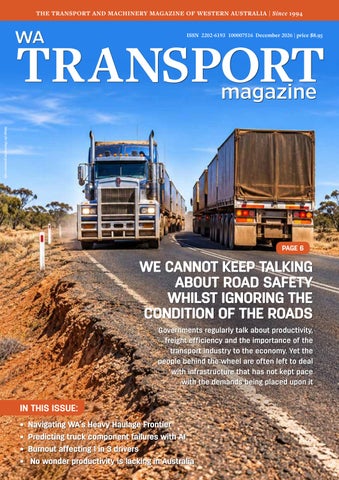
WE CANNOT KEEP TALKING ABOUT ROAD SAFETY WHILST IGNORING THE CONDITION OF THE ROADS Governments regularly talk about productivity, freight efficiency and the importance of the transport industry to the economy. Yet the people behind the wheel are often left to deal with infrastructure that has not kept pace with the demands being placed upon it
IN THIS ISSUE: • Navigating WA’s Heavy Haulage Frontier • Predicting truck component failures with AI • Burnout affecting 1 in 3 drivers • No wonder productivity is lacking in Australia
WATM • December 2026
Our Heavy Vehicle Helpdesk is available Monday to Friday. Talk to us about: Permits
Accreditation
OSOM movements
Route Assessments
Traffic Escort bookings
Compliance
The Heavy Vehicle Helpdesk is open from: 7am to 6pm Monday to Friday, and WA Public Holidays. On weekends the Main Roads Customer Information Centre will receive telephone calls on behalf of the Heavy Vehicle Helpdesk on 138 HVO (138 486) and email enquiries can be sent to hvs@mainroads.wa.gov.au
Main Roads Heavy Vehicle Services 525 Great Eastern Highway REDCLIFFE 6104
Tel: 138 486 Fax: 9475 8455 Email: hvs@mainroads.wa.gov.au www.mainroads.wa.gov.au 3 WATM • October 2021
WA
TRANSPORT
FROM THE PUBLISHER
magazine
VOLUME 32 | NUMBER 11
A
nother year has zipped by and as Cliff Graham says in his ‘This is the Outback’ column light vehicle drivers need to be more careful of their visibility and appropriate and safe indication of their intentions whilst sharing the road with so many truck’s during this year’s harvest season. The statistics don’t lie and so many drive like they are an accident waiting to happen. My condolences to the family and friends of the two truck drivers who lost their lives on Great Eastern Highway in Meckering. The images of the aftermath are haunting. There are no words for the sorrow that has been felt in the industry from this accident. As with all the industrial revolutions the world has already faced, we are living through one right now with AI. I am embracing it and have found it fantastic resource for images that better portray the stories however, as a
writer I can tell in a heartbeat when people have used it to write stories. It’s funny, I see people who have hardly strung a sentence together now popping up with epic stories and after a couple of sentences I stop reading as I know it did not come from their mouths. In this edition there is a lot of AI information that is relative to the transport industry, things that you can use it for to make your businesses and lives simpler, and hopefully more cost effective. I am going to make a prediction though, I can see that many industries are going to suffer and probably disappear into the future, but transport obviously wont be one of them. Happy Christmas to you all, and be safe. Best,
Karen
Angry Chicken Publishing Pty Ltd Telephone 0430 153 273 www.angrychicken.com.au ABN: 35 486 530 095
PUBLISHER / COMMISSIONING EDITOR Karen-Maree’ Kaye T: 0430 153 273 Email: karen@angrychicken.com.au WRITERS Karen-Maree’ Kaye, Russell McKinnon CONTRIBUTORS Jan Cooper, Cam Dumesny, Cliff Graham, Bronwyn Falconer, Lara Jensen, Carol Messenger, Ray Pratt, Kevin Toovey, Russel Walsh ADVERTISING ENQUIRIES Angry Chicken Head Office T: 0430 153 273 E: karen@angrychicken.com.au
Contents
DESIGN / PREPRESS Cally Browning | Bare Creative ACCOUNTS T: 0430 153 273 E: karen@angrychicken.com.au
3.................................. Navigating WA’s Heavy Haulage Frontier 5.................................. M ain Roads News - Christmas/New Year 2026/2027 – Curfew Reminder and looking back over the past year (Part One) espite soaring diesel prices, two thirds of freight operators are 8.................................. D
lifting tech spend to cut costs LRTA initiative delivers national training milestone for 10............................... A
livestock transport
PRINTER Daniels Printing Craftsmen SUBSCRIPTIONS Subscriptions available directly from the Publisher. T: 0430 153 273 E: karen@angrychicken.com.au Australia: 1 year $130 (inc GST)
11.................................. I mprovement in mental health, but burnout still affects one in three
Overseas subscribers: Airmail postage will be added to subscription rate.
12............................... P rocurement underway for major Anketell Road upgrades
Editorial Submissions: The Publisher welcomes editorial submissions. Once received they will become the property of the Publisher who reserves the right to edit the or adjust the content to fit with the format of our publication.
13............................... W alshy’s Perspective – No wonder productivity is lacking in Australia 15............................... Remember when - The BGC Story… in brief 17................................ W estern Australia Transport Industry Association - Ready before the roads close 18............................... F rom Route Optimisation to Autonomous Routing - What Comes Next? 20............................. E lectric Vehicle Council to lead ARENA-backed National EV Charging Roadmap afety and risk management - It's More Than a Destination 21............................... S
Why Journey Management Matters
Every Month 6.................................. Fair Go for the Owner Driver 19............................... This is the Outback 23............................. HCVC
Endorsed by
West Australian Transport Magazine (WATM) is published by Angry Chicken Publishing Pty Ltd ABN: 35 486 530 095 All rights reserved. No part of this publication may be reproduced, adapted or transmitted in any form by any process (graphic, electronic, mechanical or storage and retrieval system) or sold, resold or otherwise exploited for any purpose without consent of the Publisher. The publisher, contributors, editors and consultants disclaim any and all liability and responsibility to any person or party, be they a purchaser, reader, advertiser or consumer of this publication in regards to consequences and outcomes of anything done or omitted, or being in reliance whether partly or solely on the contents of this publication. No person, organization or party should rely on or on any way act upon any part of the contents of this magazine without first obtaining the advice of a fully qualified person. The Publisher shall have no responsibility for any action or omission by contributor, consultant, editor or related party for content within WATM. The opinions and content within WATM does not necessarily reflect those of the Publisher, editor or their agents. No responsibility is accepted for damage or loss of material supplied to the publisher.
24............................. Toots – Woman in a man’s world
WATM • December 2026 1
Focus
Navigating WA’s Heavy Haulage Frontier Engineering Precision, Heavy Transport Hydraulics, and Risk Mitigation in Remote Mining and Energy Infrastructure By WILLEM JOBSE, Sarens regional Director Oceania
W
estern Australia presents one of the most challenging logistical landscapes in the global mining and energy sectors. Spanning over two point five million square kilometres, the state relies on critical supply corridors to move multi-thousand-tonne modules, processing plants, and heavy equipment across immense distances. From the red dirt of the Pilbara to the port hubs of Dampier, Port Hedland, and Henderson, industrial operations face extreme environmental conditions, severe haulage constraints, and strict compliance environments. In this highstakes ecosystem, traditional transport methodologies are no longer sufficient, as oversized loads cannot simply be loaded onto standard trailers without extensive technical planning. Equipment failure, road downtime, or soil instability during a move can trigger operational delays costing millions of dollars per day. To overcome these geographic hurdles, heavy transport has transformed into a specialized engineering discipline, requiring an integrated approach that connects early route planning directly to the physical movement of equipment across public roads and remote mine sites.
Solving industrial logistics bottlenecks - The end-to-end engineering model This transition toward engineered transport is precisely what resolves the historic 2
WATM • December 2026
bottlenecks of industrial logistics, where disconnects between route clearance, port intake, road transport, and final installation frequently stall execution. To eliminate these operational handoff risks, Sarens utilizes an integrated engineering model that engages as early as the FrontEnd Engineering Design phase, analyzing route topology long before equipment arrives at destination ports. Transport engineers conduct comprehensive route feasibility and swept path analysis using three-dimensional design software to map clearances and structural limitations across bridges, public highways, and mine access roads. Concurrently, this early data simplifies regulatory approvals with Main Roads Western Australia, local shires, and Western Power by providing pre-verified axle weight distributions. This thorough preparation ensures that when modules land at ports via Roll-on Roll-off operations, the correct transport configuration is deployed based on the journey’s destination and route constraints. Furthermore, end-to-end integration extends into digital route modeling, enabling real-time risk assessment before a single axle rolls onto the tarmac. Advanced three-dimensional swept path software generates digital twins on the planned transport combination, identifying potential pinch points along narrow regional roads or tight turn radii within port gates. By simulating dynamic vehicle movement under varying speed and grade scenarios,
transport planners proactively identify structural modifications required along the route, such as street light removals, overhead powerline lifting, or temporary widening of unsealed road shoulders. This proactive digital verification mitigates unexpected road blockages, reduces the duration of public highway closures, and builds confidence among state authorities and municipal governance bodies long before operations commence on the ground.
Selecting the Right Equipment Conventional Trailers vs. Advanced SPMT Mechanics A critical aspect of heavy transport engineering is matching the right equipment to the specific transport leg and distance. For long-haul transit across Western Australia’s public highway network—where remote mine sites can be hundreds of kilometres inland—logistics operators rely on multi-axle conventional heavy haulage trailers pulled by heavyduty prime movers. These highway moves are governed by strict state transport regulations, height and width clearances, and payload thresholds typically capped around three hundred tonnes per module. However, for direct port-to-site moves in close coastal proximity, or once long-haul cargo arrives at the mine site boundary, execution transitions to Self-Propelled Modular Transporters (SPMTs). Serving as the muscle for specialized on-site movement and near-port logistics, an
SPMT is a computer-controlled hydraulic transport system capable of moving structural modules weighing thousands of tonnes that far exceed highway limits. Understanding this division between public road transit and localized site maneuvers is vital for project economics and risk management. Conventional platform trailers excel at higher road speeds over hundreds of kilometers, utilizing spread axle arrangements to comply with state bridge-loading formulas. Conversely, SPMTs trade road speed for unmatched structural capacity and multidirectional agility within restricted spaces. When a three-hundred-ton component arrives at the boundary of a remote mine site via conventional trailers, it is often transferred or jacked onto waiting SPMT combinations. This allows site engineers to navigate congested industrial yards, align payloads with foundation anchor bots to millimeter accuracy, and execute complex turns that conventional prime mover combinations simply cannot achieve.
Advanced SPMT Capabilities and Ground Pressure Management When moving massive processing infrastructure within site boundaries, process yards, or coastal hubs, the mechanical versatility of SPMTs becomes essential. Each SPMT axle line features independent hydraulic suspension and electronic steering capable of rotating up to one hundred and thirty-five degrees, enabling complex maneuvers such as carousel rotations, diagonal crab movements, and ninety-degree transverse positioning within narrow process bays. Dozens of hydraulic axle lines are coupled together and synchronized by Power Pack Units and Electronic Control Systems. Beyond horizontal movement, engineered site logistics frequently integrates SPMT placement with specialized jacking and skidding systems. Once a module reaches its target location, integrated high-capacity hydraulic jacks lower the payload directly onto concrete pedestals or foundation pins, eliminating the need for super-heavy mobile cranes in spacerestricted brownfield processing plants. Operating in Western Australia also demands extreme resiliency against hostile environmental conditions. The Pilbara and Goldfields regions subject heavy transport machinery to ambient temperatures exceeding forty-five degrees Celsius, pervasive iron ore dust, and seasonal tropical cyclones. Hydraulic
systems and electronic control units on heavy trailers and SPMTs must endure intense thermal stress and dust ingress without experiencing signal drift or seal degradation. Heavy logistic providers install auxiliary cooling packs on hydraulic power units and utilize sealed, heavy-duty electrical wiring looms to ensure continuous operation stability. Furthermore, engineering contingency protocols account for sudden weather shifts, ensuring that multi-thousandton payloads can be safely secured and stabilized on ground mats if extreme rain events compromise soil load-bearing capacity during transit.
heavy transport configurations feature continuous hydraulic pressure sensors embedded within the suspension circuits, providing operators with immediate feedback on load distribution across each axle group. If ground settlement occurs under one side of the trailer, the automatic hydraulic equalization system redistributes fluid across neighboring suspension cylinders to maintain a level payload and prevent structural tipping. Combined with rigorous wind-speed threshold monitoring and certified lashing calculations, these integrated civil and mechanical measures safeguard both multi-million-dollar capital equipment and the surrounding public and private infrastructure.
Ground Pressure Analysis and Infrastructure Adaptation for Mega-Projects
Driving Efficient Transport Operations into the Future
Managing how this immense weight meets the earth is crucial, as ground bearing pressure represents one of the most critical operational risks on unsealed haul roads, quaysides, and site pads. To prevent subgrade collapse, engineers run advanced calculations to configure SPMT axle lines, spreading the load over a wider footprint. Where bridge capacities or culvert limits remain restrictive, civil adaptations like temporary steel bridges, load-spreading mats, or tailored trailer axle spacings are deployed to safeguard underlying infrastructure. In remote mining areas where haul routes cross natural drainage channels or unpaved creek beds, dynamic load modeling evaluates soil compaction and moisture levels to determine if temporary civil reinforcement, such as compacted crushed aggregate or layered timber swamp mats, is required to prevent trailer sinkage under load. Safety protocols during these operations require real-time monitoring of ground behavior and vehicle stability. Modern
Connecting rigorous front-end route planning, highway logistics, advanced SPMT capabilities, specialized installation engineering, and ground safety protocols is what enables Western Australia to maintain its pace as a global leader in resource and energy capital projects. As project modules grow larger and delivery schedules tighten, the heavy haulage sector can no longer treat transport as an isolated post-fabrication task. The integration of cleaner, tier-four power pack units and optimized route planning also supports resource companies in reducing the total carbon footprint of major logistics campaigns, aligning heavy industry operations with broader environmental targets. By viewing every phase—from initial CAD route mapping and long-distance road transport to final hydraulic positioning on site — as a single continuous engineering process, logistics providers like Sarens deliver total project certainty, keeping Australia’s most vital resource developments moving safely and predictably forward.
WATM • December 2026
3
Main Roads News
Main Roads HVS – a look back at 2026 and what’s on the horizon in 2027 2026 Supply Chains / Fuel Security
F
ollowing industry feedback at the Premier’s Round Table on Fuel Security in March 2026, which included requests from industry for practical measures to strengthen supply chains during the fuel supply pressures, the WA Government introduced two key freight productivity initiatives that are helping to keep Western Australia's supply chains moving and supporting regional industries. The first of the initiatives was the increased mass allowance for 27.5 m and 36.5 m road trains carrying petrol, diesel, fertiliser, lime, lime sand, milk and bulk perishable goods to WA regions, which allows Restricted Access Vehicles (RAVs) to operate on their respective Approved Networks up to Accredited Mass Management Scheme (AMMS) Level 3 Mass Limits. For more information, refer to Main Roads HVS Update at www.mainroads.wa.gov.au/heavyvehicles/updates/hvs-updates/6-2026v3/ The second of the initiatives was the trial to allow 53.5 m road trains between Muchea and Wubin under the Bindoon Hill Special Assistance Permit. Under the trial permit, eligible 53.5 metre road trains, up to AMMS Level 3 Mass Limits, can operate on Great Northern Highway between Wubin and Muchea with strict safety requirements for drivers and vehicles. For more information, refer to the Specific Access Permits at www.mainroads.wa.gov.au/heavyvehicles/permit-order-scheme/specific-access-permits/ These temporary measures form part of a broader whole of government effort to maintain resilience of the State's essential supply chains.
Inclusion of Tri Drive Combinations into the Prime Mover Combinations Operating Conditions and the Truck Combinations Operating Conditions
In March, we were pleased to advise industry that the Tri Drive Combinations had been included under the Prime Mover Combinations Operating Conditions and the Truck Combinations Operating Conditions. This means that operators of Tri Drive Combinations are covered by the Class 2 & 3 Orders if operating an approved vehicle combination within statutory mass limits. You can find the following at www.mainroads.wa.gov.au/heavyvehicles/permit-order-scheme/orders/ • Updated Prime Mover Combinations and Truck Combinations Operating Conditions • Tri Drive Prime Mover Trailer Combinations - RAV Categories • Tri Drive Truck Trailer Combinations - RAV Categories • Approved Tri Drive Networks We made this change as part of our ongoing efforts to provide improved efficiency by removing the need for operators to apply for Tri Drive Period Permits. 4
WATM • December 2026
Improvements to the Concessional Livestock Period Permits
In June, we advised industry of the introduction of the Concessional Livestock Period Permit Operating Conditions and other improvements to align this permit with our other permit products. These improvements included: • A single permit being available to cover all approved vehicle configurations, available for 6 months, 1 year or 3 years. • Clear and consistent operating conditions being available on our website. • The development and publication of Concessional Livestock Networks on the RAV Mapping Tool. • The inclusion of additional approved vehicle configurations. For more information, refer to www.mainroads.wa.gov.au/heavyvehicles/permit-order-scheme/concessional-livestock/ We made this change as part of our ongoing efforts to provide consistent products and improved services to our customers.
Updated Mass and Dimension Limits
Main Roads WA implemented changes to align with the revised National mass and dimension limits, which came into effect on 1 August. These changes included: • Increasing the general mass limits from 16.5 t on a tandem axle group and 20 t on a tri axle group, to 17 t on a tandem axle group and 21.5 t on a tri axle group, without the need for Mass Management Accreditation. • Allowing 7.0 t on a single steer axle with ≥315 mm tyres and 11.5 t on a twin steer axle group with ≥275 mm tyres. • Increasing the general length limits for certain vehicle combinations from 19 m to 20 m, including increased rear overhang limits and S-dimension limits, subject to specified requirements. • Increasing the tow mass ratio for a rigid truck and tag trailer combination from 1:1 to 1:1.3, subject to minimum steer axle mass requirements. As a result, prior to 1 August, all relevant Main Roads WA Order and Permit operating conditions were amended to incorporate these changes. Refer to the applicable operating conditions on our website for full details of the requirements.
Road Transport Compliance
In 2026, we grew our Compliance Unit by onboarding additional Transport Inspectors, providing greater capacity for patrols and increased coverage across regional WA and Local Government areas. This increased presence supports our ongoing focus on safer roads for all road users. We also increased joint agency operations across the State, strengthening collaboration with our enforcement partners and supporting consistent and effective compliance outcomes. Together, these initiatives are helping to drive compliance forward and contribute to safer roads across WA. Continued in the January/February edition.
Main Roads News
Christmas/New Year 2026/2027 HVS office hours
M
Christmas/New Year 2026/2027 - Curfew Reminder
A
s we head towards the end of the year, it’s timely to remind industry of the upcoming Christmas and New Year curfew periods. The Christmas and New Year curfews are published at www. mainroads.wa.gov.au/globalassets/heavy-vehicles/permits-ordersschemes/osom/single-trip-osom-vehicle-standard-operating-conditions. pdf and www.mainroads.wa.gov.au/globalassets/heavy-vehicles/ permits-orders-schemes/osom/class-1-rav-oversize-period-permitoperating-conditions.pdf The curfews are as follows: 1) RAVs exceeding 2.7 metres in width and/or 30 metres in length must not travel on Forrest Highway and Lakelands Lake Clifton Road (this includes the Mandurah and Dawesville Bypasses), between the intersections of Pinjarra Road and Peppermint Grove Road, during the period from sunset on 18 December until sunrise on 4 January. 2) RAVs exceeding 4.5 metres in width and/or 30 metres in length must not travel on any of the following roads during the periods from sunset on 23 December until sunrise on 27 December, and from sunset on 30 December until sunrise on 4 January: (a) Albany Highway (Bedfordale Road Train Assembly Area, to Albany); (b) Brand Highway; (c) Eyre Highway; (d) Great Eastern Highway; (e) South Western Highway (Armadale to Bunbury); (f ) Great Northern Highway (Roe Highway to Mt Magnet). 3) RAVs exceeding 5.5 metres in width and/or 40 metres in length, must not travel on any road in Western Australia during the period from sunset on 18 December until sunrise on 4 January. Operators are to ensure they plan their movements with sufficient time margins to accommodate any unforeseen delays, as Traffic Escort Services will not allow Oversize vehicles to proceed beyond this curfew time.
ain Roads Heavy Vehicle Services (HVS) advises that on Friday 11 December 2026, the HVS public counter will be closed from 12pm. The Customer Information Centre will receive telephone calls on behalf of the Heavy Vehicle Helpdesk on 138 HVO (138 486) and email enquiries can be sent to hvs@mainroads.wa.gov.au During the Christmas/New Year period, HVS will be operating in accordance with the following times: • Friday 18 December – Thursday 24 December o 7am – 5pm (reception counter open 8:30am – 4:30pm weekdays) • Friday 25 December – Monday 28 December o Closed • Tuesday 29 December – Thursday 31 December o 7am – 5pm (reception counter open 8:30am – 4:30pm) • Friday 1 January 2027 o Closed • Saturday 2 January 2027 onwards o Normal service resumes The Accreditation and Pilot Licensing team seek your assistance by requesting you submit Audits and Pilot Licence matters prior to Friday 11 December 2026 to ensure processing before the Christmas break. For further information, please contact our Heavy Vehicle Help Desk on 138 486 or email hvs@mainroads.wa.gov.au
24 HR / 7 DAY ACCESS 3 MINUTE EXPRESS WASH
• Road train friendly • Full chassi rinse standard • Credit card facility • Fleet accounts available
QUICK DRIVE THRU FULLY AUTOMATED TRUCK WASH www.twepicton.com.au Roadtrain / truck & dog $150 inc gst Semi $125 inc gst 6 Wheel Trucks / Bus $95 inc gst 2 Nicholson Road, East Picton T: Darren 0417 909 128 | E: info@twepicton.com.au
WATM • December 2026
5
Over to you A FAIR GO FOR OWNER DRIVERS by Ray Pratt
We cannot keep talking about road safety whilst ignoring the condition of the roads Image for illustration purposes only
T
here is something seriously wrong with the way we manage Western Australia’s road network when bigger and longer road trains are approved whilst some of our major freight routes are barely suitable for the trucks already using them. Anyone who travels the highway between Pithara and Dalwallinu knows exactly what I am talking about. The condition of this stretch of road is deplorable. It is rough, badly undulating, extremely bumpy in sections and has shoulders that leave a lot to be desired. This is not a forgotten country back road carrying the occasional farm truck - It is an important freight route, carrying hundreds of heavy vehicles, every day. The standard road trains using this route can be up to 36.5 metres long. Now, with the increasing use of larger combinations, road trains of up to 53 metres are also permitted to travel along it. Think about that for a moment. We are talking about a prime mover pulling three trailers weighing well over 100 tons, stretching more than half the length of a football field, travelling along a road that is already struggling to cope with the existing traffic. Whoever okayed this must be stark raving mad. The transport industry has always been expected to improve productivity and this makes economic sense. Bigger payloads, longer combinations and more efficient freight movements are all part of keeping transport costs under control.
6
WATM • December 2026
But there is a fundamental requirement that seems to be overlooked. The road infrastructure must be capable of handling the vehicles we allow to use it. A 53-metre road train is an impressive piece of equipment in the hands of a competent professional driver. But it also demands a road that provides adequate width, sound pavement, safe shoulders and sufficient room to negotiate other traffic. When the road surface is uneven and constantly throwing a heavy vehicle around, it creates unnecessary risks. Drivers are forced to concentrate on potholes, bumps, broken edges and changing road conditions while simultaneously managing enormous combinations of trailers. When two heavy vehicles meet, particularly on narrower sections, drivers need confidence that they can safely move towards the edge of the road without encountering a crumbling shoulder or a sudden drop-off. And what about the other motorists – don’t they deserve a safe road especially if they are sharing it with combinations weighing many tonnes and stretching up to 53 metres? Also spare a thought for the oversize loads that also have to navigate this road. Many of these loads are 8 metres wide and weighing much more than the road was designed for. Governments regularly talk about productivity, freight efficiency and the importance of the transport industry to the economy. Yet the people behind the wheel
are often left to deal with infrastructure that has not kept pace with the demands being placed upon it. The trucking industry is expected to maintain high safety standards and rightly so. But surely governments and road authorities must accept responsibility for providing infrastructure that allows those standards to be maintained. The Pithara to Dalwallinu highway is a prime example of the growing gap between the size of the freight task and the standard of the infrastructure supporting it. We should not have to wait for a serious accident, a rollover or a fatality before someone decides that this stretch of road deserves attention. Nor should the solution be another round of signs, speed restrictions or warnings telling drivers to take care. Drivers already know they need to take care. What they need is a road that is fit for purpose. Perhaps it is time for those making the decisions to get out of their offices, travel this section of highway and experience it for themselves. Better still, spend a few hours in a loaded road train and see what it is like. If the authorities want bigger trucks carrying more freight, then they must provide safe, practical infrastructure that matches the job we are expected to do before the consequences are measured in lives rather than dollars. Keep it safe, Ray Pratt.
Victoria
Queensland
Western Australia
Tel - (03) 9369 0000
Tel - (07) 3372 2223
Tel - (08) 9350 6470
13-21 Bliss Court, Derrimut VIC, 3026
1/15 Seeana Place, Heathwood QLD, 4110
5 Freight Road, Kenwick WA, 6107
WATM • December 2026 7
News
Despite soaring diesel prices, two thirds of freight operators are lifting tech spend to cut costs
D
espite high fuel costs and business failures across the sector, 68% of freight and logistics operators in New Zealand and Australia expect to spend more on technology in the next 12 months, up from 52% in 2025. Cost reduction and efficiency are the leading reasons, cited by 77%, according to the Origin Logistics Technology Outlook 2026. Preparing systems for AI and automation is also driving investment. Some 41% cite this as a reason to spend, while the share running AI in production has almost doubled, from 15% to 28%. Alan Dowsett, Head of Origin, says AI is changing technology delivery, with integration, prototyping and development becoming faster and less costly. The survey closed on 4 September, after six months of volatile diesel prices. ASIC data shows insolvency appointments in Australian transport, postal and warehousing more than doubled between FY22 and FY24.
Technology spending is up, but proof of return is missing
Fewer than half of operators (48%) measure the return on technology investment. Although 61% say they have full or most visibility across their business, only 26% can see every job, its status and cost in one live view. “Most operators already own the data. It's locked in systems that don't talk to each other, and replacing one often just moves the problem,” Dowsett said. When job status and costs sit in separate systems, extras such as waiting time, demurrage and variations can go unbilled. Customer service teams also spend time answering “where's my freight?” because information is spread across screens. Joining the data helps operators bill for work completed, give customers visibility and reduce time spent chasing information. Operators with a single live view are nearly three times as likely to give 8
WATM • December 2026
customers full or most visibility of their operation (56%, compared with 20%).
Replacing systems to enable AI adoption is a priority
Close to six in ten operators (58%) expect to upgrade or replace three or more systems in the next 12 months. The transport management system (TMS) is most often on the list (51%). While 41% cite enabling AI or automation as an investment driver, 26% say a current system cannot support it. Only 12% said their last significant implementation was delivered on time, on budget and as expected. Dowsett said the TMS is the system of record for every transport job, making it central to whether automation and AI work. Upgrading it for growth and AI makes sense, provided it connects with surrounding systems.
AI is set to automate manual tasks Operators are most willing to let AI make decisions on document classification (51%) and route or load planning (40%) without human checks. Most (82%) want AI to reduce manual work, while 18% cite reducing headcount or costs. “Operators want planners and admin people doing more valuable work: looking after customers and handling exceptions that need a person,” Dowsett said. AI route and load planning can reduce planning time and fuel use, while document classification cuts hours of data entry, offering early, measurable returns.
AI adoption is outpacing strategic planning
Nine in ten operators have staff using general AI tools day to day, and production use has almost doubled to 28%. Yet only one in five has a documented AI strategy, and just 7% can show a clear, measured return. Dowsett said AI is changing how IT gets done: integrations that once took months can now take weeks, new functions can be
ASIC data shows insolvency appointments in Australian transport, postal and warehousing more than doubled between FY22 and FY24.
added to legacy systems without rebuilding them, and prototypes can be developed in days. Operators who measure technology spend are four times more likely to have AI in production.
Integration, not budget, sets leaders apart
Four in ten operators are satisfied with their pace of change. They are no more likely than others to be increasing spend (66%, against 70%). The difference is integration: two thirds rate their systems as well integrated, compared with 18% of other operators. They are also more likely to measure returns (59%, against 40%) and bring technology to customers before being asked (79%, against 52%). “The operators pulling ahead aren't necessarily outspending anyone,” Dowsett said. “They're joining things up and taking what they build to customers before being asked.” He said operators should make existing investment pay off by connecting systems and creating one view of the operation. The full report, including year-on-year comparisons and complete survey results, is free at www.originsupplychain.com/ outlook2026
BUILT FOR WA’S TOUGHEST CONDITIONS Looking for a competitively priced commercial battery without compromising on quality or reliability? Product Data Sheets Available for All Models
S8D-1500SMF (N200 Case Size) Leading the range, the S8D-1500SMF delivers an impressive 1500 Cold Cranking Amps (CCA) and 200Ah capacity, making it ideal for high-demand commercial applications. Featuring thicker expanded grid plates, it is engineered to provide exceptional durability, reliability and extended service life in some of Australia's toughest working conditions. S4D-1400MF / S4D-1400RMF (N150 Case Size) These premium maintenance-free heavy-duty batteries provide 1400 Cold Cranking Amps (CCA) and are designed to meet or exceed original equipment specifications. Built for dependable performance and long-term reliability, they are ideally suited to demanding fleet and commercial operations. ACDelco Commercial Batteries, backed by General Motors, deliver the performance, reliability and value demanded by Western Australia's harsh operating conditions. Now available from Battery Mart's Belmont and Geraldton locations, this new range has been designed specifically for demanding commercial, transport, agricultural and mining applications.
S105D31LHD / S105D31RHD (N70ZZ Case Size) A popular 300mm case size widely used throughout the transport and mining industries. Delivering 780 Cold Cranking Amps (CCA), these batteries offer the same proven engineering, durability and reliability credentials found across the larger commercial range.
Key Features & Benefits ✔ Anchor Bonding Technology for superior vibration resistance ✔ Enhanced grid design for greater durability and longer service life ✔ Heavy-duty construction for demanding commercial applications ✔ Maintenance-free convenience
Battery Mart - Belmont Head Office
✔ Proven resilience in harsh Australian environments
Gus Simonetta Unit 1/112 Belgravia Street, Belmont ✆ 08 6223 0880
✔ Reliable performance under heavy electrical loads
Battery Mart - Geraldton Branch
✔ Fewer interruptions and greater operational confidence
Andrew Halton 100 Flores Road, Geraldton ✆ 08 9964 8404
✔ Competitive pricing backed by a globally recognised automotive manufacturer
BATTERY MART - Powering Western Australia's Commercial Industry • batterymartwa.com.au •
WATM • December 2026 9
News
AI could help predict truck component failures
P
ACCAR is exploring how AI could help operators identify component failures before they happen, potentially reducing breakdowns and vehicle downtime. At TMC 26, Bill Rakis, Assistant Chief Engineer – Electrical, Air and Embedded Systems at PACCAR and Ben Chamberlain, OEM Key Account Manager at Directed Technologies outlined an early-stage proof of concept using telematics data from PACCAR Connect. The project focused on battery failures, combining truck sensor data with warranty service and repair records to train an AI model to recognise patterns associated with imminent failure.
“This is an exciting and fascinating concept. Imagine being able to receive advance notice that a component is
showing signs of failure – giving you the chance to reach out to your customer proactively, get them booked in ahead of time, and potentially avoid a breakdown altogether. That's the direction we're working toward,” Bill said. They emphasised that further testing and validation were needed and that the technology was still a year or two away from being scaled up. The team also spoke about how PACCAR Connect can improve safety, productivity and uptime by extracting strategic information from vehicles, and combining it with live camera footage and reporting, effectively ‘letting the truck talk to you.’
ALRTA initiative delivers national training milestone for livestock transport
T
he Australian Livestock and Rural Transporters Association (ALRTA) has welcomed endorsement of the new national Livestock Transport Driver Skill Set, marking an important step in strengthening industry professionalism, supporting animal welfare and attracting the next generation of drivers. ALRTA initiated the project with Industry Skills Australia (ISA), bringing industry experience into the development of nationally recognised training. Skills Ministers endorsed the Skill Set on 12 October 2026. ALRTA President Gerard Johnson said the outcome recognised the specialist capabilities required to transport livestock safely and responsibly. “Livestock transport demands skilled drivers, capable stock handlers and sound judgement. Our people make decisions every day that affect animal welfare, road safety and the reliability of Australia’s food supply,” Mr Johnson said. “This is a significant step in the professionalisation of our industry. It gives employers and drivers a clearer training benchmark and helps give the skills of livestock transporters the recognition they deserve.” The Livestock Transport Driver Skill Set brings together competencies in livestock handling, care during transit, safe heavy
10
WATM • December 2026
Resilience means having the people and capability to keep food supply chains moving through disruption and changing conditions vehicle driving behaviours and workplace safety. It includes strengthened coverage of animal welfare and biosecurity obligations. Mr Johnson said investing in driver capability was also an investment in national food security. “Australia’s food security depends on being able to move livestock safely and reliably between farms, saleyards, feedlots and processors. Skilled livestock transporters are essential to keeping that system working. “Resilience means having the people and capability to keep food supply chains moving through disruption and changing conditions. Building our workforce is central to that task.” Mr Johnson said a clearer training pathway could also help attract and retain drivers. “We need people to see livestock transport as a skilled career with a future.
A recognised pathway can help new entrants understand what the job requires, give employers greater confidence in developing their people and support experienced drivers to have their capabilities recognised. “For animal welfare, the value lies in practical capability: understanding livestock, recognising risks and making sound decisions throughout the journey.” Mr Johnson congratulated ISA, the Technical Committee, participating training organisations and industry contributors, and acknowledged the contribution of Anthony Boyle, Athol Carter, Lauren Hamilton, Alina Hawkins and Benno Sutherland. “ALRTA helped get this initiative underway, but reaching this point has been a collective effort,” he said. “Our members and industry representatives contributed their time, experience and practical knowledge to help make the training relevant to the work. We thank everyone who helped turn an identified industry need into this important outcome. “The next priority is making the training accessible and useful for operators, including those in regional and remote Australia. Endorsement is an important milestone; the lasting benefit will come from putting it into practice.”
News
Improvement in mental health, but burnout still affects one in three
T
ransport and logistics workers now rate mental health on par with the national average, a big shift for an industry that has long ranked last. But nearly one in three report symptoms of burnout, according to new research from Healthy Heads in Trucks & Sheds and Superfriend. The 2026 Thriving Workplace Index surveyed Australian’s working in the transport and logistics sectors and found that 32% report burnout, above the transport industry average (27%) and the national average (30%), yet they lose fewer days to poor mental health than other workers (2.0 a month, compared with 2.8 nationally). Linehaul drivers recorded the lowest wellbeing score of any role, with 38% reporting burnout. Connection at work was also the one area where the workforce fell below both industry and national benchmarks. Healthy Heads in Trucks & Sheds CEO Naomi Frauenfelder said, “One person told us the industry is still operating with old ‘toughen up, she’ll be right’ attitudes. That’s
changing, but too many drivers still keep it to themselves rather than putting their hand up for support.”
An industry closing the gap Transport, postal and warehousing has long ranked last of 19 industries for workplace mental health. But those surveyed through Healthy Heads scored 68 out of 100 on the Thriving Score, ahead of the transport industry (65) and level with the national average, with strong results for safety from
employers can make a difference through regular check-ins with their teams, particularly those who work alone, and encouraging leaders to talk openly about mental health.
Support making a difference Those in the industry who know about Healthy Heads scored eight points higher on the Thriving Score (71 compared with 63) and reported less burnout. Among those who know its resources, 60% show
Linehaul drivers recorded the lowest wellbeing score of any role, with 38% reporting burnout bullying, harassment and violence, and for how work is designed. The results show encouraging progress for a sector that has historically sat towards the lower end of national workplace mental health benchmarks. Burnout remains the next challenge, and
no signs of psychological distress, almost double the rate (32%) of those who don’t. “These results show that people who know where to find support report better wellbeing,” Frauenfelder said. To get free support visit www.healthyheads. org.au
HARD WORK TAKES YOU PLACES. SO SHOULD YOUR SUPER. YOU’VE EARNED IT Join the specialist fund for transport, energy, and mining. teamsuper.com/join Talk to us about super, pension, insurance and financial advice. 13 64 63 | teamsuper.com Issued by Team Super Pty Ltd ABN 70 003 566 989 AFS licence 246864 trustee for the Team Superannuation Fund ABN 16 457 520 308. Refer to the PDS and TMDs on our website at teamsuper.com when considering if our financial products are right for you. Financial planning services are provided by Team Super Financial Advice a trading name of Team Super Services Pty Ltd ABN 49 051 315 014 AFS licence 502700. Past investment performance isn’t necessarily an indication of future performance. Zenith CW Pty Ltd ABN 20 639 121 403 AFSL 226872/AFS Rep No. 1280401 Chant West Awards issued May 2026 are solely statements of opinion and not a recommendation in relation to making any investment decisions. Awards are current for 12 months and subject to change at any time. Awards for previous years are for historical purposes only. Full details on Chant West Awards at chantwest.com.au/fund-awards/about-the-awards Past performance isn’t necessarily an indication of future performance.
WATM • December 2026 11
Over to you
Walshy's PERSPECTIVE No wonder productivity is lacking in Australia
I
n the last edition, I briefly touched on how USA is pulling back on regulation, compliance and OH&S. The turning point was the Trump administrations executive order 14192 “Unleashing prosperity through deregulation”. I also touched on how driver facing cameras are now being viewed as an invasion of privacy in Canada. Meanwhile, Australia is ramping up these very things that are slowly killing and driving people ‘out’ of the road transport industry. Now let’s look at Mining. To me, they are a different breed who I believe are creating and turning out dangerous workers. The type of people who cannot operate without a procedure and cannot do a job without a Safe work instruction (SWI). In other words, they lack common sense and cannot figure out a safe way to perform a task on their own. If there is no SWI then a Job Hazard Analysis (JHA) must be done to include all persons involved in the task. Permits must be obtained, Verification Of Competencies (VOC) must be checked and so the list of
News 12
Procurement underway for major Anketell Road upgrades
WATM • December 2026
box ticking goes on. In the meantime, the job could have been completed ten times over. The inefficiencies in these systems are alarming and it’s no wonder Australia cannot compete in the world when many countries
M
ajor upgrades to Anketell Road are moving forward, with expressions of interest now open for contractors to help deliver a safer, more efficient freight corridor between Leath Road and Abercrombie Road in Perth's south. Jointly funded by the Federal and State Governments, the first stage of upgrades will include expanding Anketell Road to a dual carriageway between Abercrombie Road and Rockingham Road, and delivering a new grade separated interchange at Rockingham Road. The project will also include significant upgrades to Rockingham Road and Beard Street, modifications to existing roads and accesses, delivery of new shared paths and will allow for a future freight rail corridor to
have none or very little of this crap. Now my pet hate - Inductions. These are next level out of control in Australia. The amount of people involved in designing and presenting these ridiculous mind numbing courses is huge and it has become
connect to a new on dock rail terminal. These upgrades will shift heavy vehicle traffic away from residential areas to reduce congestion, improve safety, and decrease travel times on local roads. The Anketell Road upgrades will drive economic development across WA's premier strategic industrial area, the Western Trade Coast, to support the State's economic diversification and long-term job creation. It will also support the operation of the future Westport container terminal, the Kwinana Bulk Terminal redevelopment, and the future Defence precinct in Henderson. The expressions of interest process will identify experienced proponents to progress to the next stage of procurement for the project, with an alliance contract
an industry in itself. But what do they produce? Nothing, all they do is swallow up valuable people and resources. Implementing and managing OH&S, compliance, inductions and VOCs would gobble up a fair percentage of many business’s staff and people. It is a cost that 30 years ago we never had. And guess what - 30 years ago Australia was competitive in the world market and we had plenty of workers. Are you starting see a picture here? Now back to inductions. As a Truck driver I go onto many different sites throughout WA and every site I go to wants me to do an induction. Now bear in mind. I’m only entering the site to deliver or pick up a machine. To do this at every site I must sit through full inductions learning crap like, lock out procedures, the different types of fire extinguishers and how to use them, where the emergency safety muster points are in and around the production plant, electrical tag out procedures, lock boxes, and who is authorised to perform a lock out task or who can remove a personal lock. Oh, and while I’m at it, a licence or a ticket holds no weight with these clowns. They not only want a license or a ticket but you also must do a VOC. I’m not kidding you - this lunacy is real. The reality of the matter is that I’m not going anywhere near the production plant and anything to do with that is totally irrelevant to me. In fact, I would say about 90% of what they try to put into my head goes straight out the other side because it is totally irrelevant. Furthermore, I heard the same time wasting rubbish at the last induction… yesterday, and the day before
expected to be awarded by late 2027. Federal Infrastructure, Transport, Regional Development and Local Government Minister Catherine King said, “The Federal Government is pleased to be partnering with the WA State Government to deliver the Anketell Road upgrade. “Delivering a wider and safer Anketell Road is a huge investment in future supply chains for Western Australia. “Providing this safe corridor will mean more efficient freight movements, reduced travel times and lower costs for businesses and consumers.” WA Transport and Major Infrastructure Minister Rita Saffioti said, “ºWe’re getting on with upgrading Anketell Road and Rockingham Road to reduce congestion
The induction was totally useless to us but some training on what our task was and where to go would have been far more valuable that. They have just spun it a different way. Its just as well inductions are part of your job these days as a driver so you get paid to do them or one simply would not put up with this stupidity. Training however is a different story. I’m all for training and I don’t think there is enough of it to be honest. If people are green or new then they need to be taught or shown the correct ways to do a job or task. However, trying to teach on old fella like me to drive a truck is like trying to teach grandpa how to piddle. Let me explain the difference between inductions and training or being shown how to do the task asked of you. I’ll do it in a story. I was sent to a gold mine some years ago to do a day of onsite inductions. We learnt all the usual induction rubbish, had cups of coffee, biscuits, lunch and we came out a full bottle on fire extinguishers, lockouts, muster points, tagging out and reporting to your supervisor. We drove back to our camp and the boss said, “Righto, so you know where to go with the Quad when you get on site to load the tailings and how to get out. Are you ready to go up in the morning?” “Ummm, nah, we have no idea where to
go,” was our reply. “So, what did you do all day?” “We learnt how to use a fire extinguisher and the lock out processes and know where all the muster points are around the production plant.” The induction was totally useless to us but some training on what our task was and where to go would have been far more valuable. This is how it played out and it shows the incompetence of these mining companies and how they waste everyone’s time. They clearly make far too much money if they can afford these types of goings on and don’t get me started on wheel chocks for Road trains. This leads me onto the Dangerous Goods course. Why does a fuel carter need to sit through a two day course covering every possible dangerous good in the book and how to package and freight it by road, rail, sea or air? All we need to know is the job we are performing. Carting fuel in road tankers from point A to point B. It could be covered in half a day at considerably less cost and inconvenience. When will Australia wake up and grasp reality? No wonder productivity is lacking in in our country.
By widening the corridor between Leath Road and Abercrombie Road, we will be directly building a freight link which backs our local truckies and improves access to the Kwinana industrial area
Trade Coast, as well as the future Westport container terminal. “These road upgrades will improve safety and help reduce congestion for surrounding communities as these major economic infrastructure projects ramp up, while supporting local businesses and generating quality jobs for Western Australians.” Federal Member for Brand Madeleine King said, “By widening the corridor between Leath Road and Abercrombie Road, we will be directly building a freight link which backs our local truckies and improves access to the Kwinana industrial area. “Advancing these works mean we will soon see fewer heavy trucks cutting through local neighbourhoods, instead using a dedicated freight corridor.”
and take trucks off local roads. “This project will play a crucial role in driving Western Australia’s economic growth by strengthening access to the Kwinana Industrial Area and wider Western
WATM • December 2026 13
History
ER
IN G
TIM
T WES
ES
Remember When ... N
AU K STR UC R T A L I AN
The BCG story ... in brief
By ROD SIMMONDS
F
ounded in 1959 by architect Len Buckeridge, BCG started out as a property development and building company focused on residential home construction in Perth. Their aim was to make home ownership an affordable reality for people in WA, but Len soon saw the opportunity for the company to do more and the BGC growth was strong over many decades Driven by Len’s vision, they developed multiple businesses to manufacture their own construction materials and building products. Having an integrated supply and business sense saw them acquire many strategic quarries to feed the building product businesses. Over the many years, the company grew
14
WATM • December 2026
quickly, and were synonymous in WA with the brand becoming a household name. They were WA’s only vertically integrated construction company. In 2018, following the passing of Len in 2014, it was announced that BGC would be sold. Since then, there has been a steady sale of separate business assets, leaving Midland Brick and BGC Housing Group as the remaining business. During the 1990s-2000s the BGC logo was seen on all sorts of trucks, all day and every day around greater Perth and beyond. Multi Combinations and maximum weight truck and dog trailers did the ‘heavy work’ carting from various Quarries or Pits as usually called to other plants for further processing (i.e. clay for
bricks, aggregate for ready-mix etc.), Pneumatic Cement Tankers, and a whole supporting fleet to cater for all the ultimate end user deliveries, hiab’s, agitators, timber, blocks, and pretty much everything else that was needed to build a house, apartment or even a football stadium. The mix of trucks were equally interesting with many different Freightliners, Iveco’s, Mack’s, Volvo’s providing the back bone of the huge fleet. All resplendent in bright white the logo and BGC branding stood out. Plenty of wags used to say BGC meant Bloody Good XXXX and with that became another WA success. www.bgc.com.au/our-history/
WATM • December 2026 15
Over to you WESTERN AUSTRALIA TRANSPORT INDUSTRY ASSOCIATION By Natalie Grinceri
Ready before the roads close
F
loods, fires, rail outages and accidents can cut a freight route without warning. Western Australia Transport Industry Association (WATIA) brought industry, regulators and emergency services together to plan for disruption before it hits. Anyone who moves freight East–West or across the north knows how quickly things can change. A flooded road, a rail outage, a bushfire or a serious crash can cut access in an instant, and from that moment, the phones don't stop ringing. This year, WATIA didn't wait for that moment. In October we brought together operators, regulators and emergency services from Western Australia, South Australia and the Northern Territory for a pre-season briefing, so those conversations could happen before the roads or rails close, not after. “When a route closes, operators need to know what's happening, where to find reliable information and how to keep their drivers safe. This briefing gets those conversations happening before the disruption, so businesses can prepare and
16
WATM • December 2026
we can better support the communities that depend on freight,” WATIA CEO Cam Dumesny says.
A big wet on the way There's plenty to plan for. The Bureau of Meteorology's six-month outlook points to above-average rainfall, following a winter that already soaked the Goldfields and Great Central region. That outlook doesn't factor in cyclones, and it's ex-tropical systems that tend to drop the water that closes roads and rail. Further north, a hot summer with unusually high temperatures is expected. The Northern Territory is primed for flooding, though it’s thought the monsoon may arrive late this season.
When one link breaks A closure on one part of the network quickly ripples through the rest. If the East– West rail line goes down, road can't simply pick up the slack. There just isn't the capacity. Good information matters as much as trucks. The South Australian Freight
Council's Jonathan Wilson warned operators not to rely on the media during an outage, as outlets tend to hit the panic button and ask only one question - how long? State road authorities and emergency services portals are far more reliable. Fuel is another pressure point. The Federal Energy Security Taskforce says global markets remain volatile, driven by events around Saudi Arabia, Oman and the Strait. Supply is holding up and Australia's fuel storage has increased, but prices remain high.
Safety comes first The National Heavy Vehicle Regulator's Paul Simionato said keeping the East–West corridor productive is a priority, including allowing larger vehicles between WA and SA. But safety comes first, and fatigue remains a major concern. Operators can expect plenty of inspections this season, some with Australian Border Force, and a taskforce is investigating sham contracting. Inexperienced drivers on the East–West route are a real worry; last season there
were six truck deaths during the summer season, with inexperience and unnecessary risks a factor. In an emergency, Paul's advice is to slow down and take care.
Eyes on the road Drivers are often first to spot trouble. H5 bird flu first hit Western Australia last year and has since spread across southern Australia, though it isn't expected to affect cattle. Lorraine Corowa from the NT Department of Agriculture and Fisheries asked drivers to report any mass bird deaths via birdflu.gov.au Large herds of camels on remote routes should be reported too. Cam added a few more requests report price gouging during emergencies, give an accurate location when reporting an accident, and at a dangerous goods incident, report the placard so emergency services know what they're dealing with. Keeping communities supplied For remote communities, freight is a lifeline. As Jed Graetz and Greg Turner from the NT Department of Infrastructure, Planning and Logistics put it, no road freight means no food. NT roads are still recovering from last year's heavy rain, so
the challenge is keeping trucks moving while protecting the roads themselves. When roads fail, there are other options. WA Police Emergency Operations Officer Gareth Cornish explained that the 2022/23 Kimberley floods, the largest in recent history, led to a Severe Weather Plan. With loading facilities at Broome and Derby, two to three barges a day can carry food, emergency supplies and equipment such as generators across the region.
Ready to wait it out Even with good planning, drivers can end up stranded. Louise Bilato noted that drivers generally carry two to three days of supplies, so operators need to think about what support they'll need if they're held up longer. “Our message to every driver is simple - carry at least two days' food, water and your prescription medicines. If you're stranded, you need to be self-sufficient until help can reach you,” Dumesny says. The wet is coming. Plan ahead, talk to your clients and make sure your drivers are ready for whatever the season brings.
Operators can expect plenty of inspections this season, some with Australian Border Force, and a taskforce is investigating sham contracting
WATM • December 2026 17
Focus AI can detect disruptions, assess implications and suggest alternatives in time to act. Staying close to operational reality makes routes, ETAs and service commitments more reliable.
Close the loop and learn from execution Completed routes reveal stop and travel times, driver familiarity and customer conditions. Using this information — not simply recording it — supports continuous improvement. Systems that identify gaps between plans and execution, determine likely causes and feed learning back into planning make each cycle better reflect operating conditions.
Build autonomy on trust and control
From Route Optimisation to Autonomous Routing - What Comes Next? By GEORGE NINIKAS | ORTEC - Senior Vice President of Sales and Accounts, Supply Chain Planning, Americas
A
utonomous routing is not putting AI in charge of planning. It connects data, optimisation and execution so plans respond to real conditions. The next evolution automates work before and after optimisation; capturing business knowledge, responding to change and learning from execution. Planners spend time preparing data, adjusting plans and handling exceptions. Greater autonomy reduces this work, allowing them to focus on decisions requiring experience and judgment. Automatic route adjustments alone are not autonomy; systems must learn, adapt and incorporate planner knowledge. Autonomous routing therefore connects planning, execution and continuous improvement. The market is moving this way. Gartner estimated that 60% of enterprises using supply chain management software will adopt agentic AI capabilities by 2030, compared with 5% in 2025. It forecasts spending on such software will rise from less than $2 billion in 2025 to $53 billion by 2030. Four connected capabilities — knowledge, decision-making, execution and learning — create a continuous loop: knowledge informs decisions, execution generates information, and each cycle improves the next.
Turn business knowledge into usable input Experienced planners understand customer requirements, regional practices, 18
WATM • December 2026
drivers’ familiarity with territories and customers, and other rules shaping plans. This knowledge must be codified and consistently incorporated, rather than manually recreated each cycle. AI can identify signals in emails, messages and operational inputs, translating them into structured business rules considered before optimization. A 2025 ABI Research survey found 94% of respondents planned to use AI or generative AI for decision support in two years.
Move from one plan to informed choices Planners need to evaluate possibilities, not simply receive one recommended plan. Parallel scenarios and simulations reveal trade-offs between objectives. Optimisation finds feasible, high-quality plans; AI automates surrounding work, interprets context and presents timely options. Gartner reported that 83% of supply chain organizations were applying AI incrementally or scaling it into integrated processes; only 17% were pursuing immediate transformational redesign.
Connect planning to execution Planning must continuously compare routes with actual execution and recalculate when deviations affect service, cost or feasibility. Breakdowns, traffic, roadworks and weather can change conditions after plans are created.
Autonomy must operate within clear boundaries. The aim is to automate routine work while people retain control of decisions and exceptions requiring judgment. Automate what is safe, involving people where experience, accountability or judgment is needed. Autonomy is not all-or-nothing: systems may recommend actions or execute within agreed service, cost and operational limits. The level depends on impact, confidence and risk. Users need to understand actions, supporting information and boundaries. Organizations need decision rights defining what can be automated, what requires approval and when systems must escalate. These controls require sound foundations. PwC’s 2025 Digital Trends in Operations survey found 42% identified integration with existing systems as a major challenge, while 37% cited data availability and quality. Autonomous routing is not simply bought; it is built into processes through technology, data, business knowledge and workflow design.
The real destination - making work flow The opportunity is to remove planning complexity so people can focus where their expertise matters. Autonomous workflows prepare information, surface options and incorporate lessons from execution. The goal is not to eliminate planners, but to let them spend less time operating software and more time managing exceptions and improving the business. Technology handles routine work, learns from execution and gives people information and choices for better decisions. The opportunity is making work flow, not simply making routing more autonomous.
This is ‘The Outback’ By Cliff Graham
Heroes without Capes
A
nd just like that another year has gone by. The harvest is well and truly underway, Christmas is almost here again and so many more trucks are on regional roads doing their thing to make the harvest run smoothly. I predict that there will be hectic holiday traffic using the roads across the state and beyond. I know police have pleaded with drivers to drive with their lights on. However early morning and late evenings I am struggling to comprehend why so many cars are still driving around without their lights on. Just because you can see well enough to drive doesn’t mean you are seen easily by oncoming drivers. One example which could have ended in tragedy was when recently I was following a couple of light vehicles early one morning somewhere between 5:00 and 5:30 am. There was drizzling rain, both vehicles had their lights on and the following vehicle moved out, checked and proceeded to overtake. Nothing abnormal… except brake lights came on and even the vehicle being overtaken quickly moved to the left. Just as the overtaking vehicle pulled back in behind a silvery blue car drove past with no lights on. Extremely difficult to see in those conditions the approaching car and if there had been a head on collision there it would be insinuation that the overtaking vehicle was not driving with appropriate care and safety. However, why would anyone risk not being seen? On the subject of roundabouts… and I actually googled it to make sure; the first roundabout constructed in Western Australia was in December 1954 and yet
there’s still many people either clueless, lazy or inconsiderate to indicate correctly when using them. No thought for the extra amount of harvest heavy vehicles on the roads just trying to do the job safely only to have to skid brakes at roundabouts because someone leaves it until the last second to indicate where they are going in front of the fully loaded road train. When my son was going for his car drivers license test the assessor told him he put his indicator on a bit early. When my son told me I said maybe the assessor needs to come in the truck and see what truck drivers have to put up with because uneducated car drivers leave it until the last second to indicate. It’s driving instructors and assessors who should be teaching kids to consider how their actions affect heavy vehicles, especially loaded road trains. It shouldn’t be that difficult to share the roads safely. I’m not convinced that “I need to get in front of the big truck” mentality is ever going to end. Although from experience there’s not too many genuine truck drivers who don’t take evasive actions just to avoid the politics and inconvenience that comes with driving a heavy vehicle. With Christmas here let’s make this a thing, let’s make it happen. Even though truckies are quite often the first responders to outback and regional accidents and don’t get enough acknowledgment for what they see and go through on arrival at some serious tragedies, let’s give ‘Ambo’s’ a good truckie wave every time we see them on the road. These heroes without capes drive on the same poorly maintained roads that we
have drive on. They have to share the roads with the same inconsiderate drivers that we have to and they are there doing their best to save lives. Even the lives of those who’s careless occasionally stupid actions cause others injury or take their life. Statistics regarding Christmas traffic show that some people aren’t going to make it to their destination this festive season so let’s break that cycle. Let’s drive to be seen, drive to be safe and considerate around other road users and remember, drive so Ambos don’t need to be called.
These heroes without capes drive on the same poorly maintained roads that we have drive on
WATM • December 2026 19
News
Electric Vehicle Council to lead ARENAbacked National EV Charging Roadmap
Australia will develop its first national roadmap to help industry and governments understand and plan the charging infrastructure needed to support millions more electric vehicles and a growing fleet of electric trucks expected on Australian roads by 2035. ed by the Electric Vehicle Council (EVC), the project will bring together car manufacturers, charge point operators, consumer groups, electricity networks, fleet operators and many more to develop the evidence base of future charging needs that will help plan Australia's charging system for what comes next. The $1.43 million National EV Charging Roadmap is supported by $1.06 million in funding from the Australian Renewable Energy Agency (ARENA) under its Driving the Nation Program and contributions from the EVC and project partners. EVC Chief Executive Julie Delvecchio said that while charging investment was accelerating, a key challenge is scaling infrastructure strategically. The Roadmap will identify emerging charging demand, pressure points and where greater coordination could inform investment decisions. It will consider passenger and heavy-vehicle charging together as part of an integrated national system across metropolitan and regional Australia. “The debate about whether Australians will choose electric vehicles is increasingly behind us,” Ms Delvecchio said. “The options are here, and Australians are buying them
L
20
WATM • December 2026
It will consider passenger and heavy-vehicle charging together as part of an integrated national system across metropolitan and regional Australia in record numbers. The focus now needs to be on what happens next - so our charging system scales as EV adoption grows. “The challenge is not simply to deliver more chargers, but to ensure we invest in the right charging infrastructure nationally, in the right places, at the right time. That requires a more coordinated approach to transport, energy and infrastructure planning. “Other major EV markets have recognised the value of coordinated national planning. This Roadmap will bring that to Australia, shaped around our distances, our electricity system and the needs of everything from passenger cars to heavy trucks.” EVC Head of Energy, Infrastructure and Commercial and Roadmap Project Director Dr Alina Dini said broad industry consultation would be central to developing a practical, evidence-based Roadmap. “Australia’s charging challenge is not a lack of activity,” Dr Dini said. “Significant
investment and innovation are underway, but decisions across different sectors are often being made independently, without a shared understanding of future demand. “This Roadmap is about bringing those pieces together so the sector can work from a common national vision. “We will be consulting widely to bring together the evidence, expertise and practical experience of charging providers, vehicle manufacturers, electricity networks, fleet operators, property owners, researchers, consumer representatives and communities. “The Roadmap will be a planning and coordination tool rather than a fixed prediction or prescription. Its scenarios and priorities will provide a common evidence base to inform investment and decision making as EV uptake, charging technology, consumer behaviour, home charging, network investment and heavy vehicle electrification evolve.” ARENA Chief Executive Officer Darren Miller said, “A reliable and well-planned charging network will be critical to supporting Australia's transport transition. While investment in charging infrastructure continues to grow, it's important that future deployment is guided by a clear understanding of where demand will emerge across households, businesses, freight and public charging. “Through this Roadmap, ARENA is supporting the nation’s most comprehensive assessment of future charging needs. This will help industry and governments plan and invest with confidence, so Australians can access charging infrastructure where they need it.” Stakeholders who want to contribute to the Roadmap are encouraged to sign up for project updates and consultation opportunities at electricvehiclecouncil.com. au/national-charging-roadmap/ Ms Delvecchio said development of the Roadmap would be a starting point, not the end of the task. “The bigger job is turning evidence into coordinated action across industry, the energy system and government. The EVC will continue to bring those perspectives together as the Roadmap moves from development to delivery.” The final National EV Charging Roadmap is due for release in mid-2027.
Safety & Risk Management By Bronwyn Falconer
It's More Than a Destination - Why Journey Management Matters
A
Journey Management Plan (JMP) is more than telling a driver where to go and which route to take. It is a risk management tool that identifies the potential hazards before departure, considers what may be encountered along the way and establishes what actions are required when circumstances change. Every journey is different. Distance, load weight and dimensions, time away from the depot, client expectations and the responsibilities of the transport operator all influence the planning required. Ultimately, it comes down to understanding the risks and managing them effectively. Without adequate journey planning, a routine trip can very quickly turn into a tragedy. “We can all recall the tragic death of a truck driver who perished after leaving his bogged truck on a remote road north-east of Wiluna. This was not the road he should have been on, having taken a wrong turn despite the visible signage. He was found perished 200m from a water hole. The tragedy is that there were multiple wrong decisions, all of which could have been prevented with a journey management plan in place. I was part of the safety team involved in that incident at the nearby mine site, a tragedy that has never left me.” Is the plan practical? A journey management process involves several steps: journey planning, vehicle and equipment checks, driver capability, communication and emergency preparedness. Handing a driver the business's 15-page
procedure won't prevent an incident. The actual journey plan should be a practical, easy-to-use tool that supports the driver while meeting the business's operational and legal responsibilities. A simple two-sided form may be all that is required, accessible via a tablet or smartphone. However, a hard copy is advisable, particularly where technology or connectivity may be limited.
Before departure: planning beyond the route Planning needs to consider more than the destination. Key considerations include: • Destination requirements, delivery arrangements and client expectations. • Route suitability for the vehicle and load, including permit requirements. • Roadworks, restrictions, seasonal closures and current road conditions. • Weather forecasts, including wind, storms, extreme heat and cold. • Suitable rest stops, refuelling and food facilities. • Required tools, spare equipment and load restraint requirements. • Vehicle and trailer roadworthiness, including pre-start inspections and maintenance status.
Driver readiness and capability Having the correct licence is only the starting point. Does the driver have the experience, competency and regional knowledge required for the journey? Are they familiar with the distances, road
conditions and potential hazards? Driving hours and fatigue implications must be considered in accordance with the operator's fatigue management arrangements. Drivers should also be equipped for unexpected delays or breakdowns, including adequate drinking water, emergency food supplies and suitable communication equipment. On remote routes, this may include a satellite phone or appropriately configured satellite communication system.
Understanding the risks along the route Risks differ depending on the journey, vehicle, freight, driver and operating environment. Remote roads may be narrow, unsealed or corrugated, with changing conditions, dust, smoke, fog and reduced visibility. Wildlife and livestock present additional hazards. Seasonal activity can also increase traffic, with road trains, caravans and agricultural machinery sharing roads during busy periods. Emergency preparedness Drivers need clear instructions on what to do when things go wrong. This includes vehicle accidents, fires, floods, extreme heat, bogged vehicles, medical emergencies and mechanical breakdowns. A simple, laminated A4 Emergency Response Guide kept in every truck can provide drivers with accessible instructions when they need them most. Getting the load to its destination is the job. Making sure the driver gets there safely is the responsibility. WATM • December 2026 21
Over to you
Brunswick Show 2026 By KEVIN TOOVEY
The best looking Mack Superliner in WA
Carbone Bros working truck
I
have not been to the Brunswick show before and I was very surprised by the size of it. I drove my truck for down there early on Saturday morning for the day out. The event draws thousands of people through the gate from the surrounding areas, it is very popular, and I can understand why. This was their 95th show and it was packed with livestock displays, stud beef and dairy cattle judging, log chopping, motorcross stunt riders, market stalls, machinery and much more. This year they were showcasing working dogs; I always get amazed by the natural instinct that some of these dogs have. There were pups that already knew what it
22
WATM • December 2026
Carbone Bros working truck
Swan Towings Kenworth
Sanmel Contracting's Kenworth
was all about and they were just a couple of months old. In the truck line up there were some other striking dogs, Mack Bulldogs, Superliners, including some brand-new ones ready for work. The WA Mack Muster crew were there with a good number of trucks, they had travelled down the day before. Local contractors B&J Catalano had a nice lineup of trucks from old through to near new. Other contractors also brought their trucks and machinery along for display. Tracmach had some old tractors and working stationary engines on display as well.
Stationary motors working on display
Ross Cunninghams immaculate W Model Kenworth
1947 Ford Jailbar ute
Small scale timber milling demonstration
Kevin Toovey’s Dodge alongside old tractors
Slew West Crane Hire
Mack Titan
The B & J Catalano fleet
New Mack ready for work
New and old red Kenworths
Limited edition "Ned Kelly" Mack Superliner
WATM • December 2026 23
History
A B O O K B Y D O N N A VAW D R E Y
TOOTS
– Woman in a Man's World Follow the inspiring and at times devastating journey through Toots Holzheimer’s life. Australia’s most recognised truck driver battling non-existent roads and no telephones from the 1960s to 1990s. • To purchase Toots’ inspiring book and merchandise visit toots-thebook.com.au •
T
oots was overjoyed when she discovered she was pregnant again. Ron was ecstatic to hear he would become a father in November and reassured Toots that he would be by her side all the way, even at the birth. The rains started in late October. With the due date of baby’s arrival approaching Toots moved in with her sister Quintice to be closer to the hospital. Her waters broke on the morning of the 2nd of November. Quintice left a message at the farm where Ron was working and drove Toots to the hospital. Toots paced the floor wondering what was keeping Ron. She went into labour and still no Ron. Toots was still on her own when the doctor told her that her baby girl had been born with ‘precious bones’, a bone condition causing severely bowed legs and brittle bones. The doctor said that for her child to have any possibility of walking properly she would require an operation to break and reset the bones in her legs. It was a long night for Toots and still no Ron. The next morning a remorseful Ron finally arrived. He had received the message and driven down the Gillies Highway only to be stranded at the bottom. The Mulgrave River was over its banks and the road was closed. Thinking the river would go down when the tide went out he decided to wait. The tide came and went and still he was stranded so he decided to drive back up the Gillies, through to Mareeba and down the Kuranda Range. He was hoping that Toots would have a long labour, giving him time to get there. It was Toots’ seventh baby so her labour had not been very long at all. Recovering from the birth was simple compared to the decision that faced Toots and Ron about their beautiful little girl. Calling her Sharon-Lea they decided to wait to see if their baby would prove the doctors wrong. Within two years they knew that Sharon would have to have the operation. While Ron’s income from the dairy was feeding the family they knew they would need more to cover emergencies and help them realise their dream to start their own business. Toots recalled her father telling her so many times that ‘Money does not grow on trees.’ She told Ron about her fruit picking days around Brisbane and Ron told his brothers. After Toots had her six week check-up following the birth of Sharon, the Holzheimers' set off together to travel nearly 3,000 kilometres south to the Goulburn Valley in Victoria. The trip down was very casual. They stopped for a few weeks in Bowen to pick tomatoes. Nights were spent in their swags beside
24
WATM • December 2026
While Ron’s income from the dairy was feeding the family they knew they would need more to cover emergencies and help them realise their dream to start their own business a river or sprawled out on the back of the trucks. Finding work in Shepparton was easy as all the farmers were desperate for labourers to pick their fruit. The majority of pickers were backpackers, young adults mostly from European countries working their way around Australia. The delicious aroma of ripening fruit lured many of the backpackers into eating more than they put into the bins. Toots and Ron soon gained a reputation for being fast, efficient and reliable as well as knowledgeable. Thus began a family tradition that would last for many years. Toots was fiercely loyal and each year would return to the same farms, following the circuit. The farmers really appreciated this as it was very difficult finding experienced pickers. One year there was a cold snap and it was so bitterly cold everyone suffered from chill-blains. Desperate to warm her hands, so she could pick the fruit, Toots held onto the hot exhaust of a tractor. She did not feel the blisters that quickly formed beneath her gloves. Even in these extreme conditions Toots and Ron worked hard. Their dream kept them going. Every year however there was always something more urgent that ate into their precious savings.
The Livestock and Rural Transport Association of Western Australia (Inc) is the only transport association in WA specifically representing rural transporters. We are a strong voice for rural WA, ensuring that policy decisions support the viability and safety of rural transporters, primary industry and the communities they service.
This space could be yours for only $225 + gst per edition.
Members of the Management Committee are hands on business people, most of whom would drive a truck weekly and travel on nearly every road in WA’s 150,000 km road network in the course of a year. This close proximity between transporting operations and the advisory role means that representatives of the Association are at the coal face and as such are able to provide that all too rare practical hands on advice in committees, consultative forums and meetings.
Book for six editions and we will extend a full page of editorial on your business.
MEMBERSHIP ENQUIRIES Ph 08 9208 0320 or email admin@lrtawa.org.au www.lrtawa.org.au
To secure it please email karen@angrychicken.com.au
ON THE ROAD TRUCKS
Midlan
F = food
rook O Cranb O Albany pO Manjimu
Norsem
an O
O Lake King horpe Ravenst O O ce Esperan ning
O Katan
hO
Fu = fuel.
Perth
Border Village Eucla O O s:
O Bunbury nO Busselto
service
Mandura
ton
orlie O Kalgo alda O O Kamb die Coolgar
O Laver O Leonora
Souther Cross O Key to
O Merredin
n
LeinsterO arra O
O Mt Magnet
Meekath rvon O Carna
O
O
dd 5
& drink.
609 617
624
T = toilets.
Paynes Find Thundelarra Pass Narndee
Park
Cooladar
Hills
Kirkalocka
t/o
Cooloaloo
Hills
Wogarno Meeline Park Iowna Jumbulyer Hills BP Mt Magne t Roadhouse
Swagman Wandarrie
Gravel Pit
Mt Magne
Fu
t Creek
Fu.T.S
Mt Magne Both East
T.S
Oudabunna
West East
T.
Hills
Mt Eden
West
East
Shelter
t/o
Mt Gibson Mt Single
ton
West
West East West
553 571
Coral Bay
Exmouth
Final.in
502 522 524
Shelter Shelter
Park
Ninghan Nyounda
West
East
548 551 552
e
Fu.F.T.S Wubin
Mt Harry
East West
484
New Norcia
a O Pithar Moora OO Bindoon
an O Newm
O Marbl Bar
Tom Price O O doo Parabur O
OTR 2010
Onslow
Karratha O
Wubin Dalwallinu Pithara Miling Walebing
Mt Gibson
East West East
478
NORTH
on Warburt O
O Telfer
e
Port Hedland O
11:13 AM
407 420 438
463
95
r
Fu.F.T.S.Phon
Wubin
The Wells
West East East
446
Mullewa O nO Geraldto O Dongara O Wubin
orough
O Maryb
chydore O Maroo ngo O Miles O Nana O Caboolture O Roma ne Dalby O Brisba h mba O O Ipswic Toowooan Heads Millmerr O O Tweed OSt George Warwick O a OO Ballin Lismore indi O U¿HOG Goondiw O 7HQWH O Hebel O Moree O Innes O Grafton Glen Harbour O Coffs OWalgett bri O Narra Bourke O Pedy orth O Tamw O Coober rie O Port Macqua an O Coonanarabr dra ia NynganO O Gilganunedoo Wilcann ellbrook O Musw O era ne O O OD O Woom astle Narromi n O Newc Dubbo O O Singleto Broken Hill O Mudgee w Yunta O Lithgo O O O Ceduna O Forbes O Sydney O rough Bathurst Port Augusta Peterbo O O O Port O Burra O Goulburn ld Wyalong Wudinna Pirie k Balrana Wagga O Renmar O O Hay Wagga Elliston O O era O Canberra r O Narrand Swan Hill ans O Gawle O O Batem roo Tumut O Port Lincoln Bay O Pinna OHopetoun AdelaideO al O Tocumw a O Albury O O Coom Murray Bridge Keith Bordertown O Shepparton O OO Wangaratta Corryong O Hoesham O O Mallacoota Kingston rne Melbou dale O Bairns O O rO Sale Mt Gambie O Geelong Portland O bool Warrnam
ndo
nO
ulla O
Barringu
Cunnam
lla O Augathe O Charleville
ra
O Marla
Springs
O Alice
Kirkalocka
Wydge e Oudab unna Paynes Find
Tennant
eO
22/11/10
337 357
402
Goodlands
West East
370 386 398
t
Iona
O Kulge
O Mackay
ont
ampton od Westwo O Rockh tone O O O Glads Emerald a O Biloel re O
O Clerm
O Belya
Springsu O
Blackall
ville O Towns
ne
Barcaldi ch O O
O Lynd Junction
Longrea
Winton O
Towers O Charters O d Richmon
nO Mossma O O Cairns Mount Molloy
anton
O Norm
eal Camoow Cloncurry O O Mt Isa O Three Ways O Creek O
O Daly Waters astle Waters O Newc
Nannine
Tuckanarra
Cue
Mt Magne
T Shelte
Road
Roadhouse
Train Area Symes Crossi ng Jibberding
East
300 316
s
Wegners
East
288
Katalundie
nts & Service
BP Wubin Jimberding Wubin Road
East
275
Meekatharra
Nugudong
West East N/East North
t Roadhouse
t/o
Austin Towns
West
Lake Austin
West
Mainland
West
ite ( Ute Park
8.6m
)
Station
Dairy Flat
S = shower
s.
A = accomm
odation
. W= worksh
op
On the
3 On the
Road Trucks
22/11/1
11:13 AM
Hurry Limited copies left Only $30 postage Last published 2010 (note,plus no updates) On the Road – Trucks gives you the distances (pegs) of truck parking d 3
Final.ind
areas? Havin on TRACKS in this editi A minimumTO of 10ORDER copies must be ordered to qualify for hard copy printing delivery. AVEL WA GRand in rest e parking. g spacfor facilities, bridges and roadside facilities nationally plus dirt tracks ing Western findinsuitable troubleAustralia
visit www.angrychicken.com.au AVAILABLE IN DIGITAL FORMAT – $60
karen@angrychicken.com.au • Ph 08 9296 4488
Supplied in PDF format and emailed directly to you – the digital version can be stored on your phone or computer and you can print out all of it or the sections you want to use.
Email karen@angrychicken.com.au with your name, company name and you will receive a tax invoice with EFT details. Or phone 0430 153 273 .
5
Road Trucks
22/11/10
OTR 2010
WA
Comme
Fu
Piper Mc Neill Road Pithara Grain Solo Courtlea Road Dallwallinu
East
248
254 255 260
95
Katherin
Fitzroy Crossing O
Road Trucks
West West
253
Kumarina Roadhouse
606
228 233
Hwy 95. 1.
Arkell Park
East East
241 Great Norther n Hwy
NORTH
O Derby
1 On the
Caprico rn Roadhouse
Northern
Place
Bindi Bindi Colvins Road Miling Hotel
East
204
Newman
Great Northern Hwy
West Both
220
Name /
West
177 184 190
Munjina Roadhouse
Great Norther n Hwy
Side of Road
167
95
O
Broome
120
1
Km Peg
Great Norther n Hwy
Halls Creek O
Darwin
O Kununurra
mO
Final.indd
ndham Great
Route Guide page Midland Route to Wyndh am 3 Wyndham NSW/Vic Border Albury to WA/NT border (Victori 4-12 page to Sydne Muchea Sydney to y a Hwy) to Gerald Tweed Heads ton 74-75 13 NSW/Qld Geraldton Tocumwal Border to Port Hedla NSW/Vic border to 13-15 76-77 nd Bindoon Dubbo Dubbo to to Donga Barringun ra NSW/Qld 15-18 78-79 Wubin to Border NSW/SA border Mullewa Mildura to 19-20 Cooma 79 North West Narrabri to Bourke Hwy to Onslow 20-21 80 North West Ballina to Hwy to Exmou Boggabilla 21 th 81 Nanutarra Gilgandra to Tom Price to St Georg & Parab 21 e Queen 82 Tom Price Bathurst urdoo sland Ring Road to Hay 22 83 Great Northe Albury to Wyalong rn Hwy to Paraburdoo 22 84 The Lakes Batemans to Merred Bay to Yass in via York 23 85 Northam %HUHVÀHOG WR to Pithara 7HQWHUÀHOG 23-24 NSW/Qld 85 Geraldton Lithgow Border to Gilgan to Leinste dra r via Mt Magne 25 86 Newman NT/WA Border t to Gt Northe to Kather 26-27 rn Hwy via ine 87 Marble Bar Darwin to Nullagine to Telfer NT/SA Border via Wood via Alice 28 88 Perth to Three Ways ie Wood Springs Kalgoorlie ie to NT/Qld Border 89-90 28 Order Form Mount Isa to Rockha for OTR mpton 29-32 91 Coolgardie Camooweal to Espera Qld/NT border nce 32 92 Norseman to Cloncu Coolangatta rry to WA/SA Qld/NSW Border 93-94 border 33 Kambalda , Border Brisbane to Brisban Village to Cairns to Meeka e tharra 34 95 Leonora Brisbane to Warbu to Townsv rton via Laverto ille 35-36 96-97 Kelmscott Cloncurry n to Raven to Townsv sthorpe ille 37 98 Roelands Charters Towers to Lake King to Emeral via Collie 37-38 d 99 Free Updat Caboolture es for OTR to Nanan 39-40 go 100 Perth to Barcaldine Albany to Brisban e 40 100 Northam Goondiwindi to Cranb Qld/NSW rook 41-43 Border 101 Albany to to Toowoo Barringun Esperance Qld/NSW mba Border to 43-45 102 Rockingham Augathella Nanango to Rockh (Perth) to 46-47 ampton Bunbury 102 Armadale Lynd Juncti via Mandu to Alban on to Mount rah y via Pinjarra 47 103 Molly Border Village Gladstone & Bunbury to Spring SA/WA Border 48-50 sure 104 Ceduna to Port Augus Goondiwindi to Port Lincoln ta to Westw 51-53 ood 104 Port Augus Clermont ta to Port to Macka Lincoln 53-54 y 105 Port Augus Cairns to ta to SA/NT Mossman Border via 54 106 Port Augus Dalby Coober Pedy to St Georg ta to Adela e ide 55 106 Warnertown Dalby to Goomeri to Monas 56-57 h Renmark 107 Warnertown Wallangarra SA/NSW Border to Peterb to Nanan orough via 57 go 107 Gawler to Cloncurry Jamestown Cockburn to Norma SA/NSW nton 58 108 Adelaide Dinmore Border to Paring to Goond a SA/Vic iwindi 59-60 109 Tailem Bend Border Mungindi to Roma to SA/Vic border Pinnaro 61 110 Adelaide Cunnamulla to SA/Vic o to St Georg Border Mt 61-62 111 e Tailem Bend Vic/SA border Gambier to SA/Vic via Warma border Border 62 111 mbool to Keith to Mt Vic/SA border Geelong town Gambier via Horsha 63 112 m to Melbo Cockburn Melbourne urne NSW/SA to Wodo Border to nga Vic/NSW 63 113 Nevertire Nyngan Melbourne Border to Coona to Tocum barabran 64-66 wal Vic/NSW 114 Nyngan Melbourne Border to Narrom to Bairnsd ine 67-68 ale 115 Coonabarab Vic/NSW border via ran to NSW/Q Genoa to 68 116 ld Border Singleton Portland Bairnsdale Goondiwindi to Dubbo to Sunray sia Hwy Junctio 69-70 117 Cobram n via Hopeto to Swan wn Hill 71-73 118 Cobram to Corryo ng 119 OTR 2010
d to Wy
Continued
Wyndha
The ‘must have’ book for transport AUSTRALIAN operators giving you the locations PARKING BAYS, (distances) of Transport Parking BRIDGES Bays, Bridge information, roadside and their services ANDfacilities ROADSIDE throughout mainland regional FACILITIES Australia.
INDEX Route
WATM • December 2026 25
0 11:13 AM
Bridge Size
WA Transport Magazine has always endeavoured to make the publication ‘free’ to readers. News
DIGITAL EDITIONS ~ (11 per year) FREE OF CHARGE Our digital editions (11 per year) are available at ‘no cost’ and to subscribe please email karen@angrychicken.com.au You will receive a monthly email from us and be given a link to a high quality Flip Book that you can download and access any links within the publication.
HARD COPIES ~ (11 per year) $130 We do not make any profit on our subscriptions. Due to the rising costs of postage and producing the magazine we charge only ‘what it costs us’ to print and post your publication to you. To receive the hard copies, please email karen@angrychicken.com.au with the following details and you will receive an invoice with EFT details: Name ................................................................................................................................ Company ...................................................................................................... Postal Address ........................................................................................................................................................................................................................................... ..................................................................................................................... Phone............................................................................................................................................ Email......................................................................................................................................................................................................................................................................
WANT TO PAY BY CREDIT CARD? Visit www.isubscribe.com.au/wa-transport-magazine-subscription.cfm Note, this option costs $140 (one year) and the price includes ISUBSCRIBE fees on top of $130 base cost (printing and postage only). Thank you for your understanding and support of an independent publisher who has been producing the WA Transport Magazine for 30 years
Angry Chicken Publishing Pty Ltd www.angrychicken.com.au 26
WATM • December 2026
T 0430 153 273
26