WINTER
2026
Lunar New Year
Newsies the Musical
Years 5 and 6 precinct
AI in the academic space
Top ATAR achievers
Oaklands refurbishment
Key dates 17 Jul
24 Jul
14 Aug
20 Aug
Churchie Rugby Lunch
‘the churchie’ exhibition opens
Jazz Under the Stars
Churchie Gala Concert
11 Sep OBA Invitational Golf Tournament
23 Oct GPS Track and Field Championships
19 Nov Valedictory
16 Sep Spring Lunch
10 Oct OBA Invitational TRL Tournament
24 Oct
31 Oct
15 Oct Speech Night
5 Sep Old Boys’ Day
17 Oct Tri-Service Cadets Graduation Parade
3 Nov
Senior School Orientation Morning
Years 2 to 6 Orientation Day
Reception and Year 1 Orientation Day
27 Nov
30 Nov
2 Dec
Prep Christmas Pageant
Prep Christmas Service
Churchie Cricket Luncheon
19 Nov Prep PYP Exhibition
7 Dec OBA Invitational Tennis Tournament
Information provided is correct at the time of printing (June 2026).
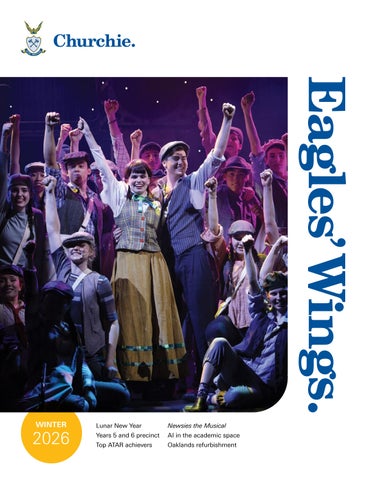
Cover image: Newsies the Musical. Photo: Stephen Taggart
Please visit myChurchie to view the latest event information.
Director of Community Relations: Zoe Morgan
Anglican Church Grammar School Oaklands Parade, East Brisbane 4169 Queensland Australia Tel +61 7 3896 2200
Editor: Katie Trappett
www.churchie.com.au ABN 34 243 342 840 | CRICOS: 00487E A School of the Corporation of the Synod of the Diocese of Brisbane trading as Anglican Church Grammar School
Contributors: TJ Bird, Brian Bodell, Dr Terry Byers, Dr Alan Campbell, Stephanie Cotroneo, Don Home, Ben Hugheston-Roberts, Joseph Jedid, Dr Alex Krzensk, Dr Victoria Leighton, Dr Darren Marchant, David Miles, Issy Mowen, Ross Muir, Abbey Naupa, Nicola Newman, David Nolan, Jamie Novosel, Dr Meagan Pearse, Fiona Philip, Jennifer Russell, Sarah Washington, Mark Wyer Graphic design: Matt James (Thought+Process) Photos: Kat Down, Dan Himbrechts (AAP), Dionne Pettingill, Aaron Tait Photography, staff, students and Old Boys of Churchie Visit churchie.com.au/eagleswings to update your subscription details and view past issues of the magazine.
Contents
02
04
06
Headmaster’s message
Lunar New Year
Staff news
12
14
16
Oaklands refurbishment
20
Top ATAR achievers
22
Newsies the Musical
23
Churchie news
Lucas Herrington’s Socceroo debut
Sport tours
26
28
30
Churchie Foundation
Old Boys’ Association
Reunions and events
08
AI in the academic space
19
Boarding history
24
Years 5 and 6 precinct
32
In memoriam
FROM THE HEADMASTER
The gift of governance
The School’s Founder, Canon Morris, demonstrated great vision, courage and energy in founding Churchie and ensuring its founding tenets would provide the foundation the School would need to grow and thrive in the future. As with any great venture, while there must be a central and abiding figure, there is also invariably a team of devotees who believe deeply in the vision and mission set in the nascent years of any great endeavour. In Canon Morris’s case, he had the Anglican Church and, more locally, dedicated school councillors who served the Church by providing governance. School Councils, on behalf of the Anglican Church, have been involved in every major decision in the 115year life of Churchie. Archbishops and School Councils have been integral to the establishment and ongoing thriving of this school.
2
Weighty decisions have been tossed around from the earliest years. From the very purchase of land at East Brisbane under Archbishop Donaldson after considering sites at Hawthorne and New Farm, through to the design, fabric and funding of the multi-milliondollar campus we share today, our School Councils have considered every decision. As noted in Canon Morris’s memoir, Sons of Magnus, in 1914, as the fledgling School officially became part of the Brisbane Diocese, Morris was keen to see his school have a School Council to govern and oversee the matters of the day, on behalf of the Diocese. On 19 March 1917, Headmaster Morris informed the first School Council that a local real estate agent had told him that some land was available for sale in East Brisbane. There would be ‘40 acres all told, with several places suited
for buildings’ on the ridge. Morris reported that the site was ‘wild but wide’, had potential for ovals and fields, and, what appealed to him greatly, ‘a natural moat, running right round the lower grounds’. So it was that the School Council resolved to secure the property for no more than 4,000 pounds; however, it secured the deal for 3,850 pounds through the generosity of the owner, Mr Cameron. This is around $100,000 in today’s Australian dollars. Each era of the School Council has been faithfully populated by men and women who have embraced our mission of the making of men. The School’s history records how successive Councils managed remarkably similar challenges and victories of the day by formulating master plans, ensuring the School is financially sound and prudently managed, and planning for funding challenges in the years ahead.
Overall, ensuring a world-class education and upholding our Anglican identity in a dynamic world lies at the heart of our dedicated governing body. This edition of Eagles’ Wings features a story about a recent reunion of School Council members, hosted by current Chair Con Castrisos OAM, all of whom have freely given generously to the life and fabric of our School. I thank our current and former School Council members for rolemodelling one of Churchie’s central tenets, service, and I commend this edition of Eagles’ Wings to you. Dr Alan Campbell Headmaster
3
Lunar New Year celebration
Parent Connect warmly welcomed Churchie families to a vibrant whole-school Lunar New Year celebration on Sunday 22 February 2026. The afternoon brought the community together to share in a rich programme of cultural experiences, including lion and dragon dancing, yangko dance, Chinese music, a Chinese qigong martial arts performance and a Shaolin kung fu showcase. Families also enjoyed a range of cultural food offerings and interactive activities, with children participating in lantern-making and calligraphy. A highlight of the celebration was Headmaster Dr Alan Campbell presenting red packets to children —a traditional symbol of good fortune, health and blessings for the year ahead. Parent Connect Treasurer Yuni Heathcote played a central role in planning and organising the event, with support from a dedicated group of parent volunteers. The Churchie Lunar New Year celebration was exceptionally well attended and reflected the spirit of connection and inclusion at the heart of the School community.
4
School Council reunion
Past and present members of the School Council gathered on Thursday 30 April 2026 at The Arches for a special reunion, hosted by Chairman Constantine Castrisos OAM. The evening provided an opportunity for members to reconnect, reflect on their shared service and acknowledge the continuity of leadership that has shaped the School over many years. Representatives from across different eras of School Council membership attended, along with members of the current Council and the School Executive. An archival display added a distinctive element to the evening, featuring artefacts connected to the School Council’s history, including architectural drawings of the Sir John Pidgeon Sports Complex, historic land deed documents and council meeting gavels. Copies of The Viking yearbook offered a nostalgic touch for Old Boys.
‘Each School Council builds on the work of those before and lays foundations for those who follow. That continuity is part of what keeps the School strong.’
Reflecting on the evening, Con noted, ‘Each School Council builds on the work of those before and lays foundations for those who follow. That continuity is part of what keeps the School strong.’ The reunion was warmly received and underscored the lasting contribution of School Council members to the life and direction of Churchie.
Past Chairman Dr Barry Kelly AM, Chairman Con Castrisos OAM, Past Chairman Dan O'Connor OAM
5
STAFF NEWS
Deputy Headmaster
Boarding Housemaster
Churchie is pleased to welcome David Nolan as the School’s Deputy Headmaster from July 2026.
At the beginning of the year, the School welcomed Jamie Novosel as the Boarding Housemaster of Goodwin House.
David joins Churchie from St Peter’s College in Adelaide, where he also served as Deputy Headmaster, making a significant contribution across many areas of its community. The College is a leading Anglican boys’ day and boarding school offering SACE alongside a well-established university studies programme. It is a school with which Churchie shares a long-standing association. He brings broad experience in senior and executive educational leadership across Queensland, Victoria and South Australia, having previously served as Head of Middle School and Deputy Principal – Learning and Teaching.
Jamie brings 27 years of experience in education, joining Churchie from his most recent role at Whitsunday Anglican College, where he served as Deputy Principal for seven years. Prior to this, he held several executive leadership team positions, including Head of Staff and Student Development, Head of Middle School, and Director of Admissions and Marketing. Churchie’s strong sense of tradition, excellence, opportunity and community was a major drawcard for Jamie, his wife Kelly and their four sons, Jude, Nash, Lennox and Coen, who all attend Churchie across both the Senior School and Preparatory School. The role of Boarding Housemaster particularly appealed to him because it combines leadership, pastoral care and the privilege of walking alongside boys during some of the most formative years of their lives. ‘Boarding is such a special environment, and I was drawn to the opportunity to help create a home where boys feel connected, valued and encouraged to become their best selves,’ Jamie said.
David holds Bachelor’s and Master’s degrees in Education and offers significant expertise in school governance, a deep understanding of boys’ education and a strong commitment to the Anglican tradition of schooling. At St Peter’s he was widely regarded for his warmth, enthusiasm and collegiality, and he is deeply committed to building positive relationships and prioritising the wellbeing of both students and staff. A Queenslander by upbringing, David is also a Churchie Old Boy, graduating in 1994. His personal connection to the School, combined with his professional experience and leadership in Anglican boys’ education, positions him exceptionally well to contribute to Churchie’s continued growth and strategic direction.
What Jamie has enjoyed most about the role so far is the strong sense of community. ‘I have loved getting to know the boys and their families and seeing firsthand the character, humour and spirit that make Goodwin House such a wonderful place,’ he said.
David looks forward to joining the Churchie community at the beginning of Term 3 and working alongside staff, students and families in the years ahead.
6
Deputy Head of Senior School
Director of Service
At the beginning of Term 2, Churchie welcomed Ross Muir as Deputy Head of Senior School (Years 10 to 12), bringing two decades of experience across senior schooling and educational leadership.
In Term 2, Churchie welcomed Jennifer Russell back to the School as Director of Service. Jennifer previously worked at Churchie as a Senior School teacher of Chinese (Mandarin) from 2013 to 2022, before taking up a housemaster role at Canterbury College.
Ross began his teaching career in 2006 and has since served in a wide range of leadership roles across senior schooling at Indooroopilly State High School, The Gap State High School, Dysart State High School and Ferny Grove State High School. These include Year Level Coordinator, Head of Department – Senior Schooling, Registered Training Organisation Manager, Principal’s Delegate, Deputy Principal and his most recent role as Head of School (Years 10 to 12) at Indooroopilly. Through these roles, Ross has worked closely with students, staff and families, experiences that have shaped his practice as both an educator and leader.
Jennifer said she is pleased to return and reconnect with staff and students at the School. ‘I have always learnt so much and found such inspiration and energy from the staff at Churchie. It’s wonderful to be back to reconnect with former colleagues and to meet and collaborate with new ones,’ Jennifer said. Jennifer looks forward to deepening her understanding of the School’s established service connections and traditions, while building on them in meaningful ways and creating new opportunities as needs arise. She is also eager to work with students to continue delivering a strong and expansive service programme.
Ross is looking forward to building strong relationships with the young men of Churchie and working alongside the dedicated and exceptional staff who support them through comprehensive curricular and cocurricular experiences. In his role, Ross is focused on supporting the wellbeing, learning and development of Years 10 to 12 students, while also ensuring the effective day-to-day organisation and operation of the School.
‘Service is an area that I am very passionate about,’ Jennifer said. ‘I see it as an integral component of the pastoral space of a school and as a part of receiving a well-rounded education. There is a reason service is one of Churchie’s four tenets, as it plays a vital role in understanding how supporting each other makes us and our communities stronger.’
‘Camaraderie, a deep sense of belonging and service are central to the Churchie culture and were what initially drew me to the School,’ Ross said. ‘I look forward to contributing to the lives of young men in the same way that dedicated teachers so profoundly shaped my own formative years and ultimately inspired my pathway into teaching.’
Jennifer’s appointment will support the continued growth of a thoughtful and impactful service programme and ensure it remains a meaningful and active part of life at Churchie.
7
At Churchie, we are taking a deliberate, evidence-informed approach to technology and artificial intelligence (AI). We are using them to strengthen teaching and learning while protecting the attention, reasoning and independence students need to thrive. Acting Deputy Headmaster Dr Alex Krzensk provides an overview of Churchie’s approach to technology and AI. Our approach to learning is grounded in research, data and professional judgement. Recent international studies provide a timely snapshot of how today’s students are learning and where schools can have the greatest impact. One finding is consistent across the literature: today’s students are just as biologically capable as any generation before them. High-performing students continue to achieve strongly; intelligence has not declined. What has changed is the learning environment, particularly the volume, speed and accessibility of information that surrounds young people. Across many Organisation for Economic Co-operation and Development education systems, large datasets show average declines or stagnation in literacy, numeracy, sustained attention and extended reasoning. These trends point to environmental influences rather than inherent ability.
Technology use is one important contributor. Research consistently links heavy, unregulated screen and smartphone exposure with reduced attention, shallower processing and weaker academic outcomes over time. Students can be more inclined to skim rather than read deeply, and to outsource steps of thinking rather than build them. Importantly, the evidence also makes a second point clear: technology itself is not the problem—outcomes depend on how it is used and how well it is governed. That distinction underpins Churchie’s approach to technology and artificial intelligence. We use AI deliberately to support teaching and learning. For example, to refine lesson design, strengthen feedback, and help students practise and improve. At the same time, we maintain clear limits around its use to protect deep learning. Students regularly work offline, read complex texts in print, write at length, grapple with problems without digital assistance and practise under exam conditions. These structures are not a step backwards; they are essential for building attention, judgement and reasoning. Our position is clear: AI should amplify learning, not replace thinking. By being explicit about expectations, disciplined in classroom practice and evidence-based in the way we deploy technology, we ensure students develop both the cognitive skills required for success today and the learning habits they will need well beyond school.
8
AI in the academic space AI supporting student-led study At the heart of Churchie’s Learning Framework, Director of Staff Growth and Research Dr Victoria Leighton explores how A Learner’s Toolkit (ALT) is evolving through the development of ALT Compass, a study companion designed to strengthen how students think, reflect and learn in an age increasingly shaped by artificial intelligence.
So, the question for us has never been whether students will use AI, but whether it can be shaped to work with their thinking rather than instead of it. Now in its early pilot stage across two subjects, ALT Compass, developed in partnership with software developers Circean, has been designed as a study companion. Its role is to strengthen habits of thinking that AI itself cannot replace, prompting reflection, guiding revision and reinforcing effective study strategies rooted in ALT.
ALT is a school-wide commitment to helping students understand how they learn, not just what they learn. Grounded in the science of learning, ALT equips students with practical study strategies, metacognitive routines and a cross-curriculum shared language for learning. As AI becomes a more prominent presence in students’ study lives, a pressing question has emerged. Can AI genuinely support learning without quietly eroding the very habits we are trying to cultivate? The research invites a degree of caution. Academics have warned that poorly designed AI may make work faster but thinking thinner, reducing cognitive effort, weakening metacognitive monitoring and ultimately limiting durable learning. At Churchie, however, our ALT team sees something more promising. When carefully designed and teacher-led, AI can do much more than simply do tasks for students; it can make learning more accessible, be more responsive to individual learners and provide material in a way that challenges students to think. 9
The design draws explicitly on established principles from the science of learning: retrieval practice, spaced and interleaved (‘jumbled’) practice, and elaborative interrogation, requiring students to explain ideas and connect new knowledge to what they already know. These are the behaviours that underpin self-regulated, sustainable learning, rather than short-term performance. Crucially, ALT Compass also responds to the reality that learners are not all the same. It provides targeted, student-led support, helping each learner move forward in a way that is realistic and meaningful for them. At the same time, teachers can track their students’ progress and respond accordingly. In doing so, ALT Compass ensures AI strengthens, rather than substitutes for, the work of learning.
AI in the academic space
Beyond plagiarism: authorship, authenticity and integrity in the era of AI writing Director of Teaching, Learning and Research Dr Terry Byers examines how the rise of artificial intelligence is reshaping student authorship and academic integrity, and how Churchie is responding by making the process of thinking and writing more visible. The rapid growth of artificial intelligence has fundamentally challenged traditional assumptions of student authorship, with significant implications for the visibility of the learning process. Historically, academic integrity relied on a ‘policing’ model, where teachers checked for copied or reused work after it was submitted. The large language models that drive AI generate fluent text without copying from a clear source, making this approach less effective. In response, Churchie is transitioning from a model of surveillance to one of transparency and process visibility through Turnitin Clarity. This shift ensures best practice around the authenticity requirements of the Queensland Curriculum and Assessment Authority and the International Baccalaureate. More importantly, it prioritises the documentation of ideation, creation and learnings as it occurs. This visible medium provides students with a more credible demonstration of their authorship.
A defining technical advantage of Turnitin Clarity is its ‘film strip’. This makes the drafting process visible, documenting how ideas are developed and refined over time. It records and documents typing patterns and drafting phases up to the point of submission. Teachers can see how students adapt and refine copied material, distinguishing between legitimate research and the outsourcing of thinking. This visibility transforms our assessment process into a learningfocused conversation that edifies observable evolution rather than retrospective suspicion. Because generative AI relies on statistical language patterns rather than direct detection of tool use, sophisticated student writing can trigger false indicators of AI assistance. In these instances, Turnitin Clarity becomes the student’s ‘defence attorney’. It provides tangible drafting records that protect and endorse the student’s original creative output. This shift replaces a culture of distrust with one of confidence and fairness, ensuring that the effort of our most talented writers is celebrated and defended. The strategic investment in Turnitin Clarity by the School shifts integrity from policing to proof, making thinking visible. It restores authenticity and the human voice into the creative output of our students, rather than relying on outsourced technology.
10
AI supporting learning Head of Library and Learning Services Fiona Philip examines how artificial intelligence can be used to support learning rather than replace it, focusing on the role of timely, targeted feedback in keeping students actively engaged in the thinking that drives genuine academic progress. The rapid development of generative AI has created both opportunity and risk for schools. Used poorly, AI can make it easier for students to bypass the very thinking that learning depends on. If a student uses AI simply to generate an answer, summarise a text they have not read, or polish work they do not understand, then the technology can weaken learning rather than strengthen it. While academic dishonesty is the most visible concern, a more important issue is what happens to learning over time. If students regularly outsource the hard mental work of questioning, drafting, explaining, revising and improving, they can miss the practice that builds understanding and durable skills. This is why the way we use AI in education matters. The most valuable uses of AI are not those that replace student thinking but support it. Used ethically and deliberately, AI can act as a learning coach by asking students to clarify their ideas, prompting them to strengthen their reasoning and helping them notice where their work does not yet meet the required standard. In this model, the student remains the thinker and author. Churchie’s use of Class Companion is an example of this more constructive approach to AI in learning. Rather than functioning as a shortcut to a completed answer, it is designed to provide students with immediate, personalised feedback while they are working. It supports the learning process by helping students understand where their response is strong, where it needs development and what they can do next to improve. Used under teacher guidance, it offers a way to harness the power of AI without removing the cognitive effort that students need in order to learn. This focus on feedback is grounded in research on how learning improves. Effective feedback is clear about the goal, connected to the criteria for success and gives students a practical next step. Hattie and Timperley (2007) describe this as helping students answer three questions: Where am I going? How am I going? Where to next? Sadler (1989) similarly argues that students improve when they understand the standard they are aiming for, compare their current work against that standard and take action to close the gap. In this sense, feedback, clear criteria
11
and modelling are essential because students need to know what quality looks like before they can meaningfully improve their own work. That is why timing matters. Feedback on a piece of writing a week after it is finished can still help, but it loses some of its power because the student has moved on. It is a bit like giving a basketball player advice on their shooting technique a week after practice. The player needed the coach beside them while they were shooting, noticing the movement, correcting the technique and helping them try again. Class Companion supports this kind of feedback loop by giving students guidance while their thinking is still active. A student can draft a response, receive feedback, reconsider their answer and make improvements before the task is complete. This changes the role of feedback. It is no longer just an end-point judgement. It becomes part of the learning process itself. Importantly, this does not replace the teacher. Tools like Class Companion are used under teacher guidance and as part of the learning process. The teacher still designs the task, sets the learning goals, selects or creates the rubric, decides what good work looks like and teaches students how to use feedback well. The tool then supports students as they practise, helping them clarify their thinking and revise their work before submission. This distinction matters for families, because ethical AI use in education should reinforce learning, not shortcut it. The purpose of Class Companion is not to give students the answer or remove the need for effort. Its value is in prompting students to think more carefully about their own work, for example, clarifying an idea, adding evidence, strengthening reasoning, addressing criteria more directly or checking whether their response actually answers the question. The student still has to do the cognitive work. AI can point to the gap, but the learner must close it. In a classroom, every student deserves guidance that meets them where they are. Class Companion offers one way to make that more achievable. Our goal is to use AI in ways that strengthen learning by keeping students actively engaged in the thinking, judgement and improvement that genuine learning requires. Hattie, J., & Timperley, H. (2007). The power of feedback. Review of Educational Research, 77(1), 81–112. https://doi.org/10.3102/003465430298487 Sadler, D. R. (1989). Formative assessment and the design of instructional systems. Instructional Science, 18(2), 119–144. https://doi.org/10.1007/BF00117714
Fresh spaces for our youngest learners Oaklands Childcare and Kindergarten has recently completed a series of thoughtful renovations, enhancing the early learning environment for Churchie’s youngest community members. The upgrades reflect a strong commitment to providing high-quality care and education in spaces that are safe, engaging and tailored to support every stage of early development. Delivered through a staged refurbishment, the project has revitalised classrooms, play areas and shared facilities. Each learning space has been refreshed with modern finishes, improved layouts and vibrant elements designed to spark curiosity and creativity. New and upgraded play areas encourage exploration and discovery, while contemporary resources support a dynamic, hands-on approach to learning. A key focus of the renovations has been the wellbeing of children. Enhanced safety features, secure access controls and dedicated zones will help children thrive in a protected, nurturing environment. Improvements to lighting, ventilation and flooring have also created spaces that are comfortable, healthy and welcoming for both children and educators. Importantly, Oaklands remained fully operational throughout the renovation period. Careful planning and additional staffing ensured minimal disruption to daily routines, with transitions between spaces managed sensitively to maintain consistency for children. Contractor activity was strictly separated from learning areas, with secure boundaries in place at all times. Looking ahead, the renewed Oaklands offers bright, contemporary environments that align with the latest research in early childhood education. The centre will welcome families into spaces that support learning, wellbeing and a strong sense of belonging. Oaklands continues to provide approved childcare, kindergarten and long day care for girls and boys from six weeks to school age. With these enhancements now complete, the centre further strengthens its reputation for excellence in early learning. For enrolment information, visit the Oaklands website: oaklands.churchie.com.au 12
The upgrades reflect a strong commitment to providing high-quality care and education in spaces that are safe, engaging and tailored to support every stage of early development.
13
Top ATAR achievers Academic excellence is one of Churchie’s four tenets, and in 2025 this commitment was reflected in an outstanding achievement, with three students attaining the highest possible ATAR of 99.95.
While George achieved academic awards, leadership roles and sporting selections, his most valued memories came from everyday moments with friends. Supporting mates on Saturdays, leading the crowd from the sidelines and connecting with boys across year levels were the experiences he found most enriching.
Magnus House Vice-Captain and Captain of Debating Jeongmin Choi, School Captain and Prefect George Samios and Dux of the School in QCE Eric Zhang all achieved top honours.
George has received a Griffith University Vice Chancellor’s Academic Achievement Scholarship and is studying a Bachelor of Medical Science with provisional entry into the Doctor of Medicine.
Jeongmin credited the teachers and staff at Churchie as being central to his academic performance and wellbeing.
Eric said receiving an ATAR of 99.95 brought a great sense of relief and validation after sustained effort.
‘The teachers at Churchie were probably the only reason I performed as well as I did,’ he said. ‘They were all incredibly knowledgeable about any enquiries and questions I had during my study.’
‘It was the moment I realised I had achieved what I had worked toward for so long,’ Eric said.
In recognition of his hard work and academic achievement, Jeongmin was awarded The C E Elliott Rhodes Scholarship Award – Proxime Accessit to the Dux in QCE. He has also received a UQ ViceChancellor’s Scholarship and is currently studying a Bachelor of Biomedicine before completing his Doctor of Medicine at The University of Queensland.
Culminating a successful year, Eric was awarded The Tyrwhitt Memorial Cup as Dux of the School in QCE and received multiple subject prizes. He has accepted a Melbourne Chancellor’s Scholarship to study a Bachelor of Science (with guaranteed entry into Doctor of Medicine) at the University of Melbourne.
George said the release of his ATAR marked an emotional and fitting conclusion to his final year at Churchie.
‘Though I knew a 99.95 was a possibility for me, I certainly was not expecting it,’ George said. 14
Wellbeing Ambassador Coordinator Ben Hugheston-Roberts reflects on the purpose and impact of Harmony Week and the role students play in fostering a culture of inclusion at Churchie.
such as inviting someone to sit with you, learning to pronounce someone’s name correctly, listening to different perspectives or standing up for others when they are treated unfairly, help build an environment where everyone feels safe, respected and valued.
Harmony Week, held annually in March, is a time to pause and reflect on how we treat those around us and ensure everyone feels a strong sense of belonging. It is also a reminder that inclusion and respect are everyone’s responsibility.
To visibly show our support for Harmony Week and reinforce the message that everyone belongs, orange ribbons were distributed during house meetings. Orange represents harmony and celebrates the many cultures that make up our community. This multicultural and inclusive approach strengthens our school and enriches our shared experiences.
Our Student Wellbeing Ambassadors worked enthusiastically behind the scenes to prepare for the week. Through a range of activities and shared information, they encouraged students to recognise and celebrate our diversity while reinforcing the importance of kindness, respect and inclusion across our school community.
Celebrations also included a special music performance, a student speech and a video presentation at the Headmaster’s Assembly. A lunchtime fundraiser for refugees was held outside the Viking Café, providing an opportunity to support those in need and put the values of inclusion and compassion into action.
The ambassadors emphasised that creating a sense of belonging begins with simple, everyday actions. Including others in conversations and activities, using kind and respectful language, and showing genuine interest in those who may feel new, different or unsure can all make a meaningful difference. Small gestures,
Harmony Week ultimately reminds us that a strong community is built through everyday actions that ensure everyone feels they belong.
Harmony Week 15
Newsies the Musical In Term 2, Churchie and Somerville House proudly presented Newsies the Musical, a high-energy production celebrating courage, camaraderie and the power of standing up for what is right.
enduring partnership and shared commitment to excellence in the performing arts. The support of parents and the wider community played an important role in bringing the production to life.
With music by Alan Menken, lyrics by Jack Feldman and a book by Harvey Fierstein, Newsies is a 1992 American musical production originally created by Walt Disney Pictures and based on the New York City newsboys’ strike of 1899. Audiences were transported to the streets of Manhattan, where Jack Kelly and his fellow newsboys navigate the challenges of New York’s competitive newspaper industry, driven by ambition, resilience and a shared sense of justice.
Special thanks are extended to Director and Designer Scott Andrews, Producer Sarah Washington and Set Designer Brian Bowen for their expertise and passion for arts education. Their leadership inspired students to explore their creativity and express their artistic passions.
This year’s production reflected months of dedication from both cast and crew. Students embraced the opportunity to develop their talents while building confidence, discipline and teamwork. The result was a dynamic and engaging performance that highlighted the strength of collaboration across both schools.
Recognition is also given to the dedicated student stage crew, whose work in sound, lighting and set design ensured a seamless production. We congratulate all students involved in Newsies and thank the staff and families whose commitment made this outstanding production possible.
The musical continues a valued tradition between Churchie and Somerville House, showcasing the 16
17
The Tukka Project triples its impact over 150 lunches every week for the children in Brisbane who would otherwise go hungry. This massive expansion has been driven by the steady support of the other houses, Casey and Mansfield, who have jumped in to lighten the load.
What began as a small, student-led initiative has grown into a powerful example of Churchie’s commitment to service. Hillary House Captain Joseph Jedid reflects on the growth of The Tukka Project, as students have scaled the operation to support more children who would otherwise go without lunch at school.
This growth enabled a significant increase in efficiency as we began producing lunches on an assembly line, ensuring each component was perfectly packed. A typical lunch includes a ham and cheese bun, crisp apples, and cheese and crackers. To top it off, we always include a sweet treat, usually a slice of banana bread or a fresh muffin.
Initially, when I first started volunteering for The Tukka Project, things looked very different. No more than 10 of us operated out of Norman Park Bowls Club, making around 50 school lunches for children all over Brisbane who don’t always have the privilege of lunch every day. It was a modest yet passionate effort from all the boys in the early days, and as our passion grew, so did Tukka. Seeing the need within our community was really eyeopening, but seeing how the Churchie community rallied to meet it has been truly inspiring.
Looking back over a year ago from my personal experience, it’s amazing to see just how far we’ve come from those early days at the bowls club. We haven’t just grown in numbers and space; we’ve grown in our commitment and teamwork to making a tangible difference. It’s incredibly rewarding to know that one simple afternoon out of my week can transform into a full stomach and a smile for a child in need.
Since then, we have moved the operation onto campus, basing ourselves in Brenan Pavilion every Wednesday afternoon. Our production has tripled, producing well 18
From Churchie’s opening in 1912 at Ardencraig, Toowong, boarding was present, though on a very small scale.
both the School’s small size and Morris’s belief in the importance of boarders’ leadership. Until the post-war years, school captains and prefects were invariably boarders, whose constant presence supported prep (supervised homework time), games and event supervision.
Early enrolment records list Alexander Morrison of Pittsworth as student number seven and the School’s first boarder. In March 1912, Morrison was joined by Douglas Logan, another boy from the bush. Logan entered Churchie lore as the first to refer, half humorously and half respectfully, to the then Reverend (later Canon) William Perry French Morris as ‘The Boss’. The nickname endured. Together, Morrison and Logan established a pattern that would define Churchie for decades: boys travelling from rural Queensland to Brisbane in pursuit of education unavailable at home, persevering with humour and character.
From the opening of School House in 1918, successive headmasters recognised increasing pressure on boarding facilities. While Morris favoured capped enrolments, Harry Roberts (1947–1969) and Charles Fisher (1970–1973) responded to growth by pursuing expansion, although economic constraints and competing priorities often limited progress. During a period of cultural change, Bill Hayward (1974–1986) guided boarding toward a more pastoral model. Despite the economic downturn of the 1970s, boarding remained strong, reaching 303 of 1,503 students by 1986. A major shift followed in the 1990s with the closure of Oaklands Parade cottages and the opening of modern dormitories with individual study cubicles, improving privacy and study conditions. These facilities have since been refurbished to maintain high-quality accommodation.
The experience of Thomas Eric Collins (1918–1923) captures the realities of early boarding. To reach the School, Collins travelled from northern Queensland on a journey of almost two weeks, riding a horse, crossing swollen creeks and eventually boarding a steamer to Brisbane. While a boarder, he served as a prefect, won the School’s science prize and captained rowing, exemplifying the academic and sporting contributions often made by our boarders.
Churchie’s boarding community has evolved over time through leadership and necessity, shaped by boys who have travelled great distances.
Initially, boarders were not organised into separate boarding houses for competition and remained part of the day house system until 1950. This reflected
From the archives
A brief history of Churchie Boarding
19
CHURCHIE NEWS
Shells of strength for the journey
Dr Meagan Pearse
Year 1 students recently welcomed Bishop John Roundhill to Churchie as part of his annual Holy Week pilgrimage, ‘Walking the Walk’.
Churchie warmly congratulates Head of Faculty – Music Dr Meagan Pearse on the recent publication of her Doctor of Philosophy thesis, a significant academic achievement that reflects her deep commitment to boys’ education.
Travelling from Cannon Hill Anglican College to Churchie, then on to St Aidan’s Anglican Girls’ School, Bishop John’s visit formed part of a 10-day journey of more than 200 kilometres across the Anglican Church Southern Queensland Diocese.
Dr Pearse’s doctoral research, In Tune with Boys: How the Sex of the Teacher and Gender Stereotypes Impact How Music is Taught and Learned in All-Boys Schools, explores how gender stereotypes and hegemonic masculinities influence the way music is taught and experienced in Australian all-boys schools. Drawing on interviews and focus groups with music teachers and adolescent boys, the study offers valuable insight into the realities of classroom practice and student engagement.
In preparation, the Year 1 class explored the meaning of pilgrimage and learnt a new word, pilgrim, in their Religious Education lesson. They learnt what it means to be a pilgrim and compared the similarities and differences with that of being a tourist. They also investigated why a shell is a symbol for both baptism and journeys, and considered the connection between the two.
Her research highlights the influence of traditional hegemonic masculinity on learning environments and the different challenges and experiences faced by female teachers in all-boys schools. Importantly, it also shows how thoughtful teaching practice, strong relationships and an explicit focus on gender equity can enrich curriculum, strengthen engagement and improve learning outcomes for boys.
Drawing on this learning, the boys created shells in Churchie blue and grey for Bishop John and his fellow pilgrims. Each shell, fitted with a clip for attaching to a backpack, was designed to inspire strength and humility throughout the journey. The class also prepared words of encouragement, thinking carefully about how to support those undertaking a long and meaningful walk. Their warm welcome reflected the spirit Bishop John values most about the pilgrimage, the conversations along the way and the encouragement received from school and parish communities.
Dr Pearse continues to contribute to professional dialogue in this field, having recently presented at the IBSC Australasian Regional Conference in Adelaide and with a forthcoming presentation at the Australian Teacher Education Association National Conference on the Gold Coast in July. Churchie is proud to celebrate Dr Pearse’s achievement and the knowledge and experience she brings to her leadership of music education across the School.
Bishop John’s visit offered a meaningful opportunity to connect classroom learning with faith in action during the season of Lent.
20
Ethical leadership
the churchie emerging art prize
More than 70 guests, many of them Churchie Old Boys, gathered to celebrate the launch of the St Magnus Institute for Ethical Leadership. Envisioned by The Reverend Mark Vincent, the St Magnus Institute for Ethical Leadership will serve as an enduring forum that complements student leadership at Churchie while encouraging informed discussion, respectful debate and principled leadership within the wider community.
the churchie emerging art prize, ‘the churchie’, is approaching its 40th anniversary, celebrating four decades of supporting emerging artists. Launched in 1974 by Dr John Jell AM (1956) as a fundraising initiative of the Churchie Old Boys’ Association, it has become a key event in Australia’s art prize scene. Over the years, the prize has been enriched by Churchie alumni. Old Boy Jonathan Crowther (1994), the 2009 winner, shared, ‘Winning “the churchie” was a pivotal moment in my life, laying the foundation for an enduring career in the arts. It continues to be an important part of Australia’s cultural landscape, championing and elevating early-career artists.’
The evening opened with remarks from The Reverend Mark Vincent, Director of the Institute, before Headmaster Dr Alan Campbell welcomed guests and reflected on Churchie’s enduring mission to educate young men of character who will lead and serve for the common good, a vision grounded in the School’s Anglican ethos.
Now in its 39th year, ‘the churchie’ is Australia’s longestrunning annual award for emerging artists. It provides artists with an opportunity to connect with industry peers and gain national exposure. With a total prize pool of $55,000, the winner receives a non-acquisitive $40,000 cash prize donated by long-term sponsor BSPN Architecture.
The launch was formally opened in prayer by The Most Reverend Jeremy Greaves KCSJ, Archbishop of Brisbane, who invited guests to reflect on what is right, what is just and how leaders can act in ways that honour the dignity of every person.
‘the churchie’ is possible thanks to all our generous sponsors: BSPN Architecture, Fardoulys Constructions, Madison Facility Services, Hutchinson Builders, Chartwells, VAULT Magazine, Churchie Old Boys’ Association, Thynne + Macartney, Jenny and Bill Chatterton, Look Education, Spot Productions, JAD Graphics, Artis Pura Custom Framing, Video Pro, Bentleys, Brisbane City Council and Jeremy Ferrier Landscape Architect.
Emeritus Professor Peter Little AM delivered the keynote, asking whether society has lost its moral compass. Drawing on his research and experience, he noted that, despite growing social and economic pressures, ethical leadership remains possible when guided by integrity and sound judgement. A panel discussion followed, where Headmaster Dr Alan Campbell, The Most Reverend Jeremy Greaves KCSJ, The Hon Tim Nicholls MP (1982) and Mr Rob McGavin (1986) explored ethical leadership across business, politics, faith and education.
The Finalists’ Exhibition will take place from 25 July to 8 August 2026 at our program partner Metro Arts, West End. The prize winners will be announced at the Exhibition Opening on 24 July 2026. For details, visit churchieemergingart.com.au. Image: Jonathan Crowther (1994) with A Walk in the Park. Photograph courtesy of the artist. 21
From the First XI
to the Socceroos
Less than a year after captaining the First XI, Old Boy Lucas Herrington (2025) started for the Socceroos, becoming the youngest Australian starting defender in 45 years.
teenager on debut in the competition. A week later, he scored his first MLS goal and kept his first clean sheet. These performances caught the attention of Socceroos coach Tony Popovic, who called the 18-year-old into the squad for Australia’s final home matches before the 2026 FIFA World Cup. Popovic had planned to give Lucas minutes off the bench in the second fixture, but a standout training session on the Wednesday before the Cameroon match changed his mind.
It has been just over six months since Lucas was juggling his Year 12 studies at Churchie with playing A-League football for the Brisbane Roar. Today, he is playing Major League Soccer (MLS) in the United States for the Colorado Rapids while also pulling on the green and gold jersey.
Former Socceroo Erik Paartalu described him as a standout and probably the best player on the field. At the time of publication, the World Cup in North America is approaching, and Lucas is now firmly in the conversation for a place in the 26-player squad, a prospect that seemed unthinkable when he was lining up in GPS Football less than a year ago.
Lucas’s path to international selection has happened quickly. He signed a scholarship contract with Brisbane Roar in September 2024 and made his A-League debut in December while still a student. He went on to captain the First XI during the 2025 GPS season while establishing himself as a first-choice starter for the Roar. Across 29 appearances for the club, he departed in January 2026 for a reported club-record transfer fee.
Congratulations, Lucas. Our school community will continue to support him as he represents Australia on the world stage, carrying the blue and grey with him.
His transition to MLS was immediate. On debut for Colorado Rapids, Lucas played all 90 minutes and set a competition record for the most successful passes by a
Photo: Dan Himbrechts, AAP
22
CHURCHIE NEWS
New Zealand cricket tour
European football tour
Twelve days across the North Island gave 25 Churchie cricketers the chance to test themselves against leading New Zealand schools and experience life beyond the boundary.
Churchie Football spent two weeks training at elite European academies and watching live matches in Madrid, London and Manchester during the December school holidays.
The biannual Churchie Cricket New Zealand Tour is one of the programme’s signature development opportunities, exposing players to unfamiliar conditions, new opposition and shared experiences that strengthen the squad.
From the pitches of Atletico Madrid to the hallowed turf of Old Trafford, 49 Churchie footballers immersed themselves in the world game across a packed two-week tour.
Across the first two weeks of the December holidays, the touring party split into two teams and faced six schools, including 2025 Auckland First XI Premiers Auckland Grammar School and former national champions Tauranga Boys’ College. Both Churchie sides performed strongly throughout. The blue team recorded wins against Macleans College and St Peter’s, Cambridge, and also challenged a full-strength Auckland Grammar side in a highly competitive match. The grey team won three of their fixtures, highlighted by Sam Hayes’s unbeaten 135 against Macleans College.
The boys trained at four world-class academies: Liverpool, Tottenham Hotspur, Real Madrid and Atletico Madrid, receiving specialist coaching and feedback from youth development staff at each club. Between sessions, they took on local schools and clubs in friendly fixtures across all three cities, with results matched by the spirit in which the games were played. Off the pitch, the tour delivered moments money cannot buy. The group watched Real Madrid host Celta Vigo at the Santiago Bernabéu and witnessed a draw between Manchester United and AFC Bournemouth at Old Trafford. A Champions League clash between Tottenham and Slavia Prague at Tottenham Hotspur Stadium rounded out an extraordinary run of live football.
The cricket, though, was only part of the experience. The boys visited Waiheke Island, Auckland Sky Tower, the All Blacks Experience and Eden Park, rode the Skyline Gondola and Luge in Rotorua, toured an active Māori village and watched test cricket at Bay Oval. Ten-pin bowling, trivia and golf at Tauranga Golf Club rounded out a full itinerary that kept spirits high between matches.
Director of Football Alex Rados said the boys had represented the School with distinction throughout the tour. ‘Across Madrid, London and Manchester, we received numerous compliments on how well the boys conducted themselves,’ he said.
Tours like these are central to the growth of Churchie Cricket, providing students with experiences and memories that carry into the GPS season and beyond.
With the programme continuing to grow, the tour has set a powerful benchmark for Churchie Football on the international stage.
23
The Preparatory School’s new Years 5 and 6 precinct represents an exciting and carefully considered investment in the learning, wellbeing and future of our boys. Purposebuilt to accommodate 312 students, the threestorey building has been designed to support contemporary teaching, collaboration and community connection within a vibrant and welcoming environment.
To enhance connectivity within the Preparatory School, a suspended Japanese classroom will serve as an elevated bridge between the library and the new building. This distinctive learning space symbolises the importance of language learning within the curriculum while physically linking key learning hubs on campus. On the lower level, new canteen facilities and café-style seating will provide boys with improved access to healthy food options. Alongside traditional ordering, students will be able to purchase a wider range of nutritious items, fostering independence in a relaxed social setting.
At the heart of the building are 12 modern classrooms, thoughtfully arranged across two levels. Each cluster of three classrooms is supported by adjoining breakout spaces, providing flexibility for small-group learning, project work and targeted support. These adaptable learning zones encourage collaboration, independence and creativity, ensuring the needs of every boy are met.
The project also includes two new undercover courts, significantly increasing access to shaded play and activity areas in all weather conditions. Connected to the canteen facilities and the Campbell Centre, these courts create a truly multipurpose space for learning, play and community events.
A standout feature of the precinct is the central forum, a lecture-style space seating up to 160 people. Designed for versatility, the forum will host cohort gatherings, curriculum experiences, performances and parent events. With integrated storage and an adjoining smaller breakout room, the space balances functionality with flexibility. Large doors allow the forum to open directly onto a landscaped courtyard, seamlessly blending indoor and outdoor use for lessons, events and celebrations.
Completing the precinct is purposeful landscaping with green space, terraced play areas, table tennis zones and shaded seating, ensuring the environment is as enriching outdoors as it is within. Together, these elements reflect a commitment to future-focused learning, holistic development and a strong sense of belonging for our boys.
A new precinct for Years 5 and 6
24
Remembering those who served As part of Churchie’s Boarding on the Road programme, Head of Cocurricular Trent Goodrick (1994), Director of Engagement David Miles (1985) and OBA President Dr Darren Marchant (1989) recently travelled to Papua New Guinea. The visit focused on strengthening connections with current parents, prospective families and Old Boys, continuing Churchie’s commitment to its international boarding community. The official visit was supported by Old Boy and current parent Dadi Toka MBE (1995) and current parent Shaun Pini. While in Port Moresby, the group took the opportunity to honour and pay respect to the seven Churchie Old Boys who lost their lives during the Kokoda Track campaign. Fought between July and November 1942 as part of the Pacific War of World War II, the campaign remains one of the most significant chapters in Australia’s military history. Eightyfour years on, the visit provided a moment for quiet reflection at Bomana War Cemetery.
In a simple and respectful ceremony, each of the seven Old Boys was honoured with a symbol of Churchie’s blue and grey uniform, laid at their headstone by Dr Marchant. Their stories were then shared through readings from The Field of Honour, offering a powerful reminder of their lives, their service and their ultimate sacrifice. The Old Boys remembered at Bomana War Cemetery are Corporal Herbert Cowdry (1938), Private John Drynan (1934), Sergeant William Hall (1937), Lieutenant George Jackson (1931), Lance Corporal Adolphus Leyshon (1940), Private Colin Robertson (1926) and Lieutenant Wallace Sanderson (1938). The visit also acknowledged three further Old Boys who, following the Kokoda campaign, fought and died in Papua New Guinea and are buried at Lae War Cemetery. They are Lieutenant Morris Hart (1940), Trooper Keith Heffernan (1944) and Captain Anthony Luetchford (1936). This time of reflection served as a reminder of the strength of the Churchie community and the importance of honouring those who served. 25
CHURCHIE FOUNDATION
From the Chairman of the Churchie Foundation not all boys who would like to or should become boarders at Churchie, including many sons of Old Boys, can afford to attend the School. The Foundation has recognised this, and, in discussion with the School and Director of Boarding Mike Symons, we have agreed to fund boarding bursaries to assist families who may not have the financial means to send their sons to the School. These bursaries will fund up to four full boarding fees per year group, starting with the Year 7 intake in 2027. By 2032, we plan to have 24 boys on this programme annually, at a cost of around $1 million per year. This is another example of how the Churchie community gives and supports our boys, as the money for this programme came from generous donations. Churchie was extremely fortunate that in 1918, Canon Morris had the foresight to purchase the land on which the School now sits. The School has grown significantly since that time, and, when opportunities have arisen, Churchie has proactively secured parcels of land in the immediate precinct of the School. As such, Churchie now owns every lot on the western side of Oaklands Parade. The School is currently undertaking a planning process to determine which replacement or new facilities are needed to support its growing student population and their future needs. One of the greatest attributes of the School is its campus, with everything located at one site and the rowing shed within walking distance.
Don Home (1978) Chairman of the Churchie Foundation
I would like to begin with a sincere thank you to the members of the Foundation Board, Chris Blue (Vice Chairman), Anna McCartney, Craig Spencer and Dr Steven Ting, who all give generously of their time to guide the activities of the Foundation. We also look forward to welcoming Michael Williams (1978) to the board in the new financial year. Mick will bring additional skill sets to the board, including his accounting background, his time serving on School Council and his experience as a boarder at the School.
When the School Council releases the next master plan for the School, I am certain that Old Boys and current families will be very excited to see the new facilities that are to be built, and we look forward to sharing them with you in the near future.
Boarding always has been and will continue to be a very important part of the School, enriching the culture and experiences of all boys who attend Churchie. The boarding community is a very tight-knit group, and the boys who are boarders develop a very strong brotherhood that will last them a lifetime. Unfortunately,
26
Meet the Foundation Board evening Chairman of the Foundation Don Home invited the Churchie community to meet the Foundation Board in April.
Hope Ferguson, Tim Ferguson (1992), Meghan Toka, Anna McCartney and Dadi Toka MBE (1995)
Don Home (1978), Frank Berardi and Craig Bowen OAM (1969)
Boarding bursaries for Year 7 2027 The Churchie Foundation offers boarding bursaries to students living in rural and remote Australia who would not otherwise have the financial means to attend the School, but who exemplify the four tenets and would contribute meaningfully to the boarding community.
Apply now churchie.com.au/boardingbursaries Applications close Friday 31 July 2026
27
OLD BOYS’ ASSOCIATION
From the President of the Old Boys’ Association It was an honour to represent the OBA at the Founder’s Day Service and Welcome to Parents evening, both special traditions that reflect Churchie’s enduring commitment to faith, service and community. I was also fortunate to attend the launch of the St Magnus Institute for Ethical Leadership. Introduced by former staff member and Honorary School Chaplain Reverend Mark Vincent, this initiative encourages frank discussion and debate on issues related to leadership at all levels. Led by a panel of prominent community leaders, the event was well attended by many of our Old Boys. We look forward to continuing our support of this important forum. The most exciting new addition to our annual calendar was the inaugural Old Boy Dads’ Night at the Lord Stanley Hotel in February. Given that 20 per cent of our current dads are Old Boys, the OBA felt it important to recognise the generational connection that many of our families have to Churchie. It provided a relaxed opportunity to reconnect, build new relationships and engage directly with the OBA.
Dr Darren Marchant (1989) President of the Old Boys’ Association
The OBA has continued its support of the Boarding on the Road programme. In March, I travelled to Papua New Guinea alongside Churchie staff and fellow Old Boys, Head of Cocurricular Trent Goodrick (1994) and Director of Engagement David Miles (1985). The weekend centred on a highly successful evening event that engaged with current and prospective families, promoted Churchie Boarding, and reinforced the School’s values and traditions. A particularly moving moment during the trip was our visit to Bomana War Cemetery, where seven fallen Old Boys are laid to rest. We had the privilege of visiting each gravesite and laying a Churchie marker. In further recognition, a wreath was laid at the memorial cross. It was an emotional and moving experience for everyone present. I extend sincere thanks to the Toka and Pini families for their generous support in facilitating another memorable PNG experience.
As we reach the midpoint of the 2026 school year, I’m pleased to share an update on the Old Boys’ Association’s ongoing and new initiatives. To round out 2025, we hosted another successful Old Boys’ Tennis Tournament at the David Turbayne Tennis Centre. This integral part of our ‘Connect and Play’ initiative brought together Old Boys from different cohorts in a full-capacity doubles competition for the John Millman Shield. Alongside other sporting activities, this initiative continues to forge meaningful connections within our community.
28
Achievements We proudly acknowledge the following Churchie Old Boys who have been recognised with honours and representative positions this year.
Member (AM) of the Order of Australia in the General Division
In further support of this programme, I also attended the Roma Picnic Races with Director of Boarding Mike Symons, David Miles and OBA Boarding Representative Graham Webb (1995). The day provided valuable opportunities to connect with current, past and prospective families, as well as engage with many Old Boys in attendance.
Paul Taylor AM (1983) for significant service to the arts and education through governance and philanthropic roles. Dr Warren Henry AM (1975) for significant service to veterinary science and to global humanitarian programs.
Medal (OAM) of the Order of Australia in the General Division John Forrest RFD OAM (1963) for service to cricket. Ben Bjarnesen BM OAM CF (2001) for service to LGBTIQ+ communities of Queensland, and to the domestic and family violence sector.
Anzac Day was again a very moving and memorable occasion. The OBA acknowledges the outstanding contribution of our tri-service cadets, whose conduct continues to reflect the highest standards of respect and service. It was also a privilege to host members of our Vintage Vikings community, and we thank Old Boy Wing Commander Cameron Cornell CSM (Retired) (1989) for serving as Reviewing Officer.
Conspicuous Service Medal (CSM)
In conclusion, it has been another strong start to the year for the OBA. We remain focused on driving this engagement and strengthening these connections. Your continued support for our events and initiatives is central to this, and we are very appreciative. I look forward to seeing you at upcoming OBA events and around the grounds at Churchie.
Lucas Herrington (2025) became Socceroo #658 when he debuted in Australia’s 1–0 FIFA Series win over Cameroon with an outstanding Man of the Match performance. After playing for the Brisbane Roar, Lucas is playing for Colorado Rapids Soccer Club in the MLS (Major League Soccer) competition in the United States of America, having taken up a four-year contract.
Colonel Scott Revell CSM (1992) for meritorious achievement as Commanding Officer and Chief Instructor of the Queensland University Regiment.
Other achievements Michael Alexander KC (1997) has been appointed as King’s Counsel. This recognition reflects Michael’s outstanding contribution to the legal profession and his dedication to excellence over many years.
Monty Ioane (2012) represented Italy in their second win ever against the Wallabies. Monty played a standout game, scoring a crucial try that helped secure Italy a historic 26–19 victory. His Honour Christopher Johnstone KC (1990) has been appointed Supreme Court Justice, as the Northern Judge for Queensland, following the retirement of fellow Churchie Old Boy His Honour Justice David North SC (1973). Quinn MacNicol (2025) represented Australia in the U20 national football team at the Australia–China Friendship Series in China. Ky Robinson (2019) has become the first Australian man in history to run sub-27 minutes over 10,000 metres. At The TEN running meet in California, Ky clocked 26:57.07 to claim second place in the event. 29
OLD BOYS’ ASSOCIATION
OBA reunions and events
Peter Bishop (1992), Andrew Bellchambers (1992) and Campbell Slaughter (1992), Old Boy Dads’ Night
Matt Pople (1995), Jarrod Coulin (1995) and Shannon Liew (1996), Old Boy Dads’ Night
Anthony Galis (2002), Albert Hakfoort (1994) and Dan Rynne (1998), Old Boy Dads’ Night
Dennis Boucher (1966) and Bruce Wilson (1967), Anzac Day Ceremony
Ross Rogers (1965) and Bruce Rogers (1967), Anzac Day Ceremony
Odd Steinar Dybvad-Raneng (1964), Anzac Day Ceremony
30
2025 OBA Tennis Tournament
Rich Dayman, Ed Francis (2014), Scott Anderson (1988) and Andrew Hamilton (1988)
John Francis (2009), Robert Foley (2008), Mal McLennan (2004) and Stewart McRae (2004)
Mateo Oliveira Munro (2022), Angus Munro (1987), Charlie Godber (2014) and Peter Godber (1979)
Mark Kassos (2002), Samuel Neilson, John Millman (2006) and Dr Darren Marchant (1989)
31
IN MEMORIAM
Donald William Hall (1956)
Reverend Canon Bruce Edward Maughan OAM (1954)
Born in Yeppoon in 1937, Donald (Don) William Hall attended Churchie from 1951 to 1955 as a boarder in Gerald House. In Year 11, his final year, he rowed in the Churchie First VIII at the inaugural eights GPS Head of the River in 1955, where the crew finished third. He also played in the undefeated premiership-winning Rugby First XV in 1955.
Reverend Canon Bruce Edward Maughan OAM attended Churchie as a Goodwin boarder from 1951 to 1954. He served as a prefect and was deeply involved in school life, including debating (captain in 1953 and 1954), rugby, drama and Army Cadets. He went on to The University of Queensland, residing at King’s College and graduating with a degree in arts in 1957 and a Diploma of Education in 1958.
After national service in 1957, Don began his career with the Ford Motor Company. Based in Brisbane, he visited Glen Innes as a field representative. He was impressed by the region and relocated there in 1964. Over 40 years, he built a strong business footprint, including General Manager – Chaffey Ford, NRMA, Motor Dealer Computer Services, and travel centres in Glen Innes, Armidale and Inverell.
In 1959, Bruce began a long and influential career at The Southport School (TSS), where he remained until 1988. A gifted educator, he taught English, History, Economics, Citizenship and Religious Education, while also serving as a Boarding Housemaster and Head of the Upper School. His impact extended well beyond the classroom through his involvement in rugby as a coach and referee, as well as his leadership in the cadets.
Don helped establish the Glen Innes branch of the National Servicemen’s Association and joined Rotary in 1965. He re-established the Glen Innes Elks Rugby Union Club as the inaugural president and founded the Glen Innes Clay Target Gun Club. He also helped establish, in memory of his daughter, the Priscilla Hall Foundation, which supports disadvantaged children in Indonesia.
As a committed Kingsman, Bruce served on King’s College Council from 1972 to 2011, was made a Fellow in 1991 and contributed extensively to the Board of Fellows. He also served on the Cannon Hill Anglican College Board from 1994 to 2011, exemplifying its values of courage and compassion.
He is survived by his wife Frances, and sons Jamie (1978), Stewart (1979), Cameron (1983) and Andrew (1990). His only daughter, Priscilla, is deceased. Don will be remembered for the energy, generosity and care he brought to everything he did.
At 54, Bruce answered a further calling, entering full-time ministry in the Anglican Church. He retired from active ministry in 2005 and was later honoured with a Medal (OAM) of the Order of Australia for service to education through a range of administrative roles and as a teacher and to the Anglican Church of Australia.
Vale
Wayne Scott Clark (1970) Paul John Clauson (1966) David Charles Clowes (1953) Russell Edward Vaughan Duigan (1955) Julian Stewart Earwaker (1953) John Manning Edwards (1953) Colin John Fitzsimmons (1953) John Walter Gauci (1970) Donald William Hall (1956) Edward George Harper (1948) Neville William Hodgens (1950) Gregory Wayne Howland (1971) Gareth Hugh Jenkins (1960) Ameet Jeraj (1997) Laurence Alfred Kelley (1951) Kenichiro Kobayashi (1992)
We respectfully acknowledge the passing of the following Old Boys. To help ensure Old Boys are recognised appropriately, please send notifications to oba@churchie.com.au Name Garth Henry Agnew (1979) Kenneth Donald Alexander (1985) Robert Graham Allardice (1970) Christie David Balzer (1960) James Henry Bruce (1969) Matthew James Bryant (1999) Grahame Newbold Carthew (1959)
Years at Churchie 1974 – 1979 1981 – 1985 1965 – 1967 1955 – 1960 1961 – 1967 1992 – 1999 1956 – 1959 32
1965 – 1970 1963 – 1965 1950 – 1953 1952 – 1955 1950 – 1953 1948 – 1953 1950 – 1951 1964 – 1970 1951 – 1955 1943 – 1944 1947 – 1948 1967 – 1971 1957 – 1960 1993 – 1997 1945 – 1951 1988 – 1992
David Park (1964)
Graham John Pocklington (1962)
David ‘Parky’ Park attended Churchie from 1960 to 1964. He arrived having only played Australian rules football, started in the Under 15C rugby team and never looked back. By 1964, he was Vice-Captain of School, Captain of Day Boys, Grenfell House Captain and recipient of the Canon Jones Memorial Prize for Service. He also excelled at gymnastics.
Graham John Pocklington attended Churchie as a day student from 1959 to 1961. In 1993, he returned to Churchie to take up the roles of Facilities Manager and School Marshal. Taking over from the well-regarded Ray Deed, Graham filled big shoes with humility and humour, quickly earning the respect of colleagues and students. Beyond his formal role, Graham was deeply embedded in the life of the School. He worked closely across cocurricular activities, most notably with the Churchie Stage Crew, where his technical expertise and steady presence supported countless musical productions and events in Morris Hall, including a wide variety of corporate, musical and social functions.
David served on the OBA Executive from 1997 to 2004, finishing as Vice-President, and was a Director of the Churchie Foundation from 2001 to 2003. With Bruce Hodges, he created the Templeton Medal. Perhaps his most lasting contribution was The Field of Honour project, tracking down a photograph of every Old Boy on the School’s honour roll.
Graham was a much-loved member of the Churchie staff, by staff and students alike. Stories shared by Old Boys speak to his character. Known affectionately as Mr P, he became a mentor and role model to generations of boys, many of whom recall his patience, humour and willingness to give his time. He is remembered for his warmth, generosity and unwavering dedication to the School community. He served with quiet distinction until his retirement in 2010. His legacy lives on in the many lives he quietly shaped behind the scenes.
He remains a true legend of the GPS Rugby Club. His connection spanned sixty years; he played more than 200 senior games and served as Treasurer, Registrar, Secretary, Coach, QRU Delegate and President from 2008 to 2012 and again in 2015. In 2006, he became a life member. He also compiled records for the club’s history that may otherwise have been lost entirely. After a career as a solicitor, principally at Watling Roche, he was admitted to the Supreme Courts of Queensland, Tasmania and the ACT, and the High Court of Australia.
Above all, Graham was a devoted family man. He is survived by his beloved wife Jenny and daughters Kylie and Alison.
Above all, David loved his family. He is survived by his wife Sue, their four children Lauren, James (2002), Courtney and Dugald (2006) and six grandchildren.
James Thomas Leinster (1953) Ian Ross MacGillivray (1962) Bruce Edward Maughan (1954) Frederick Arthur McIntosh (1955) Alan Donald McMillan (1959) George Donald Mellick (1958) John Archibald Menzies (1950) David John Miles (1963) Claude Vivian Lofters Palmer (1952) David John Ronald Park (1964) Brian Robert Philp (2000) Ross Phipps (1954) Andrew Fraser John Plummer (1989) Graham John Pocklington (1962) Constantine Potanin (1953) Charles John Quayle (1955)
Raymond William Edward Rooney (1951) Maurice Lionel Scotney (1952) Walter Geoffrey John Shapowloff (1961) John David Alexander Sinclair (1978) Leo Neville Spork (1953) Noel Bruce Stanton (1949) Robert Howard Stewart (1954) David Howard Tait (1968) John Douwe Teerds (1970) Michael John Thearle (1956) Igor Constantine Theodoridis (1968) Graham Patrick Davis Tucker (1974) David Whitman Vickers (1958) Allan John Warry (1955) Alan Nelson Whitaker (1951) Leonard Neville Young (1950)
1950 – 1951 1959 – 1962 1951 – 1954 1952 – 1953 1953 – 1959 1955 – 1956 1947 – 1950 1960 – 1961 1949 – 1952 1960 – 1964 1996 – 2000 1951 – 1952 1981 – 1989 1959 – 1961 1945 – 1953 1952 – 1955 33
1948 – 1951 1949 – 1950 1959 – 1961 1971 – 1978 1952 – 1953 1946 – 1949 1951 – 1954 1964 – 1968 1965 – 1970 1954 – 1954 1959 – 1968 1967 – 1974 1955 – 1958 1948 – 1954 1948 – 1951 1947 – 1950
www.churchie.com.au