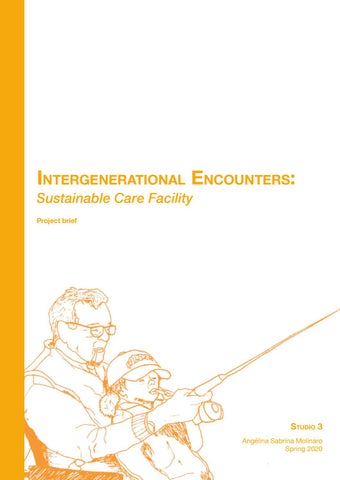
Intergenerational Encounters: Sustainable Care Facility Project brief
Studio 3 AngĂŠlina Sabrina Molinaro Spring 2020
Table
of content
Focus
05
Abstract, Offset.
Context
14
City, City analysis, Development plan, Climate challenges, Site, Pictures site area.
Research and analysis
34
Users, Typology, Nature, Daily routines.
Programme
48
Encounters, New thinking, Home, Dilemmas, Threaths and fenching,Time and loss.
Natural materials
72
Reflection
79
Bibliography and appendix
80
04
Focus
Abstract In the last couple of years it has been brought to attention that many elderly live in loneliness. From loneliness arise other problems. Those are problems as depression, suicides and illness. But this area isn’t the only field loneliness appear in our society, research shows that loneliness and anxiety amongst the youth can be tracked back to the lack of care in daycares and kindergartens. So the lack of support in the younger years have a big impact on the children’s future development. Future prognosis suggest that the demographic for elders and children will rise further in the future. The main focus of my thesis is to create a new typology for the future that combine the two institutions kindergarten and eldercare to create mutual beneficial relations between elderly and children. Due to the future demographic development (which will
be touched further in the population prognosis) the Danish welfare state will face extra challenges and battle the continuously struggle to finance and assure that people, who no longer can participate in the society, still will receive good care. This project investigate intergenerational encounters and relations. The vision of this project is to create a place, which makes it attractive for elders to move from their homes, into housing that stimulates them. But creating a mutual beneficial environment for children and the elderly, that allows knowledge to be shared across generations, and hopefully create more fulfilling lives for both parties involved.
05
Growing segment of people needing care
Today there is 1.1 mio. people in Denmark in the category 65+. This is the age of retirement in Denmark. In the future several prognosis suggest that this demographic will rise further. In a welfare state which struggles to finance and assure people, who no longer can participate in the society, will still receive good care. The conditions of the welfare have been criticized for many years, and there is a big wish for more personnel in the health sector. Further more the prognosis also show a growing demographic of children in the future. Also here is a demand for more educated personnel and hands.2
Development in population. Danmarks statestik.
Population Statistic 2018-2060 Denmark’s Statistic’s latest population prognosis shows that the population is expected to grow by 279,000 or 4.8 pct. over the next ten years. It is primarily the oldest segment that are becoming more numerous. The group over 80-year-old alone is expected to grow by 150,000 over the next ten years, corresponding to 58 per cent. more than today. The group of 65-79-year-old is expected to grow by 58,000 and thus be 7%. larger than today. The oldest segment will therefore have more presence in the society in the future than today. The number of over 80-year-old is expected to grow towards 2057, where they will amount to 667,000 or 2½ times more than today. By 2053, more than one in ten inhabitants is expected to be over 80. Today, over 80-year-old make up 4.4 per cent. of the population. The number of births is expected to increase over the next ten years. By 2027, the birth rate is expected to rise to over 72,000 children, which is 18 pct. more than was born last year. With an aging population, the number of deaths is also expected to increase every year. By 2027 over 58,000 are expected to die, which is 10 pct. more died than last year1.
06
Fertilitetskvotienter 2019. Danmarks statestik.
mean age
2018. Danmarks statestik.
O ff s e t
The Danish government For generations, we have developed a safe community in which we look after our children, care for our elderly, and care for each other if we suffer an accident or fall ill, regardless of social background or family situation. The government’s point of departure is that good health care and a decent elderly care are among the cornerstones of our welfare society. We must protect and develop that. The first steps have already been taken. With the Finance Act for 2016, we have prioritized a significant lift in the health area with a focus on the elderly. With the Finance Act for 2017, additional funds have been allocated to the area, while at the same time we have both strengthened the efforts for a decent elderly care3.
Future When the effects of healthier aging in the future are taken into account, about 30 per cent will be needed. more care homes until 2032. This corresponds to the need for approximately 13,500 more care homes according to KL. If the need for nursing homes alone is projected with the demographics, around 35,000 more nursing homes will be needed by 2030, corresponding to an increase of 80 per cent4. In 25 years, the number of citizens over 80 will have doubled from about a quarter to about half a million. That means more home-care, more nursing homes, and much more nursing staff. But how do we as a society lift the task? Municipalities will need thousands of new nursing homes and billions of kronor annually for extra care, if the current level of care for the elderly is to be maintained5, this is without thinking of bettering the conditions.
07
Elders Loneliness
Certain situations in life makes us more exposed for experiencing loneliness. An example of this can be, when we leave the labour market to retire. Loneliness can have many reasons, when you end up alone, if you get divorces, the loss of a spouse, but it can also occur, if it becomes difficult to get around. When we experience loneliness it effects the life quality for the individual, mentally and physically. Loneliness increases the risk of illness and death. Today the retirement age in Denmark is 65,5 years. According to Ældresagen 50.000 elders in Denmark over 65 feel Lonely. Loneliness can be life-treating for the individual and expensive for the society. More recent research indicates that long time loneliness can increase the presence of dementia, cause cardiovascular disease and depression. Lonely people is often more in contact with their doctor, home care or authorities than others. Loneliness is the cause to higher admissions to hospitals and psychiatry6.
08
Self-determination homes
in
nursing
The Danes live longer and generally have a lower need for care than before. However, the vast majority of the elderly, who are currently gets a place in a nursing home are severely physically or mentally impaired. They are deeply dependent on the help they receive at the nursing home. The government will pursue an aging policy based on the five basic values of the Elderly Commission on influencing one’s own life, respect for diversity, focusing on humanity, good experiences every day and a worthy end to life7.
O ff s e t
Give
back
the elders their everyday- life
Loneliness, boredom and helplessness are side effects of a wrong organisation of everyday life. It is not always good enough to be in nursing homes in Denmark, says nurse and dementia coordinator Karin Dahl, who is working to change the nursing home culture in Denmark based on the American Eden Alternative philosophy. Weak people in nursing homes others thinks life is not worth living anymore. It may not be right for the content of life to stop the people moving into an institution because others need to have control of everyday life, �says Karin Dahl. She believes that too much effort is spent on administration, scheduling and documentation and on what goes beyond the elderly who live in the institutions8.
09
Children Lack of proper care in kindergartens
It’s essential for children to form safe and close relations to their pedagogues, but the rate of pedagogues in daycare is so low that many children don’t get this opportunity. According to psychologist Rikke Yde Tordrup this have serious consequences for their learning and further development. If a child don’t get presence and don’t get used to seeking support from adults, it have big consequences for the child’s ability to self-regulate, attention ability and desire to socialize with others. An average child in Denmark spend many hours in institutions. First they spend 2 years in the nursery and then 3 years in kindergarten. They spend 7-8 hours in an institution everyday. Psychologist Rikke Yde Tordrup meet more and more children and youth with stress and anxiety. They have difficulty regulating themselves and being with other people. According to Rikke Better the rate of pedagogues in daycare institutions are crucial for preventing its development9. According to a survey 29 % of pedagogues experience at least once a week to be in an indefensible situation. If the daycares today should reach the same level as in the 90’s there should be hired 9.000 pedagogues10.
10
The minimum requirements
The minimum requirement should be understood as how many children there should be per. pedagogue. The minimum requirement on one pedagogue per. three children (1:3) within the age 0-2 years and one pedagogue per. six children (1:6) within 3-5 years. The minimum requirement are the first step in a direction to improve the conditions in the institutions. The minimum requirement are suppose to be a protection among savings and downcuts the latest years. BUPL’s goal and recommendation is to have this staffing throughout the opening hours, which is not the case. The regular personnel being educated and a minimum rate of pedagogues should be 80 %. Today no municipalities can comply BUPL’s minimum requirements. Estimates by Denmarks Statistic estimates that in 2029, there will be 61.000 more kids in the age 0-5 years in Denmark. That will require 10.000 pedagogues more to maintain the rate and level of pedagogue of today- a number which is already in the low end of what scientist recommend 11.
O ff s e t
The child and elders
Grandparents are known way to fill in the gaps for overworked or single parents. In a study conducted in the United Kingdom, researchers found that children who spent more time with their grandparents had less emotional and behavioral issues, and where much further in terms of emotional intelligence, compared to children, who did not have grandparents involved in their lives. .
In t ro ve r t
E ks t ro v e r t
VS
The power of an intergenerational relations have even been shown to impacts depressive symptoms. A close relationship between grandparents and grandchildren has been linked to a decrease in symptoms of depression for all parties. Grandparents in the study noted that they felt like they were able to support their grandchildren, especially because they understood what they were experiencing. 12
S U R V E L I A N c E
P R O TE C TI O N
11
Generation gap
After the women entered the working force, institutions have become essential part of our everyday-life with both parents working. This combined with families, no longer live near their relatives, also makes the institutions necessary. The discussion whether it affect the children not having a relation to the older generation is very much present in the public discussion13. The last couple of years the this topic have created much more awareness in form of articles, TV-shows, discussions and politics. When you look to other countries the generations are closer connected and the children spend much more time with their grandparents, this can be due to no other opportunities for care, economy or the social structures of the country.14
12
Encounters between generation can be created by common activities or interest. In Denmark today many children doesn’t live close to relatives and miss out on the everyday exchange of knowledge between the elder and the younger generation. It makes sense to create encounters between the older generation and the younger generation as they supplement each other very well. Children have a need for present and to learn, elders have a many years of life experience and a lot of time. Elders need to have conversations and get activated and challenged in their everyday lives - where children (as elders) don’t have the same filter as many of us have on today, and can ask some hard and challenging questions, but also show an interest in their lives. 15
Bennefits
Intergenerational Encounters
13
Context
Southern Denmark The region of south Denmark consist of 1.2 mio. people and is the region with the second larges area in Denmark16. The capital of region south Denmark is Vejle. Vejle is also a part of another community, which goes further back than the beginning of the regions, this it the triangle area. This region also have a high growth compared to the rest of the country17
16
The Triangle area
The Triangle area is the country’s oldest business region. The collaboration dates back to the 1960s, the cooperation have since 1994 been more formalized. today it counts the 7 cities: Billund, Fredericia, Haderslev, Kolding, Middelfart, Vejen and Vejle. The board of the triangle area consists of the mayors of the cooperating municipalities. This ensures that cooperation is a high political priority in all seven municipalities.
Context
The Attraction to the area.
The Triangle area have been the key area for production in many years. One of the reasons is, that it is transport-wise an area strategically well placed. Economically this area is also well of having a high BNP pr. capital. Looking at many statistics regrading growth it is clear that this area often are places well i relation to the rest of Denmark, often only surpassed by the capital, Copenhagen.
The municipalities facing changes in demographic, with a growing elders segment and many young families moving to the area, which means more children too. It is especially appealing for elders and young families because of the sizes of the cities, work, nature and economics.
Low unemployment, growth in population, focus on innovation and entrepreneur are just a few of the success criteria. Another parameter that also makes this region attractive is the low housing prices, which is very low compared to the rest of Denmark. All of this makes the municipality attractive for newcomers18. BNP BNP pr. inhabitant in the 5 larges metropolitan regions
BNP pr. inhabitant (2010 kr)
Adverage m2 price for Single Family Home/ terraced house
Housing prices in metropolitan regions Adverage m2 price for Single Family Home/ terraced house (kr/m2)
Aalborg-area
Odense-area
Aarhus-area
Aalborg-area
Odense-area
Capital-area
Aarhus-area
Capital-area
Triangle-area
Triangle-area
17
Vejle The will to growth
Vejle is a municipality, which is known for being a catalyst for IT, innovation and urban development. Vejle is one of the main cities the triangle area, but is also one of the biggest centers of growth, who have focused on bettering the city and developing the city for the future. Vejle municipality is the county’s fifth larges in 2019 with 115.668 inhabitants. They have had a population growth on 4,7 % since 2015. The population growth are mainly concentrated in the center and the nearby
area. Some of the tendencies in Vejle are that the elders no longer want to live in nursering homes. The division of typologies among the people in vejle are 49% in single family homes and 33% in complex-buildings, 11 % in terrace-houses, dorms and nursering homes ect. are only 1%19 Vejle municipality is 1059 kvadratkilometer and 57.051 of it inhabitants live in the city.
Architecture politics Vejle municipalities are the first municipality in Denmark to formulate a formel architecture politic. Today the municipality have experience a lot of growth in population and Vejle have become a popular place to live in the triangle area. Momentarily the focus in the municipality is on the future flooding of the city.
Green skyline
With this strong architecture-politic the municipality have become the best example in Denmark, which many other municipalities look up to. Vejle have created a brand value in Denmark with their green skyline and iconic buildings. Vejle is a great example in how to controle a growing city with architecture to create a coherent city. Water
18
City
Elders visible in the urban fabric
Elders
City
Urbanization
In developing cities elders often get excluded. The exclusion have many ways, it can be the threshold to the sidewalk or lack of public transport or affordable housing. Often elders stay in the countryside, because the cities are too expensive, but end up isolated. Including elders in the public sphere is important, and by prioritizing elders in the urban fabric, making them visible, creates more diverse cities.
Icons
The city have prioritized architecture and infiltrated this priority it in larger parts of their system. This becomes visible in terms of their iconic building and successful harbour area, where the meeting between city and water have been prioritized to the public -people of the city and common areas. Vejle have prioritize and value architecture, learning and understanding the value of architecture in the development of a city. They have a very present nature in their city and are an innovative municipality, who are focused in making their city attractive and in that relation ready to try new paths that can enhance their city.
19
Marts 21.
20
September 21.
June 21.
December 21.
Historical map 1928-40 https://www.klimatilpasning.dk/vaerktoejer/oversvoemmelseskort/se-oversvoemmelseskortet/
City
Train
Cemetary
High built Low built
a n a ly s i s
Maps
Water
Scrubs Forrest
Business
High built Low built
City center
21
B
Nordbyholmen A
A
Allotment huts Trædballebanke
Skovbyholmen
Rosborg Ø
Bjergplatauet
Rosborg gymnasium
Ådalsholmen
The proposed development propose a much larger scale in relation to buildings in the context, which are mainly one story heigh. More south from the slope the scale of existing building higher holding some of the communities social functions and Educational/cultural event.
Development plan
New Rosborg
The marked area above is the entire area becoming New Rosborg. Today this area is recycling-station and many of the sites for future development (which is illustrated on the left) are un top of landfill from the 80’s. The municipality’s plan on how to deal with the landfill is to put extra clean earth on top of the landfill, because it is too costly to clean the earth. The new development have been divided into smaller areas.The area i’m working with is Nordholmen. Nordholmen have not been not used for landfill, but were previously drained for field operations before football fields were built (in one corner). Since then, clean raw soil (clay-containing) and mud has been laid in the area.
Eksisting buildings
Nordbysholmen
Allotment huts
Diagramatic Section A
23
Resilience strategy
The city have developed a resilience strategy, which means Vejle Municipality is part of the global network, 100 Resilient Cities. Here, cities all over the world have committed to jointly developing and sharing new solutions to 21st century social challenges. Vejle is one of the most vulnerable places in relation to flooding, because of their landscape. As a part of this global network they also use each-other in the network for inspiration on how to handle the water.
Co-creating city
The digitale city
Social resilience
Climate resilience
A part of Vejle’s strategy is to have more Social Resilience, which is about enhancing the change form compensations thinking to resource-building. The strong danish welfare model is under economical pressure and demographic cross-pressure and the role of the municipality are changing. The municipality of the future will no longer be a service oriented, but leaded democratically by a community of active, responsible and ressource strong citizen, companies and institutions 20.
Climate resilience 1. Blue cityspaces 2. Nature in the city 3. Green mobility 4. Circulare economy Co-creating city 5. Common identity 6. Partnership Social resilience 7. Diversity The digital city 8. Smart city and digital resilience
24
One of the Main strategies are to develop these 5 areas. Ny Rosborg A brand new resilient neighborhood focusing on community, sustainability and diversity. Fjordbyen An urban area under development that creates new opportunities for life through water management. Vestbyen Vejle’s old working quarters, where social resilience and cohesion are the main focus. Boligsocial Nord og Syd Two neighborhoods that have been renewed through the work on housing social plans.
Vejle use different design parameters which have to be present in design decisions; Climate resilience, Co-creating city, Social resilience and The digital city.
C l i m at e
Flooding
Vejle’s landscape have been shaped by the melting ice. Vejle have a unique geographic position, which is one of the cities greatest attribute, but also poses the biggest challenge. The city are among the most vulnerable place in Denmark in relation to flooding. Water are threatening the city from all sides: rainwater, surface water from the dramatic landscape, high groundwater and rising sea-levels. This are combined with the hight frequency of great storms and heavy rain, which is a serious thread to the cities longterm survival. On the other side water is also a great value to the city and can be used to create life. 21
LAR strategy The proposed plan for the area suggest creating blue/green zones ditches, which when the water posses a problem can collect and lead the water away. They also planned on extend the existing streams. My project supports this strategy. As the chosen site already, have drainage water doesn’t posses a threat in the same extend as the rest of the Rosborg development.
challenges
Resilience
Flodding 2100 (dept in meters) 0,10-0,49 m 0,50-0,99 m 1.00-1,49 m 1.50-1,99 m <2.00 m
Flooding 2100 (meters)
Model Landscape
25
The field It’s important not to exclude the elders of our future cities, therefore I have chosen to locate them within 1,5 km form the inner city and very close to the doctor, leisure activities and public transport. The proposed area Nordholmen quickly found my interest, especially after visiting the area. Especially the calmness and brid singing won me over.
Single family houses Allotment huts
Agriculture Fields
26
Education Public functions 1,5 km city center
Wetland Nature
This site is also furthest away from the relatively large noisy road near by and surrounded by existing housing, single family homes and allotment huts. Besides this nature is very much present on the site - in form of a small forrest and a lake.
Site
Trafic noise
27
28
Pictures site area
29
30
Pictures site area Walking aroung my site its quickly becomes clear that this area is a place you walk across. Small creecks have framed in the site. When you look in the neigbourhood you see the alutmenthut area have many marks on how to personalize their spaces. You also feel the life in the area with many of them selling flowers on the side of the road.
31
Bridge to the lake. This area is clearly used by people living close by for walks. The pathways in the picture below illustrates the weet environment in the swamp. When it have rained a lot many of these areas can defficult to navigate in because of the amount of mud. The lake is habitat for animal life, especially birds have taken a liking to this area. Many different birds is spottet here e.g. swans and a duck family.
32
Pictures site area
33
Research
a n d a n a ly s i s
Research This project research have been conducted by looking in to various material regarding my users. The material expand from documentaries, books, articles ect. to interviews with people working with these user groups.
ing-homes are, and that very often it isn’t the persons own choice to go to a care facility, but the relatives. Elders are often very sick, when the go to a nursing home, and have approximately 2,5 years at the insitution before they go to their grave.
The project analyses the way elders and children lives too day. Among the findings are how unpopular elder-homes/nurs-
This thesis project want to challenge this and make is more attractive for you to leave you home, and move into more protected housing.
Kindergartens
Home
Kindergarten
7-8 hours per day
Lack of presence
To low ratios of Pedagogues
Development problems
Eldershomes
Home
Elder care
Grave
Approx. 2,5 years
36
Loss
Loneliness
Lost meaning of life
Users
Sealing hight story-appratment Sealing hight One-family house 200
i n v e s t i g at i o n s
Highest Shelf Eye height Standing
100
Table height Eye height Sitting
Children 3-6 years 22 Sealing hight story-appratment Sealing hight One-family house 200
Sitting height Eye-height Sitting
Need to be educated
100
Table height
Smaller range Full of energy
Needs to learn
Flexible
Elders
Need to be stimulated
mobility restrictions
Sealing hight story-appratment Sealing hight One-family house
Children 3-6 years
In this age you need to learn some of the rules in society, but also the social norms and how to interact with others. You have to get prepared for starting school and learn to engage with others outside your home.
Highest Shelf
200
Eye height Standing
Eye height Sitting
100
Table height
Gets tried faster Hearing loss
Lack of energy
Consider the weather Poor vision
People and elders
Diseases Mobility restrictions
Decrease in physical activity
Needs rest
Need helping devises
Elders 65 +
With ages comes years of wear and tear at the body, this is both to the physique, but can also be mental.
Dealing with parents and relatives
Chaotic everyday caused by lack of hands
Loss of hearing because of noise
Users Needs The users have special needs in regard to their physical environment, this can be due to their physical state, but the frames surrounding them can also be used to enhance their mental state.
Have to stay positive in difficult situations
Many unhealthy lifts
Restrictions in the weight you can carry
Often gets sick
Walking a lot
Service personnel
This includes all personnel around elders and children. This could be a carer, kitchen personnel, pedagogues, leaders of the organisation, volunteers and helpers.
Mobility Mobility restrictions and different ages have an impact on the scale in relation to reaching heigh and ability to things and tables in the heigh fitting the users. Because of the different users, it’s also important to consider the scale in this project.
37
Single family house
Terrace house
Block house
38
Typology
Danes
Half of the danish population owns their own place. The Dane averagely live 21 years in a place before selling it. In apartments this is only 6 years. We have a high growth in population in cities. Single family housing are the most used typology in Denmark, second are block houses and row houses. 24 In total 3,8 millioner Danes lives in house while 1,8 millioner live in apartments numbers from 2019.
Living alone
40 % of all housings contains of a person who lives without a partener. Especially the segment of the 30 -60 year old lives alone is growing.
The elders
Two thirds of the elder segment lives in houses they own. Many start consider moving, but many are reluctant. Especially if they live in a good community and have good neighbors they often stay longer in their homes. When they decide to move certain things are on their shopping list and reasons to move; smaller resident, no stairs, no garden work, bad health or living close to the center. It’s important to say that smaller residents are not small residents. Especially housing with only 2 rooms are not attractive. Elder couple’s often move to housing with 3-4 rooms25. Its very important that the housing type is a place where you can keep your independence. The elders look for certain things while shopping for a new place, the distance to thing have a say in where they want to settle in. Close to nature, shopping, good infrastructure, and close to public transport26.
Popularity
with communities of senior
housing
In the recent years the popularity for collective housing have risen. Especially the community are appealing to the elders. But also the financial part of it. In fact, it is so popular that a survey by SFI - the National Welfare Research Center in 2017 found that 80,000 elderly people were considering moving into senior housing communities, while at the time of the survey there were only about 7,000 housing in senior housing communities around the country23.
39
Tub-Building - High population - Introverted structure - Closed courtyard
Cluster-Building - Community focused - Based around a center
Block-Building - High population - Often with balconies - Great overloock spaces
40
Typology
Terrace-House - Shared - Often seperated by fences. - Two families one house
Danish single family house - Allocated to a parcel - Garden surrounding house - Approx 150 m2 in Vejle. - Privacy
Allotment Hut - Community - Close relation to nature - Low vegetation between the buildings - Small scale building
41
42
Landscape now
Strategy Nordbyen
Clusters
150 m2 Single familie homes
E a r ly 2-Storey block buildings
Terrace houses
Allotment Hut
testing typologies
2-Storey tub building
43
Mental health and nature Nature have been known to have a healthy effect on people for years. Last year an experiment in several municipalities made by Friluftsrådet and researchers at SDU are investigating, how nature affect different audiences; people with chronicle illness, lonely elders, citizen with stress, -anxiety or depression and children with special needs. The three first audiences experience getting better after taking part in this experiment, while it haven’t been possible to evaluate the last one -children with special needs. Søren Andkjær from institution Sports and biomechanics at SDU says that the nature have affected the participants in a positive direction in relation to well-being, health and life quality.
The famous TV-doctor Peter Qvortrup Geisling believes that Danish children do not lack Vitamin B, C or D. They lack Vitamin N. Himself raised with a fishing rod and binoculars in his hand, he have become a public advocate for nature to be given by prescription to sick Danes. Especially one group, he thinks, needs a lot, much more in nature: Our children. “Children are half as much out in nature as when I was a boy. It simply does not work. The children miss out on a lot of experiences, which is a good counterpoint to a stressful children’s world today”. He thinks it can have major consequences for the new generation, if they do not feel the wind and tumble into the leaves. - If the children do not taste nature when they are children. Then they intuitively do not know where to go when they grow up and experience the stress and pressure.27
“Especially one group, he thinks, needs a lot, much more in nature: Our children. - Children are half as much out in nature as when I was a boy. It simply does not work”
Forest
44
Bushes and scrubs
Garden
N at u r e
Cover
Shelter of nature
Shelter
Pavilion
Orangergy
Outhouse
Nature have shown in studies to have a big impact on the well beings of humans, it can reduces stress, depression, anxiety, and increase happiness. Because of the importance of nature I have analyzed how it appears in different scales and degrees of nature, from the forrest to the houseplant.
Garden boxes
Nature
To bring nature closer to people there is many alternatives and degrees of creating shelter from the elements.
Balcony
Plants in pots.
45
Interviews Child care Some of the main differences in my findings are that in the nature kindergarten children spend time alone and also have the possibility to do so. The philosophy in the nature kindergarten is very much build on trust. This also limits them, because they can not take in kids they can’t trust or whom maybe have other issues. They try to incorporate diversity into their “family” both in the organization, but also in the kids in the facility. Many of the others institutions follow many of the same routines and schedules, often limited to the amount of personnel by their finances and similar approach to handle the hard situations with limited resources. The nature kindergarten mentions that for some lack of funds they incorporate the parents, which helps them create a small community. Because they are places close to nature they also teach children about sustainability and lack of resources, only having a certain amount of water for a week. Elder care In Elder care it becomes clear from the investigations that elders whom need help, but still lives in their homes are quite lonely and spend a lot of time alone. Some of the only encounters are with the helpers who come to help, and sadly the time is not always for having long conversation. Some of the elders are in a state where the staff
46
evaluates it would be better for them to move to a nursing home, because of the help they need, but the citizens prefers to stay in their own homes. In a nursing home/retirement home it’s clear that you don’t chose who your neighboor will be and you can end up being the only one by “good health”. Often nursing home is the last stop on the journey and are seldom something they chose them selves, but chosen by relatives. The investigations also shows many of them only passed time with others around meals. In institution for dementia the citizens spend more time in the common area. Investigations By analyzing both children and elder facilities it becomes clear that both have a lack on some of the areas, either they don’t have time alone/one-to-one or they only have time alone. Their time are often scheduled either by the meals, but also by the activities. Both of them have activities “before dinner”, and have a quiet afternoon. In the nature kindergarten they have a quiet time after lunch. Where in other institutions all kids are in the playground, because of lack in personnel. Some elder institutions use volunteers a lot to do activities out of the ordinary, because they also lack personnel.
D a i ly routines
With others
Most time spend with others
Only nap time is spend Alone
alone for the youngest
Rarely the children have oneone time with an adult. But sometimes spend time in smaller groups.
One-one time
Analysis of the day Kids
01
02
03
04
05
06
Night
07
08
Morning
09
10
11
12
Before dinner
13
14
Dinner
15
16
17
18
19
Afternoon
20
21
22
23
24
Evening
Most time spend with others are in demen-
With others
tia institutions with common areas
Most of the day spend Alone
alone
Some elders only interactions
One-one time
are with the staff
Analysis of the day Kids
01
02
03 Night
04
05
06
07 Morning
08
09
10
11
Before dinner
12
13 Dinner
14
15
16 Afternoon
17
18
19
20
21
22
23
24
Evening
47
Programme
Kindergartens
Home
Kindergarten
7-8 hours per day
Lack of presence
To low ratios of Pedagogues
Development problems
Eldershomes
Home
Elder care
Grave
Approx. 2,5 years
Loss
50
Loneliness
Lost meaning of life
New thinking
Programme
Kindergarten
Elder care
HOMINESS
Nature
Better health Community feeling
Presence Higher life quality
Intergenerational
Feeling usefull/
encounters
needed
Healing nature
51
One-one meeting
Group meeting
52
Visual meeting
I n v e s t i g at i o n s
Sharing your knowledge
Elders observing
Elders sharing skills
Common activities
child observing
of encounters
Child sharing skills
53
RELATION Personal distance 45- 120 cm
SAFE
LEARNING Exchanging skills
2 people
KNOWLEDGE ONE-TO-ONE ENCOUNTERS
Activities
54
CHEST?
NEW FRIEND
Encounters in eye-height
A one-to-one encounter needs 2 people. Here you have full attention to eachother. In these encounters it is important not to be to far from each other. Therefor the personal distance of 45-120 cm is a great distance, the contact distance between close friends and family. 28 Exampels on activities
encounters
Creating new realtions is difficult. By having one-one encounters where you meet each other in eye height is very benneficital, but can be difficult to create.
One-one
One to one encounters
Outdoor: Bird watching Fishing Eating ice cream walking picknik Planting recyceling Learning a skills Exploring nature Indoor: Recyceling Cooking Reading Puzzel Playing Drawing Painting One-one encounters can also happen in a group.
55
Room for 60 people
COMMUNITY
Sitting in circel
COMMON INTEREST
Social distance 1,2- 3,7 m.
GROUP ENCOUNTERS
INTERACTION
Min. 3 people
SAME ACTIVITIES
25 m. distance experience emotions min. 60 m2
56
Group
Belongingness is the human emotional need to be an accepted member of a group. Whether it is family, friends, co-workers, a religion, or something else, people tend to have an ‘inherent’ desire to belong and be an important part of something greater than themselves29. Its important to humans to be social and in a group.
encounters
Group encounters
A group consits of minimum 3 people. Activities are a great way to collect people in a group. Often in group activities they end up in a circle. The distance betwwen groups are greater than the one-to-one encounter at 1,2-3,7 and called the social distance. Activities for groups: Painting Trips Learning Singing Excercise Motoric games Talking
57
CHOICE Visual acess
ALONE, BUT NOT ISOLATED
Retreated encounters
COMFORTABLE
50-70 m. recognition
VISUAL ENCOUNTER
Privacy zone
REGONIZION
DISTANCE Public distance 3,7 m.+
58
Visual
To not feel isolated or alone, even if you sit by your self. Within 50-70 meters is the distant where you can start to regonize genders, and age and even people. To create a frame for the visual encounter means that there have to be a distance to others 3,7 + is the public distance to others. But its important not to feel like your personal boundaries are being broken down and you have a visual acess out (if your inside).
encounters
Visual encounters
59
Work life and family in one
Place for Retitution
The past
Modern life
A part of you
House
60
Work
Lossing a limb
Home
Person
Home
Home then and now
Back in the days a home was the frame for work and the family, but today in modern society work is often located outside our homes, and the definition of home changed to a sanctuary and place for relaxation.
Loss
of home
The lost of home have been described as loosing a limb. During the firework accident in Seest, Kolding. People lost all at once. Many of them described it as loosing a part of them selves. When they got their homes rebuilt everything was new and they didn’t feel at home.
What makes a homes
The meaning for home is big for the individual, but is also something fluid (intangible). Its something that occures in the combination of a person and a house.
61
City
Area
5
House
Home
First I looked into home within the built environment, and realized that home is much more fluid that this. I looked into the home in different scales. It’s about a sense of belonging, but has a much higher complexity.
62
Private threshold
Home in scale
5
Matrikel
Matrikel treshold
Bed
Family
63
64
W h at
I looked into what home is not to get a better understading of home. My finding where that many of the things a home is not, are many of the things defining the institutions today. Dense small living spaces: Living very close in small spaces are quite infamiliar for most people in denmark. No acess to the outside: Most have acess to the outside in terms of a balcony or a garden.
is home not?
Anti home
Non flexible: Space there can only be adapted in one way.This don’t allow you to make your personal touches on the space. Non Personal: This would be soulutions that are stadarized and industrial, with no space for prsonal touches. Sterile environment: Many foreign objects as medical equepment or helping devices makes the spaces not feel like home. Maybe they become too functinal. Work space for others: Our homes are seldom a constant work space for others. A workspace often have focus on low cost and functionality, this are seldom the key words in people describtion of their homes.
65
66
Dilemma
Ekstrove r t
VS
colages
In t ro ver t
S U R V E L I A N c E
PROTECTION
67
Life treatening
Traffic
Water
Others Getting lost
Falling
hurt
68
ed robbon
and fencihing
Colour cod-
T h r e at s
Marking
Small fence
Plants
Metal fence
69
Perseption of time Future
0
70
Past
80
Time
Loss
and loss
71
N at u r a l
m at e r i a l s
Related to the sea:
High wind strength
Fireproof
Insulation Drainage materials
Inside climate Mussels
Drainage
Strongly water resistant
Possess static strength
Breathable
Fireproof
Insulation
Indoor climate Seaweed
Self - impregnation High wind strength
Fireproof
Strength Boulders
Drainage
Hardness
Water resistant
Related to the coast: Fireproof Structural
Sand
Higher acid resistance
Mortar Cladding
Cementing capability Lime
Light-weight
Removable by water
High wind strength
Fireproof Toughness
Toughness
Nature
Today we seems more motivated to investigate nature, motivated by large-sale public health problems such as obesity, depression and pervasive nearsightedness, all associated with the fact that we spend too much time indoors. Several investigations have been conducted. In England researchers from the University of Exeter Medical School recently analyzed mental health data from 10,000 city dwellers and used high-resolution mapping to track where the subjects had lived over 18 years. They found that people living near more green space reported less mental distress, even after adjusting for income, education, and employment (all of which are also co-related with health). In 2009 a team of Dutch researchers found a lower incidence of 15 diseases—including depression, anxiety, heart disease, diabetes, asthma, and migraines—in people who lived within about a half mile of green space.
Strength Drainage
Natural Stone
Hardness
Water resistant
Related inland: Breathable
Fireproof Structural Sculptural Cob
Seismic resistant
Researchers suspect that nature works primarily by lowering stress. Compared with people who have lousy window views, those who can see trees and grass have been shown to recover faster in hospitals, perform better in school, and even display less violent behaviour in neighborhoods where it’s common.30
Breathable
Natural materials
Insulation
Light-weight
Straw bale Structual
Straw
Water resistant Used for wall construction by the vikings Cladding
Light-weight
Low maintainance
Willow
Reacts well on weathering
Wood: Dense Fireresistance
Structural
Harder
Hard wood
74
Durability Indoor climate
Used for interior
Structural
Light-weight
Soft wood
Fast growing
Flexible
Construction is an important sector to analyze when trying to reduce negative environmental impact building by eliminating toxic off-gazing of building materials31. It is quite simple; people are exposed daily, and over many years, to the chemicals that went into the materials that were used to build their own homes. Living in close relation with nature gives great value to humans mental state, too built in natural material it can also benefit their physical health. By choosing natural materials one can create healthy indoor climate for everyday life. Many of the materials we built with in the past have many benefit for humans, but also for the environment.
Living
Material analysis
Untreated wood
Treated wood
Cor-ten
Steel
Bricks
Double Glass
Life expectancy 1
Low Co2 emission
2
Water-resistant
5
Fireproof Good isolation ability
10
Local material 20
low-cost Durable Arise new life from it
i n n at u r e
Concrete
30
Reusable Disassemble 50
Labour intensive
100+ Years
mussels
panels
Lime
Straw
seaweed
natural Stone
Cob
Life expectancy 1
Low Co2 emission Water-resistant
2 5
Fireproof Good isolation ability
10
Local material low-cost
20
Durable Arise new life from it
30
Reusable Disassemble Labour intensive
50
100+ Years
75
Investigations of material qualities Hard surfaces
cycle of life
A hole mussel
In smaller pieces
Natural Habitat As larvae, they will float freely in the ocean for about a month while their major body systems form. Eventually, they settle on a suitable rock or other hard surface and attach themselves. Mussels farms use rope in the sea .
Collected in another structure High wind strength
Fireproof
Insulating Insulating drainage materials
Drainage
Seperation between floors
Drainage
Cladding exterior
Inside climate Mussels
Strongly water resistant
76
Pulverized
Fill in walls Possess static strength
Building components
Roofing
Living i n n at u r e
Sand Light
cycle of life
Sewed together
Collected in another structure Non- toxic
Long lifeexpectancy Fireproof
Isolating
Inside climate Seaweed
Self - impregnation
Natural Habitat
Rolled
Eelgrass forms dense so-called eelgrass beds. The eelgrass beds are home to a rich wildlife with, among other things, crabs, snails, mussels and fish and also serves as an important area for fish fry. Eelgrass is Self pollination. Growing place: Sand bottom in sea and fjord to 5 meters depth.
Stacked
Isolation
Pressed
Fill in walls Building components
Roofing
77
Sustainability
This thesis project strives for an holistic approach. In relation to Studio 3’s theme; shifting territories in an (un)stable environment, this project’s focus does mainly focus on social sustainability. Today the lack of human relations create a negative effect on the weakest in our society - elders and children. I investigate in what extent architecture can solve a social-economic problem by re-organising and reinvestigating the buildings and the typology with intention to create intergenerational encounters, that could strengthen their human relations. Establishing a close connection to nature, which gives an opportunity to create a sustainable building, which respects the context, learn from it, uses local/natural materials and creates favorable indoor climate. By doing so it gives value for the users and the climate. The sizes of the different generation have a big impact on the need for kindergartens and elder care, therefore the aspect of time have to be considered in this project. Because of changing demographics a certain flexibility will be acquired to address changing needs of users and secure the building’s functionality in the future.
78
In my thesis I’m exploring how to rethink and innovate the care sector in Denmark, being critical to what exist today, but also investigating how we live now to have a better offset to propose something different. After diving head first into designing for elders and children, I quickly became aware of how large each theme were - designing both a kindergarten and a nursering home. Therefore I had to chose my focus quite early, which was to focus on creating this new typology.
reflection
//
Covid-19 made certain anthropological and participatory investigations impossible. If circumstances had been different, this is certainly aspect I would have liked to explore further and have benefitted my project.
As the project evolved I got to further explore and rely on my knowledge from previous semesters and my internship. This project has contributed with new and interesting knowledge and allowed me to work in different scales, touching different themes within architecture. Especially I enjoyed the conflict of making room for diversity in an urban context and developing citiy and giving a voice to the people, who no longer can contribute to the society.
79
Bibliography 1. Markant flere ældre i fremtiden. Published by Danmarks statestik. Internetadress: https://www.dst.dk/ da/Statistik/nyt/NytHtml?cid=26827 - visited the 04.02.2020 (Internet) 2. Tal og fakta om ældre. Published by Ældre sagen . Internetadress: https://www.aeldresagen.dk/om-aeldresagen/aeldresagen/organisation/fakta/tal-og-fakta-om-aeldre - visited the 03.02.2020 (Internet) 3. Sundhed og ældre. Published by Regeringen. Internetadress: https://www.regeringen.dk/regeringens-politik-a-å/sundhed-og-aeldre/ - visited the 06.02.2020 (Internet) 4. Flere ældre vil komme til at mangle plejebolig - Analyser. Published by DI service. Internetadress: https://www.danskindustri.dk/brancher/di-service/analysearkiv/brancheanalyser/2019/1/flere-aldre-vil-komme-til-at-mangle-plejebolig/ - visited the 03.02.2020 (Internet) 5. Fremtidens ældrepleje. Udgivet af Forsikring og pension. Internetadress: https://www.forsikringogpension.dk/temaer/fremtidens-aeldrepleje/ - visited the 04.02.2020 (Internet) 6. Ensomhed. Published by Ældre sagen . Internetadress: https://www.aeldresagen.dk/presse/maerkesager/ensomhed - visited the 03.02.2020 (Internet) 7. Giv de gamle hverdagslivet tilbage. Published by Dansk sygeplejeråd. Internetadress: https://dsr.dk/ sygeplejersken/arkiv/sy-nr-2013-13/giv-de-gamle-hverdagslivet-tilbage - visited the 03.02.2020 (Internet) 8. Giv de gamle hverdagslivet tilbage. Published by Dansk sygeplejeråd. Internetadress: https://dsr.dk/ sygeplejersken/arkiv/sy-nr-2013-13/giv-de-gamle-hverdagslivet-tilbage - visited the 03.02.2020 (Internet) 9. Børn kan ikke knytte sig til pædagoger, der ikke er der. Det har konsekvenser for livet. Published by Informationen. Internetadress: https://www.information.dk/debat/2019/03/boern-kan-knytte-paedagoger-konsekvenser-livet - visited d. 03.02.2020 (Internet) 10. Hvem passer vores børn?. 44 min., DR2, visited d. 04.02.2020. (TV) 11. Tal og fakta om børn og pædagoger. Published by BULP. Internetadress: https://bupl.dk/presse/talogfakta/ - visited the 11.02.2020 (Internet) 12. 10 Reasons It’s Important for Kids to Spend Time With Grandparents. Published by Lovetoknow. Internetadress: https://family.lovetoknow.com/about-family-values/10-reasons-it-is-great-kids-spend-timegrandparents - visited the 11.02.2020 (Internet) 13. kenneth senior udvalg, Grauerslundprojektet (phone) 14. Encounter. Internetadress: http://denstoredanske.dk/Krop,_psyke_og_sundhed/Psykologi/Psykodynamik,_terapiformer_og_begreber/encounter- visited the 19.02.2020 (Internet)
15. Encounter. Internetadress: http://denstoredanske.dk/Krop,_psyke_og_sundhed/Psykologi/Psykodyna-
80
mik,_terapiformer_og_begreber/encounter- visited the 19.02.2020 (Internet) 16. Overblik: Her er alt, hvad du skal vide om regionerne. Published by TV2. Internetadress: https://nyheder.tv2.dk/politik/2019-01-16-overblik-her-er-alt-hvad-du-skal-vide-om-regionerne -visited the 06.03.2020 (Internet) 17. Den økonomisk udvikling i regionerne. Published by dansk erhverv. Internetadress: https://www. danskerhverv.dk/siteassets/mediafolder/downloads/analysenotater-2018/analysenotat---okonomisk-udvikling-i-regionerne.pdf - visited the 10.03.2020 (PDF) 18. Vi er landets mest ambitiøse business region. Published by trekantsomraadet. Internetadress: https:// www.trekantomraadet.dk/kulturmetropol/ - visited the 01.04.2020 (Internet) 19. Bosætningsstrategi 2020. Published by Vejle municipality. http://ipaper.ipapercms.dk/VejleKommune/ TekniskogMilj/Bostningsstrategi/?page=24- visited the 18.04.2020 (PDF) 20. Om 100 Resilient City. Published by Vejle municipality. Internetadress: https://www.vejle.dk/om-kommunen/udvikling-med-vilje/resiliente-vejle/om-100-resilient-city/- visited the 15.02.2020 (Internet) 21. Stormflodsstrategi - Stormflodsbeskyttelse der gror med byenproposal 05/02/2020. Published by Vejle municipality. - visited the 26.02.2020 (PDF) 22. Trivsel og vækst by Mentor instituttet. Internetadress: http://www.sygeboern.dk/trivsel-vaekst/drenge0-5-aar - visited the 12.04.2020 (internet) 23. Hvilke bofællesskaber er der i Danmark? Published by bolius, Den tredje alder. Internetadress: https:// www.bolius.dk/tredjealder/hvilke-bofaellesskaber-er-der-i-danmark- visited the 20.04.2020 (Internet) 24. Boliger, Beboertype. Published by Danmarks Statestik: Internetadress: https://www.dst.dk/da/Statistik/emner/levevilkaar/boligforhold/boliger - visited the 20.04.2020 (Internet) 25. Bolig og velfærd - 27 forskningsprojekter om danskerne og deres boliger 2010. Published by realdania forskning. Internetadress: https://boligforskning.dk/sites/default/files/editorfiles/Bog_Bolig_velfaerd_280110%283%29.pdf?fbclid=IwAR02463NCThqJbXdOmJsvxPbsuh3y_PxZ6n12Djtz4fouRdAlv7dEM_hLa8 - visited the 22.04.2020 (Book) 26. Fremtidens bosætning og danskernes boligønsker. Published by Marianne Levinsen, Forskningschef / 31. aug 2016. Internetadress: https://www.fremforsk.dk/artikler/fremtidens-bosaetning-og-danskernes-boligoensker/ - visited the 02.05.2020 (Internet) 27. Forskning: Naturen opleves lindrende for syge og ensomme. Published by DR1. Internetadresse: https://www.dr.dk/nyheder/regionale/fyn/forskning-naturen-opleves-lindrende-syge-og-ensomme - visited the 05.02.2020 (Internet)
28. Jan gehl (side 57 29. https://www.verywellmind.com/what-is-the-need-to-belong-2795393
30.This is your brain on nature. Author FLORENCE WILLIAMS by national geographic. Internetadress: https://www.nationalgeographic.com/magazine/2016/01/call-to-wild/- visited the 12.04.2020 (Internet) 31. The Importance of Healthier Building Materials. Published by by Kimberly Stempien. Internetadress: https://greenhomenyc.org/blog/the-importance-of-healthier-building-materials/ - visited the 18.05.2020 (Internet)
81
Pictures from Case study: Nautre kindergarten
Indoor facilities
Playground
Outdoor Hay-room
82
Appendix Water challenges
Occurrence 100 years 50 years
Flooding by watercourse
floods caused by storm surge events 2012, 20 years 2012, 100 years 2050, 20 years 2050,100 years
floods caused by storm surge events
83