REFUGEE WEEK 2019
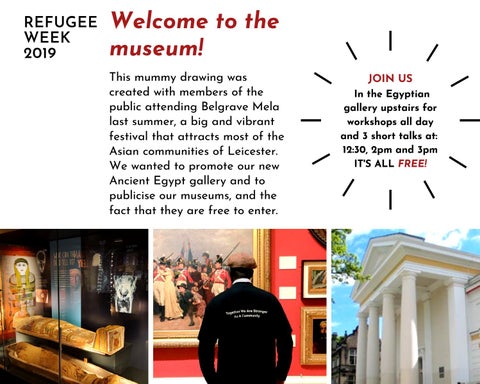
Welcome to the museum! This mummy drawing was created with members of the public attending Belgrave Mela last summer, a big and vibrant festival that attracts most of the Asian communities of Leicester. We wanted to promote our new Ancient Egypt gallery and to publicise our museums, and the fact that they are free to enter.
JOIN US In the Egyptian gallery upstairs for workshops all day and 3 short talks at: 12:30, 2pm and 3pm IT'S ALL FREE!
REFUGEE WEEK 2019
Thomas & John Mason Cook Did you know that Egyptian mummies at New Walk Museum are connected to Leicester, and linked to Cook & Son? Bes-enMut and Ta-Bes were excavated by Gaston Maspero in 1884 and brought back to Leicester by John Mason Cook in the 1880s. Ever since, they have been living their afterlife far from their home, in the museum. You can explore the Cook & Son buildings in various parts of Leicester.
WHO BROUGHT THE EGYPTIAN MUMMIES TO LEICESTER?
REFUGEE WEEK 2019
Displaced people In museums, mummies are seen as curiosities and in films, they are scary and come to life! The wrappings around the mummies also make them look like objects. But Egyptian mummies are people, and they are displaced people, who have been taken out of their country into foreign lands. Their displacement was often executed during times of violence, such as colonialism, looting and unfair trade.
HAVE YOU EVER CONSIDERED MUMMIES AS DISPLACED PEOPLE?
REFUGEE WEEK 2019
X-rays and new technologies The mummies at New Walk Museum have been X-rayed to learn new information about the bodies, their origin, health, age and gender. Today, mummies can be scanned in CT scans in hospitals around the country. The public can also use digital applications to virtually unwrap mummies. But are new technologies ethical? Are they too invasive? Is knowledge more important?
SHOULD WE USE NEW TECHNOLOGIES TO STUDY THE DEAD?
REFUGEE WEEK 2019
Journey in the museum Ever since they arrived at New Walk Museum, the Egyptian mummies have traveled within the building, going from one exhibition display to another. They were once displayed in the basement near a fish pond! Last year, they were moved from the ground floor to the first floor in our new display. One mummy even toured the world!
HOWÂ MANY OF THESE DISPLAYS HAVE YOU SEEN?
REFUGEE WEEK 2019
What makes us human? It is easy to think about mummies as objects, because they are wrapped, and don't look like real people at first. But if you look closely, you might notice that you can see this mummy's toes poking through the bandages. Often, when you see the feet, it's because mummies were displayed standing, and it damaged the wrapping. Seeing skin and nails reminds us that they were real people like us!
DO YOU THINK ABOUT MUMMIES AS REAL PEOPLE?
REFUGEE WEEK 2019
Displaying mummies This sign is here to warn you of the presence of human remains in this room. That is because some people are uncomfortable or scared when they see mummies. Also, in some cultures and faiths, it is not acceptable to see dead bodies. We think it's important to give the public a choice. You can share your opinion on the comment boards in this gallery.
DO YOU THINK MUMMIES SHOULD BE ON DISPLAY?
REFUGEE WEEK 2019
Journeys of the mummies Join us all day for workshops and talks by Dr Angela Stienne, Medicine Galleries Research Fellow at the Science Museum (London). Learn more about the journeys of the mummies to Leicester and the current debates on human remains in museums. Map your own journey to Leicester using coloured threads, it's all free!
JOIN US FOR SHORT TALKS AT 12.30, 2PM AND3PM