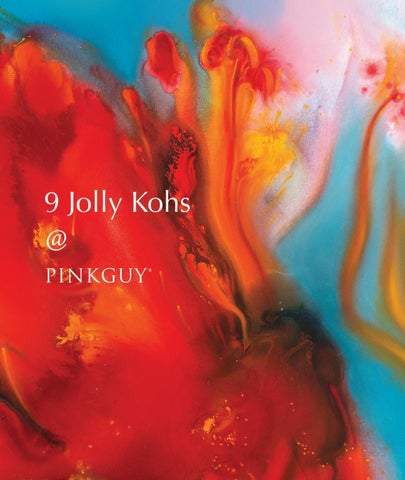
9 Jolly Kohs @
September 2019
Copyright @ Jolly Koh 2019 All rights reserved. No part of this publication may be reproduced, stored in a retrieval system, or transmitted in any form or by any means, electronic, mechanical, photocopying, recording or otherwise, without prior consent of the copyright owner.
Published September 2019 PINKGUY gallery 51-1, Jalan Telawi 3, Bangsar Baru, 59100 Kuala Lumpur Email: pinkguymalaysia@gmail.com Tel: +603 2166 2166 www.pinkguy.com.my
Photographs of paintings Puah Chin Kok Photographs of artist at work Angela Liu Jing Photograph of portrait of the artist Angela Liu Jing Design Angela Liu Jing Printer biz prints sdn bhd ISBN 978-967-5563-18-8
Cover: Detail from Celestial Flora, Pg 26-27
Painting becomes more difficult as I grow older, that is to say, it takes longer to complete, requiring a lot of alterations and refinements in order to make the painting look good. So many paintings that I see today appear slapdash and slap-happy. What does that say about the sensibility and attitude of those artists?
Jolly Koh
CONTENTS Foreword
9
Ways of Looking at Paintings
12
Pictorial Space and Luminosity
13
List of Plates
14 - 55
Cerulean Sky
14 - 17
Flame of the Forest by the Sea
18 - 21
Celestial Flora
22 - 27
Mother and Child
28 - 31
Flowers from Heaven
32 - 37
Biodata
Orange and White
38 - 41
Chinese Memory, II
42 - 47
Moon Drop
48 - 51
Nocturnal Lines
52 - 55
56 - 57
FOREWORD
Over the years, I have a great feeling whenever I see a Jolly Koh painting. A great feeling because his paintings are so beautiful; I love the colours and the diversity of expressions of his paintings; I can see the immense ability and sensibility of the artist from the works he produced. Two years ago, when I visited Jolly’s solo exhibition “Jolly Koh @ 76” at the White Box at Publika, my heart beats fast when I saw the paintings in the show; that kind of feeling is like a man facing a girl who he has fallen in love with at first sight. Today, I am privileged and honored to showcase nine beautiful and exciting paintings by Jolly Koh who is a first generation modern artist in Malaysia. These nine paintings are testaments to Jolly Koh’s diverse range of techniques and expressions. These nine paintings are specially chosen by me, not just for their superb quality, but also for their display of Jolly Koh’s diversity of expressions. This publication is my small contribution to the art infrastructure in this country. I am certain that in the years to come the images of the paintings in this catalogue will be testaments to some of the most iconic images in Malaysian art from a giant of Malaysian art.
WinSon Loh PINKGUY gallery Kuala Lumpur September 2019
9
10
11
Ways of Looking at Paintings* There are many ways to look at a painting, some of which are misguided. One of the most common mistake is to view paintings as narratives.By the narrative approach, one looks at a painting for what story it might tell. This manner of looking at paintings was popular in Victorian England when paintings were admired for their sentimental or stirring stories. With this narrative method, the focus is on the story that one might elicit from the painting and no attention is given to its artistic merit. Today, the narrative approach invariably focuses on socio-political elements, and even on personal issues that a painting might reveal. The most jarring example of this approach was Redza Piyadasa’s interpretation of At the Kampong Shop by Mohd Sallehuddin in the 1994 catalogue publication, ReLooking Modern Malaysian Art, where he extracted – far-fetched as it was – socio-political issues from an artistically mediocre painting. The paintng depicted a woman shopping in a sundry shop, but absurdly Piyadasa turned it into a narrative of racial exploitation. In philosophy, this projection of one’s imagination is called the Pathetic Fallacy. One may well ask what social or political messages might be elicited from the beautiful Dutch still lifes of the 17th century, or indeed any still life or flower painting? To gain knowledge we study the liberal arts or the sciences. Paintings require a different kind of participation. With paintings, including the other arts, such as music and opera, we gain a certain kind of emotional pleasure and aesthetic satisfaction from our encounters with them. Approaching paintings for themselves, the focus would be on the intrinsic qualities of the paintings and the problem is, to explain how the sensory qualities of the paintings give rise to aesthetic satisfaction and pleasure. None of these matters are addressed by the narrative approach. The focus on the art of painting should also lead to connecting the viewed paintings to other paintings, thereby establishing their pedigree and hence, appreciating them in their artistic context. Again, this artistic issue is totally ignored by the narrative approach. Approaching a painting as art, the criterion is aesthetic and artistic quality, but approaching a painting as a socio-political document, the criterion is Truth. Beauty and Truth are distinct values as we learned from the ancient Greeks. In other words, appreciating painting for their narrative content, Truth is the criterion, while approaching paintings for their aesthetic value, Beauty is the criterion.
Jolly Koh
12
*Reprinted from “Jolly Koh @ 76” published in 2017 by Maya Press, page 290, with some minor amendments.
Pictorial Space and Luminosity* We live in a three-dimensional spatial world and we experience three-dimensional space. That is to say, we experience some things that are near to us and some things that are far from us. One of the great joys of painting is when I am able to re-create this three-dimensional world on a flat canvas. This is done by the juxtaposition of colours, tones, shapes and textures. In other words, through paint, I am able to create an “illusion” of three-dimensional space on a flat surface. It is only an illusion in so far that it is not a physical three-dimensional space but the experience of threedimensional space on the flat canvas is nevertheless real. This “in and out” spatial experience on a flat canvas is also a source of great joy in one’s experience of good paintings. We experience this “illusion” of three-dimensional space in most good paintings, especially in the paintings of the Old Masters, from the Renaissance to the Impressionists. Paintings began to lose this great spatial depth beginning with the Cubists where the spatial depth is closer to the picture surface. However, the paintings of today are literally flat with little or no sense of experience of spatial depth in them. To me, this flatness is unfortunate because one of the great pleasures of painting is lost. One of the chief culprits for this sad state of affairs is the American art critic Clement Greenberg. He extolled the importance of the flatness of the canvas and decried the spatial “illusion” of the Old Masters. Here is an example of how a bad but influential art critic can do enormous harm to the art of painting. It is no different from the harm done by a bad painting teacher. It is even worse today because the emphasis given to installation art and videos by art schools and museum curators have resulted in very little teaching in the art of painting. Another important quality that I enjoy from the paintings of the old masters, such as Tintoretto and Rubens, is the luminosity that emanates from their paintings, a quality that is very rare in modern paintings where the colours are flat and garish.
Jolly Koh
* Reprinted from “Jolly Koh @ 76” published in 2017 by Maya Press, page 162.
13
14
15
Cerulean Sky 2013 Oil & Acrylic on Canvas 122cm x 175cm
16
17
18
19
Flame of the Forest by the Sea 2014 Oil & Acrylic on Canvas 100cm x 110cm
20
21
22
23
24
25
Celestial Flora 2014 Oil & Acrylic on Canvas 152cm x 214cm
26
27
28
29
Mother and Child 2015 Oil on Canvas 102cm x 73cm
30
31
32
33
34
35
Flowers from Heaven 2016 Oil & Acrylic on Canvas 107cm x 127cm
36
37
38
39
Orange and White 2017 Oil & Acrylic on Canvas 122cm x 61cm 40
41
42
43
44
45
Chinese Memory, II 2017 Oil & Acrylic on Canvas 51cm x 214cm
46
47
48
49
Moon Drop 2019 Oil & Acrylic on Canvas 117cm x 76cm
50
51
52
53
Nocturnal Lines 2019 Oil & Acrylic on Canvas 54cm x 160cm
54
55
JOLLY KOH BIODATA 1941
Born in Singapore
1959 – 1962
Hornsey College of Art, London, UK N.D.D (National Diploma in Design) London University, UK A.T.C (Art Teachers Certificate) Indiana University, U.S.A. M. Sc (Master of Science) Indiana University, U.S.A. Ed. D (Doctor of Education)
1962 – 1963 1970 – 1972 1972 – 1975
SOLO EXHIBITIONS
GROUP EXHIBITIONS
1958 1959 1967 1968 1971 1978 1980 1982 1983 1985 1987 1989 1992 1994 1996 1997 1999
1962
2003 2004 2006 2007 2008 2008 2011 2013 2017 2019
56
British Council, Kuala Lumpur, Malaysia Odeon, Singapore Samat Art Gallery, Kuala Lumpur, Malaysia Samat Art Gallery, Kuala Lumpur, Malaysia Indiana University, U.S.A. Raya Gallery, Melbourne, Australia Raya Gallery, Melbourne, Australia Raya Gallery, Melbourne, Australia Tynte Gallery, Adelaide, Australia Raya Gallery, Melbourne, Australia Raya Gallery, Melbourne, Australia Raya Gallery, Melbourne, Australia Galeriwan, Kuala Lumpur, Malaysia Galeriwan, Kuala Lumpur, Malaysia Shenn’s Fine Art, Singapore NN Gallery, Kuala Lumpur, Malaysia Valentine Willie Fine Art Gallery, Kuala Lumpur, Malaysia Valentine Willie Fine Art Gallery, Kuala Lumpur, Malaysia Art Salon & XOAS Gallery, Kuala Lumpur, Malaysia Art Salon & XOAS Gallery, Kuala Lumpur, Malaysia Gallery Archana, Kuala Lumpur, Malaysia Art Salon & XOAS Gallery, Kuala Lumpur, Malaysia Galeri Petronas, Kuala Lumpur, Malaysia, in conjunction with the book launch of Jolly Koh, Maya Press SENI Gallery, Kuala Lumpur, Malaysia The Edge Galerie, Kuala Lumpur, Malaysia Curate Henry Butcher, White Box, Kuala Lumpur, Malaysia PINKGUY gallery, Kuala Lumpur, Malaysia
1967 1967 1968 1969 1969 1974 1975 1978 1978 1981 1995 1997 2000 2005 2005 2006 2007 2008 2010 2017 2017 2019
Young Contemporaries, RBA Galleries, London, U.K. The GRUP, AIA Building, Kuala Lumpur, Malaysia Malaysia Art Touring Europe Malaysia Art Touring Europe X Biennial in Sao Paolo, Brazil The New Scene, Galeri 11, Kuala Lumpur, Malaysia ASEAN Mobile Exhibition, Kuala Lumpur, Singapore, Jakarta, Manila, Bangkok Third Indian Triennale, New Delhi, India Fourth Indian Triennale, New Delhi, India Malaysia Art 65 – 78, Commonwealth Institute, London, U.K. Fifth Indian Triennale, New Delhi, India Tresor ’95, Suntec City, Singapore ReGRUP, Valentine Willie Fine Art Gallery, Kuala Lumpur, Malaysia NN Gallery, Kuala Lumpur, Malaysia Art Salon & XOAS Gallery, Kuala Lumpur, Malaysia Wei-Ling Gallery, Kuala Lumpur, Malaysia Art Salon & XOAS Gallery, Kuala Lumpur, Malaysia Art Salon @ SENI Galley, Kuala Lumpur, Malaysia Wei-Ling Galley, Kuala Lumpur, Malaysia Sunjin Galleries, Singapore Museum and Art Gallery Bank Negara Malaysia, Kuala Lumpur, Malaysia Ilham Gallary, Kuala Lumpur, Malaysia La Galerie du Monde, Kuala Lumpur, Malaysia
PUBLIC & CORPORATE COLLECTIONS National Gallery, Singapore National Visual Arts Gallery, Malaysia National Art Gallery, Victoria, Australia Bank Negara, Malaysia Galeri Petrona, Malaysia EON Bank, Malaysia J.D. Rockefeller III Collection, New York, U.S.A. ESSO, Malaysia Telecom, Australia Footscray Institute of Technology, Melbourne, Australia Herbert F. Johnson Museum of Art, Cornell University, U.S.A. Ministry of Foreign Affairs, Malaysia The Kasama Nichido Museum of Art, Japan RHB Bank, Malaysia Public bank, Malaysia Fullerton Hotel, Singapore Westin Hotel, Kuala Lumpur, Malaysia Securities Commission, Malaysia Siemens, Malaysia CIMB, Malaysia Bandar Raya Developments Bhd, Malaysia Ireka Corporation Bhd, Malaysia Juta Asia Corporation Sdn Bhd, Malaysia DiGi Telecommunications Sdn Bhd, Malaysia CapitaLand, Kuala Lumpur, Malaysia
PUBLICATIONS 1. “Paula has Learned”, Philosophy of Education 1975, (Annual Proceedings of the Philosophy of Education Society, U.S.A) 2. “Jones is Teaching”, Philosophy of Education 1976, U.S.A. (Annual Proceedings of the Philosophy of Education Society, U.S.A.) 3. “On the Creative Process and One Aspect of Learning Art”, Educational Philosophy and Theory, Vol 9-No 2, 1977, Australasia 4. “A Preface for Inquiries into Art Education”, Studies in Art Education, Vol 20-No 2, Dec 1978, U.S.A. 5. “Philosophy and Some of Its Influences on Art Educators”, Arts in Cultural Diversity (Selected Papers from the 23rd World Congress of the International Society for Education through Art), 1978, Adelaide, South Australia 6. “The Drawing Lesson”. The British Journal of Aesthetics, Vol 20-No 3, Summer 1980, U.K. 7. “The Teaching of Drawing” Published by National Art Gallery, Malaysia, 2002 8. “Artist Imperative: Selected Writings and Paintings”, Published by Maya Press, 2004 9. “Jolly Koh” Published by Maya Press, 2008 10. “Jolly Koh @ 76” published by Maya Press, 2017
57
58
59
60