Spring 2026
Western Nurse & Midwife
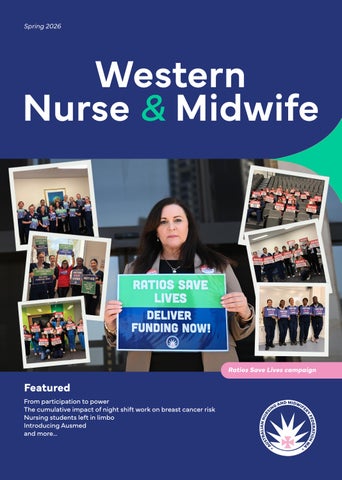
Ratios Save Lives campaign
Featured From participation to power The cumulative impact of night shift work on breast cancer risk Nursing students left in limbo Introducing Ausmed and more...
Western Nurse & Midwife |
Contents
Western Nurse & Midwife Spring 2026
Features
8
From participation to power: Lessons from ACTU conference
4 Ratios Save Lives campaign
More in this issue 3 Secretary’s report 6 You are the union 10 Member wins 11 Annual leave explainer 14 From burnout to better 20 The cumulative impact of night shift work on breast cancer risk 22 ANMF national news
24 News bites 25 Out & about 26 Climate change is a health issue: what nurses can do 28 What does a workplace delegate do? 30 Introducing Ausmed: the new CPD learning platform
16 Member spotlight: Leah
Marinovich, Cancer Care Nurse (Early Breast)
12 Nursing students left in limbo
The Australian Nursing and Midwifery Federation WA (ANMF WA) is the brand name that represents two entities: the Australian Nursing and Midwifery Federation Industrial Union of Workers Western Australia and the Australian Nursing and Midwifery Federation WA Branch. Romina Raschilla (RN MBA) is State Secretary of both entities.
Acknowledgement The Australian Nursing and Midwifery Federation Western Australia acknowledges the Traditional Custodians of the Lands on which our services operate throughout WA. We pay our respects to Elders past and present. We are committed to walking alongside all First Nations Peoples on our journey of reconciliation.
2 ||Australian AustralianNursing Nursingand andMidwifery MidwiferyFederation FederationWA WA
ANMF WA P.O. Box 8240, Perth Business Centre WA 6849 260 Pier Street, Perth WA 6000 Membership: (08) 6218 9444 Email: membership@anmfwa.org.au Front cover photo State Secretary Romina Raschilla and members campaigning for Ratios.
“
“
Nurses and midwives deserve to be treated with the same empathy and fairness we provide to our patients.
Yet, since the last edition of this journal we have been dealt a heavy blow which has been felt by nurses and midwives across the state.
Secretary’s report As I reflect on this, I think of our recently launched purpose statement: we use our collective advocacy power to advance working conditions, member wellbeing and a safer, more equitable health system for the community that depends on us. In response to our advocacy, the government announced it will deliver ratios across 33 wards in metropolitan hospitals from 26 October 2026, in an initial tranche of phase three of nurse and midwife-to-patient ratios. This announcement is a powerful demonstration of what we can achieve when union members stand together and advocate collectively for safer staffing. Just before this journal went to print, we received the good news that nurse and midwifeto-patient ratios will be implemented in the final 33 wards of Phase 3 from 16 November 2026, completing the rollout across all 91 wards.
To say we were disappointed by this would be an understatement.
Since becoming State Secretary, this has been the first major campaign of this kind that we have undertaken. The key thing I have taken away from this experience is that when we come together, we are difficult to ignore, and while this campaign is far from over, it has inspired me and I have been reminded that together, we can bring about change.
In response, we launched a petition which was signed by thousands of nurses, midwives and concerned community members, demonstrating that this is an issue that not only affects our members, but the broader community as well.
Another key milestone for our union has been the successful replacement of our old membership system, iFolio, with a modern system that will improve member experiences, strengthen cyber security and streamline payment processing.
The WA Government announced in September that the third rollout of nurse and midwife-to-patient ratios was not going ahead as promised. This would have provided much-needed relief to nurses and midwives from over 90 metropolitan wards.
It is now easier than ever for you to access member information and benefits, including the new and improved CPD offering from leading learning provider Ausmed with hundreds of evidence-based resources. It only takes a few moments in the new ANMF WA member portal to update your details or check when your next membership payment is due so I encourage each of you to log in and make sure we have up-todate information for you. As with any major system change, I am sure there will be hiccups along the way so please bear with the team as they adjust to the new system. The new ANMF WA website and member portal will be upgraded in stages so keep checking back for more features. The past few months may not have been smooth sailing, but hearing your stories and witnessing your passion for bringing about change has been inspiring. We have plenty to look forward to and I am confident that as a unified body, we are equipped to deal with any other hurdles that come our way. Together in strength,
Romina Raschilla, MBA RN ANMF WA State Secretary
Western Nurse & Midwife | 3
S E IV L E V A S S IO T A R Members win all the 91 wards of phase three
When phase three of nurse and midwife-to-patient ratios was delayed, members responded. Here’s how the campaign has progressed, and how you can help finish the job.
RATIOS EXPLAINED
On 10 September 2026, the WA Government announced that phase three of the ratios rollout would be delayed, just 11 days before it was due to start. The phase covers 91 wards in metropolitan hospitals, including emergency departments, geriatrics, paediatrics and rehabilitation, and is the largest rollout to date. For nurses and midwives already dealing with unsustainable workloads, stress and burnout, the delay was a significant setback. State Secretary Romina Raschilla said the union had not been given a clear explanation of why the rollout was delayed or when it would go ahead. “Nurses and midwives who are overworked, understaffed and burnt out have been holding out for these ratios,” she said. “At the end of the day, this will impact the quality and safety of patient care, which is what matters most of all.”
1
What are nurse and midwife-to-patient ratios?
2
Why do they matter?
3
Ratios set the minimum number of nurses and midwives who must be rostered for a given number of patients on a ward.
With enough staff on every shift, nurses and midwives have more time to monitor patients, respond to changes in their condition and provide safe care. Ratios also protect the wellbeing of the workforce, because unsafe workloads lead to stress and burnout.
Where are they up to?
Ratios were first introduced in July 2023 and are being rolled out in phases across WA Health. Phase three covers 91 wards. With 33 wards commencing on Monday 26 October 2026, a further 25 wards on 9 November and the final 33 scheduled to commence on 16 November 2026, completing phase three of the rollut.
Members spoke up Within days, we launched a petition calling on the WA Government to follow through on its commitment and implement ratios without further delay. Almost 7,000 people signed it in three weeks, sending a clear message that nurses and midwives will no longer be overlooked. The campaign also reached the wider public, with statewide radio coverage and televised interviews on Channel 7, Channel 9 and ABC News. “Strong and effective ratios improve nurse and midwife wellbeing, improve patient safety and outcomes, and improve the overall effectiveness of the health system,” Romina said.
4 | Australian Nursing and Midwifery Federation WA
Advocacy efforts with government Alongside the public campaign, ANMF WA officials held direct talks with government and lodged an application for Conference with the WA Industrial Relations Commission over the delay and the commitments made under the WA Health System Industrial Agreement 2024. In September, State Secretary met Health Minister Meredith Hammat to advocate again for the immediate delivery of ratios. She proposed dividing the 91 wards in phase three into stages, to deliver ratios sooner and ease workload pressures for nurses and midwives.
Wh
Rati WA
“This announcement is a significant win and a powerful demonstration of what we can achieve when union members stand together and advocate collectively for safer staffing,” Romina said.
Following continued advocacy from ANMF WA, the Department of Health announced a staged rollout of phase three, with ratios commencing across 33 wards in metropolitan hospitals on 26 October 2026, a further 25 wards on 9 November and the final 33 wards scheduled to commence on 16 November 2026.
The job isn’t finished The completion of phase three will mark an important milestone, with all 91 wards promised under this phase receiving ratios. However, many more nurses and midwives across WA are still waiting for ratios to reach their workplaces. ANMF WA officials will continue working with government to ensure ratios are delivered in future phases, while members and delegates across WA keep building momentum until every ward is covered. We remain committed to advocating for safer staffing for nurses, midwives and the WA community, and our message remains the same: ratios save lives.
WHAT YOU CAN DO NOW
Where are they up to?
Ratios are being rolled out in phases across WA health. Phase three is the largest so far.
1
2
Become a Ratios Champion
If you’re keen to get more involved and speak up for your ward, your colleagues and your patients, email us at union@anmfwa.org.au.
Stay informed
Our organising team will continue to be on site and in wards to hear from members. In the meantime, follow ANMF WA on Facebook and Instagram for campaign updates.
Western WesternNurse Nurse&&Midwife Midwife| | 5
What union officials and staff do for members
YOU ARE THE UNION A UNION IS BUILT AND DRIVEN BY ITS MEMBERS. UNDERSTANDING THE RELATIONSHIP BETWEEN MEMBERS, UNION OFFICIALS AND STAFF IS AN IMPORTANT PART OF RECOGNISING HOW A UNION WORKS. At ANMF WA, our members ARE the union. Our strength comes from standing together on the issues that matter for nurses, midwives and care workers across the state. Your membership fees fund the resources, representation, bargaining and campaigns that support members and improve working conditions. But the real strength comes from members actively participating, supporting one another and working together to achieve change. As a democratic organisation, members have a say in the union’s direction, priorities and decisions. ANMF WA officials and staff work alongside members to provide advice, representation and support, and to coordinate the collective efforts needed to achieve better outcomes. That is why being involved in your union matters. By being active in your workplace or stepping up as an ANMF WA delegate, you can help strengthen our collective voice. We need delegates in every ward and at every workplace around the state so that together we can build a clear picture of all the things impacting members and work together to advocate for change. 6 | Australian Nursing and Midwifery Federation WA
Negotiate better pay and conditions through collective bargaining, alongside members and workplace delegates Defend workers’ rights and job security by investigating suspected breaches of workplace laws, modern awards and anti-discrimination legislation Provide support and advice on workplace issues and employment matters. Represent members’ interests by engaging with government and employers in meetings, working groups and committees so we can influence change Improve workplace safety by running campaigns on WHS (work health and safety) compliance Provide representation in workplace disputes to ensure a fair resolution Fight for equality and fairness across gender, culture, age, sexuality, background and faith. Advocate for broader social changes that affect nurses, midwives and care workers across the state, and Australia
What you can do as a member Speak up about the issues affecting you and your colleagues. Step up as an ANMF WA delegate and help build a stronger union in your workplace (read more on page 28) Become a Ratios Champion if you work in WA public health Support collective campaigns by signing petitions, sharing messages and participating in events and workplace actions. Talk to your colleagues about the importance of union membership and encourage them to join ANMF WA. Stay informed and involved by reading ANMF WA emails, attending meetings and contributing to discussions. Help amplify our collective voice by following ANMF WA on social media and sharing campaign updates.
Looking after the people who look after WA For more than 85 years, we’ve helped WA public sector employees build their financial future. With over 250,000 members across the state, we understand your sector and your super.
Need a helping hand with your super? Visit our new learn and support hub for practical tools and resources to
Questions? Speak to our local WA-based team on 13 43 72 or on our website via Live Chat.
help make sense of super. gesb.wa.gov.au/learn-and-support
Western Nurse && Midwife | 5| 7 Western Nurse Midwife
From participation to power Lessons from 2026 ACTU organising conference Momentum
HOW DO UNIONS TURN MEMBER PARTICIPATION INTO LASTING COLLECTIVE POWER? That was one of the big questions explored at Momentum 2026, the ACTU’s Organising Conference, held on the Gold Coast in September. Held every three years, Momentum is the union movement’s largest organising gathering, bringing together hundreds of unionists from across Australia for two days of learning, strategy, solidarity and action. ANMF WA union officials joined unionists working across organising, communications, campaigning, industrial, legal, policy, work health and safety and member services to share experiences and learn what is working across different industries and workplaces. Across four sessions and many workshops, the program explored everything from growing union membership and developing delegates to digital organising, campaign communications, AI, gender equity, workplace health and safety and building member-led campaigns. While the sessions covered very different challenges, one message stood out:
The power of a union comes from its members actively taking part in it.
8 | Australian Nursing and Midwifery Federation WA
Building momentum One of the most valuable lessons from Momentum was also one of the simplest: start with the workers. Effective organising begins by listening to workers about the issues affecting them, identifying what they care about and building opportunities for them to act together within their union. Across the conference, examples from different unions and industries reinforced the importance of listening first and building strategies around the experiences and priorities of members. This means starting with the issue, rather than the tactic and understanding what workers want to change and what they are prepared to do together.
Participation is the beginning
Building collective power with members Ultimately, lasting change comes from workers acting together. Momentum highlighted the importance of building strong workplace structures and supporting delegates as workplace leaders who can connect members around shared issues. Growing membership matters, but so does building the capacity within workplaces to turn that membership into collective strength. At the heart of this is a simple but powerful reminder: members are the union. Member experiences set the priorities; member voices help shape the direction and member involvement determines what can be achieved collectively.
Another important takeaway from Momentum was that participation is not an end in itself. Having lots of members involved in something matters, but so does thinking about where that involvement can lead.
For ANMF WA union officials, Momentum was an opportunity to learn from what is working across the broader union movement and reflect on how we can continue supporting members to be active participants in creating change in their workplaces.
Each opportunity to participate can help members become more connected to their union, build confidence in speaking up and eventually taking on a bigger role in the issues that affect them.
Because collective power is not built through a single moment or action. It grows over time, as workers become more involved, more confident and more willing to stand together.
The challenge for unions is to create a pathway from participation to greater involvement leadership and collective action. In other words, the question is not only ‘how many members participated?’ But ‘what did that participation build?’
Photo credits: Kim Mak / ACTU ANMF union officials from across different branches got together for a group photo. It was great to meet comrades from different state branches!
Western WesternNurse Nurse&&Midwife Midwife| | 9
Member
WINS
YOU HAVE READ ABOUT SOME OF THE SIGNIFICANT PROJECTS UNDERWAY ACROSS THE UNION, INCLUDING THE MEMBERSHIP SYSTEM UPGRADE AND RATIOS CAMPAIGN. It has been wonderful to celebrate the progress we are all making together and, at the same time, ANMF WA staff have continued to focus on the important day-to-day work of supporting members who reach out for assistance. Not all wins will be aired on the news or featured in the newspaper, but they are still worth being celebrated. Here are some of the positive outcomes the industrial team has secured alongside members in the past few months: We supported two members facing dismissal following a serious incident report. They were navigating very unsustainable workloads, with 50 residents between them at the time of the incident. Our representation ensured their circumstances were properly considered. The employer agreed to payment in lieu of notice and the members were very appreciative of our support. We assisted a member facing termination after being off work for many months. Our team negotiated five weeks’ pay as part of the resignation outcome, despite there being no clear entitlement to that payment and the member was very appreciative of our support. Our team supported a member to get six weeks additional pay with the total payout coming to approximately $50,000. We negotiated a settlement for a member who had been terminated and changed this to a termination with five-and-a-half weeks of compensation pay.
10| Australian | AustralianNursing Nursingand andMidwifery MidwiferyFederation FederationWA WA
We worked with members to resolve two unfair dismissal matters through the Fair Work Commission conciliation process. The team secured a combined $7,000 in settlement outcomes and avoided further litigation. We worked with a member who was facing repeat serious allegations. We challenged the employer’s reliance on a letter of expectations which had not been signed or acknowledged by the member and achieved a non-disciplinary outcome. We helped a member who was facing immediate termination, secure a resignation instead. Note: Every case is different, and outcomes depend on individual circumstances.
EXPLAINER
ANNUAL LEAVE
Nursing and midwifery doesn’t stop for the holiday period, as many other industries do. We work hard year-round to provide clinical care to the communities who need us. For those planning on taking time off, it’s important to understand your leave entitlements so you know your rights. Let’s start with leave that affects all employees: public holidays. If you work on a public holiday, you should receive the public holiday rate set out in your award or agreement. Below are the upcoming public holiday dates in WA:
FRIDAY 25 DECEMBER 2026
Christmas Day
SATURDAY 26 DECEMBER 2026
Boxing Day
MONDAY 28 DECEMBER 2026
FRIDAY 1 JANUARY 2027
Additional public holiday, as Boxing Day falls on a weekend
New Year’s Day
With this being said, your leave will differ depending on whether you are employed under the federal system or the state system. (The federal system includes most private-sector employees, including many aged care and private hospital staff, whereas the state system includes public sector employees under the relevant enterprise agreements.)
For those employed under the federal system:
If your workplace shuts down for a period over the holidays, your employer can direct you to take annual leave if your award or enterprise agreement allows it. In most cases, your employer must provide sufficient notice, be reasonable and must provide the direction in writing. Your award or enterprise agreement sets out the notice period, so check yours or ask. If you do not have enough annual leave to cover a shutdown period at your workplace, you can take annual leave before you’ve accrued it or take unpaid leave, if agreed upon by your employer. If you continue working during the shutdown period outside of public holidays, you should receive your normal pay rate, but if you work on a public holiday, you should receive penalty rates.
For those employed by the state system If you are a full-time or part-time employee working within the state system, you have a minimum entitlement to paid annual leave, as outlined in the Minimum Conditions of Employment Act 1993. Annual leave must be agreed upon with your employer through a verbal agreement, appointment letter or a contract of employment, however it is best to have this in writing, so you have evidence if something goes wrong. If it is not specifically stated in your enterprise agreement, your employer cannot direct you to take annual leave over the holiday period. If you are unsure of your rights or your leave entitlements entering this holiday period, we encourage you to reach out. Our industrial team can help you to determine what you are entitled to, based on your workplace and enterprise agreement.
Member checklist Check your agreement or award for shutdown and notice rules. Ensure any annual leave requests are submitted well in advance if possible. Get any leave approval in writing. Keep a record of any direction from your employer. Contact the ANMF WA industrial team if you’re unsure. Staff will be available via phone (08) 6218 9459 or email membership@anmfwa.org.au during the holiday period (other than on public holidays).
Note: this is general information only and does not take into account your individual circumstances.
Western Nurse & Midwife | 11 Western Nurse & Midwife |
Nursing students left in limbo Delays to nursing enrolments and clinical placements at the University of Notre Dame have raised concerns about the impact on students, their future careers and WA’s already stretched nursing workforce. ANMF WA is calling for urgent action to protect the next generation of nurses. Nursing students at the University of Notre Dame were facing uncertainty about their futures, with ongoing clinical placement delays leaving some at risk of not graduating on time and potentially losing graduate positions. In February, the university announced it would pause enrolments in its Bachelor of Nursing program for semester one, stating the decision was intended to support the program’s long-term sustainability. In June, the university stated that it hoped enrolments would reopen July 2027. Meanwhile, delays in securing clinical placements had left potentially hundreds of existing students behind on the clinical hours required to complete their degrees. ANMF WA union officials have heard directly from students concerned about their ability to graduate on time, particularly those in their final year who have already secured graduate positions. For these students, the uncertainty extended beyond their studies, potentially affecting their employment opportunities and transition into the nursing workforce.
Standing up for our future nurses Nursing students are the future of our profession, and ensuring they receive the education, clinical experience and support they need is essential to building a sustainable nursing workforce.
12 | Australian Nursing and Midwifery Federation WA
Students who have contacted their union have reported a lack of transparency about placement arrangements and graduation timelines, adding further stress to an already demanding degree.
“Students deserve certainty about their future and should be able to trust their university to provide the education and clinical placements necessary to complete their qualifications”, State Secretary Romina Raschilla said. For students approaching graduation, these delays are particularly concerning. After years of study, completing their clinical placements should be the final step towards entering the profession, not an additional obstacle that puts their careers on hold. Our union has raised these concerns on behalf of affected students and is calling for greater transparency, clear communication and timely solutions to ensure their graduation and employment prospects are not compromised.
Protecting WA’s nursing workforce Beyond the immediate disruption to students, the enrolment pauses and placement delays raise broader concerns about WA’s future nursing workforce.
“We urge the state government to step in and assist with providing some spaces for the students to be able to complete their pracs, so that they can graduate.”
We estimate that approximately 1,000 nursing graduates could be affected. These are students who would otherwise have completed their studies at Notre Dame in 2029 and 2030. At a time when WA is already experiencing nursing workforce shortages, any reduction in the number of new graduates entering the profession could place additional pressure on nurses already working in an overstretched health system. For our members, workforce shortages mean increased workloads, greater pressure on existing staff and ongoing challenges in delivering safe patient care. Addressing these shortages requires more than recruiting new nurses. It also means investing in nursing education, supporting students throughout their training and ensuring graduates have a clear pathway into employment. While the WA Government made significant investments in hospital infrastructure in its 2026–27 State Budget, these investments must be matched by a commitment to developing and retaining the skilled workforce needed to staff these services. We are calling on the WA Government to work with the University of Notre Dame to resolve enrolment and clinical placement issues and minimise the long-term impact on students, nurses, midwives and the wider community. Our union will continue advocating for the next generation of nurses while standing up for our existing workforce. Investing in nursing students today is essential to building a stronger profession and ensuring safe, quality patient care into the future.
Western Nurse & Midwife | 13
From burnout to better: Feature article
spotting the signs and finding the support By Nursing and Midwife Health Program Australia
Feeling flat, cynical or permanently exhausted isn’t just a rough week - for many nurses and midwives, it’s the slow slide into burnout. Unlike ordinary stress, which tends to ease once a difficult shift or project passes, burnout builds up over months or years of sustained pressure and can leave you feeling physically and mentally depleted.
ends meet, and often family responsibilities on top of it all. Burnout can take hold long before a student sets foot in their first paid role.
A profession under particular pressure
Nursing and midwifery come with a unique set of pressures that make burnout a real risk. Long shifts, unpredictable rosters, limited control over workload, thin staffing and repeated exposure to trauma all take a toll. And it doesn’t start once you’re qualified. Student nurses and midwives are juggling similar pressures well before graduation - university deadlines, clinical placements, part-time jobs to make
14 | Australian Nursing and Midwifery Federation WA
Recognising the warning signs Burnout rarely announces itself all at once. Instead, it tends to show up as a cluster of changes: Ongoing tiredness that sleep doesn’t fix. Pulling away from colleagues and friends A growing sense of cynicism Dread about going to work A fading ability to empathise with patients in your care
Physical symptoms often follow, disrupted sleep and appetite, headaches, jaw clenching, tense muscles, more frequent illness, and in more serious cases, raised blood pressure or gastrointestinal problems. Increased sick leave or noticeable withdrawal at work can be telling clues. Often, it’s the people closest to us - family, friends, workmates - who notice the shift before we do, which is why it pays to take their concerns seriously rather than brush them off.
Who is more at risk
Burnout can affect anyone, at any stage of a career, and it is never a sign of personal failure. That said, certain traits and circumstances can increase the risk: • • • • • •
being harshly self-critical holding perfectionist standards taking on too much, whether by choice or due to things outside your control struggling to switch off from work having little support outside the job getting poor-quality sleep
Protecting yourself — and what employers owe you
While healthcare organisations carry the primary responsibility for building safer, more sustainable workplaces, there’s also plenty individuals can do to help. Useful strategies include asking for support early, taking real breaks and using leave regularly, staying socially connected, learning to set boundaries and say no (always explain the why), focusing on what’s been achieved rather than what’s left undone, moving regularly in a way you enjoy, making time to reflect, and engaging in clinical supervision.
The good news: it’s treatable
Burnout is both preventable and reversible, and outcomes are far better for those who seek support early. If any of this sounds familiar, don’t wait until things feel unmanageable - reaching out, whether to a colleague, manager or a
dedicated health program, is the first step back toward feeling like yourself again.
Reach out — support built for you
The Nurse Midwife Health Program Australia is a free, confidential service just for nurses, midwives and students. Sessions are available in person, via telehealth or over the phone, with a nurse or midwife trained to provide peer support.
! Burnout is a workplace issue, not a personal failing. If unsafe workloads are affecting you, reach out to your workplace delegate or contact ANMF WA on (08) 6218 9459
It’s not about diagnosis - it’s a conversation. A safe space to talk through what’s going on for you, whether that’s work, home, or the way the two intertwine, so you can maintain your wellbeing, gain clarity and work through the complex demands of life in and out of the job. Call 1800 001 060 or connect via nursemidwifehpa.org.au
Western Western Nurse Nurse & & Midwife Midwife || 13 15
MEMBER Spotlight
The expertise behind breast cancer nursing Leah Marinovich
Cancer Care Nurse (Early Breast) at Breast Cancer Care WA and McGrath Early Breast Clinical Nurse Consultant at Sir Charles Gairdner Hospital
OCTOBER MARKED BREAST CANCER AWARENESS MONTH, ANMF WA MEMBER AND CANCER CARE NURSE LEAH MARINOVICH EXPLAINS WHAT IT TAKES TO SUPPORT PEOPLE FROM DIAGNOSIS TO LIFE BEYOND TREATMENT. For Leah Marinovich, nursing was always going to be a career centred on people. “I’m a fairly energetic person, I love being around people and I wanted a career that felt rewarding and meaningful, so nursing was a natural fit.” After beginning her career across medical and surgical wards at Sir Charles Gairdner Hospital (SCGH), a move to London unexpectedly led Leah to breast cancer nursing. While working at a private clinic, she began working alongside breast surgeons. One encouraged her to pursue the specialty, and Leah eventually joined St George’s Hospital as a Breast Clinical Nurse Specialist, supporting people with early and locally advanced breast cancer from diagnosis through treatment and into survivorship. Returning to Perth in 2022, Leah joined Breast Cancer Care WA
(BCCWA), her first communitybased nursing role. “One of the best parts of the role is having the gift of time, the opportunity to sit with people, listen properly and provide the care they need without feeling rushed.” Today, she combines this work with her role as McGrath Cancer Care Nurse – Early Breast and Clinical Nurse Consultant at SCGH. Now with 10 years’ experience in breast cancer care, a Graduate Certificate in Breast Cancer Nursing and a Master of Public Health underway at UWA, Leah has developed specialist expertise across the many stages of breast cancer care.
It’s more than treatment For someone diagnosed with breast cancer, navigating a complex healthcare system while processing a life-changing diagnosis can be overwhelming. That is where specialist nurses like Leah play an important role. She supports people with early and locally advanced breast cancer from diagnosis, helping them understand their treatment options and prepare for surgery,
16 | Australian Nursing and Midwifery Federation WA
chemotherapy or radiotherapy, through to recovery and survivorship. “My role is not to make decisions for people, but to give them the information and support they need to make informed decisions that align with their values and priorities.” It is a role requiring extensive clinical knowledge. Breast cancer treatment continues to evolve, requiring specialist nurses to maintain current knowledge across surgery, systemic therapies, radiotherapy, side-effect management and survivorship. But clinical expertise also means understanding the individual behind the diagnosis. Cancer can affect relationships, parenting, employment, finances and a person’s sense of identity. Every person also has different priorities, responsibilities, levels of health literacy and support networks. “Care cannot be one-size-fits-all,” Leah says. Clinical judgement is needed to recognise which concerns require escalation, which can be managed through education or symptom support and when another health professional or service needs to become involved.
“
“
I hope we recognise not only the importance of early detection and treatment, but also the ongoing needs of people living with and beyond breast cancer and the specialist nurses who continue to walk alongside them.
Western Nurse & Midwife | 17 Western Nurse & Midwife | 17
Care coordination is also a significant part of Leah’s work. It might mean connecting a younger woman with an ageappropriate support group, helping someone from regional WA find accommodation while receiving treatment in Perth, arranging psychological or financial support, or helping families explain cancer to children.
conventional cancer treatment. Rather than dismissing their decision, Leah takes time to understand their reasons and hesitations.
“Holistic care means seeing the whole person rather than focusing only on their diagnosis and treatment.”
Even when their decision does not change, Leah says they still deserve respectful, informed and compassionate care.
Bringing the patient’s voice into the room
Life beyond treatment
As part of a multidisciplinary team, Leah helps ensure her patients’ circumstances and priorities are considered in clinical discussions. “A specialist nurse often gets to know a patient on a very personal level, and I don’t take that responsibility lightly,” she says. “I believe it is our duty to bring the person’s voice into clinical discussions, particularly when they are not present themselves.” Caring responsibilities, financial pressures, psychological distress, limited social support or the need to receive treatment closer to home can all affect whether a treatment plan is realistic.
“When people feel heard and safe enough to discuss these concerns, we can provide information that is relevant to what they are actually worried about.”
and move on. The reality is often much more complicated.” Nurses can play an important role through survivorship care plans, assessing ongoing physical and emotional concerns and connecting people with appropriate healthcare and community services. For Leah, good survivorship care is also about helping people return to the things that give their lives meaning, including work, relationships, exercise and social connection.
Another area Leah is particularly passionate about is cancer survivorship.
“Our responsibility as healthcare professionals is not only to treat the cancer, but also to care for the person after treatment and support them to live well.”
“Cancer survivorship remains a significant gap in care,” Leah says.
Recognising specialist nursing expertise
While breast cancer survival is improving, completing treatment does not necessarily mean life immediately returns to normal. People can experience ongoing physical effects, psychological distress, changes to their body and relationships, difficulties returning to work and fear of recurrence. “There can be an expectation from others and sometimes from patients themselves that they should simply feel grateful
“Specialist nurses can help bridge the gap between what is clinically recommended and what is achievable for the person.” This responsibility can become particularly complex when someone does not want 18 | Australian Nursing and Midwifery Federation WA
While compassion is an important part of nursing, Leah wants people to better understand the clinical expertise and professional responsibility behind specialist roles. Specialist nurses assess symptoms and risks, recognise when something is wrong, coordinate care across multiple services, advocate within clinical teams and support people through difficult decisions.
Maintaining that expertise requires supportive workplaces. “Specialist nurses need the same care, compassion and support from their workplaces that they provide to patients. We carry a lot emotionally, and without the right support that can easily follow us home and contribute to compassion fatigue or burnout,” Leah says. Manageable workloads, clinical supervision, professional development and protected time for education, service development and quality improvement all help specialist nurses continue providing highquality care.
“
Specialist nurses need the same care, compassion and support from their workplaces that they provide to patients. We carry a lot emotionally, and without the right support that can easily follow us home and contribute to compassion fatigue or burnout.
“Supporting specialist nurses is not an optional extra. It helps retain experienced staff, protects their wellbeing and allows them to provide safe, consistent and compassionate care over the long term.”
“Breast cancer nursing has taught me an enormous amount about people, resilience and myself. It has also taught me the importance of self-care and self-compassion. We need to look after ourselves and our own health if we are going to continue caring for others. That isn’t selfish; it is how we avoid burnout and build long, fulfilling careers.”
After a decade in breast cancer nursing, Leah says she is proud of the nurse she has become and is still becoming:
As Breast Cancer Awareness Month is recognised during October, she hopes people remember that the impact of
“
They also educate and mentor other nurses, helping specialist knowledge continue to grow.
breast cancer can continue long after treatment ends. “I hope we recognise not only the importance of early detection and treatment, but also the ongoing needs of people living with and beyond breast cancer and the specialist nurses who continue to walk alongside them.”
Western Nurse & Midwife | 19
The cumulative impact of night shift work on breast cancer risk Jarrod Clarke Jarrod Clarke is based in the ANMF National Policy Research Unit (Federal Office) in the Rosemary Bryant AO Research Centre, College of Health, Adelaide University This article was first published in the July-September 2026 edition of the Australian Nursing & Midwifery Journal (ANMJ).
Shift work is an unavoidable reality for many nurses, midwives, and care workers. Across healthcare settings, around-theclock staffing is essential to ensure safe, timely, and continuous care. However, while shift work is necessary for patient safety, it carries significant long-term health risks for the workforce. Research suggests one such risk of working night shift may be an increased risk of cancer, particularly breast cancer. In 2019, the International Agency for Research on Cancer classified night shift work as “probably carcinogenic to humans”, and in 2021, the National Toxicology Program concluded that there is strong (though not conclusive) evidence that persistent night work contributes to female breast cancer. A 2025 review found that women in healthcare who had worked night shifts for 20 years or more had a 25% increased breast cancer risk compared with those who had never worked night shifts.¹ The authors concluded that prolonged exposure to night shift work has a cumulative long-term effect, with risk increasing over time. Similarly, a 2022 review reported that while there was no increase in breast cancer incidence among women working one to five night shifts per week, working more than five night shifts per week was associated with an increased incidence of breast cancer.² Together, these studies indicate that frequent and prolonged exposure to night shift work may increase breast cancer risk, representing a significant occupational risk of cancer among women. Epidemiological studies from the United States and Canada estimate that approximately 5% of all breast cancer cases may be attributable to long-term night shift exposure.³,⁴ One possible explanation for this association is the effect of exposure to artificial light at night on melatonin levels. Melatonin is a hormone that regulates the body’s natural sleep-wake cycle. It is released in response to darkness, signalling when to wind down and helping to promote sleep. Exposure to light at
night can therefore suppress melatonin production. Importantly, growing evidence suggests melatonin may help suppress tumour growth, particularly in hormonedependent cancers such as breast cancer. Reduced melatonin levels may therefore increase breast cancer risk. In addition to biological mechanisms, night shift work is associated with several behavioural risk factors, including higher rates of obesity, an increased likelihood of smoking, poorer dietary patterns, and greater sedentary behaviour. Each of these factors has been independently linked to an elevated risk of cancer. Given the essential role of night work in healthcare, eliminating these shifts is not a realistic option. However, there are practical steps that can be taken to reduce risk and better support nurses, midwives, and care workers. If given the opportunity, nurses, midwives, and care workers should consider submitting roster preferences that limit long stretches of consecutive night shifts and favour forward-rotating schedules (morning to evening to night), which are generally better aligned with natural sleep patterns. It is also important to maintain healthy habits during night shifts, including a balanced diet and remaining physically active when possible. Maintaining sleep hygiene is also essential, including getting the recommended amount of sleep, keeping a consistent sleep routine, and creating a good sleep environment. If your workplace offers health or wellbeing programs, consider using these services to access guidance on improving sleep quality. Additionally, participating in early detection through recommended screening programs, such as regular self-checks and biennial mammograms for women aged 50–74 years, can assist in early detection and prevention of harm. As many nurses, midwives, and care workers have limited control over their rostering, the responsibility is on policymakers and organisations. Where possible, permanent night shift arrangements should be avoided, the number of consecutive night shifts
20 | Australian Nursing and Midwifery Federation WA
should be capped, and forward-rotating schedules should be prioritised. Rostering practices must ensure nurses, midwives, and care workers have adequate recovery time between shifts. This includes additional leave entitlements for those regularly working nights. Organisations should promote good health among night shift workers through initiatives such as providing access to healthy food options, creating opportunities for physical activity, and supporting smoking cessation. Providing sleep hygiene and fatigue management education and encouraging participation in screening programs, particularly for workers with long-term exposure to night shifts can support healthy decisionmaking. Additionally, workplace design, such as optimising lighting conditions to better align with circadian rhythms, may offer further benefits. Embedding protective policies, supporting informed decision-making, and actively minimising long-term risk are essential if we are to sustain a healthy and resilient healthcare workforce.
References 1.
2.
3.
4.
Esposito G, Bravi F, Santucci C, Zunarelli C, Violante FS, La Vecchia C, et al. Night shift work and breast cancer risk in healthcare workers: a systematic review and meta-analysis. Occup Med (Lond). 2025;75(9):596–607. doi:10.1093/occmed/ kqaf040. Hong J, He Y, Fu R, Si Y, Xu B, Xu J, et al. The relationship between night shift work and breast cancer incidence: a systematic review and meta-analysis of observational studies. Open Med (Wars). 2022;17(1):712– 731. doi:10.1515/med-2022-0470. Pahwa M, Labrèche F, Kim J, Harris MA, Song C, Peters CE, et al. The impact of night shift work on breast cancer: results from the Burden of Occupational Cancer in Canada Study. Am J Ind Med. 2019;62(8):635–642. doi:10.1002/ajim.22999. Purdue MP, Hutchings SJ, Rushton L, Silverman DT. The proportion of cancer attributable to occupational exposures. Ann Epidemiol. 2015;25(3):188–192. doi:10.1016/j.annepidem.2014.11.009.
We know your care doesn’t stop. So neither does ours. The health insurer created for nurses, midwives and care workers.
Scan or call 1300 900 310
Robynne, Midwife,
ANMF and Nurses & Midwives Health member
Eligibility criteria and conditions apply. Teachers Federation Health Ltd ABN 86 097 030 414 trading as Nurses & Midwives Health. A Registered Private Health Insurer. NMH-ANMF-WA-07/26
Western Nurse & Midwife | 11 Western Nurse & Midwife | 21
F M N A national news FEDERAL
ANMF launches national aged care campaign The ANMF has launched its national Australia needs care you can count on campaign, bringing members across the country together to demand further reform in aged care. Launched at Parliament House in Canberra, the campaign is calling for mandated staffing ratios and skill mix, stronger protections against workplace violence and greater transparency over public funding. The campaign is driven by the experiences of thousands of frontline aged care workers who say more needs to be done to deliver safe, quality care.
VIC
Lumus imaging nurses take protected industrial action for fair pay ANMF Victorian Branch members at Lumus Imaging have begun protected industrial action as they fight to close a significant wage gap with nurses doing comparable work. Lumus nurses are seeking an initial 11 per cent increase on top of the employer’s proposed increases, with the union reporting Victorian nurses remain 20-40 per cent worse off than comparable medical imaging nurses. Members are standing together for fair pay that properly recognises their skills and experience.
QLD
Gold Coast HHS members stand against proposed eight-hour shifts Queensland Nurses and Midwives’ Union (QNMU) members at Gold Coast Hospital and Health Service are standing together against a proposed move to three eight-hour shifts across the day. Members have raised concerns that replacing 10-hour night shifts with eight-hour shifts would mean working more nights each month, later start times and significantly less overlap between shifts for handover and education. The QNMU is backing members to have their voices heard and is calling for genuine consultation on changes that directly affect their workloads, working conditions and delivery of care.
22||Australian AustralianNursing Nursingand andMidwifery MidwiferyFederation FederationWA WA
federal office and other state Across Australia, our peers at the ANMF e wages, conditions and patient branches are working together to improv ortant work happening across our imp the of e som of ot psh sna a re’s He e. car national union.
TAS
Members vote for industrial action ANMF Tasmanian members at Royal Hobart Hospital have endorsed industrial action as they fight for a new agreement that delivers better pay, safer staffing and improved conditions. The union has put forward 73 claims, including nurse-to-patient ratios, retention incentives and additional annual leave. With no pay offer from the Tasmanian Government, members are escalating their campaign, with mass meetings continuing across the state and further industrial actions, including strikes, not ruled out.
NSW
NSWNMA takes action against Opal over aged care staffing The NSW Nurses and Midwives’ Association has launched Federal Court action against Opal Healthcare, alleging the provider counted laundry and kitchen duties towards mandatory direct care minutes across more than 50 NSW aged care homes. The NSWNMA says aged care providers must be held accountable for meeting legislated staffing and care requirements and is pushing for more staff and improved rosters to address workload pressures and ensure residents receive the care they are entitled to.
Western Nurse & Midwife | Western Nurse & Midwife | 23
S W NE
Health news from across WA
S E T I B
WA innovation reshaping the treatment of blood cancers A WA-led clinical trial, LEVERAGE, has shown promising results for a new chemotherapy-free treatment approach for people newly diagnosed with advanced follicular lymphoma. Conducted at Sir Charles Gairdner Hospital, the trial found that 92% of the 50 patients responded to treatment, with 86% achieving a complete response. The results highlight WA’s growing capability in innovative cancer research and the value of clinical trials in giving patients access to emerging treatments close to home.
PBS lifeline for breast cancer patients People living with breast cancer in Australia could soon have greater certainty over access to ovarian suppression treatment, following concerns about the withdrawal of Zoladex from the Australian market. The Pharmaceutical Benefits Advisory Committee has recommended expanding the PBS listing of triptorelin, an alternative treatment used internationally for hormone-sensitive breast cancer. The recommendation comes ahead of the planned withdrawal of the 3.6mg Zoladex implant from November 2026. Source: ABC News, 19 August 2026.
Source: WA Government, 26 September 2026.
WA’s first children’s hospice reaches practical completion Construction of WA’s first children’s hospice was completed in mid-September, to support children and young people with life-limiting conditions and their families. Located in Swanbourne, Sandcastles (Boodja Mia) will provide holistic around-the-clock specialist clinical care, end-of-life care, bereavement support, and palliative respite accommodation for families across WA. Children and Adolescent Health Service (CAHS) has hired 50 additional staff to work at the hospice who will be assisted by a network of dedicated volunteers. Source: WA Government, 14 September 2026.
24 | Australian Nursing and Midwifery Federation WA
out & t u o b a Romina wit h members at the WA W Conference omen’s He 2026, hoste alth d by the Ce Safety and ntre for Wo Wellbeing. men’s
rvice Health Se Newborn d n a n l e a it m Hosp from Wo g Edward Members am at Kin te re a C x Comple
Graduate nurses from Kalgoorlie Health Campus.
nne Gardner Councillor Jane-A Romina, ANMF WA stralian Au e official, at th and ANMF WA union nference Co e at St A s 2026 W College of Midwive
Romina presenting the award for Excellence in Enrolled Nursing to Anamy Sancio, at the 2026 East Metropolitan Health Service Armadale Kalamunda Group Nursing and Midwifery Awards
Western Nurse & Midwife | 25
Feature article
Climate change is a health issue: what nurses can do Kathryn Stone
Kathryn Stone is a Climate Health & Environmental Sustainability Clinical Nurse Consultant at Fiona Stanley Fremantle Hospital Group and Associate Nurse Unit Manager of the Acute Medical Unit at Fiona Stanley Hospital. She is passionate about helping nurses understand the impacts of climate change on health and identifying ways to reduce carbon emissions and minimise its effects.
Human health is inextricably linked to the health of the earth’s ecosystems1. We require clean air, clean water, nutritious food and a stable climate to survive2. However, in an effort to not only survive but thrive, we have slowly degraded the planet and the ecosystems supporting these basic needs3. Climate change, the increased concentrations of greenhouse gases in the atmosphere caused by human activity, is just one example3. Climate related hazards include extreme weather, heat, sea level rise, air pollution, distribution of vectors, water scarcity and reduced food production. These hazards affect humans disproportionately and result in poor health outcomes4. In Australia, heat is a major cause of illness and death5. It impacts multiple organ systems and increases the risk of stroke, myocardial infarction, heart failure, acquiring respiratory infections, suffering dehydration or acute kidney injury, mental health stress and pregnancy complications6. These adverse effects result in an increase in ambulance callouts7, emergency department presentations, hospital admissions and death. In Perth, it is projected that heatrelated deaths (from all causes) will increase by 61.4%, ED presentations by 29.8% and hospital admissions by 33.8% by 2050 (when compared to 2010-2019 data)5. It is important to note that the Western Australian (WA) public health care sector is responsible for 8% of the state’s total greenhouse gas emissions. This means that while we are treating the patients impacted by climate change, we are also adding to climate change through direct clinical care, amount and type of supplies used in this care and transportation of patients and goods8.
28 | Australian Nursing and Midwifery Federation WA 26
So, as nurses working in health care in Western Australia (WA), what can we do to help? Luckily, nurses have an unparalleled potential to make change in the health care system9. We work across a range of different positions, in vastly different settings and make up a large proportion of the health system workforce. The very first step toward decreasing the health care sectors greenhouse gas emissions, and as a result caring for our affected patients, is simply: choose to participate. Participation in climate action in your workplace is currently a choice (hopefully one day soon it will be mandatory) but making this choice consciously will help move you toward action. After this, the possibilities are endless but will be different for each setting. In all settings, undertaking some education on this topic is an excellent start. A local in-service, study day or online learning or even participating in the Climate Literacy Training that is offered once a year by both the Department of Health’s Sustainable Development Unit and each separate Metropolitan Health Service. Education gives a broader understanding of the topic, and how it impacts us both at work and in our personal lives. In a clinical setting a nurse could focus on: reducing product use or swapping out for available products that are more environmentally friendly (always double-check the validity of these claims), ensuring patients are only having tests that they actually need or will change the course of their treatment, swapping out single use items for reusable (E.g. blood pressure cuffs), ensuring waste is segregated and disposed of appropriately (E.g. syringes in a separate syringe recycling bin), swapping outpatient appointments for telehealth where relevant, and ensuring patients have education prior to discharge (E.g. do you have some way of cooling down in the hot weather?).
In an office (or leadership) setting a nurse might be able to focus on: writing processes or policies that incorporate environmental sustainability, ensure environmental sustainability is on the agenda for clinical governance or quality improvement meetings, adjust workflows to ensure staff are able to implement environmental sustainability actions in their work, offer staff dedicated time to complete this work, swap from printing paper documents to digital (beware digital still has a carbon footprint), and ensure equipment is switched off at end of day and disposed of correctly at end of life. When undertaking environmental sustainability projects, two issues often arise – time and financial constraints. In a busy healthcare system, time is often an issue. However, with commitment from management to allow time to be factored in for these actions or tweaks to workflows to allow these actions to be integrated smoothly it can be worked around in some settings. Financial constraints are a little more difficult, requiring a longer-term shift in thinking and what we (as a system) place importance on. It is now a reflex for most of us to consider something not possible if it costs more but it is always worth clarifying what cost is being referred to – financial, social, health, environmental? There is always more than one type of cost involved in any situation! The World Health Organisation has stated that ‘climate change is the single biggest health threat facing humanity’ and as individuals who entered a discipline centred around science, advocacy and compassion – we are one of the best positioned to move forward together to decrease harm to our patients by decreasing health care sector emissions. One small act makes a big impact! To learn more about environmental sustainability in healthcare, or to continue the conversation about how nurses can contribute to climate action in their workplaces, contact Kathryn Stone at Kathryn. stone@health.wa.gov.au.
REFERENCES 1.
2.
3.
4. 5.
6.
7.
8.
9.
Prescott, S., Logan, A., Bristow, J., Rozzi, R., Moodie, R., Redvers, N., Haahtela, T., Warber, S., Poland, B., Hancock, T., & Berman, B. (2022). Exiting the Anthropocene: Achieving personal and planetary health in the 21st century. Allergy, 77, 3498-3512. https:// doi: 10.1111/all.15419 Corvalan, C., Hales, S., & McMichael, A. (2005). Ecosystems and human well-being: health synthesis. World Health Organisation. https://www.who.int/ publications/i/item/9241563095. Whitmee, S., Haines, A., Beyrer, C., Boltz, F., Capon, A., & de Souza Dias, B. (2015). Safeguarding human health in the Anthropocene epoch: report of the Rockefeller Foundation-Lancet Commission on planetary health. The Lancet, 386, 1973 – 2028. World Health Organisation. (2023, October 12). Climate change [fact sheet]. https://www.who.int/news-room/ fact-sheets/detail/climate-change-and-health Sharma S, Sun W, Jian L, Landrigan T, Kirkland L, Joyce S and Scalley B (2024). Projecting heat-related health impacts under climate change in Perth. Perth: Department of Health WA. Xu, J., Wang Q., Anikeeva, O., Zhu, P., Bi, P., & Huang, C. (2025). Effects of extreme heat on physiology, morbidity, and mortality under climate change: mechanisms and clinical implications. BMJ, 391:e084675. https://doi:10.1136/bmj-2025-084675. Climate Council. (2016, March 4). The Silent Killer: Climate Change and The Health Impacts of Extreme Heat. https://www.climatecouncil.org.au/resources/ silentkillerreport/ Irwin, A., Malik, A., Vyas, A., Bateman, C., & Joyce, S. (2024). The carbon footprint of health care delivery in Western Australia’s public health system. The Lancet Regional Health – Western Pacific, 48. https://doi. org/10.1016/j.lanwpc.2024.101115 Butterfield, P., Leffers, J., Diaz Vasquez, M. (2021). Nursing’s pivotal role in global climate action. BMJ, 373. https://doi.org/10.1136/bmj.n1049
Three things you can do this week Complete climate literacy training Check the waste segregation on your ward Raise sustainability at your next team meeting
Western Nurse & Midwife | 27
EXPLAINER
WHAT DOES A WORKPLACE DELEGATE DO?
Workplace delegates play an important role in building a strong and active union. As the main point of contact in the workplace between members and their union, delegates help members stay connected, make sure workplace concerns are heard and encourage others to get involved in the issues that affect them. But what does being a delegate actually involve?
One of the most important parts of being a delegate is helping information flow between members and their union. Delegates can keep colleagues informed about union activities, KEEPING workplace developments, bargaining updates, campaigns and opportunities to get involved. Just as importantly, they can help MEMBERS make sure their union understands what is happening on the ground CONNECTED by raising the issues and concerns members are experiencing in their workplace.
You don’t need to have all the answers. Being a delegate is about helping members stay informed, connected and involved.
When workplace issues arise, there is strength in members coming together.
BRINGING MEMBERS TOGETHER
Delegates can help identify issues affecting members and encourage conversations about how they can be addressed collectively. They may also organise, facilitate or sometimes run workplace meetings, giving members an opportunity to discuss concerns, share experiences and determine what matters to them. This helps build solidarity in the workplace and ensures members have opportunities to participate in decisions and actions that affect them.
28 | Australian Nursing and Midwifery Federation WA
SUPPORTING CAMPAIGNS AND CREATING CHANGE
Effective union campaigns depend on active, informed and engaged members, and delegates have an important role to play to make this happen. Whether members are campaigning for improved working conditions, progressing claims through enterprise bargaining or responding to an issue in their workplace, delegates can help keep colleagues informed and engaging with them to participate. A union’s ability to achieve fair outcomes comes from the collective involvement and commitment of its members. By bringing colleagues together and encouraging participation, delegates can help build collective strength to advocate for change.
COULD YOU BECOME A DELEGATE? You don’t have to be an industrial relations expert to become a workplace delegate. Delegates are members who want to become more involved in their union and help strengthen the collective voice of nurses and midwives in their workplace. Whether it’s sharing an update with colleagues, listening and identifying workplace issues, encouraging members to attend a meeting or supporting a union campaign, there are many ways delegates can make a difference. Interested in becoming an ANMF WA workplace delegate?
1
Get in touch
2
Complete your nomination
Speak with an ANMF WA organiser who can talk you through what’s involved and answer any questions. Simply email union@anmfwa.org.au and one of the team will get back to you.
We’ll send you a nomination form to complete and return.
3 Ask your colleagues to support your nomination
You’ll receive an endorsement pack, including a poster with a QR code that your colleagues can scan to endorse your nomination. Put the poster up on your workplace and talk to your colleagues about becoming their delegate. Asking for their support is an important part of becoming a delegate, and a great opportunity to start conversations about your union in the workplace.
4 Attend a delegate training
Once endorsed, you’ll attend an ANMF WA delegate training session. We’ll provide upcoming training dates and help you apply for paid union leave to attend. Once you’ve completed these steps, you’re an endorsed ANMF WA workplace delegate. We will also notify your employer of your delegate status so you can access applicable union leave.
Western Nurse & Midwife | 29
Introducing Ausmed:
The new CPD learning platform ANMF WA members now have access to Ausmed, an online continuing professional development (CPD) platform designed to support nurses, midwives and other healthcare professionals in their ongoing learning.
Ausmed offers a wide range of evidence-based courses covering topics such as mental health, medication safety, leadership and communication, helping you build your skills, expand your clinical knowledge and meet your professional development requirements. The platform also allows you to track your CPD activities, record learning goals and reflections, and maintain a professional development portfolio in one place.
HOW TO ACCESS AUSMED Getting started is easy: 1.
Visit anmfwa.org.au and sign in to your ANMF WA ‘Member Portal’. 2. Go to your ‘Profile’ under the Member Portal menu. 3. Scroll down and click the pink ‘GO TO AUSMED’ button. 4. You’ll be redirected to Ausmed, where you can start learning straight away.
Aready have an Ausmed account?
You can merge your existing account when accessing Ausmed through the Member Portal for the first time. Previously used iFolio? Your existing CPD records from iFolio will automatically transfer to your new Ausmed account.
30 | Australian Nursing and Midwifery Federation WA
SET UP YOUR CPD PORTFOLIO Once you’re in Ausmed, We recommend adding your registration start date and Ahpra registration number to your Ausmed account. 1. 2. 3. 4. 5.
Once you are in Ausmed, click your initials in a little circle on the top right of your screen. Click ‘Account settings’. On the left side, click ‘Professional settings’. Here you can add your Ahpra number and your start date. Scroll down and click save. Go to your ‘Portfolio’ tab up the top to check your CPD years.
You may see some of your previous years marked as ‘incomplete’ even when you did complete the full required 20 hours in that year. The strictest interpretation of Ahpra CPD requirements would warrant all learnings accompanied by a context of practice, and learning goal. Whilst iFolio had a space for reflections to be written, those two extra things (context of practice and learning goal) were not on iFolio. Ausmed CPD is best practice across the industry, and is at a much higher standard than our previous system. If those two extra pieces are completed, it can be very powerful and strengthen your demonstration of continuous professional development. If you receive an Ahpra notification and are required to provide an audit-ready report, it will be greatly strengthened with adding in your context of practice and learning goals. Your history showing in Ausmed from previous years is technically still ‘complete’ but as mentioned above, would be strengthened with adding in those two things.
Explore what’s on offer We’ve highlighted three courses below to give you a taste of the learning opportunities available through your ANMF WA membership. Urinary catheterisation is one of the most common procedures healthcare professionals perform in acute settings. Despite its prevalence, the nature of catheterisation can present serious risks to patients, such as catheter-associated urinary tract infections (CAUTIs) if performed poorly or incorrectly.
CPD
49m
This Ausmed Course educates learners on best practices for catheter management aimed at improving outcomes for both patients and healthcare professionals.
Serious adverse events like cardiac arrest or respiratory depression often follow noticeable physiological and clinical irregularities. By recognising these signs early and responding appropriately, we can save lives.
CPD
1h 12m
This Ausmed Course equips healthcare professionals with comprehensive knowledge about acute deterioration, including an understanding of the National Safety and Quality Health Service’s (NSQHS) Recognising and Responding to Acute Deterioration Standard, identifying deterioration using early warning systems (EWS) and track-and-trigger charting, and explains best practices for emergency protocols and communication when responding to deteriorating patients.
Tracheostomy-related adverse events contribute to a number of complications that happen in critical care. These issues often arise from unrecognised and mismanaged complexities in tracheostomy care.
CPD
1h 7m
This Ausmed Course aims to provide healthcare professionals with essential knowledge and best practices for tracheostomy management, focusing on ensuring patient safety, responding effectively to complications, and enhancing overall patient outcomes.
Western Nurse & Midwife | 31
Tell us what matters most to you We want to make sure this journal reflects the issues, stories and priorities that are important to you.
Scan the QR code to take the survey
| Australian Nursing and Midwifery Federation WA