Baltic Roma (Gypsy) Youth The Blooming Gypsy Culture
Flowers
of
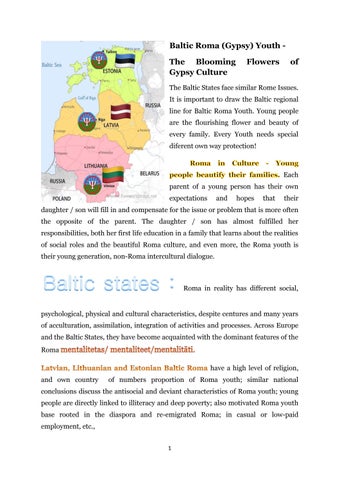
The Baltic States face similar Rome Issues. It is important to draw the Baltic regional line for Baltic Roma Youth. Young people are the flourishing flower and beauty of every family. Every Youth needs special diferent own way protection!
Each parent of a young person has their own expectations
and
hopes
that
their
daughter / son will fill in and compensate for the issue or problem that is more often the opposite of the parent. The daughter / son has almost fulfilled her responsibilities, both her first life education in a family that learns about the realities of social roles and the beautiful Roma culture, and even more, the Roma youth is their young generation, non-Roma intercultural dialogue.
Roma in reality has different social,
psychological, physical and cultural characteristics, despite centures and many years of acculturation, assimilation, integration of activities and processes. Across Europe and the Baltic States, they have become acquainted with the dominant features of the Roma have a high level of religion, and own country
of numbers proportion of Roma youth; similar national
conclusions discuss the antisocial and deviant characteristics of Roma youth; young people are directly linked to illiteracy and deep poverty; also motivated Roma youth base rooted in the diaspora and re-emigrated Roma; in casual or low-paid employment, etc., 1
Roma young people whose factor has taken over in the lives of all young people (emotions, thinking and social deprivation) or in a long-lasting frustrated state. (A mental condition that can arise when a person faces real or seemingly insurmountable obstacles on the way to an important goal. Personal exclusion; inability to fulfill one's desires; blocking of drives). The feelings of these states suppress emotions and awaken the formation of self-harming thinking and regresive the person's drive. Article stressing point are the national characteristics of Roma ethnic culture have proved years of persistence, permanence, unique Gypsy-only characteristics (original) with a hint of Gypsy mentality, and various political and historical migrations in the modern vision have changed the external façade, but the deepest context of their cultures and the meaning of symbolism is deeper in the subtext, when researchers in a variety of specialties have a lot more to do and scientific research worthwhile. On these reviews need to model the Baltic Roma Alliance in perspective as the main topic of the article.
Politically, as far as we know, Latvia seems to have been granted the status of a Baltic center in the ranks of the Baltic States. This is confirmed by the visits of various high guests: the peak of 1993 - Pope John Paul II, but in 1994 the President of the United States Bill Clinton and others visited Latvia. The well-being of Roma youth characterizes the state of health of the gypsy cultural ethnos (Dr.Hist., Professor of the University of Latvia, Ethnopsychologist, Ilga Apine, 2001). The issue of Roma youth is seen in biopsycho-social-spiritual unity, and in the balance of harmony. Psychologists call this emotional separation. However, Latvia has a special law that promotes the quality of life of young people between the ages of 13 and 25 (29) by promoting their initiative, work ethic and patriotism, participation in decision-making and public life, and supporting youth work. In Estonia, a young person is a natural person between the ages of 7 and 26; § 4. Youth work (1) Youth work is the creation of conditions that promote the diverse development of young people, which allows them to be active outside the family, to receive formal education in the adult education system and to work of their own free will. In the Roma cultural environment, the guardianship / detention of young people often takes place, for reasons of different parental beliefs and safety. 2
Another phenomenon is known as age jumping - skipping 2-5 years or acceleration. A closer look at the psychological and social phenomena of these Roma is an important factor in building a harmonious and adequate relationship with both Roma youth and their parents in the Roma cultural environment. Topical issues of
in the Baltic States have
not been updated and highlighted. Discussions have started in Latvia Tertats, Andris,
Identity
of
Fragile
Roma
Youth:
2011
Magazine
for
Professionals Social Worker. - No.4 (2011), [17] - p. For professionals in the Baltic States, teachers and social workers, the focus is on the characteristics in which Roma young people are particularly well known in the local community, which may differ from other ethnic minorities. Their biological, social, psychological and chronological age differences range from 13 to 25 (29) years. On average, in all countries, the Roma entered the Baltic about 500 years ago. For many centuries, many features specific to the Roma minority remain. Education, employment, legal issues, musicianship and the need for a separate cultural environment are similar in all countries. There are about 20 million Roma (Gypsies) in the world, the only ethnic minority in the world without their own homeland. The majority of dominant scientists believe that gene traces crossing the path of many countries migrating from India. The ethnic cultural minority in the Baltics has the smallest numerical advantage, unlike other centuries-old minorities. Rome issues are known throughout Europe; their lives, incomes and human potential. The author's attention is drawn to all young people in the Baltic Roma, including those who have never been to school and those who have broken the law and been granted a disability. Roma Youth -Culture the flower in culture illuminates the actual situation of families. Culture The flower characterizes the emotional and spiritual flow of the Roma family. The young person has almost grown up, however, in some cases, is not formally independent. The emotional connection of parents has a basis for both protecting their child and also understanding the weaknesses that young people will have to face in real life. The idea of the article is based on the idea of these and other issues, bringing out the first reflections to the young people of Baltic Roma. 3
At the suggestion of our professionals, in addition to academic education, we strive to promote the personal experience of the Baltic Roma Youth in their own talents; to the points he has and what to do with it. To shift emotions in a secondary way, allowing rational pragmatism to self-organize, achieving tasks professionally transforming, symbiotically or merging with the relationship between the state and the Roma. Their contradiction denies opportunities to themselves and conflicts with society. More often, modern needs are higher than real. In the media and research of the Baltic States, one can often read about low-income and poor living conditions of Roma families. Prolonged periods of unemployment can have serious long-term consequences for individuals, such as reduced incomes, an increased future of unemployment and social exclusion. In all cases, a young Roma person is involved as a child or adult. According to a source in Lithuania, Roma men were more likely to be not covered by compulsory health insurance (20%) than women (9%) - they were usually unemployed and not registered with the labor exchange. The share of young Roma who (53.7%) of the surveyed Roma is also officially granted the status of lowincome or needy person. This situation is closely related to the limited employment opportunities of the Roma - the results of the survey show that 40.5% of Roma households do not have any legally working family members and most of the family is supported by various social benefits and other financial assistance (Roma in Latvia, 2015). In Lithuania, a 2015 survey found that 29% of Roma described their health as "bad and very bad", and 50% reported having a chronic illness or long-term health problem. In the Roma group, women were more likely to report long-term health problems, with 25% of women surveyed stating that they had not received the necessary medical care in recent years, and 31% not having seen a doctor due to lack of money. 26% of Roma said that the main reason why they did not receive the necessary medical advice was fear of treatment and hospitalization. The most common diseases in Roma communities are digestive, contagious and respiratory diseases such as tuberculosis and scabies; the study Roma in Latvia (2015) informs that although the situation in Roma education has slightly improved over the last ten years, one of the main problems among the Roma population is still the relatively low level of education: 39.9% have dropped out of school at various stages of primary education. almost a third (31.3%) up to 7th grade), a third (34%) of Roma have completed primary education, while only 17.2% of the surveyed Roma have indicated higher education than basic education. 4
Roma migration, which is becoming more and more important today, has prompted policies to focus on Roma integration issues; policies targeting the Roma often run counter to the goal pursued, and instead of promoting inclusion, it contributes to maintaining (or even worsening) the status quo, 2018 Many Roma children communicate mainly with other Roma in the Roma language, and they often experiences intolerant and ignorant behaviour from non-Roma children and even from teachers. The Roma population in Tallinn accounted for only 13.6%. The total number of Roma, while about 1/3 of the Estonian population lives in the capital. Studies have found that economic hardship is a problem for most families where both parents are ethnic Roma. Incapacity for work pension is very common for both young and old Romani women. Many women also received benefits for raising children of close relatives. It is also pointed out that the unacceptable Roma traditions and history are one of the main obstacles to the full integration of the Roma into society. Estonian Integration Strategies 2008-2013 The 2007-2013 program focuses on youth work, with a particular focus on career guidance and networking. There is no doubt about the recognition of the Roma in the entire society of the Baltic States. The actions of the Roma can be felt from a great distance, giving the impression that there are many thousands of them. They are based on the type of nervous system (temperament), expression of emotions, formation of subgroups and alliances, close brotherhood, mental and psychological states, character traits, cognitive processes, etc. or the psychological characteristics of Rome, those that are always forgotten to be included in all Roma-related projects, initiatives, interactivities, etc. organized by NGOs and the State or Municipalities. in public tenders. Studies and reports from researchers in the Baltic States in recent years have shown some differences (positive or negative) that could qualify as unique and original differences in the psychological characteristics and social behaviour of the Roma. Therefore, different quality indicators (measures of mental activity; demographic situation - income level). I am inclined to think that Roma integration measures in the Baltic States, including Europe, have not been successful. Good intentions in Latvia, Lithuania and Estonia, however, the collective consciousness of the dominant manner of culture has historically failed to overcome modern attempts to place gypsies deep within the framework of other societies. Psychological anthropology can scientifically substantiate this phenomenon. The diversity of one culture often contradicts the interpretation of other cultures. 5
In 1972, the term was named after "psychological anthropology" by Francis L. K. Hsu. Psychological anthropology is an interdisciplinary sub-branch of anthropology that studies the interaction between culture and spiritual processes. This interdisciplinary tendency focuses on the ways in which human cognition, emotion, perception, motivation and mental health are shaped by the development of a particular cultural group - through its history, language, practice and conceptual categories. I have touched on the specific center of the subject of the Baltic Roma youth publication. The emotions, thinking and spirituality of the leading Lithuanian, Latvian and Estonian people are often out of balance with the psychological, social and thinking issues of the Roma. On this basis, new needs arise to explore deeper and more widely the Roma youth in the Baltic region - the flower of culture, psychological barriers. The setting must change, the modern version must be able to transform, from the questions: why? on which way? Knowing the interdisciplinary basic theses of various academic and professional studies, taking into account the social, psychological and socio-cognitive (learning) priority of Roma cultures in pedagogical science is denoted by a personality-oriented or person-centered approach, which means based on individual psychological characteristics. Respecting the individuality, interests, needs and social peculiarities of the flower of Baltic Roma culture. Psychological anthropology is the study of psychological topics, using anthropological concepts and methods, in order to find out more about psycho-energetic manifestations and mechanisms in the Roma environment of one's own country and in comparison with other countries. These include trends in the mental health and disorders of Young Roma in the Baltics and how they relate to other countries and continents. It is important to find out the psychological and social categories that are relevant in their age and socially useful in order to qualitatively improve the national and Baltic Roma culture in general: emotions, motivation and mental health. For Roma children, Roma parents, Roma youth, etc. revealing and delving into the issues in the analysis. In Roma care, it is important to understand the basic ideas of socio-psychological diversity and rehabilitation (renewal, improvement) in the context of the Roma, for a specific family, in the context of their life. We can combine the complex of comprehensive methods in Roma therapy (non-medical and non-psychotherapeutic), using the symbols, images and knowledge gained in Roma research. to find spiritual, emotional, spiritual healing for the phenomena of the collective consciousness of Roma cultures; 6
transformation and expansion of self-confidence. Archetype is the most universal and universal form of thinking. These originals, primordial models created and maintained by the collective unconscious, are widely expressed in myths, fairy tales, folk songs, dreams and also in art. Gypsy folk tales (wit, joke, make fun of others, can laugh at themselves), Roma flag with colors (blue - open sky, horse-wheel movement, and light green - meadow, freedom, ease), musical talent for most Roma,
which
has
historically
symbolized
public
entertainment,
migration processes (marginal group), the state of India as a origin many centuries ago; Roma Anthem of Jelem, Jelem (united in the world, but each country has its own version of the Roma anthem based on the main one), etc. are the unifying elements, symbols and images of the Roma worldwide. At the heights of Roma psychology tasks, it is necessary to ensure the filling of empty & cognitive gaps, to integrate personality-centred psychological therapy, so that the Baltic Roma youth can successfully incorporate their spiritual inner harmony into their daily lives by transferring them to the given topicality. The experience of the experience of the Baltic States in the environment of Roma cultures has given impetus to the actualization of new designations such as therapy, care and psychological services in Latvian society at the discretion of the author. The above has suggested focusing the main ideas on accumulated years of life experience, the potential (resources) of the Roma people, the dynamism (mental, spiritual, social functionalism) that characterizes the physiology of culture in the system of the Roma living system. The daily life of the Roma is different from that of other ethnic and basic nations. It is important to observe these factors both when inviting the Roma intelligents or Romologists, who have already completed at least the 3rd year of higher education in any profession. Academic thinking and scientific foundation; operation of many information within the framework of purposeful studies and its systematization, structuring, scientific and practical experience, etc. everyone acquires in the first years of study. Within the context of Baltic Roma cultures - a Romologist, the highest category in Roma society; to awaken the consciousness of Baro Manush; A romologist is Roma a scientist (researcher) within the framework of understanding Roma culture, who is able to critically analyze and selectively select information;
7
the romologist is able to detect contradictions and find solutions by combining Roma, non-governmental and national frameworks; a romologist with professional and human abilities is able to integrate, innovatively create, in the Baltic States and international context. A romologist can only be a Roma student or a graduate (at any higher education institution). Only the chosen one is able to reach such a higher category - deservedly, by consciously studying, is connected in the parallels of Roma culture and state requirements. Designations created by the author as Reabrology general restoration of gypsies, Straxology - study of fears (strax - Roman fears), Graixology - individual therapy with a horse; Grajapluokos psychology - social and psychological dynamics in contact between several horses and Roma, ČČ(Ch.Ch.) phenomenon - roma thesis on Roma psychological characteristic as own way talented, attractive, artistic, lively, skilful energetic etc. (Charlie Čaplin phenomenon);
Sasty(i)rology
-
special
attention
to
Roma
and
health;
Chiotherapy - the influence of the Romani language on their lives; Disco Dj or productive therapist - an inspirer of modern style, electro-music and rhythmics, energetics, and a virtuoso, captures the emotions, minds and social activation of the masses; socio-psychological relationships through modern music (discothec are as Roma microsocial institute), Trin-Chin-Saare therapy- natural self-organization, easy impulse-guided and collective adhesion , Healing architectural- based on the Roma phenomenon (outside hell - inside paradise) therapy, Climatic therapy based on Roma seasonality (behavior, emotions, climate) and other Roma specialized terms that focus on in-depth research in Roma society to find answers and greater clarity absenteeism, reduced self-esteem, etc. Roma family psychology, Roma psychosocial, Roma intercultural psychology, Roma micro-sociological, Roma sociopsychological (human relations, various interest groups, work team, nationality, gender, age), etc. issues as the most important aspects in the development of the personality and life of the Roma in the Baltic States.
8
Andris Tertats,
Latvian Roma ethnic identity,
Roma researcher, Roma publicist; Registered & Certified, qualified psychologist, MSc.psyc., In Latvia, qualified social educator, qualified health and social care specialist. o Since 2022, I have been the IRU Commissioner for Social Affairs and Health. Youth and Sports (Northern Macedonia, Balkans) President ZORAN DIMOVS o Member of the Latvian Association of Professional Psychologists o Member of the Latvian Society of Trauma and Crisis Psychology o Member of the Latvian Anthropological Society o Member of the Asian Roma Union of Pakistan o 4th year (last year) student of the Latvian Institute of Transpersonal Education (in transpersonal psychology and transpersonal psychotherapy) o At least 30 different popular Roma psychological articles in Latvian society
For consultation & cooperation, contact: Skype: andris.tertats3 Whats up: +447908469154 E-mail: tertats@inbox.lv; tertatsandris@gmail.com Work languages: Latvian, Roma, English, Russian
Roma (Gypsies) Social Science in Baltic ©Andris Tertats, March, 2022
9