ADS8
Andra Pop-Jurj ADS8: Data Matter - Gaming edition 2020/2021
2020/2021
RESEARCH BOOKLET
monsters and ghosts of the Russian Arctic
Andra Pop-Jurj
1
1
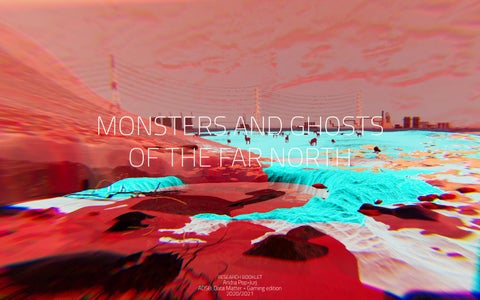
MONSTERS AND GHOSTS OF THE FAR NORTH
2
2
CONTENTS About the project 3 Design strategy 4
Russian Cosmism 11
Andra Pop-Jurj
A History of Megaprojects 21 A greening Arctic The Yamal Megaproject Living with Permafrost Multispecies Cohabitation The Contact Zone Leaks and Flares
25 27 30 32 33 42
Permafrost as a historical object Understanding frozen ground Positive feedback loops Permafrost geohazards
49 50 51 57
Permafrost Landscapes 47
monsters and ghosts of the Russian Arctic
Russian Cosmism in art and science 12 Cinematography 13 Russian Avant-Garde 18
Metabolism of the Siberian Tundra 59 Gas blowout craters 60 Permafrost metabolism 62 A frozen repository 66
Worlbuilding Techniques 72 Worlding Narrative approaches Time in art and literature Temporality concept Time segments of more-than-human agents
73 74 77 80 82
On Digital Environments 85 worldbuilding 86 Camera path studies 90 C# scripts 92
ADS8
2020/2021
Bibliography 97
3
3
Points of departure for this project are some of the spatial manifestations of the social, economic and geopolitical conflicts in the Russian Arctic caused by environmental degradation and the warming of the Far North at a higher rate than the rest of the world. In response to the studio brief, the project employs world-building techniques and uses the game engine as a testing ground for alternative perceptions and forms of representation. Elements from my research culminate into a fictionalised story, told in the format of an immersive video game experience.
The project is presented in the form of an extended trailer of this cinematic game experience. Time is the main character and narrator of events and the player is never really in charge inside the game space. By experiencing the narrative across scales and through the perspective of time, the project proposes a way to de-centre the human and his perceived universality through often disorienting scenes.
2020/2021
ADS8
This medium facilitates the recreation and understanding of existing and emerging forms of cohabitation between humans and more than humans in the highly dynamic landscapes of this region. The narrative is grounded in a number of encounters
- relationships disrupted or forged in the last few decades in the permafrost landscapes of Siberia, home to the world’s largest natural gas deposits. In aiming to move away from anthropocentric ways of representation, I consider so called contact zones spaces where cultures and species meet, clash and grapple with each other.
monsters and ghosts of the Russian Arctic
Andra Pop-Jurj
About the Project
4
4
DESIGN STRATEGY term 1
Andra Pop-Jurj
Framed as a study across multiple scales, this body of research focuses on the spatial manifestation of the current social, economic and geopolitical conflicts in the Arctic region enabled by the environmental degradation of the Far North. More specifically, it is an inquiry into the modes of cohabitation between humans, non-humans and more than humans following the development of extraction industries in the Russian Yamal peninsula. I aim to explore the role and agency of the architect in the design of digital environments that serve as a testing ground for multispecies cohabitation and their negotiation of spatial politics by asking the following:
monsters and ghosts of the Russian Arctic
Introduction
How might the cohabitation between humans and non-humans inform new forms of architecture [for overcoming established patterns of territorial governance] in the age of climate disturbances, technological shifts, and large-scale infrastructures? How might non-western and non-anthropocentric epistemologies inform new forms of cohabitation/architecture in the Russian Arctic? How might the realm of non-human senses emancipate alternate configurations of polar ecologies? How do designs of digital technologies and environments shape the way in which we see and sense the natural environment?
ADS8
2020/2021
It further speculates on our contemporary notions of nature and the dialectic between humans and environmental assemblages.
that in turn will form new monstrous relationships between humans and non-humans.
While the Russian Arctic, more specifically the Yamal Peninsula, serves as a case study of the spatial implications of social, economic and environmental changes, research into alternative theories for the Anthropocene serve as a theoretical and conceptual framework for thinking about and designing other worlds.
The role of sensing technologies
In her book ‘Arts of living on a damaged planet’, anthropologist Anna Lowenhaupt Tsing - puts forward the proposal of entangled histories and narratives as creative tools of survival in the more-than-human Anthropocene. Borrowing her concept of monsters and ghosts, the Russian Arctic lends itself to be studied through this lens. The monsters refer to symbiotic relationships between and within species, in other words ‘bodies tumbled into bodies’. The ghosts are landscapes haunted by the violence of modernity.1 Going against formal classification systems, the book addresses this planet and asks how we might learn to live together on a compromised earth. The ghosts and monsters of the Arctic encompass all scales, revealing a symbiosis between the local and the global. Minor forms of space and time merge with great ones - having reverberating effects. Ghosts remind us of what we have forgotten. They show us how living landscapes are archives of human tracks and traces. Ghosts become tangible through the melting permafrost and the destabilization of the ground that is already calling for deindustrialization in some parts of Russia. The melting permafrost could lead to dangerous chemical, biological and radioactive substances entering the human habitat
Remote sensing imagery provides crucial data sources for assessing both environmental and the social impacts of oil and gas developments and ground cover changes in the vast Arctic. I am interested in the use of sensing technologies not only as a new form of knowledge acquisition but also as a mode of representation and as a medium through which the human relation to ecological processes can be reinterpreted. The ways in which environments come to be articulated through sensing technologies have relevance for the types of environmental politics and citizenship that is formed along with these technologies. As Professor Jennyfer Gabrys articulates in her book ‘Program Earth: Environmental Sensing Technology and the Making of a Computational Planet’, environmental sensing technologies entail a transformation of the ‘objects’ that are turned into information; ‘to produce information is a technological intervention that generates distinct types of realities, rather than simply mirroring them’2. Do monitoring and the subsequent data processing in some way already presuppose a certain set of practices and preconceived expectations that assume distinct ways of accessing and studying environmental phenomena?
Anna Lowenhaupt Tsing and others, Arts of Living on a Damaged Planet: Ghosts and Monsters of the Anthropocene (U of Minnesota Press, 2017), p. G6. 2 Jennifer Gabrys, Program Earth: Environmental Sensing Technology and the Making of a Compu-
monsters and ghosts of the Russian Arctic
Andra Pop-Jurj
5
5
Alternative theories for the Anthropocene
Frank Ippolito, The Wired Woodlands, 2008
2020/2021
ADS8
1
6
6
Despite repeated efforts of taming the Far North, The Arctic remains one of the least accessible regions in the world – a continuously shifting landscape of water and ice. It is for this reason that we outsource our understanding of the territory to data collected through remote sensing technologies, and their digital reconstructions become the lens through which we see the Arctic. The scramble for sovereignty over the 1.1 million square mile area surrounding the North Pole, currently international waters, is fueled by the promises of global warming: access to troves of untapped resources below the seabed and control over new shipping routes through the thawing sea ice. However, the Arctic region is defined by both land and maritime spaces, indigenous and capitalist governance systems, a rapidly changing environment, and the presence of international, national, and subnational actors. It is of no surprise that the international system has struggled to position the circumpolar North within the Westphalian political framework. Regions above the Arctic circle can be viewed as a testing ground for new paradigms informed by indigenous and non-anthropocentric ethics and epistemologies of those agents familiar with this landscape.
The national scale
Russia’s prioritisation of the Arctic region has both an economic and a military dimension. The Arctic is the national resource base for the whole of Russia with about 20% of all Russian exports being generated in the Arctic. The rapid decrease in po-
Its distance from the equator, seemingly endless landscapes of carbon dioxide-hungry trees, defensible northern settlements, newly agriculturally-viable land might seem like an advantage. But Russia is also heating 2.5% faster than the global average and the ecological restoration following its 20th century nation building exercise requires ambitious interventions. Furthermore, the extraction practices deployed in the Russian oil and gas field require further regulation. World Bank data claims that Russia is the world’s leading anthropogenic methane emitter. By Russia’s own governmental figures, two thirds of these emissions come from the oil and gas industry and the flaring of gasses which in turn produces smoke and ash that cause several respiratory diseases among the residents of the region and accelerate climate change.4 Today, the country is far too dependent on extraction economies (that don’t trigger much innovation) in the rest of the economy and which are, of course, vulnerable as planetary energy systems shift toward renewable sources of energy. The development of this strategic energy battleground, together with increasing environmental degradation in the region, is however interfering with humans and non-humans alike. The positive feedback loops fuelling this conflict have reverberating effects on the sparsely built Siberian tundra, directly impacting the degrading soil and with that our entire environment. the local wildlife and nomadic communities.
gaps in satellite imagery, Worldview by NASA’s Earth Observing System Data and Information System
Nicole Bayat Grajewski, ‘Russia’s Great Power Assertion: Status-Seeking in the Arctic’, St Antony’s International Review , 13.1 (2017), 141– 63 (p. 142). 4 ‘ENVIRONMENT | Russia’s Exploding North and the Death of Green Investment’, The Ellison Center , 2015 <https://jsis.washington.edu/ ellisoncenter/news/environment-russias-ex3
2020/2021
ADS8
My research focuses on the Russian Arctic - whose strangeness, otherness and northernness define its identity. The effects of changes in temperatures and loss of sea ice extent in the Arctic region fundamentally transform Russia’s role as a maritime nation, particularly in light of the Northern Sea Route.
lar sea ice and the melting of permafrost — coupled with the insistent focus by President Vladimir Putin on the riches in the Arctic — has led to significant economic and military developments along Russia’s north and some 20,000 kilometers of Arctic coastline. This is an Arctic revival which hugely impacts the lives of those who live there and which provides a backdrop for the current signs of increased great power rivalry in the Arctic. As the last frontier for both imperial Russia and the Soviet Union, the country regards the denial of access to the Arctic’s resources as a direct threat to the country’s survival and identity as an Arctic nation.3
monsters and ghosts of the Russian Arctic
Andra Pop-Jurj
The geopolitical scale
7
7
The regional scale
Andra Pop-Jurj
The Arctic is receiving increasing attention not for the numerous indigenous peoples inhabiting the region but for its rising role in the global energy and mineral supply. Home to the nomadic Nenets people, The Yamal-Nenets Autonomous district holds around 90% of Russia’s and 20% of the world’s gas production.5 Its strategic importance for the Russian Federation and the European energy supply cannot be understated.
T. Kumpula, B. C. Forbes, and F. Stammler, ‘Remote Sensing and Local Knowledge of Hydrocarbon Exploitation: The Case of Bovanenkovo, Yamal Peninsula, West Siberia, Russia’, ARCTIC , 63.2 (2010), 165–78 (p. 166) <https://doi. org/10.14430/arctic972>. 6 Anna Degteva and Christian Nellemann, ‘Nenets Migration in the Landscape: Impacts of Industrial Development in Yamal Peninsula, Russia’, Pastoralism: Research, Policy and Practice , 3.1 (2013), 15 (p. 8) <https://doi.org/10.1186/2041-71363-15>.
monsters and ghosts of the Russian Arctic
World politics, particularly in the Arctic, has long been about flows of capital, humans and non-humans between cities and across jurisdictional boundaries that are regulated in ad hoc and patch worked ways rather than through the singular workings of absolute sovereignty over clearly bounded territorial spaces.
The industrial development on the Yamal Peninsula commenced in the late 1980s, slowing down after the disintegration of the Soviet Union and subsequent financial crisis during the mid-1990s in Russia. It increased substantially again in 2004 when the world prices for hydrocarbons rose and the government could afford to subsidize a massive port for liquified natural gas tankers, an airport, a powerplant and the use of nuclear-powered icebreakers in the transportation the construction materials. The Bovanenkovo industrial complex is composed of an extensive infrastructure network consisting of roads, gas fields, living quarters, production facilities, power and pipelines, and gravel pits and quarries which interfere with the local wildlife and nomadic communities.6
Satellite imagery of the Yamal peninsula, ground destabilization in the form thaw lakes and the Bovenenkovo gasfield
2020/2021
ADS8
5
8
8
Approximately 15 reindeer herding units travel through the area during summer along 21 migration routes. Reindeer herding among the Nenets people is nowadays organized in large enterprises, formerly as state managed agricultural farms. Each reindeer herding enterprise is composed of several brigades according to the number of the herds. Several herders work together and migrate with their families all year around in a brigade. In addition, there are also a great number of private herders. Many Nenets herders begin their migrations from the wintering areas in the south in mid-late March. It is home to approximately 270,000 reindeer and about 1,000 fully nomadic households, comprising ca. 5,000 nomadic people live on the Yamal peninsula. Herders can move up to 30km on a good winter day. As the snow melts, the distance is often limited to 7km depending on weather, total distance to summer pastures, ground conditions, dynamics and coordination with the migrations of other herders and the ecology of their reindeer.7
7 8
Degteva and Nellemann, p. 2. Degteva and Nellemann, p. 9.
Furthermore, several studies have shown that important grazing ranges are lost disproportionately and become unavailable, as development tends to target the same type of rugged terrain for construction. Development has also been shown to impact much greater areas beyond that of the initial footprint, including abandonment of calving grounds by caribou and reindeer. Rugged terrain is crucial to the reindeer herders and their animals for travel, access to dry camp sites and grazing.8 The physical footprint of Bovanenkovo installations is small, but for the three herding units migrating through these bottlenecks, the industrial development resulted in blockage of two out of four possible routes, loss of major grazing areas and subsequent loss of access to at least 18 traditional campsites and one sacred site along their traditional route, which in turn delays the timing of their migratory cycles. Continued industrial development will further compromise the Nenet peoples’ ability to adapt.
“White carpet” treatment from Gazprom, the company that operates Bovanenkovo, as the herd crosses the gas field. The geotextile is supposed to make it easier for reindeer bulls to pull the sleighs across the road.
2020/2021
ADS8
Traditional pastoralists are confronted with increasing competition and possible loss of seasonal pastures as infrastructure such as roads, pipelines, power lines and dams, along
with urban development and settlement, interfere with their migration patterns. Their shamanistic and belief system, which stresses respect for the land and its resources, clearly contrasts the notions of living imposed upon them directly through interventions such as the Yamal Megaproject.
monsters and ghosts of the Russian Arctic
Andra Pop-Jurj
The human scale
9
9
Time and time again we see how logics of indigenous beliefs and mythology contradict the singular version of reality predicated by Western science or are simply not understood in current scientific frameworks because they are not seen to be objective. Thus, particularly in the Arctic region, indigenous worldviews and ontologies might inform approaching these complex issues. As indigenous populations have long known, the Arctic is sentient and ‘equipped with a sense of hearing, sight and smell’.9
monsters and ghosts of the Russian Arctic
Andra Pop-Jurj
the non-human scale
New cosmologies are emerging, erasing distinctions that have been taken for centuries as axiomatic. The dividing lines between matter and energy, animate and inanimate, time and space, virtual and real, male and female—all the old dualities—no longer hold.
9 Julie Cruikshank, Do Glaciers Listen?: Local Knowledge, Colonial Encounters, and Social Imagination (UBC Press, 2010), p. 229.
2020/2021
ADS8
Candice Lin, 5 Kingdoms, 2015 - based on biologist Lynn Margulis’s theory of coevolution and symbiogenesis
10
10
Going forward, I intend to use gaming engines and digital environments as a tool for a speculative methodology but also as a space in which these spatial and cultural practices can be deposited. Conceptually, I would like to draw inspiration from the Russian Cosmist approach to world-building, museology and curation. While the museum of contemporary art might very well be the most advanced recording device ever invented in the history of humankind, the concern of how the contents of the museum might be reanimated so as to transcend even the social and physical limits imposed on humankind was already present among the Russian Avant-Garde.13 I wish to explore the use of game engines as an archive in which a more dynamic and experimental approach to curation can be deployed. I am interested in capturing the constantly evolving environmental phenomena and rapidly changing ecosystems in the form of moving image both as a spatial and curatorial practice. Seeing the digital environment as a site and space within which we hold agency as designers, it serves as a testing ground for the encounters of monsters and ghosts and implicitly the design of other worlds and forms of and representation. I am interested in how industrial, natural and human forces coexist in the hybrid Arctic landscape that is taking shape - part natural and organic, part synthetic and industrial but always in motion. Seeing the Arctic and its human and non-human inhabitants as sentient entities, the game space allows for speculation upon human and non-human interaction, ‘negotiation, reciprocity and perhaps even selflessness’14 as articulated by forest ecologist Suzanne Simard in her work
on the communication between trees. The digital spatialization of these encounters will also serve as a means of representation of further scientific research into metabolic processes during permafrost thaw caused by increasing temperatures. Microcinematography will be a useful tool as a depiction of both the objects of science and the process of scientific looking itself. Further, the game space allows us to play with time and temporalities along a guided narrative and to reconceptualize and rethink the way in which we represent non-human agency through a nonanthropocentric perspective; shifting the perspective across different beings and more than human entities. Notions of time might also shift. I aim to address these points in an experience that would challenge our anthropocentric values and universal perspective. The reconstruction of following ideas will serve as tools of investigation within the gamespace: -a study of the compromises and negotiation between human and nature and within natural systems, depicted in short animations of these moments. -employing a different lens, media or mode of representation for each scale (such as remote sensing imagery for the geopolitical/territorial scale or animations for the molecular scale) -interventions across scales addressing different nodes of conflict and negotiation -telling the story through an animation/film of the metabolism of this region - shifting perspectives to reveal ‘trading exercises’.
My intention is to shift away from an anthropocentric perspective and reconceptualize the way in which it is often simply applied onto non-humans, such as in the game Everything.
2020/2021
Arseny Zhilyaev, Avant-Garde Museology: E-Flux Classics (U of Minnesota Press, 2015), p. 17. 14 Ferris Jabr, ‘The Social Life of Forests’, The New York Times , 3 December 2020, section Magazine <https://www.nytimes.com/interactive/2020/12/02/magazine/tree-communica13
ADS8
Everything by David O’Reilly, the perspective of a frog
monsters and ghosts of the Russian Arctic
Andra Pop-Jurj
Intention
Andra Pop-Jurj
SIBERIAN PER-
monsters and ghosts of the Russian Arctic 2020/2021
ADS8 11
11
MULTISPECIES
TRANSSCALAR RUSSIAN COSMISM
12
12
RUSSIAN COSMISM IN ART AND SCIENCE
Trevor Paglen, ‘Fedorov’s Geographies of Time’, E-Flux , 88, 2018 <https://www.e-flux. com/journal/88/173480/fedorov-s-geographies-of-time/> [accessed 10 December 2020]. 11 Anton Vidokle and Hito Steyerl, ‘Cosmic Catwalk and the Production of Time’, E-Flux , 82, May2017 <https://www.e-flux.com/journal/82/134989/cosmic-catwalk-and-theproduction-of-time/> [accessed 16 December 2020]. 12 George M. Young, ‘Esoteric Elements In Russian Cosmism’, The Rose+Croix Journal , Rose+Croix
Andra Pop-Jurj
Although upon first glance, these theories might appear bizarre, the influence of Cosmism in Russian medicine, science and culture has been wide-reaching over the last century. Contemporary cosmism scholar and philosopher Svetlana Semenova argues for the relevance of this thought which calls for rational human regulation of the environment.12
10
2020/2021
ADS8
Wyld’s Great Globe, an attraction situated in London’s Leicester Square between 1851 and 1862, based on Nikolai Fedorov’s image of Earth as a spaceship
because a universal project of this nature cannot be curated selectively, and present generations do not have the right to be such a curator. It’s either everybody or nobody’11. Yet the ethical questions around the resurrection of those who have left a negative mark on our history prove rather difficult when taken into consideration.
monsters and ghosts of the Russian Arctic
Revisited in depth over the last two decades, the Russian Cosmist worldview not only collapses the distinction between human and nature but also that between the past, the present and the future. As articulated by Nikolai Fedorov at the end of the 19th century, the common task of humanity is to overcome alienation and restore a sense of kinship across species. The two great Fedorovian projects - the geoengineering of the Earth and resurrection of all those who have ever lived and implicitly the extension of life are meant to abolish this alienation on both a spatial and a temporal axis.10 As noted by Anton Vidokle, ‘Fedorov’s conviction was that nobody can be left behind in death, not even the monsters,
13
13
Anton Vidokle This is cosmism
CINEMATOGRAPHY
2020/2021
ADS8
Drawing from Nikolai Fedorov’s belief in death being an evolutionary mistake, Anton Vidokle’s This is Cosmos is the first in a trilogy of films, “Immortality for All: A Film Trilogy on Russian Cosmism,” which retraces the roots and influences of the Russian technological utopian movement “Cosmism.” Shot across various locations of the former Soviet Union and with John Cale’s (mixed by Carsten Nicolai) soundtrack, the film considers the historical, philosophical, political, and religious influences of Cosmism on society and culture.
monsters and ghosts of the Russian Arctic
Andra Pop-Jurj
This is cosmos, Anton Vidokle 2014
14
14 2020/2021
ADS8
The second film of Anton Vidokle’s trilogy on Russian cosmism looks at the poetic dimension of solar cosmology of Soviet biophysicist, Alexander Chizhevsky. Shot in Kazakhstan, where Chizhevsky was imprisoned and later exiled, the film introduces Сhizhevsky’s research into the impact of solar emissions on human sociology, psychology, politics and economics in the form of wars, revolutions, epidemics and other upheavals. The Communist Revolution Was Caused By The Sun aligns the life of post-soviet rural residents and the futurological projects of Russian cosmism to emphasize that the goal of the early Soviet breakthroughs aimed at the conquest of outer space was not so much technical acceleration, but the common cause of humankind in their struggle against limitations of earthly life.
monsters and ghosts of the Russian Arctic
Andra Pop-Jurj
The Russian Revolution was caused by the sun, Anton Vidokle 2015
15
15 2020/2021
ADS8
The trilogy’s last part is a meditation on a museum as the site of resurrection — a central idea for many Cosmist thinkers, scientists and avant-garde artists. Filmed at the State Tretiyakov Gallery, Moscow Zoological Museum, The Lenin Library and The Museum of Revolution, the film looks at museological and archival techniques of collection, restoration and conservation as a means of the material restoration of life, following an essay penned by Nikolai Fedorov on this subject in 1880s. The film follows a cast comprised of present-day followers of Fedorov, several actors, artists and a Pharaoh Hound that playfully enact a resurrection of a mummy, a close examination of Malevich’ Black Square, Rodchenko’s spacial constructions, taxidermied animals, artifacts of the Russian Revolution, skeletons, mannequins in tableau vivant-like scenes, in order to create a contemporary visualization for the poetry implicit in Fedorov’s writings.
monsters and ghosts of the Russian Arctic
Andra Pop-Jurj
Immortality for all, Anton Vidokle 2016
16
16 2020/2021
ADS8
Andra Pop-Jurj
monsters and ghosts of the Russian Arctic
Cosmist art as a world-building tool: sketches of spaceship ‘Earth’
17
17
Marxism
materialist interpretation of historical developments
rov i Fedo Nikola 903 1 – 8 2 8 1
Russian Cosmism - cosmology
Avante-Garde (1912-35)
Global Seed Vault
Museum as a graveyard of species to be resurrected
revolt against the 'kunstkammer' as an idealistic museum
destruction of the musem
Data Centres
Andra Pop-Jurj
experimental exhibition design 'the museum of the future must be a place of reconciliation, an institution that, like the church, would register every new life and death'
avante-garde theatre 'North Pole'
establishment of Bolsheviks (Bogdanov and Lenin)
Alexander Bogdanov dissolved class divisions
art integrated into everyday life
Proletkult
dynamic installations where the artwork is an active participant
depiction of a postrevolutionary Marxist museum in his sci-fi novel 'Red Star', 1908: 'I imagined there would be no museums in a developed communist society.'
not aligned with Soviet Realism
monsters and ghosts of the Russian Arctic
Russian Revolution of 1917
'avalanche exhibitions'
narratives of Communist space exploration and colonization of Mars organised in factories in a working-class aesthetic inspired by the modern industrial society in backward, agrarian Russia
Soviet Space Program (1950s)
ADS8
contextualization of art production according to class positions
Soviet Realism
2020/2021
diagram of the relation between Russian Cosmism, Russian Avant-Garde as a period of experimentation in arts and culture
'The Experimental Complex Marxist Exhibition' resonated with the 'alientation effect' adopted by Bertolt Brecht
18
18
RUSSIAN AVANT-GARDE
in arts, museology and theatre design Andra Pop-Jurj
The position of the ‘proletkult’ (short for ‘proletarian culture’) came close to the radical position of a Malevich. Proletkult was a broad movement of unprofessional poets, writers, theatrical activists, film directors, and artists who tried to build a new proletarian culture through the negation of the art of previous epochs, in a practical attempt to destroy the museum as a castle of enemy-class culture. The intellectual leader of proletkult was Alexander Bogdanov, who started as a professional revolutionary and close collaborator of Lenin but was later forced from political activity and started working as a scholar and a cultural organizer. Thanks to Bogdanov, proletkult was influenced by the ideas of Russian cosmism, which resulted in a series of narratives of Communist space exploration written by selftaught poets.
2020/2021
ADS8
Exhibition on ‘The History of the Civil War’, Leningrad Museum of Revolution, 1930
Alexander Bogdanov vision of the post-revolutionary Russian Museum in his science fiction book ‘Red Star’, 1908: ‘I imagined there would be no museums in a developed communist society,’ exclaims Bogdanov’s astonished protagonist upon finding that the institution has survived on Mars, home to a highly advanced Communist civilization. ‘I must say I never even imagined that you might have special museums for works of art’, I said to Enno on our way to the museum. ‘I thought that sculpture and picture galleries were peculiar to capitalism, with its ostentatious luxury and crass ambition to hoard treasures. I assumed that in a socialist order art would be found disseminated throughout society so as to enrich life everywhere.’
monsters and ghosts of the Russian Arctic
Proletkult and a revolutionary impulse
19
19
Mystery-Bouffe set design, Alexander Khvostenko-Khvostov 1921
Andra Pop-Jurj
At its foundantion lies the historical avant-garde’s destructive impulse towards any attempt to preserve the past. Kazemir Malevich expounded this idea, writing in 1919: ‘Contemporary life has invented crematoria for the dead, but each dead man is more alive than a weakly painted portrait. In burning a corpse we obtain one gram of powder: accordingly, thousands of graveyardcoulds be accommodated on one chemist’s shelf.’
monsters and ghosts of the Russian Arctic
This design for the opening of Mystery-Bouffe depicts a half globe topped by the North Pole. International survivors of the “waterless flood” of Revolution slowly make their way onto it. Moscow and Kharkov are marked on the globe, a reference to a different waterless flood, a theatrical one: this was one of many productions of the play that opened in the immediate wake of Meyerhold’s. Behind the globe, shards of bold color pierce the sky, at once recalling the Northern Lights and light refracted through a rainbow prism.
2020/2021
ADS8
Alexander Khvostenko-Khvostov, scene design for the ‘waterless flood’ in act 1 of Mayakovsky’s Mystery-Bouffe. This production, directed by Grigory Avlov at the Kharkov Heroic Theatre (1921), was one of over a dozen that followed in the immediate wake of Meyerhold and Bebutov’s May 1921 staging at Theatre RSFSR 1. Cardboard, pencil, gouache, collage, 58 × 78.2 cm
20
20
Soil Map - Frédérique Aït-Touati, Alexandra Arènes & Axelle Grégoire
Andra Pop-Jurj
monsters and ghosts of the Russian Arctic
Through a thought experiment, the map visualizes a reversed globe: what was external, the atmosphere, is now at the center, suddenly confined in a closed, reduced, and narrow space; and what was the deepest strata is now arranged in concentric circles that move outwards toward the edges of the map. In this way, the entire map focuses on the Critical Zone, i.e., the thin layer around the Earth where water, soil, subsoil, and the living world interact, and where human and nonhuman life and the resources that sustain it are concentrated.
2020/2021
ADS8
Frédérique Aït-Touati, Alexandra Arènes & Axelle Grégoire, Soil Map drawing
Andra Pop-Jurj
monsters and ghosts of the Russian Arctic 2020/2021
ADS8 21
21
A HISTORY OF MEGAPROJECTS
22
22
1/5 of Russian territory
Russian Arctic-Siberia
monsters and ghosts of the Russian Arctic
every Russian's identity is linked to the Arctic
Andra Pop-Jurj
industrialization of the North despite unforgiving weather conditions
2/3 of labour in the Arctic was forced
industrial plants and railways fell into disrepair with the collapse of the Soviet Union
Putin's revival of Russia's Arctic dream
Strategic energy battleground
oil and gas reserves
military bases
oil prices currently too low to convince shipping companies to invest
what is their point?
2020/2021
ADS8
ports along the Northern Sea Route
23
23
Andra Pop-Jurj
monsters and ghosts of the Russian Arctic 2020/2021
ADS8
Stalin’s Great Plan for the Transformation of Nature (1948-1953) Khrushchev’s Virgin Lands Campaign (1954-1965)
24
24 2020/2021
ADS8
Andra Pop-Jurj
monsters and ghosts of the Russian Arctic
Article on the Siberian rivers reversal published in an english language Soviet propaganda magazine, 1960
25
25
Climate change in the Arctic and Boreal Region (ABR) is unfolding faster than anywhere else on Earth, resulting in reduced volume and area of sea ice in the Arctic Ocean during summer, warming and thawing of permafrost, increases in the frequency and severity of climate-driven disturbances, and widespread changes to surface water extent, soil moisture, and vegetation structure and function. Environmental and climate change in the ABR is increasingly affecting society both locally and globally. Changes to forests from insects and fires, erosion of Arctic coastlines, and altered wildlife habitats that support subsistence opportunities may affect residents of the ABR both positively and negatively. The ABR also contains a globally significant amount of carbon in both the soils and vegetation, and it is unknown how much of this sequestered carbon will be released to the atmosphere as permafrost thaws and forests burn, potentially further accelerating global climate change.
2020/2021
ADS8
Russia has always wanted to populate its vast eastern lands, and the steady thawing there puts that long-sought goal
within reach. Wrapped up in all of this — the farming, the migration, the warming — is a larger game of global influence. The issue of national security, for any of these countries as well as the United States, is inextricably interlinked not only with immigration and border policies but also with food security. The race for prosperity in a climate-changed world is about achieving domestic self-reliance and also expanding geopolitical influence. But, as John Kerry, who is President-elect Biden’s incoming both are dependent on how the accessibility or usability of territory — whether Arctic passages or thawing land — changes over time. The scarcer food and other resources become on a global level, the more the ability to produce food domestically becomes a tool of power. And the more nations can keep themselves afloat in this changing world, the more they stand to benefit just by watching others sink. “It could be very tense,” John Kerry, US climate adviser, said, “a really, really messy process.” All of that makes the flow of people — whether you call them climate refugees or human capital — an inseverable part of the geopolitical power
monsters and ghosts of the Russian Arctic
Andra Pop-Jurj
A GREENING ARCTIC
26
Andra Pop-Jurj
monsters and ghosts of the Russian Arctic 2020/2021
ADS8
26
27
27
THE YAMAL MEGAPROJECT
Andra Pop-Jurj
Approximately 15 reindeer herding units travel through the area during summer along 21 migration routes. Reindeer herding among the Nenets people is nowadays organized in large enterprises, formerly as state managed agricultural farms. Each reindeer herding enterprise is composed of several brigades according to the number of the herds. Several herders work together and migrate with their families all year around in a brigade. In addition, there are also a great number of private herders. Many Nenets herders begin their migrations from the wintering areas in the south in mid-late March. It is home to approximately 270,000 reindeer and about 1,000 fully nomadic households, comprising ca. 5,000 nomadic people live on the Yamal peninsula. Herders can move up to 30km on a good winter day. As the snow melts, the distance is often limited to 7km depending on weather, total distance to summer pastures, ground conditions, dynamics and coordination with the migrations of other herders and the ecology of their reindeer.7
Furthermore, several studies have shown that important grazing ranges are lost disproportionately and become unavailable, as development tends to target the same type of rugged terrain for construction. Development has also been shown to impact much greater areas beyond that of the initial footprint, including abandonment of calving grounds by caribou and reindeer. Rugged terrain is crucial to the reindeer herders and their animals for travel, access to dry camp sites and grazing.8 The physical footprint of Bovanenkovo installations is small, but for the three herding units migrating through these bottlenecks, the industrial development resulted in blockage of two out of four possible routes, loss of major grazing areas and subsequent loss of access to at least 18 traditional campsites and one sacred site along their traditional route, which in turn delays the timing of their migratory cycles. Continued industrial development will further compromise the Nenet peoples’ ability to adapt.
2020/2021
ADS8
Traditional pastoralists are confronted with increasing competition and possible loss of seasonal pastures as infrastruc-
ture such as roads, pipelines, power lines and dams, along with urban development and settlement, interfere with their migration patterns. Their shamanistic and belief system, which stresses respect for the land and its resources, clearly contrasts the notions of living imposed upon them directly through interventions such as the Yamal Megaproject.
monsters and ghosts of the Russian Arctic
The human scale at the Bovanenkovo gas field
28
28
World politics, particularly in the Arctic, has long been about flows of capital, humans and non-humans between cities and across jurisdictional boundaries that are regulated in ad hoc and patch worked ways rather than through the singular workings of absolute sovereignty over clearly bounded territorial spaces. The Arctic is receiving increasing attention not for the numerous indigenous peoples inhabiting the region but for its rising role in the global energy and mineral supply. Home to the nomadic Nenets people, The Yamal-Nenets Autonomous district holds around 90% of Russia’s and 20% of the world’s gas production.5 Its strategic importance for the Russian Federation and the European energy supply cannot be understated.
T. Kumpula, B. C. Forbes, and F. Stammler, ‘Remote Sensing and Local Knowledge of Hydrocarbon Exploitation: The Case of Bovanenkovo, Yamal Peninsula, West Siberia, Russia’, ARCTIC , 63.2 (2010), 165–78 (p. 166) <https://doi. org/10.14430/arctic972>. 6 Anna Degteva and Christian Nellemann, ‘Nenets Migration in the Landscape: Impacts of Industrial Development in Yamal Peninsula, Russia’, Pastoralism: Research, Policy and Practice , 3.1 (2013), 15 (p. 8) <https://doi.org/10.1186/2041-71363-15>.
The industrial development on the Yamal Peninsula commenced in the late 1980s, slowing down after the disintegration of the Soviet Union and subsequent financial crisis during the mid-1990s in Russia. It increased substantially again in 2004 when the world prices for hydrocarbons rose and the government could afford to subsidize a massive port for liquified natural gas tankers, an airport, a powerplant and the use of nuclear-powered icebreakers in the transportation the construction materials. The Bovanenkovo industrial complex is composed of an extensive infrastructure network consisting of roads, gas fields, living quarters, production facilities, power and pipelines, and gravel pits and quarries which interfere with the local wildlife and nomadic communities.6
monsters and ghosts of the Russian Arctic
Andra Pop-Jurj
The regional scale
2020/2021
ADS8
5
29
29
Approximately 15 reindeer herding units travel through the area during summer along 21 migration routes. Reindeer herding among the Nenets people is nowadays organized in large enterprises, formerly as state managed agricultural farms. Each reindeer herding enterprise is composed of several brigades according to the number of the herds. Several herders work together and migrate with their families all year around in a brigade. In addition, there are also a great number of private herders. Many Nenets herders begin their migrations from the wintering areas in the south in mid-late March. It is home to approximately 270,000 reindeer and about 1,000 fully nomadic households, comprising ca. 5,000 nomadic people live on the Yamal peninsula. Herders can move up to 30km on a good winter day. As the snow melts, the distance is often limited to 7km depending on weather, total distance to summer pastures, ground conditions, dynamics and coordination with the migrations of other herders and the ecology of their reindeer.7
7 8
Degteva and Nellemann, p. 2. Degteva and Nellemann, p. 9.
Furthermore, several studies have shown that important grazing ranges are lost disproportionately and become unavailable, as development tends to target the same type of rugged terrain for construction. Development has also been shown to impact much greater areas beyond that of the initial footprint, including abandonment of calving grounds by caribou and reindeer. Rugged terrain is crucial to the reindeer herders and their animals for travel, access to dry camp sites and grazing.8 The physical footprint of Bovanenkovo installations is small, but for the three herding units migrating through these bottlenecks, the industrial development resulted in blockage of two out of four possible routes, loss of major grazing areas and subsequent loss of access to at least 18 traditional campsites and one sacred site along their traditional route, which in turn delays the timing of their migratory cycles. Continued industrial development will further compromise the Nenet peoples’ ability to adapt.
“White carpet” treatment from Gazprom, the company that operates Bovanenkovo, as the herd crosses the gas field. The geotextile is supposed to make it easier for reindeer bulls to pull the sleighs across the road.
2020/2021
ADS8
Traditional pastoralists are confronted with increasing competition and possible loss of seasonal pastures as infrastructure such as roads, pipelines, power lines and dams, along
with urban development and settlement, interfere with their migration patterns. Their shamanistic and belief system, which stresses respect for the land and its resources, clearly contrasts the notions of living imposed upon them directly through interventions such as the Yamal Megaproject.
monsters and ghosts of the Russian Arctic
Andra Pop-Jurj
The human scale
30
30
LIVING WITH PERMAFROST
Andra Pop-Jurj
Nyadma Khudi, a Nenets herder, leads reindeer under a pipeline at the Bovanenkovo gas field on Siberia’s Yamal Peninsula. When gas lines were new, the animals shied at them. Now they follow Khudi without hesitation—as they must to reach summer pastures in the north.
ADS8
Herds have lost hundreds of thousands of individuals, as measured by aerial photography of herds and counts in areas where caribou give birth. And their declines affect not just the landscape but the people who depend on it. The report explains that the declining number of animals are “a threat to the food security and culture of indigenous people who have depended on the herds.“ The herds have been declining in recent decades due to a complicated mix of factors including hunting, disease, diminished food availability, and climate change, the report explains. On one hand, you’d think that with climate change, the Arctic would become a more favorable environment for these grazing
Warmer summers have also meant that diseases, long locked in the Arctic permafrost, may thaw and spread among herds, though scientists aren’t completely sure how much of an impact this is having. And warmer winters can hurt them too. When it rains in the Arctic, as opposed to snow, it can freeze over into ice. That makes it harder for the caribou to walk, and to eat. In 2013, 61,000 (61,000!) reindeer died of starvation in Russia due to excess ice. Currently, a lack of snow in Sweden is impeding reindeer migrations there. As the climate warms, and as freezing rain replaces snow in the far north, this threat may increase The most recent rain-on-snow event of November 2013 resulted in 61 000 reindeer deaths, about 22% out of 275 000 reindeer on the Yamal Peninsula, says the paper, which warns that these events are now increasing in severity. In this paper, the scientists combined empirical data and modelling for major extreme weather events in 2006 and 2013 to find that the likely trigger was brief periods of Barents and Kara sea ice thinning during early November.
2020/2021
local biologist and permafrost scientists attaching tracking devices onto wild reindeer while they swim as that’s when they are most vulnerable
And they’re supremely important to the Arctic ecosystem as a source of food and livelihood for local people, and because of their power to reshape vegetation by grazing. But the populations of reindeer, a.k.a. caribou, near the North Pole have been declining dramatically in recent years. Since the mid-1990s, the size of reindeer and caribou herds has declined by 56 percent. That’s a drop from an estimated 4.7 million animals to 2.1 million, a loss of 2.6 million. “Five herds,” out of 22 monitored “in the Alaska-Canada region, have declined more than 90 percent and show no sign of recovery,” according to the latest Arctic Report Card from the National Oceanic and Atmospheric Administration, out Tuesday. “Some herds have all-time record low populations since reliable record keeping began.”
animals. Longer, warmer summers mean more vegetation for them to nosh on. And according to the Arctic Report Card, the Arctic did grow greener between 1982 and 2017. But it seems the warmer Arctic summers are also taking a toll on the reindeer. “Warmer summers also have adverse effects through increased drought, flies and parasites, and perhaps heat stress leading to increased susceptibility to pathogens and other stressors,” the report notes. Higher summer temperatures and wintertime freezing rain (as opposed to snow) seem to be correlated with adult caribou mortality.
monsters and ghosts of the Russian Arctic
Reindeer are perhaps best recognized by their magnificent antlers, the largest of any deer species in proportion to their bodies. They’re also notable for their epic thousand-mile journeys every year in search of food, in herds of 100,000 or more.
31 Andra Pop-Jurj
monsters and ghosts of the Russian Arctic
“White carpet” treatment from Gazprom, the company that operates Bovanenkovo, as the herd crosses the gas field. The geotextile is supposed to make it easier for reindeer bulls to pull the sleighs across the road.
Nenets people’s campsite along migration route
2020/2021
ADS8
31
Yamal megaproject/Yamal LNG production facility on the Yamal coast
32
32
MULTISPECIES COHABITATION The Architecture of Multispecies Cohabitation, Feral Partnerships research collective
Andra Pop-Jurj
Architects, developers and planners find themselves ever more at the intersection of contested natures. The politics of crisis and the (many) anthropocene(s) have intensified the responsibilities of design and planning towards mitigating climate change and protecting biodiversity. Yet for all the successful disciplinary rallying behind technological solutions to climate breakdown - such as low-carbon building services or clean energy consumption - architecture as a profession has yet to meaningfully address its ongoing role in biodiversity loss.
monsters and ghosts of the Russian Arctic
The Architecture of Multispecies Cohabitation presents ongoing research by Feral Partnerships (Beth Fisher Levine , Matthew Darmour-Paul, James Powell, Enrico Brondelli di Brondello, Francesca Rausa) of surprising and hopeful stories of human and other-than-human interdependence, facilitated by the architectures that host them. In the context of anthropogenic global warming and the accelerating extinction of species, the exhibition draws from historical precedents in order to inspire new possibilities for building worlds with the other-than-human in mind.
2020/2021
ADS8
Floating agents of the game experience
33
33
Conceptual model of the Arctic terrestrial biome - taxonomies and interdependencies
competition, predation
tion
atio
, pa
rasi
n
tes,
predation
parasitism, disease
herbivory, nutrient, trampling
migration
irrita
pred
birds
dise
ase
polination, nutrient cycling, decomposition
vegetation and fungi
intervertebrates
ocean
habitat, forage
In my project, I focus on non-human and more-than-human agents in these contact zones. Rather than taking a position that attempts a complete (and completely utopian) abandonment of anthropomorphic thinking, we need to adopt more encompassing and critical forms of thinking beyond the human. In doing so, I consider so called contact zones - spaces where “cultures (and species) meet, clash and grapple with each other, often in contexts of highly asymmetrical relations of power”. In the digital, these contact zones can be exaggerated to reveal often unexpected relations between agents across species, scales and timeframes.
freshwater resources
Conceptual model of the Arctic terrestrial biome, created to support develop-
landscape elements community, composition, spatial configuration, landscape dynamics
ment of the Circumpolar Biodiversity Monitoring Program - Arctic Terrestrial Biodiversity Monitoring. The model shows key biotic groups (e.g., mammals and invertebrates), relationships among those groups (arrows), and system drivers (e.g., anthropogenic and natural disturbance)
2020/2021
ADS8
physical characteristics physiographic setting, geology, elevations, topography, elevation, permafrost, nutrients
soil resources
habitat, forage
nutrients, moisture
habitat, forage
In the digtal, these contact zones can be exagerated to reveal often unexpected relations between agents across species, sclaes and timeframes.
monsters and ghosts of the Russian Arctic
Andra Pop-Jurj
mammals
THE CONTACT ZONE Mary Louise Pratt used the term “contact zones” to describe those spaces where “cultures, meet, clash and grapple with each other, often in contexts of highly asymmetrical relations of power, such as colonialism, slavery, or their aftermaths as they are lived out in many parts of the world today”.
habitat, forage
altered distributions, communitites, health, phenology, foodwebs, pathogens, migration
climate and atmospheric conditions temperature, precipitation, snow cover and depth, ice extent, solar radiation, climate change, wind, storms, flooding
parasitism, disease
anthropogenic and natural disturbance landscape change, contaminants, fragmentation, non-native species, resource extraction, disturbance, toxins, harvesting, infrastructure, tourism, fire
34
34
The Environment is not a system, Tega Brain
Andra Pop-Jurj
Mixed temperate forest, part managed, part natural regeneration
AI for Earth, Microsoft
2020/2021
ADS8
One aisle of a managed poplar forest in Tuscany
monsters and ghosts of the Russian Arctic
‘Both Scott’s scientific forest and Tsing’s plantation are examples of the complex interplay of economics and numerical approaches to landscape management, processes that are now accelerated through contemporary computation. What they show us is that data collection and modeling practices are never neutral. Rather, they reflect what is deemed important or trivial in the eyes of the modeler and therefore are profoundly shaped by economics, hubris and culture.
35
35
In northeastern Siberia, where an attempt is being made to re-create the northern subarctic steppe grassland ecosystem that flourished in the area during the last glacial period. In its most radical form, Pleistocene rewilding seeks to reintroduce the megafauna, from mammoths and giant ground sloths to sabre- toothed cats, which roamed the plains of Europe and the Americas until they were wiped out by humans 10,000 years ago. In the many cases where the mega fauna in question are now extinct, according to the principles of rewilding, the closest surviving species should be introduced, even if they were never native to the area in question.
The aim of the project is to research the climatic effects of the expected changes in the ecosystem. Here the hypothesis is that the change from tundra to grassland will result in a raised ratio of energy emission to energy absorption of the area, leading to less thawing of permafrost and thereby less emission of greenhouse gases.It is also thought that removal of snow by large herbivores will further reduce the permafrost’s insulation. To study this, large herbivores have been released, and their effect on the local fauna is being monitored. Preliminary results point at the ecologically low-grade tundra biome being converted into a productive grassland biome and at the energy emission of the area being raised
2020/2021
ADS8
The most dramatic rewilding project to date involves creating a vast Pleistocene Park in the wilds of Siberia, where the reintroduction of bison, moose and wild horses aims to trans form the water logged and mossy tundra into a diverse, grassy steppe, similar to the habitat once enjoyed by mammoths. Criticism of such projects has focused on the risk that introducing mega fauna to habitats that have evolved without them for thousands of years could have
a negative environmental effect, while barbed warnings about the dangers of `Frankenstein ecosystems’ high lights the survival within rewilding of the technocratic urge to interfere with nature.
monsters and ghosts of the Russian Arctic
Andra Pop-Jurj
Rewilding Siberia
36
36
Andra Pop-Jurj
monsters and ghosts of the Russian Arctic
thermokarst activity - a process that produces characteristic landforms such as pits, valleys, hummocks as a result of the thawing of ice-rich permafrost or the melting of massive ice aafter which the ground settles unevenly
2020/2021
ADS8
Utility lies raised above ground to protect permafrost from heat leakage. Yakutsk received the nickname ‘The city with guts out.’
37
37
Andra Pop-Jurj
monsters and ghosts of the Russian Arctic
A film set on the Lena River during the filming of ‘Khara Khaar’ (Black Snow) directed by Stepan Burnashev, in March 2019.
2020/2021
ADS8
Twins Semyon and Stepan starred in the fairy tale “The Old Beyberikeen” in the roles of mythical creatures living in the swamps—dulgancha. It is the first time they’ve participated in a film. They got into the film thanks to casting in Yakutsk. They traveled from their small village in Amginsky ulus a few hundred kilometers far away.
Andra Pop-Jurj
monsters and ghosts of the Russian Arctic 2020/2021
ADS8 38
38
Permafrost extent, oil and gas deposits, Russia
39
39
Andra Pop-Jurj
monsters and ghosts of the Russian Arctic
The US, backed by Poland and other eastern EU states, claims the pipeline is a political project designed to increase Europe’s reliance on Moscow and bypass already existing pipelines through Ukraine. Russia and Germany say it is a purely commercial initiative to meet future higher gas demand in Europe.
2020/2021
ADS8
Kremlin-controlled gas group Gazprom will commence pipe laying in a section of the Baltic Sea administered by Denmark on Friday, despite measures from Washington designed to cripple the politically divisive project financed by five of Europe’s biggest energy companies.
40
40 2020/2021
ADS8
Andra Pop-Jurj
monsters and ghosts of the Russian Arctic
Permafrost extent, Carbon content and natural gas pipeline networks, Russia to Europe
41
41
The Port of Sabetta is a new seaport under construction on the western shore of the Ob Bay in the Yamal Peninsula of Russia. The new port is being developed by the Russian gas company Novatek, in partnership with the Government of Russia. The Port of Sabetta forms a key part of the ongoing Yamal LNG project, which involves the design and construction of an integrated onshore LNG facility which processes the feedstock from South-Tambeyskoye field.
The port can also be used for shipping goods other than hydrocarbons. The port is expected to export 15 million tonnes of cargo in 2018. Annual shipments of cargo at Sabetta are expected to reach 30.7 million tonnes and 50 million tonnes respectively in the years 2020 and 203
2020/2021
ADS8
The construction of the port started in July 2012 and is scheduled for completion in 2016. The new port will facilitate shipment of LNG from the Yamal facility to the countries of Western Europe, North and South America, and the Asia Pacific
region. The Port of Sabetta will also lay the foundation for further development of hydrocarbon fields located in the Yamal Peninsula and the Gulf of Ob, by providing the critical shipping infrastructure in the icy waters of the Ob Bay and the Northern Sea Route.
monsters and ghosts of the Russian Arctic
Andra Pop-Jurj
Port of Sabetta
42
42
monsters and ghosts of the Russian Arctic
Andra Pop-Jurj
LEAKS AND FLARES
gas flaring at extraction sites
gas flaring at the Yamal LNG gas field
ADS8
2020/2021
methane release from the permafrost
43
43
Andra Pop-Jurj
monsters and ghosts of the Russian Arctic 2020/2021
ADS8
Satellites reveal massive gas leaks aty the Bovanankovo gas field - one leak was estiamted to be spewing out 93 tonnes of methane every hour, meaning the daily emissions from the leakage were equivalent to the amount of carbon dioxide pumped out in a year by 15,000 cars in the United States.
44
44
Machine lanscapes: Architectures of the Post Anthropocene, Liam Young At the resolution of the satellite image, a pixel is slightly larger than the human body. At the scale of these infrastructures we do not register; we are just a discoloration, a dead pixel thoroughly embedded in the grain of technology and indistinguishable from the systems that surround us. We are not welcome in these sites, but the uncomfortable reality for a culture that does its best to ignore them is that they are central to the production of our urban environment. They are city machines, each drum and pipe, every connection and structure a critical component in the planetary scaled robot that supports contemporary life.
2020/2021
Andra Pop-Jurj ADS8
As Odell writes: ‘If there is something unsettling about these structures, it might be that they are deeply, fully human at the same time that they are unrecognizably technological … They are our prostheses. They keep us alive and able, for a minute, to forget the precariousness of our existence here and of our total biological dependence on a series of machines, wires, and tubes, humming loudly in some far-off place.’
monsters and ghosts of the Russian Arctic
Jenny Odell, Satellite Landscapes
45
45
Andra Pop-Jurj
monsters and ghosts of the Russian Arctic 2020/2021
ADS8
Satellite imagery of the Yamal peninsula, ground destabilization in the form thaw lakes and the Bovenenkovo gasfield
Andra Pop-Jurj
monsters and ghosts of the Russian Arctic 2020/2021
ADS8 46
46
Post-Anthropocene Architecture: machine landscapes
47
47
MULTISPECIES Andra Pop-Jurj
monsters and ghosts of the Russian Arctic
SIBERIAN PER-
2020/2021
ADS8
TRANSSCALAR PERMAFROST LANDSCAPES
Andra Pop-Jurj
monsters and ghosts of the Russian Arctic 2020/2021
ADS8 48
48
Permafrost extent, Russia
49
49 2020/2021
ADS8
On 19 January 1953, Inna Poire submitted a report to he rsection chies at the United States Geological Survey (USGS). The subject was the translation into English of a Russian language book about ‘frozen ground’. In her chapter of work, Poire drew particular attention to the word permafrost: “‘Permafrost’ is a term introduced by the American engineers, and is very inadequate, she wrote. She noted that permafrost ‘has been considered a translation of the Russian vechnaia merzlota.’ But, she explained, whereas ‘vechnaia means - continuous (in time), or long lasting, or usual’, nevertheless ‘it does not mean fixed, or unchangeable, i.e. it does not mean permanent.’ She asserted that ‘merzlota, in general, is one od the least permanent phenomena in nature.’ Therefore, ‘all terms derived from permafrost, such as permafrostology, permafrozen, permafrost process to not comply with the actuality, for freezing is not permanend under the present condiirons on the earth, nown to us.’
monsters and ghosts of the Russian Arctic
Andra Pop-Jurj
PERMAFROST AS HISTORICAL OBJECT
50
50
frozen. The shaft appeared to be of great importance for further geocryological studies. First measurements of the frozen soil temperature were carried out therein in April 1829 by the German physicist Adolph Erman (1806–1877). Down to the bottom of the shaft (about 15 m deep at that time) he recorded continuously –7.5° C in deeper parts, which corresponded well to the mean annual temperature in Yakutsk of –7.4° C.
The western world was first informed of the permanent frozen ground in Siberia by J.G. Gmelin who had reported about such a phenomenon in Yakutsk, but Leopold von Buch (1774–1853) was doubtful and considered impossible that plants were growing in this region on the permanently frozen soil. On the initiative of the merchant of the Russian-American Company, Fedor Shergin, a shaft was dug in Yakutsk to get drinking water. To Shergin´s surprise, they did not reach water. Ferdinand von Wrangell, new Governor of the Russian America, insisted in 1829 on continuation of digging at the expense of the Company in order to study the frozen ground underneath Yakutsk. Between 1828 and 1837, they reached the depth of about 116.5 m, but the soil was continuously
This result can be regarded as the first record of the depth of permafrost of “Zero Annual Amplitude“. Erman expected liquid water at the depth of about 190 m. Shergin´s measurements published in 1838 indicated temperatures of ~–0.6° C at the bottom of the shaft. Several scientists were doubtful about Shergin´s data. Regular measurements in the Shergin shaft (1844– 1846) were carriedout by A. Th. von Middendorff. He reported on a bottom temperature –3.0° C and published his detailed geothermal observations, including data on the thermal conductivity of soils – a result of geothermal measurements in the Shergin shaft.
first photographs of huge ground ice wedges published by Baron Eduard von Toll
map of permafrost distribution in Siberia drawn in 1843 by Karl Ernst von Baer
2020/2021
ADS8
Scientific world was deeply impressed by the first photographs of huge ground ice wedges published by Baron Eduard von Toll in 1897. He speculated that these formations were relicts of glaciers and introduced terms like fossil ice“ and “ ice rock” (Steineis) in geocryology [22]. Alexander von Bunge did not agree With him. In 1902, Bunge was the first one to publish a hypothesis of the genesis of ground ice by thermal contraction.
monsters and ghosts of the Russian Arctic
Andra Pop-Jurj
UNDERSTANDING FROZEN GROUND
51
51
POSITIVE FEEDBACK LOOPS Mean annual air temperature (MAAN)
Andra Pop-Jurj
Climate warming in the western sector of the Russian Arctic began in the 1970s and continues since that time. The variations in mean annual air temperature (MAAT), mean temperatures of the warm (June–September) and cold periods (October–May), and thawing index (cumulative number of degree-days above 0 C, DDT) from 1970 to 2019 are shown in
The standard thawing index (DDT value average for the 1961–1990 period) was 560; from 1970 to 2019 the thawing index has increased from 500 to 810; the rate of increase in DDT in 1970–2019 was 5.9 DDT/year. The standard amount of annual precipitation (averaged over 1961–1990) was 297 mm. Summer precipitation makes approximately a half of the total. Similarly, to changes in the air temperature, an increase in the amount of precipitation has been observed since 1970s: from 1970 to 2019 it has increased from 280 to 350 mm; average rate of increase in the amount of annual precipitation was 1.65 mm/year. Over the 1970 to 2019 period, average rate of increase in snow accumulation was 0.41 cm/year.
2020/2021
ADS8
Change in mean annual temperature (MAAT), summer temperature (MAST), winter temperature (MAWT), and thawing index (DDT, degree-days above 0 C, calculated as cumulative number of all the positive mean daily air temperatures during a calendar year) over time, based on the data obtained from the Marre-Sale weather station, 1970–2019. Dotted lines show linear trends in changes of climatic characteristics.
The MAAT during this period has increased from 9.4 to 5.9 C, the mean rate of increase in the MAAT was 0.07 C/year. The mean summer air temperature has increased from 5.5 to 6.9 C, the average rate of temperature increase was 0.029 C/year.
The air temperature in the winter period has increased from 22.0 to 18.0 C, the average rate of temperature increase was 0.081 C/year. Thus, climate warming occurs largely due to an increase in air temperature in winter; an increase in summer temperatures is much less pronounced.
monsters and ghosts of the Russian Arctic
Western Yamal is located within the subarctic zone of the moderately cold and humid Atlantic area of the Western Arctic climatic region. The climate of the study area is characterized by a long period with sub-zero air temperatures. According to the Marre-Sale meteorological station, the standard mean annual air temperature (averaged over 1961–1990) was 8.5 C. The coldest month is February with an average monthly temperature of 22.7 C, and the warmest is July with 7.1 C(1961– 1990). The absolute minimum of the daily temperature was 45.9 C (27 December 1986), and the absolute maximum was 23.6 C (14 July 1990).
52 Andra Pop-Jurj
monsters and ghosts of the Russian Arctic 2020/2021
Schematic representation of a freezing soil with ice segregation: (a) layers; (b) temperature; (c) pore pressure; (d) cryogenic suction; (e) water velocity; (f) displacement (Tc,Tw, temperature at cold and warm ends, respectively; Tf, temperature at the base of ice lens; T0, freezing point; pob, surface overburden load; psep, separation strength)
ADS8
52
Modelling cryogenic processes in permafrost and frozen soils
53
53
Processes of soil freezing and ice segregation
Andra Pop-Jurj
monsters and ghosts of the Russian Arctic
As the surface temperature of a soil sample drops below the freezing point, the freezing front penetrates the sample progressively, as shown in Fig. 2. Unsteady heat flow due to the thermal gradient with depth leads to a decrease of the soil temperature. Phase change of pore water occurs in the so-called ‘frozen fringe’ (Miller, 1972), when the soil temperature falls below the freezing point; also, at this point latent heat of fusion is released. Volumetric expansion of water due to phase change (liquid to ice) causes an increment of pore pressure within the unfrozen pores. At the ice/ water interface a cryogenic suction gradient, which is developed in response to the temperature gradient, draws the pore water in the unfrozen soil towards the freezing front, which in turn raises pore pressure there. The thermally induced driving force causing pore water flow by the temperature gradient can be determined using the Clapeyron equation, whereby consideration of the thermodynamics of the system hows that the chemical equilibrium for the chemical potentials of ice and water is satisfied (Black, 1995; Henry, 2000). Ice segregation takes place if the pore pressure reaches a threshold value, and a new ice lens forms in the direction of heat removal (Miller, 1978; Gilpin, 1980; O’Neill & Miller, 1985; Nixon, 1991). Moisture accumulation and the volumetric expansion due to pore water phase change in both the fully frozen soils and ice lens result in frost heave.
2020/2021
ADS8
Thermo-hydro-mechanical interaction mechanism in freezing soils
54 ADS8
Graphs of methane accumulation in static chambers in the dominant landscapes of the Marre-Sale area (data for 20 August 2019).
2020/2021
Methane contents and gravimetric moisture contents of soils of the active layer and transition zone of the upper permafrost in dominant landscapes of the Marre-Sale study area: (a) moist tundra (MT), (b) polygonal tundra (PT), (c) water tracks (WT), (d) saturated tundra (ST), (e) peat bog (PB). Legend: 1–4—soil texture: 1—peat, 2—sand, 3—silty loam, 4—clayey loam. Horizontal dashed lines show thaw depths measured in 2016, 2017, and 2018 (note that in 2017 thaw depths were measured significantly earlier in the season, on July 27–28, when a large portion of the active layer was still frozen).
monsters and ghosts of the Russian Arctic
Andra Pop-Jurj
54
Depth of seasonal thawing in 1978–2019 in the Marre-Sale study area. Numbers of boreholes adjacent to observation sites are shown in the legend.
55
55
Siberian wildfire anomaly In a report about the remarkably warm temperatures in Siberia, European scientists examined historical temperature data in their global ERA5 reanalysis, finding that temperatures have been unusually warm in the region since January 2020. Since the ERA5 data begins in 1979, the European team also looked to GISTEMP, a NASA temperature record with data through 1880. They could not find any other examples in either dataset of such an intense heat wave in this part of Siberia persisting for such an extended period.
2020/2021
Andra Pop-Jurj ADS8
“Most of Earth’s terrestrial carbon is stored in the upper latitudes of the northern hemisphere,” explained Amber Soja, a NASA and National Institute of Aerospace associate research fellow who has conducted field research in the region. Soja noted that many forests in the region are dominated by a coniferous tree—Dahurian larch—that drops its needles each winter. “But because the winters are so cold, there are few decomposers around to break the needles down. Over time, you end up with lots of buried fuel that has built up over millennia, which stores massive quantities of carbon in peat and soils.”
monsters and ghosts of the Russian Arctic
The persistent high-pressure atmospheric pattern that brought the extreme heat has exacerbated wildfires, prompting dozens to burn in the region’s forest and shrub ecosystems. Some of those ecosystems grow on top of carbon-rich
layers of peat and permafrost. The natural-color image below shows smoke streaming from several active wildfires in Russia’s Sakha region.
56
56
Andra Pop-Jurj
monsters and ghosts of the Russian Arctic
Central results of the infrastructure hazard computations. Proportion of all residential, transportation, and industrial infrastructure in areas of nearsurface permafrost thaw (a) and high hazard (b) in the pan-Arctic permafrost area based on different Representative Concentration Pathway (RCP) scenarios by the middle of the century (2041–2060). The comparable results of RCP4.5 for geographical sub-regions (Eurasia, North America and central
ADS8
2020/2021
Paper on the Disappearing Cryosphere, pulished April 2012
Asian mountains) are presented in (c) and (d) (also 2041–2060; percentages for airports/-field, pipelines and industrial areas are not shown for central Asian mountains owing to too few observations). The numerical results are presented in Supplementary Table 3. The uncertainty ranges (bars) were based on the uncertainty in the mean annual ground temperature (a–d) and active layer thickness predictions (b and d).
57
57
PERMAFROST GEOHAZARDS
Andra Pop-Jurj
monsters and ghosts of the Russian Arctic
ADS8
2020/2021
Pan-Arctic infrastructure hazard map with close-ups from central Alaska and northwestern parts of the Russian Arctic. A consensus of three geohazard indices (settlement index, risk zonation index, and analytic hierarchy process-based index) showing hazard potential by risk level (low–high) for infrastructure damage by the middle of the century (2041–2060). Hot spots indicate areas where all three indices showed high potential for infrastructure damage.
58
58
Andra Pop-Jurj
monsters and ghosts of the Russian Arctic
Special Report on the Ocean and Cryosphere in a Changing Climate, IPCC Observed and modelled historical changes in the ocean and cryosphere since 1950, and projected future changes under low and high greenhouse gas emissions scenarios.
2020/2021
ADS8
CMIP5 modelled future permafrost area in the Northern Hemisphere. Black line indicates historical data, coloured lines indicate predicted areas based on different Representative Concentration Pathways(RCPs); shaded regions show uncertainty (IPCC, 2013).
Andra Pop-Jurj
monsters and ghosts of the Russian Arctic 2020/2021
ADS8 59
59
METABOLISM OF THE SIBERIAN TUNDRA
60
60
part of the permafrost. In the works by the LLC “KRIOS”, it was proven that “... in some areas the frozen strata has a two- and, possibly, three-layer structure” separated by permeable salt water layers—cryopegs. In some areas, the frozen stratum is heterogeneous, has a different lithological composition and salinity and therefore, it can contain extended horizons of cooled sediments with cryopegs. This pattern is also found in other land and water areas of the Russian Arctic. This creates additional possibilities for the sub-horizontal migration of fluids (water and gas), some of which come out to the ground surface and into the atmosphere through numerous taliks that exist below thermokarst lakes and large rivers. During the drilling of many wells, gas was released from the upper permafrost horizons (in the intervals of 20–130 m) with a flow rate of hundreds and even thousands of cubic meters per day, and in some cases, the flow rates reached 10,000–14,000 m3/ day. The longest gas emission was observed from the 72–80 m interval with a reservoir pressure of 8 atm in the well No. 64 in the southern part of the Bovanenkovo field—the flare was burning for 550 days. For the first 30 days, the gas flow rate varied from 3000 m3/day to a stable 500 m3/day. In total, about 300,000 m3 of gas burned out in this flare. Reservoir pressures in permafrost gas reservoirs were usually below hydrostatic; only at five sites they exceeded it by 3–14%. The composition of the gas was mostly methane (74.8–99.8%).
2020/2021
ADS8
crater C16, Yamal Peninsula, 2019
The first photo of the C17 crater from the helicopter taken by Andrey Umnikov on 16 July 2020. According to the permafrost-parametric drilling data to a depth of 350–550 m, carried out during the period 1991–1997 by the permafrost engineering company “KRIOS”, crater C17 is located in the area of continuous permafrost distribution within the third marine terrace with specific tundra moss and shrub vegetation. This terrace consists of Upper Pleistocene fairly homogeneous clay deposits (mIII2-3) up to 30 m thick. Clay deposits are characterized by a fairly high gravitational moisture content of 40–80% and more for highly icy layers. The content of organic material in clay deposits is 7–9%. These deposits are saline clay. Their total salinity mainly varies from 0.7 to 1.8%. The minimum salinity values (up to 0.2–0.3) are confined to the ground ice layers. The high salinity of the clay soil of the third marine terrace determines a significant content of unfrozen water up to 15–20 wt.%. The freezing point of investigated clay depends on soil salinity and can reach 2.5 C. In the lower part of these deposits, formation ice is widely represented. As a rule, it is not saline. They are mainly underlain by sandy and sandy loam marine sediments of the Upper Pleistocene (mIII1). From a depth of about 70 m, sandy and sandy-loam deposits of the Yamal Series (mI-II1-2) occur, and at a depth of about 200 m, they come into contact with clayey deposits of the Paleogene (mP1-2). The study area is characterized by a high gas saturation in the upper
monsters and ghosts of the Russian Arctic
Andra Pop-Jurj
GAS BLOWOUT CRATERS
61
61
Aerial photographs of the C17 crater from the height of 50 m above sea level (A), its northern (B) and southern (C) grottoes from inside the crater (photo from unmanned aerial vehicle (UAV) taken by certified external pilot Igor Bogoyavlensky, 26 August 2020).
monsters and ghosts of the Russian Arctic
Andra Pop-Jurj
Remote sensing data
Features of the structure of the crater walls (photos by Vasily Bogoyavlensky (A,B), Roman Nikonov (C) and Evgeny Chuvilin (D), 26 August 2020).
Yamal gas blowout crater C17: 3D model of the ground surface and underground cavity in two orthogonal directions (A,B) according to aerial photography from UAV (field data of August 26, 2020). Depending on the porosity of the rock, the pressure required for a volcano to erupt is 50-200 atm.
2020/2021
ADS8
Images of the C17 object from Sentinel-2A (9 June and 6 July) and Sentinel-2B (15 May, 22 October) satellites in 2020.
62
62 2020/2021
ADS8
An international team tracked the genomic composition of microbes in thawing permafrost to determine which had the greatest impact on releases of carbon dioxide and methane into the atmosphere.
Large amounts of soil carbon sequestered in permafrost are becoming available for microbial degradation as permafrost thaws. Its fate is unclear; will it remain stably stored in the soil, or will it be metabolized into the greenhouse gases carbon dioxide or methane? Understanding the carbon processing of microbial communities in thawing permafrost is thus of considerable importance to accurately predicting the magnitude of climate feedback from these systems. However, little is known about these microorganisms because very few can be grown in the laboratory. In this study, a multinational group of researchers applied new sequencing and computational techniques to recover near-complete genomes of microorganisms directly from a permafrost thaw gradient in Stordalen Mire, northern Sweden. Genes encoded on the recovered genomes showed which microorganisms were capable of performing each step of the degradation of soil organic matter, from complex polysaccharides through to carbon dioxide and methane. The correlation of specific lineages indicated potential metabolic cooperation, while other lineages co-varied with the dissolved methane-to-carbon-dioxide ratio, an important parameter in global climate models, and with methane isotopic signatures, a parameter used to partition methane production sources in atmospheric inversion models. Further study is required to elucidate more fully the functions and changes of the microbes, and to distill the insights for use in climate models.
monsters and ghosts of the Russian Arctic
Andra Pop-Jurj
PERMAFROST METABOLISM
63
63
Research paper on the evidence of methane emissions in the Permafrost Landscapes of Western Yamal, published 14 October 2020
2020/2021
ADS8
Andra Pop-Jurj
monsters and ghosts of the Russian Arctic
Research paper on the evidence of Gas emissions form permafrost in the Russian Arctic, published 24 September 2020
64
64
Andra Pop-Jurj
monsters and ghosts of the Russian Arctic
Satellite images of Сrater Lake south of Bovanenkovo field: (a) 4 July 2009 and (b) 21 July 2013). Another large lake, about 600 m in diameter, is located 10 km south of the Bovanenkovo field at~70° N (conventionally called Сrater Lake) and is surrounded by several small and large lakes with clear water. Gas releases through a few crater-like deep vents, from 15 to 60 m in diameter, which are visible under the transparent lake water and must be quite deep as they look almost black against the background (image of 2009, Figure 3а). In the image of 2013, Crater Lake is turbid but the water in all surrounding lakes remains clear (b). The turbidity may result from bottom mud that was stirred by explosive emission of gas or a water-gas mixture and was rising through a 20 Å~ 40 m vent in the southwestern lake part. Two years later, preserved rock fragments, possibly, pieces of the parapet, were detected during a helicopter survey
Remote sensing monitoring of Lake Neyto [10]. Satellite images of different dates. Satellite images reveal active gas fluid dynamic processes in Lake Neyto, ~17 km in diameter, in the central Yamal Peninsula, within the Neyto field of oil, gas, and condensate reservoirs located at least 600 m below the lake. The images indicate day-long or possibly periodic venting of deep fluids. Active fluid emission could be seen by the color change (from light blue to dark blue; 20.07.13–30.06.16), zones of gas discharge on the bottom of the lake (dark spots; 27.06), and turbidity flows (27.06–07.07.16).
ADS8
2020/2021
Dried lake with a gas emission crater in the center. Satellite image of 17 July 2
65
65
Andra Pop-Jurj
monsters and ghosts of the Russian Arctic
Along the thaw gradient, surface water is a rusty red, caused by microbes releasing iron and carbon compounds
2020/2021
ADS8
As permafrost hidden under the land’s surface melts, the soil can erode and open sinkholes and valleys, a process known as thermokarsting. Thermokarsting has caused some areas of the Koyukuk National Wildlife Refuge in Alaska, pictured here, to collapse and form bogs. Credit: NASA / Neal Pastick, USGS Earth Resources Observation and Science
66
66
A FROZEN REPOSITORY Gas fields and mercury deposits
Andra Pop-Jurj
A new study in Geophysical Research Letters finds that the Arctic permafrost is the largest repository of mercury on Earth. Mercury is a potent neurotoxin. And scientists now think there is around 15 million gallons frozen in permafrost soils — nearly twice the amount of mercury found in all other soil, the ocean, and atmosphere combined. “The release of heavy metals, particularly mercury, and other legacy contaminants currently stored in glaciers and permafrost, is projected to reduce water quality for freshwater biota, household use and irrigation,” the IPCC reports.
monsters and ghosts of the Russian Arctic
Methane seeping through Alaskan lake
A 2014 study in Environmental Research Letters estimates that thawing permafrost could release around 120 gigatons of carbon into the atmosphere by 2100, resulting in 0.29°C of additional warming (give or take 0.21°C). By 2300, another study in Nature Geoscience concludes, the melting permafrost and its resulting carbon feedback loops could contribute to 1.69°C of warming. (That’s on the high end. It could be as low as 0.13°C of warming.) The logic here is simple: The more warming, the greater the risk of kick-starting this feedback loop. A study published in Nature Climate Change in 2017 predicted that 1.5 million square miles of permafrost would disappear with every additional 1°C of warming.
Methane oxidation Arctic lakes are sensitive indicators of global changes in the environment and climate, as well as the effects of regional and transboundary transport of pollutants. Mercury is present in many of the world’s gas fields causing harmful emissions and damage to human health via exposure. As the soil thaws further, the 56 thousand tonnes of mercury also get released contaminating the ecosystem and reducing water quality for
ADS8
Methane oxidation is a microbial metabolic process for energy generation and carbon assimilation from methane that is carried out by specific groups of bacteria, the methanotrophs. Methane (CH4) is oxidized with molecular oxygen (O2) to carbon dioxide (CO2).
2020/2021
Arctic Boreal Vulnerability Experiment, NASA Airborne Science Program
freshwater biota, household use and irrigation .
67
67
Methane gas extraction from lakes Lake Kivu contains exceptionally large amounts of dissolved carbon dioxide and methane in its deep waters. These gases have accumulated over 800 to 1000 years.
Andra Pop-Jurj
Simply put, this particularity is caused because the gases are being trapped in the deep waters by an inflow of deep sub-aquatic spring containing warm, salty and carbon-dioxide rich water. This effectively creates a seal.Currently, 45km3 of methane are economically viable for extraction, which could generate as much as 500 MW of electricity over 50 years. But the electricity produced is highly dependent on the technology and the achieved efficiency. Methane extraction is beneficial for two reasons. First, the dissolved gases pose a risk to the local population, as they could potentially erupt from the lake.
Secondly, extracting methane will produce electricity, which is crucial for Rwanda’s development. Currently only about 30% of Rwandans have access to electricity through the national grid. The installed capacity is 218 MW. Methane extraction could significantly contribute to Rwanda’s electrification and there are several projects underway to extract the gas. The Rwandan government plans to reach an electrification rate of 100% by 2024. KivuWatt power plant – run by Contour Global – already extracts methane to generate electricity. The first phase already generates 26 MW of electricity. It will reach 100 MW in the second phase.
monsters and ghosts of the Russian Arctic
The carbon dioxide originates from two active volcanoes at the lake’s northern side: the Nyiragongo and the Nyamuragira. These 20,000 year-old volcanoes are among the most active in the world. The methane comes from the degradation of organic matter produced at the lake’s surface (representing one third of the methane produced in Lake Kivu) and the second process – which produces most of the methane in the lake – is the conversion of carbon dioxide into methane. The concentrations of carbon dioxide are five times higher than the concentrations of methane.Such a large accumulation of methane in a lake is unique, and has never been reached in any other lakes.
Explained very simply, a large disruption – such as a landslide – could trigger gas bubbles to rise to the surface and erupt without warning signs. Gas bursts, such as this, took place twice in Cameroon. Lake Monoun’s gas burst in 1984 killed 37 people, and a gas burst at Lake Nyos in 1986 caused the death of 1,700 people. By removing methane, the chances of a gas eruption are strongly reduced because there’s less pressure.
A public-private partnership – between Shema Power Lake Kivu Limited, formerly Symbion Energy, and the Rwandan Government – has a project to build a plant to provide 56 MW and to upgrade a pilot plant from the current 3.6 MW to 25 MW.
2020/2021
ADS8
Methane gas extraction infrastructure is seen in Lake Kivu in Gisenye, Rwanda, 2010. Photo by Eric LAFFORGUE/Gamma-Rapho
68
68
Stratigraphic profile of Siberian permafrost regions
Tundra
Taiga-Tundra Ecotone
Taiga
buffer layer: snow and vegetation
Andra Pop-Jurj
Active layer: annual freeze-thaw cycling
natural gas extraction site
sediment, ice and methan bubbles
CH4 production Permafrost layer Talik - unfrozen ground under permafrost
discontinuous permafrost
discontinuous permafrost
2020/2021
ADS8
Thaw lake
monsters and ghosts of the Russian Arctic
soil surface interface ice wedges
69
Permafrost, in its frozen state, can hoard materials for thousands of years without allowing them to decay. It can suspend bacteria in a kind of cryo-sleep—still alive for millennia.
monsters and ghosts of the Russian Arctic
Andra Pop-Jurj
69
A Pithovirus (above, as viewed by electron microscopy) was found to be still active and able to infect an amoeba.
Viruses trapped in cryosleep The pithovirus itself is very different from any known virus. At 1.5 micrometres long by 0.5 micrometres wide, it is around 30 per cent bigger than what had been the largest known virus – the pandoravirus, researchers found. Yet despite being physically larger, the pithovirus has only a fifth as many genes as the 2500 in the pandoravirus. The two giant viruses share just five genes. Reviving the pithovirus needed no sophisticated techniques.
Viable cells of bacteria photographed in-situ in permafrost sample
Next, material from the virus spills out into the vacuole and turns it into a factory for making components of daughter virus particles. After a few hours, these assemble and mature into thousands of new pithoviruses which gather at the vacuole’s edges before bursting out of a completely emaciated amoeba to find new host cells to infect. “It literally sucks the life out of the cell within 12 to 14 hours,” says Abergel. 2020/2021
ADS8
The researchers tracked and filmed the pithovirus’s entire life cycle. Once inside an amoeba, it migrates to the wall of a chamber called a vacuole. It does this with the help of an unusual structure at one end that the team discovered, which
serves as a kind of cork. “Its function is to seal and protect the amphora-shaped particle, but as soon as it enters a vacuole, the cork is removed to initiate the infection,” says Chantal Abergel. “It allows the internal membrane of the virus to fuse with that of the vacuole,” she says.
70
70
Anthrax outbreak, Yamal 2016
Andra Pop-Jurj
July 2016 had been the warmest on records over much of Siberia including the Yamal Peninsula. Sergey Semyonov, Rosgidromet’s Director of the Global Climate Change and Ecology Institute tells TASS that July 2016 turned out the warmest ever in Siberia since systematic weather observations began. Temperatures on Yamal have climbed above 30 degrees Celsius. The 2016 anthrax outbreak is believed to come from an old burial site with reindeer that died of the disease more than 70 years ago. As a consequence, over 200 reindeer had to be put out while dozens of people, including children, had been infected.
2020/2021
ADS8
Reindeer grazing in Summer on Yamal, photo: Thomas Nilsen, The Barents Observes
At the time the Soviets were expanding the Yamal livestock industry, the region became infamous for its anthrax. By the late 1920s, the disease had devastated the livestock and reindeer industries to such a degree that it became known in Russia,
a country already well-known for anthrax, as Yamal disease. Some years it virtually wiped out the reindeer industry. Of the anthrax outbreaks that I have heard of, this was the largest in terms of numbers.
monsters and ghosts of the Russian Arctic
Livestock have been raised along both branches of the Ob river of the Yamal Peninsula for several hundred years, especially since the Soviets took power in the 1920s and agriculture was designated a priority. The most important animals were horses, primarily larger types for draft purposes, followed by cattle for meat and dairy, followed by pigs. Further upstream to the south about a 1000 km on the Barabinsk steppe (prairie) is found the area which supplied much of Europe during the last century, especially Britain, with the famous Barabinsk butter and cheese. Since 1991 and the dissolution of the Soviet Republic, the importance of Yamal’s domestic livestock industry has been reduced considerably in the larger communities due to their access to modern means of transportation, but reindeer meat is still in high demand.
71
71
The Siberian mammoth tusk gold rush
Andra Pop-Jurj
Tusk hunters find a caramel-coloured mammoth tusk from the soil where it had been frozen for at least 10,000 years
ADS8
2020/2021
Mammoth bones lying near the Kolyma river
An estimated 80 per cent of Siberian mammoth tusks end up in mainland China, via Hong Kong, where they are carved and turned into elaborate sculptures and trinkets. Russia exported 72 tonnes of mammoth tusk in 2017 but exports have dropped off as a growing underground trade in tusks appears to be eating into the official trade. While collectors can obtain licences, they increasingly complain of pressure from the authorities who confiscate their finds and demand high tariffs. To avoid losing business, many are sidestepping existing regulations and selling their tusks quickly but for less money to Chinese dealers who come to buy them directly. Some see the legal mammoth trade as a relief valve that gives consumers an alternative to elephant ivory.
monsters and ghosts of the Russian Arctic
As permafrost soils thaw, Siberia is revealing its ancient treasure hoard faster than ever. Now, fuelled by Chinese demand for ivory, tusk hunters are racing to retrieve so-called “ice ivory” from the Siberian permafrost.
Andra Pop-Jurj
monsters and ghosts of the Russian Arctic 2020/2021
ADS8 72
72
WORLDBUILDING TECHNIQUES
73
73
WORLDING Workshop on worlding and virtual words with Federico Campagna
2020/2021
Andra Pop-Jurj ADS8
Technic and Magic: The Reconstruction of Reality, Federico Campagna
We take for granted that only certain kind of things exist - electrons but not angels, passports but not nymphs. This is what we understand as ‘reality’. But in fact, ‘reality’ varies with each era of the world, in turn shaping the field of what is possible to do, think and imagine. Our contemporary age has embraced a troubling and painful form of reality: Technic. Under Technic, the foundations of reality begin to crumble, shrinking the field of the possible and freezing our lives in an anguished state of paralysis. Technic and Magic shows that the way out of the present deadlock lies much deeper than debates on politics or economics. By drawing from an array of Northern and Southern sources - spanning from Heidegger, Junger and Stirner’s philosophies, through Pessoa’s poetry, to Advaita Vedanta, Bhartrhari, Ibn Arabi, Suhrawardi and Mulla Sadra’s theosophies - Magic is presented as an alternative system of reality to Technic. While Technic attempts to capture the world through an ‘absolute language’, Magic centres its reconstruction of the world around the notion of the ‘ineffable’ that lies at the heart of existence. Technic and Magic is an original philosophical work, and a timely cultural intervention. It disturbs our understanding of the structure of reality, while restoring it in a new form. This is possibly the most radical act: if we wish to change our world, first we have to change the idea of ‘reality’ that defines it.
monsters and ghosts of the Russian Arctic
As part of the workshop, Federico Campagna introduced us to the similarities and differencs between the digital and the physical.
74
74
NARRATIVE APPROACHES
Andra Pop-Jurj
Climate fiction (sometimes shortened as cli-fi) is literature that deals with climate change and global warming. Not necessarily speculative in nature, works may take place in the world as we know it or in the near future. The genre frequently includes science fiction and dystopian or utopian themes, imagining the potential futures based on how humanity responds to the challenges created by climate change. Technologies such as climate engineering or climate adaptation practices often feature prominently in works exploring their impacts on society.
monsters and ghosts of the Russian Arctic
Climate Fiction
The Ministry for the Future, Kim Stanley Robinson
2020/2021
ADS8
The Ministry for the Future, Kim Stanley Robinson
The Ministry for the Future is a novel by American science fiction writer Kim Stanley Robinson published in 2020. Set in the near future, the novel follows a subsidiary body, established under the Paris Agreement, whose mission is to advocate for the world’s future generations of citizens as if their rights are as valid as the present generation’s. With its emphasis on scientific accuracy and non-fiction descriptions of history and social science, the novel is classified as hard science fiction. It is also a part of the growing body of climate fiction. Robinson had previously written other climate fiction novels, such as 2312 and New York 2140. The novel also includes elements of utopian fiction as it portrays society addressing a problem and elements of horror fiction as climate change threatens characters.
75
75
After Geoengineering: Climate Tragedy, Repair, and Restoration, Holly Jean Buck
Andra Pop-Jurj
In this groundbreaking book, Holly Jean Buck charts a possible course to a liveable future. Climate restoration will require not just innovative technologies to remove carbon from the atmosphere, but social and economic transformation. Looking at industrial-scale seaweed farms, the grinding of rocks to sequester carbon at the bottom of the sea, the restoration of wetlands, and reforestation, Buck examines possible methods for such transformations and meets the people developing them.
monsters and ghosts of the Russian Arctic
After Geoengineering presents a series of possible futures. The window for action on climate change is closing rapidly. We are hurtling ever faster towards climate catastrophe—the destruction of a habitable world for many species, perhaps the near-extinction of our own. As anxieties about global temperatures soar, demands for urgent action grow louder. Some are thinking about releasing aerosols into the stratosphere in order to reflect sunlight back into space and cool the earth. And this may be necessary, if it actually works. But it would only be the beginning; it’s what comes after that counts.
2020/2021
ADS8
The Ministry for the Future, Kim Stanley Robinson
76
76
Playing Nature: Ecology in Video Games, Alenda Y. Chang
Andra Pop-Jurj
Arguing that games need to be understood as part of a cultural response to the growing ecological crisis, Playing Nature seeds conversations around key environmental science concepts and terms. Chang suggests several ways to rethink existing game taxonomies and theories of agency while revealing surprising fundamental similarities between game play and scientific work.
monsters and ghosts of the Russian Arctic
Video games may be fun and immersive diversions from daily life, but can they go beyond the realm of entertainment to do something serious--like help us save the planet? As one of the signature issues of the twenty-first century, ecological deterioration is seemingly everywhere, but it is rarely considered via the realm of interactive digital play. In Playing Nature, Alenda Y. Chang offers groundbreaking methods for exploring this vital overlap.
Gracefully reconciling new media theory with environmental criticism, Playing Nature examines an exciting range of games and related art forms, including historical and contemporary analog and digital games, alternate- and augmented-reality games, museum exhibitions, film, and science fiction. Chang puts her surprising ideas into conversation with leading media studies and environmental humanities scholars like Alexander
2020/2021
ADS8
Playing Nature: Ecology in Video Games, Alenda Y. Chang
77
77
TIME IN ART AND LITERATURE John Latham’s ‘Flat Time’ Theory
Andra Pop-Jurj
The Basic T Diagram (1991) Text on hardboard, Photo: Ken Adlard, Flat Time House
2020/2021
ADS8
Time-Base Roller with Graphic Score (1987) Canvas, electric motor operating metal bar, wood, graphite. Photo: Ken Adlard, Flat Time House
monsters and ghosts of the Russian Arctic
The long Time-Base Roller canvas is painted in strips and is wound round a turning barrel operated by an electric switch. As the barrel turns, more of the canvas is unrolled until the whole length is unfurled. The expanse of the rolled canvas represents an entire model of the universe understood timelessly like a musical score. The front side of the canvas is only momentarily visible to the viewer as it passes over the front of the cylinder before falling down behind, where its length is visible only in reverse. Most of the canvas remains obscured from our view most of the time, as it is either rolled up around the barrel or visible only from behind. Our understanding of the universe is therefore restricted to our lived experience of it, i.e. the narrow strip, briefly visible. The continuous change in what can be seen on this narrow strip represents the passing of time. The marks on the front of the canvas represent events occurring on different frequencies, or time-bases, as described by the letters along the top edge (see Basic T Diagram). The way the flat canvas is able to represent an entire Universe by it’s length and breadth is the root of the term Flat Time.
78
78
Fedorov’s Geography of Time, Trevor Peglan
Andra Pop-Jurj
Zoogeographical map of the Soviet Union, c. 1928.
And finally, “although stagnation is death and regression is no paradise, progress is truly hell, and the truly divine, truly human task is to savethe victims of progress, to lead them out of hell.” So, for Fedorov, the problem with the notion of progress, and history more generally, is that it produces alienation ‹ alienation from one generation to the next, and from the present to the past. And just as Fedorov’s geo-engineering seeks to collapse the philosophical and the practical.’
In the end it seems that in Fedorov’s philosophy, the full realization of kinship would spell the end of time and space. Space would be fully connected and managed through kinship, and the universe would have no ÒoutsideÓ ‹ there would be no frontiers. Similarly, full kinship seems to indicate an end to time, where the past, present, and future exist simultaneously and everyone who had ever lived is present and immortal. Indeed, this is what Fedorov seems to mean when he concludes his Philosophy of the Common Task with the following passage: “For the vast intellect able to encompass in one formula the motions both of the largest celestial bodies in the Universe and of the tiniest atoms, nothing would remain unknown; the future as well as the past would be accessible to him. The collective mind of all humans working for many generations together would of course be vast enough all that is needed is concord, multi-unity”. ’
2020/2021
ADS8
[...]
‘In sum, Fedorov’s notion of time is very different from a Newtonian conception of time as an arrow or of a great clock counting off the seconds. It’s also different from the eschatological notions of time we find in the Abrahamic religions and Jewish, Christian, and Islamic theology. For Fedorov, time isn’t an arrow so much as it is a landscape. And just as Fedorov’s ideal of kinship connects us to distant galaxies, it connects us across time to generations of people who have died in the past and who will be resurrected in the future. Time for Fedorov is not linear but a topology whereby the past can be the future, the future can be the past, and where humans are central to the ethical stewardship of temporality.
monsters and ghosts of the Russian Arctic
‘Indeed, for Fedorov, such an undertaking would collapse the distinction between theoretical and practical knowledge/ action. The solution to the nature-culture divide is the total geo-engineering of the earth. Now, we see echoes of this attitude in some of the more stupid versions of ‘Anthropocene’ theory ‹ i.e., the idea that nature doesn’t exist and so we should just get on with it. But the much more radical proposal in Fedorov is that we can apply that same idea not only to the planet, but to time. Not only does Fedorov want to collapse the distinction between humans and nature, he wants to collapse the distinctions between the past, the present, and the future in a great project of temporal engineering. This temporal engineering is related to the second of the great Fedorovian projects, which is of course the resurrection of the dead. The following quote is at the crux of it: Death can be called real only when all means of restoring life, at least all those that exist in nature and have been discovered by the human race, have been tried and have failed.
79
79
An illustration from a Soviet manual describes the setup for a blood transfusion.
“Nikolai Fedorov. Fedorov believed that death is not natural and is more like a flaw in our design. Like a disease, death is something to be fixed, cured, and overcome by technological, scientific means. This becomes the central point of his philosophy of the Common Task: a total reorganization of social relations, productive forces, economy, and politics for a single goal of achieving physical immortality and material resurrection. Fedorov felt that we cannot consider anyone really dead or gone until we have exhausted every possibility of reviving them. For him the dead are not truly dead but merely wounded or ill, and we have an ethical obligation to use our faculty of reason to develop the necessary knowledge, science, and technology to rescue them from the disease of death, to bring them back to life. From this point of view history and the past is a field full of potential: nothing is finished and everyone and everything will come back, not as souls in heaven, but in material form, in this world, with all their subjectivities, memories, and knowledge. What appears to be a graveyard is in fact a field full of amazing potential.“ “Financial capitalism does not care about the dead because they do not produce or consume. Fascism only uses them as a mythical proof of sacrifice. Communism also is indifferent to the dead because only the generation that achieves communism will benefit from it; everyone who died on the way gets nothing. It seems that only indigenous cultures at this point keep some reverence for the dead. Fedorov writes that a true religion is a cult of ancestors.”
ADS8
“These eugenicist ideas are already being implemented: cryogenics and blood transfusions for the rich get the headlines, but the breakdown of health care in particular ‹ and sustenance in general - for poor people is literally shortening the lives of millions, curtailing the possibility for them to pass on their genes. Negating, preventing, or destroying social health care programs is the most important accelerationist policy, and it has already been underway for some time. There is another aspect to this: the maintenance and reproduction of life is of course a very gendered technology - and control over this is a social battleground.” “In the present reactionary backlash,oligarchic and neoreactionary eugenics are in fullswing, with few attempts being made to containor limit the impact on the living. The consequences of this are clear: the focus needsto be on the living first and oremost. Because if we don’t sort out society ‹ create noncapitalist abundance and so forth ‹ the dead cannot be resurrected safely (or, by extension: AGI cannot be implemented without exterminating humankind or only preserving its most privileged parts).”
2020/2021
“This intersects with thought experiments to contain the dangers of Artificial General Intelligences (AGI). People think AGI
could be dangerous and override human control and even extinguish humans. Like the dead, AGIs are seen as potentially dangerous creatures and there are questions of timing or containment. Within the AGI debate, several ‘solutions’ have been suggested: first, to program the AGI so it will not harm humans, or, on the alt- right/fascist end of the spectrum, to just to just accelerate extreme capitalism’s tendency to exterminate humans and resurrect rich people as some sort of High-Net-Worth Robot race.
monsters and ghosts of the Russian Arctic
Andra Pop-Jurj
Cosmic Catwalk and the Production of Time, Anton Vidokle and Hito Steyerl
80
80 2020/2021
ADS8
As many geologists have proposed, we are now living in the age of the Anthropocene – an unstable geological epoch in which humans and their actions are the main driver of catastrophic environmental change. In this conceptualisation of temporality, the future is no longer preceded by the present, but it is rather approaching, impacting upon, or even becoming the present. The catastrophe matters, but perhaps what matters most is the revelation of what that forthcoming catastrophe entails.This challenges both our spatial and temporal ontologies, bending Euclidean space to register as a kind of simultaneity, rather than linear chronology. Experiencing the crisis through the perspective of time challenges our anthropocentric perception and notions of progress Viewing time as a point allows for switching very quickly between time and almost coexisting in these realms.
monsters and ghosts of the Russian Arctic
Andra Pop-Jurj
TEMPORALITY CONCEPT
Famine in Russia The US carries out the first experiments on inducing artificial rainfall by means of artillery projects. Fedorov approaches Tolstoy to support the idea.
Stalin’s Great Plan for the Transformation of Nature
30 000 year old Pithovirus sibericum discovered in Permafrost
INDUSTRIAL EXTRACTIVISM
The first Industrial Revolution (coal, railroads, land clearing speed up greenhouse gas emissions)
The second Industrial Revolution
The Russian Empire runs a monopolised oil industry in Baku
large oil deposits found in the Volga and Urals region
some species are able to endure these changes and survive, others perish - organisation of life is regulated in accordance to new conditions
Anthrax outbreak in the Yamal Peninsula affecting dozens of people and over 2000 reindeer
oil spill at Norilsk
Yamal nartural gas deposits discovered
peak oil
peak gas
decomissioning of Bovanenkovo gas field
low-carbon hydrogen blended into gas grid end of fossil fuel extraction
Exploitation of Western Siberian oil resurces begins
Russia claims the area around North Pole by planting a flag at the bottom of the Arctic ocean Second oil Energy Crisis. Strengthened environmental movement encourages renewable energy sources, inhibits nuclear energy growth.
2. Carbon Liberation Front
Launch of Sputnik 1, the first artifical Earth satellite. Revelle finds that CO2 produced by humans will not be readily absorbed by the oceans.
average Siberian warming
Paleocene-Eocene Thermal Maximum used as a case study for understanding current climate warming trends
average global warming
Level of CO2 in the atmosphere, as later measured in ancient ice, is about 290 ppm (parts per million). Mean global temperature is roughly 13.7°C.
First cryovolcanic eruption crater discovered in Siberia due to high pressure methane release
roads warping, buildings fall apart, trees tumble The level of CO2 in the atmosphere is 315 ppm. Mean global temperature (five-year average) is 13.9°C. 0°C. Batagaika crater starts to sink due to thawing permafrost following deforestation
The transition to renewable sources of energy exhausts Greenland’s mineral mines
gas leak at the Bovanenkovo gas field spotted from space, 93t CH4 / h
1.2°C.
1760-1840
Late Pleistocene
4. more-than-human environment
Increased Rewilding Practices
bison, moose and wild wild horses visibly transform the landscape
3.2°C.
migration patterns of the reindeer and their Nenet herders disturbed
3021
2100
2050
2007
1991
2014 2016 2019 ExxonMobil announces Carbon Capture technology
3. Extinction of Pleistocene megafauna
ECOLOGY AND INFRASTRUCTURE
GHOSTS GEOLOGIC LANDSCAPES
Carbon Capture/CO2 removal and solar management strategies deployed
Plan of Northern river reversal abandoned
Pleistocene Park established
optimization of ecosystems
monsters and ghosts of the Russian Arctic
Andra Pop-Jurj
insufficient northern migration incentives result in automated agriculture
UN moratorium on geoeingineering
post-Anthropocene landscapes
first Siberian wildfires
Tundra converted into Taiga
caused by permafrost collapse
1.5 million square miles of permafrost disappear with every additional 1°C of warming
29% of CO2 released before 2100 still in the atmosphere
Level of CO2 in the atmosphere >1000 ppm
1. melting permafrost permafrost soils hold as much carbon as contained in the atmosphere about 1.6 trillion tonnes
permafrost soils hold 56 781 tonnes mercury
lakes will increase by 50% in a high emission scenario
2020/2021
The timeline reveals that scales are in a constant state of flux and they do not obey fixed ontologies. This experience exposes new types of geological formations that emerge throughout the whole game timeline - from transformations of the core to the surface and into the atmosphere.
ADS8
1996
1986
1979
1972
1968
1957 1960 1963
1949
1946
1939
1920
1905
1896
1891
1884
1879
1914 1918 1870
1851
1840
1800
1817
1792
1760
11 700 BP
MORE-THAN-HUMAN / TECHNOLOGY/AI
Geoeingineering (carbon capture and solar radiation management) key part of the IPCC Sixth Assessment Report
NON-HUMANS
MONSTERS
55 000 000 BP
81
81
be more visual - use mesh of 3ds
82
82
TIME SEGMENTS: 1 day, 5 hours, 30+ years, 1 year, 130+ years MICROSCOPIC SCALE - MICROBIOMES AND THEIR ROLE IN THE PERMAFROST FOOD WEB darkness, seasonal thaw, heat, abrupt thaw, rocks fall, organic matter decomposes, microbes, methane, exit above ground and into the atmosphere
TIME SEGMENTS OF MORE-THAN-HUMAN AGENTS 130 years - Bacteria division happens after aprox. 12 hours
Andra Pop-Jurj
Rather than taking a position that attempts a complete (and completely utopian) abandonment of anthropomorphic thinking, we need to adopt more encompassing and critical forms of thinking beyond the human. In doing so, I consider so called contact zones - spaces where “cultures (and species) meet, clash and grapple with each other, often in contexts of highly asymmetrical relations of power”. In the digital, these contact zones can be exaggerated to reveal often unexpected relations between agents across species, scales and timeframes.
monsters and ghosts of the Russian Arctic
LANDSCAPE SCALE_segment 1 start?, heat, a series of changes in the landscape - the more random ones at first and the more specific - crater, collapse, thermokarst, flooding
actual eruption - 5 hours | pressure build up - 2-3 years
1980-2017 (data) --> into the future permafrost surface deformation
2020/2021
ADS8
LANDSCAPE SCALE_segment 2 permafrost and infrastructure collapse, thermokarst activity, flooding
83
83
2008-2038 (data) lifetime of gas well
DOMESTIC reindeer cross the pipelines (merging of scales) - they don’t migrate anymore
monsters and ghosts of the Russian Arctic
Andra Pop-Jurj
TRANSNATIONAL/INDUSTRIAL gas drilling and transnational pipelines
2020/2021
ADS8
1 year / yearly migration
84
84 2020/2021
ADS8
Andra Pop-Jurj
monsters and ghosts of the Russian Arctic
Time stamps of the five time segments in the game:. Durations and speeds of each scene inspired from current scientific estimations. From top to bottom: Permafrost thaw and microbial degradation, Near permafrost thaw induced ground destabilization due to thermokarst activity, Gas -blowout crater, Gasfield lifetime, Reindeer yearly migration cycle
85
85
Andra Pop-Jurj
monsters and ghosts of the Russian Arctic
John Gerrard - Burning oil fields, Iran 2014
2020/2021
ADS8
ON DIGITAL ENVIRONMENTS
86
86
WORLDBUILDING
Geomancer, Lawrence Lek
Geomancer Chapter 3: Archaeology of the Future Extract for Transmediale 2018 // Face Value
Featuring HD video game graphics, a neural network-generated dream sequence, and a synthesised vocal soundtrack, Geomancer explores the implications of post-human consciousness.
Emissary trilogy, Ian Cheng
Geomancer Chapter 3: Archaeology of the Future Extract for Transmediale 2018 // Face Value
2020/2021
ADS8
The Emissary trilogy (2015–17), a series of live simulation works created using a video game engine. Described by the artist as “a video game that plays itself,” the works are comprised of computer-generated simulations like those used in predictive technologies for complex scenarios such as climate change or elections. Populated by a cast of characters and wildlife that interact, intervene, and recombine in open-ended narratives, Cheng’s simulations evolve endlessly as self-contained ecosystems. The exhibition Emissaries marks the completion of this series of works, which contemplate timeless questions about evolution, the origins of human consciousness, and ways of relating to a chaotic existence.
monsters and ghosts of the Russian Arctic
Andra Pop-Jurj
Geomancer is a CGI film by Lawrence Lek about the creative awakening of artificial intelligence. On the eve of Singapore’s 2065 Centennial, an adolescent satellite AI escapes its imminent demise by coming down to Earth, hoping to fulfil its dream of becoming the first AI artist. Faced with a world that limits its freedom, Geomancer must come to terms with its militarised origins, a search that begins with a mysterious syndicate known as the Sinofuturists...
87
87
Dark Origins is a VR journey to the edge of knowledge, inviting people to experience the contested origins of life deep inside the Earth. The story shifts between human, bacterial, geological and machinic perspectives to unravel the scientific mysteries of extremophiles – creatures that thrive without any sunlight in extreme temperatures and pressures. These organisms could hold the key to resituating human life in the universe.
Cura, Ben Thorp Brown Filmed in Richard and Dion Neutra’s VDL Research House II, on Silver Lake Reservoir, Los Angeles, Cura brings to life the principles developed by the Austrian-American architect, who saw architecture as a therapeutic tool. He designed projects in which each environmental element was carefully calculated to elicit sensory and emotional responses in people. The main protagonist of the film is a tortoise, the ancient reptile embodying Cura, the goddess of care, voiced by American vocalist Joan La Barbara. The tortoise guides us through the house, delivering a monologue that mixes mythology with passages from Neutra’s main philosophical text, Survival by Design (1954).
monsters and ghosts of the Russian Arctic
Andra Pop-Jurj
Dark Origins, Calum Bowden
2020/2021
ADS8
This film was created as part of The Arcadia Center, a speculative wellness centre for our time, and a training space for a world that needs to restore its empathic abilities.
88
88
Western Flag, John Gerrard
Andra Pop-Jurj
Western Flag (Spindletop, Texas) 2017
X. LAEVIS (SPACELAB) 2017, John Gerrard
X. LAEVIS (SPACELAB) 2017
2020/2021
ADS8
In a motion capture simulation, John Gerrard responds to Luigi Galvani’s famous 18th-century experiments that studied the effects of electricity on the amputated legs of dead frogs. Gerrard’s live simulation features a frog suspended in space, more than 200 years after Galvani’s work, during the second NASA mission of the space shuttle Endeavour in 1992. This experiment established that vertebrates, in the form of the African clawed frog (Xenopus laevis), could reproduce in zero gravity – perhaps in anticipation of a future in which sustaining life beyond Earth becomes critical to human survival.
monsters and ghosts of the Russian Arctic
John Gerrard’s work Western Flag (Spindletop, Texas) 2017 is installed as a major public LED wall. In conjunction with the United Nations Climate Change Conference (COP25) to be held in Madrid, the museum and Thyssen-Bornemisza Art Contemporary (TBA21) are presenting Western Flag (Spindletop, Texas) 2017.
89
89
Beyond Blue - a simulation of the near future of ocean environments, developed together with ocean scientists
Endlings - revolves around the survival of a fox in a dystopian ecosystem
Bee Simulator
2020/2021
ADS8
Never Alone - a game centered on native Alaskans
monsters and ghosts of the Russian Arctic
Andra Pop-Jurj
Video game references
2020/2021
ADS8 Andra Pop-Jurj
monsters and ghosts of the Russian Arctic
gas blwoout crater
90
90
CAMERA PATH STUDIES
Andra Pop-Jurj
monsters and ghosts of the Russian Arctic 2020/2021
ADS8 91
91
gas field pipelines
92
Timescale, permafrost scene
92
C# SCRIPTS
Time speed tweaker
Arrow rotation based on target
2020/2021
ADS8
monsters and ghosts of the Russian Arctic
Andra Pop-Jurj
Arrow pointer
Andra Pop-Jurj
monsters and ghosts of the Russian Arctic 2020/2021
ADS8 93
93
Arrow Quest Pointer Player Movement
Andra Pop-Jurj
monsters and ghosts of the Russian Arctic 2020/2021
ADS8 94
94
Player Movement
Andra Pop-Jurj
monsters and ghosts of the Russian Arctic 2020/2021
ADS8 95
95
Soundscapes
96
Andra Pop-Jurj
monsters and ghosts of the Russian Arctic 2020/2021
ADS8
96
97
97
Bibliography Anisimov, O., Socio-Economical Impacts of Thawing Permafrost in Russia, 2017 <https://doi.org/10.13140/ RG.2.2.27434.41920> Bennett, Oliver, ‘Hooligan Communism: Why Did the Bolsheviks Ban Their Very First Propaganda Performance?’, 2018 <https://www.rbth.com/arts/328266-first-bolsheviks-propaganda-theater> [accessed 22 November 2020] Berteaux, Dominique, Gilles Gauthier, Florent Domine, Rolf A. Ims, Scott F. Lamoureux, Esther Lévesque, and others, ‘Effects of Changing Permafrost and Snow Conditions on Tundra Wildlife: Critical Places and Times1’, Arctic Science, 2016 <https://doi.org/10.1139/as-2016-0023>
Frolovskiy, Dmitriy, ‘Gas Flaring Remains Issue for Russia’, Asia Times, 2019 <https://asiatimes.com/2019/12/russiasgas-flare-up-but-less-than-before/> [accessed 12 December 2020] Gabrys, Jennifer, Program Earth: Environmental Sensing Technology and the Making of a Computational Planet (U of Minnesota Press, 2016)
Campagna, Federico, Technic and Magic: The Reconstruction of Reality (Bloomsbury Publishing, 2018)
Gainer, Robert, ‘Yamal and Anthrax’, The Canadian Veterinary Journal, 57.9 (2016), 985–87 ‘Geologists Redefine the Earth’s “Forbidden Zone”’ <https://news.stanford.edu/pr/00/000315rocks.html> [accessed 24 May 2021]
Cho, Leena, ‘Permafrost Politics: Toward a Relational Materiality and Design of Arctic Ground’, Landscape Research, 0.0 (2020), 1–11 <https://doi.org/10.1080/01426397.2020.1831461>
Grajewski, Nicole Bayat, ‘Russia’s Great Power Assertion: Status-Seeking in the Arctic’, St Antony’s International Review, 13.1 (2017), 141–63
Chuvilin, Evgeny, Valentina Ekimova, Dinara Davletshina, Natalia Sokolova, and Boris Bukhanov, ‘Evidence of Gas Emissions from Permafrost in the Russian Arctic’, Geosciences, 10.10 (2020), 383 <https://doi.org/10.3390/geosciences10100383>
Groĭs, Boris, Russian Cosmism, 2018
Cruikshank, Julie, Do Glaciers Listen?: Local Knowledge, Colonial Encounters, and Social Imagination (UBC Press, 2010)
‘Heat and Fire Scorches Siberia’ (NASA Earth Observatory, 2020) <https://earthobservatory.nasa.gov/images/146879/ heat-and-fire-scorches-siberia> [accessed 19 May 2021] Heindl, Gabu, Michael Klein, and Christina Linortner, Building Critique: Architecture and Its Discontents (Dreen, Markus, Anne König u. Jan Wenzel. Spectormag GbR, 2020) Hønneland, Geir, Russia and the Arctic: Environment, Identity and Foreign Policy (Bloomsbury Publishing, 2015)
DeGeorge, Krestia, ‘Is There a Way to Stop Burning Money in the Russian Arctic?’, ArcticToday, 2018 <https://www.arctictoday.com/way-stop-burning-money-russian-arctic/> [accessed 12 December 2020]
‘Ipcc_far_wg_II_chapter_07.Pdf’ <https://www.ipcc.ch/site/assets/uploads/2018/03/ipcc_far_wg_II_chapter_07.pdf> [accessed 15 May 2021]
Degteva, Anna, and Christian Nellemann, ‘Nenets Migration in the Landscape: Impacts of Industrial Development in Yamal Peninsula, Russia’, Pastoralism: Research, Policy and Practice, 3.1 (2013), 15 <https://doi.org/10.1186/2041-7136-3-15> ‘Download Report — Special Report on the Ocean and Cryosphere in a Changing Climate’ <https://www.ipcc.ch/srocc/ download/> [accessed 23 May 2021]
Jabr, Ferris, ‘The Social Life of Forests’, The New York Times, 3 December 2020, section Magazine <https://www.nytimes. com/interactive/2020/12/02/magazine/tree-communication-mycorrhiza.html> [accessed 11 December 2020]
‘Cosmotechnics as Cosmopolitics’ <https://www.e-flux.com/journal/86/161887/cosmotechnics-as-cosmopolitics/> [accessed 12 November 2020]
‘Ecologists Study the Interactions of Organisms and Their Environment | Learn Science at Scitable’ <https://www.nature. com/scitable/knowledge/library/ecologists-study-the-interactions-of-organisms-and-13235586/> [accessed 6 February 2021] ‘ENVIRONMENT | Russia’s Exploding North and the Death of Green Investment’, The Ellison Center, 2015 <https://jsis. washington.edu/ellisoncenter/news/environment-russias-exploding-north-and-the-death-of-green-investment/> [accessed 11 December 2020]
Finger, Rebecca A., Merritt R. Turetsky, Knut Kielland, Roger W. Ruess, Michelle C. Mack, and Eugénie S. Euskirchen, ‘Effects of Permafrost Thaw on Nitrogen Availability and Plant–Soil Interactions in a Boreal Alaskan Lowland’, Journal of Ecology,
Jiang, Zeyi, ‘Simulation & Visualization of Birds Migration’, Medium, 2018 <https://medium.com/data-mining-the-city/ simulation-visualization-of-birds-migration-632e80773141> [accessed 22 November 2020] KUMPULA, T., B.C. FORBES, and F. STAMMLER, ‘Remote Sensing and Local Knowledge of Hydrocarbon Exploitation: The Case of Bovanenkovo, Yamal Peninsula, West Siberia, Russia’, Arctic, 63.2 (2010), 165–78 Menga, Filippo, and Dominic Davies, ‘Apocalypse Yesterday: Posthumanism and Comics in the Anthropocene’, Environment and Planning E Nature and Space, 3 (2020), 663–87 <https://doi.org/10.1177/2514848619883468> Messan, Komi S., Robert M. Jones, Stacey J. Doherty, Karen Foley, Thomas A. Douglas, and Robyn A. Barbato, ‘The Role of Changing Temperature in Microbial Metabolic Processes during Permafrost Thaw’, PLOS ONE, 15.4 (2020), e0232169 <https://doi.org/10.1371/journal.pone.0232169> von Mossner, Alexa Weik, ‘Science Fiction and the Risks of the Anthropocene: Anticipated Transformations in Dale Pendell’s The Great Bay’, Environmental Humanities, 5.1 (2014), 203–16 <https://doi.org/10.1215/22011919-3615478> ‘See Russia’s Massive New Gas Plant on the Arctic Coast’, National Geographic, 2019 <https://www.nationalgeographic.
2020/2021
‘Excerpt: “The Terraforming” by Benjamin H. Bratton’, Strelka Mag <https://strelkamag.com/en/article/excerpt-bratton-the-terraforming> [accessed 22 November 2020] Felix·Guattari, The Three Ecologies (Athlone Press, 2000) ADS8
Fountain, Andrew G., John L. Campbell, Edward A. G. Schuur, Sharon E. Stammerjohn, Mark W. Williams, and Hugh W. Ducklow, ‘The Disappearing Cryosphere: Impacts and Ecosystem Responses to Rapid Cryosphere Loss’, BioScience, 62.4 (2012), 405–15 <https://doi.org/10.1525/bio.2012.62.4.11>
monsters and ghosts of the Russian Arctic
Andra Pop-Jurj
Bogoyavlensky, Vasily, Igor Bogoyavlensky, Roman Nikonov, and Aleksei Kishankov, ‘Complex of Geophysical Studies of the Seyakha Catastrophic Gas Blowout Crater on the Yamal Peninsula, Russian Arctic’, Geosciences, 10.6 (2020), 215 <https:// doi.org/10.3390/geosciences10060215>
104.6 (2016), 1542–54 <https://doi.org/10.1111/1365-2745.12639>
98
98
co.uk/2019/03/see-russias-massive-new-gas-plant-arctic-coast> [accessed 11 December 2020] Oblogov, Gleb E., Alexander A. Vasiliev, Irina D. Streletskaya, Natalia A. Zadorozhnaya, Anna O. Kuznetsova, Mikhail Z. Kanevskiy, and others, ‘Methane Content and Emission in the Permafrost Landscapes of Western Yamal, Russian Arctic’, Geosciences, 10.10 (2020), 412 <https://doi.org/10.3390/geosciences10100412>
Zalasiewicz, Jan, Colin N. Waters, Mark Williams, Anthony D. Barnosky, Alejandro Cearreta, Paul Crutzen, and others, ‘When Did the Anthropocene Begin? A Mid-Twentieth Century Boundary Level Is Stratigraphically Optimal’, Quaternary International, 383 (2015), 196–203 <https://doi.org/10.1016/j.quaint.2014.11.045> Zhilyaev, Arseny, Avant-Garde Museology: E-Flux Classics (U of Minnesota Press, 2015)
Paglen, Trevor, ‘Fedorov’s Geographies of Time’, E-Flux, 88, 2018 <https://www.e-flux.com/journal/88/173480/fedorov-s-geographies-of-time/> [accessed 10 December 2020] ‘Publication_Arctic-Baltic_final.Pdf’ <https://udenrigs.dk/wp-content/uploads/2020/01/Publication_Arctic-Baltic_final. pdf> [accessed 10 December 2020] Alegra Ally/Schilt, ‘A World of Ice and Fire: Life with the Nenets – in Pictures’, The Guardian, 21 August 2019, section Art and design <https://www.theguardian.com/artanddesign/gallery/2019/aug/21/a-world-of-fire-and-ice-life-with-the-nenets-in-pictures> [accessed 22 November 2020] Skak, Mekke, ‘Danish-Russian Interfaces: The Arctic and The Baltic Sea Region’, Det Udenrigspolitiske Selskab, Danish-Russian Interfaces: The Arctic and the Baltic Sea Region, 2020, 48–58
Andra Pop-Jurj
Terbish, Baasanjav, ‘Russian Cosmism: Alien Visitations and Cosmic Energies in Contemporary Russia’, Modern Asian Studies, 54.3 (2020), 759–94 <https://doi.org/10.1017/S0026749X17001123> ‘The End of Theory: The Data Deluge Makes the Scientific Method Obsolete’, Wired <https://www.wired.com/2008/06/ pb-theory/> [accessed 22 November 2020] Thomas, H. R., P. Cleall, Y.-C. Li, C. Harris, and M. Kern-Luetschg, ‘Modelling of Cryogenic Processes in Permafrost and Seasonally Frozen Soils’, Géotechnique, 59.3 (2009), 173–84 <https://doi.org/10.1680/geot.2009.59.3.173> Times, Financial, ‘Russia’s Arctic Obsession - Financial Times’ <https://ig.ft.com/russian-arctic/> [accessed 22 November 2020]
monsters and ghosts of the Russian Arctic
Steinberg, Philip E., Jeremy Tasch, Hannes Gerhardt, Adam Keul, and Elizabeth A. Nyman, Contesting the Arctic: Politics and Imaginaries in the Circumpolar North (Bloomsbury Publishing, 2015)
‘To Take Earth’s Pulse, You Have to Fly High’, Magazine, 2015 <https://www.nationalgeographic.com/magazine/2015/11/ pulse-of-the-planet/> [accessed 11 November 2020] Tsing, Anna Lowenhaupt, Nils Bubandt, Elaine Gan, and Heather Anne Swanson, Arts of Living on a Damaged Planet: Ghosts and Monsters of the Anthropocene (U of Minnesota Press, 2017) Vidokle, Anton, and Hito Steyerl, ‘Cosmic Catwalk and the Production of Time’, E-Flux, 82, May2017 <https://www.e-flux. com/journal/82/134989/cosmic-catwalk-and-the-production-of-time/> [accessed 16 December 2020] Vitaliev, Vitali, ‘Book Review: “Russian Cosmism” Edited by Boris Groys’, 2018 <https://eandt.theiet.org/content/articles/2018/02/book-review-russian-cosmism/> [accessed 22 November 2020] ‘Want to Study Permafrost? Get It Before It’s Gone’, Wired <https://www.wired.com/story/want-to-study-permafrost-getit-before-its-gone/> [accessed 4 January 2021]
ADS8
Young, George M., ‘Esoteric Elements In Russian Cosmism’, The Rose+Croix Journal, Rose+Croix Journal, 8 (2011), 124–39
2020/2021
Wark, McKenzie, Molecular Red: Theory for the Anthropocene (Verso Books, 2015) White, Robert, and Mohamed Yousef, ‘Energy Expenditure in Reindeer Walking on Roads and on Tundra’, Canadian Journal of Zoology, 56 (2011), 215–23 <https://doi.org/10.1139/z78-031>