ISSUE 82 – Breeders’ Cup 2026 to Pegasus World Cup 2027 $8.95 www.trainermagazine.com
THE QUARTERLY MAGAZINE FOR THE TRAINING AND DEVELOPMENT OF THE THOROUGHBRED THE OFFICIAL MAGAZINE OF THE
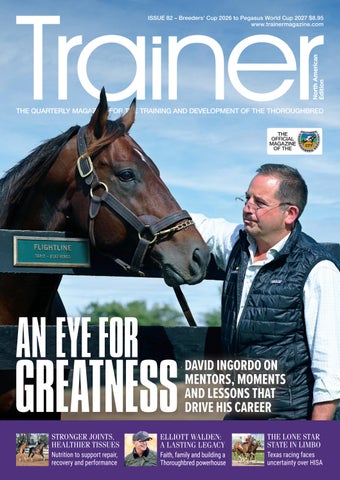
AN EYE FOR
GREATNESS STRONGER JOINTS, HEALTHIER TISSUES Nutrition to support repair, recovery and performance
DAVID INGORDO ON MENTORS, MOMENTS AND LESSONS THAT DRIVE HIS CAREER
ELLIOTT WALDEN: A LASTING LEGACY Faith, family and building a Thoroughbred powerhouse
THE LONE STAR STATE IN LIMBO Texas racing faces uncertainty over HISA
| OPINION |
GILES ANDERSON PUBLISHER’S OPINION It’s fitting to have David Ingordo as our cover profile for this Breeders’ Cup to Pegasus World Cup issue of North American Trainer. Go back twenty years to our second edition of this magazine and the cover profile for that issue was on John T.L. Jones Jr. – known to many as simply Johnny Jones. Jones had enjoyed a successful career as stallion master of some repute – he was responsible for the likes of Alleged, Nureyev, Miswaki and Successful Appeal but after selling his beloved Walmac Farm to his son Johnny III and his business partner Bobby Trussell, Jones decided that retirement wasn’t for him and took up training. I remember Jones well from his Walmac days. I first met him through my old mentor – Nick Robinson – who taught me so much about the publishing industry. A trip to Jones’ office would always involve him putting his shiny cowboy boots on his desk and then asking a simple question – “So what do you know?” Jones had a genuine interest in people and if he liked you, he would help you. He loved the concept of the magazine I wanted to build and it’s thanks to him that I met one of his then employees – Frances Karon – who has played such an important role in the development of this magazine over the years. Fast forward a couple of years when I decided to profile Jones, the first person that I turned to, to get it written was Frances Karon. It turns out that someone else Jones liked and wanted to help was David Ingordo. As Ken Snyder discovered, Ingordo got his break in the bloodstock world ‘doing something’ for Jones. Kerry Cauthen was also a key cog in the Walmac wheel at the time and helped Ingordo get a bank loan that set him on his journey as a bloodstock agent. Horses he has been involved with include these champions – Flightline (who he’s photographed with on the cover), Accelerate, Stellar Wind, Honor Code, Lady Eli and She Feels Pretty – you get the drift, he’s been involved with some very good horses. Twenty years ago this past September, Ingordo was a fledgling bloodstock agent and was responsible for the purchase of Hip #703 at the Keeneland September Yearling Sale – a daughter of Street Cry that cost a mere $60,000 – that filly became Zenyatta, probably one of the most iconic champion racehorses of the last twenty years. She was trained by John Shirreffs – Ingordo’s stepfather – who sadly died in February this year. How proud he would have been of his stepson’s achievements over the last twenty years – capped by Ingordo’s wife, Cherie DeVaux, winning both the Kentucky Derby and Belmont Stakes with Golden Tempo this year. We were lucky enough to feature DeVaux in our Triple Crown issue this spring. So it’s fitting that we finish the year with a deserved feature on her husband. Wherever your racing takes you until our next issue at the end of January – good luck! ISSUE 82 TRAINERMAGAZINE.COM
01
CONTRIBUTORS Alan F. Balch was hired as executive director of the California Thoroughbred Trainers in April 2010. His professional career in racing began at Santa Anita in 1971, where he advanced to senior vice president of marketing and assistant general manager and was in charge of the Olympic Games equestrian events in Los Angeles in 1984. He retired in the early 1990s to become the volunteer president of the National Equestrian Federation of the USA, as well as the National Horse Show at Madison Square Garden.
Editorial Director/Publisher & Advertising Sales Giles Anderson (859) 242-5025 Sub-Editors Nico Jeeves & Virginia Lisco Advert Production, Circulation/Website Nico Jeeves & Virginia Lisco (859) 242-5025 Cover Photograph Frances J. Karon
Jackie Bellamy-Zions has been Equine Guelph’s communications manager since 2010. Jackie has over 30 years of experience in the horse industry in the capacity of coach, trainer, stable manager, competitor, judge and journalist. Bill Heller is an Eclipse Award–winning author who published his 27th book, Fred Hooper – The Extraordinary Life of a Thoroughbred Legend. His other biographies include those of Hall of Fame jockeys Ron Turcotte, Randy Romero, and Jose Santos. Bill and his wife, Marianne, live near Gulfstream Park.
Trainer Magazine is published by Anderson & Co Publishing Ltd. Tel: (859) 242-5025 Fax: (888) 218-4206 info@trainermagazine.com www.trainermagazine.com North America PO Box 13248, Lexington, KY 40583-3248 United Kingdom Ground Floor Office, 72 Medstead Road, Beech, Hampshire, GU34 4AE
Alicia Hughes is an award-winning writer and reporter with more than 20 years of experience. She currently serves as director of communications for Ocala Breeders’ Sales Company and previously served as Racing Editor for The Blood-Horse and lead turf writer for the Lexington Herald-Leader newspaper from 2008 to 2016. Jennifer S. Kelly is an author and freelance turf writer. Her first two books, Sir Barton and the Making of the Triple Crown and The Foxes of Belair: Gallant Fox, Omaha, and the Quest for the Triple Crown, chronicle the lives and careers of the first three American Triple Crown winners. She also contributes to The Racing Biz, America’s Best Racing, and TwinSpires Edge. Catherine Rudenko is an independent registered nutritionist with a focus on Thoroughbreds. Based in the UK, she has worked across the USA, Europe, and Asia, creating customized feeding plans for trainers and studs. Passionate about education and research, she collaborates with professional bodies and universities to promote equine nutrition. Peter J. Sacopulos is a partner in the law firm of Sacopulos, Johnson & Sacopulos in Terre Haute, Indiana where he represents clients in a wide range of equine matters. He is a member of the American College of Equine Counsel and serves on the Board of the Indiana Thoroughbred Owners and Breeders Association and Indiana Thoroughbred Breed Development Advisory Committee.
Trainer Magazine is the official magazine of the California Thoroughbred Trainers. It is distributed to all ‘Trainer’ members of the Thoroughbred Horsemen’s Association and all members of the Consignors and Commercial Breeders Association, the Maryland Horse Breeders Association, the Massachusetts Thoroughbred Breeders Association, the Pennsylvania Horse Breeders Association, the Virginia Thoroughbred Association and to members of the National Steeplechase Association.
Ken Snyder is a turf/travel-culture writer for Kentucky Monthly magazine. His work has appeared in other publications, including The Blood-Horse. He and his wife, Cassie, reside in Louisville, KY. Laura Steley, BSc (Hons) in Equine Sports Science, is senior stud secretary at Shadwell Stud in Newmarket and a contributor to Owner Breeder magazine. She has experience in Thoroughbred pre-training, rehabilitation, and racing data analysis, with a strong focus on improving equine welfare through science. Dr Katie Williams, M.Sc (Dist) R. Nutr, has over 25 years’ experience as an equine nutritionist. She completed her PhD in Veterinary Medicine Research at the University of Glasgow in 2023, studying links between nutritionists and vets. She is leading an initiative to establish an accreditation scheme for equine feed advisers and nutritionists under the British Equestrian Trade Association. Her research interests include veterinary nutrition training, perioperative nutrition and fibre as an energy source for athletic horses. Trainer Magazine (ISSN 17580293) is published 4 times a year: February, April, July and October by Anderson & Co Publishing and distributed in the USA by Modern Litho | Brown Printing, 6009 Stertzer Road, Jefferson City, MO 65101. Periodicals postage paid at Jefferson City, MO, and additional mailing offices. POSTMASTER: Send address changes to Trainer Magazine, Anderson & Co Publishing, PO Box 13248, Lexington, KY 40583-3248.
GET BETTER HEALTH & PERFORMANCE when electrolytes work properly.
Equiwinner
Making Electrolytes Smart Easy 10-day treatment can last for months, even up to a year.
Medication-free success with EIPH Bleeding, Tying-up, Sweating, Hydration and more.
02 TRAINERMAGAZINE.COM ISSUE 82
Proof positive. Test negative. Signal-Health.com 877-378-4946 Also available at Big Dee’s, Lone Star Tack, JockeyTack, Pacesetter Tack, TT Distributors, Rafter Eleven, Sunland Tack
What’s your plasma’s ROI (Return on Immunity)? Leading equine veterinarians trust Plasvacc. It’s not hype. It’s hyperimmunized.
Not every foal will get the natural immunity it deserves. When nature needs an assist, choose Equiplas. At Plasvacc, all our donors are hyperimmunized to reach the USDA specified antibody levels needed to improve immunity and promote faster healing. Whether administering plasma for protection or recovery, if you count on antibodies, you can count on Plasvacc. Plasvacc. Peace of mind is in the bag.
USA +1 (805) 434-0321 | AUS 1-800-PLASMA | Plasvacc.com GLOBAL DELIVERY AVAILABLE. For technical information, contact Plasvacc USA Inc.
| CONTENTS |
08
28 64 70
ISSUE ISSUE
82
82
CONTENTS FEATURES
52 The Lone Star State
Jennifer Kelly reports on regulatory challenges, HISA uncertainties, simulcast signal blackouts, and future potential of Texas horse racing.
08 An eye for greatness
Ken Snyder explores the mentors, moments and lessons that have influenced bloodstock agent David Ingordo’s career, from Zenyatta to Flightline and beyond.
20 Faith, family and a lasting legacy Alicia Hughes reflects on the vision and drive that helped Elliott Walden build WinStar Farm into a Thoroughbred powerhouse.
28 25 years of gastric research
Dr. Katie Williams charts advances in understanding equine gastric disease and their influence on diagnosis, treatment and management.
36 Misbehavior, instinct... or pain?
Laura Steley explores how pain, stress and learned responses influence equine behavior and why identifying underlying causes matters.
44 Nutrition for joint & soft
tissue recovery & performance Catherine Rudenko explains how nutrition supports joint and soft tissue health, recovery and performance in racehorses.
@ t ra i n e r _ m a g
60 Is racing the best value in sport? Bill Heller compares the price of attending major racing events with other sports to assess value for spectators.
64 Diagnosing equine lameness
Without us? – Alan F. Balch on backstretch community care, living conditions, and industry interdependence.
86 #Soundbites
Backstretch security — Leading trainers discuss barn security protocols and track safety with Bill Heller.
Jackie Bellamy-Zions talks to Dr. Taralyn McCarrel about imaging and emerging tech transforming lameness diagnosis.
70 Breeders’ Cup bound – Winning owners
Bill Heller profiles the owners behind Listenupshance, Summer Starlet and Hymn and their journeys toward the Breeders’ Cup.
78 Pennsylvania’s day at the races Nikki Sherman reports on the 25th Pennsylvania Day at the Races and the state-bred stakes action at Parx Racing.
82 Chain of custody under HISA
Peter J. Sacopulos analyzes evidentiary standards, procedural challenges, and legal strategies under HISA/HIWU rules.
/ t ra i n e r m a g a z i n e
04 TRAINERMAGAZINE.COM ISSUE 82
R EGUL A R S 06 View from the CTT
/ t ra i n e r m a g a z i n e
Visit trainermagazine.com to download our current digital editions and access back issues of both European and North American Trainer.
The
Standard THAT DEFINES NOVEMBER A proven marketplace for the horses that shape the future. Exceptional breeding stock, standout weanlings and race-ready horses bring a global audience to Keeneland November, where quality and opportunity deliver results.
November Breeding Stock Sale
November Horses of Racing Age Sale
NOVEMBER 3-11
NOVEMBER 12
View catalog at November.Keeneland.com.
| CALIFORNIA THOROUGHBRED TRAINERS |
ALAN F. BALCH
WITHOUT US? ince the cataclysmal year of 2019, racing’s regulators and stakeholders in California (and several other jurisdictions) have been publicly, privately, and regularly attacked by self-identified animal welfare or “rights” advocates. They seek to end racing altogether. And, in many instances if not all, to end the use of animals for any kind of human enjoyment (including zoos and even pets, not just circuses). Ditto for fur, leather, and food. I attended a regulatory meeting in Los Angeles back then ... where a politically appointed commissioner for “Animal Services” advocated that dogs in city shelters only be provided “vegan” food, and declared that “no animal should participate in any activity without first having provided its informed consent.” Laughable? No. This year in February, our Racing Board ventured to Arcadia for a public meeting, across the street from Santa Anita. The anti-racing people attended, although not in the large numbers we once saw, and used every agenda opportunity for repetitive, critical (and occasionally erroneous or ill-informed) public comment, urging the end of racing in this state. I’m one of many who has never missed one of these meetings, in my case for the last 16 years in my present position. It took quite a while for industry representatives, and Racing Board members themselves, to realize the futility of attempting to debate or even discuss the points of view expressed by our critics. At this particular meeting, however, one prominent owner and breeder from Northern California stood to comment on the particular agenda issue under consideration; but then she ended this way: “... the other thing I would like to take the time to say here today is addressing those in the room who are so concerned for animal rights. I would wish that every homeless person, every starving child in this country would get the care, the health care, the nutrition, the shelter, the daily passionate care that these thoroughbred horses receive.” Loud, sustained applause followed from virtually every racetracker in the audience! We had been waiting years for someone to sum it all up that way, that succinctly, that truthfully.
S
06 TRAINERMAGAZINE.COM ISSUE 82
That truth is so understood, and so fundamental to the very existence of racing as an enterprise and sport, that it far too often goes without saying. Not just saying, but proclaiming. And just who is primarily responsible for that all-encompassing, passionate care at the track? The backstretch community, and all those who not just belong to it, but who support it, employ it, provide its physical components, and care for all its members. Way back in October 1991, the late American Pillar of the Turf and then editor-in-chief of The Blood-Horse, Edward L. Bowen, wrote his landmark essay, “The ‘Without Us’ Syndrome.” He chastised those of us in racing who all too frequently were tempted to say, or did say, that “without us, there would be no game.” Not only was that opinion self-destructive, but when expressed it “unmasks a basic inability to grasp the interdependence of various segments” of racing which rely on each other for the sport’s and industry’s success. And even existence. It’s in my own mind these days because I’m coming close to having spent as much time in my current professional position advocating for the interests of the backstretch community as I earlier did for various managements and regulatory segments. In short, I’ve lived the critical interdependence of racing for over half a century. I’ve heard that “without us” comment more times than I would like to admit. And, honestly, I’ve thought it myself on occasion. Lately, I’ve been struck by the contrast between some significant new attention to the backstretch communities across the nation, particularly in terms of meal
Daniel Inocente
programs and recreation, as well as health and welfare investments and organizations; however, it must be said, track living and sanitary conditions continue to be embarrassments to the sport almost everywhere. For the most part, especially at major tracks, the backstretch workers are principally responsible for turning out their horses for exercise and especially on race day in absolutely immaculate style, whether or not there are monetary rewards for “best turned out” in a race. That same community is also responsible for keeping the living conditions of their horses at the highest possible standards, around the clock: safety, medical care, clean bedding, water, feed, nutrition. Therefore, the horses are often treated better by their caretakers than are the caretakers themselves by track managements! Is it any wonder, then, that some on the backstretch can’t resist the all-too-human temptation to disrespect their physical surroundings? Throughout both the racing and non-racing horse care communities, to the contrary, I’ve always sensed their deep, respectful appreciation for the opportunities presented to those who capitalize on them, including and especially outside the sport. California’s Edwin J. Gregson Foundation, named for the late Kentucky Derby winner and headed now by Breeders’ Cup-winning trainer Jenine Sahadi, is an opportunity showcase. Since 2000, nearly a thousand scholarship grants have been distributed to children of backstretch parents, to facilitate college-bound students in their pursuit of higher education, as well as expanding backstretch educational and recreational programs. Daniel Inocente is one exemplar of the program. His late father was an exercise rider for trainer John Gosden. In the last two decades, his Gregson-stimulated career has taken him all over the world, originally in architecture ... and has spanned concert halls and museums, the Mars Rover for the Jet Propulsion Laboratory, and Dubai skyscrapers. I’ve always believed that the racetrack mirrors the world at large – the risks to and potential rewards for all, from the humble to the exalted. Resting on its foundation, the inclusive community that cares for the horses.
T O P
M A R K S
$1,650,000
HIP 646, Colt out of Inchargeofme (GB), by High Chaparral (IRE) HALF-BROTHER TO G1 2000 GUINEAS S. WINNER RULING COURT Buyer: AMO Racing USA Breeder: Nursery Place & Wilhite Consignor: Nursery Place, Agent
Additonal Prices include:
$575,000, $550,000, $410,000, $400,000, etc.
ECLIPSE CHAMPION TURF MALE | FIRST 2YOs IN 2027
UP TO THE MARK Not This Time - Belle’s Finale, by Ghostzapper
lanesend.com | t: 859.873.7300
AN EYE FOR GREATNESS WORDS: KEN SNYDER
T
he day was one David Ingordo will never forget for inexplicable reasons. There was wisdom in what an old man told him, but it was the old man himself that made it have an impact, an old man who saw something in him and in his future. “I was a little boy, and I was sitting on a tack trunk at the racetrack,” recalled Ingordo. The old man was Charlie Whittingham, offering not so much advice as instruction. “‘Let me tell you something’…and he said it matter of factly and almost like a military order, and it stuck with me: ‘If you’re around these horses, you learn something every day.’” The value of the moment enhances the poignancy. Not every little boy gets to sit at the proverbial feet of a racing giant. Whittingham today would marvel at what the little boy would achieve as a bloodstock professional, but maybe it wouldn’t surprise him. Many things have gone into what has made Ingordo, age 50, already a legend himself. Principal among them is being around people like Charlie Whittingham, Bobby Frankel, Brian and Jeanne Mayberry, and Johnny T.L. Jones.
08 TRAINERMAGAZINE.COM ISSUE 82
PHOTOGRAPHY: BENOIT PHOTOS, ECLIPSE SPORTSWIRE, FASIG-TIPTON PHOTOS, FRANCES J. KARON, KEENELAND PHOTO, LANE’S END FARM, TATTERSALLS
ISSUE 82 TRAINERMAGAZINE.COM
09
Mornings for David Ingordo as a kid meant going out to the racetrack with his father, jockey agent Jerry Ingordo. “Afterward, if you were at Santa Anita, you went to this place called Coco’s, or if you were at Del Mar, you went to Bully’s. “It would be Mel Stute with his brother Warren, Henry Moreno, Charlie Whittingham, and Wayne Hughes. On occasion Bobby Frankel might show up. I’d sit there and wouldn’t say anything. That was back in the day you were taught to be seen and not heard. And I’m still a bit that way.” That didn’t preclude listening. “I joke that I feel like Forrest Gump. I got to be around all these great people in moments of racing history. I would say I’m an amalgamation of all these people.” Bobby Frankel, it turned out, would play a major role in Ingordo’s life, giving him a start on the racetrack that was a launching pad for his career. But first there had to be one pivotal moment, one that lasted all of two minutes and five seconds. It had more than a mere impact on a 12-year-old adolescent. It set a course for his life. If you scripted what happened for a movie it would come off as too saccharine, but sometimes real life is a fairy tale. His father was jockey Pat Valenzuela’s agent, and in 1989, Valenzuela was the rider of Whittingham’s Kentucky Derby-bound colt Sunday Silence. Ingordo’s parents Jerry and Dottie flew to Louisville with Valenzuela for the big race. David stayed at home in California with his grandmother. Ingordo remembered that it was unusual for him to be alone in his room watching the Derby. “I wanted to watch the race alone, I don’t know why, and I heard ‘My Old Kentucky Home.’” Tears are common at that song for many of us, but maybe not normally for a 12-year-old boy. It may not have been the song itself and Ingordo can’t really explain it, but sometime between the playing of the song in the post parade and P Val on Sunday Silence hitting the wire the winner of the Kentucky Derby was a life-changing moment for him. Up until then, he had resisted the idea of a career in racing.
Suddenly, the change couldn’t come soon enough for him. He went to work in the summer, on weekends, and around his school day for Bobby Frankel at 14. His mother was Frankel’s bookkeeper and chief financial manager, so it was a natural fit. “They got me a special permit. I was only supposed to work so many hours because of child labor [laws], but I just kept working anyway. Whatever it was that was needed, I did it,” he said. “I walked hots and wanted to walk the most horses I could every day. I groomed a little. I was organized, I knew the horses and people. I always wrote things down, and I took good notes. I wrote the set lists. I knew which riders Bobby wanted on which horses. And if a horse had a tendon [issue], I knew about it, so the horse was in the right set to train on a good track.”
Sunday Silence and Pat Valenzuela winning the 1989 Kentucky Derby.
Ingordo and Rupert at Fasig-Tipton.
10 TRAINERMAGAZINE.COM ISSUE 82
| DAVID INGORDO |
Ingordo with Cherie at Keeneland.
When Ingordo reached the ripe old age of 18, Frankel told him to get an assistant trainer’s license. With an eye to the program that fellow trainer D. Wayne Lukas was running with the help of young assistants he was developing, Frankel had big plans for his own protege. “Lukas was rolling. He had Todd Pletcher and Kieran McLaughlin and Dallas Stewart and Mark Hennig, all those guys graduated from the Lukas school,” said Ingordo. Frankel took note of this trend with Lukas and told Ingordo, ‘I need a guy like that. You’ll do it.” But the plan went on hold after Ingordo’s high school graduation, because Dottie Ingordo also had a plan for her son, and she had the last word. Ingordo traded in racetrack life to go to college, and he was off to the University of Kentucky pre-vet program, but he ended up in the College of Agriculture instead. His plan was to eventually make his way back to Frankel at the track after he graduated from college and had picked up some other experience in the industry.
Lexington exposed him to a completely different facet of horse racing. Even though the racetrack was deeply ingrained in Ingordo’s background, breeding was brand new to him. “I thought horses were born out of the back of a Sallee van or an airplane. So this whole world opened up. I got to see these good horses on the farms. I got to see what physical problems they had, what could be overcome if a horse was good enough. I started learning pedigrees.” What opened up for him was work in bloodstock. “Mike Levy told me Johnny Jones at Walmac was looking for somebody to, quote, ‘Do something.’ That was the job description,” Ingordo said with a laugh. In the heyday of Walmac Int’l, with stallions Nureyev, Alleged, and Miswaki on the roster, Jones was to the stallion industry what Whittingham and Frankel were to training horses. Jones was a legend. It was a good door to get a foot in, and under the “do something” job description—primarily, it became selling stallion seasons and talking to people—Ingordo was learning from the best.
Ingordo at the Fasig-Tipton 2026 Saratoga Select Yearling Sale.
ISSUE 82 TRAINERMAGAZINE.COM
11
| DAVID INGORDO |
ABOVE: Zenyatta, purchased by David Ingordo for $60,000, went on to win 19 of 20 starts, including the 2009 Breeders’ Cup Classic (pictured above), becoming the first and still only filly or mare to win the race.
David, Dottie and John Shirreffs, Del Mar, 2007.
Frances J. Karon, now at Werk Thoroughbred Consultants, was another person Jones mentored. She specialized in pedigree research at Walmac, working alongside Ingordo when both cutting their teeth. Her memory of Ingordo is distinct and perhaps telling of his career. “He was an old soul. He already had a maturity about him, a seriousness.” She remembered his ability to take everything in stride, and his resilience when his father Jerry passed away and Ingordo showed up to the office in a yellow shirt because, he said, it was a bright and happy color and he didn’t want to get caught up in being depressed. Another of the Jones mentees was Kerry Cauthen, whose Four Star Sales agency later grew out of Walmac and included Jones as a partner. Cauthen was instrumental in Ingordo’s career as a bloodstock agent. “I decided that the best thing to do was to go out on my own and do my own thing buying horses, even if it was at a small level. Just to be a [bloodstock] agent to make a commission, that’s tough. Who’s going to give a 20-something-year-old money?” said Ingordo. It turned out the answer to that question was Kerry Cauthen. “He helped me to get a bank loan. I think [Kerry’s brother] Steve might have been on the bank’s board.”
12 TRAINERMAGAZINE.COM ISSUE 82
And with that loan, Ingordo bought a group of horses to pinhook, including an inexpensive one whose sire, Run Softly, he was familiar with from his time with Frankel. That colt became Running Tide, who won a Grade 3 race and earned over $300,000. “I ended up with a graded stakes winner to hang my hat on.” Cauthen remembered Ingordo in those days as a “tireless worker and an extremely quick study.” He said, “He has a lot of confidence in himself, and he was willing to say to people, ‘I can do this.’” Those words resonate with Karon’s memory of Ingordo, too. “Nothing is accidental with David,” she said. “He does his homework. But in the end, he goes with his instinct.“ It was his instinct that kept drawing him back to the horse that really set things alight for him. He will never forget her hip number at the 2006 Keeneland September Yearling sale—703. It was a family affair. His mother, by this time married to trainer John Shirreffs—David had played a part in that matchup—was the racing manager for Jerry and Ann Moss, whose homebred Giacomo, trained by Shirreffs, won the 2005 Kentucky Derby at 50-1. Ingordo had orders to pick out some yearlings for them to buy. “I liked the horse,” Ingordo said of hip 703, a filly from the first crop of Street Cry, “but that was just the first filter.” The next and possibly most important step was determining if the horse met Shirreffs’ preferences. “What I’ve learned is it’s like working for a coach that has a system. I’d seen some of the horses John had trained that were good. I had an idea of what he was going to like.” Ingordo had spotted it correctly. It also helped that they also knew that the filly had an as-yet unraced 2-year-old half-sister who was training well for David Hofmans in California. The auction hammer came down on one of the lowest prices ever for a legend, in the same company as $17,500 for Seattle Slew in 1977. The winning bid of $60,000 came from Ingordo.
| DAVID INGORDO |
The rest is a racing record among the best in history. It is unforgettable—19 wins in 20 starts, 14 of them Grade 1 races, including the 2009 Breeders’ Cup Classic when Zenyatta became the first, and still only, filly or mare to win it. She retired with over $7.3 million in earnings, was champion filly or mare for three consecutive years (2008-2010), and Horse of the Year in 2010. Her year-older half-sister wasn’t bad, either—she was Balance, who won three Grade 1s and more than a million. Zenyatta was special, more so because nothing was textbook about her. Looking back at his belief that certain horses fit with certain trainers, Ingordo stated unequivocally, “Zenyatta wouldn’t have been Zenyatta without John Shirreffs.” The second of Ingordo’s career pinnacles is Flightline.
Ingordo, by now working for Lane’s End Bloodstock, first saw him before the yearling sale season at Summer Wind Farm, where he was bred. “Bill Farish, Mike Cline [general manager of Lane’s End at the time], and I went to look at a half-brother to [Triple Crown winner] American Pharoah named Triple Tap. He was brought out with another horse.” It was the other horse, Flightline, that elicited a one-word exclamation from Ingordo: “Man!” The handlers were quick to tell him that horse wasn’t the American Pharoah half. No matter. Ingordo liked him more than the one they had specifically gone out to see. “I kept thinking, ‘This looks like a nice horse.’” They went back to Summer Wind to see the yearlings several times over the next few months, and each time he was drawn to Flightline, who was entered in the Lane’s End consignment at the Fasig-Tipton Saratoga sale in New York. As it turned out, he and Flightline shared a plane ride up to Saratoga Springs in August. Ingordo used to get a seat in the back on the direct flight with the horses shipping from Kentucky to the sale; it was the quickest and easiest way to get there. “We were flying to Saratoga, back when Tex Sutton was still shipping horses. There had been some turbulence and one of the guys asked if I would mind helping with three horses in the back of the plane. I put a shank on this horse and his head looked really familiar to me.” He read the name on the halter. Flightline. Ingordo knew he wouldn’t be cheap at the sale. He’d need to scramble to find partners to go in on him. Farish wanted him, too, and his help putting it together was vital. Ingordo and Farish “talked about it 20 times” before the colt went through the sale ring. “Bill said, ‘We’ll figure something out.’”
C
M
Y
CM
MY
CY
A generational talent, Flightline was spotted by David Ingordo and purchased for $1 million. He retired undefeated after winning all six career starts.
14 TRAINERMAGAZINE.COM ISSUE 82
CMY
K
| DAVID INGORDO |
It took a million-dollar bid. Ingordo bought him for clients West Point Thoroughbreds and Woodford Racing, but Hronis Racing and Siena Farm bought in too, and his breeder stayed in for a piece. Sent to California-based John Sadler—another mentor and factor in Ingordo’s success—to train, Flightline would go undefeated in six starts, four of which were Grade 1 races, including the Breeders’ Cup Classic in 2022, and earned $4.5 million. He was Ingordo’s second Horse of the Year purchase. Like Zenyatta, Flightline was an example of the instinct Frances Karon had talked about. Fellow bloodstock agent Donato Lanni, who also had come up at Walmac under Johnny Jones, is not surprised by Ingordo’s success. “Looking back, the writing was on the wall,” he said. “David had the pedigree and he had the work ethic. He’s probably the hardest working guy in the business. Seven days a week.” It was his work that took Ingordo on another New York trip that he would tell you was more meaningful to him than the Flightline trip. At Belmont Park to look at some horses he was helping to manage in the barn of former Frankel assistant Chad Brown, he met Brown’s assistant trainer. “We hit it off in just 30 minutes.” That was Cherie DeVaux, who at the time was considering options outside of racing. It was Ingordo’s turn to be the source of wisdom and prescience, like Charlie Whittingham had been for him. “She was either going to quit or go out on her own as a trainer. I told her, ‘You’re too talented to quit. You’ve got to try it. Let’s do this together.’” DeVaux went out on her own as a trainer in 2018, the same year she and Ingordo got married. It was a tough first year for the barn, when DeVaux sent out 19 starters who didn’t win. “I blame myself for that,” said Ingordo. “Who else you gonna blame? I gathered them up for her to train, and they couldn’t run.” He knew his wife had the ability to win at top level if only he could get her the right horses. “That ‘We put in a good effort’ business is bullshit. This is about winning, and winning at a high level,” said Ingordo. It was a matter of stocking her barn with good horses that had potential. She would take care of the rest. He was right.
16 TRAINERMAGAZINE.COM ISSUE 82
BELOW: David Ingordo with West Point Thoroughbreds founder and CEO Terry Finley at Keeneland’s 2026 September Sale. Their successful buying relationship has produced standout purchases, most notably Flightline.
BELOW: David Ingordo and Cherie DeVaux first met at Belmont Park, where DeVaux was an assistant trainer to Chad Brown. They married in 2018, the same year DeVaux launched her own training operation.
WE’RE IN IT FOR THE
LONG HAUL From the backstretch to breeding sheds, sales grounds to starting gates, this industry moves because of the people behind it.
SUPPORTING THE HORSES AND PEOPLE IN THE INDUSTRY WE SERVE. Proud to Support the Broader Thoroughbred Community •
Thoroughbred Retirement Foundation
•
Stable Recovery
•
Backside Learning Center
•
Belmont Childcare Association
•
Secretariat Center
•
Florida Thoroughbred Breeders’ and Owners’ Association (FTBOA)
•
KY TB Farm Managers
•
Ocala Farm Ministry
•
Race Track Chaplaincy of America
•
Permanently Disabled Jockeys Fund
•
Therapeutic Horses of Saratoga
•
TB Charities of America
•
RRP
| DAVID INGORDO |
The first sign of things to come was in 2020 when DeVaux’s horses earned over $929,000. The next year, 2021, she got her first graded stakes win in the Regret Stakes with Gam’s Mission and had total earnings of $2.4 million. She trained Breeders’ Cup Mile winner More Than Looks and the stable topped $10 million in 2024, had champion turf female She Feels Pretty in 2025, and she will easily go over $10 million in purse earnings again this year, spearheaded by Golden Tempo in the Kentucky Derby and Belmont Stakes and the brilliantly fast Englishman. The power team will likely be heard from many, many more times—Ingordo on the bloodstock end and DeVaux on the training end…but they’ll have to earn it. As any bloodstock agent—or breeder, owner, and trainer, for that matter—will tell you, pressure is high to deliver graded stakes horses and prove yourself every year. Zenyatta? That’s great, but that was 20+ years ago. Oh, Flightline? Seven years. What are you bringing to the table now? He said, “Many people think this is an easy game. They give you a catalog, you steal a pen and poof! You’re in business. I can tell you that it’s not an easy game and 99% of the work isn’t glamorous.” Nor is success in a cutthroat industry without its pitfalls: the more successful you are, the bigger the target on your back. For himself, he has a thick skin, but it’s not as easy to shrug off when his family and closest friends take some of that heat, and, privately, the hardest part is seeing his wife be on the receiving end of criticism intended to get at him. He said, “Cherie is no damsel in distress and doesn’t need me to take care of her. I lovingly joke that she’s capable of training racehorses or being the warden of a supermax prison, but I know the truth of her journey and have seen it with my own eyes.” It’s an unending journey he walks beside DeVaux, a journey to never stop earning their success. On a daily basis, Ingordo unconsciously repeats an instruction from Charlie Whittingham, an old master he will never forget: “Every day I learn.” Essentially, he’s still that kid sitting quietly, listening and learning at a table of Hall of Famers and legends.
THE LUCKY SPOT
The phrase “Enquiring minds want to know” originated as a trademarked slogan for a supermarket tabloid, The National Enquirer. For some of us of a certain age, it might have come to mind after Golden Tempo’s wins in the Kentucky Derby and Belmont. Where was Cherie DeVaux’s husband in the winner’s circle celebrations, not to mention other big races for his wife? The answer, or actually the reason, is in two words: “I’m superstitious,” said Ingordo with a smile. When Giacomo won the Derby in 2005 for his stepfather John Shirreffs, he watched the race from Section 316. But that evolved through the years. “I have a spot at Churchill in the paddock where I watch the races. When it was the old paddock, I stood by the clock, and in the new one I stand where the [TV analysts] are. I joke with Andie Biancone [Asmussen] that I’ve watched more winners with her than Cherie.” That’s the lucky spot.
18 TRAINERMAGAZINE.COM ISSUE 82
Englishman, a $400,000 Keeneland yearling purchase selected by David Ingordo and April Mayberry, underlines his star potential with back-to-back Grade 1 victories in the Woody Stephens and H. Allen Jerkens Memorial Stakes for trainer Cherie DeVaux.
The superstition travels, not surprisingly. “In New York, we use the Farishes box. That’s the spot. I tell Bill, ‘I don’t care whose horse it is, I’m watching it from your box.’” Finally, there’s a practical reason for the superstition. “I need a minute sometimes when we lose. I mean, a horse runs good, it’s fine, but when you get one you really like, and you haven’t had much luck… “I’m a little different than the average trainer’s spouse, but it’s not my job, it’s hers, and I respect that. I stay out of the way.” As you might guess, Ingordo went to his spot this year to watch his wife’s first Kentucky Derby win, while DeVaux and Ingordo’s daughter Reagan watched together from behind the winner’s circle. “I see this horse rolling up the outside. I can’t see him for a moment on the screen down the stretch, but when I did, he kept coming and coming and coming.” It was, of course, Golden Tempo. “I didn’t know Todd Pletcher and Bob Baffert and all these people were in front of me. I acted like a total fool.” Understandable. “So then I just walked up the tunnel, and everybody was swarming Cherie. I saw her there, hugged her, told her how proud I was of her that she did this, and then I got out of the way.” DeVaux had earned this, it was her moment. Again, for those of us of a certain age, “That’s the rest of the story.”
RELIED ON BY
CHAMPIONS WORLDWIDE
JOSEPH VILLANTE (215) 501-6880 +44 (1) 2223 931 071 Joseph@brlscience.com brlequine.com
| PROFILE |
20
WORDS: ALICIA HUGHES PHOTOGRAPHY: ECLIPSE SPORTSWIRE, FASIG-TIPTON PHOTOS
ELLIOTT WALDEN FAITH, FAMILY AND A LASTING LEGACY T
he thing about those whose career aspirations hinge so heavily upon developing athletes in the Thoroughbred industry, is they rarely pause while building paths of success to take in the scenery cultivated along the way. Stop too long to admire one’s work and one will inevitably be passed by ambitious colleagues carving out a fresh route to sport’s highest echelons. Such is the byproduct of a vocation that pins its identity largely upon end results – wins, losses, economic viability. Having spent the better part of the last quarter century as an architect of one of the most successful avenues in Thoroughbred racing, Elliott Walden is confronted by the end results of his impact on a near daily basis. It’s in the trophy cases and framed images that line the walls of the WinStar Farm office, celebrating a leading sire here, a Triple Crown winner there. It’s in the parade of bloodstock who traced their familial roots back to the Versailles, Ky nursery, sauntering into winner’s circles across the country. It is most plainly evident in the fact that, 26 years after its founding, WinStar Farm boasts perpetual residency among the industry elite. Like many of his ilk, however, Walden doesn’t allot much time for self-admiration, although moments of self-reflection have been on the table of late as one of the more accomplished chapters of the sport over the last three decades inched towards its conclusion. Shortly after the calendar flipped to January 2026, word came that Walden, who had served as president and CEO of WinStar since 2010, would be stepping down from his longtime roles with Gerry Duffy succeeding him as the farm’s president on April 1 before taking over as both CEO and president effective October 1. It was a move designed to create a seamless transition for an operation whose hallmark has been a near uninterrupted flow of accolades and, fittingly, Walden was still fine tuning his epilogue even as his final days at the helm counted down. As Keeneland’s bellwether September Yearling Sale began its record-setting run, his towering frame was in near constant motion, studying pedigree pages, analyzing well-bred physicals, still doing the work to find the next generation of high-level color bearers.
And when he did take an opportunity to ruminate on the breadth and depth of WinStar’s achievements under his guidance, he spoke with greatest satisfaction not about the view enjoyed from atop the mountain he helped build, but rather in the pitches successfully navigated during the ascent. “I think if you sit back and think about what you’ve accomplished, it’s time wasted with regards to what could be done today,” Walden said. “There is a time for that. I am grateful for what I’ve accomplished…but I tell people, the challenge we have as a culture is that young people today want to arrive somewhere and not understand the process. You never know where those opportunities are going to come from. You take one day at a time and do the best you can and see where it leads you “And when I look back on all the accomplishments, it’s not just because of me it’s because of a whole group of people. And wherever I’ve been at a certain time, I’ve tried to do the best I can that day.” Since first joining Kenny Troutt’s sprawling operation as WinStar’s private trainer in 2002, Walden has indeed done a first-class job of crafting an ever-evolving playbook that has allowed the farm to enjoy one of the sport’s most enduring runs of success in the 21st century. In the years since the former Prestonwood Farm was purchased by Troutt and his then business partner Bill Casner in 2000, the white and green WinStar colors have saturated virtually every major milestone in North American racing, from standing the late, great leading sire Distorted Humor, to earning Eclipse Awards for both Outstanding Owner (2010) and Outstanding Breeder (2016, 2020), to the rarified feat of co-campaigning 2018 Triple Crown winner Justify. WinStar’s racing accolades alone could fill the length of a stretch. A sampling of those who join Justify on the farm’s proverbial wall of fame are the likes of its homebred 2010 Kentucky Derby (Gr.1) winner Super Saver, Belmont Stakes (Gr.1) and Breeders’ Cup Classic (Gr.1) hero Drosselmeyer, fellow Belmont winner Creator, and Breeders’ Cup Dirt Mile (Gr.1) victor Life Is Good, who currently ranks among the leading firstcrop sires off the strength of such runners as WinStar homebred and Grade 1 winner, The Good Life. ISSUE 82 TRAINERMAGAZINE.COM
21
| PROFILE |
Running parallel to its on-track prosperity has been WinStar’s ample success in the commercial marketplace with a multitude of game-shaping bloodstock calling the 2,500-acre empire their home. When he passed away at the venerable age of 33 in January 2026, Distorted Humor left behind an all-encompassing legacy having earned the trifecta of being a champion freshman sire, leading general sire, and champion broodmare sire during a career that began when he was essentially thrown in with the furniture as part of the Prestonwood purchase. Preceding the cornerstone stallion in death four years earlier was his stud barn mate and global powerhouse More Than Ready, sire of multiple champions in both the Northern and Southern Hemispheres. The commonality tying all those signature moments together for WinStar is Walden’s visage and vision. Having been elevated to racing manager and vice president in 2005 before assuming his role as president and CEO in November 2010, Walden has molded WinStar’s foundation in a literal and figurative sense, beginning with him conditioning an opinionated Distorted Humor for most of the chestnut’s multiple graded stakes winning career. By deftly managing the farm’s racing and breeding pipelines though all manners of industry challenges, Walden helped take Troutt’s outsized dream of a building family-run operation capable of hitting top-level notes and turned it a concrete example of an industry standard. “WinStar is Elliott and Elliott is WinStar. And under Kenny and Lisa and the Troutt family vision, Elliott has built this,” said Duffy, who served as WinStar’s stallion seasons director in 2011 and was hand-picked by Walden to be his successor. “His fingerprints are over every part of what WinStar is and the successes of WinStar. He’s been here 25 years. There is never the right time or the wrong time but he kind of feels he’s taken it to a level and it’s time for a new voice and new opportunity and I’m eternally grateful he determined that person was me.” “With Elliott, he just has a tremendous work ethic and is totally dedicated to not only his craft, but to WinStar,” added Hall of Fame trainer Todd Pletcher, who trained such WinStar Justify, the Triple Crown champion, exemplifies the elite talent and ambition that have defined Elliott Walden’s tenure at WinStar Farm.
22 TRAINERMAGAZINE.COM ISSUE 82
stalwarts as Super Saver, More Than Ready, Constitution, and Life Is Good. “He always put WinStar as his first priority and he’s such a diversified horseman. To understand not only the racing part of it but the breeding part of it and the farm part of it, he has such a strong background in so many different areas of the industry. It’s a unique set of skills. And Elliott was able to encompass all of those things.” As a third-generation horseman and son of the late stud master Ben Walden Sr., unearthing equine talent was Plan A, B, and C for Walden when forecasting what his ideal career path would look like. His lifelong aspiration of becoming a trainer materialized when he saddled his first winner in 1985 and over the next couple decades, the Kentucky native would rise to a level sought by many and attained by few, repeatedly ranking among the top 10 trainers in the nation and conditioning 1998 Belmont Stakes (Gr.1) winner Victory Gallop, who would go on to be named champion older male the following year.
ABOVE: From Derby triumphs to Breeders’ Cup glory, the partnership between WinStar and Todd Pletcher has helped shape an era of success on the track, with Super Saver’s 2010 Derby victory a defining moment.
It was in the winner’s circle following Victory Gallop’s triumph in the 1999 Whitney Stakes (Gr.1) when the plan that had been clicking along to full fruition came face to face with a force that would alter both Walden’s future and the landscape of the commercial industry. “I remember the first time I met Kenny (Troutt) was at the Whitney with Victory Gallop,” Walden recalled. “He had never been to Saratoga before and the thing that struck him at the time was seeing three generations of the Farish (family) and Phippses and…that’s something he wanted for his kids. “As a trainer, you don’t get many opportunities to find your owner that is of the magnitude of Kenny Troutt. Kenny was the guy who was driven to a point of wanting to have the success that that few people dream about and can bring into existence. I have a great relationship with Bill (Casner), but Kenny was the guy that we both dreamed big together, which is a motto that we came up with here at WinStar. It was about trying to reach for the stars and see what we could accomplish.”
Building a racing powerhouse Overnight success isn’t really a thing in Thoroughbred racing. Bloodlines take generations to develop. Shedrows require sustained commitment and support to thrive. Racing and breeding operations can exist for decades without a modicum of top-level success gracing their doors. That is how the script usually plays out, but a handful of years into its existence, WinStar was flipping most of those notions on its ear. In 2003, still in its infancy, Walden’s protégé Distorted Humor dropped the first hint about the breed-shaping individual he would become when a son from his first crop, the WinStarbred gelding named Funny Cide, captured the Kentucky Derby and Preakness Stakes (Gr.1) en route to earning divisional honors. By 2006, with Walden a year into his heightened responsibility with the farm, WinStar ranked among the top five breeders in earnings for the first time – a position it has held each year since 2012. Four years later, WinStar emerged as an industry powerhouse, celebrating its first classic winners with Super Saver and Drosselmeyer and earning its first Eclipse Award for Outstanding Owner. That same year, Troutt took over sole ownership of the farm and Walden moved into his new role.
Drosselmeyer and Mike Smith after winning the 2010 Belmont Stakes.
That WinStar was able to go from fledgling operation to industry force in the span of a decade was the result of ambition and aptitude colliding in a manner that defies the sport’s conventions. In Troutt, WinStar had an owner not only willing to invest in the best people and athletes, but one who trusted Walden’s decades of learned experience and insight to serve as the North Star towards lofty objectives. “Over time, Elliott has succeeded in finding the right balance of tradition and innovation in an industry that has been criticized for slow growth and stunted development,” Troutt said. “He recognizes the value of improving analytical software and new marketing strategies, while at the same time holding to his traditional views on nutrition, training styles and horse selection. His body of work is self-evident. “He was in it to win it, as was I. He always had a positive outlook, always made me feel part of the racing decision-making process. His attention to every detail was an outstanding feature.”
BELOW: Elliott Walden with WinStar owner Kenny Troutt, whose shared vision helped build the farm into a leading force in Thoroughbred racing.
ISSUE 82 TRAINERMAGAZINE.COM
23
| PROFILE |
The challenge of reaching a pinnacle is matched only by the arduous task of defending one’s place in the upper echelon. As WinStar continued to reap the highest rewards for its collective diligence, Walden had to find, and then walk, the fine line between supporting proven formulas while simultaneously making the necessary adjustments that would cut any potential declines in quality off at the pass. One such opportunity presented itself when WinStar installed an all-weather Polytrack surface on its training track in 2010. Given the hefty financial investment and the fact it was producing “great results”, according to Walden, WinStar had every reason to stick with what was working. Instead, the decision was made to switch the surface back to dirt in 2018, putting the track back in line with the major racetracks across the country. “We put in the Polytrack…and we also had it with a sharper turn on the gallop out than the top turn. It was more of an egg shape like the training track at Keeneland. But we weren’t satisfied with that,” Walden said. “We built it, but we ended up transitioning back to dirt...and it was a big commitment. It was a $5 million renovation on a track that had just gone in. But we feel we’ve gotten better results. Instead of just staying status quo, we continued to improve. “You see that in sports in general, but I think you have to reinvent yourself all the time, and we’re willing to do that here,” he continued. “You always have to be willing to improve, and we’ve tried to push ourselves to that. I think one of the big things that I’ve kind of taken away from my time at WinStar versus training was it’s more about the process than it is about the results. It’s about digging in with your team, whether it’s us in a manager’s meeting, or it’s each manager with their foreman and grooms and assistants, and in trying to improve the process.”
24 TRAINERMAGAZINE.COM ISSUE 82
| ELLIOTT WALDEN |
Even the most streamlined of practices can be undone without the right personnel in place to execute. Few know that lesson better than trainers themselves as their vocation demands a never-ending juggling act of managing employees, owners, agents, and the like. Hence, it was during his time conditioning 100-plus head that Walden gained crucial insight into how to lead a team in a fashion that inspires and supports those he is asking their best from. “Everybody’s different, and even though we all had a job to do, it wasn’t just about business,” Walden said. “Right or wrong, I tended to have a personal relationship with most of my team members, and I felt like that was just a better way to be a boss. And I’ve tried to bring that here as well.” The trickle-down effect of that is one of his biggest sources of pride from his time at WinStar, namely the fact that so many of the faces that will send him off are ones that have been mainstays with the farm for most of its existence. The business itself may be run as just that. But bonds that make it run are formed at a deeper level, something Walden has again taken the lead on. “Including my family in racing and the farm enterprise was always a great incentive of mine...and that inclusive spirit carried over to (Walden’s) management style at the farm,” Troutt said. “Employee families, partners and affiliates have always been warmly welcomed and recognized. Farm milestones always include employees which in turn reinforces their confidence that they play indispensable roles.” As WinStar braced itself to bid farewell to one of its most indispensable figures, Walden himself continued to lean on one of the most fundamental aspects of his life.
| PROFILE |
An anchor beyond racing The day-to-day realities of life can test one’s faith and the volatile nature of horse racing can bring even the devout to their knees on occasion. To know Walden, however, is to know his beliefs are of the unshakable variety, a fact he proudly wears on his sleeve and regularly credits for the blessings granted and burdens overcome. Now well-documented, Walden and his family privately struggled as his son Will battled drug and alcohol addiction for several years. Since entering recovery in 2020, Will Walden himself has become a spiritual steward and is now a successful trainer in his own right conditioning the likes of Grade 1 winner Rhetorical. “For me, I found that faith has been the anchor to handle the challenges in life,” the elder Walden said. “That connection with the horse, there is a spirit element to that that really gives us an opportunity to look outside ourselves and look to a creator that created all this. For me, it’s easy to know that I don’t have all the answers. I look toward God as an anchor to all the different things in life, from Will’s addiction to all the other things. “(Will’s struggle) was going on during my time at WinStar but it didn’t change who I was on a daily basis or how I responded to things because I knew ultimately, Will was in God’s hands. It’s a testament to something bigger than him, bigger than me.” Among the things Walden maintains staunch faith in is the long-term future of horse racing. Though he acknowledges pressing issues like the declining foal crop and the ongoing contraction of racetracks, he feels the industry is better positioned in such key areas as equine safety and diversity of ownership than it was when he joined the WinStar family. “For one, I don’t hold my breath going to the track and thinking that somebody is going to get hurt that day. We still have a ways to go, but the intentionality of keeping our beautiful athletes sound has paid dividends,” Walden said. “Are we better off because of that? Absolutely. And the depth of owners is greater today with regards to the strength of the market. When I was coming along, it was Godolphin or Coolmore. Now you have 20 different owners that are willing to invest, support, and grow. We have challenges, but the depth of owners committed to having a racing stable are greater today.”
ABOVE: Elliott Walden with trainer Brad Cox after Kentucky Belle and Irad Ortiz Jr. won the 2026 Fasig-Tipton Saratoga Oaks for WinStar Farm.
ABOVE: Rhetorical, ridden by Irad Ortiz Jr., won the 2025 Coolmore Turf Mile Stakes at Keeneland for trainer Will Walden, Elliott’s son. Elliott and Will Walden with Gainesway’s Brian Graves at the 2023 Fasig-Tipton Saratoga Selected Yearling Sale.
26 TRAINERMAGAZINE.COM ISSUE 82
For the better part of the last quarter century, Walden has been committed to trying to find the best horses and improve bloodstock. In that sense, his professional objectives will largely remain the same as he begins his own new chapter come October 1. He plans to consult for both WinStar and the newly minted team-based Horse Racing League as well as making himself available to those who want to find an entry way into the sport and need some CEO-level knowledge to assist. He is stepping down from the realm that has altered the racing and breeding landscape in a way only he and Troutt dared to dream was possible. In terms of shifting the spaces around him in a manner that allows for positivity to surface, Walden assures his work is far from done. “When I started training when I was 21 years old, it was about trying to win races. But to see now…it’s a true family affair that connects people together,” Walden said. “I would hope that people would see me as a God-fearing man that was not afraid to share his faith and treated people with respect and love – and worked hard.”
Sallee Horse Vans
“The safest way to the winner s circle.”
| NUTRITION |
25 YEARS OF GASTRIC RESEARCH WHAT DO WE KNOW NOW THAT WE DIDN’T AT THE TURN OF THE CENTURY? 28 TRAINERMAGAZINE.COM ISSUE 82
WORDS: DR KATIE WILLIAMS, PHD, MSC (DIST), RNUTR
IMAGES: DENGIE HORSE FEED, NIGEL KIRBY PHOTOGRAPHY, SHUTTERSTOCK
| 25 YEARS OF GASTRIC RESEARCH |
ISSUE 82 TRAINERMAGAZINE.COM
29
| NUTRITION |
| 25 YEARS OF GASTRIC RESEARCH |
T
he first fundamental shift in our understanding is that gastric disease is a more accurate umbrella term than gastric ulcers. We now know there are two distinct diseases which affect different areas of the stomach: Equine Squamous Gastric Disease (ESGD) and Equine Glandular Gastric Disease (EGGD) (Fig 1). Less is known about the causes of EGGD but researchers describe it as an inflammatory disease rather than an ulcerative one which is why gastric ulcers is really an outdated term. This distinction is also the reason that while a grading system exists to define the severity of ESGD (Table 1), EGGD is not assessed in the same way. In fact, a recent study showed a grading system for EGGD had little value due to significant differences in grading by veterinary professionals (Pratt et al, 2022).
GRADING SYSTEM FOR ESGD
TABLE 1
GRADE
DEFINITION
0
Stomach lining is intact and no reddening is evident
1
Stomach lining is intact, but areas of reddening are apparent
2
Small single or multiple ulcers are present
3
Large single or multiple ulcers are present
4
Extensive ulcers are present, some can be deep
It was really studies in the early 2000s that started to investigate causes of gastric ulcers. The early studies associated ulcers with horses in training so it was largely considered a problem of racehorses. Primary squamous gastric disease occurred in response to factors often considered inherent in intensive management that result in prolonged exposure to acid in an animal with an otherwise normal gastrointestinal tract. Now, researchers are starting to show that some relatively straightforward changes to dietary management can significantly reduce the risk of ESGD without compromising performance.
30 TRAINERMAGAZINE.COM ISSUE 82
THE EQUINE STOMACH
SITE OF ESGD
Glandular Region
Squamous Region
SITE OF EGGD
FIG 1
studies Published e use of support th such as ingredients sugar alfalfa and rses beet for ho . with ulcers
EMERALD VALLEY
FEED SMARTER. PERFORM BETTER.
When working, horses can lose 2-3 gallons of water through sweat. To prevent dehydration, we need to provide the gut with the right tools. High moisture, low binding feed is essential to proper hydration. Hydration is gut driven.
soaking ratio
soaking ratio
+
+ 1 : 5 water
1 : 3 water
• Ready in 10 minutes • Quick and convenient No waste.
• Ready in under 15 minutes • High fibre - sustained slow release
ALFALFA, BEET PULP FLAKES, LiNSEED AND OATS
BEET PULP FLAKES
Low Sugar & Starch
Extremely Palatable
Non-GMO
Highly Digestible
Rapid Re-hydration
Safe for all your equine athletes
Even fussy eaters love it
No additives or preservatives
Supports gut health
Adds needed vitamins & minerals
"Maintaining proper digestive function is essential for any athlete. I choose Fibre-Beet because it’s a reliable way to keep my horses hydrated and their systems regulated. It’s a staple in our barn because it truly supports the horse from the inside out." International 5* Event Rider, Ariel Grald.
Emerald Valley ® Natural Health
Connect with us! @healthyequine @emeraldvalleynh
www.emeraldvalleyequine.com | 888.638.8262
| NUTRITION |
| 25 YEARS OF GASTRIC RESEARCH |
LEFT & BELOW: Alfalfa can provide a valuable fiber-based alternative to higher-starch feeds, with research suggesting that its inclusion can support muscle development and performance in horses in training, while contributing to a predominantly forage-based diet.
Researchers at the Lab to Field research center in Dijon, France, found that Standardbred horses in training fed a third of their total ration as alfalfa with just 7% oats performed comparably with those fed 33% oats (the remainder of the diet was hay). The horses were monitored over an 8-week period rather than just in a one-off standardized exercise test (SET). The replacement of a significant proportion of oats with alfalfa had no detrimental effects on muscle tone; an increase in muscle size (specifically the gluteus medius) was seen in both groups so a predominantly forage diet did not seem to compromise muscle development in these horses. There was no compromise on performance either and in fact, energy metabolism was altered in such a way as to potentially improve performance and recovery according to the authors (Martin et al, 2023). Secondary squamous gastric disease is less common and occurs as a result of delayed gastric emptying. The physiology of gastric emptying in horses is not well understood and due to anatomical differences, extrapolation from studies in other species is tricky. While the bacteria associated with gastric ulcers in humans, Helicobacter pylori, has so far remained elusive in equine gastric ulcers, a couple of recent studies have included an evaluation of the gastric microbiota in horses with gastric disease. Both studies found a link between the microbiota and gastric disease with an increased number of Sarcina specifically found in cases of EGGD. Sarcina is increasingly being associated with delayed gastric emptying in humans and while these findings are highlighting correlations not necessarily causations, it is an interesting area for further research.
The study generated thresholds for levels of starch per day and per feed that were found to increase the risk of both ESGD and EGGD which are widely used and arguably in need of review. It is also worth considering that lower levels of starch than these will alter the microbiota and initiate processes that may then result in gastric disease at a later point. When starch levels need to be kept low, alternative energy sources are required and this is usually supplied via a combination of high quality fiber sources and oil. The advice relating to oil has also evolved over time. Corn oil was advocated because of some early work exploring the benefits of its linoleic acid (LA) content but, as it has become more widely appreciated that there are oils such as soy that contain higher levels of LA, advice has shifted. This is likely to evolve again as studies are starting to explore the anti-inflammatory benefits of omega-3 essential fatty acids, particularly as the inflammatory nature of EGGD is more widely recognized. .
Levels of starch – time for a review? The levels that have become generally accepted as the threshold for where risk of disease increases originate from a study by Luthersson et al, (2009) (Table 2). What may surprise you is that these levels were based on a selfcompleted owner questionnaire using estimates for the starch levels in the feeds the owners said they were using.
THRESHOLD LEVELS OF STARCH ABOVE WHICH THE RISK OF GASTRIC DISEASE IS INCREASED
TABLE 2
g/kg (oz/lb) BWT
Starch for a 500 kg (1,100 lbs) horse
Per Day
2 (0.032)
1 kg (2.2 lbs)
Per Meal
1 (0.016)
0.5 kg (1.1 lbs)
32 TRAINERMAGAZINE.COM ISSUE 82
Dietary oils can provide an alternative energy source when starch levels need to be kept low, with growing interest in the potential benefits of omega-3 fatty acids.
A COMPARISON OF DIFFERENT FORAGES
Dry matter %
TABLE 3
HAY
HAY (n=154)
WRAPPED HAY (n=84)
HAYLAGE
SILAGE
88.4
>84
70-80
57.7
30.9
89
77.8
Average DM last 5 years Crude protein %
10.8
9.1
10.02
11
11.3
NDF % (fiber)
60.5
56.4
55
60.8
58.5
WSC % (storage sugar)
10.1
15.9
14.9
6.9
2.6
0
0
0-0.5
2.6
31.8
Lactic acid g/kg (used to indicate the amount of fermentation that has occurred)
What about forage – should we still be avoiding haylage for horses with ulcers?
Are there other forages good for horses with gastric disease?
The concern about using a true haylage for horses with ulcers is that it would take more acid into the stomach; the fermentation process used to make haylage produces acid to ‘pickle’ the forage. Although this would still be undesirable, what’s changed over the last 25 years is the production of wrapped forage. The trend has been for the forage to be much drier before being wrapped in plastic which means that little or no fermentation has occurred. Consequently, the levels of acidity are no different to a normal hay which can be seen in table 3. In the forage samples analyzed - more accurately described as wrapped hay rather than haylage in the table, the dry matter is over 70% on average. A possible benefit of using wrapped hay is that it may well have been harvested earlier and so is likely to be more digestible meaning that the horse is likely to do better on it. It is often more palatable and so wrapped forages really shouldn’t be ruled out for horses with gastric disease. A simple pH test can provide some indication as to a forage’s suitability.
There are many published studies that support the use of ingredients such as alfalfa and sugar beet for horses with ulcers. Studies back in the early 2000s (Nadeau et al, 2000; Lybbert et al, 2007) showed that alfalfa was more beneficial for horses with ulcers (ESGD) compared to grass forages, as the higher levels of calcium and magnesium it contains act as natural buffers to acidity. More recently studies carried out by the Lab to Field research group have shown the protective effects of alfalfa for horses in training. Their findings demonstrated that clinical success with horses with EGGD was 47.7 times more likely in horses fed alfalfa pellets as part of their ration compared to those on cereal only rations. Most recently, a follow-up study presented at the European Workshop on Equine Nutrition, 2026, compared different formats of alfalfa and found that horses in training fed chopped alfalfa had lower incidence of ESGD and EGGD. A study published in 2024 by researchers at the Royal Veterinary College, UK, showed that a combination of alfalfa, sugar beet and oat fiber aided reduction in recurrence of gastric ulcers when fed during the healing and post-medication periods in addition to the horse’s usual ration (Menzies-Gow and Shurlock, 2024). Alfalfa is a key ingredient in all of these studies which relates to its natural abundance in calcium. Alfalfa has really deep roots – about 3 to 4 meters – and the calcium at this depth in the soil is more available for absorption. This means that alfalfa plants can take up more calcium than grass and so alfalfa contains between 30 and 50% more calcium than grass forages. Similarly, sugar beet is also rich in calcium and so the combination of the two is unsurprisingly beneficial. Early studies suggest that the use of omeprazole to treat gastric disease is reducing calcium absorption in the horse as is seen in humans. In Pagan et al’s (2020) study, they recommended using bioavailable calcium sources in the diet to help counteract this effect. Plant-based sources of calcium such as alfalfa and sugar beet are much easier for the horse to absorb than inorganic sources such as limestone flour. LEFT: Soaked alfalfa, sugar beet and oat fiber can help reduce the recurrence of gastric ulcers during healing and post-medication periods.
34 TRAINERMAGAZINE.COM ISSUE 82
TABLE 3 DATA FROM DENGIE ANALYSIS RECORDS AND MULLER AND UDEN, 2007
| NUTRITION |
| 25 YEARS OF GASTRIC RESEARCH |
Is there evidence to support the use of dietary supplements? The high prevalence of gastric disease inevitably means there is demand for products to help manage the problem. The legal conundrum for manufacturers is that if they can demonstrate their products work to treat, cure or prevent gastric disease, then they have produced a medicine not a feed supplement which, for obvious reasons, is a highly regulated area. Even when a product is shown to work in experimental conditions, it is impossible to know if it will work in the real world where multifactorial risk factors may be present. Products therefore tend to be positioned as supporting or maintaining gastric health by manufacturers who are trying to remain legally compliant – and many simply aren’t. Products for ‘ulcers’ tend to contain materials that fall into the following categories:
• Buffers to acidity also referred to as antacids •H erbs and other ingredients with anti-inflammatory or soothing properties
• Coating agents • Nutrients that promote repair • Digestive aids Conversely, concentrated electrolyte pastes have been viewed as a potential risk factor for ulcers but closer inspection of the study that initiated this concern shows that the electrolytes were given every hour for 8 hours which is not representative of normal practices.
While there has been a lot of progress in understanding equine gastric disease, there is still much to learn and nutritional advice will undoubtedly evolve over the next 25 years. The key ‘take home’ today though, is that findings from studies often seem to have been misinterpreted or taken out of context and yet have become received wisdom, so now is probably a good time to review what you thought you knew.
JOIN THE MANY TRAINERS SWITCHING TO STRUCTURE GI+
PROVEN RESULTS BACKED BY RESEARCH AND STUDIES
NOW AVAILABLE AT
VETERINARIAN TRUSTED! www.ecnutraceuticals.com info@ecnutraceuticals.com
437-433-2802
ISSUE 82 TRAINERMAGAZINE.COM
35
| TRAINING |
MISBEHAVIOR, INSTINCT... OR PAIN? I
n a performance-driven environment such as racing, unwanted behavior is rarely viewed in isolation. A horse that becomes difficult to tack up, reluctant to enter the gates, defensive around handling, unusually reactive during routine exercise or inconsistent in its work is often assessed through a familiar framework: temperament, training, attitude, experience or management. Sometimes that assessment is entirely correct. Some horses are naturally sharper than others, some are immature, and some simply take longer to learn what is being asked of them. However, behavioral science and emerging equine welfare research increasingly challenge the assumption that problematic behavior should primarily be interpreted through a training or temperament lens. In some cases, behaviors labeled as disobedience, stubbornness, sharpness or poor attitude may instead represent expressions of discomfort, fear, accumulated stress or attempts to cope with environmental pressures.
Unwanted behavior is often communication, not simply misbehavior This distinction sits at the heart of an increasingly important conversation within racing. Because while behavior may sometimes reflect responses to inadvertently poor training or temperament (which can link into genetics), it may equally represent the horse attempting to communicate something physically or emotionally significant. The difficulty is that these categories are rarely easily separated in the horse. Pain can alter behavior. Fear can resemble resistance. Chronic stress can manifest as irritability, withdrawal or explosive reactivity. Learned behavior can persist long after the original trigger has disappeared. Normal equine instincts, when expressed within highly controlled human systems, can be mistaken for poor behavior. Distinguishing between these possibilities is one of the most challenging and arguably most important aspects of managing and training racehorses.
36 TRAINERMAGAZINE.COM ISSUE 82
At the center of this discussion lies a deceptively simple question repeatedly raised throughout recent behavioral research:
“What is the horse trying to communicate?” That question is not always comfortably received within high-performance settings where time pressures, commercial realities and competitive demands require rapid decisions and practical solutions. Yet behavior remains one of the horse’s primary communication tools, particularly when subtle physical or emotional changes precede overt clinical signs.
The racehorse versus the horse One of the clearest themes emerging from recent equine welfare and behavioral research is that many behaviors traditionally labeled as “difficult”, “fresh”, “naughty” or “temperamental” may actually sit much closer to the horse’s underlying behavioral and physiological needs than we have historically acknowledged. This is particularly relevant within our industry, where horses are expected to function within structured systems that often diverge considerably from their evolutionary biology. The horse remains, fundamentally, a highly social grazing prey animal. Survival historically depended upon environmental awareness, rapid threat detection, freedom of movement and social cohesion. Predictability, companionship and the ability to exercise some degree of control over their environment remain deeply important to how horses process challenges and uncertainty. Thoroughbred racehorses, meanwhile, operate within highly managed environments. They are stabled for prolonged periods, exercised according to strict schedules, transported regularly, exposed to noise and new experiences, managed with restrictive equipment and expected to perform under substantial physical and psychological pressure. Most adapt remarkably well. Some do not. Others cope effectively until an additional physical, emotional or environmental pressure tips the balance.
WORDS: LAURA STELEY PHOTOGRAPHY: GALOPPFOTO.DE, LAURA PALAZZOLO, SHUTTERSTOCK
| UNWANTED BEHAVIOR |
ISSUE 82 TRAINERMAGAZINE.COM
37
| TRAINING |
ABOVE: Turnout, forage and social contact allow horses to express natural behaviors and are increasingly recognized as supporting welfare and performance.
Perhaps one of the most interesting findings from the European Thoroughbred Racehorse Practices Survey (published in European Trainer October 2025) was the extent to which modern trainers already recognize the relationship between management and behavior. Across nine European countries, the overwhelming majority of respondents provided daily turnout, access to adequate forage and visual contact with other horses, with many actively modifying facilities to improve opportunities for movement, social interaction and environmental enrichment. Trainers consistently described turnout as helping horses “switch off ”, become mentally relaxed and return calmer and easier to manage. Equally reassuring but not surprising was the widespread acknowledgment that horses are individuals, with many respondents adapting turnout routines, social groupings and stable design according to the needs of specific horses rather than applying a single management system to all. These findings are particularly relevant when considering unwanted behavior. If horses are highly social animals with a strong behavioral need for movement, forage and interaction, then behaviors such as agitation, box walking, weaving, hypervigilance, resistance under saddle or reactivity around handling cannot automatically be viewed as training problems.
The survey repeatedly highlights the possibility that behaviors perceived as difficult may instead reflect how successfully, or unsuccessfully, an individual horse is coping with its environment. Importantly, the authors conclude that welfare extends beyond simply preventing injury or disease and must also include opportunities for positive experiences and the expression of normal behavior. For an industry increasingly focused on both welfare and performance, this serves as an important reminder that behavior should not simply be categorized as compliant or non-compliant, but interpreted within the wider context of physical comfort, emotional state, management and individual need. The challenge is that fear, pain, frustration and learned responses often present in remarkably similar ways.
The problem with pain Pain itself presents a particularly difficult diagnostic challenge because horses are evolutionarily adapted to mask vulnerability. The traditional expectation that painful horses will display obvious lameness, dramatic resistance or clear physical signs is increasingly recognized as overly simplistic, particularly within elite performance populations. Low-grade orthopedic discomfort, muscular soreness, gastric irritation, tack-related pain, respiratory compromise or chronic stress may initially manifest only through subtle behavioral changes long before overt veterinary pathology becomes evident. The horse that suddenly becomes defensive during saddling. The individual grows reluctant in its work without a clear physical explanation. The horse becomes unusually reactive in routine situations or simply appears less comfortable. These changes may reflect discomfort but equally they may reflect stress, fear, previous learning history or environmental pressure. Distinguishing between those possibilities is difficult precisely because the outward behaviors overlap. According to the recent international consensus report from the Havemeyer Working Group on Equine Pain Assessment, pain recognition remains one of the greatest ongoing challenges within equine practice. Unlike human patients, horses cannot self-report. There is no direct equivalent of asking where it hurts or how severe the discomfort is. Instead, trainers, riders, vets and stable staff are required to interpret a constellation of indirect signals, such as behavioral change, posture, locomotion, facial expression, physiological indicators and alterations in routine behavior. LEFT: Pain assessment combines behavioral observation with physical examination, as no single sign or test fully explains a horse’s discomfort.
38 TRAINERMAGAZINE.COM ISSUE 82
2027
STALLION ROSTER CHARGE IT
OLYMPIAD
DR AIN THE CLOCK
R AGING BULL (FR)
K AR AKONTIE
SEIZE THE GRE Y
LOCKED
TAPIT
MCKINZIE
TAPIT TRICE
MUTH
WHITE ABARRIO
G A I N E S WAY. C O M
MMEEDDI ICCEELLLL S SK KI N I NL LI FI FT T HHOORRS SE E
NEW
RYAN NOR T ON
L AKO TA GIBSON
(859) 771-2150
(859) 797-7102
MEDICELL SKINLIFT HORSE
Recovery Recovery Recovery at at the the at the Recovery Deepest DeepestDeepest Level. Level. at the Level. Deepest Level. MEDICELL SKINLIFT HORSE
Negative-pressure fascia release Negative-pressure Negative-pressurefascia fasciarelease release technology trusted by Japan’s top technology technologytrusted trustedby byJapan’s Japan’stop top racing stables. Clinically racing racingstables. stables.Clinically Clinically validated to reduce muscle validated validatedtotoreduce reducemuscle muscle stiffness in just 10–20 minutes stiffness minutes stiffnessininjust just10–20 10–20 minutes Negative-pressure fascia release per session. per session. per session. technology trusted by Japan’s top racing stables. Clinically
F FEEAAT TUURREESS && BBEENNEEF FI T I TSS
F E AT U R E S & B E N E F I T S
FAS CIA RELEASE FASCI E FAS CIAARELEAS RELEASE Restores natural movement & fle Restores Restoresnatural naturalmovement movement&&flexibility flexibility
STIFF NESS REDUCTION Reduces muscle stiffness & tens Reduces Reducesmuscle musclestiffness stiffness&&tension tensioninin minutes minutes minutesA RELEAS E FASCI Restores natural movement & flexibility INJURY PREVE NTION INJURY N INJURYPRE PREVENTIO VENTI ON Ideal pre- & post-training use Ideal post-training use Idealprepre-&& post-training use N STIFFNE SS RE DUCTIO Reduces muscle stiffness & tension in 10 –20 MIN S ESSIONS minutes 10 SIONS 10–20 –20MIN MINSES SE SSIONS Non-invasive, no sedation neede Non-invasive, Non-invasive,no nosedation sedationneeded needed
F ESTIFFNE A T U R E S SS &SS BRE ERE NDUCTIO EDUCTION FITS N STIFFNE
INJURY PRE VENTIO N Ideal pre-RMANCE &RMANCE post-training use PE RFORMANCE EDGE PERFO EDGE PE RFO EDGE Trusted by elite racing stables wo Trusted Trustedby byelite eliteracing racingstables stablesworldwide worldwide 10 –20 MIN SES SIONS Non-invasive, no sedation needed PERFO RMANCE EDGE Trusted by elite racing stables worldwide
“It’s now an essential part of
“It’s part “It’snow now anessential essential partofof validated to an reduce muscle
our conditioning toolkit.”
our toolkit.” ourconditioning conditioning toolkit.” stiffness in just 10–20 minutes
MITSUMASA NAKAUCHIDA
I TI TSSUUMMAASSAANNAAKKAAUUCCHHI D I DAA perMMsession. J R A AWA R D - W I N N I N G T R A I N E R · JR A AAWA RR DD -W I NI N N I NI N GGT R AA I NI N EE R R· · J A PA N JR AWA -W TR JA PA NN JA PA
MIC-MEDICEL MMI ICC- -MMEEDDI ICCEELLLL. .CCOOMM @medicellequine @medicellequine 213-557-8255 213-557-8255
“It’s now an essential part of our conditioning toolkit.”
ISSUE M I C82- MTRAINERMAGAZINE.COM EDICELL.COM
MITSUMASA NAKAUCHIDA
@medicellequine 213-557-8255
39
@me 21
| TRAINING |
LEFT: Subtle changes in facial expression can provide important clues to a horse’s physical comfort and emotional state, although behavior must always be interpreted within its wider context.
This is where interpretation becomes difficult. The same outward response may arise from entirely different underlying causes. A horse may nap because it is uncomfortable. Another may nap because it is uncertain. A third may do so because it has been accidentally reinforced for the wrong behavioral response. The danger comes when we assume we already know the answer.
What conflict behaviors may be telling us?
In theory, that sounds straightforward. In practice, it is anything but. The Working Group concluded that no single assessment method adequately captures the multidimensional nature of equine pain. That finding feels particularly relevant within racing because it reflects a reality familiar to most experienced horsemen:
“Pain rarely presents neatly.” Acute injury may produce obvious behavioral change, but chronic or low-grade discomfort can be far more subtle. Rather than dramatic resistance, chronically uncomfortable horses may simply become different versions of themselves; quieter, duller, more irritable, less expressive, inconsistent in their work or behaviorally altered in ways easily attributed to temperament, age or training. Research examining human ability to read equine emotional states also suggests we may not be nearly as skilled at recognizing subtle behavioral indicators as we believe. Studies referenced within learning theory and welfare research found humans correctly identified equine emotional state only around half the time. Obvious distress is comparatively easy to recognize. Nuanced changes are not. Small alterations in ear position, eye tension, nostril shape, facial musculature, posture or movement quality may communicate valuable information about the horse’s internal state, yet these signs are often missed or normalized within busy management environments.
Fear, stress or discomfort? This overlap between discomfort and behavior becomes especially apparent in high-pressure situations. The reality is that pain, fear, stress and frustration often produce remarkably similar behavioral responses. A horse becoming reluctant to go forward, resistant to handling, reactive during routine procedures or inconsistent in its work may be physically uncomfortable. Equally, it may be anxious, confused, environmentally overwhelmed or responding to previous experiences. The challenge is that the horse does not present us with a diagnosis. It presents us with behavior.
40 TRAINERMAGAZINE.COM ISSUE 82
Few situations place a horse under greater psychological pressure than pre-race handling and loading into the gates. Behaviors such as swaying, weaving, rocking, head shaking, resistance to the bit and tail swishing are familiar sights on racetracks and have traditionally been viewed as signs of freshness, excitement or nervous energy. However, behavioral research suggests the picture may be considerably more complicated. Studies examining pre-race behavior in thoroughbreds have shown associations between elevated head, neck and tail carriage and increased arousal, with less relaxed tail carriage linked to poorer performance outcomes. Tail swishing has attracted increasing research attention. In several studies, excessive tail swishing has been described as a “conflict behavior,” associated with discomfort, confusion, resistance or difficulty coping with physical or mental stressors. Conflict behaviors may represent attempts by the horse to communicate discomfort or cope with pressure. Recent work by O’Connell, Dyson, McLean and McGreevy challenges many of the traditional labels historically applied to unwanted behavior. Their paper argues that terms such as “evasion”, “resistance” and “disobedience” often place responsibility on the horse while overlooking the complex interaction between pain, confusion, fear, frustration, training history and environmental pressures that may be driving the response. The authors propose that conflict behaviors should instead be viewed as expressions of competing motivations within the horse, ranging from subtle signs through to more overt behavioral reactions. From a practical perspective, this reinforces the importance of asking why a behavior is occurring before deciding how it should be corrected. Sid Gustafson, an experienced racetrack veterinarian, described tail swishing in the gates as often reflecting a horse being “uncomfortable or unsettled”, particularly because so many other forms of communication become restricted once the horse is confined within the starting gates. Yet he also cautioned against oversimplification:
“Not all tail swishing is problematic, nor is all tail swishing reflective of discontentment or pain.” Widely reported false-start incidents, when a horse rears during the starting process before running loose, serve as useful reminders of how difficult behavioral interpretation can be in practice. While no one can know precisely what the horse was experiencing at that moment, situations such as these illustrate the complexity of behavioral responses in highly stimulating environments. That nuance is critical because behavioral interpretation is rarely absolute. Some horses are naturally more expressive or reactive than others, and behavior exists on a spectrum influenced by temperament, sensitivity and previous learning.
| UNWANTED BEHAVIOR |
LEFT: Behavior observed during stall handling reflects more than temperament alone. Previous learning, physical comfort and emotional state may all influence how a horse responds, making careful interpretation essential.
Recent events have highlighted how difficult these distinctions can become. In the UK, prior to the 2025 Grand National, a horse (Mr Incredible) was prevented from running following concerns regarding a series of racetrack incidents in which he either refused to race or failed to complete. Official reports described the horse as unruly, while those working closely with him believed he had shown meaningful behavioral improvement away from the racetrack. Regardless of one’s view of the decision itself, the case provides an interesting illustration of the challenges surrounding behavioral interpretation. The behavior itself was obvious. The motivation behind it was far less certain. This complexity partly explains why simplistic behavioral labels can become problematic.
When learning muddies the waters This is where an understanding of learning theory becomes particularly important. Learning theory is the scientific study of how animals acquire, modify and maintain behavior through their interactions with the environment. In horses, it provides a framework for understanding why a behavior occurs and how previous experiences influence future responses. Several key processes underpin learning. Habituation describes the reduction in response following repeated exposure to a stimulus, classical conditioning occurs when a horse learns to associate one stimulus with another, and operant conditioning describes how behavior is influenced by its consequences. Horses learn from the outcomes of their behavior. Responses that result in relief, reward or the removal of pressure are more likely to be repeated, while those associated with unpleasant outcomes may become less frequent. Importantly, learning theory encourages us to view behavior as a product of experience, motivation and emotional state rather than personality traits such as stubbornness or disobedience. Behavior does not occur randomly; it is shaped by consequences. Horses learn rapidly from experiences that reduce pressure, avoid discomfort or create relief. As a result, behaviors initially emerging from fear, pain or uncertainty may become reinforced over time and continue long after the original trigger has altered or disappeared. A horse reluctant to enter the gates because of a previous frightening experience may subsequently develop learned avoidance behaviors. Another horse experiencing discomfort during a particular aspect of training may begin anticipating that discomfort before it occurs, producing defensive behavior in advance of the original physical trigger. This creates one of the greatest challenges within behavioral interpretation because unwanted behavior may simultaneously involve instinctive responses, emotional stress, physical discomfort and learned coping strategies. A horse refusing to move forward may be fearful, uncomfortable, confused, overwhelmed, resistant, physically sore or responding according to previous reinforcement history. Sometimes several of those factors coexist at the same time.
The danger of silencing the symptom Increasingly, welfare science encourages a shift away from asking “How do we stop this behavior?” and towards asking “What function might this behavior be serving?” That distinction is critically important because suppressing behavior is not the same as understanding behavior. One of the strongest recurring themes throughout modern learning theory research is the danger of prioritizing behavioral suppression before investigating potential causes. Punishment, escalating pressure, intimidation or force may temporarily stop outward behavioral expression, but they do not necessarily resolve the underlying issue.
“Punishment can silence symptoms, not solve causes.” A horse can become outwardly compliant without becoming comfortable. This is particularly relevant where pain or emotional overload are involved. If discomfort-related behavior is punished or overridden, the underlying issue remains unresolved while the horse may become increasingly stressed, defensive or behaviorally shut down. An expert in the field, Camie Heleski, Ph.D., of the University of Kentucky, reiterates: “Good welfare science asks us to treat behavior as communication rather than disobedience. When we rush to eliminate a behavior before understanding its cause, we may make the horse easier to manage, but we do not necessarily make the horse better off.” The concept of flooding provides a useful example. Flooding occurs when a horse is exposed to an overwhelming stimulus without control or escape. Initially the horse may appear compliant or still, but internally stress continues to accumulate until behavioral eruption or shutdown occurs. This distinction matters because stillness is not always relaxation, and compliance is not always welfare. Quiet does not necessarily mean comfortable. Repeated exposure to overwhelming situations can produce horses that outwardly appear compliant while internally coping poorly through resignation, emotional suppression or learned helplessness. ISSUE 82 TRAINERMAGAZINE.COM
41
| TRAINING |
Research suggests that opportunities for visual and physical interaction can positively influence emotional state and behavioral welfare.
| UNWANTED BEHAVIOR |
Horses require substantial movement alongside regular social contact and forage access to maintain both physical and behavioral health. Again, this does not mean every behavioral issue stems from poor welfare or pain. Some horses remain more difficult to train than others. Some behaviors can be motivated through inconsistent handling. Some individuals are naturally more reactive or sensitive than others. However, the central issue is not whether all behavior reflects discomfort. It is whether discomfort is considered early enough within the conversation.
Listening before labeling
Curiosity before correction The racing industry understandably requires horses that function safely, efficiently and consistently within demanding operational systems. However, recognizing the possible relationship between behavior and discomfort does not undermine professional training standards. If anything, it strengthens them. Better behavioral observation is not about making excuses for poor behavior or anthropomorphizing horses. It is about improving diagnostic accuracy. Many experienced trainers already operate instinctively according to this principle. Horses that change behavior are investigated. Management routines are adjusted. Turnout patterns are altered. Tack is reassessed. Workloads are modified. Veterinary input is sought. Subtle behavioral shifts are noticed long before overt pathology appears. Recent research continues to strengthen this evidence base. A large-scale welfare assessment of 737 racehorses in training across Great Britain found that almost half of horses had physical social contact while stabled, but seven percent had neither visual nor physical contact with another horse. The study also reported stereotypic behavior in seven percent of horses during assessment and identified considerable variation between training stables in management practices associated with welfare outcomes. The authors concluded that routine welfare monitoring can help identify areas where management adaptations may improve both welfare and behavioral resilience. Importantly, stereotypies are no longer viewed simply as stable vices or management inconveniences. They are increasingly interpreted as indicators that the horse may be struggling to cope with aspects of its environment. Lack of movement, reduced forage availability and limited social interaction are all proposed contributors. Supporting this, recent behavioral research has demonstrated that social contact can positively influence emotional state, reduce stereotypic behaviors and lower vigilance in stabled horses. Even relatively modest opportunities for social interaction appear capable of improving behavioral indicators associated with welfare. While racing barns inevitably operate within practical constraints, these findings further support the growing view that management factors should be considered alongside training, veterinary and behavioral explanations whenever unwanted behavior emerges.
42 TRAINERMAGAZINE.COM ISSUE 82
That distinction feels increasingly important in an industry where performance margins are small and where subtle physical or emotional changes may precede more obvious decline. Behavioral alteration may be the first available data point indicating that something within the horse’s internal state has shifted. Interestingly, the industry’s own regulatory framework increasingly reflects the importance of behavioral and environmental factors. Recent rule changes have expanded the circumstances in which horses can be declared non-runners if they have been denied a fair start, recognizing that events occurring before a race has properly begun can materially affect both welfare and performance. While primarily introduced for fairness and integrity reasons, the changes acknowledge an important principle: context matters. What happens during loading, at the start or in the moments immediately beforehand can significantly influence a horse’s subsequent behavior and performance. The implications extend beyond welfare alone. Behavior, stress and discomfort influence learning, movement quality, recovery, consistency and ultimately performance itself. Perhaps most importantly, this evolving understanding encourages greater curiosity within horsemanship. Evidence from racehorse-specific welfare studies suggests that behavioral measures, resting behavior and grimace scores can change across a training season. Horses with greater opportunities for social contact and environmental engagement generally demonstrate more favorable welfare indicators, reinforcing the close relationship between welfare, behavior and performance. Rather than immediately categorizing behavior as good or bad, compliant or difficult, the more useful questions become: What is the horse communicating? Has something changed physically or environmentally? Is the horse fearful, confused or overwhelmed? Could management be contributing? Is this instinctive behavior expressed under pressure? Has previous learning shaped this response?
“These questions do not weaken professional training practice. They strengthen it.” In an industry built upon observation, detail and marginal gains, behavioral interpretation deserves the same level of nuance as any other aspect of performance management. Because sometimes behavior reflects poor training. Sometimes it reflects temperament. Sometimes it reflects ordinary equine instinct meeting extraordinary management demands. And sometimes the horse is communicating that something is wrong long before clinical signs emerge, diagnostics provide answers or performance figures begin to decline.
|| A AD DV VE ER RT TO OR R II A AL L ||
|| E EQ QU U II N NE E T TH HE ER RA AP PY Y II N NT TE ER RN NA AT T II O ON NA AL L ||
ELEVATING EQUINE PERFORMANCE AND RECOVERY THROUGH INNOVATION A
tt Equine Equine Therapy Therapy International, International, our our mission mission is is simple—prepare, simple—prepare, perform perform and and recover. recover. Whether Whether it’s it’s race race preparation, preparation, improving improving everyday everyday performance, performance, or or helping your horse recover from injury, helping your horse recover from injury, we we believe believe in in supporting supporting every every step step of of the the horse’s horse’s journey. journey. Our Our carefully carefully chosen chosen collection collection of of performance performance and and rehabilitation rehabilitation equipment equipment uses uses cutting-edge, tried and tested technologies to enhance cutting-edge, tried and tested technologies to enhance equestrian equestrian health. From From PEMF PEMF blankets blankets to to equine equine water water treadmills, treadmills, our our health. systems are are trusted trusted by by owners owners and and professionals professionals around around the the world. world. systems
Modern Modern Horse Horse Care Care and and the the Significance Significance of of Equine Equine Therapy Therapy
Whether Whether they they are are athletes athletes or or cherished cherished friends, friends, our our horses horses need need to meet the higher standards of today’s competitive to meet the higher standards of today’s competitive world. world. However, However, we we must must put put their their mental mental and and physical physical well-being well-being first first if we want them to perform at these highest levels. if we want them to perform at these highest levels. To To accomplish accomplish this balance, balance, equine equine therapy therapy combines combines cutting-edge cutting-edge technology technology this with traditional traditional horsemanship. horsemanship. Our Our collection collection of of cold cold saltwater saltwater with spas, spas, underwater underwater treadmills, treadmills, salt salt therapy therapy and and therapy therapy blankets blankets provide provide comprehensive comprehensive care care for for horses horses at at every every stage, stage, including including rest, rest, recuperation, recuperation, and and preparedness. preparedness.
PEMF PEMF & & Massage Massage Therapy Therapy Blankets: Blankets: The Combi Pro Blanket The Combi Pro Blanket
The The Combi Combi Pro Pro PEMF PEMF and and Massage Massage Therapy Therapy Blanket Blanket is is designed designed to promote promote suppleness, to suppleness, flexibility, flexibility, and and overall overall wellness. wellness. In In order order to to improve improve circulation, circulation, lower lower inflammation, inflammation, and and support support the the body’s body’s natural natural healing healing processes, processes, this this PEMF PEMF horse horse blanket blanket combines combines focused focused cyclonic cyclonic massage massage therapy therapy with with Pulsed Pulsed Electromagnetic Field (PEMF) therapy. It’s not just Electromagnetic Field (PEMF) therapy. It’s not just aa therapeutic therapeutic horse horse blanket; blanket; it’s it’s an an all-round all-round wellness wellness solution. solution.
The The blanket blanket can can be be used used pre-ride pre-ride to to help help warm warm up up and and relax relax the the horses’ horses’ muscles muscles or or after after exercise exercise to to help help them them recover. recover. This This PEMF PEMF blanket blanket easily easily integrates integrates into into any any routine, routine, whether whether it it is is for for promoting promoting healing of injuries, managing chronic ailments, or just healing of injuries, managing chronic ailments, or just enhancing enhancing everyday everyday performance. performance. Add-on Add-on leg leg wraps wraps extend extend the the power power of of PEMF to the limbs where many common injuries occur. PEMF to the limbs where many common injuries occur. They They can can run run simultaneously simultaneously with with the the blanket blanket or or be be used used on on their their own. own.
The The Ultimate Ultimate Conditioning Conditioning Tool: Tool: The The Equine Equine Water Water Treadmill Treadmill
Our Our equine equine aqua aqua treadmills treadmills are are custom custom designed designed to to suit suit your your space, training goals, and your budget. Options include choice space, training goals, and your budget. Options include choice of: of: •• Salt Salt or or freshwater freshwater systems systems •• Incline Incline and and decline decline capabilities capabilities for for targeted targeted muscle muscle work work •• Integrated Integrated chiller chiller to to reduce reduce inflammation inflammation Combined Aqua Aqua Treadmill Treadmill Spa Spa (includes (includes chiller chiller and •• Combined and spa spa jets) jets) -- two two machines machines in in one. one. Using Using aa water water treadmill treadmill helps helps horses horses build build core core strength, strength, encourages proper gait and supports straightness encourages proper gait and supports straightness and and balance— balance— all all while while reducing reducing concussion concussion on on joints joints and and also also giving giving injured injured horses a chance to maintain fitness while healing. horses a chance to maintain fitness while healing. All All aqua aqua therapy systems systems come come with with complete complete training training and and support support from from therapy our experienced experienced team. team. our
Trusted Trusted by by Owners, Owners, Trainers Trainers & & Professionals Professionals Worldwide Worldwide
With With two two decades decades of of experience experience in in designing designing therapy therapy rooms, rooms, installing water treadmills, and training clients across installing water treadmills, and training clients across the the globe, globe, we we know know what what it it takes takes to to elevate elevate equine equine care. care. Our Our systems systems are are in in use use by by private private horse horse owners, owners, veterinarian veterinarian clinics, clinics, and and top top competition and and training training barns. barns. competition Whether you’re you’re aa private private barn barn or or aa professional professional training training Whether establishment, establishment, Equine Equine Therapy Therapy International International offers offers flexible flexible product product options options and and financing financing solutions. solutions. We We understand understand that that therapy therapy equipment equipment is is an an investment—and investment—and we’re we’re here here to to make make that that investment investment in truly effective equine therapy equipment accessible. in truly effective equine therapy equipment accessible.
For For more more information information please please visit visit equinetherapyint.com equinetherapyint.com or call Equine Therapy International or call Equine Therapy International on on (215) (215) 305 305 8770 8770
COME VISIT US AT AAEP! • BOOTH #1131 • DEC. 7-11 LAS VEGAS • MANDALAY BAY CONVENTION CENTER 88 88 TRAINERMAGAZINE.COM TRAINERMAGAZINE.COM ISSUE ISSUE 76 76
NUTRITION FOR JOINT & SOFT TISSUE RECOVERY & PERFORMANCE 44 TRAINERMAGAZINE.COM ISSUE 82
WORDS: CATHERINE RUDENKO PHOTOGRAPHY: GALOPPFOTO.DE, LAURA PALAZZOLO, SHUTTERSTOCK
Following on from Part 1, featured in our last issue, which examined the role of oral nutrition in joint health, this article considers how oral nutrition can support soft tissue health and recovery. Soft tissue, which includes muscles, tendons, ligaments and other connective tissues will all benefit from daily nutritional support in terms of withstanding adaptation to training and helping with recovery to enable consistent training. Nutrition can also be used specifically when repair post injury is a concern.
O
n a daily basis the role of nutrition is to provide antioxidants, help to regulate the inflammatory response and provide adequate levels of energy and protein. At a basic level this means providing a fully fortified racing feed with appropriate levels of energy and protein for the work intended and balanced against the base forage. At an advanced or more targeted level this means further consideration around protein source, inclusion of multiple sources of antioxidants and addressing inflammation. Inflammation is often thought of in a negative context, and whilst excessive inflammation needs control, the initial inflammatory response is important for activation of processes that are optimal for repair. The aim is to keep a healthy balance on inflammatory response, allowing for repair whilst keeping excess inflammation at bay and keeping horses actively in training. Each approach brings different benefits to performance.
Protein provision Protein or rather amino acids are not just relevant for muscle formation and development, certain amino acids are also key for healthy formation of collagen. Collagen being the primary structural protein in tendons and responsible for tensile strength. Specific to tendon health and repair are provision of lysine, glycine and proline. Racing feed will provide all these amino acids, although quantity provided is driven by raw materials chosen. Where feeding is at capacity, and is correct for
workload and body condition, it does not always facilitate more specific feeding of amino acids with soft tissue in mind. This is where supplementation becomes of interest as it will rarely provide calories in any meaningful amount but can provide additional amino acids. This becomes even more of an advantage when needing to reduce hard feed intake for recuperation when managing energy levels in a reduced activity environment. The table below shows total crude protein value and key amino acids in grams per kilogram and ounces per pound for various protein sources and an example racehorse feed. Supplements targeting muscle health or tendon repair will often include higher value ingredients such as pea protein, high nucleotide yeast or other concentrated sources of amino acids. Another ingredient of choice is collagen in the hydrolyzed form. There are two forms of collagen primarily used in supplements, undenatured collagen and hydrolyzed collagen. Both offer benefits for joint health, particularly when considering osteoarthritis (OA). From a tendon point of view the hydrolyzed form is the relevant form and is often used in supplements when considering a need for both joint and soft tissue support. Hydrolyzed collagen (HC) is a processed form, derived from enzymatic hydrolysis to facilitate easy absorption. HC is digested pre-cecally in horses, with plasma amino acids concentrations typically peaking 2 hours after consumption.1 Typically, collagen hydrolysates are composed of glycine, proline, glutamic acid, hydroxyproline and alanine residues.
TYPICAL AMINO ACID PROVISION (g/kg | oz/lb)
TABLE 1
PEA PROTEIN
HIGH NUCLEOTIDE YEAST
SOYBEAN MEAL
SUNFLOWER MEAL
EXAMPLE RACEHORSE FEED
Crude Protein
800 | 12.80
503 | 8.05
460 | 7.36
280 | 4.48
140 | 2.24
Lysine
60 | 0.96
34 | 0.54
26.6 | 0.43
10.1 | 0.16
6.0 | 0.10
Methionine
9.6 | 0.15
6.3 | 0.10
6.2 | 0.10
6.5 | 0.10
2.3 | 0.04
Isoleucine
47.2 | 0.76
19.6 | 0.31
19.9 | 0.32
11.4 | 0.18
5.4 | 0.09
Valine
42.4 | 0.68
27.7 | 0.44
20.8 | 0.33
13.5 | 0.22
6.5 | 0.10
Leucine
68 | 1.09
30 | 0.48
31.9 | 0.51
17.2 | 0.28
10.2 | 0.16
Glycine
34.4 | 0.55
22.1 | 0.35
18.1 | 0.29
15.9 | 0.25
6.0 | 0.10
Proline
32.8 | 0.52
16.1 | 0.26
23.5 | 0.38
12.8 | 0.20
2.2 | 0.04
Glutamic Acid
133 | 2.13
67.6 | 1.08
77.1 | 1.23
52.7 | 0.84
28.0 | 0.45
Branch Chain Amino Acids of interest for muscle development
Amino Acids of interest for collagen formation
ISSUE 82 TRAINERMAGAZINE.COM
45
| NUTRITION |
| JOINT & SOFT TISSUE RECOVERY |
• 1st line of defense
Antioxidants provide 3 lines of defense: 1. Preventing excessive reactive oxygen species (ROS) formation 2. Neutralizing reactive molecules 3. Repairing or removing damaged cellular components
46 TRAINERMAGAZINE.COM ISSUE 82
n ctio rote ep ctiv effe gly sin rea
SOD
from melon pulp
Catalase
Glutathione Peroxidase Glutathione & CoQ10 Flavonoids, Polyphenols
Grape Seed Extract • Rosemary • Rosehips
Carotenoids, Vitamins A & C
ary ond nts Sec ioxida ant
Antioxidant defense Antioxidants are a key consideration for muscle function, being the first line of defense against oxidative stress. Exercise induced oxidative stress plays an important role in skeletal muscle adaptation to training, but much like inflammation, it can move from beneficial to excessive. Oxidative stress can result in damage to muscle fibres and accelerate muscle fatigue. Oxidative stress is also linked with inflammation.4 Dietary antioxidants are important for managing oxidative stress, facilitating recovery and helping sustain performance.
ANTIOXIDANT DEFENSE
ary ts Primxidan io ant
Collagen formation requires the presence of iron and Vitamin C in the diet. These are required for the conversion of proline to hydroxyproline, which plays a role in thermal stability of collagen, and for the conversion of lysine to hydroxylysine, which provides cross-linking and attachment of sugars. Dietary iron is rarely a concern for horses in training as feeds are often fortified with iron in addition to natural iron found within ingredients such as oats or sugar beet pulp. Vitamin C is a different question, not all feeds contain Vitamin C, in part because the horse has the ability to synthesize Vitamin C from glucose providing their liver is healthy. Supplementing with Vitamin C is usually carried out when considering additional antioxidant support or collagen formation. However, caution is advised against high dosing of Vitamin C for prolonged periods and gradually weaning off high intakes where such a practice has been necessary to ensure natural synthesis of Vitamin C resumes. Whilst not given as a protein source, but where there is interest in collagen formation, Avocado Soybean Unsaponifiable (ASU) may be found in supplements. ASU is linked with collagen synthesis 2 and there is some evidence in other species for its effect on tendon healing 3 relating to improved collagen alignment and inflammation. It can be considered complementary to providing appropriate amino acids.
Inc
ABOVE: Appropriate nutrition plays an important role in supporting muscle function, soft-tissue health and recovery in horses in training.
The first line of defense aims to limit the formation and accumulation of reactive species before they can cause significant damage. This includes antioxidant enzymes and proteins that control reactive intermediates and bind prooxidant minerals such as iron and copper. Key enzymatic defenses include superoxide dismutase (SOD), catalase (CAT) and glutathione peroxidase (GPx). SOD converts superoxide into hydrogen peroxide, catalase and GPx subsequently help remove hydrogen peroxide by converting it into less reactive products.5 These systems are particularly important during exercise, when increased oxygen turnover and mitochondrial activity can increase ROS production. Regular training can itself stimulate adaptations in endogenous antioxidant capacity, helping the horse become better equipped to manage the oxidative demands of exercise.4 From a nutritional perspective melon pulp and selenium are of interest when considering how to supplement at a first line of defense level.
Minerals Melon pulp naturally contains SOD activity and catalase. Melon pulp is believed to support the horse’s endogenous antioxidant enzymes, including SOD, CAT and GPx, helping to strengthen the horse’s natural antioxidant defense. Work in equines provides support for this theory, with a double-blind trial involving 24 horses receiving an encapsulated melon derived SOD preparation for 60 days. Supplemented horses showed reduced plasma muscular enzyme responses and increased resistance to haemolysis compared with controls. The authors suggested that these findings might reflect reduced muscular membrane permeability associated with training.6 A further equine study examined supplementation with melon pulp at 1g/horse/day in a controlled exercise model. Following supplementation, there was a significant reduction in synovial fluid PGE₂, with reductions in nitrite and GAG concentrations, alongside increases in SOD activity and maintenance of total antioxidant status.7 Alongside melon pulp selenium also supports the horse’s first line of defense. Selenium is needed for enzymes such as glutathione peroxidase (GPx) to function properly.
FLHPTrainer Mag Fall 26.indd 1
9/28/26 10:40 AM
ISSUE 82 TRAINERMAGAZINE.COM
47
| NUTRITION |
• 2nd line of defense The second line of defense works to neutralize reactive species before damage occurs to cellular structures. This is carried out by a network of low molecular weight antioxidants, including vitamin E, vitamin C and other endogenous and dietary antioxidant compounds such as polyphenols. Vitamin E is particularly important within cell membranes, where it helps protect polyunsaturated fatty acids from lipid peroxidation. Vitamin C contributes to antioxidant defense in aqueous environments and can also participate in the regeneration of other antioxidants. For this reason, Vitamin E and Vitamin C are often supplemented together when using nutrition to target oxidative stress. Plant based antioxidants, namely in the form of polyphenols also form part of the second line of defense, helping to neutralize reactive species. Commonly used plants include grapeseed extract, rosemary extract and rosehips.
• 3rd line of defense Antioxidant defense cannot prevent every oxidative reaction. The 3rd line is less defense and more support oriented. When damage does occur, the third line of defense involves repairing, replacing or removing damaged cellular components. Proteins can be repaired or degraded and replaced, damaged lipids can be removed and membranes remodeled as cellular systems identify and remove damaged components. Glutathione, including reduced glutathione (GSH), and related redox systems, come into play when damage has occurred.
Inflammatory support Inflammation is part of healing and is necessary. Dietary support works towards creating a healthy inflammatory balance, with the aim of reducing a prolonged inflammatory state where inflammation becomes counterproductive to repair and delays the ability to return to training. Antioxidants are one part of supporting a healthy balance of inflammation, along with omega 3 fatty acids and plants or their extracts. Within the plant category both boswellia and turmeric are worth consideration as inclusions complementary to a diet well balanced for omega 3’s and well supported with antioxidants.
• Boswellia & Turmeric The gum resin of the Boswellia serrata tree contains pentacyclic triterpenes known as boswellic acids, with acetyl-11-keto-βboswellic acid (AKBA) and 11-keto-β-boswellic acid (KBA) among the most extensively studied. Boswellic acids appear to influence several pathways involved in inflammatory regulation, including 5-lipoxygenase (5-LOX), NF-κB and COX-2, alongside inflammatory cytokines and other mediators.8,9 Much of the research into Boswellia has been conducted in humans and laboratory models, but emerging evidence is available in horses.
Linseed seeds and oil, a source of omega-3 fatty acids that can be added to the equine diet to support a healthy inflammatory balance.
TAKING REGENERATIVE CARE TO THE NEXT LEVEL ...
RenoVo Tops PRP & Stem Cells ®
No Blood Draws, No Down Time, No Centrifuge RenoVō® is cyropreserved and ready to use. Ask Your Veterinarian About RenoVō® Today! RenoVoEquine.com | 501-708-5000 info@RenoVoEquine.com
48 TRAINERMAGAZINE.COM ISSUE 82
May 7
August 24
“My 24-year-old Thoroughbred, Dylan, broke his leg (Olecranon fracture) in May. My vets were amazed at the quick progress after we started Dylan on OCD Pellets. They said the improvement was remarkable and were impressed that he was still alive! Thank you, Doc’s and OCD Pellets.
YOU SAVED MY HORSE DYLAN’S LIFE.” —
Carolyn Hauck LMT, CMLDT
www.DocsProductsInc.com
866-392-2363
*Testimonial and x-rays provided by client and printed with permission.
| NUTRITION |
| JOINT & SOFT TISSUE RECOVERY |
Ensuring adequate omega 3 fatty acid intake relative to omega 6 intake is a challenge for horses in training where pasture intake is often limited. Linseed oil, also known as flaxseed oil, is naturally high in omega 3 fatty acids although not a direct source of EPA and DHA, which is found in fish oils. Both linseed and fish derived oils are an easy addition to the diet and work well alongside other anti-inflammatory oriented ingredients.
Summary
Curcuma longa (turmeric), contains curcumin with antioxidant properties that may help regulate inflammation and support recovery processes.
A placebo-controlled study in 16 showjumping horses investigated a commercial complementary feed containing Boswellia serrata, Curcuma longa and Verbascum thapsus, alongside other ingredients. After 10 days of supplementation, significant reductions were observed in the expression of several proinflammatory markers, including IL-1α, IL-6, Toll-like receptor 4 (TLR4) and IKBKB. The study also investigated serum proteome and antioxidant status, with findings suggesting that the multi-ingredient formulation influenced several biological processes associated with exercise, oxidative stress and inflammatory regulation.10 Curcuma longa, or turmeric, has similarities with Boswellia in purpose and combining the two together provides a plantbased cocktail of support. The principal active compounds in turmeric are curcuminoids: curcumin, demethoxycurcumin and bisdemethoxycurcumin. Curcumin has a broad range of biological activities, influencing inflammatory signaling pathways including NF-κB and COX-2, with potential effects on inflammatory mediators such as IL-1β, IL-6 and TNF-α. Curcumin also has antioxidant activity, helping to regulate oxidative stress and reactive oxygen species (ROS). If using turmeric, it is important to remember that curcumin has poor bioavailability, undergoing extensive metabolism following oral administration. For this reason, black pepper containing the active compound piperine is typically given alongside turmeric to improve intestinal and hepatic metabolism of curcumin.
• Omega 3 fatty acids Omega 3 fatty acids are a well proven dietary intervention for management of inflammation. Omega-3s, mainly EPA and DHA, are commonly thought of as the ‘anti-inflammatory’ fatty acids that balance out Omega-6s, such as arachidonic acid that create pro-inflammatory messengers. EPA and DHA are also the building blocks for resolvins, protectins and morensins, which are important for stopping further neutrophil entry into tissue, reducing pro-inflammatory cytokines and helping clear debris and microbes, which in turn help with reducing inflammatory pain.
50 TRAINERMAGAZINE.COM ISSUE 82
Nutrition offers a pro-active approach to managing soft tissue performance and recovery. By combining more than one ingredient, and by considering more than one angle to soft tissue function, it is possible to provide comprehensive support for horses in training. As is always the case with nutrition, a preventative or pro-active approach is most effective. Whether through feed or through choosing supplements to provide additional support it is important to work with companies that are transparent in their listing of active ingredients, that operate under strict quality control schemes that help manage the risk of naturally occurring prohibitive substances and are formulated to be compliant under the rules of racing. It is worth noting that some nutritional supplements may contain substances that require a withdrawal period prior to racing depending on region and local regulations should be checked carefully before feeding any supplement to horses in training.
References: 1. K ranenburg, L. C., Reinke, K. S., van den Broek, J., Zaal, E. A., van den Boom, R., & van Doorn, D. A. (2025). Free Plasma Amino Acid Concentrations in Horses Fed Different Dosing Regimens of Hydrolyzed Collagen. Animals, 15(21), 3195. 2. Salehi, B., Rescigno, A., Dettori, T., Calina, D., Docea, A. O., Singh, L., Cebeci, F., Özçelik, B., Bhia, M., Dowlati Beirami, A., Sharifi-Rad, J., Sharopov, F., C. Cho, W., & Martins, N. (2020). Avocado–Soybean Unsaponifiables: A Panoply of Potentialities to Be Exploited. Biomolecules, 10(1), 130. 3. Dinç, M., Soydemir, Ö. C., Bayrak, H. Ç., Karasu, R., Aykaç, B., & Topcu, M. E. (2025). Avocado-Soybean Unsaponifiables Enhance Tendon Healing via Anti-Inflammatory and Antioxidant Mechanisms in a Rat Achilles Injury Model. Medicina (Kaunas, Lithuania), 61(11), 2035. 4. Gomez-Cabrera, M. C., Domenech, E., & Viña, J. (2008). Moderate exercise is an antioxidant: Upregulation of antioxidant genes by training. Free Radical Biology and Medicine, 44(2), 126–131 5. Birben, E., Sahiner, U. M., Sackesen, C., Erzurum, S., & Kalayci, O. (2012). Oxidative stress and antioxidant defense. World Allergy Organization Journal, 5(1), 9–19. 6. Notin, C., Vallon, L., Desbordes, F., & Leleu, C. (2010). Oral supplementation with superoxide dismutase in Standardbred trotters in training: A double-blind placebo-controlled study. Equine Veterinary Journal, 42(Suppl. 38), 375–381 7. Shoveller, A. K., Cant, J. P., & Pearson, W. (2020). Dietary Cucumis melo reduces markers of muscle and articular inflammation following high-intensity exercise in horses. Veterinary Science Research, 2(1). 8. Mahto, K., Kuwar, O. K., Maloo, A., & Kumar, A. (2025). Therapeutic potential of Boswellia serrata in arthritis management: Mechanistic insights into COX-2, 5-LOX, and NFκB modulation. Inflammopharmacology, 33, 5085–5096 9. Abdel-Tawab, M., Werz, O., & Schubert-Zsilavecz, M. (2011). Boswellia serrata: An overall assessment of in vitro, preclinical, pharmacokinetic and clinical data. Clinical Pharmacokinetics, 50(6), 349–369 10. Beghelli, D., Zallocco, L., Angeloni, C., Bistoni, O., Ronci, M., Cavallucci, C., Mazzoni, M. R., Nuccitelli, A., Catalano, C., Hrelia, S., Lucacchini, A., & Giusti, L. (2023). Dietary supplementation with Boswellia serrata, Verbascum thapsus, and Curcuma longa in show jumping horses: Effects on serum proteome, antioxidant status, and anti-inflammatory gene expression. Life, 13(3), Art. 750
CELEBRATING 120 YEARS of INNOVATION
SMART FINISH
This unique race plate foot surface design is patented by Kerckhaert. The inside edge of the foot surface is contoured to reduce sole pressure and finely textured to keep the plate securely positioned during use. Smooth heel zones support natural expansion when the foot is weight bearing.
Stable fit. Superior grip on the foot. Scan QR code with your smart phone to request a copy of our HISA Compliant Horseshoe brochure.
Find an FPD dealer near you at farrierproducts.com/locations or call (800) 468-2879. @farrierproductdistribution
@fpdinc
Kings Flush
Kings Extra Sound Flush
Legendary Flush
Tradition Flush
Tradition Hind Tradition Fast Toe Clip Flush Break Flush
Kerckhaert is the most reliable source for HISA compliant race plates - all with Kerckhaert’s patented Smart Finish.
@farrierproducts
Medical care so advanced it almost makes you wish you were a horse. We offer every type of medical care your four-legged athlete could ever need. With board-certified specialists in all fields we provide everything from upper airway, arthroscopic and laparoscopic surgeries, to internal medicine, complex fracture fixation and advanced diagnostic imaging, including bone scans, CT scans and MRIs – all in one place. It’s enough to make a human jealous. 800.724.5358 40 Frontage Road Ringoes, NJ 08551 www.midatlanticequine.com
ISSUE 82 TRAINERMAGAZINE.COM
51
| INDUSTRY |
WORDS: JENNIFER KELLY
THE LONE STAR STATE TEXAS RACING IN LIMBO AS THE HISA QUESTION LINGERS
Horse racing in Texas is a study in contrasts: in a state whose culture is intertwined with the horse, its relationship with racing, both Quarter Horse and Thoroughbred, is a portrait of the ongoing struggle between practicality and morality. The state has historically supported breeding, development, and even racing, along with the ancillary industries that bolster them, but gambling has a complicated relationship with its populace and governance. That has led the Lone Star State to a crossroads. As the constitutionality of the Horse Racing Integrity and Safety Authority remains unresolved, Texas racing laws and regulatory uncertainties directly influence the sport’s future growth prospects. This prevents its live racing signal from reaching racetracks and wagering services across the continent, leaving the state as a virtual racing island. While racing and breeding Thoroughbreds in Texas remains a viable business, unresolved issues around HISA and the lack of off-site gaming opportunities mean the state remains a well of untapped potential. The sport evolved in Texas much as it did in other parts of the country: as Spanish colonists settled what would become America’s second largest state by area, informal races sprang up across its expanse. Stephen F. Austin may have helped Americans spread into the territory, but he outlawed gambling while also supporting racing to encourage breeding better and faster horses for farming. Crowds flocked to organized races at tracks like Fair Park in Dallas, which allowed gambling via bookmakers until 1903, when the state’s legislature outlawed all forms of gambling. This history of resilience highlights Texas racing’s enduring presence despite setbacks.
52 TRAINERMAGAZINE.COM ISSUE 82
Lone Star Park at Grand Prairie, Texas.
PHOTOGRAPHY: JACK COADY PHOTOGRAPHY, LONE STAR PARK, SAM HOUSTON RACE PARK, TERRI CAGE
| T H E LO N E S TA R S TATE |
ISSUE 82 TRAINERMAGAZINE.COM
53
| INDUSTRY |
ABOVE & LEFT: The 2004 Breeders’ Cup at Lone Star Park attracted more than 53,700 fans and generated $47.4 million in economic activity. The Classic was won by Ghostzapper, trained by Hall of Famer Bobby Frankel.
That prohibition remained in place until 1933, when the Great Depression inspired a wave of laws approving pari-mutuel wagering to generate income for state coffers. However, despite the revenue and jobs generated by the state’s racetracks, Governor James V. Allred ran his 1936 re-election campaign on repealing the law approving pari-mutuel wagering, which was backed by religious and anti-gambling forces. At a special session in 1937, the legislature voted to repeal the Workman-Wagering Act, officially making pari-mutuel wagering illegal again that September. Texas became the first state to rescind access to gambling in an era when others were embracing it. The state’s racetracks either closed or were repurposed in its wake. Pari-mutuel wagering would not be legal again for another 50 years.
A history of ups and downs Amid an economic downturn in the late 1980s, Texas once again legalized pari-mutuel wagering in 1986, establishing the Texas Racing Commission. A building boom began. For decades, Texas had been involved in racing through its foothold in breeding: the state was already fourth in Thoroughbred breeding behind Kentucky, California, and Florida, and led the country in Quarter Horse breeding as well. The return of pari-mutuel wagering led to the construction of three Class I racetracks in that first decade: Sam Houston Race Park in Houston; Lone Star Park in Grand Prairie, near
54 TRAINERMAGAZINE.COM ISSUE 82
the Dallas-Fort Worth area, both hosting Thoroughbred and Quarter Horse racing; and Retama Park near San Antonio, focusing primarily on Quarter Horses. The return of pari-mutuel wagering in the late 1980s spurred economic growth in Texas, creating jobs and supporting local businesses around racetracks like Sam Houston Race Park and Lone Star Park. The 2004 Breeders’ Cup at Lone Star Park drew over 53,700 fans. This event alone generated $47.4 million in economic activity, illustrating racing’s broader economic importance beyond betting revenue. Since then, Texas has wrestled with similar declines as other racing jurisdictions. The expansion of entertainment and gaming options has worn away at racing’s former monopoly on bettors. Competition from states like Louisiana and Oklahoma, both of which have casinos in addition to racetracks, drives Texas residents over the border to play more than just the ponies. The state’s laws also limit how fans can wager on racing. Texas has only four simulcast sites: the three Class I racetracks and the Race Barn at the Gillespie County Fairgrounds in Fredericksburg. Texans have no advance deposit wagering services, and the second-largest state has no off-track betting locations. The 2022 implementation of the Horseracing Integrity and Safety Authority’s oversight on the sport also brought another challenge for anyone breeding and racing in Texas. HISA’s mandate was to institute and implement uniform safety and integrity rules for the sport. Still, Amy Cook, then-executive director of the Texas Racing Commission, issued a statement rejecting HISA’s oversight. Under the Texas Racing Act, which established racing governance in the state, the TRC holds ultimate authority and cannot be superseded by an outside agency. As a result, the state stopped importing its simulcast signal, leaving out-of-state tracks and ADWs unable to watch and wager on Texas racing. (Note: this does not apply to Quarter Horse racing, which is not under HISA’s jurisdiction.) Since then, the only way fans could watch racing was to be there in person or subscribe to a service like the Racetrack Television Network.
| T H E LO N E S TA R S TATE |
© JACK COADY PHOTOGRAPHY
LEFT: State-funded incentives have helped sustain purses at Sam Houston Race Park despite the ongoing Thoroughbred simulcast signal blackout.
Texas is not the only state with Thoroughbred racing currently under HISA’s purview, yet it remains the only one not exporting its signal. Both West Virginia and Louisiana continue business as usual, thanks to federal court injunctions that block enforcement while legal challenges proceed.
The Lone Star State is also involved in those but remains an island when it comes to its simulcasting signal. Like both states, Texas supports its racing product through legislation and breeder programs. In 2019, the state legislature passed House Bill 2463, which created the Horse Industry Escrow Account. The HEIA program is a trust funded by general revenue collected from taxes on the sale, storage, or use of horse-related items, including feed and supplements. Since its implementation, the HEIA has collected $25 million annually, of which 70% goes into purses at the state’s four racetracks. That comes to $17.5 million, which, since the signal blackout in 2022, has kept purses attractive enough to keep some owners and trainers in the state. “In 2019, we were paying out less than $100,000 a day in purses. We have doubled our purse structure in a period of seven years,” said Nick Tammaro, Player Development Manager and track announcer at Sam Houston. “However, the reality is that, like anything else in this country, the cost of everything is higher than it was seven years ago.” The HEIA has helped keep purses for maiden special weights and allowance races substantial enough to make racing in the state sustainable, though the claiming ranks did take a hit. Owners and trainers with Texas-bred horses have an advantage because they not only can race for higher purses – $40,000 minimum versus $33,000-35,000 for open company – they also can earn bonuses from the Texas-Bred Incentive Fund, which pays out upwards of $1.6 million in breeder, owner, and stallion owner rewards yearly. For owners like Robbie Norman, whose stable races primarily in Louisiana and Texas, buying and racing Texas-breds is lucrative on two fronts. “We really enjoy going to the Texas Yearling Sale, because if you buy a horse at that sale, you’re eligible for races like the Texas Thoroughbred Association Oaks. We had a horse, Liteupthenite, that won it this year,” said Norman. “At the end of the meet, if we have a Texas-bred horse do very well there, they do pay out. We get some very good paychecks.”
Norman Stables-owned Liteupthenite, winner of the 2026 TTA Oaks.
Sam Houston’s Nick Tammaro.
In the four years since their signal went quiet, Texas horse racing has taken a hit. Total handle for Thoroughbred racing in 2021 was $174.52 million; in 2025, it was $23.85 million, an 86 percent decrease. This is in addition to a continuing decrease in the number of mares bred, the number of foals produced, and the number of stallions standing in Texas. Yet Thoroughbred breeding and racing persevere in the Lone Star State, thanks to a myriad of factors and a continued belief in the latent potential of a state historically connected to the horse.
Keeping Texas racing afloat
ISSUE 82 TRAINERMAGAZINE.COM
55
| INDUSTRY |
| T H E LO N E S TA R S TATE |
LEFT: Trainer Austin Gustafson (pictured with three of his four children) is based near Remington Park in Oklahoma but maintains a strong presence in Texas, where he campaigns a stable largely made up of Texas-breds at Sam Houston Race Park and Lone Star Park.
TTA Executive Director Tracy Sheffield uses the state’s natural resources in her conversations with state legislators. “Another fact that I think is lost on lawmakers, and it certainly gets their attention, is, when you think of it, racing is a very waterfriendly industry because when you’ve got property in pastures and paddocks, that’s aquifer recharge, and water is a big issue in Texas.” The state’s natural resources also make it an ideal location for breeding and raising young horses, as Moreau-Sipiere shared: “We’re in East Texas, so there’s a lot of underground water there. We usually have a pretty good supply of natural grass, and then we see various types of hay in our area.” For Robbie Norman and his brother Mark, Texas is not just a place to race: it is a destination. “We make horse racing a vacation. We like going to Lone Star and to Sam Houston, two very nice tracks. Texas, it’s just our type of place. You can buy a moderate-priced horse and be more in line to win. And ultimately, I think everybody likes to win.” With all that the Lone Star State has to offer, the seeds for growing the sport again are all there: the horses, the tracks, and the appetite for gaming. All that remains is getting the wheels of government in motion. For trainer Austin Gustafson, who makes his home near Remington Park in Oklahoma, that business model has kept him racing in Texas. “My main client base is from Texas. I think that’s probably what is keeping me there. The Texas-breds can make ends meet because they’ve kept the Texas-bred higherend maiden special weight and allowances at $40,000, and that keeps some of these owners and breeders chasing that purse. We know that we can win that race and stay afloat for a while.” “I had previously gone to Oaklawn Park, and then we started going to Sam Houston. We had a really good meet there, and it carried into Lone Star. I stayed in Texas because of the Texasbreds that I was training; that was the majority of my stable, and they needed to race in Texas.” Regional breeding programs like Texas’s keep horses bred in those states competing in those states. For breeders/owners like Randi Moreau-Sipiere of Centurion Stud, that makes her horses hot commodities at the Texas Thoroughbred Association’s sales and elsewhere. “We get little checks here and there, but then as we’ve improved the broodmare band, it has evolved. Now we’re getting some pretty decent checks,” said Moreau-Sipiere. “All of our mares are Texas-accredited, and all of the foals are Texas runners, so we just randomly get checks in the mail for our runners. If we have Texas-bred running out there when there’s no racing going on in Texas, we get money back on those as well. It’s not strictly in-state.” With the HEIA and the Texas-bred bonuses, the breeding and racing business remains viable in a state which boasts another set of advantages: environment. Mild winters create consistency in track surfaces and racing schedules, meaning fewer cards lost to adverse weather. “I love the track surfaces in Texas. Sam Houston’s dirt and turf courses, you couldn’t pick a better place to winter than Houston, Texas. Any level of horse, they stay sound, they’re healthy, and the weather is nice,” said Gustafson.
56 TRAINERMAGAZINE.COM ISSUE 82
A state full of untapped potential Texas clearly has the horse population and facilities to sustain the sport long-term. In 2025, Texas had 700 Thoroughbred races, with 1,737 starters and $21,478,000 in purses, all achieved without exporting its simulcasting signal outside the state. Compare that to neighboring states like Arkansas, with 611 races, 2,386 starters, and $55,192,000 in purses; Oklahoma, with 878 races, 1,910 starters, and $26,686,200 in purses; and Louisiana’s 2,390 races, 4,698 starters, and $71,076,000 in purses. Those other states have not only ADWs, but casino gaming as well, so Texas’s numbers are all the more impressive given its circumstances. Knowing the state’s culture, racing’s continued toehold is unsurprising.
A strong breeding programme and favorable conditions for raising young horses help sustain Texas’s Thoroughbred industry.
NEW ST FRONTS AND ST HINDS HISA COMPLIANT ON ALL SURFACES
MADE IN USA
ST FRONTS
ST HINDS
BEST OF LUCK TO ALL THE BREEDERS CUP HORSES AND CONNECTIONS
SCAN TO CONTACT US
6.92x3.3 OKC trainer mag 10.26.qxp_Layout 1 10/7/26 11:07 AM Page 1
’Tis The Season To Give The Best! Customize with your company logo!
Order TODAY for Holiday Delivery! Handmade in Lexington, Kentucky
• Assorted Chocolates • Bourbon Cherries • Bourbon Chocolates • Sea Salt Caramels • Holiday Pretzels • Chocolate Covered Potato Chips
859.278.4444 or online at oldkycandy.com ISSUE 82 TRAINERMAGAZINE.COM
57
| INDUSTRY |
Sam Houston Race Park’s competitive fields offer bettors plenty of action, reinforcing Texas’s position as a viable wagering market with room to grow.
“We’re very much a product and an industry here that has always taken horse racing very seriously. There’s a lot of pride in the horse itself given the history of the state, and I think we have tremendous potential, and we just really need a few things to sort of break the right way,” said Tammaro. Sheffield echoed that sentiment: “This is a horse-friendly state. We have everything in place for the industry to explode. We have an interest in horses, we have the land, and we have the tracks, and we have what I consider some of the finest winter racing in the country.” With average field sizes of 8.2 horses, Lone Star State racing holds up next to its neighbors, whose averages range from 7.3 (Oklahoma) to 9.4 (Arkansas), which makes the state a viable wagering product. “You see areas with 4-, 5-, 6-horse fields.
Nobody wants to bet on that because when the favorite marches in, you know that half the time you lose money. But these 10and 12-horse fields that Houston has every race day, they’re a lot of fun to bet on, and you can actually make some money gambling,” Gustafson observed. “If we could get our simulcast signal sent out combined with the HEIA money, Texas would be back on the map for sure.” Not only is there an appetite for racing, which the state supports through its breeder bonuses and HEIA funds, but also for gaming. Texans place more than $8 billion worth of bets annually and spend around $5 billion per year in surrounding states. Although the state has three casinos, they are all federally recognized Native American gaming facilities, and all profits stay within each tribe’s sovereign territory to fund community and public services and more. The absence of commercial casinos and the limited opportunities for wagering on horse racing means that the state is missing out on an estimated $300 million in revenue, income that could benefit racing, including increasing purses, which could drive more interest in both breeding and racing in Texas. The current absence of ADWs and the limited facilities for betting in Texas “severely limits the number of people in terms of access. When you think about the state from a geographical standpoint, there’s obviously a tremendous amount of population that is not within 300 miles of a simulcast facility,” said Tammaro. “When you’re talking about the Panhandle area, they’re not terribly far from Hobbs, New Mexico, where Zia Park is. El Paso is in the vicinity of Sunland [Park in New Mexico]. It’s just across the border. But you’ve got areas of east and central Texas that have nothing.” The TTA continues to lobby lawmakers in Austin to find a way not only to help resolve the HISA issue but also to get on board with gaming expansion in the state. “The biggest one in Texas is the loss of the signal export. That looms so large that all other issues are somewhat tabled until that one is addressed. Really and truly, we’re really not looking at anything else right now except working, uh, on getting the export signal back,” said Sheffield.
Lone Star Park reflects the considerable potential of Texas racing, with the horses, facilities and enthusiasm to support the sport’s future growth.
58 TRAINERMAGAZINE.COM ISSUE 82
| T H E LO N E S TA R S TATE |
“Additionally, if people want to game, if people want to wager on horses, if they want to participate in the sport, you need to facilitate that so that the money stays in Texas and is handled fairly.” To do that, they highlight the sport’s benefits in many areas, from employment to the environment. “We hire everybody. Whether you’ve got a master’s degree in marketing and work at a track or you never had a chance to finish your high school education and you work as a groom, racing hires everybody. I think that’s a fact that is lost on lawmakers,” said Sheffield. “The other thing I try to impress upon them is that racing is small business friendly. I tell them when you look out from the track. You see the barns; essentially, every barn out there is a small business, owned by a trainer who makes hiring decisions about grooms and exercise riders, assistant trainers, who coordinates with veterinarians, farriers, feed suppliers, and has to keep their client base, their owners, happy.” With the Quarter Horse Triple Crown set to move to Lone Star Park in 2027, that brings renewed attention to what Texas offers those who want to invest in racing, which the Thoroughbred side hopes will catch Austin’s eye. “If the government itself could see the success that the Quarter Horse industry has had by being able to export its signal, increase the breeding program, and develop a sale that’s been highly successful, and then enable the Thoroughbred industry to be able to do the same thing, we’ll start to see more breeding here. We’ll see some of the farms develop. We’ll see a good amount of wagering dollars come in, and I think we’ll really be able to see racing flourish at that point,” said Tammaro.
THOROUGHBRED SEASON DEC 18 - APRIL 3 TH
M
T
W
T
F
S
1
2
3
4
5
S
M
T
W
T
F
S
1
2
6
7
8
9
10
11
12
3
4
5
6
7
8
9
14
15
16
17
18
19
10
11
12
13
14
15
16
25
26
21
22
23
24
27
28
29
30
31
DEC 26
$150,000 TTA Futurity Colts & Geldings $150,000 TTA Futurity Fillies
JAN 24
HOUSTON RACING FESTIVAL
FEB 12
$86,550 Jim’s Orbit Stakes* $86,490 Two Altazano Stakes* $40,000 Texas Six-Shooter Arabian Stakes - GIII
FEB 13
$77,000 David E. Hooper Stakes $77,000 Miss Bluebonnet Turf Stakes $77,000 Sunlit Song Turf Stakes
MAR 19
$86,550 My Dandy Stakes* $86,490 Daughter Stakes*
JANUARY 2027
13 20
STAKES SCHEDULE STAKES SCHEDULE
RD
DECEMBER 2026 S
As 2026 comes to a close, the Lone Star State continues to sustain the sport within its borders. Breeders like Randi Moreau-Sipiere, owners like Robbie Norman, and trainers like Austin Gustafson persist, committed to what Texas is and what it could be. The absence of the signal, though, remains an obstacle. “We’ve admittedly been in the shadows in this era of not exporting our signal. I can tell you that some of the reaction to seeing me when I traveled around to try and recruit horsemen recently was, ‘You guys are still running down there?’ They haven’t seen us in a long time,” said Tammaro. “The reality of it is that for a large chunk of our Thoroughbred meet, there are thousands of people across the country locked inside, in the Northeast especially, where the weather’s cold at night. And they would love to be able to bet on big fields. That’s what we want to be able to deliver again.” Ahead of a possible spot for the HISA challenges on the federal Supreme Court’s 2027 docket and of another legislative session in Austin, with the right support from the state, the Lone Star State is poised for a possible racing renaissance. The pieces are there – the horses, the people, the money, the interest – if the sport’s representatives can break through to the right decision-makers. “Texas racing is at a crossroads, and we are putting all of our energy forward into taking the right road forward, getting the legislative understanding of the importance of this industry to the state,” said the TTA’s Sheffield. Everything is bigger in Texas, including its potential. The question is, how will it be realized?
17
18
19
20
21
22
23
24
25
26
27
28
29
30
F
S
M
T
31
MARCH
FEBRUARY S
M
T
W
T
F
S
1
2
3
4
5
6
7
8
9
10
11
12
13
14
15
16
17
18
19
20
21
22
23
24
25
26
27
28
T
W
T
APRIL
S
M
1
2
3
4
5
6
7
8
9
10
11
12
13
14
15
16
17
18
19
20
21
22
23
24
25
26
27
28
29
30
31
S
W
T
F
S
1
2
3
POST TIME: THURS, FRI & SAT NIGHTS 6:30 PM CST
MAR 20 TEXAS CHAMPIONS DAY $75,000 Star of Texas Stakes $75,000 Spirit of Texas Stakes $75,000 Yellow Rose Stakes $75,000 San Jacinto Turf Stakes $75,000 Richard King Turf Stakes MAR 27
PERFECT SHOT 2026 Houston Ladies Classic GIII
COLONEL YORKE 2026 Sunlit Song Turf Stakes
$250,000 Houston Ladies Classic - GIII $200,000 Bob Bork Texas Mile (DIRT) $150,000 John B. Connally Turf Cup $75,000 Chariot Energy Groovy Stakes $75,000 Bara Lass Stakes
$40,000 Texas Yellow Rose Arabian Stakes - GIII
*Clarence Scharbauer, Jr TX Stallion Stakes Series
ISSUE 82 TRAINERMAGAZINE.COM
59
| INDUSTRY |
60 TRAINERMAGAZINE.COM ISSUE 82
WORDS: BILL HELLER PHOTOGRAPHY: BELMONT PARK, ECLIPSE SPORTSWIRE, SHUTTERSTOCK
| THE PRICE OF RACING |
HOW DOES THE COST OF A DAY AT THE RACES COMPARE TO OTHER SPORTS?
C
ompared to other sports’ major events, the cost of tickets to the upcoming Breeders’ Cup at Keeneland seems mighty reasonable, offering great value for two days of world-class championship races on the final two days of October. But how about racing’s other marquee days, say the Kentucky Derby, Preakness Stakes and Belmont Stakes? How about the cost of getting in at racetracks around the country on ordinary days? How do they compare? Let’s start with the Breeders’ Cup on Friday, October 30 and Saturday, October 31. There are 14 championship races of world-caliber horses over the two days, five on Friday for two-year-olds and nine on Saturday besides additional races both days. The highlight of the weekend is Saturday’s $7 million Breeders’ Cup Classic. General admission costs $85 Friday and $159 on Saturday. Clubhouse general admission is $212 for Friday and $477 for Saturday. Two-day packages start at $244 for general admission and $689 for clubhouse. Reserved seating begins at $186. Corporations and groups begin at $315. Dining is $398. Grandstand loge box seats, which are expanded openair boxes along the stretch run and finish line, are offered in a two-day package for $1,590 per seat. Travel packages begin at $1,299. “Because the World Championships rotate among premier racing venues, pricing can vary from year to year based on the unique characteristics and capacities of each facility,” Claire Crosby, a spokesperson for the Breeders’ Cup Limited, said. “We regularly evaluate patron feedback and work closely with our host tracks to deliver a strong balance between availability and the premium experience expected at a major global sporting event. We want fans to enjoy the pinnacle of Thoroughbred racing in a way that best fits their interests and budget.”
The price of the big occasion Perhaps the best comparison of the two-day Breeders’ Cup event is the two-day NCAA Final Four over three days. In 2026, when the Final Four was contested at Lucas Oil Stadium in Indianapolis, tickets advertised on StubHub were $530 to watch both semi-final games, Michigan against Arizona and University of Connecticut vs. Illinois. A ticket for both semi-finals and the National Championship Game two nights later went for $770. The 2027 Final Four will be held in Detroit. Tickets advertised on StubHub as of late September for both the semifinals, April 3, and the final, April 5, ranged from $950 to $21,200. There were only two percent of tickets left. Separately, a ticket for the semifinals ranged from $427 to $3,920. A ticket for the final went from $353 to $2,157.
The cost of championship golf and tennis Tickets on StubHub at The U.S. Open at Shinnecock Hills Golf Club in Southampton on Long Island for the third round were $449 for the Gallery, $693 for the Trophy Club, $1,276 for the Lodge Premier and $10,242 for the Champions Pavilion. If you were a last-minute shopper, on the morning of the final round, tickets were cheaper: $211 for the Gallery, $246 for general admission, $289 for the Trophy Club, $299 for the seventh hole reserved grandstand, $328 for all-grounds access, $344 for the 15th hole reserved grandstand, $469 for the 13th hole reserved grandstand and $656, marked down from $942, for the Champions Pavilion. Tickets for the U.S. Tennis Open at Arthur Ashe Stadium in Flushing, N.Y., began with mixed doubles on August 25 with tickets for rounds 1 and 2 going from $53 to $3,587. The price for the Mixed Doubles Final ranged from $89 to $927. On August 30, sessions 1 or 2 each cost $39 to $541. Session 3 ranged from $385 to $482. Session 4 the same day cost $154$247. Session 6 on September 1 cost from $180 to $430. For the Women’s Final, tickets began at $350 and averaged $1,230. For the men, tickets started at $730 and averaged $1,732. Baseball? Tickets for the first game of the American League Wild Card round of the playoffs at Yankee Stadium September 29 were $73.30. Projected tickets for the American League Division Series opener at Yankee Stadium, if the Yankees advance, began at $93.30. Tickets to the World Series were much pricier. According to Vivid Seats, the Major League Baseball authorized ticket marketplace, tickets for the 2026 World Series range from $500 to $1,200 for the upper level, $600 to $2,500 for the lower level and $1,500 to $6,000 for VIP Club seats. The resale market is expected to range from $650 to $5,000-plus. The College World Series was softer on your budget. Tickets were listed from $45 to $151. Soccer? Prices for this year’s World Cup were unworldly. On Seat Geek, tickets at Hard Rock Stadium for a June 24 World Cup match between Scotland and Brazil cost $1,697 two weeks before the event, then ranged from $2,689 to $8,263 a week before. Tickets for the World Cup Final at The Meadowlands went for more than $32,000. If your game is football, and you want to attend the 2027 Super Bowl on February 14 at SoFi Stadium in Inglewood, California, as of September 25, there were upper-level tickets selling for $6,650 and much better seats for $82,870 on StubHub. Want to go to the 2027 National College Football Championship at Allegiant Stadium in Las Vegas on January 25? As of September 25, StubHub lists tickets from $4,603 to $23,909. ISSUE 82 TRAINERMAGAZINE.COM
61
Tickets to the US Open tennis championships at Arthur Ashe Stadium can range from $39 for early sessions to an average of $1,732 for a final.
The Indianapolis 500 on May 30, 2027 is preceded by practice rounds you can attend for $53 a ticket. The qualifying round goes for $60; the Miller Lite Carb Day for $87 and Legends Day for $41. For the main event, general admission tickets begin at $83 and stretch to $3,378. The middle jewel of the Triple Crown, the Preakness Stakes, was held at Laurel in 2026 while Pimlico was being rebuilt. There were less than 5,000 tickets offered because of the size of the facility. Tickets had to be purchased for two days including the Black-Eyed Susan the day before. General admission for the two days was $246, while the Turfside Terrace cost $1,698. In 2027, tickets on StubHub for the Preakness at Pimlico were $213 for the infield, $412 for infield general admission, $623 for the infield festival, $665 for general admission, $679 for Preakness Live, $782 for the Mug Club, $831 for the infield Mug Club and $2,006 for the apron.
What about the Belmont Stakes? Let’s compare tickets for the Kentucky Derby, arguably the most exciting two minutes of any sporting event in the country, to another iconic sports day in May, the Indianapolis 500. In 2012, a walk-up general admission ticket to the Kentucky Derby increased from $40 to $50. By 2025, general admission started at $160. The Derby does offer two-day packages encompassing the Kentucky Oaks and the Kentucky Derby and six-day packages encompassing Derby Week. In 2026, you could have bought the Derby Week ticket for $296. These were the two-day packages for the Oaks and Derby: infield general admission $376; turf bleachers $779; first floor box seating from $917.25; the Ford first turn reserved from $1,396; starting gate courtyard reserved from $1,513; homestretch club reserved from $2,630; Millionaires Row/Skye Terrace $5,000 plus. Private suites for 24 to 52 guests required a phone call to get the price. The 2027 Kentucky Oaks and Derby are on April 30 and May 1. On StubHub, two-day packages for infield general admission are $288, the final turn costs $953 and various other sections are as high as $10,486.28. Derby tickets alone will be $148 for the infield, $216 or $341. Tickets on the final turn are $554. Various sections range from $2,094 to $6,274.
An artist’s impression of the newly rebuilt Belmont Park, which reopened on September 18, 2026, ahead of the Belmont Stakes’ return in 2027.
62 TRAINERMAGAZINE.COM ISSUE 82
The Belmont Stakes returns to Belmont Park in 2027, following the reopening of the newly rebuilt track on September 18, 2026. For three years while Belmont Park was being rebuilt, Saratoga hosted the Belmont Festival, culminating in the Belmont Stakes. General admission for Wednesday and Thursday cost $11.75, rising to $35.25 on Friday and $75 on Belmont Stakes Day. Reserved seating ranged from $416 to $1,506, while the Michelob Ultra Stretch cost $1,011 to $1,726. The 2027 Belmont Stakes returns to Belmont Park. General admission ticket prices are $50 for the infield and $75 for the backyard. How about the regular day cost of attending the races at Belmont Park and Saratoga? General admission at both tracks cost $7 in advance, $10 on race-day. “Relative to the new project, Belmont represented a generational opportunity to reintroduce fans to racing,” New York Racing Association Senior Vice-President, Racing & Operations, Andrew Offerman said. “Ultimately, we’ve tried to create a Belmont Park that provides great viewing and significant green space. We want fans to enjoy a great outdoor experience in proximity to an amazing new building. The old Belmont was designed around the wagering experience, very closed off on the southern side. This building really encompasses a 360-degree view that puts a lot more emphasis on seeing the paddock and seeing the facility with much more light and brightness.”
| THE PRICE OF RACING |
ABOVE: Leading Change, ridden by Manuel Franco, wins the 2026 Travers Stakes at Saratoga, the Travers Day was included in Saratoga’s $94 season pass.
Ticket prices for the grand opening day of Belmont September 18 cost $50, with all proceeds going to the NYRA Foundation to raise funding and awareness for the work of non-profits, service providers, Thoroughbred aftercare groups and charitable organizations connected to horse racing in New York State. For the longest Saratoga meet ever from July 3 through Labor Day, the greatest bargain in racing was the season pass, general admission for all 46 days including the Travers at $94. “The season pass is once again a very affordable way to see Saratoga,” Offerman said. “It pays for itself.” There were much pricier options at Saratoga for those who could afford it. Across the street from Saratoga Race Course, Saratoga Gaming & Racing offers free parking, free admission, harness racing and a casino which offers free sodas. How about ordinary racing days? A fan can park and walk into many tracks for free, especially those with a casino like Delaware Park, Finger Lakes, Louisiana Downs, Oaklawn Park, Parx, Sunland Park and Turfway Park. Admission and parking are free at Gulfstream Park every single day, including Florida Derby Day, except Pegasus World Cup Day. You can self-park for free or pay $35 for preferred or $87 for valet. General admission is $135; the Silks Simulcast Room $210 and the Clubhouse Fan Zone $250. Admission to Turf Paradise costs $5. You spend $7 or $10 depending on the day of the week at Keeneland. It costs $10 to get into Churchill Downs, Del Mar and Santa Anita, except on Fridays when admission and parking are both free. That’s just to get in. No seat is provided, though there are free seats on the premises if you get there early enough. Can you imagine buying a movie ticket, concert ticket or a ticket to a sporting event without getting a seat? Consider paying for a family of four at a racetrack. There’s parking, admission, the costs of seats, purchasing a Daily Racing Form or track program and concession prices which are usually high. All tracks have premium packages, including seating and dining, available. All tracks raise ticket prices exponentially on important race days such as the Derby at Churchill Downs.
ABOVE: Atmosphere and scale add to the appeal of a major league baseball game, although ticket prices can vary widely across the sporting calendar.
How do racetrack prices compare to other sports? Want to see a regular-season baseball game at Yankee Stadium? You can get in for $5 but the average ticket price is $56.14. A New York Giants game at The Meadowlands? $77 with an average ticket price of $701. Hockey game to watch the Rangers at Madison Square Garden? Tickets were $11 with an average of $200 to $300. That was small change compared to the NBA Game 3 Final at Madison Square Garden to watch the New York Knicks on their magical championship run. One seat went for $5,000. This year’s tickets for the Knicks’ season-opener at home against the LeBron James-led Philadelphia ‘76ers on October 20 were astronomical. The New York Post reported nose-bleed seats (as high as possible) cost $1,039.50. Other tickets at two ticket sites started at $1,247 and $1,646 and went as high as $4,906. Tickets for the Rangers’ home opener against the Tampa Bay Lightning were much cheaper, ranging from $136 to $3,245. Draw your own conclusion, but it seems by comparison, a day of racing or even a day of championship racing offers a ton of value. ISSUE 82 TRAINERMAGAZINE.COM
63
| VETERINARY |
WHAT DIAGNOSTICS ARE AVAILABLE FOR COMMON AND COMPLEX EQUINE LAMENESS? WORDS: JACKIE BELLAMY-ZIONS INTERVIEWING: DR. TARALYN MCCARREL
D
r. Taralyn McCarrel’s journey into equine lameness began with her early experiences riding and working at a barn. Recognizing the critical importance of soundness for both horses and riders, she developed a keen eye and ear for detecting lameness issues. Her passion for veterinary medicine led her to graduate from the Ontario Veterinary College in 2006. McCarrel specialized in large animal surgery and lameness diagnosis during her residency in Kentucky, where she gained extensive experience with racehorses and sport horses. McCarrel’s dedication to equine well-being continues to drive her work to this day as Associate Professor, Large Animal Surgery at the Ontario Veterinary College. Working in referral hospitals has seasoned McCarrel to managing complex cases, often requiring advanced imaging and a nuanced approach to diagnostics. She highlights the importance of knowing when to use various diagnostic tools and offers clients options for either rapid, comprehensive diagnostics or a more stepwise, costeffective approach. “I love being in an environment where I have all the toys to use when needed,” says McCarrel. “I think one of the advantages of being in environments where you’ve had access to all of these things is learning when to use what.”
64 TRAINERMAGAZINE.COM ISSUE 82
| DIAGNOSING EQUINE LAMENESS |
ISSUE 82 TRAINERMAGAZINE.COM
65
Common or complex lameness The most common lameness issues vary by equine disciplines and breed. McCarrel notes that her experience may be slightly skewed, with her clients coming from referrals, but for most horses she sees, foot problems are the predominant cause of lameness. “The saying ‘no foot, no horse’ holds true,” says McCarrel. In contrast, younger racehorses typically come in with more limb-related lameness, including issues with the fetlock, carpus, suspensory, and stifle. The foot problems seem to turn up in slightly older equines. In her practice, McCarrel also frequently encounters upper body issues like neck, back, and pelvis problems, which may coincide with limb lameness. These cases often require advanced diagnostic imaging to accurately diagnose and treat.
Computerised Tomography (CT)
© THE LIPHOOK EQUINE HOSPITAL
| VETERINARY |
Down to diagnostics • MRI has been revolutionary in accurately diagnosing foot lameness. High-field MRI, the gold standard for imaging the soft tissues of the foot, provides cross-sectional imaging (showing thin slices of the imaged tissues) of the soft-tissue and bony structures of the foot and provides both anatomic and physiologic information about those tissues. “Interestingly, we still encounter horses with foot pain and unremarkable MRI results, making them particularly frustrating to treat,” says McCarrel. “There’s ongoing discussion about whether we need to pay more attention to the digital cushion in MRI scans. Are there changes in this tissue that we’re not recognizing in horses with unclear lesions that explain their lameness? In some cases, the issue might be related to the quality of their hoof and the angles at which they are trimmed and shod.”
Digital radiography
• Digital radiography has significantly improved, allowing Positron Emission Tomography
field practitioners to obtain high-quality X-rays of the back, identifying conditions like kissing spine lesions. These advancements enable more precise diagnostics, although some cases still require further investigation to determine the exact cause of lameness.
innovative tool, allowing for better imaging of the pelvis by using sound waves from an ultrasound probe inserted via the rectum. The different densities of tissues (such as bone, muscle, and ligaments) reflect sound waves differently, allowing the veterinarian to visualize these structures in detail. This method has helped identify conditions like nerve compression at the lumbosacral joint and assess the health of the sacroiliac joint and intervertebral discs. McCarrel provides an example where she was able to diagnose a senior horse who presented as unwilling to hold his leg up for the farrier when they found nerve root compression using transrectal ultrasound after ruling out sources of pain elsewhere in the limb. “Our ability to image the pelvis, in adult horses, has been quite limited,” says McCarrel. “With improvements in X-ray technology, we can get better X-rays but there’s still some areas we do not see well. Bone scans give you an idea of an area that has high bone turnover, but it doesn’t tell you specifically what the problem is. By ultrasounding the pelvis from the inside, you can see much more of the pelvis and if you combine that with ultrasound of the pelvis from the outside as well, we get a more comprehensive view.”
66 TRAINERMAGAZINE.COM ISSUE 82
© LISA BEATTIE
• Transrectal ultrasound of the pelvis is a relatively new
© ARIONEO
| DIAGNOSING EQUINE LAMENESS |
ABOVE & RIGHT: Gait analysis systems assess a horse’s movement to help identify subtle irregularities that may indicate lameness, with emerging AI technology offering potential for earlier detection of injury risk.
• Large Bore CT units have been an amazing step forward in imaging, enabling detailed scans of many areas standing, as well as imaging of larger areas under anesthesia including the stifle and all the way down to the base of the neck. These advancements have led to more accurate diagnosis and new surgical procedures that can significantly improve the quality of life for affected horses. One such example is nerve root impingement in the neck and the recently developed procedure to alleviate the compression of the nerve and associated pain.
• PET (Positron Emission Tomography) imaging, often combined with CT scans, provides a powerful new way to assess bone and tissue activity in 3D. Unlike traditional imaging that shows structural damage like fractures, PET scans highlight areas where bone or soft tissue is actively changing or remodeling. This makes it especially useful for detecting subtle or early-stage issues that might not yet be visible on standard scans. While similar in concept to bone scans—where a small amount of radioactive material is used to track bone activity—PET imaging offers more precise and localized information. However, access to PET-CT technology is currently limited and can be costly, so its broader use in veterinary medicine is still evolving.
• Gait analysis is entering a new era with AI Dr. McCarrel highlights gait analysis systems as an exciting area of development in equine care that is in its infancy. Unlike traditional imaging tools like X-rays or CT scans, gait analysis doesn’t produce images—it tracks how a horse moves. One wellknown system, the Lameness Locator, has been used for years at the Ontario Veterinary College (OVC) to help detect subtle signs of lameness.
Arioneo’s Equisym Gait System.
“While gait analysis systems have been valuable tools for detecting lameness in horses, they aren’t perfect,” says McCarrel. She explains these systems work best when horses trot in a straight, consistent manner. However, if a horse moves irregularly—such as turning its head or shifting weight unevenly—the system may not recognize these subtle changes, leading to inconsistent results. Newer systems using artificial intelligence aim to improve accuracy by analyzing more complex movement patterns and adapting to each horse’s unique way of moving. These AI tools may eventually help identify early signs of injury risk or even guide training to prevent injuries. However, they’re still in development, and more research is needed to determine how reliable they are for one-time diagnoses versus ongoing monitoring. These systems could prove especially valuable in the racing world, where early detection of movement irregularities could help identify horses at risk of injury before problems become serious. ISSUE 82 TRAINERMAGAZINE.COM
67
| VETERINARY |
Advances in regenerative medicine and other therapies are creating new possibilities for managing equine lameness and improving recovery.
| DIAGNOSING EQUINE LAMENESS |
Understanding risk and acting early: keys to managing equine lameness When it comes to diagnosing lameness in horses, McCarrel emphasizes that both common and complex cases benefit from a combination of advanced tools and experienced clinical judgment. But just as important as diagnostics are the risk factors that can lead to lameness in the first place. “We know that age, body size, and excess weight all increase a horse’s risk of developing lameness,” says Dr. McCarrel. “Foot conformation and hoof care are also critical—imbalances in the hoof can put strain on tendons and joints, especially in the heel area.” Other key risk factors include: • Developmental orthopedic diseases, which may or may not impact soundness depending on severity. • Poor footing or uneven surfaces, which can stress joints and soft tissues. • Endocrine disorders like Cushing’s disease or equine metabolic syndrome, which can lead to chronic laminitis, sometimes without obvious signs.
New frontiers in lameness treatment: orthobiologics and beyond Dr. McCarrel highlights several promising advances in the treatment of equine lameness, particularly in the field of orthobiologics—therapies that use the body’s own biological materials to support healing. These include: • Stem cells (or more accurately, mesenchymal stromal cells), which may help repair damaged tissues. • Platelet-rich plasma (PRP) and other platelet-based products, which use components from the horse’s own blood to promote healing. • IRAP (Interleukin-1 Receptor Antagonist Protein), which helps reduce inflammation in joints. • A2M (Alpha-2 Macroglobulin), a newer treatment that may help protect cartilage from damage. Dr. McCarrel points to a recent study comparing several of these treatments, which found that some combinations—like PRP and autologous protein solutions—may contain higher levels of beneficial proteins like IRAP and A2M than expected. These findings help clarify how these treatments work and may guide more effective use in the future. In addition to biologics, new handheld shockwave therapy devices are making treatment more convenient and accessible. These smaller, quieter units could improve ease of use for veterinarians and comfort for horses. Beyond treating injuries, Dr. McCarrel sees growing potential in using physical training to help prevent them in the first place. Targeted exercises can improve a horse’s balance and muscle development—key factors in reducing injury risk. “What we really want to understand is how physical training can prevent injuries—not just help horses recover from them,” says Dr. McCarrel. “Having done a back-strengthening program with my own horse, I know how time-consuming it can be, but the changes in muscle tone and balance are real. I think this is going to be a major area of growth in equine care.”
68 TRAINERMAGAZINE.COM ISSUE 82
McCarrel also stresses the importance of early intervention. Subtle lameness issues, if left unaddressed, can lead to a cascade of secondary problems that are harder to treat. “It’s always better to catch a small issue early than to wait until it becomes a big one,” she explains. “In some cases, like tendon injuries or undiagnosed fractures, early detection can make a huge difference in prognosis—and in safety for both horse and rider.”
Looking ahead As diagnostic tools and treatment options continue to evolve, so does our understanding of equine lameness. From cutting-edge imaging technologies to biologic therapies and AI-driven gait analysis, the future of equine care is increasingly proactive and personalized. With continued research, collaboration, and innovation, veterinarians and horse owners alike are better equipped than ever to support long-term soundness and performance in horses across all disciplines. PHOTOGRAPHY: ARIONEO, GALOPPFOTO.DE, ECLIPSE SPORTSWIRE LISA BEATTIE, THE LIPHOOK EQUINE HOSPITAL
ONLINE COURSES Sign up for the next offering of the online Sport Horse Injury Prevention and Care course at TheHorsePortal.ca EXPLORE WHY HORSES GO LAME Test your lameness-detection skills with Equine Guelph’s Lameness Video Challenge and learn to spot the signs.
VISIT THEHORSEPORTAL.CA EQUINE NEWS & RESOURCES
BUILT FOR SPEED. DESIGNED FOR HEAT.
FULLY CUSTOMIZABLE
THE LEGACY ADVANTAGE
FAST-TRACK CONSTRUCTION IN-HOUSE ENGINEERING ENERGY EFFICIENT EXCLUSIVE FABRIC OPTIONS PATENTED ATTACHMENT SYSTEM
Racehorses are elite athletes, and their environment should perform at the same level. Legacy Building Solutions’ PVC clad barns are engineered to help manage heat and airflow in high-WBGT conditions—creating a cooler, more comfortable space for training, stabling, and recovery. A white PVC enclosure reflects solar heat while a ventilation-first design promotes continuous air movement, helping lower the “apparent” temperature felt by horses. The result: improved comfort, better recovery, and consistent performance when conditions matter most.
ABOUT LEGACY BUILDING SOLUTIONS
Legacy Building Solutions designs and manufactures high-performance PVC-clad and fabric structures for elite equine facilities—built for extreme climates, durability, and long-term value.
(877) 259-1528 | LEGACYBUILDINGSOLUTIONS.COM
| PROFILES |
BREEDERS’ CUP BOUND
LISTENUPSHANCE
Adam Kluger (Run Fast Racing) and Craig Dado (Great Friends Stables)
M
usic executive Adam Kluger has come a long way from sneaking into the dog track in Tampa Bay to bet on simulcasting from Tampa Bay Downs. Less than two months after hooking up with Craig Dado’s Great Friends Stable, he was in the winner’s circle at Del Mar after their Listenupshance captured the Gr.1 Bing Crosby Stakes July 25. Two months later, he was back after Listenupshance added the Gr.2 Santa Anita Sprint Championship. That wouldn’t have happened had a $10,000 claimer at Del Mar a year earlier been full, denying Listenupshance, a horse Kluger bought for $30,000 after he won a maiden $20,000 claimer, a spot. Instead, trainer Doug O’Neil put Listenupshance in an $80,000 grass allowance, one he won by a nose in his turf debut. Switched back to dirt, he became a star. Why would Kluger have put his $30,000 horse in a $10,000 claimer? That’s a pretty good story. Kluger’s story began in north Tampa. His father was a jeweler; his mother worked in the apparel business. Neither of them was interested in horse racing. Their teenage son sure was. “Tampa Bay Downs was too far away, so me and my best friend went to the Tampa Bay dog track and watched
70 TRAINERMAGAZINE.COM ISSUE 82
WORDS: BILL HELLER PHOTOGRAPHY: BENOIT PHOTOS, RUN FAST RACING
| WINNING OWNERS |
LEFT & RIGHT: Listenupshance, ridden by Emisael Jaramillo, wins the 2026 Santa Anita Sprint Championship at Santa Anita Park.
the Tampa Bay Downs simulcast,” Kluger said. “I’d see those gambling characters there. That was the coolest vibe ever. I loved to gamble. The quiniela. Perfectas. We were the youngest there by maybe 40 years.” They were too young. “We were constantly thrown out of there because we weren’t 18,” Kluger said. “I dropped out of college when I was 19. I went to Los Angeles.” While he would create an incredibly successful career in music, he also found time to go to the track. “I went to Hollywood Park all the time,” he said. “None of my friends would go. They said, ‘There were no girls, only old people.’ I would get offended. I’m very protective of our sport.” He fell in love with Lava Man, and ultimately hired his trainer, Doug O’Neill, to train his horses. By then, he’d made quite an impact in music. After attending a certificate program in music business and production - taking classes on topics including royalties and audio engineering he founded The Kluger Agency in 2008, focusing on product placement in music videos and song recordings. His first client was Interscope Records, which hired him to find a placement for one of Lady Gaga’s first music videos before her album, The Fame, launched her career. Kluger placed the brand Vixen’s Visions, at the tail end of the video. In addition to being his agency’s CEO, he manages musical artists individually, including Lady Gaga, Britney Spears, Jennifer Lopez, Christina Aguilera, Beyoncé, and Eminem. Kluger also launched Nontra Records, an independent record label and management company that manages artists like Lil Yachty and Bhad Bhabie. Variety listed Kluger as one of the new leaders of Hollywood on its 2021 Hollywood New Leaders List. Adam Kluger and the connections of Listenupshance celebrate after the horse’s victory in the 2026 Santa Anita Sprint Championship at Santa Anita Park.
ISSUE 82 TRAINERMAGAZINE.COM
71
| WINNING OWNERS |
Four years later, he launched Run Fast Racing, a horse racing ownership group powered by its mobile app, with partners Lil Wayne, Rauw Alejandro and Lil Yachty. Users download the app and pay $100 a month to co-own a stable of 15 or more horses. “I’m breaking down the barrier from spectators and participants that’s been there for 40 years,” Kluger said. “It’s a barrier that was built on vanity and wealth. They forgot the power is in the people not in the pockets. We let people into the sport. We got over 1,000 people in four months. Our app is only for normal people. Celebrities are my partners. To get people’s attention.” Before he launched the app, he wanted Lil Yachty to see his first horse race and go into the winner’s circle with a horse Kluger owned. Kluger called O’Neill and asked him to buy a horse for $30,000 and told him “We’ll run him in a $10,000 claimer. He’ll get claimed, but he’ll win and Lil Yachty will come that day and go into the winner’s circle. Lil Yachty will be happy and it will be all over TMZ” O’Neill picked out Listenupshance, a gelded son of Shancelot out of Listenupnow by Hard Spun purchased for $10,000 in a 2023 sale. Listenupshance won his fourth start, a maiden $20,000 claimer at Del Mar, July 24, 2025, by 4 ¼ lengths at 8-5. Kluger bought him for $30,000 and picked out a $10,000 claimer on August 9. Lil Yachty cleared the day on his hectic schedule. But the $10,000 claimer was full and the only other race open that afternoon was an $80,000 grass allowance. Though he’d never been on turf, Listenupshance won by a nose. “Lil Yachty loved it,” Kluger said. “Now he brings all his friends to the track.” Fast forward to this year’s Del Mar meet. “I needed more horses for my customers,” Kluger said. A friend, owner Mark Verge, put him in touch with Craig Dado, the former chief marketing officer at Del Mar for 20 years who runs Great Friends Stable. Dado co-owned Raging Torrent, a two-time Grade 1 winner who earned just under $1.8 million. “Adam is new to the game,” Dado said. “He came to me just before the Del Mar meet this season and said he needed horses.”
72 TRAINERMAGAZINE.COM ISSUE 82
ABOVE: Listenupshance, ridden by Emisael Jaramillo, edges Maximum Bourbon and Joel Rosario in the 2026 Bing Crosby Stakes at Del Mar.
Kluger made an offer Dado accepted: “I traded him 10 percent of Listenupshance for five percent of all his five claimers. I’d rather have 10 races a week in a claimer than one in a Gr.1.” Four of the five claimers won. One of them, Ah Jeez, crammed three victories into the seven-week Del Mar meet, including Opening Day. And Listenupshance jumped up and won a Gr.1. “Incredible,” Kluger said. So his journey went from dropping out of college to becoming a force in the music industry and creating a new racing venture to bring in fans. “Somebody has to tell me it’s a bad idea or it’s not possible, and I’m able to use it as a tailwind,” Kluger said. “Somebody has to be the first.”
Run Fast Racing founder Adam Kluger with co-owner Lil Yachty.
"The data said he had the speed” Aidan O'Brien Trainer of Darkness Falls, Winner of the Darley Dewhurst Stakes, Newmarket, 2026 You know your horses. S-PRO gives you the performance data to back your judgement. Track speed, stride, heart rate and recovery to see how your horses are progressing, optimise training and know when they’re ready to perform.
HISA COMPLIANT VICTORY RACING PLATES VICTORY MODEL
ALL SURFACES
DIRT
SPORT QUEENS FRONT & HIND
See the data. Find the edge. See what S-PRO can do for you. Email spro@equimetrics.ie
EC QUEENS FRONT & HIND EC QUEENS WEDGE FRONT & HIND RX FRONT & HIND SPORT XLT HIND SPORT XLT WEDGE HIND
Healthy Digestion = Healthy Horse
SPORT LT HIND EC XLT HIND EC XLT WEDGE HIND EC LT HIND RX XLT HIND
VISIT HISAUS.ORG FOR UPDATED RULES Digestive Optimizer is a blend of Live Probiotics, 14 Digestive Enzymes, Active Yeasts & Prebiotics – to break down feedstuffs & BOOST NUTRIENT ABSORPTION. Naturally. See Healthy Changes in: • Energy & Performance • Appetite & Feed Utilization • Stress / Nervousness • Attitude & Focus • Gas / Hay Belly • Hoof, Skin, Coat Quality • Reduced Risk of Ulcers # No Sugar #USEF/FEI Safe #BioEZWorks
Available at: BioEZHealth.com (888) GIDDYAP Also @ Jacks/JMI, Riding Warehouse, TT Distributors, Pacesetter
ISSUE 82 TRAINERMAGAZINE.COM
73
| PROFILES |
SUMMER STARLET
John Bellinger and Brian Coelho (BC Stables), David Watts and James Sherwood (Wattswood Stables), Bob Albritton, Jay Graham and David Baggett.
T
here’s a whole lot of Texas A&M in the ownership group of Gr.1 Spinaway Stakes winner Summer Starlet. “We’re a little in-bred on our ownership,” John Bellinger said. Bellinger, like Dave Baggett, Bob Albritton and Jay Graham, is a member of the Texas A&M Board of Regents. Only Bellinger, who partners with Brian Coelho in BC Stables, and Albritton, who had a bad experience as an owner decades earlier, had ever owned a horse before September 2025. David Watts is relatively new to the game, but his partner James Sherwood, a long-time, close friend and former assistant of Summer Starlet’s trainer Steve Asmussen, has deep racing roots. “I’ve been around horses since I was born,” Sherwood, the son of a trainer, said. “Always loved it. They’re just such a beautiful animal, a majestic animal.” His life around them was demanding. “It was a lot of work as a kid. I got up at 5 a.m. to feed horses; went to school, came back and took care of them. I did the whole gamut of being in the horse business. I broke them. That’s what I did as a kid.” As a teenager, he attended Texas A&M. “Greatest experience of my life, I met the guys who I work with now, Lee and Bob Ackerley. I’ve been with them for 33 years.” That was after his career as a trainer. Sherwood trained in Louisiana, Oklahoma, Illinois, Arkansas and Texas before becoming Asmussen’s assistant. “We’ve known each other since
74 TRAINERMAGAZINE.COM ISSUE 82
we were teenagers,” Asmussen said. “Back then, we both thought we were going to be jockeys. He actually worked for me as an assistant at Remington Park and Louisiana Downs. Then he went back to school and did good for himself.” That was with the Ackerley brothers, who founded Smith & Associates in Houston in 1984. It is now one of the world’s leading independent electric components distributors. “When I started with them in 1993, it was a small company,” Sherwood, now a vice president there, said. “Now we have more than 1,000 employees. It’s a $12 billion company.” The Ackerleys also had horses. “They had five claiming horses in New York,” Sherwood said. “They wanted better horses. I introduced them to Steve. They started buying horses.” Asmussen is thankful: “They purchased my first graded stakes winner, Valid Expectations, he won the Derby Trial. I met them on opening night at Sam Houston Race Course 30 years ago.” Lee Ackerley and Sherwood are still partnering on several successful horses including Obliteration, who won last year’s Gr.3 Sanford Stakes by 10 ¼ lengths and finished second in the Gr.1 Saudi Derby, and Chip Honcho, who followed a third in this year’s Gr.1 Preakness Stakes with a victory in the Gr.3 Ohio Derby. Sherwood’s partnership with Watts began a few years ago. Partnering with his father, Watts founded Upland Exploration, a family-owned oil and gas exploration company in Texas and Oklahoma, after graduating from college. They started the company in their garage in Houston in 1997. He and his wife Crystal also own Mbogo, another oil and gas operation based in Boerne (pronounced Bernie), Texas. “David and Crystal Watts had gone to the Kentucky Derby five years ago and fell in love with horses,” Sherwood said. “We live in the same neighborhood in Boerne. Our connection started through our love of Texas A&M. He wanted to get in the racing business. I told him not to do it. I said, ‘It’s not a business. It’s a hobby.’ I tried to talk him out of it for a couple of years, but he was
PHOTOGRAPHY: ECLIPSE SPORTSWIRE
| WINNING OWNERS |
LEFT: John Bellinger (left) and Brian Coelho of BC Stables lead Summer Starlet, ridden by Ricardo Santana Jr., into the winner’s circle after she won the 2026 Spinaway Stakes at Saratoga Race Course.
persistent. I introduced him to Steve. We flew to Ocala, bought two at the 2-year-old sales.” They combined their names to form Wattswood Stables, but neither two-year-old did well. “We went a couple of years without owning,” Sherwood said. That changed in August 2025. “Steve called me last year and he said, ‘I just got horses for these guys, BC Stables, John and Brian.’” Sherwood said. “They had horses with Wayne (Lukas). When Wayne passed away, they sent their horses to Steve.” Steve had an idea: combine BC Stables and Wattswood Stables. “It’s pretty easy to bring people who graduated from Texas A&M together,” Asmussen said. “It’s a great big Texas A&M connection.” Bellinger and his wife Gina founded Food Safety Net Services, at one point the largest food microbial testing business in North America. The company merged with the Certified Group. He is also the former founding partner and CEO of Texas Western Beef; the founder of Agri-West International, a food exporter, along with the real estate company Bellinger Development and Just Pots, a retail and wholesale pottery. He cherished the time he had horses with Lukas: “I had an incredible five years with Wayne. I treasured every moment of it. It was a tragedy we lost him. I’m thrilled with Steve. They’re very different. Wayne would never tell you the bad news. Steve tells it like it is. Wayne would say a horse that is limping and can barely walk is going to win the Derby, and Steve would say, ‘John, you need to sell that horse.’ Two different guys, but both great trainers.” Bellinger was happy to go partners with new people: “As expensive as the game is getting, we needed partners.” Bellinger called Sherwood three weeks before the September Keeneland Yearling Sale. They decided more partners could only help, adding three new owners, all Regents members. One of them is Baggett, managing partner of Opportune LLP, a leading global business energy advisory firm. “I think I’m supporting the bad habits of some other regents on the board,” he laughed. “I probably know the least about horses, but I know about paying
horse bills. My daughter did hunter-jumpers for quite a while. I know all about that end of the deal. I’m not used to actually having one. Quite frankly, I didn’t know exactly what to expect.” Albritton, the chairman of the Texas A&M Board of Regents, expected a better experience than he had four decades earlier: “Forty years ago, I got into the Thoroughbred business and bought four of what I thought were really good horses. I got scammed. I lost a lot of money. I said I’ll never do that again.” Albritton, a 1971 Texas A&M graduate, founded Albritton Development and Mayfair Investments and co-founded Railroad Controls Limited, which became the largest privately owned railroad signaling and communications company in the country before its sale in 2015. He is the majority owner and board chairman of Wave Neuroscience, which researches treatments for PTSD and other mental and cognitive conditions. He ultimately changed his mind about owning a horse again: “John Bellinger told me you ought to be really doing this two years ago. He kept saying, ‘You should do this.’ Finally, I gave in: Okay, I’ll do it.’” Sherwood said, “We pooled our money and bought eight at Keeneland. Summer Starlet is one of the eight.” She won her Saratoga debut by 6 ½, then the Spinaway by 4 ¾. Baggett is learning quickly: “Not only a Grade 1, but one convincingly against a good field.” Sherwood texted the group after the race telling them how lucky they are: “I’ve been the business 50 years and won a Grade 2, but I never won a Grade 1. That’s the first one. She’s pretty special.” Summer Starlet finished a game, well-clear second to Emphatic in the Gr.1 Alcibiades at Keeneland October 2. Albritton said, “You’re always surprised when a horse comes out of nowhere and appears to be as good as she is. We’ll be at the Breeders’ Cup and see just how real she is.” BELOW: Summer Starlet, ridden by Jose Ortiz, broke her maiden by 6 ½ lengths at Saratoga Race Course on August 8, 2026.
ISSUE 82 TRAINERMAGAZINE.COM
75
| PROFILES |
HYMN
Dr. Naveed Chowhan (Fleur De Lis Stables), William Sparks and Bret Jones.
S
o a horse-loving oncologist from Pakistan teams up with two horsemen from Arkansas and Kentucky and wins a Grade 1 stakes with a homebred without ever meeting his partners. “How about that?” said William Sparks, who grew up attending races at Oaklawn Park with his grandfather. “Crazy game that brings us together.” The much-accomplished oncologist, Dr. Naveed Chowhan, agrees: “It’s kind of funny. Actually, I’ve never met them.” The third person in the partnership is Bret Jones, the son of former Kentucky Governor Brereton and Libby Jones, who oversees Airdrie Stud in Midway, Kentucky. His parents founded the farm in 1972 with a leased parcel of land from Libby’s father, which has grown to more than 2,500 acres. Chowhan is the Director of the Deaconess Lange-Fuhs Cancer Center in Jasper, Indiana, not far from his farm in Kentucky. Just like Sparks and Jones, Chowhan has been in love with horses since his childhood, one thousand miles away. “I grew up riding horses back home in Pakistan,” Chowhan said. “It was great. I was in love with horses. Such a magnificent animal. All my friends, all my relatives, they love horses. My father got me into riding. Sometimes, you get born into something.”
76 TRAINERMAGAZINE.COM ISSUE 82
Now 65, Chowhan came to the United States when he was 18 and began a stellar medical career, winning “Doctor of the Year” awards. He got his medical degree in the Dominican Republic; did his residency in internal medicine at DC General Hospital in Washington, D.C.; and his oncology-hematology fellowship at the State University of New York at Stony Brook on Long Island. He was Chief of Hematology at Veterans Affairs Medical Center in Louisville and practices in Louisville and Indiana. “Sometime in the ‘90s, I got involved in Thoroughbreds,” Chowhan said. He had the good fortune of meeting and then hiring Bernie Flint as his trainer. “He was my first trainer, we were close. Bernie, obviously, had great stories and kept everyone entertained, but he was a straight-shooter. He was sincere. I knew he wouldn’t get me involved in something bad.” They had considerable success, especially with Runway Model, a $725,000 earner whose four victories in 15 starts included the 2004 Gr.2 Alcibiades Stakes at Keeneland. She was also third that year in the Gr.1 Breeders’ Cup Juvenile Fillies at Lone Star Park. Chowhan, who raced in his own name before founding Fleur De Lis Stables, also campaigned 2009 Gr.3 British Columbia Derby winner and near-$500,000 earner Winning Machine; America’s Tale, who captured the 2019 Gr.2 Inside Information Stakes; and Seaneen Girl, the 2012 Gr.2 Golden Rod Stakes winner. Originally, Chowhan had a small farm in New Albany, Indiana, where he was working. “We had a nice, small farm,” he said. “You run for the fun and spirit of it. The rules in Kentucky changed where broodmares had to reside. That was in 2007. That’s when I decided to move the business from southern Indiana to Louisville (just 5.5 miles away). I changed the name to Fleur De Lis Stables. Fleur De Lis Farms was taken.”
PHOTOGRAPHY: ECLIPSE SPORTSWIRE
| WINNING OWNERS |
LEFT & RIGHT: Hymn ridden by Ricardo Santana Jr. wins the 2026 Forego Stakes on Travers Stakes day at Saratoga Race Course.
When Bernie Flint retired two years ago, Chowhan had to find a new trainer. He found a good one in Bernie’s friend Ron Moquett. “I knew Ron because Ron and Bernie were good friends. I had met Ron several times. In racing, I had to find sincere, knowledgeable people and that’s what I found in Bernie and Ron.” Thanks to Runway Model, he bred a Grade 1 winner, Hymn, a rapidly improving four-year-old gelding who gave Chowhan his first Grade 1 victory in the Forego Stakes at Saratoga August 29, clinching a berth in the Breeders’ Cup. “The best horse that I had was Runway Model,” Chowhan said. “We sold her, but you’re always going to follow her. McKinzie is her foal.” Chowhan bred Hymn’s dam, Salt Bae, a daughter of Paynter out of the Distorted Humor mare Agatha. Salt Bae posted four victories and four seconds in 18 starts, making $187,465. “She was big and beautiful,” Chowhan said. “Bernie had trained a lot of that family. That’s why we kept her to breed her. I knew McKinzie.” Chowhan bred Salt Bae to McKinzie, and she produced Hymn, who had talent and bad habits. “He always showed ability,” Moquett said. “He’d drag you to the front and wait on horses. He was an immature punk. Fought me. Fought the rider. Not mean at all. Kind of can do’ stuff.” After Hymn’s maiden victory February 8, 2025, at Oaklawn Park, Chowhan agreed to take on Sparks and Jones as partners: “Ron actually came to me with the idea that these two guys who had been with him a long time were honest people. ‘Why not sell them a minor partnership?’ So we did.” A year later, Hymn was still struggling to win an allowance race, despite the ability he had shown from the beginning. Moquett gelded Hymn after his fourth-place finish in an allowance race at Oaklawn Park. Then Hymn started winning. After two consecutive allowance scores, Hymn took his game to another level, dominating the $175,000 Frank J. De Francis Memorial at Laurel Park by 5 ½ lengths, then finishing second by 2 ½ lengths to Built in the Gr.2 Alfred G. Vanderbilt Stakes at Saratoga. Moquett put Hymn in the Gr.1 $500,000 Forego and, under a flawless ride by Ricardo Santana Jr., he won by three-quarters of a length. Interviewed live on Fox Sports-TV after the race, Moquett was congratulated for the victory. He replied, “I wished I was good enough for him to win with his testicles. I really didn’t want to geld him.” If he hadn’t, there wouldn’t have been a trip to the Breeders’ Cup. “Even though the Forego was a win-andyou’re-in for the mile, the Breeders’ Cup has given us the option of either sprint or the mile,” Chowhan said. “So we have to see how each race turns out to be.” He knows he’ll enjoy the experience: “When Runway Model got to the Breeders’ Cup, I was fairly new in the business. You take it for granted. I’ve been telling my kids it may never happen again. We’ve been blessed with this moment, so you try to enjoy every second.” ISSUE 82 TRAINERMAGAZINE.COM
77
| RACING |
P E N N S Y LVA N I A’ S
DAY AT THE RACES A B R E E D E R ’ S PA R A D I S E
78 TRAINERMAGAZINE.COM ISSUE 82
| PA DAY AT T H E R AC E S |
WORDS: NIKKI SHERMAN PHOTOGRAPHY: AVERIE LEVANTI PHOTO
One of the best race days on the Pennsylvania calendar was held on Saturday, July 18, as Parx Racing celebrated the 25th Pennsylvania Day at the Races, featuring 12 competitive races for state-breds worth over $1 million, including four stakes.
I
t was a breeder’s paradise right from the start when homebreds accounted for six of the dozen races, including three of the stakes. Ten Plus Ten (Tight Ten) kicked off the festivities for Rich Miller when he clobbered six rivals to win the opener by 5¼ lengths as the 6-5 favorite. Taking the sixth race was 4-year-old filly Gruene Hall, who romped by 5¾ lengths for breeder/owner Marshall Gramm’s Ten Strike Stable. Big Boys Answer, a 6-year-old son of Uptowncharlybrown, continued the trend with another daylight score, by 3¼ lengths, in the seventh race for Cavanaugh Breen Farm. Parx Racing’s first 2-year-old race of the year went off as the third, with six first-time starters lining up for a $65,000 maiden special weight for fillies going 4½ furlongs. Down the Farm proved much the best under apprentice rider Magglio Sanchez, crossing under the wire 2 lengths ahead of her closest rival. The pretty bay daughter of Weigelia was bred by Carolyn Sleeter and scored for trainer Bobbi Anne Hawthorne and owner Margaret Rose Stable. Down the Farm is out of the stakes-winning Bullsbay mare Miss Bullistic. Before the day’s first stakes on the card, family and friends gathered in the winner’s circle to remember the late breeder Charles B. Lyman III, whose Maui Meadow Farm in West Chester is the oldest working Thoroughbred farm in Pennsylvania. Stakes action got underway in the eighth, the $100,000 Banjo Picker, a 6-furlong sprint that drew some of the toughest older horses in the region, including last year’s PA-Bred champion sprinter Maximus Meridius and four-time stakes winner Twisted Ride, boasting career earnings over $850,000, including a Banjo Picker victory the last time it was run in 2023. Winning Time (Winchill) and Crab Daddy (Uncle Lino) were both victors as juveniles of the Pennsylvania Nursery Stakes. Houghton Shuffle (Medallist) had captured the 2025 Page McKenney Handicap. And with hard-knocking allowance winners Wax Box and Windsor Gold, the field just got even deeper.
Maximus Meridius was the favorite with the bettors. The leggy 5-year-old bay gelding was making his first start since February. The four-time stakes winner had shone over the winter between his 3 and 4-year-old seasons with impressive stakes victories in New York against open company, and finished out 2025 with two consecutive stakes wins back at home in Pennsylvania. Second-choice Winning Time burst out of the gate and led the field through an opening quarter in :22.62. With a half run in :45.38, Maximus Meridius pressed Winning Time before taking over on the turn. Winning Time folded, but Houghton Shuffle gobbled up ground down the stretch, surging late. However, Maximus Meridius would not be denied the victory, holding off his foe by a neck. Crab Daddy was 2¼ lengths back in third. Ridden to victory by Mychel Sanchez, Maximus Meridius completed the distance in 1:10.66 and crossed the $700,000 threshold in career earnings with his ninth career victory in 23 starts. The winner is trained by Robert “Butch” Reid Jr. for owners LC Racing LLC and Wellesley Stable. Maximus Meridius was bred by Ann LaPides’s Westerly Farm on the site formerly known as Walnut Green Farm, which had been run by Butch’s brother Mark Reid. The gelding is by Maximus Mischief out of the winning Quiet American mare Quiet Virtue. Five sophomores contested the $100,000 Lil E. Tee Stakes in the next race, and while there was some promising competition, there really was no doubt as to who the winner would be. Ponder and Dream, a son of former Pennsylvania sire Uncle Lino, went off as the overwhelming favorite after easily defeating older horses in May. Mailata, last year’s PA-Bred champion 2-year-old male, came with a resume that included three straight wins as a juvenile, all at Parx, including a 19-length score in the Future Stars Stakes. Stakes-placed Mister Me, plus Our Notion and Oaklawn invader Our Magical Moon completed the field. LEFT: Maximus Meridius won the Banjo Picker Stakes for trainer Robert “Butch” Reid Jr. and owners LC Racing and Wellesley Stable.
Maximus Meridius’s connections celebrate after his victory in the 2026 Banjo Picker Stakes.
ISSUE 82 TRAINERMAGAZINE.COM
79
| RACING |
| PA DAY AT T H E R AC E S |
LEFT: Bred by co-owner Craig Harris, Ponder and Dream won the 2026 Lil E. Tee Stakes, completing a double on the day for trainer Robert “Butch” Reid Jr., jockey Mychel Sanchez and LC Racing.
It was an easy double for Reid, Sanchez and LC Racing, despite Ponder and Dream taking a solid nosedive at the break. However, he quickly recovered and just drew away, cantering under the wire 14¾ lengths on top and covering the mile and 70 yards in 1:43.28. The well strung-out field saw Mister Me finish second, 6¾ lengths ahead of Our Notion. It was a truly special victory for breeder Craig Harris, who co-owns the chestnut colt with Glen Bennett of LC Racing. Ponder and Dream is out of the To Honor and Serve mare Spanky, who won nine of 21 career starts. The $100,000 Storm Cat Stakes for older horses going a mile and 70 yards stirred things up, albeit just slightly. The core group behind the first two stakes teamed up with graded stakes winner Uncle Heavy (Social Inclusion), though several foes looked formidable. An intriguing entry was Gordian Knot (Social Inclusion), a five-time stakes-winning sprinter with career earnings approaching $700,000. BELOW & BELOW RIGHT: Bartlett and Frankie Pennington won the Storm Cat Stakes for trainer John Servis, while Nature’s Candy and Andy Hernandez captured the Dr. Teresa Garofalo Memorial Stakes for trainer Hugo Padilla.
80 TRAINERMAGAZINE.COM ISSUE 82
But it was Bartlett who went off as the odds-on choice, and he was ready for the challenge. The Not This Time gelding sat just off pacesetter Quasi Warrior before passing him at the quarter pole and effortlessly separating himself from the rest of the field. In deep stretch, he had to repel a late charge from Uncle Heavy, but rider Frankie Pennington kept him focused and the duo won by 2 lengths in 1:43.77. Gordian Knot finished third. A homebred for Greg Newell’s Newell Thoroughbreds Ltd., Bartlett is out of the winning Smarty Jones mare Brilliant Sunshine. Trainer John Servis is very familiar with this family. In addition to Bartlett and his dam, Servis trained Bartlett’s PA-bred half-sister Precious (Fed Biz), a two-time stakes winner. Precious herself is the dam of a 2-year-old named Vero, who is actively breezing at Parx. Servis also started the career of another daughter of Brilliant Sunshine, last year’s leading PA Breeding Fund Recipient Pachelbel (Hoppertunity). The final stakes on the card featured fillies and mares in the $100,000 Dr. Teresa Garofalo Memorial. The second the gates opened, the outcome was never in doubt. Nature’s Candy jetted out to the lead and never looked back, winning handily under Andy Hernandez by 2 1/4 lengths. She covered the seven furlongs in 1:24.12. Nature’s Candy was briefly stalked by six-time stakes winner Carmelina, who uncharacteristically faded entering the stretch. Multiple stakes winner Foxy Junior broke a step slow but closed well to finish second, 3¾ lengths ahead of Icona Mama. Nature’s Candy is trained by Hugo Padilla and is a thirdgeneration homebred for Dr. Yaroslaw “Jerry” Kolybabiuk’s Freedom Racing LLC. A daughter of Uncle Lino when he stood at stud in Pennsylvania, Nature’s Candy is out of the Speightstown mare Easter Blossom and is a half-sister to stakes-placed Angel of Hope (Warrior’s Reward). This was the second career stakes victory for Nature’s Candy, who also captured last fall’s Disco Chick Stakes, a race coincidentally named after another of Kolybabiuk’s star mares. Additional winners on the day included Onceinawhile (Smarty Jones), Sister Eve (Warrior’s Reward), Lady Annabelle (Golddigger’s Boy) and Connor’s Crew (Warrior’s Reward).
| LEGAL |
WORDS: PETER J. SACOPULOS PHOTOGRAPHY: ADOBE STOCK, AHMAD ARDITY/PIXABAY, DREAMSTIME, GALOPPFOTO.DE
CHAIN OF CUSTODY UNDER HISA EVIDENTIARY STANDARDS, CHALLENGES AND PRACTICAL STRATEGIES
A
trainer receives notice that a horse has tested positive for a prohibited substance. The laboratory result appears conclusive. Then, while reviewing the records, something seems wrong. A custody form is incomplete. A sample remained in storage overnight with no recorded time of transfer. Two witnesses disagree about who handled the evidence. The paperwork does not clearly establish how the sample moved from the horse to the laboratory. For someone familiar with criminal trials, the natural question may be whether the evidence can be thrown out. However, the answer under the Horseracing Integrity and Safety Authority’s (HISA) AntiDoping and Medication Control Program is more complicated. Chain of custody serves the same basic purpose in almost every legal setting in that it provides confidence that the evidence eventually tested or presented is the same evidence originally collected and that its integrity was preserved along the way. The consequences of a problem in that chain depend heavily on the legal forum in which the evidence is being introduced. Federal courts apply constitutional protections and the Federal Rules of Evidence. HISA/HIWU proceedings operate under a specialized regulatory system with their own evidentiary standards, presumptions, and burdens of proof. Understanding that distinction is critical in attempting to challenge physical evidence in a HISA/HIWU proceeding.
hain of Custody in Federal Court C In federal court, chain of custody is principally an issue of authentication. Federal Rule of Evidence 901 requires the party offering an item into evidence to produce sufficient evidence for a finding that the item “is what the proponent claims it is.” For physical evidence that changes hands several times, the chain of custody helps establish that foundation. Separate but related requirements appear in the Fourth Amendment of the U.S. Constitution, which regulates government searches and seizures.
82 TRAINERMAGAZINE.COM ISSUE 82
Under the Fourth Amendment, searches and seizures may only be conducted on grounds of probable cause or reasonable suspicion of criminal activity. Evidence obtained through an unconstitutional government search may be subject to suppression under the exclusionary rule. Once physical evidence has been lawfully obtained, however, questions about what happened to it afterward generally concern authentication and reliability. The difference between illegally obtained evidence and chain of custody issues is evident in their legal remedies. A successful Fourth Amendment challenge can prevent unlawfully obtained evidence from being introduced into legal proceedings at all, while defects in the chain of custody usually receive more forgiving treatment. Federal courts generally admit evidence when there is enough information to establish its identity, leaving deficiencies in the chain for the jury to consider when deciding how much weight to give it. The Fourth Circuit Court of Appeals explained this principle recently in United States v. Perry. There, the defendant challenged marijuana admitted against him because the government had not established a perfect chain of custody. The court characterized chain of custody as one method of satisfying Rule 901 and explained that a missing link does not necessarily prevent authentication where the evidence establishes that substitution or tampering is improbable. The Eleventh Circuit reached the same conclusion in United States v. Varazo, where a book bag containing drugs and a firearm passed through several people before reaching law enforcement. Two of the people involved in discovering the bag did not testify. The court nonetheless held that chain-of-custody problems generally concern the weight of the evidence and found that circumstantial evidence sufficiently connected the bag to the defendant. In sum, a federal chain-of-custody challenge requires more than identifying imperfect paperwork. A serious authentication challenge ordinarily requires evidence suggesting that the identity or integrity of the item is genuinely uncertain.
| CHAIN OF CUSTODY |
ISSUE 82 TRAINERMAGAZINE.COM
83
| LEGAL |
Under HISA Rule 3122, identifying a departure from laboratory standards is not enough to overturn an adverse analytical finding. The challenge must also show that the departure could reasonably have caused the result, making the link between procedural errors and the outcome crucial.
84 TRAINERMAGAZINE.COM ISSUE 82
ABOVE: Horses selected for testing are handled under controlled procedures designed to safeguard sample collection and the integrity of the evidence. Strict protocols help preserve the reliability of the testing process and support the subsequent review of any disputed findings.
If that showing is made, the burden shifts to HIWU to establish that the departure did not cause the finding. This creates an important distinction for anyone reviewing a HISA/HIWU case. Finding a procedural error is only the first part of the analysis. The challenge becomes substantially stronger when the error is connected to the identity, contamination, degradation, substitution, or analytical reliability of the sample.
hat the HISA cases tell us W Developing HISA caselaw shows how much the causal connection matters. In HIWU v. Pineda, trainer Milton Pineda challenged the chain of custody associated with samples from several horses that tested positive for Diisopropylamine. The arbitrator applied Rules 3122(c) and (d) and concluded that Pineda failed at the first step because he had not established a departure from the governing laboratory standards. His chain-of-custody challenge therefore failed. Wong v. FTC provides an even clearer example. Jonathan Wong’s horse, Heaven and Earth, tested positive for Metformin after winning a race in Indiana. Wong pursued additional testing and later identified numerous alleged errors in the testing and custody process. An administrative law judge actually found a departure from Rule 5510 concerning chain-of-custody documentation. The problem for Wong was causation. He allegedly did not provide evidence showing how the departure could reasonably have produced an incorrect Metformin finding. The federal district court therefore upheld the FTC’s decision and explained that a departure alone did not invalidate the result. In a 2026 incident, Pennsylvania State Horse Racing Commission investigators searched Felissa Dunn’s barn and recovered syringes, two of which later tested positive for banned substances. HIWU originally relied on witness statements indicating that one investigator had conducted the search and seizure. Shortly before the hearing, HIWU learned that another investigator intended to testify that two investigators had actually participated. The new account conflicted materially with the evidence HIWU had relied upon to establish possession and transfer of the syringes. Ultimately, HIWU concluded that it could no longer rely on an unbroken chain of custody and withdrew the charge.
© GEORGE ZILBERMAN
HISA uses a different evidentiary framework HISA presents a different regulatory structure. Congress recognized HISA as a “private, independent, self-regulatory, nonprofit corporation” responsible for developing and implementing national rules governing Thoroughbred racing, subject to Federal Trade Commission oversight. The Horseracing Integrity and Welfare Unit (HIWU) administers and enforces HISA’s Anti-Doping and Medication Control Program. HISA’s Testing and Investigations Standards expressly provide that target testing does not require reasonable suspicion or probable cause. The rules instead authorize testing according to the regulatory system established for covered horses and covered persons. HISA hearings also operate under evidentiary rules that are considerably more flexible than the Federal Rules of Evidence. HISA Rule 7260 gives the arbitrator authority to determine admissibility, relevance, and materiality and expressly states that conformity with formal legal rules of evidence is unnecessary. The Rule notes that the Federal Rules of Evidence may be used for guidance, and that hearsay may also be admitted. HISA nevertheless has detailed rules intended to protect the integrity of collected samples. Rule 5510 requires samples to be stored in a manner protecting their identity, integrity, and security. When blood or urine is not transported to the laboratory on the day of collection, the rules require documentation of the storage location and the times the sample entered and left storage. The collection officer must also document who has custody of the samples or access to them. Rule 5520 further requires secure transportation designed to protect the sample from degradation and provides that the Agency may consider voiding a sample if its identity or integrity was compromised during transportation. For someone challenging a test result, the crucial provision is Rule 3122. Laboratories are presumed to have conducted sample analysis and custodial procedures in accordance with applicable laboratory standards. A covered person seeking to overcome that presumption must establish a departure from the applicable standards and show that the departure could reasonably have caused the adverse analytical finding.
| CHAIN OF CUSTODY |
Together, Pineda, Wong, and the Dunn investigation offer useful analysis. Minor irregularities, unsupported allegations, and procedural departures with no demonstrated relationship to the test result are unlikely to defeat a charge. Contradictory evidence that creates a genuine question about what was seized, who possessed it, or whether the tested item can reliably be traced back to its source, however, presents a much more serious evidentiary challenge.
What is a meaningful chain-of-custody problem? The review of an evidentiary challenge in a HISA/HIWU case usually begins by reconstructing the movement of the evidence from beginning to end. For samples, that means identifying who collected material, how containers were labeled and sealed, where they were stored, who had access to them, when they were removed from storage, who transported them, when they reached the laboratory, and what happened after arrival. Warning signs include missing custody records, unexplained periods of possession, inconsistent sample identification numbers, damaged or unexplained seals, undocumented storage, conflicting times, discrepancies concerning who handled a sample, transportation outside required conditions, or witness accounts that conflict with the written chain. The final question is usually the most important: What could this problem have changed? A missing signature may establish a technical departure. A missing twelve-hour period of custody during which the location and persons with access to the sample are unknown raises a different concern. Evidence showing that a sample was stored under conditions capable of degrading it creates another. Conflicting testimony that leaves uncertainty about whether the tested item is the item originally seized can reach the core purpose of the chain of custody itself.
Addressing the problem before the hearing HISA Rule 7260 permits a party to request production of documents that are relevant and material to the dispute and permits an arbitrator to issue subpoenas for witnesses, documents, and other evidence. However, the same rule limits broad or disproportionate discovery requests. In Wong, the arbitrator rejected a request for twenty-four categories of documents as overly broad, while expressly permitting Wong to return with specific and particularized requests. The federal district court later relied on that history in rejecting his challenge to the discovery process. A targeted request is therefore likely to be more effective than demanding every record relating to testing. The request should identify the particular link at issue: the collection record, electronic chain log, storage log, shipping record, laboratory receipt, seal documentation, instrument record, or testimony from the person responsible for the disputed transfer. Where the facts support the argument, the covered person can ask the arbitrator for an evidentiary ruling excluding the evidence or contend that HIWU cannot establish the alleged violation. Rule 7280 allows interim rulings and measures during the proceeding. Any objection should be made promptly and in writing. Rule 7320 provides that a party who knows a requirement has not been followed and continues with the adjudication without a written objection waives the right to object. That waiver provision makes preservation especially important, and a chain-of-custody concern discovered before the hearing should become part of the written record immediately.
ABOVE: Samples must be carefully collected, stored and documented to preserve their identity and integrity. Any gaps in the chain of custody, from collection through laboratory analysis, can become significant when the reliability of a test result is challenged in HISA/HIWU proceedings.
If the evidence comes in Admission of the evidence does not end the chain-of-custody inquiry. The issue can still become central to the hearing. Crossexamination can establish exactly where the documentation stops matching the witnesses’ recollections. Laboratory personnel can be questioned about what their procedures require, whether the records demonstrate compliance, and what consequences could follow from the identified departure. Collection personnel can be questioned about seals, storage, transfers, timing, and access. Expert testimony may be especially important when the challenge involves sample degradation, contamination, laboratory handling, or analytical reliability. Wong illustrates the danger of identifying a deviation without providing evidence explaining how it could have affected the result. A qualified expert may supply that missing causal link. The goal is to move the argument from claiming that a rule was broken to demonstrating that a particular failure creates a reasonable mechanism by which the reported result could be wrong. This is the point at which Rule 3122’s burden-shifting framework comes into play. Finally, the objection must remain preserved throughout the administrative process. A person aggrieved by a final HISA/ HIWU civil sanction generally has thirty days to seek de novo review before an FTC administrative law judge. A subsequent application for Commission review also carries a thirty-day deadline. Review does not automatically stay the sanction. Federal judicial review may follow final agency action, as Wong itself demonstrates. Chain of custody therefore deserves attention from the moment evidence is collected. HISA’s/HIWU’s rules provide detailed safeguards for sample identity and integrity, while its evidentiary framework places a significant burden on the person challenging the evidence. The cases decided so far suggest that the most successful challenge will identify the precise break, document it carefully, explain how it threatens the reliability or identity of the evidence, and preserve that explanation at every stage of review. ISSUE 82 TRAINERMAGAZINE.COM
85
| #SOUNDBITES |
COMPILED BY: BILL HELLER PHOTOGRAPHY: COGLIANESE PHOTOS, ECLIPSE SPORTSWIRE, KEENELAND, LAURA PALAZZOLO
#SOUNDBITES The backstretch security for the Breeders’ Cup is probably the tightest in North America, but an unsubstantiated report in mid-July at Gulfstream Park alleges an unlicensed person snuck into a trainer’s barn and administered a drug to one of his horses. Is the backstretch security at the tracks you race at adequate? If not, what would you suggest?
# Leonard Powell I’m stabled at Santa Anita. We have an in-house CCTV (security) circuit, and the barns are quite enclosed, so I see security as very tight at Santa Anita. During the summer, we go to Del Mar, and there is no CCTV and the barns are more open, and I tell my staff to be more on the lookout for anybody that shouldn’t be there.
# Michael Matz I think there’s always situations that arise where a disgruntled employee tries to get in or something like that. It’s very hard to monitor everything, and things are going to fall through the cracks. With a security guard or a regulatory vet, they’re just seeing the horse for the first time. I think cameras in the barn that are on all the time are probably the best thing to discourage somebody. There’s always going to be somebody trying to figure out a way to get an edge.
# David Donk I think the security here in New York, especially at Belmont Park, is very adequate. You have to scan badges to get in. Even though I’ve been here 40 years, I’ve had to scan my badge a couple of times. I just want to play by the same rules as everybody else. Even if someone says something about having to show their badge, I’m glad to know that that person is doing his job.
86 TRAINERMAGAZINE.COM ISSUE 82
Classic Silks USA 650-346-3449
Silks, Blankets, Saddle Towels too!
NEW
PRODUC T FOR 2026 FPD is considered a leader in bringing groundbreaking products and service to the farrier industry as a wholesale distributor of farrier and equine products. FIND AN F PD D EAL ER N EAR YO U
farrierproducts.com/locations • (800) 468-2879 facebook.com/FarrierProductDistribution youtube.com/farrierproducts • instagram.com/fpdinc
The Grade 1 Run Down Patch fortifies bandages and won’t come off. Proven effective by top trainers! A roll of 200 patches for just $140 Call (516) 775-3716 or visit our website
www.grade1products.com
ADVERTISE HERE FROM JUST $450 FOR THE NEXT 4 ISSUES CALL US BY MONDAY, JANUARY 25, 2027 CALL (859) 242 5025 OR VISIT anderson-co.com/nat for further details
ISSUE 82 TRAINERMAGAZINE.COM
87
| #SOUNDBITES |
# Todd Fincher I’ve thought about that. We’re all vulnerable to something like that happening. I don’t know any track where a groom or a licensed person couldn’t easily go into someone else’s barn in the middle of that night. There are ways to prevent that, but it would cost a lot of money, and that usually stops people from doing it. I just don’t see the smaller tracks doing that.
# Brian Lynch I think at the Breeders’ Cup, you’d have to be pretty sneaky to get in there. In general, I race at Churchill Downs, Keeneland and Ellis Park. Churchill Downs is pretty strict. It keeps an honest man honest. Ellis Park can be a little bit wide open. At Keeneland, people can wander in and wander out of the barn any time. Over the years, I’ve walked back to the barn and seen a random person standing there. We’re aware of that, and we try to police that pretty well with staff that’s around the barn. I have guys who live there all the time. It’s definitely a topic that needs to be addressed. The slightest bad test could end a person’s career.
# Tim Hills I’ve had some issues at Saratoga, of all places, in the receiving barn where a horse I had ended up having a problem with a foreign substance. At the receiving barn at Saratoga, people can walk right in and there’s no security. They need visual guards. Also, someone urinated in one of my stalls. They can do a better job with security.
# Bruce Brown
# Tony Dutrow
That’s a good one. Here in New York, I feel like it is. Especially since they’ve reopened with all the new buildings and the new infrastructure at Belmont. It’s very tight. Not that it wasn’t before, but it’s definitely improved since we changed everything.
At the tracks I race at, Belmont, Saratoga, and a little bit at Gulfstream in the winter, I have a lot of confidence in their security. I do not hear or see any trouble.
88 TRAINERMAGAZINE.COM ISSUE 82
History was made on November 4, 2017... and the rest is history.
GUN RUNNER
Belong to History
Breed True