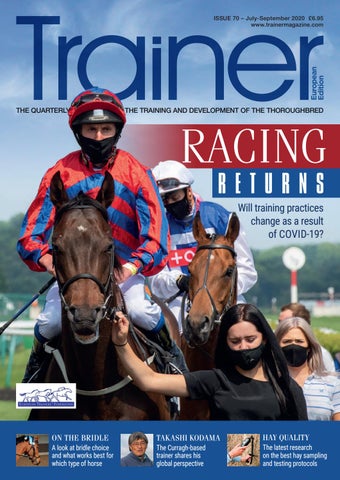
ISSUE 70 – July-September 2020 £6.95 www.trainermagazine.com
THE QUARTERLY MAGAZINE FOR THE TRAINING AND DEVELOPMENT OF THE THOROUGHBRED
RACING RETURNS Will training practices change as a result of COVID-19?
UROPEAN TRAINERS’ FEDERATION AIMS and OBJECTIVES of the ETF:
a) To represent the interests of all member trainers’ associations in Europe. b) To liaise with political and administrative bodies on behalf of European trainers. c) To exchange information between members for the benefit of European trainers. d) To provide a network of contacts to assist each member to develop its policy and services to member trainers.
ON THE BRIDLE
ETF REPRESENTATIVES Chairmanship:
A look at bridle choice and what works best for which type of horse
Guy Heymans (Belgium) Tel: +32 (0) 495 389 140 Email: heymans1@telenet.be
Vice Chairmanship:
Nicolas Clément (France) Tel: +33 (0)3 44 57 25 39 Fax: +33 (0)3 44 57 58 85 il: entraineurs.de.galop@wanadoo.fr
Vice Chairmanship:
Christian von der Recke (Germany) Tel: +49 (022 54) 84 53 14 Fax: +49 (022 54) 84 53 15 Email: recke@t-online.de
Treasureship:
Michael Grassick (Ireland) Tel: +353 (0)45 522 981 Mobile: +353 (0)87 258 87 70 Fax: +353 (0)45 522 982 Email: office@irta.ie
TAKASHI KODAMA
The Curragh-based trainer shares his global perspective
HAY QUALITY
The latest research on the best hay sampling and testing protocols
www.twydil.com
wiNNER ON All CONtiNENtS !
➜ unequalled antidoping precautions ➜ proved bio-availability ➜ guaranteed content
➜ demonstrated beneficial effect
TWYDIL® RACING
Complementary feed for competition horses, formulated (14 vitamins, 7 trace elements, 4 amino acids and magnesium) to meet the needs of top performance horses especially during intensive training and competition. TWYDIL® RACING contains all that horses need to fully express their physiological potential. TWYDIL® RACING helps to improve the horse’s general condition and helps him to support better intensive effort. - Officially certified by the LCH (following controls on final product, urine and blood). - Declared content guaranteed until expiry date.
twydil® is used by most of the successful trainers in the world. PAVESCO AG Head Office CH-4010 Basel, Switzerland Tel. +41 61 272 23 72 Fax +41 61 272 23 88
PAVESCO U.K. LTD. 116, High Road Needham, Harleston, Norfolk IP20 9LG Tel. 01379-85 28 85 Fax 01379-85 41 78
e-mail: info@twydil.com
| OPINION |
GILES ANDERSON PUBLISHER’S OPINION
We published the April-June issue of European Trainer just as the reality of the COVID-19 shutdown of racing and the world at large was starting to happen. On our cover, we included a very simple headline: ‘Stay Calm and Keep Training’. Under difficult circumstances, the industry has pulled together, and the sport has now returned to the major European countries—no doubt in part to the already strict biosecurity protocols in place across European racing, But what of the smaller countries across Europe? How have they dealt with the situation? In this issue Paull Khan takes an in-depth look at the effects that the virus has had on six of these countries and the impact on their racing industries. On the coming pages, we also ask how the racing community learned to thrive in a pandemic, and what we can teach the rest of the world. Alysen Miller discovers what the impact of the virus has been on a cross-section of European-based trainers most importantly how they have been able to adapt to change. Her closing paragraph will resonate with many in our industry: ‘It is not the strongest of the species that survives, nor the most intelligent,’ (as the internet is fond of misquoting Charles Darwin as saying), ‘but the one that is most adaptable to change. In this brave new world, trainers might just prove to be the most adaptable of all. With only six horses in training, Takashi Kodama is certainly one of the ‘smaller’ trainers located at The Curragh in Ireland. But his reach as a racing manager is global, and he makes an excellent person for us to profile during the current worldwide COVID-19 pandemic. With horses under his management located in 10 different countries, he is able to provide us with a unique perspective on the problems facing different worldwide jurisdictions during this time. For those horses who are returning to training after an enforced turnout during the COVID-19 shutdown, Catherine Rudenko, examines whether to feed for starch or fibre. Getting the balance right between the different types of carbohydrates is important for getting the right results when having to adjust the intensity of training, when resting a horse and when working back up through the stages of fitness. Finally, wherever your racing takes you this summer, good luck and stay safe!
SCAN THE QR CODE TO SIGN UP TO ACCESS OUR BACK ISSUES ARCHIVE OR REGISTER ONLINE AT WWW.TRAINERMAGAZINE.COM/ REGISTER
NEW
EASE&EXCEL CUBES
low starch support for problem horses
STARCH-SENSITIVE STRESSY FUSSY MUSCLE DISORDERS
LOW STARCH LOW SUGAR HIGH OIL BAILEYS HORSE FEEDS Racing Specialist - Simon Venner 07977 441 571 Export Manager - Mark Buchan +44 (0)7711 701 565 Tel: 01371 850 247 www.baileyshorsefeeds.co.uk
ISSUE 70 TRAINERMAGAZINE.COM
01
| CONTENTS |
40
10
R EGUL A R S
04 Contributors 06 ETF Members
54 Visit trainermagazine.com to download our current digital editions and access back issues of both European and North American Trainer.
ISSUE
70
CONTENTS F E AT U R E S 08 Denis Hogan - TopSpec Trainer of the Quarter
Breandán Ó hUallacháin talks to Denis Hogan about his sprinting sensation - Sceptical.
10 Takashi Kodama
The Curragh-based trainer explains to Lissa Oliver how his global racing business has been affected during the coronavirus shutdown.
24 Nutrition - starch v fibre intake Catherine Rudenko explains how to rein in your horse’s complex carb intake for times when work drops, or when returning from injury.
34 On the bridle
Dr. Russell Mackechnie-Guire looks at the different types of bridles at the trainers’ disposal and what works best for which type of horse.
02
TRAINERMAGAZINE.COM ISSUE 70
40 What we’ve learnt from
70 What is radiofrequency
Alysen Miller explains its impact on how trainers have been able to train - are there any measures that they’d keep in the ‘new normal’ because they actually work better?
Helen Walsh introduces radiofrequency therapy which is used for reducing pain, managing inflammation, aiding tissue repair and reducing muscle spasm.
the coronavirus shutdown
therapy?
46 Minimising serious fractures 76 The differences between of the racehorse fetlock
Celia Marr updates us on the results of a symposium of international experts, aiming to devise measures which could be used internationally to reduce the risk of catastrophic fracture associated with the fetlock joint.
54 Hay quality - sampling and testing protocols
Alan Creighton gives an update about a completed study of hay which was being fed by many of the leading racehorse trainers in Ireland and the UK.
64 News from the EMHF
Dr. Paull Khan reports on the pandemic’s effects on Europe’s smaller racing nations and their trainers and especially looks at the experience of the smaller countries.
@ t ra i n e r _ m a g
a healthy/unhealthy biome
Carol Hughes explains how every common gastrointestinal disease can be linked back to disturbances of the gut bacteria. Currently, new gene technology is driving research at an intense rate, providing new insights into the equine microbial community and providing both trainer and the vet with a powerful and accurate analytical tool to improve health and manage disease.
80 Thoroughbred Tales -
focussing on the unsung heroes in the racing world during the coronavirus shutdown Sally Ann Grassick explains how racing fans kept connected with what was going on behind the closed doors of training yards around Europe.
/ t ra i n e r m a g a z i n e
/ t ra i n e r m a g a z i n e
I bought Commanding last year and he has done very well in Dubai, winning twice and gaining blacktype at Meydan. He is a big, strong horse and we feel he will develop further next season. Nasir Askar, Owner
COMMANDING (IRE) Winner UAE 2,000 Guineas Trial 2020
Tattersalls Ireland-Goresbridge Breeze-Up Sale 24 July 2020
He’s a very easy horse to train and very tough. He has been even better this year and very impressive in winning two Listed races. So he’s had 15 starts now and 11 wins. He is different class to his competition here in Scandinavia. DUCA DI COMO (IRE) Multiple blacktype winner
Cathrine Erichsen, Trainer
Contact ITM for information on Irish breeding and sales: Phone + 353 45 443 000 | Email Info@itm.ie | Website www.itm.ie
CONTRIBUTORS Editorial Director/Publisher Giles Anderson Sub-Editor Jana Cavalier Advert Production Charlotte Fossey Circulation/Website Kerstin Coward, Anna Alcock Advertising Sales Giles Anderson, Anna Alcock Photo Credits: Alamy, Steven Cargill, Nicole Marie/ Conglianese Photos, Nigel Kirby, Zusanna Lupa, Bryn Musselwhite, Caroline Norris, Shutterstock, Roger Svalsrod, Zavodisko/Peter Lukac. Cover Photograph Nigel Kirby Photography
Trainer magazine is published by Anderson & Co Publishing Ltd. This magazine is distributed for free to all ETF members. Editorial views expressed are not necessarily those of the ETF. Additional copies can be purchased for £6.95 (ex P&P). No part of this publication may be reproduced in any format without the prior written permission of the publisher.
Printed in the European Union For all editorial and advertising queries please contact: Anderson & Co. Publishing Tel: +44 (0) 1380 816777 Fax: +44 (0) 1380 816778 email: info@trainermagazine.com www.trainermagazine.com Issue 70
Vicky Colgate is a resident in clinical research based at Rossdales Equine Hospital. Prior to this, Vicky has worked in equine clinical practice at Cambridge Equine Hospital and at an ambulatory practice in Ascot. She has a strong interest in the care and welfare of sports horses, both in the treatment and the prevention of traumatic injuries. Alan Creighton specialises in biosecurity and the diagnosis and eradication of disease in equine premises. He advises on ventilation, layout, design and environmental aspects of equine premises. He has consulted on numerous new and rebuilds of racing yards throughout Europe. He is widely experienced in the UK, Ireland, Europe and the USA and is a respected lecturer and speaker on performance, biosecurity and environmental pathogens in the equine industry. Sally Ann Grassick comes from a strong Irish racing background. She spent nine years in France as a presenter for Equidia (the French racing channel) covering international racing and is currently on the presenting team for ITV Racing in Britain and RTE Racing in Ireland. She also writes as a freelance journalist and translator, for publications such as European Bloodstock News, International Thoroughbred and Jour de Galop, and rides as an amateur jockey. Carol Hughes PhD has studied Infectious Disease at Birmingham Medical School and Gut Microbiology at Aberystwyth University. For 25 years she was based in Newmarket and Lambourn working with many of the UK’s top trainers. During the past 7 years she has been involved in 16s rRNA metagenomic profiling, linking the thoroughbred microbiome to performance and disease. Currently developing a veterinary bioinformatics application for the detection of antibiotic resistance and emerging pathogens in collaboration with Aberystwyth and Cardiff Universities. Paull Khan PhD. is an international horseracing consultant. He is Secretary-General of the European & Mediterranean Horseracing Federation and Technical Advisor for Europe to the International Federation of Horseracing Authorities. His other clients include the British Horseracing Authority. Previously, Dr. Khan held many senior roles at Weatherbys, including Banking Director and Racing Director. Dr. Russell Mackechnie-Guire runs Centaur Biomechanics and works with elite athletes in all equestrian sports, optimising performance and marginal gains. He recently gained a PhD in equine locomotion from the Royal Veterinary
04
TRAINERMAGAZINE.COM ISSUE 70
College Structure & Motion Lab. Russell is co-author of more than 30 published papers on horse-saddle-rider interaction. Professor Celia Marr is an RCVS recognised Specialist in Equine Internal Medicine based Rossdales Equine Hospital and Diagnostic Centre, Newmarket. She is also Editor-in-chief of Equine Veterinary Journal and Honorary Professor at the University of Glasgow and has previously worked at Cambridge University, the Royal Veterinary College, the University of Pennsylvania, and in racehorse practice in Lambourn. Alysen Miller is a writer, editor and producer based in London. She has written about racing for publications including The Sunday Times. She launched and produced CNN International’s first dedicated horseracing magazine show, Winning Post. She has ridden on the Flat as an amateur and currently competes in eventing on her retrained racehorse, Southfork. Lissa Oliver lives in Co. Kildare, Ireland and is a regular contributor to The Irish Field and the Australian magazine, Racetrack. Lissa is also the author of several collections of short stories and two novels. Peter Ramzan is a member of the racing team at Rossdales LLP in Newmarket. His clinical research interest is the early detection and improved management of racehorse orthopaedic injuries and he is author of The Racehorse: A Veterinary Manual—the first comprehensive textbook wholly dedicated to veterinary management of the racehorse. Catherine Rudenko is an independent registered nutritionist with a focus on thoroughbreds. Based in the UK Catherine has worked in the USA, Europe and Asia with trainers and studs creating feeds and feeding plans customised to their needs and climate. With a keen interest in education and research Catherine works with professional bodies and universities to promote knowledge of nutrition and its importance in the management of thoroughbreds and other breeds. Helen Walsh BSc MCSP HCPC is a trained Physiotherapist.Throughout her career she has worked with numerous professional sports teams and champions innovative approaches and evidence-based practice to achieve the best outcomes for patients, with special interests in tissue repair, pain management and tendinopathy.
ADVERTISEMENT
STOP THE BLEEDING
New natural approach can stop bleeding in its tracks here it was again. A trainer’s worst nightmare. Suddenly not just one, but two of his best horses were bleeding from EIPH (Exercise Induced Pulmonary Hemorrhage). They were in danger of being banned from racing, even though they were still in their prime. Lasix (Salix) isn’t an option. The trainer was at a loss. What can be done? EIPH is a rough deal for any trainer, horse owner, and horse. After all, it can lead to poor performance, lost training days, costly treatments, or worse — a very sick horse that’s banned from racing for life. Facing these concerns for two of his horses, the trainer (who asked us to withhold his name for competitive reasons) was willing to try anything. So, he searched for another option. He gave his horses an alternative to bleeder drugs and treatments; something he had read about called BleederShield. This natural respiratory horse supplement helps control bleeding. It is just as effective in improving the health and performance of bleeders but without any of those “drug issues” that come with most race-day bleeder medications. “I used BleederShield paste on two horses that had been bleeding. Now, neither horse has bled. This is a great product; it saved the careers of two very good horses.”
T
The Science Behind BleederShield To understand how BleederShield works, we looked at a controlled study run by veterinarians at the University of Minnesota College of Veterinary Medicine. They investigated the effects of the active ingredient in BleederShield, yunnan baiyao, which has been shown to help reduce bleeding in people and animals. The veterinary team wanted to see how this active ingredient specifically affected bleeding in horses. They measured template
bleeding times in horses before and after receiving a supplement with the active ingredient. The researchers reported that the supplement significantly reduced bleeding time. They concluded that the active ingredient in BleederShield was effective at minimizing blood loss in horses.1 What surprised us the most about BleederShield is its effectiveness without the use of drugs. Having a drug-free option is critical in countries that ban most race-day EIPH medications, like Lasix/Salix. There’s a serious need NOW for a natural solution that can help control bleeding in performance horses. Trainers and owners alike are impressed with the results they are seeing from BleederShield. One winning trainer told us: “I have horses that bleed and when I use this product I have no problems. I’m sure there are a lot of products on the market but I stand behind this one all the way.” Now you can improve the health of your horses while protecting the investment in their racing careers. With the results from the scientific studies, you can expect BleederShield to reduce bleeding events in horses during intense exercise… repair damaged blood vessels … and provide support for normal lung function and normal blood flow.2 Best of all, BleederShield is easy AND affordable. It could be the smartest investment you make to avoid pricey problems related to EIPH. It’s well worth the small price to avoid a banning risk or losing a great horse. You can order BleederShield today at BleederShield.com or buy it locally by visiting Dave Wilson Harness Equipment at www.davewilsonharness.co or by calling +44 (0)1968 660819. 1. Graham L. et al. J Vet Emerg Crit Care. 12:4 (2002) 279-282. 2. Graham L. Vet Clin North Am Equine Pract. 2006.
EUROPEAN TRAINERS’ FEDERATION AIMS and OBJECTIVES of the ETF:
a) To represent the interests of all member trainers’ associations in Europe. b) To liaise with political and administrative bodies on behalf of European trainers. c) To exchange information between members for the benefit of European trainers. d) To provide a network of contacts to assist each member to develop its policy and services to member trainers.
ETF REPRESENTATIVES Chairmanship: Guy Heymans (Belgium) Tel: +32 (0) 495 389 140 Email: heymans1@telenet.be
Vice Chairmanship:
Nicolas Clément (France) Tel: +33 (0)3 44 57 25 39 Fax: +33 (0)3 44 57 58 85 Email: entraineurs.de.galop@wanadoo.fr
AUSTRIA
Mrs Živa Prunk Tel: +38640669918 Email: ziva.prunk@gmail.com
CZECH REPUBLIC
Vice Chairmanship:
Treasureship:
Christian von der Recke (Germany) Tel: +49 (022 54) 84 53 14 Fax: +49 (022 54) 84 53 15 Email: recke@t-online.de
Michael Grassick (Ireland) Tel: +353 (0)45 522 981 Mobile: +353 (0)87 258 87 70 Fax: +353 (0)45 522 982 Email: office@irta.ie
HUNGARY
UNITED KINGDOM
Mr Botond Kovács Email: botond.kovacs@kincsempark.hu
ITALY
Rupert Arnold Tel: +44 (0) 1488 71719 Fax: +44 (0) 1488 73005 Email: r.arnold@racehorsetrainers.org
RUSSIA
Joseph Vana Tel: +42 (0) 6024 296 29 Email: horova@velka-chuchle.cz
Agostino Affe Email: affegaloppo@gmail.com
Olga Polushkina Email: p120186@yandex.ru
GREECE
NETHERLANDS
SLOVAKIA
Aggeliki Amitsis Tel: 30 229 908 1332+ Email: angieamitsis@yahoo.com
Geert van Kempen Mobile: +31 (0)6 204 02 830 Email: renstalvankempen@hotmail.com
GERMANY
NORWAY
Erika Mäder Tel: +49 (0) 2151 594911 Fax: +49 (0) 2151 590542 Email: trainer-und-jockeys@netcologne.de
Are Hyldmo Mobile: +47 984 16 712 Email: arehyldmo@hotmail.com
www.trainersfederation.eu
Jaroslav Brecka Email: jaroslav.brecka@gmail.com
SWEDEN
Caroline Malmborg Email: caroline@stallmalmborg.se
Rubaiyat
No Limit Credit winner Schwarzgold-Rennen, Gr.3 winner BBAG Auktionsrennen Baden-Baden winner BBAG Auktionsrennen Dortmund
Horse of the Year 2019 winner Dr. Busch-Memorial, Gr.3 winner Gran Criterium, Gr.2 winner Preis des Winterfavoriten, Gr.3
Classic contenders
Kalifornia Queen winner Diana-Trail, Gr.2
Wonderful Moon winner Union-Rennen, Gr.2 winner Cologne-Classic, Gr.3 winner Herzog von Ratibor-Rennen, Gr.3
Talk to us and we will assist you!
Premier Yearling Sale 4th September 2020 October Mixed Sales 16th and 17th October 2020 www.bbag-sales.de
®
Feed Balancers and Quality Horse Feeds
TOPSPEC TRAINER OF THE QUARTER
DEN IS HOGAN
The TopSpec Trainer of the Quarter award has been won by Denis Hogan. Hogan will receive £1,000 worth of TopSpec feed, supplements and additives as well as a consultation with one of their senior nutritionists. Breandán Ó hUallacháin enis Hogan was unsure what to expect when Sceptical, a £2,800 unraced purchase at the Horse-In-Training Sale at Doncaster in August 2019, joined him at his state of the art facilities last year. When asked how he approached the initial training of the gelding, Hogan said: “If we got a horse with form, we’d have something to go on, a line of ability, a rating probably, a distance that he races over, whereas when they’re unraced, we’re
D
08
TRAINERMAGAZINE.COM ISSUE 70
Caroline Norris
going off breeding and what they’re bred to do. Like most horses that have never raced, you build them up gradually. He then got a piece of work, and after a fast piece of work or two, we knew he was decent.” He concedes, however, that he wasn’t anxious when initially training the son of Exceed And Excel, knowing from Godolphin he had trouble breathing: “We knew he had issues, we knew his wind wasn’t perfect, but we’ve dealt with them (horses with wind problems) before.”
Though the gelding debuted on the all-weather at Dundalk on 30th October 2019, he had a wind operation after that run, with Hogan admitting “we got away with the first run.” The likeable handler states that the horse isn’t very difficult to train, describing him as “a joy to do anything with. On that score he’s 100% as good as you could ask for with temperament and attitude. His temperament, is absolutely brilliant, he’s so relaxed, calm. Nothing would phase him
®
whatsoever, you could put him anywhere in any size of crowd, even travelling he never gets worked up. You could put him anywhere in a race – up front, out the back, in the middle.” Sceptical’s training routine has essentially remained the same since his arrival. It is quite simple; it doesn’t involve anything special, according to the Tipperary native, who is lucky to have access to a 5-furlong deep sand gallop and another gallop similar to Dundalk for his top charge. “We don’t over gallop him really, he’d be cantering away, and turn him out as much as we can; he might have a gallop at The Curragh or somewhere before a big race, but that would be it really.” Though Sceptical has run on both the all-weather and turf, his training doesn’t change much, irrespective of the surface he’s being prepared for: “No, not massively – much the same, only that the surface is different. I suppose he doesn’t need to be over the top fit for the all-weather, it’s an easy surface and horses skip off it – they tend to take the race quite well, not as hard as soft ground.”
Feed Balancers and Quality Horse Feeds
AUSTRALIA – THERE’S SOME BIG PRIZE MONEY DOWN THERE, AND HE COULD BE A CANDIDATE FOR THE BREEDERS’ CUP, OR THE PRIX DE L’ABBAYE, AND SAUDI HAS THE BIG RACING FESTIVAL OUT THERE IN FEBRUARY – THERE’S TONNES OF OPTIONS OUT THERE.” DENIS HOGAN ON WHAT’S NEXT FOR SCEPTICAL
While proudly conceding that he has many race options with a horse of this quality, the Cloughjordan man is cautious about asking too much of his stable star: “We have to be careful we pick the right races now and not over-race him. With a horse like this we have a couple of options, a few different plans. The Group 1 races are literally all overseas now, and right into the autumn, there are winter festivals in every corner of the world nowadays. I’d imagine he’d be kept busy.”
In citing the international success of his fellow county man, Tom Hogan, with the late Gordon Lord Byron, Denis Hogan may be considering some long haul flights for this laid-back individual: “Australia – there’s some big prize money down there, and he could be a candidate for the Breeders’ Cup, or the Prix de l’Abbaye, and Saudi has the big racing festival out there in February – there’s tonnes of options out there.”
TopSpec Racing Feed Balancer • Muscle development and function • Performance, stamina and recovery • Healthy blood • Healthy bone • Efficient energy metabolism • Healthy digestive system • Healthy immune system • Efficient digestion and utilisation • Hoof, skin and coat quality
Multiple Award Winner for ‘Excellence in Nutritional Advice and Customer Service’
®
CREATED WITHOUT COMPROMISE by experienced equine nutritionists
Contact Will Humphreys on 07909 521085 Tel: 01845 565 030 or (062) 85401 (Ireland) www.topspec.com
ISSUE 70 TRAINERMAGAZINE.COM
09
PROFILE
Lissa Oliver
Caroline Norris
TA K I N G T H E
GLOBAL
PERSPECTIVE TAKASHI KODAMA
T
he respected Nigerian author, Chimamanda Ngozi Adichie, often speaks about the dangers of a single story. A single story, or viewpoint, leads to misconceptions and many lost opportunities, preventing us from seeing the many and varied stories within a place, or a person—the multifaceted bigger picture. Ireland’s Curragh-based trainer Takashi Kodama can never be accused of such an error. His is a life of multiple stories; and perhaps this has gifted him with the ability to identify and value the multiple stories of the international thoroughbred industry. As we talk, Kodama has five fillies waiting to be shipped from South America, to the USA and Ireland. The border had been closed due to the pandemic but was to have reopened in mid-May, so Kodama had everything organised for their export, only to receive last-minute news that the border closure had been extended. He had to spend the day urgently contacting local agents and rightly admits, “It has been my biggest nightmare with the COVID-19 pandemic.” Kodama is no ordinary trainer. Yes, he has his own yard in Kildare and a small string of six horses
10
TRAINERMAGAZINE.COM ISSUE 70
in training. He faces the same struggles as any small trainer. Yes, he has known major success as a trainer, Pop Rock winning at the prestigious Galway Festival and Elusive Time landing the 2017 Irish Cambridgeshire, a premier handicap, during Irish Champions Weekend at his home track. That saw Kodama honoured with the Special Achievement Award at the 2017 Curragh Racing Awards. But unlike many trainers, Kodama has embraced the idea of diversifying and, as a result, has his finger on the pulse of every racing nation as he searches for good value and winners, even if that means sending the horses in his care to other trainers. Even more than a trainer, he is a racing manager. This brings additional work and issues, as the South American borders testify. “Afternoon here in Ireland is business hours in South America and the USA,” he points out, “and I have six horses in my yard who demand my attention in the morning.” His passion for horses started a long time ago. “I first started working with horses a few days after my graduation from high school. I went to Hidaka, the main breeding area of Japan, to a pre-training and stud farm. It was supposed to be temporary, but in the typical way of these things I stayed five years!”
| TAKASHI KODAMA |
ISSUE 70 TRAINERMAGAZINE.COM
11
PROFILE
Breeding and pre-training are very much interlinked in Japan, so the young Kodama received a good foundation. “I worked at a facility where they did everything. I learnt to ride there, at the age of 18, and my interest went down the training side of the industry. A lot of things seem to happen by chance throughout life, and I met some people who suggested I should go to America. I worked at Santa Anita in California for three years, and then I came over to Ireland, in 1997. “I got a trainer’s licence in 2002,” he says of his first start in Ireland, “but after three years I realised it was too difficult for a small stable to make a living in Ireland, so I gave up. It is still very difficult for small trainers to survive here.” Acutely observant of cultures, politics and economies, Kodama is not a man to shy away from obstacles and, crucially, he makes a point of understanding the causes and implications to help him overcome barriers. He had gained from the experience, but it was time to explore different opportunities. “I sent my wife and two daughters to Japan, and I got jobs as a Japanese representative for Goffs and Connolly’s Red Mills. I worked with them for five years, and this brought me fresh opportunities to meet more people day by day.” During that time Kodama began working for Japanese trainers and owners to assist their international operation. “I attended all the international sales and was familiar with Goffs and Tattersalls, Arqana, Keeneland, Gold Coast, Magic Millions, even Argentinian sales.” His training background also served him well. “I was also able to assist with their international runners in Dubai, Hong Kong, etc. and provided support to get the top international jockeys to ride in Japan, such as Mick Kinane, Ryan Moore, Fran Berry and Craig Williams. From these experiences I got to know more great international racing professionals and was travelling around the world for sales, racing and visiting stud farms.” Those five years, Kodama says, were the biggest factor in shaping his life. Four times a year throughout that period, he bought a round-the-world ticket. “I started in Ireland, flew to the USA— visiting Kentucky, California and Florida—then on to Japan, Australia, New Zealand, to Argentina, Chile, Peru, Uruguay, Brazil, then back to Europe, to Germany, France, Italy
12
TRAINERMAGAZINE.COM ISSUE 70
I FOUND THAT EVERY PART OF THE HORSE INDUSTRY IN EVERY COUNTRY IN THE WORLD HAS A DIFFERENT HISTORY, CULTURE AND THE WAY THEY TRUST IN THE KNOWLEDGE GAINED FROM GENERATIONS GOING BACK MORE THAN 100 YEARS.” and the UK, and then home to Ireland. I travelled with an economy ticket all the time, but my airline status was Emerald Member! “I met so many nice, experienced horsemen all around the world: breeders, trainers, sales people, vets, jockeys, farriers. I found that every part of the horse industry in every country in the world has a different history, culture and the way they trust in the knowledge gained from generations going back more than 100 years. “I have learned so many things and gained an understanding of the fact that there are so many different ways, different schools of thought, different tools, cultures and history everywhere around the world, but we are all the same in our love and passion being passed down through every generation. That is what is holding the horse industry together, beside the financial supports.” Crucially, Kodama has also acquired a great understanding and depth of knowledge of the financial systems of racing around the world. “I examine the cost of breeding, cost of training, average horse values, market valuations, prize money, etc., and then I find the balance of all costs and prize money and sales money; and from those calculations I can calculate the cost of performance of the horse in each country.”
| TAKASHI KODAMA |
He also has an in-depth knowledge of the racing programmes for each region of the world, which he values. “I realised how important it was to have a knowledge and sense of judgement of the ability level of international horses and of the racing and breeding level in each country. I can compare the ability of horses in various countries and know their value, for buying and selling, in order to try to find the best value performance horses for my owners.” Kodama cites European horses as definitely the most expensive in the world. “For the same money, you might buy only a maiden winner in Ireland but could get a Listed winner in some other European country or the USA; and you might be able to get a Group winner in South America. The important thing is to compare these horses’ abilities.” He laughs, a typically cheerful man who belies the pressure he is so often under. “Horses bought with the same budget, if you let them run in the same race together, who will win—the Irish maiden winner or the South American Gp1 winner? That is a difficult question to answer and may be impossible to find, but it is also a very important aspect of my job.” It’s easy to think of him as a walking encyclopaedia, but he does have a lot of help. “I would not be able to do what I’m doing now without the help of the great horse people around the world I have been fortunate to meet. International jockeys who ride worldwide give me their opinion of each country’s racing and the quality of horses, and that also helps my knowledge.” Communication is key and is one of the talkative Kodama’s chief talents. “At one time, text and other mobile communications were not as popular as now. Although it might be much easier to communicate with people around the world right now, actually I feel that many, many of the
I WOULD NOT BE ABLE TO DO WHAT I’M DOING NOW WITHOUT THE HELP OF THE GREAT HORSE PEOPLE AROUND THE WORLD I HAVE BEEN FORTUNATE TO MEET.” people I have met directly face to face and have shared a drink with, eaten with, or just sat and had a chat or discussion with—or even sometimes arguing and fighting with them! ...but it’s those personal meetings that are my fortune in life and will be for a long time to come.” Of course, as much as he relishes learning from others, his true passion is working with horses, and the lure of a return to training was never far from his heart. “In 2010, by chance, I was given the opportunity to train the Japanese Group winner Pop Rock, together with a few other Japanese horses in Ireland. So I renewed my licence and re-opened my yard once more.” Pop Rock may have broken a few hearts when a narrow second in the Melbourne Cup to his compatriot Delta Blues, but he realised a dream once in the care of Kodama. “Legend Mick Kinane had retired a few years before I renewed my licence, but he very kindly helped ISSUE 70 TRAINERMAGAZINE.COM
13
PROFILE
me to try and get my first winner as a trainer. I had been with Mick as a translator in Hong Kong and Japan, and every night when we had a nightcap at the hotel bar he told me so much great things about racing and horses. He started riding out Pop Rock for me—at the beginning once a week—but getting closer to the race, he was finally riding out most of the week. We got Fran Berry as Pop Rock’s jockey for his first time out in Europe, at the Galway Festival.” The rest, as they say, is history. “Pop Rock won as my first winner at Galway and as my dream come true!” Sadly, Pop Rock was injured during running next time out in the Gp1 Irish St Leger and retired after the race. But as Kodama reflects, “My time with Pop Rock and with Mick and Fran gave me another super experience as a trainer. After this great time I was so pleased to be able to support Fran for his first season riding in Japan. And when Pop Rock retired, a friend who I had met during those five years of travel found a great place for him as a stallion. “I cannot say my training career has been good,” he admits, “but I’ve still got Elusive Time, who won three times for me, including the Irish Cambridgeshire at the Curragh on Champions Weekend, which was my biggest success as a trainer. Elusive Time was also my first winner at the Curragh, when Joseph O’Brien rode.
BELOW: Elusive Time with Kodama, Ross Coakley and the Elusive Time syndicate after winning The Tote Irish Cambridgeshire.
14
TRAINERMAGAZINE.COM ISSUE 70
| TAKASHI KODAMA |
Now Joseph trains two colts by Galileo for my owners, and also a South American Group winner is going to him with the aim of running her in the Dubai winter carnival.” Kodama has some very good Japanese owners he met during his time with Goffs, and they have provided him with the opportunity to turn his small stable into an international racing operation. “As a trainer, I have had a runner at Royal Ascot, at the Arc meeting; and I have stayed in Dubai for the winter carnival with five horses, even though I was a really small trainer with not much experience and only 8-10 horses in my yard. “I got horses for these international races from South America, Scandinavia, Italy—everywhere—with help from people I met while travelling. I also had help from every racing authority, through having met on my travels.
ELUSIVE TIME WAS MY FIRST WINNER AT THE CURRAGH, WHEN JOSEPH O’BRIEN RODE. NOW JOSEPH TRAINS TWO COLTS BY GALILEO FOR MY OWNERS.”
Support the equine athlete with the power of Ubiquinol CoQ10
The body’s first choice of antioxidant
“We have used FOR-RECOVERY for quite a few years now and are very happy with the results we get from the horses on it. Most recently Addeybb, who is on FOR-RECOVERY, travelled to Australia to win two Group 1 races. I have never seen a horse take such an arduous journey as well as he did, and settle back into his home routine so smoothly. I would highly recommend the product.” William Haggas
Foran Equine Unit 2 Cherry Orchard Industrial Estate, Dublin 10, Ireland
Ireland & International – Technical Kirsty McCann t +353 8791 61712 e kirstymccann@forans.com
t 1800 804 306 / +353 (0)1 626 8058 e info@foranequine.com www.foranequine.com
UK & USA – Technical Nichola Reynolds t +44 7739 658469 e nichola.reynolds@foranequine.co.uk
To find out more please call a member of our Technical Team or visit www.foranequine.com/product/for-recovery/
PROFILE
| TAKASHI KODAMA |
I STARTED TO BUY YOUNG HORSES AT THE SALES AND USE MY YARD FOR BREAKING AND PRE-TRAINING, TO SELECT GOOD HORSES AND TRY SENDING THE BEST HORSES TO THE MOST SUITABLE RACING COUNTRY.” I really wished I could step up onto the international racing stage as a trainer for these great Japanese owners who had given me fantastic opportunities, but unfortunately I realised I was not good enough as a trainer. I just felt so sad and sad and sad... because I could not give back anything good to these great owners who supported me so much. “And I kept thinking, thinking, thinking… How can I give something good to these owners? What can I do for them? And I realised my plans for their horses on the international racing stage were still not wrong—they could be great plans and opportunities for success; but if I really wished to get these plans going successfully, I should not keep trying to do this as a trainer. I have had to accept I am not good enough to get this done properly and successfully. “It was actually not an easy decision for me as I am still a trainer, and I still have dreams as a trainer. I wish to have runners and winners as a trainer at the great international meetings; I have tried for a few years and failed. But I am not a young boy anymore. I had to make the decision as to how I can be useful for my owners, who have been supporting me kindly for so long, even without success. “So I decided to concentrate on managing their horses, rather than simply training their horses, and to try to make my international plans a success by using better trainers.
16
TRAINERMAGAZINE.COM ISSUE 70
In this way, I can concentrate on using my experience to make a success of my role as racing manager.” Of course, Kodama still trains, but in taking the brave step to send the better horses with ambitious targets to high-profile trainers, a weight has been lifted. It has also opened up further opportunities globally and increased his involvement in more aspects of horse ownership. “I started to buy young horses at the sales and use my yard for breaking and pre-training, to select good horses and try sending the best horses to the most suitable racing country.” His academy produced Turf Laurel, sent to trainer Satoshi Kobayashi in France where she placed in Group company and ran fifth in the Prix de Diane. Tosen Gift also joined Kobayashi and twice won in Listed races. “They were Irish bred, bought at Goffs and broken and pre-trained by me. I knew they were special when they were in my yard, so it was so sad to send them out to another trainer; they were in my first year after I decided to concentrate on managing racing careers. But when they were going well with Kobayashi and I saw their owners smiling, I realised my decision was definitely right. “So I started to try to get proven top-class horses to bring my owners to the top of the international racing stage quickly. In Italy, Mac Mahon and Paiardina were
Consumer line 7/7 +44 (0)1352 746100
> FOR PULMONARY SUPPORT AND ELASTICITY
Richard Hughes; “I have used Bronchix Pulmo syrup and Bronchix Pulmo syringes on two individual horses who have unfortunately been categorised as “bleeders”. The product is simple and easy to use and we have had great success with it. We now would not do without it.”
PROFILE
WHEN I HEAR THE HAPPY VOICE OF MY OWNERS ON THE PHONE AND SEE THEIR HAPPY FACE WHEN WE MEET, SADLY I KNOW THAT THIS HAPPINESS WOULD NOT HAVE HAPPENED IF I WERE STILL TRYING TO DO THIS PLAN AS THEIR TRAINER.”
the first horses I bought for that plan. Of course, my great Italian contacts helped me to get them. Very luckily for me, Mac Mahon won the Italian Derby, and the following week Paiardina ran a very close second in the Italian Oaks. After that, Mac Mahon won the Qatar Derby, and Paiardina won a Listed race in Italy. “At the same time, I purchased in South America the Peruvian-based mare Ryans Charm. She won a Breeders’ Cup ‘win and you’re in’ race in Peru, and so I sent her to the great Irish trainer Paddy Gallagher in Santa Anita, where I spent three years when I was young; and we ran her in the Breeders’ Cup Filly And Mare Turf. She ran so well and finished sixth, only beaten four lengths by Queen’s Trust and the top European and North American fillies. That gave me confidence! It doesn’t matter where horses are bred or are racing; the ability of the top-class horses must be very close everywhere in the world. “After that I got Si Que Es Buena in Peru and ran her in their Breeders’ Cup ‘win and you’re in’ race there again,
18
TRAINERMAGAZINE.COM ISSUE 70
but unfortunately she ran badly that time. But, comparing her with Ryans Charm, I still believed she must be good enough to race against top fillies in the USA, so I sent her to Graham Motion in the USA. She started five times for two Gr3 wins and a Listed win, and ran fourth in a Gr3 and sixth in a Gr1. This was a fantastic thing after the success of Ryans Charm, Turf Laurel, Tosen Gift and Paiardina. “All those fillies, who gave such fun and success to my owner, Takaya Shimakawa, are now in Japan at his own stud farm; and they have all been covered by Mac Mahon, who won two Derbys for him and is also now standing at his stud.” It may have been a hard decision to allow his own training career to take a back seat, but Kodama doesn’t regret the move. “Four years ago I kind of nearly gave up as a trainer, with such a sad feeling. Now I have so much happiness that this happened. Horses I bought and managed for my owners have gained success and provided great fun and excitement, first as racehorses and now all at stud together for their owner’s future dreams. Their progeny may race in Japan or internationally, and I wish to be able to manage their careers. And I definitely can say now that my decision of four years ago was surely right. “When I hear the happy voice of my owners on the phone and see their happy face when we meet, sadly I know that this happiness would not have happened if I were still trying to do this plan as their trainer. The success is only due to much better and more experienced trainers... unfortunately not me.” There is still a touch of regret there, but fortunately Kodama continues to train, if not the best of his horses. It’s easy to see this is his passion, particularly as he is so very much hands-on, doing everything himself from mucking out to riding out. “I have been so happy with five horses in my yard for racing, and a few other horses for breaking or pre-training for other trainers as part of my role managing horses internationally.”
Visit Visit Sweden? Sweden? Sweden is a racing nation on the up. Sweden is a racing nation on the up. We have plenty of black type opportunities and larger We have plenty ofpeople black type opportunities larger purses than most realise. We are notand even that purses than most realise. We areelse notdoes. even that far away. Give it a people go - before everyone far away. Give it a go - before everyone else does. The Stockholm Cup day at Bro Park in Stockholm on The Stockholmfeatures Cup dayfour at Bro Park in Stockholm on 20 September black type races. 20 September features four black type races. The main race of the day is the Group 3 Stockholm The main thewhich day isboasts the Group 3 Stockholm Cup, a 12frace turfof race a purse of €133,980. Cup, a 12f turf race which boasts a purse of €133,980. The Tattersalls Nickes Minneslöpning, a Listed race The Nickes Minneslöpning, a Listed race overTattersalls a mile on the dirt course, is the perfect European over a mile on the dirt course, is the perfect European trial for the Breeders’ Cup Dirt Mile. trial for the Breeders’ Cup Dirt Mile. Contact Svensk Galopp or IRB for information on Contact Svensk Galopp or IRB for information on travel incentives. travel incentives. See you in Sweden! See you in Sweden!
SVENSK GALOPP SVENSK GALOPP The Swedish The Swedish Authority Horseracing Horseracing Authority www.horseracingsweden.com www.horseracingsweden.com @swehorseracing @swehorseracing
Dennis Madsen, Head of Racing Dennis Madsen, Head of Racing dennis.madsen@svenskgalopp.se dennis.madsen@svenskgalopp.se +46 8 466 86 03 +46 8 466 86 03
Feature races on 20 September Feature races on 20 September at Bro Park in Stockholm, Sweden at Bro Park in Stockholm, Sweden Closing on Monday, 3 August Closing on Monday, 3 August €133,980 Stockholm Cup International (Gr. 3) €133,980 3yo+, 2400Stockholm m (Turf) Cup International (Gr. 3) 3yo+, 2400 m (Turf) €63,545 Bro Park Sprint Championship (L) €63,545 BromPark Sprint Championship (L) 3yo+, 1200 (Turf) 3yo+, 1200 m (Turf) €63,545 Tattersalls Nickes Minneslöpning (L) €63,545 Tattersalls 3yo+, 1600 m (Dirt) Nickes Minneslöpning (L) 3yo+, 1600 m (Dirt) €63,545 Lanwades Stud Stakes (L) €63,545 Lanwades Stud Stakes (L) 3yo+ f&m, 1600 m (Turf) 3yo+ f&m, 1600 m (Turf)
Internatonal Racing Bureau Internatonal Bureau Max Pimlott, Racing Trainers’ Services Max Pimlott, Trainers’ max@irbracing.com Services max@irbracing.com +44 79 50 86 19 39 +44 79 50 86 19 39
PROFILE
Being involved with his owners’ horses every step of the way, from sales ring to paddocks, he is expanding his interest still further. “Now I’ve started managing the breeding side as well,” he says. “I’m trying to get good fillies and mares from everywhere around the world and select a suitable stallion for them, then send their progeny to the most suitable places for sales or racing. We have something going to the USA, something going to Japan, something staying in Europe for racing. Making all these decisions is always so difficult for me.” He is the first to admit to mistakes, but we all know that success in racing can be a numbers game. Kodama has already learnt to weigh the dice by stepping aside and selecting the right trainer for the individual horse. He is philosophical about the success of this method. “In my experience, only one success can come up from 20 fails. I have a great time and lots of fun with the horses I’m managing but have been giving my owners 20 times more disappointment than success. I am so lucky, as all my owners have so much experience with racehorses and they always say to me, ‘I am used to having disappointments with horses, so you just try your best.’ Those words always make me brave and push me forward to do what I am dreaming for my owners.” So much travel has also allowed Kodama to take a broader view of the COVID crisis, and he is best-placed to see that wider picture, the multiple stories. “That’s my good fortune from my job. I travel everywhere and keep in touch with my contacts around the world. Sometimes I’m fighting with different cultures and business methods, and now I am seeing how they are thinking and understand that we can’t all react in the same way, because every country has its own culture and political and economic system which shapes how it deals with a situation. “One thing I can say: this virus won’t be disappearing. The government cannot keep doing this. Every business is suffering, but we see it especially in racing—training fees still have to be paid, feed and bedding has to be bought, staff have to be paid, and the horses are still going to the Curragh every day to exercise. “I manage horses in more than 10 countries at the moment, and each country has its own restrictions in place. Shipping plans, racing plans, breeding plans have all been destroyed and now must be fixed or changed to get the best result in this difficult world situation. “I’ve achieved some solutions with advice from my many contacts, but each country’s situation could be changed tomorrow and new problems will have to be fixed again the day after tomorrow; and it could be the same again, week after week. So I’m just trying to get the newest information from each country as much as possible and stay in touch with all my contacts to get the best solution. It is so hard… sometimes I feel it’s impossible, but all I can do is keep trying my best, with the kind patience of my owners and great support from my friends and partners all around the world. “All over the world everybody is struggling. Everybody is in the same situation. It makes things complicated if we don’t know what the situation is for someone else, but because the COVID pandemic is global, everyone knows what the problems are.”
20
TRAINERMAGAZINE.COM ISSUE 70
| TAKASHI KODAMA |
He sees the pandemic as a great leveller, reminding us that racing isn’t so important in the face of disease. And for some parts of the world, he points out the threat of coronavirus is less worrying than the economic impact. “Racing is a very unbalanced industry,” he reflects. “The industry is supported by successful wealthy people, as everyone knows and respects and thanks them; but also there are some small racing countries in parts of the world, whose people have always faced a hard life with low financial care and low health care; and those people are also strongly supporting the industry. They hold this great racing industry together. “They are horsemen. They may be working for small money, but they need top-class skills. As a country gets richer, so the level of horsemanship goes down because kids always want better things. It’s a very tough business —nothing is easy; only tough people can survive. It’s a business for people who love horses or can do nothing else without horses. “I have met so many great horsemen who have faced a hard life working with horses on the other side of the world. They have also given me great experience and fresh new knowledge about the industry, and strength of feeling. I strongly wish they may continue to be able to look after their horses with their historical knowledge and great love of horses in this worrying world situation.” It’s a typical conclusion from a man who puts others first, but his rationale is simple. “Some trainers are looking at the owner and the account first, but a good trainer always looks at the horse first.”
Sign up now to access our back issues archive Over 90 issues of both European and North American Trainer magazine including over 500 articles.
European
European
ISSUE 50 – JULY TO SEPTEMBER 2015 £5.95
ISSUE 52 – JANUARY TO MARCH 2016 £6.95
ISSUE 61 – APRIL – JUNE 2018 £6.95 www.trainermagazine.com
ISSUE 58 – JULY 2017 – SEPTEMBER 2017 £6.95 www.trainermagazine.com
www.trainermagazine.com
Europe
www.trainermagazine.com
THE QUARTERLY MAGAZ AZINE Z FOR THE TRA RAINING A AND DEVELOPME ENT OF THE THOROUGHB BRED
Can Spirulina be a superfood for horses?
ED DUNLOP Winning the world over Is ALL WEATHER racing a bookmakers’ benefit and a commercial winner for racecourses?
LOUISA CARBERRY
Christophe
Ferland
Living the dream
Serious injuries for horses and jockeys
The Tetrarch
100 years since “the spotted wonder” stood his first season at stud
THE QUARTERLY MAGAZINE FOR THE TRAINING AND DEVELOPMENT OF THE THOROUGHBRED
JOSEPH O’BRIEN
A man with a plan
Can they be prevented?
The Crowley dynasty runs on at Carriganog
Michael Hourigan
Training with technology
What is a genetic passport?
EUROPEAN TRAINER ISSUE 52.indd 13
GENERATION X
The new jockeys on the block
SHOCK ABSORPTION
Can shoeing improve impact injuries
NUTRITION
Does a young horse’s diet determine longevity on the racecourse
THE FIGHT AGAINST EQUINE HERPES VIRUS-1
DIGESTIVE TRACT HEALTH IN FOCUS
HOW EUROPEAN GOVERNMENTS VIEW RACING’S WORKFORCE
18/12/2015 00:46
ISSUE 62 – JULY – SEPTEMBER 2018 £6.95 www.trainermagazine.com
ISSUE 64 – JANUARY-MARCH 2019 £6.95 www.trainermagazine.com
ISSUE 65 – APRIL-JUNE 2019 £6.95 www.trainermagazine.com
ISSUE 67 – OCTOBER-DECEMBER 2019 £6.95 ISS www.trainermagazine.com
ISSUE 68 – JANUARY-MARCH 2020 £6.95 www.trainermagazine.com
THE QUARTERLY MAGAZINE FOR THE TRAINING AND DEVELOPMENT OF THE THOROUGHBRED
THE QUAR QUARTERLY RTERLY MAGAZINE MAGAZINE E FOR TH THE HE T TRAINING RAINING AN ND DEVELOPMENT OF THE THOROUGHBRED D
THE QUARTERLY MAGAZINE FOR THE TRAINING AND DEVELOPMENT OF THE THOROUGHBRED
THE QUARTER QUARTERLY RLY M MAGAZINE AGAZINE F FOR OR T THE HE T TRAINING RAINING AND DEVELOPMENT DEV OF THE THOROUGHBRED
THE QUARTERLY MAGAZINE FOR THE TRAINING NG AND AN ND D DEVELOPMENT DEVELOPMENT OF OF THE TH HE E THOROUGHBRED THOROUG
JESSICA HARR ARRI RINGTON I A trainer for all seasons
MARKUS KLUG
CATHRINE ERICHSEN
THE
DUNLOPS
Life smells good for Cologne’s leading trainer
BREXIT SPECIAL
How high are racing’s stakes?
SHOULD HORSES BE PAID TO RACE?
ANDY OLIVER Shares his views on Brexit from a trainer’s perspective
THE RISE OF ALL-WEATHER RACING
WHY RACING IS LOOKING AFTER ITS TRAINERS
EQUINE ULCERS – WHAT WORKS FOR YOUR HORSE
DR. ANDREAS JACOBS Shares his thoughts on racing and breeding in Germany
FUNGI
Is fungi the invisible health risk?
HARRY WHITTINGTON
Norway’s leading lady
Making tracks for French-bred success
NEW FINDINGS ON EIPH
From an Australian perspective but with worldwide implications
ARE WE GOING SOFT ON OUR HORSES?
DIVERSITY AND INCLUSION IN EUROPEAN RACING
BLEEDERS – THE FACTS, FICTION AND FUTURE DIRECTION
“I actually had no aspirations to be a trainer whatsoever”
THE IMPORTANCE OF STABLE VENTILATION
WHAT IS EQUINE WELFARE?
Scan the QR code to sign up or alternatively register online at trainermagazine.com/register
THE IMPACT SADDLES HAVE ON PERFORMANCE
BEDMAX Supporting British Racing 2000-2020
LOOKING FORWARD FROM GREYMARE FARM It is 20 years this Spring
successful steeplechasers here in the stables where I now
since the first yellow bags
live, including Canny Danny, who won the Sun Alliance
of BEDMAX shavings began
at Cheltenham in ’83, and Strands of Gold who won the
appearing in UK racing yards,
Hennessy in ’88. I was looking for a way to make a living
but the Northumberland-based
somehow on the edges of farming, and through my aunt I
family company has put its
learned that trainers were looking for an alternative forage
anniversary celebrations
to hay. There was some significant research evidence
on hold. Like everyone else
emerging at the time about the damage airborne dust and
involved in the racing industry,
spores could do to a horse’s respiratory system in the
Managing Director Tim Smalley
stable, and hay was seen as the main culprit.
has been fully occupied adapting operations to steer the BEDMAX team safely through these uncharted waters,
“So my older brother Chris offered me the use of some of
and keeping production at record levels to support
his hayfields at Greymare Farm, I restored two old small
customers through the most disruptive crisis since the
round-bale balers, and in 1987 we started making dust free
second World War.
haylage. We sealed the bales in yellow bags and called it HAYMAX, and racing customers seemed very happy with it.”
“This is clearly a very serious problem we’re all facing, and it will obviously have serious consequences for many of us
As haylage increasingly became the forage of choice in
whose lives and livings revolve around horses. But I’ve always
UK racing yards, it became apparent that traditional straw
thought that people who work with horses, and especially
bedding was – and still is – as likely as hay to contain high
with racehorses, are better prepared than most to deal with
levels of inorganic dust and microbial particles small enough
setbacks and disasters. It’s been wonderful to see racing
to be inhaled deep into the respiratory system of a nasal
get back in the saddle again, and we’re looking forward to a
obligate breather.
return to something closer to normality as soon as possible.”
This feature is supported by BEDMAX Shavings.
Growing up surrounded by ponies, hunters and eventers on the family farm in north Northumberland, Tim opted out of horses in his teens and into agricultural engineering, and it wasn’t until he returned from a spell jackarooing in Australia in the early 80s that he started to put the two together in his first racing-based business. “Mustering cattle in the Kimberleys reignited the horse bug in me, and when I came home I started hunting again and did some pointto-pointing. At the same time my aunt was breeding some
Every race starts in the stable… Photo: Sarah Farnsworth, by kind permission of Amanda Perrett, Coombelands Racing Stables.
BEDMAX Supporting British Racing 2000-2020
“By 1998, there were lots of suppliers making haylage for
BEDMAX has led the
horses, but trainers were finding it difficult to source a dust
British Equestrian
free replacement for straw. Many were trying what I would
Trade Association’s
call waste product shavings from the wood processing
national survey results
industries, but those also had a very high dust content, so
for the best-selling
I started to look at how we could produce a better bedding,
brand of bedding
and two years later we launched BEDMAX.”
in the overall UK equestrian market
In those two years, Tim tracked down as much of the
since 2011, but racing
research into equine respiratory health as he could and
still accounts for
consulted trainers and leading equine veterinary experts,
a large proportion
and he realised that dust was not the only health threat that
of sales and Tim
horses face in the stable.
Smalley still values the approval of racing
“Respiratory damage caused by airborne dust is the most significant health problem that good bedding can help prevent, but it also needs to help maintain good hoof health,
trainers and vets as Desert Orchid was one of the first customers for BEDMAX in 2000.
the highest benchmark of success.
it can play a big part in keeping the stable hygienic and suppressing ammonia, and it needs to provide a supportive
“Racing trainers were the first to recognise the need for
base for horses to lie down and get the rest they need.
a bedding that reduced dust levels to the lowest possible minimum. Obviously, this is particularly crucial in racing
“I’ve always said it isn’t rocket science, but we put a lot of
where even small compromises in respiratory health can
thought into making a top quality all-round healthy equine
make a big difference to performance, and racehorses do
bedding. We were the first to cut larger shavings because
spend a lot of time in their stables. It gives me a headache
they’re more resilient and supportive both for the hoof and for
even trying to think of all the factors a trainer has to take
horses lying down. We dry them at sterilising temperatures
into account to get the best out of a horse, but I know that
but to a controlled 12% moisture content so they don’t
every detail is important, and I hope BEDMAX has helped
dry out hooves and cause cracking. We make them from
remove or reduce at least one potential health risk.”
traceable, renewable timber we source here in the UK, and I prefer to use pine because it offers a unique level of natural
From the outset, it has been racing that has driven this family
antibacterial resistance. And we have always been aware that
company’s success at home in the UK and then as a global
if we’re asking customers to pay a bit more for purpose-made
exporter, first to trainers in Hong Kong, Europe and the Middle
bedding, it needs to be very good value for money.”
East, and more recently to Japan and mainland China. In January, one of the world’s leading studs ordered a shipment
The other benefits he wanted all customers to be sure they got
of Northumbrian BEDMAX to be delivered to Australia for their
from BEDMAX were consistent quality, dependable supply,
stallions standing for the season down under.
and knowledgeable support and service. As sales grew, the company built a second factory in the Midlands and then
“We’ve travelled a long way from Greymare Farm since
a third in Hampshire to keep up with demand, duplicating
those first bags went off in our lorry to Malton and
the unique production process Tim and his brother had built
Middleham,” says Tim Smalley, “and it’s a pity our 20th
themselves at Greymare Farm, and they have invested steadily
anniversary has been overtaken by the coronavirus. But
in new technology and more sophisticated dust screening and
we’re in this for the long run, and we’re even more deeply
vacuum extraction to keep BEDMAX shavings at the top of the
committed to supporting our racing customers and their
bedding performance rankings.
horses through this setback and on to the next 20 years.”
| NUTRITION |
S TA R C H V FI BRE 24
TRAINERMAGAZINE.COM ISSUE 70
| STARCH v FIBRE |
Catherine Rudenko
Shutterstock
Carbohydrates are by far the largest component of any horse’s diet, typically two thirds by weight, yet we often focus more on other nutrients, such as protein—which in comparison forms only a small portion of the total diet at around 8-13%.
C
arbohydrates, specifically the balance between differing carbohydrate sources, influences three key areas relating to performance. The choice of carbohydrate influences the type of energy available, providing varying proportions of ‘fast release’ or ‘slow release’ energy. The type of carbohydrate chosen also impacts behaviour, increasing or decreasing risk of excitability and certain stereotypical behaviours. Last, but by no means least, the choice of carbohydrate and the way in which it is fed impacts digestive health and the ability of the digestive system to convert food to ‘fuel’ for the body. Getting the balance right between the different types of carbohydrates is important for getting the right results when having to adjust the intensity of training, when resting a horse and when working back up through the stages of fitness.
• What are carbohydrates? There are different ways of classifying or grouping carbohydrates, depending on whether you take things from the plant’s point of view or that of the digestive anatomy of the horse. Working with the horse in mind, carbohydrates are best classified by the section of the digestive system that they are processed in—either the small intestine or large intestine. The site of digestion determines the type of energy provided, often referred to as ‘fast releasing’
for the small intestine and ‘slow releasing’ for the large intestine. The group of carbohydrates, known as hydrolysable carbohydrates, are the group behind the description of ‘fast releasing’, whilst the group known as fermentable carbohydrates are those forming the ‘slow releasing’ category. Within the fermentable group, there are three sub groups of rapid, medium and slow.
• What are carbohydrates made of? There are many types of carbohydrates in the horse’s diet, ranging from simple sugars to more complex structures. They are defined by their degree of polymerisation, which refers to the way in which sugar units are joined together. How a carbohydrate is formed and the type of link present are important as they determine if digestion is possible in the small intestine or whether fermentation in the large intestine is required. This influences the type of energy available. For horses in training, the type of carbohydrate of particular interest is the polysaccharide group which includes starch, cellulose, hemicellulose and fructans amongst others. Starch is found in significant quantities in hard feeds, whilst cellulose and hemicellulose, amongst other fermentable carbohydrates are abundant in forages. Pasture is a source of fructans, which can change rapidly depending on growing conditions and daylight hours.
Simple Sugars (glucose, fructose, galactose) Disaccharides (sucrose, maltose, lactose) Oligosaccharides (some such as maltotriose) Starch
HYDROLYSABLE CARBOHYDRATES as digested in the small intestine
Fructans Starch (spill-over from small intestine)
Rapidly Fermentable
Galacto-oligosaccharides Gums & Beta Glucans Mucilages Pectins
Moderately Rapidly Fermentable
Hemicelluloses Cellulose Lignocellulose
Slowly Fermentable
FERMENTABLE CARBOHYDRATES as digested in the large intestines
ISSUE 70 TRAINERMAGAZINE.COM
25
| NUTRITION |
• Structure Single sugars, also called simple sugars, comprise one unit only. They are categorised as monosaccharides—the most commonly known being glucose. For horses in training this is a highly valuable sugar as it is the main ‘fuel’ for muscles. Glucose forms the basis of many of the more complex structures of interest to horses in training. When two sugars join together, they are known as a disaccharide—the best known being lactose which is found in mare’s milk. Oligosaccharides refer to more complex structures where more units are joined together—a common example being fructo-oligosaccharide (FOS) which many horses in training are specifically fed as a prebiotic to support digestive function. TYPE OF CARBOHYDRATE
EXAMPLE
Monosaccharide
Glucose, Fructose
Disaccharide
Lactose, Sucrose, Maltose
Oligosaccharide
Fructo-Oligosaccharide (FOS)
Polysaccharide
Starch, Cellulose, Fructans
Polysaccharides, our group of particular interest, are significantly more complex chains that are branched and are not so easily digested as the simple sugars. The branched nature of polysaccharides, such as starch and cellulose, are the result of links between chains of sugars. The type of link present determines whether or not it will be possible for the horse to digest this form of carbohydrate in the small intestine or not.
(a) Monosaccharides
(b) Disaccharides
26
TRAINERMAGAZINE.COM ISSUE 70
STARCH IS THE PRIMARY CARBOHYDRATE OF INTEREST IN OUR HARD FEEDS. IT IS A HYDROLYSABLE CARBOHYDRATE, WHICH CAN BE DIGESTED IN THE SMALL INTESTINE, RELEASING GLUCOSE INTO THE BLOODSTREAM.” • Starch Starch is the primary carbohydrate of interest in our hard feeds. It is a hydrolysable carbohydrate, which can be digested in the small intestine, releasing glucose into the bloodstream. For horses in training this is the most important fast release energy source. Starch is found in all plants, with the highest quantities seen in cereals such as oats, barley and maize. Composition of cereals commonly used in racing feeds
Protein %
OATS
BARLEY
MAIZE
WHEAT
9
11
8
11
Fibre
%
11.3
4.8
2
2
Oil
%
6.8
2.6
4
2.3
Starch
%
38
51.5
63
60
Starch is made up of two types of sugar chains: amylose and amylopectin, which are formed from glucose units. Amylose itself is easily digested, however amylopectin has a different type of bond connecting each branch, which the enzymes of the small intestine cannot break down. Feed processing, which changes the structure of starch and breaks apart the previously indigestible bonds, is therefore a key factor in ensuring that when starch is fed that the maximum amount of glucose is derived.
(c) Polysaccharide
Part of your support network
SUPPORT
Advanced Technical Expertise Dedication & commitment A hands-on approach Working together, giving consistent technical support to help your horses perform year after year...
Targeted nutrition Over 30 years of Equine Research Proven Scientific Knowledge Evidence Based Our own team of registered nutritionists work with KER’s scientists to provide meaningful nutritional solutions that get results.
SERVICE RACE 13
is available in 25 countries
AUSTRALIA . BELGIUM . CANADA
DENMARK . DUBAI . FINLAND . FRANCE GERMANY . HONG KONG . INDIA
IRELAND . ITALY . JAPAN . KOREA
NEW ZEALAND . NORWAY . POLAND QATAR . SOUTH AFRICA . SPAIN . SWEDEN THE NETHERLANDS . UAE . USA . UK
Care for our clients A Global approach NOPS testing at LGC Dedicated TB Office We take care of every detail to deliver a very personal level of service, actively focused on the needs of your horses.
When you win, we win... Wherever you’re racing, Saracen & Hallway Feeds can accommodate all your feed requirements. We have been working together for 20 years, and we’re here to help, no matter where your season takes you.
Call a member of our dedicated specialist Thoroughbred team. POLLY BONNOR Tel: +44 7973 802 210 ROSIE MARGARSON Tel: +44 7736 617 985 CATHERINE RUDENKO Tel: +44 7419 359252 DANIELA NOWARA Tel: +33 6 76 17 88 99 or contact the Office Tel: +44 1488 73456
working with
SCIENCE
SUCCESS
| NUTRITION |
| STARCH v FIBRE |
• Amylose and Amylopectin Feed processing comes in many forms, from simply crushing or rolling the grain to cooking techniques including micronizing, steam flaking, pelleting or extruding. The amount of processing required for what is deemed efficient digestion differs by grain type. Oats have a natural advantage within the cereal group as they can be fed whole, although processing can still improve digestion. Barley, wheat and maize cannot be fed whole or simply rolled. They require cooking to ensure that starch becomes available, and the impact of cooking processes is much greater for these grains. The availability of starch is assessed through the amount of glucose released into the blood after feeding. The study below shows the effect of steam cooking maize (corn) compared to two processes that simply change the physical appearance, cracking or grinding. Steam-flaked maize is more available as shown by the greater glucose response.
108
Amylose
Amylopectin
Effect of Corn Processing on Glycemic Responses in Horses
125
b
Blood mg/dl BloodGlucose, Glucose, mg/dl
120
Cracked Corn Cracked Corn Steam FlakedCorn Corn Steam Flaked Ground Corn Ground Corn
b
115
b
110
b
105
a a
100
b a
a a a a
a a
95 90 85
b
PR
b a a
E 3 0 ** 6 0 ** 9 0 ** 2 0** 5 0 ** 8 0 ** 1 0 4 0 7 0 0 0 3 0 6 0 9 0 2 0 5 0 1 1 1 2 2 2 3 3 3 3 4 4
Time min TimePost-Feeding, Post-Feeding, min
Figure 2. Plasma glucose concentrations post-feeding. ab
28
**
Treatments lacking a common superscript differ (P < .05) Treatments different at given sample time (P < .01)
TRAINERMAGAZINE.COM ISSUE 70
Starch is a fast release energy source, being digested in the small intestine, and the term can easily be misunderstood. It does not mean that the horse will suddenly run at top speed nor appear to be fuelled by ‘rocket fuel’. The word ‘fast’ relates to the relatively short time it takes for digestion to occur and glucose to be available. Looking at the maize example, it is possible to see that glucose is found in the blood just 30 minutes after feeding. This is a rapid response compared to carbohydrates that are digested further down the digestive tract in the large intestine. Energy is energy, whichever source it comes from or how long it takes to digest. However, the type of energy, whether fast release or slow release, does impact behaviour, in particular affecting reactivity. When fed on higher-starch diets, horses are well documented to become more reactive, anxious and over excitable. Aside from the need for glucose as a fuel for performance and equally for recovery, its presence in the diet can increase reactivity. In a sport where speed and the ability to react quickly are an advantage, starch and its associated effects can be a positive. Like all nutrients, there is a fine balance to be had, and an excess of starch and over excitable behaviour are not desirable at certain stages of fitness. Starch excess should be avoided at all costs for horses prone to tying-up where excitable behaviour is a known risk factor.
A ROYAL RETURN OF WINNERS AT ROYAL ASCOT % 25 FED ON RED MILLS
BATTAASH
HELLO YOUMZAIN
ALPINE STAR
Race Trainer Jockey Owner
Race Trainer Jockey Owner
Race Trainer Jockey Owner
King´s Stand Stakes (Group 1) Charles Hills Jim Crowley Sheikh Hamdan Al Maktoum
Diamond Jubilee Stakes (Group 1) Kevin Ryan Kevin Stott Haras D’etreham And Cambridge Stud
Coronation Stakes (Fillies´ Group 1) Mrs John Harrington Frankie Detorri Niarchos Family
Horse
Race
Trainer
Jockey
Owner
Pyledriver
King Edward VII Stakes (Group 2)
W R Muir
M Dwyer
Knox & Wells Limited And Mr R W Devlin
Coeur De Lion
Ascot Stakes (Handicap)
Alan King
Thore Hansen
The Barbury Boys
Hukum
King George V Stakes (Handicap)
Owen Burrows
Jim Crowley
Sheikh Hamdan Al Maktoum
Scarlet Dragon
Duke Of Edinburgh Stakes (Handicap)
Alan King
Hollie Doyle
Hp Racing Scarlet Dragon
Hey Jonesy
Wokingham Stakes (Handicap)
Kevin Ryan
Kevin Stott
Pallister Racing
Who Dares wins
Queen Alexandra Stakes (Conditions Race) Alan King
Tom Marquand
Hp Racing Who Dares Wins
Advert by kind permission of trainers
FEED YOUR DESIRE TO WIN Contact our expert Thoroughbred team:
Connolly’s RED MILLS Goresbridge, County Kilkenny, Ireland Tel: +353 599 775 800 Email: info@redmills.com
www.redmills.com
RED MILLS IRL: Lorraine Fradl +353 87 2575398 RED MILLS UK: Adam Johnson +44 7860 771063 RED MILLS EUROPE: Sylvain Prouvoyeur +33 6 98 67 51 38
| NUTRITION |
| STARCH v FIBRE |
• Fermentable carbohydrates Cellulose, as an example of the fermentable carbohydrate group, is similar to starch being composed of glucose units, however the type of bond is significantly different and can only be digested in the large intestine through bacterial fermentation. Cellulose is a key component of the cell wall of plants, including both cereals and forages but is found in the highest amounts within forages and some of the more fibrous co-products used in feeds, such as sugar beet pulp. The digestive process of bacterial fermentation that occurs in the large intestine yields different energy sources in comparison to the small intestine where glucose is the main product of starch digestion. Fermentation of cellulose and other fermentable carbohydrates, such as hemicellulose and lignocellulose, produce volatile fatty acids (VFAs). Like glucose, these are an energy source for the horse but through different pathways. The time required for digestion in the large intestine is much greater than the small intestine, hence the term ‘slow release’ energy being applied to the fermentable carbohydrate group. Fibrous foods are typically processed over a 30-hour period in the hindgut. As the process of digestion and energy release is more gradual and does not result in a spike of glucose, the use of more fibrous carbohydrate sources is ideal when looking to provide energy in a more consistent format. Resting and early stages of work are best supported by a higher inclusion of fermentable carbohydrates. Equally once fit to avoid a situation in which the horse ‘boils over’, altering the main diet to marginally reduce starch and increase more fibrous fermentable carbohydrates can be of help. Cellulose and other fermentable carbohydrates are not
30
TRAINERMAGAZINE.COM ISSUE 70
analysed separately in the same manner as starch. Cellulose and lignocellulose are identified through a lab method known as acid detergent fibre (ADF). By looking at ADF and starch values, we can get a picture of the balance between the fast release and slow release sources that materials commonly fed to horses have. Cereals naturally provide more starch, whereas beet and alfalfa provide little starch but plenty of fermentable carbohydrates.
• Feeding ingredient FEEDING INGREDIENT
STARCH (%)
ADF (%)
2
31
Sugar Beet
1.5
25
Wheatfeed
22
12
Oats
38
16
Barley
50
5.5
Alfalfa
Through altering the amount of hard feed against additions such as chaff and soaked sugar beet pulp, it is quite easy to change the ratio of hydrolysable (fast release) and fermentable (slow release) carbohydrates in the total diet. Many yards will feed a lower protein diet on a day off, to alter intake against workload—or rather lack of workload. Carbohydrates, or more specifically the balance of carbohydrates, is equally worthy of consideration when adjusting the diet against any change in workload.
Outstanding Results #FedonTopSpec
Lady Buttons, winning the Yorkshire Rose Mares’ Hurdle at Doncaster races, for the second year running, trained by Philip Kirby, ridden by Sean Quinlan and owned by Jayne and Keith Sivills.
Photograph by SB Photos
“Lady Buttons looks amazing this year and is keeping her condition and form so well throughout the season.” Philip Kirby
Multiple Award Winner for ‘Excellence in Nutritional Advice and Customer Service’
®
CREATED WITHOUT COMPROMISE by experienced equine nutritionists
Contact Will Humphreys on 07909 521085 Tel: 01845 565 030 or (062) 85401 (Ireland) www.topspec.com
| NUTRITION |
| STARCH v FIBRE |
• Example feeds
• Starch or fermentable carbohydrates? Whilst both are sources of energy and equally valuable to the horse, glucose from starch holds an advantage over VFAs from fermentable carbohydrates when it comes to availability during exercise. Glucose is metabolically more efficient. When working aerobically at slower speeds, glucose is metabolised at nearly twice the rate of VFAs to provide energy to the muscle for contraction. As speed and exertion increases and the horse works anaerobically, the body favours glucose as the energy source over VFAs. As such, starch is always needed in the diet of racehorses and too little starch can negatively impact on performance. The temptation may then exist to push starch intake upwards given its advantages. However, there are several drawbacks to too much starch in the diet aside from over excitability, including increased risk of disorders such as gastric ulceration, colic, tying-up and hindgut acidosis. VFAs derived from fermentable carbohydrates are available as an energy source when working at steadier speeds and contribute to daily energy requirements for basic bodily functions. They should not be discounted as less valuable. Getting the balance right between the two groups of carbohydrates can be a challenge, in which choice of hard feed plays a significant role.
• Carbohydrate profile of racing feeds Hard feed forms by weight, the largest part of a racehorse’s daily intake. The balance of carbohydrate provided through the hard feed will determine the overall balance of the daily intake. Forage, whether hay or haylage, will be a consistent source of fermentable carbohydrate. Hard feeds in contrast are highly variable in the amount of starch vs. fermentable carbohydrate provided. The fibre content of hard feeds is expressed as ‘crude fibre’, and this value can be found on all feed tags. Crude fibre is a laboratory measure that includes most of the cellulose found in the feed but only some of the hemicellulose. It also includes some lignin, an indigestible type of fibre. As such, it is not a true measure of fibre in the feed, but as all horse feeds are required to use this same measure, it allows for comparisons between feeds. Starch can be directly measured and whilst not required to be stated on the feed tag, the majority of feed companies provide this information on their websites or through their nutritional helplines.
FOR MORE INFORMATION SCAN QR CODE TO WATCH CATHERINE RUDENKO'S REVIEW OF 'CARBOHYDRATE CHOICES FOR RACEHORSES IN TRAINING' 32
TRAINERMAGAZINE.COM ISSUE 70
RACING FEED 1
RACING FEED 2
Protein g/kg
140
140
Starch g/kg
280
180
Fibre g/kg
70
130
The protein content of a feed has no correlation to the amount of starch or fibre present, and so it cannot be used as a predictor for determining whether the feed is best suited to hard and fast work or to steadier or more stamina-related work. The racing feed 1 example is a cereal-based feed and contains 28% starch (280g/kg), whereas racing feed 2 example contains cereals but in balance with more fibrous fermentable carbohydrate sources such as beet pulp and soya hulls, resulting in an 18% starch value (180g/kg). Fibre content is lower when starch is higher, as seen in racing feed 1, and increases as starch content lowers, as seen in racing feed 2. Both feeds are fortified with the appropriate vitamins and minerals so the choice becomes entirely related to the balance of carbohydrates. Combining feeds, such as the two examples above in different proportions, is often advised when wanting to slowly ‘step up’ or ‘ease off ’ horses at various stages of training. Feeds once balanced for vitamins and minerals will not become unbalanced when combined together to give flexibility around the type of carbohydrate needed.
SUMMARY There are many sources of carbohydrate that form part of the daily diet of horses in training. The site of digestion determines the source of energy produced, either glucose from the small intestine or VFAs from the large intestine. Both sources are needed on a daily basis. The balance between these sources is important as it affects behaviour, digestive health and can reduce the risk of incidence of disorders such as tying-up, colic and hindgut acidosis. By using feeds with different ratios of starch and fibre, it is possible to alter the total daily balance of ‘fast release’ and ‘slow release’ carbohydrates against type of work and stage of fitness. Use of chaff and beet pulp in the feed program also brings flexibility when needing to increase intake of ‘slow release’ fermentable carbohydrates.
Reading List •B ulmer, L. S., Murray, J. A., Burns, N. M., Garber, A., Wemelsfelder, F., McEwan, N. R., & Hastie, P. M. (2019). High-starch diets alter equine faecal microbiota and increase behavioural reactivity. Scientific Reports, 9(1), 18621. •G eor, J.G. Harris,A.P. Coenen,M. (2013) Equine Applied and Clinical Nutrition. London: Elsevier. •H oekstra,K.E. Newman,K. Kennedy,M.A.P. Pagan,J.D (1999). Effects of corn processing on glycemic responses in horses. In: Proc. 16th Equine Nutr. and Physiol. Soc. Symp. pp. 144-148.
NEW
POWERING YOUR WINNERS
Part of the new and improved SPILLERS™ Racing Range. Charlotte Mitchell (East): 07776 248957 ♦ Karon Brown (North & Scotland): 07860 955719 Kay Scriven (West & N.I): 07817 132678
Certification Mark
Suitable for equines prone to gastric ulcers as part of a balanced diet
©Mars, 2020.
| TRAINING |
ON TH E
BRIDLE SCIENTIFIC RESEARCH UNCOVERS THE PERFORMANCE ADVANTAGES OF REDUCING BRIDLE PRESSURE Dr. Russell Mackechnie-Guire
34
TRAINERMAGAZINE.COM ISSUE 70
Steven Cargill
| BRIDLE DESIGN |
Using a modified bridle design has a significant impact on whole horse locomotion–front and hindlimb–not just the head. ecent scientific advances have seen an increase in performance-based research, particularly in the sport horse world where a podium finish can depend on the smallest of margins. The findings from the sport horse research can be translated to the racing thoroughbred where the shortest distance can put you first past the post. All items of training tack and equipment have found themselves under scientific scrutiny, with some unexpected results which could have significant effects on racehorse performance. Perhaps one of the most surprising discoveries was the effect that bridle fit and design has on the locomotor apparatus of the horse (biomechanics). The bridle is a neglected item of tack which has, until now, received little scientific attention.
R
• Ahead of the game As well as improving locomotion these findings could have a significant benefit when it comes to resolving common issues affecting race performance, such as oral lesions in the commissures (corners) of the lips, tongue lolling and hanging, as well as steering or control issues. Research indicates that these behaviours are likely to occur as a result of the horse seeking relief from bridle pressure and instability. Tongue ties or Australian nosebands are two examples of gadgets traditionally used to remedy these issues, but they have their own welfare and pressure-inducing concerns. A more effective solution would be to remove the primary cause of discomfort which leads to the negative or undesirable behaviour by using a modified pressure-relieving bridle design.
The research team also used gait analysis where markers are placed on the horse’s anatomical locations ( joints), allowing locomotion to be measured. This enabled them to quantify how front and hindlimb kinematics altered, revealing an increased range of limb motion when the peak pressures in the anatomical zones were removed.
• Noseband knowledge Published research has shown that nosebands, as well as the headpiece, can be associated with extremely high pressure and distribution, and therefore also have significant effects on equine locomotion. From the research it was found that maximum noseband pressure was located on either side of the nasal bone, causing compression of the soft tissues in this area. Similar to the headpiece, the timing and location of the noseband pressures were consistent in every stride cycle. During locomotion, noseband pressures differed relative to the horse’s head position. When the head was positioned more horizontally (for example when galloping) the frequentlychosen cavesson exerted significantly higher pressures on the lower edge of the noseband, which was associated with a reduced range of motion. Previous studies from this group have shown that reducing high pressures beneath a girth and saddle is associated with improved locomotion. The same relationship is seen with the bridle; areas of high pressures beneath the headpiece and noseband have a significant effect on equine locomotion and cause the horse to develop a compensatory locomotor strategy.
• Pressure head
Fig 1: A sensor mat was used under many different bridles and nosebands to measure and record pressure on the horse’s head in motion.
Research using a calibrated pressure sensor mat, which was positioned beneath all parts of the bridle, revealed interesting findings and disproved some long-held assumptions. It had long been thought that horses experience bridle pressure directly on their poll. In contrast, the research team found no significant areas of pressure over the poll. Instead, areas of high peak pressure were located at the base of the ears in the region where the browband attaches to the headpiece. Anatomically this corresponds to the temporomandibular joint (TMJ). The TMJ is an essential part of the physiological apparatus, associated with the swallow reflex and the hyoid apparatus (see anatomy panel). The location of pressure (base of the ear and TMJ) was consistent in all commonly-used headpieces and occurred at the same moment in the stride, regardless of the make or design.
FIG 1
ISSUE 70 TRAINERMAGAZINE.COM
35
| TRAINING |
A specially designed Mexican grackle, which sits higher on the side of the horse’s head above the main artery and vein running under the facial crest, was found to exert the least pressure and, consequently, was associated with an improved locomotion and increased joint range of motion. It might be easy to assume that removing the noseband removes the problem, but this has been shown to be counterproductive. A noseband provides stability to the bridle and improves the interface between bridle and head. It has been shown that horses perform better when the bridle (and all equipment) is stable. Horses require stability in order to effectively transfer propulsive forces from the hindlimbs to propel their mass forward. If the horse is unstable, it will seek a stabilising strategy, which consequently will induce asymmetry and a loss in performance. The use of a noseband to improve bridle stability could therefore improve the locomotor apparatus, give the jockey a more refined contact and help influence gallop efficiency more effectively.
• A bit of stability As well as stabilising the bridle, bit stability is likely to be improved in a bridle with a noseband. Researchers speculate there is a link between bit stability, bridle pressure and the horse hanging. If a horse is holding its head to one side to alleviate bridle discomfort, an unstable bit is able to be pulled through the mouth, increasing loss of control and oral discomfort. A jockey who finds himself dealing with a hanging issue could inadvertently also be compromising hindlimb power. A study, which is under review, has found that in sport horses, increased rein tension when turning affects the inside hindlimb protraction (how far the hindlimb can come forward under the horse). In a racing context, if the horse is hanging to the right and its trunk is going to the right, the jockey has to counteract this with the left rein. The research suggests this will have a negative effect on the left hindlimb. So, if we can eradicate hanging by means of a pressure-reducing bridle design, we could reduce the negative effect and improve performance.
TONGUE IN CHEEK In ground-breaking research, Professor Hilary Clayton used X-ray fluoroscopic videos (moving X-rays) to examine what happens inside the mouth when using various bits, and captured footage of cases where the horse got its tongue over the bit. In these cases, when contact is taken on the reins, the tongue balloons backwards in an attempt to protect the sensitive areas from discomfort. To do this, the horse as to open the jaw, which itself can result in oral lesions and discomfort. Also, when the tongue is retracted like this, the airway can become obstructed by the soft palate which limits oxygenation and reduces athletic performance. Studies have identified a correlation between lateral tongue displacement (lolling) and compromised power in the opposite hindlimb—for example when the tongue was lolling to the left, this led to reduced power in the right hind. Lateral tongue displacement of any type should always be investigated. Of course, there are multiple factors to consider including bridle pressures, bit size or bit design. Dental health is another important factor that requires regular attention and should never be neglected.
36
TRAINERMAGAZINE.COM ISSUE 70
ORAL LESIONS CAN OCCUR IN A HORSE WEARING A BIT WHEN IT OPENS AND CLOSES ITS JAW, TRAPPING THE SKIN BETWEEN THE UPPER AND LOWER TEETH.” • Oral lesions If the bit pulls through the mouth, as well as control being compromised, the chance of oral lesions and blood at the commissures (corners) of the lips is increased. A recent research study across a variety of equestrian disciplines has shown that lesions and sores in the mouth are 2.6 times more likely in horses ridden with no noseband compared to those with a loosely-adjusted noseband. Furthermore, 48% of racehorses were shown to have oral lesions—the highest percentage across any of the disciplines in the study. Interestingly, they are also the group where bridles without nosebands are most commonly used. Oral lesions can occur in a horse wearing a bit when it opens and closes its jaw, trapping the skin between the upper and lower teeth. The function of a correctly fitted noseband is not to apply pressure when the jaw is closed; pressure is only applied when the jaw is opened. Therefore, the use of a correctly fitted noseband could contribute to a reduction in oral lesions. There is no evidence to suggest that a well-fitting noseband restricts airway function or respiration, in fact with the jaw closed and the lips therefore sealed, nasal respiration is shown to be optimised and the horse’s breathing improves.
FIG 2
Fig 2: Fluoroscopic video (moving X-ray) images were used to record what happens in the mouth when a horse gets its tongue over the bit.
| BRIDLE DESIGN |
FIG 3
Tongue Muscles linking the hyoid apparatus to the tongue and the jaw Bones of hyoid apparatus Sternohyoideus + omohyoideus muscles Brachiocephalicus muscle - used to flex the neck and protract (bring forward) the forelimb Poll TMJ Wing of atlas Position of windpipe
ASPECTS OF ANATOMY To understand why a bridle is so influential, we have to look at where it sits in relation to the anatomy of the horse’s head. As the head and neck are important for balance in the horse, increasing freedom to allow different muscle patterns in training could improve balance and therefore the ability to alter gait. If the bridle design changes the pressure and force distribution on the head, then the change in peak pressure may allow the muscles in that area to work more effectively, as they are not having to work against the pressure that was previously placed on them.
2 Year Guarantee
The TMJ (7) is the joint of the upper and lower jaw bones, and it is connected to the hyoid bone by small muscles. It is also an important location for the cranial nerves that control proprioception and balance. The intermittent high pressures located under the attachments of the browband to the headpiece involve the muscles of the hyoid apparatus (3), the associated movement of the tongue, and the swallowing mechanism actively creating pressures against the bridle each time the horse swallows. The location of maximum pressure under the headpiece lies over an area of muscle involved in flexing the neck and bringing the forelimb forward (5) . It is therefore understandable that relief of pressure at this location could de-restrict movement.
Odon
Equestrian
14 Horse 50m Galloper
14 Horse 50m Galloper
Horse Walkers
Gallop Master
Robustly Built to Last
Lunging Rings
Multi Master
Midleton, Co Cork, Ireland (00353) 21 4652972 Email:odonequestrian@eircom.net www.odonequest.com ISSUE 70 TRAINERMAGAZINE.COM
37
| TRAINING |
| BRIDLE DESIGN |
FIG 4
High peak pressures were recorded in 7 key zones around the horse’s head: At the back edge of the headpiece against the wing of the atlas At the front edge of the headpiece on the ear bulbs Across the crown of the head Under the browband above the TMJ Under the noseband on either side of the nasal bone
CHAIN REACTION Three significant muscles from the hyoid link directly to the horse’s chest, shoulders, and poll. Then, each one continues its influence on the horse’s movement and balance by means of ‘chains’ of muscle and fascial attachments which extend to the abdominals, neck, back, pelvis, and hindquarters.
Fig 4: Important locomotor muscles are all linked to the mouth and tongue via the hyoid.
Under the back of the noseband on the jaw bones Under the facial crest on top of the vein and artery
Peak pressures were consistently recorded at the same locations in all commonly-used bridle and headpiece designs.
Sternohyoideus chain (pink) The sternohyoid muscle connects the mouth and tongue (via the hyoid) to the sternum (breastbone). From this point, the chain continues through the pectorals, and along the abdominal muscles on the underside of the horse, extending into the pelvis.
Omohyoideus chain (orange) The omohyoid muscle connects the hyoid to the shoulder blade. From here the connecting muscles and fascia continue along the sides of the horse and all the way down the hindlimbs.
Occiptohyoideus chain (blue) The occiptohyoid muscle connects the hyoid to the poll. The nuchal ligament continues the connection from the poll down the neck, through the back muscles and hindquarters. These direct and indirect connections from the mouth to the locomotor muscles of the body indicate that compromising the hyoid (by either direct pressure or restriction of the tongue or mouth), will impact the horse’s movement and gait.
New bridle design significantly reduces pressure around the horse’s head: Anatomically contoured to prevent interference with the wing of the atlas Lined with pressure relieving cushioning at the back of the ear Headpiece has a wider centre section to increase stability Cushion pads on both sides lift the browband clear of the sensitive TMJ area Large pressure relieving pad to hold the cross straps clear of the sides of the nasal bone Wide pressure relieving jowl pad to protect the jaw bones
Further reading • R Murray, Journal of Equine Veterinary Science 2015; 35: 947-955 • H Clayton, Equine Vet Sci 1985; 5:68-77 • WR Cook, Equine Vet Journal 2009; 41:827-30 • R Murray, Vet Journal 2013; Oct: 92-97 • European Trainer Magazine Jan-March 2020 • M Uldahl & H Clayton, Equine Vet Journal 2019; 154-162
38
TRAINERMAGAZINE.COM ISSUE 70
High ring sets the noseband above the artery and vein, allowing the noseband to articulate with the movement of the horse’s head
Using a bridle designed to avoid locations of maximum pressure led to lower peak pressure under the noseband and headpiece compared with the horse’s usual bridle.
ScientiďŹ cally * proven Improves performance by reducing pressure & increasing power
E IN E N GLAN
D
M
AD
Gain the competitive advantage fairfaxracing.com | 07801 248147 *Journal of Equine Veterinary Science 81 (2019) 102795 | The Veterinary Journal 198-1 (2013) 92-97 Journal of Equine Veterinary Science 35 (2015) 947-955
| INDUSTRY |
BUSINESS AS US UA L HOW THE RACING COMMUNITY LEARNED TO THRIVE IN A PANDEMIC, AND WHAT WE CAN TEACH THE REST OF THE WORLD
40
TRAINERMAGAZINE.COM ISSUE 70
| BUSINESS AS USUAL |
Alysen Miller Nigel Kirby, Zuzanna Lupa
s the coronavirus blazed its pestilential path across the world, altering virtually every aspect of life as we know it, in a quiet corner of northern France it was business as usual. Every morning, accompanied by the sound of birdsong from the surrounding Chantilly Forest and unperturbed by the cacophony of confusion emanating from the corridors of power, 50 kilometres away in Paris, Nicolas Clément put his string through their paces on the gallops of Les Aigles and Les Lions. “The truth is we had to keep the horses ticking over,” he explains. “We did a bit less, obviously, when there was no visibility (about when racing would resume). I had more time in the afternoon to look at my horses and stuff. But I didn’t change much, to be honest. Because your routine is your work.” It’s an attitude that is replicated from Newmarket to Norway. In fact, wherever racehorses are trained, European trainers have stoically gone about their business, even as the magnitude of the moment seemed to take on ever-more alarming new contours. Even as London’s Excel Centre was being converted into a field hospital and graves were being dug in trenches in New York City, racehorses still had to be exercised. It’s a sentiment that is echoed, in virtually identical terms, by Oslo-based Are Hyldmo. “The daily routine hasn’t really changed that much at all,” he says. “Of course, we have had to be a bit more strict about who comes to the stables. I will allow owners to come but not in big groups. We have policies about washing your hands. We’ve used more hand soap in the last few weeks,” he deadpans, with typical Scandinavian understatement. “I’m not one of the worriers,” chirps fellow Scandinavian Jessica Long from her yard in Malmö. “It’s not just going to go away, so we’ve got to cope with it. The world can’t stop.” The Nordic neighbours couldn’t be more different in terms of their respective responses to the virus: Norway has been praised for its swift and decisive COVID-19 response, announcing a nationwide lockdown on 12th of March that saw the closure of schools and businesses and a ban on sporting events. Sweden, meanwhile, is something of an outlier in its apparently more casual approach to managing the outbreak. Yet the experiences of the two trainers are remarkably similar. “For us it’s been pretty much business as usual,” confirms Long, repeating the trainers’ mantra. ISSUE 70 TRAINERMAGAZINE.COM
41
| INDUSTRY |
RACING PEOPLE ARE INCREDIBLY RESILIENT, THAT’S FOR SURE, THEY’VE COPED AND ADAPTED WITH EXTRAORDINARY RESILIENCE, AND THEY’VE DONE IT THEIR WAY. AND EVERYONE HAS FOUND THEIR OWN RHYTHM.” All this is not to downplay the seriousness of the pandemic which, at time of writing, has infected nearly 5 million people and resulted in 324,000 deaths, according to the World Health Organisation. For many, the pathogen itself is only the tip of the iceberg. Millions of adults have reported feeling panicked, afraid and unprepared as a result of the pandemic, according to research from the Mental Health Foundation, a UK-based charity; while almost a quarter of adults living under lockdown have experienced loneliness. “The impact… on mental health can be very hard to manage,” warns Dr Antonis Kousoulis, director at the Mental Health Foundation, in the report. “We fear that we may be living with the mental health impacts of the coronavirus situation for many years to come.” Yet the racing community has singularly maintained its sense of stoicism—even humour—even in our darkest
42
TRAINERMAGAZINE.COM ISSUE 70
TOP: Nicolas Clément
ABOVE LEFT: Dr Antonis Kousoulis
hours. Now, as the first virulent wave breaks and rolls back and countries across the continent begin to take their first tentative steps out of lockdown, it is worth examining how, as a cohort, the racing community was able to survive and even thrive during one of the most extraordinary periods of human history, and what lessons we might be able to impart to the rest of the world. “Racing people are incredibly resilient, that’s for sure,” says psychologist Michael Caulfield. “They’ve coped and adapted with extraordinary resilience, and they’ve done it their way. And everyone has found their own rhythm.” One of the UK’s leading performance psychologists, Caulfield, works with a number of prominent football, cricket and rugby teams, as well as providing support to individual athletes and coaches. Even compared to other sportspeople, he says, the racing world has seemed to
| BUSINESS AS USUAL |
weather the storm far better than most. (In a previous life, Caulfield worked as a stable lad and, later, as chief executive of the Professional Jockeys Association; so he knows whereof he speaks.) The reason for this resilience, he suggests, is that racing people are inherently a species of risk-takers: “The racing world has always lived with risk. And I think with this situation now, we’re having to teach the world to learn to live with risk again because risk is a part of everyday life. With horses, it’s a part of every hour of your life; financially, in terms of the risk of injury, in terms of the uncertainty. So racing people are better equipped to deal with it than most.” Caulfield acknowledges that some of the restrictions imposed by lockdown, such as not being able to go to the pub with your mates, have perhaps been easier on people who didn’t have a social life to begin with: “How many people from equestrianism do you meet during the week for a night out? You don’t.” The impact on mental health of being able to work outdoors, with animals, should not be underestimated, says Caulfield. “I think being around them has been an absolute salvation for many people.” That, and the fact that most of Europe experienced an unusually balmy spring season. “We’ve been blessed with wonderful weather during lockdown, which is a help,” agrees Andrew Balding. The Berkshire-based trainer has even found a way to make the best of a bad situation by using the time to brush up on his YouTube skills. “It’s improved our communication skills. Usually, we’d expect owners to come and visit here. Obviously, that’s not been possible
BELOW: Doncaster Races
during lockdown. But it definitely has improved the way we’ve been communicating with owners in terms of the gallop footage we’re providing them, and that might carry on after lockdown.” It has also given some of his later-maturing horses a chance to come into their coats before the meat of the season gets underway: “It’s bought those horses some time as there’s been absolutely no rush,” he admits.
where the best in the world meet 10 GROUP RACES FEATURING
12 september leopardstown 13 september the curragh
6 group 1 races
GROUP 1 (SECOND ENTRIES) CLOSE 29 JULY 2020 HANDICAP ENTRIES CLOSE 26 AUGUST 2020 FOR FULL PROGRAMME DETAILS VISIT
HORSE RACING IRELAND
irishchampionsweekend.ie irishchampionsweekend
@IrishChampsWknd
@IrishChampsWknd
ISSUE 70 TRAINERMAGAZINE.COM
43
| INDUSTRY |
ABOVE: Andrew Balding after Kameko’s win in June’s 2000 Guineas at Newmarket.
RIGHT: Doncaster’s COVID-19 screening process.
Part of the reason for the stiff upper lip no doubt lies in racing’s collective memory of another outbreak that swept through Britain less than two decades ago. The 2001 epizootic of foot-and-mouth disease caused a crisis in British agriculture. More than 6 million cows and sheep were slaughtered, and that year’s Cheltenham Festival was cancelled (a scalp that even COVID-19 couldn’t claim). By the time the disease had been brought under control, the crisis was estimated to have cost the UK £8 billion. Since then, biosecurity measures have been part of everyday life for many in the equestrian world. “We were on that, we had hand sanitizers liberally around the yard anyway and always have done,” says Balding. “So biosecurity measures are commonplace anyway. The one thing we’ve now had to do is take the
44
TRAINERMAGAZINE.COM ISSUE 70
OPPOSITE: Michael Caulfield
temperatures of the staff as they arrive at work and just try to be as sensible as we can about the situation and not have outside people in.” “They’re used to living with viruses,” echoes Caulfield. “Horses have their own viruses, so they’re used to having their own tack, their own equipment.” The discovery of equine herpes at a show jumping venue in January, as well as the equine influenza outbreak a year earlier, may also have helped to prepare trainers for the current situation. The cultural emphasis on routine that many trainers take for granted is another positive example to the wider public, according to Caulfield. “One thing that has kept me going through this has been my routine, which I developed in racing back in 1980 when I joined as a young stable lad from school,” he acknowledges. “When
IN THIS BRAVE NEW WORLD, TRAINERS MIGHT JUST PROVE TO BE THE MOST ADAPTABLE OF ALL.” you look at some of the people out there who’ve worked in difficult situations or lived on submarines, I thought, ‘Yeah, that’s what we do in racing.’ We get up early, we get dressed and we start the day quickly.” No lounging around all day in pyjamas for racing folk. It’s probable that this virus is not going to disappear overnight, and that we will be living with some degree of restrictions for the foreseeable future. So what lessons can the racing community impart to our non-racing brethren? How, in essence, can the rest of the world learn to ‘be more trainer’? “I think they’ve got to learn to live and understand and mitigate risk more than anything, because the two phrases you hear now are ‘when it’s safe’ and ‘there’s no risk involved,’ which my answer is, there will always be risk involved. So don’t wait for it to be completely safe, because it won’t be. It just simply can’t,” says Caulfield. “The one thing I have learned about humans is that we’re good at change,” he continues. “We don’t think we are, but we’re good at it. This has been the most extraordinary change we’ve ever been through, because thankfully most of us haven’t lived through a world war or global conflict. We’re just living through a global pandemic. And it’s going to continue to affect the way we live. We’ll still have social distancing. I can’t see hugging and handshaking coming back in a hurry. I can’t see indoor events coming back in a hurry. It’s just going to completely change the way we live and we have to adapt.” “It is not the strongest of the species that survives, nor the most intelligent,” as the internet is fond of misquoting Charles Darwin as saying, “but the one that is most adaptable to change.” In this brave new world, trainers might just prove to be the most adaptable of all.
DO YOU WANT TO BE PART OF OUR NEXT ISSUE? IF SO CALL US BY FRIDAY, SEPT 11, 2020 CALL +44 (0)1380 816777 OR VISIT anderson-co.com/eut for further details
ISSUE 70 TRAINERMAGAZINE.COM
45
| VETERINARY |
MINIMISING SERIOUS FRACTURES OF THE
RACEHORSE FETLOCK 46
TRAINERMAGAZINE.COM ISSUE 70
| OPINION |
VA Colgate, PHL Ramzan & CM Marr
I
n March 2020, a symposium was held in Newmarket, UK, aiming to devise measures which could be used internationally to reduce the risk of catastrophic fracture associated with the fetlock joint. The meeting was supported by the Gerald Leigh Charitable Trust, the Beaufort Cottage Charitable Trust and the Jockey Club with additional contributions from a number of industry stakeholders. On the first day a panel of international experts made up of academic professors, Chris Whitton (Melbourne, Australia), Sue Stover (Davis, California), Chris Kawcak (Colorado), Tim Parkin (Glasgow) and Peter Muir (Wisconsin); experienced racehorse clinicians, Ryan Carpenter (Santa Anita) and Peter Ramzan (Newmarket); imaging experts, Sarah Powell (Newmarket) and Mathieu Spriet (Davis, California); and vets with experience in racing regulatory bodies, Scott Palmer (New York) and Chris Riggs (Hong Kong) joined forces to discuss risk assessment protocols, particularly those based on imaging features which might indicate increased risk of imminent fracture. This was followed by a wider discussion with a diverse invited audience of veterinary and industry stakeholders on how our current
Shutterstock
knowledge of fracture pathophysiology and risk factors for injury could be used to target risk assessment protocols. A report of the workshop outcomes was recently published in Equine Veterinary Journal.
• The importance of risk reduction With the ethics of the racing industry now in the public spotlight, there is recognition that together veterinary and horseracing professionals must strive to realise an improvement in equine injury rates. Intervention through risk profiling programmes, primarily based on training and racing metrics, has a proven track record; and the success of a racing risk management program in New York gives evidence that intervention can and will be successful. The fetlock of the thoroughbred racehorse is subjected to very great loads during fast work and racing, and over the course of a training career this can result in cumulative changes in the bone underlying the articular cartilage (‘subchondral’ bone) that causes lameness and may in some circumstances lead to fracture. Fracture propagation involving the bones of the fetlock (cannon, pastern or proximal sesamoid bones) during fast work or racing can have
ISSUE 70 TRAINERMAGAZINE.COM
47
| VETERINARY |
DIAGNOSTIC IMAGING HAS CLEAR POTENTIAL TO PROVIDE INFORMATION ABOUT PATHOLOGICAL CHANGES WHICH INDICATE THE EARLY STAGES OF STRUCTURAL DAMAGE.” catastrophic consequences, and while serious musculoskeletal injuries are a rare event when measured against race starts, there are obviously welfare and public interest imperatives to reduce the risk to racehorses even further. The dilemma that faces researchers and clinicians is that ‘fatigue’ injuries of the subchondral bone at some sites within the fetlock can be tolerated by many racehorses in training while others develop pathology that tips over into serious fracture. Differentiating horses at imminent risk of raceday fracture from those that are ‘safe’ to run has not proven particularly easy based on clinical grounds to date, and advances in diagnostic imaging offer great promise.
• Profiling to inform risk assessment Risk profiling examines the nature and levels of threat faced by an individual and seeks to define the likelihood of adverse events occurring. Catastrophic fracture is usually the end result of repetitive loading, but currently there are no techniques that can accurately determine that a bone is becoming fatigued until
48
TRAINERMAGAZINE.COM ISSUE 70
| MINIMISING FETLOCK FRACTURES |
some degree of structural failure has actually occurred. However, diagnostic imaging has clear potential to provide information about pathological changes which indicate the early stages of structural damage. Previous research has identified a plethora of epidemiological factors associated with increased risk of serious catastrophic musculoskeletal injury on the racetrack. These can be distilled into race, horse and management-related risk factors that could be combined in statistical models to enable identification of individual horses that may be at increased risk of injury. In North America, the Equine Injury Database compiles fatal and non-fatal injury information for thoroughbred racing in North America. Since 2009, equine fatalities are down 23%; and important risk factors for injury have been identified, and this work has driven ongoing improvement. The problem with all statistics-based models created so far for prediction of racehorse injury is that they have limited predictive ability due to the low prevalence of racetrack catastrophic events. If an event is very rare, and a predictive tool is not entirely accurate, many horses will be incorrectly flagged up as at increased risk. At the Newmarket Fetlock workshop, Prof Tim Parkin shared his work on a model which was based on data from over 2 million race starts and almost 4 million workout starts. Despite the large amount of data used to formulate the model, Tim Parkin suggested that if we had to choose between two horses starting in a race, this model would only correctly identify the horse about to sustain a fracture 65% of the time. Furthermore, the low prevalence of catastrophic injury means it will always be difficult to predict, regardless of which diagnostic procedure is employed.
THE NEW GENERATION SENSOR
Understand and measure physiological capabilities Measure, benchmark and record each horse’s physical capabilities and progression in training Potential to detect early signs of injury and pathological issues
DATA GATHERING
PLATFORM OF ANALYSIS
DATA SCIENCE
Medical analysis of the heart rate, a horse’s performance aligned to GPS data - speed, distance, time split, stride frequency, stride lenght.
With the best precision, Equimetre provides ongoing analysis of the physiological and physical capacity of each horse during training.
Our team of equine experts along with our veterinary partners are available to work alongside you.
Speed
Distance
Heart rate
Stride Frequency
Stride Length
For more details please visit www.arioneo.com or contact sales@arioneo.com
| VETERINARY |
• Where do the solutions lie? One possible strategy to overcome the inherent challenge of predicting a rare event involves serial testing. Essentially with this approach, a sequence of tests is carried out to refine sub-populations of interest and thus improve the predictive ability of the specific tests applied. An additional consideration in the design of any such practical profiling system would have to be the ability to speedily come to a decision. For example, starting with a model based on racing and training metrics such as number of starts and length of lay-off periods, as well as information about the risk associated with any particular track or racing jurisdiction, entries could be screened to separate those that are not considered to be at increased risk of injury from a smaller sub-group of horses that warrant further evaluation and will progress to Phase 2. The second phase of screening would be something relatively simple. Although not yet available, there is hope that blood tests for bone biomarkers or genetic profiles could be used to further distil horses into a second sub-group. This second sub-group might then be subjected to more detailed veterinary examination, and from that a third sub-group,
involving a very small and manageable number of horses flagged as potentially at increased risk, would undergo advanced imaging. The results of such diagnostic imaging would then allow vets to make evidence-based decisions on whether or not there is sufficient concern to prompt withdrawal of an individual from a specific race from a health and welfare perspective. Of course there are other considerations which limit the feasibility of such a system, including availability of diagnostic equipment and whether or not imaging can be quickly and safely performed without use of sedation or other drugs, which are prohibited near to a race start.
• Diagnostic techniques for fetlock injury risk profiling Currently there is no clear consensus on the interpretation of images from all diagnostic imaging modalities, and important areas of uncertainty exist. Although a range of imaging modalities are available, each has its own strengths and weaknesses, and advances in technology currently outstrip our accumulation of published evidence on which to base interpretation of the images obtained. Interpretation is easy when the imaging modality shows an unequivocal fracture such as a short fissure in a cannon bone. Here the decision is simple: the horse has a fracture and must stop exercising. Many cases, however, demonstrate less clearly defined changes that may be associated with bone fatigue injury.
• Imaging modalities that can be performed in the standing horse IMAGING MODALITY
STRENGTHS
CLINICAL INFORMATION OBTAINED
Radiography
• Widely available.
• Has the potential to detect radiolucent lines indicative of stress fracture or areas of radiolucency suggestive of bone resorption and prodromal fracture pathology.
• Rapid image acquisition times. • Can be performed un-sedated in most horses.
Nuclear Scintigraphy
• Large areas can be easily imaged. • Intermediate image acquisition times.
• Functional imaging technique able to identify areas of increased bone turnover.
Computed Tomography (CT)
• 3D data with high spatial resolution.
• Optimal method for detection of structural changes in bone.
• Rapid image acquisition times.
• Best sensitivity to detect abnormalities in shape or density of bone.
Magnetic Resonance Imaging (MRI)
• 3D data.
• Provides some information on activity associated with lesions.
• Only solo modality which combines structural and biochemical information.
• Combines this with structural information.
Positron Emission Tomography (PET)
• 3D data with moderate spatial resolution.
• Best imaging modality for functional assessment of bone.
• Possibility of quantification of increased bone turnover in different areas.
• Most sensitive technique for detection of early bone changes as it provides functional information at the molecular level, prior to occurrence of structural changes.
• Able to identify: - cracks - areas of increased bone density (sclerosis) - areas of decreased bone density (resorption)
• Short half-life of the radioactive isotope makes it suitable for use at the racetrack with minimal disruption to training.
50
• Useful for localising abnormalities to a specific area.
TRAINERMAGAZINE.COM ISSUE 70
• Currently limited ability to detect subtle bone changes with the standing, low-field system due to limited spatial resolution.
• Active and inactive abnormalities can be distinguished when combined with a structural imaging technique such as CT or MRI.
| MINIMISING FETLOCK FRACTURES |
Radiography currently remains the most important imaging modality in fetlock bone risk assessment. With wide availability and the knowledge gained by more advanced imaging techniques refining the most appropriate projections to use; radiography represents a relatively untapped resource that through education of primary care vets could immediately have a profound impact on injury mitigation. The most suitable projection with which to detect prodromal condylar fracture pathology in the equine distal limb is the flexed dorsopalmar (forelimb) or plantarodorsal (hindlimb) projection. On this projection, focal radiolucency in the parasagittal groove, whether well or poorly defined, with or without increased radio-opacity in the surrounding bone, should be considered representative of fracture pathology unless evidence from other diagnostic imaging modalities demonstrates otherwise.
FIG 1
Fig 1: A radiograph showing a racing thoroughbred’s fetlock joint. The arrow points to a linear radiolucency in the parasagittal groove of the lower cannon bone—a finding that is frequently detectable before progression to serious injury. Image courtesy of Dr P. Ramzan, Rossdales LLP, Newmarket.
PRACTICAL AND TECHNICAL LIMITATIONS
CURRENT KNOWLEDGE GAPS
• 2D data leads to superimposition of structures.
• Which are the projections that best detect condylar fracture/fissure?
• Variability in beam angle and technique may modify the image.
• How much agreement/disagreement is there in interpretation when different vets look at the same images?
• Interpretation is fairly subjective, particularly with subtle findings. • 2D data with superimposition and low spatial resolution. • Provides limited detail about specific lesion types. • Horses must be isolated to fulfil radioactivity safety guidelines, which disrupts the training programme close to a race.
• More work needed to understand the significance of increased bone turnover in all anatomical locations. • How much agreement/disagreement is there in interpretation when different vets look at the same images?
• Requires sedation which limits use close to a race due to drug withdrawal times. • Unable to provide functional information. • Requires sedation which limits use close to a race due to drug withdrawal times.
• Can CT distinguish between active abnormalities and static, chronic changes? • Which of the structural features that can be identified with this modality will propagate to serious injury? • Third generation dual-energy scanners may allow the detection of bone marrow oedema in the future. • Requires further validation for detection of different lesions. • How much agreement/disagreement is there in interpretation when different vets look at the same images?
• Limited spatial resolution inherent to the low magnetic field and motion experienced whilst imaging a standing horse.
• Requires further validation for detection of different lesions, particularly those associated with bone fluid patterns.
• Variability in image quality between different system sites. • Requires sedation which limits use close to a race due to drug withdrawal times.
• How much agreement/disagreement is there in interpretation when different vets look at the same images?
• Must be used with a structural imaging technique to allow full assessment and complete description of an abnormality.
• New modality that requires further validation for detection of different lesions.
• Requires sedation which limits use close to a race due to drug withdrawal times.
• How much agreement/disagreement is there in interpretation when different vets look at the same images?
ISSUE 70 TRAINERMAGAZINE.COM
51
| VETERINARY |
FIG 2
Fig 2: PET is the most recent advance in diagnostic imaging. It is being developed in California and, when combined with CT, provides information on bone activity and structure. In these three images of the same fetlock, from different aspects, the orange spots indicate increased activity in the proximal sesamoid bone, which is a potential precursor to more serious injury. Image courtesy of Dr M. Spriet, University of California, Davis.
FIG 3
Fig 3: Standing CT has recently been developed in the USA and Australia. This allows exquisite detail of bone structure to be imaged in the standing horse. In this image, the arrow points to a defect in the sesamoid bone, indicating the bone is at risk of further injury. Image courtesy of Professor Chris Whitton, University of Melbourne.
Computed Tomography (CT) excels at identification of structural changes and is better than radiography at showing very small fissures in the bone. However, additional research is needed to determine specific criteria for interpretation of the significance of small lesions in the parasagittal groove with respect to imminent risk of serious injury. There are good indications that fissure lesion size and proximal sesamoid bone volumetric measurements have the potential to be useful criteria for prediction of condylar and proximal sesamoid bone fractures respectively. With technological advancement, it is likely that CT will be more widely used in quantitative risk analysis in the future.
52
TRAINERMAGAZINE.COM ISSUE 70
WITH TECHNOLOGICAL ADVANCEMENT, IT IS LIKELY THAT COMPUTED TOMOGRAPHY (CT) WILL BE MORE WIDELY USED IN QUANTITATIVE RISK ANALYSIS IN THE FUTURE.� Magnetic Resonance Imaging (MRI) has the ability to detect alterations in the fluid content of bones, which allows assessment of acute, active changes. Indeed standing, low-field MRI has been shown to be capable of detecting bone abnormalities not readily identifiable on radiography and has been successfully used for injury mitigation in racehorse practice for some time. However, when used for evaluation of cartilage and subchondral bone lesions, there is a relatively high likelihood of false positive results. Positron Emission Tomography (PET) is a relatively new technique in the veterinary field which relies on similar principles to scintigraphy and provides information on how bone is functioning, enabling it to differentiate between active and inactive structural damage. Early results suggest PET is extremely sensitive, but as with MRI and CT, there is an urgent need to determine the relevance of imaging abnormalities detected in the identification and prediction of individuals at increased risk of serious fetlock injury.
• Lessons to be learnt from human sports medicine A presentation on the programmes carried out on elite human athletes from Dr Rod Jaques, Director of Medical Services at the English Institute of Sport (EIS), put into sharp focus both the progress equine racecourse veterinary safety assessments have made but also the direction future
| MINIMISING FETLOCK FRACTURES |
efforts must take. In elite sports overseen by the EIS, there is a predetermined pathway from diagnosis of any medical condition to management of the condition identified and return of the athlete to competition. The entire pathway is implemented by independent bodies to ensure protocols are followed and athletes fully informed of the consequences of abnormal findings prior to participation. Whilst veterinary assessment and regulatory pathways are in place in many racing jurisdictions globally, transparency about the process and standardisation across countries is lacking. For optimal assessment and accurate identification of horses which are and are not fit to run, there is a need for participation and respect amongst all stakeholders, underpinned by effective education and communication between parties so that trust is built. The workshop participants agreed that primary care vets should be encouraged to share pertinent veterinary history, where deemed necessary, and within the limits of client confidentiality. This maximises information available to racecourse veterinary assessment teams and assists them in making decisions in the interests of equine welfare. Equally, owners, trainers and other stakeholders must understand their obligation to comply with the risk assessment process if they wish to enter a horse in a race. They must also respect the decisions made by regulatory vets and appreciate that these decisions are formulated based on the information and findings available at a specific point in time. Confidence in the pre-race risk assessment process will increase with greater transparency, improved communication and evidence-based decision making.
• Workshop outcomes It is clear that further research is needed to enhance knowledge in areas that will advance catastrophic fracture prevention through identification of horses with high immediate risk. The workshop identified several key areas where action is needed: The workshop members have contacted veterinary associations internationally to provide training resources to help improve standards in radiography. More effort is needed to educate horsemen on how serious fatigue injury develops progressively. Identification of early signs will provide the opportunity for prevention of further progression through appropriate modification of athletic activity.
In light of the current lag between technological advancements in diagnostic imaging and knowledge of the significance of lesions identified, there is a need to share anonymised medical data as a research tool. Finally, it is clear that advanced diagnostic imaging in particular is a fast-moving field, and periodic revision of recommendations will be required in the future. The original EVJ article can be found at the link below: https://beva.onlinelibrary.wiley.com/doi/10.1111/evj.13273
TIME TO FORGE THE FUTURE The most innovative and lightest horseshoe of 2020; a real MUST HAVE for every professional racing farrier and trainer:
Lighter and more durable than aluminium race plates Average of 80 grams per shoe vs 110 gram aluminium shoe! Stimulating significant hoof growth as its unique flexing system enhances hoof movement Nailing or glueing; the choice is yours!
Interested? Check out WWW.TRIPLE-R.SHOES for more info
ISSUE 70 TRAINERMAGAZINE.COM
53
| NUTRITION |
T H E I M P O R TA N C E O F
HAY QUALITY
FO R R AC E H O R S E T R A I N E R S Alan Creighton, Head of Environment and Nutrition Department, The Irish Equine Centre Alamy, Nicole Marie/Coglianese Photos, Shutterstock
L
ate last year, the Environmental and Nutrition Department at the Irish Equine Centre completed a study of hay which was being fed by many of the leading racehorse trainers in Ireland and the UK. The results have answered a lot of the theories we have held over the years in relation to hay quality. The results of this study also have been used to aid hay producers and trainers in making the right choices when it comes to making and feeding hay. The study also highlights the reasons why testing hay is very important. At this time of year, we are inevitably asked questions in relation to the quality of hay versus haylage. When is the best time to test this year’s forage? How is it stored properly? The obvious difference is that you can get a good idea about hay quality prior to purchase, whereas with haylage you often have to wait until you open that plastic to know your faith. When we look at the top-level trainers in Ireland, the UK and France, the breakdown of who feeds hay versus who feeds haylage is approximately 75% hay versus 25% haylage. The decision to feed a
54
TRAINERMAGAZINE.COM ISSUE 70
particular forage is often based on availability, cost and storage facilities. Some trainers prefer to feed haylage because they believe this product is a better source of digestible energy and protein. The nutritional content of large batches of haylage can be very variable and without analysing each batch of forage, it is impossible to know exactly what the nutrient profile is. The Irish Equine Centre analyses thousands of samples of hay and haylage every year for both hygiene (mould and bacteria levels) and nutritional content. The reality is that we get both hay and haylage with extremely good nutritional and hygiene values; we also get hay and haylage with very poor nutritional and hygiene values. It is really important for trainers to realise that constantly changing forage types is extremely detrimental to horse health and is often responsible for gastric problems and colic. Ideally you should produce or purchase enough of the same batch of good quality forage for the whole season. It is our experience from testing forage that getting haylage with consistent nutritional values can be very difficult. This is mainly due to the variants in moisture content. Hay that is well made and stored well does tend to be much more consistent and therefore better for overall horse health. Haylage has a much higher moisture content than hay which therefore means that more haylage is required to be fed as compared to hay to meet the daily recommended guidelines for dry matter intake.
| H AY Q U A L I T Y |
ISSUE 70 TRAINERMAGAZINE.COM
55
| NUTRITION |
| H AY Q U A L I T Y |
HAYLAGE CAN CONTAIN HIGHER CRUDE PROTEIN, FAT AND DIGESTIBLE ENERGY. IF A TRAINER FEEDS THAT AMOUNT OF HAYLAGE AS SUGGESTED IN GUIDELINES, THE ANIMALS TEND TO GET TOO HEAVY.� Haylage can contain higher crude protein, fat and digestible energy. If a trainer feeds that amount of haylage as suggested in guidelines, the animals tend to get too heavy. When feeding haylage, the spoilage process can begin quickly if the bale is exposed to air; this may be due to damaged wrapping or not using the bale quick enough once opened. Fungal spores will develop, and this should be carefully assessed before feeding. This is a major problem we encounter on a regular basis. Often trainers are feeding big bales of haylage to a small number of horses, which means the bales are exposed to air for a prolonged period of time. Pathogenic fungi will develop very quickly and often lead to both respiratory and gastric problems. For that reason, the Irish Equine Centre recommends that opened bales of haylage are used inside of four days in the winter and three days in the summer. This recommendation will often determine the choice between hay and haylage as you would therefore need to be feeding a larger number of horses to feed large bale haylage.
56
TRAINERMAGAZINE.COM ISSUE 70
ABOVE: Good forage is key but the balance needs to be right too.
The digestive system of the horse is designed to graze constantly. Digestive disorders such as stomach ulcers increase when we move too far away from constant grazing. Horses are designed to have a regular intake of forage. Since the horse’s stomach continually secretes acid, gastric ulcers can result when the horse is not eating regularly. Saliva in the mouth contains bicarbonate which buffers (neutralises) acidity in the gut. More chewing produces more saliva, and the chew time with hay is a lot longer than with haylage. The horse therefore produces a lot more saliva when fed hay as compared to haylage. Horses also tend to eat haylage quicker which often leads to longer periods with no forage in the stomach. Both hay and haylage are prone to fungal contamination in different ways. With haylage, the fungal contamination occurs as a result of inadequate fermentation or when air pockets or punctures occur in the plastic. Fungal problems in hay occur because of high moisture levels during the baling process and because of inadequate storage during winter months. We have now shown that those fungal
Feeding Fibre for Health & Performance
Feeding isn’t simply a case of supplying energy and nutrients, it’s also vital for supporting health and well-being. At Dengie, we have a range of premium quality fibre feeds that promote digestive health, provide energy and supply quality protein for top line and muscle tone.
ALFA-A OIL
Ultimate pure alfalfa, highfibre feed for fuelling work and promoting condition
PERFORMANCE FIBRE A tasty blend of pure alfalfa and grass to tempt picky performance horses
Discover more at www.dengie.com
01621 841188
ALFA-A ORIGINAL
A pure alfalfa fibre feed naturally abundant in calcium for bone development
| NUTRITION |
| H AY Q U A L I T Y |
An Irish Equine Centre study in 2006 showed that Aspergillus contamination levels in hay produced in Europe for racehorses that year was approximately 50% as compared to 37% in haylage and 13% in the North American hay used in Europe at that time. This was a very worrying statistic as forage can often make up to 60% of the racehorse’s diet. The cost of North American hay in Europe was significantly higher than barn-dried European hay. The temperate climate in Ireland, the UK and northwestern France can make it difficult to make and store hygienic hay as compared to North America. Scientific information available for farmers to aid in the production of hygienic hay is now limited as government research facilities have concentrated on silage and haylage production for cows. It has long been the contention of the Environment and Nutrition Department that apart from the difficulties with making good hay, it is actually how we store hay in our damp climates that predisposes the hay to fungal contamination. We have always felt that hay which is uncovered in storage will act like a sponge and absorb moisture from the air during our damp winters. When the temperature is mild, this moisture encourages fungal growth on the outside of bales.
In order to help hay producers and consequently help trainers, the Irish Equine Centre felt we needed to establish the following: 1. The links between the effects the different hay preservation methods and storage methods have on the moisture levels of the hay and the resulting fungal and mycotoxin presence.
problems are compounded and elevated since farmers have moved away from the traditional small bale and moved to large round or rectangular bales. Racehorses are athletes, and they need a fully functioning respiratory system to maximise performance. IAD, COPD, RAO (all forms of equine asthma) and EIPH (bleeding) are respiratory conditions that are major causes of poor performance in racehorses. Fungi and mycotoxins are now recognised as a major cause of these conditions, and in particular the pathogenic fungus Aspergillus is the main culprit. Fungi that penetrate the airways can cause unwanted inflammation and can be infectious, toxic, allergenic or all three combined. The further the distance a racehorse is asked to race, the more detrimental this inflammation will be to performance. The main sources of this fungus are hay, haylage, straw and oats. This fungus is a storage fungus and so it propagates in stored foodstuffs overtime where the moisture level is above 14%. When the fungus contaminates a foodstuff or bedding, the horse has no choice but to breathe in the harmful spores in their stable environment. The fungus also causes a level of immunosuppression, which often can be the precursor to secondary bacterial and viral diseases.
58
TRAINERMAGAZINE.COM ISSUE 70
2. To determine the prevalence of pathogenic fungi and mycotoxins (secondary metabolites) in hay produced by five of the biggest producers of hay for racehorses in Ireland and the UK over a two-year period. 3. Determine the most suitable time during storage for trainers to test their hay. Prior to this study, the IEC recommended the month of September. The study looked at hay produced and stored over a two-year period. Five hundred twenty-five samples were taken post-harvest, post-storage and at three intervals during storage in hay barns. The moisture levels were taken at each sampling interval. All the samples were tested for pathogenic fungi and a panel of six mycotoxins. The full study is an extensive document, but the following table and conclusions give an insight into the difficulties and expertise required to both make and store top-quality hay for racehorses. The results of the study showed that Aspergillus niger is the dominant fungal pathogen in hay in Ireland and the UK. The following table is a quick breakdown of the actual percentages of Aspergillus contamination when we looked at the types of preservation and the effects of storage.
By Appointment to Her Majesty The Queen Manufacturer of Horse Bedding Bedmax Limited, Northumberland
SHAVINGS
By Appointment to HRH The Prince of Wales Manufacturer of Horse Bedding Bedmax Limited, Northumberland
As racing gets back on course and into its stride again, we are more committed than ever to providing trainers and racecourses with a bedding that helps give the horses in your care the best chance to perform to their full potential. We wish everyone involved in racing all over Europe the very best in the long run to recovery.
To find out more about how our shavings can help you get the best out of your horses, please contact us and we will arrange a visit from our Head of Sales, Brent Adamson.
+44 (0) 1668 213467 BEDMAX Euro Trainer Half Page Landscape Ad (June 2020).indd 1
www.bedmaxshavings.com 22/06/2020 16:06
ISSUE 70 TRAINERMAGAZINE.COM
59
| NUTRITION |
TYPE OF BALE AND PRESERVATION
| H AY Q U A L I T Y |
Aspergillus contamination during early storage (%) (September)
Aspergillus contamination post storage (%) (Following May)
Barn dried, square bale, covered during storage
2%
3%
Barn dried, square bale, not covered in storage
10%
24%
Large rectangular bales, naturally dried, not covered in storage
34%
58%
Large round bales, preservative treated, not covered in storage
19%
41%
24% Outside of bales 21%
41% Outside of bales 52%
Large round bales, no preservative, not covered in storage
When we looked at the types of grasses used in all the different hays post-storage, the breakdown of Aspergillus contamination was as follows: Timothy hay 24.5%, rye grass hay 17.4%, and old meadow hay 76.9%.
The following were the main take-home points from the study: •B arn-dried hay, which was dried and then covered (a layer of clean bales of straw) in storage, is consistently the most hygienic hay for racehorses. •D uring storage, the moisture level on the outside of uncovered bales significantly increases leading to a significant increase in fungal growth. Round bales suffer the most from this during storage. •T he moisture levels in the centre of large rectangular bales is difficult to remove. This hay needs to have a very low moisture level when baling. When this type of bale has a high moisture level in the centre of the bale, significant increases in pathogenic fungi contamination occur during storage. •K eeping the moisture level of hay below 14% will significantly reduce Aspergillus niger contamination. •T reatment of hay with buffered propionic acid reduces fungal growth during the early stages of storage, but its effect diminishes overtime. •O ld meadow hay is significantly more likely to develop fungal contamination during storage than both Timothy and rye grass hay. •T rainers will need to test their hay at multiple stages during the season as the dangerous fungi can develop over time.
60
TRAINERMAGAZINE.COM ISSUE 70
• T O CONCLUDE The advice to trainers should always be to acquire the best possible forage available and test it prior to purchase. We have had a very dry spring and early summer, which means the volume of forage available will be low; so trainers should act quickly to secure the best that is available. You can inspect a batch hay properly prior to purchase. This means you can be confident that you can take a representative sample for testing, which can then be the deciding factor for your purchase. When taking a sample, take a fistful from 6-8 different bales in the stack to ensure you get a representative sample. Some producers of hay have cut hay very early this year to take advantage of the good weather conditions. The first crop hay harvested early can be difficult to save and can have a very high protein content. That high protein is good if you test it to attain the actual content and you balance your feeds accordingly. If high-protein hay is used and feeds are not adjusted accordingly, it can overload the digestive system. An excess of protein in the diet will also lead to an over production of urea, leading to an excess of ammonia emissions in the stable which can cause respiratory irritation. Good quality-tested hay is still the most beneficial to horses when all factors are taken into account. Once purchased, hay should be stored properly by the supplier to ensure that it remains consistent. The hay supplier should ideally guarantee the trainer a supply of hay that is consistent for the whole season rather than swapping and changing batches constantly. All hay should be covered from the end of September once the moisture content has stabilised to protect it from damp air during winter months. Trainers with inadequate storage may have no choice than to feed haylage. If this is the case, buy the right size of bales for the amount of horses you are feeding. Steaming hay in the correct manner can be a very useful process to reduce the fungal load in contaminated hay. The Environment and Nutrition Department at the Irish Equine Centre provides full nutritional and hygiene testing for hay and haylage. It is vital that you test forage prepurchase when trying to buy a season’s supply. Hay contaminated with pathogenic fungi can cause respiratory disease which will affect racehorse performance. For that reason, the cost of testing forage is a small price to pay rather than losing significant portions of the season due to poor performance as a result of respiratory disease. Our study has also shown the importance of testing hay a number of times during the season as these moulds develop during storage.
Highclere Castle Horse Feeds The finest oats for outstanding performance Digestible and natural, produced on the farms of the Highclere Estate. Superior Grade Oats & Ryegrass Haylage Tel: 01635 250 600 Mobile: 07950 010692
enquiries@highclerecastlehorsefeeds.co.uk www.highclerecastlehorsefeeds.co.uk
Our oats power winners from Flat to National Hunt, Polo Ponies and Hunters. In the last five years, Highclere Castle Superior Oats have powered the winners of over 560 races and £12m in prize money. Horses thrive on our haylage, which is dust-free, with high digestibility and vitamin content.
The leading company in Ireland for Biosecurity and Equine health.
AirlightPLUS
AirlightPLUS is the excellent solution for the following;
Tested and approved by The Irish Equine Centre
• Inflammatory Airway Disease (IAD) • Exercise Induced Pulmonary Haemorrhage (EIPH) • Bleeding • Respiratory Problems • Poor or Reduced Performance
For more information please contact Pat @ 00 353 83 3765928 or David @ 00 353 86 4697447 Visit our website at www.sentinelireland.ie
ISSUE 70 TRAINERMAGAZINE.COM
61
ADVERTISING FEATURE
On good ground A relative newcomer to the UK equestrian fencing market, Horserail is making up good ground, from the tip of Cornwall to the north of Scotland
H
ORSERAIL, since being introduced to the UK market just over a decade ago, has proved popular with owners, breeders and trainers across the length and breadth of Britain. “We get very good feedback from our products due to its simple installation and sturdy nature,” explains Ruth Todd, sales and
marketing manager at Horserail. Horserail is a post-and-rail-style fencing system that provides an injury-free, maintenance-free, stylish and affordable fencing system with a 30-year warranty. The average price of Horserail matches and often betters traditional post-and rail-fencing. It is manufactured from a flexible polyethylene compound, which is molecularly bonded to high tensile steel fencing wire. It was developed around 20 years ago by John Wall, a fencing contractor from New Zealand who still runs the business and oversees all product improvements. Horserail is currently produced at his factory in Pennsylvania, USA. “The result,” according to Ruth, “is a fence that is flexible enough to install easily but rigid
With a 30-year guarantee and little maintenance needed, Horserail is affordable and long-lasting
enough so as to eliminate the chance of horses becoming trapped or injured in the fence. “Horserail is a versatile product that can suit a variety of applications such as paddocks, lunging rings, gallops, arenas and horsewalkers. It has no sharp edges that could potentially injure horses and has a tensile strength of approximately 2,000kg, so there is no danger of being able to break through.”
PEACE OF MIND
“Many customers have said the Horserail system has been the difference between losing a valuable animal and not,” explains Ruth Todd, sales and marketing manager
00
Horse & Hound 18 June 2020
SAFETY is a huge factor in the development of the Horserail system. “We’ve been manufacturing Horserail for over 25 years and have never had a single injury. We have a lot of calls asking if it’s safe for foals or stallions,” Ruth reveals, “which, of course, it is. “Recently a customer thanked us for saving her yearling. He had been let into a paddock after some box rest and bolted straight into the far rail. He simply bounced off it, uninjured. It’s possible had he run into a traditional post and rail it would probably have killed him. “Many of our customers have let us know the Horserail system has been the difference between losing a valuable animal and not. We too often hear of horses suffering serious injury or fatalities from wire, tape or timber fencing, but with Horserail you are guaranteed optimum safety.
FEATURE SLUG
“We’ve been manufacturing Horserail for 25 years and have never had a single injury”
“A big selling point with customers is its longevity,” adds Ruth. “Every Horserail system comes with a 30-year guarantee and requires next to no maintenance. The rail will keep its appearance over time and will never need to be painted. “In addition to this, Horserail’s hardware is galvanised and then powder coated to ensure insure maximum protection against corrosion and to colour match the rail which is available in brown, black or white.” Horserail also has the option to be electrified at both the top and bottom of the rails, giving additional security and peace of mind, as well as saving on the cost of installing an additional fencing system. “This makes Horserail unique in terms of composite equestrian fencing solutions,” explains Ruth. The Covid-19 crisis appears not to have diminished demand. Despite the cancellation of this year’s Badminton Horse Trials, an event in which Horserail has become heavily involved as a sponsor, Ruth and the team at Horserail are looking at organising events and taster days around the UK targeted at fencing contractors as well as “equestrianites”. H&H ● For more information, visit horserail.co.uk
From foals to stallions, Horserail is a safe, secure and versatile fencing option
18 June 2020 Horse & Hound 00
| INDUSTRY |
Dr. Paull Khan
Roger Svalsrod, Zavodisko/Peter Lukac
EMHF SUMMER UPDATE THE PANDEMIC’S EFFECTS ON EUROPE’S SMALLER RACING NATIONS AND THEIR TRAINERS
T
here is no racing nation that has escaped the effects of the COVID-19 pandemic. The impact on the major racing powers, in Europe and beyond, has been well chronicled. Racing industries in France, Great Britain and Ireland have all taken a significant financial hit with the period of forced inactivity. But what has been the experience of the smaller countries, with lesser financial resources with which to buffer themselves? Here we look at the
situation in six countries—Belgium, Greece, the Netherlands, Norway, Poland and Slovakia—to try to get a sense of what the coronavirus crisis has meant for their racing generally and their trainers in particular. And what we see is a highly variable picture; while for some the impact—at least to date—has been mild, and there is confidence around the long-term prospects for the sport, for others, it has threatened the very existence of horseracing in the country.
BELGIUM
GREECE
NETHERLANDS
NORWAY
POLAND
SLOVAKIA
18/52
25/0
8/20
16/8
49/10
19/3
No. of Horses in Training
320
420
120
260
730
250
Foreign-Trained Runners
252
0
20
472
60
360
Home-trained Horses’ Starts Abroad
1218
20
100
277
95
90
No. of Races (Normal Year)
169
300
35
230
326
155
No. of Races 2020
100
300
18?
230
<326
28-95
Prize Money Reduction in 2020
30%
<20%
50%?
15%
0%
40%-90%
No. of Trainers: Professional/Amateur
64
TRAINERMAGAZINE.COM ISSUE 70
| EMHF |
Belgian trainers already rely, to a large extent, on supplementing race opportunities at home with those abroad—predominantly making raids across their southern border to France—to which over 80% of foreign raiders are directed. France’s closure to foreign runners therefore represented a significant blow. Some owners transferred their horses to France when French racing resumed ahead of that in Belgium, but the damage was limited to seven horses. Marcel De Bruyne, racing director at the Belgian Galop Federation, looks forward with optimism for a recovery next year: “I think and surely hope that 2021 will look like 2019, but our industry depends, to the tune of some 85% of revenues, on French premiums, (via the PMU). When they return to operating as in 2019, we will probably too”.
GREECE
The six countries between them boast just 228 trainers: 135 professionals and 93 amateurs. In several cases, the number of horses in the entire country falls short of those in a single large yard in Britain, France or Ireland. They average fewer than 10 horses in training each. The importance of international competition is noteworthy. Of our six countries, only Greece operates pretty much as ‘an island’, with Greek-trained horses making few forays abroad, and no foreign-trained raiders entering its races. The rest are not self-sufficient. They rely on (i) races in neighbouring countries in which their horses can take part and/or (ii) horses from neighbouring countries bolstering the numbers in their own races to provide competitive sport. This is why COVID-related restrictions on international travel have been a key concern.
ABOVE: Social distancing at Øvrevoll, where no fixtures were lost.
Racing at Greece’s only racecourse, Markopoulo near Athens, was halted on March 14th and at time of writing it was hoped the cessation would be limited to three months. This crisis has come at a time when the Greek racing industry was pulling itself out of a slump which threatened its closure. A dozen years ago, the number of horses in training servicing racing was buoyant, at 1500. But by 2015 the tally had slumped to a scarcelyviable 250. This figure is critical to Greek racing since it has yet to attract foreign runners and relies entirely on local horses to populate its race fields. By 2019, through concerted efforts, numbers had recovered to 420, and prospects looked good. Konstantinos Loukopoulos is racing manager at Horse Races S.A., the company which holds 20-year pari-mutuel betting rights and the right to organise races in the country. He explains: “Unfortunately, the COVID-19 crisis hit us at the moment of our growth, as more than 170 new horses had come to Greece after our relaunch in 2019; and our newly introduced ratings-based handicapping system had started to work out well”.
BELGIUM
Belgium’s three racetracks—at Mons, Ostend and Waregem —normally stage some 170 races per year. The cessation of racing started on March 5th and, at time of writing, a resumption behind closed doors was hoped for at the end of June. It will not be possible to reschedule all the races, and a reduction in opportunities of some 40% is expected.
RIGHT: Konstantinos Loukopoulos ISSUE 70 TRAINERMAGAZINE.COM
65
| INDUSTRY |
“Our original schedule for 2020 was for 360 races (53% more than 2019). However, due to the period of closure, we will lose many races. In order to partly recover the loss, we will provide the option for up to 10 races per fixture, at least for the first month. Our goal is to give as many opportunities as possible to horses to get a run”. Greece has mirrored the approach of many larger racing nations when determining where the axe of prize money cuts should fall. Those at the bottom end of the scale will escape, while the top races will see cuts of 13%-20%. “Our races are open to all runners from abroad and we welcome any owner/trainer who wants to come and run in Greece. For our 2000 Guineas, Derby and Oaks there is a provision that the horses must be in Markopoulo 40 days prior to the race. For trainers that want to come for a specific period of time, we have in place incentives; and we can make, also, ad hoc facilitations, covering for example stabling costs.” How does Loukopoulos view prospects for racing in his country? “We all are in uncharted waters and guessing is risky”, he answers. “I would say that one of the biggest issues that faces all racing industries—and especially the small ones—is the uncertainty that comes with COVID-19. Having said that, our major concern is the impact on the economy and the forecast for a recession of ~10%. Therefore, we may face a pause to the positive trend we created last year. On the other hand, I have to mention that Greek racing is now in better shape than in previous years”. This is a view shared by Harry Charalambous, chair of the Greek Professional Trainers Association for Racehorses: “It’s been very hard for Greek racing. In 2019 we were shut for five months” (while disputes over administrative power were playing out), “and now we’re three and a half months closed with COVID. But things were going really well early this year, with 10 races and 80-100 runners per meeting, and I think we will get over it pretty quick”.
66
TRAINERMAGAZINE.COM ISSUE 70
IT’S IMPERATIVE THAT WE ALL TRY AND KEEP HORSERACING AN INTERNATIONALLY BASED SPORT, WHERE THERE IS A PLACE FOR EVERY NATION, WHETHER THEY HAVE BIG OR SMALL INDUSTRIES.”
NETHERLANDS
ABOVE: Racing at Holland’s sole gallop track at Duindigt.
The Dutch gallop racing sector is, on most measures, the smallest of our six countries. In common with several other European countries, it has but the one remaining racecourse, but what sets it apart is the fact that only 35 gallop races are staged at Duindigt in a normal year. The importance to trainers and owners of race opportunities abroad is as keenly felt in Holland as anywhere. The situation for its eight professional and 20 amateur trainers could have been described as somewhat precarious even before the ravages of COVID-19. Sad, therefore, that the degree of disruption caused by the virus has been greater here than in most countries. Racing was stopped on March 15th and, as of early June, there is still no clear indication of a resumption date, with local and national governments taking different views as to the risks involved.
| EMHF |
Camiel Mellegers, racing secretary of the Dutch racing authority Stichting Nederlandse Draf- en Rensport (SNDR), predicts half of this year’s planned races will be run in the remainder of the season (for, as a consequence, half of the prize money). “This is as far as we can tell at the moment. Rescheduling will be a discussion to be had after we have re-started racing and as a result that might change in a positive way”. Thankfully, there is no evidence yet of horses being withdrawn by their owners. “Germany opening up their races for our horses has helped in that. Sadly, this is still not the case for France. This is hard as, to survive, the small racing countries need their neighbouring “brother” countries with larger racing industries”. “Whatever happens as a result of this pandemic and Brexit, we must ensure that all the years of international collaboration through the IFHA and EMHF have not been for nothing. It’s imperative that we all try and keep horseracing an internationally based sport, where there is a place for every nation, whether they have big or small industries”. “The effects of a prolonged standstill on races and breeding are going to be a big problem in the near future. I can only say that I hope our owners and trainers have the opportunity to start again fresh in 2021 on Duindigt racecourse. We as the SNDR will do our utmost to make this possible under the best possible conditions”.
NORWAY
The Norwegian experience of the pandemic is unique amongst our ‘basket’ of six countries in that no cessation of gallop racing was necessary. Norway staged all its intended fixtures, albeit behind closed doors. Norway’s 16 professional and 8 amateur gallop trainers are responsible for 260 horses in training. Around half of these run outside the country, making an average of 2-3 starts each; and foreign-trained runners account for some 500 race starts in Norway, a significant contribution to the race fields at its sole gallop track, at Ovrevoll. It was, therefore, vitally important that restrictions on cross-border movements, especially to their Scandinavian neighbours Sweden and Denmark, were short-lived. Liv Kristiansen, racing director at the Norwegian Jockey Club, explains: “We have been very fortunate in many ways, with the season starting as planned, and then the border to Sweden opening up just before our first big meeting, allowing Swedish trainers and jockeys to do their job here. Now, with things turning back to almost normal in Norway, it is important to keep focus so we do not get closed down. Our protocols on the racetrack are stricter than outside at the moment, as we are a sports arena. Now that the country is opening up, and things are getting back to more normal days, it is harder to make people follow our protocols”. The fact that racing returned sooner than other sports could actually have provided an opportunity, but one which it was, in the end, not possible to take. “We hoped to stream our races for free when there were no other sports in Norway, and maybe get to show our sport to more people”, explains Kristiansen. “But this would also have given illegal betting companies access to the races, so we were not able to.
Complete range for training and rehabilitation
The original vibrating floor systems for horses
Manufacturing top quality surfaces in Somerset
PROVIDED BY
TB11326 EHC Trainer Magazine Advert 176 x128mm Landscape V2.indd 1
The benefits of the sea in your yard
Full range of treadmills and aqua trainers
Tel: +44 (0)1458 251300 www.EquineHealthCentre.com 19/03/2020 14:00:24
ISSUE 70 TRAINERMAGAZINE.COM
67
| INDUSTRY |
In May 2020, the government decided to keep the Norsk Rikstoto as the only legal betting company on horses”. There has been some financial fall-out, but prize money reductions are expected to be limited to 15% or so. Prominent Norwegian trainer Are Hyldmo sums up the situation for himself and his colleagues: “It’s a crisis, of course, but I think perhaps in Norway we have been quite lucky, actually. We didn’t expect that racing would go ahead, but it did, and in many ways it has been ‘business as normal’. I have not heard of any owners having had to sell their horses”. As to the future, Kristiansen looks forward with some optimism: “I am hopeful that some good will come of (the pandemic). A tax that has been paid on all betting on horses in Norway since the 80s has been removed for 2020, and we hope that this arrangement will last. This would do a lot of good for the sport”.
POLAND
Poland has the most substantial racing industry among our group with nearly 50 professional trainers; and 10 who may train their own horses. They collectively account for 730 horses in training. More insular than most, Polish trainers nonetheless ran 95 horses abroad last year, in France, Germany, Czech Republic, Italy, UAE, Saudi Arabia and Sweden. Poland was one of the first countries in Europe out of the shutdown—resuming at Warsaw on May 16th. This meant that less than a month of their season was lost, and the Polish Jockey Club has been able to recover nearly all the lost opportunities to race. Its racing secretary, Jakub Kasprzak, elaborates: “Initially 51 racing days and 446 races were scheduled to be held in Warsaw. Ultimately it was 51 race days and 445 races after changes. The main idea was not to move the second part of the season. All changes have been made to the plan only until mid-July. Some days were moved to days that initially had no races planned, when concerts or other events were to take place. The number of races planned to be held per day has been increased
68
TRAINERMAGAZINE.COM ISSUE 70
BELOW: Liv Kristiansen
(up to 10 per day), thanks to which the number of races and the sum of prizes has been maintained. “It is different in Wrocław because they mainly have fence/ hurdle races with the participation of horses from the Czech Republic; they had to reduce the number of days and races from 12 (79 races) to 7 (40 races). If the borders become opened, then more days and races will be announced”. Retention of previous prize money levels is an eye-catching achievement. Kasprzak explains how this is so: “Government subsidies are the main source of the prize pool. In Warsaw, the race organizer is Totalizator Sportowy, which leased the racetrack in Warsaw from the Polish Jockey Club for 30 years. The contract stipulates that the prize pool will not be lower than the amount set out in the contract. Totalizator Sportowy is a governmentowned company and bases its income on official lotteries organized in Poland”. How, then, does Kasprzak envisage what COVID19’s effect will be on racing in his country? “It’s a hard question. On one hand, we already have a visible decline in turnover in pari-mutuel betting. Players mainly bet at the tracks. Now betting has moved to lottery offices and the internet. The decrease in turnover is within 40%. On the other hand, I hope this will promote online betting. Until now, it was about 10% of the total turnover. The spectacle of racing has also been lost. Being at the track and not hearing the applause of the audience is a bit strange. “As for the 2021 season—because we managed to defend the 2020 season—the losses will not be very visible. The downside is the lack of mobility of horses and thus their comparison. I don’t know how this will affect auctions and sales, but there will probably also be losses, and this may affect the number of horses imported to Poland”.
| EMHF |
SLOVAKIA
Of all the countries examined, the situation in Slovakia, where a new government has recently taken office, is perhaps the most worrying. The virus struck before racing could start in this country, and nearly half of the fixtures were lost to shutdown. At time of writing, while the government has given the go-ahead for three fixtures in June and July, which will have prize money reductions of over one third, prospects beyond July 12th are most uncertain. Slovakian racing does not have a well-developed betting industry to help fund it. It has been reliant, for more than two-thirds of its income, on a government grant, which has recently been summarily halved. With the pandemic prompting re-appraisals of budgets worldwide, there
ABOVE: Racing at Bratislava.
BELOW: The paddock at Bratislava.
are fears that permission to continue racing beyond July 12th this season may not be forthcoming. And future governmental funding may even be withdrawn entirely, jeopardising the sport’s future. Responsibility for putting racing’s case for survival has passed to the newly-formed Owners’ and Breeders’ Association. “There is a huge threat”, says Jan Valtyni, racing manager at the Turf Bratislava, “that, if racing in Slovakia were to be cancelled for the rest of this year, the majority of horses will be sold off, probably exported for racing purposes to neighbouring countries, and/or for sport or leisure within Slovakia. Hopefully none will be slaughtered”. Jaroslav Brecka, Slovakia’s representative on the European Trainers’ Federation, fears that, even were his Ministry of Agriculture to continue some funding, it could be limited to support for breeding and at a level insufficient to sustain a racing industry. This would leave, as the only possible route forward, some form of self-funding of what would inevitably be a further-diminished sport. Slovakia boasts one main racetrack, in its capital Bratislava, together with three country tracks that race but once a year. Under normal circumstances, around 155 races would be run, across 20 fixtures. Its horses-in-training population of just 250 is spread between 22 trainers. Despite its small size, its geographical location—surrounded as it is by active racing nations Czech Republic, Hungary and Poland—and outward-looking approach as an active member of KMET (the Conference of Central European Horseracing), mean that it is a veritable hive of international competition. Despite average prize money hovering around the €4,400 mark, its races attract no fewer than 220 individual runners from outside its borders; that’s about as many as its homebased runners. And one quarter of its home-trained population would normally make the reverse journey, to be sent on forays abroad. In contributing to a vibrant international racing scene in the region, therefore, little Slovakia punches well above its weight. We have already witnessed the sad near demise of thoroughbred racing in neighbouring Austria. That the sport in Slovakia, too, may now be in jeopardy is something which should concern us all. ISSUE 70 TRAINERMAGAZINE.COM
69
| VETERINARY |
I
t’s the phone call guaranteed to chill any trainer’s blood in the days after a win: ‘A prohibited substance has been detected; your horse has been disqualified’. It’s a devastating blow. The reward for all the blood, sweat and tears leading up to a race win is snatched away to be replaced by questions, namely ‘how’ and ‘when’? This nightmare scenario happened to trainer Martin Keighley back in 2016 at the Cheltenham Festival with Any Currency in the Glenfarclas Cross Country Chase. After a brilliant win and much celebration, a test revealed traces of triamcinolone acetonide (TCA), a synthetic cortisone. It’s one that can legally be used in training for appropriate conditions, which it had been, but must not be present on race day. The British Horseracing Authority (BHA) refuses to give advice regarding detection times for intra-articular injections as there isn’t enough data to determine an exact time; and there are lots of variants that could lengthen the duration it can be detected in the body. Any Currency had been given the injection 42 days before competing. This is a substantial amount of time, and no one would have thought it would still be present in the horse’s system. Keighley was cleared of any wrongdoing, but the win—his first Festival victory—wasn’t reinstated. This experience made Keighley even more cautious about using medication; he swore that this situation would not happen again. He already had animal physiotherapists working on his yard, providing regular performance maintenance and rehabilitation for the horses. As much as possible, medication was being avoided. It was in September 2019 when one of his veterinary animal physiotherapists, Hannah Ashton, had arranged a lecture on electrophysical agents in tissue repair with the world-renowned Professor Tim Watson. During this lecture, research was presented on radiofrequency (RF). Far from it being just another electrotherapy fad, Prof Watson presented published lab work and clinical data using radiofrequency 448kHz as a direct current on the human body.
WHAT IS Helen Walsh, BSc, MCSP, HCPC
70
TRAINERMAGAZINE.COM ISSUE 70
Bryn Musselwhite
| RADIOFREQUENCY |
IN THERAPY? ISSUE 70 TRAINERMAGAZINE.COM
71
| VETERINARY |
AT THIS YEAR’S CHELTENHAM FESTIVAL THERE WERE SEVERAL SUCCESSFUL HORSES WHO HAVE RECEIVED THIS TREATMENT AS PART OF THEIR TRAINING AND CARE PLAN IN THE LEAD-UP TO RACE DAY."
Hannah discussed this with Martin Keighley and the yard’s vet; having always been a great advocate of equine welfare, Keighley was keen to see if this could help in the treatment of injured horses but also prevent injury in the first place. They began a trial with the technology for three weeks and were amazed by the results; the tech became part of the horse’s ongoing maintenance and for rehabilitation when indicated following injury. Looking back at their data, they have seen a dramatic reduction in medication and reduced vet call outs; the horse’s wellbeing has improved with this addition to an already exceptional care package. He isn’t the only one embracing this technology, having been widely used by Premier League football clubs for several years and been spotted in the videos posted via social media by cyclist Chris Froome of Team Ineos, and in national press with pro tennis player Rafael Nadal. It is delivered in their recovery, pre-training and before competition as well as when any injury occurs.
72
TRAINERMAGAZINE.COM ISSUE 70
TOP: Any Currency ‘winning’ the Glenfarclas Cross Country Chase, 2016.
At this year’s Cheltenham Festival there were several successful horses who have received this treatment as part of their training and care plan in the lead-up to race day. Physiotherapist Polly Hutson mentioned her use of the technology in an interview with Radio 5 Live during day three of the Festival, right before two of the horses she treated finished second and first in the following races.
• So, what is radiofrequency in therapy?
ABOVE LEFT: Trainer Martin Keighley with Lord Condi.
It is an electromagnetic current operating at 448kHz that passes out of an active electrode and is in contact with the body; this current travels through the body to wherever the ‘return’ plate is located. The therapist can decrease the power so that nothing is felt, or increase it and the body will feel a warm sensation. It’s relaxing when applied and is effective for reducing pain, managing inflammation, aiding tissue repair and reducing muscle spasm, to name a few.
| RADIOFREQUENCY |
• Why is 448kHz important? The technology has been researched at a cellular level by a bioelectrical magnetic team at University Hospital Ramon y Cajal in Madrid for over 21 years. They have published studies that show it’s completely safe on the body at a cellular level. They have also published work on proliferation of stem cells and in greater detail, proliferation of cartilage cells. Their work has also explored differentiation of stem cells into their final cell type and on the specificity of radiofrequency signal on cancer cell death. This team refined the RF to 448kHz.
• How does it work? It’s a long answer but in simple terms, applying a current of this type directly to the body can have different effects. At low power, bio-stimulation occurs; there is no thermal effect, just the electromagnetic current causing a change in expression of chemical mediators, neuromodulation and ions to move. In a clinical scenario, if an injury has just occurred, the therapist can start from day 1 with bio-stimulation to reduce pain, manage the inflammation and help the inflammatory process along to resolution. In the next stage of healing, the therapist can start to increase power to begin a thermal effect adding to bio-stimulation. (The science behind this is in part down
BELOW: Hannah Ashton (Cotswold Horse & Hound Physiotherapy) treating one of Martin Keighley's 2020 season hopefuls.
to the joule effect—the body’s tissues create resistance.) The change in temperature during the study lasted for 45 minutes after the treatment ended. It’s claimed that no other modality can come close to this result (Binoy & Watson 2018). With this change in temperature, it brings a dramatic increase in intensity and volume of blood flow (Binoy, Herbland & Watson 2017). This is vital in the tissue repair pathway, both for removal of irritants but also delivery of oxygen to the cells forming this repair.
ISSUE 70 TRAINERMAGAZINE.COM
73
| VETERINARY |
• What is it used to treat? There is a long list: post injury for tissue healing to osteoarthritis management. The main effects of reducing pain, improving blood flow, aiding repair, reducing muscle spasm and increasing joint range of movement can be applied to many different problems. It’s also used for recovery after competition and in the pre-competition days to ensure the horse is supple and joints are moving well. It’s the exact same use in human athletes (apart from the fact that they can have physio on the day of competition). In more recent clinical published studies, a randomised control trial looking onto osteoarthritis management demonstrated a reduction in pain by 66% with function improving significantly, which enabled the radiofrequency group to be more active. The patients were still better off three months later, having had eight sessions within the first month. Anecdotally, patients reported being able to reduce pain medication. Evidence is building for the equine athlete. A recent paper published this year looked at gait pattern on a treadmill and concluded that the application of radiofrequency increased stride length and decreased the number of strides over the same distance at both walk and trot, demonstrating the potential increase in suppleness and comfort of the horse when using RF. As case studies in equine are showing improvements in SIJ, splints and tendon injuries, more researchers are
| RADIOFREQUENCY |
starting to turn their attention to the equine athlete; so there will continue to be an expanding body of evidence. As with anything we’d all like more research, but there always needs to be leaders adopting newer technologies and learning from the human performance world. If it wasn’t for those, we would never have the research questions to answer! Look at regenerative medicine: we’re not quite there yet (despite its wide use). It’s likely that advances in stem cells (PRP and adipose derived) will recognise the need for electrical stimulation such as this to give those cells the signal to convert. There is already mention that these cells need a stimulus and from the current research, this type of radiofrequency seems to fit with it perfectly. It’s an exciting time as regeneration comes a step closer. Radiofrequency opens up the opportunity to manage our equine athletes in the same way as their human counterparts by improving their welfare during training and hopefully reducing medication—a benefit for the horse and reducing the risk of ever being disqualified.
References Binoy Kumaran & Tim Watson (2018): Skin thermophysiological effects of 448 kHz capacitive resistive monopolar radiofrequency in healthy adults: A randomised crossover study and comparison with pulsed shortwave therapy, Electromagnetic Biology and Medicine, DOI: 10.1080/15368378.2017.1422260 Binoy Kumaran, Anthony Herbland & Tim Watson (2017): Continuous mode 448 kHz capacitive resistive monopolar radiofrequency induces greater deep blood flow changes compared to pulsed mode shortwave: a crossover study in healthy adults, European Journal of Physiotherapy, DOI: 10.1080/21679169.2017.1316310
ABOVE: The closed circuit treatment is delivered by using a hand held electrode and placing a return plate on the sternum.
RIGHT: Fetlock joint treatment.
74
TRAINERMAGAZINE.COM ISSUE 70
T H E
Best Practices in Racing G U I D E What is a best practice? A best practice is a method or technique that has been generally accepted as superior to any alternatives because it produces results that are superior to those achieved by other means or because it has become a standard way of doing things Published this autumn, the guide will share best practice examples for racing as well as interviews and articles designed to maximise the potential of your yard. If you would like to be included in the guide and share examples of best practices in your yard now is the time to let us know!
C O N TAC T U S NOW TO B E INCLUDE D + 44 ( 0 ) 1 3 8 0 8 1 6 7 7 7 | INFO @ ANDE RS O N- CO.CO M
| VETERINARY |
THE DIFFERENCES BETWEEN A HEALTHY/ UNHEALTHY BIOME Carol Hughes PhD
G
astrointestinal diseases and upsets are common in thoroughbred racehorses, causing discomfort, loss of performance and even mortality. Every common gastrointestinal disease can be linked back to disturbances (dysbiosis) of the gut bacteria. Currently, new gene technology is driving research at an intense rate, providing new insights into the equine microbial community (1) and providing both trainer and the vet with a powerful and accurate analytical tool to improve health and manage disease. The gastrointestinal tract of the horse is colonized by trillions of microorganisms, which includes 1,000-1,500 different species, making up around 95% of the biome; the other 5% are made up of archaea, protozoa, fungi and viruses. Though most studies concentrate on identifying species of bacteria and linking to health and disease. Other members of the biome have equally important
76
TRAINERMAGAZINE.COM ISSUE 70
Shutterstock roles to play. In the racehorse, a major player is the Enterobacteria phage PhiX174, which is a bacterial virus that protects the horse against E-coli (2). The microbial community has co-evolved with the host, performing essential and vital activities such as the extraction of energy and nutrients from foodstuff, synthesis of vitamins, interaction with the immune system and cross talk with the brain, which is thought to affect temperament and behaviour. Taxonomic and functional compositions of the gut microbiome are rapidly becoming viable indicators of horse health and disease. Each member of the microbial community has a different but synergistic role, which is beneficial to the health of the horse; e.g., the fungi break down the indigestible parts of forage plants, such as the polysaccharides, whilst the ciliate protozoa contribute to the process by producing a wide range of enzymes that the
| H E A LT H Y / U N H E A LT H Y B I O M E |
FIG 1
horse is unable to make, impacting and benefitting the immune system. Microbial fermentation of cellulose, hemicellulose and lignin reduces the structural and non-structural plant wall material into carbohydrates, proteins (amino acids) and lipids, and produces volatile and short chain fatty acids (2a), which are the primary source of energy for the horse. The bacteria contribute the most to the degradation of ingested food, producing the final components of the fermentation process, which are acetic, propionic and butyric acid, methane and carbon dioxide. The gastrointestinal tract of the horse is sensitive to change, stress, environment and medication, which cause imbalances or dysbiosis (3). Establishing or profiling a healthy baseline in the horse is difficult as variations exist between individuals, breeds, diets and locations; the thoroughbred racehorse is a very different animal to the Shetland pony or an Irish Draught. Fitness training alters the microbiome further; for these reasons it is important to study the thoroughbred as a population separate from other breeds and to analyse, where possible, racehorses training in a similar environment and location. With this in mind, since 2017 there has been an ongoing project to study and profile the microbial populations of over 1,000 racehorses based in Newmarket, throughout the racing season; and the data produced has been used to develop profiles of the differences between a healthy/unhealthy biome. The project utilizes the cutting-edge Illumina MiSeq technology, which is the most accurate and up-to-date, preferred by genomic researchers around the world.
THE BIOME IN HEALTH ELITE RACEHORSES HAVE HIGHER LEVELS OF A SUPER-PHYLUM BACTERIA Questions asked‌ Elite racehorses are trained to achieve peak fitness, but is it possible that they can gain an extra edge from the input of the hind gut bacteria? How different is the microbiome of a Group 1 horse, and is it possible to identify the bacteria responsible for the extra edge?
Answers found‌
Fig 1: Image of
the analysis of Human scientists have known for some time the microbiome of that the microbiome of an elite human athlete a Group 1 horse, (4) is different , with faster metabolic pathways compared to a non- group horse. (amino acids and carbohydrates) and higher levels of faecal metabolites (microbial-produced short-chain fatty acids) acetate, propionate and butyrate associated with enhanced muscle fitness. The human and elite equine athlete do share similar microbial profiles, having higher percentages of the bacteria that manufacture short-chain fatty acids and higher levels of the super-phylum verrucomicrobia; these increase as the season/training progresses.
What is known about this super-phylum? It has two main members: Methylacidiphilaceae and Akkermansia
1
Verrucomicrobia Methylacidiphilaceae thrive and proliferate on the ammonia produced from the degradation of starch and protein (5), whereas starch produces very high levels of ammonia. The bacteria make enzymes (ammonia monooxygenase) (6), which convert ammonia into nitric oxide (7). The nitric oxide has three major benefits to a racehorse: a. Helps repair and renew the gut wall (8) b. Enhances performance and increases exercise tolerance (9) c. Improves vascular function and metabolism (10)
2
Verrucomicrobia Akkermansia is a mucus-eating specialist, living and thriving within the gut wall, digesting mucin from the mucosal lining (10a) with a unique ability to metabolise galactose and melibiose (11) for energy. Akkermansia in the human biome significantly increases the numbers of metabolic pathways. Horses with gastric ulcers have very low levels, perhaps indicating its function in both performance and disease. Comparing percentages of the super-phylum amongst other breeds/locations/environments gave good insight into how important and relevant verrucomicrobia is to the racehorse. Verrucomicrobia varied significantly from group to group; the lowest levels were found in the sedentary and/or companion animal group which was comprised of 250 horses (gently hacked or unridden companions). The Carneddau are an ancient herd of ISSUE 70 TRAINERMAGAZINE.COM
77
| VETERINARY |
PERCENTAGES OF THE SUPER PHYLUM
FIG 2
25 20
horse types
15 10 5 0
Group
Non Group
Sedentary
wild horses that graze freely in the mountains of Snowdonia, and the Pottokas are from Spain. The CCI-L group was made up of 10 horses eventing at International One Day Event Level. The non-group horses were based in Newmarket and analysed at the height of the flat season in July, whilst the Group 1 horses started the season (Feb) with levels of 10%; these levels increased as the season continued until finally levelling out at 23% in July through to September when the testing finished. Why the horses diagnosed with Equine Glandular Gastric Disease having lower levels of verrucomicrobia is unknown at this time, horses with EGGD had a completely different profile to the healthy Group 1 horses. See Figs 3 and 4. (The Group 1 horses had a much higher diversity; and at genus level, they had many more groups of bacteria. Increased diversity is thought to be an indication of stability and homeostasis.)
CCI-L
Wild
EGGD
The profound effect of antibiotics on the microbiome of the thoroughbred racehorse The intestinal bacterial community is intimately linked through countless metabolic pathways and chemical and physical signaling processes (12). The use of an antimicrobial causes a change in the bacteria species, driving changes to the normal functions of the biome and reducing the bacteria that benefit the host whilst increasing those linked to infections, inflammation and disease (12a). Fig 5 is a replication taken from Illumina BaseSpace of the MiSeq analysis of the microbiome of a horse one week prior to using antibiotics. The internal circles of the sunburst chart represent different taxonomic classifications (i.e., kingdom, phylum, class, order, family, genus and species), whilst the lines denote the different types of bacteria.
Fig 3: The microbiome of Group 1 horses indicating higher diversity and stability. Fig 4: Image of thoroughbreds in training diagnosed with EGGD.
Fig 6 In the same horse, one week later after the use of antibiotics, the microbiome has altered as follows: a) 6 .3% reduction in the number of individual species. b) 1 .5% reduction in biodiversity calculated using the Shannon Index, which measures both the number of species and percentages of each within the biome (diversity and richness). c) A ltered microbial population i) 56% increase in spirochaetes, part of the core equine biome, spirochaetes produce formate, succinate and acetate; higher levels of formate have been linked to dysbiosis. Spirochaetes feed on short-chain fatty acids, folic acid, biotin, niacinamide, thiamine, pyridoxal and carbohydrates; higher percentages within the biome reduce important nutrients and energy supply to the horse (13). ii) 14.7% decrease in proteobacteria, though the phyla proteobacteria contain some of the most well-known pathogens such as Rickettsia, Escherichia, Salmonella, Vibrio, Helicobacter and Campylobacter and the cause of equine diseases such as Glanders. Other members of the diverse and important proteobacteria group attack unwanted invading bacteria, playing a big part in maintaining stability and homeostasis within the anaerobic environment. They also make contributions to the nutrition of the host (the horse) through their ability to process nitrogen. d) 1 7% increase in clostridium species linked to enterocolitis (14). e) 5 0% increase in archaea, linked to poor productivity and performance (15). � Treponema
FIG 3
FIG 4
� Blautia � Fibrobacter � Paludobacter � Clostridium � Sphingobacterium � Dysgonomonas � Verrucomicrobia � Pedobacter � Prevotella � Oscillospira � Erysipelothrix � Pediococcus � Paraprevotella � Phascolarctobacterium � Caloramator � Liberibacter � Bacteroides � Norcardia � Desulonauticus
THE MICROBIOME AT GENUS LEVEL – GROUP 1 HORSES
78
TRAINERMAGAZINE.COM ISSUE 70
� Ruminococcus
WITH EGGD
� Succinibrivio � Other below 1%
| H E A LT H Y / U N H E A LT H Y B I O M E |
THERAPIES & INTERVENTIONS Faecal transplants There has been a huge increase in interest in faecal matter transplants for horses (16), following its success in treating C. difficile in humans when compared to the use of antibiotics. The main result of the transplant was an increase in microbial diversity. Other gastrointestinal inflammatory conditions of horses are now being considered as suitable for treatment (17).
Prebiotics FIG 5
Prebiotics stimulate, feed and encourage the growth of microorganisms, especially those that are beneficial, many horses with gastrointestinal disorders have either low or no bacteria associated with good health. Loss of diversity is also common amongst horses with dysbiosis or gastrointestinal disease. Stabilising and improving the biome can also include improving forage quality, specific foodstuff and a different feeding routine. (18) Prebiotics containing fructooligosaccharide (FOS) or mannanoligosaccharides improved DM, CP, and NDF digestibility in horses fed high-fibre diets and have reduced dysbiosis in microbial populations, improving levels of beneficial propionate and butyrate. Probiotics are commonly used in horses as a therapy to treat or prevent gastrointestinal diseases, orally introducing live bacteria able to benefit the health of the biome. Benefits include the inhibition of ‘bad’ bacteria and an enhanced immune system response, though it is difficult to compare data due to the different live species used and differences in diets. The most successful appear to be Lactobacillus, Bifidobacterium, Enterococcus and Saccharomyces yeast, all of which improve DM, CP and NDF digestibility of high-fibre diets.
SUMMARY FIG 6 Fig 6: One week after antibiotics
References 1) De Almeida, M. L. M., Feringer, W. H., Júnior, J. R. G. C., Rodrigues, I. M., Jordao, L. R., Fonseca, M. G., ... & de Macedo Lemos, E. G. (2016). Intense exercise and aerobic conditioning associated with chromium or L-carnitine supplementation modified the fecal microbiota of fillies. PloS one, 11(12). 2) Nobrega, F. L., Costa, A. R., Kluskens, L. D., & Azeredo, J. (2015). Revisiting phage therapy: new applications for old resources. Trends in microbiology, 23(4), 185-191. 2a) Dougal, K., de la Fuente, G., Harris, P. A., Girdwood, S. E., Pinloche, E., & Newbold, C. J. (2013). Identification of a core bacterial community within the large intestine of the horse. PloS one, 8(10). 3) Banse, H. E., & Andrews, F. M. (2019). Equine glandular gastric disease: prevalence, impact and management strategies. Veterinary Medicine: Research and Reports, 10, 69. 4) Barton, W., Penney, N. C., Cronin, O., GarciaPerez, I., Molloy, M. G., Holmes, E., ... & O’Sullivan, O. (2018). The microbiome of professional athletes differs from that of more sedentary subjects in composition and particularly at the functional metabolic level. Gut, 67(4), 625-633
The gastrointestinal tract of the thoroughbred racehorse is home to a complex microbial community that changes in health and disease and alters throughout the racing season and training regime. New sequencing technology allows insights into a previously unknown world, understanding the microbial communities that have such a strong influence on performance, fitness, health and temperament is a rapidly emerging science.
study ammonia-oxidizing microorganisms (AOM) in the environment. Applied microbiology and biotechnology, 85(3), 425-440.
12a) Modi, S. R., Collins, J. J., & Relman, D. A. (2014). Antibiotics and the gut microbiota. The Journal of clinical investigation, 124(10), 4212-4218.
7) Khadem, A. F., Pol, A., Wieczorek, A., Mohammadi, S. S., Francoijs, K. J., Stunnenberg, H. G., ... & den Camp, H. J. O. (2011). Autotrophic methanotrophy in Verrucomicrobia: Methylacidiphilum fumariolicumSolV uses the Calvin-Benson-Bassham cycle for carbon dioxide fixation. Journal of bacteriology, 193(17), 4438-4446
13) Stanton, T. B., & Canale-Parola, E. (1980). Treponema bryantii sp. nov., a rumen spirochete that interacts with cellulolytic bacteria. Archives of Microbiology, 127(2), 145-156.
8) Lanas, A. (2008). Role of nitric oxide in the gastrointestinal tract. Arthritis research & therapy, 10(2), S4. 9) Mosher, S. L., Sparks, S. A., Williams, E. L., Bentley, D. J., & Mc Naughton, L. R. (2016). Ingestion of a nitric oxide enhancing supplement improves resistance exercise performance. The Journal of Strength & Conditioning Research, 30(12), 3520-3524. 10) Jones, A. M. (2014). Dietary nitrate supplementation and exercise performance. Sports medicine, 44(1), 35-45. 10a) Schroeder, B. O. (2019). Fight them or feed them: how the intestinal mucus layer manages the gut microbiota. Gastroenterology report, 7(1), 3-12.
5) Geor, R. J., Coenen, M., & Harris, P. (2013). Equine applied and clinical nutrition E-book: Health, welfare and performance. Elsevier Health Sciences
11) Stein, L. Y., Roy, R., & Dunfield, P. F. (2001). Aerobic methanotrophy and nitrification: processes and connections. e LS.
6) Junier, P., Molina, V., Dorador, C., Hadas, O., Kim, O. S., Junier, T., ... & Imhoff, J. F. (2010). Phylogenetic and functional marker genes to
12) Yoon, M. Y., & Yoon, S. S. (2018). Disruption of the gut ecosystem by antibiotics. Yonsei medical journal, 59(1), 4-12.
14) Stewart (2013) Clostridia-associated Enterocolitis in Horses , Department of Clinical Sciences, John Thomas Vaughan Large Animal Teaching Hospital, College of Veterinary Medicine, Auburn University 15) Murru, F., Fliegerova, K., Mura, E., Mrázek, J., Kopečný, J., & Moniello, G. (2018). A comparison of methanogens of different regions of the equine hindgut. Anaerobe, 54, 104-110. 16) Mullen, K. R., Yasuda, K., Divers, T. J., & Weese, J. S. (2018). Equine faecal microbiota transplant: current knowledge, proposed guidelines and future directions. Equine Veterinary Education, 30(3), 151-160. 17) Laustsen, L., Edwards, J., Smidt, H., van Doorn, D., & Lúthersson, N. (2018, August). Assessment of Faecal Microbiota Transplantation on Horses Suffering from Free Faecal Water. In Proceedings of the 9th European Workshop on Equine Nutrition, Swedish University of Agricultural Science, Uppsala, Sweden (pp. 16-18). 18) Coverdale, J. A. (2016). HORSE SPECIES SYMPOSIUM: Can the microbiome of the horse be altered to improve digestion?. Journal of animal science, 94(6), 2275-2281.
ISSUE 70 TRAINERMAGAZINE.COM
79
Sally Ann Grassick
THOROUGHBRED TALES he recent lockdown period has been tough for people in every walk of life all around the globe; however in racing and breeding, it has largely been a case of “business as usual” as far as daily routines are concerned. Foals still have had to be born, mares have still needed to be covered and racehorses have still needed to be cared for and exercised; even if none of us have had any idea when they would actually see a racecourse again. In a bid to keep racing fans connected with what was going on behind the closed doors of training yards around Europe, ‘Thoroughbred Tales’ had some excellent guest hosts during the lockdown period from both the racing and breeding industry, including Elwick Stud, Salcey Forest Stud and Sophie Buckley of Culworth Grounds, Irish jockey Gary Halpin and our first ever equine host in the John Berry trained social media star Roy Rocket. Trainers from three different European countries also hosted during the period to show firstly how the daily care and training of the horses was continuing regardless during the initial lockdown but also, following on from that, how they were adapting as racing gradually resumed around Europe behind closed doors. Patrick Harty, who is assistant to his father Eddie on The Curragh, provided popular interviews with the staff on their yard including one where he posed to them all the same question: “Who is the best horse you ever rode?” The answers varied from Patrick’s own reply of Sprinter Sacre to Snow Fairy, Moscow Flyer, Golden Cross, Ridgewood Pearl and an obviously unbiased response of Captain Cee Bee from Eddie Harty himself. Patrick commented on his time as a guest host, “I really enjoyed my week hosting Thoroughbred Tales. I was a little apprehensive initially as there had been some very interesting and impressive weeks before me. Once I started tweeting, it became easier and the feedback from followers was very positive and encouraging. It wasn’t long before I was stopping myself overdoing it.” Another highlight from Patrick’s time hosting Thoroughbred Tales was his run through of the many training facilities available on The Curragh, many of which would be unfamiliar to racing professionals let alone to a fan of the sport.
T
Newmarket based Amy Murphy provided some much watched and very informative videos during her time as a guest host where she explained all the different types of bits and headgear used in a racing yard. Young French trainers Hugo Merienne—based in Avilly Saint-Leonard near Chantilly—and Mathieu Brasme, who trains near Le Mans in the west of France, provided beautiful footage of their yards and facilities while the latter also showed firsthand how French racing was operating following its resumption behind closed doors. During an unprecedented prolonged period of no live racing around most but not all of the world, it can be hard to keep the interest of the existing fans of our sport, let alone attract much needed new ones. One of the initiatives we launched on the Thoroughbred Tales accounts was a social media campaign called #MeetYourRacingHeroes, where racing fans of all ages posted photos of their fan letters to a racehorse/jockey/trainer, etc. who originally inspired them to get involved in racing or who has had a big effect on them. We then requested written or video replies directly from the “racing hero” and posted them on our Twitter account. It went down really well with letters to and replies from Rachael Blackmore, Monbeg Dude, Politologue and the stallion Dragon Pulse. I think this is something that can be explored further as racing is one of the few sports where fans get such open access to the stars and that can really encourage an interest from the younger generation. Nick Luck’s weekly show ‘Luck On Sunday’ on Racing TV has provided entertainment for many racing fans and professionals during this period, and I was delighted when asked to talk about Thoroughbred Tales on the programme. Our number of followers is growing constantly, but publicity like that really gives our project a boost. Nick has kindly offered Thoroughbred Tales a regular slot on the show where the current guest host can talk about their experience during their week in charge of our Twitter account. We have had more generous offers from trainers and their staff to host the account recently, and we appreciate each one. We would love to hear from anyone else who would like to become a part of the growing global Thoroughbred Tales team!
To get involved, look for us on twitter: @ThoroughbrdTale, email: thoroughbredtales@gmail.com or call Sally Ann on: +353 87 7637125
80
TRAINERMAGAZINE.COM ISSUE 70
Carrera
Carrera Secure
Liberty Carrera combines a standardized, solid neck design with a super slim shaft.
Carrera Secure has the same unique features as all Carrera nails. The nail head is wider, for less wear.
The nail is available in three different lengths. This means you do not have to use a larger nail, if you need the extra length.
•
The large nail head adds wear to your race plate.
•
There is just enough space between the nails, so you can remove them easily.
SMALL | MEDIUM | LONG
MEDIUM | LONG
Also available Liberty Carrera Secure-Non-Slip (steel)
Carrera replaces
47 mm
44,5 mm
41,5 mm
SMALL MEDIUM LONG RACE 3,5, BH3, ASV 1 5/8 RACE 4,5, SWIFT 0, BH3,5 4,5 SLIM (SB), ASV 1 3/4 RACE 5, BH4, HAMMERHEAD
MEDIUM
FEED YOUR DESIRE TO WIN THE RED MILLS
CARE RANGE TRIED, TESTED, TRUSTED “Since making the change to Connolly’s RED MILLS and using Horse Care 14 Mix, my horses are looking and feeling great. Our horses are eating and working well and recovering quickly after running. It’s great having the support of their team which means a lot.” - Charlie Hills
BATTAASH
King’s Stand Stakes (Group1) Winner, Royal Ascot Trainer Charlie Hills Jockey Jim Crowley Owner Hamdan Al Maktoum Breeder Ballyphilip Stud
Tel: +353 599 775 800 Email: info@redmills.ie Goresbridge, Co. Kilkenny, R95 EKH4, Ireland
www.redmills.ie