ISSUE 30 OUTSIDE COVERS REAL b:Layout 1
24/5/10
10:47
Page 1
European Trainer ISSUE 30 – SUMMER 2010
European
ISSUE 30 – SUMMER 2010 £5.95
www.trainermagazine.com
THE QUARTERLY MAGAZINE FOR THE TRAINING AND DEVELOPMENT OF THE THOROUGHBRED
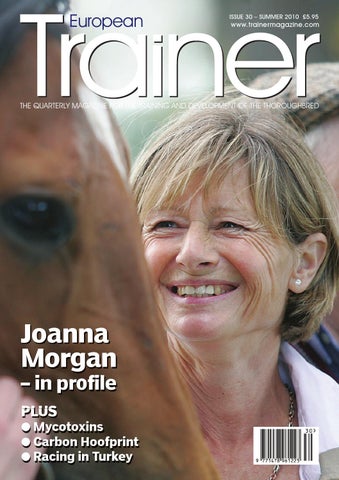
Joanna Morgan – in profile Publishing Ltd
PLUS G Mycotoxins G Carbon Hoofprint G Racing in Turkey
ISSUE 30 INSIDE COVERS REAL:Layout 1
24/5/10
10:49
Page 1
INTRO issue 30.qxd:Jerkins feature.qxd
20/5/10
12:15
Page 1
Introduction Giles Anderson
Our cover profile is on the much-travelled Irish trainer Joanna Morgan. Joanna has built her reputation over a number of years and as Lissa Oliver found out on her recent visit to Joanna’s County Meath base, Joanna is the sort of trainer who is always going to give her owners their money’s worth, and is never afraid to try a horse at a big meeting.
Win, lose, or draw, the horses are always given the chance to run. One such horse that sticks in my memory was One Won One. I remember that this horse was owned by a group of priests under the name of the Heavenly Syndicate and during his nineyear career the horse made 110 starts and, apart from being a regular at all the major Irish festivals, he ran in Dubai, Abu Dhabi, Hong Kong, New York, Royal Ascot and Glorious Goodwood. As you’ll find out when you read her story, Joanna’s horses are mostly kept in their paddocks, which certainly must explain why some of her horses keep on running. Trainers hone the tools of the trade for racing and it’s of no surprise that they, quite rightly, must be able to express their opinions as to the way the sport should be run. Joanna certainly has her opinions but Maria Lamm goes one step further in her article examining using the betting platform to fix racing’s financial problems. Maria is the Vice Chairman of the European Trainers’ Federation and when she’s not involved with horses, she can be found working as a lawyer in Stockholm. Over the last few years I’ve talked at length with Maria about her ideas and have encouraged her to put her thoughts to paper, and the result is her very incisive study which is published in this issue of the magazine. A different and pragmatic approach to maximising revenue is close to the hearts of those at the core of the industry, and given the fact that across Europe bookmakers are seemingly allowed to trade across boundaries, Maria’s ideas are at least worth exploring. In this issue, we examine the causes and treatments of tibial stress fractures and discover that they are more common than we might think but learn that they can be less severe than feared. James Tate gives us some practical advice for treatment. We also take a look at how trainers can reduce their “carbon hoofprint”; whether boots are a good solution to better protect lower limbs; and we discuss a subject that you’re going to be hearing plenty about this summer – mycotoxins. All this plus an introduction to the growth of the racing and breeding business in Turkey, and Katie Roebuck finds out if it is easy to “import” stable staff from outside the EU. With a packed-full issue to read, I hope you get some time to train your horses! I ISSUE 30 TRAINERMAGAZINE.com 01
C HEAD issue 30.qxd:Jerkins feature.qxd
21/5/10
13:31
Page 1
Chairman’s message
CRIQUETTE HEAD I write following a fantastic Guineas weekend for the French, an historic double which has never before been completed. Special Duty’s success in the 1000 Guineas did not come as I would have wished, and victory in the Stewards’ Room always leaves a bitter taste even if the video shows that victory was awarded to the best filly.
I
FEEL for the connections of Jacqueline Quest as it is always terrible to lose a race in such circumstances and I applaud the fantastic reaction of Henry Cecil who was so sporting in accepting defeat. A re-match is possible in the Coronation Stakes and if both fillies make it to Royal Ascot it will be interesting to see the outcome. In racing as in society, we must live by the rules. Although this has been a busy time at both the stud and the stable, it has been interesting to see some important topics raised during the Asian Racing Conference. Edouard de Rothschild declared that the French doctrine for
interference will not change, and while I think we should all be willing to make a simultaneous effort to our rule books, we must also realise that it is normal that our codes differ. Each country’s rules are adapted to their betting offer and in France the dominance of combination bets such as the Quinté means that our racing rules must protect the betting public. The whip was also discussed in Sydney. I feel that it would be crazy, and dangerous, to completely forbid the use of the whip in races as it helps jockeys to keep their horses straight and avoid trouble. However we must be aware of the image of racing on the general public and I am in favour of the softer whip which is used in
England and will shortly be introduced in France, as well as a limitation on the number of strokes of the whip. Public opinion is important and although we should not react excessively, it is imperative that racing demonstrates that horses’ welfare is a central concern for us. Above all, I believe that racing should be promoted as a sport. The free racedays held recently in England are a good idea and in France a similar initiative, the “Dimanches au Galop”, has been in place for several years now with positive results. It is important that the public can come to the races and see that both horses and jockeys are true athletes. I
“I feel that it would be crazy, and dangerous, to completely forbid the use of the whip in races as it helps jockeys to keep their horses straight and avoid trouble” 02 TRAINERMAGAZINE.com ISSUE 30
C HEAD issue 30.qxd:Jerkins feature.qxd
21/5/10
13:31
Page 2
Contents issue 30.qxd:Jerkins feature.qxd
21/5/10
13:44
Page 1
CONTENTS ISSUE 30
10 TRM Trainer of the Quarter
Ten-time champion trainer Henry Cecil.
12 Joanna Morgan
Lissa Oliver visits with the hard-working Joanna Morgan, who is a woman with strong opinions and who approaches everything with her own style.
18 Carbon Hoofprint
42 Mycotoxins – Health or Hype?
Increased awareness of mycotoxins means we need to have a greater understanding of what they are and how best to avoid them. By Dr Catherine Dunnett.
46 Betting Platform
A possible solution to the financial struggles with which racing is faced, by Maria Lamm
Tamara Farrant suggests ways in which racing yards can reduce their carbon hoofprint as well as minimise carbon dioxide’s ill-effects on racehorses.
50 Employing Staff from outside the EU
As Turkey is becoming a force to be reckoned with in the industry, we learn about the past, present, and future of racing in the country, by Michele MacDonald.
56 Mark Johnson
22 The Advance of Turkish Racing
28 Tibial Fractures
How tibial stress fractures are a fairly common and not necessarily serious injury, by James Tate.
34 To Boot or Not to Boot
Katie Roebuck tells us why employing foreign stable staff is becoming more difficult in a time of recession Step into the announcer’s booth at the home of the Kentucky Derby and meet racecaller Mark Johnson, by Geir Stabell.
60 Product Focus 68 Stakes Schedules
Forthcoming stakes races from Europe and around the world.
Dr David Marlin weighs the positives and negatives of using boots on a racehorse.
34 04 TRAINERMAGAZINE.com ISSUE 30
46
Contents issue 30.qxd:Jerkins feature.qxd
21/5/10
13:44
Page 2
Contributors issue 30.qxd:Jerkins feature.qxd
21/5/10
13:29
Page 1
CONTRIBUTORS
Publisher & Editorial Director Giles Anderson Assistant Editors Frances Karon, Sophie Hull Design/Production Neil Randon Advertising Sales Giles Anderson Circulation Pippa Anderson Photo Credits
Caroline Norris, Churchill Downs, James Tate, Jenny Doran, Fiona Boyd, Karen Coumbe, Michele MacDonald, Hugh Routledge, Dr Keith Foster, Thoroughbred Photography, Frank Sorge, Shutterstock
Cover Photograph Caroline Norris
Trainer Magazine is published by Anderson & Co Publishing Ltd. This magazine is distributed for free to all ETF members. Editorial views expressed are not necessarily those of the ETF. Additional copies can be purchased for £5.95 (ex P+P). No part of this publication may be reproduced in any format without the prior written permission of the publisher. Printed in the European Union For all editorial and adver tising enquiries please contact Anderson & Co Publishing Ltd Tel: +44 (0)1380 816777 Fax: +44 (0)1380 816778 email: info@trainermagazine.com www.trainermagazine.com
06 TRAINERMAGAZINE.com ISSUE 30
Dr Catherine Dunnett BSc, PhD, R.Nutr. is an independent nutritionist registered with the British Nutrition Society. She has a background in equine research, in the field of nutrition and exercise physiology, with many years spent at The Animal Health Trust in Newmarket. Prior to setting up her own consultancy business, she worked in the equine feed industr y on product development and technical marketing.
Michele MacDonald is an awardwinning writer, editor, photographer and marketing and media consultant with more than two decades of experience in Thoroughbred racing. Based in Lexington, Kentucky, she has covered major racing and sales events in North America, Europe and Asia. She also has edited two books on horses honored with national prizes in the United States.
Tamara Farrant took a degree in animal science, before training as a journalist and joining Farmers Weekly. Since then she has combined science and business reporting for rural and equestrian audiences. As a teenager she rode out for several trainers, including her father John Farrant, and competed in a range of horse disciplines. Now weekends are spent at shows and events with her two daughters.
Lissa Oliver lives in Co Kildare, Ireland and is a regular contributor to The Irish Field and the A ustralian magazine, Racetrack. Lissa is also the author of several collections of short stories and two novels.
Maria Lamm has been in racing since the mid-’70s as an owner, amateur trainer, and former amateur rider, and has been Vice President of the ETF since 2008. As a member of the Swedish Bar Association, she practices business law and lectures at the Stockholm University. A career outside of horseracing has given her a different perspective on the industr y in relation to EC law, competition law, and human rights. She has been interested in a sustainable legal system to finance racing. Dr David Marlin is a specialist in exercise physiology, thermoregulation, transport, and respiratory physiology. He has authored over 170 scientific papers and book chapters, and Equine Exercise Physiology. Marlin is International Board Chairman of the International Conference on Equine Exercise Physiology, editor of Comparative Exercise Physiology, and holds visiting Professor positions at the Universities of Bristol, Nottingham, and Oklahoma State. He works as a consultant to the racing industr y, the British Equestrian Teams, the FEI, and the Inter national League for the Protection of Horses.
Katie Roebuck is an NCTJ journalist who began her career at The Sporting Life in 1993. She then spent ten years working in television news – culminating at BBC News as a senior spor ts news producer. More recently Katie was south west correspondent for Farmers Guardian newspaper; she became a freelance journalist at the start of 2009 and is regularly writing for equestrian and farming publications. Geir Stabell, founder and Editor of Globeform has worked with many leading publications which include; The Sporting Life, Paris-Turf, Blood-Horse, Racing World, Ridsport and the Irish Field. He was also international handicapper to the Racing Post for seven years,where he introduced European style ratings in North America, Australia, Japan and Hong Kong. He has also worked as a TV presenter & exper t guest in Scandinavia and USA. James Tate BVMS MRCVS qualified as a veterinary surgeon from Glasgow University and his career started with mixed practice in Cumbria. He is from a family steeped in horseracing. His father, Tom Tate, is a dual purpose trainer, his father-in-law, Len Lungo, is a National Hunt trainer, and his Uncle, the legendar y Michael Dickinson, has just retired from the training ranks. James is currently the resident senior vet for leading flat trainer Mark Johnston, a position which he has held since the star t of 2006.
Contributors issue 30.qxd:Jerkins feature.qxd
21/5/10
13:29
Page 2
EFT REPS issue 30.qxd:Jerkins feature.qxd
20/5/10
18:40
Page 1
EUROPEAN TRAINERS’ FEDERATION AIMS and OBJECTIVES of the ETF:
a) To represent the interests of all member trainers’ associations in 3Europe. b) To liaise with political and administrative bodies on behalf of European trainers. c) To exchange information between members for the benefit of European trainers. d) To provide a network of contacts to assist each member to develop its policy and services to member trainers.
ETF REPRESENTATIVES Chairmanship:
Criquette Head-Maarek Association des Entraineurs de Galop 18 bis Avenue du Général Leclerc 60501 Chantilly FRANCE Tel: + 33 (0)3 44 57 25 39 Fax: + 33(0)3 44 57 58 85 Email: entraineurs.de.galop@wanadoo.fr
Vice Chairmanship:
Max Hennau FEDERATION BELGE DES ENTRAINEURS Rue des Carrieres 35 5032 - Les Isnes BELGIUM Tel: Fax: +32 (0)81 56 68 46 Email: max.hennau@mobistarmail.be
GERMANY
Vice Chairmanship:
Jim Kavanagh IRISH RACEHORSE TRAINERS ASSOCIATION Curragh House-Dublin Road Kildare-Co.Kildare IRELAND Tel: +353 (0) 45 522981 Fax: + 353 (0) 45 522982 Email: irishrta@eircom.net www.irta.ie
SPAIN
NORWAY
Erika Mäder Jentgesallee 19 47799 Krefeld Tel: +49 (0)2151 594911 Fax: +49 (0)2151 590542 Mobile: +49 (0)173 8952675 Email: trainer-und-jockeys@netcologne.de
Mauricio Delcher Sanchez AZAFRAN, 5- 3ºM MAJADAHONDA 28022 Madrid Spain Tel: +34 (0)666 53 51 52 Email: mdelcher@hotmail.com
CZECH REPUBLIC
UNITED KINGDOM
Jan Demele CZECH JOCKEYS AND TRAINERS ASSOCIATION Radotinska 69 Praha 5-Velka Chuchle 150 00 Contact: Roman Vitek Mobile: +42 (0)606620591 Email: drvitek@email.cz
08 TRAINERMAGAZINE.com ISSUE 30
Treasureship:
Maria Lamm Dåntorp, 136 50 Haninge Sweden Tel: +46 (0)8500 20938 Fax: +46 (0)8500 25250 Mobile: +46 (0)70 7560 769 Email: ml@marialamm.se
Rupert Arnold NATIONAL TRAINERS’ FEDERATION 9 High Street - Lambourn - Hungerford Berkshire RG17 8XN Tel: +44 (0)1488 71719 Fax: +44 (0)1488 73005 www.racehorsetrainers.org
Sven-Erik Lilja Eventyrveien 8, 1482 Nittedal Norway Tel: +47 (0) 67 07 14 12 Mobile: +47 (0) 91 12 88 96 Email: svelilja@nokab.no
SWEDEN
Fredrik Reuterskiöld Swedish Trainers Association South Notarp 3228 S-243 92 Hoor Tel: +46 (0)413 55 00 65 Fax: +46 (0)413 55 04 95 Mobile: +46 (0)70 731 26 39 Mr Claes Björling Swedish Trainers Association North Karlaplan 10 115 20 Stockholm Sweden Mail: worldracing@hotmail.com Tel: +46 (0)8 662 46 79 Mobile: +46 (0)708 756 756
EFT REPS issue 30.qxd:Jerkins feature.qxd
20/5/10
18:40
Page 2
TRM issue 30.qxd:Jerkins feature.qxd
20/5/10
20:33
Page 1
Henry Cecil (right) with Aviate and jockey Eddie Ahern after victory in the Tattersalls Musidora Stakes at York
The TRM Trainer of the Quarter award has been won by Henry Cecil. Cecil and his team will receive a selection of products from the internationally -acclaimed range of TRM supplements worth â‚Ź2,000, as well as a bottle of select Irish whiskey .
TRM Trainer of the Quarter
HENRY CECIL
10 TRAINERMAGAZINE.com ISSUE 30
TRM issue 30.qxd:Jerkins feature.qxd
T
20/5/10
By Sophie Hull
HE name Henry Cecil is synonymous with success. From the very beginning, when Wolver Hollow took the Eclipse Stakes in Cecil’s first year as a licensed trainer, back in 1969, everything has pointed towards greatness. He has been champion trainer ten times and his success in domestic Classics is unrivalled – he has won the Derby four times, the Oaks eight (a record-equalling feat) and the St Leger, 2,000 and 1,000 Guineas at least twice each. After a spell out of the limelight, Multidimensional and Passage Of Time announced his return in 2006, both winning in France (Gr2 and Gr1 respectively). In 2009 Cecil was once again in the top ten of UK trainers,
20:33
Page 2
saddling over 60 winners, most notably Midday and Twice Over, both owned by Prince Khalid Abdullah. 2010 began in style in January when Zerzura broke his maiden at Wolverhampton, and since then the Warren Place team have gone from strength to strength, where the last week (11th-17th May) has seen them win no less than nine times. The highlight of the week was undoubtedly Cecil recording a Stakes treble on 14th May, when Manifest triumphed over a good field to take the Gr2 Yorkshire Cup by eight lengths, swiftly followed by Principal Role in the Listed Swettenham Stud Fillies’ Stakes at Newbury and Chachamaidee in the Listed Michael Seely Memorial Stakes at York. Manifest now looks to be heading for the Gold Cup at Royal Ascot, which would give Cecil great
pleasure – in his own words “I love Cup horses and he could just make into a nice one. [...] It’s entirely up to the Prince [Khalid Abdullah, owner of the horse] if he would like to run him or not.” May has also seen the improving Bullet Train take the Lingfield Derby Trial by nearly three lengths, which may have gone some way towards tempering the disappointment of Timepiece’s defeat in the Listed Oaks Trial at Lingfield and the disqualification of Jacqueline Quest in the 1,000 Guineas. With promising entries in the Irish 1,000 Guineas, the Coronation Cup, the Oaks and the Derby to look forward to in the very near future, the Group 1 flag might be flying over Warren Place again very soon! I
ISSUE 30 TRAINERMAGAZINE.com 11
JOANNA MORGAN ISSUE 30.qxd:Jerkins feature.qxd
20/5/10
18:08
Page 1
PROFILE
JOANNA MORGAN I defy anyone to visit the Portlester yard of Joanna Morgan, in Ballivor, County Meath, and return home still under the belief that stabling is the best policy for racehorses. Five minutes in the company of Mo rgan is enough to convince you otherwise, never mind the obvious proof in the well being of her h orses. By Lissa Oliver
T
HE fact that I managed to pay my visit on a bitterly cold and miserably wet day (not difficult in Ireland) did nothing to alter that opinion and Raise Your Heart, recently returned from the far different climes of Dubai and living out day and night since, showed a definite reluctance to be caught, until he realised it was merely for a photo shoot. “Stables are a hindrance”, Morgan says fervently. “Horses need to be in their natural environment; they’re a herding animal. They should be out grazing with their pals around them.” All of her horses are doing just that and none of the negatives raised by other trainers in the pros and cons debate on this topic are applicable. “You wouldn’t lock an athlete up in his room for 23 hours a day and expect him to be able to put in an effort for an hour in the morning!” she rightly argues. “I’m totally against it. It just dates back to years of the old regime.” Last year Morgan built 17 new boxes – “a nightmare”, as she described the intrusion of builders. Having only chatted with her for a short while, I already get the impression she would do everything herself, if she were able. All the new boxes are now
12 TRAINERMAGAZINE.com ISSUE 30
filled and her string has risen from the usual 30 of previous years to 50. Her high profile and prolific winners have allowed the recession to pass her by, unaffected. She is also being sent a far better class of horse than in previous years, so her steady rise is likely to continue. I didn’t discuss fees, but the obvious benefit of training from the field, as Morgan does, is the lack of need for supplements and medication aimed at counter-acting the many problems of stabling. Gastric ulcers, set-fast, and respiratory disease are strangers to the Portlester team. “If he was stabled”, Morgan tells me as we stand in the field with Raise Your Heart, “he would be costing me €28 a day on ulcer medication.” Neither are there any supplements in the feed room. “They graze naturally for 18 hours a day and they walk for something like 18 miles a day in the course of grazing”, Morgan points out. “They’re already getting all the nutrients they need from grass alone.” While they are usually supplemented with a hard feed – a 14% racing mix – even that is unnecessary when they start to fill out on May grass. There is one negative and one alone: stone bruises. “I’d keep them out all year round if I could”, Morgan insists, “but when
the ground is very wet they get stone bruises, so I have to fetch them in.” The Irish weather is very much against her and, with only 40 acres, she must preserve her grazing during the winter months by limiting turn out, which is otherwise normally 24 hours a day, seven days a week. “Originally when the aristocracy owned racehorses they wanted to visit their horse in a clean stable and see a clean horse”, Morgan explains, “and nothing has changed since. Much of racing is archaic, that’s the trouble. I treat my horses as animals, not as hothouse flowers. It’s maybe more work, very tiresome, taking food out to them, fetching them in and out when necessary, and it’s more messy. But most of the prevalent problems – ulcers, tying-up, respiratory – none of those happen. They have to be healthier and fitter. It’s living as nature intended them to.” Morgan puts them out in groups of six, of separate sexes. Her stables are open, every horse able to see its neighbours and interact, even when in. “The barn is open plan. Fresh air is very important”, says Morgan as she shows her new boxes, not the usual American barn design. “They can all see each other and have contact with their neighbours; they’ve already become
JOANNA MORGAN ISSUE 30.qxd:Jerkins feature.qxd
21/5/10
13:46
Page 2
JOANNA MORGAN
Morgan with Lee the Alsatian
ISSUE 30 TRAINERMAGAZINE.com 13
JOANNA MORGAN ISSUE 30.qxd:Jerkins feature.qxd
20/5/10
18:09
Page 3
PROFILE
friends and got their own buddies before they’re turned out. There’s the odd bit of kicking, but nothing serious and we don’t put hind shoes on them. They soon establish a pecking order and settle down.” Neither does Morgan experience any feeding difficulties. The worst doers usually thrive once they are turned out day and night and Morgan likes to feed four times a day, feeding haylage ad lib, “I’d use meadow hay in preference, but you just can’t get it here”, and taking round the last feed and hay herself at ten in the evening. “They’ve a very long intestine and a very small stomach,” Morgan points out, “the food intake is always slowly filtering through. There’s no problem fetching them
14 TRAINERMAGAZINE.com ISSUE 30
“Stables are a hindrance. Horses need to be in their natural environment; they’re a herding animal. They should be out grazing with their pals around them” out of the field and straight onto the gallops. Even when they’re full up on rich May grass they blow far less when they work than a stabled horse.” The natural movement involved in grazing also has its fitness benefits. “I do
very little work with them,” Morgan explains. “I never ask them hard questions at home. I won’t work them upsides, I hate that. That’s why they retain their enthusiasm. When you see horses being worked upsides each other twice a week
JOANNA MORGAN ISSUE 30.qxd:Jerkins feature.qxd
20/5/10
18:09
Page 4
JOANNA MORGAN
they lose their competitive edge, they lose their confidence. I like to see them happy and enjoying themselves.” This is probably why the best known of Morgan’s winners have been prolific, with Dbest notching up 13 wins, Portant Fellar winning 15 times, Orpailleur and Jawad each winning eight, and globetrotting Group winner One Won One even trying his hand at hurdles as an 11-year-old, never losing his zest for racing. Perhaps the same could be said of Morgan, who was still enjoying life as a jockey up until 1997 and partnered One Won One as a twoyear-old. “I started off in point-to-points in Wales”, she says, “and came to Ireland to
ride for Seamus McGrath as a holiday job. Giving licences to lady jockeys was a new innovation then and I signed on with him as an apprentice for the next six to eight years.” In 1976 she became the first woman to ride in an Irish Classic, partnering Riot Helmet in the Irish Derby, and during her career rode over 200 winners, riding a winner on every continent. She took out her first licence to train in 1985, while still riding. “I rode in Australia for three months and I broke my leg”, Morgan recalls, “so I spent time going around with the vets, helping out and learning all the time. I also spent three months in America. Every country is different, all have their own methods. I
wouldn’t just ride out for a trainer in the morning and go home, I’d go back in the afternoon and observe.” In any recession the weak disappear and the fact that Morgan has never been busier says it all. But still, there must surely be a negative? No matter how I push, or how hard Morgan thinks about it, we can’t come up with one. Her horses suffer none of the problems associated with stabling, they’re fit, healthy, and show an enthusiasm for racing combined with soundness, keeping them going from season to season. It’s only when we discuss the infrastructure of Irish racing itself that negatives start to appear. As in her approach to training, she keeps things simple and logical.
Imperial Belle with Amy Parsons walks back to the yard af ter work
Morgan keeps her horses outside in their natural environment as much as possible ISSUE 30 TRAINERMAGAZINE.com 15
JOANNA MORGAN ISSUE 30.qxd:Jerkins feature.qxd
20/5/10
18:09
Page 5
PROFILE
“I’m very glad to see we’re back under the banner of Agriculture, rather than Sport and Tourism. We’re definitely agricultural and represent a huge value to the economy.” Indeed, the Irish bloodstock industry represents €1.1 billion gross value to the economy, with exports in excess of €180 million annually. “The biggest problem with Irish racing is probably half the people who run it!” Morgan insists. “It should be run as a business. It’s archaic and is still being run the same way it was centuries ago. It’s a business and there should be businesspeople running it. There’s no control; we’re losing too much to bookmakers and the internet.”
“The biggest problem with Irish racing is probably half the people who run it! It should be run as a business. It’s archaic and is still being run the same way it was centuries ago” Morgan cites Australia as the perfect system. “They have a Tote monopoly and have on-course bookmakers, which encourages the punter to go racing. It’s
Morgan with A Hit Is A Hit (lef t) and Raise Your Heart
16 TRAINERMAGAZINE.com ISSUE 30
bloody expensive to have a pitch at the course, they need to lay. A punter can put big money on and still get good odds; they encourage the punter to go racing. The French also have the Pari-Mutuel; it keeps the money in racing, and look at how wealthy France and Australia are.” Neither is Morgan happy with the management of racecourses in general. “There is no organisation and [is] a total lack of common sense. Racecourses should be run by hoteliers. They’re trained specifically to provide a top class service to the public. The country tracks are far from perfect but they’re desperately underfunded and with limited resources they’re doing their best. But for a premier track the Curragh has no excuse.” Morgan was particularly annoyed by the condition of the track on the opening day of the season and the fact that up to 30 horses were allowed to work on it after racing, as well as staging an apprentice practise race on it a few days later. “That just could not happen at Longchamp or Newmarket and there’s no excuse for it.” She also lists serious safety issues to be found in many of the racecourse stables around the country. “The Calendar is another problem. In the first month of the new Flat season there was no racing on a total of 10 days. Either the season has started or it hasn’t! The allweather should have a meeting twice a week. When the season opens we should go for it, with racing every day. There’s no opportunity for a progressive handicapper to notch up a decent series of wins.” During this heated discussion much of what Morgan has said has been interspersed with “for God’s sake don’t print that, I’ll be lynched!” but it’s her obvious passion and dedication to the sport she so loves that engenders such forthright remarks. Coupled with her undeniable expertise, that is what makes Joanna Morgan a successful trainer even in the hardest of times and it is little wonder that we can see that same enthusiasm and passion exemplified by her horses. She is, if you’ll excuse the pun, truly outstanding in her own field. I
JOANNA MORGAN ISSUE 30.qxd:Jerkins feature.qxd
20/5/10
18:09
Page 6
CARBON HOOFPRINT ISSUE 30.qxd:Jerkins feature.qxd
21/5/10
15:01
Page 1
BUSINESS
Global warming and carbon emissions are affecting results on the track as well as profitability, and there are numerous ways in which racing stables can reduce their carbon hoofprint. By Tamara Farrant
T
RAINERS are judged by their horses’ performance on the track, so training regimes, feeding, facilities, and management are all honed to give every animal its best chance of success. While the sciences of physiology, nutrition, and psychology are already wellestablished, the organic chemistry involved in the carbon cycle could provide an edge in performance, profitability, and appeal to owners. Global warming has a direct influence on any trainer’s key criteria: winning. Carbon dioxide levels are nearly double what they were 200 years ago. Over that same time period oxygen levels have more than halved. Because oxygen levels in the bloodstream reflect the atmospheric levels, the oxygen in the blood of horses has also effectively halved. To make the problem worse for a racehorse, as lactic acid builds up during exercise it becomes harder for working muscles to use the depleted oxygen and muscles become tired. A meaningful target to give horses an edge is to have the carbon dioxide in their blood reduced to a minimum level. This can be done by reducing the carbon dioxide entering the bloodstream from the gut during the digestion process. To achieve this, Dr Keith Foster, an innovator in the field of natural animal care, started looking at charcoal, which wild horses are observed eating. “Rather than address acid in the hind gut,
Active charcoal under an electron microscope
18 TRAINERMAGAZINE.com ISSUE 30
which is for probiotics and other feed additives, I wanted to see if we could take acid and other nasties out before it got there”, he said. Charcoal has a history of over 4,000 years of use as an antidote to poison and as a digestive aid. Dr Foster has developed a processing technique that activates the charcoal sufficiently so that it will remove carbon dioxide, acid, and toxins from food in the gut, but not so active that it starts to remove beneficial nutrients. With carbon dioxide removed, the oxygen has greater opportunity to cross into the bloodstream. The higher level of oxygen in the blood, as all trainers and athletes will know, improves performance, healing, and stamina. Understanding the science of carbon dioxide could also help reduce bills. The average European is responsible for ten tonnes of carbon dioxide emissions a year. Carbon dioxide is the main emission from burning fuel, which is where most advice on reducing emissions is focused. For horse businesses, however, there are two other essential areas of gas emissions: management of manure and care of pasture. Importantly, manure produces far worse greenhouse gases than carbon dioxide. Methane is a greenhouse gas that is 21 times more harmful than carbon dioxide. Even worse is nitrous oxide, which is 310 times worse than carbon dioxide. These numbers are the carbon equivalent of a gas, which gives us a true measure of the output of activity for the different kinds of greenhouse gases we produce. Canadian researcher Gurpreet Singh compared emissions from two 50 tonne piles of dung – one which he mixed and kept well aerated, and the other untouched. The static pile generated 233kg of equivalent carbon dioxide emissions per tonne, while the turned pile emitted a mere 92kg of equivalent carbon dioxide. This is a massive difference and must encourage anyone not regularly sending their manure away for composting to look again at what they can do. If you want a DIY approach use the fork or bucket on a tractor to turn it every three or four weeks. Alternatively it can be aerated by forcing a crow bar into the heap to create air channels. If it is not raining regularly it may need to be watered to keep it moist. If the composting is not progressing as
quickly as hoped, a sprinkling of lime creates a better environment for the microbes to multiply. Putting a cover over the manure or throwing in a few shovelfuls of dirt to provide soil microbes are other ways of improving the end result. If conditions are good you should get useable compost with one turning over six to eight weeks. A significant portion of carbon in organic material is likely to be returned to the atmosphere as carbon dioxide, but composting is seen as positive because the alternatives are worse. Fossil fuels are not used to transport the manure off site. If compostable materials are left to rot or go to landfill they will produce methane – which is a far worse greenhouse gas than carbon dioxide. Alternatively, composting without air can be commercially harnessed. In these
CARBON HOOFPRINT ISSUE 30.qxd:Jerkins feature.qxd
21/5/10
15:02
Page 2
CARBON HOOFPRINT
Tackling the Carbon Hoofprint anaerobic digesters, the biogas formed, which is mainly methane, has a value of 6.4kWh/Nm3. This compares with 10kWh/Nm3 for natural gas. Digesters are popular in Germany where they have been installed on over 1,000 farms. Some of these digesters do accept horse manure, which has a similar calorific value to cattle manure, producing 20m3 of biogas per m3 of manure. The largest biogas plant taking horse manure is Essen, which takes in 2,750 tonnes of horse manure a year. As yet no European country is composting horse manure on the scale of the U.S. state of Michigan. There, 11,000 tonnes per year is mixed with wood chips to produce electricity for about 35,000 Michigan homes. Another positive reason for making your own compost is to reduce your bill for fertiliser, which leads to another area where
trainers can make a significant difference to carbon levels. The healthier your grass and soil, the more carbon it will be able to lock up. Healthy grass is better able to use the nitrogen available to it and also means a healthy root structure, which again locks up carbon. Poor, thin soils will lock up around four tonnes of carbon a hectare, compared with 40 tonnes for top quality turf. This will be lost if the ground is ploughed or poached. Compost-rich soil also requires less irrigation because the healthier root systems of the grass can store more water. This will also reduce runoff and cut the risk of erosion. Healthy roots can reduce irrigation needs by 30% to 70%, another very important eco-friendly criteria for turf gallops. To maintain gallops in good condition,
whether they are grass or all-weather, every trainer will have a tractor. In many cases these will be a weak point for emissions, often being old and poorly maintained. It is common sense that fuel consumption will be minimised when tyre pressure is correct and the vehicle is regularly serviced. Also, instead of racing through the job, take time to check the revs. These should be below 2,000rpm. For best fuel consumption revs should be around 1,650rpm. Moving in to the stable yard, the largest energy bill is likely to be heating the water for washing down. A typical large yard will have a 500 litre tank. If all the water is heated to 40ºC above the cold water temperature twice a day, the electricity needed is 3.86kW. At a cost of €8 per kW this is €30.88 a day. If used every day from the beginning of October to the end of March this is €5,558.
ISSUE 30 TRAINERMAGAZINE.com 19
CARBON HOOFPRINT ISSUE 30.qxd:Jerkins feature.qxd
21/5/10
15:02
Page 3
BUSINESS
With costs such as this it makes sense to look at heating sources which once installed have negligible costs. One of the most traditional forms of heat that is ideal for trainers with a source of cheap timber is a wood-burning boiler stove. These can typically deliver 3kw of heat to a room – ideal for drying rugs – and around 15kW for hot water and radiators. The cost of installing these is from €1,400 to €5,000, which in many cases makes sound economic sense. Burning wood in this efficient way is actually carbon neutral, as the amount of carbon the tree absorbed during its lifetime makes up for the amount released on burning it. Other ways of heating the water from renewable sources are solar water heaters and ground source heat pumps. Solar water heaters will cost from €1,000 to €5,000, depending on how large or advanced you wish to go. However, at the times when you most want the hot water – during the winter months – the heating will be at its least effective. More reliable are ground source heat pumps that transfer heat under the ground into a fluid-filled pipe. The downside of the horizontal slinky-style pipes is that laying the trench can be disruptive, although not a problem if you are looking at a new build. Some companies offer a borehole option that goes down vertically. In the closed loop system a single U-shaped plastic pipe loop circulates water with an antifreeze, usually brine. The solution extracts heat from the borehole and delivers heat to the pump, where the heat is extracted from the water before returning to the ground. The plant above ground is no bigger than a domestic fridge. Water bill savings are an additional benefit of the open loop system. In these, groundwater is abstracted and circulated Some biogas plants can take in 2,750 tonnes of horse manure a year
20 TRAINERMAGAZINE.com ISSUE 30
“Rather than address acid in the hind gut, which is for probiotics and other feed additives, I wanted to see if we could take acid and other nasties out before it got there” Dr Keith Foster directly through the heat pump. Due to the conductive nature and specific heat capacity of groundwater, an open loop system can deliver a large amount of energy from a single well. Water is abstracted from the borehole, passed through a heat exchanger/pump system, and then either used as part of a grey water supply system or discharged to a surface water system. Iain Waugh, drilling manager of a leadinng UK drilling company, explained: “On a closed loop typically a 100 metre borehole provides 5kW. On the open system a borehole producing 10 cubic metres/hour can supply 80kW. Drilling costs can vary depending on the geology and thermal response although expect a minimum of £15,000.” Several European countries now offer to pay small producers for any surplus electricity they generate from their own
systems, which gives an incentive to set against the installation costs. Wind turbines or photovoltaic systems that convert the sun’s radiation into electricity are becoming more popular. In Germany there is a booming industry in photovoltaic panels, and by 2015 the country expects to generate 12GW from these, which will account for 15% of renewable sources. Photovoltaic systems have come down in price in recent years but are still at least €6,000. Wind turbines are cheaper at €1,500, but this domestic type of turbine only produces about 500kWh of electricity a year. Although all these large schemes catch the imagination, the basic energy-saving tips given for the house should be applied in the stables. Changing the old halogen bulbs to the new compact fluorescent bulb will save around €7 a year per bulb. Assuming 60 bulbs in the yard this comes to €420 a year, and they should last ten times longer than the old bulb. Understanding the carbon cycle and energy consumption is relevant to the horse world. Realising that a racetrack on the outskirts of a town where car fumes can be trapped could reduce a horse’s stamina and finding ways of boosting circulating oxygen in the blood are important. At the yard, greener energy sources can be implemented that could also, in the long term, reduce bills. And last but not least, as more people come to understand the significance of our activities, carbonfriendly trainers who have energy saving practices and who compost the stables’ manure may become the choice of discerning owners. As every business needs to differentiate itself from its rivals, some might find it worthwhile using a low carbon hoofprint to attract new owners. I
CARBON HOOFPRINT ISSUE 30.qxd:Jerkins feature.qxd
21/5/10
15:02
Page 4
TURKEY ISSUE 30.qxd:Jerkins feature.qxd
RACING
22 TRAINERMAGAZINE.com ISSUE 30
20/5/10
20:13
Page 1
TURKEY ISSUE 30.qxd:Jerkins feature.qxd
20/5/10
20:17
Page 2
TURKEY
The advance of Turkish racing ISSUE 30 TRAINERMAGAZINE.com 23
TURKEY ISSUE 30.qxd:Jerkins feature.qxd
20/5/10
20:17
Page 3
RACING
For centuries extending back to the Roman Empire, Turkey and its cosmopolitan center now known as Istanbul have been the crossroads of civilisations, straddling Europe and Asia and connecting the commerce, art and religions of the world. Today Turkey is diligently working to also achieve recognition as a significant new crossroads for horseracing. By Michele MacDonald
C
ONTINUING an equine sporting tradition that began with the Romans’ chariot races and which the Republic of Turkey’s founder, Mustafa Kemal Ataturk, proclaimed in the early 20th century “a social need for modern societies”, Turkish racing is taking a vibrant new shape. By importing high-profile stallions from Europe and the United States to improve domestic stock and by establishing an international festival that has drawn runners from Godolphin and The Queen, Turkish racing leaders envision a future in which their horses and racing are world renowned. Their primary goal is to be accepted as a Part I country under the rules of the International Cataloguing Standards Committee, joining the 16 major racing nations that currently hold that distinction. “It’s an important process we are in the middle of”, said Burak Konuk, assistant general manager of the Jockey Club of Turkey, which oversees international affairs as well as the quasi-governmental organization’s stud farms, equine hospitals and apprentice jockey school. “The goal of making our racing more international is an important one – to improve our local racing to an international level while also marketing Turkish horses”, he said. Turkey already has taken tremendous strides. In 2009, the nation jumped from Part III under cataloging standards, or the lowest grade for Flat racing, to Part II. Two of its international races gained Part I recognition last year in the same way that the international races in Hong Kong, also
a Part II country, are recognised. By any standard, 2010 is likely to stand as an important landmark in Turkey’s progression. The Jockey Club imported five new stallions in February, with international sire Dehere, Kentucky Derby (Gr1) runner-up Lion Heart, and successful young sires Yonaguska and Cuvee obtained from the U.S., and Powerscourt, a multiple Grade/Group 1 winner by Sadler’s Wells, acquired from Coolmore in Ireland. Also that month, 2008 Turkish Classic winner and Horse of the Year Pan River launched a stellar international campaign in Dubai, winning a $175,000 handicap over eventual Dubai Duty Free (Gr1) winner Al Shemali prior to finishing a close second in the Dubai City of Gold (Gr2) for owner and breeder Nevzat Seyok. Trainer Ayhan Kasar then sent Pan River out to a seventh-place finish in the $5million Dubai Sheema Classic (Gr1). Crossing the finish line 4½ lengths behind winner Dar Re Mi, Pan River proved fleeter on the night than such European Group 1 stars as Youmzain, Quijano and Jukebox Jury as well as American record holder Presious Passion, thus making a bold statement about the rising status of Turkish racing. And he was not the first. In 2006, Sabirli, a seven-time champion in Turkey who ranks as the nation’s leading career earner with $2,760,334, won during the Dubai International Racing Carnival, as did another Turkish champion, Win River Win. Win River Win then finished second in the $1-million Godolphin Mile (Gr2) won by Japanese champion Utopia.
“Turkish racing is advancing at a quick rate and there are several horses of the same calibre or better than Pan River currently racing in Turkey” Ayhan Kasar 24 TRAINERMAGAZINE.com ISSUE 30
Kasar, who is fluent in English and hopes to eventually race in Britain, France, the U.S. and Australia, said that as proud as he is of Pan River, the five-year-old son of Red Bishop may not even be the best horse in Turkey. “Turkish racing is advancing at a quick rate and there are several horses of the same calibre or better than Pan River currently racing in Turkey”, said Kasar. “There is no doubt that Turkish racing is currently behind some other countries, but I’m sure that in the future, Turkish horses will be seen racing around the world.” Yet Turkish racing and breeding is largely unknown in the capitals of the sport in other countries. Through membership in the Asian Racing Federation and an upcoming role as host for the 2012 Asian Racing Conference, as well as their own international racing festival held annually in early September, Turkish leaders hope to convey their accomplishments and goals to the rest of the world. Some of the numbers connected with or generated by Turkish racing, which features dirt, turf and all-weather surfaces, would be impressive anywhere on the globe. According to figures from the 2009 season provided by the Jockey Club of Turkey there were: Eight racetracks spread around the nation, with as many as six new courses being considered for the coming years. Existing tracks include Veliefendi in Istanbul, which last year replaced its dirt track with a synthetic surface; Ankara in
TURKEY ISSUE 30.qxd:Jerkins feature.qxd
20/5/10
20:18
Page 4
TURKEY
Admission to the racetracks is only about €0.47 (£0.41) for men and half that for women
the capital city; Sirinyer in Izmir, Turkey’s third largest city; Osmangazi in Bursa, the capital of the Ottoman Empire in the late 1200s and early 1300s; and the newest, Diyarbakir, which opened last September in the southeastern part of the country; A total of 2,277 races run for thoroughbreds and another 1,865 for purebred arabians; €934,757,325 (£828,803,474) wagered on track and at the Jockey Club’s about 2,000 off-track betting outlets, where a total of about 8,000 people are employed around the nation; More than €51million (£45.3million) distributed in prize money to thoroughbred owners, with the average purse per race standing at €22,447 (£19,902); Another €9,247,062 (£8,198,916) awarded to breeders in premiums; Fifty-seven domestic group stakes and the pair of Group 2 races that are included in Part I and that are the features of the annual international racing festival – the Topkapi Trophy on turf, which last year carried total prize money of $1,020,000 and was the richest mile race in Europe, and the Bosphorus Cup, a $680,000 event over 2,400 metres on turf; A total of 2,755 Thoroughbreds in training for racing, who together made 23,415 starts, and; A huge human component consisting of 5,250 registered racehorse owners, 1,195
trainers, 3,626 grooms, 492 jockeys and 580 apprentice jockeys. Fans, too, are warmly welcomed at racetracks, with family areas offering pony rides and barbecues. Admission to the racetracks is only about €0.47 (£0.41) for men and half that for women. Perhaps the most intriguing statistic is one released by the International Federation of Horseracing Authorities during its annual meeting in Paris last October. Turkey ranks far ahead of all the major European racing nations – as well as all the North and South American racing nations, Australia, New Zealand and South Africa – by the percent of training expenses covered by prize money, at 99%. “The prize money is very good, especially when you compare it to the cost of straining a horse. It is very profitable in Turkey if you own a handy racehorse”, Kasar said. “I think Turkey would compare credibly to any racing nation if you compare the return for racing a horse here.” Unlike officials in some other countries, Turkish leaders see horseracing, breeding and betting as important parts of the national economy that should be cultivated. The Jockey Club falls under the scope of the Ministry of Agriculture and Rural Affairs, which has determined that more than 100,000 people are employed either directly or indirectly in the industry. “Most of them are working in the rural area, which is very important to us”, said
Konuk, who noted that with the government’s encouragement through such initiatives as funding stallion acquisitions and offering award premiums, breeders have become more active. About ten years ago, there were only about 20 thoroughbred and arabian nurseries in Turkey; now there are about 350, Konuk said. In 2007, the national government responded to pleas from breeders and racing officials and overhauled a crushing tax structure on the sport, which had been the highest in the world among large racing jurisdictions. More funds from betting now are returned to support racing and breeding, which Ataturk initiated partly as a way for his cavalry officers to utilise their equestrian skills in the post-World War I era. Some prominent owners and breeders today are descendants of these Turkish military heroes and carry on the legacy with pride. Turkish officials also keep stud fees low as incentives for breeders and they limit stallions’ books. Each of the new stallions will be restricted to 75 nominations, with Dehere, who ranked as America’s second leading sire in 2002, standing at the highest fee: a mere €3,267 (£2,896). Lion Heart and Powerscourt will both stand for €2,800 (£2,483) while Cuvee and Yonaguska will be available for €2,333 (£2,069). The Jockey Club of Turkey stands 27 stallions, some of which they make available to breeders from other countries, and operates five thoroughbred studs. The 1,215-acre Karacabey Pension Stud Farm, consisting of a 16-box stallion complex and barns accommodating 840 mares, weanlings, and yearlings, was established about 70 kilometres from Bursa to commemorate the Jockey Club’s 50th anniversary in 2000. Fittingly, this land was used by some of the sultans of the Ottoman Empire to breed fine sporting horses centuries ago. The other primary stud, the Izmit Central Stallion Station, lies on 176 acres about a 1½-hour drive from Istanbul. Turkey’s top stallions often rotate between Izmit and Karacabey to give breeders easy access to varying bloodlines, with Dehere (who has been leased for one year from Coolmore’s Ashford Stud in Kentucky), Lion Heart and Cuvee being sent to Izmit, and Powerscourt and Yonaguska to Karacabey. Just two years ago, the Jockey Club acquired proven sires Victory Gallop, winner of the Belmont Stakes (Gr1) in the U.S., and Divine Light, a Japanese-bred son of Sunday Silence whose daughter
ISSUE 30 TRAINERMAGAZINE.com 25
TURKEY ISSUE 30.qxd:Jerkins feature.qxd
20/5/10
20:18
Page 5
RACING
Natagora reigned as Europe’s champion juvenile filly of 2007. More acquisitions probably will be forthcoming in the near future, Konuk said, as many of Turkey’s leading stallions, such as Kentucky Derby winners Strike the Gold, 22, and Sea Hero, 20, are aging. “We have to buy some new ones, but it may not be next year”, Konuk said. “We have to get permission from the Ministry of Agriculture.” Long-time consultant Jean-Pierre Deroubaix of the French Bloodstock Agency and Ric Waldman, who managed the stud career of Storm Cat for Overbrook Farm in Kentucky, have advised the Jockey Club on many acquisitions. American-bred and -raced horses have dominated Turkey’s leading sire lists. In 2009, Grade 1 winner Unaccounted For, a former resident of Lane’s End in Kentucky by Private Account, ranked as the king with progeny earnings of €3,390,671 (£3,006,341). Of the top ten sires, all but the deceased Irish champion Distant Relative were bred in the U.S. and seven were raced in America. In addition to seeking a balance of sires that are speed- and stamina-oriented, the Jockey Club follows strict criteria that call for no conformational faults and at least one Group/Grade 1 or two Group/Grade 2 victories before a stallion can be considered for purchase. An age limit of 14 also has been set for horses that are bought. Similar criteria are set for mares purchased abroad and imported, and the
“My own view is that every year we need to create new international races or open up some of our races to international horses” Burak Konuk Jockey Club has agents compile lists of mares that fit the guidelines at major sales conducted by Tattersalls, Arqana, Goffs, and Keeneland. Individual breeders then decide which mares, and sometimes foals, they want to purchase, with import restrictions limiting their acquisitions to primarily these categories. Over the past two years, 51 mares have been sent to Turkey from the U.S., 44 from Britain, 34 from Ireland, 14 from France, and one from The Netherlands. Four Turkish buyers – Cem Ozyigit, Muhsin Emirsoy, Omer Halim Aydin and Gulay Cokay – bought 21 mares at the 2009 Tattersalls December sale for a total of 332,700 guineas. And the Turks are starting to become more involved in racing other countries as well. “Something we have noticed in the last couple of years has been some of the Turkish buyers buying yearlings or breezeup horses to put into training in the UK”, said Jason Singh, Tattersalls marketing manager. Four years ago, Muanet Kitapaci’s homebred West by East became the first
The Turkish Jockey Club acquired proven sire and Belmont Stak es winner Victory Gallop two years ago
26 TRAINERMAGAZINE.com ISSUE 30
Turkish-bred horse to win a race in the U.S. with a victory at Sam Houston Race Park in Texas. Looking to the future, Konuk said officials will continue transforming Turkish racing from a local pursuit, albeit one with a long and storied past, to an international activity. Efforts range from sending apprentice jockeys trained though the Jockey Club’s two-year program at Veliefendi to work with such respected European trainers as Jim Bolger and John Oxx, to harmonising rules with other major racing nations to improving quarantine procedures and facilities. International trainers with prominent horses will be offered transportation subsidies to race in Turkey’s international races. The Turks hope to diversify from solely European-based runners at the festival and will try over time to also attract American and Japanese competitors, Konuk said. In turn, domestic participants such as the connections of Pan River are offered premiums that equal approximately 25% of the prize money their horses earn abroad. With that incentive and Pan River’s performances in Dubai, Kasar said the horse will be aimed at middle-distance races in France this summer. Just as Japan did to gain Part I status, Turkey must begin to allow more international competition within its own borders as well as send even more competitors to other areas in order to prove the worth of Turkish bloodstock. “My own view is that every year we need to create new international races or open up some of our races to international horses”, Konuk said. “It’s not easy. We’re working on this; both the Jockey Club of Turkey and the Ministry have to agree. “Of course there are some conservative people who may be scared to open the races in case foreign horses win all the prize money”, he continued. “But little by little, they see that Turkish horses can win abroad, and the only way to improve is to have that kind of competition. People are seeing that now and they have more courage to compete internationally.” Currency exchange rates of €0.4667 and £0.4138 per Turkish Lira, from 31 December, 2009, were used.
TURKEY ISSUE 30.qxd:Jerkins feature.qxd
20/5/10
20:18
Page 6
TIBIAL FRACTURES ISSUE 30.qxd:Jerkins feature.qxd
20/5/10
20:09
Page 1
VETERINARY
Tibial Stress Fractures – More Common Than You Think
Tibial stress fractures are generally perceived to be serious injuries that occur infrequently and require lengthy recovery times. However, this article will suggest that these injuries are in fact much more common than most people think and are often misdiagnosed as pulled muscles. In addition, they may not be as serious as previously thought and with the help of sequential x-rays monitoring the injury, young horses can be returned to training surprisingly quickly. By James Tate BVMS MRCVS
A
FTER winning the Group Two Royal Lodge and coming second in the Group One Racing Post Trophy as a two-year-old, hopes were high that Jukebox Jury would top the charts as a three-year-old. However, he was found to be lame behind after a routine canter in the spring. An investigation revealed that the lameness was being caused by a ‘microfracture’ of his tibia. The problem soon settled and he resumed full-speed cantering just over a month after the injury before embarking on a very successful three-year-old season, winning three Group races including the Group One Preis Von Europa in Cologne before coming a creditable second in the Grade One Canadian International.
Jukebox Jury, who fractured a tibia in the spring of 2009, seen here af ter winning the Group 1 Preis Von Europa in September
28 TRAINERMAGAZINE.com ISSUE 30
Where is the tibia? The tibia is the large bone in the hind leg between the hock and the stifle, which is the equivalent of our shinbone. Most people probably have very little to do with this bone unless they have sent horses for ‘bone scanning’ (nuclear scintigraphy). This is because tibial stress fractures are usually only diagnosed via a bone scan although sequential x-raying of the tibia is in fact more helpful – something that will be discussed later in this article. What does a horse with a tibial stress fracture look like? A horse with a tibial stress fracture is often quite lame on the day of injury but usually comes sound in approximately a week, hence the under-diagnosis of this
TIBIAL FRACTURES ISSUE 30.qxd:Jerkins feature.qxd
20/5/10
20:09
Page 2
TIBIAL FRACTURES ISSUE 30.qxd:Jerkins feature.qxd
20/5/10
20:09
Page 3
VETERINARY
injury in most yards in the country. The lower limb is often cold and free from swelling whereas the upper limb musculature of the horse is usually quite sensitive, with many of the large muscles being in spasm. If the horse is only lame for a few days it is unlikely that it will be sent for a bone scan and hence a diagnosis of a ‘pulled muscle’ is likely to be made, particularly if the horse is seen or ‘treated’ by a physiotherapist or ‘back manipulator’ in the meantime. When do they occur? Tibial stress fractures are most commonly seen in young horses especially, if they are returning from a lengthy period of enforced rest. If horses are restricted to box rest due to injury then their skeleton can become ‘soft’ and so predisposed to minor bony injuries when they are returned into full cantering. These bony injuries include wellknown problems such as ‘splints’ and sore shins but, perhaps even more commonly, tibial stress fractures. A typical scenario is a horse that has suffered an injury which may or may not have needed surgery but that required one-to-two months of complete box rest followed by a similar amount of horsewalker exercise. The horse then undergoes a period of light ridden exercise before resuming full speed cantering. However, after approximately two-to-four weeks of fullspeed cantering it is found to be lame behind. If the cause of the lameness is not obvious and the horse’s lower limb is cold with no signs of swelling or pain, then the most likely cause of such an injury in a hind leg is a tibial stress fracture. How are tibial stress fractures diagnosed? Tibial stress fractures can only be diagnosed by either bone scanning or sequential x-rays. If a speedy diagnosis is required or if the lameness persists for a while then the horse might be sent for a precautionary bone scan. This will reveal increased bone turnover in one tibia compared to the other and hence the diagnosis of a tibial stress fracture will be made. On the other hand, if a horse is found to be lame behind and a tibial stress fracture is considered to be a possible diagnosis then the tibia can be x-rayed when the horse is first found to be lame. Whilst this x-ray is unlikely to reveal any significant abnormalities, the tibia can then be re-x-rayed every few days and if there is any evidence of active new bone or ‘callus’ formation appearing on the surface of the tibia within a week or two of the onset of lameness, this signifies that the cause of the horse’s lameness was a tibial stress fracture.
30 TRAINERMAGAZINE.com ISSUE 30
Jukebox Jury had a problem in the winter with a wound on his fetlock that necessitated an enforced period of box rest. He recovered well from this but after a few weeks cantering he was found to be quite lame on his right hind. These are his sequential tibial x-rays.
1
1. The first x-ray was taken the day after he was lame following cantering and did not reveal any significant abnor malities. He remained on box rest. 2. The second x-ray taken seven days after the onset of lameness suggested that there may be a small amount of ‘new bone’ forming on his upper tibia. He was sound shortly after this x-ray was taken and so started walker exercise.
2
3. The third x-ray taken 17 days after the onset of lameness revealed a large lump or ‘callus’ of new bone on his upper tibia signifying a ‘micro-fracture’ within the bone. He resumed ridden walk/trotting exercise following this x-ray. 4. The fourth x-ray taken one month after the injury suggested that the new bone was settling and so he would soon be ready to resume full-speed cantering.
3
5. The fifth x-ray taken a few days later confirmed that the injury had settled and so he resumed full work. He did not have any further setbacks.
Why are tibial stress fractures so under-diagnosed? The main reason why tibial stress fractures are so under-diagnosed is that affected horses often come sound within a week and providing that the trainer is sufficiently patient then the tibia is likely to settle by the time the horse is returned into full work, and so an investigation is never carried out. In addition, if a physiotherapist or ‘back manipulator’ is called to see the horse, they will ‘treat’ the horse’s upper limb muscle spasm and probably advise that it undergoes a period of rest – something that will probably ensure that it has enough time off for the tibial stress fracture to settle. Why are we only learning about tibial stress fractures now? The advent of equine bone scanning in the early 1990s brought about the diagnosis of the tibial stress fracture. A bone scan measures bone turnover and it soon became apparent that the bone turnover and remodelling in a young horse’s tibia is massive and hence many horses that underwent a hind limb bone scan came back with a diagnosis of one or even two tibial stress fractures. However, these injuries started to be diagnosed with such regularity that many began to question
4
5
TIBIAL FRACTURES ISSUE 30.qxd:Jerkins feature.qxd
20/5/10
20:09
Page 4
TIBIAL FRACTURES
A sequence of x-rays of a horse that suffered a stress fracture of its lower right tibia. When the horse was first lame x-rays revealed no significant abnormalities; however, after a few days a lump of new bone (‘callus’) began to for m, signifying that the horse had suffered a tiny stress fracture.
whether they really were fractures or simply ‘normal’ remodelling within the young horse’s tibia. After x-raying the tibias of a large number of young horses, it has now become apparent that tibial stress fractures are indeed very common but the diagnosis can only really be certain if it is possible to demonstrate an ‘active’ callus forming and then settling on x-ray in the period shortly after the horse was first found to be lame. Treatment Having made the diagnosis of a tibial stress fracture in a horse that is probably sound by the time of diagnosis, the question is then posed – how long should the horse be rested? A few years ago, most tibial stress fractures were treated with one month or more of box rest. However, as veterinary surgeons have become more familiar with these injuries, they have tried to reduce the amount of rest that a horse requires to recover. It is at this point I would like to suggest that most tibial stress fractures should actually be managed more like severe sore shins. Sore shins are caused by micro-fractures in the horse’s cannon bone and are readily diagnosed by feeling the hot, painful shin which forms new bone on the front of the cannon. This is commonly known as a ‘bucked’ shin but is actually more accurately described as an external callus. The soreness is easily monitored, and as soon as the heat and pain has gone, the horse is returned to cantering just days after being diagnosed with micro-fractures (sore shins). This has been an accepted protocol for many years for recovery from this type of injury. Tibial stress fractures and sore shins occur in exactly the same type of horse – either the immature horse or the horse
The tibia is the large bone between the hock and the stifle
ISSUE 30 TRAINERMAGAZINE.com 31
TIBIAL FRACTURES ISSUE 30.qxd:Jerkins feature.qxd
20/5/10
20:09
Page 5
VETERINARY
“The main reason why tibial stress fractures are so under-diagnosed is that affected horses often come sound within a week and providing that the trainer is sufficiently patient then the tibia is likely to settle by the time the horse is returned into full work”
The possibility of a severe tibial fracture deters many trainers from treating tibial stress fractures with shorter recovery regimes
returning from injury. I am suggesting that tibial stress fractures should be treated more like severe sore shins than serious fractures. However, there are some problems with this. Firstly, it is difficult to monitor the tibia because much of the bone is covered by muscle and only a small portion of it is palpable and so only x-rays show us how the bone is changing. Secondly, there is a fear of a more serious
tibial fracture and this is something that deters the majority of people from treating a tibial micro-fracture as a less serious problem. Obviously, each injury should be treated on its merits but on average a young horse with a tibial stress fracture can be returned into full cantering approximately one month after injury. The horse should be box rested until it is sound, which usually takes about seven days, after which time it should commence horse-walker exercise for a further seven days. On completion of this period of box rest and walker exercise, the horse can then be returned into light ridden exercise for approximately two weeks and then it can resume full-speed cantering providing that an x-ray confirms that the injury has settled. Prognosis Whilst no-one wants a horse to be out of full-speed cantering for a month, a tibial stress fracture is not an undesirable injury. This is because it very rarely recurs providing that the tibial injury being dealt with is a tibial stress fracture and not a more serious fracture. As long as the horse is given enough time then the prognosis for a full and fairly rapid recovery is excellent.
A tibia being x-rayed
32 TRAINERMAGAZINE.com ISSUE 30
Conclusion In summary, tibial stress fractures occur much more frequently than many people think and are commonly misdiagnosed as pulled muscles. If a young horse that has just resumed cantering after an enforced rest suddenly becomes lame behind and the problem is not obvious, then a tibial stress fracture is the most likely cause. These injuries can be diagnosed by a ‘bone scan’ but sequential x-rays diagnose them more accurately and are also very helpful in determining when the horse can be returned into training. The average tibial stress fracture can resume full-speed cantering approximately one month after injury and the prognosis is usually excellent. The next time the reader has a horse that is lame behind in similar circumstances, I would urge them to consider this diagnosis. I
TIBIAL FRACTURES ISSUE 30.qxd:Jerkins feature.qxd
20/5/10
20:09
Page 6
BOOTS ISSUE 30.qxd:Jerkins feature.qxd
21/5/10
14:20
Page 1
RACING
To Boot or Not to Boot, is that the Question?
34 TRAINERMAGAZINE.com ISSUE 30
BOOTS ISSUE 30.qxd:Jerkins feature.qxd
21/5/10
14:21
Page 2
BOOTS
ISSUE 30 TRAINERMAGAZINE.com 35
BOOTS ISSUE 30.qxd:Jerkins feature.qxd
21/5/10
14:21
Page 3
RACING
A
N aversion to using boots in the past few decades probably stems from some research on the temperature of tendons carried out at Bristol University in the early 1990s which showed high temperatures inside tendons of galloping horses. This was followed up by some work by the same group which seemed to show that tendon cells were sensitive to heat and that the temperatures reached during galloping could actually kill tendon cells. But of course boots should be used to offer protection to the lower leg and we know that lower leg injuries are common in racehorses. In this article I will review the issues for and against the use of boots on racehorses. The number one reason for using boots on a horse’s legs must be protection. Boots and exercise bandages are used on horses in the belief that they offer protection against concussion and penetration. In the flat horse the risk of injury comes from brushing (i.e. interference between the two forelegs or two hindlegs) or over-reaching (i.e. a hind shoe hitting the tendon of the forelimb
36 TRAINERMAGAZINE.com ISSUE 30
It’s safe to say that at the present time and for some years now, boots have not been one of the most common items of tack used by racehorse trainers , whether on the flat or over jumps. By Dr David Marlin on the same side). In jump horses there is also potential for injury as a result of hitting the fence material. Whilst falls are relatively rare in flat racing, in jump racing falls are not uncommon and there is also potential for injury as a result of crush, concussion, or penetration when horses hit the deck. The lower limbs, and in particular the forelimbs, are the most common site for injury in the horse. In a study of injuries during racing (flat and NH) in the UK over three years, 81% of injuries involved the forelimbs (Williams et al., 2001). One of the things that enable the horse to be so athletic, to move quickly, and to jump so well is its long and slender legs which can move quickly. Most of the muscle is close to the body with the result that the legs can be rapidly accelerated through the air,
giving a long stride at canter and gallop. This “streamlining” means that there is little tissue to cushion any impacts on the front of the lower leg, for example from hitting a jump, or from an interference blow from the opposite or a hind leg (brushing, over-reaching). These contacts can damage the bone, joints, and tendons. Damage from concussive blows even where there is no obvious swelling, bruising, abrasion or cut can result in damage to the delicate tissues, including the bone. Think how painful a blow to the front of your own shin is. Whilst many leg injuries may occur due to overuse or overloading, injuries also occur due to trauma to the lower leg that may occur during training and racing. For example, in a study of racehorse injuries in
BOOTS ISSUE 30.qxd:Jerkins feature.qxd
21/5/10
14:21
Page 4
BOOTS ISSUE 30.qxd:Jerkins feature.qxd
21/5/10
14:21
Page 5
RACING
New Zealand by Perkins et al. (2005), one in seven lamenesses were caused by direct trauma (i.e. injury, such as cuts and penetration). At present it is also unclear what role repeated low-grade trauma may have in pre-disposing to injuries such as tendonitis. During exercise the lower limbs of the horse may be at risk from a variety of different traumatic insults. In National Hunt racing, the frontal aspect of the lower fore and hindlimbs may be at risk of trauma from hitting fences. And in both flat and NH racing, horses may be at risk of lower limb trauma due to interference (brushing or over-reaching). The risk of interference is also increased when horses become tired – especially on heavy ground – in hot weather, and/or in the latter stages of a race. The type of trauma may be blunt but there may also be surface bruising or internal damage, abrasion or cutting of the skin, and other soft tissue traumas or penetration. Boots and bandages can potentially offer protection against these types of injury, but there are also potential negatives to wearing boots. Any weight added on to a horse will require an increased effort on the part of the horse to move that weight. This is of course true of a jockey and tack. However, kilo for kilo, weight placed on the limbs will have a greater impact than weight carried in the saddle area. The reason for this is that the limbs are moving faster than the main body. The need to be able to accelerate the limbs quickly explains why they are so light when compared with the rest of the body. Animals with big, heavy legs cannot move them as fast. This is also why there is not much on the lower legs other than bone, some tendons and a small amount of muscle. All unnecessary weight has been “removed”. Any weight added requires more energy to be put in to get the leg moving and more energy to stop it and make it swing back again. Thus, adding small amounts of weight to the end of the leg in the form of a boot increases the effort the horse must put in to run. It is even possible to measure the difference in energy required for a horse wearing ordinary steel shoes and the same horse wearing aluminium racing plates to run (Dr Bob Colborne, University of Bristol, personal communication). In addition, not only can weight increase energy usage but it can also alter the characteristics of the stride. So one important issue in boot design is that although they must offer protection against both blunt trauma (concussive damage) and cutting or penetrative damage, they should also be as light as possible. We should also take into account the potential for boots or bandages to absorb water when in use. Boots that weigh only
38 TRAINERMAGAZINE.com ISSUE 30
“It would seem important to make sure boots are used only during the period of actual exercise and not left on for long periods before or especially after exercise” around 200g each when dry may well be able to hold 100-200ml of water and as 1ml of water weighs 1g, this could double the weight of the boots if the horse was exercising in the rain or on wet grass or if the boots are insulating and sweat produced underneath cannot escape. The next issue relates to restriction of movement. There is widespread belief that boots and bandages can offer support. Whilst there is evidence that athletic taping in human athletes can stabilise joints and potentially reduce the risk of injury, there has been limited investigation of its use in equine sport. If boots are constructed of inflexible (i.e. stiff material) or if boots are applied too tightly, they have the potential to restrict joint movement.
An unprotected leg hitting a fence can cause serious damage to delicate tissues
Again, there are relatively few scientific studies in this area but Kicker et al. (2004) published a paper in the Equine Veterinary Journal in which they looked at three “support” boots and one “protective” boot. At walk, two of the support boots restricted the range of movement of the fetlock joint, whilst at trot all four boots reduced maximum extension. A recent undergraduate student study at Hartpury College by Jadine Birchall (supervised by Kathryn Nankervis) also seems to support these findings. The average range of movement of the fetlock joint in five horses during walk, trot, and canter exercise was 42° (degrees) without a boot and only 36° with a boot. Tight boots and bandages also have the potential to rub and cause inflammation and injury, especially if applied tightly over the tendons. Another concern with boot and bandage use during exercise relates to heating. Tendons are elastic structures and as they are repeatedly loaded (when the limb is on the ground) and unloaded (when the limb is in the air), they generate heat. Some work by Alan Wilson and Allen Goodship (1994) at the University of Bristol showed that the temperature inside the tendons of horses galloping without boots on could reach 45°C. This was second highest only to muscle temperatures. The tendon temperatures are very high not only because of heat production within the tendons but because tendons have a relatively poor blood supply, which in any other tissue would help remove heat. Are these temperatures of concern? In 1997 the same group of works published the results of a scientific study in which they showed that isolated tendon cells in culture were sensitive to heating. When tendon cells were heated for ten minutes at 45°C, around 10% died, but when they were heated to 48°C then around 80% died. These results were also confirmed by a more recent study of equine tendon cells in Japan (Hosaka et al. 2006). This study also showed that the higher the temperature, the more tendon cells died, and furthermore, it showed that inflammatory mediators were released after heating. Many people have dismissed these studies by stating the view that tendons consist of both cells and non-cellular matrix (the elastic part of the tendon). However, inflammatory mediators are chemicals and hormones within the body that cause inflammation (heat, swelling, pain) and tissue damage. They can damage both the living (cellular) part of the tendon and the non-living mechanical part of the tendon. If tendon core (central) temperatures can reach 45°C during a few minutes galloping without boots, it is almost certain that they will get even hotter when boots are being
BOOTS ISSUE 30.qxd:Jerkins feature.qxd
21/5/10
14:21
Page 6
ISSUE 30 TRAINERMAGAZINE.com 39
BOOTS ISSUE 30.qxd:Jerkins feature.qxd
21/5/10
14:21
Page 7
RACING
worn. The veterinary and racing world was not slow to pick up on these studies, and this led many trainers to try to limit the use of boots except in those horses where it was essential to maintain soundness. In the light of these studies, it would seem important to make sure boots are used only during the period of actual exercise and not left on for long periods before or especially after exercise. It would also seem ideal to choose boots that allow heat loss and do not insulate the lower legs, keeping the heat in. Removing boots soon after exercise and cooling the legs would also seem to be advisable. The fact that the lower leg gets hot during exercise and even hotter when boots are used presents another potential problem: sweating. When boots are removed the leg underneath is often very wet from sweat. When skin is in contact with moisture for a long time it becomes hyper-hydrated; this is the effect you see if you stay in the bath for too long. Wet skin cannot “breathe� normally and it becomes more permeable, allowing greater absorption of anything on the skin. Wet skin is also more susceptible to mechanical damage, with an increased risk of abrasions
and grazing. Finally, wet skin is more susceptible to bacterial or fungal attack and hence a potentially increased risk of conditions such as mud fever, caused by the bacterium Dermatophilus congolensis. Other potential problems related to comfort can include boots that are too inflexible, boots that slip, boots that allow surface material to become trapped underneath (which may be an important issue on all-weather or dirt tracks), overtight application (which may restrict blood flow and lead to tendonitis), and poor hygiene related to insufficient cleaning of legs and boots (leading to dermatological conditions). Lower limb injuries to racehorses during training and in racing are extremely common and can have career- or lifethreatening consequences. A variety of factors have been identified as affecting the risk of limb injury in racehorses including gender, racing history, race interval, race length, going, time in training, number of starts, type of race, age, type of shoe, and degree of fatigue. To date no study has proven whether boots significantly decrease the risk of injury. To a very large extent that will
Removing boots soon after exercise and cooling the legs is advisable
40 TRAINERMAGAZINE.com ISSUE 30
depend on the design and quality of the boot being used. By far the most critical issue in deciding whether to use boots or bandages during training or racing must be whether there is a need for some form of protection that would reduce the risk of either repeated low-grade trauma or severe isolated potentially catastrophic injuries, such as a tendon laceration. Whilst severe traumatic injuries to the lower limbs are easy to identify and explain (e.g. an overreach), the effect of repeated low-grade blunt trauma with no obvious external damage has not been extensively studied and may contribute to accumulated damage to bone, joints, and tendons over time. Individual horses may also be at greater risk of injury due to other factors such as conformation, previous history of injury, pre-existing injuries, and concurrent injury. The issues to weigh up when considering whether to use boots or bandages include weight, comfort, restriction of movement, and heating. If the decision is still to use any form of leg protection then it is paramount that this must offer sufficient protection in the event of concussive or penetrative trauma to the lower leg area. I
BOOTS ISSUE 30.qxd:Jerkins feature.qxd
21/5/10
14:21
Page 8
ISSUE 30 TRAINERMAGAZINE.com 41
MYCOTOXINS ISSUE 30 NEW:Jerkins feature.qxd
20/5/10
18:06
Page 1
NUTRITION
Mycotoxins – Health Issue for Racehorses or Simply Hype? Ten years ago, mycotoxins were probably unheard of in the racing community. Recently, however, awareness has increased and it is not unusual for racing yards to be advised that they may have an issue with mycotoxicosis that is likely to have a negative impact on their horses’ health and performance. By Dr Catherine Dunnett BSc, PhD, R.Nutr.
I
NTERESTINGLY, increased awareness has coincided with the emergence of a range of products to help address the issue, in the form of dietary mycotoxin binders and disinfectant-type products for treatment of the yard environment. Should we be cynical and suggest that this accounts for the rise in profile of mycotoxins in racing, or is it simply a reflection of improved knowledge driven through investment in research by interested commercial parties? In this article, I will seek to outline the relevant issues concerning mycotoxins for horses in training and what methods are available to reduce their impact by drawing on the available research in horses and other species. What are mycotoxins? Mycotoxins are chemical substances that are produced by moulds in association with forage, feed, or bedding, or more generally in the stable environment. Mycotoxins can be formed by moulds in the field prior to harvest, or subsequently during storage or feed manufacture. The level and type of mould/fungus and associated mycotoxins produced are dependent on the environmental conditions and it is therefore not surprising that different mycotoxins are more prevalent in different parts of the world. Horses can ingest, inhale, or even absorb
42 TRAINERMAGAZINE.com ISSUE 30
mycotoxins through their skin. Exposure to mycotoxins has been shown to contribute to disease and even death in some instances in a wide variety of animal species, including horses. There are estimated to be over 300 types of mycotoxins produced by a large number of moulds or fungi, but the three most significant ones for horse health are Fusarium, Pencillium, and Aspergillus. Summary of significant fungi and related mycotoxins Class of Fungi Associated mycotoxins Aspergillus Aflatoxin B1 B2, G1, G2, Ochratoxin A, Cyclopiazonic acid (CPA) Claviceps Ergot alkaloids Clavines, Lysergic acid Lysergic acid amides, Ergopeptines (ergotomine, ergovaline) Fusarium Fumonisin B1, B2 & B3 Trichothencenes T2 toxin, HT-2 toxin, Diacetoxyscirpenol (TYPE A) Nivalenol, deoxynivalenol (DON), fusarenon-x (TYPE B) Zearalenone (ZON) Pencillium Ochratoxin A Citrinin, Roquefortine, Cyclopiazonic acid (CPA), Patulin Neotyphodium Tall fescue toxins Ergot alkaloids, lolines, peramine, lolitrems
Do mycotoxins represent a health hazard to horses? There is no doubt that mycotoxin exposure in horses can have devastating effects on horse health. The potent effect of ingestion of forage or feed with significant mycotoxin contamination by horses is well documented. For example, stachybotryotoxicosis, which is one of the earliest recognised mycotoxin-mediated diseases, was linked to illness and death of thousands of horses in Eastern Europe and Russia in the 1930s and in the mid ‘80s. Fescue toxicosis and ryegrass staggers are two mould and mycotoxin-mediated diseases with which you may be more familiar. Fescue toxicosis is characterised by reproductive problems, such as increased gestation length, poor lactation, and mare and foal death, whilst ryegrass staggers involves neurological signs, such as lack of co-ordination, head shaking, and collapse. Whilst the incidence of these severe mycotoxin-derived diseases should be recognised as rare, of greater concern for horses in training is the effect of regular ingestion of low-level mycotoxin contamination. Mycotoxicosis could certainly explain some of the general ills commonly reported in racing yards, such as poor appetite, failure to thrive, immune suppression, and increased incidence of secondary infections, which are described as nonspecific signs of mycotoxicosis in farm animals such as chickens and pigs. A reduction in feed intake and evidence of liver damage (as indicated by raised liver enzyme GGT) has previously been reported in horses fed with feed experimentally contaminated with Fusarium mycotoxins. However, the level of mycotoxin contamination employed in this study was in reality quite high which is relevant as the clinical impact of mycotoxicosis is most likely to be dose
MYCOTOXINS ISSUE 30 NEW:Jerkins feature.qxd
20/5/10
18:06
Page 2
MYCOTOXINS
Choose haylage with caution, as the integrity of the wrapping and other details can encourage mycotoxin contamination
dependent. There has also been a suggestion that mycotoxin contamination of feed could contribute to colic in some instances, although the evidence for this is not strong, as there are many other feedrelated factors that are equally if not more relevant. Prevalence and relevance to horses The risk of mycotoxicosis in racehorses remains unanswerable at the current time, as we do not know how widespread the contamination of forage, feed, or bedding is, or what the clinical relevance of lowgrade mycotoxin intake is to health and performance in racehorses. This is because there is an absence of any large scale surveys of mycotoxin contamination within the racing environment. A small survey of five racing yards in Ireland was undertaken by the Irish Equine Centre and revealed that a high proportion of hay and haylage was contaminated with moulds and mycotoxin (see table 2). Samples of coarse mix, oats, and pelleted feed revealed a much lower level of mould and mycotoxin contamination, with the pelleted feed having the lowest content. However, this was a small sample and certainly my feeling is that the haylage results should be viewed with caution, as no details were provided as to the quality of the haylage sampled, in terms of the integrity of the wrapping and
fermentative status or the stability of the product. A large scale survey of mycotoxin contamination of concentrate feed ingredients including maize, soyabean meal, wheat bran, and rice bran was carried out over two years in the European, Mediterranean, and Asian-Pacific markets. Analysis of 2,753 resultant samples revealed that over 50% of the European samples and 30% of the Asian-Pacific samples were contaminated with one or more mycotoxins. Whilst I would say that the presence of
mycotoxins in some forage, feed, bedding, and stable environments cannot be disputed, conclusions on its true impact on health and performance cannot yet be made. However, from both a manufacturer’s and a trainer’s perspective, at this stage our efforts should perhaps be targeted at reducing the overall risk of mycotoxin exposure in horses in training through a variety of methods. Management strategies Unfortunately, mycotoxins are relatively resistant to chemical or thermal treatment
Table 2: Survey of feed and forage samples in Ireland (Buckley 2007) Irish hay
No. sampled 62
% containing pathogenic fungi 50%
Haylage
54
37%
Canadian hay
63
13%
Coarse mix
38
13%
Oats
26
8%
Pelleted feed
51
4%
Fungi Isolated Aspergillus fumagatus Aspergillus niger Aspergillus flavus Aspergillus fumagatus Aspergillus niger Aspergillus flavus Aspergillus fumagatus Aspergillus niger Aspergillus flavus Aspergillus niger Aspergillus flavus Fusarium Aspergillus niger Aspergillus flavus Aspergillus flavus
Associated mycotoxin Zearalenone
Zearalenone Zearalenone Zearalenone Ochratoxin T2 Toxin Fumonisin T2 Toxin Zearalenone T2 Toxin
ISSUE 30 TRAINERMAGAZINE.com 43
MYCOTOXINS ISSUE 30 NEW:Jerkins feature.qxd
20/5/10
18:06
Page 3
NUTRITION
and so once they are formed they are a challenge to remove from feed ingredients, finished feed, or indeed the stable environment. However, there are a number of practices that can help to minimise exposure to mycotoxins. Feed manufacturers Most feed manufacturers are very aware of the potential issue with mycotoxin contamination of feed, and their strategy is driven by a combination of existing legislation and guidelines designed to reduce the risk of mycotoxin contamination, in combination with 'going that extra mile' as part of their due diligence. There are a number of measures that feed manufacturers take to minimise mycotoxin contamination. Pre-harvest strategy – Use of diseaseresistant varieties to reduce mycotoxin formation. In addition, certain field management techniques such as crop rotation and irrigation can reduce mycotoxin formation in the field. Processing techniques – Sieving to remove cracked and damaged grains is helpful, as these are more likely to harbour fungal growth. Washing of grains can also reduce the mycotoxin load, as they are primarily found on the outer surface of the grain. Acid-based mould inhibitors are also used extensively to prevent mould and mycotoxin formation. Bacterial deactivation – Some microorganisms including certain Lactobacillus species have been reported as having potential for detoxifying mycotoxins in animal feed and forage, although no work in this area has been carried out in horses. Mycotoxin binding/sequestering agents – These ingredients have physical properties which allow them to bind
Soaking hay will remove some but not all of the mycotoxins
44 TRAINERMAGAZINE.com ISSUE 30
Mouldy hay, a breeding ground for mycotoxins
mycotoxins within the gut, thus preventing, or at least reducing, their absorption by the horse. There are numerous mycotoxin binding agents available commercially including bentonites (clay), aluminosilicates, zeolites, and glucomannan (yeast) derivatives. The only mycotoxin binder that has been evaluated in horses thus far is derived from yeast (Saccharomyces cerevisiae 1026) cell walls. When this was fed at about 5g per day it was able to improve appetite and reduce signs of liver damage (raised GGT) in horses consuming a ration that was contaminated with a number of Fusarium mycotoxins compared to the nonsupplemented control group of horses. Some feed companies are already adding mycotoxin binding agents to their feed, although they can of course be top dressed onto the racing ration. Forage Ingestion and inhalation of mycotoxins in forage is an issue for horses. A link has
already been made between inhaled mycotoxins and the development of equine recurrent airway obstruction (RAO). Routine analysis of forage for mycotoxins is relatively expensive (approximately £125-150/sample) and it is also a bit like looking for the proverbial needle in a haystack, as contamination may not be uniformly distributed. However, a simple total mould and yeast analysis, which is much more economical (approximately £50-60/sample), may give a broad indication of how clean a particular batch of forage is. Soaking hay – Whilst mycotoxins are soluble in water and some will be lost during the soaking process, if hay needs to be soaked, perhaps it is not good enough to be fed to horses in training. Steaming hay – The practice of steaming hay has increased in popularity in racing yards and whilst this should not be used to condone buying lower quality hay, research does indicate that steaming forage helps to limit the exposure of horses in training to moulds. However, as far as I am aware the impact of the steaming process on the presence of mycotoxins in forage has not been evaluated. Stable cleanliness Residues of feed in buckets, mangers, barrows, and feed bins are an open invitation for mould and associated mycotoxin growth and so should be avoided. The general standard of cleanliness in the feed room should also be consistently high. Dispensing feed directly from bags, rather than into bins or barrows, is preferable, but where feed components need to be mixed, ensure everything used is washed thoroughly on a regular basis. In addition, feed mangers in stables should ideally be totally removable, again to allow thorough cleaning. Hay and forage needs to be stored carefully to reduce the likelihood of mould growth and a well-ventilated building that is dry and clean is essential for this purpose. In summary, mycotoxin contamination of feed, forage, and bedding is probably a reality for horses in training, and the potential deleterious effects of mycotoxins on appetite, immune function, and overall health and well-being may limit exercise performance. Much more research is needed to assess the current level of exposure to mycotoxins and the associated clinical impact. In the absence of equivocal data, it is sensible to take active steps to reduce the exposure to moulds and mycotoxins and certainly where poor performance, loss of appetite, failure to thrive, or other widespread health effects are experienced within a yard, it is worthwhile to eliminate mycotoxin exposure as a potential cause. I
MYCOTOXINS ISSUE 30 NEW:Jerkins feature.qxd
21/5/10
00:24
Page 4
ISSUE 30 TRAINERMAGAZINE.com 45
BETTING PLATFORM ISSUE 30.qxd:Jerkins feature.qxd
20/5/10
20:06
Page 1
BUSINESS
Yes, there is a possible legal solution to racing’s financial problems
46 TRAINERMAGAZINE.com ISSUE 30
BETTING PLATFORM ISSUE 30.qxd:Jerkins feature.qxd
20/5/10
20:07
Page 2
BETTING PLATFORM
Horseracing is an expensive business, as everyone reading this publication is well aware, writes Maria Lamm. Recently racing has experienced declining prize money, and other changes in the world economy might further change the scenery for racing’s future. Horseracing costs money Funding is, by far, the most important issue for racing in the long run. Insufficient funding affects sales, number of horses in training, training fees, wages for staff, employment, maintenance of the tracks, and, in the end, the welfare of the horses and the quality of the sport. There are only a few possible sources for funding. Visitors to the tracks are growing fewer every year; people attend racing at
the big events but in between they want to follow races through internet or television. Revenue from broadcasting is a small but secured source of income for the big racing nations, where the viewers are already attracted to the sport. Support from the government is not a reliable source and in most countries is considered to be political suicide in comparison to the public need for funding health care and education. However dedicated and involved we might
be, we must never forget that racing belongs in the sector of “nice to have”, not “need to have”. The only realistic source of income is what we can get from betting. In most countries racing is funded to a certain extent by betting. The State’s interest in tax revenue. All States have a legitimate interest in obtaining tax to finance their needs and obligations towards their citizens. How much tax each state considers it requires for this purpose and what shall be covered with taxpayers’ money is not a legal issue but a political decision to be assessed by the people at each election. Typically, a system where a substantial part of the government’s expenses would be paid through a tax originating from betting would be rather easy to accept for the taxpayers, especially in relation to income tax or tax from owning real estate, including properties containing people’s private housing. It is also good for racing if it makes a substantial contribution to governments’ finances since the official attitude will then be very benevolent. Racing shall not only be a “sport of kings” but a sport for society as well. The EC regulatory framework and its values in relation to a regulated gambling market. EC regulations are based on the principle of free movement and non discrimination regardless of State of origin. If marketing goods or a service is legal in one member State it is automatically legal in all member states. Exceptions from these principles can be made for environmental or national health reasons, which are frequently used by Sweden. An accepted exemption from a principle is always diminishing the importance of the principle itself. The gambling market and restriction of free movement based on the public health argument. The idea of the European Common Market is based on the principle of free movement of goods, people, capital, and services, and on non discrimination regardless of country of origin. This free movement can be restricted for reasons of public health or if it creates a public danger in any other way. The restriction can be legitimate provided it is relevant, effective for its purpose, and designed in a proportionate way. The member States have historically had a wide range of interpretations of the public interest argument. In Sweden, the parimutuel gamble company, ATG, is among the five largest buyers of commercial advertising, with a total marketing investment of approximately €21 million per year. The public health argument – ISSUE 30 TRAINERMAGAZINE.com 47
BETTING PLATFORM ISSUE 30.qxd:Jerkins feature.qxd
20/5/10
20:07
Page 3
BUSINESS
gambling addiction – is by no means medically substantiated by a scientifically recognised method. To my knowledge, there are no official studies comparing gambling addiction in countries with a regulated gambling market as opposed to countries with a free gambling market. As a summary, you could say that it is only a question of time until the current situation is going to change, and without appropriate actions it will most certainly not be to racing’s advantage. This mutual need for a solution might be a blessing in disguise. The possible legal solution to racing’s financial problem. The enticement to invest into any business is related to one’s possibilities to utilise what comes out of it. This is nothing new. The farmer will not work the land and sow seed unless he is entitled to benefit from the harvest, which is the theory behind the whole intellectual property right including patent, trademark, copyright, and so on. Those who pay for tracks, horses, and training do not own the right to use what can be harvested from it. The right to arrange betting on the event is free for every betting company in the world, without any legal rights for those who have invested in the event. A sustainable solution to the problem must provide racing with substantial funding and ensure that the Governments tax income from betting without: G distorting competition between different forms of gambling; G creating exemption from EC principles of free movement of capital or services and non discrimination between different distributors in different countries; G creating severe limitations and control of the citizens’ free communication over the internet. With no existing functional solution, are we in need of a new, uniform legal construct and an adaptation of tax regulation and criminal law? Society has, for a long time, accepted that it is possible to own intellectual property such as scientific discoveries, artistic work, and commercial trademarks of different types. This is considered to be property over which the owner has a right to dispose. To apply the same theory on racing’s right to use the races for betting requires a legal construct which will be a new form of intellectual property, the right to provide betting which would belong to the person or organisation that organises a hazardous event which may be subject to gambling. The Organiser shall own the right to provide betting on the event. This shall not be restricted to racing but applicable to all sorts of events including internet poker;
48 TRAINERMAGAZINE.com ISSUE 30
“It is only a question of time until the current situation is going to change, and without appropriate actions it will most certainly not be to racing’s advantage.” otherwise, racing will lose in competition to other such events. With the right to own comes the right to dispose and in consequence the business opportunities. An Organiser, free to dispose over its right to provide betting, has a choice to either provide betting itself or to licence that right, exclusively or nonexclusively, to an external betting company, the Provider. To protect the Organiser from intrusion on its property right, there will be a need for an adaptation of criminal law. As with all other infringements, it must be a criminal act to provide betting on an event to which the Provider has not acquired the right from the Organiser. A Provider that intrudes, without permission, on the Organiser’s exclusive right shall be obliged to pay severe and preventive damages to the Organiser and also, through criminal procedure, be convicted to a penalty. This is the same type of legislation that protects authors and commercial trademarks.
The taxation on betting shall be paid according to the territoriality of the event and calculated based on total turnover. The country where the event takes place shall have the sole right to the betting taxation. If the betting is totally web-based, like internet poker, the location of the server defines the territory. Both Organisers and Providers shall be obliged to pay corporate taxes according to ordinary tax legislation. The Organiser shall be primarily responsible for paying the betting tax. If the Organiser has licensed the right to provide betting to an external Provider, it shall be sufficient to show proof of the licence arrangement to the government, and thereafter the Provider has the sole responsibility for paying the gambling tax. Punters who choose to gamble at events outside the EC area shall be personally obliged to declare and pay gambling tax. To withhold such income shall be considered an ordinary criminal tax offence and will be
BETTING PLATFORM ISSUE 30.qxd:Jerkins feature.qxd
20/5/10
20:07
Page 4
BETTING PLATFORM
prosecuted within the country’s normal criminal procedure. What will a uniform European new legal construct and an adaptation of tax regulation and criminal law provide? The benefits from this type of system are numerous. The suggested legal construct does not violate fundamental EC principles since it not only allows free movement of capital and services, but is also non-discriminatory and even promotes free and fair competition between Providers (betting companies). The legal construct does not intrude on a person’s integrity and right to free communication, and it can be administered within normal well-known procedures used in connection with VAT, intellectual property, damages, fiscal matters, prosecution, and penalties. The risk of detection is fairly high for illegal providing of gambling since it is hardly possible to achieve a sufficient turnover in secret. The traceability is also good since for practical reasons, betting companies have extensive records and systems adapted to provide accounting.
The system allows the government to substantially increase its tax revenue from betting as well as corporate tax from Organisers and Providers within the country. The system will not only be beneficial to racing organisers but to all types of sports and athletes. What’s the catch? Who is going to pay if racing and the governments substantially increase their revenue? The answer to that question is the punters. They will still “win” but they’ll win less, which, if seen from the bright side, mitigates the risk for addictive behaviour. The difficulty is that to implement a new form of intellectual property is a huge political undertaking. It is a normal human reaction to be suspicious of and therefore reject any new ideas, regardless of how good they might be. The ETF does not have a lobbying organisation of its own, but its membership constitutes a vast network through owners, breeders and friends all over Europe and beyond. Let’s join forces and ensure a financial security for racing’s future. I
ISSUE 30 TRAINERMAGAZINE.com 49
EMPLOYMENT ISSUE 30.qxd:Jerkins feature.qxd
20/5/10
18:50
Page 1
WELFARE
Employing stable staff from outside the EU
50 TRAINERMAGAZINE.com ISSUE 30
EMPLOYMENT ISSUE 30.qxd:Jerkins feature.qxd
20/5/10
18:51
Page 2
EMPLOYMENT
Successful racing yards are not just about having talented, winning horses looking over the stable doors. Behind the scenes there is a whole team of dedicated staff who work all hours to care for them. By Katie Roebuck
F
INDING and keeping good staff is a feat in itself and a challenge for any industry. Attitudes have changed and racing especially has been hit; it is no longer appealing for the ‘youth of today’ to devote themselves to the care of an animal. Working at a racing yard is not Monday to Friday, nine to five; it’s not working in a cosy, warm office and it’s certainly not highly paid. Because of this, staff have often had to be sourced from elsewhere. If it’s from within the EU it’s not a problem, but from outside of the EU it has become one. Immigration is a subject high on the political agenda. Europe’s recent recession has meant the bureaucracy surrounding immigration is greater than ever, and trainers can no longer look further afield for reliable, skilled workers. In Ireland, employing stable staff from outside of the EU has stopped. Jim
Kavannagh, chief executive of the Irish Trainers Association, said, “Legislation has been brought in by the Irish government because the unemployment situation in the EU is very significant right now; I think it is over 20 million people. The government said it was no longer proper for people to come in from outside of the EU.” There are exceptions to the rule, but they only apply to specific skills. Kavanagh does not believe the change in the law will pose too much of a problem in Ireland because the downturn in the economy has brought about a number of job losses in the racing industry, stable staff are not being replaced, and demand is not what it used to be. People from outside the EU who are already in Ireland can legally have their permits renewed and are allowed to stay. Kavanagh added, “The boom times are over. From the Trainers Association point of view, keeping people in their jobs is the most important thing at the moment.”
But why would trainers need to employ from outside of their locality in the first place? It’s not just about the attitudes of people who would rather be employed elsewhere, but also the physical effects and consequences of comfortable living in the western world. Katrina Oxx, wife of Irish trainer John Oxx, explained more. “People need to be suitable; it’s the weight, skills, and knowledge of horses that’s required. It has become very difficult to get work riders from Ireland as the population seems to have got larger. In the past, over the years we have had large numbers from the Ukraine, Brazil and India.” People from these countries are generally lighter and therefore suited to exercising racehorses. John Oxx employs about 50 staff at his Currabeg stables, and staff from outside of the EU account for about a quarter of that. About ten years ago the Oxxes were actively seeking staff from abroad; not only did they use an agency to help them, but through word of mouth and good references people would join the team. Now that the law has changed those days are gone, but in return Katrina has noticed a trend – people are returning home to Ireland after working away, and they are looking for employment. “We take on all
ISSUE 30 TRAINERMAGAZINE.com 51
EMPLOYMENT ISSUE 30.qxd:Jerkins feature.qxd
20/5/10
18:51
Page 3
WELFARE
ages. The older ones can help train the younger ones. We don’t mind the age as long as they are fit – they do have to be the right weight as we have a lot of youngsters. As long as we can get good references – it is terribly important to get good references – from a safety point of view. “We don’t have a huge turnover of staff, which I like to think is because we have reasonably good work conditions, people are happy with working for us. There is a downturn in the industry, there are fewer horses, less owners, and fewer trainers, therefore also a need for less staff.” This has a knock-on effect for other businesses that have provided racing stables with staff over the years. Donna Channing, an equestrian recruitment consultant from County Laois in Ireland, is convinced the business would have folded if they hadn’t diversified into agriculture. In the past, workers from places like India, Pakistan, Brazil and Australia only required a work permit, which would then get renewed. But once the Irish government made it more difficult, trainers decided they could not wait the weeks and months it was taking to clear staff into the country. They would find someone else in the meantime and stick with them. Channing said, “There is a shortage of home-grown people. People didn’t want these sorts of jobs, but since they have lost their jobs in nice, warm offices there has been an uptake again. The problem is these people are married with families and houses and are not always suited to the live-in jobs
52 TRAINERMAGAZINE.com ISSUE 30
“It has become very difficult to get work riders from Ireland as the population seems to have got larger. In the past, over the years we have had large numbers from the Ukraine, Brazil and India” Katrina Oxx available. It can be hard to match people and jobs.” Channing also warned of people being tempted to come to Ireland on a working holiday visa. “It is not recommended in the current financial climate. It’s better they come over with a job already arranged. “ In the UK the original work permit has been replaced and upgraded by the Home Office with a points-based system. Essentially, this process is a lot stricter, and workers who wish to come in to the UK from outside of the EU will find this new policy a tough one. One of the stipulations is that every candidate has to take an English language test. This is regarded as a good thing and can only raise the standard of the quality of worker wanting to make the UK their home. The points-based system was set up in November 2008, but a constant criticism is that the policy is being developed as it runs and was rushed though in response to
media pressure on the British government about the issue of immigration. In Newmarket there is a high proportion of staff from India and Pakistan, whose light weight is an advantage. Ahsan Mohammed is the managing director of a company which provides recruitment to the equine industry. He said, “People in the UK wanted better jobs, they didn’t want mud on their faces, but they have also grown heavier and taller. A job on a racing yard can be a lonely place; if you are located away from a town centre you can feel isolated and young people want to socialise. But racing is like a steam engine – you have to have guys throwing the coal in or you are not going anywhere.” Perhaps this is a dilemma that has sorted itself out: young people in the UK do not want to work on stable yards and it’s harder to employ staff from other countries outside of the EU, but the racing industry is shrinking anyway.
EMPLOYMENT ISSUE 30.qxd:Jerkins feature.qxd
20/5/10
18:51
Page 4
ISSUE 30 TRAINERMAGAZINE.com 53
EMPLOYMENT ISSUE 30.qxd:Jerkins feature.qxd
20/5/10
18:51
Page 5
WELFARE
Sir Michael Stoute’s yard in Newmarket has 94 staff on the books and only six of those are from outside the EU. Like many trainers, he struggles to find riders who are the right weight. But because of his record and reputation, there’s always staff wanting to work for him. If they have good references and prove to be good riders and hard workers, they can find themselves working in one of the most prestigious training centres in the world. Maria Bonham, personnel secretary at Freemason Lodge, sorts out all the legalities. Bonham said, “We photocopy their passports if they are from outside the EU and see if they currently have leave to remain. We are set up as a sponsor with the Home Office. We can employ from outside the EU because we have a sponsorship
54 TRAINERMAGAZINE.com ISSUE 30
“To my knowledge there are zero immigrants working in racing in France, hence we have a staff shortage in this country” Richard Gibson licence. Workers get a sponsorship certificate from us; once that is approved they get leave to remain and then they can work with us. I can issue a sponsorship certificate straightaway and the leave to remain usually takes about six weeks to come through. It is employer specific, so it
is for the employer. If they leave our employ they have to apply for another one with another employer. It’s about £465 for about three years – it’s not that much over that period of time. But if they leave here in six months they have to do it all over again.” Bonham prefers to employ from within the EU as it is simpler in terms of administration; potential staff from outside of the EU cannot start work until the paperwork is approved so they have to fend for themselves in the meantime. She also prefers to employ staff who are already working in the UK, as she is more confident about the credibility of those all-important references. It is a time-consuming business, but in some respects making the employment of staff from outside of the EU more complicated has probably simplified the employment policy of many racing yards. This also applies to France. It is nigh on impossible to get a work permit in France without the guarantee of a job in the first place. It is advised that the employer, not the worker, apply for the permit. All nonEU nationals need both a work and residency permit – once the work permit is granted then a residency permit must also be applied for. In order to employ a non-EU citizen, especially long term, an employer must demonstrate that there is not a suitably qualified EU candidate interested in the position. This is not as impossible as it sounds, but for smaller racing yards, the approval process is a slow one and often not worth the bother. Richard Gibson, who trains in Chantilly, said, “It’s a complex subject. French employment law is a tough one. The straight answer is you can hire outside the EU but the visa costs perhaps three to four months of wages for the employer. You also have to put an ad in the job centre to prove that a French guy can’t do the work. To my knowledge there are zero immigrants working in racing in France, hence we have a staff shortage in this country. “If you are working in a racing yard in France and you are from outside the EU, you are a rare sight indeed.” The way it’s going, this could also be the case in Ireland and the UK in the not too distant future. I
EMPLOYMENT ISSUE 30.qxd:Jerkins feature.qxd
20/5/10
18:51
Page 6
ISSUE 30 TRAINERMAGAZINE.com 55
JOHNSON ISSUE 30.qxd:Jerkins feature.qxd
21/5/10
14:26
Page 1
PROFILE
The English Voice of the Kentucky Derby “My first season at Churchill Downs exceeded my expectations a thousand-fold.” These words belong to 43-year-old Mark Johnson, the Londoner who took up the position as racecaller at Churchill last spring, writes Geir Stabell.
W
ITH his arrival “the voice of the Kentucky Derby” was given an English accent, while Trevor Denman’s South African tone is part of the Breeders’ Cup. These are changing times in horseracing, right from the track surfaces up to the caller’s booth at the top of the grandstand. No doubt, calling races has become an international profession, and why not. If a man can do a good job at Newmarket or Stratford-on-Avon in England, he will probably do a good job also at Churchill Downs. Without having done any research on the subject, it is my guess that Johnson is the most versatile of all racecallers in this world. Having started off at point-to-point meets in England, he became the first man to have called both the Grand National and the Derby on the other side of the pond, and it is a fair bet that he will, for some time to come, be the only one to have Churchill Downs on a CV already including Aintree and Epsom. His passion for the sport shows a mile off and is heard even further, while his interest in North American racing goes back a long way. “It has been my lifelong ambition to call at a major venue in the USA”, Johnson reflects, “but when I applied for this job [at Churchill] I did agree with bookmakers in Las Vegas as they chalked me up at 33-1 to actually get it.” However, and perhaps for a change, the bookies did not know enough about the
56 TRAINERMAGAZINE.com ISSUE 30
form. After a two-week trial in competition with four other callers, Johnson was offered the job and, in his own words, “thought about it for about five seconds before accepting.” It meant reorganising his life somewhat, with three long spells in Louisville, Kentucky, and the rest of the year in England, where his wife Catherine is still based. “It suits us well”, Johnson says, “I am very fortunate, as I get the best of both worlds. I have my cake and eat it too. Last spring, I married Catherine and I got my dream job. It must have been the best year of my life!” The enthusiastic Johnson has some observations on his job, his input to a raceday in the US compared to in the UK and racing in general: “Firstly, one thing I really enjoy at Churchill Downs is that I am being used more, my homework is being put to much better use”, he explains. “I am part of the handicapping team with Jill Byrne, and racecallers here also get the chance to inform the public much better during the post parades, and as we greet every winner back in the winners’ circle. No race is too small to make a bit of fuss about the winner and its connections. What happens before and after each race is important, in my view. I therefore also feel strongly that racecourses back home should stop sending the runners straight to the start from the paddock – often they don’t even canter past the stands but disappear around the bend across to the backside. People do not get to
see the horse move. Racing is so much more consumer driven in the US, and, as ‘the voice’, all callers are part of it. “For example, I also write on Twitter [username: churchillmark] between races, from my booth, and I am part of the simulcasting show. I give selections between races. Do I bet? Yes I do, but not when I am working, it just becomes distracting. Remember, racecallers probably come better prepared than anybody to each raceday, so why not use us in the same way also in Britain? At Churchill I am provided with all the tools to give the public, on track and off track, good information; back home I am not.” He still sounds totally British of course, but many of his phrases are very North American these days. When he calls races in England, the public now often hear lines like “he sits five off the speed” and this is just one of many lines new to them. One has heard no complaints. In a way, the racecallers are probably the best equipped to provide explanatory links between racing jargons on both sides of the Atlantic. After all, when you are being told a horse is five off the speed and you see he is five lengths behind the leader, you get it. Equally when you get the description ‘running in snatches’ about a horse you see racing in a kind of a ‘stopstart-manner’ you will understand. You will learn, and it will be easier to follow, and appreciate, global horseracing. Johnson is quite right. This must be a no-brainer. Use the racecallers more, more, more, in promoting horseracing. Johnson already considers himself as part of the family at Churchill. “One of the vice presidents here suggested I should come out early and get to know the horsemen and others at Churchill before my first meet”, he tells us, “and that was a great piece of advice. I love the mornings when I am out with my coffee watching horses
JOHNSON ISSUE 30.qxd:Jerkins feature.qxd
20/5/10
18:05
Page 2
MARK JOHNSON
“Racing is so much more consumer driven in the U.S., and, as ‘the voice,’ all callers are part of it. For example, I also write on Twitter [username: churchillmark] between races, from my booth, and I am part of the simulcasting show” work, and I feel that I get on really well with the racing office, trainers, jockeys, agents, owners and stable staff.” Johnson was himself an assistant trainer in England before taking up racecalling and TV presenting full time. Does his background help? “One would hope so”, he says. “Having worked with horses makes one understand and appreciate all the hard work that goes into every barn. Everyone involved in horseracing should try to connect with the horsemen and women. People like Dale Romans, Kenneth McPeek, Calvin Borel and his agent Jerry Hissam have all been very supportive and helpful. Borel – a jockey best known for his rail-skimming rides – “did not mind too much when I gave him the nickname ‘the paint stripper’ and people seem to enjoy a racecaller that tries to add some colour. All Calvin said was that he had been called worse things, by the way. He’s a great guy, still mucking out when his brother needs a hand.”
J
OHNSON feels that US trainers have “a bit more power” than what seems to be the case in England. “Let me use the word ‘power’ in a nice kind of way”, he stresses, “and what I mean by that is that they are being consulted more by the track management and in particular by the racing secretary, who writes races to suit what horses are on the grounds for each meet.” Perhaps it would be a good idea for racecourses in European regions to also ensure they have races that suit locally based runners, although because most of the trainers are within walking distance of the racing secretaries’ offices the task is naturally easier in North America. “Of course it is”, Johnson says. “The fact that trainers are based [at the racecourse] has many positive effects. There is more of a team spirit in US racing circles.” What can racing on the two continents learn from each other? “Lots of things”, Johnson says, “and communication is the key.” He is himself a great communicator, as well as a wellknown TV presenter on Racing UK in England, where his expertise is international racing. “I have also done some
point-to-point shows”, he tells us. A few days after our talk Mark Johnson is off to call the races at Tweeseldown pointto-point, the track where it all began back in 1986. “It is not well paid but I love it”, he explains with a big smile. “In fact, my last job in England before the Kentucky Derby meet last year was at a point-to-point, on the day after I had been part of the Grand National commentary team.” Arriving at Churchill, with a bit of jetlag, a few days after having been to a pointto-point, amateur steeplechasing out on a field, must have felt like landing on a different planet. Racecallers must be adaptable. Returning to the subject of comparing North American and European racing, Johnson continues: “I feel that there are too many handicaps in England; racecourses should be able to copy some of the US style conditions, with ‘non-winners of two’ and so on. That way the horses can graduate naturally, without the trainers having to worry about handicap ratings. Handicaps are fine, but not too many. One type of races I would simply ban are the selling races. They have no function, but are just another way for the courses
to make some money. The whole concept is so heavily in the favour of the owners, and nice winners are always bought back in. Sellers have no place in modern racing, in my opinion, and I also like the US claiming races better – as horses must be claimed before the event, not after the race. Let both sellers and buyers take a gamble.” Touching on betting products, Johnson quickly confesses that “the Pick 4 is my favourite wager, it offers good value.”
ISSUE 30 TRAINERMAGAZINE.com 57
JOHNSON ISSUE 30.qxd:Jerkins feature.qxd
20/5/10
18:05
Page 3
PROFILE
Winning Pick 4 tickets must have the winners of four predetermined races in a row at each racecourse, wagered in advance of the first leg. “Many of the exotic bets in America make wagering on horseracing a thinking man’s game. In England punters are obsessed with the fixed odds markets, where they can take a price. Ante-post betting is popular, and the Kentucky Derby Future Wager is a great idea here at Churchill. More diverse types of betting products make betting more interesting. But they must also be affordable. For example, I have never played the Scoop 6 in England, as the minimum stake is £2 per line. That does not give the small players much of a chance. Some courses in the US have 50 cents as the minimum for their Pick 6, also for Pick 4 wagering, and it creates huge pools. I can’t see why the Tote in England can’t operate a Pick 4, and if they decide to one day make sure all races are at the same course, that is very important.” A racecaller’s job is very different, in so many ways, on opposite sides of the pond. A day at Newmarket or Ascot typically has six races, sometimes seven or eight, while North American tracks often put on a tenrace card. “We have up to 13 races at Churchill, which means a lot of homework and a tough day for me”. Johnson says. “It
58 TRAINERMAGAZINE.com ISSUE 30
may seem long but I believe in this concept, as it makes going racing more of a ‘flexible day out’ if you like. With three Pick 4s on each day there is something for everyone. People arrive after race two or three, some go home after the feature, which may be race eight or nine. If you want to play the Jackpot in England, you must be there for race one. How many make it to the first race at Windsor on a Monday night?” How much does a racecaller have to adapt to racing at different surfaces? “Not as much as he has to adapt to the layout of the course, and the distance of the race”, Johnson says. “For me the main thing is that it is a fair track. Churchill Downs is very fair, and the dirt track is also regarded as one of the safest tracks in the world. That means a lot to me. If you ask me what races I enjoy the most the answer is the routes. I really like races over 1 1/16 miles plus. When the race starts right under the Twin Spires you get a feel and a flow, it becomes natural to get into the action and I feel my commentary benefits from this.” An aspect of European racing Johnson hopes will be adopted into North American racing is racecards with printed silks. “I don’t mind too much”, he says. “I always do my own colour sheets anyway when I prepare, but silks in the program is obviously consumer friendly. One thing I would like to see, however, is fewer colour changes. Shippers often arrive without their
own silks, and run in the house colours. Perhaps owners and trainers could take a bit more pride in running in their own colours.” How about the stars, the ‘wow experiences’, did he have many of those in his first year at Churchill? “Quite a few”, Johnson says and first and foremost thinks back to the Kentucky Oaks. “Calling Rachel Alexandra home was a great thrill, as was calling Mine That Bird and Calvin Borel in the Derby.” Looking ahead, Johnson admits to having a soft spot for the Dale Romans-trainee Lost Aptitude, a three-year-old son of Jockey Club Gold Cup winner and Kentucky Derby runnerup Aptitude. Johnson says: “When he won the Grand Canyon [Handicap] I immediately got the feeling that he was a serious horse. He ran too freely in the Fountain of Youth [a Kentucky Derby prep race for sophomores] and perhaps he will always be a turf horse. He corners so well, I would not be surprised to see him develop into a strong contender for the Breeders’ Cup Turf Mile.” The Breeders’ Cup is some way off, and 33-1 is certainly the minimum you would want if placing a future wager on Lost Aptitude for the BC Turf Mile. If you do, make sure not to tell the bookmaker the tip came from Mr. Johnson, however, as some of those guys in Vegas may remember this 33-1 shot all too well. Those he may have cost money are consistently reminded of Mark Johnson’s existence. And as they say, “that ain’t gonna change any day soon.” I
JOHNSON ISSUE 30.qxd:Jerkins feature.qxd
20/5/10
18:05
Page 4
ISSUE 30 TRAINERMAGAZINE.com 59
PRODUCT FOCUS issue 30.qxd:Jerkins feature.qxd
21/5/10
14:31
Page 1
PRODUCT FOCUS
Loddon provides top quality equipment – safe for both horses and the people who look after them
European Trainer Suppliers’ Guide
60 TRAINERMAGAZINE.com ISSUE 30
LODDON has been the brand name that all top equestrians have associated with high quality internal stabling over the past forty years. During that time, such prestigious clients as The Hong Kong Jockey Club, Godolphin Racing, Singapore Racing, Ballydoyle, The N.Y.P.D.,The British Army (Hyde Park Barracks) and The Royal Studs have been successfully supplied – the latter leading to the receipt of the Royal Warrant. Recently, the company came out of private ownership and was bought by Camellia PLC – a global company with 75,000 employees. Their acquisition of Loddon has allowed the company to push forward into more markets, making Loddon products available to customers worldwide. In addition it has brought the galvanising and powder coating processes in house and under Loddon's own control. Increased investment has allowed for a series of product improvements. As well as the original hardwood panelling Loddon now offer recycled polypropylene, and composite bamboo planking as alternative kick boards. The website has been totally re-vamped and a visit to www.loddon.co.uk will give you a good impression of what Loddon now has to offer. As well as adding more products to the equestrian range, Loddon have also created an exclusive range of kennelling with many unique features, both for private dog owners and those establishments subject to local authority licensing. A recent sponsorship deal with top flat jockey Darryll Holland has also raised the company profile within the thoroughbred racing industry. Loddon's core principles remain the same: – to provide top quality equipment which is primarily safe for both the animals and the people who look after them. The future certainly seems bright for the Loddon brand and their dedicated staff. For further information visit www.loddon.co.uk or call +44 (0) 1508 520744
PRODUCT FOCUS issue 30.qxd:Jerkins feature.qxd
21/5/10
14:31
Page 2
PRODUCT FOCUS
Litovet® offsets the rigours of training Inducing a training effect involves placing the horse’s various physiological systems under stress, whilst maintaining soundness and health during the process. The cumulative effects of daily exercise can take their toll on the tissues of the body including muscles, connective tissue and the skeletal system. It has long been known that exercise training results in ongoing microtrauma to tissues involving a degree of inflammation. This process encourages tissues to adapt in response, therefore contributing to the ‘training effect’, which brings improved fitness and strength. However, if micro-trauma and inflammation progresses without adequate recovery during days of light exercise and rest, it has a negative effect on the training process and ultimately on horse health. In human athletes, this is often referred to as over-reaching. Many of the characteristics of overreaching such as a reduced willingness to work, stiffness and raised muscle enzymes are commonly seen in horses in training. Joint related stiffness involving the synovial joints of the fetlocks, knees and hocks is particularly common in race training. Managing the micro trauma and inflammation that forms an integral part of the training process is therefore essential to maintaining soundness, good mobility and an overall willingness to work. Rose-hip (Rosa canina) contains a number of bioactive ingredients that can help to offset the physical stress of training. Rosa canina contains natural antioxidants, organic acids, flavonoids, carotenoids and has a naturally high vitamin C content. Of most significance is the presence of a galactolipid substance known as GOPO® that has been shown in published studies in both humans and horses to support the body’s natural anti-inflammatory response. Rose hip (Rosa canina) can therefore help to support the body’s natural recovery from the ongoing micro-trauma and inflammation associated with exercise training. Litovet® is a specialised source of rosehip powder for horses
that has a unique standardised GOPO® content, achieved through a patented manufacturing process. Unlike many other feed supplements for horses, the beneficial effect of Litovet® is supported by extensive research studies in humans and by an equine specific study carried out in performance horses. In a double blind placebo controlled trial involving 74 horses, Litovet® helped to maintain the horses’ natural antiinflammatory processes and significantly boosted antioxidant defences resulting in the horses in the supplemented group being more supple with a greater willingness to work during ongoing training. Litovet® maintains mobility and suppleness helping to offset the rigours of training and reducing the likelihood of loss of performance due to over-reaching. For further information call +44 (0)1452 524012 or visit www.litovet.co.uk.
European Trainer Suppliers’ Guide
ISSUE 30 TRAINERMAGAZINE.com 61
PRODUCT FOCUS issue 30.qxd:Jerkins feature.qxd
21/5/10
14:31
Page 3
PRODUCT FOCUS
REVERDY EQUINE NUTRITION Trust the French..! REVERDY is a range of top quality horse feeds developed and manufactured in Normandy, by stud owner Eric Lecler. The different ranges are specifically designed for horses in hard work, light work, covering stallions, brood mares and young stock. When Eric started his stud, Haras du Reverdy in 1987, he had problems with horses dying from colic and twisted guts. He discovered that most intestinal problems are caused by ingredients such as wheat feed (bran) and molasses binding together and causing blockages. These were being used as bulk with little nutritional value so Eric excluded them from the new feed he was developing. It was also decided that REVERDY feeds would contain the highest quality ingredients. The finest barley and oats, alfalfa,
omega oils and the best vitamins, minerals, and proteins as well as pro-biotics… these to be minutely balanced to suit specific types of horses. Their modern state-of-the-art mill produces only REVERDY horse feeds. The ingredients are tested in their own laboratory for quality and contamination and any not meeting the highest standards are rejected. REVERDY has taken off in a big way on the continent and is now available in the UK. Trainers and owners find that REVERDY fed horses not only thrive but perform well too. In fact, it’s so unlikely that a horse will go down with intestinal problems that some underwriters will cover any colic surgery for a horse that is insured with them and fed on REVERDY. For further details call their UK agent Gardie Grissell on +44 (0)1424 838 241 or +44 (0)7787 843277 or visit www.reverdy.fr.
Electrolytes Explained Water and electrolytes are probably the most important components of the body, giving soft tissues and cells their structure. Because electrolytes are either positively or negatively charged, they create the tension between and within the cells. They also allow osmosis, so that nutrients can flow into the cells, in exchange for waste products diffusing out. In order for the body to function efficiently, water and electrolytes must be replaced every day. Sweating results in water loss as well as significant losses of sodium, chloride, potassium, magnesium and calcium. Providing only water after exercise will dilute the remaining blood salts,
European Trainer Suppliers’ Guide
62 TRAINERMAGAZINE.com ISSUE 30
making the need for electrolytes even greater. Large electrolyte losses will dehydrate red blood cells so that they become deformed, restricting the delivery of oxygen to the muscle tissues. There are no body stores of water or electrolytes, other than those carried in the gut, as any excess is excreted in the urine. Fluids must be replaced as they are lost, which is particularly important for horses in training. Most feeds have little or no salt added as it tends to decrease shelf life. Electrolytes must therefore be provided in the form of a supplement, such as Prolyte Plus from Brinicombe Equine, when the dose can be adjusted in accordance with the horse’s workload. Prolyte Plus is a complex electrolyte providing a balanced ratio of all the electrolytes with additional B vitamins and iron to optimize oxygen transport to the muscles. It is available as a concentrated syrup based liquid which can be mixed with feed, or as a water soluble powder for adding to feed or water. Prolyte Plus will prevent dehydration after exercise, aiding the horse’s recovery and preventing the effects of fatigue. For further information contact Brinicombe Equine on 08700 606206 or visit www.brinicombe-equine.co.uk.
PRODUCT FOCUS issue 30.qxd:Jerkins feature.qxd
21/5/10
14:31
Page 4
PRODUCT FOCUS
The benefits of feeding steamed hay to stabled horses Dr.Meriel Moore-Colyer, Royal Agricultural College, Cirencester Meriel.moore-colyer@rac.ac.uk Most racehorses are kept in stables, with little or no turnout time. Hay and straw contain significant amounts of fungal and bacterial spores (respirable particles) that germinate in warm damp conditions contaminating the feed and bedding. Moreover, the spores remain airborne for long periods and are inhaled by the horse which induces the life-long allergic reaction Recurrent Airways Obstruction (RAO). Reducing the source of microbes involves replacing the straw
with shavings and treating the hay, traditionally done by soaking. Soaking is cumbersome, leaches out essential minerals and the post-soak water is a biological hazard. Steaming hay is a preferable alternative and recent extensive research (4 fully controlled experiments) at the Royal Agricultural College Cirencester, using the HAYGAIN hay steamer, on a wide variety of hays from all over the UK have shown that a 50 minute steam in the thermally insulated Haygain reduces respirable numbers by 94% and kills all the fungal and yeast spores. Steaming conserves (Ca, Mg, Na, P, Cu Mn and Fe) or increases (N, K and Zn) the availability of all the important minerals in the hay and only reduces the sugar content (WSC) by 2%. Despite this small decrease in energy content the in vitro fermentation experiment showed no alteration in hindgut degradation between dry and steamed hay. Steaming hay in the Haygain therefore reduces the microbiological hazard while conserving the valuable nutrient content, making this an ideal fibre to compliment any cereal-based hard feed. For more information about Haygain call +44 (0)333 200 5233 or visit www.propressequine.com.
European Trainer Suppliers’ Guide
Pictured is Our Giant by Giants Causeway (USA) out of Marcosa (NZ) by McGinty (NZ). He has had 30 runs, 12 wins, and 12 places when trained by Charles Laird (on HAYGAIN hay) and owned by Markus and Ingrid Jooste. He is now trained by Mike de K ock in Dubai and has been bought by Sheikh Mohammed Bin Khalifa Al Maktoum and Mr A . Chandler.
ISSUE 30 TRAINERMAGAZINE.com 63
PRODUCT FOCUS issue 30.qxd:Jerkins feature.qxd
21/5/10
14:31
Page 5
PRODUCT FOCUS
EGUS
(Equine Gastric Ulcer Syndrome) Gastric Ulcers are the most prevalent performance inhibiting damaging and can improve digestion. When feeding any problem in the industry with studies reporting 100% prevalance in concentrates small regular meals are recommended as this leads to horses actively racing, and 91% prevalance in horses in race shorter retention time in the stomach and so less time for training. Although other discplines such as endurance and show fermentation and subsequent VFA (volatile fatty acid) production, jumping reach 67% and 58% respectively, the racehorse is certainly which can damage squamous tissue. the most affected. This is down to several factors including diet, The addition of oil to the diet as an alternative form of energy training and yard environment. can also be beneficial to stomach health. Studies on ponies have Ulcers are predominantly found in the squamous (top half) shown that supplementing the diet with 45mls of corn oil resulted section of the stomach. This area is effected by all of the above and in a decrease in gastric acid production. A combination of low is an area in which changes to both diet and management can starch high oil diets is one step in the process of reducing the improve stomach health and the horse’s performance. Ulcers can negative effects of ulceration. It is worth pointing out at this stage also be found in the glandular that even with the best feeding Normal stomach showing levels of acidity region but these are more likely a program possible gastric ulceration result of inflammation, impaired can still occur. This is because blood flow (often from prolonged training and temperament also have use of NSAID’s) and possibly from a role to play. impaired mucus barriers. When the horse exercises the Gastric acid production is acid content from the bottom of perfectly normal and is the first the stomach is forced upwards on to stage of ‘digestion’ for feed as it is the un-protected soft squamous mixed with the gastric juices before tissue at the top. As racehorses passing onto the small intestine for undergo a rigorous training program further breakdown and nutrient the damage is ongoing. absorption. The stomach can Temperament is also reported to produce up to 1.5 litres of acid per influence severity of ulcers. hour. When the horse is in its Nervous ‘highly strung’ horses seem natural state, e.g. at pasture, this to fare worse. One theory to explain high level of acid production is this is that tense horses maintain a counter-balanced by a near reduced gastric volume in response constant production of saliva. The Stomach showing acid movement under exercise to persistent tension of the horse will naturally graze for up to abdominal muscles, forcing acid 18 hours a day, producing up to 30 fluid to the squamous region of the litres of saliva. Saliva acts as a stomach. natural acid buffer and helps The management of ulcers in maintain a healthy pH level. performance horses is difficult and is Once stabled a horse will spend a combination of high fibre / high significantly less time chewing. oil / low starch feeding programs, This infrequent chewing due to regular feed intake and stress reduced forage intake and ‘meal reduction. It is impossible to avoid feeding’ rather than ad-lib feeding an intense work program when all contribute to ulceration. training any athlete and so ulcers Regular feeding of forage and the will likely remain a constant problem inclusion of chaffs or alfalfa in the for most trainers. The aim is to bucket feed will help reduce the reduce the severity / frequency of effects of stabling, but cannot ulceration and so limit any negative guarantee an ulcer free horse. effects that ulceration can have on High grain diets are also implicated in causing gastric ulcers. It is the horse’s performance. necessary to feed some grains to provide the energy and protein For further advice on best feeding practices for stomach health needed for performance. However low starch racing diets which and performance please call +353 59977 5800 or visit may contain only some grains and rely more on super fibres are less www.redmills.com.
64 TRAINERMAGAZINE.com ISSUE 30
PRODUCT FOCUS issue 30.qxd:Jerkins feature.qxd
21/5/10
14:31
Page 6
PRODUCT FOCUS
Investment in equine therapy systems is a decision not taken lightly, but when it comes to versatility and value for money, the popular Activo-Med Rug and Leg Wrap systems are outstanding and will prove their worth. Trainers can also take advantage of the 10-day free trial to really see the benefits of the system in action. Practical and effective for rehabilitation and every day use, the Activo-Med Pro System is a unique rug with leg wraps option that provides sequenced pulsed electromagnetic field (PEMF) and cyclonic massage therapy from poll to tail, on the shoulders and thigh areas. The system offers pre-set warm-up and recovery programmes, plus ability to change therapy time, frequency and intensity to suit specific horses or conditions. The Activo-Med Combi Pro is lightweight and breathable, easy to use and horse friendly with no trailing cables and powerful rechargeable battery. Champion National Hunt Trainer, Paul Nicholls, says; “Since using the Activo-Med Combi rug on the horses I have noticed a definite improvement in their ability to get over muscle strains. Not only do they come out looser the next day but it has helped some horses keep their coats and relax when being treated.” The Activo-Med Combi Sport is now also available, offering a more basic version but lower price point. FMBs therapy systems also offer a range of laser, hot/cold + compression therapy products plus spas, treadmills and water treadmills. For more details or to arrange a free demo, call +44 (0)1628 472440 or +44 (0)7885 539312 or visit www.fmbs.co.uk.
Photo courtesy of Horses Inside Out
Activo-Med Therapy Systems
European Trainer Suppliers’ Guide
ISSUE 30 TRAINERMAGAZINE.com 65
PRODUCT FOCUS issue 30.qxd:Jerkins feature.qxd
21/5/10
14:32
Page 7
PRODUCT FOCUS
Reduce the cost of horse ownership The proven, revolutionary new product – “The Box System” – from Stable-Safe Limited delivers as much as 40% savings in bedding and many other benefits for horses, trainers, owners and breeders requiring the optimum healthy and safe stable environment. The kit formed/self install modular system is manufactured from 6mm shatter-proof polypropylene and fits any stable configuration. Totally sealed around the perimeter base of the stall it keeps bedding in the middle, and does away with the need for banking thus significantly reducing labour, materials and dust. Greater stable safety is inherent, as the robust/flexible material absorbs impact from low level kicking thereby reducing the possibility of injury or bruising which can be contributory factors in damaged hocks, stress fractures and Laminitis. The curved panels almost entirely eliminate the risk of a horse becoming cast. Respiratory disorders very frequently result from the inhalation of dust, spores and pollen that compromise a horse’s breathing and
performance. Less bedding significantly reduces the problem and mucking out is faster and easier, freeing up staff for more productive activities. Polypropylene which is simple to clean, pressure wash and sanitise repels bacterial growth. Integral to the structure of the stall it eliminates the problematic interface between floor and wall and thereby greatly reduces the possibility of spread of infection. The system from as little as ₤30 per month is also “tax deductible” and provides a cost effective permanent solution for stall safety, maintenance, sanitation and upkeep. For further information call +44 (0)23 8083 9907 or e-mail john@stable-safe.com.
Independent trial proves efficiency of Irish manufacturer TRM’s staysound leg clay TRM’s Staysound, an internationally acclaimed pre-mixed cold clay that cools, soothes and tightens hot, tired legs, was proven in an independent trial to reliably reduce the lower leg temperature of thoroughbreds in training – the only leg clay in this trial of topical leg cooling agents to produce lower leg temperatures in all the trial horses. The study, carried out on thoroughbreds in full race training, also concluded that leg clays have the best long term
European Trainer Suppliers’ Guide
66 TRAINERMAGAZINE.com ISSUE 30
cooling effect when compared to ice packs, ice gel boots, branded ice bandages, cold hosing and a proprietary equine ice refrigeration system, as the drop in temperature is maintained for a period after their removal. Containing Thyme oil, an essential oil and a natural antiseptic, Staysound is specially formulated to produce a longer cooling action. Ready to use straight from the tub, it is easy to apply and has a superior, longer lasting formula, with no need to wrap or bandage and is easily washed off. (For a more prolonged effect, legs can be wrapped over with moistened brown paper and bandaged). Staysound can be used as part of the daily routine to care for and maintain trouble free legs and applied as necessary throughout training and after competition. Safe for long term use. For further information visit www.trm-ireland.com or call +353 454 34258
PRODUCT FOCUS issue 30.qxd:Jerkins feature.qxd
21/5/10
14:32
Page 8
PRODUCT FOCUS
Mycosorb Equine Formula
For Health, for Performance, for Peace of Mind Mycosorb Equine Formula is a revolutionary new product designed to protect all horses from the significant health threats posed by mycotoxins found in forage. Mycotoxins are toxic chemicals produced by some types of mould growth under certain environmental conditions and can occur on growing, harvested or stored cereal and forage crops, such as hay and haylage. Invisible to the naked eye, when ingested mycotoxins have the potential to suppress the immune system and cause a wide range of conditions, from hypersensitivity to loss of well-being and have also been linked to colic, respiratory problems and reduced fertility. Acute mycotoxin poisoning could even be fatal in horses, but until now there had been no way to tackle the problem of mycotoxins in hay or haylage for horses.
Distributed exclusively by Happy Horse Products, in partnership with Alltech, Mycosorb Equine Formula is a natural forage supplement designed to offer effective protection from mycotoxins from the inside out, by specifically targeting mycotoxins and removing them from the gut before they can do any harm. Easily applied to dry hay or haylage prior to steaming in a Happy Horse Hay Steamer, Mycosorb Equine Formula is then effectively and evenly distributed throughout your hay by the steaming action, which ensures even and thorough distribution throughout the volume of hay to be fed to the horse. For more information visit www.knowmycotoxins.com, www.happyhorseproducts.co.uk, email info@happyhorseproducts.com or call +44 (0)845 370 3113.
Bamboo: A Unique Replacement For Hard Wood Stall Partitioning The use of compressed, laminated bamboo was pioneered by Röwer & Rüb, a major European Equestrian Equipment manufacturer based in Germany. Work commenced 6 years ago since which time it has been used by them on stall fronts and partitioning for stabling at the 2006 Asian Equestrian Games in Qatar , the 2008 China Olympics in Hong Kong, the 2010 Asian Equestrian Games in China and many other prestigious new stabling installations in the Asian and Arabic countries, Europe and the USA. Bamboo is a grass and therefore a renewable resource. It is environmentally friendly and far stronger than its timber alternatives. Bamboo does not warp or shrink and horses do not chew on it!! Because of Bamboo’s inherent strength the design is able to incorporate ventilated stall fronts. This in turn creates greatly improved air circulation allowing for more efficient extraction of ammonia and thus a healthier environment for both horse and handler. Taken over the lifetime of a stall, Bamboo can also r esult in significant financial savings. It reduces the need for long-term maintenance and provides a more sustainable hygienic solution. It avoids problems at the interface between wall and floor where timber is prone to rotting. It therefore makes stall sanitation easier, quicker and more thorough. Röwer & Rüb also manufacture barns, loose boxes, horse walkers/round arenas and multiple other quality equestrian products, coupled with a comprehensive design and construction facility. For further information visit www.roewer-rueb.com or contact export@roewer-rueb.com or +44 (0)1223 969740.
European Trainer Suppliers’ Guide
ISSUE 30 TRAINERMAGAZINE.com 67
STAKES SCHEDULES ISSUE 30 new:Jerkins feature.qxd
20/5/10
20:39
Page 1
STAKES SCHEDULES
RACES
Races are divided by distance and the relevant surface is indicated as follows: AWT - All Weather Track D - Dirt T - Turf European counties covered in this issue are: Denmark, France, Germany, Ireland, Italy, Norway, Sweden and United Kingdom. The indexes also include Grade 1 races fr om North America as well major races from Australia and Japan.
CLOSING DATES
Closing dates for all Irish races are set for international entry dates. For cer tain races, Irish trained horses, may be able to enter after the published dates. Please check dates with the relevant issue of The Racing Calendar. All main French races have been given an eight day closing date with provincial races set to a ten day closing date. The Italian authority (UNIRE) do not publish closing dates for Listed races but we have been advised to set each race closing date ten days in advance of the race.
COPYRIGHT
Under Copyright law, no part of this publication may be reproduced or transmitted in any form or by any means. This includes but not limited to; photocopying for commer cial redistribution and or facsimile recording without the prior permission of the copyright holder, application for which should be addressed to the publisher.
DISCLAIMER
Whilst every effort has been made to publish correct information, the publishers will not be held liable for any omission, mistake or change to the races listed in all published indexes.
Build a better website Country FR IRE FR GB GB GB GB GB GB FR IRE FR GB GB FR GB IRE JPN ITY FR GB GB FR IRE GB FR GB GB IRE GB
Track Chantilly Naas Maisons-Laffitte Sandown Park Ascot Ascot Ascot Ascot Ayr Chantilly Curragh Deauville Sandown Park Sandown Park Chantilly Chester Tipperary Niigata Naples Vichy Goodwood Goodwood Deauville Tipperary Newbury Deauville York York Curragh Beverley
Race Name & (Sponsor) Prix du Gros Chene Naas Sprint St La Fleche Scurry St King’s Stand St Windsor Castle St Queen Mary St Norfolk St Land O’Burns St (EBF) Hampton Sapphire St Yacowlef Dragon St Sprint St (Coral) Prix du Bois City Wall St (toteswinger) Tipperary St Ibis Summer Dash Citta di Napoli Reves d’Or - Jacques Bouchara Molecomb St (Betfair) King George (Audi) Cercle Abergwaun St St Hugh’s St La Vallee d’Auge Roses St (Julia Graves) Nunthorpe St (Coolmore) Curragh St Beverley Bullet Sprint St (totespor t)
68 TRAINERMAGAZINE.com ISSUE 30
Class Gp 2 L L L Gp 1 L Gp 2 Gp 2 L L Gp 3 L L Gp 3 Gp 3 L L Gr 3 L L Gp 3 Gp 2 L L L L L Gp 1 L L
Race Date 6-Jun-2010 7-Jun-2010 10-Jun-2010 12-Jun-2010 15-Jun-2010 15-Jun-2010 16-Jun-2010 17-Jun-2010 19-Jun-2010 25-Jun-2010 27-Jun-2010 1-Jul-2010 2-Jul-2010 3-Jul-2010 4-Jul-2010 10-Jul-2010 10-Jul-2010 18-Jul-2010 18-Jul-2010 21-Jul-2010 27-Jul-2010 29-Jul-2010 5-Aug-2010 6-Aug-2010 13-Aug-2010 18-Aug-2010 18-Aug-2010 20-Aug-2010 21-Aug-2010 28-Aug-2010
5f (1000m) Value €130,000 €42,500 €55,000 £40,000 £300,000 £50,000 £90,000 £90,000 £40,000 €52,000 €65,000 €55,000 £27,000 £65,000 €80,000 £40,000 €50,000 $937,000 €88,000 €55,000 £60,000 £100,000 €52,000 €47,500 £27,000 €55,000 £30,000 £240,000 €40,000 £40,000
Age 3+ 3+ 2 3 3+ 2 2F 2 3+ F&M 3+ 3+ 2 2 3+ 2 3+ 2 3+ 3+ 2 2 3+ 3+ 2+ 2F 2 2 2+ 2 3+
Surface T T T T T T T T T T T T T T T T T T T T T T T T T T T T T T
Metres 1000 1000 1000 1000 1000 1000 1000 1000 1000 1000 1000 1000 1000 1000 1000 1000 1000 1000 1000 1000 1000 1000 1000 1000 1000 1000 1000 1000 1000 1000
Furlongs Closing 5 12-May-10 5 02-Jun-10 5 02-Jun-10 5 07-Jun-10 5 20-Apr-10 5 09-Jun-10 5 10-Jun-10 5 11-Jun-10 5 14-Jun-10 5 17-Jun-10 5 19-May-10 5 23-Jun-10 5 26-Jun-10 5 28-Jun-10 5 16-Jun-10 5 05-Jul-10 5 05-Jul-10 5 08-Jun-10 5 08-Jul-10 5 12-Jul-10 5 21-Jul-10 5 23-Jul-10 5 28-Jul-10 5 02-Aug-10 5 07-Aug-10 5 10-Aug-10 5 12-Aug-10 5 22-Jun-10 5 16-Aug-10 5 23-Aug-10
STAKES SCHEDULES ISSUE 30 new:Jerkins feature.qxd
20/5/10
20:39
Page 2
STAKES SCHEDULES
www.horsehosting.com Country IRE GER GB GB FR ITY GB GB ITY GER GB FR GB ITY IRE FR USA
Track Curragh Baden-Baden Doncaster Doncaster Longchamp Rome Ayr Newbury Milan Cologne Newmarket Longchamp Ascot Milan Dundalk Longchamp Churchill Downs
Race Name & (Sponsor) Flying Five St Flieger-Preis Scarbrough St Flying Childers St (Polypipe) Prix du Petit Couvert (Qatar) Divino Amore Harry Rosebery St World Trophy (Dubai Duty Free) Cancelli Kolner Herbst Sprint Rous St Prix de l’Abbaye de Longchamp (Qatar) Cornwallis St Premio Omenoni Mercury St Criterium de Vitesse Breeders’ Cup Turf Sprint
Class Gp 3 L L Gp 2 Gp 3 L L Gp 3 L L L Gp 1 Gp 3 Gp 3 L L Gr 2
Race Date 29-Aug-2010 1-Sep-2010 8-Sep-2010 10-Sep-2010 12-Sep-2010 12-Sep-2010 17-Sep-2010 18-Sep-2010 19-Sep-2010 26-Sep-2010 30-Sep-2010 3-Oct-2010 9-Oct-2010 17-Oct-2010 22-Oct-2010 29-Oct-2010 6-Nov-2010
5f (1000m)
Value €60,000 €20,000 £40,000 £80,000 €80,000 €61,600 £35,000 £65,000 €61,600 €20,000 £40,000 €250,000 £45,000 €88,000 €42,500 €55,000 $1,000,000
Age 3+ 3+ 2+ 2 3+ 2 2 3+ 3+ 3+ 3+ 2+ 2 3+ 2+ 2 3+
Surface T T T T T T T T T T T T T T AWT T T
Metres 1000 1000 1000 1000 1000 1000 1000 1000 1000 1000 1000 1000 1000 1000 1000 1000 1000
Build a better website Track Taby Galopp Rome Rome Maisons-Laffitte Taby Galopp
Race Name & (Sponsor) Taby Varsprint Perrone A. Giubilo Alberto Prix Robert Papin Taby Open Sprint Championship
Class L L L Gp 2 L
Race Date 1-Jun-2010 2-Jun-2010 2-Jun-2010 25-Jul-2010 12-Sep-2010
Value SEK 600.000 €88,000 €61,600 €130,000 SEK 800,000
Age 4+ 2F 2C 2 CF 3+
Surface T T T T T
FR FR
Chantilly Chantilly
Prix d’Arenberg Bonneval
Gp 3 L
13-Sep-2010 4-Oct-2010
€80,000 €52,000
2 3+
T T
Metres 1150 1100 1100 1100 1150
1100 1100
www.horsehosting.com Track Belmont Park Epsom Downs Naas Leopardstown Kyoto Cork Milan Salisbury Ascot Ovrevoll Ascot Ascot Milan Milan Curragh Newcastle Newmarket Curragh Belmont Park Woodbine Hakodate Newmarket Newmarket Newmarket York Calder Calder Calder Fairyhouse Hamburg Newbury Maisons-Laffitte Newbury Curragh Curragh Ascot Saratoga Goodwood Deauville Del Mar Chester La Teste de Buch Curragh Curragh Saratoga Saratoga
Race Name & (Sponsor) True North Handicap Woodcote St Coolmore Stud Sprint St Ballyogan St CBC Sho Rochestown St Bersaglio Cathedral St Coventry St Norsk Jockeyklubs Sprintlop Albany St Golden Jubilee St Premio Primi Passi Crespi V. Balanchine St Chipchase St Empress St Railway St Prioress Stakes Highlander S Hakodate Sprint Stakes Cherry Hinton (Irish Thoroughbred Marketing) July (TNT) July Cup (Darley) Summer St (Cuisine de France) Princess Rooney Handicap Smile Sprint Handicap Carry Back Stakes Belgrave St LOTTO-Hamburg Trophy Rose Bowl St Prix du Ris-Orangis Hackwood St Anglesey St Sweet Mimosa EBF St Princess Margaret St Sanford Stakes Richmond St Prix de Cabourg Bing Crosby Handicap Queensferry St Criterium du Bequet Phoenix St Phoenix Sprint St (Patrick P O’Leary Memorial) Alfred G Vanderbilt Handicap Honorable Miss Handicap
Class Gr 2 L Gp 3 Gp 3 Gr 3 L L L Gp 2 L Gp 3 Gp 1 Gp 3 L L Gp 3 L Gp 2 Gr 1 Gr 2 Gr 3 Gp 2 Gp 2 Gp 1 Gp 3 Gr 1 Gr 2 Gr 2 L Gp 3 L Gp 3 Gp 3 Gp 3 L Gp 3 Gr 2 Gp 2 Gp 3 Gr 1 L L Gp 1 Gp 3 Gr 1 Gr 2
Race Date 5-Jun-2010 5-Jun-2010 7-Jun-2010 10-Jun-2010 13-Jun-2010 13-Jun-2010 13-Jun-2010 13-Jun-2010 15-Jun-2010 17-Jun-2010 18-Jun-2010 19-Jun-2010 20-Jun-2010 20-Jun-2010 25-Jun-2010 26-Jun-2010 26-Jun-2010 27-Jun-2010 4-Jul-2010 4-Jul-2010 4-Jul-2010 7-Jul-2010 8-Jul-2010 9-Jul-2010 9-Jul-2010 10-Jul-2010 10-Jul-2010 10-Jul-2010 11-Jul-2010 16-Jul-2010 16-Jul-2010 17-Jul-2010 17-Jul-2010 18-Jul-2010 22-Jul-2010 24-Jul-2010 25-Jul-2010 30-Jul-2010 1-Aug-2010 1-Aug-2010 1-Aug-2010 1-Aug-2010 8-Aug-2010 8-Aug-2010 8-Aug-2010 8-Aug-2010
Closing 21-Jul-10 23-Aug-10 02-Sep-10 04-Sep-10 25-Aug-10 02-Sep-10 11-Sep-10 13-Sep-10 09-Sep-10 16-Sep-10 24-Sep-10 8/25/2010 04-Oct-10 16-Sep-10 18-Oct-10 21-Oct-10 25-Oct-10
5.5f (1100m)
Country SWE ITY ITY FR SWE
Country USA GB IRE IRE JPN IRE ITY GB GB NOR GB GB ITY ITY IRE GB GB IRE USA CAN JPN GB GB GB GB USA USA USA IRE GER GB FR GB IRE IRE GB USA GB FR USA GB FR IRE IRE USA USA
Furlongs 5 5 5 5 5 5 5 5 5 5 5 5 5 5 5 5 5
Value $250,000 £30,000 €100,000 €60,000 $937,000 €45,000 €61,600 £40,000 £100,000 NOK 200,000 £70,000 £450,000 €88,000 €61,600 €45,000 £65,000 £27,000 €100,000 $250,000 CAN200,000 $937,000 £74,000 £74,000 £400,000 £65,000 $350,000 $350,000 $200,000 €42,500 €50,000 £27,000 €80,000 £65,000 €55,000 €62,500 £45,000 $150,000 £80,000 80,000 USD250,000 £40,000 €55,000 €200,000 €70,000 $250,000 $150,000
Furlongs Closing 5.75 19-Apr-10 5.5 24-May-10 5.5 24-May-10 5.5 07-Jul-10 5.75 19-Jul-10
5.5 5.5
01-Sep-10 24-Sep-10
6f (1200m) Age 3+ 2 2F 3+ F&M 3+ 2 3+ 3+ 2 3+ 2F 3+ 2 2F 2F 3+ 2F 2 3F 3+ 3+ 2F 2 C&G 3+ 3+ F&M 3+ FM 3+ 3 3+ 3+ 2 3+ 3+ 2 3+ F&M 2F 2 2 C&G 2 3+ 3+ 2 2 CF 3+ 3+ 3+ FM
Surface D T T T T T T T T T T T T T T T T T D T T T T T T D D D T T T T T T T T D T T AWT T T T T D D
Metres 1200 1200 1200 1200 1200 1200 1200 1200 1200 1200 1200 1200 1200 1200 1200 1200 1200 1200 1200 1200 1200 1200 1200 1200 1200 1200 1200 1200 1200 1200 1200 1200 1200 1260 1200 1200 1200 1200 1200 1200 1200 1200 1200 1200 1200 1200
Furlongs 6 6 6 6 6 6 6 6 6 6 6 6 6 6 6 6 6 6 6 6 6 6 6 6 6 6 6 6 6 6 6 6 6 6.3 6 6 6 6 6 6 6 6 6 6 6 6
Closing 22-May-10 31-May-10 02-Jun-10 28-Apr-10 27-Apr-10 08-Jun-10 03-Jun-10 07-Jun-10 09-Jun-10 19-Apr-10 12-Jun-10 20-Apr-10 20-May-10 10-Jun-10 21-Jun-10 21-Jun-10 21-Jun-10 19-May-10 19-Jun-10 16-Jun-10 25-May-10 01-Jul-10 02-Jul-10 04-May-10 03-Jul-10 26-Jun-10 26-Jun-10 26-Jun-10 06-Jul-10 25-May-10 10-Jul-10 23-Jun-10 12-Jul-10 12-Jul-10 15-Jul-10 19-Jul-10 10-Jul-10 24-Jul-10 14-Jul-10 22-Jul-10 26-Jul-10 22-Jul-10 31-Mar-10 07-Jul-10 24-Jul-10 24-Jul-10
ISSUE 30 TRAINERMAGAZINE.com 69
STAKES SCHEDULES ISSUE 30 new:Jerkins feature.qxd
20/5/10
20:39
Page 3
STAKES SCHEDULES
Build a better website Country JPN SWE JPN GB GB GB FR GB GER IRE FR JPN GB GER GB GB GB JPN IRE GB IRE JPN GB GB GB ITY GB GB USA GB JPN GB FR GB GER IRE GB CAN GB ITY GB FR FR USA GB ITY GB FR FR JPN JPN
Track Hakodate Jagersro Kokura Pontefract York York Deauville Newmarket Baden-Baden Curragh Deauville Sapporo Ripon Baden-Baden Salisbury Haydock Park Kempton Park Kokura Curragh Goodwood Curragh Hanshin Newbury Ayr Ascot Milan Newmarket Newmarket Belmont Park Redcar Nakayama Ascot Chantilly Ayr Bremen Curragh Newmarket Woodbine Doncaster Rome Newmarket Maisons-Laffitte Maisons-Laffitte Churchill Downs Doncaster Rome Lingfield Park Fontainebleau Fontainebleau Kyoto Nakayama
Race Name & (Sponsor) Hakodate Nisai Stakes Zawawi Cup TV Nishinippon Corp Sho Kitakyushu Kinen Flying Fillies’ St (EBF) Gimcrack St (Irish Thoroughbred Marketing) Lowther St (Jaguar Cars) Prix Morny (Darley) Hopeful St Goldene Peitsche Round Tower St (Go and Go) Prix Meautry (Lucien Barriere) Keeneland Cup Ripon Champion Two-Year-Old Trophy 2010 Kronimus-Rennen Dick Poole St (EBF) Sprint Cup (Betfred) Sirenia St Kokura Nisai Stakes Blenheim St Starlit St Renaissance St Centaur Stakes Mill Reef St (Dubai Duty Free) Firth of Clyde St (Laundr y Cottage Stud) Diadem St (John Guest) Eupili Cheveley Park St Middle Park St (Shadwell) Vosburgh Stakes Two-Year-Old Trophy Sprinters Stakes Bengough St Prix Eclipse Rockingham St Bremer Sprint-Cup Waterford Testimonial St Boadicea St (EBF) Nearctic S Doncaster St Pandolfi Ubaldo Bosra Sham St (EBF) Criterium de Maisons-Laffitte Prix de Seine-et-Oise Breeders’ Cup Sprint Wentworth St Premio Carlo & Francesco Aloisi Golden Rose St Contessina Zeddaan Keihan Hai Capella Stakes
Class Gr 3 L Gr 3 L Gp 2 Gp 2 Gp 1 L Gp 2 Gp 3 Gp 3 Gr 3 L L L Gp 1 Gp 3 Gr 3 L L Gp 3 Gr 2 Gp 2 Gp 3 Gp 2 L Gp 1 Gp 1 Gr 1 L Gr 1 Gp 3 Gp 3 L L L L Gr 1 L L L Gp 2 Gp 3 Gr 1 L Gp 3 L L L Gr 3 Gr 3
Race Date 8-Aug-2010 8-Aug-2010 15-Aug-2010 15-Aug-2010 18-Aug-2010 19-Aug-2010 22-Aug-2010 28-Aug-2010 29-Aug-2010 29-Aug-2010 29-Aug-2010 29-Aug-2010 30-Aug-2010 31-Aug-2010 2-Sep-2010 4-Sep-2010 4-Sep-2010 5-Sep-2010 11-Sep-2010 11-Sep-2010 12-Sep-2010 12-Sep-2010 18-Sep-2010 18-Sep-2010 26-Sep-2010 26-Sep-2010 1-Oct-2010 1-Oct-2010 2-Oct-2010 2-Oct-2010 3-Oct-2010 9-Oct-2010 9-Oct-2010 9-Oct-2010 10-Oct-2010 10-Oct-2010 15-Oct-2010 16-Oct-2010 23-Oct-2010 24-Oct-2010 29-Oct-2010 1-Nov-2010 1-Nov-2010 6-Nov-2010 6-Nov-2010 14-Nov-2010 20-Nov-2010 22-Nov-2010 22-Nov-2010 27-Nov-2010 12-Dec-2010
6f (1200m)
Value $752,000 SEK 500,000 $937,000 £45,000 £140,000 £100,000 €350,000 £40,000 €65,000 €55,000 €80,000 $937,000 £30,000 €20,000 £32,500 £275,000 £43,000 $752,000 €45,000 £40,000 €60,000 $1,363,000 £80,000 £70,000 £100,000 €61,600 £170,000 £170,000 $350,000 £150,000 $2,227,000 £65,000 €80,000 £30,000 €20,000 €42,500 £40,000 CAN500,000 £35,000 €61,600 £27,000 €190,000 €80,000 $2,000,000 £50,000 €88,000 £40,000 €52,000 €55,000 $937,000 $888,000
Age 2 3+ 3+ 3+ F&M 2 C&G 2F 2 CF 3+ 3+ 2 3+ 3+ 2 2 2F 3+ 2 2 2 3+ 3+ 3+ 2 2F 3+ 2F 2F 2C 3+ 2 3+ 3+ 2 2 3+ 3+ 3+ F&M 3+ 2 2F 2F 2 3+ 3+ 3+ 2+ 3+ 3+ 2 3+ 3+
Surface T D T T T T T T T T T T T T T T AWT T T T T T T T T T T T D T T T T T T T T T T T T T T D T T AWT T T T D
Metres 1200 1200 1200 1200 1200 1200 1200 1200 1200 1200 1200 1200 1200 1200 1200 1200 1200 1200 1200 1200 1200 1200 1200 1200 1200 1200 1200 1200 1200 1200 1200 1200 1200 1200 1200 1200 1200 1200 1200 1200 1200 1200 1200 1200 1200 1200 1200 1200 1200 1200 1200
www.horsehosting.com Race Name & (Sponsor) Sierstorpff-Rennen Polar Cup
Class L Gp 3
Race Date 25-Jul-2010 29-Jul-2010
Value €50,000 NOK 500,000
Age 2 3+
Surface T T
USA FR USA USA USA GER FR
Amsterdam Stakes Prix Maurice de Gheest Best Pal Stakes Adirondack Stakes Saratoga Special Stakes Bayerischer Fliegerpreis Saraca
Gr 2 Gp 1 Gr 2 Gr 2 Gr 2 L L
2-Aug-2010 8-Aug-2010 8-Aug-2010 15-Aug-2010 16-Aug-2010 12-Sep-2010 21-Sep-2010
$150,000 €250,000 $150,000 $150,000 $150,000 €20,000 €55,000
3 3+ 2 2F 2 3+ 2
D T AWT D D T T
Metres 1300 1350
1300 1300 1300 1300 1300 1300 1300
Build a better website Country GB FR USA ITY GB GB GER GB GB IRE IRE
Track Epsom Downs Longchamp Belmont Park Milan Ascot Ascot Dusseldorf Warwick Newmarket Fairyhouse Fairyhouse
Race Name & (Sponsor) Surrey St Prix du Palais Royal Woody Stephens Stakes Nogara Jersey St Chesham St BMW Preis Dusseldorf Eternal St Criterion St Brownstown St (Irish Stallion Farms EBF) Golden Fleece St
70 TRAINERMAGAZINE.com ISSUE 30
Class L Gp 3 Gr 2 L Gp 3 L L L Gp 3 Gp 3 L
Race Date 4-Jun-2010 5-Jun-2010 5-Jun-2010 6-Jun-2010 16-Jun-2010 19-Jun-2010 19-Jun-2010 24-Jun-2010 26-Jun-2010 30-Jun-2010 1-Jul-2010
Closing 22-Jun-10 07-Jun-10 06-Jul-10 09-Aug-10 29-Jun-10 06-Jul-10 04-Aug-10 23-Aug-10 20-Jul-10 24-Aug-10 11-Aug-10 20-Jul-10 24-Aug-10 20-Aug-10 27-Aug-10 06-Jul-10 27-Aug-10 20-Jul-10 06-Sep-10 06-Sep-10 04-Aug-10 03-Aug-10 27-Jul-10 13-Sep-10 24-Aug-10 16-Sep-10 20-Jul-10 20-Jul-10 18-Sep-10 27-Sep-10 03-Aug-10 04-Oct-10 22-Sep-10 04-Oct-10 01-Oct-10 05-Oct-10 09-Oct-10 29-Sep-10 18-Oct-10 14-Oct-10 23-Oct-10 20-Oct-10 20-Oct-10 25-Oct-10 01-Nov-10 30-Sep-10 15-Nov-10 12-Nov-10 12-Jan-10 12-Oct-10 26-Oct-10
6.5f (1300m)
Country Track GER Hamburg NOR Ovrevoll
Saratoga Deauville Del Mar Saratoga Saratoga Munich Maisons-Laffitte
Furlongs 6 6 6 6 6 6 6 6 6 6 6 6 6 6 6 6 6 6 6 6 6 6 6 6 6 6 6 6 6 6 6 6 6 6 6 6 6 6 6 6 6 6 6 6 6 6 6 6 6 6 6
Furlongs Closing 6.5 15-Jul-10 6.75 31-May-10
6.5 6.5 6.5 6.5 6.5 6.5 6.5
17-Jul-10 21-Jul-10 29-Jul-10 31-Jul-10 31-Jul-10 02-Sep-10 13-Sep-10
7f (1400m) Value £40,000 €80,000 $250,000 €61,600 £80,000 £50,000 €20,000 £40,000 £65,000 €80,000 €40,000
Age 3 3+ 3 3F 3 2 3+ F&M 3F 3+ 3+ F&M 2
Surface T T D T T T T T T T T
Metres 1400 1400 1400 1400 1400 1400 1400 1400 1400 1400 1400
Furlongs 7 7 7 7 7 7 7 7 7 7 7
Closing 29-May-10 12-May-10 22-May-10 27-May-10 10-Jun-10 14-Jun-10 09-Jun-10 18-Jun-10 21-Jun-10 26-May-10 24-Jun-10
STAKES SCHEDULES ISSUE 30 new:Jerkins feature.qxd
20/5/10
20:39
Page 4
STAKES SCHEDULES
www.horsehosting.com Country FR USA GB USA GB JPN FR FR IRE IRE USA IRE GB GB GER GB GB FR GB FR IRE GB USA IRE GB GB FR GB GB IRE FR GB GER IRE GB USA USA USA IRE GB CAN GER GER USA USA FR FR USA USA GB USA GB IRE GB GB GB GB IRE GB GB GB FR IRE FR GER IRE FR FR GB GB GB GB GB GER IRE JPN GER IRE FR USA ITY JPN JPN FR GB JPN
Track Longchamp Belmont Park Newmarket Hollywood Park Chester Hanshin Deauville Longchamp Leopardstown Curragh Hollywood Park Leopardstown Sandown Park Ascot Munich Goodwood Goodwood Vichy Goodwood Deauville Tipperary Newmarket Saratoga Leopardstown Newbury Newbury Deauville York York Fairyhouse Deauville Sandown Park Dusseldorf Tipperary Goodwood Del Mar Saratoga Saratoga Curragh Goodwood Woodbine Baden-Baden Baden-Baden Del Mar Saratoga Longchamp Longchamp Saratoga Saratoga Goodwood Del Mar Doncaster Curragh Doncaster Doncaster Newbury Ascot Curragh Newmarket Newmarket Redcar Longchamp Tipperary Longchamp Hannover Dundalk Longchamp Maisons-Laffitte Newmarket Newmarket Newmarket Newbury Newbury Baden-Baden Leopardstown Kyoto Hannover Leopardstown Maisons-Laffitte Churchill Downs Milan Kyoto Tokyo Saint-Cloud Kempton Park Hanshin
Race Name & (Sponsor) Prix de la Porte Maillot First Flight Handicap Superlative St Triple Bend Handicap City Plate Procyon Stakes Amandine Roland de Chambure Silver Flash St Minstrel St A Gleam Handicap Tyros St Star St Winkfield St Dallmayr Prodomo Trophy Lennox St (Betfair Cup) Vintage St (Veuve Clicquot) Jouvenceaux et Jouvencelles Oak Tree St Six Perfections Coolmore St Sweet Solera St (skybet.com) Test Debutante St Hungerford St (CGA) Washington Singer St (Usk Valley Stud) Francois Boutin Acomb St City of York St Futurity St (Galileo EBF) Prix du Calvados (Haras des Capucines) Solario St Grosser Preis der Stadtsparkasse Dusseldorf Fairy Bridge EBF St Prestige St Pat O’Brien Handicap NetJets King’s Bishop Stakes Ballerina Stakes Moyglare Stud St Supreme St Play the King S Zukunfts-Rennen Coolmore Stud - Baden-Baden Cup Darley Debutante Forego Handicap Prix du Pin Prix La Rochette Spinaway Stakes Three Chimneys Hopeful Stakes Stardom St Del Mar Futurity Sceptre St (JRA) National St Park St Champagne St Cup (Dubai Duty Free) October St (Miles & Morrison) Park St (CL Weld) Somerville St (Tattersall) Oh So Sharp St Guisborough St Prix de la Foret Concorde St (Coolmore Stud Home of Champions) Prix Jean-Luc Lagardere-Grand Criterium Hannoverscher Herbst-Stutenpreis Star Appeal EBF St Herod Saint-Cyr Dewhurst St Rockfel St Challenge St Horris Hill St Radley St Badener Sprint-Cup Killavullan St Mainichi Broadcast Swan Stakes Preis Gestuts Brummerhof Knockaire St Prix Miesque Breeders’ Cup Filly & Mare Sprint Premio Chiusura KBS Kyoto Sho Fantasy Stakes Keio Hai Nisai Stakes Ceres Sunbury St Hanshin Cup
Class Gp 3 Gr 2 Gp 2 Gr 1 L Gr 3 L L Gp 3 Gp 3 Gr 2 Gp 3 L L L Gp 2 Gp 2 L Gp 3 L L Gp 3 Gr 1 Gp 2 Gp 2 L L Gp 3 L Gp 2 Gp 3 Gp 3 L L Gp 3 Gr 1 Gr 1 Gr 1 Gp 1 Gp 3 Gr 2 Gp 3 L Gr 1 Gr 1 Gp 3 Gp 3 Gr 1 Gr 1 L Gr 1 L Gp 1 Gp 2 Gp 2 L L Gp 3 Gp 3 Gp 3 L Gp 1 Gp 3 Gp 1 L L L L Gp 1 Gp 2 Gp 2 Gp 3 L Gp 3 Gp 3 Gr 2 L L Gp 3 Gr 1 Gp 3 Gr 3 Gr 2 L L Gr 2
Race Date 3-Jul-2010 4-Jul-2010 9-Jul-2010 10-Jul-2010 10-Jul-2010 11-Jul-2010 11-Jul-2010 14-Jul-2010 15-Jul-2010 17-Jul-2010 17-Jul-2010 22-Jul-2010 22-Jul-2010 24-Jul-2010 25-Jul-2010 27-Jul-2010 28-Jul-2010 29-Jul-2010 30-Jul-2010 31-Jul-2010 6-Aug-2010 7-Aug-2010 7-Aug-2010 8-Aug-2010 14-Aug-2010 14-Aug-2010 15-Aug-2010 17-Aug-2010 20-Aug-2010 21-Aug-2010 21-Aug-2010 21-Aug-2010 22-Aug-2010 26-Aug-2010 28-Aug-2010 28-Aug-2010 28-Aug-2010 28-Aug-2010 29-Aug-2010 29-Aug-2010 29-Aug-2010 3-Sep-2010 3-Sep-2010 4-Sep-2010 4-Sep-2010 5-Sep-2010 5-Sep-2010 5-Sep-2010 6-Sep-2010 7-Sep-2010 8-Sep-2010 9-Sep-2010 11-Sep-2010 11-Sep-2010 11-Sep-2010 17-Sep-2010 25-Sep-2010 26-Sep-2010 30-Sep-2010 1-Oct-2010 2-Oct-2010 3-Oct-2010 3-Oct-2010 3-Oct-2010 3-Oct-2010 8-Oct-2010 12-Oct-2010 13-Oct-2010 16-Oct-2010 16-Oct-2010 16-Oct-2010 23-Oct-2010 23-Oct-2010 24-Oct-2010 25-Oct-2010 30-Oct-2010 31-Oct-2010 31-Oct-2010 1-Nov-2010 5-Nov-2010 6-Nov-2010 6-Nov-2010 13-Nov-2010 23-Nov-2010 15-Dec-2010 18-Dec-2010
Value €80,000 $150,000 £74,000 USD250,000 £40,000 $888,000 €55,000 €55,000 €50,000 €60,000 $150,000 €50,000 £30,000 £27,000 €20,000 £155,000 £80,000 €55,000 £65,000 €55,000 €45,000 £43,000 $250,000 €100,000 £100,000 £27,000 €55,000 £50,000 £40,000 €100,000 €80,000 £50,000 €30,000 €62,500 £50,000 $300,000 $250,000 $250,000 €235,000 £65,000 CAN200,000 €50,000 €20,000 USD250,000 $250,000 €80,000 €80,000 $250,000 $250,000 £30,000 USD250,000 £40,000 €235,000 £160,000 £100,000 £40,000 £40,000 €60,000 £60,000 £43,000 £40,000 €250,000 €70,000 €350,000 €20,000 €60,000 €55,000 €55,000 £300,000 £74,000 £100,000 £43,000 £27,000 €50,000 €50,000 $1,363,000 €20,000 €42,500 €80,000 $1,000,000 €88,000 $703,000 $888,000 €55,000 £40,000 $1,652,000
7f (1400m) Age 3+ 3+ FM 2 3+ 3+ 3+ 3F 2 2F 3+ 3+ FM 2 2F 2 3+ 3+ 2 2 3+ F&M 2F 2 2F 3F 2F 3+ 2 2 2 3+ 2 2F 2 3+ F&M 3+ F&M 2F 3+ 3 3+ FM 2F 3+ 3+ 2 3+ F&M 2F 3+ 3+ 2 2F 2 2 2 3+ F&M 2 CF 3+ 2 C&G 3+ 3+ F&M 2F 2 C&G 2F 3+ 3+ 3+ 2 CF 3+ F&M 2 2 3F 2 C&F 2F 3+ 2 C&G 2F 3+ 2 3+ 2 3+ 2F 3+ FM 2+ 2F 2 3F 3+ 3+
Surface T D T AWT T D T T T T AWT T T T T T T T T T T T D T T T T T T T T T T T T AWT D D T T T T T AWT D T T D D T AWT T T T T T T T T T T T T T T AWT T T T T T T T T T T T T T D T T T T AWT T
Metres 1400 1400 1400 1400 1400 1400 1400 1400 1400 1400 1400 1400 1400 1400 1400 1400 1400 1400 1400 1400 1400 1400 1400 1400 1400 1400 1400 1400 1400 1400 1400 1400 1400 1400 1400 1400 1400 1400 1400 1400 1400 1400 1400 1400 1400 1400 1400 1400 1400 1400 1400 1400 1400 1400 1400 1400 1400 1400 1400 1400 1400 1400 1490 1400 1400 1400 1400 1400 1400 1400 1400 1400 1400 1400 1400 1400 1400 1400 1400 1400 1400 1400 1400 1400 1400 1400
Furlongs Closing 7 02-Jun-10 7 19-Jun-10 7 03-Jul-10 7 30-Jun-10 7 05-Jul-10 7 25-May-10 7 02-Jul-10 7 06-Jul-10 7 08-Jul-10 7 02-Jun-10 7 07-Jul-10 7 16-Jul-10 7 16-Jul-10 7 19-Jul-10 7 15-Jul-10 7 21-Jul-10 7 22-Jul-10 7 19-Jul-10 7 24-Jul-10 7 23-Jul-10 7 02-Aug-10 7 02-Aug-10 7 24-Jul-10 7 30-Jun-10 7 27-Jul-10 7 09-Aug-10 7 06-Aug-10 7 11-Aug-10 7 14-Aug-10 7 14-Jul-10 7 04-Aug-10 7 16-Aug-10 7 12-Aug-10 7 19-Aug-10 7 23-Aug-10 7 19-Aug-10 7 14-Aug-10 7 14-Aug-10 7 26-May-10 7 23-Aug-10 7 11-Aug-10 7 20-Jul-10 7 24-Aug-10 7 04-Jun-10 7 21-Aug-10 7 18-Aug-10 7 18-Aug-10 7 21-Aug-10 7 21-Aug-10 7 01-Sep-10 7 04-Jun-10 7 03-Sep-10 7 26-May-10 7 20-Jul-10 7 20-Jul-10 7 11-Sep-10 7 20-Sep-10 7 27-Aug-10 7 24-Sep-10 7 25-Sep-10 7 27-Sep-10 7 25-Aug-10 7.4 25-Aug-10 7 25-Aug-10 7 23-Sep-10 7 04-Oct-10 7 04-Oct-10 7 05-Oct-10 7 03-Aug-10 7 11-Oct-10 7 21-Sep-10 7 18-Oct-10 7 18-Oct-10 7 14-Sep-10 7 20-Oct-10 7 14-Sep-10 7 21-Oct-10 7 26-Oct-10 7 20-Oct-10 7 25-Oct-10 7 07-Oct-10 7 28-Sep-10 7 28-Sep-10 7 15-Nov-10 7 09-Dec-10 7 09-Nov-10
ISSUE 30 TRAINERMAGAZINE.com 71
STAKES SCHEDULES ISSUE 30 new:Jerkins feature.qxd
20/5/10
20:39
Page 5
STAKES SCHEDULES
Build a better website Country GER ITY ITY ITY ITY ITY ITY GER ITY ITY ITY FR ITY
Track Dresden Milan Milan Naples Livorno Florence Rome Cologne Milan Rome Rome Deauville Pisa
Race Name & (Sponsor) Grosser Freiberger Premium Preis Mantovani De Montel Criterium Partenopeo Criterium Labronico Toscana Repubbliche Marinare Preis des Union Gestuts (ex Berberis-Rennen) Coolmore Rumon Criterium Femminile Luthier Criterium di Pisa
Class L L L L L L L L L L L L L
Country SWE GB USA USA CAN FR FR JPN JPN ITY IRE FR FR GB GB GB GB NOR GB ITY FR GB CAN IRE USA GB FR USA ITY FR GB GB GB GER FR SWE GER FR NOR FR GB USA FR GER GB GB GB ITY FR IRE FR DEN GER JPN IRE FR GB FR GB FR IRE GB FR GB GER GB USA FR GER FR TKY
Track Taby Galopp Epsom Downs Belmont Park Belmont Park Woodbine Saint-Cloud Chantilly Tokyo Tokyo Milan Leopardstown Chantilly Chantilly Ascot Ascot Ascot Ascot Ovrevoll Ascot Milan La Teste de Buch Windsor Woodbine Curragh Hollywood Park Sandown Park Chantilly Churchill Downs Milan Nantes Pontefract Newmarket Ascot Hamburg Deauville Taby Galopp Hamburg Maisons-Laffitte Ovrevoll Vichy Ascot Del Mar Chantilly Munich Pontefract Goodwood Goodwood Varese Deauville Cork Deauville Klampenborg Frankfurt Niigata Curragh Deauville Salisbury Deauville Bath Deauville Killarney Salisbury Deauville Sandown Park Dusseldorf Goodwood Del Mar Deauville Baden-Baden Chantilly Istanbul
Race Name & (Sponsor) Bloomers’ Vase Princess Elizabeth St Acorn Stakes Just a Game Stakes Nassau S Lilas Prix de Sandringham Yasuda Kinen Unicorn Stakes Estate Glencairn St Prix du Chemin de Fer du Nord Prix Paul de Moussac (ex La Jonchere) St James’s Palace St Queen Anne St Windsor Forest St Sandringham Handicap Polar Mile Cup Coronation St Royal Mares La Sorellina Midsummer St King Edward BC S Celebration St Royal Heroine Mile (ex CashCall Mile) Distaff St (Coral) Prix Jean Prat Firecracker Handicap Del Giubileo Grand Prix d’Anjou Bretagne Pipalong St (Weatherbys Bank) Falmouth Summer Mile Hamburger Meile Saint-Patrick Swedish Open Mile Preis der Spielbank Hamburg (Hamburger Stutenpreis) Prix Messidor Morten & Torvald Klaveness’ Minnelop Jacques de Bremond Valiant St (EBF) San Clemente Handicap Bagatelle Dallmayr Coupe Lukull Pomfret St Sussex Thoroughbred St Criterium Varesino Prix de Rothschild (ex d’Astarte) Platinum St Tourgeville Copenhagen Golden Mile Meilen-Trophy Sekiya Kinen Desmond St Lieurey (Shadwell) Sovereign St Prix Jacques le Marois (Haras de Fresnay-Le-Buffard) Dick Hern St (EBF) Grand Handicap de Deauville Ruby St Stonehenge St (Weatherbys Bank) Criterium du FEE Atalanta St (IVECO) Junioren-Preis Celebration Mile (totesport.com) Del Mar Mile Prix Quincey (Lucien Barriere) Oettingen-Rennen (Darley) La Cochere Topkapi Trophy
Race Date 12-Jun-2010 4-Jul-2010 4-Jul-2010 25-Jul-2010 15-Aug-2010 4-Sep-2010 12-Sep-2010 26-Sep-2010 26-Sep-2010 26-Sep-2010 7-Nov-2010 9-Dec-2010 12-Dec-2010
7.5f (1500m) Value €20,000 €61,600 €61,600 €61,600 €61,600 €61,600 €61,600 €50,000 €61,600 €61,600 €61,600 €52,000 €61,600
Age 3 2F 2 C&G 2 2 2 2F 2F 2F 2C 2F 3+ 2
Surface T T T T T T T T T T T AWT T
Metres 1500 1500 1500 1500 1500 1500 1500 1500 1500 1500 1500 1500 1500
Furlongs 7.5 7.5 7.5 7.5 7.5 7.5 7.5 7.5 7.5 7.5 7.5 7.5 7.5
Age 3+ F&M 3+ F&M 3F 3+ F&M 3+ F&M 3F 3F 3+ 3 3 4+ 4+ 3 CG 3C 4+ 4+ F&M 3F 3+ 3F 3+ F&M 3F 3+ 3+ 3+ 3+ F&M 3F 3 CF 3+ 3+ 4+ 4+ F&M 3+ F&M 4+ 3+ 3 C&G 3+ 3+ F&M 3+ 3+ 4+ 3+ F&M 3F 3F 3+ F&M 3+ 3+ 3 2 3+ F&M 3+ 3 C&G 3+ 3+ 3+ 3+ 3F 3+ C&G 3+ 3+ F&M 3+ 3+ 2 2 3+ F&M 2 3+ 3+ 3+ 3+ 3F 3+ C&F
Surface T T D T T T T T D T T T T T T T T T T T T T T T T T T T T T T T T T T T T T T T T T T T T T T T T T T T T T T T T T T T T T T T T T T T T T T
Metres 1600 1600 1600 1600 1600 1600 1600 1600 1600 1600 1600 1600 1600 1600 1600 1600 1600 1600 1600 1600 1600 1600 1600 1600 1600 1600 1600 1600 1600 1600 1600 1600 1600 1600 1600 1600 1600 1600 1600 1600 1600 1600 1600 1600 1600 1600 1600 1600 1600 1600 1600 1600 1600 1600 1600 1600 1600 1600 1600 1600 1600 1600 1600 1600 1600 1600 1600 1600 1600 1600 1600
Furlongs 8 8 8 8 8 8 8 8 8 8 8 8 8 8 8 8 8 8 8 8 8 8 8 8 8 8 8 8 8 8 8 8 8 8 8 8 8 8 8 8 8 8 8 8 8 8 8 8 8 8 8 8 8 8 8 8 8 8 8 8 8 8 8 8 8 8 8 8 8 8 8
www.horsehosting.com
72 TRAINERMAGAZINE.com ISSUE 30
Class L Gp 3 Gr 1 Gr 1 Gr 2 L Gp 2 Gr 1 Gr 3 L L Gp 3 Gp 3 Gp 1 Gp 1 Gp 2 L L Gp 1 L L L Gr 2 L Gr 2 L Gp 1 Gr 2 L L L Gp 1 Gp 2 Gp 3 L L Gp 3 Gp 3 L L L Gr 2 L L L Gp 1 L L Gp 1 L L L Gp 2 Gr 3 Gp 3 Gp 3 Gp 3 Gp 1 L L L L L L L Gp 2 Gr 2 Gp 3 Gp 2 L
Race Date Value 1-Jun-2010 SEK 500,000 5-Jun-2010 £65,000 5-Jun-2010 $300,000 5-Jun-2010 $400,000 5-Jun-2010 CAN300,000 5-Jun-2010 €55,000 6-Jun-2010 €130,000 6-Jun-2010 $2,344,000 6-Jun-2010 $870,000 6-Jun-2010 €61,600 10-Jun-2010 €42,500 13-Jun-2010 €80,000 13-Jun-2010 €80,000 15-Jun-2010 £250,000 15-Jun-2010 £250,000 16-Jun-2010 £125,000 16-Jun-2010 £50,000 17-Jun-2010 NOK 200,000 18-Jun-2010 £250,000 20-Jun-2010 €77,000 24-Jun-2010 €55,000 26-Jun-2010 £40,000 27-Jun-2010 CAN50K (BC)/CAN250K 27-Jun-2010 €62,500 3-Jul-2010 USD150,000 3-Jul-2010 £40,000 4-Jul-2010 €400,000 4-Jul-2010 $175,000 4-Jul-2010 €61,600 5-Jul-2010 €52,000 6-Jul-2010 £45,000 7-Jul-2010 £200,000 10-Jul-2010 £100,000 10-Jul-2010 €50,000 10-Jul-2010 €55,000 12-Jul-2010 SEK 500,000 14-Jul-2010 €50,000 17-Jul-2010 €80,000 22-Jul-2010 NOK 250,000 22-Jul-2010 €52,000 23-Jul-2010 £40,000 25-Jul-2010 $150,000 25-Jul-2010 €55,000 25-Jul-2010 €20,000 25-Jul-2010 £45,000 28-Jul-2010 £300,000 31-Jul-2010 £50,000 31-Jul-2010 €61,600 1-Aug-2010 €300,000 1-Aug-2010 €42,500 1-Aug-2010 €55,000 1-Aug-2010 DKK 150,000 8-Aug-2010 €65,000 8-Aug-2010 $937,000 12-Aug-2010 €60,000 12-Aug-2010 €80,000 12-Aug-2010 £65,000 15-Aug-2010 €600,000 15-Aug-2010 £40,000 15-Aug-2010 €100,000 17-Aug-2010 €47,500 20-Aug-2010 £30,000 21-Aug-2010 €122,000 21-Aug-2010 £40,000 22-Aug-2010 €20,000 28-Aug-2010 £100,000 28-Aug-2010 USD250,000 29-Aug-2010 €80,000 31-Aug-2010 €65,000 1-Sep-2010 €55,000 2-Sep-2010
Closing 02-Jun-10 24-Jun-10 24-Jun-10 15-Jul-10 05-Aug-10 25-Aug-10 02-Sep-10 16-Sep-10 16-Sep-10 16-Sep-10 28-Oct-10 01-Dec-10 02-Dec-10
8f (1600m) Closing 19-Apr-10 31-May-10 22-May-10 22-May-10 19-May-10 26-Mar-10 12-May-10 27-Apr-10 27-Apr-10 27-May-10 03-Jun-10 26-May-10 19-May-10 20-Apr-10 20-Apr-10 27-Apr-10 10-Jun-10 19-Apr-10 20-Apr-10 10-Jun-10 14-Jun-10 21-Jun-10 09-Jun-10 22-Jun-10 28-Jun-10 16-Jun-10 19-Jun-10 24-Jun-10 25-Jun-10 30-Jun-10 15-Jun-10 05-Jul-10 25-May-10 02-Jul-10 24-May-10 25-May-10 30-Jun-10 25-May-10 12-Jul-10 07-Jul-10 15-Jul-10 16-Jul-10 15-Jul-10 19-Jul-10 25-May-10 26-Jul-10 21-Jul-10 14-Jul-10 27-Jul-10 23-Jul-10 11-Jun-10 15-Jun-10 22-Jun-10 07-Jul-10 28-Jul-10 06-Aug-10 28-Jul-10 09-Aug-10 06-Aug-10 12-Aug-10 14-Aug-10 13-Aug-10 16-Aug-10 12-Aug-10 13-Jul-10 19-Aug-10 11-Aug-10 20-Jul-10 24-Aug-10 04-Aug-10
STAKES SCHEDULES ISSUE 30 new:Jerkins feature.qxd
20/5/10
20:39
Page 6
STAKES SCHEDULES
Build a better website
8f (1600m)
Country IRE GB GB FR JPN FR FR GB IRE JPN IRE GER SWE
Track Leopardstown Haydock Park Haydock Park Longchamp Niigata Craon Chantilly Doncaster Curragh Nakayama Curragh Hannover Taby Galopp
Race Name & (Sponsor) Matron St (Coolmore Fusaichi Pegasus) Ascendant St Superior Mile Prix du Moulin de Longchamp Niigata Nisai Stakes Criterium de l’Ouest Prix d’Aumale May Hill St Solonaway Stakes Keisei Hai Autumn Handicap Flame of Tara EBF St September Stuten-Meil Nickes Minneslopning
Class Gp 1 L L Gp 1 Gr 3 L Gp 3 Gp 2 Gp 3 Gr 3 L L L
Race Date 4-Sep-2010 4-Sep-2010 4-Sep-2010 5-Sep-2010 5-Sep-2010 6-Sep-2010 9-Sep-2010 10-Sep-2010 12-Sep-2010 12-Sep-2010 12-Sep-2010 12-Sep-2010 12-Sep-2010
Value €200,000 £35,000 £40,000 €450,000 $752,000 €55,000 €80,000 £80,000 €60,000 $937,000 €65,000 €20,000 SEK 500,000
Age 3+ F&M 2 3+ 3 + CF 2 2 2F 2F 3+ 3+ 2F 3+ F&M 3+
Surface T T T T T T T T T T T T D
GB FR FR CAN ITY ITY ITY FR GB GB GB FR GB IRE GER GER GER GB GB FR FR FR ITY ITY GB ITY USA USA IRE SWE FR FR JPN IRE GER ITY GER IRE GB FR GB JPN GER ITY FR GB GB GB FR FR USA GER FR USA USA USA USA USA ITY USA FR IRE JPN FR
Sandown Park Lyon-Parilly Longchamp Woodbine Milan Milan Milan Saint-Cloud Ascot Ascot Ascot Craon Ascot Curragh Koln Cologne Cologne Newmarket Newmarket Longchamp Longchamp Saint-Cloud Milan Milan Ascot Milan Belmont Park Belmont Park Curragh Taby Galopp Saint-Cloud Bordeaux Kyoto Cork Koln Milan Cologne Naas Pontefract Deauville Doncaster Tokyo Baden-Baden Rome Nantes Lingfield Park Newmarket Newmarket Saint-Cloud Saint-Cloud Churchill Downs Hannover Saint-Cloud Churchill Downs Churchill Downs Churchill Downs Churchill Downs Churchill Downs Rome Aqueduct Toulouse Dundalk Tokyo Saint-Cloud
Fortune St Criterium de Lyon Prix des Chenes Woodbine Mile V. Riva (ex del Dado) Bessero Pietro Del Piazzale Coronation Queen Elizabeth II St Fillies’ Mile (Meon Valley Stud) Royal Lodge St (Juddmonte) Point du Jour Rosemary Handicap Beresford St (Juddmonte) Grosse Europa-Meile Preis der Spielbank Bad Neuenahr Oppenheim-Rennen Joel St (Nayef) Sun Chariot St (Kingdom of Bahrain) Prix Daniel Wildenstein (Qatar) Prix Marcel Boussac Prix Thomas Bryon Gran Criterium Premio Vittorio di Capua Autumn St Premio Sergio Cumani Frizette Stakes Champagne Stakes Silken Glider St Lanwades Stud St Ranelagh Grand Criterium de Bordeaux Daily Hai Nisai Stakes Navigation St Preis der Winterfavoriten Premio Dormello Weidenpescher Stutenpreis Garnet EBF St Silver Tankard St (totepool) Prix des Reservoirs (Haras d’Etreham) Trophy (Racing Post) Saudi Arabia Royal Cup Fuji Stakes Preis der Winterkonigin Nearco Sablonnets Fleur de Lys St (EBF) Ben Marshall St (bet365) Montrose St (bet365.com EBF) Criterium International Prix Perth Pocahontas Stakes Stuten-Meile Isola-Bella Breeders’ Cup Juvenile Fillies Turf Breeders’ Cup Dirt Mile Breeders’ Cup Mile Breeders’ Cup Juvenile Turf Chilukki Stakes Premio Ribot Nashua Stakes Criterium du Languedoc Cooley EBF St Tokyo Chunichi Sports Hai Musashino Stakes Tantieme
L L Gp 3 Gr 1 L L L L Gp 1 Gp 1 Gp 2 L L Gp 2 Gp 2 L L Gp 3 Gp 1 Gp 2 Gp 1 Gp 3 Gp 1 Gp 1 Gp 3 Gp 3 Gr 1 Gr 1 L L L L Gr 2 L Gp 3 Gp 3 L L L Gp 3 Gp 1 Gr 3 Gp 3 L L L L L Gp 1 Gp 3 Gr 2 L L Gr 2 Gr 1 Gr 1 Gr 2 Gr 2 Gp 2 Gr 2 L L Gr 3 L
15-Sep-2010 17-Sep-2010 18-Sep-2010 19-Sep-2010 19-Sep-2010 19-Sep-2010 19-Sep-2010 23-Sep-2010 25-Sep-2010 25-Sep-2010 25-Sep-2010 25-Sep-2010 25-Sep-2010 26-Sep-2010 26-Sep-2010 26-Sep-2010 26-Sep-2010 1-Oct-2010 2-Oct-2010 2-Oct-2010 3-Oct-2010 7-Oct-2010 9-Oct-2010 9-Oct-2010 9-Oct-2010 9-Oct-2010 9-Oct-2010 9-Oct-2010 10-Oct-2010 10-Oct-2010 12-Oct-2010 14-Oct-2010 16-Oct-2010 16-Oct-2010 17-Oct-2010 17-Oct-2010 17-Oct-2010 17-Oct-2010 18-Oct-2010 19-Oct-2010 23-Oct-2010 23-Oct-2010 24-Oct-2010 24-Oct-2010 26-Oct-2010 28-Oct-2010 30-Oct-2010 30-Oct-2010 31-Oct-2010 31-Oct-2010 31-Oct-2010 31-Oct-2010 3-Nov-2010 5-Nov-2010 6-Nov-2010 6-Nov-2010 6-Nov-2010 6-Nov-2010 7-Nov-2010 7-Nov-2010 11-Nov-2010 12-Nov-2010 14-Nov-2010 18-Nov-2010
£40,000 €55,000 €80,000 CAN1,000,000 €61,600 €61,600 €61,600 €55,000 £250,000 £200,000 £125,000 €52,000 £40,000 €100,000 €65,000 €20,000 €50,000 £65,000 £200,000 €130,000 €300,000 €80,000 €297,000 €297,000 £43,000 €88,000 $350,000 $350,000 €45,000 SEK 500,000 €52,000 €55,000 $888,000 €42,500 €155,000 €121,000 €20,000 €62,500 £30,000 €80,000 £200,000 $937,000 €105,000 €61,600 €55,000 £40,000 £40,000 £27,000 €250,000 €80,000 $150,000 €20,000 €52,000 $1,000,000 $1,000,000 $2,000,000 $1,000,000 $150,000 €154,000 $150,000 €55,000 €42,500 $888,000 €52,000
3+ 2 2 CG 3+ 2C 3+ F&M 3+ 3F 3+ 2F 2 C&G 3+ 3+ F&M 2 3+ 3+ F&M 2 3+ 3+ F&M 3+ 2F 2 2 C&F 3+ 2 3+ F&M 2F 2 2F 3-5 F&M 3+ 2 2 3+ 2 2F 3+ F&M 3+ F&M 2 2F 2 C&F 3+ 2F 3 2 3+ F&M 3+ 2F 2 CF 3+ 2F 3+ F&M 3F 2F 3+ 3+ 2 3+ FM 3+ 2 2 3+ F&M 3+ 4+
T T T T T T T T T T T T T T T T T T T T T T T T T T D D T T T T T T T T T T T T T T T T T AWT T T T T D T T T D T T D T D T AWT D T
Metres 1600 1600 1600 1600 1600 1650 1600 1600 1600 1600 1600 1600 1600
1600 1600 1600 1600 1600 1600 1600 1600 1600 1600 1600 1650 1600 1600 1600 1600 1600 1600 1600 1600 1600 1600 1600 1600 1600 1600 1600 1600 1600 1600 1600 1600 1600 1600 1600 1600 1600 1600 1600 1600 1600 1600 1600 1600 1600 1600 1600 1600 1600 1600 1600 1600 1600 1600 1600 1600 1600 1600 1600 1600 1600 1600 1600 1600
Furlongs 8 8 8 8 8 8.25 8 8 8 8 8 8 8
Closing 30-Jun-10 30-Aug-10 30-Aug-10 18-Aug-10 20-Jul-10 27-Aug-10 01-Sep-10 04-Sep-10 04-Aug-10 03-Aug-10 07-Sep-10 02-Sep-10 19-Jul-10
8 8 8 8 8 8 8 8 8 8 8 8.25 8 8 8 8 8 8 8 8 8 8 8 8 8 8 8 8 8 8 8 8 8 8 8 8 8 8 8 8 8 8 8 8 8 8 8 8 8 8 8 8 8 8 8 8 8 8 8 8 8 8 8 8
09-Sep-10 07-Sep-10 01-Sep-10 01-Sep-10 09-Sep-10 09-Sep-10 09-Sep-10 15-Sep-10 20-Jul-10 20-Jul-10 20-Jul-10 15-Sep-10 20-Sep-10 18-Aug-10 17-Aug-10 16-Sep-10 16-Sep-10 25-Sep-10 27-Jul-10 25-Aug-10 25-Aug-10 22-Sep-10 09-Sep-10 09-Sep-10 04-Oct-10 09-Sep-10 25-Sep-10 25-Sep-10 05-Oct-10 23-Aug-10 04-Oct-10 04-Oct-10 31-Aug-10 11-Oct-10 01-Dec-10 16-Sep-10 07-Oct-10 12-Oct-10 12-Oct-10 06-Oct-10 10-Aug-10 14-Sep-10 01-Dec-10 14-Oct-10 15-Oct-10 22-Oct-10 25-Oct-10 25-Oct-10 13-Oct-10 13-Oct-10 13-Oct-10 21-Oct-10 26-Oct-10 25-Oct-10 25-Oct-10 25-Oct-10 25-Oct-10 20-Oct-10 07-Oct-10 01-Nov-10 08-Nov-10 28-Sep-10 10-Nov-10
ISSUE 30 TRAINERMAGAZINE.com 73
STAKES SCHEDULES ISSUE 30 new:Jerkins feature.qxd
20/5/10
20:39
Page 7
STAKES SCHEDULES
www.horsehosting.com Country JPN FR USA USA GB ITY ITY JPN JPN
Track Kyoto Saint-Cloud Aqueduct Aqueduct Kempton Park Siracusa Siracusa Hanshin Nakayama
Race Name & (Sponsor) Mile Championship Isonomy Top Flight Handicap Hill ‘n’ Dale Cigar Mile Handicap Hyde St Criterium Aretuseo Criterium Mediterraneo (ex Ippodromi e Citta) Hanshin Juvenile Fillies Asahi Hai Futurity Stakes
Class Gr 1 L Gr 2 Gr 1 L L L Gr 1 Gr 1
Race Date 21-Nov-2010 23-Nov-2010 27-Nov-2010 28-Nov-2010 28-Nov-2010 5-Dec-2010 8-Dec-2010 12-Dec-2010 19-Dec-2010
8f (1600m)
Value $2,344,000 €55,000 $150,000 $300,000 £40,000 €61,600 €61,600 $1,521,000 $1,652,000
Age 3+ 2 3+ FM 3+ 3+ 2F 2 C&G 2F 2 No G
Surface T T D D AWT T T T T
Metres 1600 1600 1600 1600 1600 1600 1600 1600 1600
Build a better website Country GB USA USA USA USA USA USA USA SWE USA GB USA USA USA JPN USA USA GER USA USA GER CAN USA USA USA
Track Epsom Downs Hollywood Park Belmont Park Saratoga Del Mar Belmont Park Saratoga Del Mar Jagersro Del Mar York Saratoga Monmouth Park Del Mar Sapporo Hoosier Park Philadelphia Park Dusseldorf Churchill Downs Churchill Downs Krefeld Woodbine Churchill Downs Churchill Downs Churchill Downs
Race Name & (Sponsor) Diomed St Hollywood Oaks Ogden Phipps Handicap Lake George Stakes San Diego Handicap Ruffian Handicap Fourstardave Handicap Clement L. Hirsch Handicap Margareta Wettermarks Minneslopning La Jolla Handicap Strensall St Ballston Spa Handicap Molly Pitcher Stakes Palomar Handicap Elm Stakes Indiana Derby Fitz Dixon Cotillion Stakes Grosser Preis der Landeshauptstadt Dusseldorf Breeders’ Cup Juvenile Fillies Breeders’ Cup Juvenile Herzog von Ratibor-Rennen Autumn S Mrs. Revere Stakes Kentucky Jockey Club Stakes Golden Rod Stakes
Class Gp 3 Gr 2 Gr 1 Gr 2 Gr 2 Gr 1 Gr 2 Gr 1 L Gr 2 Gp 3 Gr 2 Gr 2 Gr 2 Gr 3 Gr 2 Gr 2 Gp 3 Gr 1 Gr 1 Gp 3 Gr 2 Gr 2 Gr 2 Gr 2
Race Date 4-Jun-2010 6-Jun-2010 12-Jun-2010 28-Jul-2010 31-Jul-2010 1-Aug-2010 1-Aug-2010 7-Aug-2010 8-Aug-2010 14-Aug-2010 20-Aug-2010 28-Aug-2010 29-Aug-2010 6-Sep-2010 20-Sep-2010 2-Oct-2010 2-Oct-2010 10-Oct-2010 5-Nov-2010 6-Nov-2010 7-Nov-2010 13-Nov-2010 20-Nov-2010 27-Nov-2010 27-Nov-2010
Closing 05-Oct-10 15-Nov-10 22-Nov-10 25-Nov-10 26-Nov-10 26-Oct-10 09-Nov-10
8.5f (1700m)
Value £65,000 $150,000 $250,000 $150,000 USD200,000 $300,000 $150,000 $300,000 SEK 500,000 $150,000 £85,000 $200,000 USD300,000 USD150,000 $888,000 $500,000 USD750,000 €55,000 $2,000,000 $2,000,000 €50,000 CAN150,000 $175,000 $150,000 $150,000
Age 3+ 3F 3+ F&M 3F 3+ 3+ FM 3+ 3+ F&M 3+ F&M 3 3+ 3+ FM 3+ FM 3+ F&M 3+ 3 3F 3+ 2F 2 CG 2 3+ 3F 2 2F
Surface T AWT D T AWT D T AWT D T T T D T D D D T D D T AWT T D D
Metres 1700 1700 1700 1700 1700 1700 1700 1700 1730 1700 1700 1700 1700 1700 1700 1700 1700 1700 1700 1700 1700 1700 1700 1700 1700
www.horsehosting.com
Furlongs Closing 8.5 29-May-10 8.5 26-May-10 8.5 29-May-10 8.5 17-Jul-10 8.5 22-Jul-10 8.5 17-Jul-10 8.5 17-Jul-10 8.5 29-Jul-10 8.6 07-Jun-10 8.5 05-Aug-10 8.5 14-Aug-10 8.5 14-Aug-10 8.5 15-Aug-10 8.5 26-Aug-10 8.5 03-Aug-10 8.5 8.5 18-Sep-10 8.5 31-Aug-10 8.5 25-Oct-10 8.5 25-Oct-10 8.5 17-Aug-10 8.5 27-Oct-10 8.5 03-Nov-10 8.5 10-Nov-10 8.5 10-Nov-10
9f (1800m)
Country GER USA USA USA USA JPN IRE USA USA DEN FR FR USA JPN USA CAN IRE USA USA CAN GB USA USA USA USA USA IRE GB USA USA JPN USA NOR
Track Baden-Baden Churchill Downs Churchill Downs Hollywood Park Hollywood Park Tokyo Leopardstown Belmont Park Prairie Meadows Klampenborg Longchamp Chantilly Hollywood Park Fukushima Hollywood Park Woodbine Curragh Del Mar Saratoga Woodbine Goodwood Saratoga Saratoga Monmouth Park Saratoga Mountaineer Gowran Park Salisbury Saratoga Del Mar Sapporo Del Mar Ovrevoll
Race Name & (Sponsor) Preis der BHF-Bank (ex Festa-Rennen) Stephen Foster Handicap Fleur de Lis Handicap Californian Stakes Vanity Handicap Epsom Cup Nijinsky St Mother Goose Stakes Prairie Meadows Cornhusker H 109th Pokallob Prix de Daphnis Prix Chloe American Hcap Radio Nikkei Sho Swaps Stakes Dance Smartly S Kilboy Estate St Eddie Read Handicap Coaching Club American Oaks Nijinsky Stakes Nassau (Blue Square) Diana Stakes Jim Dandy Stakes Haskell Invitational (INV) Whitney Handicap West Virginia Derby Hurry Harriet EBF St Upavon St (EBF) National Museum Racing Hall of Fame Stakes John C. Mabee Handicap Hokkaido Shimbun Hai Queen Stakes Del Mar Oaks Marit Sveaas Minnelop
Class L Gr 1 Gr 2 Gr 2 Gr 1 Gr 3 L Gr 1 Gr 2 L Gp 3 Gp 3 Gr 2 Gr 3 Gr 2 Gr 2 L Gr 1 Gr 1 Gr 2 Gp 1 Gr 1 Gr 2 Gr 1 Gr 1 Gr 2 L L Gr 2 Gr 2 Gr 3 Gr 1 Gp 3
Race Date 5-Jun-2010 12-Jun-2010 12-Jun-2010 12-Jun-2010 13-Jun-2010 13-Jun-2010 17-Jun-2010 26-Jun-2010 26-Jun-2010 27-Jun-2010 3-Jul-2010 4-Jul-2010 4-Jul-2010 4-Jul-2010 17-Jul-2010 18-Jul-2010 18-Jul-2010 24-Jul-2010 24-Jul-2010 24-Jul-2010 31-Jul-2010 31-Jul-2010 31-Jul-2010 1-Aug-2010 7-Aug-2010 7-Aug-2010 11-Aug-2010 11-Aug-2010 13-Aug-2010 15-Aug-2010 15-Aug-2010 21-Aug-2010 22-Aug-2010
Value €20,000 $600,000 $200,000 USD150,000 USD250,000 $954,000 €42,500 $250,000 $300,000 DKK 200,000 €80,000 €80,000 $150,000 $919,000 USD200,000 CAN300,000 €52,500 USD300,000 $250,000 CAN300,000 £200,000 $500,000 $500,000 USD1,000,000 $750,000 $750,000 €42,500 £50,000 $150,000 USD250,000 $888,000 USD300,000 NOK 1,300,000
Age 3F 3+ 3+ FM 3+ 3+ FM 3+ 3+ 3F 3+ 3+ 3 CG 3F 3+ 3 3 3+ F&M 3+ F&M 3+ 3F 3+ 3+ F&M 3+ FM 3 3 3+ 3 3+ F&M 3+ F&M 3 3+ F&M 3+ FM 3F 3+
Surface T D D AWT AWT T T D D T T T T T AWT T T T D T T T D D D D T T T T T T T
USA USA IRE
Saratoga Saratoga Curragh
Lake Placid Stakes Bernard Baruch Handicap Dance Design St
Gr 2 Gr 2 Gp 3
22-Aug-2010 27-Aug-2010 29-Aug-2010
$150,000 $200,000 €70,000
3F 3+ 3+ F&M
T T T
74 TRAINERMAGAZINE.com ISSUE 30
Furlongs 8 8 8 8 8 8 8 8 8
Metres 1800 1800 1800 1800 1800 1800 1800 1800 1800 1800 1800 1800 1800 1800 1800 1800 1800 1800 1800 1800 1800 1800 1800 1800 1800 1800 1800 1800 1800 1800 1800 1800 1800
1800 1800 1800
Furlongs 9 9 9 9 9 9 9 9 9 9 9 9 9 9 9 9 9 9 9 9 9 9 9 9 9 9 9 9 9 9 9 9 9
Closing 26-May-10 29-May-10 29-May-10 02-Jun-10 02-Jun-10 27-Apr-10 10-Jun-10 12-Jun-10 15-Jun-10 12-Mar-10 02-Jun-10 16-Jun-10 23-Jun-10 25-May-10 07-Jul-10 30-Jun-10 13-Jul-10 15-Jul-10 10-Jul-10 07-Jul-10 06-Jul-10 17-Jul-10 17-Jul-10
9 9 9
07-Aug-10 14-Aug-10 21-Jul-10
24-Jul-10 26-Jul-10 05-Aug-10 05-Aug-10 31-Jul-10 05-Aug-10 06-Jul-10 12-Aug-10 21-Jun-10
STAKES SCHEDULES ISSUE 30 new:Jerkins feature.qxd
20/5/10
20:39
Page 8
STAKES SCHEDULES
Build a better website
9f (1800m)
Country GER GB USA USA USA JPN CAN GB USA IRE
Track Baden-Baden Goodwood Saratoga Del Mar Belmont Park Hanshin Woodbine Goodwood Louisiana Downs Gowran Park
Race Name & (Sponsor) Preis des Casino Baden-Baden Alice Keppel Handicap (EBF) Woodward Stakes Del Mar Derby Garden City BC Stakes Kansai Telecasting Corp Sho Rose Stakes Canadian S Foundation St Super Derby Denny Cordell Lavarack & Lanwades Stud Fillies St
Class L L Gr 1 Gr 2 Gr 1 Gr 2 Gr 2 L Gr 2 Gp 3
Race Date 29-Aug-2010 29-Aug-2010 4-Sep-2010 5-Sep-2010 18-Sep-2010 19-Sep-2010 19-Sep-2010 22-Sep-2010 25-Sep-2010 25-Sep-2010
Value €20,000 £40,000 $750,000 USD300,000 $250,000 $1,221,000 CAN300,000 £40,000 USD500,000 €80,000
Age 3+ 3+ F&M 3+ 3 3F 3F 3+ F&M 3+ 3 3+ F&M
Surface T T D T T T T T D T
USA USA NOR
Philadelphia Park Turfway Park Ovrevoll
Pennsylvania Derby Kentucky Cup Classic Semb Hovedgard Hoppelop
Gr 2 Gr 2 L
25-Sep-2010 25-Sep-2010 26-Sep-2010
USD1,000,000 $350,000 NOK 200,000
3 3+ 3+ F&M
D AWT T
JPN ITY USA USA FR JPN GB FR JPN FR IRE ITY USA ITY JPN FR JPN USA USA USA USA USA JPN JPN
Sapporo Milan Belmont Park Monmouth Park Longchamp Tokyo Newmarket Longchamp Tokyo Longchamp Leopardstown Rome Churchill Downs Milan Kyoto Marseille Borely Tokyo Churchill Downs Churchill Downs Aqueduct Aqueduct Aqueduct Hanshin Hanshin
Sapporo Nisai Stakes M.Se Ippolito Fassati Jamaica BC Handicap Monmouth Cup Le Fabuleux Mainichi Okan Darley St Prix de Conde Fuchu Himba Stakes Casimir Delamarre Eyrefield St Premio Guidi Berardelli Breeders’ Cup Ladies’ Classic Campobello Miyako Stakes Delahante Tokyo Sports Hai Nisai Stakes Falls City Handicap Clark Handicap Gazelle Stakes Remsen Stakes Demoiselle Stakes Naruo Kinen Japan Cup Dirt
Gr 3 L Gr 1 Gr 2 L Gr 2 Gp 3 Gp 3 Gr 3 L L Gp 3 Gr 1 L Gr 3 L Gr 3 Gr 2 Gr 1 Gr 1 Gr 2 Gr 2 Gr 3 Gr 1
2-Oct-2010 2-Oct-2010 9-Oct-2010 9-Oct-2010 9-Oct-2010 10-Oct-2010 15-Oct-2010 17-Oct-2010 17-Oct-2010 24-Oct-2010 31-Oct-2010 1-Nov-2010 5-Nov-2010 6-Nov-2010 7-Nov-2010 13-Nov-2010 20-Nov-2010 25-Nov-2010 26-Nov-2010 28-Nov-2010 28-Nov-2010 28-Nov-2010 4-Dec-2010 5-Dec-2010
$752,000 €61,600 $250,000 USD300,000 €55,000 $1,521,000 £65,000 €80,000 $888,000 €55,000 €40,000 €88,000 $2,000,000 €61,600 $888,000 €55,000 $752,000 $150,000 $500,000 $300,000 $200,000 $200,000 $954,000 $3,058,000
2 3 3 3+ 3 3+ 3+ 2 3+ FM 3F 2 2 3+ FM 2 3+ 2 2 3+ FM 3+ 3F 2 2F 3+ 3+
T T T D T T T T T T T T D T D T T D D D D D T D
Metres 1800 1800 1800 1800 1800 1800 1800 1800 1800 1890
Furlongs 9 9 9 9 9 9 9 9 9 9.4
Closing 19-Aug-10 23-Aug-10 21-Aug-10 26-Aug-10 04-Sep-10 03-Aug-10 01-Sep-10 16-Sep-10 07-Aug-10 18-Aug-10
1800 1800 1800
9 9 9
04-Sep-10 15-Sep-10 26-Jul-10
1800 1800 1800 1800 1800 1800 1800 1800 1800 1800 1800 1800 1800 1800 1800 1800 1800 1800 1800 1800 1800 1800 1800 1800
9 9 9 9 9 9 9 9 9 9 9 9 9 9 9 9 9 9 9 9 9 9 9 9
17-Aug-10 22-Sep-10 25-Sep-10 25-Sep-10 01-Oct-10 31-Aug-10 09-Oct-10 29-Sep-10 31-Aug-10 15-Oct-10 26-Oct-10 30-Sep-10 25-Oct-10 27-Oct-10 28-Sep-10 03-Nov-10 12-Oct-10 10-Nov-10 10-Nov-10
www.horsehosting.com
9.5f (1900m)
Country USA USA GER USA FR FR SWE SWE
Track Colonial Downs Arlington Park Hannover Arlington Park Deauville Deauville Taby Galopp Taby Galopp
Race Name & (Sponsor) Colonial Turf Cup American Derby Hannoverscher Stuten-Cup Beverly D. Stakes Lyphard Petite Etoile Stockholms Stora Pris Matchmaker St (Coolmore)
Class Gr 2 Gr 2 L Gr 1 L L Gp 3 L
Race Date 19-Jun-2010 17-Jul-2010 8-Aug-2010 21-Aug-2010 8-Dec-2010 18-Dec-2010 1-Jun-2010 12-Sep-2010
Value USD500,000 $300,000 €20,000 $750,000 €52,000 €55,000 SEK 1,200.000 SEK 500,000
FR
Longchamp
Prix Dollar (Qatar)
Gp 2
2-Oct-2010
€130,000
Age 3 3 4+ F&M 3+ FM 3+ 3F 4+ 3+ F&M
Surface T T T T AWT AWT T T
3+
T
Metres 1900 1900 1900 1900 1900 1900 1950 1950
1950
Build a better website Country FR IRE FR USA
Track Fontainebleau Curragh Saint-Cloud Belmont Park
Race Name & (Sponsor) Grand Prix de Fontainebleau Melisande Silver St Matchem Woodford Reserve Manhattan Handicap
Class L L L Gr 1
Race Date 3-Jun-2010 4-Jun-2010 4-Jun-2010 5-Jun-2010
26-Oct-10 12-Oct-10
Furlongs Closing 9.5 29-May-10 9.5 09-Apr-10 9.5 29-Aug-10 9.5 23-Apr-10 9.5 30-Nov-10 9.5 10-Dec-10 9.5 19-Apr-10 9.5 19-Jul-10
9.5
25-Aug-10
10f (2000m) Value €55,000 €42,500 €55,000 $400,000
Age 3F 3+ 3 C&G 3+
Surface T T T T
Metres 2000 2000 2000 2000
Furlongs Closing 10 24-May-10 10 31-May-10 10 26-Mar-10 10 22-May-10
ISSUE 30 TRAINERMAGAZINE.com 75
STAKES SCHEDULES ISSUE 30 new:Jerkins feature.qxd
20/5/10
20:39
Page 9
STAKES SCHEDULES
www.horsehosting.com Country USA GB GER FR GB GB GB GB USA GER JPN GB IRE IRE ITY FR FR GB GB USA USA GER USA JPN USA USA GB FR IRE GB GB FR GER FR JPN FR FR FR JPN GB IRE FR FR GB FR USA USA USA FR FR JPN GER GB USA USA USA JPN GER FR IRE IRE GER FR IRE JPN FR GB GER GB FR GB GER FR IRE USA USA USA JPN FR FR GER ITY ITY SWE FR GB GB CAN
Track Hollywood Park Newbury Dresden Longchamp Warwick Ascot Ascot Ascot Belmont Park Dortmund Hanshin Newcastle Curragh Curragh Milan Compiegne Chantilly Sandown Park Sandown Park Hollywood Park Belmont Park Munich Hollywood Park Fukushima Colonial Downs Delaware Park Newbury Vichy Leopardstown York York Vichy Munich Maisons-Laffitte Hakodate Maisons-Laffitte Compiegne Deauville Kokura Haydock Park Curragh Deauville Deauville York Le Lion d’Angers Arlington Park Arlington Park Saratoga Deauville Deauville Sapporo Baden-Baden Windsor Del Mar Saratoga Saratoga Niigata Baden-Baden Longchamp Leopardstown Leopardstown Baden-Baden Marseille Borely Curragh Hanshin La Teste de Buch Goodwood Frankfurt Yarmouth Longchamp Ayr Frankfurt Maisons-Laffitte Dundalk Belmont Park Belmont Park Hawthorne Racecourse Hanshin Chantilly Longchamp Hoppegarten Rome Milan Taby Galopp Lyon-Parilly Newmarket Newmarket Woodbine
Race Name & (Sponsor) Charles Whittingham Memorial Handicap Ballymacoll Stud St (Lord Weinstock Memorial) bwin Sachsen Preis Prix La Coupe Warwickshire Oaks Prince of Wales’s St Hampton Court St Wolferton Handicap New York Stakes Grosser Preis der Wirtschaft Mermaid Stakes Hoppings St (EBF) Pretty Polly St (Audi) International St Premio Mario Incisa Grand Prix de Compiegne Ridgway Gala St Eclipse St (Coral) American Oaks Suburban Handicap Grosser Canon-Preis Hollywood Gold Cup Tanabata Sho Virginia Derby Delaware Handicap Steventon St Grand Prix de Vichy - Auvergne Meld St Lyric St York St (Sky Bet) Madame Jean Couturie Grosser Dallmayr-Preis-Bayerisches Zuchtrennen Prix Eugene Adam Hakodate Kinen La Pepiniere Pelleas Prix du Psyche Kokura Kinen Rose of Lancaster St Royal Whip St Prix du Gontaut-Biron Prix Guillaume d’Ornano International St (Juddmonte) Grand Prix du Lion d’Angers Arlington Million XXVIII Secretariat Stakes Alabama Stakes Prix Jean Romanet (Darley) Prix de la Nonette (Darley) Sapporo Kinen Preis der Sparkassen-Finanzgruppe (ex Spreti-Rennen) Winter Hill Pacific Classic Shadwell Travers Stakes Personal Ensign Stakes Niigata Kinen Furstenberg-Rennen Boulogne Irish Champion St (Tattersalls Millions) Kilternan St Preis der Peter Deilmann Reederei (ex JRA Trophy) Coupe de Marseille Blandford St Asahi Challenge Cup Occitanie Select St (Racing UK On Sky 432) Euro-Cup John Musker (attheraces.com EBF) Prix du Prince d’Orange Doonside Cup Niederrader Stutenpreis-Trial La Coupe de Maisons-Laffitte Diamond St Jockey Club Gold Cup Invitational Stakes Flower Bowl Invitational Stakes Hawthorne Gold Cup Sirius Stakes Charles Laffitte Prix de l’Opera Preis der Deutschen Einheit Archidamia Premio Verziere Songline Classic Prix Andre Baboin Severals St (Lanwades Stud) Champion (Emirates Airline) E P Taylor S
76 TRAINERMAGAZINE.com ISSUE 30
Class Gr 1 L L Gp 3 L Gp 1 L L Gr 2 Gp 3 Gr 3 L Gp 1 Gp 3 Gp 3 L L L Gp 1 Gr 1 Gr 2 L Gr 1 Gr 3 Gr 2 Gr 2 L Gp 3 Gp 3 L Gp 2 L Gp 1 Gp 2 Gr 3 L L Gp 3 Gr 3 Gp 3 Gp 2 Gp 3 Gp 2 Gp 1 L Gr 1 Gr 1 Gr 1 Gp 1 Gp 3 Gr 2 Gp 3 Gp 3 Gr 1 Gr 1 Gr 1 Gr 3 Gp 3 L Gp 1 Gp 3 L L Gp 2 Gr 3 L Gp 3 Gp 3 L Gp 3 L L Gp 3 Gp 3 Gr 1 Gr 1 Gr 2 Gr 3 L Gp 1 Gp 3 L Gp 3 L Gp 3 L Gp 1 Gr 1
Race Date 5-Jun-2010 10-Jun-2010 12-Jun-2010 14-Jun-2010 14-Jun-2010 16-Jun-2010 17-Jun-2010 18-Jun-2010 19-Jun-2010 20-Jun-2010 20-Jun-2010 24-Jun-2010 26-Jun-2010 26-Jun-2010 27-Jun-2010 29-Jun-2010 30-Jun-2010 2-Jul-2010 3-Jul-2010 3-Jul-2010 3-Jul-2010 4-Jul-2010 10-Jul-2010 11-Jul-2010 17-Jul-2010 17-Jul-2010 17-Jul-2010 21-Jul-2010 22-Jul-2010 23-Jul-2010 24-Jul-2010 24-Jul-2010 25-Jul-2010 25-Jul-2010 25-Jul-2010 25-Jul-2010 26-Jul-2010 31-Jul-2010 1-Aug-2010 7-Aug-2010 8-Aug-2010 14-Aug-2010 15-Aug-2010 17-Aug-2010 19-Aug-2010 21-Aug-2010 21-Aug-2010 21-Aug-2010 22-Aug-2010 22-Aug-2010 22-Aug-2010 28-Aug-2010 28-Aug-2010 28-Aug-2010 28-Aug-2010 29-Aug-2010 29-Aug-2010 1-Sep-2010 1-Sep-2010 4-Sep-2010 4-Sep-2010 5-Sep-2010 10-Sep-2010 11-Sep-2010 11-Sep-2010 11-Sep-2010 11-Sep-2010 12-Sep-2010 15-Sep-2010 18-Sep-2010 18-Sep-2010 19-Sep-2010 24-Sep-2010 1-Oct-2010 2-Oct-2010 2-Oct-2010 2-Oct-2010 2-Oct-2010 2-Oct-2010 3-Oct-2010 3-Oct-2010 3-Oct-2010 9-Oct-2010 10-Oct-2010 14-Oct-2010 15-Oct-2010 16-Oct-2010 16-Oct-2010
Value USD250,000 £40,000 €20,000 €80,000 £40,000 £450,000 £50,000 £50,000 $250,000 €50,000 $888,000 £40,000 €200,000 €65,000 €110,000 €60,000 €55,000 £40,000 £500,000 USD250,000 $400,000 €20,000 USD500,000 $1,009,000 USD600,000 USD750,000 £40,000 €80,000 €60,000 £40,000 £100,000 €55,000 €155,000 €400,000 $1,009,000 €52,000 €55,000 €80,000 $1,009,000 £65,000 €100,000 €80,000 €130,000 £650,000 €55,000 $1,000,000 $400,000 $500,000 €250,000 €80,000 $1,652,000 €55,000 £70,000 $1,000,000 $1,000,000 $300,000 $1,009,000 €50,000 €52,000 €750,000 €60,000 €20,000 €55,000 €100,000 $954,000 €55,000 £65,000 €50,000 £40,000 €80,000 £60,000 €20,000 €80,000 €60,000 $750,000 $500,000 USD500,000 $888,000 €55,000 €300,000 €50,000 €61,600 €88,000 SEK 500,000 €80,000 £40,000 £350,000 CAN1,000,000
10f (2000m) Age 3+ 3F 4+ 4+ 4+ F&M 4+ 3 4+ 3+ FM 3+ 3+ FM 3+ F&M 3+ F&M 3+ 3F 4+ 3 C&G 3+ 3+ 3F 3+ 3+ 3+ 3+ 3 3+ FM 3+ 3+ 3+ 3+ F&M 3+ 3F 3+ 3 3+ 4+ F&M 3 C&G 3F 3+ 3+ 3+ 4+ 3 3+ 3 3+ 3 3F 4+ F&M 3F 3+ 4+ 3+ 3+ 3 3+ FM 3+ 3 4+ 3+ 3+ 3F 3 3+ F&M 3+ 3F 3+ 3+ 3+ F&M 3 3+ 3+ 3+ 3+ 3+ 3+ FM 3+ 3+ 3F 3+ F&M 3+ 3+ F&M 3+ F&M 4+ 3+ 3+ F&M 3+ 3+ F&M
Surface T T T T T T T T T T T T T T T T T T T T D T AWT T T D T T T T T T T T T T T T T T T T T T T T T D T T T T T AWT D D T T T T T T T T T T T T T T T T T AWT D T D D T T T T T D T T T T
Metres 2000 2000 2000 2000 2000 2000 2000 2000 2000 2000 2000 2000 2000 2000 2000 2000 2000 2000 2000 2000 2000 2000 2000 2000 2000 2000 2000 2000 2000 2000 2000 2000 2000 2000 2000 2000 2000 2000 2000 2000 2000 2000 2000 2000 2000 2000 2000 2000 2000 2000 2000 2000 2000 2000 2000 2000 2000 2000 2000 2000 2000 2000 2000 2000 2000 2000 1900 2000 2000 2000 2000 2000 2000 2000 2000 2000 2000 2000 2000 2000 2000 2000 2000 2000 2000 2000 2000 2000
Furlongs 10 10 10 10 10 10 10 10 10 10 10 10 10 10 10 10 10 10 10 10 10 10 10 10 10 10 10 10 10 10 10 10 10 10 10 10 10 10 10 10 10 10 10 10 10 10 10 10 10 10 10 10 10 10 10 10 10 10 10 10 10 10 10 10 10 10 10 10 10 10 10 10 10 10 10 10 10 10 10 10 10 10 10 10 10 10 10 10
Closing 19-May-10 04-Jun-10 02-Jun-10 02-Jun-10 08-Jun-10 20-Apr-10 11-Jun-10 12-Jun-10 05-Jun-10 27-Apr-10 11-May-10 18-Jun-10 21-Apr-10 02-Jun-10 20-May-10 18-Jun-10 22-Jun-10 26-Jun-10 27-Apr-10 23-Jun-10 19-Jun-10 24-Jun-10 30-Jun-10 25-May-10 29-May-10 03-Jul-10 12-Jul-10 07-Jul-10 16-Jun-10 17-Jul-10 19-Jul-10 14-Jul-10 01-Jun-10 07-Jul-10 08-Jun-10 16-Jul-10 16-Jul-10 14-Jul-10 22-Jun-10 02-Aug-10 07-Jul-10 28-Jul-10 28-Jul-10 22-Jun-10 09-Aug-10 23-Apr-10 09-Apr-10 07-Aug-10 04-Aug-10 04-Aug-10 06-Jul-10 20-Jul-10 23-Aug-10 19-Aug-10 14-Aug-10 14-Aug-10 20-Jul-10 20-Jul-10 24-Aug-10 31-Mar-10 28-Jul-10 26-Aug-10 31-Aug-10 04-Aug-10 03-Aug-10 01-Sep-10 06-Sep-10 10-Aug-10 09-Sep-10 01-Sep-10 13-Sep-10 09-Sep-10 08-Sep-10 25-Sep-10 18-Sep-10 18-Sep-10 22-Sep-10 17-Aug-10 24-Sep-10 25-Aug-10 10-Aug-10 23-Sep-10 09-Sep-10 23-Aug-10 13-Oct-10 09-Oct-10 03-Aug-10 29-Sep-10
STAKES SCHEDULES ISSUE 30 new:Jerkins feature.qxd
20/5/10
20:39
Page 10
STAKES SCHEDULES
Build a better website Country JPN GER ITY ITY IRE GB JPN USA GB IRE ITY FR FR GER ITY JPN GB FR JPN GB JPN JPN AUS
Track Kyoto Munich Rome Rome Leopardstown Newmarket Tokyo Churchill Downs Doncaster Dundalk Rome Saint-Cloud Marseille Borely Frankfurt Rome Fukushima Lingfield Park Fontainebleau Kokura Lingfield Park Kokura Hanshin Moonee Valley
Race Name & (Sponsor) Shuka Sho Nereide-Rennen Premio Lydia Tesio Conte Felice Scheibler Trigo St James Seymour St (bet365) Tenno Sho (Autumn) Breeders’ Cup Classic Gillies St Carlingford St Premio Roma Criterium de Saint-Cloud Grand Prix de Marseille Hessen-Pokal G, Valiani (ex Buontalenta) Fukushima Kinen Churchill St Solitude Chunichi Shimbun Hai Quebec St Aichi Hai Radio Nikkei Hai Nisai Stakes Tattersall’s Cox Plate
Class Gr 1 L Gp 1 L L L Gr 1 Gr 1 L L Gp 1 Gp 1 L Gp 3 L Gr 3 L L Gr 3 L Gr 3 Gr 3 Gp 1
Race Date 17-Oct-2010 17-Oct-2010 24-Oct-2010 24-Oct-2010 25-Oct-2010 30-Oct-2010 31-Oct-2010 6-Nov-2010 6-Nov-2010 6-Nov-2010 7-Nov-2010 13-Nov-2010 13-Nov-2010 14-Nov-2010 14-Nov-2010 20-Nov-2010 20-Nov-2010 22-Nov-2010 11-Dec-2010 18-Dec-2010 19-Dec-2010 25-Dec-2010 23-Oct-2010
10f (2000m)
Value $2,084,000 €20,000 €297,000 €61,600 €42,500 £40,000 $3,099,000 $5,000,000 £40,000 €42,500 €297,000 €250,000 €60,000 €50,000 €61,600 $954,000 £40,000 €55,000 $954,000 £40,000 $888,000 $752,000 AUS$3,050,000
Age 3F 3+ F&M 3+ F&M 3 3+ 3+ 3+ 3+ 3+ F&M 3+ 3+ 2 CF 3+ 3+ 3+ F&M 3+ 3+ 3F 3+ 3+ 3+ FM 2 3+
Surface T T T T T T T D T AWT T T T T T T AWT T T AWT T T T
www.horsehosting.com Country FR FR GER GER GER FR FR GER FR FR FR
Track Chantilly Chantilly Bremen Dusseldorf Dusseldorf Longchamp Strasbourg Frankfurt Saint-Cloud Le Croise-Laroche Toulouse
Race Name & (Sponsor) Prix du Jockey Club Prix de Diane SWB Derby Trial Grafenberger Ladies Cup Henkel-Trophy Liancourt Grand Prix de la Region d’Alsace Frankfurter Stutenpreis Prix de Flore Grand Prix du Nord Prix Fille de l’Air
Class Gp 1 Gp 1 L L L L L Gp 3 Gp 3 L Gp 3
Race Date 6-Jun-2010 13-Jun-2010 18-Jun-2010 4-Jul-2010 1-Aug-2010 1-Sep-2010 19-Sep-2010 10-Oct-2010 26-Oct-2010 6-Nov-2010 11-Nov-2010
Metres 2000 2000 2000 2000 2000 2000 2000 2000 2000 2000 2000 2000 2000 2000 2000 2000 2000 2000 2000 2000 2000 2000 2040
Track Baden-Baden Baden-Baden Koln Limerick Hanshin Milan Haydock Park Monmouth Park Ovrevoll Belmont Park Hamburg Hamburg Naples Dusseldorf Merano Bremen Woodbine Windsor Del Mar Newbury Milan Nakayama Nakayama Rome Baden-Baden Hannover Churchill Downs Aqueduct Kyoto Pisa
Race Name & (Sponsor) Preis der Hotellerie Baden-Baden Grosser Preis der Badischen Unternehmen Oppenheim-Union-Rennen Martin Molony St Takarazuka Kinen Paolo Mezzanotte (ex FIA EBF) Lancashire Oaks (bet365) United Nations Stakes Valley Chapel Memorial Man o’ War BC Stakes Grosser Preis Jungheinrich Gabelstapler (ex Fahrhofer Stutenpreis) Siemens-Rennen - Hanshin-Cup Unire Henkel Preis der Diana (Deutsches Stuten-Derby - Ger man Oaks) EBF Terme di Merano Walther J Jacobs - Stutenpreis Sky Classic S August St Del Mar Handicap Arc Trial (Dubai Duty Free) Premio Federico Tesio RF Radio Nippon Sho St Lite Kinen Sankei Sho All Comers Villa Borghese Memorial F. Cadoni Baden-Wurttemberg-Trophy Herbst Stuten Steher-reis Breeders’ Cup Filly & Mare Turf Red Smith Handicap Queen Elizabeth II Commemorative Cup Andred (ex Regione Toscana)
Class L Gp 2 Gp 2 L Gr 1 L Gp 2 Gr 1 L Gr 1 Gp 3 L L Gp 1 L Gp 3 Gr 2 L Gr 2 Gp 3 Gp 3 Gr 2 Gr 2 L Gp 3 L Gr 1 Gr 2 Gr 1 L
Race Date 5-Jun-2010 6-Jun-2010 13-Jun-2010 18-Jun-2010 27-Jun-2010 27-Jun-2010 3-Jul-2010 3-Jul-2010 8-Jul-2010 10-Jul-2010 11-Jul-2010 17-Jul-2010 25-Jul-2010 1-Aug-2010 15-Aug-2010 22-Aug-2010 22-Aug-2010 28-Aug-2010 29-Aug-2010 17-Sep-2010 19-Sep-2010 19-Sep-2010 26-Sep-2010 3-Oct-2010 23-Oct-2010 31-Oct-2010 5-Nov-2010 7-Nov-2010 14-Nov-2010 12-Dec-2010
Value €1,500,000 €800,000 €20,000 €20,000 €20,000 €55,000 €52,000 €50,000 €80,000 €55,000 €80,000
Age 3 CF 3F 3 3 3+ 3F 3+ 3+ F&M 3+ F&M 3 3+ F&M
Surface T T T T T T T T T T T
Metres 2100 2100 2100 2100 2100 2100 2100 2150 2100 2100 2100
Race Name & (Sponsor) Urban Sea Mediterraneo - Memorial Faraci
Class L L
Value €20,000 €65,000 €100,000 €42,500 $3,099,000 €61,600 £100,000 $750,000 NOK 750,000 $500K/BC 100K €50,000 €20,000 €61,600 €400,000 €61,600 €50,000 CAN250,000 £40,000 USD200,000 £65,000 €110,000 $1,276,000 $1,504,000 €61,600 €50,000 €20,000 $2,000,000 $150,000 $2,121,000 €61,600
Race Date 8-Jun-2010 8-Dec-2010
Age 4+ F&M 4+ 3 3+ 3+ 4+ F&M 3+ F&M 3+ 3+ 3+ 3F 4+ F&M 3+ 3F 3+ F&M 3+ F&M 3+ 3+ 3+ 3+ 3+ 3 3+ 3 3+ 3+ 3+ FM 3+ 3+ FM 3+ F&M
Surface T T T T T T T T T T T T T T T T T T T T T T T T T T T T T T
Metres 2200 2200 2200 2200 2200 2200 2200 2200 2200 2200 2200 2200 2250 2200 2200 2200 2200 2200 2200 2200 2200 2200 2200 2200 2200 2200 2200 2200 2200 2200
Track Epsom Downs Epsom Downs Belmont Park Goodwood Epsom Downs
Race Name & (Sponsor) Coronation Cup Oaks Brooklyn Handicap Tapster Derby (Investec)
Class Gp 1 Gp 1 Gr 2 L Gp 1
Race Date 4-Jun-2010 4-Jun-2010 4-Jun-2010 4-Jun-2010 5-Jun-2010
Closing 17-Feb-10 17-Feb-10 08-Jun-10 24-Jun-10 22-Jul-10 24-Aug-10 09-Sep-10 17-Aug-10 13-Oct-10 27-Oct-10 27-Oct-10
Furlongs Closing 11 26-May-10 11 13-Apr-10 11 23-Mar-10 11 14-Jun-10 11 11-May-10 11 17-Jun-10 11 28-Jun-10 11 19-Jun-10 11 10-May-10 11 26-Jun-10 11 25-May-10 11 07-Jul-10 11.25 15-Jul-10 11 26-Jul-10 (supp) 11 05-Aug-10 11 29-Jun-10 11 04-Aug-10 11 23-Aug-10 11 19-Aug-10 11 11-Sep-10 11 19-Aug-10 11 03-Aug-10 11 17-Aug-10 11 23-Sep-10 11 14-Sep-10 11 21-Oct-10 11 25-Oct-10 11 11 05-Oct-10 11 02-Dec-10
11.5f (2300m) Value €52,000 €61,600
Age 3F 3+
Surface T T
Metres 2300 2300
Build a better website Country GB GB USA GB GB
Furlongs 10.5 10.5 10.5 10.5 10.5 10.5 10.5 10.75 10.5 10.5 10.5
11f (2200m)
www.horsehosting.com Country Track FR Le Lion d’Angers ITY Siracusa
Closing 31-Aug-10 07-Oct-10 23-Sep-10 14-Oct-10 20-Oct-10 25-Oct-10 14-Sep-10 25-Oct-10 01-Nov-10 01-Nov-10 07-Oct-10 27-Oct-10 03-Nov-10 05-Oct-10 04-Nov-10 12-Oct-10 15-Nov-10 12-Nov-10 26-Oct-10 13-Dec-10 09-Nov-10 09-Nov-10 03-Aug-10
10.5f (2100m)
Build a better website Country GER GER GER IRE JPN ITY GB USA NOR USA GER GER ITY GER ITY GER CAN GB USA GB ITY JPN JPN ITY GER GER USA USA JPN ITY
Furlongs 10 10 10 10 10 10 10 10 10 10 10 10 10 10 10 10 10 10 10 10 10 10 10
Furlongs 11.5 11.5
Closing 28-Jun-10 26-Nov-10
12f (2400m) Value £225,000 £350,000 $200,000 £40,000 £1,250,000
Age 4+ 3F 3+ 4+ 3 C&F
Surface T T D T T
Metres 2400 2400 2400 2400 2400
Furlongs Closing 12 06-Apr-10 12 16-Mar-10 12 22-May-10 12 29-May-10 12
ISSUE 30 TRAINERMAGAZINE.com 77
STAKES SCHEDULES ISSUE 30 new:Jerkins feature.qxd
20/5/10
20:40
Page 11
STAKES SCHEDULES
www.horsehosting.com
12f (2400m)
Country USA FR FR ITY FR IRE ITY GB FR GB FR GB FR GB GER GB IRE FR FR IRE GB GB FR FR GER GB IRE GER USA FR GB GB IRE DEN
Track Belmont Park Chantilly Chantilly Milan Chantilly Cork Milan Ascot Nantes Ascot Toulouse Ascot Lyon-Parilly Pontefract Hannover Newmarket Curragh Saint-Cloud Saint-Cloud Roscommon Newmarket Ascot Longchamp Longchamp Hamburg Newmarket Curragh Hamburg Hollywood Park Vichy Goodwood Goodwood Cork Klampenborg
Race Name & (Sponsor) Belmont Stakes Grand Prix de Chantilly Prix du Royaumont Gran Premio Milano Prix du Lys Noblesse St (Kerry Group) Italia Ribblesdale St Derby de l’Ouest-Grand Prix de l’Asselco King Edward VII Derby du Languedoc Hardwicke St Grand Prix de Lyon (Merial) Pontefract Castle St (toteswinger) Neue Bult Derby-Trial Fred Archer St Irish Derby Grand Prix de Saint-Cloud Prix du Malleret Lenabane St Princess of Wales’s St King George VI and Queen Elizabeth Grand Prix de Paris (Juddmonte) Thiberville Deutschland-Preis Aphrodite St (Plantation Stud) Irish Oaks (Darley) Deutsches Derby Sunset Hcap Frederic de Lagrange Gordon St Glorious St (Coutts) Give Thanks St Scandinavian Open Championship
Class Gr 1 Gp 2 Gp 3 Gp 1 Gp 3 Gp 3 L Gp 2 L Gp 2 L Gp 2 L L L L Gp 1 Gp 1 Gp 2 L Gp 2 Gp 1 Gp 1 L Gp 1 L Gp 1 Gp 1 Gr 2 L Gp 3 Gp 3 Gp 3 Gp 3
Race Date 5-Jun-2010 6-Jun-2010 6-Jun-2010 13-Jun-2010 13-Jun-2010 13-Jun-2010 13-Jun-2010 17-Jun-2010 17-Jun-2010 18-Jun-2010 18-Jun-2010 19-Jun-2010 20-Jun-2010 20-Jun-2010 26-Jun-2010 26-Jun-2010 27-Jun-2010 27-Jun-2010 27-Jun-2010 5-Jul-2010 8-Jul-2010 14-Jul-2010 14-Jul-2010 14-Jul-2010 17-Jul-2010 17-Jul-2010 18-Jul-2010 18-Jul-2010 18-Jul-2010 18-Jul-2010 27-Jul-2010 30-Jul-2010 1-Aug-2010 1-Aug-2010
Value $1,000,000 €130,000 €80,000 €297,000 €80,000 €85,000 €88,000 £125,000 €55,000 £150,000 €55,000 £125,000 €60,000 £45,000 €20,000 £40,000 €1,250,000 €400,000 €130,000 €42,500 £100,000 £1,000,000 €600,000 €55,000 €155,000 £40,000 €425,000 €500,000 USD100,000 €55,000 £70,000 £70,000 €85,000 DKK 500,000
Age 3 4+ 3F 3+ 3 CG 3+ F&M 3 3F 3 3 C&G 3 4+ 4+ 4+ 3 4+ 3 CF 4+ 3F 3+ 3+ 3+ 3 CF 3F 3+ 3+ F&M 3F 3 CF 3+ 3 3 4+ 3+ F&M 3+
Surface D T T T T T T T T T T T T T T T T T T T T T T T T T T T T T T T T T
GB SWE IRE USA GER GB GB GB NOR
Newbury Jagersro Leopardstown Saratoga Koln York York York Ovrevoll
Chalice St (EBF) Swedish Derby Ballyroan St Sword Dancer Invitational Stakes Rheinland-Pokal Great Voltigeur St Yorkshire Oaks (Darley) Galtres St (EBF) Erik O Steens Memorial
L L Gp 3 Gr 1 Gp 1 Gp 2 Gp 1 L L
1-Aug-2010 8-Aug-2010 12-Aug-2010 14-Aug-2010 15-Aug-2010 17-Aug-2010 19-Aug-2010 19-Aug-2010 22-Aug-2010
£40,000 SEK 2,000,000 €60,000 $500,000 €155,000 £140,000 £310,000 £40,000 NOK 400,000
3+ F&M 3 3+ 3+ 3+ 3 C&G 3+ F&M 3+ F&M 3+ F&M
T D T T T T T T T
2400 2400 2400 2400 2400 2400 2400 2400 2400
12 12 12 12 12 12 12 12 12
25-May-10 29-Jun-10 22-Jun-10 13-Aug-10 21-Jun-10
NOR FR IRE TKY GB GER FR GB FR FR FR FR FR SWE
Ovrevoll Clairefontaine Galway Istanbul Kempton Park Baden-Baden Chantilly Chester La Teste de Buch La Teste de Buch Longchamp Longchamp Longchamp Taby Galopp
Norsk Derby Grand Prix de Clairefontaine Oyster St Bosphorus Cup September St (totesport.com) Grosser Preis von Baden (Mercedes Benz) Tourelles Stand Cup Grand Prix Inter Regional de 3 Ans Grand Prix du Sud-Ouest Prix Vermeille (Qatar) Prix Foy (Qatar) Prix du Niel (Qatar) Stockholm Cup International
L L L
NOK 1,100,000 €55,000 €52,500
Gp 3 Gp 1 L L L L Gp 1 Gp 2 Gp 2 Gp 3
22-Aug-2010 28-Aug-2010 30-Aug-2010 2-Sep-2010 4-Sep-2010 5-Sep-2010 8-Sep-2010 11-Sep-2010 11-Sep-2010 11-Sep-2010 12-Sep-2010 12-Sep-2010 12-Sep-2010 12-Sep-2010
3 3 3+ 3+ C&F 3+ 3+ 3+ F&M 3+ 3 4+ 3+ F&M 4+ CF 3 CF 3+
T T T T AWT T T T T T T T T T
2400 2400 2400 2400 2400 2400 2400 2400 2400 2400 2400 2400 2400 2400
12 12 12 12 12 12 12 12 12 12 12 12 12 12
18-Aug-10 25-Aug-10 04-Aug-10 27-Aug-10 15-Jun-10 31-Aug-10 06-Sep-10 01-Sep-10 01-Sep-10 25-Aug-10 25-Aug-10 25-Aug-10 19-Jul-10
CAN
Woodbine
Northern Dancer BC Turf
Gr 1
19-Sep-2010 CAN100K (BC)/CAN650K
3+
T
2400
12
01-Sep-10
78 TRAINERMAGAZINE.com ISSUE 30
£65,000 €250,000 €52,000 £40,000 €55,000 €52,000 €350,000 €130,000 €130,000 SEK 1,550,000
Metres 2400 2400 2400 2400 2400 2400 2400 2400 2400 2400 2400 2400 2400 2400 2400 2400 2400 2400 2400 2400 2400 2400 2400 2400 2400 2400 2400 2400 2400 2400 2400 2400 2400 2400
Furlongs Closing 12 27-Mar-10 12 12-May-10 12 19-May-10 12 13-May-10 12 26-Jun-10 12 05-May-10 12 03-Jun-10 12 27-Apr-10 12 07-Jun-10 12 27-Apr-10 12 08-Jun-10 12 27-Apr-10 12 10-Jun-10 12 14-Jun-10 12 16-Jun-10 12 21-Jun-10 12 22-Jun-10 (supp) 12 09-Jun-10 12 09-Jun-10 12 30-Jun-10 12 15-Jun-10 12 08-Jun-10 12 17-Feb-10 12 06-Jul-10 12 27-Apr-10 12 12-Jul-10 12 13-Jul-10 (supp) 12 12-Jui-10 (supp) 12 07-Jul-10 12 08-Jul-10 12 21-Jul-10 12 24-Jul-10 12 30-Jun-10 12 11-Jun-10
26-Jul-10 07-Jul-10
STAKES SCHEDULES ISSUE 30 new:Jerkins feature.qxd
20/5/10
20:40
Page 12
STAKES SCHEDULES
Build a better website Country FR GB GER GB JPN FR SWE FR GB USA GER FR JPN IRE AUS GB CAN ITY FR GB FR GB USA ITY SWE FR JPN GB FR USA
Track Chantilly Ascot Koln Ascot Hanshin Saint-Cloud Jagersro Toulouse Newmarket Belmont Park Mulheim Longchamp Kyoto Curragh Caulfield Newmarket Woodbine Milan Longchamp Newbury Nantes Kempton Park Churchill Downs Milan Jagersro Lyon-Parilly Tokyo Kempton Park Toulouse Calder
Race Name & (Sponsor) Turenne Princess Royal St Preis von Europa Cumberland Lodge St (Grosvenor Casinos) Kobe Shimbun Hai Joubert Skanska Faltrittklubbens Jubileumslopning Panacee Godolphin St Joe Hirsch Turf Classic Invitational Stakes Silbernes Band der Ruhr Prix de l’Arc de Triomphe (Qatar) Kyoto Daishoten Finale St BMW Caulfield Cup Pride St Pattison Canadian International Gran Premio del Jockey Club e Coppa d’Oro Prix du Conseil de Paris St Simon St Grand Prix de la Ville de Nantes Floodlit St Breeders’ Cup Turf Falck G. Jockeyklubbens Avelsopning Grand Camp Japan Cup Wild Flower St Max Sicard WL McKnight Handicap
Class L L Gp 1 Gp 3 Gr 2 L L L L Gr 1 L Gp 1 Gr 2 L Gp 1 Gp 2 Gr 1 Gp 1 Gp 2 Gp 3 L L Gr 1 L L L Gr 1 L L Gr 2
Race Date 23-Sep-2010 24-Sep-2010 26-Sep-2010 26-Sep-2010 26-Sep-2010 29-Sep-2010 30-Sep-2010 30-Sep-2010 1-Oct-2010 2-Oct-2010 2-Oct-2010 3-Oct-2010 10-Oct-2010 10-Oct-2010 16-Oct-2010 16-Oct-2010 16-Oct-2010 17-Oct-2010 17-Oct-2010 23-Oct-2010 26-Oct-2010 3-Nov-2010 6-Nov-2010 6-Nov-2010 7-Nov-2010 20-Nov-2010 28-Nov-2010 28-Nov-2010 12-Dec-2010 18-Dec-2010
12f (2400m)
Value €55,000 £45,000 €155,000 £65,000 $1,276,000 €55,000 SEK 500,000 €52,000 £40,000 $500,000 €20,000 €4,000,000 $1,521,000 €42,500 AUS$2,550,000 £100,000 CAN2,000,000 €297,000 €130,000 £65,000 €60,000 £40,000 $3,000,000 €61,600 SEK 500,000 €52,000 $5,872,000 £40,000 €60,000 $150,000
Age 3 C&G 3+ F&M 3+ 3+ 3 No G 3F 3+ 3+ F&M 3+ 3+ 3+ 3+ CF 3+ 3+ 3+ 3+ F&M 3+ 3+ 3+ 3+ 3+ 3+ 3+ 3+ F&M 3+ F&M 3+ 3+ 3+ 3+ 3+
Surface T T T T T T D T T T T T T T T T T T T T T AWT T T D T T AWT T T
www.horsehosting.com Country FR FR FR FR FR FR JPN FR JPN
Track Deauville Deauville Deauville Deauville Longchamp Deauville Tokyo Fontainebleau Nakayama
Race Name & (Sponsor) Reux Prix Minerve (Shadwell) Prix de Pomone (Haras d’Etreham) Grand Prix de Deauville (Lucien Barriere) Prix Royallieu (Qatar) Vulcain Copa Republica Argentina Belle de Nuit Arima Kinen (The Grand Prix)
Country GB GB GB GB
Track Newmarket Newbury Chester Lingfield Park
Race Name & (Sponsor) Trophy St (Bahrain) Geoffrey Freer St (CGA) Chester Handicap River Eden St (EBF)
Class L Gp 3 Gp 2 Gp 2 Gp 2 L Gr 2 L Gr 1
Race Date 8-Aug-2010 12-Aug-2010 14-Aug-2010 29-Aug-2010 2-Oct-2010 21-Oct-2010 7-Nov-2010 30-Nov-2010 26-Dec-2010
Metres 2400 2400 2400 2400 2400 2400 2400 2400 2400 2400 2400 2400 2400 2400 2400 2400 2400 2400 2400 2400 2400 2400 2400 2400 2400 2400 2400 2400 2400 2400
12.5f (2500m)
Value €52,000 €80,000 €130,000 €200,000 €130,000 €55,000 $1,363,000 €52,000 $4,220,000
Age 3+ 3F 3+ F&M 3+ 3+ F&M 3 3+ 3+ F&M 3+
Surface T T T T T T T T T
Metres 2500 2500 2500 2500 2500 2500 2500 2500 2500
Value £65,000 £65,000 £40,000 £40,000
Age 3 3+ 3+ 3+ F&M
Surface T T T AWT
Metres 2600 2600 2600 2600
Build a better website Class Gp 3 Gp 3 L L
Race Date 8-Jul-2010 14-Aug-2010 21-Aug-2010 28-Oct-2010
Track Curragh York Longchamp Leopardstown Goodwood Fairyhouse Goodwood Doncaster Curragh Newmarket Milan Dortmund Chantilly Baden-Baden Milan Rome
Race Name & (Sponsor) Curragh Cup (attheraces) Silver Cup Handicap (John Smith’s Extra Smooth) Prix Maurice de Nieuil Challenge St Lillie Langtry St Ballycullen St March St (Windflower) Park Hill St St Leger (Irish Field) Noel Murless St Duca d’Aosta Deutsches St Leger Scaramouche Badener Steher-Cup St Leger Italino Roma Vecchia
Class Gp 3 L Gp 2 L Gp 3 L L Gp 2 Gp 1 L L Gp 3 L L Gp 3 L
Race Date 26-Jun-2010 10-Jul-2010 14-Jul-2010 15-Jul-2010 29-Jul-2010 21-Aug-2010 28-Aug-2010 9-Sep-2010 11-Sep-2010 30-Sep-2010 2-Oct-2010 3-Oct-2010 7-Oct-2010 22-Oct-2010 23-Oct-2010 14-Nov-2010
Race Name & (Sponsor) Kolner Steher Trophy St Leger (Ladbrokes)
Class L Gp 1
Race Date 15-Aug-2010 11-Sep-2010
Value €65,000 £40,000 €130,000 €42,500 £70,000 €42,500 £40,000 £100,000 240,000 £40,000 €61,600 €50,000 €52,000 €20,000 €88,000 €61,600
Age 3+ 3+ 4+ 3+ 3+ F&M 3+ 3+ 3+ F&M 3+ 3 3+ 3+ 3+ 3+ 3+ 3+
Surface T T T T T T T T T T T T T T T T
Metres 2800 2800 2800 2800 2800 2800 2800 2800 2800 2800 2800 2800 2800 2800 2800 2800
Track Chantilly Maisons-Laffitte Deauville Deauville
Race Name & (Sponsor) La Moskowa Carrousel Michel Houyvet Prix du Kergorlay (Darley)
Class L L L Gp 2
Race Date 16-Jun-2010 30-Jul-2010 15-Aug-2010 22-Aug-2010
Furlongs 13 13 13 13
Closing 02-Jul-10 09-Aug-10 16-Aug-10 22-Oct-10
Furlongs Closing 14 19-May-10 14 05-Jul-10 14 23-Jun-10 14 08-Jul-10 14 23-Jul-10 14 16-Aug-10 14 23-Aug-10 14 03-Sep-10 14 31-Mar-10 14 24-Sep-10 14 22-Sep-10 14 10-Aug-10 14 29-Sep-10 14 12-Oct-10 14 23-Sep-10 14 04-Nov-10
14.5f (2900m) Value €20,000 £500,000
Age 3+ 3 C&F
Surface T T
Metres 2900 2920
www.horsehosting.com Country FR FR FR FR
Closing 30-Jul-10 28-Jul-10 28-Jul-10 11-Aug-10 25-Aug-10 13-Aug-10 28-Sep-10 19-Nov-10 09-Nov-10
14f (2800m)
Build a better website Country Track GER Cologne GB Doncaster
Furlongs 12.5 12.5 12.5 12.5 12.5 12.5 12.5 12.5 12.5
13f (2600m)
www.horsehosting.com Country IRE GB FR IRE GB IRE GB GB IRE GB ITY GER FR GER ITY ITY
Furlongs Closing 12 15-Sep-10 12 18-Sep-10 12 06-Jul-10 12 20-Sep-10 12 17-Aug-10 12 21-Sep-10 12 16-Aug-10 12 20-Sep-10 12 25-Sep-10 12 18-Sep-10 12 22-Sep-10 12 05-May-10 12 31-Aug-10 12 05-Oct-10 12 03-Aug-10 12 21-Sep-10 12 29-Sep-10 12 16-Sep-10 12 29-Sep-10 12 18-Oct-10 12 15-Oct-10 12 28-Oct-10 12 25-Oct-10 12 27-Oct-10 12 13-Sep-10 12 10-Nov-10 12 12-Oct-10 12 22-Nov-10 12 02-Dec-10 12 04-Dec-10
Furlongs 14.5 14.6
Closing 05-Aug-10 29-Jun-10
15f (3000m) Value €52,000 €52,000 €55,000 €130,000
Age 4+ 4+ 3 3+
Surface T T T T
Metres 3000 3000 3000 3000
Furlongs 15 15 15 15
Closing 08-Jun-10 22-Jul-10 06-Aug-10 04-Aug-10
ISSUE 30 TRAINERMAGAZINE.com 79
STAKES SCHEDULES ISSUE 30 new:Jerkins feature.qxd
21/5/10
14:38
Page 13
STAKES SCHEDULES
Build a better website Country FR FR JPN
Track Longchamp Longchamp Kyoto
Race Name & (Sponsor) Prix de Lutece Prix Chaudenay (Qatar) Kikuka Sho (Japanese St Leger)
Class Gp 3 Gp 2 Gr 1
Race Date 5-Sep-2010 2-Oct-2010 24-Oct-2010
15f (3000m) Value €80,000 €130,000 $2,630,000
Age 3 3 3 No G
Surface T T T
www.horsehosting.com Country FR FR FR
Track Longchamp Longchamp Saint-Cloud
Race Name & (Sponsor) Prix Gladiateur (Qatar) Prix Royal-Oak Denisy
Class Gp 3 Gp 1 L
Race Date 12-Sep-2010 24-Oct-2010 13-Nov-2010
Metres 3000 3000 3000
Track Baden-Baden Ascot Sandown Park Hamburg Goodwood York Ascot Newmarket Flemington
Race Name & (Sponsor) Betty Barclay-Rennen Queen’s Vase St Esher St (Coral) Langer Hamburger Goodwood Cup Lonsdale Cup (Weatherbys Insurance) Fenwolf St (SIS) Jockey Club Cup Emirates Melbourne Cup
Class Gp 3 Gp 3 L Gp 3 Gp 2 Gp 2 L Gp 3 Gp 1
Race Date 3-Jun-2010 18-Jun-2010 3-Jul-2010 13-Jul-2010 29-Jul-2010 18-Aug-2010 26-Sep-2010 16-Oct-2010 2-Nov-2010
Value €80,000 €250,000 €52,000
Age 4+ 3+ 3+
Surface T T T
Metres 3100 3100 3100
Race Name & (Sponsor) Doncaster Cup Sports Nippon Sho Stayers Stakes
Class Gp 2 Gr 2
Value €50,000 £70,000 £40,000 €50,000 £100,000 £140,000 £40,000 £65,000 AUS$6,175,000
Race Date 10-Sep-2010 4-Dec-2010
Age 4+ 3 4+ 4+ 3+ 3+ 3+ 3+ 3+
Surface T T T T T T T T T
Metres 3200 3200 3200 3200 3200 3200 3200 3200 3200
Race Name & (Sponsor) Gold Cup Prix du Cadran (Qatar)
80 TRAINERMAGAZINE.com ISSUE 30
Class Gp 1 Gp 1
Race Date 17-Jun-2010 3-Oct-2010
Closing 25-Aug-10 06-Oct-10 05-Nov-10
Furlongs 16 16 16 16 16 16 16 16 16
Closing 13-Apr-10 12-Jun-10 28-Jun-10 23-Jul-10 12-Aug-10 20-Sep-10 11-Oct-10 03-Aug-10
18f (3600m)
Value £100,000 $1,504,000
Age 3+ 3+
Surface T T
Metres 3600 3600
Build a better website Country Track GB Ascot FR Longchamp
Furlongs 15.5 15.5 15.5
16f (3200m)
www.horsehosting.com Country Track GB Doncaster JPN Nakayama
Closing 18-Aug-10 25-Aug-10
15.5f (3100m)
Build a better website Country GER GB GB GER GB GB GB GB AUS
Furlongs 15 15 15
Furlongs 18 18
Closing 04-Sep-10 26-Oct-10
20f (4000m) Value £250,000 €250,000
Age 4+ 4+
Surface T T
Metres 4000 4000
Furlongs 20 20
Closing 20-Apr-10 25-Aug-10
ISSUE 30 INSIDE COVERS REAL:Layout 1
24/5/10
10:49
Page 1
ISSUE 30 OUTSIDE COVERS REAL b:Layout 1
24/5/10
10:47
Page 1
European Trainer ISSUE 30 – SUMMER 2010
European
ISSUE 30 – SUMMER 2010 £5.95
www.trainermagazine.com
THE QUARTERLY MAGAZINE FOR THE TRAINING AND DEVELOPMENT OF THE THOROUGHBRED
Joanna Morgan – in profile Publishing Ltd
PLUS G Mycotoxins G Carbon Hoofprint G Racing in Turkey