20 23
CATACLYSM
CATACLYSM ANDA MBAMBO
2023
2
list of Illustrations
3
introduction
4
cataclysm: explained
7
hourglass - short film
8
mustang
11
conclusion
12
sources consulted
Contents
2
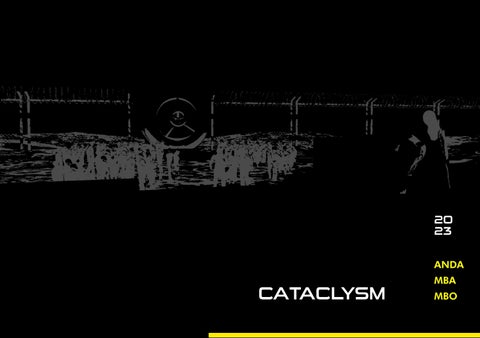
Anda Mbambo, Hourglass (2023). Video Still.
cover
Anda Mbambo, Hourglass (2023). Video Still.
contents
Fig. 1. Hajime Isayama, Attack on Titan (2013). Video Still. page 5. Fig 2. Owen O'Brien, Mirror's Edge (2008). Video Still.
page 6.
Fig 3. Anda Mbambo, Hourglass (2023). Video Still.
page 6.
Fig 4. Anda Mbambo, Hourglass (2023). Video Still.
page 7.
Fig 5. Anda Mbambo, Hourglass (2023). Video Still.
page 7.
Fig 6. Anda Mbambo, Hourglass (2023). Video Still.
page 7.
Fig 7. Anda Mbambo, Mustang (2023). Digital canvas, 10 x 15,01 cm.
page 9.
list of illustrations
3 In the past years of my life I have watched the country I live in go through many changes. While there are not only negatives changes, I will focus on the negative side of events since they have guided my theme in this project. Dystopia or a failed utopia is a concept I have come most intrigued by and have found many of its characteristics to be evident in the real world. It is clear to see one of its environmental aspects, as there is likely not a single person who has not seen some form of pollution in their lives. The
introduction
concerns about climate change can be justified by the past few months in which the weather has painted its own picture of its current state. Humans, a key subject and motif in this project, have an effect on the environment and human beings have created the dystopia genre, where a grim and undesirable future is envisioned. My pessimism, from my guilt and fears led me to create this frame of mind for my exhibition, Cataclysm, which is so named due to the many events currently happening in the country I live in as well as the place we may find ourselves – in the future.
4
cataclysm: explained
Throughout the year I have explored my feelings about the environment and used them to direct the narrative I will use in this exhibition. The word “cataclysm” refers to an event that causes a lot of destruction or sudden change and this is the idea behind all of my work. Regarding the film, the oppression of the Chadha conglomerate is the highlight of the film and the destruction they are causing to the environment is evident. In the beginning of the year, I had researched the photographs of Camille Seaman and her work spoke about climate change. The icebergs that she photographed melting is similar to that of the concept behind the name of my film – Hourglass – since
global warming would melt the ice over time, an hourglass represents time passing slowly and how a few grains of sand result in a dune after a long time. While the film is set in a toxic environment, the Chadha conglomerate continues to pollute the world further to stay in power. I was literal with the meaning behind the naming of my exhibition and wanted it to also reflect the current “climate” of South Africa.
5
hourglass Fig 1. Hajime Isayama, Attack on Titan (2013).
My featured work in this exhibition is Hourglass (2023) and it is based on a fictional island called Mento where people are seemingly living in peace and bliss inside a dome ignorant of the conglomerate which created it. The dome protects people from lifethreatening pollution which plagues the entire planet. However, the real threat to the people are those who are in power. ZERO, the resistance, are the protagonists who try to find out the truth about how the world came to be so that people can once again live beyond the dome.
Hajime Isayama’s Attack on Titan (2009) is what originally inspired this film after I thought of several sources of inspiration. The anime is set in a world where large titans threaten to drive humanity to extinction. Later on it is discovered how humans are the true enemy in this anime. While Attack on Titan talks about freedom and nature of humans in a world plagued with war and conflict, Hourglass talks more about propaganda, the environment and how people are seemingly free but imprisoned in a somewhat
6
uninhabitable world.
Mirror’s Edge (2009), Heavy Rain (2010) and Beyond Good and Evil (2003) are other sources of inspiration.
Fig 2. Owen O'Brien, Mirror's Edge (2008).
Fig 3. Anda Mbambo, Hourglass (2023).
Mirror’s Edge (2009) is a dystopian parkour video game and it was an important source of inspiration for the modeling of the film. Its most noticeable detail is the city in which it is based in and the experience of the game. The contrasts with the white buildings and the blue bloom visible in the scenes gives the game a cold unnerving experience. The signage, white flora and rough textures of the buildings combined with the lights of police vehicles gives the city an identity. The people live in an oppressive city where individuality is not allowed. The sounds of the sirens, guns and the helicopters add to the atmosphere. Regarding my film, I created my own atmosphere in the first scene, in which the people chant for the execution. I used high contrast in the scenes giving the film a darker feeling to it. The weather is gloomier than in Mirror’s Edge, for the planet, in this film, has been engulfed in pollution.
7
The idea behind my film is purely environmental. The way Thuli and Jongiwe’s grandmother die, the dome and the island being industrial all points to effects of humans on nature. The choice of themes in the film was motivated by my exhibition and the main topics it delves in are dystopia, pollution, corruption and oppression.
Fig 4. Anda Mbambo, Hourglass (2023).
The rainy weather, in the night scenes, combined with the dim orange light gives off a vibe of a planet that is weeping. In day time scenes, grey skies are used to imply cloudy and gloomy weather. The buildings in the film use rough textures and are very large to show the amount of influence corporations have on the island. The districts show the lack of individuality on the island since each district is assigned a colour and must adhere to it. The look of each district also shows the social class with the 1st district being the most opulent and wealthy while the fourth district appears to be the most poor.
Fig 5. Anda Mbambo, Hourglass (2023).
Fig 6. Anda Mbambo, Hourglass (2023).
8
The idea behind this artwork was a “what if” scenario. This is directly linked to East London protestors stopping Shell from disturbing the ocean with seismic blasting. The idea was a future where such corporations are not stopped and the environment subsequently becomes polluted much like the situation in my film Hourglass (2023). The themes the work touches on are dystopia, pollution, environment, pessimism and consumerism. This artwork is very imaginative and it is much like a dream. The sky is a calming colour while black fills the canvas to make the artwork very negative and dark. It is in landscape which I thought would be fitting for a cityscape. A blue mustang with white smears is chosen as the main subject. The colour choice was deliberate and literal – it refers to the blue and white colours of the Ford logo. This is in relation to the red and yellow sea which hints at the influence of Shell on the ocean. I specifically used Ford as the main subject due to my own fantasies and desires, and this is a story about how the nature of humans affects nature. The buildings in the background make the artwork more city based. Since this was inspired by a local event I thought it would make sense to base
it in a city. The buildings also play a role in showing the dominance of the unnatural world. For this work, Krita was used. I made the work with ink and wet paint brushes which gave the artwork a dreamy look. I added looks of imperfection on the buildings with texture brushes which made them seem like they have cracks. Ink brushes were used for the more solid lines on the building and the mustang, while the paint brushes were used for the skies and sea as well as the black that fills the cityscape.
mustang
9
Fig 7. Anda Mbambo, Mustang (2023).
10 Everyone has had their own share of personal negative experiences and they have helped shape who they are. Just as we are shaped in this way, nature is also burdened with this change caused by our actions. My film Hourglass (2023) is a narrative based on what I have learned thus far and what my artworks aimed to explain while Mustang (2023) is a dream in which large corporations rule unopposed. Overall, dystopia - as a concept, that talks about the environment’s current and future state, has helped me speak and confront my fears and pessimism. It has also helped me to acknowledge them so as to better myself and conduct myself in a more environmentallyaware fashion.
conclusion
11
sources consulted Cambridge Dictionary. (2023). cataclysm. Retrieved from Cambridge Dictionary: https://dictionary.cambridge.org/dictionary/english/cataclysm Claeys, G. (2017). Dystopia: A Natural History: a study of modern despotism, its antecedents, and its literary diffractions. Oxford: Oxford University Press. Electronic Arts Inc. (2009, January 13). Mirror's Edge. Retrieved from Electronic Arts: https://www.ea.com/games/mirrors-edge/mirrors-edge Isayama, H. (2009). Attack on Titan. Quantic Dream. (2010, February 23). Heavy Rain. Retrieved from Quantic Dream: https://www.quanticdream.com/en/heavy-rain Tsotetsi, L. (2022, September 8). ‘Victory for the planet’ – South Africans celebrate court win to stop Shell’s destructive oil exploration. Retrieved from Greenpeace: https://www.greenpeace.org/international/story/55572/south-africacelebrates-court-win-to-stop-shell-oil-exploration/ Ubisoft. (2003, December 14). Beyond Good and Evil. Retrieved from Gog: https://www.gog.com/en/game/beyond_good_and_evil
special thanks I would like to warmly thank the people who have helped me complete this catalogue especially the lecturers and students I collaborated with. And I would also like to thank my mama for her support in my studies. Last of all, thanks for reading.