Kisholoy is produced by youth members of Ananda Mandir The articles, drawing or photographs of this magazine are copyrighted and should not be reproduced in any other forms without the consents of the owners.
We would like to acknowledge the contributions of the followings:
Articles: Anooshka Sen, Anirudh Sarkar, Auroni Sen, Asmit Chakraborty , Shama Dinesh, Shivan Mukherjee,
Drawing: cover - Anooshka Sen
Editors: Dipak K. Sarkar and Utpal Sengupta
Magazine Composer: Dipak K. Sarkar
For information about the Kisholoy – contact Dipak K. Sarkar via email (Dipakksarkar@hotmail.com).
Our Cosmic Address
By Anooshka Sen (age 7)
WHY IS OUR ADDRESS IMPORTANT?
Our address is important because it helps us locate a person, a place or a building. If someone in outer space wants to find us, then they can use our cosmic address to find us, or they will be lost in the universe.
Our universe is huge and Earth is just a very tiny part of it. The universe is so big that scientists measure distance between objects in the universe in light-years. Light-years sound like a measure of time but it’s actually a measure of distance. One Light-year measures the distance that light travels in one Earth year which is a huge amount, given light is the fastest travelling thing in the universe.
Our cosmic address starts with House number followed by Street, City, State, Country, and Planet. Our Earth is the third smallest planet in our Solar System. Like our Solar System there are many Solar Systems in the Milky Way galaxy. Our Milky Way galaxy has four major arms and few minor arms. Our Solar System is located in one of the minor arms called Orion Arm.
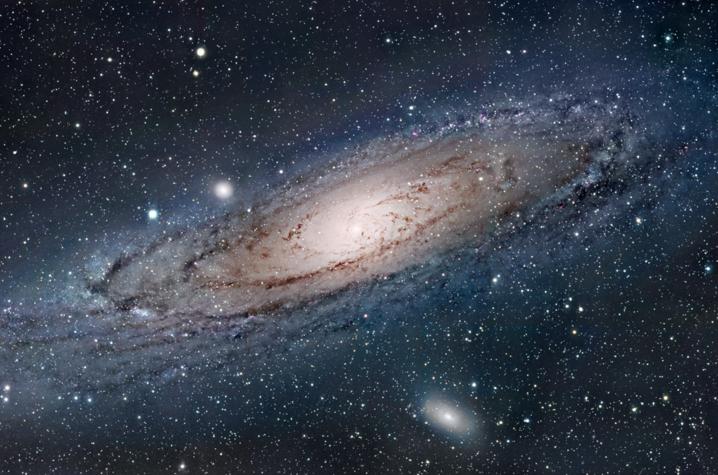
Like our Milky Way galaxy there are many galaxies around us. Andromeda is our nearest neighborhood galaxy. Milky Way galaxy, Andromeda and 28 other galaxies together make the Local Group. About 1300 Local Groups together make the Virgo Cluster. Virgo cluster is part of a supercluster named Laniakea.
So if someone out in the universe were trying to reach Ananda Mandir, they could use
During the pandemic, I can’t see my friends or family or my teachers or classmates. During these times it can be hard to start following a different routine. Before the pandemic, the park and all of it’s equipment was open. Now, you can only go there to walk. This is new to some people who have never been quarantined before, and it is hard to stay at home away from friends and family.
Being quarantined has its ups and downs. One bad thing is that we can't see our friends and family. One good thing about staying home is how it’s affecting the environment. It is helping our planet. When people are staying at home and not using their car, there's not much pollution. One reason for air pollution is exhaust from cars .Because of the pandemic, everyone is staying home and not going places. This is good because the world was covered in air pollution and smoke from cars for a long time. But now, everyone is home and they don't use their cars. And because there are no people making traffic, the Venice canal, for example, is clean. When there were people, there was traffic, which made the water dirty.
Another way the pandemic has a bad impact on the environment is that there is more waste coming from medical staff and hospitals. Doctors have to use a lot of personal protective equipment. Cashiers and delivery people also need to change their gloves every time they handle food for one person. This is how the pandemic has a good and bad impact on the world and our environment.
The self isolation and social distancing guidelines changed human routines. People cannot go outside. This is why there were so many more people on the beach and boardwalk before the pandemic. But there is no one there during the pandemic because people are all inside. That is how the self isolation and social distancing guidelines changed human routines.
GOOD VS. EVIL
By Asmit Chakraborty (age 12)
I am the good Who makes you happy When you are sad and When you are shabby
I am the one who Gives you peace When in pain Or when in need
I am the good who Brings a smile in your face Keep me in your heart I will give you light and joy always.
I am also there Inside you
I am the evil Want to drag you
Sad and gloomy I rule the dark And anger within Is my character
So devote yourself for good Even if you have no return And control yourself Just be happy and have fun.
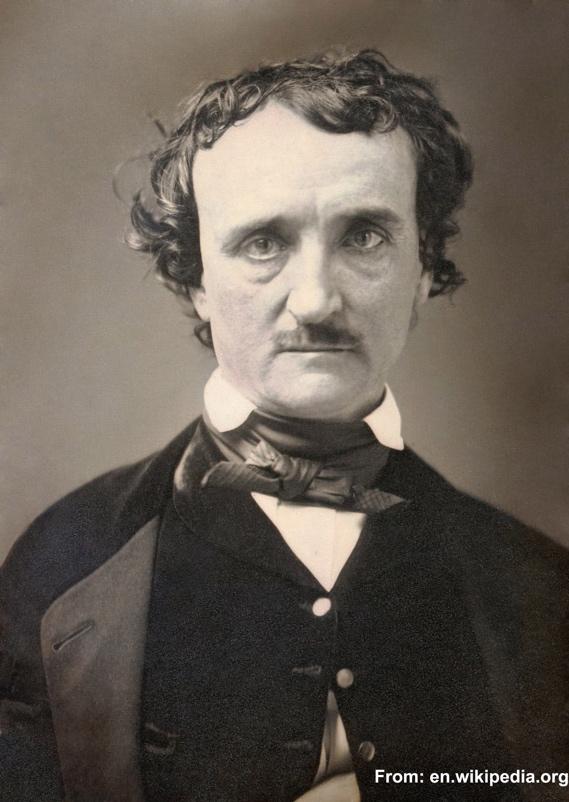
Edgar Allan Poe
By Anirudh Sarkar (age 14)
Edgar Allan Poe was an infamous poet in the 1800s, born on January 19, 1809 in Boston and died on October 7, 1849 in Baltimore. His literature was exceptionally dark and ominous, because of his very dark and traumatizing past. Before he was three years old, Poe’s parents had died, and he was taken in by a foster parent in Richmond, VA. One of his foster parents, John Allan, was a tobacco exporter. Poe attended a good boarding school as well, however, he was forced to leave when Allan refused to pay for Poe’s gambling debts. When he returned to Richmond, he had little ties with John Allan. He enlisted in the United States Military Academy in 1827 under University of Virginia but was forced to exit as he lacked any financial supports.
Afterward he moved in with his aunt and cousin and began to write and sell short stories. He progressed slowly and assumed the role of an editor for a Richmond newspaper, the Southern Literary Messenger. During these years, he had established himself to be a poet, and created the gothic fiction stories that we know now as, The Tell-Tale Heart and The Raven. However, his darkness within him increased in 1847, when his wife died of tuberculosis. His addiction to alcohol and depression had strengthened, and he died 2 years later. This was his backstory, but his literature is the primary aspect of this essay. His literature did not really become as popular as it was until after he died. His most publicized pieces, like the Raven and the TellTale Heart, were infamous because they perfectly portrayed Poe’s insanity. Note that he has gone through much trauma since he was born. To start off, the raven portrays his insanity well because of his responses to the raven each time it says “Nevermore”for those who have not read Poe’s most famous work (and I encourage you to do to so) The Raven - he hears noises in his room, ominous noises. He opens his door, but it’s just darkness. He opens his window, but then the raven flies in. He believes that the raven was sent by angels to his chamber to constantly remind him of his lost love, and that tortures him inside.
Lenore was the lost love that he talks about in his story. He uses language like that Raven’s eyes “burned into [his] bosoms’ core” which essentially says that it burned into his soul. Another one, which happens to be my favorite work of Poe’s is the Tell-Tale Heart. This story is about Poe’s caretaker in a place he is living in. He feels very uneasy about his caretaker’s eyes. He feels something from the eyes, and decides to kill him that same night. Throughout the whole poem, he argues to the readers that they are false for believing that he is insane. Anyway, after Poe kills the man, he chops up his body and hides the pieces underneath the floorboards. He intends to get away with a perfect crime with the old man in his household. However, he can still hear his heartbeat, growing ever so loudly.
All in all, Edgar Allan Poe’s work is loved by many because of its perfect representation of gothic literature and immense insanity depicted in writing.
Basic of Quantum Theory
By Shivan Mukherjee (age 16)
Particle-wave duality. Quantum leaps. Entanglement. The magnitude of and the nuances within quantum theory mean that it can be discussed and debated on for hours. In layman's terms, quantum mechanics or quantum theory explains the behavior of subatomic (small) particles. At the scale of electrons and atoms many of the classical laws that we are familiar and comfortable with no longer hold. Before the advent of quantum mechanics, there were a number of puzzles that scientists could not explain. However, beginning with Max Planck’s study on radiation on “blackbody” substances where he declared that energy came in discrete units (or quanta), quantum theory was born. With a more probabilistic view of nature, Quantum theory substantially changed the perspective of scientists and contributed greatly towards modern physics.
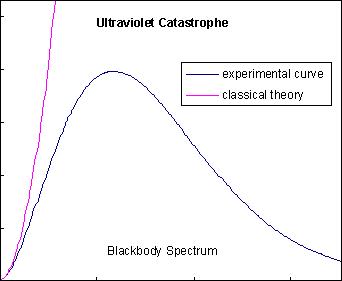
One example of the puzzles that scientists were faced with was the Ultraviolet Catastrophe. Scientists once theorized, according to classical theory, that an ideal blackbody1 would emit energy at all frequencies and that as the frequency increased, so would the intensity of energy that was released. This represents an exponential curve of intensity as a function of frequency. In other words, hot objects would emit an infinite amount of energy at small wavelengths. The results they found represented this idea, until it reached a certain frequency upon which it peaked and then began emitting less and less energy (Figure 1).
Max Planck solved this “catastrophe” through quantization. His equation E = n*h*f was able to represent the graph in a way that made sense mathematically. The significance of this was that the graph actually represented the probability of occupation for each quantized energy state. And at high levels of frequency, probability of occupation is extremely low. In the terms of the experiment itself, his equation states that in the individual particles, beyond a certain frequency, there is not enough energy for it to emit any light at higher frequencies. This can vary between temperatures, but there will always be a limit, as represented by the graph. This idea of quantization was one of the main stimuli for quantum physics. And, it caused significant clashes between classical and quantum physics as well. For example, as per quantum physics, because energy is quantized, there are theoretically velocities that you cannot have. This is counter-intuitive since usually we perceive velocity as something which is continuous and that in order to reach a value, you would have to, as per the Intermediate value theorem, have every velocity between your target velocity and 0 at some point in time. Figure 1 (Frequency vs Intensity) Another puzzle that scientists have faced can
1 Blackbody: An object that absorbs all radiation (visible light, infrared light, ultraviolet light) and can emit all frequencies. Examples include the stars, lightbulb filaments, etc.
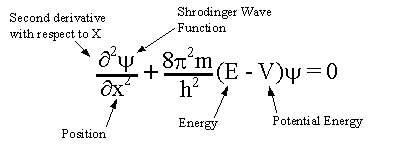
be demonstrated through the Double-Slit experiment. In this experiment, a particle beam was fired at two slits to measure the resulting impacts on the screen behind the slits. One would expect to find two lines of impacts behind each slit. However, a puzzling third line appeared in between the two slits with no electrons in between. This represented the behavior of waves, not particles. This experiment eventually culminated in the idea of wave-particle duality which says that every particle or quanta can be described as either a wave or a particle. These properties only hold for microscopic particles, however, since the wavelengths for macroscopic particles are so short that the wave properties are no longer detectable. The major significance of this was that, now, all behavior of light and matter could be explained using wave equations. Schrodinger was the first to create such an equation (Figure 2). Using his equation another scientist, Max Born, believed that you could use the size of the wave at any given position to represent the probability of finding the particle there or, in other words, a probability wave. While the equation itself is very complex, the equation is used to find the allowed energy levels a particle can be in, and, from there, the associated probability of finding the particle at a certain position.
2 Schrodinger’s Equation
Yet another puzzle that scientists faced was that which was encountered when observing line spectra (observing heated gases through prisms). Instead of seeing continuous light as you would expect, pencil beams of light would appear at specific colors. Niels Bohr in order to attempt these straight lines came up with the idea that electrons followed specific orbits within atoms. Each orbit represented a distinct energy state and could fall down or up orbits without occupying the space between by releasing or absorbing energy. This “teleportation” between orbits would go on to be known as a quantum leap.
Besides answering many puzzles, there are also a number of fundamental principles. One of the fundamental principles of quantum physics is the Uncertainty principle. This states that the position and momentum of a particle cannot be known simultaneously because the methods to measure these quantities affect the other. Another phenomenon is that of entanglement. Entanglement is a theory that two particles and their properties can be linked if they are close enough together. Upon being entangled if they are sent far away from each other, they can still be linked. And it is not until they are measured that they have to take on definite properties and positions. As such, they live in a probity blur and each particle can directly affect the other. Even further, the principle of quantum superposition states that if a particle can be in multiple possible states, then unless the particle is measured, it will be a combination of all possibilities. Quantum theory has had many advancements since the early 20th century. Since the beginnings of quantum theory, scientists have also created quantum field theory which
Figure
describes the interactions between multiple branches of science in order to create a standard model of Physics. It is a conglomeration of special relativity, quantum mechanics, and classical field theory. What’s more, entanglement was able to be proven time and time again experimentally since the days of Einstein as well. Specifically, the work of John Bell and others such as Klauzer led to an experimental way to test entanglement, and prove it correct. Recently, scientists were also able to gain the first picture of Quantum entanglement. They were able to come up with an image of particles as they went through a 4 phase transitions, marking the first time we’ve seen physical evidence of the theory.
Quantum theory also has applications to the real world. The entire field of technology (smartphones, computers, tablets) are all linked to the principles of Quantum theory. This is said because the creation of and the study of semiconductor physics is heavily reliant on Quantum Mechanics. These same semiconductors were critical to the creation of transistors which are key components in almost all electronics. Quantum mechanics also has applications in nuclear fusion. Nuclear fusion deals with harnessing the great amount of power possessed in chemical bonds to be used as a power source. At this subatomic level, quantum physics comes into play greatly. Scientists are now even trying to use the idea of quantum tunneling to reduce the amount of energy required to overcome the chemical bonds to begin fusion.
It can be mind boggling to think of quantum theory after learning about and applying classical physics. The main differences, however, lie in the fact that particles can no longer be well defined and they definitely do not have predictable trajectories. Even further, in classical theory, particles are not thought of as waves and many fundamental ideas such as Newton’s second law cannot be applied to quantum theory. However, although many things change, there are also things that remain constant, such as Conservation of Energy, and it is through this new theory that we are able to further understand Nature.
Quantum theory holds many facets. A short summary cannot do justice to the plethora of information, theories, and debate that quantum theory has. As the field continues to advance, so does our understanding of the natural world. Quantum theory revolutionized our perspective of physics, chemistry, and the world as we know it, and as scientists continue to work, who knows what the next discovery could be!
Citations
Quantum Hypothesis Used for Blackbody Radiation Law ...." 18 Mar. 2020, https://chem.libretexts.org/Courses/Pacific_Union_College/Quantum_Chemistry/01%3A_The_Dawn_of_the_Quantum_Theory/1.02 Quantum_Hypothesis_Used_for_Blackbody_Radiation_Law. Accessed 31 May. 2020
Line Spectra and the Bohr Model - Chemistry LibreTexts." 24 May. 2020, https://chem.libretexts.org/Bookshelves/General_Chemistry/Map%3A_Chemistry_ The_Central_Science_(Brown_et_al.)/06._Electronic_Structure_of_Atoms/6.3%3A_Line_Spectra_and_the_Bohr_Model. Accessed 31 May. 2020
Quantum Physics | Electronics Textbook - All About Circuits." https://www.allaboutcircuits.com/textbook/semiconductors/chpt2/quantum-physics/. Accessed 31 May. 2020. Fusion by strong lasers - ScienceDaily." 5 Dec. 2019, https://www.sciencedaily.com/releases/2019/12/191205113209.htm. Accessed 31 May. 2020.
Quantum Tunneling." http://abyss.uoregon.edu/~js/glossary/quantum_tunneling.html. Accessed 31 May. 2020. What is the difference between classical physics and ... - Esalq http://www.esalq.usp.br/lepse/imgs/conteudo_thumb/What-is-thedifference- between-classical-physics-and-quantum- physics.pdf. Accessed 31 May. 2020.
LABELS
By: Shama Dinesh (age 18)
Struggles, unheard of, persistent
Eyes, cold and callous, reflecting Disgust, hatred, horror, and loathing
At us, as we ignore their stares
We sit in silence, our minds filled with Fear, shame, disgrace, and humiliation
Avoiding interaction, blending into the shadows
We hear the cries, loud and clear “The world is changing!”, they said But to us, we still slink in the darkness “A revolution is happening!”, they exclaimed Then why are we still hiding?
Our courage falls low when we face the crowd
That may smile at us, but we hear
The whispers
So what if our identity is different We are still human, are we not?
So what if we choose to label ourselves?
Does your society not do that?
‘Rich’, ‘poor’, ‘pretty’, and ‘ugly’ What are these, if not labels What power do those petty words hold?
Why do we label ourselves, if not to discriminate? Is it a mandate to blend in?
A confinement to be defined
You mercilessly label us
And in the end, look down upon us
For having those labels
Detest us for something we never could choose
Punish us for the mistakes we never made
Abhor us for the label you imposed
Yet cheer us onward when it’s convenient
With no disregard for the pain we went through
Do we exist for your entertainment
To cure your boredom and nothing more?
Do our voices get lost in the sounds of your chatter?
Do our cries of pain get lost in the symphony of your laughter?