Ananda Mandir
269 Cedar Grove Lane
Somerset, NJ 08873


Ananda Mandir
269 Cedar Grove Lane
Somerset, NJ 08873
october 2016
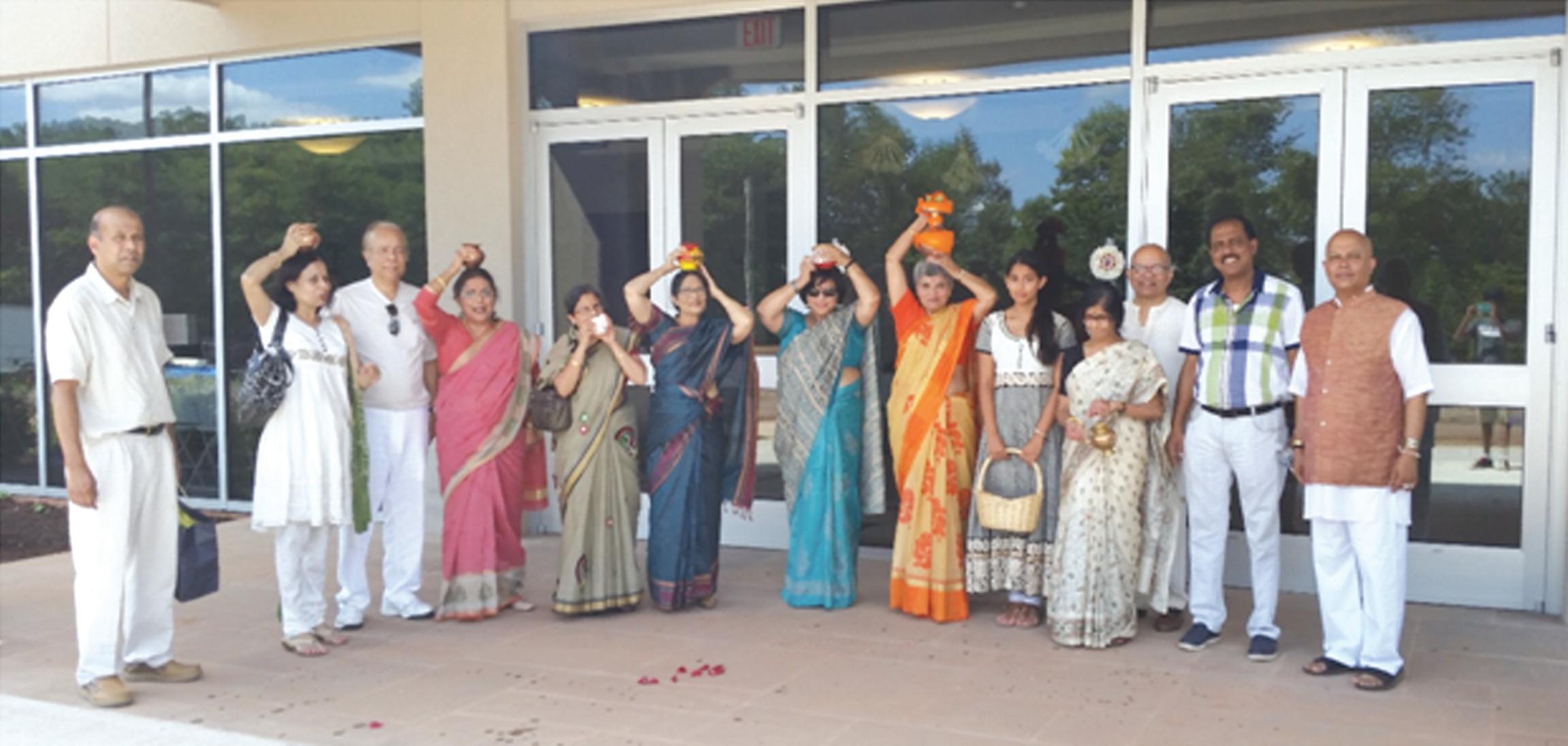
reported by Debajyoti Chatterji
For the past several years, Ananda Mandir had invited its members and friends to an “Annual Fund-Raising Day” with two objectives in mind: to brief them on the progress achieved by the organization in the previous year and share with them the plans for the year ahead – and to urge them to donate generously to support the organization's financial needs. And every year that call for financial support was met enthusiastically by the membership This year the call went out in mid-July for the “Annual FundRaising Day” to be held on Sunday, August 14 More than in previous years, the call this year had a keen sense of urgency and criticality Our construction projects were nearing completion and the monthly payments on our $3 million bank loan were about to begin We genuinely needed generous financial support of our members and friends to meet our significantly increased financial obligations
We were delighted to see over 170 members and wellwishers attend the Annual FundRaising Day on Sunday, August 14, and enthusiastically participate in the day's program They were pleased to tour the newly expanded temple building, admire the sculptures and murals on the temple exterior and its inside walls crafted by artisans
was the first-ever assembly of members and friends in the new auditorium in the Community Center building Dipak Sarkar, Chair of the Fund-Raising Committee (and the immediate past president of Ananda Mandir) acted as the emcee for the program and called the meeting to order After the invocation by our priest, Biswabhai, the “state of the union” was presented by Ashok Rakhit, our current president Ashok reviewed the
dollar ” contribution pledge by Shyamal and Ruby at that time, we could raise almost $200,000 That sum of money gave us the financial confidence to start construction of our first temple On receiving the recognition, Shyamal thanked all the donors who had come forward to make that “matching funds challenge” a great success back in 2003, a milestone year in the history of Ananda Mandir
1215
from Kolkata, and view the features of the brand new 10,000 sq ft Community Center building
The new parking lot with plenty of space gave them comfort that even during peak holidays, they would be able to find parking spots
Delicious snacks and cold drinks greeted everyone upon arrival at the new Community Center complex However, the highlight of the day's program
"Ananda Mandir management urges al l members and visitors to park their vehicles in the paved parking lot behind the new Community Center building. Effective immediately, parking near the temple or the along the main drive is prohibited. Please help Ananda Mandir abide by Township Fire Department restrictions Thank you for your cooperation "
progress made in the past year and outlined the financial challenges ahead for the organization. A Certificate of Appreciation was then presented by Pronoy Chatterjee (Chair, Awards & Recognition Committee) to Shyamal and Ruby Sarkar who were singularly responsible for catalyzing a remarkable communitywide response to our first fund-raising appeal, back in 2003 Thanks to the “dollar-for-
Several speakers (Paritosh Chakrabarti, Pijush Chakraborty and Kamalesh Sirkar) then talked about the continuing need for community involvement and support to make Ananda Mandir successful and to remind the members of the tireless efforts of its founding members, some of whom are no longer alive to see their dream come true.
The presentations were followed by a sumptuous lunch prepared by our never-tiring Food Preparation Committee members under the leadership of Suprasad Baidyaroy and served by the
Continued to page 10
ananda Mandir
Calendar of Events (Dates are subject to Change) Please check our website frequently www.anandamandir.org tel: 732-873-9821
NOTE: If a particular Puja time is not listed, please contact temple or visit our website:anandamandir org
oCtoBEr
Mahishasur Mardini
Sunday, 02, 4:30 – 7:30 am
Durga PuJa
Debir Bodhan
Thursday, 06, 6:30 – 8:00 pm
Debir amantran o adhibas
Friday, 07, 6:30 – 8:00 pm
saptami
Saturday, 08, 7:30 – 9:30 am
ashtami
Sunday, 09, 9:00 – 11:30 am
sandhi Puja
Sunday, 08, 5:10 – 5:58 pm
nabami
Monday, 9:00 – 11:00 am
Dashami
Tuesday, 11, 9:30 – 11:00 am
kojagari Lakshmi Puja
Saturday, 15, Evening
Maha kali Puja
Saturday, 29, 7:30-11:00 pm
sahitya o alochana
Friday, 15, 8:00 PM
ananda sandhya Not scheduled
noVEMBEr (*)
sahitya o alochana Friday, 18, 8:00 PM
ananda sandhya Not scheduled
DECEMBEr (*)
sahitya o alochana Friday, 23, 8:00 PM
ananda sandhya Not scheduled
(*) Call Mandir for Puja Schedule
special religious services: Upon request, the priest of Ananda Mandir offers services such as inhouse Shraddhas, Rituals associated with Cremations (Antyesti Kriya), Shraddha Anniversaries, Pre-wedding rituals (Naandimukh, Ashirwad, etc), Upanayan (Paitey), Annaprasan, Wedding Ceremonies & Wedding Anniversaries, Griha Prabesh (Bhumi Puja), Consecrations of new cars (New Car Pujas) and others if you have needs for any of the above or more, please feel free to contact Biswabhai @ 732-873-9821
ananDa sangBaD
A Periodical Newsletter
Published By ananDa ManDir (A Tax-Exempt, Non-Profit Organization) 269 Cedar Grove Lane Somerset, NJ 08873 Ph: 732-873-9821
Website: www anandamandir org
PuBLiCation CoMMittEE oF ananDa ManDir
Chairperson: Pronoy Chatterjee, pkc usa@yahoo com
Assistant Chairperson: subrata Bhaumik, Bhaumik subrata@gmail com
Editor-in-Chief: Debajyoti Chatterji, Debsmee572@gmail com
Managing Editor, Ananda Sangbad: guru Chakravarty, guruchakravarty@yahoo.com
Managing Editor, Anandalipi: amitabha Bagchi, amitabhanj@gmail.com
Editors: subrata Bhaumik, bhaumik subrata@gmail com subhodev Das, subhodev das@gmail com sushmita Dutta, sushmitadutt2@gmail com amrita kangle, amritakangle@hotmail com nupur Lahiri, nupurlahiri@aol com
Associate Editor: ruby Banerjea, r banerjea@yahoo com
Members-at-large: Bhaswati Bhadra ashok rakhit
All queries, articles, news reports and letters should be directed to the Managing Editor: Phone: 908-752-3065, E-mail: guruchakravarty@yahoo com
For general information, please contact the following executives of Ananda Mandir: ashok rakhit, President
Jaiprakash Biswas, Vice President
suprasad Baidyaroy, Vice President
arun Bhowmik, Vice President
sajal Mukherjee, Gen Secretary
Another Octoberfest is upon us, not the kind of gulping the bitter stuff down the throat in a drinking binge generally attributed to a foreign country, but the one that fills Hindu Bengalis with happy feelings inside and spreads goodwill amongst all. This whole month of October is known to the Bengalis as the Month of Festivals, as we celebrate our own brand of Octoberfest. Festivals are lined up, one after another, with never-ending consumption of delicious sweets. Durga Puja, the most fervently celebrated event by Bengalis, is followed in one week by Lakshmi Puja with Kali Puja in another two weeks in its wake Diwali, the biggest festival celebrated by Indians, wherever they are in the world, coincides with the Kali Puja of Bengalis
We start our Octoberfest off with the devotional musical, the “Mahishasur Mardini”, a week before the Durga Puja This special event that starts at a somewhat uncomfortable hour of 4 am is amazingly popular in the community, among young and old, men and women - all eager to participate as they struggle to get over the sleepiness
Then comes the crown jewel event of the Bengali Octoberfest – four days of Durga Puja, which elevates all Bengalis up as they get into a mentally happy mode It is so beautiful to see everyone showing up at the Mandir - happy faces and attractive color of saris filling up the arena Students are the only ones who have to go to school, while most adults manage to get time off from work to show up during the puja Some come to pray to Mother Durga, while others come just to see friends, to mingle, and enjoy the atmosphere Famous performers from Kolkata and Mumbai present lovely entertainment programs; vendors bring their wares of “Sharadiya Magazines”, new Puja CDs’, and display their precious commodities of the ever popular new saris and jewelry of the “puja” season The “Bijoya Sammelani” at the end of Durga Puja remains as the only party where an invitation is not necessary to participate Somehow, “The Mother” removes all distress and sadness of our hearts and replaces them with joy and laughter
Lakshmi Puja is more of a homely affair Pujaris are in big demand on this day, as many families want their services performed in their own homes.
The puja of Maha Kali, which is the principal deity at Ananda Mandir and also at some other Bengali temples, is considered as the second most popular festival of Bengalis after Durga Puja. Nobody wants to miss this one-evening event and so, over-crowding is the norm at the temples. But there is another big event around this day, the Diwali, also known as the “Festival of Light” While Bengalis observe Kali Puja, the Diwali is celebrated by all Indians, here in the U S , and wherever else Indians are, all around the world
Chanu Das, Treasurer l l Didn't
And, while our Octoberfest is not that well- known to the world, it is fast catching up This year, the U S Post office has announced the publication of a new “Diwali” stamp And, unlike the other Oktoberfest, ours is an all-sweet occasion, where sweets are in abundance, thus eliminating any chance driving under influence
Ananda Sangbad conveys Best Wishes to ALL on the occasion of Bengali Octoberfest
guru Chakravarty
Managing
Editor,
Ananda Sangbad
Dear Members of Ananda Mandir,
We are close to the end of almost a six-year period of planning and building the Bengali Heritage Center that would fill the long awaited needs for our community This has been an exciting as well as stressful journey for Trustees and the members supporting this construction project Making the final decision for a $3 5 million construction loan and raising almost $1 5 million over last four years from the community were not easy tasks
Currently, we are completing all required inspections of both buildings by various construction departments of Franklin Township so that we can receive Temporary Certificate of Occupancy ( TCO) before Durga Puja and Kali Puja in October Work is ongoing for installation of the A/V equipment and stage curtains in the auditorium We are waiting to receive the spires that are being fabricated in Pennsylvania and will be installed before upcoming major festivals Two renowned artists from Kolkata came to install the fiberglass medallions and decorated the main altar in the temple with religious paintings If you came to the site in recent months, you should have seen beautiful terracotta-style medallions on exterior façade of the temple as well as many newly planted evergreen trees surrounding our entire property We are completing the landscaping work around both buildings, and finished hydro-seeding on all open areas of the property to promote growth of green grass We have installed over 400 sprinkler heads to water all green areas to ensure that we have an attractive site with pleasant landscape surrounding beautiful architectural buildings.
Today, as we come to the end of the first phase of our challenge to successfully complete construction, our next phase of challenge begins where we have to start paying large mortgage ($24,000) every month towards our loan obligation. The core financial team of the BOT has developed both immediate and long-term financial plans to meet this challenge Of course any plan has its assumptions and associated risks of unknown We hope that we will meet the challenge with your help and Ma’s blessings For those with faith, we could not have come this far without her help!
I am thankful to our members who helped us raise about $300,000 during the Annual Fund Raiser held on Sunday, August 14, 2016 Accommodating the first six months of expenses will be the most difficult challenge because our revenue from the expanded center will be minimal during the first two quarters of operation. if you are planning a private event in november onwards, please talk to us to rent our new facility. We hope to be able to start taking reservations sometimes in late-september.
If you have not become a Life Member yet, please do so Become a part of this historic occasion We also humbly request all our Life Members to request their working children to become the individual Life Members The success of this heritage center depends on the active participation of the next generation in order to shape its direction We hope that in 2 to 3 years we will be operationally and financially stable with optimal use of our facility to meet the needs of our community
While we are proud of our accomplishments to date at Ananda Mandir, this is the beginning of a long journey that our founders envisioned for our community in this new homeland With your help and continued support, I am confident that Ananda Mandir will be the community home for all Bengalis in the tri-state area and more importantly, will be Tomorrow ’s Center of Learning of our rich heritage in this western world
Thank you, ashok
rakhit
President, Ananda Mandir
If you are a Life Member or an Associate Member, but didn't receive your copy of Ananda Sangbad, it may be because we do not have the correct address on file for you. Please send an email to guru Chakravarty (guruchakravarty@yahoo.com) with your correct address, and we will send you another copy.
It was an evening in Rangoon, 1943 that Debdas Chowdhury, now a retired officer in the Indian Air Force who visits his son and daughter in New Jersey frequently, would never forget Netaji Subhas Chandra Bose had come to Rangoon a few weeks ago and given patriotic and rousing speeches exhorting men and women to join the Indian Independence League and the Azad Hind Fauj. He had requested boys over 12 to join the Balsena unit of his Indian National Army. Debdas, then a boy of 11, was determined to comply His eldest sister, Suniti Chowdhury, and her friends Aruna and Karuna Ganguly and Noni B hattacharya, had joined the Rani Jhansi regiment and were learning how to use small arms, and Debdas wanted to play his part as well He crept out of his house and raced to where the special camp was being held
Netaji addressed the Balaksena group in another passionate speech You are the new soldiers who will look after the country once it is free, Debdas recalls Netaji saying Till then, the Balaksena group was to work in the background, giving “semimilitary” help to their elders on the battlefield
But the next day, Debdas‘ father, who had been looking for him, found him and brought him home He was 5 years younger than his eldest sister, his father pointed out, and needed to go to school The boy Debdas was sorely disappointed, but perhaps it was this incident that prompted him, years later, to join the Indian Air Force (and be awarded the Samar Seva medal in 1965) in the Azad Hind that Netaji had helped, in his own way, to create
Harvard University History professor Sugata Bose, whose paternal grandfather ’s younger brother was Netaji, describes in his book His Majesty’s Opponent how Subhas Chandra Bose planned to free India from British rule by entering India from the east. On May 16, 1943 after a dangerous trip across the oceans on a German and then a Japanese submarine, Netaji arrived at Tokyo. He met with Japanese Prime Minister Hideki Tojo and told him of his plan to enter India from Burma Japan had swept across a whole swath of South East Asian countries by this time, and so, with Japanese help, Netaji travelled to Singapore There, on July 4, 1943 he accepted the leadership of the Indian Independence League from Rashbehari Bose, and formed the Second INA, (the first, formed in 1942 after the fall of Singapore, had been almost disbanded)
It was part of Netaji’s plan to meet with all people of Indian origin in South East Asia, and particularly in Malaya, Thailand and Burma because these countries had many such families He arrived in Burma on July 29, 1943 He addressed the Indian community soon after, and left a tremendous impact on Debdas’ young mind
“I was too young to comprehend everything that he said, but I was mesmerized ” recalls Debdas “Netaji stood under a bright light in the middle of a stadium that was full of people He was in uniform I never saw him in civilian clothes I don’ t think any of us did He spoke in Hindustani and sounded so elegant! He said that he was going to win Indian independence, not by negotiation, but by “blood ” What he meant was that those who could fight should join the INA.
“I cannot remember everything he said, but he kept using the phrase Bharat ki azadi ke liye. (For the independence of
By Jayashree Chatterjee
India ) He said that everyone could help – mothers, fathers, daughters and sonsand that without sacrifice independence could not be won
“He explained that at first India had one enemy – the British But now she had two because America had joined the war and sided with the British He told us that apart from blood he needed gold, because gold would bring in more money for the cause than just currency notes And he needed money to buy arms from the Japanese and to finance the coming war By the time he finished speaking, we were all completely enthused, and eager to help with the freedom movement ”
That Netaji was an extremely competent orator is attested to by many scholars. He also had the much-needed ability to draw people of different faiths to his cause. Sugata Bose quotes from some of his more rousing speeches. Here is an extract from his July 5, 1943 speech to the INA soldiers: “I can offer you nothing except hunger, thirst, privation, forced marches and death But if you follow me in life and in death – as I am confident you will - I shall lead you to victory and freedom ” It is interesting to note that though historians like David Fisher, Anthony Read and Byron Farwell see Netaji in a negative light, Farwell concedes this about him“Bose was said to possess considerable charm and a ‘magnetic, almost hypnotic influence on others” (Quotation marks by Farwell )
After that meeting at the stadium in Rangoon, hundreds of Indians in Burma joined the Indian Independence League, and began to meet regularly Debdas’ father Kshirendranath Chowdhury became a member, and a regular contributor to the cause He was given receipts for every one of his contributions, one of which is reproduced here (* see at the end of the article) It is signed in green ink by Netaji, though the signature is now faded Debdas Chowdhury says that Laxmi Swaminathan of the Rani Jhansi Regiment handed the receipt over to his mother, and that was an honor in itself
Sugata Bose describes how, on October 21, the Provisional Government of Azad Hind was formed in Singapore On 7 January, 1944 the headquarters moved to Rangoon, which gained in importance because the thrust into India would take place from Burma.
But one needs to backtrack a bit to understand how Kshirendranath Chowdhury came to be in Burma and why he gave Netaji his whole-hearted support In India, as a student of engineering at Jadavpur Polytechnic, Kshirendranath had been arrested for participating in freedom marches He finally got a job at the Tata Steel Mills at Jamshedpur But there he had an altercation with a British staff member whom he hit in the face He didn’ t wait to see what would happen next; he fled to Rangoon At first he worked with a Chinese contracting company; then he started his own company, Oriental Engineers It was at this time that Japan began sweeping across South East Asia Burma was expected to be next on the list, and the British government an-
nounced that all citizens should leave Rangoon within forty-eight hours Citizens of Indian origin faced an additional cause for concern – they were disliked by the Burmese because they were better educated and had better jobs So the fear was that once the Japanese took over they would face Burmese reprisals But Kshirendranath decided not to leave He was building the council building at Pyapon, near a tributary of the Irrawaddy river, and he decided to move with his family to Pyapon
Debdas remembers vividly the day the Japanese entered Pyapon That night, they heard the sound of machine gun firing, and then a close Burmese friend asked the whole family to stay with him till things settled down. Soon the Japanese occupiers announced that everyone should go back to work, and so Kshirendranath Chowdhury met with the Japanese commandant who reiterated the order. After his work was complete, he took his family back to Rangoon There, he was hired by the Japanese to work on the Rangoon Airport Soon, Mr Chowdhury made a name for himself as an engineer, and many projects came his way It was at this time that Netaji came to Rangoon and gave his speech at the stadium, and enthused Debdas to join the Balsena unit
But the occasion that Debdas dwells on most when talking about Netaji is that of the inauguration of the National Bank of Azad Hind in April 1944 Netaji had created this bank as part of his extensive plans regarding what would happen once he and his soldiers entered India He was sure there would be a general uprising, and that his army and the whole of India, fighting together, would defeat the British So a realistic infrastructure was needed to support the war and its aftermath On the day of the inauguration, after the meeting was over, people were served tea and snacks, and Debdas sat right opposite Netaji who was relaxing on a sofa in front of him At the Balsena meeting, Debdas had been far away from Netaji, but now he saw him face to face, and the effect, Debdas says, was electrifying He recalls that he was so overwhelmed by Netaji, who was not just extremely brave, but extremely handsome as well, that he was completely dumbstruck. Debdas was holding a plate with a laddoo on it, and he was so unmindful of everything except Netaji that his hand shook and the laddoo fell off the plate. Netaji looked at him and said, “Laddoo utha lo.” Pick up the laddoo
Kshirendranath Chowdhury once asked Netaji whether he missed any particular kind of Bengal food “Amar mayer topshe macher jhol”, Topshe fish cooked the way my mother cooked it, was the reply Kshirendranath asked when he could deliver this delicacy at his house because security arrangements for Netaji were very tight and he very rarely went to other people’s houses Kshirendranath’s wife Monikuntala prepared the dish and Kshirendranth dropped it off at Netaji’s residence The next time Netaji met him, he said to Kshirendranath, “Mar katha mone koriye dilen ” You made me think of
my mother Monikuntala Chowdhury was always very proud that she had cooked topshe mach for Netaji
The Bengali community in Rangoon wanted Netaji to offer anjali at their Durga bari during Durga Puja, and asked Kshirendranath, who was head of the Bengali Association that year, to arrange the visit. Netaji’s response was that he would try to fit a visit into his schedule, but he would have to bring his bodyguards with him, and not all of them were Hindu. The Durga Bari was closed to the public during the visit, but Kshirendranath and his son, together with some others, were there to welcome Netaji Debdas says that all his bodyguards, including the Japanese, wore dhoti-Punjabi and Gandhi caps And then he noticed that the bodyguards also had revolvers in holsters strapped to their waists And they never took their eyes off Netaji
An incident that endeared Netaji to the local Bengalis was when Charu Datta, the uncle of Kalpana Datta of the Chittagong Armory Raid fame, came to Rangoon and was arrested by the Japanese and tortured on espionage charges Netaji intervened, and made the Japanese release him Kshirendranath asked Netaji about this, and Netaji said that he had to help him because he was the uncle of a freedom fighter
Meanwhile, the British were trying to reconquer Burma, and it was a common sight to see British aircraft in the skies One day, Kshirendranath was on his way to the airport when the bombing started After the all-clear signal, he got into his car again and resumed his journey; then, he suddenly saw Netaji and his bodyguards Their car had been hit and completely damaged Kshirendranath rushed up to Netaji and asked, “Apnar kichu hoyni to?” I hope you haven’t been hurt. The immediate response was, “Britishra ekhono oi bomb toiri koreni amake marar jonne.” The British are yet to make the bomb that will kill me.
Kshirendranath pressed him to take his car.
“What will happen to you?” asked Netaji
“I’ ll manage My driver will be with me ”
“Thik ache”, replied Netaji “Apnar gari apna ke poche dawa hobe ” All right Your car will be returned to you
In May 1944 INA soldiers hoisted the Indian tricolor on a mountaintop near Kohima, but, for a variety of reasons, it became obvious that their plan of freeing India from British rule was not going to succeed and on July 10, 1944 the Japanese said it was best to retreat Netaji spoke to the Indians in Rangoon “We are not in an advantageous position to enter India right now,” he said, “but my struggle will go on forever ” Seven days later, he left Rangoon
Then one day, after the British reoccupied Burma, Debdas came home from school to find that his house was surrounded by soldiers of the Gurkha regiment of the British Indian army His father was arrested and imprisoned, the charge being that he had helped Netaji He was released only after the INA trials were over
Many months later, sometime after the plane crash at Taipei in August 1945, Sarat Bose, the elder brother of Netaji, visited Rangoon to write a report on Netaji. Debdas was in Rangoon, and he went to visit
Continued to page 5
By Bakul Banerjee
Modern travelers must be prepared to don the cloaks of several avatars These avatars, my internal whisperers, not the Hindu Avatars, need to work together to help the travelling experiences go smoothly For my latest journey to Scotland and England, I assigned them mutually exclusive duties since foreign travels are getting more complex and I am no longer a spring chicken. The Logistics Avatar must take care of the distribution of possessions, for example, remembering to stuff the purse in the backpack at the point of entry to the airplane to keep the total number of carry-on pieces exactly equal to two This avatar had to make sure that the carry-on bag was light enough that I could lift up to the overhead bin The Cyber Avatar must maintain the cyber-presence as I follow the flow of travel It is not fine to fall off the cybergrid even if I wanted to The Resources Avatar must be responsible for tracking essentials, like clothing, snacks, water bottles, filled or emptied as appropriate This avatar was assigned the responsibility of constantly reminding me not to accumulate things Over the years, I have avoided shopping during travel, but still tend to collect pamphlets and fridge magnets
During June of 2016, my wanderlust took me to the little island across the pond called Great Britain Ridiculous, isn’ t it?
The total size of it is merely 94, 058 square miles compared to the 3 806 million square miles for United States or 1 269 million square miles for India, the country of my birth In spite of its small size, it is called Great Britain Much to the displeasure of my Logistics Avatar, I had to carry two hefty guide books, one for Scotland and one for England, to cover only a small portion of this island, mostly regions related to religion and trading rights where history of conflicts is long and runs deep.
My travel without trouble from Chicago to Edinburgh was a good omen. I connected with my fellow travellers at the lobby of the medium sized, easy to navigate airport of Edinburgh. Using the wellorganized and efficient taxi pool, we headed out to the hotel near Edinburgh’s Waverly station, only a couple of blocks away from the famed Royal Mile The friendly taxi driver gave us the first orientation of the New Town and Old Town of hilly Edinburgh which was designated as a UNESCO World Heritage Site in 1996 We spent the remainder of the day resting in the hotel and puttering around the Royal Mile At one corner of the street, a large group of Sikhs in turbans and neon-green safety vests were offering simple food of bread and a delicious chickpea stew called Chhole to whoever stopped by It is a part of their weekly worship ritual known as Langer In Edinburgh it happens on Wednesday evenings Hundreds of Scots and tourists were enjoying this offering standing around or sitting on steps of the old buildings under the golden, late evening light I picked up a little pamphlet with a message from the Sikh holy book Guru Granth Sahib Ji:
“Recognize the lords light (sic) within all, and do not consider any social class or status ”
This unexpected opportunity to participate in Langer, one of my favourite rituals, moved me one more time
The exploration of the city began in earnest the next day It started raining in the morning, so we took refuge inside a red double-decker hop-on hop-off bus. As we passed through the lush green cityscape studded with ancient buildings, I remembered rainy commutes to college in my native Kolkata. Other than the anxiety about the flooding of the Kolkata roads and the possibility of subsequent shutdown of public transportation, rain always calmed me I could see more of the city through rain The hilly Edinburgh was probably immune to water-logging Accompanied by the narration of the city ’s history, Edinburgh presented itself to me in a mysterious way
As the bus followed its route, the narrator pointed out the landmarks I was surprised how Scots honored their scientists, philosophers, and writers with substantial statues and memorials at prominent intersections We went past the new statue of James Clark Maxwell, the scientific giant, famed for his seminal discoveries The set of partial differential equations named after him forms the basis of modern electrical and communications technologies and inspired innumerable scientists, including myself The classical Gothic monument of Sir Walter Scott reminded me of the volume of Ivanhoe that my eighth grade English teacher took out for me from the gleaming glassfaced bookcase of the school library At one intersection, we came across the statue of David Hume (18th century), a giant among world philosophers Later on, I would get a chance to touch the shiny toe of the statue as done by countless philosophy students all over the globe David Hume has a special place in the hearts of students of Bengali Enlightment. His influence on the writings of Rabindranath Tagore is being researched by scholars around the world. I was delighted that I was familiar with these Scottish intellectuals. By the way, Edinburgh was designated as a UNESCO City of Literature in 2004
When we got down from the bus to climb up to the Edinburgh Castle, the rain was dwindling to a drizzle I decided not to take out my trusted poncho, against the advice of my Logistics Avatar The castle, or an older version of it, was first built on the massive volcanic rock, also called Castle Rock, around 13th century With many major extensions, large, strategically placed cannons, and the Chapel honoringSt Margaret, a Roman Catholic martyr, tucked away in a corner, the castle remained formidable for many centuries It also attracted warriors and marauders alike The admission ticket included a guided tour of the castle I hung around with one group for a while and found it helpful I love to hear stories told by locals It started raining heavily as we came down from the castle I had to take out my poncho from the backpack in a hurry
The Resources Avatar winked at me
We ducked inside one of the wool shops Almost everything in the shop was made in Scotland Ignoring the warnings of my Resources Avatar, I splurged on a
shawl for myself and two scarves for my girls
The Royal Mile, made up of four ancient streets, connects the Edinburgh Castle and Palace of Holyrood It remained the hub of Scottish politics, religion, culture, and architecture for a long time A walk up and down this street reveals much about Scotland. Architectural artifacts of Scotland’s religious transformation from the Catholic faith to the Protestant one through the Reformation movement are plentiful in this neighbourhood. St. Giles Cathedral is now a part of the Church of Scotland of Protestant denomination In that sense it is not really a cathedral now To ordinary travellers like me, this street seems to be the symbol of Scottish defiance against England
The street also holds the secrets of the devastating Black Death that afflicted Edinburgh in the 17th century Next day, our first stop was to the Mary King’s Close It is a collection of tenement homes and streets (or close) that was emptied out of people and partially demolished to contain the spread of infection, then built over at a later date It is a popular tourist attraction, with atmospheric story-telling by guides about ghosts and paranormal activities
The Scottish National Museum was our next stop This large museum contains Scottish artifacts from the Iron Age to modern times A retired Cockcroft Walton multiplier, used for powering generations of particle accelerations was displayed prominently in the lobby That particular machine was donated by the University of Edinburgh A similar iconic machine was used with many particle accelerators, at the Fermi National Accelerator Laboratory at Batavia, Illinois People like I who worked there would always remember it The laboratory replaced it with a newer machine only in 2012.
Leaving Edinburgh the next day, we began our driving adventure to East Lothian castles continuing the journey to border abbeys. Our first stop was the Glenkinchi Whisky factory. Since we planned to visit many places that day, we did not linger However, the manicured grounds and pathways were covered with fresh pink and white petals dropped by numerous flowering trees – truly a sight to behold I felt a bit nostalgic and missed the spring flowers in my own garden
We had a lunch stop in the little town of Gullane Under the bright midday sun, ruins of old St Andrews Church felt stark Surrounded by ancient stones, the few burial markers looked desolate, even though the church was located next to a busy road
Our next destination was North Berwick with two major castle ruins nearby The first stop was at the Dirleton Castle and Garden The castle, quite friendly looking from outside, is located in the middle of a township with a public park in front The large, meticulously maintained garden, which was probably established in the 1800s, is by itself a tremendous attraction Wildflower plants, many in bloom, sitting pretty in manicured beds were well-marked with signs I could have spent the entire afternoon roaming the garden and learning The castle, initially built in the 13th century, was enhanced by two more families who used
the place as their fortified residence for centuries It had a prison, a chapel, and a hidden storage space The steep staircase in front was daunting at first, but to my great relief I found an excellent ramp in the back My Resources Avatar was content
The Tanttalon Castle, original home of the Red Douglas family, is surrounded by sea on three sides; the solid wall faced the landside. As I walked through the majestic red-stone castle and stood on the lawn looking down the cliff, even its shadow weighed on me with its show of power. The giant Bass Rock, a volcanic silvery grey outcrop, still assumed to be active, rose across the water A picturesque lighthouse clung to the side of the rock When my eyes became adjusted to the sunlight, I noticed a silvery plume, almost as tall as the rock itself, of birds swirling at a distance by the water ’s edge Bass Rock is the home of 150,000 gannets in the peak season, making it the largest colony of this type of bird in the world The Scottish Sea Bird Centre maintains a webcam to monitor their activities
English kings continued their assaults on both of these castles for more than three centuries Finally, Oliver Cromwell caused massive destruction to them during his siege in 1650 Although Dirleton Castle was repaired later, Tanttalon Castle was left alone
At the end of the day we headed toward our bed and breakfast place in the town of Alnwick Leaving the cozy B&B with a stomach filled with traditional English breakfast, we made a detour stop at the Barter Books At this wonderful bookstore people can exchange used books, sometimes rare and unusual, or buy them We saw two large working castles, Alnwick and Bamburgh, only from a distance Both of them hosted film and TV projects like Downton Abbey and Harry Potter. These venues are also available for other public events.
Ruins of four majestic abbeys, located close to the Scotland and England border, are major tourist attractions. Over several centuries these Catholic churches were subjected to waves of assaults by English monarchs and Reformists who wanted to establish Protestant ways All of them can be visited in one day using a well-defined circuit We would cross the border several times during the day Because of the lack of time, we could visit only three of them, stopping first at the fortress-like Kelso Abbey, the most modest one Built in 12th century by a group of Tironesian monks from France, it was abandoned around 18th century although much of it was destroyed earlier
The next stop was at St Mary’s Abbey at Melrose, commonly called Melrose Abbey Distinguished by the fine curving and delicate architecture although in ruins, this abbey is considered to be one of the finest in Great Britain Built by Cistercian monks, it was established in 1136 AD and abandoned in 1609 AD Like many other monks of that time, Cistercian monks worked hard at growing food, producing wine and distilling herbal medicines to increase the wealth and prestige of the abbey It is not a surprise that the heart of Robert the Bruce, one of the great Scot-
Continued to page 5
The hero emerging from the Rio Olympics is Usain St Leo Bolt from Jamaica, otherwise known as the Fastest Man in the World. Viewers across the world were pre-warned not to blink during his 100m dash because the race would be over by then
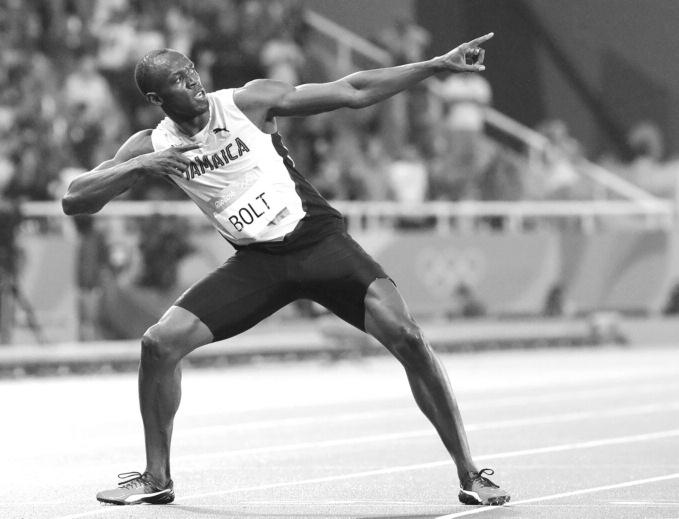
usain Bolt clearly dominates the field of favorite heroes in the Olympics. Regarded as the fastest human ever timed, he is the reigning World and Olympic champion in the three sprints – 100m, 200m, and the 100m relay for the last three Olympics Due to his unprecedented dominance and achievements in the athletic field, and not to minimize his charismatic appeal, he is widely considered the "Greatest sprinter of all time".
He says “I want to be among greats like Muhammad Ali and Pele” Well, that depends on how he carries on with his life when he is out of athletic competition, doesn’ t it?
Michael Phelps, the American swimmer is a close second among the heroes of the Rio Olympics. With a total of 28 medals, 23 of them gold, Phelps is head and shoulders above all athletes in the history of Olympics Larisa Latynina, a gymnast from Soviet Union (1956- 1964) is the next in line with a total of 18 medals simone Biles of USA, dominated women’s gymnastics winning individual all-around, vault, floor and the team gold medals. Being an African American, Biles is the most decorated American gymnast ever Coincidentally, many fondly remember the two great gymnasts of the past, Olga Korbut and Nadia Comaneci, who won our hearts for their extraordinary artistic and charismatic flair
There are many other heroic achievements that will be chronicled in the history of Olympics
Why is united states so dominant?
As usual, the U S team is head and
By guru Chakravarty
shoulders above the rest of the world in medal counts
Naturally, we think of big budget for the success of USA year after year. Where does this enormous funding come from? Unlike what you would like to believe, and unlike nearly every National Olympic Committee in the world, the United States Olympic programs receive no government support The U S relies on private donations to help fund many national programs to find, train and support the athletes. Of course, once they are successful in the field, business sponsorship takes over to pay them handsomely, and as it goes, success breeds success
But the US Olympic Committee does great grass-root work They provide the basic support mechanism from the background as follows:
• High Performance Programs and services such as strength and conditioning, physiology, training programs, nutrition and sports psychology
• athlete Financial aid to supplement the limited annual income of Olympic and Paralympic athletes and hopefuls, providing support to cover living, training and healthcare costs.
• advancement of the Movement through community outreach and education services including the Team USA Ambassador program, the Team For Tomorrow program, Olympic Day events, and the SafeSport welfare training program to promote safe environments at all levels of sport.
Availability of great coaches, who come from the hoard of past Olympians, and facilities with the latest and greatest equipment for training leave the competition in the dust
india’s Woes Continue
The Indian Olympic Association sent the nation's largest ever delegation (a total of 117 athletes; 34 larger than their previous record of 83 athletes in 2012) in the Summer Olympic history to Rio But the lament of Indians for lack of success in the world venue goes on Why can’ t we raise great athletes, why is the game of Cricket not included, are the perennial questions they ask in despair. Here is the Rio Olympics tally of medals for India: Silver P V Sindhu Badminton,
Women’s Singles
Bronze Sakshi Malik Wrestling Women’s Freestyle, 58 Kg sindhu’s silver medal win in the
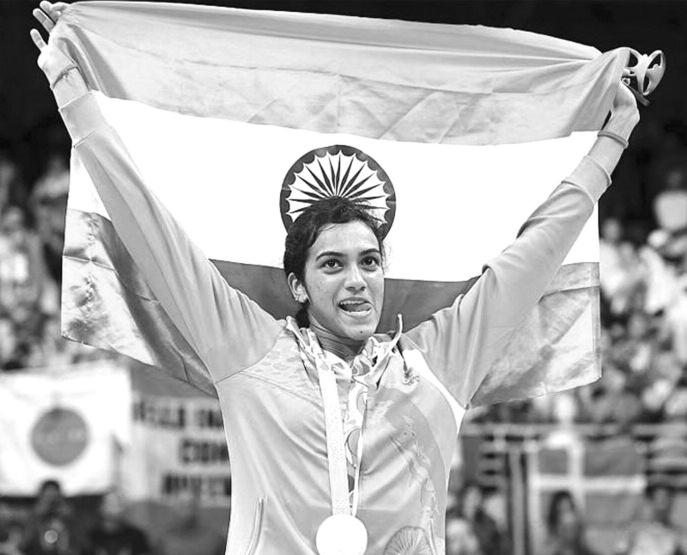
women's singles event of the 2016 Summer Olympics made her the first Indian badminton player to win in this competition. Previously, she had become the first ever Indian women's singles player to win a medal at the Badminton World Championships
sakshi Malik won the bronze medal

in the 58 kg category, becoming the first Indian woman wrestler to win a medal at the Olympics
Bengali gymnast Dipa karmakar narrowly missed the bronze by finishing fourth in the women's vault event She is the first Indian female gymnast ever to compete in the history of Olympics.
One of the main reason of failure by the Indian athletes is the lack of sponsorship by private institutions Whereas athletes in the U S have opportunities to earn enough money from private sponsorships and from many competitive events held throughout the year, the most Indian athletes get out of athletic success is a job in government institutions Sindhu has been employed with Bharat Petroleum Malik is
Continued from page 4
tish heroes, was buried there Even today, remnants of delicate curving, tall columns and ribbed ceilings are inspiring
Our last stop was at the massive Jedburgh Abbey It was led by monks from the order of St Augustine Like other abbeys, it was destroyed around 1550 AD The impressive vertical dimensions gave these churches, even in ruins, an aura of other-worldly presence Attackers often destroyed the roofs of these tall structures making them unstable and therefore inhabitable They reminded me of magnificent Hindu temples of India
Many of them were also built during the latter part of the medieval period when these abbeys saw their glory days Most of them were destroyed by Mongol, Pathan, and Mughal invaders Many came to loot the wealth stored in the temples and others were motivated by religious reformation, that is, to establish Islam in a Hindu country Perhaps, reasons for these destructions were similar
After visiting these ruined fortresses and abbeys, I became convinced about the fiercely independent nature of Scottish people through centuries Their valiant kings and generals fought English monarchs and their generals The national identity
currently employed with Indian Railways
The competitive passion dies upon achieving a steady livelihood
Cost to host an Olympics is sky high
Here are costs of some recent Olympics: London Summer Olympics 2012
Total Cost - $14 6 billion – privately sponsored
Sochi Winter Olympics 2014 Total
Cost – $51.0 billion – government sponsored
Rio Summer Olympics 2016 Total
Cost – $11 6 billion – government sponsored
The government-run Montreal Olympics in 1976, which cost Canadian $ 1 4 Billion, drew a huge loss, and it took up to 2006 to pay off the loan A special tax was imposed on the Canadians to fund the loss In rare cases, like the government-run Seoul Summer Olympics in 1988, a profit was made
The cost of the 2004 Athens Summer Games has been cited as a contributor to the Greek government-debt crisis Many of the venues lie unused, vacant and rotting It is very difficult for small nations to host Olympics for obvious reasons. A great amount of money must be spent to improve infrastructure Now there is an additional burden to take up the heightened security measures
Yes, of course it is, is the predominant view of the world It is the single biggest brotherly social event for the humankind to get together in peace. Here people from the practically unknown South Pacific nation of Tuvalu (population 10,600) or from Nauru (population 11,000) march with their head held high getting the same respect as the athletes from the most developed nations Pierre de Coubertin, upon the creation of the International Olympic Committee in 1894, set the motto of the game saying, "The most important thing is not to win but to take part!"
Although the medal results of the Olympics clearly favor the developed nations, even they are simply unenvious when they get beat by the brilliance of Usain Bolt of Jamaica in men’s sprint, or the undying stamina of Jemima Sumgong of Kenya in the women’s marathon. The strict policies of Olympics in drug prevention among all athletics of the world is a great example of how it serves the human race
Continued from page 3
was always important to them The Reformation movement that swept Great Britain played no small role in this struggle
That evening, I found out that my ninety-five year old mother in India became very upset with me because I could not call her personally It was difficult to explain to her that unlike my siblings, I don’ t carry a phone capable of making international calls
My Cyber-Avatar depended only on Wi-Fi emails and texts, but she wanted to hear the live voice of her first-born
Note: Videos of the tour are available on YouTube Search for “Scotland Bakul Banerjee ”
Sarat Bose He told his secretary that he wanted to see him because he respected Netaji so much
“Tumi Subhas ke dekhecho?” Did you ever meet Subhas? Bose asked him
“Payer dhulo nitay parini,” Debdas replied, “kintu kach theke dekhe chi ”
I never got the opportunity to touch his feet But I did see him close up
Though the formation of the INA, together with the failed uprising in the British Indian Navy that followed it, showed the British that their days in India were numbered, it was Gandhi’s policies that won Indian independence But those who came in contact with Netaji still hold him in high regard Today, after all these decades, Debdas Chowdhury still feels that those years in Burma were amongst his most memorable
* Receipt reproduced in page 15
"What is love?" Mankind has pondered the answer to this question for centuries I do not know who coined the word "love", but I am sure that the feeling existed long before that The purpose of this article is to explore the concept using my very limited knowledge and experience about it and my efforts can probably only be compared to those of the proverbial blind men exploring an elephant. There are, of course, many different kinds of love. I would like to focus my attention to romantic love between a man and a woman because that is the most fascinating one of all
The seeds of romantic thoughts are placed in our head by the fairy tales in our childhood where a beautiful princess is rescued from the evil spell of a witch by a handsome prince on a Pegasus; or Hindu mythological stories from the epics like the Ramayana and Mahabharata
Our social interactions leave no doubt that an ideal family unit should consist of a father, a mother and a couple of children and there has to be some strong feeling of caring between them in order to hold the unit together
As one grows older it also becomes clear that the key goal in life should be having a family of one's own and all the education and other preparations in life are really geared towards making one ready to be able to handle all the responsibilities of such a family
Three distinct feelings emerge with age as we grow from an adolescent teen to a mature adult: "falling in love", "caring" and "love" Some people talk about loving and caring in a synonymous sense, but that is certainly not correct as we will discuss shortly. “Falling in love” is a purely biological phenomenon at a molecular level and related to bubbling hormones within our body and typically happens at a younger age It can be triggered by a very simple little thing like a song or a smell or a picture
When it happens the emotions can be totally overwhelming and powerful, taking over all the rational senses in our head We cannot even breathe without the thought of this loved one at every second The thought of physical intimacy is intertwined with this feeling You want to get inside the mind of that person as well as his/her body It is not the fleshy pleasure you are thinking but how two of you can be unified into one entity forever Falling in love is not necessarily a two-way street You can fall in love with someone even without the other person knowing about your feelings According to (late) Dr Valerie Hunt of Malibu, an ex-professor of physiological sciences at UCLA and well-known in her field, such one-sided emotions are called “lovingness” In her view, this lovingness is your
By Basab Dasgupta
own creation and the other person was just a catalyst It is no different than creating a song or a painting, inspired by someone It makes you feel good Many young people simply fall in love with the concept of falling in love In some extreme cases this obsessive one-sided infatuation can blur the difference between fantasy and reality leading to not only absurd dreams but stalking and even serious crimes
If there is a reciprocal feeling of falling in love from the other person, it is called "chemistry" in the western culture It is this chemistry that is a prerequisite for the next phase of an intimate relationship and in most cases a couple gets married when there is a great chemistry However, this euphoric feeling never lasts forever Sooner or later, you realize that the other person is not that perfect soul-mate after all This realization can come after two months or ten years, but it always does When this happens, most married couples say to themselves, “well, our marriage is not a match made in heaven, but it is not bad”. After all there is considerable synergy in two people living together in a committed way as far as many practical things are concerned, not to mention the benefit of companionship Then there are others who feel that search for true love must continue and perhaps time has come to move on
In an arranged marriage there is no such thing as falling in love before the marriage because the bride and the groom are total strangers and therefore there is no such thing as chemistry However, there is intimacy If a man and a woman are put in the same room at night as a husband and a wife, they inevitably engage in a physical union whether they knew each other or not Living together as a couple for a long period of time inevitably leads to a feeling of mutual caring This is not necessarily a physical attraction or chemistry but a sincere wish to see one's partner to live a happy life in every way and to worry when the partner is suffering for any reason This feeling of caring is probably no different than that between a couple who got married because of a strong chemistry and remain married even when the thrill of initial passion was gone
So it is relatively easy to understand falling in love and caring; but what is love? Is it reasonable to say that love is caring coupled with a strong physical chemistry? I don’ t think so. You can genuinely love someone
without sex and even as such, it is a whole lot more than just caring for someone One criterion is that you must crave and cherish the companionship of your loved one He or she must be a person you would think of when you are suffering yourself Perhaps you would wish to die in his/her arms You must be willing to do almost anything for your lover –sacrificing everything, lying, dying, even hurting someone Love also means fear of losing the loved one, worrying about him or her for no apparent reason as well as jealousy and possessiveness Love comes from heart and transcends age and external beauty One can "fall out of love" with someone, but still love that person Love never disappears Then there is my favorite line from the Bryan Adams song: “ when you see faces of your unborn children in her eyes, then you know you love her ” I do not understand “love at first sight”; it has to be an infatuation of some kind However I do believe that both caring and falling in love can gradually evolve into "love".
People talk about "unconditional love" and "true love". I don’t quite understand the difference between these descriptions and just plain ordinary variety of "love" It is interesting to quote Paramhansa Yogananda in this context One of his disciples once asked him "If our purpose is to seek God and self-realization then why do we go through this life-long ritual of finding a mate, getting married, having children and raising them? Why not skip everything and directly go for the search of God?" Yogananda responded by saying that, in order to achieve God, one must first learn how to love everyone unconditionally The only way human beings learn this unconditional love is first by having children because their love for their children is truly unconditional love The hope is that they would then learn to love others unconditionally So the purpose of romantic love is to condition ourselves for developing that ultimate ability for unconditional
love
Perhaps I cannot define love but I can feel it Deep down inside I know exactly who the women I love are, but I cannot fully explain why I have asked many people about their opinion of what love is Surprisingly, most people had difficulty in articulating it even when these people were highly intelligent and educated and were married for long time In any case, it seemed that everyone had a slightly different version of the meaning of the word "love" I also believe that one's concept of love changes over time as one grows older and passes through different phases of life At older age, a spiritual element comes in It almost seems that the love that one seeks all through one's life is really the love of God; the physical existence of the loved one is simply an embodiment to facilitate this realization
It is one thing to feel love, but a different thing to be able to express love In the western culture it is so common to say "I love you" and so soon after one meets a potential romantic partner. (By the way, the word "love" ranks at #387 among the 500 most commonly used words in English language). I must confess that I cannot love someone very easily or quickly and find it very difficult to say “I love you” to anyone I remember a scene from the movie “Namesake” where the middle-aged husband and wife, who were of Indian origin, were strolling on the grounds of Victoria Memorial in Calcutta, when the husband asked the wife “Do you love me?”
The wife answered with a smile, “Do you want me to say ‘I love you’ like the American women?”
It is true that Americans, both men and women, find it a lot easier to say “I love you” I often wonder if they really mean it My reluctance to say those three words could also be an aversion to show my vulnerability In some cases, it is simply an unwillingness to misrepresent my true feeling; why should I say “I love you", when I am not so sure?!
Probably one of the most
touching tributes to love is the song "do you love me?" from the movie "Fiddler on the Roof " Trevye, the dairyman, was intrigued by the concept of love when he found out that his daughters were marrying against his will and traditional customs for the sake of love; he asked Golde, his wife of twenty five years if she loved him Golde responded "for twenty five years I have washed your clothes, cooked your meals, cleaned your house, given your children .shared the same bed.....if that is not love, what is?" They ended the song by admitting that they probably do love each other
My favorite love story is that of Emperor Shah Jahan The story was that when he was dethroned by his son, Aurangzeb, and imprisoned at Agra Fort, his only request to his son was to put him in a cell from where he could see the Taj Mahal every morning when he woke up His son granted him that wish and Shah Jahan died in that room with a view of Taj Mahal
I have concluded that no one can define love and any proposed definition would simply be an incomplete one, just like the description of an elephant by the blind men I think that is a good thing Love is such a mysterious and magical phenomenon People have done all kinds of crazy things over the centuries for love They have gone to war, given up throne, sacrificed their families, crossed the seven seas, written love songs and poems, built Taj Mahal, converted into other religions, engaged in infidelity and charades, hijacked planes, gone insane, committed suicides and I can go on and on. Still no one knows what love is and so it is inevitable that all these obsessive activities would continue for centuries to come.
In addition to "what is love", there are two other questions that mankind will never be able to answer: "what happens when you die" and "what is the extent of the universe?" In my thinking, all these three unanswerable questions point in the same direction: concept of God Yogananda's comment makes sense to me Romantic love may be just the first step in our effort to learn the ultimate unconditional love for everyone which is a prerequisite for experiencing God and that is not likely to happen in one lifetime
Pranab and I went to Franklin Food Bank on 01 September to drop off 122 pounds of food. They would do another food drive for Christmas.
The food for the needy comes from generous donations made by you - our members, temple attendees and all well-wishers of the community Will you please help? This is a year round program, so any time is good for the donation. All kinds of non-perishable food and toiletries are needed No glass jars please!
Thank You,
krishna Dutta roy, Chair, Ananda Mandir Humanitarian Activities
Standing on the vaulted, sun-washed terrace, the burning day bore mute testimony to my euphoria at being at a place where architectural history had been made Made and then had stood still, unmoved by time or by the hurrying feet of history, as sentinel to the Emperor who slept in eternal peace beneath its balming shade The scent of heady jasmine, orange blossom, and water on parched ground assailed my nostrils while the majestic dome of Humayun’s tomb soared upwards towards the heavens.
This exquisite mausoleum was designed by the Persian architect Mirakh Mirza Ghiyath, who was commissioned by Humayun’s chief consort Bega Begum and his son Emperor Akbar. It will forever be hailed as the structure that took a giant leap in Mughal architecture, and became the forerunner in introducing garden tombs in India
Made up entirely of rubble masonry and red sandstone, the central marble dome, all white, is a picture in sharp contrast The design of the dome follows that of a Persian double dome on a high neck drum The outer layer supports the white marble exterior while the inner portion of the dome gives shape to the cavernous interior
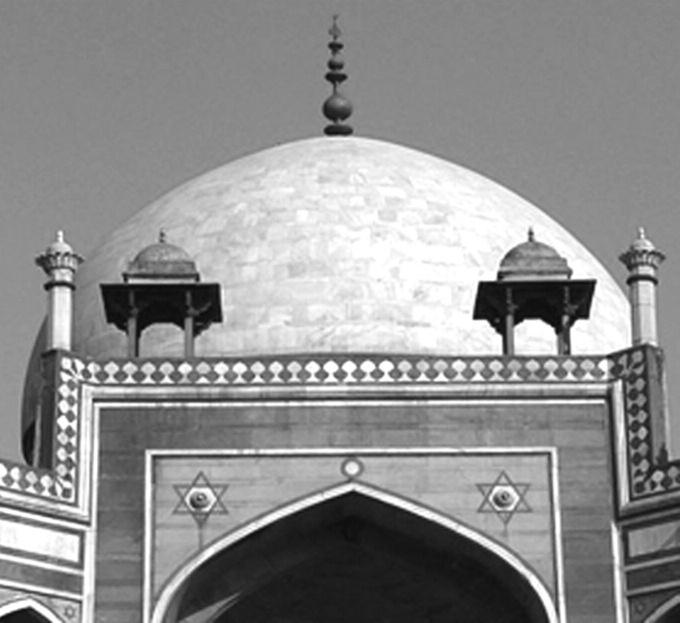
tHE outEr DoME WitH tHE MarBLE EXtErior tHE PiEtra Dura or ParCHinkari inLaY PattErn oF gEoMEtriCaL sanDstonE anD MarBLE Can BE sEEn in grEat DEtaiL
By amrita kangle
Domes by their very shape have always evoked a response from man. Essentially, a dome is a hemispherical structure, which evolved from the arch. It is in effect
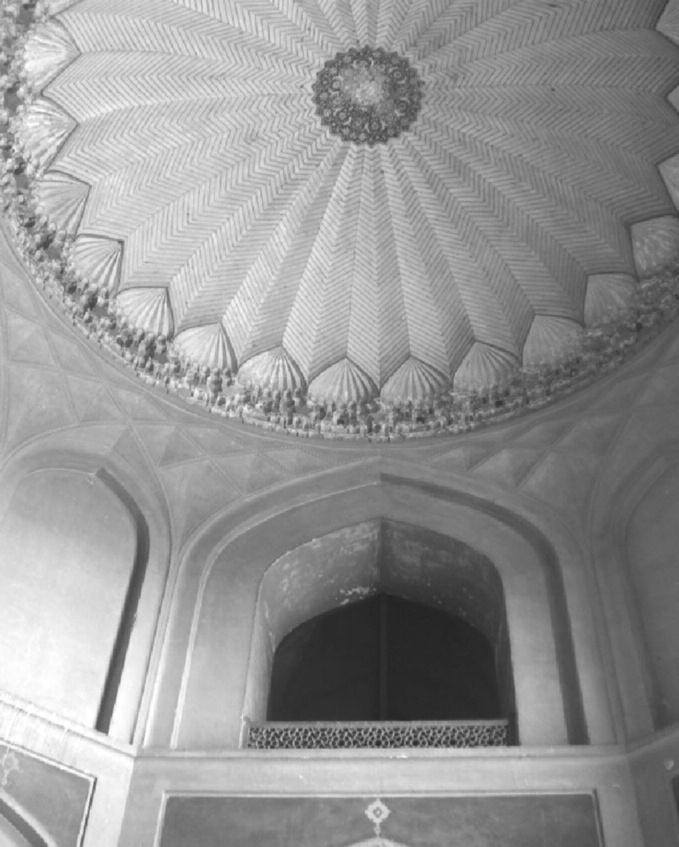
a collection of arches all sharing the same center and evolved gradually over the centuries from being solid mounds to becoming extremely complicated ribbed and fluted structures, which conveyed the impression that they were as light as air Despite their frivolous appearance, domes actually serve a very practical purpose
In Greek architecture, the stone lintels used to fortify their flat roofs needed to be supported by the columns, which could be at the very most 21 feet apart As compared to that, a brick arch in the same period could span a distance of 150 feet The possibilities that this freedom offered to architects and designers were quite mind boggling, since they now had the freedom to design uninterrupted spaces without
the intrusion of heavy columns to mar the architect’s visualization of unlimited open space.
One of the first concrete domes to be constructed was on The Pantheon in Rome, built in 126 AD as a temple for all the Roman gods It had an opening in the center: the oculus This famous dome continues to be the largest concrete dome for almost two thousand years after it was built
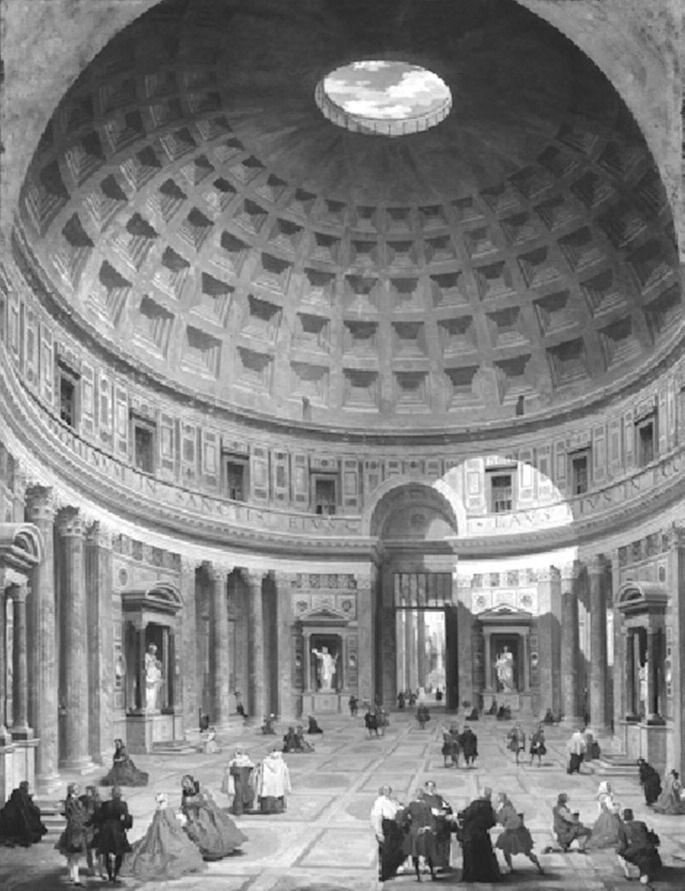
The interior of the Pantheon as it appeared in 1734 in a painting by Giovanni Paolo Pannini
A bright, airy, and beautifully simple, large open space illuminated with diffused sunlight, pouring in through the oculus, is the real beauty of the Pantheon. The large open space, which enfolded so much of the vast universe within its confines was
reported by Debajyoti Chatterji
The second quarter of 2016 (ending on June 30) was a very busy period for the Evergreen Club We successfully organized three meetings, and the attendance level was uniformly high Unfortunately we could not sustain our momentum into the third quarter. Our members enjoyed a busy summer with family and friends, often traveling for extended periods of time. That made the task of scheduling Evergreen Club events a real challenge A busy summer for the members meant a slow season for the club!
On Sunday, July 31, a dozen or so Ananda Mandir seniors met at Pan Asia, a local restaurant specializing in India-inspired Thai and Chinese cuisines The group enjoyed delicious dishes of their
choice, all prepared by a Nepalese chef with a well-earned reputation And the informal discussion that complemented the food was equally enjoyable It covered a wide range of topics, as is customary for Bengali social gatherings, and the bonds of friendship among the members were renewed and strengthened. The next session was scheduled for Sunday, August 21, and two well-traveled speakers had been invited to present a “Report from Exotic Destinations: The Galapagos Islands and the Arctic Region” About two years ago, the speakers, Dr and Mrs Ram Ramchandran had given a spellbinding account of their 21-day travel through Antarctica to a large audience, and they had been invited back by popular de-
mand Unfortunately, the attraction of family vacations during the final weeks of the precious summer season proved to be so strong that we decided to postpone this eagerly anticipated session to early November when a much higher level of participation is expected
The September session is scheduled for Saturday, October 1 (not strictly in September, I admit) It will feature a pot-luck lunch plus discussions on health care issues (such as diabetes) and estate planning/planned giving
Looking ahead, the final quarter of the year is also expected to be a slow season for the Evergreen Club but a busy period for the members because of the Puja festivities spanning almost three weeks, followed by the Thanksgiving and the Christmas holidays
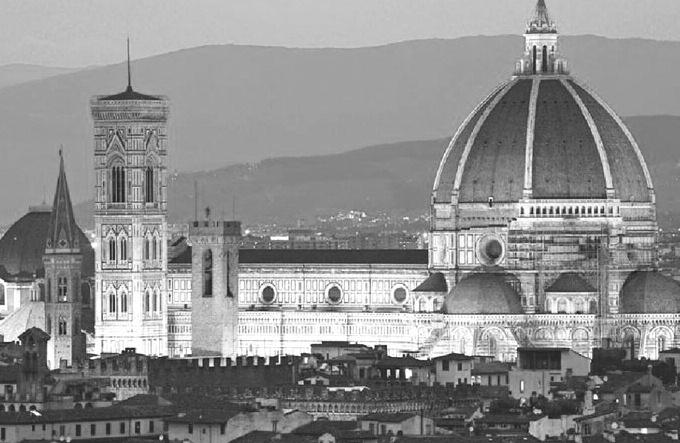
truly fit to be an abode for the Almighty tHE DuoMo
Begun in 1926 and completed just a few years later in 1436, The Basilica di Santa Maria del Fiore is the symbol of the city of Florence
Designed by Filipo Brunelleschi, this famous dome, named after its creator, mirrors the ideals of the Renaissance period, one of which was to place an almost unlimited trust in man’s abilities This ideal could not have been proved truer than in Brunelleschi’s dome, which is an engineering and a designing marvel.
The cupola has two parallel shells, which are connected by brick spurs. The internal one is the real roofing while the external one made of bricks is just 80 centimeters thick, which makes the dome visible from afar The finished height of the dome is 114 meters The Duomo is visible from every part of the city and towers over the city as if standing guard while its citizens frolic and have their time in the sun
Domes, as we can see have continued to fascinate man down the ages It is as if these lofty, soaring structures have given wing to man’s imagination, and every leap in design has been a personal, twofold leap for man in his search for perfection St Paul’s Cathedral in London, St Peter’s Basilica in Rome, The Hagia Sophia in Istanbul and the Taj Mahal in Agra (amongst many others) all reinforce the fact that amongst all God’s creatures, it is man alone who He created closest to His own form. He blessed man with the ability to create!
Recently, the Board of Trustees of Ananda Mandir has established an annual “Kishalay Award for Writing Excellence in Memory of Gauri Sen Gupta ” This has been made possible by an endowment from Avijit Sen, a respected life member of Ananda Mandir, in the memory of his late mother in law
The award is intended to inspire the young school age children and kin of the members of Ananda Mandir to enhance their writing skills and promote community involvement It will be administered by the “Awards Recognition Committee” of Ananda Mandir The committee has established guidelines, rules, and procedures for the award, which are being announced separately in this issue of Ananda Sangbad For further information, please contact Subrata Bhaumik at Bhaumik subrata@gmail com or Pronoy Chatterjee at pkc usa@yahoo com
We wish to express our sincere thanks to Avijit Sen for taking this noble and exemplary step to memorialize Gauri Sen Gupta’s devotion to youth development
Here are the highlights of our puja activities during the last quarter JunE
In our last report I touched upon upcoming Phalaharini Kali Puja in the month of June This is a much celebrated puja in India as well as in Ananda Mandir At
least sixty people gathered to observe this puja We also celebrated our monthly Satyanarayan puja in June
JuLY
In addition to our usual monthly Satyanarayan puja and Shyama Puja, we celebrated the big event of Ratha Yatra That was scheduled on 6th of July The Rath was nicely decorated with garlands and flowers The deities of Jagannath Dev, Balaram and Suvadra were dressed in decorated gorgeous clothes and were placed on the Rath The devotees, young and old alike, eagerly waited to pull the chariot Finally, with blowing of cinch shell, and playing of Dhak, Dhol, Khol and Kartal, the Rath was pulled slowly by the enthusiastic crowd Ganges water was sprinkled and flower were scattered on the pathway in front of the Rath as it was
reported By krishna Dutta roy, Chair, Puja Committee
being pulled People were chanting Jagannath dev's name and Hare Krishna kirtan while pulling the chariot into the driveway and then to the parking lot This continued until the Rath made several turns in the parking lot at the direction of our revered priest, Biswabhai According to the tradition, candies were thrown towards the crowd as "Harir Loot" Finally the deities were brought inside and puja continued ending with Stuti, arati and anjali Prasad and dinner were served to all assembled devotees The festivity ended around 9:30pm
On 13th, the Ulto Rath, meaning bringing Jagannath Dev with Balaram and Suvadra back to home in their chariot was celebrated. Again, the chariot was pulled by the assembled devotees with a lot of enthusiasm, playing of dhol and Kartal, amid Hare Krishna kirtan. After the Rath was brought, the deities were
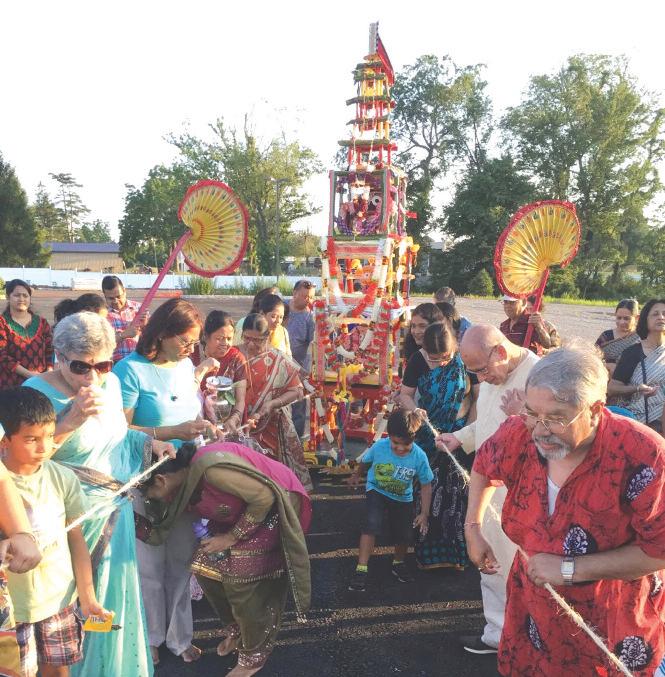
safely put in their original places inside the temple, As usual, puja and anjali were performed and prasad and dinner
were served
On 12th July we observed Bipad Tarini puja during the day About 25 devotees attended, even though it was a weekday
The last event of the month was Satyanarayan puja, performed on 17th July august
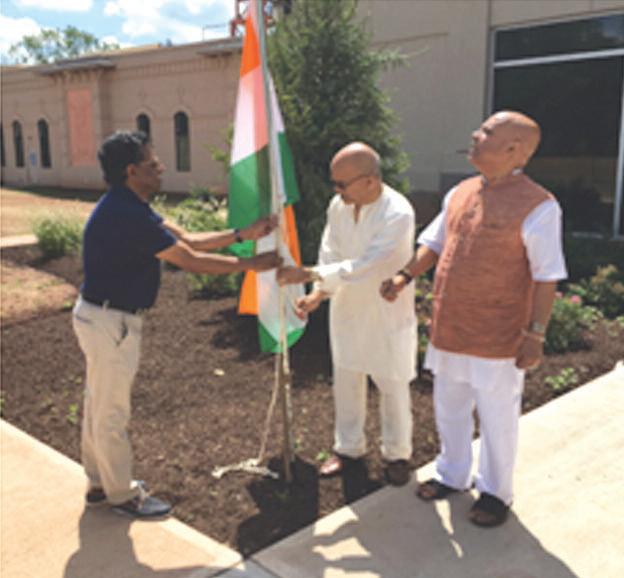
August was a busy month too On 14th of August, we celebrated India’s Independence day Flag was hoisted by Ashok Rakhit, the current president and Dipak Sarkar, the outgoing president, assisted by Biswabhai. Shreya B hanja Chowdhury sang both Indian National anthem and American National Anthem, as the assembled people assembled looked on. This year we did not have enough time to plan an elaborate program to celebrate our Independence day, due to lack of time and excessive heat outside
Our newly constructed Community Center was the venue for the Annual Fund Raising event on this day Many ladies walked around the temple with Kalash (ghat) held over their heads for the informal inauguration of the new facility Chairs and tables were set for the people to sit down and the fund raising was held as the very first event of the community center
In the evening, our monthly Satyanarayan puja was held
On 18th August, we observed Jhulan Purnima, also known as Rakhi Purnima Like other years, deities of Lord Krishna and Radha were decorated with festive clothing and flowers, and were placed on a swing that was decorated with flowers too Devotees worshipped and chanted as they slowly moved the swing per tradition Devotional songs were presented
by some of the attendees After puja, arati and anjali were done, prasad was served
On 25th of August, the crowd-favorite Janmashtomi event was held to celebrate the birthday of Lord Krishna This is a very big event in many parts of India, as it is here The BalGopal Temple was open from 8:30am to 9:30pm From the very morning, devotees started gathering in the temple and started chanting Lord Krishna's 108 names We targeted a goal of 10,000 times of chanting, but actually exceeded 15,000 chants, as different people took turns to chant all through the day. In the evening, Puja started with bathing Balgopal by traditional items like chandan, water, oil etc. After bath, Gopal was placed on a seat and then puja started. By the time Havan started, Dr. Manisha Chakraborty started reading the story of the birth of Lord Krishna, the eighth child of Bosudeb and Debaki Although the story is well known to all, devotees love to hear it every year, as Manisha does a great job in telling the story Then Arun B howmik and others chanted Krishna Naam Also Babravi chakraborty sang a bhajan The ceremony continued until 9:30pm, when puja and anjali were offered followed by prasad and dinner
Monthly Shyama Puja was held on 31st August sEPtEMBEr
Our upcoming Puja is Ganesh Chaturthi on sept 5th, 8:30am to 11:30am Details will be covered in the next issue
Please check our website for Durga Puja in October, and join us Also, we ask you to join us as volunteers, and get satisfaction of being a part of it
By subhodev Das
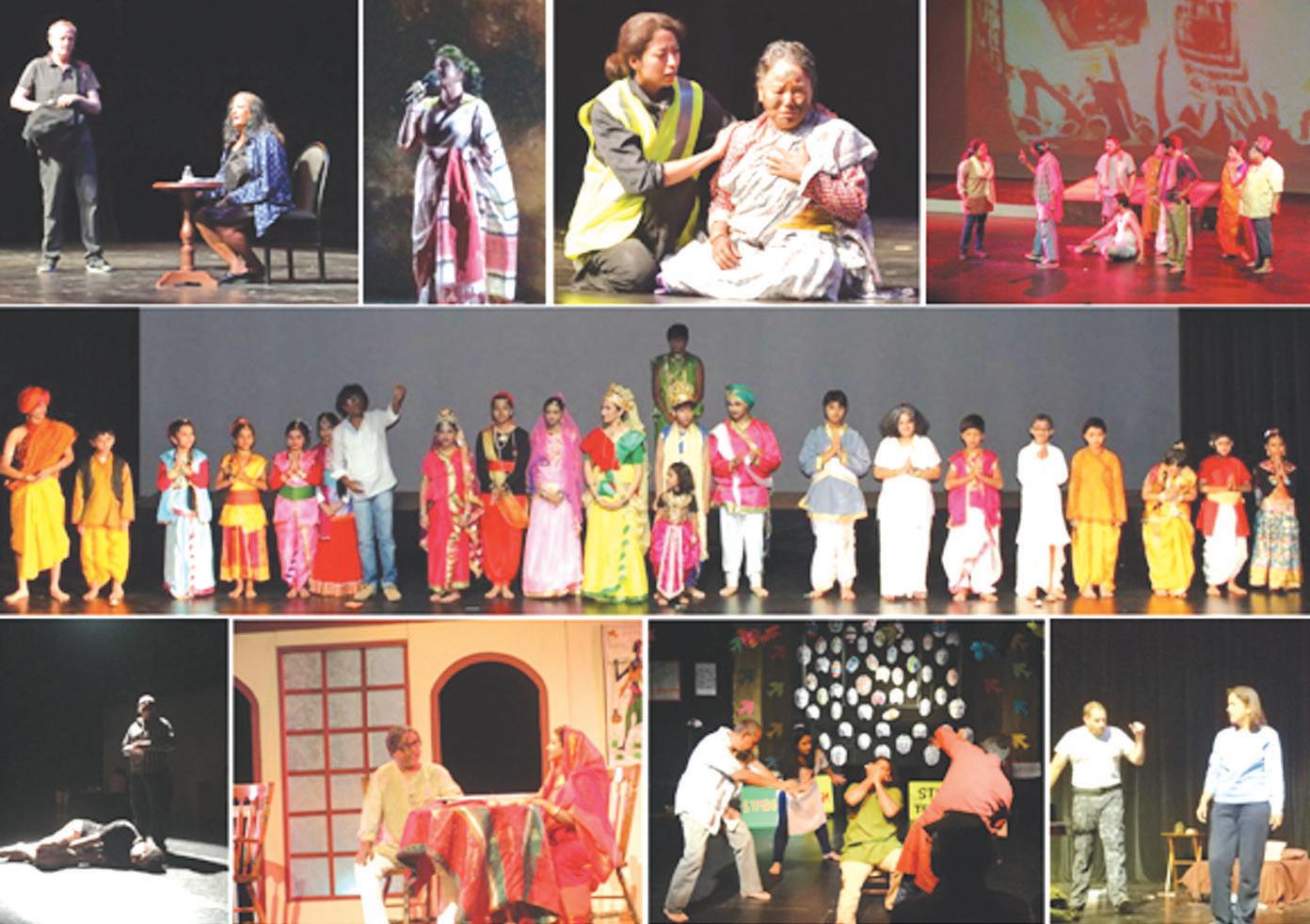
The 11th South Asian Theater Festival organized by the Epic Actors’ Workshop was held at George Street Playhouse in New Brunswick, New Jersey, during August 27-28, 2016.
Following the inauguration, Sreeshti of New Jersey presented a collage of recitation and dance titled Bharotbarsho It was composed and directed by Rituparna Das Datta The presentation drew on Bengali poems written by Subhorup Dasgupta, Nabanita DebSen, Amitabha Dasgupta and others that explored the crisis of human existence
Next up was Light of Asia, a children’s play in Bengali directed by Parthapratim Deb and produced by Mrittika Inc The play highlighting the early life history of Tathagata Buddha was scripted by Dhriti Bagchi, the Founder Principal of Mrittika Shri Deb, a noted theater personality of Kolkata, returned to the festival and was assisted by his wife, Smt Rupa Deb
The second play was Recipe Book in Hindi written by Shubhada Kamerkar It was directed by Mukund Kamerkar and produced by Theatrix of New Jersey The story weaves around three generations of women spanning the globe The grandmother who is a good singer and a great cook exhibits signs of early dementia She is busy penning her recipes and talking about them all the time Her daughter in the USA feels helpless with the mother ’s deteriorating health, however the granddaughter who grew up with her decided to return to India to be with her
The final program of the evening was The Masrayana, an
Continued to page 12
By sushmita Dutta
author’s note: In Hinduism, creation of this universe is timeless –there is no beginning neither an end With dissolution of one creation follows another new creation just like birth, death, and re-birth In science, we have multiple theories and proven logic to support beginning of creation, destruction, and recreation of this universe However, neither any religious nor scientific findings have been able to pin-point on the origin of this universe What triggered this creation in the first place? Nothing comes from nothing There had to be something that caused this creation What was it? There has to be something that laid the rules and timings of creation, destruction, and re-creation and designed the laws that govern orchestrated movement of millions and billions of universal bodies What is that controlling power? If it is the God, then who created the God? With scientific findings and Vedic philosophies simplified for easy reading, this is a special report for Ananda Sangbad readers in search of the origin of our universe Enjoy reading And, yes, please do write to the Editor with any contributory thoughts on this fascinating topic Concepts and explanations thereof are available on popular scientific and religious websites
Hindus offer prayers to Lord Shiva, chanting 108 names of the Lord, having dialectically opposite expressions like “Om Shukshma Tanave Namaha” meaning salutation to the Lord who bears the minutest form of physical body, and then, immediately after we have “Om Jagat Vyapine Namaha” meaning acknowledgement of the Lord who is spread all over the world This principle of dialectically opposites drives the very existence of this entire cosmos - the universe, the galaxies, the stars, the planets and the full band of living non-living entities There are phases of creation that bloom into bright, luminous universal bodies And then, in parallel, while the universe rejoices expansion, somewhere in the cosmos, dialectically opposite forces are created, which cause destruction of everything, and then, there is a period of silence, a long pause as if something is getting impregnated with new seeds before creation starts all over again We are all wrapped into this cycle of creation, dissolution and creation again Hindus call this cycle “Srishti” (Creation) “Sthiti” (Stability) “Proloy” (Destruction) Scientists
topic yet the root cause of creation is still unknown In the past, scientists believed that the universe was ever existing and everlasting. In 1915, with introduction and acceptance of Einstein’s Theory of Relativity, it was pronounced that “Space and time were no longer absolute, no longer a fixed background to events Instead, they were dynamical quantities that were shaped by the matter and energy in the universe They were defined only within the universe, so it made no sense to talk of a time before the universe began” Along with the theory of relativity came discovery of the fact that the universe is constantly expanding It is believed that the universe and time itself began with the Big Bang and time would come to an end in B lack Holes So, here, for clarity, a very simplistic definition is needed on what is big bang and what is black hole?
What is Big Bang?
“According to the standard theory, our universe sprang into existence as "singularity" about 13 7 billion years ago ” “The Big Bang theory is a cosmological model for the universe from the earliest known periods through

have termed these as phases of “Big Bang” which cause creation of a universe and then there are “Black Holes” which trigger complete dissolution of everything created With enormous progress in cosmology, scientists have researched extensively on this
its subsequent large-scale evolution The model accounts for the fact that the universe expanded from a very high density and high temperature state and offers a comprehensive explanation for a broad range of phenomena, including the abun-

dance of light elements, the cosmic microwave background, large scale structure and Hubble's Law” Hubble’s law describes expansion of the universe “The distant galaxies we see in all directions are mov-

ing away from the earth” as the universe expands. A simple analogy could be the baking of a
raisin bread As the bread gets baked and expands, the raisins are distanced from each other Similarly all elements within the universe were closely knit during early formation stages of the universe As the universe expanded the elements within were getting away from each other and the expansion is still on Scientists today assume that “Everything in the universe is moving uniformly away from everything else” and the universe is expanding like an elastic or a flexible sphere What is singularity? “In the center of a black hole is a gravitational singularity, a one-dimensional point which contains a huge mass in an infinitely small
space, where density and gravity become infinite and space-time curves infinitely ” What is Black Hole? “A black hole is a place in space where gravity pulls so much that even light cannot get out The gravity is so strong because matter has been squeezed into a tiny space This can happen when a star is dying Scientists think the smallest black holes formed when the universe began Stellar black holes are made when the center of a very big star falls in upon itself, or collapses When this happens, it causes a supernova. A supernova is an explod-
Continued to page 15

By rahul ray
In recent gatherings of my Indian friends, some would say that currently our native country was doing very well, societally and otherwise Yet some others would voice a completely opposite view This war of words has become a political hot potato, and with ensuing deep political polarization it really depends on which side you are on I am squarely with the second opinion, particularly where women’s issues are concerned No matter which media one follows, the news is daily filled with incidents of beating, rape and murder of women of all ages and from almost every corner of the country Sadly and alarmingly so, all of us are slowly but surely becoming de-sensitized to the dire state in the affairs of Indian women.
I am reminded of an incident I had heard a few years ago in a radio report where the reporter was talking about an episode involving the movie, ‘Schindler ’s List’, by the famous Steven Spielberg A middle school teacher from California had taken her young students to an afternoon showing of the movie Her motivation was to expose young minds to the horrors that one human can inflict on other, so that they could be more sensitive to crimes against humanity In a scene a Nazi soldier was shown killing a prisoner at point-blank range After a brief hush suddenly the students broke into loud laughter! The rest of the audience in the movie-theater were so enraged at this vulgar display of insensitivity towards violence, that they loudly protested and the students were thrown out of the theater
Creeping de-sensitization of our feeling about violence towards Indian women makes the situation far worse It is as if in India women don’ t count, and worse still that they are completely at the mercy of men!
This is the reason why Lakshmi Bai, the famed queen of Jhansi matters a great deal today. She was a woman, a valiant one, and one who led an army and died with dignity fighting the then British lords of India and their cronies, instead of being molested and murdered by a fellow countryman Before I go any further, an arching back to the history of nineteenth century India will be most relevant However, it must be noted that it is not merely re-telling of history, but a narrative within the context of the role of women in Indian society then and now
Lakshmi Bai was born Manikarnika in Varanasi to a wealthy, highly intellectual and influential family well-connected with Maratha royalty The name Manikarnika is highly significant Legend has it that Lord Shiva, under acute grief after the death of his wife Parvati or Sati went on a mad rampage, and dropped a ring or ‘Mani’ from his ear or ‘karna’ at a place in Varanasi making this place, Manikarnikaghat, one of the holiest places for Hindus True to her namesake, Manikarnika or later Lakshmi Bai became a sacred name in India
Manikarnika lost her mother when she was four, and her father, a Peshwa or chief counsellor to the Maratha empire, brought her up in a most unusual way. She took intense training in riding horses and elephants. She learned fencing and marksmanship. It seems uncanny, almost as if her father, Moropant Tambe, could foresee her future
Most importantly, Manikarnika, as a young girl grew up in a way that was most unusual in the first half of the nineteenth century India, when young girls were prevented from going to school, and were wed off by their parents before they reached puberty These young ladies were merely relegated to taking care of their husbands and bear their children
Interestingly, the tale of Chitrangada from the Mahabharat who was the princess of Manipur and who dressed as a lad and learned everything befitting a man, including warfare was known to people far and wide Yet it remained in people’s mind only as a fantasy As a result, the role of a woman outside the chores and duties in her husband’s family, was unthinkable, let alone women riding horses side by side with men or hitting a target with a rifle Thus, the upbringing of Manikarnika was so remarkable
In the year 1842, at the tender age of fourteen, Manikarnika was married to Gangadhar Rao Niwalkar, the king of the estate of Jhansi in Uttar Pradesh She was renamed Lakhsmi Bai after Lakhsmi, the goddess of prosperity, and the sacred in Manikarnika was sacrificed at the altar of riches In 1851 Lakhsmi Bai gave birth to a son who died in infancy Due to failing health, Gangadhar Rao adopted Damodor Rao as their son and the future heir to the throne of Jhansi Soon after, Gangadhar Rao passed away and Rani Lakhsmi Bai ascended to the throne of Jhansi till Damodor Rao came of age, to assume charge as the head or king of the estate of Jhansi This was also the time when troubles began
The year was 1853 and Lord Dalhousie was the governor general of India on behalf of East India Company which was in the process of tightening its grip on colonial India by expansion, attrition, and brute force by running roughshod over still independent Indian estates and kingdoms In the case of Jhansi, governor general Dalhousie invoked the infamous Doctrine of Lapse by which any sovereign estate where the ruler was either deemed incompetent or died without a male heir would be annexed by East India Company. Soon Rani Lakhsmi Bai was de-throned, given a token pension and ordered to leave her estate
What transpired after that for almost five years is rather complicated, but the crux of it was that Lakhsmi Bai refused to give in to the demands of the East India Company She also valiantly defended her estate from invaders from the surrounding areas who miscalculated that a woman could be defeated in a whisper
All the trainings she received as a young girl were put to the test It was also a very turbulent time in colonial India The Sepoy mutiny, dubbed as the first Indian war of independence had started in 1857, first in the army barracks in Meerut, a neighboring town of Jhansi The mutiny was triggered off by a rumor that the cartridge of the Enfield rifle that the soldiers used, contained cow or pig fat Mangal Pandey, a soldier in the Barrackpur cantonment in Bengal, enraged by this rumor, killed an officer and was subsequently hanged But this incident set a chain reaction that spread like bonfire leading to a carnage on both sides that remains unmatched today.
In the meantime, British rulers kept up the pressure on
Rani Lakhsmi Bai to surrender Jhansi to their hands, but she famously declared- "We fight for independence In the words of Lord Krishna, we will if we are victorious, enjoy the fruits of victory, if defeated and killed on the field of battle, we shall surely earn eternal glory and salvation "
The final test of her mettle came when in March, 1858 British troops encircled the fort of Jhansi with a demand for Lakhsmi Bai’s head Jhansi fell, and Rani Lakhsmi Bai fled, with her young son strapped to her back, first to Kalpi and then to Gwalior, fighting all the way, supported by fighting men from Tantiya Tope, Ghulam Ghoush, Nana Saheb, Khuda Baksh and other famous warriors of the day. It is noteworthy that many of her compatriots were muslims with independent India in their minds Rani Lakhsmi Bai’s final moment came when during the battle of Gwalior she fell from the horse she was riding and was killed by a soldier on the other side Thus ended the heroic and patriotic life of Rani Lakshmi Bai at a tender age of twenty-nine Tales of Lakhsmi Bai have entered the lexicon of Indian folk-
lore since her death. There are monuments and parks in her name Novels have been written, movies have been made, songs have been composed praising her valor Today men and women alike worship her as a goddess of strength, gallantry and patriotism
Ironically, the same Indian males have been treating their gender-counterparts only as objects of desire and bearer of their children!
I may sound preachy, but Indian society today would benefit enormously by empowering women like Rani Lakhsmi Bai to right the wrongs committed by Indian men These women would also potentially remove the cloud of de-sensitization among many Indians, who think that violation of women is a trifling matter and a norm in Indian society
But, is it what is happening in India today? We have witnessed numerous protests by women after many incidents of rape and murder We have heard fiery discourses in public and in the social media after many molestations But atrocities have remained unabated.
If women of India are inspired by the courage of Rani Lakshmi Bai they must band together to isolate a rapist from society on one extreme and castrate him on the other! This would send shock-waves to abusing men We haven’ t heard of such incidents yet, but these may be the things to come! Indian women have waited long enough for judicial, legislative and administrative efforts to redress rape, honor-killing, acid disfigurement and outright murder by the maledominant Indian society
Continued from page 1
members of the Food Distribution Committee The donation collection efforts were coordinated by Bandana Rakhit with the able assistance of Chanu Das, our treasurer When all the contributions were tabulated and verified, the total stood at a hefty $297,000, an all-time record for Ananda Mandir
Special thanks are due to the members of the Kishaloy team, our Youth Group, for their efforts as enthusiastic guides throughout the day Numerous other volunteers worked tirelessly to make the event truly enjoyable, and all aspects of the program functioned smoothly Last but not the least, sincere thanks to the many members who worked hard to call others and solicit their support in raising awareness of and participation in this year's campaign
All in all, this year's Fund-Raising Day was a huge success, and the $300,000 raised from the event will go a long way towards meeting our financial obligations for the year ahead Sincere thanks to all our members and friends who participated in the event and to the many others who could not be present but sent their donations by mail and through intermediaries
By ruby Banerjea
Amongst the numerous things I had to get used to after coming to this country, the most unusual was getting used to being called by my first name What's so unusual about that? Well, nothing really, until you hear a five year- old calling you by your first name!
We were at a Thanksgiving party, in fact my first one. My husband's colleague had most kindly invited us to their house to include us in their celebration. After exchanging the usual pleasantries, the lady of the house introduced us to her two adorable daughters aged five and one Imagine my surprise when the five year old tugs at my sari and said, "Hi Ruby, will you come and see my toys?"
It took me a full minute to realize that she was talking to me! Ruby? No Mrs , no aunty, straight Ruby? How rude!
My husband nudged me out of my disbelief and I couldn't help wondering how different our cultures were Right from our childhood we were taught to address our elders with respect There are no end to those suffixes dada, didi, uncle, aunty It is perfectly normal to address a complete stranger as an uncle or aunty Nobody takes offense, in fact they will if not However in America it is perfectly fine to address you by your first name It took me some time getting used to it
However, soon enough I was quite comfortable; it felt nice to be addressed as just 'Ruby' In fact it made me feel young! I enjoyed the liberty of doing the same.
But not for long. I was brought back to stark reality when an acquaintance of mine addressed me as 'Aunty'.
Aunty??
"Hi aunty, how are you?"
"Fine, thank you, (or not!)"
That was the limit I had to do something about it All that talk about aging gracefully and stuff is fine, as long as it doesn't concern me! I'm far too young to be addressed as an aunty C'mon, at least I'm still young at heart! This is America for Goodness sake I was furiously musing about all this, when my daughter piped in, "Mom, did that lady just call you aunty?"
I knew I had heard right and now had to deal with it
"Yes--- what nerve!"
I could feel my daughter smiling, sitting by me in the passenger seat while I was driving, and was just going to protest, when "But Mom you aren't that old, and she couldn't be that young either; in fact you don't look old at all "
That was music to my ears
I remember a doctor once asking me "How young are you Mrs Banerjea? What a nice way to ask your age! It's only a number after
all and nowhere is it more true than in America I see senior citizens driving, shopping and enjoying themselves despite their years How wonderful it is to feel young in spite of the physical restraints that accompany our grey hairs? My senior friends from Garden club are so active and vibrant that I feel really inadequate when I have to excuse myself from hands-on gardening, due to my bad knee; and when I see them volunteering to pull out weeds and raking leaves, I am downright ashamed! Our elders in India have been so tuned to a certain lifestyle after a designated age, that anything unconventional is a problem and even sometimes frowned upon However young they might feel, however fit they might physically be, the age factor always seems to stand on the way "I am too old to wear that color" or "at my age? You must be kidding!" seems to be the general referendum Elders mourning their lost youth and beauty, make themselves (and others) more miserable
I strongly feel that the absence of hired help with our daily chores, forces us to stay fit and thereby feel young Not only physically, I feel our outlook changes too, when dealing with our children in this country I used to be so protective while raising my elder daughter, always very aware that I had to mentor and protect her; she never discussed her friends or her problems if she ran into one Maybe she thought I wouldn't understand or relate. I was still in the old-fashioned-I-am-the-mother mode. All that changed overnight as my younger daughter grew up to be a teenager. She would discuss everything under the sun with me, and though I was shocked and fascinated at the same time at the stories she would share, I became her closest friend and confidante! We shared and laughed together like best friends much to the amazement of my elder daughter It made me feel so much younger and closer to them as I felt them trusting me with their secrets, though at times I felt I'd be better off not knowing them
Now as they have all grown and left home, I find myself wondering When I look at the mirror I can still see the 'young' me irrespective of the fine lines on my forehead and the laugh lines that accompany my smile I can see a little wrinkle here and a little crinkle there and ask myself how old is still 'young'? As I make a note to check out the new line of age-defying products that are so alluringly advertised, I remind myself it does not really matter After all, beauty lies in the eyes of the beholder and as long as my children think I'm still cool enough, I will always be young at heart!
“Looking for the Indian event? Just follow the sarees ” Apparently, that was the response of an NYPD officer to a soul lost in the busy streets of Big Apple I remembered that exchange while stepping out of New York Penn Station during the evening rush hour of July 1
While many of the Manhattanites were heading out of the metropolis for the long weekend, we joined six thousands of our Bengali brethren to partially fill in for the vacationing crowd. This was the occasion of North American Bengali Conference 2016 or “Banga Sammelan” as the event is popularly known
The cosmopolitan street scene of New York had taken on a different look with the influx of conference attendees The familiar canvas of business suits and contemporary garb was now dotted with brightly colored sarees There were enough varieties to turn heads of the city fashionista I heeded to the advice of the uniformed man and followed the train of sarees into the main conference arena – the Madison Square Garden Thanks to our foresight, we were in possession of our conference credentials The geo-political disruptions from Orlando to Dhaka bore fresh in our minds as we made our way past the security checkpoints
The conference was inaugurated with much fanfare Renowned Kathak maestro, Pt Birju Maharaj, and his troupe performed in the opening event However, the venue seemed somewhat lightly attended I assumed that many attendees were arriving late as was the norm on the first day. Well, that was not the case on this evening – apparently many of our friends were still stuck in the registration queue. The rest of the evening turned out to be no less eventful People streaming out of MSG and the registration area began to congregate on the eighteenth floor of Hotel Pennsylvania that had room for far fewer audience We sensed trouble; instead of hanging out in the Penn ballroom, we decided to ride the elevator down to the safer streets of New York
This was turning out to be an interesting pow-wow, quite different from the Sammelan we had participated in 2005 at these same venues Nearly everybody we met on this opening night had something to quip about The overseas artists (that would be from Kolkata) arriving at JFK had transportation issues; the individual committees were struggling to keep their ranks filled; Ananda Mandir ’s ex-President was in hot pursuit of bundles of the Kolkata newspaper “Aa-
By subhodev Das
jkaal” printed specially for the conference that were being delivered in a wandering chartered bus outside MSG; the food stalls apparently catered items not quite as advertised; even the famous New York street food vendors were swiping the attendees Then again people were hanging around in spite of all the complaints and were willing to put up with their troubles
Wouldn’t it be worthwhile to feel the pulse of the attendees – what actually drew them to the conference? So, I struck somewhat random conversations with people. I began with my friend and ex-Dean of IIT Kharagpur, Prof. Amit Patra, who was visiting from India with his wife Anasuya They arrived in the City a few days earlier and were settled by the time of inauguration The Patras seemed much less ruffled by the hiccups compared to many of the locals As we strolled down 33rd Street towards New Yorker Ballroom for the literary session on Saturday morning, Amit expressed his deep satisfaction with the conference He felt that the local participants occupying the same stage as the overseas artists was a remarkable feat in itself; that would be completely incomprehensible in India By Sunday, the couple felt that the quality of local productions was at par with the overseas ones and that the conference was really an amalgamation of Bengali culture They would not hesitate (except for the travel) to attend another Sammelan in future
Next, I turned my attention to Dr Biplab Bhawal, a physicist at Caltech He was at the conference to hobnob with the Tollywood glitterati Biplab, who had been my Facebook friend until then, could call on many of the matinee idols as his close friends. He was not the typical conference attendee and was definitely enjoying the Cityscape According to Biplab, it was the friends’ company that drew him to the Sammelan year over year
Tilottama Majumdar, the noted novelist-poet-essayist from Kolkata, was attending the Sammelan for the very first time She felt at home in the literary sessions among her peers, like Srijato and Binayak Bandopadhyay Tilottama happened to be among the initial arrivals from Kolkata who were caught up in transportation faux pas at the airport Would she be coming back to North America on another such occasion? She was not so sure Meanwhile, the fate of any one of the advertised programs
running its full course became somewhat uncertain as the Sammelan wore on Given that in either local or overseas category, the total programming hours was way more than what could be accommodated at the various venues, such infractions were a foregone conclusion Still I managed to sample a few events, which were on my list, and gave up on the rest I was relieved that our own drama event could go on stage without much of a headache By Sunday, most attendees were resigned to their fate that they would have to acquire their fair share of Bengali culture; however, they were resonating with the vibes of the City by filling in the bars and restaurants around MSG up to the wee hours of the morning
In the closing hours, I came across Subhramanya Sanyal, an old acquaintance, who was visiting from Chicago with his family and friends He turned out to be a straggler trying to identify his motivation behind the Big Apple trip Although he had his list of events to attend, he would not miss the first opportunity to hang out with friends So, we walked into an Irish pub and sat down to chat Dev Hazra, a theater enthusiast and Sanyal’s comrade from Chiacgo, and Tathagata Mullick of Toronto, another of Sanyal’s friends, joined us Dev concurred with Sanyal’s view about attending the Sammelan, though Tathagata sought a balance between event patronization and milling with friends
Once we downed our drinks, the group headed out for one last opportunity to claim our respective slices of the Bangaliana pie We queued up in front of MSG, hoping to attend Sunidhi Chauhan’s performance. After nearly hour and half of jostling and holding our fort from being overrun by the surging crowd, we stepped into the arena.
Three hours later, when the show concluded, the departing crowd seemed to have reached the consensus that for once things worked well and all the efforts to attend the august gathering had paid off Well, Sunidhi was not quite the Bangaliana brand ambassador In the end, my small sample of interviewees and highly unscientific poll lead me to conclude that as long as there was something for everybody, people really did not care much Whether the conference could successfully execute its plan was probably a concern for just a handful of the organizers The rest of us came for Sammelan and, boy, did we congregate!
(Disclaimer: The characters in the article are real; the names are changed for confidentiality.)
Mina Shah came to my office and broke into tears and said, “Doctor I am paralyzed and cannot take care of my husband or my children I constantly worry about germs swarming over my kitchen floor, kitchen counters, carried by my children’s dirty shoes and dirty hands I have to scrub the counters and the floors six times a day and I’m not able to cook for my family Before I leave the house to go for food shopping, I come back and check the stove three times and the door lock three more times Please help me ”
I did my usual psychiatric evaluation and prescribed a standard treatment for Obsessive Compulsive Disorder She came back three weeks later and reported that she was feeling much better and stopped worrying about germs, and cooking for the entire family She also disclosed that her husband was very happy because she was able to be intimate with him without taking shower multiple times I told her to continue on the medication and come back in three months She did not come back for six months and one day called the office to make an emergency appointment She arrived looking disheveled and extremely anxious I asked her, “What’s the matter Mina?” Mina said, “When I visited my mother-in-law she was very upset that I was taking pills. She took me to the temple and asked the priest to give me blessings with holy water and then took away my pills. She told me that God would save me from this evil eye. Doctor, I’m back to square one and cannot function again Please give me my medicine and I will take them secretly I won’t even tell my husband ”
Many Hindus attach a stigma to mental illness and cognitive dysfunction
Many have a strong belief in the concept of the evil eye and may believe this to be a cause of mental illness In addition, all illnesses including mental illness, may be seen as the result of karma of this life or a previous life As a result, mental illness may be viewed as something to be accepted and endured rather than treated with proven interventions These beliefs may encourage a quiet fatalism and non-adherence to therapeutic measures
While visiting my place in Santiniketan last year, my caretaker requested me to see a young woman named Lakshmi from a nearby village I was told that she was possessed by ghosts (bhut) The husband and brother-in-law carried her to my house and placed her on my patio Her arms and legs were tied with ropes and she let out unintelligible loud shrieks and her entire body shook in spasms
The mother-in-law told me that Lakshmi had trances when she talked to herself and disappeared for days She also informed me that Lakshmi’s uncle has the same disease I went to the local drugstore, got an antipsychotic medication in a liquid form and gave it to Lakshmi. I
By nupur Lahiri M.D.
told the family to continue the medicine for at least six months Yesterday I got a call from my caretaker telling me that Lakshmi is now completely cured Her family performed the ritual of “Bhut Chaturdoshi”, but agreed to continue the treatment prescribed by the Memsahib doctor
Belief in possession by an earthbound spirit or bhut (ghost) is an integral part of Hindu ideas of the soul and its karma
Belief in religion is a Mental illness: is it true?
Philosopher Bertrand Russell wrote:
"'Religion is based...mainly upon fear...fear of the mysterious, fear of defeat, fear of death. I regard it as a disease born of fear and as a source of untold misery to the human race.'"
According to the American Psychological Association (APA), a strong and passionate belief in a deity or higher power, to the point where it impairs one’s ability to make conscientious decisions about common sense matters, will now be classified as a mental illness
Dr Lillian Andrews, a professor of psychology, stated “every year thousands of people die after refusing lifesaving treatment on religious grounds Even when being told ‘you will die without treatment ’ the patients reject the idea and believe that their God will still save them Those lives could be saved simply by classifying those people as mentally unfit for decision making”
Mary Ellen has suffered from lifelong depression and anxiety that culminated into a suicide attempt after her 34-yearold son finally passed away Richard was born with congenital deformity of heart and had undergone multiple surgical operations by age of 2 ½ Mary Ellen has been taking antidepressant and antianxiety medication all through her life and managed to take care of her family and her stressful job She questioned repeatedly all along, “Why me?” She had stopped going to the church and started drinking alcohol every day After dealing with her crisis of failed suicide attempt I asked her to go to her church again and pray for the soul of her son. She listened to me and attended church regularly and started a support group for mothers in mourning. She was able to reduce the dose of her medications, stopped drinking and never thought of suicide anymore.
The religion that is based on fear, fear of the mysterious, fear of defeat, fear of death and fear of punishment for bad karma can have much negative impact on a person On the other hand, positive spirituality that facilitates life transitions and spiritual forgiveness and encourages altruism helps with coping with distress in times of crisis such as illness, loss of loved ones and serious mental illness of a family member
Spiritual support from God or a higher power, with support from reli-
gious institution or the priest, has given strength, hope and purpose to continue living during distress It is important for mental health providers to acknowledge and take into consideration the dual nature of religion and spirituality as they can be essential resources for health and well-being
Salma brought her eight-year-old son who never spoke a word and made growling noises and banged his head when he was hungry Kashim did not make any eye contact, walked around the room purposelessly and started banging on the door He did not respond to any command from his mother. Salma told me that she prayed six times a day and followed all the rituals of her religion as recommended by the mosque, hoping for a miracle. Her 13-year-old daughter was a bright eighth-grader, a violinist and was an honor student. Salma blamed herself for not praying during her first trimester due to severe nausea and vomiting She strongly believed that Kashim was the result of her sinful act I recommended that she took her son to special school for Autistic children and prescribed medications to reduce Kashim’s self-stimulating behavior
The boy was engaged in Speech Therapy, Occupational Therapy and specific treatment for reducing rituals and compulsions A year later she brought Kashim back to my office for his usual monthly follow up visit Kashim looked up at me and smiled and said” Hello” Salma never stopped praying I was able to convince her that her inability to pray for a short time had nothing to do with Kashim’s illness
Positive effects of religion: A religion offers ways of understanding and coping with life crises
Religious rituals help to ease negative thought process through prayers and offerings
Religious ceremonies help celebrate life events such as birth, marriage and death
Religious scriptures help understanding life experiences
Religious teachings encourage volunteering and helping others.
Religious gatherings encourage interacting with the community and togetherness.
Meditation and prayers help reduce stress, anxiety and hopelessness.
Spirituality, a deep-seated connection of one’s self with the greater “whole” or the Atman, helps us understand ultimate questions about life and transcends us to a higher power Expressing spirituality through art, poetry, music becomes an all-inclusive concept of awareness
Ananda Mandir is a place of worship and a place for conducting community prayers, celebrations of birth and performing the last rites, providing a tremendous comforting influence on the families in attendance
Continued from page 8
English play written by William C Kovacsik
The story drew upon real-life events to focus on crisis of human existence It narrates the journey of a farmer, named Gopal Mesra, through an uncaring and archaic bureaucratic system that has declared him dead As he crosses India, Gopal meets many like him and together they manage to confront the system This play was directed by Mahesh Dattani, a renowned playwright and director from Mumbai, under the auspicious of Indian Cultural Society of East Brunswick
The concluding day of the festival showcased two Bengali plays and a panel of three short plays The day opened with Aw Aaa Ka Kha performed by Spotlight Ohio The play written by Indrasish Lahiri was directed by the renowned theater personality Meghnad Bhattacharya of Kolkata The play sought to emphasize education as a holistic endeavor in our society.
The three one-act plays, a new venture of the festival, followed next. The first play Jodiyos Bhattkieka Manharu (May the Broken Hearts Heal) in Nepalese written by Ashesh Malla was directed by Hari Bahadur Thapa. The story, set against the backdrop of the massive earthquake of Nepal, depicts the loss of life and sufferings of the survivors It was staged by Nepali Theater of New York The second short play was Issues of a Sergeant, written by Alan Stolzer and directed by Seeyali Singh This English play is about the war and how it affects the relationship of a couple The final one-act play Come Home for Lunch is written and directed by Bina Sharif Ms Sharif, who was featured in past festivals, based this fictional play on true events in Arkansas It explores the primary reasons behind school shootings often taking many colors
The final play of the festival was the much-anticipated Sagina Mahato by Epic Actors’ Workshop Based on Gourkishore Ghosh’s novel of the same name, the play was adapted from Badal Sircar’s script and directed by Parthapratim Deb with the assistance of Rupa Deb Set in North Bengal, this popular play explores the rise of a charismatic leader from the ranks of tea plantation workers to the national stage and his subsequent return to his people Theater in Breaks conceived and directed by Subhasis Das and produced by Epic Actors’ Workshop featured in the festival lineup as in last year According to Subhasis, the concept is one that aims to explore and create spaces of exchange between theater workers and their audiences. During four breaks over two days, Subhasis and his supporting team explored different frames of performance in the format of ‘Third Theater ’ popularized by his mentor Shri Badal Sircar. The black box space of George Street Playhouse was utilized for theatrical performances like installation, musical, and storytelling The two breaks on the first day presented snapshots dealing with emergence of a play and human intolerance due to our practiced –isms During the first break on the second day, We Came to the River inspired by Badal Sircar ’s “Nadi,” was presented Jonmobhumi Aaj, a poetry montage adapted by Badal Sircar based on the works of Birendra Chattopadhyay and Kazi Nazrul Islam, was performed in the final break
reported by subrata Bhaumik
Sahitya O Alochana (SOA) is a monthly literary and topical discussion forum under the aegis of Ananda Mandir (AM) It completed its 8th anniversary in January 2016 and will have organized ninety three (93) sessions by the time the current edition of Ananda Sangbad goes to press These monthly discussion sessions feature exciting and illuminating discussions on diverse subjects including literature, art, theater and movie; history, philosophy and religion; science and mathematics; economics and business; and social issues, sports, and current affairs The following is an account of the recent sessions organized by the SOA committee of AM June 2016
This session was entitled "revival of terracotta sculpture in india and Beyond " It focused on an exquisite sculpture ( Terracotta) that dates back to 3000 – 5000 BC Female figurines and phallus-shaped stone uncovered by archaeologists in Mohenjo-Daro, Burney-Relief in ancient Mesopotamia, and Ushabtis in ancient Egypt are some of the fine examples of this waning art that adorns the annals of history History of sculpture in Bengal in India is also replete with substantial use of terracotta in the temples around the land and other popular traditions of folk sculpture including the famous Bankura Horses Ananda Mandir, NJ is proud to have broken new grounds by introducing this fine heritage sculpture in the temples around North America. “ANANDAKIRTI” is a project undertaken by Ananda Mandir to model the façade of the new temple and community center (nearing completion) in this centuries old art from Bengal and ancient India
The discussion leaders of this session were Partha Dasgupta and Shibsankar Das Graduates of Government Art College and Visva Bharati, the duo has extensive background in ceramic, glass, and wood and leather craft; and has done enormous amount of high quality work in reviving this form of art in the mainstream temple sculpture in India and beyond They presented a documentary on the various Terracotta sculpture projects they worked on and their vision of Anandakirti in Ananda Mandir, which was interspersed by narrations of their personal experiences on such creative work Their work can be viewed on the front façade of the temple of Ananda Mandir A ton of thanks goes out to Messrs Dasgupta and Das July 2016
In July, the New Jersey literary enthusiasts had the good fortune of hearing the works of Srijato Being in the forefront of the “nouveau génération de Bengali poètes,” Srijato (Bandophadhyay) needs no introduction to Bengali poetry lovers This event was entitled “an evening with srijato – a passionate dousing in contemporary Bengali poems and music lyrics ” It was a runaway success with a very ro-
bust crowd eager to taste “la poésie Bengali d’aujourd’Hui“and interact with the rock star that he is. This session was one of the rare sessions we have had in our history of almost nine years – a real treat, a collector’s item A ton of thanks goes out to Srijato august 2016
There was no session held in August due to scheduling difficulty in the month known for vacation september 2016
Art of Storytelling, a multimedia presentation, was the session for the month We have always wondered about what could potentially be the oldest form of art? The answers of course are many depending on our respective affinities to various forms of art, but they certainly include storytelling Ever since the early human beings felt the need to share and communicate emotions and experiences that extend beyond physical necessities, storytelling came into existence
This session decidedly struck a chord with many of us who in our own ways consider ourselves to be storytellers Almost everyone tells stories in everyday life Whether we think we are storytellers or not, we surely tell people what happened to us – be it over a long phone conversation or in a Facebook “status” update A story can only be told at a particular place and time, with someone telling and the other(s) listening. Even if the process has been repeated countlessly since the beginning of time, the storyteller must still be balancing the demands of the story, his/her emotional needs and perceptions, and that of the audience Since every situation is unique, it follows that there is no singularly particular way to tell stories In this session, we will appreciate the craft of storytelling, which fulfills a profound human need to grasp the patterns of living not merely as an intellectual exercise, but within a very personal, emotional experience
Subhodev Das, a veteran of the local Indian cultural community and our “alochana” group, led this wonderful multimedia presentation, which elaborately laid out the evolution of storytelling to its present form
Future sessions
Quite a few interesting sessions are in the pipeline for the next several months They feature eclectic topics including a session on Bertolt Brecht, one of the greatest dramatists and writers that ever lived and an unsung hero of the Nobel Prize (possibly due to his procommunist thinking and affiliation); Work of Akhil Sharma - the famous Indian American writer; an Urdu ghazal session (reading and vocal recital); etc
The friends of Sahitya O Alochana would like to thank Ananda Mandir for its continued support for the forum’s contribution to the cultural enrichment of the local Indian and Bengali communities
By: rishab Das, grade 10

Some bacteria are becoming resistant to our best drugs
Bacteria are one of the oldest living things on Earth and have been around for a very long time But even though most Bacteria you need and are good, there are some that are bad that invade your body and kill you quickly The things keeping us alive right now are antibiotics They kill most of the bacteria and leave the rest to the immune system, which can deal with it easily Antibiotics have ways of killing the bacteria by stopping them from producing more DNA or stopping their growth and metabolism The problem is evolution Eventually everything will find a way to survive and genetically get past those obstacles When one of the Bacteria is able to reproduce, there is a small chance that they will be immune to the antibodies It is not that big a deal because the immune system can deal with those few but it will become a bigger problem if they escape and share that immunity with other bacteria It was antibodies being used too much
as if for advertisement, rather than when they should be used, which led to this problem The antibiotics are also transferred through meat when the animals were grouped together in tight spaces where disease was possible The antibiotics were giving to the animal which got transferred to us There are different antibiotics that can defend and kill super bugs but recently there was a superbug found in China that was immune to Colistin which is a last resort antibody and is rarely used, since it does extreme damage to the liver It is used only in hospitals and now since there is a bacteria with this immunity, humanity needs to be much more careful so there isn’ t an epidemic There isn’ t too much to worry about, since new antibiotics are being developed every day that are unique and they defend against all kinds of substances
So, in conclusion, we can say that the human race has to be more careful of what they do and that the survival and life of humans should be the number one priority
By rishi roy, grade
Today I have picked up an offbeat topic on perseverance. Perseverance is an effort to continuously believe in something despite the obstacles or difficulties faced by a person to achieve his goal
As Nelson Ma said, the greatest g living lies not in ne falling, but risin every time you fall He had faced adverse conditions and hardship in his search to achieve freedom for his South African countrymen It was sheer determination an perseverance t helped him to a his goal successful
all aspect of life. As a student, in sports, or in Boy Scouts.
I too believe in the concept that practice makes perfect It is never easy to repeat but then once you learn from your mistakes then it helps to get better results at the end This applies to
Some of my experiences have made me realize that willingness and focus along with determination wins half e even before it And perseverance ether with hard ork makes it easier o reach the end In camping or any competitive sport, it is always your p e r s e v e r a n c e which helps to carry on till the end For example at a campfire it is ot easy to start a and keep it steady outdoors but deterto set it up and build the fire is the key to a successful campfire
That is why I strongly believe in proverbs “try again and again till you succeed!”
reported By nimai ghosh (Executive Committee)
As we write this short bulletin from NJPA, the lazy hazy days of summer are behind us
In the midst of many outdoor summer activities with family and friends we took some time off to bring together NJPA’s friends in a picnic at the Roosevelt Park in Edison, NJ It was an interesting event as we could enjoy a late afternoon get together with snacks and drinks and then walk to the Roosevelt Park theater to enjoy a wonderful comedy “Sister Acts” under a moon-lit sky It reminded us of “Jatra” performance from back home The best part was that a two and half hour long high quality production with live orchestra cost only $7 ($5 for those 60 or older) So please make a mental note to join us there next summer
As the cool breeze of autumn has begun, we are beginning to feel that the season for pujas is just round the corner Durga puja, Kali puja are the events that let us celebrate Devi’s relentless struggle against evil and make this earth a better place NJPA will celebrate “baroari” Kali Puja/Diwali Festival on 12th Nov 2016 at the Monroe Senior Center at Monroe Township Note that we are naming it Kali Puja/Diwali Festival in recognizing that there are many among us for whom Diwali is also part of the celebration We will look forward to your presence there There will be performances by talented artists from our midst
Soon after the pujas, that day or rather night of the year will arrive when we will bid farewell to 2016 and welcome 2017 In keeping with our New Year Party events of the last few years NJPA’s New Year Party will take place at the Royal Alberts Palace this year. Judging by what participants told us about what they thought of the party, food, drinks, music, singers and presenters we were humbled to know how NJPA set a platform to make so many families so happy to enjoy an evening together. That is new wind under NJPA’s sail. Further information will be posted on NJPA.net and Sulekha.com as we get closer to December. We will be happy if you could join us there
reported By arpita gupta (President)
The iCC annual picnic, the primary activity of the community for this summer, was held on Sunday, July 31st between 11am and 5pm at the newly renovated Hedden Park Recreation Area at 124 Reservoir Ave, Randolph, NJ
All attendees were greeted with snacks of hot and cold refreshments with Ghol especially made to cool the soul The park has a very beautiful trail meandering through the woods, lake and other manicured open spaces, which many of the attendees strolled around The adjoining field also provided an opportunity for others to try their skills in soccer, cricket, “hula hoops” and other outdoor activities “Musical Chairs” games were organized for the children and ladies, with prizes being awarded for the winners and the runner ups Kids enjoyed the bag race and Tug of war There was a special Ninja dance was showcased by Chandrasekhar
A sumptuous dinner consisting of delicious Goat Curry and other Indian delicacies, was thoroughly relished by all Thanks to Nirmal da our social secretary for the array of food The special hit was Bonde made by Arpita and Chaitali Rasmalai by Aditi was enjoyed by everyone
With the end of summer, the ICC EC with the help of many of its members is very busy preparing for the ICC’s Durga Puja which will be held on October 1st and 2nd rupankar and his Band from kolkata will be the featured artist of on saturday and subhamita will perform on sunday at this event. They will be performing exclusively for ICC in the NY-NJ-CT tri-state area during this Puja season. There will be other programs by ICC members and Local Artists too.
More details of all the above events may also be found at the ICC website www.iccgs.org.
I wish all readers, a wonderful Fall Season and all the very best in the upcoming Festivities
reported By guru Chakravarty
Garden State Cultural Association of New Jersey, popularly known as GSCA, became a corporate member of Ananda Mandir in June, 2016, and is proud to participate in the growth and success of Ananda Mandir As a premier organization in New Jersey of 25 years, GSCA has been serving the community in propagation of Bengali culture in a major way
GSCA is proud to have a philanthropy wing to provide scholarship funds to needy and meritorious students in post-secondary level education in India since 2012 In 2016, GSCA is supporting fourteen students currently enrolled in medical, nursing and other undergraduate programs In addition, GSCA awarded scholarships to two graduating seniors from Plainfield High school in 2016
We had a fun-filled picnic in July at the Edison Senior Center in Edison Lots of activities were organized by the Recreation Committee to keep the children busy in many different contests, and attractive prizes were given away Like every year, the “Antakshari” competition between ladies and gents, was smartly hosted by Alok Mittra, who is always able to hold the interest level at its peak An array of delicious foods kept everyone stuffed from morning to evening, thanks to great planning by the Food Committee
We participated in the India Day Parade organized by the Indian Business Association on August 14 in Edison
GSCA is now preparing for its biggest annual event, the Durga Puja, to be held at Plainfield High School on October 1 & 2. The cultural committee has lined up major stars from Kolkata – Anwesha Dutta Gupta on Saturday and Joy Sarkar band on Sunday. Please join us. Please visit our website gsca.us for more information


Sudipta B hawmik, a well-known playwright from the Ananda Mandir community, has published "Rajar Chithi O Anyanya", an anthology of seven Bengali plays The plays tell the stories of stranded men and women trying to hang on to their roots and beliefs. Sudipta is a prolific writer, and this is his sixth book of Bengali plays. His plays have been staged at many locations in the US as well as in Canada, India and elsewhere. "Rajar Chithi O Anyanya" and Sudipta's other books are available on Amazon. He can be contacted at 908-429-1120.
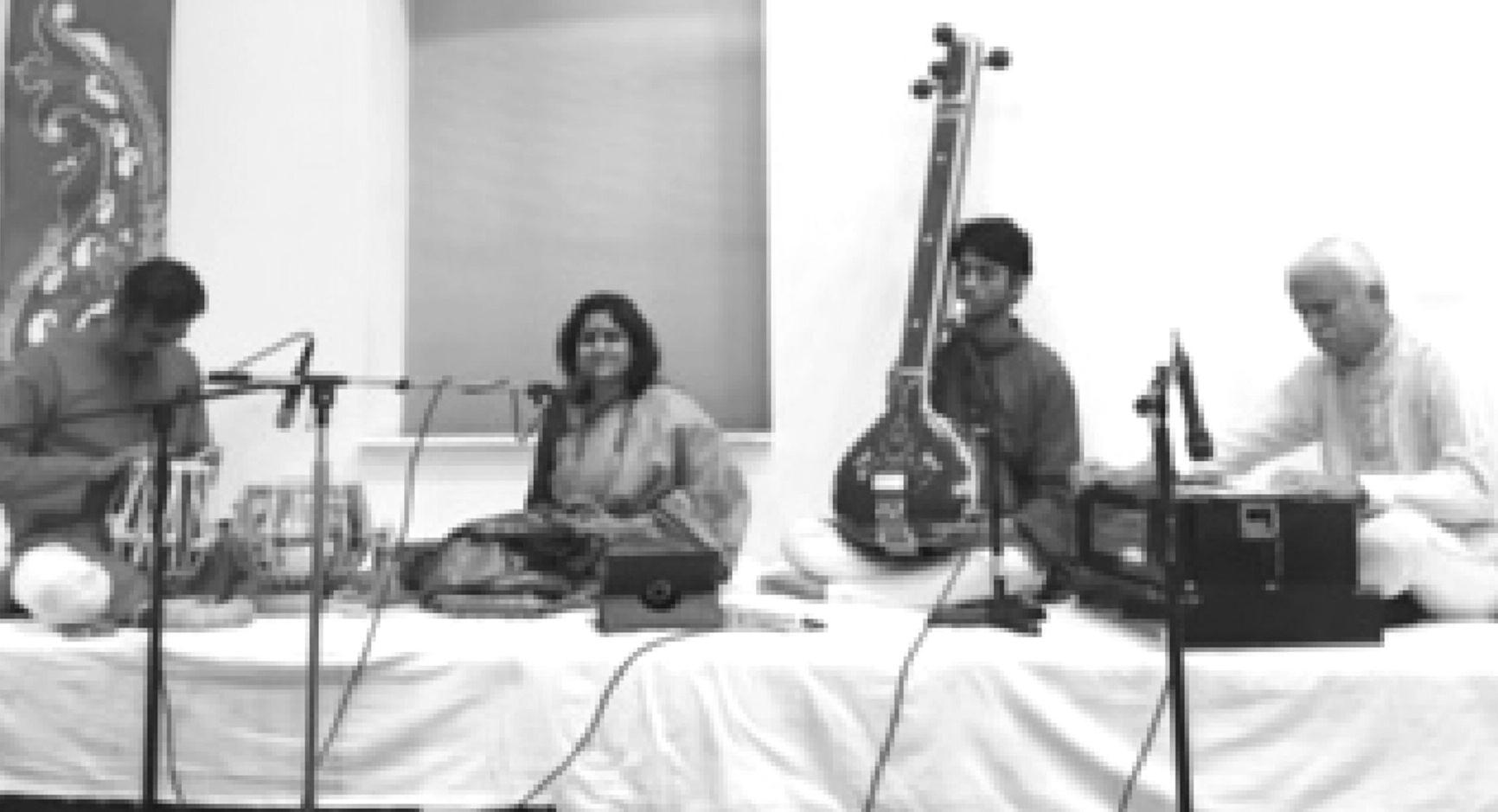
As part of the Centenary Celebration of B harat Sevashram Sangha throughout the world during 2016-2017, the New Jersey chapter at Kendall Pak celebrated the occasion on September 2, 3 and 4 Several monks from USA and Canada visited the facility
A classical musical performance was organized on 3rd September. Avik Mukherjee, a Sitar specialist from New York played various Ragas for about one and a half hour, accompanied by Dibyarka Chatterjee on Tabla Then, Bridgewater-based Mitali Banerjee Bhawmik enchanted us
with Hindustani classical songs including Bhajans for over an hour. She was accompanied by Dr. Amod Dandawate on Tabla and Suresh Benegal on Harmonium. Attendees were spellbound for about three hours at their superb performance
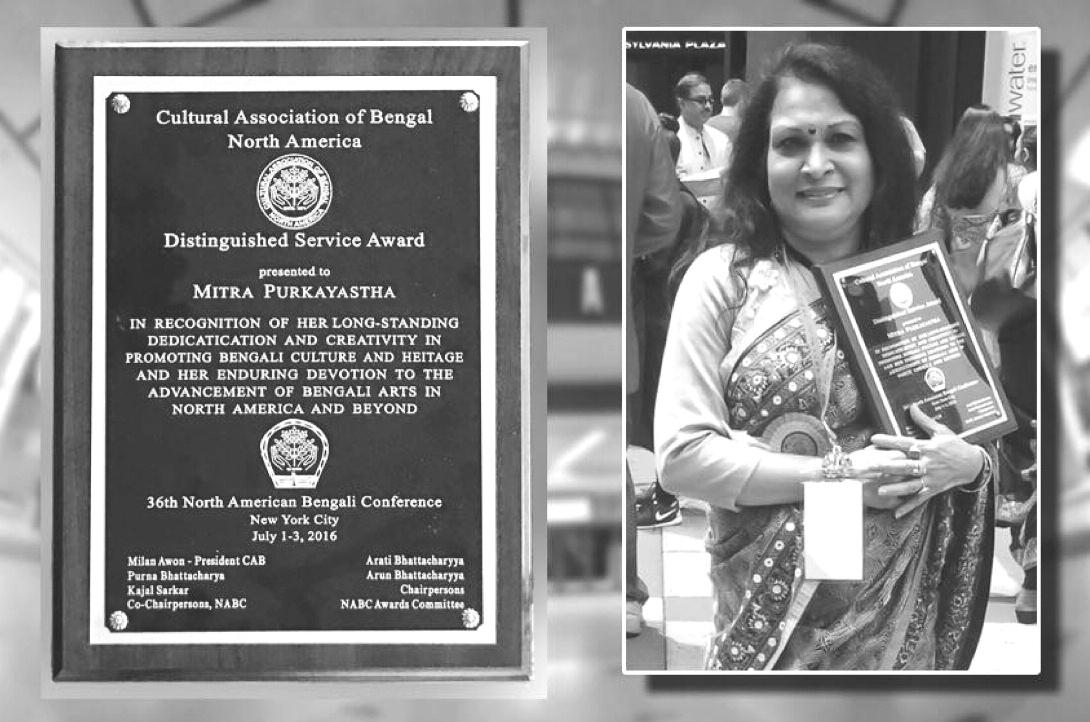
Mitra Purkayastha, an accomplished dancer and director of “Rhythm of Dance & Music” school, won a well- deserved award for her long years of devotion to this art form.
Rhythms of Dance & Music (RDM) follows the ancient traditions to provide a solid base and experiment with contemporary influences to keep these art forms relevant in today's society.
“Dance is my Shakti, my Shanti, my Sadhana, my power, my peace, my prayer- my ecstasy-mind, body & soul”, Mitra says. Mitra is a dedicated member of Ananda Mandir.
Continued from page 5 - receipt reproduced
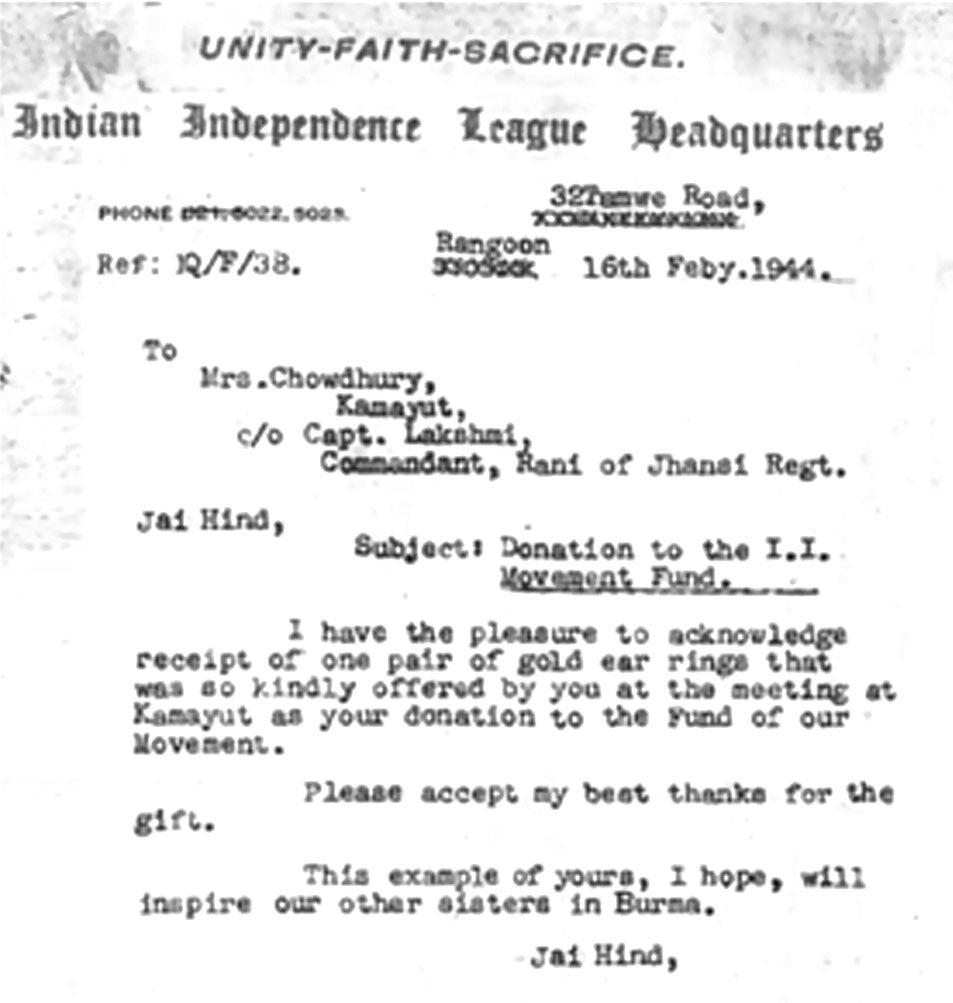
Continued from page 9
ing star that blasts part of the star into space ” other findings:
There is another set of belief that “The cosmos emerges without any divine interference from a primal nothingness, from an innate tendency to exist”. What is this nothingness has not been described yet. There could be a mathematical definition of “nothingness” that has built-in ingredients to surface a creation as large as the universe, but we do not have any definite findings on this yet
Also, in an attempt to avoid the universe having a beginning was the proposition that “previously there was a contracting phase, but because of rotation and local irregularities, the matter would not fall to the same point Instead, different parts of the matter would miss each other, and the universe would expand again with the density remaining finite ”
“The irregularities in the early universe means that some regions had slightly higher density than others The gravitational attraction of the extra density slowed the expansion of the region, and could eventually cause the region to collapse to form galaxies and stars We are the product of quantum fluctuations in the very early universe” (Note: A quantum fluctuation or quantum vacuum fluctuation is the temporary change in the amount of energy in a point in space, as explained in Werner Heisenberg's uncertainty principle )
We are all wrapped in this uncertainty, - the cycle of Big Bang, Black Holes – Creation and destruction When everything ends, all that we have earned as human race – from the agricultural era through industrialization to information technology and beyond, everything accomplishedcomes to a state of dissolution. We are sucked into a black hole where there is no
distinction between the intellectuals and non-intellectuals, Gods and demons The human brain as a mass gets into a state of full cessation until “Big Bang” causes sparkles and creation of a new universe begins all over again with new sets of galaxies, stars, planets and the entire ensemble of living, non-living entities Our return is inevitable
Blending thoughts of science and religion:
Religious myths worldwide accept the presence of a divine power that created this universe, which is eternal and existed for ever and will continue to exist eternally Greek philosopher Aristotle, also believed that the universe had existed forever. “Something eternal is more perfect than something created. He suggested the reason we see progress was that floods, or other natural disasters, had repeatedly set civilization back to the beginning. The motivation for believing in an eternal universe was the desire to avoid invoking divine intervention to create the universe and set it going ” While many believe in existence of God as the prime mover of creation of this universe, surprisingly Hindu scripture, Rig Veda, rules out the existence of God in creation of this universe
rig Veda describes the origin of the universe as –
“Neither there was existence nor nonexistence There was no realm of air or the sky beyond There was nothing called death nor immortality There was no sign that would divide the day from night That one thing which was breathless breathed by itself and apart from it there was nothing at all Darkness was concealed in darkness All that existed then was void and formless Then there was a desire Desire that caused the primal seed and germ of spirit Sages who searched with their heart's thought they discovered the existent's association in the non-existent
Crosswise they asked: What was above it then, and what below it? There were begetters, there were mighty forces, free action here and energy up yonder Who verily knows and who can here declare it, when was it born and when comes this creation? The devas are later than this world's creation Who knows then when it first came into being? He, the first origin of this creation, whether He formed it all or did not form it Whose eyes control this world in highest heaven, He verily knows, or perhaps He knows not ”
So, even the sages of the Rig Veda era did not know where the universe originated from According to Hindu cosmology, the entire cosmos exists in two states - the un-manifested state and the manifested state. And that is exactly what the sages of the era of Rig Veda found – there was a feeling of nothingness, all appeared to be one vacuum and then there was probably a desire sprouted from a spirit that began the creation. This cycle of creation from nothingness to dissolution into yet another phase of nothingness has been going on eternally Ours is not the only universe, there are many universes that follow the same pattern of creation, dissolution and re-creation, and it is happening somewhere in the cosmos even now, right at this moment beyond our knowledge
One statement in this segment of Rig Veda is interesting – “The devas are later than this world's creation ” According to Hindu Purans (Shiv Puran, Vishnu Puran etc ) each of our devas have designated geographic locations for their respective homes Like Kailash in the Himalayas is the abode of Lord Shiva As creation of this world precedes creation of Gods, the story behind creation of three Hindu Gods – Brahma, Vishnu and Maheshwar is perceivably true As the famous story of Hindu trinity (the three main pillars of Hinduism) goes, that Lord Vishnu was found lying in the ocean when Lord Brahma ar-
rived on a lotus that stemmed from Lord Vishnu’s naval base There was a dispute between Lord Vishnu and Lord Brahma as to who is more powerful when a pillar like light appeared in-between and Lord Shiva declared his presence and the three Devas were stated having designated responsibilities – Lord Brahma for creation, Lord Vishnu for preservation and Lord Shiva for destruction Theoretically, the principle of creation, sustenance and destruction as found in science are retained here But the eternally asked question – what caused the birth of the universe is still unknown It is believed that “if general theory of relativity is combined with quantum theory, it may be possible to predict how the universe would have started”. Research in this topic is on, and maybe we are close to answering the question - what caused the origin of the universe?
But, for now, we just have to live through this process of existence and accept the fact that there will be a state of destruction of everything that our universe has earned and that we have earned –physically, materialistically and intellectually “Amar je shob dite hobe, sheto ami jani, Amar joto Bitto, Amar joto bani, shob dite hobe” – wrote Rabindranath Tagore, which simply says that everything that we earn in the process of living shall have to be given back to this universe The intellectual properties are probably retainedBhagavat Geeta prescribes in the philosophy of birth and re-birth that our intellects are retained that we carry-over in our next birth But then, final dissolution retains nothing There is a complete state of unmanifested nothingness for how long who knows until there is another sparkle in a big bang that re-creates a new universe and we return with everything new So, for now, let’s celebrate life as we live, rejoice every breath with whatever we have That is the only truth Rest is all temporary
shyamal sarkar was recognized by the Board of trustees of ananda Mandir at the fundraising event on august 14, 2016.
Shyamal (and Ruby) was presented a Certificate of Appreciation in recognition of his visionary leadership at the initial stage of Ananda Mandir that helped to
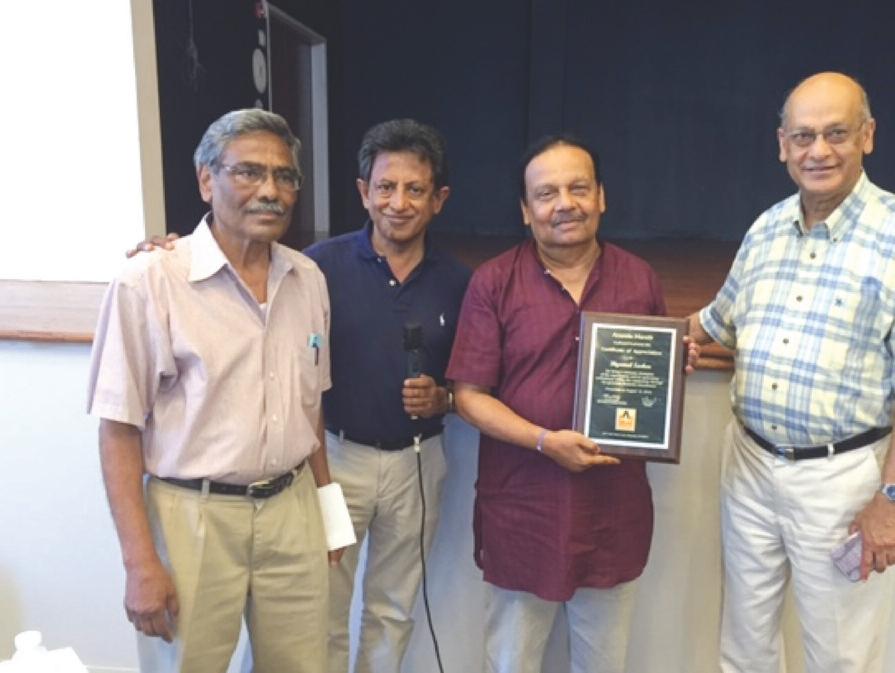
raise the fund needed to build its first temple About thirteen years ago Ananda Mandir held its first fundraising luncheon at a restaurant in Bridgewater Township, which was led by Debajyoti Chatterji It was a grand success, and because of that
fundraising event Ananda Mandir finally could meet its financial reserve requirement to begin the temple construction However, that success wouldn’t have been achieved without the visionary impact of one individual, Shyamal Sarkar, who pledged to match the total amount raised during that fund raising luncheon. Shyamal's generous commitment gave a tremendous incentive to Ananda Mandir members to come up with their own generous donations At that event $97,000 was raised from 121 donors, and as promised, Shyamal matched that amount with $100,000 With $197,000 in hand, Ananda Mandir could proceeded with confidence to get the mortgage needed for constructing the temple At the August 14 meeting he was presented with a plaque that cited the contribution of Ruby and Shyamal Sarkar
Life Member ($1,000 to 4,999) Mitrajit and rashmi Mukherjee
Patron ($ 5,000 – 5,999) garden state Cultural association
Grand Patron - Silver Phalguni and sutapa ghosh
by donating a minimum of $50. Your subsequent donations of $50 or more are credited to your account. When your total cumulative donation reaches $1000, you become a Life Member. Your support, small or large, is most welcome and sincerely appreciated.
Ruby General Hospital, the brainchild of Dr. Kamal Dutta, a dedicated member of Ananda Mandir, is a large 300 bedded multi-specialty hospital with more than a thousand employees and 350 medical consultants. There is constant communication between Indian and US-based doctors with the continuous transfer of knowledge and technology.