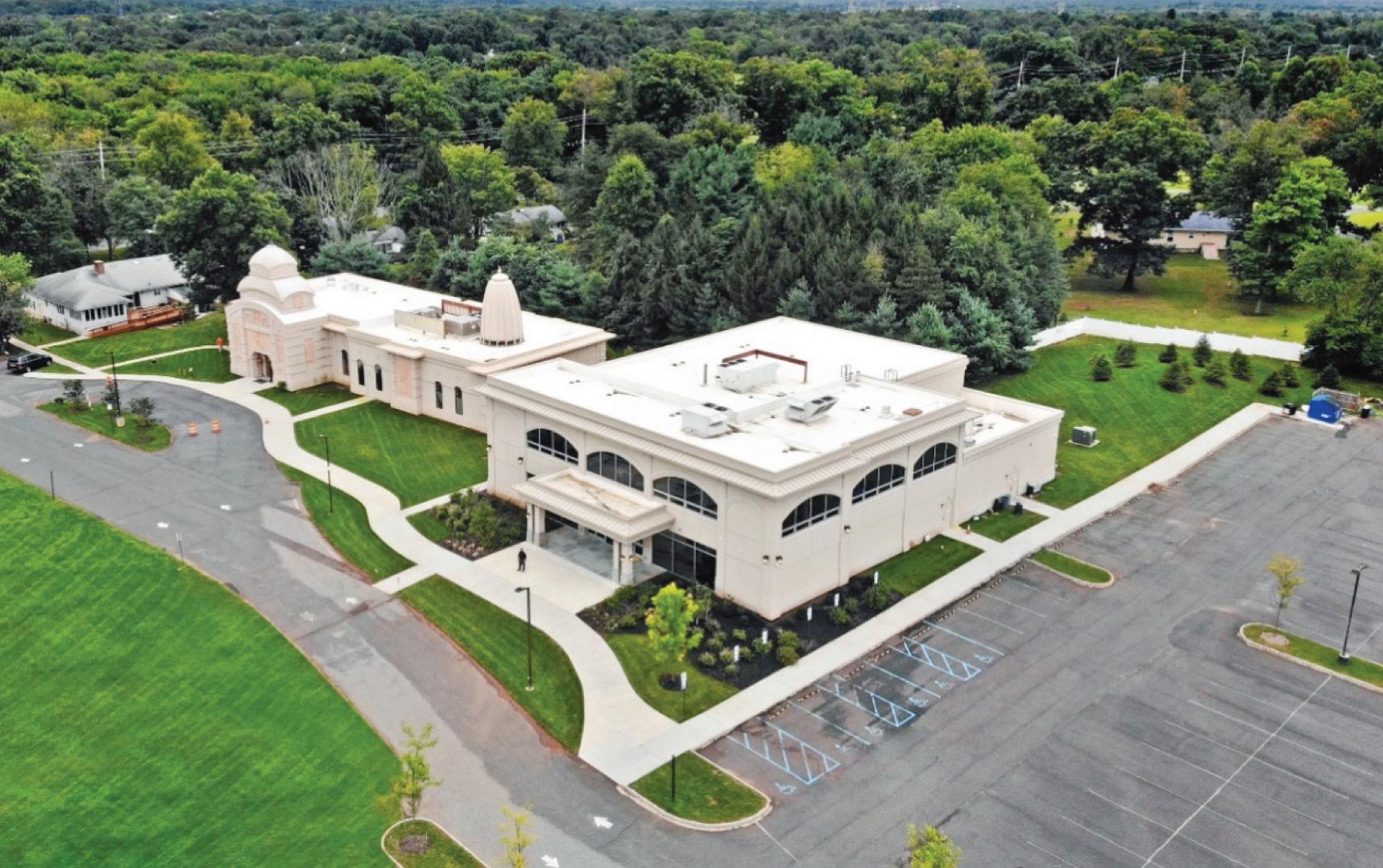
Ananda Mandir


Ananda Mandir
The2019 Annual General Meeting of Ananda Mandir was held on May 11, 2019. Like every year, the meeting was held in the basement of the old building. The event followed a sumptuous vegetarian lunch.
Over 75 people attended the event. This was a healthy level of participation by the membership, considering that there were no elections this year for Board of Trustees membership. There were four vacancies on the Board, and four candidates had submitted nominations. As a result, election by balloting was not necessary. More details are given later in this report.
By Sajal Mukherjee, Outgoing General Secretary
tees in its June 9 meeting. He also talked about NABC 2018 being a grand success. Contrary to the apprehensions of NABC becoming a financial burden on Ananda Mandir, it turned out to be a well-planned and well-managed event and resulted in a surplus. More importantly, it helped create a massive publicity for Ananda Mandir throughout North America and has also attracted new management talent to Ananda Mandir organization. The most significant finan-
The first meeting of the Board of Trustees (BOT) after the AGM was held on Sunday, June 9. At this meeting, the BOT unanimously elected the following trustees to the Executive Committee:
President: Jai Prakash Biswas
Vice Presidents: Suprasad Baidyaroy, Debajyoti Chatterji, Ashok Rakhit
General Secretary: Arun Bhowmik
Treasurer: Chanu Das
Assistant Treasurer: Pradip Majumdar
The BOT also thanked all the members of the last Executive Committee for the dedicated service over the previous three years.
The event started with our beloved priest Biswabhai praying for the divine blessings for the temple and its devotees. Following this invocation, the Anandadhwani team welcomed the attendees with a wonderful rendering of the well-known song, “Swagatham, Suswagatham”, written by Pandit Narendra Sharma.
Ashok Rakhit, President of the Board of Trustees, began with a brief history of the journey of Ananda Mandir since its inception in 1997, and then presented an overview of 2018 activities and the outlook for 2019. Ashok mentioned that the AGM was his last in the capacity as President. He explained that the next president will be chosen by the Board of Trus-
cial development reported by Ashok was the news that 31 families have come together to lend money to Ananda Mandir to pay off our outstanding bank mortgage balance. These short-term loans
carry a much smaller interest that will result in a debtfree status for us by 2027. This is a huge milestone for Ananda Mandir. There is no other Bengali organization in the country that has raised $3.2 million of loans from its members and has managed to win the trust of so many members.Please see the box on this subject elsewhere within this report.
The Treasurer, Pradip Majumdar, presented the details of financial performance for 2018 and the budgetary projections for 2019.
Our auditor, Arun Sarkar, CPA, could not attend the meeting but had prepared the statutory Financial Reports. On behalf of Mr. Sarkar, Debajyoti Chatterji announced that copies of these reports were available for interested members to pick up copies at the end of the meeting.
Kamalesh Sircar, the Election Committee Chair, explained that since the number of nominations for Trustee positions were equal to the vacancies on the Board, the nominees were all elected. They are
- Joy Bhowmick
- Nilotpal Paul
- Mita Sinha
- Debajyoti Chatterji
These newly elected Trustees were welcomed by all the members present at the
Mahishasura Mardini
Debir Bodhan
Debir Amantran O Adhibas
Saptami Puja
Ashtomi Puja
Sondhi Puja
Nabami Puja
Dashami Puja
meeting. The members also thanked the outgoing BOT members - Phalguni Ghosh, Anupam Saha, Krishna Dutta Roy, Smee (Sikha) Chatterjee and Pronoy Chatterjee for their pastcontributions
Pronoy Chatterjee then provided updates for the Publications and Awards and Recognitions committees. The following individuals were presented with certificates as outstanding Youth (Kishalay) volunteers: Parama Das Shivan Mukherjee
Anirudh Sarkar
Auroni Sen Adwaitaa Goswmi
Ayushmaan Mukherjee
Anshini Ghoshal
Mita Sinha was recognized as Outstanding Volunteer and was presented with a certificate.
Pronoy reminded the audience that during 2018, Ananda Mandir had also honored two authors (Jayashree Chatterjee of New Jersey and Subrata Kunar Das of Toronto, Ontario) with the Gayatri Memorial Awards for Literary Excellence. Last but not the least, Ananda Mandir had also bestowed “Lifetime Service Awards” to nine of its distinguished volunteers at the Atlantic City NABC.
Thereafter, Arun Bhowmik, the Cultural Secretary, provided an update of the cultural activities.
continue to page 4 }
Sunday, 29 September 4:30 am – 6:30 am
Thursday, 03 October 6:00 pm – 8:00 pm
Friday, 04 October 6:30 pm – 8:30 pm
Saturday, 05 October 8:30 am- 11:30 am
Sunday, 06 October 8:30 am- 12:00 pm
Sunday, 06 October 1:57 pm- 2:45 pm
Monday, 07 October 8:30 am- 11:00 am
Tuesday, 08 October 8:00 am- 9:30 am
Sindur Khela & Arati Friday, 08 October 6:30 pm
Kojagori Lakshmi Puja & Sunday, 13 October 5:15 pm – 8:00 pm
Satyanarayan Puja
Maha Kali Puja & Diwali
Sunday, 27 October 9:00 pm- 12:30 am
Ananda Mandir
Calendar of Events (Dates are subject to Change) Please check our website frequently www.anandamandir.org Tel: 732-873-9821
NOTE: If a particular Puja time is not listed, please contact temple or visit our ebsite: anandamandir.org
July(*)
Shyama Puja
Tuesday, 02, 6:00pm-8:00pm RathJatra
Thursday, 04, 6:00pm-8:00pm Shri Shri Bipadtarini Puja
Tuesday, 09, 8:30am-11:30am ulto-RathJatra
Friday, 12, 6:30pm-8:30pm Guru Purnima
Tuesday, 16, 9:30am-10:30am Shyama Puja
Wednesday, 31, 6:30pm-8:30pm Sahitya O Alochana Friday, 26, 8:00 pm
AuGuSt (*) Rakhi Purnima & Satyanarayan Puja
Wednesday, 14, 6:30pm-8:30pm Shri Krishna Janmashtami
Friday, 23, 9:00am-9:00pm Sahitya O Alochana
Friday, 23, 8:00 pm
SePteMBeR (*)
Shri Ganesh Chaturthi Puja
Sunday, 02, 6:00pm-8:00pm Satyanarayan Puja
Sunday, 08, 6:00pm-8:00pm Pitri tarpan
Saturday, 28, call for time Biswakarma Puja
Wednesday, 18, 10:00am-11:00am Mahishasura Mardini
Sunday, 28, 4:30am-6:30am Shyama Puja
Saturday, 28, 6:00pm-8:00pm Sahitya O Alochana
Friday, 27, 8:00 pm
OCtOBeR (*)
Durga Puja (See Details Front Page)
Thursday, 03 – Tuesday 08
Kojagori lakshmi Puja
Sunday, 13, 5:12pm-7:30 pm
Maha Kali Puja & Diwali
Sunday, 27, 5:00pm-12:00am
(*) See www.anandamandir.org or Call Mandir for details
Special Religious Services:
Upon request, the priest of Ananda Mandir offers services such as in-house Shraddhas, Rituals associated with Cremations (Antyesti Kriya), Shraddha Anniversaries, Pre-wedding rituals (Naandimukh, Ashirwad, etc), Upanayan (Paitey), Annaprasan, Wedding Ceremonies & Wedding Anniversaries, Griha Prabesh (Bhumi Puja), Consecrations of new cars (New Car Pujas) and others. If you have needs for any of the above or more, please feel free to contact Biswabhai @ 732-873-9821
Ananda Sangbad
A Periodical Newsletter
Published
By
ANANDA MANDIR
(A Tax-Exempt, Non-Profit Organization)
269 Cedar Grove Lane Somerset, NJ 08873
Ph: 732-873-9821
Website: www.anandamandir.org
PuBlICAtION COMMIttee OF ANANDA MANDIR
Chairperson: Debajyoti Chatterji, Debsmee572@gmail.com
Assistant Chairperson: Subrata Bhaumik, Bhaumik.subrata@gmail.com
Editor-in-Chief: Amitabha Bagchi, amitabhanj@gmail.com
Executive Editor, Ananda Sangbad: Guru Chakravarty, guruchakravarty@yahoo.com
Executive Editor, Anandalipi: Subhodev Das, subhodev.das@gmail.com
Editors: Subrata Bhaumik, bhaumik.subrata@gmail.com
Sushmita Dutta, sushmitadutt2@gmail.com Amrita Kangle, amritakangle@hotmail.com Nupur lahiri, nupurlahiri@aol.com
Associate Editor: Ruby Banerjea, r_banerjea@yahoo.com
Advisors: Pronoy Chatterjee pkc_usa@yahoo.com Ashok Rakhit ashokrakhit@gmail.com
l
All queries, articles, news reports and letters should be directed to the Managing Editor
Phone: 908-752-3065
E-mail: guruchakravarty@yahoo.com
l For general information, please contact the following executives of Ananda Mandir: Jai Prakash Biswas President
Suprasad Baidyaroy Vice President
Debajyoti Chatterji
Vice President
Ashok Rakhit
Vice President
Arun Bhowmik General Secretary
Chanu Das Treasurer
Pradip Majumdar Assistant Treasurer
What is Adversity Score?
The SAT adversity score is a number that the College Board calculates from information about a student’s disadvantage level. This considers different aspects of the test taker’s life: the environment at home, family stability, the crime level in his or her neighborhood, the median family income, etc. Only colleges and institutional score report recipients can access this score. If you’re a test taker and look up your SAT score in the College Board account, you won’t see this information.
The College Board defines the adversity score on a scale of 1 to 100, with 100 denoting the least amount of hardship and 0 the most.
Just what information goes into the adversity score calculation? The College Board publications initially listed 12 factors that were used to determine a test taker’s “adversity index.” Further elaboration on how this adversity score is shared with colleges can be seen on the internet.
Why is the adversity score created?
Based on quotes from CEO David Coleman, it is clear that by introducing this score the College Board is trying to demonstrate that the effort and resourcefulness needed to achieve a certain score differs drastically between test takers, depending on certain advantages or disadvantages the test taker starts out with.
Advantages to students from well-to-do families and for those living in affluent neighborhoods are not difficult to see:
a) Students can enroll in high-priced tutorial courses
b) Students are exposed to AP courses in Science and Math
c) Students have space and environment to concentrate on studies
d) Students can afford to spend all their time studying, instead of working to earn money.
Students from disadvantage neighborhoods must suffer from:
a) Not enough space and facility in their homes to study
b) Not enough AP courses are offered in the school
c) Many have to work part time to support family
d) Cannot afford costly tutorial courses
e) Many students are illegal immigrants, and live under fear of deportation.
How does SAT scores compare with Joint Entrance Examination (JEE) Scores in India?
This gives us a reason to consider a review of the Joint Entrance Examination system in India.
JEE in India is analogous to the American SAT score and is applied even more rigidly for admissions to the premier educational institutions. The adversities faced by students from villages and poor areas in India are much more pronounced than in the U.S. Some such adversities are:
• JEE tutorial courses are offered only in big cities
• The tutorial costs are exorbitantly high
• Transportation from villages to tutorial centers are limited and takes a lot of time
• Schools are not equipped with training materials or teachers for JEEs.
• Most schools do not have enough computers for their students and or internet.
• Not enough room and facility at home to study Should Adversity be considered as a factor for college admission in India?
There is no adversity score system associated with JEEs. However, Scheduled Cast and Scheduled Tribe (SCST) quotas are available in admissions. But economic hardships in villages and poor areas are much more extensive than what the SCST quotas can make up for. A more comprehensive review is required to level the field for students facing economic challenges. Education is proven to be the most effective way to come out of the vicious cycle of poverty in India. A few professionally trained persons in a village can help a significant number of people out of a life of adversity.
Guru Chakravarty Executive Editor, Ananda Sangbad
Dear Members:
This will be my last write up as President of Ananda Mandir as we elect a New President on June 9th meeting of the Board of Trustees (BOT). It has been a long journey for me personally as I took this leadership responsibility twice; first during the construction of our first temple in 2004 for four years (2004 – 2008) and then in 2016 with the grand expansion of the facility for next three years (2016-2019). This has been a challenging journey for Ananda Mandir as we grew slowly but steadily during last 22 years since the purchase of our property in 1997.
As I reminisce, we purchased the property at 269 Cedar Grove Lane in Franklin Township in 1997 with ~7.5 acres of land and a 3BR house with only $60,000 cash in hand and acquiring a seller’s mortgage along with an interest free loan from few volunteers. By 2004, we paid off seller’s mortgage on the property and built a small temple of approved occupancy of 95 persons and a 50-car paved parking with a driveway. During next five to six years, we, purchased another 2.5-acre vacant land next to our property, brought township water replacing well water and built sewer line around the entire property replacing the underground septic tank. We have constantly been looking up with great ambition to build a Bengali Hindu Heritage Center in North America that would fit the needs of our large community and grandeur of the country we live. By 2010, we started campaigning for a grand expansion of this facility with expanded temple, a multipurpose community hall and 300+ parking to accommodate 500 to 1000 attendees on major events like Durga Puja and Kali puja. In 2012, BOT submitted the architectural plan to Franklin Township for approval, developed construction budget close to $5.0 million and started approaching financial institutions for a bank loan of ~$4.0 million. We crossed these hurdles along the way with Township approval, raising a seed fund of close to $1.0 million and secure the bank financing with a $3.5 million 20-year loan. Construction took almost three years (2014-2016) with a temporary CO for the temple and community hall in late 2016 just before Durga Puja.
This challenging journey over decades, however, brought tremendous sense of joy, strength and pride in all of us as a Bengali Community in the tri-state area. These challenges still continue today in its different form. With the successful completion of construction, we finalized $3.5 million construction loan to a 19-year mortgage with monthly payment of ~$22,000. Last three years (2016-2018), we have paid the monthly mortgage along with maintenance of this huge complex using revenues from operations in both buildings but mostly from Annual Fundraiser and Donations Collected during two major religious events of Durga Puja and Kali Puja. Looking ahead, the biggest challenge to Trustees still remains - the monthly mortgage payment of $22,000 every month for 19 years in addition to operating expenses with a total monthly expense of ~$40,000 or revenue needs of $500,000/year.
We have lost few founding members since inception and many others are now retiring or retired. Although we are now meeting large monthly mortgage expenses; but how long can we depend on the large donation of these core families? In recent months, the management started reaching out to its core donor families for an alternative financing to this long-term high interest institutional loan.
Time and time again, many of our core family members came forward to listen to the management proposal and then agreed on a personal loan of $25,000 to $250,000 with only a nominal 2% interest and principle payable in 3 to 8 years. This would save Ananda Mandir over $2.0 million in interest payment and reduce payment period from 19 to only ~8 years. Ananda Mandir community is immensely thankful to these 31 families who came forward to participate in this short-term loan and hence reduce the financial risk of a large debt for a much longer period of almost two decades.
This story of Ananda Mandir will someday, hopefully be written up to recognize the love and sacrifices of these Founding families that will exemplify the dreams and ambitions of an immigrant Bengali community. The financial challenge will continue next 7 to 8 years until the personal loan funds are paid up as promised. Let us all work together next years ahead until we become debt-free so that we can conclude the story of building Ananda Mandir as a tale for generations that can be proud of their fore fathers carrying the flagship in their new home of a rich Hindu heritage from Bay of Bengal!
Ashok Rakhit
Outgoing President, Ananda Mandir
By Basab Dasgupta
Creativity is considered to be a trait that expresses itself, and not necessarily a quality that can be cultivated as a learning process in an institution. Still, I believe that everyone can indeed be creative when they make an effort to reveal any hidden talents. There are three levels or steps to get there.
The first level is just enjoyment of any creative output such as painting, writing, music, movies, fashion, architecture, performing arts, industrial design, cooking, knitting, gardening etc. If you ask a group of people in any gathering, almost everyone will say that they like all of the above. They would express this opinion without giving it a lot of thought or even understanding, simply because they feel positive upon experiencing the offerings. For many people these are simply items of entertainment or at least a pleasant way to pass their idle time.
In addition to the basic enjoyment there are two additional types of delight that come into play here. Firstly, it provides a much more profound understanding of the process of creation and perhaps even an insight into the mind of the creator. Secondly, there is a huge satisfaction at the realization on the part of the admirer that he/she has this special capability to appreciate the finer subtleties. Call it ego or call it what you will but we humans all suffer from this vice called self-admiration.
In the second level one learns to analyze what they are sensing with their five senses and look for subtlety, novelty and uniqueness. The goal is to evaluate the object of admiration in a sophisticated way in order to understand what is really appealing about it. Of course this analysis is different for different people.
The third level arises when one can create similar outputs by oneself; for example, when a singer listens to a song or a writer reads a novel or an artist looks at a painting. It allows an identification of the admirer with the creator; there is almost a oneness or bond that forms between them. Here the main joy is associated with the process of creation itself and not how good one’s personal output compares with the object of admiration. There would be lessons for the admirer to improve their own work and to expand the scope of their creativity. There is a feeling of euphoria
which is almost therapeutic. The appreciation is heartfelt and often not describable even by the most eloquent critical comments.
While almost anyone can experience the first level creativity, the second level requires some special traits: intelligence and/or education, a keen interest in the subject under consideration and an analytical mind. In addition, the person must be well-versed in the area. He must be well-read if he were to critique a book and must be familiar with the works of great artists in art galleries and museums if he were to really get into analyzing a painting.
How to reach the third level is not so clear. One might think that once an admirer passes through levels one and two, he/she would be prepared to go into the third level by creating himself/herself. However, that is not necessarily true. Ability to create may or may not manifest itself with extensive study and intelligence. It is almost a hidden talent spiritual in nature and certainly goes beyond a traditional learning process.
I believe that the spell of creative inspiration comes to all of us like waves, perhaps from some divine source. One needs an ability to sense when that spell arrives and be ready to harness it to produce something. This ability to tune in with a certain creative spell, in some specific area or areas is inherent in us all and cannot be developed by any kind of formal training. Unfortunately, most of us are too busy with our daily grinds to even recognize any of these developments taking place within us.
Enjoyment of others’ creative outputs could be a trigger for many people to explore and find their own creativity. A person can be suddenly inspired to paint after visiting a gallery, sing a song after being in a concert or write after reading a stimulating book.
A second level of appreciation may not even be a prerequisite to go into the third level. A creative genius can be born even if he/she has not seen or learned what others have already done in the area of his/ her creation. It may even be an advantage because one is not biased by what already exists and their expert analysis. On the contrary, a strong second level mindset can become a deterrent in achieving the third level status. The reason is an acute
self-consciousness about how the other (second level) guys would evaluate their work.
A writer, for example, may be thinking of how to use very uncommon words in an elegant composition to impress his/ her peers and in the process encounters a “writer’s mental block”. In order for a person to be creative the urge to create has to be so strong that he just writes spontaneously without even worrying about how his readers would react to it. Of course, a favorable review is an icing on the cake, but a lack thereof should not dampen his creative spirit.
An ideal combination would be a person who was born with an inherent ability to find an outlet for his creative juices in a certain area and at the same time goes through a thorough learning process about what has already been produced in his area of interest. This would certainly prevent him from “reinventing the wheel” so to speak and sow seeds of new ideas.
It is also common that a person who is very creative in one particular area, say music, is also reasonably creative in another area like painting. So, this process of tuning in to the creative waves is not necessarily limited to one area. I believe that different types of creative ideas “float” up to us in different ways and our capability to capture these different types of waves determine the breadth of our creativity.
The process of being aroused by creative thoughts is almost like resonance or tuning. If one of our inherent “creative frequencies of vibration” coincides with the frequency of an external stimulus we would be able to get stimulated just like a television tuner can capture a video image from the surrounding electromagnetic waves by tuning its frequency to the carrier frequency of a signal. What we do with this creative thought is another story and depends on our available time and skill set.
In the television analogy a TV set will display a vibrant color picture only when it’s display circuits are also fully functional in addition to its tuning circuits.
Typically, a creative person would have the ability to tune in to two or three areas of interest. A polymath like Rabindranath Tagore or Leonardo da Vinci could tune into dozens of different categories. This is similar to a TV set’s capability to tune in to multiple channels. Just like different
continue to page 4 }
By Mandira Chattopadhyay
I have been in Cleveland only a few months but have been completely enthralled by the city. Although the city can boast about its rock ‘n’ roll museum, the Playhouse Square where numerous Broadway hits come and go, Cleveland’s music scene amply reflects the city’s diverse cultural landscape embodying over a hundred different global ethnicities. I have been privileged to witness the International Film Festival where several recent Indian movies were featured along with those from other countries of the world.
When I heard that the legendary Thyagaraja Festival was in town, as it has been for the last fortytwo years, I became curious about the magnitude of this festival. I was aware that Thyagaraja festival is celebrated in quite a few locations in the US, I was never really interested in it, because of the language barrier and the lack of my exposure to this genre of music. I have been familiar with Hindustani classical music, but never was exposed to the Carnatic music. As I started to attend the festival, I was simply mesmerized. Cleveland Thyagaraja Festival is the largest Indian classical music festival outside of India. This year with attendance pushing nearly 10,000, the festival drew fans, competitors and performers (as well as their friends and family) from around the world. I was fortunate to hear the unique sounds produced by instruments like veena, mridangam, ghatam and kanjira. The two weeks of the festival went by quickly as the cherries bloomed merrily in the beautiful downtown campus of Cleveland State University. One could witness the parade of women clad in colorful saris roaming through the campus – normally a rare sight. I felt like I was transported to India.
The Cleveland Aradhana committee was the primary force behind this festival; they were totally dedicated for the twelve days of the festival. The A-class professional musicians along with their A-class students were carefully screened and went through rigorous tests before they were allowed to participate in the festival. They were offered free room and board and allowances. Tracing back the history of this annual festival in Cleveland, we find that the Aradhana Committee was formed forty-two years ago. This committee approached the music department of Cleveland State University and made a deal that they would bring the best Carnatic musicians from India and the University would provide the necessary facilities. Also, every year outstanding performers would be selected to teach Carnatic music at Cleveland State for a semester and this would continue every year. The selected musician could be a vocalist or an instrumentalist. The main purpose of this humongous festival was to bring out outstanding musicians as well as the prodigies who would be recognized and showcased in this event.
For twelve days of the festival the young artists were frolicking around the campus, with their parents escorting them in colorful attires. The Aradhana committee rented several hotels and planned to serve the artists and the visitors South Indian food, free of charge. I have never seen so many people congregate to witness the festival. The famous artists from India were confident that Cleveland would be the best place to land because the city bubbles with culture.
It is important to note that Cleveland Thyagaraja Festival was not simply geared towards old-timers. In fact, the festival showcased the newest generation of traditional Indian dancers, who are typically young girls performing the mesmerizing Bharatanatyam dance in vibrant, jewel-toned saris and expressive makeup. Also featured were many youngsters who sang and played the violin, veena, mridangam and ghatam. There were competitions organized for these
| continue from page 1
Cultural activities are thriving at Ananda Mandir, with multiple cultural events, including theatrical events. He expressed hope that the Ananda Sandhya program will resume soon after we finish renovating the basement of the front building.
Krishna Dutta Roy provided an update of the Puja Committee and summarized its multitude of activities through the year.
Utpal Sengupta talked about potential use of the basement of the old building. He also talked about the Interfaith Council of the Franklin Township. Ananda Mandir will start participating as an active member of this Council and has offered its premises for the next meeting.The Council is an excellent platform to exchange educational, religious and spiritual ideas among different Faiths through meetings, ‘Open Houses’, and seminars in the campus. It takes steps to ensure safety measures in different places of worship
and the neighborhood in conjunction with the Franklin Township Police Dept. against terrorism. The Council looks for funding from the State for the growth and developments of the place of worship and attends prayers and ‘vigils’ in places of worship to empathize and express solidarity with others who have been victimized by terror acts and hate-crimes.
Ananda Mandir’s joining the council is a significant development.
As General Secretary, Sajal Mukherjee updated on Minutes of Meetings and Memberships. By end of 2018, there were 2667 Associate Members, while there were 573 Life Members.
Debajyoti Chatterjee provided an update on the Senior Forum (“evergreen Club”). 2018 was a busy year. The forum held 10 sessions during the year. A couple of sessions attracted 30+ participants, and the majority of the get-togethers had 20-25 participants. Notable were the Lunch-Theater outings - Hunterdon Hills Playhouse:
“Run For Your Wife” (Sept 22), Paper Mill Playhouse: “Color Purple” (Oct 11) and Hunterdon Hills Playhouse: “Steel Magnolias” (April 21) and Group Outings - South Indian Lunch at Ananda Bhavan, South Plainfield (August 25) and Visit to Tulip Festival & Lunch, Cream Ridge, NJ (April 30).
Subrata Bhaumik provided updates on the Literary Committee activities. Sahitya O Alochana, a flagship event organized by the committee, completed its 11th anniversary in February 2019. A variety of topics drawn from diverse areas such as International and South Asian Literature, other performing arts including Music, Movie, Theater, and Entertainment, Philosophy , Religion, and History, Science, Mathematics, and Medicine, Business and Economics, International and Current Affairs, and Sports. Subrata mentioned the Literary Seminar in NABC 2018, being by far the best in the history of NABC.
The event concluded thereafter.
Ananda Mandir Pays Off $3.4 million Bank Mortgage by Raising Loans from Members!
On May 13, the Board of Trustees completed a historic campaign that had been launched in November of last year. The campaign had the objective of raising $3.4 million from loans from our members (at low interest of 2%) to pay off our high interest (5.25% interest, 5-year ARM) and long duration (20 years) mortgage with Unity Bank. The financial benefit of this “refinancing” was enormous. If we achieved our goal, we would save over $2.8 million of interest payment to the bank over the duration of the mortgage. Equally importantly, Ananda Mandir would become debt-free in in 8.5 years instead of over 18 long years!
When we launched this “loans from our members” campaign, few believed that we would succeed. But a dedicated and hard-working team persevered and succeeded in convincing 31 member families to give loans, ranging from $50,000 to $250,000 per family, all to be paid back by the end of 2018. By May 7, the campaign had raised $3.175 million, and with another $200,000 from Ananda Mandir reserves, we met the final closing fund requirement of approximately $3.375 million.
We take this opportunity to express our sincere gratitude to the following 31 member families who have shown tremendous love for and confidence in Ananda Mandir by loaning very significant amounts of loan, based simply on faith and goodwill towards the organization.
We also thank Jai Prakash Biswas, Debajyoti Chatterji and Ashok Rakhit for tirelessly driving this campaign and bringing it to a successful close on May 13.
Projit & Mita Aon Dr Samir Dutta
Tapan & Gita Audhya Prativa Hore
Samir Bannerji Anjan & Purba Lahiri
Saroj & Sipra Bhol Pradip & Dr Shikha Majudar
Arun & Rita Bhowmik Sajal & Sharbani Mukherjee
Jayadratha & Tandra Bhownick
Nilotpaul & Subhechha Paul
Jaiprakash & Suparna Biswas Birendra & Nandita Pramanik
Prabir & Susmita Biswas Anup & Soma Rakhit
Dhiraj & Chitrita Chanda Ashok & Bandana Rakhit
Pronoy & Swapna Chatterjee Uma & Swapan Roychaudhuri
Debajyoti & Sikha Chatterji Dipak Sarkar & Shirley Sanderson
Meena & Anup Dam Shyamal & Ruby Sarkar
Chanu & Lopa Das Dr Rik & Supriya Sen
Drs Kiran & Kamala Das Utpal Sengupta
Sanchoy & Rajashri Das Mita & Provat Sinha
Name Withheld On Request
Bank mortgage is paid off but now we have to pay back loans taken from “Lenders Club” members!
While paying off the bank mortgage was a very good development for Ananda Mandir, it also created a significant fund-raising challenge for the organization. When we had a $3.3 million mortgage, our yearly payment to the bank was approximately $260,000. Now we owe the same amount of money to 31 member families. We will be paying a much lower interest rate to these member families, thus saving a large amount of interest money that we would have paid to the bank. However, we plan to pay back these member loans in less than 9 years. This will require us to pay $400,000 annually (plus the 2% interest) to the “Lenders Club” members.
As you can see, from now onwards, we will be paying $140,000 per year more towards the “new loan” payment ($400,000 minus $260,000 = $140,000/year additional payments towards the loan plus interest of $60,000 on Year 1, gradually going down to 0 in about 8 years). We can raise this extra $200,000/year only through additional contributions from you during our annual fund-raisers. We urge you to give us even more generously this year than you haven in the past years. Remember: we are now free of a huge bank debt but we are not debt free! We have basically refinanced the bank loan with loans from 31 member families for a shorter duration but our annual payment has gone up. We have taken this strategy, with the confidence in your continuing, generous support. Please make this year’s Annual Fund-Raising Day a grand success!
PLEASE NOTE ON YOUR CALENDAR!
Annual Fund-Raising Lunch will be held this year on Saturday, August 24, 2019. Further details will follow later.
| continue from page 3
TVs have different display performances measured by color, contrast, resolution, brightness etc., the outputs of different people are different even when they are tuning to the same channel. A creative person can improve the quality and elegance of his/ her output by undergoing a formal training on the subject in much the same way a display performance can be enhanced by adding sophisticated circuit components. Then there are people who can capture creative ideas during certain spells but do not produce anything, again mainly because they are too busy with other more routine activities. They are like a TV set whose tuning circuits are on and working perfectly but display circuits are not operating.
When a person becomes creative he or she finds a direct link to God. They may not see God or even believe in God but can sense that some higher power is controlling their efforts. It is a euphoric feeling – a “high”. Many creative people continue to generate their output regardless of the financial reward simply to experience this high over and over again.
In conclusion, we can all be creative if we let our mind just float free and see if some idea comes to us. The ideas will not come to us on demand, but they will come if we are patient enough and alert enough to sense their arrival. However, we must then actually do something tangible with the idea in order to be labeled as a “creative person”!
A creative person typically creates only when he feels an urge to do so and this urge, very often, is beyond his control. Quite often, commercial pressures force him to create more. Some ideas stored in memory can help. Otherwise he just generates output completely on his own and somewhat superficially i.e. without any idea flowing into him. This produces detectable deterioration in the output and sometimes causes a “fatigue” or “burning out” syndrome.
Shaltora is a remote village of Bankura district in West Bengal, still languishing as an undeveloped, backward area, awaiting the amenities of city life with job-providing companies, easy transportation, healthcare facilities and internet. It is just another of hundreds of rural villages, where people still go out every morning carrying a spade (kodal) in their shoulder, wearing a short dhoti that covers the body from waist to the knees, to tend to their crops. In the summer, they may have a genji (an undershirt) to cover the upper body. In the winter, they may have a piece of cloth (a chaadar) to cover their bodies. On their way, they will stop by a pond to perform the excretion and wash off with stagnant water in the pond. Most of the young men are engaged in helping out with cultivation in the field during the rainy season. In summer months, they find utility jobs like road construction or brick laying, or set up as roadside vegetable vendors, or serve in multitude of shack cafeterias made out of tin or asbestos. There is no entertainment available in the evening, except gathering to see TV in one of the few houses that can afford it. Many still live in huts with thatched roof, without any lavatory facilities, and without any plumbing. Bankura is not a desert in the literal sense, but it is pretty much a barren land, devoid of good irrigation to help with agricultural production. The standard of living has remained about the same in the last fifty odd years. Yes, some things are changing for the better. Although almost no one has a computer, practically everyone has a phone, many of them smartphones. The cost is affordable and the monthly charges are easy to bear. Education level among the new generation has improved to a great extent, thanks to several colleges operating nearby, mainly offering humanities courses. In school level, there has been a boon. Every child gets a chance to go to school, up to high school level, gets free lunch, free school uniform, free bicycle. Now, under the highly popularized program called the “Kanyashree Scheme”, there is a one-time grant of Rs. 25,000/-, to be paid after a girl turns 18, provided that she was engaged in an academic or occupational pursuit and was unmarried. Given that children from socioeconomically disadvantaged families are more vulnerable to child marriage, this is designed to help girls from families whose annual income is Rs. 1,20,000/- or less. In addition, a new scheme called the “Rupashree Prakalpa”, is another West Bengal state government initiative that provides a one-time financial grant of Rs. 25,000 for economically stressed families at the time of their adult daughters’ marriages. Free decent hospital care for farmers of limited income is another new service to the people that is started recently.
The otherwise humdrum life of Shaltora bursts into excitement with happiness during one big celebration, the “Dol” Utsav. Unlike “Baro Mase Tero Parbon”, Dol is the only festival that fires up enthusiasm in everybody. The only temple at Shaltora is “Radha-Gobinda Mandir”. Priests are assigned to perform daily puja and offer “Bhog” every day. Over two centuries ago, the temple was built by a well-to-do medical practitioner (called Kabiraj in those days), named Kunja Bihari Chakraborty. He built a temple to house the deities of Radha Gobinda, and built a separate stage (Dol Mancha) outside the temple area to hold entertainment programs. The temple and the dol mancha still bear the original marble architecture, although they have gone through repairs over the years. Kunja Kabiraj also enticed Pujaris from outside the area to perform temple services and allotted lands to them to settle down at Shaltora. Today, the descendants of Kunja Kabiraj are entrusted with organizing the Dol every year, and, of course, the daily pujas of Shri Radha Gobinda.
By Guru Chakravarty
The celebrations go on for three and sometimes four days. The main attraction for the visitors is “Jatras” (Open Air Theaters) for several nights. All Shaltora natives from near and far, congregate at Shaltora for the ceremony. Families and friends look for the occasion to come home, sometimes for the only time in the year. Even farmers, living in huts with no savings whatsoever, must invite their relatives from outside Shaltora, to enjoy the ceremony together.
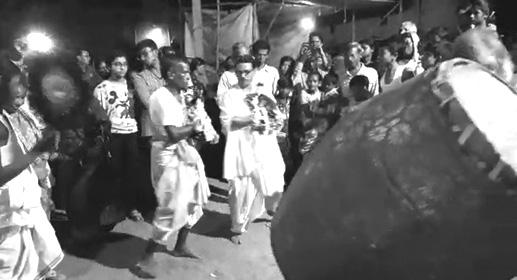
The first day of celebration is called “Chanchor”, (‹„þy‹þîû orbonfire). It happens on the day before the actual day of Dol. The deities, about one-foot high each, are taken out of the temple and placed in a handcart. The cart is carried by four youths from the families of priests on their shoulders, taking turn, around the village in a spectacular procession. A large effigy of a demon called Medrasur (öô’þü¤%îû) made out of dried hay, is carried behind the cart with the deities. Large kerosene lanterns (known as Hazak lights) are carried in separate carts. Several Dhak players accompany the procession playing in rhythm, producing a high decibel atmosphere. Several band groups follow the procession a little behind the Dhak players playing their own brand of music. A large crowd walks in the procession, around the village. Along the road, all men and women come out of their houses to watch the procession. Many of them keep tossing abir (powders of different colors) on to the crowd, messing up hair and clothes of the walkers. At the end of the journey, they all reach the old Tamarind tree at the head of the village. There the effigy of the demon is burnt in a bon-fire. Fireworks accompany the bonfire. From there, everybody goes back to the temple to have a little snack before they disperse for the evening. The deities are returned to the temple.
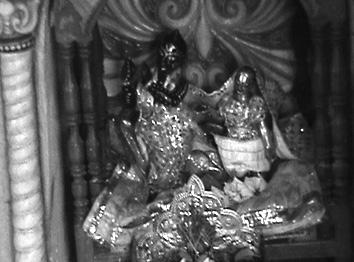
On the day of Dol, the deities are taken out of the temple in the morning and taken to the DolMancha. Puja is performed at the Mancha in observance of Dol-Purnima. While puja is going on, people play Holi, applying colored powders on each other. At the end of puja, the deities are returned to the temple. The surrounding area of Dol-Mancha is prepared for a carnival. All kinds of temporary shops selling food, toys, balloons etc. are set up. A Ferris wheel and a Merry-go-round for kids are set up too.
A huge pavilion with overhead cover made out of heavy jute cloth is set up for the public to sit on floor to see the “Jatra”. People from Shaltora and other nearby villages come to enjoy the carnival, buy toys for their children, and have some freshly prepared jilebis.
Around 7 pm in the evening, the deities are taken to the Dol-Mancha in
a procession with a lot of fanfare. The travel from the temple to the Dol-Mancha is about a hundred feet, but it takes about two hours to cover the distance. Dhakis play and dance with the young boys from the priests’ families who take turn to hold the deities while dancing on the street. Upon reaching the Mancha, the deities are placed inside, facing the stage of the Jatra, signifying that Radha Gobinda too are going to enjoy it along with the public. At the end of the Jatra, the deities are taken back to the temple by the pujari. The evening procession is held every evening as long as the Jatras are scheduled.
The fun of Dol at Shaltora is all about Jatras. News of which parties are playing this year, who are the lead actors and actresses, the names of the plays, are advertised, mostly by word of mouth, to all nearby villages well in advance. These Jatra parties are well established with professional people, and generally have offices in Kolkata as well as in suburbs. Some of the Jatra actors and actresses are well known in the villages, just like those in Kolkata theaters and even in the movies. In fact, it is not surprising to find some of the cinema/ TV personalities acting in Jatras. The Jatra usually starts around 10 pm, and generally ends in about four hours. This year, three nights of Jatras were scheduled. The first two nights were staged by professional teams from Kolkata. The third night was reserved for the home –grown Jatra party of Shaltora. The local players prepare for it with immense enthusiasm, and put their heart out to stage the best show possible. Interestingly, while the professional Jatra parties have female actors traveling with the units, the village party has no such luxury. The Shaltora women so far have not shown the courage to infiltrate into this male-dominated enterprise. Still, a professional group of women actors is available in Bankura for filling in the female roles.
It is interesting to note that there is no hotel, motel, B&B, or even a restaurant at Shaltora. The Jatra party comes in the morning in a bus and their accommodation is arranged by the Dol organizers at the village school. Groceries and freshly caught fish are supplied by the organizers. Food is prepared by the cook of the team. Where else this type of accommodation is offered to guests but in a place like Shaltora?
The last day of Dol is known as “Dhulat”, specifically reserved for playing colors. People again play with powders, some even play with colored liquids using spray guns. The team of Dhakis go from home to home, and play for one last time. Every home gives out gratuities to the Dhakis.
It takes a few days to wind down all the activities, in slow motion. The structure over the stage is taken down by the contractor. The sweet vendors keep their stores open for the benefit of the local people. In the absence of any restaurant, villagers take advantage of it till the last moment. The sure sign of the end of Dol at Shaltora comes when the last sweet shop closes.
I. Kolkata: Chors and Chowkidar
My plans have an uncanny habit of colliding with those of Mamata Banerjee. My father passed away in 2004, and on the day I had to shave off all my hair from head and face, Miss Banerjee (then in Opposition) called a Bangla Bandh (All Bengal Shutdown). I was in acute tension while driving in a taxi to the banks of the Ganges for the shaving ritual. Some years later, I got stuck at Bagdogra as Miss Banerjee (now the Chief Minister of West Bengal) came to the airport with her entourage under heavy police protection to return to Kolkata after inaugurating the Uttar Banga Sammelan (North Bengal Conference) at Siliguri. And a couple of years back, she destroyed my lunch plan as I got stuck on the road in mid-morning for her party’s sudden call for a twohour Chaka Bandh (Stop the Wheels) in South 24 Parganas.
So it was entirely fitting that I reached Kolkata this time on the evening before her latest call for Brigade Chalo (March to the Brigade Parade Ground). The drive home from the NSC Bose airport was sluggish as the driver negotiated huge crowds of Trinamul supporters milling around at street corners, waiting for free dinner and anticipating excitedly the jamboree on the Maidan the next afternoon.
Brigade Chalo on January 19 was a resounding success. The large crowd was regaled with fiery speeches by a Who’s Who of all-India political leaders opposed to Narendra Modi – from Omar Abdullah and the Yadavs (Laloo and Akhilesh) to Chandrababu Naidu. There were a few notable defectors from Modi’s BJP party as well, such as Arun Shourie and Shatrughan Sinha. They all called Modi corrupt and a chor (thief), training their heavy guns on the Rafale fighter jet deal with France that now includes a sweet-heart arrangement with the bankruptcy prone scion (Anil) of the Ambani clan. Miss Banerjee basked in the warmth of the adulation of her invitees. Many saw in the spectacle her first salvo in going after India’s Prime Ministership.
A few days later, Modi flew into West Bengal and started to tear apart Miss Banerjee and her cronies. Calling himself the chowkidar (sentry or night-watchman) of the nation, he accused Miss Banerjee and the coterie around her of grand larceny in connection with multiple scams (Sarada and Narada). The next few days were full of news items of the two leaders sniping at each other, trading insults and barbs. It became clear to all but the most obtuse that the campaign for India’s 17th Lok Sabha (or parliamentary) elections had truly begun.
As an interesting aside, I noticed that the sobriquet for Mamata Banerjee was changing from the erstwhile Didi (Elder Sister) to Pishi (Aunt) – in
By Amitabha Bagchi
reference to the meteoric rise and financial shenanigans of her nephew (Abhishek). Family connections sadly have been the bane of Indian politicians of all stripes.
Things were just beginning to heat up on the campaign trail when news broke of an event that was predictable in broad terms but entirely unpredictable in terms of specifics. Terror struck in the Pulwama district of India’s Kashmir valley, and the mastermind of the plot was operating from Pakistani soil.
On February 14, a 22-year-old disgruntled young man named Adil Ahmad Dar drove an explosive-laden SUV into one of the buses of a large convoy transporting some 2500 personnel of India’s paramilitary force. At least 40 members of the force died in the attack, and many more were injured. Although Dar hailed from the Indian controlled part of Kashmir, and the attack occurred in the Pulwama district of India’s Jammu and Kashmir state, a Pakistan-based Islamist militant group, Jaish-e-Mohammed claimed responsibility for the terror attack. Dar had apparently joined the group a year earlier and did make a video before his attack.
It soon became clear that I was now living in Modi’s India and not Manmohan Singh’s. An eye for an eye was the new norm in response to terrorist strikes – not just cancelling cricket matches with Pakistan. The country’s focus turned swiftly to where and how India would launch its Surgical Strike 2.0 against Pakistan. It was a matter not of if but when and where. After all, Surgical Strike 1.0 after Uri was claimed to have been such a grand success that it spawned a hugely successful Bollywood movie.
India’s answer came on February 25 when its planes flew into Pakistani territory to bomb an alleged terrorist training camp located in a madrasa in Balacot. Pakistani planes flew into India in retaliation, and in the ensuing dogfight, an Indian MIG-21 was shot down and the airman, Abhinandan Varthaman, was captured by Pakistan. He was released a day later, in a huge propaganda coup for Pakistan. It also tied Modi’s hands from further military action.
The thing that impressed me most in all this was the realization that Modi’s India was far from being a fascist country. The news coverage was distinctly bipolar. The television coverage was breathlessly jingoistic, talking up unverified success stories, planted by unnamed and clearly pro-ruling-party sources, of the great success of Surgical Strike 2.0 in eliminating several hundred terrorists in a training camp. The English-language
press was alternately skeptical and derisive. Their opinion pieces cautioned against hasty over-reaction, doubted the extent and success of either surgical strike, and suggested that a limited military response –more for show than a real invitation to an all-out war – was the preferable option. There was a silly headline in Calcutta’s Telegraph newspaper that blared “Surgical Peace” after Imran Khan released the Indian airman. A sports-minded wag referred to the move as a reverse swing, harking back to the young Imran’s bowling prowess in cricket. I was comforted to see no harm come to the newspapers or newsmen.
III. Shantiniketan: What’s in an Address?
The car sidled up to me near noiselessly on a narrow street in Shantiniketan. The gentleman in the passenger seat rolled down the window and asked, “Could you please direct me to the house named Nibhriti?”
Nibhriti? I was intrigued by the name, which denotes seclusion or solitude, and wondered if the owner was a recluse. I had no idea, of course, about its existence or location. So I said NO. And I wondered some more about houses in Shantiniketan having only names and not numbers and street addresses. What a quaint system! How do people cope with it?
Shantiniketan is where the great Indian poet, Rabindranath Tagore, established his experimental school –cradled in nature in the manner of ancient India’s ashrams – where open-air classes were held under shady trees. The Tagore family originally owned a large tract of sparsely populated land there, covered with trees and scattered tribal villages. With the founding of the school, which later grew into a university (Vishva Bharati), came teachers, poet’s friends, helpers and support personnel. Those who chose to stay were often granted long-term lease on substantial parcels of land, one-third acre or more, on which to build residential homes. The homes were typically modest but tended to have flower- and vegetable gardens. The homes had names: everybody knew everybody else, and any further or detailed identification was unnecessary.
I was surprised to see that this
quaint convention -- clearly a relic from the days when Shantiniketan was a sleepy village -- has survived to this day. In the 75-plus years since the poet’s death, Shantiniketan and its neighboring areas have grown considerably. Many homes have been built – on smaller parcels of land, to be sure, but owned and not leased from the university – by Bengali retirees and the well-heeled or the intellectually inclined among the denizens of Calcutta. They have splendidly manicured flower gardens and handsome gravelly (or paved) walkways (or driveways). And the one thing they all have in common is that they have names but not street addresses with numbers.
One afternoon, I took a walk in a part of the village (yes, the central part remains pretty much a village) to look at the house names. I was hoping against hope to find Nibhriti. (I never did!). The names fell into three categories: pedestrian, poetic and romantic. In the first group are names mentioning owners, forefathers and families. The second group uses names alluding to titles or snippets of Tagorean poems. And the third group is given to flights of fancy –from Shuk-tara (Morning Star) to Ayena (Mirror) and Tobu Mone Rekho (Be Sure to Remember Me). The last one remains a particular favorite of mine. I can imagine a catchy name being distinctive of a house. But what of the mundane or pedestrian ones? I was particularly concerned about my own home, which is named in memory of my deceased father-in-law. I was expecting a package from the State Bank of India and was concerned how the postman would locate the house name as the address, especially because my wife and I spend very little time there. With high anxiety, I went to the local post office to introduce myself and associate me with our house name. The postman initially drew a blank. (Small surprise?) But after my attempt at explaining the location, he knew exactly where it was. “Oh, the one where construction is going on in the back?” Yes, I replied, noting internally that activities in the village are noticed and gossiped about. In a few hours, he turned up to deliver the package I was looking for. And he asked confidentially if I was friendly with my next-door neighbor, in case he had to leave behind a registered post with him in my long absence.
Didn’t Receive Your Copy of Ananda Sangbad?
If you are a Life Member or an Associate Member, but didn’t receive your copy of Ananda Sangbad, it may be because we do not have the correct address on file for you. Please send an email to Guru Chakravarty (guruchakravarty@yahoo.com) with your correct address, and we will send you another copy.
Inmodern history, the Nobel Prize has always been revered as the most prestigious award – a recognition of the pinnacle of human achievement. But in the first half of 20th century, in an era of global wars, genocide, and oppression, the man who stood as an apostle of peace and nonviolence was not recognized with an award by the Nobel Peace Prize Committee. Although his name was nominated five times, in 1937, 1938, 1939, 1947 and 1948, the Committee never conferred the Prize to Mahatma Gandhi.
What were the reasons for this omission? The question was raised by Nobel Organization’s Peace Editor, Oyvind Tonneson, five decades later: “Was the horizon of the Norwegian Nobel Committee too narrow? Were the committee members unable to appreciate the struggle for freedom among non-European people? Or were the Norwegian committee members afraid to make a prize award which might be detrimental to the relationship between their own country and Great Britain?” The Committee never commented on the speculations, but only in 1999 the thinking behind the Committee’s decisionswere made public.
What is notable is that after Gandhi’s death, his name was mentioned by the Nobel Committee in at least three award ceremonies. And also, in anunprecedented act, Secretary ofthe Nobel Committee expressed sincere regret for failing to recognize Gandhi. This was the only incidence, in Nobel’s hundred plus years of history, that the Committee made such an admission. Here is the chronology of events that reveal the circumstances of this historic omission.
1937 – 1939
In the early 1930’s, there was a network of “Friends of India” associations in Europe and America. Members of the network strongly admired Gandhi for many different reasons. The religious minded members admired his piety, whereas the antimilitarists and radicals liked his philosophy of nonviolence and his fight against imperialism.
Amongst the supporters of “Friends of India” was a member of the Norwegian Storting (Parliament), Ole Colbjørnsen. He nominated Gandhi for Nobel Peace Prize in 1937, and the justification was that “Gandhi advocated racial, social and political peace, and he was ‘a living incarnation of the ideal of peace itself’.”
The Committee included Gandhi’s name in the short list of thirteen candidates. However, the Committee’s adviser, Professor Jacob WormMüller’s report on Gandhiwas a mixed assessment. On one hand, he wrote: “He (Gandhi) is undoubtedly a good, noble and ascetic person – a prominent man who is deservedly honored and loved by the masses of India.” But on the other hand, his description of Gandhi as a political
By Asok Baral
Editor’s Note: In writing this article, the author used many published sources, as shown at the end of the article. Because of space and time constraints, proper reference/citation marks for specific sections could not be included. Our regrets for these omissions.
leader was quite unfavorable: “sharp turns in his policies, which can hardly be satisfactorily explained by his followers… He is a freedom fighter and a dictator, an idealist and a nationalist. He is frequently a Christ, but then suddenly an ordinary politician.”
Professor Worm-Müller perceived Gandhi as an Indian nationalist, and expressed doubts as to whether his ideals could become universal or remain primarily Indian.
We do not know whether the Nobel Committee considered Gandhiseriously, most likely they did not. Undeterred by the Committee’s cold shoulder, Colbjørnsen nominated Gandhi again in 1938 and 1939, but Gandhi did not make it to the short list in either year.
India gained independence, and according to the rules of the Nobel Peace Prize Committee, Indian government officials could now nominate Gandhi. The nomination came from B.G. Kher, Govinda Bhallabh Panthand Dadasaheb Mavalankar. They described Gandhi as “architect of the Indian nation, the greatest living exponent of the moral order and the most effective champion of world peace today.” The Nobel Committee considered the nomination and Gandhi’s name was included in the short list of six candidates.
The Committee’s adviser, historian Jens Arup Seip, wrote a new report on Gandhi. He gave an account of Gandhi’s role from 1937 to 1947: “The ten years led to the event which for Gandhi and his movement was at the same time the greatest victory and the worst defeat – India’s independence and India’s partition.”
The Seip report was quite favorable, but not explicitly supportive. The report detailed how Gandhi acted on three different fronts – the struggle against the British, India’s participation in the second world war, and the conflict between the Hindus and Muslims. In all cases, Gandhi had followed his principle of nonviolence. On the partition of India, Seip commented: “that it has not led to bloodshed of much larger dimensions, Gandhi’s teachings and the efforts of his followers and his own presence should get a substantial credit.” The comments were true then, but proved to be short-lived in later years.
The Nobel Committee had to struggle with a few issues. First, the Peace Prize had never been awarded for this sort of struggle. Second, the political effects the award might have since the relation between India and Pakistan were quite hostile during
tions. The Committee had already received six letters of nomination for Gandhi, two of them from former Laureates - the Quakers and pacifist and social reformer, Emily Greene Balch.
the autumn of 1947.
When the committee members met to make their decision on October 30, 1947, two acting members, Herman Ingebretsen and Christian Oftedal spoke in favor of Gandhi. They liked him as a moral and religious symbol in a world threatened by social and ideological conflicts. However, the other three members were very reluctant. Labor politician, Martin Tranmæl did not want to give the award in the midst of the IndiaPakistan conflict.
In addition, both Tranmæl and Chairman Gunnar Jahn referred to the September 27, 1947 issue of The Times, and raised doubts whether Gandhi had given up on his consistent rejection of war. The Times report was based on a telegram from Reuters, and it stated that:
“Mr. Gandhi told his prayer meeting to-night that, though he had always opposed all warfare, if there was no other way of securing justice from Pakistan and if Pakistan persistently refused to see its proven error and continued, the Indian Government would have to go to war against it. No one wanted war, but he could never advise anyone to put up with injustice.”
Gandhihad immediately stated that the report was correct but incomplete. At the meeting, he had added that he himself had not changed, and in his mind “there is no place in a new order where they wanted an army, a navy, an air force and what not.”
Both Jahn and Tranmel knew that the Reuter report was incomplete, but still Gandhi’s comments made them uneasy. Any research on the ground would have revealed that Gandhi still had unwavering adherence to his nonviolence principles, and also his constant endeavor to reduce the communal violence.
As a defense of his opposition to Gandhi’s award, Jahn wrote in his diary: “While it is true that he (Gandhi) is the greatest personality among the nominees – plenty of good things could be said about him – we should remember that he is not only an apostle for peace; he is first and foremost a patriot.”
It also appears that the Committee Chairman suspected Gandhi’s statement was a deliberate step to deter Pakistani aggression, but in the end, three of the five members voted against Gandhi.
1948: APosthumous Award Considered
Gandhi was assassinated on 30 January 1948, two days before the closing date for Peace Prize nomina-
Despite his death, the Committee included Gandhi in the short list of three names. Committee adviser Seip wrote a report on last months of Gandhi’s life. He made the conclusion that Gandhi, “through the course of his life, had made a profound mark on an ethical and political attitude which would prevail as a norm both inside and outside India”, and said that, “In this respect, Gandhi can only be compared to the founders of religions.”
The committee was in a dilemma of whether to give the awardposthumously, although that would not have violated the then statutes of the Nobel Foundation.
The other cited obstacle was more logistical - Gandhi did not belong to any organization, nor did he have any property or will. Thus, the question was who would receive the Prize money. The Director of the Norwegian Nobel Institute, August Schou, sought the advice of Committee lawyer, Ole Torleif Røed, who came up withseveral possible solutions. Finally, the Director asked the Swedish prize-awarding institutions for their opinions, and they came back with the answer that a posthumous award should not be given unless the laureate died after the Committee’s decision had been made.
So, according to Chairman Jahn, as we find in his diary: “a posthumous award would be contrary to the intentions of the testator”, and three of his colleagues agreed to his view. Only Oftedal opposed this view. But the Committee did not want to put anybody ahead of Gandhi, and so on November 18 1948, the Committee decided that no award would be made that year because, as they put it, “there was no suitable living candidate.”
According to Nobel Organization’s Peace Editor, Oyvind Tennesson, “the horizon of the Norwegian Nobel Committee may have been too narrow. Gandhi was very different from earlier Laureates. He was no real politician or proponent of international law, not a humanitarian relief worker or an organizer of international peace congresses. He would have belonged to a new breed of Laureates.”And whether this deviation from norm made the Committee members hesitant is not very clear.
It is also worth noting that up to 1960, the Peace Prize was awarded almost exclusively to Europeans and Americans, although, according to Nobel’s will, “no consideration be given to the nationality of the candi-
By Dilip Chakrabarti
OnMay 11, 2019, Cultural Association of Bengal, commonly known as CAB, celebrated the birthdays of Nobel Prize winner world famous poet Rabindranath Tagore and well known rebellious Bengali poet Kazi Nazrul Islam in Tagore Hall of Ananda Mandir in Somerset, New Jersey. One of the main attractions of this event was “Briksha Ropan” which was done by planting a Japanese Maple Tree in front of the Temple arena.
The celebration started with the “Prabhat Phery” from Tagore Hall to Temple Arena and back to Tagore Hall. Boys and girls of different ages started the journey with music and dance from Tagore Hall and they went on to the temple arena. This colorful procession was only the beginning of celebration which was definitely a kind of excellence which is very rarely produced by any Association in recent time of memory. Performance shown by these young talents was the talk of the day among spectators of this “Prabhat Phery”.
The next ceremony of the day was planting the Japanese maple in front of the temple. This ceremony was witnessed by a big crowd. Quite a few dignitaries were present in this crowd. Shri Sandeep Chakravorty, Consul Generalof India in New York,
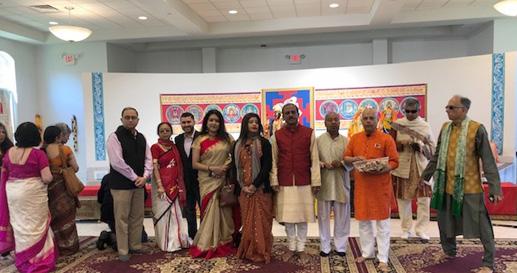
Consul General Ms. Sadia Faizzunnesa of Bangla Desh, Padmabhusan Prof Gayatri Chakravorty Spivak, NJ State Assembly Member Raj Mukherjee, Kazi Anindita, grand-daughter of Kazi Nazrul Islam, CAB’s own present and past key personalities like Dilip Chakrabarti, Tapas Sanyal, Milan Awon, Prabir Roy and many other well-known people of the area. Besides, Ananda Mandir’s President Ashok Rakhit and elite members like Pronoy Chatterjee, Debajyoti Chatterji, Guru Chakravarty, Amitabha Bagchi, and many more were also present. Bishwa Bhai, the priest of

Ananda Mandir started the “Briksha Ropan” ceremony by chanting the “Mantras”, appropriate for the ceremony. He explained meaning of the “Stotra”, stating that trees are good for the environment and human beings as well. Then the Japanese Maple Tree was planted into the ground by Mr. Chakravorty and Ms. Sadia, with help from Prof Spivak, andthe donors of the plant. Some of the elite members present also put soil into the ground. Pertinently, the donors of the plant were Dr. Debasis Adhikari, Prabir Roy and Dilip Chakrabarti. After consummation of “Briksha Ropan”, all the people went inside the Tagore Hall. The tree planting ceremony really set the tune of the day. The cultural program started with the candle lighting ceremony. Cab President Dilip Chakrabarti and Utsav Committee President Tapas Sanyal welcomed everybody for coming to this ceremony. Keynote Speaker in this event was Padmabhusan Prof. Gayatri Chakravorty Spivak. In her short but eloquent speech she explained the importance of mother tongue, how Bengali language was transformed into a very rich language with depth of passion, and how the influence of this language in human life became enormous and limitless. She asserted that this was possible because of these two poets who were really a writer, philosopher and guide for the Bengali Literature.It is their solid contribution which made Bengal a coveted place of literary excellence. She also mentioned the influence and importance of “Vaishnav Padabali” and poet “Chandi Das” in Bengali Language in her speech. Her felicity of diction and delivery of speech made the whole audience so spellbound in a magical moment that the audience paid a standing ovation after her speech. It can be said “she was fluent, humble yet poignant with her thoughts; she definitely depicted the limitless influence of these two super talents in the arena of Bengali Literature and Bengali life. I have never heard a speaker so explicit on the subject.She rightfully received the standing ovation of the audience. ”
After her speech three hundred plus strong audience were very pleased to see the beginning of the entertaining program. Different Bengali Associations of the Tri State Area assembled under the leadership umbrella of CAB. Garden State Cultural Association started the first performance of the day. It was a quality performance delivered by the artistes. Ananda Mandir’s own program led by Arun Bhaumik was also a high mark program and it entertained peoples to the highest level. CAB’s own dance program led by well-known Subhra Goswami brought a magical moment to the spectators and it was praised by one and all. Every participating artiste, be a musician, dancer or actor, has proven his or her adroit talent during the performance and it is evidently clear that these artistes are none but tomorrow’s stars of performing arts in our community and in the Tri State Area.
CAB also arranged for light lunch for a very reasonable price. The entrance area of the Tagore hall was filled with a few vendors; the area was always busy and noisy with prospective buyers of commodities from these vendors.
The main programs of the evening were performances by the granddaughter of Nazrul, Kazi Anindita and famous singer Pramita Mallick, a musician of “Rabindra Sangeet”. Anindita won the hearts of the audience by performing her narrative Nazrul Songs. She definitely made a good impression of her skillful talent among the spectators. Pramita Mallick mesmerized the audience with her performance to the fullest potential level of satisfaction among the audiences. It was very clear that she was one of the brightest shining stars of the whole “Rabindra and Nazrul Utsav”.
Congratulations and thanks to CAB and all the volunteers who relentlessly worked for weeks to produce such a complacence of entertainment. This year’s “Rabindra and Nazrul Utsav” created by CAB under the leadership of Tapas Sanyal, will be remembered for long by the spectators.
| continue from page 3
youngsters in the areas of vocal and instrumental music and dance.
During the Saturday morning of the festival’s opening weekend, organizers hosted a large group-singing of the “Pancharathna Krithis,”, the five jewels, which was sung to pay homage to Sri Thyagaraja, the Hindu saint and composer. The festival started a little after 8 am with poojas and bhajans. The musicians and devotees of music continued to filter in. Before long, the rendition of the Pancharatna Krithis had begun. Local artistes sat alongside the visiting professionals in respect to Saint Thyagaraja.
What has become the largest and most notable South Indian classical arts festival outside of India started in 1978 as a three-act concert in the basement of a rented church in the Richmond Heights section of the city. The seeds for the Thyagaraja Festival were planted in the early 1970s with a group of Indian immigrants and their families who lived in Cleveland. When Ramnad Raghavan—a noted mridangam percussionist— moved to the city in 1977, he sought to strengthen their ties through Indian music and offered to train the group to sing the works of the famed Indian composer Thyagaraja.At his suggestion, several members of the group mobilized to form the Cleveland Thyagaraja Festival in 1978. Fortyone years later, the event continues to be organized by members from two generations of these original families, as well as a core group of volunteers.Today the Thyagaraja Festival features 100plus performers over 12 days at Cleveland State University every spring, attracting more than 10,000 people to Cleveland from around the world.
These volunteers spearheaded the planning and organization of the Cleveland Thyagaraja Festival. They worked closely with various other Carnatic music organizations in the United States and Canada to bring artists to Cleveland for the festival. The notable personalities among the volunteers included ones known popularly as ‘Cleveland’ Balu (Balasubramaniam) , ‘Cleveland’ Sundaram, and ‘Toronto’ Venkataraman. Balu’s wife Gomathi oversaw the preparation of meals for all the artists and
was affectionately called “Annapurna”, the goddess of food.
The venue of the festival was mainly at the Waetjen Auditorium of Cleveland State University, with some isolated events arranged in the Comfort Inn across the campus. Comfort Inn housed the artists that came from India as well from the States and Canada. South Indian meals were arranged for the artists and the visitors at the hotel. Theorganizers did not merely have to cater for the musicians, they had the mammoth task of feeding 1500 or so visitors.
With the musicians gathered around in the lobby of the hotel, and the words of Tamil, Telegu and Malayalam floating around it was like stepping into the foyer of a music academy of South India. None of the words spoken made any sense to me, of course.
One of the special attractions of the festival was the performance of the students of M. S. Martin who played Carnatic music on the keyboard.For the past 25 years, Martin has been teaching children to play on the keyboard. In 2011, his students set a Guinness Record when 109 of them played Carnatic music for a quarter of an hour on the keyboard in unison. For the first time in the history of 42 years of the Cleveland Thyagaraja Festival, the keyboard took center stage, led by Martin in an hour-long concert with his 16 disciples. They included two students based in the U.S., aside from 14 students from his school in Chennai.The highlight of the concert was the moving rendition of Thyagaraja’s ‘Nagumomu’. The performance ended with a vibrant Sindhu Bhairavi tillana. According to Martin, the response from the audience proved that Carnatic music can be enjoyed on the keyboard too. He felt that such opportunity helped youngsters understand and appreciate their classical heritage. What attracted me most was how the older generation were teaching the younger ones to carry the torch for the future Thyagaraja Festivals; they were trying to sow the seeds of artistry in them. Some of the performances in the festival were memorable, namely that of the Hyderabad Brothers – listening to them I realized that the language was no barrier, music tran-
scends all languages. One of the performances was dedicated to Nandikeshwara, Lord Shiva’s Vahana and the patron god of rhythm. The program on this day featured special percussion ensembles, as well as musical performances with emphasis on rhythm. In Carnatic music, I learned that the accompanists are as important as the solo performers, and the accompanists are given equal opportunity to exhibit their talents. One of the events featured a dance program entitled Dhruva, the guiding star, to bridge cultures by taking the familiar story of the Lion King and presenting it to the audience through Bharatanatyam. One of the memorable events of the festival was the performance of Sudha Ramanathan, a world-renowned musician and the leading torchbearer as well as a global ambassador of Carnatic music. She was awarded the Festival’s highest honor for a performing musician, the D. M. Balamuralikrishnan Memorial Award.
The festival included dance performances that featured live music by concert musicians, so that the musical aspect of the program is presented at the highest level. Apart from the emphasis on South Indian classical arts, the festival also featured Kathak master Birju Maharaj who delighted the audience with his unique hand movements (Abhinaya) His disciple Saswati Sen who presented Kathak dance was recognized for her contribution to the classical arts. Sujata Mohapatra gave a spell-binding performance of Odissi dance, performed with live music. The rendering of the dance Ardhanarishwara with her young male disciple from Calcutta was simply outstanding. Rajeswari Sainath demonstrated the nine emotions (Nava Rasa) with her daughter through Bharatanatyam. The mother-daughter partnership was very nicely expressed in their dance.
All in all, it was a memorable two weeks.I felt fortunate to be living close by and to afford to attend this annual event. The quality music, the dignified musicians, the hardworking and dedicated volunteers and the wonderful friends I made all contributed to the remarkable experience that will stay fresh in my mind for many years to come.I offer my salute to the Cleveland Thyagaraja Festival.
| continue from page 3
dates”. Whether there was an overt bias in Gandhi’s case, it is hard to say. Also, through the archives, there is no clear indication that the Committee considered the possibility of an adverse British reaction.
It is obvious that in both 1947 and 1948, the Committee was torn between giving the prize to Gandhi or not. It seems reasonable to conclude that had Gandhi lived a few more months, he would have received the Peace Prize in 1948. The Committee’s statements in subsequent years seem to indicate that they not only regretted their decisions, but it also remained like a “prick of conscience” with them.
The Years That Followed
After Gandhi’s death, his principle of nonviolence against a powerful adversary was followed by many activists and institutions around the world, and three stalwarts among them - Martin Luther King Jr., Nelson Mandela and Dalai Lama – were awarded Nobel Peace Prizes. And in each of those occasions, the Committee made it a point to bring back the name of Gandhi.
In 1964, in awarding the Peace Prize to Dr. Martin Luther King, Jr., Chairman Jahn of the Nobel Committee, talked of Dr. King’s belief that “the nonviolent resistance philosophy of Gandhi… the only morally and practically sound method open to oppressed people in their struggle for freedom.” Dr. King, long influenced by Gandhi, spoke about the impact of the Indian struggle on the Civil Rights movement in his acceptance speech: “Negroes of the United States, following the people of India, have demonstrated that nonviolence is not sterile passivity, but a powerful moral force which makes for social transformation.”
And in 1989, in awarding the Peace Prize to Dalai Lama, the Chairman of the Nobel Committee, Egil Aarvik, stated: “Dalai Lama likes to consider himself one of Gandhi’s successors. People have occasionally wondered why Gandhi himself was never awarded the Nobel Peace Prize, and the present Nobel Committee can with impunity share this surprise, while regarding this year’s award of the prize as in part a tribute to the memory of Mahatma Gandhi.” It is a clear admission by the Committee about its failure to recognize Gandhi. And in accepting the Prize, Dalai Lama said “I accept it as a tribute to the man who founded the modern tradition of nonviolent action for change – Mahatma Gandhi – whose life taught and inspired me.”
Again in 1993, in awarding the Peace Prize to Nelson Mandela, Chairman of the Nobel Committee, Francis Sejersted, stated that “he (Mandela) was among those who were inspired by Gandhi’s methods of nonviolence.”
Finally, in 2006, the Secretary of Nobel Committee, Geir Lundestadin, said, “The greatest omission in our 106-year history is undoubtedly that Mahatma Gandhi never received the Nobel Peace prize. Gandhi could do without the Nobel Peace prize, whether Nobel committee can do without Gandhi is the question.”
There could not be a stronger admission from such an august institution.
Sources:
Mahatma Gandhi, the missing laureate. NobelPrize.org. Nobel Media AB 2019. https://www.nobelprize.org/prizes/themes/mahatma-gandhi-the-missing-laureate Award to Dalai Lama Speech: https://www.nobelprize. org/prizes/peace/1989/ceremony-speech/ Dalai Lama Acceptance Speech: https://www.nobelprize.org/prizes/peace/1989/lama/biographical/ Award to Nelson Mandela Speech: https://www.nobelprize.org/prizes/peace/1993/ceremony-speech/ Nelson Mandela’s Acceptance Speech: https://www. nobelprize.org/prizes/peace/1993/mandela/26130-nelson-mandela-nobel-lecture-1993/
Martin Luther King Jr.’s Acceptance Speech: https:// www.nobelprize.org/prizes/peace/1964/king/26142martin-luther-king-jr-acceptance-speech-1964/ https://www.nobelprize.org/prizes/facts/nobelprize-facts/ History Channel: https://www.history.com/news/7things-you-may-not-know-about-the-nobel-prizes
Reported by Subrata Bhaumik
Sahitya O Alochana (SOA)
is a monthly literary and topical discussion forum under the aegis of Ananda Mandir (AM). It completed its 11th anniversary in January 2019 and will have organized one hundred and fourteen (114) sessions by the time this report goes to press. These monthly sessions feature exciting and illuminating discussions on diverse subjects including literature, art, theater and movie; history, philosophy and religion; science and mathematics; economics and business; and social issues, sports, and current affairs. Below is an account of the last three sessions.
March 2019
No session was scheduled in March - we were hibernating! Well, we didn’t disappear from the face of the earth; were still around - live and kicking, and getting ready to reemerge from a short and refreshing hiatus. The weather was cold and dull, then there were conflicts and priorities of life, all around – yada, yada – you know the story. But the good news is - we came back on the block in April, which is not really the “cruelest month!!”
April 2019
This session was entitled “Nobel Prize in Literature –Eurocentric and Politicized, or Free & Fair.”
For about 125 years recognition of literary careers of the highest caliber in the world has gone through an evolutionary process and reached a stage where it has become synonymous with the venerable “Nobel Prize.” In international literature, it is, in a way, the difference between unsung heroes and immortalized literary figures. And that is one of the central reasons that the process of awarding and the institution responsible for it should be free and fair - clean and devoid of all biases, perceived or real.
Consider the following facts: The United States is the only non-European nation that ranks in the top ten countries with the highest number of Nobel prizes in literature. Of the 114 recipients of the
Nobel Prize in Literature to date, there have been two authors in Japanese, two in Chinese, one in Arabic (from Egypt) and one from India (in Bengali and English). There has been a smattering of other no people of non-European origin, like V.S. Naipaul, Kazuo Ishiguro, Wole Soyinka, Derek Walcott and Toni Morrison (all writing in English). Is this a matter of Eurocentricity and bias, or can it be justified in terms of the universalist goals set out for the prize at its inception? Or it is just a “North-South divide” dominated by the white people and the forces of capitalism?
In summary, this session focused on the evolution of the selection and award process, its organizational and political dynamics, and the challenges it confronted in its effort to morph into a global literary phenomenon from a Eurocentric prize. It was also in some ways a reexamination of whether or not there existed some kind of “due process” in picking the winners through a quick review of the awardees, especially the much talked about controversial cases, which is plentiful in supply.
Amitabha Bagchi, the discussion leader, made an excellent presentation that was well researched, very informative and highly insightful. It focused on the evolution of the selection and award process, its organizational and political dynamics, and the challenges it confronted in its journey of morphing into a global literary phenomenon from a Eurocentric prize.
Attendance was robust, and the participation was erudite and animated! A ton of thanks goes out to Amitabha Bagchi.
In May, Sudipta Bhawmik andSoumendu Bhattacharya jointly moderated a session that was a discussion session entitled “Apaharan (Abduction) vs. Right & Fair Child Custody, The Holy Grail of Failed Connubial Bliss. Below is a little introduction to the topic and the relevance.
The dynamics of conjugal relationship changes are very complex and hurtful to the
people involved. And there is at least one indisputable fact related to such evolving situations: custody of minor children in cases of evaporating connubial bliss is at best a thorny issue. Is there a right solution? Is the conventional wisdom the best solution for all involved? Maybe yes, maybe not. We certainly don’t know what the right choice is in the chaos of shifting priorities and changing lifestyles demanded by the ever-increasing pursuit of vocational and material success. But it is true that people venture out, sometimes in very uncharacteristic ways, to hatch plans and carry out all kinds of acts just to be able to enhance their own influences on and help shape the lives of their progenies trapped in unfortunate situations. And to make matters worse, such acts may sometimes be bordering on immoral and not in the best interest of all involved, especially the minors, and could produce unintended consequences that are life-shattering.
The topic is a holdover concept from a recently successful play (Apaharan; Abduction) written, produced, and acted in bySudipta Bhawmik and directed by Soumendu Bhattacharya. The discussion session resuscitated the hot debate that began in the drama and reexamined the issue that has always been a vexed one, but added new dimensions in the backdrop of immigrants’ lives in an ever-complexing 21st century.
Attendance was very strong, and the participation was animated, if not boisterous! A ton of thanks goes out to Sudipta and Soumendu.
Quite a few interesting sessions are in the pipeline for next several months. They feature eclectic topics including “Children’s Literature,” a discussion on “Religion and Politics” with special reference to South Asia, a session on technology and new horizons, and other.
The friends of Sahitya O Alochana would like to thank Ananda Mandir for its continued support for the forum’s contribution to the cultural enrichment of the local Indian and Bengali communities.
By Ruby Banerjea
I stared at a tiny face all scrunched up in fury at being so abruptly exposed to the new world where adoring unknown faces were looking at him. My heart was exploding with happiness and pride.My first grandson was born.
I just couldn’t believe it – I was a grandma! I had been thinking of this moment ever since my daughter had given me the good news. How would it feel to be a grandmother? My very first emotion to be unabashedly honest, was disbelief! Me? A grandmother already? C’mon, I chided myself. It was about time as it has been four years since they were married, and it was me who had been a little nosy. Gently prodding and poking as to whether they were thinking of starting a family at all?
However, was I ready? Would I be able to be the doting and loving grandma as my mother was and still is? One of my friends had gently warned me “your life will change forever” and when I looked at her with alarm, she quickly added “of course for the better.” I couldn’t quite fathom how much involved I should be in his life.
After all I had to respect my daughter and son-inlaw’s wishes. Perhaps, I thought, I would be there once or twice a month to visit and help her with the baby. I wanted to be helpful not imposing! However, very soon I realized how naive I had been. It turned out that she needed me from day one!
“Mom, you can’t leave me alone with a newborn. I know nothing.” She was already panicking.
“Ok, I’ll stay with you for a few days till you are comfortable with him.”
It felt good to be ‘needed’ and I was also secretly pleased that she had asked me. I cherished every moment with him. Needless to say, ‘few days’ turned to a month and she showed no signs of letting me leave. I liked taking charge and enjoyed the fact that both my daughter and son-in-law hung on to my every word as to how to hold the baby correctly and not to panic every time the little one so much as even whimpered. Watching
the baby grow as the days passed was not only joyful, it also stirred memories as how we had managed our girls as they were growing up. I soon realized (embarrassingly enough) that I didn’t quite remember all of it so much.
As both my girls were born in India, we always had family and friends who were so eager to help. So when Riyan (my grandson) smiled for the first time we were so ecstatic. I also remembered when my babies had smiled for the first time the doctor had told me it could only mean ‘gas’. I never believed that for a single minute. We were absolutely convinced that our grandson was SMART!
However, after a month or so Riyan’s other grandparents expressed their desire (very subtly) to spend time with the baby. He was their grandson too. I knew it was time to let go and return to my own routine life. I had, in fact, started getting quite a few accusations and complaints from my best friend as to how I had no time to spend withher, or for that matter with anyone else. Even my younger daughter was of the same opinion. So much so, they called themselves a part of ‘neglected by Ruby club.’
Well! I couldn’t help being always preoccupied with Riyan. I couldn’t bear the thought of leaving him for too long. Everything revolved around him and still does.
Almost a year old now, he is the cutest baby with his wispy brown hair, round black eyes and such long eyelashes!
So as not to hurt anyone’s feelings we decided on a routine; every alternate week we will take turns to be with him. It works! Everyone is happy even though I miss him the very next day I come back to Wayne. When I’m at her place I’m the one whom he wants when he is sleepy. As I rock him on my knees he starts to sing as if on cue and happily drifts off to sleep. His mother still wonders how. I wait eagerly to facetime him when I am not there and when he learnt to ‘kissie’ me on the screen of the phone, it
Lack of access to safe drinking water in resource-poor communities is responsible for prolonged health impairment. Far worse, this deficiency often leads to a vicious cycle of poverty. Although unknown nearly thirty years ago, natural arsenic contamination of groundwater emerged as a major global crisis affecting over fifty countries. In 1998, New York Times called it the worst natural calamity of recent time. The adverse health effects resulting from drinking arsenic contaminated groundwater are most apparent in South and Southeast Asia, e.g., Bangladesh, Cambodia, Nepal, India, Laos and China, where over 300 million people, according to the World Health Organization (WHO), are threatened with arsenic-inflicted serious health impairment. It is ironic that the majority of the affected population also make less than $2 per day.
In the Indian subcontinent and Southeast Asian countries, surface water is practically unusable due to poor sanitation practices and consequent contamination, with the potential for an outbreak of waterborne diseases. Large social engineering efforts pushed mass installations of hand pump operated tube wells as “safe” potable water sources. Unfortunately, many groundwater sources in the Indian subcontinent and Southeast Asia have geogenic arsenic and fluoride in concentrations far exceeding permissible standards of the WHO: 0.010 mg/L arsenic and 1.5 mg/L fluoride, respectively. Technological innovations were deemed imperative for efficient removal of arsenic and fluoride from contaminated groundwater, but their integrations with the social and economic framework of the affected communities posed serious challenges.
During the last twenty years, Lehigh University has been actively involved in mitigating the arsenic
By Prof. Arup K.SenGupta, lehigh university
and fluoride crises in affected regions with appropriate technology and a micro-financing business model while partnering with NGOs, academic institutions and local village panchayats for long-term solutions. It is important to note that in thousands of rural communities, no alternate safe water source currently exists. Three basic questions that the Lehigh team and its partners in different countries wanted to address were:
i) Is the technology robust and easy-to-operate so that villagers can take the full long-term ownership?
ii) Is the community based treatment technology economically sustainable?
iii) Can the arsenic removed from
as the hybrid ion exchange nanomaterial (HIX-Nano), forms the heart of the process and is currently manufactured in India through partial financial support from the department of science and technology of the government of India. In addition, the ongoing project also demonstrated that arsenic- and fluoride-laden sludge can be appropriately contained without posing any environmental and human health related threat.
The attached figure 1 illustrates the key elements of the community model where every participating family pays a small amount of monthly tariff (Rs 100 per month) in lieu of guaranteed supply of safe drinking water of 20 liters per day. In every

the contaminated groundwater be safely contained without posing any environmental and/or human health related threat?
For over a decade, the technology and the micro-financing model for economic sustainability have been refined. The community- based treatment systems are now run and managed by villagers. Currently, over 500,000 people drink arsenic- and fluoride-safe water in five different countries. An adsorbent, referred to
US Department of State, USAID, Intel Technology Award grant, Private donors, National Academy of Engineering (NAE) Grainger Challenge grant, Tata Water Mission and several notfor-profit social enterprises (e.g., Rotary International, VentureWell, Mass Challenge Competiton) with total amount exceeding two million US dollars. A community-based plant altogether requires $10,000 (ten thousand US dollars) and the project is executed in approximately three to four months in cooperation with the villagers. The ongoing work led to the creation of one NGO and one social enterprise
Technology with a Human Face (www.techhumanface.org)
Drinkwell (www.drinkwellsystems.com)
For technically oriented readers,
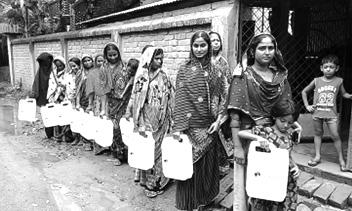
location, care taker/operator and water transporters are compensated for their service. On the average, two jobs or employments are created in every community plant after meeting all the operating expenses. Over the years, women’s direct participation in the management and upkeep of the community plants has greatly increased (See Pic taken at Manikgunj, Bangladesh).
During the last 15 years, this ongoing project received funds from the
the following two publications provide supplementary materials for further reading:
“Evidence of Economically Sustainable Village-Scale Microenterprises for Arsenic Remediation in Developing Countries” Environ. Sci. Technol. (2019): 53, 1078-1086
“Evolution of community-based arsenic removal systems in remote villages in West Bengal, India: Assessment of decade-long operation.” Water. Res. (2010). 44, 5813-5822
Reported by Debajyoti Chatterji
As in previous years, January and February were the lean, “no event” months for Evergreen Club. Too many of our core members were in India for their annual winter vacation. However, enough of them trickled back to NJ by early March to allow us to hold our first session of 2019 on Saturday, March 16. The theme of this meeting, held at Ananda Mandir, was Basanta Jagroto Dwarey (“Spring has arrived at the door”, a liberal translation). Besides a sumptuous, home-cooked pot luck lunch, the meeting featured a number of
songs and poetry recitations by several talented members. Following that, we held a free-wheeling discussion, ranging from medical issues (such as hearing loss among the elderly and use of hearing aids, shingles and the need for vaccination, and dental implant expenses in India vs the US), to the need for greater interaction with local organizations such as the InterFaith Council and the Somerset Food Bank.
We celebrated the Bengali New Year (Shuvo Noboborsho) on Saturday, April 20, at the beautiful home of Ruby and Shyamal Sarkar, located just a stone’s throw from Ananda Mandir. This was the first time Evergreen Club members met at a private home because of the attraction
of a non-vegetarian pot luck lunch that could not be served within the Ananda Mandir complex! Their expectations were more than fulfilled with a multi-course, home-cooked, meatand-fish lunch, followed by a wonderfully diverse and rich program of songs, recitations, and discussions. Our special thanks go to our kind hosts who made this event possible by inviting us to their home.
Our third session was held on Sunday, June 2, at Ananda Mandir. The theme of this meeting was “sharing interesting travel experiences”, domestic or international. The session began with a highly informative and interesting presentation by Tilottama (Tinty) Bose on her (and her husband, Rana Roy’s) recent trip to Egypt. Af-
ter an extensive Q&A session, we proceeded to hear from Shyamal Sarkar about the trip he and Ruby took recently to Arunachal Pradesh in India, a remote and undeveloped – but stunningly beautiful – part of the country that borders China. Other speakers followed to share their travel experiences, some seriously scary (such as the one by Sheuli Gupta).
The level of attendance in all the sessions ranged from 25 to 30. And for all the sessions, the pot-luck lunches were planned and prepared by our army of volunteers who deserve our sincere gratitude.
In July, the group is planning to visit Hunterdon Hills Playhouse for a lunch/theater event.
By Dr Sheela Purkayastha, MD. london uK
Editor’s Note: The author is a Gynecologist with a special interest in PCOS, practicing in London over 35 years. She has seen many cases of PCOS and successfully treated them with various ways depending on their needs.
Polycystic Ovarian Syndrome (PCOS) is one of the commonest conditions seen in female reproductive life causing distressing symptom requiring medical help. About 8-10% women are affected with various gynaecological problems such as missing periods, abnormal weight gain or difficulty in losing weight. Bad oily skin with acne on the face, shoulders and back, excessive facial and body hair (hirsutism).
Other symptoms include difficulty in conceiving, which can cause anxiety and depression. All these symptoms can be profound and so need a prompt diagnosis and appropriate medical advice. Diagnosis is not difficult and needs a thorough consultation by a clinician with PCOS awareness, some blood tests and an ultrasound scan of the ovaries. In 1935, Stein-Leventhal described this condition with regard to a group of women who presented with the above symptoms: so, PCOS is also known as Stein-Leventhal syndrome. At that time and until recently, doctors thought that the problem started with the ovaries as there were multiple cysts seen on ultrasound scan of ovaries. But in recent years after a lot of research we know that a defect in insulin metabolism is the main cause of PCOS resulting in a hormonal imbalance.
Why it is important to treat PCOS?
Once the correct diagnosis has been made and the condition treated,
| continue from page 11
made my day! Talk about smart babies!
There was still something important to be decided. What will my grandson call me? The ever popular ‘dida’ (maternal grandma in Bengali) was always one of my options.
However, ’Glam-ma’ is what I have decided. After all I am always young at heart so glam-ma, short for glamorous- ma, is what I will want him to call me. I hope. Fingers crossed.
Being with Riyan has made my husband and me more active, all the running around has inadvertently helped us to stay young and positive. My hobbies and other projects have taken a backseat. My priorities have changed. Now I know what my friend had meant. My life has changed, for the better.
we can prevent certain diseases like diabetes with a number of possible complications, raised blood pressure with its consequences like stroke. Other problems include increased risk of cholesterol and heart disease, obesity, endometrial cancer, recurrent early miscarriage, and fertility problems.
Irregular periods are always a cause of concern for women of all ages particularly in young people. Successful treatment for infertility can be provided instead of pushing women to go for IVF. All these above treatments can be provided by a good healthcare professional. By treating PCOS with appropriate help and guidance, long term health hazards can be prevented successfully. Excessive unwanted hair growth is distressing and causes embarrassment and depression in women. Various treatments are available and will be mentioned later.
What causes PCOS?
Exact causes remain unknown. It is thought to have multiple contributing factors such as metabolic disorders, strong genetic or family predisposition. Raised insulin is thought to be the topmost cause for this condition (70-80% of all cases of PCOS). There is excess androgen (male hormone) production in the ovaries resulting in all the complex symptoms of PCOS.
How is PCOS diagnosed?
Although it is a doctor’s job to
make the correct diagnosis, it is always good for women themselves to have the knowledge to hand. In 2003, Rotterdam’s criteria in diagnosing PCOS was accepted and published. The specialists’ consensus was to diagnose PCOS when two out of three of the following features were found in suspected cases:
• Symptoms: These can include any problems with menstruation, like delayed, irregular or no periods. Difficulty in getting pregnant related to no release of eggs from the ovaries. Acne, excess hair on face, body or both, male pattern of hair loss can be present as mentioned earlier
• Biochemical changes: Raised hormones like androgens, LH and insulin are responsible for all symptoms as described earlier.
• Radiological signs: Multiple small cysts in the ovaries can be seen by ultrasound scan. These are small fluid filled sacs representing the nonrelease of eggs. These ovaries are never hugely enlarged and do not need operation. They are never cancerous so there is not any health risk from these cysts.
The approach should be holistic, considering different ways to treat the patient depending on her symptoms and requirements. However, in all of them general measures like change in lifestyle and reducing at least 5-10% of body weight (in overweight patients) seems to help considerably. This can be achieved by lowering overall calorie intake, adopting a high protein and low carbohydrate diet with a low glycaemic index. Along with diet, regular exercise is the key to success. Aerobic exercise is very beneficial: at the minimum brisk walking for at least 20-30 minutes 3-4
times a week or swimming 50 lengths can help enormously. Women should give themselves three months of this and if there is no improvement the physician can add certain medicines to improve the carbohydrate metabolism and prevent hyperinsulinemia. One of the common drugs used is Metformin, though this might have slight side effects. In the UK we have a natural supplement available (Myo-inositol) which improves the carbohydrate metabolism hence improving the symptoms with periods, acne and conception. Women with period problems can try low dosage combined birth control pills which are easily available in the market. For excessive hair growth anti-testosterone medications can be helpful, as well as cosmetic hair removal measures like waxing, threading, shaving, laser hair removal in conjunction with other pharmacological preparations like Eflornithine 11.5%. Ovulation problems can be treated with various medications like clomiphene which need to be decided by the physicians. IVF should not be the first line of choice in these cases and operations on the ovaries should be avoided due to subsequent complications.
In conclusion I would liketo say if you suspect you might have PCOS choose a physician with PCOS awareness and try the easy ways I mentioned above which are always beneficial to your health. You may then go for a blood test and ultrasound scan of ovaries as advised by your physician. Lastly, to be positive and be honest with yourself about diet, exercise and alcohol intake.
For further information you can visit the author’s website at www.femalegynaecologistlondon.co.uk
Epic Actors’ Workshop is proud to announce the 14th South Asian Theater Festival on Aug 3 and 4, 2019 at George Street Playhouse (New facility): 103 College Farm Rd., New Brunswick, NJ-08901.
We thank you for your patronage in the past and we hope you will join us this year to celebrate our 14th anniversary. We put together an exciting line-up of quality theaters in English, Hindi and Bengali, with shows from communities belonging to different South Asian countries.
The Lineup of the shows:
• Megh (Bengali)--Epic Actors Workshop, NJ
Written by Utpal Dutta
Directed by Pinaki Dutta
• Anton Chekhov Returns (Hindi/English)--ICS Theatre, NJ
Written by Anton Chekhov
Directed by Mahesh Dattani
• Kamala (Bengali)--Spotlight Theater, Ohio
From Myman Shingha Geetika
Directed by Gautam Haldar
• Rani Kamalapati (Hindi) – Prayog, NJ
Written by Indira Dangi
Directed by Ameeya Mehta
• Stories of Jackson Heights (English)--Dhaka Drama, New York
Written by Golam Sarwar Harun
Concept and translation by Gargi Mukherjee
Directed by Golam Sarwar Harun
• Makkhee Choos (Hindi)--Bravo Arts, Boston
Written by Moliere
Adapted from: Avare
Directed by Jayashree Shahane
Srivatsa
of Krishnamacharya), Dr. Paul Jerard,
Pattabhiram (a disciple of Swami Rama), Pt. RajmaniTigunait, Tari Prinster, William Bodri, Yogani, and Leslie Kaminoff.
The Gayatri Memorial Awards were established in 2010 by Jerry GaMarsh to honor his late wife, Gayatri GaMarsh. The program is administered through the Awards & Recognition Committee of Ananda Mandir, Somerset, NJ.
Two cash awards are usually given each year to recognize outstanding works published in North America-based literary magazines. One award is given to an author of Bengali works, and another is given to an author in English. Each award consists of $500 in cash and a commendation plaque. Under certain situations, co-winners may be selected for an award category.
An author may nominate himself/herself -- or may be nominated by third parties (using the Nomination Form shown below). Each nomination should be submitted in duplicate and supported by photocopies of one of the following:
Two (and only two) works of prose (essays, short stories or plays) published in North America-based Bengali or English print or digital magazines within the last five years. The submitted articles should not be more than ten pages long. Longer articles may be disqualified.
In case of poetry, submission may consist of up to four poems, each ofreasonable length (2 pages or shorter).
A combination of prose and poetry may be submitted as well. However, please submit no more than one short story, essay or play and two poems.
Please note that unpublished works of literature will not be accepted. Full publication references must be given for the articles submitted with each nomination. Articles published in magazines or websites outside of North America will not be considered.
Nominated authors must be 18 years or older, and must live in North America.
Each nomination should include a short biography of the author. Judging, however, will be based primarily on the supporting publications. Judges’ decisions will be final.
Members of the Awards & Recognition Subcommittee and the judges cannot submit nominations for themselves nor can they be nominated by third parties.
Deadline for nominations (with supporting documents) for the 2019 awards is August 31, 2019. Awards will be announced and presented in the Fall of 2019.
Please send nominations (with supporting documents) to Debajyoti Chatterji, 79 Mackenzie Lane South, Denville, NJ 07834
In case of questions, please email Debajyoti Chatterji (debsmee572@gmail.com)
By Anuraag Sarkar, Age 15
Robots are constantly being improved on and have become much more useful than what they were a few years ago despite the fact that they are already incredibly advanced and ingenious. Engineering feats such as the Starlit Knight and Microbe Sampling mechanism constantly aid us in aquamarine research, archeological exploration, and economic development. These robots, however, are just the tip of the iceberg.
Autonomous ships are one of the many examples of what aquatic robots can accomplish and become. These ships are currently under development, but if perfected, can lead to a world full of fast and safe aquatic shipping and travel. According to the article Are Autonomous Ships the Future? by David Cowan, “isolated islands could be served, inhospitable routes navigated and remote areas accessed, much of it with diminished risk to seafarers,” (Ref. Cowan). Although Autonomous Ships would not serve an archaeological or scientific purpose, these ships can later be developed into self-scavenging and navigating machines that can help locate significant items or anomalies in the ocean.
The Scuba Droid is another example of cutting edge technology that if further developed can become key to
solving the crypticmysteries of the ocean. A scuba diver cannot survive underwater for more than fifteen minutes nor can he go very deep because of water pressure. Scuba Droids, however, are the perfect solutions to this problem. These droids can not only survive very long underwater due to a very powerful battery, but they can also go deeper because of durable materials that protect them from collapsing under the weight of the water above them. These unflaggingscuba droids may replace deep sea scuba divers, ensuring safe and efficient sea exploration and research.
Additionally, the Blue Revolution is an example of an aquatic robot that has already been implemented in the real world, as shown in the article 12 Robots that could Make (or Break) Oceans), “Submerged ‘aqua pod’ cages, for example, have been deployed in Hawaii, Mexico, and Panama,” (Ref. Degnarain). Because of the growing population in the world, demand for food has increased.However, there are not enough fishermen to supply food to all the people in need. Because of this, the Blue Revolution was developed. This ingenious invention automatically captures swarms of fish, which can then be harvested and used to provide food for people. Research
on improving this mechanism is already underway, and it is predicted that this mechanism can completely nullify the need for manual fishing.
Although robots and automation are only just starting out, the future holds many promising and hopeful developments for aquatic robotics. Innovations such as the autonomous ship, scuba droid, and Blue Revolution have not only shaken the foundation of aquatic research and exploration but also the foundation of our communities. They can not only help with commercial and economic problems, but can even aid archaeologists and scientists. Further development of these inventions may lead to complete automation of aquatic travel, exploration, and research, and they may even eliminate fatalities relating to ocean research. Aquatic robots are the future, and the future is now.
Works Cited:
Degnarain, Nishan, et al. “12 Robots That Could Make (or Break) the Oceans.” World Economic Forum, World Economic Forum, www.weforum. org/agenda/2016/09/12cutting-edge-technologies -that-could-save-ouroceans/.
Cowan, David. “Autonomous Ships: Are They the Future of the Seven Seas?” Raconteur, Raconteur Media Ltd., 16 Oct. 2018, www.raconteur.net/finance/autonomous-ships.
The Kishalay Awards for Writing Excellence were established by Ananda Mandir (AM) in 2016. This program is designed to recognize superior writing skills of school age children and kin of AM members. The initial year awards were made possible by a donation by Abhijit Sen, a life member of Ananda Mandir, which was then followed up by members of the AM community.
In 2018, the award was funded by a donation by Utpal Sengupta, a trustee of AM. And the winners for the year were Annesha Ghosh (first prize) and Aishi Raychoudhury (second prize).
Nominations are hereby invited for 2019 Kishalay Awards, which
have been made possible by a donation by Indrani Dhar, a member of the Trustee Board of Ananda Mandir.
Following are the basic rules that govern the award administration.
1) The first-place winner will earn prize of $300, and the second prize is worth $200.
2) It is available for only school age children and kin of Ananda Mandir members. The contestants for the awards need to reside in the US, and preferably enrolled in a high or middle school.
3) A contestant will need to be nominated by a member of Ananda Mandir or be self-nominated following the nomination rules set forth herein.
4) Potential contestants over 18 years of age will be automatically disqualified.
5) Number of submissions is limited to two (2) per contestant per year. Only English prose (essay, story, report, article, etc.) would be considered, and the length should be limited to 2,500 words.
6) Submission of published article in any magazine (school or others) is highly encouraged although unpublished work will be accepted as well.
7) Nominations should include short biography of the author and his/her connection to Ananda Mandir.
8) Deadline for nominations (with copies of the submissions) for
the 2019 awards is August 31, 2019. Awards will be announced and presented in the Fall of 2019.
9) All nominations will be made using the Nomination Form downloaded from Ananda Mandir’s website. For copies of nomination form, please contact Subrata Bhaumik and /or Ashok Rakhit at the following email addresses. Completed forms should be supported by the submitted piece(s) of work of the young author.
10) Nomination forms will be available on Ananda Mandir’s website and distributed via email.
In case of questions, please email Subrata Bhaumik (Bhaumik.subrata @gmail.com or Ashok Rakhit (ashokrakhit@gmail.com).
Reported by Pradip R. Das
GSCA had its Annual General Meeting at the Crowne of India Restaurant at Plainsboro, NJ on Saturday, March 31st. The meeting was preceded by a sumptuous lunch buffet of North and South Indian delicacies. This meeting was attended by one of the largest gathering of members in recent years.The meeting which started at 1:30 pm had a full agenda, the highlights of which were reports by the outgoing Chairman of the Board and the Treasurer, followed by brief reports by the coordinators of the nine committees of GSCA. The new board was introduced by the incoming Chairman, Indrasish Basuroychowdhury. New members were introduced as well. The meeting concluded with a lively Q&A session.
Baishakhi was celebrated by GSCA at Linwood Middle School, North Brunswick, on Saturday, May 4th. The on-stage programs consisted of lively song and dance performances by local youngsters. Opening songs dedicated to Rabindranath Tagore commenced the afternoon’s cultural program. GSCA’s In-House production Nrityanatya. Rabindranath’s “Pratham Puja” was a beautiful rendition by members. Next, a short instrumental medley of popular tunes entertained the audience. This was followed by poetry recitation by Sanghamitra Bhattacharya and a male accompaniment. The cultural programs concluded with a mesmerizing fusion dance performance by IMGE, an Urban Indian dance troupe founded by Ishita Mili. Urban Indian is a style primarily rooted in Indian classical dance and Hip-Hop.
An Indian meal was served to all attendees present at the conclusion of all the programs. Clothing and jewelry and an art stall drew crowds which added to the festive mood of the day.
On May 11th, GSCA participated in Ananda Mandir’s “Rabindranath/Nazrul Utsav” by presenting the dance drama “Pratham Puja”.
In 2019, we are supporting (34) students who are continuing their studies in Medical, Engineering, Nursing and undergraduate colleges, ten of them being in the MBBS category. Included in the list are seven students graduating from Plainfield High School in New Jersey.
Philanthropy committee members, during their visits to India, interacts with existing and newly supported students. They also searched for potential future scholarship recipients and works with our partners in Kolkata who facilitate in the implementation of our program there.
In addition, GSCA’s youth volunteers ran snack stalls at various GSCA community events and donated all sales proceeds to philanthropy. What a marvelous and encouraging impact GSCA’s philanthropic efforts are having on the youth!

Reported by Chanakya Ganguly
NJPA celebrated Saraswati Puja at the Monroe Senior Center in Monroe, NJ on February 23rd, 2019. Attendance was excellent. There was cultural program of Indian Classical Dance and Music. Bhupen Hazarika’s son attended the event. It had good participation from kids and families. Pamphlets were prepared to educate people on Yogic significance of Saraswati. NJPA made a modest profit. It was a grand success. The year before we had to cancel the Puja due to declining attendance and difficulties in finding a venue. Young volunteers from our community raised funds for St. Jude Children’s Research Hospital.
NJPA AGM was held on May 18th, 2019. Nimai Ghose was elected as the new VicePresident. We have been able to address the needs of wider community and increase participation with kids and families. NJPA is looking to push for new ideas to bring in more Yoga, spirituality and relevance of Dharmic education with modern life among kids and families for moral development, mental peace, health and well-being. NJPA has been able to get more volunteers from the next generation.
Summer is almost here and this year NJPA will have its annual summer picnic on June 9th at Roosevelt Park in NJ. We invite everyone to attend with family and friends and have fun.
Information about the upcoming event will be available on our Facebook page “NJPA Parivar.”
Till we meet again, have a Sunny Summer and a meditative year.
Reported by Arpita Gupta
Professor Elora Mukherjee of Columbia University, was named as Jerome L. Green Clinical Professor of Law, a new endowment chair established with a 15 million dollar gift from Jerome L. Green Foundation. Elora Mukherjee founded Columbia Law School’s Immigrants’ Rights Clinic in 2014 and since then she has successfully represented hundreds of migrant refugees at the Texas border who have fled violence and persecution in their home countries. She led a team of law students to represent detainees and asylum seekers which required quite intensive process of interviewing with clients, their family members, other witnesses in their home country and preparing legal briefs with documents, police reports as well as medical and mental health status. She is also a founder and director of the Refugee Reunification Project that provides financial grants to refugee families. She thought it was an amazing job which really transformed her life.
We congratulate Elora for her fine humanitarian work for the society. She is the daughter of Arun and Nita Mukherjee of South Brunswick, New Jersey.
Source: “The Sentinel” of Central Jersey
The Indian Community Center of Garden State (ICC) welcomed the arrival of spring, by celebrating the 2019 Baishakhi on April 27tht at Livingston Community Center,Livingston, NJ. This annual event provides the members and more importantly, their children with a platform to expose their talent in the fine arts – one of the critical missions of the organization.
The event started around 3:00pm with a snack of Bengali ‘muri’,”Singara” and ‘cha’ as the attendees comingled and engaged in ‘talks’, while the volunteers prepared the stage and the auditorium.
ICC President, Nirmal Kundu and General Secretary, Nilay Hait, welcomed the assembled gathering and ushered the start of the cultural program. This event began with the presentation of Rabindra sangeet –sung by Monalisa and Arunima.Kids performed instrumental, vocal and dance programs. Adults showed their talents in different performances like dance, singing , shruti natok , narration etc. A group song was presented by Anusuya De giving Tribute toRabindranathand Nazrul. Participating singers were Sheena, Mithoo Bhattacharya, Gopa Mukherjee,Paromita, Anustup, Moumita,Subhoshree, and Moumita Hait. Arindam Chakraborty did the percussion, and Sutapa Chakraborty performed the narration.
A sumptuous dinner with Goat curry, alur dom, chholar dal, luchi,bhat and pantua was served.
Agomoni Bangla School did an event of potting the plants with Children, which was a hit among members.
The Executive Committee continues to look for other opportunities where the ICC members and their children get an opportunity to present and practice their Indian heritage. Please stay tuned for announcements for upcoming events at our website www.icc-gs.org
Swami Vedantanandaji, popularly known as Kashi Maharaj, of the New Jersey Ashram of Bharat Sevashram Sangha, passed away on June 02, 2019. He worked at the publication office of Bharat Sevashram Sangha for many years, working on the PRANAB magazine, and other publications of the organization.He wrote songs, poetries and articles for many well-known publications of Kolkata. Thereafter, he continued writing in both Bengali and English, which were published in various publications all over the world.
Swamiji came to USA in the year 2000, as a representative of Peace Missionary from Bharat Sevashram Sangha of Kolkata to the United Nations. He started working at the New Jersey Ashram in the same year. Throughout his stay at the New Jersey Ashram, he continued to write songs, poetries and books. He received many awards and honors from various educational institutions, including the highly prestigious Cambridge University of United Kingdom. We pray for his soul to unite with his Gurudev, Acharya Swami Pranavanandaji Maharaj, the Founder
Bharat Sevashram Sangha.
Many young members of Ananda Mandir are volunteering their time to work at the Ananda Mandir facility. During the spring break at the school, a few of them can be seen heredoing clean up at the old building.
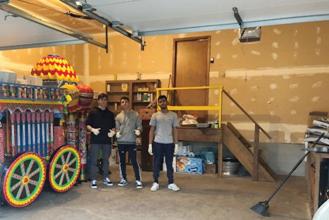
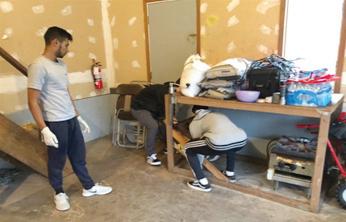
Please note that you can become an Associate Member of Ananda Mandir by donating a minimum of $100. Your subsequent donations of $50 or more are credited to your account. When your total cumulative donation reaches $1000, you become a Life Member. Your support, small or large, is most welcome and sincerely appreciated.