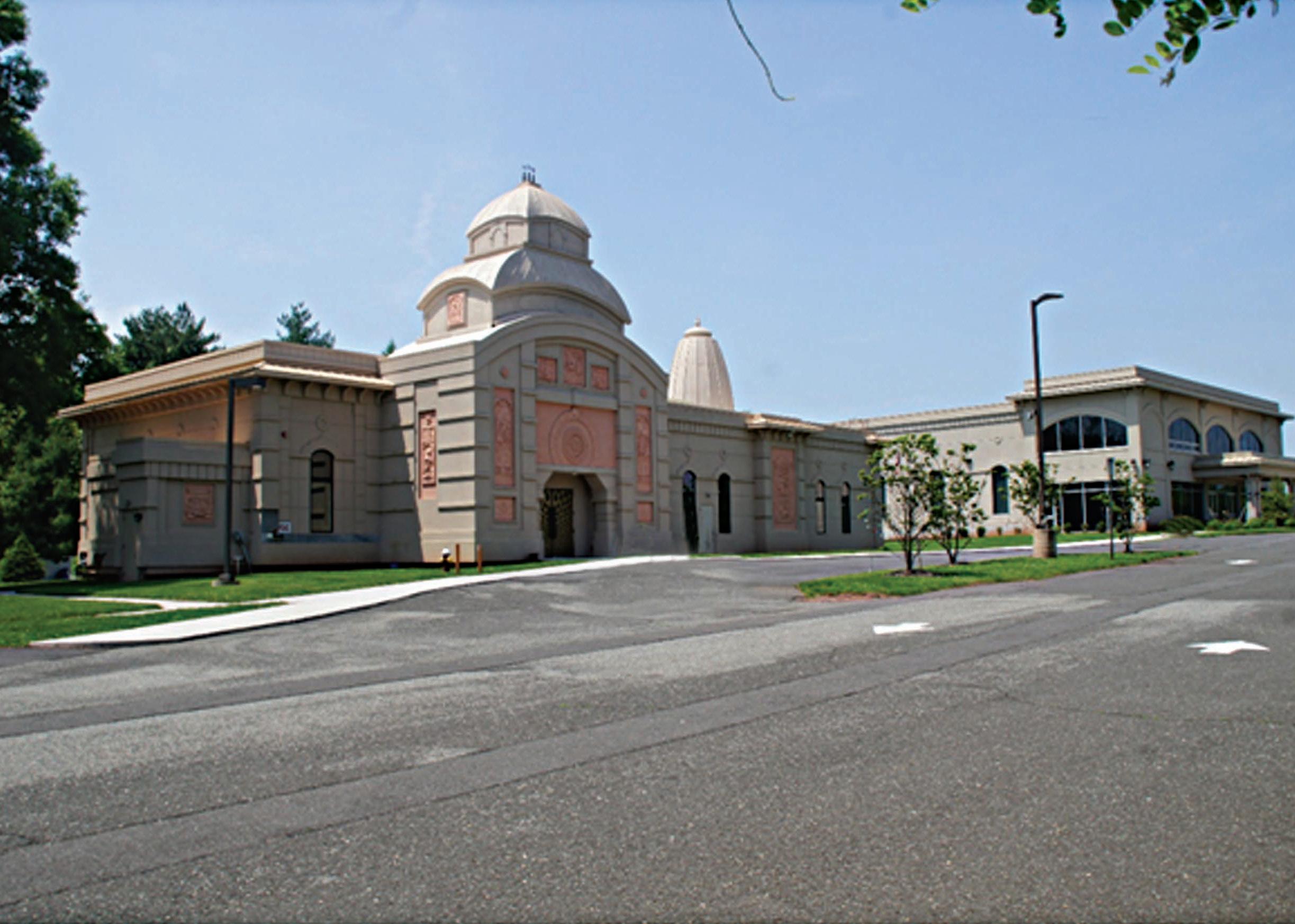
Ananda Mandir
269 Cedar Grove Lane Somerset, NJ 08873


Ananda Mandir
269 Cedar Grove Lane Somerset, NJ 08873

Hosted by Ananda Mandir, Somerset, New Jersey A Religious and Cultural Center for Bengalis
This is a special issue of Ananda Sangbad, focused towards North American Bengali Conference attendees. It presents a flavor of a variety of subject matters that we cover on a regular basis, as well as selected articles from previously published issues of Ananda Sangbad authored by writers from all across America.
“He Saw Netaji‘‘: Fascinating story about encounter with Netaji (By Jayashree Chatterjee)
“Death of a Salesman‘‘: A Humorous Experience of Selling Encyclopedias (by Basab Dasgupta)
‘‘Cut the Cord‘‘: Break Free From Cable Forever (By Chayan Roychowdhury)
“Preventing Illness During Travel to India‘‘: Valuable Medical Advice (by Rachna Gupta, MD)
“"Lakshmi Bai -- Why She is Relevant Today": A Fascinating Glimpse of History (by Rahul Ray)
“Forgotten Heroes of Bengal‘‘: Impact of Derozio and His Disciples (by Rajat Chanda)
THE PUBLICATION OF THIS ISSUE HAS BEEN MADE POSSIBLE SOLELY BY A GRANT FROM ANDY BOSE, C.P.A.
Ananda Sambad
A Periodical Newsletter
Published By
ANANDA MANDIR
(A Tax-Exempt, Non-Profit Organization)
269 Cedar Grove Lane Somerset, NJ 08873
Ph: 732-873-9821
Website: www.anandamandir.org
Publication Committee of Ananda Mandir
Chairperson: Pronoy Chatterjee, pkc_usa@yahoo.com
Assistant Chairperson: Subrata Bhaumik, Bhaumik.subrata@gmail.com
Editor-in-Chief: Debajyoti Chatterji, Debsmee572@gmail.com
Managing Editor, Ananda Sangbad: Guru Chakravarty, guruchakravarty@yahoo.com
Managing Editor, Anandalipi: Amitabha Bagchi, amitabhanj@gmail.com
Editors:
Subrata Bhaumik, bhaumik.subrata@gmail.com
Subhodev Das, subhodev.das@gmail.com
Sushmita Dutta, sushmitadutt2@gmail.com
Amrita Kangle, amritakangle@hotmail.com
Nupur Lahiri, nupurlahiri@aol.com
Associate Editor: Ruby Banerjea, r_banerjea@yahoo.com
Members-at-large: Ashok Rakhit
l
All queries, articles, news reports and letters should be directed to the Managing Editor
Phone: 908-752-3065
E-mail: guruchakravarty@yahoo.com
l
For general information, please contact the following executives of Ananda Mandir: Ashok Rakhit, President
Jaiprakash Biswas, Vice President
Suprasad Baidyaroy, Vice President
Arun Bhowmik, Vice President
Sajal Mukherjee, Gen Secretary
Pradip Majumdar Treasurer
Ananda Sangbad is a quarterly news magazine published by Ananda Mandir of New Jersey. It not only publishes news on Ananda Mandir and its community activities, but also includes relevant articles on new technologies that would impact our lives, economics and health sciences, as well as some humorous and light articles on individual experiences. This year’s July issue of Ananda Sangbad is a special issue, focused towards North American Bengali Conference attendees. It presents a flavor of a variety of subject matters that we cover on a regular basis, as well as selected articles from previously published issues of Ananda Sangbad authored by writers from all across America
This issue also contains a brief overview of our Ananda Mandir organization on how it evolved, where it stands now, and its vision. Ananda Mandir is not just a religious institution, as its name reflects, it is also a cultural center, where our music, dance, entertainment, theater, language and literary discussions are being held and nurtured, introducing them to our next generation population . It has a state of the art auditorium, which also plays an important role in serving the members of our community to hold private festivities, like wedding, annaprashan, graduation parties, etc. Some of the Bengali clubs in the tristate area, who generally cater to the cultural needs of local communities, have joined hands with Ananda Mandir as its corporate members.
Ananda Sangbad plays the role of communicating with the community at large. It has the upcoming puja calendar of the temple, news about other social and cultural activities like musical performances, drama, seniors’ forum, monthly literary discussion sessions and information on different categories of awards for literary excellence. In addition, the local Bengali clubs regularly publicize their activities in the Community Reports column. It all started as a four page newsletter containing activities of Ananda Mandir only. Soon, the need was felt to upscale it to a decent size news magazine. Today, it is a 16-page news magazine, with color pages in front, back and center, which contains thought-provoking articles written by authors from the various parts of North America. People interested in receiving copies of Ananda Sangbad, or intending to write for the magazine, may contact the Managing Editor of the publication.
Hope, you all will enjoy reading it.
Guru Chakravarty Managing Editor, Ananda
Sangbad
Welcome to all attendees at NABC 2018! Let me first thank you for taking the time to attend NABC 2018 together with thousands of fellow Bengalis travelling across the continents of Asia, Europe and North America. Coming to NABC does need major financial and time commitment for each family. On behalf of the Board of Trustees of Ananda Mandir and NABC Managing Committee, I thank you for your support.
Ananda Mandir is proud to take up the task of being the sponsor organization for the 38th North American Bengali Conference (NABC) and thanks the Cultural Association of Bengal (CAB) for its trust and confidence. Ananda Mandir is a Bengali Heritage Center located in central New Jersey. It is the DREAM CHILD of Bengalis in the tri-state (NJ/NY/PA) area. Its mission is dual; one is to provide a religious center for Bengalis to worship in and secondly to foster our rich cultural heritage both for us and the next generations to integrate the religious as well as the artistic and cultural aspects of our Bengali heritage. During the early years of center development, we realized that in spite of high emotions, building such a center in the east coast would require not only major financial drive but also require inviting leaders of all organizations in NJ under one platform. Singularly, no organization could afford to build such a center but collectively, they might! Our community was fortunate enough to find good number of visionary citizens and also a few leaders from existing organizations who were willing to work together to start the journey. Rest is history that you will hear from my esteemed colleague and one of the early founders, Dr. Debajyoti Chatterjee, in his article entitled “Ananda Mandir - A brief overview of its evolution……” in this issue of Ananda Sangbad.
The decision to sponsor NABC was not easy considering the year-long preparation by a large dedicated team and the potential financial risks of sponsoring such a mega event! Our single major motivating factor was that a center like ours has to take leadership in nurturing Bengali Culture and use the NABC forum to bring closer all talents and resources of the North American Bengali Community. There is no better forum than NABC to test and showcase the strength of us as a community and motivate other Bengali organizations across North America!
We as a community with its rich heritage of culture and religion can only prosper if we build similar centers in different states from East to West and from North to South so that our children and grandchildren will have a place they can call community (or ancestral) home wherever they live. Our rich heritage will not be forgotten over time but will thrive in years ahead as our children and grandchildren integrate in the larger multicultural society. It is our earnest hope that each of you no matter in which remote part of the country you live, will start building heritage homes large or small so that our culture and traditions are not forgotten; rather they enrich the American culture and our children can grow with pride and a sense of strong ancestral heritage wherever they choose to live and whatever is the faith of their partner in life.
We must thank Cultural Association of Bengal (CAB) and its leadership for its vision and persistent hard work over the last 38 years to help organize in various cities of North America, this annual gathering of thousands of Bengalis, with the hope that we as a community stay close and thrive culturally by bringing the best talents in art, music, film and literature from Bengal to remind us of our rich heritage. A very important part of the NABC forum is also to provide opportunities for local children as well as adults performing on stage, their talent in Bengali art and music. It is critical to develop and sustain an interest in Bengali art, dance and music in our children while they grow up in the western culture.
This year the organizing committee has worked very hard to develop a program that is time relevant, of the highest quality and covers a variety of cultural aspects ranging from traditional to modern dance, music, literary discussions of Bengali writers living both in the east and west to new frontiers of challenges and opportunities in business, technology and medicine. The Opening ceremony is directed and composed by renowned dancer, teacher and choreographer from Kolkata, Sukalyan Bhattacharya who spent months training almost fifty children and adult dancers from dance schools across North America. The closing ceremony directed by Tabla maestro Bikram Ghosh will present a fusion of instrumental music from both the east and west with renowned musicians from both sides of the world, to show how music connects us and transcends different cultures.
Every year each organization tries to bring the best talents and presents something new to keep the attendees excited and looking forward to the next year. We hope that you will enjoy all our programs in NABC 2018 and will continue your support over the coming years. At the end of it all, it is the attendees who make this event successful and are the engine that helps keep driving this mega event. Thank you for coming and hope we will see you all again next year at NABC 2019 in Baltimore, Maryland. Thank you and wish you a safe travel back home.
Ashok Rakhit President,
Ananda Mandir
“From
Although small numbers of Bengalis from undivided India had trickled into the US for over a century, immigration of Bengalis (and other Indians) began in earnest after 1968 when the American laws were liberalized for the first time to accept immigrants from China, India and other non-European countries. By the late 1970s this emigration wave had gained some strength, and many localities around the country had enough Bengalis to start organizing community activities like Saraswati Puja New Jersey quickly became a magnet for Bengalis arriving on the East Coast, and a number of community organizations were formed. And so began the dream of building a “place of our own” – a brick-and-mortar facility where the Bengali community could gather yearround for religious festivals and cultural activities and actively encourage their children to learn and perpetuate the Bengali culture.
For many years, these community organizations tried unsuccessfully to find a suitable property and raise the funds needed for purchase. Finally, in 1995, a non-profit organization, Ananda Mandir, was officially established with the mission of locating a suitable property and raising the required funds. The leaders of this new organization incorporated Ananda Mandir as a legal entity in New Jersey, established a constitution, secured tax-exempt certification from the IRS as a non-profit, religiouscum-cultural entity, and obtained sales tax exemption.
After extensive search for a suitable property, success finally arrived in December, 1997, when Ananda Mandir purchased a 7.53 acres property at 269 Cedar Grove Lane in Somerset (Franklin Township), NJ, for $350,000. The property came with an 8-room, 2800
By Debajyoti Chatterji
sq. ft., ranch-style building with a full basement (quickly became known as the “front building”), a second building with about 1800 sq. ft. of usable space (named by the members as “Kalighat” building), and a third roofed structure that was useful as a storage facility.
There was also a large shed which was soon demolished to open up that part of the property. At long last, the Bengalis in New Jersey had a “place of their own” with ample space to grow in the future! The purchase of this property proved in time to be a remarkably good move by the early leaders of this fledgling organization. Purchase of this property was made possible through a combination of membership contribution ($190,000), loans from several members ($90,000) and a mortgage held by the seller ($70,000).
Because of a lack of a dedicated prayer hall, for the first couple of years of its life, Ananda Mandir members had to be content with social, cultural and recreational activities, such as organizing a library of Bengali books, launching indoor and outdoor sports tournaments, enjoying a community picnic, inviting guest lecturers and artistes, and supporting dance, music and language classes given by well-known local instructors. Even without a proper prayer hall, many core members of Ananda Mandir were determined to conduct some basic religious services. Thanks to their drive, we soon began monthly Satyanarayan Puja in one room of the front building. These pujas were performed by volunteer priests from the membership since we had no resident priest. We then proceeded to the next step of organizing Saraswati Puja which was a success. Encouraged by this positive response from the community, Ananda Mandir proceeded to hold a one-day Durga Puja in
the basement of the front building. That milestone in Ananda Mandir’s history came in 2004.
As the organization’s social, cultural and religious activities began to gather momentum, so did the members’ efforts to raise funds and develop plans for building a small temple. The group of members who had provided personal loans kindly forgave those loans, and strong fund-raising and membership drives succeeded in generating enough cash to pay off the mortgage held by the seller. As a result, Ananda Mandir became debt-free in 2001, another milestone in the organization’s evolution. In fact, in June of that year, Ananda Mandir had a cash balance of $45,000 in hand.
Bolstered by this success, Ananda Mandir’s Board of Trustees began planning for a temple. Architectural drawings were drawn up and an application was filed with the township for a construction permit. After multiple reviews and hearings, the township issued such a permit in November 2002. The permit allowed us to demolish the Kalighat building, construct a temple in its place and build a paved parking lot for the devotees attending religious services. The construction permit also required us to demolish the nearby roofed structure (the storage shed had been removed in 2001 in anticipation of the permit).
The following months saw hectic activities on two fronts: selection of a contractor and raising funds needed for the construction project. After reviewing three bids, a contractor was selected and a construction budget of $550,000 was agreed upon.
With much fanfare, Baastu Puja was held on December 7, 2002, to sanctify the ground where the temple would rise. The occasion renewed enthusiasm in the community for raising the funds needed
continue to page 6 }
Mahishasura Mardini Sunday, 07 October 4:30 am – 6:30 am
Debir Bodhan Sunday, 14 October 6:00 pm – 8:00 pm
Debir Amantran O Adhibas Monday, 15 October 6:00 pm – 8:00 pm
Saptami Puja
Tuesday, 16 October 8:00 am- 10:30 am
Ashtomi Puja Wednesday, 17 October 8:00 am- 11:00 am
Sondhi Puja
Nabami Puja
Dashami Puja
Sindur Khela & Arati
Wednesday, 17 October 12:03 pm-12:51pm
Thursday, 18 October 9:00 am- 11:30 am
Friday, 19 October 8:30 am- 10:30 am
Friday, 19 October 6:00 pm – 7:30 pm
Kojagori Lakshmi Puja Wednesday, 24 October 6:00 pm – 9:00 pm & Satyanarayan Puja
Maha Kali Puja
Tuesday, 06 November 9:00 pm- 12:30 am
Calendar of Events (Dates are subject to Change)
Please check our website frequently www.anandamandir.org Tel: 732-873-9821
NOTE: If a particular Puja time is not listed, please contact temple or visit our ebsite: anandamandir.org
JuLy (*)
Shyama Puja
Tuesday, 12, 6:30 pm–8:30 pm
Lord Jagannath Ratha Jatra
Saturday, 14, 6:00 pm–8:00 pm
Bipad Tarini Puja
Tuesday, 17, 9:30 am–11:30 am
Satyanarayan Puja & ultorath
Sunday, 22, 5:30 pm-8:30 pm
Sahitya O Alochana
Friday, 13, 8:00 pm Cultural Program (*)
AuGuST (*)
Shyama Puja
Friday, 10, 6:30 pm – 8:30 pm
Rakhi, Jhulan Purnima & Satyanarayan Puja
Sunday, 26, 9:30 am–11:00 pm
Heritage Day
Sunday, 26, 9:30 am–11:00 am Sahitya O Alochana
Friday, 24, 8:00 pm Cultural Program (*)
SePTeMBeR (*)
Janmastomi
Sunday, 02, 9:00 am–9:00 pm
Shyama Puja
Sunday, 09, 6:00 pm–8:00 pm
Ganesh Chaturthi
Thursday, 13, 8:00 am–1130 am
Radha Ashtomi & Biswakarma Puja
Monday, 17, 10:00 am–11:30 am
Satyanarayan Puja
Sunday, 23, 6:00 pm–8:00 pm
Sahitya O Alochana Friday, 21, 8:00 pm Cultural Program (*)
(*) See www.anandamandir.org or Call Mandir for details
Special Religious Services:
Upon request, the priest of Ananda Mandir offers services such as in-house Shraddhas, Rituals associated with Cremations (Antyesti Kriya), Shraddha Anniversaries, Pre-wedding rituals (Naandimukh, Ashirwad, etc), Upanayan (Paitey), Annaprasan, Wedding Ceremonies & Wedding Anniversaries, Griha Prabesh (Bhumi Puja), Consecrations of new cars (New Car Pujas) and others. If you have needs for any of the above or more, please feel free to contact Biswabhai @ 732-873-9821
By Jayashree Chatterjee, New Jersey
(This article was originally published in the October, 2016 issue of Ananda Sangbad)
It was an evening in Rangoon, 1943 that Debdas Chowdhury, now a retired officer in the Indian Air Force who visits his son and daughter in New Jersey frequently, would never forget. Netaji Subhas Chandra Bose had come to Rangoon a few weeks ago and given patriotic and rousing speeches exhorting men and women to join the Indian Independence League and the Azad Hind Fauj. He had requested boys over 12 to join the Balsena unit of his Indian National Army. Debdas, then a boy of 11, was determined to comply. His eldest sister, Suniti Chowdhury, and her friends Aruna and Karuna Ganguly and Noni Bhattacharya, had joined the Rani Jhansi regiment and were learning how to use small arms, and Debdas wanted to play his part as well. He crept out of his house and raced to where the special camp was being held.
Netaji addressed the Balsena group in another passionate speech. You are the new soldiers who will look after the country once it is free, Debdas recalls Netaji saying. Till then, the Balaksena group was to work in the background, giving “semi-military” help to their elders on the battlefield.
But the next day, Debdas‘father, who had been looking for him, found him and brought him home. He was 5 years younger than his eldest sister, his father pointed out, and needed to go to school. The boy Debdas was sorely disappointed, but perhaps it was this incident that prompted him, years later, to join the Indian Air Force (and be awarded the Samar Seva medal in 1965) in the Azad Hind that Netaji had helped, in his own way, to create.
Harvard University History professor Sugata Bose, whose paternal grandfather’s younger brother was Netaji, describes in his book His Majesty’s Opponent how Subhas Chandra Bose planned to free India from British rule by entering India from the east. On May 16, 1943 after a dangerous trip across the oceans on a German and then a Japanese submarine, Netaji arrived at Tokyo. He met with Japanese Prime Minister Hideki Tojo and told him of his plan to enter India from Burma. Japan had swept across a whole swath of South East Asian countries by this time, and so, with Japanese help, Netaji travelled to Singapore. There, on July 4, 1943 he accepted the leadership of the Indian Independence League from Rashbehari Bose, and formed the Second INA, (the first, formed in 1942 after the fall of Singapore, had been almost disbanded).
It was part of Netaji’s plan to meet with all people of Indian origin in South East Asia, and particularly in Malaya, Thailand and Burma because
these countries had many such families. He arrived in Burma on July 29, 1943. He addressed the Indian community soon after, and left a tremendous impact on Debdas’ young mind.
“I was too young to comprehend everything that he said, but I was mesmerized.” recalls Debdas. “Netaji stood under a bright light in the middle of a stadium that was full of people. He was in uniform. I never saw him in civilian clothes. I don’t think any of us did. He spoke in Hindustani and sounded so elegant! He said that he was going to win Indian independence, not by negotiation, but by “blood.” What he meant was that those who could fight should join the INA.
“I cannot remember everything he said, but he kept using the phrase Bharat ki azadi ke liye. (For the independence of India.) He said that everyone could help – mothers, fathers, daughters and sons - and that without sacrifice independence could not be won.
“He explained that at first India had one enemy – the British. But now she had two because America had joined the war and sided with the British. He told us that apart from blood he needed gold, because gold would bring in more money for the cause than just currency notes. And he needed money to buy arms from the Japanese and to finance the coming war. By the time he finished speaking, we were all completely enthused, and eager to help with the freedom movement.”
That Netaji was an extremely competent orator is attested to by many scholars. He also had the muchneeded ability to draw people of different faiths to his cause. Sugata Bose quotes from some of his more rousing speeches. Here is an extract from his July 5, 1943 speech to the INA soldiers: “I can offer you nothing except hunger, thirst, privation, forced marches and death. But if you follow me in life and in death – as I am confident you will - I shall lead you to victory and freedom.” It is interesting to note that though historians like David Fisher, Anthony Read and Byron Farwell see Netaji in a negative light, Farwell concedes this about him - “Bose was said to possess considerable charm and a ‘magnetic, almost hypnotic influence on others”. (Quotation marks by Farwell.)
After that meeting at the stadium in Rangoon, hundreds of Indians in Burma joined the Indian Independence League, and began to meet regularly. Debdas’ father Kshirendranath Chowdhury became a member, and a regular contributor to the cause. He was given receipts for every one of his contributions, one of which is reproduced here. It is signed in green ink by Netaji, though the signature is
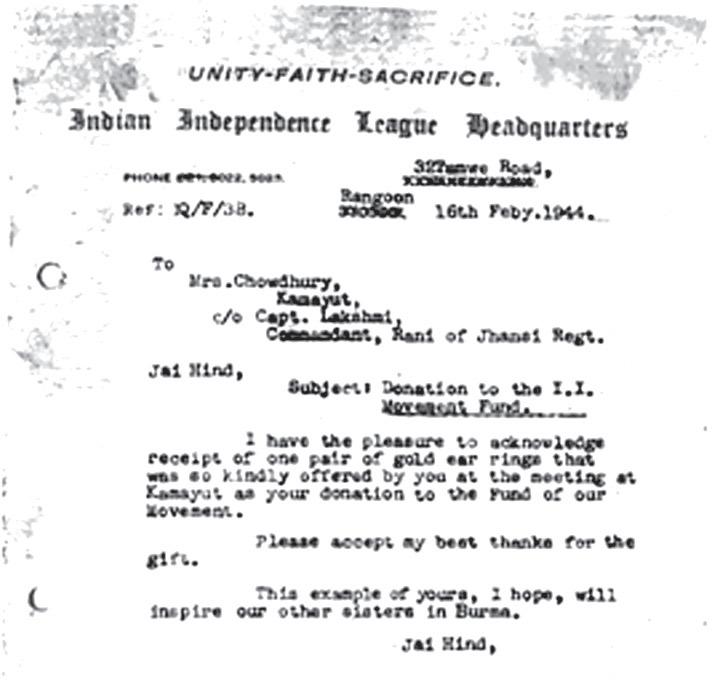
now faded. Debdas Chowdhury says that Laxmi Swaminathan of the Rani Jhansi Regiment handed the receipt over to his mother, and that was an honor in itself.
Sugata Bose describes how, on October 21, the Provisional Government of Azad Hind was formed in Singapore. On 7 January, 1944 the headquarters moved to Rangoon, which gained in importance because the thrust into India would take place from Burma.
But one needs to backtrack a bit to understand how Kshirendranath Chowdhury came to be in Burma and why he gave Netaji his wholehearted support. In India, as a student of engineering at Jadavpur Polytechnic, Kshirendranath had been arrested for participating in freedom marches. He finally got a job at the Tata Steel Mills at Jamshedpur. But there he had an altercation with a British staff member whom he hit in the face. He didn’t wait to see what would happen next; he fled to Rangoon. At first he worked with a Chinese contracting company; then he started his own company, Oriental Engineers. It was at this time that Japan began sweeping across South East Asia. Burma was expected to be next on the list, and the British government announced that all citizens should leave Rangoon within fortyeight hours. Citizens of Indian origin faced an additional cause for concern – they were disliked by the Burmese because they were better educated and had better jobs. So the fear was that once the Japanese took over they would face Burmese reprisals. But Kshirendranath decided not to leave. He was building the council building at Pyapon, near a tributary of the Irrawaddy river, and he decided to move with his family to Pyapon.
Debdas remembers vividly the day the Japanese entered Pyapon. That night, they heard the sound of machine gun firing, and then a close Burmese friend asked the whole family to stay with him till things settled down. Soon the Japanese occupiers announced that everyone should go back to work, and so Kshirendranath Chowdhury met with the Japanese
commandant who reiterated the order. After his work was complete, he took his family back to Rangoon. There, he was hired by the Japanese to work on the Rangoon Airport. Soon, Mr. Chowdhury made a name for himself as an engineer, and many projects came his way. It was at this time that Netaji came to Rangoon and gave his speech at the stadium, and enthused Debdas to join the Balsena unit.
But the occasion that Debdas dwells on most when talking about Netaji is that of the inauguration of the National Bank of Azad Hind in April 1944. Netaji had created this bank as part of his extensive plans regarding what would happen once he and his soldiers entered India. He was sure there would be a general uprising, and that his army and the whole of India, fighting together, would defeat the British. So a realistic infrastructure was needed to support the war and its aftermath. On the day of the inauguration, after the meeting was over, people were served tea and snacks, and Debdas sat right opposite Netaji who was relaxing on a sofa in front of him. At the Balsena meeting, Debdas had been far away from Netaji, but now he saw him face to face, and the effect, Debdas says, was electrifying. He recalls that he was so overwhelmed by Netaji, who was not just extremely brave, but extremely handsome as well, that he was completely dumbstruck. Debdas was holding a plate with a laddoo on it, and he was so unmindful of everything except Netaji that his hand shook and the laddoo fell off the plate. Netaji looked at him and said, “Laddoo utha lo.” Pick up the laddoo. Kshirendranath Chowdhury once asked Netaji whether he missed any particular kind of Bengal food. “Amar mayer topshe macher jhol”, Topshe fish cooked the way my mother cooked it, was the reply. Kshirendranath asked when he could deliver this delicacy at his house because security arrangements for Netaji were very tight and he very rarely went to other people’s houses. Kshirendranath’s wife Monikuntala prepared the dish and Kshirendranth dropped it off at Netaji’s residence. The next time Netaji met him, he said to Kshirendranath, “Mar katha mone koriye dilen.” You made me think of my mother. Monikuntala Chowdhury was always very proud that she had cooked topshe mach for Netaji.
The Bengali community in Rangoon wanted Netaji to offer anjali at their Durga bari during Durga Puja, and asked Kshirendranath, who was head of the Bengali Association that year, to arrange the visit. Netaji’s response was that he would try to fit a visit into his schedule, but he would have to bring his bodyguards with him, and not all of them were Hindu. The Durga Bari was closed to the public during the visit, but Kshirendranath and his son, together with some others, were there to welcome Netaji. Debdas says that all his body-
continue to page 5 }
| continue from page 3
guards, including the Japanese, wore dhotiPunjabi and Gandhi caps. And then he noticed that the bodyguards also had revolvers in holsters strapped to their waists. And they never took their eyes off Netaji.
An incident that endeared Netaji to the local Bengalis was when Charu Datta, the uncle of Kalpana Datta of the Chittagong Armory Raid fame, came to Rangoon and was arrested by the Japanese and tortured on espionage charges. Netaji intervened, and made the Japanese release him. Kshirendranath asked Netaji about this, and Netaji said that he had to help him because he was the uncle of a freedom fighter.
Meanwhile, the British were trying to reconquer Burma, and it was a common sight to see British aircraft in the skies. One day, Kshirendranath was on his way to the airport when the bombing started. After the all-clear signal, he got into his car again and resumed his journey; then, he suddenly saw Netaji and his bodyguards. Their car had been hit and completely damaged. Kshirendranath rushed up to Netaji and asked, “Apnar kichu hoyni to?” I hope you haven’t been hurt. The immediate response was, “Britishra ekhono oi bomb toiri koreni amake marar jonne.” The British are yet to make the bomb that will kill me. Kshirendranath pressed him to take his car.
“What will happen to you?” asked Netaji. “I’ll manage. My driver will be with me.”
“Thik ache”, replied Netaji. “Apnar gari apna ke poche dawa hobe.” All right. Your car will be returned to you.
In May 1944 INA soldiers hoisted the Indian tricolor on a mountaintop near Kohima, but, for a variety of reasons, it became obvious that their plan of freeing India from British rule was not going to succeed and on July 10, 1944 the Japanese said it was best to retreat. Netaji spoke to the Indians in Rangoon. “We are not in an advantageous position to enter India right now,” he said, “but my struggle will go on forever.” Seven days later, he left Rangoon.
Then one day, after the British reoccupied Burma, Debdas came home from school to find that his house was surrounded by soldiers of the Gurkha regiment of the British Indian army. His father was arrested and imprisoned, the charge being that he had helped Netaji. He was released only after the INA trials were over.
Many months later, sometime after the plane crash at Taipei in August 1945, Sarat Bose, the elder brother of Netaji, visited Rangoon to write a report on Netaji. Debdas was in Rangoon, and he went to visit Sarat Bose. He told his secretary that he wanted to see him because he respected Netaji so much.
“Tumi Subhas ke dekhecho?” Did you ever meet Subhas? Bose asked him.
“Payer dhulo nitay parini,” Debdas replied, “kintu kach theke dekhe chi.” I never got the opportunity to touch his feet. But I did see him close up.
Though the formation of the INA, together with the failed uprising in the British Indian Navy that followed it, showed the British that their days in India were numbered, it was Gandhi’s policies that won Indian independence. But those who came in contact with Netaji still hold him in high regard. Today, after all these decades, Debdas Chowdhury still feels that those years in Burma were amongst his most memorable.
By Basab Dasgupta, California
(This article was originally published in the April, 2012 issue of Ananda Sangbad)
I have tried many things in my life – as a profession, as a hobby, as an entertainment or simply as a way to satisfy some curiosity, and with some reasonable degree of success in almost all of these activities. However, I miserably failed in one area – in the job of a door-to-door encyclopedia salesman.
The year was 1972. I had secured a teaching assistantship at the physics department of the University of Wisconsin where my wife was already working. However, I did not have any financial assistance or job during the summer of 1972. By virtue of my wife’s appointment, we had just enough money coming in to pay for the rent, food etc. and I was initially quite content to stay home all day, watching the game shows and soap operas on TV. After a couple of weeks of my wife’s constant nagging at my laziness, I started to look for a summer job.
I do not remember where I saw the ad for an encyclopedia salesman, but I showed up at the sales office, was interviewed and hired soon thereafter. Later, I realized that they hired just about any young person healthy enough to walk and speak English. The compensation was 100% commissionbased so the company had nothing much to lose by hiring someone. All the new recruits, including myself, spent the first three days in “training” which included cramming a three page long sales pitch and strategic guidelines from an experienced salesman.
I still remember the opening sentence of the sales pitch: “I am interviewing some folks in the area about some new educational material that would be used in schools; may I come in?”
The basic idea was to get a foot in the door without mentioning the word “encyclopedia”. The educational system in India had given me a good memorizing capability, and I had no problem in vividly remembering the entire pitch after a few rehearsals. The emphasis in training was to not take “no” for an answer, and to bug the potential customers for a reason for their lack of interest in immediately signing up for an order. Once a reason was given, our job would be to counter that reason.
The most common expected response would be “Oh, I wish I had such a set, but I really cannot afford it”. We were prepared to refute this excuse with an attractive payment plan, spread over a three-year period, costing only a quarter or so per day – merely the
cost of a cup of coffee! We were ready to show them how cost competitive we were with other companies, such as Encyclopedia Britannica, with all kinds of facts and figures. Another excuse could be “Oh, I have simply no room in my house for an entire set like that”; this was just the perfect prompt necessary to show our accessory – a very elegant and compact book-shelf which would go nicely with any home décor, like a piece of furniture. If there was any concern about obsolescence of the information in our set, we were to show how we intended to offer an annual update at no extra cost for a number of years. We were taught to show colorful photographs from some volumes of the set depicting some major sequences of events such as development of a human embryo into a baby, landing on the moon, assassination of John F. Kennedy, etc. By the fourth day, I felt ready. We gathered at the company office around three o’clock in the afternoon. By four, we were all on the road in several large cars, with about five people in each car, excluding the driver. Each car took the sales people to a different rural location or small town within an hour’s drive from Milwaukee. We were dropped at some easily identifiable location, such as a gas station or in front of a bar and told to be at the same location around nine o’clock at night in order to be picked up. The few hours in between were completely at our disposal in terms of what we did or where we went in our effort to make a sale.
I will share some of the more amusing aspects of my experience. One day I knocked on a door and just as I had started my pitch by saying “I am interviewing some folks …..”, the man who had opened the door interrupted me by saying, “I take it that you are selling encyclopedias, and I am not interested” and just slammed it on my face. On another occasion, although he did not slam the door, the man of the house was really annoyed at me because I had interrupted a romantic evening he was about to have with his wife, and simply told me to get lost.
There was also some suspense and drama during my sales days. One night I was waiting with two other sales persons for a rather long time at the designated pickup location. Our ride finally showed up with the remaining two guys from our sales group. The delay was caused by a brief imprisonment of those two be-
cause they were apparently trying to sell in an apartment complex which had a clear “NO SOLICITING” sign, and someone had called the police.
My experiences were sometimes sad. On one occasion I met a middle-aged woman and her teen-age daughter. I gave them my overview, and showed them a bunch of color pictorials from the various sample volumes I used to carry. The daughter was very intrigued by the pictures showing development of a human baby and pleaded with her mother to buy the set. “No, I can’t,” the mother said with almost tears in her eyes. She did not elaborate, but I knew that she was a single mother (by the absence of a wedding ring, among other things) and struggling financially. Our three-day training did not provide me with any guideline about how to handle emotional situations like that, and I did not push.
The conventional wisdom was that if you could get into a house and deliver the complete sales pitch, chances were very high that you would make a sale. Not for me, alas! The closest I came was this one time a very friendly gentleman opened the door and invited me in. He not only listened to my whole spiel, he also offered me something to drink. When I was getting ready to close the deal, he finally confessed that he really had no intention of buying encyclopedias. He said that he was a door-to-door salesman himself and therefore empathized with my plight, especially the rejections and rude receptions. He just wanted to be nice!
I finally called it quits after five days of such outings. I did not make one single sale, and did not earn one single penny. I concluded that I was not cut out to be a door-to-door encyclopedia salesman, and my foreign appearance and accent were probably not helping either. Besides, it was very exhausting. In addition to continuously walking for hours, there were not many opportunities to take a break. Apart from a couple of bars and a corner grocery store, most of these small neighborhoods did not have a fast-food joint where one could grab a cup of coffee and a burger. Also, I did not have much money and time to waste. By the time I came home at nine thirty or ten o’clock at night, I was extremely hungry and ready to collapse into my bed right after eating.
It was a perfect evening for the annual worship of Lord Shiva, the deity of death and renunciation. Like Lord Shiva’s abode in the Himalayas, Chicago area was covered by a thick blanket of pristine snow, rather typical of February. The lock on the main temple was frozen shut and we could not enter. We moved the worship location to the nearby temple guesthouse. Consequently, I was forced to skip the elaborate preparations that we had already made in the main temple. I had my basic kit for worship with me. My cohort and the keeper of the temple was present with her two children who were busy clearing the walkway to the door. Two other members of the congregation helped me to clear the space in front of the fireplace arranging few fruits and flowers on paper plates. I filled a Styrofoam bowl with fresh milk, yogurt, honey, clarified butter and water, assembling the most auspicious of all offering. Before beginning the worship, I glanced at others and noticed deep disappointment on their faces. By the time I held the bowl between my palms
By Bakul Banerjee, Illinois
(This article was originally published in the January, 2016 issue of Ananda Sangbad)
and raised it in meditation reciting the Gayatri Mantra, the four thousand year-old Vedic hymn, the bowl felt as if it were made of pure gold. About half an hour later, when I began the hymn to Lord Shiva, I was surprised by the unexpectedly large number of voices joining mine. Many braved the snow to come to the temporary location. What a thrill it was!
I often wondered why Bengalis prefer to have their own worships instead of participating in those conducted in major Indian temples in the area. I began paying close attention to the Bengali versions of scriptural texts and noticed how regional changes came about slowly but steadily in India. I continue to explore the influence of worship on spiritual life of the Bengali Diaspora. In this essay I present my reflections on Bengali style performance of rituals honoring the divine in visible forms crafted out of stone, metal, clay etc. Why do we worship?
Since thousands of years ago, gatherings of tribes remained important to humanity to reinforce moral and cultural values. Other than mobilizations for war, communal worships played key roles along with associated sacramental rituals like weddings and last rites. I helped with Pujas since my pre-teen years and became involved with the organization of major worships soon after landing in Baltimore, Maryland. Over the past forty years, I had the privilege of organizing and leading many Hindu sacraments and worships. Learning Sanskrit in my youth helped as well. Although I am familiar with Sanskrit, the language in which scripture used in worships are written, I need to study the scriptures for hours. I strive to execute this glorious duty to the best of my capabilities. Since January 1, 2014, I took the assignment, albeit a temporary one, of the Bharat Sevashram Sangha, Chicago, a non-profit
international order of Hindu monks. This assignment gave me the incentive to discover new meanings and interpretations of the worship that I could not have imagined before.
What is worship? Because of difference of opinions among Hindus, any definition that I may offer may be vigorously debated. Instead, let me explain the meaning by describing the components of worship. I will explain only three components: Puja or the ritual worship of Bigrahas or symbolic icons celebrated by performing a series of actions accompanied by the recitation of scriptures or Stotras. The general outline of Puja consists of purification ceremonies, invocations and adorations of the deity and offerings of ornamentations, food and drinks as used by Bengalis in India in their daily life. Homa or the fire ceremony is more complex and has its roots in ancient Vedas. The third aspect of worship is Vratakatha
or readings of morality tales customized for each deity. The pattern of these tales is same throughout India, but the narratives often vary based on the region. Music and singing as the adoration of the divine is important. However, music is certainly not my forte. I do feel moved occasionally and participate in sing-along of hymns, but I am never comfortable with it. Fortunately, there are many good singers who are always willing to take charge.
Puja of a primary deity begins with a series of standard purification ceremonies for earth, water, flowers and other objects used in the worship. It is followed by invocations to Vedic gods and goddesses, often representing various aspects of nature. Invocations and specific adorations of the primary deity are accompanied by specific prayers. It is interesting that even in this new country we try to find specific foods and flowers supposed to be preferred by each deity. Many years ago, quite by accident, I grew some Dhatura (Angle Trumpet) flowers,
continue to page 14 }
| continue from page 1
for building the temple. Pledges for $85,000 were received that day itself, and a highly successful fund-raising luncheon in March 2003 raised another $215,000, a substantial sum for the Bengali community at that time. Construction began soon after Baastu Puja but encountered many issues and delays, some beyond our control such as a very harsh winter. Finally, on November 14, 2004, our temple, the first of its kind for the Bengalis in New Jersey and the neighboring states, was inaugurated. The temple became the home of Ma Kali, Shri Ganesh, Shri Radha-Krishna and Lord Shiva. The deities were custom-made for us from hand-selected stones by artisans in India and brought over in time for the inauguration ceremony.
Our first temple was our pride and joy but we knew that it was a modest start for us, not our ultimate ambition. The 2400 sq. ft. temple accommodated 90 devotees in the prayer hall, and the newly constructed parking lot had space for 60 cars. This was satisfactory for many of our religious needs but not adequate for major events such as Durga Puja or Kali Puja. So, soon
after the inauguration of the temple, we began to work on three parallel fronts: (1) improve infrastructure of the property, (2) continue fund-raising drives; and (3) develop detailed plans for an expanded temple and a new Community Center.
Progress came slowly but steadily in the following years. We removed septic tanks and connected to the public sewer system. We also deactivated our well water system and brought in city water line to the property. And we bought an adjoining 1.8 acres property to secure ample land for future growth. These investments totaled over $650,000 and were funded through member contributions. Finally, a detailed set of engineering drawings were developed by our architect for a major expansion-andbeautification project that would consist of (1) a new, 9000 sq. ft. “Community Center” with first-rate facilities, (2) a vastly expanded temple with a Bengali architectural theme, (3) a parking lot for 300 cars, and (4) planting of several hundred evergreen trees around the entire property. Total cost of all the projects were projected to be around $5 million.
After receiving necessary approvals from the township authorities, we held the Ground-Breaking Ceremony on April 17, 2011, and construc-
tion started in earnest in the spring of 2012. Per our plan, the expanded and beautified temple was completed first, and we held the first Durga Puja in the new temple with much fanfare in the fall of 2015. The new community center, now named Tagore Hall, became available for use during the puja season of 2016.
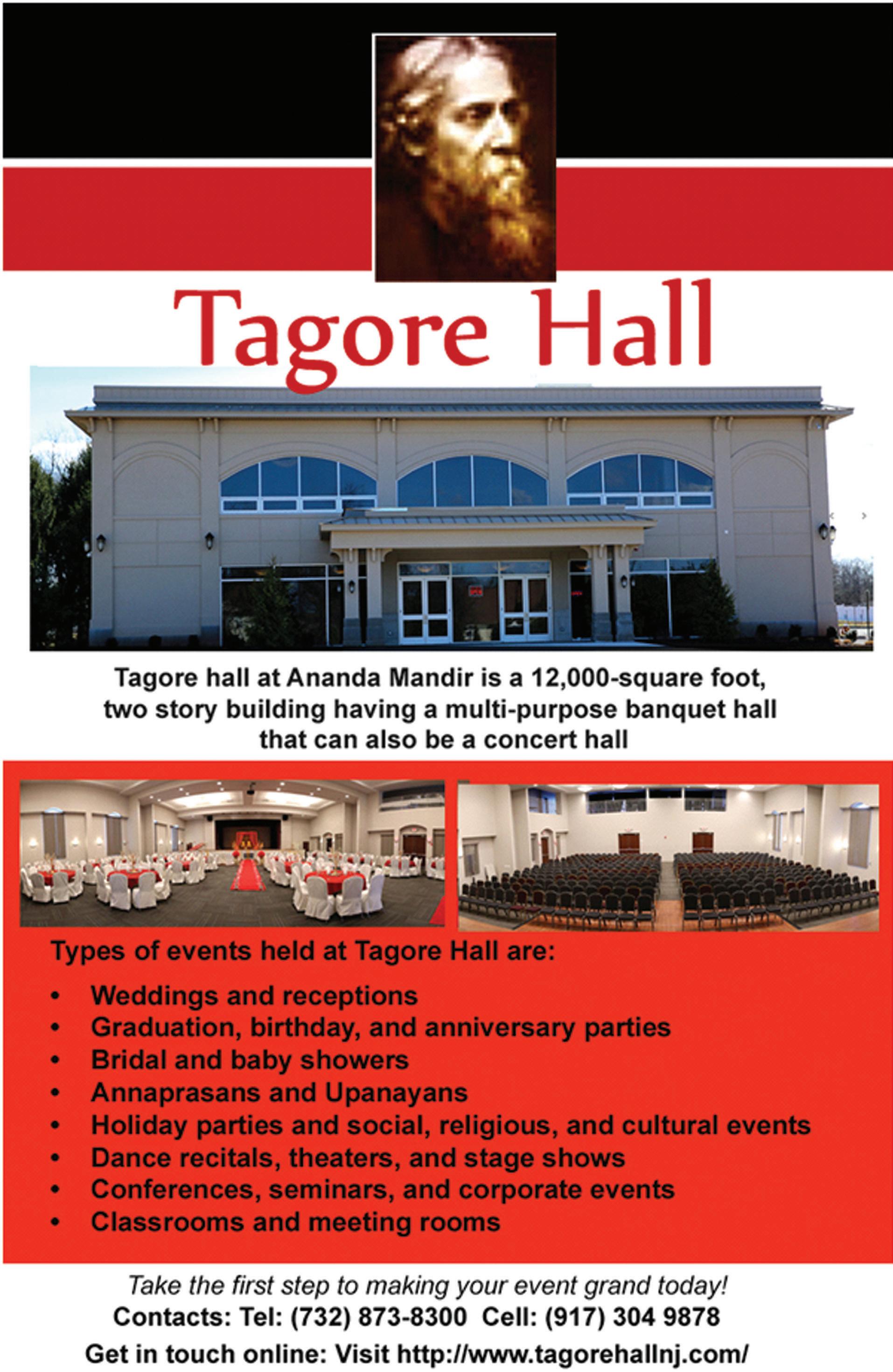
It took Ananda Mandir over 18 years to evolve from its humble beginnings to its current position of strength and pride among the Bengalis in New Jersey and the neighboring states. Today we are justifiably pleased with our beautiful, big temple that can accommodate several hundred devotees during major religious events. And our Tagore Hall is a majestic 2-story facility that is arguably the best of its kind among all Bengali organizations in the country. It has a total capacity of over 800, and it offers an auditorium-cum-banquet hall that can seat more than 300 dinner guests, and offers a stage with first-rate audiovisual capabilities, commercial-grade kitchen facilities, and several meeting/class rooms and a large mezzanine area for yoga, meditation and similar activities. Besides our remarkable growth
in brick-and-mortar facilities, our membership has also seen impressive growth. Today we have over 1800 members of which almost 500 are Life Members (meaning that each of them has contributed $1000 or more).
We are proud of the fact that our progress has come solely through members’ generous contributions and dedicated service as volunteers. Also, Ananda Mandir has never been just a religious organization. Although pujas and religious activities form a very important part of our organization, our members are also involved in a wide range of non-religious pursuits such as music, dance, theater and literature, and they come together often in many social forums and recreational events.
However, looking ahead, we see several challenges. First is the financial burden we face in the form of a big mortgage payment every month to the bank. Second is the need for more volunteers for operating our significantly expanded campus and providing expanded services to the community. Last but not the least is the challenge of involving our younger generations in our activities so that the Bengali religious and cultural heritage is nurtured long into the future in America.
Reported by sushmita Dutta
Itwas autumn of 2015. Fragrance of Durga puja festivities was in the air. Embracing the cerulean blue sky stood our newly constructed Ananda Mandir temple replicating Bengal temple architecture. In the adjacent land reared Tagore Hall, a grand 2-story building that is perceived the best of its kind among all Bengali organizations in the country. Our joys knew no bounds. We felt glorious. We chart many such glorious moments that truly account for the success of Ananda Mandir like purchasing the property, starting our temple construction, getting temple images from India and having artists specially flown from India to decorate the exterior frontage and interior walls of the temple. Those moments of joy and glory are unparalleled.
Culturally, we have been extremely active which in-
volved the communities around and in India and strengthened our presence.
Year after year for fourteen years, Ananda Mandir has had glorious moments on every eve of Durga Puja when, in the wee hour of 4:00 A.M., live “Mahalaya” program is held in the temple premises -- filling the space with pure, nostalgic sounds of conch shell (shankho dhwani), melodious songs from AIR’s “Mahisasurmardini” like “Jago Durga, Jago..”, and Chondi Path that most Bengalis grew up with. Yes, 14 years of sustained and glorious performances contributed to the growth of Ananda Mandir; and the credit goes to Ananda Mandir’s dedicated team, a band of extremely talented singers and musicians from our very own community who perform under the direction of Arun Bhowmik, the chair-
person of Ananda Mandir’s cultural committee.
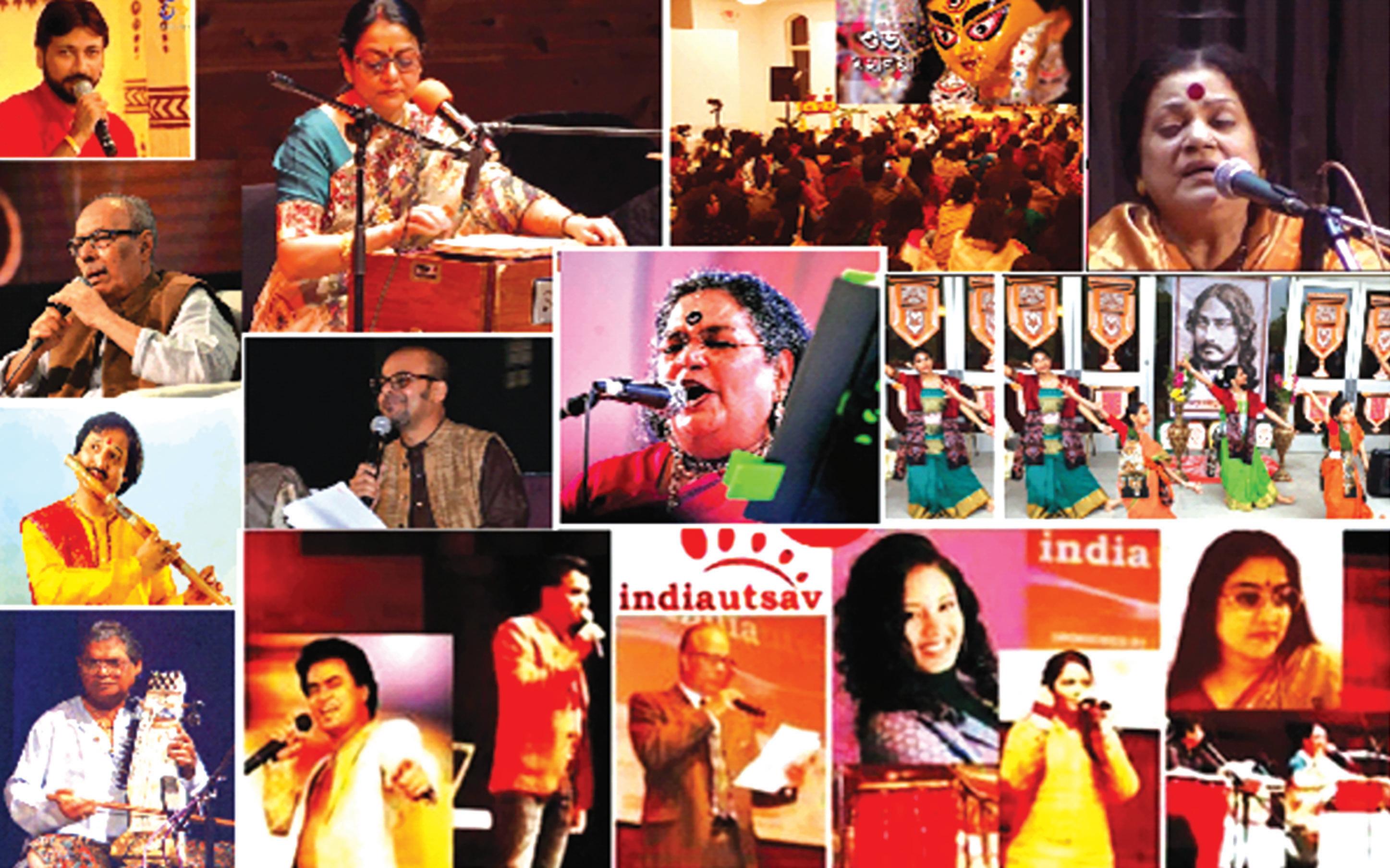
Another event that brought glorious moments to Ananda Mandir for a few years was programs under “India Utsav”. Co-sponsored by Ananda Mandir, P.C. Chandra Jewelers of Kolkata and PMG Publications, “India Utsav” was truly a festival of famous participating artists (musicians and dancers) from India, along with a variety of stores and food stalls on the event premises that brought a sense of festivity and joy to the audience in attendance. At India Utsav, we had a galaxy of famous performing artists from India (as seen in the pictures above) with scintillating performances by Usha Uthup, Monomoy Bhattacharya, Jojo, Anwesha, Debojit and Srilekha Bandyopadhyay. We had jam-packed audience at India Utsav programs
that constituted glorious moments in the annals of Ananda Mandir.
Single performing artists’ programs were also highly applauded and brought glory to Ananda Mandir’s team efforts. Recently, during the Durga Puja festival, we had the famous singer Haimonti Shukla from Kolkata. She performed at Ananda Mandir’s Tagore Hall to a packed audience. Similarly, we had renowned performers like Pandit Ronu Majumdar, India’s ace flutist, Pandit Ramesh Misra, a phenomenon in Indian classical music and Pandit Kaivalya Kumar Gurav, an outstanding vocalist from India.
Another glorious moment was having Anindita Kazi, the granddaughter of Kazi Nazrul Islam, performing at the Tagore Hall. Her unique presentation included the relationship between Rabindra
Nath and Kazi Nazrul Islam, their untold stories, poems, letters and songs.
We also had literary sessions with the noted writer Sirshendu Mukhopadhyay and Bengal’s contemporary poet Srijato Bandopadhyay. Both sessions involved close audience interactions with the writers. There were discussions and then questionand-answer sessions. As an extension of our literary work, we publish Ananda Sangbad, a quarterly newspaper and Anandalipi, a yearly magazine. Also, we had many glorious moments at Ananda Mandir in discussions with spiritual leaders on Vedanta, Upanishad and related topics giving us a sense of solidarity, fulfilment and of course, glory. The journey is on. Come, join us at Ananda Mandir and be a part of our glorious moments.
Ananda Mandir offers a wide range of events and activities to the community. Some of these are readily visible to all (such as religious and cultural events, highlighted below) while many other activities are done behind the scenes by our devoted volunteers. These “behind the scene” activities are essential for a smooth operation of the organization on a year-round basis. Examples are food preparation and distribution at numerous events, major events planning and coordination, donation collection, membership drive and communication, facility maintenance, website design and maintenance, Tagore Hall management, and many others. All of Ananda Mandir’s activities, large and small, visible or invisible, reflect the efforts of our numerous volunteers. We thank all of them for their selfless acts of kindness through the years.
Pujas are held throughout the year, the number of such events easily eclipsing the proverbial Baro Mase Tero Parbon at Ananda Mandir. Durga Puja, the most popular Bengali celebration, is clearly the busiest event of the year, attracting thousands of people visiting the temple over the five days of festivities. The entire Ananda Mandir facility, consisting of the temple, the auditorium, and the club house are so overfilled, that extra tents are set up with sitting accommodations. All cooking is done in the premises, with help from volunteers. There are other volunteers inside the temple to help with puja preparations, pushpanjali, and keeping the place clean. Parking within the premises is guided by volunteers. Kali Puja attracts similar crowds as Durga Puja, however, it is a one-night celebration, thus needing somewhat less efforts from volunteers.
Ananda Mandir’s pujas are announced in advance, in the website as well as in Ananda Sangbad, the quarterly news magazine. Besides pujas, all kinds of personal services like wedding, annaprashan, upanayan and shraddha are performed at the premises. In some cases, the priest is called upon to go out to homes or banquet facilities to perform those services.
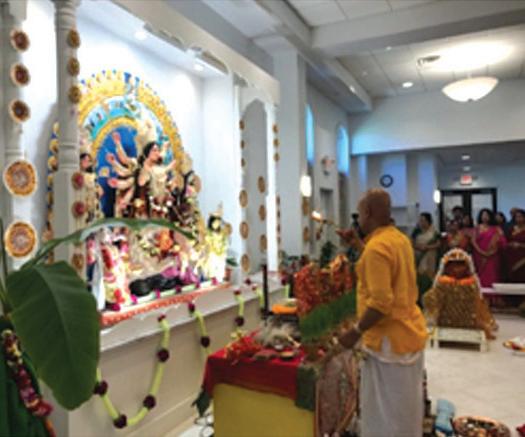
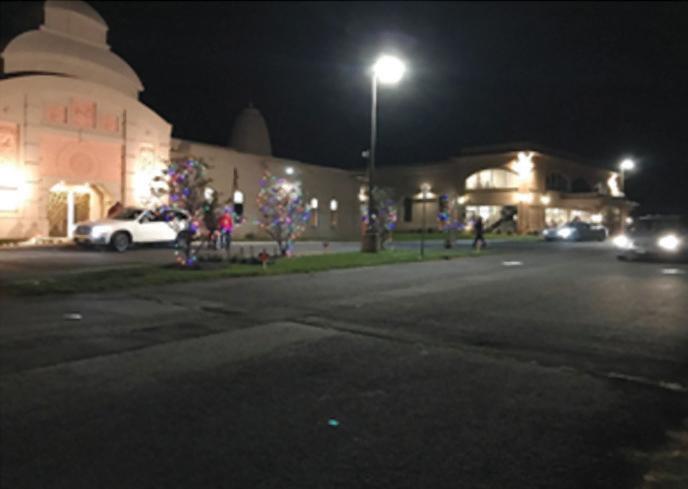
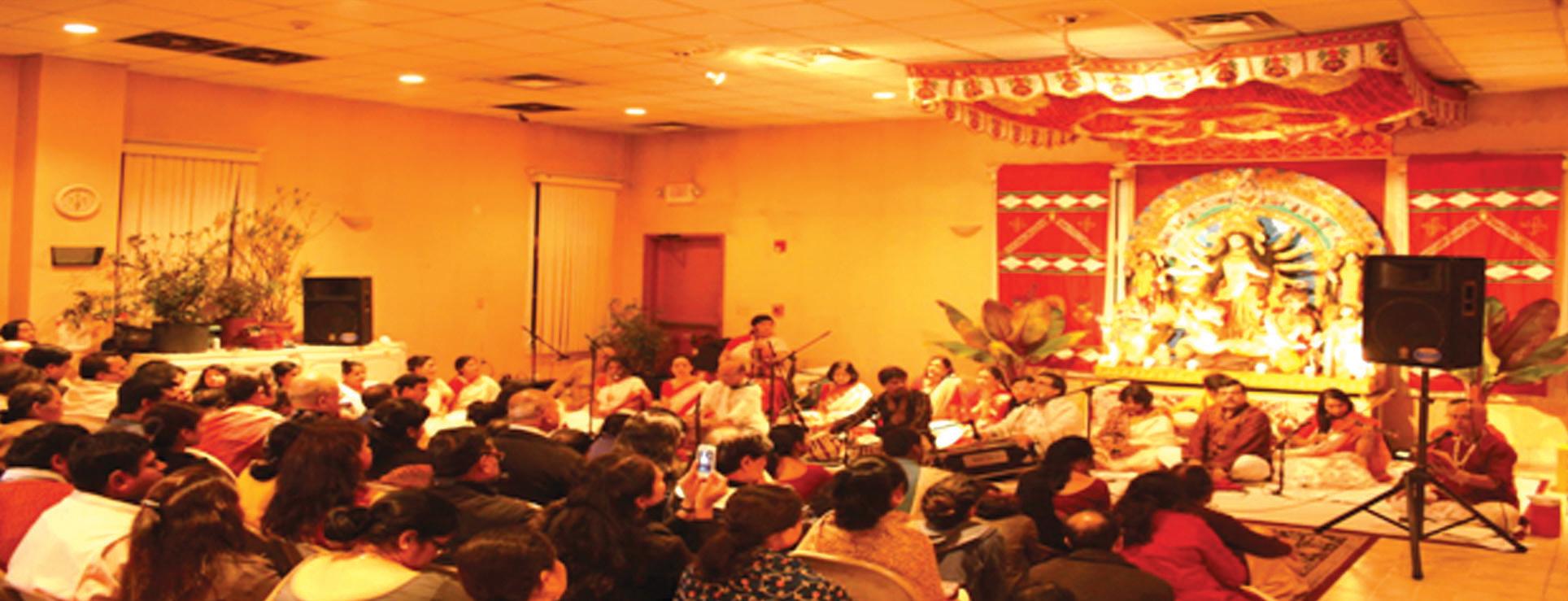
AnandaMandir is active throughout the year holding musical and entertainment programs. The most coveted event is a live Mahishasura Mardini program held on a Sunday morning, one week before Durga Puja. Over 30 talented performers participate in singing and playing instruments (sitar, tabla, guitars etc) in the event, starting promptly at 5 am. It has been held since the inception of Ananda Mandir, and is so popular that the hall is always filled to capacity.
Musical programs are planned during most puja events. Durga puja, Kali Puja and Saraswati puja, as always, attract the best performers in the community. New Jersey is rich with musical and dance schools, some of them in the premises of Ananda Mandir, and both the teachers and the students are all eager to showcase their talents at such events. The cultural committee does a good job in ensuring that the next generation of children at Ananda Mandir get exposure to our cultural heritage. In some occasions, professional artists are invited from abroad to provide an additional dose of entertainment. A daylong Utsav during the Rabindra-Jayanti has now become a regular tradition. There is a Theater Club for the theater lovers. The availability of a state of the art auditorium to stage dramas has been a boon to these people, and the community has responded by attending the theaters in throngs.
Ananda Mandir publishes Ananda Sangbad, a quarterly news magazine, and Anandalipi, an annual literary magazine. Members of Publication Committee oversee the timely production and distribution of these magazines and are responsible for ensuring high content quality. Each of these publications is published under the leadership of a Managing Editor and is supported by a board of editors. Both publications attract authors and reporters from not just New Jersey but also many corners of America, even India.
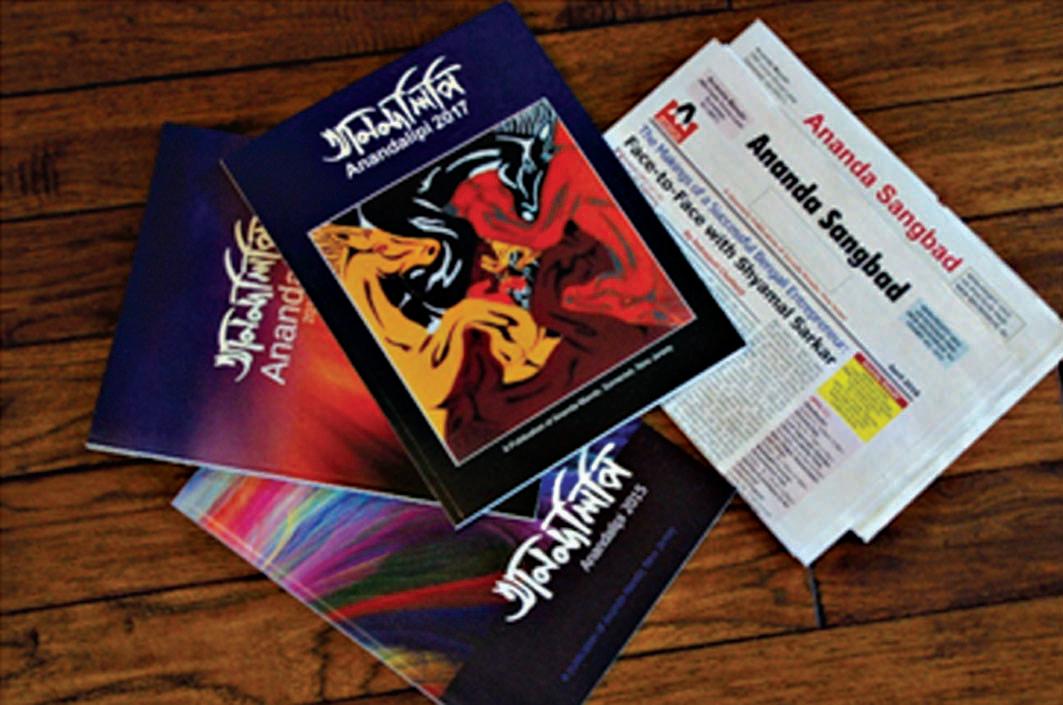
Ananda Sangbad, published in English, reaches almost 1500 households. Being a news magazine, it keeps Ananda Mandir members regularly informed on the organization’s strategic directions and major events and initiatives. It also offers well-written and interesting articles on a wide variety of topics, such as health, technology, entertainment, travel, education and philosophy. Ananda Sangbad does not publish works of fiction or poetry and avoids political opinions and religious preaching.
Anandalipi is usually published around Durga Puja/Kali Puja time and delivered to about 500 life members of the organization. Being a literary magazine, it publishes short stories and plays, poems, critical essays and travelogues, written mostly by Bengalis from different parts of the country. The primary objective of this magazine is to encourage literary activities by Bengalis living in America. To that end, the magazine publishes articles in Bengali and in English, and submissions by children and young adults are encouraged.
Sahitya O Alochana (SOA) is a literary and topical discussion forum under the aegis of Ananda Mandir (AM), New Jersey. The discussions and talks are organized by the literary committee of AM. They are held on a monthly basis at the premises of Ananda Mandir and are available for participation remotely on the web as well.
These sessions feature exciting and illuminating discussions on diverse subjects including literature, art, theater and movie; history, philosophy and religion; science, technology and mathematics; economics and business; and social issues, sports, and current affairs.
The usual format of such discussions is a presentation on a chosen topic by an invited guest presenter/ speaker followed by a Q&A session. However, interactive discussions during the presentation also take place based on the nature of the topic and or by the pulse of the attending audience. Presenters and or speakers are invited from local communities based on their respective mastery on chosen topics. Every now and then, famous speakers/writers outside local communities and from overseas would be invited as well. Attendance is generally robust and averages around 20 people but totaled up to 55 on occasions.
Some of the literary topics from the archives included sessions on Gabriel Garcia Marquez and Rushdie to Elliot and Yeats, Kazua Ishiguro and Kamel Daoud to Bertolt Brecht and Harold Pinter, Joy Goswami and Sunil Gangopadhyay to Jibananda Das, Arundhati Roy, and Srijato, history of Urdu Adab (Ghazals), and mystery novels and comics; while discussions on philosophy, science, and other subjects covered a wide range of themes and topics like Gita, Creativity and Madness, Artificial Intelligence, history and new frontiers of Medical Science, Astronomy and Physics, evolutionary interpretation of Religion and anatomy of Free Will, Economies of India and China, cricketing legend Sachin Tendulkar, and even some trend-bucking movies.
The forum completed its 10th anniversary in February 2018 and organized a total of 104 sessions through May 2018. The 105th session will be held on June 30 – July 1, 2018 as a part of NABC 2018 (billed as Literary Seminar) in Atlantic City, NJ. This event will also commemorate the centenary of the SOA sessions that occurred months ago and the forum’s over-a-decade long promotion of cultural services in local communities.
Evergreen
Club (originally named as Seniors Forum) was launched in July, 2011. The primary objective was to establish a support structure for seniors within the Ananda Mandir community and to organize events and processes to promote friendly interaction and networking among the elders.
Evergreen Club meets 9 to 10 times a year. Most of the sessions are held at Ananda Mandir but we also organize group trips to nearby attractions and lunches/dinners at local restaurants.
2017 was a busy year for the Evergreen Club members. We held three informal discussionsessions where the members actively participated in pre-selected topics of common interest. Members enjoyed two special presentations on travel to exciting destinations, one domestic and one foreign.
Pot-luck lunches accompanied these five meetings at Ananda Mandir premises. We also went out for group lunches to local restaurants on two occasions and enjoyed two group outings to a playhouse for lunch/theater experiences. Last but not the least, a group of 30 seniors went on a sightseeing cruise on the Hudson River from Newburgh, NY.
In 2018, we are organizing a similar mix of activities and planning 9 to 10 interactive sessions and enjoyable group outings.
Kisholoy is the name of a monthly wall magazine published by the school-going children of Ananda Mandir members. It is prepared entirely by children with all articles and drawings by their peers.
This magazine is posted at a prominent location in the Ananda Mandir campus and is viewed and appreciated by all. Kisholoy is usually published on the first Sunday of every month.
The first issue of Kisholoy was published in 2014. From the very beginning, this youth activity has captured the imagination and enthusiasm of many budding young authors and artists -- and attracted the admiration of the adult members of the organization. Last year, a selection of articles and sketches from the previous three years were printed by Ananda Mandir as a special publication.
To encourage and recognize such creative efforts by our school-age children, every year we present Certificates of Recognition and small cash awards to a selected number of Kisholoy volunteers.
These are presented at our Annual General Meeting in front of our Life Members.
In addition to creative writing and art work, Kisholoy members also act as volunteers in many religious and cultural events organized by Ananda Mandir. Their presence and participation always add a youthful atmosphere to these major events.
The Awards & Recognition Committee was originally established to develop and implement management processes and systems to recognize valuable service to the organization by its members. To that end, the committee administers two programs. one program is designed to honor “Outstanding Volunteers” who have tirelessly served Ananda Mandir over many years. Since the launch of this program in 20XX, 20 (?) members have been so recognized. Each of them has received certificates for their dedicated and sustained service at Ananda Mandir’s Annual General Meetings. – The other program aims to recognize those members who have demonstrated strong organizational leadership and left lasting marks on Ananda Mandir’s history. These members have been honored as “Distinguished Leaders” at special occasions and presented with plaques with appropriate citations. Six members have been so recognized thus far.
The committee is also entrusted with the task of promoting literary activities through two award programs. Gayatri GaMarsh Memorial Awards for Literary Excellence were established in 2010 by Jerry GaMarsh in memory of his late wife who was a well-known author, editor and a key member of the organization. Two awards are given annually after a nationwide contest, one is given to an author in the Bengali publications category, and the other award goes to the winner in the English publications category. Each award carries a cash award of $500 and a plaque with appropriate citations. Since the inception of the program, 19 authors have received these coveted awards. The second program, Kisholoy Awards for Literary Excellence, was introduced in 2015. These awards are aimed at motivating and recognizing young authors (in grade schools) within the Ananda Mandir community. Four young authors have received Kisholoy awards so far. First place winners in this annual competition receive cash awards of $300 and certificates, and second place winners get $200 cash awards plus certificates.
Ananda Sangbad, our quarterly news magazine, gives timely coverage to all our awards and recognition activities.
Many Bengali organizations in the tri-state area, catering to the cultural needs of local communities, have joined hands with Ananda Mandir in supporting its mission. They support Ananda Mandir by participating in many events held here, and sometimes holding their own programs at the facilities of Ananda Mandir. Their activities are published quarterly in Ananda Sangbad. A brief note is provided below about each of these Bengali associations.
Kallol
In 1975, a group of imaginative Bengalis from Kolkata-India instituted ‘Kallol of NJ´ to establish a cultural and social base here in the United States. Thriving ever since, ‘Kallol´ today now stands alone as the undisputed foremost organization of all the Bengali communities in this nation. Its involvements are geared to promote exchange of multicultural programs, to enhance literary endeavors, to encourage athletic activities, and to serve as a platform extending assistance to needy people of all ethnic backgrounds.
NjPA (New jersey Puja Association)
NJPA is the oldest Bengali organization in New Jersey that provides a forum to the community on nurturing, cultivating and promoting our religious and cultural heritage. In the beginning it was called “Saraswati Puja Committee” and later renamed as “New Jersey Puja Association (NJPA)” and incorporated as a nonprofit organization in the state of New Jersey. It first organized a public function in 1970 and ever since it organizes community get-together through annual picnic, social events, movie shows and so on.
GSCA (Garden State Cultural Association)
Garden State Cultural Association, established in 1992, is an Indian American non-profit organization based in New Jersey. Its primary objective is to promote Indian social, cultural and religious events throughout the year. In addition, it provides an opportunity for the children to learn about the rich and ancient cultural heritage of India, through organizing various talent shows, literary events and other cultural events where the youths actively participate.
GSCA is active in philanthropic activities, supporting needy and meritorious students for higher professional studies, in India and US.
ICC (Indian Community Center) of Garden State
Indian Community Center of Garden State (ICC GS) is a non-profit, social, cultural, educational, charitable and non-political organization. The major objective of the organization is to foster cultural, social and educational traditions of the Indian community residing in the state of New Jersey.
The intention of the ICC is to celebrate the major Bengali cultural events and organize social activities from time to time to preserve the rich heritage and serve the community.
Other prominent organizations who regularly participate in organizing cultural events are RDM (Rhythms of Dance & Music): The passion of dance in rich Indian classical tradition.
Mrittika, Inc.: A south Asian Center for language & heritage
Rhythms of Dance & Music (RDM) follows the ancient traditions to provide a solid base and experiment with contemporary influences to keep these art forms relevant in today's society. We offer easy understanding, personal attention and detailed instructions!
In recent gatherings of my Indian friends, some would say that currently our native country was doing very well, societally and otherwise. Yet some others would voice a completely opposite view. This war of words has become a political hot potato, and with ensuing deep political polarization it really depends on which side you are on. I am squarely with the second opinion, particularly where women’s issues are concerned. No matter which media one follows, the news is daily filled with incidents of beating, rape and murder of women of all ages and from almost every corner of the country. Sadly and alarmingly so, all of us are slowly but surely becoming de-sensitized to the dire state in the affairs of Indian women.
I am reminded of an incident I had heard a few years ago in a radio report where the reporter was talking about an episode involving the movie, ‘Schindler’s List’, by the famous Steven Spielberg. A middle school teacher from California had taken her young students to an afternoon showing of the movie. Her motivation was to expose young minds to the horrors that one human can inflict on other, so that they could be more sensitive to crimes against humanity. In a scene a Nazi soldier was shown killing a prisoner at point-blank range. After a brief hush suddenly the students broke into loud laughter! The rest of the audience in the movietheater were so enraged at this vulgar display of insensitivity towards violence, that they loudly protested and the students were thrown out of the theater.
Creeping de-sensitization of our feeling about violence towards Indian women makes the situation far worse. It is as if in India women don’t count, and worse still that they are completely at the mercy of men!
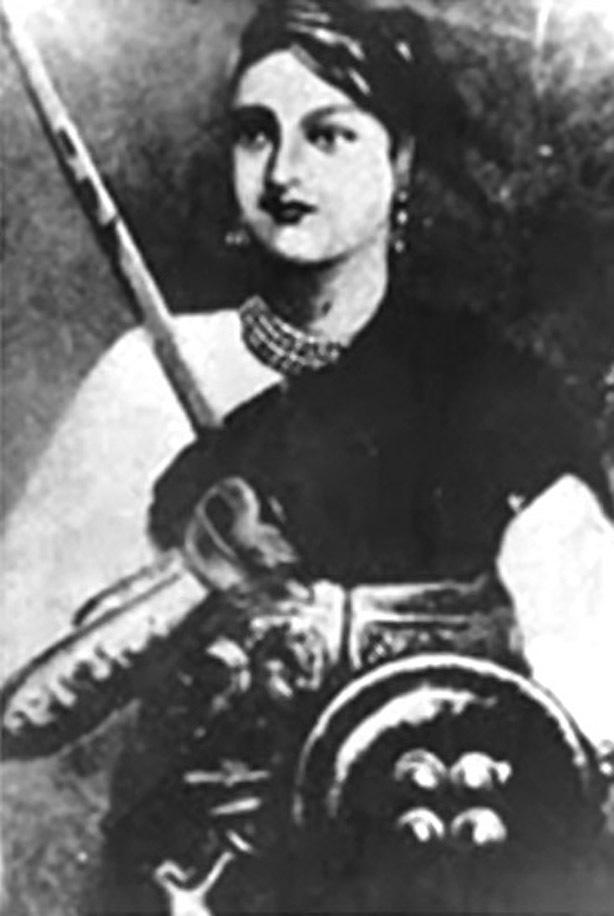
This is the reason why Lakshmi Bai, the famed queen of Jhansi matters a great deal today. She was a woman, a valiant one, and one who led an army and died with dignity fighting the then British lords of India and their cronies, instead of being molested and murdered by a fellow countryman. Before I go any further, an arching back to the history of nineteenth century India will be most relevant. However, it must be noted that it is not merely retelling of history, but a narrative within the context of the role of women in Indian society then and now.
Lakshmi Bai was born Manikarnika in Varanasi to a wealthy,
By Rahul Ray, Massachusetts
(This article was originally published in the October, 2016 issue of Ananda Sangbad)
highly intellectual and influential family well-connected with Maratha royalty. The name Manikarnika is highly significant. Legend has it that Lord Shiva, under acute grief after the death of his wife Parvati or Sati went on a mad rampage, and dropped a ring or ‘Mani’ from his ear or ‘karna’ at a place in Varanasi making this place, Manikarnikaghat, one of the holiest places for Hindus. True to her namesake, Manikarnika or later Lakshmi Bai became a sacred name in India. Manikarnika lost her mother when she was four, and her father, a Peshwa or chief counsellor to the Maratha empire, brought her up in a most unusual way. She took intense training in riding horses and elephants. She learned fencing and marksmanship. It seems uncanny, almost as if her father, Moropant Tambe, could foresee her future.
Most importantly, Manikarnika, as a young girl grew up in a way that was most unusual in the first half of the nineteenth century India, when young girls were prevented from going to school, and were wed off by their parents before they reached puberty.
These young ladies were merely relegated to taking care of their husbands and bear their children.
Interestingly, the tale of Chitrangada from the Mahabharat who was the princess of Manipur and who dressed as a lad and learned everything befitting a man, including warfare was known to people far and wide. Yet it remained in people’s mind only as a fantasy. As a result, the role of a woman outside the chores and duties in her husband’s family, was unthinkable, let alone women riding horses
side by side with men or hitting a target with a rifle. Thus, the upbringing of Manikarnika was so remarkable.
In the year 1842, at the tender age of fourteen, Manikarnika was married to Gangadhar Rao Niwalkar, the king of the estate of Jhansi in Uttar Pradesh. She was renamed Lakhsmi Bai after Lakhsmi, the goddess of prosperity, and the sacred in Manikarnika was sacrificed at the altar of riches. In 1851 Lakhsmi Bai gave birth to a son who died in infancy. Due to failing health, Gangadhar Rao adopted Damodor Rao as their son and the future heir to the throne of Jhansi. Soon after, Gangadhar Rao passed away and Rani Lakhsmi Bai ascended to the throne of Jhansi till Damodor Rao came of age, to assume charge as the head or king of the estate of Jhansi. This was also the time when troubles began.
The year was 1853 and Lord Dalhousie was the governor general of India on behalf of East India Company which was in the process of tightening its grip on colonial India by expansion, attrition, and brute force by running roughshod over still independent Indian estates and kingdoms. In the case of Jhansi, governor general Dalhousie invoked the infamous Doctrine of Lapse by which any sovereign estate where the ruler was either deemed incompetent or died without a male heir would be annexed by East India Company. Soon Rani Lakhsmi Bai was de-throned, given a token pension and ordered to leave her estate.
What transpired after that for almost five years is rather complicated, but the crux of it was that Lakhsmi Bai refused to give in to the demands of the East India Company. She also valiantly defended her estate from invaders from the surrounding areas who miscalculated that a woman could be defeated in a whisper.
All the trainings she received as a young girl were put to the test. It was also a very turbulent time in colonial India. The Sepoy mutiny, dubbed as the first Indian war of independence had started in 1857, first in the army barracks in Meerut, a neighboring town of Jhansi. The mutiny was triggered off by a rumor that the cartridge of the Enfield rifle that the soldiers used, contained cow
continue to page 12 }
By Rajat Chanda, California
(This article was originally published in the April, 2012 issue of Ananda Sangbad)
Introduction: Colonization of India by the British happened at a time when India was in a chaotic and weakened situation. The society had remained static for centuries. It was also subject to horrible oppression and tyranny by the rigid caste system, unacceptably low status of women, polygamy, child marriage, prevalence of “Sati-daho”, and all sorts of cruel practices and superstitions. The exploitative motive of colonial powers is well known. However, it also ushered in a revolution in thoughts and ideas in religion and society in the late 18th and early 19th century, soon after the British occupied Bengal, Bihar and Orissa (1764). The elimination of the terrible practices and synthesis of the desirable thoughts and deeds began to dramatically change the deplorable state - thanks to the leaders of the 19th century Renaissance in Bengal. The pioneer of this transformation was Ram Mohan Roy (1772-1833).
In this brief survey, I shall focus on a few of the less known personalities.
Henry Louis Vivian Derozio (1809-31): Derozio was of Anglo-Portuguese-India ancestry and the son of an officer in a British company. His family lived in 155 AJB Road (today), Calcutta. From 1815 to 1823, he was educated in a school at Dharmatala Street run by Drummond, a poet and a scholar influenced by philosophers, positivists and reformers of the 18th century Europe. After school he tried but disliked a clerkship job, and spent a couple of years in Bhagalpur, rich in natural beauty, with his aunt. Here he became a promising poet. His ‘The Fakir of Jhungeera’ shows genuine patriotism, rare for Eurasians or even for Indians in that era.
Derozio was appointed to Hindu College in May 1826 (due to his commentary on Kant’s work and his own poems). He immediately attracted many students as a freethinking brilliant teacher. Derozio started an ‘Academic Association’ with a monthly journal where he and his students and friends published their views and criticisms. He tried to broaden and deepen their knowledge of Western thought and literature, debate on women’s education, arguments for and against the existence of God, and question the prevalent practices of the society and religion in light of modern rationality. Some of his students used to celebrate their emancipation by eating beef, drinking alcohol, and ridiculing the hated practices.
There were excesses in some cases. It should be remembered that the teacher and students were teenagers. On the other hand, reports by H.H. Wilson (1786-1860) of Sanskrit College and Asiatic Society (who also translated Rigveda Sanhita, Vishnu Puran and Meghdoot), and others evidenced Derozio’s effective teaching of excellent quality. The following lines, penned by him, provide an in-
sight into Derozio as a loving teacher:
Expanding like petals of young
I watch the gentle opening of your minds
And the sweet loosening of the spell that binds Your intellectual energies and powers.
What joyance rains upon me when I see Fame in the mirror of futurity, Weaving the chaplets you have yet to gain, And when I feel I have not lived in vain.
The conservatives of the society and the board of directors started an agitation against the troublesome teacher. Gossips of all sorts began to circulate against the Young Bengal group. After the 1829 abolition of “Satidaho,” things came to a head since the group supported it strongly, thereby antagonizing the conservatives even more. Finally, on April 23 [Shakespeare’s birthday!], 1831, the directors of Hindu College fired Derozio without giving him a chance to defend. On his strong objection, Henry Hayman Wilson (a famous orientalist and Derozio’s friend) posed 3 questions to him as a compromise. His answers to these are powerful. However, he was compelled to leave and face hardship with his dependents: step mother and beloved sister Amelia. He remained active, published a daily and kept close contact with the Derozians. Unfortunately, he was struck down by cholera by the end of that year at the age of 22. The Christian community considered him a non-believer; and as such, he was not allowed to be buried inside the Park Street cemetery. His remains were transferred to its present location much later.
Under Derozio’s inspiring leadership, his students challenged the age-old beliefs and questioned centuries-old practices, and attempted to change them based on rational philosophy and science. The orthodox reaction was strong. Derozio saw the beginning of some changes before his untimely death. His students continued the reform work through two periodicals, The Enquirer and
| continue from page 11
or pig fat. Mangal Pandey, a soldier in the Barrackpur cantonment in Bengal, enraged by this rumor, killed an officer and was subsequently hanged. But this incident set a chain reaction that spread like bonfire leading to a carnage on both sides that remains unmatched today.
Jnananneshan. David Hare, a strong supporter of Ram Mohan and of Derozio, a lifelong friend of India, and a pioneer in starting the Hindu College, School Book Society, Medical College, etc., led the Academic Association. But the promising start in reformation did not develop into a large movement, yet the close group kept their distinction and contributed individually and also in collaboration in various areas. The 1843 visit by George Thompson, a British Magistrate was important. He suggested that Derozians should organize themselves into political associations. Thus the Bengal British India Society, subtitled ‘aristocracy of intelligence’, was started. Slightly younger bunch of new leaders such as Debendranath with inspired followers rejuvenated the Brahmo movement in 1843 and Vidyasagar, Akshay Datta and others continued to reform the society, education and others spheres.
Brief Life Sketches of Several Derozians
Radhanath Sikdar (1813 –70): Radhanath was the only Derozian who dedicated his life to science. As a student in Hindu School he was especially good in mathematics, a favorite student of Dr. Tytler. George Everest was searching for a mathematician with spherical trigonometry background for the Great Trigonometric Survey (GTS). At age 19, Radhanath joined GTS as ‘computer’ with salary of Rs 30/ month. He excelled in Geodesic Survey. Indians were allowed to rise up to Deputy Collector in 1833. Radhanath was offered that post. Everest prevented his departure to be one by arguing that he is indispensable. He said, “… few of my instruments that he (Skidder) can not manage --and none of my computations of which he is not thoroughly master. He can not only apply formulae but investigate them.”
After 20 years of service, Radhanath was transferred to Calcutta as ‘Chief Computer’ (salary Rs 600/month), also serving as Superintendent of
continue to page 13 }
In the meantime, British rulers kept up the pressure on Rani Lakhsmi Bai to surrender Jhansi to their hands, but she famously declared- “We fight for independence. In the words of Lord Krishna, we will if we are victorious, enjoy the fruits of victory, if defeated and killed on the field of battle, we shall surely earn eternal glory and salvation.”
The final test of her mettle came when in March, 1858. British troops encircled the fort of Jhansi with a demand for Lakhsmi Bai’s head. Jhansi fell, and Rani Lakhsmi Bai fled, with her young son strapped to her back, first to Kalpi and then to Gwalior, fighting all the way, supported by fighting men from Tantiya Tope, Ghulam Ghoush, Nana Saheb, Khuda Baksh and other famous warriors of the day. It is noteworthy that many of her compatriots were muslims with independent India in their minds.
Rani Lakhsmi Bai’s final moment came when during the battle of Gwalior she fell from the horse she was riding and was killed by a soldier on the other side. Thus ended the heroic and patriotic life of Rani Lakshmi Bai at a tender age of twenty-nine.
Tales of Lakhsmi Bai have entered the lexicon of Indian folk-lore since her death. There are monuments and parks in her name. Novels have been written, movies have been made, songs have been composed praising her valor. Today men and women alike worship her as a goddess of strength, gallantry and patriotism.
Ironically, the same Indian males have been treating their gender-counterparts only as objects of desire and bearer of their children!
I may sound preachy, but Indian society today would benefit enormously by empowering women like Rani Lakhsmi Bai to right the wrongs committed by Indian men. These women would also potentially remove the cloud of de-sensitization among many Indians, who think that violation of women is a trifling matter and a norm in Indian society.
But, is it what is happening in India today? We have witnessed numerous protests by women after many incidents of rape and murder. We have heard fiery discourses in public and in the social media after many molestations. But atrocities have remained unabated.
If women of India are inspired by the courage of Rani Lakshmi Bai they must band together to isolate a rapist from society on one extreme and castrate him on the other! This would send shock-waves to abusing men. We haven’t heard of such incidents yet, but these may be the things to come! Indian women have waited long enough for judicial, legislative and administrative efforts to redress rape, honor-killing, acid disfigurement and outright murder by the male-dominant Indian society.
| continue from page 12
Meteorological dept. He developed formulae for converting barometric readings to a standard temperature. In 1851 a voluminous ‘Survey Manual’ was published. The preface stated that all technical and mathematical chapters were written by Radhanath Sikdar. In the 3rd Edition, published in 1875, after Radhanath’s death, the preface was deleted, de-recognizing the crucial contribution. ‘Friend of India’, a journal, called it ‘Robbery of the Dead’.
Much of the data was collected by observations from far since entry into Nepal and Tibet was not possible at that time. One of the crucial corrections to observation were due to refraction of light coming from the cold mountaintops to much warmer points of data collection, making the apparent heights different from the actual. Radhanath computed and applied these corrections. One of the peaks, called 15, was computed to be 29,002 ft high. In 1852, Radhanath rushed to the then Surveyor General and announced, ‘Sir, I have found the highest mountain in the world!’
It is important to note that Radhanath is not even mentioned in an important recent book ‘Everest: mountain without mercy’ by B. Coburn, published by National Geographic Society! The Himalayan Survey covered 1,600 miles. Thousands of workers were involved. Hundreds died from Tiger and Malaria attacks, and accidents.
Radhanath remains a largely unsung hero. John Keay, a historian, confirms ‘His great contribution was working out and applying the allowance to be made for refraction’. Radhanath, in collaboration with Peary Chand Mitra, a fellow Derozian and an intimate friend, published ‘mashik patra’, a monthly magazine written in simple colloquial style, especially for the women. He strongly protested child marriage prevalent at that time and never married.
• Peary Chand Mitra (1814 – 83): Peary Chand learned Persian in his young age, and studied English at Hindu College. While he was a student himself, Peary Chand started a school at his home with his friends Radhanath, Rasik Krishna Mallick and Sib Chandra Deb with help from Derozio and Hare. He became the Librarian of the recently opened Public Library. He wrote widely in many magazines and newspapers. His ‘Alaler Gharer Dulal’, the first novel written in the colloquial Bengali, in contrast to the prevailing Sanskritized style, was very popular. He was also a successful businessman. With Tarachand Chakravarty, a fellow Derozian, he ran an import-export business. Peary Chand was interested in the development of agriculture. He strongly criticized the Permanent Settlement act.
Ramgopal Ghosh (1815 – 68): Ramgopal’s brilliance as a student of Hindu College attracted the attention of David Hare. When Derozio established the Academic Association, he became a leading member. He was very fluent in English and later in his life he became a great orator, called Indian Demosthenis. Many high Government officials attended Association meetings who noted his talents.
Ramgopal started business ventures in collaboration with Joseph and Kelsall. Later, in 1848, he floated his own firm, which became very successful. He helped friends like Ram Tanu Lahiri and Rasik Krishna Mallick in their social reform work and in publication of Journals Jnananweshan, Bengal Spectator, etc. He also helped John Bethune to establish his Girls’ School in 1849. Another Derozian, Dakshinaranjan Mukhopadhyay donated the land on which the school was built.
Ramgopal helped Dwarkanath Tagore in supporting the cost of education of two of the four Calcutta Medical College students who were sent to England to pursue further studies in Medicine and Surgery.
Ghosh was the first Indian to demand the eligibility of Indians in the ICS (1853). It was he who proposed establishment of modern Indian Universities (1854). With his initiative and donation the statue of David Hare was erected. It survives in the Presidency College campus. A benevolent man, he wrote off all his loans given to friends and various institutions.
By Chayan Roychowdhury, Pennsylvania
(This article was originally published in the April, 2013 issue of Ananda

Arewe there yet?
Over last few decades, AT&T, Verizon and a host of Cable companies have enjoyed regional monopoly in the American homes. Cable rules while network TV content slacked and Satellite TV was fraught with poor service. Competition was almost nonexistent and Cable controlled consumer behavior much against consumer angst.
Entertainment channels HBO, Showtime, HULU, Sporting channels like ESPN, Fox sports and Lifestyle channels like Food or Travel are indispensible to the American household. Basic cable packages, once with 10-20 channels, today contains over a 100 channels.
Cable providers seized the opportunity to exploit a captive consumer base with packages that offer this rich content but slapping the consumer with annual contracts, set top boxes, DVR service, remotes and oh yes increasing cable bills. Cable expenses have grown FOUR times the rate of inflation almost 10% since 2010. If cable prices increased consistently with the U.S. inflation rate over the past 18 years, you’d be paying $35 a month for about 165 channels and there would likely be a lot less cord cutting going on.
While Content continues to grow, so does bandwidth. The Internet bandwidth has grown from speeds of 1012Mbps to fiber speeds of 50Mbps or higher. In the home you can wire your devices by Gigabyte Ethernet or go Wireless. Wireless bandwidths are a whopping 300MHz-1.5GZ or higher. Bandwidth, that was capable of only delivering simple capabilities like browsing and email, now offers streaming services for Gaming, Movies and Live events. By 2015, the network was robust to “Cut the cord”. What does this mean?
This implies that you no longer need to subscribe to Verizon or AT&T, Charter for your cable services but only their broadband. Say goodbye to set top boxes, VCR services,
cable bills, multiple TV connection charges. But how do we get our favorite channels without cable?
If you are a basic cable junkie, and need everything including the kitchen sink, then for approx. $20/month you can get network and non-premium cable shows from Sling TV, Sony PlayStation vue and a host of other services coming this year (2017) like YouTube TV and Apple. If you need international packages like Star TV or Zee TV (including local programming), you can get add-on services for $5-$15 and tiered just like cable. It goes for sports packages like ESPN or Fox Sports.
What about bandwidth? You need to have at least 25Mbps download speeds from your Internet service provider (ISP). However, not to worry, this is usually the basic tier offered by your ISP. Be wary of multiple TV’s @ Home that may be streaming at the same time. You can easily check your bandwidth from popular internet services like speedtest.net and a call to your ISP to adjust your tier.

What about equipment?
To stream content, you would need a broadband connection to your home and a streaming box like Apple TV, Roku, Amazon Fire or Chromecast. However, if you simply want it on your phone and able to airplay or Chromecast it to your TV, then you may not even need a streaming box. Modern TV’s have built in capability called Smart TV built into them. Also some streaming services like Sling TV give out free Roku sticks for subscription to them. A streaming box like Chromecast or Roku Stick can cost as low as $35 today.
If you are not a cable junkie, but a serial binger looking for only specific serials that you
are interest in then it’s even cheaper. You can get your cable fix by buying Hulu service for $15/month or download individual seasons on iTunes or Amazon Instant Video.
Similarly if you are a Sports fan only, you may want to think about only getting streaming service from the major league you are hooked on to like NFL, NHL or NBA which could be even cheaper than Sling TV or PlayStation Vue.
What about your TV set?
Do they have to be replaced?
If you don’t already have a Smart TV, you do not need to get one. In general, the “Smart hub” TV’s are slow, difficult to navigate, and not very flexible. So if new apps are available for streaming, chances are your TV will not support them.
A streaming box like Roku will do what a Smart TV does but better for less money. However, if you are intent on purchasing a Smart TV, Roku has begun partnering with TV makers to create smart TVs that run the Roku interface. This will give you a blend of the Roku and Smart TV experiences.
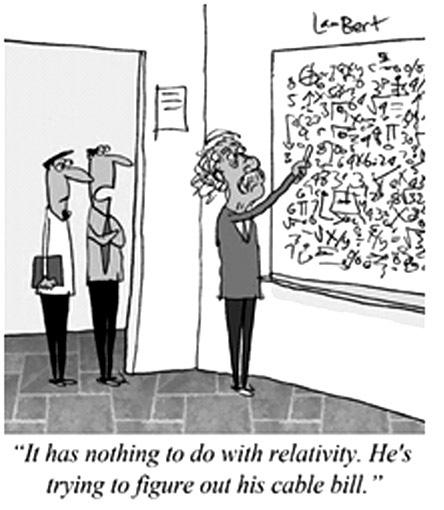
The lower costs and simplicity of switching has led the consumers to jump on the streaming bandwagon. The other obvious reason is its ubiquitous nature of the service, that allows one to run the it in home or on the road on your mobile device.
And yes, your subscription to Sling TV or PlayStation Vue, it can be run on different TV’s on your house.
So, Are we there yet? I would hit the gavel with a resounding YES!! With time, the options are going to get better and if you are not tied into a contract you can choose whatever options suit you best, whenever you want.
| continue from page 6
considered to be a favorite of Lord Shiva. The plant continues to reseed and bloom occasionally in late fall. I am always pleased when I am able to take those blooms to the temple. In few days, I will be running around my garden and around town gathering plants and fruits favored by Devi Durga.
The ritual of Pushpanjali or the offering of scented flowers is performed by all devotees accompanied by prayer hymns of the deity. Puja ends with the Aarti or Aratrika in Sanskrit which means the removal of darkness. With the accompaniment of music and prayer songs, the deity is celebrated with glowing lamps, incense and fragrant flowers. Lit by the clarified butter (Ghee) lamps, faces of many deities glow in the shrine. As I move the air around the deities and devotees alike with the giant red fan, it seems that an ethereal bond is established amongst us. The Aarti ceremony has a root which may be traced to other ancient traditions, including those in the Catholic Church.
Homa or Yajna, the fire ceremony, may be performed independently, in association with any sacramental ritual like wedding, or in conjunction with the worship of a major deity. Procedures for Homa are based on early Vedic scriptural texts and sensibilities. Vedic gods and goddesses like Indra, the king of the sky and Grahas or planets, play significant roles in Homa. A mandatory Homa is performed for gods and goddesses with Vedic origin. During the Durga Puja or Navaratri ceremony, it is done as prescribed in the text of Devi Mahatmya, a definitive scripture. During Homa, a sustained fire is lit and various offerings are placed in the fire pit to be totally consumed by Agni, the fire god. Ancient Hindu sages used to perform Homa under the open sky. Homa is an essential part of the worship of Devi Durga which is performed on the ninth day of the two week-long celebration. It is worth pointing out the interesting regional differences here. While Bengali Durga Puja is done over five days, Navaratri is celebrated for nine days in most part of India. North Indians worship the goddess Lakshmi on the Deepavali day while Bengalis in general worship the goddess Kali on that day.
Vratakatha or the readings of morality tales associated with a deity is the last but certainly not the least part of a communal worship. Vratakatha is often called Paanchali in Bengali. Most of these stories illustrate the essential nature of the deity along with instructions about how humans, mostly women, should behave to receive the grace of the deity. They are read aloud by the priest or one of the devotees while everybody is supposed to listen carefully. For example, the story of Lord Shiva illustrates his compassion. I must confess that these stories sometimes conflict with modern sensibilities, especially for women. Several women pointed out to me that the Paanchali for goddess Lakshmi is somewhat meaningless in modern life. I must admit that many of them slip away during the reading.
My most labor intensive duty is still the organization of the worship. All Hindu worships are associated with elaborate preparations written down in thick books. I have organized many of them for male priests. Although I have become the worship leader, I still do most of the organizational work, spending days cleaning, washing vessels, shopping, and making sure of the details before I can take the priestly seat. The simple joy of preparing fragrant rice with ghee, peas, and dry fruits, making a small pile of it on a shiny plate, decorating it with red rose petals, and offering it to Devi Durga is difficult to describe. These efforts are labors of love. These days, men from younger generations are often willing to assist. It is a delight when professional men bring cooked food offerings for the goddess with great humility.
Worship procedures that we are most familiar with, began during Vedic times but changed as they were adopted by Bengalis. Vedic scriptural texts and procedures were modified to fit the Bengali life style. Sensibilities of post-Vedic or Samhita era were included at that time. Characteristics of gods and goddesses also changed to suit the local environment. When I was young, in Kolkata, I never heard of any major celebration for Lord Ganesh. However, as Bengalis migrated to other parts of the country, they brought Ganesh Puja to Bengal. Minor deities became major ones and some
important deities, like goddess Monosha, the queen of snakes, lost popularity. There is an urban legend that the worship of Viswakarma, the god of engineering, started at the behest of a British businessman. Now, this deity is routinely worshipped by engineering and technology students. Most immigrant Hindu Bengalis who arrived in North America during past fifty years, brought with them their belief systems that are often modified by the quintessential Bengali ethos, often influenced by reformist leaders like Sri Ramakrishna, Swami Vivekananda, Sri Aurobindo, Rabindranath Thakur, and others. Cultural programs gained significant emphasis in Bengali religious festivals. Such modifications are certainly not new. The Bengali Ramayana, penned by Sri Krittibas, probably had a great influence on how we celebrate the five-day long festival for Devi Durga.
Unlike many other Hindu communities, Bengalis do not build big temples often. We prefer small-scale centers for worship. We do not visit temples every week either. Most of us have personal shrines in our homes where we spend some time in prayers throughout the year. Yet, we need to fulfill the primal need of tribes to gather for festivals worshiping deities or celebrating major sacraments of life. Often, we rent schools and hotels for larger festivals. Bengalis from smaller towns travel hundreds of miles to reach larger cities to attend such events. Like the worship venues, Bengalis retained their distinct ways of worship from other Hindu immigrant communities. Bengali sacramental ceremonies, like the wedding, the first rice eating ceremony etc. are also somewhat different from other Hindu communities. It is not unusual for Bengalis to consume meat and fish during festivals which is considered a sacrilege for most Hindus.
In this spiritual journey, I do witness small coincidences, which some may call miracle. Before leaving home on that wintery evening described in the introduction, I took along my mother’s stone Shivalinga from my home shrine on a whim. Later, I felt fortunate that we could at least pour milk on the little Shivalinga even though we could not access the one in the main temple and other offerings were sparse.
By Rachna gupta MD, MPH
(This article was originally published in the January, 2014 issue of Ananda Sangbad)
Are you planning a trip to India? Pre-travel planning for preventing illness is often a neglected part of travel preparation. Whether traveling back home to visit friends and family or traveling for work, failing to anticipate and recognize potential exposures and health risks leads to high rates of travel related infectious diseases. Expatriates often underestimate their own risk of illness and erroneously believe that living in India in the past will protect them from illness during visits back home. Typhoid, malaria and other mosquito borne illnesses are common and often preventable causes of illness in travelers returning from India. Vaccines, certain prophylactic medications, and educating yourself are effective ways to prevent illness during travel.
Typhoid fever is a bacterial illness acquired by contaminated food or water. The bacteria are ingested, invade through the small bowel, and reach the bloodstream causing fever, abdominal pain, rash, and in many persons can lead to serious complications like intestinal hemorrhage, abscesses, coma and death. According to the Centers for Disease Control (CDC), almost two thirds of typhoid fever cases among returning US travelers are imported from the Indian subcontinent; the number of new cases is nearly 18 fold higher than for persons returning from travel to any other geographic region. Also, due to increasing drug resistance to many oral antibiotics, treatment of the Typhoid fever acquired in India now requires intravenous antibiotics. A person who has had typhoid fever in the past is not protected against reinfection in the future.
Vaccination is an effective way of preventing Typhoid fever. The vaccine is available in oral form (Ty21, Vivotif®), which can be given to persons as young as age 6. It comes as a preparation of 4 capsules that must be refrigerated. One capsule is taken every other day, and the schedule should be completed at least one week before your departure date. It protects against typhoid for 5 years but is not recommended for persons who are immunosuppressed or are taking antibiotics. The intramuscular injectable vaccine (Typhim Vi®) can be given to children as young as age 2. For best protection, immunization should be received at least two weeks prior to travel. Booster doses are recommended every 2 years. Neither vaccine provides absolute immunity, but the benefit clearly outweighs the risk.
Receiving vaccine must be combined with exercising basic food and water safety which protects not only from typhoid but also other gastrointestinal illnesses including diarrhea, dysentery, cholera, and some viral hepatitis. Suitable drinking water should be bottled (obtained from a reliable source), boiled (CDC recommends a rolling boil for one minute, then cooled), or filtered. Avoid unpasteurized milk, undercooked eggs and meats, or salads. Raw vegetables should be washed with clean drinking water and peeled, preferably by the traveler, before being eaten. Remember, only ice made with clean drinking water should be consumed.
Malaria is a life-threatening infection caused by a microorganism that can be injected into one’s blood during a mosquito bite. Infection can initially manifest with chills, high fevers, jaundice, headache, vomiting and abdominal pain and requires prompt evaluation and treatment. Some species of malaria (Plasmodium vivax and Plasmodium ovale) can become dormant in the liver during infection and cause relapse infection months, sometimes years after travel. Traveling through most of India, including the greater metropolitan areas, at any the time of year is risky for acquiring malaria, and prevention using antimalarial medication is recommended. According to the Kolkata Municipal Corporation statistics, approximately 42,000 cases of malaria in 2011 and 36,000 cases of malaria in 2012 were diagnosed
continue to page 15 }
By shivan Mukherjee, Age
(This article was originally published in the January, 2018 issue of Ananda Sangbad)
Within New Jersey itself, a battle between two of the greatest minds was waged over electricity. Thomas Edison was already immensely popular and wealthy after his multitude of inventions. Once Edison had perfected his lightbulb, he now needed to create a system and an industry based around it so that electricity could be available to the general public. To power his electricity grid he decided to rely on direct current otherwise known as DC power which although safe, could only power areas within a half mile radius. This caused power to only come in densely populated areas and those in rural areas were automatically excluded.
Prior to moving to the United States, Nikola Tesla worked for Thomas Edison’s electric company in Paris. He had an idea to control AC power which was the original and much more powerful form of DC power. However, it had never been controlled before and was unsafe. To present his ideas Tesla came to the U.S. and visited Edison in his lab in New Jersey. However, so much work and money had been already poured into the DC systems, Tesla’s ideas for the AC were not welcome. He was instead told to improve the current system for a prize. The prize was a joke but Tesla not knowing English well took it seriously. This caused a falling out between the two when he did improve Edison’s system. Enraged Tesla quit his job but there were not many jobs for inventors and electricians during that time. He began working to dig ditches for Edison’s system when he met a man who believed in him and had connections with an investor. Tesla perfected his system and started his own company. His AC power could not only power over .5 miles but over 50 miles making power not only available to the elite but to everybody.
This began a battle between the two geniuses. Edison was determined to present Tesla’s system as dangerous and volatile while his system was safe and reliable. He even went as far as to recommend Tesla’s company to make the first electric chair which showed the power and danger of his system to the public. But Tesla wouldn’t back down and soon the investors of Edison had stopped believing in him and made the decision to switch to the AC system behind his back. In the end, Tesla proved to be correct and his system electrified the world.
| continue from page 5
I met my good friend Avijit at the end of summer when I visited New York. I found out much to my surprise that he had also been working in a summer job, selling doorto-door a “Black History” book in the ghetto areas of Cleveland. What a coincidence, I thought! Contrary to my failure, however, he had a huge success, and was even awarded a trophy for being one of the top selling salespersons. I asked him, “What was your secret?”
“Oh, it was very easy”, he said. “Whenever I knocked on a door, some black woman would open the door. She would take one look at me and say something like, “You have straight black hair! Come on in, I want to take a look at it”. The rest was easy. They bought the book, if nothing else, as price for having the privilege of getting a close look at straight black hair. That was probably the only time I was envious of Avijit’s looks, or more precisely, his hair. Those days, my hair used to have quite a bit of curl, so I doubt that I would have been successful in selling black history books either.

| continue from page 14
in the local municipality clinics. This number likely underestimates the actual burden of malaria cases in Kolkata. Exception to the recommended prophylaxis applies only for travel to areas at altitudes over 2000 meters (6000 feet) in Himachal Pradesh, Jammu and Kashmir, and Sikkim. Due to drug resistant malaria in India, medications used in prevention include atovaquone-proguanil (tradename Malarone®), doxycycline, or mefloquine (tradename Lariam®). When taken properly, these medications greatly reduce the risk of acquiring malaria.
Atovaquone-proguanil must be taken daily starting 1-2 days before leaving for India and should be continued for 7 days after returning from India. Doxycycline must also be taken daily starting 1-2 days before leaving for India and should be continued for 4 weeks after returning to the US. Mefloquine is taken once weekly, starting at least 2 weeks before leaving for India and MUST also be continued for 4 weeks after returning from India. The choice of which medication to take should be discussed with your prescribing physician and is usually based on the duration of your trip, your other medications and medical conditions, convenience, and tolerability of the medication.
Of note, people returning from India and other countries where malaria transmission occurs are not permitted to donate blood in the US for a period of time (usually one year) after their return.
In addition to malaria, other important mosquito-borne illnesses encountered in India include Dengue virus, Chikungunya virus, and Japanese En-
cephalitis virus infections. While the mosquitoes that transmit malaria bite between dusk and dawn, these illnesses can be spread by daytime biting mosquitoes and have occurred as epidemics. There is no specific antibiotic/ antiviral treatment for each of these beyond supportive medical care, so protecting yourself from mosquito bites is the best prevention. The CDC recommends insect repellent sprays containing DEET (at least 30-50%) and wearing full sleeved clothing, tucked in shirt, and long pants to minimize exposed skin. The sprays can last about 4 to 6 hours and come off earlier with sweat and rain, so should be reapplied during the day. Clothing can also be pre-treated with permethrin, an insecticide, which is retained in clothing and remains effective even after several washings. Sleeping under insecticide impregnanted bed nets (available online or through sports/camping supply stores) is highly effective and often a novel experience for children. Staying in air-conditioned rooms and tightly screened rooms, if available, also reduce exposure to mosquitoes.
Before your trip, check with your physician if your routine vaccinations are up to date. Measles-Mumps-Rubella (MMR), tetanus-diptheria-pertussis (Tdap), poliovirus, and seasonal influenza are some vaccines that can be administered by your general physician. Some require a one-time booster in adulthood, if previously immunized, while the Tdap requires a booster vaccine every 10 years and the influenza vaccine is given yearly. Hepatitis A vac-
cine is an effective vaccine for a preventable disease and appears to confer lifelong immunity. Many adults who grew up in India may already have natural immunity to Hepatitis A. Your physician can check your Hepatitis A antibody levels in your blood. If Hepatitis A antibody is absent from the blood, vaccine is recommended.
Depending on when and where in India you are visiting, there have been local outbreaks and some persistent endemic illnesses. These include Chikungunya virus (2005-2006), Acute Encephalitis Syndrome in Uttar Pradesh (since 2005), Hepatitis E in Maharashtra (2012), Dengue virus (nationwide), Japanese Encephalitis Virus, and Rabies. Some of these are preventable with vaccine (i.e. Japanese Encephalitis and Rabies) taken prior to travel and with precautions taken during travel. Being aware of the latest news at your travel destination can help you better plan prevention strategies.
Travel health information and the latest health alerts are available on the CDC website. Adults, children, women who may be pregnant, persons who are immuno-suppressed or with chronic illnesses should discuss their travel plans with their physicians for individualized travel advice who, if necessary, may refer travelers to specialized infectious diseases/ travel medicine clinics.
So, as you plan and pack for your next trip to India, give consideration to the health risks and learn about ways to reduce your risk and to maintain your health during travel. Safe Journey!