Ananda


Ananda
January 2017
Reported by Amitabha Bagchi
The spanking new Community Center of Ananda Mandir, which is a pride and joy for all our members, is now essentially complete and ready for use with limited township restrictions Not surprisingly, its first few uses were for Ananda Mandir’s official purposes: for holding the meeting of members and supporters during our annual fundraiser; for staging cultural programs on three evenings during the Durga Puja; and for serving community dinner by utilizing the hall and kitchen on the night of the Kali Puja But the gala opening of the facility, so to speak -- its very first use by a member family -- took place on November 13 when Debajyoti and Sikha Chatterji hosted an Appreciation Dinner for what they termed the “Heroes of Ananda Mandir ”
It was an event that lived up to its billing The program started with a cocktail hour in the entrance foyer of the building In that warm and cozy setting, the invited guests mingled freely to trade stories and recollections.
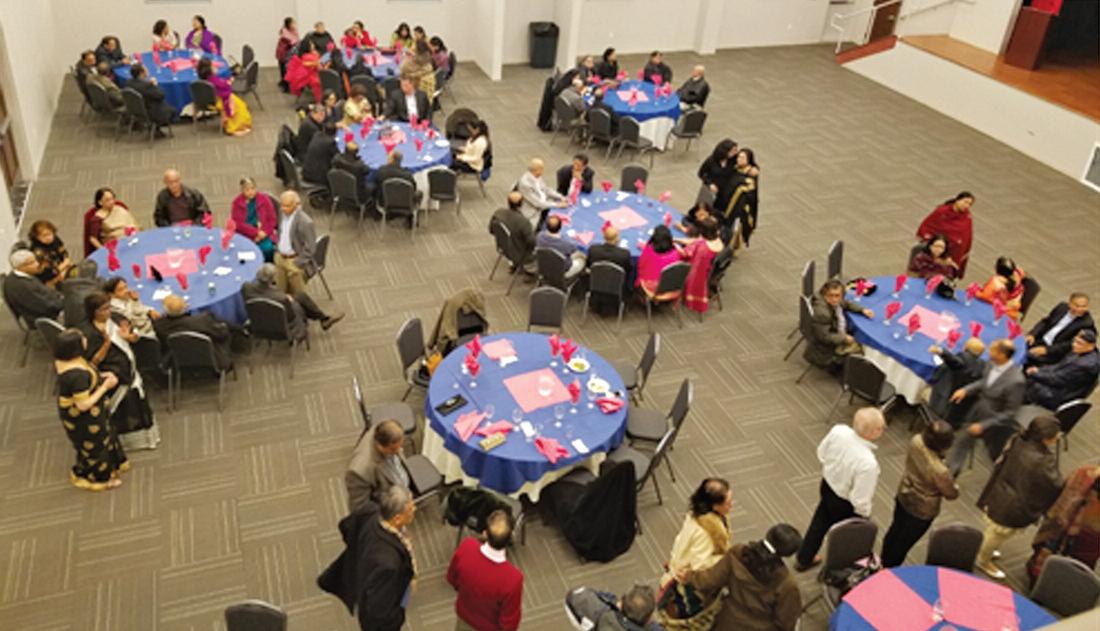
The group then moved into the main hall, which was set up for the occasion with several linencovered round dining tables and surrounding chairs Once the 100 or so guests were seated, Sikha Chatterji (as the host) formally welcomed them from the stage and then turned the microphone over to her husband for a more detailed explanation of the purpose of the evening’s get-together In a comprehensive speech, Debajyoti Chatterji expressed his and his wife’s collective appreciation to the putative “heroes of Ananda Mandir ” for (in his
words) “their tireless and selfless efforts” to bring to fruition “this impressive Community Hall and the beautifully expanded temple next door ” He then proceeded to call out and explicitly recognize and honor heroes in many categories He began with the new construction and expansion effort and mentioned:
• The core members of the Construction Committee;
• The other members of the expanded construction team; and
• The architect-engineer and construction contractor involved in the effort from its inception
Next he recalled the heroes involved with the construction of the original temple, and those who oversaw the sculpting and shipment of the deities from India He noted sadly that some of the original stalwarts were no longer with us He then proceeded to recognize key members of the Board of Trustees (BOT ) over the years, and followed that up with tributes to the unpaid volunteer members of all the committees of Ananda Mandir -- from puja to food preparation and distribution, from maintenance to cultural and literary programs, from publication to constitution modification, and from fundraising to donation collection and sundry other activities
Debajyoti wrapped up his presentation by specially thanking the Priest, our Founding Members, current Life Members and Associate Members, and all our supportive spouses.
The last part of the evening was, of course, a sumptuous dinner prepared and served by Deewan Banquet All in all, it was a memorable evening that will be cherished by all in attendance
Saraswati Puja & Hatekhori : Wednesday, 01 February, 8:30 am - 11:00 am
Saraswati Stuti & Aarati, Evening : Wednesday, 01 February, 6:30 pm – 8:00 pm Bani Bandana & Hatekhori : Sunday, 05 February, 10:00 am – 12:00 noon
Reported
By Guru Chakravarty
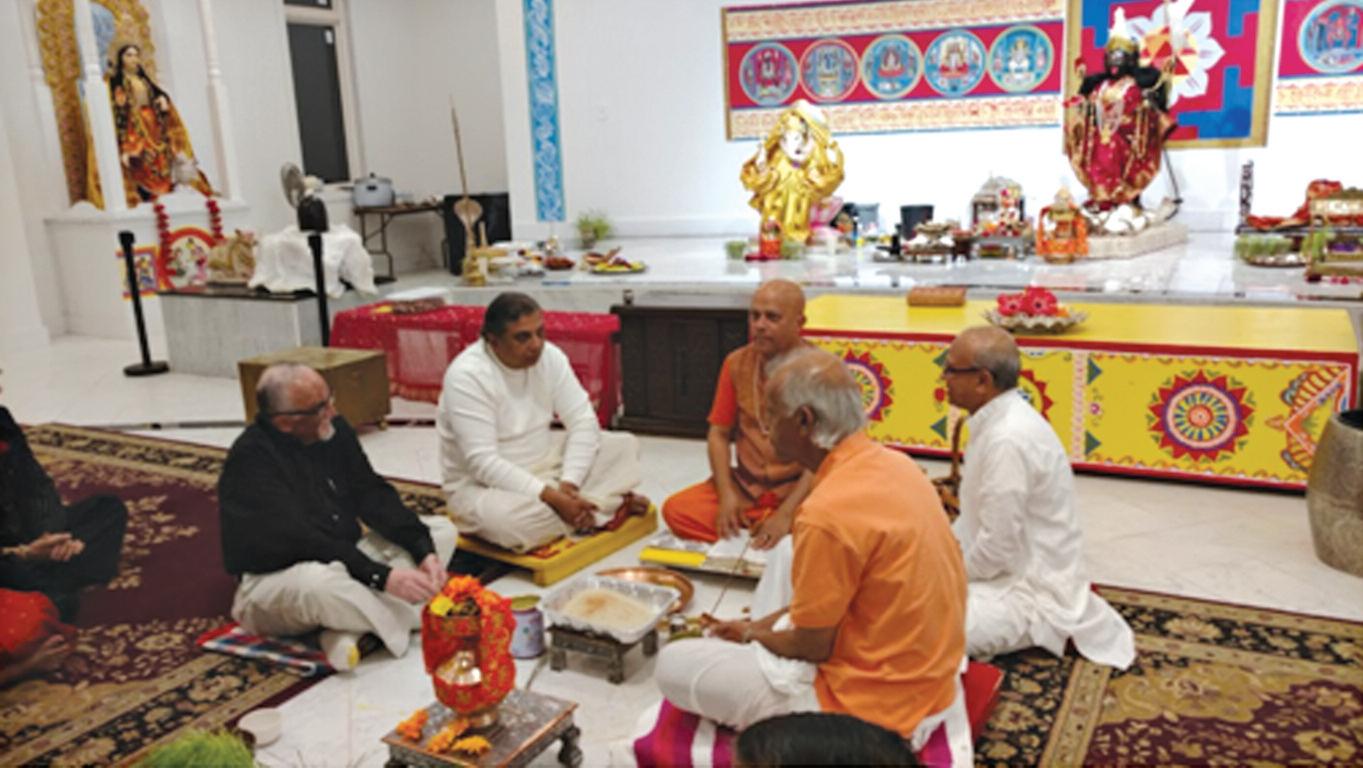
Foundation day of Ananda Mandir was celebrated on 14th November, 2016, with Pujas and Havan ceremony In reminiscence of the original foundation ceremony with four priests performing in synchrony in 2004, Biswajyoti invited some of the original priests available for this day and some new to perform the Havan ceremony together, in the new expanded temple Many devotees attended the program and participated in offering ghee and “havan samagree” materials to the Agni God Biswajyoti led the chanting of slokas from Chandi and Bhagavat in his unique ability to do so, and other priests followed him The sanctified atmosphere held the attention of all devotees to the end.
Calendar of Events (Dates are subject to Change)
Please check our website frequently www anandamandir org tel: 732-873-9821
NOTE: If a particular Puja time is not listed, please contact temple or visit our ebsite: anandamandir.org
JAnUARY 2017 (*)
new Year Morning Darshan
Sunday, 01, 9:00am – 12:00pm new Year Evening Darshan
Sunday, 01, 4:00pm – 9:00pm
Satyanarayan Puja
Sunday, 08, 5:30pm – 7:30pm
Makar Sankranti
Saturday, 14, Ratanti Kali Puja
Thursday, 26,6:00pm – 8:30pm
Shyama Puja
Friday, 27, 6:30pm – 8:00 pm
Ganesh Chaturthi
Turesday, 31,10:00am-11:00am
Sahitya o Alochana
Friday, 20, 8:00pm
Ananda Sandhya Not scheduled
FEBRUARY (*)
Saraswati Puja & Hatekhori
Wednesday, 01, 8:30am- 11:30am
Saraswati Puja Stuti & Arati
Wednesday, 01, 6:30pm- 8:00pm
Bani Bandana & Hatekhori
Sunday, 05, 10:00am- 12:00pm Satyanarayan Puja
Sunday, 05, 6:30pm-8:00pm
Sahitya o Alochana
Friday, 17, 8:00pm
Ananda Sandhya Not scheduled
MARCH (*)
Sahitya o Alochana Friday, 17, 8:00pm
Ananda Sandhya Not scheduled
(*) Call Mandir for Puja Schedule
Special Religious Services: Upon request, the priest of Ananda Mandir offers services such as inhouse Shraddhas, Rituals associated with Cremations (Antyesti Kriya), Shraddha Anniversaries, Pre-wedding rituals (Naandimukh, Ashirwad, etc), Upanayan (Paitey), Annaprasan, Wedding Ceremonies & Wedding Anniversaries, Griha Prabesh (Bhumi Puja), Consecrations of new cars (New Car Pujas) and others if you have needs for any of the above or more, please feel free to contact Biswabhai @ 732-873-9821
AnAnDA SAnGBAD
A Periodical Newsletter
Published By AnAnDA MAnDiR (A Tax-Exempt, Non-Profit Organization)
269 Cedar Grove Lane Somerset, NJ 08873
Ph: 732-873-9821
Website: www anandamandir org
PUBliCAtion CoMMittEE oF AnAnDA MAnDiR
Chairperson: Pronoy Chatterjee, pkc usa@yahoo com
Assistant Chairperson: Subrata Bhaumik, Bhaumik subrata@gmail com
Editor-in-Chief: Debajyoti Chatterji, Debsmee572@gmail com
Managing Editor, Ananda Sangbad: Guru Chakravarty, guruchakravarty@yahoo.com
Managing Editor, Anandalipi: Amitabha Bagchi, amitabhanj@gmail.com
Editors: Subrata Bhaumik, bhaumik subrata@gmail com
Subhodev Das, subhodev das@gmail com
Sushmita Dutta, sushmitadutt2@gmail com
Amrita Kangle, amritakangle@hotmail com nupur lahiri, nupurlahiri@aol com
Associate Editor: Ruby Banerjea, r banerjea@yahoo com
Members-at-large: Bhaswati Bhadra Ashok Rakhit
New Year of 2017 began with the aftershocks of a huge bang in the prior months that shook us all Actually, it is a multiplicity of bangs that touched all of us in many ways Let us consider them one by one
The first and foremost is the enormous surprise in the U S Presidential Election of November, 2016 The shockwave that it created had spread not only throughout the U.S., but it traversed all over the world. In simple words, this was like Brexit, many times over. While this came out as a happy surprise to supporters of one major party, the majority of the voters, as indicated in vote counts, were inundated in deep sadness, worried about the future of the nation. No matter, there is a new awakening among the intellectuals that their thoughtfulness and punditry take a back seat to the uneasiness and anger expressed by not-so-literate mass The highly scientific and technical polls, that the intellectuals like to brag about, missed the bearing so widely that it would take a major overhaul of the process in the prediction business
Still, there is enough good news for the Indian Americans to cheer about in this election Kamala Harris became the first Indian-American to be elected to the US Senate Pramila Jayapal won the Congressional seat from Seattle, the first Indian-American woman to accomplish this feat Rohit Khanna won California's 17th congressional district and Amerish Bera was reelected, also in California Raja Krishnamoorthi was elected to the U S Congress from Illinois And, Nikki Haley ’s nomination as the US Ambassador to the U N paves the way to future cabinet appointments In addition, more and more Indian Americans can now be seen to anchor or to provide commentaries on news, politics and finance to establish our footings in the media The economy has made a leap to new prosperity The Dow Jones Industrial Average has jumped over a new bar at 19,000 points, closing in on 20,000, and most people of our community have reason to feel happy about their investments
Here at Ananda Mandir, the home of our community, the bearings are set on a forward looking course We just completed a major overhaul of the facilities to expand the temple and to build a new community center. People have reason to feel genuinely proud that the beautiful temple is now completed and the amenities of the community center are available for day-to-day use. It symbolizes unity and purpose of the Bengali community to come together to produce something that will last for generations. We like to thank those heroes who gave their incessant energy, time and money to make it happen
Dear Members of Ananda Mandir,
The New Year is approaching fast and we are getting ready to celebrate New Year ’s Eve in our newly constructed Tagore Hall Ananda Mandir and Kallol are partnering to host this event inviting all members of our community to join us as we welcome the New Year
Since my last quarter update in September, we celebrated Durga Puja and Kali Puja in October; the two most attended events in our temple. Like every year, we organized Mahalaya (Mahisasur Mardini Live) in our new temple on Sunday, October 2nd. Temple was packed with hundreds of enthusiasts before sunrise to listen to this popular musical event performed by the best Indian Music talents of New Jersey. Our sincere thanks to Arun Bhowmik and his team who spent hours on rehearsal before the event! Traditionally, Bengalis come to the temple on Mahalaya for ‘Pitri Tarpan’ every year This year also many came from early morning to mid-day for this service on September 29th
Durga Puja was celebrated from Thursday Oct 6th to Tuesday October 11th We had thousands of attendees every day of the event, morning and evening Our volunteers in the kitchen cooked fresh lunch and dinner every day for six days Dozens of men and women volunteers came to the kitchen to cut vegetables and help cooking different vegetarian menu twice daily for 500+ people each time We had volunteers helping priest during Puja for Anjali and separate teams collecting puja donations every day This was truly a ‘Sarbojanin Pujo’ where community volunteers participated in different aspects of the puja for almost a week We are lucky to have the religious services performed under the direction of our Head Priest, Biswajyoti Nayak Everybody loves Biswabhai He is the center of our temple
Annual Kali Puja was celebrated on Saturday, October 29th as per Panjika The newly expanded temple did accommodate a large number of devotees enjoying Biswabhai’s Puja that evening We served dinner at the new community hall where we streamed the temple puja on a big screen We had snacks, sari and jewelry vendors in the hall lobby It was a great evening attended by over 600 people with ample space for parking, puja and dinner services
On revenue side, we collected donations on both occasions as we set a target every year Thanks to all our members and sponsors who supported the temple all around the year, especially during Annual Fundraiser and Durga Puja and Kali Puja
On months of November and December, we are focusing on getting our new banquet hall/auditorium ready for community rental We have hired Elite Catering Services as Managing Agent for rental and operational services of our hall This team is experienced in running similar hall for other churches in the area and we are confident of their professionalism and high quality service to our members when renting our hall. The Board of Trustees has proposed to name our hall as ‘Tagore Hall’ honoring our revered Nobel Laureate poet. We have started advertising in local Indian radio station (EBC Radio) to publicize its use by greater Indian community.
All queries, articles, news reports and letters should be directed to the Managing Editor: Phone: 908-752-3065, E-mail: guruchakravarty@yahoo com
For general information, please contact the following executives of Ananda Mandir: Ashok Rakhit, President
Jaiprakash Biswas, Vice President
Suprasad Baidyaroy, Vice President
Arun Bhowmik, Vice President
Sajal Mukherjee, Gen Secretary
Chanu Das, Treasurer l l
Should we just brush off the current Presidential election result as one that does not touch our dayto-day lives and should continue to enjoy the aboveaverage middle class opportunities? Or should we worry about a more intolerant society, about more racist feelings amongst neighbors and about communities getting more isolated from each other? Next four years under a new untested and somewhat inexperienced administration will be warily watched for answers to those questions
Guru Chakravarty Managing Editor,
Ananda Sangbad
We still have few items of construction that need to be completed – installation of two spires, addition of private puja room attached to the temple lobby, and an entrance gate that would welcome and also secure the property We hope to complete these in few months before cold winter arrives Our center is slowly getting in shape that we dreamt for many years! We urge all our members in the community to find opportunity to rent our new banquet hall for all occasions of Anniversary to Birthdays or Graduation We need your support more than ever as we need to meet our financial obligations to the bank Please join us if you have not yet become a Life Member Let us celebrate every occasion in our new home and help shaping its future Wish you all a Happy New Year
Thank you,
Ashok Rakhit President, Ananda Mandir
If you are a Life Member or an Associate Member, but didn't receive your copy of Ananda Sangbad, it may be because we do not have the correct address on file for you. Please send an email to Guru Chakravarty (guruchakravarty@yahoo.com) with your correct address, and we will send you another copy.
An Unprecedented Economic Policy
It was the dawn of November 8, 2016, and Americans of Indian origin just began to get ready to vote in a historic election that was underway in the US Almost on the other side of the globe, India startled the world with an unprecedented economic policy declaration Prime Minister Narendra Mody delivered a late night unscheduled speech in which he announced that, effective immediately, two legal tenders (500 and 1,000 rupees notes) would turn illegal. Holders of such notes would have until December 30, 2016 to exchange them with new 500 and 2,000 notes to be issued through banks
The announcement caught vast majority of Indian citizens from all walks of life by complete surprise, and what ensued was an economic and political mayhem Day to day commerce and life in general for average Indians turned upside down as a result of the demonetization – one couldn’ t go about one’s daily life because there were no legal monies of large denominations (the mainstay of Indian commerce) in the system that could effect a simple transaction It shattered small businesses, low wage earners, and others, especially in the informal economy, which purportedly is an enormous piece of the whole pie To add fire to the fury, even the new monies (500 and 2,000) failed to appear in large quantities to be dispensed through the banks for a variety of reasons And as a result, the monetary system was rendered a complete “dry well,” to use an oil industry analogy
the impacts
The fallout from the policy move, almost immediately, began producing sharp and substantially negative results in various sectors of the economy: Crop prices that are already softening due to the latest monsoon bonanza show signs of much sharper weakening because most of the trades by small and medium sized farmers are conducted in cash, and the crunch is forcing liquidation of inventory at an abnormally lower price intake A pretty darn damaging start for the next cycle!
Service sector (retail, transportation, food, restaurants, healthcare services, etc ), which, by some estimates, accounts for more than half of the economy, has been the most hard hit Infrastructure sector including construction, steel, and cement – the pivots of India’s growth in recent years - is next in the ecosystem Potential demand contraction in real estate and other construction industries is likely to create price shocks eventually culminating in low or negative income growth in related sectors Various learned sources are toying with different estimates of GDP loss, which range from 1 5% to 3% A reputed Mumbai-based research firm forecasts no growth for the economy
By Subrata Bhaumik
in the next two quarters – a free fall from the 7 5% growth in 2015-16 Again, bad news for domestic and international investments!
SENSEX and the Rupee (in the international markets) fell almost immediately on the news of the cash squeeze – the size of the decline over a few days was pretty alarming And there is of course the expectation of lower interest rate - in the wake of low growth and low inflation – looming large on the horizon. A disheartening correction of course in India’s growth trajectory!
Myth vs. Facts
The policy on the face of it looks like a pivot that might change the way the economy operates in the long run; that’s what is what being claimed by the architects of it Unlike apples, which don’ t fall far from the tree, reality often unearths the holes in our thinking and the plans based on it Let’s review and decode the logic behind the policy The official goals of the latest move are the following:
a) Choking the Shadow Economy to Death – The World Bank, IMF, and other multilateral and international financial institutions estimate that black market counts for about 25% of the Indian economy And the prevailing Indian economic maxim is that 85% of cash in circulation are in these two denominations Exchanging the illegal notes for the new ones will afford an automatic conversion of black money into legitimate wealth thereby producing a revenue stream (tax and penalty) for the exchequer
Myth Yes, it ’s true that there is going to be a onetime conversion (estimated at approximately US $300 billion) and some cash in the government coffer (between $100 to $150 billion) But, there is no guarantee that the chunk of the new money will not find illegitimate home again, thereby self-feeding the shadow economy cycle. Note that part of the additional tax revenue would also be offset by the lower tax base generated by the overall low income growth due to the economic downturn stemming from the policy. It is also argued that most of the black money is not held in cash as is assumed in the move A vast majority of the wealth is held in gold, properties (not held in owner’s name), and in offshore bank accounts By some estimates, Indians have more black money stashed in the Swiss Banks than rest of the world combined – a staggering $1 4 trillion ( a 2010 calculation) This is roughly 50% of the country’s 2010 GDP measured by Purchasing Power Parity method (an alternate economic concept of measuring GDP), 6 times the external debt, and 60% of the total debt And all of it is ill-gotten gains of the powerful holders of public or private offices and business leaders
b) Drying Up terrorism Fi-
nancing – It is true that an enormous amount of counterfeit currency is used to fund terrorism including Kashmir and other insurgencies within India The money is brought in the country through cross-border smuggling (Nepal, Bangladesh, Sri Lanka, etc ), havla and other shady exchange mechanism Majority of these fake notes originate in Pakistan – India’s archrival, which was the main beneficiary of some security breaches a few years ago at certain overseas (British and German) Indian bank note manufacturers including De La Rue.
Fact, Partial - As in the case of shadow economy, it does make a dent in the terrorism finance, but it’s only effective until they find a way to mint fake version of the (technologically superior and hard to copy?) new notes
c) Curbing inflation - the cash squeeze is guaranteed to help arrest runaway inflation
Myth The initial impact will bring the prices down, as already mentioned, for as long as the confiscated money remains outside the system, especially in certain sectors of the economy Note that the legitimate and new money that replaces the illegal tenders will fill the void, and in the long run, the net impact will likely be neutralized B lack money is just money held by people instead of the government It’s the excessive money (total) supply that tends to create inflation; whether that money is white or black hardly produces any considerable difference As a matter of fact, there is no evidence that black money actually is significantly more inflationary than white money, as the sum total of black and white monies in the system remains the same A low level of inflationary pressure may still exist in economies with significant black money because wealthy hoarders tend to spend it out rather than saving it, which, in any event, is likely to fall short of triggering any major hikes in the general price levels. In other words, the top spenders of black money do not significantly influence the general price level because their number is small relative to average mass of wage earners
d) Paving the Path towards Cashless Economy - financial transactions will be much more electronic and traceable with obvious and tangible benefits to the economy Fact, but at an extremely high cost of thwarting commercial activities! No economy in the world is completely cashless; only a few are substantially cashless including Sweden, Netherlands, France, Canada, etc India is currently trudging wearily on that road, ranking as one of the least cashless societies Credit Suisse, the international banking giant, estimates that 90 percent of transactions in India are conducted in cash Not only would a move towards a cashless society be a tough logistical hurdle but a cultural one as well The playing field requires a lot of prep
Continued to page 5
By Amitabha Bagchi
In December 2003, I went to Baidyanath dham for the second time in my life. My first trip, taken some fifty years earlier, was one of my most memorable experiences. I was but a child then, and I remember vividly the express trains, brightly lit station platforms, pushy pandas, fluffy puris and overly sweet pedas The religious significance of Deoghar and Baidyanath dham was of lesser importance I learned of course the legend of how the Jyotirlinga came to be located in that small town King Ravana, after propitiating Lord Shiva, was carrying a potent Siva linga to Lanka with the understanding that he could not set it down anywhere without affixing it permanently there The gods, alarmed at the prospect of Ravana’s invincibility in his island kingdom, schemed to fill his bladder with so much water that he had to (indirectly) set down the Jyotirlinga in Deoghar to relieve himself (That act allegedly created a large pond ) When Ravana could not lift up Shiva, he angrily flailed and hit it so hard that a good part of it was driven into the ground That is the configuration in which the linga (i e , Lord Shiva) is worshipped in Baidyanath dham My family went to Deoghar because my grandmother had apparently made a mental promise (known as manat in Bengali) some years earlier to do a puja to the deity there I recall going to the temple but could not see the object of veneration with any clarity A large crowd surrounded what looked like a circular depression in the ground Shiva’s phallic symbol, which normally points so proudly upward at the sky, seemed here to be barely peeking out of the center of that depression Nevertheless, in all the confusion and with a sudden gush of piety, I also did a manat to perform a puja someday at the same place What was worse, I told my mother about my mental promise.
Years passed, going into decades, and nothing was mentioned about my childhood promise to the Lord. But things changed some forty years later. Now, whenever I came to India to visit my parents, my mother would pointedly remind me of my manat. For the first couple of times I paid no heed, until I realized that she was dead serious and even fixated on the matter I began to worry that she might pass on before I could fulfil her wish, leaving a large hole in her heart So finally I relented and approached my mom
“You really want me to go to Baidyanath dham to perform a puja there?” I asked Her answer in the affirmative was not a surprise
“All right,” I said, “but your interest in this matter far outstrips mine Let me take you with me ” She gently but firmly declined my offer Her knees had gone so bad, she could barely fold one leg and had difficulty getting into a cab Riding a train would have been sheer torture I gave up and, in late 2003, boarded a train with two friends for Deoghar
On my second trip, with adult eyes, I saw Deoghar in a less idyllic light The natural beauty of an undulating landscape was still there, but it was despoiled by haphazard urban growth and a pervasive sense of decay What caught my eye the most were one-time beautiful mansions in various states of dilapidation and decay What was even more interesting was that most of those once proud houses had Bengali names on marble nameplates – B hattacharya, Chatterjee, and the like Clearly the decline of Deoghar was partly attributable to the decline in fortune of the Bengali zamindar and bhadralok class which greatly contributed to its prosperity in the British times
The Bengali influence in Deoghar can be seen in other ways too – most notably, in the large number of ashrams or religious monasteries that have been
Continued to page 4
By Basab Dasgupta
In my view, Self-Realization (SR) is an effort to answer the question, "Who am I?" According to the Hindu wise men the answer is actually well-known and very simple; "You are God" or "You are part of God ” In this context I love the following quote from Satya Saibaba: "I am God and you are God I know that I am God; you just don’ t know that you are God ” I believe that there is only ONE purpose in a person's life and that is to find out who he or she really is
The thoughts expressed in this article are not my own ideas In fact, these are the essence of the teachings of Hindu philosophy Being a non-religious person, I have never read the Geeta nor any of the other Hindu holy books or scriptures in my youth. I first learned about SR when I was forty-five years old and reading the chapter 43 of the book ‘An Autobiography of a Yogi’ by Paramhansa Yogananda. The chapter is an incredibly detailed account of what his guru, Sri Yukteswar, told him about life after death during his resurrection It immediately appealed to me not only because I found answers to some of those eternal spiritual questions I had been asking but also the physicist in me
was intrigued I could visualize a theoretical model to explain what our existence is all about The following is my interpretation of Yukteswar's narrative using partly a layman's language and partly a physicslike description I will call this description a ‘model’ using the word ‘model’ very loosely
One can think of one's existence as a sphere consisting of three outer layers (or shells) and an inner core The outermost layer is the "physical layer", the next one is the "emotional layer" and then comes the "intellectual layer" Inside the layers, at the core of the sphere, is some indescribable entity – a soul or a spirit or a package of energy or a piece of God! Each one of us can be modelled by one of these spheres Each lifetime can be represented by a bouncing of the ball from a rigid reflecting surface like a plane mirror The purpose of the mirror is three-fold. It momentarily stops the ball and makes it realize that it is not yet liberated and free to move on. Secondly, due to the impact of the collision, the ball suffers some pain. Finally, the reflective surface allows the ball to see its own image if it wants to. It is likely that part of the layer would be peeled off because of the impact; how much of the layer is ripped out would depend on the ball and how hard it hits the
surface If you continue to bounce the ball hundreds, if not thousands of time, eventually the first or the physical layer would completely come off
The same thing happens during our reincarnations In each reincarnation, we improve ourselves just a little bit, perhaps as a result of some suffering, which is similar to peeling a little piece of the outermost layer This "improvement" takes us towards the goal of SR, whether we realize it or not In the ball analogy, it is the realization that we are not just "balls" and we need to get rid of these outer coatings to see what is really inside us The pain and frustrations of the physical world makes us look at ourselves in the process of introspection
The spiritual improvements contributing to "peeling" of the outer layer is not a mechanically torturous separation process. We often see many people suddenly becoming very generous in their old age, donating money to various charities and funds for building temples etc. with the hope that such acts would help them to go to heaven or some other “desirable place" after they die. In my opinion, one's destiny is related to how one feels inside Donating a thousand dollars to some charity for gaining some social status does not benefit them from a spiritual point of view
On the other hand, if giving food to a hungry man or shelter to a homeless person gives you an incredible joy, which is beyond any materialistic or physical pleasure, then you have improved yourself You have effectively peeled off a piece from your outer shell and have taken a step towards your self-realization because you have started to find out what really lies inside you, by going beyond all the temptations of the materialistic world
Every person undergoes little introspection and improvements in each of his or her reincarnations Even a sinful man eventually realizes the futility of materialistic pleasures, a cruel man repents his past deeds, and a serial killer may find God in prison Amount of improvement in a given life, of course, varies from person to person After hundreds and hundreds of reincarnations we no longer come back to this physical body. The physical outermost layer is completely depleted by then. How quickly this depletion happens, depends on how much self-improvements one achieves in different reincarnations. The benefit of these improvements is cumulative in the sense that good deeds in past lives mean you have less "distance" to cover in the present life in that quest to discard the physical shell
Continued to page 7
Continued from page 3
founded by Bengali monks. The best known among them are the ashrams founded by Anukul Thakur and Mohanananda Brahmachari. There is also a fine school run by the Ramakrishna Mission
We stayed as guests of the Dev Sangha Ashram and Math school -- thanks to the kindness of its leader, Saumyendranath Brahmachari The day after our arrival, I took care of the manat puja early in the morning The priest took me into garbha griha, but the partially interred jyotirlinga within the central indentation was – to use an inelegant Bengali slang – surrounded by Dehati women in brightly colored saris and so largely invisible Lord Shiva must have chosen to be hidden from sinners like me! From the temple, we came back to the school where I taught two math classes at the request of our hosts Then we ate lunch and set off to explore the countryside
While driving around the rocky and barren surroundings of Deoghar, which were occasionally punctuated by tala (or toddy) and date palm trees, we chanced upon a small village What we found there confounded us all We saw two relatively new and modern structures across each other on a wide, clean and wellmaintained country road. One building had the appearance of a temple; the other looked rather like a hostel. Young Caucasian men and women in ochre robes
and saris were flitting back and forth between the two buildings. The very incongruity of the scene – a slice of the West in the heart of Jharkhand – was breath-taking! We absolutely had to find out the story behind it all We knocked on the front door of the temple for admittance and were told that it was a private place and not open to visitors Undeterred, my friends persisted by pointing out that our group included a visitor from America That did the trick and, after waiting for a while, we were ushered into the courtyard
It was quite a spectacle We saw two stupa-like structures -not domed but stepped-pyramidal in appearance – that looked like small temples There was also a large raised dais or patio of white marble Young Caucasian women in saffron saris were on their hands and knees, with buckets of water and rags, cleaning and polishing the stone surface Their devotion to the task was palpable We followed our guide to a small office Pretty soon, a white woman in her forties, most likely the person-incharge of the place and a kind of Mother Superior to the younger “nuns,” came in to greet us and explain the background and purpose of the place.
The background itself was unexceptionable. The set-up we saw was the Jharkhand chapter or branch of an active yoga movement from a place further up north – Kanpur or Rishikesh, I forget which The devotees underwent some rigorous and sys-
tematic training in yoga and spirituality. The lady gave us several books describing the organization and its goals But then she said something really odd She said that the Jharkhand “ministry” was under the leadership of a Guru who had gone into Samadhi for some three months in one of the stupas All the devotees were waiting for his emergence from the Samadhi state in six months, per his assurance, and keeping the place in tip-top shape for his return to the mortal world
***
The idea of a six-month Samadhi is patently absurd But it will be nevertheless believed by many Hindus as the manifestation of supernatural yogic power Any contrarian scientific opinion will be brushed off with the old saw “Biswase Milay Krishno Tarke Bohudoor” ( The Lord reveals Himself to one of faith, not to a debater ) So, was this Guru of Jharkhand essentially immortal? What is the Hindu attitude to the immortality of (at least some) holy men?
This question has intrigued me for some time, so I did a quick research using two unreliable sources: Google and Wikipedia. The first person I looked up was my favorite sadhu of the 19th century, Trailanga Swami. The Wikipedia entry on him is truly fascinating It says (accurately enough) that he is regarded as a “legendary figure in Bengal” – no wonder I am a fan! – and that Ramakrishna called him “The Walking Shiva of Varanasi ” And then it
gives his age (at death) as either 280 years or 358 years. Apparently, people knew exactly when he died, but they could believe whatever they wanted about when he was born I can only sigh about the near-total absence of content-control by the Wikipedia management (Or am I showing my debating spirit and not evincing much of a sign of faith?)
I turned next to Lahiri Mahasaya – the home-bound yogi who revived the practice of Kriya Yoga – or more accurately to his guru, Mahavatar Babaji According to Wikipedia, Mahavatar Babaji appeared to Lahiri Mahasaya and also to disciples in his lineage, such as Yukteshwar Giri and Paramahansa Yogananda between 1861 and 1935, i e , over a span of 74 years Nobody knows when he was born, but one anecdote in Wikepedia puts his date of birth as 30 November 203 AD, while Yogananda in one of his books claims that Babaji conferred with Jesus Christ when the latter traveled to India These stories would make Babaji close to 2000 years old and essentially immortal, because nobody knows if and when he died either.
What exactly do the devout Hindus mean by such instances of extraordinary longevity? They cannot be explained by sensebased logic, so the faithful speak in terms of spirit and sukhma deha (ethereal form) that can take on earthly manifestations in front of extraordinarily gifted disciples of the same lineage Swami Vivekananda, for example, is believed to have seen the
shape or heard the voice of Thakur Ramaksrishna more than once after his guru’s death Examples of revelation are, of course, hardly unique to Hinduism They are known aplenty in other religions as well: Moses climbed up a mountain to converse with God and brought back two tablets inscribed with the Ten Commandments; the resurrected Jesus Christ spoke to Saint Peter on his way to Rome and answered his query (“Quo Vadis, Domini?”); and the Prophet Muhammad conferred with Archangel Gabriel multiple times in distant hills away from human habitat Revelations like these have a revered place in religions all over the world
There was one important difference though between the revelations I mention above and the story I heard about the yoga guru’s six-month Samadhi in his monastery near Deoghar That story was told to me less in divine terms and more as an example of supernatural yogic powers There was no opportunity for me to go back to Deoghar in three to six months to check on the status of the guru and his Samadhi. So a mystery remains to this day: Was the guru bumped off ? Was he kept alive through some secret provision of sustenance? Or did he truly emerge from his trance in time, as promised, and gain acceptance over the years as an avatar descended from heaven to found yet another Hindu sect? The answer, I am afraid, is unlikely to be revealed to me
Most Bengalis of my generation are familiar with the worship of Devi Saraswati, the goddess of learning It is celebrated in communities and schools throughout West Bengal on Vasanta Panchami day, often in February Because of my father’s job, we lived in different cities of India Deprived of any easy access to public worships, we celebrated it at home with my father performing the priestly duties When we were in Kolkata, I used to be intrigued by a related food restriction We were not supposed to eat the berry called Kool before it could be offered to the Goddess There are two types of Kools available in Bengal: a longish fruit with a smooth green skin and reddish tinge, and a smaller, round kind that turned red when ripe, perfect for pickling with tamarind juice and jaggery I wanted to see what would happen if I broke the rule, but dared not try - everybody knew that one would not do well in the upcoming examinations because the goddess would take offense at this infraction
Like other genesis stories of ancient gods and goddesses, there are many related to the goddess Saraswati from Vedic times. My favorite one is about how Brahma created her from his own body. When Brahma created the world, it became filled with enormous noise and chaos. As he looked for ways to make some sense out of it, he visualized Saraswati, a beautiful woman with four arms, approaching him, seated on a white swan She was dressed in pure white, symbolizing purity and the rejection of the material world, while carrying a Veena, an ancient musical string instrument symbolizing vibrations In each of the other two hands, she carried prayer beads and Veda, the sacred book of knowledge However, in Bengali tradition, the Devi appears with only two arms holding the Veena She created speech, or Vaak in Sanskrit, and helped Brahma with the organization of the world using Vedic hymns Saraswati became known as Vagdevi In Hindu symbolism, a white swan represents the ability to extract pure knowledge from an ocean of irrelevant ones Saraswati, the patron
By Bakul Banerjee
goddess of wisdom, told Brahma that the only way to find solutions to problems is thorough knowledge Brahma pined for Saraswati who was born out of his own body and mind, and eventually married her This action angered the other Gods, who cast a spell on him so that Brahma would be worshiped in only one temple According to Hindu mythology, these events occurred near the Lake Pushkar in Rajasthan, India It is said that the temple of Brahma, the original father of all Hindus, was established at the town of Pushkar, although there are a few other temples of Brahma around India
Several years ago, I had the good fortune of visiting this ancient pilgrimage site of Pushkar Like many other ancient temples in India, the original temples of Brahma, Saraswati and other gods and goddesses surrounding the sacred lake, were destroyed by waves of invaders; the significant ones were rebuilt several times Although the temples were not old, they felt ancient to me as the pilgrims and priests from many regions of India performed rituals by the lake and in temples singing Vedic prayers. The site was filled with tourists speaking many languages from all over the world. Foreign tourists of all skin colors, many in Capri pants and Bermuda shorts, bargained with shopkeepers in broken Hindi I am sure that Vagdevi smiled at all of us sitting pretty on her lotus-seat inside her temple
During the time of Puranas, there was a revival of the worship of the goddess through the writings of venerable sages like Vashishta and Markandeya, who established their hermitages on the fertile banks of the river Saraswati This river that might have originated from the Shivalik mountain range connected the rivers Yamuna and Shatadru However, it had disappeared, probably because of certain tectonic activities, which made the region arid Devi Saraswati is often associated with this famous river Saraswati, considered to be one of the seven sacred rivers in Hinduism Many events described from
Rig Veda to Mahabharata occurred on the banks of this now-extinct river Ancient sages who lived on the banks of Saraswati described the goddess with great reverence They imagined that Saraswati represented gracious attributes like learning, wisdom, and arts They invited us to pray for her blessings so that we could nurture similar qualities within us Devi Mahatmyam or Glory to the Goddess, one of the most enduring books of hymns, was authored by the sage Markandeya sometime between 400 and 600 CE This book contains 700 Sanskrit verses addressed to the three great Hindu goddesses Mahakali, Mahasaraswati, and Mahalakshmi, consorts of the triad of Hindu gods Shiva (the destroyer), Brahma (the progenitor), and Vishnu (the protector of the universe) respectively The fifth chapter of this book is dedicated to the goddess Mahasaraswati In these beautiful verses, twenty one attributes associated with logical and abstract senses linked with the goddess are listed in the form of salutations. The poet began the invocation of the goddess as follows: “Salutations again and again to Devi who abides in all beings in the form of consciousness.”
He continued honoring the goddess that resides in all beings, particularly humans, in the form of intelligence, power, forgiveness, modesty, peace, action, memory, compassion, and others The sage concluded by singing that the goddess also manifests herself within us in the form of B hranti The literal meaning of Bhranti is an error that may be a simple mistake or a major transgression According to this essential scripture, with respect to everyday life, it is our duty to pay close attention to each of these elements, even our transgressions, and internalize them including their consequences as best as we can In my teenage years, I often wondered who thought of cataloguing and defining these elusive attributes that cannot be grasped directly I found out after learning a little Sanskrit
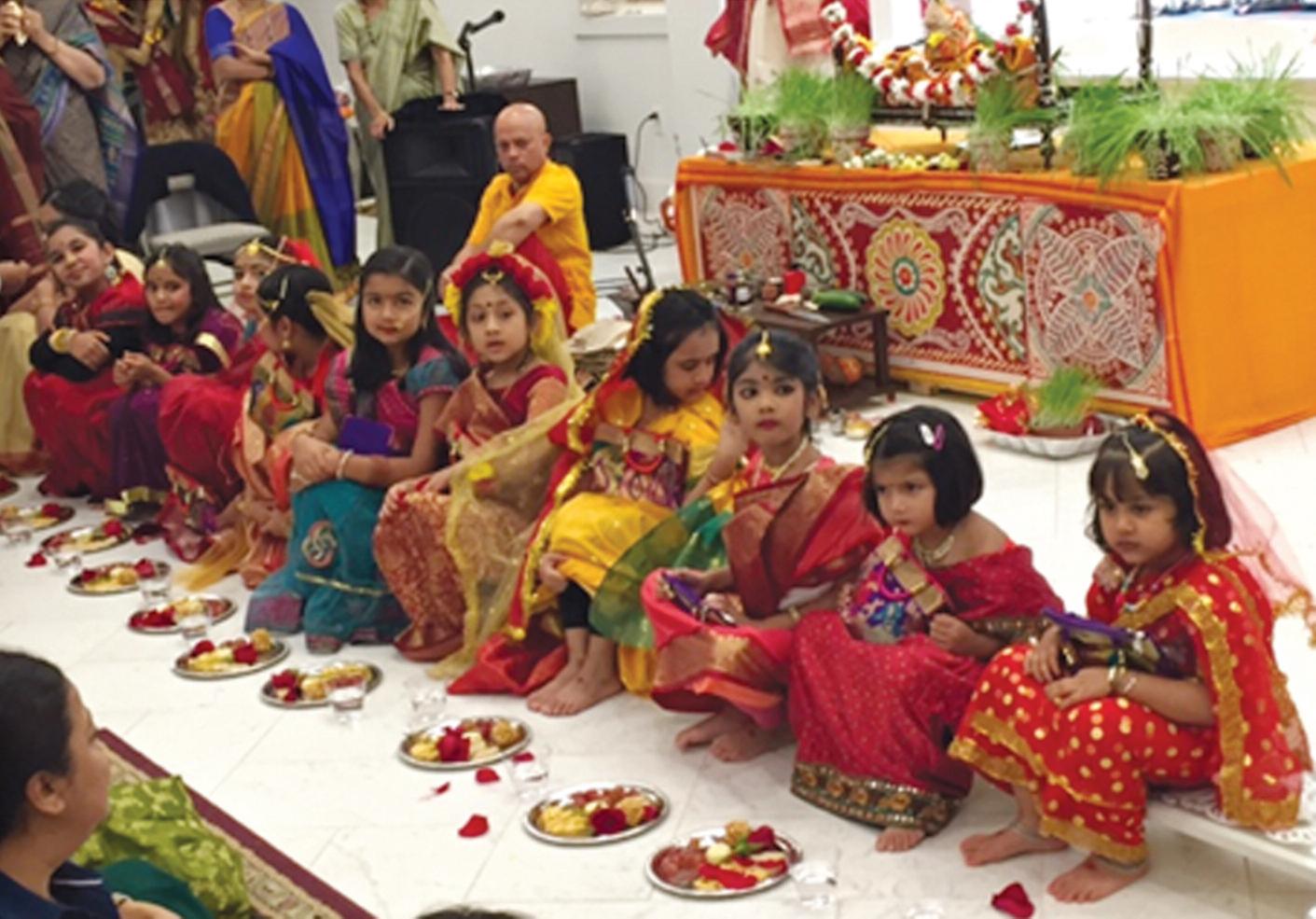
During the past three years, I had the privilege of performing most worships at the temple of Bharat Sevashram Sangha in Chicago, which gave me the wonderful opportunity to connect with devotees of different generations and from different states of India, although most of them were Bengalis In most parts of India, Devi Saraswati is worshipped during Navaratri festival, which overlaps with the Bengali Durga Puja However, there is something special about worshipping the goddess in the dead of winter when the landscape is usually covered with snow Young parents bring their small children dressed in adorable little yellow saris or Dhuti and Panjabi outfits to perform the “first writing or Hatekhori” ceremony Holding the little ones on my lap and guiding them to write the alphabet, numbers, or names of gods, is probably my most rewarding experience as a priest In order to write, children must have some ability to hold the pencil or chalk for a reasonable length of time However, parents are often eager to get started with the education of their children Last time, I found myself holding a baby still in diapers Older children often come clutching their musical instruments and books at the behest of their parents. Although most of these parents believe that participating in the worship of Devi is the right thing to do for children, many adults, both men and women, are skeptics themselves. Being a scientist myself, I can relate to their points of view However, the more I study these exquisite hymns honoring the goddess, the more I believe that the sage Markandeya was instructing us to meditate on our own human bodies and spirits to improve our wellbeing
Now, going back to my story about Kool berries, I did muster the courage to bite into them ahead of the festival after finishing college, but while still in graduate school Those unripe fruits tasted quite bad They ripen only around the Saraswati festival day Nothing really bad happened, and I did get my degrees Let us salute the Devi who abides in all beings in the form of patience
Continued from page 3
work including mass education, abundant availability of technology infrastructure, etc before a society can make the transition There isn’ t really a strong install base for digital payment methods in India, and majority of the population aren’ t familiar with how to use them While it looks like the right move for any country toward a more secure and efficient economy, it needs to be spread out in phases over a period of time A hastily planned implementation is sure to create economic chaos the Execution - Alleged leakage, a Major Problem - The success or lack of it for a policy initiative is hinged on the way it is implemented, and many wellcrafted policies end up being inert and ineffective due to botched execution Newspaper reports indicate that the move somewhat lacked the surprise element because privileged and influential sections of the society saw it coming, and had time to prepare for it It was reported that top wealthy business tycoons including Ambanis, Adanis, and others were indirectly alerted; other unconfirmed reports also reveal that just a few months before the announcement there was an upward spike in property prices in Bihar and Uttar Pradesh where many properties changed hands and landed in the grabs of senior BJP leaders Rush to offload the illegal tenders, right? These carefully orchestrated leaks, in large part, helped a big chunk of the ill-gotten cash to be converted in noncash
assets thereby avoiding the wrath and the reach of the big brother At the end of the day, this is India where corruption and morality are intertwined, and it takes meticulous planning and tighter implementation efforts to cleanse one of the other
Reactions - Similar moves were contemplated before by previous Indian Governments including the former BJP led administration, but were abandoned due to perceived lack of net potential long term benefits and the relative size of disruption it would have caused
Reactions in the financial and economic circles around the world have been mixed Many Indian bankers and financial think tanks welcomed the move while others were not so sure The move clearly struck a chord in the vast swaths of the patriots and ultranationalist that serve as the base of Narendra Modi’s support
Raghuram Rajan, the former RBI governor and a celebrated economist, favored better tax administration and law changes over demonetization Kaushik Basu, former chief economic advisor to Government of India and Chief Economist of the World Bank, thinks it’s more disruptive than effective Amartya Sen, the Nobel laureate economist thinks the move is a despotic action that undermines the basic trust reposed in the system by citizens, and will eventually hurt the economy On the other side of the globe, opinions are mixed as well Kenneth Rogoff, a famous Harvard economist and an ardent promoter of a
cashless economy favored the move, while revered economist and Nobel laureate Paul Krugman is not very clear on its impact and thought it was a very unusual move
Political Capital is Priceless – Narendra Modi’s will and resolve to take on economic power centers and corruption in the society is laudable and exemplary, and is kind of reminiscent of the Anna Hazare movement a few years ago, but that was more idealistic than practical On the other hand, in any major policy initiative, mass support and playing to base contingency is as powerful a motivation as the end results And it is within the realm of possibilities that Narendra Mody’s tryst with “Aam Aadmi” needed the redemption as much as the economy did And he gains an enormous amount of political capital from this despite the negative economic impacts, which is sure to help Mr Modi in pursuing other radical items on his agenda
the Jury is Still out - Shi Lancha, a visiting scholar at Tsinghua University, China, recently commented in China’s Global Times newspaper - “While it takes political courage to launch such a trailblazing and massive campaign, it actually takes far more wisdom to give it a happy ending " It’s a bold move for sure, but whether it will deliver the economic good that it promises is going to be analyzed by the pundits for a long time We see somewhat similar spectacles of populist but difficult to achieve economic promises playing out in many different parts of the world But, that’s a different debate
By Pronoy Chatterjee
I met her thirty years ago. She was from Bangladesh. I first met her in my office in Johnson & Johnson when she came and introduced herself for an orientation as a new employee She was a Senior Chemist, had graduated with Masters from Dhaka University, ranked first class first and later had done another Masters from Stevens Institute of Technology She worked for Johnson & Johnson for five years and then left and took up employment elsewhere but maintained contact with me
Over the years we had many discussions together We spoke on a wide variety of things – like literature, religion and philosophy, besides the hard core science that we practiced in our jobs She inspired me to read the works of Schopenhauer, Spinoza and Kant who were deeply influenced by the ancient Eastern philosophy revealed in the Vedas and Upanishads She often quoted their writings during our conversations She also introduced me to the writings of Rumi and Kahlil Gibran
She lived in a rural area of South Jersey where she bought a house when a local builder developed a parcel of real estate within two miles of a military installation. In between the housing development and the military barracks there was an open land, which once was a cornfield and was now an empty land, covered by weeds and wild bushes. From the military installation, fighter jet planes would occasionally fly on practice missions making roaring sounds Apart from the sounds of the aircraft, which were not too frequent, the entire area was very quiet with virtually no noise of the regular traffic From the ‘development ’ one could see the exercises of the military crew, with jeeps and trucks running back and forth Sometimes they would rehearse a mock war with gunshots that would echo through the whole area When that mock fighting occurred at night or early dawn one could see the blasts of fire released from the gun barrels
When she first moved to the ‘development’, one early morning before sunrise, she got up from her bed at the sound of a loud gunshot When she looked out the window she saw a number of military soldiers were running and trucks were being driven at high speeds She thought it was a real war Later during the day, the gunshots stopped and the soldiers left, but she was still in shock until her neighbor told her that it was all a mock war, sometimes called war-games. During peacetime, soldiers would create a virtual war to learn and practice
what should be done in case a real war broke out.
Her house had a big upstairs bedroom window facing the west, overlooking that empty land and the military installation at the other end Sometimes she would simply sit near the window for hours without doing anything, just looking outside as far as the eye could see Looking at the military installation at the far side she recalled the time when civil unrest spread in East Pakistan that changed its name to Bangladesh after splitting ties with West Pakistan
She talked to me about the history and philosophy of Islam many times and she spoke of it with ease Growing up in a totally Hindu surrounding in a Hindu holy city Benares, I didn’ t have a chance to know much about Islam In the fourteen centuries since Islam was established, it has often been a source of conflict, violence and fanaticism The fanaticism often comes from ignorance and not understanding the real doctrine of Islam However, in reality, fanatics like Islamic fundamentalist groups are constantly instigating conflict, war and bloodshed for innocent people.
Islam (Is-LAM) is an Arabic word, means submission to the will of God. It is total submission without any reservations. The word Muslim refers to one who submits. All rules and regulations of their belief and their code of conduct came directly from God through Hazarat Mohammad, the messenger of God, as they believe Koran, their religious scripture, which illustrates everything about life, is considered to be the literal word of God, not written by Mohammad but transmitted to the people by him They consider that there is only one God and God has no form or image However, there are huge differences between what the believers are taught by their faith and what they actually think, interpret and do in their real life
She told me that she belonged to the Sunni sect of Islam The other major sect of Islam is Shia An age old continuing riot between Sunni and Shiite sects in Islam devastated the Mid-East by dividing the people with hatred and maliciousness
People in every country and at every age fought with each other for power The age-old fight between Buddhists and Confucians, between Jews and Muslims took place because of the zeal to establish their own religious faiths.
Sunnis and Shiites both are Muslims, and both claim they are the only perfect followers of the
teachings of the holy Koran Shiites are in general a more militant group than Sunnis However, in recent times, the Wahhabi sect of Sunnis in Saudi Arabia seems to have become the most rigid branch of Islam, much more so than the Shias
Shiites believe that Islamic laws must be imposed everywhere by force as the Prophet, Hazarat Muhammad, the preacher of the Koran, did in the seventh century AD They believe that Sunnis are revisionists and not pure Muslims, and the revisionists have no place in orthodox Islamic community.
The difference between Sunni and Shiite began thirteen hundred years ago with a split in Islamic doctrines. Two rival groups were formed and each wanted to capture power after the reign of Prophet Hazarat Muhammad Those two rival groups had two leaders, one was Umayyads from an aristocrat family of Mecca and another was Ali, the prophet’s son-in-law married to the prophet ’s daughter Fatima The Shiites favored Ali on the grounds that it would keep the caliphate in the prophet ’s family, assuring spiritual purity
Everyone expected that Ali, who was capable of being a ruler in every respect, would inherit power from Muhammad The power, however, was transferred to Abu Bakr who became the Khalif and who was Muhammad’s best friend Muhammad also established a relationship with him by taking Abu Bakr’s daughter as one of his wives
Later, the Khalif- hood was transferred to Omer who was not related to Muhammad The followers of Ali, who was the sonin-law of Prophet Muhammad and the husband of Fatima, didn’ t like it at all Finally, he did become the Khalif, but unfortunately his reign was short-lived because he was assassinated a few years later, in 661 AD.
Ali had two sons with Fatima, Hassan and Hussain. Shiites expected that one of their sons would become Khalif after Ali. After Ali, there was a fierce power struggle and the Khalif ’s chair went to a devoted Muslim, Osman, who came from a merchant class and that enraged the followers of Ali Unfortunately, Hassan died of a mysterious poisoning and Hussain died in the famous Karbala war Osman became very powerful during that time and no other group could remove him from power
After Osman, Muavia and then Yajid became Khalif and the Prophet’s followers started losing ground The Prophet’s followers who were expecting to retain power called themselves Shia, whereas from Muavia a new sect was established as Sunni Shiites finally lost the battle over succession and became perennial dis-
senters Iran became Islam’s leading Shiite nation Sunnis, on the other hand, had long experience as the Iraqi ruling class They were more down to earth, more attracted to power, less apprehensive of changes and less ardent in religious practices than the Shiites
Ever since Shiite and Sunni were formed as two divided sects within Islam they had fought with each other bitterly for power Sunnis argued that whoever worshipped any personality, and that included the personality of Prophet Muhammad, he or she would not be considered a true Muslim. Worshipping of any personality, living or non-living, is unacceptable in Islamic faith. Worshipping must be confined to only Allah, the God.
Shiites, on the other hand, believe that God had sent Prophet Muhammad, so not only he but his heirs must be worshiped To reinforce this belief in the Islamic community, Shiites celebrate Muharram every year and hold a parade on the street where the followers beat their bare chests with their own fists or with iron chains and chant loudly, “Hassan, Hossain” in honor of the two legendary brothers, grandsons of Prophet Muhammad, sons of Ali and Fatima During the parade, they repeatedly hit their chest so hard that sometimes they are badly injured and blood oozes out from their wounds, dripping on the street They all get badly bruised and literally sick but still the selfinfliction in the name of those legendary brothers continues This is the way they worship their heroes and in essence it is just worshipping personalities, who are not God according to Sunnis Sunnis argue that the laws laid in the Koran prohibit placing any flesh and blood human being’s image on a pedestal By doing so one would defy the orders of Allah. Orthodox Muslims, therefore, never put anyone on a pedestal, not even Hazarat Muhammad, even though they regard him as a prophet. As per teachings of the Koran, all human beings are equal They need not have to bow to another individual All human beings who follow the divine instructions written in the Koran are equal, all exist at the same level Worshipping any human being would be unethical and against the Islamic teachings
Sunni – Shiite rivalry was not the only thing that was responsible in originating the divisive nature of Islam Arabs have majority Sunni, but they do not subscribe to the religious beliefs of Sunnis of either Iran or Iraq In recent times, the Wahhabi sect of Sunnis in Saudi Arabia seems to be the most rigid branch of Islam They provided all the actors and plotters of the
9/11 attack on The World Trade Center in New York in 2001
In Iraq, although most Muslims are either Shiites or Sunnis, there is also a sect called Kurds that has different ethnic and cultural background than either Shiites or Sunnis They developed their own language and inhabit the hilly region of Northeast Asia They too, as a separate sect in Islam, aspired to have their religious doctrine spread to the entire nation but it didn’ t Their dream evaporated with the discovery of oil in Kurdish land that Great Britain quickly incorporated into the British mandate. They had an age-old rage against Shiite and Sunni both. Since the end of the mandate, the Kurdish managed to get a separate autonomous region and continued to remain as a separate entity within Islam
This and many other differences within Islam caused a rifts between different sects of Islam They all had been actively seeking power over the others and, as a result, there were killings and bloodshed that have never stopped even to this day
She told me that she remembered the riot, the killing, and the screaming of the helpless mass trying to cling onto life During the riot in Dhaka, her family too had to vacate their house and take shelter in the basement of a smaller house along with thirty other families Every time the loud siren blew they all looked at each other knowing death could be near There was the sound of bombs blasting followed by the chilling cries of the people and their last gasping for life which hung on a delicate balance
Her family lived in the basement, capturing and scrutinizing every sound of the maddening dances of devastation that were going on outside They trembled with every sound that came inside, like a herd of animals do in a slaughterhouse, waiting to be dragged through the door and butchered by a sharp, curved knife. They feared that their warm blood would gush out of their bodies and splash over the floor and the walls Then, there would be silence
Memories are hard to remove from the mind in a lonely state Sitting by the bedroom windowsill in her new house, overlooking the military camp beyond the open field, she would often revive her past and spend hours without moving
Over the years, we had discussed many topics and exchanged many ideas, but then our paths changed and we lost touch with each other However, I treasured our acquaintance and recognized the value of our conversation that enlightened me with the meaning of Islam and the conflict among the believers of Islam, called Muslims
Continued from page 3
However, we still come back, but now in our emotional shell as the outer shell. We no longer have the five senses of a human body and cannot enjoy the "earthly" pleasures, but we can still feel emotions; we can still identify other souls and communicate with them We no longer "live" in the physical universe that we knew in our past lives; it was just an "illusion"! Now we would live in some other universe, not governed by laws of physics nor any other physical science for that matter According to Yukteswar, this universe is much more enlightening, again not in a way that can be appreciated by using the five senses, but in some other way that we cannot quite comprehend in this physical world This emotional layer is softer than the previous layer and as a result the ball spends more time in contact with the mirror resulting in more time for SR and less suffering Many reincarnations later, this emotional shell is also gone Another layer of the "ball" is peeled off by repeated bouncing However, we are still reincarnated
Now we come back with our intellectual shell as our only cover We would have shed our physical bodies long time before that and our emotions and feelings are now completely gone also All we would be left with, during this series of reincarnations, is pure wisdom We would still be able to think and meditate without the five senses of a physical body and without any emotion
The grand finale happens when we finally lose this last shell. This is "nirvana". Whatever was in our core – piece of God, our soul, a jolt of enlightenment, a dose of that indestructible and omnipresent energy or however you choose to describe it – becomes free to fly out and merge with the all-pervading universal consciousness which also embeds God The mirror can no longer bounce the ball back because the ball has lost all its covers
Who bounces the balls? Of course, God does in the sense that God guides all of our lives or, in other words, determines the trajectories of the balls For a brief "moment" during throwing of the ball, it stays is God's hand and as Yukteswar described, this period between reincarnations is an incredible experience even if the ball is not allowed to just fly off from His hand yet However, what happens at the moment of impact with the mirror– how much time is spent in contact with the rigid surface and the force of impact or the tendency of the ball to veer from the course and details like those are determined by the ball itself Also, remember, although I am talking about a physical model, it is not really a model of the physicists who can precisely determine the motion of the ball using Newton's laws of motion
While it is an intriguing model, the immediate question would be, “What is the point of going through this endless sequence of reincarnations?” “Why not find some way to cut through all three layers in this lifetime and set our soul free?” It seems that some men and women have been able to do just that. That was exactly what happened to the great prophets like Buddha, Jesus and
certain Hindu gurus. Yukteswar gave us a clue about this process, which I will discuss shortly. For the common people, the path is unfortunately a very long one People who do not believe in reincarnations and/or God think that our life is "one life to live" and death is the ultimate end It is like an endless dreamless sleep Nirvana is indeed that endless dreamless sleep, but it cannot be achieved by everyone in just one lifetime
According to Yogananda, no one will be able to know in our present lifetime why we have to go through these reincarnations to eventually merge with God
However, practices like Kriya Yoga helps one to get there faster and drastically reduce the number of necessary reincarnations It would be similar to soaking the ball in some chemical so that the outer layers are peeled off faster
When I was a little boy, about ten years old, I used to play this game where I would just throw a tennis ball and bounce it off a wall I would continue to do that literally hundreds of times while absorbed in all kinds of daydreams For me it was a fun way to pass my idle time, somewhat similar to playing Solitaire
The tennis ball would indeed show some wear and tear after weeks of doing this routine, like some torn fabric in different areas I suppose that had I continued this practice with the same ball, it would probably have lost its complete outer layer.
It would have been a source of great delight for me if I could buy a ball with multiple outer layers and if the layers simply worn off one by one as I continued to bounce the ball, eventually bursting like a balloon and releasing the air inside the ball Is it conceivable that God does the same thing with our existence just to pass His idle time? After all, as Saibaba said, we are God and I was probably simply emulating in my game what God would have done Himself!
There was another fascinating subject mentioned by Yukteswar to Yogananda According to him, once a person reaches the ultimate state of nirvana where his soul merges with the supreme being, he/she can channel the soul back to the previous reincarnations by forming those layers at will This is similar to saying that a ball which has burst by losing all of its protective layers can regrow those layers – one or two or all three – and then go back to hang out with other balls in a similar phase The purpose for them in going back would be to guide all those other people at different stages in their journeys on the right track, and that is precisely what the prophets do So the prophets who seem to have achieved nirvana in just one lifetime, did not actually quite do that; they had all gone through the rigorous process of multitudes of reincarnations before Now they could just move around between different shells at will! The resurrection of Sri Yukteswar was one such deliberate transformation on his part to help Yogananda remain on the right path. This is something I cannot model using a physics based approach. That is not surprising; physics after all, is, just a science based on the material universe, which we only encounter in our physical shell!
By Rahul Ray
In New England, October is the month when leaves of maple, oak, ash, birch and many other trees turn color As temperatures drop to the 30s at night, the colors of the leaves change from yellow to orange to red before they unhinge from the treelimbs and drop to the ground It is a spectacular sight of a brilliantly colorful death With the approach of fall, daylight becomes sparse and chlorophyll that makes leaves green, breaks down, and bright color of carotenoids and anthocyanins, natural constituents of these leaves show off till the end comes
Conifers, like pine and hemlock, shed too Tan colored needles cover the ground in thick pads Somedays, with a swift breeze, leaves float down in a soft swinging motion, while heavier needles come down in torrents Standing close to the trees one can hear the agony and the ecstasy of the dying leaves!
Trees, however, don’ t die, but go into a long slumber Smaller plants and shrubs shed their leaves as well. But it is not a pretty sight. They look lifeless without leaves. Only the skeletal remains shiver in the chilly wintry wind. Soon, a thick cover of snow envelopes everything.
It is hard to imagine that perennials plants survive this onslaught and come back with new leaves when winter snow melts away and warmer temperatures return For annual plants, however, winter is a kiss of death In cold winds they shiver, wilt and die
I am an avid gardener Therefore, October is a sad and worrisome month for me My beloved plants would turn deathly gray with one killer frost The once lush green foliage would turn rusty, brownish green and droop from their limbs helplessly and ultimately fall off It is an ugly sight, and a painful one to watch as well My garden is almost exclusively made up of perennial plants Therefore, I take solace in the fact that come spring all of them will delight me with new foliage and flowers
This year was an exception With my wife’s insistence and help we introduced a planter garden of several vegetable plants It was tiny, but all the plants rewarded us with an abundance of crops Several varieties of deep purple eggplants hung from delicate branches, green peppers nestled in deep green foliage, and butternut squashes showed off their size, peeking through spiny vines with large leaves Then there were string beans, cucumber and several varieties of peppers – Thai, jalapeno, and habanero Every day both of us would come back from work and go to our little vegetable patch to admire the crops and tend to the plants
Then came the middle of October and temperature started dropping to 30s at night. We anxiously watched the weather report daily, and at the mention of temperature dipping below freezing I covered the vegetable plants with plastic sheets to give them an extra few days of life Still, the shiny green leaves of some of the plants started turning dull Some began to droop showing strain from the dipping temperatures It was like a cat and mouse game
with Mother Nature. However, soon the weather report predicted nightly frost for several days in a row, and covering the plants with plastic sheets no longer remained practical
Our hearts almost stopped at the thought that we had to let them go Eggplants were ready to be picked up, so were squashes of various sizes But, some of the green peppers had just started turning red, and they still had a long time to live, at least that was what we surmised The Thai chili pepper plant was still laden with thin and long green peppers There were even small white flowers, soon to morph into fruits
We had to come to a decision We plucked the egg-plants from the plants and harvested all the squashes and left the barren plants outside, while we moved the planters containing green and chili peppers inside the garage to protect them from being killed by frost, which was predicted that night
The next morning, I went into the garage All the plants that were taken inside looked fine Then I went outside There was a very thin layer of ice was on everything All the vegetable plants, particularly the egg-plant plants that had looked reasonably healthy the day before, looked lifeless This was to be expected But, tears welled up in my eyes I killed them I killed them, while I let the others survive! Almost with a parental instinct I took the eggplant planters inside the garage hoping that they will survive the shock and come back.
However, like a bad and gnawing headache, a chilling thought clung to my mind. I decided to let some plants die while I protected the others! I played God! I tried to reason with myself - This is only natural All of them would die soon with the rapidly approaching winter But I was unable to shake off the bothersome thought from my mind
A very long time ago, as a little boy I had witnessed a similar situation Poppy, our fox terrier pet was very old and feeble She could hardly walk or see She lost control over her excretory organs, and I, along with my two sisters had to clean up the mess Our well-wishers advised us to put her to sleep, arguing it was probably the most humane way of treating her My mother brought Poppy home as a pup when my two sisters and I were also little children Poppy grew up with us like our sister But, as nature has it, soon Poppy became our mother ’s age, at least that was what we were told By the time we were teenagers, she became like our grandmother Therefore, the question came –Can we put our grandmother to sleep when she becomes too old and feeble! The answer from us, children was resoundingly –no Shortly, Poppy died in her sleep Thus we didn’ t have to play God, and decide who lives and who dies
However, the situation was much different with our vegetable plants I did play God! Soon footage from a movie I saw many years ago started playing in my head. To my utter dismay I realized that I played the role of Sophie Zawistowski! Meryl Streep won the best actress award in 1982 for acting the role of Sophie
Continued to page 10
reported By Krishna Dutta roy, Chair, Puja Committee
In our last publication I mentioned about upcoming pujas in September. We observed Ganesh Chaturthi, Biswakarma Puja, and the monthly Shyama Puja and Sataynarayan Puja
october
October is always a busy month because of our celebration of a number of "Sharat Kalin Utsavs", our Octoberfest, and the celebration starts with the Mahishasurmardini program This year the program was held on 2nd October in our newly completed extended temple The program started at 5:00 am on the dot and ended around 6:30 am It was amazing to see around 250 people gathering in that early morning hour! Nevertheless, it happens every year, and this year was no exception Our cultural secretary Arun Bhowmik's skillful organizing capabilities to bring so many talented individual singers and instrumental accompaniments together, really makes it one of a kind production This event marks the beginning of our October festivities
Pitri Tarpan, an annual event to offer homage to our ancestors falls on the day of Mahalaya This year, it was scheduled
on Friday, 30 September, and was
priest
This year Durga Puja started on 6th October and ended on 11th October It all started with "Debir Bodhan" on 6th and
presided by veteran priest Guru Chakravarty Many devotees came to perform this ritual under guidance of the
then continued with “Adhibas and Amantran” on the 7th These programs were scheduled in the evening only About
60 to 70 people participated in these days’ rituals
Maha Saptami puja was scheduled on Saturday, 8th October Puja started around 7:30am and ended around 9:30 am The newly expanded temple was full with people as they watched the puja, listened to Biswabhai' slokas and loved his unique Chandi Paath, which is always a special attraction with Ananda Mandir crowd. After Puja was completed, Anjali started and continued until 1:00pm, making sure that nobody missed it. Again in the evening Puja, Stuti, Arati and Anjali were performed. Arati, in coordination with the sound of Dhak, Kartal and intermittent blowing of conchshell created a spiritual environment that filled everyone with devout feelings All devotees were treated with prasad and sumptuous dinner before the conclusion of the day
Maha Ashtomi is a very auspicious day in Bengali people's psyche Ladies like to get dressed in new sarees while men and children like to wear new clothes for the occasion More than 400 people attended the Ashomi Puja during the day After the Puja, Biswabhai continued Pushpanjali for all until no one was left The anjali offerings were completed by 2:30pm While
Continued to page 9
By Sushmita Dutta
A report captioned “Fast Forward 2030: The Future of Work and Workplace” by the LA based Global Real Estate consulting firm CBRE states that “nearly 50% of occupations today will no longer exist in 2025 New jobs will require creative intelligence, social and emotional intelligence and the ability to leverage artificial intelligence ” Technology is changing the face of human existence; we are forced to acquire new technology skills with each new digital device introduced in the market for simple day-to-day functional use As customers or end-users, we interact with technology devices and gadgets, but what goes on behind the technology is something many of our readers would like to know So far we covered Big Data, Mobile Games, Mobile Commerce, and other technology topics in past issues of Ananda Sangbad This time we present a write-up on Cloud technology written in simple words and explanations to make the readers understand the terminology and its usefulness So, read on and enjoy!
Why the name Cloud for technology? In fact, when shown visually, this technology also looks like the realworld cloud under different names like “Public Cloud”, “Private Cloud”, “Hybrid Cloud” and “Community Cloud” (S Cloud Diagram 1)
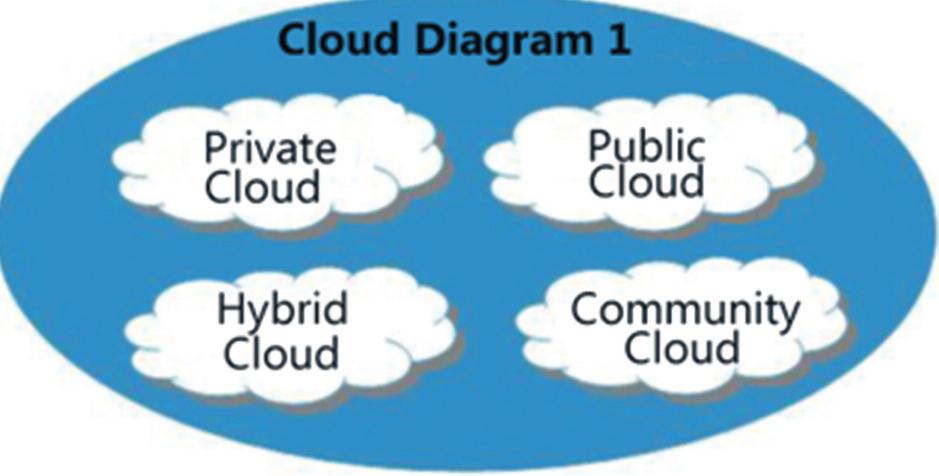
These fluffy, white technology clouds do not bear water particles as the real-world clouds do, neither do they float against the cerulean blue sky nor move across the horizons These are technology clouds, and they bear a completely different meaning What is it?
Let’s move on
Before diving into cloud technology, a very basic level of understanding is required on how a web site works. Let ’s take a sample web site, say, jwt.com. J Walter Thompson is a large New York-based advertising and publicity company with branches all around the world. Like every website with a reason to exist, the purpose of JWT web site is to showcase their work delivered to
clients So, technically JWT site has three layers – client, middleware and server Client is the top layer of a website that you interface with or what you see and interact with For example, a text says “View image”; when you click on this text link, a large image is displayed on the screen Technically, what happens is that a call is made from the client to the database where the image is stored and then the image is processed through the middleware which decides about the positioning of the image on the client and activates some application (example, calculate image price for purchase, paying methods etc ) that may have a linkage with the image call. This is the standard threelayer web site structure: (1) Client taking care of your interaction, (2) Middleware handling your communication and linkages to back-end server and applications, and (3) Server storing information in a database including a huge bundle of images and videos that are shown on the JWT web site. Now, if JWT decides to adopt cloud technology, where would the cloud fit in and why? Let’s move on Cloud is a service over the Internet It is a resource center that can store, manage, and ss data, without having to acss a local server or personal computer, and by that token, the cloud technology is platform independent – i e , it is freely accessible from any digital device By IBM’s definition of cloud, “Cloud computis the delivery of on-demand ng resources – everything from applications to data centers – over the internet on a pay for-use basis ” So, going back to the case of JWT, it ’s a global organization having multiple large size data at each global location’s database It would be a much faster and cost-effective service if there is one central repository like a cloud that would be networked with all JWT web sites across the globe to showcase the company’s work delivered to clients worldwide So, cloud is a technology present at a remote location over the internet that can provide services over networks like WAN (Wide Area Network), LAN (Local Area Network) and VPN (Virtual Private Network) Various network-based applications like email, online education (distance learning),
web-driven conference, customer-driven services such as purchase order generation, customer relationship management, etc all can run conveniently on cloud See Cloud diagram 2 for a network of multiple location-based clients that can access information and applications from the cloud and also send information back to the cloud
Platform dependency is a big issue in customer-driven computer services Cloud computing rules out platform dependency and hence makes applications easily accessible from any digital platform
Other technical terms related to cloud technology are: SaaS, PaaS and IaaS. Let’s move on with these definitions and their usage.
● Software as a service (SaaS)
Cloud-based applications are termed Software as a Service (SaaS). These applications run on distant computers in the cloud (See Cloud Diagram 2) which are owned by cloud service providers and connect to users’ computers via the Internet for a fee
● Platform as a service (PaaS)
Platform as a service delivers cloud-based environment This infrastructure provides complete lifecycle of building web-based applications that run on cloud
● infrastructure as a service (iaaS)
Infrastructure as a service delivers companies with computing resources including servers, n e t w o r king, storage, and data center space on a pay-per-use basis
Cloud Models:
The purpose of this article is to deliver basic knowledge about cloud computing to our readers So, the next level of knowledge would be four types of clouds that are in use today:
1 Public Cloud: Allows systems and services to be accessible to the general public Because of its openness, this category of cloud is less secure
2 Private Cloud: Allows systems and services to be accessible to a private group or people belonging to an organization with enhanced security
3 Community Cloud: Allows systems and services to be accessible to a well-defined group of community members
Continued to page 9
Continued from page 8
4 Hybrid Cloud: A combination of public and private cloud having critical secure services under private cloud and non-critical services under public cloud
End-user advantages of Cloud Computing:
To a common man what does cloud technology offer? Here are some benefits:
1 First of all, you do not have to install any piece of software in your machine to be able to access and manipulate cloud-based resources
them and use them as utilities This is wonderfully useful
5 For readers who are technically hands on, cloud service model offers online development and deployment tools and programming runtime environment
6 Also, Cloud Computing offers ondemand self-service Resources can be used without interacting with cloud service provider
“Cloud computing and services market will grow from $43 billion to $55 billion this year ” Here is an excerpt from a recent survey on cloud technology:

2. If you are in a business of fairly large information storage, processing and delivery system, cloud computing is the most cost-effective solution for you
3 Cloud being platform independent, you can avail cloud-based resources from any technology platform and digital devices anytime over a network
4 You can access cloud-based applications over the internet, manipulate
“Today ’s growing businesses face a tough challenge. Studies show that large enterprises are making heavier use of cloud-based applications than their smaller counterparts, but small and mid-sized businesses are catching up fast Experts anticipate that the cloud usage number to reach 78% of technology usage by 2020 They also predict that the US small and mid-sized business cloud computing and services market will grow from $43 billion to $55 billion this year ” That ’s quite a substantial growth even though there are many downsides of cloud technology like non-security issues, which, I am sure, will be addressed and improved as we move into the next generation of cloud computing So, just hang in there!
Ruby General Hospital, the brainchild of Dr. Kamal Dutta, a dedicated member of Ananda Mandir, is a large 300 bedded multi-specialty hospital with more than a thousand employees and 350 medical consultants. There is constant communication between Indian and US-based doctors with the continuous transfer of knowledge and technology.


By Ruby Banerjea
As I lay sprawled out on my recliner, nursing a bag of ice on my knee, I had just one question, what was I thinking?
It all started at the doctor's office, where my physician had subtly suggested that losing a few pounds would be the best for all my issues
"I do exercise at home " I had tried to protest
"Well, I'm sure you do, Mrs Banerjea, but why not step it up a little? Join a gym, do whatever you enjoy You will be amazed at the difference it makes " She was looking straight into my eyes and was clearly not joking
She had me thinking What was it that I really liked to do?
My daughters had the answer right away
"Join the gym Mom, they have a ton of things which you could do, there's a new Crunch right around the corner "
I looked at her to see if she was joking, but she was never more serious I decided to check it out and then could put the matter behind me once and for all I dragged my husband with me to Crunch, just to check it out However, before we knew it we were roped in My enthusiasm was whetted when our guide showed us all the classes that were held and of which I could be a part of, if I joined There was Zumba! It is a kind of dancercise, and it was fun I had always loved to dance, and I was hooked! We both left the gym, being proud members for the first time in my life. I had no idea what I was getting into.
I could hardly wait to be there for my first Zumba routine. I was confident of my capabilities and was waiting outside the door, much before the scheduled time. As the members gathered inside I took my spot right in the front, so that I could see the instructor as she taught us I couldn't have been more surprised! It was nothing as I had known or expected As she dimmed the lights and blared the music, it was as if everything was happening at a fast-forward motion All I could see was a frenzy of arms and legs flailing every which way and the instructor bending and
twirling in ways that I did not know any human could! Worst of all, everybody knew what they were doing, and I was the only one straining my neck to keep track of the instructor to see what she was doing next, so that I could follow or at least make a very poor attempt to I was failing miserably I have to say that I had no clue that people could move so fast! All the ideas I had of Zumba lessons, were of a very leisured class I had been to one, a few times where most of the students were seniors, as it was a class for the elderly, and the pace was much more doable; I was a good fit there, and so I was naive enough to think that's how all Zumba classes would be
After an hour the class was over and as quickly as it had been all full, it was all vacant before I could blink God, these ladies are fit! I, however, huffed and puffed and managed to go up to the instructor who was thankfully still there
"Excuse me, is there any class for beginners?" I was still trying to catch my breath
All it took was one look at my redfaced wheezing state, for her to know I was one
She broke into a smile and very kindly told me to relax She explained to me how I did not have to do it as she or everybody else does it
"You can do it at your own pace, and don't worry, today's class was a little fastpaced. Next time I will space it out with fast and slow numbers."
Her assurance kept me from quitting and needless to say the pace has not slowed down; instead, as the days went by I started to get used to it and even look forward to my favorite classes. My daughters noticed the change of my attitude from, "I was crazy to join" to "Oh! I have to run it's my favorite instructor today " and they exchange looks and spur me on
However, I can never match my daughters' enthusiasm and I will say, crazy dedication, to exercise and keeping fit! They make it a point to go every single
Continued to page 11
Continued from page 8
people were busy with Prasad and lunch, the Puja volunteers got busy for preparation of Sondhi Puja. Sondhi puja timing was from 5:10pm to 5:58pm, and the puja started exactly on time In the meantime the whole temple was full with people, including chairs for the seniors It makes us glad to see what this puja means to us – it brings all the people in the community closer After the Sondhi puja, evening Stuti, Chandi Paath and Sandhya Arati were completed and Pushpanjali was offered by all On this evening we did observe "Kumari puja" with one Kumari only After prasad and dinner were served, people were requested to go to our new community center for cultural program Nabami puja was on Monday morning, 10 October, from 9:00 am to 11:00 am This being a week day morning, crowd was a little less Still more than few hundred people visited us all through the day As usual Puja, Stuti, Arati and Anjali were performed, all done by 2:30pm The puja committee volunteers got busy in cleaning up the temple in preparation for evening puja Puja started around 6:00pm After regular puja, the special attraction of Kumari puja started Eleven young girls dressed in red Sarees and jewelry were seated to receive puja Dr Santosh Mukherjee presided over this puja Each Kumari was worshipped individually and arati was done for each one. Bhog was offered and some gifts were also given to them. We like to do this ritual every year because it brings so much joy to the children and their parents. The photo session continues for a while to mark a memorable occasion in the children’s lives After Arati and Pushpanjali, Prasad and dinner was served to conclude the Nabami Puja Tuesday, 11th October was set for Dashami puja, from 9:30 am to 11:00am As Puja and other rituals started, the sad feeling of sending our daughter back to her husband's home started to set in For Bisarjan process, we do the symbolic ghat Bisarjan After the rituals of “Debi’s Baran” and looking at
“Debi’s Charan” in the water, ladies carried the ghats outside for Bisarjan. Thus ended our Durga Puja celebration, and we started greeting each other for Shubho Bijaya Dasami. In the evening, we had Debi’s Baran again, followed by Sindur Khela and Dhunuchi dance, just like we used to do back home in India After Sindur khela Arati was done
All in all, we entertained over 2500 hundred people during the puja days serving prasad, lunch and dinner every day The cultural entertainment was organized for three days It included artists from Kolkata, local artists and groups performing dance and drama
We sincerely thank all those volunteers who worked behind the curtain and made this long six days’ program a big success It would not be possible without their time, labor, and sweat all day long, whatever they were needed for- puja prep, food prep , managing crowd, controlling traffic flow, managing front desk, and everything else We got big help from our next generation kids too Our heartfelt thanks go to all of you on behalf of Ananda Mandir management
After a week of Durga Puja, we celebrated Lakshmi puja and Satyanarayan puja on 25th October As usual, our temple was full with devoted people from the community Our volunteers were ready to help the guests with Arati, Pushpanjali, and serve prasad and dinner to them
On 29th of October, we observed our well celebrated Maha Kali puja Puja started at 7:45 pm and continued until 11:00pm. This is a puja that Bengalis do not want to miss. As usual, the volunteers were ready to do the job. After the puja and Arati was done, Pushpanjali started by 10:00pm. Then Biswabhai started the Yagna. Lots of people stayed on until the completion of Yagna After dinner was served, clean up continued until around 1:00pm
Thus we at Ananda Mandir completed our month long festivals of October
Jagaddhatri puja is scheduled for 08 November Please check our website at www anandamandir org or call 732-8739821 anytime for Puja timings
Continued from page 7
Zawistowski, a Polish lady in German-occupied Poland during Second World War in the movie Sophie’s choice
This American movie made by Alan Pacula in 1982 is the most disturbing movie I have ever seen I have watched movies with horrible violence and cruelty, terrible tragedy and all the rest, but none has disturbed me so much as Sophie’s Choice
During Nazi occupation of Poland, Sophie, along with her two young children, Jan and Eva were rounded up by the Gestapo to be sent to a concentration camp Sophie’s father was a Nazi sympathizer Hence the Gestapo-chief agreed to spare her life But then, he specified that one of Sophie’s children would be gassed and the other would be sent to concentration camp for children Then came the real clincher He offered Sophie to choose between her daughter and her son One would live and the other would die!
I was a college-going young man in Kolkata when political heat boiled over in the city and the entire state of West Bengal, leading to murder, mayhem and sheer horror Newspapers were filled with daily findings of headless bodies, rotting corpses and reports of almost incessant shooting and bombing There were columns in
papers designated as ‘Neeruddesh Sangbaad’ or ‘News about lost ones’ where a mother would seek information about her lost son who was last seen on such date One could certainly hear a mother ’s anguish and sobbing in those tiny printed lines
I personally didn’ t experience any of those shootings, stabbings and other atrocities but my heart cried out each time I read about those ‘mother ’s pleas’ in the paper Later on in life, I have watched enough cruelty, violence and blood-shed on celluloid that would curl up my skin In recent years, several movies based on the Indo-China war are brutally violent Apocalypse now and Deer hunter come to my mind But the feeling of horror significantly subsided inside me as soon as movie was over, and was not palpable after a few days
But that scene in Sophie’s choice where Sophie had to make a choice between her son and daughter, the suggestion of horror and savagery has made a permanent imprint on my mind
In the movie, Sophie chose to let her daughter Eva be taken away by the Nazis to be gassed, and her son Jan to be put into the children’s concentration camp Sophie lived through the horror of Nazi atrocities and ultimately came to New York City for a new life. But the horrors of war, particularly her guilt about having to
make a choice between her son and her daughter made such an impact on her mind that she committed suicide while making love to her boy-friend During Nazi captivity and later on Sophie looked hard for her son who had been taken away by the Nazis But he was gone without a trace

A week after
left outside looked deathly pale, leaves were droopy and dry. There was no sign of life in them.
By tathagata Ghosh
The US is one of the few countries in which a woman has not ascended to become the head of state Though it is one of the oldest democracies, even an extremely qualified person such as Hillary Clinton could not break through the glass ceiling It would be hard to assert that any woman in the US, in the next few decades, would even have a competitive chance of being nominated by the major parties as a candidate for the Presidential election
In distinct contrast, most of Asia, Europe and even South America have had many women in the top job of President or Prime Minister
The case of Asia is quite curious A large majority of countries, especially in the Indian sub-continent, have had women as head of state It is worthwhile trying to analyze this apparent anomaly in this supposedly socially conservative region of the world. A glaring fact is that almost all of these women had relatives, typically fathers or husbands, who preceded them as head-of-state. All of these countries were fledgling democracies, and it could be argued that most of these women did not have the qualifications to justify their selection or election A notable exception perhaps was Benazir B hutto who was highly educated and had some political experience before following in the footsteps of her deposed father and was the first head of a Muslim majority country On the other hand, many of them served multiple terms which could mean that they were able to convince their electorate that they were deserving candidates or it was just that their brand, which became stronger after being in office and they benefited from being in the limelight
Many of these women lead-
ers in Asia were fronted by the ruling party in the hopes of election victory just by the virtue of a familiar family name, and that seems to have worked Time after time, the women in question acquired control and power far beyond what their handlers expected Many of them had insignificant roles before their ascension to power An interesting point though is that most of the women were in power pre-2000 and after that the family brand seems to have faded somewhat Whatever power was acquired, or even a fraction of it, did not devolve down to other women in these countries beyond their relatives or to particularly improve the lot of women in general Another common thread is that many of these women leaders or their relatives died violent deaths or had attempts made on their lives
The most prominent women at the present time in Asia are Aung San Suu Kyi, the de-facto head-of-state of Myanmaar and Park Geun-Hye, the South Korean President. They also share the similar characteristics of all the other prominent women in Asia, being related to powerful men, who were heads of state
The case of women who have risen to the top in South America also follows similar storylines as their counterparts in Asia Many did so on the coattails of their fathers or husbands; conspicuous examples are Eva Peron and Cristina Kirchner, both of Argentina, in different decades An important distinction to note about the women of South America when compared to Asian leaders is that many of the South American leaders are post-2000 candidates Many of these women leaders of South America many of them had a good grounding and foundation in the political
Continued to page 12
Continued from page 10
day and sometimes even twice a day if there are some interesting new classes going on. The biggest problem with the fitness frenzy is that I have to watch what I eat! No way! I thought exercise was the answer to all my problems; but if my daughters are with me they will strictly follow their no-carb-after-sundown diet and make my life way more difficult than I did imagine! My elder one will look at the food I serve and quickly get to her smart phone and enter the name of the dish and calculate the calories, and much to my annoyance lecture me on its importance They are so serious about healthy food that my husband and I feel almost guilty to eat 'normal' food! Well, we did sneak in some Pizzas and French fries when the girls weren't there, and the pleasure of doing that was like playing truant!
Even though I groan and moan every time I come back from the gym, I am so glad that I had taken the first step and started I know I am a long way from a no- carb diet, and no junk food policy, but baby steps count too! Next time I go to the doctors I pray that the scales tip on my favor
And I will be lying if I don't say that I kind of love Zumba!
Every society or culture (and you probably are no exception) has pondered over the notion of afterlife The belief in existence of a world beyond our known universe as well as manifestations of the spirits of the dead is widespread, dating back to animism or ancestor worship in preliterate cultures
Many believe in the spirit world and often try to communicate with their loved ones Certain religious engagementsfuneral rites, exorcism, and some practices of spiritualism and ritual magic - are specifically designed to rest the spirits of the dead
Ancestor worship typically involves rites intended to prevent revenants, the vengeful spirits of the dead, imagined as starving and envious of the living These rites may include sacrifice, i e , offering food and drink to the dead as a means of pacification, and magical banishment of the deceased seeking to force them not to return. Ritual feeding of the dead is performed in traditions like the Chinese Ghost Festival, the Western All Souls' Day or the Hindu Pitri Paksha ‘tarpans’ Magical banishment of the dead is prevalent in many of the world's burial customs The bodies found in many tumuli (burial mounds or kurgans) had been ritually bound before burial; the custom of tying up the dead persists, for example, in rural Anatolia – the Asian part of modern day Turkey
Ancient cultures harbored a common belief that the human soul was an exact reproduction of the body in every way, even down to clothing the person wore This is depicted in artwork from various ancient cultures, including such works as the Egyptian Book of the Dead, which shows deceased people in the afterlife appearing much as they did before death, even in the style of dress Elsewhere the soul was sometimes symbolically or literally depicted as a bird or other animals
While deceased ancestors are universally regarded as venerable and often believed to have a continuing presence in some form of afterlife, the spirit of a deceased person, which remains present in the material world (viz. a ghost) is regarded as an unnatural or undesirable state of affairs.
Ghosts are generally described as solitary, human-like essences that haunt particular locations, objects, or people they were associated with in life, though stories of ghostly armies and the ghosts of animals have also been recounted
Another widespread belief concerning ghosts is that they
By Subhodev Das
are composed of a misty, airy, or subtle material Anthropologists link this idea to early belief that ghost was the person within the person (the person's spirit), most noticeable in ancient cultures as a person's breath, which upon exhaling in colder climates appears visibly as a white mist This belief may have also fostered the metaphorical meaning of "breath" in certain languages, such as the Latin spiritus and the Greek pneuma, which by analogy became extended to mean the soul The Bible states that God synthesized Adam, as a living soul, from the dust of the Earth and the breath of God
In many traditional accounts, ghosts were often believed to be deceased people looking for vengeance (vengeful ghosts), or imprisoned on earth for misdeeds during their lifetime The appearance of a ghost has often been regarded as an omen or portent of death. Seeing one's own ghostly double or "fetch" is a related omen of death.
The idea of ghosts or revenants invokes a reaction of fear. This is universally true in pre-modern folk cultures, but fear of ghosts also remains an integral aspect of the modern ghost story, Gothic horror, and other horror fiction dealing with the supernatural
There are many references to ghosts in Mesopotamian religions – the religions of Sumer, Babylon, Assyria, and other early states in Mesopotamia Traces of these beliefs survived in the later Abrahamic religions that came later to dominate the region Ghosts were thought to be created at the time of death, taking on the memory and personality of the dead person They traveled to the netherworld, where they were assigned a position, and led an existence similar in some ways to that of the living Relatives of the dead were expected to make offerings of food and drink to the dead to ease their conditions If they did not, the ghosts could inflict misfortune and illness on the living Traditional healing practices ascribed a variety of illnesses to the action of ghosts, while others were caused by gods or demons
The Hebrew Bible contains a few references to ghosts, associating Spiritism with forbidden occult activities (cf. Deuteronomy 18:11). The most notable reference is in the First Book of Samuel (I Samuel 28:3–19 King James Version), in which a disguised King Saul has the Witch of Endor summoning the spirit or ghost of Samuel
There was widespread belief in ghosts in ancient Egyptian culture The soul and spirit were believed to exist after death, with
the ability to assist or harm the living, and the possibility of a second death Over a period of more than 2,500 years, Egyptian beliefs about the nature of the afterlife evolved constantly Many of these beliefs were recorded in hieroglyphic inscriptions, papyrus scrolls and tomb paintings The Egyptian Book of the Dead compiles some of the beliefs from different periods of ancient Egyptian history
Ghosts appeared in Homer's Odyssey and Iliad, in which they were described as vanishing "as a vapor, gibbering and whining into the earth" Homer's ghosts had little interaction with the world of the living Periodically they were called upon to provide advice or prophecy, but they do not appear to be particularly feared Ghosts in the classical world often appeared in the form of vapor or smoke, but at other times they were described as being substantial, appearing as they had been at the time of death, complete with the wounds that killed them.
By the 5th century BC, classical Greek ghosts had become haunting, frightening creatures who would engage for either good or evil purposes The spirit of the dead was believed to hover near the resting place of the corpse, and cemeteries were places the living would avoid The dead were to be ritually mourned through public ceremony, sacrifice, and libations, or else they might return to haunt their families The ancient Greeks held annual feasts to honor and placate the spirits of the dead, to which the family ghosts were invited, and after which they were "firmly invited to leave until the same time next year"
The 5th-century BC play Oresteia, a trilogy of Greek tragedies written by Aeschylus, contains one of the first references of ghosts in a work of fiction
In the New Testament, Jesus has to persuade the Disciples that he is not a ghost following the resurrection (Luke 24:37–39) Some versions of the Bible, such as the KJV and NKJV, use the term "spirit” Similarly, Jesus' followers at first believed him to be a ghost (spirit) when they saw him walking on water.
In the 5th century AD, the Christian priest Constantius of Lyon recorded an instance of the recurring theme of the improperly buried dead who come back to haunt the living, and who can only cease their haunting when their bones have been discovered and properly reburied
One of the first persons to express disbelief in ghosts was
Continued to page 12
Reported by Debajyoti Chatterji
The final quarter of 2016 offered an unusually varied and enjoyable mix of activities and experiences for members of Ananda Mandir Evergreen Club members
Over twenty seniors enjoyed a delicious multicourse pot luck lunch (all prepared by volunteer members) on Saturday, October 1, before sitting down to learn a number of helpful tips on how to keep diabetes at bay – before and after the disease has been diagnosed in a patient Since diabetes has emerged as a major health issue around the world and is particularly affecting Indian communities here and in India, there was a high level of interest in the insightful presentation by indrani (Papri) Dhar, a professional in the field of nutrition with many years of experience Papri shared with the audience numerous tips on how to control diabetes, even delay its onset, through proper exercise and balanced diet.
After the discussion session following Papri's presentation, Dr. Samir Dutta outlined an estate planning/planned giving approach that, if embraced by the members of the Ananda Mandir community, could generate significant amount of funds for the organization Since Ananda Mandir has a large mortgage burden on its shoulder, such an approach is worthy of serious consideration Dr Dutta was en-
couraged by the audience to share his thoughts with the Board of Trustees
The next session of the Evergreen Club, held on Sunday, November 6, featured two well-traveled speakers, Ram and Janaki Ramachandran About two years ago, this husband-wife duo had given a fascinating account of their 21-day travel through Antarctica to a large audience, and they had been invited back by popular demand to present a “Report from Exotic Destinations: The Galapagos Islands and the Arctic Region” Not surprisingly we had an overflowing crowd of over 30 for the occasion, and the audience was once again treated to a visual feast of spectacular photography The occasion also featured a “snack feast” that was enjoyed by all
The last activity scheduled for the year is a lunch-and- theater outing on Tuesday, December 20. Two dozen seniors have signed up for this group outing that will take us to the Hunterdon Hills Playhouse for a “holiday spectacular” show and a delicious lunch at this well-known “dinner theater”. The group is eagerly waiting for this event and keeping fingers crossed for good weather
The Evergreen Club members wish everybody a very happy and healthy 2017!
Continued from page 11
arena before they made the final ascension In Latin America, most of the leaders seemed to have at least a modicum of experience before they were elected head-ofstate Dilma Rousseff of Brazil or Michelle Bachelet of Chile have come up through the ranks, they are very qualified, savvy and maybe a model for women leaders the world over They have had mixed success during their tenures, and that is to be expected
Europe has had multiple women leaders, and almost none of them had any relative or family name to bank on Seventeen of the 25 countries of the EU have had women in the premier role
The most prominent leaders of the present in Europe are Angela Merkel of Germany and Theresa May of England and Dalia Grybauskaite of Lithuania These ladies have more than a decade of experience in the political arena, before they had an opportunity for the top job. They are
just the more prominent figures in the long line of women who have held the top job in Europe since the ‘Iron Lady ’ , Margaret Thatcher
An important factor that needs to be emphasized is that most of the places with women as leaders are parliamentary democracies, or where there is an indirect election The head of the party in power or the head of a coalition becomes the leader of the country In the US and many other places where there are direct elections for the top jobs, the number of women in the top jobs falls dramatically One prominent success story of a direct election was in Argentina, where Cristina Kirchner made it to the top
The broader point in this is that it seems that it is not necessary that more mature or older the democracies are, the better are the chances of a woman being elected for the top job. Young democracies like the ones in Asia have had significant
Appendix : Prominent Asian Women leaders
amount of women leaders It does seem to help immensely that a relative held a top position before, for a woman to be even eligible for the top spot. An interesting aspect to be further researched is whether women leaders at the helm mean that women’s issues have higher priority. This does not seem to be the case, especially in Asia, where the women are still far from being emancipated In fact, they are still stuck in the morass of societal oppression as if there was never a woman at the helm
In the US, is it just an aberration that no woman has made it to the highest office of the land?
In a nation, which has worked assiduously for women’s right and have so many women in corporate leadership positions, there seems to be a strange resistance to electing a woman as President It may be increasingly impossible for a woman candidate for President to withstand the barrage of vituperative attacks regardless of their qualification So in all likelihood in our lifetime, we will not see anybody addressed in the US as ‘Madam President’ name Designation Year Relation Political
Elected connection relative
Sirimavo Prime 1960 Widow Solomon Prime Minister Multiple Bandaranaike Minster Bandarnaike
Chandrika Prime 1994 Daughter Sirimavo Prime Minister 1 term Kumaratunga Minster Bandarnaike
Indira Prime 1966 Daughter Jawahar Lal Prime Mnister Multiple Gandhi Minster Nehru
Benazir Prime 1988 Daughter Zulfikar Prime Minister Multiple Bhutto Minster Bhutto
Sheikh Prime 1996 Daughter Sheikh Mujibur Prime Minister Multiple Hasina Minster Rehman
Aung San State 2016 Daughter Aung San Father of the 1 term Suu Ki Counsellor Naton
Continued from page 11
Lucian of Samosata in the 2nd century AD In his tale "The Doubter" (circa 150 AD), he related how Democritus "the learned man from Abdera in Thrace", lived in a tomb outside the city gates to prove that cemeteries were not haunted by the spirits of the departed Ghosts reported in medieval Europe tended to fall into two categories: the souls of the dead, and the demons. The souls of the dead returned for a specific purpose. Demonic ghosts were those which existed only to torment or tempt the living. The living could tell them apart by demanding their purpose in the name of Jesus Christ The soul of a dead person would divulge their mission, while a demonic ghost would be banished at the sound of the Holy Name
Renaissance magic took a revived interest in the occult, including necromancy In the era of the Reformation and Counter Reformation, there was frequently a backlash against unwholesome interest in the dark arts
White ladies were reported to appear in many rural areas, and they were supposed to have died tragically or suffered trauma in life White Lady legends are found around the world – common to many of them is the theme of losing or being betrayed by a husband or fiancé They are often associated with an individual family line or regarded as a harbinger of death similar to a banshee
Legends of ghost ships have existed since the 18th century; most notable of these is the Flying Dutchman This theme has been used in literature in The Rime of the Ancient Mariner by Coleridge.
In modern times, the fanciful concept of a mummy coming back to life and wreaking vengeance when disturbed has spawned a whole genre of horror stories and films
In some societies, the mysteries of the unknown have become interwoven with everyday life Nowhere this is more apparent than in India, a deliciously mysterious country to the Western world It is said that India beholds the secrets and stories of a lot of palaces and their kings, of treasures and their keys, of those who died a painful death and are now a part of the broken synchrony that is reality Consequently, a lot of forts or palaces or beaches or even a ‘just another’ valley in India has a his-
tory or a twist of mystery attached to it, or something, which makes a more interesting case The Bhangarh Fort of Ajmer, Rajasthan, is one such destination for tourists embarking on supernatural adventure
Another notable example is The City of the Dead, or Cairo Necropolis (Qarafa, el-Arafa), which an Islamic necropolis and cemetery located below the Mokattam Hills in southeastern Cairo, Egypt
The realm of the dead has not escaped the scrutiny of the scientific community Limitations of human perception and ordinary physical explanations can account for ghost sightings; for example, air pressure changes in a home causing doors to slam, or lights from a passing car reflecting through a window at night Pareidolia, an innate tendency to recognize patterns in random perceptions, is what some skeptics speculate causes people to believe that they have 'seen ghosts'. Reports of ghosts "seen out of the corner of the eye" may be accounted for by the sensitivity of human peripheral vision According to researchers, peripheral vision can easily mislead, especially late at night when the brain is tired and more likely to misinterpret sights and sounds
Some researchers have speculated that changes in geomagnetic fields (created, e g , by tectonic stresses in the Earth's crust or solar activity) could stimulate the brain's temporal lobes and produce many of the experiences associated with hauntings Sound is thought to be another cause of supposed sightings Richard Lord and Richard Wiseman have concluded that infrasound can cause humans to experience bizarre feelings in a room, such as anxiety, extreme sorrow, a feeling of being watched, or even the chills Carbon monoxide poisoning, which can cause changes in perception of the visual and auditory systems, was speculated upon as a possible explanation for haunted houses as early as 1921
Nietzsche argued that people generally wear prudent masks in company; but that an alternative strategy for social interaction is to present oneself as an absence, as a social ghost – "One reaches out for us but gets no hold of us ”
Whether you’re fascinated by afterlife or not, the debate over what lies beyond our known universe is expected to continue for quite some time
By Mandira Chattopadhyay
Most of our stay in India last year was in Kolkata, where both my husband and I have our childhood roots We were put up in a guest house in Salt Lake and driven down to the other parts of Kolkata and its outskirts every day, to meet with relatives and friends We also visited places like the spiritual grounds of Shanti Niketan and the abodes of literary figures such as Sharat Chandra and Bankim Chandra Despite numerous attempts, my husband was unable to connect with his class mates from high school or college Suddenly, out of the blue, a high school buddy who he had recently befriended on Facebook, e-mailed to notify him about the reunion event at his high school that takes place every year on August 15 The school was located just a stone’s throw away from my husband’s ancestral home in Bhowanipur where he had spent his high school days Although this home was no longer accessible to him, having been away from it for so long, he was very excited to be so close to his formal home, connect with former classmates at the school reunion and see what they had been up to
The school that my husband went to is South Suburban School (Main), which still stands majestically in the midst of a very crowded neighborhood in South Kolkata We gathered our belongings to attend the reunion together I dressed myself in a Benarasi Sari with turquoise and gold threading, and my husband wore a long mustard colored kurta. My husband registered as an alumnus at the counter set up in the schoolyard and was presented with a fancy handbag and other paraphernalia, reminiscent of what one receives at the registration counters of scientific conferences. The other counter featured deliciously cooked dinner boxes of rice pulao, rui fish curry, spiced cauliflower and rice pudding, which we consumed merrily and then entered the school corridor of numerous classrooms
My husband was completely overwhelmed as he strolled down memory lane to recall the five years of his life that he had spent here There were speeches made by the alumni of the classes of the sixties, the seventies, the eighties, as well as the millennials There were musical performances by some alumni and their children Accompanied by the harmonium, sitar and tabla, there were soothing renditions of Tagore music, modern Bengali and Bollywood tunes A bunch of my husband’s friends requested him to sing, which he did gracefully in a trembling voice with tears trickling down his face But more than anything else, I was really blown away as I searched through the history of the school, to read about the famous people who had studied there as well as about the people who had taught there These are some of the details which I was able to uncover during my brief stay in Kolkata
South Suburban School was established in 1874 near Hazra Park (now Jatin Das Park) It moved to Gobinda Ghoshal Lane and finally to its present location on Gopal Banerjee Street in B howanipur What is now the secondary building of the school, was built in 1888 by an Italian engineer and the primary building was built in 1908 We saw the new building Ashutosh Bhavan in the school campus that was erected in 2014 to commemorate the 150th anniversary of Sir Ashutosh Mukhopadhyay ’s birth. Notable alumni include Sir Ashutosh Mukhopadhyay, an eminent academic administrator, Premendra Mitra, a famous poet, novelist and short story writer, Arun Kumar Chattopadhyay (Uttam Kumar), the matinee idol and Rabi Ghosh, the comedian Sir Ashutosh Mukhopadhyay, also known as the Bengal Tiger, was a student in the school when Pandit Shibnath Shastri was the headmaster He graduated in 1880 and went on to study in Presidency College where his fellow student was Swami Vivekananda Later he would become the vice
Chancellor of Calcutta University, as well as a justice of the Calcutta High Court He was also the president of the Asiatic Society and the National Library Upon his demise, Tagore had written, Once the Goddess Saraswati authenticated you, Your Life, Her greatness established forever, Let that name sound Her victory
Let your memory last with our worship to Her!
Two of the notable alumni Sourindramohan Mukhopadhyay and Manilal Gangopadhyay decided to have a mourning ceremony at the school hall following the death of Swami Vivekananda In his memoir Sourindramohan writes how they arranged to have Rabindranath Tagore as the chairman of that ceremony and Sister Nivedita as the featured speaker to talk on Vivekananda’s life and his teachings Incidentally, Sourindramohan’s daughter was none other than Suchitra Mitra, the legendary exponent of Rabindra Sangeet
Further, the well-known historian Ramesh Chandra Majumdar was a student of the school who later became a professor at Calcutta University followed by Dacca University Nitish Mukhopadhyay graduated from this school in 1933 He debuted in the movie “Parashmani” and followed it up with about seventy more that included “Saheb Bibi Golam” and “Sagarika ” Arun Kumar Chattopadhyay was a student of this school He would later become the one and only Uttam Kumar. He started his career at the Calcutta Port Commissioner’s Office. He became famous for his role in “Sare Chuattor ” (74 ½), and had more than two hundred films to his credit. We all grew up watching his movies. Tarun Kumar, his younger brother, an accomplished actor of stage and screen was a student of this school. His efforts led to the establishment of “Uttam Mancha ” In his memoir Tarun Kumar writes: “When I think of South Suburban School, a large hall comes into view On the walls hung the pictures of Swami Vivekananda, Netaji Subhash Chandra Bose and other famous luminaries I went to the school again in 1993 to work on a documentary on my older brother (Uttam Kumar) There I saw the school boys performing a drill For a moment I was able to relive my past When I was a student there in the nineteen forties, things were quite different But one should not change one’s mindset – the blessings of the teachers that I received, helped me move forward in my life ”
Bhagwandas Harlalka was a notable figure in the school’s history Harlalka’s clothing store is still a landmark in Bhowanipur In his memoir Harlalka writes: “It was 1932 The Swadeshi Movement was in full swing all over the country The British were torturing the native Indians The plight of the Indian people was deplorable The hot blooded youth was impatiently waiting to take revenge on the British rulers My father came as a street hawker to Calcutta from Rajasthan I was born in Bhowanipur and studied in South Suburban, the largest school there During my senior year, the Swadeshi Movement was at its peak ” The Mullick family of Bhowanipur had a great association with the school with as many as sixty of their family members attending the school A large number of them would later become famous in their respective professions
The vibrant reunion started from the late afternoon that day and went on up to close to midnight. At the end, many of the alumni and their families found it hard to leave the school. I watched my husband’s face glowing brightly, ever so fascinated by the past which was now taking place in the present. Bidding goodbye to all his old classmates, I reminisced on the intellectual legacies of all the school’s current and past minds, and particularly looked at my husband filled with his happy childhood memories, with awe We walked out of the schoolhouse hand in hand, as though we were both students and just like those youngsters, we went out to play under the shining moon
Reported by Subrata Bhaumik
Sahitya O Alochana (SOA) is a monthly literary and topical discussion forum under the aegis of Ananda Mandir (AM) It completed its 8th anniversary in January 2016 and will have organized ninety five (95) sessions by the time the current edition of Ananda Sangbad goes to press These monthly sessions feature exciting and illuminating discussions on diverse subjects including literature, art, theater and movie; history, philosophy and religion; science and mathematics; economics and business; and social issues, sports, and current affairs
The following is an account of the recent sessions organized by the SOA committee of AM october 2016 - The October session was organized in conjunction with by Urhalpool (a bilingual web magazine) and Rattapllax, a literary and film production organization It was held at the Poets House in New York This session featured poetry reading by famous American and Indian poets including Anne Waldman, a famous poet of the beat generation, Yusef Komunyaka, a winner of the Pulitzer Prize and the poet laureate of the state of New York, and others including Catherine Fletcher, Bob Holman, and Goutam Datta Subodh Sarkar, a famous Bengali poet from Kolkata was the guest of honor who read some of his famous poems as well
The organizers offered a special felicitation to Bob Dylan’s Nobel Prize winning by drawing a parallel to Rabindranath Tagore, another famous Nobel laureate from the days of yore who was a lyricist and a poet as well Couple of Dylan’s and Tagore’s songs was performed by Punyaha Mukherjee, a very promising teenage singer from New Jersey. The event was jointly emceed by Kajal Mukhopadhaya and Subrata Bhaumik.
The event was a runaway success attended by scores of NY/NJ poetry lovers from across many communities november - This session was entitled “Comics in the United States and other countries - past and present.” Whether it’s called comic books, graphic novels, or just comic, the creative expression has come a long way over the last several decades Words and pictures/graphics have evolved from simple communication of light hearted fun or imagination for young people (remember Tintin, Hada Bhoda, Batul the Great?) or sarcastic cartoons to a serious form of Art in its own rights Despite the continuing divide in the ranks of pundits over whether or not comics belong to the mainstream art world, our generation has seen its proliferation from innocuous pictorial words that only young minds would enjoy to its evolution into a mature art medium that is firing up the critical imagination to the status quo in the artistic world this session was an overview of this evolution, and we reviewed the essentials of comics as a form of reading, elements of timing, framing and writing; differences amongst illustrated books, cartoons, and animations We tried to chronicle the history of comics in United States and other countries: the golden era, the decline, the collectors’ era, the graphic novel and alternate comics, and the rise of comic book movies Finally, we discussed about a few representative comic books and authors, such as the Contract with God (Will Eisner), Persepolis (Marjane Satrapi), the Arrival (Shawn Tan), Maus (Spiegelman), Frank Miller, Alan Moore, Neil Gaiman etc
Somdip Datta, an investment banker by profession and a graphic novelist by passion, led the session
December - There was no session held in December due to scheduling issues during the holiday season
Future sessions
Quite a few interesting sessions are in the pipeline for the next several months They feature eclectic topics including a session on Bertolt Brecht, one of the greatest dramatists and writers that ever lived and an unsung hero of the Nobel Prize (possibly due to his pro-communist thinking and affiliation); Work of Akhil Sharma - the famous Indian American writer; an Urdu ghazal session (reading and vocal recital); etc.
The friends of Sahitya O Alochana would like to thank Ananda Mandir for its continued support for the forum’s contribution to the cultural enrichment of the local Indian and Bengali communities
Reported By Anshula Sarkar
Fall heralds in an air of festivities Joyful hearts look with expectant hope of sharing love and laughter amidst the fiesta of cultural holidays In keeping with the spirit of the holidays, we at NJPA celebrated our forty eighth year of Kali Pujo and Diwali on November 12
Family and friends of NJPA gathered under one roof to celebrate the Festival of Lights with prayers, food, songs, and dance There were many familiar faces and some new faces that have now become part of our growing NJPA family Guests from all corners of New Jersey and even from our neighboring states were part of this cultural evening Our little NJPAns helped raise money to donate to St Jude Children's Research Institute by doing a bake sale NJPA is going to contribute to the funds raised by our young children and keep the spirit of giving alive We are humbled by the warmth and love that our guests, participants, and volunteers shared with us
The New Year is right around the corner Information about NJPA’s New Year's Eve party will be available on our Facebook page (NJPA Parivar) and also on website www njpa net We welcome you with open hearts and look forward to seeing you at our future events Come make our Parivar a part of your family
Wishing everyone a very happy holiday season!
The Executive Committee, NJPA
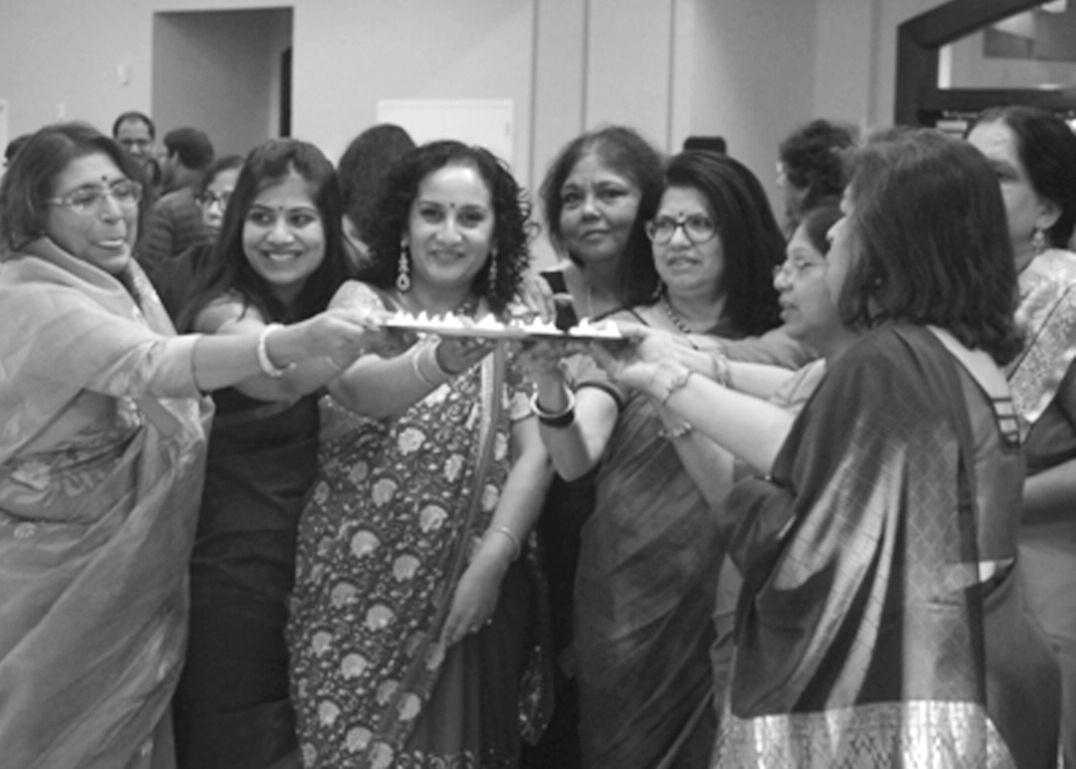
"Ananda Mandir management urges all members and visitors
t o p a r k t h e i r ve h i c l e s i n t h e
p ave d p a r k i n g l o t b e h i n d t h e
n e w C o m m u n i ty C e n t e r
b u i l d i n g . E ffe c t i ve i m m e d i -
ately, parking near the temple or the along the main drive is p ro h i b i t e d . P l e a s e h e l p
A n a n d a M a n d i r a b i d e b y
To w n s h i p F i re D e p a r t m e n t
re s t r i c t i o n s . T h a n k yo u fo r your cooperation."
Reported By Arpita Gupta, President
ICC Garden State celebrated its biggest event of the year, the 2016 Durga Puja, on the weekend of October 1and 2, at the Mt Olive High School ICC Durga Puja has also been locally known as the Parsippany Durga Puja I, on behalf of the rest of the ICC Executive Committee, take this opportunity to thank all members and patrons who helped in making this a grand success
ICC maintained its tradition of holding the Durga Pujas in a homely and cordial environment, with active participation of all its members, all coming together as a huge extended family The two hundred and fifty odd families that attended were all dressed up in their best attire, and were treated to two days of solemn pujas, sumptuous food and lots of entertainment A large number of vendors also attended offering everything from dresses, jewelry, books, periodicals and CD/DVDs, which provided the attendees with ample choices to complete their puja shopping. There were also a couple of snack bars selling authentic Bengali cuisine and refreshments.
The Maha Saptami and Maha
Ashtami Pujas were observed on October 1st with devotees offering their Pushpanjali and then treated to Prasad at its conclusion A delicious Bengali dinnerwhich included traditional vegetarian dishes, goat curry and mishti - was served prior to the commencement of the cultural program
ICC Members opened the cultural program with a beautiful “agomoni gaan” followed by a show based on works of R D Burman and S D Burman -“Pita Putra Katha” by ICC members It was conceived and directed by Sangrami Lahiri This was followed by a dance performance by Dipon Ghosh, directed by Malabika Guha
The main attraction of the evening was the famous National Award winning singer, Rupankar Bagchi from Kolkata, featuring many contemporary, folk, Rabindra Sangeet as well as some occasional English songs Many in the audience moved up to the front of the stage to dance to appropriate tunes.
Maha Nabami and Dashami were observed the following day, which was followed by ‘Sindur
Khela’ and dinner The second day ’s cultural program was opened with a play performed by the ICC Junior Members directed by Joydip Bandopadhyay This was followed by a unique show by ICC Junior Members
“Tribute to Kabi Guru Rabindranath” based on the western inspiration in his music or bhanga gaan The concept, script, direction and choreography were done by Arpita Gupta
The narration was done by Arpita Gupta and Mousumi Chakraborty The main attraction of the evening was Shubhomita, a very melodious singer from Kolkata
ICC also observed Lakshmi Puja on October 16th It was attended by a record number of members A light dinner cooked by ICC volunteers was served at the conclusion Bijoya Sammiloni was celebrated by the members on November 19th at Union Hill Church Almost 100 members attended this event A lavish dinner cooked by ICC volunteers catered a perfect feast for the occasion. Our next event in December and January is AGM and Saraswati Pujo.
Reported By Guru Chakravarty
Andy Bose, a well-known CPA in New York, and a wellwisher of Ananda Mandir likes what he reads in “Ananda Sangbad” so much that he decided to bear all cost of its publication for one year (four issues). To show his appreciation of the authors and friends of Ananda Sangbad, he organized an “Appreciation Dinner ” for us at an Indian Restaurant - “Biryani Pot” in Edison, NJ on September 17, 2016 It was an enjoyable evening attended by the following people from Ananda Mandir: Pronoy Chatterjee, Amitabha & Dhriti Bagchi, Subrata B haumik, SushmitaDutta, Ruby & Ashish Banerjee, Nupur Lahiri, Tathagata & Achira Ghosh, Kankana & Amitabha Sengupta, Arun & Rita Bhowmik, Krishna & Pranab Dutta Roy, and Guru Chakravarty Andy had about 25 people from his side at the dinner
Andy explained his invitation to us by saying, “It is my pleasure and privilege to be of some help to sustain and upgrade the little-known

"Ananda Sangbad" tabloid, which in my mind is pretty rich with fascinating articles written by "amateurs" in a very professional way...I was particularly struck by the wide diversity in subject topics, and its simplicity, depth and lucidity .... ” Guru introduced the participants from Ananda Mandir, the editors and writers of Ananda Sangbad and expressed his appreciation to Andy for arranging this event Pronoy thanked Andy for
his financial support and said, “I now realize how thoroughly you read our news magazine and enjoy reading it ” . Pronoy briefly touched on all activities of the Publication Committee including our annual magazine Anandalipi, “Gayatri Awards for Literary Excellence” and “Kishalay Awards” for writing skill of school age children
Arun B howmik briefly explained the mission of Ananda Mandir to the assembled guests and invited Andy ’s guests to visit our facilities

Ronobir Lahiri landed the lead role of "Amir" in Ayad Akhtar's widely acclaimed drama, “Disgraced” Lahiri was a member of the Tony Award-winning 1994 revival of "The King & I," including a turn as the King of Siam in the 2001 UK tour and the 2005 American tour opposite TV & film star Stefanie Powers. His numerous television appearances include a recurring role on Freeform's "Stitchers" and guest appearances on "Criminal Minds," Torchwood" and many others In addition to his work on stage and in television, Lahiri is a renowned sitar player and a composer, having played with the likes of Ziggy Marley, Katy Perry and Blue Man Group
“Disgraced” fearlessly investigates the 21st century clash between American culture and the Islamic faith
Multi-talented Ronobir is the younger son of our own Dr Nupur Lahiri, a psychiatrist and an editor of Ananda Sangbad
Food Drive by
Ananda Mandir
The food for the needy
c o m e s fro m g e n e ro u s donations made by you - our members, temple a tt e n d e e s a n d a l l w e l lwishers of the commun i ty. W i l l yo u p l e a s e h e l p ? T h i s i s a ye a r round program, so any time is good for the donation. All kinds of nonp e r i s h a b l e fo o d a n d t o i l e t r i e s a re n e e d e d . No glass jars please!
Thank You,
Krishna Dutta Roy, Chair, Ananda Mandir Humanitarian Activities
Please note that you can become a n A s s o c i a t e M e m b e r o f A n a n d a Mandir by donating a minimum of $50. Your subsequent donations of $50 or more are credited to your account. When your total cumulative donation reaches $1000, you become a Life Member. Your supp o r t , s m a l l o r l a rg e , i s m o s t w e lcome and sincerely appreciated.
life Member ($1,000 to 4,999)
Pratapaditya & Chitralekha Pal
Ranjit & Indira Majumder
Sara Dev & Ashim Purkayastha
Amit & Sangeeta Bhowmik
Ayon Datta
Partha & Sudipta Chakraborty
Kapil Bhattacharjee
Sumit Ganguli
Milan & Sipra Rudra
Shubho Sarkar
Manoj & Ashima Basu
Mistry Design
Patron ($ 5,000 – 9,999)
Hemendra & Aparajita Bhattacharya
Anjan & Anupurba Lahiri
Grand Patron – Silver ($ 10,000 – 24,999)
Dhiraj & Chitrita Chanda
Sanchoy & Rajyasri Das
Saroj & Sipra Bhol
Utpal Sengupta
Benefactor ( > $ 50,000)
Kalyan K & Paromita Basu
Ananda Mandir has announced the following winners of this year's contest:
In the Bengali Nominations Category
Sujay Datta (Ohio, USA)
In the English Nominations Category: Sonnet Mondal (Kolkata, India)
Each winner received a cash award of $500 and a plaque with a citation. The judges also decided to recognize Lagnajita Mukhopdhyay (Tennessee, USA) as the recipient of an “Honorable Mention” award in the English nominations category She received a cash award of $300 and a plaque with a citation Congratulations to all the winners!

As a professor, Sujay Datta (Akron, Ohio) leads a very busy life teaching students, guiding researchers and writing papers in the field of statistics But he was always an avid reader of Bengali and (to a lesser extent) English literature He started writing seriously in his college days in Kolkata but after coming to the US as a graduate student, he had to shelve his writing passion for several years. Fortunately, about a decade ago he was urged by his friends in Milwaukee to write something for the local Bengali cultural association's annual magazine. That released his bottled up literary passions, and he returned to his literary activities with renewed zeal. He has published short stories and essays in DuKool, Prabas Bandhu and Batayan and has translated Hindi stories into Bengali The award recognizes him for his creative and skillful story-telling

Born and brought up in West Bengal, India, Sonnet Mondal is a young Indian English poet and editor Author of eight books of poetry, founder of The Enchanting Verses Literary Review, and a member of the editorial board of the Paris-based bilingual magazine Levure Litteraire, Sonnet was recognized by Forbes Magazine in 2014 and 2015 among “the celebrated authors of India”. In 2010 India Today listed him as one of “famous five Bengali youths”. His poems have been translated into nine languages, and he has been invited to read his works at numerous poetry conferences around the world. Just this month he led a fourmember delegation of Indian poets at Ars Poetica Festival in Slovakia The award recognizes Sonnet Mondal for brilliant and multilayered interplay of ideas and imagery in his poetry

At the tender age of 18, lagnajita Mukhopadhyay ( n a s h v i l l e , tennessee) has already become an accomplished poet In 2015, she was named as Nashville's first Youth Poet Laureate, and earlier this year she was selected as Southeast Regional Youth Poet Laureate. As one of the five finalists this year for the National Youth Poet Laureate program of the Poetry Society of America, she was invited to the White House to meet Michelle Obama. Author of a book, this is our war, Lagnajita has published her poems in several local and national magazines and has read her work at many literary events Born in Kolkata, Lagnajita came to the US at the age of 6 with her parents The award recognizes Lagnajita for giving voice to the agonies and aspirations of today's youth