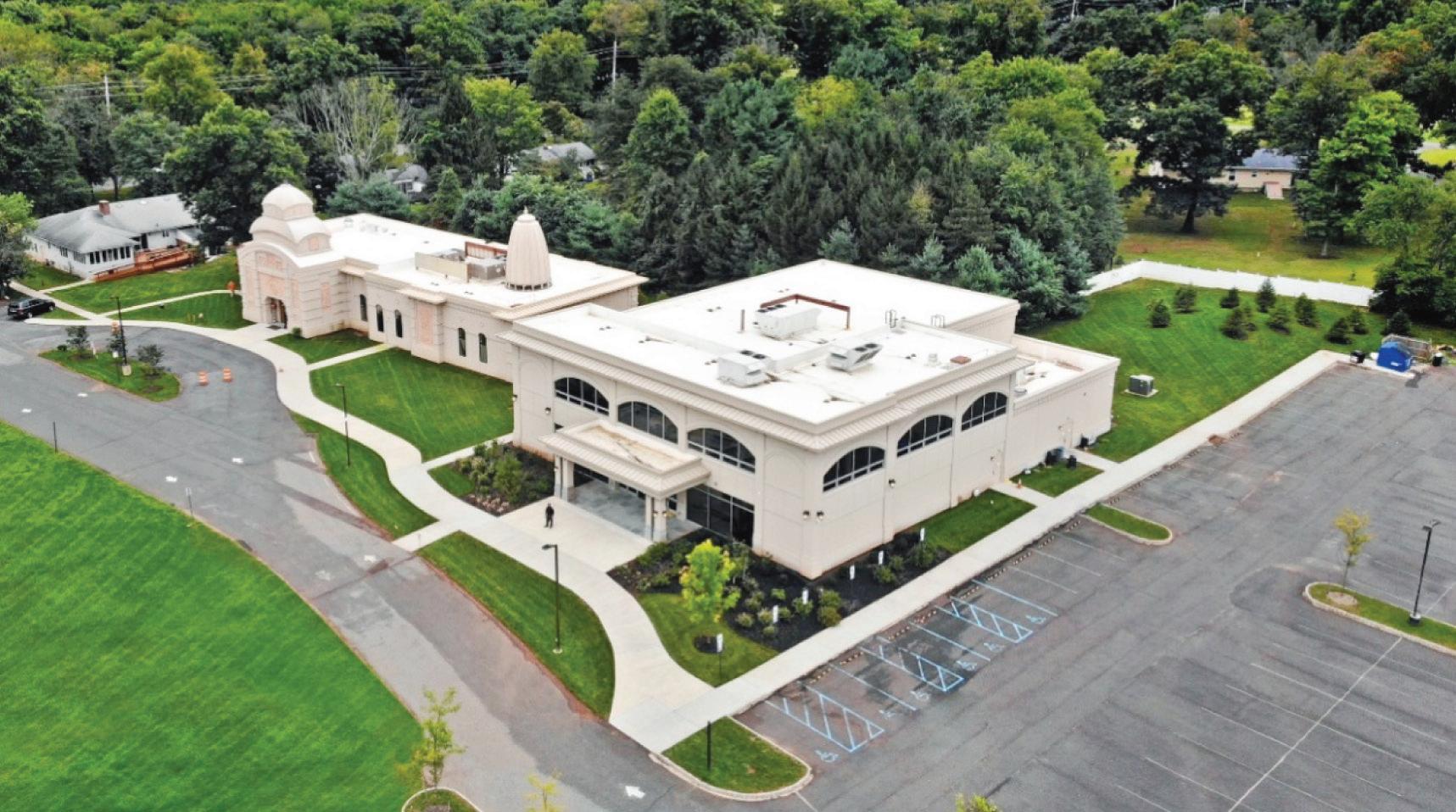
Ananda Mandir
269 Cedar Grove Lane Somerset, NJ 08873


Ananda Mandir
269 Cedar Grove Lane Somerset, NJ 08873
reported
by
Arun Bhowmik, General Secretary
Ananda Mandir’s Annual General Meeting for 2020 was originally planned to be held in May, then rescheduled in September, and finally held on November 22nd. The reason for the rescheduling was the health concerns caused by COVID-19.
Due to the ongoing situation with the pandemic, the usual in-person meeting like the past years was not possible. The AGM 2020 was held virtually, with 50 members in attendance which was more than what was required for the quorum.
The meeting started at 2 pm with an opening prayer from Biswabhai.
Primary topics of discussions were
1. 2019 accomplishments and challenges
2. Outlook for 2020 and beyond
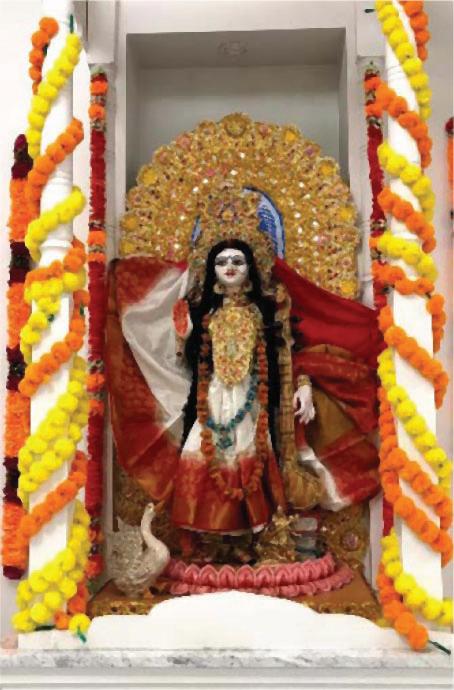
SARASWATI PUJA
16 February, Tuesday 8:30 am – 11:30 am
BANI BANDANA
20 February, Saturday 10:00 am – 11:30 am
3. Results of Board of Trustees Election
FINANCIAL OVERVIEW was presented by our treasurer, Chanu Das. He presented the 2019 statement, duly reviewed and certified by our external auditor. Total revenue in 2019 was $627K, and total expense was $712K (which had a one-time property tax settlement of $331K, a part-year mortgage payment and closing costs, totaling $120K). Barring these one-time expenses, we would have had a healthy operating surplus of over $360K. Net loss from Tagore Hall activities was $31K.
of Ananda Mandir, Inc. fairly presents, in all material respect, its financial position as of December 31, 2019.
BOT ELECTION RE-
SULTS – Surya Dutta stated that 13 Trustees were to retire on May 9, 2019. However, 13 nominations were received to fill the vacancies. Therefore, no election was necessary.
PUJA ACTIVITIES –
Mita Sinha presented the activities in detail. All Puja and related activities in 2019 were very successful with no issues. Total collection from all Pujas and in-temple collections was $315K which was remarkable. In 2020, the year started well, but the temple had to be closed in March due to the pandemic. However, the Durga puja and Kali
UPDATE – An overview of cultural activities in 2019 and 2020 was presented by Sajal Mukherjee. A full plate of cultural events was presented in calendar year in 2019, starting with Bani Bandana, followed by several events in Tagore Hall including music, dance, theater, New Year’s party, and the Gen-Z-Event which was the highlight. A very significant change is now occurring in cultural presentations due to the pandemic. All our presentations, such as e-jolsha, Naba-Barsha program, and all other cultural programs with artists from India and local talents are now being presented on our DIGITAL platform. Ananda Mandir has established itself in the digital media, and it
Special Features of this issue:
“Advaita and Dvaita Schools of Vedanta...” By Amitabha Bagchi … P-3 Gayatri Award Winners (2020) Announced… P-16
For 2020 outlook, the bad news is that the temple and Tagore Hall have been closed since March, resulting in significant reduction in revenue.
The good news is that the Annual Fund-Raising drive this year was very successful ($329K), and the collections from Durga Puja and Kali Puja are also expected to be reasonably good, though less than last year’s.
TAGORE HALL OPERATIONS – Jai Prakash Biswas presented the operational details. We had a good level of booking in 2019, but no bookings since March 2020 due to the pandemic. We are taking bookings for 2021, subject to health regulation by governing authorities, and reservations may have to be cancelled if pandemic restrictions continue.
AUDITOR’S REPORT –
Arun Sarkar, CPA, presented the Auditor’s report, certifying that financial statements
puja were executed extremely well, both from health restriction and revenue point of view, which will be detailed in next year’s AGM minutes.
CONSTRUCTION UPDATE – Ashok Rakhit provided update on construction status. Storm Water Basin work is now complete. The parking lot has been paved with the top layer, and all markings are now complete. The front gate piers are now complete, the aluminum gates have been ordered and expected to be installed in December. Roof work over temple entrance is being completed. Finishing front house basement and renovation of the front house for additional accommodation are being contemplated pending fund availability. A 7 ft tall bronze statue of Rabindranath has been ordered and is expected to be installed outside Tagore Hall in early 2021.
CULTURAL EVENTS
is expected to co-exist with physical presentations in future.
BUDGETING & LOAN REPAYMENT PLAN – Anjan Lahiri began his presentation with a brief explanation of the improved budgeting and income/expense tracking system that was put in place this year. He then proceeded to explain that in May 2019, Ananda Mandir had raised a total of $3.175 million loan from 31 members to pay off the balance of our bank mortgage, saving us a huge amount of bank interest. Annual payments of principal and interest to these loan-givers will begin in December 2020. But the plans had to be adjusted slightly, with the concurrence of the loan-givers, to maintain healthy cash balance for Ananda Mandir. Details of the loan re-payment plan was explained by Anjan.
continue to page 6 }
Calendar of Events (Dates are subject to Change) Please check our website frequently www.anandamandir.org Tel: 732-873-9821
NOTE: If a particular Puja time is not listed, please contact temple or visit our website: anandamandir.org
JAnuAry (*)
new year’s Day Friday, 9:00am – 2:00pm 4:00pm – 8:00pm
Shyama Puja
Tueday, 12, 5:30pm – 7:30pm Satyanarayan Puja
Sunday, 24, 5:30pm – 7:30pm Sahitya O Alochana (*)
Saturday, 16 Cultural Program (*)
FeBruAry (*)
ratanti Kali Puja
Wednesday, 10, 8:30am – 11:30am
Shyama Puja
Thursday, 11, 6:00pm – 8:00pm Saraswati Puja
Tuesday, 16, 8:30am – 11:30am
Bani Bandana
Saturday, 20, 10:00am – 11:30am Satyanarayan Puja
Saturday, 20, 6:00pm – 8:00pm Sahitya O Alochana (*)
Saturday, 27 Cultural Program (*)
MArCh (*)
Maha Shiv ratri
Thursday, 11, 3:00pm – 3:00am Shyama Puja
Friday, 12, 6:00pm – 8:00pm hOLI & Satyanarayan Puja
Sunday, 28, 6:00pm – 8:00pm Sahitya O Alochana (*)
Saturday, 20 Cultural Program (*)
APrIL (*)
Shyama Puja
Sunday, 11, 6:00pm – 8:00pm Sahitya O Alochana (*) Cultural Program (*)
(*) See www.anandamandir.org or Call Mandir for details
Special Religious Services: Upon request, the priest of Ananda Mandir offers services such as in-house Shraddhas, Rituals associated with Cremations (Antyesti Kriya), Shraddha Anniversaries, Pre-wedding rituals (Naandimukh, Ashirwad, etc.), Upanayan (Paitey), Annaprasan, Wedding Ceremonies & Wedding Anniversaries, Griha Prabesh (Bhumi Puja), Consecrations of new cars (New Car Pujas) and others. If you have needs for any of the above or more, please feel free to contact Biswabhai @ 732-873-9821
Ananda Sangbad
A Periodical Newsletter
Published By
AnAnDA MAnDIr
(A Tax-Exempt, Non-Profit Organization)
269 Cedar Grove Lane Somerset, NJ 08873 Ph: 732-873-9821
Website: www.anandamandir.org
PuBLICAtIOn COMMIttee OF AnAnDA MAnDIr
Chairperson: Debajyoti Chatterji, Debsmee572@gmail.com
Assistant Chairperson: Subrata Bhaumik, Bhaumik.subrata@gmail.com
Editor-in-Chief: Amitabha Bagchi, amitabhanj@gmail.com
Executive Editor, Ananda Sangbad: Guru Chakravarty, guruchakravarty@yahoo.com
Executive Editor, Anandalipi: Subhodev Das, subhodev.das@gmail.com
Editors: Sushmita Dutta, sushmitadutt2@gmail.com Amrita Kangle, amritakangle@hotmail.com nupur Lahiri, nupurlahiri@aol.com
Associate Editor: ruby Banerjea, r_banerjea@yahoo.com
Advisors: Pronoy Chatterjee pkc_usa@yahoo.com Ashok rakhit ashokrakhit@gmail.com
l
All queries, articles, news reports and letters should be directed to the Managing Editor Phone: 908-752-3065
E-mail: guruchakravarty@yahoo.com
l For general information, please contact the following executives of Ananda Mandir: Jai Prakash Biswas President
Suprasad Baidyaroy Vice President
Debajyoti Chatterji Vice President
Ashok rakhit
Vice President
Arun Bhowmik
General Secretary
Chanu Das Treasurer
Pradip Majumdar
Assistant Treasurer
Happy New Year to the community! That is, we fervently wish for a better New Year than the one we just survived. That brings us to the extraordinary leadership provided by many Indians to help us understand and to cope with the coronavirus pandemic during the year. Fortunately, we do see the light at the end of the tunnel with the discovery of new vaccines being deployed before the end of the year.
The Coronavirus has affected over 16 million people and caused death of over 300,000 people in America alone as of this writing. Over 73 million people are afflicted by the disease worldwide. Even more importantly, the disease has brought the world on its knees in fear and awe. For prolonged periods, people all over the world were locked up in their homes. People were overwhelmed by the situation and desperately looked for answers to what to do. This is when lead scientific experts, which included several Indians, came into our lives to educate us about it on a daily basis and to offer their advice about how to protect us. The television networks sought them out, along with other scientists, persistently, to tell us more. The media set up many question-answer sessions for the public to ask questions and to get solace from their answers. Never before we have seen such interest in the public to tune in to the unbiased truth coming from scientific scholars.
Three Indian men of medical expertise have illuminated the spotlight on and enhanced the pride of all Indians in America. They are
Sanjay Gupta, Ashish Jha and Vivek Murthy. Their faces are on television almost every day for the last nine months because of their expertise about the deadliest disease encountered by human being in a century.
Here is a short biography of each of the three men to better understand their progress into leadership roles.
Dr. Sanjay Gupta is the multiple Emmy-award winning chief medical correspondent for CNN.
Born in Michigan in 1969, Sanjay obtained his medical degree from University of Michigan. He serves as associate chief of the neurosurgery service at Grady Memorial Hospital in Atlanta, Georgia, associate professor of neurosurgery at the Emory University School of Medicine,
Gupta was considered for the position of US Surgeon General at age 39. Although he had not been formally nominated for the coveted job, the senior members of the Obama administration had made it clear he was their choice. “I think, for me, it really came down to a sense of timing more than anything else,” he said. “I just didn’t feel I should do that now.”
He is the author of three New York Times best-selling books, “Chasing Life” (2007), “Cheating Death” (2009) and “Monday Mornings” (2012). His fourth book, “Keep Sharp: Building a Better Brain” was published in 2020.
Dr. Ashish Jha is the Dean of the Brown University School of Public Health. Until recently, he was the K.T. Li Professor of Global Health at Harvard T.H. Chan
School of Public Health and the Director of the Harvard Global Health Institute.
Jha was born in Bihar in India in 1970 and lived there till he was 9, when his parents, both educators, immigrated to Toronto. In 1983, they moved to New Jersey. He graduated from Columbia University and obtained his medical degree from Harvard.
Jha has emerged as a leading voice of reason and expertise during the epidemic. He is frequently called upon to clarify complicated issues in such forums as CNN, The Washington Post, MSNBC as well as The New York Times. He also advises government policymakers and elected officials. In mid-March, Dr. Jha called for a two-week national quarantine across the United States to reduce the effects of the COVID-19 pandemic.
Dr. Vivek Murthy is a 43 year old physician who served as the nineteenth Surgeon General of the United States from 2014-2017. He has been named by Biden Administration to serve as the new Surgeon General. Currently, Murthy would co-chair Biden’s COVID-19 Advisory Board, alongside former Food and Drug Administration commissioner David A. Kessler and Yale public health professor Marcella Nunez-Smith.
Dr. Murthy was born in 1977 in the United Kingdom. The family moved to USA in 1978. He graduated from Harvard University magna cum laude in 1997 with a Bachelor of Arts in biochemical sciences. In 2003, Murthy earned an MD from Yale School of Medicine and an MBA from Yale School of
Reported By Arun Bhowmik
Management
He is the founder and president of Doctors for America, a group of more than 15,000 physicians and medical students supporting high quality affordable care for all. In 2011, Murthy was appointed by Barack Obama to serve on the Presidential Advisory Council on Prevention, Health Promotion, and Integrative and Public Health within the Department of Health and Human Services. In April 2020, he published a book entitled Together: The Healing Power of Human Connection in a Sometimes Lonely World.
Along with Dr. Murthy, another doctor of Indian ancestry, Celine Gounder, has been named as a member of the new Covid-19 Team. Dr. Gounder and many other Indian doctors are regularly called upon by the news media. Some of these frequent guests on television are Amesh Adalja from Johns Hopkins, Kavita Patel from Brookings, Vin Gupta from University of Washington and Lipi Roy from NYU, a regular Medical News contributor. Another notable doctor is Nirav Shah, head of CDC for the State of Maine. In addition, there are a multitude of Indian physicians and healthcare professionals who work tirelessly in hospitals and do not even have time for anything else but to take care of the Covid patients. We all look up to them in recognition of their amazing public service as proud Indians.
Guru Chakravarty Executive Editor, Ananda Sangbad
After many months of inactivity due to various reasons including the Pandemic, we started the revival of Ananda Sandhya virtually with our first episode on July 19 with local talents.
For September, Subarna, a very versatile singer, sang some “Lalon Geeti”, and that was quite a treat In October, we presented our signature event live “Mahishasura Mardini”.
Our November Ananda Sandhya on 14th was another outstanding program highlighted by the participation of star artists from Kolkata - Acharya Sanjay Chakraborty and his wife Smt Reshmi Chakraborty. We also had our very talented local talents, Swagata Chakraborty, Swagata Goswami, and Shilpi Kundu present Shyama Sangeets and other devotional songs.
Finally, we ended the year on December 20 with another musical presentation by the group “Rhythm Specs”, arranged and directed by Dr. Arindam Chakraborty, the star percussionist.
We hope to continue the Ananda Sandhya tradition next year, virtually for a while, and hope to be able to present in person some day. Ananda Mandir appreciates your support, your interest, and your participation in Ananda Sandhya and all cultural events.
By Amitabha Bagchi
Popular Indian history holds that Adi Shankaracharya rescued Hinduism from being eclipsed by the then ascendant Buddhism in India. He did so through a clever -- or seminal, if you prefer -- amalgamation of the Buddhist concept of reality with those from ancient Hindu texts like the Upanishads (known collectively as Vedanta, or the End of the Vedas) and Shrimad Bhagavata Gita. Shankaracharya rejected the ritualistic, Brahminical Hinduism of the early Vedas that are analyzed in the Purva Mimamsa school of Hindu philosophy. Instead, he began with the late Vedic or Vedantic concept of Brahman or Consciousness as the ultimate cosmic reality. His Brahman, in its Nirguna or formless manifestation, is all-pervasive and immanent as well as ineffable and indescribable. In addition, it is the sole reality and an unchanging entity, whereas all other changing entities are not real (Maya). In this latter concept, he borrowed heavily from the idea or metaphysics of Sunyata (or Sunyavada) of the Buddhist monk Nagarjuna. The parallelism is so pronounced that Shankara’s contemporaneous detractors accused him of being a crypto-Buddhist. The sole reality of Brahman is what earns Shankara’s philosophy the label of Advaita (i.e., Non-Dual) Vedanta
What distinguishes this philosophy from Buddhism is a second part, where Shankaracharya accepts the Vedantic concept of Atman (Self or Soul) but conflates it with Brahman and thus preserves Non-Duality. Buddhist philosophy does not accept the reality of Atman and is hence described as an Anatman philosophy. The identity of Atman with Nirguna Brahman is a key component of Shankara’s Advaita philosophy. He proceeds from there to posit that the self-realization of the above unity is what constitutes Moksha (Ultimate Liberation) in Hinduism.
Shankaracharya’s philosophy’s basis is succinctly captured in this passage from the eminent scholar and philosopher, Surendranath Dasgupta, as quoted in Wikipedia:
“Shankara and his fol-
lowers borrowed much of their dialectic form of criticism from the Buddhists. His Brahman was very much like the sunya of Nagarjuna [...]. The debts of Shankara to the self-luminosity of the Vijnanavada Buddhism can hardly be over estimated. There seems to be much truth in the accusations against Shankara by Vijnana Bhiksu and others that he was a hidden Buddhist himself. I am led to think that Shankara’s philosophy is largely a compound of Vijnanavada and Sunyavada Buddhism with the Upanisad notion of the permanence of self superadded.”
The Advaita philosophy of Shankaracharya, positing the unity of Atman and Brahman, got serious pushback centuries later from two major figures of Vedanta philosophy – Ramanuja Acharya (Vishishtadvaita) and Madhvacharya (Dvaita Vedanta). Together they put in place a strong Vaishnavite tradition of late Hinduism, which was further enhanced by Shri Chaitanya Mahaprabhu. Ramanuja Acharya codified a line of thinking that moved away from absolute Non-Dualism to Qualified Non-Dualism (Vishishta Advaita). Brahman is still the one and only reality, but it is no longer Nirguna, i.e., without attributes. Reality as Brahman is Saguna and has three attributes: Ishvara (as VishnuNarayana or Shiva), Jiva (the sentient beings) and Ajiva (the insentient objects). The three are referred to alternatively as Parabrahman, Chitbrahman and Achit-brahman respectively. The philosophy is still non-dualist in the sense that Brahman alone exists, but it is characterized by multiplicity. The metaphysics consists of exploring the relationship among the attributes, of which Ishvara is the primary or substantive part of Brahman, while the other two attributes are secondary.
Coming some two centuries after Ramanujacharya, Madhvacharya rejected the previous two schools of Vedanta and established a third, the Dvaita (i.e., Dualist) school of Vedanta. Also called
Bhedavada, this school of Vedanta believes that (quoting Wikipedia) “God (Vishnu, supreme soul) and the individual souls (jīvātman) exist as independent realities, and these are distinct, being said that Vishnu (Narayana) is independent, and souls are dependent on him.” We now have the identification of a God with form (as imagined or visualized by the devotees) with Brahman itself. The first reality is that of Vishnu as Brahman, the supreme self. But the second reality “is that of dependent … but equally real universe that exists with its own separate essence.” Continuing the analogy further, to Madhvacharya, “the metaphysical concept of Brahman in the Vedas was Vishnu.” This leads to a concept of monotheism that is most avidly embraced by the International Society for Krishna Consciousness (ISKCON).
* * *
The concepts of Dvaita vs Advaita Vedanta philosophy were presented with supreme clarity and erudition by Swami Sarvapriyananda on a virtual (Zoom) meeting of Ananda Mandir’s Sahitya O Alochana on October 11. Swamiji is a monk of the Ramakrishna order who heads the Vedanta Society of New York. He went over the history of non-dual and dual Vedanta -- interlacing his talk with Sanskrit quotations and funny anecdotes. Noted for his lucidity, oratory and depth of knowledge, Swami Sarvapriyananda’s presentation was spellbinding indeed. Swamiji mentioned in passing the six major streams of orthodox Hindu philosophy, known as Darshana: Nyaya, Vaisheshika, Mimamsa, Samkhya, Yoga and Vedanta Of the six, in recent times, Advaita Vedanta has become pre-eminent as the accepted distillation of the Hindu philosophical thought. The reason is not hard to understand. First of all, it has an enormous appeal to the rational mind. Second, it is simply easier to present the pantheistic (allpervasive) and monist (unitary) aspects of Brahman to practitioners of monotheistic, mainly Abrahamic religions like Christianity and Islam. Small wonder that as part of the Hindu revival associated
By Jayashree Chatterjee
Is this the age of Zoom?
After all, in these stay-athome times, Zoom seems to be the video conferencing platform that is most popular whether it is for the more formal setting of an office meeting or a fun and casual one like getting together with friends or family. In fact, in March of this year, Zoom had 200 million daily meeting participants, according to its CEO Eric Yuan. Also is the phrase “Age of Zoom” to grandiose?
In answer to the first question, though Zoom seems to be one of the most popular platforms, there certainly are other kinds of video conferencing software that are being used right now. Till I retired just a few years ago, at work we always used GoToMeeting and were very satisfied with it. In fact Zoom and GoToMeeting have many features in common. But now, at my old place of work, they are using Zoom for their office meetings. So are many educational institutions. A student at Harvard University’s Graduate School of Education says that last November, when he was looking for a video conferencing platform for a research paper that he was writing, his IT department recommended Zoom. They had bought the license in the fall, they said, because it was so good. And this is true of many other colleges in the US, and India, as well.
For a smaller group of participants, Facetime, Skype and WhatsApp video, amongst others, are popular as well. So the choice of platform seems to depend on the number of attendees, which software is most user friendly, and the cost involved.
To what extent does Zoom satisfy all these conditions for non technical people? For those of us who need just a basic platform to engage with a large group of people, perhaps the lure of Zoom is that it is a new tool, that it is very easy to use, and that a host can use it free of charge for up to 40 minutes. I should also add, though, that many people who are using it during these trying times for social reasons, are also ready to pay for it, and are doing so. But they can use the 40-minute feature to familiarize themselves with its characteristics before they
purchase it.
In my house, on certain days of the week, you ‘ll find me clearing things away from near the dining table, not just to make it look better but also to get more floor space. After all, this is where my husband meets with his physiotherapist on Zoom and does his exercises. Zoom dictates in which room he attends these meetings. In our house, this is the place where we get both the most sunlight and the most space. Also, we have to position our laptop in a way that makes it easy for the therapist to see what he is doing. On the other hand, though my book group holds its meetings on Zoom as well, the meetings take place in the evening, and I don’t have to be on my feet while they are being held. So I gravitate to the luxury of sitting in an armchair in the living room. My husband and I do the same when we attend Ananda Mandir’s Senior Forum or Writer’s Club sessions that are also held on Zoom. We can relax in the comfort of armchairs while we listen to the other members sing, recite poetry or read out their prose pieces. Of course when I’m on Zoom with my grandchildren, some of whom live in California and others in Lexington, MA, and whose ages range from 6 to 11 years, I roam round the whole house, laptop in hand, because that is what our conversations necessitate. My little grandson loves the special feature on Zoom that allows him to change his background. The one that his favorite allows him to look as though he is floating space. And he laughs with great glee as he tells me that he is floating around with the stars. Another impressive Zoom background is one that was used by a Writer’s Club member. There was an imposing castle behind her, and she seemed quite regal as she sat there, looking out at us from what could have been the royal gardens of a long line of monarchs.
During these unusual times, many different kinds of groups use Zoom. A friend said that his Camera Club now uses Zoom for their meetings. He says people can see one another’s photographs clearly and that
By Mandira Chattopadhyay
Manyyears ago, my family visited Soumitra Chatterjee in his modest home in Golf Green, Kolkata. We went to see the man who became famous in the cradle of Satyajit Ray’s films. As we went inside, we saw him sitting under the lampshade of woven straw, glowing like a demigod. We felt like there sat Apu! Even to this day, members of my family remember his chiseled face, perfect chin and thoughtful eyes that mesmerized us. For a superstar, Chatterjee was unusually unconcerned by the glamor and glitz, the thrill of public adulation; he lived simply in a house on a government housing project in Golf Green, Kolkata, the same house he lived for over three decades. He worked out of a study where he also met visitors. He was accessible and clearly never felt the need to protect his stardom from public at large.
There are so many facets of Soumitra Chatterjee. Besides being a legendary actor, he was an essayist, poet, founder, and coeditor of a literary magazine Ekkhon, a painter, a playwright, and a theater director. He was not simply a film actor, he was so much more, and he read and read, and carried a large, red clothbound notebook with him all the time. In this he would jot down lines of poetry, salient points about the characters he was playing, while continuing to chat, laugh with his sense of humor. Soumitra would occasionally recite or sing Rabindra Sangeet lustily in small get-togethers. Known as Pulu in his young age, he was very much admired by the great poet Shakti Chattopadhyay, who stated, “To me he is a born poet; poetry runs through his vein. What I like the most, despite his hectic life, his notebook was filled with his poetry. I admired his editing of Ekkhon I am a great admirer of Pulu. Besides being an actor, it is extremely hard to find such a wonderful person like him.”
Soumitra was always inclined towards literature. His college professor was the famous litterateur Narayan Gangopadhyay. His grandfather Lalit Kumar Chattopadhyay wrote all sorts of books. Both his parents were avid readers, and his father acted in some amateur plays.
Even in their financial struggles, his family continued to buy books. Their focus must have left a lasting impression on him. He never had any interest in formal education although he was a heavy reader. As a child, his mother always heard complaints from their neighbors that he was a troublemaker along with a group of kids in the neighborhood. But the only way to shut him up was to give him a couple of books to read. In his uncle’s house he used to get immersed in books in the library known as Sir Ashutosh Mukhopadhyay Library. Whether or not he understood what he was reading he would simply gobble the books up. In his young age he used to gather some young kids and staged his writing.
As he grew up, his girlfriend Deepa (who would eventually become his wife) came to visit him on his birthday when he was sick. While in bed, he translated Omar Khayyam from English to Bengali and gave it as a gift to Deepa. It demonstrates how crazy he was about poetry. He would be intoxicated by the poetry of Rabindranath Tagore and Jibanananda Das. The very well-known critic of film and theater, Samik Banerjee commented right after his death: “Soumitra Babu was not just an actor. Right from the beginning when he did Apur Sansar in 1959, he was engaged in writing poetry and became a major poet of his generation, edited a literary journal, very very distinctive.”
Soumitra Chatterjee frequented Coffee House in College Street and continued even after he became a big star. He would sit there with his intelligent friends, many well-known poets, and authors among them. They would drink endless cups of coffee while the swirling smokes of the coffee would dance around and they discussed everything under the sun, from poetry to politics to painting. He was so creative that besides acting and writing he also was a painter. He was perhaps imitating Satyajit Ray, as he would illustrate the covers of the magazine he edited. In art, we could say it is a distant and silent provocation from Rabindranath Tagore, who would doo-
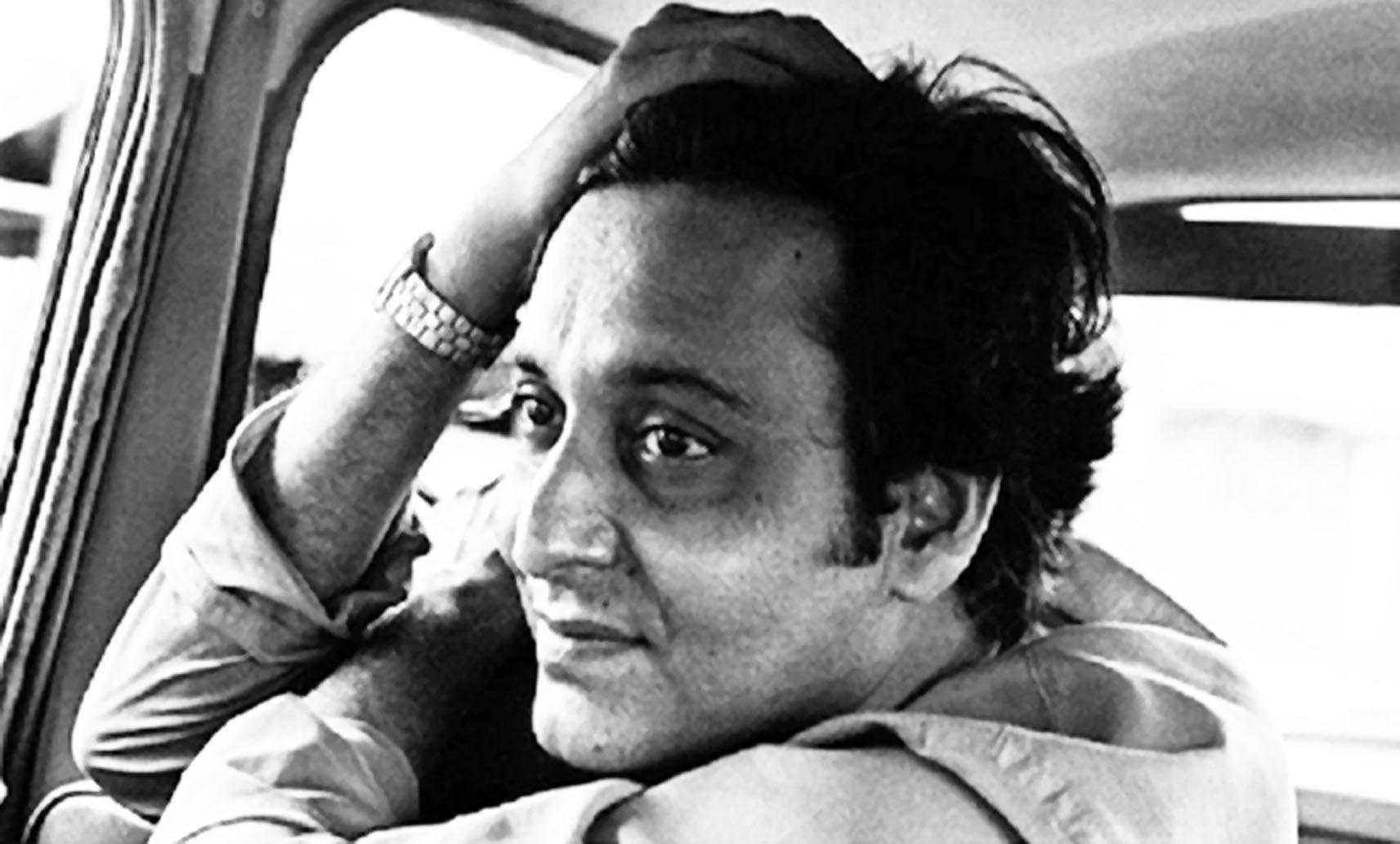
The legendary actor of Bengali cinema, Soumitra Chatterjee died on November 15, 2020 (“Reproduced from the internet for non-profit purposes only”).
dle as well. Samik Banerjee said that Soumitra became a painter in his own right in the last ten to twelve years of his life, and his paintings were widely exhibited. When the first book of the legendary Bengali actor Soumitra Chatterjee’s paintings and annotations was launched, the thespian said he drew his inspirations from the doodling of Rabindranath Tagore.
Both Samik Banerjee and Soumitra Chatterjee were associated with the legendary Bengali theater personality Sisir Kumar Bhaduri, though they were in contact with Sisir Bhaduri during the last three years of his life. Soumitra learned the basics of acting from Sisir Bhaduri, the passion and qualities of which he later would try to inculcate in his acting. While watching Sisir Bhaduri act, he felt how when he would act one day with a poetic passion. For the past two and half decades he was more into theater, where he could do whatever he wanted to do.
Chatterjee said that as an actor he would draw the family trees of characters he portrayed on stage and screen to understand them. He inhabited an intellectual universe where he wrote and recited declaring that he could spend an entire night reciting the poetry of Tagore and Jibanananda Das. When his recording of Banalata Sen, the romantic poem by Jibanananda Das was included in the album, it immortalized the work and the voice that recited it.
It was the depth of intellectual understanding that set him apart. Samik Banerjee with encyclopedic knowl-
edge of film and theater, observed that the actor permeated his craft with the richness of all his other creative and intellectual pursuits. As the editor of the three volumes of Chatterjee’s collected writings, Banerjee pointed to the prodigious creative energy of the actor who worked with the words, lines, and the body and above all, a reflective mind.
Chatterjee said in one of his interviews that he took the roles seriously. This professional commitment was almost impersonal, in the sense that he gave to every role regardless of the script, the direction and production, a part of himself that was a reflection of his deep search for meaning within the characters he was required to play.
Satyajit Ray once told him. “Soumitra, I have always given you a free rein as an actor. But we must etch out the characters together.” Satyajit Ray gave him the thread and he started to weave. Before doing Apur Sansar he took trips to Krishnanagar where he spent the early years of his life. He walked on the paths of the guava trees and watched the mannerisms of the villagers. He had a great vision.
Soumitra Chatterjee, a cultural icon of Bengal who straddled the world of theater and cinema, will be remembered not just an actor, but also a public intellectual speaking out on varied issues including politics. That is why Soumitra Chatterjee, Samik Banerjee, the late Karuna Banerjee (Samik Banerjee’s sister-in-law who acted in Pather Panchali) spent many evenings talking about litera-
ture and politics in Samik Banerjee’s abode in Hindustan Park in Kolkata, where I used to visit my guru Samik Banerjee to learn theater and literature. Soumitra Chatterjee acted in the Bengali version of King Lear (Raja Lear) quite late in his life but acted very well in that play. He knew that “As I lay dying” his final curtain will fall soon. So, he asked the audience at the beginning of the play Raja Lear, “Who am I?” He wanted to live long like Tagore who wrote in one of his last poems, “Who am I?” I asked the sun. There was no answer.”
The noted critic of Indian theater and film, Samik Banerjee stated that the actor gave a new lease of life to every role he played and had never been repetitive whether on screen or on stage. Watching the television, the day he died, I witnessed how the tearful audience were bidding goodbye to their favorite Feluda. As the sun set, people lit candles in homage, and we could hear his favorite Rabindra Sangeet being played. On the TV as I saw the public gathered at his home in Golf Green and lined the roads as the cortege wound its way through the city, I was so grief stricken to remember there was where I met the icon long time ago. I could not be silent. I felt like telling the Covid 19 Yamaraja as Nandini in Red Oleanders (Rakta Karabi) found the death of Ranjan. She said, “Look there! He has come, my hero braving death. He leaves behind him in death his conquering call. He will live again, he cannot die.”
Ananda Sangbad
Kolkata, or Calcutta...The City of Joy, the name which is quintessential to Bengali culture and heritage and the city where many of us lived and also some like me, were born. The city that is bedecked with stunning remnants of Colonial India where contemporary influences meet old world charm. Our nostalgia of the city is enlivened by the buzz of the
By Pradip r. Das
marketplace blending with the lull of the Hoogly, the raggle-taggle confluence of architecture, people, cuisines and the colors of the red brick buildings and yellow taxis.
Many know Kolkata as a sleepy and lazy city but there is no end to its fascination. There are so many fun as well as intriguing facts about Kolkata which have either been forgotten or fail to get noticed owing to today’s fast paced lifestyle. Let us revisit the many places and facts of our beloved city, some known and some perhaps obscure to many of us.
Kolkata has a preeminent place in the history of American diplomacy, where the second oldest American Consulate of anywhere in the world was established and the oldest in India. The first American President, George Washington nominated Benjamin Joy of Newbury Port as the first American Consul to Kolkata on November 19, 1792. With the advice of Secretary of State Thomas Jefferson (later to become the third President of America) and consent of the Senate, President Washington commissioned Benjamin Joy to that office on November 21, 1792. His arrival was the beginning of a long official American relationship with Kolkata and, indeed, all of India.
The Royal Calcutta Golf Club, founded in 1829, is the oldest golf club in India and the second outside the British Isles. It is by far one of the most prestigious landmarks in the country.
Similarly, Calcutta Polo Club, the world’s first polo clubstill in existence, was established by two British soldiers in Calcutta in 1862. Later they spread the game to their peers in England. The sport was particularly popular amongst the royals and Nawabs of Bengal.
Dalhousie Square has a riveting past. This square served as the administrative seat of the British Colonial rule before they moved to Delhi. The British invested heavily in this area with striking architectural structures which amalgamated Georgian, Victorian and Gothic styles. Also constructed in this area were awe inspiring structures like the St. Andrews Church, the Metropolitan Building, Writer’s Building and the General Post Office. Today this neighborhood is called BBD Bagh in memory of the three revolutionaries Benoy, Badal and Dinesh who shot the Inspector General of Prisons in the balcony of Writers Building. After the attack, the men committed suicide.
The Indian Coffee House on Col-
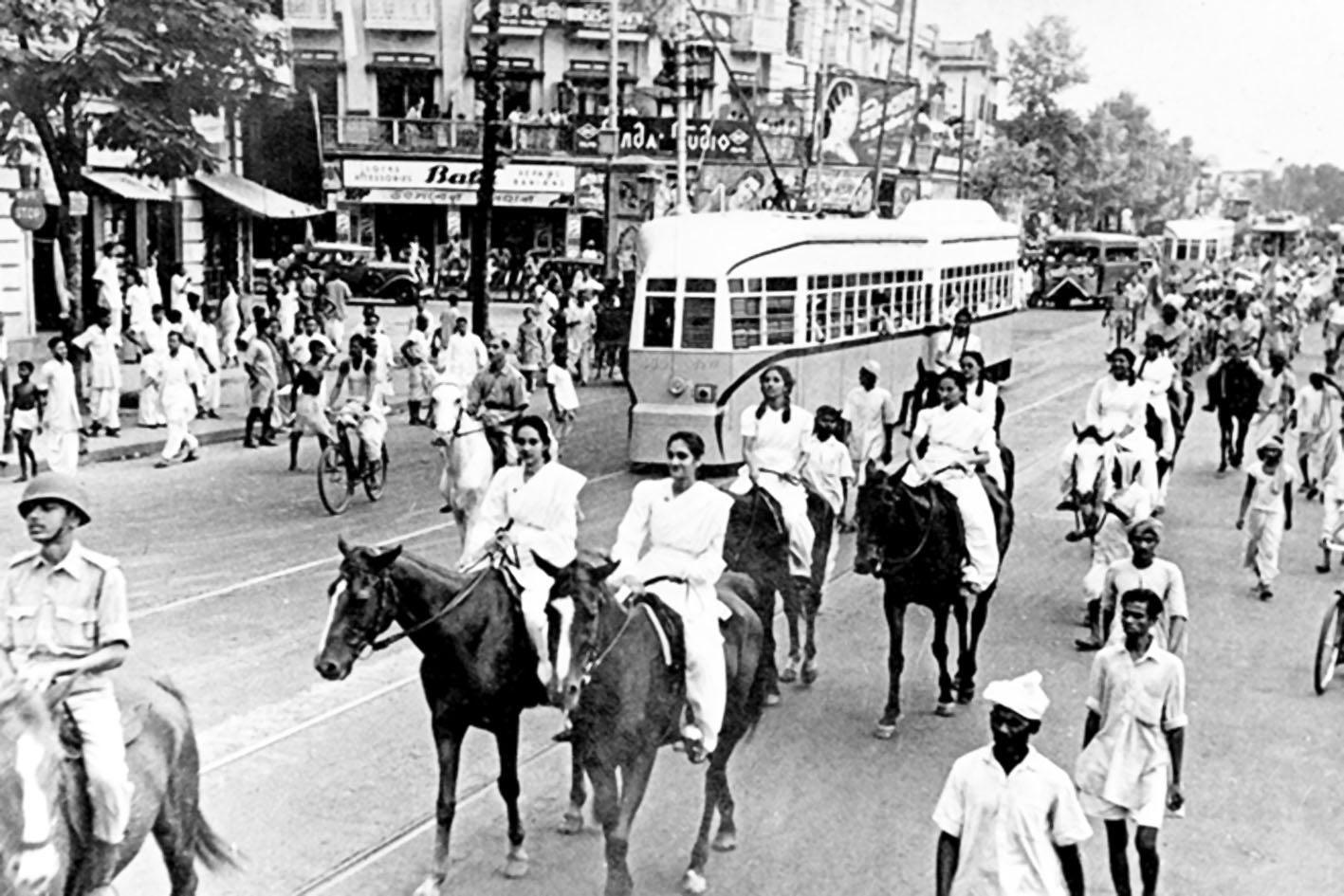
lege Street is steeped in History and Bengali Culture.
Although the “adda” is the most symbolic element of the Coffee House, this unassuming establishment was the meeting place for freedom fighters, revolutionaries, novelists and film-makers. Even today, the coffee shop is a haven for college students and academics where, on most days, the tables are packed with enthusiastic people talking and discussing animatedly over all possible topics covering politics (both Indian and foreign), book reviews, cinemas and songs, latest gadgets etc. over piping hot cups of coffee and tea.
Kolkata is a book lovers’ paradise, and The College Street Book Market is the largest book market in India and possibly the largest secondhand book market in the world. The “boipara” or College Street in Kolkata is a prominent center for Kolkata’s literary crowd and has an altogether different charm. Amongst the smells of new and old and dog-eared books at the many kiosks, one can find attractive bargains on pre-owned books.
David Hare established the Hindu College with 20 scholars in 1817. Thus, the street on which Hindu College was located came to be known as “College Street” under the governorship of Lord Wellesley. Many other prominent colleges are also located on this street.
Kolkata Book Fair is one of a kind and is Asia’s largest book fair. This event witnesses an ensemble of celebrities and commoners gathered to purchase books; the fair also brings together an amazing collection of different forms of art and artistic renditions throughout the duration of the fair.
New Market, chaotic but colorful, has been an integral part of Kolkata since 1874 and is a vast shopping complex comprising a maze of shops housed in Gothic style arcades. From groceries to shops carrying the latest trends in fashion, New Market houses everything to satisfy every shoppers’ needs. It is impossible to
the second largest football stadium in the world with a reported seating capacity of 120,000 . The stadium hosted the finals of the 2017 FIFA U-17 World Cup, alongside hosting other matches of the tournament. It will be the site again for the 2021 FIFA U-17 Women’s World Cup.
miss the amazing style of shoppers here, as they snake their way through the crowd and shoppers’ lanes to bargain for the perfect price. During winter, New Market dresses up for the Christmas spirit, every shop is decorated with a festive display and a Christmas Tree, mired in grandeur, stands in the courtyard.
Who amongst us does not consider “Indo-Chinese Cuisine” as one of their favorites? Chinese people living in Kolkata, mostly of Hakka origin, first introduced this famous cuisine. Kolkata has India’s only Chinatown and the restaurants there serve awesome food.
The Great Banyan Tree located in the Botanical Gardens, Shibpur is over 250 years old and the largest tree in the world in terms of the area it occupies. The tree draws more visitors to the garden than its collection of exotic plants from five continents. Its main trunk was diseased after it was struck by two cyclones, so in 1925 the main trunk was amputated to keep the remainder healthy, leaving it as a clonal colony rather than a single tree. Incidentally, the banyan tree is also India’s National Tree; because of its longevity it is considered immortal and is an integral part of the myths and legends of India.
The Calcutta Football League, founded in 1898, is India’s oldest football tournament and the second oldest in the world. Mohun Bagan Sporting Club and the club’s football section, now known as ATK Mohun Bagan AC, is one of the oldest in India and Asia. The club is most notable for its victory over East Yorkshire Regiment in the 1911 FIFA Shield Final. That victory made Mohun Bagan the first all-Indian side to win a championship over the British side and was a major moment for India’s push for independence.
Vivekananda Yuva Bharati Krirangan, also known as the Salt Lake Stadium, with a current capacity of 85,000 is the second largest football stadium in India by seating capacity. Prior to its renovation in 2011, it was
Park Street, synonymous with glamour and good times, was not always bustling and lively. It was known as the Burial Ground Road during Colonial Rule. This eerie street was mostly avoided till Sir William Jones founded the Asiatic Society in 1784 to study the culture of the Orient. Gradually the landscape of the once avoided Burial Ground Road changed and in the 1920’s, a Swiss Couple opened a quaint tearoom here that later became the famous Flury’s patisserie. The area was renamed Park Street and this once lonely area was infused with spirit. Today, Park Street represents the joy and mirth of Kolkata, and a haven for food lovers with restaurants galore. There is something for every palate and cuisines to placate even the fussiest eaters. Pubs and Nightclubs are the other attractions of the area where Kolkata’s best dressed come out to party. With the influx of tourists and trendy locals, Park Street represents the pulse of Kolkata.
Referred to as “The Jewel of the East” by American author Mark Twain, the 180 year old Great Eastern Hotel was unveiled and formally re-launched by the West Bengal Government in 2013. Once reputed to be the first luxury hotel of Asia, the hotel is now known as Lalit Great Eastern. Encouraged by the success of his thriving confectionery shop in Kolkata, Englishman David Wilson launched a hotel in 1840 and named it Auckland Hotel after the then Governor General. Popularly known as Wilson’s Hotel till 1865, it was renamed as the Great Eastern Hotel thereafter. In 1883 it became the country’s first hotel to be fully illuminated with electricity and was the favorite haunt of the elite of the city. The hotel, as it stands today, is an amalgamation of the styles from three different eras, Victorian, Edwardian and contemporary as displayed in its various blocks. In 1975, West Bengal Government took over the hotel and in 2005, the current owner, Lalit Suri, bought the hotel and hence the current rename.
Erected in 1906 and to pay homage to Queen Victoria, Victoria Memorial bears testimony to Kolkata’s colonial heritage. However, to make room for this colossal marble structure, the Presidency Jail on this site was relocated. The Victoria Memorial area, due to its fascinating background, has developed into a cultural hub and become a forum for intellectuals, art enthusiasts and history lovers. One is easily transported to a past era while strolling down the cobbled streets or indulging in a horse-drawn carriage ride around the monument. Kolkata’s Tramway System is one of the old-
continue to page 6 }
| continue from page 5
est in Asia and currently the only operational one in India. The intricate maze of tramlines was laid by the Calcutta Tramway Co. in 1880, and the coaches were initially horse drawn and later made electric. Interestingly and during the British Rule, the tram was reserved for highranking officials only. Currently, the tram is affordable traveling around the city for everyone. The tram connects people from all backgrounds and the distinct neighborhoods of Kolkata.
Kolkata has always promoted science and technology and has produced some internationally acclaimed scientists. Constructed in 1963 and inaugurated by the then Prime Minister, Jawaharlal Nehru, the Birla Planetarium is the largest planetarium in Asia and also the second largest in the world.
As an added fact, Science City is the largest center for the culture of science in the Indian subcontinent.
One cannot reminisce about Kolkata without mentioning Howrah Bridge. At the time of its commission in 1943, it was the third longest cantilever bridge in the world. Linking the two cities of Howrah and Kolkata, it was renamed Rabindra
Setu in 1965 but is still popularly referred to as Howrah Bridge. Carrying a daily traffic of approximately 100,000 vehicles and possibly 150,000 pedestrians, it is arguably the busiest cantilever bridge in the world. The bridge is considered as “The Gateway to Kolkata”, as it connects the city to Howrah Station.
Howrah Station is not only India’s busiest, Howrah Junction of this station is also the largest and oldest complex in India.
Indian ports, through increase in trade and commerce have always been important to India and its sea and river ports have flourished and emancipated since pre-independence times. Few know that the country’s only riverine port is at Hoogly called the Kidderpore Port which also happens to be the oldest port in India.
These and other unique facts add to the old charm which remains the main attraction of Kolkata. By-lanes of the city has houses and shops that reflect the rich history of the by-gone eras and this gives the metropolis its distinct character and engulfs visitors in its charms. It is of no wonder that anyone who has lived in this city carries a part of Kolkata with nostalgic pride in their hearts.
| continue from page 3
with the Bengal Renaissance, Raja Rammohun Roy developed his idea of the (new) Brahmo sect of Hinduism around Shankaracharya’s concept of Advaita Vedanta. Rammohun was deeply impressed with both Islam and Unitarian Christianity, and he imported aspects of those faiths and merged them with Advaita Vedanta to develop his ideas of Brahmo-ism. Brahmo-ism started impressively in the nineteenth century and attracted a large number of educated and enlightened Bengalis to its fold. As a religion, however, it turned out to be far too spare and austere to have much traction beyond a small group. It turns out that the Hindu masses of India are drawn emotionally to idol worship and colorful rituals. Their spiritual hunger is thus better met by Dvaita Vedanta of the type practiced by the Ramakrishna Mission. In this version or form, the supreme reality of Brahman is represented as Shakti in the form of Kali. Thus, Swami Vivekananda, the great disciple of Shri Ramakrishna, could speak in terms of a highly ecumenical religious philosophy in his address to the Chicago Parliament of Religions in 1893. And the Mission he later set up and thus immortalized his Guru would have no trouble practicing colorful Hindu rituals to worship Kali and her alternate manifestations.
| continue from page 1
– De-
bajyoti Chatterjee thanked the 100+ volunteers in about 25 committees who worked tirelessly in all areas to keep Ananda Mandir running smoothly. He acknowledged the better than expected fund-raising revenue ($330K), our new website integrated with membership database, ongoing repair, maintenance and beautification projects, and our IT group’s contributions in many areas. He outlined several new initiatives such as improving our relationship with the neighbors and the Township and mentioned the $5,000 donation made to local Fire and Police departments and the Food Bank. Ananda Mandir also hosted a “COVID-19 and Antibody Testing Day” – in cooperation with the Inter-Faith Council and the Mayor’s Office.
Q & A
Several positive comments were received from floor, such as “Ananda Mandir appears to be a well-oiled machine running under very able management”, and some other similar comments. There were no negative statements, criticisms, or comments from any participant.
CONCLUDING REMARKS– Arun Bhowmik thanked all speakers for their detailed, informative presentations. He also thanked all who joined the meeting. The meeting was adjourned at 4:00 pm.
| continue from page 3
they like this platform. Some singing groups point out that they face a problem with Zoom because of the time lag between the sound and visual effect. Nevertheless, many music teachers are now conducting their classes on Zoom.
But I must also add that as far as our doctors’ visits are concerned, our PCP’s staff members say they prefer Facetime though they offer Zoom sessions to those who do not have iPhones. They wouldn’t explain why but I am assuming it’s because Facetime is part of Apple’s ecosystem. It’s on one’s iPhone. There is no need to create an account or have a password in order to access it.
I have reached a stage when Zoom dictates when I can do things like going for a walk, completing my household chores or reading a book. Each Zoom session that I attend is set to begin at a certain fixed time and the host generally requests attendees to sign in at least 10 minutes before the session is due to start. This is understandable. We all want the session to go well. Zoom also decides when we are going to have our meals because many sessions are held during our lunch or dinnertime. I have toyed with the idea of switching off the video feature and eating while listening to others talk but I don’t think I’d feel comfortable doing so.
People say a lot of good things about Zoom, but these are things that could, perhaps, apply to any video conferencing platform. The Camera Club member that I spoke with told me that it’s connecting people more and that the attendance at the club’s meetings has gone up. After all, people don’t have to drive anywhere to attend the meetings. They can do so from home. The Harvard student said that his department was doing qualitative research on virtual learning and communication during a pandemic. Their findings were that it was easier to meet with people like students and faculty because one could do so just by clicking a button; but in order to meet in person many other things had to be taken into consideration. He also said that some people liked that fact that video conferencing was more social because it enabled one to “get a glimpse into the lives of the attendees.” In one case, the attendees little daughter was urging her parents leave their computers and help her build a snowman, and the other attendees liked this human aspect that this revealed. It should be mentioned here, though, that many other people do not like distractions of this kind and would rather see a colleague in an office setting. That also helps them concentrate of the issues on hand.
In recent weeks, Zoom has been facing a major problem – Zoombombing has been occurring. What this means is that due its screen sharing feature, people who were not invited to join a zoom session have been able
to break into meetings and disrupt them by showing distasteful graphic material to attendees. Zoom meetings held by Chipotle and some other companies have been attacked in this way. It has now been reported that New York Attorney General Letitia James has written to Zoom Video Communications asking about what new security features the company is planning to put in place. Zoom is also reported to be sharing data with Facebook and James inquired about this as well.
Zoom has now declared that it does not sell data and it has put new security features in place. I joined a Zoom meeting with a new organization today, in mid April, and we attendees had to use a password to join. (Unlike Go To Meeting, Zoom does not require an attendee to use a password.) The host also read out a list of security features to us before she began the program. So people are clearly becoming conscious of security problems.
In the US, senate members have been cautioned against using Zoom as have some US school districts, particularly New York school districts. As for the general public,. a host who uses Zoom says that he initially chose the platform because it was user friendly and because it offered potential users a free trial and so that they are able to examine its features before selecting it. He said that in the beginning he did not use the Waiting Room feature where attendees have to wait till the host gives them access to the meeting. Now he is glad that this feature has become mandatory. He feels it makes his meetings safe.
How will Zoom fare once things become normal again. People will go to office once more and not have to communicate remotely all the time with their colleagues. After all, working from home a day or two a week has proved to be a good idea in most cases; having to do it day after day because you are not allowed to leave home for fear of infecting yourself with a terrible virus is not. At such times, one realizes how dynamic it is to be able to get into your car and drive to work on highways and state roads full of traffic and traffic lights with people walking in and out of nearby strip malls compared to this static situation of staying at home. Doctors will not have to use video conferencing to meet with their patients and the general public will not have to maintain social distancing but will meet with their friends. And shake hands with them or even give them a friendly hug. But right now when that will happen is not easy to tell. And more and more organizations seem to be choosing Zoom as their preferred platform. And this may remain the case depending on the extent to which Zoom is able to introduce the changes that reassure people about its safety. Right now it seems that this is the age of Zoom.
By rahul ray
Poet Sukanta Bhattacharya penned his famous lines – ‘Poetry, today I show you the door/ In the time of hunger you must take the backseat/ Today, the full-moon in Purnima resembles a burnt flat-bread’. This poem was written after the horrid famine of Bengal in 1943 that claimed the lives of millions. During that period inherent spirituality of Rabindranath was still dominant in Bengali literature. Manik Bandopadhayay, Premendra Mitra and other writers of the ‘Kallol age’ -fame were trying hard to come out of that spell. In the music-world, devotion to god, and love and separation dominated the song-lyrics. Kaji Nazrul Islam, Salil Chaudhuri, Hemanga Biswas and, others, much like their literary counterparts wrote lyrics to represent the struggle of the common man. Music and poetry apart, painters like Jogen Choudhury, Prakash Karmakar and, others created numerous canvasses depicting the horrors of the famine. They created these paintings for future generations to appreciate the suffering of the people and a reminder of the horror that was the famine of 1943.
The famine of 1943 was created by man. Among other man-made horrors, wanton pollution and destruction of the earth’s natural environment top the list. We have already begun to experience kick-backs of such actions on various environmental, economic, and social manifestations.
The earth that was created approximately four and a half billion years ago was initially a ball of fire. Prolonged and incessant rainfall cooled her down to a livable planet with a life-sustaining environment that is controlled by the very distant sun. First, single-cell amoeba appeared in oceans and, soon salamanders came out of the water to live on land. This continuing process of creation, lasting millions of years gave birth to the world of high and low forms of life, including animals, insects which roamed in their new habitats. Soon, static life in the form of trees and plants emerged as sus-
tainers of the earth and its inhabitants in terms of foodsource and controller of the atmosphere.
Almost immediately begun the war of ‘survival of the fittest’. The ancient man stood up as Homo sapiens and through stone and iron ages, and by his higher intellect became the ‘the lord of the universe’. ‘Might is right’ is a much-reviled phrase, yet it has been the modus operandi for the timeimmemorial. Mighty rulers conquered and ruled the world; stronger groups and communities dominated over their weaker counterparts.
We, humans, have employed the same approach towards other life-forms, namely animals and plantlife. According to a recent report by the World Wildlife Foundation, in the last fifty years the human population has ballooned to approximately seven billion1. To provide food and shelter for this population forests and trees are being cut or burned down at a constant and high rate. We have been killing large animals to extinction and forcing smaller animals to live increasingly close to us by taking away their natural habitat. In addition, many ancient species are routinely added to the list of ‘endangered species’, and rapidly vanishing from the face of the earth.
Now, the time has arrived to evaluate the consequences of such human behavior, particularly in the light of the current COVID-19 pandemic. Presently it is a common knowledge that the virus, associated with COVID-19 originally spawned in bats at someplace in China. It found a human host who developed fever, cough, and cold and, other pulmonary distress that are associated with COVID-19. This person, without any knowledge of the consequences, infected others, and this process of cross-infection went on unchecked, and ultimately created the world-wide pandemic that has sickened and taken the lives of hundreds of millions of people. This has sent economies of many countries in a tail-spin resulting in the loss of lives and livelihoods of a countless number of people.
Almost a year has passed,
and development of several vaccines has been reported. Yet, their efficacy and safety in large human population are yet to be determined. In addition, general availability and cost-effectiveness is uncertain. On the other hand, development of any effective therapeutic medicine (drug) has remained a pipe-dream. Perhaps it is appropriate to analyze the difference between a vaccine and a drug. In the vaccination process a tiny amount of a ‘live’ bacteria or virus, or a virus-like product, produced in the laboratory is introduced into the body. The dose is small enough not to make anyone sick. However, it produces a robust immunity, which prevents the person to get reinfected. On the other hand, a drug is required after a disease has taken hold. In other words, a drug combats the symptoms of a disease. For example, swallowing aspirin tablets quickly takes away headache in most cases. Presently, in the absence of a vaccine or drug COVID-19 continues to wreck lives and livelihoods unabated.
It is known that various animals are the source of prior epidemics and pandemics. For example, sources of Ebola, human immunodeficiency virus (HIV), Spanish flu, European plague are gorilla, chimpanzee, chicken, and rats respectively. However, it must be emphasized that not all members of an animal species act as a ‘host’ to a certain virus. For example, not the entire bat population, but certain sub-species act as ‘carriers’ of SARS-CoV-2.
The big question is, we, humans have lived with these animals for millions of years, and why then in the last 300-400 years we have become so vulnerable to various bacteria and viruses hosted by these animals? We do not need to go very far to find an answer to this apparent paradox. As stated earlier we, humans have been wantonly clear-cutting forests and taking away the natural habitats of animals. Thereby, these animals are increasingly forced to live close to us. As a result, the transmission of dangerous bacteria and viruses, to which these animals are immune to are passing on to us at an alarming rate.
COVID-19 pandemic has
largely forced us to stay indoors. Travel by bus, train, airplane, even by car is only a fraction of what used to be in pre-Covid days. Now, what about animals? They must be thoroughly puzzled, wondering what may have happened to their two-legged neighbors. On 30th March 2020, BBC reported that a herd of hairy goats was seen roaming around in the town of Landudno in Wales2. The Economic Times reported that several kinds of forestdwelling animals, including deer and Neelgai are seen wandering around in various towns and cities in India.2 A one-horned rhino was sighted walking the streets of Guahati3. Dolphins are spotted frolicking in the waters of Marine Drive and Malabar Hills in Mumbai, long after a time that anybody can remember.
I indulged in drawing and painting from my child to adulthood days in Kolkata. In my spare time, I went out with painting accessories in a shoulder-bag and caught various images of the city. I have retained my love for drawing and painting in my adulthood, and have been painting pretty landscapes, still life of fruits and foliage, etc. However, the global warming and, the COVID-19 pandemic has significantly changed my outlook about the subjects I paint. I am convinced that my paintings must relate to these adversaries.
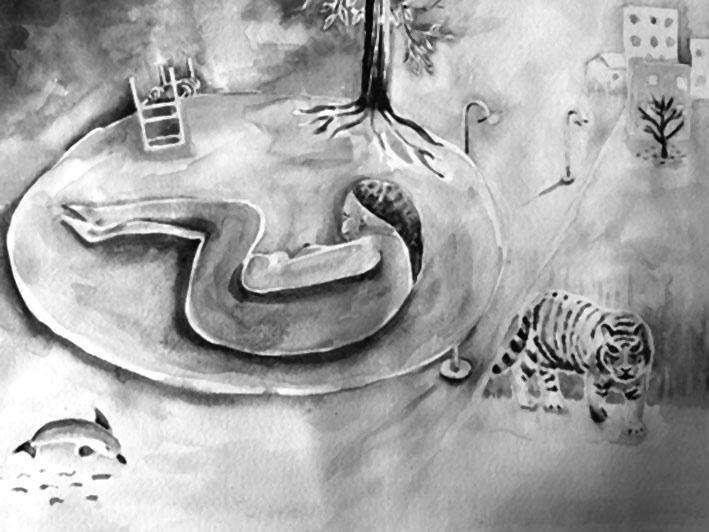
To reflect this mood, I recently painted canvases depicting our disregard for our environment and its consequences. I have also painted canvases related to various consequences of COVID-19 In the attached painting a man/woman is seen slumbering in a fetal position,
while his/her livelihood is taken away, metaphorically shown by the removal of a chair from the cocoon. A large tree is seen spreading its roots deep inside representing the passage of time. The wild tiger is seen roaming on the street. It appears to be bewildered as if wondering -whatever happened to our two-legged cousins. A dolphin is seen frolicking in the ocean in the absence of a fisherman’s net. However, there is no real reason for the animals to rejoice. The horror of COVID-19 is certain to be over someday. Soon, we will forget that this pandemic ever happened and will fail to recall that so many people lost their lives and livelihood. In no time we will get busy with wanton consumerism, and continue to destroy the very environment we live in. We will resume cutting down trees and driving animals away from their habitat. It will force them to live close to us. As a result, we will fall sick time and again from bacteria and viruses, carried by these animals, insects and, like. New epidemics and pandemics will certainly descend upon us with new names and of greater ferocity. Again, we will hurriedly get busy to develop vaccines and medicines, and completely ignore the root-cause of these disease. It is a vicious circle.
1. https://www.bbc.com/news/ukwales-47535311
2.https://economictimes.indiatimes. com/news/politics-and-nation/ coronavirus-lockdown-unusualsightings-of-animals-in-india/nilgai-in-noida/slideshow/75230929. cms
3.https://economictimes.indiatimes. com/news/politics-and-nation/ coronavirus-lockdown-unusualsightings-of-animals-in-india/nilgaiin-noida/slideshow/75230929.cms
reported by Mita Sinha, Chair, Puja Committee
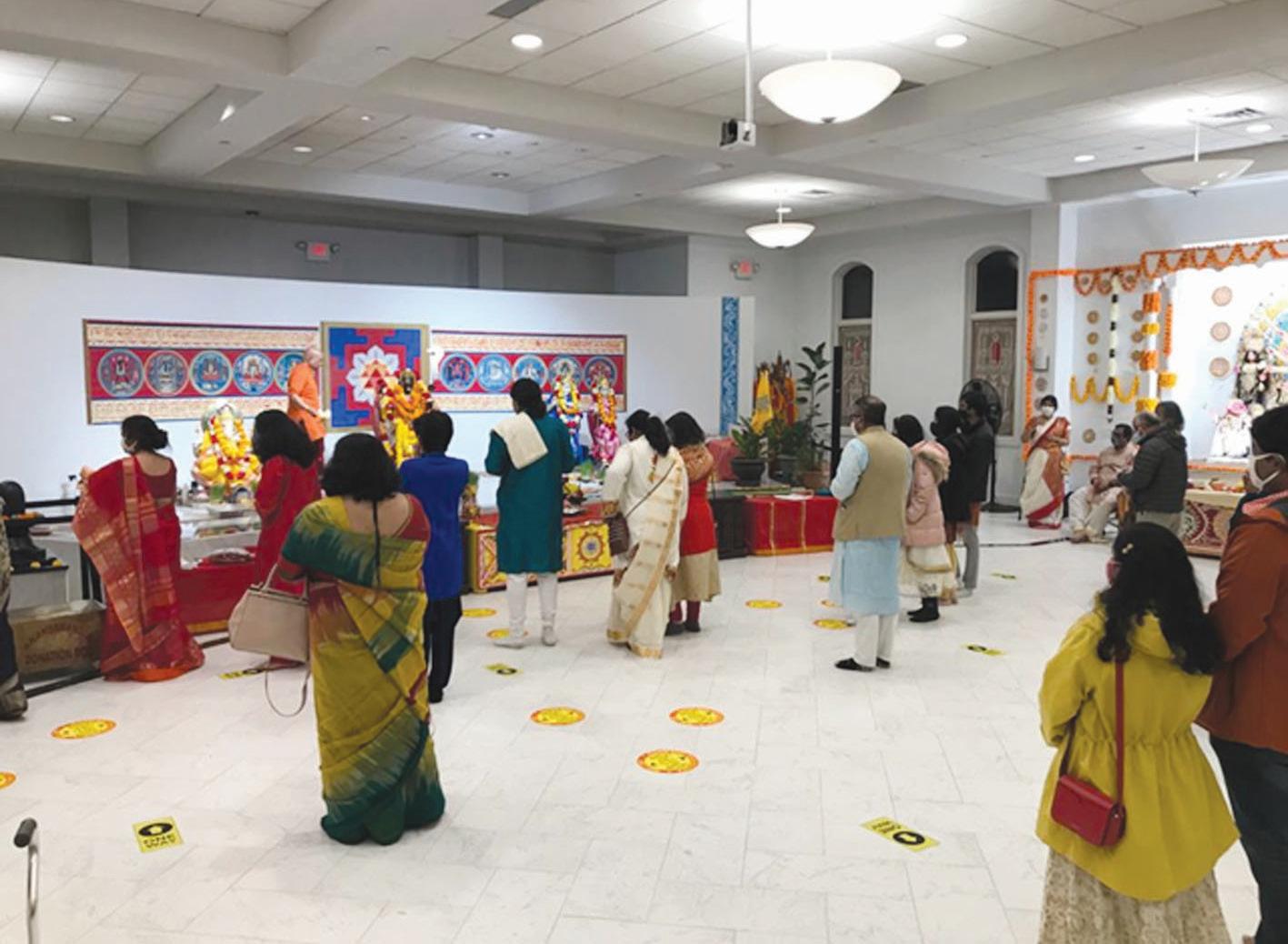
Corona Virus is still wreaking havoc in the country, and as a result, Ananda Mandir has been closed to public until September. Biswabhai alone performed the daily rituals for the deities as usual. The temple opened up in October for Durga Puja and Lakshmi Puja and also in November for Kali Puja, with strict adherence of all rules and regulations imposed for coronavirus.
September
In the month of September, we had Shyama Puja, Til Tarpan, Biswakarma Puja, and Satyanarayan Puja. The Til Tarpan is observed by many people who year after year come to the temple to revere their departed ancestors. Biswabhai was assisted by our veteran priest Guru Chakravarty to help them with the proper rituals and find solace in their hearts.
October
In October, with the permission of Township of Franklin, we opened the temple in limited capacities for Durga Puja. We had live streaming of Mahishasurmardini on October 18, ahead of the Durga Puja. Every year the mandir is full to capacity with people at the early morning hours of 4:30 am, but not this year. This time people tuned in from their homes at the early morning hours, and still enjoyed this annual event superbly conducted by Arun Bhowmik.
Durga Puja started from October 21 with Shashti puja and ended with Bijoya Dashami on October 25th. This year our Durga Puja celebration was very successful considering the unique circumstances we were facing. We worked very closely with the Township. Logistics Planning Team worked in coordination with the Puja Committee members, accomplished a smooth and flawless
By Partha Sircar
Rummaging through the internet, an idle pursuit that has engrossed me for the last few years, I suddenly came across this map in Wikipedia while I was reading up about the Third Battle of Panipat. It may be recalled that the Marathas lost the Third Battle of Panipat in 1761 to the Afghan ruler Ahmad Shah Abdali of the Durrani clan. It put a damper on the Marathas’ onward march for a pan-Indian empire and their conquests extending into Afghanistan. The Maratha Empire lived on for several decades as the premier power in the subcontinent before their defeats at the hands of the British in the Second and Third Anglo-Maratha Wars (1815-1818). In the words of the Indian historian Sanjeev Sanyal, “British did not gain supremacy from the Mughals but from the Marathas”.
implementation of traffic control, maintaining physical distancing, the mandatory use of mask inside the Mandir, completing health questionnaire, temperature check etc. Our volunteers did a super job of controlling the operations.
Devotees were only allowed to stay inside the Mandir for 30 minutes as per township’s requirements. Everyone complied with the guidelines. For Durga Puja, this is the first time we required pre-paid registration, and fixed time slots were assigned for Darshan and Anjali/Arati/Stuti.
Also, this is the first time we arranged live-streaming of parts of the puja rituals. Devotees who were not able to come to the Mandir were able to enjoy the puja rituals online. Everybody enjoyed the cultural programs during the Durga Puja.
Another first timer was on-line Puja sponsorship by individuals and families. Our priest offered pujas with sponsors’ name and gotra.
Kojagori Lakshmi Puja was on October 30th. Few people attended this puja since most of the devotees do this puja at their own home.
November
On November 14th we had our Maha Kali Puja. The Mandir was opened to the members/devotees again. We followed all our township’s guidelines to protect our devotees including mandatory use of mask, physical distancing, and limited time inside. Also, traffic control was employed. Our volunteers did an excellent job, and the entire process was managed smoothly. This is the first time we arranged live-streaming of almost the entire puja rituals. We required pre-paid registration. Since we were so successful in managing the Durga Puja we replicated the same process
We have all grown up on tales of Chhatrapati Shivaji and his epic battles with the mighty Mughal emperor Aurangazeb , and his dream of establishing a pan-Hindu empire. We have also heard of the exploits of Baji Rao and other Marathas. Nevertheless, I found the large swathe of India under Maratha control before the Battle of Panipat really impressive, if not mind-boggling. And there is more. The area of Bengal carved out by the British came to them on a silver platter after their victory in the Battle of Plassey.
Historical evidence shows the victory of Plassey in 1757 was more a result of treachery of Mir Jafar, the minister in chief of the young monarch, Siraj-ud-Daula, and a conspiracy between the powerful noblemen, most prominently Jagat Seth, a Marwari and the chief financier of the empire and a high-ranking Bengali nobleman, Raj Ballabh. Siraj had only ascended the throne less than a year upon the death of his grandfather, Alivardi Khan. Alivardi’s empire was ravaged by constant raids by the Marathas under Raghuji Bhonsle; his coffers were depleted, and his empire greatly weakened. He gave up his control of Orissa to the Marathas. Similar, I believe was the situation in Nizam’s Hyderabad and the kingdom of Oudh. The areas were under constant siege by the Marathas.
Makes one wonder what the world might have become if only a little something – not a whole lothad gone the other way. The Imperial British Empire, ‘where the sun never set’, may never have quite risen in the first place. After all, British colonizing ambitions sprouted and were nurtured by their conquests in India. Before the Battle of Plassey, perhaps the only British colony of consequence was the 13 colonies of America, which soon broke with the empire in 1776.
And what of India? Perhaps this is a more interesting question. Would India’s development have
been stunted without the British hegemony? Recent research by Madhushree Mukherjee and others have brought to our attention the damage to Indian economy including the high incidence of famines during the British rule. (Dadabhai Naoroji, the grand old man of Indian politics pointed out the drainage of resources from India over 150 years ago). By the same token, the Marathas of later years were no saints. The adorable Marathas under Shivaji and Baji Rao had degenerated into fearsome marauders and pillagers. The menace of the Maratha (Bargi) attacks still lives on in Bengali lore and in the Maharashtra Purana written in Bengali, just before the advent of the British Empire. A similar composition in Oriya in the eighteenth century, Samarataranga, a poem about war and chivalry, also has the Oriya Maratha
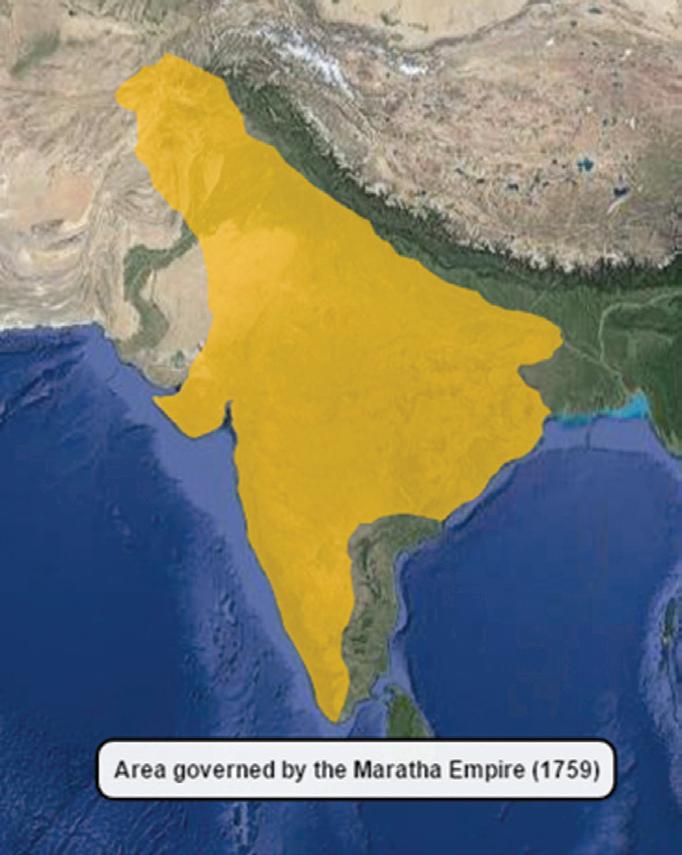
Source- “Image from Wikimedia Commons”
conflict as the context. There are indications, apparently quite reliable, that in 1791, Maratha forces under Raghunath Patwardhan attacked the famous Shankaracharya Math in Sringeri during their attack on Bednur. The Marathas resorted to plundering the temple and caused considerable damage.. The damages were later repaired, reportedly with the help of Tipu Sultan. There are also reports of possible Maratha attacks on the famous Tirupati temple in 1759 by the Maratha general Gopal Rao. They demonstrate for us that temple destruction was probably not a monopoly of the Muslim invaders as we have generally been led to believe.
But then again, perhaps conquerors in the real world are never saints, though they may sometimes be made to appear as such in later years.
Ten years or so after their defeat in the Battle of Panipat, the current Peshwa, Madhavrao, divided the Maratha empire into a loose federation reminiscent of the Greeks after the death of Alexander the Great
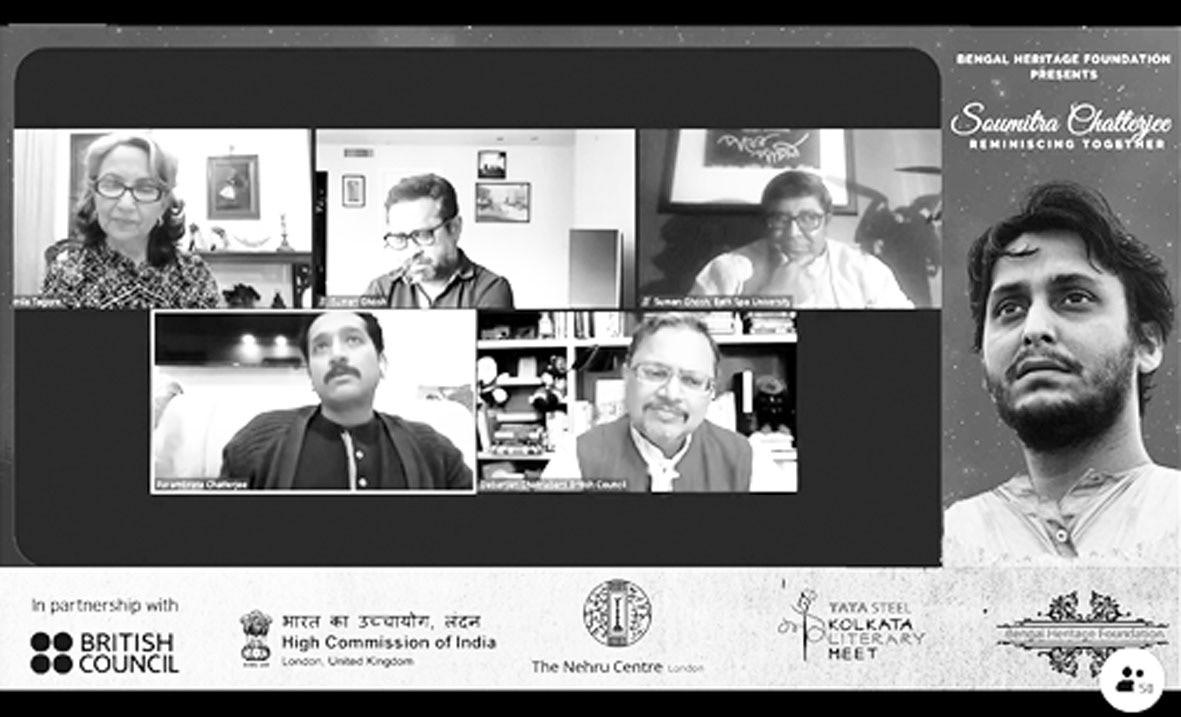
Beyond the label of a legendary actor, Soumitra Chatterjee left us on November 15, 2020 creating a void in the world of Bengali cinema. Media broadcasts and Social media posts repeatedly showcased the actor’s life, stage performances, creative endeavors and film snippets. As I began writing this article on a Sunday morning, November 29, 2020 to be precise, my Facebook Virtual Online Page was running a special panel discussion on Soumitra Chatterjee. It was a live show, virtually online from different parts of the world featuring participating stars like Sharmila Tagore, Soumitra Chatterjee’s co-star in iconic film “Apur Sansar”, actor Parambrata Chattopadhyay, actress Rituparna Sengupta, poet Srijato Bandopadhyay and other internationally known participants. The event ran Live on Facebook for about two and half hours using Zoom Online Streaming technology. The program was jointly hosted by Bengal Heritage Foundation of London, British Council, High Commission of India and Nehru Center, London. It was one of the globally viewed online programs of recent times, extremely successful, so, I would like to take this online virtual program as the starting point to discuss the topic of this article – “Monetization of Online Programs” – the money making processes for online programs. Viewers from all over the world had free access to this show on Soumitra Chatterjee via a designated web link. Would the organizers of this program make money if this was a paid show? If they did then what would be the process of getting money from viewers scattered all over the world? I will keep the discussion very “reader-friendly” with minimal technology jargons, so, please read on to know some of the very basic differences between Paid Online programs vs Non-paid Online programs vs Streaming programs over Netflix, Hulu and other mass media digital technology platforms.
First of all, what is an Online, Virtual program and how it happens? As seen in the cover picture of this article, five participants from different parts of the world were connected virtually online to discuss and present the program on Soumitra Chatterjee. Sharmila Tagore in Mumbai, India responded to Parambrata Chattopadhyay in Kolkata and also answered questions asked by panelists in London, New Delhi and Nashville, Tennessee. All happened seamlessly. We are now living in a fascinating era of virtual technology where communication can happen flawlessly between participants scattered all over the world. Exciting indeed. And this is all happening via Zoom. So, let’s take a peek on ‘How Zoom happens’.
By Sushmita Dutta
With pandemic dominating 2020, online, virtual technologies like Zoom witnessed skyrocketing success. Of all the virtual technology applications during the coronavirus pandemic, Zoom’s rise has been the most striking for being FREE with an option to upgrade to higher features. Zoom grew from around 10 million daily meeting participants in December 2019 to 300 million participants in four months. Zoom is a web-based video conferencing tool with a local, desktop client and mobile application which allows users to meet online from any geographic location with collaborative audio, video and multimedia presentations. Primarily featuring online live programs (Live programs happen as and when you are watching it), Zoom also facilitates recording of live programs for future and after the event views. Zoom makes group collaboration easier for being compatible with almost all technology platforms like Mac, Windows, Linux, iOS, and Android. Zoom also features designated group and private chat with screen sharing from phones, tablets, laptops and desktop computers. So, versatility over technology platforms is one of the key factors behind Zoom’s success.
Virtual programs:
The easiest way to make money with Zoom is to set up a paid webinar where you can sell products, services and even online training and education programs. Zoom accepts credit card and PayPal payments online. The process of monetization using Zoom is fairly easy. Hence, several organizations across the globe utilize Zoom technology to make money by promoting “Online Paid Programs.” Let’s take an example of a recent
paid show online. Here is snapshot of a paid virtual program captioned “Nana Ronger Dinguli” – A Musical Journey of Bengali Cinema organized by ABKC – Association of Bengalis, Kansas City. The program features actress Rituparna Sengupta and singer Nirmalya Roy.

This poster advertised via Social Media and the organizer’s website labels a ticket price of $15Per Link – so please note, each purchase provides a designated link to the buyer. When clicked on the button “Buy Ticket”, it takes us to “PayPal” website. We select the number of tickets we want to purchase. We are required to enter one email, a mobile number, billing address of the Credit card/Visa/ Master. And, after successful purchase of ticket, we get this message: “Thank you for your purchase. Your link to the program will be sent via your email within 48 hours before the event starts.”
This link that you will receive is a designated link which registers your name, location and IP address (IP address is the logical location of your computer when it’s connected to the Internet. Networking software and hardware must know your IP address for you to connect and go online with a program.) Now, this is where Paid online programs defeat the purpose of monetization processes:
One purchase of a single ticket registering one name, one IP address may have many viewers watching the show “Free of cost”.
Today under pandemic condi-
tions, hundreds of commercial shows like Apollo Theater, New York, now hosts paid shows online not knowing how many people are actually watching the show with known number of tickets sold online. Zoom has a feature called “Attendance Tracking” for an online event to help generate a report on who attended the program, from which IP address, for how long, what was the network type, which device was used and also the time a viewer joined and left the show. But Zoom cannot tell how many viewers there were under one purchased ticket. This is a technology challenge that we have faced in 2020 and will continue to struggle with as long as pandemic restrictions prevail and we are dependent on online events.
Monetization online indicates the process of creating a revenue-generating pattern of earning money from an online event. An event posted virtually online is a “One-time event” that relies on number of tickets purchased to know if the event was commercially successful or not. Many performing professionals presenting shows online rely on number of tickets sold which directly impact their livelihood - “bread and butter”. But technology is not there yet to show how many viewers were there on one purchased ticket. One transparent way to monetize online virtual programs is to display advertisements at short intervals like YouTube does. YouTube monetization is fairly straightforward. Advertisements by companies are placed before videos run on YouTube which are called preroll ads. Each time a viewer watches an advertisement, owner of the video gets paid. Similar trackable process can be adopted for monetization of virtual programs using Zoom.
Zoom recently rolled out a separate platform for online events called On Zoom which is different from regular Zoom. On Zoom allows interested businesses and creators of online programs to interact, schedule and host a variety of events, list and sell tickets, and promote their events through social media and mass emails sent to target audience.
Zoom is often compared to Netflix, Hulu and similar programs. Here is a brief note to get some idea on how Zoom is different from Netflix and other similar technologies.
Netflix monetization is different from Zoom:
Monetization via Zoomis a Onetime Live Event. Netflix does not have a
By Basab Dasgupta
makes a person happy? There are plenty of clichés you have heard in response to this question: “Money cannot buy happiness”; “Happiness lies in one’s heart”; “Best way to be happy is not to have a desire for anything”; “Finding God is the only way to be happy”; “Love is happiness”; “I am happy as long as there is peace and harmony in this world” and so on. Then there are some answers which even question the wisdom of seeking happiness. My favorite one is “I know money does not buy happiness, but I don’t want happiness; I want money”!
Instead of going into a long spiritual discussion about what really gives us happiness, I would like to propose my prescription for happiness from a very practical point of view. It has two parts: a) a person has to first convince himself that he is in a superior situation in some category than anyone else in his “local” circle of friends, relatives, neighbors and colleagues, no matter what his physical, financial and emotional states are and b) then he has to somehow project that conviction onto others. This latter goal can be achieved by simply declaring this conviction in various social interactions or by writing something (like a memoir or e-mail or story or posting on Facebook) or by some body language or attitude.
Let me first clarify what I mean by “local” circle. Basically, my local circle is the circle that I interact with on a regular basis, not just in person, but also by telephone, email, Facebook etc. The people in the circle need not be physically close to me. The
circle does not include people I do not regularly deal with, even if I know many of them and certainly excludes all strangers that I have never met.
I also believe that most people want to be happy, following this prescription, but at the same time, there are other people who behave exactly in an opposite way. They convince themselves that they are, in fact, less fortunate than the people in their local circles for one reason or another and feel a tremendous amount of selfpity. It is needless to say that they are also very unhappy people, if not chronically depressed.
First, I will give you several examples to make my point about the first part of my happiness criterion. A person living in a very small house might make himself feel better by thinking that his house expenses, not just the mortgage and taxes, but also cleaning, maintenance and repair, etc., are small and he can therefore spend his disposable income instead on much more enjoyable activities like travel, entertainment and other interests.
A single person living alone might consider himself to be lucky that he can do whatever he pleases and whenever, without having to discuss and get an agreement from a spouse; he also does not have to worry about the responsibilities towards another person. Even a physically handicapped person might be thankful and feel content, if not happy, that he does not have to work and can pursue all kinds of interesting hobbies, while living off some disability insurance payment.
A spiritual or philosophical person might think that life on this material world is only temporary and somewhat meaningless and may feel superior thinking that he might be the only person in his local circle who has made this realization. Then there are, of course, people who seem to have everything including wealth, health and a happy family life and they do not need much external input to be convinced about their good fortune. People with special talents like singing and cooking can easily feel a sense of superiority just because of those special skills.
I would like to emphasize the second part of my point next. None of the people in above examples would be truly happy unless they get an opportunity to somehow declare their superiority. Even the spiritual person would be very inclined to give you a lecture, perhaps bringing God in the discussion, on why all the material and physical things that seem desirable really do not bring happiness. He will do that because giving you that lecture would make him feel happy since it would show, not only to himself, but also to others, that he has accomplished something that you have not! A good singer can showcase his/her talent by singing on various social occasions and a good cook can throw frequent parties with servings of a variety of gourmet dishes.
There is an intermediate class of people between the “happy” and “unhappy” groups that I defined above. They are the ones who have not really convinced themselves that they are happier than others, but try to project an image of “happiness” in their social interactions with others. In other words, they fake happiness. These are the
individuals who post their vacation photographs and pictures of their new cars on Facebook; who dress up in their best attire for any social gathering; who shamelessly declare how great everything is in their lives. Even though they may not be really happy, just this creation of illusion of their happiness to others actually gives them considerable amount of joy and happiness. In other words, they feel a genuine happiness by projecting a phony happiness. Without this projection they would feel very miserable.
Contrary to the popular belief, money can buy happiness (as defined here) if the person with money socializes with others with considerably less money and can flaunt his wealth; but if he interacts mainly with a lot of rich people then money is no longer a parameter to place him is a superior position. Then a competition ensues to show who is better off and this can lead to unhappiness.
So, happiness is really relative. If you did not have any social interaction with anyone to compare your superiority with, you would not know if you were really happy; peaceful perhaps, but not happy.
I remember buying a brand new and very sleek looking car many years ago. Frankly speaking, I did not feel any difference at all in driving my new car compared to the car I was driving before that. Of course, the exterior was shinier, but I could not see it while driving. The interior, head room and leg room, accessories were all similar to those in the previous car. However, I detected a look of envy among my friends and neighbors as soon as they saw the car. I commented to a colleague of mine, in a half-joking
way, “Everyone seems to get slightly unhappy when he or she sees my car. I guess that makes me, relatively speaking, more happy!”
Some people even find happiness in crying, especially crying in the open! The rationale can be seen from my definition. They feel happy because they realize that they are much more sensitive (and hence better) than others; they also feel that they are being able to let out all of their pent-up sad emotions and therefore in a better emotional shape than others.
It is also important to note this “local circle” aspect. It really does not bother me to know that Jeff Bezos has hundred billion dollars or my distant cousin in India, whom I have not seen for many years, has become a millionaire; but it would bother me if I see my neighbor driving out of his garage in a brand new Mercedes Benz convertible. By the same token, when we know that we have no reason to feel happy – after the death of someone close or loss of job, for example – we tend to completely avoid this local circle because we know that no amount of comparison would make us feel good.
There are, of course, people who truly feel a “divine bliss” even if they have no material assets and do not socially interact with others. They are the saintly people who have overcome the attachments of this material world and crossed the boundaries of social norms. They do not analyze their accomplishments, they do not brag about their happiness; they do not preach to others about how to be happy. They always seem to be in a perennial state of contentment. I want to be like them, but I know I have a long way to go and it is highly unlikely that I will get therein this life.
| continue from page 10
Live option. Popular streaming services like Netflix, Disney+, Hulu, Prime-Video, all are Subscriptionbased Streaming Services that allow members to watch TV shows and movies without commercials. You can also download TV shows and movies from Netflix and the rest to your iOS, Android, or Windows 10 device and watch at your leisure. All these Subscription-based Media platforms have Known Customer Base with a known dollar figure as revenue and hence it does not matter to
Netflix whether a show is watched by one person, or the entire family or by a larger group of family and friends.
Online virtual events, in contrast, are “One TimeLive Events” which for lack of adequate technology cannot measure the number of viewers behind one purchased ticket and hence the true picture of success or failure of an online event remains unknown. I am hoping we will soon have some bio-technology measures like eyetracking and Artificial Intelligence added to technologies like Zoom to get a clear picture of how many viewers are there behind a paid ticket. This
will help hundreds and thousands of organizations, individual performers who are trying to make a living using online virtual paid programs. Anyone out there with any innovative ideas? Please communicate with Zoom directly. Zoom’s young CEO Eric Yuan is very receptive to new ideas and technologies. In a recent post, Chris Lesieutre, CEO of Dundee Hills Group writes –“I should start by saying that this is a big idea. Big enough that we thought we should take it directly to the CEO of Zoom. And we did. That led to a meeting with a Zoom prod-
uct manager, who’s now looking into developing the feature called ‘Zoom Virtual Pub’ where company party, dealer reception, or similar networking events will happen.” How far Zoom Virtual Pub’s close-knit networking over a virtual platform will facilitate businesses and help online monetization processes is yet to be seen. I am keeping my fingers crossed at least for the sake of hundreds and thousands of musicians, actors, singers and show performers who count on Online Paid Programs for their livelihood during this prolonged phase of pandemic.
Sahitya O Alochana (SOA) is a monthly literary and topical discussion forum under the aegis of Ananda Mandir (AM). It will complete its 13th anniversary in January 2021 and will have organized one hundred and twenty-three (126) sessions by the time this report goes to press. These monthly sessions feature exciting and illuminating discussions on diverse subjects including literature, art, theater, and movie; history, philosophy, and religion; science and mathematics; economics and business; and social issues, sports, and current affairs.
Since its inception the year 2020 has been the leanest in terms of activity volume primarily due to scheduling conflicts resulting from the contagion fallout. However, quite a few eclectic and very interesting sessions as explained below.
This session focused on Bengali Nobel prize winners in Economics while indirectly examining if there is a connection between ethnicity and Nobel prize. While behavioral economists would have a lot to say about that, the distribution of the ethnicity of the awardees uncovers an interesting correlation. In its 50-year history, the Economics Nobel prize has been awarded to 89 laureates. And the vast majority (55) of them are US nationals, which is a common occurrence in natural sciences as well. Outside the US and the UK (the holder of 2nd rank with 9 prizes), arguably the two major melting pots in terms of ethnicity and culture, France has 4 winners with the top rank, while there are five nationalities and or ethnic groups that share the 2nd rank outside the “Duopoly” of the Anglo world. And there is one ethnic community that proudly shares that honor (along with a few other major forces in the world order including Canada, Germany, Norway, and USSR).
The discussion celebrated and reviewed the work of these eminent members of the Bengali community including Abhijit Banerjee (2019), Amartya Sen (1998), and Muhammad Yunus (Peace Prize 2006) – very different work, but all in the field of development economics. Whether or not there is any correlation, we definitely learned, in the session, a few things about why “rational behavior” is just one of many ways to model the economic agent; other highlights of the discussion included social choice theory, randomized control tests, and micro-finance.
This session was led by Ranajoy Ray-Chaudhuri, a professor of economics at Muhlenberg College in Pennsylvania.
It was an informative and enlightening discussion. Judging by the robust attendance and very active interaction it definitely was one of the better sessions in last few years. A ton of thanks go out to Ranajoy.
In April we organized a session that addressed one of the greatest challenges that humanity is currently confronted with – novel Coronavirus. An online event in keeping with times, this session was titled “Pandemic, People, and Evolution.”
It covered the history of pandemics and the science around them with a special focus on experience from the frontline, and our collective struggle to manage the Covid 19 crisis while working on a potential cure. It clearly and successfully separated itself from the stream of confusing information that is constantly overwhelming our sensory system and navigated through the bits and bytes of this never-ending chatter separating facts from the fear, and constructively approached the coping process with this apocalyptic calamity.
reported by Subrata Bhaumik
The event was an outstanding success! About 125 participants attended the event on Zoom and another 1,500 viewed it on You Tube and Facebook.
The outpouring of positive feedback highlighted the timeliness, quality of knowledge disseminated, and the smooth execution of the session. A ton of thanks goes out to the stellar panelists (Subhasis Banerjee, Abhijit Chatterjee, Kaushik Mitra, Poushali Mukherjea (moderator) Deholi Bandyopadhyay, and Dipan Ray.
See below for the YouTube screenshot.
July -
In July we embarked on a treasure hunt in our own backyard. And in the process, we discovered many creative gems amongst us – remember “He Bongo Bhandare Tobo Bibidho Ratan…?” In this session, four established authors from the Community (Tathagata Ghosh, Jayashree Chatterjee, Vishnupriya, and Amitabha Bagchi) read their works. It was a great program judging by the robust online attendance, a very active Q&A session and the serendipitous rediscovery and enjoyment of the beauty of those glistening drops of dew on the sheaves of paddy grain that lie in our doorsteps. A ton of thanks goes out to the writers referenced above.
October -
In this session, Swami Sarvapriyananda, a renowned Hindu monk and philosopher, and the head of The Vedanta Society, New York discussed some of the very compelling and competing concepts of Hindu Philosophy focusing on “Advaita vs. Dvaita Schools of Upanishad” with unparalleled clarity, completeness, and authority.
He walked the audience through the evolution of the various schools of Vedanta philosophy, the cross-pollination of ideas between the then evolving Advaita Vedanta philosophy and Buddhism that was born out of the rejection of the hitherto Hindu Brahminical order, and the similarities and differences between Advaita Vedanta (championed by Adi Shankaracharya) (5th-6th century BC), Vishsista Advaita espoused by Ramanuja (11th century BC) , and finally Dvaita conceived by Madhavacharya (13th century BC). While this not the appropriate forum for exploring the details ofthe Swamiji’s illuminating discourse, here is synopsis that covers at a high level the contents and boundaries of the discussion.
Advaita, the nondualist concept, features the union of Atman and Nirguna (without attribute) Bramhan, the indestructible and never-ending energy, matter, and time - the one supreme spirit that is the origin, support, and the sum-total of the phenomenal universe. This is the ultimate truth, consciousness, and reality. Anything that is perceptibly different from this oneness is “Maya” (Illusion). Vishsista Advaita (Qualified Non Dualism) on the
other hand upholds the ultimate reality of the union Saguna (with attribute) Brahman and Atman (like Advaita) while maintaining the supremacy of the Brahman – while Dvaita (dualist theory) popularized by Madhavacharia around 13th century BC rejects the concept of oneness in Advaita, and posits that Brahman (the supreme being) is different (swathantra) from the sentient and the insentient world that consists of Jiva and Jara (animate and inanimate world. They both are separate realities while the Bramhan (the supreme being) appears to control the other reality of the Jiva and Jara world.
This session was facilitated by a team that included Amitabha Bagchi, Subrata Bhaumik, and Gautam Goswami. It was a hugely successful session that was greeted with very high level of enthusiasm by the participants – 90 people attended the session on Zoom while another 1,500 viewed it on You Tube and Facebook.
See below for the YouTube screenshot.
Future sessions - Quite a few interesting sessions are in the pipeline for the next several months. They include a session on review of the roles of Race and Religion in the American political order, a multimedia poetry reading session (poems of Eliot and Yeats) adorned by music, and finally another philosophical session on the age-old human quest of knowing the “Who am I” through the angle of Vedanta.
The friends of Sahitya O Alochana would like to thank Ananda Mandir for its continued support for the forum’s contribution to the cultural enrichment of the local South Asian communities.
| continue from page 8
when the empire was split among his generals, and after the death of Chengiz Khan, his Mongol empire, the largest empire till the British came along, among his four sons. The major successors were the generals of the Maratha army: Gaekwad (Baroda in Gujarat), Peshwa (Maharashtra), Scindia (Gwalior in Madhya Pradesh), Holkar (in Indore), and Bhonsales (in Nagpur). With the establishment of British hegemony, they became some of the major Princely States under the British Indian Empire. Some played important roles in history, including the Sepoy Mutiny. Rani Laxmibai was the queen of the Maratha kingdom in Jhansi in southern Uttar Pradesh. The effect of the extent of Maratha conquests are well reflected in the wide distribution of the states. Baroda and Gwalior were particularly progressive states: Sri Aurobindo was an administrator in Baroda before giving up his post to become a revolutionary. The Scindias are still prominent in Indian politics. Finally, it would be remiss of me if I did not mention Queen Ahalyabai of Holkar (1725 – 1795). She was a principal financier for the rebuilding of many temples destroyed by the Muslim rulers, most prominently the Vishwanath temple in Varanasi and the Temple in Mathura.
reported by Pradip r. Das
For us Bengalees, Durga pujo is the time of the year, irrespective of whatever challenges and difficulties we faced in the past year, our spirits are lifted by the joyous festivities and cheers that the season brings. In our adopted homeland here, we strive to recreate and re-live the nostalgia surrounding Durga pujo back in India and pass it onto the next generation. We all participate wholeheartedly in this endearing process.
2020 has been particularly difficult for all of us as the coronavirus pandemic engulfed the entire globe and caused innumerable health and/or economic distress to many citizens in all countries. The world witnessed various attempts by different governments to face this pandemic through national lockdowns, partial closures and issuance of common sense guidelines for their citizens, hygiene, social distancing, wearing masks, and avoiding large groups being the most basic.
For celebrating Durga puja this year, GSCA, guided primarily by health concerns, adopted a socially responsible approach and conducted its maiden virtual pujo for its members. The two priests who conduct GSCA’s Durga Puja every year, a very limited number of volunteers who aided in puja preparation, met at the Ved Mandir in Milltown on Saturday, October 24. Those few who were present there maintained strict safety precautions as
mandated by the state under the pandemic environment.
The entire puja proceedings was streamed live to all members through online links. Members could thus witness the puja with their family members from the comfort of their own homes.
At the conclusion of the puja (10 am to 1 pm), GSCA, with the help of a few dedicated volunteers, delivered prasad and food boxes to all members who desired to receive them to their homes. This was indeed a very personal touch of brotherly and community feeling that GSCA exhibited.
Cultural programs (a very nominal paid option) were streamed to all registered members and nonmembers as well on both Saturday and Sunday (10/24 & 10/25) through another secured online link. Saturday’s programs included Devi Bandana (vocal), inhouse production, Ananda Lahari (vocal/dance), Arinav Mukherjee, Delhi (dance), Sombuddha Chaterjee, Kolkata (vocal) and finally the main artist Anjan Dutta and his son, Neel Dutta, the duo entertained the viewers and listeners with many folk songs amongst others.
Sunday’s cultural line-up included some local performers, a dance performance by Rumeli Mazumdar (Kolkata), a natok based on a theme relating to adjustments in the current pandemic environment. Sunday’s main attraction was Kinjal Chatterjee, accompanied by a keyboard and guitar, whose melliflu-
On November 14th, NJPA celebrated Kali Puja and Diwali online as an alternative way to handle the same during this long Covid crisis. The Puja was organized at Nimai and Manideepa Ghose’s house and transmitted online over Zoom for all the members from 2pm onwards. The puja was carried out with devotion and chanting of mantras by Guru Chakravarty.
This was followed by an online cultural program in partnership with Mana TV from 4-5pm, with recordings from key artistes: Ishani Sanyal, Ayush Lala, Subhadrakalyan, Tathagata Sengupta, Rumeli Dutta Majumder, Madhurima Chakraborty Mukherjee. Chanakya Ganguly was the Guest
ous voice and old melodies transported all listeners to the yesteryears. Incidentally, all the Indian presentations were streamed live from India while the local and inhouse were pre-recorded. Two successive evenings of wonderful presentations well choreographed.
The entire GSCA management team and the various volunteers are to be applauded for the unique virtual Durga puja experience they provided in this particularly difficult time and also exemplify proper social responsibility and health safety awareness.
For several years, GSCA has been making concerted efforts to expand its philanthropic activities in ways that are having greater impacts on communities and individuals. Most notably, GSCA’s scholarship fund has supported meritorious and needy students both here and in India. In November 2020, GSCA added 12 new students to support in India, MBBS (3), BSc Nursing (3), B.Tech Pharm. (1), Science (5), bringing the total to 39 students currently being supported concurrently in India. The students that are selected for support by GSCA are supported through their entire curriculum until they graduate successfully.
GSCA’s philanthropy wing is indeed doing a praiseworthy job in making differences in individuals’ lives and to their families.
reported by Arpita Gupta
There are years where very little happens, and there are weeks where years happen. A constant in all years is the celebration of Durga Puja. This year was a year with extraordinary circumstances as a result of the global pandemic, and in many weeks, it felt like ages had passed without seeing the bright faces of our community. Even in light of these challenges, the members and EC of ICC-GS stood up to the task of creating a Durga Puja event that would warm people’s hearts, bring back nostalgic memories, and provide a sense of normality in such uncertain times. The ICC-GS 2020 Durga Puja became a tremendously successful event which showcased talent, memories, and the strength of the community.
Staying in tune with the themes of 2020, ICC was able to create a virtual live-stream for the Durga Puja and cultural program for all members to view on YouTube & Facebook thanks to the help of Communications Secretary Arpita Gupta who provided streaming for all events of the Puja including Cultural. In addition, in-person Puja following COVID restriction guidelines was held at Pearl Banquet Hall in Parsippany with President Nirmal Kundu leading the event. Members participated in puja with lot of enthusiasm and joy. Time slots were allotted to every member.
Our priest Guru da showed zeal and devotion by being able to perform the puja in-person over the two- day event even in face of the restrictions as a result of COVID. He made sure that every member got the opportunity to perform Anjali. Chaitali Sinha, Reeta De, Kalpana Bhattacharya and Snigdha Chakraborty helped him in puja activities.
The food was cooked by volunteers Rupak Raha, Siddhartha Basu, Abhishek Banerjee and Nirmal Kundu. The food distribution was handled by volunteers in supervision of Ruma Ghosh.
This year’s Cultural Programs involved Shruti Natok, performances in dance and music by our members, Rabindrik program and talent shows for our young generation. Sanghamitra Bhattacharya, Sheena Mithoo Bhattacharya, Deepa Bhandari, Sutapa Chakraborty, and Debaditya Roychowdhury took the lead. Bidita Bhattacharya Chakraborty and Susmita RoyChowdhury did great job as the program MCs. Success of these programs was due to the diligent work by GS Nilay Hait, CS Arpita Gupta and Cultural Secretary Mridul Paul who all spent significant time and effort panning these programs. Also notable were the recreational programs like “Kids Talent Show” by Mousumi Chakraborty, “Memories of Members through the Years” by Arpita Gupta,“Recipe Share” by Sutapa Chakraborty and “Now and Then” by Rakhi Mandal.
The featured artists from Kolkata were Sovon Ganguly and Poushali Bannerjee, both of whom mesmerized the audience with their virtual performances.
Despite of all the odds, ICC Executive Committee worked very hard to make this year’s Durga puja a grand success.
reported by Chanakya Ganguly
Speaker on the show discussing Yoga, Pandemic and Diwali. It was hosted by Raagini and Sharat.
The year saw Durga Puja being watched and celebrated online or with restricted admission with preregistration at many places. Many people enjoyed watching the Puja online transmitted by many spiritual organizations like Ramakrishna Mission, Belur Math and Bharat Sevashram Sangha, as they could concentrate on the Puja from the peace of their home without distractions.
Connecting people online for Puja celebrations, cultural programs and discussions may slowly be accepted as the new normal till this Covid crisis gets resolved. It also has the potential to continue in the future as people can enjoy the functions and discussions online from the comfort of their homes without the hassles of driving, parking, arranging for food, getting dressed up and so forth.
Diwali commemorates the Yogic Enlightenment of Vardhman Ma-
havir and Dayanand Saraswati. Diwali reminds us on the individual effort to practice Yoga to find the light within. As the veil of ignorance lifts, we see the triumph of light (goodness, wisdom, hope) over darkness (evil, ignorance, despair) within - the true Self. It is better to trust ourselves, rediscover our abilities in unexpected situations, in exile and homecomings to reach A=No Yodha=War through Ra=Sun Ma=Consciousness. Yoga means to pursue freedom with higher self-responsibility and clarity.
Till we meet again, have a cozy winter and an Introspective New Year of Yogic Consciousness. Information about upcoming events will be available on our Facebook page “NJPA Parivar.”
(July –December 2020)
reported by Debajyoti Chatterji
As we had reported in the July issue, Evergreen Club had adjusted quickly to the “no-meetings-in-person” mandate issued by the Board of Trustees in mid-March by moving to a “virtual meetings” format. It took us a couple of months to get adjusted to the Zoom videoconferencing technology and to develop a meeting management protocol and a standard agenda. Once those initial hurdles were addressed, the Evergreen Club settled into a familiar and well-liked pattern. Now that we have organized about ten virtual sessions, we can proudly report that Evergreen Club seems to be flourishing under the “Zoom umbrella”.
During the second half of the year, we have met on a monthly basis with the attendance level ranging from 20 to 35. Typically, the sessions are held on Sundays from 6 to 8:30 pm. Some sessions have used an open agenda while others have
been organized around a central theme (with plenty of flexibility still allowed outside the theme). Open agendas have allowed members to share their talents and interests such as singing songs, reciting poetry, reading short stories or describing memorable experiences. An example of a session with a central theme was the one held on November 22, where we paid respects to the life and contributions of the recently departed Soumitra Chatterjee, a legendary figure in the Bengali cultural world.
Although these virtual sessions do not allow us to enjoy communal lunches, group outings and face-toface interactions that the prepandemic meetings offered, we have come to recognize many positive benefits of these “Zoom sessions”. Here are some examples:
• More members participate actively, and people seem to have less inhibition to speak up in these virtual
meetings than in face-to-face get-togethers.
• Members who had moved out of New Jersey and could not participate in Evergreen Club activities are now delighted to be able to join in.
• A few months ago, we introduced a “guest artists” program to showcase local talents and promote inter-generational exchange within the Ananda Mandir community. The following guest performers have appeared in the last four meetings: Aditi Ghosh Dastidar, Sangrami Lahiri, Soumi Jana, Sahana Bhattacharyya, Sreerupa Ghoshal and her daughter, Anshini, Swagata Goswami and her daughter, Adwaita (Gigi), and last but not the least, Ishanaa Banerjee, a 5-year old rising star in poetry recitation. The presentations by the invited artists have drawn universal praise from our members and have made our meetings very enjoyable.
The last session of the year is scheduled for Sunday, December 20.
(July 1, 2020 to December 31, 2020)
reported by Debajyoti Chatterji
Note: Writers Club meetings are open only to “active writers” who are willing to present their own writings (in Bengali or English) to their peers. Readings of third-party authors are not permitted. Club members are welcome to share their poems, short stories, personal narratives and essays – whatever they prefer to write. After each presentation, an intensive Q&A period follows, sometimes lasting as long as thirty minutes. As a result, our two-and-half hour sessions permit readings by only 6 to 7 writers. To accommodate all writers, we follow a staggered order over several sessions.-- If you are an active writer and would like to join our club, please send an email to debsmee572@gmail.com.
Theyoungest of Ananda Mandir’s cultural endeavors, Writers Club, hasn’t missed a beat even during the dark days of the pandemic. Zoom-based meetings have been held on a monthly basis, usually on Friday evenings, with 12 to 20 members in attendance. Almost all the sessions have been over-subscribed in terms of writers wanting to present their writings to their peers. This has been a good indicator of the level of interest on the part of the writer-members of the club. Another development that has been encouraging to
this young club is the interest expressed by out-of-state authors to join and present their writings. We now have members (and visitors) from states like Massachusetts, Kansas and Texas! We are also pleased to see that several “new writers” have continued their literary efforts because of strong encouragement from their peers.
The final meeting of the year is scheduled for Friday, December 18.
We wish everybody a very happy holiday season and a peaceful and healthy New Year.
Neera Tanden, lawyer, political consultant, writer, is an Indian-American, nominated as the Director, Office of Management and Budget (OMB), only the second woman and now the first Indian-American in that post.
Vivek Murthy, former surgeon General of the USA, is nominated as the new Surgeon General of USA. He is also in several ARTs (Agency Review Teams, a.k.a. Transition Team) including Health and Human Services and Homeland Security
Other Indian-origin members of the Transition Team include:
Arun Majumdar from the California’s Stanford University is the team lead for the Department of Energy ART.
Dr Rahul Gupta, A former state health officer for West Virginia is leading the transition over the Office of National Drug Control Policy.
Kiran Arjandas Ahuja is an American lawyer and activist who served as the Chief of Staff to the Director of the US Office of Personnel Management from 2015 to 2017 has been named Team Lead for Office of Personnel Management.
Puneet Talwar former Assistant Secretary of State for Political-Military Affairs in 2014-15 was top Middle East advisor to Barack Obama, playing a central role in the backchannel diplomacy that produced the Iran nuclear deal. Focused on the Department of State .
Pav Avneet Singh is a non-resident fellow in the John L. Thornton China Center at Brookings Institution has been named to two ARTs, the National Security Council and Office of Science and Technology.
Arun Venkatraman a machine learning computer expert and graduate of Carnegie Mellon University has been named to two ARTs, Department of Commerce and US Trade Representative Office.
Pravina Raghavan is the Executive Vice President, Division of Small Business and Community Economic Development for Empire State Development (New York).
Atman Trivedi is Managing Director at Hills & Company, International Consultants for Department of Commerce.
Shital Shah is the Manager of
Philanthropic Engagement at the American Federation of Teachers (AFT) for Department of Education.
R Ramesh is a professor wellknown globally for his contributions to the science and technology of complex functional oxide materials, on The Energy Department team.
Rama Zakaria is a Senior Manager for Regulatory Policy and Analysis at the Environmental Defense Fund (EDF), on Department of Energy.
Subhasri Ramanathan is a lawyer who has worked for the Department of Homeland Security. For the Department of Homeland Security.
Raj De is a cybersecurity and data expert for Department of Justice.
Seema Nanda had been CEO of the Democratic National Committee and along with Raj Nayak, the former COO of Viacom 18, are looking at the Department of Labor.
Reena Aggarwal is the Robert E. McDonough Professor of Business Administration and Finance, vice provost for faculty, and the director of the Center for Financial Markets and Policy in the School of Business
at Georgetown University and with Satyam Khanna, the former senior legal adviser to US SEC Commissioner Robert Jackson, is on the ART for the Federal Reserve Bank.
Bhavya Lal is a scientist holding three degrees from the Massachusetts Institute of Technology and nuclear expert. She is on the ART for NASA.
Dilpreet Sidhu most recently worked for the US Department of State as an Economic Officer in Basra, Iraq, where she advanced US policy goals. She is on for the National Security Council.
Divya Kumaraiah, with an MBA from Harvard is looking at the Office of Management and Budget.
Kumar Chandran worked as Chief of Staff for the US Department of Agriculture’s Food, Nutrition, and Consumer Services is in the ART for Department of Agriculture.
Aneesh Paul Chopra served as the first Chief Technology Officer of the United States, appointed in 2009 by President Barack Obama and will be examining the US Postal Service. Almost all of these are volunteers. Source- Internet
Ananda Mandir has announced the following winners of this year’s contest: Co-winners in the Bengali nominations category are Swapna Ray of Wayland, MA, and Subhankar Mukhopadhyay (Nashville,TN). Winner in the English nominations category is Debashis Roy Chowdhury of Campbell, CA. Each winner has received a cash award of $500 and a plaque with a citation. Congratulations to all the winners!
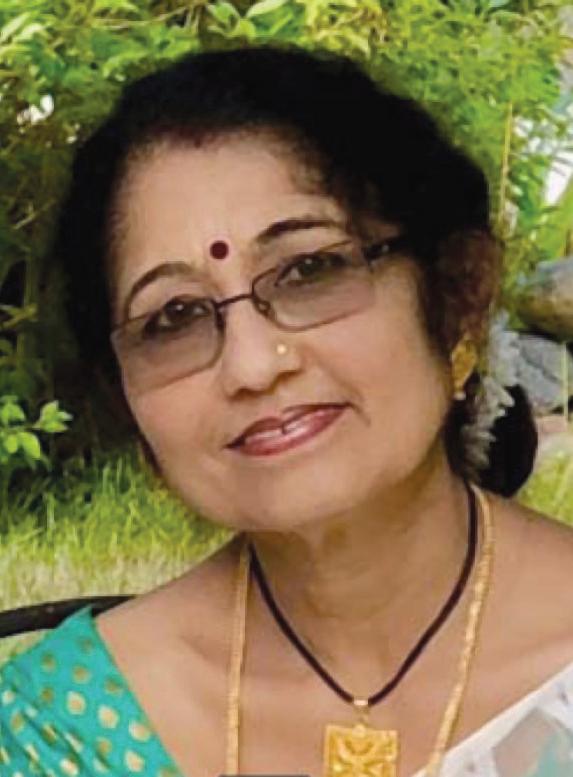
Swapna Ray, a disciple of Suchitra Mitra, started Swaralipi Academy of Music in Wayland, MA, fifteen years ago to teach Rabindrasangeet to her pupils, of all ages. From music-teaching she picked up the pen to write poems and prose in Bangla. Her poems have appeared in many journals in India and in North America, particularly in venerable magazines like Krittibas, Parabaas, and Pratichi. She has also co-authored a book of verses, entitled Kobitara jokhon jhanke jhnake asey (Krittibas, 2012) with Rahul Ray. Swapna is also passionate about stage acting. She, along with Rahul founded ‘The Boston Group’, and staged numerous plays in North America and Canada. Swapna is a scientist and a teacher by profession.
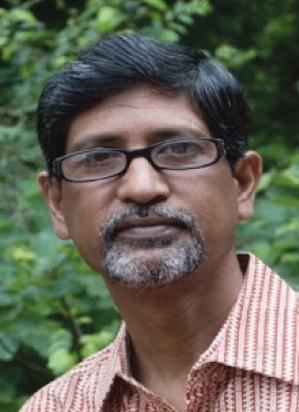
Subhankar Mukhopadhyay is an author and a journalist. He is currently working for the Tennessee Department of Health. But in the past in Kolkata, he was a journalist for Bartaman and was a regular contributor to TV & Radio. At present, he is a regular contributor to Anandabazar Patrika, Bartaman, Aajkaal, and Ei Samay. He has published seven books (Netaji Ontordhaan Rohosyo, Bharotio Songbidhan: Ponchaashe Paa, Krishnochorit, Choitonyochintaa, Arobinder Sondhaane, Nogor Baaul Bob Dylan, and Milemishe).
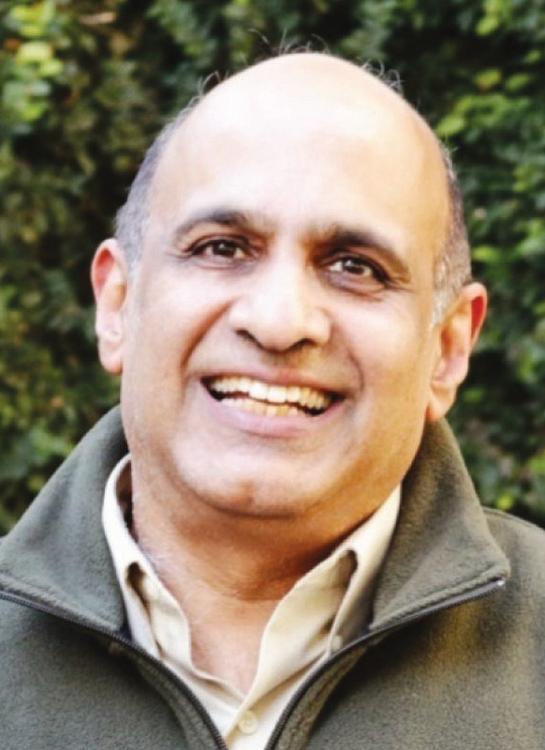
Debashis Roy Chowdhury is a software engineer by profession. Debashis has a passion for reading and creative writing. He has published over 25 short stories in English in various magazines in North America including Kallol, Anandalipi and the NABC magazine Debashis has also written thought-provoking essays on music, musical legends and on meditation in various publications in the US and India. Debashis is a dedicated student of Indian classical music and references to Indian music often seeps into his short stories. He currently resides in the Bay area along with his family.