Celebrity Scandals vs. Real News: A Culture Obsessed
| continue from page 5
as truth. Media-literate individuals can distinguish between evidence-based information and personal beliefs.
Media literacy also helps people recognize hidden purposes behind content. Some news is designed to provoke emotions, influence political views, or generate profit. Understanding these motives encourages critical thinking.
Teaching media literacy from an early age is crucial. When young people learn to question, analyze, and reflect on what they see online, they become more informed, responsible, and thoughtful media consumers.
When Gossip Becomes Serious
Although most celebrity gossip is light and short-lived, some stories grow into meaningful cultural and political discussions. The #MeToo
movement is a strong example. What began as allegations against powerful individuals developed into a global conversation about workplace harassment, gender inequality, and abuse of power. Similarly, Britney Spears’ conservatorship battle revealed serious issues surrounding mental health, legal autonomy, and media exploitation. Will Smith’s Oscar slap also went beyond gossip, sparking debates about violence, public behavior, masculinity, and emotional trauma.
These cases show that celebrity news can carry real social importance when reported with depth and context. Problems arise when media outlets reduce such stories to clickbait, ignoring their broader meaning.
Gossip and journalism can coexist if handled responsibly. Entertainment stories can be paired with expert insights, statistics, or social
analysis. At the same time, audiences should broaden their media habits, support serious journalism, and step back from nonstop gossip to think more critically.
Conclusion: Culture in Crisis and The Cost of Attention?
The cultural obsession with celebrity scandals at the expense of real news reflects a deeper societal issue. While entertainment is essential, an over-reliance on it risks diverting attention from issues that genuinely impact lives. In the end, it is not just media that must be held accountable—it is the audience, too, that must reassess what they value, prioritize, and choose to engage with.
In today’s informationrich world, attention is a finite and powerful resource. Every like, click, and comment is more than just an interaction—it is a vote for
the kind of content that gets amplified. If we spend all our attention on celebrity feuds and internet drama, we risk ignoring the issues that genuinely shape our lives and future.
So, the next time you are scrolling through a trending celebrity scandal, pause for a moment. Ask yourself: is this nourishing my mind, or just
feeding the algorithm?
It is okay to laugh at the memes and enjoy a bit of drama. Entertainment is human. But do not let it consume all your focus. Carve out time for substance. Because while we were busy analyzing someone’s breakup, the world kept burning—and too few noticed the fire.
Deciphering of Hieroglyphs – the Ancient Egyptian Language
| continue from page 4
he considered it an irresistible challenge. Young’s breakthrough came when he focused on a set of hieroglyphs enclosed in a loop, called a cartouche that looked like He suspected that these highlighted hieroglyphs represented something significant, possibly the name of the Pharaoh Ptolemy, who was mentioned in the Greek text.
If this were the case, it would enable Young to latch on to the phonetics of the corresponding hieroglyphs, because a pharaoh’s name would be pronounced roughly the same regardless of the language. Young matched the letters of Ptolemy (Ptolemios) with the hieroglyphs and managed to correlate most of the hieroglyphs with their correct phonetic values. The decipherment of the Egyptian script was underway. (Fig. 3)
Young was on the right track, but his work suddenly came to a halt. It seems he was biased by the established view that the script was picture writing, and he was not prepared to shatter that paradigm. He excused his phonetic discoveries by noting that the Ptolemaic dynasty was not of Egyptian descent and hypothesized that their foreign names would have to be spelled phonetically because there would be no symbol in the standard list of hieroglyphs.
Despite coming so close to cracking the code, Young lost interest in hieroglyphs and brought his work to a conclusion by simply summarizing it in an article for the 1819 supplement to the Encyclopedia Britannica. It is said that it was characteristic of
Young to hop from one topic of interest to another before bringing a particular one to a logical conclusion. In the process, he lost out to a young Frenchman, Jean-Francois Champollion, who is credited with completely deciphering the mystery of hieroglyphs.
Champollion’s complete deciphering of hieroglyphs
Champollion applied Young’s technique to other cartouches, but the names, such as Alexander and Cleopatra, remained foreign, supporting the theory that phonetics was invoked only for words outside the traditional Egyptian lexicon. Then, in 1822, Champollion received some cartouches that were old enough to contain traditional Egyptian names, yet they were still spelled out, clear evidence against the theory that spelling was used only for foreign names.
Champollion focused on the cartouche containing just four hieroglyphs: the first two symbols were unknown, but the repeated pair at the end signified ‘s-s’. This meant that the cartouche represented (‘?-?-ss’). Champollion wondered if the first hieroglyph in the cartouche, the disc, might represent the sun, and then he assumed its sound value to be that of the Coptic word for sun, ‘ra’. This gave him the sequence (‘ra-?-s-s’). Only one pharaonic name seemed to fit. Allowing for the omission of vowels and the unknown letter (shaped somewhat like ‘m’), surely this was Rameses (Rameses II was one of the most powerful kings of Egypt who
reigned in the 13th century BC). The spell was broken. Hieroglyphs were phonetic, and the underlying language was Egyptian.
Although this was just one more cartouche, it clearly demonstrated the fundamental principles of hieroglyphics. It showed that the scribes sometimes exploited the rebus principle, which involves breaking long words into phonetic components and then using pictures to represent these components. For example, the word belief can be broken down into two syllables, ‘bee-leaf’[2]. Hence, instead of writing the word alphabetically, it could be represented by the image of a bee and a leaf. In the Rameses example, only the first syllable (‘ra’) is represented by a rebus image, a picture of the sun, while the remainder of the word is spelled more conventionally, that is, phonetically. After studying several of these coded scripts, Champollion identified phonetic values for many hieroglyphs and established that phonetics was the ‘soul’ of hieroglyphs.
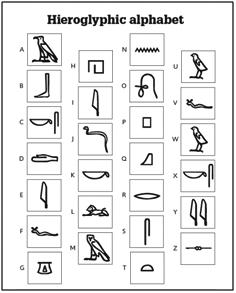
So, while the original work was started by Thomas Young, the mantle was carried by Jean Francois Champollion, who after studying several of these coded scripts, identified phonetic values for most hieroglyphs and established that phonetics was the ‘soul’ of hieroglyphs (Fig. 4).
It was an interesting learning, and I would never have learnt about the enigma of the ancient language and the exciting stories of its decoding by scholars such as Thomas Young and Jean Francois Champollion unless I embarked on a trip to the mysterious
Fig. 4A simplified summary of the mapping of hieroglyphs with the English alphabet
land of Egypt.
References:
1. Thomas Young – The last man who knew everything, book by Andrew Robinson
2. ‘The Decipherment of Hieroglyphs’ by Simon Singh on BBC Website
Fig. 2 Gossip and Journalism
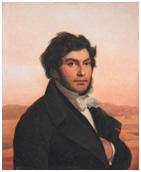
Jean Francois Champollion
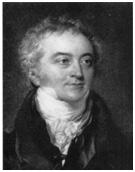
Thomas Young
PUJA ACTIVITIES FOR JAN – MAR 2026
Inone of New Jersey’s coldest and snowiest winters in recent memory, our community members were brave enough to show up at the Temple for most of our major puja ceremonies.To them, it is a place for peace, worship, and socialization.
On New Year’s Day, the temple was open from 9 AM to 8 PM, and there was a constant stream of devotees. In the evening, we had Satyanarayan Puja followed by Arati, Pushpanjali, and a nice dinner.We are off to a good start in the new year.
On January 17, we had our Ratanti Kali Puja in the evening. This special worship of Goddess Kali was observed on Chaturdashi of the Krishna Paksha in the month of Magh. It is said that on the sacred night of Ratanti Amavasya, when the world rests in silence, Ma Kali awakens her heart. Many devotees attended the Puja on this day and worshiped in the evening. We had Aarati, Anjali, and a good dinner. The next day, we had our monthly
Reported by Mita Sinha, Chair, Puja Committee
Shyama Puja, which was also very well attended.
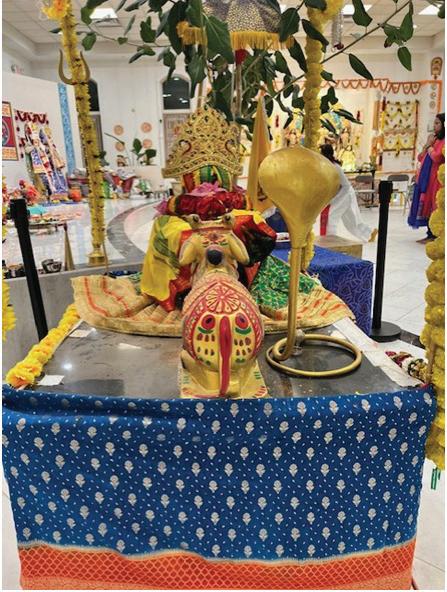
On January 23, we had our Puja Ma Saraswati, the Goddess of knowledge, wisdom, music, and the performing arts. Saraswati Puja is mostly celebrated in the Northeastern part of India, whereas other parts of the country celebrate Basant Panchami.
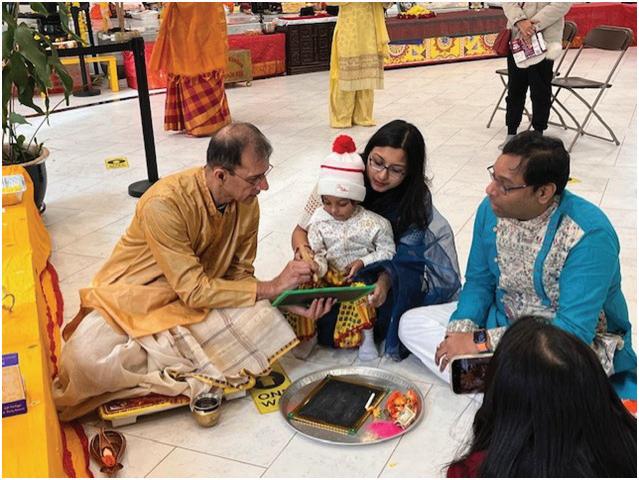
Our puja started at 8:00 am in the morning. After the puja, we had Aarati, Anjali, and Hate Khori, an auspicious religious ritual performed by Hindu children to mark the start of their education. This is observed mostly in West Bengal and traditionally occurs on the day of the Saraswati Puja. The children, mostly aged three to four, perform the ritual of writing the Bengali alphabet and numbers on a slate. This marks the beginning of their formal education. We had many kids at this ceremony, all in traditional Bengali dress, and they had great fun
writing on a slate and starting their formal education. They also received a gift bag from Ananda Mandir. This is a fun ritual for both kids and parents. Elder students brought their books to be blessed by the goddess Saraswati. Everybody had prasad and lunch after the puja.
This is a day marked by the color yellow.The ladies mostly wore yellow sarees, and some men wore yellow kurtas. Yellow marigolds were offered to Ma Sarswati for the puja. Since Ma Saraswati is also the Goddess of music and performing arts, we celebrated Bani Bandana in the Tagore Hall this evening. Several talented kids from our community presented their talents on the stage with music, drama and dance.
On February 1, we celebrated Maghi Purnima, the full-moon day in the Bengali calendar month of Magh. It is one of the Hindu Calendar’s most auspicious days, when the Moon reaches its highest point and radiates energy everywhere. This is a day dedicated to honoring Lord Vishnu, and many people fast on this day. We had a puja in the morning and evening. In the evening, we also had the Satyanarayan Puja, a popular Hindu ritual in which devotees seek blessings of health, wealth, and harmony. Satyanarayan puja is performed at Ananda Mandir at least once a month during Purnima.
On February 15, we had Maha Shivaratri Puja to hon-
or and worship Lord Shiva. This is also one of the most important festivals for the Hindu community. In our Shastra, Shiva and Shakti are two forms of a single energy, and Maha Shivaratri is observed as a day of fasting and meditation. Devotees came to the temple all day, and at night, we had the Hima Chandan Aarati and Rajbesh (special dress) for Lord Shiva. Some of our members stayed up all night at the temple on this day.
On February 16, we held our monthly Shayama Puja, our last major event of the month. Attendance was great on these days despite very bad weather, and we thoroughly enjoyed all the pujas.
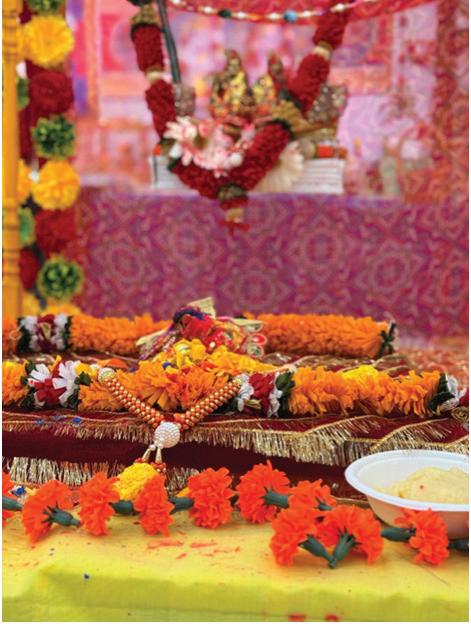
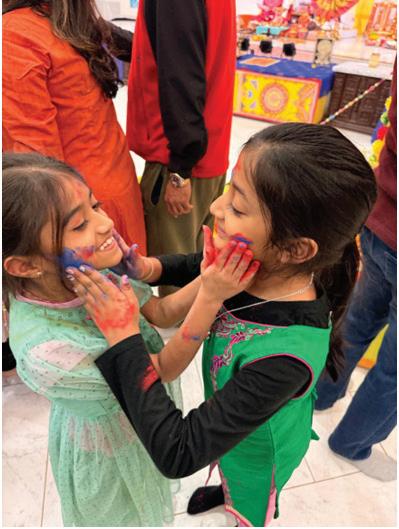
On March 3, we celebrated Dol Purnima/Holi, one of India’s most popular festivals. The festival is dedicated to Lord Sri Krishna, and we chanted Lord Krishna’s names. Holi is known as the festival of color, and people, including children, enjoy throwing colored powder at each other. In the evening, we also had Satyanarayan Puja. After the puja and Aarati, we rub color powder on each other’s faces. It also signifies the arrival of spring and the victory of good over evil. This was a fun day, and we all enjoyed ourselves. We all had a good dinner after the puja.
On March 18, we had our monthly Shyama Puja. As always, this puja was well attended by our devotees. In the evening, after the Puja
and Aarati, we all had dinner.
The next Puja at Ananda Mandir was Basanti Puja, from March 24 to March 27, with main rituals starting on Saptami and ending with Bijoya Dashami. This spring festival coincides with Chaitra Navaratri. This was the original Durga Puja. Basanti Puja is celebrated in the eastern parts of India. As the name suggests, this puja is observed in the Spring season. This is performed in the month of Chaitra in the Bengali calendar.
On March 27, we had a Ram Navami celebration. Ram Navami is a Hindu festival that celebrates the birthday of Lord Rama, the seventh avatar of the deity Vishnu. We also had our monthly Satyanarayan Puja in the evening on this day. We perform all major pujas of the Hindu Calendar,andwe welcome everybody to come and pray with us. And we are happy that we have manyout-of-statevisitors. Our temple hours are 9 to 11:30 AMand 5:30 to 8:00 PM, and we are open seven days a week. Anyone can sponsor an online puja if he/she so choose. To schedule a private puja at your home or at the Temple, please call (732) 8739821 and leave a message, and someone will get back to you. Our website is www.anandamandir.org, and you can find details of our puja dates and information on all other cultural activities on this website and on Facebook and Twitter.
Badminton Tournament Organized by Ananda Mandir
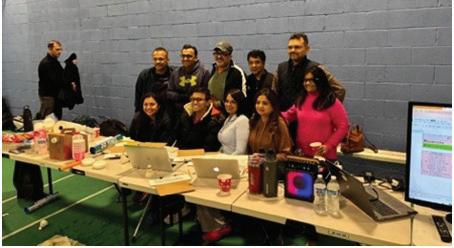
TheSecond Annual Badminton Tournament was held on December 6th and 7th at the Pine Brook Complex in New Jersey and drew widespread attention from the local sporting community. There were 90 matches with 60 players participating in Men’s Dobles, Women’s Doubles and Mixed Doubles categories in a league-cum-knockout format. There were six teams: Mavericks, Warriors, RouNxt, Baazigar, Shuttlers, and Raqueteers, each comprising 10 players. The players were selected through a bidding process to maintain competitive balance.
Reported by Subhrojit Dutta (New Jersey)
The tournament atmosphere was marked by intense efforts, discipline and sportsmanship. The preliminary rounds set the tone for impressive rallies and closely fought encounters. The fast-paced exchanges, accurate drop shots, and powerful smashes thrilled the spectators. Few teams advanced smoothly through the early rounds, and the advanced stages showed impressive resilience, consistent baseline play, effective net control, and attacking style in shifting
momenta.
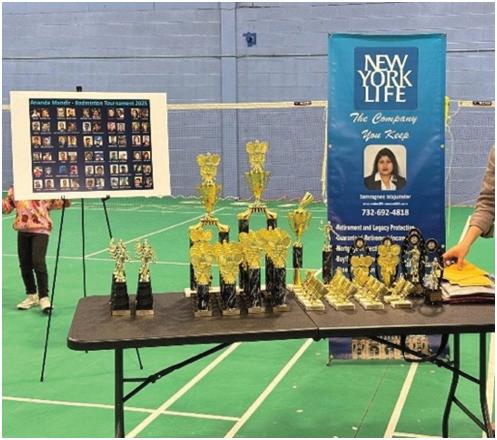
Whereas Men’s Doubles final displayed excellent coordination and tactical discipline, Women’s Doubles showcased quick reflexes and defensive skills. The Mixed Doubles matches were closely contested and drew intense interest from the crowd. In the end, the Mavericks were the winners, followed by the Warriors, and YouNxt secured third place. Prizes were also awarded to the Best Male and Female, and Best players in the categories of the Spirit of Ananda mandir, Shining Star, and People’s Choice.
A notable feature of the tournament was the strong performances by younger, first-time players. Organizers observed notable improvements in players’ fitness and professionalism compared to the previous year. It showed the effectiveness of local coaching programs and the training facilities. The event drew a steady stream of spectators, including local sports enthusiasts, former players, and members of the players’ families. The hard work of the organizers and 20 volunteers ensured the smooth
running of the tournament and an adequate supply of a diverse range of refreshments.
Trophies were presented by Ananda Mandir Volunteers, and in his concluding remarks, Ananda Mandir President Mr. Anjan Lahiri stressed the need for local tournaments to identify talent and promote sports as an integral part of community life. And he expressed appreciation of the efforts of the volunteers, who were led by Mr. Alok Dey. The organizers expressed satisfaction with the overall response to the event and announced plans for future events. The tournament’s success reinforced the value of sports in fostering discipline, teamwork, and healthy lifestyles.
CULTURAL PROGRAM HIGHLIGHTS
RAMESHWARAM- THE ISLAND OF LEGEND
By: Tathagata Ghosh (New Jersey)
After a rough July in Chennai in 2025, my brother and I decided that we needed a break in Rameshwaram.
Rameshwaram is fairly close to Chennai, my hometown, a little over 500km. There are multiple options to go to from Chennai -a bus, train or a car. Travelling by car is probably the most comfortable, but we decided to go by train. So, my brother, his wife, and I traveled on an overnight train -it is called Superfast Express, but the leisurely pace did not justify its title. I was quite excited to be travelling by train again, which I had always enjoyed as a young person, but I was a little tentative about the overnight journey.
Rameshwaram is actually an island off the coast of Tamil Nadu. It is connected to the mainland of India by the Pamban bridge,which allows trains and road traffic to cross. The island of Rameshwaram is quite close to Sri Lanka; the nearest point is only about 30 km from the mainland. Hence, the presence of Ram and the Ram Setu are palpable in every legend and the temple in Rameshwaram.
We caught the train at Egmore station in Chennai and arrived at Rameshwaram early in the morning, around 4.30 am. When we woke up to our alarms, we were travelling over the Pamban bridge. The Pamban bridge would be a spectacular crossing at dawn, but in the predawn hours, we could not see much in the dark.
We stayed in a small hotel; it was adequate and functional. It seemed that Rameshwaram was not really set up for tourists, though a large number of religious tourists visit the island.
Rameshwaram is an important destination of the Char Dham (4 Dhams) –Badrinath in the North, Dwarka in the West, Puri in the East, and Rameshwaram in the South. Only Ramesh-
waram has a Shiva Deity, while others have Vishnu deities.
My interest in the trip to Rameshwaram stemmed from its distinctive geographic features rather than any religious inclinations. In that part of India, it is the easternmost part of the mainland and close to Sri Lanka. The Palk Straits separate India and Sri Lanka.
Once we got our bearings, we made our plans for the next day. After discussing with the locals, we decided on the following places:
1. Pamban Bridge
2. APJ museum
3. Villondi
4. Vibhishana temple
5. Dhanushkodi
The Pamban bridge, which we crossed by train, also has a roadway connecting the island of Rameshwaram to the mainland. We drove to the top of the bridge and got a fascinating view of the two distinct bodies of water.
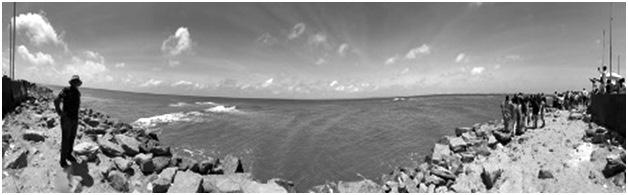
There is an approximate dividing line between the Indian Ocean and the Bay of Bengal. We could see, on one side, the Indian Ocean, blue and rough, with nice sandy beaches, and on the other side, the Bay of Bengal, with dull green water and a little rocky landscape. The Bay of Bengal is a lot shallower, and all the fishing boats are typically anchored there. From the Pamban bridge, we could see the old, abandoned railway line over which the new elevated line has been, and our train used that line.
Next, we went to Dhanushkodi,a jutting projection of the island. It can best be described as a Cape. It is an abandoned town with a fascinating history.
There was a cyclone in 1964 (with tidal waves of about 20 feet) and the town of Dhanushkodi was destroyed. More than 1000 people died in that cyclone, and an entire train was lost. The Govern-
ment declared Dhanushkodi a ghost town and restricted access.
This is the land area closest to Sri Lanka, and the Ram Setu is supposed to start from here. Though this area is advertised as abandoned, local fishermen still operate here, with many huts and small establishments lining the beach.
The army also monitors this stretch. A new road has been built spanning the promontory. Now it is more of a tourist stop, but there are no water facilities, plumbing, or electricity here. We saw many huts with solar panels on their roofs.
The road entrance was controlled by a gate, presumably patrolled by the Indian Coast Guard. The driver said that all vehicles need to return from Dhanushkodi by 5 pm. After a couple of miles on the road, we started seeing more fishermen’s huts along this stretch of land, where they live off fishing and tourism. We saw the island’s destruction, with broken-down buildings that were never repaired after the cyclone. There were taxis, autos and cars parked on either side of the road.
The cell service had stopped working. The tourists were enjoying the beach or swimming in the Indian Ocean. If only the tourists knew of the dangers. The driver of our taxi said that in the last week, two tourists were swept away in the currents in the Indian Ocean and were lost forever.
There were no signs anywhere about how dangerous the beaches were. The tourists continued to stop by unaware, and this situation has presumably gone on for a long time unreported.
We drove to the very tip of the promontory. The cell service on my T-Mobile phone started connecting to a tower in Sri Lanka. At the tip, we could notice the Adam’s Bridge, more famously known as Ram Setu. These
are limestone shoals and sandbanks, some even jutting out from the water in low tide connecting Dhanushkodi to Sri Lanka. The distance to Sri Lanka is very close from here, about 30 km.
Ships cannot pass through this area easily. This roughly demarcates the Bay of Bengal from the Indian Ocean. It is a significant place from a military perspective. Neither the Chinese Navy nor the US Navy can cross these shoals. They need to go around Sri Lanka to get into the Bay of Bengal. On the other hand, it is a perfect stretch for smugglers and other illegal activities, including terrorism.
The Dhanushkodi promontory has a significant presence of the Indian Customs and Coast Guard. We saw what looked like a Customs hovercraft. The fishermen on the island are sometimes attacked by the Sri Lankan Navy if they cross over too far into Sri Lankan waters.
During the Tamil separatist movement, there was a lot of migration from the Sri Lankan side. So, Ram’s army may or may not have crossed here, but Tamil insurgents certainly did, and we are aware of the subsequent terror plots in India. Because of the area’s proximity to Sri Lanka, it is still a place for a lot of illicit activity, including smuggling, especially at night.
Our driver indicated that gold smuggling goes on here in the dark. Gold and narcotics enter routinely through this corridor. We took some pictures at the tip of the island and bought shells and other trinkets from there for gifts. The locals here have done a good job of collecting seashells and creating interesting artwork.
Another highlight of the Dhanushkodi trip a full South Indian meal at a roadside stall. It was freshly caught fried fish with rice and sambar. We washed our hands from a makeshift bucket reservoir. There are no hotels,
no restrooms or any facilities in Dhanushkodi, just subsistence living by the local fishermen, eking out a living where and when possible.
After the beach exploration, we headed for a couple of temples on the island. We first went to Villondi, which is famous for a fresh/sweet water well in the ocean. The well is accessible by about a 100-foot-long walkway, and it is surrounded by the ocean. The local priest dropped a bucket, and in came a full bucket of sweet water. We tasted it, it was definitely sweet, not salty as one would expect. The legend is that Sita was thirsty, so Shri Ram aimed an arrow at the sea, and fresh water came out.
A more likely explanation is that the freshwater exists in groundwater reserves if you tap deep enough. I live very close by the beach, and I know that we get fresh water from our underground resources when we dig a well. The priest asked us to donate money to build a toilet, which was nonexistent near the temple at Villondi.
The next place we visited was the Vibheeshana Temple, which is right on the coast of Rameshwaram. This is where Ravavna’s brother Vibheeshana (the good brother), surrendered to Shri Ram. The temple was crowded, and I did not venture inside, but my brother and his wife went in. I walked around the temple enjoying the architecture. This was a semi-traditional South Indian temple. There were a lot of vendors outside, but no facilities, not even rudimentary bathrooms.
We moved on to our next destination, the APJ museum, or the Abdul Kalam Museum. Dr. APJ studied here before he went to ISRO, where he started India’s rocket program, and finally, he became the President of India. His relatives still live there and have some businesses in the area.
continue to page 11 }
Rameshwaram- The Island of Legend
| continue from page 10
The APJ Museum is a well-designed museum with many pictures of APJ with many dignitaries, and also many statues of different times of his life. I think there were also models of the different kinds of rockets that he was involved with. It was nice to see a man of such great stature being respected in the land of temples and deities. A word of caution: no cell phones are allowed inside the museum, probably to prevent people from taking pictures.
The next day, we went to the Ramanathswamy temple. We checked on the website and found out that traditional attire was required. So, before we went to the temple, my brother and I got ourselves a Veshti, the southern dhoti, which is to be worn inside the temple.
At the temple, we saw signs for baths at the 22 wells, and some very wet souls standing in the queue. We learnt that they had taken their first dip in the sea and were now in line for the 22-bath sequence inside the temple. This is the holy dip supposed to cleanse one of all karmic impurities.
The three of us carefully skirted all the ‘wells’ where a priest was dunking everybody with water. After avoiding the dunking and the karmic cleansing, we traversed one of the longest temple corridors in the world. Inside the temple, we heard a commotion. I looked at the next corridor, and I saw a good-sized elephant strolling along, heading for the exit. One of the residential temple elephants, I guessed. Finally, after a maze of barricades, we reached the sanctum sanctorum, where we had a quick glimpse of the Shiva Linga. We soon exited the temple at a different entrance than the one we entered through and couldn’t find our footwear. We were not exactly sure where we had entered, and we ended up making a full parikrama of the temple before we located our footwear.
In addition to the temples and museums, I thought it would be good to see if there was a place for water activities on the island. The internet mentioned some decent water activities, but we found out that these were more of a façade. Even the ‘beach’ was too dirty for swimming. If you want to swim, you have to go into the ocean, about a hundred meters. We decided not to do that, but spent a little while reading a book in the shade and again having some local fish dish. What I realized from this is that Rameshwaram is extremely polluted, and probably human waste on the island just gets pumped out into the ocean.
There were a few other temples my brother and my sister-in-law visited, and we then made our way back to the station for our train home. This time, we had a good view of the Pamban bridge and the deceptively shallow waters as we exited Rameshwaram. Definitely a nice place to make a visit if you are religiously inclined; otherwise, there is not much else to do here. About 2-3 days is a good enough time to see the entire island.
Why Staying Positive Has Mental...
| continue from page 7
this article provides neurological insights into how the brain processes stress and how it can develop into depression, leading to new interventions.If the brain were already compromised by whatever factors that cause dementia, it wouldn’t be far-fetched to say that constant negative thinking could speed up the whole process.
“Try not to think about it” may sound stereotypical, but here it may well be medically sound advice.
References:
[1] The Journal of the Alzheimer’s Association, Vol 16, Issue 7, July 2020, pg 1054
[2] “Neural mechanisms mediating optimum Bias” Tali Short et al. Nature Letters, Vol 450, November 2007
[3] The Link between Stress and Depression by Dean Burnett, The Guardian.org, October 2019
AN OLD TIME CAMPUS STORY
The Curious Case of Shantanu’s Dinner Invitation
By Gautam Bandyopadhyay (Massachusetts)
Shantanu was different from the rest of us. While we were a ragtag bunch of financially strapped graduate students on temporary student visas, Shantanu arrived in the U.S. with a coveted green card - a golden ticket for permanent residency. Among a dozen or so twentysomething Bengali students at a large California campus in the early ’70s, the green card made him unique, and to him, maybe even a little superior.
New to the community, Shantanu often hung out with us students. He had an engineering degree from Jadavpur University and had taken advantage of the recently liberalized U.S. immigration policy for skilled professionals. Along with his green card, he brought a well-paying job at a local consulting firm and a late-model Toyota sedan, which, in our eyes, practically made him a royalty.
To be fair, he carried himself like royalty. He never missed a chance to tell us about his wealthy, progressive family in Kolkata, his Park Street club life, his rotating roster of girlfriends, and his exotic family vacations. For us - middle-class Bengalis raised in conservative homes, Shantanu’s tales were like something out of a Bollywood film. So naturally, we did what any self-respecting group of students would do - we encouraged him to tell more, while secretly laughing at his desperate attempts to impress us.
So, when Shantanu invited Amit and me over to his apartment for drinks and dinner, we were surprised, and curious. We couldn’t pass up a chance to witness the extravagant lifestyle he talked so much about. His apartment wasn’t far from campus, and it definitely outclassed ours. He lived all by himself - not like us, crammed two-to-a-room in a 2-bedroom flat with old hand-me-down furniture collected from university storage. His place had real furniture, a brand-new 15inch color TV, and shiny kitchen gadgets we hadn’t seen outside of Sears catalogs.
As we stood there, admiring his setup with a healthy dose of envy, we noticed a stack of glossy Indian film magazines perfectly fanned out on his coffee table. I picked one up and began flipping through.“I get
them airmailed every week,” Shantanu said with a smug smile.
In 1971, finding any Indian magazine in the U.S. was like spotting a unicorn. To get them weekly, and airmailed, was indeed impressive - though, to me, it sounded like an extravagant waste of money. Neither Amit nor I dared ask the cost. We weren’t about to hand him another opportunity to make us feel broke.
Then came the main actdinner and drinks.He proudly showed us the Italian dish baking in the oven - something fancy and layered. On the way back to the living room, he picked up a bottle of Russian vodka from his well-organized bar. That alone set him apart. Most of us didn’t drink, and back home, we hadn’t even seen alcohol in our families. Since arriving in the U.S., I had dipped a toe into the beer and wine world, but vodka? That was uncharted territory. Amit and I squinted at the label - 40% alcohol. Our eyebrows went up.
With the flair of a bartender in a Bond movie, Shantanu poured three shots. He raised his glass - “Cheers to good health!” - and downed the entire shot in one dramatic gulp. We followed with a cautious sip. It tasted awful. Like industrial cleaner with a kick. I couldn’t understand how Shantanu managed to gulp that stuff.
“You have to learn how to drink the real stuff like whiskey and vodka. Beer and wine are for weak hearts!” he declared with a loud laugh, as he downed his second shot. His face twisted slightly as the liquid burned its way down. He added, “Some people - women usually - mix juice with vodka. But I like it raw.”Clearly, this was his idea of masculinity.
Then came shot number three. No pause. No chaser. Just another big gulp. At this point, Amit and I looked at each other, wide-eyed. Was this dinner or a live experiment in alcohol tolerance?
Within 30 minutes of our arrival, Shantanu had downed four vodka shots. His speech slurred, and soon he collapsed onto his sofa, completely knocked out.We were stunned. Neither of us had dealt with a situation like this before. Was he just drunk? Was this dan-
gerous? We checked his pulse –it felt steady. He seemed peacefully asleep or passed out.
Meanwhile, the delicious aroma from the oven reminded us that we were still hungry. Walking out to find a restaurant didn’t make sense - not with our near-empty wallets, and not when we had been invited for dinner.
Amit, always the kitchen expert, identified the dish as lasagna. We raided Shantanu’s kitchen and found some bread and soft drinks to go with it. To our surprise, we ended up having a pretty good meal - awkward company notwithstanding.
An hour later, with Shantanu still in dreamland, we cleaned up, dumped the untouched vodka shots, and quietly let ourselves out. As we stepped into the night, Amit asked, “Should we have called an ambulance?”
“Maybe,” I replied. “But he looked like he was just sleeping. It would have felt stupid if he were just drunk.”We were still unsure when we went to bed.
The next morning, Shantanu called. His voice was sheepish. “I’m really sorry about last night. That’s never happened before. I usually know my limits.” He repeated his apology several times before nervously asking, “Did you guys at least eat something?”
We assured him we had a great meal - which was technically true. But that night marked a turning point. He never invited us again. And interestingly, he also stopped telling his grand stories about his fancy life in Kolkata.
Looking back, I often wondered; was Shantanu really someone with a drinking problem? Or was it a clumsy attempt to impress us with his version of American-style socializing?Truth is, back in those days, there were no guidebooks or YouTube channels for young immigrants trying to navigate cultural transitions. People like Shantanu with extra money in pocket had to figure it out on their own - often by trial, error, and a few too many vodka shots. Thankfully, today’s young immigrants are better informed, better prepared, and less likely to measure masculinity by alcohol proof.
RECENT ALOCHANA SESSIONS AT ANANDA MANDIR
Reported by Subrata Bhaumik (New Jersey)
Alochana – formerly Sahitya O Alochana (SOA) - is a periodical (formerly monthly, now quarterly) topical discussion forum under the aegis of Ananda Mandir (AM). It completed its 17th anniversary in 2026 and has thus far organized one hundred and thirty-three (133) sessions. They feature exciting and illuminating discussions on diverse subjects, including literature, art, history, science, philosophy, business, and current affairs. These sessions were resurrected in February 2025 after a long hiatus for over two years due to Pandemic fallout and organizational issues. And a few very interesting sessions have been organized ever since. Here is a quick summary of the activities since then.
February
2025
“My Father’s Brain - Life in the Shadow of Alzheimer’s” was a wonderful session with a sell-out turnout. The crowd in attendance was well-informed, engaged, and appreciative of the discussion. The speakers, Dr. Sandeep Jauhar (a famous cardiologist and a NYT bestseller writer) and Mr. Sanat Chattopadhyay ( President of Worldwide Manufacturing and Supply Chain of Merck & Co., the Pharma giant) were in their elements discussing Dr. Jauhar’s New Times Bestseller book on Alzheimer’s disease and its impacts on caregivers, their family lives, and the pharma industry’s eclectic challenges in its quest for effective and lasting medicinal treatment. A ton of thanks go out to them!
November 2025
“In Search of Identity Along the Silk Road,” - Reza Husseini in Conversation with Subrata Bhaumik. Reza Husseini, the speaker, is a scholar/researcher at Princeton University with a background at various top international universities, including Cambridge and JNU. His area of specialty includes IndoIranian and Central Asian History along the Silk Route.
The session focused on the idea that South Asians have a love and hate relationship with the concept of “mixed identity. While on one hand the perceived purity of South Asian race is anthropologically debated, on the other, they still celebrate opportunities to explore their perceived mixed identity because historically their land is right in the middle of a quasi-ancient and enormous trade cum cultural network
of pathways that connected a huge chunk of the globe – from southern Europe to Middle East to China, South Asia, Far East and Central Asia, to parts of former Soviet Union.
In the session we explored how the potpourri of mixed identity came about and, in the process, argued that people along this ancient, vast cultural and trade route share a lot more commonality than meets the eye.
It was a wonderful discussion with a robust turnout given the cold weather. The crowd in attendance was diversely informed, interactive, and appreciative of the topic and the ensuing discussion. Reza Husseini shared a treasure trove of fascinating information in the backdrop of the fabled “Silk Route” and cut through some of the myths that sometimes mask the history. A ton of thanks go out to him.
December 2025
Deals and Scams – This session was experimental in format – more of an interactive discussion on a novel topic that examined the inexplicable affinity of the general public falling prey to everyday scams couched as the best deals ever. Note that many of us, claiming to be rational individuals, have had the experience of acting against our better instincts, hoping to beat the odds. Several attendees shared their own stories along similar lines. Overall, Tathagata Ghosh, a local technology professional cum writer (of Soaring Crimson Tales fame), the discussion leader, and Debajyoti Chatterjee of Ananda Mandir, his collaborator, presented a pretty good session that was informative, yet humorous and, in some sense, self-deprecating. A ton of thanks goes out to them!
February 2026
Broadway, Bars and Fortune, a novel documentary, was screened in this session. hat – The documentary is a heart-touching tale of incarcerated individuals and their triumphant return to life through arts, Hollywood, and theater. It’s a unique journey of trauma, travails and redemption featuring some very prominent Broadway personalities. This documentary received various International Awards Dr. Shuvendu Sen, the director, is an award-winning physician, an accomplished writer, and a movie
What We See When We Look in America’s Mirror
| continue from page 3 continue to page 13 }
Bengali professor and a South Korean doctor and a Filipino nurse share some essential identity just because we’re all from the world’s largest continent.
A multiracial friend once told me she feels like she’s always explaining herself. At Indian gatherings, people ask about her “other half.” At white gatherings, she’s the exotic one. She doesn’t fit the boxes, so people don’t know where to put her. And when people can’t easily categorize you, they get uncomfortable.
These rigid categories fuel anxiety on all sides. When your identity feels threatened by people who don’t fit neat labels, you cling harder to those labels. This is true for majority groups worried about “replacement” and minority groups worried about erasure. The fear is the same, even if the power isn’t.
The Gift of the Mirror
Here’s what I’ve come to believe: being a minority in America, for all its discomfort, offers us something valuable. A mirror.
When you lose your “default setting,” when you’re forced to see yourself through others’ eyes, you can’t pretend anymore that categories are natural or inevitable. You see them for what they are: human constructions, artifacts of power and history and fear.
This mirror should make us more empathetic, not less. When we feel the sting of being stereotyped, we should remember what it feels like for minorities in India. When we resent being judged by our accents, we should think twice before judging someone else by theirs. When we demand to be seen as individuals, we should extend that same courtesy to others.
And when we catch ourselves cheering for outcomes that would hurt our own families, when we notice that confused loyalty pulling us in opposite directions - maybe that’s the mirror showing us something important. Maybe it’s revealing that our identities are more complicated than any passport can capture, that belonging isn’t a binary choice between here and there.
But empathy is hard. It requires us to hold uncomfortable truths at the same time: that we are both privileged and marginalized, both insiders and outsiders, both loyal and conflicted, both oppressors and oppressed depending on which border we’re standing on.
Choosing Honesty Over Comfort
We are not hypocrites. We are human beings navigating a world that treats identity as destiny, trying to keep ourselves and our families safe in a system we didn’t design. We are
people caught between two countries, two loyalties, two versions of ourselves. We have the privilege of observing both sides of the bridge dispassionately, because we belong to both and neither.
But we can choose to be honest about the choices we make - even when honesty is dangerous, even when algorithms are listening, even when history warns us that admitting complexity can be weaponized against us. We can acknowledge that our political principles shift depending on whether we’re in the majority or minority. We can admit that our success in America hasn’t erased our insecurity. We can recognize that the boundaries we police in our families mirror the boundaries we resent when they’re policed against us.
What do we do with that honesty? We can start by asking ourselves harder questions. If we demand secularism in New Jersey, can we demand it in New Delhi? If we want our children judged by their character and not their color, can we extend that standard when they bring home someone we didn’t expect? If our retirement depends on American economic strength, can we examine why we feel satisfaction when that strength is challenged? If we benefit from capitalism, can we stop romanticizing systems that don’t work?
These aren’t easy questions. They don’t have tidy answers. But asking them is how we move from fear toward something better. It’s how we move from confused loyalty to conscious choice.
The risk of speaking honestly is real. In our age of permanent digital records and rising suspicion, every admission of complexity can be stored, categorized, and potentially used against us. But the risk of silence is greater. When we hide our contradictions, we allow others to define us. When we pretend our loyalties are simpler than they are, we surrender the right to be fully human.
America has given us many things: opportunity, prosperity, and education. But perhaps the most valuable thing it offers is this uncomfortable mirror. It shows us what we look like when we’re not the default, not invisible, not in control. It reveals our contradictions, our fears, our tangled loyalties.
The question is: once we see ourselves clearly, what will we choose to do? Will we hide that complexity to feel safer? Or will we claim it, knowing that being fully seen is both dangerous and necessary?
That’s the conversation our community needs to have. Not in whispers, not in coded language, but out loud - before someone else decides what our complexity means.
COMMUNITY NEWS
GSCA CORNER
Reported by Pradip R. Das (New Jersey)
A Tribute to the late Dr. Prasun K. Chakravarty
On February 6, 2026, GSCA sadly lost one of its long-time and dedicated members. He died peacefully in his sleep at his home in Washington, D.C., surrounded by family, after a five-year struggle with idiopathic pulmonary fibrosis. His selfless service to this organization will be remembered with the deepest gratitude.
Originally from Dehri-on-Sone, Prasun Chakravarty spent his early years across Bihar and Uttar Pradesh. After obtaining his PhD in Chemistry at CDRI, Lucknow, he accepted postdoctoral positions in the US, first at Utah State University, then at the University of Illinois, Urbana-Champaign. He met his future wife, Sumita, at the latter. In 1982, he joined Merck as a research scientist, where he pursued a distinguished scientific career spanning 30 years. Also known as P.K., he was widely respected by colleagues for his intellectual rigor, humility and compassion, and enduring commitment to scientific excellence and leadership.
Prasun da, as he was fondly referred to by many at GSCA, was a devoted husband, father, grandfather, brother, and to some, like me, a genuine and wonderful friend. His deep kindness and empathy, quiet determination, boundless curiosity, and steadfast presence had a lasting impact on all who knew him. He found profound meaning and fulfillment in countless things big and small; his family and friends, learning from and teaching others, music of all kinds, thoughtful conversations about topics ranging from philosophy to politics, experimentation in cooking, travel and cultural exploration, reading articles and telling stories, and the loving companionship he shared with the family dog, Eri.
He is survived by his wife, Dr. Sumita S. Chakravarty; their children, Aditi and Anupam Chakravarty; their spouses, Naveen and Connie (respectively); and three grandchildren.
A life well lived leaves more than just memories; it leaves momentum, a standard, and a spark in others. So now, not only do we grieve, but we also give thanks and give tribute to a life lived so fully and kindly.
Rest in Peace. Holiday Party
The annual December Holiday Party on December 6th at St. Stephen’s Orthodox Church in South Plainfield concluded GSCA’s
2025 events. Despite the very cold weather, over 75 adults and children participated in this fun-filled gathering. The sumptuous buffet of North Indian delicacies was a savory treat for all. A member appropriately donned a Santa Claus costume to entertain the gleeful children and give them gifts. A choreographed dance routine by some GSCA ladies set the mood for the evening, and the open dance floor drew enthusiasts, dancing to contemporary music. Some took advantage of the open mic, too. Overall, a delightful evening of company amongst friends, good food and lively entertainment.
GSCA ended the year with a bang!
GSCA New Board
A new Board of Trustees composed of five new and two continuing members took office at the beginning of this year. Archita Roy is the new Chairperson of this board.
Saraswati Puja
On Saturday, January 31st., GSCA’s first community event for 2026 took place at the South Brunswick Community Center, Monmouth Junction. This event was open to non-members as well, and some new members who joined this year also attended. GSCA welcomes them all. Attendance was over 100 adults and children.
Saraswati Puja is a cherished Bengali cultural heritage that celebrates knowledge, wisdom and creativity and provides an opportunity to seek the blessings of goddess Saraswati for academic success, intellectual growth and artistic inspiration. In addition to the traditional puja, pushpanjali, and prasad, a delightful dinner was served. To entertain the attendees, a delightful cultural program by the youth of GSCA was presented. Both vocal and instrumental medleys were presented by youngsters. Everyone enjoyed this year’s first community event of GSCA.
Upcoming events
Annual General meeting on Sunday, March 22nd at Tabaq Banquet Hall, Edison, NJ. (Members only) Baishakhi On Sunday, June 7th at Tagore Hall, Ananda Mandir, Somerset, NJ.
Maitree Association Corner
Reported by Arundhati Sanyal (New Jersey)
In December, Maitree Philanthropic Committee members handed over checks to the principal monk of Bharat Sevashram Sangha, Kendall Park, for the education of tribal girls at Ghatsila Bharat Sevashram Sangha and for the education of two nursing students at West Bengal through Bharat Sevashram Sangha, Kolkata.
Maitree celebrated Saraswati Puja on February 7 at Ananda Mandir Tagore Hall, and about 220 devotees attended. There was also a cultural program that included participation of several talented kids/ youth and captivating performances by various community groups. A Bhasa Workshop was conducted by “Next Gen Banga” group for the kids. The Youth Committee raised funds for philanthropy by selling snacks and boxed drinks. Maitree Members Engagement Committee (MEC) organized an Arts and Crafts contest (Boshe Anko)
for the kids and also presented the exhibits (paintings) of talented members. The spirit of the attendees was commendable despite the severe winter weather.
Finalist Maitree team participated on March 7 at the Grand Finale of the Kallol Quiz Contest.
Maitree Members Engagement Committee (MEC) continued the monthly publication of “Member’s Monday” article for a nominated member.
Preparation is underway for the Annual General Meeting (AGM) on April 12 at Guru Palace, North Brunswick. Maitree Baisakhi will take place on May 2 at Princeton Presbyterian Church, and the Cultural Committee has initiated planning for the event.Maitree Summer Picnic will take place on August 22 at Ridley Creek State Park in Pennsylvania. A bus has been reserved for the trip.
ICC CORNER
Reported by Chaitali Sinha (New Jersey)
InDecember 2025, a new Executive Committee of the Indian Community Center (ICC) of Garden State was elected. This committee of nine members is enthusiastic and committed to serving the organization. In addition, a sister committee was formed to support the ICC’s philanthropic activities.
ICC has always believed in serving the community. Recently, generous donations of non-perishable food items from the ICC members were distributed to those in need.
ICC organized Saraswati Puja in January. Despite the adverse weather conditions, the event was well attended and very successful. The puja ceremony, along with the colorful performances by youngsters, made the evening truly memorable. The traditional Bengali dinner was also greatly enjoyed by the attendees.
ICC will celebrate Baisakhi on 9 May 2026 and the picnic on 26 July 2026.
Though there are months to go, preparations are already underway. The ICC picnic is an event that has always been cherished by both the young and the elderly. This year, we have selected a new location for the picnic, it offers more recreational facilities for our youngest members.
ICC’s biggest event of the year, Durga Puja, will be held on 10 and 11 October. We have already scheduled renowned singers to perform during the puja. There will also be talented homegrown artists. We are striving to make the celebration memorable.
We are also proud that our ICC team participated in the Quiz competition organized by Kallol and made it to the final round, where they competed against eight other teams from around the world. We are proud of their outstanding achievement, and we extend our congratulations.
Recent Alochana Sessions at Ananda Mandir
| continue from page 12
maker. He has Amazon best-sellers to his credit, including “Why Buddha Never Had Alzheimer’s,” the movie version of which was produced by government authorities in India and selected at the United Nations in 2024 and screened at the Marché du Film, Cannes, 2024.
The crowd in attendance enjoyed the movie and the very interesting Q&A with Dr. Sen. A ton of thanks goes out to Dr. Sen.
Future sessions
Quite a few interesting sessions are in the pipeline for the rest of the year. They feature eclectic topics, including a session on Artificial Intelligence, an event on TS Eliot’s poetry with music, and one on Ethics in Medicine, etc.
The friends of Sahitya O Alochana would like to thank Ananda Mandir for its continued support for the forum’s contribution to the cultural enrichment of the local South Asian communities.
THE LIBRARY CARD
By Anandita Chowdhury (New Jersey)
“The three most important documents a free society gives are a birth certificate, a passport, and a library card.” - Author E.L. Doctorow.
Well, we got the first two of these three important documents in India. And then my husband’s employer arranged our visas to the United States of America.
The main issue facing us, once in the US, was transportation… an issue many immigrants would perhaps be able to relate to. Getting a driver’s license and arranging for a car were priorities, right after housing. Those steps taken care of, we started venturing out, scared to drive but having no other option in suburban America… our first destinations were the bus station, where my husband would catch the bus to work, and the grocery store.
Okay. The ways to feed the body were now taken care of. How about feeding the mind, especially that of the two-year-old we had at home? Thus, our venture of driving to our third destination, the local public library, came about. And there we got the third most important document of a free society, a library card.
Our experience of approaching any desk at any official organization back home had made me kind of wary and suspicious. The answers the lady at the desk gave to my repeated questions of how much it would cost for a card (nothing), and how many books could be checked out (as many as you like) seemed too good to be true. There must be a catch somewhere… I kept thinking. And I kept waiting for someone to stop us at the door while we walked out after checking out a bag full of children’s books for my toddler, and a big fat Agatha Christie collection for myself. No one did!
So began our weekly trips to the library, and our association with the American public library system. My son, and later my daughter when she came along, would attend each and every “Children’s Program” that they offered. Every week, I would put them in strollers, and once a little older, they would ride their bikes, and off we
would go to the story sessions, craft classes, and myriad other enrichments the library offered. Once in high school, they would volunteer there, shelving, sorting, and arranging. They also planned and organized youth programs there, completing the full circle from the early days when they sat engaged and awestruck at these programs as little kids themselves.
Spending years carting the kids to and from their various activities and taking care of the household, checking and rechecking the visa status (a situation any spouse on a dependent visa can relate to), I would look at the ladies at the library desk with envy. How wonderful it must be to be able to spend hours here, and on top of that, to get paid to do that!
Well, finally the day came when I got my work permit, and of course, the first place I applied for a job was the local public library. The stars must have been aligned in my favor that day, for I got a call for an interview, and a few days later, a job offer!
And now, I’ve been exposed to a whole new world. The library, as an insider, is so much more interesting, at times dramatic, and sometimes exhausting, than how we see it from outside as patrons. I got to know the public in a whole new way, soon recognizing who was nice and polite, who needed to be coddled and pampered, and who, as soon as they walked in, the staff muttered “uh... oh” to themselves.
Funny how much you come to know about a person through the books they check out at the library. You have a nervous first-time parent checking out “What to Expect when You’re Expecting”. You get an anxious second-time parent checking out books about introducing the newborn to their toddler. You get someone checking out books about divorce proceedings, and you know what they are going through in their life now. Someone sheepishly returning a chewed and drooled upon book on pet training...hmm...the training was probably not going that well! It may be surprising in this day and age of digital information overload, but I found that many still do pre-
fer to depend on books for their various queries.
We know people come to the library to read books and immerse themselves in stories about others’ lives. But what about their own stories, don’t they share bits of them as well, advertently or inadvertently? I have had someone tell me, sad and mortified, that he could not pay for the lost books on his account because he has been laid off for a long time and is filing for bankruptcy. I have had a lady, heartbroken but determined to help her longtime friend in the last stages of life, look for books on estate planning. There was that patron who came to drop off tons of cookbooks after her mother passed away, hoping someone would enjoy them and carry on her mother’s passion.
And speaking of passion, how can I forget that 96-year-old lady, bent and walking with a walker, but with clear eyes and a sharp mind, renewing her library card for the next three years and checking out books. What a triumph for hope and courage! Nor should I forget to mention the little toddler princess, hanging off her daddy’s arms, getting her library card, and walking around the room clutching a board book in her chubby arms and chanting “book ...book...book...”
The children are, I think, one of the most endearing and enchanting aspects of the library. Back in India, we read more and more about local libraries being shut down, and those that remain are suffering from a lack of patronage.
We see quite a different picture here in the US. The schools highly encourage reading, especially for fun. In fact, local schools make it a point to arrange field trips to the public library for kindergarten students, where they get their own library cards and can bring home one book that day. The school trip days are always fun for the staff, too. With their excitement about a trip outside school, their awe at entering the library’s back areas that are otherwise not open to the public, their incessant chatter and never-ending questions... You can see they are having a really good time! And what makes them excited the most? Getting to see
the returned books fall down the chute. That always gets the most oohs and aahs and cheers!
The Halloween parade, when princesses, ghosts, knights, and superheroes prance, skip, and preen down the library hallways, brings so much joy to patrons and staff alike.
We talk a lot about what gets checked out at the library. What about what gets left behind? The Circulation Desk, where I worked, was also the library’s “Lost and Found” section. Oh, the things we would find! Glasses, the most common item, are only rivalled by water bottles. Backpacks, yes, them too. These are items that are likely to be left behind. But how do you explain how one shoe, yes, not a pair but just one, gets left behind! Do we go around the town looking for our Cinderella now? How did they manage to walk out wearing just one shoe, you ask yourself. Speaking of walking out, how did the person who left their walking cane behind walk out then? Did some sort of miracle happen here that they were cured of whatever ailment made them need the cane while walking in? Cellphones got left behind a lot, too. We would try to call someone on their contact list if the phone was unlocked. That led to some very interesting and sometimes awkward conversations, depending on who we happened to call.
Talking about the Lost and Found will forever be linked to this one incident in my mind. As I was walking into my evening shift one day a few winters ago, I saw the front parking lot filled with police cars and ambulances. A few teenagers, studying for their midterms in the library, had decided to take a break and go out to walk on the frozen pond in the park across the parking lot. The thin ice broke, and they fell into the freezing water. The police could rescue two but could not reach the third boy in time. It was a sad and somber moment in the Lost and Found section at closing time that night when the custodian dropped off the backpack the teenager had left behind at one of the tables. The item was found, but the owner was lost forever.
That heartbreaking day notwithstanding, it has been ten years of joy, purpose, and a sense of community working at my local public library. Because libraries nowadays are no longer hushed halls of people bent over desks reading. They are community centers of learning, teaching, attending classes, communicating, coming together, and growing as a group.
Our looking for and driving to the library and getting the library card all those years ago has really paid off. Because, as Albert Einstein said, “The only thing that you absolutely have to know is the location of the library.”
“The Palace of Illusions” by Chitra Banerjee Divakaruni
| continue from page 14
dropped lazily onto thick grass”. And “Coiled on a silver tray like a white snake, the wedding garland was as thick as my forearm. I regarded it warily as though it might, at any moment, decide to strike”.
In the end, Arjuna’s grandson Parikshit is crowned king, and Droupadi and her five husbands leave on their final journey up through the Himalayas. She is the first to fall, and while freezing to death amidst the snow, she is visited by her lifelong friend Krishna who consoles and comforts her. “Krishna touches my hand. These pinpricks of life coalescing into shape …. At his touch, something breaks, a chain that was tied to the woman’s shape, crumpled on the snow. I am buoyant and expansive and uncontainable…. And for the first time I’m truly Panchaali.”
I couldn’t put the book down. It is stunningly beautiful!!
Mrs. Chitra Banerjee Devakaruni was born in Kolkata, graduated from Kolkata University, and then obtained her Master’s and PHD from Wright State University and UC Berkeley. She has also written several books of poetry and short stories. She won the American Book Award, and her books have been made into movies. She is currently a Professor of English and Creative Writing at the University of Houston.
BOOK REVIEW
“THE PALACE OF ILLUSIONS” BY CHITRA BANERJEE DIVAKARUNI
We have all grown up with the great Indian epic, The Mahabharata, written over 2000 years ago, but still a part of every Hindu’s life. Like the Western epics, the Iliad and the Aeneid, the Mahabharata is a male-centric saga, filled with warriors, kings, Gods and demigods, sages and charlatans, mostly males; though there are many strong women in the hundreds of characters that fill its pages.
Chitra Banerjee Divakaruni’s “The Palace of Illusions” is a retelling of this epic, but from the point of view of Draoupadi, a woman, and told in the first person. It reads like a modern-day tale, but unfolding in an ancient setting.
Droupadi, the daughter of King Drupad of Panchal, grew up confident, but aloof, close only to her brother and to Krishna, who becomes her lifelong friend and counselor. She is never sure if he is mortal or divine.
When King Drupad holds a sayambara for her, all contenders failed the test of stringing a huge bow and piercing the eye of a golden fish revolving from the ceiling while looking only at its reflection in a bowl of water. When the great warrior Karna was about to aim, Droupadistopped him and told him that he cannot compete because he is not of royal blood. Stung to his core, Karna leaves, but Droupadi is forever smitten and pines for him for
Reviewed by Ranajit Mitra (New Jersey)
the rest of her life.
When Arjuna, the greatest warrior of Bharat succeeds, he wins Draupadi as his bride. But when his mother, Kunti, asks Arjuna to share whatever he has brought home, the Pandavas obey their mother, and Draupadi is forced to marry all five brothers!!
The Pandavas build a magnificent palace full of illusions, and Droupadi loves living in the palace. When Yudisthir, the eldest brother, loses a contest of dice against his eldest cousin Durdodhyana, the Pandavas are banished from the kingdom. After 12 years of exile, they return with an army, and the great battle of Kurukhetra ensues. Once the Pandavas vanquish their cousins, they regain their kingdom.
We all know this story, but the author portrays it from Draupadi’s point of view with a strong feminist undertone. Her Droupadi is a strong, pragmatic, rational woman in a man’s world. She thought she was marrying Arjuna, but this polyandrous arrangement of being passed to a different man’s bed every year makes her feel like a slave girl. Though she remains a dutiful wife all her life, she has very little good to say of her husbands.
Yudhisthir is much too righteous to do the right thing, and gambles away
their palace, their kingdom, and their freedom, and then even gambles and loses them to Duryodhan. She then has to face the public humiliation of disrobing, which is only prevented by her friend Krishna.
Arjuna, whom she resents for obeying Kunti’s arrangement without protest, is haughty and is always seeking fame by conquering other kingdoms. He marries often and is away most of the time visiting other wives. Much later, Droupadi becomes friends with one of them, Subhadra, Krishna’s sister.
Nakul and Sahadev she views as well-meaning but simpletons. Her only kind words are for Bheem, the gentle giant, who she believes truly loves her and does everything to preserve and protect her. As for Kunti, she sees her as a stern, cold woman who cares only for her sons and views Droupadi as incidental. A contemporary reader can easily identify with Mrs. Divakaruni’s portrayal of this family’s life with all the jealousies and tensions that must have lain under the surface.
The author describes even the great battle of Khurukhetra very much from a woman’s point of view. Not a glorious fight for Dharma, right, and truth, but rather a huge slaughter of millions
of men so that the famous male warriors can display their martial prowess and their Ashtras, the God-given weapons of mass destruction. In the end, almost all of them are killed, including the Kauravas, Bheesma, Drona, Droupadi’s brother, and all her sons. Karna fights Arjuna and is unjustly killed at Krishna’s urging. Karna, whom Droupadi had secretly loved, turns out to be of royal blood, Kunti’s son before marriage. Karna confesses to Bhisma that he has loved and pined for Droupadi all his life, just as Droupadi has pined for him.
The author describes how, after the last day of battle, thousands of women, clad in white sarees, roam the battlefield in the dark, amidst the carnage and smoke and funeral pyres, trying to locate the bodies of their loved ones. Droupadi sets up an abode for the poor, grieving widows of common soldiers. A reminder for us that women carry the weight of the world on their shoulders.
The book’s language is direct and lyrical at the same time. One is mesmerized by the telling of this great tale of warriors and kings, of good and of evil. The epic that has reverberated through the ages captures our imagination anew in this retelling by the author. Her prose reads like poetry in motion: “Luscious purple jamuns