HNOLO G EC
. IDEAS. T SS
BUSINE IS.
ANALY S Y.
OUR COORDINATOR
Prof. Madhavi Garikaparthi (Coordinator-Student Activities,) Associate Professor (Marketing & Strategy) IBS Hyderabad
OUR MENTOR
Prof. Dr. Vaibhav Shekhar Associate Professor (Marketing & Strategy) IBS Hyderabad
ACKNOWLEDGEMENT We IBS Analytics Club would like to express our sincere gratitude to ICFAI Business School Hyderabad for providing us with an amazing platform to put forward our magazine. As a team, we are highly obliged in taking this opportunity to convey our sincere regard to Prof. Madhavi Gankaparthi Ma’am (coordinator – of student Activities and Associate Professor, Department of Marketing & Strategy) for her constant support and encouragement throughout. We are also grateful to Prof. Dr. Vaibhav Shekhar Sir (Associate Professor, Department of Marketing and strategy) for his immense support and guidance towards the launch of the magazine. Lastly, we would also like to thank each and every member of our club for working hard with utmost diligence and perfection and supporting each other throughout the course of this magazine. IBS Analytics Club, IBS Hyderabad, a Constituent of IFHE, Deemed University
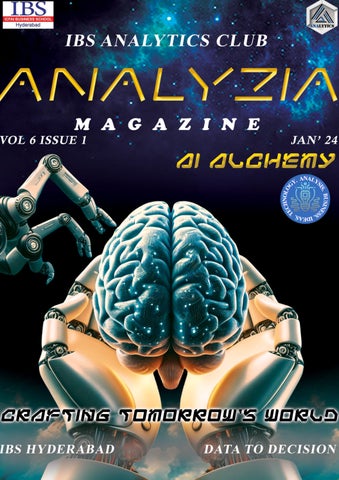
EDITOR'S NOTE Dear Readers, The Editorial vertical of IBS Analytics Club is proud to present, Analyzia Volume 6.0 Issue 1! The issue's theme is ‘AI Alchemy: Crafting Tomorrow’s World’, which will reflect the road to progress paved with the digital imprints of AI, illuminating the way to a future where challenges are opportunities and limitations are mere illusions. We present articles ranging from the evolution of AI, and its impact on various segments like finance, healthcare, art, transportation, education, and management, penned by our enthusiastic team members, analyzing the journey of AI and its impact on human beings. This volume includes a variety of new sections to keep our digital readers engrossed, abreast, and intrigued! This includes brain teasers to tickle the grey cells and fun facts, putting analytics into purview. At IBS Analytics Club, we believe in building a network of nurturing connections. Hence, we welcome your constructive feedback on the magazine, in general or specific. Feel free to reach us at: ibsanalytics.editorials@gmail.com We hope you enjoy reading as much as we enjoyed making it for you!
Table of Contents The Artistic Revolution: Where the Brush Meets the Canvas Dreaming with Data: The Marvel of Generative AI Empowering Education: The Dynamics of generative AI in teaching and learning Impact of AI on Transportation Industry Generative AI to Revolutionize the Healthcare Industry Soon Artificial Intelligence in Finance Impact of AI on Human Resource Management
The Artistic Revolution: Where the Brush Meets the Canvas For centuries, the artist's palette was a sacred domain, a tangible bridge between vision and canvas. Now, a new element has been added to that palette, one composed of lines of code and humming servers: Generative AI. This potent new tool is not here to replace the artist's hand but to extend it, to push the boundaries of creativity in ways unimaginable just a generation ago. In the ever-evolving landscape of technology, artists across various disciplines are finding new ways to harness the power of these sophisticated algorithms to push the boundaries of creativity and redefine artistic expression. Imagine a sculptor who can conjure intricate patterns and textures at the whisper of a prompt, or a painter who can explore entire galaxies of color palettes in a single afternoon. Generative AI makes these feats not just possible but also effortless. Platforms like Artbreeder morph landscapes with the twist of a dial, while tools like Runway ML can weave dreams into photo-realistic landscapes. This ability to automate repetitive tasks, like generating textures or creating variations on a theme, frees up the artist to focus on the heart of their work: the meaning, the emotion, and the spark that ignites the viewer's imagination. This transformative technology, fuelled by machine learning and neural networks, is not just a tool, it's a catalyst for a renaissance in the artistic process. Generative AI, at its core, involves machines learning patterns and creating content autonomously. The most remarkable aspect is its ability to mimic, understand, and even transcend the nuances of human creativity. From visual arts to music and literature, Generative AI has become a dynamic collaborator for artists seeking inspiration and innovation.
But AI's influence extends beyond mere brushstrokes. It acts as a muse, a tireless assistant whispering suggestions in the artist's ear, while also providing artists with the tools to overcome their creative blocks. The process of ideation, which is often the most challenging aspect of artistic creation, is being revolutionized with tools like GauGAN2, which can take a rough sketch and transform it into a detailed masterpiece, while the algorithms analyze the existing works and diverse artistic styles and trends and then generate novel compositions, styles, and concepts. This collaborative spirit isn't just inspiring new forms of art; it's fostering a dialogue between humans and machines, a dance of intuition and computation that pushes the very definition of what art can be. This symbiotic relationship between the artist and the machine not only boosts creativity but also opens doors to uncharted artistic territories. The visual arts have experienced a paradigm shift with the integration of Generative AI. In the realm of digital media and animation, artists are no longer confined to traditional tools; they now have the option to collaborate with algorithms that can generate unique visual content. This collaboration extends beyond mere assistance, as the AI contributes creative ideas, allowing artists to focus more on the conceptualization and storytelling aspects of their work. This efficiency is not just a time-saver but also a catalyst for more experimentation and exploration. The democratization of art is another transformative power of AI, making artistic tools and inspiration accessible to a broader audience. Tools like NightCafe Studio and Dream by WOMBO put the power of creative generation into the hands of anyone with a smartphone. Artists who may not have formal training in certain disciplines can now experiment and create with confidence, knowing that AI algorithms can assist and guide them. This accessibility not only opens doors for aspiring artists but also allows established creators to experiment with new forms and engage their audience in novel ways. Imagine interactive installations where the audience becomes the co-creator, feeding the AI their own brushstrokes, emotions, and ideas to participate in the creative conversation. The musical landscape is undergoing a sonic revolution with the infusion of Generative AI. Composers and musicians are employing AI algorithms to create unique melodies, harmonies, and even entire musical compositions. This collaboration between human intuition and machinegenerated patterns has resulted in compositions that challenge traditional notions of music. AI-driven music is not merely an imitation; it's a new form of expression that taps into the vast reservoir of musical knowledge accumulated by the machine. The impact of Generative AI extends beyond the realm of individual artists. Collaborative projects between artists and AI are becoming increasingly prevalent, leading to the emergence of entirely new art forms. These collaborations challenge preconceived notions about authorship and creativity as the lines between the artist and the machine become more fluid. It prompts us to reconsider what it means to be a creator and how the creative process can evolve in an increasingly digital and interconnected world.
While the integration of Generative AI in the arts brings forth a newfound power with unprecedented opportunities, it also raises ethical questions and concerns. Issues related to ownership, authenticity, and the very value of art in a machine-generated world loom large. Are AI-generated pieces truly art, or are they simply clever algorithms mimicking human creativity? Should AI creations be copyrighted, and if so, who owns the rights: the artist who provided the spark or the algorithm that fanned it into flames? These are complex questions with no easy answers, but engaging in them is crucial to ensuring that AI serves as a tool for artistic empowerment, not exploitation. As the artistic community embraces these new tools, it becomes imperative to establish ethical guidelines and frameworks to ensure fair and responsible use of Generative AI in the creative domain. Despite the challenges, the amalgamation of art and Generative AI is a testament to the ever-evolving nature of human creativity. As artists continue to explore the possibilities offered by these algorithms, the boundaries of what is considered art will inevitably expand. The journey of artistic discovery is now intertwined with the capabilities of Generative AI, promising a future where the creative process is not hindered by limitations but propelled by the synergy between human imagination and machine intelligence. Ultimately, the relationship between generative AI and the artist is not one of replacement but of evolution. It's about embracing the potential of technology to expand the artist's toolbox. From visual arts to music and beyond, the collaboration between human intuition and machine-generated content is igniting an art that is not just visually stunning but also deeply meaningful, pushing the boundaries to explore uncharted territories and redefine the very essence of what it means to create. This is not the end of the story, but the beginning of a new chapter. A chapter where the artist's palette shimmers with digital pigments, where brushstrokes dance with lines of code, and where the human spirit finds new and wondrous ways to express itself through the lens of artificial intelligence. As we navigate this new frontier, the artistic community must strike a balance between embracing innovation and addressing ethical considerations. So, let us step into this future, not with fear but with excitement, with open minds and hearts, ready to witness the birth of a new era in art where the canvas stretches beyond the physical and the possibilities are as infinite as the human imagination itself.
Author: Bakshi Tisha Vaid
Fun Facts Swarm, an AI software, boasts up to 90% accuracy in predicting Oscar winners. Beyond Hollywood, Fortune 500 companies leverage this tech for financial forecasts and market research. Every second, Google orchestrates 63,000 search queries, totaling a staggering 2 trillion searches per year. This data powerhouse fuels business enhancements, from customized search experiences to targeted advertising. Sophia, the humanoid robot, holds the distinction of being the first AI entity with legal citizenship and a passport, courtesy of the Saudi Arabian government.
Cyber-attacks unfold every 39 seconds on the web, emphasizing the critical need for robust data security measures.
Dreaming with Data: The Marvel of Generative AI Do you recall that sense of relief when staring at an empty screen and a pressing deadline, you seek assistance from your trusted digital ally? It’s almost a guilty reliance—the way we lean on AI such as ChatGPT or Bard to organize our thoughts, refine our presentations, and pull us out of creative blocks. Yet, beyond these tools lies generative AI, the foundational neural network architecture that powers the capabilities of ChatGPT, Bard, DALL-E, and a diverse array of intelligent systems. Understanding this groundbreaking technology is crucial for dissecting its gradual yet substantial impact on transforming technology and innovating various facets of business practices. Generative AI refers to a subset of artificial intelligence technology capable of autonomously creating diverse content formats such as text, images, audio, and synthetic data through algorithms designed to simulate and generate human-like outputs. Its inception traces back to the 1960s within chatbots. However, the pivotal leap occurred in 2014 with Ian Goodfellow's introduction of generative adversarial networks (GANs), vastly enhancing AI's realism in content creation. Subsequent advancements in related technology, notably variational autoencoders (VAEs) and transformer models, further expanded the capabilities of Generative AI. To generate original content, generative AI models employ neural networks to recognize patterns and structures in existing data. One of the advances of generative AI models is the ability to use alternative learning methodologies for training, such as unsupervised or semi-supervised learning.
There exists a multitude of generative AI models; however, a selection have been examined to delve into their functionalities. Generative Adversarial Networks (GANs) are a class of neural networks used in unsupervised learning. They consist of two neural networks—the generator and the discriminator—that are trained adversarially to generate synthetic data resembling real data. The generator creates data and tries to deceive the discriminator, which in turn aims to distinguish between real and generated data. This adversarial process leads to the generation of realistic synthetic data. Variational Autoencoders (VAEs) are a specialized version of autoencoders, neural networks crafted to learn data representations efficiently without supervision. Autoencoders operate on an encoder-decoder framework; the encoder condenses input data into a concise representation, and the decoder reconstructs the original data from this condensed form. This process aids in capturing critical dataset features. VAEs incorporate a statistical approach to depict dataset samples within what's called a latent space. Unlike standard autoencoders that produce a singular output in the bottleneck layer, VAEs' encoder generates a probability distribution. This statistical representation allows for more intricate and continuous sampling within the latent space. This, in turn, enriches the generation process, offering enhanced adaptability and a wider range of output variations. Autoregressive models operate by sequentially predicting the next element in a sequence based on the preceding ones. These models, such as PixelCNN and PixelRNN in image generation or language models in text generation, excel in capturing dependencies within the data, ensuring coherence and fine-grained control during generation. Their sequential nature, however, can limit parallelization, posing computational challenges for larger sequences or high-resolution images. Despite this, their ability to model complex relationships within data makes them valuable for diverse generative tasks. Transformers changed machine learning by allowing huge model training without labeled data. Models like GPT and Bard used vast, unstructured text for more detailed outputs. With attention mechanisms, transformers let models understand word connections across longer texts, not just sentences. This broader view improved how well models grasped complex text relationships, making their generated content more insightful. Flow-based models like Real NVP and Glow utilize invertible transformations to map simple distributions (e.g., Gaussians) into complex distributions. By employing bijective functions, these models ensure both forward and inverse transformations, enabling the
generation of diverse and high-quality samples. This process establishes a connection between basic and complex distributions, facilitating realistic data generation while maintaining the capability for likelihood evaluations and sample generation. Generative AI finds applications across various domains. It uses algorithms to imitate artistic styles in paintings, sculptures, and music compositions. It generates different text material using natural language processing, including stories, poems, and articles written in a variety of styles. It excels in image manipulation techniques like super-resolution and style transfer. In videos, it can alter scenes, generate deepfakes, and enhance overall video quality. From optimizing molecular structures for drug discovery to reconstructing images from incomplete data for medical imaging, generative AI drives advancements across pharmaceutical research and healthcare diagnostics. Generative AI assists in creating game content, characters, and levels. It also powers realistic simulations for training purposes in industries like aviation and healthcare. It utilizes user behavior analysis to deliver personalized recommendations in entertainment, shopping, and content consumption, while also enabling natural interactions within virtual assistant systems. It further helps robots generate motion patterns, resolve control problems, and develop autonomous systems. Additionally, it streamlines prototypes and structures in the design and manufacturing processes. Generative models assist in financial forecasting by generating predictive models and assessing risk factors, aiding investment strategies and risk management. Despite its impressive capabilities, generative AI faces several limitations and challenges that impact its widespread adoption and effectiveness. Generative models tend to magnify biases present in training data, leading to biased or unfair outputs. Understanding the inner workings of generative models is challenging due to their complexity, hindering transparency and interoperability. These models heavily rely on large volumes of highquality data, limiting their effectiveness in scenarios with limited or poor-quality data. Training and running generative models require substantial computational power, making them resource-intensive and inaccessible for some applications. Ensuring consistent quality in generated outputs can be difficult, resulting in variations that might not always meet desired standards. Generative models might struggle to generalize well to new or diverse scenarios, potentially overfitting specific datasets. Generative AI is at the forefront of technological progress, promising to reshape our work and lifestyles. Instead of engaging in debates over its dominance, a pragmatic approach is needed to ensure that everyone benefits from its potential. Individuals should acquire at least elementary knowledge of generative models like GANs and VAEs. It is essential to recognize these advancements and understand their role as 'assistants' rather than 'replacements' in our daily tasks.
Embracing generative AI as a tool for personal growth amid technological progress is both important and urgent. Businesses venturing into Generative AI adoption must strike a delicate balance between innovation and ethical responsibility. Thoughtful implementation of this technology, integrating concepts such as machine learning and robust data governance, not only propels organizational progress but also upholds ethical standards and societal well-being. At a societal level, deploying Generative AI to address societal challenges requires careful consideration of its environmental impact. Prioritizing practical and beneficial applications over mere automation is crucial. Leveraging the potential of Generative AI, particularly in areas like language processing and image creation, contributes to sustainable growth and innovation, ensuring smoother integration within society. Understanding the extensive capabilities of Generative AI empowers us to wield it responsibly, emphasizing its technical intricacies and harnessing its potential for the collective benefit of all. Author: Kanishk Mehta
FUN CORNER
RIDDLE TIME 04
UNIQUE CARDS
RIDDLE TIME
RIDDLE TIME
I'M NOT A CRYSTAL BALL, BUT I FORESEE, ANOMALIES AND OUTLIERS, CLEAR AS CAN BE. WHAT AM I, WITH A KEEN DETECTION KNACK, SORTING THROUGH DATA, NEVER A LACK?
I CRUNCH NUMBERS WITH SPEED AND GRACE, WITH ALGORITHMS, I SET THE PACE. WHAT AM I, WITH A MIND SO FAST, PROBLEMS FROM THE PAST?
ANOMALY DETECTOR
RIDDLE TIME
I HIDE IN THE SHADOWS OF DATA'S EXPANSE, FINDING INSIGHTS WITH A STATISTICAL DANCE. WHAT AM I, IN THE ANALYTICS SPHERE, MAKING SENSE OF DATA, CRYSTAL CLEAR?
ML ALGORITHM
RIDDLE TIME
I'M A PUZZLE OF BOXES, WHISKERS TOO, SHOWING DATA'S RANGE, OLD AND NEW. WHAT AM I, A VISUAL CLUE, DISPLAYING STATS FOR ALL TO VIEW?
DATA ANALYST BOX PLOT
Empowering Education: The Dynamics of generative AI in teaching and learning Since its debut on November 30, 2022, ChatGPT has quickly gained over one million subscribers within a week, surprising the world with its ability to handle complex tasks. This sophisticated generative AI tool, developed by OpenAI, has significant potential in the education sector. It can facilitate personalized and interactive learning, generate prompts for formative assessment activities, and offer ongoing feedback to enhance teaching and learning. But this is only one example of the many generative AI models that are revolutionizing the realm of education. Generative AI is transforming the education landscape by injecting personalized learning, creativity, and efficiency into classrooms. It has made it possible for students to view education from a whole new perspective and learn in exciting ways, such as by exploring historical events through simulations generated by AI, writing stories alongside AI coauthors, or practicing math problems with adaptive difficulty. Beyond individual learning, AI has also transformed the other side of education, which is teaching. It has simplified teachers' lives by crafting tailored lesson plans, providing real-time feedback on student work, and even grading essays. The benefits of Generative AI in education are several, such as personalized tutoring, automated essay grading, language translation, interactive learning, and adaptive learning systems. These applications have been supported by research studies that highlight improved learning outcomes and efficiency.
Coded Mind is a UK-based startup that uses advanced generative AI to paint dynamic video lessons and craft personalized learning journeys with interactive avatars. Their platform, "Spark," goes beyond the typical algorithms and static content, injecting creativity and interactivity into every learning experience. It uses AI to craft personalized video lessons, tailoring explanations, animations, and even the narrator's tone to each student's learning level and understanding. Imagine struggling with fractions, Spark might explain them through a quirky animated chef dividing a pizza, while advanced learners might dive into interactive 3D visualizations. It allows students to use AI avatars, which react to their progress and act as mascots. Students can use Spark to generate personalized flashcards, worksheets, and even creative writing prompts, further reinforcing their learning in the real world. This caters to diverse learning styles and keeps students actively involved in the learning process. Some other such examples include Springboard, which weaves AI-generated storylines into ebooks, and Ripplenet, which provides students with AI-powered feedback on their writing, going beyond grammar to suggest deeper improvements. Finland's AI-powered learning platform, "Kirjoita," is an AI platform that personalizes writing instruction for dyslexic students, while in the US, "Dreamreader" uses AI to create engaging, leveled readers for struggling students. It's like education has stepped into a time machine, propelled by generative AI into a future where learning is as unique and vibrant as each individual student. The use of tools like ChatGPT in education comes with as many potential drawbacks as benefits. As smart and knowledgeable an AI is, it lacks the human interaction essential for meaningful learning experiences and has a limited understanding of concepts, relying on statistical patterns. Biases in training data, a lack of creativity, dependency on data quality, and a limited contextual understanding are also concerns. Additionally, privacy issues may arise when using generative AI models in education. How many times have you asked a basic question from Generative AI and it has given you a proper and factually correct answer at once? The basic feature that distinguishes human interaction from AI learning is that a human can listen to your question, unconsciously identify the kind of doubt you are having, and give the most acceptable answer at once, as AI is unable to understand your emotions and intentions behind a question and hence provide a very general answer. Despite these drawbacks, educators have begun exploring Generative AI's efficiency in various educational activities. However, caution is advised due to Generative AI's limitations, such as generating false information and references.
Realizing the full potential of Generative AI in education also raises questions about equity and accessibility. How do we ensure that such AI-driven educational tools are accessible to all students, regardless of their socio-economic background or geographic location? These ethical considerations are crucial as we navigate the evolving landscape of AI in education. Looking ahead, the future implications of Generative AI in the education industry are both advantageous and challenging. In order to create norms that don't limit accountability, transparency, or justice, educators, legislators, and technologists must have constant conversations about the latest developments in AI technology. It is possible to pave the road for a time when generative AI enhances every student's educational experience by addressing these ethical issues. It's really important to address the limitations and use these tools responsibly. Policymakers, researchers, educators, and technology experts should make collaborative efforts to guide the constructive and safe use of evolving generative AI tools in education.
Author: Devansh Srivastava
FUN CORNER
RIDDLE TIME 04
UNIQUE CARDS
RIDDLE TIME
RIDDLE TIME
I'M A PUZZLE OF CELLS, ROWS, AND MORE, IN DATABASES, I TRULY SOAR. WHAT AM I, A STRUCTURED ARRAY, HOLDING DATA IN A MEANINGFUL WAY?
I'M A BRIDGE BETWEEN DATA AND INSIGHT, TRANSFORMING, SHAPING, WITH ALL MY MIGHT. WHAT AM I, IN THE ETL SONG, MOVING DATA WHERE IT BELONGS?
DATABASE TABLE
RIDDLE TIME
I'M A POTION IN THE ANALYTICS BREW, REDUCING VARIANCE, IT'S TRUE. WHAT AM I, IN THE STATISTICAL SPELL, MAKING DATA DISTRIBUTIONS SWELL?
ETL PROCESS
RIDDLE TIME
I'M A LANGUAGE OF PATTERNS AND CODE, IN DATA, I FIND MY ABODE. WHAT AM I, WITH RULES SO CLEAR, MINING KNOWLEDGE FROM THE DATA SPHERE?
STANDARD DEVIATION DATA MINING
Impact of AI on Transportation Industry The application of artificial intelligence in the transportation industry is currently flourishing and will only grow. Numerous issues that humans are unable to handle, such as heavy traffic, a lack of parking, lengthy journeys to work, and more, can be resolved by AI. It is also anticipated to have a significant impact on raising the standard, sustainability, safety, and efficiency of upcoming transportation systems. Research projects that involve AI in the transportation industry will reach $3.5 billion by 2023, allowing for an astounding 16.5% growth rate. What changes is AI making to the transportation sector? In many parts of the world today, self-driving automobiles are standard. Artificial intelligence (AI) is utilized to monitor surrounding traffic conditions, issue safety alerts, and even assist in spotting impending crashes. In an emergency, AI-driven cars are also programmed to brake faster than driver-controlled ones. Through wireless communication, the devices can avoid sharing paths or taking up excessive space on roads. Additionally, it can anticipate bottlenecks and modify routes appropriately. Additionally, compared to human drivers, AI might be able to gather more information on weather, accidents, and other disruptions. Furthermore, in risky circumstances, it might also assume command. Additionally, AI-controlled cars are designed to operate more effectively than human drivers, which may lessen traffic jams. AI can assist with traffic control by recommending different routes to cars. To allow vehicles to plan and depart earlier than usual, it may also indicate periods when little traffic is anticipated. By monitoring AI in other drivers' transportation data, AI would be able to accomplish this.
It can also be used to operate parking lots and traffic signals. AI can also be used to track traffic in the vicinity of accidents or construction sites so that motorists are informed of any delays that may occur. People demand environmentally friendly ways to travel from point A to point B because they are becoming more conscious of the effects that transportation has on the environment and pollution. Consider electric or solar-powered cars, for instance. Although these technologies are still feasible without artificial intelligence, they function more effectively during recharging, and the energy consumption is managed with the aid of an AI system that can anticipate traffic patterns on public roads to provide improved solutions for driverless cars. Having an AI system to assist with business management is crucial if you operate a fleet of cars. Big fleet management companies have a lot of issues, one of which is keeping track of drivers' whereabouts via GPS tracking devices installed in every vehicle. It can therefore assist companies in streamlining their operations by providing fleet managers with real-time updates. Notifications are issued regarding a variety of events that may impact the use of the cars owned by your company, such as when a vehicle requires maintenance or has been in an accident. Given the hundreds of billions of dollars involved in the shipping sector, it is hardly surprising that some entrepreneurs are searching for methods to increase productivity. Rolls-Royce and Google have teamed up to include AI in ships that are slated for this year. As a result, AI is being used in the shipping sector to increase productivity and cut costs. The use of AI in the automotive industry has long been a source of conjecture and fantasy. The idea of drone taxis is one that several businesses have investigated. Uber published a white paper in 2016 outlining how its long-term vision and strategy included the use of aerial taxi services. Volocopter presented its drone taxi concepts at the World Economic Forum in Davos, while Airbus gave a presentation. We can see that the drone taxi concept has advanced from the conceptual to the practical stages with all of these improvements. Several organizations place a high premium on the use of AI in transportation since it can make driving and other AI-related tasks safer. By observing automotive sensors and identifying vehicles that are near or likely to collide, artificial intelligence (AI) can contribute to increased safety. By warning cars of hazardous weather conditions like severe rain or snow, artificial intelligence can also contribute to increased safety. AI might accomplish this by monitoring AI in other cars' transit data and contrasting it with the sensors' current condition.
Although integrating AI into your organization might yield considerable benefits, it is not a cheap endeavor. Many businesses can now afford sensors and transmitters because of their decreasing costs over time as output rises. Because of their past, many businesses are reluctant to invest in autonomous vehicles, and the general public still finds the concept unsettling. What is the primary cause of this? Numerous mishaps have involved autonomous systems. Until these problems are fixed, there will inevitably be some ambiguity. Transportation data is vulnerable and could reveal personal information or give hackers access to networks, both of which could have catastrophic effects. Why is this the case? Because the infrastructure of many AI projects is based on cloud computing, a data breach is considerably more likely. Integrating AI projects requires you to take cloud security very seriously. One must guarantee that the datasets and resources are suitably set up to allow for thorough monitoring of any system vulnerabilities or leaks. One of the biggest obstacles to AI in transportation is the availability of labor. The requirement for experts and specialists in this subject has not been satisfied by the industry. Additionally, there is a labor shortage in this industry for skilled workers. The impact of AI on the transportation industry is transformative, ushering in a new era of efficiency, safety, and innovation. As technology continues to advance, it is imperative to address challenges responsibly and collaboratively, ensuring that AI contributes to a transportation ecosystem that is sustainable, inclusive, and beneficial for society as a whole. The ongoing dialogue between industry, government, and the public will be essential in shaping the future of AI in transportation. Author: Sakshi Verma
Fun Facts On any given day, a whopping 333.2 billion emails are sent worldwide. That's like each person on Earth sending over 42 emails daily – talk about a digital conversation party!
With an estimated 1.7 trillion photos expected to be taken in 2022, if each photo were a pixel, it could form an image 22,000 times clearer than the world's highest-resolution camera!
Companies generate a mind-boggling 2 quintillion bytes (approximately 1818.99 terabytes) of data each day, encompassing various data types.
Generative AI to Revolutionize Healthcare Industry Soon Generative AI has swiftly risen to prominence in various fields, including health care. It can potentially transform the industry and help companies unlock value in new ways. Generative AI algorithms can evaluate vast amounts of medical data and generate completely new content. This technology has the potential to enhance the quality of care, make it more accessible and affordable, minimize imbalances in research and care delivery, and assist businesses in unlocking value in the best ways. Furthermore, generative AI eliminates some of the traditional barriers to AI implementation in health care. It is more flexible with unfamiliar conditions and can interface more effectively with healthcare personnel. These characteristics broaden the applicability and transferability of generative AI to many healthcare activities. It can analyze unstructured data sets, representing a potential breakthrough for healthcare operations, which are rich in unstructured data such as clinical notes, diagnostic images, medical charts, and recordings. These unstructured data collections can be utilized alone or in conjunction with large, structured data sets, such as insurance claims. Generative models, such as Generative Adversarial Networks (GANs), can be used to generate synthetic medical images. This is particularly useful when there is a scarcity of labeled data for training machine learning models. GANs can generate realistic medical images, helping to augment datasets and improve the performance of image-based diagnostic models.
It can be employed to assist in the discovery of new drugs. By generating molecular structures, predicting chemical properties, and simulating interactions between molecules, generative models can help researchers identify potential drug candidates more efficiently. This has the potential to accelerate the drug discovery process and reduce costs. Generative models can assist in the generation of personalized treatment plans based on individual patient data. By analyzing patient histories, genetic information, and other relevant factors, these models can generate recommendations for personalized interventions, drug regimens, or lifestyle modifications. Generative AI could support applications like conversational AI to deliver personalized messages based on member health needs and preferences. It can contribute to predicting disease risk by generating synthetic datasets that incorporate a wide range of potential risk factors. This can enhance the accuracy and robustness of predictive models for diseases such as diabetes, cardiovascular conditions, and various cancers. When combined with reinforcement learning techniques it can be used to optimize treatment plans for patients. These models can simulate different treatment scenarios and learn optimal strategies for adjusting treatments based on patient responses. Similar to medical image synthesis, generative models can augment clinical datasets by generating synthetic patient data. Generative models can be used for generating medical text, such as clinical notes, radiology reports, or even patient summaries. It can aid in automating documentation processes, making it easier for healthcare professionals to manage and process large amounts of information. This can be valuable for training machine learning models for various tasks, including disease prediction. Using the AI platform's mobile app, a practitioner records a patient's visit. The platform incorporates the patient's information in real-time, recognizing any gaps and seeking the physician to fill them in, thereby translating the dictation into a structured record with conversational language. After the appointment, the clinician sees the AI-generated notes on a computer, which they can update by speech or typing, and transmits them to the patient's electronic health record (EHR). This quick process cuts down on the laborious and time-consuming note-taking and administrative work that a clinician must accomplish for each patient. Generative AI has the potential to strengthen and enhance every segment of the healthcare industry: Pharmaceutical Firms: In the future, the application of generative AI in the preclinical and clinical stages might speed up access to pharmaceuticals, especially for uncommon disorders where treatment development has been difficult or cost-prohibitive. The technology may also be utilized in the analysis of patient data to identify groupings of patients who are likely to react to certain therapies or to tailor medications to the specific requirements of individual patients.
Healthcare Consumers: Consumers may use generative AI to cut expenses, enhance risk management, and increase member engagement, with the overarching objective of providing better coverage at a lower cost to consumers. In the future, conversational AI, for example, might use generative AI to send tailored messaging based on member health requirements and preferences. Operations and Services: Generative AI is more adaptable than previous generations of AI, and it can handle many data modes and formats and generate synthetic data to supplement deficient data sets. Existing applications, such as health and laboratory information management systems, can benefit from generative AI. It can also aid with inventory management and replenishment, cold-chain logistics, data exchange, and HR operations. Public-Health Organizations: Public health organizations and other health organizations can use generative AI-powered systems to enhance resource planning and allocation, predict public health needs and actions, and more successfully execute programs. Generative AI has the potential to dramatically increase efficiency, improve the quality of care, and create value for healthcare organizations. It is also important to address ethical considerations and data privacy issues, and there is a need for rigorous validation and regulatory compliance to ensure the responsible and effective deployment of these technologies in clinical settings. The journey of Generative AI in healthcare is indeed a catalyst for positive change, heralding an era of unprecedented advancements in the field. Author: Ponduri Vishnu Sai Sree
FUN CORNER
RIDDLE TIME 04
UNIQUE CARDS
RIDDLE TIME
RIDDLE TIME
I'M NOT A DOCTOR, BUT I DIAGNOSE, IN HISTOGRAMS AND CHARTS, MY STORY COMPOSES. WHAT AM I, REVEALING THE TALE, OF DATA DISTRIBUTIONS, WITHOUT FAIL?
I COME IN QUARTILES, ONE, TWO, AND THREE, DIVIDING DATA WITH SUCH GLEE. WHAT AM I, A MEASURE SO GRAND, SHOWING THE SPREAD ACROSS THE LAND?
HISTOGRAM
RIDDLE TIME
I'M THE CAPTAIN OF THE DATA SHIP, STEERING THROUGH THE NOISE, NOT A BLIP. WHAT AM I, LEADING THE WAY, IN CLEANSING DATA, COME WHAT MAY?
INTERQUARTILE RANGES
RIDDLE TIME
I'M A PUZZLE OF POINTS ON A GRAPH, CONNECTING THE DOTS IN A DATA BATH. WHAT AM I, A VISUAL DELIGHT, SHOWING TRENDS IN THE ANALYTICS LIGHT?
DATA CLEANER SCATTER PLOT
Artificial Intelligence in Finance Revolutionizing the future of banking and investing, Artificial intelligence (AI) is permeating many industries, and finance is no exception. In recent years, the financial sector has been transformed by the integration of artificial intelligence technology. From increasing operational efficiency to improving the customer experience, artificial intelligence is changing the landscape of the banking, investment, and financial services sectors. Risk management and fraud detection are perennial challenges in the financial industry. Artificial intelligence has proven to be a powerful ally that uses advanced algorithms to analyze large amounts of data in real-time. Quantitative analysis in AI relies on numerical data and statistical methods to make informed decisions. It involves collecting and processing large datasets to identify patterns and correlations, driving insights that inform machine learning models. These models, integral to many AI applications, use quantitative techniques to learn from data, enabling them to make predictions, classifications, and automated decisions. Algorithmic trading in AI involves the application of advanced computational algorithms to execute financial transactions in the stock market. These algorithms analyze market data, identify patterns, and make rapid trading decisions, often executing orders at speeds beyond human capability. AI-driven algorithmic trading seeks to optimize trading strategies, capitalize on market inefficiencies, and enhance overall portfolio performance through automated and data-driven decision-making.
Data analysis and insights form the cornerstone of AI applications, where advanced algorithms process and interpret vast datasets to extract meaningful information. In AI, data analysis involves techniques such as statistical analysis, machine learning, and pattern recognition to uncover patterns, trends, and correlations within the data. These analyses provide valuable insights into various domains, from predicting market trends in finance to optimizing operational processes in businesses. AI and blockchain technology interact in a number of ways that present creative possibilities and solutions. Blockchain, with its reputation for security and decentralization, can improve AI systems' credibility. It guarantees the integrity and traceability of datasets used to train AI models by enabling the creation of transparent, impenetrable records of data exchanges. In AI applications, where the accuracy of models depends on the quality of the underlying data, this openness aids in addressing issues with data quality and reliability. Regulatory compliance in AI is a critical aspect that involves adhering to legal and ethical guidelines to ensure responsible and transparent use of artificial intelligence technologies. Governments and regulatory bodies worldwide are increasingly recognizing the need to establish frameworks that govern the development, deployment, and impact of AI systems. These regulations often address concerns related to data privacy, bias and fairness, transparency, accountability, and the ability of AI algorithms. Robo-advisors represent a significant application of AI in the financial industry, providing automated, algorithm-driven financial planning services that require less assistance from humans. By using machine learning algorithms to assess the financial data, risk tolerance, and investment objectives of their users, these digital platforms provide individualized investment recommendations. The power of AI lies in its ability to detect patterns and anomalies that may escape human observation. Machine learning models can process massive amounts of transactional data and detect deviations from typical behavior. This real-time anomaly detection allows financial institutions to identify and respond to potentially fraudulent activity quickly. AI goes beyond traditional rule-based systems to include behavioral analytics. Instead of relying on predetermined rules, machine learning algorithms learn from historical data to understand individual users' and entities' normal behavior patterns. Any deviation from learned patterns triggers warning signals and enables early intervention. One of the main advantages of artificial intelligence in risk management is its adaptability. AI models continually learn and adapt to new trends and emerging risks as the financial landscape evolves. This adaptability ensures that risk management strategies remain relevant and effective in ever-changing financial dynamics.
Traditional fraud detection systems often generate false positives, resulting in unnecessary investigations and inconvenience for legitimate users. AI helps minimize false positives by improving understanding of what constitutes suspicious behavior over time. This precision not only increases the accuracy of fraud detection but also improves the overall efficiency of risk management processes. AI excels at integrating data from multiple sources, including transactional data, social media, and external databases. This holistic approach provides a comprehensive overview of user behavior and enables more accurate risk assessment. Financial institutions can better identify potential threats and vulnerabilities by considering a broader range of information. In summary, integrating artificial intelligence into risk management and fraud detection is a game changer in the financial sector. It enables institutions to proactively protect against threats, maintain the integrity of financial transactions, and build trust with customers. As AI technologies continue to develop, their role in ensuring the security and stability of financial systems will undoubtedly become even more important Author: Dipanshu Bajaj
FUN CORNER
RIDDLE TIME 04
UNIQUE CARDS
RIDDLE TIME
RIDDLE TIME
I'M A LANGUAGE OF THE DATA KIND, SPEAKING IN QUERIES, NOT HARD TO FIND. WHAT AM I, IN THE DATABASE QUEST, RETRIEVING ANSWERS, AT MY BEST?
I'M A CODE WIZARD, CRAFTING SCRIPTS, EXTRACTING INSIGHTS, NO NEED FOR TRICKS. WHAT AM I, IN THE PROGRAMMING TRANCE, UNRAVELING DATA'S INTRICATE DANCE?
SQL QUERY
RIDDLE TIME
I ROLL THE DICE IN A RANDOM SPREE, SIMULATING OUTCOMES, JUST WAIT AND SEE. WHAT AM I, IN THE UNCERTAINTY GAME, ADDING RANDOMNESS TO THE ANALYTICS FRAME?
DATA SCIENTIST
RIDDLE TIME
I'M A SECRET AGENT IN THE ANALYTICS GAME, CLASSIFYING DATA, NOT BY NAME. WHAT AM I, WITH PATTERNS IN SIGHT, SORTING AND LABELING DAY AND NIGHT?
RANDOM NUMBER GENERATOR CLASSIFIER
Impact of AI on Human Resource Management In the era of technological advancement, Artificial Intelligence (AI) has emerged as a transformative force across industries. The HR landscape has witnessed a significant paradigm shift, with organizations leveraging AI to streamline processes, enhance decision-making, and ultimately reshape the way human resources are managed. It examines the influence of AI on Human Resource Management (HRM), investigating key areas like recruitment, onboarding, training, rewards, recognition, and the ethical concerns associated with this technological advancement. According to recent statistics, over the past four years, there has been a remarkable 270% increase in companies adopting AI technology. This surge underscores the growing recognition of AI's potential to revolutionize HR processes. Nearly 9 out of 10 businesses have either initiated or are actively investing in AI, marking a significant shift in how organizations perceive and harness this transformative technology. Onboarding, often a tedious and monotonous task, is a domain where AI can make a significant impact. By automating processes such as document verification, induction programs, and administrative tasks, AI enhances the efficiency and organization of the onboarding process. This ensures a more personalized onboarding experience for new employees, reducing regrettable attrition and improving the overall work experience. Many companies increased their AI investment during the pandemic to navigate the challenges it presented.
The 2020 RELX Emerging Tech Executive Report revealed that 68% of companies increased their AI investment during the pandemic, and 81% of companies now report using AI technologies. This growing recognition of AI's benefits highlights its potential to reshape and enhance HR practices. Recruitment, an extremely important aspect of HRM, has been redefined by AI. Traditional recruitment processes, which could take up to 100 human hours, are now being streamlined through automation. AI facilitates the automation of tasks such as resume scanning, candidate outreach, and initial competency assessments. This not only accelerates the hiring process but also allows HR professionals to focus on more strategic aspects, including employee engagement, sourcing, and appraisals. AI systems can analyze vast amounts of data to identify patterns and make predictions, enabling HR teams to make more informed and data-driven decisions. According to a LinkedIn report, the demand for AI skills has surged, reflecting the growing importance of AI in the job market. This increased demand emphasizes the need for professionals proficient in AI technologies who can drive innovation and transform HR practices. Customized training programs can be created using AI tools, tailoring modules to individual employees based on their skill sets, employment levels, and specific requirements. AI can recommend relevant courses, match employees with projects based on their upgraded skills, and provide insights into how jobs may evolve. The impact of AI on skill development is crucial for the future of work. Countries that demonstrate a robust current market for AI professionals and a strong supply of qualified STEM graduates fall into the "Leaders" quadrant. India, Germany, and Singapore have positioned themselves as leaders in AI and HRM, with a solid foundation of skilled professionals and continuous educational pathways contributing to their success in leveraging AI technologies. While AI may not replace human decision-making entirely, it empowers HR leaders with extensive data and analytics. Surveys, feedback analysis, and data on productivity, engagement levels, and performance enable HR professionals to make informed, datadriven decisions. This data-centric approach enhances the precision of decision-making processes, contributing to the overall efficiency of HRM. The integration of AI into decision-making processes is a strategic move for organizations. AI systems can analyze data from multiple sources in real time, providing valuable insights that inform strategic decisions. AI is a game-changer in handling queries and mundane administrative tasks. HR personnel often spend a considerable amount of time addressing routine queries. Implementing AIdriven chatbots can efficiently handle basic queries, freeing up HR professionals to focus on more strategic responsibilities.
Additionally, AI can take over entry-level administrative tasks, ensuring accuracy and compliance with organizational terms and conditions. The efficiency gains from AI in query handling and administrative tasks are significant. HR professionals can leverage AI to streamline communication and provide quick, accurate responses to employee inquiries. This not only enhances the employee experience but also allows HR teams to allocate more time to strategic initiatives and value-added activities. As organizations embrace AI in HRM, ethical considerations become paramount. The HR department deals with extensive personal information, making data security and employee privacy critical concerns. Transparency, safety, accountability, and fairness must be integral components of any AI framework implemented in HRM. A carefully designed AI system ensures that intentional or unintentional biases do not compromise the integrity of HR processes. Ethical considerations in AI-infused HRM extends beyond data security to encompass the responsible use of AI algorithms. Regular audits and reviews of AI systems can help identify and address biases, ensuring that HR practices remain equitable and aligned with ethical standards. The incorporation of AI in HRM signifies a revolutionary transformation in how organizations oversee their human resources. The future of HRM is undeniably linked with the boundless possibilities introduced by AI, offering a promise of enhanced efficiency, transparency, and personalized management of human capital. The journey toward AIinfused HRM is thrilling, holding the potential to redefine the dynamic between organizations and their most valuable asset—their workforce. Author: Yamini Gothwal
The Stars Behind the Scenes: Appreciating Our Stellar Team Bakshi Tisha Vaid P Vishnu Sai Sree Dipanshu Bajaj Koustav Roy Aishani Mukherjee Sakshi Verma Yamini Gothwal
Special Thanks to: Bhargavi Siram Priyanshu Goyal
Send your feedback articles to IBS Hyderabad, The ICFAI Foundation for Higher Education (Declared as Deemed University U/s 3 of the UGC Act 1956) Donthanapally, Shankarpally, Road, Hyderabad-501203. Feel free to write back at: editorial.ibsanalytics@gmail.com Frequency of the Magazine This magazine is biannual and published twice a year, with support from IBS Hyderabad, a Constituent of IFHE, and Deemed to be University. Disclaimer The views expressed by the contributors represent their personal views and not necessarily the views of their organization. All efforts are made to ensure that the published information is correct. The organization is not responsible for any errors caused due to oversight or otherwise. Copyright All rights reserved. No part of this publication may be reproduced or copied in any form by any means without prior written permission. Publisher Student Club IBS Analytics, IBS Hyderabad, a Constituent of IFHE, Deemed University.
ANALYZIA VOL 6 ISSUE 1 | JAN’ 24
IBS ANALYTICS CLUB DATA TO DECISION
"As more and more artificial intelligence is entering into the world, more and more emotional intelligence must enter into leadership.." - Amit Ray Survey No. 156/157, IFHE - IBS Campus, Donthanapally, Shankarapalli Road, Hyderabad , Telangana 501203. India