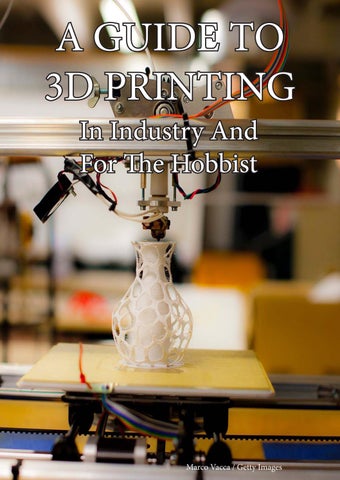
A GUIDE TO 3D PRINTING In Industry And For The Hobbist
Marco Vacca / Getty Images
Source article: 3 Ways 3D Printing Technology Will Change Every Industry
How 3D printing is helping the world and its problems One of the leading problems we as humans create is unneccersary waste. When something gets broken we have a tendancy to throw it out and get a new one.
A great example of this is the youtuber Morley Kert, who goes out to local places such as parks and cafes, and 3D prints fast repairs for peoples broken items.
for example, if you have a water bottle with a broken latch. generally people would throw it away. However, with 3D printing, the latch on the water bottle can be fixed allowing it to be used once more. Which means you dont have to throw it out. This reduces the level of global waste, and especailly plastic waste.
Still image from: Free 3D Printed Repairs for Strangers
How is 3D printing being used in professional fields
Source article: LOCKHEED MARTIN PURCHASES EBAM INDUSTRIAL 3D PRINTING SYSTEM FROM SCIAKY
There are a few benefits to 3D printing that makes it benefitial to being used in professional fields. One of these benefits is the ability to create multiple products using one machine. this is extermly helpful esspecailly for smaller business that do not have the resources to set up multiple different manufacturing systems
Another benefit is the ability to modify the products, as you do not need to modify anything physical but only the digital file. making 3D printing much more suitible for idividualised products, as well as prototypeing new products or parts.
How is it used in engineering?
shown is a 3D printed engine piece by MSM-Aero
One of the main users for 3D printing in engineering is the aeronautical and aerospace groups. which use 3D printers to create physical mockups of designs and parts that can be tested like an aeroplane design which can be tested in a wind tunnel. Because of 3D printings benefits it allows them to make small modifications to the designs to make them
better
Another use of 3D printing in engineering is in the creation of compliant mechanisms which uses a materials natural flexibility and energy retention to make one piece joints and springs which means you dont need multiple pieces to create moving part, this has many benefits compared to typical joints. 3D printing allows these to be created far easier then the other methods which require intensive proccessing.
How is it used in constrution and production
Photo by INA FASSBENDER/AFP via Getty Images
Within the last couple of years, 3D printing technology has branch out into many different professions with one being house construction. they have been able to print the shell of houses using concrete, this is extermely important in constuction as you are able to build a house quicker and for cheaper then previously.
With technology getting more and more sophisticated 3D printers are being made that can even work with using metal and other difficult to process materials. Having this capibility allows for more flexibility in production and how it is employed by a company.
Application of 3D printing in the hobby scene
Resin Printing
Phrozen Sonic 4K mighty
Benefits:
• Resin printers generally have a higher level of resolution in their prints which makes them more suitable for printing minitures • Resin printers are faster printing speeds as it prints 1 whole layer at a time compared to filament printers, this also allows for the printing of multiple things at one time • Resins can vary in hardness and strength however the prints from a resin printer are typically more solid then the prints from a filament printer
Filament Printing
Benefits:
creality dual filament 3d printer crx
• Filament printers are typically cheaper to buy and use then a resin printer • Resin printers require alot of post printing processing to ready the print for use, however filament prints are almost completely ready to go as soon as it is finished. • Filament printers are capable of composite printing where you use multiple different filament in the one print • Filament printers have more customisation for the print, as well as a larger comunnity around it.
The Printing Process So you have choosen the 3D printer you want by what do you do next? well luckly the process for printing is fairly simple and similar for both types of printer. 1. before you do anything it is extermely important to calibrate the axis’s of your printer. this will vary depending on your printer however there will be instruction avaible online for your printer. and the process is mostly automated in printer. 2. Next, you want to find some files to print. either you can design these yourself or look online on websites such as thingyverse, sketchfab, or cults3D. 3. After that, you will need a program known as a slicer which is responsible for taking your 3D model, and creating layers and a print pattern that can be read by your printer, as well as adding supports to the model so the model does not fall of the plate or fail to print properly. there are many programs that do this function, however, i recommend the Lychee slicer as it has a free basic program that is suitable to both resin and filament printers, and also has a paid option to unlock more indepth slicing options. 4. After that all that you need to do is load your material into the printer, transfer the file to the printer, select it, and press go 5. After it has finished printing you are now onto the post print process
Post print processing The post printing process for filament printers is extermely easy as all you need to do is remove supports, however for resin printers it is more indepth, while there are machines that will do most of the post printing process, below is the process without one.
1. First step of post print is to re-
move the models off the build plate, this is generally done with a plastic scraper. Then the supports are removed from the model, these can generally just be snapped off however sometimes a scalpel is needed for small supports
3. lastly before moving onto painting, the resin needs to be cured using uv light, this process you can do if you place the models in a sunny area, and after a few minutes, flipping them to make sure every area gets sun.
2. resin prints need to be cleaned. Some resins are water soluble so water can be used, but typical resin needs to be washed in a bath with isopropyl alcohol or acetone, i typically use a shallow aluminium tray for this, then taken out of the bath to dry.