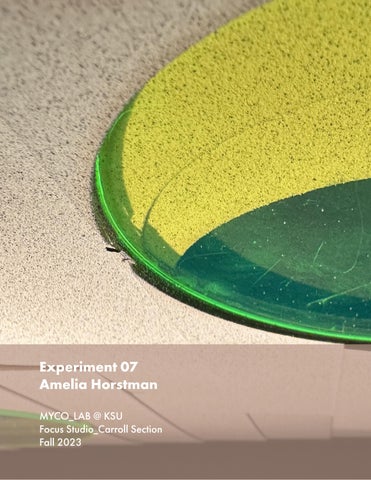
Experiment 07 Amelia Horstman MYCO_LAB @ KSU Focus Studio_Carroll Section Fall 2023
Amelia Horstman As time progresses, we must design architecture that seamlessly incorporates the vitality of life. Our society and planet necessitate architectural frameworks capable of adapting to the new challenges currently being faced. Notably, architecture plays a significant role, contributing 40% to annual global carbon dioxide emissions. This contribution emanates from the intricate processes involved in infrastructure development, material manufacturing, and construction.
A possible solution to this calamity is to incorporate green and living materials throughout our buildings. A new wave of research on Mycelium has been introduced into the discussion. This project aims to experiement with how mycelium can be introduced into archicture in a sustainable way.
Initial Precedents Hy-Fi by The Living
Claycelium
-Commissioned by the Museum of Modern Art and MoMA PS1. -Queens, New York, NY -Built 2014
-Project developed at IAAC -Created by Justin Sheinberg and Mert Gonul -2018/19, Digital Matter Program
The Living
Hy-Fi
Hy-Fi, conceptualized by David Benjamin under the guiding principle of ‘The Living’, displays a structure harnessing the power of Mushroom Mycelium and agricultural by-products. This tower, showcased at the Museum of Modern Art (MoMA) in New York, displays sustainable architecture and comprises a series of organic and reflective bricks, named “Bio-Blocks,” The Bio-Blocks are crafted from chopped corn, hemp, and Mycelium. Enhanced with light-refracting film, the blocks contribute to the tower’s luminosity by guiding and bouncing light throughout the structure. The brick-work, intentionally designed with gaps, allows natural ventilation through the stack effect. Cold air enters from the bottom, displacing warm air through the top, creating a self-ventilating system. The integration of corn stalks and the living root structures of the mycelium ensures strength, durability, and water resistance. Manufacturing these components into molds and allowing them to cement through the mycelium’s fungal growth, a total of 10,000 bricks contribute to the structural integrity of the entire tower. Thes Bio-Blocks can reach maturity in just five days, showing the efficiency of this as a construction material. At the end of its lifecycle, the entire structure can be composted, resulting in no energy consumption and zero waste.
https://architexturez.net/pst/az-cf-166796-1410423428
Living Structures
Claycelium Claycelium, an innovative architectural project developed at the Institute for Advanced Architecture of Catalonia (IAAC), researches the alternate construction material of clay and mycelium. This initiative is showcased as part of IAAC’s programs, and stands as a remarkable example of sustainable design and material exploration. Claycelium utilizes the combination of clay and mycelium to produce a versatile building material. The mycelium not only enhances the structural integrity of the material but also introduces ecofriendly attributes to the construction process. This concoction forms the basis of the project’s bricks, the Claycelium. The resulting bricks exhibit many benefits. From swift production timelines to strength and compostability, these bricks embody the principles of sustainable architecture. The integration of mycelium has a rapid growth cycle and contributes to the overall efficiency of the material. The architectural significance of Claycelium is shown in its design adaptability and potential applications. The project highlights the overall versatility of the material. Just as with the Bio-Blocks in the Hy-Fi precedent, the Claycelium project embraces methods of low-cost and environmentally conscious building solutions.
Experiment 1
Claycelium: Increase the Strength of Clay Objectives:
Process:
This experiment aims to explore the potential of combining clay and mycelium as a sustainable type of construction material. The expectations are to create a structurally sound and environmentally friendly prototype to base architectural construtrion off of.
01 02 03
Mold Design & Fabrication Composite Formulation Curing & Growth Progress
01 Mold Design & Fabrication • The simple tile was designed to be a simple wall decoration, connecting to one another with the integrated holes. Through the holes, wires or thread can be inserted to connect each module to one another. • After designing the tile, I then 3D printed the module to create a negative for the mold to be made.
• After the 3D print was procured, I mixed a silicon solution to create the inverse of the tile. Silicon is resistant to clay and would theoretically peel easily away from the clay tile. I inserted the print into the silicon, let it cure overnight, and released the print from the mold, creating a perfect negative to fill with the mixture.
02 Composite Formulation For this mixture, we used Clay, bits of a used & growing mycelium block, and the nuts & sawdust substrate. We hydrated the pellets in a french press, removed the water, , and mixed all of the materials together in a mortal & pestle. Once the mix was smooth and combined, we evenly distributed the mixture into the silicon mold.
Progress photos of mycelium growth The mycelium in the tile definitely did not integrate as well as it did in the petri dish. Speculation is the tile was not as well preserved or encased within a container such as the petri dish was. The clay quickly lost moisture & any movement of the silicon caused the clay to crack. The petri dish mixture flourished and actually thrived within the protective containment of the dish itself. The experiment here was far more successful than initially thought. I speculate that if the mold was more tightly filled with the mycelium, it would integrate more thouroughly through the clay and not just on top. However, with that being said, the back of the petri dish is evidence that the mycelium is thoroughly growing through the clay and bonding it (Thereby strengthening it).
03 Curing & Growth Process
Experiment 2
Building Blocks: Apply Design to Claycelium Objectives: Experiment 2’s aim was to add deign to the concept of claycelium. Through this experiment, the building blocks came into “play”. A design that is aimed to display how claycelium can become a structural aspect to basic building blocks of a building. Each of these blocks are simple, liminal, and aesthetic in deisng, and display fundamental elements of architecture, such as Frank Lloyd Wright’s “Kindergarten”, educational toys for children. The goal was to add the claycelium tot the blocks using the same process as the tile. Further inspection from our professor argued that the claycelium wasn’t as aesthetically pleasing as the normal substrate. The normal substrate was used instead.
Block Components Using the same process as before with the tile: 3D print, silicon negative, fill with the mixture. The mixture this time, however, only contained the substrate and a mycelium liquid broth, placed into the silicon mold.
• Stairs • Door/Gate • Brdige/Arcade • Wall
Exhibition Models For the exhibition hosted in Atlanta, I incorporated the Mycelium growth of the building blocks as a facade to the 3D printed blocks. The Mycelium was still a bit flimsy, so I experimented with each block to see exactly what component could give the most structure to the Mycelium. For the stair and bridge blocks, I molded in resin. This seemed to degrade the mycelium itself, but did adequetly seal and support the block, giving it an interesting and aesthetic texture. For the wall with window block, I brought back the clay add-in, after seeing how successful the mycelium acting with the clay substrate.
I mixed clay with water until smooth, and then poured the mixture into the wall mold and waited for it to dry. It was perhaps not as successful as the resin. The mixture took longer to dry, and the final product was still a bit flimsy. However, the block did give the Mycelium more structural backing, and molded to it far more naturally than the resin. The clay being a natural material, the mushroom growth did not decay away as did with the resin. It bonded with it, and perhaps even gave the mycelium a substrate to grow from. Concluding thoughts on the claycelium are that the mixture of the two could make for an incredibly innovative new building construction. Sustainable and easy to grow.
Extrapolation 1 The building blocks as a large multifunctional structure
Extrapolation 2 The building blocks as an interior space
Tile: Extrapolating into Tile Designs Objectives:
Blocks used for the tile design:
The final process to this Focus Studio experiment was to extrapolate and design 3 tiles based from our designs. For my design’s I decided to pull out themes from the building block designs, and integrate them into layered geometries. While the tile’s are not the same to each other, they each mantain a similar theme and materiality. The materials were stimulated by the mycelium used throughout the semester, to insinuate the building blocks growing with mycelium.
01 Staircase 02 Wall, Stairs & Bridge 03 Wall & Archways
Linework & Renderings for Tiles
01 Staircase Extrapolated from Staircase Block, I created undulating layers from the geometries, with a looking glass seemingly inverting the tile underneath.
02 Wall, Stairs & Bridge Extrapolated from archways of the gate & bridge blocks, I wanted this tile to convey how these blocks could overlap with rhythm. The layers of the tile stem from the staircase, while the looking glasses stem from the wall with window.
03 Wall & Archways Extrapolated from wall block, this tile is a rectalinear version of the windows looking glass. Framing a portal, this tile conveys the stepped perceptions of walking through a threshold, such as the archway blocks.
Tile Design
01
02
03
Final Tile Formation
Amelia Horstman_ Reflection on Process
Myco Project
Overall, this project was a spectacular exploration of creative integrity and mycelium research. This project presented me with an amazing outlet to my Thesis research on ‘Threshold Spaces’, while also allowing me to learn more about the sustainable and facinating field of Mycelium. Every project could be better than it’s final product, but I am incredibly satisfied with my explorations this semester. Thank you for your time, and I hope you enjoyed.