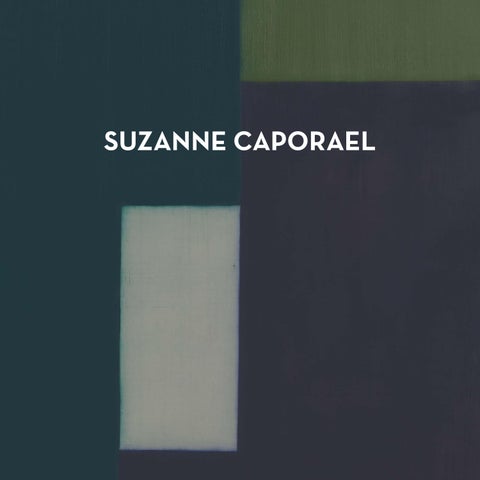
SUZANNE CAPORAEL
SUZANNE CAPORAEL FITTING
511 West 22nd Street
515 West 22nd Street
525 West 22nd Street
520 West 21st Street
New York NY 10011
New York NY 10011
New York NY 10011
New York NY 10011
4
NP-Complete Susan Tallman Back in the day, paintings told stories their audiences already knew — a baby in a manger, a king on a horse, a half-naked lady plowing through open ocean on a seashell. People might debate how the story was told or the clarity or heresy with which the artist treated it, but nobody had to ask what the picture was “about.” Then, in the nineteenth century, painters like Édouard Manet invented a fresh form of discomfort for viewers, making persuasive pictures that refused any obvious shared storyline. A new relationship developed between artists, subject matter, and the public, in which the “aboutness” of art grew ever more mercurial: Just when a viewer — having learned to look out for formal values, or politics, or the still small voice, or the dark night of the soul — might think she had a finger on that “aboutness,” away it skittered to some other place. Thus, many observers came to rely on artists’ statements of intent (or curators’ summaries thereof) as footholds on the path between looking and understanding. The one request Suzanne Caporael made of this essay was that it not quote her. The problem isn’t an inability to discuss her work or a refusal to do so. Caporael speaks lucidly and intriguingly about her art — the curiosity that drives it, the iteration and invention that ensue. The problem is that artists’ observations are sometimes misrepresented as all-purpose mottos, or worse, as explanations of objects whose point is to be looked at. She has been described as a “mostly abstract painter,” which seems about right.1 Her art may connect to objective phenomena — the periodic table of elements, the ebb and flow of littoral systems, the left/right handedness of molecules — without being about those things. The problem with statements of aboutness, like those that come with quotation marks, is that they can cheat our eyes of the aesthetic and cognitive pleasures of discovery.
1 Jonathan Goodman, “Suzanne Caporael,” Whitehot Magazine of Contemporary Art (March 30, 2021). https://www.milesmcenery.com/news/suzanne-caporael-whitehot-magazine2.
3
Caporael’s paintings of the past couple of years might be generically described as “geometric abstraction,” though they lack the hard edges and bold contrasts that the label brings to mind. The colors are tertiary, not primary: rusty reds, oxidized greens, deep mulch-pile browns. They have the look of things seen in shadow, with borders that are not protractor-sharp but tenderly finessed; at once solid and slightly out of focus. If the paintings conjure up any historical visual reference at all, it is of the downy-edged bricks of old wool in Pre-Columbian textiles rather than the chirpy rigor of Piet Mondrian or Vera Molnár. That said, the structures Caporael plays with are obviously rectilinear, and anyone who has experience with spreadsheets, knitting patterns, or Lego (not to mention minimalist art) will intuit the presence of an underlying grid. Glancing from one painting to the next, you can recognize a repeating vocabulary of shapes — rectangles, Ls, a stout T like a brimmed hat, a squat lintel, strange entities that might have fallen out of some 8-bit video game — all built from the square cells of the grid. 4
In geometry, such concatenations of squares are known collectively as polyominoes, and individually by Greek names denoting size: Three squares make a triomino, four a tetromino, five a pentomino, and so on. The familiar domino is just a two-square polyomino. They also come in different flavors: A domino will always be a rectangle, but a triomino might line up as a rectangle or bend to make an L, and that L might face right or left, up or down. Four squares might lie down as a bar, cling together in a square, or fold into an L or a T. This may sound off-puttingly mathematical, but for whatever evolutionary reason, humans find the act of fitting polyominoes together to be weirdly and persistently satisfying. It’s an instinct that has made Tetris the world’s most successful video game and Blokus a board-game-night favorite. The permutational possibilities can be turned over in your mind, and also in your hand. Drawing and painting are ways of making an immaterial idea concrete — not in the sense of immobile, but in the sense of tangible and present.
Caporael’s polyomino paintings are physically substantial objects. 815 (nonominoes) (2026) stretches 16 feet long, across three conjoined canvases. (One of the apparent seams is a feint.) But even the paintings that occupy just one canvas are larger than you might expect from reproductions — 4 1/2 or 5 1/2 feet tall — and their surfaces are enticingly complicated. Their personalities vary: Some may suggest incipient motion, like the pinwheel-like arrangement of T-shaped tetrominoes at the center of 809 (tetromino, pentomino, hexomino) (2026); others suggest meditative stasis, like the chunky dark frame stacked around a numinous teal center in 816 (four tetrominoes) (2026). Some might conjure anthropomorphic associations. (I can’t help reading the hexominoes sitting back-to-back at the center of 812 (six dodecominoes) (2025) as siblings in a huff.) The imposing architectonic character of 815 (nonominoes) is reinforced by the rhythmic repetition of window-like openings, while the surrounding nine-square nonominoes shape themselves into ziggurats, meanders, horizontal plinths, and stubbylimbed hat racks that all but gambol across the long expanse. It is clear from looking at them that these are the results of choices rather than of a system. Most of the time Caporael has packed her polyominoes to form a rectangular block, but sometimes they resolve differently. The triominoes of 818 (triominoes) (2026), leave an empty box in the lower right corner; the chunky dodecominoes (12-square shapes) of 814 (three dodecominoes) (2026) wrap themselves around a central window and step up along the bottom as if sitting on an invisible staircase. In 813 (L tetrominoes) (2025), an orderly scrum of tetromino Ls leaves open squares in two corners. Here and elsewhere, we can see the overshoots of Caporael’s construction lines. In none of the paintings do the colored blocks fill the canvas edge-to-edge. There’s always something like a margin. It may run across the top and bottom, or fully around the block of polyominoes, isolating it like a picture on a page. Caporael is an experienced and accomplished printmaker, familiar with a domain in which margins are a logistical necessity. (Printers need something to hold onto as they move paper on and off inked surfaces.) This is not the first time Caporael has provided painted objects with a surrounding space that reads as empty. But where paper margins reveal the support on which the image sits, the sand-colored territories in these paintings are as present and full of nuance as the color-saturated constructions they buffer. They negotiate the space between the external demands of the stretcher and the internal logic of polyomino packing.
5
Those pseudo-margins, open squares, and dangling overshoots make for paintings that feel orderly, but not tidy. Like fairy-tale children, Caporael leaves evidence of the path pursued. And while one can sense the slow gestation of the images as objects, the indelible sense of polyomino-packing satisfaction still shines through — the gratifying snap of the right fit, one to the next, the part to the whole, the image to the object. Chess and Go have long been celebrated as philosophical and aesthetic disciplines. Artists and writers from Su Shi in the eleventh century to Vladimir Nabokov and Marcel Duchamp in the twentieth have tried to translate the beauty of game play — the surprise and revelation, the sense of glimpsing some larger cosmic truth or plan — into fixed words and images.
6
Blokus, not so much. Maybe it’s that candy-colored plastic pieces feel less stately or profound than stones or ivory. Maybe it’s that children can so often beat grown-ups. Maybe it’s that it includes monominoes (1-square) pieces, which may feel like cheating. In any event, it seems like an oversight, since the activity of fitting polyominoes together is not just satisfying and potentially pleasing to the eye; it gives rise to astonishing complexity. The mathematician Claude Shannon estimated that there were at least 10120 possible variations in chess, which is a very large number, but minuscule compared with Go, which has more potential board configurations than there are atoms in the universe. Blokus is thought to have many more than that. Nobody has actually counted them. Mathematicians classify general polyomino-packing problems as “NP-complete,” meaning there’s no known algorithmic shortcut to a solution — no formula you can just run. You can see instantly whether you’ve got it right, but the only way of getting there is to look and move, then look and move again. I should make it clear that Caporael has never mentioned the word “Blokus” to me. Nor are her paintings “about” the complexity of polyomino packing problems. She isn’t illustrating a game; she’s making paintings. Games play out in time; paintings play out in space. But the pleasure a good game move offers isn’t really about the game. It lies in the sudden awareness of an opportunity you hadn’t seen a moment ago, and the chain of new options that unfurl from that realization. The images in Caporael’s paintings are fixed, yet somehow they carry the whiff of that wide open universe
of permutational possibility — all the other valid packings, structurally sound, but not yet seen. They invite us to look, and to look forward. Susan Tallman is an art historian and frequent contributor to The Atlantic and The New York Review of Books.
7
8
808 (five pentominoes), 2025 Oil on linen 54 x 42 inches 137 x 107 cm
9
10
809 (tetromino, pentomino, hexomino), 2026 Oil on linen 54 x 42 inches 137 x 107 cm
11
12
810 (hexominoes), 2025 Oil on linen 54 x 42 inches 137 x 107 cm
13
14
811 (two, three, four, five, six), 2026 Oil on linen 66 x 54 inches 168 x 137 cm
15
16
812 (six dodecominoes), 2025
Oil on linen 66 x 54 inches 168 x 137 cm
17
18
813 (L tetrominoes), 2025 Oil on linen 54 x 42 inches 137 x 107 cm
19
20
814 (three dodecominoes), 2026 Oil on linen 54 x 42 inches 137 x 107 cm
21
22
815 (nonominoes), 2026
Oil on linen 66 x 192 inches 168 x 488 cm
23
24
816 (four tetrominoes), 2026 Oil on linen 54 x 42 inches 137 x 107 cm
25
26
817 (dominoes), 2026
Oil on linen 54 x 42 inches 137 x 107 cm
27
28
818 (triominoes), 2026
Oil on linen 66 x 54 inches 168 x 137 cm
29
30
Suzanne Caporael Born in New York, NY in 1949 Lives and works in Islesboro, ME EDUCATION 1979 MFA, Otis Art Institute, Los Angeles CA 1977 BFA, Otis Art Institute, Los Angeles CA SOLO EXHIBITIONS 2026 “Fitting,” Miles McEnery Gallery, New York, NY 2024 “Proof,” Miles McEnery Gallery, New York, NY 2021 “Suzanne Caporael: The Nature of Things,” Chazen Museum of Art, University of Wisconsin–Madison, Madison, WI “Book Eight,” Miles McEnery Gallery, New York, NY 2019 “Blue Uniform,” Miles McEnery Gallery, New York, NY 2018 “Suzanne Caporael: Prints,” Tandem Press Apex Gallery, University of Wisconsin–Madison, Madison, WI 2017 “What Follows Here,” Ameringer | McEnery | Yohe, New York, NY
2015 “The Landscape,” Ameringer | McEnery | Yohe, New York, NY 2014 “Suzanne Caporael: Recent Paintings,” Peters Projects, Santa Fe, NM 2013 “Enough is Plenty,” Ameringer | McEnery | Yohe, New York, NY 2012 “Seeing Things,” Ameringer | McEnery | Yohe, New York, NY Ameringer | McEnery | Yohe, New York, NY 2010 “The Memory Store,” Ameringer | McEnery | Yohe, New York, NY 2008 “GOING,” Richard Gray Gallery, Chicago, IL 2007 “Roadwork,” Greenberg Van Doren Gallery, New York, NY 2006 “Time,” Richard Gray Gallery, Chicago, IL 2005 “Reading Time,” Greenberg Van Doren Gallery, New York, NY and St. Louis, MO “Works on Paper,” Richard Levy Gallery, Albuquerque, NM “A Decade,” Lemberg Gallery, Ferndale, MI
31
2004 “Estuaries,” Elizabeth Leach Gallery, Portland, OR “Tide Waters,” Richard Gray Gallery, Chicago, IL 2003 “Littoral Drift,” Artemis Greenberg Van Doren Gallery, New York, NY Hemphill Fine Arts, Washington, D.C. 2001 “Turnagain Arm and Other Cold Places,” Richard Gray Gallery, Chicago, IL 2000 “Melt: New Paintings,” Kohn Turner Gallery, Los Angeles, CA
32
1999 “Studies for Melt,” Karen McCready Fine Art, New York, NY 1998 “The Elements of Pigment,” Lemberg Gallery, Birmingham, MI; traveled to Richard Gray Gallery, Chicago, IL; and Kohn Turner Gallery, Los Angeles, CA 1997 “Recent Paintings,” In Khan Gallery, New York, NY “Suzanne Caporael,” SOMA Gallery, La Jolla, CA 1996 “The Five Kingdoms and The Periodic Table of Elements,” Kohn Turner Gallery, Los Angeles, CA; traveled to Richard Gray Gallery, Chicago, IL; and Stephen Wirtz Gallery, San Francisco, CA 1994 “Paintings, from the Series Inside Trees and Living on Permafrost: Black Spruce,” Stephen Wirtz Gallery, San Francisco, CA
1993 “Inside Trees,” Richard Gray Gallery, Chicago, IL 1992 “Second Nature,” Stephen Wirtz Gallery, San Francisco, CA 1991 “Suzanne Caporael,” Richard Gray Gallery, Chicago, IL “Paintings and Works on Paper,” Richard Green Gallery, Santa Monica, CA “New Work,” Lisa Sette Gallery, Scottsdale, AZ 1989 “Recent Paintings,” John Berggruen Gallery, San Francisco, CA “New Paintings,” Lisa Sette Gallery, Scottsdale, AZ 1988 “New Work,” Richard Gray Gallery, Chicago, IL “Recent Work,” Harcus Gallery, Boston, MA; traveled to Krygier/Landau Contemporary Art, Santa Monica, CA 1987 “Recent Paintings,” John Berggruen Gallery, San Francisco, CA 1986 “Recent Paintings,” Krygier/Landau Contemporary Art, Santa Monica, CA “California Viewpoints,” Santa Barbara Museum of Art, Santa Barbara, CA 1985 “Suzanne Caporael,” Irit Krygier Contemporary Art Los Angeles, CA “Summer 1985: Nine Artists,” Museum of Contemporary Art, Los Angeles, CA
1984 “Suzanne Caporael,” Newport Harbor Art Museum, Newport Beach, CA
R. Kravis II Collection,” Oklahoma State University Museum of Art, Oklahoma State University, Stillwater, OK
SELECT GROUP EXHIBITIONS
2016 “Beyond Likeness: Mapping the Self,” Chazen Museum of Art, University of Wisconsin–Madison, Madison, WI “The Other: Nurturing a New Ecology in Printmaking,” Museum of Contemporary Art Jacksonville, Jacksonville, FL
2026 “Line/Form,” Miles McEnery Gallery, New York, NY 2025 “In Tandem: Ruhl & Caporael,” Tandem Press Apex Gallery, University of Wisconsin–Madison, Madison, WI 2024 “All Bangers, All The Time: 25th Anniversary Exhibition,” Miles McEnery Gallery, New York, NY “A Planar Garden” (curated by Stephen Westfall), Alexandre Gallery, New York, NY “On Tenterhooks,” Tandem Press Apex Gallery, University of Wisconsin–Madison, Madison, WI
2015 “Celebrating the Spectrum: Highlights from the Anderson Collection,” de Young Museum and Legion of Honor, Fine Arts Museums of San Francisco, San Francisco, CA 2014 “Color Rhythms,” Richard Levy Gallery, Albuquerque, NM
2021 “Summer Reflections,” Tandem Press Apex Gallery, University of Wisconsin–Madison, Madison, WI “Minted,” Addison/Ripley Fine Art, Washington, D.C.
2011 “(Un)Natural Histories,” Kemper Museum of Contemporary Art, Kansas City, MO Ameringer | McEnery | Yohe, New York, NY
2020 “Immersed,” Tandem Press Apex Gallery, University of Wisconsin–Madison, Madison, WI
2010 “International Exhibition of Visual Arts,” American Academy of Arts and Letters, New York, NY
2018 “Known: Unknown” (curated by Graham Nickson and Rachel Rickert), New York Studio School, New York, NY “Belief in Giants,” Miles McEnery Gallery, New York, NY
2008 “People and Places,” Atrium Gallery, St. Louis, MO “New Prints: Spring 2008,” International Print Center New York, New York, NY
2017 “SITE/SIGHT” (curated by Ellen Kozak), Cross Contemporary Art, Saugerties, NY “The Times,” The FLAG Art Foundation, New York, NY “Oklahoma and Beyond: Selections from the George
2007 “Less is More,” 511 Gallery, New York, NY “Empty Nest: The Changing Face of Childhood in Art, 1880 to the Present” (curated by Lowell Pettit), Nathan A. Bernstein & Co. Ltd., New York, NY
33
2006 “Nine Decades of Los Angeles Art,” Los Angeles Municipal Art Gallery, Los Angeles, CA 2005 “New Art, New York: Reflections on the Human Condition,” Trierenberg Holding AG, Traun, Austria 2003 “Components,” Elizabeth Leach Gallery, Portland, OR 2002 “Linger,” Artemis Greenberg Van Doren Gallery, New York, NY “Plotting: A Survey Exhibition of Artists’ Studies,” Carrie Secrist Gallery, Chicago, IL
34
2001 “On Language: Text and Beyond,” Center Galleries, Detroit, MI 2000 “Identities: Contemporary Portraiture,” Palmer Gallery, New Jersey Center for Visual Arts, Summit, NJ “Watch,” Bona Fide Gallery, Chicago, IL “Ellsworth Kelly and Suzanne Caporael,” Graystone Contemporary Art, San Francisco, CA 1999 “Retrospective of the Collection of David Teplitzki,” Boulder Museum of Contemporary Art, Boulder, CO “The Great Drawing Show 1550 to 1999,” Kohn Turner Gallery, Los Angeles, CA “A Quiet Storm: Painting in Abstraction,” Kohn Turner Gallery, Los Angeles, CA 1998 “Cleveland Collects: Contemporary Art,” Cleveland Museum of Art, Cleveland, OH “Hands on Color,” Bellevue Art Museum, Bellevue, WA
1996 “Between Reality and Abstraction,” NICA, Las Vegas, NV “Rediscovering the Landscape of the Americas,” Gerald Peters Gallery, New York, NY 1995 “New Abstraction,” Kohn Turner Gallery, Los Angeles, CA 1993 “45th Annual Academy Purchase Exhibition,” American Academy of Arts and Letters, New York, NY “Sea Fever,” Transamerica Pyramid Center, San Francisco, CA 1992 “Inaugural Exhibition,” Riverside Art Museum, Riverside, CA “Selective Visions,” Transamerica Pyramid Center, San Francisco, CA 1991 “Group Show,” Stephen Wirtz Gallery, San Francisco, CA “Individual Realities in the California Art Scene,” Sezon Museum of Modern Art, Tokyo, Japan “Selections From the Peter Norton Collection,” Rand Corporation, Los Angeles, CA “Presswork: The Art of Women Printmakers,” National Museum of Women in the Arts, Washington, D.C. 1989 Richard Gray Gallery, Chicago, IL 1988 “Land,” ACA Art Gallery, New York, NY 1987 Zolla/Lieberman Gallery, Chicago, IL
“Alumni Invitational,” Otis Art Institute, Los Angeles CA, “Avant-Garde in the Eighties,” Los Angeles County Museum of Art, Los Angeles, CA John Berggruen Gallery, San Francisco, CA AWARDS 2020 Fine Arts Fellowship, John Simon Guggenheim Memorial Foundation, New York, NY
Legion of Honor, Fine Arts Museums of San Francisco, San Francisco, CA Los Angeles County Museum of Art, Los Angeles, CA Milwaukee Art Museum, Milwaukee, WI Museum of Contemporary Art, Los Angeles, CA National Museum of Women in the Arts, Washington, D.C.
2009 Artist in Residence, Josef & Anni Albers Foundation, Bethany, CT
Orange County Museum of Art, Newport Beach, CA
1986 Painting Grant, National Endowment for the Arts, Washington, D.C.
San Francisco Museum of Modern Art, San Francisco, CA
SELECT COLLECTIONS Art Institute of Chicago, Chicago, IL Carnegie Museum of Art, Pittsburgh, PA Chazen Museum of Art, University of Wisconsin–Madison, Madison, WI Detroit Institute of Arts, Detroit, MI Fogg Museum, Harvard Art Museums, Harvard University, Cambridge, MA High Museum of Art, Atlanta, GA Honolulu Museum of Art, Honolulu, HI Hood Museum of Art, Dartmouth College, Hanover, NH Irish Museum of Modern Art, Dublin, Ireland
Portland Museum of Art, Portland, ME
Santa Barbara Museum of Art, Santa Barbara, CA Speed Art Museum, Louisville, KY The University of Arizona Museum of Art, University of Arizona, Tucson, AZ Whitney Museum of American Art, New York, NY Worcester Art Museum, Worcester, MA Yale University Art Gallery, Yale University, New Haven, CT
35
Published on the occasion of the exhibition
SUZANNE CAPORAEL FITTING 10 September – 31 October 2026 Miles McEnery Gallery 515 West 22nd Street New York NY 10011 tel +1 212 445 0051 www.milesmcenery.com Publication © 2026 Miles McEnery Gallery All rights reserved Essay © 2026 Susan Tallman
36
Associate Director Julia Schlank, New York, NY Catalogue Design Laurie Mullowney, New York, NY Artwork Images © 2026 Suzanne Caporael / Artist Rights Society (ARS), New York, NY Photography by Dan Bradica, New York, NY Dana Nielsen Clarke, Rockland, ME ISBN: 979-8-3507-6714-8 Cover: 814 (three dodecominoes), (detail), 2026