NORMAN BLUHM
BEYOND THE END NORMAN BLUHM IN THE S
By Zachary Ri er
“He [the artist] must be quite aware of the obvious fact that art never improves, but that the material of art is never quite the same.”
T.S. Eliot once remarked that no artist generates their meaning alone. Rather, the fullness of their work becomes intelligible only once its relationship to the past is sorted through. For the artist, cultivating this “historical sense,” as Eliot calls it, is necessary if they want to engage with tradition as more than just a rote process of bestowal and reception. To be an active participant in tradition is to understand how the past shapes the contours of the present—how it informs our sense of what feels necessary, and what seems possible.
I.
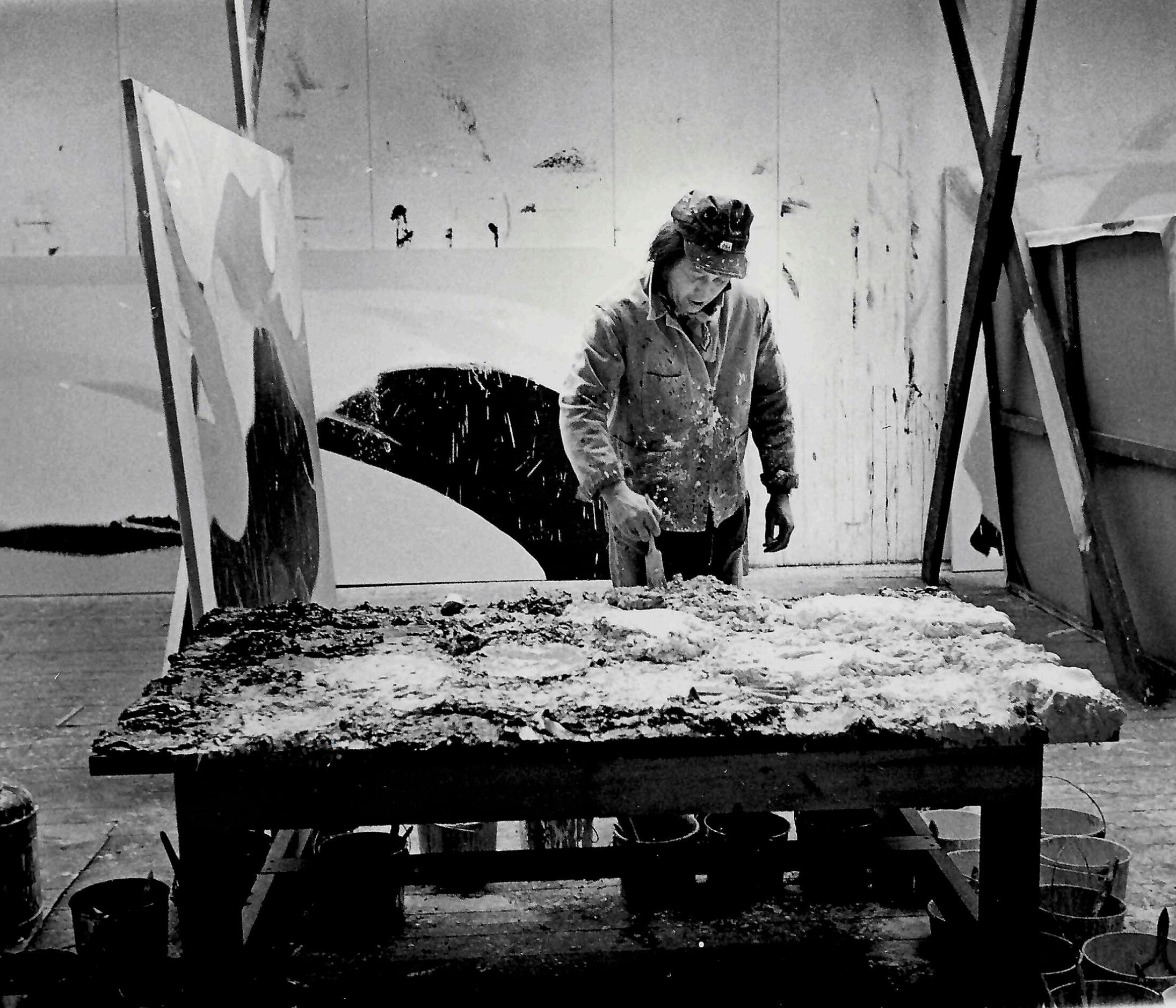
Beginning in the 1970s, and a er more than two decades of experimentation and accomplishment, Norman Bluhm arrived at an idiom of gestural abstract painting entirely his own. The timing was just right for Bluhm, but exactly wrong as far as the critical consensus was concerned. Particularly in America, there were few who took notice of Bluhm’s innovations, and even fewer who saw the significance in them. A ention was elsewhere: Conceptual art, Pop art, Minimalism and even Color Field painting were all considered more noteworthy—more historically important— than the continued elaboration of gestural abstraction. Undeterred by the winds of recognition and success blowing hard against him, Bluhm continued to develop the grammar of his painting.
To understand how the 70s paintings became possible for Bluhm, it is necessary to take stock of how his art, and his life, had taken shape up to that point. With the end of World War II came the end of Bluhm’s service in the United States Air Force in 1945 as well, and rather than return to Chicago and resume his architecture studies, Bluhm opted for Europe, living briefly in Florence and then, for the be er part of a decade, in Paris, from 1947-56. These years were formative: Bluhm was immersed in a vibrant post-war milieu of artists and intellectuals, from Jean Cocteau and Jean-Paul Sartre, to fellow expatriates Joan Mitchell and Sam Francis (with whom he shared a studio). His work from this period strikes one now as something of a precursor to the more mature work he would start making closer to the time he relocated to New York, in 1956. Still, what was already clear in this work was the importance that drawing from life, particularly the nude female form, had for Bluhm. In the years immediately following his arrival in New York Bluhm produced paintings that are rich with the movement of their making, but which also show a real sophistication of structure: angular bursts of color across the canvas work as anchor points for the eye as it tracks Bluhm’s brush.
As the 1950s gave way to the 60s, so too did Bluhm’s all-over compositions begin to give way to more linear, more graphic, more selective ways of structuring his paintings. In works like Hell’s Bell (1962) and Iron Horse (1964) we can see large spaces of primed white canvas le bare and then flanked, encircled by sweeps of his brush with quick, assured movements—as though the influence of Jackson Pollock had been worked through, and Bluhm’s more natural affinity for Franz Kline and Willem de Kooning had risen to the surface. The paintings he made through the 60s put progressively more emphasis on volume and curvilinear form as the basis for composition, and those forms were put down with an increasingly more streamlined pale e of pastel blues and pinks, of bright yellows and deep, direct greens, and with a healthy application of black and white for good measure. Just as Bluhm was expanding his visual language, he, along with other painters still commi ed to some form of abstract expressionist painting, like his friends Mitchell and Francis, was being derisively referred to as a second-generation practitioner of that style. Such a label implied that painting in this way was an exhausted pursuit, and that no further
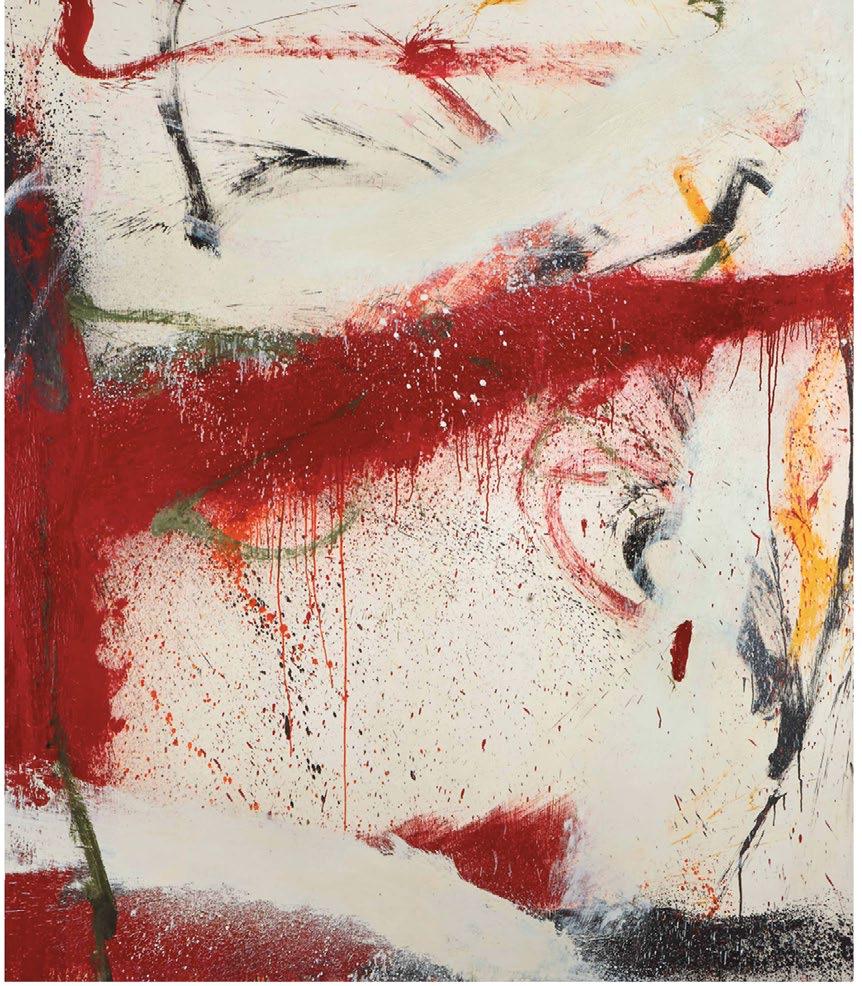
discovery—no meaningful discovery at least—was worth making. As we can now see, and with the added benefit of hindsight, Bluhm was on the verge of roundly disproving that.
II.
In 1970 Bluhm and his family le New York City for the town of Millbrook in upstate New York. The city was replaced by the countryside, and Bluhm was ready to leave his exploration of freeform, all-over compositions behind in favor of more sinuous, more sensuous, ways of constructing space. Speaking in 1987 about this very period, Bluhm emphasized the expanded role that nude drawing had assumed for him before and a er the move to Millbrook:
“I began to insert the nude form into the pictures. [...] I was interested in closed and open forms and the way one form defeated another. The gesture around the closed form—I first saw it at the Cloisters [Museum] in tapestries. Groups of figures were connected by directional marks, such as the crossing lances.”
Norman Bluhm, Hell’s Bell, 1962, Oil on canvas
83 7⁄8 x 72 inches, 213 x 183 cm
Bluhm was no longer invoking the body solely through the act of painting (the way his paintings had previously figured the movement of his body or the sweep of his arm in paint). Rather than be a mere reference point outside of the work, something which the work summons to one’s mind during the process of looking, the body provided a language of rhythm, of compositional structure, that Bluhm could use to dramatically expand his visual repertoire.
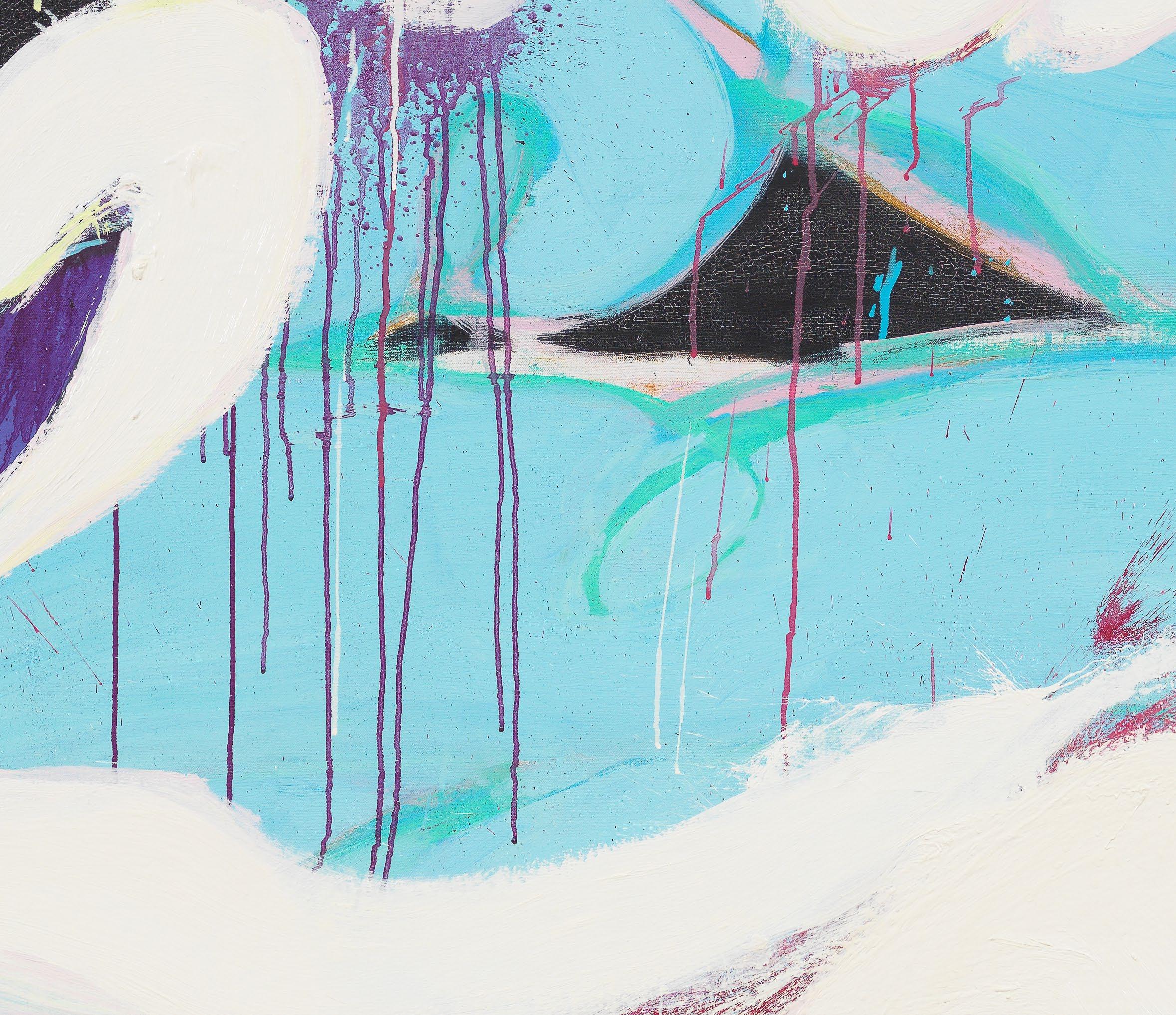
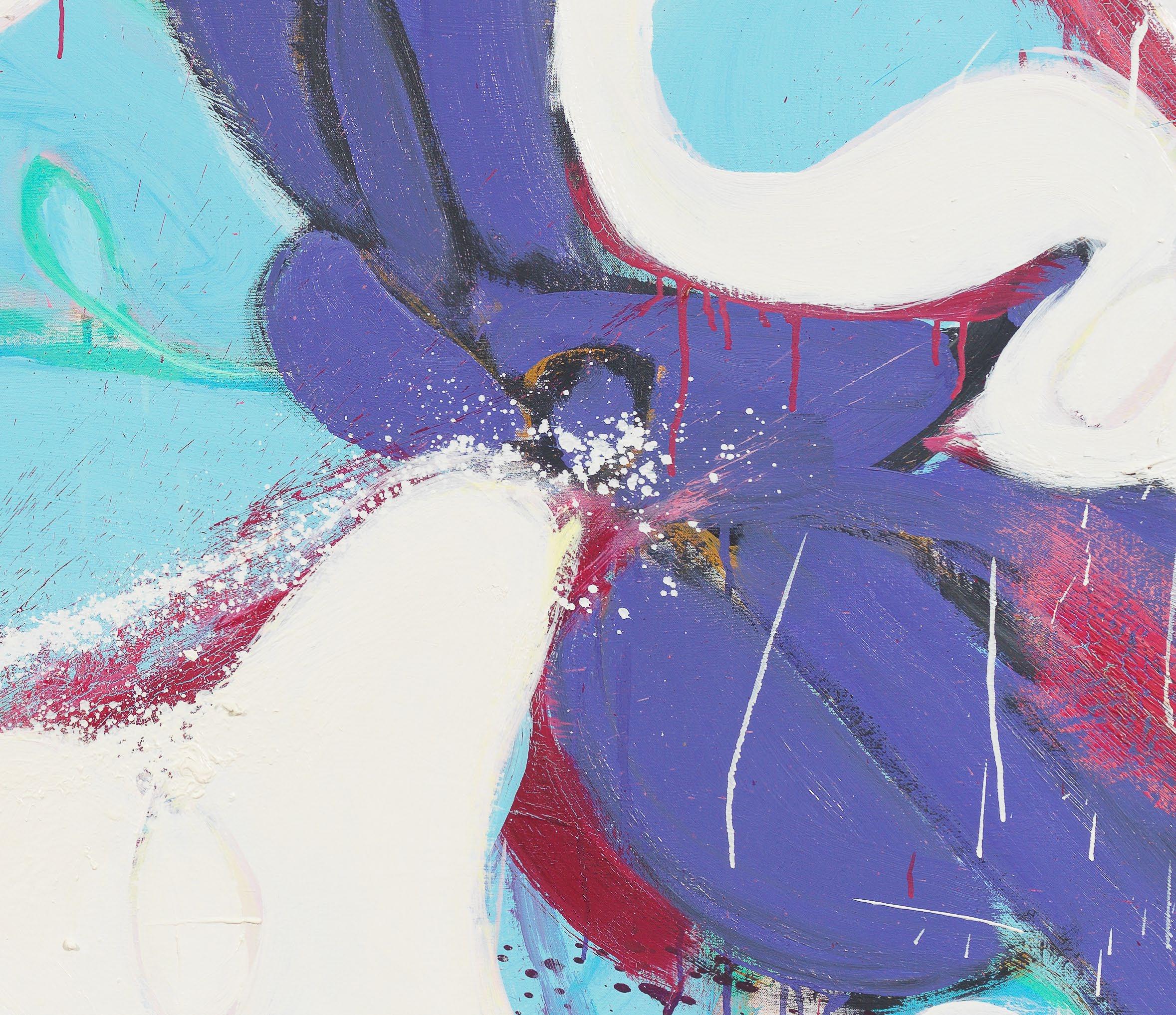
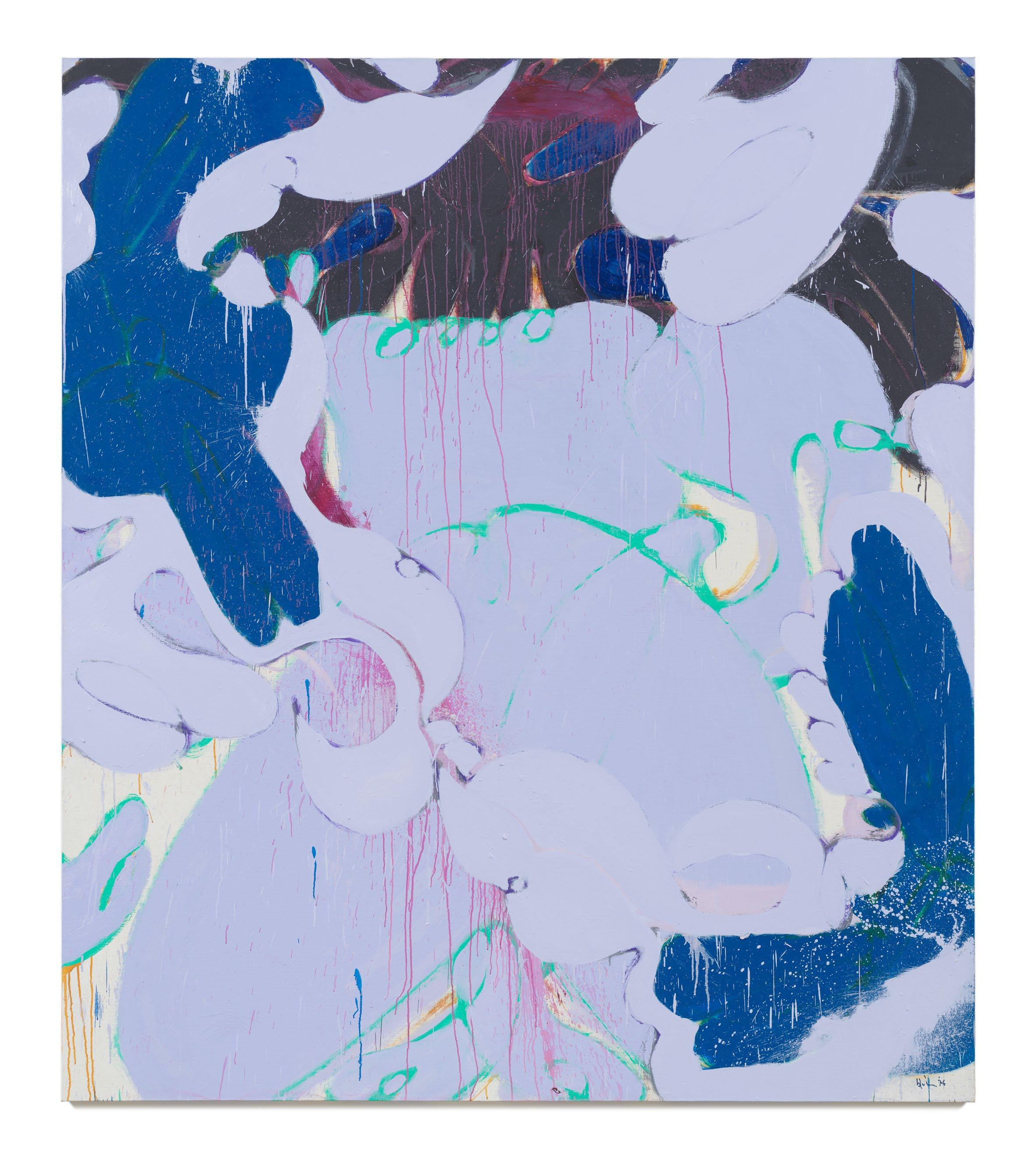
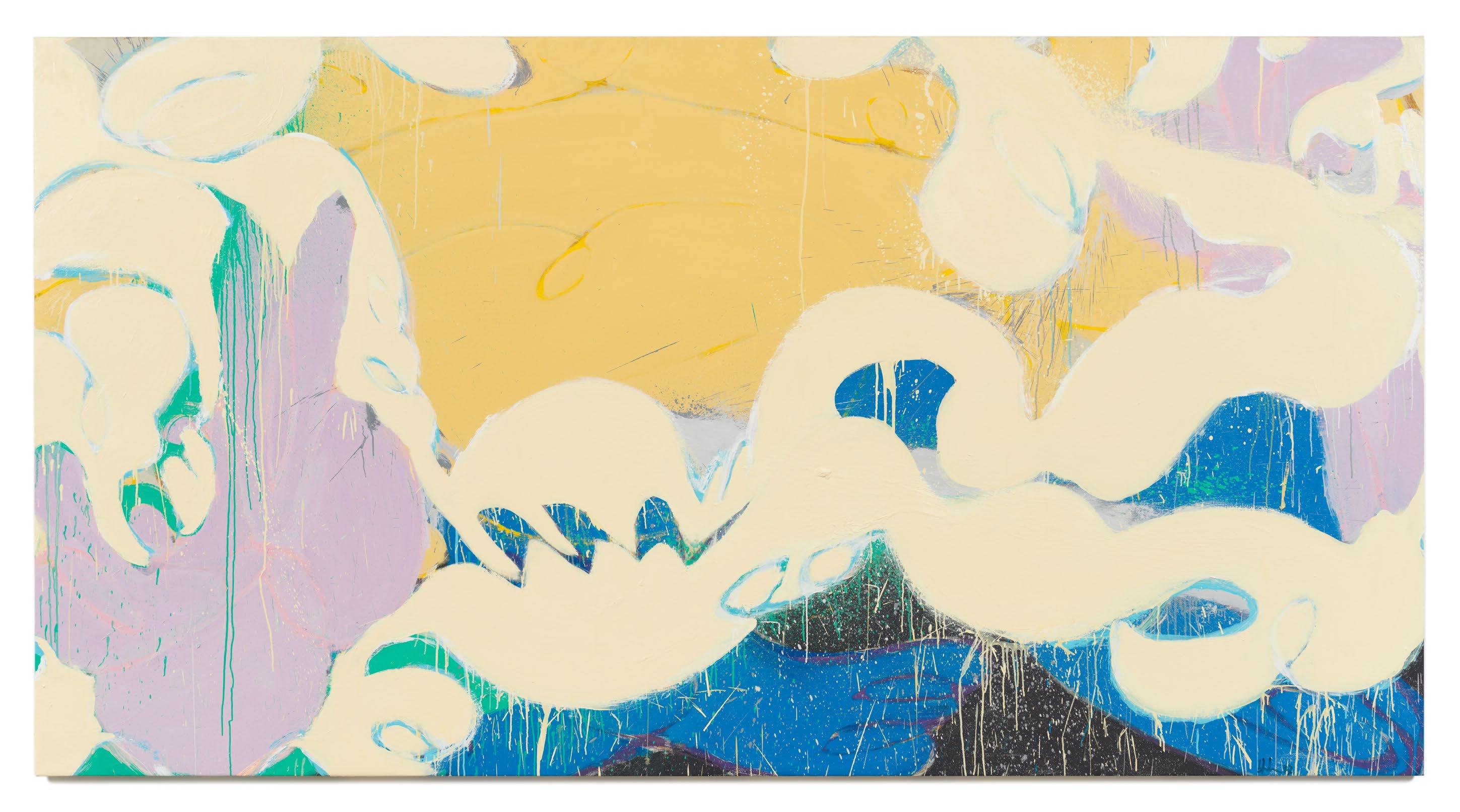
This development was not immediate, nor did it take place in the space of a single canvas. Bluhm worked through it. In Philomela (1972), we see snaking stretches of violet interlocking with a collar of black that encloses the bo om half of the canvas, effectively framing loose drips and spla ers of paint. Bluhm articulates the outline of one violet expression as though he were se ing the silhoue e of a reclining nude. There is a kind of loose entanglement of shape that circles the painting’s open and relatively capacious middle area, where swi articulations of the brush, seemingly unmodified, stand out. In Crustadéle (1976) and Milkmaid (1977) we can see a development in Bluhm’s compositions that resulted in denser spaces, where awkward and tense folds of color are pressed up against one another. Particularly in Milkmaid, where pastels of yellow and pink weave into and overlap with each other, we can get a sense for how these paintings seem to be working themselves out in real time, as though their composition was provisional, tentative, still to be determined by some internal law.
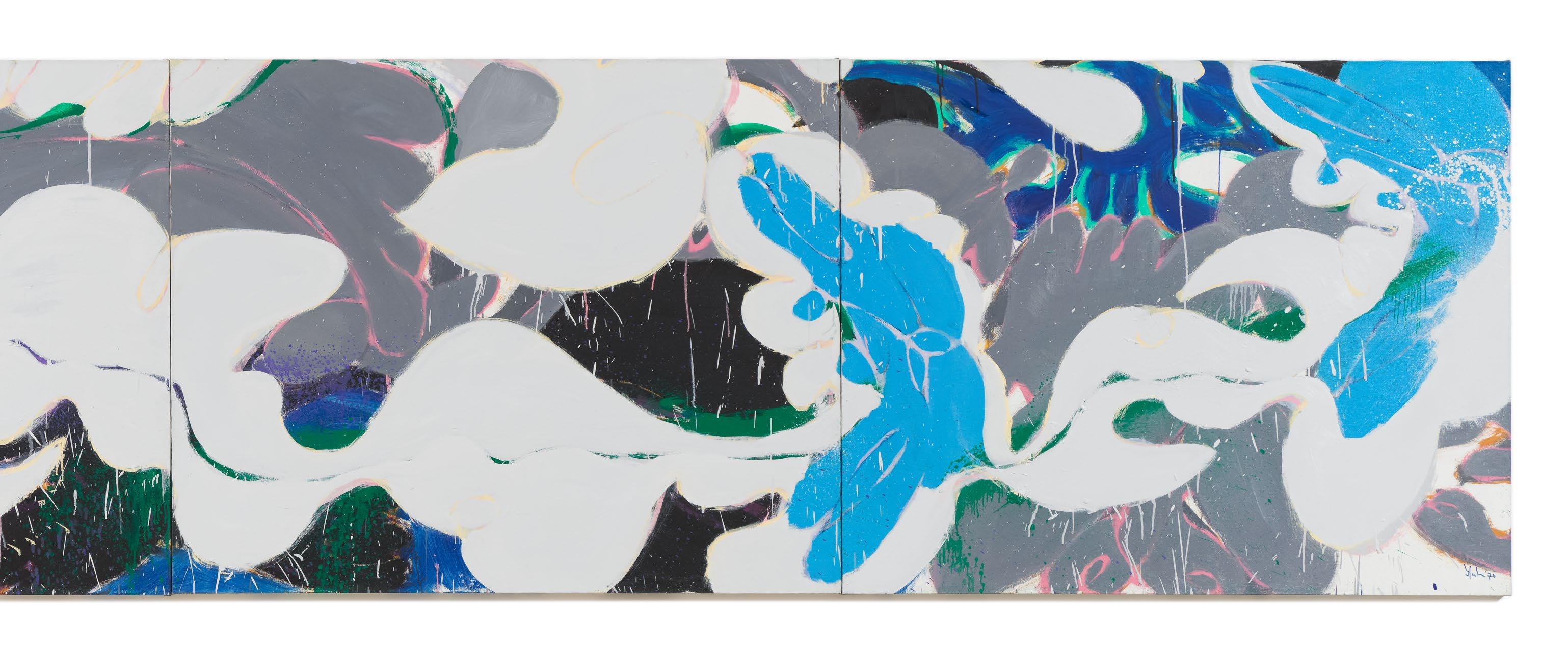
Although Bluhm was no stranger to painting at a grand scale—regularly doing so across several canvases for a single work—as he painted through the 70s he began to emphasize horizontality in a dramatic fashion, particularly in multi-canvas works. Untitled, Studies in Blue, White, Gray, (1975) is a potent expression of this emphasis: stretching across four canvases to measure twenty feet long and, by comparison, only an intimate four feet tall, the painting wrestles together so much of what Bluhm had been working through in relatively smaller canvases up to that point. Fluid forms with sharp contours; a complex and multi-polar composition that seems to burst with improvisation; zones of flat, unmodulated color that are delicately accented with whips and spla ers of paint; formlessness and its inverse. This painting has the restlessness that comes not just from form itself, but from a sense one gets that ideas are being thought through, examined, tried and tested with paint on canvas.
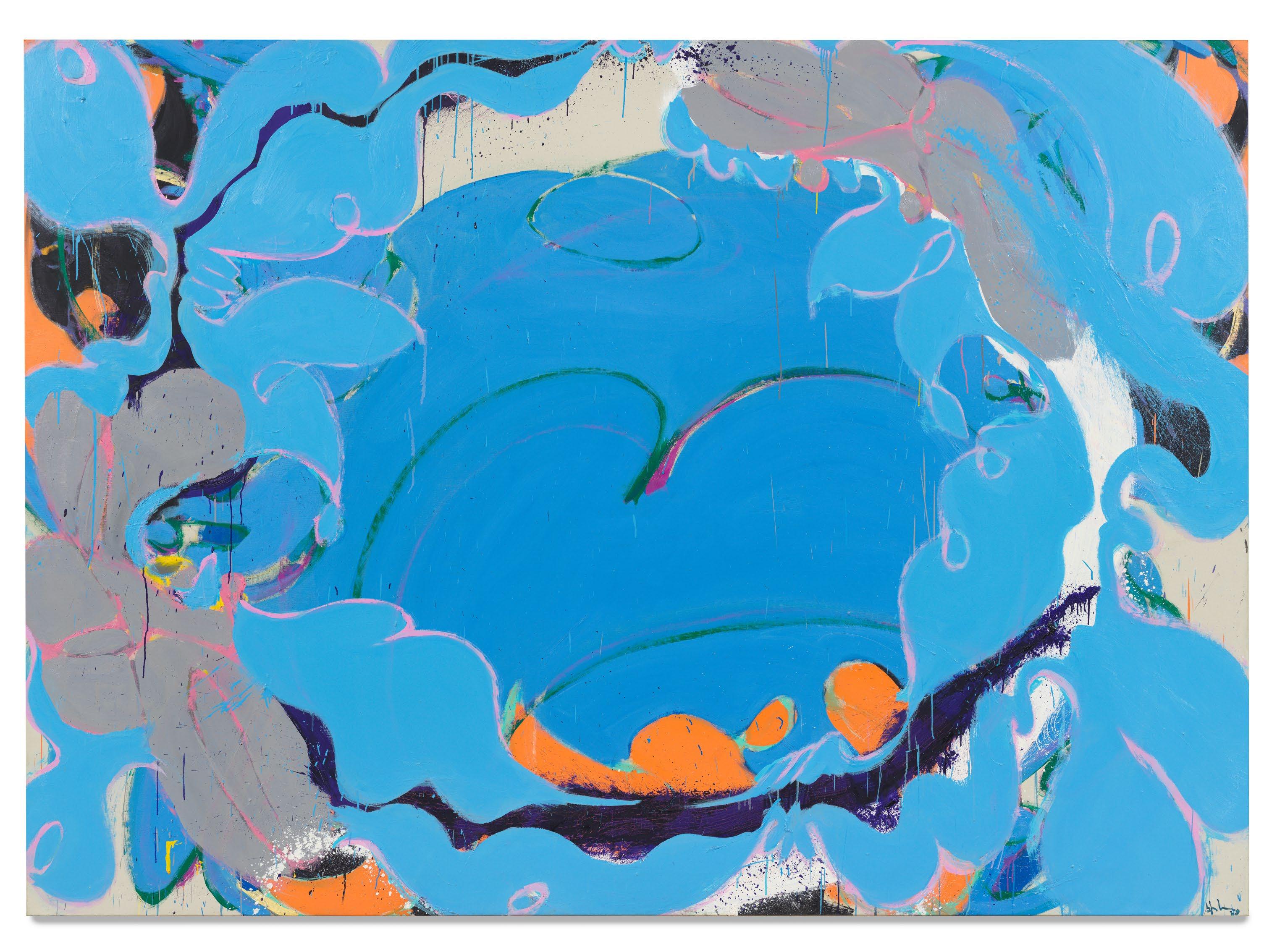
As Bluhm continued to utilize multi-canvas paintings as a way to expand the sheer size that his dramatic acts of form could play out in, the space within the paintings largely remained flat and two-dimensional. Though this was consistent with the prior twenty or so years of painting that he had done, it too would soon be challenged. In Ice Blue (1978) and Viper Lady (1979) our eyes no longer shu le from side to side—instead they move round and round as billowing shapes, now rippling together, enclose centers of solid color marked once again with the quick, assured strokes of his brush, in each instance resembling the top half of a heart. Are we looking upward, past clouds and then to the heavens, or downward into the deep recesses of some bo omless pool of blue?
III.
The significance of the 70s for Bluhm’s art can be seen by looking backwards at what preceded it, but also forward at what was to come. His paintings from the 70s marked a watershed in his drive to bring a romanticism of the body into Abstract Expressionism, and the work that followed, in the 80s and 90s, would take this focus further, to extreme and o en challenging ends. Though his late work became evermore idiosyncratic with reference, and radical in how space is constructed, the 70s remain the pivotal years, the ones which saw Bluhm paint using the lessons of the living tradition he was part of, only to move beyond them into a space of genuine invention.
Endnotes
1. Eliot, T.S. “Tradition and the Individual Talent.” The Selected Prose of T.S. Eliot, edited by Frank Kermode, Harcourt Brace Jovanovich, Farrar, Straus and Giroux, New York, 1975, 39.
2. Salzillo, William. “Conversation with the Artist.” Norman Bluhm: Works on Paper 1947–1987, Hamilton College, Clinton, 1987, 11.
Zachary Ri er is a writer based in New York. His writing has appeared in The Brooklyn Rail and Hyperallergic.
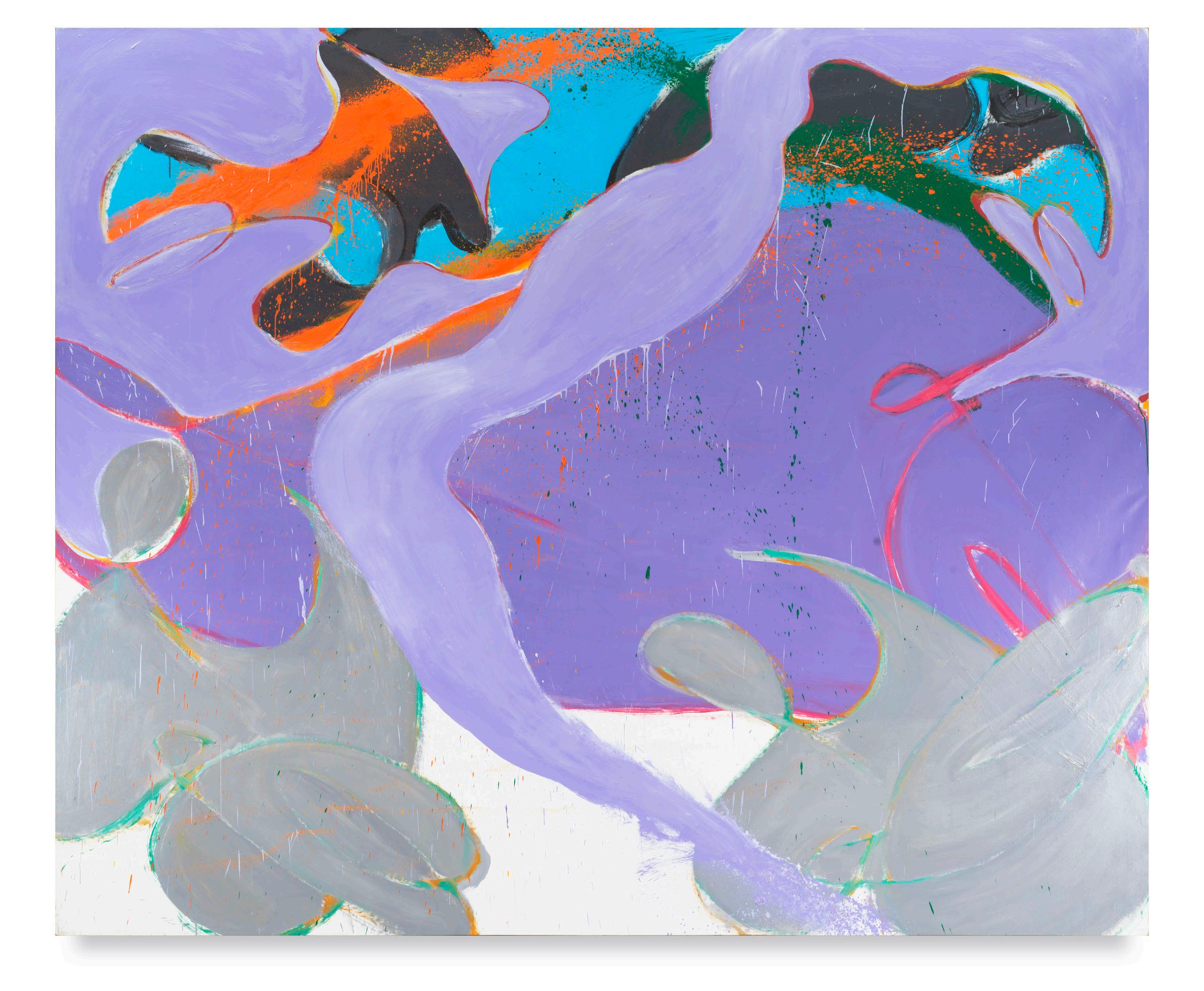
Henri Did It, 1972
Oil on canvas
96 x 116 inches
243.8 x 294.6 cm
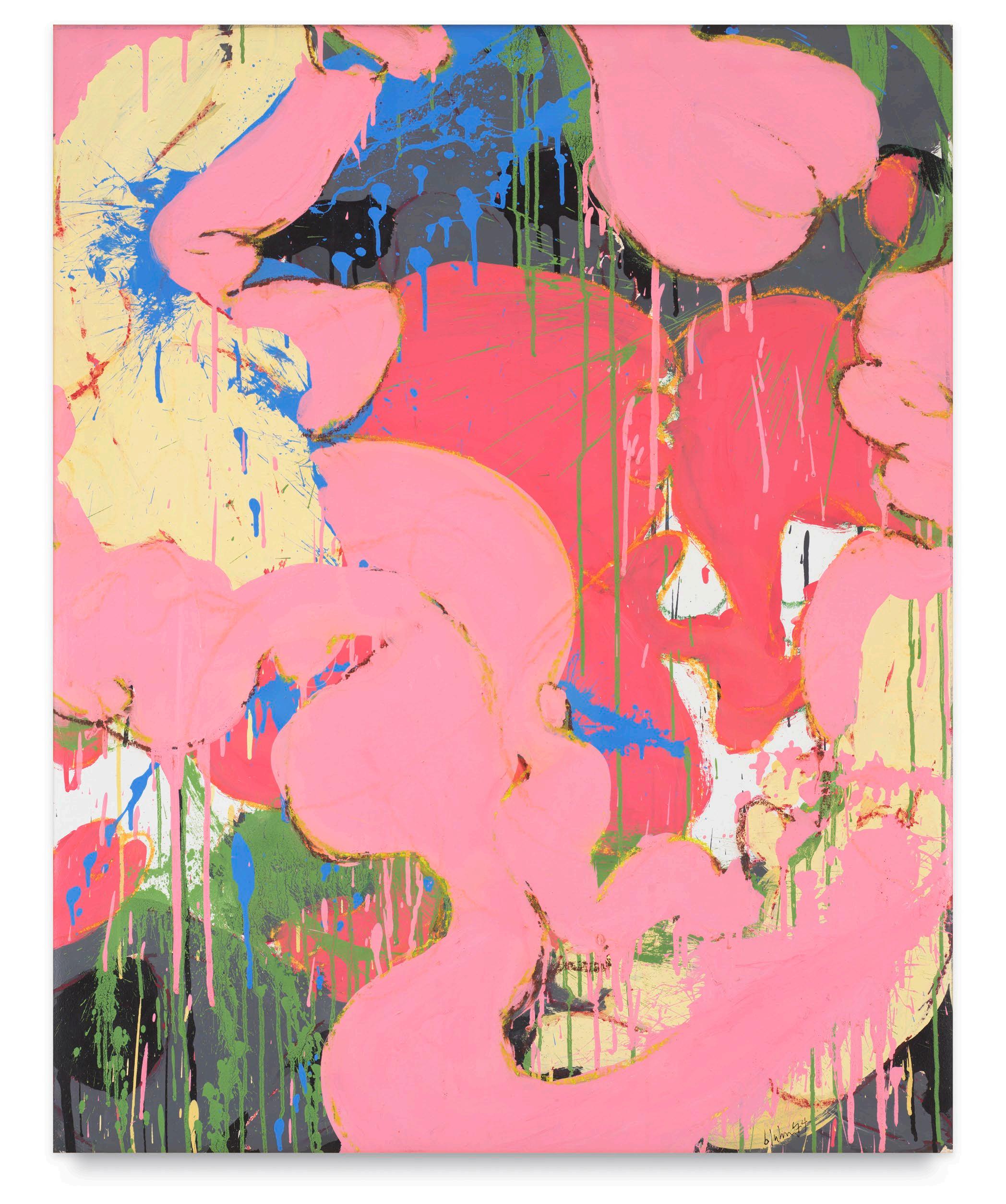
Untitled, 1974
Acrylic, pastel on canvas
48 x 38 inches
121.9 x 96.5 cm
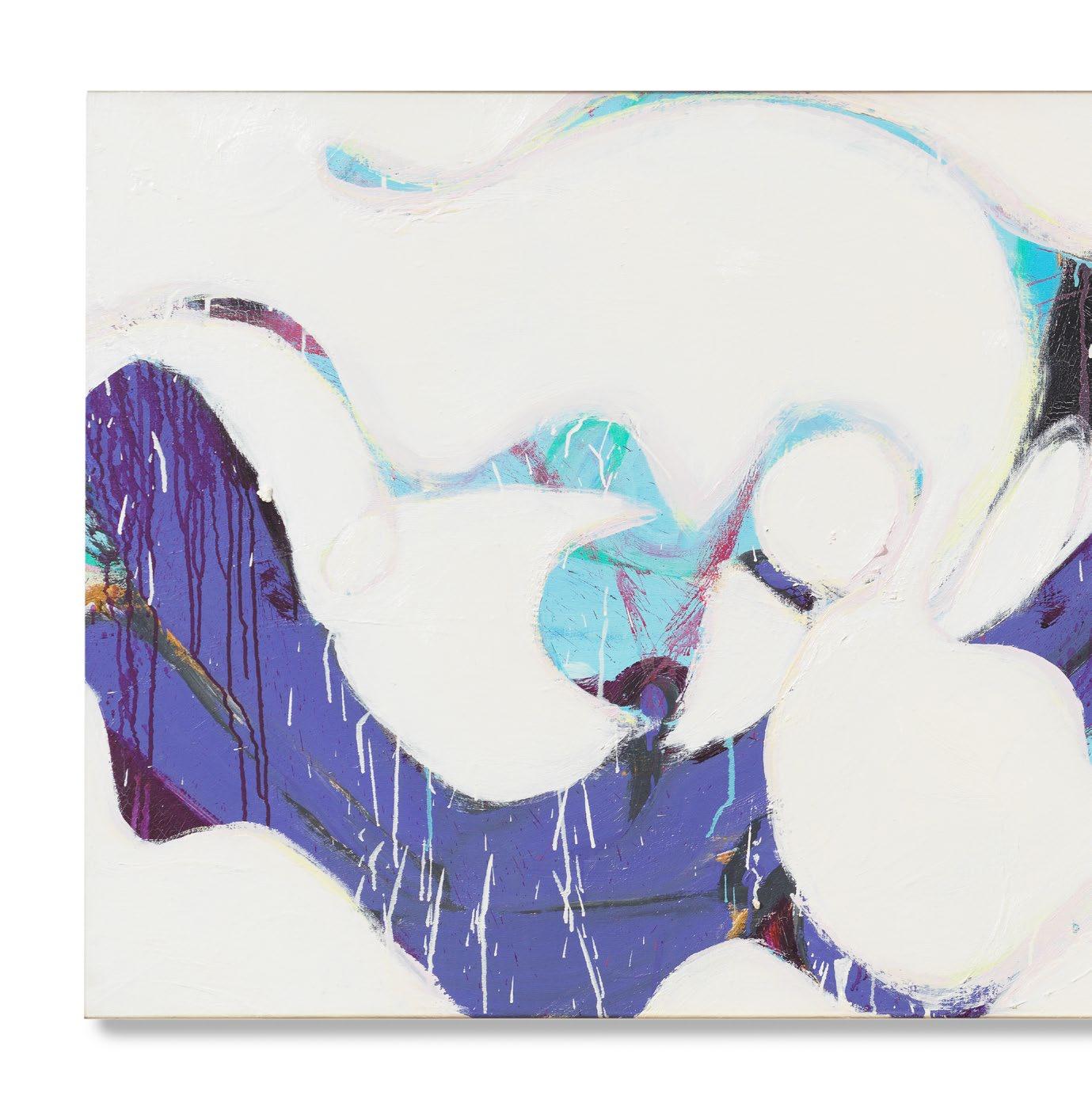
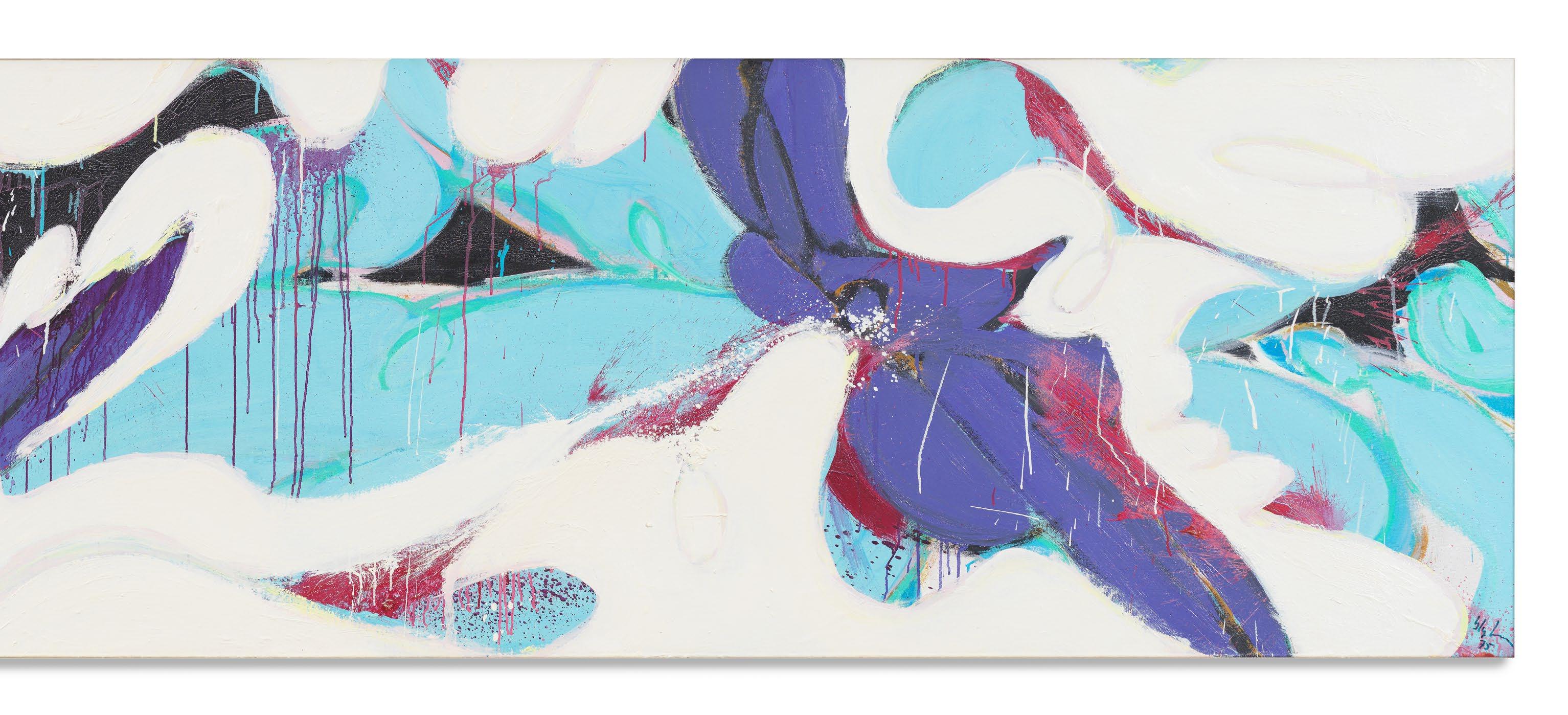
Hard Frost, 1975
Oil on canvas
32 x 116 inches
81.3 x 294.6 cm
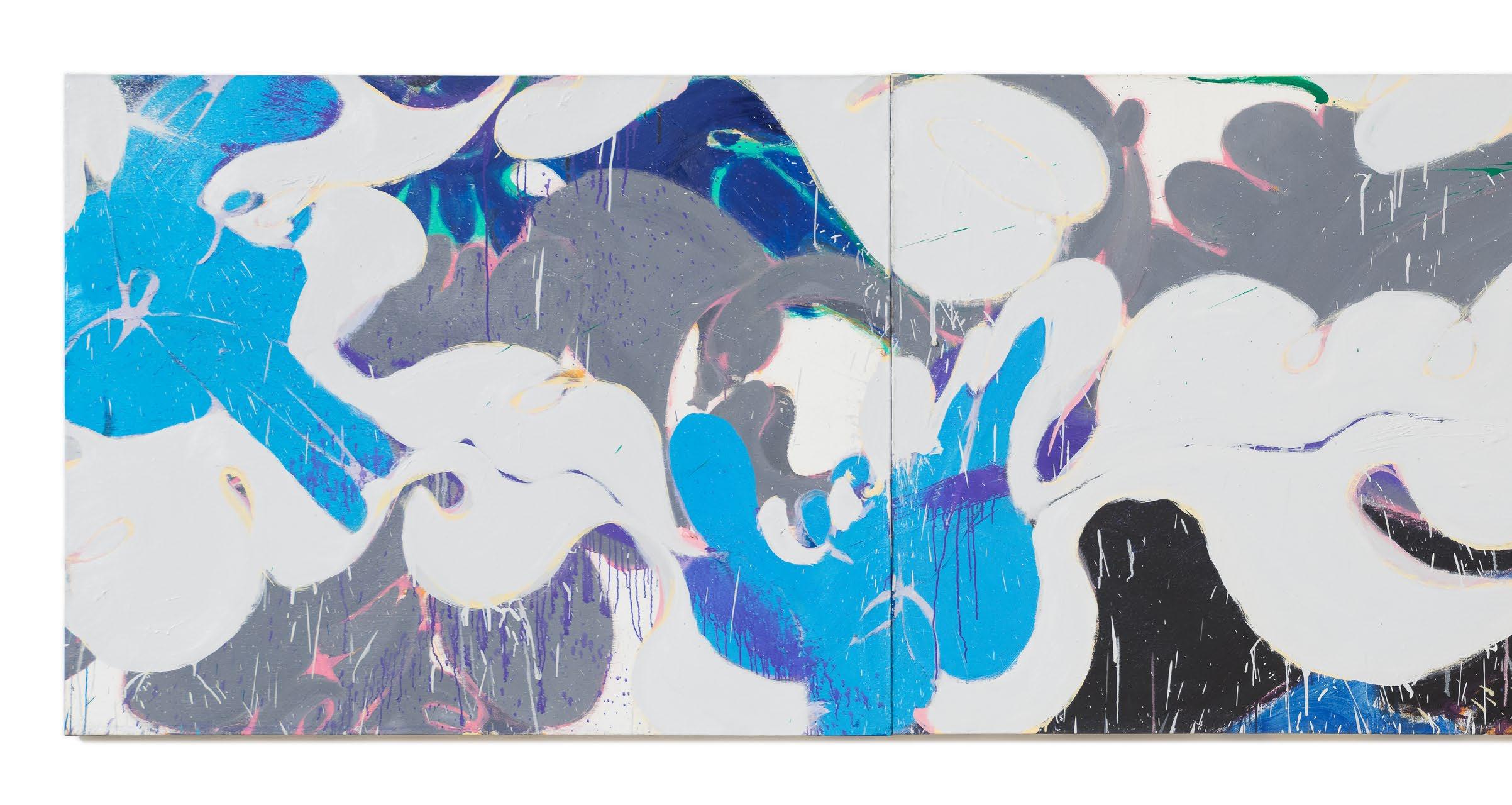
Untitled, Studies in Blue, White, Gray, 1975
Oil on canvas
48 x 240 inches
121.9 x 609.6 cm
Crustadéle, 1976
Oil on canvas
96 x 84 inches
243.8 x 213.4 cm
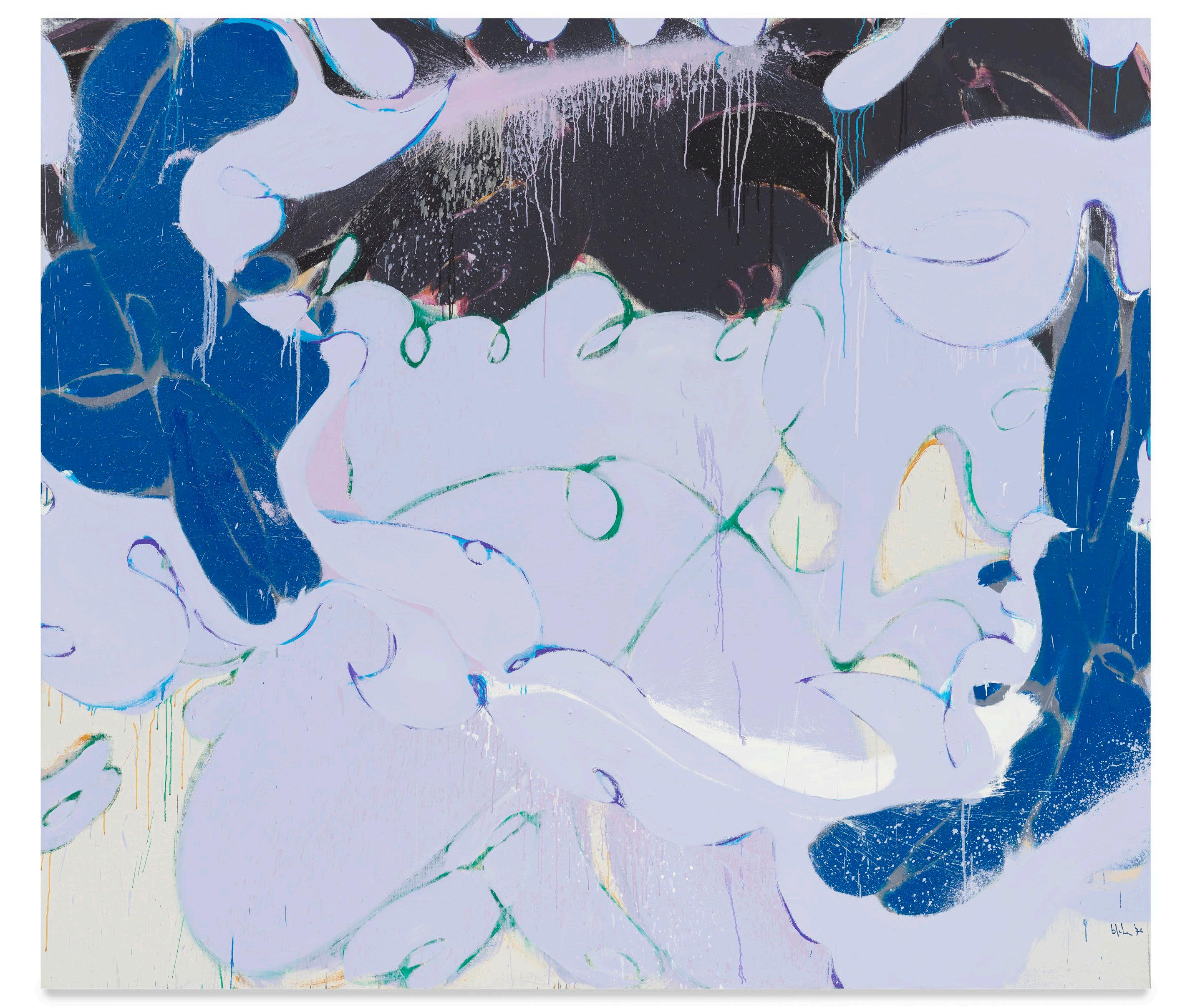
Millbrook Blues, 1976
Oil on canvas
84 x 96 inches
213.4 x 243.8 cm
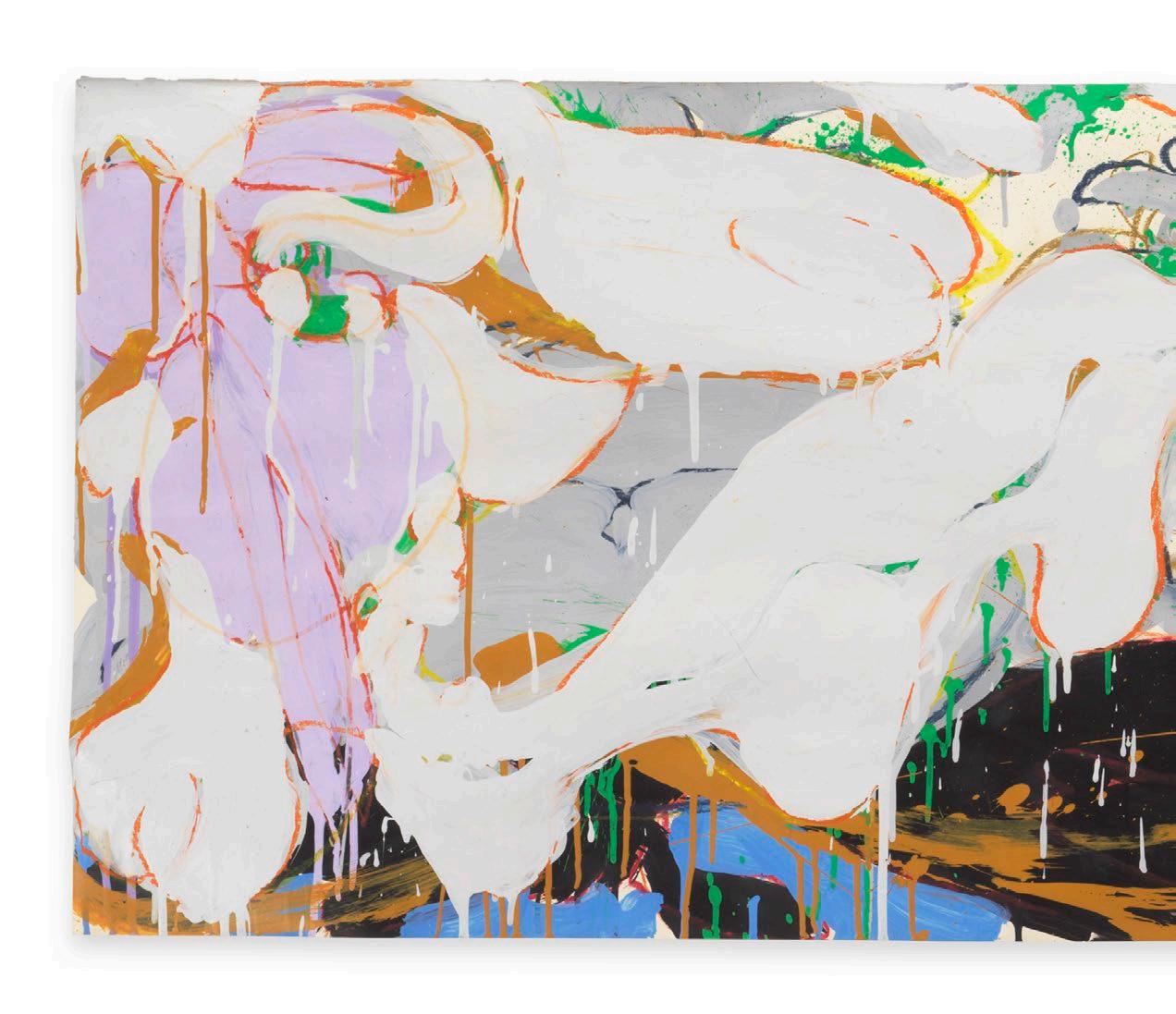
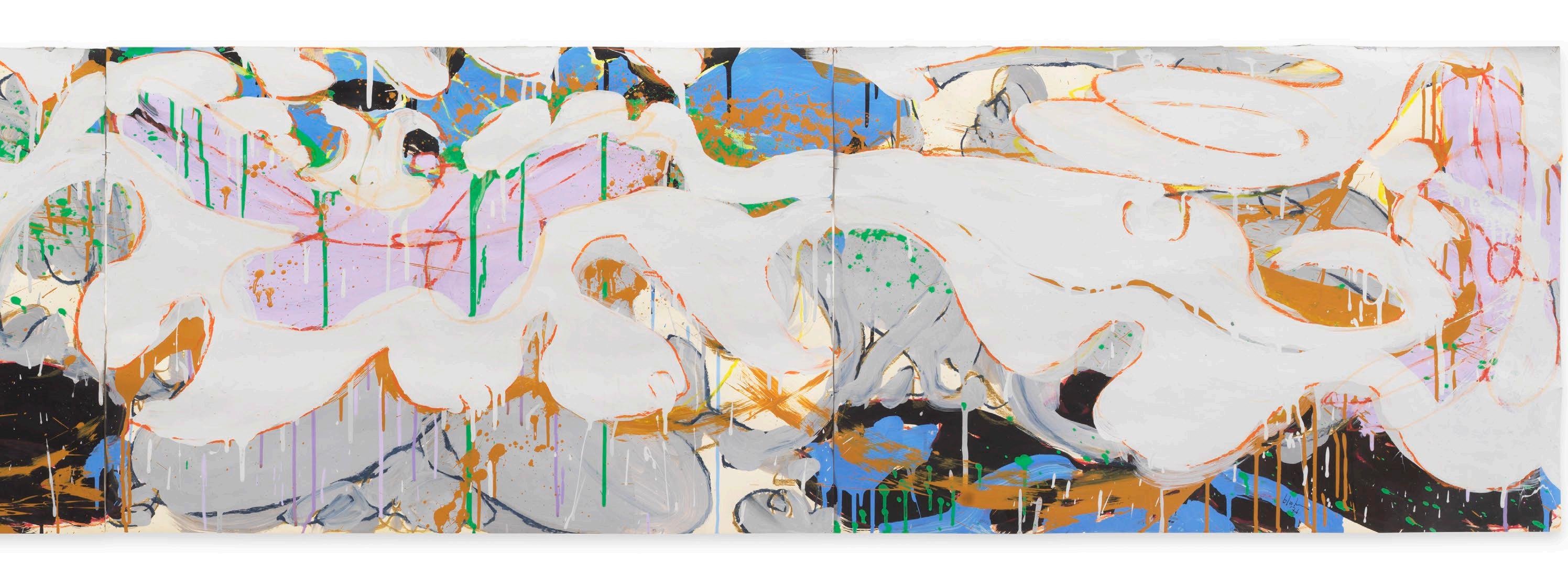
Untitled, 1976
Acrylic, pastel on paper
24 x 108 inches
61 x 274.3 cm
60 x 112 3⁄4 inches
152.4 x 286.4 cm
Milkmaid, 1977
Oil on canvas
Coral Dream Girl, 1978
Oil on canvas
89 x 76 inches
226.1 x 193 cm
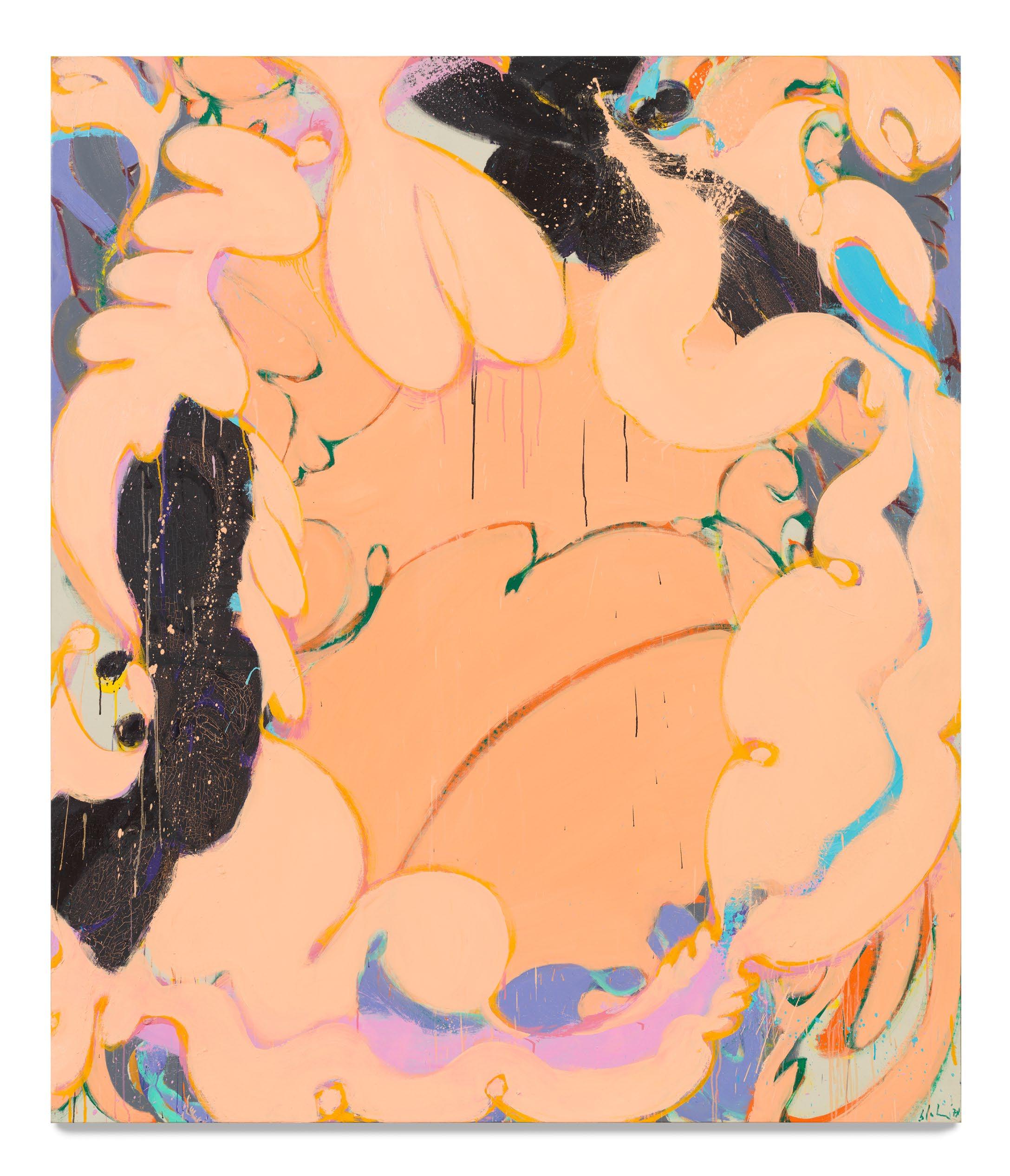
Ice Blue, 1978
Oil on canvas
76 x 106 inches
193 x 269.2 cm
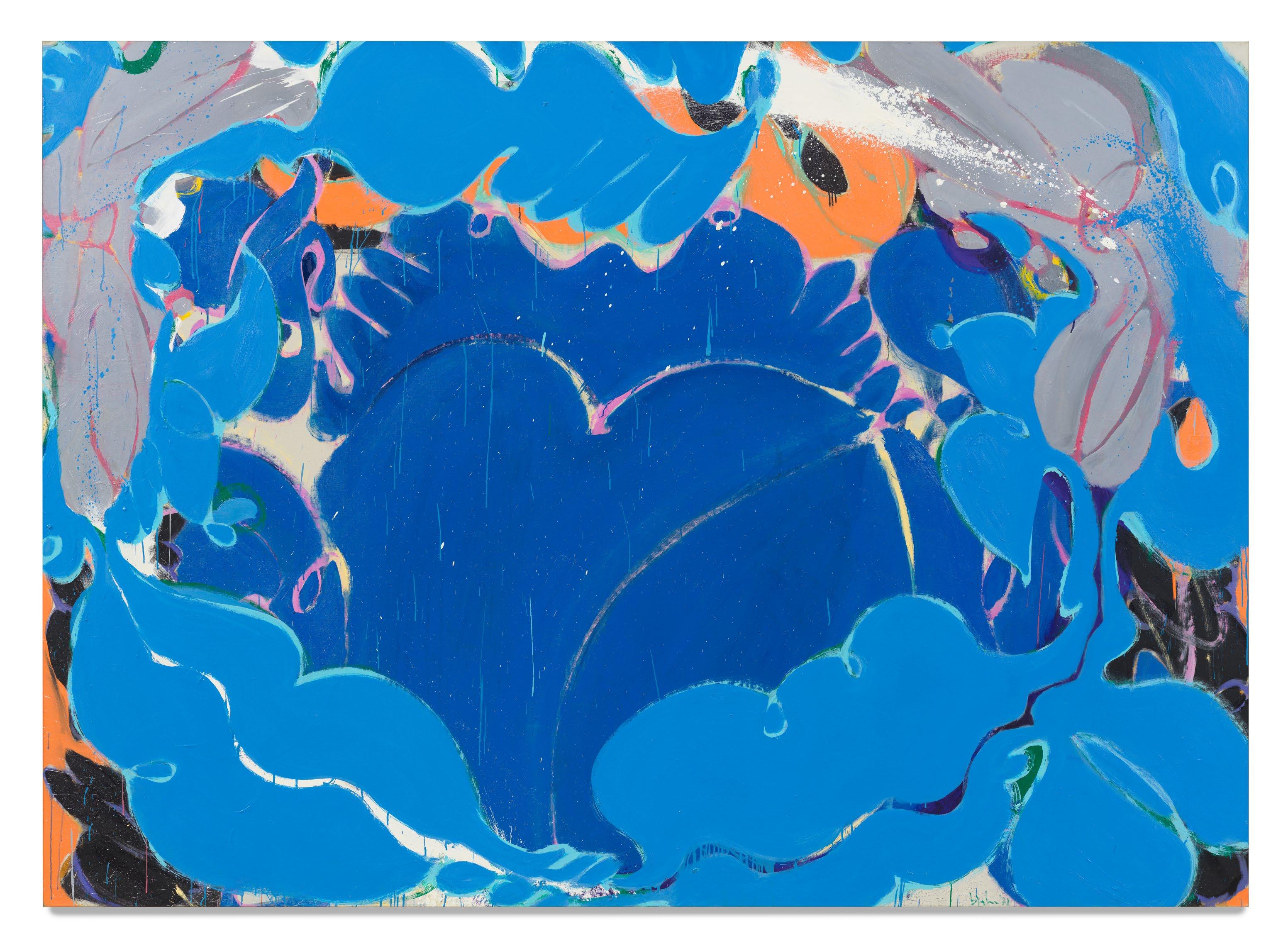
Mermaid’s Delight, 1978
Oil on canvas
76 x 106 inches
193 x 269.2 cm
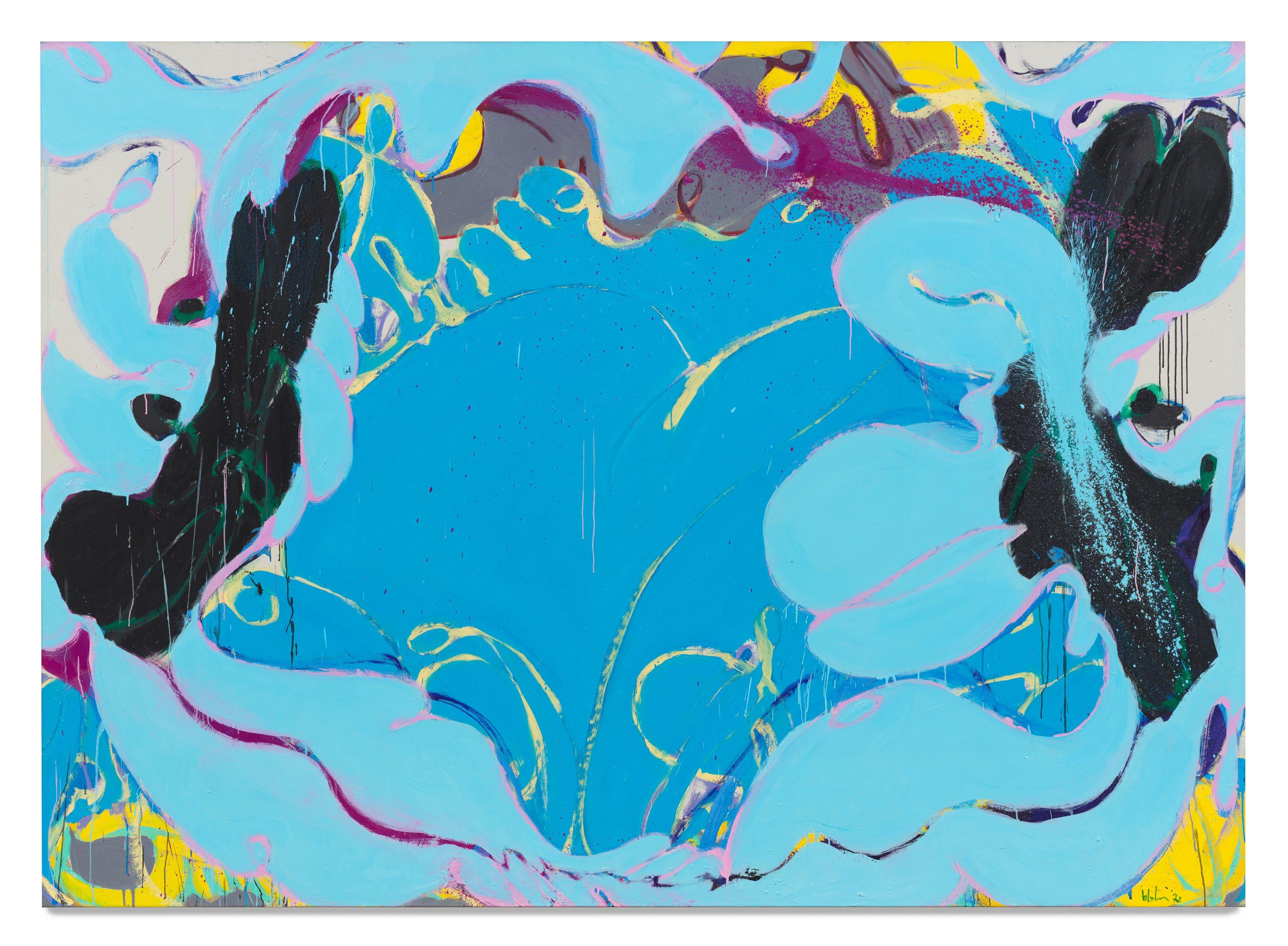
Sooty Lady, 1978
Oil on canvas
76 x 106 inches
193 x 269.2 cm
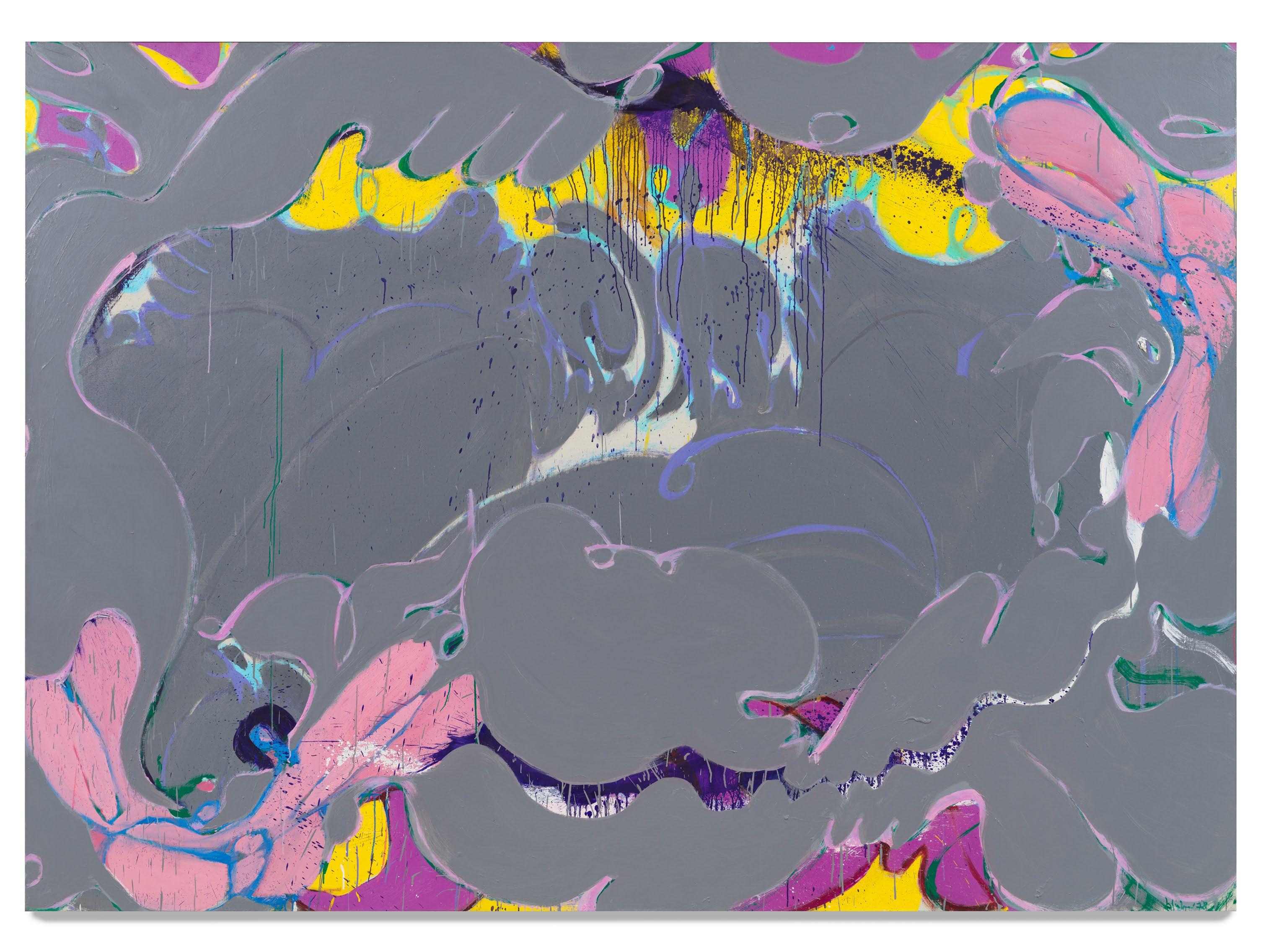
Viper Lady, 1979
Oil on canvas
77 x 107 inches
195.6 x 271.8 cm
CHRONOLOGY
1920
Born March 28 in Chicago, IL to Henry Bluhm and Rosa Goldstein.
1925 - 1929
Lives in Florence, Italy with his mother and his younger brother, William, while his father works on an engineering project in the Soviet Union.
1930 - 1935
The Bluhm family returns to Chicago, IL.
1936 - 1941
Studies architecture at Armour Institute of Technology, Chicago, IL. Mies van der Rohe becomes head of the department in 1938 and Bluhm a ends his first classes.
1941
In late December, enlists in U.S. Army Air Corps, along with his brother William, who later passes in action.
1944
Discharged from the U.S. Army Air Corps.
1945
Returns briefly to architectural studies at Armour, then decides to leave the field.
1946-47
Moves to Florence, and studies fresco painting at the Accademia di Belle Arti di Firenze.
1947-56
Lives in Paris. Studies at École des Beaux-Arts and Académie de la Grande Chaumiére.
1950
Marries Claude Souvrain, an artist with deep ties to the Parisian art world.
1953
Included in Peintres américains en France at Galerie Craven, Paris.
1956
Divorces Claude Souvrain, and moves to New York, NY.
1957
Rents a studio at 333 Park Avenue South, and exhibits first solo show at Leo Castelli Gallery, New York, NY.
1958
Rents a summer house in Springs, on the East End of Long Island, with Michael Goldberg across from Green River Cemetery.
1959
Included in the Carnegie International, Pi sburgh, PA; Whitney Museum Annual, New York, NY; and Documenta II, Kassel, Germany. He is also included in exhibitions at galleries in Los Angeles, CA and Milan, Italy, and in a group show at Leo Castelli.
1960
Meets Cary Ogle, who was working at Staempfli Gallery on East 77th Street, and spends summer in Paris, France and uses Joan Mitchell’s studio on rue Frémicourt. He is included in numerous surveys of contemporary art at American museums, most notably Sixty American Painters at the Walker Art Center, Minneapolis, MN. He exhibits his second solo show at Leo Castelli, New York, NY.
1961
Marries Cary Ogle at Shirley Kaplan’s mother’s house in Norwalk, CT, in May, followed by an extended honeymoon in Italy. Guests include Frank O’Hara, Mike Goldberg, Patsy Southgate, and Joe LeSueur. He is included in American Abstract Expressionists and Imagists at the Solomon R. Guggenheim Museum, New York, NY. He shows with Elaine de Kooning in a two-person exhibition at Graham Gallery, New York, NY organized by Joan Washburn.
1962
His son David is born. He exhibits a solo show of paintings at David Anderson Gallery, New York, NY.
1963
His daughter Nina is born.
1964
Moves to Paris with his family and paints in a studio owned by Galerie Stadler on rue Nationale.
1965
The Bluhm family returns to New York, NY.
1968
His first solo show at Galerie Stadler, Paris, France opens during the 1968 student protests.
1969
First monographic museum show at the Corcoran Gallery of Art, Washington, DC, of paintings from the 1960s, organized by James Harithas. He leaves New York with his family for Connecticut, but maintains a studio in New York, NY.
1970
He begins showing at Martha Jackson Gallery, New York, NY (David Anderson, director), and has solo shows there in 1970, 1971, 1972 and 1974. The Bluhm family moves to a former winery in Millbrook, NY, and Bluhm sets up a large painting studio in the haylo and drawing studio in the old worker’s quarters.
1972
He is included in the Whitney Annual Exhibition of American Painting.
1973
He exhibits a solo show of recent paintings at Everson Museum of Art, Syracuse, NY, organized by James Harithas. He shows a solo exhibition at the Palazzo delle Prigionie, Venice, Italy, arranged by gallerist Rinaldo Ro a.
1976
He has a solo exhibiton at the Contemporary Art Museum, Houston, TX, organized by James Harithas.
1977
He has a solo exhibition of recent paintings at the Corcoran Gallery of Art, Washington DC, organized by Jane Livingston.
1981
He moves to East Hampton, NY where he and Cary build a new house.
1984
Solo exhibition Norman Bluhm: Seven from the Seventies at Staller Center for the Arts, Stony Brook, NY organized by Rhonda Cooper and Terence Ne er. He is included in the exhibition
Action/Precision: The New Direction at the Newport Harbour Museum of Art, Newport Beach, CA, organized by Paul Schimmel, and the exhibition travels to five other venues.
1986
Joins Washburn Gallery, New York, NY, and exhibits solo shows there in 1986, 1989, 1990, and 1991.
1987
He shows a solo exhibition, Norman Bluhm: Works on Paper, 1947-1987, at Emerson Gallery, Hamilton College, Clinton, NY, organized by William Salzillo, and the exhibition travels to six other venues.
1988
Moves to East Wallingford, VT where Norman and Cary renovate a nineteenth-century farmhouse and build a large new studio.
1992
He begins showing at Galleria Peccolo, Livorno, Italy, and has solo shows there in 1992, 1995, and 1998.
1994
Exhibits solo shows at Ace Gallery, New York, NY and Los Angeles, CA.
1999
On February 3rd, the artist passes at his home in East Wallingford, VT. The Butler Institute, Youngstown, OH exhibits Norman Bluhm: A Tribute Exhibition, organized by Lou Zona and Jim Harithas.
NORMAN BLUHM
Born in Chicago, IL in 1921
Died in East Wallingford, VT in 1999
EDUCATION
1947
École des Beaux-Arts, Paris, France
1946
Accademia de Belle Arte, Florence, Italy
1945
Studies Architecture at Armour Institute of Technology, Chicago, IL
1941–1945
United States Army Air Forces
1936–1941
Studied Architecture with Ludwig Mies van der Rohe at Armour Institute of Technology, Chicago, IL
SOLO EXHIBITIONS
2022
Miles McEnery Gallery, New York, NY
2020
“Norman Bluhm: Space, Time Continuum,” Hollis Taggart, New York, NY
“Norman Bluhm: Metamorphosis,” The Newark Museum of Art, Newark, NJ
2019
“Norman Bluhm: The 70s,” Hollis Taggart, New York, NY
2015
“Norman Bluhm: Divine Proportion,” Christie’s Private Sales, New York, NY
2012
“Norman Bluhm’s Architecture of Desire,” 499 Park Avenue and Hines, New York, NY
2011
“Norman Bluhm: Paintings 1967-1974,” McClain Gallery, Houston, TX
“Norman Bluhm: Paintings 1967-1974,” Lore a Howard Gallery, New York, NY
2010
“Norman Bluhm: A Retrospective of Works on Paper 1948-1998,” McClain Gallery, Houston, TX
“Norman Bluhm: A Retrospective of Works on Paper 1948-1998,” Galleria Il Gabbiano, Rome, Italy
2009
“Norman Bluhm: Gestural Structures 1960-1965,” Kunsthandel Wolfgang Werner, Berlin, Germany
“Norman Bluhm: A Retrospective of Works on Paper 1948-1998,” Jacobson Howard Gallery, New York, NY
2008
“Norman Bluhm: Large-Scale Works on Paper,” James Graham & Sons, New York, NY
2007
“The Late Paintings of Norman Bluhm,” Station Museum of Contemporary Art, Houston, TX
“Norman Bluhm: Selected Works from 1976-1989,” Manny Silverman Gallery, Los Angeles, CA
2005
“Norman Bluhm, Works on Paper from the 70s, 80s, and 90s,” James Graham & Sons, New York, NY
“Norman Bluhm, Three Paintings,” JG | Contemporary, New York, NY
2002
“Norman Bluhm, Drawings,” Worcester Art Museum, Worcester, MA
“Ideal Abstraction, 1955-1965, Norman Bluhm and Karl Benjamin,” Gary Snyder Fine Arts, New York, NY
2000
“Opere su carta 1948-1999,” Padiglione d’Arte Contemporanea, Milan, Italy
1999
“Norman Bluhm, A Tribute Exhibition,” The Butler Institute of American Art, Youngstown, OH
1998
“Works from the 1950’s and 1960’s,” Galleria Peccolo, Livorno, Italy
1996
“Opere 1993-1995,” Studio d’arte Zanole i, Milan
“12 Works on Paper,” Marist College, Poughkeepsie, NY
1995
“Opere 1993-1995,” Galleria Peccolo, Livorno, Italy
Galleria Blu, Milan, Italy
1994
Ace Contemporary Exhibitions, Los Angeles, CA
Ace Contemporary Exhibitions, New York, NY
1992
“Works on paper, 1967-1991,” Galleria Peccolo, Livorno, Italy
The Anderson Gallery, Buffalo, NY
1991
“Works from the 1960’s,” Washburn Gallery, New York, NY
Hiram Butler Gallery (with James Surls and Robert Creeley), Houston, TX
1990
“Works from the 1950’s,” Washburn Gallery, New York, NY
“Selected Works, 1954-1960,” Manny Silverman Gallery, Los Angeles, CA
1989
Riva Yares Gallery, Sco sdale, AZ
Washburn Gallery, New York, NY
1988
Galerie Stadler, Paris, France
1987
“Norman Bluhm, Works on Paper, 1947-1987,” Fred L. Emerson Gallery, Hamilton College, Clinton, NY; traveled to the Ball State University Art Gallery, Muncie, IN; Allentown Art Museum of the Lehigh Valley, Allentown, PA; The Arkansas Art Center, Li le Rock, AK; McNay Museum, San Antonio, TX; University of Arizona, Tucson, AZ; Buscaglia-Castellani Art Gallery of Niagara University, Niagara Falls, New York
“Poem Prints, Norman Bluhm and John Yau,” Cone Editions, New York, NY
1986
Washburn Gallery, New York, NY
Zolla-Lieberman Gallery, Chicago, IL
1985
Herbert Palmer Gallery, Los Angeles, CA
1984
The Fine Arts Center Gallery, State University of New York, Stony Brook, NY
1982
Galerie Stadler, Paris, France
1977
Corcoran Gallery of Art, Washington, D.C.
1976
Contemporary Art Museum, Houston, TX
Robinson Gallery, Houston, TX
1975
Galerie Stadler, Paris, France
1974
Martha Jackson Gallery, New York, NY
Vassar College Gallery of Art, Poughkeepsie, NY
Palazzo delle Prigioni Vecchie, Venice, Italy
Galleria Il Cerchio, Milan, Italy
Galleria Ro a, Milan, Italy
1973
Everson Museum of Art, Syracuse, NY
1972
Martha Jackson Gallery, New York, NY
Galerie Stadler, Paris, France
1971
Martha Jackson Gallery, New York, NY
J. L. Hudson Gallery, Detroit, MI
1970
Galerie Stadler, Paris, France
Martha Jackson Gallery, New York, NY
1969
The Corcoran Gallery of Art, Washington, D.C.
1968
Galerie Stadler, Paris, France
1967
“Poem-Paintings by Frank O’Hara and Norman Bluhm,” Loeb Student Center, New York University, New York, NY
1965
Galerie Anderson-Mayer, Paris, France
1964
Galerie Smith, Brussels, Belgium
1963
Galerie Semiha Huber, Zurich, Switzerland
American Gallery, New York, NY
Galerie Anderson-Mayer, Paris, France
1962
David Anderson Gallery, New York, NY
1961
Galleria Notizie, Turin, Italy
Holland-Goldowsky Gallery (with Larry Rivers), Chicago, IL
Graham Gallery (with Elaine de Kooning), New York, NY
1960
Leo Castelli Gallery, New York, NY
1959
Galleria del Naviglio, Milan, Italy
1958
Paul Kantor Gallery, Los Angeles, CA
1957
Leo Castelli Gallery, New York, NY
SELECT COLLECTIONS
Ackland Art Museum, The University of North Carolina at Chapel Hill, Chapel Hill, NC
Addison Gallery of American Art, Phillips Academy, Andover, MA
Albright-Knox Gallery, Buffalo, NY
Allentown Art Museum of the Lehigh Valley, Allentown, PA
Arkansas Art Center, Li le Rock, AK
Art Gallery of Ontario, Toronto, Canada
Ball State University Museum of Art, Muncie, IN
Birmingham Museum of Art, Birmingham, AL
Jack S. Blanton Museum of Art, Austin, TX
Bowdoin College Museum of Art, Brunswick, ME
Butler Institute of American Art, Youngstown, OH
Castellani Art Museum, Niagara University, NY
Centre Nationale d’Art Contemporain, Paris
Chrysler Museum of Art, Norfolk, VA
Connecticut College, New London, CT
Cooley Art Gallery, Reed College, Portland, OR
Corcoran Gallery of Art, Washington, D.C.
Dallas Museum of Art, Dallas, TX
Dayton Art Institute, Dayton, OH
Denver Art Museum, Denver, CO
Dillard University Fine Arts Gallery, New Orleans, LA
Everson Museum of Art, Syracuse, NY
Fogg Art Museum, Harvard University Art Museums, Cambridge, MA
Grey Art Gallery, New York University Art Collection, New York, NY
Guild Hall, East Hampton, NY
High Museum of Art, Atlanta, GA
Hirshhorn Museum and Sculpture Garden, Washington, D.C.
The Jewish Museum, New York, NY
Herbert F. Johnson Museum of Art, Cornell University, Ithaca, NY
The Frances Lehman Loeb Art Center, Vassar College, Poughkeepsie, NY
The Metropolitan Museum of Art, New York, NY
Sidney Mishkin Gallery, Baruch College, NY
MIT List Visual Arts Center, Cambridge, MA
Museum of Contemporary Art, Los Angeles, CA
Museum of Contemporary Art San Diego, San Diego, CA
Museum of Fine Arts, St. Petersburg, FL
The Museum of Modern Art, New York, NY
National Gallery of Victoria, Melbourne, Australia
National Museum of Wales, Cardiff, Wales
Nelson-Atkins Museum of Art, Kansas City, MO
Neuberger Museum of Art, Purchase College, State University of New York, Purchase, NY
Newark Museum, Newark, NJ
The Parrish Art Museum, Southampton, NY
The Phillips Collection, Washington, D.C.
Phoenix Art Museum, Phoenix, AZ
Princeton University Art Museum, Princeton, NJ
Rocky Mountain College, Billings, MT
Smith College Museum of Art, Northampton, MA
Smithsonian American Art Museum, Washington, D.C.
University Gallery, University of Massachuse s, Amherst, MA
University of Arizona Museum of Art, Tucson, AZ
University of Iowa Museum of Art, Iowa City, IA
University of Kentucky Art Museum, Lexington, KY
Utah Museum of Fine Arts, University of Utah, Salt Lake City, UT
The Weatherspoon Art Museum at The University of North Carolina at Greensboro, NC
Whitney Museum of American Art, New York, NY
Worcester Art Museum, Worcester, MA
Published on the occasion of the exhibition
NORMAN BLUHM
28 July – 1 September 2022
Miles McEnery Gallery
525 West 22nd Street
New York NY 10011
tel +1 212 445 0051
www.milesmcenery.com
Publication © 2022 Miles McEnery Gallery
All rights reserved
Essay © 2022 Zachary Ri er
Director of Publications
Anastasija Jevtovic, New York, NY
Digital Initiatives Associate Sean Kennedy, New York, NY
Photography by
Christopher Burke Studio, New York, NY
Jeffery Sturges, New York, NY
Artwork Images
Courtesy of the Estate of Norman Bluhm and Miles McEnery Gallery, New York, NY
ISBN: 978-1-949327-85-4
Cover: Hard Frost, (detail), 1975