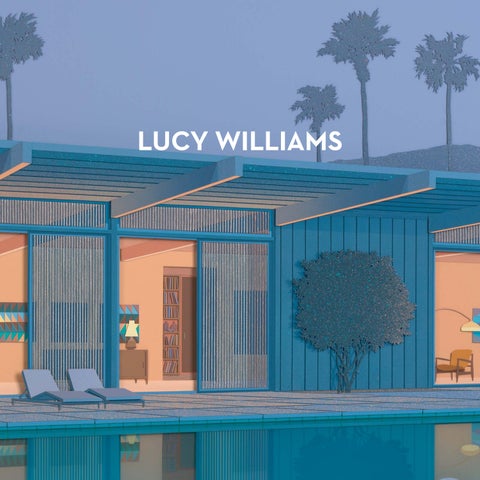
LUCY WILLIAMS
LUCY WILLIAMS
511 West 22nd Street
515 West 22nd Street
525 West 22nd Street
520 West 21st Street
New York NY 10011
New York NY 10011
New York NY 10011
New York NY 10011
4
LUCY WILLIAMS: BEAUTIFUL, PERFECT THINGS Emily McDermott “I believe … that the desire to create beautiful things coincides with the striving for perfection, as long as this desire is true and honest.” — Sophie Taeuber-Arp1 Images of abstract paintings by Lygia Clark, polyphonic watercolors by Paul Klee, the painting Double Pennants (1949) by Wallace Mitchell, textile and painted card samples from Otti Berger’s Bauhaus workshop, fabric designs by Ruth Adler Schnee and Marianne Strengell, and a Useless Machine mobile from Bruno Munari are just some of the visuals pinned to the artist Lucy Williams’s studio walls. A delicate mobile she made herself hangs nearby, and shelves and tabletops are covered with works in progress as well as books, including Weaving as an Art Form: A Personal Statement (1975), Woven Histories: Textiles and Modern Abstraction (2023), Bauhaus (1919–1933): Workshops for Modernity (2009), and the Atlas of Mid-Century Modern Houses (2019). As is made evident by such research materials, the London-based artist grounds her practice in the legacy of craft while expanding and highlighting its intersections with modernist design and architecture. Williams, who was born in Oxford, England, in 1972, initially enrolled at The Glasgow School of Art to study sculpture, but she soon transferred to the painting department, where she still “felt like a round peg in a square hole,” she once said. It was only in 1999, when she began a fine arts postgraduate program at London’s Royal Academy Schools, that Williams began to find a direction that felt fitting. In her second year, she started making collages — and now, more than 20 years later, she is internationally recognized for her intricately detailed and meticulously constructed mixed-media bas-relief collages that range in scale from just 15 centimeters to over 2 meters wide. 1 Anne Umland and Walburga Krupp with Charlotte Healy, eds., Sophie Taeuber-Arp: Living Abstraction, exhibition catalogue (New York: Museum of Modern Art, 2021): 30.
3
Using materials that include medium-density fiberboard (MDF), obeche strip wood, birch ply panel, cork, paper, piano wire, acrylic paint, acetate, and cotton thread, Williams homes in on specific modernist movements and visual motifs in her expansive bodies of work. Palm Springs (2016–ongoing) focuses on desert modernist private residences in the titular city. Library at Maison Louis Carré (2017–18) and Bookcase (2022–ongoing) depict mid-century modern wooden shelving units lined with colorful books, dancing mobiles, and bulbous vases. Radiant City (2023–ongoing) features close-up exterior views of brutalist apartment buildings with intimate glimpses inside windows. At the same time, works in Threaded Collage (2021–ongoing) and Threaded Assemblage (2024–ongoing) repeat the shape of a diamond ad infinitum to create purely abstract, geometric optical wonders.
4
Each of these motifs is steeped in historic references and nuanced dialogues. The renowned Finnish architect Alvar Aalto conceived art dealer and collector Louis Carré’s private villa, including a twostory library and office, in 1959 as a Gesamtkunstwerk, methodically designing everything from the building’s structure to its light fixtures, textiles, and furniture. The library specifically was built to make Carré feel enveloped by literature: The room was wrapped in built-in wooden bookshelves and card-catalogue drawers. In her Library at Maison Louis Carré series, Williams replicates detailed, individual sections of this storied space and, in doing so, anonymizes it, allowing viewers to project their own associations onto what looks like a universal design of the time. Meanwhile, Radiant City takes its name and inspiration from Le Corbusier’s controversial design proposal for an urban megalopolis, comprising towering concrete apartment buildings with symmetrical, modular units, which were meant to reform social housing. Although Le Corbusier’s Radiant City project was left unrealized, its principles of using modern architecture to integrate humankind with nature and recent technological innovations provided the foundations for his Unité d’Habitation (housing units) in cities like Marseille, France, and Berlin, Germany. In her collages, Williams not only captures the striking aesthetic resonance of these buildings but also the tension between the individuality of inhabitants and the uniformity enforced upon them. Although various bodies of Williams’s work highlight specific modernist architectural movements, it is Bauhaus that fundamentally underpins her practice. Ever since Williams first came across a photo of the iconic Bauhaus staircase in Dessau, Germany, as a student, the movement has “formed the
Diving Pool, 2004 Card, tapestry canvas and wool, mountboard, gauze fabric, plastic, and acrylic paint on board 24 1/2 x 27 5/8 inches 62 x 70 cm
Parkhaus, 2008 Paper, Perspex, mountboard, strip wood, velvet fabric, scenic ballast, and acrylic paint on board 28 x 41 3/4 inches 71 x 106 cm
basis of how I work,” she says. It speaks to “the multiplicity within my practice and experimentation, combining craft with painting and sculpture, as well as my interest in geometric simplicity,” the artist continues. “This is perhaps most obvious in the apartment blocks and municipal buildings but also extends through to the origins of the Californian houses.” Perhaps even more significant than these direct references, however, is the fact that Williams consciously injects traditionally female histories within such traditionally male movements. Early in her practice, Williams sewed and embroidered fabric skies foregrounded by her characteristic architectural scenes. In Diving Pool (2004), a perfectly geometric white diving platform looms over two empty pools and rows of unoccupied bleachers, all built from mountboard, plastic, and acrylic paint. But behind this rigid space is a deeply textured sky with soft clouds and trees rendered in wool, canvas, and gauze. While the pool and its manmade surroundings reference functionalism in their replication of the Helsinki Swimming Stadium, which hosted the swimming events of the 1952 Summer Olympics, the natural environment in the background brings the traditionally female crafts of embroidery and weaving directly into the picture plane. Similarly, Parkhaus (2008) depicts a parking garage built in 1955–56 in Frankfurt: Here, Williams juxtaposes the re-creation of the West German modernist structure in paper, Perspex, and wood with a velvet-fabric sky.
5
Desert House, 2021 Paper, Perspex, engineered wood, piano wire, and acrylic paint on birch ply panel 32 5/8 x 51 1/8 inches 83 x 130 cm
6
Around 2014, however, Williams intentionally left the direct incorporation of sewing and embroidery behind in favor of addressing craft’s history more indirectly. To do so, she began intervening with the architectural spaces she recreates by way of interior design. In her Radiant City works, Le Corbusier’s béton brut apartments are decorated lovingly with plants, lamps, and curtains featuring patterns inspired by the work of his lesser known, albeit equally talented, female peers, like Berger, Schnee, and Strengell, among others. In both her Bookcase and Bookcase (with abstract) series, Williams adorns the modernist wood furnishings with not only books and vases but also with geometrically patterned elements referencing works by Sophie Taeuber-Arp and weavings by Anni Albers. And while many of her desert homes are styled with Constantin Brâncuși-esque columns, Donald Juddlike wall sculptures, Charles and Ray Eames’s DCW chair, and Marcel Breurer’s Wassily chair, with Desert House (2021) she sought to redress the balance: In this piece, the walls are adorned with paintings and prints by Helen Frankenthaler, an act that subsequently provided a springboard for Williams to begin incorporating facsimiles of her own abstract works in many of her collaged homes. While such references and deliberate interventions establish significant, complex, and even meta frameworks that offer portals to walk deeper and deeper into Williams’s works, viewers should also allow themselves to stop and appreciate the decorative beauty of the façades themselves. Despite the taboos placed on words like “decorative” and “beautiful” in the artworld, Williams is the first
to admit that they describe her work. Referencing Sophie Taeuber-Arp by way of Walt Whitman, Williams says, “Making decorative work is fine if you’ve thought about it deeply and create it with intentionality.” And Williams does just that: The artist takes months to complete just one work. Beyond researching source material, she ruminates deeply on form and color, experimenting through drawing and digging through her catalogue of over 800 hand-mixed paint tests on paper. When an idea becomes more solidified, she then drafts, like an architect, a full-scale blueprint for each collage, some with a 0.3 mm clutch pencil on tracing paper and others with gouache on handmade graph paper. From there, the various mixed-media elements are crafted. Book spines, for example, are made from MDF and painted paper: The MDF is laser cut. Pieces of cartridge paper, painted with three coats of acrylic and varnished, are hand-cut into corresponding shapes and glued, using a syringe, to their wooden counterparts. Other features, such as the surfaces of pools, are created from sandwiched layers of Perspex onto which the reflection of a home’s interior has been etched, painted, and drawn; building up just one reflection can take a full week. Finally, all these individual pieces are carefully arranged atop the drawing and, if Williams is pleased with the effect, moved to and fixed in place on a structural base exactingly laser-cut to replicate the blueprint. The astounding beauty of Williams’s work lies not only in the historically validated splendor of her chosen subject matter but also in the thought poured into and the precision applied to each and every one of her compositions, color palettes, and construction techniques. Her collages are often situated in the liminal space between realism and abstraction, for in the restraint of realism, Williams finds freedom, and within the freedom of abstraction, she finds restraint — and it is in the convergence of such dichotomies that her striking scenes come to life. The nature of Williams’s work is such that she will forever be bound to her inspirational forebearers, male and female alike, but as the artist moves forward, the past continually integrates with the present and future. Her meticulous reproductions become further imbued with both deliberately referential and abstract imaginations, her need for precision and structure coalescing with her intentional search for a timeless beauty. Emily McDermott is an art writer, editor, and cultural producer living in Berlin, Germany.
7
8
9
10
Radiant City #10, 2025
Paper, Perspex, engineered wood, cotton embroidery thread, cotton crochet thread, and acrylic paint on birch ply panel 17 1/2 x 15 1/4 inches 45 x 39 cm
11
12
Radiant City #11, 2025 Paper, Perspex, engineered wood, cotton embroidery thread, cotton crochet thread, and acrylic paint on birch ply panel 17 1/2 x 15 1/4 inches 45 x 39 cm
13
14
Radiant City #12, 2026
Paper, Perspex, engineered wood, cotton embroidery thread, cotton crochet thread, and acrylic paint on birch ply panel 17 3/4 x 29 1/2 inches 45 x 75 cm
15
16
Radiant City #13, 2026 Paper, Perspex, engineered wood, cotton embroidery thread, cotton crochet thread, and acrylic paint on birch ply panel 17 3/4 x 15 1/4 inches 45 x 39 cm
17
18
Bookcase (with abstract assemblage) #4, 2026 Paper, engineered wood, oak veneer, piano wire, wool, cotton embroidery thread, and acrylic paint on birch ply panel 14 1/4 x 28 1/4 inches 36 x 72 cm
19
20
Bookcase (with abstract assemblage) #5, 2026
Paper, engineered wood, oak veneer, piano wire, wool, cotton embroidery thread, and acrylic paint on birch ply panel 14 1/4 x 14 1/4 inches 36 x 36 cm
21
22
Bookcase (with abstract assemblage) #6, 2026
Paper, engineered wood, oak veneer, piano wire, wool, cotton embroidery thread, and acrylic paint on birch ply panel 14 1/4 x 14 1/4 inches 36 x 36 cm
23
24
Bookcase (with mobiles) #1, 2026 Paper, engineered wood, cotton embroidery thread, piano wire, and acrylic paint on birch ply panel 10 1/4 x 15 1/4 inches 26 x 39 cm
25
26
Bookcase (with mobiles) #2, 2026 Paper, engineered wood, cotton embroidery thread, piano wire, and acrylic paint on birch ply panel 10 1/4 x 10 1/4 inches 26 x 26 cm
27
28
Palm Springs #6, 2026 Paper, Perspex, engineered wood, cotton embroidery thread, piano wire, and acrylic paint on birch ply panel 25 3/4 x 39 1/2 inches 65 x 100 cm
29
30
Threaded Assemblage, 2024 Paper, Perspex, engineered wood, cotton embroidery thread, wooden dowel, piano wire, and acrylic paint on panel 14 3/4 x 11 3/4 inches 38 x 30 cm
31
Threaded Assemblage, 2026 Paper, Perspex, engineered wood, cotton embroidery thread, and acrylic paint on panel 14 3/4 x 10 1/2 inches 38 x 27 cm
32
Threaded Assemblage, 2026 Paper, Perspex, engineered wood, cotton embroidery thread, and acrylic paint on panel 14 3/4 x 10 1/2 inches 38 x 27 cm
33
Threaded Assemblage, 2026 Paper, Perspex, engineered wood, cotton embroidery thread, and acrylic paint on panel 14 3/4 x 10 1/2 inches 38 x 27 cm
34
Threaded Assemblage, 2026 Paper, Perspex, engineered wood, cotton embroidery thread, and acrylic paint on panel 14 3/4 x 10 1/2 inches 38 x 27 cm
35
Threaded Assemblage, 2026 Paper, Perspex, engineered wood, cotton embroidery thread, wooden dowel, piano wire, and acrylic paint on panel 14 3/4 x 11 3/4 inches 38 x 30 cm
36
Lucy Williams Born in 1972 in Oxford, UK Lives and works in London, UK
2010 “Glass Houses,” McKee Gallery, New York, NY
EDUCATION
2007 “Beneath a Woollen Sky,” Timothy Taylor Gallery, London, UK
1992 Bachelor of Arts in Fine Art in Painting, The Glasgow School of Art, Glasgow, Scotland
2006 “The Day the Earth Stood Still,” McKee Gallery, New York, NY
1999 Postgraduate Diploma in Fine Art, Royal Academy Schools, London, UK
2004 “Stranger than Paradise,” McKee Gallery, New York, NY
SELECT SOLO EXHIBITIONS
2001 “Graduate 2002,” The Kiosk Project, London, UK
2026 “Lucy Williams: Beautiful, Perfect Things,” Miles McEnery Gallery, New York, NY
SELECT GROUP EXHIBITIONS
2025 “Lucy Williams: Radiant City,” Berggruen Gallery, San Francisco, CA 2021 “Lucy Williams: MOSAIC,” Berggruen Gallery, San Francisco, CA
2026 “Women in Abstraction,” Berggruen Gallery, San Francisco, CA 2025 “Interiors,” Berggruen Gallery, San Francisco, CA “55 Years: Isn’t That Long Enough?,” Berggruen Gallery, San Francisco, CA
2014 “Festival,” McKee Gallery, New York, NY
2024 “Architecture in Art,” Berggruen Gallery, San Francisco, CA “on architecture,” Bernhard Knaus Fine Art, Frankfurt, Germany
2012 “Pavilion,” Timothy Taylor Gallery, London, UK
2023 “Paper,” Tristan Hoare Gallery, London, UK
2017 “Lucy Williams: Pools,” Berggruen Gallery, San Francisco, CA
37
2022 “Host & Guest / Nick Stewart & Friends,” PALFREY, London, UK 2020 “Dwelling is the Light” (curated by Katy Hessel), Timothy Taylor, London, UK 2019 “Cut and Paste: 400 Years of Collage,” National Galleries of Scotland: Modern Two, Edinburgh, Scotland “Major Contemporary Works,” Berggruen Gallery, San Francisco, CA 2018 “Malevolent Eldritch Shrieking” (curated by Paul Morrison), Attercliffe, Sheffield, UK
38
2016 “140 Unlimited,” Mount Holyoke College Art Museum, Mount Holyoke College, South Hadley, MA “Berggruen @ Minnesota Street,” Minnesota Street Project, San Francisco, CA 2015 McKee Gallery, New York, NY 2014 McKee Gallery, New York, NY McKee Gallery, New York, NY 2013 “AFTER” (curated by Marjolaine Levy), JGM. Galerie, Paris, France McKee Gallery, New York, NY McKee Gallery, New York, NY
2011 “Building Blocks: Contemporary Works from the Collection,” RISD Museum, Rhode Island School of Design, Providence, RI “Made in the UK: Contemporary Art from the Richard Brown Baker Collection,” RISD Museum, Rhode Island School of Design, Providence, RI McKee Gallery, New York, NY 2010 McKee Gallery, New York, NY McKee Gallery, New York, NY 2009 “Point of Entry: The Space Between Art and Architecture” (curated by Erin Dziedzic and Melissa Messina), Savannah College of Art and Design, Savannah, GA; traveled to Galerie Pfriem, Lacoste, France McKee Gallery, New York, NY 2008 Timothy Taylor Gallery, London, UK McKee Gallery, New York, NY “Painting the Glass House: Artists Revisit Modern Architecture,” Yale Architecture Gallery, Yale University, New Haven, CT; traveled to The Aldrich Contemporary Art Museum, Ridgefield, CT; and Mills College Art Museum, Northeastern University, Oakland, CA 2006 “Out of Line: Drawings from the Collection of Sherry and Joel Mallin,” Herbert F. Johnson Art Museum, Cornell University, Ithaca, NY 2004 “The Possibility of Experiencing the Death of Others,” One in the Other, London, UK
2003 “Chockerfuckingblocked,” Jeffrey Charles Gallery, London, UK “Graduate Show,” Royal Academy Schools, London, UK; traveled to Terrace Gallery, Leeds, UK
SELECT COLLECTIONS
2002 “No-One Begins a Lunatic,” Jeffrey Charles Gallery, London, UK
Francis H. Williams Collection, Wellesley, MA
2001 “Premiums 2001,” Sackler Gallery, Royal Academy Schools, London, UK “Seven Up,” east73rd Gallery, London, UK
ISelf Collection, Geneva, Switzerland
AWARDS
RISD Museum, Rhode Island School of Design, Providence, RI
2003 Alumni Association Student Prize, Royal Academy Schools, London, UK Graduate Prize, Worshipful Company of Painter-Stainers, London, UK Hine Vintage Cognacs Award, Royal Academy Schools, London, UK 2000 Travel Commission, Rail Europe, Paris, France
Anderson Collection, Stanford University, Stanford, CA Firebird Collective, London, UK
Hiscox Collection, London, UK
Mount Holyoke College Art Museum, Mount Holyoke College, South Hadley, MA
39
Published on the occasion of the exhibition
LUCY WILLIAMS BEAUTIFUL, PERFECT THINGS 10 September – 31 October 2026 Miles McEnery Gallery 525 West 22nd Street New York NY 10011 tel +1 212 445 0051 www.milesmcenery.com Publication © 2026 Miles McEnery Gallery All rights reserved Essay © 2026 Emily McDermott
40
Photo Credits p. 5: Courtesy of the artist and McKee Gallery, New York, NY, photo by McKee Gallery p. 5: Courtesy of the artist and McKee Gallery, New York, NY, photo by McKee Gallery p. 6: Courtesy of the artist and Berggruen Gallery, San Francisco, CA, photo by Todd White Art Photography Associate Director Julia Schlank, New York, NY Catalogue Design Laurie Mullowney, New York, NY Photography by Eva Herzog, London, UK Andrew Radford, London, UK ISBN: 979-8-3507-6722-3 Cover: Palm Springs #6, (detail), 2026