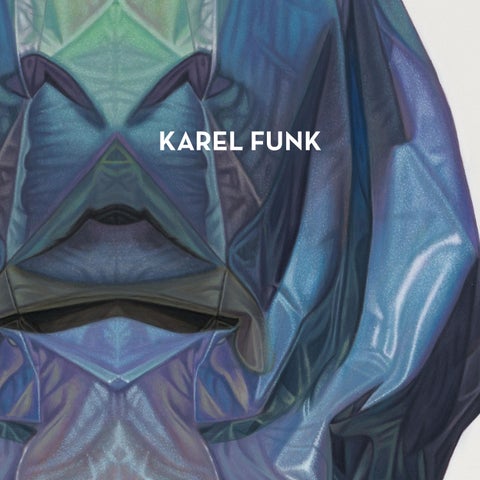
KAREL FUNK
KAREL FUNK
511 West 22nd Street
515 West 22nd Street
525 West 22nd Street
520 West 21st Street
New York NY 10011
New York NY 10011
New York NY 10011
New York NY 10011
4
Karel Funk Has Been Painting the Same Subject for Decades. He’s Still Making Discoveries. Katie White Long before Karel Funk brings a brush to wood panel, he begins working on a painting with a meticulous and solitary staging process that takes hours, even days. “It can be pretty intense,” Funk said, on a video call from his studio in Winnipeg, Manitoba. “If I’m going to do something, I want to do it right.” The Canadian artist is known for his mesmerizing, near-obsessive paintings of hooded jackets. These garments, with their ripples, folds, and reflections, have been featured in his work for over two decades, dating back to his student days at Columbia University, where he earned an MFA in 2003. Over the years, Funk has assembled an archive of hundreds of jackets and coats. “I have a huge stockpile in my basement,” he said with a quiet smile. “It could be a $400 jacket from North Face or Patagonia, or I’ll go on Amazon and type in ‘metallic hoodie’ or ‘shiny hoodie’ … all that matters is that the material looks like it could do something interesting.” He spends hours pinning, taping, and crinkling these coats into shape on a mannequin, sometimes even stuffing them with tissue paper. Once he’s satisfied with the effect, he photographs the coat — often hundreds of times. He manipulates the photographs in Photoshop, merging, collaging, cutting, and finally mirroring the image so that the hood appears to be perfectly symmetrical. Then he begins his process of painstakingly transferring the digital image by hand into acrylic on panel. Each work takes months to complete. The results rest somewhere between a Venetian master’s fetishistic talent for rendering fabric with the unnerving ambiguity of a Rorschach test. Funk’s colorful,
3
Jan van Eyck, Portrait of a Man (Self Portrait?), 1433, Oil on wood (probably oak), 10 1/4 x 7 1/2 inches (26 x 19 cm). The National Gallery, London, United Kingdom
singular hoods appear like bright beacons against white backgrounds, hovering in non-spaces that imbue the works with a monastic, near-spiritual quality.
4
In the past, Funk sometimes depicted people wearing these garments, but for the past five or six years he has foregone figures almost entirely, painting the hoods from behind instead, so the images are anonymized. Funk sees this shift as evidence of his increasing interest in the fabric’s own potential to hold unexpected, even illusionistic forms. In his first solo show with the Miles McEnery Gallery, the artist delves further into this material territory. The seven works in the show are similarly scaled, most around 20 by 25 inches, though sizes vary slightly. This is a deliberate reduction from the larger formats Funk has used in the past, and it is meant to sharpen the works’ intensity. Yet within that discipline, the paintings feel more uncanny than ever, and they are the embodiment of a decades-long pursuit. “The work has become more about this same thing: to be complex, super detailed, formally dynamic, but as pure, simple, and clean as possible,” Funk said. The Renaissance, Romanticism, and the Now Funk’s paintings can look strikingly futuristic, with their gleaming fabrics, yet they grew out of the artist’s deep interest in the past.
Chuck Close, Fred II, 2017, Oil on canvas, 72 x 60 x 2 inches (182.9 cm x 152.4 cm x 5.1 cm).
“For many years, I had a real deep interest in Renaissance portraiture,” Funk explained. “I was trying to find a bridge between contemporary fashion, a sense of urban life, and historical painting. I used the hood as that bridge.” The artist’s attention to detail has also earned him well-placed comparisons to the Flemish masters, particularly Jan van Eyck and his famous 1433 oil painting Man in a Red Turban, which is alternately titled Portrait of a Man (Self Portrait?). Funk’s Untitled #3 (2003) provides an apt comparison. Writing in a 2004 frieze review, the critic Megan Ratner noted that in Funk’s portraits his references to earlier portraitists feel “less painterly than musical,” alluding to “the physiognomic detail of Chuck Close, the nearly abstract planes of Alex Katz and the materialistic specificity and scale of Hans Memling or Jan van Eyck.” In more recent years, the artist has felt his work moving away from direct Renaissance inspiration. “My love for Renaissance portraiture is still there, but I don’t think about it as much now,” he said. His recent paintings are, however, reminiscent of the tableaux of the 19th-century German Romantic artist Caspar David Friedrich. Friedrich’s most famous painting, Wanderer Above the Sea of Fog (ca. 1817), shows a man in a green overcoat standing at the peak of a majestic mountain. The figure’s back faces the viewer. The painting is one of the most famous examples of Rückenfigur, a rear-facing figure
5
used in paintings throughout art history as a proxy for the viewer. Friedrich used the motif, as did other German Romantic painters, as a way of expressing the sublimity of nature and the human mind’s ability to comprehend it. In some ways, Funk’s contemporary Rückenfiguren give a nod toward that same sense of nature and outdoorsmanship. The synthetic, hyper-engineered garments he paints are built for hiking, camping, and foul weather, but his paintings offer no escape into nature itself. Instead, his figures exist in a void, a pristine white emptiness that collapses that sublimity back in on itself, compressing the paintings with a sense of tightly wound control. This intensity also brings Funk into dialogue with his contemporaries, namely Chuck Close’s obsessive photorealism and Vija Celmins’s tautly rendered drawings of space heaters and crashing planes, which wink at a world flirting with disaster. The Cinematic and the Psychological 6
In his studio, Karel Funk doesn’t listen to music while he paints. Instead, he plays movies. When we spoke, he had just turned off the epic science fiction film Dune: Part Two (2024), which had been playing in the background. “I used to listen to music a lot, but about 10 years ago I experimented one day with playing a movie in the background, and I liked it,” Funk said matter-of-factly. There is a quiet but real cinematic quality to Funk’s paintings. Seeing his works in person for the first time, I recalled scenes from horror and disaster films with people running down lonesome roads, not knowing what lurked ahead. Or inversely, Funk’s figures could themselves be cinematic predators, stalking prey. Others have noted Funk’s penchant for the filmic. In her frieze review, Ratner wrote that his “work perhaps draws most from Caravaggio, whose prescient cinematic sense included not just his theatrical mise-en-scène and use of light but also an intuitive feel for the importance of the well-placed extra.”
Alexander Ross, Untitled, 2014, Oil on canvas, 90 x 79 inches (228.6 x 200.7 cm).
That silver screen effect is heightened in Funk’s most recent paintings, glistening with metallic, shimmering, iridescent colors that carry an ancient-futuristic charge common to sci-fi films. That effect is heightened by the symmetry of the imagery. About six years ago, Funk began Photoshopping his hoods so the left and right sides would be mirror images. (He said he’d only ever been able to capture the effects he wanted on one side of the panel.) Soon after this shift, people began likening the results to Rorschach tests, and mirrored forms in the hoods became a psychological litmus test, reflecting the viewer’s mind more than the artist’s. Recently, however, these shapes have morphed from the abstract into mask-like, totemic faces hidden in the fabric of the jackets. In the violet-blue hood of Untitled #119 (2026), for instance, a grimacing face seems to lurk out from the center of the painting. Another visage, perhaps with a beak, appears in the green surfaces of Untitled #113 (2024). “It definitely looks like there’s something living in the material,” Funk acknowledged. The faces call to mind the visages of alien warriors in the Predator film series and, at other times, the biomechanical aesthetic of the Swiss artist H.R. Giger. Funk acknowledges the influence of the aesthetics of the Dune films on his works. “My inspirations can emerge from anywhere. It’s not really pinned down,” Funk explained.
7
These paintings increasingly engage with pareidolia, the tendency to perceive a face or pattern in random forms — the same impulse that finds a face in the clouds. Funk has noted his appreciation of the work of the artist Alexander Ross, whose biomorphic forms have similarly played with the boundary between face and abstraction. “His work kind of freaked me out when I first saw it, because there was something in there I felt like I understood — not that I wanted to do what he was doing, but something in there felt like part of my personality, something I might have been searching for in my own paintings,” Funk said of his first encounter with Ross’s work. Endurance Tests
8
Before Karel Funk was an artist, he was an athlete. Funk, who was largely raised in Winnipeg but spent a few childhood years in Vancouver, had drawn as a child, but he gave over his teenage years to skateboarding. “I was a diehard skateboarder from about 15 to 21 years old,” Funk recalled. “I wanted to go pro. I loved the struggle of figuring out tricks and having the courage to do them, because sometimes it could be really dangerous.” But when he was in his early 20s and dealing with near-constant injuries from wipeouts, he realized he would have to change paths. “You have to be ready to be a stuntman, basically ready to kill yourself, and I just couldn’t,” he said. Through a string of jobs, from working as a cook in a restaurant kitchen to a stint at Toys “R” Us, the artist found his way back to art, eventually earning a BFA at the University of Manitoba. The athletic impulse has never left Funk — his paintings are their own kind of endurance test. “It’s exactly like what happens in the studio,” the artist said of skateboarding, “You get in there, go for it, try to stay calm, and figure it out, try to work your way through it.”
Funk tends to work on one painting at a time, and he completes only five or six works in a year. Working from his digital image, Funk measures and dots key points onto the panel. He works with minuscule brushes, creating hundreds of small marks. “I can get burned out — every day coming in and putting 600 dots or brush marks in one small area,” he said. “In one day, when I’m doing a lot of dots, I’m basically scrubbing with them, and I can go through three little brushes in a day.” Every day is a race against time, with the artist working across both sides of the panel so the colors he has mixed that day match on each side. “It’s mentally pretty intense, moving back and forth between each side.” While Funk’s works are often described as photorealistic, the artist thinks this is a misnomer. Inside his compositions are subtle variations between the two sides of the panel, evidence of the hours spent painting them separately, by hand. “There are mistakes, lumpy brushwork,” he explained. These works are as much about Funk’s self-mastery as an artist as they are about subject matter. Over the years of his career, Funk has had to recalibrate and set boundaries in order to push hard without burning out. He does that by keeping regular studio hours, going to the gym and taking long walks with his wife. For an artist whose practice is mentally and physically demanding, he has honed a craft of quiet, steady endurance, one where precision meets human foibles. “I’ve come to peace with the fact that no painting is ever perfect, at least not for me,” said Funk. They certainly come close. Katie White is a writer, editor, and art historian based in Brooklyn, New York. She is currently a senior staff writer at Artsy and Artnet. Her writings have appeared in Time magazine, Cultured, and Sotheby’s magazine, among other publications.
9
10
11
12
Untitled #111, 2023 Acrylic on panel 19 x 24 inches 48 x 61 cm
13
14
Untitled #113, 2024 Acrylic on panel 19 x 25 inches 48 x 64 cm
15
16
Untitled #116, 2025 Acrylic on panel 26 x 28 inches 66 x 71 cm
17
18
Untitled #117, 2025 Acrylic on panel 20 x 25 1/2 inches 51 x 65 cm
19
20
Untitled #119, 2026
Acrylic on panel 20 x 25 inches 51 x 64 cm
21
22
Untitled #120, 2026
Acrylic on panel 21 1/2 x 25 inches 55 x 64 cm
23
24
Untitled #121, 2026 Acrylic on panel 22 x 25 1/4 inches 56 x 64 cm
25
26
Karel Funk Born in 1971 in Winnipeg, Canada Lives and works in Winnipeg, Canada EDUCATION 2003 MFA, Columbia University, New York, NY 1997 BFA, University of Manitoba, Winnipeg, Canada SOLO EXHIBITIONS
2016 NextLevel Galerie, Paris, France Winnipeg Art Gallery, Winnipeg, Canada 2015 Galerie Division, Montreal, Canada 2010 303 Gallery, New York, NY 2009 Rochester Art Center, Rochester, MN
2024 Stems Gallery, Brussels, Belgium
2007 “Karel Funk: Hyperrealistic painting” (curated by Pierre Landry), Musée d’art contemporain de Montréal, Montreal, Canada 303 Gallery, New York, NY
2023 Blouin Division, Montreal, Canada
2004 303 Gallery, New York, NY
2022 “Project Room: Karel Funk,” 303 Gallery, New York, NY
GROUP EXHIBITIONS
2026 Miles McEnery Gallery, New York, NY
2021 Monte Clark Gallery, Vancouver, Canada 2020 Ribordy Thetaz, Geneva, Switzerland 2018 Monte Clark Gallery, Vancouver, Canada Jessica Silverman, San Francisco, CA 2017 303 Gallery, New York, NY
2026 “Cold Comfort,” Miles McEnery Gallery, New York, NY 2024 “Zurbarán. Reinventing a masterpiece.” Musée des Beaux-Arts de Lyon, Lyon, France “303 Gallery: 40 Years,” 303 Gallery, New York, NY 2020 “Sound & Color” (curated by Brian Alfred), Miles McEnery Gallery, New York, NY “Inaugural Exhibition,” Blouin Division, Montreal, Canada “Crossing” (curated by Claudia Beck), Monte Clark Gallery, Vancouver, Canada
27
2019 “We the Centre,” Patel Division Projects (Patel Gallery and Division Gallery), Toronto, Canada “303 Gallery: 35 Years,” 303 Gallery, New York, NY 2016 “The Coldest Winter,” Jessica Silverman, San Francisco, CA 2014 “1+1=1: When Collections Collide,” Musée des beaux-arts de Montréal, Montreal, Canada “Homecoming,” Division Gallery, Montreal, Canada 2013 “Soundtrack: Vol 1,” Division Gallery, Toronto, Canada
28
2012 “My Winnipeg: Winter Kept Us Warm” (curated by Anthony Kiendl and Noam Gonick), Plug In Institute of Contemporary Art, Winnipeg, Canada “The Perfect Show,” 303 Gallery, New York, NY “My Winnipeg: Maps and Legends” (curated by Paula Aisemberg, Sigrid Dahle, Hervé di Rosa, Noam Gonick, Anthony Kiendl, and Cathy Mattes), Plug In Institute of Contemporary Art, Winnipeg, Canada “Variations on Theme: Contemporary Art 1950s Present” (curated by Jeffrey Grove), Dallas Museum of Art, Dallas, TX 2011 “Out of Nowhere: A Group Show of Winnipeg Artists” (curated by Sarah Anne Johnson and Meeka Walsh), Julie Saul Gallery, New York, NY “My Winnipeg” (curated by Guy Maddin and Noam Gonick), La Maison Rouge de Fondation Antoine de Galbert, Paris, France; traveled to Musée International des Arts Modestes, Sete, France
2007 “Two Years,” Whitney Museum of American Art, New York, NY “All the More Real” (curated by Merrill Falkenberg and Eric Fischl), Parrish Art Museum, Southampton, NY 2006 “Acquisitions récentes” (curated by Marc Mayer), Musée d’art contemporain de Montréal, Montreal, Canada 2005 “First We Take Museums,” Kiasma Museum of Contemporary Art, Helsinki, Finland 2003 “Superreal” (curated by Lauri Firstenberg), Prague Biennale, Prague, Czech Republic; traveled to Marella Arte Contemporanea, Milan, Italy 2002 “Painting as Paradox” (curated by Lauri Firstenberg), Artists Space, New York, NY 2000 “Figuring the Future,” Site Gallery, Winnipeg, Canada AWARDS AND RESIDENCIES 2017-18 Koerner Artist in Residence, Fine Art (Visual Art) Program, Queen’s University, Kingston, Canada 2013 Deep Bay Artists’ Residency, Manitoba Arts Council, Winnipeg, Canada Visual Arts Grant, Canada Council for the Arts, Ottawa, Canada 2012 Grant A – Visual Arts, Manitoba Arts Council, Winnipeg, Canada
SELECT COLLECTIONS Art Gallery of Ontario, Toronto, Canada Dallas Museum of Art, Dallas, TX Hammer Museum, Los Angeles, CA Jordan Schnitzer Museum of Art, University of Oregon, Eugene, OR Los Angeles County Museum of Art, Los Angeles, CA Montreal Museum of Fine Arts, Montreal, Canada Musée d’art contemporain de Montréal, Montreal, Canada Museum of Contemporary Art, Los Angeles, CA National Gallery of Canada, Ottawa, Canada San Francisco Museum of Modern Art, San Francisco, CA Solomon R. Guggenheim Museum, New York, NY Whitney Museum of American Art, New York, NY Winnipeg Art Gallery, Winnipeg, Canada
29
Published on the occasion of the exhibition
KAREL FUNK 5 November 2026 – 9 January 2027 Miles McEnery Gallery 525 West 22nd Street New York NY 10011 tel +1 212 445 0051 www.milesmcenery.com Publication © 2026 Miles McEnery Gallery All rights reserved Essay © 2026 Katie White
30
Photo Credit p. 4: Digital Image © The National Gallery, London, United Kingdom. All rights reserved. p. 5: Courtesy of Pace Gallery / photo by Kerry Ryan McFate Associate Director Julia Schlank, New York, NY Catalogue Design Laurie Mullowney, New York, NY Photography by Dan Bradica, New York, NY Dave Swiecicki, Winnipeg, Canada ISBN: 979-8-3507-6945-6 Cover: Untitled #119, (detail), 2026