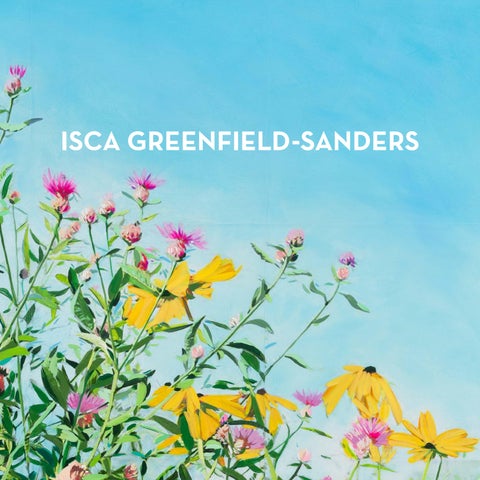
ISCA GREENFIELD-SANDERS
ISCA GREENFIELD-SANDERS
511 West 22nd Street
515 West 22nd Street
525 West 22nd Street
520 West 21st Street
New York NY 10011
New York NY 10011
New York NY 10011
New York NY 10011
4
ISCA GREENFIELD-SANDERS: THE LANGUAGE OF FLOWERS Bridget Quinn Isca Greenfield-Sanders’s new body of work, exhibited in “The Language of Flowers,” draws on the same rigorous technique she has developed over decades: transforming photographs that she crops, enlarges, adjusts for color and light, translates into watercolor studies, then forges into finished square-format paintings. The paintings sometimes include figures, other times not, but they always retain some glimpse of the grid that formed them. Her new series of floral landscapes, though, while familiar, represents a distinct departure — one that is both beautiful and perilous. That departure is partly one of technique. Rather than utilizing found photographs as sources, Greenfield-Sanders uses photos she took herself, and while her earlier paintings were in oil, the new series is in acrylic. The risk, though, is not one of technique but rather of subject matter: The exhibition features landscapes dominated by flowers, both in cultivated gardens and blooming in the wild. How can flowers, in and of themselves, represent any kind of peril? Bright red blossoms with accents of violet and gold beneath a canopy of trees, as in Poppies and Lilies (2026), or the tangled wild blooms against the sky of Hardheads (2026): What could be lovelier or more traditionally pleasurable? That may indeed be the case for the viewer; maybe it even should be. But for any artist who is also a woman, all flowers have thorns. As to the danger of gardens, ask Eve. In Western culture, flowers are too often relegated to the decorative, and are regarded — consciously or unconsciously — as the hallmark of a specific type: that is, some version of the lady artist in her drawing room. This is hardly by accident. In Jean-Jacques Rousseau’s influential eighteenth-century treatise, Émile, or On Education, the philosopher wrote that girls should be taught to draw “leaves, fruit, flowers, draperies, anything that will make an elegant trimming for the accessories of the toilette,
3
and enable the girl to design her own embroidery if she cannot find a pattern to her taste; that will be quite enough.” Flowers are “quite enough” for girls who will become women, because philosophers and many others deem them all to be merely decorative. So it’s a double risk for an artist who is also a woman to take on flowers as her subject. But it is also sometimes essential. While Greenfield-Sanders’s earlier paintings tended toward seascapes, bathers, and the vistas of holiday hikes, all conveying an air of personal and collective nostalgia, her new focus proffers something that is the near opposite of nostalgia: a sweetness that also conveys a sense of apprehension. Unlike the sea or mountains, flowers are with us a very short time. There’s a reason why flowers, as much as skulls, are used as memento mori. Flowers as objects may be frivolous, but as symbols they can be deathly serious.
4
This is not to imply that Greenfield-Sanders’s landscapes are part of some old-fashioned or outdated tradition. What could be more of our time, and more needed, than looking again at the natural world? While depictions of flowers may invite some nostalgia for earlier art and times, a painting like Queen of the Meadow (2026) engenders a different kind of wistfulness. It is not art for a different era, but art for a different epoch of the earth. Rousseau’s age kicked off an aesthetic of the sublime, with its sense of the terror and beauty born out of the awesome power of nature. In our age, the roles have shifted. We have become a danger to nature, and nature, in response, has become more dangerous to us. The sense of memento mori embodied by Greenfield-Sanders’s flowers includes not just the fragility of human life, per artistic tradition, but of the natural world itself. Can paradise survive us? Painting may be a place to secure some of its survival, because art has always been one of the great bulwarks against the ravages of time. In Greenfield-Sanders’s landscapes, I’m reminded of the almost Egyptian-like calm of Georges Seurat, translating something of middle class leisure — gardens, hikes — into the eternal: still, beautiful, and sometimes a little terrifying in their timelessness. Of course, many artists and eras inevitably come to mind. In her previous work, Greenfield-Sanders’s paintings have suggested to me, and others, the works of artists ranging from Masaccio to Milton
Paula Modersohn-Becker, Self-Portrait as Half Nude with Amber Necklace I, 1906, Oil on cardboard, 24 1/2 x 19 inches (62.2 x 48.2 cm). Private Collection.
Avery. But when viewing the paintings exhibited in “The Language of Flowers,” I can’t help but think of Rachel Ruysch and Clara Peeters, Mary Delany and Georgia O’Keeffe, that is, women whose art often centered around flowers and whose choice of subject matter influenced their reputations. Think of Georgia O’Keeffe, forever swatting away the vulvar obsessions associated with her monumental flower portraits, as well as the longstanding rankings of academic art that put still lifes at the bottom of the hierarchy of genres — and surely put floral still lifes by women artists at the very bottom of that particular genre. Choosing to paint flowers will always be a courageous choice for women who are aware of this history. In addition to her artistic foremothers, Greenfield-Sanders has notable family influences. Her grandfather was the Dutch and American abstract expressionist painter Joop Sanders, who had Delft tiles in his home — small, square, painted landscapes (and sometimes figures) laid out in grids — that Greenfield-Sanders remembers fondly from her childhood and that surely have some echo in her own work. Her father, Timothy Greenfield-Sanders, is an artist, a filmmaker, and a photographer who gave his daughter her first camera. Photographs are, in a sense, part of her DNA. They are essential to her process as a painter, and they provide, quite literally, the underpinning of her art. As an aside (or is it?), the list of women artists with artist fathers is significant and long, ranging from Artemisia Gentileschi to Élisabeth Vigée Lebrun, from Rosa Bonheur to Kiki Smith and Kara Walker, among many others. I’ll include just one more: Frida Kahlo, whose father, Guillermo, was a professional photographer.
5
Clara Peeters, Table, 1611, Oil on panel, 20 1/2 x 28 3/4 inches (52 x 73 cm). Museo Nacional del Prado, Madrid, Spain.
6
Edvard Munch, Cabbage Field, 1915, Oil on canvas, 26 3/4 x 35 1/2 inches (68 x 90.5 cm). MUNCH, Oslo, Norway.
In self-portraits, Kahlo often painted herself with flowers in her hair, and she was often photographed similarly. Flowers are traditionally utilized in portraits of women to convey beauty, freshness, and purity, but they hold other meanings when women wield them for themselves. Paula ModersohnBecker depicted herself holding flowers many times, but nowhere is this more telling than in Self-Portrait as Half Nude with Amber Necklace I (1906), where in her hair and in each hand are small pink buds that echo the shape and color of her nipples and areolae. As an artist, she is like nature itself, fecund, procreative, and generative. Similarly, Ana Mendieta’s haunting depiction of her body as a kind of grave of flowers, Imágen de Yágul (1973), from her Silueta series, embodies a total unification of artist and earth. And then, of course, there’s Clara Peeters, painter of the Dutch Golden Age, who created some of its earliest, and greatest, floral still lifes. She sometimes inserted her own nearly hidden self-portrait as a ghostly presence within the work, as in Table (1611). As for Greenfield-Sanders’s own landscapes, the artist says, “Flowers are a portrait of time.” I’m reminded of something the Norwegian writer Karl Ove Knausgaard noted in his book So Much Longing in So Little Space, about a landscape by Edvard Munch that moved him. Cabbage Field (1915) depicts six rows of vertiginously receding blue-green cruciferous vegetables hemmed on both sides by golden crops of another kind. Knausgaard says of the apparently prosaic rural scene, “I see death.” I laughed the first time I read that — cabbages equal death? — but thought of it again when I looked at Greenfield-Sanders’s Red Salvia (2026). Like Munch’s cabbages, her green here (and elsewhere)
contains blue, which is restful for the eye and emotions even while there is restive movement — hers upward with the red salvia into sky. If flowers in their fleeting transience are ideal symbols of our impermanence, then surely white daisies and red salvia, with their attendant art historical associations of purity and sacrifice, should remind me of death just as Munch’s cabbages reminded Knausgaard. But, I don’t see it. What I see and feel is a portrait of time: this moment and the artist’s attention to it, a rigorous and lovely fixing of the timebound into timelessness, the blooming in the doom, and the beauty of it all. Bridget Quinn is a writer, art historian, and critic. She’s the author of three books, including the award-winning Broad Strokes and, most recently, Portrait of a Woman: Art, Rivalry & Revolution in the Life of Adélaïde Labille-Guiard.
7
8
9
10
Hardheads, 2026 Mixed media acrylic on canvas 51 x 51 inches 130 x 130 cm
11
12
Innisfree, 2026 Mixed media acrylic on canvas 51 x 51 inches 130 x 130 cm
13
14
Peonies, 2026 Mixed media acrylic on canvas 51 x 51 inches 130 x 130 cm
15
16
Poppies, 2026
Mixed media acrylic on canvas 51 x 51 inches 130 x 130 cm
17
18
Poppies and Lilies, 2026
Mixed media acrylic on canvas 51 x 51 inches 130 x 130 cm
19
20
Poppy, 2026
Mixed media acrylic on canvas 51 x 51 inches 130 x 130 cm
21
22
Queen of the Meadow, 2026 Mixed media acrylic on canvas 51 x 51 inches 130 x 130 cm
23
24
Stonecrop, 2026
Mixed media acrylic on canvas 51 x 51 inches 130 x 130 cm
25
26
Tulips, 2026 Mixed media acrylic on canvas 51 x 51 inches 130 x 130 cm
27
28
Forest Flowers, 2026 Mixed media acrylic on canvas 17 x 17 inches 43 x 43 cm
29
Hardheads, 2026 Mixed media acrylic on canvas 17 x 17 inches 43 x 43 cm
30
Innisfree, 2026 Mixed media acrylic on canvas 17 x 17 inches 43 x 43 cm
31
Maine, 2026
Mixed media acrylic on canvas 17 x 17 inches 43 x 43 cm
32
Night Lake, 2026
Mixed media acrylic on canvas 17 x 17 inches 43 x 43 cm
33
Peonies, 2026 Mixed media acrylic on canvas 17 x 17 inches 43 x 43 cm
34
Poppies and Lilies, 2026
Mixed media acrylic on canvas 17 x 17 inches 43 x 43 cm
35
Red Boat Cloud, 2026
Mixed media acrylic on canvas 17 x 17 inches 43 x 43 cm
36
Red Salvia, 2026 Mixed media acrylic on canvas 17 x 17 inches 43 x 43 cm
37
Red Suit Lake, 2026
Mixed media acrylic on canvas 17 x 17 inches 43 x 43 cm
38
Still Lake, 2026 Mixed media acrylic on canvas 17 x 17 inches 43 x 43 cm
39
Stonecrop, 2026
Mixed media acrylic on canvas 17 x 17 inches 43 x 43 cm
40
41
42
Isca Greenfield-Sanders Born in 1978 in New York, NY Lives and works in New York, NY EDUCATION 2000 BA, Visual Arts, Brown University, Providence, RI BA, Mathematics, Brown University, Providence, RI SOLO EXHIBITIONS 2026 “The Language of Flowers,” Miles McEnery Gallery, New York, NY 2025 “Cut From A Dream,” Berggruen Gallery, San Francisco, CA 2024 “Wildflower Path,” Miles McEnery Gallery, New York, NY 2023 “Passing Afternoon,” Galerie Klüser, Munich, Germany “Paulson Fontaine Press: Prints by Isca GreenfieldSanders,” Museum of Fine Arts, Houston, Houston, TX “Somewhere to Begin,” Michael Reid Sydney, Sydney, Australia 2022 “The Things I Can’t Forget,” Miles McEnery Gallery, New York, NY “Ocean Eyes of Blue,” Michael Reid Sydney, Sydney, Australia
2021 “Let’s Be Still,” Berggruen Gallery, San Francisco, CA “If I Could Go Back,” Baldwin Gallery, Aspen, CO 2020 “Shade My Eyes,” Miles McEnery Gallery, New York, NY 2019 “Today and Everyday,” Galerie Klüser, Munich, Germany 2018 “Isca Greenfield Sanders: Inherited Landscape,” Berggruen Gallery, San Francisco, CA 2017 “Keep Them Still,” Ameringer | McEnery | Yohe, New York, NY 2016 “Balance Point,” Reynolds Gallery, Richmond, VA “All Roads in My Mind,” Wetterling Gallery, Stockholm, Sweden 2015 “Those Few Hours,” Baldwin Gallery, Aspen, CO 2014 “Somewhere Else, Somewhere Good,” John Berggruen Gallery, San Francisco, CA 2013 “Marines,” Galerie Klüser, Munich, Germany 2012 “Second State,” Haunch of Venison, London, UK 2011 “Film Edges,” Wetterling Gallery, Stockholm, Sweden “The Ocean Between,” Haunch of Venison, New York, NY
43
2010 “Field at Hollow Road,” John Berggruen Gallery, San Francisco, CA “Isca Greenfield Sanders: Light Leaks” (curated by Nora Burnett Abrams and Ellen Bruss), Museum of Contemporary Art Denver, Denver, CO 2009 “A Beautiful Place to Get Lost,” Galerie Klüser, Munich, Germany “Light Leak,” Baldwin Gallery, Aspen, CO 2008 “Against the Fall,” Goff + Rosenthal, New York, NY 2007 “Red Boat Beaches,” John Berggruen Gallery, San Francisco, CA
44
2006 “Viridian Isle,” Galerie Klüser, Munich, Germany “Pinelawn Pools,” Goff + Rosenthal, New York, NY “Swimming Pool Paintings,” Wetterling Gallery, Stockholm, Sweden 2005 “Sky of Blue, Sea of Green,” John Berggruen Gallery, San Francisco, CA “Paintings for Harley,” Baldwin Gallery, Aspen, CO 2004 “Silver Cove,” Galerie Klüser, Munich, Germany 2003 “Isca Greenfield-Sanders: Rose Point” (curated by Jeffrey Uslip), P.S. 1 Contemporary Art Center, Queens, NY “Windswept Fields,” Galerie Klüser, Munich, Germany
2002 “Beachwood Park,” Lombard-Freid Fine Arts, New York, NY “New Work,” Baldwin Gallery, Aspen, CO 2001 “Three Project Rooms,” Galleria In Arco, Turin, Italy 2000 “Memories,” Galleria In Arco, Turin, Italy GROUP EXHIBITIONS 2026 “The Distance We Keep,” Miles McEnery Gallery, New York, NY “Sea, Pop & Sun” (curated by Dieter Buchhart and Anna Karina Hofbauer), Fondation Carmignac, Hyères, France 2025 Wetterling Gallery, Stockholm, Sweden “55 Years: Isn’t That Long Enough?,” Berggruen Gallery, San Francisco, CA “DayDream” (curated by James Salomon), Leonhardt Galleries, Berkshire Botanical Garden, Stockbridge, MA “Pool Party: The Pool in American Art” (curated by Shannon Fitzgerald and Katherine Page), Mennello Museum of American Art, Orlando, FL “Picasso, Beckmann, Turner and others: Stories told by the sea,” Olaf Gulbransson Museum Tegernsee, Tegernsee, Germany 2024 “All Bangers, All The Time: 25th Anniversary Exhibition,” Miles McEnery Gallery, New York, NY “Cloudscapes,” Wetterling Gallery, Stockholm, Sweden “Summer Selections,” Weber Fine Arts, Greenwich, CT “Couples Squared” (curated by Phyllis Tuchman), Southampton Arts Center, Southampton, NY “California Gold,” Berggruen Gallery, San Francisco, CA “Works on Paper,” Berggruen Gallery, San Francisco, CA
2023 “to be & to have” (curated by Thekla Zell), Museum Morsbroich, Leverkusen, Germany “a touch of playfulness,” Stiftung Reinbeckhallen, Berlin, Germany “Landscape Crossover,” Galerie Klüser, Munich, Germany “Transcendent variables,” Wetterling Gallery, Stockholm, Sweden 2022 “Who’s Afraid of Blue?,” Galerie Klüser, Munich, Germany “Unnatural Nature: Post-Pop Landscapes” (curated by Todd Bradway), Acquavella Galleries, New York, NY and Palm Beach, FL “PHOTO (-based),” Galerie Klüser, Munich, Germany “COMPETERE,” The Bo Bartlett Center, Columbus State University, Columbus, GA 2021 “Landscape & Memory,” Pamela Salisbury Gallery, Hudson, NY “Deep Blue” (curated by Katherine Bradford), Hall Art Foundation, Reading, VT Berggruen Gallery, East Hampton, NY “Water Marks: Images of Water in the Collection,” Lawson Print Gallery, McNay Art Museum, San Antonio, TX “You’re My Favorite Thing by Far,” Wetterling Gallery, Stockholm, Sweden 2020 “It Is All About WATER” (curated by Elizabeth Fiore and Melissa Feldman), The Storefront, Bellport, NY “Do You Think It Needs a Cloud?,” Miles McEnery Gallery, New York, NY
2019 “Striking Gold: Fuller at Fifty” (curated by Beth McLaughlin and Suzanne Ramljak), Fuller Craft Museum, Brockton, MA “RealitätsCheck,” Art’Us Collectors’ Collective e.V., Kunstraum Potsdam, Potsdam, Germany “Ocean’s Edge,” Brattleboro Museum & Art Center, Brattleboro, VT 2018 “twentyfourseven,” Wetterling Gallery, Stockholm, Sweden “Always Greener: Seeing and Seeking Suburbia Selections from the Museum’s Collection,” Museum of Fine Arts, Houston, Houston, TX “Belief in Giants,” Miles McEnery Gallery, New York, NY 2017 “Isca Greenfield-Sanders in Conversation with Julian Opie,” Galerie Fluegel-Roncak, Nuremberg, Germany 2016 Wetterling Gallery, Stockholm, Sweden “Paulson Bott Press: Celebrating Twenty Years,” Anderson Gallery, de Young Museum, Fine Arts Museums of San Francisco, San Francisco, CA “Water | Bodies” (curated by Eric Fischl and David Kratz), New York Academy of Art, Southampton Arts Center, Southampton, NY 2015 “I’ll Be Your Mirror,” Dubner Moderne, Lausanne, Switzerland 2014 “Domesticity,” Jason McCoy Gallery, New York, NY “Sargent’s Daughters,” Sargent’s Daughters, New York, NY
45
2013 “Missed Connection,” Reynolds Gallery, Richmond, VA “Ten Years,” Wallspace, New York, NY “Playing with Process: Explorations in Experimental Printmaking,” Museum of Fine Arts, Houston, Houston, TX “1XX” (curated by Sam Trioli), LAUNCH F18, New York, NY “The Distaff Side” (curated by Melva Bucksbaum), The Granary, Sharon, CT 2012 “Modernist Art from India: Radical Terrain,” Rubin Museum of Art, New York, NY “Beached,” Gallery Valentine, East Hampton, NY
46
2011 “Boundaries Obscured,” Haunch of Venison, New York, NY “Out of Focus, After Gerhard Richter,” Hamburger Kunsthalle, Hamburg, Germany “U.S. Department of State,” Art in Embassies Program, Tel Aviv, Israel 2010 “The Art of Giving,” John Berggruen Gallery, San Francisco, CA “Nothing Gold Can Stay,” Robert Goff Gallery, New York, NY “They Knew What They Wanted” (curated by Robert Bechtle), John Berggruen Gallery, San Francisco, CA 2009 “Extended Family: Contemporary Connections” (curated by Eugenie Tsai and Patrick Amsellem), Brooklyn Museum, Brooklyn, NY “One Size Fits All,” On Stellar Rays, New York, NY “In Their Own Right: Contemporary Women Printmakers,” McNay Art Museum, San Antonio, TX
2008 “30th Anniversary Show: Part III,” Wetterling Gallery, Stockholm, Sweden “Summer in the City 2008,” John Berggruen Gallery, San Francisco, CA “Reflections on Light: 30 Years,” Galerie Klüser, Munich, Germany 2006 Carl Hammer Gallery, Chicago, IL “Timothy & Isca Greenfield-Sanders,” Museum Morsbroich, Leverkusen, Germany 2005 “Carla Mattii, Isca Greenfield-Sanders, Silvia Zotti,” 1/9unosunove, Rome, Italy “Convertible Fabric Pyramid” (curated by Demetrio Paparoni), Benevento, Italy “The Dreamland Artist Club 2005” (curated by Steve Powers and Alexa Coyne), Creative Time, Brooklyn, NY “The General’s Jamboree: Second Annual Watercolor Show,” Guild & Greyshkul, New York, NY 2004 “River Arts,” Cassola Gallery, Peekskill, NY 2003 “Franz von Lenbach and art today,” Museum Morsbroich, Leverkusen, Germany “Prague Biennale: Peripheries Become the Center,” Veletrzni Palac, National Gallery in Prague, Prague, Czech Republic “Photography as Model,” Wallspace, New York, NY “All About Me,” Spike Gallery, New York, NY “After Matisse/Picasso,” P.S. 1 Contemporary Art Center, Queens, NY “Sanders & Greenfield-Sanders,” Fredric Snitzer Gallery, Miami, FL “25th Anniversary Show,” Wetterling Gallery, Stockholm, Sweden
2002 “Painting as Paradox” (curated by Lauri Firstenberg), Artists Space, New York, NY “Gothic Mood,” Palazzo delle Stelline, Milan, Italy “Friends and Family,” Lombard-Freid Fine Arts, New York, NY “27 Emerging Artists,” Spike Gallery, New York, NY
SELECT COLLECTIONS
2001 “Vice Versa” (curated by Michael Lieberman), RARE Gallery, New York, NY “Addition | Subtraction,” Carlin Space, New York, NY “Collector’s Choice,” Exit Art, New York, NY “Nostalgia,” UBAN ETC., Brooklyn, NY
Israel Museum, Jerusalem, Israel
2000 “Biblioteca Comunale,” Torre del Castello, Turin, Italy “School of Visual Arts Digital Salon,” Palacio de Santa Cruz, Valladolid, Spain 1999 “School of Visual Arts Digital Salon,” Visual Arts Museum, School of Visual Arts, New York, NY “School of Visual Arts Digital Salon,” Círculo de Bellas Artes, Madrid, Spain
Brooklyn Museum, Brooklyn, NY Fine Arts Museums of San Francisco, San Francisco, CA Hood Museum of Art, Dartmouth College, Hanover, NH
McNay Art Museum, San Antonio, TX Museum Morsbroich, Leverkusen, Germany Museum of Fine Arts, Houston, Houston, TX Palm Springs Art Museum, Palm Springs, CA Solomon R. Guggenheim Museum, New York, NY Stiftung Reinbeckhallen, Berlin, Germany Victoria and Albert Museum, London, UK
47
Published on the occasion of the exhibition
ISCA-GREENFIELD SANDERS THE LANGUAGE OF FLOWERS 10 September – 31 October 2026 Miles McEnery Gallery 511 West 22nd Street New York NY 10011 tel +1 212 445 0051 www.milesmcenery.com Publication © 2026 Miles McEnery Gallery All rights reserved Essay © 2026 Bridget Quinn
48
Photo Credits p. 5: © Paula-Modersohn-Becker-Stiftung, Bremen, Germany p. 6: © Museo Nacional del Prado, Madrid, Spain / Art Resource, New York, NY p. 6: © Munchmuseet, Oslo, Norway Associate Director Julia Schlank, New York, NY Catalogue Design Laurie Mullowney, New York, NY Photography by Dan Bradica, New York, NY Christopher Burke Studios, New York, NY ISBN: 979-8-3507-6731-5 Cover: Hardheads, (detail), 2026.