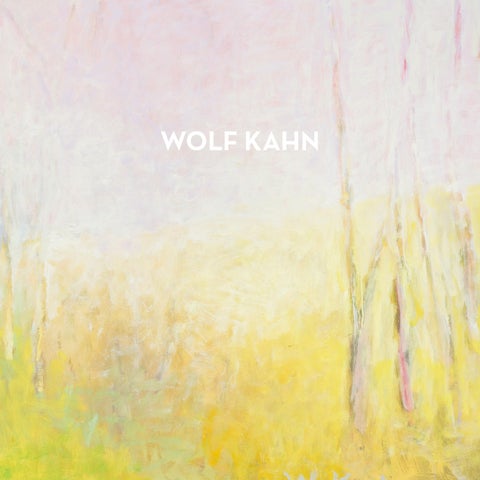
WOLF KAHN
WOLF KAHN STAND #E11 14–18 OCTOBER 2026 THE REGENT’S PARK, LONDON, UK
511 West 22nd Street
515 West 22nd Street
525 West 22nd Street
520 West 21st Street
New York NY 10011
New York NY 10011
New York NY 10011
New York NY 10011
4
FOREWORD England holds profound historical and personal significance in Wolf Kahn’s life. Born Hans Wolfgang Kahn in Germany in 1927, he encountered the arts early as the son of Stuttgart Philharmonic conductor Emil Kahn and Nellie Budge. He spent much of his childhood in the care of his paternal grandmother, Anna Kahn, in a home filled with art. As Hitler rose to power, Anna Kahn secured a place for elevenyear-old Kahn on the Kindertransport to England. She and Kahn’s maternal grandparents did not survive the Holocaust. In 1940, Kahn was reunited with his father, stepmother, and siblings.
Wolf Kahn’s Immigration Papers, August 3rd, 1939.
Kahn’s year in the English countryside was not only lifesaving, it was also his first sustained encounter with the British landscape, light, and cultural environment. Absorbed at a formative age, these impressions became part of the visual reservoir that later informed his mature work. His lifelong exploration of landscape, color, atmosphere, and structure reflects a European sensibility that evolved within the context of postwar American abstraction. The Miles McEnery Gallery Frieze Masters presentation brings together key works that reveal Kahn’s synthesis of European modernist traditions and the Second-Generation New York School. Shown in London, this body of work returns with quiet resonance to the place that ensured his survival and helped shape his artistic consciousness. Mara Williams, Wolf Kahn Foundation, Chair
3
BROKEN WOODS Charles Palermo Wolf Kahn’s art matured at the moment of abstract expressionism’s ascent. At his own expense, he resisted it. When, around 1960, his engagement with it intensified, he also committed permanently to landscape.1 Some early works in the selection being presented at the Miles McEnery Gallery show this two-sided development. When ’60s post-painterly abstraction rejected expressionist touch and refused traditional composition, Kahn remained a painterly landscapist. Can we, perhaps, understand his later work as an engagement with the most foundational developments of modernist art? Consider a work from 2009, A Broken Birch in Broken Woods. 4
A standing tree reinforces the left framing edge, and the diagonal form of a fallen tree — the broken birch of the title — cuts across the lower right-hand corner. Together, they bracket the composition. A deep red, mostly linear, motif repeats. In the upper right, it looks like calligraphy — a “W,” maybe — and floats among the treetops. It weaves among tree trunks, smeared into the trunks of a couple of trees near the middle of the canvas. It lies on the surface of the support except where depicted forms overlap it, producing a tension between a depicted deep space and the literal surface of the canvas. We’re used to paint doing double duty — both sitting on the surface as brushstrokes and giving us the surfaces and colors of fictional objects in a fictional world. Just protruding from below and to the right of the fallen trunk is a lavender shape. Its depictive function is uncertain, as is its position in space. It sits on top of the green streaks that suggest grass; yet its shape is defined in part by the lower edge of the fallen log so that it also seems to be behind the fallen log. In the contest between pictorial depth and the surface of the painting, we can see Kahn’s debt to his teacher Hans Hofmann, or at least the sympathy between the two painters.2
In the lower left is another calligraphic passage — a dark line loops like graffiti just to the left of the painter’s signature (a barely legible “W Kahn”). Beyond the thicket of loops that resembles tags on a subway car, a bright, warm luminous touch of color peeks out from behind dark trees — a campfire, presumably. It creates in those dark woods a forceful sense of an interior. Further, insofar as it suggests a campfire, it installs human activity, human presence, action and meaning. Suddenly, Kahn becomes part of another heritage, older than abstract expressionism. This small human presence, inside the woods, evokes predecessors like Théodore Rousseau and Camille Corot as well as the Impressionists and successors like George Inness — all of whom created dense landscapes that resist vision, which push their habitants to the edge of visibility and paint to the limit of depiction. For Rousseau, it was a matter of a proto-ecological sensibility that diminished the human presence in order to tell the nonhuman world’s story.3 For the Impressionists, among other things, an exploration of the pictorial role of the touch of paint on the surface of the canvas.4 For Inness, who was influenced by the theology of Emanuel Swedenborg, it was a mystical obscurity anticipating a transcendental opening, where nature’s hieroglyphs lay waiting to reveal another truth.5 The title of A Broken Birch in a Broken Woods repeats the word broken. “Broken” first describes the birch in the lower right corner of the painting. Repeated, it refers to the woods as a whole, which is to say, it refers to virtually the whole painting, since the woods fill the canvas, except for a small fringe of sky above. Is the word “woods,” then, a way of referring to the painting? Why not landscape? A landscape is both a kind of fictional scene and a genre within painting. To call the painting a landscape would naturalize the duality of depicted space and literal surface. The scene is a landscape, and the painting is a landscape. To call the painting a woods makes the duality strange. And if calling the painting a woods stresses the approximate identity of these two substances, fiction and object, then calling the woods broken suggests two contesting ways of thinking of the brokenness. On one hand, the woods, like all such places, is full of damage. This would be like Rousseau’s view of the natural world — a place of processes, of life and decay, of growth and destruction. On the other hand, broken, when the word is used to refer to a work of art, suggests articulation — a line break or
5
a broken line, for instance. (Kahn was trained as a Morse code operator—a journeyman in dots and dashes during his brief career in the Navy; a master later on.6) Broken lines — dashes — almost literally cover the painting. Horizontal dashes of paint litter its surface — branches that float free of any trunk. They belong to the surface of the canvas as much as to the birches in the fictional woods. Marks or lines or writing, even.
6
The trees in Kahn’s painting seem to be paper birches, a tree named for its bark, which peels off in white sheets resembling paper. The trunks of the paper birch are covered — like the trees in Kahn’s painting — with scattered marks that, on paper-white bark, suggest marking or writing. A broken birch in a broken woods where a campfire’s glow penetrates a sheet of dashes in something like the way, in a papier collé by Georges Braque, a sheet of woodgrain dashes glued upon the support slips behind a newspaper that overlaps the pasted paper. The papery sheets of bark have peeled away from the tree — after the integrity of the tree is broken, and the sheets enter the analogy with writing and with the surface of the painting — yet the deep, depicted space emerges with them. This late landscape from Kahn resists the developments of his own lifetime but performs a different task; it reappropriates together the modern tradition of landscape and papier collé’s foundational conflation of space and surface.
Charles Palermo I would like to thank the Miles McEnery Gallery for the opportunity to see this painting and most of the other works destined for the exhibition in person and Julia Schlank for her generous and unflagging help. I viewed these works with Jennifer Ashton and Walter Benn Michaels. These remarks are very much the product of our conversation in the gallery; any shortcomings are mine alone.
NOTES 1. 2.
See Martica Sawin, Wolf Kahn: Landscape Painter (New York: Taplinger Publishing, 1981), 22. Michael Schreyach, “Re-created Flatness: Hans Hofmann’s Concept of the Picture Plane as a Medium of Expression,” The Journal of Aesthetic Education 49, no. 1 (2015): 44-67. 3. See Greg Thomas, Art and Ecology in Nineteenth-Century France: The Landscapes of Theodore Rousseau (Princeton, N.J.: Princeton University Press, 2000). 4. See Michael Fried, “The Moment of Impressionism,” nonsite.org 33 (December 2020): n.p. See also Sawin, Wolf Kahn, 23-24. 5. See Rachael Ziady DeLue, George Inness and the Science of Landscape (Chicago: University of Chicago Press, 2007). 6. Christopher Crosman, “Wolf Kahn: Orange, Barely Blue” in Wolf Kahn (exh. cat., The Bo Bartlett Center, Columbus State University, October 1, 2019 to January 15, 2020), 6. 7
8
Seven Gates Across the Sound, 1960
Oil on canvas 24 x 24 inches 61 x 61 cm
9
10
Cypresses, 1963-1964 Oil on canvas 47 1/2 x 51 1/2 inches 121 x 131 cm
11
12
Gray Trees, 2003
Oil on canvas 24 x 26 inches 61 x 66 cm
13
14
Long Landscape, 2003 Oil on canvas 43 x 75 inches 109 x 191 cm
15
16
Mostly White, 2003
Oil on canvas 52 x 60 inches 132 x 152 cm
17
18
Slightly Leaning, 2004 Oil on canvas 15 x 25 inches 38 x 64 cm
19
20
Broken Branch, 2005 Oil on canvas 48 x 40 inches 122 x 102 cm
21
22
Foggy, 2005 Oil on canvas 36 x 52 inches 91 x 132 cm
23
24
Pale House Amid Trees, 2005
Oil on canvas 22 x 30 inches 56 x 76 cm
25
26
Yellow and Gray, 2005 Oil on canvas 26 x 30 inches 66 x 76 cm
27
28
Gap into Deep Woods, 2006
Oil on canvas 24 x 26 inches 61 x 66 cm
29
30
A Broken Birch in Broken Woods, 2009
Oil on canvas 52 x 52 inches 132 x 132 cm
31
32
Gray and Yellow I, 2009 Oil on canvas 24 x 24 inches 61 x 61 cm
33
34
WOLF KAHN Born in Stuttgart, Germany, in 1927, Wolf Kahn immigrated to the United States by way of England in 1940. In 1945, he graduated from the High School of Music & Art in New York, after which he spent time in the Navy. Under the GI Bill, he studied with renowned teacher and Abstract Expressionist painter Hans Hofmann, later becoming Hofmann’s studio assistant. In 1950, he enrolled in the University of Chicago. He graduated in 1951 with a Bachelor of Arts degree. After completing his degree in only one year, Kahn decided to return to being a full-time artist. He and other former Hofmann students established the Hansa Gallery, a cooperative gallery where Kahn had his first solo exhibition. In 1956, he joined the Grace Borgenicht Gallery, where he exhibited regularly until 1995. Kahn received a Fulbright Scholarship, a John Simon Guggenheim Fellowship, an Award in Art from the Academy of Arts and Letters, and a Medal of Arts from the U.S. State Department. Kahn married the artist Emily Mason in 1957. Their marriage lasted sixty-two years until Emily’s death in December 2019, just a few months before his passing. The pair lived and worked between New York City and W. Brattleboro, Vermont. Wolf Kahn regularly exhibited at galleries and museums across North America. His work may be found in the collections of The Metropolitan Museum of Art, New York, NY; the Whitney Museum of American Art, New York, NY; The Museum of Modern Art, New York, NY; the Museum of Fine Arts, Boston, MA; The Hirshhorn Museum and the Smithsonian American Art Museum, Washington, D.C.; and the Los Angeles County Museum of Art, Los Angeles, CA. Kahn died in 2020 in New York, at the age of 92.
Portrait of Wolf Kahn, c. September, 1959.
The Wolf Kahn Foundation is represented by Miles McEnery Gallery, New York, NY.
35
Published on the occasion of the exhibition
FRIEZE MASTERS 2026 STAND #E11 14–18 October 2026 The Regent’s Park London, UK Miles McEnery Gallery 520 West 21st Street New York NY 10011 511 West 22nd Street New York NY 10011 515 West 22nd Street New York NY 10011 525 West 22nd Street New York NY 10011
36
tel +1 212 445 0051 www.milesmcenery.com Publication © 2026 Miles McEnery Gallery All rights reserved Essay © 2026 Charles Palermo Associate Director Julia Schlank, New York, NY Catalogue Design Laurie Mullowney, New York, NY Special thanks to Mara Williams, Ellen McCulloch-Lovell, and The Wolf Kahn Foundation, New York, NY Artwork Images: © 2026 Wolf Kahn / Licensed by VAGA at Artists Rights Society (ARS), New York, NY Image on Page 2 Wolf Kahn in his Chelsea Studio, 1995 Photography by Dan Bradica, New York, NY Christopher Burke Studios, New York, NY ISBN: 979-8-3507-6829-9 Cover: Foggy, (detail), 2005