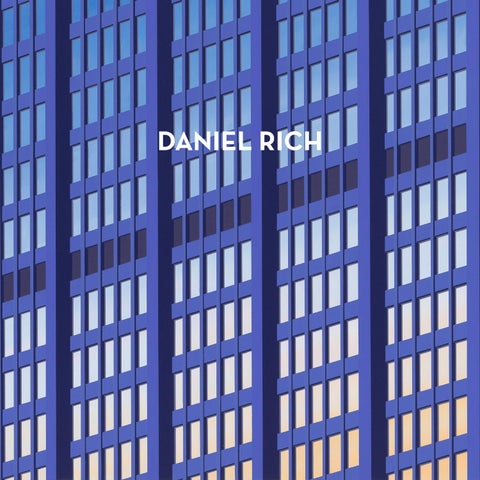
DANIEL RICH
DANIEL RICH
511 West 22nd Street
515 West 22nd Street
525 West 22nd Street
520 West 21st Street
New York NY 10011
New York NY 10011
New York NY 10011
New York NY 10011
4
What Happens on the Twenty-Third Floor: On the New Paintings of Daniel Rich Evan Pricco The city in these paintings is empty, and it is dusk — or something like dusk. There’s a color that doesn’t quite belong to any hour, magenta bleeding into cobalt, giving us a violet that has no source you can point to in the sky. The buildings are rendered with a precision so exacting that it borders on obsession: every window, every setback, every cornice accounted for, traced and cut, stenciled and filled until nothing is left to chance. And yet nothing moves. There are no cars, no crowds, no single figure crossing a plaza or looking out from behind a glass window. It is New York, mostly, though it could be read as any dense vertical city built to project permanence. It is entirely uninhabited, which is strange, because Daniel Rich will tell you that these paintings are, in the end, about people. About us. About what we build and why, and what we don’t see happening inside our buildings. That contradiction — structures this solid, this settled, from a man who says his life has been characterized by perpetual restlessness — sits at the center of this new body of work, opening this fall at the Miles McEnery Gallery in New York. Three generations of Rich’s family have immigrated across continents. His immediate family has moved from New York to Berlin and back again. And now, from a house in the North Carolina mountains that he only half-jokingly calls his own magic mountain, he is in the middle of applying for U.S. citizenship, a process that carries its own quiet and specific anxiety about what he can and cannot afford to say. Against all of this, the paintings hold still. They look, as he put it, as if no wind could knock them down. If restlessness is the private weather of the artist’s life, permanence is the public face Rich has built to withstand it, painting buildings that don’t move even when everything else does.
3
Nobody appears in these paintings, but Rich has come to think of them as portraits all the same — of the people behind the built thing, rather than the built thing itself. What he keeps returning to in conversation is a kind of civic curiosity that shades into something more uneasy: What is actually happening on the twenty-third floor of a building you pass every day and have never wondered about until now? Are you being observed from inside it, or are the windows simply blind, indifferent glass? The city is full of structures that we live close to without any real access to what goes on inside them — commerce, governance, whatever quiet machinery keeps a tower lit at 2 a.m., and Rich’s paintings sit in that gap, imagining a kind of parallel universe running alongside our own, visible only as surface. You go to the grocery store on the ground floor. Somewhere above you, on a floor you’ll never see, something else entirely is happening, and it is, in its own way, running your life, too.
4
Rich didn’t set out to illustrate any of this. The clarity came later. By his own account, he was well into a year of painting before the pieces connected in his mind, prompted in part by a run of audiobooks he had been listening to in his studio: Thomas Mann’s novel The Magic Mountain, Stefan Zweig’s memoir The World of Yesterday, W.G. Sebald’s novel Austerlitz. All three were written by Central European writers watching a familiar world come apart while still tending to the ordinary business of living inside it. Mann’s novel strands its characters in an Alpine sanatorium in the years just before the First World War. His characters, who aren’t really so ill, have sectioned themselves off into their own insulated world while history gathers itself outside. They are apathetic and enraged in equal measure, unable to act and unable to look away. Zweig wrote his memoir as an act of retrieval, cataloging a Central Europe that he had left — first for England in 1934, then for the United States in 1940, and finally for Brazil in 1941. It had already been erased by the time he finished his memoir in early 1942. (Zweig took his own life the day after the memoir was completed.) Sebald’s novel follows a man piecing together a buried personal history through the buildings and objects that outlasted the people who built and used them — architecture as a kind of memory that persists longer than anyone’s ability to explain it. None of these are books about the present moment. All of them, Rich found, described it anyway. Rich, who grew up in Germany, is candid about the discomfort many Germans must have felt in the 1930s, watching a democracy erode by increments and telling themselves, at each stage, that it’s still
fine, still survivable, still not yet the thing it’s becoming. He calls these paintings “sneakily political,” which is its own kind of admission: A foreign-born artist in the middle of the citizenship process has more at stake than most when he speaks plainly, and his work carries its politics the way a lot of the strongest political art has always carried politics — coded into subject and color and mood rather than argued outright. There’s a lineage for this. The Precisionists of the 1920s and ’30s, Charles Sheeler chief among them, painted American industry with a clarity so total it curdled into something faintly surreal, faintly ominous. Berenice Abbott’s photographs of New York in the 1930s did something similar, documenting a city becoming something else, which was made urgent by the specificity of what was actually there. Rich’s paintings work in that same register: not protest but witness. They are a record of what this particular moment in this particular city looked like, made by someone obsessive enough to get every window right. Rich’s process is inseparable from that idea of record-keeping. For the first time, every source photograph in this body of work is Rich’s own. This is a departure from the appropriated, Internetsourced imagery of his earlier paintings; it’s also a small but deliberate act of authorship over what’s being witnessed. From there, the image is put through a process that traces back to his training in printmaking — screen printing and intaglio specifically — and it has gotten more exacting over time. In his own words: My painting process developed from my background in printmaking — specifically screen printing and intaglio. A painting begins with a sourced image or a photograph I take in response to my research. The source image is manipulated and scaled in Photoshop, printed out to the size I envision the painting to be, and then traced and redrawn on an aluminum composite panel covered with a translucent vinyl mask. The resulting line drawing is cut out by hand using an X-Acto, and colors are mixed in reference to the source image using Golden fluid acrylic paints and mediums. The image is then transcribed into paint employing a multi-layered masking and stenciling process that involves the meticulous cutting out of shapes and the application of paint with a squeegee.
5
It amounts, as Rich puts it, to an elaborate paint-by-numbers, except that the numbers are his own invention, assigned color by color to a photograph that has already been pushed through Photoshop into something looking only partly like what his eye actually saw. The labor is enormous, and it is largely invisible in the finished painting: hundreds of hand-cut stencils, layered one over another, each one masking what came before so the next color can go down clean. What survives that process isn’t documentary in any straightforward sense. It’s a photograph that has been taken apart, recolored, and rebuilt into something adjacent to reality rather than a copy of it. His word for it is “edited,” which feels right. The buildings are real. The version of them on the panel is not quite the world as it is, but the world as it has been strained through one very particular, very deliberate set of decisions, over and over, thousands of times, until a painting exists.
6
New York holds a specific place in all of this, distinct from the other cities and structures that have run through Rich’s work over the years. He lived in New York for a long time before Berlin and before North Carolina, and he still thinks of it as something closer to a portal than to a place: the city that has absorbed generation after generation of people arriving to start over, his own family included. It is also, he has noticed, a city that seals its residents into their own version of the world. Live in Manhattan long enough, and the rest of the country starts to feel like a separate track entirely. Live in Brooklyn, and Midtown can start to feel like another universe, twenty minutes and a bridge away. That tension — the city that’s the center of the world but is also just one more sealed-off enclave among many, running on its own logic while everything else runs on another — is its own quiet echo of the parallel-universe feeling that shapes the whole body of work, magnified to the scale of the city that, more than any other, gets to decide what counts as the world. There’s something almost narrative in how Rich has come to describe this group of paintings. It’s not exactly a story, but there are glimpses of one: someone arriving, someone starting over, someone leaving things behind the way the writers he has been listening to leave things behind in their books, whether the record is fictionalized or not. He has said he doesn’t fully know yet what this show adds up to, and that he may not know for years — that the connecting of the dots this time happened late, almost by accident, sometime after most of the paintings already existed. What he does seem certain
of is the moment he’s recording: an in-between stage, uncertain of where it’s headed, in which the built world goes on looking as permanent and unbothered as ever, indifferent to whatever is or isn’t being done about the forces bearing down on it. The paintings don’t resolve that tension. They just hold it very still, in very exact light, for as long as you’re willing to look.
Evan Pricco, Editor and Founder of The Unibrow
7
8
9
10
28 Liberty St., 2026 Acrylic on Dibond 60 x 48 inches 152 x 122 cm
11
12
40 Wall St., 2026 Acrylic on Dibond 22 x 17 inches 56 x 43 cm
13
14
120 Wall St., 2026 Acrylic on Dibond 60 x 40 inches 152 x 102 cm
15
16
Garment District, NYC, 2026
Acrylic on Dibond 59 x 41 1/4 inches 150 x 105 cm
17
18
Liberty St., NYC, 2026
Acrylic on Dibond 60 x 40 inches 152 x 102 cm
19
20
NYC Nocturne #1, 2025 Acrylic on Dibond 72 x 50 inches 183 x 127 cm
21
22
NYC Nocturne #2, 2026 Acrylic on Dibond 60 x 40 inches 152 x 102 cm
23
24
NYC Nocturne #3, 2026 Acrylic on Dibond 72 x 48 inches 183 x 122 cm
25
26
NYC Nocturne #5, 2026
Acrylic on Dibond 72 x 48 inches 183 x 122 cm
27
28
1071 Fifth Ave., NYC, 2026
Acrylic on Dibond 12 x 10 inches 31 x 25 cm
29
30
NYC Nocturne Study #2, 2026
Acrylic on Dibond 12 x 10 inches 31 x 25 cm
31
32
NYC Nocturne Study #4, 2026 Acrylic on Dibond 12 x 10 inches 31 x 25 cm
33
34
Daniel Rich Born in 1977 in Ulm, Germany Lives and works in Blowing Rock, NC and Berlin, Germany EDUCATION 2004 MFA, Tufts University, Medford, MA/School of the Museum of Fine Arts Boston, Boston, MA 2001 BFA, Atlanta College of Art, Atlanta, GA SOLO EXHIBITIONS
2018 “Never Forever,” Peter Blum Gallery, New York, NY 2014 “Systematic Anarchy,” Peter Blum Gallery, New York, NY 2012 “Platforms of Power,” Museum of Fine Arts Boston, Boston, MA 2009 “1989-2009: Paintings of the Berlin Airports 20 Years after the Fall of the Wall,” ANDREW RAFACZ, Chicago, IL
2026 “Magic Mountain,” Miles McEnery Gallery, New York, NY
2008 “Downburst,” Perry Rubenstein Gallery, New York, NY
2025 “Passages,” Bernhard Knaus Fine Art, Frankfurt, Germany
2007 “Black Sunday,” Sunday L.E.S., New York, NY “Baghdad,” Mario Diacono Gallery, Boston, MA
2024 “Parallels,” Miles McEnery Gallery, New York, NY
2006 “Torre Velasca,” Mario Diacono Gallery, Boston, MA
2023 “Vertical Drift,” Weber Fine Art, Greenwich, CT
2005 “Project Space,” Elizabeth Dee Gallery, New York, NY
2022 “Flat Earth,” Miles McEnery Gallery, New York, NY
GROUP EXHIBITIONS
2020 “(co)vertex,” StudioTrouble, Berlin, Germany “Back to the Future,” Miles McEnery Gallery, New York, NY
2026 “Visions of the City,” Rollins Museum of Art, Rollins College, Winter Park, FL “Unboxed: Art beyond the Museum,” North Carolina Museum of Art, Winston-Salem, Winston-Salem, NC “Horizon Line: 250 Years of American Landscape,” Blowing Rock Art & History Museum, Blowing Rock, NC
35
2025 “Miniature, Monumental” (curated by Andrew Leventis and Daniel Rich), Projective Eye Gallery, The Dubois Center, UNC Charlotte Center City, Charlotte, NC “Echoes of Modernism,” Birdland Gallery, Raleigh, NC “Paint the Lines” (curated by Eddie Martinez), Broadway Gallery, New York, NY “Look to the West,” Contemporary Art Museum of Raleigh, Raleigh, NC “Counter History: Contemporary Art from the Collection,” Museum of Fine Arts Boston, Boston, MA 2024 “All Bangers, All The Time: 25th Anniversary Exhibition,” Miles McEnery Gallery, New York, NY “on architecture,” Bernhard Knaus Fine Art, Frankfurt, Germany
36
2023 “Nocturne: Part 1,” ANDREW RAFACZ, Chicago, IL “Interactions of Color,” Turchin Center for the Visual Arts, Appalachian State University, Boone, NC 2022 “Dreamland” (curated by Soraja Helac), Helac Fine Art, Charlotte, NC “2022 Department of Art Faculty Biennial,” Smith Gallery, Appalachian State University, Boone, NC “Otherworldly,” Mucciaccia Gallery, London, UK 2021 “Studio Visit: Thoughts and practices surrounding ten artist’s studios,” Collezione Maramotti, Reggio Emilia, Italy Weber Fine Art, Greenwich, CT “Beyond the Streets on Paper,” Southampton Arts Center, Southampton, NY 2020 “Endless State” (online exhibition), The Skowhegan Alliance, New York, NY
2019 “Mensch in Moll” (curated by Marcus Bjernerup), Inter Port, Berlin, Germany “Geometric Heat,” GR Gallery, New York, NY “Invisibli” (curated by Donatella Mezzotero), Anna Marra Contemporanea, Rome, Italy “Set for the Sun” (curated by Jenne Grabowski), Lobe Block, Berlin, Germany 2018 “#” (curated by Markus Linnenbrink), Cindy Rucker Gallery, New York, NY “In My Room: Artists Paint the Interior 1950-Now” (curated by Rebecca Schoenthal and Ryan Steadman), The Fralin Museum of Art, University of Virginia, Charlottesville, VA 2017 “After the Fall,” Peter Blum Gallery, New York, NY 2016 “Urbanopolis,” Galerie LJ, Paris, France “Summer Mixer,” Joshua Liner Gallery, New York, NY “Postcard from New York - Part I” (curated by Serena Trizzino), Anna Marra Contemporanea, Rome, Italy 2015 “On a Boat, Looking to Land: Gil Heitor Cortesão & Daniel Rich,” CARBON 12, Dubai, United Arab Emirates 2014 “Résonance(s),” Maison Particulière, Brussels, Belgium “Epic Fail 2,” Active Space, Brooklyn, NY 2013 “October 18, 1977” (curated by Birgit Rathsmann), Klemens Gasser & Tanja Grunert, Inc., New York, NY
2012 “Summer Group Show,” Joshua Liner Gallery, New York, NY “Divergence” (curated by Rachel Gladfelter), Lower East Side Printshop, New York, NY 2011 “Chain Letter,” Golden Parachute, Berlin, Germany and Samsøñ, Boston, MA “LANY” (curated by Mario Diacono), Peter Blum Gallery, New York, NY 2010 “Berlin,” Horton Gallery, New York, NY 2009 “Slow Photography,” Sunday L.E.S., New York, NY “Transitions. Painting at the (other) end of art,” Collezione Maramotti, Reggio Emilia, Italy “Rattled by the Rush,” ANDREW RAFACZ, Chicago, IL 2008 “A Sorry Kind Of Wisdom,” Perry Rubenstein Gallery, New York, NY 2006 “Material Matters,” Maryland Art Place, Baltimore, MD “We Build the Worlds Inside Our Heads,” Freight+Volume, New York, NY 2005 Elizabeth Dee Gallery, New York, NY 2004 “Combined Talent,” Florida State University Museum of Fine Arts, Florida State University, Tallahassee, FL “Summer Distillation,” Miller Block Gallery, Boston, MA “Site Specific” (curated by Jonathan Santos), artSPACE@16, Malden, MA “The Sublime is (still) now” (curated by Joe Wolin), Elizabeth Dee Gallery, New York, NY
“Axiom,” Gallery 4, Baltimore, MD “Constellations,” Shirley and Alex Aidekman Arts Center, Tufts University, Medford, MA 2003 “Properties,” H. Lewis Gallery, Baltimore, MD “CRG Advisors & Dragon Foundation Scholarship Recipients,” Museum of Contemporary Art of Georgia, Atlanta, GA “Referencing Perspective,” Gallery 100, Atlanta, GA “Deconstruction and Recomposition,” Art Farm, Atlanta, GA TEACHING EXPERIENCE 2025 Adjunct Faculty, Department of Art, Appalachian State University, Boone, NC 2024 Visiting Artist, University of North Carolina at Charlotte, Charlotte, NC 2023–2024 Lecturer in Painting, Appalachian State University, Boone, NC 2021–2023 Adjunct Instructor, Painting and Drawing, Appalachian State University, Boone, NC AWARDS AND RESIDENCIES 2026 Residency, Yaddo, Saratoga Springs, NY 2025 Fellowship, Virginia Center for the Creative Arts, Amherst, VA
37
2022 Artist Grant, North Carolina Arts Council, Raleigh, NC 2017 Publishing Residency, Lower East Side Printshop, New York, NY 2015 Traveling Scholars Grant, School of the Museum of Fine Arts Boston, Boston, MA 2012 Painting Fellow, New York Foundation for the Arts, New York, NY
38
SELECT COLLECTIONS Blowing Rock Art & History Museum, Blowing Rock, NC Collezione Maramotti, Reggio Emilia, Italy Fidelity Art Collection, Boston, MA Hudson Valley MOCA, Peekskill, NY JPMorganChase Art Collection, New York, NY Meadows Museum, Southern Methodist University, Dallas, TX
2011 Keyholder Residency Award, Lower East Side Printshop, New York, NY
Museum of Fine Arts Boston, Boston, MA
2010 Space Program Residency, Marie Walsh Sharpe Art Foundation, New York, NY Residency, Bemis Center for Contemporary Arts, Omaha, NE
Wellington Management, Boston, MA
2004 Full Fellowship, Skowhegan School of Painting and Sculpture, Skowhegan, ME Travel Grant, School of the Museum of Fine Arts Boston, Boston, MA 2001 Graduate Fellowship, School of the Museum of Fine Arts Boston, Boston, MA Ben Shute Scholarship for Excellence in Representational Art, Atlanta College of Art, Atlanta, GA Dragon Foundation Scholarship, Atlanta College of Art, Atlanta, GA
Rollins Museum of Art, Rollins College, Winter Park, FL
39
Published on the occasion of the exhibition
DANIEL RICH MAGIC MOUNTAIN 5 November 2026 – 9 January 2027 Miles McEnery Gallery 511 West 22nd Street New York NY 10011 tel +1 212 445 0051 www.milesmcenery.com Publication © 2026 Miles McEnery Gallery All rights reserved Essay © 2026 Evan Pricco
40
Associate Director Julia Schlank, New York, NY Catalogue Design Laurie Mullowney, New York, NY Photography by Dan Bradica, New York, NY Chris Edwards Photography, Fort Mill, SC ISBN: 979-8-3507-6934-0 Cover: 28 Liberty St., (detail), 2026