No. 2 Vo lum e 4 5 / S p r in g 2 02 2
Cornell Report
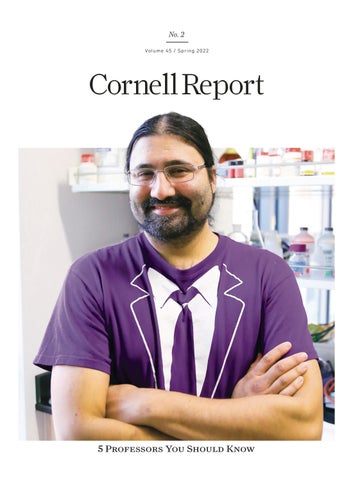
5 Professors You Should Know
MARJ WHITLEY
Maybe a ticket taker dropped a few tickets as he was leaving King Chapel on Oct. 15, 1962. Maybe a custodian later swept them under a floorboard without realizing it. Whatever happened, 60 years later contractors exploring damage to King Chapel freed a handful of tickets from under the flooring and behind the east wall. Those tickets were to see The Rev. Martin Luther King Jr. on that night in 1962. After a social media post, word of the recovered tickets spread to Mount Vernon resident Marj Whitley, age 86, who held a surprising connection to the event. Whitley’s parents lived in the small cottage just behind the library and the heating plant. Her father, Carl Whittemore, was a night watchman. Her mother, Verla Whittemore, was then a 54-year-old housekeeper at Pfeiffer and filled in where needed. On Oct. 15, 1962, she was filling in at Brackett House, the campus guest house where King was staying. “My mother got his breakfast for a couple of mornings, and he asked her to sit and have breakfast with him because he was so lonesome for his family when he was traveling,” Whitley said. “I have a feeling they talked about his family. Mom didn’t even talk about it for a while. She wasn’t the kind who would’ve thought that was important at the time. “I wonder what she fed him, but I’ll bet it was either sausage, eggs, and toast; or bacon, eggs, and toast. He would have had a busy day ahead of him. She said he was a very nice gentleman.” Five-and-a-half years later, on April 4, 1968, the civil rights leader was assassinated in Memphis, Tennessee. The following fall, 30 Cornell students and three others took over Old Sem, the campus administrative building. Among their demands was the establishment of a Black activities center. The Whittemores moved not long after that, and the cottage where they had lived became the Black Activities Center.
1963 ROYAL PURPLE
MLK rediscovered
TOP: Martin Luther King Jr. at Cornell College.
EX
’82 AT RO
NR
E DE
AN
LEFT: Tickets to see Martin Luther King Jr. were found in King Chapel 60 years later. ABOVE: Verla and Carl Whittemore at the campus cottage where they lived, later the home of the Black Activities Center. Verla sat with Martin Luther King Jr. at breakfast in Brackett House during his campus visit.
C O R N E L L R E P O RT | S P R I N G 2 0 2 2
CONTENTS
19
5 professors you should know
31
Cornell connected When the Hilltop is a family tradition
L I F E A F T E R CO R N E L L
Jane Welgos Sidwell ’69
Johnnie Johnson ’97
Wyatt Whitegoat ’16
Serving others at a sacred time
Preparing future generations
Indigenous health pioneer
18
30
DEPARTMENTS
ON THE COVER:Associate Professor Jai Shanata ’05 wears his “formal” research attire in a Russell Science Center chemistry lab. Photo by Megan Amr.
2 You Said 4 Around the Hilltop 16 Ram Report
41 Alumni News 53 In Memoriam 56 Last Word
1
40
HART GALLENTINE ’22
Around the Hilltop
Soccer player Galen Westervelt ’23 (center, #12) and his Cornell teammates celebrate a 1-0 overtime win over Rockford University last fall. The 15-4 Rams set a school record for most wins in a season, tied for first place in the Midwest Conference, and reached the championship match of the MWC Tournament for the first time since 1982.
4
No. 2 Volume 4 5 / SPRING 202 2
Cornell Report
You Said
EDITOR
Dee Ann Rexroat ’82 drexroat@cornellcollege.edu 319.895.4241 ASSISTANT EDITOR
Lisa Gray Giurato DESIGN
Amy Belice Graphic Design PRINTER
Lane Press CLASS NEWS CONTRIBUTOR
Maxwell Love
Cornell Report is published fall, spring, and summer for alumni, parents, faculty, staff, and friends of the college by the Office of Marketing and Communications, Box 1648, Cornell College, 600 First Street SW, Mount Vernon, IA 52314-1098
Contact Us GIFTS TO CORNELL ADDRESS CHANGE
877.MVERNON (683.7666) giving@cornellcollege.edu ALUMNI ENGAGEMENT OFFICE
319.895.4204 alumni@cornellcollege.edu REGISTRAR
319.895.4372 registrar@cornellcollege.edu ATHLETICS
319.895.4230 athletics@cornellcollege.edu ADMISSION
800.747.1112 admission@cornellcollege.edu cornellcollege.edu/cornell-report
ONLINE-ONLY OPTION To opt out of the printed magazine and be notified by email when each issue is online, contact the editor at cornellreport@cornellcollege.edu
WILL CORNELL PUSH FORWARD FOR SOCIAL JUSTICE? I glanced at, then read with interest, the letters in the fall 2021 issue. Both fervent praise—more passionate than usual—and condemnation attached to the previous summer’s Report. Going back to reread that issue online, I was struck: Here was something substantive, reflective, searching, intense. Here was, perhaps, a turning, moving Cornell, not just the Report, toward finding a place amongst premier colleges exploring and promoting social justice. What might be going on here? When I arrived in the fall of 1965, Cornell was just beginning to move itself away from its lily-white past. Over the next several years, it admitted substantial numbers of African American students. Yet, like other campuses, the community seemed to assume that admitting such students was all they needed to do—no further accommodation or adjustment seemed called for. By the fall of 1968, amid the turmoil roiling colleges and the broader society alike, such minimalism no longer appeared tenable. Frustrated students, Black and white, occupied Old Sem, demanding changes to curriculum, faculty, and cultural life. The heated community discussion that followed led to some such changes, but many of the radicals, me among them, cleared out. I returned for the following spring semester and was delighted to find a thriving Black cultural center in operation. It was wonderful to be one of two or three white students amid a room filled with Black students, but those numbers were also troubling. What was going on with the rest of the campus? Were we clinging to an illusion reflected in one of the letters—that all was well, we were good people after all, and everyone was included? I left, a bit short of graduating (though I was awarded a degree five years later, on condition that I not return to campus), and noted, over the next few years, that many of the faculty I most admired either left themselves, or were denied tenure. The president from that time was fired a couple years on, but that seemed rather little, rather late. In time, my only connection to the college came to be through its publications, and they failed to reveal much of what I would have hoped to see. The summer 2021 issue, though, clearly shows that much, indeed, has been going on. Such an issue would not be possible merely because a growing number of students had felt marginalized, ignored, othered. Rather, there had, at least, to be considerable receptivity to such messages within the broader community, and, of course, someone like Heather Roberts ’09 was needed to push the vision of the issue with intensity. So, here we are. Will this effort be contained within acceptable boundaries, ultimately supporting current power dynamics? Or can Cornell push forward into a broader resolution of this America-defining conflict?
Paul Hetland ’69 Tucson, Arizona
2
YOU SAID
Said on campus
Kammer Hufnagle
SOMETHING FOR EVERYONE I thought the wide range of pieces in the fall Report gave something for everyone and showed what our wonderful college is capable of offering. I especially liked the story about George Phelps ’60 and his 99-yard touchdown run, which Keith North ’60 tells. I was the other guy in the backfield at that time and remember the moment well. I also remember being carried off the field at Knox, after being injured later in the game.
Donald Utroska ’60 Lake Forest, Illinois
TRIBUTE TO THE 2 CHAPLAINS I was deeply touched by your photo and caption of the Rev. and honorary alumnus Richard Thomas and the Rev. Catherine Quehl-Engel ’89 in the fall 2021 Cornell Report. My many interactions with both of them during my association with Cornell were among the highlights of my Cornell experiences, and I wish them continued success as they spread encouragement and joy in all of their future endeavors.
Tom Cox ’52 Lake Forest, Illinois
“This makes me smile from ear to ear. As a wrestling mom and a proud parent of a Rams baseball player, I’m very happy for this decision. Good job!”
Katie Blasko ’13
“Loved having Marty [Condon] as a professor, and I still have ‘Dr. Tatiana’s Sex Advice to All Creation’ on my bookshelf!” RESPONDING TO OUR STORY ON CARRIE HILL STECKL ’92
Paige Thompson Olech ’92
Politics Professor Megan Goldberg
“Great story!! Always growing and learning … Cornell instilled that.”
“Interrupting the election timeline to thank [former Congressman Dave Loebsack] @DaveForIowa (who is also an emeritus member of our department!) for leading an excellent session with my Congress and the Presidency course!”
RESPONDING TO THE TOILET PAPER TOSS GAME
Paul Doxsee ’79
“You can tell they aren’t paying for the toilet paper and the Covid supply problem is easing.” RESPONDING TO THE KIOSK TRADITION
“Boosters lead to memory cells that are increasingly better at recognizing SARSCoV 2 [COVID-19] than the original vaccine. Boosters encourage strong immune responses!” Professor of Biology Barbara Christie-Pope Science Interest Group talk, Nov. 4, 2021
‘I SEE YOU’ ISSUE WINS GOLD
Kat Fay ’02
“Hours and hours spent chipping away at paint while chatting at the kiosk … oh to have that kind of free time again.”
RESPONDING TO A POST ON THE ROCK
Adrienne Corn ’93
“And 100 years later, in 1989, my freshman roommate and boyfriend painted the rock for my birthday in my fave colors—one of them being purple, of course.”
ON CORNELL ADDING WOMEN’S WRESTLING
Kevin Drendel ’82
“I love it! Women’s wrestling is growing fast. Good move Cornell!”
FAVORITE PED MALL MEMORY
Alex Place ’17
Laura Knutsen Britten ’93
“I See You,” the summer 2021 Cornell Report guest edited by Heather ‘Byrd’ Roberts ’09, won a gold award in the 9th Annual Education Digital Marketing Awards. From over 1,000 entries, gold awards were granted to 222 institutions, silver to 125 institutions, and bronze to 73 institutions.
“Calling my dad on my walk back to the dorms after every exam in West Science Center.”
“As an alum and parent of a HS girl wrestler, I applaud this decision! Very exciting!”
BE PART OF THE CONVERSATION We are delighted to publish letters and social media mentions. Tag @cornellcollege to be considered on social media. Send letters to cornellreport@cornellcollege. edu or Cornell Report, Box 1648, 600 First St. SW, Mount Vernon, IA 52314-1098. Submissions are edited for style, length, and clarity.
3
C O R N E L L R E P O RT | S P R I N G 2 0 2 2
Financing a Cornell education CORNELL COLLEGE IS BECOMING A LEADER in making a private liberal arts education more affordable to all students. With two new initiatives and another that was increased this school year, Cornell is also making cost more transparent to potential students and their families. Forbes is among the media following the story, including in its Aug. 25, 2021, article, “How A Small College Is Targeting Financial Aid To Compete With Flagship Universities.”
Debt Reduction Pledge
of $30,000 to all first-time students from the state of Iowa who are accepted for admission. This move puts Cornell’s cost of attendance in line with Iowa’s three state universities and offers the opportunity for more Iowans to choose an affordable private college education. Used in collaboration with the Iowa Tuition Grant— state aid that is available only to students attending private colleges—the cost of attendance is comparable to all three institutions.
Cornell is kicking off a new program to take a stand against college debt by committing to pay half of students’ federal loans–up to $12,000–at the time of their graduation. The Debt Reduction Pledge will provide funding to 65 first-year students, starting with those enrolling for the 2022-23 academic year. The only requirements to receive the funding are that students must graduate from Cornell in four years, live on campus, maintain good academic standing, and stay enrolled as a full-time student.
Freeway Scholarship Giving Midwest students $30,000 when they’re admitted is another move to make college more affordable. The Cornell College Freeway Scholarship is rolling
Iowa Promise Scholarship Our Iowa Promise Scholarship offers a minimum
5
out for first-year students from Illinois, Minnesota, Missouri, Nebraska, Wisconsin, and Kansas City, Kansas, applying now for the 2022-23 school year. “Affordability should be one of the top initiatives for every college,” said Director of Admission Drew Shradel. “It’s our responsibility as higher education professionals to find ways to make our college affordable and accessible. This is an investment in our students and an investment in what we believe in. We are a great institution and what better way for us to demonstrate that than by giving more students access to our educational system, our professors, and our facilities.”
Gifts to the Greater >Than Campaign continue to enrich the Cornell College student experience MCLENNAN COLLEGE HALL DEDICATED One of the most historic buildings on campus was modernized and reopened for classes last fall as McLennan College Hall. A lead gift from Trustee Robert McLennan ’65 and Rebecca Martin McLennan ’64 propelled the $3.6 million renovation that included new HVAC and Wi-Fi systems, ADA compliance inside and out, renovated office spaces, and updated classrooms with custom technology for business and education. Bob is a real estate executive with deep community involvement. Becky, a retired teacher, produces Broadway plays and is involved in their community of Glenview, Illinois. “McLennan College Hall is home to a large number of our faculty–nearly 30. These renovations will enhance everyone’s teaching and learning experiences and physical comfort in many ways. I have so much gratitude for the McLennans and the other generous donors to this project,” said Provost and Vice President for Academic & Student Affairs Ilene Crawford ’92, who spent many hours in the building as a student.
ENDOWMENT GROWTH Two gifts totaling $1.1 million have created endowments that will help ensure that students benefit from experiential learning, a strength of One Course At A Time and the college’s new Ingenuity curriculum. The Esther and Robert Armstrong Charitable Trust Endowment has dissolved and bestowed its remaining funds to seven organizations in the Cedar Rapids area. Cornell received $600,000 to establish the Esther and Robert Armstrong Charitable Trust Endowment for Ingenuity. The Armstrongs were once the owners of the storied Armstrong’s Department Store in downtown Cedar Rapids. David Korslund ’76 and his husband, Rob Kooiman, of the Netherlands, have generously provided $500,000 to establish the Korslund/Kooiman Endowed Experiential Learning Fund. Korslund, who is retired from an international career in sustainable banking, and Kooiman set
ROBYN SCHWAB AARON ’07
Bob McLennan ’65 and Becky Martin McLennan ’64 at McLennan College Hall on the day it was dedicated.
6
C O R N E L L R E P O RT | S P R I N G 2 0 2 2
Susan Taylor Spielman ’75 and Rick Spielman have given $250,000 to the project. Susan is a retired German teacher who ran with the men’s cross country team while at Cornell, prior to the establishment of the women’s program. In recognition of their gift, the outdoor track will bear Susan’s name. Cornell Life Trustee Bob Slater ’60 also has given $250,000 to the athletics and wellness project. He and his late wife, Dixie Krantz Slater ’64, gave generously to Cornell athletics and also are known for their support of the Cornell Fellows, especially with Creede Repertory Theatre in Colorado. Bob worked with Ernst & Young and Spencer Stuart International in a professional and management capacity.
up the fund to provide resources for Cornell students who would otherwise feel too financially constrained to take advantage of international study.
ATHLETICS MOMENTUM As construction crews continue to transform the Sport Center to a health, wellness, and sport center for all students, the college is just $2 million from completing the $19.5 million Athletics and Wellness Facilities Project. With the addition of women’s wrestling, this building—which will be known as the Richard and Norma Small Athletic and Wellness Center (the SAW)—will be home to 20 NCAA Division III teams when it opens next school year. Construction of new additions is more than 50% complete and renovations have now begun.
MAJOR GIFT FROM CHAFFINS Two members of Cornell’s centennial class, the late Truman “Trum” Chaffin ’53 and Ver Jean “VJ” Hark Chaffin ’53, left a $1.84 million estate gift to the college. The couple was married in 1954 in King Chapel. Following Trum’s military service they moved to California. VJ taught speech and hearing to students in the Inglewood School District. Trum worked for Los Angeles County for 35 years, including as director of emergency medical services. The Chaffins were married 64 years before VJ died in 2016. Trum died in 2020. Completing the Greater > Than Campaign will require the continued generosity of Cornellians with gifts of all sizes.
COURTESY DAVID KORSLUND
David Korslund ’76 (right) and Rob Kooiman.
MEGAN AMR
Second Year Seminar (SYS) students receive a tour from Willis Dady Homeless Services Executive Director Alicia Faust. SYS was created as part of Cornell’s new Ingenuity curriculum, which is supported by the Greater > Than Campaign.
7
A RO U N D T H E H I L LT O P
Cornell connection in Dodge’s DNA
ENVISAGE STUDIOS
Nearly 40 years after graduating, Bonnie Dodge ’76 discovered a family tie to one of Cornell’s first professors and the man who turned down Cornell’s presidency in 1863. David Hilton Wheeler was the first professor of classical languages when Cornell opened in 1853. He campaigned for Abraham Lincoln in Iowa and was rewarded in 1861 with an appointment as U.S. Consul at Genoa, Italy. Among other posts, he served as acting president of Northwestern University and president of Allegheny College. Though Dodge was in Old Sem many times as a student, she had no idea that her great-great-granduncle was one of its original inhabitants. “To think that he walked up that hill and saw the same vista over the countryside that we see today,” she remarked while visiting campus. And although she’s done a great deal of research on him, she still asks herself: “Why didn’t he accept the presidency? I’ve always wanted to know.” Dodge took up genealogy when she retired in 2013 from teaching 8th grade language arts in Marion, Iowa, and private flute and piano lessons in Cedar Rapids. When Wheeler’s bio popped up, the words
Bonnie Dodge ’76 stands in front of Old Sem holding a photo of her 2nd great-granduncle, David H. Wheeler, who taught in that building when it opened in 1853.
“Cornell College” caught her with a sudden punch. Over time she discovered he was loved by students and in demand as a great orator. And she found stories like one recounted by William Heywood in Cornell’s scholarly history, in which Wheeler once famously declared—from the top of an overturned whisky barrel whose contents had been emptied on the street by Mount Vernon residents angry at its proprietor—“The question is simply this: Whiskey and no college, or college and no whiskey.” “Facts are great, names are great, but they’re not like stories. Stories give you a glimpse into their world,” Dodge says. “I can imagine his life. I’ve read his sermons and discovered how devout and well-loved he was, and I really feel like I know him. “It just means a lot to me to know the founders left a legacy and were involved in something so important and challenging at the time—to start a college in the middle of almost nowhere.”
WEB EXTRA
Read a reflection on David Wheeler by Bonnie Dodge ’76 at crnl.co/wheeler or by using the QR code 8
CORNELL COLLEGE ARCHIVES
C O R N E L L R E P O RT | S P R I N G 2 0 2 2
When knitting was the rage Who says you can’t knit and smoke at the same time? This unlabeled photo from the Cornell College archives appears to document male students, with a female instructor, knitting in order to “do their part” on the homefront during World War II. In 1941 the American Red Cross launched a massive knitting effort to make sleeveless sweaters for the Army and Navy. By November the Linn County chairperson told The (Cedar Rapids) Gazette the number of volunteers in Linn County had doubled that year, specifically mentioning Cornell students as being part of the effort. Mount Vernon’s Red Cross chairwoman in charge of knitting, Dessie Sommerville, received the first Linn County Service pin for knitting 100 pieces, eventually
completing more than 200 of the largest and heaviest sweaters called for. War effort knitting in Mount Vernon and on campus began during World War I after a Red Cross chapter was formed with Cornell Vice President James Harlan as chairman. Membership surpassed 600 in the small town. According to “A Centennial History of Mount Vernon, Iowa (18471947)” knitting for the Red Cross war effort was all the rage: “Women carried their knitting to lectures, clubs, concerts, and other gatherings. College girls found time to add a row or two of stitches between class periods. Everyone knitted. On one occasion needles clicked during the morning services of the Methodist Church. Such enthusiasm was not looked upon with much favor and the procedure was not repeated.” 9
Crews arrived in December to remove all 3,771 pipes and other components of the 1967 M.P. Möller organ. The instrument, valued at $2.9 million, is being stored in Champaign, Ill. Now that the organ is safe, shoring has been installed to support the building. Next, most of the ornate windows will be removed, followed by stone work where needed, and the roof repaired. The work is estimated to last from six months to 1.5 years. “As it stands, King Chapel has quite literally weathered the storm,” reported Jack Scodro ’24 in The Cornellian, “and while it has been left with a sizable amount of damages, there is an array of talented, dedicated people, all of whom deserve a great deal of gratitude, working vigilantly behind the scenes to undo the effects of the 2020 derecho. And we can rest assured that, when their work is complete, King Chapel will stand prouder atop Cornell College’s hilltop than ever before.”
MEGAN AMR
When a derecho blew through the Cornell College campus with hurricane-force winds in 2020, the first thing people noticed were the hundreds of damaged or downed trees across campus. As the grounds were cleared, every building was inspected. The extent of the damage to King Chapel wasn’t visible at first. However, the costliest thunderstorm in U.S. history caused an estimated $8 million in damages to the 1882 chapel, the college’s most iconic building. Three structural engineering firms and two architectural firms have investigated the building and reviewed its original plans. Among their findings were that the National Register building was designed to flex under 100 mph winds for 30 seconds. The derecho blasted up to 140 mph for 45 minutes, fracturing the chapel’s four main roof trusses, which in turn are causing progressive residual damage throughout the building.
10
JILL HAWK
DEE ANN REXROAT ’82
JILL HAWK
Preserving an icon
FAR LEFT: A worker and his teammates disassemble the 1967 pipe organ from its loft above the King Chapel stage, as his shadow hovers overhead. MIDDLE Left: Pipes are lined up in preparation for off-site storage. LEFT: Organ parts are carefully packaged and crated. BELOW: King Chapel’s pipe organ was removed to protect it during repairs following major wind damage from the 2020 derecho.
WEB EXTRA
View a time-lapse video of the pipe organ removal from King Chapel at crnl.co/remove or use the QR code.
One COURSE
QUEER ART COURSE OFFERED FOR 1ST TIME After 25 years on the Cornell faculty, Professor of Art History Christina Penn-Goetsch offered a new course this past fall on a topic she has wanted to teach since taking the job.
Condon awarded scientific distinction The American Association for the Advancement of Science (AAAS) has elected Cornell Professor of Biology Marty Condon to its newest class of AAAS Fellows, among the most distinct honors within the scientific community. Condon studies biological diversity and has discovered several species of flies in the tropics. She’s spent decades studying the evolutionary biology of the flies, the flowers they live on, and their predators, to better understand the diverse species. “AAAS is proud to bestow the honor of AAAS Fellow to some of today’s brightest minds who are integral to forging our path into the future,” said Dr. Sudip Parikh, AAAS chief executive officer and executive publisher of the “Science” family of journals.
It took this long for her to feel secure enough in her position to teach Queer Eye for Art History. “For an openly bisexual or gay professor to teach this topic requires exposure and risk,” said Penn-Goetsch, who received Cornell’s Exemplary Teacher Award in 2018. “There was never any problem with my teaching American Indian art or African art, but the LGBTQ+ or queer art was a different animal. This is not a course typical to most major research institutions, because there are too many restrictions put on information shared. Fear of losing a job is still a concern at some colleges and most high schools.” This unusual course explored art through a queer lens from antiquity to the modern era. “We looked at artwork spanning centuries and mediums and practiced queering, which is the act of looking at things through a queer lens. In doing so, we learned about Professor of Art History the often unspoken backstories of many Christina Penn-Goetsch famous artists and artworks,” explained student Emma Burnett ’23, a studio art and psychology major. “This course provided me with an entirely new perspective when viewing and studying artwork. It taught me to stop taking artwork simply at face value and instead examine subtle aspects in order to realize possible deeper meanings.” Penn-Goetsch said the class size of 15 was ideal for conversation, and they had a lot of rich discussions about topics most of them had never talked about. “Students came from the full gamut of identifications. They were very kind to each other. They were the best of Cornell in their extraordinary patience with each other,” she said.
12
“NYC - MOMA: ANDY WARHOL’S DOUBLE ELVIS” BY WALLYG IS LICENSED UNDER CC BY-NC-ND 2.0
Will Alvey ’22 said he most enjoyed the comfortable environment Penn-Goetsch created for her students. “It was such a new and refreshing experience to be taught by a very openly queer person, and especially with this specific subject matter as our focus,” said Alvey, who is majoring in Spanish and English. “Although I may not be an active participant in the subcultures that I studied, my ethnographic focus really allowed me to respect such subcultures and become a more open-minded individual along the way. “I am going to be able to take skills I learned—notably reception of art, art analysis, and a strengthened feminist lens—and apply them to other classes that I take.”
13
Professor receives national mentor award Cornell College’s Rhawn Denniston has mentored over 50 students while researching climate change at home and abroad since 2000. Now the William Harmon Norton Professor of Geology has been recognized with the 2021 Undergraduate Research Mentor Award. The award is given annually by the Geosciences Division of the Council on Undergraduate Research (CUR). “I love teaching in the classroom, but spending time in the lab and in the field with my students is the best part of my job. My students regularly impress me,” he said in accepting his award. Denniston is the recipient of numerous National Science Foundation grants.
A RO U N D T H E H I L LT O P
Beyond the Summit
“Collaborating with a diverse group of faculty members, staff, and coaches on how we can better serve our students was quite incredible. Working in a small cohort allowed me to understand different aspects of the same question and to form associations that will continue beyond the summit.” —Assistant Professor of Computer Science Ajit Chavan
Cornell adds women’s wrestling
RHAWN DENNISTON
AS PART OF CORNELL’S FALL 2021 DIVERSITY, EQUITY, AND INCLUSION (DEI) SUMMIT, CORNELL FACULTY AND STAFF FORMED SMALL DISCUSSION GROUPS THAT CONTINUE TO MEET PERIODICALLY.
Gabi Hiatt ’21 holds data loggers, electronic devices that record environmental conditions, outside a Portuguese cave.
5 new majors launched To support our strategic plan initiatives, faculty have been busy evaluating the needs of students and what fields of study will be most beneficial to their future careers. As a result, five new majors have been launched: • Data science • Applied statistics • Environmental science and sustainability • Ecology and evolutionary biology (replaces biology major) • Environmental justice and sustainability (replaces environmental studies major) “These exciting new majors and minors are the result of a careful strategic planning process–faculty have designed programs that reflect emerging, interdisciplinary areas of knowledge and suit our applied liberal arts model by providing significant experiential learning opportunities for students,” said Provost and Vice President for Academic & Student Affairs Ilene Crawford ’92. “That careful design will ensure students taking advantage of these new programs are prepared for career opportunities in a broad range of new and evolving fields.”
14
Cornell has added women’s wrestling as its 20th NCAA Division III intercollegiate varsity sport. Competitions will begin in 2023-24. Cornell is the 110th institution nationwide that will have women’s wrestling teams in the next two years, including 29 in Division III. “Wrestling has been a cornerstone of Cornell athletics, and we are delighted to provide competitive opportunities for women and build on the rich history of our storied program,” Cornell Director of Athletics Seth Wing said. “Today is a giant step for the college.” With the addition of women’s wrestling, Cornell now sponsors 10 men’s sports and 10 women’s sports in its varsity athletics program. Men’s and women’s lacrosse were the last programs added, in 2015. A national search is underway with the expectation that a coach will be named by early April.
T H E H I L LTO P
Admission Fun Facts Here are the numbers from recruiting our fall 2021 entering class.
2,933
2,250
NUMBER OF APPLICATIONS READ BY ADMISSION STAFF
AVERAGE NUMBER OF STEPS ON ONE TOUR
5
1,096
AVERAGE NUMBER OF BAD JOKES TOLD BY A TOUR GUIDE ON TOUR
NUMBER OF INDIVIDUAL VISITS (ON-CAMPUS AND VIRTUAL)
#1
980
QUESTION ASKED ON CAMPUS TOURS
NUMBER OF EVENT ATTENDEES (ON-CAMPUS AND VIRTUAL)
“WHY IS THE ORANGE CARPET ORANGE?”
DURING OUR APRIL 30, 2021, COVID-AWARE OUTDOOR VISIT DAY:
653
NUMBER OF INDIVIDUAL STUDENT-ATHLETE VISITS (ON-CAMPUS AND VIRTUAL)
78
450.5
NUMBER OF FACULTY, STAFF, AND CURRENT STUDENTS WHO WORKED ONSITE
HOURS OF ZOOM MEETINGS WITH PROSPECTIVE STUDENTS
96
80
NUMBER OF PROSPECTIVE STUDENTS WHO ATTENDED (WITH 221 FAMILY MEMBERS)
NUMBER OF ENTERING STUDENTS WHO RECEIVED FINE ARTS AWARDS
29
NUMBER OF GOLF CARTS ON CAMPUS FOR TOURS
15
Ram Report
Kahl is Rams’ link to the outside world By
Matthew Levins
K
erry Kahl and his wife, Melissa, are at a wedding of state and out of the country. I am responsible for making reception for Cornell College Head Women’s sure their families and friends can get online right away and Lacrosse Coach Meredith Merce Meier when his see what their student-athletes are doing. I take my job very cell phone begins to vibrate. seriously.” For Kahl, it is a call to action. While he is often seen but seldom heard at athletic Kahl gets up and quietly sneaks out to his car in the events, he is the man who holds things together and helps parking lot to boot up his laptop. The Cornell men’s and the events go on without a hitch. women’s basketball teams have “Kerry is always as profesjust completed a sweep of Besional as they come,” Cornell loit College in Wisconsin, and Director of Athletics and Head Kahl has work to do. He gets the Baseball Coach Seth Wing said. box scores from Beloit’s sports “Cornell College is lucky to have information director and bea real journalist in that position. gins typing up a story on each Kerry not only understands colgame for the Rams’ website. lege athletics but he knows the He attaches photos and mug work ethic that comes with it. shots and uploads the stories His father was a farmer, and I so alumni, parents, and fans think that is where that hard BRENT BRASE ‘90 worldwide can get the inforwork ethic comes from. He’s the HEAD WOMEN’S BASKETBALL COACH mation immediately. first one here and the last one to It’s all in a day’s work for leave almost every home event.” Kahl, who has been the sports information director (SID) Head Women’s Basketball Coach Brent Brase ’90 said at Cornell College the past 15 years. Kahl takes real pride in his work. As a one-man operation, he relays all the Rams athlet“He loves covering the team and covering the athletes ics news to the fans and manages a staff of six to 10 stuand giving them the exposure they really deserve,” Brase dent-athletes who help him cover events. said. “He does an awesome job. He’s a great human being “I love my job. I am the person who has to link our stuand he’s fun to work with. He has been great for Cornell. I dent-athletes to the outside world. I keep everyone connectcan’t imagine where we would be without Kerry.” ed,” Kahl said. “We have so many students who are from out Kahl learned the ropes as an undergraduate at Central
“He loves covering the team and covering the athletes and giving them the exposure they really deserve.”
16
ENVISAGE STUDIOS
Sports Information Director Kerry Kahl is the first to arrive and last to leave almost every home event.
College under legendary SID Larry Happel. After graduating from Central, Kahl spent one year as sports editor at the Mount Pleasant News, then five years as a sportswriter at The Hawk Eye Newspaper in Burlington. Kahl decided to switch careers when he and Melissa made plans to get married and start a family. The couple has two children—daughter Kamryn is in eighth grade and son Klayton is in fifth grade. Kahl was the SID at Iowa Wesleyan University in Mount Pleasant from 2005 to 2007 before accepting his position at Cornell. Part of Kahl’s job is building working relationships with the Cornell coaching staff, student-athletes, and SIDs from other schools. He hires Cornell student-athletes to help him in their off-seasons with statistics and game management at home athletic events. He simply couldn’t survive without them. “In this job I am constantly learning new technology,” said Kahl, who often puts in 15 hours on game days and spends his summers catching up on work he can’t do in season. “I learn the new systems and then I teach
the student-athletes. It’s a constant training and learning situation.” Former Cornell softball player Carley Robison ’20, who is finishing up work on her master’s degree in applied behavior analysis at Arizona State University, said she learned a great deal working for Kahl for three years. “At some point I think I helped out with almost every sport. It was a really, really great experience to learn all those sports in a different light,” she said. “Kerry is present at every single home event. He talks you through the process so you get that visual and audible experience. I even took on some other projects, like helping with roster updates, schedules, football programs, all those tedious things that have to be done behind the scenes. “Kerry was a great person to work for. I’m not sure I would be the same person without him.” Matthew Levins has been a sportswriter for 31 years at The Hawk Eye Newspaper in Burlington, Iowa.
17
LIFE AFTER CORNELL
Jane Welgos Sidwell ’69 Serving others at a sacred time
E
“It is an intense privilege to be able to provide comfort to people leaving this life and to their loved ones.”
arly in her high school years, Jane Welgos Sidwell ’69 and some schoolmates from Decorah, Iowa, made a field trip to a home for unwed mothers and their children. Jane played the piano to entertain the group. During those few hours Sidwell realized that her future lay in helping others. That impulse led to decades of leadership in the fields of hospice and palliative care—serving the spiritual, psychological, social, and physical needs of people who are seriously ill or approaching the end of life. “It is an intense privilege to be able to provide comfort to people leaving this life and to their loved ones,” Sidwell said. “Like birth, it is a sacred time. Hospice helps people live it to the fullest.” It was a calling she came to in mid-career and almost by accident. After graduating from Cornell, she obtained a master’s degree in social work from Washington University in St. Louis and began a career that took her to Illinois, Minnesota, and Texas. By 1989 she was in human resource management for a behavioral health agency in Houston, and she was miserable: “I was managing employees instead of caring for patients.” She and her husband, Lloyd, CEO of a family services organization, had two college-aged children, but they both knew she needed a major change. She left her job and began studies for a nursing degree, intending to specialize in midwifery. As part of her training, Sidwell worked in a hospice unit. “I was hooked,” she said. “All my experience came together because I was caring for the mind, body, and soul. I was ecstatic doing this work.”
18
In the years since that revelation, Sidwell has been a hospice nurse, clinician, educator, and leader. She led the effort to establish palliative care services at a Houston medical center, trained hospice nurses, made presentations at professional gatherings, and served as president of the National Hospice and Palliative Nurses Association. Sidwell credits Cornell for instilling the confidence and honing the skills her career demanded. She majored in psychology and sociology, was president of the Religious Life Council, absorbed the lessons taught by humanities professors, and even enjoyed the mandatory chapel convocations, where she shook hands with visiting poet W.H. Auden and listened to the experiences of the Black Panther Party. “Exposure to new ideas shaped the way my career developed,” Sidwell recalled. Sidwell’s connection to Cornell remained strong. Her daughter, Kara Klatt Moore ’98, and son-in-law, Thomas Moore ’96, are graduates. Sidwell serves on the Alumni Board of Directors. As her 50th reunion approached, she and Lloyd, a graduate of the University of Iowa, began thinking about their legacy. After learning about Cornell’s innovative approaches to student health, they established the Jane Welgos Sidwell and Lloyd H. Sidwell Mental Well-Being Endowment at the college to support all aspects of the mental well-being of students. Now retired and living in Beaufort, South Carolina, Sidwell continues to help others. She has served on many groups promoting local causes, including tourism, the library, and historical preservation. Most important, she is helping guide a local nonprofit agency as it establishes a 10-bed hospice facility—with room for expansion, Sidwell noted. “After all,” she said, “Isn’t that what Cornell taught us—to make a difference?” —DAN KELLAMS ’58
C O R N E L L R E P O RT | S P R I N G 2 0 2 2
5 professors you should know MEET FIVE CORNELL COLLEGE FACULTY at the midpoint of their
careers, each with deep commitments to their students and their scholarship. Several followed a straight path to graduate school and found Cornell. Others left unrelated careers to pursue their passion. Two are alumni who returned to teach on the block plan. These associate professors, who represent varied fields of study, told us what they have spent their careers investigating and why, what they enjoy about teaching on the Hilltop, and what the future holds for them and their students.
19
COURTESY, MISHA QUILL
The anthropologist Associate Professor of Anthropology Misha Quill
MISHA QUILL DIDN’T ORIGINALLY INTEND to be an academic or to live in small-town Iowa. She grew up on the East Coast and worked in public radio documentary production before heading to graduate school at age 40 to study anthropology. Despite receiving her doctoral degree from the University of Iowa, Quill’s first visit to the Cornell College campus was for her job interview. She remembers an instant connection with the historic campus and its people—despite the bitter cold that day.
As part of a 2019 Medical Anthropology course in Nepal, Misha Quill and her students visited Patan Durbar Square, a UNESCO World Heritage site.
20
C O R N E L L R E P O RT | S P R I N G 2 0 2 2
The students were so amazing. I was so touched by how engaged and interested they were. I think that helped tip the balance. “The students were so amazing. I was so touched by how engaged and interested they were. I think that helped tip the balance,” she said. She’s had a major impact since her arrival on campus in 2015. Anthropology was added as a major separate from sociology, and she has developed over 15 new courses, including Medical Anthropology; Environment, Culture, and Sustainability; and Anthropology of Doing Good.
WORK WITH REFUGEES Her Ph.D. explored how the international community manages protracted refugee situations. As a grad student conducting research in Ireland, she learned of a group of Muslim refugees from Myanmar who escaped to Bangladesh and then years later were resettled in a small village in Ireland. She started learning Bengali and eventually spent 18 months living and working with staff members from an international NGO running a refugee camp on the Bangladesh-Myanmar border. Her dissertation addressed the nature of humanitarian intervention—how to run a refugee camp and keep people safe, fed, and housed—and critiqued the international aid system that sometimes does little more than keep refugees alive.
LIFE AT CORNELL Quill bought a home in Mount
Vernon because she thinks a lot in her work about collective responsibility for the planet, and she walks to work most days. “It fit with my values and the life that I wanted for myself,” she says. As a cultural anthropologist she studies contemporary people, focusing on places where people, society, and culture experience change or conflict. In the classroom she frequently provides real-world examples from her experiences in Bangladesh, India, Nepal, and Ireland. During off-campus courses she models ways to interact with other communities. “Anthropology offers students the opportunity to pick up a tool kit, methods, perspectives, and a way of thinking about the world and interacting with people that can help them in lots of disciplines. They can use these tools to work with people, listen to people, bridge differences, and learn what motivates people. It’s a great all-purpose degree for students interested in connecting with other humans,” she said. Quill is now on sabbatical exploring how the pandemic has reshaped humanitarian work. One of her critiques of humanitarian aid work, and nonprofit work in general, is the amount of time needed to write reports that are required by funding agencies. “In some settings the staff are as concerned with writing reports as doing humanitarian work. On the ground, work can
21
suffer,” she said. “Changing that system seems like an enormous endeavor. But the pandemic might offer opportunities because things are so unsettled.” She imagined having more time for research and writing when she came to Cornell, but quickly realized that was not the case: “Cornell is a place where most of us focus most of our attention on students.”
LOOKING TO THE FUTURE Quill sees two avenues of growth for anthropology programs. One is technology. Many high tech firms are hiring anthropologists to help them develop and refine tech solutions and new products. Using data collection methods like participant observation, interviewing, and focus groups, anthropologists can help organizations hone in on what customers and other stakeholders need and want. Working with diverse communities to foster sustainability and social justice is another area of growth. “Students are very interested in doing environmental work and working with people and communities. Anthropology can really serve them,” she said. “Similarly, there is a lot of excitement about future opportunities for global health. I see anthropology being a key part of that.” —DEE ANN REXROAT ’82
The organic chemist Associate Professor of Chemistry Jai Shanata ’05 JAI ANAND PATTUR SHANATA ’05 FIRST CHOSE CORNELL College as a student, and then again as a visiting lecturer. “Interacting with students was as positive from a faculty side as it was from the student side,” he said of his blocks as a visiting lecturer. “And it made me interested in teaching on the block plan.” In 2014 he chose Cornell for a third time, leaving his tenure-track position at Loyola University New Orleans for one on the Hilltop. Shanata teaches courses in organic chemistry, general chemistry, and an advanced topics course in pharmacology and drug synthesis. As faculty advisor of Cornell’s Dimensions for Health Professionals, he loves advising students about graduate programs and careers in the sciences and health sciences to help them find their passion.
FOUNDATIONS Shanata came to Cornell as a pre-med student. But by his junior year he knew he wanted to be a professor—after Chemistry Professor Charley Liberko pointed out that he was asking not just content questions but the kinds of questions teachers ask: How do you teach and present skills and materials? How do we effectively learn? He graduated with majors in biochemistry and molecular biology, philosophy, and chemistry. He and Brandi Mae Logan Shanata ’05 were married on Commencement weekend and then were off to California, where Jai pursued his Ph.D. at Caltech and Brandi pursued graduate work at UCLA. There, he researched and published on the chemistry of nicotine addiction, which helped improve the effectiveness of a Pfizer smoking cessation drug.
RETURNING TO CORNELL Shanata quickly found fulfillment as a Cornell professor. “The level of student engagement is strong, and I have deep connections with advisees,” he said. “Students want to be with faculty, and faculty want to be with students. Many small private colleges say this, but it’s really true here.”
22
And there was another opportunity. “After being here only a year, I got to play a major role in Jean Russell ’65’s wonderful gift to us,” he said, referring to designing the Russell Science Center, which opened in late 2018. Shanata’s current research focuses on the application of organic chemistry and biophysical methods to understand the role that cell membranes play in drug side effects and off target effects. His long-term goal is to facilitate personalized medicine, so medical doctors can better help patients monitor and alter their diet to maximize desirable effects of prescriptions while minimizing undesirable ones. When Shanata took his sabbatical in 2020-2021, the pandemic forced him to pause that research. He and Brandi, a statistician, teamed with two students for a year. They provided recommendations and data to Cornell’s COVID-19 crisis management team so campus leaders could make data-driven decisions for the college community. “That was the biggest silver lining of the pandemic. I got to spend time with my wife collaborating on a research project and growing even closer intellectually. Public health research is not what we expected to do in our careers, but our liberal arts background prepared us to make this pivot to meet a college need,” he said.
C O R N E L L R E P O RT | S P R I N G 2 0 2 2
The level of student engagement is strong, and I have deep connections with advisees. Students want to be with faculty, and faculty want to be with students. Many small private colleges say this, but it’s really true here.
Shanata was a leader in planning Ingenuity, Cornell’s new core curriculum, and its common First-Year Seminar, which is taken by all new students in their first block. He says One Course At A Time has a unique advantage to prepare college students early: “It gets students off to the right start, makes unique use of the block, and helps Cornell stand out. Every first-year student enters October far more prepared for college than their peers elsewhere.” Finally, he has provided leadership to Cornell’s strategic diversity initiatives. After an incident on campus, he gave a campus lecture in 2016 on his experiences as a person of color at Cornell and with police; the lecture is now optional reading in the First-Year Seminar. More recently he helped start the Alumni of Color Association, and is a founding member. “I had heard it’s more work to be a faculty of color, providing representation on committees and supporting student groups. While I’ve found this to be true, I think we’re making exciting changes. Posse [a program that brings student-leaders with diverse backgrounds to its partner campuses, including Cornell] is exciting—we’re good for them, and they’re going to be good for us. However, change is way too slow for some, too fast for others. “I’ve spent a lot more time trying to find ways to support staff, faculty, and students than I ever would have expected. As I concluded in my 2016 lecture: ‘I believe it is worth working hard for this community … I’m all in.’ ” — DEE ANN REXROAT ’82
MEGAN AMR
THE WORK AHEAD
Jai Shanata ’05 helped plan the new Russell Science Center, where he has his office, lab, and classrooms.
23
The wildlife conservationist
Associate Professor of Biology Tammy Mildenstein TAMMY MILDENSTEIN STARTED HER CAREER in electrical engineering but soon realized her interests were in another STEM field: wildlife conservation. She made this discovery while in the Peace Corps at a former U.S. naval base on the main island in the Philippines.
BATS AND BUTTERFLIES Her Ph.D. focus became the conservation of globally endangered fruit-eating flying foxes, which are really large bats that look like little dogs. The question she posed centered around two endangered species of fruit bats. One species was numerous and one was not, but both were treated the same so was one benefiting more, and why? One species is endemic to the Philippines (the specialist species that ate only from a select group of fruits) and one was found throughout Southeast Asia and would eat any fruit. She wondered if by treating both bats the same in terms of conservation efforts, the more numerous and widespread fruit bat was preventing the specialist species from thriving. Her controversial recommendation—let the locals eat the bat that outnumbers the rarer specialist species. She continues to study bats in Guam and the Mariana Islands with her students. After coming to Cornell College, she wanted a species she could study in Iowa. Her interest was piqued by the Monarch butterfly, on which she has conducted summer research with Cornell students the past seven years. Cornell students study the essential habitat of the caterpillar of the Monarch, the milkweed, which is the only food source for a Monarch caterpillar. How much prairie (with milkweed) do we need to stabilize the Monarch population?
SURPRISING RESULTS Sometimes, Mildenstein notes, we uncover through our experiments unexpected observations. 24
One of her students found that mowing a prairie helped milkweed flourish whereas the other prairie plants took longer to grow back, which triggered a boom in monarch egg production. While living and working in San Francisco for Motorola as an electrical engineer, Mildenstein spent time outdoors with others interested in conservation. “I just got really interested in the science behind conservation, and how sometimes what our initial responses are, isn’t what’s best for conservation of the species. If you haven’t done research on the ecology of the species, you may not be doing the right thing. And just because you want to hug everything doesn’t mean everything wants to be hugged.”
NATIVE IOWAN RETURNS Mildenstein grew up in Iowa, and she returned to Iowa in part due to a chance encounter with Dale Carhill ’85 on a boat near the Mariana Islands, where she was counting the bat population. She originally had not planned to do her counting from a boat, but a rocky flight on a helicopter the day before prompted her to seek an alternate mode of transportation for her bat counting expedition. Serendipity? “The guy told me how Cornell had changed his life; he was glowing. It was the most powerful experience of his life and it’s how he met his wife. It was the first time I realized how small schools can play such a huge role in a person’s life. That put Cornell on my radar,” she said. And despite being told how unlikely it would be for someone in biology at Cornell to step down
COURTESY TAMMY MILDENSTEIN
C O R N E L L R E P O RT | S P R I N G 2 0 2 2
to open up a spot for her, it happened, and she’s been teaching and researching at Cornell since 2014. “I love that the students care,” Mildenstein says. “I love that they ask questions. I love that every day after class, they all say thank you. It makes me want to cry. I’m still in touch with former students from my very first year. I love how much I learn from students and how much passion they bring into the classroom.”
Tammy Mildenstein pauses while searching for signs of flying foxes in Guam during the winter of 2021.
I love that the students care. I love that they ask questions. I love that every day after class, they all say thank you … I love how much I learn from students and how much passion they bring into the classroom.
–LISA GRAY GIURATO 25
MEGAN AMR
Steven Neese holds one of his lab rats in the Vivarium Lab inside of West Science.
26
C O R N E L L R E P O RT | S P R I N G 2 0 2 2
The neuroscientist
Associate Professor of Psychology and Behavioral Neuroscience Steven Neese YOU CAN OFTEN FIND STEVEN NEESE IN THE BASEMENT of West Science inside the Vivarium Lab, which is home to 25-30 rats—mothers and their offspring. Neese and his team of student lab assistants conduct ongoing research on the impact of a high-fat diet and hormones on the behaviors of the Vivarium’s residents. Neese speaks passionately about the process and the potential extrapolation for human behavior and neuroscience.
LOOKING BACK He’s spent his 20-year career investigating the impact of naturally occurring hormones such as estrogen and testosterone, dietary hormones found in OTC supplements, and synthetic hormones on the behavior of rats. Neese’s master’s thesis focused on the impact of a botanical estrogen on the learning and memory functions of the offspring of mother rats who were given alcohol while carrying fetuses. For his doctorate, he examined the potential impact of synthetic estrogen on rats with traumatic brain injuries. Did it enhance their recovery time in motor-sensory ways and in terms of their memory? He found that the treated rats did demonstrate enhanced movement and memory over the untreated rats. Neese’s post-doc research examined supplemental estrogen’s impact on the working memory and impulsive behaviors of aging female rats.
TODAY “The block plan fits the way I teach,” Neese says. “I like the ability to just be together. I don’t have to worry about if my student is taking a calculus test today. It also allows my students to investigate something on their own and it allows me to be creative in the classroom. My favorite part of my job is advising students.” When asked what surprised him the most about teaching at Cornell since his arrival six years ago, he said it is how hard the students work. He says his students don’t complain about being in class all day. The students who work in the Vivarium with him gain animal lab research experience that looks stellar on their resumes and helps them get into graduate or med school. At the same time they are fulfilling a major component of Cornell’s core curriculum, Ingenuity in Action, which requires students to complete at least two hands-on experiences.
LOOKING TO THE FUTURE Neese dreams about finding even better ways to connect his research lab with behavioral neuroscience courses at Cornell. He sees areas he can expand upon like courses in psychopharmacology. He knows his students will continue to conduct research with him and present their findings at conferences. He continues to look for ways to incorporate students
27
The block plan fits the way I teach. I like the ability to just be together. I don’t have to worry about if my student is taking a calculus test today. It also allows my students to investigate something on their own and it allows me to be creative in the classroom. into all aspects of the research process at the Vivarium Lab. As for the future of the field of behavioral neuroscience? “Behavioral neuroscience is always going to have a place at the table,” Neese says. “Behavioral neuroscience, as in any science, becomes more reductionist in nature, mechanistic, pushing along the lines of looking at molecular components, with genetics moving into epigenetics and watching how these markers change in the brain. But at the end of the day, it folds right back to the work that I did with traumatic brain injury. I can make a brain look like a normal brain but if the behavior hasn’t recovered, what have I done?” –LISA GRAY GIURATO
The physical therapist Associate Professor of Kinesiology Kristi Meyer ’01 KRISTI MEYER ’01 OBTAINED HER CLINICAL doctorate in physical therapy after completing her B.A. at Cornell College with an interdisciplinary major in education and fitness. She is a board-certified athletic trainer and a board-certified clinical specialist in sports physical therapy. “I found my passion, and therefore have spent my career thus far focused on clinical work, and especially on educating others, a crucial part of both a physical therapist’s and college professor’s roles,” Meyer says. “I feel fortunate that teaching at Cornell has allowed me to continue my clinical practice as my primary means of scholarship and professional development alongside my daily teaching and advising faculty work.”
BIOMECHANICS RESEARCH Meyer’s overall research interests have all revolved around biomechanics in some form. In graduate school, her research was based on three-dimensional kinematics of the overhead throwing motion. In her sports physical therapy residency program, her research was focused on ACL injuries and core strength in the female athlete. At Cornell, all of her studies have been collaborative student-faculty endeavors where students choose the topics. These have ranged from analyzing kinematic and kinetic factors of a counter movement jump, a continued look at core strength and lower extremity movement patterns, a meta-analysis on neurodevelopment and the kinesthetic classroom, and a current study analyzing deviations in pediatric gait in children with various medical diagnoses that
impact gross motor function. “I have always been interested in understanding the human body and how it moves,” Meyer says. “I think that is why I was drawn toward athletics and physical activity as a kid. Biomechanics and physical therapy go hand in hand, and gaining an increased understanding of the kinematics and kinetics of human movement, as well as human tissue mechanics, drives my research interests and makes me a better clinician and professor. A passion for helping others learn and understand, especially about the human body and how to stay healthy, is what fuels my work in both the classroom and the clinic.”
TEACHING ONE COURSE AT A TIME Meyer’s academic advisor in college was Steve DeVries, and he approached her to see if she would be interested in teaching a few courses for the Kinesiology Department. Those few courses turned into a tenure track position, and currently she is in her 10th year teaching a range of courses including Anatomy and
I continue to love the same things that originally drew me to Cornell. The immersive flexibility that the block plan allows, the close student and colleague relationships that a small campus community allows, and the ability to continue to be involved with my clinical work alongside my teaching and advising roles. 28
Physiology, Human Biomechanics, and Exercise Testing and Prescription. “I continue to love the same things that originally drew me to Cornell,” she says. “The immersive flexibility that the block plan allows, the close student and colleague relationships that a small campus community allows, and the ability to continue to be involved with my clinical work alongside my teaching and advising roles. The opportunity to create and collaborate with students and colleagues on research projects and campus endeavors feels like icing on the cake.”
Kinesiology is a popular area of study and, with its interdisciplinary nature, tends to draw students with a vast array of interests. Meyer doesn’t see this changing anytime soon. The study of human biomechanics also continues to grow, especially as technology advances and accessibility to engage in sophisticated analysis increases, even by those with a novice level of knowledge in the field. “The profession of physical therapy is fun and rewarding, a patient-centered discipline in the health care field that continues to grow and evolve as the science directing evidence-based care expands,” Meyer says. “I believe physical therapists will continue to be in high demand, and I find it exciting and inspiring to be a part of educating future Cornell clinicians in addition to all of our phenomenal kinesiology students!” –LISA GRAY GIURATO
Kristi Meyer ’01 stands in her office. Visible is her children’s book, “The Adventures of Team Super Tubie,” written after her son was placed on a feeding tube.
MEGAN AMR
FUTURE OF KINESIOLOGY
LIFE AFTER CORNELL
Johnnie Johnson ’97 Preparing future generations
J
ohnnie Johnson ’97’s work is steeped in understanding what makes students apply to colleges. As the vice president of admissions at Transylvania University, he recalls his own decision to attend a small, private liberal arts college in Iowa instead of the larger institutions he first considered. “I got this random brochure that talked about One Course At A Time,” Johnson says, “and dug into it a bit more. I remember taking my visit to Cornell in April of my senior year, so it was late.” By the time his visit was over, he knew Cornell was it. “In my business now, I try to make that happen for a lot of different families,” he says. “It’s not just about the academics or the programs, sometimes it’s just a feeling or a moment.”
Johnson arrived on campus that fall with his parents (his mother would later go on to college herself, earning bachelor’s and master’s degrees, and his dad was in the military). His dad told Olin Hall R.A. Marcus Montgomery ’95, “Take care of my son.” Johnson soon found himself hanging out in Montgomery’s room all the time, taking naps on the Orange Carpet, and playing endless card games. After Olin, Johnson lived in the 8th Avenue Apartments by the train tracks with Claude Howard ’97 for three years and didn’t find the noise of the trains annoying at all. He continues to meet up with Howard, Montgomery, Jason Edwards ’95, and James Mourning ’99 once a year. In addition to his academics (economics and business and sociology double major), his work experiences
TRANSYLVANIA MARKETING & COMMUNICATIONS OFFICE
“When you’re a product of a school like Cornell, you believe in what that institution and schools like it can do.”
30
as a tour guide and on the admissions call team, and his involvement in shaping the Black Awareness Cultural Organization (BACO) helped prepare him for his future in higher ed. When Johnson and his friends were students on the Hilltop, they reckoned with issues of race, but forged ahead in developing organizations on campus that would support future generations of marginalized students. When Johnson moved south for work, he faced a similar challenge, his greatest challenge to date. The difference was now he was part of the administration, again working toward developing a support system for students of color and trying to make sure their voices were heard. “Ten years ago, 5% of Transylvania’s students were students of color and now we’re at 18%,” he says. “Part of that is just having a presence here on campus but also challenging the administration to put some money into scholarships and programs and into different partnerships. A white student from Lexington and a Black student from Lexington will have different experiences, and that needs to be recognized.” Before Transylvania he worked at Georgetown College and before that, he worked in Cornell’s admission office. He’s turned down opportunities at larger institutions for a reason. He passionately believes in small, private liberal arts colleges. “Cornell was and is one of the leaders in higher ed. When I first got there, Kevin Crockett was dean of admissions. Kevin’s boss was Peter Bryant. Peter and Kevin started Noel-Levitz [a higher-ed agency]. I learned from them. Brian Taylor ’93, Todd White ’91, and Wes Butterfield ’91 all worked there with me, and we all went on to higher ed. When you’re a product of a school like Cornell,” he says, “you believe in what that institution and schools like it can do. My proudest moments are watching students I’ve recruited walk across that stage at graduation.” –LISA GRAY GIURATO
C O R N E L L R E P O RT | S P R I N G 2 0 2 2
Cornell
connected
By Dee Ann Rexroat ’82
For nearly 75 current students, coming to Cornell College is a family tradition. A parent, grandparent, aunt, sibling, or other relative lived and studied on the Hilltop before them. Legacy students will tell you they aren’t just following in those footsteps, though. They came to campus on their own terms. SENIOR Carson Rashid—the son of two
At this point in our history there are few
alumni—made what he calls a “pity visit”
legacy families of color. But as Ted Meads ’67
as a prospective student and promptly fell
notes in comparing his Cornell experience
in love with the campus. On the other hand,
to his grandson Indigo’s, today’s student
first-year Will Bickel says his family legacy
body is more reflective of a racially mixed
played a major role in his college decision,
America. And this means legacy families will
even though he knew his grandfather
soon reflect that change as well.
would support him wherever he went.
Read what six families say is different, and what’s not, for them and their current students—and how their legacy might have altered their experience.
31
Clara Haverstic ’23 Clara Davison Davidson ’52 GRANDMOTHER
CLARA My grandmother’s name was Clara Davidson (nee Davison). She graduated in 1952 with a degree in dramatic arts. I certainly have a lot more freedom here than she did. When my grandmother was here, she still had to abide by curfews and contend with house mothers. She also wasn’t allowed to have a car, even though I’ve heard that did not stop her. However, the spirit of community is the same. She found meaning through her involvement with the radio station, her sorority (Delphis), the dance troupe, and theatre. I also have found a lot of meaning and connection through Greek Life (Newts) and the theatre. She loved being a part of the Cornell community, and so do I. My grandmother passed away when I was pretty young. I didn’t get a chance to know her as an adult, and being here makes me feel closer to her. I’m not a theatre major like she was, but I’m still involved with theatre as an extracurricular activity. We’re both performers, and it gives me a sense of connection to know we both performed in the same place. Not the exact same stage, though—all our performance spaces were built after she graduated. I think she would have been delighted to have her namesake go to her alma mater and follow in her footsteps with theatre. She found a place at Cornell and would be thrilled to know that I have too. We probably would have been able to bond over swapped stories about the campus shenanigans that happened during our times here!
Above: Clara Davison Davidson ‘52 (1952 Royal Purple image). Right: Clara Haverstic ’23 holds a photo of her grandmother (left photo, row 3) while visiting as a prospective student in 2018.
32
C O R N E L L R E P O RT | S P R I N G 2 0 2 2
In Circle: Clara Haverstic ’23 (in red coat) and her family pose in front of King Chapel during her grandmother’s 50th reunion weekend in 2002. Children with Clara are her cousin (left) and sister (center). In the back row from left are her aunt, grandmother Clara Davison Davidson ’52, grandfather, and mother.
MEGAN AMR
Right: Clara Haverstic ’23
Carson Rashid ’22 on move-in day 2018 with Michael Rashid ’94.
Above: Beth Brouwer Hoyt ’94 and Carson Rashid ’22 on move-in day 2018. Left: Beth Brouwer Hoyt ’94 and Mike Rashid ’94 in 1993.
Carson Rashid ’22
the lack of privacy fosters self-development and personal growth. By promoting interaction with a diverse collection of classmates, one must also confront oneself and one’s choices. When Carson talks about his life right now, I feel like I really know what he is going through. Having the Cornell connection gives us a shared understanding. I’m proud of him for finding his own identity. He quickly found an aptitude for business classes, and he is laying the foundation for a great start to his career. BETH Cornell continues to provide students with the quintessential college experience. Carson and I both enjoy the social group world (me a Kappa Theta and Carson a Gamma Tau Pi). I learned valuable leadership qualities as the social chair of the Thetas for two years, and I know Carson has developed strong leadership skills as social chair and currently as the president of the Gammas. The high level of educational excellence remains the same and the personal connections students make with professors is invaluable. Needless to say, COVID has made the biggest difference between our college experiences. I’m beyond proud of Carson for making the most of his Cornell years, academically and personally.
Beth Brouwer Hoyt ’94 MOTHER
Michael Rashid ’94 FATHER
CARSON Having parents who are alums has played a huge role in bringing me to Cornell. What started as a pity visit turned into a full-fledged visit, as I found a niche in the track team. After I enrolled I became a part of Greek life, just like both of my parents. As I’ve continued down my path at Cornell, it’s been great to be able to compare our shared experiences. These experiences, among others, have provided a framework for our relationship and continue to bring laughs when recounting the twists and turns that every college student experiences. MICHAEL Cornell still provides a small town feel, as it did when I attended. When you meet anyone on campus, you either know them or could get to know them. Some may bemoan the scrutiny of living on a small campus and crave the faceless anonymity of a crowd. However, I believe that
34
C O R N E L L R E P O RT | S P R I N G 2 0 2 2
Indigo Meads ’23 Ted Meads ’67 GRANDFATHER
INDIGO The fact that my family has history with Cornell motivates me to do well academically and participate in college activities, but I don’t find myself restricted in any way by it. I don’t feel pressured and, honestly, most of the time I don’t think about my family history while at school. I find my experience here to be uniquely my own. I do find that my experience is enhanced, though, in that I can find more relatability with my grandfather. I love to exchange experiences about our time at Cornell. I think that colleges find unique ways to improve their curriculums over the decades, and at Cornell those improvements have culminated in the development of the block plan. I am part of the Cornell Esports team, and imagining myself in my grandfather’s shoes (taking multiple classes while putting in the level of participation I have this year) is difficult, which only increases my respect for him. TED Like the rest of the world, much has changed yet much remains the same at Cornell since I graduated in 1967. The obvious academic change is from a quarter system to One Course At A Time. There also has been a significant change in the composition of the student body from overwhelmingly white to a student body that is more reflective of a racially mixed America. In my era there was both a Dean of Men and a Dean of Women and “in loco parentis” was a guiding principle, particularly when it came to women students. Women had hours and a dress code. Men were free to come and go as they pleased; they could be out all night if they wished. It was a very different era. As when I was there, Cornell boasts a great faculty and leadership, a focus on the liberal arts, a beautiful campus, King Chapel, The Rock, and a true sense of community. Having gone to Cornell and had both a younger brother, sister, and daughter attend, Indigo’s being there is a nice continuation of our family’s relationship with the college. My hopes for him are to be challenged, enjoy his four years, feel as though he is getting a good liberal arts education, make some lifelong friends, and look back on his time on the Hilltop with gratitude.
Top: Indigo Meads ’23 and his grandfather Ted Meads ’67. Above: Ted Meads ’67 (1967 Royal Purple image).
35
Brothers Will Bickel ’25 (left) and Jack Bickel ’24 (right) with their grandfather John “Corky” Bickel ’66 at King Chapel.
Jack Bickel ’24 Will Bickel ’25 John “Corky” Bickel ’66 GRANDFATHER
MEGAN AMR
JACK So much must have changed between my grandfather’s time at Cornell and mine, with some of the most significant changes being related to the use of computers and technology and (as demonstrated last year) being able to take classes off-campus virtually. My connection to family members who went to Cornell is what prompted me to tour campus in the first place, and ultimately what helped me to transfer to Cornell after my first year in college, because I know that Cornell can help people grow into the best versions of themselves. This has proven to be the case for me, and it’s been fun sharing stories with my grandfather of what activities still go on at campus and what has changed since his time on the Hilltop. WILL My grandfather played a large role in me choosing Cornell. He motivated me to come take visits and explore Cornell as an option. I know he would support me regardless of where I went to school, however, I know he is very proud I chose Cornell. By coming to Cornell I am able to continue a tradition my grandfather started, and this played a major role in my college decision. Similar to my grandfather, I am getting a meaningful education at Cornell that will help set me up for success now and later in life. I believe that the largest difference that we have in our experiences is that I am continuing to play soccer alongside getting my degree. JOHN “CORKY” Will and Jack have the privilege of living and studying on an iconic, idyllic physical campus, being taught in small classes, living in the dormitory, communal dining, and developing friendships with fellow students. Just about everything else is different from my experience, beginning with studying One Course At A Time. Having grandsons who are fellow Cornellians has added a dimension to our relationships. It gives us an additional common experience. I take immense pride that we now have three consecutive generations who are Cornellians—me, our daughter Kristin Bickel Clark ’89, our son, John P. Bickel ’93 (who finished his degree at Luther), and our two grandsons. I know a Cornell education will give my grandsons the tools to enable them to lead happy, successful, satisfying lives. Lives filled with and appreciation for lifelong curiosity, compassion, and happiness.
37
Naomi Bauer ’23
Dan Bauer ’96 & Miranda Minton Bauer ’97 FATHER & MOTHER
M R
DEE ANN REXROAT ’82
NAOMI I have many of the same professors who taught my parents years ago. However, I know that Cornell has changed in some ways because I’ve heard my parents complain about the old ways and then get amazed every time I tell them it’s changed (it’s quite funny because it happens so often). One of the biggest things that has stayed the same is the Cornell environment. Everyone here wants you to succeed (be it professors, staff, and even other students) and everyone cares about each other. I know that was the same when my parents went here because of how they talk about their classes, friendships, and mentors. I think it’s pretty spectacular that it stayed essentially the same for so long. I definitely think that the fact that both my parents went to Cornell has shaped where I’m at now. I’m not sure that I ever would have found Cornell if I hadn’t heard about it from them. I can go to them for advice on how to best interact with certain professors or classes, how to manage my time on the block plan, or even just to rant about some of the crazy life that is Cornell. DAN When we dropped her off the first year, there were no tears of sadness, no separation or anxiety. We knew where she was, that she was going to have good friends, and she was going to be safe. I felt like we were inserting her into a bubble—the same bubble that we ourselves emerged from just a few years ago. (Ok, I concede that a quarter century is perhaps more than a few years … forgive me as I wax poetic for the alumni magazine.) To some extent, we can guide her through college better because we’ve been there. We know some of the ins and outs of the block plan. It’s also added a bit of camaraderie. We can laugh together at certain shared experiences (how loud a certain professor talks, for example), and understand the stress of the last few days of a block. My hope for her is that she doesn’t regret a single moment on the Hilltop. That doesn’t mean mistake-free living, but really more to take opportunities that interest her and present themselves. This is a time in her life she’ll never get back, and she’s in a place she can grow, learn, and become the best version of herself.
N GA ME
A
Top: Miranda Minton Bauer ’97 and Dan Bauer ’96 on Naomi’s move-in day. Above: Naomi Bauer ’23 Left: Miranda Minton Bauer ’97 and Dan Bauer ’96 on their wedding day in 1998.
38
C O R N E L L R E P O RT | S P R I N G 2 0 2 2
Laura Gibson ’25 Kyle Gibson ’88 FATHER
Kent Gibson ’56 GRANDFATHER
LAURA I think the campus today is very inclusive and diverse. My family history hasn’t had a big impact on my Cornell experience other than a scholarship [the $2,000 Legacy Award]. But a lot of people are interested in why we all went to the same school. I think it’s safe to say, at least for my dad and me, we liked the block plan. Now we can relate to each other over the structure of the block plan. I like to talk to my dad about the classes I take. KYLE The campus itself hasn’t changed a whole lot because the buildings are historic. When dad went there, he had mandatory and assigned seating in King Chapel in the mornings and was required to be there. I am not sure I set foot in King Chapel until graduation. It was a fluke that Laura ended up there after visiting campus with one of her friends. I had never taken her to campus before. I also ended up at Cornell on a fluke after changing my mind and my dad called to see if they were still taking students. It turns out Laura and I were attracted to the same type of thing. Now she likes One Course At A Time, which I enjoyed. We are two very different people. My interests were athletics and social groups, and she’d rather be reading in her room. Having gone there I know whatever her interests are, Cornell has them. KENT Laura’s just starting this year and really likes the block schedule. That’s definitely a big difference from my experience. Having Laura at Cornell gives us more to talk about when she’s here. When I was a student women’s dorms were locked at 10 o’clock, no alcohol was allowed on campus, and it was frowned upon anywhere else also. But they’ve adjusted to the times, I guess, and we have to abide by that. Basically, it’s still a small college in a rural town in the Midwest, so it’s about as American as you can get.
Top: Kyle Gibson ‘88, Laura Gibson ’25, and Kent Gibson ’56. Above: Kyle Gibson ‘88 and Kent Gibson ’56 at Kyle’s Cornell graduation. Left: Kent Gibson ’56 (1955 Royal Purple image).
39
LIFE AFTER CORNELL
Wyatt Whitegoat ’16 Indigenous health pioneer
I
“Cornell really, really prepared me for my academic and professional studies.”
n the past five years Wyatt Whitegoat ’16 received two master’s degrees and returned twice to work on the Navajo reservation where he was born. Still not satisfied he was doing enough, he is now pursuing his Ph.D. in Indigenous health as part of a program at the forefront of Indigenous health equity. “Growing up I was always told to go get an education. I pursued my interests, but I always kept my culture at the center. I knew that, at the core, I was doing it not only for myself but for my people and for my community,” he said while visiting his family’s home on the Navajo reservation in Arizona. In 2012 Whitegoat was one of only three native students when he arrived on the Cornell College campus. Through Cornell’s Office of Intercultural Life, Whitegoat found like-minded students. He and Kayne Whyte-Dale ’16 founded Native Americans at Cornell to educate the campus about their culture. He majored in kinesiology and psychology and said two activities—being a sports medicine assistant and joining former Psychology Professor Melinda Green’s research team—had a major impact. “Cornell really, really prepared me for my academic and professional studies,” he said. Whitegoat earned his master’s of athletic training at St. Louis University in 2018 and returned to the reservation. As a certified athletic trainer he engaged people in physical activity and injury prevention treatments to promote a healthier lifestyle. But his opportunities were limited by a lack of awareness for the profession and 40
the fact that the Indian Health Service doesn’t recognize athletic training as a service to reimburse. Rather than be discouraged, he was inspired. Whitegoat helped found the Native Athletic Training Group and moved to Washington, D.C., to pursue a master’s of public health at the George Washington University Milken Institute School of Public Health. Degree in hand, in 2020 he returned to the reservation as a wellness program specialist for the Indian Health Service. The reservation had been hit hard by the pandemic and Whitegoat also became involved in the vaccination rollout. Motivated by his impact, as well as a desire to address the underrepresentation of Indigenous scholars, he looked for a way to do still more. He was accepted into a first-of-itskind doctoral program in Indigenous health at the University of North Dakota. He is now studying full-time remotely while working as an athletic trainer in Washington, D.C. When he completes his doctoral degree, he plans to not only apply his knowledge on his reservation but also address the issue of underrepresented Indigenous scholars, possibly working as a professor. “My goal in everything I have achieved is to inspire not only Indigenous scholars about what we can do,” Whitegoat said, “but also non-Indigenous scholars about traditional knowledge and how to properly integrate it into Westernized studies.” — DEE ANN REXROAT ’82
XAVIER FANÉ PHOTOGRAPHY
Alumni News
The Cornell Report class news brought Jim Schmidt ’70 and Ruth Turnquist Carver ’70 together after Jim read about Ruth in the spring 2019 issue. They were married Sept. 18, 2021.
41
ALUMNI NEWS
1940s
1960s
James Bloom ’60, Palm Beach
Kathie Safford McConnell ’48 and John McConnell ’48, Long Beach, California,
CONTRIBUTE
We love receiving updates. Submit your news to crnl.co/classnews
Gardens, Florida, writes that he and his wife, Judy, figured that if they could live harmoniously on a 40-foot sailboat for many months at a time, living in a three-bedroom home would be a piece of cake, no matter for how long—and they were right. “I must admit, the pool around the boat was bigger, much bigger, than the one in the backyard. No fishing in the latter, however.”
celebrated their 73rd anniversary. They are pleased to have their granddaughter, Rebecca Swartz ’10, living with them: “She is indispensable, acting as chef and chauffeur for us old folks.”
1950s
At 94 Dick Wardell ’50, Scottsdale, Arizona, reports that he is still active golfing once a week, working as a ranger-starter at the golf course two days a week, and taking care of his house. His second wife died in July.
Cornell Life Trustee Judy Hesler Jorgensen ’60, Milwaukee, Wisconsin, writes that the best thing that happened in the last year was surviving a very tough case of COVID-19. “I learned a lot living through that experience: how important family really is when you’re going through a hard time, how much one appreciates those who do reach out and truly are concerned! Our fearless leader, Jonathan Brand, called at least weekly when I was so sick! That is Cornell! I had a lot of time to contemplate and to think about my past experiences and really process my life pretty thoroughly! I have a new appreciation for a lot of things! Amazing experience! And, I survived!”
Mardell Koop Schumacher ’54, Elk Grove Village, Illinois,
writes that her purpose in life is serving on her local consolidated school board. She recently signed up to read for a 3rd-grade class. During their annual winter stay in San Diego, California,
Ann Holcomb Carlson ’55 and Duane Carlson ’55 spent time with both David Hanses ’88, executive director
of development at Scripps Institution of Oceanography, and Lois Fear Brossart ’55. Their granddaughter Helen (daughter of Pam and Dale Carhill ’85) spent three weeks on the Hilltop at Cornell’s One Course Summer Institute high school program. In September they spent three weeks in Italy, staying at a hotel they’ve visited for 40 years in the northern lakes area. “The best thing that happened to us this year is the same for every one of the 66 years we have been married: our joy and love of being together, and having such a wonderful family and dear friends,” they write.
Robert Slater ’60, Arlington,
Texas, held a remembrance for Dixie Krantz Slater ’64 with family and friends in July. They also renamed their annual family bocce ball tournament for Dixie.
Diana Jordan Senturia ’61,
Peacham, Vermont, arrived as a junior transfer, drove a red 1952 MG TD, and earned the nickname MG while at Cornell. After graduation in 1961, she earned a master’s of science degree in mathematics education and a Ph.D. in teacher education. She taught elementary students, undergraduate university students, and graduate students. She was a principal in East Lansing, Michigan; directed a research and demonstration lab school at SUNY-Potsdam; and was
Frederick Morris ’55 retired for the third time in June and moved from California to Nicaragua, where he enjoys retirement after 68 years as a United Methodist pastor. His wife, Argentina, has a large extended family there.
42
department chair of teacher education at Cleveland State University. In retirement she has traveled around the world and, since her marriage in 1989, has traveled with her husband around Canada and Cuba. They have two sons and daughters-in-law as well as five grandchildren.
Ernie Norris ’63, and his wife, Ann, live in Fearrington Village, a community just south of Chapel Hill, North Carolina. “We have now been here two years and, thanks to COVID, have been unable to partake in the many activities the area has to offer,” he writes. “We were fortunate to have had good friends already living here, so they and their friends provided a social bubble.” After getting their booster shots, they took a 5,500-mile road trip last fall. They are now looking forward to exploring their new North Carolina community.
John Lisle ’64, Clarinda, Iowa,
still is not fully retired and was recently added to the board of Sukup Manufacturing Co. He winters in Arizona.
David Syfert ’64, Vilas, North
Carolina, and his wife, Gerry Smith, were featured in the Yellowstone Forever newsletter for their volunteer work. Following retirement, Dave served five seasons at the Yellowstone Institute, a field school at the Lamar Buffalo Ranch, one of five volunteers supporting classes on bison, trout, wolves, park geology, and other subjects. He listened to instructors’ presentations, drove classes to field sites, hiked many backcountry trails, and helped maintain the ranch campus.
Doug Kirkpatrick ’65 and Joanie Landquist Kirkpatrick ’66, Greenwood
Village, Colorado, had the good fortune, in spite of COVID-19, to visit Portugal for a month last fall. The primary reason for the trip was a bike tour with six friends who had ridden the Camino de Santiago trail along the Portuguese coast in 2015 and enjoyed each other’s company so much they wanted to travel it again.
C O R N E L L R E P O RT | S P R I N G 2 0 2 2
Tom Lovett ’65, Madison,
Wisconsin, published “Creating Beautiful Lives,” a book that links key ideas from the natural sciences, the social sciences, and the humanities into a story about human potential.
I needed to know more about Reconstruction and [Cornell Professor of History] Dr. Phil Lucas has graciously provided me with a reading list. Cornell continues to be a resource for lifelong learning.”
Tom Kingston ’66 and Sue Leigh Kingston ’67, Santa
Paul Stark ’68 and Konnie Kiefer Stark ’68, Upper
Fe, New Mexico, have been reemerging, fully vaccinated and boostered, to enjoy the high desert of Santa Fe. They celebrated with both grandchildren who played soccer in the state tournament. They relished seeing the Kingston Trio. They continue to participate in the First Presbyterian Church of Santa Fe as lay worship coordinator (Tom), and choir member and leader of social causes (Sue). Tom continues playing the organ, strictly now as a hobby, and Sue remains active with local education projects.
David Klaus ’67, Washington,
D.C., takes a brisk walk of about 50 minutes nearly every day of the year. A few months ago he finished memorizing the 27 amendments to the Constitution and has moved on to the original (unamended) Constitution of 1787. His younger daughter got married May 8, 2021, and had a baby girl Aug. 11, his first granddaughter. While still working full time for a health care company, Ted Meads ’67, Hudson, Wisconsin, and his wife, Susie, found time to do some world travel, including to the Galápagos Islands, Turkey, Greece, and Croatia. Six of their eight grandchildren are relatively nearby so they see them on a regular basis. One exception is Indigo Meads ’24, a sophomore at (none other than) Cornell College.
Carol Monson Reinhard ’67 and Tom Reinhard ’65
enjoy their condo in St. Louis, Missouri. Carol continues to participate in several book clubs, including Ewe Read, an online discussion with women from the Class of ’67. “I hope you are all taking advantage of the pandemic to read,” Carol writes. “I decided
even with an abbreviated itinerary. Darryl serves on Cornell’s Alumni Board and notes that they all share the benefits of a liberal arts education and would gladly do it all over again. “I wish I had a chance to experience One Course At A Time and be immersed in one subject, allowing for continuity of thought from one study day to another. I do miss the active neurology practice I enjoyed for so many years, especially the collegiality of working a case with other physicians and the thrill of making a patient’s life better,” he writes.
Gwynedd, Pennsylvania, took their granddaughter to Kansas City to see where Paul grew up; then to Galena, Illinois, and to Iowa where they visited a family farm and the Cornell campus. Along the way they picked up two cousins and everyone loved seeing where Paul and Konnie met. In October they ventured to Crystal Bridges Museum of American Art in Bentonville, Arkansas. Paul joined Craft Now, a new board dedicated to promoting and enhancing craft in the Philadelphia area. Konnie is continuing her philanthropic work.
Carol Shiner Wilson ’68,
Bethlehem, Pennsylvania, reports the news of her beloved husband’s death. They met while working at Muhlenberg College and married in 1983. Because of his work on the social history of polio epidemics, he had been a contributor to a variety of media regarding the COVID-19 pandemic. On May 6, less than five weeks before his death, he wrote an op-ed piece titled “Listen to a Polio Survivor: Everyone should get COVID shots.”
Aleta Grillos Trauger ’68, Nashville, Tennessee,
performed the wedding of her only child in September. The blended family has five children, ages 2-9, and lives a mile from Aleta and her husband, Byron, who is a most effective tutor when needed. Aleta is still judging in Nashville, and Byron is still practicing law. Aleta, who has been the “project judge” for her court, is looking forward to the move to the new federal courthouse in Nashville that is nearing completion. Still no plans to retire, as they enjoy going to work every day.
Mike Conklin ’69, Scottsdale, Arizona, published two books in 2021. “Class Dismissed” is his third novel, a tale of how a writing class at a small Midwestern college unravels a 50-year old unsolved murder case. The other book is “Miracles by the Mountain,” a coffee table nonfiction book he co-authored that tells the story of Faraja Primary School, a remote boarding school for physically disabled youth in Tanzania that Mike supports and visits periodically. He also got a Zoom book club off the ground in 2021 that is made almost exclusively of Cornell alumni and includes Jack Carbee ’68 in France.
Darryl Varda ’68, Ada,
Michigan, reports two best things during the pandemic— good health after prostate cancer, and a son with bipolar disease enjoying stability on his current medication regimen. He and Jane Bishop Varda ’69 enjoy six months in Florida, where they share a place with Jane’s twin sister and husband. Jane enjoys her spring and summer flowers and Darryl enjoys fishing, both in freshwater Michigan and saltwater Florida Gulf Coast. They enjoyed being on the Hilltop for 2021 Homecoming
43
1970s WEDDINGS Ruth Turnquist Carver ’70 to Jim Schmidt ’70, Sept. 18, 2021
Jerry Gale ’74 to Suzanne Perry, Aug. 14, 2021
Thomas McKay ’70, Madison, Wisconsin, has an essay titled “I Miss Iowa” that appears in the anthology “These Interesting Times: Surviving 2020 in the Quad Cities.” The anthology was published by the Midwest Writing Center and can be ordered through the center’s website.
Linda Ellenberger Shirkey ’70, The Woodlands, Texas,
sold her investment advisor compliance consulting business two years ago in anticipation of slowing down. But that isn’t happening, as she is involved with product development, marketing, speaking, and managing projects with major clients for Bates Group. Houston has been home for years.
Eric Carlson ’71, Villanova,
Pennsylvania, retired from surgical practice over 10 years ago and devoted his time to caring for his wife, Susan, who passed away 10 years ago from glioblastoma. His world revolves around their four daughters and 13 grandchildren, all of whom live within 20 minutes.
Diana Morrow Howard ’72,
Dakota Dunes, South Dakota, released a chapbook of poetry in November titled “Winter Solstice: A Memoir in Poetry.” The memoir is described as a poetic journey of a daughter trying to love and help her mother who is slowly losing her memory.
ALUMNI NEWS
Kim Luther ’72, St. Louis,
Missouri, cites two best things that happened this year. First he and Jeanne LaMear Luther ’74 celebrated the first birthdays of their twin granddaughters and a grandson. The second best thing was the chance to again play golf, as has become the tradition with Cornell buddies Peter Holmes ’72, Scott Woodin ’72, Jim Schlapkohl ’72, Rick Spletter ’72, Joe Campanelli ’69, Steve Miller ’65, John Casebolt ’72, Rick VanScoy ’72, and Scott Arends ’72. Kim, who graduated from Washington University School of Law, retired at the end of 2021, after 46 years of trial work, primarily defending physicians in medical malpractice cases in St. Louis and Illinois. During the pandemic Scott Simmer ’73 and his wife, Peggy Schoen, have moved, mostly full time, from Silver Spring, Maryland, to the bayside home they built in Selbyville, Delaware. Scott, who continues his law practice and serves as managing partner of his firm’s Washington, D.C., office, has been heavily involved in numerous aspects of the opioid litigation, representing whistleblowers who have brought claims on behalf of the federal and state governments. Before the pandemic Scott and Peggy enjoyed getting back to Mount Vernon for Cornell Board of Trustee meetings, which also gave them the added opportunity to visit Scott’s son Reid and his wife, who live in Iowa City.
Jerry Gale ’74, Brooklyn Park,
Minnesota, got married for the second time in August to Suzanne Perry. “Boy, did we have a great time celebrating a wedding at age 69 rather than a funeral!” he writes. Jerry wrote a children’s picture book during the summer of 2020 when almost the only fun he was having was swimming with his three grandkids in his backyard. “Swimming in Grandpa’s Pool” was published in October 2021.
Cheryl Johnson Mahin ’74 and Pat Mahin ’71,
2021, and they have enjoyed special time with Jason and his longtime partner.
Minnetonka, Minnesota, are grateful to be well in the Twin Cities of Minnesota. Pat enjoyed working with the Class of 1971 reunion team and will be ready when the chance comes again.
Kristin Ekvall Reiner ’76,
Inverness, Illinois, is engaged. Her husband died in 2013 after 27 years of marriage. “I didn’t plan on even dating, let alone marrying again, but God had different plans for me,” she writes. “I guess you’re never too old to start anew!” She became involved in Lutheran Church Charities Comfort Dog program in November 2020 and became an apprentice trainer for a golden retriever.
Jill Olson ’74, Sycamore,
Illinois, enjoyed a fun week in September 2021 in Door County, Wisconsin, with
Barb Bartlett Spalten ’74, Wendy Buresh ’74, Gail Parker Mehlan ’74, and Jennifer Nielsen Erbes ’75,
continuing the tradition of traveling together that began when the Theta Girls turned 40. The fun continues as they gather weekly on Zoom calls that also include Nancy House-Winiecki ’74 and Ann Mullan Schlapkohl ’73.
Tom Durham ’77, Scottsdale,
Arizona, came out of retirement to run for city council and was elected in 2020 as one of three new members out of a field of nine. During his term Tom has worked on many issues, including a nondiscrimination ordinance and a new general plan for Scottsdale. He also serves on the Maricopa County Association of Governments Transportation Commission.
Henry Winokur ’74, Chevy
Chase, Maryland, says the best thing that happened to him this past year is having family, including grandchildren, close by and being able to visit them. Other than that, the best thing is being vaxxed and, so far, COVID-free.
Martha Hemenway Durham ’78 retired as an Episcopal deacon in September after having served the church in various capacities for over 30 years.
Gary Haaheim ’75 and Nancy Wickersham Haaheim ’75, Chaska, Minnesota, had an eventful 2021. The pandemic put a stop to their parttime retirement jobs, but Nancy obtained a part-time, remote position managing new product development for a company that makes top-of-the-line tools for woodworkers. In February 2021 their youngest child, Katie, was married to her longtime partner in a beautiful, albeit virtual, ceremony. Shortly thereafter, Gary and Nancy found out that after waiting for 20 years, they were told by Katie that they were going to be grandparents! Gary and Nancy purchased a motorhome and have enjoyed two trips to visit Katie in Boise, Idaho. Grandson Ragnar Taggart (named after his Norse and Irish heritage) was born in October. Gary and Nancy’s oldest son, Jason, moved in with them in the summer of
Harlan Newell ’78,
Minneapolis, Minnesota, reports that after a hiatus due to COVID-19, the Tarr Boyz once again gathered at the farm of Karl Kost ’77 in Clarence, Iowa, in September for Get Down Daze IV. They had a great gathering, partied like it was 1977, and enjoyed Karl’s generous hospitality. All the guys were well and healthy, all had their jabs and masked up. About two-thirds are now retired. On a sad note, Ken Vickerstaff ’77 passed away as they were gathering. “He was a special friend to us all and we fondly remember his camaraderie, friendship, and the love he shared with all he encountered,” Harlan writes.
Tony Plaut ’78 is scheduled to teach his final three classes in the Department of Art and Art History at Cornell this spring. After his retirement he will
44
have a retrospective exhibition in the campus gallery covering 34 years of teaching at Cornell, plus some new pieces from the pandemic years. It will be up during Homecoming 2022.
Annie Read Pusey ’79,
Yachats, Oregon, had a great visit with her Cornell roommate
Ann Shoemaker von Ofenheim ’79 at Netarts Bay, Oregon.
Louis Thompson ’79,
Homewood, Illinois, reports that after working over 42 hours per week as a retail pharmacist for over 35 years, he now works 8-16 hours per week, giving him more music and golf time.
1980s
Sally Reynolds ’80, St. Paul,
Minnesota, says the best thing that happened to her last year was spending a lot of time outdoors in national parks with her family. The year started with a six-day backpacking trip in early March at the Grand Canyon with her daughter Ashley—who she managed to keep up with. They also visited and hiked at Petrified Forest National Park and Arches National Park. In July she visited Mount Rainier National Park, Lassen Volcanic National Park, and Yellowstone with several of her brothers and their families. And in November she returned to the Grand Canyon with her husband and some dear friends. “I’m thankful that outdoor activities are relatively safe during these pandemic times. And I’m grateful for those before us who preserved these beautiful parks!” she writes.
Dana Dahl Touzelet ’81,
Switzerland, plans to retire from Edwards Lifesciences next June after 14 years. Her husband, Chris, retires at year-end but has agreed to consult on a part-time basis for another two years. “We continue to scour several locales for a second home but will likely choose Bourgogne, the region of Chris’ birth, for practical reasons,” she writes.
C O R N E L L R E P O RT | S P R I N G 2 0 2 2
LEFT: Jerry Gale ’74 got married for the second time on Aug. 14 to Suzanne Perry. From left: Laurel Krause ‘72, Christine Hamon Waters ‘03, Cindy Keune ’74, Patsy Graham Ophaug ‘74, Marie DeVries, Susan Taylor Spielman ‘75, Tia Stackland McGinnis ‘74, Cullen DeVries ‘04, Suzanne Perry, Jerry Gale ‘74, Professor Emeritus and honorary alumnus Steve DeVries, Kimberly Gale DeVries ‘04.
Former roommates Annie Read Pusey ’79 and Ann Shoemaker von Ofenheim ’79 met up in Netarts Bay, Oregon. ABOVE: Rich Grimes ’82, Tom O’Kane ’82, Warren Braun ’85, Mark McKinstry ’84, and Dave Ver Woert ’82 (from left) got together for an Iowa football game.
HARLEY NEWELL ’78
LEFT: The Tarr Boyz gathered again at the Clarence, Iowa, farm of Karl Kost ’77 for Get Down Daze IV. Top row from left: Dave Middleton ‘77, Karl Kost ‘77, Dan Morse ‘77. Middle row from left: Brian Tyndall ‘78, Jerry Harrington ’77, Don Fraker ‘77, Ned Carroll ‘79, Jay Burhans ‘77. Bottom row from left: Gordy Hellwig ‘78, Rob Lothrop ‘78, Hank Schultz ‘77, Jeff Camargo ‘77. Not pictured: Harley Newell ’78.
45
“There’s a feeling in my chest whenever I’m back. I think you know the one. Returning to campus always feels like coming
Calling you home HOM E
OMING
& REUNION WEEKEND
home.”
OCTOBER 21–23, 2022
—Derek Johnson ’04
See crnl.co/homecoming for more information.
“We’re excited about the adventures and experiences that await us in retirement!”
Dennis Schertz ’82, Hudson,
Wisconsin, writes that the best thing that happened in 2021 was that he and his wife went to Boston to visit their daughter for the first time since she headed east in 2019. The night before they flew back he spent a few hours with fellow Milt and classmate Dan Sheehan ’82. The second best thing to happen was then seeing Dan again at Cornell for Homecoming, where over 60 old and present Milts celebrated the 150th anniversary of the Miltonian Literary Society. “Dee Rexroat ’82 wrote a very nice article about the 150th anniversary for the Cornell Report, which she, of course, has been editing for a number of years,” he writes. “Looking forward to heading back to the Hilltop next year for our 40th class reunion.”
Sara Baty Nichols ’83,
North Liberty, Iowa, took a clinical biostatistician job with Innovative Analytics based in Kalamazoo, Michigan. It’s a remote position so she and John Nichols ’79 are staying in Iowa. Their boys are out of the house, but they adopted a border collie.
Kimberly Moser Zimmerman ’83, Anamosa,
Iowa, retired in 2020 from the Anamosa State Penitentiary, where she was a supervisor for Iowa Prison Industries. She worked there 25 years.
Kathryn Mierke ’84,
Cleveland Heights, Ohio, spent a week in La Veta, Colorado, at a retreat house where she spent time in and around Cordova Pass hiking, sightseeing, and contemplating the words of Dr. David R. Hawkins for personal growth and spiritual enrichment. “The most successful challenge for me personally was my ability
to hike a mile up to the top of Cordova Pass and a mile back down, despite dealing with chronic pain due to lymphedema and lipedema, genetic disorders of the lymphatic system,” she writes. She graduated from Case Western Reserve University in 2013 with a second master of arts degree in art education, planning to teach K-12 art. However, for the past 6.5 years Kathryn has worked as an art therapist at a regional dialysis outpatient care facility. She has never married, has a niece and nephew, and lives five minutes from her parents.
over the years, including presidential campaigns, Lori Lightfoot’s historical and successful campaign for mayor of Chicago, and many local campaigns. He plans to attend the University of IllinoisChicago for his bachelor’s degree.
David Zalig ’84, Chicago,
Liberty, Iowa, was named director of the clinical staff office at University of Iowa Hospitals and Clinics in July.
Illinois, attends Harold Washington College and will graduate in 2021 with an associate’s degree in political science. He wants to thank his Cornell professors, and especially Robert Sutherland, who instilled in him a love of politics. He’s done a lot of political volunteer work
46
After moving 11 times across the U.S. and Europe, Lisa Engelbreit Nash ’86 has returned to Florida. “We are happy to be back in our favorite place and enjoying all the Melbourne area has to offer,” she writes.
Jacqueline Buol ’87, North
C O R N E L L R E P O RT | S P R I N G 2 0 2 2
Brett Denker ’87, Deer Park,
Illinois, was the center on the Rams football team that beat Lake Forest College in a game played on Northwestern’s then-Dyche Stadium field. The game was switched to the stadium due to muddy conditions on the Lake Forest field. Brett is now a Big 10 football referee and periodically returns to this facility and officiates major college games. Brett’s day job is working as a bank officer for John Eilering ’67.
Kathryn Gomm Martin ’87,
St. Ignatius, Montana, is the executive assistant to the CEO of S&K Technologies Inc. She had been working as the ambassador’s assistant at the US-NATO office in Brussels, Belgium, and retired from the U.S. State Department in June 2020.
Julie Bryant ’88, Cedar
Rapids, Iowa, completed her two-year term as president of Cornell’s Alumni Board of Directors in October 2021. She says the best part of being on the Alumni Board has been the opportunity to meet and get to know Cornell graduates from across the decades. Julie highly recommends the Alumni Board experience and encourages others to submit a nomination for themselves or a classmate to serve. Julie also had the opportunity to work with Cornell in her role as vice president for student success at Ruffalo Noel Levitz. Cornell administered the Student Satisfaction Inventory, which Julie manages. She shares that Cornell students give high scores to the instructional experience and the block plan. Although Jay Andersen ’89, Portland, Oregon, never spoke with Val McAneny Fuchs ’89 while on the Hilltop (which is odd since they overlapped in Pfeiffer), they connected via Facebook about a year ago. When they realized they had overlapping vacations planned, they met for brunch in Cabo San Lucas, Mexico.
Carol Cook ’89, Davenport,
year was the COVID vaccine. “The year before that, we were largely helpless against the virus and didn’t know when we were going to get sick from it ourselves. All the docs in my hospital got COVID, but we all survived, and with no bad effects. The same could not be said of many of our patients. We took care of hundreds of COVID patients. I spent entire weeks signing many death certificates a day, for several months. It was pretty bad. No more. People still get sick from the virus, but far fewer are dying. At least not the vaccinated ones. I don’t have to worry so much personally, and I can now travel again and see my friends and have fun! 2021 has been quite the relief from 2020,” he writes.
Iowa, says the best thing that happened to her this past year was getting accepted to graduate school at St. Ambrose University and finally pursuing her master’s of social work degree. “It’s been an adjustment, but I’m loving being back in school!” she writes.
John Gilliland ’89, Van
Meter, Iowa, joined RBC Wealth Management as senior vice president, financial advisor in October. He was re-elected to the Van Meter Community School Board for a four-year term in November.
1990s
Mona Malec ’90, Rio
Rancho, New Mexico, won her class at the Masters World Championships for traditional Scottish Highland games (which include stone puts, hammer throws, and similar traditional feats of strength). She says she was never athletic, but found Highland games in her 40s and has been hooked ever since.
Laura Buchs ’95 moved to
Tracie Nelson Porter ’90,
accepted the position of associate superintendent for academic services for the Lee’s Summit Missouri School District.
New Hampshire in August to lead the University of New Hampshire’s Affirmative Action and Equity Office and serve as the campus Title IX coordinator. She is looking forward to all she will learn and contribute in this new role.
Christy Roccaforte Barger ’96, Lee’s Summit, Missouri,
Chicago, Illinois, was sworn in on Nov. 12, 2021, by the Illinois Supreme Court as a judge in the Circuit Court of Cook County. Judge Porter will be an adjunct professor of law at Drake University Law School in spring 2022.
Sarah Sampson DeAngelo ’96, Lakewood, Colorado, is
married with two boys. She’s a jewelry artist and last year opened her own retail shop. She sells her jewelry to stores all over the country as well as through the Sundance Catalog.
Meg Ferris ’91, Seattle,
Washington, was awarded a Ph.D. in religion from Claremont Graduate University in May 2020. Her study of religion began at Cornell, when she took a class with Professor David Weddle at the end of her sophomore year. She majored in history and religion. Later, she earned a master’s degree in theological studies from Garrett-Evangelical Theological Seminary in Evanston, as well as a master’s degree in religion from Claremont.
Jennifer Gessley Gayman ’96 lives in Olympia, Washington, with her husband Mark. She still loves her job running the park stewardship program for Olympia Parks, Arts, and Recreation Department. Managing volunteers, teaching children environment educational programs, and planning events proved challenging during the pandemic, but she continued partnerships with children with disabilities, working with them outdoors on habitat restoration projects. She proudly serves
Craig Vickstrom ’92, Lanse, Michigan, is a doctor in rural Michigan. The best thing that happened to him this past
47
on two equity, inclusion, and belonging committees—one with the city and one with the Washington Recreation and Park Association. They are down to one daughter at home. Their two older daughters are in college. Last summer, middle-aged debauchery was achieved when Jennifer, Kari Knowles ’95, Jacob Schmitt ’96, Andy Briscoe ’96, and Kirsten Anderson Drews ’97 met in Oklahoma City for laughs, drinking, and sightseeing.
Angela Lee Gonzales ’96,
Lexington, Kentucky, reports on an exciting year. Her son, Jackson Gonzales ’25, started his freshman year at Cornell, is on the wrestling team, and has quickly become part of the Cornell community. “It was great to be back on campus during freshman move-in and it brought back so many memories of my own four years on the Hilltop,” she recalls. “Cornell is a special place, and I am glad my son has a chance to experience a great environment.” Angela is happily teaching elementary school and started her 26th year in the classroom.
Thandiwe Gregory-Jallow ’96 reports that on July 3, 2021, a few Cornellians attended her wedding to Yankuba Jallow in Pasadena, California. Former Cornell adjunct professor Emory Gillespie conducted the ceremony, and Cornellians present were Rachel Condit Schreiber ’96, Danielle Abbott Beyer ’96, Sarah Sampson DeAngelo ’96, Alana Bottinelli ’96, and
Chelsea Bottinelli Jarosik ’98. Thandiwe was featured in the summer 2021 Cornell Report.
ALUMNI NEWS
Heather Allyn Huegel ’96, Manchester, Iowa,
wants to thank everyone for participating in their 25 year reunion, and the adjacent classes who surfaced to help them celebrate. Among the attendees: Mike Rashid ’94, Gina Kramer Stewart ’94, Emily Howard ’94, Kari Knowles ’95, Marc Moomey ’95, Ted Neal ’95, Jack Lumanog ’96, Matt Shelton ’96, Jacob Schmitt ’96, Andy Briscoe ’96, Shilo Knapp ’97, and Brian McHughes ’97.
Heather Walters Schierenbeck ’96, Apple
Valley, Minnesota, says she is teaching middle school because she is still a middle schooler. Her eldest child, Brynn Schierenbeck ’24, is a student at Cornell. Her second graduated from high school in 2021. Her youngest just dances happily along.
Matthew Shelton ’96, Pacific Grove, California, writes that something he’ll never forget about 2021 is his son Edward walking off the last game of his pony league season with a game-winning hit over the center fielder. Keeping score for Eddie’s team and helping coach his son Oliver’s brought lots of joy and laughs this last year. He says he and
Sarah Frahm Shelton ’98
are lucky that the outdoors is always welcoming there. They spend almost every Saturday or Sunday morning walking on the beach with their dog Tonks, and recently their walk included James Krakowski ’96. Their oldest, Julia, is in high school, Eddie in middle school, and Oliver in elementary school. “Having each kid on a different campus after spending the previous year in the house together has been another blessing in 2021!” he writes.
Ryan Tucker ’96, Alpharetta, Georgia, has grown passionate about technical mountaineering in the last few years, and in August he was successful in summiting Mount Rainier, which at 14,410 feet is the most glaciated peak in the lower 48. He made
Mandy Landuyt ’99,
the decision to leave a nice career at KPMG to co-found a cloud data consultancy called Hakkoda. “Pretty cool to set up our center of gravity for young hires in Costa Rica,” he writes. “I’m spending a fair bit of time down there.”
Williamsburg, Iowa, and her partner, along with their combined eight biological children, are in their sixth year of foster parenting. They’ve fostered over 25 children ranging in age from two days to just weeks from turning 18. They’ve had placements for periods as brief as 24 hours and others for 18 months. Sometimes they have one child, and other times they’ve had sibling sets. They’ve fostered children from 13 counties across Iowa and continue to love this challenging adventure.
Virginia Henley Gatz ’97
lives in Colorado Springs, Colorado, with her spouse, Jeff Gatz, daughters Dresden and Éowyn, three dogs, and two cats. She switched from being a family law attorney to being a family law mediator a couple of years ago and says mediation is way more enjoyable. She and Jeff celebrated their 20th anniversary in November.
2000s
Mary Elliott ’98, Arvada,
Colorado, had a busy year. She finished her dissertation and successfully defended it over the summer, graduating with a doctorate in education in August. On Oct. 1 she married her partner, Eric. They honeymooned in Kentucky where they explored the Bourbon Trail.
BIRTHS & ADOPTIONS Francis John Mihiata ClintonGohdes, April 27, 2021, to
Justin Clinton-Gohdes ’06 and Amanda Clinton-Gohdes
Annika Josephine Corva Johnson, Oct. 20, 2021, to Roxy Westcot Running ’06 and Cameron Johnson
Will Dennison ’99, Wonder
Lake, Illinois, is celebrating two years since forming the Law Office of Hiera & Dennison, LLC. He co-starred as the villain in a feature film earlier this year (“By Sword or By Fire,” a fantasy action film in postproduction and scheduled for release in spring 2022), and is co-starring in another this month (“Chi-Town Thunderfist,” a martial arts action film).
Agatha Grace Tallant, June 17, 2021, to Alexandra Godar Tallant ’06 and Ryan Tallant Emerald Volker Schraan, Dec. 14, 2019, to Whitney Volker ’06 and Nate Schraan Evalyn Jayne Lair, April 20, 2021, to Emili Vondrak Lair ’08 and Wayne Lair Walter Otto Reicks-Appel, Oct. 21, 2021, to Emma Reicks ’09 and Paul Appel ’10
RJ Holmes-Leopold ’99,
Northfield, Minnesota, director of the career center at Carleton College, was named the 2021 recipient of the Don Racheter Impact Award from the Midwest Association of Pre-Law Advisors. The award recognizes a pre-law advisor who has demonstrated a high level of dedication to advising pre-law students and who has made valuable contributions to the profession of pre-law advising.
Angela Bird ’00 and Toby Brown ’01, Colorado Springs,
Colorado, celebrated the graduation of their son in May and 15 years of marriage in August. Their daughter is a senior this year. Toby returned to school in January for his master of divinity degree. Angela still teaches high school French and science. They look forward to the next stage of life with adult children.
48
Maleah Farnam Stroud ’01, Floyds Knobs, Indiana,
celebrated her fourth year with Kentucky Eye Care and her seventh as a breast cancer survivor. She volunteers as a Girl Scout troop leader for her two daughters, and they are fundraising for an international trip they hope to take in 2024.
Christopher Meuleners ’02,
Brooklyn Park, Minnesota, and his wife, Amanda, moved into a new home in November 2020. In addition to helping build their home, Chris has been busy with marathon, road, and trail races.
Anna Norstedt ’02, St. Paul,
Minnesota, teaches pre-K and is in her third academic year affected by the pandemic; she says each pandemic year has become harder than the previous one. She ran a half marathon in Wisconsin and a 10-mile race in Minnesota, which was far beyond her COVID-19 comfort zone.
Tara Drollinger Allard ’04,
Stacy, Minnesota, and her husband welcomed Aubrie, their third child, in May 2020, and reports that they couldn’t ask for a more joyful child. Their other children, Brendan and Leah, are 7 and 5. Tara added to her specific learning disabilities degree by completing a master’s degree in differentiated instruction in hopes of reaching more struggling learners throughout the school. She works as a special education teacher at Roseville Middle School and writes, “I definitely cannot see myself working with any other age but these sassy middles for years to come!”
Liz Ashe ’04 is an exhibit
and events technician for the Katzen Center at American University in Washington, D.C. She received grants from the DC Commission on the Arts and Humanities to support her studio practice. She had a solo art exhibit, “Aïllament (Isolation)” at the Nano Gallery at DC Arts Center.
C O R N E L L R E P O RT | S P R I N G 2 0 2 2
ABOVE: Sarah Sampson DeAngelo ’96, Rachel Condit Schreiber ’96, Tawnya Eberhart Coates ’96, and Danielle Abbott Beyer ’96 were together to celebrate the life of Rachel’s father.
LEFT: At Homecoming 2021 the men of Mu Lambda Sigma—the Milts—celebrated their founding 150 years ago as the Miltonian Literary Society.
J&B PHOTO STUDIO
FRONT ROW: Dan Ricklefs ‘79 ROW 2: Alexander LeFebvre ’11 ROW 3: Edgar Thornton ’80, Max Ginsberg ’22, Kevin McGinity ’82, James Scollay ‘81 ROW 4: Ben Covey ‘21 ROW 5: TJ Murray ‘15, Joe Depke ‘18, Bryan Hernandez ‘18, Matthew Briggs ’22, Austin Andreasen ’02 ROW 6: Eric Ekman ’81, Omar Canty ’80, Jason Dodson ’25, Guy Neske ’88, Fred Holtz ‘86 ROW 7: Brent Peterson ’92, Bob Fedorchak ’84, Dennis Schertz ’82, Doug Hay ’85, Earl Weiss ‘13 ROW 8: Lowell DeFrance ’90, Ed Petkevis ’82, Elie Saad ’81, John Parod ‘88 ROW 9: Curtis Deremer ‘15, Alex Wolf ‘16, Eugene Kratochvil ’82, Geoff McManus ’83 ROW 10: Dan Sheehan ’82, Carl Marzolf ‘87, Enoc Castillo ‘15, Jim Moran ‘81 ROW 11: Randy Parkinson ’79, Jake Alm ‘23, Mike Minea ’83, Bryce Connelly ‘18, Ian Williams ’81 ROW 12: Bill Hedges ’80, Mike Boock ’82, Rob Grisamore ‘22, Mark Dunlap ’79, Blaise Dauzvardis ’23, Ethan Khanolkar ‘18, Edan Cohavi ’22.
LEFT: Thandiwe Gregory ’96 (center) married Yankuba Jallow (left) in Pasadena, California, on July 3, 2021. Former Cornell adjunct professor the Rev. Emory Gillespie (right) officiated.
49
ALUMNI NEWS
Alice Juarez ’04, Dallas,
Texas, works with a medical device company that she’s expanding into Mexico. She writes that they welcomed their third bambino, Luis Daniel, in 2020.
Carolyn Weber ’04,
Pocatello, Idaho, completed her Ph.D. in 2009, followed by a postdoctoral fellowship at Los Alamos National Laboratory in New Mexico, and a block as a visiting faculty member at Cornell. She then spent five years teaching biology at Idaho State University teaching and performing research on airborne microbiota with funding from the Department of Defense and the National Science Foundation. Carolyn then decided to combine her love for science and movement and enrolled in the doctor of physical therapy program at Des Moines University. After becoming licensed she returned to southeast Idaho where she started her practice providing services to patients in their own homes. When not working she enjoys biking, swimming, and running in the mountains.
Catherine Fruehling ’05,
Cedar Rapids, Iowa, received her MBA degree and leadership certificate, both with distinction, from the University of Iowa in May 2021.
Marc Myers ’05 and his wife
bought a new home in Los Alamitos, California. He reports he gets plenty of surfing each day before work. He was named vice president and senior financial consultant with Charles Schwab just before his 11th anniversary with the firm.
Justin Clinton-Gohdes ’06
lives in New Plymouth, New Zealand, with his wife Amanda. They were married in 2017 in ceremonies in New Zealand and in the U.S. at the home of Luke Behaunek ’06 and
Leslie Tweeton Behaunek ’09. Justin and Amanda have connected in New Zealand with Luke and several other
Cornellians, including Logan Rott ’07 (and his wife, Emily), Lucio Tolentino ’09, and Emma Jacobs ’11. The couple had a baby boy in April 2021 and Justin was on parental leave from April to January 2022. He works for the regional health system as the portfolio manager for mental health and addictions, which entails managing Ministry of Health contracts as well as regional relationship development, contract management, and system design.
Tiffany Clark-Zarifkar ’07,
Mount Vernon, Iowa, moved her business, Mount Vernon Family Counseling, to uptown Mount Vernon after lengthy renovations. Counseling services are now within walking distance for Cornell students.
Martin Ellinger ’07 and Erin Collins Ellinger ’07 moved to a new home in Kirkwood, Missouri, and are parents to Alice, 4, and Jerry, 2. Martin works as a senior manager for Anheuser Busch, while Erin does full-time parenting and part-time science teacher development with Washington University.
Alexandra Godar Tallant ’06, Minneapolis, Minnesota,
reports that Agatha Grace was born June 17, 2021, joining big sister Adelaide (2015). “We are all loving being a new family of four,” she says.
Dustin Hinton ’07 and Nikki Bonar Hinton ’06 packed
up their four kids, two guinea pigs, and dog and moved to San Marcos, Texas. Dustin accepted the position of agile ops manager at an Austin, Texas-based company called WP Engine. While the company plans to continue working virtual, the Hintons decided to take the opportunity to move to warmer climates. Having lived in Iowa their entire lives, this ended up being a huge move, and they are excited for this adventure. The Hintons are digging the college town vibes in San Marcos. They noted that driving downtown when the college students are milling about sure brings back good memories of their time on the Hilltop!
Whitney Volker ’06, Verona,
Wisconsin, and her husband became parents in December of 2019 to a daughter named Emerald. Whitney has been with Amazon for nearly six years. In April 2020 she started a position as a regional talent and development manager for Amazon Robotics.
Robyn Schwab Aaron ’07,
Lisbon, Iowa, reports that the last 18 months gave her and Darrell Aaron ’05 a chance to slow down. Although she’s no longer a full-time photographer, she takes on some commercial projects. In 2020, though, she was mostly a stay-at-home parent, which turned into the rollercoaster that is homeschooling and managing home tasks. Still, she was able to take up some hobbies, especially watercolor painting and vegetable gardening. They also got a small chicken flock and a vintage apple cider press. Their daughters, now in 1st grade and preschool, fill their 1910 home with art and imagination. Robyn writes that she credits Cornell for her love of lifelong learning and shifting routines on a regular basis: “Perhaps the One Course At A Time lifestyle is truly in my bones!”
Amanda Langdon-DeVaul ’07, Alamosa, Colorado,
was accepted to the SPARC Open Education Leadership Program as a cohort Fellow for the 2021-2022 academic year. SPARC advocates for open and equitable research and education. Separately she has developed and chairs an Open Education Committee at Adams State, leading an initiative to lower textbook costs and student struggles at Colorado’s first Hispanic Serving Institution (HSI). In the last two years and without institutional support, she has more than doubled the number of faculty turning away from expensive traditional textbooks to more affordable alternatives.
50
Anthony Cozzi ’08, Buffalo
Grove, Illinois, got engaged and is planning for a July 2022 wedding in St. Paul, Minnesota.
Emili Vondrak Lair ’08,
Estherville, Iowa, and her husband, Wayne, welcomed the birth of their daughter, Evalyn Jayne Lair, on April 20, 2021. They live in rural Estherville with their dog, Sydney. After four-and-a-half years living in Virginia and working at Emory & Henry College, Maggie Obermann ’08 and her two cats have happily returned to her home state. She is living in Fort Collins, Colorado, and working as the RSVP Broomfield manager for the nonprofit Spark the Change Colorado, connecting retired seniors to local volunteer opportunities. In addition, Maggie is passionately pursuing a certification in the Enneagram.
Veronica Czastkiewicz ’09,
Annandale, Virginia, joined the U.S. Department of State as a foreign service officer in July 2021. Her first post will be in Kingston, Jamaica, where she will serve in the embassy until 2023.
Elinor Levin ’09, Iowa City,
Iowa, is running to be the State Representative for Iowa House District 89 in 2022.
Rebecca Sullens ’09, Cedar
Rapids, Iowa, got engaged to fellow Prairie High School graduate Ryan Buchanan and they purchased a home in Cedar Rapids with their new adventure kitty, Gemma. In July 2020 Rebecca moved from Cornell’s Berry Career Institute into the associate director of student life position. She also started a master’s of organizational leadership program through Goodwin University.
Josiah Wagoner ’09, San
Leandro, California, was promoted to head of school at BASIS Independent Fremont, part of a network of top STEM schools across the country.
2010s WEDDINGS
Nova Mae Westerby, July 3, 2021, to Hayley Uzpen Westerby ’17 and Adam
Westerby ’15
Tatiana Batson ’10 to Scott Bevan, June 6, 2021
Valerie Collins ’10 to
Matthew Park, May 2, 2021
Samantha Hebel ’12 to
Thomas Leitch, Oct. 30, 2021; the couple will go by Samantha and Thomas Hebel Perkins
Lucee Kate Rakowitz ’14 to Arthur James Leyja, Oct. 14, 2021
Ben Knake ’16 to Lindsay Smith, June 26, 2021
Kathleen Nordie ’17 to Blake McAfee, Nov. 13, 2021
Elisabeth Sage ’18 to Marcus England, Aug. 6, 2021
BIRTHS & ADOPTIONS Walter Otto Reicks-Appel, Oct. 21, 2021, to Emma Reicks ’09 and Paul Appel ’10 Orin Edward Juhl, Sept. 26, 2021, to Tara Ohrt Juhl ’12 and Zachary Juhl Luca Thomas Kinn, Aug. 21, 2021, to Taylor Koch Kinn ’12 and Andrew Kinn ’12. Eleanor Mae Ignatiuk, Aug. 31, 2021, to Samantha Reed Ignatiuk ’13 and Daniel Ignatiuk Carter Ray Wilson, Sept. 15, 2021, to Rebecca Carter Wilson ’13 and Andrew
Wilson ’13
August Victor StumoLanger, April 25, 2021, to Katlyn Arndt ’15 and Nick Stumo-Langer Micaiah Ireni Pavlik, Sept. 26, 2021, to Laura Wetzel Pavlik ’16 and Timothy Pavlik ’16
After two postponements, Tatiana Batson ’10, Mount Arlington, New Jersey, was married to Scott Bevan on June 6, 2021. They closed on their first house in October.
Kelly Kall Pilger ’10, Thorton,
Colorado, transitioned to a new position at GOAL High School over the 2021 summer months. She is now the teacher on special assignment for the social studies department, working with 14 teachers providing instructional coaching, professional learning opportunities, and curriculum support.
MONT-SAINT-MICHEL, FRANCE
Why let Cornell students have all the fun?
Tara Ohrt Juhl ’12, North
Liberty, Iowa, reports on a whirlwind few months for her family in 2021. In June they closed on their first house the day before their daughter turned 4. In July they moved back to eastern Iowa and Tara finished the last requirement for her Ph.D. program, a yearlong clinical psychology internship. In August she started her postdoctoral fellowship, where she was referred to as Dr. Ohrt for the very first time. In September they welcomed their son, Orin Edward Juhl. “Because when you’re going to have some big life changes, you might as well do them all at once,” she writes.
EMBARK ON A LEARNING ADVENTURE IN FRANCE WITH FELLOW CORNELLIANS!
Samantha Hebel Perkins ’12, Cedar Rapids, Iowa, was
married Oct. 30, 2021, to former Cornell staff member Thomas Leitch. They are now Thomas and Samantha Hebel Perkins.
June 25–July 3, 2022
Discover the history and culture of Normandy with hosts President Jonathan Brand and Rachelle LaBarge.
Rachel Fendrich ’13 took
a position as a veterinary technician at the Audubon Zoo in New Orleans, Louisiana.
Dontae Chow, Aug. 6, 2021, to Sandra Cordero ’16 and
Mason Chow ’16
See crnl.co/travel for more information.
51
ALUMNI NEWS
James Hoeffgen ’13,
Covington, Louisiana, started a job as assistant public defender with Northshore Defenders in southeast Louisiana. In September he became engaged and now lives with his fiancé and five-cat family.
David Zabner ’13, Medford,
Massachusetts, married Emily Ledger, finished up a lovely year teaching computer science at Cornell, and started a Ph.D. in STEM education at Tufts University.
Mohammad Al-Ansari ’14 and Nicole Tennessen ’14
are pursuing their Ph.D.s together at the University of Iowa. “It is our first time living together since our time at Cornell College almost nine years ago,” Nicole reports. Both are studying education. Nicole is in the Higher Education and Student Affairs program, and Mohammad is in the Schools, Culture, and Society program.
Morgan Cornelison ’14,
Washington, D.C., starts the George Washington University paralegal master’s program in spring 2022 and plans to get married the following fall.
Rachel Cowell ’14 and Jordan Welch ’14, Waterloo, Iowa, are engaged to be married.
Jacqueline Havens ’14
moved to Tulsa, Oklahoma, last summer after being accepted into a program called Tulsa Remote. Making the move allowed Jacqueline and her partner to purchase their first home.
Lucee Kate Rakowitz ’14,
San Antonio, Texas, and Arthur James Leyja were married Oct. 13, 2021, in an intimate
ceremony in their hometown of San Antonio, Texas, surrounded by a few friends and family. The date was special to them, as it marked the fifth anniversary of their first date in 2016. Lucee is also about to upgrade her social work license to the master clinical social worker level and hopes to jump into private practice therapy in the next few years.
Carly Pierson ’17 is the K-12 curriculum specialist with the University of Arizona Community and School Gardens Program in Tucson, Arizona.
Elisabeth Sage England ’18
started a Ph.D. program in counseling psychology at the University of Kansas. She was married on Aug. 6 to Marcus England.
Ariel Sciammas ’14, Seattle,
Elissa Karim ’18 started
Washington, is going back to school at Northwest University for her master’s degree in teaching.
law school at the University of Oregon School of Law with the intention to focus on environmental and natural resource law.
In 2021 Tyler VanderGaast ’15, Green Bay, Wisconsin, bought a house and spent the summer renovating all of it.
Marin Dettweiler ’19, Marion,
Iowa, finished her second term with Green Iowa AmeriCorps at Matthew 25 as its education coordinator and started a job at Willis Dady Homeless Services as a housing case manager. She really loves her new job helping homeless people and families get stable housing and become self-sufficient. She and her husband live with their dog and cat.
Laurel Fraser Capesius ’16 and Kenny Capesius ’16
recently moved to Upland, California. Laurel works fulltime at Claremont United Church of Christ as the minister of children, youth, and families. Kenny will graduate from UCLA School of Law in May.
Justin Futrell ’16, Denver,
2020s
Colorado, launched the fourth annual Pull-ups for Tanzania fundraiser with the goal of 75,000 pull-ups and $75,000. The purpose of the pull-ups is to bring awareness to the need for clean water and the money is used to construct solar-powered, sustainable water projects through the nonprofit Tanzania Water Fund (TanzaniaWaterFund.net) founded by Dean Riesen ’79.
Wylie Allen ’20, Westmont,
Illinois, launched a premium supplement brand called Pinnacle Supplementation. “The best thing about it is all the positive impacts we have been making in so many people’s lives by improving their health, well-being, or performance,” he writes.
Jessica Budlong ’20,
Ben Knake ’16, Mount Vernon,
Washington, D.C., started as a policy analyst with the Department of Treasury running cases for the Committee on Foreign Investment in the United States. She graduated with her master’s degree from the University of Denver last fall.
Iowa, married Lindsay Smith, Cornell’s assistant women’s basketball coach, assistant director of athletics, and senior woman administrator on June 26, 2020.
Miranda Donnellan ’17,
Mount Vernon, Iowa, started a job as the Cole Library administrative assistant.
Carson Behrens ’21,
Davenport, Iowa, was hired to teach K-6 physical education at an elementary school in his hometown district in Davenport, Iowa.
52
Angel Fabila ’21, Kansas City, Missouri, was accepted into Northwestern University’s masters of science in information design and strategy program and will study remotely. She just accepted a position as solution analyst with WellSky, where she collaborates with stakeholders in the home health care industry to deliver solutions that leverage artificial intelligence and machine learning.
Teleonte Smith-Tasco ’21,
Hannibal, Missouri, signed with Posh Models in Chicago, Illinois, and recently did an interview with VoyageLA. Teleonte was featured in Vogue Italia in June 2021, did a beauty campaign for Rossario George, and was featured on covers of various international magazines.
Katrina Stroud ’21, Boulder,
Colorado, writes that the best thing that happened to her last year was being able to interview residents and write a book about the pandemic in Mount Vernon, Iowa.
In memoriam
Author and professor William R. Allen ’48, who hosted the nationally syndicated Midnight Economist radio series from 1978 to 1992, died Jan. 15, 2021. In his radio series Allen educated a broad general audience for 14 years with essays emphasizing applications of analytics to public policy issues. He taught economics to generations of students at the University of CaliforniaLos Angeles, beginning in 1952, and contributed to the field by authoring, co-authoring, and editing nine books and publishing widely in professional journals. Allen provided leadership as president of the Western Economic Association and the International Institute for Economic Research. He received teaching awards from the Freedoms Foundation at Valley Forge, the Western Economic Association, and the UCLA Alumni Association. His research was supported by grants from the Ford Foundation, the National Science Foundation, and the Earhart Foundation. He also was a consultant to the Balance of Payments Division of the Department of Commerce and a director of the Yardney Corporation. Allen held a doctoral degree from Duke University. Cornell College recognized his achievements in 2003 with a Leadership and Service Award.
UNITED PRESS
William R. Allen ’48
Lois Jean Listebarger Humphrey ’51 Iowa’s first Teacher of the Year, Lois Jean Listebarger Humphrey ’51, died at age 92 on Oct. 4, 2021, in Ames, Iowa. Humphrey majored in elementary education and was elected to Mortar Board and Phi Beta Kappa at Cornell. She taught second grade in Newton, Iowa, then moved to Ames and taught at Welch and Edwards elementary schools from 1953 to 1961. She was one of very few elementary teachers in Iowa who taught Spanish as part of her classroom curriculum. During the 1957-58 academic year, she was named Iowa Teacher of the Year and National Teacher of the Year, traveling to Washington, D.C., to be honored by President Dwight Eisenhower at the White House.
53
She was involved in the United Methodist Church throughout her life. As a college student and young adult, she participated in the Methodist Youth Caravan Movement, serving in Alabama and Iowa and as a member of the national training staff. She chaired and served on many Methodist Church committees, taught Sunday school, played in the bell choir, was a senior high youth director, and served on the National Methodist Committee on Religion and Public Education. She also actively participated in school and community affairs, serving as president of the Edwards Elementary and Welch Junior High PTAs, the Ames Volunteer Center Board, and the board of the Ames International Orchestra Festival Guild. She is survived by her husband, Bob, her two children, and five grandchildren.
BARAKA FAMILY
In memoriam
Robert Elwell ’53
Larry W. Baraka ’73
Robert Elwell ’53, who helped develop rocket fuel for the Apollo missions, died on Oct. 2, 2021, in Beaverton, Oregon, at age 90. Elwell received his doctoral degree in chemistry from the California Institute of Technology. He also held a master’s degree in theology from the University of Southern California. He worked as a chemical engineer at Aerojet, where he helped develop a safe rocket fuel for the Apollo missions. Elwell also was a consultant for the layout of the Kennedy Space Center. He was an active member of the Diamond Bar, California, community, where he was a founding member of the Diamond Bar Jaycees. He was named Diamond Bar Citizen of the Year in 1967 and Diamond Bar Junior Chamber of Commerce Man of the Year in 1968. He was instrumental in forming the Diamond Bar Recreational Planning Commission and, ultimately, the Diamond Bar Parks and Recreation Commission, which brought the first recreational facilities to the community. He was said to have a dry sense of humor, even to the end. Elwell was preceded in death by a son and by his twin brother. Survivors include his wife Janet; a sister, two daughters, a son, eight grandchildren, and four great-grandsons.
Larry W. Baraka ’73, the first Black district judge elected in Dallas County, Texas, died Dec. 6, 2021. He was 71. Born Larry Wallace, he grew up in a St. Louis housing project and came to Cornell College as a first-generation college student. Once on campus, however, he was shunned and threatened, according to a 1990 D Magazine article titled “The Riddle of Larry Baraka.” The article states, “In his anger, Baraka renounced his Baptist faith and adopted the tenets of Islam espoused by his new hero, Malcolm X.” He discarded the surname Wallace—‘a name given to our family by slave owners’—and called himself Baraka, ‘The Blessed.’ ” Baraka received his law degree from the University of Houston Law Center after being part of the CLEO (Counsel on Legal Educational Opportunity) program, designed to diversify the legal profession. He was hired as an assistant prosecutor by the Dallas County District Attorney, became the county’s first Black felony prosecutor in 1978, and worked as a defense attorney before successfully running for the Criminal District Court Second Judicial seat, a position he held from 1985 to 1997. According to The Dallas Morning News article upon his death, Baraka’s ascension “served as inspiration for up-and-coming Black lawyers in Dallas County.” Baraka is survived by his wife and four children. Cornell College acknowledges Larry Wallace Baraka’s experience as a student. As a priority of its strategic plan, the college is committed to creating a welcoming community in which all individuals are respected and included.
54
C O R N E L L R E P O RT | S P R I N G 2 0 2 2
Deaths Mary Hubbard Wilson ‘42, Aliso Viejo, California, Sept. 20, 2021 Betty Jo Sheeley Wilcox ‘44, Iowa City, Iowa, Oct. 18, 2021 Shirley Hodgson Bernard ‘48, Wayzata, Minnesota, Nov. 2, 2021 Nancy Petersen Johnson ‘48, Rock Island, Illinois, July 29, 2021 Shirley Bryant Appelgate ‘50, West Palm Beach, Florida, Oct. 31, 2021 Marilyn Miller DeJonge ‘50, Sturgeon Bay, Wisconsin, Aug. 7, 2021
William Tolbert III ’77 The Rev. William “Bill” Richard Tolbert III ’77, died Nov. 1, 2021, in Monrovia, Liberia, where he served as National Peace Ambassador. His death is being investigated as a homicide. He was 68. Growing up in Liberia, Tolbert learned of Cornell College through a family friend, Dorothy Newbury, a Cornell education professor and Fulbright Lecturer in Liberia. He returned to Liberia following graduation, and three years later his father, Liberian President William Tolbert Jr., was assassinated in a coup that led to several decades of civil war and economic turmoil. Tolbert and other family members not slain by the military were placed in a military prison for 20 months and 10 days. In 1983 he returned to the United States to marry his high school sweetheart. Tolbert received a master of arts in Christian education from The Southern Baptist Theological Seminary in 1986 and, over the following decade, he traveled to Liberia to begin the rebuilding process. He moved back in 1999 as pastor of Zion Praise Baptist Church in rural Bentol City, and worked to bring Liberians together in a process of personal and public reconciliation. In recognition of his work to unify the people of Liberia, then-President Ellen Johnson Sirleaf appointed Tolbert to the role of Peace Ambassador in 2015. Tolbert received Cornell’s highest award, the Distinguished Achievement Award, in 2017. He is survived by his wife of 40 years, Henrietta, eight children, and nine grandchildren, and other family members including his brother Stephen Tolbert ’83.
Martha Schlots Hudson ‘50, Peoria, Illinois, Aug. 17, 2021 Lynn Schroeder ‘50, Tucson, Arizona, Oct. 22, 2021 Priscilla Toppen Wimpress ‘50, Woodbury, Minnesota, Oct. 30, 2021 Maryann Secrest Crew ‘52, West Branch, Iowa, July 30, 2021 Donald Ockelmann ‘52, Davenport, Iowa, Sept. 1, 2021 Virginia Failor Whiteside ‘52, Denver, Colorado, Jan. 5, 2021 Carolyn Croft Nelson ‘53, Dothan, Alabama, Nov. 8, 2021 Daniel Buck ’54, Davenport, Iowa, Nov. 26, 2021 William Kettelkamp ‘54, Marion, Iowa, Oct. 15, 2021 Charles Robinson ‘57, Littleton, Colorado, Sept. 24, 2021 Larry Zea ’59, Blackduck, Minnesota, Nov. 12, 2021 Lawrence Anderson ‘64, Urbandale, Iowa, Oct. 19, 2021 Michael Creighton ‘64, Corvallis, Oregon, Oct. 31, 2021 A. John Wiley Jr. ‘64, Appleton, Wisconsin, Sept. 22, 2021 Dal Zierk ‘64, Roswell, Georgia, Sept. 29, 2021 Stuart Herrick ‘66, Blue Springs, Missouri, Sept. 26, 2021 Julie Ann Coughlin Henderson ‘67, Edina, Minnesota, Aug. 26, 2021 James Elijah ‘69, Lindenhurst, Illinois, Aug. 13, 2021 Helen Gough Hall ‘70, San Antonio, Texas, Oct. 20, 2021 Vance “Phil” Nordaker ‘71, Minneapolis, Minnesota, May 1, 2019 Richard Neighbor ‘72, Bloomington, Minnesota, Aug. 9, 2021 Kenneth Vickerstaff ‘77, Lake Tomahawk, Wisconsin, Sept. 25, 2021 R. Chad Wisco ‘79, Sioux City, Iowa, Sept. 5, 2021 Laura Jessen ‘86, Middle Amana, Iowa, Nov. 5, 2021 Todd TePoel ’06, Aurora, Colorado, Nov. 10, 2021
55
L A S T WO R D
N GA ME
R AM
How should we evaluate our beliefs? By
Jim White, Erastus Borroughs Soper Professor of Philosophy
M
ost of us—as parts of families and neighborhoods, schools and churches, states and nations—find ourselves in a position in which some, even many, of our beliefs are at odds with those of fellow citizens. We disagree about what appear to be ordinary factual claims: about climate, COVID-19, and vote counts, as well as about morality, religion, and politics. How can we engage in collective decision-making given such disagreement? We might hope that as we consider evidence and listen to others, our beliefs will increasingly converge. Instead, we adopt a closed mindset, defending the beliefs we have, becoming more deeply entrenched. This tendency is abetted by professional persuaders on social media and elsewhere, bent on igniting discord and inculcating beliefs that further their interests and not our own. Philosophers have long bemoaned our irrational tendencies and identified principles underlying sound reasoning. Using logic, we can be sure that if we begin with true beliefs, the results of our reasoning will also likely be true. The problem is finding a reliable starting point when, for the most part, we do not choose the beliefs we have. We absorb them as products of our upbringing, culture, and experience. When we examine them, we do so on the basis of beliefs we already have. We consider evidence that confirms those beliefs and dismiss evidence inconsistent with them. We regard those with whom we disagree as stupid or duped. The 17th century philosopher Descartes thought this shows that all our beliefs are suspect and that reason
requires us to erase our minds and start over, allowing into our thinking only those claims whose truth is certain. For most things though, certainty isn’t available. Even experts make false claims and revise their testimony. In any case, having erased our minds, how could we know how to start over? What seems possible is not wholesale replacement, but piecemeal adjustments to our beliefs. We find it easy to be objective about flaws in others’ reasoning but are blind to flaws in our own. If we apply the same skepticism to our own reasoning that we apply to others, perhaps we can become less defensive, more flexible thinkers capable of making adjustments to our beliefs in light of evidence. Such an attitude may enable us to appreciate others’ points of view, reduce attachment to our own beliefs, and open possibilities for reaching agreement. We need to replace our defensive mindset with one that is more open and curious, more rational. In order for such rationality to matter, we need citizens engaged in critical examination of their own beliefs and mutually respectful dialogue with others. The functioning of our democracy would seem to depend on fostering such citizenship. Development of the intellectual and moral virtues required—modesty, open-mindedness, skepticism, respect—ought to be an outcome of the education Cornell provides. It enables questioning of received ideas about the way the world is and of ends worth pursuing. Such education, though, is increasingly under attack by those whose interests conflict with the ends it pursues. Jim White has taught at Cornell College since 1987. 56
3•30•22
2021: Our. Biggest. Giving. Day. Ever. Shout out to the 910 Cornellians and friends who donated: From 44 states, Australia, Hong Kong, Netherlands, Panama, Scotland, and Switzerland! (We missed you Delaware, Kentucky, Mississippi, North Dakota, West Virginia, and Wyoming.)
When our students and faculty needed you most ...You. Stepped. Up.
Help us make history again on March 30, 2022! crnl.co/coloritpurple
600 FIRST STREET SW MOUNT VERNON, IA 52314–1098
NON-PROFIT ORG. U.S. POSTAGE PAID CORNELL COLLEGE
When she’s first in line at the railroad crossing, Tommie Ouverson photographs the trains speeding through Mount Vernon— sometimes with surprising results such as this reflection of King Chapel. Ouverson owns Fuel, a coffee shop in uptown Mount Vernon.