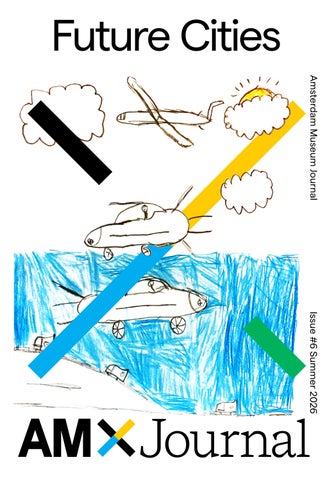
Future Cities
Amsterdam Museum Journal
Issue #6 Summer 2026
Journal
Table of Contents About AMJournal
4
Children's interventions
6
Editors' note — Frances Gene-Rowe, René Boer & Emma van Bijnen 6 The Short Essays The Pragmatic University
10 12
Martin van Pul & Anya Naumova
Imagining beyond Visions
36
Auto Ex-Machina
52
Carmen Armenteros Puchades & Lucia Concetta Vincelli
Hopes, Dreams and Wishes (2021) 72 Rosanne van Ballegooijen
The Long Essays Imagining Hong Kong Through Sci-Fi
88 90
Amsterdam Museum Journal
Job Oberman & Rianne Janssen
Ming-yan Carissa Ma
Late Qing Utopian Cities
112
Xia Zijian (夏子健)
Speculative Architectures of Privilege
134
Jagoda Tyczyńska
Vanishing Points: Control and Surveillance
158
K. Yoland
and Etsa Cortez Osorio
188
Issue #6 Summer 2026
The Visual Essay (Re)thinking Quito Léa Lamotte, Carolina Enriquez, Vanesa Guerrero, Yolanda Doicela
The Polyphonic Object
226
Maria Mazzanti, Amy Brookes & Tom van der Molen
The Polylogue
238
Francis Gene-Rowe, René Boer, Angela YT Chan & Selçuk Balamir
254
Editorial Board
258
Special Thanks
259
For More on…
260
Upcoming Editions
262
Amsterdam Museum Journal
About the Contributors
Issue #6 Summer 2026
About AMJournal Amsterdam Museum Journal (AMJournal) is a (diamond) open access, peer reviewed research journal that is published twice per year on the Amsterdam Museum website (AMJournal | Amsterdam Museum). As the city museum of the eclectic capital of the Netherlands, the art and objects we show, the stories we host, and the societal issues that occupy us are complex by nature. This complexity requires a polyphonic approach; not one field or research can, or indeed should, tell the whole story. As such, rather than disciplinary, AMJournal is thematically oriented. Each calendar year, we publish editions that center on themes relevant to the cultural domain, public discourse and urban spaces, such as War, Conflict and the City (edition 1; October 2023), Deconstructing Gentrification (edition 2; Summer 2024), (Re)production (edition 3; Winter 2024), Co-creating our Cities (edition 4; Summer 2025), Women and Cities (edition 5; Winter 2025), Future Cities (edition 5; Summer 2026 – current edition). Whilst AMJournal strictly publishes contributions that meet its high standards, the aim is to make research publications accessible for both readers and authors. AMJournal therefore publishes peer reviewed contributions by scholars in all stages of their research careers, from outstanding master students to the most lauded full professor (and anyone in between). In addition, we publish essays and research papers by authors from all disciplines, from legal scholars to sociologists and from historians to economists. By centering on a theme rather than a discipline, complex issues are approached from various angles; demonstrating that it is through a polyphony of perspectives that we advance academic discourses. In short, multidisciplinary research is not merely encouraged, it is at
the core of the Amsterdam Museum Journal. To support scientific multivocality and offer a platform for various disciplines, AMJournal is modular, meaning each edition may include a combination of the following contribution types: 1. The Short Essays: short form texts in which authors succinctly defend topical thesis statements with proofs. 2. The Long Essays: long(er) texts in which authors defend topical thesis statements with proofs. 3. The Empirical Papers: qualitative and/or quantitative data analyses, or research papers. 4. The Dialogue: a conversation between the guest editor and another renowned scholar in their field on questions relevant to the edition theme. 5. The Polylogue: a thematic roundtable conversation with expert voices from various fields, from academic to artists, and from journalists to activists. 6. The Polyphonic Object: short complementary analyses by scholars from different disciplines of a single thematic object from the Amsterdam Museum collection. 7. The Visual Essay: a printed exhibition in which the analyses are based on images, which are then analyzed empirically and/ or by means of a theoretical framework. All contributions are published in English and written according to strict author guidelines with the broader academic- and expert community in mind. Each AMJournal edition and each separate contribution is freely downloadable and shareable as a PDF-file (amsterdammuseum.nl/journals). To further aid accessibility, for both authors and readers, AMJournal does not charge readers any subscription- or access fees, nor does it charge authors Article Processing Charges (APCs).
About AMJournal
AMJournal is governed by an internal board of editors, which is complemented by an extensive multidisciplinary external board of editors. For each thematic edition, a guest editor joins the internal board of editors to provide guidance. Internal Board of Editors Emma van Bijnen, Judith van Gent, Tom van der Molen, Vanessa Vroon-Najem, Norbert Middelkoop.
Irene Stengs; Eliza Steinbock; Colin Sterling; Sanjukta Sunderason; Kirsztina Varró; Rebecca Venema; Tim Verlaan; Janessa Vleghert; Jean Wagemans; Anna Weinreich; Daan Wesselman; Karen de Wild; Janina Wildfeuer; Lise Woensdregt; Rixt Woudstra; meLê yamomo; Mia You; Marielle Zill; Emilio Zucchetti. DOI: doi.org/10.61299/WDknw18091810IDN26 ISSN (digital): 3050-9467 ISSN (print): 3050-8665
Amsterdam Museum Journal Issue #6 Summer 2026
External Board of Editors Pablo Ampuero Ruiz; Rowan Arundel; Sruti Bala; Markus Balkenhol; Ellinoor Bergvelt; Sophie Berrebi; Stephan Besser; Carolyn Birdsall; Cristobal Bonelli; Pepijn Brandon; Benedetta Bronzini; René Boer; Petra Brouwer; Fabiola Camuti; Thorsten Carstensen; Cyril Thjaja; Chiara de Cesari; Debbie Cole; Leonie Cornips; Annet Dekker; Christine Delhaye; Brian Doornenbal; Menno Dudok Heel; David Duindam; Jorge Duran Solorzano; Karwan Fatah-Black; Maaike Feitsma; Mark Fenemore; Francis GeneRowe; Gaston Franssen; Florian Göttke; Maartje van Gelder; Wouter van Gent; Marike Geurts; Javier Gimeno Martinez; Sara Greco; Suzette van Haaren; Laura van Hasselt; GL Hernandez; Danielle van den Heuvel; Hilde Heynen; Pim Huijnen; Katy Hull; Julian Isenia; Steve Oswald; Paul Knevel; Linda Kopitz; Gregor Langfeld; Mia Lerm-Hayes; Geertje Mak; Virginie Mamadouh; Michiel van Meeteren; Miguel Mira; Anna Nikolaeva; Julia Noordegraaf; Suleiman Osman; Asli Özgen; Marrigje Paijmans; Manon Parry; Esther Peeren; Shialoh Phillips; Bob Pierik; Fenne Pinkster; Gertjan Plets; Pieter du Plessis; Menno Reijven; Jan Rock; Noa Roei; Bert van de Roemer; Aafje de Roest; Margriet Schavemaker; Dorine Schellens; Michael Scherer-Rath; Britta Schilling; Natalie Scholz; Steven Schouten; Gabriel Schwake; Dimitris Serafis; Elpida Stratopoulou; Fenna Smits; Tamara Soukotta; Isabella Steenbergen;
5
Children's interventions The Right to Imagine: Children's Affective Vision of Future Cities by Sanne T. Seidel What can a city become when imagined by those who will inhabit it the longest? These children´s drawings of Future Cities are imaginative, artistic acts through which the children participate in envisioning alternative forms of collective life. They offer a perspective that contrasts with dominant ways of envisioning urban futures, typically shaped by planners, policymakers, and technological industries, which often prioritize optimization and efficiency. Instead, these images assemble a visual vocabulary of care, belonging, coexistence with the natural world, and everyday relational life, suggesting the city as something to be carefully sustained. The drawings reveal how children use their visual expression to explore hopes, concerns, and desires about future urban life. Some drawings emphasize a warm welcome for migrants, whereas others address environmental degradation, housing availability or practices of sustainability, including new ways of recycling clothing. Recurring motifs such as playgrounds, bicycles, green spaces, recycling bins, schools, and shared environments, articulate an understanding of urban space as a form of collective life grounded in social and ecological relations. From an art educational perspective, the drawings invite reflection on the significance of artistic practice for children. Perkins (1994) argues that engagement with art can cultivate wonder by encouraging learners to question assumptions and imagine alternatives. Drawing, in this sense, becomes an exploratory practice through which possibilities are investigated. It offers children a space to express their imagination. Play is central to this process. Perspectives
from sociocultural theory recognize play as a meaningful mode of engagement through which children experiment with roles, relationships, and possible realities (Vygotsky, 1978). Imagination enables children to reorganize experience and explore how life might be otherwise. bell hooks (1994) framed imagination as integral to a practice of freedom through which alternative ways of living together can be envisioned. The drawings in Future Cities extend this playful experimentation into a visual form, creating temporary worlds in which ideas are proposed. The many depictions of playgrounds and sports parks literally signal the importance of play. Imaginative processes are inherently affective and embodied. Damasio and Yang (2007) argue that feeling and learning are fundamentally intertwined, shaping how individuals attend to and engage with the world. In this affective framework, the drawings reveal what the children value in their social and material environments, rather than being understood as merely neutral representations of urban space. The prominence of care, inclusion and environmental responsibility emerge as key orientations through which collective life is imagined. Colorful creatures, abstract landscapes and flying vehicles, show imaginative possibilities, whereas drawings of shops and schools are more grounded in everyday lived experience. The public articulation of children´s imagi native worlds can be linked to traditions of critical pedagogy. Paulo Freire (1970) understood education as developing the capacity to name and transform one's world, adding meaning to experiences and creating awareness through dialogue. These drawings make the children´s experiences visible and demonstrate how they perceive their social world. When they become part of a broader dialogue about collective futures, an exchange in reflection and action can take place. Biesta (2012) argues that education
Children's interventions
Biesta, Gert. Goed onderwijs en de cultuur van het meten. Boom Lemma, 2012. Freire, Paulo. Pedagogy of the oppressed, Continuum, 1970. hooks, bell. Teaching to transgress: Education as the practice of freedom, Routledge, 1994. Perkins, David. The Intelligent Eye: Learning to Think by Looking at Art. Los Angeles, CA: Getty Publications, 1994. Vygotsky, Lev. Mind in society: The development of higher psychological processes, Harvard University Press, 1978. Yang, Mary Helen. I., Damasio, Antonio. “We Feel, Therefore We Learn: The Relevance of Affective and Social Neuroscience to Education.” Mind, Brain, and Education 1, 1: 3-10, 2007: DOI 10.1111/j.1751228X.2007.00004.x
Issue #6 Summer 2026
Viewing these drawings as expressions of children´s inner worlds, invites recognition that imagining the future is inseparable from the conditions of the present. The possibilities children envision are shaped by adult responsibilities in sustaining more just, safe and sustainable societies. The significance of these works lies in what drawing and imagination make possible as practices of freedom. They affirm a right to imagine, a right for children to play, to speculate, to express concerns and desires, and to contribute to shared futures, the conditions of which must be actively negotiated in the present.
References
Amsterdam Museum Journal
should create opportunities for individuals to emerge as subjects capable of bringing something new into the world. Through this lens, the public presentation of these drawings creates a space in which children's experiences, concerns, and aspirations become part of wider conversations about urban futures.
7
Editors’ Note
8
Dear Readers, We are proud to present the sixth edition of the Amsterdam Museum Journal (AMJournal) ‘Future Cities’, which is dedicated to the elusive future of urban spaces, painted by countless possibilities, challenges and imaginaries. Not thinking about the future is a privilege when climate breakdown, genocidal warfare and runaway technology are already ravaging large parts of the world.
Issue #6 Summer 2026
From essays on spatial empathy to postcolonial utopianism, this edition challenges us to rethink how we may approach the ambiguous topic of ‘the future’. Besides the rich and relevant written contributions, this edition features a visual essay on rethinking the future of Quito, Ecuador and a round table conversation on what ‘collapse’ means, both for (non)humans and our lived environments. To further support students and independent researchers, for each edition AMJournal awards the Best Paper Prize to scholars without a research position. This edition’s Best Paper Prize was awarded to Armenteros Puchades and Concetta Vincelli
Amsterdam Museum Journal
Edition #6 of the AMJournal is a layered and multi disciplinary polyphony that features reflections and forecasts about the future of cities by contributors from various disciplines all over the world. As a result, this issue is a diverse and complex exploration of ‘the future’ that looks at the imagining of futures in the various arts as well as practical challenges and possibilities.
Editors' Note
9
for their essay ‘Auto Ex-Machina: Towards Post-car Imaginaries’.
Yours sincerely,
Amsterdam Museum Journal
We would like to thank our contributors and readership for their continued engagement with the AMJournal in general and more specifically this special issue. AMJournal is a growing platform and network of likeminded scholars, who understand the need to move beyond a single discipline or perspective when trying to deconstruct complex themes such as ‘the future’. Your involvement continues to inspire, and it is because of the continued collaboration between undogmatic researchers, which we are proud to platform, that we can move the critical discourse along (and outside) the beaten paths of the academic world.
René Boer Edition Guest Editor Francis Gene Rowe Edition Guest Editor Emma van Bijnen Editor-in-Chief Issue #6 Summer 2026
The Short Essays
10
Amsterdam Museum Journal
Issue #6 Summer 2026
Index
The Pragmatic University
11
12
Martin van Pul & Anya Naumova
Imagining beyond Visions
36
Job Oberman & Rianne Janssen
52
Carmen Armenteros Puchades & Lucia Concetta Vincelli
Hopes, Dreams and Wishes (2021)
72
Amsterdam Museum Journal
Auto Ex-Machina
Rosanne van Ballegooijen
Issue #6 Summer 2026
The Short Essays
12
The Pragmatic University
Amsterdam Museum Journal
Producing Inclusive Futures: Pedagogy, Governance, and the Pragmatist Reform of Higher Education
Authors Martin van Pul & Anya Naumova
Discipline Future Studies, Political Epistemology, Critical Pedagogy
Keywords
Doi doi.org/10.61299/In12nHonFrr78
Issue #6 Summer 2026
Epistemic Justice / Urban Futures / Higher Education Reform / Pragmatism
The Pragmatic University
13
Abstract
Amsterdam Museum Journal
Visions of the smart, sustainable, innovative, and resilient city are not neutral. They rest on a habit of treating expert measurement as real knowledge and experience as mere opinion. The result is thin inclusion: more people are consulted, but what counts as knowledge stays the same. Universities matter here because they produce both these visions and the standards for judging them. This essay offers pragmatism as an alternative, where knowledge grows from working out together what the consequences of an action mean. It follows three implications through teaching and governance: who counts as a knowledge producer, how learning happens by trying things and seeing what follows, and how what people feel counts as evidence. A speculative fiction of a governance assembly in an imagined Amsterdam program shows these ideas at work. A future is inclusive only while those who live with it can still change it.
Issue #6 Summer 2026
The Pragmatic University
Amsterdam Museum Journal Issue #6 Summer 2026
Future Imaginaries in Higher Education The future is often treated as something that follows the present; a horizon that never quite arrives. Yet futures also act on the present. Collectively held visions of desirable and attainable outcomes, what Jasanoff and Kim (2015) call future imaginaries, organize present trajectories toward some possibilities and away from others. When a city commits to “smart” infrastructure or “resilient” growth, it is not only describing a future it expects but actively organizing present budgets, partnerships, and skills around that vision. The future, in this sense, is not a distant horizon, but a governing force within contemporary practice (Beckert 2016; Haraway 2016). Dominant visions of future cities cluster around the “smart,” “sustainable,” “innovative,” and “resilient” city. They organize municipal agendas toward digital infrastructures, climate-oriented growth, and security-driven resilience (Jasanoff & Kim 2015; Vanolo 2014). These visions appear politically neutral and universally beneficial. Yet their neutrality is produced rather than given, sustained by an epistemic logic (Swyngedouw 2018): a tacit set of rules about what counts as valid knowledge of the future, who is authorized to produce it, and for whom. That technocratic logic treats expert measurement as the standard for serious knowledge, while experience is dismissed as softer, less reliable, mere opinion. It vests the authority to produce such knowledge in credentialled professionals and addresses it to the administrators and investors who need legible, comparable inputs (Porter 1995; Scott 1998). What this logic produces is a thin form of inclusion: more voices may be consulted, but the criteria by which their contributions count remain unchanged. Moving past thin inclusion requires a different account of who is entitled to interpret consequences and revise commitments. Inclusive futures, as we use the term, name that account. They are futures in which those who live with the consequences, the communities, places, and ecologies that bear them, retain that entitlement. The consequences at stake are not only material but also experiential and emotional, and they extend to non-human as well as human bearers (Fricker 2007; Haraway 2016; Santos 2014). A neighborhood whose residents are surveyed about a transport scheme but cannot contest how fatigue, displacement, or ecological strain is interpreted has been consulted, not included (Arnstein 1969). Inclusion in this sense is not a destination an institution arrives at but a continuous practice of remaining answerable to those it affects, human and otherwise. Universities sit at an unusual intersection in the production of urban future imaginaries.1 They produce these visions: through research that turns smart, sustainable, innovative, and resilient from political slogans into
14
The Pragmatic University
Amsterdam Museum Journal Issue #6 Summer 2026
measurable indicators and evidence-backed objectives; through curricula that train students to recognize these as the futures worth pursuing; and through partnerships that carry them into municipal planning, infrastructure procurement, and policy design (Facer 2011; Miller 2018). They also produce the epistemic standards by which such imaginaries are evaluated. What counts as a credible claim about the future, what kinds of evidence are required, which methods are recognized, is shaped through academic training before it is applied in any urban decision. A planner deciding whether resident testimony or modelled projections should drive a floodresilience plan is drawing on standards she did not invent; she absorbed them in graduate seminars years before (Bourdieu 1988; Santos 2014). This is what makes higher education a pivotal arena for inclusive futures: it is one of the few sites where imaginaries and the standards that legitimize them are produced in the same institutional motion. Reworking them requires an alternative epistemology adequate to the task. Pragmatism is one such tradition. It emerged in late-19th- and early-20th-century America as an alternative to philosophical accounts that grounded knowledge in correspondence to a fixed reality, and its commitments have since shaped experiential learning, critical pedagogy, action research, and democratic experimentalism. For pragmatists, knowledge is not a mirror of reality (Rorty 1979) but a tool for navigating problematic situations: situations in which habitual practice breaks down and people must inquire into what to do next (James 1948; Dewey 1938). Inquiry, on this view, begins not from theory but from such situations: knowledge is generated where institutional decisions produce effects on the people and places living with them, and where those affected interpret what those effects mean. Pragmatism's relevance for inclusive futures lies precisely here. The redistribution of interpretive standing is not added to inquiry afterwards; it is constitutive of how inquiry begins. Three implications follow, and structure the rest of the essay. First, sources: who counts as a knowledge producer cannot be settled in advance; communities, places, and ecologies must be recognized as participants in inquiry, not its objects. Second, practice: learning happens by trying things and seeing what follows, organized around identifying problems in realworld conditions rather than transmitting pre-specified content. Third, register: what people feel as a result of institutional action is part of what must be interpreted, making well-being a measure of whether inquiry is proceeding adequately. Pragmatist universities can contribute to inclusive urban futures by changing the conditions under which any vision of the future can be sustained, not by including more voices in an unchanged process.
15
The Pragmatic University
Issue #6 Summer 2026
Sources of Knowledge The dominant epistemic logic of the university assumes that legitimate knowledge originates within it: validated by its methods, credentialled by its institutions, and flowing outward to the communities it serves. Pragmatist pedagogy challenges this assumption directly, proposing instead a more distributed account: knowledge is co-produced by the full range of actors surrounding the university, including communities, places, and nature (Martin & Te Riele 2011; Lynch & Mannion 2021; Bleazby et al. 2023; Yemini, Engel & Ben Simon 2025). The first move is to take communities seriously as epistemic actors. Community members are not subjects of study or stakeholders to be consulted: they are holders of knowledge the university does not possess, knowledge produced through living with consequences rather than observing them from a distance. This means that communities surrounding the university can actively shape what is studied, how it is framed, and what counts as a meaningful outcome. Curriculum, in this view, is not delivered to a community but negotiated with it. The second move is to treat the place not as a backdrop to learning but as a site of inquiry in its own right. Every place carries histories of use
Amsterdam Museum Journal
Pragmatist Pedagogy The three implications named above (sources, practice, register) structure what follows. Each names a condition the conventional university tends to suppress, and each must be reworked if pedagogy is to ground knowledge in the consequences of practice rather than in pre-set indicators. Pragmatist pedagogy treats learning as irreducibly experiential: not as the transmission of abstract content from expert to student, but as collective reflection on the effects of practice (Biesta 1995; Dewey 1938; Elkjaer 2018; Taguchi 2011). Learners and educators engage shared problems, test provisional responses, and reflect together on the situations those responses create. This reorients the questions at the center of the curriculum. Rather than asking what students should know and be able to do upon graduation, a pragmatist pedagogy asks: what can be learned from those who live with the consequences of what is being studied? What problems are real and present in the places where learning occurs, and how should inquiry respond to them? And what does honest engagement cost us emotionally, and how do we attend to that cost? Together, these pull the institution away from the logic of the ivory tower and toward something closer to a community garden: rooted in local soil, shaped by seasons, sustained through shared labor and responsibility.
16
The Pragmatic University
Issue #6 Summer 2026
Practice: Knowledge Tested in Action Pragmatist knowledge is tested in use and rooted in real-world complexity rather than abstract exercises. The goal is not mastery of a fixed body of knowledge through passive observation, but to train responsiveness: the capacity to act, reflect, and adjust in relation to evolving conditions. Crucially, problem-solving is not the same as skills-based training. Pragmatist pedagogy teaches to first identify what the problem is, make it visible for analysis and then execute a solution with a mix of skills, creativity, and attention to the experiences of others. Lectures and seminars sit alongside outdoor workshops, group walks, and site-based explorations. Walking, wandering, and deep listening become legitimate research methods. The most generative starting point is often a real condition outside the university (an abandoned building, a contested public space, infrastructure under strain), where the first task is simply to identify what the problem is before any response is proposed.
Amsterdam Museum Journal
and neglect, relations of presence and exclusion, conditions that enable certain kinds of action and foreclose others. These are not merely illustrative resources that enrich curriculum; they can actively shape what can be known, by whom, and under what conditions. The third move is harder, but follows from the same logic. If communities and places are legitimate sources of knowledge because they bear and respond to consequences, then the same argument extends to the world of nature. For Dewey, experience is not a uniquely human possession but a relational process in which an organism and its environment continually adjust to each other (Dewey 1925), which means a forest, a river, or an urban ecosystem registers consequences in its own way, even if not in human language. More recent initiatives recognizing nature as a rights-bearing subject arrive at a similar conclusion from a different direction (Kauffman & Martin 2021): that environments are not passive recipients of human action but active respondents to it. To learn how responses of nature can be translated into terms that institutional inquiry can register requires methods, mediators, and forms of attention the university does not currently train its students to develop. In practice this might look like residents formulating research questions alongside academics rather than appearing as data sources, community members designing and teaching courses on consequences they understand better than any academic could, or place-based teaching centered on physical engagement with the more-than-human world: ecological restoration, environmental monitoring, or a student formally appointed to speak on behalf of nature.
17
The Pragmatic University
Issue #6 Summer 2026
Pragmatist Governance Educational practice does not float free of how the institution is run. Decisions about curriculum content, financing, hiring, partnerships, and how each is evaluated shape what kinds of pedagogy are possible at all. A pragmatist pedagogy that is not matched by a pragmatist governance will be absorbed by the institution it is meant to transform: experiential learning becomes a program, community engagement becomes a metric, and the underlying epistemic logic remains intact. The same epistemic shift we have proposed for pedagogy must therefore extend to the architecture of decision-making. The technocratic logic that shapes urban governance also operates within universities. Strategic priorities are set on the basis of national performance agreements, accreditation cycles, ranking positions, employability data, and labor market projections, while feedback from staff, students, and surrounding communities enters governance through surveys, evaluation forms, and performance indicators. Formal participatory bodies exist, but
Amsterdam Museum Journal
Register: The Emotional Dimension Finally, the learning process can stir and unsettle, particularly when students are asked to engage with communities and environments that are close to them and to sit with consequences that are not abstract but felt. If we take it seriously, the well-being of students and educators is a measure of whether pedagogy is working at all, and universities should offer a room for emotional distress and healing. This does not mean protecting students from difficulty. It means equipping them with the capacities to navigate what genuine engagement provokes, and building structures that can recognize and respond when the process becomes harmful. The emotional conditions that make this kind of learning possible also require deliberate design. At the outset of a course, students and educators can together establish shared conditions for working, including what to do when a topic becomes too close, too heavy, or too destabilizing to engage with productively. Short grounding practices at the start of a session, not as therapy but as a way of arriving present before entering difficult material, can become a regular part of the format. When a student or a group signals overload, this is treated not as an individual problem to be managed pastorally but as a collective signal that the program’s demands require examination and adjustment. This orientation extends beyond the curriculum itself: allied health training and accessible mental health services become not optional supplements but structural features of an institution that takes mental wellbeing seriously.
18
The Pragmatic University
Amsterdam Museum Journal Issue #6 Summer 2026
they typically hold advisory rather than binding authority. In the Dutch context this is structurally codified: under the Wet op het hoger onderwijs en wetenschappelijk onderzoek (1992), the Executive Board (College van Bestuur) carries primary responsibility for institutional direction, while accreditation through bodies like the NVAO consolidates a governance grammar in which legitimacy flows from documented compliance with externally defined standards rather than from ongoing relational deliberation with those affected (De Boer et al. 2007; Dougherty & Natow 2020). This is the architecture within which any pragmatist pedagogy would have to operate, and which would steadily reabsorb it. A pragmatist governance begins from the same premise as a pragmatist pedagogy: those who live with the consequences of institutional decisions are legitimate knowers. In the governance register, this means treating staff, students, surrounding communities, and surrounding nature not as stakeholders to be consulted but as parties with standing to interpret what the institution is doing and to what end. The current architecture already includes participatory bodies; the problem is that their interpretations are filtered through criteria of relevance set elsewhere. A staff council can describe rising care burdens, but those descriptions must compete for institutional attention with workload metrics that measure time but not strain. A neighborhood partner can describe what an outreach program has actually meant on the ground, but those interpretations are read against indicators designed to capture engagement in countable units. Governance as situated means redistributing not only voice but interpretive authority: the right to say what an experience means, on terms not pre-specified by the institution (Fricker 2007). Extending this redistribution to non-human bearers rests on a related but distinct claim. For Dewey, experience is a relational process in which an organism and its environment continually adjust to each other (Dewey 1925). A wetland, a tree-lined street, an urban ecosystem responds to its environment in ways that register as changes in state and behavior: soil that subsides, air that grows harder to breathe, a population of pollinators that thins. The international rights of nature movement (Den Outer 2026; Kauffman & Martin 2021) and the Dutch Zoöp model developed at Het Nieuwe Instituut are recent attempts to give such responses institutional standing, the latter through an appointed Speaker for the Living whose remit is to translate non-human interests into organizational decisions (Pedroso-Roussado 2025). Technocratic architecture detects non-human changes well enough through sensors and monitoring, but detection without standing reproduces the problem situated governance is meant
19
The Pragmatic University
Issue #6 Summer 2026
Fiction as Method What follows is a speculative fiction account of a single session of the Reflective Assembly, the governance forum at the center of a fictional Amsterdam Urban Development program. We draw here on the tradition of critical and speculative fiction in academic research in which invented situations serve not as predictions but as a way of rehearsing possibility (Coleman & Jungnickel 2024; Watson 2025). Pragmatism holds that knowledge grows out of situations as they unfold, not from the application of theory to stable cases; by staging consequences rather than deducing them, the narrative becomes part of the method (Tomin & Collis 2024). The Amsterdam Urban Development program is imagined as an integrated higher education initiative that dissolves the conventional separation between vocational, applied, and research tracks in the Dutch system, bringing together learners across age, background, and prior experience. The Reflective Assembly is its primary governance forum, where community members can propose experiments, participants collectively assess their consequences, and new practices emerge when existing ones
Amsterdam Museum Journal
to solve: the data is interpreted by the same actors, on the same terms, against the same priorities. What is needed is a role that holds authority to interpret what those changes mean and to halt commitments that exceed collectively agreed ecological limits. Standing without authority to revise commitments is incomplete. Under the prevailing logic, evaluation is periodic: a cycle audit, a five-year review, an annual report. Interpretations gathered between cycles accumulate as input but rarely as cause for change, and by the time review arrives, the conditions that prompted the interpretation have often shifted or been absorbed. Pragmatist governance treats decisions as provisional commitments, examined as their consequences emerge and revised accordingly (Dewey 1938). The implication is structural rather than procedural: there is no separate decision process to which interpretations are submitted as data. The consequences arising in classrooms, partnerships, and everyday encounters are themselves the substance from which institutional commitments are continually reformulated. A complaint from a staff council about workload is not a data point for the next review but a candidate revision of the workload commitment itself; an ecological signal from a campus wetland is not an environmental indicator but a possible reason to alter a development plan already in motion. This dissolves the conventional separation between practice and governance, and gives the standing claim its institutional bite.
20
The Pragmatic University
21
Circle
Focus
Practice
Purpose
Body
Physical, emotional, creative capacities.
Movement, philosophy, meditation, theatre, craft.
Cultivate attentiveness and embodied awareness.
Home
Domestic and material competencies.
Repair, wood and metal work, gardening, food preservation, low-energy cooking.
Strengthen everyday capacities and reduce dependence on centralized systems.
Neighborhood
Local ecosystems, infrastructure, and social relations.
Urban engineering, ecological study, social work, community-based inquiry.
Understand how resources circulate and how neighborhoods are sustained by care as much as by technical systems.
Amsterdam Museum Journal
prove inadequate. The session that follows produces one such proposal middeliberation. Pedagogy and governance are not separate in this institution; they are two registers of the same inquiry. The Assembly is structured by two standing practices. Those Most Affected are participants whose accounts of a curricular decision have flagged the sharpest consequences; their endorsement is required before any revision passes, operationalizing the redistribution of interpretive authority. The Speaker for the Living is a standing role held by an ecologically literate participant who can halt proposals that exceed collectively agreed ecological limits, extending interpretive authority to non-human bearers. The session turns on a curricular reform, the Circles, which restructure learning around three overlapping domains, Body, Home, and Neighborhood, summarized in Table 1. The Circles are a hypothesis being tested through their consequences.
Table 1. The three Circles: focus, practice, and purpose.
Issue #6 Summer 2026
The Pragmatic University
22
The Reflective Assembly Circles
Amsterdam Museum Journal
Figure 1. Hannah’s notebook with notes from the previous Assembly, 2026. Photograph by: Anya Naumova
Issue #6 Summer 2026
On the tram that morning, Hannah had reread her notes about the experiment they had approved at the previous Assembly. She remembered the longer discussion that had produced these notes. Body, Home, Neighborhood. The participants at the previous assembly had insisted the three belonged together. Amsterdam’s housing crisis would not be a case study but a structuring reality. Water governance would not be history alone but a living inheritance. Field-based seminars would replace some lectures. Social work would sit alongside engineering. Credits would matter less than contribution. On paper, it looked coherent. Almost modest. But what looked modest on paper had required months of negotiations. The Circles did not fit neatly into existing course codes. They blurred the line between classroom, workshop, and neighborhood projects. She folded the pages back into her bag before entering Ru Paré.
The Pragmatic University
23
Ru Paré
Amsterdam Museum Journal
Figure 2. Ru Paré’s building, 2026. Photograph by: Anya Naumova
Today’s meeting was organized in one of the larger rooms on the first floor. A long wooden table stood in the center. Chairs and floor cushions were scattered loosely around it, arranged and rearranged as people arrived. For every meeting, participants were invited to bring an artefact symbolizing an experience, a thought, a wish, which they wanted to put
Issue #6 Summer 2026
The temperature in the room was colder than comfortable. A heating system the students had designed never quite warmed the building evenly. The radiators clicked on and off, part of a setup that had been put in place in a hurry. The Assembly gathered in Amsterdam-West’s Ru Paré, a former school building with lofty classroom windows and wide staircases polished by decades of foot traffic. It was a common public area rather than an academic campus, hosting mutual-aid meetings, language collectives, legal consultation hours, and sewing workshops.
The Pragmatic University
Amsterdam Museum Journal
“What problems are real and present in the places where learning occurs, and how should inquiry respond to them?”
24
Issue #6 Summer 2026
The Pragmatic University
25
Amsterdam Museum Journal
Figure 3. Ru Paré’s garden and outside area, 2026. Photograph by: Anya Naumova
up for public discussion. This morning the table gradually filled with a jar of canal water collected after heavy rainfall, a small branch from a tree in Rembrandt Park, a ball of thread dyed in the Body circle’s craft class, a USB stick containing interviews recorded with residents, and a battery.
Issue #6 Summer 2026
Attendees Learners from all three circles, educators, neighborhood partners, and anyone else who had provided feedback on the current experiment were all invited to the Assembly. Some had attended every Assembly; others had never spoken in the room before. On the far wall sat Mira, the Assembly’s Speaker for the Living. Soil traced the cuffs of her jacket; dried mud lined the hem of her trousers. A field biologist before taking on the role, she was more accustomed to wetlands and sampling grids than deliberative circles. Her role was to attend to what could not speak for itself: soil, trees, the air drifting through the open window. No decision moved forward without her acknowledgement.
The Pragmatic University
Issue #6 Summer 2026
Those Most Affected She glanced briefly toward the six members of Those Most Affected and slowly scanned the room, putting faces to the reflections she read. The exhaustion of juggling the Home workshops with paid shifts. The tension in a Neighborhood partnership that felt more extractive than reciprocal. The Body circle reopening memories someone was not ready to hold. They were those who, in their written reflections, had described the highest levels of disruption or unintended costs resulting from the Circles experiment. In the pre-assembly vote, these accounts had been tagged as the most severe. Those Most Affected must recognize themselves in the adjustments. As part of the Assembly’s practice, no revision could pass without their endorsement. The category had emerged the previous spring, after an experiment with public progress reports. Two participants had warned the format risked exposing unfinished work punitively; their concerns were folded into a broader summary about transparency. Within weeks, educators described the sessions as humiliating. The Assembly spent an evening retracing how openness had turned into exposure. After that, they changed their practice. Anyone who felt the weight of a proposal most sharply could request to sit among Those Most Affected. The aim was not to rank suffering, but to ensure that the sharpest edge of a decision was visible before it hardened into structure. “I highlighted some of the different perspectives in this summary which I would like you all to read before we discuss. After you’re done reading, take a couple of minutes to write down your reactions. Just like last time, we will go round to give everyone an opportunity to share their thoughts.”
Amsterdam Museum Journal
With a stack of printed papers resting on her palm and her gaze sweeping the crowded room, Hannah rose slowly. She had strong feelings about the Circles, but her role required her to hold them lightly. Unlike the advisory councils common in universities, the Assembly did not simply offer recommendations. Its conclusions directly shaped the program’s structure. Facilitating these meetings required a different kind of attention than in other working groups, less urgency, more attention; fewer corrections, more care. “Thank you all for being here and for providing your written reflections over the past week,” Hannah softly began, slightly lifting the stack. “From the conversations we had and the letters you wrote I got the feeling that the Circles are working as we had hoped. Maybe even better. But there are also consequences we did not anticipate, and we gathered today to think about our response to them.”
26
The Pragmatic University
Issue #6 Summer 2026
Invisible Labor Benjamin leaned back, one ankle over his knee, in a posture carved from worksite breaks rather than seminar rooms. He smiled easily, but the smile did not fully disguise the fatigue around his eyes. “Thank you, Hannah. My name is Benjamin. I recently got involved with your Urban Development program. I have worked for twelve years as an electrician for the municipality…” He paused, then said: “There was a girl, second week, who watched me tape a junction and asked why we ran the cable around the willow root rather than through it. I’d never been asked. I’d just always done it. We spent an afternoon mapping which trees the grid had to bend around. That’s the kind of thing this was supposed to be.” His voice flattened. “But for every one of those, there were five who didn’t show, and I was the one calling them. It was very draining.” The battery on the table seemed suddenly less symbolic. “What was originally intended to be a community-oriented form of learning forced me to drag a bunch of kids along by the hand. I wasn’t trained for
Amsterdam Museum Journal
She passed half of the stack of printed copies of the handwritten report to her left and the other half to her right. The room quieted as people focused on the sheets in front of them. When the reading was done, no one spoke. The heating clicked on, then off again. Mira glanced at her notes, then gave a small nod. As the first people began reaching for pens and post-its, Hannah looked over at the six members of Those Most Affected one by one. She gave a small nod to one of them and Benjamin responded with a half shrug and raised brow. When the last person put down their pen, Hannah walked to the whiteboard beside the ecological panel and uncapped a marker. Two columns. On the left, she wrote: Unintended Consequences. On the right: Benefits Experienced. She faced the room. “Let’s visualize this before we jump to solutions. Are there any consequences that people want to highlight or add? And remember, for this Assembly to work as intended, we listen to understand rather than to respond. Those Most Affected will summaries before we move toward revision.” One of the first-years leaned forward. “Should we start with the satisfaction scores from the mid-term survey? They’ll tell us where the strain is.” Hannah let the question sit before answering. “The scores will tell us how many. They won’t tell us where the weight has landed, or on whom. We need both, but not in that order.” The student nodded slowly and sat back.
27
The Pragmatic University
28
this. I understand this was an experiment, but I think we should seriously reconsider how to reorganize the course so that the community doesn’t end up paying for something that sounds good on paper.” The heating clicked off again. Mira remained still, listening, her pen resting against the page. Lauren, a retired librarian who now splits her time between the community garden and afternoon childcare, nodded slowly.
Amsterdam Museum Journal Issue #6 Summer 2026
Emergence “What do you think a redesign would require?” Lauren asked softly. Amira, a second-year student, pushed her chair back before speaking. She hesitated just long enough to gather the room’s attention. “I think we’ve made a mistake,” she began. “We keep saying students are learning by doing. But in practice, they arrive as beginners in projects that cannot afford beginners.” Amira continued, more deliberately now. “What if no one joins a community project until they demonstrate that they can actually contribute? Not on paper. For real.” “We design a readiness check,” Amira said, stepping closer to the board. “Before entering the energy module, students demonstrate basic technical literacy, reliability, and task ownership. Not through an exam. Through peer and community certification.” “Certification?” someone echoed. “We might need to look for a better word…” Benjamin looked across the table. “You mean I wouldn’t get a group of six people who disappear after week two?” “Exactly,” Amira replied. “If they can’t commit yet, they stay in preparation labs. They practice. They shadow. They don’t enter the field.” She tapped the board lightly beside the new heading, as if fixing the proposal within the Assembly’s shared practice. One of the Body Circle facilitators raised their hand. “Doesn’t that just shut people out? The Circles were designed to lower thresholds, not raise them. What happens to the ones who aren’t ready yet? Do they fall behind?” Before Amira could respond, Mira lifted her hand. Hannah turned toward her. “I want to pause us for a moment,” Mira said quietly. “As we speak about increasing preparation and field presence, I hear an assumption that more time on site automatically strengthens contribution. That might be true for people.” She rested her pen against the page. “But environmentally, it may also increase strain.” A few people shifted in their seats. “The temporary grid installation is already under pressure. If redesign means more movement, more testing, more material adjustments, we need to consider what that does to air quality and soil disturbance in the coming weeks.”
The Pragmatic University
Issue #6 Summer 2026
Experimentation “Let’s structure this as a trial,” Hannah said at last, uncapping the marker. She hesitated a fraction longer than usual before writing, aware of the direction she herself would have preferred. She wrote at the top of a new sheet: Readiness Check. Those Most Affected leaned closer together as she spoke, chairs drawing inward in a quiet circle of their own. “Let’s try two approaches side by side,” Lauren suggested. “In one Circle, open entry continues. In another, readiness confirmation is required.” Hannah nodded. “We begin by paying attention to three things: the strain carried by community partners, how students develop before and after entering projects, and the quality of the work itself. If those turn out to be the wrong lenses, we revise them.” “Students can reflect on their skills before and after entry,” Amira added. “It may make them more confident once they enter.” Benjamin allowed a small smile. “Then we all benefit.” The heating pulsed back on briefly. Hannah faced the circle again. “If anyone objects to running this trial, please raise a hand.” A pause followed. Someone shifted as if considering it. No hand rose. Mira remained seated, hands folded loosely over her notebook.
Amsterdam Museum Journal
Lauren had been quiet for a while. Her eyes were on the window, not on the board. “If we change this,” she said, “we change who this program produces five years from now.” She was not speaking only about graduates. The electricians, planners, and facilitators who passed through this room would later sit in municipal offices and decide how streets were rewired and parks maintained. Mira looked up from her notebook. “The soil disturbance readings from the installation site peak mid-week,” she said. “The same days the students report the highest stress in their reflections. I don’t know what to make of that yet. But I’d want to look at it before we assume it’s unrelated.” “Then any redesign must include ecological limits alongside social ones,” Lauren added, leaning forward, palms flat on her knees. Hannah nodded slowly. “Agreed. No increase in field activity without prior ecological assessment and a cap on hours at the installation site.” “Preparation labs remain off-site unless explicitly cleared,” Amira said after a brief hesitation. The room settled around the proposal. Hannah looked toward Mira. “Is that sufficient for now?” Mira held the silence a moment longer. Her fingers rested lightly on the edge of the notebook, as if weighing whether what she had written there justified interruption. “For now.”
29
The Pragmatic University
Issue #6 Summer 2026
Conclusion This essay has argued that urban futures are not merely planned but epistemically produced, and that universities, as sites where knowledge is legitimized, bear a particular responsibility for whose experience counts in that production. The dominant logic privileges what is quantifiable over what is experienced, and trains practitioners to reproduce that distinction in the institutions they later inhabit. We proposed pragmatist epistemology as an alternative grounded in the collective interpretation of consequences, and developed its implications across pedagogy and governance. The argument is not that universities should include more voices on existing terms. It is that they should change the terms on which any vision of the future can be sustained.
Amsterdam Museum Journal
“Then we begin next Monday,” Hannah said. “Those who want to refine the details meet tomorrow at fifteen.” The battery remained on the table. It was not removed, nor resolved, but it was no longer left unnamed. As people began gathering their things, Mira remained seated. “Can I say one more thing?” The room resettled. “We’ve decided to slow the pace of field entry and cap the hours on site. That’s good. But I want to name something we haven’t resolved.” She turned a page in her notebook. “We’ve been talking about the site all morning as if it’s just a limit on what we can do. I think it might also be a collaborator. The changes we’re seeing in the soil, the air quality shifts, the way the embankment is responding to the grid, these aren’t just measures of our impact. They’re part of what the students are learning out there. I don’t think we’ve found a way yet to let that into the curriculum.” A few people paused at the door. Hannah added a line to the board beneath the session’s decisions: The site as collaborator… return to this. The note remained on the board as the room slowly emptied. The temporary energy installation down the street would still be running in the morning, drawing its uneven load from the neighborhood grid. Next week the students would return to it, some prepared differently; some not yet allowed to enter. The Assembly would meet again to see what had changed. Whether the redesign had reduced the burden, whether the soil readings had shifted, whether the new sequence of preparation and contribution had altered how people worked together. The Circles had never promised certainty. Their purpose was simpler: to make sure that the streets rewired, the embankments maintained, and the housing retrofitted across Amsterdam-West would carry forward not a settled vision of the future, but the practice of remaining answerable to those who lived with it.
30
The Pragmatic University
Amsterdam Museum Journal
“Curriculum, in this view, is not delivered to a community but negotiated with it.”
31
Issue #6 Summer 2026
The Pragmatic University
32
Amsterdam Museum Journal
Figure 5. Streets of Amsterdam-West, 2026. Photograph by: Anya Naumova
Issue #6 Summer 2026
The fiction made visible what the theoretical argument could only assert: that pragmatist institutions do not simply process information more inclusively but treat emotional response, embodied strain, and relational friction as forms of knowledge in their own right. Benjamin’s frustration with the energy module was not an obstacle to institutional functioning. It was where genuine inquiry began. His complaint surfaced a structural transfer of invisible labor that no survey would have captured. The Assembly treated it as knowledge to be interpreted rather than noise to be managed. What this dissolves is the conventional separation between learning and deciding. In the Assembly, every pedagogical moment is also governance, because the knowledge produced through shared inquiry directly reshapes the program’s structure. The redistribution at stake is not from silence to voice, but from “we heard you” to “you determine whether we understood.” This answerability is what makes the futures the institution helps produce more inclusive. Under the dominant logic, an imaginary becomes authoritative when it is endorsed by the right institutions, validated against the right indicators, and aligned with the right strategic horizons; its inclusiveness is
The Pragmatic University
Amsterdam Museum Journal
then measured by who has been consulted in its formulation. A pragmatist university operates on a different standard. An imaginary becomes authoritative only as long as it remains revisable in light of its consequences, and inclusiveness is measured not by the breadth of consultation but by whether those who live with the imaginary’s effects retain the standing to revise it. A future is inclusive, in this sense, to the extent that those who live with it retain the interpretive authority to say what it means. This is a more demanding standard than participatory or deliberative inclusion. It is also continuous rather than completed at any one moment of consultation or design. We do not pretend this shift is simple to institutionalize. Pragmatist deliberation is slow, labor-intensive, and structurally at odds with quality assurance regimes that assume knowledge can be pre-specified. The fiction is honest about this: Benjamin’s exhaustion is partly caused by the program’s own ambitions. Whether such ongoing reflection becomes productive or exhausting depends on conditions the Assembly alone cannot secure: adequate funding, institutional patience, and a willingness to tolerate uncertainty as rigor rather than failure. To stay in line with both pragmatism and speculative fiction, we resist closing with a settled conclusion. The Reflective Assembly is not a model to be adopted but a speculative prototype, an exercise in institutional imagination whose value lies in the questions it opens rather than the answers it provides. We invite readers to interpret its consequences, challenge its assumptions, and consider what it would mean for their own institutions to take seriously the claim that the future should not be decided in advance, but discovered through the consequences of what is tried together.
33
Issue #6 Summer 2026
The Pragmatic University
References
Issue #6 Summer 2026
org/10.1093/acprof:oso/9780198237907.001.0001. Haraway, Donna J. Staying with the Trouble: Making Kin in the Chthulucene. Duke University Press, 2016. James, William. Essays in Pragmatism. Edited by Alburey Castell. Hafner Pub. Co., 1948. Jasanoff, Sheila, and Sang-Hyun Kim, Dreamscapes of Modernity: Sociotechnical Imaginaries and the Fabrication of Power. University of Chicago Press, 2015. Doi.org/10.7208/ chicago/9780226276663.001.0001. Kauffman, Craig M., and Pamela L. Martin. The Politics of Rights of Nature: Strategies for Building a More Sustainable Future. MIT Press, 2021. Doi.org/10.7551/ mitpress/13855.001.0001. Lynch, Jonathan, and Greg Mannion. “Place-Responsive Pedagogies in the Anthropocene: Attuning with the More-Than-Human.” Environmental Education Research, vol. 27, no. 6, 2021, pp. 864–878. Doi.org/10 .1080/13504622.2020.1867710. Martin, Gregory, and Kitty Te Riele. "A Place-Based Critical Pedagogy in Turbulent Times: Restoring Hope for Alternative Futures." In Critical Pedagogy in the Twenty-First Century: A New Generation of Scholars, edited by C. Stephenson-Malott and B. J. Porfilio. Information Age Publishing, 2011. Miller, Riel, ed. Transforming the Future: Anticipation in the 21st Century. Routledge, 2018. Pedroso-Roussado, Cristiano, et al. "Zoöp Futures: Towards an Organisational Framework for Ecological Cooperation between Humans and More-ThanHumans." Futures, vol. 169, 2025, p. 103584. Porter, Theodore M. Trust in Numbers: The Pursuit of Objectivity in Science and Public Life. Princeton University Press, 1995. jstor.org/stable/j.ctt7sp8x. Rorty, Richard. Philosophy and the Mirror of Nature. Princeton University Press, 1979. Santos, Boaventura de Sousa. Epistemologies of the South: Justice Against Epistemicide. Routledge, 2014. Doi. org/10.4324/9781315634876. Scott, James C. Seeing Like a State: How Certain Schemes to Improve the Human Condition Have Failed. Yale University Press, 1998. Doi.org/10.2307/j.ctvxkn7ds. Swyngedouw, Erik. Promises of the Political: Insurgent Cities in a Post-Political Environment. MIT Press, 2018. Doi.org/10.7551/mitpress/10668.001.0001. Taguchi, Naoko. “Teaching Pragmatics: Trends and Issues.” Annual Review of Applied Linguistics, vol. 31, 2011, pp. 289–310. Doi.org/10.1017/ S0267190511000018. Tomin, Brittany, and Ryan B. Collis. “Science Fiction, Speculative Pedagogy, and Critical Hope: Counternarratives for/of the Future.” In Reimagining Science Education in the Anthropocene, Volume 2,
Amsterdam Museum Journal
Arnstein, Sherry R. “A Ladder of Citizen Participation.” Journal of the American Institute of Planners, vol. 35, no. 4, 1969, pp. 216–224. Doi. org/10.1080/01944366908977225. Beckert, Jens. Imagined Futures: Fictional Expectations and Capitalist Dynamics. Harvard University Press, 2016. Biesta, Gert. “Pragmatism as a Pedagogy of Communicative Action.” In The New Scholarship on Dewey, edited by Jim Garrison. Springer Netherlands, 1995, pp. 105–122. doi.org/10.1007/978-94-0110071-7_9. Bleazby, Jennifer, et al. “Responding to Climate Change ‘Controversy’ in Schools: Philosophy for Children, Place-Responsive Pedagogies & Critical Indigenous Pedagogy.” Educational Philosophy and Theory, vol. 55, no. 10, 2023, pp. 1096–1108. Doi.org/10.1080/001 31857.2022.2132933. Bourdieu, Pierre. Homo Academicus. Stanford University Press, 1988. Coleman, Rebecca, and Kat Jungnickel. “Introduction to Creating Feminist Futures: Research Methodologies for New Times.” Australian Feminist Studies, vol. 38, no. 115–116, 2024, pp. 1–13. Doi.org/10.1080/081646 49.2024.2373931. De Boer, Harry, Jürgen Enders, and Uwe Schimank. “On the Way towards New Public Management? The Governance of University Systems in England, the Netherlands, Austria, and Germany.” In New Forms of Governance in Research Organizations, edited by Dorothea Jansen. Springer Netherlands, 2007. doi. org/10.1007/978-1-4020-5831-8_5. Den Outer, Jessica. The Forest Fights Back: A Global Movement for the Rights of Nature. Pluto Press, 2026. Doi.org/10.2307/jj.33676834. Dewey, John. Experience and Nature. Open Court, 1925. Dewey, John. Experience and Education. Taylor & Francis, 1938. Dougherty, Kevin J., and Rebecca S. Natow. “Performance-Based Funding for Higher Education: How Well Does Neoliberal Theory Capture Neoliberal Practice?” Higher Education, vol. 80, no. 3, 2020, pp. 457–478. doi.org/10.1007/s10734-019-00491-4. Elkjaer, Bente. "Pragmatism: Learning as Creative Imagination." In Contemporary Theories of Learning, edited by Knud Illeris. Routledge, 2018, pp. 66–82. Facer, Keri. Learning Futures: Education, Technology and Social Change. Routledge, 2011. Doi. org/10.4324/9780203817308. Fricker, Miranda. Epistemic Injustice: Power and the Ethics of Knowing. Oxford University Press, 2007. doi.
34
The Pragmatic University
End Notes 1. When we use the term university here, we mean this broadly: not the research university alone, but higher education across its full range (in the Dutch context, MBO, HBO, and WO alike), because each level trains people who will act on urban environments, and expanding who can produce more inclusive visions of the future.
Amsterdam Museum Journal
edited by Sara Tolbert, Maria F. G. Wallace, Marc Higgins, and Jesse Bazzul. Springer International Publishing, 2024. Vanolo, Alberto. “Smartmentality: The Smart City as Disciplinary Strategy.” Urban Studies, vol. 51, no. 5, 2014, pp. 883–898. Doi. org/10.1177/0042098013494427. Watson, Ash. “Researching Futures with Speculative Fiction.” Journal of Creative Research Methods, vol. 1, no. 1, 2025, pp. 55–71. Doi.org/10.1332/30502969Y2 025D000000005. Wet op het hoger onderwijs en wetenschappelijk onderzoek [Higher Education and Scientific Research Act]. Staatsblad, nr. 593, 1992. Yemini, Miri, Laura Engel, and Adi Ben Simon. “Place-Based Education – A Systematic Review of Literature.” Educational Review, vol. 77, no. 2, 2025, pp. 640–660. Doi.org/10.1080/00131911.2023.2177 260.
35
Issue #6 Summer 2026
The Short Essays
36
Imagining beyond Visions
Amsterdam Museum Journal
Imagining beyond Visions: Opening up the Omgevingsvisie Amsterdam 2050 for Transformative Futures
Authors Job Oberman & Rianne Janssen
Discipline Urban Planning
Keywords
Doi doi.org/10.61299/w80otOpAU36i8
Issue #6 Summer 2026
Imagination / Visions / Spatial Planning / Transformation / Omgevingsvisie
Imagining beyond Visions
37
Abstract
Amsterdam Museum Journal
Despite the promise of vision documents to make city planning more ambitious and future-oriented, current planning systems often lack the capacity for transformations towards more sustainable and just socio-spatial futures. In this essay, we examine the limits of visioning as a dominant practice in urban planning by looking at its underlying style of anticipation. Through an analysis of the vision document of the city of Amsterdam, Omgevingsvisie Amsterdam 2050, we illustrate that visioning relies on a closed style of anticipation. This style frames the future as a continuation of existing trends to be managed through consensus-building. Instead, we argue that visioning needs to be complemented with practices of imagining with an open style of anticipation, engaging with a plurality of futures through contestation, experimentation, and affective knowledge. This essay concludes by exploring what embracing imagination in city planning could look like, opening up potential futures for Amsterdam beyond the Omgevingsvisie.
Issue #6 Summer 2026
Imagining beyond Visions
Amsterdam Museum Journal Issue #6 Summer 2026
Introduction In 2021, the municipality of Amsterdam published its Omgevingsvisie Amsterdam 2050 [translation: Vision on Physical Space Amsterdam 2050, hereafter Omgevingsvisie]1, a document outlining the vision for the city’s future. The preamble of this document contains an explicit invitation to the people of Amsterdam to actively participate in shaping the city (15). As urban planning scholars and residents of Amsterdam, we gladly take up their invitation, which comes at a time when deep engagement with urban futures is urgently needed. While times of intersecting social, ecological, and political crises call for transformations to more sustainable and just socio-spatial systems, current city planning practice often maintains rather than challenges or transforms the status quo, especially when responding to crises that are non-linear, interdependent, and politically contested (Stead & Albrechts 2023). We explore this difficulty of generating transformative change in city planning by focusing on a dominant instrument in contemporary planning: the practice of visioning, particularly revolving around the production of vision documents such as the Omgevingsvisie. Visioning is the collective practice of creating normative statements about a desired future, which can subsequently orient different actors to work towards this shared vision (Kesar & Ache 2024). It was introduced in planning in the late 1980s and early 1990s as a way to make planning more ambitious and participatory, centering collective desires for the future rather than the predictions offered by tools such as model calculations, risk assessments, and trend analyses (Gaffikin & Sterrett 2006; Kesar & Ache 2024; Muiderman et al. 2020). However, whilst visioning has been successful in setting out a long-term strategy and connecting various people around a common goal, it struggles to enable futures that deviate from the present trajectories responsible for today’s polycrisis (Ache 2017; Kesar & Ache 2024). Building on Ben Anderson’s (2010) framework of anticipatory action, this essay argues that visioning lacks transformative potential because of its closed ‘style of anticipation’, locking in the future around existing path dependencies through the ontological and epistemological assumptions about the future underlying this practice. While a closed perspective on the future could be useful for different actors to collaborate on realizing a desired future, we propose that visioning needs to be complemented by practices of imagining with an open style of anticipation. As a process of “seeing, sensing, thinking, and dreaming” about a plurality of alternative possibilities (Yusoff & Gabrys 2011, 516), imagination may create opportunities for radically different futures (Moore & Milkoreit 2020).
38
Imagining beyond Visions
Issue #6 Summer 2026
Open and Closed Styles of Anticipation To understand why visioning is limited in creating pathways for radically sustainable and social future cities and why imagining might be a necessary complement, we turn to Anderson’s (2010) work on anticipatory action. Anderson (2010) provides a framework to unpack how different kinds of anticipatory actions, including city planning, relate to the future and what futures they make possible. He argues that anticipatory action is shaped by three components: styles, practices, and logics. Styles refer to the ontological and epistemological foundations of how someone relates to the future, the assemblage of “knowledge practices, forms of social action, and normative frameworks which underlie and help organize future imaginaries” (Groves 2017, 32). Different styles of anticipation may clash, for example when the technocratic style of a government body aiming to control the redevelopment of a piece of land meets the more affective and embodied relation to the future of residents (Groves 2017). From these styles follow certain practices to make the future tangible (Anderson 2010). Anderson discusses three practices, which he calls calculating, prefiguring, and imagining, the latter of which he sees as an umbrella category that also includes visioning. We, however, distinguish the practices of visioning and imagining to be able to analyze their different styles of anticipation. Lastly, Anderson (2010) explains that practices lead to concrete anticipatory actions, such as
Amsterdam Museum Journal
We illustrate the limits of visioning, as well as the possibilities for more generative imagination that can be found in its margins, through an analysis of the Omgevingsvisie. This vision document is created by the city of Amsterdam to meet the legal obligation for municipalities, provinces, and the national government to outline the aspirations for the use, development, management, protection, and conservation of the physical environment (Omgevingswet, Chapter 3). In 277 pages, the Omgevingsvisie discusses the challenges the city is facing, its vision for the future captured in five strategic pillars, and subsequent details of what this will entail, where this will apply, and how this development will be structured. Grounding our argument in an analysis of this vision document, we explore how city planning might better fulfil its mission to make better places (Healey 2017) if it embraced the potential of imagination to anticipate a plurality of futures open for negotiation, disagreement, and transformation. In what follows, we first theoretically distinguish the open and closed styles of anticipation. Thereafter, we discuss how these styles appear in the Omgevingsvisie and explore possibilities for imagination within and beyond this document.
39
Imagining beyond Visions
40
Visioning
Imagining
Logics
Preparing for the future
Transforming the future
Styles
Closed (linear future, extending past trajectories, reactive)
Open (seeking emergent alternative possibilities, generative)
Mainly predictive, rational knowledge
Including experiential and affective knowledge
Results-oriented
Process-oriented, focus on learning
Consensus-building
Contestation
Abstract language
“Concrete utopias”
Anticipatory actions
Table 1. Differences between visioning and imagining in terms of logics, styles, and actions.
Issue #6 Summer 2026
Practices
Amsterdam Museum Journal
planning decisions, which are justified through logics, such as precaution, preemption, or we may add, transformation. For Anderson, this framework helps to reflect on how we currently relate to the future and whether we might want to relate differently. While Anderson (2010) does not specifically connect certain practices to logics or styles of anticipation, we follow other scholars such as Muiderman et al. (2020) that do argue that the ontological and epistemological foundations of future orientations lead to particular practices and logics of anticipatory governance. Particularly, we argue that the practices of visioning and imagining in city planning lead to different logics of what action is needed because of their different underlying styles of anticipation. To be able to distinguish between the styles of visioning and imagining, we call these styles ‘closed’ and ‘open’. In a closed style of anticipation, which we will link to visioning, there is a clear image of what the future will be. This allows us to prepare for and to some extent modify these expected events. For example, the expectation is that sea levels will continue to rise, which requires measures to prepare for this event and to mitigate its consequences. An open style of anticipation, in contrast, relates to the future as a temporality that is by definition uncertain, unpredictable, and constantly unfolding. This style, which we will connect to imagining, assumes that the ‘best’ future is not already legible to institutions but will require “sustained engagement with changing urban realities” (Kesar & Ache 2024, 60). The main differences in the logics, styles and anticipatory actions between visioning and imagining are summarized in Table 1, which we will develop further in the remainder of this essay through an analysis of the Omgevingsvisie.
Imagining beyond Visions
Amsterdam Museum Journal Issue #6 Summer 2026
Visioning as Foreclosing Futures Having established the differences between open and closed styles of anticipation, we now turn to the practice of visioning in planning to understand how this practice is shaped by a closed style and what this means for planning better future cities. The term ‘visioning’ has gained popularity in many disciplines and fields since the 1990s, yet its meaning often remains vague and the term is applied to a variety of approaches (Van der Helm 2009). While visions appear as ideologies in politics or as aspirations in the field of personal development, the term is most prominently featured in business and organizational theory where it is used as a strategic tool (Van der Helm 2009). It is also in this context that Kesar & Ache define visioning in planning as the production of a normative “statement highlighting what is to be achieved in the future” aimed at “changing the attitude and behaviour of actors by taking up the role of a framework of orientation” (2024, 51). 2 As abstract and broad guidelines, visions captured in vision documents connect various actors involved in shaping spatial futures–from various city planning departments to developers, investors, politicians, and citizens–in coordinated and strategic efforts to work towards a shared goal (Gaffikin & Sterrett 2006). Such vision documents, including the Omgevingsvisie of Amsterdam, are often characterized by a closed style of anticipation. This style forecloses future possibilities by constricting the options that are considered. One way in which vision documents do so is by conceptualizing the future as a temporality that extends from current trends that mostly lie outside of one’s control. The Omgevingsvisie, for example, starts by looking back at the trends that have been noticeable over the last ten years. The expectation is that “Trends zetten door. (…) Het wordt steeds duidelijker wat de richting daarbij zal zijn. [translation: “Trends continue. (…) It becomes increasingly clear what their direction will be.” 42]. The vision is then positioned as a response to these external factors, particularly the expectation that the city will continue to grow in population. The increase in residents, visitors, and foreign capital creates the perception that the city government is increasingly “out of control” [translation: “grip verloren”] and that regaining such control would also provide opportunities that the city might benefit from (14). By framing these trends as external factors posing threats to the current ways of living, the future is not seen as a space of possibility but rather as a risk the city needs to manage and prepare for. Taking this reactive attitude as a starting point for visioning, there is a risk of locking in the future around these expected trends, making this style of anticipation ‘closed’. From this perspective, measures to radically
41
Imagining beyond Visions
Amsterdam Museum Journal Issue #6 Summer 2026
break from expected trends and existing policies are not considered. We see this logic of continuation in how the Omgevingsvisie builds on existing policy instead of setting out a new direction (17, 158). It also continues this policy into the future, as the five main strategic pillars outlined in the vision are meant to provide a framework for future development, as something to hold onto [translation: "houvast bieden"] and against which all new policies need to be tested. Thus, future action of the municipality becomes locked in around these frames with little room for experimentation outside these boundaries (Marquardt & Nasiritousi 2022). Another way in which future possibilities become foreclosed is through the language of consensus. Because the five strategic pillars of the vision have to encompass all of the municipalities’ policies, they need to act as abstract umbrella categories that all city departments can agree on and that are supported by other actors such as politicians, citizens, and developers. In the document, we can read that the vision must be “coherent”, providing a general course of action to 2050 (17). This framing of coherence obscures that blanket terms used in the vision such as ‘green’ or ‘inclusive’ hold multiple, often contested, meanings at once. These umbrella categories absorb and neutralize the variety of potentially conflicting agendas that are part of everyday planning practice and may obfuscate unequal power relationships (Kallis et al. 2009). As a result of this vision document, the future of Amsterdam is mainly anticipated as a turbulent temporality impacted by external threats that needs to be controlled and prepared for through visioning as a consensus-building and trajectory-setting practice. The Omgevingsvisie is not the only vision document with this style of anticipation, as a review of more than 30 vision documents across European cities found that these documents lack challenging and ambitious visions, and instead present manageable and consensual stories (Ache 2017). Importantly, this closed style of anticipation may at times be valuable to coordinate effective and rapid action in large organizations. Creating systemic change also requires many actors to work together towards a shared future. In current times, however, the need for fundamental transformations towards more sustainable and just cities implies that the future will take a shape that is still unknowable from within the current system (Osterweil et al. 2025). To acknowledge this uncertainty while still holding on to the agency to transform our living environments into the places we desire, we turn to imagining as a complementary practice with an open style of anticipation.
42
Imagining beyond Visions
Amsterdam Museum Journal Issue #6 Summer 2026
The Possibilities of Imagination Similar to ‘visioning’, imagining often lacks a clear definition and is used as a label for many different practices. We define imagination as a social, collective process of “seeing, sensing, thinking, and dreaming” (Yusoff & Gabrys 2011, 516) to understand the present and create a plurality of alternative possibilities (Moore & Milkoreit 2020). Compared to visioning, this definition contains several elements that express a more open style of anticipation. First, imagining is conceptualized as a constantly evolving process. In an open style of anticipation that sees the future as open-ended and uncertain, the future cannot be predicted or even imagined from the present, but we can engage in a process of constantly re-imagining and re-evaluating emerging possibilities. Practices of imagination are thus not primarily about producing useful end-results but about learning from the process (Stirling et al. 2023). Second, while vision documents present a consensus about what the future should be, imagination aims to keep imaginaries plural. Only when we have multiple imaginaries of the future can we have productive conversations about what we want and do not want (Benjamin 2024). An open style of anticipation therefore does not mean that we cannot engage with the future, or only formulate our wishes in abstract terms. Rather, we are encouraged to be specific, playing with ‘concrete utopias’ (Bloch 1954) that are not end-states but starting points that can be contested and adapted. Through contestation around a plurality of options, we can also make underlying power relations explicit and open to change (Eisenhauer 2023). Lastly, in such processes of learning and deliberating, practices of imagination draw not only on the rational and predictive knowledge used for visioning, but also embrace the epistemological value of experiences, dreams, and affects. We have illustrated that the Omgevingsvisie is predominantly based on a closed style of anticipation. Yet, it also offers glimpses of an open style, particularly through the participatory process that was part of the development of the vision and included practices of imagination (263-265). The municipality facilitated conversations about the future of Amsterdam with diverse participants, such as experts (by experience), entrepreneurs, school children, and advocacy clubs. During the ‘toekomstestafette’ [translation: ‘future relay’], professional storytellers translated the ideas of citizens about what they would need in the city of 2050 into 150 short stories. Furthermore, the city asked curators to organize discussion sessions within the municipality’s ‘Atelier van Verbeelding’ [translation: ‘Studio of Imagination’] and commissioned an exhibition in the public library. In these participatory practices,
43
Imagining beyond Visions
Amsterdam Museum Journal
“The future is not seen as a space of possibility but rather as a risk the city needs to manage and prepare for.”
44
Issue #6 Summer 2026
Imagining beyond Visions
Amsterdam Museum Journal Issue #6 Summer 2026
transformative ideas about the city’s future were discussed, including ideas of commoning and citizen’s assemblies (264). It seems that these practices encouraged a variety of people to explore and discuss multiple concrete futures beyond the constraints of past or present policies. However, the epistemological value of this process of imagination is not fully captured in the Omgevingsvisie. The co-creative activities are only briefly summarized at the end of the document and are not explicitly tied to the main text. This is very different from how trend analyses have been used to justify and frame many of the city’s choices throughout the text, creating the impression that this citizen participation was merely an add-on to already ‘designated imaginaries’ (Vainio 2021). Whereas the Omgevingsvisie notes that the conversations with different people of Amsterdam “generated a plurality of thoughts, ideas, and themes for the future of Amsterdam” (265), it continues to summarize the “rode draden” [translation: “main points”] (265) in consensual language that flattens the richness and diversity of the ideas. Thus, these practices of imagination seem to lose their transformative potential in a document informed by a closed style of anticipation. At other times, open and closed styles of anticipation seem to clash within the document, such as in one of the five strategic pillars called “samen stadmaken” [translation: “co-creating cities”] (58). On the one hand, the vision document argues that the municipality needs to set boundaries (“kaders stellen”, 58), and only within these boundaries is there space for initiatives of other stakeholders. This constricts the imagination to the predefined requirements set by the municipality, making it difficult to propose transformative ideas beyond these frames. On the other hand, however, the aim to co-create cities is connected to an open style of anticipation. Calling for “open design”, the Omgevingsvisie argues that the future needs space for organic development, shaped by the municipality and a broad range of societal partners (253-254). In this way, the city aims to be able to adapt to changing needs of residents in the future and to allow for the development of spontaneous and unpredictable activities (254). It is a way of developing cities that values co-creative experimentation and learning from what emerges in such spaces (58, 254). This process-oriented way of developing fosters continuous imagination beyond what can currently be envisioned to adapt to changing possibilities and needs, which fits an open perspective on futures. To summarize, the Omgevingsvisie is mostly structured according to a closed style of anticipation, noticeable in the reactive framing, consensual language, and the suggested need for clearly defined boundaries and pillars
45
Imagining beyond Visions
46
for long-term development. Yet, particularly in the pillar about co-creation, this style of anticipation is also implicitly contested when calling for open design. We end this essay by imagining ways forward for city planning through embracing the friction between different styles of anticipation.
Amsterdam Museum Journal Issue #6 Summer 2026
Imagining Possible Ways Forward If imagining offers a complementary practice of anticipation to visioning, how might spatial planning embrace this going forward? As imagination is unpredictable and open-ended, answering this question requires acceptance that there will be no definitive answers and that the possibilities might be constantly changing. Yet, the power of imagination also lies in seeking the possibilities of alternative futures in the present and building concrete utopias that can be constantly contested, developed, and adapted. We therefore challenge ourselves and you, the reader, to think about the question: What if cities were not only obliged to produce an Omgevingsvisie, but also an additional planning instrument dedicated to imagination: an Omgevingsverbeelding [translation: Imagination for Physical Space]? How can we conceive of a living set of future imaginaries as a public iterative imagination infrastructure, designed to keep futures open and contestable while still producing concrete possibilities? First of all, the imagined instrument of the Omgevingsverbeelding could advance the ambition of the Omgevingsvisie to become a "levend document” [translation: “living document”] (58). In fact, it would not even have to be a document but could take a flexible form. The Omgevingsverbeelding could be built from stories, scenarios, prototypes, conflicts, and reflections, as well as proposals for concrete utopias to experiment with ideas in the current urban fabric. It can include representations of the participatory process of imagination the city organizes, showcasing the different imaginaries that are being generated and reflecting on the questions or tensions that arise. The Omgevingsverbeelding might also be represented in multi-sensory ways in exhibitions, walks, immersive experiences, or public performances, taking seriously the experiential and affective dimensions of imagination. When the current assessment framework of the Omgevingsvisie is a consensual framework that all policies have to fit, we might consider how the idea of the Omgevingsverbeelding can become a starting point for political deliberation and contestation. We propose that the Omgevingsverbeelding would not take external constraints and trends as its starting point, but could instead center the question of what kind of city Amsterdam wants to be, allowing for imagination of potential futures outside of these constraints. To complement the five strategic pillars of the vision
Imagining beyond Visions
Amsterdam Museum Journal
“Creating systemic change also requires many actors to work together towards a shared future”
47
Issue #6 Summer 2026
Imagining beyond Visions
Amsterdam Museum Journal Issue #6 Summer 2026
document, the Omgevingsverbeelding could, for example, offer a living set of multiple competing imaginaries that can be discussed and debated, each with specific proposals for smaller concrete utopias. Whereas the Omgevingsvisie is revised every couple of years, the Omgevingsverbeelding could run on shorter iterative cycles. This approach benefits from a physical space that functions as an imagination infrastructure (Robinson 2023). We therefore suggest making the municipality’s ‘Atelier van Verbeelding’ a permanent infrastructure that is not limited to the participation process of the Omgevingsvisie but would continuously provide space for participation and contestation. Where the Omgevingsvisie is introduced as a ‘steering instrument’, ‘agenda’, or ‘assignment’, the city also wants to see the document as an ‘invitation’ for co-creating the development of the city (15). The process of the Omgevingsverbeelding can explicitly invite artists, scholars, residents, or other actors to the Atelier to engage with the ideas about the future in different ways: critiquing them, exploring their consequences, or experimenting with their possibilities. At the same time, the Omgevingsverbeelding could draw upon the imagination that already exists in the city, which the Omgevingsvisie calls the “vrije ruimte” [translation: “free space”] (161). In their words: “what matters is looking with compassion and precision to what is already there and what grows, and how citizens give meaning to their own lives and living environments” (253). As cities are being imagined and enacted by various actors and in different places, invited or uninvited (Savini & Bertolini 2019), the city could incorporate and epistemically value the knowledge of these anticipatory actions in a potential Omgevingsverbeelding as a formal planning procedure, expanding the definition of who makes the city. Our imagined Omgevingsverbeelding would also ask for a shift in the role of civil servants to incorporate imagination into planning. While times of crisis may make planning systems inclined to seek stability and a shared direction, the call for imagination requires a new practice for civil servants, what DRIFT has called, in an essay reflecting on the changing role of civil servants in transitions, as the “transformatieve ambtenaar” [translation: “transformative civil servant”] (Diercks et al. 2024). This new transformative role involves replacing prediction with imagining and giving space for learning from experimentation (12). Furthermore, it entails an ambition to work together with concrete initiatives that are already in transformation, instead of relying on official participation channels (11). The Omgevingsverbeelding could be a way to let civil servants and residents imagine and contest multiple possible futures before these are translated into the steering instrument of the Omgevingsvisie.
48
Imagining beyond Visions
49
In the end, our argument is not to completely remove the Omgevingsvisie as a planning instrument, as spatial transformations do benefit from a clear direction and shared goal. We argue visioning needs to be complemented with imagining to avoid locking in the future around narrow trends or frames. Our argument is thus mostly a call to critically reflect on how we relate to the future and what we enable or disable in doing so. While we can already find opportunities to do so in the margins of the Omgevingsvisie, we may take up these opportunities in imagining a completely new planning instrument: the Omgevingsverbeelding. Only when we treat the future as open and uncertain do we, as inhabitants of Amsterdam, actually feel the agency to take up the invitation in shaping the future we want for our city.
Amsterdam Museum Journal
Acknowledgements The authors would like to thank Luca Bertolini and two anonymous reviewers for their helpful and constructive comments.
Issue #6 Summer 2026
Imagining beyond Visions
References
Issue #6 Summer 2026
envision a fossil-free future.” Environmental Politics, vol. 31, no. 4, 2022, pp. 621-642, https://doi.org/10.10 80/09644016.2021.1951479. Moore, Michele-Lee, and Milkoreit, Manjana. “Imagination and transformations to sustainable and just futures.” Elementa: Science of the Anthropocene, vol. 8, no. 1, 2020, pp. 1-17, https://doi.org/10.1525/ elementa.2020.081. Muiderman, Karlijn, Gupta, Aarti, Vervoort, Joost, & Biermann, Frank. (2020). “Four approaches to anticipatory climate governance: Different conceptions of the future and implications for the present.” WIREs Climate Change, vol. 11, no. 6, 2020, pp 1-20, https://doi.org/10.1002/wcc.673. Municipality of Amsterdam. “Omgevingsvisie Amsterdam 2050.” 2021, https://openresearch. amsterdam/nl/page/72317/omgevingsvisieamsterdam-2050-versie-2021 “Omgevingswet”, 2026, https://wetten.overheid. nl/jci1.3:c:BWBR0037885&z=2026-0218&g=2026-02-18 Osterweil, Michal, Escobar, Arturo, and Sharma, Kriti. “Relationality and Presently Unimaginable Transitions.” Post-Carbon Futures, Routledge, 2025, pp. 48-67. Robinson, Cassie. “Imagination Infrastructures at Anticipation Conference.” Medium, 7 January 2023, https://cassierobinson.medium.com/imaginationinfrastructures-at-anticipation-conferencead0e1837d48b. Savini, Federico, and Bertolini, Luca. “Urban experimentation as a politics of niches.” Environment and Planning A: Economy and Space, vol. 51, no. 4, 2019, pp. 831–848, https://doi. org/10.1177/0308518X19826085. Shipley, Robert. “The Origin and Development of Vision and Visioning in Planning.” International Planning Studies, vol. 5, no. 2, 2000, pp. 225–236, https://doi. org/10.1080/13563470050020202. Shipley, Robert, and Newkirk, Ross. “Vision and Visioning in Planning: What do these Terms Really Mean?” Environment and Planning B: Planning and Design, vol. 26, no. 4, 1999, pp. 573–591, https://doi. org/10.1068/b260573. Shipley, Robert, and Newkirk, Ross. “Visioning: Did Anybody See Where It Came From?” Journal of Planning Literature, vol. 12, no. 4, 1998, https://doi. org/10.1177/088541229801200402. Stead, Dominic, and Albrechts, Louis. “European planning studies at 30 – past, present and future.” European Planning Studies, vol. 31, no. 11, 2023, pp. 2257–2266, https://doi.org/10.1080/09654313.2023. 2217861.
Amsterdam Museum Journal
Ache, Peter. “Vision Making in Large Urban Settings: Unleashing Anticipation." In Handbook of Anticipation, 2017, pp. 1–21, https://doi. org/10.1007/978-3-319-31737-3_43-1. Anderson, Ben. "Preemption, precaution, preparedness: Anticipatory action and future geographies." Progress in Human Geography, vol. 34, no. 6, 2010, pp. 777–798, https://doi.org/10.1177/0309132510362600. Benjamin, Ruha. Imagination: A Manifesto, W. W. Norton & Company, 2014. Bloch, Ernst. The Principle of Hope, MIT Press, 1954. Diercks, Gijs, Notermans, Igno, and Loorbach, Derk. “Bij Amsterdam Maakt Ruimte is de transformatieve ambtenaar aan zet.” Drift, 2024, https://drift.eur.nl/ app/uploads/2025/01/Essay-DRIFT-Bij-AmsterdamMaakt-Ruimte-is-de-transformatieve-ambtenaaraan-zet_def.pdf. Eisenhower, David. “Governance by and of Imagination: Outlining the Uses of Imagination within Urban Environmental Governance.” The Professional Geographer, vol. 75, no. 2, 2023, pp. 288-295, https:// doi.org/10.1080/00330124.2022.2062013. Gaffikin, Frank, and Sterrett, Ken. "New Visions for Old Cities: The Role of Visioning in Planning." Planning Theory & Practice, vol. 7, no. 2, 2006, pp. 159–178, https://doi.org/10.1080/14649350600673070. Grandel, Gunnar, and Berger, Martin. “Pathways from street experiments to transformation: A systematic review of theories of change.” Transport Reviews, vol. 45, no. 6, 2025, pp 924–947, https://doi.org/10.1080/0 1441647.2025.2523282. Groves, Christopher. “Emptying the future: On the environmental politics of anticipation.” Futures, vol. 92, 2017, pp. 29–38, https://doi.org/10.1016/j. futures.2016.06.003. Healey, Patsy. Making Better Places: The Planning Project in the Twenty-First Century, Bloomsbury Publishing, 2017. Kallis, Giorgos, Hatzilacou, Dionyssia, Mexa, Alexandra, Coccossis, Harry, & Svoronou, Eleni. “Beyond the manual: Practicing deliberative visioning in a Greek island.” Ecological Economics, vol. 68, no. 4, 2009, pp. 979-989. https://doi.org/10.1016/j. ecolecon.2007.07.002. Kesar, Purushottam, and Ache, Peter. “Spatial Visioning: Systematic Literature Review and Research Agenda.” Planning Theory & Practice, vol. 25, no. 1, 2024, pp. 47–64, https://doi.org/10.1080/14649357.2024.2324 421. Marquardt, Jens, and Nasiritousi, Naghmeh. “Imaginary lock-ins in climate change politics: the challenge to
50
Imagining beyond Visions
Endnotes 1
2
Amsterdam Museum Journal
Stirling, Andy, Cairns, Rose, Johnstone, Phil, & Onyango, Joel. “Transforming imaginations? Multiple dimensionalities and temporalities as vital complexities in transformations to sustainability.” Global Environmental Change, vol. 82, pp 1-13. https://doi.org/10.1016/j.gloenvcha.2023.102741. Vainio, Anna. “Designated Spaces for Designated Imaginaries: The Cruel Optimism of Citizen Participation in Post-disaster State-citizen Dialogues.” Journal of Dialogue Studies, vol. 8, 2020, pp. 9–31. Van der Helm, Ruud. “The vision phenomenon: Towards a theoretical underpinning of visions of the future and the process of envisioning.” Futures, vol. 4, no. 2, 2009, pp. 96-104, https://doi.org/10.1016/j. futures.2008.07.036. Van Lente, Harro, and Peters, Peter. "The future as aesthetic experience: Imagination and engagement in future studies." European Journal of Futures Research, vol. 10, no. 16, 2022, pp 1-8, https://doi.org/10.1186/ s40309-022-00204-8. Yusoff, Kathryn, and Gabrys, Jennifer. “Climate change and the imagination.” WIREs Climate Change, vol. 2, no. 4, 2011, pp. 516-534, https://doi.org/10.1002/ wcc.117.
51
In this essay, we use the original version of the Omgevingsvisie that was published in 2021. An update of the vision document in 2025 has since become available. For further information about the development of visioning in planning, see for instance Shipley 2000; Shipley & Newkirk 1998.
Issue #6 Summer 2026
The Short Essays
52
Auto Ex-Machina
Amsterdam Museum Journal
Auto Ex-Machina. Fodder for Postcar Imaginaries
Best e Paper Priz Edition #6
Authors Carmen Armenteros Puchades & Lucia Concetta Vincelli
Discipline Landscape, architecture, art and environmental humanities
Keywords
Doi doi.org/10.61299/g02gwNagT482
Issue #6 Summer 2026
Post-car imaginaries / Car parking reuse More-than-humanurbanism / Green gentrification / Urban commons
Auto Ex-Machina
53
Abstract
Amsterdam Museum Journal
As cities increasingly seek to reduce car dependency, vast areas of urban land dedicated to automobility become available for reuse. This article examines how the spatial surplus of the automobile can be reimagined as a frontier for post-car imaginaries. Artistic provocations such as Wolf Vostell’s 1969 Fluxus artwork Ruhender Verkehr, an Opel Kapitän encased in concrete, challenged automobility by occupying parking space, prompting a broader question: what becomes of car space in postcar cities? Environmental transitions and shared mobility open opportunities to reclaim it as multifunctional urban commons: parks, housing, playgrounds, and community hubs. Initiatives such as Peckham Levels and R-Urban interventions in London and SCADpads in Atlanta demonstrate the potential of adaptive reuse. Repurposing car-dominated infrastructure carries social risks of gentrification, though it provides an alternative to large-scale “creative destruction.” Re-envisioning these spaces addresses housing shortages, carbon footprints and community fragmentation, sparking ideas for a post-car urban futures.
Issue #6 Summer 2026
Auto Ex-Machina
Issue #6 Summer 2026
Figure 1. Conservation specialists work on the underside of Wolf Vostell’s Concrete Traffic_ 1970: Chicago, April 5, 2016. Photograph by: Stephen Murphy. © The Wolf Vostell Estate.
Amsterdam Museum Journal
Introduction In the centre of Cologne's traffic lanes stands ‘Ruhender Verkehr’ (Stationary Traffic), Wolf Vostell's 1969 Fluxus artwork: an Opel Kapitän entombed in the very material that modern cities pour to accommodate cars: concrete. This artwork and ‘Concrete Traffic’, made one year later in Chicago (Figure 1), were conceived to usurp a parking spot, thus mocking automotive dominance. Similar to other artists within the Fluxus movement, Vostell encapsulated its core principles by orchestrating Happenings and Aktionkunst.1 His artworks were intended to disrupt daily life and wedge their way into the urban environment. In fact, both ‘Ruhender Verkehr’ and ‘Concrete Traffic’ were built in parking lots amidst the crowd. The latter work was revived in 2016, paraded around the streets of Chicago and parked in the University of Chicago Campus. Unfortunately, ‘Ruhender Verkehr’ was too much for the German automotive society and was shoved on a road median between opposing traffic lanes in Hohenzollernring, defeating its entire conceptual purpose. Vostell’s interventions triggered vital reflections: what if the artwork remained blocking traffic; what if all automobile space were blocked, and if so, what should be done with the inherited car space as cities move toward reduced car dependency?
54
Auto Ex-Machina
Amsterdam Museum Journal Issue #6 Summer 2026
From this tension between disruption and reinvention, a new spatial narrative begins: the concept of this paper, Auto ex Machina, emerges as a response to these questions, transforming artistic provocation into architectural and urban reflections. Auto ex Machina connects to the ancient Greek theatrical concept ‘Deus ex machina’, which consisted of lowering an actor (deity) with a mechanical crane that intervened to conclude the plot. Our title suggests resolving the urban ‘plot’ by adding a slight twist to the original story, removing the automobile or machine itself. The title plays with the prefix ‘ex-’ and the redundancy of Auto, which takes Deus’s spot, and the Italian word ‘macchina’, which commonly designates ‘car’. If the role of the automobile is increasingly questioned, what narrative can we consolidate for the space created around it? Across contemporary cities, vast areas of land remain dedicated to automobility infrastructures – parking lots, underground car parks, curbside parking, etc. These spaces form a hidden layer within the modern city with potential future uses. Research shows that cars remain parked approximately 95% of the time (Shoup, 2005), transforming large portions of urban space into a spread-out storage facility. With the slogan “You are not stuck in traffic. You are traffic”, What the Street!?- The Mobility Space Report, an interactive data visualization platform designed by Michael Szell and Stephan Bogner in 2017, calculates how many square meters cities allocate to different transport mediums, specifically cars, trains and bikes. In Amsterdam alone, nearly eight million m2 of public space is devoted to driving infrastructure and over one and a half million to parking. Bigger European cities' data are even more shocking. London places amongst the top European cities in terms of space allocated to automobiles, with parked vehicles occupying well over 14 km² of roads and streets, an area roughly equivalent to ten Hyde Parks, with more allocated space to cars, with a whopping twelve million m2 of uniquely street parking space (Barrett, Wills and Washington-Ihieme, 2020). At the same time, environmental and energy transitions and the growing critique of car dependency, especially within the boundaries of cities themselves, have begun to destabilise the long-standing hegemony of the automobility discourse. Budding ideas of degrowth, shared mobility, and declining car ownership suggest the emergence of post-automobility futures (Braun & Randell, 2022). Reclaiming car-dominated urban land as multifunctional commons is essential for post-car imaginaries.2 While the (potential) reuse of these urban infrastructures is central to constructing post-car imaginaries, such spatial transitions are not inherently emancipatory. Without embedding these transformations within frameworks of mobility justice, urban commons governance, and more-than-human
55
Auto Ex-Machina
Amsterdam Museum Journal
“You are not stuck in traffic. You are traffic.”
56
Issue #6 Summer 2026
Auto Ex-Machina
Issue #6 Summer 2026
The Arrogance of Space The twentieth century saw one of the biggest physical remodelling of cities. Highway networks were adapted to the automobile in the period between wars (Giedion 1948, 43) and architecture succumbed to a technocratic and impersonal modernism, which, far from remaining within the architectural imagination of Le Corbusier (Ville Radieuse, Plan Voisin) and other urbanists such as Robert Moses, extended its claws to the way people conceived life and freedom. Traffic engineers that shape-shifted into urban designers sought to reorganise the fundamentals of spatial order in favour of the autonomous machine, clinging to an ideal of the modern city as a mechanised utopia of speed (Sheller & Urry 2000; Virilio 1977). However, the rise of the automotive city was not led uniquely by post-war imaginaries or even consumer demand, but by political and economic elites that promoted this transformation by dismantling streetcar systems and planning cities around motorised transport: “automotive interest groups, led by General Motors, conspired to foil the free market by acquiring street railways,
Amsterdam Museum Journal
considerations, the claiming of parking and traffic space risks reproducing socio-spatial inequality through processes of green gentrification and landvalue extraction. This paper examines how the spatial surplus of automobility can be reinterpreted as a frontier for post-car urban imaginaries, specifically within a European context. We open up the question of how the spaces historically dedicated to automobility can be reappropriated to support a socially and ecologically diverse city, using examples of artworks and provocations as boundary-blurring, porous and key drivers for re-imagining a future city. Throughout the text, examples of reappropriation and ideas for future projects are discussed and combined with theoretical analysis drawing from automobility studies, urban political ecology and critical urban theory. These different perspectives frame automobility as a technocratic and socio-political regime imposed on city and lifestyle imaginaries, which continue to prevail strongly today. Particular attention is given to large European cities that historically dedicated extensive space to car infrastructures and are now beginning to confront a post-car transition. The article examines the historical context of the birth of the automotive city and the ideological foundations of the automobile hegemonic regime. It goes on to analyse the spatial consequences of automobility, especially through the fragmentation of urban functions, further exploring how residual spaces produced by this system may become sites for new urban commons and alternative forms of collective urban life.
57
Auto Ex-Machina
58
Issue #6 Summer 2026
Figure 2. One of the Author’s street in Köln created with The arrogance of space Mapping Tool, 2026. Credit Carmen Armenteros
Amsterdam Museum Journal
scrapping them, and substituting buses and, ultimately, urban highways” (Norton 2008, 10). As public transit declined, residents were left with few alternatives but private cars. Automobiles had conquered the streets. Early twentieth-century streets had functioned as complex public environments where everyday social life intersected with multiple forms of mobility, including pedestrians, streetcars, cyclists, and horse-drawn vehicles. This delicate ecology of shared spaces was progressively transformed by the rise of the automobile imaginary. What followed was an extended process of adaptation of urban infrastructures, legal frameworks and public attitudes reconfigured around the idolisation of motorised movement. As Peter D. Norton notes, this shift required as much of an ideological campaign as a technical one, redefining pedestrians as ‘jaywalkers’ and normalising the idea that the streets belonged first and foremost to cars (Norton, 2008).3 This restructuring was further reinforced through the modernist doctrine of functional zoning, promoted by planners and architects associated with the CIAM4 in the late nineteenth century and early twentieth century. As cities industrialized and urban populations expanded, government control over land use increased (Hirt 2018). Modernist planning proposed a rational separation of urban activities into distinct zones for dwelling, working, recreation and circulation. Ideal and conceptually strong, promising an efficient and orderly everyday life, it resulted in a dispersed landscape of commuting. Jane Jacobs, an early detractor of technocratic city planners, criticised this urban model that meant eroding the diversity and vitality that characterised successful cities. She argued that strict zoning within the city created dead urban spaces (Jacobs 1961).
Auto Ex-Machina
Issue #6 Summer 2026
As pedestrians and cyclists were being progressively confined to the margins of even wider roads and larger intersections, the meaning of what urban mobility specialist Mikael Colville-Andersen calls ‘the arrogance of space’ becomes clear. The term refers to the unequal distribution of urban territory between cars and other forms of mobility, where the majority of street space is allocated to private vehicles despite the fact that they only represent one category of urban user. To represent this, he created a free online mapping tool where anybody can upload a bird’s-eye view of the street they live in and calculate the amount of space dedicated to different categories: cars, pedestrians, dead spaces, green spaces, cyclists, etc. Colville-Andersen mentions in an interview how “obscenely arrogant the amount of space given to automobiles [is]” (Colville-Andersen 2020), and stresses how the current state of the arts is more of a transportation dictatorship rather than an urban democracy,5 as seen by all the red space drawn in the example, created by the authors, of their own street (Figure 2). We can clearly see the dimensions of circulating cars in the jocular 1975 action of Hermann Knoflacher’s memorable ‘Gehzeug’ or ‘Walkmobile’ (Figure 3) and in many more cyclist-friendly activist actions throughout Europe subsequently.6 Knoflacher, a civil engineer and professor at the Vienna University of Technology, developed a ghost-car structure consisting of a wooden frame and some straps. In an interview with DIE ZEIT newspaper, he describes the car as a virus that settles in the brain and totally reverses the code of conduct, value system and perceptions of space (Die Zeit 2007), to the extent that degraded urban environments are normalized. The arro-
Amsterdam Museum Journal
Figure 3. Professor emeritus Hermann Knoflacher leaving Technischen Universität Wien with his ‘Gehzeug’ or ‘Walkmobile’, 2025. Photograph by: © Kleine Zeitung.
59
Auto Ex-Machina
Issue #6 Summer 2026
Figure 4. La voiture Jacuzzi_La voiture de police poullailler_La piste d’athletisme sur les voitures_Les voitures peleuses, 2014_ 2013_2020_2021. Photograph by: benedettobufalino.com/
Amsterdam Museum Journal
gance of the space taken by automobiles aligns with what a dominant urban imaginary looks like. French philosopher and urbanist Paul Virilio stated that “there is no democracy, only dromocracy”7 (Virilio 1977, 69), positing that modern political power is determined by speed and mobility systems. The automobile is, as Virilio puts it, a producer of speed (Virilio 1997) and a motor of imagination, albeit currently not the ideal one. As Nick Dunn puts it, the real problem of imagining a future city lies in what he calls the ‘imaginative lock-in’: the tendency of dominant urban narratives to make certain futures appear inevitable or difficult to create alternatives for (Dunn 2018). In this sense, automobility has generated such powerful visions that it has narrowed the spectrum of what can be conceived, ‘locking-in’ a particular future. However, Dunn also argues in favor of non-pragmatic imaginaries and unmanageable utopias, for these possibilities and “epistemological boundaries of separating fiction from non-fiction are far more porous than often recognized” (Dunn 2018, 378). Hence, imagination is vital in reshaping the material conditions of urban space. It is within this premise that artistic and performative interventions can operate and work towards a post-car imaginary. In the case of artist Benedetto Bufalino, this takes the form of a playful yet critical reconfiguration of the automobile itself. He explores exactly the opposite of speed by exploiting the motionless quality of parked vehicles in a seemingly mocking way and reimagining them by giving them new uses: cars morph into ping-pong tables, pizza ovens, swimming pools, seating areas, chicken coops, athletics tracks and plant vases. Much like ‘Ruhender Verkehr’, these humorous artworks change the way vehicles are perceived and invite passersby to engage with the hidden possibilities within the terribly ordinary and polluting automobiles.
60
Auto Ex-Machina
Issue #6 Summer 2026
Post-Car Housing Estates and Other Urban Struggles: Laboratories of Transition Post-war public housing estates in European cities provide a critical site of observation to examine post-car transitions: built around a modernist automobility-enthused paradigm, they now reveal how the obsolescence of traffic infrastructures opens spaces for reappropriation while exposing mobility shifts as inseparable from wider struggles over housing, health, land value, and inequality. In the geography of European cities, the allocation of land to traffic infrastructures closely mirrors patterns of socio-economic imbalance. Air pollution and environmental burdens are disproportionately concentrated in neighbourhoods where young families are more likely to live, while more affluent and older populations tend to reside in less polluted areas. In Britain, the communities that experience the highest
Amsterdam Museum Journal
Jane Jacobs argues that automobiles are often blamed for the destruction of cities when the real problem always lies in planning ideologies that prioritise them over urban life (Jacobs 1967). Streets tend to flourish when shops, workplaces, housing and public amenities exist within easy walking distance of one another. The vitality of city life was maimed by the fragmentation of neighbourhoods into monofunctional environments. Accommodating more cars creates a self-reinforcing cycle: widening roads, building highways, and adding parking spaces encourage more driving, which in turn generates further demand for road space. This process ultimately results in the erosion of cities, spreading activities farther and farther apart, diminishing urban diversity, weakening public transport and severing walkability. At the beginning of the book Speed and Politics, Virilio asks if asphalt is a political territory. Robert Braun and Richard Randell’s analysis of automobility8 provides a compelling response to this question. They conceptualize automobility as an ontopolitical formation, suggesting that the infrastructures of mobility actively produce the social order in which they operate: “The automobility imaginary is an indexical ontopolitical imaginary; it is both a reality- constructing apparatus and the reality constructed by that apparatus” (Braun & Randell 2022, xxii). Asphalt thus becomes political territory insofar as roads, parking infrastructures, and circulation networks materialize and stabilize the social order of automobility. This ontopolitical order also extends into the everyday environments of housing, insinuating infrastructures of circulation and parking within domestic space, generating a spatial surplus that reveals the contradictions embedded within its own system.
61
Auto Ex-Machina
Amsterdam Museum Journal Issue #6 Summer 2026
levels of pollution – despite contributing least to emissions – are among the poorest (Mitchell & Dorling 2003). The spatial organisation of post-war cities and in the 60s-70s demonstrates how motorised infrastructure has shaped urban form, encroaching on domestic life, as residential estates built at the time reflected the modernist separation of pedestrian and vehicular circulation, dedicating ground-level space to cars and relegating human activities to elevated walkways, corridors, and podiums. As Matrix Group’s feminist interpretation of the urbanism of housing estates noted, this created “an environment designed to enhance the norm of individual mobility […] a male, white, middle-class norm” (Matrix 2022, 41), establishing a dual-level spatial hierarchy. Today, however, this hierarchy is divergent: while ground-level parking will lose functionality due to future declining car dependency, we can already observe common spaces such as walkways and open areas supporting multiple uses. By retaining flexible identities, they hint at their potential as sites for post-car interventions. The spatial surplus of automobility is now empirically visible. In the UK, national surveys show that over half of domestic garages no longer store cars (RAC Press Team 2021). Although car ownership increased in previous decades, larger vehicles and the growth of multi-car households often led garages to be used less for parking and more for fulfilling other needs. Additionally, since 2019, London’s population has grown by 1%, while car registrations have fallen by 2.5% (Transport for London 2024). As a result, garages are repurposed as hobby rooms, home gyms and storage areas. The infrastructure of automobility persists physically while declining functionally – a spatial residue awaiting political direction. Teviot Estate, in north-east London, provides a telling example of these dynamics. Built in 1955 by Poplar Borough Council, it is now part of the London Borough of Tower Hamlets, five minutes away from Canary Wharf, effectively cut off from the surrounding area by a railway line and a busy dual carriageway. With 88 garages for 535 homes, roughly one garage for every six homes, the estate sits below the average parking provision of its time. Yet, even this limited garage stock is underused: Tower Hamlets Council owns 161 empty garages, most of which are now employed as storage, workshops, exercise spaces, or converted rooms. This aligns with broader trends across London, where of 53,640 council-owned garages, 41% remain empty, and in some boroughs - such as Ealing, Havering, and Brent- vacancy exceeds 70%. Such surplus spaces, already noted by developers as Property Partner in 2017 through a Freedom of Information request, could potentially accommodate approximately 16,000 one-bedroom homes, demonstrating the double-edged opportunity of public reuse versus speculative
62
Auto Ex-Machina
Amsterdam Museum Journal
“Reclaiming car-dominated urban land as multifunctional commons is essential for postcar imaginaries.”
63
Issue #6 Summer 2026
Auto Ex-Machina
Amsterdam Museum Journal Issue #6 Summer 2026
development of underutilised parking infrastructure (Sharman 2017). The SCAD Pad project tested this idea: the Savannah College of Art and Design (Figure 5), prototyped 12.5 m² micro-apartments to be installed in unused parking spaces of a multistorey car park in Atlanta, to create affordable housing in dense cities, prototyping a small village in the parking garage providing each unit with a parking space-sized private patio, alongside a community garden and an artificial-turf park. In other European contexts, flyovers, ring roads, and car parks were embedded in working-class neighbourhoods and public housing estates, which functioned as urban shields against the byproducts of transport infrastructure, such as noise, pollution and spatial fragmentation. Lancaster West Estate in North Kensington, in London, exemplifies this condition in relation to the Westway, a 1960s elevated motorway that cut through the surrounding urban fabric, later integrated into the ambitious and never fully realised Greater London Council’s Ringways scheme. Being composed of three linear housing blocks oriented toward internal green spaces, its configuration creates a protected residential interior while forming a built edge towards the surrounding infrastructure. Because these estates had to absorb the negative impacts of transport infrastructure, struggles for better housing have historically been inseparable from efforts to secure safer and healthier open public spaces. Both address the same structural issue: how urban land is allocated, and whose needs it prioritises. This is reflected in the convergence of initiatives such as Deutsche Wohnen & Co. Enteignen and the Berlin Autofrei referendum, with the former challenging land allocation and the latter reclaiming space from private cars for greener public uses. Across Europe, housing activists have repeatedly highlighted the contradiction of municipalities claiming land scarcity for affordable housing while maintaining extensive areas of underused asphalt for parking or road infrastructure, turning parking land in or close to residential estates into a contested frontier where climate transition and housing justice converge. In the 70’s, UK movement Homes before Roads highlighted these interlinked issues, successfully interrupting the Ringways project to prevent the replication and intensification of postwar landscapes dominated by traffic. Most recently in London, the Westway Trust emerged as a community response to the Westway flyover. The Trust transformed residual land beneath the motorway into community-managed facilities and open space, operating as a form of counter-infrastructure that reclaimed space previously dominated by transport engineering. Post-war housing estates have become critical sites for post-car transition.
64
Auto Ex-Machina
Issue #6 Summer 2026
Creative Invasion vs Creative Destruction Post-car interventions, such as pedestrianization schemes, traffic calming measures, and greening, are not politically neutral: the same spatial qualities that make former car space a potential area for commons-making also expose
Amsterdam Museum Journal
However, as Petzer et al. note, changes in mobility patterns often show a discrepancy between spatial allocation and spatial appropriation, with mobility transition outpacing infrastructural transition, leaving unresolved the question of how urban spaces once dedicated to cars might be reimagined and reused (Petzer 2021). In the Teviot Estate, London’s efforts to reduce car dependency through investments in public transport resulted in the opening of a new DLR station in 2007 in Langdon Park, providing more access to the public transport network. Yet the legacy of car-oriented policies and designs continues to shape spatial redevelopment in the area. This tension is evident in the Taviot Estate’s renewal plans. Although 161 existing garages are reportedly underused, the scheme still proposes 126 new parking spaces, while former garage sites are planned for high-rise housing. It is within these redundant existing car spaces that R-Urban intervenes, temporarily converting underused car parks and garages into a vegetable garden and ecological workshop space. The intervention unfolded within a historically diverse neighbourhood, where the 2011 census report records a high proportion of residents of Bangladeshi descent. In this context, reuse provided a site for encounter, despite operating in the slippery field of temporary initiatives. Underused garages, parking courts, and residual open spaces serve as opportunities for experimentation with alternative social or ecological practices without requiring permanent transformation, but impermanence is frequently utilised within urban regeneration plans to anticipate processes of gentrification. In an informal interview with one of the authors, Andrew Belfield of R-Urban notes – referring to the diagram by Bishop and Lesley in their ‘The Temporary City’ (2012) – that it is possible to distinguish between two forms of temporary activity: an instrumental temporariness, as a managed suspension aimed at preparing a permanent development, and a constant temporariness capable of coexisting with stable activities within the urban fabric. This distinction becomes critical in areas undergoing regeneration, such as the Taviot Estate under proposals led by the housing association Poplar HARCA. R-Urban positions its work within the second category, activating existing spatial surplus as a commons rather than treating the estate as a site awaiting transformation, while remaining relocatable within the estate so that activities can move and adapt to residents’ needs over time.
65
Auto Ex-Machina
Amsterdam Museum Journal Issue #6 Summer 2026
it to capital revaluation. While historically struggles for healthy open space – first in the 19th century sanitary discourses, later in the 20th century environmental campaigns for housing justice – were inseparable from demands for decent and accessible housing, contemporary mobility transitions can also act as catalysts for a “third wave” of gentrification, as theorized by Neil Smith (Smith 2002), contributing to rising land values, accelerating the displacement of working-class populations, consolidating gentrification as a generalised urban strategy, delineating a new urbanism with a different balance between public interests, local, state and private interventions. Post-pedestrianization areas of Barcelona’s Superilles (Superblocks) – a government-funded initiative started in 2014, converting vehicle-dominated intersections into pedestrian spaces – have undergone sociodemographic changes consistent with gentrification dynamics. Compared to the citywide average, throughout the programme, these areas have experienced a greater increase in residents originating from the global North and in individuals with higher educational attainment, alongside a more pronounced decline in the proportion of older adults (Villar-Abeijón et al. 2025). In this context, ‘greening’ may play a leading or complementary role in the restructuring of urban socio-spatial hierarchies. A comparative research across 28 European cities identifies a strong and robust association, persisting for at least a decade, between greening interventions implemented in the 1990s–2000s and subsequent gentrification processes observed between 2000 and 2016 in 17 cases (Anguelovski et al. 2022). If originally the sociologist Ruth Glass depicted the phenomenon as the invasion by the bourgeois class, it’s now the “creative city” (Smith 2002), which stresses the urban landscape. In this sense, in some contexts, it can be argued that certain forms of gentrification may temporarily shield areas from more aggressive models of urban redevelopment. In defiance of any post-car imaginaries, some regeneration schemes for residential areas in South London (such as Aylesbury Estate) opened local streets to car traffic in the newly built estate, in areas previously dedicated only to pedestrians. Unlike large-scale “creative destruction” (Harvey 1988) strategies – which rely on demolition and clearance of the existing built environment in favour of new construction to capture surplus value – some gentrification processes operate through revaluation and adaptive reuse. Rather than erasing the existing built fabric, they conserve and repurpose it, shifting its economic value and social function while preserving or partially conserving the physical structure. Although socially exclusionary, such dynamics may, in certain cases, present an alternative to more extractive forms of regeneration that depend on intensified environmental impact.
66
Auto Ex-Machina
67
Figure 6. Peckham Levels: London. Photograph by: Tim Crocker and Peter Landers.
Amsterdam Museum Journal Issue #6 Summer 2026
This logic of adaptive reuse in the service of both urban life and landscape is evident in the Peckham multi-storey car park in South London (Figure 6). Built in 1983 for a Sainsbury’s supermarket and earmarked for demolition under the New Southwark Plan, it became the focus of local mobilisation. Since 2015, the Peckham Vision Campaign successfully argued for its retention, particularly to preserve the panoramic views it offers across London from its roof –views threatened by proposals to replace the nearby Aylesham Centre with a 20-storey tower. The building was subsequently listed as an Asset of Community Value and featured in the National Trust’s 2017 campaign on protected views. Today, the former car park accommodates Peckhamplex cinema, Frank’s Café, and Peckham Levels, converting the existing empty space into a 6-level complex of studios, workshops, and co-working spaces designed to support artists and creative entrepreneurs. What was once infrastructure dedicated to automobility has been reprogrammed as a cultural and economic hub, attracting users from across the city and new economic activity (Habiba 2023). Yet this adaptive reuse also prevented a more extractive redevelopment model, with the structure embodying an apparent paradox: a car park that safeguards a landscape, representing a negotiated form of urban change. The addition of the Peckham Observatory – an elevated steel-framed walkway designed by Cooke-Fawcett architecture studio – further reinforces this shift, transforming the rooftop into a public vantage point over south London: a previous car infrastructure becomes a guardian9 of London's landscape and of the visual access to the city. Not reducible only to heritage, roads, car parks and housing estates are also sites of ongoing negotiation between infrastructure, ecology, and equity. Post-car transitions are highly visible in these estates, turning once-defensive designs into potential urban commons.
Auto Ex-Machina
Amsterdam Museum Journal Issue #6 Summer 2026
Urban Commons As automobility infrastructures lose relevance within city trends and politics, the spaces they once dominated – housing perimeters, car parks – become fertile grounds for post-car city experiments, turning their physical structures into urban commons that rethink productivity and ownership. This transformation echoes David Harvey’s critique of Garrett Hardin’s The Tragedy of the Commons (1968). Rather than viewing commons as resources that inevitably degrade through collective use, Harvey argues that the more serious threat lies in unregulated capital accumulation, which expands productivity in ways that simultaneously erode the very conditions that sustain it, including land, labor, and shared urban space. Post-car transitions are not merely environmental shifts; they are land reallocations. The automobility regime created a spatial surplus: car space is now a latent urban capital. Harvey, therefore, calls for “creative ways to use the powers of collective labor for the common good” to transform spaces once organized for extraction (Harvey 2012, 87). The history of car infrastructure itself reveals how mutable these spaces can be. The earliest surviving multi-storey car park, built in 1902–03 for the London Motor Garage Co. at 33–37 Wardour Street in London, a three-storey structure for 200 cars, today functions as a pub. What was once dedicated to storage and circulation has been absorbed back into the city's social life. Closed in 2008, the runways and the terminal of Berlin's Tempelhof Airport have since been repurposed as the public Tempelhofer Feld park and for mixed cultural uses, and although there have been attempts to privatize the site, these were blocked by citizen initiatives that successfully preserved the historical layout and public accessibility, opening it to wider cultural and outdoor life. Its multifaceted reuse exemplifies a shift from the ‘right of way’ – the logic that privileges movement and vehicular priority – to the ‘right to occupy’. Following the paradigm that Aaron Betsky proposes in one of his chapters, ‘Squatting, installing, activating’ (Betsky 2024), the collective and imaginative occupation of the car space is a first step towards reappropriation and adaptive reuse in the service of an inhabited heritage. In this sense, what Richard Sennett and Pablo Sendra describe as “infrastructures of disorder” (2020) becomes relevant in a post-car imaginary. Rather than rigid, mono-functional systems, such infrastructures enable overlapping uses, informal adaptations, and the recombination of networks – social, ecological, and energetic. Post-car spaces loosen the functional determinism of modernist mobility systems and, open to collective reinterpretation, could operate in disorder, as an indeterminacy capable of supporting urban commons.
68
Auto Ex-Machina
Amsterdam Museum Journal
Conclusions This article has argued that a transition towards a post-automobility future is an ontological problem that relies on a shift of politics and imaginaries as much as an ontic problem of the automobile and its concrete structures by themselves. Urban planning and functional zoning have resulted in fragmentation and have proven to be the death of diversity and liveliness of cities. Across European cities, the surplus spaces of automobility reveal an underlying potential for reuse: underused garages, decrepit multistory car-parks, flyover undercrofts, redundant car parks and oversized roads for cars. Post-car imaginaries transform this material legacy into a site of experimentation, where the infrastructure of automobility becomes a tool for collective agency to create housing and urban commons. Artistic and performative practices play a crucial role in actively producing and testing alternative futures operating as instruments of imagination that intervene directly in the material fabric of the city, opening it for reinterpretation. As Dunn suggests, reclaiming urban imaginaries is essential “as a means of questioning the present and demonstrating that what we think may be impossible is possible” (Dunn 2018, 383). This paper is not claiming any degrowth in the amounts of cars manufactured, but rather an increase in the observable political and spatial tendencies within city policies to prioritise public transport, cycling infrastructure, and pedestrianisation, processes that gradually displace the spatial dominance of the automobile and lead to a progressive erosion of car infrastructures. Paradoxically, the streets of our future cities may just start looking like they did at the beginning of the 20th century. The question today is therefore not whether cars will disappear entirely, but whether the land they have monopolized will be reclaimed as a speculative frontier or as a collective inheritance, challenging risks of gentrification. Possible futures lie in the capacity to reuse car space in ways that consider urban diversity. Reclaiming automobility infrastructures invites a shift from the ‘right of way’ toward the ‘right to occupy’ or the right to dwell, gather, play, grow and collectively shape urban environments.
69
Issue #6 Summer 2026
Auto Ex-Machina
References
Issue #6 Summer 2026
Cornell University Press, 2018. Jacobs, Jane. The Death and Life of Great American Cities. Random House, 1961. Jelali, Habiba. “The Neighbourhood of Peckham, Southwark: a Study of the Process of Gentrification between 1997 and 2022.” Sociology. Université de la Sorbonne nouvelle, 2023, doi.org/10.70675/769db06a zb0cdz4094z8591z4fd6d6485dde Matrix. Making Space. Women and the man-made environment, Verso, 2022. Mitchell, Gordon and Dorling, Danny. “An Environmental Justice Analysis of British Air Quality.” Environment and Planning, no. 35, 2003, pp. 909-929, doi.org/10.1068/a35240 Nekoba, Melise M. Design strategies for an adaptive reuse parking garage: A hybrid publicprivate partnership. Doctoral professional project, University of Hawaii at Manoa. 2022, hdl.handle. net/10125/102148 Norton, Peter D. Fighting Traffic: The Dawn of the Motor Age in the American City. MIT Press, 2008. Petzer, Brett J. M., Wieczorek, Anna J. and Verbong, Geert P. J. “The Legal Street: A Scarcity Approach to Urban Open Space in Mobility Transitions”. Urban Transformations (3), 1, 2021. RAC Press Team.“Nearly six million UK garages not used for cars as they’re too full of junk.” RAC Media Centre, 28 Jun. 2021, media.rac.co.uk/nearly-six-millionuk-garages-not-used-for-cars-as-theyre-too-full-ofjunk-3112460 Sennett, Richard and Sendra, Pablo. Designing Disorder: Experiments and Disruptions in the City. Verso, 2020. Sharman, Laura. “London councils sitting on 22,000 empty garages finds research.” Local gov, Jan 18 2017, www.localgov.co.uk/London-councils-sitting-on22%2C000-empty-garages-finds-research Sheller, Mimi. Mobility Justice: The Politics of Movement in an Age of Extremes Brooklyn, Verso, 2018. Sheller, Mimi, and Urry, John. “The City and the Car.” International Journal of Urban and Regional Research, vol.24, no. 4, 2000, pp. 737-757, doi.org/10.1111/14682427.00276 Shoup, Donald. The High Cost of Free Parking, Routledge, 2005. Smith, Neil. “New Globalism, New Urbanism: Gentrification as Global Urban Strategy.” Antipode, no.34, fasc. 3, 2002, pp. 427–50, doi.org/10.1111/14678330.00249 Villar-Abeijón Pablo, Miralles-Guasch Carme and Marquet, Oriol. “Can pedestrianization trigger gentrification? Analysis of Barcelona’s sociodemographic changes following
Amsterdam Museum Journal
Anguelovski Isabelle, Connolly JJT, Cole H, GarciaLamarca M, Triguero-Mas M, Baró F, Martin N, Conesa D, Shokry G, Del Pulgar CP, Ramos LA, Matheney A, Gallez E, Oscilowicz E, Máñez JL, Sarzo B, Beltrán MA and Minaya JM. “Green gentrification in European and North American cities.” Nat Commun, no.13(1):3816. July 2022, doi.org/10.1038/ s41467-022-31572-1 Barrett, Silviya; Wills, Joe and Washington-Ihieme, Mario. Reclaim the kerb: the future of parking and kerbside management in London. Centre for London, March 2020. Betsky, Aaron. Don't Build, Rebuild: The Case for Imaginative Reuse in Architecture. Beacon Press, 2024. Bishop, Peter and Williams, Lesley. The Temporary City. Routledge, 2012. Block, Rene. Vostell Automobile. Verlag Wasmuth & Zohlen, 2001. Braun, Robert, and Randell, Richard. Post-Automobility Futures: Technology, Power, and Imaginaries. Rowman & Littlefield, 2022. Braun, Robert, and Richard Randell. “Towards PostAutomobility: Destituting Automobility.” Applied Mobilities 8 (3), 2023, pp. 201–17, doi.org/10.108 0/23800127.2022.2071664 Colville-Andersen, Mikael. “The Arrogance of Space in Urbanism.” YouTube, 16 Apr. 2020, www.youtube.com/ watch?v=CfXP6KOVBOY Die Zeit. “Das Auto macht uns total verrückt.” Die Zeit, no.38, Sept. 2007, www.zeit.de/2007/38/Interv_Knoflacher Dunn, Nick. “Urban Imaginaries and the Palimpsest of the Future.” The Routledge Companion to Urban Imaginaries, Routledge, 2018, pp. 373–386,doi. org/10.4324/9781315163956-28 Giedion, Siegfried. Mechanization Takes Command: a contribution to anonymous history. Oxford University Press, 1948. Hardin, Garrett, “The Tragedy of the Commons.” Science, Vol. 162, no. 3859, Dec. 13, 1968, pp. 1243-1248, doi. org/10.1126/science.162.3859.1243 Harvey, David. Social justice and the City. Blackwell Publishers, 1988. Harvey, David. “The Future of the Commons.” Radical History Review, no. 109, 2011, pp. 101–7, doi. org/10.1215/01636545-2010-017 Harvey, David. Rebel Cities. From the Right to the City to the Urban Revolution. Verso, 2012. Hirt, Sonia A. Zoned in the USA: The Origins and Implications of American Land-Use Regulation.
70
Auto Ex-Machina
71
pedestrianization schemes.” Transportation Research Part D: Transport and Environment, Volume 142, 2025, doi.org/10.1016/j.trd.2025.104718 Virilio, Paul. Speed and Politics. Semiotext(e), 1977.
Endnotes 1
Amsterdam Museum Journal Issue #6 Summer 2026
Translated as Action Art, it served as an umbrella term for Performance art, Happenings and Viennese Actionism. 2 While closely related, this paper distinguishes between Braun and Randell’s post-automobility futures as systemic transitions in automobility regimes characterised by the dismantling of automobility as a dominant order and an ontological shift beyond car-dependent ways of living, and postcar imaginaries as the more cultural and speculative visions, often small-scale practices through which such futures are imagined. 3 Motor calamities were extremely normal beginning in the 20s, the automobile industry (“motordom”) reshaped the public understanding of traffic safety in order to protect the future of cars in cities. Through influence over newspapers, statistics, education campaigns, and safety programs in schools, motordom promoted the idea that pedestrians also bore responsibility for accidents and that streets were increasingly spaces for automobiles. 4 Congrès Internationaux d’Architecture Moderne 5 Do it yourself here: https://cyklokoalicia.sk/arrogance/ 6 See Biker’s Day activists in Riga (2014); Extinction Rebellion ‘Gehzeug’ actions in Dortmund (2020), Bonn and Freiburg (2022); Dott e-bike campaign in London, Paris and Brussels (2022) 7 Dromology (from greek δρόμος meaning race or racetrack) is a term coined by Paul Virilio as the “science of movement and speed” whereas Dromocracy is a form of politics that involves a control over speed and circulation. Whoever controls the fastest systems controls power. 8 Automobility refers to a complex socio-technical system composed of automobiles, infrastructures, industries, and cultural practices that together structure and reorganize space, time, and everyday life in modern societies (Urry 2004; Sheller & Urry 2000). 9 The term ‘guardian’ is here used both in its literal meaning, and in the legal definition of a temporary ‘caretaker’ who lives in an empty property.
The Short Essays
72
Hopes, Dreams and Wishes (2021)
Amsterdam Museum Journal
Hopes, Dreams and Wishes (2021): Understanding the Journey to the Future in Muon Thi Văn and Victo Ngai’s Award-Winning Picturebook Authors Rosanne van Ballegooijen
Discipline Literary Studies
Keywords
Doi doi.org/10.61299/z96meKuwU239
Issue #6 Summer 2026
Utopianism / Post-colonialism / Multimodal / Picture books / Children’s literature
Hopes, Dreams and Wishes (2021)
73
Abstract
Amsterdam Museum Journal
Wishes (2021), written by Muon Thi Van and with illustrations by Victo Nga, covers vast topics such as the loss of a home, travelling in dangerous circumstances, family and identity all within less than 75 words. Each page calls upon a shared universal wish, which translates notions of the future to young readers who are looking at the unknown. This article explores Wishes through post-colonial utopianism. Utopianism is a multifaceted concept in literary discourse, which allows current scholars to question more than just the idealistic visions it calls upon in readers. With a postcolonial fixture, this paper investigates how Wishes moulds itself to a Western, urban utopia, and how this presents a contradictory understanding of the Future, the City, and placemaking for young readers. Finally, this article uses a multimodal approach alongside close reading to investigate how text and image work together to expose (young) readers to a child’s journey in Wishes.
Issue #6 Summer 2026
Hopes, Dreams and Wishes (2021)
Figure 1 (left): Vietnamese sailing boat 65 persons, 1978. Photograph by Les Bird (Bradley 2022).
Amsterdam Museum Journal
After the fall of Saigon in the spring of 1975, the Vietnam War was won by the North Vietnamese forces and a humanitarian crisis commenced. Thousands upon thousands of Southern Vietnamese who opposed the communist party fled from Vietnam to save themselves from persecution (Bradley 2022; Halfond 2022). Some of this movement was organised with help by the Americans, allowing individuals to enter into neighbouring countries or journey all the way to the United States. Other movement was self-constructed: people desperate for safety embarked upon extremely dangerous journeys to get to places such as Hong Kong, Thailand, Singapore, Malaysia or Indonesia. The Vietnamese who arrived in Hong Kong between the late 1970s up until the 1990s were coined “boat people”, as their journey often took place on riverboats not fit for the rough sea (Halfond 2022). They endured extreme weather, food shortages, and piracy to cross to ‘safe havens’ like Hong Kong.
74
Figure 2 (right): Cover illustration from Wishes, 2021. Illustration by Victo Ngai (Văn 2021).
Issue #6 Summer 2026
Although only referenced in the author’s note, this treacherous journey is the backbone of the picturebook Wishes (2021). The cover, depicting the kind of boat the Vietnamese refugees boarded, focalises this journey in the narrative (see Figs. 1 & 2). A wooden boat carrying one too many people, downcast faces and the emotions involved in leaving behind one’s family for the unknown are all depicted. Wishes follows a young girl who watches her family pack up supplies in the middle of a dark and rainy night, walk to the shore, and line up behind a large group to sail away to a bright metropolis visible on the horizon. Despite only having 75 words, this picturebook shows the transition from sadness and despair to hope for a better future. It looks through the protagonist’s eyes to build up a utopianist outlook that
Hopes, Dreams and Wishes (2021)
Amsterdam Museum Journal Issue #6 Summer 2026
allows readers to question if the arrival destination was worth the perils it took to get there. Originally an English picturebook written by Mượn Thị Văn with illustrations by Victo Ngai, it was translated to Dutch and awarded the 2025 Zilveren Penseel prize. This prize recognises a book’s illustrations, clear from the jury’s report: “De illustraties zijn volstrekt eigen, atmosferisch en warm (…) de illustraties brengen die emoties over, zonder daarin te willen overweldigen [translation: “the illustrations are completely unique, atmospheric and warm (…) the illustrations translate the emotions without overwhelming the readers”] (Letterenfonds 2025, 28). The Zilveren Penseel recognises exceptional works in children’s literature, and their concluding comment in the report demonstrates the ability of this text to attract readers: “de empathie die ontstaat verbindt ons met een belangrijk en universeel verhaal” [translation: “the empathy it creates connects us with an important and universal story”] (Letterenfonds 2025, 28). Its power lies not only in the locality of the story, but in its dual ability to beacon the shared wishes of humanity. This comment, while positive about the text, raises queries. For, in a postcolonial world, where is this hope coming from, and towards what is it directed? There are various tensions at play in the narrative. From the changing rural and urban settings, leaving behind what you know for a future unknown in a different place, and considering if and how the protagonist can even wish for a future––while on the surface a mere picturebook, Wishes presents a dynamic place for questioning how a significant historical event is depicted for younger audiences. The purpose of this investigation is plural. Blending analyses of Victo Ngai’s illustrations and Mượn Thị Văn’s writing, I will explore what the future looks like for this young refugee family, what the city looks like to them and what it represents, and what this says about a postcolonial world which plays with utopian notions. Children’s literature offers rich spaces for analysis about sociocultural norms and values. From depicting familial relations to societal events, it is in the balance of illustration and text that world structures are built for younger audiences. For this reason, this exploration uses a multimodal analysis method, which assesses the collaboration of various visual elements, from font, sizing, focus, texture and more, to understand how text and image collaborate in a narrative (Serafini 2015). I will also use close reading alongside multimodality, to ensure that the nuances in the text are understood in tandem with the images. This combination of methods additionally allows scholars to see if text and image supplement one another, replace, or merely exist alongside each other, which influences the way (narrative) information is conveyed to the reader.
75
Hopes, Dreams and Wishes (2021)
Amsterdam Museum Journal Issue #6 Summer 2026
The need for understanding children’s literature is great, as the way in which the world is depicted for young readers plays a significant role in how their outlook on the world is developed (Nikolajeva 2013). If images hold such value in children’s picturebooks, then we, as scholars, should consider those illustrations as sociocultural signifiers that affect us and evoke “the social, political and cultural contexts in which they are viewed” (Serafini 2015, 420). In Wishes, purposeful choices are made to demonstrate the future wishes of the travelling family. As Ngai comments in the artist’s note, a challenge was to “exercise restraint, to translate the emotions as honestly as I can, without the bright colours, elaborate compositions, or other stylisations and embellishments behind which one can hide many insecurities” (37). The artist’s approach considers how this story can be presented to the young readers in a raw, unfiltered form. However, in reading this, I wonder if this is true for the utopianist narrative arch of the book. This journal’s theme of ‘Future Cities’ must be broken up and defined before diving into the core of this paper. To start with the latter, this paper acknowledges the complexity of defining ‘cities’, as it may adhere to functional, physical, social, statistical, geographical and other conditions (Veckalne and Tambovceva 2023). For the scope of this paper, cities will primarily be seen as modern urban hubs whereby the physical manifestation of the city is clear through image representation (i.e. buildings, closeness, etc) and easily identifiable for younger readers. However, as Veckalne and Tambovecva (2023) write, it is challenging to see the urban in only one context, similar to defining the rural. As such, in this context-dependent sphere of definitions, urban and rural are seen in relation to each other and will be continuously defined at the hand of the book’s text and imagery. The second core concept of this journal’s theme, ‘future’, is defined through utopianism. In the general sense, utopia is considered to be an ultimate dream place. Although it may look different for various individuals, it refers to the manifestation of one’s fantasies, a safe haven full of wishes. The characters in Wishes are travelling away from their home towards, hopefully, a utopian place. Yet, when considering utopianism through a key scholar such as Ernst Bloch, the idea of this future and better place becomes complex. In his foundational text The Principle of Hope (1995), the German scholar wants to “teach humanity to learn hope, as opposed to the vortex of fear that leads into and is dominated by nihilism” (Roberts 1987, 94). For Bloch, utopia is not a blueprint for society, or a place to sail towards, but instead a fluid concept. Utopianism allows people to imagine futures and build hope whilst critiquing the perceived limits of sociocultural lines. In his text, Bloch builds up the notion of the anticipatory consciousness, which
76
Hopes, Dreams and Wishes (2021)
Amsterdam Museum Journal
“Its power lies not only in the locality of the story, but in its dual ability to beacon the shared wishes of humanity.”
77
Issue #6 Summer 2026
Hopes, Dreams and Wishes (2021)
Amsterdam Museum Journal Issue #6 Summer 2026
is the human capacity to orient itself towards the future, to be grounded in reality yet build imagined possibilities. As he writes in his introduction, “we need the most powerful telescope, that of polished utopian consciousness, in order to penetrate precisely the nearest nearness” (par. 8). Rather than fantasy or wishing, the anticipatory consciousness is an active agent that reframes a person’s outlook on the future. Like a telescope, it scans for different possibilities which can manifest in various ways, from daydreams to political revolutions as well as children’s texts (Kellner 1976). In this line of thought, the idea of a utopia is replaced and geared towards utopianism, where active practice of imagination is a driving force. This agentic quality allows for writing about utopias and future places to move away from generic, colonialist writing, to one that moves towards postcolonialist experimentation. Bill Ashcroft, a postcolonial-utopianist scholar and editor of his volume Utopianism in Postcolonial Literatures (2016), writes that “postcolonialism is marked by ‘an expansion of the imagination rather than an expansion of territory’” (qtd. in Banerjee 2023, 2). This line of thinking, in expanding the imagination, is also seen in other literary areas, such as through Sara Ahmed’s Queer Phenomenology (2006). It is the act of reimagining and rethinking, of having awareness of one’s orientation in time and space, that can change one’s perspective of (future) social interactions. In connecting postcolonialism to utopianism, the static and structured worldview associated with colonial periods are opened up and expanded to allow for broader thinking, reaffirming Bloch’s idea of fluidity in utopianism. It shows the site of tension and play where past and future places clash in society and are remediated through imagination and the sounds of unheard voices. Postcolonialism marks the ‘post-colony’ period not just in time, but in the way in which the continuous effects of colonial power dynamics are shaped by voices who speak up for migration, slavery, occupation and diaspora. Postcolonialism grapples with the aftershocks of colonisation and how society thinks and talks about it now, where investigations into the potential and agency of futurity are significant (Banerjee 2023). It allows us to ask ourselves, who can consider the future? Where is this future going to take place? Such questions help in returning to the case of Wishes, where, in the wishes of the objects and elements, the family is seen as helpless agents, muddling through the landscape. In their place of origin and whilst on the riverboat, they lack any sense of agency and succumb to the forces around them. However, this takes a turn in the climax of the narrative. The picturebook opens with illustrations of the family packing up their things in the midst of a rainstorm. The women prepare food, the children
78
Hopes, Dreams and Wishes (2021)
Issue #6 Summer 2026
are woken up in the middle of their dreams, and the elderly man is seen digging up hidden suitcases in the back yard (Fig. 3). The family leaves in a downcast, sad atmosphere, the shadow of the unknown following them to the shores. Looking multimodally at the narrative demonstrates a visual pattern. In the opening spreads, the rural and isolated environment of the family’s origins is depicted in earthy and muddy colours. Rain streaks over the pages in stark, white lines; there are puddles all around and the dark night quiets the edges of the illustrations, isolating the images. The text itself is softened into the background of the image, allowing the designs to speak for themselves, only supplementing by highlighting a universal wish. In the narrative, this rural environment is associated with this sense of tension and fear, which brings about a lack of control. See, for instance, Figure 4, where the family is haunted by the twisting and winding of gnarly branches. In this spread, the present tense is associated with a dark atmosphere, where the wish is small and off to the side of the spread, and the focus is on the downcast family. What is noticeable in this image, is the light coming from the part of the page that the path is leading towards–as if it is coming from a source off the page, and thus in the future of the reader’s
Amsterdam Museum Journal
Figure 3: Old man in spread from Wishes, 2021. Illustration by Victo Ngai (Văn 2021).
79
Hopes, Dreams and Wishes (2021)
Amsterdam Museum Journal
experience. Through these details, Ngai is able to build up suspense in the narrative, associating presentness with anxiousness and perhaps even fear. In the family’s isolated walk along the winding path, the book’s creators are setting up a clear juxtaposition between the rural and the present, and a future place where there may be lighter days. In this sense, the text motivates the Blochian utopianist outlook in the reader: there is an active call for practice of imagination, in order to hope for a better outcome for this downcast family. Despite depicting a bleak scene, the connection to wishes and the possibility of hope in the future through the light triggers the anticipatory consciousness within the reader to orient itself to a positivist outlook for the future. The idea of futurity plays an important role in the narrative development in Wishes. Almost all of the wishes in the text are written in the third person
80
Figure 4: Family walking in the night from Wishes, 2021. Illustration by Victo Ngai (Văn 2021).
and are object-oriented. This creates a universalist tone in the text, allowing the text and image to distance themselves in the reader’s experience. For instance, the following lines are examples which separate the protagonist’s journey from what the objects wish for.
Issue #6 Summer 2026
“The bag wished it was deeper” (8-9). “The light wished it was brighter” (10-11). “The clock wished it was slower” (14-15). “The sea wished it was calmer” (20-21). “The sun wished it was cooler” (22-23).
Hopes, Dreams and Wishes (2021)
81
In this writing style, Văn uses the wishes to unite readers who may be unfamiliar with the fears associated with this refugee journey, with those who have lived or are living through them. The wishes are only contextualised through the imagery, so it is in this pairing that the relevance of the refugee journey becomes clearer. Every child inherently wishes their good dreams last longer and that their environment is a happy, stable setting. Hence, the text allows readers to understand the wishes, whilst the illustrations localise it to the perilous journey the characters embark upon. Although this combination is something the Zilveren Penseel panel praised (Letterenfonds 2025), this writing style balances on a knife’s edge. The other side of the edge is the pitfall of utopianist texts: simplifying the complexities of hoping, utopia, and the future in this postcolonial world. Amsterdam Museum Journal Issue #6 Summer 2026
Figure 5 & 6: Rescue and arrival illustrations from Wishes, 2021. Illustration by Victo Ngai (Văn 2021).
Hopes, Dreams and Wishes (2021)
Amsterdam Museum Journal Issue #6 Summer 2026
After storms have raged and died out, it is in the sunrise over a new day that the young girl looks out and spots a large ship that sails towards them. The travellers on the fishing boat are lifted onto the ship and brought to shore, where a bright metropolis is laid before them. The layering of hands in Figure 5 builds up the image of a stable support system, of a solid rescue mission. It also alludes to the idea of a larger community, of a group of individuals ready to welcome the small family into the city. In this sense, the city is defined through the people it has and how they introduce themselves. This is an interesting characterisation, as it reciprocally defines the rural space the family left behind as one that is more isolated, that lacks the same community size that is reflected in Figure 5. Moreover, a sense of calmness spreads over the previously tense atmosphere of the narrative as more light filters onto the image, through both a brighter sun and the use of white dress, alluding to peace and safety. These elements pair the community with a safe feeling, making the city an approachable place with a support system. In Figure 6, the physical idea of a utopia is most obviously presented in the book. The mother, cuddling her two children whilst looking out at the reward of their arduous journey, allows for a denouement in the story. The significance of this choice is great––as mentioned earlier in the article, picturebooks are powerful objects that may contribute to a child’s world view. In connecting text and image, the narrative builds up a juxtaposition in the isolation and darkness of their rural environment that is relieved by the helping hands of people from the city. These final spreads depict the arrival at a city as a utopia. It is still a place in the future, as they have not yet arrived, but one they can look towards, can assign as their place of refuge. However, this representation flattens the post-imperial thinking that drives critical thought about futurity and place-making. If one considers Vietnam in the second half of the 21st century, the imperial and political turmoil is an extremely relevant nuance when understanding Wishes. Yet, with an optimistic ending geared towards a metropolis, the book’s assumptions risk neutralising the tensions that come from the sociohistorical context. More importantly, it flattens the colonial history by emphasising the euphoric feeling of salvation. For, as the protagonist states in the final spreads of Wishes, as she and her family are being saved, “And I wished…” (28-29), “I didn’t have to wish…” (32-33), “anymore” (34-35), as she is in a place where she already has all of her wishes. In not having to wish anymore, the text also considers who is doing the wishing: although the implication exists that the girl does not have to wish for anything because she is in a new place where she has everything she needs, one can
82
Hopes, Dreams and Wishes (2021)
83
also read it as an interrogation into the girl not having a place to wish for, or not being able to wish for things (as they will not come true). As a children’s book, the didactic illusion is that all’s well that ends well, but when placing the book in context, a turbulent human experience is called into question.
Amsterdam Museum Journal
Figure 7: Closing spread illustration from Wishes, 2021. Illustration by Victo Ngai (Văn 2021).
Issue #6 Summer 2026
The final spreads show that the city is bright and ready for the family’s arrival, a utopia for them to be safe from the sociopolitical tensions of their place of origin. This message is a controversial place to end, particularly when considering the conditions of arrival in a new city. This is reaffirmed on the last page, seen in Figure 7, where the girl is lowered to the ground, feet just not touching the ground and a sense of lightness in her eyes. She has not arrived yet, but as she looks up towards the buildings in front of her, curiosity radiates from her. There is a sense of the Blochian anticipatory consciousness here: the girl orients herself towards the place where she can manifest her utopianist future. However, in this orientation, there is a removal of the utopia. Blochian utopianism calls for constant imagination, yet in the story, there appears to be a conclusion of the aforementioned imagination. In that sense, the girl is merely looking at the city with anticipation, in her arrival losing the allusion of utopianism. There is no more imagination, no more wishing, which removes the option for a sense of utopianism to occur.
Hopes, Dreams and Wishes (2021)
Amsterdam Museum Journal Issue #6 Summer 2026
When considering futurity, it appears that the book relays a simple message. On the one hand, the relationship between the rural environment and futurity seems daunting and uncertain. On the other, the urban space is associated with a brighter energy, denoting an improvement from her place of origin. No longer pelted by rain or facing life-threatening conditions, the final spreads associate themselves with images of saving, of relief, and most importantly: freedom in a city. In this way, when considering the concept of ‘cities’, the book appears to characterise it here through its physical manifestations, and layer all its additional components on it. A city can be a great place, from the communities it fosters, landmarks it represents and opportunities it creates. However, the controversy in this definition is two-fold. On the one hand, this definition reduces the value of the rural space, which, defined in relation to this urban, could be seen as the opposite. Understanding the city space through this text is problematic, as it reduces the rural space to a limiting, darker place. Secondly, this message is a significant disservice to the young readers who learn about the experiences of refugees who arrive at new destinations. In a postcolonial-utopian approach, it is important to think about what the book leaves unaddressed, what future the book ignores. As Bloch considers in his writing on utopianism, the utopian place should be taken more figuratively than literally. One should not need to look at the metropolis to see utopia; rather, upon arrival, the mind should be open to considering what other utopianisms they can look towards, work towards. For, in reality, the city is rarely friendly to those who have no place in it. Utopia is not a place of arrival, but a notion of imagination. Although Hong Kong welcomed the first political refugees from Vietnam, when thousands upon thousands sailed in on their overloaded boats, refugee policies needed to be tightened and tensions rose in the region (Stankrauff 2023). Tending to the mass of tired and weary individuals costs resources, something cities do not always want to give way to strangers. Moreover, refugee camps are “midway-to-nowhere”, a place where “boredom, uncertainty and helplessness” reign over this state of limbo (Chan & Loveridge 1987, 746). In the book’s ending, a false hope is created that is not fully grounded in the reality of the aftermath of arrival in a new city as a refugee. It gives the illusion that the future can only be built in a metropolis, despite that communities, support systems, buildings and opportunities may all also occur in other environments. Perhaps the author’s goal is to allow for a sense of escapism in the text. Even so, an opportunity to build a future for those who need a safe place seems oversimplified in this narrative.
84
Hopes, Dreams and Wishes (2021)
Amsterdam Museum Journal
The postcolonial world grapples with the lasting effects of European colonisation. Turbulent political systems, identity formation and placemaking are all core elements of this. In connecting this to a sense of utopianism, the result shows how the navigation of the post-colony society can be prompted by imagination and agency. This train of thought, however, is oftentimes lacking in Wishes. In thinking about future cities, it seems that Văn’s and Ngai’s message is that the future lies in cities, an easy message for children to pick up on. However, the simplification of the arrival of refugee’s in a city paired with the relegation of the post-colonial urban place to utopia flattens the complexities that postcolonial thinking encourages individuals to consider. Children’s literature is definitive for young readers and needs to be treated cautiously. Ultimately, as Elizabeth Thomas relates to Edward Saïd in her research on children’s literature, “if todays’ children grow up with postcolonial education, and if they are encouraged to understand and appreciate racial/ethnic difference, that would tremendously expedite the progress towards a globalised postcoloniality” (Thomas 2016, 115). Despite the power of Wishes to share a story of hope that, as the Zilveren Penseel jury emphasised, allows young readers to empathise and connect with it, it is important to go against the grain and explore the tensions of the book in the sociohistorical context it was written about. Even then, for a children’s story about a mass wave of immigration in the late twentieth century, it is beyond relevant for both today’s, and the future’s, people and cities.
85
Issue #6 Summer 2026
Hopes, Dreams and Wishes (2021)
Amsterdam Museum Journal
“It allows us to ask ourselves, who can consider the future? Where is this future going to take place?”
86
Issue #6 Summer 2026
Hopes, Dreams and Wishes (2021)
References
‘Still’ Matter: Rethinking the Role of Diverse Children’s Literature Today.” Language Arts, vol. 94, no. 2, 2016, pp. 112–19. JSTOR, http://www.jstor.org/ stable/44809887. Văn, Mượn Thị. Wishes. Illustrated by Victo Ngai, Scholastic Press, 2021. Veckalne, Regina, and Tatjana Tambovceva. "Unpacking Urban: Towards Common Definition." Engineering for Rural Development, vol. 22, 2023, pp. 1297-1304. https://doi.org/10.22616/ERDev.2023.22.TF216.
Amsterdam Museum Journal Issue #6 Summer 2026
Ahmed, Sara. Queer Phenomenology: Orientations, Objects, Others. Duke University Press, 2006. JSTOR, https://doi.org/10.2307/j.ctv125jk6w. Ashcroft, Bill. “Critical Utopias.” Textual Practice, vol. 21, no. 3, 2007, pp. 411–431. https://doi. org/10.1080/09502360701529051. Chan, Kwok B., and David Loveridge. “Refugees ‘in Transit’: Vietnamese in a Refugee Camp in Hong Kong.” The International Migration Review, vol. 21, no. 3, 1987, pp. 745–59. JSTOR, https://doi. org/10.2307/2546620. Banerjee, Rimi. “Review of Utopianism in Postcolonial Literatures, by Bill Ashcroft.” C21 Literature: Journal of 21st-Century Writings, vol. 10, no. 2, 2023, article 889, doi:10.16995/c21.889. Bloch, Ernst. “Introduction.” The Principle of Hope, translated by Neville Plaice, Stephen Plaice, and Paul Knight, MIT Press, 1995, Marxists.org, https://www. marxists.org/archive/bloch/hope/introduction.htm. Bradley, Faye. “When the Boat People Came to Hong Kong.” Sixth Tone, 27 Apr. 2022, www.sixthtone.com/ news/1010214/ Halfond, Irwin. “Boat people.” EBSCO Research Starters: History, EBSCO Information Services, 2022, www. ebsco.com/research-starters/history/boat-people. Kellner, Douglas, and Harry O’Hara. “Utopia and Marxism in Ernst Bloch.” New German Critique, no. 9, 1976, pp. 11–34. JSTOR, https://doi. org/10.2307/487686. Letterenfonds. Griffels and Penselen 2025 Awarded for Best Dutch Children’s Books. 23 June 2025, Dutch Foundation for Literature, https://www.letterenfonds. nl/en/whats-happening/griffels-and-penselen-2025awarded-for-best-dutch-childrens-books. Nikolajeva, Maria. “Picturebooks and Emotional Literacy.” The Reading Teacher, vol. 67, no. 4, 2013, pp. 249–54. JSTOR, http://www.jstor.org/ stable/24573569. Roberts, Richard H. “An Introductory Reading of Ernst Bloch’s ‘The Principle of Hope.’” Literature and Theology, vol. 1, no. 1, 1987, pp. 89–112. JSTOR, http://www.jstor.org/stable/23925188. Serafini, Frank. “Multimodal Literacy: From Theories to Practices.” Language Arts, vol. 92, no. 6, 2015, pp. 412–23. JSTOR, http://www.jstor.org/stable/24577533. Stankrauff, Alison Harper. “Vietnamese Refugees Riot in Hong Kong.” EBSCO Research Starters: History, EBSCO Information Services, 2023, www.ebsco.com/ research-starters/history/vietnamese-refugees-riothong-kong. Thomas, Ebony Elizabeth. “Research & Policy: Stories
87
The Long Essays
88
Amsterdam Museum Journal
Issue #6 Summer 2026
Index
89
Imagining Hong Kong Through Sci-Fi 90 Ming-yan Carissa Ma
Late Qing Utopian Cities
112
Xia Zijian (夏子健)
Jagoda Tyczyńska
Vanishing Points: Control and Surveillance
158
Amsterdam Museum Journal
Speculative Architectures of Privilege 134
K. Yoland
Issue #6 Summer 2026
The Long Essays
90
Imagining Hong Kong Through Sci-Fi
Amsterdam Museum Journal
Futures in Flux: Imagining Cities Through Water in Hong Kong Science Fiction Authors Ming-yan Carissa Ma
Discipline Literary Studies, Cultural Studies, Science Fiction Studies
Keywords
Doi doi.org/10.61299/s22ieNagR308
Issue #6 Summer 2026
Hydrofeminism / Sinophone science fiction / Blue Humanities / Speculative futures
Imagining Hong Kong Through Sci-Fi
91
Abstract
Amsterdam Museum Journal
This essay applies a hydrofeminist lens to Hong Kong Sinophone science fiction. Drawing on Astrida Neimanis’s aqueous phenomenology, it analyzes aquatic imaginaries in Dark Fluid: A Science Fiction Experiment, edited by Hong Kong visual artist Angela Su, an experimental science fiction anthology that reframes Hong Kong’s precarious sociopolitical conditions through a generative blue ecology. Focusing on two of the short stories, ‘Epidemic Investigation’ and ‘The Examination,’ the essay shows how water destabilizes normative boundaries of kinship and the human. Hong Kong’s blue imaginaries, this essay contends, open a site for imagining alliances across human and more-than-human bodies that resist both extractivist and authoritarian paradigms.
Issue #6 Summer 2026
Imagining Hong Kong Through Sci-Fi
Amsterdam Museum Journal Issue #6 Summer 2026
Introduction: Toward a Blue Hong Kong Dark Fluid is an experimental science fiction anthology that asks a deceptively simple question: how might Hong Kong imagine its future when its political ground feels increasingly unstable? Edited by visual artist Angela Su and initiated in 2015, the project brings together writers, artists, filmmakers, architects, journalists, and activists to explore science fiction not as escapist fantasy, but as a practical and imaginative tool for thinking through crisis. Rather than presenting a single, unified vision of the future, Dark Fluid assembles a series of short speculative narratives that reflect the city’s fragmented political realities and the uncertainty of everyday life in contemporary Hong Kong. What distinguishes Dark Fluid from conventional science fiction collections is both its method and its ambition. Contributors were invited not only to write stories, but to experiment across media and disciplinary boundaries. The anthology includes work by an experimental sound artist, an architect, a photographer-activist, and an independent filmmaker, alongside journalists and fiction writers. This diversity of perspectives results in stories attentive to the social, emotional, and bodily consequences of how people live and relate under conditions of expanding authoritarian control. Together, they form what might be described as a collective speculative archive of Hong Kong at a moment of profound transition. Questions about urban futures are, at their core, questions about constraint: who gets to imagine the city’s future, through what frameworks, and under what conditions of possibility. This essay proposes hydrofeminism—a mode of thinking developed by feminist philosopher Astrida Neimanis that takes water’s porosity, unpredictability, and relational force as a model for understanding bodies, environments, and power—as a productive lens for approaching such questions (2017). Where futures studies and urban planning often privilege stability, projection, and control, a hydrofeminist perspective draws attention to what exceeds those logics: the leaks, the ruptures, and the fluid solidarities that emerge precisely when official visions of the future fail. Dark Fluid itself is a product of precisely such a moment of failed official futurity. The project emerged in the aftermath of the 2014 Umbrella Movement, a mass pro-democracy protest sparked by proposed changes to Hong Kong’s electoral system. For many Hong Kongers, the movement marked a turning point, when it became widely apparent that the political promises made at the 1997 handover, particularly the guarantee of autonomy under the ‘one country, two systems’ framework, were increasingly fragile. Although Dark Fluid was published in 2017, its concerns have
92
Imagining Hong Kong Through Sci-Fi
Amsterdam Museum Journal Issue #6 Summer 2026
only intensified in the years since. Two major events—the 2019–2020 anti-extradition protests and the COVID-19 pandemic—have radically reshaped the city’s political and social landscape, lending the anthology an almost prophetic quality. The 2019 protests began in response to a proposed extradition bill widely seen as threatening judicial independence and exposing activists and dissidents to political persecution. As protests escalated, they evolved into a sustained confrontation between Hong Kong citizens and the Chinese state, culminating in Beijing’s imposition of the National Security Law in 2020, leading to widespread arrests, the dissolution of opposition parties, the closure of independent media, and a wave of emigration (Ma 2019; Luqiu 2021). The arrival of COVID-19 compounded this climate of repression. Bans on public gatherings were repeatedly cited to prohibit protests on dates of particular symbolic importance—the annual June 4th vigil commemorating the Tiananmen Square massacre, long the only public memorial of its kind on Chinese soil, was banned in 2020 and remains suppressed to this day (‘Heavy Police Presence on Eve of Tiananmen Anniversary’). Pandemic technologies such as contact-tracing apps raised further concerns that public health infrastructure could be repurposed for political monitoring (Kwan 2021), making the boundary between safety and control increasingly difficult to discern. It is against this backdrop that Dark Fluid takes on particular urgency. Across both protest and pandemic, fluidity emerged as a recurring strategy of survival. During the 2019 protests, demonstrators adopted the slogan ‘Be Water,’ inspired by the philosophy of Bruce Lee and Daoist notions of adaptability (Holbig 2020; Ting 2020; Yam & Ma 2023). Protesters organized in decentralized, mobile formations, appearing and dispersing quickly to avoid arrest. During the pandemic, fluidity became a psychological necessity as familiar structures—workplaces, homes, borders—were disrupted or dissolved, and the virus’s ease of transmission exposed how fragile the imagined separations between inside and outside, self and other, truly are. Reading Dark Fluid through a hydrofeminist lens, I situate the anthology’s aquatic imagery within a much longer history in which water has structured how Hong Kong negotiates precarity and constraint. Cultural works such as Chan Tze-woon’s Blue Island (2022) and Olivia Martin-McGuire’s Freedom Swimmers (2021) recall the mid-twentieth-century phenomenon of ‘freedom swimmers’—men and women who risked their lives swimming from mainland China to British Hong Kong in search of political refuge and economic survival. Read alongside the protest mantra ‘Be Water’ and the pandemic’s exposure of porous borders, this genealogy situates Dark Fluid’s aquatic imaginaries within a deeply sedimented political imagination that
93
Imagining Hong Kong Through Sci-Fi
Amsterdam Museum Journal
“Across both protest and pandemic, fluidity emerged as a recurring strategy of survival.”
94
Issue #6 Summer 2026
Imagining Hong Kong Through Sci-Fi
Issue #6 Summer 2026
Theoretical Framework: Hydrofeminism This essay draws on hydrofeminism, a strand of feminist theory developed by philosopher Astrida Neimanis, to rethink water not as a passive backdrop to human activity but as an active, relational substance that connects bodies, environments, and histories. At its core, hydrofeminism begins from a simple but powerful premise: human bodies are largely made of water, and so are deeply entangled with the planet’s oceans, rivers, rain, and atmospheric systems. From this perspective, water does not merely surround us; it moves through us, linking individual lives to broader ecological and political processes. As Neimanis argues, imagining ourselves as “bodies of water” challenges assumptions about human separateness, reminding us that boundaries between self and environment, present and past, human and nonhuman are far less stable than we often assume (2017, 4).
Amsterdam Museum Journal
understands motion, adaptability, and risk not as temporary responses to crisis, but as enduring conditions of life when solid ground proves unreliable. To ground this discussion, I focus on two Sinophone short stories from the anthology. ‘The Examination,’ by Cally Yu—a writer, playwright, and community artist—unfolds as a near-future dystopia in which a rigidly controlled public examination determines who is entitled to a future, narrated through the eyes of a cyborg teacher caught between institutional duty and emergent solidarity. ‘Epidemic Investigation,’ by Tse Pakchai—a photographer, local historian, and social activist—takes the form of disaster realism, following the aftermath of a covert government experiment that liquefies most of a working-class Hong Kong district, producing an exclusion zone that becomes, against all official intent, a site of collective survival and alternative community. Both narratives mobilize water to unsettle familiar ideas about kinship, reproduction, and the boundaries of the human, suggesting that survival under conditions of crisis depends not on purity or stability, but on adaptability and mutual responsiveness—recalling the freedom swimmers, whose survival relied on fluid movement amid shifting currents. By reading Dark Fluid through hydrofeminist theory and the emerging field of the Blue Humanities, which studies oceans, rivers, and aquatic environments as cultural and political spaces, this essay argues that Hong Kong’s future imaginaries are rooted in aquatic ways of thinking. These stories do not offer utopian solutions. Instead, they dwell in ambiguity and contamination, proposing modest but meaningful ways of imagining life amid ruins. In doing so, Dark Fluid contributes to broader conversations about future cities by showing how urban survival increasingly depends on fluid modes of belonging, solidarity, and resistance—forms of life forged not in permanence, but in movement, mutation, and flow.
95
Imagining Hong Kong Through Sci-Fi
Amsterdam Museum Journal Issue #6 Summer 2026
Building on feminist philosophy and phenomenology, with its attention to embodied and situated experience, hydrofeminism treats the body not as a sealed container but as a porous form embedded in planetary systems of circulation. In this view, vulnerability is not a weakness to be overcome but a shared condition of life. Water becomes a site of both intimacy and resistance: it exposes how power operates through bodies, while also opening possibilities for connection, care, and collective survival. These ideas resonate strongly in Hong Kong, a coastal city shaped by humidity, monsoons, and rising environmental risk, where the forces of nature and the reach of state authority loom over everyday life. Here, water functions simultaneously as resource, threat, and connective tissue, demanding analytical tools that can account for its instability and political significance. Hydrofeminism aligns closely with the Blue Humanities, an emerging interdisciplinary field that examines oceans, rivers, and aquatic environments as cultural, historical, and political spaces (Gillis 2013; Mentz 2009). Rather than treating water as a neutral stage for human history, scholars in the Blue Humanities emphasize its role in shaping migration, empire, labor, climate change, and collective memory (DeLoughrey 2017). From this perspective, seas and waterways are not empty surfaces but dynamic ecologies marked by colonial extraction, forced migration, and environmental transformation. This ‘oceanic turn’ encourages us to rethink how cultural narratives, artistic practices, and political imaginaries are shaped by life in and around water—a reorientation that finds a productive parallel in the growing body of ecocritical SF scholarship, which has examined how speculative fiction functions as a medium for environmental and political reflection, from the genre’s engagement with imagined ecologies and planetary futures (Canavan and Robinson 2014) to what Chris Pak describes as its capacity for “disciplined thought experiment” on questions of environment, ethics, and habitation (2016, 8). To complement this material and ecological focus, this essay also draws on sociologist Zygmunt Bauman’s (2000) concept of liquid modernity, which describes how the stable structures once associated with modernity—secure jobs, stable identities, enduring institutions—have largely dissolved, leaving individuals to navigate uncertainty with few reliable anchors (2000, 136). While Bauman uses liquidity as metaphor rather than environmental concept, his framework helps articulate the emotional and political experience of living in constant flux—one in which liquidity can feel threatening, but can also become a strategy for endurance. Posthumanist theory further deepens this framework by questioning the idea that humans are the central or sole agents shaping the world. Thinkers
96
Imagining Hong Kong Through Sci-Fi
97
such as Karen Barad (2007) and Stacy Alaimo (2010) argue that life emerges through complex interactions among humans, nonhuman organisms, materials, and infrastructures. Barad’s theory of agential realism, developed through the concept of intra-action, holds that entities come into being through their relations rather than preceding them (2007, 33; 178). Alaimo’s trans-corporeality similarly insists on the inseparability of human bodies from their environments (2010, 1). Water, in this sense, becomes a key medium through which bodies and worlds are continually remade. Positioned at the intersection of these intellectual traditions, this essay uses hydrofeminism as a focal point to analyze how Hong Kong’s speculative fiction imagines life in conditions of political repression and ecological uncertainty. Water is approached as operative political infrastructure—a medium through which governance is enforced and contested, kinship dissolved and reconstituted outside sanctioned forms, and urban futurity imagined otherwise than through the logics of control, purity, and managed development. As Neimanis suggests, thinking with “bodies of water” offers an “alternative to dominant imaginar[ies]” grounded in control, separation, and extraction (2017, 170)—attuning us to what such projections suppress: the leaking bodies, the flooded zones, the fluid solidarities that exceed the state’s capacity to contain them, and that Hong Kong’s speculative writers make visible.
Amsterdam Museum Journal
Contextualizing Dark Fluid Hong Kong has often been described as a ‘floating city,’ a phrase associated with renowned Hong Kong writer Xi Xi and later taken up by poet-scholar Tammy Ho Lai-Ming (2014). The image evokes a city suspended between ground and air. This sense of suspension reflects Hong Kong’s lived condition: a place defined by political uncertainty, layered histories, and unresolved questions of belonging. Once a British colonial outpost made up of scattered islands, and now a Special Administrative Region of China with limited and gradually eroded autonomy, Hong Kong occupies an in-between position that resists easy classification. Its archipelagic geography mirrors a broader sense of cultural and political liminality. This condition of precarity has become more pronounced in the years following 2019. The anti-extradition protests that erupted that year marked a decisive turning point. What began as opposition to a proposed law allowing extraditions to mainland China quickly grew into a mass movement against authoritarian governance and the erosion of civil liberties. Police violence, mass arrests, and the 2020 National Security Law transformed Hong Kong’s politics and introduced pervasive surveillance, censorship, and control into
Issue #6 Summer 2026
Imagining Hong Kong Through Sci-Fi
Amsterdam Museum Journal Issue #6 Summer 2026
daily life. In this climate, protest slogans such as ‘Be Water’ functioned not only as tactical advice but as expressions of a deeper political sensibility. Protesters embraced mobility and adaptability, organizing fluidly across the city in ways that echoed Hong Kong’s own fragmented geography and history. Alongside these political pressures, Hong Kong faces mounting environmental risks. As a densely populated coastal city, it is highly vulnerable to rising sea levels, typhoons, and increasingly unpredictable weather patterns linked to climate change. Its vertical urban form, consisting of high-rise buildings stacked against steep hillsides and pressed up against the sea, intensifies these risks. Environmental threat and political repression thus unfold simultaneously, shaping how the future is imagined and felt. In this context, water cannot be understood as a purely symbolic element. As Neimanis reminds us, the movement of water between bodies and environments is “never synecdochal or metaphoric; it is radically material” (2017, 86). Rain, humidity, flooding, and ocean currents are lived forces that shape urban experience and political possibility. It is within this overlapping terrain of political constraint and environmental uncertainty that Dark Fluid takes on renewed significance. Although the project began before the 2019 protests, it anticipates many of the conditions that now define Hong Kong’s present. Under the curatorial direction of Angela Su, Dark Fluid treats science fiction as a critical practice rather than a genre concerned with distant futures. Su frames science fiction as a way of questioning “fundamental concepts that we take for granted” (2017, 19). The anthology’s form reflects this ethos. Rather than presenting a unified narrative, Dark Fluid moves fluidly between short stories, essays, visual artworks, and fragments of workshop discussion. This hybrid structure resists traditional genre boundaries and mirrors Hong Kong’s own sense of fragmentation. The collection blurs distinctions between art and activism, documentation and imagination, analysis and affect. Su has described her approach as embracing the erratic nature of art, a stance that foregrounds uncertainty rather than coherence (Guthrie 2017). As cultural critic Andrew S. Guthrie (2017) has observed, this experimental energy recalls the effervescent atmosphere of Hong Kong’s 2014 street occupations, when public space briefly became more playful, open, and more liveable. Within this framework, science fiction functions as a method of subversion. Darko Suvin defines science fiction as a literature of “cognitive estrangement,” in which the ‘novum’—some new, estranging element— defamiliarizes the everyday in order to reveal its constructedness (1979, 7–8). Su’s comparison of speculative writing to an “anthropologist’s experiment,” a way of stepping outside the familiar to observe social norms from
98
Imagining Hong Kong Through Sci-Fi
Issue #6 Summer 2026
Watery Kinships in ‘The Examination’ One of the central ideas behind hydrofeminism is that human bodies are not sealed, autonomous units but are deeply entangled with the world around them. Neimanis encourages us to think of bodies as watery: porous, leaky, and shaped by circulation rather than containment. As she writes, “this watery gestationality is […] decidedly posthuman, where human reprosexual wombs are but one expression of a more general aqueous facilitative capacity” (2017, 3). From this perspective, reproduction, care, and survival are not confined to the biological family or the womb, but are part of broader systems of material exchange. Bodies generate and sustain life not by remaining closed but by being open to transformation. This understanding of embodiment comes sharply into focus in ‘The Examination,’ a story set in a future society governed by extreme forms of standardization and control. The narrative centers on a high-stakes public exam designed to determine who is worthy of a future. To take the test, candidates must submit to what is called a 裸考 [“bare exam”], meaning they are stripped of anything not deemed part of their original biological bodies; implanted organs, technological enhancements, even cultivated hair or skin are prohibited; only those classified as 純人類 [“pure humans”] are allowed
Amsterdam Museum Journal
a critical distance, maps closely onto this logic (2017, 19). Likewise, scholars such as Chan Kit-Sze Amy have noted that science fiction enables this kind of defamiliarization by projecting alternative futures that cast the present in a new light (2017, 30). For Hong Kong—a city frequently framed through rigid binaries such as East and West, capitalism and socialism, colonialism and nationalism—science fiction offers a way to disrupt simplified narratives and make room for complexity. Indeed, Hong Kong has often been described as inherently speculative. Scholars Euan Auld and Casper Bruun Jensen have called it “a living science fiction” (2023, 469), while writer Albert Tam characterizes the city as both politically disillusioned and hyper-capitalist (Karacs 2017). Writer Jeannette Ng (2019) famously described Hong Kong as “the most cyberpunk city in the world” in her 2019 Campbell Award acceptance speech. These accounts point to a shared sense of suspended futurity, in which the present feels saturated with fear, loss, and uncertainty. Dark Fluid engages directly with this affective atmosphere. Rather than depicting the city as passively adrift, the anthology reimagines Hong Kong’s floating condition as an active and strategic mode of existence. By drawing on the language of water, the project frames instability as a condition that can generate new forms of relation and resistance.
99
Imagining Hong Kong Through Sci-Fi
Amsterdam Museum Journal
“In this view, vulnerability is not a weakness to be overcome but a shared condition of life.”
100
Issue #6 Summer 2026
Imagining Hong Kong Through Sci-Fi
Amsterdam Museum Journal Issue #6 Summer 2026
to compete (Yu 2017, 76).1 The story’s vision of high-stakes assessment as a mechanism for determining who belongs to the future finds a pointed realworld echo in Hong Kong’s overhaul of its university entrance curriculum: the former Liberal Studies subject was replaced by Citizenship and Social Development, a subject whose marking guidelines reward answers that affirm government narratives on the National Security Law, leaving, as one veteran teacher observed, “no room for the students to think critically” (Yiu 2021). In Yu’s story, however, the stakes of failing to conform are taken to a dystopian extreme. The lowest-scoring group is exiled into space, discarded after the state has deemed them a poor investment. As the story bluntly puts it, 像垃圾一樣被丟下黑洞 [“like garbage, they are discarded into a black hole”] (Yu 2017, 78). The exam thus functions as more than an educational assessment; it is a mechanism for managing population, value, and futurity—structured around what Lee Edelman calls “reproductive futurism,” the symbolic logic that ties the meaning of the future to reproduction and to the figure of the child as its privileged embodiment (2004, 2). Who gets to live, reproduce, and belong is decided through a regime that equates purity with worth and contamination with disposability. What begins as a tightly controlled testing environment soon unravels. The disruption starts when a student known as the Red-haired girl suddenly bursts into uncontrollable laughter. She calls the examiners 偽善 [“hypocrites”], and her laughter spreads rapidly through the room (Yu 2017, 79). The story describes this outbreak in aquatic terms: laughter moves like a contagion, flooding the hall and undermining the solemnity of the event. Attempts by authorities to suppress it only intensify the effect, as laughter grows louder and more collective, 淹滅 [“engulfing like waves”] (Yu 2017, 79). This emotional overflow sets the stage for an even more radical rupture. Another student, the Black-haired girl, stands up as a milky-white fluid pours from her body. She moans in pleasure, and then her body cracks and explodes in slow motion. The exam hall becomes a scene of spectacular breakdown. But it is also politically charged. Black-haired girl’s body literalizes Neimanis’s notion of posthuman gestationality; her explosion enacts a hydrofeminist rupture, where containment gives way to overflow. The body’s refusal to remain closed or orderly directly challenges the state’s insistence on purity and control. In this scene, water becomes a force of revolt. The fluid released from the Black-haired girl’s body cannot be neatly classified as either healing or harmful. As Red-haired girl notes, “生命水可怕的地方。是要人冒險的, 因為不是每次塗在身體,都有回春的效果,如果水細胞遇上的不是有機的 良性細胞,它會反過來咬死對方,促成對方死亡。因此是一場身體的賭
101
Imagining Hong Kong Through Sci-Fi
Amsterdam Museum Journal Issue #6 Summer 2026
博 [“The frightening thing about the fluid is that it requires taking a risk, because applying it to the body does not always result in rejuvenation. If the water’s cells encounter inorganic or malignant cells, they will turn against and destroy the body, leading to the person’s death. Therefore, it is a gamble with the body”]”. (Yu 88). This ambiguity destabilizes the categories the regime relies on to sort life from waste, health from illness, and future from failure. Rather than offering a clean alternative to state power, the fluid exposes how fragile and contingent such classifications are. The story makes clear that reproduction itself has become a site of governance. Early on in the story, the state announces the dissolution of the family unit. In this context, the exam determines not just individual success but access to futurity itself. The explosive laughter and leaking bodies of the two girls thus represent a refusal of this tightly controlled vision of the future. Their spectacular failure can be understood through what Jack Halberstam calls “the queer art of failure”—the insight that failing, unmaking, and not knowing can offer more creative and cooperative ways of being in the world than docile conformity to a depleted social order (2011, 1). In failing the examination in a spectacularly grotesque manner, the girls reject the state-managed production of futurity and expose the violence of its demand for purity and order. This idea is reinforced through the story’s narrator, a cyborg Teacher who oversees the examination. Designed to look and behave like a human, the Teacher occupies a precarious position. She is tasked with caring for and disciplining students, yet she herself is monitored and denied recognition as a fully sentient being. As Steven Shaviro argues, sentience—whether in humans, animals, or artificial entities—is less a matter of cognition than of what he calls “discognition”: something that disrupts and exceeds the limits of cognition while also subtending it, and which SF is uniquely positioned to dramatize (2015, 10–11). The Teacher’s affective life—her growing discomfort, her attachments, her eventual act of dissent—registers precisely as this kind of excess that the regime cannot account for within its own categories. Her role as both nurturer and instrument of the regime also mirrors feminized forms of emotional labor that tends to be nurturing, attentive, and essential, yet structurally undervalued and easily abandoned (Hochschild 1983; Illouz 2007)—a dynamic that scholarship on of the female cyborg figure, or the gynoid, has shown to be a persistent feature of how science fiction constructs artificial femininity: as a form of labor and service that is simultaneously indispensable and disposable (Cox-Palmer-White 2021; Jones 2025).
102
Imagining Hong Kong Through Sci-Fi
Amsterdam Museum Journal Issue #6 Summer 2026
When the state dissolves the family unit, the Teacher’s longtime robot companion, Alpha, chooses to leave her. Although both are machines, their relationship is emotionally rich, blurring the line between programmed behavior and genuine attachment. Before departing, Alpha tells the Teacher, “你有慾望想成為人類那刻,已經成為人類了 [“The moment you have the desire of becoming human, you are already human”]” (Yu 2017, 93). This line reframes humanity not as a biological status but as the capacity to desire connection and care, a capacity reflected in the Teacher’s relationship with Alpha. The Teacher’s trajectory across the story, from compliance to dissent, can be understood as a series of widening relational attachments that ultimately exceed her programming. The Teacher becomes increasingly aware of the violence embedded in the system she serves, and her growing discomfort culminates in a public act of dissent, when she defends a group of underground youth wrongly blamed for the fluid explosion in the exam hall. This moment marks an ethical rupture that reflects what feminist theorist Sara Ahmed describes as a “snap” (2017, 189)—the point at which accumulated pressure makes compliance no longer possible. For Ahmed, the “feminist snap” is a reorientation, “the way in which we collectively acquire tendencies that can allow us to break ties that are damaging as well as to invest in new possibilities” (2017, 162). The Teacher’s solidarity with the scapegoated youth and failure to act according to her programming gesture toward two related posthumanist frameworks. For Rosi Braidotti, “multiple belongings” describes a mode of subjectivity that is not anchored to a single identity or allegiance but is constituted through layered, sometimes contradictory attachments—a condition the Teacher embodies as a cyborg who is bound simultaneously to the state and to the students she has come to care for (2013, 49). Teagan Bradway and Elizabeth Freeman’s concept of ‘queer kinship’ (2022 ), meanwhile, names the relational bonds that form outside biological and legal norms. Together, these frameworks illuminate what is at stake in the Teacher’s act of dissent: a refusal of her prescribed belonging and an improvised attachment to those the state has deemed disposable. Through its cyborg narrator and its spectacular scenes of bodily overflow, ‘The Examination’ imagines kinship beyond bloodlines and biological reproduction. Community forms through exposure, risk, and mutual responsiveness rather than genetic inheritance. These watery kinships resist state legibility and refuse stable identities, offering instead a model of relation grounded in permeability and transformation. The story suggests that futurity might be forged not through purity and control, but through the messy, unstable work of caring for one another amid systemic collapse.
103
Imagining Hong Kong Through Sci-Fi
Amsterdam Museum Journal Issue #6 Summer 2026
Leaking Solidarities in ‘Epidemic Investigation’ In ‘Epidemic Investigation,’ water once again functions as both a destructive and transformative force. The story begins with a sudden rainfall over Sham Shui Po, one of Hong Kong’s poorest districts—a neighborhood historically shaped by working-class labor, successive waves of refugee and immigrant settlement, and chronic housing precarity, with a long history of government-driven redevelopment and displacement. The rain has catastrophic effects: most residents are liquefied, their bodies dissolving into water, and the area is immediately sealed off as an epidemic zone. What appears at first to be an unusual natural disaster is later revealed to be the result of a covert government experiment. Yet the rain’s effects are not uniform. While the vast majority perish, a small number of people survive. These survivors are rejuvenated, transformed into teenagers, and in some cases gain clairvoyant abilities. The state responds by quarantining the district, framing the zone as a site of contamination rather than state violence. Water here becomes a biopolitical tool: engineered, weaponized, and managed in the name of public safety. One of story’s central figures, Juman, embodies this ambiguity between contamination and transformation. Juman enters the zone with her husband Kasa in a desperate attempt to cure his Alzheimer’s disease. While Kasa is instantly liquefied, Juman survives and is transformed. She eventually becomes a leader among the survivors, helping to organize life within the quarantined zone. Like the ambiguous rainwater itself, her contaminated body embodies uncertainty and possibility at once. In Butler’s words, “[N]one of us is fully bounded, utterly separate, but, rather, we are in our skins, given over, in each other’s hands, at each other’s mercy” (2005, 101). As the narrative unfolds, the rainwater reveals an unexpected capacity: it can store and transmit memory. Juman is able to reconnect with her perished husband, Kasa, through the rainwater. As one character observes, “政府和財團沈迷於趨童作用,卻忽視了在水化症中顯現出來的另一種自然 現象。那就是水能傳遞和保存記憶。那是我們社會最後的希望。它比長生不 老更加重要 [“The government and corporate conglomerates are obsessed with the rejuvenating effects of the epidemic water, yet they ignore another natural phenomenon that has emerged from the condition of liquefaction: the water’s ability to transmit and preserve memory. That is our society’s last hope. It is more important than immortality”]”. (Tse 2017, 120). This revelation reframes the epidemic water as an archive rather than a mere agent of mutation. Memory is no longer housed solely in human minds but is dispersed across material processes. The rainwater becomes a medium through which the past continues to speak. This aligns with theories that
104
Imagining Hong Kong Through Sci-Fi
Amsterdam Museum Journal Issue #6 Summer 2026
understand memory as embedded in landscapes, infrastructures, and matter itself. In ‘How the Earth Remembers and Forgets,’ Bronislaw Szerszynski (2019) suggests that memory can be encoded in physical systems such as energy, matter, and spatial configurations, even in the absence of human consciousness. And as scholars such as Malcom Ferdinand (2022) and Christina Elizabeth Sharpe (2016) remind us, watery spaces are neither abstract nor universal but thick with colonial, racial, and environmental histories. To listen to water, the story suggests, is to attend to histories that official records have erased or refused to acknowledge. At the center of the epidemic zone, a striking transformation occurs. Where one might expect decay, a dense forest emerges. Human, plant, and microbial life intermingle in new, vibrant configurations. Read through Neimanis’s rethinking of gestationality, this space is not simply regenerative in a biological sense but relational in an ontological one: it becomes a site of “what allows another being to be, and that which connects beings to one another” (2017, 100). The forest materializes Neimanis’s concept of “interpermeation,” the recognition that bodies, waters, and environments are not discrete entities but participants in a shared continuum (2017, 99). This contrasts sharply with the militarized perimeter surrounding the epidemic zone, where surveillance and barricades enforce rigid boundaries and separation. Against this logic of containment, the forest models an alternative social organization grounded in mutual care, co-constitution, and shared vulnerability rather than extraction and control. Knowledge about the zone is fragmentary and unreliable, circulating primarily through rumors and second-hand accounts. As one report notes, “由於公務人員全面撤出,我們並無官方紀錄可依,去了解疫區內的狀況。 我們對疫區的了解,一直是依靠以訛傳訛的口述資料,其可信程度令人存疑 [“Due to the complete withdrawal of government personnel, we have no official records to rely on for understanding the conditions inside the epidemic zone. Our knowledge of the zone has always depended on secondhand oral accounts, the credibility of which remains highly questionable”]”. (Tse 2017, 102). In response, the survivors build walls to protect themselves, asserting autonomy against a state that once sought to exploit them—a reversal of power that challenges conventional paradigms of public health, revealing how care can emerge outside institutional authority. Five years later, the government plans to reclaim the epidemic zone for redevelopment. The same water that once justified quarantine is now hailed as a miracle substance to be patented, commodified, and marketed for hydrotherapy hospitals and profit-driven medical treatments. Publicly, the state casts this intervention as a humanitarian effort to reintegrate
105
Imagining Hong Kong Through Sci-Fi
Issue #6 Summer 2026
Conclusion: Aquatic Poetics of Resistance Across the two stories examined here, water operates as a force that unsettles political order and redefines how life might persist under conditions of control and collapse. In ‘The Examination,’ the eruption of an unclassifiable fluid from a student’s body disrupts the state’s biopolitical machinery, exposing the violence behind its obsession with purity, discipline, and managed futurity. In ‘Epidemic Investigation,’ torrential rain liquefies much of a working-class district while unexpectedly rejuvenating others, producing an exclusion zone that is simultaneously a site of state abandonment and speculative regeneration. What unites these narratives is a distinct aquatic poetics of resistance. Both stories emphasize leakage, instability, and transformation. Resistance takes shape through apparently messy solidarities: a cyborg teacher who breaks with her state-programmed role to defend scapegoated youth; a
Amsterdam Museum Journal
the infected survivors. In reality, its aim is to extract value from the same biopolitical event it once worked to contain. This arc, from emergency containment to commercial reclamation, maps closely onto the logics that shape urban futures more broadly: crises are managed not in the interests of those who suffer them, but in the interests of those who stand to profit from their aftermath. In Sham Shui Po, a district already marked by cycles of displacement and redevelopment, the epidemic zone becomes simply the latest site to be cleared, rebranded, and opened to capital. This duplicity shapes the mandate of the government’s investigation team, dispatched into the sealed-off zone five years after the disaster. The story’s ethical stakes crystallize through Sze Ma Zak, a government investigator whose loyalties erode as his complicity becomes clear. Gradually, he learns that the disaster was deliberate and must choose between facilitating state-backed reintegration—which would subject the survivors to renewed exploitation—or protecting the self-governed isolation of the survivors. His shifting loyalties mirror the story’s larger concern with leakage: how health and contamination, nature and design, human and non-human bleed into one another, resisting neat division. Through water that dissolves bodies yet preserves memory, ‘Epidemic Investigation’ imagines solidarity beyond individual survival. The epidemic water, capable of both destruction and renewal, becomes a medium for deep entanglement—dissolving the boundaries between life and death, self and other, past and future, while nurturing alternative ecologies of care, memory, and resistance beyond dominant paradigms of knowledge and control.
106
Imagining Hong Kong Through Sci-Fi
Amsterdam Museum Journal
“In this climate, protest slogans such as ‘Be Water’ functioned not only as tactical advice but as expressions of a deeper political sensibility.”
107
Issue #6 Summer 2026
Imagining Hong Kong Through Sci-Fi
Amsterdam Museum Journal
woman whose contaminated body becomes a medium for communal healing and collective resistance. This ethic is reinforced at the level of narrative form: both stories rely on destabilized points of view that refuse clear moral resolution, mirroring the thematic instability. What does it mean for a city to imagine its future through water rather than through blueprints? The readings offered here suggest that a hydrofeminist approach to urban SF reframes what future-thinking can look like under conditions of constraint. Where dominant paradigms of urban futures—smart city planning, infrastructure investment, resilience frameworks—tend to project forward from positions of control, Dark Fluid proposes something fundamentally different. Its resistance to utopianism is a deliberate epistemological stance directed specifically at the top-down, state-administered utopianism that has governed Hong Kong’s urban transformation under the PRC.2 In this sense, the anthology makes a genuine contribution to the discourse on future cities by insisting that the most urgent question is not what the city will look like, but who gets to survive its transformation and on what terms, attending to the solidarities forming in the flood zones that official futures leave off the map. Taken together, ‘The Examination’ and ‘Epidemic Investigation’ do not offer solutions or closures. Instead, they propose a reorientation of how survival, resistance, and relation might be imagined in futures shaped by political repression and authoritarian control. Survival here is not a return to order, but an immersion in new and fragile modes of being. Kinship is forged not through sameness or inheritance, but through shared risk and mutual exposure. Through their blue poetics, these stories invite readers to consider what it means to live and act in a world already saturated with fluid instability. If hydrofeminism asks, as Neimanis suggests, “what do we owe, and how do we pay?” (2017, xx), Dark Fluid responds by imagining forms of accountability attuned to our shared, liquid world.
108
Issue #6 Summer 2026
Imagining Hong Kong Through Sci-Fi
References
Amsterdam Museum Journal Issue #6 Summer 2026
Ahmed, Sara. Living A Feminist Life. Duke University Press, 2017. Alaimo, Stacy. Bodily Natures: Science, Environment, and the Material Self. Indiana University Press, 2010. Auld, Euan, and Casper Bruun Jensen. “Speculative Hong Kong: Silky Potentials of a Living Science Fiction.” In The Routledge Handbook of CoFuturisms, edited by Taryne Jade Taylor and Bodhisattva Chattopadhyay. Routledge, 2023. Barad, Karen. Meeting the Universe Halfway: Quantum Physics and the Entanglement of Matter and Meaning. Duke University Press, 2007. Bauman, Zygmunt. Liquid Modernity. Polity Press, 2000. Bradway, Teagan, and Elizabeth Freeman, eds. Queer Kinship: Race, Sex, Belonging, Form. Duke University Press, 2022. Braidotti, Rosi. The Posthuman. Polity Press, 2013. Butler, Judith. Giving an Account of Oneself. Fordham University Press, 2005. Canavan, Gerry, and Kim Stanley Robinson. Green Planets: Ecology and Science Fiction. Wesleyan University Press, 2014. Chan Kit-Sze Amy. “Science Fiction as Social Justice.” In Dark Fluid: A Science Fiction Experiment, edited by Angela Su. Things That Can Happen, 2017. Chan, Tze‑woon, director. Blue Island. Icarus Films, 2022. IcarusFilms.com, icarusfilms.com/df-island. Cox-Palmer-White, Emily. The Biopolitics of Gender in Science Fiction: Feminism and Female Machines. Routledge, 2021. DeLoughrey, Elizabeth. “Submarine Futures of the Anthropocene.” Comparative Literature 69, no. 1 (2017): 32–44. doi.org/10.1215/00104124-3794589. Edelman, Lee. No Future: Queer Theory and the Death Drive. Duke University Press, 2004. Elias, Amanuel, Jehonathan Ben, Fethi Mansouri, and Yin Paradies. “Racism and Nationalism during and beyond the COVID-19 Pandemic.” Ethnic and Racial Studies 44, no. 5 (2021): 783–93. doi.org/10.1080/014 19870.2020.1851382. Ferdinand, Malcom. Decolonial Ecology: Thinking from the Caribbean World. Polity Press, 2022. Gillis, John R. “The Blue Humanities.” Humanities 34, no. 3 (2013). neh.gov/humanities/2013/mayjune/feature/ the-blue-humanities. Guthrie, Andrew S. “‘Dark Fluid’: An experimental science-fiction anthology initiated by Angela Su.” HKFP, October 9, 2017. hongkongfp.com/2017/10/09/ dark-fluid-experimental-science-fiction-anthologyinitiated-angela-su/. Halberstam, Jack. The Queer Art of Failure. Duke
University Press, 2011. “Heavy Police Presence on Eve of Tiananmen Anniversary, Performance Artist Escorted Away by Officers.” Hong Kong Free Press, June 3, 2025. hongkongfp.com/2025/06/03/heavy-policepresence-on-eve-of-tiananmen-anniversaryperformance-artist-escorted-away-by-officers/. Ho Lai-ming Tammy. “Hong Kong Is a Science Fiction.” Law, Text, Culture 18 (2014): 127–28. Hochschild, Arlie Russell. The Managed Heart: Commercialization of Human Feeling. University of California Press, 1983. Holbig, Heike. “Be Water, My Friend: Hong Kong’s 2019 Anti-Extradition Protests.” International Journal of Sociology 50, no. 4 (2020): 325–37. httpdoi.org/10.108 0/00207659.2020.1802556. Illouz, Eva. Cold Intimacies: The Making of Emotional Capitalism. Polity Press, 2007. Jones, Rebecca L. Female Robots and AI in Science Fiction Cinema: The Fabular Femininity of Gynoids. Palgrave Macmillan, 2025. Karacs, Sarah. “The Dystopian Vision of Hong Kong’s First Successful Sci-Fi Writer.” Zolima City Mag, April 13, 2017. zolimacitymag.com/dystopian-vision-ofhong-kongs-successful-sci-fi-writer-albert-tam/. Kwan, Rhoda. “Covid-19: Gov’t Expresses ‘Anger’ over Medical Union’s Call to Boycott Tracing App amid Privacy Concerns.” Hong Kong Free Press, February 19, 2021. hongkongfp.com/2021/02/19/covid-19govt-expresses-anger-over-medical-unions-call-toboycott-tracing-app-amid-privacy-concerns/. Levitas, Ruth. Utopia as Method: The Imaginary Reconstitution of Society. Palgrave Macmillan, 2013. Luqiu, Luwei Rose. Covering the 2019 Hong Kong Protests. Palgrave Macmillan, 2021. Ma, Ngok. “From Political Acquiescence to Civil Disobedience: Hong Kong’s Road to Occupation.” In The Umbrella Movement: Civil Resistance and Contentious Space in Hong Kong, edited by Ngok Ma and Edmund W. Cheng, Amsterdam University Press, 2019, pp. 27–50. Martin‑McGuire, Olivia, director. Freedom Swimmer. No Thing Productions, 2022. No‑Thing.co, no‑thing.co/ projects/freedomswimmer/. Mentz, Steve. “Toward a Blue Cultural Studies: The Sea, Maritime Culture, and Early Modern English Literature.” Literature Compass 6, no. 5 (2009): 997–1013. doi.org/10.1111/j.1741-4113.2009.00655.x. Moylan, Tom. Demand the Impossible: Science Fiction and the Utopian Imagination. Peter Lang, 2014. Neimanis, Astrida. Bodies of Water: Posthuman Feminist Phenomenology. Bloomsbury Academic, 2017. Ng, Jeannette. “John W. Campbell, for Whom This Award
109
Imagining Hong Kong Through Sci-Fi
Amsterdam Museum Journal
Was Named, Was a Fascist.” Medium, August 18, 2019. medium.com/@nettlefish/john-w-campbellfor-whom-this-award-was-named-was-a-fascistf693323d3293. Pak, Chris. Terraforming: Ecopolitical Transformations and Environmentalism in Science Fiction. Liverpool University Press, 2016. Sharpe, Christina Elizabeth. In the Wake: On Blackness and Being. Duke University Press, 2016. Shaviro, Steven. Discognition. Repeater Books, 2015. Su, Angela, ed. Dark Fluid: A Science Fiction Experiment. Things That Can Happen, 2017. Suvin, Darko. Metamorphoses of Science Fiction: On the Poetics and History of a Literary Genre. Yale University Press, 1979. Szerszynski, Bronislaw. “How the Earth Remembers and Forgets.” In Political Geology: Active Stratigraphies and the Making of Life, edited by Adam Bobbette and Amy Donovan. Palgrave Macmillan, 2019. Ting Tin-yuet. “From ‘Be Water’ to ‘Be Fire’: Nascent Smart Mob and Networked Protests in Hong Kong.” Social Movement Studies 19, no. 3 (2020): 362–68. doi. org/10.1080/14742837.2020.1727736. Tse Pakchai. “Epidemic Investigation.” Dark Fluid: A Science Fiction Experiment, edited by Angela Su, Things That Can Happen, 2017, pp. 98–129. Yam Shui-yin Sharon, and Carissa Ma. “Being Water: Protest Zines and the Politics of Care in Hong Kong.” Cultural Studies 38, no. 4 (2023): 668–96. doi.org/10. 1080/09502386.2023.2191123. Yiu, William. “Hong Kong pupils ‘can get full marks’ for national security law questions in revamped liberal studies exam under new marking scheme.” South China Morning Post, November 5, 2021. scmp.com/ news/hong-kong/education/article/3155045/hongkong-pupils-can-get-full-marks-national-securitylaw?module=perpetual_scroll_0&pgtype=article. Yu, Cally. “The Examination.” Dark Fluid: A Science Fiction Experiment, edited by Angela Su, Things That Can Happen, 2017, pp. 72–93.
110
Endnotes
2
All translations into English of the short stories from Dark Fluid are by the author. This resistance targets coercive, blueprint-driven utopianism rather than the utopian impulse as such. For processual and relational accounts of utopianism more consonant with Dark Fluid’s speculative ethics, see Moylan, Demand the Impossible; Levitas, Utopia as Method.
Issue #6 Summer 2026
1
Imagining Hong Kong Through Sci-Fi
Amsterdam Museum Journal
“The rainwater becomes a medium through which the past continues to speak.”
111
Issue #6 Summer 2026
The Long Essays
112
Late Qing Utopian Cities
Authors
Amsterdam Museum Journal
Reimagining the Future City: Utopian Ambivalence and Spatial Experiments in 新石頭記 ‘The New Story of the Stone’
Xia Zijian (夏子健)
Discipline Sinology
Keywords
Doi doi.org/10.61299/p60emKAnI458
Issue #6 Summer 2026
Late Qing science fiction / Urban utopia / Spatial form / Wu Jianren
Late Qing Utopian Cities
113
Abstract
Amsterdam Museum Journal
Late Qing science fiction, exemplified by Wu Jianren’s 新石頭記 [translation: ‘The New Story of the Stone’], imagines the future city as rational, ordered, and bound to national strengthening, while registering deep ambivalence about that project. This essay reads urban images from Chinese cities as a spatial utopian experiment in the ‘Civilized Realm’. Drawing on Ruth Levitas’s account of the ‘education of desire’, David Harvey’s distinction between utopianism of spatial form and social process, and Ursula K. Le Guin’s ‘yin utopianism’, it argues that Wu Jianren’s fragmented real cities generate the desire for a coherent alternative, while the ‘Civilized Realm’ reveals the limits of resolving social contradiction through completed spatial design. Garden aesthetics and deferred ‘Freedom Village’ interrupt this modern blueprint from within. Rather than offering a stable synthesis of Western institutions and Chinese tradition, ‘The New Story of the Stone’ registers an unresolved negotiation between semi-colonial crisis, Qing imperial inheritance, and vernacular forms of ethical dwelling.
Issue #6 Summer 2026
Late Qing Utopian Cities
Amsterdam Museum Journal Issue #6 Summer 2026
Introduction In 1910, a young man named Lu Shi’e (陆士谔) penned the speculative novel 新中国 [translation: New China], imagining a World’s Fair held in Shanghai’s Pudong district a century hence. Reformist figures such as Liang Qichao ( 梁启超) also proposed hosting an exposition in Shanghai, yearning for their nation to “睡狮破浓梦,病国起沉疴” [translation: ‘awaken the sleeping lion from its deep slumber and cure the sick country of its chronic ailments.’] (温家 宝 2009)1. Nevertheless, with the Chinese nation beset by internal strife and external threats, its national strength waning, hosting such an exposition remained a distant dream. 城市,让生活更美好 [translation: ‘Better City, Better Life’] was the theme of the Shanghai World Expo in 2010. It is precisely at this juncture that late Qing science fiction has been revisited, with particular emphasis placed on how it conjured up visions of the future, such as the hosting of the World Expo in Shanghai, and how it expressed the nation’s aspirations for greatness, just like Wen Jiabao, the prime minister at that time, emphasised in his speech. In contemporary China, science fiction and its utopian visions are deeply intertwined with an ever-shifting political landscape; this naturally includes the once-flourishing science fiction of the late Qing dynasty, which, from its very inception, articulated a political desire for reform and an ideal future that stood in contrast to contemporary Chinese reality, and has come to be regarded as the origin of the selective tradition of Chinese science fiction (Song 2013). By the Republican era, late Qing science fiction had already been incorporated into a certain framework of literary criticism (吴家荣2006); however, it was criticised for failing to conform to the aesthetic principles of realism. The academic study of Late Qing science fiction has undergone several significant transformations since the 1980s. Its foundations were laid by Japanese sinologist Masaya Takeda (武田雅哉), whose pioneering excavation of neglected texts culminated in the first systematic history of Chinese science fiction literature中国科学幻想文学館 [translation: ‘The literature history of Chinese science fiction’] (武田雅哉 & 林久之, 2017). David Der-wei Wang (王德威)’s Finde-siècle Splendor [translation: ‘被壓抑的現代性.’] (David Der-wei Wang, 1997) subsequently elevated the field by situating Late Qing fiction within a broader rethinking of Chinese literary modernity, arguing against the dominance of realism in the 20th century and recovering various genres’ suppressed imaginative energies. More recently, American scholar Nathaniel Isaacson completed the first English-language work on systematic research into Late Qing science fiction (Isaacson 2017); Jia Liyuan (賈立元)2 has provided the most comprehensive collation and analysis of Late Qing science fiction to date (贾立元 2021).
114
Late Qing Utopian Cities
Issue #6 Summer 2026
Text and Method: Reading ‘The New Story of the Stone’ Wu Jianren’s ‘The New Story of the Stone’3 was first published in a Chinese literary journal in 1905 and later republished as a single volume in 1908 (贾 立元 2019). Its publication coincided with the emergence of modern Chinese science fiction in the late Qing period. As the name suggests, it was characterized as a modern, continuous version of the famous Chinese classic 紅樓 夢 [translation: ‘The Story of the Stone’] by Cao Xueqin, which has become one of the most famous novels.4 The new novel reintroduces characters from the original novel and follows Jia Baoyu’s journey through several late Qing metropolises before his eventual arrival in a utopian urban realm. This approach to rewriting, based on classical Chinese novels, is by no means uncommon; indeed, there are two versions of ‘The New Story of the Stone’ alone.5 However, later revolutionary and realist critics were highly critical of this trend, describing it as “是当时新小说的一种反动,也是晚清谴责小说的一 种没落。” [translation: ‘a reactionary departure from the new fiction of the time, and a sign of the decline of the Late Qing condemning novels’] (阿英 1980, 178). In the original story, Jia Baoyu appears to remain within the Grand View Garden until he participates in the imperial examinations near the conclusion. In contrast, in the new adaptation where the temporal scope is considerably condensed, Baoyu’s journey has already spanned much more
Amsterdam Museum Journal
Jia Liyuan’s monograph offers the most systematic study of Wu Jianren’s 新 石頭記 [translation: ‘The New Story of the Stone’] to date. It provides detailed analyses of the novel’s world-building, its negotiation between Chinese and Western cultural resources, and its use of character contrasts. This paper is indebted to his foundational work, particularly his reconstruction of the novel’s intertextual relationships and his identification of its central preoccupations. On the other hand, his analysis, like the broader field he surveys, remains primarily oriented toward questions of national identity and literary history. This article, therefore, reads ‘The New Story of the Stone’ as a spatial experiment in utopian thinking. It first explains how Jia Baoyu’s itinerary provides a method for comparing real and imagined cities. It then examines Shanghai, Wuhan, and Beijing as fragmented urban spaces that produce what Ruth Levitas calls an ‘education of desire’. The essay next turns to the Civilized Realm as a utopia of spatial form, before showing how garden aesthetics and the deferred Freedom Village interrupt that modern blueprint from within. In doing so, it argues that Wu Jianren’s non-Western modernity is not a stable synthesis of Western institutions and Chinese tradition, but an unresolved negotiation between semi-colonial crisis, Qing imperial inheritance, and vernacular forms of ethical dwelling.
115
Late Qing Utopian Cities
Amsterdam Museum Journal Issue #6 Summer 2026
of China, especially its well-known metropolises. At the time, travel literature chronicling journeys through China was by no means uncommon, and to a considerable extent, such works served as a direct metaphor for the transformation of the ancient, conservative political centre from the south upwards, drawing on the experiences of the developed and open regions of the south (董定一 2012). The urban space to be showcased is defined through the figure of a wanderer in the cities; this is the setting for the utopia of the space that follows. Chinese cities at that time, such as Shanghai, Beijing, and Wuhan, which 賈寶玉 [translation: Jia Baoyu] visited in the fiction, began to take the form of figures and stories rather than 大觀園 [translation: ‘The Grand View Garden’], the luxurious, closed private territory in the original work. From the moment Jia Baoyu descended to the mortal realm, he found himself almost exclusively in the major cities of China before finally entering a utopia known as the 文明境界 [translation: ‘Civilized Realm’]6(吴趼人 1986). Wu Jianren meticulously orchestrated the narrative sequence and structure. A particularly evident indication lies in his attempt in Shanghai, Beijing, and the ‘Civilized Realm’ to depict an urban landscape that evolves from material artefacts to institutional frameworks, ultimately culminating in a grand utopian vision encompassing both spiritual civilization and material culture. When Jia Baoyu first enters the world, the commonplace items of writing brushes and matches already provide him with an immediate sense of material refinement. During his voyage to Shanghai aboard a steamship, from Western servants and cuisine to the vessel’s propulsion systems and traffic management, the very space of travel impressed upon the innocent youth an ever-deepening sense of wonder. This cramped cabin space simultaneously establishes the spatial structure of the entire novel: a confined, modern urban space that primarily serves private purposes yet seeks to expand its understanding of the vast public sphere through private connections. It is precisely through this clearly defined, finite space that the author enables the reader to follow Jia Baoyu’s movements and to observe and distinguish the urban spaces he presents, thereby consciously comparing the two types of space: the real world and the planned utopian space. Baoyu’s itinerary, therefore, supplies the method of the essay itself. Rather than treating the ‘Civilized Realm’ as an isolated fantasy, the following sections read it backwards through the failures of the cities that precede it. Shanghai, Wuhan, and Beijing are not merely preliminary settings; they are the fragmented urban conditions that make utopia both imaginable and unstable.
116
Late Qing Utopian Cities
Amsterdam Museum Journal Issue #6 Summer 2026
Fragmented Cities for the Education of Desire: Shanghai, Wuhan, Beijing The first stage of this spatial education and the experience of fragmented cities takes place not in the ‘Civilized Realm’, but in the ordinary urban spaces that Baoyu fails to understand or accept. Nowhere is this more apparent than in Baoyu’s response to Shanghai’s味莼園 [translation: ‘Weichun Garden’], one of the most significant public spaces in late Qing Shanghai. Jia Baoyu, however, dismissed it as a commercial small teahouse, rather than the “garden” for viewing described by Xue Pan: “我不信那是人 家花园。要是花园时,无论如何总要有点亭台楼阁,曲径回栏,也要有些山 石树木,分出丘壑”“他那房子里,一行一行的摆了多少桌子,明明是为卖茶 而设,花园那里有这么个样?……他卖了茶,就要算茶馆。”(吴趼人 1986, 72) [translation: “I refuse to believe that was someone’s garden. If it were a garden, regardless of anything else, there should at least be a few pavilions, viewing platforms, and towers, as well as winding paths and curved railings. There should also be some craggy rocks and trees, and one should be able to make out hills and dells.” “had laid out row upon row of tables, obviously set up for selling tea to patrons. Why would a garden be laid out in this way? … Once they start selling tea there, it should be considered a teahouse.”] (Wu Jianren 2025, 111). Later, in the Civilized Realm, Baoyu encounters a classical Chinese garden that corresponds more closely to his expectations of privacy, cultivated leisure, and aesthetic coherence: “原来窗外是一所花园。这窗面对 着一个亭子,亭外一株石榴,正在开花,十分红艳。” (吴趼人1986, 176) [translation: “As it happened, there was a garden just outside. Directly opposite the window stood a small pavilion, beside which grew a pomegranate tree. The tree was all abloom with bright red blossoms.”] (Wu Jianren 2025, 193) The conflict Wu Jianren staged here between Western concepts of urban public space and Chinese garden aesthetics thus runs deeper than a clash of styles. This incomprehension is productive: it generates precisely the dissatisfaction that Levitas identifies as the foundation of utopian desire, training the reader's imagination through the accumulated dissatisfactions of the given world until that imagination becomes capable of receiving a totalized alternative (Levitas 2010, 121). Each encounter with a modern urban form that fails to cohere produces an affective residue, an inarticulate longing for a space where material organization and moral meaning coincide. Utopian narrative, as Levitas argues, operates through contrast: the imaginary reconstitution of society requires a prior apprehension of the society that falls short (Levitas 2010, 131). In Tom Moylan’s terms, the
117
Late Qing Utopian Cities
Amsterdam Museum Journal Issue #6 Summer 2026
“This vertical transmission inverted the prison’s original logic: what had once been hidden below was now made visible only through machinic mediation.”
118
Late Qing Utopian Cities
Amsterdam Museum Journal Issue #6 Summer 2026
utopian text first constructs an “originary world”, a negative foil whose inadequacies render the utopian alternative both necessary and legible (Moylan 2014, 10–11). Wu Jianren’s narrative structure follows this pattern almost to perfection. In addition to the Shanghai example mentioned above, further examples can be found in his travels through other cities. In Shanghai, Jia Baoyu expressed his naive nationalist concerns about the trade deficit and his wish for Chinese industries, technologies, and products. The ‘Civilized Realm’ fulfilled his dream by offering giant factories, schools, watches, and Chinese medicine. Moylan’s research focused on the transformation of the critical utopia after the 1970s, when “industrial capitalism and the nation state give way to worldwide automated production maintained by structures of power” (Moylan 2014, 10). This suggests that the utopia Wu Jianren seeks to describe will resemble those earlier utopian visions that remained mere blueprints, or were even commodified due to his lack of material production, like Moylan’s description. However, Wu Jianren naturally had his own complex reasons for creating such scenes; it was not simply a case of “suicidal” behavior ( 阿英 1980, 177), where he deliberately chose to emulate ancient literature despite knowing it was a poor choice. It is precisely this historically conditioned critical impulse that the contrast between Jia Baoyu and Xue Pan allows us to map. According to many scholars, the character of 薛蟠 [translation: ‘Xue Pan’] appeared as the function of serving as a foil to Jia Baoyu. Xue Pan arrived in Shanghai several years before Jia Baoyu, having journeyed through a dreamlike passage of time aboard trains and steamships. By then, he had already established himself as a successful merchant. Many scholars have pointed out the tension of contrast. Theodore Huters argued that Xue Pan served as a foil to Jia Baoyu, who advanced the method of critical thinking as a public intellectual and correctly recognized the environment (Huters 2005, 158). Jia Liyuan focused on Xue Pan's mirage, from the worship of Western goods to the Boxer Rebellion, and noted the opposing perspectives that contributed to the rejection of modernity in the real world (贾立元, 2021, 72–74). These readings are not wrong, but they risk flattening a more unsettling asymmetry that Wu Jianren’s narrative simultaneously stages. Xue Pan, despite his moral failures, has done what Baoyu cannot: he has become genuinely part of the city. The private sphere that constantly enveloped Jia Baoyu was absent in Xue Pan’s case. Xue Pan has successfully become part of the city, though its filth has tainted him; Jia Baoyu, while retaining the intellectual’s vigilance, finds his protests confined to private expression and fails to translate them into action within the city’s events.
119
Late Qing Utopian Cities
Amsterdam Museum Journal Issue #6 Summer 2026
Wu Jianren’s exhaustive depiction of the utopian city in the novel’s second half denies a retreat from the critical project and provides necessary completion. It is precisely this critical impulse, shaped by historical conditions, that we are able to delineate through the contrast between Jia Baoyu and Xue Pan. The protagonist seems to be calling in vain for an ideal system, whilst the supporting characters have become more complex and active political agents, albeit through misguided actions. This bears a striking resemblance to the shift described by Moylan at the turn of the 1960s and 1970s (Moylan 2014, 178): the turn towards activism has brought the novel’s decentralised subjects, or so-called “supporting characters”, to the fore (Moylan 2014, 78-79). The transition to a utopian narrative here becomes an act of ideological rupture in the terms of French philosopher Paul Ricoeur (Ricoeur 1986, 182). Where the forces of the real city work to naturalize existing conditions as inevitable, rendering both technological modernization and anti-modern violence as the only available responses to China’s historical crisis, the utopian space intervenes to denaturalize them (Taylor 2006). The ‘Civilized Realm’ does not offer an escape from the urban question; it offers, for the first time in the novel, a position from which that question can be seen whole. This is precisely what Levitas identifies as the function of the ‘education of desire’: the fragmented experience of the real city trains the reader’s capacity for longing, accumulating dissatisfaction until the imagination is prepared to receive a totalized alternative (Levitas 2010, 121). Throwing Jia Baoyu, Xue Pan, and other noble characters in ‘The Story of the Stone’ into the modern or contemporary cities instead of the continuous imagination of the pastoral and classical Chinese gardens should not be easily criticized as a dismissal of the rural population (阿 英 1980, 178) or as some form of intellectual arrogance on his part. Wu Jianren viewed the urban space as a suitable medium for presenting his utopian vision. Wu Jianren deliberately constructs a fragmented urban space. He imbues Jia Baoyu’s movements with a sense of chance, limiting his social interactions to a select few close associates. Consequently, what is presented through the eyes of Jia Baoyu as both traveller and observer are discontinuous fragments of the urban landscape. This is precisely what Wu Jianren excels at. This highly fragmented treatment of the modern city can still be observed in Wu Jianren’s other works, such as the fragmented urban spaces depicted in 二十年目睹之怪現狀 [translation: ‘Strange Events Witnessed Over Twenty Years’], one of the most accomplished works of the late Qing 譴責 [translation: ‘Condemning’] tradition, a genre defined
120
Late Qing Utopian Cities
121
precisely by its ability to render social pathology through the accumulation of observed scenes (Milena 1980). Wu Jianren was by no means a mediocre writer; on the contrary, the endless stream of corrupt bureaucrats and decadent literati, the chaotic Western artefacts, and the Boxer Rebellion all form part of his carefully crafted fragmentary technique, which serves as a cumulative critical strategy. Here, the presence of utopia further enhances this function: readers must first fully appreciate real fragmentation and shortcomings before they can develop a genuine desire for utopian wholeness. The ‘Civilized Realm’ described later is, surprisingly, systematic and complete, even featuring a vast, scientifically categorised museum complex of considerable scale. The fragmented city creates the very desire that the utopian city will be constructed to satisfy. Amsterdam Museum Journal Issue #6 Summer 2026
The Civilized Realm: The Spatial-Form Utopia Wu Jianren's utopian project is structurally committed to the utopianism of spatial form: the ‘Civilized Realm’ is presented as already complete, already coherent, a finished blueprint rather than an ongoing social process. This formal commitment to a completed blueprint does not make the utopia simply conservative. Its conservatism becomes most visible in the political order that the novel imagines as complete: 老少年7道:“是‘德育普及,宪政可废’。 (……)于是各议员都把政权纳还皇帝,仍旧是复了专制政体。”“所以要 讲德育普及呀!哪一个官不是百姓做的?他做百姓的时候,已经饱受了 德育,做了官,哪里有不好之理。(……)也就乐得安居乐业。” (吴趼人 1986, 199–201)[translation: ‘The Lao Shaonian said, “The last words were: ‘If moral education is widespread, then the constitution can be dissolved.’ (…) And so all members of parliament relinquished to the emperor the power to govern, and we returned once again to having an authoritarian government.” “That is why it is necessary to speak of widespread moral education! What official doesn’t emerge from among the common people? If he received moral education while he was still a commoner, then when he becomes an official, how could he govern with poor principles? When the commoners have such a good government, they are peaceful in their lives and content in their work, (…) and everyone is free to pursue his own specialized field of learning.” ’] (Wu Jianren 2025, 319–320) The passage translates political conflict into moral completion. Once virtue is assumed to have been universally internalised, constitutional checks, political disagreement, and institutional accountability appear unnecessary. Although Wu Jianren’s historical situation differs sharply from the post1970s context analysed by Moylan, both moments involve a crisis in which
Late Qing Utopian Cities
Amsterdam Museum Journal
“It is spectacle engineered through abundance.”
122
Issue #6 Summer 2026
Late Qing Utopian Cities
Amsterdam Museum Journal Issue #6 Summer 2026
existing social forms appear inadequate, and the utopian imagination is pressed toward alternatives it cannot fully stabilise. Wu Jianren’s utopia is the product of precisely such a moment, and its contradictions are a historically specific critical impulse that has not yet found its adequate form. The Marxist geographer David Harvey distinguishes between a utopianism of spatial form and a utopianism of social process (Guneri 2021, 346–347). The former seeks to fix a just social order through the permanent arrangement of rational, planned space; the latter keeps the ideal open as an ongoing, process-oriented project (Harvey 2000, 173–196). The utopia Wu Jianren constructs here is precisely a utopianism of spatial form: it seeks to resolve social contradictions through the permanent arrangement of a rationally governed, institutionally complete space, rather than through ongoing social process (Harvey 2000, 173). The ‘Civilized Realm’ is presented as already finished, already coherent, already legible as a whole. This is the formal register of the blueprint utopia, and it stands in direct contrast to the fragmentary, process-bound experience of the real cities that precede it. The fragmented city creates the very desire that the utopian city is constructed to satisfy. It is at this point, however, that the critical limits of Wu Jianren's spatial imagination become visible. The utopianism of spatial form, as Harvey himself warns, carries a structural tendency toward closure: by fixing the ideal in a completed spatial blueprint, it forecloses the open-ended social processes through which genuine transformation might occur (Harvey 2000, 195–196). The ‘Civilized Realm’ resolves the contradictions of Shanghai and Beijing by eliminating them from the frame rather than by working through them. This is not a failure of literary imagination alone. It is symptomatic of a deeper structural predicament: Wu Jianren's utopian project both depends upon and is constrained by the institutional grammar of Western modernity, a grammar that arrives in China already freighted with the hierarchical assumptions of colonial progress. The critical utopian impulse that drives his narrative, the accumulated dissatisfaction with existing conditions, and the desire for a totalized alternative, produce a spatial form that cannot fully escape the colonial modernity it seeks to surpass. Had Wu followed the classical Chinese utopian tradition more strictly, he would have found it difficult to use urban space to represent a life of natural spontaneity, peace, contentment, and
123
Late Qing Utopian Cities
Issue #6 Summer 2026
Gardened Modernity: Classical Aesthetics and the Missing Village Wu Jianren seems determined to portray his Utopia, the Civilized Realm, as a perfect metropolis. Upon entering the city, Jia Baoyu is introduced to an immensely vast nation comprising two million districts, each spanning one hundred square li. Every 500,000 districts form a province, with four provinces in total: East, South, West, and North. Clearly, the author deliberately exaggerates (or fails to calculate precisely) the number of administrative units here. This utopia, occupying an implausibly vast administrative territory, scarcely seems sustainable for either a future China or even a modest province like Shandong, where Jia Baoyu entered it. There are factories, schools, a vast museum with well-organised exhibits, and well-maintained roads. Nevertheless, even amidst such a grand, rational journey through a fallen realm, Jia Baoyu appears as contented as he was in the ‘Grand View Garden’, a state of mind likely sustained by the exquisite surroundings of his “realm”. The guest quarters where Jia Baoyu resides are depicted as embodying the classical Chinese garden style. Even the imposing buildings of the schools and hospitals he visits are consistently described amidst their flowers, trees, pavilions, and terraces, ‘as if they were gardens’. Moreover, Baoyu can readily access writing implements and savour tea and fruit, truly feeling as though he has returned to the Grand View Garden.
Amsterdam Museum Journal
relative detachment from material production. (孟二冬 2005, 50). Intellectuals in the late Qing dynasty viewed the city instead of the countryside as the essential space in which “national consciousness” could take shape. The countryside was equated with pre-modern ignorance and political passivity, whilst the city was seen as the potential breeding ground for national agency. This directly underpinned Wu Jianren’s rejection of the Boxer Rebellion and his limited identification with urban modernity after witnessing it (Cohen 1997, 223–224)8. Wu Jianren was therefore compelled to choose the urban space; though imperfect, it was the only resource available to him for responding to what he perceived as the political passivity and anti-modern violence of the rural order. The modern urban space had already proven incompatible with traditional morality. This contradiction can be understood through Jameson’s account of the historical limits expressed by utopian form (Jameson 2005). In the eyes of later generations, Wu Jianren’s detachment from and rejection of peasants and their social movements constituted a limitation on his work. Yet the contradictions of the era he sought to portray did not allow him to reserve a place for peasants in his utopia, even though his novels depicted the conflict between the city and the countryside as a distinct spatial dimension.
124
Late Qing Utopian Cities
Amsterdam Museum Journal Issue #6 Summer 2026
Wu Jianren’s urban vision unexpectedly converged with the utopian ideals of the Garden City movement: an emphasis on greenery, restraint in urban industrial production, and the preservation of cultural heritage within the city. Wu deliberately highlighted these elements as the core imagery of his constructed utopia, seeking to persuade readers, weary of the chaos and materialism of Beijing and Shanghai, to embrace his vision of the ideal. Providing the framework of a modern nation for the realm of civilisation, Wu Jianren, however, imbued it with the substance of classical utopianism. The concept of the garden city can be understood, in part, as a response to Edward Bellamy’s ‘Looking Backward: 2000-1887’9. The novel was first translated into Chinese by the missionary Timothy Richard in 1891 and soon exerted its influence on Liang Qichao and Wu Jianren (姚达兑 2023). Wu Jianren’s writing clearly attempted to follow the visitor-narrative model of ‘Looking Backward’, presenting similar socialist and idealistic traces in his envisioned utopian society (Huters 2005, 151). Howard’s Garden City model, however, developed partly in response to the centralised and potentially authoritarian social order imagined by Bellamy (Batchelor 1969). William Morris’s ‘News from Nowhere’ likewise offered a direct literary critique of Bellamy (Oppenheim 1996), but it was not translated into Chinese until the 1920s (郑立君 2016, 74-75). Direct borrowing from Morris is therefore unlikely, suggesting that Wu’s gardened urbanism emerged from a different literary and historical configuration. Certain evidence also suggests that Wu Jianren likely did not draw upon Howard’s theoretical model. Reports introducing the ‘Garden City’ theory first appeared in China and Japan as early as 1908, with actual construction in Japan commencing around 1910 (Oshima 1996). In China, ‘Garden City’ concepts within urban planning predominantly emerged during the Republican era after the 1920s (Chu & Liang 2019). Although Wu Jianren had visited Japan and maintained close ties with his friend Liang Qichao, both of whom had opportunities to engage with the latest Western ideas introduced in Japan, Wu’s novelistic output predated these translations and introductory articles. This suggests his ‘Garden City’ concept is not a product of borrowing from Howard’s ideas, despite the emergence of numerous highly similar images in both. Another interpretation suggests that, at this stage, urbanisation in China was not sufficiently advanced, as in Europe and America, to generate a pastoral idealism opposed to industrialisation. Chinese urban studies scholar Luo Xiaoming’s analysis contends that as a late-developing nation, China had not yet experienced the urban-rural tensions common in industrialised societies. Consequently, embracing the idealised country-
125
Late Qing Utopian Cities
Issue #6 Summer 2026
Village and Realm: Vernacular Counter-Logics of Modernity The spatial contradiction encoded in Wu Jianren’s utopian city finds its most condensed expression in the novel’s nomenclature. The space Jia Baoyu travels toward is named as 自由村 [translation: ‘Freedom Village’],
Amsterdam Museum Journal
side from traditional culture was both natural and more persuasive (Luo 2023, 89). This explains Wu Jianren’s reliance on traditional consciousness, compounded by the profound influence of ‘The Story of the Stone’ on textual narrative. The fusion of rural and urban elements can be interpreted through the lens of classical literary tradition. However, in the novel’s firsthalf depictions of metropolises like Shanghai, one can already glimpse the force of urbanisation clashing violently with China’s traditions, a conflict that, at the very least, unsettles Jia Baoyu, the idealised figure drawn from classical literature. Moreover, if the classical tradition were capable of seamlessly uniting urban and rural elements within a utopian vision, it ought to have correspondingly depicted rural decay during the earlier realistic journey. The countryside never appears as a site of suffering or dislocation; it simply does not appear at all. Thus, the absence is telling. This creative endeavor, which sought to embrace Western modernity while ingeniously shaping gardens and green urban landscapes, resonated precisely with that unspoken “village”. Rather than emphasizing Wu Jianren’s absorption of some unrecognized Western ideology, it is more pertinent to reconsider whether he sought to achieve a balance. Having embraced this contradiction, Wu endeavoured to create a utopia blending classical romanticism with modern rationality. Only by embracing these vestiges of tradition, like the narrative techniques of classical Chinese literature that permeate the story, could Jia Baoyu truly transcend the chaotic, disordered modern Chinese city and pursue an idealised Chinese urban aesthetic. What Wu Jianren constructs in the ‘Civilized Realm’ is therefore not a reconciliation of city and countryside but something more precise and revealing: a countryside rationally planned like a city. The garden aesthetics, the carefully zoned districts, the tree-lined grids, and so on do not represent a retreat from urban modernity but its displacement onto a different spatial register. The village that Jia Baoyu never reaches has not been abandoned; it has been absorbed into the realm, stripped of its Daoist smallness and rehoused within a framework of institutional rationality. This is Wu Jianren’s most distinctive spatial invention, and his most telling contradiction: in attempting to preserve the classical garden within the modern state, he produces a garden that administers itself, a state that dreams it is a village. It is a space that is neither fully one nor the other.
126
Late Qing Utopian Cities
Amsterdam Museum Journal Issue #6 Summer 2026
a designation that invokes the Daoist ideal of the 小國寡民 [translation: ‘small state with few people’], and continues the classical Chinese literary tradition of utopian communities deliberately insulated from the corruptions of large-scale political organisation. However, the space the narrative actually delivers is ‘the Civilized Realm’: a designation that implies vast territorial extent, institutional complexity, and the rational governance demanded by modern nation-building discourse. Wu Jianren introduces both concepts but cannot sustain their distinction. As the narrative elaborates on the Civilized Realm’s administrative divisions, academies, hospitals, and rational urban grids, Freedom Village quietly disappears from the text. Jia Baoyu never reaches it. The village survives only as a moral counterpoint: the space into which Xue Pan strays, whose “barbaric freedom” defines the value system of the Civilized Realm through negation rather than affirmation (Wu Jianren 2025, 273–275). This narrative foreclosure is not incidental. The village represents what Wu Jianren’s Daoist and classical literary inheritance told him the ideal community should look like: intimate, ethically coherent, insulated from the corruptions of scale. The realm represents what his encounter with Western modernity, mediated through Bellamy’s institutional grammar, led him to believe China needed. Wu Jianren cannot choose between them, and so the narrative does something more telling than choosing: it names the destination as a village, then delivers something that functions as a state. Moylan’s framework, rooted in the political culture of 1970s North America, does not directly address the specific risk that utopian imagination faces in colonial and semi-colonial contexts. This risk is not absent from ‘The New Story of the Stone’. It reflects a structural predicament that recent scholarship on utopianism under colonial and semi-colonial conditions has begun to theorise. Ursula K. Le Guin’s “yin utopianism” (Le Guin 1989, 90) is useful here. Han Chinese or classical Chinese culture should not be equated with indigenous knowledge. In Wu Jianren’s novel, garden aesthetics and the deferred Freedom Village perform a comparable, though historically distinct, function: they interrupt the expansive grammar of modern nation-building with smallness, withdrawal, ethical intimacy, and non-teleological dwelling (Davis 2021). Wu Jianren undoubtedly wrote from within an imperial culture and from the position of a Han Chinese intellectual. The point, therefore, is not that Wu offers an indigenous utopia, but that his novel tests whether a vernacular spatial repertoire can limit the colonial and totalising tendencies embedded in the modern utopian blueprint. Wu Jianren’s selective appropriation of Bellamy, retaining the narrative structure and institutional ambition while replacing the spatial
127
Late Qing Utopian Cities
Amsterdam Museum Journal Issue #6 Summer 2026
and political content, is precisely this double-constrained move. The Civilized Realm does not offer an escape from colonial modernity; it offers what Nandy would call a form of critical traditionalism: the assertion of a non-Western cultural inheritance as the limiting condition of Western institutional forms (Nandy 2009). In this reading, the garden aesthetics that pervade the utopian city are not decorative but structural. They mark the boundary of what Wu Jianren is willing to borrow from Bellamy, and they define the cultural ground on which his alternative modernity will stand. However, as mentioned earlier, Wu Jianren did indeed remain within this space shaped by colonial modernity, and this gave rise to a contradiction. No sooner had Jia Baoyu set foot in this utopia known as the “Civilized Realm” than he sought out his friend Xue Pan, who was said to reside in the 自由村 [translation: ‘Freedom Village’]. However, the inhabitants soon informed him that Xue Pan had strayed to a place bearing the same name but being mistakenly so called. Though outwardly appearing Civilized and free, this place in truth pursued barbarism, where a “domestic revolution” threatened to cast aside the ethical principles upheld by ancient philosophers. Conversely, “realm” in classical literature signifies, at a minimum, boundless expanse; further elaboration in the text implies vast territories, institutional complexity, and rational governance, precisely the spatial form demanded by modern nation-building discourse. However, it would be inappropriate to regard the village as merely a lost classical Chinese utopia: Wu Jianren depicts Xue Pan’s “Freedom Village” as overwhelmed by Western notions of democracy and the family, losing its traditional morality and becoming “barbaric”. The “Freedom Village” that the narrative promises but never delivers belongs to a different utopian register entirely: it is intimate, bounded, and process-oriented, defined by the quality of ethical life it sustains rather than by the institutional apparatus it erects. Wu Jianren cannot integrate these two registers because they are rooted in incommensurable political logics. The macro-scale realm speaks the language of modern nation-building; the micro-scale village speaks the language of classical communal ethics. The garden aesthetics that pervade the Civilized Realm are the textual trace of this failed integration: they are the village reasserting itself within the realm, the small-scale and the intimate persisting within the institutional and the vast. That this integration fails is not a consequence of Wu Jianren’s personal limitations. It is a structural consequence of the historical position from which he writes. Davis, drawing on Moylan’s return to Ernst Bloch, has argued that the utopian imagination is from its inception bound to a colonial conception of progress: the very grammar of utopian thinking,
128
Late Qing Utopian Cities
Issue #6 Summer 2026
Conclusion: Back to the Futures in Expo 2010 Returning to Expo 2010 does not mean treating late Qing science fiction as a prophecy fulfilled by contemporary Shanghai. Rather, it allows us to see how persistent the problem of urban futurity has been in modern Chinese cultural imagination. From Lu Shi’e’s imagined exposition to Wu Jianren’s Civilized Realm and the final slogan ‘Better City, Better Life’, the future city repeatedly appears as a space where national strength, moral order, technological modernity, and public life are expected to converge. The New Story of the Stone is valuable precisely because it shows how difficult it was to imagine that convergence from the beginning. Luo Xiaoming's ‘Unlocking the Future: The Urban Imagination in Contemporary Chinese Science Fiction’ is a recent, seminal work that explores urban imagery in contemporary Chinese science fiction. However, the cities depicted in late Qing science fiction, exemplified by ‘The New Story of the
Amsterdam Museum Journal
with its emphasis on rational planning, institutional completeness, and the production of a legible social order, carries within it the civilisational assumptions of Western modernity (Davis 2021, 554). Wu Jianren both needs and cannot fully trust this grammar. He needs it because the modern institutional forms it makes available are the only resources capable of enabling the imagining of a China strong enough to resist colonial subordination. He cannot fully trust it because those same institutional forms carry within them the hierarchical logic that subordinated China in the first place. The result is the spatial contradiction the novel encodes at every level: a utopia that speaks modernity in its administrative structure and refuses it in its sensory and aesthetic experience. In Ricoeur’s terms, what Freedom Village accomplishes by remaining permanently deferred is itself a utopian act. It functions not as a destination but as a critical position: the name that the novel gives to the desire that the Civilized Realm cannot satisfy (Ricoeur 1986, 182). The realm denaturalises the real cities of Shanghai and Beijing by demonstrating that an alternative is conceivable; the village, in turn, denaturalises the realm by marking the limit of what the institutional imagination can achieve. This double movement of denaturalisation is Wu Jianren’s most significant contribution to the tradition of utopian thinking that Davis calls grounded: rather than projecting a final resolution, the novel’s non-Western modernity therefore keeps a distance from the successful synthesis of Western institutions and Chinese tradition, and continues a structurally unresolved negotiation between a Levitasian desire for social totality and a Le Guinian suspicion of totalising, progressive, and colonising forms of utopia.
129
Late Qing Utopian Cities
Amsterdam Museum Journal
Stone’, are often simplistically dismissed as merely objectified and static prehistory (Luo 2023, 89). Naturally, this work centres on ‘contemporary’ texts completed after 1949 and better known to contemporary Chinese and overseas readers. Nevertheless, confronting the widely acknowledged predicament within contemporary Chinese science fiction as an imagination seemingly constrained by the modernity of reality, particularly the absence of heterogeneous urban spaces, these imperfect late Qing attempts could offer renewed insight. The courage displayed in transcending either simplistic aversion or unquestioning submission to industrial society proves especially valuable. The significance of Wu Jianren’s novel lies not in the success of its utopian design. On the contrary, it registers the contradictions of such a design. Its fragmented cities educate desire; its ‘Civilized Realm’ satisfies that desire through spatial order; its gardens and deferred village then expose the limits of that satisfaction. For contemporary discussions of Chinese urban futures, this late Qing text therefore offers more than prehistory. It reminds us that the future city has always been imagined through conflict: between public space and private retreat, national strength and ethical life, institutional modernity and alternative forms of dwelling.
130
Issue #6 Summer 2026
Late Qing Utopian Cities
References
Issue #6 Summer 2026
University Press, 1986. Song, Mingwei. “Variations on Utopia in Contemporary Chinese Science Fiction.” Science Fiction Studies, vol. 40, no. 1, 2013, pp. 86–102, doi.org/10.5621/ sciefictstud.40.1.0086. Taylor, George H. “Ricoeur's Philosophy of Imagination.” Journal of French and Francophone Philosophy, vol. 16, no. 1/2, 2006, pp. 93–104, doi.org/10.5195/ jffp.2006.186. Wang, David Der-wei. Fin-de-Siècle Splendor. Stanford University Press, 1997. Wu, Jianren. New Story of the Stone: An Early Chinese Science Fiction Novel, Columbia University Press, 2025. 吴趼人. 新石头记. 中州古籍出版社. 1986. [translation: ‘Wu Jianren. The New Story of the Stone. Zhongzhou Guji Chubanshe. 1986’] 吴家荣.”阿英与晚清小说研究”. 明清小说研究, (4), 2006, pp.81-91. doi.org/10.13674/j.cnki.321017/i.1994.04.010 [translation: ‘Wu Jiarong. A’ Ying and Late Qing fiction studies. Mingqing Xiaoshuo Yanjiu, 2006, pp.81-91. doi.org/10.13674/j.cnki.32-1017/i.1994.04.010’] 姚达兑. “《百年一觉》对康有为、梁启超的影响.” 贵州社 会科学, no. 06, 2023, pp. 47–53. doi.org/10.13713/j. cnki.cssci.2023.06.008. [translation: ‘Yao Dadui. The impact on Kang Youwei and Liang Qichao of Looking Backward: 2000-1887. Guizhou Shehuikexue, no.06, 2023, pp. 47-53. doi. org/10.13713/j.cnki.cssci.2023.06.008.’] 刘树森. “李提摩太与《回头看记略》──中译美国小说的 起源.” 美国研究, no. 1, 1999, pp. 122–138. kns.cnki. net/KCMS/detail/detail.aspx?dbcode=CJFQ&dbname =CJFD1999&filename=MGYJ199901006 [translation: ‘Liu, Shusen. “Timothy Richard and A Brief Account of Looking Backward: The Origin of American Fiction Translated into Chinese.” American Studies, no. 1, 1999, pp. 122–138.’] 孟二冬. “中国文学中的‘乌托邦’理想”. 北京大学学报(哲学 社会科学版), no.01 ,2005, pp.41-50. kns.cnki.net/ KCMS/detail/detail.aspx?dbcode=CJFQ&dbname=CJ FD2005&filename=BDZK200501005 [translation: ‘Meng Erdong. “The idea of Utopia in Chinese Literature”. Journal of Peking University (Philosophy and Social Sciences Edition), no.01,2005, pp.41-50. kns.cnki.net/KCMS/detail/ detail.aspx?dbcode=CJFQ&dbname=CJFD2005 &filename=BDZK200501005’] 武田雅哉, 林久之. 中国科学幻想文学史. Translated by 李重民. 浙江大学出版社, 2017.[translation: ‘Masaya Takeda, and Hayashi Hisayuki. The literature history of Chinese science fiction. translated by Li Chongmin, Zhejiang University Press, 2017.’] 董定一. “《新石头记》旅行空间论”. 河北科技师范学院学
Amsterdam Museum Journal
Batchelor, Peter. “The Origin of the Garden City Concept of Urban Form.” Journal of the Society of Architectural Historians, vol. 28, no. 3, 1969, pp. 184–200, doi.org/10.2307/988557. Chu, Cecilia L., and Liang, Calvin Z. “Tianyuan Dushi ( 田園都市): The Garden City, Urban Planning, and Visions of Modernization in Early-TwentiethCentury China.” Traditional Dwellings and Settlements Review, vol. 31, no. 1, 2019, pp. 39–54. Cohen, Paul A. History in Three Keys: The Boxers as Event, Experience, and Myth. Columbia University Press, 1997. Davis, Laurence. “Grounded Utopia.” Utopian Studies, vol. 32, no. 3, 2021, pp. 552–581. Doleželová-Velingerová, Milena. The Chinese Novel at the Turn of the Century. University of Toronto Press, 1980, doi.org/10.3138/9781442631205. Güneri, Gizem Deniz. “In the Nature of (Utopian) Production of Space: A Structuralist Perusal of Architectural Utopianism.” Utopian Studies, vol. 32, no. 2, 2021, pp. 342–364. Harvey, David. Spaces of Hope, University of California Press, 2000. Huters, Theodore. Bringing the World Home: Appropriating the West in Late Qing and Early Republican China. University of Hawai'i Press, 2005, jstor.org/stable/j.ctt1wn0r4p. Isaacson, Nathaniel. Celestial Empire, Wesleyan University Press, 2017. Jameson, Fredric. Archaeologies of the Future: The Desire Called Utopia and Other Science Fictions. Verso, 2005. Le Guin, Ursula K. “A Non-Euclidean View of California as a Cold Place to Be.” Dancing at the Edge of the World: Thoughts on Words, Women, Places, Grove Press, 1989, pp. 80–100. Levitas, Ruth. The Concept of Utopia. Peter Lang, 2010. Luo, Xiaoming. Unlocking the Future: The Urban Imagination in Contemporary Chinese Science Fiction. Routledge, 2023. Moylan, Tom. Demand the Impossible: Science Fiction and the Utopian Imagination. Peter Lang, 2014. Nandy, Ashis. The Intimate Enemy: Loss and Recovery of Self Under Colonialism. Oxford University Press, 2009. Oppenheim, Irene. “Paradise Postponed.” The Threepenny Review, no. 65, 1996, pp. 6–7. Oshima, Ken Tadashi. “Denenchōfu: Building the Garden City in Japan.” Journal of the Society of Architectural Historians, vol. 55, no. 2, 1996, pp. 140–151, doi. org/10.2307/991116. Ricoeur, Paul. Lectures on Ideology and Utopia. Columbia
131
Late Qing Utopian Cities
Amsterdam Museum Journal Issue #6 Summer 2026
报(社会科学版), vol.11 No.3, 09.2012, pp.7-11, 21. kns.cnki.net/KCMS/detail/detail.aspx?dbcode=CJFQ &dbname=CJFD2012&filename=HZYS20120300 1[translation: ‘Dong Dingyi. “A Theory of Travel Space in ‘The New Story of the Stone’.” Journal of Hebei University of Science and Technology (Social Sciences Edition), vol. 11, no. 3, September 2012, pp. 7–11, 21. ’] 温家宝. “温家宝在第七届上海世博国际论坛开幕式上的 致辞(全文).” 中华人民共和国驻法兰克福总领事馆, 12 Nov. 2009. frankfurt.china-consulate.gov.cn/chn/ zgyw/200911/t20091112_3507645.htm.[translation: ‘Wen Jiabao. “Address by Wen Jiabao at the Opening Ceremony of the Seventh Shanghai World Expo International Forum (Full Text).” Consulate-General of the People's Republic of China in Frankfurt, 12 Nov. 2009. frankfurt.china-consulate.gov.cn/chn/ zgyw/200911/t20091112_3507645.htm.’] 贾立元. “镜与像:《新石头记》与吴趼人的观看之道.” 中国现代文学研究丛刊, no. 03, 2019, pp. 113–35. doi. org/10.16287/j.cnki.cn11-2589/i.2019.03.013. [translation: ‘Jia Liyuan. "Mirror and Image: ‘The New Story of the Stone’ and Wu Jianren's Approach to Viewing." Zhongguo Xiandaiwenxue Yanjiu Congkan, no. 03, 2019, pp. 113–35. doi.org/10.16287/j.cnki. cn11-2589/i.2019.03.013.’] 贾立元. “现代”与“未知”——晚清科幻小说研究. 北京 大学出版社, 2021. [translation: ‘Jia Liyuan. Modernity and the Unknown: A Study of Late Qing Science Fiction. Peking University Press, 2021.’] 郑立君.《乌有乡消息》在中国的审美译介. 美育学刊, vol.7, No.6, pp.74-80, 2016. kns.cnki.net/KCMS/detail/ detail.aspx?dbcode=CJFQ&dbname=CJFDLAST2017 &filename=MYXK201606021 [translation: ‘Zheng Lijun. “The Aesthetic Translation in China of News from Nowhere”. Journal of Aesthetic Education. vol.7, No.6, pp.74-80, 2016. kns.cnki.net/KCMS/detail/detail.aspx? dbcode=CJFQ&dbname=CJFDLAST2017& filename=MYXK201606021’] 阿英. 晚清小说史. 人民文学出版社, 1980. [translation: ‘A’Ying. History of Late Qing Fiction. People's Literature Publishing House, 1980.’] 陆士谔. 新中国. 九州出版社, 2010.[translation: ‘Lu Shi’e. New China. Jiuzhou Chubanshe, 2010.’]
132
Late Qing Utopian Cities
Endnotes 1
3
4
For English translation, ‘A Dream of Red Mansions’ translated by Yang Xianyi and Gladys Yang is recommended. 5 The first “The New Story of Stone” was written by Wu Jianren; the second one was written by 南武野 蛮 [translation: ‘Nanwu Yeman’, meaning ‘Southern Warrior and Barbarian’], and was published in 1909. However, both were criticized as failures by A Ying ( 阿英 1980, 177). 6 文明境界 (Wenming Jingjie) has different English translations in different scholars’ works. David Derwei Wang used “Civilized World”; Theodore Huters used “civilized realm”; and Lorenzo Andolfatto used “boundaries of civilization”. 7 There is currently a new English full translation of ‘The New Story of the Stone’ by Liz Evans Weber, published in 2025. The English translation in the essay is taken from this book. However, the English full-text translation uses the title ‘New Story of the Stone’, which differs slightly from the previous titles used by many scholars, such as Theodore Huters and David Der-wei Wang. 8 According to the end of the story, 老少年 [translation: ‘Lao Shaonian’, meaning ‘The Old Youth’], who appeared in the ‘Civilized Realm’, is Wu Jianren himself. ‘The Old Youth’ witnessed Jia Baoyu’s experiences and decided to complete the story of ‘The New Story of the Stone’, and promote it to the public. 9 Edward Bellamy’s ‘Looking Backward: 2000–1887’ is a utopian novel first published in 1888. In the novel, a young American man named Julian West fell into a deep sleep in 1887 and awoke in Boston, USA, in the year 2000, where he witnessed the tremendous achievements of a United States that had become a socialist utopia in areas such as urban development, economic systems, workers’ rights, and socialist politics. The book became a huge hit in Europe and the United States, and was quickly translated into Chinese and published in China in 1891 by the famous missionary Timothy Richard (刘树森 1999, 123).
Amsterdam Museum Journal
2
Issue #6 Summer 2026
Wen Jiabao quoted the phrase in a 2009 speech,“维 新变法的代表人物梁启超等也曾提出在上海举办世 博会,渴望自己的祖国‘睡狮破浓梦,病国起沉疴’。” [translation: ‘Liang Qichao and other leading figures of the Reform Movement also proposed holding a World Expo in Shanghai, in the hope that their motherland might “awaken the sleeping lion from its deep slumber and cure the sick country of its chronic ailments.”.’] ( 温家宝 2009). The webpage is not paginated. The phrase “睡狮破浓梦,病国起沉疴” is also drawn from a chapter heading in Lu Shi’e’s 新中国 [translation: New China], and the original title is “催醒术睡狮破 浓梦 医心药病国起沉疴” [translation: “The revival technique awakens the sleeping lion from its deep slumber; the medicine heals the heart and rises the nation rises from its long-standing ailments.”] (陆士谔 2010, 28) 贾立元 [translation: ‘Jia Liyuan’] is a science fiction writer and Chinese literature scholar. He is an associate professor at the Department of Chinese, Tsinghua University. Jia is also a renowned science fiction writer, penning works under the pseudonym 飞氘 [Translation: ‘Fei Dao’, meaning “flying Deuterium”], and has won the 全球华语科幻星云奖 [Translation: ‘Chinese Nebula Awards’]. However, in his academic publications, he generally uses the name Jia Liyuan. Synopsis of ‘The New Story of the Stone’: Jia Baoyu, the protagonist of ‘The Story of the Stone’, is resurrected in 1901. He travels to Shanghai, Nanjing, Beijing, Wuhan and other places, witnessing events such as the Boxer Rebellion, the EightNation Alliance invasion of China and the Reform Movement. By chance, he arrives at the ‘Civilized Realm’, where he encounters all manner of modern inventions and cultural achievements. He ultimately spends the rest of his life there. 石头记 [translation: ‘The Story of the Stone’], also named as 红楼梦 [translation: ‘A Dream of Red Mansions’, apparently ‘The Story of the Stone’ is a more suitable translation here to explain ‘The Story of the New Stone’], written by 曹雪芹 [translation: ‘Cao Xueqin’] during the mid of the Qing Dynasty, is one of the most well-known Chinese classic novels. From Jia Baoyu's perspective, the main male character in the story, the tragic love stories and the rise and fall of Chinese aristocratic families are depicted. It is clear that Cao Xueqin completed the first eighty chapters; the work exists in numerous versions, including the final forty chapters, published by Cheng Weiyuan and Gao E and traditionally attributed to Gao E.
133
The Long Essays
134
Speculative Architectures of Privilege
Cities of Privilege: Speculative Architecture, Corporate Sovereignty, and the Martian Frontier Amsterdam Museum Journal
Authors Jagoda Tyczyńska
Discipline American Studies and Science Fiction Studies
Keywords
Doi doi.org/10.61299/o22deKobC356
Issue #6 Summer 2026
Martian city / Speculative finance / Speculative urbanism / Eextrastatecraft / Façadism
Speculative Architectures of Privilege
135
Abstract
Amsterdam Museum Journal
This essay examines how future cities may be imagined through contemporary visions of Mars settlement. It argues that the speculative urbanism of Mars functions less as a blueprint for alternative urban futures than as a reflection of the architectural and spatial logics of late capitalism. Through a comparative analysis of SpaceX’s promotional visions of Martian colonization and the science-fiction series The Expanse, the article proposes façadism as a defining characteristic of these urban imaginaries: an architectural logic that privileges images of transparency, order, and collective purpose while concealing the infrastructures, labor relations, and forms of corporate sovereignty that sustain them. Drawing on theories of speculative finance, extrastatecraft, and capitalist realism, it shows how domes, pastoral landscapes, and iconic urban forms transform Mars into a stage for projecting civilizational renewal and future value. Rather than imagining radically new forms of urban life, these speculative cities rehearse the continuity of capitalism on a planetary scale.
Issue #6 Summer 2026
Speculative Architectures of Privilege
136
“Mars is a mirror, not a crystal.” —Ray Bradbury, The Martian Chronicles
Amsterdam Museum Journal Issue #6 Summer 2026
When Elon Musk delivered a SpaceX update at Starbase, Texas, in May 2025, he shared his vision of establishing a self-sufficient Martian colony as a countermeasure to the uncertainty around humanity’s future. Citing wars, natural catastrophes, or “something you don’t expect”, he frankly discussed Mars as a backup plan to “secure the future of civilization as quickly as possible” (Starbase 2025). To conclude his presentation, Musk reflected on the idea of an amazing city on Mars— “a new world, an opportunity to rethink civilization”—followed by open questions to the audience on what form of government or rules Martians could choose for themselves after reexamining the societal systems left on Earth (Starbase 2025). His presentation not only calls into question which and whose civilization he means when he speaks of securing “its” future but also draws attention to how a Martian frontier operates within the same logic of colonial ideologies that came before (Becker 2025, 153). The recognizable narrative of a new world drives the imagination of a hard-won fresh start for a future society while obscuring the transnational economic appeal of such undertakings that give these projects momentum. In a strongly US-centric understanding of the frontier, off-world territorial expansion becomes tethered to a tradition of colonial story-world building that utilizes tried and tested imagery of a better world, one that is potentially self-governing (Eriksson 2023), and very much self-determined. This seems particularly evident in the imagery presented during Musk’s presentation. As part of the slide projection, he displayed virtual images of Optimus robots preparing Martian terrain for human arrival, commenting that “that would be an epic picture to watch Optimus walk around on the surface of Mars” (Starbase 2025). In a good-humored image that would speak to the hearts of his American fanbase, one of the slides depicted five robots sitting atop a steel beam as a reference to the iconic image of the fearlessness of the Empire State building workers. This heightened interest in iconicity on Musk’s part is reflective of the larger schemes driving speculative urbanism. In the spirit of Ray Bradbury’s literary assessment that “Mars is a mirror, not a crystal” (1950), the current imaginary of Mars settlement should reflect the political and economic conditions that presently shape spatial planning. If Mars is a mirror, what, then, does it reflect about the emergent architecture of late capitalism? Building on a heritage of fictional Martian worlds that would manifest fears of invasion, anxieties of suburban life, or a growing necessity for additional resource extraction,
Speculative Architectures of Privilege
Amsterdam Museum Journal Issue #6 Summer 2026
recent Martian narratives similarly replicate the dominant tensions that shape societies, or rather, the market tensions that would organize them. In the midst of intensifying climate breakdown, widening wealth inequality, and the consolidation of power in the hands of transnational technology firms, the growing appetite of a progressively unbridled global market seems to beg for a frontier rejuvenation. However, unlike with preceding formations of colonial cities, there appears to be a tension between this present speculative colonial enterprise and an imagined architecture that would serve to aesthetically cover it up, largely reflecting the preoccupation of modern mega-infrastructural design to obscure its own inner workings (Easterling 2014). This article aims to examine the speculative urbanism of Mars through this tension, arguing that façadism plays a central role in the contemporary imagining of Martian cities, particularly by (speculative) financial actors. By analyzing the architectural prospects supplied by SpaceX and narratively resolved in The Expanse (2015-2022), the article maintains that these Mars imaginaries expose an anxiety about visibility—about what must be shown and what must remain concealed in order for the frontier to retain its utopian charge and, by the same token, for global markets to maintain their operationality. Mars’ smooth glass domes, pastoral renderings, and monumental silhouettes function as façades thanks to which images of order and collective purpose are given superiority over the infrastructural dependencies and labor hierarchies that would sustain them. Furthermore, these presumed architectures of the Martian city seem to find security in familiar forms. Although this could be explained as an organic continuation of Earth’s architectural heritage and an overall necessity to design proven durable constructions for austere environments, it would be more engaging for the purpose of this analysis to consider an alternative motivation. The fact that the guiding aesthetics of these cities are a mere amalgam of recognizable—thus marketable—styles may underline the core issue of architecture in late capitalism, namely that it cannot imagine a world outside of itself and therefore is bound to capitalize on former successful projects (Fisher 2009). Even though these aesthetics are plucked from the historical contexts in which they emerged, their collectively enhanced iconicity may secure a “future value in the present, creating a…speculative temporality” that feels at once unprecedented and already known (Vint 2019, 24). However, through an understanding of “speculative fiction as a mode of critique…that probes the limits and immanent contradictions of speculative finance” (Nilges 2019, 38), as a pairing, SpaceX and The Expanse are able to stage an urban political economy over time, dramatizing
137
Speculative Architectures of Privilege
Amsterdam Museum Journal
“Part self, part Other, Mars seemed to mimic a feared horizon of the British empire.”
138
Issue #6 Summer 2026
Speculative Architectures of Privilege
139
how settlements mature, stratify, and eventually confront obsolescence once their speculative promise wanes. Mars, then, rather than serving as a blank slate for alternative urban futures, becomes the stage on which late capitalism may rehearse its own continuity—projecting expansion while concealing the mechanisms that sustain it. It is, therefore, within this friction between exhibition and concealment that the speculative urbanism of Mars might be understood and, correspondingly, how it might inform the imaginary of future cities.
Amsterdam Museum Journal Issue #6 Summer 2026
Depicting Mars, Projecting Anxiety To capture both the essence and the nuance of this tension, it is vital to first return to the correlation between the formation of the Martian imaginary and historically prevalent expressions of societal power, fear, and desire. In the late nineteenth century, inspired by the work of Giovanni Schiaprelli, Percival Lowell’s telescopic observation of ‘canals’ on the surface of the planet helped popularize an image of Mars as a vast hydraulic civilization. Through a set of semi-scientific publications between 1895 and 1908, Lowell played a central role in spreading the idea that the observed features on Mars—which he interpreted as a crisscrossing of engineered waterways—were evidence of an advanced civilization. He argued that the canals were carved as a survival strategy, diverting water from the polar ice caps to sustain a dying world through infrastructure (Guthke 1990, 355-56). Already reminiscent of the monumental civil engineering projects seen in the digging of the Suez Canal, shortly followed by the Panama Canal, the presumed familiarity of Martians’ imperial undertakings touched on the very type of territorial management demonstrated by Western colonial empires. As such, the Martians’ imagined struggles with ecological exhaustion could communicate fears of an overextension of imperial rule and depletion of resources leading to the death of industry. Moreover, with the publication of H.G. Wells’ War of the Worlds (1898), Martians could push British imperial anxieties a step further through a narrative of colonial violence coming home. Part self, part Other, Mars seemed to mimic a feared horizon of the British empire. Next in a significant line of Martian depictions is Bradbury’s The Martian Chronicles (1950). In a post-World War II landscape, the novel is “not a book about the future but about the then-present of 1950, not so much about the actual Mars but about the then-actual United States” (Crossley 2011, 8). Formulating a direct expression of nuclear anxieties, the stories map and interrogate the moral trajectory of mid-century US by confronting the pre- and aftermath of nuclear annihilation of Martian and human civi-
Speculative Architectures of Privilege
Amsterdam Museum Journal Issue #6 Summer 2026
lizations. The shadow of the human-Martian war structures the narratives, while the architecture of Mars settlements conveys an uneasy nostalgia attached to American expansionism. Using Schiaparelli’s canals as a “major geographic feature in his story [, h]is Martian cities largely appear as futuristic Earth cities, with tall shiny buildings, plentiful open space and park land, and cozy, comfortable homes” (Hollander 2022, 160). Bradbury’s anxiety around the containment of the Cold War solidifies a recognizable Americana in Martian architecture. This allows him to present modern suburbia’s ‘cozy, comfortable homes’—reproduced in porches and lawns—as a proxy for the American lifestyle to eventually posit the domestic as the ultimate victim of expansionist appetites. Following the Mariner missions in 1965, the arid, largely lifeless depictions of Mars shaped a generation of speculative fiction forced to reckon with the absence of developed life. Notably, the plots of Philip K. Dick’s The Three Stigmata of Palmer Eldritch (1964) and Do Androids Dream of Electric Sheep? (1968) resolved Martian habitation issues by going underground and using android colonists respectively. However, in a strong pull towards the projection of “Earthlikeness” elsewhere (Woods 2019, 7), Martian sf still maintained and returned to its mirror-like quality to channel ecological anxieties regardless of the new-found improbability of its human inhabitation. Given the understanding that the “attraction of terraforming has little to do with its feasibility” (Woods 2019, 7), ultimately, the speculative revival of above-ground dwelling may more openly respond to a need to play out urban anxieties. Entering the 1990s, Kim Stanley Robinson’s Red Mars (1992) provides something of closure to the issues pressing The Martian Chronicles and gives way to fresher geopolitical anxieties. With the destabilization of the Soviet Union, the first IPCC assessment report in 1990 marking a ‘greening’ of politics following the end of the Cold War, and the advent of more scientifically substantiated images of space tied to the launching of the Hubble Space Telescope, Red Mars reflects a shift from fears of nuclear annihilation toward globalization and ecological crisis by staging debates over terraforming and corporate control on Mars. As Justin B. Hollander put it, “[w]here Bradbury employs the wit and imagination of a poet to paint his picture of Martian urbanization, Robinson uses the tools of the scientist and engineer to present a compelling vision of a settled Mars” (2022, 170). Integrating engineering, urban design, and environmental constraints, he offers two highly geometric settlement plans that may be coterminous with hegemonic visions of the grid city as the utopian urban form (Scott 1998, 55). These settlements correspond to different phases of Martian
140
Speculative Architectures of Privilege
Issue #6 Summer 2026
Space Architecture and the Logics of Colonial Planning Despite its potential to explore a fundamentally different world, Mars has long been imagined as uncannily familiar. From Victorian canals to new frontiers of globalization, the architecture of Mars tracks the evolution of an urban sensibility, building an image in the style of its own anxiety. However, this is not to say that an actual attempt at designing a Martian city would not be ridden with concerns around civil and civic anxieties. While critics such as Adam Becker have thoroughly argued that projects of Martian colonization—particularly those advanced by Musk—rest on technologically and economically unrealistic assumptions as well as on the fundamental uninhabitability of Mars (2025), this paper approaches such proposals as speculative constructs rather than near-term possibilities. In this sense, their value lies less in feasibility than in the ways they rehearse economic fictions tied to sentiment and identity (Vint 2019, 15) alongside inherited models of settlement and governance. In The First City on Mars: An Urban Planner’s Guide to Settling the Red Planet, Hollander discusses the dual factors that would have to be accounted for in a “rational” approach to settling the planet. Parallel to scouting physically optimal locations, the design for the city must always plan for civic engagement and, by that same token, civic unrest. Examining the planning rules from antiquity to Britain’s 17th-century Grand Modell and Spain’s The Law of the Indies of 1573, Hollander argues that cities have historically been designed to foster civic unity
Amsterdam Museum Journal
habitation: Underhill, designed to accommodate the first colonists, and Nicosia, envisioned for a more advanced stage of urban development. While the former is located underground and features an orthogonal layout of brick-vaulted radiation-proof habitats organized around central gardens, the latter rises above ground as a triangular city composed of trapezoidal, color-coded buildings, tree-lined boulevards, and a transparent tent structure for controlled environmental conditions. The political implications of these idealistic designs crystalize in the novel’s broader conflict between terraforming advocates and preservationists. As transnational corporations extend their power onto Martian soil in search of new opportunities for profit and investment, the settlements become sites where competing visions of environmental transformation and economic development can be contested. In this sense, Robinson anticipates the rise of neoliberal globalization, envisioning a world in which corporate authority increasingly exceeds that of nation-states. The geometric settlements then, may reflect the same power structures that underpin the slow violence of ecological degradation driven by market expansion.
141
Speculative Architectures of Privilege
Amsterdam Museum Journal Issue #6 Summer 2026
through plazas while minimizing the possibility of organized disobedience through features such as wide streets, as in the 1802 city plan for Sydney and its penal residents (2022, 22-28). These concerns with social cohesion and political order were inseparable from the broader imperative of sustaining imperial expansion. Since colonial cities functioned as instruments of expansion, extending and strengthening imperial networks, Musk’s vision of what he describes as a “multi-planet civilization” similarly proposes a form of network expansion that seeks to extend the longevity of existing urban systems (Starbase 2025). Even in a purely speculative mode, then, the social anxieties of urban life remain embedded within these projections. Consequently, the interdependence between core and periphery, when stretched across astronomical distance and delayed communication, reframes questions of governance and control. With this in mind, firms such as SpaceFactory AI exemplify how a design against civic anxiety may become embedded not only in urban design principles but in construction technologies as well. Winner of NASA’s 3D-Printed Habitat Challenge (2017—2019), the company specializes in modeling habitat structures using indigenous materials for potential Mars or Moon missions. “Reifying and reproducing a technopolitical hegemony inscribed in culture imaginaries of both the frontier and science fiction” (Cirac-Claveras, as cited in Young and Doherty 2024, 178-9), the company’s design philosophy alludes to the spirit of the opening credits monologue in Star Trek: Next Generation: “to boldly build where no clear path exists. Our innovations bridge Earth and space, grounded in rapid prototyping and agile development. Unencumbered by convention and undaunted by the unknown, we are engineers of the frontier” (SpaceFactory AI n.d.). Yet, as another part of their “Mission Update: Engineering at the Frontier” section informs, “Our focus is solving the hardest problems in environments where failure is not an option” (SpaceFactory AI n.d.). When failure is not an option, it bluntly communicates that any and all uncertainty must be engineered out of existence in a zero-tolerance environment. Consequently, the selling point of Martian settlement— “[the] publicly performed visions of a future…infused with technological utopianism and libertarian individualism” (Tutton 2021, 421)—might actually be mitigated by an architecture defending its inhabitants against the environment itself, thereby revealing one of many stress cracks in the Martian colony’s ‘utopian’ façade. However, as they also claim, the architecture for mental health is as mission-critical as resilient structures and mission-optimized layouts. In order to distance themselves from the cliché Martian dome and its connecting corridors, their proposed ‘Marsha’ habitats as seen in Figure 1—tall, isolated, elongated pods with stacked, ring-like structures—are meant to
142
Speculative Architectures of Privilege
Amsterdam Museum Journal
“Space colonization is presented through political, economic, and social tensions produced by this planetary settlement.”
143
Issue #6 Summer 2026
Speculative Architectures of Privilege
Reading these designs as responses to contemporary anxieties likewise helps explain their particular forms. If architectural imaginaries reflect and carry the prevailing conditions of their time, then the shape and form
Issue #6 Summer 2026
Figure 1. Marsha habitat visualization. Screenshot: author. Spacefactory, date unknown. spacefactory.ai/marsha
Amsterdam Museum Journal
offer an Earth-like interior design, while the height should provide vantage points for humans to observe dynamic landscapes. Still, it could be argued that even this emphasis on mental and social health is framed within a managerial paradigm. By building upward, civic life would supposedly unfold in the isolated pods, while their tall, narrow form would reduce the need for machines to rove between them, minimizing unpredictability connected to each outward venture. Through this type of architectural visionary that is spiritually akin to Le Corbusier’s high modernist insistence on sedentarization through the “death of the street” (Scott 1998, 109), potential disorder or insubordination could likewise be absorbed into design constraints, thus completing the multifold purpose of authoritarian and colonial planning under the guise of utopia. However, this time, the Martian conditions would push corporate fantasies of complete urban control to dizzying heights through a complete control of the settlers’ resources, potentially establishing greater “monopoly than any corporation ever enjoyed in a company town on Earth” (Becker 2025, 145). With regard to the “nascent field of space architecture [being] almost entirely speculative” (Hollander 2022, 119) despite its best effort to respond to off-planet simulations with engineering ingenuity, even the architectural solutions offered by SpaceFactory AI mirror the atmosphere of late capitalism just as every Martian depiction that came before it mirrored its own cultural anxieties.
144
Speculative Architectures of Privilege
Issue #6 Summer 2026
SpaceX as ‘extrastatecraft’ It is precisely for this reason that the analysis turns to SpaceX and The Expanse. By bracketing the imaginary of Martian architecture inside a speculative timeline where the starting point is a corporate rendering of the future and the endpoint a narrativized collapse of the ‘Martian dream’, what emerges is a reckoning with the anxieties tied to the concept of perpetual market growth and expansion (Vint 2019). SpaceX represents the most visible and materially consequential actor currently advancing a longterm vision of Mars colonization (Eriksson 2023). Unlike purely speculative architectural proposals or distant science fiction futures, SpaceX’s Mars renderings are tethered to active launch infrastructure and state contracts in addition to global investment (Tutton 2021). Its promotional animations, like the one staged by Musk at Starbase, generate speculative value that speaks to investors and dreamers alike by selling a business plan to the former and a culturally relevant mythology to the latter. Ultimately, borrowing from Hugh C. O’Connell’s assessment of the “more subtly insidious functions” of speculative finance, SpaceX delivers a “colonizing of the utopian sf form of imagining possibility, alterity, and radicality and substituting finance’s spurious utopian promises of individuality, mastery, and profit” (2019, 137). Regardless of the Martian image that the company is selling, what deserves attention in this promotional material is the evident shift from state-led space programs to privatized, corporate sovereignty in extraplan-
Amsterdam Museum Journal
of Martian architecture may be read against the climate of ecological precarity and financial volatility, not to mention an array of fears stemming from a guaranteed instability of tomorrow. In a world of geopolitical and economic unpredictability driven by the speculative value of goods, the Marsha project may stand as a yearning for an absolute containment of such ‘bubbles’, perhaps ironically reflected in the discrediting of the (in) famous Martian dome. Neither phallic- nor egg-shaped, but at the same time both, these pods can be read as visually symbolic of the desired fruitfulness of the frontier as well as the confident masculinity that is inscribed into the land’s conquest. The return to an older symbol meaning to denote a futuristic enterprise may mark a helplessness in deciding on what the future should look like, which is why it must return to its symbolical origins. This configuration of symbols extremely simplifies the imagined defense against the fatalism of the times to not only depict Martian architecture as a mere performance of iconicity but also to recognize the anxiety and confusion hiding behind that architecture.
145
Speculative Architectures of Privilege
Issue #6 Summer 2026
etary planning. In the 2017 SpaceX promotional visualization of a future Mars settlement for an Interplanetary Transport System presentation, the emerging city is quite intentionally depicted from a bird’s-eye view. Within seconds, the humble image of solitary launch pads seen in Figure 2 develops into an attached urban development expanding proportionately according to a square grid. What is visible from that vantage point is a matrix of infrastructure: greenery-filled domes, polygonal-shaped buildings connected through corridors, and a peppering of squares in between, presumably denoting solar panels. The city sits directly on the red regolith, visually contrasting the structures with the barren fragments of Martian dessert separating them. With the expansion of the city, the buildings take on more curious shapes, more greeneries appear, and a massive solar farm peaks out from the edge of the shot. In the final stage, captured in Figure 3, more high-rises seem to protrude from the grid while each bloc shuffles a combination of similar building structures. The rendering uses bright light, touches of glassy green, and a clean architectural surface to produce a utopian atmosphere of technological mastery and prosperity. Environmental constraints stemming from radiation shielding to resource scarcity are visually minimized, reinforcing the impression that engineering and capital investment have already resolved the major challenges of Martian habitation. Reminiscent of a computer matrix, the image is neat, symmetrical, and adverse to spontaneity or individualism. The sharp contrast between enclave and barren surface tells its own frontier narrative. Above all, the
Amsterdam Museum Journal
Figure 2. SpaceX presentation. Screenshot: author. Insider Tech via YouTube, 2017. youtube.com/ watch?v=zSv0Y7qrzQM&t=37s
146
Speculative Architectures of Privilege
Amsterdam Museum Journal
“By subjecting this world to collapse, the story exposes the role of ruin and its absence in speculative urbanism.”
147
Issue #6 Summer 2026
Speculative Architectures of Privilege
148
city is pre-planned, and since human survival will undoubtedly hinge on its infrastructural layout, the image successfully delivers a vision of urban totalization through infrastructure. Until any terraforming project would, or could, ever be realized, the only type of city to emerge on Mars would be according to the “formula of infrastructural technology” (Easterling 2014, 10). In his observation of the phenomenon of ‘extrastatecraft’ in Shenzhen or Dubai, Keller Easterling
Amsterdam Museum Journal
Figure 3. SpaceX presentation. Screenshot: author. Insider Tech via YouTube, 2017. youtube.com/ watch?v=zSv0Y7qrzQM&t=37s
Issue #6 Summer 2026
postulates that “buildings are often no longer singularly crafted enclosures, uniquely imagined by an architect, but reproducible products set within similar urban arrangements. As repeatable phenomena engineered around logistics and the bottom line, they constitute an infrastructural technology with elaborate routines and schedules for organizing consumption” (2014, 9). What goes with this, “infrastructure is then not the urban substructure, but the urban structure itself—the very parameters of global urbanism” (Easterling 2014, 10). Given this understanding of the Martian city’s defining elements, the settlement is less about urban design than it is oriented toward a fantasy of spectacular homogenization of urban functionality. The repeatable spatial units such as domes, landing pads, and transport hubs serve the same function as economic zones or logistics hubs—to prioritize the optimal flow of goods, energy, and capital. Additionally, in Easterling’s framework, infrastructural spaces such as free zones often operate partly outside traditional state structures to encourage business (2014, 13). In that event, SpaceX would likewise seem to build towards such a political
Speculative Architectures of Privilege
Amsterdam Museum Journal Issue #6 Summer 2026
and financial haven by envisioning an urban layout where the rules of settlement would emerge from infrastructure rather than conventional civic planning. Foregoing any notions of historic urban planning, this frontier life would likely be organized according to the schemes of maximized efficiency in place of a slow but deliberate discovery of the planet. In perhaps the most telling reading of infrastructure that “[i]t is not the declared content but rather the content manager dictating the rules of the game in the urban milieu” (Easterling 2014, 11), the Martian city becomes hollowed out of its presumed content to instead stand as a mere representation of perfected planning. Upon looking at the city from a “God’s-eyeview” in order to grasp its utopian symmetry (Scott 1998, 57), it becomes clear that it rests on a frontier mythology that is romanticizable and, even more so, on a pedantic spatial organization that is fetishizable. Both are entirely bound to corporate wishful thinking in the sense that they must latch onto potent marketing formulas to foresee the market response to their product. With nostalgia—“for spectacular performance of American technological hegemony” (Young and Doherty 2024, 186)—on one side and a desire for order on the other, the recipient of the Martian settlement ad may escape from the hazards of the rapidly shifting global market into a more ‘predictable’ past while simultaneously remaining exposed to the same organizational logic that would exacerbate the capacity of that global market. Although nostalgia and desire are wholly constructed and may add an additional perceptive layer to how the future is imagined, they cannot stand on their own, as they may only modulate an existing cultural and political content (Jameson 1992; Berlant 2011). Without an actual content of the urban milieu, the Martian city acts as a façade for the inner workings of extrastatecraft projects. At the same time, the way imagery has always enhanced the gravity of major enterprises adds dimension to Musk’s attachment to the ‘iconicity’ of images produced on and about Mars. The notion that “iconic architecture has always been a resource in struggles for meaning and, by implication, for power and profits” (Sklair 2017, 4) suggests that the production and circulation of such imagery should be understood as part of a broader symbolic economy in which architectural spectacle helps consolidate the cultural legitimacy of large-scale technological enterprises. Even if a façade of a city could not possibly imbue the Martian imaginary with a legitimate urban plan, perhaps at this stage of design, the inspiration for this imagery is otherly motivated. Examining the characteristics and forces behind what she calls ‘The Icon Project’, Leslie Sklair advances the idea that “[i]t is largely, though not entirely, in the power of a hegemonic class to redefine
149
Speculative Architectures of Privilege
Amsterdam Museum Journal Issue #6 Summer 2026
taste or aesthetics to serve its own interests” (2017, 14). Similarly to visualization boards of modern housing developments, despite a substantial lacking in the proposed representations, such images nonetheless perform an important persuasive function—one that is rooted in the logic that “the more successfully a building can convey consumer-friendly meanings and consumer-friendly design, ideally combining the comfortable with the spectacular, the more value it will have in the market” (Sklair 2017, 3). The images allow audiences to imagine themselves inhabiting a space that, in material terms, remains largely speculative. But more importantly, the pervasiveness of shortcut exterior design that would strip the buildings of any identity serves to establish a gusto for such buildings as markers of modernity. From this standpoint, the SpaceX visualization may test the boundaries of its own desirability and determine whether or not alluding to the symbolism embedded in the construction of the Empire State Building eight years later at another SpaceX event is enough to maintain the project’s attractiveness, if not yield greater audience enthusiasm. By superimposing a vision of architectural grandeur over an urban simulation, SpaceX borrows an iconicity until their Martian city may fully rely on its own to shape the tastes and aesthetics of future inhabitants. It is also interesting to note how the visualization utilizes material and form to convey subliminal messages regarding the company that commissioned the project. In other words, how the dome sits comfortably within the interpretation that “[g]lass, shiny metals, and spectacular shapes have been mobilized to convey messages of transparency, democracy, and consumer-friendliness in all building types” (Sklair 2017, 5). Followed by the conclusion “that buildings, spaces, and architects are iconic to the extent that they become famous and symbolize the variegated fruits of consumerism and express them symbolically and aesthetically in spaces that will encourage people to spend” (Sklair 2017, 25-26), this could point to the possibility that SpaceX’s city may try to lean on consumer trust that is established through a perceived transparency of the business, with the architectural aesthetic of the domes functioning as a visual metaphor for openness and reliability. What is more, by leaning into urbanist visions such as the Generic City conceptualized by Rem Koolhaas, this Martian settlement may be read as another awkward attempt to denote a transparency of layout as utopia. Koolhaas envisions an urban landscape “liberated [...] from the straitjacket of identity”, emphasizing instant, modular transformation of urban space (Braester 2013, 62-63). Skyscrapers, for Koolhaas, are both utopian devices in how they create unlimited “virgin sites” in dense cities and vehicles for spectacle, embodying the cyclical tension between erasure and reinvention
150
Speculative Architectures of Privilege
151
in urban design (Braester 2013, 63). Here, SpaceX flattens the city skyline to adjust to the Martian terrain but maintains the skyscraper’s presence through an image of workers on a steel beam. This somehow unfolds the life of the utopian skyscraper in the horizontal, delivering Koolhaas’ equally generic city emerging from the density of infrastructure on Mars—devoid of identity, whose one redeeming quality would be its readiness for transformation. So far, this may be the biggest and only selling point for the city that is not framed through a dream but through material consumption.
Amsterdam Museum Journal Issue #6 Summer 2026
Terraforming, Brutalism, and Ruin in The Expanse If the SpaceX visualization reveals the mechanism of a corporate imaginary of Martian urbanism grounded in infrastructural supremacy, iconic spectacle, and consumer trust, the science-fiction series The Expanse offers a counterpoint through which the durability of these assumptions can be tested. Based on the novels by James S.A. Corey (the joint pen name of Daniel Abraham and Ty Franck), the series is set roughly two centuries in the future in a Solar System where humanity has expanded beyond Earth. Space colonization is presented through political, economic, and social tensions produced by this planetary settlement. As a result, humanity is divided into three major political blocs: Earth, governed by the United Nations; Mars, by the Martian Congressional Republic; and the Asteroid Belt, whose inhabitants form a loosely connected movement under the Outer Planets Alliance. Within this tripartite system, Mars has developed into a highly disciplined, technologically advanced, military state. Its population lives primarily within domed cities and subterranean habitats, sustained by tightly controlled life-support infrastructures. Central to their identity is the long-term project of terraforming the planet, which produces a social ethos of collective sacrifice and civic duty, distinguishing Martian culture from the more politically fragmented societies of Earth and the Belt. Eventually, however, the project unravels once the speculative worth of the Martian frontier dwindles under the duress of better colonial prospects. Thanks to this narrative arc, the Martian urban economy is played out over time and, with that, may draw greater attention to the implicit structures and exclusions of real-world projects. To start with the terraforming dream, Chris Pak explores how terraforming narratives frequently draw on pastoral motifs, blending nostalgia for agricultural idylls with the futuristic impulses of science fiction. Drawing on Mikhail Bakhtin’s classification of pastoral forms—love, labor, craft, and family idylls—Pak argues that science fiction condenses complex social meanings into symbolic landscapes such as wilderness, gardens, and farms
Speculative Architectures of Privilege
Amsterdam Museum Journal Issue #6 Summer 2026
(2016, 59). Not limiting this reading solely to The Expanse, the pastoral imagery functions as a socio-technical experiment for imagining social order and, just as in Robinson’s Mars Trilogy, simultaneously articulates an anxiety about technology and environmental transformation. However, there is something to be said about the inverted chronology of the project. Unlike historical pastoral imaginaries in which agrarianism precedes urban development, Martian settlement begins with infrastructure. The world promised by terraforming exists only as a distant future that justifies the present austerity of Martian life. Due to a perpetual elusiveness of this future, the project sustains a meritocracy mythology that the collective sacrifice will eventually be rewarded with a habitable world. Therefore, faith in the terraforming technology becomes central to this narrative. In his account of the historical transformation between city and countryside, Henri Lefebvre argues that at a certain moment in capitalist development the traditional opposition between urban and rural space was reversed. The country ceased to function as an independent social world and instead became “no more than—nothing more than—the town’s ‘environment,’ its horizon, its limit” (Lefebvre 2014, 41). As villagers increasingly produced for the urban market, the path to economic freedom appeared to pass through urban exchange. Terraforming on Mars seems to extend this logic in the way the future pastoral is not an alternative to the city but a product of infrastructural expansion. Mars must first be urbanized before it can become pastoral, and it is the city dwellers who must produce for an imagined ecological utopia. Since tangible production runs on belief alone, The Expanse reveals the fragility of massive infrastructural enterprises in late capitalism—should the project cease to motivate the population, or should its economic justification falter, it risks being abandoned altogether regardless of its earlier emotional and financial investment. More crucially, when this ‘Martian dream’ is boiled down to the hope of the civilizational past becoming the future, it begins to reflect the unwavering appeal of nostalgia when the urban cannot sustain ideals beyond hard work. The yearning for the pastoral becomes a final attempt to infuse the urban milieu with content by broadening the cities’ horizons. Notwithstanding, there is a lasting effort to maintain a sense of transparency through the Martian architecture itself to assuage the anxiety that the project is fundamentally artificial. Seen through a Brutalist framework, the cities not only follow the core tenants of the style but also its driving ethos. Emerging in the postwar period, one of the definitions of Brutalism proposed “1, formal legibility of plan; 2, clear exhibition of structure, and 3, valuation of materials for their inherent qualities ‘as found’” (Banham
152
Speculative Architectures of Privilege
Issue #6 Summer 2026
Figure 4. Exterior of the Asteria Naval Base. Image from humanmars.net, 2021. humanmars.net/2021/03/martian-colonies-in-season-5-of-expanse.html
Amsterdam Museum Journal
1955, 357). The emphasis on exposition—famously associated with the term béton brut (“raw concrete”) used by Le Corbusier—was as much a style as an ideology. For theorists such as Reyner Banham, Brutalism sought to communicate honesty in a disavowal of nostalgic references to historical styles by its insistence that building materials should be exposed rather than concealed, leaving surfaces raw, structures visible, and the external skin of buildings bare of decoration (Banham 1955). Moreover, it came to be understood as an architecture capable of confronting the harsh realities of the postwar world, which is why it also came to stand as “an ethic, not an aesthetic” (Davies 2017, 277). Seen through this lens, the Martian architecture in Figure 4 echoes many of Brutalism’s underlying principles. Every wall, conduit, and pressure seal becomes part of a visible technological apparatus that makes survival possible. Due to a ‘clear exhibition of structure,’ the buildings inspire trust by remaining readable to their inhabitants: the sturdiness of the constructions acts as a reminder of the endurance needed to push the terraforming project, while the coarseness of the materials speaks of the struggle it welcomes. A telling conversation about the Martian ethos from the episode ‘The Weeping Somnambulist’ illustrates the significance of hard work on the red planet when Earth’s majority of inhabitants living on basic assistance—hence, without jobs—are called ‘takers’. Architecture thus both feeds into and becomes an extension of civic ideology—notably, that an aesthetic of honesty and endurance obscures the fact that labor has become culture.
153
Speculative Architectures of Privilege
Amsterdam Museum Journal Issue #6 Summer 2026
Bringing the Martian dream to an end, the opening of the Ring Gates marks a decisive rupture for the terraforming project. The gates appear after the activation of a protomolecule structure beyond Uranus, forming a vast network of over a thousand portals connecting the Solar System to habitable, ancient, alien-controlled worlds across the galaxy. The slow, collective labor on Mars becomes economically irrational, and eventually, colonization replaces terraforming, morphing the pastoral from a delayed gratification to a denied one. For a final response to the worldbuilding of SpaceX’s speculative finance (Vint 2019), as Mars gradually loses its social cohesion, skilled workers and scientists emigrate to new colonies while black markets emerge around advanced Martian technology. The speculative collapse of this Martian imaginary becomes a key to understanding the final issue of façadism in the architecture of late capitalism. By subjecting this world to collapse, the story exposes the role of ruin and its absence in speculative urbanism. Because the architecture of this Mars functions primarily as a life-support system, it lacks the historical layering of urban memory. With that, ruin seems inherently antithetical to advanced infrastructure, and therefore, its absence becomes particularly significant when considered alongside the contemporary fascination with urban decay (Lindner 2018). As Christoph Lindner argues, “[t]he post-Fordist transformation of industrial sites of production into dead zones (…) not only created ruins out of modern industrial architecture, but also generated a desire to see and experience these spaces” (2018, n.p.). The ruin then transforms into a space onto which contemporary culture projects a desire for “sites of interiority, memory, and haunting”, offering what he describes as an illusionary escape from the relentless temporality of neoliberal globalization (2018, n.p.). By contrast, the Martian world in The Expanse appears almost anti-ruinous. Paradoxically, this absence may intensify a latent cultural desire for ruin within the Martian imaginary. If “[t]he seductive appeal of that imaginary resides in the way ruins enable an illusion of escape from contemporary cultures of speed” (Lindner 2018, n.p.), then the opening of the Ring Gates may simulate the ruin of contemporary cities—through economic abandonment and uneven development—to stage a realized desire for urban historicity. Through a desire for history expressed in the nostalgia of an erecting New York City or terraforming project, The Expanse bookends SpaceX’s corporate optimism for the iconicity of speculative urbanism with a longing to witness the ruin of that vision to finally develop the content of an urban milieu. In the end, when nostalgia could not bring the past to the present, a desire emerged to turn the present into the past.
154
Speculative Architectures of Privilege
Amsterdam Museum Journal Issue #6 Summer 2026
Conclusion Speculative visions of Mars reveal less about the architectural future of planetary settlement than about the cultural and economic conditions that shape how such futures must be imagined. By proposing a reading of SpaceX’s vision and The Expanse as two ends of the same urban timeline within a duality of speculative finance and speculative fiction (Higgins and O’Connell 2019), the article aimed to explore the contemporary imaginaries of Martian urbanism as structured by a fundamental tension between what must be shown and what must remain hidden in the architecture of late capitalism. Characterized by an enduring anxiety, desire for predictability and transparency, nostalgia, and (financial) investment in iconicity, the speculative architecture navigates fears of expendability at the same time as its contradictory desires for history and an end of history. On one level, the projected Martian city promises clarity through orderly infrastructures or a communicated ‘honesty’ of design. However, this clarity operates precisely as a façade. Beneath this imagery lie the largely unarticulated conditions that would sustain them, ranging from corporate governance to the speculative flows of capital required to finance such ventures. At the same time, these images are saturated with references to the past. Familiar architectural forms, iconic silhouettes, and pastoral promises of future landscapes anchor the Martian city within recognizable cultural narratives to communicate stability and inevitability in order to attract investment despite the speculative city’s paradoxical emphasis on adaptability to the volatile dynamics of expanding markets. The result is an urban imaginary that projects clarity, order, and collective purpose at precisely the moment when the infrastructures shaping everyday life appear increasingly opaque and difficult to grasp. For this reason, Mars should not be understood as an exceptional case detached from terrestrial urbanism. Rather, the Martian frontier amplifies tendencies already visible in contemporary projects such as NEOM and The Line (a 170-kilometer linear city organized around high-speed transit), where the complexities of urbanism are similarly expected to be resolved through infrastructural totalization alongside AI and big data governance. In both cases, the city functions as a speculative object long before it exists as a lived environment, attracting capital through carefully curated visualizations that depict an urban order while leaving questions of labor, governance, environmental sustainability, and social difference largely outside the frame. Mars therefore functions as a particularly revealing mirror of contemporary urban thought. If the Martian city may tell any story about the future, it is about how capitalism continues to nurture a future thinking
155
Speculative Architectures of Privilege
156
conditioned by privilege to imagine escape, expansion, or a reinvention of a hazardous environment. The question raised by these visions is therefore not whether such cities can be built, but what alternative urban futures become difficult to imagine when the horizon of possibility is increasingly organized through the aesthetics and logics of speculative capital.
Amsterdam Museum Journal Issue #6 Summer 2026
Speculative Architectures of Privilege
References
Amsterdam Museum Journal Issue #6 Summer 2026
Banham, Reyner. "The New Brutalism." Architectural Review, December 1955, http://architectural-review. com/archive/1955-december-the-new-brutalism-byreyner-banham/8603840.article. Becker, Adam. More Everything Forever: AI Overlords, Space Empires, and Silicon Valley’s Crusade to Control the Fate of Humanity, Basic Books, 2025. Berlant, Lauren. Cruel Optimism, Duke University Press, 2011. Braester, Yomi. “The Architecture of Utopia: From Rem Koolhaas’ Scale Models to RMB City” in Spectacle and the City: Chinese Urbanities in Art and Popular Culture, ed. Jeroen de Kloet and Lena Seen. Amsterdam University Press, 2013. Bradbury, Ray. The Martian Chronicles, Doubleday, 1950. Crossley, Robert. Imagining Mars. A Literary History, Wesleyan University Press, 2011. Davies, Colin. A New History of Modern Architecture, Laurence King Publishing, 2017. Easterling, Keller. Extrastatecraft. The Power of Infrastructure Space, Verso, 2014. Eriksson, Johan; Newlove-Eriksson, Lindy M. “Outsourcing the American Space Dream: SpaceX and the Race to the Stars.” The International Journal of Space Politics & Policy, vol. 21, no. 1, 2023, pp. 46–62. doi.org/10.1080/14777622.2023.2196017 Fisher, Mark. Capitalist Realism: Is There No Alternative? Zero Books, 2009. Guthke, Karl. The Last Frontier. Imagining Other Worlds, from the Copernican Revolution to Modern Science Fiction, Translated by Helen Atkins. Cornell University Press, 1990. Higgins, David M.; O’Connell, Hugh C. “Introduction: Speculative Finance/Speculative Fiction.” CR: The New Centennial Review, Vol. 19, No. 1, Spring 2019, pp. 1–10. doi.org/10.14321/crnewcentrevi.19.1.0001 Hollander, Justin B. The First City on Mars: An Urban Planner’s Guide to Settling the Red Planet, Springer, 2022. Jameson, Fredric. Postmodernism or, the Cultural Logic of Late Capitalism, Verso Books, 1992. Lefebvre, Henri. “From the City to the Urban Society.” In Implosions/Explosions: Towards a Study of Planetary Urbanization, ed. Neil Brenner, Jovis, 2014. Lindner, Christoph. “Ghost Cities and Ruin Lust”, Oxford Urbanists, May 2018, oxfordurbanists.com/ magazine/2018/5/14/ghost-cities-and-ruin-lust “Mission Update: Engineering at the Frontier,” SpaceFactory AI. Retrieved 25 July, 2026, from web. archive.org/web/20260119224339/spacefactory.ai/ Nilges, Mathias. “The Realism of Speculation:
Contemporary Speculative Fiction as Immanent Critique of Finance Capitalism.” CR: The New Centennial Review, Vol. 19, No. 1, Spring 2019, pp. 37–60. doi.org/10.14321/crnewcentrevi.19.1.0037 O’Connell, Hugh C. “The Novums of Fiscalmancy: Speculative Finance and Speculative Fiction in Ian McDonald’s The Dervish House.” CR: The New Centennial Review, Vol. 19, No. 1, Spring 2019, pp. 129–154. jstor.org/stable/10.14321/ crnewcentrevi.19.1.0129 Pak, Chris. Terraforming: Ecopolitical Transformations and Environmentalism in Science Fiction, Liverpool University Press, 2016. Scott, James C. Seeing Like a State: How Certain Schemes to Improve the Human Condition Have Failed, Yale University Press, 1998. Sklair, Leslie. The Icon Project. Architecture, Cities, and Capitalist Globalization, Oxford University Press, 2017. Tutton, Richard. “Sociotechnical Imaginaries and Techno-Optimism: Examining Outer Space Utopias of Silicon Valley.” Science as Culture, Vol. 30, no.3, 2021, pp. 416–439. doi.org/10.1080/09505431.2020.18411 51 Vint, Sherryl. “Promissory Futures: Reality and Imagination in Finance and Fiction.” CR: The New Centennial Review, Vol. 19, No. 1, Spring 2019, pp. 11– 36. jstor.org/stable/10.14321/crnewcentrevi.19.1.0011 Woods, Derek. “’Terraforming Earth’: Climate and Recursivity.” Diacritics, Vol. 47, No. 3, 2019, pp. 6–29. jstor.org/stable/10.2307/26954797 Young, David; Docherty, Niall. “An Anticipatory Regime of Multiplanetary Life: On SpaceX, Martian Colonisation and Terrestrial Ruin.” Science as Culture, vol. 34, no.2, 2024, pp. 168–193. doi.org/10.1080/095 05431.2024.2393096
157
The Long Essays
158
Vanishing Points: Control and Surveillance
Amsterdam Museum Journal
Vanishing Points: Spatial Empathy and Surveillance in Sites of Control and Erasure Authors K. Yoland
Discipline Practice-based researcher, independent scholar and filmmaker working across spatial theory, geopolitics, and surveillance
Incarceration / Military simulations / Borders / Surveillance / Spatial empathy
Doi doi.org/10.61299/m06neOsAE457
Issue #6 Summer 2026
Keywords
Vanishing Points: Control and Surveillance
159
Abstract
Amsterdam Museum Journal
This essay examines how infrastructures of spatial control — including surveillance, enclosure, simulation, and border technologies — function as anticipatory systems: they do not merely observe and regulate in the present but actively script who may participate in imagining and inhabiting the future city. Drawing on interdisciplinary, practice-based research across former Cold War prisons, militarised desert simulations, and contemporary border architectures, the essay traces how visuality, data extraction, and territorial control intersect to regulate access, belonging, and visibility. Through site-based observation, archival research, participatory installation, and reflective field writing conducted between 2012 and 2023, it develops the concept of spatial empathy: an ecologically informed mode of relational awareness that resists the abstraction and dehumanisation inherent in these infrastructures. Integrating creative non-fiction, theoretical reflection, visual documentation and site-writing, the essay argues that spatial empathy offers a counter-practice capable of reorienting urban futures away from domination and towards shared ecological presence.
Issue #6 Summer 2026
Vanishing Points: Control and Surveillance
Amsterdam Museum Journal Issue #6 Summer 2026
Introduction Jane and Louise Wilson's video installation Stasi City (1997) opens inside the paternoster lift of the former Stasi headquarters in Berlin: a chain of doorless cabins moving on a slow continuous loop, fast enough to disorient a first-time user but not fast enough to threaten one. Bodies get on and off; the system does not. The Wilsons let a suspended figure drift through the building's non-time, alive and dead at once – both the ghost of those the apparatus once held and the apparatus itself, dormant but reactivable. When I visited the same building in 2022 I had not yet seen their work, but I recognised the affective register they had captured: the quiet horror of an infrastructure that feels emptied without ever being switched off. This is what an infrastructure of anticipatory control feels like from inside, and what this essay sets out to trace. I argue that infrastructures of spatial control – including surveillance, enclosure, simulation, and border technologies – function as anticipatory systems: they do not merely observe and regulate in the present but actively script who may participate in imagining and inhabiting the future city. In doing so, they unevenly distribute the privilege of future thinking itself, collapsing bodies and territories into predictive and algorithmic abstractions that discipline visibility, mobility, and belonging. Drawing on interdisciplinary practice-based research across former Cold War prisons, militarised desert simulations, and contemporary border technologies, I propose spatial empathy as a relational counter-practice capable of reorienting urban futures away from domination and towards shared ecological presence. Conceptually, this research engages critical infrastructure studies, surveillance theory, and spatial theory. My argument extends Foucault's analysis of disciplinary visibility (Foucault 1977) by attending to infrastructures that operate beyond the panoptic gaze (including through scent, sound, atmospheric calibration, and algorithmic abstraction) where being seen by the apparatus is decoupled from being seen by a watcher. Building on Easterling's account of infrastructure as an active political form (Easterling 2014), I treat built and digital systems as agents that shape behavioural possibility – what Klein calls 'scripted space', where physically designed environments choreograph action while sustaining an illusion of user autonomy (Klein 2004). Doreen Massey’s relational conception of space as temporally layered – making the social, political, cultural, ecological always intertwined – helps frame how spatial relations impact perception and action (Massey 2008). Browne's analysis of how surveillance has historically been calibrated against Black bodies clarifies that the techniques I describe in Berlin and the Mojave do not invent racialised classification but inherit and extend it (Browne 2015).
160
Vanishing Points: Control and Surveillance
Amsterdam Museum Journal Issue #6 Summer 2026
Developed through artistic and embodied research across open and restricted desertscapes (Yoland 2024), spatial empathy describes an ecologically informed mode of relational awareness that resists the abstraction and dehumanisation inherent in infrastructures of spatial control. It foregrounds the capacity to sense, rather than merely observe and regulate, the entanglement of human, technological, and ecological agencies within spatial regimes. Bodies do not operate separately within neutral containers; they are always already embedded within atmospheric, ecological, and built conditions that shape perception and action.1 Rather than offering a purely ethical appeal, spatial empathy functions as an epistemological and methodological orientation: one that challenges spatial control by re-situating bodies within shared conditions of vulnerability and interdependence. This orientation aligns with ecological thinking, which decentres colonial perspectives on how land is perceived, measured, and managed (Yoland 2024; Crone et al. 2022). Where spatial control collapses land and bodies into single operational coordinates, ecological thinking insists on the multiple temporalities – geological, more-than-human, human – that coexist and intertwine within any site. It resonates with a systems-thinking approach to living organisms, social systems, and ecosystems (Capra et al. 2014), and with Coccia's theory of immersion: that all bodies and ecological environments are co-constitutive rather than discrete (Coccia 2018).2 Although developed through ecological encounters, spatial empathy applies equally to architectures of confinement, where severance from atmospheric and temporal registers is itself the technique of control. The analysis moves between historical and contemporary sites: former state security prisons in East Berlin, the militarised desert training grounds of the US Southwest (Fort Irwin), and contemporary geopolitical border architectures. Across these locations, visuality, data extraction, and territorial control intersect to regulate access, belonging, and visibility. These architectures are not relics of past regimes; through simulation, securitisation logics, and algorithmic modelling, they prefigure governance frameworks increasingly embedded within urban administration. Military rehearsal, carceral design, and border surveillance operate as laboratories for urban futures, shaping how movement, risk, and participation are calculated at city scale. This essay is grounded in my work as a practice-based researcher working at the intersection of embodied research, spatial theory, and critical urban studies. My methodology combines site-based observation, archival research, participatory installation, and reflective field writing conducted across former carceral infrastructures and contemporary mil-
161
Vanishing Points: Control and Surveillance
Figure 2. Office inside House 1: Former Ministry for State Security headquarters and official residence of Erich Mielke; now the Stasi Museum Berlin, 2022. Photograph by: K. Yoland.
Issue #6 Summer 2026
Figure 1. Corridor inside House 1: Former headquarters of the Ministry for State Security (MfS) of the German Democratic Republic (GDR, 1949–1990) and official residence of Erich Mielke; now the Stasi Museum Berlin, 2022. Photograph by: K. Yoland.
Amsterdam Museum Journal
itarised landscapes between 2019 and 2023, alongside earlier research in US deserts and borderlands between 2012 and 2018. I approach these sites not as a military analyst or policy expert, but as a critical spatial researcher concerned with how encounters with such infrastructures condition perception, mobility, and collective futures.3 In this essay, I draw on my encounters within spaces of control to examine how techniques developed in restricted zones – prisons, borders, simulations – might migrate into civic and urban governance. By situating this research within discourses on infrastructure, surveillance, and predictive systems, this essay positions spatial empathy as a conceptual and methodological intervention within contemporary urban theory. Presented as a work of creative non-fiction combining theoretical reflection with visual documentation and site-writing (journal entries), the essay juxtaposes past and present architectures of control to ask what kinds of futures are imagined, or foreclosed. Here, the future city appears as administratively structured rather than collectively emergent. By contrast, spatial empathy is advanced as a methodological and perceptual intervention that reorients urban imagination toward relational accountability and shared ecological presence.
162
Vanishing Points: Control and Surveillance
Issue #6 Summer 2026
East Berlin: Infastructures of control In 2022 and 2023, I travelled to Berlin to research architectures of control in former Stasi infrastructures.4 I also walked the ghost space where the physical cut of the Berlin Wall once divided a city into opposing political systems from 13 August 1961 to 9 November 1989 [Fig 3], enclosing West Berlin first in barbed wire and breezeblocks and then into a concrete-clad island 155-kilometres in circumference. Early on, walking in the cold alone, day after day, I tried to imagine this other era – what it meant to climb barbed wire and run for one's life, or to jump from windows when this became a borderline.5 Over time, the wall through central Berlin included watchtowers, gun emplacements, mines, various systems of walls, electrified fences, and fortifications. Towers were watching your moves. People were shot as they attempted to run across the ‘death strip’, a stretch between the inner and outer walls, filled with sand. Others attempted to make tunnels.
Amsterdam Museum Journal
Figure 3. Remains of the Berlin Wall: location unspecified, 2022. Photograph by: K. Yoland.
163
Vanishing Points: Control and Surveillance
Amsterdam Museum Journal Issue #6 Summer 2026
“This vertical transmission inverted the prison’s original logic: what had once been hidden below was now made visible only through machinic mediation.”
164
Vanishing Points: Control and Surveillance
165
Yet beyond these images of violence lay a quieter mechanism: administration. As I visited memorials and preserved prison sites or headquarters, I observed what I call administrative disappearance – the reduction of bodies and histories into files, coordinates, and risk categories (Engwert and Knabe 2015). Sites visited included the former headquarters of the Ministry for State Security (MfS) of the German Democratic Republic (GDR, 1949–1990) and official residence of Erich Mielke (now the Stasi Museum Berlin); the former central Soviet custodial prison for East Germany, 1946–89 (now the Berlin-Hohenschönhausen Memorial museum); and the Soviet State Security Service prisons for political dissidents in Berlin-Karlshorst (1951– 1963) [Including: Fig 1-8].6
Amsterdam Museum Journal Issue #6 Summer 2026
Figure 4. Office interior: From the period of use as the central remand prison of the Ministry for State Security (MfS) for political prisoners (1949–1989), preserved as part of the Gedenkstätte BerlinHohenschönhausen (Berlin-Hohenschönhausen Memorial). Former functions include a central Soviet custodial prison for East Germany (1946–1949) and a Soviet camp (1945–1946), Berlin, 2022. Photograph by: K. Yoland.
Vanishing Points: Control and Surveillance
Issue #6 Summer 2026
In Berlin, surveillance, partition, and confinement operated not only as repression but pre-empting dissent through spatial and informational containment. For example, in the former central Soviet custodial prison for East Germany, detainees had their scent captured on small fabric squares placed inside the seats at which they first sat for many hours being interrogated. These pieces of cloth were then kept in jars in case the detainee ever escaped or left and needed to be tracked by dogs. Samples were also taken from secret home searches, cars and crime scenes in which odour samples were extracted and used to identify dissidents in crowds and demonstrations allowing a much wider net to be cast and stretched across space and time (Deutsches Spionagemuseum n.d.). Scent was therefore both contingency (prisoner escape) and crowd identification (public action). In general, the coordination between wall, prison, informant, and diverse archive helped to form an infrastructural system: one that did not simply react to resistance but sought to forecast, isolate, and neutralise in advance. Although the scent techniques were administered by the Stasi, the process repeated in the reunified Germany when the police used scent capture techniques for tracking activists at the G8 summit in 2007. This included taking “scent traces” from palm sweat, vests and cigarette lighters (Connolly 2007). According to Connolly’s coverage for the Guardian at the
Amsterdam Museum Journal
Figure 5. Office inside House 1: Former Ministry for State Security headquarters and official residence of Erich Mielke; now the Stasi Museum Berlin, 2022. Photograph by: K. Yoland.
166
Vanishing Points: Control and Surveillance
Amsterdam Museum Journal
time, scientists reported that scent could also identify age, sex and illness. This is an example of how future cities might inherit and evolve techniques from authoritarian pasts rather than discard them. At the time, the deputy speaker of parliament, Wolfgang Thierse warned of this leading to a police state and Petra Pau, a politician from the opposition Left Party, also warned the decisions were “another step away from a democratic state of law toward a preventive security state" (n.a. BBC 2007).7 Inside East Berlin’s repressive system, bodies were isolated, severed from social networks, and regulated by fear as a spatial technique. Listening and recording devices were planted into furniture, clothing, and equipment such as petrol canisters, and anyone could be an informant conscripted voluntarily or through threat. Confinement and coercion engineered isolation and fear, leading to forms of disappearance not solely through violence and standard prisons but through bureaucratic calibration which allowed people to feel imprisoned even in public or in their own homes not knowing who was an ally or a spy. This calibration of isolation, observation, and documentation constitutes an infrastructure of immediate and also predictive governance in which spatial control operates through administrative abstraction as much as physical force. Walking through the remains, memorials and museums of the prisons, offices and headquarters, there was often a foreboding quiet. Moving through the maze of the prison, cells were left intact to provide context for another time but the prisoners and their guards had long gone. Heavy metal doors, footsteps and echoing corridors provided a dense, air-tight silence, punctuated by sudden reverberations. Padded windowless cells contained and absorbed sound and light [Fig 6 and 8]. And yet, I could imagine the conversations, shouting, screaming and crying that once took place. Here, fear and intimidation were produced through both overwhelming noise and the calculated absence of sound and external life.8 Journal Entry: February 2023, Berlin
167
Issue #6 Summer 2026
Vanishing Points: Control and Surveillance
168
The underground prison rooms are cold and no matter how many layers I wear it feels freezing: I walk through a maze of hospital-like corridors. Some of the cells contain windows; while others are in complete darkness, reminding me of solitary confinement in the current supermax prisons I am reading about in the United States. Who learned from whom? Here, there is no panopticon but it hardly seems necessary: the steel doors anchor the body to concrete, enforcing total stillness and silence.
The architecture reminds me of sci-fi horror and zombie films: Covered in sweat and blood, the body runs for its life yet loops around mazes, running from an unknown power they will never fully understand. In cinema perhaps power has materialised itself through the body of one killer or monster, which walks slowly through zones ignoring any spatio-temporal constraints. However, here in the prison, the unseen is a system – the archive, the state, the machine that sees everything while the human detainee sees nothing.
Amsterdam Museum Journal
Time is decimated here; the living body and the world are severed – no deep time, no human time, only the time of power.
After six hours underground, the air feels weighted; the space is haunted, perhaps by those who were held here. This is a place of suspended time, where space ceases to be elastic. Something is blocked, perhaps not the site, but my capacity to think beyond confinement.
Issue #6 Summer 2026
This experience demonstrates how spatial control regulates temporality itself: confinement as the management of time, perception, and relationality. In this sense, East Berlin’s carceral architecture does not merely contain bodies; it restructures the conditions under which bodies may sense, imagine, and project themselves into the future. The GDR's repressive apparatus was distinctive in its nakedness: exposed to international scrutiny, unconcealed by democratic procedure or the claim of technical neutrality. What migrates from it into contemporary governance is not the visible brutality but the underlying techniques: the
Vanishing Points: Control and Surveillance
169
Amsterdam Museum Journal
Figure 6. Padded prison cell (top) and Wooden bed (bottom): former central Soviet custodial prison for East Germany (1946–1989); now BerlinHohenschönhausen Memorial Museum, 2022. Photographs by: K. Yoland. Figure 7. Museum display of surveillance televisions: Former central Soviet custodial prison for East Germany (1946-89); now BerlinHohenschönhausen Memorial museum, 2022. Photograph by: K. Yoland.
Issue #6 Summer 2026
Figure 8. Corridor with padded prison cells: Former central Soviet custodial prison for East Germany (1946-1989); now Berlin-Hohenschönhausen Memorial museum, 2022. Photograph by: K. Yoland.
Vanishing Points: Control and Surveillance
Amsterdam Museum Journal
“It is spectacle engineered through abundance.”
170
Issue #6 Summer 2026
Vanishing Points: Control and Surveillance
171
alignment of spatial partition, informational capture, and bureaucratic documentation. These techniques now operate inside regimes that maintain a legitimacy facade the Stasi never possessed – embedded in algorithmic systems, smart infrastructures, and predictive analytics whose violence is harder to see precisely because it is dressed in efficiency.9 The haunting: the sheet and the body
Amsterdam Museum Journal
Figure 9. Hung Up to Dry: Documentation of installation in basement spaces formerly used by the Soviet State Security Service as prisons for political dissidents (1951–1963). Photograph by: K. Yoland.
Issue #6 Summer 2026
In early 2023, I was invited by the artist and curator Elana Katz of House at the End of the World, to participate in a group exhibition in one of the former Stasi prisons. Now a university, it was a space where the Soviet State Security Service imprisoned political dissidents, who were tortured and interrogated on-site by the Soviet secret police (KGB) between 1951 and 1963.10 All work would have its own basement room/cell and these installations would be shown via video transmission. After my research in East Berlin and time on site, I focused on hanging three off-white sheets in a prison room [Fig 9-11] and called the work ‘Hung up to Dry’. The sheets were old bed and painter’s sheets. Worn and tired. Suspended from bungee cords, the sheets moved slightly because of three fans which I hid in the corners of the room. By setting up a surveillance camera, the existence of the cell and the sheets were cast into motion and digital visibility.11 Sent
Vanishing Points: Control and Surveillance
172
up to the world above, which was never allowed downstairs – a private haunting was made public. This vertical transmission inverted the prison’s original logic: what had once been hidden below was now made visible only through machinic mediation. The vertical divide between above and below mirrored the horizontal one that once split the city: walls, cameras, informants, and listening devices creating parallel worlds of knowing and unknowing. The detainee and civilian see nothing. The machine and the system observe everything. Here vanishing begins – not mystical, but administrative: the condition of being seen only by machines, erased from citizenship, reduced to data:
Amsterdam Museum Journal
Figure 11. Hung up to Dry: Documentation of fans and installation, former Soviet State Security Service prison basements, 2023. Photograph by: K. Yoland.
Issue #6 Summer 2026
Figure 10. Hung Up to Dry: Documentation of camera view, 2023. Photograph by: K. Yoland.
Vanishing Points: Control and Surveillance
Figure 13 (right). Hung Up to Dry at dusk: Installation documentation, 2023. Photograph by: K. Yoland.
Journal Entry, February 2023 – Berlin:
Amsterdam Museum Journal
Figure 12 (left). Camera device: Documentation of camera device used for Hung Up to Dry, former Soviet State Security Service prison basements, 2023. Photograph by: K. Yoland.
173
Last night, I dreamed of a dark prison room partially illuminated with pulsing red light. Between pulses a person painted entirely in gold or silver appears. The colour of the paint changes depending on how long I think about it – a quantum slip-up. They have a machine-altering voice. And they’re reading my site-writing: Desert Diaries. The scenes of violent lines in the sand, which I wrote about for ten years. The crowd was there. In the shadows. I put on my glasses:
Issue #6 Summer 2026
The person reading my notes is in fact me. My other self opens a door, and outside the soldiers are shooting each other in eye-watering sunlight. The Iraqi woman with the biscuits crosses the frame crying. The cameras and umpires and notetakers hover from a roof. An open trap door becomes visible and a soldier tells me to head on down: “You’ll cross the desert underground this time,” he said, “We know you have seen the land up top, but now you will see our underworld. We will find you, don’t worry. We know where we all are at all times.”
Vanishing Points: Control and Surveillance
174
These architectures of control do not remain confined to their original sites. They condition how futures are rehearsed.
Amsterdam Museum Journal
Spatial Governance My research in Berlin spanned six weeks, split across two years. It sat in the middle of other research I was conducting in the deserts of the US Southwest, which also revealed architectures of control: fortresses, restricted zones, and simulation cities where the US military rehearsed future wars. Simulations represent an escalation of these prototypes – set apart from live urban governance and conducted as rehearsal rather than in the ‘real world’, as in East Berlin. However, both spaces constrain the spatial politics of future urban environments and prefigure their governance. Though rehearsed in remote desert terrains, the simulations exceed their geographic isolation. They model urban control as transferable and scalable, extending beyond declared battlefields into the grammar of civilian structures. Their operations occur largely outside public oversight, positioning the future itself as a restricted zone. Across Berlin and the desert simulations, their models of spatial control overlapped.
Figure 14 (left). Fort Irwin NTC: Simulation town, Mojave Desert, 2019. Photograph by: K. Yoland.
Issue #6 Summer 2026
Figure 15 (right). Map view of simulation village: Google Earth imagery of Fort Irwin NTC, Mojave Desert, 2020. Tracking myself after the fact; Red and orange markers indicate my positions on the site. Produced as photograph, wallpaper and carpet, ‘On the Map’, 2020 and 2023. Image by: K. Yoland.
Vanishing Points: Control and Surveillance
175
Figure 16 (top). Speakers: Installed inside the simulation village, Fort Irwin NTC, Mojave Desert, 2019. Photograph by: K. Yoland. Figure 17 (bottom). View: The desert surrounding a simulation village in Fort Irwin, Mojave Desert, 2019. Photograph by: K. Yoland.
Amsterdam Museum Journal Issue #6 Summer 2026
US Desert Simulations In 2019, I visited a restricted military site for five days to observe simulation villages used in pre-deployment training for the Middle East [Fig 14-16]. Although vast and remotely located in the Mojave desert, it was approximately three hours from Los Angeles – home to Hollywood’s many fictions of fear and fantasy, and three hours from Las Vegas – with its fabricated landmarks such as the casino-replica Eiffel Tower and Taj Mahal. When I first arrived, the zone for receiving new deployments was buzzing with organised actions that allowed soldiers to move from one location to another to begin rehearsing simulated warfare. Communications via satellite or voice-based instructions both punctuated and synchronised operations. Alone, with no crew or colleagues, I navigated desert sets resembling Middle Eastern villages with only a military chaperone dialling in our coordinates each time we moved by truck or on foot. While I surveyed the site, the architects of the site surveyed and tracked me. The simulations I visited were designed with the help of Hollywood set designers and pyrotechnicians allowing soldiers to move through mock streets, training for future wars. They were surrounded by a desertscape which felt endless – flat, warm colours, with the occasional mountain [Fig 17]. But GPS and maps relayed it in points and coordinates. Flattened into marks within a restricted void, it was rendered a sterile laboratory (Scott 2012).12 Inside the simulations, speakers are rigged to play a soundscape of fictional civilian life: children playing, adults talking, music coded as ‘foreign’ [Fig 16]. Fake mosques broadcast the call to prayer and scent machines are embedded in the sets to pump the smells of sweet tea and burned flesh. Actors are often Iraqi refugees posing as civilians, various professions and
Vanishing Points: Control and Surveillance
Journal Entry, January 2019 – Mojave Desert: They forget to tell me it’s starting, and suddenly I’m in the middle of a battle. I duck into a doorway, not knowing which direction the action will come from next. Guns, tanks and helicopters drop a variety of ammunition. I use my turtleneck to breathe as the room fills up with smoke. There is the odd sensation of being in and outside the action. Over speakers, a voice describes the present and future violence like an omniscient God, telling the invisible audience what they are witnessing. At the same time, my body is in the dirt, breathing black smoke, which will give me a sore throat for a week.
Issue #6 Summer 2026
The fiction has found a way to create a real imprint on my body. I was informed that throughout the training, referees observed soldiers and declared them injured or dead when hit. Surveillance teams monitored the action through cameras embedded in the sets, recording data and feeding it back into the system during post-training debrief. While I did not hear the referees or listen in live to the surveillance teams I could imagine the complex and intersecting buzz of communication between departments, specialists and the designers of these fictions. For me, I experienced the ground and aerial equipment, actors and performed rehearsals, which surrounded the body with organised attack, movement, and communication. Meanwhile, the sounds of desert life persisted – sometimes masked by human-made noise, sometimes emerging more clearly
Amsterdam Museum Journal
leaders. They are instructed to speak Arabic during live training. Simultaneously, ammunition, Apache helicopters, and improvised explosive devices were prepared or deployed. Everything is recorded from hundreds of cameras outside and inside the tunnel systems, which are all viewed and recorded from a control building high on a hill [Fig 18]. In one rehearsal, performed for unknown visitors, a soldier stood on a rooftop and read a script describing the unfolding action [Fig 19]. From this elevated position, he narrated the present and anticipated future of the battle. During the first performance, I was not observing from the rooftop but positioned within the action itself. I had been momentarily left without my chaperone. Unaware the staged action was starting I encountered various architectures combining: the urban set which I was navigating and using to protect myself from smoke and action, and the architecture of spectacle and enforcement.
176
Vanishing Points: Control and Surveillance
Amsterdam Museum Journal Issue #6 Summer 2026
as military work paused or reset. Each night, as the sun dropped, I drove back towards my motel through a long, winding ravine. As the simulation receded, the vastness of scale, deep time, and ecological diversity returned: wind, insects, distance. The hour-long drive home became a decompression chamber, where the operational sound and action of war-as-performance gave way to more subtle desert happenings. Scale is consequential here: it directs both perception and rehearsal, both of which become the future action shaping urban environments and bodies. Training imagines the disorientation of warfare inside urban environments and then disciplines it through cycles of repetition and feedback. The desert-as-stage becomes a looping sensorial and surveyed infrastructure of artifice, movement, and voice-based command. The site along with the smells and sounds allow the “representational” to become reality – embedded in past wars or cultural assumptions about the current or future warscape. To enter this space as an outsider is to be bombarded by infrastructural showmanship. It is spectacle engineered through abundance. Desertscapes contain a clear military presence, and yet a lack of boundaries surrounding them.13 Rachel Woodward’s book, Military Geographies (2004), examines the varied presence and negotiations of the military across land, and argues they have an invisible control of spaces and bodies outside war. Lack of academic literature on military land use, due to national security, allows their impact to go unmonitored. Woodward argues that if we don’t name/categorise what is happening then we allow the terms to be framed by the military, for example, “discourses of state, nationhood, sovereignty and security” (Woodward 2004, 7). Explicitly talking about these geographies keeps them in the public consciousness. While Berlin is implemented live on the scale of half a city, the military simulation shows the transnational continuity and scalability of anticipatory infrastructures which can pre-empt action. Simulation then becomes a form of data/information logic and choreography of security models. Who controls the future city in simulation is privileged with weaponry, interlinked surveillance, and decision-making authority. Civilians are usually excluded from this privilege and military bodies become one super-body defining limits of movement, existence, and future. While the infrastructure becomes a hive mind – alive and yet networked – the civilian becomes increasingly isolated and trapped within observation and information.
177
Vanishing Points: Control and Surveillance
Amsterdam Museum Journal
“Spatial empathy is not sentimental – it requires discomfort.”
178
Issue #6 Summer 2026
Vanishing Points: Control and Surveillance
Amsterdam Museum Journal Issue #6 Summer 2026
Conceptual Positions In previous research, I have used the term “spatial control” to describe the flattening of land, sites and bodies into “lines and points” – grids and coordinates that can be policed, surveilled, and severed from layered histories and memories (Yoland 2024).14 Spatial control in this context means drones do not see villages, forests or bodies, they only register targets in Cartesian space. However, in the case of the site work I have conducted in Stasi prisons and on the ground in military simulations, spatial control does not just operate through rationalist/sterile coordinate-capture but also through the affective distortions that are produced in the bodies subjected to it. In both the prisons and the fictional villages I visited the design and operational actions around the architecture of these sites resembled a maze-like infrastructure (layers of visible and invisible control), an enforced suspended time through the severing of other alternatives and an almost sci-fi dystopian horror which infiltrates the psychological experience of being contained, tracked or punished. On the ground, movement may feel open, yet it unfolds within designed systems. Norman Klein calls this illusion of individual control, Scripted Space, which he finds evident in the spectacle of design in casinos, shopping malls, and places of worship (Klein 2004). The individual has the sensation of choice (e.g. they can choose between roads, shops and routes through the location) but the space is essentially designed for one end: to govern how they act and respond e.g. shopping, gambling or loyalty. This can also be perceived outside Klein’s case studies in outdoor public spaces where paths, barriers, sightlines, and flows choreograph the body’s movement and adherence to rules. The prison sheet installation reveals this scripting: the lens captures disturbance, yet the apparatus behind it remains inaccessible. There is no “Wizard of Oz” curtain to peek behind; viewer agency is null; the camera scripts movement. In contrast, I have tried to understand the opposite of spatial control through encounters with the scale and deep time of open US desertscapes. In earlier research I described this as an encounter with “spatial complexity” – space beyond the geographies of control. It is a weave of times, memories, ecologies, and more-than-human life, containing multiple pasts, presents, and futures, not always visible but constantly entangled like a superposition. This draws on Doreen Massey’s argument that space is not divorced from time – space breathes and heaves with ever-present temporal dimensions that can be thought of as intertwining histories (Massey 2008, 9). Spatial complexity exists everywhere, though it is often concealed in
179
Vanishing Points: Control and Surveillance
Issue #6 Summer 2026
Contemporary Technologies & Geopolitics The relevance of these sites to “Future Cities” lies in their function as replicable or prototypes. The prison and the militarised simulation operate as experimental grounds where techniques of anticipatory governance are refined before entering mainstream urban administration. Contemporary cities increasingly rely on predictive analytics, biometric identification systems, algorithmic policing, smart infrastructure monitoring, and AI-assisted planning tools. These systems promise efficiency and safety, yet they operate through the same logics observed in Berlin’s archival bureaucracy and the desert’s rehearsal environments: classification, intervening before the fact, and data abstraction. When behaviour is modelled in advance, questions of authorship and authority over urban futures become unavoidable. Alongside my research into former East Berlin and military desert simulations, there is a wider deployment of borders, drones, data extraction, and algorithmic mapping across urban and geopolitical contexts. Recent conflicts demonstrate how these technologies extend predictive control across dense civilian populations and contested territories. Spatial control enables predictive systems to regulate who appears, who disappears, and which zones are designated as risk. This is acutely visible in Palestine and Ukraine, where satellite imaging, drone warfare,
Amsterdam Museum Journal
dense urban environments where deep time and ecological life are obscured by built form. In light of understanding spatial control and spatial complexity, a third term, “spatial empathy”, becomes a mode of practice in which complexity is chosen instead of control. It names a way of perceiving space not through dominance or mastery, but through relational attunement. Spatial empathy is not sentimental – it requires discomfort. It asks how to inhabit architectures of control critically, without reproducing their violence. In the prison basement, the faint sound of the fans moves air through the sheets; above, a live feed reveals the same image without the fans visible. The camera sees the movement, but not the atmosphere. It translates air into pixels – presence into data. This is the paradox of the surveilled world: the more precisely we are recorded, the less we exist as beings. I argue that spatial empathy resists that logic. It is the insistence that sensing and imagining remain human acts – fragile, embodied, fallible. Spatial empathy extends equally to the more-than-human, not as gesture toward a wider moral circle but as recognition that any site holds geological, ecological, and human temporalities at once, and that infrastructures of control work by collapsing these into one.
180
Vanishing Points: Control and Surveillance
Amsterdam Museum Journal Issue #6 Summer 2026
signal tracking, and real-time mapping platforms render land and bodies continuously into data. For example, at certain checkpoints, without knowledge or consent, the Israeli military facial recognition system called ‘Red Wolf ’ reportedly scans and logs Palestinian faces into a surveillance database (called ‘Wolf Pack’) (n.a. Amnesty International 2023; and Mozur et al. 2023). Over months and years, I have watched Google Earth update its maps as neighbourhoods in Gaza are reduced to dust [Fig 20-22]. Cities become interfaces, buildings become coordinates, and lives become pixels (also see Chamayou 2015). Drone warfare displaces the operator’s bodily risk while intensifying aerial oversight. In Gaza, drones hover above collapsing roofs and tents; in Ukraine, skies are saturated with drones, missile trajectories, and signal interference. Territory is gamified through damage metrics and digital feedback systems (Melkozerova 2025; and Walker 2025). What appears as technological advancement is also a recalibration of perception: war becomes infrastructural, continuous, and remotely administered. When these systems produce mass civilian harm, their invisible registers – coordinates, target packages, automated decision chains – make accountability difficult to locate and easy to defer. On 28 February 2026, the opening day of the US–Israeli military operation against Iran, multiple Tomahawk missiles destroyed the Shajareh Tayyebeh primary school in Minab, killing 156 civilians, among them 120 children, 26 teachers, and seven parents (n.a. Amnesty International 2026). The school had been walled off from the adjacent Islamic Revolutionary Guard Corps naval compound by 2016, with its own street entrance, but a preliminary US military inquiry attributed the strike to outdated intelligence, an attribution corroborated by independent investigations (Bowman et al. 2026; Feinberg 2026; Thomas et al. 2026). The site had become an abstract digital coordinate rather than a complex and evolving system of diverse life.15 What is rehearsed at the geopolitical extreme also migrates inward into civic infrastructures. The same logics shape mobility decisions, zoning, housing access, and security architectures within nominally civilian governance. The anticipatory city operates through sorting and intercepting, narrowing who may appear, belong, and participate in shaping urban futures. Within this framework, spaces are increasingly designed to separate migrants, refugees, unhoused people, and those with mental health conditions from the wider population. Familiar instances span the UK's 2020 proposal to house asylum seekers on Ascension Island some 4,000 miles away (Foster et al. 2020), the floating Bibby Stockholm barge where Legionella was detected in 2023 (Castle 2023), the militarised squalor of the
181
Vanishing Points: Control and Surveillance
Issue #6 Summer 2026
The Vanishing Point The vanishing point is a fiction of perspective – a place where parallel lines meet but can never be reached. It is also a political metaphor: the convergence of control and disappearance within infrastructures that script the future as fixed.
Amsterdam Museum Journal
Calais camps (MSF 2024; Cao 2025), US detention sites along the Mexico border, and Australia's offshore regime on Manus and Nauru (Amnesty International 2025). What these share is the rendering of populations as logistical problems to be relocated rather than communities to be supported. This logic is migrating into the management of citizens. In July 2025, US Executive Order 14321 directed federal agencies to expand involuntary civil commitment and to redirect homelessness funding toward jurisdictions that criminalise public camping. Its flagship is a planned 1,300-bed facility outside Salt Lake City – described by Utah officials as a 'transformative campus' with an 'accountability center', and by critics including the National Homelessness Law Center as a detention camp (Nawaz et al. 2025). These cases illustrate how infrastructures rehearsed for non-citizens can be turned inward. Privatisation is accelerating this drift. Outsourcing converts the containment of bodies into a profit-making venture, giving contractors a material interest in sustaining the very populations they manage, fixing the future rather than allowing it to evolve collectively. In January 2025, ahead of the US Super Bowl LIX, Louisiana state police cleared homeless encampments near the Superdome and bused residents to a hastily converted port warehouse run by the state contractor Workforce Group, on a contract reportedly worth up to $17.5 million (Nolan 2025). The pattern extends to ecological registers. Smart-city sensing systems, satellite environmental monitoring, and predictive climate models treat ecologies the way they treat human bodies: as data streams to be optimised, coordinates to be tracked, futures to be modelled in advance. The data is flattened and severed from the living conditions it claims to represent. Ecological thinking refuses this rendering, holding land and life as relational and temporally layered rather than as resource flows. In this context, spatial empathy functions as counter-infrastructure. It insists that land and bodies are not reducible to coordinates or data sets, and that sensing relational entanglement remains political. Against algorithmic abstraction, spatial empathy re-situates urban life within ecological and social interdependence: finding ways to live together – across human and more-than-human registers – rather than divide, segregate, and contain.
182
Vanishing Points: Control and Surveillance
Figure 21 (top). Rashad Shawa Cultural Center: Google Earth images of the remains of the bombed Rashad Shawa Cultural Center, Rimal, Gaza, Palestine. Built in 1985 and bombed by Israel in November 2023, the site previously hosted Palestine Liberation Organization (PLO) leader Yasser Arafat and U.S. President Bill Clinton during the Oslo Accords in the 1990s. Image by: Google Earth 2025.
Amsterdam Museum Journal
Figure 20 (top and bottom). Destroyed buildings: Google Earth images of destroyed structures in Palestine, 2025. Image by: Google Earth.
183
Figure 22 (bottom). Al-Yarmouk Stadium: Google Earth images of emergency housing (tents) installed within Al-Yarmouk Stadium; titled “Alermouk Stadium” in Google Maps), a venue with an approximate 9,000-spectator capacity, Palestine, 2025. Image by: Google Earth.
Issue #6 Summer 2026
In every site I study, something or someone vanishes – sometimes a body, sometimes a history, sometimes an idea of freedom. When predictive and surveillance systems structure urban governance, disappearance becomes administrative rather than accidental. It is embedded in design. Spatial empathy becomes necessary as both method and ethic. It asks planners, designers, and citizens to resist reproducing the gaze of control – to refuse seeing only through the camera, the grid, and the dataset. It asks us to remain with the potential discomfort of opacity, to acknowledge what cannot be mapped or measured or fully understood. This resonates with Glissant’s “right to opacity” (Glissant 1997), not as refusal of relation but as protection from total capture and total categorisation. Spatial empathy is less a solution than a sustained practice of attention.
Vanishing Points: Control and Surveillance
Amsterdam Museum Journal
Ghost Futures & Pluralities In Berlin, I left the sheets hanging in the basement for several weeks. Each day, light cast different colours across the fabric, and the hidden fans kept them in motion. No one from the public came down to watch; they were not allowed. Only myself, the maker, and the organisers were allowed to touch the matrix. When I descended one last time to remove the sheets, I realised they had become portraits of air – records of movement otherwise unseen. That is what the future feels like now: suspended between observation and erasure, between control and care. We inhabit systems that predict our movements, preferences, and risks, modelling urban life in real time and in advance. Yet the future, like the ghost, resists total capture. To reimagine future cities as ecologies of empathy rather than architectures of domination is not naïve optimism. It is a structural reorientation. It means designing and governing urban spaces with awareness of ecological interdependence, historical layering, and shared vulnerability. It means recognising that spatial control and bodily prediction are not the only ways to plan and live. Interdisciplinary creative and critical research – attentive to the fundamental interconnectedness of ecological, social, anthropological, spatio-temporal, and political modes of being – can hold open that space: a breathing interval between what is rendered visible and what is allowed to vanish. Such research refuses the abstractions that sever land, body, and history from one another, insisting instead on relational accountability across registers that infrastructures of control would prefer to keep apart. Within that interval, plurality remains possible.
184
Issue #6 Summer 2026
Vanishing Points: Control and Surveillance
Endnotes 1
Amsterdam Museum Journal Issue #6 Summer 2026
In Philippopoulos-Mihalopoulos’ book Spatial Justice (2015), he argues that the human body is always in an atmosphere in which the body is guided, controlled, and absorbed within the lawscape's parameters. 2 There is also a different use of immersion by Peter Sloterdijk which is informative and supportive for my analysis of spatial control. Sloterdijk argues that in living and working in built architecture, the human body is immersed within the limits of the design and scale and must cede control of the immediate environment in order to survive, live or move within that space (Sloterdijk, 2011). Peter Sloterdijk, ìArchitecture as an Art of Immersion”, Interstices: Journal of Architecture and Related Arts, 2011, 105109. 3 I use encounter-as-method in alignment with Deleuze (1994) and O’Sullivan (2006). 4 The research was made possible thanks to the EU funded SPACEX project. Special thanks to my secondment hosts in Berlin: Susanne Prinz and Chiara Valci Mazzara of Verein zur Foerderung von Kunst und Kultur am Rosa-Luxemburg-Platz. The Spatial Practices in Art and ArChitecture for Empathetic EXchange (SPACEX) project is a crosscontinental and cross-disciplinary effort bringing together academics and cultural organisations to build stronger networks and maximise the ways in which art, architecture and design promote empathetic ways of living together. Special thanks to Andy Hewitt, Mel Jordan, Jaspar Joseph-Lester, Emma Mahoney and Marley Treloar for their SPACEX support. 5 For example, the Finder Family including a four year old child were photographed jumping from the 4th floor on Bernauer Strasse 7 on September 22, 1961. Information is shared at the Berlin Wall Memorial on Bernauer Strasse. Other’s, such as Ida Siekmann, died from attempting such a jump without street level help (August 22nd 1961). 6 Special thanks to Felix Müller of the Stasi Museum Berlin for guiding me through the history of the GDR’s secret police and surveillance tactics. 7 See also the report by the Legal Team of the Republikanischer Anwältinnen- und Anwälteverein (RAV), Feindbild Demonstrant [translation: 'The Demonstrator as Enemy Image'], a first-hand account by the roughly 100 European lawyers who provided legal observation and defence during the 2007 G8 protests in Rostock and Heiligendamm. Available in German only. 8 On silence, please also see Saydnaya prison in which
silence was used as a form of torture: n.a. ‘Inside a Syrian torture prison: An acoustic survey of the Assad regime's Saydnaya prison’, Forensic Architecture and Earshot; and Wainwright, Oliver. 'The worst place on earth': inside Assad's brutal Saydnaya prison’, The Guardian. 9 Deutinger's Handbook to Tyranny (2018) is useful to compare systems across the world. He catalogues hundreds of such techniques across borders, prisons, and crowd-control tactics. It underscores how the Berlin Wall was never an isolated artefact but part of a broader, ongoing experimentation in territorial and bodily management, even as the political regimes now deploying these techniques become harder to name as authoritarian. 10 Located in Berlin-Karlshorst, the basements were used by the former Soviet State Security Service as prisons for political dissidents, who were tortured and interrogated on site by the Soviet secret police (KGB) between 1951 and 1963. The site served multiple functions over time: it was originally constructed as St Antonius Hospital (1930–1945); after the Second World War, it became the Soviet Military Administration (Economic Department of the Soviet Military Government) (1945–1951); subsequently, it housed the Soviet State Security Service (1951– 1963); and later served as the headquarters of the GDR Ministry of Agriculture, Food and Forestry (1963–1990). Since 1991, the building has housed the Katholische Hochschule für Sozialwesen Berlin (KHSB), a university of applied sciences. In partnership with the Museum Berlin-Karlshorst, the basement installations were organised and curated by Elana Katz and Dario Srbić as part of House at the End of the World (HEW), a project space directed by artist and curator Elana Katz, in cooperation with Gallery KWADRAT. The exhibition, EXIT IS NO OBJECT, was held from 14 April to 5 May 2023. The surveillance system concept, design, and implementation were by Dario Srbić. 11 As noted in (1), the surveillance system concept, design, and implementation were by Dario Srbić. 12 Emily Scott has described military tests in the desert as theatrical stages that are ‘laboratory’-like and sterile in their approach. See Scott, E. (2012) ‘Desert Ends’, in Kaiser, P. and Kwon, M. (eds.) Ends of the earth: land art to 1974. Los Angeles and London: MOCA and Prestel, 83. It should be noted that Fort Irwin has conservation initiatives on site, suggesting an acknowledgment that the land is not barren. However, the U.S military is legally obliged to avoid environmental damage. 13 For example, Fort Irwin military training grounds is
185
Vanishing Points: Control and Surveillance
186
a high clearance zone and incredibly dangerous, (with live mines and tank battles,) however, there are no walls or fences around the site and it easily merges into the rest of the Mojave desert. 14 The concepts and research behind spatial control, spatial complexity and spatial empathy were developed in my PhD (Yoland 2024). 15 Including the New York Times, BBC Verify, Amnesty International, and Human Rights Watch.
Amsterdam Museum Journal Issue #6 Summer 2026
Vanishing Points: Control and Surveillance
Amsterdam Museum Journal
“Here vanishing begins – not mystical, but administrative: the condition of being seen only by machines, erased from citizenship, reduced to data.”
187
Issue #6 Summer 2026
The Visual Essay
188
Amsterdam Museum Journal
Issue #6 Summer 2026
Amsterdam Museum Journal
Issue #6 Summer 2026
The Needle and the Map:
189 Visual Essay
The Visual Essay
Authors Léa Lamotte, Carolina Enriquez, Vanesa Guerrero, Yolanda Doicela and Etsa Cortez Osorio
Amsterdam Museum Journal
(Re)thinking Quito through Embroidery with Indigenous Youth
190
Disciplines Human Geography / Cultural Mediation / Sociology
Keywords
Doi doi.org/10.61299/v12raSEoT135
Issue #6 Summer 2026
Right to the city / Participatory-creative method / Kichwa / Ecuador / Jatari Unancha
(Re)thinking Quito
191
Abstract
Amsterdam Museum Journal
Our visual essay explores how young Kichwa people who migrated from rural territories to Quito, and whose lives are structured by Ecuador’s racialized social hierarchies, imagine the city’s future. We developed a methodology grounded in critical, feminist, and decolonial geographies. Through embroidery, a culturally significant practice in Indigenous Andean communities, we created with students from the Intercultural Bilingual Educational Unit ‘Jatari Unancha’ a collective countermap to explore their current emotional relationships to the city and their visions for its future. The process revealed that participants’ aspirations for a greener, more playful, and inclusive Quito are shaped by actual experiences of insecurity and exclusion while drawing on memories of their territories of origin. We discuss the strengths and replicability of our methodology and further examine how the knowledge generated through such engaged participatory processes can be mobilized to influence policymaking and urban planning toward more just urban transformations.
Issue #6 Summer 2026
(Re)thinking Quito
“Embroidery is also central to Jatari’s ‘Diseño de Modas’ [translation: ‘Clothing Design’] program, showing the importance to preserve it as a core element of students’ Andean culture.”
(Re)thinking Quito
193
Introduction This essay foregrounds young Kichwa people’s visual representations of how they perceive and desire the future of Quito, Ecuador’s capital (Object 1). The country is constitutionally recognized as an intercultural and plurinational state, comprising fourteen Indigenous nationalities of which the Kichwa are the largest, with nearly 800,000 people (IWGIA 2026). Inhabiting both Andean and Amazonian territories, Kichwa communities sustain diverse territorial, linguistic, and cultural practices while actively resisting ongoing forms of colonial and extractive violence (Pomboza-Tamaquiza et al. 2014; Teixeira 2020). Colonial legacies nevertheless persist in Ecuador, perpetuating ethno-cultural discriminations that associate Indigenous peoples with rural ‘backwardness’ in contrast to urban ‘White progress’ (Hollenstein 2009; Rahier 1998).
Object 3 (previous page). Some of the project’s participants, students at the ‘Jatari Unancha’ Intercultural Bilingual Educational Unit by Etsa (Carol Cortez Osorio). February 2026. Property of Quito Center of Contemporary Art.
Issue #6 Summer 2026
Object 1. Melyss situates her embroideries on a printed textile map of Quito, indicating what and where urban transformations are urgent by Etsa (Carol Cortez Osorio). February 2026. Property of Quito Center of Contemporary Art.
Amsterdam Museum Journal
Quito’s metropolitan area, home to over 2.8 million inhabitants, has been shaped by rapid and largely uncontrolled growth, alongside the internal migration of Indigenous populations seeking improved living conditions (Ríos-Mantilla 2022; Anangonó Espinosa 2022). Upon arrival, many encounter the city’s racialized topography, which relegates them to the peripheries with fewer resources and opportunities, thereby deepening their exclusion (Hinojosa Barahona 2018; Santillán Cornejo 2019).
(Re)thinking Quito
194
Within this context, the Intercultural Bilingual Educational Unit ‘Jatari Unancha’ in Quito, hereafter ‘Jatari’, part of the Indigenous Schools System of Cotopaxi which supports rural Indigenous communities development, constitutes a place of technical and culturally appropriated education for young Kichwa people who migrated to the city to work in its informal sectors (Rodríguez Cruz 2018; Rodríguez Brochado 2020; Sánchez-Parga 2002). The school is located in ‘La Lucha de los Pobres’ [translation: ‘The Fight of the Poor’], a southeastern neighborhood (Object 2) marked by limited infrastructure and weak urban connectivity (Ríos-Mantilla 2022). The students with whom we collaborated are mostly around 15 years old and live in Quito’s southern peripheries (Object 3).
Amsterdam Museum Journal
Object 2 (above). View looking south over Quito from the ‘La Lucha de los Pobres’ neighborhood [translation: ‘The fight of the Poor’], 2026. Photography by Vanesa Guerrero.
The project is grounded in critical, feminist, and decolonial geographies (e.g. Castree 2000; Zaragocin 2020; Longhurst 2002; Radcliffe 2017). These approaches share commitments to socio-spatial justice through the production of counter-narratives of territory grounded in lived and intimate experiences, while moving beyond binaries such as urban/rural (e.g. Longhurst 2002; Hughes 2023). Moreover, they draw on critical and transformative pedagogical methodologies (e.g. Freire 2005; hooks 1994; 2024), which challenge conventional modes of learning and knowledge production by fostering dialogical spaces for reflecting on power relations through collective, creative, and embodied playful practices (e.g. Lange 2023; Heras & Tàbara 2014). Issue #6 Summer 2026
We begin by outlining our methodology of collective embroidery-based countermapping, followed by its main findings. We then reflect on its strengths, offer recommendations for replication, and discuss its remaining challenges. Pictures taken by the facilitation team illustrate this essay. All participants’ names have been changed.
(Re)thinking Quito
195
1. C ollective Embroidery-based Counter-mapping: Elaborating a Methodology a. Countermapping Geography is historically entangled with coloniality, and its key tools, maps, have facilitated European colonial spatial and epistemic appropriations. Often framed as objective and produced by a restricted range of ‘experts’, mainly military and academic (Montoya Arango 2007; Risler & Ares 2013), maps usually classify territories, peoples and resources according to dominant worldviews (Gandolfo 2025; Oslender 2021). We instead draw on an understanding of territory as dynamic and socially constructed (Lefebvre 1968) and rely on collective counter-mapping methods used in critical geography. They prioritize process over the final visual output: what matters is the collective creation of situated knowledge and meaningful exchanges between participants (e.g. Kollektiv Orangotango+ 2018; Oslender 2021). We especially mobilized social cartography, rooted in militant action research that, since the 1990s in Latin America, supports struggles for the right to the city and land rights while defying inequalities in mapping participation by involving marginalized groups (Sosa & Diez-Tetamanti 2024). Besides, social cartography seeks to render visible the social, cultural, and affective dimensions of territory(ies), often omitted by conventional maps (Montoya Arango 2007; Diez-Tetamanti 2018). Thus, we aimed that ‘Jatari’ students counter-mapped emotionally their daily urban activities.
Amsterdam Museum Journal
Object 4. Embroidered clothing worn by a representative of the ‘Puruhá’ Indigenous population in Ecuador by Etsa (Carol Cortez Osorio). June 2025. Property of Etsa (Carol Cortez Osorio).
Issue #6 Summer 2026
(Re)thinking Quito
196
b. Embroidery Technique Embroidery, stitching threads into textile surfaces to create forms and textures (Tapia de la Fuente 2022; Blanca 2014), is grounded in touch and in the relationality between body(ies) and materials (Pérez-Bustos & Márquez-Gutiérrez 2015). It long exists across Global North and South countries as a domestic, feminized practice (Sánchez Ángeles & Armenta Hurtarte 2025). Often reduced to a pastime or decorative craft (Gouveia Fernandes & Pouchain Ramos 2019), it has been largely marginalized within dominant narratives of cultural and aesthetic production (Springgay et al. 2011).
Amsterdam Museum Journal
In Latin America, embroidery predated colonization and progressively became a source of livelihood for Indigenous rural communities (Tenesaca Bravo 2012). Today, in Ecuador, it remains closely tied to Indigenous women, as among ‘Saraguro’, ‘Otavalo’, and ‘Puruhá’ communities (e.g. Mena et al., forthcoming; Núñez Pavón 2021; Jiménez Sagnay 2025; Object 4). Embroidery is also central to Jatari’s ‘Diseño de Modas’ [translation: ‘Clothing Design’] program, showing the importance to preserve it as a core element of students’ Andean culture. Chilean women producing ‘arpilleras’, textiles narratives, during Pinochet’s dictatorship underpinned the re-signification of embroidery as a political practice. The apparition of collectives such as ‘Bordar la ternura’ [translation: ‘Embroidering tenderness’] in Quito, where women stitch in public to denounce injustices and document violences, sustain collective embroidery as a form of feminist textile activism (e.g. Sánchez-Aldana et al. 2019; Pacheco Ballén 2018). It echoes ‘knitivism’ (e.g. Springgay 2010), similar women resistances performed in English-speaking countries. Across contexts, embroidery is thus increasingly reclaimed as a practice of women’s self-organized space-making that fosters collective care and healing via the visual translation of personal, but common, experiences (Pacheco Ballén 2018; Springgay et al. 2011). We sought to explore, through the needle, how “emotions intertwine with ways of inhabiting the city” (Pérez & Gregorio Gil 2020, 15 ). Embroidery was chosen for its cultural significance in Ecuador and to expand situated, visual, and participatory approaches that embrace transdisciplinarity (e.g. Seppälä et al. 2021; Knowles & Cole 2007), a key dimension of critical geographies. Besides, when used pedagogically, embroidery requires neither expensive nor numerous materials and inherently involves a slow pace, anchoring the method to a ‘degrowth’ agenda (e.g. Trantas 2021).
Issue #6 Summer 2026
(Re)thinking Quito
197
c. What Did We Do? In February 2026, our team, consisting of an art educator, an activist, a photographer, a researcher and the director the ‘Jatari’ in Quito, organized a series of workshops with one of the classes. We conducted three workshops to interrogate students’ daily itineraries, uses, emotions, and imagined futures of the city. In the first session, participants identified their homes on individual printed paper maps. We then worked collectively on a large textile map of the urban area (Object 5) where students cut into the fabric to mark perceived fractures between spaces where they felt belonging or not (Object 6).
Amsterdam Museum Journal Issue #6 Summer 2026
Object 5. The map of southern Quito printed on fabric, 2013 (Property of Military Institute of Ecuador).
(Re)thinking Quito
Amsterdam Museum Journal
Object 6. Mishell makes a cut across Avenida Occidental, which crosses the city from north to south, as a representation of the urban socio-spatial fractures in Quito by Etsa (Carol Cortez Osorio). February 2026. Property of Quito Center of Contemporary Art.
198
The second session focused on questions such as “How do I feel when I leave my neighborhood?” and “Why do we inhabit certain areas?”, stitching answers and located them onto the textile map. The final workshop centered on envisioning the future, as students embroidered what they wished to see improve, disappear, or emerge in thirty years. Music accompanied the sessions. Results were analyzed through Rose’ visual framework (2016) and qualitative narrative analysis of transcribed workshops, based on grounded theory (e.g. Charmaz 2006; Konecki 2011)
Issue #6 Summer 2026
(Re)thinking Quito
199
2. A Fragmented and Insecure Urban Territory, Dreamt to Be Safer, Biodiverse and Playful a. What Counter-mapping of the Present City Tells After slitting the map along the north–south and urban–rural divides, students embroidered on red fabric shapes of the emotions they experience in the city (Object 7).
Object 7. David and Wilmer embroider the emotions that shape their experiences of living in Quito by Etsa (Carol Cortez Osorio). February 2026. Property of Quito Center of Contemporary Art.
Issue #6 Summer 2026
(Re)thinking Quito
200
Fear emerged as the predominant personal and collective emotion, and participants shared stories illustrating how rising crimes and its resulting insecurity (e.g. Rocchio et al. 2024) shape and constrain their movements, particularly in southern areas of the city. Efrain explained, “The gang Los Lobos controls two blocks from my neighborhood, so you can’t go out after 6 p.m.” Nataly added, “I don’t go beyond Chillogallo because I’m afraid.” Inhabiting Quito is thus synonym of restricted mobility and perceived dangers. At the same time, ‘Jatari’ students emphasized their connections to rural Indigenous territories, where they were born and where their relatives mostly still live. Their narratives evoked sensory impressions of these places, as Blanca described: “In the countryside you breathe clean air; you can see the stars. My body feels different there.” These accounts conveyed a sense of nostalgia for their rural territories and suggest that bodies’ sensations vary across different spatial environments.
Object 8 (next page). The red thread represents the students’ connections between their rural territories of origin and the city by Etsa (Carol Cortez Osorio). February 2026. Property of Quito Center of Contemporary Art.
Issue #6 Summer 2026
Object 10. The map shows how emotions (red circle) and memories of the countryside (red thread) intertwine in shaping the urban living experiences of the ‘Jatari’ students by Etsa (Carol Cortez Osorio). February 2026. Property of Quito Center of Contemporary Art.
Amsterdam Museum Journal
Given the importance of emotional bonds with the countryside, we sought to symbolically (re)introduce it onto the map through a red thread linking students embodied rural memories to urban places where they experience similar sensations, as the public park ‘La Carolina’. This thread marked the rural–urban continuum (e.g. Berardo 2019) and rendered visible Indigenous students’ identities made of multiple worlds (Objects 8, 9 & 10).
(Re)thinking Quito
“Affective transformations withing the daily urban life was at the core of their imagined futures, as Evelyn declared: “I drew a heart so happiness can finally grow in Quito.”
201
(Re)thinking Quito
203
b. Insights From Embroidering the Urban Future For the final workshop, we invited students to project themselves into what it might feel like to live in Quito in thirty years. The map gradually filled with clouds, triangles, and squares, representing what they wish to see emerge, hope would improve, and want to disappear by 2056 (Objects 11, 12 & 13).
Amsterdam Museum Journal
Object 11. Using a visual system of clouds, triangles, and squares to structure a reflection on the city’s future, students embroidered their hopes by Etsa (Carol Cortez Osorio). February 2026. Property of Quito Center of Contemporary Art.
Issue #6 Summer 2026
Object 9 (previous page). By stitching the red thread, Angela shows where the sensations she experiences in her rural place of origin might also be felt into the urban territory by Etsa (Carol Cortez Osorio). February 2026. Property of Quito Center of Contemporary Art.
(Re)thinking Quito
204
“We can do a quote “Yet a challenge here”
Issue #6 Summer 2026
Object 12 (next page): Fernanda and Blanca embroider on cloud figures their hopes for Quito in 2056 by Etsa (Carol Cortez Osorio). February 2026. Property of Quito Center of Contemporary Art.
Amsterdam Museum Journal
remains: how can these ideas, voiced here by marginalized Indigenous youth, be heard within existing racial power structures in Ecuador?”
205 (Re)thinking Quito
Amsterdam Museum Journal
Issue #6 Summer 2026
206 (Re)thinking Quito
Amsterdam Museum Journal
Issue #6 Summer 2026
(Re)thinking Quito
Amsterdam Museum Journal
Object 13 (above). Square, triangle, and cloud figures represent and situate spatially what each student considers as necessary urban transformations for the future by Etsa (Carol Cortez Osorio). February 2026. Property of Quito Center of Contemporary Art.
207
Object 14 (previous page). Franklin talks about his desire for guns not to exist in Quito in the future by Etsa (Carol Cortez Osorio). February 2026. Property of Quito Center of Contemporary Art.
Issue #6 Summer 2026
The triangles embroidered made it clear: by 2056, Quito has “more trees” (Object 15), and “more birds, because I only see pigeons” and it is possible “to see more stars”, expressing students’ strong environmental affectivity (e.g. Giraldo & Toro 2020). They positioned themselves as guardians of nature, proposing actions as reforestation and hoping for the disappearance of “factories that produce pollution.” Affective transformations withing the daily urban life was at the core of their imagined futures, as Evelyn declared: “I drew a heart so happiness can finally grow in Quito” (Object 16).
208 (Re)thinking Quito
Amsterdam Museum Journal
Issue #6 Summer 2026
(Re)thinking Quito
Amsterdam Museum Journal
Object 15 (previous page, above). Carolina, from the facilitation team, places a triangle in the sector of the ‘mercado mayorista’ [translation: ‘wholesale market’], where a student expressed his wish to see more trees by Etsa (Carol Cortez Osorio). February 2026. Property of Quito Center of Contemporary Art.
209
Object 16 (previous page, below). Melyss embroidered a heart within the triangle to express her longing for a more joyful experience of the city in thirty years by Etsa (Carol Cortez Osorio). February 2026. Property of Quito Center of Contemporary Art. Object 17 (above). Jairo explains whishing that in thirty years Quito has a motocross track because it is his favorite sport by Etsa (Carol Cortez Osorio). February 2026. Property of Quito Center of Contemporary Art.
Issue #6 Summer 2026
(Re)thinking Quito
210
Students also imagined accessing concrete recreational spaces, being able to go to “a motocross track” or “a boxing gym” (Object 17), thereby asserting their right to enjoy what the city offers. Such desires echo ongoing socio-spatial segregation that hinders their access to such spaces. Participants also envisioned cultural spaces to practice their traditional music and dance without discrimination. The final counter-map (Object 18) revealed thus students’ multidirectional aspirations: it projects nostalgic rural sensations onto imagined urban futures while seeking access to recreational spaces, ultimately expressing a desire to belong fully within Quito’s urban life.
Amsterdam Museum Journal
Object 18. The final embroidered collective map with the portraits of most of the ‘Jatari’ participants by Etsa (Carol Cortez Osorio). February 2026. Property of Quito Center of Contemporary Art.
Issue #6 Summer 2026
(Re)thinking Quito
211
“We can do a quote “Participants here”
Amsterdam Museum Journal
also envisioned cultural spaces to practice their traditional music and dance without discrimination.”
Issue #6 Summer 2026
(Re)thinking Quito
212
3. Reflections on the Collective Embroidery-based Counter-mapping Methodology a. Strengths of the Process Students expressed that time seemed to dissolve while stitching, suggesting deep focus and enjoyment during the activity (Objects 19 & 20). Many even asked to repeat the sessions. Since experiencing joy is political (Macleod & De Marinis 2018), and as ‘Jatari’ students have little time for leisure because they work during the week and attend classes on weekends, this is a key effect of our methodology. This latter also offers valuable practice in speaking publicly, as participants were asked to articulate their stitched symbols to their peers.
Amsterdam Museum Journal
Object 19. Students focus on the embroidery while listening to music, favorizing introspection by Etsa (Carol Cortez Osorio). February 2026. Property of Quito Center of Contemporary Art.
Issue #6 Summer 2026
(Re)thinking Quito
Issue #6 Summer 2026
We consider that our counter-mapping process created relational aesthetics (e.g. Bourriaud 2006), crafting a temporary space of engagement between Indigenous Kichwa culture, contemporary art, and research (Objects 21 & 22). By returning three times to the school to reflect together on the ways we experience the city, we gradually built trust and a sense of community between students and us, non-Indigenous facilitators. This is a powerful repercussion, as community-making is not given (Springgay 2010), especially within a racialized social system such as that of Ecuador. While wellbeing within a group largely depends on human encounters, collective embroidery proved to be a powerful means of representing subjective realities and a transformative pedagogical method that facilitates horizontal exchanges, affective connections, and collective learning (e.g. Pérez-Bustos 2019; Sánchez Ángeles & Armenta Hurtarte 2025; Vaughan 2005). Here, embracing embroidery had positive effects on the youth’s self-representations, as their traditional Kichwa visual language was used.
Amsterdam Museum Journal
Object 20. David, Jairo and Wilmer next to the fabric map spread out on the table, attentive and laughing by Etsa (Carol Cortez Osorio). February 2026. Property of Quito Center of Contemporary Art.
213
214 (Re)thinking Quito
Amsterdam Museum Journal
Issue #6 Summer 2026
(Re)thinking Quito
Object 22. ‘Jatari’ students and facilitation team after completing the first stages of the collective embroidery-based countermapping process by Etsa (Carol Cortez Osorio). February 2026. Property of Quito Center of Contemporary Art.
Issue #6 Summer 2026
Object 21. Carolina from the facilitation team supports participants with cutting the thread to embroider by Etsa (Carol Cortez Osorio). February 2026. Property of Quito Center of Contemporary Art.
Amsterdam Museum Journal
“While wellbeing within a group largely depends on human encounters, collective embroidery proved to be a powerful means of representing subjective realities and a transformative pedagogical method...”
215
(Re)thinking Quito
216
b. Recommendations for Replication Our embroidery-based counter-mapping process is therefore transformative and, while particularly culturally suited to the ‘Jatari’ students, worth adapting to other socio-cultural contexts and groups. When planning to rely on embroidery to create narratives, we recommend assessing participants’ familiarity with the practice beforehand and to be prepared to help and share basic stitches (Object 23), even though no advanced skills are required. In our case, all participants, including boys, were already skilled, having learned from their Indigenous community members. No gender barriers emerged, though this may vary and could become a noteworthy point of collective reflection.
Amsterdam Museum Journal
Object 21. Our embroidery-based counter-mapping process generated affective bounding between the participants and the facilitation team by Etsa (Carol Cortez Osorio). February 2026. Property of Quito Center of Contemporary Art.
Object 25. Flor locates on the map where she lives and moves within the city by Etsa (Carol Cortez Osorio). February 2026. Property of Quito Center of Contemporary Art.
Issue #6 Summer 2026
Object 24. In the foreground, Ivan is trying to locate on a printed paper map the parish where he lives and to represent his daily trajectories in the city by Etsa (Carol Cortez Osorio). February 2026. Property of Quito Center of Contemporary Art.
217 (Re)thinking Quito
Amsterdam Museum Journal
Issue #6 Summer 2026
(Re)thinking Quito
Amsterdam Museum Journal
Object 26. Flor and Franklin are thinking together on where to locate their wishes for the future on the map by Etsa (Carol Cortez Osorio). February 2026. Property of Quito Center of Contemporary Art.
218
Besides, we recommend repeating that the process is more important than the final creation (Oslender 2021). ‘Jatari’ students felt initially intimidated by the project and concerned about making it “look good”, which disappeared over time. Finally, trusting participants’ creativity is crucial, and there is no need to worry about a lack of ideas. Our participants, for example, translated their experiences of insecurity into symbols of weapons without prompts. We believe that a relaxed atmosphere supports the emergence of such creative agency; playing music and allowing breaks facilitated, in our case, the flow of visual and verbal narratives. Such processes would be further enhanced by ensuring comfortable material conditions, like sufficient space to sit and move and adequate lighting. Issue #6 Summer 2026
(Re)thinking Quito
219
c. Remaining Challenges Analyzing the results of the counter-mapping process is complex, as it draws on both visual materials and transcribed workshop testimonies, requiring navigation across different forms of data. The main difficulty, however, lies for us in the dissemination of its conclusions. At ‘Jatari’, participants proposed urban transformations that could meaningfully improve their living conditions in Quito. For instance, expanded access to sports and cultural spaces is recognized as fostering socialization, enhancing feelings of safety, and thus helping prevent violence (Jáuregui 2021). Yet a challenge remains: how can these ideas, voiced here by marginalized Indigenous youth, be heard within existing racial power structures in Ecuador? This raises broader questions about the afterlife of counter-maps: what can be done with their political meanings? How can they avoid remaining archives and instead contribute to transforming spatial dynamics into tangible ways? Amsterdam Museum Journal Issue #6 Summer 2026
Object 27. Estefania is stitching in front of a text in Kichwa, prompting us to also reflect on the language in which the results should be disseminated, and thus, to whom by Etsa (Carol Cortez Osorio). February 2026. Property of Quito Center of Contemporary Art.
(Re)thinking Quito
220
For us, these questions remain open. We consider it crucial to share young people’s perceptions of the city and to communicate our collective counter-mapping methodology, yet we are still exploring how to do so. Translating the results into Kichwa (Object 27) or exhibiting the map at the Center of Contemporary Art may not be appropriate, given that Kichwa is primarily an oral language and the museum’s perceived inaccessibility, although carefully curated public exhibitions could still make these stories visible. For our process insights to trigger concrete changes, they likely need to reach decision-makers, which may require translating them into formats that are understandable for policymakers, such as policy briefs.
Amsterdam Museum Journal Issue #6 Summer 2026
Object 28. Beyond the counter-map, our process suggests that building friendship and trust between people from different socio-cultural backgrounds can be facilitated by collective embroidery. Here you can see the faces of (almost) all the participants by Etsa (Carol Cortez Osorio). February 2026. Property of Quito Center of Contemporary Art.
(Re)thinking Quito
Amsterdam Museum Journal
“How can they avoid remaining archives and instead contribute to transforming spatial dynamics into tangible ways?”
221
Issue #6 Summer 2026
(Re)thinking Quito
222
Conclusion In the context of Quito, and with Kichwa youth, embroidery-based counter-mapping proved to be a transformative pedagogical methodology, foremost because it resisted their confinement to sidewalks, corners, and margins imposed by a racialized social system. Participants could articulate both their present realities and their imaginaries of what Quito could become in thirty years. Embroidery functioned as a powerful means of expression, enabling the creation of personal graphic representations alongside verbal narratives, ultimately forming a patchwork of collective sensitive experiences of the city. Students’ reflections revealed strong links between present conditions and desired futures, marked by a wish to eliminate insecurity and to create and enjoy a greener, more recreational city.
Despite ongoing challenges in translating our results into tangible urban transformations, stitching our counter-map with the ‘Jatari’ students was political: through thread, needle, and fabric, these youth could (re)imagine imposed fractures of the city they live in and sustain hopes for reshaping it.
Amsterdam Museum Journal
Furthermore, as a method, embroidery enhanced students’ concentration and reflection while creating playful moments that enacted Kichwa youth’s right to joy. The workshop sessions fostered a sense of community between the participants and us as facilitators, bridging differences in age, socio-cultural, and racial backgrounds (Object 28).
Acknowledgments We thank all participants for sharing their stories and for the time and commitment they devoted to this process Financial Support Materials for this project were funded by the Quito Center of Contemporary Art
Issue #6 Summer 2026
(Re)thinking Quito
References
Issue #6 Summer 2026
Dwayne Mamo, 2026. Jáuregi, Estefania. “Habitando la Ciudad Reflexiones en torno al derecho a la ciudad y los equipamientos urbanos, a partir de un acercamiento cualitativo.” Proyección, vol. 15, no. 29, 2021, pp. 130–160. doi. org/10.48162/rev.55.006 Jiménez Sagnay, Grace Nayeli. “La mujer puruhá en la preservación de las practicas ancestrales en la comunidad Tzalaron, cantón Riobamba, provincia de Chimborazo.” Trabajo de titulación en licencia de educación, Universidad Central del Ecuador, 2025. Knowles, Gary & Cole, Ardra. Handbook of the Arts in Qualitative Research – Perspectives, Methodologies, Examples and Issues. SAGE, 2007. Konecki, Krzyszstof Tomasz. “Visual grounded theory: A methodological outline and examples from empirical work.” Revija za sociologiju, vol. 41, no. 2, 2011, pp. 131160. http://dx.doi.org/10.5613/rzs.41.2.1. Kollektiv OrangoTango+. This is Not An Atlas – A global collection of counter- cartographies. Transcript Verlag, 2018. Lange, Elizabeth. Transformative sustainability education: Reimagining our future. Routledge, 2023. Lefebvre, Henri. Le droit à la ville. Anthropos, 1968. Longhurst, Robyn. “Geography and gender: a ‘critical’ time?” Progress in Human Geography, vol. 26, no.4, 2002, p. 544-552. doi. org/10.1191/0309132502ph385pr. Macleod, Morna. & De Marinis, Natalia. Resisting Violence – Emotional Communities in Latin America. Palgrave Macmillan Cham, 2018. Mena, Sebastián; Rios, Sara; Lozano, Sisa & Pacari, Sisa. “Tejer el agua para aprender a defender el territorio: una carta a Fierro Urku.” in Dupuits, Emilie; Intriago, Melania & Lamotte, Lea (Eds), Libro de pedagogías transformadoras y ambientales, Kikuyo Edition, forthcoming. Montoya Arango, Vladimir. “El mapa de lo invisible. Silencios y gramática del poder en la cartografía.” Universitas Humanistica, no. 63, 2007, pp. 155-179. http://www.redalyc.org/articulo.oa?id=79106309. Núñez Pavón, Emily Mikaela. “Hilda Males Andrango como precursora del rescate de las técnicas de bordados ancestrales en blusas, faldas y vestidos de la cultura indígena - ecuatoriana de Otavalo-Imbabura.” Trabajo para graduación ISM North, 2021. repositorio.ism. edu.ec/handle/64000/160. Oslender, Ulrich. “Decolonizing cartography and ontological conflict: Counter-mapping in Colombia and “cartographies otherwise”.” Political Geography, vol. 89, 2021. doi.org/10.1016/j.polgeo.2021.102444. Pacheco Ballén, Jhonny Alexander. “Las arpilleras de shuba: bordado de arpilleras para tejer la memoria colectiva sobre los espacios.” Revista Cambios y Permanencias, vol. 9, no. 1, 2018, pp. 1009–1028. revistas.uis.edu.co/index.php/revistacyp/article/ view/8475. Pérez, Paula & Gregorio Gil, Carmen. “El derecho a la ciudad desde la etnografía feminista: politizar emociones y resistencias.” Revista INVI, vol.35, no. 99, 2020, pp. 1-33. http://dx.doi.org/10.4067/S071883582020000200001. Pérez-Bustos, Tania. “¿Puede el bordado (des)tejer la etnografía?” Disparidades. Revista de Antropología,
Amsterdam Museum Journal
Anangonó Espinosa, Eliana Yajair. “Entre la memoria y el olvido: la configuración del barrio Lucha de los Pobres a través de la organización social.” Trabajo de Licenciada en Sociología, Universidad Central del Ecuador, 2022. http://www.dspace.uce.edu.ec/ handle/25000/27585. Berardo, Martina. “Más allá de la dicotomía rural-urbano.” Revista del área de estudios urbanos del Instituto de Investigaciones Gino Germani de la Facultad de Ciencias Sociales (UBA) Quid, vol.16, no. 11, 2019, pp. 316-324. Blanca, Rosa. “El bordado en lo cotidiano y en el arte contemporáneo: práctica emergente o tradicional?” Revista feminismos, vol. 2, no. 3, 2014, pp. 19-31. www. ufsm.br/app/uploads/sites/529/2020/08/rosablancabordado.pdf. Bourriaud, Nicolas. Estética Relacional. Adriana Hidalgo Editora, 2006. Castree, Noel. “Professionalisation, activism, and the university: Whither ‘critical geography’?”. Environment and Planning A: Economy and Space, vol. 32, no. 6, 2000, pp. 955-970. doi.org/10.1068/ a3263. Charmaz, Kathy. Constructing grounded theory: A practical guide through qualitative analysis. SAGE, 2006. Diez Tetamanti, Juan Manuel. “Cartografía social, cartografías y multiplicidad. Producir método desde las trayectorias en Patagonia Central.” +E: Revista de Extensión Universitaria, vol. 8, no. 9, 2018, pp. 145-156. http://dx.doi.org/10.14409/extension.v8i9.Jul-Dic.7852. Freire, Paulo. Pedagogy of the Oppressed. Continuum, (3rd ed), 2005. Gandolfo, Luisa. Utopian Cartography and Political Imagination. Sociological Research Online, vol. 30, no. 2, 2025, pp. 363-380. doi. org/10.1177/13607804241307008. Gouveia Fernandes, Danielle & Pouchain Ramos, Jeannette Filomeno. “Between movements, yarns, and shapes: embroidery in teaching practice.” Conhecer: debate entre o público e o privado, vol. 09, no 23, 2019, pp. 165-179. doi.org/10.32335/22380426.2019.9.23.1284. Heras, Maria & Tàbara, J. David. “Let’s play transformations! Performative methods for sustainability.” Sustainability science, vol. 9, no. 3, 2014, pp. 379-398. http://dx.doi.org/10.1007/s11625014- 0245-9. Hinojosa Barahona, Myriam Johanna. “Entre derecho a la ciudad, segregación y estigma: dos estudios de caso al sur de Quito, Ecuador.” Tesis de maestría, FLACSOEcuador, 2018. http://hdl.handle.net/10469/13602. Hollenstein, Patric. La reproducción de la dominación racial. Experiencias de una familia indígena en Quito. FLACSO Ecuador, Abya-Yala (1sr. ed), 2009. Hooks, bell. Teaching to Transgress: Education as the Practice of Freedom. Routledge, 1994. Hooks, bell. Enseñar comunidad - Una pedagogía de la Esperanza. Bellaterra, 2024. Hughes, Sarah. Critical Geographies of Resistance. Edward Elgar Publishing, 2023. IWGIA. The Indigenous World 2026. Ecuador (p. 399-411).
223
(Re)thinking Quito
del compartir – Tres métodos para cartografiar territorios, experiencias y cuerpo. La Plata: Arte editoria Servicop, 2024. Springgay, Stephanie. “Knitting as an Aesthetic of Civic Engagement: Re-conceptualizing Feminist Pedagogy through Touch.” Feminist Teacher, vol. 20, no. 2, 2010, pp. 111–123. doi.org/10.1353/ftr.2010.0009. Springgay, Stephanie; Hatza, Nikkie, & O’Donald, Sarah. “Crafting is a luxury that many women cannot afford”: campus knitivism and an aesthetic of civic engagement. International Journal of Qualitative Studies in Education, vol. 24, no. 5, 2011, pp. 607–613. doi.org/10.1080/09518398.2011.600262. Tapia de la Fuente, María Belén. “Circuló digital de bordado como método de investigación feminista.”, Revista CS, no. 38, 2022, 252-274. doi.org/10.18046/ recs.i38.5204. Teixeira, Rodrigues. “Propuestas de resistencias y reexistencias desde la Amazonía ecuatoriana: El caso del pueblo originario kichwa de Sarayaku y las luchas antiextractivas.” Revista Direito em Debate, vol. 52, 2020, pp. 44-55. Tenesaca Bravo, Gloria Isabel. “El bordado popular en la provincia del Azuay.” Tesis de Bachelor, Universidad de Cuenca, 2012. Trantas, Nikos. “Could ‘degrowth’ have the same fate as ‘sustainable development’? A discussion on passive revolution in the Anthropocene age.” Journal of Political Ecology, vol 28, no. 1, 2021, pp. 224-245. doi. org/10.2458/jpe.2362. Vaughan, Kathleen. “Pieced Together: Collage as an Artist’s Method for Interdisciplinary Research.” International Journal of Qualitative Methods, vol 4, no. 1, 2005, pp. 27-52. doi. org/10.1177/160940690500400103. Zaragocin, Sofia. “Geografía feminista descolonial.” Geopauta, vol. 4, no.4, 2020, pp.18-30. doi. org/10.22481/rg.v4i4.7590.
Amsterdam Museum Journal Issue #6 Summer 2026
vol. 74, no. 1, 2019, pp. 1-7 doi.org/10.3989/ dra.2019.01.002.04 Pérez-Bustos, Tania & Márquez Gutiérrez, Sara. “Aprendiendo a Bordar: Reflexiones Desde El Campo Sobre El Oficio de Bordar e Investigar.” Horizontes Antropológicos, vol. 21, no. 44, 2015, pp. 279-308. doi.org/10.1590/S0104-71832015000200012. Pomboza-Tamaquiza, Pedro Pablo, Paucar Pomboza, Carlos María, & Ulcuango Ulcuango, Kelly del Cisne. Idioma Kichwa y Resistencia cultural en los Pueblos Indígenas de Tungurahua-Ecuador. Diálogo andino, vol. 74, 2024, pp. 89-99. dx.doi.org/10.4067/S071926812024000200089 . Radcliffe, Sarah. “Decolonising geographical knowledges.” Transactions of the Institute of British Geographers, vol. 42, no. 3, 2017, pp. 329-333. doi. org/10.1111/tran.12195. Rahier, Jean Muteba. “Blackness, the racial/spatial order, migrations, and miss Ecuador 1995–96.” American anthropologist, vol. 100, no. 2, 1998, pp. 421-430. doi. org/10.1525/aa.1998.100.2.421. Risler, Julia & Ares, Pablo. Manual de mapeo colectivo: recursos cartográficos críticos para procesos territoriales de creación colaborativa. Tinta Limón, 2013. Ríos-Mantilla, Renato Sebastián. “Laboratorios Itinerantes de Urbanismo Táctico (LIUTS) en la “Lucha de los Pobres” en Quito, Ecuador.” Ciudad y Territorio, vol. 54, no. 214, 2022, pp. 1017-1026. doi.org/10.37230/ CyTET.2022.214.12. Rodríguez Brochado, Adrián. “Derecho a la educación e interculturalidad. La lucha por la educación en la sierra ecuatoriana: SEEIC y Jatari Unancha.” Voces y Silencios, Revista Latinoamericana de Educación, vol. 11, no. 2, 2020, pp. 135–157. doi.org/10.18175/ VyS11.2.2020.8. Rodríguez Cruz, Marta. “Construir la interculturalidad. Políticas educativas, diversidad cultural y desigualdad en el Ecuador.” Íconos - Revista De Ciencias Sociales, no. 60, 2018, pp. 217–236. doi.org/10.17141/ iconos.60.2018.2922. Rose, Gillian. Visual methodologies: An introduction to researching with visual methods. SAGE, 2016. Sánchez Angeles, Miriam & Armenta Hurtarte, Carolina. “Bordado y experiencia menstrual: metodología participativa en jóvenes universitarias desde la interculturalidad.” HArtes, vol. 7, no. 13, 2025, pp. 130158. doi.org/10.61820/ha.2954-470X.1991. Sánchez-Aldana, Eliana; Pérez-Bustos, Tania & ChocontáPiraquive, Alexandra. “¿Qué son los activismos textiles?: una mirada desde los estudios feministas a catorce casos bogotanos.” Athenea digital, vol. 19, no. 3, 2019, pp. 1-24. raco.cat/index.php/Athenea/ article/view/360548. Sánchez-Parga, José. Educación Indígena en Cotopaxi – Avances políticos y deudas pedagógicas. Centro Andino de Acción Popular, 2002. Santillán Cornejo, Alfredo. La construcción imaginaria del Sur de Quito. FLACSO Ecuador, 2019. http://hdl. handle.net/10469/20310. Seppälä, Tiina; Sarantou, Melania & Miettinen, Satu. Introduction: Arts-Based Methods for Decolonising Participatory Research. Routledge, 2021. Sosa, Brenda & Diez Tetamanti, Juan Manuel. Geografías
224
(Re)thinking Quito
Amsterdam Museum Journal
“Embroidery functioned as a powerful means of expression, enabling the creation of personal graphic representations alongside verbal narratives, ultimately forming a patchwork of collective sensitive experiences of the city.”
225
Issue #6 Summer 2026
The Polyphonic Object
226
Amsterdam Museum Journal
Issue #6 Summer 2026
Participants
Tom van der Molen Curator
227
Tom van der Molen has a PhD in art history, and a specialist in Govert Flinck. Tom is senior curator at the Amsterdam Museum and coordinator of the research stream on ‘storytelling and collection’ at the AMResearch Center. He specializes in unveiling the untold stories of history and historical artifacts, focusing on migration, identity, and social change to show how these forces have shaped Amsterdam's evolving urban landscape. He is a favored writer and guest lecturer at universities and cultural insitutions.
Architect & lecturer
María Mazzanti Architect
doi.org/10.61299/oA5523Atk76
María Mazzanti is an architect, editor, and educator based in Amsterdam. She works across publishing, critical spatial practices, and writing, often collaboratively, translating research into public formats, shareable narratives, communicative objects, and publishing frameworks for collective engagement. She is an editor at large in Failed Architecture and the managing editor of VOLUME magazine. She teaches in the interior architecture departments of the Bachelor program at the Gerrit Rietveld Academy and the Master’s program at the Sandberg Instituut. She was a research fellow in the same institutions between 2021-2022. María has taught at Universidad de los Andes in Bogota, the University of Antwerp, the Willem de Kooning Academy in Rotterdam, the Aarhus School of Architecture, and HSE University in Moscow, among others.
Issue #6 Summer 2026
Doi
Amy Brookes (she/her) is an architect and lecturer in architecture. As an educator, she explores the role of narrative and empathetic engagement in design, using science fiction literature to provide a critical point of reflection on cities we currently inhabit as well as the future worlds we may be constructing. As a researcher, she examines the way in which the fictional worlds we construct influence and reflect the world we inhabit, writing about utopian thought and the imaginary in architecture through science fiction literature and film.
Amsterdam Museum Journal
Amy Brookes
The Polyphonic Object
Issue #6 Summer 2026
In ‘The Polyphonic Object’, three analyses by experts from different perspectives and (academic) fields show the layers of complexity a single object can hold. Through their practical and theoretical analyses, they uncover the different stories behind New Babylon by Dutch artist Constant Nieuwenhuys who worked on this project between 1956 and 1974. He envisioned a Utopian future of interconnected cities where land is collectively owned and labor automated allowing the population to “play”, inspired by Johan Huizinga’s Homo Ludens.
Amsterdam Museum Journal
Plan for a new babylonic structure on the territory of current Amsterdam
228
The Polyphonic Object
229
Amsterdam Museum Journal
Between 1956 and 1969 Constant Nieuwenhuys developed his vision of New Babylon: a future city that would enable a new type of mankind: creative, playing and nomadic. In 1968 he made this sketch of the New Babylonic structures, called sectors, on the map of Amsterdam, a commission from the museum.
Issue #6 Summer 2026
© Constant Nieuwenhuys (1920-2005) Plan for a new babylonic structure on the territory of current Amsterdam, 2021 Amsterdam Museum, purchased from the artist, 1968
The Polyphonic Object
Tom van der Molen (Curator)
Playing with ideas of a future city In 1968, the Amsterdam Historical Museum (now Amsterdam Museum) gave a commission to Constant (1920-2005) to project his vision of the future, New Babylon, on the city of Amsterdam. It was quite a literal projection: the museum ordered a large photograph of a map of the city through the municipal office of city development and sent it to the artist (Haak to Constant, 1968). The artist used it to draw sectors of New Babylon on it, with colored pencil, India ink and watercolor. In a calendar for the year 1971 published by the city of Amsterdam, the work was reproduced for the month of December and accompanied by an explanatory text by Constant himself:
Issue #6 Summer 2026
“The map shows a comparison between a city for a sedentary (working) population and the New Babylonian network, interwoven from sectors that are uninhabited but traversed by a nomadic population of ‘homini
New Babylon was thus intended to make a new type of society possible, and even a new type of human. It would be a society where automation had made human work unnecessary. Instead of working, mankind would play. Constant was inspired by Johan Huizinga’s famous book on the playing human, Homo Ludens, in which Huizinga considers playing as the basis of culture (Huizinga, 1938). Constant envisioned New Babylon to be the architecture that made such creative playing possible. This would not take place in the cities as we know them, but above them, in changeable sectors that rest on pillars. The sectors are communal spaces for a nomadic humankind; there are no borders and there is not much room for individuality, the creativity is as communal as the spaces (Darbé e.a. 2016). The work was first displayed in the museum in the first exhibition in the former civic orphanage in 1969/70. The exhibition, Weg wezen. Recreatie vroeger, nu en straks
Amsterdam Museum Journal
Fig. 1 During the opening exhibition of the Amsterdams Historisch Museum in the former city orphanage Queen Juliana of the Netherlands (on the right) and director Simon Levie (to her left) study Constant’s Plan for New Babylon, 1969. Archives of the Amsterdam Museum.
luidentes.’ New Babylon has been called a ‘play city.’ If one assumes that life is play, then one might more accurately use the term ‘living city.’ The cities built and being built in utilitarian society permit life at most, and even then, life in the limited sense of a struggle for existence. New Babylon emerges after the revolution that puts an end to this struggle and opens the way for the unfolding of creativity, which is what will truly make life human life. The sectors of New Babylon form the artificial world that man creates for himself as a backdrop for this creative unfolding, as an instrument and as a medium.”
230
The Polyphonic Object – Tom van der Molen
[Get out of here. Recreation in the past, present and future] had tourism and recreation as the subject. Constant’s drawing of Amsterdam as a utopian play city was a fitting addition. In the exhibition, the drawing discussed here was displayed together with a ‘playful staircase’ made for the occasion. The staircase, shaky and not particularly leading anywhere was a playful anti-utilitarian exhibit (fig. 2).1
Issue #6 Summer 2026
It is remarkable that a history museum decided to acquire a vision of the future for the city in 1968. Now, almost sixty years later, the Plan for New Babylon has become historical after all, which has radically changed its meaning. No longer is the work forward looking, but a historical account of futuristic ideas. It allows us to consider what came of that future, what elements (if any) of New Babylon we can recognize in our own time. First, automation has indeed taken a tremendous flight but has not fulfilled the promise of a revolution to liberate us from work. Instead, it has changed the nature of our work and our skills. Among those skills are those that come in handy in playing and creativity. Machines and computers have led to a loss of craftsmanship and among the
Amsterdam Museum Journal
Fig. 2 The Playful staircase in the exhibition Weg wezen. Recreatie vroeger, nu en straks. In the background the Plan for New Babylon, 1969. Archives of the Amsterdam Museum.
downsides of Artificial Intelligence is that the skills in making arts or writing have come under pressure. The passage of time seems to have worn Constant’s techno-optimistic outlook, although the progress of technology has been and is accelerating. Perhaps it is still early days, too early to give a good assessment of what technology can bring humankind. We do (still) often have time to play and do so in abundance in the city. Festivals and other leisure activities are rampant throughout the city of Amsterdam. Tourism might, perhaps a bit over-optimistically, be considered a nomadic form of playing. This all surely leads to joyful (communal) experiences and the chance to be a homo ludens in the city but also to many complaints, especially at places where playing collides with the vested interests of people that dwell, work or play differently in the city. Modern playing in our city is heavily intertwined with the Homo Faber, the human-that-makes that was the antithesis of Constants idea of the Homo Ludens. Holidays are only possible in relation to work, and playing in the city is heavily dependent on economic systems that Constant would have hoped to leave behind. Another interesting part of Constant’s New Babylon is that it is strictly anthropocentric. Although he appears to have had the awareness of not placing his structures above green structures such as parks and bodies of water, in his utopic vision there are no traces of the role of non-human animals and plants. Many modern thinkers envision a future where humankind (again) forms kinship and community with non-human life (e.g. Wall Kimmerer 2013; Van Dooren 2014; Haraway 2015). In New Babylon there is no such opportunity. The plants and animals stay on the ground, while the humans are elevated to the sectors above it. Such current ideas about the life of humans in relationship to their environment
231
The Polyphonic Object – Tom van der Molen
“This was as far as I could go. The project exists. It is safely stored away in a museum, waiting for more favorable times when it will once again arouse interest among future urban designers.” The project, however, does more than that; it allows us to consider what utopian ideas for cities might do and where they are limited. It ceased to function as a utopian vision of the future itself but is there as a reminder of the limits of our own utopias. References Boer. René. Smooth City: Against Urban Perfection, Towards Collective Alternatives. Valiz, 2023. Darbé, Sandra a.o. Constant : New Babylon: aan ons de vrijheid. Hannibal Books, 2016. Haak, Bob (on behalf of Levie, Simon), Letter to Constant Nieuwenhuys, 4 January 1968. Archives of the Amsterdam Museum. Haraway, Donna. ‘Anthropocene, Capitalocene, Plantationocene, Chthulucene: Making Kin’, Environmental Humanities, vol. 6, no. 1, 2015: pp. 159–165, https://doi.org/10.1215/220119193615934 Huizinga, Johan, Homo Ludens: proeve eener bepaling van het spel-element der cultuur. H.D. Tjeenk Willink, 1938 Van Dooren, Thom, Flightways: Life and Loss at the Edge of Extinction. Columbia University Press, 2014 Wall Kimmerer, Robin, Braiding Sweetgrass: Indigenous Wisdom, Scientific Knowledge and the Teachings of Plants, Penguin, 2013
1
The text label “Use of the stairs is outside the responsibility of the museum” visible on the photo is an interesting reminder that the museum’s institutional responsibility formed a contrast with the utopian idea that responsibility was shared.
Issue #6 Summer 2026
Endnotes
Amsterdam Museum Journal
greatly influence the perspective of the old utopia of New Babylon. What was intended as a playful environment can suddenly feel sterile, like an airport terminal. Cities have become cleaner, more technological, again within the capitalistic framework that Constant would have liked to leave behind, which might account for the sterility that might not have been what Constant envisioned at all. René Boer coined the term Smooth City for this, a place where the urge for perfection has undermined the possibilities for individuality (being different), for friction or for providing alternatives to what is mainstream (Boer 2023). Constant had hoped for the dawn of a new type of human, free from the shackles of work, family life, borders and civic responsibilities to make room for playing, adventure. What is missing in smooth cities, amongst other things, is the connection between humans as well as the connection between humans and their environment. This connection can also be friction, which can well be used as a playful base for creativity and development of the city. New Babylon promised a salvation of the pains of being human (or any animal): having to toil to have food and shelter, in a world full of risks and dangers. Risks and dangers, however, are also part of playing and fuel that play. But who knows what future utopians might say? Utopias appear to be very time sensitive. When Constant started his New Babylon project in the late 1950’s he might have had hopes of actually helping create a new world. In 1974 when the project was exhibited at the Gemeentemuseum Den Haag (now Kunstmuseum Den Haag) in The Hague he considered it finished, as an art project. In 1980 Constant states:
232
The Polyphonic Object
Amy Brookes (Lecturer and Architect)
“She tried to understand the attraction of minimal topology, but it just looked… unfinished… Familiar things grew more improbably gossamer. Everything was intertwined tensegrity meshes that cross braced themselves when stressed.” (Doctorow 2017, 140)
“In the small square, a refuse can blazed... Bron saw the rope from the overhead black… swaying… Someone was sliding, slowly, down: gold chains hung from her toe-rings. At the end of each, small mirrors spun in the firelight… (others had joined the singing. And still others.) … His ears and tongue felt carbonated. His scalp crawled with joy….” (Delany 1976, 18) The inhabitants of New Babylon have also been remade. In a post-scarcity society humanity has been transformed into Homo Ludens, continually and creatively in a state of play. This is not the ecotopian vision of works like Woman on the Edge of Time (1976), where ideals of personal fulfilment and creative delight are made possible by cultural shifts towards social balance and ecological awareness. Instead, these are inhabitants unencumbered by crisis of self or planet, free from drudgery and responsibility, able to remake their world with creative abandon. I attempt to imagine such people and find echoes in the theatre troupe from Samuel Delany’s Triton (1976). They emerge from the city without warning to stage elaborate productions for an audience of one, using psychotropic drugs, light, sound, and their own bodies to remake the experience of space. Delany describes
Issue #6 Summer 2026
For all its monumentality, I do not understand New Babylon to be a wholesale rewriting of what has come before; our world still lingers in the shadow of this future. So, I turn away from Caves of Steel (1953), The World Inside (1971), Catacomb Years (1979), or Terrarium (1985), these stories where the cities of the present have been stripped down and rebuilt, for better or worse, as the Cities of the future. While there are similarities in the scope of re-imagining of what urban space might be, these models of the Mega-City are too permanent and inflexible. Instead, I find myself drawn to the communal dwellings in Cory Doctorow’s Walkaway (2017). Here, those
who leave ‘default’ build based on need and desire, without planning or predetermination. As such, these structures are in a continual state of change, perpetually being repaired and remade. While these buildings are small in scale, I find in this work a way to understand New Babylon as both transformative and in transformation, a utopia of practice, not fixed but able to be undone and made again.
Amsterdam Museum Journal
I have not visited New Babylon. Despite the proliferation of models, paintings, collages and drawings which comprise Constant Nieuwenhuys’ New Babylon project, I have seen it only through the work of others. Perhaps it is appropriate for a city overlaid onto our contemporary every-day, that it should hover in my mind’s eye as an amalgamation of images seen in conference presentations, website thumbnails, and low-resolution print outs, a name evoked without needing to be grounded in the specificity of a particular object. And so, this essay is not about a specific encounter with Plan for New Babylonic Structure on the City Area of Current Amsterdam, but my own continued encounter with New Babylon through other works of speculative fiction.
233
The Polyphonic Object – Amy Brookes
how Bron, plagued with dissatisfaction, self-absorption and unhappiness, finds himself suddenly immersed in this artwork, disoriented and destabilised but still out of step with its liberatory qualities. I cannot help but see myself standing alongside him, in the presence of unfettered art I am held at remove by my longing to understand the mechanisms which make such a world possible, too needful to join them.
But it is this radical imaginative leap which maintains New Babylon as a live project, potent and present. It occupies that slippery temporal position of all images of the future, both an archival document attesting to the concerns of its own historical moment, and a possible future manifest within the present. But while the imagined world of New Babylon ranges unconstrained, the materialised fragments are mired within systems of control. Works like Plan for New Babylonic Structure are held within institutional space, while the complexity of custodianship dictates how they are disseminated. As part of the Speculative Space project (2022-ongoing) we have discussed what it means to enclose an object in the glass of a vitrine, or in the more intangible but no less perversive enclosures of intuitional systems and logics of ownership. This is the double-edged sword of maintenance, that labour to preserve an object by reproducing the systems within which it is held. But still, as described by Craig Laurance Gidney in A Spectral Hue (2019), these artworks of elsewhere are living things, transcendent and transformative. It is this quality which persists even when I encounter Plan for New Babylonic Structure as a fugitive object, glimpsed on a hand-out or a conference slide. They thrum and resonate, these fragments of a possible world.
Issue #6 Summer 2026
Perhaps I cannot reach this state of playful abandon because it is predicated on a universal state of abundance, manifest in structures which over-sail borders of property and state. It is a dissolution of boundaries which resonates with Mohsin Hamid’s Exit West (2017), where mundane doorways across the world begin to take on transformative qualities, able to immediately transport people from one location to another. The destination of each doorway is unknown, and to step into the darkness of the portal holds no guarantee of welcome on arrival. But even when the perils of the journey are imagined to be removed the violence of bordering remains, and police cordons and refugee camps wrap themselves around these doorways. There is radical power in New Babylon’s vision of a world without borders, without the rapacious inequalities of nation states or capitalist structures of property ownership, and I stumble at this threshold, confronted by the distance between here and there.
“There were no words for what was happening. The paintings were living things. Painting was a verb and a noun and both aspects of that word were present… The whole gallery was haywire, a riotous spectacle of flashing colour.” (Gidney 2019, 129)
Amsterdam Museum Journal
“[She] approached the door, and drawing close she was struck by its opacity, the way it did not reveal what was on the other side, and also did not reflect what was on this side, and so felt equally like a beginning and an end.” (Hamid 2017, 98)
234
The Polyphonic Object – Amy Brookes
235
References
Amsterdam Museum Journal
Asimov, Isaac. Caves of Steel. Doubleday, 1953. Brookes, Amy & Megen de Bruin-Molé, “The Speculative Space of Galleries, Libraries, Archives and Museums.” Speculative Space, 14 Jul. 2026, speculativespace.wordpress. com/ Bishop, Michael. Catacomb Years. Berkley, 1979. Delany, Samuel. Triton. Bantam Books,1976. Doctorow, Cory. Walkaway. Tor Books, 2017. Gidney, Craig Laurance. A Spectral Hue. Word Horde, 2019. Hamid, Mohsin. Exit West. Hamish Hamilton, 2017. Piercy, Marge. Woman on the Edge of Time. Alfred A. Knopf, 1976. Silverberg, Robert. The World Inside. Doubleday & Co, 1971. Sanders, Scott Russell. Terrarium. Tor Books, 1985.
Issue #6 Summer 2026
The Polyphonic Object
236
Maria (Architect)
Issue #6 Summer 2026
seems unresolved, one never fully understands how the proposal works. The drawing adopts the conventions of the urban plan while simultaneously undermining them with its own indeterminacy. After leaving the Situationist International, Constant devoted himself almost entirely to the development of New Babylon, a project he worked on from the mid-1950s until its major exhibition in 1974. Inspired by Johan Huizinga's concept of Homo Ludens, Constant imagines a future utopian society liberated from manual labor, where creativity, play, and experimentation would become central to everyday life. Through an extensive body of models, drawings, collages, and texts, New Babylon explores the role art might play in intensifying daily life and enabling new forms of collective expression (Stichting Constant n.d.). New Babylon presents us with a society in continual transformation. A transient social order resisting being fixed in one category, or as this text argues, in one image. Borges situates his story in an empire, maybe because empires depended on the map as a mechanism for ruling, but also because the empire relied on other mechanisms to control the territory: roads, aqueducts, networks, and communication systems, some of the infrastructures that have endured the passage of time. These are the objects of the 'civilized' or the components of the grids that sustain the complex functions of everyday life. Grids make the world functional. They are made of steel and concrete, of numbers and paperwork. The modern city is, in many ways, an accumulation of overlapping grids: of streets and property lines, of energy, water, finance, labor, and data. Constant's Plan for New Babylonic Structure on the City Area of Current Amsterdam can be read as an attempt to emancipate the city from the fixed values established by the grid, or more simply, a plan to live off this grid.
Amsterdam Museum Journal
When looking at Constant's Plan for New Babylonic Structure on the City Area of Current Amsterdam, one cannot help but think of Jorge Luis Borges' short story On Exactitude in Science. Borges tells of an empire so devoted to cartographic precision that its map eventually reached the scale of the empire itself: A 1:1 useless cartographic device. The following generations, who were not so fond of cartography, Borges writes, abandoned these vast maps, leaving them in disuse and to decay under the vagaries of the weather, surviving only as the ruins of cartographic precision. Behind Borges’ story lies a familiar modern fantasy: the desire to represent the world and control it by rendering the territory measurable and predictable. Nevertheless, he radicalizes the impulse of the map by making it completely obsolete. Borges' fable reveals the limits of a map that aspires to have a perfect correspondence with reality. In a similar spirit, Constant's drawing of a New Babylonic structure for Amsterdam points to another limitation of the map: that certain ways of imagining everyday life may exceed the possibilities of spatial representation. Constant’s map of Amsterdam presents us with two opposites: the more Cartesian city, organized in blocks, canals, and streets, depicted with black lines, all inscribed over a piece of white paper. Superimposed on this floorplan of Amsterdam, appears a discontinuous network of colored megastructures, organized in big volumes that rotate and create smaller clusters. The megastructure is drawn with watercolors, making it transparent and allowing us to see the black lines of the more conventional map underneath. Constant’s drawing of Amsterdam lacks the modern authority of a master plan; some parts do not fit perfectly, the colors overlap, the scale is ambiguous, the relationship between the old city and the new structure
The Polyphonic Object – Maria
There is a disciplinary logic behind maps and spatial representation. The world Constant is representing, however, does not fit in that logic, therefore, his drawing of Amsterdam stands with a certain awkwardness. It is difficult to interpret it in detail. Both Borges and Constant share an interest in the point at which the capacity of representation of the map collapses under the weight of its own ambitions. The utopian future proposed by Constant Nieuwenhuys is one where labour is not necessary and where private property is abolished. Collective ownership is the rule. These communities created around a shared commons resist the grid in its entirety; they don’t need it to survive. They live mortgage-free, debt-free, without precarity and without the necessity of overperforming all the way to exhaustion. Constant's drawing of Amsterdam occupies a place of inexactitude, perhaps even failing on purpose, revealing how limited representational tools are when confronted with the political imagination of a world yet to come.
Amsterdam Museum Journal
References Borges, Jorge Luis. 1998. "On Exactitude in Science." In Collected Fictions, translated by Andrew Hurley, 325. New York: Penguin. Huizinga, Johan. 1955. Homo Ludens: A Study of the Play-Element in Culture. Boston: Beacon Press. Stichting Constant. “New Babylon 1956– 1974.” Stichting Constant. 27 June 2026. stichtingconstant.nl/constant/periods/newbabylon-1956-1974. Wigley, Mark. “Paper, Scissors, Blur.” In Constant's New Babylon: The HyperArchitecture of Desire, edited by Mark Wigley, pp. 9–27. New York: Witte de With Center for Contemporary Art and NAi Publishers, 1998.
Issue #6 Summer 2026
In Paper, Scissors, Blur, Mark Wigley argues that New Babylon challenges the role of architectural drawing. Remarkably, “it was not until [the models] were completed at the end of 1959 that Constant produced any drawings” (Wigley 2001, 11). The drawings came after the project itself. Rather than simply projecting a future city, they sought to give form to a society organized around play, perpetual transformation, and collective ownership. In architecture, drawings usually come first. They project a future, prescribe uses, organize circulation, define the functions, and anticipate life before it takes place. In New Babylon, the social and political imagination precedes representation. Constant first imagines a different social order, produces models and images, and only afterwards searches for a two-dimensional spatial graphic language capable of depicting it. The problem Constant faces is therefore not how to design a city, but how to represent a radically different organization of life when the traditional language to do so seems insufficient. The awkwardness, ambiguity, and sense of incompleteness of the drawing of Amsterdam can be understood as symptoms of this representational crisis. Rather than a failure, the drawing records Constant's search for a language capable of accommodating a ludic society. Constant refuses to represent it through the exactitude normally associated with infrastructural and technical drawing. The indeterminacy of the image destabilizes the functional logic of the plan. The infrastructure remains, but it is partially withdrawn from the grid of measurement, productivity, and control. The watercolor used to depict the megastructure contributes to this ambiguity. Unlike the crisp lines of conventional plans, watercolor resists precision. The future Amsterdam imagined by Constant is flooded by another cartographic imagination.
237
The Polylogue
238
Amsterdam Museum Journal
Issue #6 Summer 2026
Participants
Selçuk Balamir
239
(SB) is a postcapitalist designer, commoning researcher and just transition organizer. He previously co-developed disobedient climate campaigns and co-initiated social housing cooperatives.
René Boer
Francis Gene Rowe
doi.org/10.61299/Bfr2247nK89h
(FGR) is a writer, designer and scholar who works in and with science fiction, utopia/dystopia, ecology, digital cultures, experimental poetry, oracular game design and divinatory practices.
Issue #6 Summer 2026
Doi
(AYTC) is a researcher and artist investigating climate change narratives through colonial history, technology, and justice. Her participatory and reflective activities often grow interdisciplinary collaborations across activism, policy, journalism and academia.
Amsterdam Museum Journal
Angela YT Chan
(RB) works as a critic, curator and organizer in and beyond the fields of architecture, design, heritage and the arts. In his practice he articulates new perspectives on spatial conditions and facilitates fertile ground for imagining and materialising alternatives.
A Polylogue on Collapse
240
A Polylogue on Collapse
Issue #6 Summer 2026
Through discussions on empire, the climate crisis, infra structure and the politics of preparedness, the contributors ask how future cities can become spaces of resilience, redistribution, and solidarity. In doing so, collapse emerges as a framework for new social and political possibilities.
Amsterdam Museum Journal
In this roundtable discussion, guest-editors René Boer and Francis Gene Rowe talk to design academic Selçuk Balamir and artist-researcher Angela YT Chan about future cities and future collapse. This polylogue explores collapse as an ongoing process rather than a singular, apocalyptic event. The contributors consider collapse across both colonial history and the contemporary political moment, discussing the forms of collapse brought about by colonial expansion as well as the collapse within the colonial core itself, in cities such as Amsterdam and London.
A Polylogue on Collapse
241
Framing Collapse
think of it as infinite? For this edition on future cities, we wanted to not only have a critical conversation around what the future looks like, but also about the concept of the future itself. I had to think of the 2025 celebration of Amsterdam’s 750th anniversary. The celebrations suggested a certain temporality, of another 750 years to come, although that is unlikely. By my estimation, Amsterdam has another 100 to 150 years, or maybe even as little as another fifty if we are unlucky.
FGR When we were discussing the topic for
this roundtable, there was a sense that things have been bad, are bad, and are getting worse, and that that should be part of the discussion around future cities. Much as it is understandable that
There is a kind of thinking, an attempt to dominate the notion of a collapsing society, and I think that is one of the front lines, both in a more abstract or discursive sense and also in a literal sense: the language, history and politics used around collapse, and the people protesting and fighting each other in the street. SB In my work, I used to frame everything
through the lens of the climate crisis, but during the pandemic I went through a certain crisis of faith in this narrative. I was uncomfortable with having to negotiate between Western techno-scientific epistemology and radical decolonial critique. I got increasingly drawn to the collapse framing, even though I was critical of its conventional interpretation with Christian undertones: capital-c Collapse as the end times.
Issue #6 Summer 2026
So, for this conversation, we want to focus on this finite temporality, with the inevitable collapse, of ecological, societal but also urban structures as the overarching framework. Things are collapsing in multiple ways, and maybe that is inevitable, but maybe we can think about and envision what the most just version of that might look like.
we want to think about forms of critique or visions that make us feel more hopeful, the notion of futurity as the stately advance of progressive ideals is coming to an end. Increasingly, there is an understanding, even among liberals, that history does exist and that it is happening.
Amsterdam Museum Journal
RB When we think about the future, do we
A Polylogue on Collapse
Instead of pontificating that “the end is nigh”, asking “what is collapsing for you?” can make us more attuned to the plurality of collapse. It can allow us to find commonalities and eventually to form communities and solidarities across differences. It doesn’t require an academic level fluency in climate science, degrowth economics and imperial geopolitics for people to recognise themselves in it.
Amsterdam Museum Journal
I would like to challenge this framing by exploring small-c collapses in their multiplicity and subjectivity. Rather than one singular Collapse, we should distinguish between different kinds of collapse: ecological breakdown, an empire in disarray, and the lived experiences of people whose lives are unraveling through polycrises. Collapse can mean the loss of livelihoods, jobs, land, belonging, meaning, community, and dignity. In this way, collapse resonates with how Indigenous peoples and enslaved people have historically, and continue to, experience collapse. It resonates with queer people, especially gay men who experienced the AIDS crisis. It resonates with European Jews and Palestinian Arabs. It also resonates with rural and working people in deindustrialised societies.
242
Issue #6 Summer 2026
A Polylogue on Collapse
243
Amsterdam Museum Journal
“I think it is interesting to explore the ways in which this collapse is now manifesting at the colonial core.” Francis Gene Rowe
Issue #6 Summer 2026
A Polylogue on Collapse
244
The Collapse of Empire
not a discrete or singular event. I think the idea that it is reflects a trick of hegemonic historical thinking. For me, it relates to the human-centric way in which people perceive their own experiences and lives. Scholars such as Kathryn Yusoff take a long-durational view of climate change and connect it to colonialism. There is a historical context to the current collapse of empire that we are witnessing. AYTC
Creating these future cities meant the testing of different policies, technologies, forms of cultural and political erasure, and the restructuring of labor
SB As Angela suggests, now the imperial
core is contemplating its own finitude, and mistakes it for the end of the world. But the empire is not the world, and the end of the empire is not necessarily the end of the world. Clearly there are some collapses that are more desirable than others. One can simultaneously work toward imperial downfall while wishing to dodge a mass extinction. It is no surprise that imperial subjects, including people unwillingly entangled with the imperial mode of living, feel existentially threatened. This is because imperial infrastructures that we depend on and that were meant to remain
Issue #6 Summer 2026
choing Francis, I think it is interesting E that cities at the center of colonial empires, such as Amsterdam and London, have envisioned many different kinds of future cities in other parts of the world that they colonized. The idea of these future cities was recycled across different climates and geographies and imposed upon different cultures. The creation of these future cities often meant the collapse of Indigenous and colonized societies.
consistently took place ‘overseas’, on Others, through colonization. And now the urgency of futuring the cities in the heart of old empires coincides with these places beginning to face some of the impacts it has created elsewhere in the world – be they climate change frontlines, energy and water distribution scarcities, increasingly unemployment and poverty… and along with it all, such future cities probably do not consider participation by refugees, people facing forced migration, into their borders.
Amsterdam Museum Journal
FGR As we have talked about, collapse is
A Polylogue on Collapse
hidden in plain sight are increasingly being exposed as dysfunctional. Fuel shortages, grid failures, food prices… These lead people to experience various stages of grief; collapse-denial, collapse-anger, collapse-bargaining, collapse-depression, collapse-acceptance.
FGR So, seeing this in the context of how the
The final thing I will say is that, when the Roman Empire collapsed, many people’s experience of it was that people stopped turning up to repair the roads.1
Issue #6 Summer 2026
imperial core has become increasingly concerned with itself, with its own social and political body, rather than with its extracted periphery, this is manifested in the form of borders: both in how borders are violently maintained and in the rebordering of people already within a country, via increased surveillance and police violence, the ongoing dismantlement of public space and infrastructures of support, and systematic entrenchment of various phobias and forms of prejudice. More generally, it is reflected in the amplification of racism, Islamophobia, and other forms of reactionary hostility towards people who are marked out as being less human, less civilized, and less deserving of the right to participate in the city.
So, maybe there is also a sense of collapse as a very grounded, immediate, non-globalized, and non-centralized experience of infrastructure, and of the continuities of the city, the world, and the future that are attached to it.
Amsterdam Museum Journal
I am personally still going back and forth between bargaining and acceptance, as my work negotiates what can be salvaged from these cities, technologies and societies. I see collapse as the most hopeful framework we have, because it confronts us with a choice: do we remain attached to our imperial mode of living and to work on extending its lifespan? Or are we ready to ‘hospice modernity’ and reinvent what it means to be human?
245
A Polylogue on Collapse
246
Issue #6 Summer 2026
René Boer
Amsterdam Museum Journal
“Cities are clearly not very self-sufficient in times of crisis. That is why I think it is important to begin organizing within urban environments at an early stage.”
A Polylogue on Collapse
247
The Social & Political Aspects of Collapse Narratives AYTC Infrastructural collapse is often one of
I think of collapse from a more human perspective, in the sense that things collapse when even the most basic standards of human decency, values, and ethics fail to be upheld in everyday actions. These everyday actions can lead to very long-term consequences. I am talking about the politics of sharing a planet together and what that means. The cultural normalization of xenophobic prejudice, which precedes the bombing of infrastructure and all-out genocide, is already the huge collapse.
Some forms of collapse-oriented thinking are complicit in eco-fascism, and I think this tendency is only going to grow. We are seeing a mobilization of the slow and fast violence of empire, which has usually been deployed at the periphery, now being increasingly directed within its own borders, especially in cities.2 The relative abundance that European middle and lower classes have historically enjoyed compared with working classes in the Global South is clearly under threat. Part of what will follow is a shift in the class composition of cities, something that is already happening through increasing precarity and the growing power of the landlord class. Fascism is already enamoured with the notion of collapse, but its focus is more on demography, race, and religion. This is what figures such as Peter Thiel and Alex Karp appear to be fixated on: a neo-reactionary, almost Tolkienesque, vision of a particular medieval Europe defined by kings, white people, and Christians.3 4 5
FGR I think it is interesting to explore the
ways in which this collapse is now manifesting at the colonial core. We now see
RB I think you are right, and that is pre-
cisely why it is important for the left
Issue #6 Summer 2026
So, I think it is often distracting, unfortunate, and ultimately unhelpful to recognize collapse only once its symptoms have become visible, when we suddenly realize that things are no longer working. That is not the root cause of the problem, nor a genuine acknowledgement of the timeline of collapse, but a justification of bystander excuses.
urban spaces as the main battleground for this kind of contestation over the streets, which we have been seeing in the UK in the form of fascist race riots.1 Amsterdam Museum Journal
the first things we notice as a sign that a system is no longer working. The dismantling of efficiency and functionality reveals that the system was never really built to withstand the many frictions that people and decision-makers place upon it.
A Polylogue on Collapse
to embrace collapse as a concept and use it as an organizing framework. The right, and particularly the far right, have already been doing this by advancing their own narratives of collapse. Perhaps it would be valuable for the left to engage with the concept as well and ask what a just collapse might look like.
AYTC Adding to those two interesting points,
What interests me is how attempts to recreate something from this particular moment in time and history can reshape
SB Building on Francis’s point, “end-times
fascism” (Klein and Taylor 2025) is characterised by giving up on the living world while still clinging to the idea of technological progress.7 They intuit that power is infrastructural, and that cities are accumulations of infrastructure. After all, even the infrastructure that dominates the countryside ultimately exists to serve the flows of cities and empire. Rather than asking how cities survive collapse, perhaps we should ask which infrastructures deserve to survive. The end-times fascists offer two complementary spatial strategies: retreat into gated communities, bunkers, private islands, floating cities, or seasteading projects and let cities decay and collapse. At the same time, they double down on their fantasies of fully automated, highly controlled, smart cities and economic zones that are built from scratch. Both scenarios fail to recognise that those who sow progress will also reap collapse; the two are inseparable parts of the same process. Meanwhile, the left seems undecided on what to do with cities. One approach is to retrofit existing cities into denser and more compact settlements, even though that implies remaining entangled in global dependencies. Another is to seriously consider ‘unsustaining’ the city itself, by imagining new ways to inhabit bioregions and remedy metabolic rifts. This way, the boundaries of the city may become more diffuse and porous, to borrow René’s counterproposal to the smooth city (Boer 2023).8
Issue #6 Summer 2026
the right-wing movement has already been using a narrative of collapse to its advantage, and this has become very dominant in the UK. Reform has drawn upon this narrative for many years, and more recently the independent party Restore Britain has emerged. Once again, it is a narrative that seeks a return to some imagined point of origin, or to an early and highly exclusionary form of “Britishness” that erases much of the UK's immigrant history.
an entire historical trajectory. I am very conscious of how this represents yet another way in which history continues to unfold.
Amsterdam Museum Journal
Going back to the terminology, it is interesting to see how national and local governments are rolling out disaster-preparedness campaigns. Last year, everyone in the Netherlands received a booklet explaining what to do in the event of a disaster and how to prepare for one. Museums are being provided with plans outlining where their most important paintings should be taken in the event of a disaster. This language of disaster is being adopted both by public authorities and by the far right. I think we should perhaps embrace terms such as prepping more confidently, while reimagining them through alternative values and power structures, as a way of counterbalancing these dominant narratives. 6
248
A Polylogue on Collapse
249
Issue #6 Summer 2026
Angela YT Chan
Amsterdam Museum Journal
“The creation of these future cities often meant the collapse of Indigenous and colonized societies.”
A Polylogue on Collapse
250
Collective Action Perhaps these spaces could become new centers for collective forms of preparedness and resilience, alternatives to the highly individualistic, white male-dominated culture that often characterizes contemporary prepping.
RB I know that the fascist right is often
AYTC
When I became involved in the movement in the late 2000s, one of the first places we squatted received a visit just a week later from a group of people who showed up to repair the heating and electrical systems without us even asking. It was a very powerful experience. It demonstrated how easily you could connect yourself to broader networks within the city and operate according to an ethic of mutual aid and collective support.
On the one hand, there is an approach centered on the question: What can I buy to secure my individual household? On the other, there is an approach that asks: What can we build, salvage, reconstruct, and share together? The latter is based on a more communal understanding of preparedness and survival. RB
he urban scale is particularly interesting T in this context. Historically, if you look at a major period of collapse in Amsterdam during the Second World War, the city experienced a severe food crisis. Many people had to cycle out of the city and travel increasingly long distances to find farms where food was still available. In some cases, people would spend days cycling to secure food and then make the journey back.
Issue #6 Summer 2026
I think this offers an inspiring example of how we might build similar networks today. At present, there is far less vacant space in the city than there once was, which makes recreating these structures more difficult. Nevertheless, it is interesting that many of the larger sites once occupied by the squatting movement were eventually legalized and continue to exist as large collective spaces. Often, the people managing them no longer have the capacity to fully program them with events and activities.
I think there is a great deal we can learn from these alternative traditions and practices of collective resilience. The prepping space is still largely dominated by white, male, and often extremist perspectives. I think there is an important distinction to be made between that approach and forms of preparing for collapse that are rooted in communities of colour, queer communities, and neighborhood-based forms of mutual support and resilience.
Amsterdam Museum Journal
engaged in rewriting history, but perhaps we can instead look to examples from Amsterdam’s more recent past. One example is the squatting movement, which functioned as a large and broadly accepted para-statal structure within the city. Tens of thousands of people lived within it, often largely separated from the formal structures of empire: inhabiting abandoned buildings, not participating less in formal work, and creating alternative systems of support and provision.
A Polylogue on Collapse
Cities are clearly not very self-sufficient in times of crisis. That is why I think it is important to begin organizing within urban environments at an early stage. What is interesting is that this is already happening in some places.
AYTC I also love the fact that some things
cannot be scaled up. Some things are not meant to be open source, building and sharing certain infrastructures should be mindful of how it carries the intended community and shields them from harm by oppressive systems and powers. I look to digital media artists, such as Morehshin Allahyari who considers cultural heritage and ‘digital colonialism’ and Jon Corbett who is building an Indigenous computer programming language based on the Cree language. 1
SB Resilience without redistribution is
simply adaptation for the privileged. The individualistic survivalist with the biggest stockpile of cans and guns cannot match the resilience of a diverse, egalitarian and democratic community. Communal resilience is measured in relationships, not stockpiles. So perhaps the opposite of prepping is commoning. We can treat the city as an open commons that is “free, fair and alive” (Bollier and Helfrich 2019).3 This involves working at the hyper-local neighbourhood level while also integrating these efforts at the scale of the city and the wider region. Collectivist preparedness begins with ensuring vital system provision without relying on the infrastructures of empire and the contemporary city. Equal access to shelter, food, water, energy, care, knowledge, and tools has to be reclaimed and redistributed. This way we can avoid falling into the self-sufficiency trap, and instead find ways to remake the city as a place of interdependent survival. I call this ‘collapsolidarity’ — letting go and coming together while falling apart.
Issue #6 Summer 2026
Many practices, forms of knowledge, and technologies are valuable precisely because they remain local, situated, and community-specific rather than being designed for mass adoption. There is something particularly compelling about linking digital infrastructure to ecological thinking: treating servers less as abstract, invisible systems and more as material technologies that require maintenance, energy, and care. I had a lot of playful, insightful learnings alongside my collaborator AI infrastructures researcher Boxi
A. Wu, when we brought a community of specialised participants together online in our ‘Tiny Tech Futures’ workshop.2 We discussed and designed how low-tech and self-hosted technologies can play a role in lighter and greener creative practice. It was a part of the Sunlight Liberation Network programme, and we were energised to engage with practitioners, dreamers, and makers who have been working on this blend of environmental arts and perma-computing projects for many years.
Amsterdam Museum Journal
I live near Nieuwmarkt, a neighborhood in the center of Amsterdam, where, last month, a small crisis-response group was established. The people involved have no particular connection to the climate movement or to existing forms of political organizing. Rather, it is an autonomous collective based on mutual support and neighbourhood-scale solidarity. I think this represents a very powerful and interesting way of moving forward.
251
A Polylogue on Collapse
252
Issue #6 Summer 2026
Selçuk Balamir
Amsterdam Museum Journal
“I got increasingly drawn to the collapse framing, even though I was critical of its conventional interpretation with Christian undertones: capital-c Collapse as the end times.”
A Polylogue on Collapse
253
Endnotes ' The Collapse of Empire'
Endnotes ' Collective Action'
1
1
For more on the infrastructural collapse of empires, see Ehrenhalt (2017): Ehrenhalt, Alan. “When Nobody Comes to Fix the Bridge.” Truthdig, 2017, https://www.truthdig. com/articles/when-nobody-comes-to-fixthe-bridge/.
She Who Sees The Unknown: The Archive https://archive.shewhoseestheunknown. com/about 2 TinyTech Futures https://angelaytchan.net/ blog/2025/250131_tinytech/ 3 Bollier, David, and Silke Helfrich. Free, Fair, and Alive: The Insurgent Power of the Commons. New Society Publishers, 2019.
Endnotes ' The Social & Political Aspects of Collapse Narratives' 1
3
4
5
6
7
8
Amsterdam Museum Journal
2
‘Who were the far-right agitators at the Henry Nowak protests in Southampton?’ The Guardian. 21 Jul. 2026 theguardian.com/ politics/2026/jun/04/who-were-the-farright-agitators-at-the-henry-nowak-protestsin-southampton Slow violence is a concept emerging from environmental studies, developed by Rob Nixon (2011): Nixon, Rob. Slow Violence and the Environmentalism of the Poor. Harvard University Press, 2011. Konstantinou, Lee. “Mythic Capital.” ARC: Religion, Politics, Et Cetera, arcmag.org/ mythic-capital/. Haiven, Max. “Palantir’s Fascist Worldbuilding.” Max Haiven, maxhaiven. substack.com/p/palantirs-fascistworldbuilding. Spectre Editorial Collective. “Tolkien’s Deplorable Cultus.” Spectre Journal, spectrejournal.com/tolkiens-deplorablecultus/. ‘Prepping’ refers to the practice of acquiring skills, supplies, and equipment for emergencies and disasters. Klein, Naomi, and Astra Taylor. “The Rise of End-Times Fascism.” The Guardian, 2025, theguardian.com/ Boer, René. Smooth City. Valiz, 2023.
Issue #6 Summer 2026
About the Contributors
254
research focuses on the politics of representation and affect in speculative fiction, particularly Asian Futurisms. Her scholarship has been published in journals such as Science Fiction Studies, Modern Chinese Literature and Culture, and Cultural Studies.
Carmen Armenteros Puchades Carmen is a visual artist and holds a PhD in Landscape and Environment from Sapienza University of Rome. Her doctoral thesis is titled Underground Landscapes: Subterranean Imaginaries through Environmental Humanities. Her artistic practice explores playfulness, landscape ecologies, environmental awareness and poetic inquiry. She is currently obsessed with volcanoes and eels.
Anya Naumova Anya Naumova is a PhD researcher at the University of Groningen. Her work uses participatory and art-based methods to study politics of belonging.
Jagoda Tyczyńska Jagoda Tyczyńska is a PhD student at the University of Warsaw. Her doctoral research examines the persistence of Enlightenment-era colonial imaginaries in transhumanist visions of the future, focusing on the trope of cross-ethnic body swapping in Western science fiction.
Martin van Pul Martin van Pul is Junior Assistant Professor at the Copernicus Institute of Sustainable Development, Utrecht University. His research explores how higher education can empower students to become agents of change.
Issue #6 Summer 2026
Lucia Concetta Vincelli Lucia Concetta Vincelli, an architect, co-founder of the CALUMA collective, and PhD candidate in Landscape and Environment at La Sapienza, studies urban transformations linked to the privatisation of public space and the replacement of public housing in Europe. She co- created Future Archaeology, a pavilion in London to oppose demolition.
Ming-yan Carissa Ma Ming-yan Carissa Ma is an Assistant Professor of Anglophone Literature at Florida Atlantic University. Her
Rosanne van Ballegooijen Rosanne is a junior researcher and recent graduate of the Literary Studies research master at the University of Amsterdam. Her research focuses primarily on (post)colonial intersections with children’s literature. She wrote her dissertation on identities in (post)colonial Surinamese children’s literature and hopes to continue exploring (children’s) literature in international, academic spheres.
Amsterdam Museum Journal
K. Yoland K. Yoland is an independent researcher, filmmaker and practice-based scholar working across spatial theory, geopolitics, and surveillance. Doctoral research (RCA, 2024) combined a decade of site-based fieldwork with experimental and documentary filmmaking across US desertscapes, military simulations and border architectures. They have presented internationally, including with the United Nations and the London School of Economics.
About the Contributors
possibilities for sustainable and just spatial futures in mobility, energy, and housing.
Xia Zijian (夏子健) Xia Zijian (夏子健) is a graduate student at the Department of Sinology, Universität Würzburg. His research interests include Late Qing science fiction, Sinophone science fiction and Literature and Science. He gave presentations on SFRA conferences in 2024, 2025 and 2026.
Yolanda Doicela Yolanda Doicela is an Intercultural Bilingual educator with 20 years of experience. Inspired by Paulo Freire, she promotes participatory and inclusive education. Her work focuses on educational innovation, digital learning environments, and the integration of technology to foster meaningful learning and respect for cultural and linguistic diversity.
Carolina Enriquez Carolina Enriquez is an artist-educator with experience in popular education and feminist pedagogies. Their work focuses on community-based processes of creation, education, and arts-based research, primarily with children, youth, women, and gender-diverse communities. Etsa (Carol Cortez Osorio) Etsa (Carol Cortez Osorio) is a photographer and visual artist whose practice engages political art, culinary cultures, and community-based pedagogy. A transfeminist, anti-colonial, and anti-capitalist activist, they currently work as an educational mediator at Quito’s Contemporary Art Center.
Issue #6 Summer 2026
Rianne Janssen Rianne Janssen is a PhD researcher in Urban Planning at the University of Amsterdam, with a background in Cultural Analysis. Her work focuses on how imagination can open up radical
Vanesa Guerrero Vanesa Guerrero is a youth leader and sociologist from Ecuador’s Central University, currently pursuing a Master’s in Climate Change Law and Economics at FLACSO Argentina. She works on climate change, food security, and community development in vulnerable contexts, and co-founded the community ‘Ayriwa’, promoting sustainable urban initiatives in southern Quito.
Amsterdam Museum Journal
Job Oberman Job Oberman is a PhD candidate at the Urban Planning department of the University of Amsterdam and the Urban Innovation Lectorate of hogeschool Windesheim. His research revolves around how imagination and experimentation can foster transformation out of lock-in in urban mobility transitions.
Léa Lamotte Léa Lamotte holds a PhD in Geography and Sustainable Development from the Centre for Development and Environment at the University of Bern, Switzerland. Based in South America/ Abya Yala, she researches food systems through interactive and creative methodologies, drawing on visual arts, soundscapes, and theatre.
255
About the Contributors
Selçuk Balamir Selçuk Balamir is a designer, researcher and organiser working on just transition. He co-developed disobedient climate campaigns (Climate Games, Shell Must Fall) and co-initiated social housing cooperatives (NieuwLand, de Nieuwe Meent). His PhD in Cultural Analysis is on postcapitalist design and he’s currently researching the creative reuse of fossil energy infrastructures in the just transition.
Angela YT Chan Angela YT Chan is a researcher and artist investigating climate change narratives through colonial history, technology, and justice. Her participatory and reflective activities often grow interdisciplinary collaborations across activism, policy, journalism and academia. Angela is currently a Research Fellow/Artist in Residence with Critical Infrastructure and Image Politics (WSA) and University of Southampton for SOUNDSCALE, and co-leads in exploring methods for justice-informed artistic research on emerging technology, with the case of dark fibre. angelaytchan.net
Amy Brookes Amy Brookes (she/her) is an architect and lecturer in architecture. As an educator, she explores the role of narrative and empathetic engagement in design, using science fiction literature to provide a critical point of reflection on cities we currently inhabit as well as the future worlds we may be constructing. As a researcher, she examines the way in which the fictional worlds we construct influence and reflect the world we inhabit, writing about utopian thought and the imaginary in architecture through science fiction literature and film.
María Mazzanti María Mazzanti is an architect, editor, and educator based in Amsterdam. She works across publishing, critical spatial practices, and writing, often collaboratively, translating research into public formats, shareable narratives, communicative objects, and publishing frameworks for collective engagement. She is an editor at large in Failed Architecture and the managing editor of VOLUME magazine. She teaches in the interior architecture departments of the Bachelor program at the Gerrit Rietveld Academy and the Master’s program at the Sandberg Instituut. She was a research fellow in the same institutions between 2021-2022. María has taught at Universidad de los Andes in Bogota, the University of Antwerp, the Willem de Kooning Academy in Rotterdam, the Aarhus School of Architecture, and HSE University in Moscow, among others.
256
257 About the Contributors
Amsterdam Museum Journal
Issue #6 Summer 2026
Editorial Board
Tom van der Molen Dr. Tom van der Molen has a PhD in art history, and a specialist in Govert Flinck. Tom is senior curator at the Amsterdam Museum and coordinator of the research stream on ‘storytelling and collection’ at the AMResearch Center. He specializes in unveiling the untold stories of history and historical artifacts, focusing on migration, identity, and social change to show how these forces have shaped Amsterdam's evolving urban landscape. He is a favored writer and guest lecturer at universities and cultural insitutions.
Judith van Gent Dr. Judith van Gent is an experienced Dutch art historian, curator and author. On top of her broad knowledge of art history, she specializes in the Dutch painter Bartholomeus van der Helst. She is the Head of Collections and Research at Amsterdam Museum.
Norbert Middelkoop Dr. Norbert Middelkoop is an experienced art historian and Senior Curator of paintings, prints, and drawings. In addition to portrait painting, Middelkoop's research and curatorial practices focus on the painted cityscape. He often recurs as a guest lecturer on Amsterdam-related issues, such as portraiture and city views.
Issue #6 Summer 2026
René Boer René Boer (1986) works as a critic, curator and organizer in and beyond the fields of architecture, design, heritage and the arts. In his practice he articulates new perspectives on spatial conditions and facilitates fertile ground for imagining and materialising alternatives. He is a founding partner of Loom-practice for cultural transformation, part of the transnational platform Failed Architecture and affiliated with various urban social movements as well as art, architecture and design schools in Amsterdam and beyond. In 2023, he published 'Smooth City' with Valiz Publishers.
Vanessa Vroon-Najem Dr. Vanessa Vroon-Najem is a researcher, curator, writer, lecturer, and moderator. She obtained a doctorate in anthropology at the Amsterdam Institute for Social Science Research, and is currently a member of the Academic Staff, Educator Co-Creation, as well as post-doc Researcher at the University of Amsterdam. In addition, she is Director of Diversity and Inclusion at the Amsterdam Museum.
Emma van Bijnen Dr. Emma van Bijnen is the research and publications coordinator at Amsterdam Museum, and Editor-inChief of Amsterdam Museum Journal, as well as the general coordinator of the AMResearch Center and head of the research stream on ‘Societal Impact’. She is an independent researcher with a doctorate in discourse and argumentation (Università della Svizzera italiana), for which she was awarded the grade Summa Cum Laude (2020). She specialises in multidisciplinary research with a focus on common ground, in/ exclusion and multimodality.
Amsterdam Museum Journal
Francis Gene-Rowe Francis Gene-Rowe works with poetry, games, utopia, and science fiction, and teaches media practices at the University of Southampton. You can find their poetry in Strange Realism (Future Natures) and Corroding the Now: Poetry and Science|SF (Veer Books & Crater Press). Francis is a co-director of the London Science Fiction Research Community, and has published critical work on petrocultures, cyberpunk, Ursula K. Le Guin, and Philip K. Dick. At present, Francis thinks, learns, and creates around speculative divination, losing in games, and goblin futures.
258
Special Thanks Francis Gene Rowe Whose critical and conceptual mind are an absolute treasure trove. Always questioning and daring, and who, beyond their valuable contributions, was an absolute pleasure to work with. René Boer Who brought the important practical considerations regarding the future to the table. A valuable voice who has gone from a regular mention in more than one of our previous AMJournal Edition to the perfect guest editor for this issue. Imogen Mills Who we are proud to call our lead editor of ‘The Polylogue’ since the first edition of AMJournal. Sice, she has also become the editor of 'The Polyphonic Object' and of the occasional 'The Dialogue'. She is able to flawlessly manage multiple projects at the same time, as well as multiple people from multiple perspectives.
TengTeng Ho Who was essential in bringing this edition to life. She is critical in her assessments and possesses the rare, combined qualities of being both able to think conceptually on a high level whilst also being prepared to roll up her sleeves to make those concepts a reality.
Finally, the internal board of editors would like to thank the external board of editors for their continued support and involvement in this special thematic journal: External Board of Editors Pablo Ampuero Ruiz; Rowan Arundel; Sruti Bala; Markus Balkenhol; Ellinoor Bergvelt; Sophie Berrebi; Stephan Besser; Carolyn Birdsall; Cristobal Bonelli; Pepijn Brandon; Benedetta Bronzini; Petra Brouwer; Fabiola Camuti; Thorsten Carstensen; Chiara de Cesari; Debbie Cole; Leonie Cornips; Annet Dekker; Christine Delhaye; Brian Doornenbal; Menno Dudok Heel; David Duindam; Jorge Duran Solorzano; Karwan Fatah-Black; Maaike Feitsma; Mark Fenemore; Gaston Franssen; Maartje van Gelder; Wouter van Gent; Marike Geurts; Javier Gimeno Martinez; Sara Greco; Suzette van Haaren; Laura van Hasselt; GL Hernandez; Danielle van den Heuvel; Hilde Heynen; Pim Huijnen; Katy Hull; Julian Isenia; Steve Oswald; Paul Knevel; Linda Kopitz; Gregor Langfeld; Mia Lerm-Hayes; Geertje Mak; Virginie Mamadouh; Michiel van Meeteren; Miguel Mira; Anna Nikolaeva; Julia Noordegraaf; Suleiman Osman; Asli Özgen; Marrigje Paijmans; Manon Parry; Esther Peeren; Shialoh Phillips; Bob Pierik; Fenne Pinkster; Gertjan Plets; Pieter du Plessis; Menno Reijven; Jan Rock; Noa Roei; Bert van de Roemer; Aafje de Roest; Margriet Schavemaker; Dorine Schellens; Michael Scherer-Rath; Britta Schilling; Natalie Scholz; Steven Schouten; Gabriel Schwake; Dimitris Serafis; Fenna Smits; Tamara Soukotta; Isabella Steenbergen; Irene Stengs; Eliza Steinbock; Colin Sterling; Sanjukta Sunderason; Krisztina Varró; Rebecca Venema; Tim Verlaan; Janessa Vleghert; Jean Wagemans; Anna Weinreich; Daan Wesselman; Karen de Wild; Janina Wildfeuer; Lise Woensdregt; Rixt Woudstra; meLê yamomo; Mia You; Marielle Zill; Emilio Zucchetti.
Amsterdam Museum Journal
Rosanne van Ballegooijen Who was not only integral to the conceptualization of this issue in the early stages, but who turns out to be one of the contributing authors of this issue. Whilst we are not surprised by her quality, we were surprised when the author names were revealed to us during the final stages, as, of course, this is a double-blind peer reviewed journal.
259
Jules Rosier Who we would not be able to make AMJournals without. It is rare that you come across someone with such a keen eye for detail. He is able to smooth out any rough edges and is ever clever and flexible in his approach. Isabelle Vaverka Who is the creative force behind the look and feel of AMJournal. As the designer of the editorial formula, she is responsible for the innovative design of the AMJournal. Patrick de Bruin Who is an integral to all edition of AMJournal and who works diligently to make every edition look and feel ‘just right’.
Katharina Klockau Who managed our budget and always makes herself available when needed. Sigi Samwel Who worked with us in the initial stages of this AMJournal. As both former visual editor and former best paper prize winner of AMJournal, her contributions are already sorely missed.
Issue #6 Summer 2026
Sanne Seidel Who gave us the perfect short analysis of the visual layer. As an edition about the future cannot be published without the imagination of children, her contribution is a key ingredient for this issue.
For more on...
260
...future cities and the Netherlands Nederland Verbeeld(t) For more on how the Netherlands can be future proof, a documentary made by Urban Futures Studio, a research group at Utrecht University, follows people across the Netherlands as they search for shared visions of the country’s spatial future. It aims to be a coversation, fostering greater public engagement with the spatial future of the Netherlands.
Model City Haven-Stad
Four Siblings Collective
For more on envisiong the future in the Netherlands and Amsterdam’s biggest expansion since IJburg, this new multimedia installation narrates the spatial story of Haven-Stad. To be seen at Arcam, Model city Haven-Stad showcases the plans for Haven-Stad but also serves as a model for many other area developments within and outside the Netherlands.
For more on how to contribute to a growing and sustainable city, Four Siblings is an edible living labyrinth garden in Amsterdam Nieuw West where you can learn to grow food in a mutually supportive way; care for our bodies while we care for the land; make a point in biodiversity and seed resources, generate new local networks between artist, farmers, permaculturists, residents while learning by doing.
Amsterdam Museum Journal
...reading material Dark Fluid: a science fiction experiment by Angela Su
by Paul Virilio For more on our Best Paper Prize winners Carmen Armenteros Puchades and Lucia Concetta Vincelli essay Auto Ex-Machina: Towards Post-car Imaginaries, read Speed and Politics by Paul Virilio. It presents speed as the engine of destruction, honing in on the ways technological advances were made possible through the militarization of society. Virilio's book is a look at how humanity's motivity has shaped the way we function today, and what might come of it.
The Flexible City: Sustainable Solutions for a Europe in Transition by Tom Bergevoet en Maarten van Tuij For more on toolkits on new European urbanism, read The Flexible City by Tom Bergevoet en Maarten van Tuij, a book that offers a concrete toolbox for making existing European cities circular and climate-adaptive. The book contains various case studies of innovative spatial interventions for anyone working on the future of the European city.
Issue #6 Summer 2026
For more on the topic of Ming-yan Carissa Ma essay, read Dark Fluid, a book that considers future imaginaries of Hong Kong through the lens of science fiction. Through the participation in sci-fi writing workshops, the project invites the activation of arts and cultural practitioners in social movements as a tool for empowerment and social justice, a survival kit in a dystopian future, and a manual for alternative community models.
Speed and Politics
For more on...
261
...the Polylogue A Billion Black Anthropocenes or None by Kathryn Yusoff
by Naomi Klein and Astra Taylor For more on the term mentioned by Selçuk Balamir in the polylogue, read Naomi Klein and Astra Taylor’s book where the term End Times Fascism has been coined from. Available for pre-order, this book showcases us how to resist the new far-right apocalyptic alliance of religious fundamentalists, billionaire Silicon Valley tech kings and ethnonationalists. This work considers breaking the doom loop, and find a new of living together rooted in our existence on this earth, in the here and now.
Buurtteam Amsterdam For more information on what René mentioned in the Polylogue about the small crisis response group in Amsterdam, explore Buurtteam Amsterdam. The neighbourhood team is a local support group where residents come with questions related to social security, complex housing situations and healthcare.
Amsterdam Museum Journal
For more on the topics mentioned by Francis Gene-Rowe, read A Billion Black Anthropocenes or None. This book rewrites the “origin stories” of the Anthropocene by examining how the grammar of geology is foundational to establishing the extractive economies of subjective life and the earth under colonialism and slavery. Among other things, Yusoff initiates a transdisciplinary conversation between feminist black theory, geography, and the earth sciences, addressing materiality, deep time, and the afterlives of geology.
End Times Fascism and the Fight for the Living World
...platforms and podcasts Flourish Systems Change Podcast
Loom
For more on social change, sustainability, and alternative futures, visit Andrewism on YouTube. The platform brings out educational content in episodes such as “The Third Place and How to Build a Solarpunk City,” which examines again how shared community spaces and sustainable design can foster imagination and care.
For more on René Boer’s work on cultural transformations in cities, visit loom.ooo, the practice for cultural transformation that he co-founded with Katía Truijen, Mark Minkjan, Michiel van Iersel and Radna Rumping. Loom is powered by dialogue and imagination which develops open, experimental formats to help find and unlock the transformative potential of people, places and organisations.
Issue #6 Summer 2026
For more on conversations about regenerative design and development, Sarah Ichioka and Michael Pawlyn, discuss a bold set of regenerative design principles, drawn from natural and cultural wisdom with change agents from around the world. The Flourish Systems Change podcast offers ideas and solutions for designers, clients and inhabitants alike to build a thriving future, together.
Andrewism
Upcoming Editions
Amsterdam Museum Journal
AMJournal #7: Fashion and Identities Every day we express ourselves by the way we dress. We use clothes to express what we stand for and what we fight against. We weave our grief into veils and proudly celebrate our identities through statement shirts. How does individual expression create collective belonging? How do political, historical, and class systems affect fashion? How can sartorial representation serve as a symbol for activism and be a form of activism itself? How is fashion used for inclusion/exclusion mechanisms? How do music and (pop) culture shape trends in fashion? As such, Amsterdam Museum Journal (AMJournal) #7 Fashion and Identity (published open access in December 2026) focuses on how identities reflect on both historical and contemporary conditions of the fashioned body, which often remains underexamined in academic Research. Guest editors for this edition are Jane Tynan and Roberto Luis Martins.
262
Want to keep in touch with AMJournal?
Send an e-mail to journal@amsterdammuseum.nl
Issue #6 Summer 2026
Want to be the first to receive the new journal editions?
Upcoming Editions
263
Amsterdam Museum Research Center Do you identify with our vision on research, which focuses on multidisciplinarity and multifocality? Interested in joining our growing academic network based on topic oriented research?
For more information check out AMResearch Center on amsterdammuseum.nl/en/ knowledge-and-publications/publications/ journal/amresearch-center
Amsterdam Museum Journal
We call on other research institutions, higher education studies, lecturers, senior researchers and young aspirant scholars to join AMResearch Center as an affiliate, associate or ambassador.
Issue #6 Summer 2026
Amsterdam Museum Journal
doi.org/10.61299/WDknw18091810IDN26
Issue #6 Summer 2026
Doi
Journal