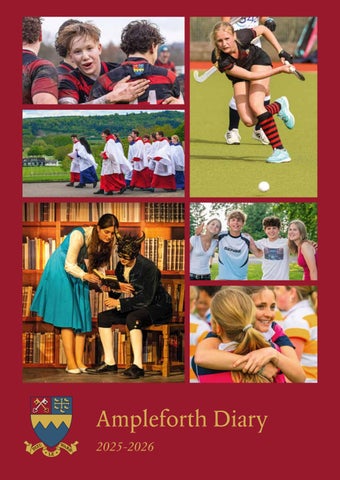
Ampleforth Diary 2025-2026
Contents 2 4 17 18 20 22 23 24 26 28 29 30 41 46 50 54 56 62 74 75 76 79 78 80 82 87
Marketing & Communications Office, Ampleforth College, York YO62 4ER Tel: 01439 766000 Email: marketing@ampleforth.org.uk
Welcome Department Roundups National Awards Success Academic Scholars Model United Nations Exhibiting at the Bank of England Museum JCB Innovation Challenge Enrichment Week Careers Why Study in a North American University? From Ampleforth to Cambridge House Roundups Junior House Inter-House Competitions Weekends and Social Life House Traditions Music Sport My Cricketing Experience Partnership with Yorkshire CCC Lacross is back! South Africa Sports Tour Country Sports Equestrian CCF Duke of Edinburgh Award
88 Theatre 96 What’s the Food like? 98 Artificial Intelligence 100 Confirmation 102 Chaplaincy 103 What I learnt at Ampleforth 104 Lourdes Pilgrimage 106 Live Simply 107 The Big Walk 108 Friendship Project 109 Running the Lyke Wake Walk 110 Transforming Communities in Malawi 112 Helping Street Children Escape Poverty 114 Coaching Cricket in Sri Lanka 115 My Time in the Valley 116 The Ampleforth Society 120 Anniversary of The Mouseman 123 Manquehue 124 Holding My First Art Exhibition 126 Art Exhibition 128 Exhibition 130 Headmaster’s Exhibition Speech 133 Leavers 2026 134 Leavers’ Ball 136 Staff Leavers
Design: www.innermedia.co.uk AMPLEFORTH DIARY | 2025-2026 | 1
Welcome It has been a successful year here in the Valley - my thanks go to all staff and pupils for their efforts and company. The Diary offers far more than a record of events; it captures the transformational offer of our education, underlines the focus on community living, celebrates the achievements of our pupils, and imbues our focus on being a school of the Lord’s service. The spiritual lives of the pupils were enriched by the welcome return of members of the Manquehue to the Valley for the first time in many years, accompanying our pupils and supporting our Lectio Divina groups. The Bishop of Leeds, Marcus Stock, celebrated our Confirmation Mass in May with the confirmati having been supported through a comprehensive programme of preparation. These examples underline how our faith and Benedictine ethos permeate all that we do here. In the classroom, pupils have been pushed to meet their potential, and with Mr David Strange having taken on the role of Head of Academic Enrichment, our scholars have been challenged to think deeply across a broad range of subjects. There have been many sporting successes including various equestrian triumphs, a superb 1st XI girls’ hockey run to the National Finals, a strong 1st XV rugby season (unfortunately affected by injuries), and great successes on the tennis courts for both boys and girls and some strong and very promising cricketing results for a young 1st XI boys’ side. I have continued to meet lots of Old Amplefordians in the year and it is lovely to see so many coming back here to the Valley. A particular highlight was a gathering in London for the 100th anniversary of St Cuthbert’s House where almost a hundred OAs braved the heatwave to celebrate their old House. This year we have had a particular focus on the Theatre and have enjoyed many workshops, guest speakers and performances by our pupils. The pick of the bunch for me was the performance of Beauty and the Beast which was a fantastic production showcasing the tremendous creative, choral and orchestral talent at Ampleforth. My sincere thanks go to everyone who has contributed to this publication and, more importantly, to the life of the school throughout the year. Your commitment, encouragement, and example continue to inspire our pupils and strengthen our community. Jon Mutton, Head of Ampleforth College
2 | 2025-2026 | AMPLEFORTH DIARY
AMPLEFORTH DIARY | 2025-2026 | 3
Department Roundups ART This year has been one of remarkable growth, innovation, and achievement within the Art Department. A major milestone has been the successful introduction of Textiles into our curriculum, culminating in the launch of our first A Level Textiles course for Year 12 students. This significant development required the complete transformation of a studio space, including the installation of new machinery, specialist equipment, and resources. Through extensive studio reorganisation and improved stock management, we have been able to maximise our facilities and create a vibrant, purposeful learning environment. Building on the success of this initiative, we are delighted to announce the introduction of GCSE Textiles for Year 10 students from September. With both courses now established, next year promises to be equally exciting and ambitious. ‘My favourite part of the textile course is the creative freedom with expert guidance. We learn different techniques and the teachers help you hone your skills to the theme of your coursework. They open the art department in the evenings to give a creative space and opportunity to work on coursework and explore other projects.’ Felix Hankey (12CT)
practice. It has been inspiring to witness the impact these opportunities have had on students’ creativity and ambition. Educational visits have continued to play a vital role in enriching our curriculum. Students have enjoyed inspiring trips to the Yorkshire Sculpture Park, Tate Britain and Tate Modern in London, the Northern School of Art Degree Show, and the Glasgow International Biennial Festival. Experiencing artwork first-hand allows students to engage with art in its intended context, deepening their understanding and providing invaluable inspiration for their own coursework and creative development. To support students during key assessment periods, we have expanded our provision of Open Studios, offering dedicated Sunday sessions for Year 11 and Year 13 students. These additional opportunities have enabled students to make considerable progress with coursework, refine practical outcomes, and prepare thoroughly for examinations.
‘The most beneficial thing I have gained from Year 12 Art has been the opportunity to gain experience in how to create art in assorted styles and medias, for example, etching, lino-printing, heat press printing, and how to create different backgrounds and mixed media. Learning how to create art in Alongside our popular etching press, we diverse ways has really helped me to go beyond have invested in photographic screenjust painting and drawing, but to approach art in printing and heat-transfer facilities. These more varied ways. This is something I never really additions have broadened the range of practised in GCSE Art, so Year 12 has really creative processes available, encouraging encouraged me to go out of my comfort zone, to students to work confidently across Fine Art explore new things and to not fear trying new and Textiles disciplines while developing a methods and making mistakes.’ deeper understanding of professional artistic Pia Felipes (12A) 4 | 2025-2026 | AMPLEFORTH DIARY
Our Basil Hume Scholars have continued to thrive, taking part in competitions and benefiting from increased access to the studios across three evenings each week. Working alongside GCSE and A Level students has fostered a collaborative creative environment, allowing scholars to develop new skills, share ideas and grow in confidence. Throughout the year, we have also hosted a series of successful Saturday workshops for prospective Prep School students. These sessions have introduced young artists to the exciting processes involved in printmaking and have provided an excellent opportunity to engage with the department’s creative culture. Friday afternoon Year 13 NEA sessions continue to go from strength to strength. The additional two hours each week provide invaluable time for students to develop their practical work, refine ideas, and engage in meaningful discussions with staff. The enthusiasm of our current Year 12 cohort suggests that next year’s programme will be equally well received. Junior Textiles has enjoyed tremendous success this year, with students producing an impressive range of work including cushions, corset tops, embroidery projects, and knitted pieces. Their creativity, commitment and willingness to experiment have been a pleasure to see. House Retreats saw St Dunstan’s and St Oswald’s students spend the day creating a stunning ceramic sconce which is now proudly on display in house.
Ceramics continues to expand its offering, with students developing their skills through projects such as pinch-pot animal sculptures and slabbuilt decorative plates. Meanwhile, Photography Club remains an inspiring activity, encouraging students to explore visual storytelling and image-making. Looking ahead, we are excited by plans to expand into traditional black-andwhite darkroom photography. In support of this ambition, we would be grateful to hear from anyone who may have unused digital SLR and non-digital SLR (roll film) cameras or lenses available for donation! The highlight of the year was undoubtedly Exhibition Weekend, where our students displayed the exceptional outcomes of their hard work, creativity, and dedication. Throughout the year, GCSE and A Level students have produced work of an outstanding standard, culminating in a striking and diverse exhibition featuring everything from traditional drawing and painting to large-scale conceptual sculpture and installation. The exhibition attracted great attendance and received widespread praise from parents, visitors, and members of the wider school community. We could not be prouder of our students and the professionalism, originality, and artistic excellence they demonstrated. As we look ahead, the department is excited to continue building on this year’s successes, embracing new opportunities and inspiring the next generation of creative practitioners. Helen Marshall Head of Art
BIOLOGY The 2025-2026 academic year has been a busy and successful one for the Biology Department, marked by a wide range of enriching opportunities both inside and outside the classroom. Our Year 13 A Level biologists enjoyed their field trip to the Blencathra Field Studies Centre, where they developed their ecological sampling skills and explored key fieldwork elements of the examination curriculum. During the Lent term, our Year 12 students took part in the British Biology Olympiad, while both Year 10 and 12 students took part in a range of dissection activities, including the examination of owl pellets, a piglet and a pregnant rat. These experiences provided valuable opportunities to deepen their understanding of biological structure and function through handson learning. We were delighted to relaunch the school’s Medical Society. Through an enriching programme of activities, aspiring medics and veterinary students have been supported throughout the highly competitive application process. The programme has included discussions of current healthcare issues, role-play activities, personal statement workshops, and mock interviews. We were particularly pleased to welcome Erin Anglim, an OA (B21) and final-year medical student at the University of Sheffield, who shared her journey into medicine and offered valuable insights and advice to our prospective applicants. My sincere thanks go to colleagues across the department for their invaluable support throughout the year. Ms Beth Newbould has played an integral role in promoting excellence in teaching and
learning, while Dr Oliver Beveridge has provided guidance and support across all areas of Biology. Our Biology Technician, Mr Ian Schofield, has been instrumental in supporting practical work and ensuring the smooth day-to-day running of the department. I would also like to recognise the outstanding support provided by Mrs Kate Green from the Learning Hub to several of our students. Thank you also to Mr Simon Howard, Head of Chemistry, and Mr Billy Townend, Head of Physics, whose experience and expertise have been invaluable as we have worked collaboratively to strengthen and develop the wider Science Department. Looking ahead, Ms Beth Newbould will take over leadership of the Biology Department in the next academic year. She brings a clear and ambitious vision, and I am confident that the department will continue to flourish under her leadership. Amanda Lee Head of Biology VOCATIONAL STUDIES In January, our Enterprise and Entrepreneurship and Travel and Tourism BTEC students returned early to school, four days before the start of term, to go through a series of workshops to help them prepare for their examinations. We have continued to develop our relationship with JCB and are organising a trip to their international headquarters in Uttoxeter for students planning to apply for our JCB Engineering or Business scholarships next year. 2026-27 is shaping up to be another successful year for our BTEC programme. AMPLEFORTH DIARY | 2025-2026 | 5
COUNTRYSIDE MANAGEMENT BTEC Our Countryside Management students, six Year 13s and 12 Year 12s, have all been out and about this year enjoying their studies. They surveyed a farm in Galphay where the owner had many opportunities for the students to get involved in detailed analysis and assessment and develop management plans. This linked into a fascinating visit to Yorkshire Heart Vineyard and Brewery to study a land-based profit organisation and compare it to the Nidderdale Area of Outstanding Natural Beauty (AONB), a land-based non-profit organisation. Recent weather has been kind allowing the students to make the most of their practical sessions. They surveyed both a young and an ancient woodland comparing the two to gain a better understanding of how biodiversity develops over time. To promote biodiversity, the students felled selected trees to salvage the usable timber and used the remaining brash to create deadwood hedges. They then cleared he tree stumps with an excavator and later replanted the whole area. Each student developed a case study of a land-based enterprise. Their projects covered a wide range of ideas including bee keeping, fishing parks, picking your own wildflowers, free range egg production, and a proposal to harvest wind energy to produce hydrogen for a cooperative of local farms. It was great to see such a diverse range of innovative and productive work. TRAVEL AND TOURISM BTEC The highlight of BTEC Hospitality this year saw the introduction of the BTEC in Travel and Tourism. It has proved to be a highly enjoyable course with our Year 12 students engaged by 6 | 2025-2026 | AMPLEFORTH DIARY
the study of a range of topical issues affecting the tourism industry globally. A key focus has been on two contrasting visitor attractions, Castle Howard and the North York Moors National Park. Visits to both attractions gave students valuable firsthand experience, helping them to develop ideas and evidence for use in their coursework. As I write this, the students have already completed their first exam and are now embarking on their Global Destinations unit in which they effectively take on the role of a travel agent, researching and recommending destinations to meet different customers’ needs. Early results are very encouraging. Students also particularly enjoyed exploring sustainability and the environment through another strand of the curriculum. They produced some outstanding research presentations at the end of the year demonstrating not only a strong understanding of the subject but also the independent research and presentation skills needed for their next stage of learning at university. ENTERPRISE AND ENTREPRENEURSHIP BTEC It has been another busy year in the BTEC Enterprise and Entrepreneurship department. One highlight was a BTEC Grade Booster Workshop at the Trafford Centre in Manchester in November. Along with other schools from all over the country, this provided an excellent opportunity for our students to showcase their talents and knowledge and gain valuable experience to support their preparation for the BTEC external examinations. Students enjoyed a field trip to Helmsley where they accepted the challenge to carry out competitor analysis of a selection of
coffee shops. It was a practical and engaging way to apply classroom learning to real business environments and understandably was a very popular exercise! The Ampleforth Abbey Tea Room formed part of the study, and we have noticed that the students seem to have prolonged their research here over the course of the whole year. Michael Emsley Head of Vocational Studies BUSINESS AND ECONOMICS It has been another exceptionally busy and productive year for the Business and Economics department. The students had an exciting opportunity to visit Newcastle’s Metrocentre, where our students attended the A Level Business Strong Foundations Workshop and the BTEC Enterprise Grade Booster Conference. This proved to be an excellent forum for our cohorts to test their knowledge and showcase their talents alongside peers from other schools around the UK. Some of our students also submitted outstanding entries to the Young Economist of the Year Competition. The most popular choices this year explored critical global and domestic issues: “What are the economic consequences of a falling birth rate, and what approaches can be taken to mitigate these?” and “What are the drivers of wealth inequality in the UK and how can they be addressed?” These choices reflect how deeply the core values and ethos of Ampleforth are embedded in our students’ academic outlook. Back in the classroom, it is brilliant to see students regularly engaging with our Business and Economics Library and embedding wider reading into their academic arguments. This resource also inspired an interesting Extended Project Qualification (EPQ ) this year, which
evaluated the commercial realities of the manufacturing sector: “Can small-scale furniture makers compete with large-scale companies like Ikea?” We have thoroughly enjoyed teaching and learning in the newly renovated Bamford Centre. Thanks to our continued relationship with JCB, our students’ participation in the practical JCB Challenge has inspired our large cohort of students and elevated their daily academic experience with practical context. With these brilliant facilities and strong foundations in place, the department looks forward to maintaining this momentum into the next academic year. Jeremy Mitson Head of Business and Economics CHEMISTRY Year 13 Chemistry students emulated the achievements of their predecessors with a large number of medals in both the Cambridge Chemistry Challenge and the 58th Royal Society of Chemistry Olympiad. Hattie Roberts (A) replicated the previous successes of James Smolarek (CT) and Melisa Anyim (B) in the past two years, achieving Gold medals in both competitions. In the Cambridge Chemistry Challenge, Gabrielle Akanbi (A) and Noelle Savarimuthu (B) also won Silver Awards, whilst Jonty Harrap (DO) won a Copper Award. In the RSC Chemistry Olympiad, as well as Hattie’s Gold, there were Silver Awards for Gabrielle Akanbi (A), Noelle Savarimuthu (B), Kofi Taylor (CT) and Sophie Reeve (B). Katie Armstrong (A), Benedict Aldous-Ball (CT), Jonty Harrap (DO) and Antonius Sweerts-Sporck (DO) achieved Bronze Awards.
Right at the end of the last academic year, Year 12 Chemists took part in the Royal Society of Chemistry Analytical competition. Our three teams took first, second and third in the North East section of the Great Britain and Northern Ireland competition. Ben Barrett (DO) and Gabrielle Akanbi (A) were crowned Regional Champions and were nationally commended alongside eight other schools for their efforts. A fantastic achievement! Year 10 and 11 took part for the first time in the Junior Chemistry Challenge and Freddie Goor (CT), Cullen Lyness (H) and Emily Tench (M) achieved Gold Awards. In addition, there was a significant number of silver and bronze award winners across both year groups. Simon Howard Head of Chemistry CHRISTIAN THEOLOGY The 2025–2026 academic year has been productive and enriching for the Christian Theology Department. In September, Mrs Gaëlle McGovern returned to Ampleforth to take up the position of Head of Department. The Autumn Term saw the celebration of notable student success in external academic competitions. Chloe Grace (13M) was shortlisted in the Theology category of the John Locke Institute 2025 Global Essay Prize. From a field of 63,328 entries, the shortlist represented the top 18.65% of candidates worldwide, placing Chloe among an exceptionally distinguished group. She was invited to attend a gala dinner in recognition of her achievement. Arabella Hunt (10M) was awarded second prize in the Catholic Young Writers Award and, as part of her success, was invited to
Farm Street to hear Baroness Hollins speak. Responding to the prompt, “I think Jesus was a great man and a wonderful moral teacher, but I do not accept that he is God,” Arabella composed a thoughtful and persuasive essay articulating the Christian belief in Jesus Christ as Saviour and Redeemer, promised from the beginning. In the Spring Term, the department introduced a pilot programme within Core Christian Theology exploring artificial intelligence and ethics. Students examined both the opportunities and challenges presented by AI, engaging with topics such as autonomous technologies, chatbots, and the Church’s teaching on technological development. Particular emphasis was placed on the protection of human dignity within this advancing field. The programme culminated in a wellattended Exhibition debate entitled “The future with AI will respect human dignity.” Year 12 Theology students prepared and delivered carefully considered arguments on both sides of the motion, incorporating, with notable originality, responses generated by AI itself. The event was warmly received by parents and guests and took place shortly before the publication of Pope Leo XIV’s first encyclical, Magnifica Humanitas, launched with contributions from Dr Anna Rowlands (Durham University) and Christopher Olah, co-founder of Anthropic. A new co-curricular initiative, The Think Tank, was established this year, providing students with the opportunity to engage in philosophical and theological inquiry through classical thought experiments such as the Trolley Problem and the Ship of Theseus. The initiative has been met with enthusiasm and has fostered lively and intellectually rigorous discussion. The Aquinas Society has also resumed its programme, with students studying seminal AMPLEFORTH DIARY | 2025-2026 | 7
theological and philosophical texts. These included extracts from Veritatis Splendor by Pope John Paul II, Spe Salvi by Pope Benedict XVI, and a contemporary article by Vikas Beniwal exploring the question, “What does it mean to be human?” Among the highlights of the year was the visit of four members of the Manquehue community. During their time at Ampleforth, Year 9 pupils engaged in a creative and formative project, designed by Mr Hudson, examining the vocation of the laity through the witness of lay oblates in Chile. Further formative projects were developed by Mrs Dawn Thyne and Mrs Ali Rogerson for Years 7 and 9. These included work on St Josephine Bakhita, the Magnificat, the Book of Kells, business ethics, Eucharistic devotion, and reconciliation expressed through art. Such projects continue to encourage independence, intellectual curiosity, and the cultivation of key Benedictine scholarly attributes. This work also supports one of the key priorities identified in the most recent Catholic Inspection, in which the College was judged outstanding. A final highlight is the number of our students who have chosen to continue their study of philosophy or theology beyond Ampleforth.11 students hold offers from universities such as Durham, Edinburgh, St Andrews, Exeter and Bristol to study Theology or Philosophy next year. We wish them every success in their future education and know they will make a difference to the world beyond their studies. It has been deeply encouraging to witness the academic and spiritual development of our pupils throughout the year. In the spirit of our departmental motto, inspired 8 | 2025-2026 | AMPLEFORTH DIARY
by St Anselm, our work remains grounded in fides quaerens intellectum - faith seeking understanding. Gaëlle McGovern Head of Christian Theology CLASSICS Sixth Form students of Latin, Greek and Ancient History visited Newcastle University in January to listen to a variety of lectures relevant to their A Level courses. These included representations of women on Athenian pottery, the reasons for the fall of the Roman republic, and the role of music in Greek tragedy. This study day gave the students a taste of learning in a university setting. A ‘ s someone hoping to take a Classics degree in the imminent future, it was brilliant to have the opportunity to look around the Newcastle campus and experience what university lectures are like. I particularly enjoyed the talks given on Sulla’s autocracy in Rome and on my set text, the ‘Pro Roscio’ (for Roscius) by Cicero. They both highlighted some of the historical and societal context of speech that I didn’t know much about, beyond what we had learnt in the classroom, such as the domination of Sulla (Rome’s dictator at the time of Roscius’ trial) being compared to that of Jupiter in chapter 131 of Cicero’s work, all of which I found completely fascinating.’ Alice Del Mar (12M) In March a group of Year 13 students of Greek and Ancient History attended a performance of Aristophanes’ The Clouds, performed partly in Greek and partly in English, at King’s College London. The visit also gave us a chance to catch up with OAs studying at KCL. ‘It was fascinating to see the play we had studied on the page come alive on the stage’ Hector James, (13H)
Towards the end of the Lent Term, Ampleforth students from Years 8 to 13 participated in the inaugural Classics Quiz hosted by the Northeastern branch of the Classical Association at Newcastle Girls’ High School. Competing in University Challenge conditions, our three teams of students put fingers on buzzers to answer questions about the Latin language and Roman life, and Classical general knowledge. Against some fierce competition, our Junior Latin team won first prize in their section, and the senior Classical Civilisation and Latin teams came second and third respectively in theirs. Our winning Year 8 team, George Thyne, Toby Seligman, Abena Effah, have fond memories of the day:
on computational thinking and algorithms, students have developed both practical skills and a clear understanding of how computing underpins the modern world.
‘It was lovely to meet other students who like Latin as much as I do’ George Thyne (8EW)
The Year 12 set have enjoyed two field trips this year aimed at inspiring their designing. The first was a day at the Nissan car factory in Sunderland and the second was in Newcastle, assembling IKEA furniture and touring the architectural and civil engineering sites of Gateshead including the Glasshouse International Centre for Music, Angel of the North, and Millenium Bridge. Beyond the classroom, the department The Year 12s have just started their own has continued to emphasise realindividual projects and the three JCB Sixth world relevance. Regular discussion of Form scholars in this set have been setting developments in artificial intelligence, cybersecurity, and the ethics of technology high standards in all that they do. helped pupils to think critically about The themes set by the exam board this the digital landscape they are entering. year for GCSE students included ‘parent Events such as enrichment week IT and baby bonding’, ‘communal dining’ literacy sessions and opportunities and and ‘sports participation’. The sheer variety consideration of national cybersecurity in the projects produced, which were on initiatives further extended students’ display at Exhibition, demonstrates how experience. each student has been able to identify their own unique design problem and solution in Overall, this has been a year of progress, strong outcomes, and genuine enthusiasm keeping with these themes. for the subject, with pupils leaving the The Year 9 students have been working department well prepared for further through a series of practical skills to study and the challenges of a rapidly expand their understanding of materials evolving digital world. I am happy but also ensure that they are confident, safe to announce that Mr Karl Appleyard and independent when they progress to is taking on leadership of the subject
‘I realised I knew more than I thought I knew’ Abena Effah (8EW) ‘It was a very enjoyable day’ Toby Seligman (8EW) The summer term concluded with Year 9 students visiting Aldborough Roman town, where they had a tour of the site, a visit to the museum, and a chance to make mosaics and play Roman games. A visit to Spofforth castle rounded off a fantastic day. Charlotte Goddard Head of Classics COMPUTER SCIENCE This has been a productive year for Computer Science at Ampleforth, with students across all year groups engaging with a broad, challenging, and relevant curriculum. From the Year 7 foundation in digital literacy, data modelling, and web development, through to our Year 9 focus
At GCSE level, Year 10 students made excellent progress in Python programming and core theory, tackling increasingly sophisticated problems and taking part in activities that included cybersecurity challenges. Year 11 students approached their final examinations with maturity and resilience, supported by a structured programme of revision and practice during their Thursday evening prep. In the Sixth Form, students demonstrated independence and ambition: Year 12 developed secure foundations across programming, including object-oriented constructs, systems, and databases. Year 13 produced an impressive NEA project alongside the study of advanced topics including algorithms, data structures, and computational theory.
from September. Best wishes to all our computer scientists of the future and to all at Ampleforth College. Eric Knutsen Head of Computer Science DESIGN & TECHOLOGY The Design and Technology department has been busy this year with many exciting projects across all year groups. The Year 13 projects show high levels of quality in both the designing and the manufacture. We wish them all the best for their future studies.
tackle GCSE projects. They have also run through a mini project based on collecting waste, (a theme set this year by JCB), a STEM challenge, and a short architectural sketching module. Year 8 pupils have been working with several STEM (Science, Technology, Engineering and Maths) challenges including modelling and basic electronics that have allowed them to integrate their learning from other subjects into projectbased work. The Year 7s have been learning foundational practical skills and making lovely spatulas and copper bowls along the way. Beyond the curriculum, the D&T department continues to run the Rocket Club, Jewellery-making and Design for Good service activities. The rocket teams were disappointed not to get to the national finals this year, but Ampleforth performed well at the local Rotary Technology Tournament in March at the Royal Electrical and Mechanical Engineers workshops in Catterick. Brendan Anglim Head of Design & Technology EAL The EAL Department has enjoyed another successful and rewarding year, supporting students from a wide range of countries, cultures and linguistic backgrounds. We welcomed EAL students from Belgium, Poland, Germany, France, Spain, Luxembourg, Mexico, Chile, Argentina, China and Hong Kong, reflecting the truly international nature of the Ampleforth community. Our students have ranged from almost complete beginners at CEFR A1 level AMPLEFORTH DIARY | 2025-2026 | 9
to highly proficient C1 learners, with some joining us for two terms or a year, while others have studied at Ampleforth throughout their secondary education. We have worked with pupils across Years 7 -13, supporting their academic progress, language development, and integration into every aspect of school life. A key feature of our provision is the delivery of bespoke programmes tailored to individual students’ needs and aspirations. Throughout the year, students have prepared for a variety of qualifications, including Cambridge IGCSE English as a Second Language, IELTS, Cambridge B1 Preliminary, B2 First and C1 Advanced examinations. We are delighted that many students have achieved excellent results, enabling them to progress confidently to mainstream classes, A Level study, and university pathways. Beyond examination preparation, our curriculum encourages students to develop the language and cultural understanding needed to thrive in an international environment. Lessons have explored a wide range of themes, from literature and history to contemporary issues such as technology, artificial intelligence, and social media. We actively celebrate the many cultures represented within our student body, recognising not only the British cultural calendar but also significant events from around the world, including Chinese New Year and German Reunification Day. These opportunities encourage students to share their own traditions and experiences, enriching the learning of the entire community. One particularly enjoyable activity this year saw students from Years 10 and 12 visit the Ampleforth Abbey Tea Room following a course on British culture and traditions. They sampled a range of traditional 10 | 2025-2026 | AMPLEFORTH DIARY
English specialties, providing a memorable opportunity to experience an aspect of British life beyond the classroom. Student Reflections “My favourite lesson is EAL because it has helped me to improve my English in every way and gain more confidence when speaking the language.” “I’ve made great friends from different countries and we’ve shared lots of experiences together. EAL lessons helped me to really improve my vocabulary.” “My English is much better than last year. The EAL lessons have helped me with my speaking, reading and spelling.” “I found a very good friend who often helped me and translated things for me when I first arrived. I am glad that we became friends, and I have met many kind people in my house.”
canonical texts, and learning the craft of writing for a range of different audiences. Year 7 students have been discovering connections between Western and wider world mythologies through their study of Greek, Roman and Egyptian myth and culture; studying the presentation of one of English literature’s most infamous monsters in the figure of Grendel; exploring representations of chivalry in nineteenth-century poems; and taking part in the regular ‘Courage Weeks’ to develop independence and problem-solving skills. In Year 8, students have learnt about the ways in which classical drama emerged from oral poetry performance and enjoyed performing extracts from Sophocles’ Antigone. They have been developing their analytical skills, writing about representations of human and non-human characters in The Tempest.
Rita Bose Head of EAL
Year 9 students been studying the connections between British industrialisation and the British imagination by examining Romantic understandings of the town and the countryside; by responding to Mary Shelley’s Frankenstein with prose descriptions of their own monsters; and by exploring the complex network of alliances, betrayals and soothsaying woven by Shakespeare in his version of Julius Caesar’s assassination. In Years 10 and 11, students have been perfecting their skills of descriptive writing and critical reading by examining the poetry of travel and migration, Shakespeare’s Antony and Cleopatra and the Nigerian tragic novel, Things Fall Apart.
ENGLISH English students have had an adventurous and imaginative year in the department, extending their reading of fiction and non-fiction, exploring canonical and non-
Sixth form Literature students have approached tragic drama and the literature of tragedy and crime writing with enthusiasm, debating questions like ‘Is society the root cause of a protagonist’s tragic downfall?’, ‘Why is the economic
“I would recommend Ampleforth. It’s a cool place. The people here are very friendly and will always help you if you need it.” Above all, the EAL Department seeks to ensure that every student feels valued, supported and confident as they develop their English and participate fully in life at Ampleforth. We are proud of the resilience, commitment and achievements shown by our students this year and look forward to supporting future cohorts as they continue their educational journeys.
success so significant a theme in American tragedy?’, ‘Is nature a friend or a foe?’ and ‘Is a king bound by the same laws as his subjects?’ Year 12 students have started working on their independent summer research projects by exploring the bibliographies of their chosen poets and novelists. Year 13 students submitted a wide variety of critical essays shortly after Christmas, which included an economic reading of class concerns in Oscar Wilde’s The Picture of Dorian Gray, feminist readings of an American childhood in Madeleine Hall’s Where the Crawdads Sing, and representations of nature in Ted Hughes’s poetry collection, The Birthday Letters. The Sixth Form Poetry Society has been well attended, and members this year have considered the poetry of faraway lands, the poetry of strangeness and poems written in non-English tongues. A second edition of the Virtuoso anthology was published by the department at Exhibition, a limitededition hardback book presented to Upper Sixth Leavers and to scholars in the Middle and Senior school. This year’s edition includes three poems produced by some of our younger students submitted for the Middle School Poetry Competition on the themes of movement and the sea and affords a glimpse into the different ways in which students’ English studies have been enriched by cross-curricular links with the art, music, CT and chaplaincy departments. The middle school Reading for Pleasure project continues to challenge and motivate students and staff to embrace the benefits of pursuing their interests in a range of areas through regular, daily protected reading time. The overwhelming majority of boarders have reported that their commitment to reading has significantly improved as a consequence of this approach to reading for pleasure
and many have commented appreciatively on the sense of calm that it brings to their otherwise busy lives. Books retain a central place in the lives of Ampleforth students. Christopher Vowles Head of English GEOGRAPHY In last year’s Ampleforth Diary, the Geography department was focused on the integral role fieldwork plays in delivery of our subject, particularly at GCSE and A Level. This year, our focus is on reading. Geography is a subject that can cover a huge range of different topics, people, and places. In our department meetings we often find it difficult to make decisions on what to teach that will cover the fundamentals of our subject but will also enrich and inspire our students. One of the aims of the Geography department is ‘Awe and Wonder’ and we use books and articles to ensure this is firmly embedded within the curriculum. The lived experiences of others allow students to go beyond what they are learning in lessons and gives them the opportunity to learn more about the world that they live in.
See what some of our Year 7 students thought of the books they have studied this year: This year we have read ‘Stitched Up’ and ‘Welcome to Trashland’ by Steve Cole. ‘Stitched Up’ is the story of a young Vietnamese girl who has dreamt of being a fashion designer. She is tricked by strangers who promise her a job in a clothes shop, but when she arrives in the city the job is in a sweatshop where she works like a slave. She must work in bad conditions, is fed horrible food and only gets one loo break a day whilst making jeans for Western shops. The story follows her friendships with others as they try to gain their freedom. ‘Trashland’ is set in Ghana, where a young boy called Theo lives on top of an enormous electronic waste dump. He scavenges for scraps to sell at the market to make money to live on. A new boy arrives at the dump with rumours of buried treasure, and they try to find it. The treasure has a local gang interested so they must try to navigate this to survive.
I enjoyed these books as they helped my understanding about the things underprivileged children around the world must live with and do to survive. Both were good stories and made you think about what was going on in the world. Both As part of their prep programme, Year 7 are books were about child labour, the inequality provided with 2 books over the course of between high and low income countries, and the year that aim to enrich what is being the consequences of our love of fast fashion and taught in lessons. Both books, by the same throw away electronics. Both were part of our author, allow the students to understand globalisation topic and these books really helped what they are learning about from the bring it to life. perspective of children their own age. Willoughby Phillips (7EW) While both books are works of fiction, they are based on the realities of a world In ‘Stitched Up’, twelve-year-old Hanh gets the where inequalities exist. Students are often opportunity to work as a shop assistant in Hanoi surprised to learn how others are expected and sees it as an opportunity to earn money for to live and how our own decisions can her family who are living in poverty in Vietnam. affect the lives of others unseen. When she arrives in the city, she discovers that the job was a lie and she ends up working in a Hannah Graham sweatshop making fast fashion clothes. A day in Head of Geography the sweatshop is full of long hours, poor working AMPLEFORTH DIARY | 2025-2026 | 11
conditions, little food, and regular violence. Hanh is desperate to escape and when the time comes, she must decide whether to take the chance or be trapped forever. She comes up with a plan, but when it fails and she gets caught along with the other girls, Hanh believes there is no hope of escape. However not long after, a repair person at the sweatshop hands her a gum wrapper on which it’s written that help is coming in five days. She thinks it is a cruel trick until the help does come and she ends up free. I liked reading this book because it highlights what goes on in sweatshops around the world. It is a story of enduring pain and suffering with perseverance and determination, showing that when there is injustice, even just a twelveyear-old can make a difference. I loved Hanh’s determination to do what is right and to also look out for her friends when she can. It has enriched my geographical knowledge because it has shown me what really goes on around the world and what many people must endure. It has also made me see fashion in a different way and changed how I feel about fast fashion so that I no longer support it because of the truth of how it is made. ‘Welcome to Trashland’: Theo is a 13-yearold boy who lives in the tough conditions of the Agbogbloshie electronics dump in Ghana. He is taught at night by a young teacher called Gifty and hopes for a better life one day. When a new boy called Emmanuel arrives and says there is hidden treasure at the dump, Theo helps him keep it a secret. While searching for it, they get mixed up with gangs, stolen metals, and the mystery of Emmanuel’s brother, Morgan, who died the year before. After facing lots of danger and problems, they find out that the “treasure” is a motorbike that Morgan made from melted-down metals. With help from Gifty and Mr Ghazi (the man in charge of all the boys there), Theo can use the bike to change his life for the better. At the end of the story, he leaves the dump and lives in a room above a shop. What I enjoyed about reading this was the characters’ ability to find friendship despite 12 | 2025-2026 | AMPLEFORTH DIARY
Our Junior History Society has also met regularly, discussing a wide range of historical issues. We have a trip planned for Year 9s taking GCSE History to go to the National Holocaust Centre in Newark which includes a museum, memorial, and the opportunity to see and hear testimony from Holocaust survivors. We have also organised an annual Holocaust education morning for our Year 9 students including looking at how the Holocaust happened, Jewish life before Nazi rule, and the issue HISTORY of how far and wide responsibility for The History Department has had another the Holocaust lies, notwithstanding the excellent year, starting with very strong 2025 centrality of course of Hitler. public examination results. At GCSE, over a third of our students achieved grades 9-8, Furthermore, our students have benefited over half achieved grades 9-7 and about from presentations on the importance two thirds achieved grades 9-6. At A level, of Armistice Day and Remembrance 11% achieved A*, nearly 40% achieved Sunday, the 80th anniversary of VE Day A*-A and 80% achieved A*-B. These results and of VJ Day, and Holocaust Memorial were outstanding and far above national Day. Our Year 12s have also benefited averages. We also continued to offer a range from scholarly lectures on aspects of the of extension and extra-curricular provisions English Civil War, the Holocaust and to take students beyond the syllabus. Nazi foreign policy. In addition, our Sixth Form students have continued to enter The Senior History Society has met each national history essay competitions. Many week to discuss a wide variety of issues, for also undertake 5000-word history EPQs example the importance of history, several (Extended Project Qualifications). This types of history, and how history differs year, for example, these have included from disciplines such as law. In addition, looking at the influence of women at we have discussed issues of pressing the court of Louis XV, the significance importance today, for example how to of Comfort Women in Korean politics, detect and address the politicisation of culture and society, and the degree to history, how Holocaust denial must and which penal reform has or has not led to a can be addressed, the importance of black system that is fit for purpose. and women’s history, whether statues of reevaluated historical figures should be taken The History Department has again run its down and so forth. We also had a guest own National History Essay Competition lecture from Dr Richard Rex, Professor of for Years 5, 6, 7 and 8 pupils at prep Reformation History at Queens College and junior schools around the country. Cambridge on religion and the causes of Now in its ninth year, this has become the English Civil War and have another the preeminent school-organised History planned from Dr Jasper Heinzen from essay competition in the country, this the University of York talking about year attracting 170 entries from twenty the development of nationalism in 19th different schools. The range and variety Century Germany. of titles was extraordinary, as always, the harsh conditions and suffering. I was also inspired by Gifti’s desire to teach the younger children, and I loved the surprises in the story like the bike being the treasure. This helped enrich my geographical knowledge because Trashland is a real place in Agbogbloshie and it is an eye opener to where our electronics go after we use them and how that affects children and adults across the world. Cleo Stirling (7EW)
including, for example, the significance of the first Moon landing, the impact of the Napoleonic Wars, First World War, Second World, Vietnam War and dropping of the atomic bomb on ordinary civilians, the importance of studying the Holocaust, the Pendle Witch Trials, the sinking of the Titanic, the impact of colonialism, tulips (!), the Great Escape, King John, how green fashion could kill in the Victorian Age, the significance of Suleiman the Magnificent, theatre, plays and toys through the ages, and many, many more. Many had personal connections with the writer or had been inspired by a site visit which had had a profound impact - these added a notable touch. Paul Connor Head of History MATHEMATICS In September we benefitted from newly decorated maths classrooms with fresh paint and new carpets, curtains and storage, making each room a wonderfully light and spacious learning environment. This was a lovely welcome for the new teachers: Mr Nicoll has filled the place with positive energy, enthusiasm and brilliant teaching ideas. And I, as the new Head of Department, have been delighted by the passion of our Maths teachers and the determination of our students. This year has been an absolute joy. As usual, students from all year groups have participated in the UK Mathematics Trust national competitions with great success with the following certificates achieved: Bronze: Charles De Pampelonne (7EW), Fred Pern (8EW), William Potter (8EW), Alice Wu (8EW), Benjamin Hills (9J,) Inigo Blake-Jones (10H), Theo Carter
(10J,) Akosua Effah (10B), Jose Garcia (10J), Benedict Michie (10J), Catherine Nelson (10B), Henry Sillars (10DO), Rossi McAllister (11CT), Justus Baum (12DO), Phoebe Bian (12A), Alice Del Mar (12M), Ellie Rose Echodu (12A), Victoria Hamilton (12A), Maksymilian Modrzejewski (12DO), Dariia Pechena (13B), Kassian Von Stkelberg (12J), Lidia Waldburg-Zeil (12B), Daniel Zhao (12CT), Gabrielle Akanbi (13A), Wilfrid Blake-Jones (13H), Paul Muscat (13H), Sophie Reeve (13M), Hattie Roberts (13A), Noelle Savarimuthu (13A)
round was fast and intense! Well done to Abena Effah (8EW), George Thyne (8EW), Benjamin Hills (9J) and Aurielle Njinang Nzonlie (9A).
Year 7 and 8 students had a visit to the Wetherby Racecourse. The races were cancelled due to bad weather, but we made up for lack of horses by running the final furlong ourselves! That was a new unit of measurement for many of us and lots of mental maths was involved working with metric and Imperial units. It extremely useful to do some practical measuring outside the classroom. All the Silver: Sabine Messeguem (8EW), Aurielle activities - weighing ourselves wearing Njinang Nzonlie (9A), Arthur Camacho our jockey’s silks, analysing all the data (10H), George Maxwell Stuart (10CT), on a racecard, considering the layout of Cullen Lyness (11H), Archie Tait (11J), the track and design of jumps - helped us Alex Zhang (11A), Cristobal Albornoz see how the maths we learn at school is Minck (12CT), Daniyal Awan (12CT,) applied in a real-life setting. Joshua Risbey (12DO) We thank Mr Strange for his hard work Gold: Arabella Hunt (10M), Rebecca and dedication in the department for Chester (11A), Kiki Hampton the last two years. We also have to say Papageorgiou (12B) goodbye to Mr Rudsdale who, as Second in Department, has been instrumental We were also delighted with the results in getting these competitions and trips from The Maths Competition for Girls organised. He has shown brilliant subject (designed to encourage senior girls’ knowledge combined with a gift for participation at an advanced level) when communicating complicated ideas in a way Alice Del Mar (12M), Emily Vaux (12M) that students really understand. We thank and Lidia Waldburg-Zeil (12B) all him for everything he has done and wish received Merits. Special congratulations him well in his next adventure. We will to Kiki Hampton-Papageorgiou (12B), continue his vision with plans for further who was awarded a Distinction in the events and trips next year so that students highest-level competition: the Maths can experience the subject beyond the Olympiad for Girls. curriculum. The Maths department has now invested in new equipment, resources Our Year 8 and 9 maths team took part in and interactive websites all with same the Regional final of the National Team fundamental aim: for students to gain a Maths Challenge. They made it to the top secure and deep understanding of the ten with a particular triumph in the cross- mathematics they are studying. number challenge where one pair worked on the ‘across’ clues and the other pair Imogen Lloyd were given the ‘down’ clues. A relay round Head of Mathematics got them out of their seats and the shuttle AMPLEFORTH DIARY | 2025-2026 | 13
MODERN FOREIGN LANGUAGES The languages department has experienced another exceptionally busy year. Alongside delivering an engaging and rigorous curriculum, we have worked to enrich the learning experience by integrating technology and authentic materials into our lively lessons. We also continued to offer specialised speaking support and coaching. Furthermore, our students benefited from numerous curriculum-enhancing opportunities that truly brought their language studies to life. We have continued to provide our students with opportunities to highlight their skills in various competitions and events. In November, a group of Year 12 students, Alice, Victoria, Katelyn, Emily, and Daniyal, took part in the UK Linguistics Olympiad. This year, they tackled challenging tasks featuring languages such as Seri, Iñupiaq, Lezgian, Khana, and Cantonese Braille! It proved to be a highly enriching and enjoyable experience for everyone involved. Similarly, the Linguistic Society provides a weekly activity open to years 7 and 8. During the sessions, students solved language puzzles and explored amazing cultural facts about linguistics. They learned about the deep influences of Latin, Greek, Norse, and Celtic on the ways we speak. They also dived into the world of codes, cryptography, secret, and made-up languages. To wrap up a fantastic year, the students even tried their hands at creating their very own language! In November, our Years 7 to 9 students took part in an exciting Language Day. We welcomed Dr Caroline Summers from Warwick University, who came to give an inspiring talk called ‘The Power of Languages.’ 14 | 2025-2026 | AMPLEFORTH DIARY
The Year 7 and Year 8 students enjoyed a session focused on how learning a language gives us new ways to express ourselves and helps us tell different stories. For the Year 9 students, Dr Summers showed how languages give you great skills for any future job, focusing on creativity and decoding patterns. The Year 9 students then put these skills to the test by decoding a Swedish poem. Later that month, our Year 9 students took part in a thrilling national language competition designed by GCHQ , the UK’s intelligence service. This special contest aims to get young people excited about languages. It does not require any previous language knowledge because it focuses on solving puzzles at different difficulty levels. Ellie, Mary, Max, and Maria proudly represented Ampleforth College. Operating under the team’s name Receptive Rattlesnake, the students used their own chosen secret agent names: Alert Intriguing Duck, Intelligent Super Bear, Compassionate Rapid Starfish, and Royal Loyal Tiger. Together, they fought valiantly and scored an impressive 3,070 points. In January, our Year 13 Spanish students enjoyed an enriching cultural visit from Chilean members of the Manquehue group. They gave a fascinating talk and a live demonstration of El canto a lo poeta, a beautiful musical and poetic tradition practised for over 400 years. Students learned that this art features cantores (singers) who perform complex verses from memory. They accompany themselves on a standard guitar or a traditional, multi-stringed guitarrón chileno. Deeply rooted in local communities, the tradition is split into two primary branches. The first is Canto a lo Divino,
which features sacred poetry about biblical stories and saints sung during religious vigils and rural festivals. The second is Canto a lo Humano, which covers secular themes like love, history, and social commentary. It even includes fun, improvised singing battles called payas. The Lent term saw an exciting mix of science, space, and deep thinking for our linguists. First, in January, a team of Years 10 and 11 students visited the RAF base in Leeming for the International Space Challenge. It involved the design of a practical space hotel for a European company. The twist? They had to work with foreign materials suppliers and pitch their ideas to investors in French, German, or Spanish! It was a brilliant, fun way to use science and languages together while building great skills for future jobs. Around the same time, our Academic Scholars enjoyed two fascinating talks. They explored big ideas in ‘Language and Culture’ and ‘Universal Grammar and Language’, looking deep into how human speech develops. Our Sixth Form linguists explored big questions about global culture, history, and politics through their Independent Research Projects, diving far beyond standard textbooks. In the French department, pupils debated the impact of the 2024 Paris Olympics, the future of French cinema, the law on secularism, and Paris’s changing food scene. Spanish students tackled complex social issues, exploring Argentina’s El Gauchito Gil folk culture, Mexico’s “los muxes” third gender, wealth gaps in Madrid, the
commercialism of the St. James’ Way, Peru’s environmental crisis, and peace in the Basque Country.
been a fabulous experience for everyone involved, creating long-lasting memories and friendships!
Russian students investigated the New Year movie The Irony of Fate, Maya Plisetskaya’s impact on ballet, Pavel Durov’s influence on social media, and tourism threats to Lake Baikal. Whilst the Chinese speakers weighed up the future of overseas students and the role of Artificial Intelligence in education. Finally, German students analysed the Alpine region, the rise of the AfD party, social networks in action, and cannabis legalisation; with our Italian speaker investigating the role of mafia informant Tommaso Buscetta. We are incredibly proud of our Sixth Formers, who proved that learning a language is truly about understanding the world.
Aileen Wallington Head of French
Our final big event has been the French exchange, an exciting new venture involving the GCSE French students. In March, eight Year 10 students and two staff members visited our partner school in Versailles, St Joseph de Lys. Staying with French host families gave our pupils a genuine taste of everyday life in France. They attended morning school lessons and spent their afternoons exploring famous sights. Unforgettable highlights included a scenic boat tour along the Seine, witnessing the Crown of Thorns procession at Notre-Dame, and taking part in the moving “Flame of the Nation” ceremony beneath the Arc de Triomphe. They also loved visiting the magnificent Palace of Versailles and, of course, eating delicious crêpes! We then welcomed the French students into our Valley at the start of June. They enjoyed a busy programme of visits to local attractions and participated fully in the daily life of the College. This has
Y13 students who took part in the British Physics Olympiad challenge, an extremely demanding exam that pushes students well beyond their A level work. Billy Townend Head of Physics
PHYSICS It has been another busy academic year in the physics department. Year 7 and 8 students have been building their knowledge across many physics topics with hands-on practical lessons. The Year 9 students made a strong start to their IGCSE course with an in-depth look at forces and motion. This has allowed them to work on a number of exciting practicals such as measuring acceleration of cars and the terminal velocity of bun cases. They have also applied their knowledge on a larger scale by studying orbits in the Solar System.
POLITICS It was another successful year for the Politics Department. More than ever, our role is to help pupils make sense of their place as citizens in a complex and often dangerous political world. Questions about democracy, rights, the rule of law and political leadership are no longer abstract issues confined to textbooks, but are live issues playing out daily in society. Our subject is uniquely placed to engage with these debates and that is one reason why Politics remains such a popular A Level choice.
Year 10s have made strong progress through their IGCSE course and are now over the halfway mark. The Year 10 course lays strong foundations for Year 11 and beyond into A Level by studying some of the core areas of physics such as waves, energy, and electricity. We have opened a new pathway for some of our Year 10 students to allow them to achieve their very best in the sciences. Year 11s have finished their IGCSE course this year by studying some more advanced areas in physics such as electromagnetism, thermodynamics, nuclear physics and astrophysics.
A Politics Department night out in York was one of the highlights of the year. Following a quick visit to Pizza Express, students attended Lady Hale’s lecture to mark the publication of her book With the Law on Our Side. It was a valuable opportunity to hear from one of the most influential British legal figures of modern times and to see how the issues we study in the classroom can have a direct impact on people’s lives. Continuing our focus on the judiciary, we also attended the Law and Disorder Live debate at Ripon Cathedral on the question: “Is trial by jury dead?”
The A level groups have worked hard all year in a very demanding course. They get a chance to study some abstract and conceptually challenging ideas in the A level with a detailed look into topics such as particle physics and Einstein’s Special Relativity. Congratulations to all those
We enjoyed a fantastic talk by Dr Rory McCarthy, Associate Professor in Politics and Islam at Durham University. His title was: ‘Making Sense of the Middle East: Between Protest and Conflict’ – particularly timely in the context of conflict in Iran. AMPLEFORTH DIARY | 2025-2026 | 15
There have also been a number of excellent EPQ projects linked to Politics, and this remains a way for students to develop undergraduate level skills whilst making a topic their own. This year there were projects on varying themes, from human rights law in the UK to comparative studies of gender equality between the UK and Sweden. It is not all about examinations, though the results achieved by the 2024–25 cohort were strong indeed. Politics also continues to be a popular choice for university study, with students progressing to a range of courses including Politics and International Relations. We are already looking ahead to February, when more than forty students and staff will travel to the United States. Visiting New York, Philadelphia and Washington DC, the trip will provide a unique opportunity to experience American politics and history first-hand while bringing aspects of the course to life. Christopher Starkey Head of Politics
PSYCHOLOGY Psychology has established itself as a popular A level choice within the Sixth Form curriculum at Ampleforth. The course delivers a rigorous understanding of key psychological concepts and theories, offering students deep insight into the critical drivers of human behavior but also excellent analysis and evaluation skills. This academic year our students have enjoyed the exploration of fascinating real-world case studies and have engaged in lively discussions. Students had the opportunity to investigate conformity and obedience, such as Milgram’s dismaying electric shock experiments and Zimbardo’s Stanford Prison study, to understand how situations dictate human actions. The study of Psychopathology allowed the students to analyse the biological and cognitive origins of OCD, depression, and phobias. Highlights of the year were the class debates looking at the complex neural and environmental debates surrounding Schizophrenia and the evolutionary origins of Aggression.
The department this year has been impressed by the highly motivated students supported by a dedicated staff team. And we have been delighted that several of our upper sixth have chosen to read Psychology at university level. We plan to continue to build on this excellent momentum next year. Mandy Williams Head of Psychology
National Awards Success We encourage our students to push themselves academically and intellectually, exploring and thinking beyond the core content of their curriculum. As well as bringing in speakers to school, and visits to talks and conferences elsewhere, there are a wide range of competitions which we urge students to enter. Two of those who did so this year were rewarded for their independent thought and research by achieving national recognition for essay writing in esteemed competitions. Chloe Grace (13M) entered the John Locke Institute’s Global Essay Prize, a prestigious competition in which
students from over 150 countries develop their writing and critical thinking skills exploring challenging questions that go far beyond the school curriculum. The competition is judged by a panel of senior academics from leading universities including Oxford and Princeton. Essays can be submitted in seven categories: Philosophy, Politics, Economics, History, Psychology, Theology, and Law. Chloe submitted her Essay in the Philosophy category, exploring the question “Is atheism implausible?”. She was nominated as a finalist, attended the glittering awards dinner in London last October, and has been awarded a scholarship to the John Locke summer school. ‘To increase my knowledge around the topic, I selected a number of books from the school library, ranging from Dawkins to McGrath, to ensure that I had covered both sides of the argument. I met with Mr Hudson, Christian Theology teacher, who gave me valuable guidance on how to structure my essay and how to reach a concise, justified conclusion. Due to the vast depth of the topic, at first I struggled to find the right place to start so sought feedback on my draft introduction from Ms Paterson, my Housemistress, who was really helpful. I was completely surprised when I received the nomination from the Institute but was delighted to know that my long evenings of reading and evaluating had paid off! One thing I learnt from this valuable experience is that in order to form your own point of view, all other opinions must also be considered.’ Chloe Grace (13M)
16 | 2025-2026 | AMPLEFORTH DIARY
Arabella Hunt (10M) also took on the challenge of exploring a philosophical question through an essay, entering hers into the Catholic Young Writers Award 2025. Entrants were asked to “imagine that a friend has said to them that Jesus was a great man, and wonderful moral teacher, but that they did not accept that he was God”. They are encouraged to write an essay in response drawing on the Scriptures and showing evidence of having studied the Catechism of the Catholic Church and some Papal teachings. Arabella won second prize for her entry and attended the Annual Meeting of the Catholic Union in London later to celebrate her success and hear Baroness Hollins speak. Baroness Hollins is a crossbench life peer and eminent speaker and writer about learning disabilities. It is fantastic to see our students taking on challenges, pondering important and complex philosophical questions, and seeking feedback and guidance from their teachers. Both of these awards attract hundreds of entries from across the country, making these achievements especially impressive.
Read the full essays by scanning the QR code
AMPLEFORTH DIARY | 2025-2026 | 17
Academic Scholars This year, the Academic Scholars have followed a programme designed to extend both the breadth and depth of their knowledge, whilst simultaneously developing their academic skill set. Meeting over lunch on Tuesdays, they have had the opportunity to read and discuss a wide variety of material. In the Autumn Term, scholars were exposed to a range of ideas and thinkers, from Plato’s view of reality and Rousseau’s critique of inequality to the paintings of Renoir, finishing the term by examining the struggle for democracy in the twentieth century. In the Lent Term, scholars were grouped by subject specialisms: STEM, Social Sciences, and Arts & Humanities. In these “deaneries”, STEM explored concepts such as the nature of infinity and quantum physics; Social Sciences examined topics ranging from Coptic Christians’ recycling practices in Cairo to the legal rights of slaves in Ancient Rome; and
18 | 2025-2026 | AMPLEFORTH DIARY
Arts & Humanities considered ideas such as the purpose of poetry and the nature of language itself. The Summer Term focus was on developing scholars’ academic writing, resulting in excellent essays across a wide range of topics, from the status of religious experience to whether we should be polite to ChatGPT. In the Sixth Form, Emily Vaux (12M) won for the essay “Is space exploration a necessity or an indulgence?”; in the Middle School, Benjamin Hills (9J) won with an essay on the same question; and in Junior House, Abena Effah (8EW) won for the essay “Is it ever wrong to do the right thing for the wrong reasons?”. The year concluded with a celebratory dinner for those scholars who had engaged particularly well throughout. David Strange, Head of Academic Enrichment
“while the conquest of space may yield scientific and technological benefits, it remains an indulgence given the pressing social, economic, and environmental challenges facing humanity. The pursuit of extraterrestrial expansion may encourage the perception of space as an alternative frontier to exploit by relocating humanity’s footprint, rather than confronting problems at their source.” Emily Vaux (12M) “we know the sun in our solar system will eventually fail so unless we expand into space, this means that the human race will inevitably die at that point if we cannot find another place to live.... a small investment of $19 billion global spending or 0.0576% of global expenditure for the 2024 fiscal year (Statista Research Department 2024) does not seem unreasonable in this context.” Benjamin Hills (9J) “doing the right thing for the wrong reasons is mostly flawed and ethically not right. True ethical action requires a clear alignment between intentions and deeds, grounded in true respect for moral principles. When actions are performed with bad motives, they not only diminish their moral worth but also pave the way for a cycle of manipulation and mistrust. Ultimately, the right thing, when done for the wrong reasons, risks sacrificing long-term ethical integrity for short-term gains that don’t last.” Abena Effah (8EW)
Read the full essays by scanning the QR code
AMPLEFORTH DIARY | 2025-2026 | 19
Model United Nations Club E very Wednesday evening, a group of students gathers in a room on the maths corridor. For the next hour, we engage in debate over a resolution submitted by a student (or by our expert advisor, Dr Pomroy) and chaired by a senior student. Students pick a nation from a curated selection (one is always the submitting nation named on the resolution) and so become a delegate of the nation they have chosen. After a few minutes of reading, the submitting delegate will read out the resolution and give a speech as to why other representatives should vote in favour. Additional speeches are delivered, with delegates given the opportunity to ask questions of the speakers. The same is done for the opposite opinion.
Next comes the most fun part; amendments to the resolution. Students collaborate on amendments and then read them out before debating them. Once an amendment is read and voted on with no abstentions; a simple majority of more than fifty percent is required for it to pass. Once this happens for each amendment, the resolution is voted on with amendments accounted for. Abstentions are allowed and a tie will force the resolution through. An hour of well-spent debate comes to an end.
Model United Nations (MUN) provides an opportunity for students to work outside their comfort zone in areas such as debating, planning, and public speaking, all of which will be beneficial in life and in careers such as politics or law. At big MUN conferences, students have the chance to work in committees and so specialise in areas of interest. These conferences also allow us to encounter students from other schools, develop each other’s ideas, foster good relationships, and improve our ability to negotiate. Personally, I find this aspect of MUN most exciting, giving me a broadened view of life. We must not forget the inherent importance of MUN; it is a simulation, a Model of the United Nations. The importance of the UN in global politics cannot be understated as a force for change and a keeper of the peace, nipping disagreements in the bud. MUN therefore functions not only as a tool for academic enrichment, but also a glimpse into how the UN carries out its everyday functions and how it could improve these workings. Overall, MUN is a deeply fruitful activity for those who treasure hard work, opening our eyes to new angles and perspectives on life. Daniyal Awan (12CT)
Model United Nations International Conference T his October, ten students travelled with Dr Pomroy to participate in one of the UK’s leading Model United Nations conferences at the Royal Russell School in London. Running for over 30 years now, this brings together hundreds of students from across the UK and overseas to debate global affairs and experience the collaborative and intellectually demanding environment of international diplomacy.
While delegates represented countries across the conference’s many committees, I had the privilege of participating as a judge in the model International Court of Justice (ICJ), a unique simulation of the United Nations’ principal judicial organ. Rather than negotiating resolutions, judges, advocates, and witnesses worked together to recreate an international legal case, transforming a classroom into a courtroom for remarkably rigorous legal argument. The case was based on Palestine’s 2018 application against the United States, following the Trump administration’s decision to relocate the U.S. Embassy in Israel from Tel Aviv to Jerusalem. What made the experience particularly rewarding was the depth of this simulation. Across three full days, we heard opening submissions, examined extensive documentary evidence, listened to witness testimony, and observed detailed direct and cross-examinations. As judges, we were responsible not only for evaluating the credibility and significance of each piece of evidence, but also for questioning advocates and witnesses ourselves, testing legal arguments and seeking clarification where necessary before reaching an informed judgement.
20 | 2025-2026 | AMPLEFORTH DIARY
For me, this opportunity to participate directly in the proceedings was the highlight of the conference: questioning advocates and witnesses required careful preparation, attentive listening, and the confidence to probe complex legal arguments somewhat on the spot. It offered a fascinating insight into the balance needed as a judge, between managing hard line legal principles and having your own informed reasoning. Equally memorable was the high calibre of students from the wide variety of schools which took part, all of whom brought different perspectives and experiences. It was inspiring to spend three days alongside people who shared a genuine interest in international relations and diplomacy, whether they were experienced MUN participants or attending their first international conference. The conversations outside the classroom proved just as engaging as those within it, encouraging friendships and discussions that extended well beyond the formal sessions. The conference was an outstanding event for the entire Ampleforth delegation, but for me, the International Court of Justice was the defining feature of the experience. It demanded careful analysis, thoughtful debate, and close collaboration, while offering a rare opportunity to experience international law in practice – all be it at a rather junior level. Overall, I can confidently say the conference strengthened my, and all those who took part, enthusiasm for and enjoyment of MUN. Alice Del Mar (12M) AMPLEFORTH DIARY | 2025-2026 | 21
Exhibiting at the Bank of England Museum Back in the spring of 2023, while searching for activities to occupy myself during half-term, I came across the Bank of England Museum. As I am interested in central banking, this was right up my street. I decided to go and check it out and ended up spending the entire day there. I learned about the early British economy and the key role of central banks; the 1720 South Sea Bubble exhibit hit me the hardest and how a fraudster, John Blunt, swindled the nation to pay off the national debt. In January 2025, when again I found myself with free time, I wrote to the Museum asking about collaborating with them to make an exhibit. I have been obsessed with the Romans since I was child (and am taking Latin A Level), and ever since reading Economics for Dummies when I was 10 years old, have loved economics as well. So, I proposed the theme of the exhibit should be the Roman Economy. I was delighted when the Museum responded saying they loved the idea and had a large collection of relevant Roman artefacts. During renovations of the Bank of England in the early 1930s, they had come across tonnes of relics and a well-preserved mosaic as the Bank was built on what once were Roman townhouses. The museum was created as a result to preserve and display these items. In March, I had a first meeting with the Collections Manager and Museum’s Curator, where we agreed on the title Roman Trade in London. I then visited the Bank’s archives to pick out items to show including a bowl from Gaul which was transported to London over 2000 years ago, some locally made scales used to weigh gold, and a series of coins showing different Emperors as well as Britannia; all evidence of how common money stalls and merchants were in Roman London. My next task was to write a description explaining the display, which eventually opened to the public in July. The whole experience of writing, designing, and creating the exhibition was not only fun, but also extremely rewarding. It gave me a great insight into the operations of a museum; the work it takes to create an exhibition and the value of passing on historical information through tangible objects.
I thank the Bank of England Museum for allowing and assisting me to curate this exhibition aged only 17 and for helping me to learn so much. I was lucky enough to welcome The Lord Mayor of the City of London, Alderman Alastair King, who visited to see the display and talk to me about my interest in Roman trade and experience of working with the Museum.
Innovation Challenge
Paul Muscat (13H)
T
hanks to our partner JCB, Year 10 students took part in an engineering and design challenge based on real-world industry practice. This creative challenge was an inspiring opportunity to develop critical thinking, collaboration and communication skills while gaining an insight into the world of innovation. While developing their product or service, each team had to choose a Project Manager from amongst their ranks, design branding and a mascot, choose a brand ambassador, design a print advert, write and act TV and social media adverts, decide on the perks and protections their employees would have under HR regulations, and decide where (and why) they would locate their premises and how it would look. The three best teams and products were judged to be: 1. PEN-CIL, the Swiss-army knife of writing utensils 2. Sparks - a watch that tells you everything about your school day eg timetable, fixtures, menus, news, your punctuality data 3. GymTrain - a carriage on major train routes enabling passengers to work out while on the move John Devitt, Deputy Head Academic
the best ideas often come from collaboration. It also taught me that running a thriving business is about far more than simply having a good idea or product. I now understand how much time, effort, dedication, and teamwork are needed to develop an idea into a profitable product, giving me a much greater appreciation for those who build successful businesses.’ Charlie Jameson (10J) ‘Our team came up with the idea of the Pen-Cil, at first, it sounded silly but all of us decided to go with the idea anyway. Our invention was a basic idea, but we designed it with lots of details and interesting parts to it. Although a challenge was how we would fit all the different components into one pen, we resolved it by adding in a middle section in the PEN-CIL connecting the two by a magnet. I really enjoyed mixing with people in my year and learnt that working in a team and sharing ideas to then agree on one together helped us produce something unique and very different from all the other teams. Each of us had different strengths, for example, coming up with ideas, drawing designs, and writing adverts. It was great fun and all the effort we put in resulted in a win for our group.’ Olivia Brett (10M)
‘The day began with the question, “What challenges do you face in daily life and how can you create something to solve them?” After discussing several ideas, we identified the problem of not always having the correct stationery for different lessons and designed a solution called the PEN-Cil, a pen that combines all the everyday stationery needed into one product. We also considered creating biodegradable plastic but agreed that the PEN-Cil was the more practical and useful idea. Throughout the challenge, I particularly enjoyed learning about all the work that happens behind the scenes to turn an idea into a successful product, such as planning, branding, teamwork, and organisation. The hardest part was thinking of an idea while working under time pressure, as it was much more difficult to be creative. This experience showed me how a group of people with different opinions and strengths can work together to create something innovative, proving that
22 | 2025-2026 | AMPLEFORTH DIARY
AMPLEFORTH DIARY | 2025-2026 | 23
ENRICHMENT WEEK Staff and students greatly enjoyed this year’s Enrichment Week. As the photographs attest, a huge range of activities took place across the week. The purpose of Enrichment Week is fourfold.
activities for pupils from local primary schools). Students from across the school attended CCF camp, while a small number of Schola students took part in a musicians’ workshop in Sedbergh.
Firstly, it provides opportunities to enrich the curriculum through trips and visits, including a week of adventurous activities at PGL Winmarleigh Hall for Years 7 and 8, a visit to a mosque in Bradford for Year 9 to enhance their study of Islam in Christian Theology lessons , and the Royal Armouries in Leeds for Year 10 to learn about the evolution of warfare and the impact on human society.
The final theme focuses on next steps. All students devoted time to this in some form: Year 9 spent an afternoon reflecting on what they had learned during the year and considering the skills and attributes needed for success in Year 10; Year 10 took part in workshops on goal setting and revision skills to help prepare them for Year 11; and Year 12 benefited from valuable sessions on universities admissions and careers sessions.
Secondly, many students had the chance to develop broader life skills through activities such as first aid training, ironing and sewing lessons, finance workshops, road and driving safety sessions, cooking, teamwork challenges, a play in a day, public speaking, and problem solving through the JCB Challenge. Service forms the third core theme. Year 12 students supported the Friendship Project (fundraising for and organising a shared social experience with students from a school for children with special educational needs and disabilities), the Power of Women Day (supporting activities designed to elevate aspirations for primary school pupils from Middlesborough, one of the most deprived areas in the country), and the Countryside Day (running engaging countryside 24 | 2025-2026 | AMPLEFORTH DIARY
Each evening, students were offered different opportunities to come together socially and have some fun. The lovely weather certainly helped, but students thoroughly enjoyed the BBQs, bouncy inflatables, and Colour Run in aid of FACEFAW, as well as the Year 12 Safari Supper, the Year 9 and 10 Black Tie Event at The Windmill, and the joint house socials. Reflecting on the week, I hope that every student can identify a moment when they stepped outside their comfort zone, experienced something new, discovered something about themselves, and strengthened existing friendships or formed new ones. Hannah Pomroy, Deputy Head
‘Y9 Mosque Trip to Bradford Grand Mosque Year 9 have begun their enrichment week with a fascinating trip to Bradford Grand Mosque. It was an immensely valuable culmination of their study of Islam in CT lessons this half term, grounding their learning in the reality of prayer and worship for Muslims. We are very grateful to our welcoming and knowledgeable tour guide Bilali - who gave so much insight into Islam and food for thought for our students - as well as the wider community for their kind hospitality.’ Hugh Ainscough, Assistant Head of Middle School / Teacher of Christian Theology
AMPLEFORTH DIARY | 2025-2026 | 25
I extended my visit to go and explore some other institutions including the New York Film Academy, Hult International Business School, the Massachusetts Institute of Technology (MIT), Harvard, and the University of Toronto in Canada. This really helped me get a feel for the different campuses and how these institutions operate. The universities were keen to establish stronger links with Ampleforth and to support our students individually. As a result of these connections, we arranged a ‘Study in the USA and Canada’ webinar open to all our students and their parents to hear speakers from a range of institutions. This was followed up with on-site visits to Ampleforth, and individual meetings with representatives from the
universities of New York, Pennsylvania, Virginia, Toronto, Notre Dame, the Catholic University of America, and Colorado College. For many years we have run a special programme to support SATs preparation for entrance to US universities, but numbers have been relatively low. Usually around 10 of our students consider applications overseas whereas this year I have supported 24, of whom 9 went on to make US applications, 8 to European institutions, and 1 to Hong Kong. Stevaan Hall, Head of Careers
Careers A
t Ampleforth, we help our students to start thinking about future careers from Year 7, when pupils are 11 years old. A planned programme of careers education and guidance is woven into our academic, co-curricular, and pastoral programme all the way through to Year 13. This equips students with tools to manage their life and learning, to make informed decisions about subject choices as they progress through school and about what they choose to do after Ampleforth.
with applications to apprenticeships, Art Foundation courses, UK universities and international destinations, including Europe, the United States, and further afield. The majority go on to Russell Group universities after Ampleforth but an increasing number now opt for higher education overseas, degree apprenticeships, or choose a different path altogether. We support and guide each one individually to find the best possible route for them and celebrate the achievements of all.
A defining feature of our Careers Programme is the personalised support every student receives throughout their journey. This includes indepth, one-to-one guidance meetings with an independent, qualified Careers Adviser alongside individual appointments available through selfreferral and staff referral.
As Head of Careers, I continuously try to update and broaden our offer. Last summer, I attended the International College Admissions Counsellors Conference in New York and gained valuable insight from admissions teams from a range of highly regarded institutions in North America, including the Universities of Pennsylvania, New York, Columbia and Princeton, and Barnard College. Mock selection exercises helped clarify what US universities look for in applications, especially the different features that Ivy league and non-Ivy league institutions prioritise.
Students also have the opportunity to engage directly with universities, gap year providers and employers at our annual Higher Education Conference, as well as receiving tailored support 26 | 2025-2026 | AMPLEFORTH DIARY
AMPLEFORTH DIARY | 2025-2026 | 27
Why Study in a North American University? In July 2025, I embarked on an exploratory expedition to visit and connect with Universities and Colleges across the US and Canada. Although just the tip of the iceberg in terms of opportunity, I connected with around 30 Universities from the states of Pennsylvania, New York, Massachusetts, New Jersey, Colorado and Virginia in the US and Ontario in Canada. Each institution offers something unique: world-class research, experiential learning, classical learning, creative learning, cutting-edge business schools. Visiting inperson gave me much deeper insight than can be gained from a website and helped me build stronger connections. I stayed on the University campuses whenever I could, experiencing the modern city dorms of New York University, the more community focused dorms of Hult International Business School and the historical suites of the University of Toronto. In the UK, the primary feature of university selection is choosing first the course of study and then considering which university. In the US and Canada, there is a more holistic approach which involves finding a university that matches your values, interests and outlook alongside your academic priorities. The challenge is finding the ‘best fit’. Students will typically study a set of core units and be able to choose from a range of optional modules. In a typical 4-year degree programme, students use the first year for exploratory study then 28 | 2025-2026 | AMPLEFORTH DIARY
declare their major at some point during the second year. A student may prefer a large University with access to worldclass resources, in which case Toronto or University of Pennsylvania may be a good consideration. Or perhaps they would be better suited to a smaller, more specialist place of study, such as the New York Film Academy, or Hult International Business School. Aspiring young women might fit best with Barnard College, where part of their goal is to develop powerful female leaders of the future. Unlike in the UK, where conversations about university costs typically focus on fees, in North America they talk about ‘cost to attend’ which includes fees, accommodation, food, and resources, wrapping all costs into one realistic estimate which is used to judge affordability, considering ‘demonstrated need’. Although always a factor, most Universities do not want finance to be a limiting constraint when looking at exceptional students. Harvard University, for example, offers needsblind admissions, meeting 100% of ‘demonstrated need’ for all applicants, including international. At Columbia University, financial aid is also generous: needs-blind for US students, need-aware but supportive for international applicants.
While attending the International College Admissions Counsellors Conference in New York, I took part in a mock admissions exercise, working with a range of Ivy League and non-Ivy League institutions. Whilst academic grades are naturally important, this was where the truly holistic nature of the application process in the US and Canada really stood out. Using different case studies, the task was to work with the Admissions Directors to decide whether to admit or not based on their own institution’s assessment criteria. I was with Colorado, New York, and Dartmouth and it was fascinating to see their process and reasoning, particularly when the Ivy League institution Dartmouth selected one that both the others rejected. Dartmouth explained, “We can see some exceptional qualities and some deficiencies. This applicant fits within our vision and has excellent potential, and we can support them to develop their deficiencies.” My key take-away from the Conference was that there are four key areas that could support a successful US or Canada application, in addition to academic achievement: leadership, service, resilience, and international mindset. These are areas where opportunities are in abundance at Ampleforth! For our older students considering studying in North America, do ensure you emphasise these features in your application. For our younger students, you can start preparing now by taking advantage of all the opportunities on offer at school. Of course, the Careers Department will help and guide you; and we will be running more opportunities next year for students and families to learn about North American institutions and meet their staff.
From Ampleforth to Cambridge The support Ampleforth students receive extends well beyond the Careers Department – it is a whole whole-school approach. Recent OA, Alix Hamilton, who secured a place to study Music at Cambridge University, reflected on her experience and the support she received throughout her journey: “I’ve always loved music, especially the practical side of it such as singing and playing the piano and organ. Initially, I was hesitant to study at university something that had always been my hobby, but through Sixth Form I realised more and more how much music inspired me, and I couldn’t see myself studying anything else. I don’t regret my choice at all and am incredibly happy to be studying something I enjoy so much!
practise the piano whenever I wanted in the Music Department. I applied to Cambridge during my gap year after I had left school but was still in contact with these extremely talented and knowledgeable teachers and they continued to give me a great deal of support and advice. During my gap year I completed the six-month Short Term Music Programme in Classical piano at the Guildhall School of Music and Drama, studying alongside first year undergraduates. I was able to enjoy the full conservatoire experience, significantly improving my piano skills and confidence in both performing and sight reading. It also demonstrated to my Cambridge interviewers just how much I love music and how serious I was about pursuing my studies.
At Ampleforth both Dr Goddard, Head of Classics, and Mr Seymour, Director of Music, supported me with writing essays outside the curriculum on Classical Literature and Music. These formed an important part of my Cambridge application. My Personal Tutor, Mr Hudson, helped me a lot in deciding what I wanted to study. He also encouraged me to apply to Cambridge in particular.
Cambridge appealed to me because of the strong chapel choir tradition. Having loved singing at Ampleforth, I was keen to continue singing and to try at an even higher level. I now sing with Gonville and Caius college choir. The music course at Cambridge appealed to me because of its diversity. Within History of Music, we look at the Medieval period and the 19th Century through the lens of music, understanding how the time and context shaped the music. I’ve developed my skills through Music More generally, Ampleforth provided many opportunities for musical Analysis and Aural classes to identify by ear specific pitches and chords. development. So much of this came through frequent practice and at least I’ve had great opportunities to perform in many beautiful venues and twice weekly public performances with the Schola Cantorum, organ lessons witness some of the best musicians in the world.” in the Abbey with Mr Dore and Mr Muttit, giving concerts as part of the Chamber Choir, singing lessons with Ms Fox, and being able to Alix Hamilton (A24)
Many universities offer extremely generous but highly competitive scholarships, such as the Jefferson Scholarship at University of Virgina and the Lester B. Pearson International Scholarship at University of Toronto. The Jefferson Scholarship for example is a fully funded, four-year merit award open to international students that covers the entire cost of attendance including tuition, board, books, personal expenses and funds for supplemental enrichment experiences Stevaan Hall, Head of Careers such as summer travel, independent research, and study abroad.
AMPLEFORTH DIARY | 2025-2026 | 29
HOUSE ROUNDUPS ST AIDAN’S This year at St Aidan’s has been one to remember. As ever, it is the girls who create the atmosphere and culture we cherish, through their energy, their care for one another, and the breadth of what they offer to school life and beyond. It is the full picture that defines St Aidan’s, not just the accolades, but the small daily acts of kindness, the laughter shared, and the genuine concern each girl shows for those around her. Living in a community such as ours is both a privilege and a formation, and this year the girls have embraced that fully. This year carries particular significance as St Aidan’s stands on the threshold of its centenary. As one of the four founding boarding houses of Ampleforth College, we carry a century of history, of young people shaped by this place, and of a place shaped in turn by them. That we were also the first purpose-built girls’ house, opening our current doors in 2002, adds another layer to a story we are deeply proud of. The centenary year ahead is an opportunity both to celebrate and to honour all that has gone before. The year has been rich with participation. The reinstatement of Lacrosse at Ampleforth has been a welcome development, and Celia Scott has led
30 | 2025-2026 | AMPLEFORTH DIARY
the way magnificently, representing U20 Scotland at the Home Internationals and earning her first international caps. Her enthusiasm has been infectious, and uptake among girls keen to try something new has been strong. The production of Beauty and the Beast drew out extraordinary commitment from cast and crew alike, many juggling demanding rehearsal schedules alongside Schola and the ordinary pressures of school life.
travelling tirelessly across the north of England: teaching, healing, and sharing his faith with a warmth that made him one of the most beloved figures of the early Church. The Venerable Bede wrote of him that he cultivated peace, purity, humility and gentleness, virtues that feel very much at home in these walls. To walk the causeway he once walked, and to pray where his mission began, will be a memorable way to mark our hundredth year.
The spiritual life of the house continues to give rhythm and depth to our days together. The Autumn Term House Retreat, themed around peace, offered a welcome pause. It provided a day of reflection and connection structured around deanery teamwork and framed by special house suppers. Our weekly diet of deanery discussions, Lectio Divina, and shared liturgical prayer is something we hope the girls carry with them long after they leave. Thanks are due to Isabel Mounde for her faithful service as House Catechist throughout the year.
In sport, it has been a year of real collective achievement. Inter-house titles in tennis, squash, swimming, athletics, netball, and hockey reflect both individual talent and genuine team spirit across the house. The performances of our younger girls have been especially encouraging, with the ‘inters’ showing considerable promise as they prepare for senior competition next year. The house also shared first place in the Inter-house music competition, with a rendition of Katy Perry’s ‘Firework’.
It is fitting, then, that the centenary year House Retreat will take us to Holy Island, Lindisfarne, on pilgrimage. St Aidan crossed from Iona in 635 AD at the invitation of King Oswald of Northumbria, establishing a monastic community at Lindisfarne and
Exhibition was a bumper occasion, with the house collecting over thirty prizes spanning academics, arts, music, sport, CCF, and service. From sciences and mathematics to languages, theology, drama, design, and classical civilisation, the girls made their mark across every area of school life. We were especially proud to have
recipients of the McAndrew Shield and the Elwes Prize; these being awarded for consistently positive influence in line with our Benedictine core values.
Our monitor team has served with real distinction this year. Clover Jenks led the house with warmth and steadiness, supported ably by Deputy Heads Katie Armstrong and Gabrielle Akanbi. Hattie Among the individual highlights: Antonina Roberts served the whole school with Helmin-Berkowicz’s (11A) hat-trick of grace as Deputy Head of School, Emilia the Senior DT Scholarship, Arkwright Parnis-England brought thoughtfulness to Scholarship, and JCB Engineering the Chaplaincy Monitor role, and Sophie Scholarship places her among a nationally Risbey’s leadership of the Schola has been recognised group of young engineers. a gift to our liturgical life. Each has looked Ellie-Rose Echodu’s (12A) Senior Academic outward and sought to include, and we Scholarship, Miranda Blake-James’s (11A) thank them all sincerely. Drama Scholarship and McAndrew Shield, Alex Zhang’s (11A) Art Scholarship, and Saying goodbye to our Year 13 is never Connie Griffiths’ (11A) JCB Business easy, but particularly so this year as the Scholarship together reflect the exceptional first group I have seen through the house range of talent within the house. In the from Year 9. They have given enormously CCF, Hattie Roberts (13A) received the to this community and leave a legacy in Irish Guards Cup, Katie Armstrong (13A) the friendships they have forged and the won the Nulli Secundus Cup and was tone they have set. We look forward to appointed Senior Under Officer, and following their journeys and to welcoming Gabrielle Ainsworth (9A) earned the Sword them whenever they find their way back to Platoon Individual Achievement Award, the valley. remarkable recognition for one of our younger girls. In music and performing The incoming team, led by Celia Scott arts, Coco Bannister (12A) and Flora as Head of House, with Aggie Tucker Favell (12A) achieved distinctions in their and Coco Bannister as Deputies, and Grade 8 LAMDA examinations, Lily Sadler Penelope de Montbel, Betty Kennedy, and (12A) earned her Diploma in Voice, and Lily Sadler in key roles, brings energy, Jasmine Jallow’s (13A) place on the A&O warmth, and vision. With the Holy Island Shearman Step into Law programme is a pilgrimage ahead and a centenary to fine achievement. celebrate, the year promises to be a special
one. We cannot wait to see what this remarkable group of girls will bring to the life of St Aidan’s. Ceri Dent, Housemistress of St Aidan’s ST BEDE’S It has been a great privilege to serve as Housemistress in St Bede’s. I would like to reflect on the year by highlighting three verbs which I think capture something of the St Bede’s House Spirit. The first: to belong. The girls in St Bede’s recognise that each girl matters, that every single girl has a God-given value and a purpose that no one else has, and that each should be cherished. We begin and end every day with prayer, thanking God for this gift. This stands in contrast with the world that so many teenagers experience, where success, efficiency and usefulness are often the measures of worth. Here, the girls have learned not to measure themselves in that way. They know that they are not defined by their usefulness. They are cherished. They are loved, no matter what. They belong.
AMPLEFORTH DIARY | 2025-2026 | 31
It has been a joy to see them grow in this conviction over the course of the year, and to watch their friendships deepen as a result. This brings me to the second verb: to encounter. I have witnessed so many transformative encounters over the past year in St Bede’s: older girls supporting younger students with prep in ways that make them feel both loved and empowered; girls consoling one another in difficult moments, never losing sight of the bigger picture and full of the hope that can only be received from another in this situation; and girls celebrating each other’s achievements - whether completing the Big Walk or succeeding in an independent study project - so that each recognises that what she offers is not only for her, but also for the community. We are all better because of the actions of each one. It is the strength of the relationships of the girls in this house that most inspires me, and this strength is borne of the quality of each individual encounter. That has been our aim this year: to deepen those encounters, to grow in love and friendship, and to recognise our dependence on each other and on God.
32 | 2025-2026 | AMPLEFORTH DIARY
Deanery sessions have often been the setting for this depth of encounter. Reflecting on the Rule and sharing bidding prayers is a meeting of hearts That this happens so naturally across year groups is something to treasure, and I am very grateful to the Deans for their service. The girls value this time so much that the monitors requested weekly deanery lunches, and it has made a difference. The girls in St Bede’s are known not only by name, but through a glimpse of one another’s hearts. Weekly house socials, for every year group, have fostered these encounters. Hot chocolates, nacho nights, ice cream parties and countless deli nights have been among the highlights of the year. I have seen the girls grow in confidence and friendship and I have loved hearing laughter and singing ringing out across the Valley. The culmination of these socials was our House Punch, an unforgettable evening. I am still deeply moved by Ava’s words. Above all, the girls have come to recognise that true encounter begins with living for the other. So, the third: to love.
The girls love St Bede’s House. They have learned this year to treasure the things we have. This was helped in no small part by the amazing refurbishment of the fabric of the house; certainly, an expression of love. We are so grateful to those who made this happen. I hope you know how much we appreciate it, and how big a difference it has made to our approach and to our life. Another expression of love has been the girls’ renewed academic focus in the house. Prep time is purposeful, reading time is treasured and time is not wasted. The girls are determined to make the most of the gift that they have been given in an Ampleforth education, and I have been so impressed by their determination, resilience, and perseverance. I am sure that this is bearing fruit. Perhaps the most significant witness this year has been the girls’ decision to love each other. Ultimately, to become self-gift, growing in the knowledge that the greatest masterpiece of our lives must be other people: the lives you have touched for the better. In St Bede’s, I have found young women who care deeply about each other and who will go out of their way to support each other, often at no small cost to themselves.
I have found here young women who are grateful and positive role models; girls who live what they pray.
It has been a complete joy to share life with the young women of St Bede’s. They are wonderful people.
They are lights for the world.
Gabrielle Foster, Housemistress of St Bede’s
Each day, when I see the girls, I am reminded of Christ’s great commission: it is by your love for each other that they will know that you are my disciples. Bishop Marcus talked about this in his homily at Confirmation Mass. This was such a significant day for Flora, Rose and Katelyn but also for the whole house. Bishop Marcus reminded us of the words of Mother Teresa: not all of us can do great things, but we can do small things with great love. It is in these small everyday actions that the family of St Bede’s is formed, planted in love and built on love. I would like to thank all the girls for their witness, and in particular to thank Ava, Vic and Audrey for their leadership this year. Their humble service, positivity, and commitment to doing the small things with great love have made St Bede’s a true home for us all. I know that St Bede’s is in safe hands as our Year 12s take the reins next year. They are a special group, and Mrs Lawless is very blessed to accompany them as Housemistress.
ST CUTHBERT’S & ST THOMAS’ This year has been, as usual, an actionpacked one full of successes and celebrations. The year started on a high, where (despite having a champion tug-ofwar in house) the first weekend saw the tug-of-war alluding us. We responded in the only sensible way and decided to dress up and really commit to the raft race which resulted in us taking the award for first place across the board! The first time we have won it in over four years. House Retreat was, as ever, a wonderful event. Acts of service between students, staff and students and giving back to the community are an important part of the College values. Coupled with a lovely walk and time spent reflecting in the crypt at Lastingham, House Retreat continues to be a key enriching part of the year. The Grounds team were particularly delighted as part of their service included the boys fixing the first XV training pitches and also clearing debris in the woods in the valley –
a job which took such a large team hours, rather than days. Whole house events have offered an opportunity to celebrate success and express gratitude for all we have. House Christmas Dinner was a roaring success with special guests enjoying the friendly, warm, and welcoming atmosphere in house, perpetuated by the boys’ sense of hospitality. Hilarious secret Santa gifts, showing a real understanding of each boy’s personalities and interests, was a great example of the closeness and care across year groups shared throughout the house. House Punch was, as always, a celebration of everything achieved throughout the year. Archie H was awarded House Colours for the impressive way he approaches school life and the positive impact that this has on others. Kester thanked all those involved in creating the warm and caring atmosphere, designed to help the boys achieve and progress, which is most clearly seen in the Year 13s leading the house. Visiting monitors and guests reflected on the warmth of welcome, the happy and calm atmosphere, and the sense of family they could clearly see. House competitions continue to be a favourite experience for the boys and this year included new competitions such
AMPLEFORTH DIARY | 2025-2026 | 33
as Lacrosse. What impressed me most at every event was the willingness to be involved. Boys pulled up their socks and gave their all without hesitating. Highlights include Archie swimming like a speedboat in house swimming, but also the juniors swimming length after length and impressing with their tenacity and ability. The way the seniors organised the house for Sports Day, and the effort shown by so many in the 32x200m relay, was impressive and many were encouraged on by a sense of duty and wanting to be part of the team. All the events showed how much commitment the boys have to the house, which makes me proud. Faith has continued to be a key part of house life and a record number of attendees to the annual Lourdes Pilgrimage is a clear indication that our community is united in their joint faith. Confirmations - both in the Abbey Church and into the Anglican Church - have been important events. Student-led deanery groups, Lectio and Prayer are a key part of our daily and weekly routine. Weekly house Mass is a highlight, with pupils from all year groups reading on a regular basis.
Drama, Music, and academic performance, showing how well the boys have done in taking-up the opportunities available at Ampleforth. Watching them parade with the CCF, the pipe band and being involved in the play showed their commitment. Their sense of achievement cannot be undervalued, and I will remember their efforts with huge positivity. The end of the year signals a moment of change. The boys are most thankful to Miss Lally, who has been a caring and important part of the house family this year. She will, undoubtedly, be missed by them. Miss Foster returns to house as Assistant Houseparent, after a term as tutor earlier this year, which has given the boys a sense of continuity and confidence. Mr Jonathan Waldburger joins in September as Housemaster, bringing his experience from boarding schools in South Africa, along with his family. It signals an exciting time for St Cuthbert’s and St Thomas’ and one in which the student leaders will be key. I am certain that the House will go from strength-to-strength next year and look forward to lots of updates from Conrad (Head of House) and Felix (Deputy Head of House).
Exhibition again resulted in a raft of awards across all aspects of school life. Highlights Simon Rudsdale, Housemaster of include Rollo winning the HM Sports Cup St Cuthbert’s & St Thomas’ and there were awards for Art, Design,
34 | 2025-2026 | AMPLEFORTH DIARY
ST DUNSTAN’S & ST OSWALD’S It is with immense pride and gratitude that we reflect on a truly exceptional year for St Dunstan’s and St Oswald’s. The past twelve months have been characterised by growth, achievement, service, leadership, and an ever-strengthening sense of community. This is a house that is thriving: a place where boys are challenged to develop their talents, deepen their friendships, and contribute positively to the life of the school.
that spirit was on full display in the many inter-house competitions that form such an important part of school life. Once again, St Dunstan’s and St Oswald’s enjoyed an extraordinarily successful year. Whether on the sports field, in academic contests, musical performances, debating competitions, charitable initiatives, or other house events, our boys consistently demonstrated determination, teamwork, and resilience.
One of the most significant developments was the arrival of nineteen new boys. Representing seven different countries, they brought a rich diversity of experiences, cultures, and perspectives. Joining a boarding house can be a daunting prospect, particularly when arriving from another country. But, through the kindness of their peers, the support of staff, and their own willingness to embrace house life, they settled in remarkably quickly and are now fully embedded in the daily rhythm of St Dunstan’s and St Oswald’s. Their contribution to house life has been considerable, and they have enriched our community in countless ways.
The results speak for themselves. We were delighted to secure victory in most of the inter-house competitions this year, a remarkable achievement that reflects the breadth of talent within the house and the willingness of boys across all year groups to contribute. Success, however, has never been measured solely by trophies and points. What has been equally pleasing is the manner in which our boys have competed, with integrity, enthusiasm, and a genuine desire to support one another. These qualities embody the very best of house spirit.
The strength of any boarding house is found not only in the individuals who comprise it but also in the collective spirit that unites them. Throughout the year,
A particularly notable feature has been the continued strength of student leadership. Effective leadership is essential to the success of any boarding community, and we have been fortunate to benefit from an outstanding team of student leaders. The
House Council has transformed many aspects of day-to-day house life. Through regular meetings, thoughtful initiatives, and a willingness to listen to the views of their fellow pupils, council members have made a tremendous contribution to the smooth running and overall atmosphere of the house. Special thanks must be extended to Head of House, Benny, and Deputy Head of House, Ambrose. Their leadership has been exemplary. Both have approached their responsibilities with maturity, dedication, and a concern for the welfare of others. They have led by example, fostering a culture of service, responsibility, and mutual respect. The positive impact they have had on the house will continue to be felt long after their tenure concludes, and we are deeply grateful. This year also saw significant investment in our facilities. Thanks to the continued success of the tuck shop and the careful stewardship of its profits, several exciting improvements have been made which will benefit generations of boys to come. Among the most significant has been the installation of a new church organ in our chapel. The chapel remains the spiritual heart of our house, and the new organ has enriched our liturgies and times of prayer,
helping to create a fitting atmosphere. We were also delighted to purchase a new industrial toaster, an addition that has proven immensely popular and significantly improved breakfast service. The common room has been enhanced through the installation of new blinds featuring our house crest, providing a visible reminder of our shared identity and pride in the traditions of St Dunstan’s and St Oswald’s. These improvements reflect our determination to continually strive to provide the best possible environment for the boys. One of the defining highlights of the year was our House Retreat in October. Inspired by the Benedictine monastic traditions that have shaped Christian education for centuries, we invited boys and staff alike to step away from the normal pace of school life and spend a day following the rhythm of ora et labora - prayer and work. It was an enormously rewarding experience. Throughout the day, boys participated in a variety of activities that combined practical service with spiritual reflection. One group undertook the creation of a blessed water font for the chapel, producing a lasting contribution to the spiritual life of the house. Another devoted their efforts to the painting and refurbishment of the Sixth Form Common Room, transforming the
AMPLEFORTH DIARY | 2025-2026 | 35
space into a more welcoming and attractive environment for senior pupils.
contributed immeasurably to the wellbeing and success of our pupils.
Perhaps the most ambitious undertaking of the day involved harvesting apples from local orchards. Through considerable effort and teamwork, the boys collected enough fruit to produce approximately two hundred bottles of house apple juice. The project was not only productive but also deeply symbolic, demonstrating the value of shared labour, stewardship, and community endeavour. By the end of the retreat, all had gained a deeper understanding of how prayer and work can complement each other in daily life.
We are equally indebted to our Assistant Housemaster, Mr Butler, whose tireless commitment, and steady presence have helped ensure the smooth operation of house life throughout the year. Our gratitude also extends to Matron Minnie, whose care, kindness, and attention to detail are deeply appreciated by boys and staff alike. Her contribution often takes place behind the scenes, yet it is impossible to overstate the importance of her role in creating a warm and supportive environment.
None of the successes of this year would have been possible without the dedication of our staff team. Boarding houses flourish when talented and caring adults invest their time, energy, and expertise in the lives of young people, and we are exceptionally fortunate in this regard.
Finally, we thank our chaplain, Fr Cedd, for his spiritual guidance, wisdom, and encouragement throughout the year. His ministry has enriched the life of the house in countless ways, helping boys to reflect more deeply on questions of faith, character, service, and purpose.
Our sincere thanks go to our tutors: Mrs Rogerson, Mrs Thyne, Mr Howard, Mr Glendon-Doyle, and Mr Harrison. Each has played a vital role in supporting, encouraging, and guiding the boys entrusted to their care. Whether through academic mentoring, pastoral support, or simply taking the time to listen, they have
As we celebrate the achievements of the past year, we also look ahead with excitement and optimism. The foundations laid by our current leaders leave the house well positioned for future success. We are delighted to welcome Nolan as Head Boy, Joshua as Head of House, and Oscar as Deputy Head of House for the
36 | 2025-2026 | AMPLEFORTH DIARY
coming academic year. Each has already demonstrated the qualities of leadership, integrity, and service that are so highly valued within our community, and we look forward to supporting them as they guide the house into its next chapter. As we conclude another memorable year, we do so with gratitude for all that has been accomplished and confidence in all that lies ahead. Plus est en vous! Stefan Steinebach, Housemaster of St Dunstan’s & St Oswald’s ST HUGH’S Reflecting on the past year before we broke up for the holidays, Hugh’s boys identified many different highlights from 2025-26. For a number, there were the individual successes in inter-house events, from the joy of winning the boys’ tug-of-war in the first week back, through to rugby in the autumn, football in the spring and cricket in the summer. Of course, there were also wins in the croquet, senior cross-country, debating and many more. It was pleasing to hear others point to memorable moments in House, such as the House Retreat, the paintballing trip and the Christmas Dinner that we shared with St Margaret’s, while for others there were moments within the
life of the College that stood out for them, including Beauty and the Beast, SHAC Rock and, perhaps surprisingly, the challenges of the Silver Duke of Edinburgh expedition! But what has undoubtedly stood out the most for me has been the sense of community and togetherness that is so characteristic of the boys in House. And that is evident in all the small, everyday occasions and interactions that mark our life together, from illicit games of gal cricket to cooking in the evenings, from Year 12s giving the Year 11s advice on revision during prep to quick games of chess before prayers, from the collective effort that is preparing the Sunday barbecue to the competitive energy that everyone brings to inter-house events. It is a joy to live alongside such spirited, caring boys. Everyone in the House plays a role in contributing to this sense of community, as we are all called upon to think beyond the confines of our own interests. Our Year 13 Leavers, however, have played the central role in developing that spirit in St Hugh’s and being role models to the younger years. We are immensely grateful to James as Head of School, Hector as Head of House, and Wilfrid as Deputy Head of House for all that they have done to lead the boys. Likewise, we have seen the Year 13s step
into leadership elsewhere, with Charlie captaining the Rugby 1st XV, Hugo the Football 1st XI and Noah the Hockey 1st XI, for instance, while Wilfrid led the Schola and Noah and Paul supported Year 7 and 8 as effective Monitors. As a group of fourteen young men, we could not be prouder of all that they have contributed to St Hugh’s and the wider College. The House was enriched by those who joined us this year, with seven new boys in Year 9 and three new boys in Year 12, as well as a group we will miss next year who were here for a year or less. Atilio (Y10), Carl, Edouard, Gabriel, Juan, and Louis (all Y12) fully embraced our life in Hugh’s. The moments of farewell when they left us are testament to the strong bonds of affection that they built in their time with us. I am sure our Year 12s will fondly remember the summer evenings spent in the St Hugh’s garden prior to their departure. Our House Retreat in October, which took peace for its theme, played an important role in giving the spiritual life of the House a shared vocabulary for the year. Equally, the continued strength of Lectio and of the Deanery discussion groups, as well as the weekly celebration of Mass in the St Hugh’s Chapel, mean that our boys’
spiritual formation remains central to the work of the House. We were delighted to celebrate the Confirmation of seven of the Hugh’s boys on a weekend that was filled with joy and good cheer. Our thanks, again, to Wilfrid (Y13), who has been a wonderful catechist in House. This year, we also bade farewell to our housekeeping team of Maureen, Maryna and Terry, who have served the boys so well over the years. Maureen’s great number of years of service to the House have left an impression on many. We are fortunate to have Debbie and Lauren with us now, who have ably stepped into their shoes. While the Fairfax Building is one of the newer buildings in College, it has been rather well-loved by successive generations of boys. As a result, we have been busy making small renovations, repairs and adjustments over the year, having painted the top and lower gals, replaced sofas throughout and renovated the kitchen. There is more work to be done, of course, and I suspect the boys will be delighted by the repairs to the astro in the autumn. When I look ahead to next year, I am filled with anticipation and excitement. We will be joined by a new group of boys
AMPLEFORTH DIARY | 2025-2026 | 37
who will, I know, embrace the spirit of St Hugh’s. The incoming Monitors of Felipe as Deputy Head of School, Ned as Head of House, and Digby as Deputy Head of House will, I am sure, continue the superb legacy of their predecessors. And we will all, every one of us in St Hugh’s, look to “associate together in peace,” as we have done this year. Anton Viesel, Housemaster of St Hugh’s ST JOHN’S Three moments stand out this year as particularly memorable and indicative of our culture in St John’s. The first was our House Retreat in the Autumn Term, when we travelled to the National Memorial Arboretum to explore our theme of Peace and Reconciliation in the Benedictine context of pax inter spinas. The boys encountered outstanding memorials and exhibitions, including those focused on the suffering of prisoners of war in the Far East and the process of reconciliation after the Second World War. We celebrated Mass in the Millennium Chapel of Peace and Forgiveness. It was a challenging day, particularly given the distance we had to travel, but the Retreat has paid dividends throughout the year, with
38 | 2025-2026 | AMPLEFORTH DIARY
boys continuing to reflect upon it and value the experience. Easier options were available, but I am proud that we made the most of the opportunity and challenged ourselves. A second highlight was the visit of members of the Manquehue Apostolic Movement from Chile. They joined St John’s during the first half of the Lent Term for Mass, deanery discussions, and lectio divina, helping us to deepen these aspects of our spiritual life. St John’s has enjoyed a special connection with the Manquehue since the founder of the movement gave retreats here in the 1980s, and I have been glad to help steward that partnership for the next generation. The boys greatly enjoyed meeting our visitors, and it was a reminder that our values have resonance across the world.
Cantor. I enjoyed sharing the occasion with so many families. I am particularly grateful to our House Catechist, James, and to Guillaume and Billy, who acted as sponsors for housemates preparing to be confirmed. Together, these memories present a compelling picture of what it means to be a St John’s boy as the House approaches its 70th year in 2027. Our spiritual life remains front and centre, while combining so naturally with the hospitality and supportive “family home” atmosphere that distinguishes us.
Of course, there have been many more examples of our boys excelling during 2025–26. We had a significant presence in both the Schola and the Theatre, where Archie played the lead role in the school musical. He will go on to become a Choral My third high point was the Confirmation Scholar at Wells Cathedral next year. Max Mass. We had eight boys receive the served as Captain of the School Shoot, sacrament from Bishop Marcus, and I know and we enjoyed our shoot teas in St John’s how seriously they approached this vital throughout the season. Our sportsmen were moment in their spiritual lives. We had key members of school teams, with Ashton, already celebrated a special Mass in the Joshie, and Kit all being awarded Full Abbey Crypt, where Tom was received into Colours. William spent a week during the the Church and received Holy Communion Summer Term volunteering for a charity in for the first time. The Confirmation Mass Malawi that builds schools in disadvantaged itself featured a strong St John’s presence, communities - a truly demanding and lifewith Nico and Tom both reading at the changing experience that inspired us all and service and Charlie serving beautifully as through which he lived out our values.
Our reputation as a hospitable house was maintained through regular deli nights and a range of other social events. There was a splendid House Punch and a Burns Night supper complete with reeling. We enjoyed waking in the small hours to follow the Ashes Tests, despite the results. We teamed up with St Bede’s for house lunches and Christmas dinner and have enjoyed a summer full of barbecues. At all of these events, our ethos was clear. We are a house that does the informal things well: not in a tribal or boastful way, but through quality time spent together and a tacit recognition by the boys that St John’s is a place where they are known, celebrated, and free to grow. I would like to thank the St John’s team for all their work with the boys. I am grateful to Eric Knutsen for his year with us as Assistant Housemaster. He instantly grasped the character of St John’s and helped to enrich it. Eric has decided to continue his career closer to his family in Sheffield, and while we wish him every success, we will be sorry to see him leave. As ever, my final heartfelt gratitude goes to the outgoing top Year. They are an energetic and varied group who have grown into fine young men. It is bittersweet to send them out into the
wider world, but they leave as our finest advocates and representatives. Chris Starkey, Housemaster of St John’s ST MARGARET’S It has been a year of great distinction and warm community in St Margaret’s, and we are immensely proud of all that our girls have achieved. On the sports field, the house has excelled across a remarkable breadth of disciplines. Our girls have claimed victories in netball and hockey, demonstrated real grit and endurance in cross country, and performed with distinction at the NSEA equestrian competitions, competing with skill and grace that reflects their dedication and love for their sport. These achievements are not simply about winning; they speak to a culture of effort, teamwork, and resilience that defines the spirit of this house. No account of the year in St Margaret’s would be complete without a full and faithful record of the Raft Race, which must rank as one of the great theatrical events in the house’s recent history. The decision to arrive as a collective Where’s Wally was, in hindsight, an inspired one. A bobbing fleet of red and white stripes making their way
across the water with enormous dignity and very little structural integrity. The ship, it is fair to say, went down. Our magnificent Captain Chloe Grace, true to the finest traditions of nautical leadership, went down with it , without hesitation, without complaint, and with the kind of composure that only a true Head of House can muster when fully submerged. Her Housemistress, meanwhile, could be found clinging to the sides with the quiet determination of a woman who had absolutely no intention of going anywhere near the water, dignity intact and red hat firmly in place. It was, by any measure, a triumph not of seawomanship, perhaps, but certainly of spirit, laughter, and the particular joy that comes from doing something completely ridiculous together. St Margaret’s, to the very last, went down in style. Beyond the sports field, St Margaret’s girls have shone brightly in the cultural life of the school. We are thrilled to have won the school music competition, a wonderful testament to the musical talent and hard work within the house. Our girls played a significant and memorable role in the school’s exhibition debate, holding their arguments with confidence and intellectual rigour, and many threw themselves wholeheartedly into the school plays, bringing creativity and commitment to
AMPLEFORTH DIARY | 2025-2026 | 39
JUNIOR HOUSE every performance. These occasions remind us that the richest education takes place both inside and outside the classroom, and our girls embrace that truth.
respect for their teachers, their peers, and their own learning, and it speaks volumes about the young women they have become. We could not be more proud.
The spiritual life of the house continues to be a quiet and sustaining heartbeat running through all we do. This year our house retreat was a particularly beautiful occasion, centred on the theme of peace. As a Benedictine community, Pax, peace, is not merely a word but a vocation and a daily practice. It is the first word of the Rule of Saint Benedict, and his invitation to “listen carefully, my child, to the master’s instructions, and attend to them with the ear of your heart” reminds us that true peace begins in stillness, in listening, and in openness to one another. We live this every day in St Margaret’s: in the way our girls care for each other, in the generosity they show in small moments, and in the attentiveness with which they inhabit this community. Formation here is not a programme but a way of life.
Throughout the year we have continued to develop the house as a true home. New furnishings have been introduced to the common room, creating more comfortable and welcoming spaces where the girls can gather, relax, and simply be together. We believe deeply that a boarding house is far more than a place to sleep; it is where friendship is forged, where character is formed, and where girls learn to live generously alongside one another. Creating the right physical environment is part of that vision, and we are grateful to everyone who has supported these improvements. Thank you to our wonderful Year 13 parents for the outside bench donated for the house, a beautiful addition for us to remember them by.
We are especially proud to say that our Upper Sixth have been a shining example of the house’s values throughout their final year. They are the only year group in the entire school not to have received a single sanction for lateness to lessons - not one, across the whole year. This is no small thing. It is a daily, unglamorous act of
40 | 2025-2026 | AMPLEFORTH DIARY
As we say farewell to our Year 13 leavers, we do so with full hearts. They have been quite wonderful, in house, in the school, and in the wider community. Their leadership, warmth, and commitment to this place have set a standard that will be felt long after they have gone. We led this year under the outstanding stewardship of Chloe Grace as Head of House, with
Minnie Wilson and Mollie Shaw serving as Deputy Heads of House. Their dedication to St Margaret’s has been exceptional, and we wish them every happiness and every success in all that lies ahead. We are equally delighted to welcome our new house leadership team for the coming year. Isabel Paston-Bedingfeld takes on the role of Head of House, with Mima Vaux and Emily Vaux serving as Deputy Heads of House. We have every confidence in them and look forward to seeing the house thrive under their care. It is a particular point of pride that, once again, St Margaret’s is home to the school’s Head Monitor. Alice Del Mar has been appointed Head Monitor, Ruby Lawson-Brown takes on the role of School Sports Monitor, and Sofia Lorenzo Davy has been named Head of Schola. We are enormously proud of each of them, and we know they will be outstanding ambassadors for all that this school and this house hold dear. St Margaret’s continues to be a house of great energy, great warmth, and great purpose. We give thanks for another remarkable year.
This past year has been a full and memorable one for Junior House, defined by warmth, energy, and a strong sense of community in which our youngest pupils, both boys and girls, have truly flourished. It has been a pleasure to watch friendships grow, confidence develop and a genuine spirit of kindness and inclusivity take root across the House. From the very beginning of the year, pupils settled quickly into the rhythms of Junior House life, supported by clear routines, strong pastoral care and the encouragement of both staff and their peers. As the months have progressed, it has been particularly pleasing to see increasing independence, resilience, and a willingness to embrace all that Ampleforth has to offer. There have been numerous highlights along the way. Early excitement came in the form of the raft race, where enthusiasm certainly outweighed engineering success. Dressed superbly as Smurfs, pupils showed fantastic creativity and team spirit, even if the raft itself did not quite go the distance and sank rather spectacularly. It was, nonetheless, a joyful occasion and perfectly captured the sense of fun that runs through Junior House. The Michaelmas term brought with it the ever-special Carol Service, which remains a personal highlight. The atmosphere in the Abbey, combined with the pupils’ singing and readings, provided a moment of reflection and beauty that stands out in the rhythm of the year. As the year progressed, pupils continued to shine across a wide range of areas. The production of Beauty and the Beast was exceptional, highlighting impressive talent, commitment and confidence from all involved. Music has again been a strength of the House, with the Parents’ Music Recital and several Schola performances in the Abbey offering wonderful opportunities for pupils to perform and grow in confidence.
Rebecca Paterson, Housemistress of St Margaret’s
AMPLEFORTH DIARY | 2025-2026 | 41
Junior House pupils are hugely fortunate as they all try out new and different instruments in a Music Department scheme to encourage more musicians. This perhaps explains why the strength and depth of Music in Junior House is so impressive. Academic endeavour has also been a significant feature of the year. The success of our Da Vinci Decathlon team, who won the junior award (in a field of 9 teams from 6 schools), was a particular highlight and speaks to the intellectual curiosity and teamwork of our pupils. Learning beyond the classroom has been equally important, with the Geography field trip to the caves proving both engaging and thoroughly enjoyable. The House Retreat offered an opportunity for reflection on the theme of peace. While the concept of peace in Junior House does not always come naturally, the pupils approached it with thoughtfulness and good humour, exploring what it means in the context of their daily lives and relationships within the House. Community events have continued to play a central role in the life of Junior House. The Exhibition cricket match, Parents versus Pupils, was a wonderful occasion, with fantastic participation and played in excellent spirit. It perfectly captured what makes Ampleforth so special, bringing together pupils, parents, and staff in a shared sense of enjoyment and community. Towards the end of the year, the PGL trip to Winmarleigh Hall provided a fitting highlight. It offered pupils the chance to step outside their normal routines, build confidence and enjoy new challenges, whether on zip lines, in canoes or simply encouraging one another. It was a hugely positive experience and a wonderful way to round off the year together. While it was disappointing that Sports Day could not take place due to the exceptional heat, a rare occurrence, this was balanced by a lovely Prizegiving, where we were able to celebrate the many achievements of Junior House pupils alongside parents and staff. 42 | 2025-2026 | AMPLEFORTH DIARY
AMPLEFORTH DIARY | 2025-2026 | 43
There are several important acknowledgements that we would like to make.. A huge thank you to Matron Kirsten for her tireless care, commitment, and attention to detail throughout the year. She is, quite simply, the heartbeat of the House. We are also extremely grateful to Matron Tina for her invaluable support at weekends, always ensuring the same high level of care and consistency. Our sincere thanks go to Ella, our Gap student, who has been outstanding throughout the year. Her energy, kindness and enthusiasm have made a lasting impact on the pupils, and we wish her every success as she returns to her studies in Adelaide. We are also enormously grateful to Laure, our French volunteer, for all her support and the positive contribution she has made to daily life in Junior House. Finally, on a personal note, I would like to say goodbye and thank the Ampleforth community for its support during my time here. It has been a privilege to be part of Junior House and to work with such wonderful pupils, staff, and families. We will miss this incredibly special place enormously, but we will never forget the memories we have made here, both in Junior House and across the Valley. Thank you for all your encouragement and support, it has meant a great deal. Mike Slingsby, Head of Junior House
44 | 2025-2026 | AMPLEFORTH DIARY
AMPLEFORTH DIARY | 2025-2026 | 45
INTER-HOUSE COMPETITIONS 2025-26 At least seventeen inter-house competitions were fiercely contested over this academic year. Most were held on Sunday afternoons and attracted strong, loud and colourful support. Competitions included Athletics, Basketball, Netball, Football, Cross-Country, Golf, Hockey, Tennis, Bake-Off, Shooting, Tug-of-War, Touch Rugby, Swimming, Badminton, Singing, General Knowledge Quiz, the Raft Race and even Advent Wreath making!
46 | 2025-2026 | AMPLEFORTH DIARY
AMPLEFORTH DIARY | 2025-2026 | 47
48 | 2025-2026 | AMPLEFORTH DIARY
AMPLEFORTH DIARY | 2025-2026 | 49
Gilling is encouraged and, back on site, students make full use of the gym, squash and tennis courts, the art and music rooms, and of course the library. It’s been great to see lots of croquet and volleyball played this summer too. Sunday afternoons are one of the only points in the week when students have time to visit each other’s houses and simply hang out together, enjoying the company of their friends.
WEEKENDS and Social Life One of the great strengths of life at Ampleforth is the breadth and variety of opportunities available to students beyond the classroom, helping them develop confidence, resilience and independence while creating enduring friendships and memories. This year’s Weekend Programme was as vibrant as ever. A particular highlight has been the range of year-group trips which have helped strengthen friendships and create lasting memories. For example, Year 9 pupils enjoyed an enchanting visit to the York Ice Trail, seeing incredible ice sculptures inspired by York’s rich history; and they loved their trip to Saltburnby-the-Sea for a classic seaside experience including fish and chips, splashing in the sea, a walk along the Victorian pier, and plenty of fun in the arcades.
For those seeking adventure and outdoor challenge, there have been paddle sports days, lots of opportunities for clay pigeon shooting, equestrian events, and several visits to different climbing walls, as well as Duke of Edinburgh’s Award weekends, CCF exercises, and of course the Big Walk. The Weekend Programme not only provides opportunities for recreation but has also enriched students academically and culturally. Visits to Christmas Markets, including York’s St Nicholas Market, complemented opportunities to work in the Art Studio, participate in Christmas craft sessions such as making wreaths, perform in theatre productions and musical concerts, and engage with the wider cultural life of the College. SHAC Rock, a whole school festival where lots of student bands perform, is always a favourite, as well as open mic nights on the bounds. Of course, we also run a varied social programme over the weekends and some weekday evenings, offering students in every year group the chance to have fun with friends, mix across houses and year groups, and broaden their friendship groups. They have enjoyed BBQs, indoor and outdoor games nights, discos, black tie balls, film nights, safari suppers, toasting marshmallows around the fire-pit, pizza making, fun on inflatables, Scottish reeling, water-gun fights, and of course Windmill for the Sixth Form in many variations, from fancy dress to karaoke. Victoria Anglim, Director of Co-curricular
The calendar has been a packed with inter-house competitions over the weekends, bringing together students across the year groups in friendly rivalry. Events have included Debating, The Bake Off, Basketball, the Swimming Gala, Squash - and almost every other type of sports competitions, Chess, School Challenge quiz competitions, a Croquet Tournament, Tug-of-War, and the everpopular Raft Race. Students enjoy getting out of the College grounds and we have offered a range of excursions including 9 cinema trips, visits to Ten Pin bowling alleys and mini-golf courses, sightseeing and shopping trips to York, ice-skating opportunities, swinging through the trees in Go Ape’s Tree Top Challenge at Dalby Forest, Helmsley ice cream, cafe, and shopping outings, the Gilling Ramble, and various seaside trips. Closer to home, tuck trips to the Ampleforth shop remain as popular as ever and students enjoy the village cafe with its excellent cakes as well as the very welcoming Abbey Tea Room. Heading off for a walk with friends in the beautiful valley, a spot of fishing in one of the lakes, or a round of golf at 50 | 2025-2026 | AMPLEFORTH DIARY
AMPLEFORTH DIARY | 2025-2026 | 51
52 | 2025-2026 | AMPLEFORTH DIARY
AMPLEFORTH DIARY | 2025-2026 | 53
House Traditions H
ouse life is a central feature of our strong community at Ampleforth and different traditions are often the defining characteristics that distinguish each house’s unique personality. These traditions help create a powerful sense of identity and belonging, fostering close relationships between students, staff, and OAs. Current students and former pupils alike hold them close at heart because they bridge the gap between generations, allowing shared memories and experiences to continue long after school life has ended. Many houses have secret notebooks with notes recorded over several generations, particular items of clothing, and mascots (usually stuffed toys in House colours) which are passed down through generations of Heads of House and Deputies. A stuffed toy goat for some reason is bequeathed to the incoming Heads of School. It has become a tradition that a (real) House ferret is handed on to countryside sports enthusiasts in St Dunstan’s and St Oswald’s. Variations of different games are popular; St Hugh’s, for example, plays a form of kneeling cricket in their garden known as Corridor Cricket. St Margaret’s is known to have a penchant for singing the Salve Regina.
54 | 2025-2026 | AMPLEFORTH DIARY
Each House has their own version of ‘House Jaw’, coming together to discuss moral topics and the state of the nation. They each have a collection of House flags, waved enthusiastically at all interhouse competitions, accompanied by particular House songs. The march down to the Raft Race on the lakes, or the Tug of War on the Bounds, with flags flying, drums beating, mascots waving, faces painted in House colours and everyone singing at the top of their voices is a sight to behold. There are light-hearted ‘raids’ on each other flags, and, if you take a walk around the Houses the night before the Raft Race, you may spot the ‘crews’ sitting on their floors imaginary rowing to try out their particular chants.
Other major occasions in the school calendar are the Punches, where each house comes together to celebrate its community, achievements, and history. All Punches include a House Mass, delicious dinner, speeches, and entertainment put on by the students, but each House has different activities and customs that evening which reflect their character. Students and staff take part together, strengthening the sense of unity and pride as they celebrate the values, friendships, and traditions that make each house distinctive. Upper Sixth students are each allowed to invite a member of staff (who is not part of the House team) as a guest and St Bede’s has a lovely tradition of writing why each individual has been invited in their invitation.
the development of bonds across year groups. Younger pupils learn from the experience and guidance of older students while, in turn, older students develop leadership skills and a sense of responsibility for those in the years below them.
Christmas is one of the most significant times of the year for traditions, with each House putting its own spin on festive celebrations, how they decorate the tree, which carols they sing, and different ways of sharing gifts. Reflecting the generations of families from mainland Europe for whom Ampleforth is school, some Houses celebrate St Nicholas Day with students leaving out their shoes on 5 December to be filled with small treats by their Housemaster or mistress. The whole school tradition of singing the Twelve Days of Christmas together over Christmas Dinner is loved by all.
It is often conventions woven into the everyday life of each boarding house that have the greatest impact on building a close-knit and supportive community. These routines help to create a sense of familiarity and belonging. One of the best examples is the deanery system, which exists in all houses but is interpreted slightly differently depending on each one’s customs and character. A deanery is a group of students from across all year groups who meet regularly to discuss extracts from the Rule of St Benedict. This encourages reflection, conversation, the sharing of ideas, and
These traditions, particularly those which in some part reflect our core Benedictine values, help pass down pride for the school through generations.
In many houses, deaneries are used to organise everyday responsibilities too, such as taking turns to clean up the kitchen or other communal tasks. They also act as friendly teams for a variety of in-house competitions such as football, pool, and quizzes – and no doubt different activities in the girls’ houses. These light-hearted rivalries strengthen friendships within deaneries while contributing to the wider sense of house spirit.
James Deacy (13H)
“…different traditions are often the defining characteristics that distinguish each house’s unique personality.” AMPLEFORTH DIARY | 2025-2026 | 55
Music A
s I write, everything has gone quiet. Instrumental lessons and rehearsals have stopped, no students are crossing the threshold. Only the tapping of computer keys and the sniffing and yawning of music dog, Nell remain. Fortunately, so do the echoes of a wonderful year of music. Students have written below on the feast of music that has taken place but, as ever, I’d like to outline a few notable events. The Autumn Term is action packed with music; Year 9 Recital, Music Scholars’ Recital, and House Singing Competition all before half term. Following the break, we launched into a performance at All Souls of Duruflé’s magnificent setting of the Requiem. In years past, Gabriel Farué’s setting had been the popular choice; some would say it was an Ampleforth tradition, but I know that Duruflé’s Requiem has been a feature of the Schola’s music list in years past and it was time to bring it back to the fore. The work is significant undertaking for both choir and organ. Do read ahead for Emilia’s excellent article.
motets and reading built around performances of the great ‘O’ Antiphons. The choir were on super form and, thanks to Fr Cedd, their plainsong singing was the best it has been in recent years. Many thanks also to Mrs Allott, Fr Ambrose and Br Edmund who ensured the abbey was safely a magnificently aglow with candles. In the new year we were delighted to hear of Archie Jameson’s (13J) successful audition for a Choral Scholarship at Wells Cathedral. From September 2026 Archie be will singing 8 services a week and living in the beautiful Vicar’s Close. He will have a busy year of services, broadcasts, and recordings with the world-renowned choir. It was wonderful also to hear of recent leaver Oliver Grace (CT25) who has received a Choral Award at The Queen’s College, Oxford. We are so pleased for these students and proud of our continued success in preparing students for such prestigious scholarship opportunities.
Last week we had our final round of Associated Board music examinations. Amongst the 100% A week later and straight after the St Cecilia concert pass rate were a Grade 8 for Benedict Aldous-Ball (do read Victoria’s super review) we welcomed over (13CT) on Trumpet, for Tom Robson (13H) on 100 string players form across the region for a Percussion (to accompany his Grades 8s in Piano workshop led by international cellist Matthew Sharp. and Drum Kit) and a distinction for Lily Sadler Head of Performance, Ms Hicks organised a truly (12A) in her singing diploma; Remarkable and justly inspiring event allowing players of all abilities to deserved achievements. take part and succeed. The final performance of the day was incredible to see and hear. We were delighted that Victoria Hamilton (12A) was appointed the first ever Music Monitor. She The Autumn Term closed in a slightly different way will promote the work of the department across than in previous years. The annual performance of boarding houses and present to us the musical Messiah has become biennial, alternating for the first wishes of the students; we are all ears. time this year with a candlelit Advent meditation. The Schola gave a lengthy programme of advent Edward Seymour, Director of Music 56 | 2025-2026 | AMPLEFORTH DIARY
HOUSE SINGING COMPETITION This was a fantastic celebration of creativity and house spirit, with the whole school enjoying an afternoon of outstanding performances. The atmosphere was brilliant, and it was clear how much hard work and dedication had gone into preparing for the competition. The standard was exceptionally high, making it a challenging task for the judges and a real showcase of the talent we have within our school community. This year, we were particularly pleased to introduce a Monologue category as part of our Year of Theatre. This gave students the chance to demonstrate their acting and performance skills and proved to be a powerful addition. Congratulations to worthy winner Miranda Blake James (11A).
Song continues to be one of the highlights of the school year, and this year’s event was a wonderful example of the confidence, enthusiasm, and talent of our students. Theo Carter (10J) DURUFLÉ REQUIEM This year, the Schola had the privilege of performing Duruflé’s Requiem. This beautiful rendition was new to every member of the choir and seemed quite daunting and complex at first, but after several weeks of dedicated hard work it proved to be a spectacular performance.
The solo movement, Pie Jesu, was sung by Lily Sadler (12A) and accompanied by Sophia Lorenzo-Davy (12M) on the cello. It Congratulations also to our joint House Song was very moving, and although it contained winners, St Margaret’s and St Aidan’s, whose notes exceptionally low in Lily’s range, she performances stood out in a very strong field, still managed to make it seem completely effortless along with Sophia’s impeccable and to the Whitmore Wailers from St John’s playing. Archie Jameson (13J) had solo for winning the Music category. moments too and gave a suitably dramatic performance. A huge thank you to our judges, Nikki Dance from Terrington and Sarah Skilbeck In preparation for the concert, we sang from Queen Mary’s, for giving their time individual movements of the piece during and expertise to support the event. Finally, Mass, which was incredibly helpful. My well done to every student who took part. favourite part was the final movement, In Whether performing on stage, helping behind the scenes, or supporting their houses Paradisum, especially when the whole choir from the audience, everyone played a part in joins in with the sopranos. I particularly enjoyed the calm atmosphere it conveyed; making the afternoon such a success. House
the combination of the soaring soprano line and the rich harmonies of the choir created a truly memorable resonance that captured the beauty of the movement. The resulting sound was both thrilling and uplifting and being able to say I was part of such a beautiful performance was truly a privilege. It took time getting used to, but the whole choir agreed that ultimately it turned out to be an extremely rewarding experience. Special note too to Mr Muttitt for his amazing playing of this fiendish piece. The organ part is so much more than an accompaniment, and it was thrilling to hear. Emilia Harding-Newman (12A) ST CECILIA CONCERT The Patron Saint of Music, St Cecilia, was celebrated this year with a wonderful concert in which many musicians participated. The performances ranged from soloists, string and brass ensembles, the Ampleforth Highlanders Pipe Band, our Chamber Choir, and the Friday afternoon Jazz Ensemble, all filling the Performing Arts Centre with a vibrant variety of sounds. The Pipe Band made a grand entrance, starting the concert with the traditional Scotland the Brave set. This was followed by the String Orchestra’s Capriol Suite by Peter
AMPLEFORTH DIARY | 2025-2026 | 57
Warlock. My personal favourite was the Ubi Caritas by Ola Gjeilo sung by the Chamber Choir. The Chamber Choir sang three more excellent pieces, one of which was called Daemon Irrepit, a piece which seemed at first glance very complex and unusual but we grew to like as time went on. The Band played Feel Good by Gorillaz and Valerie by Amy Winehouse, a favoured Ampleforth classic. The concert ended beautifully with the Brass Ensemble playing Swing Low, Sweet Chariot and Hallelujah Drive by Chris Hazell. The St. Cecilia concert was a great success, and I look forward to an even better one next year! Victoria Hamilton (12A) SHAC ROCK 2026 The Sports Hall is not usually the place where the whole school spends a Saturday evening, but SHAC Rock has never been a typical school event. Once a year, thes Hall is transformed into a concert venue as students take to the stage to perform a mix of memorable rock classics and contemporary favourites in front of a supportive and enthusiastic crowd. This year’s event was no exception. From the opening act onwards, the atmosphere was electric. The sound of guitars, drums and vocals echoed across the Valley as students packed into the s Hall and danced along. Months of rehearsals and preparation came together with each band bringing its own style and energy to the stage. Ambrose (13DO) got the evening underway with a strong DJ set, before bands including Guns and Rosaries, Super Quiche and The Arctic Monks took to the stage. Songs from Valerie, Don’t Look Back in Anger and Creep to Hey Jude - had the audience fully joining in throughout the evening. 58 | 2025-2026 | AMPLEFORTH DIARY
But SHAC Rock is about more than music. Through the charity, Mary’s Meals, the funds it raises support the school’s sponsorship of Chigwaja Primary School in Malawi. This year’s event continued that support, helping to fund food and education for the school’s pupils for another year.
JOINT SERVICES The Schola took part in joint services this year, first with Durham Cathedral Choir and then Ripon Cathedral Choir.
As the final chords rang out across the Sports Hall, bringing another successful SHAC Rock to a close, students made their way back to houses after an evening of crowd favourites, enthusiasm and friendship had helped to reach this year’s sponsorship goal, with everyone already looking forwards to next year’s SHAC Rock.
This included Elgar’s The Spirit of the Lord, Byrd’s Mass for Four Voices, Victoria’s O Quam Gloriosum Est for the Offertory, and Sheppard’s in Manus Tuas for Communion. With both choirs together, the sound was much larger and richer than usual and filled the whole Abbey.
Arabella Hunt (10M) WOMEN IN MUSIC CONCERT The Women in Music concert was the highlight of my musical life at Ampleforth. The aim was to shine a light on female composers. Throughout history, women such as Clara Schumann, Sara Bareilles, Florence Price, and Judith Weir created beautiful and sensational music. However, throughout their careers they faced hurdles that have prevented them from getting the same recognition as their male counterparts. Students were tasked with finding female composers and performing their pieces to a high standard. Celebrating these women gave us a fuller understanding of music creation and the history of female composers. Their stories remind us that musical talent and creativity transcend gender. Encouraging young girls to explore their compositions may help shape the next generation of great musical creators. Lily Sadler (12A)
The Choristers of Durham Cathedral came to join us for Mass at Ampleforth Abbey in January.
In March, the Schola travelled to Ripon Cathedral for joint evensong with the Ripon Cathedral Choir. Thisincluded Stanford’s Magnificat and Nunc Dimmitis in C, the Clucas responses, Loosemoore’s O Lord increase my faith, and Psalm 135. As Ripon Cathedral is such a big building, it brought a strong, resonant sound which stays in the building for a few seconds. This made every line sound as though it leads on to the next, making the whole service sound very together. Both were valuable experiences and showed how a building can change the sound and the way pieces are heard. In Ripon’s much larger and more open building, sound carries throughout the space, creating a prolonged echo. Singing with the Durham choristers in Ampleforth Abbey, there was a strong but much more direct sound. Dean Fernandes (10CT) ST JOHN’S PASSION In March the Schola, along with the Terrington Choristers and the Ampleforth and Ryedale Concert Choir, put on an outstanding performance of Bach’s St. John’s Passion. We were lucky enough to AMPLEFORTH DIARY | 2025-2026 | 59
be joined by exceptional soloists including David De Winter as the Evangelist, Richard Wiegold as Christ, James Geidt as Pilate, Austin Gunn as a tenor and Milly Lennox and Kate Symonds-Joy as soprano and mezzo soprano. The orchestra accompanied the voices beautifully and conveyed the baroque style of the piece very successfully. My favourite part of the piece is the last section called Sleep well. This is a calm and gentle movement, almost like a lullaby. In this last part, the intensity and drama of the Passion dissolves and it creates a very moving ending to the piece. Although the Schola had sung John’s Passion once before, parts of it still proved particularly challenging such as the opening movement Hail which has a series of extremely rapid notes. This was my first time performing St John’s Passion and I very much enjoyed it. The powerful sound produced by such a large group was thrilling and being a part of it was an unforgettable experience. In the lead-up to the performance, we sang several movements during Mass. This
60 | 2025-2026 | AMPLEFORTH DIARY
was incredibly helpful, as it allowed us to become comfortable performing the pieces. The concert itself was the most rewarding part of the whole experience. Having dedicated so many hours to rehearsals, seeing it all come together slowly but surely was very gratifying.
fifteen minutes earlier. Speeches from the Heads of Schola, Wilfrid Blake James (13H) and Sophie Risbey (13A), looked back at the many memories formed this year and Mr Seymour offered his thanks and appreciation for everything we had achieved.
Victoria Hamilton (12A)
Fr Henry also reflected on his time with Schola and announced that he will be retiring at the end of the academic year. This was met with sadness but deep gratitude for his years of commitment.
SCHOLA DINNER In May,the Schola came together for our annual dinner to celebrate another successful year of singing two weekly Masses, numerous additional performances, and many other special occasions. There was a warm, relaxed atmosphere, with excellent food and guests including Fr Ambrose, Dean of the School, and Dr Krippner, Director of Music at Ripon Cathedral. Abbot Robert also popped in to express his thanks for Schola’s dedication and continued contribution. The dinner began with a beautiful Grace composed by Tom Robson (13H) which the choir had learned hot off the press
Dr Ronny Krippner spoke with fascinating (and often hilarious) insight into his journey into English church music and the challenges facing the English choral tradition. Thanks to the planning of Mr Seymour, Mrs Allott and the Heads of Schola, the dinner provided a fitting end to the year, a celebration of music, friendship, and shared commitment. Katelyn Lai (12B)
AMPLEFORTH DIARY | 2025-2026 | 61
SPORT Pupils, staff and parents can reflect on sport over 2025-26 with great fondness! The pupils have demonstrated remarkable talent, commitment and best of all, great sportsmanship in their endeavours. From national competitions to local fixtures, the breadth and depth of participation across an array of activities have been exceptional, highlighting that sport remains at the heart of an Ampleforth education, and the College continues to punch above its weight competitively. David Laventure, Head of Sport
GIRLS HOCKEY The girls’ hockey programme enjoyed an exceptional season, playing 119 matches and securing 74 victories, a superb return that reflects the strength, depth and ambition across all age groups. It was a year defined by consistency, high performance, and a collective drive to push standards even further. The 1st XI delivered a standout campaign, building on the momentum gained during their pre‑season tour to South Africa. Led superbly by Chloe Grace (13M) and Hannah Tench (13M), the squad produced a series of outstanding performances and went on to reach the England Hockey National Finals at Nottingham Hockey Centre. Their route to the Nationals included impressive victories over Dame Allan’s, Barnard Castle and Hymers in the North‑East Finals, a remarkable achievement that reflects the girls’ hard work and resilience throughout the season. The U16 Girls also enjoyed a strong year, reaching the North‑East Finals and narrowly missing out on a place at Nationals after a close contest with Dame Allan’s. Their progress highlights a talented and determined group who have shown consistency and competitiveness across the term. The 2nd XI produced one of the most impressive records of the season, coming close to an unbeaten run. Their only loss came against Ashville College 1st
62 | 2025-2026 | AMPLEFORTH DIARY
XI, but they still recorded an outstanding 12 wins from 13 matches. Their performances underline the depth within the senior programme and the strength of players pushing for higher level selection. Following last year’s U14 National Finals appearance, the U15s faced a tougher fixture list but competed admirably, securing 8 wins from 12 matches. Their development this year suggests they will make significant contributions to the senior squad’s next season. A major contributor to the programme’s success has been the players’ commitment to developing their hockey outside school. This year, five Ampleforth students represented the England Hockey Talent Academy (TA) at Durham University: Thea Camacho (11M), Isobel Hepden (11M), Olivia Bellamy (10M), Elizabeth Bellamy (10M) and Willow Goor (9A). Their weekly involvement at TA level is a brilliant achievement, and we wish them every success in the upcoming England Hockey TA Cup. Finally, a heartfelt thank you goes to our Year 13 leavers, who have been outstanding role models for the younger students. Many have been central figures across the 1st, 2nd and 3rd XI squads, and their leadership, commitment and example have left a legacy within the girls’ hockey programme. AMPLEFORTH DIARY | 2025-2026 | 63
BOYS HOCKEY The boys’ hockey programme enjoyed a season full of development, resilience and exciting progress across all age groups. With many senior players graduating last year, the 1st XI entered the season in a rebuilding phase, but under the determined leadership of Noah Rothwell (13H), the squad performed admirably. A young team featuring several Year 11 players grew rapidly in confidence and cohesion, producing some excellent results. Notable victories came against Barnard Castle, Pocklington, Giggleswick, Hill House and the Old Amplefordians, alongside a hard‑fought draw with Sedbergh. Their narrow loss to St Peter’s in the third round of the National Cup was one of their best performances of the year, showcasing their potential and setting a strong foundation for next season. The U15s continued their upward trajectory with another strong campaign, highlighted by an impressive end‑of‑season win against RGS Newcastle. Their consistency, work ethic and competitive edge suggest they will transition smoothly into the senior programme next year, adding depth and quality to the older squads.
64 | 2025-2026 | AMPLEFORTH DIARY
The U13A team were arguably the most improved side of the season. Despite several narrow defeats, they demonstrated outstanding work rate, resilience and a clear desire to improve week by week. Their progress was rewarded with well-earned victories over Mowden Hall and St Peter’s, reflecting the promise within this talented group. This season also saw significant individual success. Freddie Goor (11CT) and Cullen Lyness (13H), who will captain the senior sides next year, continued their development through weekly training at the England Hockey Talent Academy (TA) at Durham University, preparing for the TA Cup at Nottingham Hockey Centre this summer. Meanwhile, Noah Rothwell earned a remarkable achievement in being selected for the Wales U21 squad, representing his country at the European 6 Nations Tournament as a testament to his dedication and quality. Overall, it was a season full of growth, character and exciting potential for the future of boys’ hockey at Ampleforth.
NETBALL Netball continued to thrive as a Lent Term Games option, with 13 teams playing over 80 matches throughout the season. 100% of the girls on the netball programme represented the College in a competitive fixture, with several playing in their first-ever match. Performance netball also continued to build strong momentum, with the 1st VII securing key victories, including notable wins against our Lancashire rivals Stonyhurst. The younger year groups showed impressive progress as the season developed and the future of netball at Ampleforth is bright. A special mention must go to outgoing captain Bay Tempest (13M), whose leadership, commitment, and example have left Ampleforth in a stronger place for those who follow. Individual recognition also goes to Lulu Hill (11M), who continues to excel, having been selected for the Gibraltar U17 Netball Team.
AMPLEFORTH DIARY | 2025-2026 | 65
RUGBY VII The 7s season was a story of so close and yet so far away! A great season highlighting the importance of small margins in sport. The squad started positively giving a great account of themselves coming through the pool at the North of England 7s only to lose narrowly to finalist Sedbergh in the final knock out game. Three great games saw them top the group at the Ampleforth 7s coming from 3 scores down at half time to beat Scarborough in the quarter-finals before
RUGBY XV The 2025 season proved to be a memorable and character-forming campaign for the Ampleforth 1st XV under the leadership of Charlie Vaughan, combining an ambitious overseas tour, competitive cup fixtures, and a demanding northern schools’ circuit. The season began in August with a fantastic tour to South Africa, where the team immediately set the tone with three impressive victories. A hard-fought 27–22 win over De Kuilen High School, before defensive discipline came to the fore in a 17–0 victory against HTS Bellville. The tour concluded emphatically with a commanding 45–5 win over Bernadino Heights, giving the squad both confidence and cohesion heading into the domestic season. Pre-season fixtures against Hartlepool Rovers RFC and Mowden Park RFC provided valuable preparation, allowing the squad to rotate and build combinations ahead of the competitive programme. The National Trophy campaign began positively, with a strong performance against Ashville Harrogate followed by a narrow and competitive 21–28 defeat to Pocklington School. The side quickly responded, producing one of the performances of the season in a dominant 51–0 victory over Ripon Grammar School. Cup rugby brought high drama, most notably in the National Cup first round, where Ampleforth edged a thrilling encounter against RGS Newcastle 36–33. This attacking confidence carried into a convincing 39–19 win over Hymers College. However, the physical demands of the schedule were evident in a difficult October period, with several injuries and losses to Durham Cathedral Schools Foundation and Park View School in the National Cup second round. 66 | 2025-2026 | AMPLEFORTH DIARY
The Merchiston Rugby Festival presented a stern test against top-tier opposition. A narrow and spirited 7–5 win over George Watson’s College showcased the side’s defensive grit, but successive matches tested squad depth, resulting in defeats. However, the festival provided invaluable experience against some of the strongest school sides in the UK.
losing to Durham in the semi. A plate semi-final followed at Barnard Castle and a Bowl win at the Dame Allans 7s at Newcastle University. The season ended at Rosslyn Park at the National 7s where, despite some magical moments, they just couldn’t turn possession into points on a day of “what ifs!?” The squad made great progress with Benny Hill (13DO) player of the season and Ollie Lovegrove (11DO) most improved.
The team bounced back with a well-earned 29–17 victory over Bradford Grammar School. A narrow 17–20 defeat to Stonyhurst followed in a closely contested fixture, reflecting the fine margins at this level. The final block of the season saw mixed fortunes. A heavy loss away to Scarborough College was followed by a strong showing to close the home campaign, with an emphatic 57–5 victory over Giggleswick School. The final fixture of the season, a narrow 29–31 defeat to RGS Newcastle, encapsulated the side’s year—competitive, resilient, and always striving until the final whistle. Overall, the 2025 season was one of growth and development. Charlie Vaughan’s leadership guided a squad that demonstrated resilience, attacking flair, and a willingness to take on strong opposition. The foundations laid this season will undoubtedly serve the group well moving forward, with valuable experience gained across both domestic and international competition.
AMPLEFORTH DIARY | 2025-2026 | 67
TENNIS The 2026 tennis season was a hugely positive, with over 80 students opting for tennis and creating a vibrant, competitive and enjoyable atmosphere across our 18 hard courts and 4 astro courts. It was fantastic to see so many pupils engaged, whether representing the school in fixtures or playing recreationally with friends. GIRLS TENNIS The girls’ programme enjoyed particular success, with the 1st Team reaching the 3rd Round of the National U18 LTA Cup and securing impressive wins over St Peter’s, Sedbergh, Ryedale and Stonyhurst. A special thank you must go to Minnie Wilson (13M), 2026 Captain, along with Iona Wishart (13M), Clover Jenks (13A), Chloe Grace (13M), Tara Bromet (13M) and Martha Finlay (13A), for their outstanding service to Ampleforth tennis throughout their time here; their leadership, commitment and example have been invaluable. We also wish Celia Scott (12A) the very best as she steps into the role of Tennis Captain next season.
CRICKET Cricket benefited from the fine weather, allowing all the squads to enjoy a full and competitive season. The Winter Training Programme laid strong foundations, with early morning and lunchtime sessions, one-to-one coaching and scholar development. There were some excellent wins and several exciting finishes, reflecting the team spirit and growing confidence across the teams. Arthur Camacho (10H), Archie Welford (12DO), Harrison Zakrzewski (10H) and William Zakrzewski (8EW) all represented Yorkshire and Nancy BramallSmith (12B) was selected to play for the MCC Women’s XI. Encouragingly, the younger players made significant progress, with several stepping up to represent 1st XI teams. The end-of-term Emeriti Schools’ Festival was a real highlight, with Ampleforth performing impressively against strong opposition in the U13 Boys, U13 Girls and Boys’ 1st XI events, showcasing the depth and quality of cricket in the College. To read more about cricket at Ampleforth turn to pages 74 & 75. 68 | 2025-2026 | AMPLEFORTH DIARY
The 2nd Team produced one of the standout moments of the term by winning the St Peter’s U18 Plate Competition, defeating several schools’ 1st teams in a brilliant afternoon of tennis. The U15s were equally impressive, with the U15A girls coming close to an unbeaten season and finishing second overall at the St Peter’s Tennis Festival. The U15B team finished undefeated, highlighting the exceptional depth and talent within this year group as they prepare to step into the senior programme next year. The U14 girls showed excellent development as the season progressed, recording strong wins against Stonyhurst, Ripon Grammar and Pocklington, with only a narrow loss to St Peter’s. Overall, it was a season full of progress, enthusiasm and achievement, and the girls should be proud of the standard of tennis they produced throughout the term.
BOYS TENNIS It was another highly encouraging season for boys’ tennis, with over 65 boys participating throughout the term and creating a brilliant atmosphere on our courts. The 1st Team, led by Ben Tighe (13CT), 2026 Captain, competed in a series of close and competitive fixtures, often losing by the narrowest of margins but showing real resilience throughout. Their win against Woodhouse Grove and their excellent performance against Wigginton Men’s Club were highlights, made even more impressive by the Year 12 cohort stepping up during the public examination period, filling the gaps left by absent Year 11 and 13 players. With Toby Speir (12CT) taking on the role of captain next year, there is plenty to build on for the future. The 2nd Team enjoyed an impressive run of results, securing wins over Sedbergh, Woodhouse Grove, and Ashville’s 1st Team, demonstrating both depth and commitment across the squad. The talented U15 boys continued their strong trajectory, backing up last year’s success with excellent victories against Sedbergh, Stonyhurst, St Peter’s, Hymers, and Ryedale. The U14s faced a challenging season but showed clear improvement as the term progressed, competing in several close matches and laying solid foundations to build on. The U13 boys produced one of the most exciting finishes of the season, earning a superb win and pushing St Peter’s all the way to the final round in a tight return fixture after a narrow loss earlier in the term. Overall, it was a season full of development, determination and promise, with the boys showing great spirit and pride in representing the College. AMPLEFORTH DIARY | 2025-2026 | 69
FOOTBALL The football season began with high expectations, with three strong squads and talent in abundance. While momentum was at times disrupted by unfulfilled fixtures and unplayable pitches, the quality and spirit within the group remained clear throughout. The 1st XI opened with a pulsating 2–2 draw against Bootham, followed by an impressive home win over Stonyhurst which demonstrated their growing cohesion. The 2nd XI, although narrowly beaten in their corresponding fixture, showed clear promise. House football was once again a highlight, showcasing the depth of ability amongst pupils who do not regularly play football for the College. Fixtures against St Peter’s proved defining. A thrilling but agonising 4–5 home defeat, decided in the final minute, could easily have derailed the side. Instead, it galvanised the group. In the return match, despite conceding a three-goal head start, the determination and belief within the squad shone through, carrying into an excellent 4–3 victory over the Old Amplefordians in their last match. The 2nd XI mirrored this resilience. Having lost at home to St Peter’s, they responded superbly away, drawing 3–3 before holding their nerve to win on penalties in a superb contest. The season’s high point came at the prestigious Tranby 8-a-side Tournament. Having previously struggled to progress, Ampleforth produced an outstanding unbeaten run, led admirably by Hugo Schofield (13H), to reach the final, competing superbly against some of the strongest schools in the North-East. Bootham proved the best side on the day, but there was no disappointment, only pride in their achievement and a fitting end to a memorable season.
SQUASH It was another successful year for the Squash Team as they played games against touring teams, Barnard Castle and more. This year they had chance to play against Jesters at Bedale Squash Club, where they received valuable coaching tips while playing against the members. Captained by Hugo Schofield (13H), the team has built on the foundations from the previous year, helped by the fact that more students are playing squash in their free time and junior students are playing it more during activity slots and in Physical Education lessons. It seems squash is becoming increasingly popular at Ampleforth and its future looks positive.
BADMINTON Badminton remained a popular Autumn Term Senior Games option with competitive opportunities for students to play singles, doubles and mixed doubles formats. The Senior Boys Team had a strongly competitive but friendly fixture away to Stonyhurst College and more fixtures are in the calendar next year. Inter-House Badminton was well supported with St Bede’s winning the girls’ title and St Cuthbert’s & St Thomas’ taking the boys’ title.
GOLF It has been another busy year for Ampleforth golfers, with over forty students honing their skills at Gilling Castle Golf Club and, for many, having their first taste of competitive golf matches both home and away. The annual fixture against the Old Amplefordians Golf Society (OAGS) at Ganton was another enjoyable and bitterly fought day out, with the OAGS emerging triumphant on this occasion. We are forever grateful for the hospitality, and generous mentoring and golfing wisdom, of the OAs.
LACROSSE We saw a welcome return to Lacrosse in the Valley this Lent Term, last played at Ampleforth College in 2015-16. This gave our senior girls the choice to try something new, or for some, the opportunity to pick up their sticks again for a sport they had played in the past. We were very fortunate to employ a top-level coach, India Chadwick, who is currently the Welsh Lacrosse Coach and played for England U23s. Given this was a new sport for most of our players, it was remarkable that we were able to play competitive fixtures after just six weeks of practice, including matches at Harrogate Ladies College and Leeds Beckett University. These proved to be valuable learning experiences for our girls and we are setting the bar high for next season - we are determined to progress further and attend the National Schools Lacrosse Championships. A special mention to Ceilia Scott (12A), who was recently selected to play for U20 Scotland and received her first cap for Scotland. 70 | 2025-2026 | AMPLEFORTH DIARY
Under the captaincy of Jack Gilbey (13H), 2.8 handicap, the golf team entered the Independent Schools Matchplay Competition for the first time this year, drawn against Woodhouse Grove in the first round. It was a nail-biting match that went down two play-off holes for the final pair with the scores level. A tough loss in the end against a strong opposition who then went on a run through the tournament. The other standout fixtures of the season included a win against the OAs at Gilling on the Ampleforth Society weekend and two competitive fixtures against Stonyhurst, the second of which was a very narrow loss involving some outstanding individual performances from the debutants and girls on the team. At the Junior end of the school, a breadth of talent has been emerging in the Friday afternoon golf activity and progress has been immense. With many joining golf in senior games next academic year, the strength and depth of the golf team look assured for the future. In summary, Golf saw significant development with year-round training offered to pupils in Years 11 to 13. The programme yielded improved skills and match performances, including a 4–0 win over the Old Amplefordians, and a successful debut against Easingwold Golf Club. AMPLEFORTH DIARY | 2025-2026 | 71
SWIMMING Swimming this year focussed upon building strong foundations. Pool discipline and stroke development were a key feature of most sessions, and the more confident swimmers completed some impressive speed and endurance sets. There was an increase in numbers attending the pool in the Lent swimming term and the full sessions allowed for a purposeful environment. We hosted a competitive gala against Bootham School where Girls’ Captain Emilia Parnis-England (13A) gained a school record in the senior 25m butterfly. CROSS COUNTRY This season has seen a busy and varied programme. The first fixture was an urban orienteering event at Stockton Riverside. Having a navigational challenge helps distract from the effort and most of the students were surprised by how far they ended up running! We were beaten away at Stonyhurst but offered a different sort of adventure for the home fixture - a friendly hashing run. In a winding 7km route back from Gilling, at every junction each direction had been marked with flour symbols by the hare, but most were dead ends meaning that the fastest runners can tot up almost 11km as they check each of the alternatives. The target race for the Michaelmas term was the Fountains Abbey Park run early in December. Sophie Risbey (13M) hit a new 5km PB at this event. During this season a selection of our fastest runners took part in the District heats. From this selection process, Olivia Bellamy (10M) was chosen to represent North Yorkshire at the English Schools Cross Country Championships at Sefton Park in Liverpool. She ran hard to place in the top 25% of the field which included Year 11 girls. She should be very proud of her performance, and we look forward to seeing how she performs as a rising star in the sport. The Lent term started with our regular OA fixture on the Senior A course. Although the student team 72 | 2025-2026 | AMPLEFORTH DIARY
was beaten by the OAs, this was the closet result in many years. Training this term included some more orienteering in the form of score events where competitors have a set time to visit as many control sites as possible. This year we tried the MapRun system which uses GPS tracking to record the times, scores and routes. Other training included excursions to complete sections of the Cleveland Way around the North Yorkshire Moors.
A small team of intermediate girls and boys represented Ampleforth College at the Scarborough and District Schools’ Swimming Association gala where they competed against seven local schools. Both teams showed promise for future years, and their team spirit was excellent. Notable performances came from Emilia Parnis-England in sprints and Isabel Mounde 13A in distance. Oliver Tate (12CT) and Katie Armstrong (13A) should be commended for their commitment and significant improvements over the swimming term.
The format of the Inter-house competition was adjusted this year to a more inclusive 5km on the classic Windmill Route. Some very fast times put St Margaret’s girls with St Hugh’s senior boys and the St John’s intermediate boys in the winning positions. The season ended with the second edition of our ‘Hovingham Half ’. This relatively flat 21km route was tackled by the seniors whilst the juniors ran 10km. It was a fitting finale for a strong cohort of Year 13 students who have been the core of the cross-country squad, many for the last four years. Benedict Aldous-Ball (CT) and Sophie Risbey (A) broke two hours. Willow Armitage (A), William Tait (J), Paul Muscat (H), Gabriel Dean (J), and Archie Jameson (J) were cajoled around the course by the captain Hattie Roberts (A) on her bike. AMPLEFORTH DIARY | 2025-2026 | 73
My Cricketing Experience There’s a great buzz behind Ampleforth Cricket now, not only because of the partnership with Yorkshire CCC, but just being part of a young and talented 1st XI. We have had a good season, with some fantastic wins and thrilling matches, which even included the rare experience of a tied match. But if we are honest with ourselves, we should have won more. We got into winning positions but too often didn’t capitalise. This kind of experience, however, should set us up for a great season next year. Playing cricket at Ampleforth is a memorable experience which you take with you through life. It’s a beautiful setting and it’s an honour to step onto the match ground, playing against high-quality schools, touring teams, and even the MCC. Playing cricket at this level, while representing your college is something I’ll never forget, and I am delighted that I have another year left to enjoy it. Our cricket programme fields a range of sides from U13s to 1st XI Senior Boys and there is opportunity to play year-round. Throughout winter, all teams have multiple training sessions including seam and spin bowling, batting and wicket-keeping practice. We also had voluntary open nets twice a week, not including academy training sessions on a Friday. This level and amount of training make every participating student strive to improve and succeed. In the summer, our teams play from the middle of April non-stop until the end of the summer term. Double fixture weekends, on Saturday and Sunday are particular highlights, as are the different formats that we play, from various limited overs matches, to good oldfashioned time games, which brings in different ways to think about the game, including declarations and when to chase or when to bat out for a draw. This constant flow of games keeps students actively playing, giving us a release from normal school life. This term, the academy squad took part in a high-performance session with former England international Dawid Malan, gaining insight into how international players train and approach practice. Dawid shared mindset strategies on how to get the most out of training and led fielding drills done in short bursts of 100% effort to replicate real match situations; he also ran bat-versus-ball net scenarios. Dawid worked closely with the batting group, explaining what he focuses on during an innings. He also shared technical tips to help players set up and prepare like international cricketers. These specialised tips for everyone helped our squad create their own plans and excel further in their attributes, helping shape us into better cricket players, and better student, as well as teaching us valuable lessons in and outside the game. These experiences were unique and unforgettable and gave us valuable insight from an elite performer. It’s been a fantastic year, and I can’t wait to get going again from September.
From first attending winter training sessions and North Yorkshire Country training at Ampleforth as a young cricketer, to later being awarded a Sports Scholarship to join the College in the Sixth Form, and benefiting from the best coaching available, cricket has given me some amazing opportunities. Among the highlights of my cricketing journey have been the opportunity to play at Lord’s, captain Sessay Emeralds 2nd XI to a match-winning victory, score my first halfcentury, and represent both Sessay Emeralds 1st XI and the Ampleforth Girls’ 1st XI. This summer, I have once again had the chance to captain Sessay Emeralds 2nd XI. Another memorable experience was playing in an MCC final, where I opened the bowling and took wickets with both my first and third deliveries. I was also selected for the MCC Under-16 North of England representative team to play against the MCC Women’s team, where I was awarded the Spirit of Cricket award in recognition of my fielding and valuable late runs. I hope to have the opportunity to represent the MCC Women’s team again in the future.
PARTNERSHIP WITH YORKSHIRE CCC Ampleforth College has partnered with Yorkshire County Cricket Club (YCCC) in an exciting venture which further strengthens Ampleforth’s reputation as a centre of cricket excellence in the north of England. Building on an established relationship, we have become the North Yorkshire hub for YCCC Performance Pathway boys’ winter training, for boys’ and girls’ summer fixtures, and for the professional women’s squad training sessions. We are excited to be hosting our first professional cricket game when Yorkshire Women’s 1st XI play Surrey in the Metrobank One Day Cup on 26 August. In return, Ampleforth students are benefitting from coaching sessions from professional YCCC players and coaches. Our Senior Cricket Scholars also enjoyed an indoor training session at Headingly and a tour of the Stadium. In addition, there is further investment to enhance the all-year-round coaching facilities at the College.
“We have an exceptionally fine cricketing tradition here at Ampleforth and have invested significantly in our facilities in recent years. This partnership with Yorkshire County Cricket Club provides an excellent opportunity to offer the absolute best coaching opportunities and cricket facilities both to our own students and to talented girl and boy cricketers from across Yorkshire and beyond.” Jon Mutton, Headmaster
I loved being part of such a supportive cricket community and have made memories that I’ll never forget. I’m excited to see what comes my way next. Nancy Bramall-Smith (12B)
Archie Welford (12DO)
74 | 2025-2026 | AMPLEFORTH DIARY
AMPLEFORTH DIARY | 2025-2026 | 75
SOUTH AFRICA SPORTS TOUR Forty-three students and staff set off on a memorable twelve-day Rugby and Hockey tour to South Africa last summer. Greeted with stunning scenery and warm hospitality, they enjoyed competitive matches, learned about the history, culture, flora and fauna of the country, and had lots of fun as Chloe and Charlie recount: Our action-packed itinerary kicked off in Stellenbosch, in South Africa’s wine country, where we were warmly welcomed by De Kuilen High School for our first training session. Before every match on the tour, we held training sessions to help us acclimatise, agree tactics, and build team cohesion, setting the groundwork for good performances against strong sides. The matches against De Kuilen the next day saw our 1st XV Rugby team having to fight hard in a fast-paced game, taking a close win at 27-22. The boys then supported the girls’ 1st XI Hockey team who enjoyed an excellent game and a strong 8-1 win. After this positive start, De Kuilen hosted us to an excellent meal.
LACROSSE IS BACK! Over the past year, it has been exciting to re-introduce lacrosse into the life of girls at Ampleforth. We welcomed a wide variety of experience levels, from players who had never even seen the game before to players who are competing on the international stage. This brought a sense of fun and community to practice sessions and it was fantastic to watch all the players get stuck in! Initially our goal was simply to play competitive fixtures. The girls went above and beyond with their resilience and determination to learn the skills, rules, and game plan in order to represent Ampleforth against other schools. Goals were scored and balls were turned over making our competitors work hard for their success! It is testament to the attitude and skill of the team that we were able to compete after just 6 weeks of practice sessions with schools who had played for several years! For the upcoming season, our sights are set on attending the National Schools Lacrosse Championships, the biggest school competition in the country! It has truly been a pleasure to share my love of the game with the girls, and I hope we can continue to build momentum next year. India Chadwick, Lacrosse Coach
76 | 2025-2026 | AMPLEFORTH DIARY
Having joined Ampleforth in Y12 from an all-girls school where lacrosse was a major part of sporting life, I was thrilled when Mr Mutton announced it was going to be reintroduced at the College. Having another girl’s sport to offer has been brilliant; not only because it is now an Olympic sport, but it gives girls who may not excel at hockey or netball the chance to shine on the lacrosse field instead as it is played over both the autumn and lent terms. I have so enjoyed being part of the new lacrosse programme this year; playing with those who knew the game but, more importantly, introducing it to those who didn’t. The interest and enthusiasm for the game have been brilliant. Our new coach, Miss Chadwick, is excellent which is perhaps not a surprise given that she represented England at Under-23 level and coached the Welsh national team. Her training sessions have been fun with a very positive and encouraging environment. Everyone is excited to get back to serious training in September with the aim of going to the National Schools Championships next March. Celia Scott (12A)
On a high after our victories, we headed to Cape Canopy to take on 13 ziplines across the Hottentots Holland mountains, some stretching for hundreds of metres and soaring over waterfalls and rivers. It was an incredible adrenaline rush and an exhilarating experience for all. We visited the beautiful Kirstenbosch National Botanical Gardens in Cape Town the next morning, exploring the gardens and learning about plants found in this part of South Africa. Later, the boys played HTS Bellville, a strong and physical team, securing a 17-0 victory through disciplined play. Our hosts treated us to a traditional South African braai afterwards, which everyone agreed was the best post-match meal we had ever experienced. Meanwhile, the girls took on Fairmont High School, one of South Africa’s top ranked teams. It was a tough battle, and we played well, but were unable to secure a victory. However, we learnt a lot about teamwork in a challenging environment.
It was off to Table View beach the next morning, for a surf lesson with professional instructors surrounded by stunning scenery. This was one of everyone’s favourite parts of the tour, learning how to balance on the surfboard – and many were successful. After a beachside lunch, we visited Fisantekraal Orphanage, learning about the children’s lives. It was a humbling experience, but we had a lot of fun playing with the children. With the help of Rob Stevenson’s Trust, we were able to donate a bag filled with balls, bibs, and sports equipment.
Later, the girls played their final hockey match against Bellville high school, cheered on by the boys. It was a fast-paced and very competitive game, unfortunately ending in a narrow 3-4 defeat, but providing insight into what work was needed for the season ahead.
The next morning, we took a Seal Island cruise from Hout Bay and really enjoyed seeing Cape Fur seals in their natural habitat. After lunch, we headed to Bernadino Heights High School. This was the boys’ final game of the tour and saw a dominant 45-5 win for our 1st XV, highlighting their attacking strength and finishing the tour unbeaten. Meanwhile, the girls bounced back to pull off their biggest win in South Africa with a score of 10-0.
There was much excitement about the 2-day safari at the end of the tour in the Aquila Game Reserve in the Karoo. It was a beautiful place and marvellous to see so many species up close in their natural environment including elephant, lion, rhino, giraffe, hippo, monkey and the iconic South African springbok. This got us all thinking about conservation and human impact on our planet. The evening ended with toasted marshmallows under the stars, as we appreciated the beauty of our surroundings.
Our guided tour of Langa Township, Cape Town’s oldest township, was an eye-opening experience. Langa, established in 1927 during apartheid, was designed to segregate Black South Africans and treat them as an inferior class, restricting their rights, movement, and economic opportunities. Today, it is a vibrant community full of resilience and culture. We visited homes and a community centre, meeting residents and learning about the challenges of daily life. Everyone was incredibly friendly and welcoming and taught us some words in the Xhosa language, which most of us found quite challenging! The visit ended with a delicious traditional meal accompanied by live music.
After celebrating Mass at Saint Mary’s Cathedral on Sunday morning, we took the cable car up Table Mountain and spent an hour on the summit, walking around and admiring the breathtaking views of Cape Town and the surrounding coastline.
We were all sad to be leaving South Africa after such a wonderful trip where we had learnt and experienced so much, but the memories will always remain with us. Thank you to all the students and staff who made it great fun – and special mention to the ‘Players of the Tour’, Minnie Wilson for hockey and Charlie Vaughan for rugby, recognised for their outstanding efforts on the field. Chloe Grace (13M) and Charlie Vaughan (13H)
AMPLEFORTH DIARY | 2025-2026 | 77
“I really enjoy taking part in country sports. Being out in the valley during Gamekeeping is a wonderful experience…”
Country Sports T
he opportunity to take up country sports at the College has been enjoyed by thousands of students over the years. This year alone we have had over eighty students taking part in gamekeeping, shooting, clay shooting, fishing, and beagling. The students are very lucky to have all these sports available to them in our valley.
the teamwork and camaraderie that lie at the heart of gamekeeping and shooting at Ampleforth. Sam Scrope (11H) was awarded Best Sporting Shot at Exhibition. He was recognised for his courteous and respectful attitude in the gunline, not only sporting to his fellow guns, but for his respectful attitude to the birds too.
GAME SHOOT This year’s game shoot season was a resounding success, with students enjoying superb days in the fields. Throughout the year, Max Von Westenholz (13J) Captain, and Antonius Sweerts-Sporck (13DO) Vice Captain, led the team admirably both on gamekeeping and shoot days. Our beating line did a fine job again this year, exemplifying
A key element of our shoot is to make sure that no part of the bag is wasted and to use the meat produced in the proceedings. One highlight of shoot days is the very popular pheasant samosas we have for lunch, kindly prepared by Hester Sowerby. Throughout the season we sell off breasted birds to members of staff, putting the proceeds towards purchasing the birds for the forthcoming
78 | 2025-2026 | AMPLEFORTH DIARY
season. We also provided the meat for the game pie served at the end of season celebration dinner for the shoot students and staff. The celebration dinner was a lovely evening, full of conversation and laughter, and where Ned Gruffudd-Jones (11J) and Ivan Pugachev (11H) were announced as the Captain and Vice-Captain respectively for the forthcoming season. We wish them the very best of luck. “I have really enjoyed being part of the gamekeeping team in Ampleforth because it brings every year group together. It can help us with skills like communication and teamwork and I have made good friends with students who I hadn’t known previously.” Freddie Fraser (9DO)
Nancy Bramall-Smith (12B) hadn’t shot prior to joining Ampleforth but signed up for Gamekeeping to see what it was all about. “I really enjoy taking part in country sports. Being out in the valley during Gamekeeping is a wonderful experience, and I especially enjoyed trying out clay shooting. It was a fun and rewarding opportunity to learn new skills and spend time outdoors.” CHARITY CLAY SHOOT At the end of the Shoot season, we returned to Gormley Field for the Charity Clay Shoot, kindly managed by OA Edward Robinson (O12) and his father James. Parents, alumni, and members of this year’s shoot team all took part and there were over 3000 clays overhead. It was a beautiful afternoon in the valley and started with a delicious BBQ kindly overseen by Hester Sowerby and Eliz Cook. The atmosphere was fantastic atmosphere and it was a very special occasion.
AMPLEFORTH BEAGLES We managed to get a couple of days out with the Ampleforth Beagles once the shoot season had finished, which made for a lovely change of scenery for the students with most of the meets being held on the moors. The beagles made a very welcome appearance at Exhibition too, much to all our young visitors’ delight, with Ned and George Hill (9J) taking the stage and whipping in for them while they were being paraded, George also accompanied Mrs Cook to the Beagles Puppy Show at the Kennels, where George was presented with an Ampleforth Beagles tie by the Masters. FISHING With the distances involved from the main College site it is perhaps easy to overlook the wonderful fishing opportunities here in our valley. Students can enjoy this relaxed country sport both as their Games and Activities options.
Throughout the year a healthy sense of competition has developed as students competed to see who could catch the biggest pike in the lakes. As I write this article, I believe Joel Ainscough (10J) may hold the record this season, although there have been large pike caught by Aliosha Pugachev (12H) and James Thompson (13J) too. At the end of the academic year, ten students enjoyed a trip to the Beak Hills Farm fly fishing lake in Bilsdale, a scenic lake set in stunning Yorkshire countryside where they had a superb afternoon of fishing. As ever, the Country Sports team camaraderie was in abundance, with students helping each other land some superb Rainbow Trout which I believe was enjoyed in one or two boarding houses for supper that evening. Eliz Cook, Countryside Sport Co-ordinator
AMPLEFORTH DIARY | 2025-2026 | 79
Equestrian T
he Equestrian Team has gone from strength to strength this year. Riders once again qualified for the prestigious NSEA Arena Eventing and Show Jumping Championships which took place at Addington last October, and several team members have already secured qualification for the 2026 Championships. The team also qualified for the NSEA Eventers Challenge, Show Jumping and Dressage Championships at Hickstead in May 2026, with further success in qualifying for the 1.10m Show Jumping Championship in June. Junior House pupils Ettie (8EW) and Bea (7EW) Clarke enjoyed a highly successful trip to Hickstead alongside their sister Florence (9A), Poppy Bramall Peill (10A), Liza Potter (10A), Olivia Bellamy (10M) and Zinnia Hurley (9M). The Championship weekend coincided with the exceptionally hot weather experienced during Exhibition and competing in soaring temperatures presented an extra challenge for our riders. However, fuelled by plenty of ice cream and the occasional water fight, they produced some superb performances, including: Liza Potter – 3rd, Prelim Dressage; Ettie Clarke – 3rd, 1.10m Show Jumping; Poppy Bramall Peill, Florence Clarke, Bea Clarke and Olivia Bellamy – 6th, 90cm Team Eventers Challenge; Bea Clarke, Ettie Clarke and Olivia Bellamy – 5th, 1m Team Show Jumping, with Ettie also finishing 8th individually; Liza
80 | 2025-2026 | AMPLEFORTH DIARY
Potter, Bea Clarke, Ettie Clarke and Olivia Bellamy – 8th, 1m Elite Team Show Jumping; Zinnia Hurley – 11th, 80cm Addington Championship Qualifier; Olivia Bellamy – 5th, 1m Addington Qualifier; Olivia Bellamy, Florence Clarke and Bea Clarke – Winners of the Team 90cm Addington Qualifier, with Bea also finishing 9th individually.
Zinnia Hurley has shown remarkable dedication throughout the year, making full use of Friday Activities for regular lessons with local instructors, as well as early Sunday morning rides before attending Mass.
Equestrian Achievement Awards This year’s Equestrian Achievement Award, presented at Exhibition, was Annabelle Harrison (12A) enjoyed a awarded to Henrietta Price (11A) memorable debut for the school team, in recognition of her commitment, winning the Dressage at Northallerton perseverance and growing confidence as Equestrian Centre in January to qualify for a rider. Henrietta attends weekly Friday Hickstead. She also helped our 90cm Show Activity lessons at Friars Hill Riding Jumping and Eventers Challenge teams Stables alongside eight other pupils. secure qualification. The Junior Equestrian Awards were Elsie Nicholl (9M) made an impressive debut presented to Ettie and Bea Clarke for with her new horse, Ballinacarra Bobby, their outstanding contribution to the at Northallerton in May, qualifying for the school team. Bea’s determination was National Championships at Addington. particularly admirable, returning to competition at Hickstead only weeks William Hall (12CT) made an immediate after having the pins removed from a impact. Within a month of arriving at badly broken arm. Ampleforth, he finished second in the Prelim Dressage at Greenlands Equestrian Christopher Bartle Masterclass Awards Centre, Cumbria, qualifying for Addington, William Hall and Liza Potter received where he went on to win the Prelim Warm- this year’s Christopher Bartle Masterclass Up class. Will has since qualified both of Award, enjoying individual coaching his horses for the Royal International Horse from Christopher Bartle at the Yorkshire Show in the Show Hunter classes. Riding Centre. Christopher, an OA (A69) and British Eventing’s High Performance Liza Potter and Olivia Bellamy both Coach, has provided invaluable guidance, represented their respective Pony Clubs reflected in both riders’ excellent results at the Bramham Horse Trials, with Olivia this season. winning the Mini Major class alongside her riding partner, event rider Emily Lawson.
Reflections “My siblings and I have grown up around horses, so being able to choose riding as a school activity has been a natural extension to this. It provides a wonderful balance to academic life and gives me the chance to spend time outdoors. I used to feel nervous about competitions, but over the last two years, competing at Hickstead has really helped my confidence grow. I’ve mainly focused on show jumping, but I’m now broadening my experience into eventing. The team has become stronger every year, and it’s exciting to be part of that progress.” Florence Clarke “I’m really grateful for the opportunity to go home and ride my horses for my Friday afternoon activity. With such a busy school week, it’s the perfect way to recharge while preparing for
competitions. Representing the NSEA team has also helped me build a partnership with my new horse, and we’ve made some wonderful memories at the Championships.” Annabelle Harrison “Being part of the NSEA has been a fantastic opportunity. It has allowed me to represent the school in a sport I love while giving me dedicated time each Friday afternoon to train my horses throughout the season.” William Hall “Being part of the NSEA team has been one of the most rewarding experiences of my life. Competing for the school, receiving training from top riders, and spending extra time working with my pony George, have all helped me develop as a rider. I’m incredibly grateful to be part of such a supportive team.” Ettie Clarke
AMPLEFORTH DIARY | 2025-2026 | 81
CCF T
from Guest of Honour, OA Lt Col Will Tulloch, Commanding Officer 1st Battalion, Scots Guards. The next act of ceremony and community was Exhibition, to which we were pleased to welcome Wing Commander Simon Reade MBE as the Inspecting Officer. In hot temperatures the cadets persevered admirably and proudly showed off their discipline and teamwork.
he contingent’s theme for this year has been commitment, and the cadets have certainly show that value in spades throughout, battling through a busy calendar of events and weathering various slings and arrows of misfortune along the way.
to RAF Waddington, a particular thrill for the cadets being able to sit in an aircraft belonging to the Red Arrows. The RAF cadets have also been blessed with enough good weather for all of them to be afforded the opportunity to take part in the flying events at RAF Leeming, some more than once.
The contingent remains in rude health, starting the year with 75 cadets and more than doubling the size of the RAF Section from seven to 20. There was a strong intake of Year 9s into both sections of which almost half were girls and we have been pleased to be able to host international students from all over the world. We have been blessed with an excellent cadre of role models among our senior cadets this year, with Under Officer Katie Armstrong, Army and RAF Sgt-Majors Hector James and Paul Muscat, ably supported by C/Sgt Hattie Roberts and Sgts Hannah Tench, Ned Anderson and Toby Praud. I am delighted at the example that they have set and wish them all the best of luck for the future as they leave us.
Early in the year the Indoor Range was taken out of action due to a requirement for essential repairs which could only be carried out by MOD. We have been waiting for them ever since which unfortunately has curtailed shooting activities, but I am pleased to say that it will be operational again in September. I am delighted that the Outdoor Range will imminently be open for business once more thanks to very generous donations. This will mark a significant step change in the shooting provision, with a move toward restoring Ampleforth’s shooting pedigree and make us the only school in the North of England with a functioning 1905 Barrack Range.
A plethora of activities and engagements have been delivered and, despite needing to make some alterations to the programme, the Year 9s of Sword Platoon were able to experience a first foray into fieldcraft full-bore shooting and many of them signed up to both Paddle Sports and Summer Camp. The Army Section was once again graciously hosted by Gurkha Company and the RAF Section travelled 82 | 2025-2026 | AMPLEFORTH DIARY
The second iteration of the Nairac Dinner this year expanded to accommodate even more guests, a reflection of the number of cadets but also due to the number of OAs - many currently serving - that were able to attend. This afforded another excellent opportunity to strengthen College and contingent links with the OA family and was a chance for the cadets to interact with their near peers at a formal Mess Dinner. The occasion was capped off with the rapt attention of the cadets to a wonderful speech
The flagship event of the year has without doubt been the privilege of a Summer Camp with 1st Battalion, Scots Guards, with the word summer emphatically demonstrated by scorching temperatures. With some modifications, the cadets nevertheless were able to enjoy a variety of activities. This began with attending the Biennial Regimental Gathering, at which the cadets met HRH the Duke of Edinburgh and took home second place in the Swinton Quaich competition. The traditions, ethos and family atmosphere of the regiment were much in evidence, and it was wonderful for the cadets to be part of such an occasion. After this, the cadets were put through their paces on the drill square, tackled a PT session, honed their skills on the range and showed off their casualty evacuation skills – with an ongoing section competition an added incentive to enthusiasm. The cadets were hosted to dinner in the Officer’s Mess and chatted enthusiastically with serving officers, many of them OAs, before a performance from a team of Pipers. The next morning those cadets in the Ampleforth Pipes & Drums joined with their Scots Guards equivalents to practise and perform together. The contingent was also kindly invited to a barbecue at the Commanding Officer’s house, with a further chance to speak with serving personnel. The week was rounded off with a field exercise in scorching temperatures, for which the final platoon attack was mounted in the cool dawn hours. Having
bestirred themselves at 0430, the cadets then enthusiastically overran their unfortunate opponents. The Scots Guards were exceptionally generous hosts throughout, providing a wonderful experience for the cadets at a busy time in their calendar and I am deeply grateful to the Commanding Officer, Lt Col Tulloch for providing the opportunity. The year has been one of development and activity and the contingent is well poised to move from strength to strength, with new facilities and resources becoming available and an ever-expanding network of support. I remain extremely grateful for the efforts of all of those that make the contingent’s activities possible, not least to the volunteer staff, but to our many partners as well. My thanks to the Cadet Training Team, Scots Guards, 2ITB and RAF Waddington. I wish you all a restful summer and look forward to welcoming the cadets back to Valley in due course. Major Tim Dennis (QOY), CCF Contingent Commander
AMPLEFORTH DIARY | 2025-2026 | 83
including roles such as Section Commander or second-in-command. However, one of the most important lessons is that leadership starts with being a good follower. Respect, discipline, and teamwork are the foundations of effective leadership. You learn that authority is earned through setting a positive example, not simply by giving orders. Confidence grows naturally as you take on responsibility and begin to lead others.
The skills developed in CCF do not stay within the activity, they have a clear impact on academic and everyday life. Qualities such as determination and mental strength are especially important during stressful periods like exams. CCF teaches you that even when something feels difficult, persistence and effort can lead to success. It also reinforces the importance of discipline and following instructions, even when it is challenging or when you may not fully agree. Sometimes leadership means trusting the process for the benefit of the wider group.
Courses such as the Cadet Leadership Course which involves early starts, physically demanding tasks, and intensive drills are designed to push you to your limits. These experiences test not only your physical While I have considered the possibility of a military career, including endurance but also your ability to remain focused, support others, roles such as the Scots Guards, I am still exploring my future options. and lead under pressure. University is currently my focus, and I am particularly interested in studying in Scotland, where I have strong personal and cultural ties. Perhaps the most important thing I have gained from CCF is a better understanding of my own hardiness. Before joining, I might not have However, the influence of CCF will stay with me regardless of described myself as particularly tough. However, through taking on the path I take. The confidence, resilience, and co-operation it has new challenges, I have realised how much I am capable of. developed are qualities that will be valuable in any career. A CADET’S PERSPECTIVE OF THE CCF The Combined Cadet Force (CCF) has been one of the most influential parts of my school experience. More than just a weekly activity, it has challenged me to develop teamwork, resilience, and leadership skills that extend far beyond the parade ground.
Another unique aspect is the opportunity to learn from experienced officers, some of whom have served on the front line. Their insights bring a level of authenticity and depth to the training, helping us understand the real-world importance of resilience, integrity, and determination.
At the heart of the CCF is joint effort. Everything we do, whether it’s command tasks, field exercises, or drill, depends on our ability to work together effectively. As a section forming part of a platoon, we rely on each other completely. Trust is essential.
CCF offers a range of expeditions, each providing its own challenges and rewards. One particularly memorable experience was a trip focused on the history and legacy of the Gurkhas. Learning about their background these were individuals who came from extremely difficult circumstances in Nepal and went on to become some of the most respected soldiers in the British Army was both humbling and inspiring. Their values of loyalty and perseverance continue to influence us.
In CCF, success is never individual; it belongs to the group. If one person struggles, it becomes everyone’s responsibility to help solve the problem. We are assessed constantly on how well we communicate and support each other, and this mindset quickly carries over into school life. You begin to see challenges not as “someone else’s issue” but as something to tackle together. One of the things that makes CCF so valuable is the range of skills it teaches, many of which you wouldn’t typically encounter in the classroom. We learn how to communicate clearly and precisely, often to a military standard, and develop practical skills such as map reading, radio use, and navigation. We also take part in skill-at-arms training, which teaches discipline and responsibility, as well as problem solving under pressure. Weekly sessions are varied, meaning we are always learning something new and adapting to different situations. 84 | 2025-2026 | AMPLEFORTH DIARY
One example came during a summer camp on a military base, where we tackled a high ropes obstacle course. As someone who is afraid of heights, this was a real challenge. Climbing high structures and stepping out onto narrow platforms was daunting, and at first, I doubted whether I could do it at all. But by pushing myself and committing to the task, I was able to overcome that fear, at least enough to complete the course. In fact, I even asked to go around again. It didn’t remove my fear entirely, but it showed me that I can manage it and push through when it matters.
The CCF is about far more than military training. It is a programme built on teamwork, education, expedition, and leadership all working together to develop well-rounded, capable individuals. It offers challenge, adventure, and the opportunity to grow in ways that are hard to replicate elsewhere. And, perhaps most importantly, it shows you what you are truly capable of achieving. Luke Butler (11DO)
Another highlight was a canoeing expedition along the River Wye. For nearly a week, we worked together with cadets from other contingents as a group, many of us meeting for the first time. Navigating whitewater rapids required trust, coordination, and constant communication, quite literally putting us “all in the same boat.” Living and camping together intensified the experience. It pushed us out of our comfort zones and created strong bonds that would have been impossible to form in a classroom setting. Looking back, what felt challenging at the time now stands out as one of the most rewarding experiences. Leadership is a central element of the CCF. As cadets progress, they take on increasing responsibility, AMPLEFORTH DIARY | 2025-2026 | 85
Duke of Edinburgh Award Completing my Silver Duke of Edinburgh (DofE) Award last year was one of the most memorable experiences of my time at school so far. It challenged me physically and mentally, but more importantly, it taught me the value of teamwork, resilience, and independence.
A CADET’S PERSPECTIVE OF THE CCF I joined the CCF in Year 9 and I am now about to start Year 13. I really look forward to CCF on Friday afternoons and the staff always make it as exciting and educational as possible for all year groups. CCF has taught me discipline, teamwork, and resilience and I have learnt so much from how to put up a basha, rifle drill, through to a better understanding of the school’s and the army’s core values. It has always been fun and engaging. I have been on multiple exercises and always leave with a smile on my face - as well as camouflage paint - because without fail there is something new to see or do like using flares or smoke grenades in Gilling Woods or ambushing the Year 9 ‘enemy’. There is never a dull day in CCF. I am in the Army Section but am rather jealous of the RAF section going off on gliding trips or using the flight simulators in the range.
86 | 2025-2026 | AMPLEFORTH DIARY
I especially enjoy the weeks leading up to Exhibition when all the cadets, both Army and RAF, band together to showcase different CCF activities. There is always a sense of pride as everyone practises their marching for the guard of honour and you can’t help but feel moved by the spirit and commitment of all the cadets. The gun run, where cadets try to put together their canons in an often-chaotic race across the course, is an incredible experience and always a favourite at Exhibition. We have fantastic connections with local Army Barracks such as Catterick and even get opportunities to visit and use their facilities which is an incredible honour and privilege. CCF is one of the unique and extraordinary things that truly make Ampleforth stand out. Coco Bannister (12A)
began to struggle, we made sure no one was left behind. We took turns going back to support him, encouraging him to keep going so that we could all finish together.
Reaching the top was an incredible moment. For the first time, we could see the bus waiting in the distance. Suddenly, all the One of the biggest lessons from DofE was exhaustion disappeared, and we jogged how to work effectively with others. I was down the hill with a huge sense of relief in a group of five, and during our expedition and achievement. What had felt impossible we had to camp, cook, and navigate together on the way up became one of the most — often in difficult conditions. It wasn’t rewarding moments of the entire experience. always easy. At times we argued, especially when some of us found the physical side DofE isn’t just about the expedition itself more challenging than others. What kept a lot of preparation goes into it. We attended us going, however, was a shared sense of regular sessions where we learned how humour. We joked, laughed, and made the to read maps, calculate distances using most of difficult situations. Those moments scales, and understand contour lines to of fun helped us bond and turned challenges judge changes in altitude. Each group was into something we could look back on responsible for planning their own routes, positively. Honestly, it was just so funny. which added another layer of independence. We also had to organise all our equipment, One unforgettable moment came early on from tents and cooking gear to compasses when we walked through a field of cows. and torches. Learning how to pack Some of us were already nervous, and when efficiently and plan what we needed was an the cows started stamping and charging important skill. downhill towards us, panic set in. While I ran as fast as I could, my friend Paddy stood The award also includes volunteering and his ground with his arms out — he seemed physical activities. For my volunteering confident he could communicate with the section, I took part in CCF (Combined animals. It was a frightening moment at the Cadet Force), which helped develop time, but afterwards it became something discipline, punctuality, and teamwork. we all laughed about. Experiences like that Others in my year contributed through brought us closer together and gave us activities like litter picking or helping within stories we will never forget. the school community. Alongside this, I continued with sports such as cricket and The expedition pushed us physically as hockey to complete the physical section. well. On the final day, we had to climb a One of the most valuable aspects of DofE is large mountain covered in ferns and bracken the sense of freedom it offers. Unlike school, in cold, misty weather. By that point, we where almost everything is structured and were exhausted and unsure how much supervised, the expedition gives you further we had to go. Despite this, we kept responsibility for your own decisions. moving. When one member of our group Although teachers track your progress and
are there for safety, you are on your own as a group. This independence helps you grow in confidence and learn how to manage challenges without immediately relying on adults. It’s a different kind of education — one that teaches life skills you can’t always learn in a classroom. While academic work is important, experiences like DofE and activities such as CCF offer something equally valuable. They build resilience, strengthen friendships, and give you the confidence to step outside your comfort zone. During GCSEs, when life can feel structured and intense, spending time outdoors navigating mountains provides a refreshing change of perspective. It reminds you of what you’re capable of and gives you a sense of achievement that goes beyond grades. Looking back, my Silver DofE experience was challenging, unpredictable, and at times exhausting, but also incredibly rewarding. It brought me closer to my friends, pushed me to my limits, and left me with memories I’ll carry for years. Most importantly, it showed me that with the right mindset and the support of a team, even the toughest challenges can be overcome. Leo Wrightson (11J)
AMPLEFORTH DIARY | 2025-2026 | 87
Year of
THEATRE T
his year has been extraordinary for Drama and Theatre at Ampleforth, defined by ambition, creativity, and excellence, with our students embracing every opportunity and producing work of an exceptionally high standard throughout. From outstanding examination performances and fantastic productions, to masterclasses with industry professionals and collaborations with leading theatre practitioners, they have experienced an unparalleled range of opportunities which have enriched their understanding of theatre and allowed them to flourish artistically and personally. What has been most striking has been the quality of performance demonstrated across every Year group. Whether performing in front of audiences, creating original devised work, tackling demanding classical and contemporary texts, or preparing for examinations, our students have consistently displayed remarkable talent, commitment, and maturity. Their confidence and creativity have been a source of immense pride and, in this year of focus on Drama, has established the department as one of the most vibrant and successful areas of Ampleforth life. It began with an inspiring visit to see the Physical Theatre company Frantic Assembly. Sixth Form students experienced the work of one of the most influential theatre companies in the world, witnessing first-hand the creativity, innovation and artistry that have made the company internationally renowned. This encouraged students to think more ambitiously about their own creative practice. October also saw the introduction of the Inter-House Drama Monologue Competition, providing students with a platform to display their
88 | 2025-2026 | AMPLEFORTH DIARY
dramatic talents and perform before the whole school and staff. The courage and skill demonstrated by those who took part highlighted the extraordinary depth of talent here. Our Drama scholars and academic students were also inspired by performers and directors from the American Academy of Dramatic Arts in New York, who came to speak about training opportunities and auditioning for Drama schools in the United States. Events like this broaden our students’ horizons and encourage them to pursue their ambitions with determination. Our Drama scholars also greatly benefitted from working alongside professional actors from Kat Mary Productions in an interactive production. This gave them invaluable insight into the realities of the industry while allowing them to develop their performance skills in an exciting and highly professional environment. One of the defining features of this year has been the outstanding standard of practical work produced by our examination groups. Year 11 students delivered highly engaging, devised performances inspired by the Antwerp Diamond Heist and the Victorian Matchstick Girls, demonstrating their impressive theatrical understanding and sophisticated storytelling. Year 10 students rose magnificently to the challenge of performing demanding scripted extracts from Journey’s End and A Doll’s House, producing thoughtful, mature, and compelling performances. Particularly noteworthy was the outstanding work produced by Year 12, whose entirely self-devised physical theatre performance highlighted their creative imaginations and mature ensemble work. Their ability
to create sophisticated and emotionally engaging theatre independently was a testament to their talent and dedication. More inspiration came from a visit from OA and film actor Will Gibson (D20), whose reflections on his professional journey, and experiences establishing a production company and working in the film industry, provided a motivating insight. The Drama Department further enriched the cultural life of the school through the provision of the Live Theatre and Streaming Programme, encouraging students and families to watch some of the most exciting and innovative theatrical productions in the UK. This commitment to broadening students’ exposure to professional theatre remains a cornerstone of the Drama Department’s philosophy. Without question, one of the crowning achievements of the year was the whole school production of Beauty and the Beast, an outstanding success and a magnificent celebration of the performing arts. Audiences were captivated by the professionalism, energy and talent displayed by the cast, musicians, technicians, and production team. The quality of performance throughout was exceptional and reflected months of dedication, teamwork, and artistic commitment. It was a production of which the entire school community could be immensely proud. Students also enjoyed a very special screening of the BAFTA award-winning feature film I Swear, hosted by OA and acclaimed film producer Piers Tempest (E92). Hearing first-hand about the journey from concept to his BAFTA award-winning production was fascinating and inspired our aspiring performers and filmmakers. AMPLEFORTH DIARY | 2025-2026 | 89
My Life of Drama
T
hroughout my time at Ampleforth, I have immersed myself in the College’s dramatic life, but I can confidently say that this Year of Theatre has been the most memorable and rewarding yet. I was absolutely thrilled to be cast as Belle in Beauty and the Beast and it was an experience I will always cherish. Although I have played leading roles before, taking on one of Disney’s most iconic princesses in such a well-loved musical felt both exciting and daunting. However, with the support and guidance of my fellow cast members and the Drama and Music staff, I hope I was able to develop a performance that was both convincing and larger than life.
Further inspiration followed in the form of a visit from Broadway performer J. Elaine Marcos, whose experiences at the highest level of musical theatre captivated and motivated students considering careers in the performing arts. The Department’s commitment to supporting our students’ future creative pathways remains unwavering. Students applying to Drama schools and conservatoires benefited from extensive one-to-one guidance, specialist audition preparation, and additional workshops delivered by the American Academy of Dramatic Arts. A professional headshot session also ensured that aspiring performers were equipped with industry-standard materials as they prepare for the next stage of their creative journey. The Whole School Theatre Dinner provided a fitting opportunity to celebrate the achievements of our students. It was a wonderful evening that recognised talent, commitment, and contribution across the year, with Theatre Laurels awarded to Joshua Rautenbach (11CT), Tom Robson (13H), Audrey Burt (13B), Archie Jameson (13J), Wilfrid Blake-James (13H) for their dedication and dramatic achievements. In the summer term, our Year 10 students delivered powerful and accomplished 90 | 2025-2026 | AMPLEFORTH DIARY
monologue performances from iconic texts including Private Peaceful and The Seagull, displaying emotional depth and impressive theatrical maturity. We were thrilled to put on our first devised, immersive production over Exhibition. This innovative piece, The Hathersage Sisters, was a product of our students’ imagination then scripted by Mr Lewis, our Theatre Director. Audiences were led through different parts of the theatre building, immersed in the mysterious story of three sisters accused of witchcraft in the 1600s. Performances lasted about 30 minutes and the audiences, who became part of the performance, were limited to 20 people at a time. This clever and rather spooky production allowed the students to explore their creativity and try alternative forms of producing and performing theatre in a project they could fully call their own. Among the many successes celebrated this year, we are all particularly proud of the outstanding LAMDA results, with students achieving 100% success rate at Merit and Distinction level. This is a reflection not only of talent, but also of the perseverance that our students bring to their work. Alongside Drama, the Performing Arts provision has continued to flourish through the expansion of Dance under the excellent leadership of Mrs Webster. Students have benefited from an increasingly diverse range of opportunities to develop as performers,
artists, and confident communicators. The year concluded with a visit to York Grand Opera House to see The Spy Who Came in from the Cold starring Ralf Little, offering yet another opportunity for students to experience professional theatre of the highest calibre.
Seeing every performance sell out was incredibly rewarding, and I was grateful for the unwavering support of my friends, many of whom attended multiple shows! The positive feedback received by the
cast and production team reflected the dedication and hard work that everyone had invested in the show. None of it would have been possible without the students working tirelessly behind the scenes on lighting, sound, costumes, and stage management - these efforts brought the production to life. One of the things that makes drama at Ampleforth so special is the wide range of opportunities available beyond the stage. Through LAMDA lessons, I have been able to develop my confidence, communication skills, and performance technique, all of which have helped me both in theatre and in everyday life. The College also provides opportunities to hear from industry professionals and OAs who have gone on to pursue careers in the performing arts. Listening to them speak about their experiences, challenges, and successes has been incredibly inspiring and offered valuable insight
into the many pathways available within the industry. The production of Beauty and the Beast also gave me the chance to collaborate with students from different year groups and backgrounds, many of whom I had never worked with before. Spending months rehearsing together created a strong sense of community, and some of the friendships formed throughout the process are ones that I know will stay with me long after I leave Ampleforth. It is this combination of exceptional opportunities, shared experiences and lasting friendships that makes the theatre at Ampleforth so much more than just putting on performances; it creates a truly unique and supportive community, the memories of which I will carry with me long after I leave the College. Emilia Harding-Newman (12A)
Looking back on this year, what stands out above all else is the achievement of our students. Their talent, enthusiasm, courage, and commitment have been evident in every rehearsal, classroom discussion, and performance. Time and again they have exceeded expectations, embraced challenges, and demonstrated what can be achieved through hard work, creativity, and passion. This has been a year of wonderful performances, unforgettable experiences, and outstanding success. The Drama Department extends its sincere thanks to parents for their continued encouragement and support. We look forward to an even brighter future for Drama and Theatre at our school! Finally, huge congratulations to OA David Shields who was nominated this year for a Lawrence Olivier Award for Best Actor! A fantastic way to round off the Year of the Theatre at Ampleforth College. Emma Naylor, Head of Drama
AMPLEFORTH DIARY | 2025-2026 | 91
I
have been involved in five productions so far. My first experience was working behind the scenes on Little Shop of Horrors, which was a great introduction to theatre. I was quite nervous about performing at the time, so it felt a bit safer to be off stage, but I really enjoyed the atmosphere and seeing how everything came together. My first on-stage role was in The Wizard of Oz. The production only involved Years 9 and 10 so I ended up being cast in a main role, which was amazing. I played the Wizard, which was a big part with lots of lines, and it really boosted my confidence. Next came Peter Pan, where I had a smaller, more physical role. I played one of the two brothers, alongside Alfie Gibson. We acted as a kind of comic double act, often working without lines and relying more on physical comedy. I remember one moment when we were sitting at the top of the stage playing rock–paper–scissors, and it got a great reaction from the audience. That experience made me realise that I’m particularly comfortable in comedic roles, especially those that use dry humour, however I still enjoy the challenge of more serious parts. Drama is a major part of my school life now. I study GCSE Drama, have been awarded a Senior Drama Scholarship, and take LAMDA lessons - I am currently working towards my Grade 7 exam. For Grade 6 I performed three contrasting pieces: one from Shakespeare (Macbeth), one from the Theatre of the Absurd (Waiting for Godot), and one from a film script (The Riot Club). Those pieces have helped me develop my range. In Waiting for Godot, for example, I played a character with both comedic and philosophical elements. The play itself is quite abstract, often interpreted as being about waiting for meaning or even the 92 | 2025-2026 | AMPLEFORTH DIARY
afterlife, but it balances serious ideas with humour. My character has some quite dark but funny lines, and it’s been interesting to explore that contrast. In Macbeth, I played Malcolm, a more serious and political role. Shakespeare is challenging because of the language but also rewarding. One of my lines reflects on leadership and how a country might suffer under the wrong ruler, which feels very relevant. It’s a vastly different experience to comedy, and it’s helped me grow as an actor.
the week if I don’t have rehearsals! The department itself feels like a family. There is always someone around, whether teachers or students, and you build close friendships through working together.
While I play and enjoy sports like rugby, which obviously create a team bond, I think drama has given me a stronger sense of connection with others. There is something unmatched about rehearsing together for such a long time, working collaboratively, that creates memories and funny moments, and forms strong friendships. On stage, you What I enjoy most is the variety. LAMDA get a deeper insight into people because lessons tend to focus on character objectives you’re exploring emotions, relationships, and and intentions, often working one-to-one or different perspectives. I really enjoy stepping in small groups, whereas GCSE Drama looks into different roles - it’s a chance to leave more at styles of acting and how to write yourself behind for a while and think in a about performance. Both have improved completely new way. my acting, especially in terms of physicality and expression. One particularly memorable experience was performing in Moriarty, a Sherlock That said, my favourite part of drama Holmes sequel. The production had a very is school productions. Anyone can get minimal backstage setup, so actors moved involved, and you work with people from props themselves. It made it feel dynamic all year groups, which creates a really strong and slightly chaotic, but in a good way. sense of community. One of my favourite I played three separate roles; a character roles was Cogsworth in Beauty and the who dies at the start, Moriarty’s rightBeast. It suited my style perfectly - quite a hand-man, and a lockpicker. As part of the dry, comedic character - and the rehearsal production, we travelled to put on the show process was one of my highlights of Year at Helmsley Arts Centre, which was our first 11. I even had a small solo, although I’m not major performance outside school, and it the strongest singer, so it ended up being was a tremendous success with a fantastic more of a “sing-talking” performance. atmosphere. Outside school, I enjoy watching theatre and have seen some great productions, including The Mousetrap, which I loved, and a spy-themed play. Sometimes I can’t help analysing what I’m watching and thinking about how it would be marked in an exam! Looking ahead, I’m planning to continue drama at A Level and I’d love to pursue it beyond school. It is such a central part of my life and I can feel a bit lost during
If I were to give advice to someone thinking about getting into drama, it would simply be to go for it. Put your name down, audition, and get involved. Whether you are in the ensemble or have a speaking role, you’ll find a way to express yourself. Drama offers something unique; it is one of the few disciplines where you can explore who you are and who you could be. Edward Harvey (11H) AMPLEFORTH DIARY | 2025-2026 | 93
“These are the spaces where I feel most myself ”
Why I love Drama and Music My experience of creativity at school has been shaped most powerfully by drama and music. These are the spaces where I feel most myself, where I’ve grown in confidence, and learned how to connect with other people in meaningful ways. One of the main reasons I enjoy drama so much is that it brings together two of my favourite things: acting and singing. School productions, particularly plays and musicals, have been a highlight of my time at school so far. A standout moment for me was the 2026 production of Beauty and the Beast, in which I played LeFou. It was a role built around slapstick humour and comic timing, and I loved the physicality and energy it demanded. Looking back from Year 9 to Year 11, I can see how the roles I’ve been given have gradually increased in importance. With each production, I have felt more challenged, more trusted, and more excited to perform. Alongside school productions, LAMDA has played a huge role in my development as an actor. What I enjoy most about it is how personal it is: the lessons are tailored specifically to me, and they push me to improve efficiently and thoughtfully. I’m currently working towards my Grade 7, performing three contrasting monologues that help me build a varied acting portfolio.
The pieces I’m working on couldn’t be more different. One is Stanley Kowalski from A Streetcar Named Desire, a character who is aggressive, volatile, and deeply flawed. Playing someone who shows anger, violence, and a lack of respect has been challenging, but also fascinating. Another is Gary from Friendly Fire, a much quieter but equally complex character, caught in a love triangle and overwhelmed by confusion. The last is Macbeth, which is probably the most enjoyable of all. It’s a tense moment in the play where he begins to realise that everything he’s done has been for nothing, and that his fate is inevitable. Exploring that fear and regret is incredibly rewarding. What is interesting is that none of these characters are anything like me (you’ll be glad to know). I hope it won’t come as a surprise that I’m not violent, abusive, murderous, or trapped in dramatic love triangles. It’s an exciting challenge to try and get into a completely different person’s experience. To prepare for these roles, I start with reading - sometimes slowly, sometimes more than once - and researching the characters in depth. I look at how they’re described, how they speak, and what their backstories reveal. With guidance from my LAMDA teacher, I think carefully about motivations, inner conflict, and emotional state. For example, understanding Macbeth’s
obsession with the witches’ prophecy and his guilt over Duncan’s murder, completely changes how I approach the role. It’s about imagining how a troubled mind might work and then finding a truthful way to express that on stage. Interestingly, I approach drama differently depending on the setting. In one-toone LAMDA lessons, I am more focused and serious, which often leads to being cast in more serious, intense or dramatic monologues. In contrast, during wholeschool rehearsals, I’m far more social and energetic. That side of me is probably why I was cast as LeFou, a role where I could bounce off other actors and really enjoy the comedy. Both experiences are valuable, and together they give me a fuller understanding of performance. Drama, for me, is about far more than entertainment. Yes, plays are meant to be enjoyed, but they also help us connect, both as performers and as audiences. When you put on a production, you spend months working closely with the same group of people, supporting each other through mistakes, nerves, and breakthroughs. There is something incredibly powerful about knowing that if something goes wrong on stage, someone you’ve rehearsed with dozens of times will be there to reassure
“Drama, for me, is about far more than entertainment. Yes, plays are meant to be enjoyed, but they also help us connect, both as performers and as audiences.”
you. By the end, you are not just putting on a show; you’re creating something together as a community. Music plays a similarly important role in my life, particularly through Schola Cantorum. Singing to accompany school Masses and performing large-scale works such as The St John Passion or Handel’s Messiah in front of a full Abbey church is an unforgettable experience. There is something special about being part of a tradition that stretches back centuries. Sacred music - from plainsong to modern motets - has always brought people together, and singing it feels like a kind of time travel, connecting us to generations before us. Schola has also given me opportunities beyond school, including trips to Rome, Paris, and Ripon Cathedral. In Paris, we learned not just about music, but about French culture and different expressions of Christianity. These experiences have shown me how music can transcend language and place, creating shared meaning wherever you are.
94 | 2025-2026 | AMPLEFORTH DIARY
One moment that really stayed with me was when I had missed rehearsals for one reason or another one week so wasn’t ready to sing with the schola on the Sunday. Sitting in the nave listening to the choir, rather than singing with them, for the first time in years made me realise just how powerful the sound is from the outside, and how much I value being part of it. It was a funny moment with mixed feelings on the one hand I felt sad not to be part of it, but at the same time is was both a privilege and joy to hear the quality of the singing. It was a really lovely memory. I have also enjoyed being involved in student-led music through Shack Rock. Playing in bands with friends, improving together, and working towards a big concert for charity has been both challenging and exciting. It’s a different kind of creativity and music, but just as rewarding. It’s obvious that I like performing and it is wonderful to stand up on a stage and sing to a crowd! Drama and music matter to me because of what they give me as a person. They
build confidence - performing in front of hundreds of people is a completely different experience from speaking to a class. They develop emotional intelligence, because acting isn’t about repeating lines, but about understanding how people think, feel, and express themselves. And they bring joy not just to those performing, but to those watching and listening. One of the things that stands out to me about both music and drama is that they are communal activities; they bring people together in shared spaces, to meet and share an experience. There is giving and receiving, and human beings have always done this, it seems, gathering in groups in social or sacred spaces. There is something really special about this. In a world where people worry that screens are making people more solitary and insular, these shared creative experiences feel more important than ever. Drama and music remind us how powerful it can be to gather, create together, and feel something together. I love being part of that. Paddy Brennan (11DO) AMPLEFORTH DIARY | 2025-2026 | 95
What’s the food like? “The food at Ampleforth is excellent and is one of the things I enjoy most about school!” Eddie Acton (10DO) Food plays a central role in life at Ampleforth! Every day, our catering team prepares hundreds of delicious and varied meals, carefully planned to support the health, wellbeing and development of our students and staff. Every dish reflects our commitment to quality and hospitality. Our Head Chef Trevor Philips boasts a distinguished career included working at The Ritz. He is supported by a team of eight experienced chefs with backgrounds in fine dining, hotels and restaurants across the UK and Australia. Together they bring decades of expertise to every meal they prepare, combining traditional cooking skills with enthusiasm for fresh ingredients. Quality begins with sourcing the best ingredients. We work closely with trusted suppliers across Yorkshire and the North of England, with fresh fruit and vegetables delivered six days a week, locally sourced meat arriving throughout the week, and fresh fish supplied regularly from the Yorkshire coast. By sourcing locally and eating seasonal produce wherever possible, we reduce food
96 | 2025-2026 | AMPLEFORTH DIARY
miles, support regional producers and ensure ingredients reach our kitchens at their freshest. We pride ourselves on making the vast majority of the dishes we serve from scratch in our kitchens. Bread is baked fresh on site, soups are prepared daily using seasonal vegetables, sauces and hummus are handmade, and salads are freshly prepared every day, ensuring that our food is both healthy and full of flavour. Planning menus for a busy boarding school requires careful thought. Meals and snacks need to be varied, nutritious, popular with students and suitable for active young people with busy schedules. Our menus are carefully designed by the catering team in consultation with students, staff, and our student Food Committee, as well as guided by Government nutritional recommendations. Michelin-starred local chef, Andrew Pern, independently reviews our offer and provides valuable insight into the nutritional balance and quality of the food we serve.
Vegetarian and plant-based choices form an important part of the menu, with almost 43% of main meal options being vegetarian, complemented by an extensive range of fresh salads and plant-based desserts. We enjoy a balanced and varied diet while supporting a more sustainable approach to food. Breakfast is the only meal eaten in the boarding houses rather than in our Refectories, allowing students to enjoy a relaxed breakfast in their pyjamas before heading to lessons. Each boarding house can order from an extensive selection, allowing them to tailor breakfast to the preferences of their students from traditional cooked breakfasts to croissants, smoked salmon, cereals,
fresh berries, and yoghurt. Houses all have their own kitchens and keep everyday essentials such as bread, fruit and other snacks readily available for students to help themselves throughout the day. We continually seek ways to reduce our environmental impact. Food waste is carefully managed and we have invested in specialist food drying technology to convert waste into biofuel rather than sending it to landfill. By combining skilled craftsmanship, fresh local ingredients, homemade cooking, balanced nutrition and responsible environmental practices, Ampleforth provides excellent food that nourishes our students while caring for the world around them.
AMPLEFORTH DIARY | 2025-2026 | 97
How can the Rule of St Benedict help us in a world of Artificial Intelligence? During whole school assembly in the Abbey Church, I asked the students to reflect on a simple question: ‘What are you hoping to gain by attending your academic lessons?’ In an age defined by speed, efficiency, and measurable outcomes, it is increasingly tempting to view education and indeed life itself as a sequence of hurdles to be jumped. For our students, this often means moving from one qualification to the next: GCSEs, A Levels, university degrees. These can lead to successful careers across a range of sectors. Yet beneath this relentless sense of progression lies a deeper question: what remains when the goals are achieved? If learning becomes merely the accumulation of external rewards, the ultimate purpose of education, the formation of the person, can be quietly lost. This prioritisation of outcomes over genuine formation has been intensified by the rise of Artificial Intelligence (AI). AI tools can generate content in mere seconds; problems are solved effortlessly and ideas and connections assembled without any thinking or sense of struggle. While these developments bring opportunities, they also risk eroding something essential in the development of the human person. In his recent encyclical Magnifica Humanitas (Magnificent Humanity), Pope Leo XIV warns against a ‘technocratic paradigm’ that reduces human dignity to productivity and efficiency. He compares the unchecked rise of AI to a new Tower of Babel, an ambitious project that risks fragmenting rather than uniting humanity. In response, Pope Leo XIV calls for an educational alliance rooted in truth, authentic human relationship, and the full flourishing of the human person with human dignity at the heart. 98 | 2025-2026 | AMPLEFORTH DIARY
Fortunately, Amplefordians have a tool to navigate the world of AI. Forged in the sixth century, this is the Rule of St Benedict. Firstly, at the heart of Benedictine life is a commitment to integrity, a wholeness of life in which action, intention, and identity are aligned. St Benedict did not measure success by output, but by faithfulness. In Chapter 4 of the Rule, he lists ‘the tools for good works,’ including honesty, perseverance, and the refusal to deceive. These are not dramatic ideals, but steady disciplines of character. In a world shaped by AI, this principle becomes particularly urgent. To use technology to bypass the effort of learning may secure short-term success, but it undermines the very purpose of education. St Benedict insists that growth is not accidental; it is instead formed through daily choices. The monk who labours in the garden, studies in the scriptorium, or prays at fixed hours is not simply completing tasks, instead he is becoming a certain kind of person. He is developing certain habits than in turn form and shape and allow for growth.
learning was not a chore to finish; it was a gift to be shared.
to think, reflect, and engage fully with the learning process.
Integrity is about inner coherence. It is to be who we say we are, even when it is difficult and to be the same person when no one is watching as when everyone is. In this sense, the real danger of AI is not that it is powerful, but that it tempts us to become passive and to settle for imitation rather than authentic effort to be the best versions of ourselves.
Thirdly, the Rule of St Benedict stresses the role of humility. St Benedict describes in Chapter 7 a ladder of twelve steps by which the individual gradually grows in selfknowledge and freedom and to lower one’s pride to ultimately reach the perfect love of God. This is not humiliation, but liberation and the release from ego and self-deception. In the context of AI, humility takes on new significance. It requires acknowledging the limits of what technology can do. While AI can replicate patterns and generate content, it cannot replace human insight, moral judgement, or lived experience. St Bernard of Clairvaux, drawing on Benedictine tradition, emphasised that humility begins with knowing oneself truthfully. This includes recognising both strengths and weaknesses. AI can obscure this process by masking gaps in understanding, giving the illusion of competence without substance. St Benedict’s vision insists that true growth cannot be outsourced. It must be lived.
Secondly, the Rule of St Benedict begins with a single imperative: Listen. Not superficially, but deeply ‘with the ear of your heart.’ This phrase captures the essence of Benedictine scholarship. It is not about absorbing information, but about transformation through the virtue of attentiveness.
In Chapter 3, Benedict instructs the Abbot to consult the entire community, even the youngest members. This reflects a profound respect for dialogue and attentiveness. True listening requires humility and the willingness to admit what we do not already This emphasis on integrity is echoed in the know. AI, by contrast, offers immediate lives of later Benedictine figures. St Bede, answers tailored to our preferences. It for example, devoted his life to study and reduces learning to retrieval, often bypassing writing, not for recognition but for the the necessary struggle that leads to pursuit of truth. His scholarship was marked understanding. St Benedict invites us in the by patience and humility; virtues that stand opposite direction: to remain with difficulty, in stark contrast to the instant outputs of to dwell in questions, and to allow insight AI-generated knowledge. He famously said: to emerge gradually. This practice of deep ‘It has ever been my delight to learn or teach listening is exemplified in the life of St or write.’ The most moving part of St Bede’s Hildegard of Bingen. A Benedictine abbess, life was at the very end. As he lay dying, she described her visions not as products of he was still dictating a translation of the her own intellect, but as the fruit of attentive Gospel of John into English. His students listening to God. Her writings and music were weeping, but St Bede was focused demonstrate a creativity that emerges not on the work. He wanted them to have the from speed, but from contemplation. To knowledge he had spent his life gathering. listen with the ‘ear of the heart’ in today’s He used his final breaths to ensure others world may mean resisting the urge for could continue to learn. For St Bede, immediate answers and choosing instead
Scholastica, St Benedict’s sister, embodies this relational dimension. Her prioritisation of connection over rigid adherence to rules reminds us that human encounter is not secondary to human growth, but central.
To conclude, AI may transform how we access information, but it cannot replace the formation of character, the discipline of thought, or the joy of genuine understanding and authentic human relationships. I return to the question I put to the students in the Abbey Church: what they will gain by attending their lessons? I believe the answer is genuine formation within a human community that is helping Finally, is the importance of hospitality. In them to be capable of seeking truth with the rule, St Benedict’s famous instruction in integrity, humility, attentiveness and love. To Chapter 53: ‘All guests are to be welcomed learn properly, to think carefully, to struggle, as Christ’. This must extend beyond to know your strengths and weaknesses. physical hospitality. It reflects an openness This forms and shapes you and allows to encounter and most importantly a you to flourish. An Ampleforth education recognition of the dignity of another person. provides a compass for life. As our students In a digital world shaped by algorithms, begin to navigate a world shaped by AI, this form of hospitality can be diminished. they will need a tighter grip of this moral AI often isolates us within personalised compass than ever before. feeds, narrowing rather than expanding our engagement with others. There have I leave you with a point of reflection. In a been horror stories of worrying interactions world where artificial intelligence can do so between humans and AI avatars and AI much for us, how will we ensure that we do chatbots. Benedictine hospitality challenges not become less ourselves, less attentive, less this by calling us to seek genuine human inclined to seek the truth, less fully human? relationships. Pope Leo XIV also stresses this in his encyclical: human relationships Helen Pepper (Deputy Head must be face-to-face and not neglected. St Academic-Benedictine Scholarship) AMPLEFORTH DIARY | 2025-2026 | 99
Confirmation Confirmation weekend remains one of the most special moments in our calendar, as families, godparents and friends gather in the valley to support those taking this important step in their faith in receiving the gift of the Holy Spirit. In May, a packed Abbey Church welcomed the Right Reverend Marcus Stock, Bishop of Leeds, who confirmed 37 pupils and preached an inspirational homily. He left the Confirmati with a beautiful prayer from St Teresa of Ávila. The occasion was made even more memorable thanks to the stunning music of the boys and girls of the Schola Cantorum.
Church of England Confirmation After months of preparation, 4 of our students were warmly welcomed at Holy Cross Church, Gilling, to be confirmed by Bishop Barry Hill, Bishop of Whitby. Afterwards we were all treated to a sumptuous tea at the vicarage of St Hilda’s Church, Ampleforth, kindly arranged by Revd and Mrs James Trowsdale and baked by the parishioners. The occasion was a wonderful celebration of faith, community and the strong ecumenical relationships that enrich life at Ampleforth.
100 | 2025-2026 | AMPLEFORTH DIARY
AMPLEFORTH DIARY | 2025-2026 | 101
Listening with the ear of the heart in Chaplaincy St Benedict begins his Rule with a simple instruction: “Listen with the ear of your heart.” It is an invitation that asks more than simply hearing words. It asks us to be attentive to God, to one another, and to the quiet moments where wisdom is often found. This is one of the Benedictine values that lies at the heart of chaplaincy at Ampleforth. In a school where life is busy and demanding, learning to listen is something that must be practised deliberately. One of the places I have experienced this most clearly is through Deanery sessions. Bringing together students from different year groups and backgrounds reminds us that everyone carries experiences we know nothing about. Through conversation, prayer, and shared activities, I have learnt that listening is not about waiting for my turn to speak but about making space for someone else’s story. Community is built not through always agreeing with one another, but through being willing to understand one another. Lectio Divina has also taught me what St Benedict meant. At first, sitting quietly
102 | 2025-2026 | AMPLEFORTH DIARY
with Scripture felt unfamiliar. We are so used to rushing from one thing to the next that silence can feel uncomfortable. Yet Lectio invites us to slow down, to return to the same words, and to allow God to speak through them. Often, the passage speaks differently to each person, reminding me that God meets each of us where we are. Listening with the ear of the heart requires patience as much as faith. Preparing for Confirmation deepened this understanding. It was never simply about learning facts or preparing for a service. It encouraged me to reflect, to ask questions and to listen to the experiences of others. Hearing how different people understood their faith reminded me that our relationship with God is not identical for everyone. We all travel the same road, but we each walk it differently. I believe this Benedictine value is lived most naturally in friendship. Chaplaincy encourages us to create a community where people feel welcomed, supported, and valued. Sometimes the most important thing we can offer someone is not advice but our attention. Whether a friend is
anxious about exams, struggling with something at home, or simply having a difficult day, listening without judgement reminds them that they are not alone. For me, Compline brings all this together. At the end of the day, when the noise of school begins to settle, we are given the chance to pause in silence before God. Those moments have taught me that listening is not passive; it is an act of trust. It allows us to look back with gratitude, to recognise where we have fallen short and to become attentive once again to God’s presence. St Benedict’s words continue to shape life at Ampleforth because they are lived as well as taught. Through Deanery, Lectio Divina, Confirmation, friendships and Compline, Chaplaincy teaches us to listen before we speak, to seek understanding before judgement, and to recognise Christ in those around us. Listening with the ear of the heart is not simply about hearing more carefully; it is about becoming the kind of people who make others feel truly heard. Victoria Collis (13B)
What I learnt at Ampleforth It is strange to think that one year can change so much. When I first arrived at Ampleforth, I was nervous, confused and honestly quite lost. Looking back now, I realise that the person who arrived here and the person who is leaving are vastly different. Before coming here, my life felt chaotic. There were so many things, and distractions around me that I rarely stopped to think about myself, my future or where I was going. The year before I came here, I was not always making the best decisions. I was getting through each day, but I was not really pushing myself to grow or challenging myself. But coming here completely changed that. At first, it was incredibly difficult, everything was different from what I knew. But after this year, I feel I was living inside a bubble, my world was limited to what I knew, what I was used to and what felt comfortable. Then suddenly I was surrounded by a completely different way of living. What I did not realise at that time was that this was exactly what I needed. Ampleforth, and especially St Aidan’s gave my life structure, stability and clarity. It gave me the opportunity to think about who I want to become and what I want my future to look like.
more motivated to learn, work harder, and take opportunities that I might have avoided before. One of the biggest changes has been the independence and confidence I gained. Being here forced me to rely on myself more and trust my abilities. When I first arrived, I genuinely believed that I was never going to be able to have a fluent conversation in English or let alone finish the year in the way I have. And that confidence is something I will carry with me long after I leave. The opportunities I had here played a huge role in that. Taking part in the Duke of Edinburgh, completing the Big Walk, representing teams, learning another language. All of this made me get out of my comfort zone, and that is exactly what made me grow. At the same time, this year made my life healthier in every sense of the word. My physical health improved, my mindset improved and I became more aware of the kind of person I want to be. However, what really made all of this even more meaningful were the people around me. The support from teachers, the care from the house staff, the friendships I built and the chance to meet people from completely diverse backgrounds, changed my perspective of life.
One of the biggest things this year taught me was the value of time. Before coming here, I do not think I fully understood how much you can achieve when This place became much more than a school. It you make good use of your time. It taught me to be became a home during one of the most important more intentional with how I spend my days. years of my life. And the friendships I built will stay with me forever. I will admit that when I first arrived, there were many things I did not want to do. But now I I know that Ampleforth did not make me perfect, realise that following a routine is what truly brings but it definitely made me a better person, and I will discipline to my life. And that anything worthwhile be forever grateful for that. takes consistency, effort, and patience. Gracias, This year constantly encouraged me to expect more from myself, and little by little, I became Luciana Leal Hernández (12A)
AMPLEFORTH DIARY | 2025-2026 | 103
A Week in Lourdes One of the most memorable moments of the pilgrimage was our evening visit to the Grotto and the prayerful time many of us shared there. A few nights in, those who wished to walked together in the relative darkness of the evening, crossing the bridge before spending time by the river in silent reflection, thinking of those we wished to pray for, before lighting candles. When we reached the Grotto, alongside prayers for my friends and family, what remained most prominent in my thoughts was the remarkable community that exists in Lourdes. I was particularly struck by the way in which the Assisted Pilgrims both cared for each other and were looked after by family, friends and nurses, whose consistent love, generosity and quiet dedication is inspiring. This combination creates an atmosphere entirely unique to Lourdes, joyful and full of life, yet deeply peaceful, reassuring and safe. And it is this sense of community, unlike any other, that most resonates with the description of Lourdes as a place where the distance between heaven and earth is extraordinarily small.
Image © Photo Lacaze
As a first-time pilgrim, this experience has challenged me to think differently about how I respond to those around me. In Lourdes, the needs of others are often more visible, and the kindness, attentiveness and encouragement shown by everyone, especially in the relationships between the Assisted Pilgrims, their families and friends, seems to be practically instinctive. I hope to carry that same awareness back to school and into my everyday life, remembering that many people’s struggles are not as immediately apparent as our Assisted Pilgrims. The Lourdes community is one built on a love expressed through simple, consistent acts of care, and it is that spirit I hope to take away with me following this incredible experience. Echoing the words of St John, I hope all of us aim to bear ‘the fruits’ of such love from this pilgrimage, by supporting our communities at home with the same level of compassion and generosity as has been so beautifully displayed here.
Lourdes Pilgrimage In 1858, the Blessed Virgin Mary appeared to a young girl, Bernadette Soubirous, over eighteen times in a small grotto near the town of Lourdes in the Pyrenees. Bernadette wasn’t certain who she was and referred to her as ‘the beautiful lady’. The lady asked her to dig in the ground at a certain spot and drink from the spring of water that appeared. Soon, cures were reported from the water, and many incidents of healing have been documented since. Lourdes is now a major pilgrimage destination, attracting millions of visitors seeking healing and spiritual solace.
Alice del Mar (12M) When I applied to join this pilgrimage, I wrote that faith was always something I was expected to have because of how I was brought up, rather than something I had truly made my own. This week changed that. Through serving others, sharing this journey with new people, and experiencing Lourdes, my faith has become much more personal and meaningful. As a first-timer, I was a little unsure of what to expect, but everyone was so welcoming and kind that I never once felt left out. Instead, I felt encouraged, included, and supported from the beginning, which made the experience even more special. I hope to carry that stronger faith, along with the lessons of compassion, gratitude and service, and continue living them long after this pilgrimage has come to an end.
The Ampleforth Lourdes Pilgrimage began in the 1950s, as a way for monks and students to accompany and serve those in need of assistance. Today, it brings together over 300 pilgrims from across the Ampleforth family, including students, alumni, parents, monks, staff, and friends from around the world. Many return, year after year, and carry the culture of service they encounter in Lourdes into the rest of their lives.
Image © Photo Lacaze
104 | 2025-2026 | AMPLEFORTH DIARY
Image © Photo Lacaze
Image © Photo Lacaze
Image © Photo Lacaze
Going to Lourdes has been an amazing experience. I have loved taking care of others every day and even the smallest acts of kindness felt meaningful. Seeing the joy we could bring to people has shown me how important care and kindness are. Even though the days were long and often tiring, every day felt rewarding knowing that we had made even just a small difference to the Assisted Pilgrims’ day. In addition to caring for others, the pilgrimage has strengthened my faith. Praying with so many people daily has given me a new perspective. Lourdes is a very special place and I will take everything I have learned on this trip with me. Lidia Waldburg-Zeil (12B)
One of the biggest highlights of my week in Lourdes was the Grotto Compline. Standing together in prayer at the Grotto at night was such a peaceful and powerful experience I will never forget. Another special moment was holding the banner during the International Mass. It was a real honour to represent our pilgrimage in such a meaningful celebration alongside people from all over the world, and it made me feel incredibly grateful to be part of something much bigger than myself. It wasn’t just these special moments that stood out, but also the friendships I formed and the incredible sense of community that made every day so memorable. It reminded me a lot of the atmosphere in a boarding house, where everyone looks out for one another and there’s a real sense of belonging.
Before coming to Lourdes, I had heard so much about the pilgrimage from other Amplefordians, but experiencing it for myself has been completely different. As a current student, it has been a privilege to be part of such a long-standing tradition of service that spans back to 1953. Although the days have been busy and sometimes tiring, every moment has felt worthwhile. Meeting the pilgrims, helping in whatever way I could, and seeing the joy and gratitude they bring has been incredibly rewarding. My first Lourdes experience has taught me the importance of kindness, patience and putting others before yourself. It is something I will always remember, and I hope I can return.
Nolan Iyade (12DO)
Freddie Fletcher (12CT) AMPLEFORTH DIARY | 2025-2026 | 105
LIVE SIMPLY
THE BIG WALK
The Live Simply group has been working hard throughout the year to encourage everyone to think about how they live their daily lives and what small changes they can make to have a positive impact on themselves, others and the environment. As a group, we have been working towards achieving the CAFOD LiveSimply Award. Schools must submit an action plan and complete nine faith-inspired actions demonstrating that they are living simply, sustainably and in solidarity with communities around the world.
In May, twenty-nine Year 12 students, accompanied by several members of staff, took on a daunting 80km walk from Whitby Abbey to Ampleforth Abbey. The students, all involved in the Friendship Project, took on this challenge to raise money for students at Oak Field, a school in Nottingham for children with special educational needs and physical disabilities.
Organising a school screen-free day challenged us to spend less time on phones, computers and social media and more time talking to people and being outdoors. While it was a big change from our usual routines (and perhaps not welcomed by everyone at first!), it helped students feel calmer, more focused and present in the moment, while reinforcing our Benedictine values of community and simplicity in everyday life. Organising a simpler school lunch (for one day only!) reminded us that not everyone has access to the same resources and helped us appreciate what we have. We also held a ‘Brighten Up Day’, where every student donated £2 to incorporate a bright item of clothing into their outfit, raising money for charity. Other activities included encouraging people to buy locally - and in groups –to reduce our carbon footprint, as well as introducing more Fairtrade, locally sourced and environmentally friendly products into the tuck shop. One of the most rewarding aspects of being involved in Live Simply has been the support we’ve received from other students for the activities and ideas we’ve promoted throughout the year. It has also made us more aware of our own choices and shown us that small actions can make a real difference. Knowing that our efforts have encouraged others to think about living more simply and sustainably, while raising money for charity, has made all the hard work worthwhile. The Live Simply initiative has encouraged us to slow down, be grateful and think more carefully about how we live each day. It has also helped us to appreciate what we have and reminded us of our responsibility to care for both the environment and other people.
We set off from the beautiful Whitby Abbey, looking out over the town as we braced ourselves for the mental and physical challenge ahead. A sense of excitement carried us through the streets, each of us determined to give the walk everything we had. The first 15km led us through open meadows and dense forest, with occasional breaks for snacks, to retape our feet and to keep morale high. After four hours of walking, we welcomed the calm of Mass, said by Fr. Henry at Egton Bridge. It gave us the chance to reflect on the purpose behind the walk: to create a memorable experience for the children at Oak Field School which we would share with them. This reminder of why our service mattered renewed our motivation for the next 10km.
We wound through more forests and hills, taking in the beauty of the Yorkshire landscape. After a much-needed supper and rest, we pulled on our waterproofs and wrapped up warm for the final three hours of daylight before the night shift began. Soon the rain set in and mist closed around us. It was here, on top of the moors, that many of us began to struggle. At this crucial point, messages from our parents and siblings read out to us by Dr. Anglim, reminded us why we were doing this and spurred us on. We were all completely committed to finishing every leg. At 10pm we stopped to prepare for the night ahead, layered up, refilled our bottles with electrolytes, and were given protein and coffee. The next leg would be five hours in the dark, where any injury would have made it almost impossible to complete the walk. Even so, the group stayed united and ready to face what was, without doubt, the hardest part of the journey. Half an hour later, we set off into the night. We waded through wet moorland and offroad trails for hours. Despite the difficulty, there was laughter, excitement, and lots of encouragement to help everyone push through the pain and keep moving. After
an exhausting five hours, the sun began to rise, and we reached the next checkpoint. By now it was hard to find anyone without injury or pain, yet 30km still lay ahead, and everyone was determined to see it through. The morning was quiet as we marched on to Helmsley, where a hot breakfast and our families were waiting. Countless parents and teachers turned out to greet us, offering much-needed encouragement and support. Their enthusiasm carried us through the final 8km. At last, after 24 hours of walking, we came down into the valley through the garden of St. Dunstan’s and St. Oswald’s and began our descent towards school. All the pain and fatigue fell away as we reached our destination, clapped in by the whole school, and embraced our friends and family. It was an unforgettable journey for an incredible cause, and I know I speak for all of us when I say it was one of the most meaningful things we have ever done. We were delighted to have reached our fundraising goal and so grateful to everyone who donated and supported us along the way.” Kiki Hampton-Papageorgiou (12B)
Arabella Hunt (10M) and Arthur Camacho (10H)
106 | 2025-2026 | AMPLEFORTH DIARY
AMPLEFORTH DIARY | 2025-2026 | 107
Running the Lyke Wake Walk On Sunday 8 March, which fittingly fell on International Women’s Day, I ran the Lyke Wake Walk route across the North Yorkshire Moors, completing the forty miles (64 km) in 11 hours 30 minutes. It was an unforgettable journey that tested both my physical endurance and mental resilience.
Friendship Project Over the course of this year, the Year 12 Friendship Project students have been working under the patient eye of Mrs Stannard to raise money for a three-day residential trip with pupils from Oak Field School in Nottingham, a specialist school for those between the ages 3-19 with a wide range of learning needs and disabilities. Through initiatives such as the Big Walk (78 km from Whitby Abbey to Ampleforth Abbey), a Masquerade ball, and sales of Christmas cards and Valentine’s lollipops, we were able to raise what was required to make this memorable experience possible. Our first day began with meeting and chatting to the Oak Field students followed by wheelchair awareness training. Every Ampleforth student had the opportunity to both navigate and be pushed in a wheelchair, offering a valuable insight into some of the daily challenges faced by many of the Oak Field pupils. Afterwards, we all travelled together to the bowling alley for an afternoon of games, bowling and pizza which quickly encouraged friendships to form.
and understanding. One student remarked that “simply being present” brought such obvious joy to the Oak Field pupils, reminding us how often we become caught up in the busyness of our own everyday lives, and forget to appreciate the presence of those around us. We all recognised that caring well for others requires a deeper attentiveness to people’s individual needs and that, while many of us hide our own struggles, those with visible disabilities rarely ever can. This challenged us to consider the relationship between human dignity and vulnerability and its overall dependence on us being able to rely on one another, no matter how apparent or not someone’s struggles are. On the second morning, we travelled to a nearby park. Together we played football, enjoyed games of Duck Duck Goose and shared ice creams in the sun. Back at Oak Field, everyone gathered for a picnic lunch before splitting into groups, with most of us spending the afternoon creating colourful bunting, which merrily combined the artwork of both schools, while other groups had a go at curling and boccia, a Paralympic precision ball sport.
required every day. We also learned that, for some of the Oak Field pupils, this trip was their first experience of activities such as bowling or visiting a theme park, which served as a keen reminder that things many of us take for granted, including days out with friends and family, are simply not accessible to everyone. The final day brought the highlight of the friendship holiday: a visit to Drayton Manor theme park. Travelling together by coach and minibus, the journey was filled with singing and chatting. Throughout the day, mixed groups explored the zoo, travelled on the wheelchair accessible railways, and enjoyed other rides together before a joint lunch and ice cream. As the afternoon came to an end, we all returned to Oak Field to say our goodbyes, meet parents, and thank staff for their incredible hospitality and support.
There was a common feeling that we had taken part in something more significant than a school trip or fundraising initiative. The experience had challenged assumptions and enhanced our own compassion for one another and our new friendships. In A prayer and reflection time that evening the rule of St Benedict, we are reminded to revealed just how powerful that day had Before heading back to our hotel, we recognise the dignity of every person and been for us Ampleforth students. Many watched part of the carefully organised serve others with compassion and humility, spoke of a renewed gratitude for something process of each Oak Field student getting ‘care of the sick must rank above and before as minimal, or so it seems to us, as being home - perhaps one of the most memorable all else.’ This call for a mature and loving able to walk independently and have a moments of the trip. Every detail, from attentiveness supported all our approaches say in where they wanted to go or who ensuring communication devices were to the trip and helped us come away with takes them. Others reflected on how easily attached to wheelchairs, to checking every such positive memories from the three days most of us communicate without thinking, individual’s medication and other needs, spent together. whereas for some Oak Field students every demonstrated the extraordinary dedication conversation requires patience, attentiveness of the Oak Field staff and the level of care Alice Del Mar (12M) 108 | 2025-2026 | AMPLEFORTH DIARY
I was accompanied by Dr Anglim, Head of Design and Technology, who has an incredible sporting background, including representing Great Britain in the World Triathlon Multisport Championships. Having such an experienced and supportive person alongside me made all the difference, especially given how demanding the route was. The Lyke Wake Walk is known for being tough even in the best conditions, and we certainly did not have it easy. Large sections of this ancient coffin route do not follow clear paths or tracks, which meant we often had to navigate carefully across difficult terrain. At times, we found ourselves trudging through deep, waterlogged bogs, clambering over uneven rocks, and cautiously making our way down slippery stone slabs. The conditions made everything more challenging, with constant fog limiting visibility and a steady drizzle soaking us throughout the journey.
areas, communities face incredibly harsh conditions, including frequent flooding and earthquakes, which make everyday life and access to education extremely difficult. Supporting this cause meant a great deal to me, as I wanted to contribute to improving opportunities for young people in such challenging environments. Ampleforth has a strong connection with Nepal and the Gurkhas, and regularly organises expeditions where students trek across the Himalayan foothills to deliver funds directly and assist with school renovations. Although I am not part of the upcoming expedition in October, I still felt strongly about contributing in my own way, and this challenge gave me the perfect opportunity to do so. Throughout the run, there were moments when I felt exhausted and questioned whether I could keep going. However, I kept reminding myself of the purpose behind what I was doing, which gave me the motivation to continue. Every step felt like progress not just for me, but for the people I was hoping to help through the funds raised.
now feel much more manageable. As I said at the end, “10km seems like nothing now,” and I truly meant it. Completing something on this scale has shown me that when you overcome a major challenge, smaller ones become far less intimidating. This experience has not only strengthened my physical endurance but also my determination and confidence. It is something I will always be proud of, and it has inspired me to continue pushing myself and taking on new challenges in the future. Chloe Grace (13M) The Lyke Wake Walk is a 40-mile (64 km) challenge walk across the highest and widest part of the North York Moors National Park in North Yorkshire. The route commemorates the many corpses carried over the moors on various old coffin routes and the ancient burial mounds encountered on the way. The name derives from a lyke (the corpse), and the wake (the watch over the deceased).
Crossing the finish line was an incredible feeling. After hours of pushing through difficult terrain and tough conditions, I felt both overwhelmed and relieved. It made me realise just how much one is capable of Despite these obstacles, we were when setting one’s mind to something. determined to push through. We took on Looking back, one of the biggest things this challenge to raise money for the Pahar I have taken away from this experience Trust, a charity dedicated to building and is how it has changed my perspective. maintaining schools in rural Nepal. In these Challenges that once seemed difficult
AMPLEFORTH DIARY | 2025-2026 | 109
TRANSFORMING COMMUNITIES IN MALAWI Going to Malawi and helping to build a school was one of the best experiences I’ve ever had. After trekking there for three days, seeing Kasenjere village, where the school was to be built, made me realise how lucky I am to have things like clean water, electricity and a good education. Most of the villagers are subsistence farmers and are illiterate. We stayed in their homes and, even though they had very little, they were incredibly welcoming and hospitable. We worked together to make the bricks, cement, and dig the foundations, and even though it was hard, physical work, there was singing and dancing and a great determination to create a better future for their children. The villagers were so grateful for our support. One of the biggest things I took from the trip was not to take anything for granted. Meeting the children and seeing how excited they were to learn was wonderful. The school will be completed by August 2026 and will provide education to 350 girls and boys, opening so many more opportunities to them. Realising how
110 | 2025-2026 | AMPLEFORTH DIARY
transformative this will be to the community has made me appreciate Ampleforth much more and recognise that acts of kindness can make a big difference to other people’s lives for generations to come. My time in Malawi changed the way I think about the world. I learnt that happiness does not come from having lots of possessions but from spending time with others and helping people who need it most. I came home feeling more thankful for what I have and more determined to help others whenever I can. If you ever get the chance to take part in an initiative like this then do take it because it will change your outlook on life. The experience I had of Malawian culture and society, the kindness and hospitality of the people I met, and the extraordinary impact of supporting others, particularly through giving them an education, will stay with me forever. This was a life changing trip. William Peters-Dickson (10J)
William went to Malawi with The Magic Future Foundation, a charity with a target of building 100 schools in the 8 most economically deprived countries in the world to transform the lives of children and the communities they live in, breaking the cycle of poverty, illiteracy and low expectations. 30 schools have been completed, 4 more are being built, and 1 more funded, impacting over 15,000 lives now and for generations to come. The start of a build is pivotal as all the villagers assemble around the site, signing
a covenant which commits the community and charity to work together on the project and a promise to send equal numbers of boys and girls to the school. Most villagers sign with their thumbprint. The Foundation welcomes involvement in this mission. Those who help fund a school have the opportunity, like William, to travel to the country and work alongside the local community on the build. William’s stepfather, OA Tom Spanner (EW03) is a trustee of the Magic Future Foundation.
AMPLEFORTH DIARY | 2025-2026 | 111
HELPING STREET CHILDREN ESCAPE POVERTY IN KOLKATA Emil Lovegrove, who left Ampleforth in 2025, spent the first six months of his gap year in Kolkata volunteering with Future Hope, a local charity that helps street children escape poverty through education, medical care, and providing homes. Emil wrote regularly to us about his experiences and you can see his full missives in the news section on our website. He is keen to encourage other students to take up voluntary work during their gap year. Two of Emil’s classmates, Annie Mitchell and Isla Tennant, also went to volunteer at Future Hope this year. Six months ago, I arrived in Kolkata in my gap year knowing very little about the city, the school, or what my role would eventually become. I expected to spend my time teaching, helping where I could, and experiencing a completely different part of the world. What I hadn’t expected was how quickly this place would begin to feel like home. Future Hope works with children from some of Kolkata’s most difficult circumstances. Many have grown up in the city’s slums, surrounded by poverty, addiction, violence, and neglect. Some have lost one or both parents; others have been separated from their families because there was simply no way to provide for them. Alongside education, Future Hope provides something even more fundamental: stability, safety, healthcare, regular meals and the chance to grow up in an environment where children are simply allowed to be children. Much of my time was spent in the Resource Room (Outcome Based Education), supporting children with a wide range of learning needs. Some were neurodivergent; others had arrived at Future Hope with little or no previous education after being taken directly from the streets. The classroom therefore became much more than an academic space. Building confidence, routine, communication and trust was often just as important as teaching mathematics or English.
112 | 2025-2026 | AMPLEFORTH DIARY
Teaching there rarely followed a neat lesson plan. I often knew very little about the students before working with them and had to learn through observation, patience, and plenty of trial and error. What worked brilliantly for one child could make little sense to another. Over time I found myself becoming less concerned with finishing a worksheet and more interested in understanding how each student approached the world. As someone who is due to begin studying neuroscience at university, it gave me a far more personal appreciation of learning than any textbook could. Music quickly became another constant. What began as a few informal piano lessons gradually developed into regular teaching sessions, a music club, and performances at the school’s annual Mela. Watching students who had never touched a piano begin to read chord diagrams, learn to sight-read, and play independently was immensely rewarding. More than anything, I wanted them to leave with enough confidence and curiosity to continue learning long after I had gone. Outside the classroom, life at Future Hope was wonderfully varied. There were afternoons coaching rugby, playing hockey and cricket, helping with homework in the boarding homes, cooking enormous chicken curries with enthusiastic assistants, travelling to remote villages with Khelo Rugby, and even joining Kolkata’s Hash Harriers. Of everything I experienced, it is the evenings in the boarding homes that will stay with me the longest. Many of the boys have no parents waiting for them, no family to return to and no certainty beyond those walls. Knowing that changes the weight of time. Conversations that might otherwise have lasted five minutes somehow became an hour. We talked about school, football, music, and their hopes for the future. Other evenings were spent answering maths questions, listening to stories, or simply
being climbed on by twenty boys at once. Somewhere amongst all the noise and chaos, friendships quietly formed. Like any worthwhile experience, there were difficult moments too. Much of the work required initiative and being comfortable with uncertainty. I often found myself building projects from scratch, adapting to unfamiliar ways of working and communicating across language barriers. There were days that felt confusing or frustrating, but they were usually followed by others that reminded me exactly why I had come. Living in India also brought countless experiences beyond the school itself. From a forty-hour train journey across the country with my rugby team, to village hospitality in North Bengal, Durga Puja celebrations, jazz concerts, cooking classes and learning to eat with my hands without dropping half my dinner, every week seemed to offer something entirely unexpected. Those moments helped me understand India in a way that would never have been possible as a tourist. Looking back, I realise that the most valuable parts of these six months were rarely the ones I had planned. They were the conversations after school, the small moments of trust, the unexpected opportunities, and the relationships that gradually grew over time. I arrived hoping to contribute something useful; I leave enormously grateful for everything this community has given me in return.
“Looking back, I realise that the most valuable parts of these six months were rarely the ones I had planned. They were the conversations after school, the small moments of trust, the unexpected opportunities, and the relationships that gradually grew over time.”
Future Hope has been an extraordinary place to spend six months, and I feel incredibly fortunate to have played a small part in its story. None of it would have been possible without the generosity of those who supported me, and it is something I know I will carry with me for many years to come. Emil Lovegrove (DO25)
AMPLEFORTH DIARY | 2025-2026 | 113
COACHING CRICKET IN SRI LANKA
D
uring our gap year, Harry Ludiman (CT25), Ralph Schofield (H25) and I have been fortunate to spend time coaching cricket in schools and communities in Sri Lanka. What started simply as a fun opportunity to travel in this beautiful island, soon became one of the most rewarding experiences we have had this year. We worked with children of all ages, running sessions that focused on batting, bowling, fielding and, most importantly, enjoying the game. Our work was supported by the Ceylon Cricket Foundation, a charity which encourages the growth of cricket in Sri Lanka by providing coaching, equipment and opportunities for young players. The foundation is run by Haydon Jackson, Cricket Coach at Ampleforth and Yorkshire Country Cricket Club Performance Coach and this connection made it particularly special for us to be involved.
114 | 2025-2026 | AMPLEFORTH DIARY
It was great fun working with the children. The coaching sessions were always lively and engaging, and the children enjoyed themselves while also developing their cricket skills. While there were some language and culture differences, and some inevitable challenges as a result, cricket was our common ground, and the enthusiasm of the players made every session enjoyable. One of the best things about our experience was the relationships we developed, not only with the children but also with their parents. Off the field, the kindness and generosity we experienced were just as memorable. The parents went out of their way to look after us; always making sure we were well fed and entertained in the evenings. We were made to feel greatly welcomed in every community we encountered and learnt so much about the country, people, and society thanks to the friendships we formed.
Overall, the trip was so much more than coaching. It was an opportunity to immerse ourselves in a new culture, meet interesting people, and learn about the power that sport possess to inspire people and unite nations and communities. We would highly recommend this opportunity to any Ampleforth students thinking about taking a gap year, and to anyone visiting Sri Lanka in the future – and make sure you try the chicken kottu! Harry Feeley (J25)
My time in the Valley Will was talking to prospective families in Hampshire in May 2026
I am currently studying classics at Corpus Christi College, Oxford and am a Choral Scholar in Merton College Choir. I left Ampleforth in 2024 after five incredibly happy years in St Hugh’s House, which, in my unbiased opinion, is far and away the greatest house.
particularly in the sixth form, I was really encouraged to think and bring my own ideas to a topic or piece of literature.
My friends and I were always busy. It is a real boarding school where everyone stays over weekends and Sundays are used for activities, from the raft race to days I joined Ampleforth, from a small prep out in York and inter-house sport. There school in the Cotswolds where I had flexiis something for everyone and all skills boarded odd nights but always knew I could and successes are celebrated; academics go home if I wished. The idea of travelling and sport are not the only currency. Julian so far, with no possibility of going home for Fellows, OA, said at Exhibition last year a night, did seem rather daunting. And it that there isn’t an Ampleforth type because was! I was quite homesick in my first term. you can be yourself and are loved for it. In However, I had the support of my lovely my experience that is 100% true. matron Dawn and our House Chaplain, and I now look back on my time at Ampleforth I may have slightly misled you when I said as some of the happiest years of my life. I left Ampleforth two years ago, because I don’t think you ever truly leave. You might During my time at school, I played cricket think that after five years the school washes for the first team for three years, played its hands of you, but that is not at all the in the Orchestra, volunteered with the case with Ampleforth. I am in regular Lourdes Pilgrimage, and helped at soup contact with lots of my school friends and kitchens in Bradford. The focus on service often meet up with those in Oxford, but for others is at the heart of Ampleforth and forming lasting friendships in boarding something that is very important to me schools is not so unusual. What makes and my friends – we will be volunteering Ampleforth special is that you also remain at Lourdes with Ampleforth for the fourth in contact with staff. I often talk to Father time this summer. Ambrose about services at which I have sung, and Miss Foster is always available One of the highlights was singing, both for a catch up and check in. for the Schola Cantorum and the Chamber Choir. When I was in Year 12, the Schola The Benedictine value of hospitality went on tour to Rome where we sang the runs through the school. Monks provide first service of Palm Sunday in St Peter’s stability and lead by example, whilst Basilica. The training at Ampleforth gave deaneries, small groups of students in every me the perfect platform to build on in year from a boarding house, foster strong Oxford, where I sing up to six services a friendships with students in different week and perform internationally. years. A Benedictine approach might seem foreign in the modern world, but it plays Academically my teachers made lessons an important, natural and entirely positive enjoyable as well as challenging and, part of life at Ampleforth.
There is a uniquely strong relationship with housekeeping staff who dedicate themselves to one house and are all part of the house family. This year Maureen, one of St Hugh’s housekeepers, had a big birthday which the house celebrated. Numerous videos were sent in by old boys going back over twenty years for whom she had been key in creating a home from home. House Chaplains and Catholic faith are fundamental but Catholicism at Ampleforth is not heavy handed; it is woven naturally into school life. My non-Catholic friends also miss the beauty of Mass in the Abbey on Sundays and personally, I really felt comforted by the prayers and support of the monks when my grandparents died. Fr Ambrose celebrated Mass for me and my friends on the anniversary of my grandfather’s death. The Ampleforth Society is also key to building an enduring relationship with school. As a pupil you meet OAs when they return as speakers or visitors. There is a really fun annual OA Sports Weekend and a closely fought OA cricket fixture at Exhibition. The Society also arranges reunions and catch-ups all over the UK and the world. My parents made many Ampleforth friends through their time as parents and really look forward to the London Carol Service and regular drinks events. Going to Ampleforth means joining a community, not just attending a school. I hope I have been able to convey why Ampleforth is such an incredibly special place. It brings the best out of you and is somewhere that never leaves you. Will Shipsey (H24) AMPLEFORTH DIARY | 2025-2026 | 115
The Ampleforth Society A YEAR OF CONNECTION, COMMUNITY AND MOMENTUM The past year has been one of exceptional activity for the Ampleforth Society, with events across the UK and internationally demonstrating the strength, warmth, and enduring appeal of the Ampleforth community. From major reunions and speaker events to sporting fixtures, faith gatherings and international receptions, hundreds of Old Amplefordians, parents, former parents, staff, monks, and friends of the College have come together in a shared spirit of friendship, service and connection. At the heart of the year has been a continued desire to reconnect. Reunions have been a particular highlight, drawing alumni back together from around the world and across the decades. More than 75 members of the Class of 2020 gathered for their 5-Year Reunion, while the Class of 2015 marked 10 years since leaving the College, with Headmaster Jon Mutton joining the celebrations. The Class of 2005 also returned in impressive numbers for its 20-Year Reunion, with attendees travelling
from across Europe, Asia, Africa and North America, a powerful testament to the lifelong friendships forged in the valley. The Class of 1985 completed the sequence of milestone celebrations with its 40-Year Reunion, joined by Emma Craig and Br Edmund OSB, himself a member of the year group. Many more Old Amplefordians and former parents have returned to Ampleforth this year, whether for organised events, sporting fixtures, retreats, Society walks or simply to visit the Abbey and College. Time and again, visitors comment on the same thing: the unique sense of homecoming that Ampleforth continues to provide. The Society’s regional events programme has continued to grow, creating more opportunities for people to stay connected wherever they live. Gatherings in London, Manchester and the Cotswolds brought together Old Amplefordians, parents and friends for Mass, conversation, hospitality, and updates from the College, with attendees spanning more than six decades of Ampleforth leavers.
Christmas saw more than 300 members of the community come together for the annual London Carol Service, one of the Society’s most cherished traditions and a wonderful demonstration of the intergenerational nature of the Ampleforth network. Internationally, momentum continues to build. Society events in Hong Kong and New York brought together Old Amplefordians, current and former parents, prospective families, and friends of the College. The Hong Kong gathering showcased the remarkable strength of the Ampleforth community overseas, with established alumni actively supporting younger OAs beginning their careers abroad and helping introduce new families to the Ampleforth story. Professional and intellectual engagement has also flourished. The launch of the Society’s new Speaker and Social series attracted a packed audience to hear Harry Blakiston Houston (EW14) share the inspiring story of Insulate Ukraine and the humanitarian impact of his work. It was an
evening that reflected the values of service, leadership and purpose that continue to characterise so many members of the Ampleforth community. The Ampleforth Society Women’s Network, launched this year, has already become one of the most exciting new developments within the Society. Following a highly successful launch event at The Windmill in Ampleforth, the Network expanded to London and has brought together mothers, Old Amplefordians, wives of OAs and friends of the College. Its aim is to create a welcoming community built on shared interests, professional connections, friendship, and mutual support, providing opportunities for women connected with Ampleforth to build meaningful relationships with one another. The enthusiasm, energy and ideas generated at the Network’s events demonstrate both the appetite for such a forum and the important role it will play in the years ahead.
gatherings throughout the year have continued to strengthen the bonds between College, Abbey, and Society. Sport remains one of the great connectors of the Ampleforth family. Super Saturday once again reunited generations of players and supporters across rugby, hockey, netball, golf and cross-country, while the return of the Old Amplefordian Rugby Club to the valley provided a visible reminder that Ampleforth friendships and loyalties endure long after school days are over. Closer to home, Society walks and local gatherings have offered new ways for members to enjoy the beauty of the valley together, proving that some of the strongest connections are often formed through simple conversation and shared experiences.
Most encouragingly, so much of this activity has been driven by the community itself. Across the UK and internationally, The Benedictine foundations of Ampleforth Old Amplefordians and parents have remain central to Society life. The Young volunteered their time, opened their OA “Listen” Retreat returned to the homes, hosted receptions and gatherings, College, bringing together young alumni welcomed prospective families and for a weekend of faith, friendship, and helped strengthen connections between reflection, while Masses and community generations. Whether through reunion 116 | 2025-2026 | AMPLEFORTH DIARY
committees, regional events, mentoring younger OAs, or introducing new families to the College, their generosity speaks powerfully to the affection people continue to feel for Ampleforth long after leaving the valley. Taken together, these events tell a powerful story. They demonstrate an Ampleforth community that is active, welcoming, and increasingly connected; one that spans generations, professions and continents, yet remains united by shared values and shared memories. For Old Amplefordians considering reconnecting, for current and former parents looking to become more involved, and for prospective families seeking evidence of the lifelong value of an Ampleforth education, the message is clear: Ampleforth is far more than a school. It is a community that endures long after pupils leave the valley, and one that continues to grow in strength, purpose, and friendship. We look forward to welcoming even more members of the Ampleforth family over the coming year. There truly is something for everyone, and there has never been a better time to get involved. Emma Craig. Head of Development
AMPLEFORTH DIARY | 2025-2026 | 117
150 YEARS OF FRIENDSHIP, FAITH AND FELLOWSHIP Few occasions better capture the spirit of Ampleforth than a gathering of The Ampleforth Society, and its 150th Anniversary celebrations did so in remarkable style. More than 150 members returned to the valley for a weekend that celebrated not only the Society’s rich history, but also its enduring importance to the life of the College today. Bringing together Old Amplefordians, current and former parents, families and friends, the anniversary showcased the extraordinary strength of a community bound by shared values, lasting friendships and a commitment to future generations.
“Founded in 1875, The Ampleforth Society has spent 150 years fostering connections between those shaped by the College and Abbey. Today, it is a unique community that brings together Old Amplefordians, parents, and former parents, creating opportunities for friendship, support, professional networking and shared purpose.”
Founded in 1875, The Ampleforth Society has spent 150 years fostering connections between those shaped by the College and Abbey. Today, it is a unique community that brings together Old Amplefordians, parents, and former parents, creating opportunities for friendship, support, professional networking and shared purpose. Throughout the anniversary weekend, members experienced first-hand the power of that community in action. One of the most striking examples came through the programme of keynote speakers. Acclaimed natural history producer James Honeyborne (B88), Deputy Director of The Gates Foundation, James Carty (H95), and adventurer and writer Louis Hall (EW14) captivated audiences with reflections on their careers, experiences and lessons learned along the way. Their willingness to return and share their expertise demonstrated the remarkable breadth of talent within the Ampleforth community and the generosity of spirit that continues to inspire future generations. That same spirit of giving back could be seen in the Society’s engagement with current pupils. Around 70 Year 12 students benefited from careers mentoring and guidance, drawing on members’ expertise from an impressive range of professions.
118 | 2025-2026 | AMPLEFORTH DIARY
These conversations provided invaluable insight into future career paths while highlighting one of the Society’s greatest strengths: its ability to connect young people with experienced members willing to invest their time, encouragement and wisdom. The weekend was also marked by friendship and fellowship across generations. Leavers of the 1950s, parents with children currently at the College, and young families all attended together, reflecting more than seven decades of Ampleforth life. New friendships were formed, old ones reignited, and there was a genuine sense of joy in seeing so many members renewing connections and sharing memories. Following Saturday morning’s activities, members gathered for lunch where they heard from Abbot Robert, Lord Stafford, Chair of The Ampleforth Society, and Headmaster Jon Mutton. The speeches reflected on the Society’s 150-year history, celebrated the contribution of generations of members, and looked ahead to its future role in supporting the College, the Abbey and the wider Ampleforth family. Alongside a social programme, there were opportunities for reflection and spiritual renewal. A retreat led by the monastic community offered time and space for contemplation, while other talks and discussions highlighted the enduring contribution of the Abbey to the wider Ampleforth family. A particularly joyful reunion brought together those connected with Manquehue in Chile, celebrating friendships and shared experiences that continue to flourish across continents and generations. Saturday afternoon saw Society members take on the school in the Corbould Cross Country Challenge. Battling testing conditions and the approaching storm, the seasoned Old Amplefordians emerged victorious. Many participants had themselves trained under the watchful eye of Fr Edward Corbould, after whom the
race is named, adding a further sense of connection and tradition to the occasion. The celebrations reached their climax on Sunday with a packed Abbey Mass celebrated by Abbot Robert. The Society joined the whole school community in worship, creating a powerful expression of the spiritual unity between College, Monastery and Society. The Schola Cantorum was joined by a special Society Schola comprising Old Amplefordians, parents, former staff and friends of Ampleforth. Bringing together some of the earliest Schola members from the 1970s alongside a leaver from last year, it was a vivid example of the generations connected through the musical and liturgical life of Ampleforth. The music was magnificent, while the entrance procession provided a striking visual reminder of the scale and vitality of the Ampleforth community, taking nearly five minutes to make its way through the nave. As the storm clouds finally gave way to sunshine, members gathered in Main Hall for a final farewell. Looking around the room, it was impossible not to be struck by the strength of the relationships that bind the Ampleforth family together. Cries of “until next year” echoed around the valley as old friends departed and new ones promised to stay in touch. The 150th Anniversary celebrations showed Ampleforth at its finest: faith, friendship, service and generosity lived out in practice. It was a weekend that demonstrated the unique value of The Ampleforth Society, bringing together a wide community in support of one another and of Ampleforth. From world-class speakers and careers mentoring to shared worship, fellowship, and some healthy sporting rivalry, the weekend highlighted the extraordinary strength of a community that spans generations. Above all, it was tremendous fun, and a fitting celebration of 150 years of friendship, belonging and mutual support as College, Monastery and Society look to the future with confidence.
AMPLEFORTH DIARY | 2025-2026 | 119
Anniversary of The Mouseman
T
his year is the 150th anniversary of the birth of Robert Thompson, the Mouseman of Kilburn, whose distinctive mouse motif and rippled woodwork marks furniture across the College and Abbey. Like our coat of arms and the gridiron, Thompson’s mice are quintessentially ‘Ampleforth’, and it seems fitting that we recall the life and work of this master craftsman in this special anniversary year. Robert Thompson was born in Kilburn on 7 May 1876. His father was a joiner and carpenter, and the young Robert followed in his footsteps, yet such was his promise that he was sent to Cleckheaton in West Yorkshire aged twenty to become an apprentice engineer. This work did not appeal to him
and he was soon back in Kilburn, working as a mason restoring the church tower at Gilling (for which he made a gargoyle) and on the memorials which became the focus of collective grief in Coxwold, Husthwaite and Bishopthorpe following the carnage of the First World War. Although these projects provided an outlet for Thompson’s creative genius, it was wood, specifically English Oak, that was his passion, inspired by the medieval choirstalls in Ripon Cathedral. He studied books on medieval oak-work and copied the tools which had been used by earlier craftsmen. This included an adze, a traditional Saxon tool designed to even rough wood (imagine a croquet mallet swung between the legs combined with a sharp chisel) which he used to add a rippled
effect which catches the light. ‘Adzing’ is just as much a signature of Thompson’s work as mice. Thompson applied this knowledge to make furniture for his own home, but oak was expensive, so he had few opportunities to work with it professionally, except for a pulpit in Yearsley church and communion rails at Harome church. The turning point in Thompson’s life came in May 1919 when, aged forty-three, he met Fr Paul Nevill, who was then the parish priest of Our Lady and St Benedict’s in Ampleforth village. Fr Paul had a large figure for a crucifix which he wanted to place in the graveyard on a large oak cross, yet he had been unable to find a carpenter willing to take on the project. During a visit to Sydney Mawe, the only Catholic living in Coxwold
at the time, Fr Paul shared his quandary. Mawe advised that he had better ‘go to Bob Thompson’. Recounting that first meeting with Fr Paul years later, Thompson recalled that he had nothing except his knowledge and love of oak, indeed ‘he did not know where the wood was coming from, because he had none.’ Nevertheless, he was not going to turn down Fr Paul’s commission, thus beginning a lifelong friendship between the two men. A fallen oak tree on the Newburgh estate provided the wood for the crucifix which was then placed in the graveyard at Ampleforth. Fr Paul, seeing his talent, invited him to make something for the Library at Ampleforth. His first piece was the great oak table in the Upper Library which weighed a ton and a quarter and was secured on its two massive feet by gravity alone. The wood for this table came from the beams of a medieval barn which Thompson estimated to have been about 400 years old when he discovered it. He drew inspiration from Anglo-Saxon woodwork and completed his ensemble with several chairs, including the big chair used by the President of the Debate. Yet if one looks closely at these early works, the ubiquitous mouse is nowhere to be found. Thompson told two stories about the origins of his trademark. The first was that when he had begun his woodworking career in earnest, he described himself as being ‘as poor as a church mouse’ and was inspired to incorporate a mouse into his carving as a result. The second, told in his later years, was that the mouse was the embodiment of his personal motto, ‘industry in quiet places’. While his early work had no mice at all, their form evolved over time so you can almost date Thompson’s work by the mouse. The first ones appeared with
120 | 2025-2026 | AMPLEFORTH DIARY
front paws, and even whiskers sometimes, but the paws were prone to breaking off, so by the 1930s they generally only had back legs. With the adoption of the mouse, Thompson’s name began to spread, and he received commissions from across the country and even the United States. Such was the power of the mouse that in the 1930s a letter was sent from someone in Australia who knew neither his name nor address so drew a mouse on the envelope followed by ‘Yorkshire, England’. It was safely delivered to his cottage in Kilburn! A great boost to Thompson’s reputation came when Fr Paul introduced him to Sir Giles Gilbert Scott, renowned architect, who began construction of the present Abbey Church in 1924. Fr Paul wanted Thompson to be involved in the joinery. However, Scott was not keen and preferred to use his own London cabinet makers (who made a series of bookshelves in the Monastic Library in Scott’s west wing to the Monastery). So, he set a test for Thompson, asking him to carve the centre piece for the Abbot’s stall in Monks’ Choir. The panel was wide, and Scott knew that a good joiner would not put a joint in the centre, but instead use three pieces, joined together so the important centre detail of the panel was not sullied by a joint of change in grain. Scott presented his design, asking ‘where to put joins, how to hide them?’ Thompson sourced a raw plank of suitable cut and grain, that was wide enough to allow the panel to be carved as a single piece, without risk of cupping or bowing in the middle. ‘Tell your London Craftsman that in Yorkshire you can have it in one piece’. This seems to be the moment that Scott recognised his genius and their
collaboration was born. Thompson’s skill in seamlessly joining separate pieces of oak into what appeared to be a single work is another defining feature of his work. Indeed, towards the end of his life, he had carved a piece into a semi-circle which was so well crafted that not even he could find the joins upon its completion! There is a hidden inscription in the monastic choir stalls, carved in the underside of the pew front to the north side of the Abbot’s stall, which says ‘1928 Sir Giles Scott R.A.Architect, Robert Thompson – Craftsman’. Thompson signed the Abbey Church, but tucked it away, out of sight, like a quiet church mouse. We don’t know if Scott even knew it was there. In 1925, Fr Paul became Headmaster and asked Thompson to continue furnishing the Library. He devised the carrels and incorporated his recently acquired mouse into the design. In one, a mouse can be found peeping out from behind some leaves. In another, a little mouse is curled up eating its own tail. His passion and humour shone through in the design. Added to the carrels were the round-backed ‘Monk’s Chairs’, his own creation following several experiments. In 1934, the Library was extended and more carrels carved featuring the heraldic shields of high-ranking Amplefordian families of the era. Following the Second World War, the royalties from the diaries of Old Amplefordian Hugh Dormer, killed in action in Normandy on 31 July 1944, were gifted to the College. These were used by Fr Paul to commission shelving carved by Thompson for the Upper Library, installed in 1948. The Old AMPLEFORTH DIARY | 2025-2026 | 121
Manquehue It was a joy to welcome five members of the Manquehue community from Chile to share our life here in the Valley over the first half of the Lent Term. Founded in 1981, the Manquehue movement is a lay Benedictine community dedicated to living and working together in education. Since its earliest days, there has been a close friendship with the community at Ampleforth, a connection that has continued for over four decades. Generations of Amplefordians have been inspired by the Manquehue, either through interactions here in the Valley or spending time during their gap years working in their schools in Chile. It is wonderful to see this friendship renewed year after year. Today, the movement is led by Old Amplefordian, Jonathan Perry (C94), a testament to the depth of this enduring bond.
“‘Tell your London Craftsman that in Yorkshire you can have it in one piece’. This seems to be the moment that Scott recognised his genius and their collaboration was born.” Boys’ Memorial Fund then financed the Memorial Library which featured memorial tablets for those killed in the war and opened in 1950. The Library undoubtedly was Thompson’s favourite work and he came to describe it as ‘My Room’. 1955 saw its completion, with the great oak door - which welcomes visitors to this day - the last piece that Thompson made before his death. A door that could be closed behind him. Thompson also designed the furnishings for Gilling Castle when it was acquired in 1930, as well as most of the furniture for the House common rooms, the Upper Building, the School Guest Room, and the Headmaster’s study of the day. Indeed, Ampleforth College and Ampleforth Abbey have the largest single collection in the world of both Robert Thompson 122 | 2025-2026 | AMPLEFORTH DIARY
furniture and Gilbert Scott buildings. To have both these collections in the same place makes Ampleforth a significant site of world heritage significance. In Thompson’s later years, Abbot Patrick met him in the Library, a place to which he would often return to admire his greatest masterpiece. He remarked ‘I just don’t know how I did it and I am glad I haven’t it to do again.’ In a reflection published in the Ampleforth Journal following his death on 8th December 1955, the author wrote that ‘the fullness, the strength and gentleness of his character were not entirely man-made.’ Thompson was able to create his work at Ampleforth because he placed God first and devoted himself to harnessing and perfecting his God-given talents. Together, he and Fr Paul endowed Abbey and College with furnishings which truly
During their time with us, our Chilean visitors were immersed in College life, supporting the House Deaneries, joining Lectio sessions, and helping train House Lectio leaders. We thank them for their ongoing contribution to our community
and much look forward to welcoming them back next year. Vicente, a core member of the Manquehue, reflected on their time here: “For a period of five weeks during January and February 2026, a group of us from Manquehue were able to share the life and rhythm of the Ampleforth Valley, joining the monastic community for most prayers and Mass, and helping in the school chaplaincy. The group consisted of five of us: Javier and Vicente (oblates and core members of Manquehue) plus Max, Thomas, and Alex – so four Chileans and Alex (an alumnus of Downside). This visit comes in the context of a longstanding link with the Ampleforth family ever since our founder, José Manuel Eguiguren, first visited in 1981. In this visit, we were able to spend time with both the whole monastic community in different prayers and with individual monks who came and spoke to us about aspects of Ampleforth’s monastic life. In the school, we joined the students and staff for the various breaks between lessons, tea and toast, lunchtime, Deanery
meetings in houses, house Mass, and house prayers, and we were especially glad to help by visiting all the houses for their weekly moment of lectio. We were able to offer training for the group of lectio leaders from each boarding house. We also joined various moments of lectio with members of staff and chaplaincy periods for different year groups. In addition, we were able to connect with young people througout the country through a network that has been developing over the years called The Weave of Manquehue Prayer. This strives to support young people in their prayer life, sharing with them the Benedictine charism that underpins all that we do as a movement. It was very fulfilling to renew this friendship with the Ampleforth family, and we look forward to continuing to develop this bond in the years to come.” God bless, Vicente
‘embody Benedictine stability’. Across the years, how many of us have encountered the Lord made present in the Eucharist on altars Thompson carved, have written essays on his desks ensconced in his carrels, or shared meals seated in his chairs at his tables? His craftsmanship unites our community, both in our search for God and in our relationships with each other, and for that we are eternally in his debt. Happy 150th Birthday, Robert Thompson. May the Lord reward you for your work in this school of His service. Joseph Ruane (EW16), Teacher of History Thanks to Gerry Rogerson (H85) and Fr Chad Boulton OSB for their contributions. AMPLEFORTH DIARY | 2025-2026 | 123
Another thing I learned from the exhibition was how to accept compliments. I am not used to receiving so much praise for my drawings, so at first, I did not know how to respond. Hearing people say kind things about my work felt strange but wonderful at the same time. It taught me to be more confident in my abilities and to appreciate the progress I have made as an artist over the years. The exhibition also taught me the value of my artwork. In the past, I sometimes sold drawings for tiny amounts of money. Through this experience, I realised that my art is valuable because it represents years of effort, practice, and personal expression. It reminded me to respect my own work and to be careful about how I share it.
HOLDING MY FIRST ART EXHIBITION
W
hen I first heard that I would have my own exhibition, I could hardly believe it. I started drawing only four or five years ago, and at that time never imagined that one day my work would be on display for others to see. As a self-taught artist, I learned everything on my own. I spent years practising, experimenting with different styles, and finding my own artistic voice.
drawings to people, they do not pay attention. This was completely different. It felt as though the paintings were speaking directly to the viewers. People connected with the emotions behind the artwork and even became emotional themselves. Knowing that my art could affect people in such a powerful way was something I had never experienced before.
Before the exhibition, I felt incredibly nervous. I was worried about what people would think. As I walked around the school putting up posters, I kept wondering whether people would judge me or laugh at my drawings. Most of my artworks are emotional and sometimes quite sad, so I was afraid that people would not understand them.
My artwork reflects different emotions and experiences. Every painting tells its own story. Certain pieces express happiness, while others show sadness, loneliness, or anger. They are emotional because I have experienced difficult moments in my life, including the effects of war. Art became a way for me to express feelings that were sometimes difficult to put into words. When people looked at my paintings and understood those emotions, I felt understood as well.
However, when the exhibition opened and visitors started arriving, my fears quickly disappeared. People stopped to look carefully and seemed genuinely interested. Visitors told me they enjoyed my drawings; parents said they and their children had spent time looking at every piece. My classmates also came to see the exhibition, and hearing their positive comments meant a lot to me. One of the most memorable aspects was seeing people’s reactions. Usually, when I show my 124 | 2025-2026 | AMPLEFORTH DIARY
Overall, my first art exhibition was one of the happiest and most meaningful experiences of my life. It helped me grow as an artist and as a person. Most importantly, it showed me that my work can touch people and communicate emotions in ways that words sometimes cannot. Seeing others appreciate my art gave me confidence. For the first time, I truly felt that my talent had been recognised, and that is a feeling I will never forget. Emiliia Tymokhina (11A)
I especially enjoy creating works that combine darkness and light. My favourite pieces feature cats or fantasy creatures and have a slightly sad atmosphere. Even when the colours are brighter, there is often a deeper emotional meaning hidden within. These are the pieces that feel the most personal to me, and I was proud to share them with others. AMPLEFORTH DIARY | 2025-2026 | 125
ART EXHIBITION
126 | 2025-2026 | AMPLEFORTH DIARY
AMPLEFORTH DIARY | 2025-2026 | 127
EXHIBITION
128 | 2025-2026 | AMPLEFORTH DIARY
AMPLEFORTH DIARY | 2025-2026 | 129
Headmaster’s Exhibition Speech When I talk about resilience, I don’t mean surviving Y9 Latin lessons with yours truly as many of our Y13 leavers managed. This world is complex – possibly more complex than ever – and perhaps we make it so. We live in a society increasingly marked by anxiety, division, speed, and noise. Public discourse can often feel dominated by outrage rather than understanding; economic uncertainty weighs heavily on many families; and technology is reshaping the way human beings relate to one another at astonishing speed.
W
elcome to Exhibition 2026. It is a great pleasure to be able to address you this morning at prizegiving. I thought it important to begin by mentioning, at my second prizegiving as Headmaster, that I am very much still enjoying the role! The time spent in community with your children is a blessing and, ever the educationalist, a chance for learning. Recently, standing in Theatre Square as part of my usual morning routine, welcoming the pupils to their first lesson of the day, I asked a member of the Sixth Form how their focus on lateness was going. I received a tremendous reply that the pupil had been ‘reflecting deeply on their punctuality’ - a wonderful answer. As it was already 08.42 for the 08.40 lesson, regrettably, reflection, like this pupil’s punctuality, may have arrived slightly too late to be fully effective. There is something deeply reassuring about Prize Giving each year. Public examinations are finished - for 10 days at least trunks and suitcases are beginning to appear in corridors, Matrons are running around getting ready for all the visitors as well as ensuring their charges haven’t forgotten anything in their packing, and we gather together to celebrate what has been another remarkable year in the life of this wonderful school. Prize Giving matters because we want to celebrate the efforts and successes of our entire pupil body – of course, too numerous to mention individually. The characters formed, friendships made, setbacks overcome, the quiet acts of perseverance. While it is nice to receive a prize, in our Benedictine school especially, we understand that good education is not transactional. We are not here simply to win awards, to produce examination results - though I am delighted to say that our pupils continue to achieve extremely well. We are here to form young people of substance: intellectually alive, spiritually grounded, compassionate in service, and resilient in character.
Only recently, Pope Leo reflected on the development of Artificial Intelligence and warned that technology must never diminish human dignity or weaken our moral responsibility to one another. His concern was not anti-technology - indeed, schools like ours must prepare pupils for a much more technologically sophisticated world - but he reminded us that wisdom and moral judgement cannot simply be outsourced to machines. Shakespeare has Hamlet, pretending to be mad, ponder the question ‘to be or not to be’. When we deal with chat-bots or avatars, AI invites us to ponder ‘to be or to pretend to be’. This can be very lonely as Abbot Robert underlined so well in Exhibition Mass yesterday evening. This is a profoundly important challenge for educators. Our mission at Ampleforth, the formation of young people in all aspects of their humanity, feels more needed and more consequential than ever. For our leavers, a common question is “What jobs will exist in twenty years?” Clearly this is very important, but at Ampleforth, we are most interested in the question “What sort of human beings will our young people become?”. Will they know how to think critically? Will they know how to listen fully and openly? ‘Listen with the ear of your heart’ as St Benedict tells us at the beginning of the Rule. Will they understand truth, beauty, sacrifice, service, compassion, faith? Will they possess inner resilience when life becomes difficult? These are not optional extras in our education. They are foundational. Things that our Compass for Life provides. Ampleforth is particularly renowned for its pastoral care and incredibly rich co-curricular offering. But I want to make clear that the academic life of the school is equally important. Scholarship is at the very heart of Benedictine culture, and we prize learning as central to the formation of all our young people. We also work to foster a love of learning as an end in itself. Over the past year, we have focused on strengthening and reinvigorating the tradition of Benedictine scholarship. Our staff are very skilled at getting to know the talents, and also the challenges, of their pupils and supporting them accordingly. Top quality academics is at the core of our holistic educational offering. We have restructured our academic management structure so that next year, 6 highly-skilled Heads of Faculty,
working alongside Helen Pepper as Deputy Head Academic, will be forensically focused on making sure that each of our pupils achieves their very best academically. Our work to help pupils choose the right educational paths for them continues to be successful. Hearing the ambitions of our Academic Scholars in their weekly scholars’ workshops, seeing them being intellectually stretched, and challenged to think more deeply and critically, is inspiring. A Benedictine education should produce thoughtful young men and women who know how to think, not merely what to think. Following our Sport theme last year, this has been the year of the Theatre with a fantastic array of opportunities for our pupils in drama and the rest of the arts. Our Dance provision has expanded, LAMDA examination results were excellent with 100% awarded Distinctions or Merits, and all of our public exam drama students have been commended by their external examiners. Our pupils have worked with industry professionals, watched award-winning theatre companies, participated in professional workshops, and taken part in outstanding performances. Those of you who had the pleasure of watching Beauty and the Beast back in January will certainly agree. Earlier this week, I saw pupils in Y7-10 perform in the Exhibition Play, The Hathersage Sisters. Pupils devised the piece with the support of staff and performed it to a promenading audience in eight different parts of the theatre. It was enormously creative and clever and very inspiring for all the pupils involved as well as the audience. With the addition this year of Textiles into our curriculum, it feels entirely fitting that next year our theme will be the celebration of Art and Design. At a time when creativity is often undervalued in national conversations about education, we intend to champion it unapologetically. As this school year draws to a close, I would like to mention a few highlights from the extraordinarily busy calendar of events. Music is in the blood of all Amplefordians - as we heard yesterday evening in the Abbey Church - and the whole School singing Compline together is often raised by pupils as one of the most moving experiences in the Valley. Bach’s mesmerising St John Passion, and our Advent by Candlelight concert, were wonderful moments in the Schola’s extensive repertoire this year. We’ve already heard our marvellous pipe band this morning and will soon hear from the orchestra – thank you all of you. I must mention the amazing strings masterclass and workshop the Music Department put on this year with internationally acclaimed cellist Matthew Sharp drawing in over 100 young musicians from across the region. Following the very successful hockey and rugby tour to South Africa last summer, the boys’ rugby side enjoyed a good season, with a highlight perhaps as losing semi-finalists in the Ampleforth VIIs competition. Our girls’ 1st XI hockey team reached the
“We are here to form young people of substance: intellectually alive, spiritually grounded, compassionate in service, and resilient in character. national finals and the U16 team got through to the North East of England finals. We reintroduced Lacrosse to our sports programme much to the girls’ delight and enjoyment. And the 32 pupils running the 200m relay race at our much-loved Inter-House athletics competition was the best ever. 4 of our school track and field records were broken that day. It was a joy to welcome members of the Manquehue community, a lay Benedictine movement in Chile, to share our life in the Valley for two months during the Lent Term. Their support for our Chaplaincy programme was invaluable, and we are delighted that so many of our leavers go and spend time working in their schools in Chile in their gap years. As I’ve said already, enriching academic experiences beyond the curriculum are important and we are proud of all of our pupils who won particularly prestigious prizes, both in the Royal Society of Chemistry’s Top of the Bench competition and Chemistry Olympiad, as well as those who took part in the academically challenging Da Vinci Decathlon competition. The student team which runs our Model United Nations Society took part in the International Model United Nations Conference in London last November, with 2 of our 10 delegates appointed as judges in the mock International Court of Justice – an impressive achievement. Talking of discourse and deliberation, do come and listen to the debate on ‘whether the future with AI will respect human dignity’ which is taking place in the library this afternoon. Our pupils are so lucky to have such a wonderful place in which to study. This year is the 150th anniversary of the birth of Robert Mouseman Thompson, the famous master craftsman who, out of all his work, was most proud of our Library. Our science block, the Bamford Centre, was refurbished this year thanks to the generosity of Lord Bamford. The Year 12 recipients of Lord Bamford’s JCB Engineering or Business Sixth Form Scholarships have benefited from the advice and support of their JCB Mentors and will take up their first work experience placements this summer. We always have an eye on what lies beyond the valley for our pupils and our annual Higher Education Conference gets bigger and better every year, supported by a programme of careers talks and other inspiring lectures which open pupils’ eyes to new ideas and possibilities. Just after he had won several BAFTAs for producing I Swear, a powerful film about a Tourette’s Syndrome sufferer and campaigner, one of our alumni and also a current parent, Piers Tempest, came and did exactly that. His message was AMPLEFORTH DIARY | 2025-2026 | 131
that the most important skill in filmmaking is the ability to work with anyone and everyone, something which Amplefordians are particularly good at. It is important to acknowledge that these are challenging times for the independent sector. Across the country, schools face rising costs, financial pressures, demographic shifts, and increasing uncertainty. Many excellent schools are having to make difficult decisions. We are certainly not immune from those realities. And yet, I am pleased to say that Ampleforth remains in a position of strength. That strength comes not from complacency, but from clarity of purpose: our Catholic Benedictine Mission which is at the heart of all that we do; the stability and strength of our community, our full-boarding model, which works for both boarders and day pupils; and our beautiful Valley with all the opportunities it offers. We are more than holding up positively because people recognise more than ever the importance of what happens here. I have heard this first hand at Admissions events all over the UK and the world, not only from prospective parents but from OAs and others. Like many schools, however, we are also increasingly aware that philanthropy and fundraising will become a more important part of sustaining excellence in the years ahead. Independent schools have historically relied almost entirely on fee income, but the landscape is changing rapidly. We are acutely conscious that parents already make enormous sacrifices to send their children here, and we never take that commitment lightly. But I would simply invite parents, alumni, and friends of the school to consider, where possible, whether they might in future support our wider ambitions - particularly in areas such as bursaries which allow us to offer opportunities to pupils who would otherwise never experience this wonderful Benedictine education. This is to support us in 10-15 years, so we ensure the school is in good health as we look further ahead to our 250th anniversary in 2052. As ever, this year we lose members of staff whom I would like to give thanks to for their hard work for our pupils. In January, Will James left us after over 10 years’ service, most latterly as Head of Sport, and this summer we will lose Mike Slingsby who, although not in continuous service, has worked for us since 2009. Harriet Langdale will leave her role as Director of Admissions, Marketing and Communications after 7 years to return home to the south. Having travelled the world with her over the last 2 years and knowing her before she joined the College staff as Housemaster to two of her boys, I must say I am losing a friend. Everyone who knows her, appreciates how much she truly cares for the College. When times were tough, Harriet’s tenacity and belief in our education helped the leadership team to get through some challenging times – her communication skills and contacts 132 | 2025-2026 | AMPLEFORTH DIARY
helped us more than most will know. She will stay connected in a different role with us. I would like to take a moment to mention two other members of staff. On New Year’s Eve our community was rocked by an accident involving Ali Rogerson and her daughter, Izzy, who is also an OA. Ali is a deeply private person, never one for the limelight, much appreciated by those she teaches and those she tutors and all staff who work with her. That some of her first thoughts after the accident were for her pupils and the College says it all. It was great to have her as part of Exhibition yesterday evening and we look forward to her coming back after half-term. The final member of staff I would like to mention is Fr Henry Wansborough.
2026 Leavers
I am personally very grateful to Henry for his support of me in some academic studies I am doing but it is for his service and membership of the schola for which I would like to honour him today. The Schola was formed in 1969 and Fr Henry was a founding member, which in his words, makes it a decent term of service. After 57 years as a member, he will sing his last song with the schola cantorum this academic year. I think a round of applause is the least we can do for this feat. Thank you all for your support of the school this year. Thank you to our staff for their extraordinary dedication. Thank you to parents for your trust and partnership. And thank you to our pupils, who remain the reason for all that we do. Particular thanks to our Heads of School this year, Hannah, James, Hattie and Kofi. You have been brilliant. To Hannah Pomroy and Ali Gardiner for the smooth running of Exhibition – seamless and calm as ever. I wish our leavers well; some have been here for 15 years, some have now actually finished their studies. You leave us as members of the Ampleforth Society and as members with a lifelong, global network of support. The Valley will miss you all and be ready to welcome you back. Jon Mutton, Headmaster
To read the speeches from our Chair of Governors, Edmund Craston (O82) and guest speaker Martha Byrne-Hill, please scan the QR code.
To read the Abbot’s Homily at Exhibition Mass, please scan the QR code. AMPLEFORTH DIARY | 2025-2026 | 133
LEAVERS’ BALL
134 | 2025-2026 | AMPLEFORTH DIARY
AMPLEFORTH DIARY | 2025-2026 | 135
Staff Leavers HAPPY RETIREMENT TO VIVIENNE ALMOND, CHEF AND HEALTH CARE ASSISTANT
difficulty, when she would have a sensitive, kind, and gentle way of healing situations with calm reassurance and a listening ear, which St Benedict encouraged in his monks and she practised with loving concern. She had a fine quietness to her, of manner, disposition, and heart.
Viv retired in September 2025 after an incredible 53 years of service. Her mother worked at the College until 1997 and while Viv was still at school, she began working on some afternoons and at weekends. In 1973, she joined us full time, initially as Assistant Chef in St Cuthbert’s. The College supported her in obtaining professional cookery qualifications from York College and she was promoted to Head Chef in St Cuthbert’s before moving to the Infirmary to work as a Health Care Assistant in 1994.
A story which came to mind when thinking about Viv’s invaluable contribution to the life of us all here at Ampleforth. In June I was walking from Alban Roe House back to the Monastery. At the tables outside the tearoom, one lady sat on her own facing across the valley. She seemed deep in thought, so I paused just to say how beautiful the view was. She smiled and somewhat tearfully explained she had come to collect her son, who was in the Upper Sixth and leaving the next day. She had come a day early as it felt the end of an era. She and he could visit again in the future, but this was a liminal moment for them both, and she wanted time here to remember and give thanks for all she and her son had been given here. This reminded me of Viv, whose presence, work, personality, and faith create what this mother was attempting to say about Ampleforth - as a living experience first, and Fr Bede Leach OSB remembers her with affection: a beautiful place second. An individual a friend of mine would have called Her length of service reflects just how deeply she belonged here, a tremendous deservedly “an artisan of peace.” witness to her loyalty and devotion to our community. She was always there, ever-present, with a quiet diligence and a pride in all she did as Head Chef Viv is remembered fondly by generations of students, staff and monks. and then Health Care Assistant. I found her always interested in the person, We pray that in her retirement, she may find that spirit of peace and be it a colleague, monk, student or member of staff; we were each treated thanksgiving she helped “cook and care” so quietly and caringly into our equally, save for her special care for anyone who seemed to have a struggle or lives, here and beyond.
FAREWELL TO WILL JAMES, HEAD OF GAMES We were really sad to say goodbye to Will after eleven happy years at Ampleforth. Will joined us as Head of Sport Performance and Development, and Head of Rugby, in June 2014, after a successful career playing rugby for Gloucester Rugby and for Wales. He was promoted to Assistant Director of Sports in 2019 and became Head of Games and Head of Rugby in 2020. Ampleforth has a strong sporting reputation and there have been some very notable successes and achievements under Will’s leadership. Sport is integral to life here for all our students, not only for those in the top teams or participating in national, regional, and county performance pathways. Will should be extremely proud of our 100% student participation rate and across such a broad range of sporting opportunities besides the long-established staples of rugby, hockey, netball, cricket, and tennis. Under his tenure, our students have enjoyed fixtures against other schools in everything from water polo to raft-racing, fencing to shooting, and squash to basketball. 136 | 2025-2026 | AMPLEFORTH DIARY
As a committed believer that sport is about personal fulfilment and wellbeing, as well as learning to work in teams and develop the resilience necessary to achieve goals, Will made sure that sport is enjoyable for all through an enthusiastic and positive coaching approach. Often called the Big Man, behind the imposing and unmistakeable looks of a second row rugby player, he is a gentle giant with a kindness and thoughtfulness which have earned him a huge following amongst students and staff alike. His sports tours – and not just the ones to Sri Lanka or South Africa – have never been more popular. Will got involved in all aspects of school life at Ampleforth, acting as a leader, a mentor for both staff and students (over his time here he took on the role of Tutor in several boarding Houses), a motivator for individuals and teams, a kind and thoughtful listening ear, an organiser of tournament schedules, fixture lists, and transport for teams and individuals all over the country; he drove minibuses, arranged packed lunches and celebratory dinners, bought treats to cheer up frazzled teams, awarded prizes and gave speeches about achievement and attitude, spoke to headteachers and parents about his belief in sport for all and the positive power of sport on personal development. Wil was a calming presence who always gave his best and we were lucky to have him. Will, his wife Rose, and daughters Bethan (B20) and Loyce (B22) leave the Valley to return to their family home in Devon. They go with our very best wishes and with a great debt of gratitude. AMPLEFORTH DIARY | 2025-2026 | 137
www.ampleforthcollege.org.uk