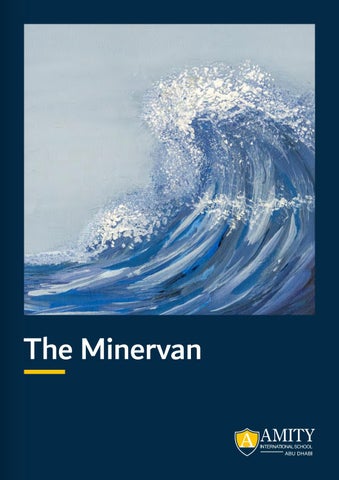
The Minervan
the case for many artists for centuries before them. Whilst some have reflected upon the sea’s majesty and beauty such as in the depiction of Trenet’s ‘La Mer’, others have considered the darker and more menacing attributes of the sea’s character such as that seen in the art work of Rahaf Teggaz or in Emma Hawkins’ analysis of Tsnunamis.
Preface from the Principal,
Mr. Frost
It gives me great pleasure to write the preface to this, the first edition of The Minervan. This work represents the pilot of a new endeavour to promote and celebrate intellectual curiosity. The topic of ‘Waves’ is a pertinent choice for us at Amity. As is the nature of a small school, each student in our Secondary School is a significant contributor to a greater whole. As such, each of them is a potential game-changer or ‘wave-maker’ through their involvement in not only the classroom, but their wider contribution to what has become a very friendly and diverse community, unified by a collective mission for success. Testament to this, is the success of our students despite the constraints exacted by the pandemic. We have seen pupils take principal roles in the Dubai Opera House, win hip-hop dance competitions, speak at Medicine Conferences, compete with Chess Masters, or nail their first ice-skating axel. Ambitious and inspired, Amity pupils make waves, and through their togetherness and collaboration, the constructive interference of these waves make the school an ever-more exciting and ambitious institution year upon year.
Maryam Ballaith - Year 8
Surf vortex, acrylic on paper Inspired by the power of ocean waves and surf boarding, Maryam merges edgy lines and vivid colour to capture the viewers’ imagination.
Given our location and identity, many of the pupils have used the sea as the source of their inspiration for their article choice; as has been
Thinking further out of the box, some pupils have taken the topic of waves and applied it in more abstract contexts. Taehee Kim analyses the movement of energy through a body of water, applying his wave theory from his study of sound and light. Meanwhile, Emilia Bray-Murphy reviews the wave of influence that followed Robert Koch’s contribution to our understanding of epidemiology, and Fransis Van Ravenswaay’s analyses the parameters influencing global population growth and decline. I would like to congratulate all the pupils who contributed to this first edition of The Minervan. You have set the bar for all those who follow you. Furthermore, you have represented the qualities of true Scholarship here at Amity International School and the School’s values of Inspiring Excellence and Collaboration. Your participation in this project not only highlights your intellectual curiosity and Willingness to study beyond the confines of your academic curriculum, but also your own interdisciplinary thinking, and the wider academic harmony that underpins our curriculum here at Amity. I would also like to thank all the staff in the Secondary School who have worked together with the authors, all of whom were younger than 15, when preparing these articles. Thank you to Mr Ferris and Mrs Upsall for their editing and thank you Mr Kumar for your overall management of the project. To all the Secondary staff who have worked with the pupils on this publication, you have shown what our Amity pupils are capable of when we ‘lift-the-lid’ on our expectations of them. Thank you for being such an inspirational team!
03
Index Front cover - After Hokusai by Alreem Alhameedi (Year 11)
01
Inside Cover - Surf vortex by Maryam Balliath (Year 8)
02
A debate on the effects of the latest social media craze on today’s youth by Camryn McPherson (Year 10) and Elisey Nikolayev (Year 9)
06
Are there lessons to be learnt from the Indonesia and Fukushima tsunamis? by Emma Hawkins (Year 11)
12
Majestic terrain by Amina Khamatdinova (Year 8)
16
Benjamin Britten by Hyunseo Ryu (Year 8)
18
From Koch to Covid by Emelia Bray-Murphy (Year 10)
20
Global population growth by Fransis Van Ravenswaay (Year 11)
22
How does fetch generate powerful waves? by Maram Chetioui (Year 11)
24
Jean Sibelius - Oceanides Analysis by Hilla Kauppi (Year 8)
26
Shoreline memory by Rahaf Teggaz (Year 11)
28
La Mer by Emelia BrayMurphy (Year 10)
30
Sehnsucht by Leila Vetter (Year 10)
32
An Analysis of ‘Frente al mar’ by Matteo Maragucci (Year 11) and Emma Hawkins (Year 10)
33
The Professionalisation of Nursing by Hamdan Al Nuaimi (Year 10)
34
You know nothing, John Snow by Jude Hasanin (Year 10)
37
Tranquil horizon by Amina Khamatdinova (Year 8)
40
Physics, Mathematics and Ocean Waves by Taehee Kim (Year 9)
42
05
A debate on the effects of the latest social media craze on today’s youth
By Camryn McPherson Year 10 and Elisey Nikolayev Year 9
Before I start to speak to you about how social media can impact you negatively, just think of how much time you spend approximately, on some kind of internet platform. You may think one to three hours per day? However, the truth is that tweens and teens in the U.S. are consuming an average of six to nine hours a day. The average social media usage of internet users worldwide amounted to 144 minutes per day in 2019. Not as bad as we could imagine, but what about 2020? Since the 5th of March 2020 in our global situation of the Covid pandemic, we have all spent time at home, in isolation, learning online, socialising online, and connecting with family and world events, online. This has dramatically increased the amount of time spent on social internet platforms with a lack of face-to-face interaction.
06
Waves
Social platforms allow us to communicate and keep in contact with people who are close to us. We can share photographs and videos that make it easier to share experiences and keep each other up-to-date on life events. However, it has impacted face-to-face communication, which as a result has impacted on our authentic means of human and social interaction. Children spend more time on social media platforms and technology than they do with their parents and friends, time in school, or any sporting or leisurely activities. One of the psychological risks of social media is that people may become addicted. People spend lots of time on social networking sites which can divert the concentration and focus from a particular task, making us less productive.
Platforms such as Tik Tok, Instagram, Facebook, Snapchat allow the sending of images. It may intrude upon privacy. Sharing details on social media may lead to kidnapping, murder, or robbery as they contain information which you post or send on social platforms. There are many cases registered by police where adults target young children and lure them into meeting them. The New Orleans Police Department arrested 22-year-old Rigoberto Usher on the 12th of July for the kidnapping of a 13-year-old girl. He picked up the teenager from her home against her guardian's consent. The two reportedly met on social media. (CNN) ‘A group of criminals used social media to stake out burglary targets in upscale Houston neighborhoods’, police of Houston reported. Their theft included artwork worth hundreds of thousands of dollars. The criminals would search social media for posts that indicated when the wealthy owners would be at work or on vacation. The thieves would also be able to see a post about an upcoming party and go to the event to case the house. If youths are not aware or educated on how to use social platforms properly, they make themselves vulnerable to those who are willing to take advantage of the personal information provided on these social platforms.
07
Today’s youth are hugely influenced by famous people such as gamers and people who want their voice to be heard by society. They should take into account the fact that social platforms have a minimum age and note size and variation of the social platforms. It often happens that bloggers, gamers, writers and other people post age-inappropriate information on social platforms that may lead young people to act more aggressivly or to feel pressures on them which may lead to depression. Many videos or posts may contain violence and other negative
images or behaviors which may have a negative impact on a youth. It is also linked to cyber-bullying and hate speeches which is any form of expression intended to slur, humiliate, or encourage hatred against a group or a class of persons. This happens because social platforms allow users to distribute speeches and demonstrate aggression to others with impunity, as each person appears as an avatar, invisible, they can abuse this by using the screen to shield their identity.
Social platforms do have many benefits. It is, however, important to remember the potential dangers which they pose to the youth of today and the destructive consequences which can occur. Some social networks, for example The Blue Whale Challenge, coerce young people to participate in assignments given to them, using phrases such as “weakly” or “you can’t”, leaving vulnerable children at risk of cyberbullying and online shaming. They continue to give increasingly sinister tasks, and as it is youth-driven, it can lead to unfortunate situations, tragedies, and even death.
08
Waves
Social platforms play an important role in our life. It is the fastest, most convenient and popular source of information and communication around the world. Without it, some people may feel helpless or alone. We do need to be aware of the risks and dangers, we need to be educated on how to understand and identity potential risks before the consequences become tragic.
It is no lie that the use of social media has taken over the world in more than I think it was expected to, but it has not been all bad. The first type of social networking created was email, which was invented in 1975. Since then, social networking has advanced into a profile with numerous features that can be used and has integrated the use of email.
Social networking is changing the way people of the world interact, and has provided many useful tools for people to use. Still, these social networks are continuing to advance to provide better features for users, and these popular sites will continue to develop. Even though we can accuse some social networking of being a waste of time or having a negative influence, it can also impact on people positively by allowing people to communicate and remain in contact with friends in a much easier way. It can educate people on a vast range of matters whether it be academically, socially, politically or emotionally.
09
Social networking sites allow people to communicate and remain in contact with friends as well as meet new people. In this modern world, social media and technology have made it very easy for us to keep in close contact with many friends and family that are located around the world. Many social media platform trends include Snapchat, Instagram, Facebook and Tik Tok. These sites allow for us to send a photo or message of what we are doing and when we are doing it. In addition, these sites also enable people to find others who may have similar interests and allow them to develop amicable relationships. Groups can be joined or formed to meet people with similar interests and views. Social networking allows for creative expression by using tools such as blogging and messaging to post ideas and stories. Users can also share their creativity such as poems, music, videography, hobbies, photography, and many other things. I am certain that everyone listening to this debate now, has family or friends somewhere in the world that they cannot see all the time. Therefore, the use of modern technology gives the next best thing in allowing us to stay in contact with one another when we are not able to do so in person. Without the use of such technology and the latest social media trends, it would be very difficult to live in a world where we are all so far apart yet still feel together.
In a world full of people who can dominate with their loud voices and strong opinions, it can be hard to have your own voice heard. There are people with big ideas in our world that go unheard. Social media is able to provide them with the platform to voice their opinion and ideas. It is known that there are approximately 3.6 billion people worldwide who use social media, this is 3.6 billion of the 7.8 billion population that can connect from places all over the world. Social media platforms such as Tik Tok, Facebook, Instagram and Twitter are great places for people to express their thoughts and feelings to others that might be interested and feel the same. It is so vital that the youth of today have their voices heard, because we are the future, and without the ability to express our thoughts and opinions on important topics, it can be very difficult to develop our sense of responsibility or need to be taken seriously. If you have an idea, you can express it in any way you want on social media whether that be through photos, videos or a speech. You have the ability for people all across the world to see it and within weeks, your idea has shared its way across the globe.
10
Waves
A young fifteen-year-old girl named Greta Thunberg did exactly this. She had concerns about our climate and she thought that they needed to be heard by the rest of the world. Greta resorted to social media, posted one statement on twitter and then within months found herself standing on a podium delivering a speech to an audience of people that have the power to make a difference. Another inspirational woman named Malala Yousafzai, has become an icon in the movements towards women's rights. After publishing a vlog about her personal experiences with the Taliban, it quickly took over the internet, and in a similar case to Greta, she found herself delivering empowering speeches to people all over the world. It is a crucial element in a teenager's mind to feel like they are heard and their opinions matter. With the use of social media trends and platforms, it has become much more achievable.
In many people's minds, social media can be a toxic and frightening place for young people. Yes, if social media is used irresponsibly or if a young person is not educated on how to use it safely, however social media can provide young people with the courage, acceptance and power that they may not be gaining in their everyday lives. Social media is a place where you are able to express how you are feeling at a certain point in time and have people give you advice and guide you in a particular direction. Social media is a place where you can be who you are. If you like your outfit and want to post it, you can and there is nothing stopping that. You are able to show your friends, family and many other people who you are and who you are happy being. The power that social media brings to a young person’s mind is important in the way that they perceive themselves, and accept and be proud of their identity. Yes, there will always be trolls who try to come after you, but above all, it teaches you to be true to yourself and that you are worthy and accepted for who you are. Paralympic athlete, Tatyana McFadden, who has achieved numerous medals in her time, took to social media to motivate and encourage other people to be positive about their body. She posted on Twitter and Instagram to share her story and confidence with the younger generation. She encourages every person to feel comfortable with who they are and what they look like. Tatyana McFadden is not the only one. There are countless numbers of people worldwide that support and try to uplift today's youth in being who they are. The social media trends that surface on platforms such as Tik Tok and Instagram, motivate young people to be involved be true to themselves and accept themselves whilst doing it. Social media plays a vital role in the way we function. It is in our lives, no matter what and there is no escaping it. The impact that social media has on today’s youth can be significant. It provides you with the ability to reconnect and exchange thoughts with people all around the world. It gives you the opportunity to be yourself and express who you are, and most importantly it brings everyone together through different platforms. The trends that come and go through social media have the ability to bring out the best in a lot of people and we need to start embracing that.
11
Are there lessons to be learnt from the Indonesia and Fukushima tsunamis?
By Emma Hawkins - Year 11
Tsunami is a Japanese word made up of two parts - tsu, meaning ‘harbour’, and nami, meaning 'wave'. A tsunami is a series of particularly long waves caused by a sudden and violent displacement of water in oceans and large lakes, which are caused by earthquakes, underwater landslides, volcanic eruptions, and such like. As these waves get closer to the shore and reach shallower waters, the wave height increases, sometimes up to 30 metres, and can reach speeds of between 30 to 50 kilometres per hour. Clearly, such a huge mass of water hitting the coast at these speeds can have devastating effects on the populations living there, as witnessed in the incidents in Indonesia and Fukushima. On the 26th of December 2004, an enormous earthquake struck along a 1448-kilometre fault line between the Indian and Australian tectonic plates. As one plate slipped below the other, the earthquake, estimated to have released energy to the equivalent of more than 20,000 atomic bombs, caused a sudden rise in the ocean floor of 40 metres and triggered one of the largest tsunamis on record. The waves travelled across the Indian Ocean at up to 804 kilometres per hour and reached heights of 30 metres at the point they first struck land. Unfortunately for the city of Banda Aceh on the island of Sumatra, the waves arrived only 20 minutes after the earthquake. Buildings were flattened and everything in the waves’ path was swept away. Over 100,000 people lost their lives in this city alone, however the tsunami was not finished. It continued its progress and subsequently hit the coasts of Sri Lanka, Thailand and India, where it claimed many thousands more human victims, before eventually striking the coast of South Africa, almost 8046 km away and 8 hours after the first earthquake. In all, over 230,000 people died as a direct result of the tsunami’s impact, and provoked damage estimated at between $12-15 billion. Source: reliefweb.int
12
Waves
The 2004 tsunami claimed so many victims for a number of reasons. Firstly, the populations in Indonesia that were close enough to the epicentre of the quake to be able to feel it, were unaware that it would have caused a tsunami. This meant that nobody tried to move away from the coastal areas to higher ground. Had they known to do this, it would surely have saved lives. However, in this case the speed at which the waves hit would have made it difficult for anyone to escape. To make matters worse, the early warning system in Indonesia had previously been struck by lightning, meaning that the authorities were unable to send out an alert. In Thailand, the warning was only given after the first devastating wave hit. Again, this gave the populations in the coastal areas too little time to flee to the safety of higher ground. Meanwhile in India, the warning of the tsunami was communicated to the wrong government official, which led to crucial delays in sounding the alert and no doubt causing the inevitable loss of life. However, today this has changed and now there are a series of warnings and systems that takes place. The combination of these factors exposed the shortcomings of the systems in place in the region, and hard lessons were learnt. It was clear that action needed to be taken, and only one month after the tragedy, one hundred and sixty eight nations signed up to the Hyogo Framework for Action. Disaster prevention and risk management were given priority, and today the region is considerably better prepared. Thanks to the Indian Ocean Tsunami Warning and Mitigation System, a complex network of sensors has been installed, such as tidal gauges and seismometers, which can detect the type of undersea tremors that can provoke tsunamis. The sensors detect such tremors, but importantly can understand the magnitude of the quakes and how likely they are to cause the types
of wave that can be a threat to human life. These sensors alert the three main centres in India, Indonesia and Australia, as well as sharing data with a further 28 states in the region. In addition to solutions driven by technology, there have also been extensive education programmes in the region. Coastal populations have been given training in rapid evacuation and disaster response, and authorities have implemented more effective procedures for communication in the event of a disaster. Furthermore, planners and architects have collaborated on projects to build high-rise shelters in vulnerable areas, and governments have undertaken projects to encourage residents to relocate to towns and cities further inland.
13
Source: internetgeography.net
Six years after what has become known as the Boxing Day Tsunami, a similar disaster struck Japan. One of the most powerful earthquakes ever recorded was caused by the movement of two tectonic plates, and a 10-metre upward shift led to the sudden displacement of water sufficient to create a devastating tsunami. At its peak, the waves are reported to have reached 36 metres in height and travelled up to 10 kilometres inland. The damage of the initial impact was made worse as the waves retreated, carrying huge amounts of debris back into the sea. 20,000 people were killed, mostly by drowning, and half a million people were evacuated to safety.
Undoubtedly, the lessons learned from 2004 meant that Japan was significantly better prepared than they otherwise would have been. The relatively low number of victims can be partly down to the early warning systems that had been put in place, and the efforts to build ‘tsunami-proof’ infrastructure in the coastal areas. However, the speed and size of the waves still meant that there was not enough time for people to flee and highlights the fact that when dealing with forces of nature of this magnitude, sometimes there is little that can be done to save lives.
The most significant factor that distinguishes the 2011 disaster from that of 2004 is the failure of the Fukushima Nuclear Power Station and the subsequent emergency. The tsunami waves cut power to the cooling systems and meant that the reactors overheated, leading to radiation leaks from the plant. The surrounding area was evacuated, and water and food became contaminated, along with the sea in that area. It was enough to cause alarm in the international community over the spread of radiation across a wide area. There are a number of lessons to be learnt from this, not least the need to carefully consider the location of nuclear facilities that could pose further threat to human life in the event of a natural disaster. Japan is in a region with a particularly high frequency of earthquakes, and as was evidenced at Fukushima, a flood can lead to the loss of vital power to keep the cooling systems operating. Therefore, future plants should be situated far enough inland to escape a tsunami, and existing plants on the coast should have backup power supplies that are resistant to flood damage.
14
Waves
Source: worldvision.org
To conclude on a personal note, while on a recent visit to Sri Lanka, I was able to witness the long-lasting effects of the devastating tsunami that hit the south-east of the island. Even 14 years after the event, it was very much a part of people’s lives. I visited the museum dedicated to keeping the memories of that day alive and spoke with survivors. Their stories support the reports I have read to research this essay, in that they all referred to the short amount of time between the alert sounding and the waves hitting. Some were able to reach safety, while so many others were not so fortunate. My family and I travelled on the same train line that had been hit, with a loss
of 1,700 lives. As we passed through the town of Trincomalle, we could see the numerous memorials and graves from the train window, and it helped us to understand how terrible and terrifying it must have been. The hotel we stayed in was owned by a Swiss lady who had survived while she was a tourist in the area. She had been so moved by the tragedy, particularly the courage and resilience of the people affected, that she returned to the island soon after to dedicate the rest of her life to helping rebuild the community. I found her story inspirational and is a personal lesson that I learnt about the human spirit in the face of adversity.
15
Amina Khamatdinova Year 8 Majestic terrain, watercolour on fabriano paper A landscape depiction using layers of watercolour to create a hyper-real composition.
16
Waves
17
Exploring, Noye’s Fludde by Benjamin Britten by Hyunseo Ryu Year 8
Benjamin Britten was a famous British composer. He was born on the 22nd of November, 1913, in Lowestoft, Suffolk, England. Britten was the youngest of four children with elder sisters Charlotte Elizabeth Britten and Idis Barbara Britten, and his brother Robert Harry Marsh Britten. His father, Robert Victor Britten, was a successful but dissatisfied dentist. Benjamin's mother, Enne Hockey Edith Rhoda, was an amateur pianist and secretary of the Lowesoft Music Association. His first appearance in music was with his mother. He began composing his first work at the age of five, and, despite his lack of musical guidance, he composed music during many of his early years.
Noye’s Fludde was composed in 1968 by Benjamin Britten. It is specifically written for amateur performers and young children. We should praise how hard children and amateur performers work in the performance and how well the work turned out. In Noye’s Fludde, a chorus, professional orchestra, recorder, band-bugles, treble recorders, violins, cellos, percussion, handbells and a range of other instruments are used. The music is very long, starting slowly and calmly.
Noye’s Fludde begins with a powerful short instrumental prelude, which forms the basis for music accompaniment to the opening hymn. In the parts where they raise their voice or get angry, he usually used the minor key. Mrs Noye and her gossips distort the children's tones sharply and slightly with ‘F’, reflecting their derisive attitude. In the last scene, before the storm to persuade the slave and his family to join the ark, ‘G’ major, expresses the servant's stubbornness with the ‘D’ sharp pedal preparing for the ‘E’ minor gossiping busy chord. In the final formal choral section, the main tune is played by a repetitive trumpet sound, moving from F major to G major.
Noye’s Fludde was described by music scholar Arnold Whitall as a means of creating very effective music theatre. This song is good to listen to and very successful. It makes me feel proud of the children performing. The violinists in the back, the cello players and the chorus people were amazing and it was great to hear the first atmosphere of the music started with a grand, slow, and low note. If the first part had started quickly with high notes, it could have ruined the song. The middle part was very good and the final section was particularly effective. They also expressed the mood well and this song is perfect.
He was a central composer figure in 20th-century British music, with a variety of works, including opera, vocal, orchestral, and chamber music. His best-known works include the opera Peter Grimes, War Requiem, and the orchestral shows The Young Person's Guide to the Orchestra. His famous piece War Requiem, Britten's greatest choral work written for Choir and Orchestra (1962), is based on Latin Requiem texts and poems by Wilfred Owen, who died during World War I.
18
Waves
19
From Koch to Covid – Why we owe a debt of gratitude to Robert Koch By Emelia Bray-Murphy - Year 10
It is easy for us to forget what a debt of gratitude we owe to 19th century scientists for paving the way for the incredible achievements their modern counterparts have completed in the past 12 months. In the current circumstances we find ourselves in with a global pandemic, adjusting the way we live our lives, we have now become somewhat experts in topics such as scientific research and the vaccination process. To think that over 100 years ago there was a lack of knowledge of different microbes causing different diseases and now almost everyone knows about vaccines, diseases, prevention and much more. Our society is very welcoming to new scientific research and ideas, whereas over 100 years ago, people were often derided for their research, which actually ended up making major breakthroughs and paved the way for things we do every day and do not question at all. Late 19th century scientists were aided by changes in attitudes – notably the move from ‘Laissez-Faire’ governance and the courage of individual geniuses such as Snow, Semmelweiss and Pasteur to publish their research. By 1900 the ‘waves’ of progress were turning into a tsunami!
20
Robert Koch, a German Microbiologist made waves in the late 19th century scientific community with the research he had worked on regarding causes of diseases. In his research, he showed that individual diseases like cholera and tuberculosis had different biological origins and although Koch was a trained doctor, he mainly focused on prevention and not on cure. A radical idea at the time that went against medical training! He was convinced that the answer lay in microorganisms which varied from disease to disease. This idea would also go on to inspire the research which led to ‘magic bullets’ such as Prontosil and Salvarsen 606. To us, Robert Koch’s ideas seem sensible but at the time his ideas were new and some did not believe his research1.
Waves
Robert Koch was able to make these developments in medicine with the help of improved science and technology (such as high-power microscopes) and government support. Due to the breakthroughs that his work has made, not to mention the long-term consequences of his discoveries, makes him one of the most important people in 19th century medicine. He is most widely known for finding that different microbes cause different diseases. He also discovered the bacteria which is responsible for Anthrax (1875), Septicemia (1882) and Cholera (1883) – paving the way for the next generation of scientists such as Erlich to develop targeted medication for specific diseases. He was able to isolate the bacterium tuberculosis by experimentation (using Agar jelly). He was able to prove that Tuberculosis
was an infectious disease and could be spread from person to person – when he presented his evidence to the Physiological Society in Berlin, they were so stunned the whole room was silent!2. Koch’s work went on to make waves around the world and his achievements, including his Nobel Prize win in 1905, show the ripples felt from the first initial wave of innovation.3 Interestingly, Koch appears on postage stamps from over 50 countries in the world – showing how widely the impact of his research has been felt. During his lifetime, he was sent to study tropical diseases in countries like Egypt and South Africa, such was his reputation for being able to do the ‘impossible’ and isolate strands of disease where others could not.4
The German government was a big help to Koch in developing his ideas – in 1870 there was the Franco-Prussian war. The French were against Germany so when Robert Koch was able to develop Louis Pasteur’s ideas (Pasteur was a French chemist), the German government provided Koch with a team of scientists to complete further research. Koch was also provided with government money to set up and establish a research laboratory – the Robert Koch Institute still exists today in Berlin studying diseases and is at the forefront of German research into Covid-195. Having such support meant that Koch was able to experiment more freely as he did not have to worry about money – this meant he could follow up his theories and work to gather evidence and prove them correct. He also published his research, which allowed other scientists to read his findings and adapt them into their own research. This shocked the scientific community, because of rivalry between countries the idea of sharing research had not really been done before. Koch created waves in the scientific community that led to increased collaboration. Something we have definitely benefitted from over the past 12 months! Robert Koch was also able to create steam sterilizers and better microscopes to aid research, he also developed a solid medium to grow cultures and watched the microbes progress through a high-powered microscope. Koch was determined to work to benefit the whole scientific community and encouraged collaboration between scientists from different countries. Koch was incredibly significant because of the long-term impact his discoveries had. Without Koch the ‘Father of Bacteriology’ there would be many other deadly diseases in the world that we still might not have a cure for. Scientists working on vaccinations and treatments for Covid-19 can do so because of the pioneering work of Robert Koch, and for that we should be very grateful.
21
Global population growth consider the parameters influencing its growth and fall By Fransis Van Ravenswaay - Year 11
Danny Meyer once said that ‘life is a series of waves to be embraced and overcome,’ suggesting that the impact of life’s occurrences vary- some being beneficial and some disadvantageous. Similarly, the same theory can be applied to global population, as it experiences waves of growth and waves of reduction, which both entail various economic and social benefits as well as drawbacks.
Global population growth occurs primarily as a result of a continual increase in birthrates. Poor living standards are common within LEDCs (Less Economically Developed Countries) as there is little to no sanitation or access to clean water. To add to this, a high percentage of women are illiterate, which is a reason for infant mortality rates being higher. In countries such as Liberia, Somalia and Angola the above-mentioned trend is due to economic and cultural circumstances. However, as these countries are less industrially developed than MEDCs such as, the UK, a high birthrate is essential for increasing the size of the labour force as the economy is mainly based on agriculture. Although high birthrates perhaps benefit these countries in their current economic state, a lower birthrate will most definitely contribute to a better quality of life for its people as resources would then be divided amongst a smaller amount of people.
22
Waves
A decrease in death rates, with no change in birth rates, in LEDCs, are also connected to an increase in the population size. A fall in death rates is due to improvements made to infrastructure such as, healthcare and education, which in turn increases people’s quality of life and therefore, their chances of survival. As countries such as Afghanistan and South Africa progress onto stages 2 and 3 of the Demographic Transition Model, they experience a natural increase which negatively affects the country economically and environmentally. South Africa, with its birthrate of 25/1000/year and deathrate of 10/1000/year, has a population growth rate of 1%/year which has resulted in more people than jobs available. This has caused a constant increase in taxation rates in order to maintain infrastructure, such as public hospitals and schools, where a decrease in quality in both public healthcare and education is prominent due to the lack of government tax-income. Furthermore, the rapid emergence of informal
settlements and the government’s financial inability to maintain sewage plants has led to increasing river pollution. An example of this is the Hennops river in the Gauteng province. However, in MEDCs (More Economically Developed Countries) such as the UK and Germany, a population decline is eminent as both death and birth rates are low. Excellent quality healthcare and sophisticated systems of sanitation ensure that MEDCs have a high life expectancy and few deaths caused by disease. The emancipation of women in more developed countries has led to lower fertility rates as women prefer to attend university and have careers over having many children. As a result, women marry later and either have fewer or no children at all due to their age. The advantages of these trends are seen economically as unemployment rates are extremely low, just below 4%, and in individual households as quality of life increases with fewer kids to take care of.
On the other hand, the trend of a “greying population” is becoming widespread in high income countries which entails major economic and social disadvantages. With a stunted population growth, countries such as Germany are facing a decrease in the size of the younger working force and an increase in costs due to more elderly dependents. Like LEDCs, population growth in MEDCs is essential for economic survival, however unlike LEDCs, the financial burden of growth is unimaginable as food, education, and health-care costs are extremely high, therefore preventing many young couples from having more kids. Socially speaking, more and more elderly are without human contact as they do not have any kids or grandkids. 30.8% of elderly women in Germany battle depression as a result, which ultimately decreases the country’s average quality of life. In applying Danny Meyer’s theory to the topic of population growth, it becomes clear that the concept is much more complex than it appears. Waves of growth cannot be classified as just beneficial and waves of reduction not as just disadvantageous. Each wave, in the extreme, entails challenges that are only fixed with time and a lot of money. Therefore, maintaining a balance between uncontrollable growth and irreversible reduction is essential for the social and economic well-being of each individual country, regardless of its level of development. Bibliography: www.internetgeography.net- Population Issues: Population changes in LEDCs, Population changes in MEDCs bbc.co.uk/bitesize- Population change and structure: Patterns of population growth nap.edu/read- The Growth of World Population: Analysis of the problems and recommendations for research and training: Social factors, 1870 Economic factors
1970 1950 1930 1900
2000
2018
How does fetch generate powerful waves?
By Maram Chetioui – Year 11
Waves are formed by wind blowing over the surface of the water. This blowing creates ripples which eventually form into waves. As these waves reach the beach, the lower part of the waves decreases in speed due to friction from the beach sediment and rocks turning the motion of the rocks from circular to more elliptical. Therefore, the upper part of the wave plunges forward crashing on the beach. There are two types of waves, constructive and destructive waves. Constructive waves are low and spread apart with a strong wash bringing in sediment onto the beach shore and weak backwash that is not strong enough to pull sediment with it into the ocean. This type of wave is what contributes to building up the beach or other landscapes. On the other hand, destructive waves are waves that are high and have more compact. They normally have a weak swash not bringing any rocks or shells to the shore but pulling it into the sea with its strong backwash causing the beach to be destroyed. There are lots of factors that affect the power, speed, and destructive rate of a wave. These factors include fetch, duration of wind, and wind speed. The term fetch is given to the distance travelled by wind over open water without interference (such as islands) and it is what affects the power of the waves determining whether the waves are constructive or destructive. The longer the fetch, the stronger and more powerful the wave, thereby creating a more destructive wave. For example, the South Westerly is affected by large waves that have really long fetch where the wind travels are uninterrupted for thousands of miles across the Atlantic Ocean. Whereas if the fetch was only a couple of meters long, then this will produce short waves (constructive)
24
Waves
talking about the study of the reason behind these gigantic waves, “We should also analyse the width of the wind fetch directly pointed at Teahup’oo, which was bigger in yesterday’s case as compared to 2011.”
The largest fetches are generated in the Pacific Ocean, which is no surprise since it is the biggest ocean. Therefore, the waves can travel for thousands of kilometres without interruption before reaching the shore. An example of an area affected by its large fetch is Teahupo’o Tahiti. This area is located along the southwestern coast of the Island of Tahiti. It is known for its heavy, thick, and high waves reaching up to 2 to 3 metres high and in some cases reaches around 7 metres, perfect for surfing. The fetch length for these waves reaches to more than 10 thousand kilometres that travel through the Pacific Ocean all the way to this island making it not only a surfer’s delight, but a dangerous place due to its rough waves. As said by the MSW forecaster, Francisco Silva
The fetch of a wave also has an impact on communities and infrastructure. If the fetch of a wave is extremely large and the wind speed is high resulting in stronger and higher waves, then the communities will need to be aware of this as the government needs to make sure that the area is safe. For example, they could build coastal barriers around harbours in order to resist strong waves. As well as that, warnings need to be placed informing people of the danger and risk. In some severe cases, laws and restrictions in coastal regions should be placed preventing any casualties or injuries resulting from destructive waves caused by long fetch. A researcher at the Institute of Marine Sciences at the University of California, Santa Cruz explains how “Ocean waves determine where people build infrastructure, such as ports and harbours, or require protection through coastal defenses such as breakwaters and levees,”
Some studies have also shown how waves have been affected due to increasing global temperatures. The intensity of waves has been increasing throughout the years which, according to a study about the correlations between sea surface temperatures and wave intensity, is caused by the increasing surface temperature of the water. This effect results in higher wind speeds which causes more intense and destructive waves. This wave power increase is likely to further develop as sea levels rise as stated by the researcher of the study, “Sea level rise will further aggravate these effects by allowing more wave energy to reach shoreward.”
25
Jean Sibelius – Oceanides Analysis
By Hilla Kauppi Year 8
Jean Sibelius was a Finnish composer and violinist who is considered Finland’s greatest composer. He was born on the 8th of December, 1865 in Hämeenlinna. He had a sister called Linda, who was two years older than her brother. His father was called Christian Sibelius and was 44 years old at the time Jean was born, and his mother, Maria Sibelius was 24 years old. His father worked as the town’s local doctor. When Jean was only three, his father passed away from typhoid fever. The tragedy continued, as Christian had unpaid debts and lost most of his money. The family had to move to Maria’s mother’s, Katarina Borg’s home because Maria did not earn enough to keep a house. Jean’s interest in music began during these tough times when Jean’s aunt, Julia, tried to teach him to play the piano, but Jean did not like her methods as she would punish him for every wrong note. He much preferred free improvisation over these harsh ways. In 1903, Jean built his family a house, on the shores of Lake Tuusulanjärvi in Järvenpää, which he called Ainola (Aino’s place). He would spend a lot of time in Helsinki for his work, but he spent his last days in Ainola. He passed away on the 20th of September, 1957. Jean Sibelius produced many compositions during his life. The most famous piece of work he ever wrote is Valse Triste, which gained worldwide attention. He composed the waltz for his brother-in-law Arvid Järnefelt's 1903 play Kuolema (Death). However, it is far better known as a separate concert piece. Another remarkable piece is Finlandia, which was originally named Finland Awakens but then later renamed. Sibelius composed it in 1899 for the Finnish Press Pension celebration. His seven symphonies are also very famous. There is an eighth symphony but he never finished it. He composed the seven symphonies during the time period 1898 and 1924. Oceanides (Aallottaret in Finnish) is a tone poem. A tone poem is a piece of music which tells a story, describes a landscape etc. This particular piece describes a storm rising above an ocean through the use of dynamics and varying texture. The conductor was Sibelius himself, and the orchestra that played it was the Norfolk Music Festival Orchestra. The song was originally commissioned for the Norfolk Festival by Horatio Parker. He was acting on the authorisation of the millionaire and festival promoter Carl Stoeckel and his wife.
26
Waves
CALM OCEAN
STORM RISING
THUNDER STORM
Oceanides is divided into three main sections. They are calm ocean, a storm gathering and the thunderstorm. The calm ocean is played softly, with quite a light texture. I would imagine this section as a clear sky and stable ocean, with a little breeze. The next, gathering storm, is getting a bit rougher than the calm ocean, the texture gets thicker. In this part, we see the ‘clear sky’ get covered with grey clouds and the weather getting windier. The last part, the thunderstorm, has a thick texture with sounds and notes added together. This is the part where the clouds would turn very dark, the weather a lot windier, with a rainfall like straight from a bucket. Let’s go into more detail! The best way to describe the opening section is to say that the musical sounds seem to flow like calm waves. It has a light texture and is played softly. It starts with violins and cellos playing a calm melody, with a little quiet percussion. Then the flutes enter and join with the melody. I think this could represent a happy little breeze. Even though the texture is light, with some percussion, strings and flutes, it still sounds very grand, which helps us to visualise a huge ocean. This is helped by the use of percussion and varying dynamics. As we get into the second part, the storm gathering, the texture gets thicker. You can hear brass and woodwind enter and the melody changes to a more melancholic sounding one. The percussion increases, indicating a change of ‘weather’. The melody changes for a while to a quick and higher pitched one, with a cheerful tone. As the music progresses it starts to build with more instruments being added and increased dynamics.
The third part, the thunderstorm, sounds exactly as the name suggests. It perfectly matches the section’s name and the dynamic is forte, sometimes switching to fortissimo. The strings play a quick-paced loop of rising up a chromatic scale and back down again, which reminds me of a tornado going around! Low-pitched notes are played by the tubas and the trombones and the percussion becomes intense. I could describe the combination of the texture and dynamics as grand. The music is successful because of the use of contrasting themes during different sections that fit the overall mood of the song. All the three sections, calm ocean, storm rising, and thunder storm represent the changing moods and the force of the ocean. Another factor of the piece being successful is the varying texture between all of the sections. Today, Sibelius is celebrated on his birthday, 8th December. The day is the flag day of Finland, but also the day of Finnish Music.
Bibliography: www.sibelius.com www.sibelius.fi https://www.britannica.com/biography/Jean-Sibelius
27
Rahaf Teggaz Year 11 Shore line memory, acrylic on canvas A lyrical composition by Rahaf Teggaz exploring colour, inspired by childhood memories of the Mediterranean shoreline.
28
Waves
29
The sea, see it dance Playing along the long shore N' when it showers, the sea shines bright Splaying the light even more
Charles Trenet French singer-songwriter
The sea, to the summer sky Confounds those ivory sheep Shepherd of blue, you watch the view Reflecting Angels as they sleep.
La mer interpretation of an old French song
I'll see . . . circling a pond Tall reeds glistening green And homes a rusty red White wings caa-calling the sea . . . The Sea swings along shore To sing a tune of l'amour Waves of a song of love to me A lifetime of love for the sea.
By Emelia BrayMurphy – Year 10
Charles Trenet was a French singer-songwriter, born on the 18th of May, 1913 and passed away on the 19th of February, 2001. His song La Mer, released in 1946, was considered to be France’s best-selling song with a growing number of recordings and sold copies. The lyrics came to Charles Trenet when he was sixteen and on a train, observing ponds that were in the distance of the landscapes. In 1946, the year La Mer was released, it reached an astonishing 70 million copies sold! He was described as a magician with words and an inventor of rhythms.
30
Waves
My interpretation of the lyrics La Mer
Je regarde les vagues éclabousser le rivage, tout en sentant le sable doux au fond de l'océan. L'eau et ses différentes teintes de bleu, Quelle vue magnifique, c’est merveilleux. Le sable, la sensation de chaleur sous mes pieds sont assez pour égayer la journée. Un ciel aussi bleu que la mer, assise sur le rivage, il y a tant à voir, quelle atmosphère. Les vagues apportent avec elles tant de possibilités, pour n'importe qui, peu importe nos capacités. Au bord de la mer, il y a du bonheur dans les yeux de tous, du lever du soleil au coucher.
The Sea
I watch the waves as they splash off of the shore, feel the soft sand on the ocean floor. The water is so many variations of the colour blue, it is such a wonderful view. The sand, the feeling of warmth beneath my feet, enough to make the day feel complete. A sky just as blue as the sea, sitting on the shore, there's so much to see. The waves always carry such possibility, for anyone no matter your ability. By the sea there is happiness in everyone’s eyes, whether it be sunset or sunrise.
31
Spanish Poem Sehnsucht
s Meer, der Strand Da ist es endlich, da r stand. e schon nicht meh an dem ich so lang , die Wellen so laut Die Sonne so warm baut ern und Vätern ge nd Ki n vo en rg bu Die Sand acht mich hierher gebr t ha t ch su hn Se ie D ht. davon fast jede Nac Geträumt hab ich d, der Salzgeruch Die Wellen, der Win sonst gesucht das alles hab ich um Strand kein Meer und kein Wo ich lebe da ist ent und Sand n gebaut aus Zem er üs Ha n vo r ee M Da ist nur ein Smog, und Stress Nur Strassenlärm, ess. he am Meer, nur M Nichts von der Ru
ENGLISH
s sea, the beach There is the endles t stood for so long On which I have no the waves to loud The sun so warm, thers ildren and their fa ch by ilt bu s le st The sandca t me here The longing brough t is almost ever y nigh I have dreamt of th e sea air and the smell of th d in w e th , es av w The this in vain I’ve looked for all of ach is no so and no be Where I live, there ment ilt from sand and ce bu es us ho of a se There is only a smog and stress Only street noise, aos aceful sea, only ch pe e th of ng hi ot N
SehnVsetuterc-hYetar 10 By Leila
32
Waves
Matteo Maragucci (Year 11) and Emma Hawkins (Year 10) have read and interpreted the poem ‘Frente al mar’ by Octavio Paz. Both pupils have spent time translating the poem and interpreted it in their own way. Matteo:
I think this poem has tried to describe how our society is these days. When the poem refers to the sea dying of thirst, it makes me think of how our planet is ‘dying’ because of the effects of humans. The waves coming and going in different directions and shapes, made me think of how we humans always want to try different things, but rarely consider saving our home. But we could also interpret the waves as life, how they all go different directions and how some end within minutes, while others in days. Also, the poet suggests how we can only let the wind guide us which for some of us could be considered part of our religion.
Emma:
I believe the poem "Frente al mar" describes the process of life and relationships with people that come and go; whether they are friends, family or strangers. The waves can represent people and, even though they might only stay for a while, they will have a big impact in your life. The 'waves' can change you as a person and have an influence on you, however, just as the waves remain in the sea, you still remain yourself at the end of the day.
avio Paz Frente al mar, by Oct Llueve en el mar: mar al mar lo que es del eredad. y que se seque la h a? ¿La ola no tiene form culpe En un instante se es rona y en otro se desmo donda. en la que emerge, re forma. Su movimiento es su Las olas se retiran ucas? ¿ancas, espaldas, n s pero vuelven las ola umas? ¿pechos, bocas, esp . Muere de sed el mar ie, Se retuerce, sin nad s. en su lecho de roca re. Muere de sed de ai
English It rains at sea elongs to the to the sea what b sea inheritance. and dries up the ot have shape? n e av w e th s e o D ulpts itself In a moment it sc collapses and in the next it at emerges, into the wave th complete. its shape. Its movement is raw The waves withd es? Hips, backs, nap turn But the waves re bubbles? Chests, mouthes, of thirst The sea is dying anyone, It twists, without of rocks. On its deathbed
33
The professionalisation of Nursing – remembering Florence Nightingale and Mary Seacole
Florence Nightingale was a pioneer in nursing. She was an upper class woman who shocked her whole family when she announced she wanted to become a nurse. Her family were opposed to the idea because they thought nursing was a dirty job and not a great job for a woman’s health. Florence Nightingale ignored all the negative comments and attitudes around her and was determined to have her dream career. This determination to follow her own path in her life and ‘make waves’ deserves to be remembered. Other middle and upper class women were inspired by her and they decided to become nurses as well, meaning that to be a nurse was seen as a good job/career by the end of the 19th century as she completely changed the role of nursing and changed people’s perceptions. Nursing had become professionalised – with proper rules, training and professional qualifications.
By Hamdan Al Nuaimi - Year 10 The world is thankful and very grateful that we have doctors and nurses who work really hard for our health and to help us recover from Covid-19. The Covid 19 pandemic has taught the world to appreciate all that nurses do for the world. However, this was not the case in the 19th century; to be a ‘nurse’ was not a good thing. The modern profession of nursing that we know today is thanks to a few brave women who were not afraid to make changes to the attitudes held towards nursing. In the 19th century, nursing was not seen as a real profession. The nurses received no formal training, did not have to stick to rules about hygiene and they were often poorly paid and made up of women from the lower parts of society who could not get any other job. They certainly did not keep medical notes or administer medicine. There were also no male nurses in the 19th century. This is obviously very different to today where nurses come from a range of backgrounds and are honoured for their hard work risking their lives to care for other people. In the United Arab Emirates we have seen nurses receive praise and rewards for all they do to help other people in the pandemic1.
34
Waves
War has always been a factor that has led to great positive changes in medicine – professionals have to innovate and work under high pressure to find a solution to major injuries and infection. The Crimean War (1853-56) led to improvements in the nursing career and had two high profile individualsFlorence Nightingale and Mary Seacole making changes that would later lead to the professionalisation of nurses. But the British government did not even want them there at all! If Florence Nightingale or Mary Seacole had listened and not ‘made waves’, nurses and hospitals might be very different today. As they cared for sick and injured soldiers, they brought in radical changes to hospitals that still exist to this day. For us, it seems only correct that hospitals would be clean with lots of windows for fresh air and a team of doctors and nurses ready to give medicine or dress wounds – of course because of Covid-19 hand washing and infection control. This was not the case in the mid-19th century and when Florence Nightingale and her team of nurses arrived at the battlefield hospital in Scutari they came to a horror show.
35
Hospitals were not like they are today, they were more like care facilities for people that did not hope to recover and there were little attempts to cure patients. Florence Nightingale came up with innovative ideas to help the soldiers recover and transform the hospital into something we would recognise today. Some of the problems Florence had to fix were: no beds for sick patients, overcrowding, outbreaks of disease such as Cholera and Typhoid, dirty wards, a leaking roof, lack of medical supplies and food. Today, we can immediately see how these issues would create a high mortality among patients in hospitals but in 1853 Germ Theory was still in a very basic development and Pasteur and Koch had not published their findings. Back to innovation though. Without fully understanding how her actions were helping (she actually believed miasma caused disease) Florence Nightingale began to transform Scutari Hospital. She did this by: setting up a cleaning rota, changing bandages and dressings daily, opening windows to allow in fresh air and making sure all patients had a clean bed and fresh food. Mary Seacole had a similar idea to
36
Florence Nightingale and opened up a hotel hospital that was very clean, had warm places for soldiers to stay and have some proper care for their wounds. Why should Florence Nightingale and Mary Seacole be remembered as ‘making waves’ in medicine? Because they changed the idea of hospitals and nursing. In the mid-19th century people would not go to the hospital because they thought that it was a dirty and not a good place. This is not like today. Florence Nightingale knew how dirty the hospital was and she made the place clean and bright, even when people tried to stop her. By not being afraid to ‘make waves’ she helped create the idea of modern hospitals. Florence Nightingale and Mary Seacole both wrote books about their experiences in Scutari – doctors all around the world read them and started to use their ideas. Florence Nightingale wrote a book about how nurses should be trained and challenged the idea nursing was not a proper job. It is scary to think what might have happened if these brave women did not ‘make waves’ to change attitudes and practices in nursing.
You know nothing, John Snow – Or do you? Making waves in 19th century Public Health By Jude Hasanin - Year 10
In the current climate of masks and medicine, viruses and vaccinations, we all have a new appreciation for the work of the doctors and scientists who have worked tirelessly to understand and treat Covid-19. The work of these fearless individuals to help bring the pandemic to a close, follow in the footsteps of many early medical pioneers – some of whom faced hostility, ridicule and sometimes violence in their pursuit of medical understanding. Take the famous John Snow for example: Snow was a key individual in tackling the spread of one of the early modern pandemics - Cholera. This deadly disease was responsible for taking hundreds of thousands of innocent lives. It is due to Snow’s pioneering work that our understanding of the spread of disease has greatly evolved from the mid-1800s, when the concept of sanitation was laughed at. Our ability to treat and vaccinate against Covid-19 owes a huge debt of gratitude to individual geniuses such as Snow who risked their careers to ‘make waves’ and challenge the status quo. In the 19th century, one of the biggest obstacles to preventing and containing epidemic outbreaks of disease was the rather contentious issue of public health – or lack thereof. The attitude of governments in 19th century Europe was ‘Laissez Faire’ (meaning: the policy of leaving things to their own course, without interfering). Of course we know from our own experiences with the current global pandemic, strong and decisive leadership is vital to dealing with public health emergencies effectively. In 19th century London when a Cholera epidemic hit in 1832, then again in 1849 and 1854 national government intervention was limited, and responses varied from city to city depending on the attitudes of the ‘Board of Health.’ 1
Waves
37
to save patients who had, up to a few hours ago, been perfectly fit and healthy. What makes Snow exceptional is he refused to accept the established narrative and had the courage to challenge the entire medical profession – and potentially ruin his career – to help improve the lives of his patients. His diligence and tireless research led him to hypothesise the link between polluted water and disease. In the midst of the 1854 Cholera epidemic, Snow wrote of the surge of excitement he felt when he noticed a link between Cholera cases and Broad Street, where he states in his research journal: “Within 250 yards of the spot where Cambridge Street joins Broad Street there were upwards of 500 fatal attacks of Cholera in 10 days,”
In 1832, the first Cholera wave struck Europe. By the year 1849, Snow published a report: ‘On the mode of communication of cholera’, which introduces the hypothesis of Cholera being spread through the ingestion of contaminated water. Snow’s dedication to eradicating this killer disease allowed him to become one of the most significant individuals of the 19th century and inspired many others to ‘make waves’ in addressing issues of Public Health. In fact, doctors themselves did not know how to effectively respond to outbreaks of disease such as Cholera because their understanding of what caused disease was incorrect. John Snow’s theory that diseases such as Cholera
could be spread by dirty water was so outrageous at the time because the prevailing theory amongst medical professionals as well as the general public, was that epidemic diseases such as Cholera were caused by ‘miasma’ (foul smelling air) which seeped into the body through your pores and made you sick. Here is an example of a letter sent by a Surgeon, Thomas Calley in 1832 recommending setting off large explosions around London to clear the air. “combustion [setting fire] of gunpowder from large pieces of ordnance [weapons] on the principal that it would produce a general rarefaction of the atmosphere [make the air less dense] and fill the element with vital air.”
But what led John Snow to make these discoveries? How did he come up with such an outlandish theory? His story begins fairly normally - he worked as a regular household doctor for 18 years. By 1831, the first Cholera epidemic had hit England. Snow saw firsthand the utter devastation ‘King Cholera’ wreaked amongst his patients in London and committed himself to finding why this awful disease seemed to target so randomly. For him, the miasma theory simply did not make sense.
38
Cholera is a brutal disease, spread by bacteria in dirty water. It causes untold suffering to those infected, causing severe dehydration and particularly affects children and the elderly. It can kill within a matter of hours and is highly infectious. The mortality rate for Cholera can be as high as 68%. Snow worked in areas of high depravation as a doctor, and time and time again found himself unable
Waves
Dr. Snow goes on to write: “As soon as I became acquainted with the situation and extent of this irruption (sic) of cholera, I suspected some contamination of the water of the much-frequented street-pump in Broad Street.” 5.
Snow worked around the clock to track down information from hospital and public records on when the outbreak began and whether the victims drank water from the Broad Street pump. Snow suspected that those who lived or worked near the pump were the most likely to use the pump and thus, contract Cholera. His pioneering medical research paid off. By using a geographical grid to chart deaths from the outbreak and investigating each case to determine access to the pump water, Snow developed what he considered positive proof the pump was the source of the epidemic. It was this meticulous gathering of evidence and attention to detail, coupled with Snow’s persistence that finally convinced parliament members to remove the handle of the water pump in Broad Street to prevent further spread. As a result, the average daily cholera cases fell from 130 to 40 almost overnight. Overall, John Snow’s hard work and perseverance significantly improved public health in the 19th century, as the link between contaminated water and disease meant there was a new drive to improve sanitation leading to a decline in Cholera cases and better health in England. Now that the link between dirty water and disease had been made, it would be up to scientists such as Pasteur and Koch to take advantage of new technology such as high-powered microscopes to prove WHY.
39
Amina Khamatdinova Year 8 Tranquil horizon, watercolour on fabriano paper A dream-like beach scene at sunset using joyful colours to capture the open sea and sky.
40
Waves
41
In this document, we focus on mechanical waves.
Physics, Mathematics and Ocean Waves
Parts of a Wave
A crest (or a peak) is the maximum height of the wave, and the trough is the minimal height of the wave.
A wavelength is the distance between each crest (peak) in a transverse wave, and the distance between two equal-density points in a longitudinal wave.
By Taehee Kim – Year 9
Introduction to Waves
Waves come in different shapes and sizes. Sometimes, it is a calm and soothing wave at the beach, and sometimes it is a massive earthquake shaking the ground. But what properties do they have? What do they look like? What exactly is a ‘wave’?
What are Waves?
Waves are the transfer of energy from a point to another. If that sounds absurd, imagine two people holding two ends of a rope. One of them starts to pull the rope upwards, then back down. This motion is repeated, and the energy travels through the rope, from one person to the other.
From this you can learn that a wave is energy (the undulation of the rope) moving through something (a rope in this case) from one point to another. The median (the rope) can be anything from the air around us (sound waves) to the sea waters (ocean waves).
Different Types of Waves
Waves can be divided into two major categories: Mechanical and Electromagnetic waves. Mechanical waves need a median to travel through, for example ocean waves through water, while the latter may travel by itself. Mechanical waves can also be divided to two smaller categories, known as longitudinal and transverse. Transverse waves are like the waves you see in the ocean – a patterned movement that oscillates, and longitudinal waves are like slinkies being pulled apart then put together again. Transverse waves include oceanic waves, electromagnetic waves, and seismic S waves. Longitudinal waves include sound waves and seismic P waves.
42
Waves
© Encyclopædia Britannica, Inc.
Amplitude is the height of the crest or trough, and a cycle is the duration between a point of intersection (with the wave and the x-axis) to a corresponding point that is a wavelength away.
Ocean Waves
Ocean waves seem chaotic and unorganised at first glance. However, as you look closely at the waves, you start to see a recurring form of a transverse wave. A question remains, though; what shape are the waves?
Trochoid Waves
A trochoid wave is a type of transverse wave. A trochoid can be defined as the curve traced out by a point on a circle as the circle is rolled along a line. Look at Fig. 2. The water particles in a wave move in a circular motion, and this makes the wave draw a trochoid wave, where the wavelength is 20r and the amplitude is r.
Figure 2 - an illustration of a trochoid wave, as observed in water - http://hyperphysics.phy-astr.gsu.edu
Cycloid Waves
There are several types of cycloid. In this article, the name cycloid refers to one of the family of curves which form the focus of a point on a circle rolling along a straight horizontal path. Fig. 3 illustrates the basic cycloid; in this case the point is on the circumference of the circle.
Figure 3 - a basic cycloid wave - www.JCMail.ac.uk
43
Al Bahya, E10, Exit 39, Abu Dhabi - UAE Call: +971 2503 9000 Email: reception@amityabudhabi.ae
www.amityabudhabi.com