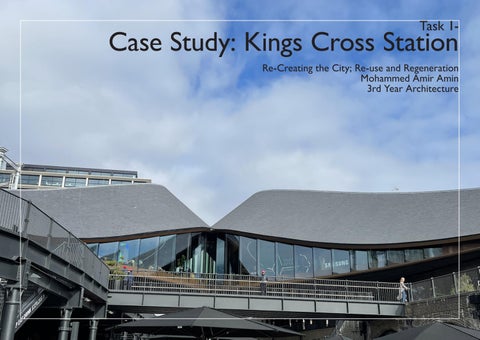
Task 1-
Case Study: Kings Cross Station
Re-Creating the City; Re-use and Regeneration Mohammed Amir Amin 3rd Year Architecture
Introduction
The importance of heritage conservation, both tangible and intangible with aspects of heritage led regeneration is becoming more important in the field of architecture because of the changing technologies and need to reuse historical buildings. Architects now need to understand the values associated with heritage sustainability and not just the methods of maintaining the aesthetic of historical buildings. While comparing the evolution of different theoretical approaches to restoration by theorists of historically important buildings and monuments. On the other hand, discussing current legal frameworks in the UK and the role of international organisations such as UNESCO and ICOMOS alongside the United Nations Agenda 2030 view on heritage conservation with sustainable development goals in mind. The case study being discussed will be Kings Cross Station in London, UK because of its drastic transformation that can be debated as a successful restoration and regeneration of the wider area. The purpose of this paper will be explaining the evolution of the conservation theory, legal frameworks specifically in the UK and the case study in regards to it being a successful heritage-led development.
Figure 1- Eugène Viollet-le-Duc
Figure 2- John Ruskin photograph
Figure 3- Portrait of William Morris
photograph by Nadar
in 1863 by Downey
published in 1899
Figure 4- Arch. Camillo Boito, photograph by Varischi
Heritage today is defined as “All inherited resources which people value for reasons beyond mere utility” by The Nara Document on Authenticity from the International Council On Monuments and Sites known as ICOMOS (1994). However, theories around heritage and conservations in regards to architecture have evolved and changed over time. One of the key players in heritage conservation was French architect Eugène Emmanuel Viollet-le-Duc (1814-1879) (Fig. 1); his approach in regards to heritage was to focus on a ‘stylistic restoration’ for architecture and monuments (Jokilehto, 2018). He believed that architects should try and replicate the original material palettes and find a suitable way to reuse buildings of historical value to add to their longevity. On the other hand, John Ruskin (1819-1900) (Fig. 2) focused on a purely conservationist view as he disagreed with restoration works because they destroyed the original beauty and meaning of structures quoted saying “The thing is a Lie from beginning to end.” in reference to restoration. This means if architects protect and conserve historic buildings in their original form, then restoration wouldn’t be needed (Ruskin, n.d.). The ‘SPAB manifesto’ was written in 1877 by William Morris (1834-1896) (Fig. 3) alongside others who agreed with many of Ruskin’s views, the aim of the manifesto was to educate the public in the 19th century on the importance of heritage of historical buildings which at the time were only valued on their monetary and practical values (Donovan, 2008). Italian architect Camillio Boito (1836-1914) (Fig. 4) approach to heritage conservation took aspects from both Viollet-le-Duc and Ruskin and combined them to create a scientific, critical approach to analysing the different layers of intervention needed when dealing with historically significant architecture and monuments (Boito, & Birignani, 2009). Boitos’ findings produced the ‘Charter of Restoration’ in 1883 which took into account eight points to consider when dealing with heritage; these points were widely accepted and influential and worked into modern legislation like the Athens Charter (1931), Venice Charter (1964) and the Burara Charter (1979) (Starn, 2002).
Today, international organisations such as the United Nations Educational, Scientific and Cultural Organisation (UNESCO) and ICOMOS (Fig. 5 and 6) are major players in heritage conservation in the world as they list important heritage sites around the world, advising on how to properly preserve them in today’s climate and make use of their culture (UNESCO, 2021). Additionally, the sustainable development goals (SDG) in the context of the 2030 agenda (Fig. 7) have not only listed the preservation of historical architecture although not directly mentioned it refers to heritage in SDG in 11.4 and through other goals referring to both local and national, urban and rural communities should consider importance of the different values attached to heritage both tangible and intangible such as a sense of culture, identity and belonging to develop sustainable communities and create successful placemaking strategies (Petti, Trillo, & Busisiwe Ncube Makore, 2020).
Figure 6- International Council on Monuments and Sites logo by ICOMOS
Figure 7- The Sustainable Development Goals by UNDP (2016)
Figure 5- Flag of the United Nations Educational, Scientific and Cultural Organization by Mouagip
Figure 8- Facade of Kings Cross Station which is Grade I listed, photograph by author
In the UK, Historic England created a Conservation Principles (2008) which provides a framework for practices dealing with designated listed buildings and how to properly re-use, restore and conserve their original heritage using different values being communal, aesthetic, evidential and historical. The legal framework, known as Planning (listed building and conservation) Act 1990, which is the most important documentation that is enforced by parliament, should be preserving and enhancing our heritage assets that will be changed to not cause harm to the original building when it is being reused or restored for a different function. Historic buildings are listed from grade I being most protected and harder to make changes to, II* and II (Fig. 8). These designated buildings are maintained by Historic England as they have been identified as having significant value and quality either; communal meaning it is a place which the local people relate to it in a memory or experience, aesthetic meaning that the building is very detailed crafted, evidential which displays historic construction methods and its materials or historical which is evidence of the culture and way of life of the people during that time period (Historic England, 2021). The next important document is the National Planning Policy Framework (NPPF) (2019) which does not only deal with listed heritage buildings but all decision making related to the sustainable development of the built environment for the present and future generations. The local planning authorities also play a role in the heritage conservation framework and can differ from area to area; they should be consulted for a project relating to historical assets.
Case Study
The case study of Kings Cross Station is located in London, UK. The station was designed by architect Lewis Cubitt and was constructed in 1852. It featured a double barrelled train shed, one for outward travel and one for inward travel as well as a monumental twin-arched facade made from yellow brick (Transforming King’s Cross, 2012). During World War II, the station itself sustained significant damages to western side and needed significant repairs and had to be rebuilt to its original form. Also in 1987 there was a fire outbreak which burned many of the train lines and killed many civilians. These events would then lead to periods of economic decline, high unemployment and increased crime which negatively affected the community and reputation of the area. Although in 2012 the Grade I-listed station underwent a major transformation by the firm John McAskan + Partners, led by Network Rail as the ambition of the project was to reinvent and change the perception of the wider area from a derelict, poor environment to a busy, urban area for economic growth (Jóźwik, 2015). Additionally restorations of the arc shed roofing were done and one of the most noticeable changes was the addition of a new concourse structure which replaced the extension made in 1972 (Fig. 9) as this plaza space allowed for a better integration between the station and its surrounding area as a place to attract tourists and increase business (Transforming King’s Cross, 2012). This impressive master plan featured the new extension structure to Kings Cross Station and the planning application for the restoration of more than twenty historic buildings served as a catalyst to the wider area of Kings Cross for development and heritage-led regeneration (Lee, 2004) (Fig. 10). The project was able to respond to the problems faced by historically conserved areas such issues like decay and lack of care but instead it was transformed into successful preservation and allowed for the historic structure to be reused and have new, meaningful value for the current population (Punter, 2010) (Fig. 11).
Figure 9- Concourse structure from both sides of the station, photographed and edited by author
Figure 10- Master Plan of London model, photographed by author
Furthermore, implemented aspects of the United Nations SDGs such as Goal 11 which was to create safe, inclusive and sustainable city environments for all as it was able to change the negative reputation of the area through its use of lifts and ramp access as well as the already established underground transport network with the wider area of Kings Cross being easily accessible with public transport with many signs and symbols to help guide people (Adelfio, 2021) (Fig. 12). Other sustainable goals included in the development were sustainable transportation and reduced carbon emissions (Goal 13) through the use of greener power for hot water supply, heating and electrical eco-trains being implemented. Goal 7 reducing energy consumption was achieved through a variety of methods such as the use of glass in train sheds to maximize daylighting and refurbishing/retrofitting the eastern range building instead of it being demolished to be properly utilized. Goal 8 refers to economic growth, which at Kings Cross was a main aim for the project and the creation of the iconic concourse landmark led to more facilitates, businesses and stakeholders investing in other areas like Coal Drop Yard (Sustainability At King’s Cross sustainability is king, n.d) (Fig. 13). These environmental, social, and economic aspects in the regeneration of Kings Cross station acted as indicators of the project being a successful heritage-led scheme as the area was able to transform itself using its heritage as a forefront for development and attracting more investment into the wider area of Kings Cross.
Figure 11- Central Saint Martins interior, photographed by author Figure 12- London underground sign, photographed by author Figure 13- Coal Drop Yard, photographed by author To conclude, through Task one I have understood that heritage plays an important role in a successful regeneration and placemaking of a community as seen through Kings Cross as it can change an area’s perception as seen first hand from the site visit to London. The social and cultural aspects of the local community should be just as important and protected as the historic buildings that make up the area. For architects and urban planners it’s important to follow and keep up to date with current legal frameworks and application process but also to work with local governance and communities to help ensure a beneficial plan that considers a range of people’s points of interest and not just those in power. Therefore, conservation and the restoration of historic buildings are able to provide a sense of identity among people and act as an important catalyst for the regeneration of the wider region.
Bibliography : - Adelfio, M., Hamiduddin, I., & Miedema, E. (2021). London’s King’s Cross redevelopment: a compact, resource efficient and “liveable” global city model for an era of climate emergency? Urban Research & Practice, 14(2), 180–200. https://doi.org/10.1080/17535069.2019.1710860 - Boito, C., & Birignani, C. (2009). Restoration in Architecture: First Dialogue. Future Anterior, 6(1), 68–83. https://doi.org/10.1353/fta.0.0026 - Donovan, A. E. (2008). William Morris and the Society for the Protection of Ancient Buildings (Vol. 10). Routledge. https://doi.org/10.4324/9780203937907 - Historic England. Conservation Principles; Policies and guidance for the sustainable management of the historic environment (2008) https://historicengland.org.uk/images-books/publications/conservation-principles-sustainable-management-historic-environment/ conservationprinciplespoliciesandguidanceapril08web/ - Historic England, Listed buildings 2021 https://historicengland.org.uk/listing/what-is-designation/listed-buildings/ - Jokilehto, J. (2018). Stylistic restoration. In A History of Architectural Conservation (2nd ed., Vol. 1, pp. 169–208). Routledge. https://doi.org/10.4324/9781315636931-6 https://www.mdpi.com/2571-9408/2/1/61/htm - Jóźwik, A. (2015). Modernization Of Saint Pancras And King’s Cross Railway Stations In London. Civil and Environmental Engineering (Berlin), 18(3), 65–74. https://doi. org/10.1515/ceer-2015-0037 - Lee Connor. (2004). Twelve-year masterplan submitted for King’s Cross renewal. Regeneration & Renewal, 8–. - Ministry of Housing Communities & Local Government, National Planning Policy Framework (NPPF) (2019) https://assets.publishing.service.gov.uk/government/uploads/system/uploads/attachment_data/file/1005759/NPPF_ July_2021.pdf - Petti, L., Trillo, C., & Busisiwe Ncube Makore, C. (2020). Cultural heritage and sustainable development targets : a possible harmonisation? Insights from the European Perspective. - Planning (Listed Buildings and Conservation Areas) Act, 1990, Chapter 9 https://www.legislation.gov.uk/ukpga/1990/9/contents
Bibliography : - Punter, J. (2010). Urban design and the British urban renaissance. Routledge. - Ruskin, J. (n.d.). The Seven Lamps of Architecture. Project Gutenberg. - Starn, R. (2002). Authenticity and historic preservation: towards an authentic history. History of the Human Sciences, 15(1), 1–16. https://doi. org/10.1177/0952695102015001070 - Sustainability At King’s Cross sustainability is king, (n.d). https://www.kingscross.co.uk/sustainability - The Nara Document on Authenticity (ICOMOS 1994) - Transforming King’s Cross. (2012). Merrell. - United Nations Educational, Scientific and Cultural Organisation, UNESCO, (2021) https://en.unesco.org - United Nations Sustainable Development Goals for the 2030 Agenda https://sdgs.un.org/goals
Image Source List : Cover- Coal Drop Yard in Kings Cross edited and photographed by author Figure 1- Eugène Viollet-le-Duc photograph by Nadar
Figure 12- London underground sign, photographed by author Figure 13- Coal Drop Yard, photographed by author
https://www.e-periodica.ch/digbib/view?pid=lib-005:1946:3::99#64 Figure 2- John Ruskin photograph in 1863 by Downey. W http://www.npg.org.uk/collections/search/portraitLarge/mw122256/John-Ruskin?LinkID=mp03899&role=sit&rNo=13 Figure 3- Portrait of William Morris published in 1899 https://books.google.com/books?id=0ZQOAAAAIAAJ Figure 4- Arch. Camillo Boito, photograph by Varischi, Artico e C. https://archive.org/details/gri_33125012259038 Figure 5- Flag of the United Nations Educational, Scientific and Cultural Organization (UNESCO),by Mouagip, 2010 Figure 6- International Council on Monuments and Sites (ICOMOS) logo by ICOMOS https://www.icomos.org/en/ Figure 7- The Sustainable Development Goals, adopted on 25 September 2015 as a part of the 2030 Agenda, by UNDP (2016) https://www.undp.org/content/undp/en/home/sustainable-development-goals.html Figure 8- Facade of Kings Cross Station which is Grade I listed, photograph by author Figure 9- Concourse structure, photographed by author Figure 10- Master Plan of London model, photographed by author Figure 11- Central Saint Martins interior, photographed by author
Appendix : - Group slides presentation, collaborated effort with Alradhi. W, Alhabbal. M, Albuhamaid. N, Albuhmaid. M, Abdullah. M, Alsinan. R