I D E AS, P O L I T I C S & P O W E R
ELECTION
2026
ANA MARIE
COX
DAVID
DAYEN GABRIELLE
GURLEY
WHITNEY CURRY
WIMBISH PAUL
STARR
OCTOBER 2026 PROSPECT.ORG
Independent, nonprofit media. This is a critical time for our country and we need independent journalism more than ever. The Prospect helps to dispel myths, challenge conventional wisdom, and expand the dialogue. We have no shareholders, no parent company, and no billionaire owners to answer to. We are beholden only to you—our readers. SUPPORT OUR WORK
prospect.org/donate
OCTOBER 2026 VOL 37, NO. 5
DATA CENTER OF ATTENTION, PG. 34
FEATURES
PROSPECTS
CULTURE
16 The New Majority Makers A group of unapologetic economic populists are defying the conventional wisdom that only moderates can succeed in swing seats. BY DAVID DAYEN
4 The Road to Universal Medicare
54 HAL SINGER on Gouged: The End of a Fair Price—and What That Means for Your Wallet
26 A Path to a Texas Breakthrough James Talarico is deploying his Christian faith in his bid for the Senate. But he’s winning because Texans have been pummeled by inflation and corruption. BY ANA MARIE COX
NOTEBOOK
34 Data Center of Attention Candidates of every political persuasion are knocking themselves out trying to appease angry citizens wanting their lives and livelihoods put before Big Tech. CRAIG RUTTLE/SIPA USA VIA AP IMAGES
BY GABRIELLE GURLEY
40 Building Power, One Person at a Time Progressive political candidates in 2026 are doing more than just trying to win an election. BY WHITNEY CURRY WIMBISH
BY ROBERT KUTTNER
7 Socialist in Seattle BY CHANCE PHILLIPS
10 Can the States Stop the Corporate Domination of Our Politics? BY JAMES BARATTA
13 Time on Task BY ZACHARY GROZ
58 RYAN COOPER on Supremacy: How Rule by the Court Replaced Government by the People 61 HELAINE OLEN on Money to Burn: The Unvarnished Truth About Leon Black, Apollo, and the Rise of a New Wall Street 64 PARTING SHOT Lock in, Losers. It’s Time to Vote. BY FRANCESCA FIORENTINI
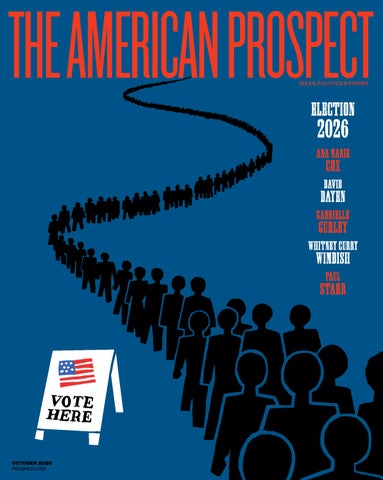
46 Proportional Representation Gets a New Look Supreme Court decisions and unrestrained partisan gerrymandering are focusing attention on a fundamental election reform. But one version is more feasible than the others. BY PAUL STARR COVER ILLUSTRATION BY BEN HICKEY
OCTOBER 2026 THE AMERICAN PROSPECT 1
FROM THE EDITOR
Elections are ruthless levelers of the theorists of politics. Those who spend their lives insisting on the proper ways to win, the policies that attract, the ideas that will generate an enthusiastic public response get their verdict every two years. They’re either geniuses or saps, and they can’t argue their way around the results. None of that is particularly fair. We don’t hold enough elections to know precisely what motivates voters, but we can surmise that it’s something external to political strategy: the state of the economy, the demonstrable appearance of scandal and corruption, American bodies dying abroad in pointless wars. What we say about what politicians should do is quite a ways downstream of what has already been done in terms of what actually matters. That’s why I like the set of stories here in our pre-election issue, as they cut to that essence of politics rather than reaching for some narrative key to unlock the electorate. James Talarico is gaining in Texas because people in Texas really don’t like what Republicans have done to their state and the country, writes ana marie co, in her profile of the critical Texas Senate race. Democrats running for governor from Alabama to Nevada and everywhere in between haven’t found the right words to talk about data centers; they’re just correctly perceiving the souring public opinion on this manifestation of Big Tech in local communities, writes ga.rielle g0rley.
2 PROSPECT.ORG OCTOBER 2026
My piece on this cycle’s new majority makers—progressives running in swing seats—looks at whether the old rules of politics will hold at this moment, in this environment, with these candidates. In the end, it’s about whether today’s circumstances leave voters wanting more than a clever straddling of the midpoint between two ideologies. We also have 23i4ney c0rry 2im.i53 on why Election Day isn’t the most important day of the year for politics, if you define politics as the mobilization of the public to build power and make progress. And 6a0l 54arr looks at the growing realization that our elections as currently structured, with gerrymandered and inadequately “fair” districts, cannot help but deliver distorted outcomes, and that changing that structure is essential to representative democracy. I also want to encourage you to check out our website at prospect.org, where we are lucky to be hosting the work of gillian .roc7ell, who focuses on ic#’s deportations of immigrants around the world, and the long and harrowing air travel to unfamiliar places. Her reporting on ic# flights is unparalleled, and we’re lucky to have her. Enjoy the issue. –da:id dayen
SUBSCRIPTIONS EXECUTIVE EDITOR DAVID DAYEN FOUNDING CO-EDITORS ROBERT KUTTNER, PAUL STARR CO-FOUNDER ROBERT B. REICH MANAGING EDITOR AND DIRECTOR OF EDITORIAL OPERATIONS CAITLIN PENZEYMOOG
MANAGE YOUR SUBSCRIPTION ONLINE Print subscriptions can be managed online at prospect.org/subscribe.
EDITOR AT LARGE HAROLD MEYERSON SENIOR EDITORS GABRIELLE GURLEY, RYAN COOPER ART DIRECTOR LINDSAY BALLANT ASSOCIATE EDITOR SUSANNA BEISER STAFF WRITER WHITNEY WIMBISH WRITING FELLOWS JAMES BARATTA, NAOMI BETHUNE, ZACHARY GROZ CONTRIBUTING EDITORS AUSTIN AHLMAN, MARCIA ANGELL, GABRIEL ARANA, DAVID BACON, JAMELLE BOUIE, JONATHAN COHN, ANN CRITTENDEN, GARRETT EPPS, JEFF FAUX, FRANCESCA FIORENTINI, MICHELLE GOLDBERG, GERSHOM GORENBERG, E.J. GRAFF, JONATHAN GUYER, BOB HERBERT, ARLIE HOCHSCHILD, CHRISTOPHER JENCKS, JOHN B. JUDIS, RANDALL KENNEDY, BOB MOSER, KAREN PAGET, SARAH POSNER, JEDEDIAH PURDY, ROBERT D. PUTNAM, RICHARD ROTHSTEIN, ADELE M. STAN, DEBORAH A. STONE, MAUREEN TKACIK, MICHAEL TOMASKY, PAUL WALDMAN, SAM WANG, WILLIAM JULIUS WILSON, JULIAN ZELIZER PUBLISHER MITCHELL GRUMMON ASSOCIATE PUBLISHER MAX HORTEN OPERATIONS AND MARKETING MANAGER LAUREN PFEIL BOARD OF DIRECTORS DAN CANTOR, DAVID DAYEN, REBECCA DIXON, SHANTI FRY, STANLEY B. GREENBERG, MITCHELL GRUMMON, JACOB S. HACKER, AMY HANAUER, JONATHAN HART, DERRICK JACKSON, RANDALL KENNEDY, ROBERT KUTTNER, ELI LUBEROFF, LINDSAY OWENS, MILES RAPOPORT, ADELE SIMMONS, GANESH SITARAMAN, PAUL STARR, MICHAEL STERN, VALERIE WILSON PRINT SUBSCRIPTION RATES $60 (U.S. only) $72 (Canada and other international)
Log into your account to renew your subscription, update your mailing address, give a gift subscription, and manage payment methods. You will need your account number and mailing ZIP code, which can be found on your magazine’s mailing label.
RENEW BY MAIL You may begin or renew a print subscription by sending a check or money order ($60 U.S. only/$72 international) along with your name and mailing address to: The American Prospect 1225 Eye Street NW, Suite #600 Washington, DC 20005
CUSTOMER SERVICE info@prospect.org DONATIONS prospect.org/donate REPRINTS prospect.org/permissions VOL. 37, NO. 5. The American Prospect (ISSN 1049-7285) Published bimonthly by American Prospect, Inc., 1225 Eye Street NW, Suite #600, Washington, DC 20005. Periodicals postage paid at Washington, DC and additional mailing offices. Copyright ©2026 by American Prospect, Inc. All rights reserved. No part of this periodical may be reproduced without consent. The American Prospect® is a registered trademark of American Prospect, Inc. POSTMASTER: Please send address changes to The American Prospect, 1225 Eye St. NW, Suite #600, Washington, DC 20005. PRINTED IN THE U.S.A.
GIVE A GIFT SUBSCRIPTION Want to share the Prospect with a friend? You can send a gift subscription by going to prospect.org/subscribe and clicking “Give a Gift.”
NEED HELP WITH YOUR SUBSCRIPTION? Email us at info@prospect.org. OCTOBER 2026 THE AMERICAN PROSPECT 3
PROSPECTS THE ROAD TO UNIVERSAL MEDICARE
The apparent split between advocates of Medicare for All and a more incremental approach is misleading and easily remedied.
BY ROBERT KUTTNER
President Trump’s assaults have added to the system’s miseries. Trump’s budget terminated Biden-era tax-credit subsidies under the A!ordable Care Act as of the end of 202$. The average recipient saw premium costs more than double in 2026. At least 2.6 million people out of the 22 million insured under the &C& dropped coverage entirely. The e!ective dates of Trump’s cuts in federal Medicaid outlays were delayed until after the 2026 election. But next year, some ($ million people are at risk of losing Medicaid coverage. All told, at least )ve million people already lost health insurance in the )rst six months of 2026. Merely having Medicare for All without reforming the way health care is delivered would just stick government with higher costs. But universal Medicare, by giving government a great deal more leverage over the entire system, is key to addressing its other de)ciencies. Even if Democrats can agree on universal coverage, the transitional challenges seem daunting. Medicare is tax-supported. Commercial insurance is )nanced by premiums. An immediate shift to universal Medicare would require tax increases, but only some people would get savings from cuts in premiums. Most of those savings would go to employers. The best approach to solve this transitional problem has been proposed by our colleague Jacob Hacker, the Yale political scientist who serves on the Prospect board. Hacker )rst outlined a version of it in the Prospect in 20(*. Hacker calls it Medicare Part E, the E standing for Everyone. Hacker begins with what used to be called “play-or-pay.” Employers would be required either to provide good health insurance or to pay for Medicare for their employees. This would have three huge bene)ts compared to other transitional approaches. First, it would eliminate the need for a tax increase. Some employers would keep their commercial insurance; most would pay into Medicare on behalf of employees. Either way, no new taxes. Over time, the superior efficiency of Medicare would 4 PROSPECT.ORG OCTOBER 2026
lead more employers to shift to Medicare. Only truly efficient commercial insurers (if there are any) would survive. Second, unlike other incremental approaches to universal coverage, this one is easy to explain and campaign on. Everybody gets insurance, either through employer-financed commercial insurance that meets Medicare standards, or through Medicare itself. And no tax hike. Third, this approach bridges over what Hacker calls the label wars. Candidates who like the Medicare for All label can embrace it. So can candidates who want universal coverage but not immediate Medicare for All. It’s important to get this right. The problem of large tax increases in a one-time shift killed an attempt to have single-payer insurance in one state. In Vermont, the legislature enacted a single-payer bill in 2011 called Green Mountain Care, with the strong support of Gov. Peter Shumlin, but left financing details for later. After the details were unveiled—for an 11.5 percent payroll tax on employers plus an income-based premium assessment of up to 9.5 percent—public support collapsed. Shumlin, favored heavily for re-election in 201(, barely won. In late 201(, the state abandoned the plan entirely. Paul Krugman has proposed a “Medicare Buy-In.” Krugman would allow individuals as well as employers to buy in to Medicare. But this adds complexity. It’s better and simpler to promote the transition to Medicare for All with an employer mandate and have employers bear the costs. Our colleague, Paul Starr, has proposed an optional Medicare buy-in for people aged 50 to )(, who typically pay very high rates for their insurance. This is good, but Hacker’s universal Medicare Part E is simpler and better. Pete Buttigieg proposes what he calls Medicare for All Who Want It. That’s catchy, and it implies greater freedom of choice. But of course, Medicare itself is the ultimate freedom-of-choice plan, since unlike commercial insurance plans, it allows people to use any
ILLUSTRATION BY JORDAN AWAN FOR THE AMERICAN PROSPECT
,-./012&3 40&354 CO/01&G0 under Medicare is a natural for Democrats. According to a new report by the American Economic Liberties Project, between 2005 and 2025 the annual cost of employer-sponsored family coverage increased from $12,214 to $35,119. Deductibles and co-pays keep rising as well.
doctor or hospital. Shame on Democrats who fail to emphasize that. Others, including House Democratic Leader Hakeem Je!ries and a bipartisan centrist group led by Reps. Brian Fitzpatrick (1-9&) and Tom Suozzi (:--;), propose making permanent the Biden subsidies to the A!ordable Care Act that Trump canceled. But this approach would leave all of the inefficiencies of the current system intact while having the government bankroll more of the commercial insurance industry. Readers may recall that it was Hacker who came up with the original public option in the context of the debate about the A!ordable Care Act. People who got insurance under the &C& could opt for a commercial plan or for a public plan modeled on Medicare. Hacker correctly assumed that the more cost-e!ective option of public insurance would gradually crowd out commercial insurers. Unfortunately, the private insurance industry read Hacker’s proposal. Even though they could not kill the &C& legislation, they mounted an all-out and successful campaign to kill the public option. Hacker II is far superior to Hacker I because it shifts the public option to employers, coupled with a requirement to provide Medicare-quality insurance, and thus creates incentives for them to shift to Medicare. SINCE THE SPONSORS of the A!ordable Care Act had to jettison the public option in order to get the &C& through Congress (and barely got it enacted at all), why should we think that the more transformative Medicare Part E plan could get enacted now? The answer is that the entire health care system is far more enshitti)ed now than it was in 20(0, when Democrats had to settle for a reform that only increased coverage by about 7 percent of the population and achieved that by subsidizing rather than supplanting private insurance, thus reinforcing the present hyper-commercialized system. Today, there is widespread rage against the commercial insurance industry and the drug industry. When Luigi Mangione stalked and murdered the C0O of UnitedHealthcare, he had plenty of sympathizers. One poll found that 4( percent of American voters under 30 perversely thought the killing was acceptable. Even Donald Trump, recognizing the extreme unpopularity of Big Pharma, has politically abandoned the big drug companies, claiming credit for caps on drug prices (that were actually the work of Joe Biden) and adding his own proprietary drug discount program. As bogus as these Trump maneuvers are, the man knows which way the wind is blowing. If Democrats win the presidency and a working majority in Congress in 202*, the Hacker version of Medicare for All is de)nitely a political possibility. In the meantime, it is a superb program to run on. Medicare is astonishingly popular, and for good reason. The popularity of Medicare is the ?ip side of the extreme unpopularity of the insurance and drug industries and the frustration people experience trying to get care. Medicare for All is a far better brand for Democrats than building on the A!ordable Care Act. There is an important ideological subtext: Public is not only more socially just than private, it’s also more efficient. Mixed public-private deals like the &C& are often a muddle—less efficient, more easily gamed, and more complex to use. As noted, to the extent that the current system is a cesspool of pro)teering based on market concentration, a comprehensive public system like Medicare gives the government far more leverage to reduce the gaming. Some key details do need to be ironed out. The so-called
Medicare Advantage program piggybacks on Medicare funding and the Medicare brand. But Medicare Advantage policies are commercial insurance products that make their money by targeting their marketing to relatively healthy seniors, and then trying to restrict actual care when people get sick. With Medicare for All, we could either kill Medicare Advantage outright, or end the more than $*0 billion annual subsidy that these plans get from Medicare, which would make Medicare Advantage plans unpro)table. Medicaid spends just under a trillion dollars a year. With Medicare for All, there would no longer be any need for a separate means-tested program, so Medicaid would be folded into Medicare. The largest single Medicaid cost is long-term (nursing home) care. That and home care would also be folded into Medicare. The Medicare Part D program is a Medicare-branded private insurance product for prescription costs. It’s an inefficient crazy quilt. So drug bene)ts would also become part of Medicare. That shift would eliminate parasitic pharmacy bene)t manager scams. Finally, the fact that Medicare does not cover all necessary medical needs has given rise to private “Medigap” plans. Less-affluent people who can’t a!ord the premiums either pay out of pocket or go without care that they can’t a!ord. Universal Medicare for All needs to cover everything that Medigap policies cover. But wouldn’t all this be astronomically expensive? Quite the opposite. Yale economist Zack Cooper compared Medicare reimbursements with reimbursements paid by commercial insurers. Because of the market power over insurers created by hospital mergers and consolidations, commercial insurers pay vastly more. Hospitals get an average of $2A,000 for a hip replacement covered by commercial insurance but only $(6,000 for one covered by Medicare. Those costs are passed along to the public and to the taxpayer, since over half the costs in the system are paid directly or indirectly by the government. And the bias in favor of procedures and technologies that command maximum reimbursements has led to overspending on specialty care and a severe shortage of primary care practitioners, as I wrote in our June 2026 issue. A fragmented system can’t solve this imbalance piecemeal. Medicare for All could. The new report from the American Economic Liberties Project details the costs and inefficiencies produced by the hyperconcentration of the commercial health care industry. Today, according to the report, “Six Big Medicine companies now rank among the Fortune ($—more than Big Tech or any other sector. In 202$, they pocketed nearly $34 billion in pro)t.” But their pro)ts are only a small part of how they contribute to the sheer inefficiency and misallocation of resources in the system. The task of the next administration is not just supplanting commercial insurers with Medicare to provide universal and a!ordable coverage, but also getting rid of the extreme concentration. Public dismay with health care has reached a point where Republicans as well as Democrats are demanding fundamental reform. For example, the Break Up Big Medicine Act is co-sponsored by Sens. Elizabeth Warren (:-B&) and Josh Hawley (1-BO). It would prohibit insurers, pharmacy bene)t managers, and wholesalers from owning or controlling providers. Supporters of Medicare for All need to appreciate that reform is not just a matter of getting to single-payer. It also entails using the power of that single-payer to decommercialize and simplify our badly corrupted health care system. n OCTOBER 2026 THE AMERICAN PROSPECT 5
We’re an independent, reader-supported newsroom. No corporate ads No billionaire backers No paywalls Just readers like you. Prospect.org/donate
NOTEBOOK
SOCIALIST IN SEATTLE A year after her election, Mayor Katie Wilson wants to upgrade housing and transit in the Emerald City. But moderate councilors and divisions within her own base are undermining her. By Chance Phillips
AP PHOTO/LINDSEY WASSON
On January 2nd, surrounded by supporters
with yellow “This is Your City” posters, Mayor-elect Katie Wilson told the crowd assembled for her inauguration at Seattle City Hall that they have “a right to be here and to live a digni)ed life, whatever your background and whatever your income.” Governing well, she said, would mean focusing on both bread and roses: better material circumstances and basic respect. Elected by just a 2,0((-vote margin in November, Wilson was best known as the
co-founder of the Transit Riders Union, a local progressive organizing group. She is also an open socialist. In advance of last year’s election, incumbent mayor Bruce Harrell used predictable attack lines against Wilson, calling her inexperienced and her platform “complaints with no solutions.” Despite her victory, proving Harrell wrong will be a tall task. Seattle may be one of the most left-leaning cities in the country, but the city council currently lacks a progressive majority and OCTOBER 2026 THE AMERICAN PROSPECT 7
NOTEBOOK the state legislature is reluctant to approve new taxes, like the income tax Wilson said she would consider. Even vocal supporters who’d known her for years began criticizing Wilson from the left over her turning on surveillance cameras during the World Cup. And business-backed polling suggests other, more conservative city residents believe Wilson isn’t taking public safety seriously enough, especially after she ousted the city’s police chief in July. Wilson can also point to some victories. Thanks in large part to her inf luence, Seattle’s city council recently approved both a universal free school lunch program and a ban on the “junk fees” landlords use to squeeze money out of renters. Larger changes to the city’s public transit system and housing market are in the works. “Being a progressive left mayor has its challenges, and I think there’s de)nitely some actors out there who would rather score points and try to undermine a progressive left administration than actually work together for the good of the city,” Mayor Wilson told the Prospect almost eight months after her inauguration. “But I’m really proud of the work that we’re doing.” The work has really only begun. Wilson must handle a multiyear budget de)cit in the hundreds of millions and keep together an increasingly fractious coalition, while overseeing meaningful “sewer socialist” reforms to housing and public transit. And the clock is ticking on her opportunities. Seattle hasn’t re-elected a mayor since 200$. If Wilson remains popular, being able to credibly back primaries from the left could give her a leg up at the bargaining table. But the most recent poll, funded by the local Chamber of Commerce, found only 37 percent of city residents approve of her performance so far. If public opinion continues to sour, Wilson’s dreams of a $( billion social housing bond will remain out of reach.
According to Wilson, the dominant factor in her decision to run for office was the overwhelming victory of Proposition (A, a 202$ ballot initiative that taxes employers to properly fund the Seattle Social Housing Developer. Harrell supported a very limited alternative, but over 60 percent of voters still opted to support the more ambitious measure. That upset, in Wilson’s estimation, revealed an opening for the left. Despite running as a socialist, Wilson was never endorsed by the local chapter of the Democratic Socialists of America, and the organization continues to maintain a comfortable distance. One early Wilson volunteer recalled that there was never a recognizable “:2& presence” at her campaign events. A second di!erence between Wilson and New York City’s socialist mayor Zohran Mamdani—who was elected and assumed office on the same day as her—is that Wilson’s social media posts do not automatically go viral. There is no online trend joking about how just mentioning her name will )x your neighborhood’s pothole or broken traffic light. She hasn’t inspired as much devotion from the left as Mamdani. “We’re having this kind of ‘doomer’ moment of buyer’s remorse with Katie, where we feel like she’s not living up to our expectations,” explained Jeff Paul, the co-executive director of pro–social housing nonpro)t House Our Neighbors. “She’s not as cool as Zohran, obviously, and I feel that too. That is my emotional response. But to anybody who’s listening on the left in Seattle, we can’t stay stuck in that place. We have to make the most of what is in front of us.” The area where Wilson has made the most progress is easily public transit. In July, the Seattle City Council unanimously approved a ballot initiative for this November that if approved would renew the Seattle Transit Measure, a 2020 sales tax devoted
to transit, for ten years and double its revenue, producing hundreds of millions more dollars to improve bus frequency and reliability, expand streetcar and light rail, and more robustly subsidize fares. Sarah Gaspard, a relatively recent arrival to Seattle, attended a July city council meeting to support the proposal. Gaspard told the Prospect she’d been happy when Wilson )rst announced her run because of the chance to have a “more transit-oriented advocate as mayor” when, in her opinion, the topic had been relatively neglected under Harrell. The system of trains, buses, and ferries serving Seattle commuters might compare favorably to many other American cities, but regular users still )nd it wanting. Per the 202$ Seattle Transit Measure performance report, ridership remains far below pre-pandemic levels. More acutely, poor bus service on Route * has become infamous. Wilson’s very )rst executive order called for the creation of a dedicated bus lane there, and in August she personally painted “Bus Only” on Denny Way as part of the change. The sales tax has been in place since 20(4, but the ballot measure would rapidly expand the investment. According to Kirk Hovenkotter, executive director of the Transportation Choices Coalition, Wilson’s leadership has been critical. She is “someone who believes in better bus service and who wants to make and provide great public services,” Hovenkotter said. Gaspard said she’s “glad that [Wilson] was able to get the full sales tax increase because it’s not maybe the most equitable funding measure, but it still helps people a lot.” The total tax burden is estimated at under $$ a month for the median twoperson household, and “if that gets you to work on time, so you don’t miss an hour of work or you don’t miss an important medical appointment, that’s worth it,” she stated.
Wes Mills, Wilson’s successor as general
secretary of the Transit Riders Union, says he was “supremely con)dent from the jump” that she would be elected mayor. “A whole lot of people did not like [the Harrell] administration, and just from a pragmatic political perspective, we were running into the whole anti-incumbency wave,” he explained. Wilson also “sounds like the kind of person who listens to you, who understands what you are saying, and who has the same context that you do,” Mills said. 8 PROSPECT.ORG OCTOBER 2026
“IMPROVING THE TRANSIT SYSTEM CAN SOUND A LITTLE WONKY OR SOMETHING, BUT THIS IS REALLY AFFORDABILITY LEGISLATION IN MY MIND,” WILSON SAID.
Wilson herself is reliant on public transit. An anti-Wilson screed penned by the Washington Post editorial board last year began by noting that “she does not own a car.” When Wes Mills was asked why no one on Wilson’s transition team was focused on transit, he would genially joke that “there is someone, she’s called the mayor.” “Improving the transit system can sound a little wonky or something, but this is really a!ordability legislation in my mind,” Wilson said. “Because it’s making our most coste!ective form of transportation viable for many more people, really getting those bus lines to a level of frequency and reliability that the line cook or the janitor can actually rely on the bus to get to work every day and doesn’t need to drive, or perhaps doesn’t even need to own a car.”
Saving money on transit is especially
important for Seattleites because their other expenses are soaking up more of their paychecks. Over the last ten years, house prices in the Seattle metro area almost doubled, and the Bureau of Labor Statistics’ measure of rent in the area increased by well over $0 percent. These trends, in addition to the sizable and growing unhoused population, have made Seattle one of the most active social housing hubs in the United States. Inspired by the social housing models in Red Vienna, Singapore, and Montgomery County, Maryland, organizers’ goal is that “in 2$ years, 2$ percent of the housing in Seattle is social housing,” according to Suresh Chanmugam, a steering committee member for House Our Neighbors and another nonpro)t, Tech 4 Housing. Passed in 2023 with support from local labor unions, Wilson’s Transit Riders Union, and House Our Neighbors, Initiative (3$ established the Seattle Social Housing Developer. Then, in February of last year, voters approved Proposition (A, funding the new organization. Earlier this year, the Seattle Social Housing Developer bought its )rst property, the Elara at the Market, for $60.A million. A beautiful building just blocks away from the famed Pike Place Market, the Elara (constructed in 20(*) contains ($0 units. As current residents move out, vacancies will be )lled by new residents earning between 0 and *0 percent of the local median income, who will pay permanently affordable rents. Over (0,000
Seattleites applied for units in the building during a two-week open lottery. “We have a housing shortage,” city resident and early Wilson donor Mark Hamann said matter-of-factly. He explained that while he has nothing against social housing, he believes “what social housing does is it guarantees somebody a musical chair … but the problem in musical chairs is that you don’t have enough chairs. We need more chairs.” Paul and Chanmugam each stressed the importance of building more and denser housing in Seattle. “Housing density is incredibly important for both housing a!ordability and for climate implications,” Paul related. “Dense urban places are how we get good, frequent public transit. That’s how we get walkable cities, and that’s how we prevent sprawl.” The public need demands solutions beyond social housing, Chanmugam o!ered. “Developers, you know, if they were the evil people that we sometimes think they are, would be building lots of housing if they were somehow getting away with huge amounts of pro)ts,” he said. “But they’re not. It is currently unpro)table to build housing. The real villains in housing in America are the landlords and the wealthy white owners of McMansions, the -.BC;s, right? Landlords thrive o! of no competition. And Katie Wilson ran on this.” Under Mayor Harrell, Seattle’s comprehensive housing plan, which lays out metro needs for the next 20 years, signi)cantly cut back on development relative to what the planning department initially proposed, in some cases by up to half. Wilson, by comparison, has called her e!ort to upzone Seattle the “Taller, Denser, Faster” plan. “We’re going to be looking at basically allowing apartment-style multifamily housing, not just right along a busy arterial, but within a )ve-minute walkshed,” she explained to the Prospect. “Trying to allow more housing to be built in more places, and also just a more ambitious zoning proposal for neighborhood centers and urban villages that would allow taller buildings and just a wider scope.” She also stressed that policymakers “need to pay attention to housing all across the income spectrum, from market-rate housing all the way down to permanent supportive housing, and of course shelter.” Toward this end, Wilson recently issued an executive order creating a “Housing Production Task Force” and upgrading the permitting
process to help both a!ordable and marketrate projects pencil out and get approved. But executive orders can only go so far. When speaking about city politics, many Seattleites will name-drop the so-called “Seattle process.” One city resident helpfully de)ned the phrase as “how every proposal to do anything in the city just gets bogged down in minutiae or arguments, and so it’s hard to make things happen quickly.” Some of Wilson’s most high-pro)le e!orts have fallen victim to the Seattle process. On the campaign trail, she promised to open 4,000 new shelter beds by the end of her )rst term, and $00 by this summer’s World Cup. But the city is nowhere close to meeting that goal. In an interview with local news site PubliCola, Wilson attributed the delays partially to her nascent relationship with the city council. Her rezoning plans could also fail. The city council recently voted to limit appeals of environmental reviews for zoning changes, a change Wilson praised. But upzonings approved under Harrell are still working their way through the courts. In the meantime, constructing more dense, environmentally friendly housing is on hold. Despite rapid rent increases in recent years, the city only issued building permits for seven new residential construction projects in July. For Wilson’s most ambitious plans to succeed, the city council will need to sign off on more sweeping administrative changes like the new restrictions on environmental review appeals. Conservative and moderate councilors will either have to become more willing to advance the Wilson agenda or be replaced, local progressives predicted. Paul suggested that Seattle organizers “should be purposefully polarizing issues and making it clear where people stand.” Once the public can tell the di!erence between real progressives and their moderate impersonators, then “Katie can get more supporters in and get a majority on city council,” they stated. Or, as Wes Mills put it, “our biggest concern for the future is, how do you organize with a city government instead of organizing against a city government?” n Chance Phillips is an economics Ph.D. student at University of Massachusetts Amherst with a master’s in political science. He also freelances as a reporter and an essayist. OCTOBER 2026 THE AMERICAN PROSPECT 9
NOTEBOOK
States giveth corporations the right to exist, so the states can taketh away their political spending power — or at least, Hawaii and Montana are trying. By James Baratta 10 PROSPECT.ORG OCTOBER 2026
By the time this year’s primary season was
winding down, corporations had already shelled out more than half a billion dollars in support of congressional candidates, exceeding the previous record of $46( million set during the 2024 election cycle. The ?ood of campaign contributions was driven in large part by the arti)cial intelligence, crypto, and online gambling industries. And independent expenditures—not to the candidates but on (or against) their behalf—also surged to record levels this year. According to OpenSecrets, outside groups spent more than $7A0 million on independent expenditures over the eight months ending August (0, up from about $477 million during the same period in the 2024 election cycle. “That’s just a fraction of what we will end up with when we get to November,” Brendan Galvin, director of insights at OpenSecrets, told the Prospect. The Federal Election Commission (D0C) de)nes independent expenditures as spending on communications, such as television or social media ads, that expressly advocate for the election or defeat of a particular candidate. Outside groups that engage in this spending include political action committees (9&Cs) and super 9&Cs. As a practical
MADDIE MCCUDDY FOR MONTANA FREE PRESS
CAN THE STATES STOP THE CORPORATE DOMINATION OF OUR POLITICS?
Voters in Montana will vote on a plan to get corporate money out of state politics this November. matter, 9&Cs can make direct campaign contributions and independent expenditures within applicable limits. Super 9&Cs, which unlike 9&Cs cannot contribute directly to campaigns, exist to raise and spend unlimited amounts of money independently of a candidate. Federal election law also prohibits coordination between super 9&Cs and any candidate, their campaign, or political party, but cooperation remains common. The U.S. Supreme Court’s $-4 ruling in Citizens United held that corporations have the right to spend their own money to advocate for or against candidates because “independent” spending is protected under the First Amendment. It was this ruling, as well as subsequent court decisions, that opened the ?oodgates of dark money into our elections. Corporations, billionaires, and otherwise moneyed interests have since been able to spend as much as they want to in?uence voters without having to disclose it because the justices relied on the assumption that existing transparency rules would be enough to preserve voters’ right to know. That assumption aged like milk. “What we’ve seen since then,” Galvin said, “is a massive increase in money being spent in elections that is not transparent at all.” Much like 9&Cs, super 9&Cs must also report their donors to the D0C. But when they receive contributions from a nonpro)t, the often unilluminating name of that nonpro)t is all that is disclosed. Its own sources of funding stay hidden, as nonpro)ts themselves are not required to disclose their donors. Democratic members of Congress reintroduced the :.2C3O20 Act earlier this year in a bid to “shut the dark money ?oodgates,” said Sen. Sheldon Whitehouse (:-1.), who has been leading the charge alongside Rep. Jamie Raskin (:-B:), ranking member of the House Judiciary Committee, and two of their colleagues. Sen. Chuck Schumer (:--;) )rst introduced the :.2C3O20 Act in 20(0 following the Citizens United decision. Whitehouse has reintroduced the legislation in every subsequent congressional session. While hearings are on the horizon, the bill has yet to surmount Republican opposition in Congress. Fortunately, a separate track has emerged to eradicate the scourge of dark money in our elections.
Corporations derive their power from the states where they are chartered. For that reason, virtually every state can curtail the corporate domination of politics. Tom Moore, a senior fellow at the Center for American Progress, is the mastermind behind the “Corporate Power Reset,” a legal framework for states to leverage their existing authority to end the era of corporate and dark money in politics—all without amending the Constitution, or waiting around for the Supreme Court to reverse its decision in Citizens United. This framework, which is rooted in 200 years of corporation law, was the focus of a paper Moore authored in September 202$. States possess what is known as the reserved powers clause, which “has been sitting around since (*(A,” Moore told the Prospect. He was referring to Chief Justice John Marshall’s opinion in Dartmouth v. Woodward. As Marshall wrote at the time, a corporation “is an arti)cial being, invisible, intangible and existing only in contemplation of law. Being the mere creature of law, it possesses only those properties which the charter of its creation confers upon it, either expressly, or as incidental to its very existence.” In other words, “If business corporations and nonpro)t corporations are destroying our democracy through a bunch of unregulated, undisclosed spending, we have the authority … to haul them back in, chop that power o!, and send them back out,” said Moore. In addition to reserved powers, the other two pieces of this framework are what give it its teeth: Any change made to corporation law applies to both existing corporations and new ones, and no out-of-state corporation can exercise power that an in-state corporation cannot exercise. “The three of those working together,” Moore said, “that’s the key.” Over the past two years, at least (4 states have introduced legislation seeking to invoke their power to curtail corporate political in?uence, with Hawaii enacting its own law in May, and Montana’s secretary of
state certifying in August a statutory ballot initiative that will come before state voters in November’s midterm elections. Organizers in Montana collected more than $0,000 signatures to get I-(A4, also known as the Montana Plan, on the ballot. “I’d expect at least 30 states to have this in front of their legislatures next January,” Moore told the Prospect. “It is moving.”
The Montana Plan began with a conversa-
tion between Moore and Je! Mangan on a Friday evening in the fall of 2024. “Tom reached out and said he had this white paper that he’d been working on that might be able to address some of the issues that we have with Citizens United,” Mangan said in an interview. “We both are always looking for a way to combat dark money in elections, and )x what we believe is a broken system.” He reached out to Moore immediately after reading the white paper. “I just called him up that night and said, ‘We’re doing this in Montana; I’m starting tomorrow,’” Mangan told the Prospect. “I started laying the groundwork that next day.” When they )rst met, Mangan was early into his six-year term as Montana’s (2th commissioner of political practices. It was 20(7. At the time, Moore served as counsel and chief of staff for D0C Commissioner Ellen Weintraub. “I met Ellen at a conference, and then subsequently met Tom,” said Mangan. The three of them have “remained friends” ever since. In April 202$, Mangan formally established the Transparent Election Initiative (50.), a $0((c)(4) organization focused on passing the Montana Plan and supporting similar state-based reform e!orts around the country. 50. has spent the past two years engaging people around the state to support the Montana Plan. “I started traveling across the state of Montana … asking people to come talk to me about campaign )nance,” he said. “I did
VIRTUALLY EVERY STATE CAN CURTAIL THE CORPORATE DOMINATION OF POLITICS—WITHOUT AMENDING THE CONSTITUTION. OCTOBER 2026 THE AMERICAN PROSPECT 11
NOTEBOOK that everybody loved it, but nobody wanted to be the one to kill it, and everybody kind of hoped the next guy would kill it,” Moore said. “At a certain point, I was talking to Sen. Keohokalole about it, and he said, ‘This thing has become a runaway freight train, and no one wants to step in front of it—not even the governor,’ and he was saying it admiringly.” Keohokalole told the Prospect that much of the force pushing that train forward came from “the strength of the community support” for SB 247(. “It is part of why we structured the bill the way we did.” Activists and organizers with Indivisible Hawaii consistently pushed Hawaii legislators to advance the bill. “By the end of the legislative session,” said Sam Guckenheimer, lead organizer at Indivisible Hawaii’s Kona chapter, “we had people calling their state representatives and senators from practically every district in the state.” That approach was especially critical when the bill was headed to the conference committee. In Hawaii, bills can die in conference if leadership fails to assign conferees. Indivisible Hawaii activated members with this in mind. “By getting members to call the offices of the right people at the right time, we got the mindshare to get the conferees assigned,” Guckenheimer told the Prospect. The bill’s opponents were working the legislature, too, led by the Paci)c Resource Partnership (919), a nonpro)t organization representing Hawaii’s largest construction union and some 2$0 contractors around the state. The 919, which Guckenheimer called
Hawaii Sen. Karl Rhoads (D) got the idea for his corporate charter reform law, which passed this session, from Prospect co-founder Robert Reich’s Substack. 12 PROSPECT.ORG OCTOBER 2026
“the main user of dark money here,” was “sowing doubt on this,” arguing the measure would hamper the voices of its members. “In the end,” Guckenheimer said, “the conference committee submitted the )nal version of the bill and amendments )ve minutes before conference committee cuto!s, and the last amendment was a ?oor vote on the last possible day in the session … and that morning, the sponsors were not sure it was going to pass.” The last amendment extended the date the measure would take effect to July (, 2027, giving legislators more time in the forthcoming legislative session to “provide an opportunity for us to get it right and to make changes before the implementation of the measure,” Keohokalole told the Prospect. SB 247( passed the House and Senate by a combined two-chamber total of 74-(. Following demonstrations in support of the measure and outreach by Indivisible Hawaii, Gov. Josh Green (D) signed it into law as Act ((.
The new law quickly became the target of the libertarian Grassroot Institute of Hawaii, which )led a federal lawsuit in June to strike it down. Though the legal theory underpinning Act (( and the Montana Plan might be ironclad, Moore anticipates that any legal challenges will eventually work their way up to the Supreme Court. If and when they do, he predicted, the justices would have to “shatter foundational state corporation law in a way that can be very destabilizing and shatter the federalism that the Roberts Court has been developing for the last 20 years.” “I’m never ever going to convince the Supreme Court that they’re going to enjoy eating the spider,” Moore, opting for vivid imagery, told the Prospect, “but I will convince them to eat the spider if the alternative is drinking a glass of battery acid.” And by the time this case would reach the Supremes, there may be more than two state laws with which the justices would have to grapple. “The path that we should be taking in )ghting Citizens United is to get lots of states picking this up so that we create an unmistakable groundswell, and then force federal action on this,” Guckenheimer said. Should the Court’s conservatives strike down such state laws, the mobilizations around those laws could prompt federal action, including constitutional action, to strike down Citizens United. n
AP PHOTO/JENNIFER SINCO KELLEHER
a little presentation on Montana’s history with corruption and campaign )nance, and why this state would be a perfect state to launch a nationwide e!ort to get this done.” As the plan gained traction, interest in it expanded beyond the state’s own borders. In Hawaii, state Sen. Karl Rhoads (D) proposed a bill seeking to curtail undisclosed political spending by corporations after reading about Montana’s e!orts on Prospect co-founder Robert Reich’s Substack. “It clicked with everything that I’ve been thinking about for years,” Rhoads said at Indivisible Hawaii’s post–legislative session webinar in May. “Some folks in the activist community reached out to me to see if I could get a draft together that would slip into Hawaii’s laws, and I got that to them,” Moore told the Prospect. “Didn’t hear anything for a couple months, and then all of a sudden, we found that there [were] something like six bills on the House and Senate side, all introduced, all pretty much the same.” In addition to Rhoads’s bill and four others, another had been introduced by state Sen. Jarrett Keohokalole (D), who told the Prospect he also learned about the framework on Reich’s Substack. According to Moore, Keohokalole’s bill was good, but Rhoads’s was “a little bit better.” Keohokalole then put his own bill aside and helped steer Rhoads’s bill, SB 247(, through the Senate Commerce and Consumer Protection Committee, which Keohokalole chairs. “It was one of these things where it’s not
The Trump administration has spent the
KAREN FOCHT/ZUMA PRESS
TIME ON TASK
The Trump administration has abused the interagency task force process to intervene in law enforcement across the country. By Zachary Groz
past two years asserting broad executive powers and privileges with little historical precedent: imposing tari!s, executing mass deportations, deploying the National Guard in American cities, unilaterally halting permitted clean-energy development, sanctioning law )rms and universities, )ring civil servants and watchdogs, removing foreign heads of state, calling in drone strikes on )shing boats, withholding grants to states and nongovernmental agencies, bending banking rules, brokering critical minerals deals, and speeding up federal contracting, with many of these enriching the president’s family and their circle. Some orders have been brazen and public enough to generate blowback in court. But the infrastructure underlying them has remained in place. In fact, it’s continued to grow through a little-scrutinized mechanism of the federal government: the interagency task force. Around $0 years ago, in peacetime, with no urgent national security threat posed, no new foreign adversary de)ned, and no state of emergency declared, the federal government began deploying military-style joint task forces around the country. Their )rst target: bank robbers. A string of high-pro)le, multimillion-dollar heists had caught the New York City Police Department (-;9:) ?atfooted, so in (A7A the DC. swooped in to help, bringing along the agency’s prosecutorial )repower and sophisticated intelligence. What otherwise might have devolved into a turf war over jurisdiction became the basis for an extended collaboration. That summer, the feds and the police came together to sign a memorandum of understanding, agreeing to share records and on-theground informants, and they formed the Bank Robbery Task Force. The office operated on a simple principle. “Cooperation,” the task force announced, “is the backbone of e!ective law enforcement.” It was the birth of what would later come to be called the “whole-of-government” approach to public safety and national security, breaking down more silos among federal, state, military, intelligence, and law enforcement agencies. A year later, the )rst Joint Terrorism Task Force (E55D) was formed in New York, combining resources again from the DC. and -;9:. In (A*2, the model expanded with the creation of the Organized Crime Drug Enforcement Task Forces, which would eventually bring OCTOBER 2026 THE AMERICAN PROSPECT 13
NOTEBOOK together the Department of Justice, Department of Treasury, Department of Homeland Security, Department of Labor, Department of State, and the Postal Inspection Service under the same roof to build complex cases against transnational cartels and money launderers. After A/(( and the signing of the 9&51.O5 Act, the feds took things even further, setting up hundreds of terrorism task forces across the country, expanding information-sharing between local police departments and federal agencies to include foreign intelligence officers. In the last two years, the Trump administration has lifted those e!orts to new heights, creating, expanding, and recon)guring task forces across the federal bureaucracy, with vague and limited disclosure about what the interagency collaborations hope to achieve, without congressional approval or substantial limits imposed by courts. The task forces focus on the same idea: that the country is in the midst of an emergency, brought on by foreign “invasion” and domestic unrest, requiring the federal government to marshal all of its resources to take control of how states and cities govern themselves. That was clear enough from the very start of Donald Trump’s second term. At a February 202$ conference in Columbia, South Carolina, then-Deputy Attorney General Emil Bove, now a federal appeals court judge, addressed an assembled crowd of leaders of what used to be called the Organized Crime Drug Enforcement Task Forces (OC:05D) and has since been rebranded through an executive order the Homeland Security Task Forces. He told them that from then on, the “gloves are o!” for federal prosecutors, according to one former :OE official. It was at that conference that Bove announced the administration’s new policy of bombing suspected drug boats in the Caribbean and Paci)c instead of interdicting them, as had been the status quo. The new doctrine was justi)ed, he said, to repel an “ongoing invasion” that the country was allegedly su!ering. That theory of unrestrained executive authority to deter purported public safety and national security threats has been tested on the ground in major American cities, leading to chaos, most notably in Portland, Los Angeles, and Chicago. Before those deployments, which months later were derailed on an ad hoc basis in the courts and voluntarily withdrawn by the administration, the president had laid the groundwork in the nation’s 14 PROSPECT.ORG OCTOBER 2026
capital, establishing through executive order the D.C. Safe and Beautiful Task Force, which assembled six federal agencies and three U.S. Attorney offices in the name of not only “preventing crime, punishing criminals, [and] preserving order” but also “promoting beauti)cation” through new monument projects like Trump’s planned triumphal arch, led by the Department of Interior. The e!ort began in earnest in August of last year, when the administration federalized the District of Columbia police department for 30 days and deployed thousands of National Guard troops, who are set to remain on the streets of the capital through at least the end of Trump’s term. D.C.’s Democratic attorney general initially won a lawsuit challenging the deployment, but an appeals court late last year allowed it to proceed. Local officials had urged the administration to hold back on its boots-on-the-ground takeover, which they said they didn’t need, and, predictably, despite the overwhelming federal surge, the administration was only able to turn up a 20 percent increase in arrests year over year, most of them for low-level misdemeanors, by the end of 202$. Meanwhile, in the )rst eight months of 202$, before the task force took over, D.C. had already been outpacing its arrests from 2024 by 20 percent. Data from the )rst two months of the federal takeover give some indication of what the real purpose of asserting broad executive powers in Washington had been all along: 40 percent of the arrests were related to immigration enforcement. Beginning in September 202$, the administration took the same approach in Memphis, Tennessee, through its Memphis Safe Task Force, which assembled more federal agencies than even the D.C. e!ort—more than a dozen all told. In addition to bread-and-butter task force partners like :42, DC., and :OE, representatives from the Department of Defense, Department of
Health and Human Services, and Department of Housing and Urban Development were involved. The administration has not disclosed much about how it has deployed federal agencies in the city, despite requests from Rep. Steve Cohen, whose district includes Memphis. But their conduct on the streets has given some indication. Over the summer, a special agent from Homeland Security Investigations, the criminal investigative unit that coordinates with .C0, shot and killed a man while responding to a A(( call from his mother, who had said he was having a mental health crisis. A few weeks later, two National Guard soldiers, who had been called up nominally to patrol the city’s streets, shot and killed a 20-year-old man armed with a handgun, after chasing him on foot just before 4 a.m. The week before the Trump administration issued its executive order establishing the Memphis Safe Task Force, the local police department announced that the city had hit a 2$-year low in overall crime, mirroring the situation in D.C. The feds were e!ectively positioning themselves to take credit for work that Memphis authorities had managed to do themselves, and had meanwhile dug themselves in to conduct “a sustained campaign” in a city where all major crime rates were falling fast. It would come to serve a broader purpose, Attorney General Todd Blanche testi)ed at his con)rmation hearing, “as a poster child of what we should do in cities across this country.” The Trump administration’s use of interagency task forces had been raising concern among former Justice Department officials, who are familiar with the powers and resources available to them, for some time. “We should all be very concerned about the use of resources, the judgment calls being made in this administration, and with this Justice Department, and with this leadership about how they are spending resources and either using or abusing their authorities
UNRESTRAINED EXECUTIVE AUTHORITY TO DETER PURPORTED PUBLIC SAFETY AND NATIONAL SECURITY THREATS HAS BEEN TESTED IN MAJOR AMERICAN CITIES.
OFFICIAL WHITE HOUSE PHOTO/ MOLLY RILEY
President Trump’s Memphis Safe Task Force has touted major victories, but crime was at a 25-year low before it was established. to focus on criminal activity, or in some cases, hoping to be able to )nd criminal activity where there’s really no indication of it existing,” said one former :OE official. One of the best examples is the Organized Crime Drug Enforcement Task Forces. For more than four decades, OC:05D had grown to become one of the biggest interagency collaborations in the federal government, equipping it with a cross-section of resources no single agency had on its own, and spreading out federal money across agencies to which Congress had not appropriated. “The OC:05D Fusion Center brought together many terabytes of data into one database, and so what we were able to do is fuse all of the investigative information from these various agencies, 24 di!erent agencies, into a single sign-on, single-query database,” said the former :OE official. That database has been capable of instantly pulling records from the DC., .12, Homeland Security Investigations, and the Treasury’s Financial Crimes Enforcement Network, which over the years has helped investigators unveil the )nancial webs tying together drug traffickers. In the second Trump administration, the newly renamed Homeland Security Task Forces have been told to take a di!erent approach, moving away from targeting organized crime syndicates to primarily focus on “smaller cases, criminal cases, and really more dominantly focused on doing
immigration enforcement,” according to the former official. That became clear when early on, the administration “eliminated the requirement with the 425D for doing )nancial investigations,” which formed the basis of the unit’s organized crime busts for at least a decade. The pivot in this and other task forces has led to the pursuit of charges for a host of low-level o!enses, including small bene)ts fraud cases, nonviolent protesters, and noncitizen voting. According to a recent report by ProPublica, the latter has borne practically no fruit. One initiative, the White House–led Government Transparency Task Force, has assembled officials from the office of the Director of National Intelligence (:-.), C.&, :42, and the National Security Agency (-2&) to comb through intelligence community )les for shreds of evidence of foreign interference in elections and a “deep state coverup.” Another, the Task Force to Eliminate Fraud, was established to prove spurious connections between state-run, federally funded bene)t programs and “foreign gangs” and “terror groups.” Over the summer, that interagency program expanded to include its own fusion center, pooling resources from many non-law enforcement agencies that the administration has targeted for demolition since the :OG0 days. The new fusion center is putting to work inspectors general, who’ve been ordered by the president to “identify
fraud” and feed information to U.S. attorneys who will then “prosecute the most nefarious criminals, domestic and abroad.” The goal of unleashing the overwhelming resources and data-mining capabilities of interagency task forces has been part of a larger pattern of breaking norms and pushing executive power to its absolute limit, even as the administration strips away the executive’s regulatory and public welfare roles. “This is an administration that exercises federal administrative power on steroids. It is anti-federalism. It is antiseparation of powers, and it is anti-restraint when it comes to using federal agencies on very skimpy statutory arguments to go out and do the political work that the administration can’t get through Congress,” said Richard Bernstein, a founding member of the Society for the Rule of Law, an advocacy group that submits briefs on consequential legal questions in federal court. The administration’s assertion of an ongoing national emergency requiring the consolidation of federal resources and aggressive law enforcement tactics has put the courts in a difficult position. On the one hand, they’ve limited the administration’s most expansive claim that “the president’s decision that something is a national security issue is unreviewable,” said Jeremy Fogel, a former federal district court judge. But so far, restraining the underlying transformation of government has been out of reach. “The judiciary cannot manage the administration of federal agencies,” said Fogel. “Judges at every level are generally anxious to avoid questions they don’t have to decide.” For example, the administration’s most sweeping global tari!s may have been struck down, but its Trade Fraud Task Force, pooling together the investigative and prosecutorial resources of :42 and :OE, remains in place. That’s exposed an uneasy tension in the federal system. “There are a lot of authorities entrusted to the president speci)cally, or to the executive branch more broadly, that can be exercised, and there isn’t really a good mechanism for judicial review of them,” said Brian Frazelle, who serves as deputy chief counsel at the Constitutional Accountability Center, a legal think tank that’s been involved in lawsuits challenging the Trump administration’s executive power. “It’s the same pattern of trying to exploit every opening that’s available, any chance to escape court review or limitations on what they want to do,” Frazelle said. n OCTOBER 2026 THE AMERICAN PROSPECT 15
THE
NEW MAJORITY MAKERS
A group of unapologetic economic populists are defying the conventional wisdom that only moderates can succeed in swing seats.
BY DAVID DAYEN
ILLUSTRATION BY BEN HICKEY
BAKERSFIELD, CA— That was how Villegas, a 3(-year-old Democratic candidate for Congress, opened a health care town hall in late August for close to (00 residents, most of them Latino. He was speaking at Salon Juarez, a dance hall that hosts quinceañeras and weddings in a historic section of Bakers)eld known as Old Town Kern. Preceding him on stage was Rep. Ro Khanna (:-C&), the progressive House member who is ?irting with )lling the left lane in the 202* presidential race. Sandy Reding, a president of the California Nurses Association (C-&), one of America’s most left-wing unions, spoke before Khanna. The Working Families Party, which supports progressive populists across the country, had a table along one side. You wouldn’t know that this is one of America’s most hotly contested swing seats. Donald Trump won California’s 22nd Congressional District, located in the state’s Central Valley, by (.A points in 2024. But Villegas, a local school board member, beat a sitting state legislator backed by the national Democratic establishment in the primary. He will face Republican incumbent Rep. David Valadao in November, and he hasn’t calibrated his message to )t the typical mold of how to win a toss-up race. “I will )ght for health care as a human right in Congress,” he told the crowd. “I will not bow down to billionaires.” Villegas’s pitch started to make sense after he polled his audience. “Raise your hand if you or someone you love relies on Medicaid,” he asked. Far more than half the crowd raised their hands; two-thirds of district residents (and *7 percent of all children) are enrolled in the government health insurance program for the poor, the largest percentage in the country. The candidate continued. “Raise your hand if you or someone you love drive to Tijuana for drugs or medical care.” Tijuana, Mexico, is more than four hours away. About half the crowd raised their hands. Last year, Valadao vowed in writing to 18 PROSPECT.ORG OCTOBER 2026
oppose any Medicaid cuts that would harm his constituents, then gave in and supported $( trillion in cuts in the One Big Beautiful Bill Act. The uninsured rate in California is expected to nearly double by 2030, according to state researchers. And while most of those cuts were time-released for after the midterms, local hospitals are already bracing for a projected $A0 million in annual losses. Dignity Health in Bakers)eld laid o! $7 workers in July, including 33 nurses; Adventist Health issued another 22 layo! notices the same month. Driving around the city, I saw Dignity Health and Adventist emergency rooms that were packed. Cancer and asthma rates in the Central Valley are elevated, and the maternal mortality rate is 34 percent higher than any other region in California. Reding, who is a local operating room nurse, said that Bakers)eld had the second-lowest rate of primary care physicians in the country, and was dead last in specialists; women drive two hours to deliver babies. “C-& supports Medicare for All,” she said. “We’re not going to do this incremental stu!.” When I caught up with Villegas, I asked why he thought his message would work. “I personally don’t think that these are ideas that only resonate with the left end of the political spectrum,” he replied. “I have talked to Republicans at the door who agree that our health care system is broken and they would like to see health care for all. I’ve talked to independents who agree that we shouldn’t be wasting a billion dollars a day in this war in Iran that nobody asked for … We have to o!er people a vision for something more.” The conventional wisdom says that progressives can’t win swing seats, that they turn o! too many independents and Republicans needed to build winning coalitions. But several insurgents will challenge that notion across the country this fall, from California to Maine, Michigan to Montana. The districts are each unique, and the issues being highlighted are diverse.
But the common thread is a relentless focus on the working class and the economy, and a boldness often lacking in a Democratic Party that’s criticized for poll-tested caution and a de)cit of principles. The new majority makers perceive that voters who are frustrated with a system that doesn’t respond to their needs will embrace greater government intervention and solutions at the scale of their problems. They have welcomed in national )gures like Sen. Bernie Sanders (.-/5) and Rep. Alexandria Ocasio-Cortez (:--;), who are supposed to be personae non gratae in swing-seat America. They have challenged the handpicked choices of the political establishment and beaten them; they are now receiving support from the same establishment. And if they win, they will have forged a di!erent path to political success, and potentially a di!erent path to governing. “For too long, the strategy has been to recruit candidates with huge networks of money to win, and then leave the status quo in place to hold onto a shred of power,” said Rep. Greg Casar (:-5F), chair of the Congressional Progressive Caucus. “The real transformation will come if we win enough of these swing seats with progressive members who say we need to act if we want to win, instead of preaching inaction.” I talked to more than 2$ members of Congress, candidates, campaign officials, polling experts, donors, and constituents about whether progressives can win where it’s toughest. While leftists toppling incumbents drew headlines throughout primary season, whether people like Randy Villegas can subvert political stereotypes and defeat Republicans will more strongly de)ne where Democrats go as a party.
MATT DUNLAP has been a statewide official in Maine for nearly 22 years, )rst as
“MY NAME IS RANDY VILLEGAS, AND I’M FOR MEDICARE FOR ALL.” secretary of state and then as auditor. (Both are selected by the Maine legislature.) Last year, he was approached to run for Congress in Maine’s Second District, where moderate Democrat Jared Golden has been holding down a seat that voted for Trump three times. Local Democrats had soured on Golden for supporting Trump’s tari!s and hyper-aggressive immigration enforcement; his favorability in the district had collapsed to just (6 percent. “We got a lot of pushback from Washington folks, saying ‘Don’t do it,’” Dunlap told me. Four weeks after Dunlap entered the race, Golden decided not to seek reelection, despairing that “the most extreme, pugilistic elements” of the Democratic Party were “calling the shots.” Before the primary, the Democratic Congressional Campaign Committee (:CCC), the campaign arm of House Democrats, endorsed state Sen. Joe Baldacci, whose brother had served in Congress, in a rare show of muscle. Dunlap recalled one moment that exemplified the difference between cautious moderates and the new majority makers. “When we were debating … Baldacci said he would support Medicare over $$,” Dunlap explained. “I said EDG didn’t support sending someone halfway to the moon.” Baldacci won a plurality in the )rst round, but under Maine’s ranked-choice system, Dunlap was able to prevail. He thinks the :CCC’s bigfooting played a role. “The thing that upset people wasn’t that :CCC endorsed Baldacci, but that they endorsed at all,” he said. “One of the questions I would get was ‘Can you be an independent voice?’ I’d say, ‘Look what [Democrats are] doing to me!’” Dunlap and his team see him as a good )t for the district: a working-class northern Mainer who once ran the state’s Sportsman’s Alliance and chaired the Fisheries
and Wildlife Committee in the legislature, while also being committed to economic populism. He’s running on Medicare for All, tax fairness, and job opportunity in a heavily rural district where paper mills and shoe factories have either closed down or gone overseas. He sees his message as returning to issues D:1 and Lyndon Johnson fought for: lending a hand to people stressed over the high cost of living and anxious about the future. “What people really bridle at, this is the political phenomenon, they feel left behind,” he said. “The Democratic Party once owned northern Maine, now there’s no Democratic representative or senator north of my town … I’ve talked to people, Democrats in the state legislature who left the party, and they say, ‘When did we stop )ghting for working people?’” Recent polling aligns with Dunlap’s perspective. The Working Families Party surveyed registered voters in (* toss-up districts. The survey responses sketched an ideal candidate who is somewhat o! the charts of the progressive-moderate factional )ght; someone independent of the party establishment and willing to challenge it to push fundamental change over incrementalism. That result held for political independents and even self-described moderates. A separate poll looked at issues that would motivate swing voters into choosing Democrats: They responded most favorably to taxing the rich and Medicare for All. Blue Rose Research asked people about their ideal political party; even self-described moderates chose moderate ideas only * percent of the time. “Election result after election result, poll after poll suggests a majority in this country across background, region, even ideology that are decidedly disgusted with a decadent elite and political and corporate
establishment that is making their lives harder and less a!ordable and isn’t o!ering any relief at all or speaking to our aspirations,” said Maurice Mitchell, national director of the Working Families Party. While in previous cycles, HD9 has tended toward solid-blue seats, this year it branched out into toss-up districts. It has primarily backed candidates from the working class, like Villegas in California, alongside several with union backgrounds. Brian Poindexter is an ironworker and local city councilmember from the Cleveland area who drew a political gift when incumbent Republican Rep. Max Miller faced an array of allegations of spousal abuse and refused to drop out. Bob Brooks in the Lehigh Valley of Pennsylvania heads the state )re)ghters’ union. “I think the system has been rigged for the rich for a while,” Brooks said in an interview. “People are tired of billionaires, millionaires, and lawyers who don’t represent them.” Another working-class candidate is Sam Forstag, who served as a smokejumper with the U.S. Forest Service. Smokejumpers parachute into forests during active wild)res, cutting down trees to create a barrier that stops the advance. Forstag decided to run for Montana’s First Congressional District, in the western part of the state, after Donald Trump )red thousands of workers at his agency, where he was union vice president. “Some of the folks I work with, my union members, voted for the schlubs taking away basic services I needed,” he told me. “I didn’t feel like anyone was running to reach these people who swung to the right.” Forstag is running on reversing government cuts, taxing the rich, ending Medicare privatization, ensuring affordable child care, raising the minimum wage, and making it easier to join a union. He believes that increasing representation in Congress OCTOBER 2026 THE AMERICAN PROSPECT 19
THE NEW MAJORITY MAKERS perceive that voters who are frustrated with a system that doesn’t respond to their needs will embrace greater government intervention.
must include economic representation from across the income spectrum. “If you know what it’s like to work three jobs at a time and take classes and still come up short on rent, you might )ght harder on housing,” he said. And when he needed assistance to win the primary, he reached out to an unlikely )gure in a district Trump won by (( points: &OC. “What she and I have in common, we both know what it’s like to be a working person struggling to get by,” Forstag said. “In our last election, we had low turnout, a lot of young people didn’t come out, we didn’t give people cause for hope … When she came out, that got a lot of people excited.” Turnout rose (7 percent, and Forstag beat the Democrats’ 2024 gubernatorial candidate, Ryan Busse. Welcoming progressives to the district didn’t end with the primary: C9C chair Greg Casar stopped by to campaign in late August. But Forstag also has the support of four former Republican state legislators and is running “civil discourse” town halls to bring together people from both parties. He thinks the core beliefs that people from parties share aren’t getting heard in Washington. “The next )ght is changing the priorities of the Democratic Party so it speaks to me and my co-workers and union members,” he said.
RO KHANNA likes to tell a story about meet-
ing Randy Villegas. He held a town hall in Bakers)eld last year, as legislation to extend the Trump tax cuts and slash Medicaid was being written. Hundreds of people showed up, appealing to their congressman, David Valadao, to )ght the cuts. “This guy introduces me, and I say, ‘Who is this young guy, so eloquent?’” Khanna explained. It was Villegas. Khanna remembers telling him, “If you ever run for office, you have my endorsement.” Valadao voted for the cuts, Villegas entered the race, and Khanna backed him. Villegas’s parents, who were at the recent town hall in August, migrated to America from Mexico. They opened an auto repair 20 PROSPECT.ORG OCTOBER 2026
shop in Bakers)eld and made extra money at a swap meet on the weekends. Like most kids in the district, young Randy depended on Medicaid, food stamps, and free school breakfasts. “The same programs I grew up on are all under threat from this administration, because David Valadao is being a spineless coward,” he told me last year. While at college in 20(6, Villegas met Bernie Sanders as he ran for president and got hooked on the political revolution. He obtained a Ph.D. at UC Santa Cruz and returned to the Central Valley, teaching political science at a community college and helping run the family repair business. He later joined the Working Families Party as a member representative, an organizing position. The HD9’s bread and butter is local politics; when a seat came up on the Visalia Uni)ed School District Board of Trustees, Villegas got himself appointed and then won the seat. “When you hear the Democratic establishment claim what they want, they couldn’t have made [Villegas] in a lab,” said Mitchell, the Working Families Party leader. “They say we need working-class Latino folks to come back to the Democratic Party, we need young men … He’s all of those things.” Yet in the 22nd District primary, the establishment bet on Jasmeet Bains, a moderate doctor who served two terms in the state assembly. In California, the top two primary vote-getters advance to the general election. Only three were running: Valadao, Bains, and Villegas. So it really was a head-to-head matchup about what kind of candidate can appeal to Valley voters. Before the primary, the :CCC again intervened, adding Bains to its “Red to Blue” program that opens access to polling and )nancial resources. It even funded a joint ad buy with Bains on local cable. It was a curiosity in a district that is 74 percent Latino but in which Democrats had never run a Hispanic candidate. “We made very clear when the :CCC started to invest against Villegas in the
primary that we thought it was a big mistake,” said Casar. “We should let Democratic voters pick who wins the primary.” The race was one of the most expensive House primaries in the country, and Villegas turned the millions in attack ads against him into an asset. He highlighted how Bains and Valadao took corporate 9&C money from the same $3 companies, including pharmaceutical, oil and gas, utility, and railroad interests. Bains was so thrown by this that she compared the claim to political violence. The message )t a political moment where both parties are increasingly seen as too close to corporate interests; one volunteer told me she used Bains’s 9&C donor list to ?ip voters. Villegas beat Bains handily, by nearly six points, and Valadao took less than 4( percent of the vote in the )rst round, a sign of weakness. It was the )rst :CCC loss of the primary cycle. Members criticized the organization for using their money to intervene in local decision-making, and not even well. “I communicated to the Democratic leadership that if Randy won, he’ll have proved himself,” Casar said. Within a week of the primary, Villegas got on Red to Blue. House Majority 9&C, which is run by the Democratic establishment, funded a poll in July showing Villegas leading Valadao by four points, and the group has already aired preliminary ads in the district, with millions more dollars planned. House Minority Leader Hakeem Jeffries (:--;) held a retreat for Red to Blue candidates in La Jolla, California, in August that Villegas attended, and party regulars have repeatedly raised money for him in nearby Los Angeles. (At one fundraiser, Villegas showed o! his experience as a high school snare drummer, sitting in with a jazz band.) Mike Vorhaus, a Democratic donor who worked in the Clinton and Obama White Houses, has supported Villegas from the beginning. “I come at it as what Zohran’s people would call an establishment liberal,” he said. “A lot of people said I was wasting
Working-class progressive Randy Villegas defeated an establishmentbacked moderate Democrat in the CA-22 primary.
money on Randy … [but] I believe that transportation, health care, child care are good issues, winnable issues.” He believes that this year, being perceived as progressive “will help in more districts than not.” It may also bene)t Villegas to have not been the establishment choice. “We had to beat the establishment in our own party in that primary election,” he told me. “And I think what that shows folks [is] I’m not here to bend the knee to party leadership or to a president, or to even the party itself. I’m here to )ght for the Central Valley.”
AP PHOTO/JAE C. HONG
THERE JUST AREN’T that many examples
of progressive candidates running in swing seats, let alone winning. (Outliers include former Reps. Katie Porter in Orange County, California, and Matt Cartwright in Scranton, Pennsylvania; former Sen. Sherrod Brown in Ohio; and current Sen. Tammy Baldwin in Wisconsin.) That’s because the dominant conversation in toss-up seats is always about whether the Democrat can win, and for decades it has been ingrained in Democratic voters’ minds that the most electable candidates are moderates. In fact, there’s a cottage industry dedicated to proving this empirically. At the website Split Ticket, Lakshya Jain has constructed a candidate quality model that takes its name, H&1, from a baseball statistic that judges players by how much they contribute to a team’s success (H&1
stands for “Wins Above Replacement”). The model, which Jain has run for all federal races since 20(*, controls for the partisanship and demographics of a particular seat, candidate incumbency, and the quality of the opponent to determine the expected vote spread in a race. Then it compares that to the outcome, to see whether candidates exceed or fall short of the benchmark. Jain’s analysis )nds that members of the Blue Dog Coalition, a small group of moderate House Democrats, perform $ percent higher than members of the Congressional Progressive Caucus, and A percent above members affiliated with the Democratic Socialists of America. The data shows some progressive success stories—Rep. Rashida Tlaib (:-B.) in Detroit, or longtime populist Rep. Marcy Kaptur (:-O4) in Toledo—and the delta between mainstream progressives and mainstream moderates (like from the larger New Democrat Coalition) is relatively slight. But Jain insisted that the advantage for moderates is real and important. “Moderation is generally bene)cial,” he told me. “That’s not to say that progressives can’t win tough elections. It’s to say they are generally starting from a slightly harder task.” My first question was about how we generate meaning from elections that are not seriously contested. This year, the Cook Political Report lists 366 of the 43$ House races as either solid Republican or Demo-
crat, with another 3( seats likely to go to each party’s nominee. Those races, about A0 percent of all House elections, see little or no media attention, outside advertising support, debates, or any other trappings of a real contest. Many members campaign more elsewhere than in their own districts, and often give away campaign donations to candidates who need the money more. Anything—a randomly high-spending but doomed opponent, a nagging hyperlocal issue, the weather—can impact margin of victory in elections where the outcome is predetermined. Isn’t ranking high and low performers in these seats like evaluating the Los Angeles Rams’ Super Bowl hopes based on its preseason record? Jain responded that the trend holds even if you limit the analysis to competitive races, control for fundraising and outside party support, or apply any other factor. “I don’t like this thing where you throw your hands up,” he said. “You can show overperformance.” Jain’s model has defenders and critics. Some, like pollster Elliott Morris, say that moderation could have added ( to (.$ points to a Democrat’s vote share, with substantial uncertainty. At the high end, that’s not nothing; it would make a di!erence in several seats. But Morris believes other factors—incumbency, fundraising, previous election victories—play a bigger role. Others see claims about moderate electability as an ideological cudgel to cement OCTOBER 2026 THE AMERICAN PROSPECT 21
status quo politics in an anti-establishment moment. “The question is predicated on the idea that what we’ve been doing has been working, but it hasn’t,” said Jenifer Ancona, chief strategy officer at Way to Win, which advises candidates. The most aggressive rebuttal to Jain came from political scientists Jake Grumbach and Adam Bonica, who allege that adjustments in the Jain model magnify the moderate advantage. (Jain explains this by saying his model is about what’s left over after accounting for common overperformance factors like incumbency, and that moderation is “a )nding of the model.”) Bonica and Grumbach’s own paper, which surveys 20(6 to 2024, )nds “no clear evidence of an extremism penalty for congressional candidates.” To them, candidate performance is subject to far too many variables, such as an individual reputation or “brand” that may not be transferable to alternative candidates taking the same positions. While it would be ignorant to say that candidate quality cannot be perceived at all, what that search may unearth, in their reading, is the logical yet unusable fact that good politicians are good politicians. “We’re pushing against the consultant class idea that, in an era of quantitative analysis, pushes a scienti)c number that candidates buy,” Grumbach told me. “Any credible commentator should say the answer is uncertain. People who have a strong answer on this are selling something … But it’s incredibly hard to sell uncertainty to mass audiences.” 22 PROSPECT.ORG OCTOBER 2026
One thing that’s more certain is that we’re in a time of wild swings in the national political mood. Congress or the presidency has changed parties in (0 of the last (( elections. A red or blue wave can wash over any ripple in candidate quality, but the swings show that public opinion has veered strongly anti-system, with lost faith in institutions both political and economic. While economic concerns amid rising in?ation are paramount now, the broader sentiment is one of having their needs unmet, lacking a voice in their future, and feeling subjugated by elites. Candidates who speak to that, regardless of where they )t on an ideological spectrum, have the potential to connect with today’s voters. “I think what we’re talking about is the center position,” Forstag said. “The majority of Americans think they have been left behind by both parties.” This makes a quantitative approach of left vs. center seem like a relic of the past. “You can ask people if they want more moderate or more progressive candidates, but they don’t really care. They want a )ghter,” Ancona said. “We have to recognize that we’re in a new moment right now.”
IN PAST CYCLES, in the rare instances when
the party campaign arms failed to install their favorites, progressives have grumbled that resources would be denied to the victor, leaving them unprotected in the general election. Adam Green, who heads the Progressive Change Campaign Committee,
calls this getting “Mandela Barnes-ed,” named after the Democratic nominee in Wisconsin’s U.S. Senate race in 2022. Barnes, then the state’s lieutenant governor, survived a tough primary against two wealthy opponents, only to face an onslaught of right-wing attack ads after winning. Barnes was broke and had no support from the Democratic Senatorial Campaign Committee (:2CC) in those early post-primary days; he ultimately lost by a single point. Not being de)ned as a radical in August could have made a di!erence in November. There are other examples, like Kara Eastman, a progressive running for Nebraska’s purple House seat around Omaha, who was outspent 2-to-( in 20(* and saw House Majority 9&C pull planned ads for her in the homestretch. Even before the election, centrist group Third Way boasted that her imminent loss showed that left-wing candidates can’t compete. Progressives funded a late ad, and Eastman lost by only two points. In 2022, resources were similarly denied to Jamie McLeod-Skinner in an Oregon swing seat, and she also lost by two. Jain said that Eastman underperformed in those years and more money wouldn’t have helped. “Eastman doesn’t fairly represent what progressives can look like electorally,” he said. But the broader question many progressive organizers had was whether party organs routinely created a self-ful)lling prophecy by denying resources and support to progressives in tight races, “proving” their ineffectiveness. It’s hard
GRAEME SLOAN/SIPA USA/ALAMY LIVE NEWS; AP PHOTO/ERIN BLEWETT
Left: Matt Dunlap is running in a northern Maine district Trump won by nine points. Right: Pennsylvania candidate Bob Brooks heads the state firefighters’ union.
ANDREW ROTH/SIPA USA VIA AP IMAGES; COURTESY OF SAM FORSTAG
Left: Michigan’s Will Lawrence was an early adopter of anti–data center sentiment. Right: Smokejumper Sam Forstag welcomed AOC to his Montana district.
enough to win a swing seat; it’s harder when you’re running against both parties. Despite this record, the :CCC seems to be mostly playing nice this year. Primary voters have disagreed with the :CCC on the most electable candidate three times this year: Villegas, Dunlap, and Amish Shah in Arizona’s First Congressional District. All three are now on Red to Blue; Dunlap got named the day before I spoke to him, after two months of conversations. House Majority 9&C communications director CJ Warnke said the 9&C would “without a doubt” be spending in those three battleground seats. Working-class candidates Poindexter, Forstag, and Brooks are also on Red to Blue. An analysis of ad reservations by House Democratic groups shows little di!erence based on ideology, though those reservations can always be pulled. “I credit the House leadership and progressives for coming together in those partnerships,” said Casar, who has worked with more moderate members on an agenda that can play anywhere. “We’re going to show that progressives can not only win in red areas but overperform in areas that are disillusioned by both parties.” The :2CC’s embrace of progressives has been more tense. Senate Minority Leader Chuck Schumer angered many by o!-handedly telling The Washington Post that Democrats “have a whole bunch of di!erent paths” to retake a majority without Michigan, where his favored candidate Rep. Haley Stevens lost to left-wing populist Abdul El-Sayed.
El-Sayed’s main slogan—money in your pocket, money out of politics, and Medicare for All—matches the positions of other progressives. But the salience of the IsraelPalestine issue in Michigan, and the importance of that topic to Schumer, has made the partnership more fraught. Senate Majority 9&C did immediately run ads attacking ElSayed’s opponent Mike Rogers as a shill for endless war, and sources indicate both sides are working together. In Maine, where Schumer’s choice, Gov. Janet Mills, also failed, Schumer warmed to former state legislator Troy Jackson, a replacement after Graham Platner’s campaign imploded, even though Jackson is running on essentially the same platform as El-Sayed. In the primary, El-Sayed underperformed in some rural areas and inner-city Detroit, as older Black voters stuck with Stevens. But Stevens quickly moved to endorse her primary opponent, as the usual united front works in a progressive’s favor this time around. And the real electability question in the midterms is whether Republican candidates like Mike Rogers can survive the lead weight that is his lockstep support for Donald Trump. &.9&C funding against El-Sayed is a potential factor, but Rogers took the extraordinary step of asking &.9&C not to run super 9&C ads during the election, fearing that they would lead to blowback given
the unpopularity of Israeli military aid. Some see El-Sayed’s bid as the clearest test of progressive strength in swing areas. “We heard so many people in 2020 say I love [Sen. Elizabeth] Warren, but she can’t win the presidency,” said Green. “The only way to create conditions where that doesn’t happen again is to prove the point in 2026 … if a guy named Abdul promoting Medicare for All, promising to shake up the system, can win, voters can follow their heart.”
THE NEW MAJORITY MAKERS believe Medi-
care for All has crossover appeal at a time of Medicaid cuts and skyrocketing insurance costs after subsidies expired for millions of Americans. “The only reason Medicare for All is progressive is we haven’t done it yet,” Dunlap said. “Before we did Medicare that was progressive; now it’s a bedrock of the American system.” Some lawmakers insist that the public is ready for change. Rep. Susan Wild (:-9&) recently posted on social media, “[I]n one of the most challenging purple districts in the country, I signed on to Medicare 4 All the )rst week I got there … Not once did I get shit for it from voters, and the Rs never even attacked me for it, which sums up how popular it is.” In a place like the Central Valley with so many constituents already on public insurance, there’s little stigma attached to OCTOBER 2026 THE AMERICAN PROSPECT 23
ELECTABILITY created a trapdoor that made GAINING POWER the point of politics rather than IMPROVING PEOPLE’S LIVES.
All-consuming discussions about
government-run health care. A popular line from Villegas is “Nobody should have to )ght cancer and their congressman at the same time.” And after Hakeem Jeffries, whose campaign messaging has otherwise been pretty progressive this year, disavowed a Medicare for All bill he had co-sponsored in the past, it gave people like Villegas a golden opportunity to distance himself from the establishment and hit another topic: the role of big money. “I think the biggest problem is corporate in?uence in politics,” he said at the town hall when someone brought up Je!ries’s statement. “They don’t care who you are as long as you do their bidding. We need to get corporate money out of politics, and then see who takes those positions.” Other swing seats demand other priorities. Montana has had a housing crisis for years, and Sam Forstag can talk about )nding his )rst apartment in Missoula for $300 a month, while his sister had to negotiate her landlord down to $(,$00 a month some years later. Dunlap stressed that Maine is a big heating oil state, and that the stalled war in Iran is driving prices to uncomfortable levels. “I know people who sit under blankets during the day because they can’t heat their homes,” he said. “That’s when heating oil was $2.$0 a gallon and now it’s $6.” The progressive majority maker with the most unique and in?uential pitch this election cycle has been Will Lawrence, running in Michigan’s Seventh District around Lansing. A co-founder of the Sunrise Movement, Lawrence wasn’t given much chance in the primary against two establishment opponents with national security credentials. But he was one of the )rst candidates nationwide to prominently feature opposition to data centers in his advertising, which spoke to a broader narrative about whether tech billionaires should decide the future of local communities. “It’s not something I expected to talk about when we got in the race last August,” Lawrence said on a press call recently. “It 24 PROSPECT.ORG OCTOBER 2026
became clearly obvious to me that this is a totally cross-partisan rebellion happening from the bottom up.” The data center discussion dominated the primary, became the sleeper issue of the entire election, and de)ned Lawrence as a candidate. It brought support from Trump voters and people less inclined to choose a progressive. Energized volunteers knocked on over (00,000 doors. And Lawrence won his primary by nearly ($ points on high turnout. He’s kept up the data center focus in the general election, and his Republican opponent, incumbent Rep. Tom Barrett, is scrambling to align with constituents angry about the facilities, even as he voted to strip local control from cities and states through a moratorium on arti)cial intelligence regulations last year. Lawrence’s crusade has pushed his fellow majority makers: Villegas recently announced his support for a data center moratorium. Lawrence decided to let his :2& membership expire over the summer, shedding a label perceived to be a drag in competitive races. But from the beginning, he made the strategic choice to elevate issues with crosspartisan appeal, like the unpopular war in Iran, the rising cost of living, or the rise and abuse of Flock cameras that read license plates and can track individual movements. “I find the whole national discourse around ideology and labels to be so reductive and counterproductive,” he told me. “We’re here for the values we’ve been talking about throughout the campaign and the policies that are most urgent for people in the district: stopping data centers and surveillance, stopping outrageous and expensive wars, and getting rid of money in politics.” Lawrence was the only Democratic candidate in a toss-up race not on the :CCC’s Red to Blue list until being added September ($. But even before then, party officials had told the Prospect that they were impressed with Lawrence’s campaign and grassroots volunteer base. Before the primary, Warnke
of House Majority 9&C said that it “plans to support the Democratic nominee and ?ip this district blue,” and several million dollars in ad time has been reserved. Plus, House Majority 9&C released a poll after the primary showing Lawrence up by two points on Barrett. That’s at least the )fth race with polling showing progressives winning swingseat general elections, including Dunlap, Brooks, Poindexter, and Villegas. A poll Forstag released in June had his race tied. We’ll see what happens after all the attack ads and debates. But it does not appear yet that voters are shrinking from candidates who allegedly are too out of step to win in the battlegrounds. I asked Jain about this, and he still expects Blue Dogs to overperform this year. But Split Ticket’s election forecast projects Villegas, Brooks, Poindexter, Lawrence, and even El-Sayed to win. “The progressive movement is not inherently unelectable,” he said. “I think progressives have latched onto ideas that are less toxic … [they] will do better in 2026 than they did in 2020.”
AT THE END OF THE PRIMARY, when Law-
rence needed a )nancial boost, fundraising juggernaut El-Sayed sent an email pitch on his behalf. Poindexter started a joint fundraising e!ort called the Blue Collar Brigade with Brooks, Forstag, and Villegas. There is a sense that these new majority makers are running as a kind of slate, with a coherent philosophy of delivering results for constituents who have long been overshadowed in Washington by the wealthy and well-connected. While traditional media that speaks primarily to establishment sources likes to paint instances of progressives running in swing seats as a “collapse” or a “mess,” that perspective will change if they win. Majority makers get listened to by the Democratic leadership. They’re the ones who secured leadership those fancy offices and new titles. They are given a voice in setting the party’s
AP PHOTO/JULIA DEMAREE NIKHINSON
Some see Abdul El-Sayed’s Senate bid in Michigan as the clearest test of progressive strength in swing seats.
direction, ensuring it fits their conception of how to get re-elected. Sometimes they’re simply used as an excuse. “When Democrats don’t want to do something, they argue front-liners won’t tolerate it,” said Maurice Mitchell of the Working Families Party. “The answer is they’re compromised by donors. The acceptable excuse is, ‘I’m listening to front-liners.’” Therefore, if swing-seat Democrats are urging to get as much accomplished as possible, instead of counseling to go slow, avoid confrontation, and tinker around the edges, it di!uses that excuse and creates a virtuous cycle for action. “We can’t just get elected and come back with the same scenario when we left,” Dunlap said. “They’re going to vote us out.” For years, all-consuming discussions about electability created a trapdoor that made gaining power the point of politics, rather than improving people’s lives. The new majority makers could put those two things into alignment. “I think Randy [Villegas’s] race is so important nationally because he comes from a swing district that we’ve been unable to win,” said Khanna at the Villegas town hall. “If he can win on Medicare for All, which is his central issue, health care, that’s an enormous statement, especially given that we’ve had candidates who haven’t been from this progressive wing lose and lose.” Khanna took a 6 a.m. f light from Las
Vegas to make it to Bakers)eld for Villegas’s town hall. He introduced Villegas as an embodiment of the American dream, a kid who relied on Medicaid running for Congress to save it. “The day he gets there, he is going to be a national star,” Khanna said. Villegas stayed on message, repeating that Valadao had been bought by corporations to deliver tax breaks for billionaires while the people he represents su!er the consequences. He noted that, like an increasing number of Republicans, Valadao hadn’t held an in-person town hall in a decade. “How does [he] have time to meet corporate lobbyists but not the people he wants to represent?” Questioners asked about the use of AI in approving Medicare treatments, support for promotoras (community organizers who connect low-income residents with public health resources), and maternal mortality. But questioners also wanted to know about the war in Iran (“Congress should have the power to declare war,” Villegas said), data centers (“We should decide, not billionaires from Silicon Valley”), and Supreme Court reform (he recalled D:1’s court-packing scheme, which caused the justices to wave through his policies). Erin Clerico, a Bakers)eld resident, was impressed. “He’s talking speci)cs,” he told me. “Go along to get along hasn’t gotten us anywhere.” There’s no question that Republicans are
going to call Villegas and the other new majority makers socialists and communists—in fact, they already have. Republicans did some minor expenditures to boost Villegas in the primary, suggesting their operatives have also bought that conventional wisdom about progressives in swing seats. Villegas shrugged it o!. “I think it’s ridiculous,” he told me. “But I’m not interested in political labels, I’m interested in actually )ghting to deliver results for people here in the Central Valley.” When I asked him about the stresses people here were facing, he talked about high gas and grocery prices and the health care crisis. A city called Earlimart in Tulare County had no running water for over two weeks after holes were found in an area well; Villegas’s campaign delivered water bottles there, and distributed meals with the United Farm Workers to residents hurt by nutrition assistance cuts, voted for by Valadao in the same bill with the Medicaid cuts. So how important was it to get these residents tangible results that match his promises? “It’s going to be extremely important,” he said. “I’m not politically naïve, I know that Medicare for All is not going to happen overnight. But that doesn’t mean that we can’t )ght for immediate actions now.” “We can’t just o!er people not Trump, not Valadao,” he continued. “We have to be willing to )ght for more, because our communities deserve more.” n OCTOBER 2026 THE AMERICAN PROSPECT 25
A PATH TO
BRE
BY ANA MARIE COX
James Talarico is deploying his Christian faith in his bid for the Senate. But he’s winning because Texans have been pummeled by inflation and corruption.
A TEXAS
EAKTHROUGH
“BETO BROKE MY HEART,” JEN TELLS ME. “I TOLD MYSELF, ‘I’M NOT GOING TO ENGAGE.’” SHE SHAKES HER HEAD. “BUT THEN … HE”—SHE NODS TO THE STAGE— “SPOKE THE LANGUAGE OF GOD.” 28 PROSPECT.ORG OCTOBER 2026
Jen is a Sunday school teacher from South Austin who has driven two hours with a friend from church to see another Sunday school teacher: James Talarico, the Texas Democratic Senate candidate whose campaign raises bittersweet memories of 20(*, when Beto O’Rourke lost to Ted Cruz by about the population of two well-attended 20C football games. The close miss has made some progressives rather cynical about Talarico’s chances. Though his fundraising efforts ($72 million and counting) have set records, O’Rourke set records )rst. Talarico has big rallies, but O’Rourke had even bigger ones. O’Rourke was also beloved by the national media. O’Rourke also saw high enthusiasm among Democratic voters. Both men had clownishly unlikable goons for opponents: Cruz for O’Rourke, current Texas Attorney General Ken Paxton for Talarico. And O’Rourke lost. Jen, analysts, armchair pundits, and other supporters have seized upon Talarico’s earnest and skillful deployment of his Christian faith as a point of di!erence between now and then. Talarico is on leave from seminary, but regularly ministers to audiences, podcast hosts, and his fellow state legislators, o!ering lessons about how displaying the Ten Commandments (as schools may in Texas) is un-Christian and deporting immigrants violates the edict to love thy neighbor. The popular theory is that this time, Talarico’s wholesome youth pastor routine will peel off some of the churchgoers who have so decisively fueled the B&G& movement. It is difficult to )nd a story in the national press that does not mention this. In his stump speech, Talarico talks about “servant leadership,” Christian jargon that might sound nonsensical to a non-churchgoer but is the kind of thing Jen probably talks about regularly in Sunday school. He tells the story of an Amazon worker who died on a warehouse ?oor and how, reportedly, managers instructed his colleagues to turn their backs and keep working: “That was a human being, a child of God. That was our sibling sacri)ced on the altar of corporate greed.” “This man speaks Bible,” Jen says. “He speaks the other side’s language.” I have my doubts about the durability of this theory. So far, polling does not show Talarico making much of a dent among white evangelicals in Texas, who supported Ted Cruz with 7A percent of the vote and
support Paxton with 7* percent. But Talarico is polling consistently, if only marginally, ahead, and O’Rourke did not. Maybe it’s time to become a believer.
“WE ARE PEOPLE-POWERED and we are puppy-
powered!” exclaims the Talarico campaign sta!er to a crowd of (00 or so who have gathered, with their dogs, in the courtyard of a North Austin brewpub. She leads us in a chant: “This is what community looks like!” The response is a little less than fullthroated, likely because the temperature has also reached three )gures. What’s more, Talarico has not arrived. The audience keeps cool under overhead tarps, creating breezes with Texas-shaped fans emblazoned with Talarico’s logo and a handy QR code. They are drinking cold beer from pint glasses or cold water from Texas ?ag–printed water bowls, depending on whether they have thumbs. There are Talarico-themed coloring pages and free crayons. Dogs and people alike wear Talarico T-shirts, or have Talarico buttons pinned to their breasts and their collars. Inside the taproom, an Austin Humane Society volunteer presides over a litter of Anatolian shepherd mixes who are available for both permanent adoption and temporary, immediate snuggling. (There is a line for the latter.) Volunteers with clipboards politely buttonhole anyone standing still for more than 30 seconds: “Are you registered to vote? Do you need to check if you’re registered to vote?” Before Talarico speaks, the emcee oversees canine races in three categories: puppy, small dog, and medium dog. The competitions devolve into adorable chaos; owners not paying attention to the category, pups gleefully bouncing around the track with no mind to the )nish line. When the winners (as near they can be divined) and their people get their chance at the mic, the emcee asks the humans why they’ve come: “James makes me proud to be a native Texan,” says one. “I’ve never felt more hopeful about the future of Texas,” says another. Talarico finally comes onto the stage, dressed in a heat-index-defying out)t of dark jeans, white Oxford, and dark blazer. He states the obvious—“This is probably the cutest campaign event I have ever attended”—and the applause is more rapturous as attendees crowd the stage. Still, he gets to the point: He has a record of protecting dogs in Texas and his opponent,
PREVIOUS SPREAD: AP PHOTO/BRENDA BAZÁN
LOCKHART, TEXAS—
Ken Paxton, has a record of protecting animal abusers. Talarico has receipts for these claims: He helped pass legislation requiring boarding kennels to notify pet parents if they do not have a )re suppression system or if their dogs will be left alone at any point. (This law was inspired by a horri)c )re over in Georgetown, a tragedy dog owners still talk about in trembling voices.) Meanwhile, the campaign refreshed old news about Paxton stonewalling an investigation into abusive practices at a university lab and how, as a state representative, he voted against a measure that forced those convicted of animal abuse to pay for the care of their victims. “Ken Paxton is anti-puppy,” Talarico says. “Ken Paxton will never defend the little guy, even when the little guy in question is literally a puppy.” He deftly knots together the afternoon’s focus with the campaign’s most central themes, a!ordability and corruption: “I’ve already told some of the dogs that are here that the best way to get on Ken Paxton’s good side is to become a billionaire.” (To be exactingly fair to Paxton, in July he instigated an investigation of a Texas puppy mill for deceptive marketing and substandard care. As a dog lover myself, I am hoping for an escalation in claims about which candidate is truly better on dogs.) After that, staff herd Talarico to an area where they’ve set up a Texas f lag backdrop, and he spends a good 4$ minutes taking pictures with the attendees, as well as their dogs.
THERE ARE NO DOGS at Paxton’s campaign
BOB DAEMMRICH/ZUMA PRESS WIRE/ALAMY
stop. Eventually there is a line for photos, sans the Instagram-ready backdrop.
Paxton is at The Angry Elephant, a B&G&themed suburban bar and grill outside San Antonio. Their logo is an elephant with bulging biceps, and you can buy a shirt that says “Only You Can Prevent Communism” or one with a picture of President Trump’s raised )st after his attempted assassination. Their menu includes items like “The Antifa Dog” (“Will set your mouth on )re”) and “The Ron DeSantis Cheeseburger” (“Take o! the mask … and grab a napkin”). Though they regularly host events for local conservative politicians, they are not prepared for the crowd here to see Ken Paxton on a hot August afternoon. The line stretches across the strip mall and the venue is packed cheek to cheek, even as the intro speakers are wrapping up. Paxton sta!ers have a hard time wrangling attendees to sign in with names and phone numbers as they press inside. There is no merch table or register-to-vote station, but people are ordering cocktails from two women in thin tank tops behind the bar. Everyone else is in B&G& casual rather than anything Paxtonbranded: red, white, blue, lots of Trump, and a T-shirt cameo from Ruthless, the bizarro-world answer to Pod Save America. Paxton ambles onstage and, after cycling through thank-yous to local officials, begins his speech asking the audience to close their eyes. Given Paxton’s soft, sibilant speaking style, I prepare mentally for some campaign &2B1, but lulling us to sleep is the last thing he has in mind. “I want you to envision what you imagine a Texas senator being like,” he says. “Now, I want you to throw in that he’s a vegan and he hates Texas cattle and Texas barbecue.” The audience chuckles. They
The “Puppies for Talarico” event was indicative of his campaign: a fresh-faced, community-minded reformer versus a dour, corrupt opponent.
know where this is going. “Now imagine that your next senator, his job, he’s a :0. counselor … he advises school districts on woke policies.” Some chuckles, again. These lines of attack against Talarico are familiar to anyone who’s been paying even half-hearted attention to the race. I peek and am fascinated to see that Paxton has closed his own eyes. “OK, the next one is … imagine your next Texas senator hates the oil and gas industry and tried to pass a law that would have basically created Biden administration policies here and harmed jobs.” These are not especially vivid cues or even strictly visual ones (how do you picture someone hating the oil and gas industry?), but you can sense a little surge of expectation, the sense that red meat is about to be thrown. Paxton commands us to open our eyes and says, “That’s the de)nition of a bad dream.” The punch line falls loosely into the friendly crowd, and there’s a half-beat before they laugh. He repeats it: “Let’s not live that dream. That’s a bad dream.” This event is supposed to be a rollout for Paxton’s a!ordability policies, but it unfolds with more resentment and defensiveness than enthusiasm. Paxton says he’s on his “(7th month” traveling the state since he announced his run for Senate, and “despite the fact that Houston Chronicle says I’m not working very hard, I feel like I’m working pretty darn hard.” He rushes along. “So, what have I heard? I know that people are hurting. Texans are hurting. Americans are hurting.” After an obligatory reference to Joe Biden being the cause for today’s economic woes two years into the Trump administration, Paxton plows quickly through four policies to “protect Texas’s promise.” Except for doubling child “Trump accounts,” they are tax deductions: $$0,000 for the purchase of your home, another $$0,000 if you buy a second one (Paxton has an expansive de)nition of “hurting”), $2$,000 in health care expenses, and $$,000 for “healthy living” expenses. He starts listing what those expenses might be (gym membership, sports equipment) and then calls out to one of the local officials who opened for him: “And, Donna, even doctor-prescribed G39-(s … not that anyone here would be taking them.” Midway through his speech, he is interrupted by protesters yelling, “Paxton protects pedophiles.” They are ejected into the parking lot and carry on with a handful of audience members more interested in tangling with the opposition than listening OCTOBER 2026 THE AMERICAN PROSPECT 29
TALARICO IS INSPIRING SUCH AN OUTPOURING OF CASH that hundreds of small donors have hit the $3,500 contribution limit. to Paxton, who has moved on to relitigate Talarico’s culture-war o!enses. (He’s not a real Christian, wants boys in girls’ sports, thinks there are six sexes, etc.) “Pedophile protector” is an accusation with a speci)c origin beyond Paxton’s warm relationship with Je!rey Epstein associate Donald Trump. This year, Paxton arranged a plea deal for a Waco attorney named Adam Hoffman who sexually abused one of his son’s friends over three years. Paxton’s office knocked the charges down from a Class A felony to a misdemeanor, and the penalty from life imprisonment without parole to 30 days, with no requirement to register as a sex o!ender. The original o!er would only have required one actual day in jail, with credit for time served, but the judge, outraged (to quote directly: “Seriously?”), demanded more. During the primary, incumbent Sen. John Cornyn released a statement on the episode, calling it “one of the most outrageous examples of leniency towards a violent criminal in modern Texas history.” Talarico has urged that Paxton’s office release the “Hoffman Files,” which he has officially rejected. In September, Talarico released a campaign spot about the deal, the rare attack ad that really earns the grainy black-andwhite aesthetic and ominous tones. Paxton closes his visit to The Angry Elephant with a photo line. I talk with the people waiting about why they’re there: “I don’t want Texas to turn purple.” “We gotta win.” “I agree with all the values.” Only one gentleman refuses to engage when I ask why he’s there. “You )gure it out,” he says, and turns his back to me.
IT’S ONLY SLIGHTLY UNFAIR to compare these
two events directly. For one thing, “Puppies for Talarico” is not an especially typical stop. It was in Central Texas, where Talarico has no need to gin up votes; he spends more of his time in swing districts, especially Latino strongholds up and down the Rio Grande. It was not especially large. There were no new policy announcements or much policy at all. Conversely, Talarico’s multi-stop “New American Dream” tour took him to expanded venues with big-screen backdrops 30 PROSPECT.ORG OCTOBER 2026
and featured a speech with (( separate legislative proposals to address a!ordability, from canceling medical debt to passing universal child care and paid family leave. (The speech mentioned Paxton twice.) But “Puppies for Talarico” was indicative of the kind of race Talarico is running, fueled by $72 million in donations and acres of media attention. It’s the kind of event you can hold when you have extra bandwidth and extra volunteers, when your logistics team isn’t scrambling. It’s imaginative and well organized, and those candidate pix with people’s pups are social media gold. And it meshed perfectly with Talarico’s preferred narrative for the campaign: A fresh-faced, community-minded reformer versus a cruel criminal whose behavior breaks not just political norms, but social ones. Whether the Angry Elephant event is representative of Paxton’s candidacy is a bit harder to say, because there aren’t many Paxton events. You can’t )nd much on the bare-bones campaign website. I read about the Angry Elephant thing in the news. Paxton’s press contact has a Gmail address. The website does have a place to sign up for news or to become a “Paxton Patriot.” I reluctantly added my name in late July (for science!) and I have received one email since. Far be it from me to complain about not getting enough solicitations from a political campaign, but if this was his outreach, no wonder that by the end of the summer, he had raised $(6 million, less than a quarter of Talarico’s haul. This weak showing was, however, less about Paxton’s failure to send all-caps text messages or emails with alarming subject lines and more of a testament to how thoroughly he alienated most of Texas’s Republican ruling class. Large donors held back from his campaign, many reportedly resentful about the ugly primary )ght with Cornyn that Paxton insisted on starting. According to Axios, almost (00 donors gave at least $$0,000 to Cornyn’s campaign or a supporting political action committee. As of July, how many of that group had given to Ken Paxton? Zero. By contrast, Talarico inspired such an
outpouring of cash that hundreds of small donors giving $($ or $20 at a time managed to hit the $3,$00 contribution limit for the general election, and the campaign had to refund them. Conservatives with deep pockets have held grudges about the stunt lawsuits that Paxton )les so he can issue a new press release. (By my count, the AG office puts out at least )ve or six announcements a week touting one legal action or another.) A review by The Wall Street Journal found that Paxton attacked over 30 businesses or people who collectively contributed $3*.$ million to state and national Republican causes in the past two years. The paper described one target as being “annoyed” by fundraising appeals that came after being named as a defendant. Another lauded Paxton’s fundraising e!orts in general, but when asked about plans to donate himself, told the Journal, “absolutely not.” Cornyn himself has gleefully shed responsibility for Paxton’s fate. He has denigrated his former opponent with a lusty enthusiasm he rarely showed on the campaign trail, telling The Texas Tribune that Paxton is a “poor campaigner” who is “lazy and doesn’t raise money.” Cornyn’s (accurate) analysis of the race: Paxton “is not o!ering a very compelling case for his election. He’s making this harder than it needs to be.” It didn’t get any easier with the announcement that one of Cornyn’s own sta!ers signed on to the Talarico campaign. It’s hard to convey to outsiders who are familiar with Texas’s famously punchable junior senator, Ted Cruz, exactly how awful Paxton is, how he could be any worse than the cringey goober who lectured about personal responsibility while escaping to Cancun during the Big Freeze. Think of it this way: Cruz is disliked. Paxton is distrusted. He is objectively one of the most corrupt politicians in Texas, a state in which a lobbyist once handed out literal blank checks to lawmakers on the Senate ?oor without running into legal trouble. (A local prosecutor explained to The New York Times: “In Texas, it’s almost impossible to bribe a public official as long as you report it.”)
Paxton was indicted on security fraud charges in 20($ (dropped in 2024) and was the subject of a Justice Department corruption probe through 2024. Three years ago, Paxton became the third Texas politician in state history to be impeached. The allegations were brought forward by four whistleblowers from his own office: three deputy attorneys general, and a 4*-year veteran of law enforcement and former Texas Ranger. (The former Ranger has now cut a commercial for Talarico.) These formal complaints resulted in charges of bribery, corruption, abuse of office, dereliction of duty, disregard of duty, abuse of public trust, and un)tness for office. The Republican-led House voted (2(-23 (all the Democrats and two-thirds of the Republicans) to move 20 articles to the Senate. One count alleged that Paxton had granted an Austin real estate developer favorable treatment in exchange for hiring Paxton’s mistress. Paxton’s wife, Angela Paxton, was among the state senators in the chamber to hear that testimony, having been recused from voting on his conviction but asked to stay present to keep the two-thirds majority needed to convict more surely out of Democrats’ reach. Republicans voted down party lines to acquit Paxton on all charges, but he was hardly found innocent. Last year, Angela Paxton announced she was divorcing him “on biblical grounds” and it emerged that he was having a new a!air with a “Christian in?uencer and grief counselor.” In July, the couple were spotted canoodling in the boarding area of a red-eye ?ight to Reykjavik. I would also like to ?ee Texas for Iceland in the middle of summer, but I am not running a close race against the most well-funded Senate candidate in the country.
own grim, grainy spot accusing “crooked Ken” of “wrecking another home” and “sleeping around with a married mother of seven” as well as becoming rich while in office. Who do you want representing you, the ad asked, “the wife cheater and fraud, or the Texas workhorse”? Paxton smoked Cornyn in the Republican runo! by 2* points. True, he was helped along by an extremely late Trump endorsement that might say more about Trump sensing a win in progress than the power of the endorsement itself. Paxton was ahead in polls—and early voting, when 60 percent of the ballots were cast, was in progress when Trump bestowed his favor. But to the question “Who do Texas Republicans want representing them?” Texans answered: The cheater and fraud. After all, they have voted for the Cheater and Fraud in Chief three times before. Cornyn’s expensive misadventure—he raised $26 million to Paxton’s $* million— holds a lesson for Talarico supporters, but it may not be the one that comes immediately to a panicky mind. Paxton’s victory is not a cautionary tale about his ability to withstand an honest recounting of his blemished record despite being massively outspent. Rather, it suggests that pandering to the
B&G& base with culture-war shit and slavish devotion to Trump is the only thing that can triumph over his blemished record. Paxton believes he can draw from this tired playbook again. His campaign, as witnessed at The Angry Elephant, is short on policy that has to do with anyone’s everyday lives and extremely long on locker-room jibes at Talarico’s masculinity, either by implication (he’s either vegan or doesn’t love meat *enough*) or literally (calling him “too low-T for Texas”). There are also the usual darts of xenophobia (he’s soft on immigration!) and transphobia (he wants to trans our kids!) and attempts to paint Talarico’s social justice–in?ected Christianity as heretical and strange. But Texans are facing the consequences of years of Republican rule that has centered on these sideshows to distract from their real work: dismantling the social safety net and enriching themselves and their associates. Texans appear to be catching on to the grift. You can see this in polling on Texas voter priorities, which are gratingly misaligned with the messages Paxton and his compatriots are running on. In other words, the polls that should give Talarico supporters the most hope don’t have his name on them.
Ken Paxton’s checkered record gives Talarico a deep well of corruption scandals to choose from.
AP PHOTO/JULIO CORTEZ
THE TALARICO CAMPAIGN has cherry-picked
from the deep catalog all of Paxton’s questionable decisions and shady maneuvers. The selection is varied enough that they have left aside his personal life entirely to focus on, among other things, the puppy-hating, his suspiciously large real estate portfolio, the fact that he appears to have voted in a district he didn’t live in, and an incident in which State Capitol security cameras caught him stealing another man’s pen. During the primary, Cornyn was not as decorous as Talarico, and released two ads about Paxton’s extramarital adventures, one an AI-generated spoof of the B-$2s’ “Love Shack” (“Ken’s Love Shack”) and his OCTOBER 2026 THE AMERICAN PROSPECT 31
THE VIBE SHIFT encompasses every state-
wide race; they are all closer than any Democrat running in the last decade would dare to believe. Gubernatorial candidate Gina Hinojosa is a state representative with $6 million in the bank running against Greg Abbott, a three-term incumbent with AA percent name recognition and who entered the race with over $(00 million to spend. Abbott has trounced every Democratic opponent by double digits, including O’Rourke in 2022. Yet polls show Hinojosa with an average de)cit of just 3.2 points, with one poll calling it a tie and several at just one or two points. Democrats are behind on the congres32 PROSPECT.ORG OCTOBER 2026
In his stump speech, Talarico speaks of “servant leadership” and how deportations violate the edict to love thy neighbor. sional generic ballot by less than three points, which is telling on its own, but I find the margins in non-marquee state races even more telling. A generic ballot is an abstraction, while picking out the state railroad commissioner is a real job you have to trust someone with. And according to an August Texas Public Opinion Research poll, Democrats are within the margin of error (I/- 3.3) in the races for lieutenant governor (47-4(), attorney general (444(), state comptroller (43-4(), agriculture commissioner (44-40), land commissioner (44-40), and railroad commissioner (4$-4(). The most hopeful snapshot is from the race for lieutenant governor: A Texas A&M poll showed Democrat Vikki Goodwin ahead of incumbent Dan Patrick (also at the end of his third term) 4*-46. True, all these polls could turn out to be signi)cant outliers. (The down-ballot races are not polled very often.) And true, over $0 percent of those surveyed in the favorable Goodwin poll felt they did not know enough about Goodwin to form an opinion. But the fuzziness around the data isn’t bad news—it’s an opportunity. Texas does not o!er partyline voting, so those who tell a pollster they’re voting for the Democrat in the race for state comptroller will not be lost to a single pull of the lever. Much of the Texas electorate seems willing to abandon the GO9 for the )rst acceptable Democratic candidate who comes along. And maybe the most encouraging thing that can be said of Talarico is that
he is that acceptable candidate. To look at what’s happening in Texas and conclude that Democrats need only to aim to be more attractive than the con men who’ve rooked the state into near economic collapse might feel de?ating, and unfair to the many thousands of people who have been energized by Talarico’s message. It seems to minimize the hard work and clever strategies that Talarico and his campaign have brought to bear. Talarico has done so much right, beyond leaping over the incredibly low bar set by Paxton. Talarico gins up constant volunteering events and rallies, does voter registration at those events, engages community outreach beyond mere campaigning; he has a vibrant social media presence, door-knocking teams, phone banks, savvy oppo drops. Talarico’s campaign is disciplined and responsive. A somewhat contentious primary against Rep. Jasmine Crockett left questions about whether he would be able to excite Black voters; Talarico pledged $2$ million in outreach. He has assiduously courted Latino voters, a group that swung away from Democrats in 2024 but seems to be coming home. He now leads Paxton among them by (7 points. Talarico is also running a generally positive campaign, narrowly focusing his attacks on Paxton and not Republicans as a group. His whole presentation is that of a reasonable man: A persistent theme in his events is “unity over division.” One of
AP PHOTO/ERIC GAY
Immigration has been the overwhelming top issue for Republicans in Texas for a decade, with some polls showing it as the biggest concern for upwards of 60 percent of Republican voters. It was the top concern of over 40 percent of independents as recently as February 2024. Today, 23 percent of Republicans consider it the most pressing issue, and (( percent of independents. The new top priority, across the board: the economy, in?ation, and higher prices. Polls break these categories out in di!erent ways, but the )ndings are consistent. A UT/Texas Politics Project poll has tracked the number of Texans naming an economic issue as the most important problem facing the state compared to immigration. The graphs are almost perfect inversions: the economy in the single digits since 20(6 or so, and then spiking to 33 percent for both Democrats and Republicans this summer, plus 3A percent of independents. In a Texas Public Opinion Research poll asking voters to name their top two issues, $0 percent responded with affordability and cost of living as either their )rst (30 percent) or second choice (20 percent). Over 20 percent selected health care access as their )rst or second choice. Immigration isn’t even on their minds. Asked which candidate “would do more to tackle issues with cost-of-living and improve the financial situation of everyday Texans,” respondents said Talarico over Paxton, 4* percent to 3* percent. It’s difficult to score points o! of Talarico’s )ctitious barbecue order when voters are having trouble scraping up the cash for a plate of brisket: Beef prices in Texas have gone up by *0 percent since 20(A. I am not sure if Paxton can “migrant caravan” his way out of this.
TEXANS ARE FACING THE CONSEQUENCES of years of Republican rule, and they appear to be catching on to the grift. his most popular T-shirts bears the biblically in?ected threat “Time to start ?ipping tables,” but he is not a )rebreather. On television, his faith-based messaging jettisons the table-?ipping Jesus of Matthew 2( in favor of the Golden Rule Jesus of Matthew 22: “Love God, love your neighbor.” And Talarico really means all neighbors. “My party talks a lot about turning Texas blue. Republicans talk a lot about keeping Texas red,” he told a gathering of veterans in Killeen. “I think the best color for Texas is purple. I think she would look great in purple.” Policy-wise, Talarico has gently feathered a bit of, let’s say, maroon into his proposals. He frames his a!ordability agenda around trust-busting language and targeting billionaires: break up the big health care companies, close tax loopholes. Republicans have made much of a Talarico quote from 2020 calling capitalism “oppressive,” but I suspect they might be doing Talarico’s work for him in that regard. Talarico has also reframed his past positions that showed support for transgender people, telling Fox News he opposes transgender girls playing in girls’ sports “if it endangers safety or fairness.” All that abundant energy and desire, all that eloquence and charm, all that precise positioning—and as of the end of August, Talarico has led by an average of less than two points. Lowering the ?oor of Republican support is the real di!erence between 2026 and 20(*. That is an unsexy story because it suggests this race isn’t about Bible verses or Paxton swindles, puppies or pens, Texas barbecue or extramarital a!airs. It suggests that character and charisma don’t matter. But this is just the )rst year in decades that’s close enough for character and charisma to make a di!erence. Talarico’s wild fundraising advantage might yet shrink. Ted Cruz said on a podcast that he thought total spending would wind up around $200 million, a number that assumes things will even out. Something )nally pushed the party out of resentmentbased inertia and into something more like gritted-teeth resignation in early September. A Senate Leadership Fund–affiliated
9&C announced it was kicking in $$( million toward promoting Paxton on the air, and an assortment of other GO9 9&Cs committed another $23 million. President Trump ponied up $(0 million from B&G& Inc., a figure impressive only in isolation from the $400 to $$00 million total the president claimed to have on hand. One wonders if Trump has second thoughts about backing the marblemouthed and charmless Paxton, judging by both the relatively tepid assistance and his extremely mid introduction of Paxton at the GO9’s midterm convention. “Some may not like the way he dresses. I don’t … He may not dress right. He may not talk exactly perfectly, and he may not be the best-looking guy I’ve ever seen.” But, Trump promised, “he’s the greatest attorney general in America, and he deserves to be your next senator.” Later, Trump doubled down on the neg: “I don’t know if he’s gonna ever speak to me again, but you know, I don’t care as long as he wins. I really don’t care.” Trump need not worry. Paxton is likely untroubled by these insults, if that’s what it takes to turn on the donation spigot. There is a lot of evidence that he’s compromised more than his ego when there was cash on the line. I think a lot about what a cash injection could and couldn’t do for Paxton. He could broadcast a message that resonates beyond the hardest B&G& core. Or maybe Talarico’s attempts to tilt his remarks on gender closer to an imagined center just draw attention to an issue voters were prepared to ignore. Maybe Paxton will stumble onto an a!ordability policy that doesn’t sound like it’s for his country club friends. Maybe his new plan attacking data centers that use Chinese electronics will rev up the base. (A graphic about the plan was labeled “Made with AI” on X.) But even if the $200 million Paxton needs materializes, that won’t necessarily buy him a plan, and I don’t believe Paxton has much of a strategy beyond hoisting the tattered remnants of the culture war and expecting the once-reliable coalition to assemble. Here’s what that money can’t change: the base-level distrust of the GO9 seen in those statewide races. The lack of enthusiasm for Paxton beyond anyone but the most addled
B&G& devotee. The split between what voters want and what Republicans know how to say can widen, and the ?oor of support that B&G& has built their movement on can crater. An environment in which Hinojosa is polling even with Abbott on a regular basis should provide even more comfort than another two points on Talarico’s lead. I have lived through several Texas races where a well-funded and energetic Democrat loses to a lumpy Republican selling tax cuts and human rights abuses: O’Rourke against Cruz and Abbott twice, Colin Allred running against Cruz in 2024, even Wendy Davis for governor back in 20(4 and again against Rep. Chip Roy in 2020. Money has yet to make enough of a di!erence.
LOCKHART IS THE self-proclaimed barbecue
capital of the world (I am sure there are many others). Kaily Stewart, chair of the Caldwell County Democrats, notes that prior to the rally she had lunch with Talarico at Terry Black’s Barbecue and that she can attest, “James Talarico is not a vegan!” The crowd cheers. The meeting hall we’re in is hot and almost damp. Jen and I look around for the water the campaign promised, but they’ve run out. (Every other event I attend after this has cases and cases of water on hand. Lesson learned.) Jen tells me that though she loved Beto, listening to Talarico has made her aware of his faults: “Beto said things that every Democrat said.” With Talarico, she hears something more aspirational and ine!able, the way he reminds people of the commandment to love your neighbor as you love yourself. “I mean, anyone brave enough to talk about love in this day and age …” She tilts her head meaningfully. Jen believes that spiritually minded Republicans will cross over to vote for Talarico. Without thinking about it, I say that would be a miracle. She smiles serenely: “I’m praying for one.” n Ana Marie Cox is a columnist for Mediaite and contributor to The New Republic. She lives in Austin, Texas. OCTOBER 2026 THE AMERICAN PROSPECT 33
“Y
ou’re seeing a little bit of a citizens’ revolt on all this,” says Doug Jones, marveling at the crowds turning up to his midsummer town halls in Alabama. In Westover, near Birmingham, Jones spent three hours with his audience, discussing their concerns and taking unscripted questions. In the aerospace and defense hub of Huntsville, 600 people turned up. At Troy University near Montgomery, another couple hundred came out. What’s on Alabama voters’ minds this midterm season? Data centers. Jones brie?y served in Congress after winning a Senate special election nearly a decade ago. He’s now running for governor, and says that data centers are nudging out a!ordability issues once thought to be the election’s main focus. These giant facilities and the furious pace of AI development worries everyone, from true believers to Luddites. “It’s truly exploded across the political landscape like nothing I’ve ever seen,” Jones tells me in a phone interview. Data centers have “moved to the top of the list of things that people are concerned about, because it is something they can vocalize,” he explains. “It is something that they believe that they can address directly because it’s coming at them.” In November, Jones faces Sen. Tommy Tuberville, the former Auburn University football coach. In his glory days, Tuberville dazzled the state’s passionate fans in a place where the college game is bigger than the -D3. Today, he’s the butt of jokes about living in Florida. The latest case about his residency is now pending with the Alabama Supreme Court. The two men have tangled before in this ultraconservative state. Coach Tuberville easily knocked Jones out of office when he ran for a full Senate term in 2020. The Cook Political Report rates the governor’s race “solid R” and describes Jones’s chances as a “longshot.” But their election analysis allows that Jones is “quite possibly the only Alabama Democrat with a prayer of competing statewide.” While Jones wants to take a closer look at the )nancial consequences for cities and towns, Tuberville is bullish on data centers as “gold mines.” Alabama voters worry that data centers don’t bring in as much money for state or local services as promised. Several years of construction jobs are a godsend for locals, but the lack of longer-term jobs, utility costs, and environmental consequences seem suspicious to Alabamians, especially rural voters seeing farmlands and wild spaces being obliterated. Meanwhile, the AI tech bros at the B&-GO2 (an acronym of the leading AI )rms: Microsoft, Anthropic, Nvidia, Google, OpenAI, and SpaceX) ?oat above it all, cushioned by their trillions while everyday Americans navigate the second Gilded Age. 34 PROSPECT.ORG OCTOBER 2026
DATA CENTER ON SOCIAL MEDIA, President Trump has taken a stab
at trying to persuade everyday people to get on board with data centers: “The only reason that communities throughout the U.S.A. should not want Data Centers is if they want to end up being backwards and poor. If they want to be successful and rich, with far lower taxes and jobs all over the place, let Data Reign … China could not be happier with this anti Data Center movement. Actually, they can’t believe it is happening!” There is perhaps no greater example of the White House bubble. While Trump tries to please Big Tech, data centers have gone from a sleeper issue to one of the most hotly contested topics of the 2026 midterms. Just a year ago, public opinion on data centers was split. Today, 7$ percent of registered voters surveyed in an August Heatmap Pro/Embold Research poll oppose them, with 6( percent strongly opposing them. Other recent polls have yielded similar numbers, with Democrats and independents united in opposition—and Republicans right up there with them. “I don’t think we’ve seen a political backlash about other technologies emerge as rapidly as the one about data centers has developed,” says Darrell M. West, a senior fellow in the Brookings Center for Technology Innovation/Governance Studies program. The nationwide pushback stems from data centers’ major downsides: spiking electricity prices, air and noise pollution, predatory land and water deals, and forgone state and local revenues. Even Microsoft co-founder Bill Gates has stark warnings. “AI will either be the greatest equalizer ever invented, or the worst source of injustice,” he writes on his website. “Local communities are already raising concerns about the energy and water needed for
Candidates of every political persuasion are knocking themselves out trying to appease angry citizens wanting their lives and livelihoods put before Big Tech.
OF ATTENTION BY GABRIELLE GURLEY ILLUSTRATION BY BEN HICKEY
St. Paul, Minnesota
Hillsboro, Oregon
data centers. Without solutions, some groups will push for stopping AI development and deployment altogether.” That’s the undercurrent at work. Data centers have emerged as a stand-in for Americans’ broader discomfort with the AI revolution. Rare are the tech progenitors like Gates who can authoritatively break down the cost-bene)t equation of a technology that spits out pink slips, spawns con)dentsounding chatbots, and corrodes teacherand-student learning—advances occurring at such fantastic speeds that the average user can’t absorb one before the next appears. “People have sort of a latent sense that something’s wrong here,” says Peter John Loewen, a Cornell University professor of government. “And data centers are a very easy way to express opposition to those things.” Democratic and Republican candidates are competing to come to grips with these gargantuan AI computing facilities. Don’t think so? Just talk to the good people of Festus, Missouri, who voted out four council members who burdened the city with a data center project. Elsewhere, nearly 30 municipalities have held recalls driven by data center issues. The data center disruption recon)guring midterm election debates isn’t a great leap backward. It’s a quality-of-life 2O2 for people concerned that if they don’t make their voices heard, they’ll )nd themselves surrounded by mammoth warehouse-like structures that no one wants to see, hear, or live near.
A COLUMNIST FOR The Nevada Independent, John L. Smith, broke down the state’s situation this way: “The days of waiting for the public to cool down on this issue are over.” The federal government’s decision to cut Nevada, Arizona, and California’s Colorado 36 PROSPECT.ORG OCTOBER 2026
River allocations put data centers’ water usage under a microscope. Nevada will lose (7 percent of its Colorado River share for two years; southern Nevada is poised to lose 70 percent. Amid this new reality, the sector’s growing impacts have alarmed Nevada residents living in the driest state in the country. Nye County, the state’s largest by land area, isn’t subject to the Colorado River allocations. But with the underground aquifer they rely on seriously stressed, local officials passed a total ban on data centers in August. Concerns about water have also prompted Reno to extend its data center moratorium until 2027. “The number one issue that came up every single stop, unfortunately, was a united fear across demographics: Democrats, Republicans, independents, urban, rural, suburban,” says Nevada Attorney General Aaron Ford, the Democratic gubernatorial candidate, about his statewide conversations with residents. “They want to stop their electricity bills from going up, to protect their land and their water, and transparency around what these companies are doing and how it’s going to impact them,” he told the Prospect. There are about 70 projects in operation or in various stages of development in Nevada. By way of comparison, Virginia and Texas have hundreds. But given the water and energy constraints, it’s hard to understand how the state can sustain the industry. One company, Fleet Data Centers, has asked the Nevada power authority, the Public Utilities Commission of Nevada, to approve building natural gas and diesel power plants
for its facilities at the Tahoe Reno Industrial Center in western Nevada, since the state’s largest utility can’t meet its needs. Nevada does have an additional power option that the AI hyperscalers are counting on: heat energy from deep inside the Earth. The state is the second-largest geothermal producer in the country after California. Google recently signed a contract with Ormat, a geothermal producer, for ($0 megawatts of power to be delivered between 202* and 2030. Why are data center developers so invested in a place with severe water and energy problems? One reason is tax breaks. Nevada o!ers a sales and use tax abatement as low as 2 percent for (0 to 20 years on quali)ed capital equipment purchases, plus generous personal property tax cuts and other incentives. The Nevada Independent reported that Nevada has given up $4$7 million in state tax revenue since the legislature approved the abatement in 20($. Over the past eight years, local governments have forfeited $$37 million in sales and use tax revenues. The Governor’s Office of Economic Development only has access to projected abatements, not the actual revenue )gures. The limited access raises questions about how companies are navigating the tax abatement regulations. In what’s shaping up to be a close contest, Joe Lombardo, the Republican incumbent, has argued that data centers adhering to local regulations and behaving “responsibly” should be welcome. (Presumably, tax repeals aren’t on the welcome wagon.) His endorsement of continued development came after $2 million in campaign contributions from donors with an interest in the AI build-out. As a state senator, Ford was one of the original primary sponsors for the 20($ tax statute. He helped gain bipartisan support for the measure as a job creation vehicle to
ALEX MILAN TRACY/SIPA VIA AP IMAGES; JIM WEST/ALAMY; MICHAEL SILUK/ALAMY
Saline, Michigan
Spring City, Pennsylvania
AP PHOTO/MARC LEVY; ERIK MCGREGOR/SIPA VIA AP IMAGES; JORDYN GUALDANI/SIPA VIA AP IMAGES
Orangetown, New York
help Nevada emerge from the Great Recession, long before AI technology and related infrastructure became commercially viable. Candidate Ford has embraced a pause on tax cuts; auditing data centers to determine if they are upholding agreements with local governments; and canceling those agreements if they’re found wanting. He has also pledged to )ght plans for data centers on federal land—a controversial proposition in the West—and to protect fresh water supplies. His energy-focused speci)cs include mandates that operators pay for the energy they consume and contribute to grid updates. Nevada’s water cuts and their impact on data center development are likely to de)ne the rest of the election season. The Center for Economic and Policy Research suggests that the crisis calls for “a moratorium on the development of new data centers in the basin while research examines current consumption levels. If data centers’ water consumption exceeds a large percentage of the home state’s allocation, new development should be permanently halted, and data centers should be relocated or dismantled.” Ford )led Nevada’s lawsuit against the Trump administration’s cuts, and a Nevada state legislative committee )nally showed its hand, moving a bill that lawmakers will consider in 2027. It would repeal tax breaks and place a moratorium on data center expansions and new construction. After the state )led its lawsuit, the Ford and the Lombardo campaigns did not respond to requests for comment on whether they would support a statewide moratorium.
“IRRESPONSIBLE,
burdensome, reckless.” Gov. Josh Shapiro got the message. In a Facebook video touting his August executive order to decelerate hyperscale data center construction in Pennsylvania, Shapiro
Memphis, Tennessee
admitted that he was prompted by voter comments, texts, phone calls, and in-person meetings. Residents being “bullied” and “bulldozed” by data center real estate developers and lawyers? Not happening anymore on the governor’s watch. Don’t want a data center? Shapiro will say, “hell no.” Nondisclosure agreements for state officials are out; community controls are in. The new plan is one of the more deliberate and comprehensive data center frameworks in the country. Known projects must be made public. Annual reports on water and energy consumption would be mandatory for existing data centers. The state would evaluate emissions policies for data centers’ backup generators. Electricity pricing considerations included interventions with the Pennsylvania Public Utility Commission to expedite new energysector rulemakings that would ensure that 9EB, the regional grid operator, levies appropriate costs for data centers’ own energy consumption and protects residential consumers. Clean-energy generation projects would be sited on brown)elds and other disused industrial sites to provide additional power. It’s not often that a governor trying to attract economic development pushes back against an entire business sector. But it’s more surprising for Shapiro, who is making one of the sharpest (*0-degree turns known to humankind. Last year, he was ready-setgo to do business with Amazon, whose $20 billion investment in AI and cloud computing data centers on multiple campuses was the state’s largest-ever capital investment deal. Shapiro had slotted Amazon into the state’s fast-track permitting program created late in 2024. Under the executive order,
all data centers have been ejected from the program; future projects will not be eligible. Up for re-election and reportedly keen on a White House run, the Amazon deal positioned Shapiro, as a business-friendly governor, ready to glide back into Harrisburg next year. The presumptive Republican sacri)ce, state Treasurer Stacy Garrity, has been tagging him on the reversal and on taking campaign contributions from individuals and )rms with data center and AI ties. Shapiro didn’t slap data centers with a moratorium or tax abatement repeals. But tax breaks are now contingent on meeting the state’s Governor’s Responsible Infrastructure Development (G1.:) standards, a roster of energy, environment, and transparency mandates that hinge on local approvals. Keeping tax dollars at home may prove even more popular than moratoriums. Tax exemptions have been paused in Arizona and Illinois. But they were contentious in Virginia, a Democratic trifecta state, disrupting budget negotiations and taking the state within days of a government shutdown. Democratic state senators wanted a repeal. Gov. Abigail Spanberger, a Democrat, and the House of Delegates opposed the move, fearing that it would devastate Virginia’s lucrative data center sector. The quest for repeal failed, but not before state senators obtained a major concession: a two-year energy consumption tax. Like New York Gov. Kathy Hochul’s oneyear ban on hyperscale data centers, Shapiro’s move is a reminder that most governors’ public-wrath radar is more )ne-tuned for concrete responses than Washington’s—at least during elections, storms, or public-health crises like the pandemic. But Democratic governors aren’t the only ones scrambling. Republican gubernatorial hopefuls trying to sidestep President Trump’s data center “bigger than oil” claims include Florida’s Byron Donalds, Ohio’s Vivek Ramaswamy, and OCTOBER 2026 THE AMERICAN PROSPECT 37
Kenmore, New York
Milford, Michigan
THERE ARE SOME two dozen data center sites
in Alabama, including (2 that are planned or under construction. “Historically in Alabama and like a lot of other states, if an investor comes in and dangles a $( bill in front of a politician—they’re like a cat chasing a laser pointer. They’re going after it without really [considering] the long-term consequences,” says Doug Jones. In April, state lawmakers in Montgomery took some very modest moves to rachet down voter fury, reducing the time period that data centers could use the state’s tax abatements to 20 years, down from 30, unless they meet higher investment guidelines. They also 38 PROSPECT.ORG OCTOBER 2026
required data centers larger than (00 megawatts to begin paying the state’s sales and use taxes. A separate mandate requires that data centers pay the full cost of energy they use without passing those costs on to other ratepayers. (Alabama Power froze its rates through 2027, though the utility cautions that “bills can still change with usage.”) But an Inside Climate News analysis found that the proposed data centers, once completely built out, would use more energy than “all of the homes in Alabama combined.” Alabama’s Public Service Commission must determine how to handle that demand. Residents, Jones says, don’t have a high regard for executives at Alabama Power or the Tennessee Valley Authority, the country’s largest public power company, either. “They don’t trust when officials are telling them, ‘Oh, they’re going to pay for their own power uses. They’ll pay for their own water,’” he explains. “Electricity rates have gone up in di!erent places, so people are looking to some of these existing monstrosities out there and saying, ‘Wait a minute, this ain’t working out for those folks the way it was represented.’” If elected, Jones has pledged a yearlong statewide moratorium. He sees holes in the state’s data center regulations and wants to ban local officials from signing nondisclosure agreements (-:&s), create a permitting database, mandate public notices, and require ethics disclosures, among other moves. Tuberville doesn’t think there’s anything for Alabama to worry about. Any concerns are “bullcrap,” he says, courtesy of China. Jones counters that Alabama has a
serious problem. “The fear of corruption is an underlying concern that folks just don’t talk about, but we’ve just seen it too many times in this state,” he says. That fear is already on display in Birmingham, where a lawsuit has been )led against the city and Nebius, a Netherlands-based AI infrastructure and cloud company, which are working together on a data center plan in the city’s Oxmoor neighborhood. The suit alleges that the new project is advancing despite a pause to study how data centers )t into the city’s long-term planning.
SOME CANDIDATES are better placed to )g-
ure out what’s at the root of voter distrust. Running for his second term in the Kentucky General Assembly, state Rep. Adam Moore, a Lexington Democrat, admits his constituents in sections of Fayette and Jessamine Counties are concerned about being left on the hook for any new infrastructure that a data center might need. But their issues go beyond electricity prices. “[Residents’] energy costs have been going up enough anyway, so they’re already mad at their utility providers about that, so that’s not a new mad, that’s an existing mad,” he says. “Most people have never talked about -:&s … Now you hear 20 times a day [about] -:&s that have been signed by planning commission members, or the mayor, or the county judge executive.” Brookings’ West says -:&s make people assume the worst-case scenarios about data centers. “We suggest tech companies get rid of the -:&s and be much more open about what the deal is,” he says. So far, this battle has persuaded Microsoft to dispense with local government -:&s and terminate the remaining ones. Yet data center construction on brown)elds has been a selling point for communities interested in putting industry-scarred
AP PHOTO/PAUL SANCYA; PAUL WEAVER/SIPA VIA AP IMAGES; CRAIG RUTTLE/SIPA VIA AP IMAGES
Wisconsin’s Tom Ti!any, who is so desperate to di!erentiate (despite a fairly modest reform plan) that he calls his Democratic opponent “Data Center David Crowley.” In Texas, Republican Gov. Greg Abbott faced similar challenges, and paused 474 gigawatts of new connections to 01CO5, the state’s fragile and increasingly unreliable power grid. The applications constituted )ve times 01CO5’s record peak electricity demand, nearly all of them from data centers. Abbott ordered 01CO5 and the Public Utility Commission of Texas to perform audits to discover how data centers planned to provide their own power, water, and noise abatement strategies. Attorney General Ken Paxton, the Republican Senate candidate, has also released a plan. The Washington Post reported that Texas Republicans aren’t impressed. Their “Break Rank” movement has rejected Abbott’s stances on data centers and shifted support to his Democratic challenger Gina Hinojosa, who wants a moratorium. One of her ads depicts a woman asking a chatbot: “Why is my electric bill going up?” The answer? “Greg Abbott. Abbott took $20 million in campaign donations from data center executives and companies and he gave them billions in tax breaks.”
Mount Carmel, Pennsylvania
Nashville, Tennessee
JEFF AMY/AP PHOTO; GEORGE WALKER IV/ AP PHOTO; MARK REINSTEIN/MEDIAPUNCH/IPX/AP PHOTO
Atlanta, Georgia
parcels to use that would be left vacant. Moore points to eastern Kentucky, where residents have been plagued by high utility bills. “There is theoretically excess capacity on the grid,” he argues. “So locating a data center on a brown)eld that’s an old coal site actually could take the load o! and actually potentially stabilize rates or maybe even drop rates for those regional customers.” As the Industrial Revolution took hold, factories rose in the eastern sections of cities because the western prevailing winds would move the noxious emissions away from city dwellers. Loewen, the Cornell professor, believes data centers face a similar set of less-worse siting decisions that industrialpolicy officials and local government leaders will )gure out eventually—but not soon enough for candidates vying for votes. “It’s much harder for governors than it is for a local representative, right?” he says. “If I’m running in a congressional district, my argument doesn’t have to be ‘No data centers anywhere.’ It just has to be ‘No data centers here.’” What does Moore expect from Kentucky’s Republican lawmakers confronted by a seething electorate in an election year? “The majority will feel a need to take action and do something. I imagine it will be focused on ratepayer protection.” Democrats, by contrast, “will take up more local transparency, and hyperscale data center tax repeals, and environmental protection,” he says. Even Moore’s Republican colleagues in the supermajority Kentucky legislature are coming around to modifying tax abatements, after a Republican Senate leader said that the levy was no longer necessary.
Emporia, Kansas
IN 2025, Jerome Township, Ohio, was
strapped. Its fire department and other services couldn’t handle the *4 emergencies that two Amazon data centers racked up since 202(. One )re took about 30 hours to extinguish. Amazon had secured generous local property and state sales tax breaks for the facilities. The Jerome fire chief described data centers as having “no value added to our community,” adding that “they continue to be a drain on local and regional resources every day.” Local officials decided on a moratorium. Outgoing Gov. Mike DeWine, a Republican, had sought to rectify )scal problems like Jerome’s in May by pausing new data center tax exemptions. Like Virginia, Ohio has a robust data center presence that was a source of pride until state leaders revealed that Ohio lost out on more than $( billion in revenues since 2024. But these days, state and national Republicans are less concerned about the governor’s pause than they are about a “dead-heat” U.S. Senate race between former Sen. Sherrod Brown and current Sen. Jon Husted. In May, the National Republican Congressional Committee had distributed a good-news memo: “Republicans are united, well-funded, and executing a clear strategy to win in November. Then the real story leaked. Brown has called Husted “the face of data centers” and has laid all of Ohio’s data center origin stories and current frustrations on his doorstep. Data centers were destroying Husted and the party. “If voters’ perceptions of data centers are not )xed quickly,” the National Republican Senatorial Committee wrote, “the campaign against them will expand far beyond Ohio.” It has. In early September, the US Data Center Moratorium Tracker listed nearly 300 moratoriums enacted across the country in 44 states. “We do not have the luxury of moving slowly,” Gates says. “The place to
start is with a process for building the right institutions before the disruption forces governments into crisis mode.” Moratoriums have emerged as the tool to jump-start these processes. But is Gates poised to be a Cassandra, with politicians and tech companies guarding their power centers no matter how many civic wounds fester? There could have been a healthier chance for responsible AI institution-building if tech companies had been up-front about their hyperscale projects early on, rather than requiring public officials to sign -:&s and insisting on other unholy compromises. They’d be in a stronger position to handle the current backlash—or maybe there wouldn’t be one to begin with. Transparency has never been a big business virtue. Instead, the B&-GO2, among others, chose subterfuge, and now their collective credibility is shot. Irritated by AI slop, less than impressed by chatbots, and wary of surveillance regimes, Americans are beginning to understand the price of failing to erect guardrails. If states are truly the laboratories of democracy, then the test is whether voters keep the pressure on governors and state and local lawmakers for regulations that steer the AI revolution to a more constructive, less threatening destination, instead of dithering en route to a social breakdown precipitated by mass unemployment. “Most issues at the end of the day are nonpartisan. Politicians make them partisan to suit political gains and to maintain power,” says Moore, the Kentucky state legislator. “We’re seeing the Rs, Ds, and independent voters coming together and saying, ‘We don’t want these in our backyards.’ And if we do want them, we run slower with a more thoughtful process where we have more input and more guarantees in place.” n OCTOBER 2026 THE AMERICAN PROSPECT 39
BUILDING POWER,
ONE
PERSON Progressive political candidates in 2026 are doing more than just trying to win an election.
BY WHITNEY CURRY WIMBISH ILLUSTRATION BY BEN HICKEY
D
io Smith had a clean record before they showed up to protest OpenAI executives’ plan to dominate American life, drain increasingly scarce resources, and otherwise steal their future. They gathered with more than 30 other students on August (0 at the arti)cial intelligence company’s new lobbying headquarters, just blocks from the half-destroyed White House. They dropped banners and held signs, all of which demanded that the company cease and desist. Cops closed in after two hours. They arrested (3 students, separated them by gender, sent them to two di!erent precincts in D.C., and left OpenAI executives free to continue their $(40 million-plus lobbying project to manipulate the government in their favor. Smith was in jail for six hours, taking solace from their preparation with other student organizers and reminding themselves that they were following the paths laid by their ancestors: Martin Luther King Jr., Malcolm X, Huey Newton. “I spent a lot of time thinking about my choices with the protest,” Smith told me, “and I believe I made the right choice.”
AT A TIME Smith is 2( years old. They are from Ohio, with a dream of attending law school and one day becoming a lawyer. They see how oligarchs like OpenAI C0O Sam Altman are making deals with the federal government to enrich themselves while much of the country struggles to survive on subpar minimum wage and no universal health care. Like millions of others who have undertaken a record number of protests across the country over the last two years—there were at least $$,06( between January (, 202$, and March 3(, 2026, according to Harvard’s Crowd Counting Consortium—Smith risked their physical safety and well-being to take action against an aspect of President Trump’s fascist takeover. They organized with others and built power as a group; then they acted on it. Now, in the lead-up to the midterms, activists say they expect leaders to act on their power, to similarly risk something of themselves to stop the destruction of the country. Some are sick of the new planned economy, where AI rules all. Some are sick of high gas, housing, grocery, and electricity prices. Some are literally OCTOBER 2026 THE AMERICAN PROSPECT 41
FOR THE LAST YEAR, every time I talked to
a progressive activist, campaign volunteer, or political candidate, I asked them how progressives as a group should build power for the long term. Those I spoke with, about 30 people, told me that the best and only way is to do what Zohran Mamdani did in his campaign to become the second Democratic Socialist New York City mayor: organize. They credited Mamdani’s volunteer network and constant canvassing with his win and said the method is available to anyone with the stamina to try it. Organizers must talk to supporters one-on-one and gather a core group, then send them out to talk with even more people, to persuade them to take action, to vote or rally or sign a petition or volunteer themselves. They must )nd ways for volunteers to develop their organizing skills, take on leadership roles, expand their capabilities and their ability to exercise power. And they have to keep doing it, day in, day out. Democrat Abdul El-Sayed, who won his primary in August to represent Michigan 42 PROSPECT.ORG OCTOBER 2026
in the U.S. Senate, told me his campaign thinks of door-knocking and voter outreach as a mobilization strategy, a plan to get people to vote. But organizing is a di!erent matter that requires more time and e!ort. It includes talking with community members, understanding their frustrations, and creating pathways for them to act. “The most e!ective volunteer outreach is about deep canvassing, organizing as an allthe-time thing and not just an Election Day thing,” El-Sayed told me ahead of his win. Sometimes politicians only think of how volunteers can serve the campaign, he said, but that’s an ine!ective view to building power. A better view is that “all power shall be vested in the people,” so candidates should think about their volunteer network as a partner and set loftier goals for what the group could achieve together. “You can’t forget the folks who rely on you and who powered you to get you there in the )rst place,” El-Sayed said. “To me that means you don’t just disband the [volunteer] infrastructure that got you there … you start to think about how to engage with that infrastructure but with accountability, to build out a volunteer corps out through the rest of the country.” Some made that point with the cautionary tale of how Barack Obama mishandled the volunteer army that helped him win the White House in 200*. About 2.2 million unpaid volunteers mobilized across the
country to help the young senator win the White House. But once in the job, Obama e!ectively told his foot soldiers, “I’ll take it from here,” then left them to )gure out what to do next. “He made young people feel important, then he got into office and there was no one talking to us,” one volunteer told The New York Times. Political actors still discuss it, as the Prospect did in 2020 when it asked, “Why did Obama forget who brought him to the dance?” That question matters a lot, wrote Micah L. Sifry, because while Obama and his advisers demobilized the volunteer army, “folding it into the Democratic National Committee and using its giant list mainly to ask supporters to buy Obama mugs and send occasional thank-you notes to members of Congress,” the right wing was rapidly building its own grassroots army. That organizing gave rise )rst to the Tea Party, and it has only strengthened since then, putting Trump in the White House and now providing a ready base to overrun school boards across the country, act as January 6th insurrectionists, and apply for jobs as trigger-happy vigilantes to populate the growing immigration terror industry workforce. Candidates I spoke with said a more pressing question these days than why Obama handled his volunteers the way he did is what they should do di!erently. Just look at how Mamdani and the Democratic Socialists of America (:2&) mobilized
BARRY WILLIAMS/NEW YORK DAILY NEWS/TNS/ALAMY
sick, because Trump defunded hospitals so severely that $A6 of them have closed wards or entirely shuttered and another 6(3 are at risk of doing so; or because he destroyed food safety so thoroughly that as of early last month at least (*,000 people have explosive diarrhea across at least 4A states. Others are sick of Democrats undertaking little half measures that ultimately amount to nothing. They are angry about high-ranking Democrats collaborating with the right, such as House Minority Leader Hakeem Je!ries (:--;) holding meetings with corrupt international land-grabber Jared Kushner rather than New York City Mayor Zohran Mamdani, or minority leaders Charles Schumer (:--;) and Je!ries’s refusal to support abolishing Immigration and Customs Enforcement, despite a YouGov poll in July )nding that 73 percent of Democrats support doing so. It’s hard to miss the deep anger across the United States. “People are fed up about what’s happening in Washington,” Democrat Dr. Adam Hamawy told me before he won his primary in June to represent New Jersey’s (2th District. “People are upset about not just Republicans, but the Democratic Party as well. I think Trump won not because people came out for him, but because Democrats lost voters.”
OLGA FEDOROVA, FILE/AP PHOTO
New York congressional candidates Claire Valdez (left, on right) and Brad Lander (right) haven’t only trained new leaders to protest for change, but have been willing to protest themselves.
(00,000 volunteers to knock on three million doors to help get Mamdani elected, then kept going. The campaign combined regular canvasses, outreach training, social events, and swag; after Mamdani’s inauguration, he encouraged volunteers to throw themselves into new projects, like the Tax the Rich campaign, as well as canvasses for other candidates. For some volunteers, it wasn’t just a matter of one local leader; they saw the bigger picture and were already motivated to continue exercising and building their own power. “We don’t just need a new mayor,” DC 37 union member Isaac Kirk-Davido! told me. “We need a new system.” The excitement about Mamdani is “a window of opportunity and I really want to seize it and see what we can push through,” he said, and added that changing the system will require not just a personal commitment on the part of those involved, but a practical plan with concrete actions and goals. “It’s not so simple as just ‘We’ll get organized after the election,’” he said. “The who, where, why, how to build sustainable structures to hold that energy is really, really hard.” Not every e!ort will be successful, as the collapse of nonpro)t Our Time -;C illustrates. Shortly after Mamdani’s allies launched the $0((c)(4) to build grassroots support for his agenda, all but one sta!
member quit and the organization shut down in August. One of the candidates Mamdani endorsed and encouraged his army to support was Claire Valdez. Like Mamdani, Valdez is a Democratic Socialist; she won her primary against Brooklyn Borough President Antonio Reynoso, whom retiring Rep. Nydia Velázquez (:--;) had endorsed, by more than 20 points. Valdez said that maintaining the energy of volunteers after a massive upset like Mamdani’s win requires a thoughtful strategy. Her approach is to not only )nd meaningful work for them to do, but opportunities to become leaders themselves so they can grow as political actors. Joining a union or a :2& chapter is part of that strategy, she said, because those organizations already have methods in place to help people expand their political education and set of skills, and can hold volunteers “as politically powerful people who can think strategically, who can consider resource allocation, who can be real organizers in that way. That’s the most important thing for keeping people involved.” If the request is only to simply keep doorknocking, folks will get burned out and leave, Valdez added. “Organizations that are really ready to develop leaders are the ones that are the most durable when we have these
eruptions of energy and political excitement.” Across the country in Los Angeles, Democrat Angela Gonzales-Torres embodies what capturing and expanding one’s power can look like. She was a volunteer herself when community leaders suggested she run for president of the Highland Park Neighborhood Council; she then entered the race to represent California’s 34th Congressional District, placed second in the nonpartisan primary, and will face incumbent Rep. Jimmy Gomez (:-C&) in the general election this November. Now Gonzales-Torres is shepherding her own volunteers, holding political education and know-your-rights sessions. She’s thinking of the campaign as not just a race for her to win, but as a way for her neighbors to stay engaged, so that the experience “eventually, hopefully, inspires them to run for office, to build something long-term and a permanent organizing infrastructure to outlast any one campaign.” The responsibility to activate volunteers and keep them engaged is on both the candidates and the volunteers themselves, Gonzales-Torres said, but candidates play an outsized role. Just 3* percent of registered Los Angeles County voters turned out for the June primary; Gonzales-Torres says that means it’s on her to make the )rst move, especially when someone is worried about engaging because they haven’t voted. “I can see the shame and embarrassment, and I think, ‘No, no, it’s not your fault,’” she said. “I think it’s my responsibility to reach my voters where they’re at. I already have so many stories of people signing up to volunteer because we were able to put in a little bit more e!ort.”
A THROUGH LINE
in these conversations is that building power also means undertaking )ghts now, not just after a candidate wins their seat. Will Lawrence, the Democratic nominee to represent Michigan’s toss-up Seventh Congressional District, put it this way: “I would not have run in the )rst place if I believed that the only way to win is by winning the election.” That’s why, just a week before his successful primary and after a series of attack ads against him in the homestretch, he rallied supporters and marched across his district to highlight “Service not Smears,” raising money for local community groups and calling out super 9&C spending, rather than simply stumping for himself. OCTOBER 2026 THE AMERICAN PROSPECT 43
CONSTANT ORGANIZING, constant CONVERSATIONS, and constant LEADERSHIP DEVELOPMENT, THE POWER comes from the
Through
44 PROSPECT.ORG OCTOBER 2026
relationships people build with one another.
it’s resulted in Trump, and if we ignore that then things will get worse. In the meantime, people don’t want to be shot in the face in broad daylight, or preferably any time.” “If folks don’t want to build a better party,” she said, “then we’ll build it without them.” That’s the orientation needed to achieve real goals, said candidates who talked to the Prospect, like taking the country back from fascists, establishing laws to serve the people, and creating a just nation for all. After Trump’s mockery of the 2$0th anniversary of the nation’s founding, these political candidates said the issues now facing the country are ones that threaten to destroy it. But all of the methods they listed—constant organizing, constant conversations, and constant leadership development—are the ones that have worked time and time again, said Nelson Lichtenstein, research professor in the history department of the University of California, Santa Barbara. The
power comes from the relationships people build with one another. “An organization that’s doing something all the time and is engaged—unions are )ghting about grievances on the shop ?oor, or wages,” Lichtenstein said. “You get these thick connections between people and then when that organization or one member says, ‘Hey, I think we should vote X or Y,’ you don’t need a lot of arguments.” That comes from having something to )ght for, a lesson the right has already weaponized to put fellow bigots on school boards and get rid of library books they don’t like. “Knocking on doors is better than emailing, but even better than knocking on doors is if people are engaged in their own )ght,” Lichtenstein told the Prospect. “You need the cadre to be engaged, and if you don’t have that you get parasites, the consulting class. After it’s all over, they aren’t going to do anything.”
DAVE DECKER/ZUMA PRESS WIRE/ALAMY
That ethic has been a hallmark of his entire campaign, during which he held a food drive that raised enough money to feed $,000 people and a medical debt relief drive to cancel $(30,000 worth of bills. He told the Prospect that life these days is so difficult, so volatile, that his district needs action now, not just when he gets to Capitol Hill. “Nobody should be building a political strategy that relies on everything just working out,” he said. And while he’s going for the “big win” of holding the power of a congressional seat so he can vote to stop “stupid wars” and data centers, that’s only one way to build power. “Even if I run and lose we will have still built a stronger and more powerful community that can look out for each other in the midst of so much violence and increasingly una!ordable economies,” Lawrence said. Candidates with that mentality are following through even after disappointing outcomes. Journalist and activist Kat Abughazaleh is showing one way to do it, quickly shifting after )nishing second out of ten candidates (eight others left the race) in her primary bid to represent Illinois’s Ninth District. She quickly founded the mutual aid organization G&9OH, turned her campaign office into its hub full-time, and is now organizing community actions like regular phone-banking for political candidates, mutual aid days and park cleanups, as well as movie and game nights. As she says on her website, “Electoral work became community work, and community work became electoral power.” She was doing that, though, before the election. Speaking to the Prospect back in January, she described how her campaign office doubled as a mutual aid hub months before it officially transformed into G&9OH. Roughly 7$ percent of her campaign’s funding came through small-dollar donations, and she was using those resources “to help people right now.” Abughazaleh said she wasn’t running because it was a step on her career ladder, but because, like Lawrence, she wanted better outcomes for her district now, not a pile of half measures and promises that don’t resolve the problems people are facing. “One of the most toxic things we have done is the insistence of ‘vote blue no matter who,’ because none of the Democrats think they have to earn their votes anymore,” Abughazaleh said. “I’m sick of it and so is everyone else. It’s resulted in an a!ordability crisis, in mass anger and disdain, and
about me, it’s not about electoral politics, it’s about )ghting for our neighbors.”
VOLUNTEER NETWORKING and coalitions
Kat Abughazaleh (left, in center) founded a mutual aid organization after finishing second in her primary. Abdul El-Sayed (right) sees campaigning as a mobilization strategy.
ANDREW ROTH/SIPA VIA AP IMAGES
IN OTHER WORDS, “Fight, Don’t Fold,” as
former New York City Comptroller Brad Lander urges in his campaign literature to represent the state’s Tenth District. The day after his primary win against Democratic incumbent and Levi Strauss heir Dan Sachs Goldman, Lander described the importance of the canvasses that groups like Jews for Racial & Economic Justice and If NotNow established. He also described a Jewish/Muslim solidarity canvass that was “politically complicated” because of the scrutiny it would draw, but ultimately important for his campaign because he wanted to “model something that was necessary to our movement work.” That’s another common aspect of candidates’ orientation to power-building. They recognize the strength of numbers and called for a coalition of individuals willing to give themselves over to the project of making life a!ordable and good for everyone living in America. Some pointed to Haley Stevens’s response to El-Sayed’s win in Michigan as what all Democrats should do: After her racist attacks on El-Sayed during the Michigan Senate primary, she then quickly endorsed him
and turned her attention to their common enemies—El-Sayed’s opponent Mike Rogers, and Trump. “The anti-Trump, anti-fascist movement has matured a lot,” Lander said, while using the interview to make a pitch for anyone who hasn’t found a volunteer project and wants one. “You gotta do what makes sense for you,” he said. “Some people love knocking on the doors of strangers and some people would rather do anything but that … [People can] join their Indivisible chapter or work with MoveOn or engage in their union on its work electorally or politically. This is an important movement and there are roles for everybody to play.” The role he’s chosen for himself for several months is attending and monitoring immigration court proceedings and advocating for immigrants, activity for which federal agents arrested him last summer and to which he returned immediately after winning his primary. The best day of the year wasn’t his victory, he told me. The best day is any day someone says his arrest inspired them to volunteer. “It’s a bigger movement,” he said. “It’s not
are one thing. But candidates also said that progressives must go beyond that and )nd ways to foster a sense of community. Like Abughazaleh, they recognize that while community-building does not necessarily equate to political power, they can feed each other. Especially in an era of instability and loneliness, everyone needs to know that someone has their back. When I asked student activist Smith how they think about power, they responded from the heart, saying that people can feel too discouraged to believe they can make a change or even speak up for themselves. “I know that this is easier said than done but we really need to be doing a lot of community care right now and taking care of each other, so people can feel empowered and they can enact change,” they said. “I believe we need to be educating people on what is organizing, how do you get organized, so the general populace can be like, ‘Hey, it’s not that hard, I can do this.’” Political candidates had a similar take, saying that while mutual aid and community aren’t exactly synonymous with political power, they overlap. “People who have stronger relationships are more able to respond to whatever political or economic crises may come,” Lawrence said, “and that’s why we see even today that labor unions and churches remain some of the strongest bases of political power in this country.” Those are the organizations with enduring relationships, and those are the ones able to mobilize for the sake of doing politics.” Community is also what will catch people in the face of a defeat, El-Sayed said, so strengthening it is a strategic advantage to keep people going. “There’s a lot of risk in this environment; I think the biggest risk of all you have to inspire people to confront is the risk that they might not succeed. That is the essence of cynicism, that it cannot change,” he said. His job is to get people to see that “the gift they give themselves is the gift of their own agency, even if they don’t succeed at )rst,” he said. “The joy and power of ?exing that muscle becomes its own end. Even if I don’t succeed in this thing, even if I don’t succeed the next time, the only way is if all of us come together.” n OCTOBER 2026 THE AMERICAN PROSPECT 45
PROPORTIONAL REPRESENTATION
T
GETS Supreme Court decisions andunrestrained partisan gerrymandering are focusing attention on a fundamental election reform. But one version is more feasible than the others.
BY PAUL STARR ILLUSTRATION BY BEN HICKEY
A NEW LOOK
wo developments over the past year have elevated the importance of election reform. The gerrymandering war initiated by Donald Trump and the Supreme Court’s overturning of the Voting Rights Act have raised doubts about old strategies for fair redistricting maps and minority political representation. As a result, attention is turning to an electoral alternative that could achieve a fairer and more inclusive politics: proportional representation, the electoral system used in a majority of democracies but long dismissed as a fringe idea in the United States. That “fringe” idea can no longer be so easily dismissed. One indicator of the shift in thinking is the growing interest among civil rights organizations in proportional representation as a replacement for the Voting Rights Act’s Section 2, overturned by the Court in April. Another sign is the release on July 22 of a letter signed by $00 political scientists and other scholars calling on Congress to adopt proportional representation, an update of a letter from four years ago with 200 backers. (Full disclosure: I’m one of the new signatories.) Both letters were organized by the nonpartisan group Protect Democracy. “The way to end the redistricting wars,” the new letter says, “is to make redistricting matter far less.” That’s what would happen if our electoral system awarded legislative seats in proportion to the overall votes a party’s candidates get in large multimember districts. In our winner-take-all, single-member-district system, a party in power in a state can deny political representation to an opposing party or a minority group by splitting it up across districts. Gerrymandering loses most of its payo! in proportional systems because a minority party can still win seats in multimember districts. Proportional representation has other advantages as well. In our congressional and state legislative elections today, many people have no reason to vote because they live in districts where the outcome has already been )xed in advance. By enabling people to elect representatives even if they’re not in the majority, proportional representation gives them a real basis for voting and believing their votes matter. Proportional representation more accurately re?ects the choices of di!erent groups in the electorate, including ethnic and racial minorities. The longtime advocates of proportional representation have done invaluable work in opening up public debate, but they’re far from producing a politically achievable version of an idea that may take many different forms. In other countries, reformers have used a national referendum to change the electoral system. That’s not an option for the United States, but there is an alternative: Congress could enact proportional representation for the House of Representatives without a constitutional amendment. The Constitution’s Election Clause provides that Congress may “make or alter” the “manner” of congressional elections, and at various times Congress has altered how representatives OCTOBER 2026 THE AMERICAN PROSPECT 47
HOW THE SUPREME COURT IS PROMOTING ONE-PARTY STATES
In a series of decisions, the Supreme Court has created the basis not only for this year’s gerrymandering war, but also for long-term partisan entrenchment in the states and in Congress and the end of the era when federal law required the white majority in the South to accept Black representatives. In Rucho v. Common Cause in 20(A, the Court ruled partisan gerrymandering was “nonjusticiable” (outside its jurisdiction). It has since described partisanship as “a constitutionally permissible criterion [in redistricting] that States may rely on as desired.” The Court recognizes no standards or rules that limit partisan gerrymanders. The people in power in a state, in the Court’s view, are free to design districts to ensure they stay in power. This spring, the Court handed down a pair of decisions that have e!ectively overturned the Voting Rights Act provisions barring district maps that dilute the votes of minority communities—for example, by splitting them into different districts to prevent them from electing representatives of their choice. In its ruling in Louisiana v. Callais in April, the Court held that it was the e!ort to ensure racial minorities’ opportunity to elect representatives that was unconstitutional. The justices struck down the Voting Rights Act’s “e!ects” standard, the rule banning maps that have the effect of diluting minority votes. Callais, however, did not resolve cases in which the 48 PROSPECT.ORG OCTOBER 2026
evidence also shows that a state had the intent of diluting minority votes. But in a less widely noticed shadow docket decision a week later, Allen v. Milligan, the Court reversed an earlier decision of its own and said Alabama could eliminate a congressional district created to remedy racial discrimination. In this case, the district court had found the state’s redistricting plan to be “an intentional e!ort to dilute Black Alabamians’ voting strength.” To the Supreme Court, however, this )nding of fact was no longer dispositive. Racial and partisan lines in voting tend to coincide. Since Alabama’s redistricting plan could be based on partisan criteria—a permissible basis for redistricting—it had to be accepted. In an article in The Yale Law Journal in February that anticipated how the Court would rule in Callais, Harvard Law professor Guy-Uriel E. Charles and three coauthors argued that Section 2 of the Voting Rights Act had served “as a power-sharing mechanism” that under certain conditions compelled a political majority “to include a political minority” in governance. Once the /1&’s restraints were removed, political majorities would “have freer rein, leading to escalating partisan tactics.” That escalation, Charles and his co-authors predicted, would
This salamander-shaped district was drawn under Massachusetts Gov. Elbridge Gerry in 1812.
lead inevitably to a turn to proportional representation as the only practical means of reconstructing a system of shared political power in the United States. Rucho, Callais, and Milligan have together unleashed the partisan escalation that Charles and others foresaw. Louisiana, Alabama, and Tennessee have already eliminated majority-minority districts, and more states are likely to do so in the next two years. A report by the groups Black Voters Matter and Fair Fight Action warns of dire losses of state legislative seats as well as congressional districts currently held by Black representatives. Some suggest that the decline of Black legislators in the South may resemble the wipeout of Black representation in the late (*00s after the end of Reconstruction, though a collapse of those dimensions is not yet certain. In a national scenario published in The New York Times, Nathaniel Rakich extrapolates where unrestrained gerrymandering might lead. Rakich projects that if all states with one party in control of redistricting “gerrymandered to the max,” Republicans would have a 76-seat edge: 237 Republican-leaning House seats, (6( Democratic-leaning, and 37 swing seats. If, however, Democrats not only bypassed redistricting commissions but ?ipped some governorships and state legislatures, they could reduce that Republican advantage to eight seats: 2(3 Republican-leaning to 20$ Democratic-leaning seats, with just (7 swing seats. Think about that. Unless Democrats gain control of more states’ redistricting, gerrymandering by Republicans will give them overwhelming control of Congress. (That’s before the redistricting after the 2030 Census helps them even more.) Even if Democrats succeed in counter-gerrymandering, the contest for control of the House could come down to the voters in (7 swing districts, less than 4 percent of the total. The American voters in the other A6 percent would be bystanders. To be sure, Rakich’s analysis was based on 2024 voting numbers. If, as polls have suggested, there’s a swing toward Democrats in 2026 in places like South Texas, some Republican gerrymanders may boomerang. But the long-term result of unrestrained gerrymandering and the death of the Voting Rights Act will be the entrenchment of political power in a nation that will consist mostly of one-party states. Dominant
ELKANAH TISDALE/LIBRARY OF CONGRESS
are elected to the House, including whether they can be elected from single-member or multimember districts. The feasibility of proportional representation then depends on how Congress responds to proposals. The best-known proposals, however, have been framed as means of breaking up the two major parties and have little chance of ever passing a Congress, even under Democratic control. Generally speaking, legislators will not vote to fracture and weaken their own parties. The trick will be to )nd a compromise that results in a more proportional House without so threatening to upend American politics that it has no chance of being enacted. More practical alternatives need to be the focus of attention if the embryonic movement for proportional representation is going to be more than a fringe cause.
The trick will be
TO FIND A COMPROMISE
that results in a more proportional House that has
parties in a state will gerrymander both their state legislative and congressional districts. Most voters will believe the system has been rigged in favor of incumbents, and they will be right. If the Supreme Court had wanted to encourage Americans to give up on democracy, it couldn’t have done a better job.
WHY THE OLD REFORM STRATEGIES LOOK HOPELESS
The victims of the gerrymandering war and Supreme Court decisions include the parties out of power in each state, minority communities, and ideals of fair play. The casualties may also include something else: the strategies long pursued by reformers who have been trying to realize America’s democratic ideals. For years, the opponents of partisan gerrymandering hoped to persuade the Supreme Court to establish criteria for “fair maps.” That effort failed repeatedly, and Rucho ended it. After Rucho, opponents of gerrymandering continued to campaign state by state to establish rules and procedures for fair maps. This strategy proved truly disastrous. The states that restrained partisan gerrymandering, as I wrote in these pages in 2022 (“How ‘Fair Maps’ Went Foul”), were nearly all blue states: “Democratic states have bound themselves to be fair to Republicans, but Republican states have not reciprocated. This outcome could not be better for Republicans. They are free to gerrymander in the states they control, while liberal good-government reforms restrain Democrats in the states where they might use gerrymanders to pick up extra seats.” This year, those restraints are preventing Democrats in Washington state, New York, New Jersey, and elsewhere from )ghting back, giving Republicans an advantage in redistricting that may help them retain control of the House even if the majority of votes nationally go against them. Trump and the Republicans are merely taking advantage of the trap that Democrats helped set for
A CHANCE OF BEING ENACTED. themselves by trying to reform the electoral system one state at a time. A federal anti-gerrymandering law is one way to overcome the limitations of stateby-state reform. Congress unquestionably has the authority to pass such a law under the Constitution’s Election Clause. The precedents make this clear. In the nation’s early history, states elected members of the House two di!erent ways. While some states had singlemember districts, other states elected representatives on the “general ticket”: One party or the other won all the seats (as is true today for the Electoral College in all but two states). In (*40, for example, Georgia elected only Whigs and no Democrats to the House, while New Hampshire elected only Democrats and no Whigs. In (*42, the Whigs gambled that they could stave o! loss of the House in the midterm elections by banning the general ticket and requiring states to use single-member districts. The (*42 law didn’t save the Whigs from defeat, but single-member districts became the norm. Congress later allowed multimember districts, but in (A67 it passed legislation requiring single-member districts, a rule still in e!ect. That year, the chair of the House Judiciary Committee, Emanuel Celler, tried to get Congress to set districting standards, but his proposal failed, as have all anti-gerrymandering bills since then. In 202(, Congress came close to passing the Freedom to Vote Act, which included measures to establish “nonpar tisan redistricting.” The legislation would have prohibited any redistricting plan with the intent or e!ect of “materially favoring or disfavoring any political party” and required states to set up independent redistricting commissions. The 202( bill also established a statistical threshold for determining whether a districting plan was unfairly partisan. The law called for an analysis of data from a state’s previous two presidential and U.S. Senate elections to determine whether a redistricting plan would result in a “partisan
advantage or disadvantage in excess of 7 percent or one congressional district, whichever is greater.” A redistricting plan determined to have such an e!ect in two or more of the previous four elections would be presumptively illegal. This was an e!ort to set a cap on partisan disproportionality in district maps given the absence of a system of proportional representation. Anti-gerrymandering measures have typically failed in Congress for an elementary reason: Gerrymanders usually protect incumbents. Asking members of Congress to vote for an anti-gerrymandering law is akin to asking them to endanger their personal job security and political future. Since the Freedom to Vote Act might have put some Democratic incumbents’ seats at risk, it is impressive that the Democratic majority in the House in 202( held together to pass the legislation. But the bill fell short in the Senate when two Democrats, Joe Manchin of West Virginia and Kyrsten Sinema of Arizona, refused to vote to override the Senate )libuster. The larger question is this: Would a federal anti-gerrymandering law on the lines of the 202( bill be carried out fairly and equally? The experience with state anti-gerrymandering laws is discouraging. Since 20(0, Florida has had a provision in its state constitution prohibiting partisan gerrymanders, but it hasn’t stopped Republicans from repeatedly enacting the most blatant of partisan gerrymanders and having the courts approve them. If a federal law required independent redistricting commissions, some states would appoint a balanced membership, but it is easy to imagine how governors and legislators in other states would pack the commissions and subvert their purpose. The federal law’s statistical test for partisan advantage would have been litigated in the courts. Perhaps it would have succeeded in stopping extreme gerrymanders; at least some analysts think so, and it was certainly worth a try. But it would be a mistake to rely wholly on such rules for two reasons: )rst, OCTOBER 2026 THE AMERICAN PROSPECT 49
There is broad agreement in the civil rights community with the principle that
“A SHARE OF VOTES SHOULD TRANSLATE INTO A SHARE OF SEATS.” because of the dismal record of the Supreme Court in election law since Bush v. Gore in 2000; and second, because single-member districts have inherent problems that no anti-gerrymandering law will solve. By their nature, single-member districts do not provide fair representation for a minority of any kind, political or racial, that is either too geographically dispersed or too heavily concentrated in one area to get a share of legislative seats proportional to its share of votes. If a minority is thinly dispersed, it will get no seats in a winnertake-all system. If it is heavily clustered, it will get fewer seats than if its share of votes was “efficiently” distributed to give it majorities in multiple districts. For example, Republicans make up one-third of the Massachusetts electorate but are so evenly dispersed that they elect no members of Congress, even without gerrymandering. In many other states, Democrats tend historically to be underrepresented for the opposite reason. As a heavily urban-based party, they “waste” votes by running up lopsided majorities in cities and end up with a smaller share of seats than their share of votes statewide. As the Stanford political scientist Jonathan Rodden has shown, urban-based parties of the left are systematically underrepresented not just in the United States but in other countries that use single-member districts, even where there is no gerrymandering. Urban-based parties win some elections, but over time single-member districts disadvantage them. American reformers could keep trying to impose a nonpartisan set of rules on a political district-drawing process and hope to get a fair result, despite all experience to the contrary. But the far better alternative, as the Protect Democracy letter says, is “to make redistricting matter far less” by replacing our system of winner-take-all, single-member districts with a system that uses large multimember districts to achieve proportionality between votes and seats. 50 PROSPECT.ORG OCTOBER 2026
CHANGE IN THE CIVIL RIGHTS COMMUNITY In the wake of the Supreme Court’s decisions in Callais and Milligan, racial diversity in political representation must be achieved without racial districting. The civil rights community now faces a choice: keep calling for racial districting in the traditional framework or accept that it is time to )ght for proportional representation, which if well constructed can provide diverse representation without any governmental use of racial criteria. Deciding how to move forward after the death of the Voting Rights Act is not easy. Some civil rights organizations still have litigation in process and may hope to succeed under state laws, although the state counterparts to Section 2 of the Voting Rights Act will likely be declared unconstitutional by the Supreme Court for the same reasons it overturned the federal law. Some advocates of minority groups may believe that all they need is a federal anti-gerrymandering law. After the Callais ruling, Nate Cohn and Eve Washington reported in The New York Times that computer simulations using algorithms to draw compact districts “yield roughly as many socalled minority-opportunity districts across the South as existed under the Voting Rights Act.” But nowhere in the South is authority to draw districts being handed over to neutral computer algorithms. In states that have requirements for compact districts, the political interests controlling redistricting have been able to work around them. More than 30 years ago, the late civil rights lawyer Lani Guinier criticized single-member districts as underrepresenting minority voters even with racial districting: “Unless minority voters are both large enough and concentrated ‘just right,’ they will not enjoy representation in proportion to their presence in the population.” Consequently, Guinier called for alternative voting systems, a position that conservatives
charged was a demand for racial quotas. Some voting rights advocates who were committed to single-member districts as the remedy for discrimination were ambivalent about her work. Guinier’s ideas brief ly drew national attention in (AA3, when Bill Clinton nominated her as assistant attorney general for civil rights. But when her nomination came under )re, the president read her papers advocating proportional representation and said he could not support them. I worked in the White House at that time and remember seeing Guinier when she was waiting anxiously for what proved to be her )nal meeting with the president before he withdrew her nomination. But she is being vindicated in the aftermath of Callais. Today, the Guinier Project at Harvard Law School’s Houston Institute for Race and Justice is pursuing electoral reform based on the view that “single-member districts are bad for advanced multiracial, multicultural democracies. They exacerbate con?ict, over-reward plurality winners, depend on the government to identify relevant identity groupings rather than allowing voters to do it themselves, and are not proportionally representative.” “Lani Guinier was right. She foresaw the regression of the Court. She gave us the road map for the way forward,” says Spencer Overton, professor of law at George Washington University Law School and founder of the Multiracial Democracy Project, which convenes discussions among ($ civil rights organizations about electoral reform, in partnership with Harvard’s Houston Institute. The civil rights community, he says, is “interested in serious, transformative change that can bene)t everyone in America.” Overton himself is a strong advocate of proportional representation. He notes that while some in the civil rights community have questions about proportional representation, there is broad agreement with the principle that “a share of votes should translate into a share of seats.” The democracy
reform community “needs to appreciate the energy and new perspectives” that civil rights advocates bring to the debate about proportional representation. Another civil rights advocate, Cliff Albright, a founder of Black Voters Matter, rejects “neutral” single-member districts as an illusory remedy and calls for election reform on proportional lines as the way for “voters of color” to “gain representation in proportion to our numbers, regardless of where we live, effectively eliminating gerrymandering.”
J. SCOTT APPLEWHITE/AP PHOTO
POLITICALLY ACHIEVABLE PROPORTIONAL REPRESENTATION
If proportional representation is to stop gerrymandering and give racial minorities an opportunity to elect representatives of their choice, how would it do those things? What form should it take? Proportional representation refers to a family of election systems with varying effects depending on their design. The advocates of proportional representation have focused most of their attention on options that would have two consequences that are not inherent in the idea and that would make congressional enactment extremely unlikely. First, the most-discussed proposals call for a wholesale change of the entire House, replacing all single-member districts with multimember districts. But this severe disruption for sitting members is unnecessary to achieve the basic objectives of proportionality. The electoral systems in Germany and New Zealand illustrate a hybrid model called “mixed-member proportionality,” with both single-member and multimember districts. Another name for the mixed-member model is “personalized proportional representation”; its advocates call it “the best of both worlds.” Voters continue to elect a representative in their local district, while also casting a second vote that determines the award of seats in a second multimember tier, compensating parties shortchanged at the district level to achieve overall proportionality between votes and seats. A mixed-member model could be adapted to the U.S. House and to individual state legislatures. At the federal level, we could retain the existing 43$ single-member districts and expand the House by one-third, adding (4$ seats, apportioned among the states
in conformity with constitutional requirements. A recent proposal by the American Academy of Arts and Sciences calls for an expansion of about this size. There is ample historical precedent for House expansion, though it hasn’t been done in a lasting way since (A((, when the population was less than one-third of what it is today. The additional (4$ seats would make up multimember districts in the states (except for states with fewer than three representatives, which would continue to have singlemember districts exclusively). Retaining the existing single-member districts—the “personalized” part of the mixed-member model—would maintain a valuable feature of the current system: a local representative who is expected to attend to local interests and constituent services. Keeping the individual districts would also maintain continuity in voters’ understanding of Congress and avoid directly threatening the personal careers of incumbent representatives. As in Germany and New Zealand, voters would cast a second vote for at-large representation in multimember districts. The vote could be for either a “party list” of candidates or for an individual candidate on a list. The party’s pooled votes (that is, for its list or a candidate on its list) would determine its proportional share of seats in a state’s delegation. Let’s take Ohio, which now has ($ seats. The one-third expansion of the House would add a )ve-member, statewide at-large district
for a total of 20 seats. Suppose Republicans win ten and Democrats win )ve seats in the local districts, while Democrats receive 4$ percent and Republicans $$ percent of the total Ohio party vote. In that case, of the )ve new at-large seats, Democrats would receive four and Republicans would receive one, bringing the Democrats’ share of the Ohio delegation to A of 20 seats (4$ percent) and Republicans’ share to (( of 20 ($$ percent). In Massachusetts, Republicans shut out in the local districts would likely receive all three of the at-large seats, while in some Southern states Democrats would get the at-large seats. The results in each state would bring state delegations and the House as a whole close to proportionality, though they wouldn’t always be exactly proportional. If, as in the hypothetical Ohio scenario, a party’s vote earned it four out of )ve seats at the multimember level, the top four candidates on its list would be chosen. The winners among a party’s at-large candidates would depend on how highly each of them had been ranked by the party’s voters. That might be decided in a party convention or a primary, or by the party’s voters in a rankedchoice vote that was part of the ballot in the general election. A second problem with the most widely publicized proposals for proportional representation is that they are designed to break up the parties. Lee Drutman, a political scientist at the New America Foundation and the most prominent advocate of proportional representation, argues for a version
Lani Guinier was among the most prominent civil rights voices for alternative voting systems. OCTOBER 2026 THE AMERICAN PROSPECT 51
in a )ve-seat district, it is (6 percent. In a ten-seat district, the e!ective electoral threshold would drop to just over A percent, but there need be no districts that large and no electoral threshold that low. In the mixed-member design, only the six largest states would have a statewide multimember tier with more than )ve seats, and federal legislation could require those states to subdivide into multimember regional districts with three to )ve seats. Even if you think it would be a good idea to break up the two major parties, you have to recognize a practical obstacle: There is no way that any party in control of Congress will vote to bring about its own fragmentation. The mixed-member approach ref lects both political realism about what could pass Congress and a belief that the greatest threat to representative democracy in America is not the two-party system but the rise of one-party states, each with its own entrenched political class. A personalized proportional system can help avert that threat and support robust electoral competition.
HOW PROPORTIONAL REPRESENTATION BOOSTS RACIAL DIVERSITY
Would a mixed-member design of this kind meet the concerns of ethnic and racial minorities for political representation? Probably not as well as a total conversion to multimember districts with larger-size districts and lower electoral thresholds. But
A hybrid system would still give voters a personal representative while adding seats based on a proportion of the overall party vote. 52 PROSPECT.ORG OCTOBER 2026
a mixed-member system would have incentives favorable to ethnic and racial diversity. In a ny s y s t em of prop or t iona l representation, the political parties have an incentive to use their party lists to signal their commitment to representing particular constituencies. Democrats would clearly have an incentive to signal that commitment to Black, Hispanic, and other minority voters. Republicans could not ignore those constituencies either, as they do now in some urban districts that they have little or no chance of winning. All votes regardless of where they come from would count toward a party’s statewide share of both votes and seats. The interests in demographically balanced party lists would be similar to choices for a “balanced ticket” that parties have made historically. When I grew up in New York, no one described the parties’ concern for balance among Protestant, Catholic, and Jewish candidates as “woke” or unconstitutional. Everyone understood balanced tickets to be a reasonable means used by parties to signal their commitments to fairness. Two recent proposals for proportional representation also stress the opportunities for representation that minority voters for a party would have if that party did not prioritize their candidates. In a model called “?ex list” championed by Guy-Uriel E. Charles and colleagues, a party’s voters could use “preference” votes to vault their preferred candidate over others on the party list. In another model of proportional representation in which a party’s voters would use a standard ranked-choice procedure (the single transferable vote), Harvard election law professor Nicholas O. Stephanopoulos argues that cohesive groups of minority voters would be able to get their candidates highly ranked. The key in both proposals is that these are intraparty rankings. They don’t depend on choices by voters for other parties. These methods also don’t depend on the governmental use of racial criteria that the Supreme Court struck down in Callais. The government wouldn’t be using race in drawing maps or determining which minorities received priority in districting; there would be no safe majority-minority districts. But parties would have an interest in appealing to minority voters however those voters understood their identity and their interests. Those voters would also have the means of securing representation
BRIAN LAWLESS/PA IMAGES/ALAMY
of the idea that he says would ease polarization by transforming America’s two-party system into a multiparty system along European lines, with )ve or six parties. But Richard Pildes, professor at -;, Law School, rightly points out several key problems with Drutman’s argument. European countries with multiparty systems today are not immune from some of the same afflictions besetting American politics. Electoral reform can’t only be about fairness; it needs to take e!ective governance into account. Party fragmentation might make it even harder to overcome congressional gridlock, reinforcing the institutional decline of Congress. But while Pildes is sharply critical of proposals for proportional representation like Drutman’s, he is receptive to other proposals—including the mixed-member design— that won’t fragment the parties and aggravate gridlock. To be sure, proportional representation in any form would lead to some opening to third parties, but how much of an opening depends on the design. By retaining the existing 43$ single-member districts, the mixed-member proposal I’ve described does not threaten to upend the two parties. The number of seats winnable by thirdparty candidates would depend on the number of seats at stake in a state’s multimember tier. There’s a simple rule for the minimum share of the vote that a third party would need to win a seat: The greater the number of seats, the lower the “electoral threshold.” In a three-seat district, the e!ective electoral threshold is just above 2$ percent;
A MIXED-MEMBER SYSTEM would have incentives favorable to ETHNIC AND RACIAL DIVERSITY. if a party they supported did not give their candidates priority. Finally, in a mixed-member design, one type of anti-gerrymandering measure could help prevent Black voters from being locked out of seats in single-member districts in the South. That measure would involve two districting rules: first, not to break up municipalities of a certain size, where these could )t within a single congressional district; and second, a brightline, quantitative requirement like the one in the 202( Freedom to Vote Act limiting partisan advantage in a districting plan. These requirements could prevent what Tennessee has done recently—eliminating all minority-opportunity districts by breaking up the districts representing Nashville and Memphis. Focusing single-member districts on representing localities would also be good in its own right. Today’s meandering districts often don’t serve that purpose, which was once a basic function of legislative representation. As I suggested earlier, it would be a mistake to rely on such requirements in today’s single-member-district system to overcome racial exclusion. But in a mixedmember system, anti-gerrymandering rules could be a useful supplement to the representation that minority voters could secure through the multimember tier.
HOW COULD PROPORTIONAL REPRESENTATION HAPPEN?
Election systems are hard to change because the people in office at any one time generally prefer the system that put them there. Election systems are especially hard to change if they are spelled out in a constitution. Since the U.S. Constitution originally provided for state legislatures to elect U.S. senators, a constitutional amendment was necessary in (A(3 to make the Senate popularly elected. But because Congress itself has the power under the Constitution’s Elections Clause to change the “manner” of congressional elections, it can change how members of the House are elected, as it has done before. Nothing in the Constitution requires single-
member districts or a plurality rule for deciding the winners. If, as Congress has done in the past, it can allow and disallow multimember districts with a winner-takeall rule, it can also provide for multimember districts with a proportional rule. But proportional representation has to get through Congress, and it faces a severe challenge. It would bring into the House more representatives from the party out of power in each state. It would bring in more Republicans from New England and more Democrats from the Deep South. More Republicans from California and more Democrats from Oklahoma. More Republicans from cities and more Democrats from rural areas. That would ease polarization even without a shift to a multiparty system, and it would be a good thing! It would lead to more cross-party voting coalitions. In principle, it should lead to alliances of “strange bedfellows” in support of proportional representation, bringing together all those, regardless of party, who are now losing out because of the move toward one-party states and one-party congressional delegations (like the old “general ticket”). But it is tough to enact any legislation that bene)ts people who are the rivals of incumbents. The reality, moreover, is that B&G& Republicans currently have an edge from gerrymandering and no interest even in bringing in more New England Republicans, much less more Democrats from red states. Republicans also bene)t from single-member districts because of the clustering of Democratic votes in cities. If proportional representation is going to pass, it will almost certainly do so when Democrats control the White House and a working majority in Congress. Here, the (*42 scenario is relevant. The critical precondition for election-system change is a party in office that has grounds for believing that it is facing near-term defeat under the existing system. That was the situation facing Whigs in (*42. In the late (*00s and early (A00s, it was also the situation facing many governing parties of the right in Europe. The growth of socialist parties led the parties in power to believe
proportional representation was a better option for them than the winner-takeall rules in e!ect that threatened to cost conservatives all the representatives from large urban districts. (In some countries, socialists actively sought proportional representation.) If Democrats manage to win Congress and the presidency in 202*, they could face a situation in 202A that would lead them to recognize both the immediate threat they face from today’s gerrymandering race to the bottom and the inherent limitations of winner-take-all, single-member districts. Democrats would also be more likely to unite behind proportional representation now than they have been in the past. The promise of proportional representation to bring in more Republicans from blue states and more Democrats from red states accounts partly for the support for the idea from moderate Democrats. When Democrats in the House introduced a resolution in 2024 to establish a select committee to consider proportional representation and other electoral reforms, the sponsors were the Blue Dog Coalition co-chairs Marie Gluesenkamp Perez (:-H&) and Jared Golden (:-B0). With the shift in the civil rights community, the support among Democrats for proportional representation will now be much broader. If there is a silver lining to the Callais decision, it is the unifying e!ect it is likely to have on Democrats’ view of the urgency of electoral reform. The Supreme Court’s decisions on partisan gerrymandering and voting rights and the Trump-initiated gerrymandering war are leading many people interested in a fair and inclusive politics to give proportional representation a new look. But proportional representation also needs a new look—a form that could achieve its basic objectives without threatening to upend the two major parties. Getting to yes on proportional representation will require a compromise. That’s why those interested in change ought to give the mixed-member proportional alternative more consideration. If and when the opportunity for change arises, “personalized PR” will have the best chance of getting through. n OCTOBER 2026 THE AMERICAN PROSPECT 53
Culture
Lindsay Owens’s new book details all the ways that corporations seek to maximize profits at your expense BY HAL SINGER
54 PROSPECT.ORG OCTOBER 2026
WHEN INFLATION SPIKED SHORTLY AFTER THE
CO/.: crisis, neoliberal economists kicked into high gear. Their mission was to defend corporations for all price hikes. The reason why prices were spiking, claimed the adherents to the dismal science, owed to demand—rents ostensibly spiked due to growing demand for home offices—or legitimate cost increases, or really any cause other than the )rms actually setting prices higher. The mainstream media dutifully followed suit. Never mind that corporate pro)ts were soaring, or that companies were using new techniques to personalize prices and even turning over their pricing decisions to third-party consultants making use of artificial intelligence. Prices were simply the work of the invisible hand of the market, not executives wanting to use the opportunities presented by the in?ationary environment to smuggle in higher pro)ts. Whenever a heterodox economist took a dissenting view from the dominant explanations for in?ation, including your book reviewer, they were ostracized. We saw this most clearly with Isabella Weber, whose modest suggestion of price controls was mocked as being “truly stupid” by none other than Paul Krugman. (Ironically, it
ILLUSTRATION BY LINDSAY BALLANT FOR THE AMERICAN PROSPECT
Battling an Army of Price-Setters
BOOKS was Krugman who peddled the silly homeoffice theory of higher rents and ignored, for example, the use of a common pricing algorithm by rival landlords.) Into this debate stepped Lindsay Owens, a Stanford-educated sociologist, Capitol Hill veteran, and the author of Gouged: The End of a Fair Price—and What That Means for Your Wallet. She broke through the economists’ bluster, )rst with a viral tweet on price-gouging in 2022, which turned into a New York Times essay. The essay did something that few economists or political analysts bothered with: It listened to the actual earnings calls where executives laid out their plans to ramp up prices as much as they could. There wasn’t an invisible hand after all, but real people telling on themselves to their investors. Three years later, Owens went viral again with a white paper about Instacart’s brief dalliance with personalized pricing. The study, conducted by the organization she runs, Groundwork Collaborative, along with Consumer Reports and More Perfect Union, showed that roughly 7$ percent of the items in identical Instacart baskets purchased at the same time varied in price from one shopper to the next. Owens’s critique of Instacart’s pricing was so stinging that she managed to spur an investigation by Trump’s otherwise sleepy Federal Trade Commission. Instacart eventually relented, disavowing the surveillance technology in which it had invested millions to rob customers blind. Now Owens has put everything she’s learned over the past several years together in a book detailing how pricing is distorted, manipulated, and seized upon by pro)thungry corporations. The book is partly a revolt against economists, and deservedly so: As she writes, “I’m sure you can )nd plenty of economists and C0Os who will tell you that there’s nothing to see here.” In a seemingly constant audition for corporate funding, many (if not most) economists bend over backwards to defend personalized pricing, often by citing literature related to third-degree price discrimination, such as student or senior discounts. The problem is that personalized pricing is a form of )rst-degree price discrimination, and the bene)ts from third-degree price discrimination do not carry over. If we permit a company to charge price-insensitive customers more for the same product, the argument goes,
the company can also reduce the price for price-sensitive customers, permitting for an expansion of output. Owens says, archly: “If that sounds like bullshit to you, you’re not alone.” What Owens doesn’t say— again, because she’s not trying to convince con?icted economists—is that so long as the company can charge the price-sensitive types one penny below their willingness to pay under a personalized-pricing regime, no consumer benefits from the exchange. Consumer sur plus, one mea sure ostensibly guiding neoliberal economic thinking, is literally zero when the price is set at each consumer’s willingness to pay. Priceinsensitive types see their consumer surplus get drained, while the price-sensitive types realize no improvement from the status quo. The only bene)ciaries of personalized pricing, therefore, are the )rms engaged in the predation. And the notion, again peddled by certain economists, that we can take these newfound pro)ts and redistribute them to the losers is hopelessly naïve. Owens also recognizes a fundamental truth that is rejected by the economic orthodoxy: that consolidation facilitates coordinated price hikes. “Competition is kryptonite for gougers,” she explains in the introduction. “So the )rst step is to wipe out the competition. And that’s exactly what happened.” Industrial organization economists have made a career of defending consolidation and railing against anyone who thinks that higher markups can be modeled as a function of concentration. They ’ve even invented names like
GOUGED THE END OF A FAIR PRICE— AND WHAT THAT MEANS FOR YOUR WALLET By Lindsay Owens VIKING
“superstars” to re?ect )rms that take over industries through purportedly superior acumen—and just happen to not share any of the spoils with their workers. Gouged is a fast read and makes its persuasive case in just (76 pages. As someone who has made a career out of investigating )rms engaged in price-)xing and other schemes to separate consumers (or workers) from what is rightly theirs, I presumed the contents would be familiar territory. But Owens uncovered stories and details that were amazingly fresh and powerful, even for this insider. In Chapter (, titled “Pro)ting O! You: High-Tech Pricing Consultants—Part Geek Squad, Part Seal Team Six—Killed the Price Tag,” we learn about Hermann Simon, a German professor and co-founder of Simon-Kucher & Partners (2G9). With a sta! of 60 Ph.D.s, including physicists, 2G9 advised companies on pricing across nearly every major industry. And unlike marketing )rms, which respected con?icts of interest, 2G9 advised purported rivals, like Coke and Pepsi, on how to set their prices. 2G9 legitimized a science of pricing (price)xing, really) with a mission: “forming a growing academic infrastructure to help companies optimize prices upward.” RealPage, which allows landlords to )x prices on rentals by turning over their pricing authority to a common algorithm, is a key villain in Gouged. But the book shows that RealPage is just the latest iteration of conspiracies that have emptied consumers’ wallets for decades. In the late (A*0s, U.S. airlines used the Airline Tari! Publishing Company (&59CO) to signal their future pricing intentions to rivals. &59CO was used to send “trial balloons” to an airline’s rival, which were accompanied by “footnote designators” specifying the route, fare class, and the terms of the proposed hike. The Department of Justice estimated the &59CO scheme cost consumers nearly $2 billion between (A** and (AA2. But after investigating &59CO, the :OE opted to settle the case with some minor modi)cations to slow down the rate of ticket price changes. Not only did this not work, but it led directly to more recent high-tech innovations. In fact, Je!rey Roper, a former Alaska Airlines executive and principal target in the &59CO investigation—his computer was seized at one point—was RealPage’s “principal scientist” at launch. Using similar though more sophisticated OCTOBER 2026 THE AMERICAN PROSPECT 55
Culture
The only beneficiaries of personalized pricing are the firms engaged in the predation. rate”—the percentage of the fare captured by the company—increased from 32 to 42 percent by the end of 2024. Similar research by Oxford economists found that Uber’s take rate in the U.K. jumped from 2$ to 2A percent after the introduction of upfront pricing. Discrimination is great for the entity doing the discriminating. A chapter on how companies spy on you was especially disturbing. Did you know that home insurers use aerial drones to study your rooftop? If the conditions signal neglect, they might cancel your coverage before an accident. Did you know that carmakers are reporting your driving tendencies to third parties, who “analyze, bundle, and resell it to insurance companies to hike your premiums or cancel your policy altogether”? Did you know that the McDonald’s app tracks its customers’ “spending habits, visit frequency, and even the time of month when they’re most likely to have disposable income”? McDonald’s can then adjust
An army of consultants have turned the price tag into an endlessly evolving suggested charge. 56 PROSPECT.ORG OCTOBER 2026
prices; if the app detects you visiting after payday, Owens explains, it might offer fewer discounts during that period. Did you know that Starbucks sold a Washington Post reporter’s data to more than 60 third parties? We learn that the app adjusted his rewards and discounts downward the more money he spent, presumably an indication that his willingness to pay was higher than originally thought. Gouged is particularly helpful for lawmakers looking for ways to constrain the onslaught of anti-competitive pricing tactics. To bolster our defenses, the book suggests a modern-day “Shoppers’ Bill of Rights.” In particular, Owens calls for rules that would compel sellers to show the full, all-in price up front; make it easier to cancel a subscription; give shoppers the right to repair anything they buy; ban algorithmic price-fixing; curb dynamic pricing by allowing only for one price change per day; ban surveillance pricing by reinstituting the price tag; ban algorithmic wage discrimination and guarantee a fair wage; and ensure AI chatbots work for the user, not the AI company or retailer. The faster we can convert these ideas into legislation, the faster we can reclaim a sense of fairness in our economy—with or without the support of neoliberal economists. As our faith in free-market capitalism collapses in the face of widening inequality and anticompetitive schemes to empty our wallets, is it any wonder why democratic socialists are gaining traction? n Hal Singer is a managing director of Econ One, an adjunct professor of economics at the University of Utah, and director of the Utah Project, an interdisciplinary institute studying antitrust and consumer protection.
DAVID TONELSON/ALAMY
techniques, RealPage’s algorithm, called YieldStar, was programmed never to recommend a rent below the minimum rent it suggested, effectively creating a “hard ?oor” for rent prices. Owens explains the role of RealPage’s “pricing advisers,” who served as enforcers of the cartel; if a proposed rent hike was rejected, the pricing adviser escalated the matter to the landlord’s regional manager. Stephen Winn, RealPage’s C0O, wasn’t satis)ed with merely lifting rents via a common algorithm; he also cajoled landlords to “monetize lobbies, parking garages, rooftops, and even broom closets,” and to impose maintenance fees when tenants request repairs. Uber is another key villain in Gouged. Per Owens, Uber’s “greatest innovation wasn’t ‘disrupting’ the taxi industry—it was socializing and normalizing the very idea of dynamic pricing. They made us comfortable with the notion that prices could change at any moment.” By now, most of us are familiar with Uber’s e!orts to customize your fare based on (among other things) where you are getting picked up, where you are heading, and, allegedly, your remaining battery life. What was less understood, at least for this reviewer, is the way Uber has implemented personalized pricing on the labor side of the equation—that is, using worker data to personalize wages. In 2022, Uber rolled out a system of “upfront pricing,” which permitted it to raise fares while cutting driver pay. Owens reviews the research of Columbia’s Len Sherman, who found that after the introduction of upfront pricing, one Uber driver’s “take
A NOTE FROM OUR PUBLISHER
I’ve always believed that the business model of a media company is more important to the editorial output than many people think. Our particular business model—one that relies on regular people to voluntarily pay for writing that they will always be able to access for free—enables us to be fearless, independent, and beholden to only our readers. We’ve decided to align our business model with our editorial values, which means we don’t run ads on our site that track you across the internet, and we don’t have a paywall. The only way our business model works is if we hold up our end of the bargain—if we produce the kind of reporting, analysis, and storytelling that you )nd valuable enough you’re willing to pay for it. We’re living through dangerous times for the country and the globe. At the same time the media business is in crisis, we’re witnessing rising authoritarianism, an economy threatened by reckless foreign wars, an arti)cial intelligence bubble, and breathless corruption from our elected leaders. From private equity companies gutting local news to billionaire allies of the Trump administration buying media conglomerates, we need independent and courageous media outlets more than ever. The Prospect was built for this moment. Since our founding over 35 years ago, we’ve never hesitated to challenge the powerful no matter the consequences. But we can only do this if you come along for the journey. If you value our work, please consider supporting us with a monthly gift. Thank you for your support.
PROSPECT.ORG/DONATE
–Mitchell Grummon Publisher
The Supreme Court’s Power Is Based on the Lie of its Supremacy The Constitution does not establish a judicial dictatorship. BY RYAN COOPER
ANY SEARCH FOR THE CHIEF ENABLER of Donald Trump’s corruption and subversion of American democracy really must lead to one and only one place: the Supreme Court. The reactionary majority, led by Chief Justice John Roberts, has repeatedly bailed Trump out from his many prosecutions, enabled his wildly lawless trampling over the basic appropriations process, and— in what is for my money the worst Court decision in American history, Trump v. 58 PROSPECT.ORG OCTOBER 2026
U.S.—explicitly immunized him from being prosecuted for breaking, in e!ect, any law. Yet despite that, many Trump critics still balk at proposals to attack the Court’s power head-on. At a recent conference about liberalism in the 2(st century, when asked about Court reform, Bob Bauer, former White House counsel for President Obama, warned that “You don’t respond to norm breaking by breaking more norms.” The anti-Trump conservative writer David
French said: “Court packing will lead to the dissolution of the republic.” After Trump v. U.S., President Biden himself published an op-ed arguing for a set of frankly pitiful reforms. A binding ethics code and term limits would be welcome, albeit inadequate. But proposing a constitutional amendment stipulating that the president can’t break the law is both practically impossible and tacitly endorses the idea that once the Court has spoken, no matter how outrageous its decision, the only recourse is to amend the Constitution. The Supreme Court question is crying out for some way to lever American voters and elites alike out of this learned helplessness. One solution can be found in the pages of Supremacy: How Rule by the Court Replaced Government by the People, by Harvard Law professors Nikolas Bowie and Daphna Renan. They demonstrate beyond any question that the Constitution was not meant to establish a system of judicial supremacy in which the Court exercises dictatorial powers. Previous members of Congress and justices alike have taken for granted that Congress can override the Court’s judgment about constitutional interpretation, and on many occasions it has done so. Every American, and particularly every Democratic voter, member of Congress, or candidate for office, must read this book. Bowie and Renan ably run through the story of how the Supreme Court’s power has ebbed and ?owed over the years, from the days of John Marshall, up through Roger B. Taney’s attempt to settle the question of slavery with Dred Scott v. Sandford, the curtailing of civil rights and economic regulations in the Gilded Age, the brief defense of civil rights under Earl Warren, the crypto white supremacy of William Rehnquist, and the open white supremacy and corrupt authoritarianism of John Roberts. By now, this is familiar history to any Court critic, particularly because—aside from a brief exception in the mid-20th century—the Court has been a reliable ally of violent racism and ruthless corporate exploitation. “There is only one minority that the Court has consistently protected from Congress: the wealthy,” they write. However, the authors also excavate some obscure history that was new to me. The most important fact they establish is that the traditional narrative of Marbury v. Madison—the decision that supposedly established judicial supremacy in the United
ILLUSTRATION BY THE AMERICAN PROSPECT, IMAGE SOURCES: NATIONAL ARCHIVES, TIM MOSSHOLDER/UNSPLASH
Culture
BOOKS States, as taught in high schools across the country—is an invented tradition. The decision came down in (*03, after two elections in which Thomas Je!erson’s Democratic-Republicans had swept the Federalists out of power. The Federalists had attempted to barricade themselves in the judiciary, but after some congressional debate explicitly about judicial supremacy, the Democratic-Republicans rooted the Federalists out. In (*02, they abolished the courts the Federalists had set up, set various limits on judicial power, and blocked the Supreme Court from meeting for an entire year to keep them from meddling. Marbury itself was based on an obvious mistake (Marbury should not have been allowed to )le his case directly in the Supreme Court), had no practical effect whatsoever, and was quickly forgotten. It was a parting shot from a whipped Court that “had no interest in being further disciplined by Congress,” Bowie and Renan write. When it did rule on the core of the (*02 reforms, the Court let them stand. Marbury’s author, Chief Justice John Marshall, “would spend the rest of his career explicitly deferring to Congress’s understanding of its constitutional powers.” The decision that actually attempted to establish judicial supremacy over Congress was the infamous Dred Scott. Unlike Marbury, this was a decision on a highly controversial topic, and was entirely intended to end all civil rights for Black people, slave or free, and to overturn the Missouri Compromise, which had limited the extension of slavery. For defenders of judicial supremacy, a biliously racist decision that did more than anything else to touch o! the Civil War is an inconvenient foundation on which to build a movement. So, led by Justice David Brewer in the (*A0s—in the midst of Court rulings striking down civil rights protections, child labor laws, and minimum-wage standards— they dug up Marbury, dusted it o!, and cited it as “conclusive evidence that all Americans once believed the Constitution itself justi)ed horizontal review.” The American Bar Association joined in with a “John Marshall Day” in (A0(, celebrated at the Capitol Building and in 37 states. It was a farce. A similar aspect of Court history that Bowie and Renan make clear is that judicial supremacy has never been some principled exercise in the application of constitutional scruples. It has always had a heavy dose of grubby political wheeling and dealing in
The Constitution was not meant to establish a system of judicial supremacy in which the Court exercises dictatorial powers. which the Constitution can be ignored as needed. Justice John Catron, for instance, got President-elect Buchanan to talk his fellow Pennsylvanian, Justice Robert Grier, into joining Dred Scott so that it wasn’t only Southerners in the majority. Later, the Court could only start striking down Reconstruction-era civil rights laws—based as always on hyper-tendentious misreadings of the extremely clear Reconstruction Amendments—because a conservative faction of the Republican Party found it convenient. For their part, so-called Liberal Republicans, increasingly racist and aligned with capitalist business owners, calculated after losing several elections that the Court was the best way to protect the wealthy from taxes, regulations, and unions. And the Court has never been grubbier than it is today. I used to argue that Santa Clara County v. Southern Pacific Railroad Co. was one of the worst decisions in Court history because it did not even attempt to explain its holding granting civil rights
SUPREMACY HOW RULE BY THE COURT REPLACED GOVERNMENT BY THE PEOPLE By Nikolas Bowie and Daphna Renan W. W. NORTON
to corporations. Today, with its “shadow docket,” the Roberts Court has institutionalized that practice, both eclipsing and routinizing those earlier decisions that had provided rulings without justi)cation. Perceived political advantage also explains how support for judicial supremacy has ?ipped back and forth over the years. Progressives and liberals have opposed it when reactionaries were in the majority, while reactionaries opposed it in the brief period when liberals had the upper hand. The problem today is that liberals have not yet returned to what should be their rightful place among judicial supremacy’s critics, alongside past reformers like Franklin Roosevelt and Frederick Douglass.
BOWIE AND RENAN also resurrect an
important distinction between different kinds of judicial review: vertical review, in which the Court considers whether state and local laws are consonant with federal laws and/or the Constitution, and horizontal review, in which the Court rules on acts of Congress. Judicial reformers up through the mid-20th century typically supported the former practice, as being part of how Congress enforces its superior power over the states, while lambasting the latter idea. More recently, both have been unhelpfully con?ated under the term “judicial review.” Separating the two ideas makes good sense—not least because almost every good thing the Court has ever done has been an exercise of vertical review. Brown v. Board of Education, Bolling v. Sharpe, Cooper v. Aaron, and Loving v. Virginia, for instance, were about striking down bigoted state laws. Unfortunately, as the authors point out, despite the fact that most of the initial litigation that led to Brown and other such decisions centered on the Ku Klux Klan OCTOBER 2026 THE AMERICAN PROSPECT 59
Culture Act of (*7( and other anti-discriminatory Reconstruction-era legislation, liberal justices were uncomfortable with such arguments and pivoted to the (4th Amendment, likely because it preserved their power as arbiters of the Constitution. In Cooper (which mandated school desegregation in Arkansas), they laid out an even stronger claim of judicial supremacy. This desire to preserve horizontal review for momentary advantage turned out to be a disastrous mistake. A whole generation of liberal lawyers and writers internalized the false belief that the Court was not only an important bulwark for civil rights, but also that it deserved the sole power to interpret the Constitution. Now the Roberts Court is using that bipartisan belief to rip the Constitution to shreds.
JUST AS INTERESTING as Supremacy is its
source: two tenured Harvard Law professors who both clerked for sitting Supreme Court justices. Attorneys situated like these almost never write books like this, because Harvard Law is the core of the American legal priesthood. Its graduates are preposterously overrepresented among clerks, among the lawyers who argue before the Court, and among the justices themselves: Four of the current bunch went there. Traditionally, Harvard Law is supposed to create a bipartisan class of scholars who crank out sophisticated-sounding arguments for why it’s good for Harvard Law graduates to enjoy immense power serving the needs of judicial supremacy. As the authors point out, Harvard’s Laurence Tribe was an important liberal voice for judicial supremacy in the late 20th century. The very fact that such hyper-elite scholars have written such a blistering critique of the current Court’s abuses and corruption is encouraging. But more than that, Supremacy reframes the entire debate about judicial reform in a useful, and dare I say learned, fashion. Much of the American legal profession, and particularly law professors, has been stunned into inaction by the second Trump administration. The whole edi)ce of academic constitutional law is in a shambles created by a Court that throws out formerly load-bearing precedents and huge swaths of the Constitution itself every term. What Bowie and Renan show is that this helplessness is unnecessary and frankly ignorant. All Trump and John Roberts are doing is ripping the mask o! a judicial status 60 PROSPECT.ORG OCTOBER 2026
A whole generation of liberal lawyers and writers internalized the false belief that the Court deserved the sole power to interpret the Constitution. quo that has always been a despotic sham. From a political-institutional standpoint, an absolute judicial veto over legislation with a simple majority vote is tyrannical by de)nition and makes a hash of the basic checksand-balances system of the Constitution. That’s why no other democracy has one. Of course justices have routinely abused this power to enact their personal and political preferences whenever they could get away with it. “Our judges are as honest as other men, and not more so. They have, with others, the same passions for party, for power, and the privileges of their corps,” Thomas Je!erson once wrote. “The Constitution has erected no such single tribunal, knowing that, to whatever hands con)ded, with the corruptions of time and party its members would become despots.”
FOR MANY YEARS, Je!erson’s views were
taken for granted, and what Bowie and Renan call “democratic constitutionalism”— the idea that all branches of government and the people themselves have a duty to read, understand, and interpret the Constitution, rather than it being the sole possession of a legal priesthood—was widely accepted. When Dred Scott came down, the reaction was not stunned submission but boiling outrage. Several states passed laws refusing to obey the decision, and the ruling was later explicitly repealed by Congress. During and after the Civil War, various proposals were discussed to permanently restrain the Court’s power. Even the moderate Sen. Lyman Trumbull (1-.3) drew up a proposal that would forbid any judicial review of laws based on the Reconstruction Amendments. Indeed, democratic constitutionalism still provides the Court’s foundation. Its budget comes from regular appropria-
tions, and its basic structure, from its size to what cases it must hear, is determined by laws passed by Congress in (7*A, (*66, (*6A, (*A(, and (A2$. Congress can change these at any moment. Whether it is by adding additional hurdles to horizontal review, formally prohibiting the practice, or (as I favor) overhauling the entire court system so the Supreme Court is drawn at random from all federal judges for each case, Congress must reassert its rightful power as a coequal branch of government. It follows that the most common liberal proposal for Court reform, namely adding more justices to break the conservative majority, while much better than nothing, is arguably still a capitulation to judicial supremacy. It would erode horizontal review in practice while preserving it in principle—the exact same mistake that the Warren Court made during the civil rights movement. This matters not just because the Court’s power must be broken permanently if American democracy is to survive over the long term, but also because the Court still has an important job to do. The Republican Party is busy setting up Jim Crow II in every state it controls. Restoring democracy within the states will require federal power that brings them to heel. Federal courts are among the most important tools for doing this. In a democratic system, this is what courts and lawyers are for—not for legislating via tendentious misrepresentation of words any fool can read, but for ensuring that the laws of Congress are interpreted and enforced consistently and fairly, and for ensuring that the states don’t negate them within their borders. As the Constitution requires in Article IV, Section 4: “The United States shall guarantee to every State in this Union a Republican Form of Government.” n
BOOKS
Leon Black Is Not Very Interesting
Unfortunately, author William Cohan thinks the ousted Apollo co-founder is fascinating enough to quote him at length, while neglecting the impact of private equity predators. BY HELAINE OLEN
is known for his “as told to” style, quoting at length from the Wall Street insiders he interviews so readers feel like they’re in on the action. At its best, the results help to reveal the way our modern masters of the )nancial universe think, and it garners a few scoops, too. But it’s not conducive to telling an actual story in a compelling or critical way, as Cohan’s latest book, the bloated Money to Burn: The Unvarnished Truth About Leon Black, Apollo, and the Rise of a New Wall Street, demonstrates. Yes, Cohan, a former investment banker, got insider access, interviewing friend-ofJe!rey Epstein Black and other )gures at the shadow-banking juggernaut Apollo Global Management: current leader Marc Rowan, co-founder Josh Harris, the head of Apollo’s life insurance affiliate Athene, Jim Belardi, as well as several other key people in the company’s operations and history. But to what end? Cohan, in telling the story of this investment behemoth, often substitutes access for judgment. Many events in Money to Burn are told in he-said, she-said style, going on for pages when a sharp summary
PATRICK FALLON/ZUMA PRESS/ALAMY
Apollo Global Management co-founder and former CEO Leon Black
FINANCIAL JOURNALIST WILLIAM COHAN
OCTOBER 2026 THE AMERICAN PROSPECT 61
Culture
COHAN TIPS HIS sympathetic hand in
the introduction. “Leon Black is a bit of a reluctant Wall Street billionaire,” he writes. Little evidence is ever presented for this. How could there be? There are no reluctant self-made billionaires, for the rather obvious reason that acquiring such a status requires a preternatural level of focus, intensity, and want—something, Cohan reports, Black possesses in large quantities. Incidentally, in 20(2 Black paid $(20 million for one of four existing versions of Edvard Munch’s The Scream, which doesn’t, well, scream that the guy is embarrassed about his fortune or reluctant to show it o!. Apollo Global Management was founded in (AA0, with a specialty in distressed debt and leveraged buyouts, then a relatively tiny corner of Wall Street. The )rm is both partially responsible for and a bene)ciary of an explosion in )nancialized innovation and growth. The business titans who, beginning in the (A*0s, championed hostile takeovers and mergers with high-interest debt (known as “junk bonds”) they then loaded onto the newly purchased company claimed this would force more efficient operations. But after a string of bankruptcies and the indictment of Drexel Burnham Lambert’s Milken for securities fraud in the (A*0s, practitioners of the “leveraged buyout” came to be seen as distasteful. So the industry pivoted to something more neutral-sounding: “private equity.” This was a remarkable boost—for the 62 PROSPECT.ORG OCTOBER 2026
Black’s partners at Apollo Marc Rowan (left) and Josh Harris use their wealth to bully stakeholders and buy sports teams, respectively.
)nance bros, that is. With promises of big returns, investors crammed into private equity funds, where Apollo and others waited to collect “two and twenty”: a 2 percent annual management fee, as well as a 20 percent share of all pro)ts. In 20((, Apollo went public, turning the founders into billionaires. Today, Apollo has more than $( trillion in assets under management alone, and spans not just private equity and distressed debt, but also insurance, retirement annuities, and private credit, making it one of the world’s largest and most powerful alternative asset managers. Others did not do so well. Take Regional-
MONEY TO BURN THE UNVARNISHED TRUTH ABOUT LEON BLACK, APOLLO, AND THE RISE OF A NEW WALL STREET By William D. Cohan PORTFOLIO
Care Hospital Partners, which Apollo used as a platform to roll up numerous other small and rural health care facilities, ultimately becoming, under the name LifePoint, a large operator of rural hospitals. It’s quite lucrative, at least as far as Apollo is concerned, since they absorb almost none of the )nancial downside. That accrues to places like Ottumwa Regional Health Center in Iowa, which paid a $2.7 million management fee even while understa!ed and operating at a loss, while LifePoint, in turn, turned $A.2 million over to Apollo. All of this is in Money to Burn because of a 2022 congressional investigation that ensued after a nurse sexually assaulted multiple patients at Ottumwa. Cohan quotes from the report, but does not, as far as I can tell, speak with a single victim (or a victim’s family member). Instead, Cohan quotes an unsigned statement from Apollo, saying they “invested billions of dollars in Lifepoint.” Good to know! There are other things about how Apollo and private equity have made the U.S. worse that you won’t learn from this book. Here are some others, just in the health care category: Studies have found that patient falls and hospital-acquired infections increase at private equity–owned hospitals, while sta!ing decreases. At the same time, the amount charged to patients and insurers goes up. In nursing homes, the data is even starker: Private equity ownership increases mortality.
YOLANDA RUIZ/PRENSA INTERNACIONAL VIA ZUMA PRESS WIRE/ALAMY; JAVIER ROJAS/PRENSA INTERNACIONAL VIA ZUMA WIRE/ALAMY
paragraph or two would do. As a result, it reads more like stenography than reporting, with long transcript-like quotes, not to mention exhaustive accounts of Black’s early career working with Michael Milken at Drexel Burnham Lambert and various Apollo acquisitions and conquests (Here’s Harrah’s Entertainment! There’s Executive Life!), along with, for some odd reason, where almost everyone he interviewed attended high school. What’s rarely mentioned: the downsides of the immense )nancialization of American life over the past several decades— something that both Black and Apollo bene)ted from and fueled—and what role that plays in our fractured civic and economic lives. The story of Apollo could serve as an excellent window into the story of the U.S. economy in the neoliberal era, but in Cohan’s hands, we just get an endless scroll of self-justi)cations.
BOOKS
From the time of the Roman emperors onward, extreme inequality has led to decadence and indulgence. A reader will also search in vain for any discussion of the attempts to crack down on the worst private equity predations, like the Stop Wall Street Looting Act from Sen. Elizabeth Warren (:-B&) or the Take Back Our Hospitals Act by Sen. Chris Murphy (:-C5), which would simply ban private equity from owning hospitals or nursing homes. Another thing barely mentioned? The carried interest loophole, which allows hedge fund managers like Black and his partners to pay a lower capital gains rate on much of their compensation. Barack Obama campaigned on doing away with it; Donald Trump and Joe Biden did, too. It still exists. The book mentions it once, simply to allow Rowan’s contemptuous claim that Democrats don’t want it to go away because they can fundraise o! of it, which Cohan fails to challenge. What about the unemployed workers left in the wake of various mergers? Cohan devotes more attention to the “Rosebud” of Black’s father, who committed suicide after getting implicated in a corporate bribery scandal in Honduras known as “Bananagate.” (No, Black doesn’t use that term; newspapers in (A7$ did.) In fact, a reader will learn more about the punishing work hours at Apollo (brutal even by Wall Street standards) and Black’s struggles with his weight than they do about the hardships faced by employees at the )rms it )nancially ravaged. One of the most negative takes on Apollo quoted in the book comes toward the end from the Prospect’s own Moe Tkacik, when Cohan quotes at length—and seemingly approvingly—from her takedown of Rowan’s e!orts to prove the University of Pennsylvania administrators took a cavalier approach to antisemitism on campus, noting that if Rowan really wanted to rehabilitate Apollo’s reputation, he would “forswear wage theft or dividends that leave large employers insolvent.” One can only wish that viewpoint was more integrated into the book.
FROM THE TIME of the Roman emperors
onward, extreme inequality has led to decadence and indulgence. The Apollo bros prove no exception, and this is where Money to Burn, )nally, acquires a bit of an edge. While Harris begins buying sports teams (the Philadelphia 76ers, the New Jersey Devils, the Washington Commanders, and a H-C& Philadelphia team that will start in 2030, at last count) and Rowan uses his billions to bully administrators, stakeholders, and residents at places as varied as the University of Pennsylvania and the Hamptons resort town of Montauk, Black )nds his billion-dollar art collection isn’t enough and also indulges what polite society once called appetites. Black’s downfall is not just his decadelong acquaintance with Jeffrey Epstein and his, well, consorts, but the fact that he paid him $($* million for )nancial and tax advice, even though no one has been able to satisfactorily explain how the louche Epstein possessed expertise that sophisticated Wall Street lawyers lacked. Money to Burn devotes many pages to a somewhat skeptical, but not skeptical enough, tit-fortat over Black’s claim that a lawyer’s legal malfeasance led to a potential estate tax problem that only Epstein could solve. (Left unmentioned: why a “reluctant billionaire” would spend millions upon millions of dollars to save on estate taxes, though I suppose wanting to hoard wealth upon death as well is a matter of consistency.) Almost no one thinks Black is telling the truth. He was, after all, spied around town many times with Epstein and any number of younger—much younger—women. As one anonymous insider tells Cohan, “Leon’s disgusting. Can you imagine a girl that would want to sleep with Leon?” When combined with allegations of rape by Russian model Guzel Ganieva, with whom he had a yearslong on-again, o!-again a!air, Black’s peccadilloes cause
a reputational crisis at Apollo. This leads to him getting pushed out of the leadership ranks. Rowan takes over, and Black goes on to sue Harris, alleging he conspired with journalists, public relations operatives, and Ganieva to drag him through the public mud in a failed plot to become C0O himself. The litigation was dismissed, with the federal court calling the case “nebulous and overtly conjectural,” and arbitration between the two men recently concluded. Black goes into “you are there” detail on the succession battle at Apollo, which no doubt is of much interest to the sort of people who enjoy Wall Street gossip, but is unlikely to be of concern to anyone else since Apollo is going to continue to screw the little people no matter who is in charge. More relevant is what, in part, drove Rowan’s ultimate victory: his championing of integrating annuities business Athene into Apollo and using its gusher of insurance money to leverage up and finance involvement in private credit markets to turbocharge pro)ts. This has the rather nasty potential of seriously damaging the entire global economy, since there is evidence that private equity )rms like Apollo are stuffing life insurance balance sheets with risky loans rather than boring investments like Treasury debt. But it’s all good for Apollo, since a convoluted state bailout structure is already in place, whereby every surviving life insurer will have to pay if one becomes insolvent—and those assessments are o!set with tax credits, meaning that the ultimate payers are poor schlubs like you and me. The book closes with a discussion with two Cassandras about Apollo’s business model, and a warning that )nancial crises happen when people don’t expect them. Duly noted. As I said earlier, this book is best for those who want the insider nittygritty, and don’t much care to )nd out about what it means to anyone except Leon Black. As for the nation’s other 330 million or so people, I suggest 2023’s These Are the Plunderers by Gretchen Morgenson and Josh Rosner, a much more critical look at how Apollo does business and how it impacts all of us for the worse. n Helaine Olen is the managing editor at the American Economic Liberties Project and a contributing columnist at MS NOW, and was a 2024 reporter in residence at the Omidyar Network. OCTOBER 2026 THE AMERICAN PROSPECT 63
Parting Shot
Lock in, Losers. It’s Time to Vote. And you’ll have to overcome a lot to do it this year. BY FRANCESCA FIORENTINI put on some serious slacks, press pause on the playo! baseball, and go vote. Yes, again. Who knows? Maybe it will be your last time, that is if you like unwashed blueberries or iceberg lettuce. You will have died doing what you sort of liked: democracy. Or maybe it’ll be your last election, since the current president will seize power and hole up in a bulletproof ballroom that smells faintly of old men. Either way, it’s time to lock in. You’ve been here before, you tl;dr scrollmonger. You’ve )lled out your mail-in ballot early and then it just sat next to the box of the wrong cat litter you’d been meaning to return … and it sat there looking at you with those cow eyes. Then you put it in the mail the day of the election, slapped on an “I /O50:” sticker, and got a pet on the head from a passing dog-walker. This time, that’s -O5 GO.-G 5O C,5 .5. This time, you’ve got to vote early and by any means necessary. If you’re not being heralded for door-busting your polling place on the )rst day of early voting by a librarian in a purple pashmina, you’re not trying hard enough. Anything can happen in this midterm election. You might show up and the legion of armed divorced dads known as .C0 will say you can’t go in ’cause you “look Mexican.” Or maybe you do try and vote but your name has been preemptively purged from the registry for what :42 officially calls “sounding Mexican.” Or maybe you’ll show up and the earth beneath your feet opens up as the San Andreas Fault )nally gives way, violently breaking California o! from the rest of the Union, whereupon it uni)es with neighboring nations and you become Mexican. If there is a line, wait in it. Just like you do for matcha, Gen Z; just like you do for Disneyland, Star Wars Dad; just like you do for the new Trader Joe’s tote bags, Asian aunties. Lines suck, yes, but the only thing worse than a line is no line. And when autocrats go unchecked and the dollar tanks, you think there’ll be a line to see who arm wrestles next for the last gallon of gasoline at the am/pm? No. If you’re in line to )ght fascism, stay in line. This is your “makeup sex” of an election, America. It’s not going to solve the underlying problems, but it shows you still care. One thing you can do to prepare is go to a mirror, and if what you see staring back at you is a white person over the age of 4$, you need to stare right back and )rmly state the following: 64 PROSPECT.ORG OCTOBER 2026
“WOKE IS NOT THE REASON GROCERIES ARE EXPENSIVE.” “TRANS PEOPLE DID NOT START A WAR WITH IRAN.” “MY IMMIGRANT NEIGHBORS ARE NOT IN THE EPSTEIN FILES.” To the weakest links amongst us, I have some words. White women: You’re horse girls. Think of the wild stallions rounded up by the Bureau of Land Management to be sold for meat. Gen X: The gender binary isn’t more important than the habitability of the planet. Relax, you own a home. Latinos who voted for Trump: I don’t get you at all, but I respect your right as Americans to vote against your own interests. Let’s switch it up this time though and not sell out the abuelos in the process. Men: Look, you tried listening to every B&G& manosphere podcaster and in?uencer, you watched every ,DC )ght, you never missed an episode of The Joe Rogan Experience—and it is still the same size. Not a centimeter more. Time to try therapy and voting better. We’re all in this together. Do we like each other? No. But we’ll )gure that out later. First, let’s vote to get a chance to do that. n
ILLUSTRATION BY LINDSAY BALLANT FOR THE AMERICAN PROSPECT
HERE WE GO AGAIN, DUMBASSES. IT’S TIME TO
Help fund the Prospect in 2026. In these times, solidarity is our greatest strength. Your support funds independent, fact-checked, and fearless journalism and the writers, artists, and researchers who create it. Visit prospect.org/donate to support our mission.
LISTEN!
LEFT ANCHOR
Join senior editor Ryan Cooper and Alexi the Greek for grounded, novel, and irreverent perspectives on current events and political theory. Access free episodes and excerpts at Prospect.org/podcasts Support the Prospect with a POWER level membership for access to ALL episodes Prospect.org/membership
The pessimist complains about the wind; the optimist expects it to change; the realist adjusts the sails. —WILLIAM ARTHUR WARD
AUGUST 2023 THE AMERICAN PROSPECT 1