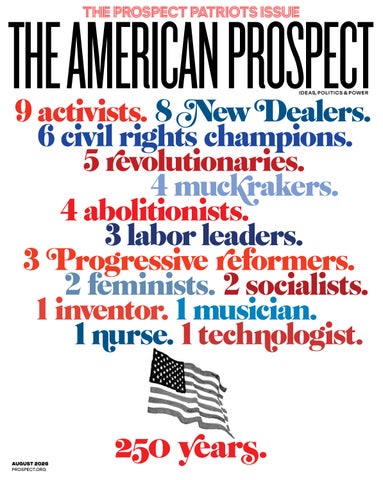
THE PROSPECT PATRIOTS ISSUE
I D E AS, P O L I T I C S & P O W E R
9 activists. 8 ew ealers. 6 civil rights champions. 5 evolutionaries. 4 mucrakers. 4 abolitionists. 3 labor leaders. 3 rogressive eformers. 2 feminists. 2 socialists. 1 inventor. 1 musician. 1 urse. 1 techologist.
AUGUST 2026 PROSPECT.ORG
ear.
Independent, nonprofit media. This is a critical time for our country and we need independent journalism more than ever. The Prospect helps to dispel myths, challenge conventional wisdom, and expand the dialogue. We have no shareholders, no parent company, and no billionaire owners to answer to. We are beholden only to you—our readers. SUPPORT OUR WORK
prospect.org/donate
AUGUST !0!6 VOL !7, NO. 4
4
10
14
These Are Our Prospect Patriots
The Consistent Revolutionary Thomas Paine’s lifelong battle for freedom.
In the nation’s 250th year, we turn an eye to Americans who challenged power, took risks, and made our country greater.
BYTHOR BENSON
BY DAVID DAYEN
18
Brave Woman By chronicling the shame of lynching in the South, Ida B. Wells exposed the corruption of white supremacy. BY NAOMI BETHUNE
28
The Journalist Who Took Down Rockefeller Not even Teddy Roosevelt could break up his corrupt oil monopoly—until Ida Tarbell came along.
Indefatigable American If Frederick Douglass, a former slave who saw the dream of emancipation drown in Jim Crow, didn’t give up on this country, then we have no excuse. BY RYAN COOPER
THE PROSPECT PATRIOTS ISSUE
BY WHITNEY CURRY WIMBISH
22
The Empiricist Louis Brandeis believed that facts could change lives and break excessive power where it accumulated. BY DAVID DAYEN
32
The Greatest Senate Investigator Ever How Sicilian immigrant Ferdinand Pecora upended the rule of the bankers and ushered in FDR’s radical reforms of capitalism. BY ROBERT KUTTNER
36
The Architect of Social Security In her words, Frances Perkins, the first woman cabinet secretary, ‘came to Washington to work for God, FDR, and the millions of forgotten, plain, common workingmen.’
40
Socialist on the March A. Philip Randolph led Black workers and won defining civil rights victories over a career spanning 60 turbulent years. BY HAROLD MEYERSON
44
Saint Radical The incredible life and times of Dorothy Day, the Catholic who served the poor and gave hell to everyone else. BY MAUREEN TKACIK
50
Tenacious Symbol Disability rights activist Judy Heumann carried forward the demands of those who didn’t get to live to see the movement’s triumphs. BY NATHAN TANKUS
BY GABRIELLE GURLEY
Cover illustration by Lyndon Hayes
CULTURE
54
58
60
JEFFREY SKLANSKY
HELAINE OLEN on How to Rule
A.A. DOWD on
64 PARTING SHOT Are You a Patriot?
on Against Money
the World: An Education in Power at Stanford University
Ted Lasso, Season 4
BY FRANCESCA FIORENTINI
AUGUST 2026 THE AMERICAN PROSPECT 1
FROM THE EDITOR
Let me address something first: I am aware of the calendar, and when the Declaration of Independence was signed. So yes, you are receiving this edition commemorating what happened on the Fourth of July !5# years ago, despite it being the month of August. We’re late. I know. Unfortunately, we run our print issues in evennumbered months. Ultimately, we decided that in !5# years, nobody will take note of the precise timing of our semiquincentennial remembrance. I had the idea for this issue around the end of last year. Whenever we commit something to paper, it gives us the opportunity to take our time, step back a bit, and more deeply consider the issues facing the nation. But these round-numbered anniversaries demand that you step all the way back. I’m not going to get the opportunity to do a tricentennial issue; this is my one shot. So I wanted to make it count. The balancing act was how to recognize America without succumbing to what I call the Great Man of History approach, the idea that individuals making unilateral decisions is how a country moves forward. I don’t believe that’s how history operates, and I didn’t want whatever we did to reinforce that approach. My concept was to honor the Americans who stood for and alongside the movements of the past !5# years, against the prevailing unjust power of their time. Those we selected are representative rather than singular. They come from
2 PROSPECT.ORG AUGUST 2026
and sit in solidarity with the common people and the common good. They exemplify America at its best, and a spirit closest to the ideals espoused in the manuscript presented to the world on July $, 1776. I want to give special thanks to harold me,erso., our in-house historian and my co-editor on this issue. We worked really hard coordinating input from staff and whittling down a list that had far more than 1## names on it to 1# profiles and $# acknowledgments. He also was great in helping find historians, authors, and knowledgeable figures to comment on the accomplishments of these Prospect Patriots. This was no small task amid midsummer vacations! I was born in Philadelphia, about four blocks from where the Declaration of Independence was signed, and where the Liberty Bell and Independence Hall still stand. City Tavern, where the signers celebrated the separation from colonial rule that afternoon, remains a working restaurant. I was born adjacent to history and I love what history can teach us. I hope this issue will inspire you to explore these people and their stories more, as it has me. –da01d da,e.
SUBSCRIPTIONS EXECUTIVE EDITOR DAVID DAYEN FOUNDING CO2EDITORS ROBERT KUTTNER, PAUL STARR CO2FOUNDER ROBERT B. REICH MANAGING EDITOR AND DIRECTOR OF EDITORIAL OPERATIONS CAITLIN PENZEYMOOG EDITOR AT LARGE HAROLD MEYERSON SENIOR EDITORS GABRIELLE GURLEY, RYAN COOPER ART DIRECTOR LINDSAY BALLANT ASSOCIATE EDITOR SUSANNA BEISER STAFF WRITER WHITNEY WIMBISH WRITING FELLOWS JAMES BARATTA, NAOMI BETHUNE, ZACHARY GROZ INTERNS ELEANOR DAVIS(DIVER, PATRICK DIMASIN, MAKELA REID, KEYIAN VAFAI CONTRIBUTING EDITORS AUSTIN AHLMAN, MARCIA ANGELL, GABRIEL ARANA, DAVID BACON, JAMELLE BOUIE, JONATHAN COHN, ANN CRITTENDEN, GARRETT EPPS, JEFF FAUX, FRANCESCA FIORENTINI, MICHELLE GOLDBERG, GERSHOM GORENBERG, E.J. GRAFF, JONATHAN GUYER, BOB HERBERT, ARLIE HOCHSCHILD, CHRISTOPHER JENCKS, JOHN B. JUDIS, RANDALL KENNEDY, BOB MOSER, KAREN PAGET, SARAH POSNER, JEDEDIAH PURDY, ROBERT D. PUTNAM, RICHARD ROTHSTEIN, ADELE M. STAN, DEBORAH A. STONE, MAUREEN TKACIK, MICHAEL TOMASKY, PAUL WALDMAN, SAM WANG, WILLIAM JULIUS WILSON, JULIAN ZELIZER PUBLISHER MITCHELL GRUMMON ASSOCIATE PUBLISHER MAX HORTEN OPERATIONS AND MARKETING MANAGER LAUREN PFEIL BOARD OF DIRECTORS DAN CANTOR, DAVID DAYEN, REBECCA DIXON, SHANTI FRY, STANLEY B. GREENBERG, MITCHELL GRUMMON, JACOB S. HACKER, AMY HANAUER, JONATHAN HART, DERRICK JACKSON, RANDALL KENNEDY, ROBERT KUTTNER, ELI LUBEROFF, LINDSAY OWENS, MILES RAPOPORT, ADELE SIMMONS, GANESH SITARAMAN, PAUL STARR, MICHAEL STERN, VALERIE WILSON PRINT SUBSCRIPTION RATES $60 (U.S. only) $72 (Canada and other international) CUSTOMER SERVICE info@prospect.org DONATIONS prospect.org/donate REPRINTS prospect.org/permissions VOL. 37, NO. 4. The American Prospect (ISSN 1049-7285) Published bimonthly by American Prospect, Inc., 1225 Eye Street NW, Suite #600, Washington, DC 20005. Periodicals postage paid at Washington, DC and additional mailing offices. Copyright ©2026 by American Prospect, Inc. All rights reserved. No part of this periodical may be reproduced without consent. The American Prospect® is a registered trademark of American Prospect, Inc. POSTMASTER: Please send address changes to The American Prospect, 1225 Eye St. NW, Suite #600, Washington, DC 20005. PRINTED IN THE U.S.A.
MANAGE YOUR SUBSCRIPTION ONLINE Print subscriptions can be managed online at prospect.org/subscribe.
Log into your account to renew your subscription, update your mailing address, give a gift subscription, and manage payment methods. You will need your account number and mailing ZIP code, which can be found on your magazine’s mailing label.
RENEW BY MAIL You may begin or renew a print subscription by sending a check or money order ($60 U.S. only/$72 international) along with your name and mailing address to: The American Prospect 1225 Eye Street NW, Suite #600 Washington, DC 20005
GIVE A GIFT SUBSCRIPTION Want to share the Prospect with a friend? You can send a gift subscription by going to prospect.org/subscribe and clicking “Give a Gift”.
NEED HELP WITH YOUR SUBSCRIPTION? Email us at info@prospect.org. AUGUST 2026 THE AMERICAN PROSPECT 3
America at
ese
Are Our
Prospect atot
In the nation’s 250th year, we turn an eye to Americans who challenged power, took risks, and made our country greater. By David Dayen Illustrations by Lyndon Hayes
Background (left to right): Louis Brandeis, A. Philip Randolph, Thomas Paine Foreground (left to right): Ida B. Wells, Judy Heumann, Dorothy Day, Frances Perkins, Ferdinand Pecora, Ida Tarbell, Frederick Douglass
ostly by sheer coincidence, I had the occasion this spring and summer, before the semiquincentennial celebrations, to visit all the major cities involved in the memorial building now marks the spot at 2& Wall Street, right American Revolution and the founding of across from the New York Stock Exchange. our national government. I saw the harIn Bensalem, Pennsylvania, the town I grew up in, I saw the bor where Bostonians dressed as Native mansion where locals say Benjamin Franklin conducted his experiAmericans and ransacked three merchant ments with electricity; they had taken out the soccer $eld where I ships, protesting the monopoly the British played as a kid. About !5 miles down the road, I saw McConkey’s gave the East India Company on imported Ferry, the landing where George Washington led the crossing of the tea to the colonies. I saw the home of Paul Delaware River on Christmas Day !((&, to surprise the Hessians Revere, the silversmith who took a midnight at their forti$cation in Trenton. ride, alerting his neighbors of the British I saw Independence Hall and the Liberty Bell that once hung armed advance into Massachusetts along in its steeple and the nearby archaeological site where George the Charles River. I saw the little boarding and Martha Washington lived with nine servants in the !()0s, house in Philadelphia where Thomas Jef- now freighted with controversy after the Trump administration ferson drafted the Declaration of Indepen- sought to take down explanatory panels about Founding Father dence—or at least a facsimile of the house, slave owners. The panels were still up when I was there, though an since it was torn down in !883 to put up a appeals court in June gave the National Park Service the green light to remove them. Homemade signs around the location expressed bank and later a lunch counter. I didn’t spend a lot of time in New York, the right to “peacefully protest our government’s attempts to whitebut I was primarily in and around the site wash (literally) history.” And I saw Washington, modern Washington, where on the day I of the Battle of Brooklyn, the $rst major confrontation of the Revolution, which strolled around the Federal Triangle, an Ultimate Fighting Champipre$gured the anomalous pattern of the onship octagon known as The Claw loomed over the South Lawn of eventually victorious Continental Army the White House, with advertisements on its padded bars from Ram being defeated over and over again. And Trucks, Bud Light, and an unregulated online casino called Stake. Ain’t that America. I saw the site of Federal Hall, where the $rst presidential inauguration and the presentation of the Bill of Rights were held. A y amateur study of the past 250 years, reinforced by this accidental journey, has taught me a couple of things about this country. American history is essentially about power: those with wealth and privilege climbing over one another to obtain it, and those without such advantages taking them on. This nation was founded with a healthy skepticism toward concentrated control, and it has been shaped by a continual pendulum swing between entrenchment and fragmentation, consolidation and breaking apart. Another observation is that real change in America, by and large, has started from outside the system, from common people wanting to 6 PROSPECT.ORG AUGUST 2026
DAVID DAYEN
Independence Hall, Philadelphia
improve their lives and the lives of their neighbors, seeking liberty over tyranny, freedom over slavery, equality over bigotry, justice for all and a better life. This was ampli$ed on my trips, too. I saw campaign signs reading, “Save Our Neighborhood Schools,” local businesses explaining why federal immigration agents were unwelcome on their property, and a solitary man across from the Eisenhower Executive Office Building in Washington with a sign reading, “No Arch.” In Portland, Maine, a key stop on the Underground Railroad, I walked the Freedom Trail, discovering how local clergy, longshoremen, porters, barbers, and secondhand clothing dealers ferried freed Black slaves to Canada. And on the way back from that walk, an unidenti$ed man with a bullhorn, like Paul Revere 250 years earlier, warned residents that ,-. had been spotted in the area, asking passersby: “What would you do if they confronted you?” The spirit of America is in these people, the ones who protect their neighbors, the ones who strive for a more perfect union in the workplace, in the halls where legislation is conceived and implemented, in our community spaces. They want control over their own lives, to pursue their happiness as they determine. The version of an America driven unilaterally by Great Men (usually men) making weighty judgments inside gleaming towers does not match our arc of history. When I visited the /FK Library, his !)&! inaugural address played on a loop, exhorting citizens to “ask not what your country can do for you, ask what you can do for your country.” But it also spotlighted Kennedy’s book Profiles in Courage, which featured eight U.S. senators defying their constituents to do what they felt was right. These pro$les combine the noble (progressive Nebraskan George Norris leading the revolt against House Speaker Joseph Cannon’s dictatorial control of what bills got voted upon) and maybe not so noble (Edmund Ross voting against the majority of his party to acquit Andrew Johnson in his impeachment trial, which at least one historian views as the result of bribes and political patronage). But none of them, to me, represent real American courage. Courage comes from greater risks than losing a seat in political
office. It comes from greater decisions than a representative of the people defying the will of the people. When we thought about how we wanted the Prospect to commemorate this 250th anniversary, we turned to stories about people without institutional power who challenged the most entrenched and dominant forces in our economy and society, risked their lives and reputations, de$ed conventional wisdom, and triumphed. We’re presenting them to you in this special series with ten pro$les of Prospect Patriots who can epitomize the American story in a way that best matches how the nation has adapted and changed—usually slowly and in no way without hardship, but moved inch by inch through the laborious work of citizens who demand better.
ere’s no perfect way to do a list like
this. If we choose a select sample of patriots, aren’t we reifying the very individualized version of history we wish to reject? And after we choose, won’t we be criticized for who we left out, for whose tales we failed to tell? Such criticism ref lects both the inadequacy of listicles and the reason why magazines sometimes engage in them, on the idea that controversy generates interest. That was not our purpose here, however: We believed that the 250th anniversary would lead to valorization of American heroes in ways that made incorrect evaluations about who in this nation actually has mattered, and still matters. Correcting such misimpressions outweighed the fear of offending by omission.
American history is essentially about power: those with wealth and privilege climbing over one another to obtain it, and those without such advantages taking them on.
AUGUST 2026 THE AMERICAN PROSPECT 7
Washington’s Crossing
The spirit of America is in these people, the ones who protect their neighbors, the ones who strive for a more perfect union in the workplace, in the halls where legislation is conceived and implemented, in our community spaces.
8 PROSPECT.ORG AUGUST 2026
JFK Library, Boston
We are also aware that nobody in this world is completely perfect, and that even those who best embody the American character made choices that we, 250 or !50 or 50 years later, may $nd flawed. It would not be possible to construct an honest list free of such blemishes, and we won’t shrink from those faults in telling their stories. We think the broad sweep of their actions exempli$es the America we wanted to uplift.
n this series, you will read about the revolutionary with a
personal integrity closest to the democratic impulses embedded in the founding documents. You will examine the avatar of the impossible movement to abolish slavery in these United States. You will learn about journalists who chronicled the horrors of racial supremacy and the predations of great combinations of industry. (You’re surprised we foregrounded journalists? We’re a magazine; cut us some slack.) We chronicle the progressive reformer who fought tirelessly for the liberty of the people. We narrate the tale of the Wall Street law clerk who then exposed Wall Street’s villainy that bankrupted the nation during the Great Depression. We highlight leaders for labor rights and civil rights, in one instance illustrated by the same person. And we nod to the great social movements in America, the demands for dignity and respect at home and abroad, and the
DAVID DAYEN
In our preparations, we laid down some ground rules. First of all, this is not a de$nitive list of the greatest Americans. We decided against choosing many of those who sit atop such lists traditionally, people like Martin Luther King Jr. or Benjamin Franklin, Rosa Parks or Harriet Tubman. We wanted to go a layer deeper and elevate some less familiar Americans, while also paying tribute to the ideals and priorities of those everyone knows. We also made a rule: no elected officials. That means we had no place for George Washington, Thomas Jefferson, Abraham Lincoln, Franklin Roosevelt, Jeannette Rankin, Shirley Chisholm, Barbara Jordan, Hattie Caraway, and many more who served honorably inside government. We preferred to tell stories from the outside, of those who took the long road of making this nation achieve something close to its stated principles. We only strayed from this in one instance: a state legislator who is better known for his work well before election. There’s also one Supreme Court justice, who again would have been suitable for our esteem even if he were never nominated. A few of our Prospect Patriots sought political office, and some did take positions of power, or at least counseled people in power. But in so doing, they brought with them the accumulated demands of great masses and movements of Americans. They are in many ways representative of something larger, a pro$le of one as a synecdoche for millions. And most of them did that work without a formal seat of influence.
OUR 50 PROSPECT PATRIOTS Thomas Paine, revolutionary Lemuel Haynes, clergyman Margaret Catherine Moore Barry, scout Mercy Otis Warren, pamphleteer Herman Husband, radical Frederick Douglass, abolitionist Sojourner Truth, abolitionist Wendell Phillips, abolitionist William Still, conductor Clara Barton, nurse Ida B. Wells, journalist W.E.B. Du Bois, public intellectual George Washington Carver, scientist Sitting Bull, holy man Maggie Lena Walker, banker
Declaration House, Philadelphia
Louis Brandeis, reformer Oliver H. Kelley, farmer Jane Addams, social reformer Edward Filene, businessman Margaret Sanger, nurse Ida Tarbell, muckraker Elizabeth Cady Stanton, feminist Eugene Debs, socialist icon Elizabeth Gurley Flynn, union leader Henry Demarest Lloyd, muckraker
DAVID DAYEN
Ferdinand Pecora, investigator Harry Hopkins, New Dealer Francis Townsend, activist Woody Guthrie, musician Catherine Bauer, housing advocate
desires to solve problems with dialogue and not guns. Alongside these pro$les, you will see entries of other Americans from the same eras whose activities we thought important to honor, with write-ups from people who have studied and admired them. It would be impossible to be comprehensive in recounting 250 years of history on our limited pages; our initial list was roughly twice this size. But we have made our best attempt. In a moment when so many among us despair about whether we can even keep our fraying democracy, we felt that it was important to write an American story that shows how we’ve emerged from the depths before. Power has been defeated in this nation, at the cost of personal comfort and fortune and lives—sometimes, lots of lives—by those who spoke for the people’s yearnings for freedom. We must remember our history because we are more equipped for future battles when we take history’s lessons. And we must not surrender it to those men of privilege who would twist it into something indecipherable, in the name of putting down rebellions to their authority. The past—and the present—informs what is possible in America, despite its mistakes, despite its trespasses, despite its cruelties. In a never-ending struggle for the interests of the many over the few, we can choose the side of those who took up the challenge. These are some of their stories. n
Frances Perkins, New Dealer Mary McLeod Bethune, New Dealer Leon Keyserling, economist Jesse Jones, public financier Walter Reuther, union leader A. Philip Randolph, civil rights leader H.L. Mitchell, union leader Ella Baker, organizer James Baldwin, author Fannie Lou Hamer, civil rights activist Dorothy Day, pacifist Fred Korematsu, civil rights hero Michael Harrington, democratic socialist Tom Hayden, antiwar activist Rachel Carson, environmentalist Judy Heumann, activist Marsha P. Johnson, gay rights icon Heather Booth, organizer Barbara Ehrenreich, modern muckraker Aaron Swartz, internet activist
10 PROSPECT.ORG AUGUST 2026
oas aie
THE CONSISTENT REVOLUTIONARY
Thomas Paine’s lifelong battle for freedom. BY THOR BENSON
TIMOTHY MATHER COOLEY, FROM SKETCHES OF THE LIFE AND CHARACTER OF THE REV. LEMUEL HAYNES
W
hen Americans discuss the Founders, there’s always a cloud of shame hanging overhead. One might like many things about Thomas Jefferson or George Washington, but it’s impossible to forget that these men participated in the horri$c system of human bondage. A few of the Founders, though, stand out for opposing it outright. Thomas Paine was one such $gure. Paine—an author and political philosopher—was born in Thetford, England. His friend Benjamin Franklin helped him get established in Philadelphia upon his arrival to the colonies in !((4. There, he wrote the 4(-page pamphlet Common Sense, which was published in !((& and swept early America. The pamphlet became the de$ning argument for America’s independence—for many Americans, both the $rst and the most persuasive argument for severing allegiance to the British king, or to any king. In many ways, Paine was a $ercer supporter of democracy than many of the more celebrated Founding Fathers, whose mistrust of the “common people” led them to put limits on voting rights and popular representation in the halls of government. Those were limits that Paine also opposed outright. “I think most people know him largely because of his pamphlet Common Sense, which came out in !((& and had an impact on galvanizing Americans in favor of independence from Britain,” William Hogeland, an author and historian who focuses on the founding era, told The American Prospect. “It was dramatic because he attacked the idea of the British Constitution and said, basically, they have no constitution. Where is this constitution? Because it wasn’t written down. He attacked the idea that the Crown was part of a constitutional, balanced government.” Paine portrayed the king as a “royal brute,” Hogeland says. This was seen as somewhat extreme at the time, because even colonists who favored independence weren’t that critical of the king. For that reason, Common Sense helped lay the groundwork for the Declaration of Independence, which also excoriated King George at length. “The pamphlet sells extremely well, whether it’s in Charleston or Boston. Maybe … the idea is not completely alien. It’s more that he $nds a way to make the case, and the case looks pretty appealing in his hands,” Sophia Rosenfeld, a professor of history at the University of Pennsylvania, told the Prospect. “It’s less
Lemuel Haynes
CLERGYMAN Born mixed-race in 1753, Haynes was released from his indenture, enlisted in the Continental Army, and in 1776 penned “Liberty Further Extended,” a critique of slaveholding in the American colonies in a time of war against British tyranny. As one war created his career, another ended it; opposition to the War of 1812 cost him his pulpit. –John Saillant, biographer
than six months before the Declaration of Independence becomes the actualization of what he’s proposed in his little pamphlet.” Paine became quite influential in early America. He also seems to have had a personality that was sometimes difficult for people to accept. He knew what he believed and was not willing to waver from those beliefs. To read about him is to envision a passionate, stubborn man who might have had a hard time keeping friends. “We gather from reading about him that he was very intense in his personality, but also he had a friendly, casual quality,” Hogeland says. “I think a lot of people see Paine as just like a very adroit propagandist for new ideas because he was such a good writer. But I disagree. I think he did have original ideas. In fact, you can sort of tell [that] from the degree to which a lot of the other Founders kind of recoil from his thinking.” Both John Adams and Alexander Hamilton—future Federalists with a disinclination to popular democracy—regarded Paine as extreme. Adams famously wrote his pamphlet, Thoughts on Government, in response to Paine’s ideas. He wrote in favor of independence but was not comfortable with the hyper-democratic government Paine was proposing. The country was still years away from the writing and adoption of the Constitution when these pamphlets were being released, but they did set a foundation for what would eventually go into that document. “There’s no way Paine knew that he was setting up the mechanism for a constitution,” Rosenfeld says. “But I think in times of disorder and dismay, sometimes a text can articulate clearly the discontent people are feeling. A very similar thing happens at the AUGUST 2026 THE AMERICAN PROSPECT 11
12 PROSPECT.ORG AUGUST 2026
Margaret Catherine Moore Barry SCOUT
A Revolutionary War scout who risked her life to ride through South Carolina’s backcountry before dawn on January 16, 1781, to tell Patriot troops that the British were advancing. Armed with her intel, they won the Battle of Cowpens the next day, a victory that helped win independence. –Whitney Curry Wimbish
Mercy Otis Warren PAMPHLETEER
She was an outspoken poet, playwright, pamphleteer, and intellectual thinker of the American Revolution whose anti-British plays supported a break with the mother country. Her 1788 treatise under the pseudonym “A Columbian Patriot” argued against adoption of the U.S. Constitution until there was a Bill of Rights. –Nancy Rubin Stuart, historian
French Revolution,” Rosenfeld says. “He becomes perhaps the $rst international revolutionary, in that sense.” In !()!, Paine authored Rights of Man, one of the most influential defenses and manifestos of the Revolution published at that time. Again, he put pen to his democratic impulses and his rejection of monarchy. Again, Paine synthesized ideas that were circulating at the time. On both sides of the Atlantic, he had a preternatural ability to put those ideas into words that resonated with the people. In Britain, Rights of Man sold some !00,000 copies in three months of publication. “He ends up in France as a hero of the French Revolution, and they wanted him partly because he was a hero of the American Revolution,” Hogeland says. “Paine spoke across France and was even made a member of the revolutionary government.” As anyone familiar with the French Revolution would suspect, that was not the safest place to be. Paine ended up facing condemnation for opposing the execution of the king: It was wrong, he insisted, and a mistake to turn the king into a martyr. Eventually, like many of his fellow revolutionists, he was arrested and spent ten months in prison. He almost ended up being executed by Robespierre and his lieutenants, but narrowly escaped that fate. “He barely missed being guillotined himself in France,” Hogeland says. “Because he had such an idiosyncratic personality and such an idiosyncratic way of looking at the world and politics, he was often at odds with allies as well as with enemies.” The American government didn’t do much of anything to assist Paine in his time of need in France. The U.S. minister to France, Gouverneur Morris, did not seem interested in securing Paine’s release from prison or helping him escape the guillotine. Later,
LIBRARY OF CONGRESS/BRITISH CARTOON PRINTS COLLECTION; JOHN SINGLETON COPLEY/MUSEUM OF FINE ARTS, BOSTON
start of the French Revolution, when What Is the Third Estate?, Abbé Sieyès’s little pamphlet, similarly gives an agenda to people who would go on to be revolutionaries.” Paine wanted a government that was more representative than the one we have today. He didn’t want anything like the Senate or the Electoral College, which might act as bulwarks against popular majorities and the will of the people. He wanted judges to be elected by the public. He didn’t want a solo executive but rather something of a committee. While many of the Founders feared what might happen if you gave the people too much power, Paine (like Franklin) did not. “He really doesn’t come from the aristocratic worlds of people like Hamilton or Madison,” Rosenfeld says. “He’s kind of anti-elitist.” During the Revolutionary War, Paine was a volunteer for the Continental Army, and he ended up writing The American Crisis about what he was observing. He famously wrote the line “These are the times that try men’s souls.” Paine was essentially cheerleading the war effort and trying to convince his fellow patriots to keep $ghting, and that, as difficult as the struggle appeared, it would all be worth it in the end. The American Crisis also found a wide, appreciative, and strategically important readership. Once the war had concluded, despite his successes and his fame, Paine was broke. He ended up having to argue for compensation from individual states and the newly forming American government. He was eventually awarded $3,000 from Congress for his contributions to the American Revolution. “He did get some money in the end from Congress, but he wasn’t making it here,” Hogeland says. “He felt he had to leave. And so then he becomes kind of a citizen of the world type.” Paine was also becoming something of an inventor at this point, pitching an innovative bridge concept to investors and governmental officials, but to no avail. In April of !(8(, he decided to take his ideas elsewhere. He returned to Britain, but he failed to raise the investment needed to fully realize his project. He eventually left for France, arriving just as the French Revolution was commencing. Once again, a revolutionary was surrounded by other revolutionaries. “He goes on to play a pivotal role in the
Paine wanted a government that was more representative than the one we have today.
Paine’s Common Sense (center) was a defining argument for America’s independence from monarchy; Rights of Man (right) extended it to the whole world.
after Paine had been released, James Monroe became the minister to France and came to his aid. With America badly divided over the French Revolution, and the administration of John Adams resolutely set against it and its Jeffersonian allies in the States, Paine didn’t return to the United States until !802—one year after Jefferson assumed the presidency. “He thought, ‘Oh, now our guys are in. Now the more democratic people are in,’” Hogeland said. “But he had been writing all this stuff that was so controversial, especially The Age of Reason, which was very anti–organized religion. It became so controversial that even the Jeffersonians thought he was too hot to handle.” He certainly didn’t return a hero. He still had those who celebrated his work and appreciated his contributions to the country’s independence, but he was now seen as a polarizing $gure. Many hated him for his criticisms of organized religion. New York had granted Paine some land in New Rochelle for his contributions to the American Revolution, so Paine decided to settle there. He continued to write and was a supporter of the Jefferson administration, but his relevance had severely dwindled. Paine died at the age of (2 in !80). “Very few people came to his funeral, and nobody who was still around from the glory days of !((& showed up,” Hogeland says. His reputation, for better and worse, outlived him. Theodore Roosevelt famously called him “a $lthy little atheist,” though Paine was in fact a deist. As the 20th century proceeded, however, Paine became a hero to liberals and the left, who found him to be both the most democratic and the most modern of the Founding Fathers. “His ideas don’t seem that radical to us now, because they’ve become, in a way, our common sense,” Rosenfeld says. “His style
Herman Husband RADICAL
The backwoods prophet from western Pennsylvania conceived of Social Security, progressive taxation, and the abolition of slavery at a time when such things were nearly inconceivable. His inveterate resistance to government corruption and wealth concentration, culminating in the Whiskey Rebellion, represents an important radical tendency in the American revolutionary consciousness. –William Hogeland, historian
and his ideas have become so ordinary to us that it’s hard to actually see that he was advocating for things that were rather radical in their moment, whether it was about race or religion or economics or political rights.” Today, most of us understand the limits that the Founders placed on the democratic and egalitarian sentiments in our foundational documents. Hogeland pointed out, though, that “in !((&, the anti-democratic, elitist impulse wasn’t the only American impulse. There were radically democratic and populist ideas in play too, and Paine was maybe their most articulate and thoughtful spokesperson.” You won’t $nd many statues of Thomas Paine in town squares or abutting county courthouses around the country. It was his ideas, however, that both made this country possible and tilted it, over time, toward the genuine popular democracy we still struggle to create. n Thor Benson is an independent journalist who has contributed to The American Prospect, Wired, Rolling Stone, and many other publications. He’s currently based in Chicago. AUGUST 2026 THE AMERICAN PROSPECT 13
redec, ouglas
INDEFATIGABLE AMERICAN
A
merica is suffering a crisis of faith. The president, rapidly losing control of his faculties, is leading a coterie of degenerate cronies, literal malefactors of great wealth, who are destroying whole wings of the White House when they’re not gorging themselves on the public treasury with corrupt contracts and giveaways. Many Americans, particularly in elite circles, seem stunned and bewildered. The worst people in the country are in power, again, and laying waste to everything. Every week, Trump does something an order of magnitude worse than Watergate, and it’s a two-day story at most. It’s hard to muster the energy to care about so many scandals. I frankly share the stunned feeling, sometimes. Is a nation stupid enough to elect Donald Trump twice worth saving? Maybe the American people deserve to get what they voted for, good and hard. At those times, I think about Frederick Douglass. There was someone who had a mountain of reasons to give up entirely on the United States. Instead, he poured out a lifetime of grueling effort to end slavery and secure civil rights for African Americans. He lived long enough to see slavery ended, but also to see the resurgence of white supremacy that violently destroyed the brief Reconstruction experiment with multiracial democracy in the South. Yet even with so much of his life’s work in ruins, he never gave up on America or freedom. So how can we?
Douglass’s life story seems designed to embody all the contra-
dictions and possibilities of !)th-century America. Born not just a slave, but a mixed-race slave likely fathered by one of his enslavers or one of his enslaver’s sons, he was the product of arguably the single most appalling feature of antebellum slavery: the widespread habit among male Southern slave owners of raping their female slaves and then enslaving their own resulting children. He successfully escaped bondage from eastern Maryland in !838, at age 20. After a few years working odd jobs, he was discovered by the abolitionist movement. The discovery of Douglass’s immense oratorical talent was instantly appealing to abolitionist organizers for obvious reasons. He would prove that a Black person can succeed at the highest level, even if he were a result 14 PROSPECT.ORG AUGUST 2026
Sojourner Truth
ABOLITIONIST Born into slavery in New York’s Hudson Valley, Sojourner Truth secured her freedom as a young woman. Deeply religious, she gained fame as a celebrated, fearless, well-traveled preacher, abolitionist, and women’s rights advocate who corresponded and met with the most distinguished leaders of her era, including Frederick Douglass and Abraham Lincoln. –Gabrielle Gurley
of the dreaded race-mixing, without any formal education, inherited wealth, or powerful family connections. Nobody has ever come closer to the impossible idea of lifting himself by his own bootstraps. Abolitionists like Douglass toured the northern United States tirelessly, speaking at thousands of abolitionist rallies. This was a dangerous business even in New England, and he was repeatedly the victim of discrimination, heckling, threats, and assaults. One particularly violent brawl left him with a permanently dis$gured right hand. Eventually, he wrote an autobiography, which became an instant classic, and went on extensive international tours. By the mid-!850s, he was a world-famous speaker, writer, journalist, newspaper editor, and all-around celebrity. He ended up being the most-photographed American of the !)th century, and certainly the most important civil rights activist in the world. In a sense, he was the !)th century’s version of an influencer—except instead of producing short-form video optimized to catch the attention of “masses” of individuals scrolling on their phones, Douglass brought the show to the actual masses, day after day, for decades. Through years of practice, he honed his routine and technique to a mirror $nish; a reliable crowd-pleaser was his bitterly sarcastic “Slaveholder’s Sermon,” in which he parodied the sanctimonious hypocrisy of Southern Christianity. “Oh, consider the wonderful goodness of God! Look at your hard, horny hands, your strong muscular frames, and see how mercifully he has adapted you to the duties
LIBRARY OF CONGRESS/GLADSTONE COLLECTION OF AFRICAN AMERICAN PHOTOGRAPHS
If Frederick Douglass, a former slave who saw the dream of emancipation drown in Jim Crow, didn’t give up on this country, then we have no excuse. BY RYAN COOPER
you are to ful$ll!” Douglass had the pastor say to his slaves. “While to your masters, who have slender frames and long delicate $ngers, he has given brilliant intellects, that they may do the thinking, while you do the working” (emphasis in original). From a modern standpoint, it is almost unbelievable that Douglass could get huge crowds of people, most of whom did not have even a high school education, to pay rapt attention to flowery, hours-long speeches, often full of learned citations and elaborate arguments. But they kept coming back for more. There may be something to the idea that television and cellphones have ruined the national attention span; professor friends of mine relate that if they assign any Douglass speech, it must be heavily abridged or students simply will not read it.
Douglass’s first mentor was William Lloyd Garrison, one of the classic American-style utopian idealists, disgusted by the grubby realities of politics. Garrisonians hated political parties, lambasted the Constitution as a pro-slavery document, advocated pure “moral suasion,” and, as so often with political radicals, were highly prone to sectarian in$ghting. After a few years, Douglass came to understand that such a naïve, hyper-moralistic approach—Garrison argued that government itself was essentially always wrong— AUGUST 2026 THE AMERICAN PROSPECT 15
16 PROSPECT.ORG AUGUST 2026
Douglass was the most-photographed American of the 19th century, making long speeches in public for decades.
Wendell Phillips
ABOLITIONIST In the 1830s, he abandoned his Boston law practice to become a full-time abolitionist, while arguing for women’s suffrage and their right to leadership positions in the male-dominated anti-slavery movement. During Reconstruction, he argued for universal Black suffrage and ownership of prewar plantations; and championed unions and the eight-hour workday. America’s all-purpose 19th-century radical. –Harold Meyerson
ing back the war effort. Lincoln took the complaints seriously, some rules were removed, and Douglass returned to recruiting, though the personal military position he thought was coming never arrived. Historians have argued that the Civil War was a fairly close-run thing in !8&4. Union losses were appalling during the Overland Campaign, as Gen. Ulysses S. Grant went on a sustained, grueling offensive to force the Confederacy into submission and end the war quickly. The resulting carnage and repeated setbacks were extremely unpopular, and Lincoln assumed that unless the tide turned quickly, he was going to lose the election that November. He even met with Douglass to plan a possible effort to covertly free the remaining slaves in the South, should the election be lost. But by this time, there were roughly 200,000 Black men in the United States military, about !0 percent of the total. Without this influx of new recruits, many of whom fought and died in the bloodiest battles of !8&4, Grant’s harrying of Lee might have dragged on a critical few months, leading Lincoln to lose the election to would-be Confederate appeaser George B. McClellan. In short, it is entirely possible that without Douglass’s actions to enable and then bolster Black enlistment, the Confederacy would have won its independence. When African Americans from around the country consecrated a statue of Lincoln in !8(& (known as the Emancipation Statue, it can still be seen in Washington, D.C., today), Douglass delivered a famous oration to practically the entire national political establishment, from President Grant to the Supreme Court to congressional leaders. (As biographer David W. Blight notes, no Black person
SOUTHWORTH & HAWES/ONONDAGA HISTORICAL ASSOCIATION MUSEUM; NATIONAL PORTRAIT GALLERY; COLLECTION OF THE SMITHSONIAN NATIONAL MUSEUM OF AFRICAN AMERICAN HISTORY AND CULTURE; LIBRARY OF CONGRESS/BRADY-HANDY PHOTOGRAPH COLLECTION
could never abolish slavery. Abolitionists would have to descend into the political muck and get dirty grappling for power. Navigating the pitfalls of politics without losing sight of one’s moral principles is always the most difficult part of radicalism, and Douglass managed it with rare dexterity. After having briefly fled the country for fear of prosecution over his involvement with John Brown, Douglass debated the British abolitionist George Thompson in !8&0 about whether the Constitution was pro- or antislavery. Douglass made the latter case, and while the argument was sophisticated and clever, it was also a little tendentious. He argued, for instance, that the infamous three-$fths clause was a “downright disability” because it “deprives those States of two-$fths of their natural basis of representation … Therefore, instead of encouraging slavery, the Constitution encourages freedom by giving an increase of ‘two-$fths’ of political power to free over slave States.” Mathematically correct, but something of an evasion of how the clause gave extra political power to slave owners in proportion to how many people they owned, and quite obviously done to enlist reverence for the Constitution and the cult of the Founding Fathers on behalf of abolition. If the argument was something of a cynical expedient in !8&0, it became an open-and-shut case when the Radical Republicans added the !3th Amendment to the Constitution in !8&5. That’s one way to win a debate about constitutional law. Though he never quite reached the heights of national power, Douglass was not some bit player amid the enormous tumult of the Civil War. When $ghting began, Black men were not allowed in the United States military, which Douglass attacked as unjust and counterproductive. “This is no time to $ght only with your white hand, and allow your black hand to remain tied,” he argued. When this ban was removed, thanks partly to his own inf luence, Douglass became a tireless military recruiter, and two of his own sons enlisted. He quickly stopped, however, when it became clear that Black troops were being abused, paid much less, denied promotions, and, worst of all, denied prisoner-of-war protections, making it more likely for them to be murdered by racist Confederate forces after capture. Douglass met with President Lincoln in the White House and argued once more that this racist treatment was immoral and hold-
NAXOS AMERICAN CLASSICS; CLAFLIN'S PHOTOGRAPHIC GALLERY/LIBRARY OF CONGRESS/LILJENQUIST FAMILY COLLECTION
would do this again until Barack Obama was inaugurated in 200).) There, Douglass delivered a considered political verdict on Lincoln’s legacy. He stated forthrightly that Lincoln “was preeminently the white man’s President, entirely devoted to the welfare of white men,” and that African Americans “are at best only his step-children; children by adoption, children by forces of circumstances and necessity.” Still, “we were able to take a comprehensive view … and to make reasonable allowance for the circumstances of his position … we came to the conclusion that the hour and the man of our redemption had somehow met in the person of Abraham Lincoln.” Douglass pointed out that even Lincoln’s prejudice was a necessary precondition for his political success. “Viewed from the genuine abolition ground, Mr. Lincoln seemed tardy, cold, dull, and indifferent; but measuring him by the sentiment of his country, a sentiment he was bound as a statesman to consult, he was swift, zealous, radical, and determined.” Few have delivered a better summary of how to ride the edge of the politically possible.
Douglass’s most marked characteristic was his astounding capacity for empathy. Brilliant minds are not uncommon. Much rarer is the genius with a sound moral sense—one which persists even when that person has suffered terrible injustice. Someone with Douglass’s background would have had every right to cultivate a bilious resentment against white people. But a repeated theme in his anti-slavery work was how the institution gravely harmed everyone, regardless of race. This extended even to his unknown father. “Cruel as the deed may strike any one to be, for a man to sell his own children to human flesh-mongers, it is often the dictate of humanity for him to do so,” Douglass wrote in his $rst autobiography. “Unless he does this, he must not only whip them himself, but must stand by and see one white son tie up his brother, of but few shades darker complexion than himself, and ply the gory lash to his naked back; and if he lisp one word of disapproval, it is set down to his parental partiality, and only makes a bad matter worse, both for himself and the slave whom he would protect and defend.” No doubt this was partly rhetorical—by demonstrating insight into the human motivations even of his own brutal enslaver, Douglass demonstrated his own humanity, and his superior virtue to boot—but it was also true. Douglass maintained this largeness of spirit throughout his life. He was one of a handful of men—and the only Black person of any gender—at the Seneca Falls Convention in !848, the $rst women’s rights conference in American history. There he argued strongly for women’s suffrage against more moderate factions who worried it would discredit the group, and he helped carry the day. He continued to advocate for women’s rights his whole life, even as many white feminists, embittered by the fact that Black men had gotten the vote $rst, and drawn into the vortex of racism that gradually consumed the post–Civil War North, welcomed segregation and Jim Crow. “Let those who want argument examine the ground upon which they base their claim to the right to vote,” Douglass said in an !888 speech at an International Council of Women conference. “They will $nd that there is not one reason, not one consideration, which they can urge in support of man’s claim to vote, which does not equally support the right of woman to vote.” In !8&(, as a xenophobic anti-Chinese panic built up, Douglass
William Still
CONDUCTOR Harriet Tubman is a legend and deserves her plaudits, but Still, who gave material support to Tubman, helped at least 800 slaves secure freedom, and was nicknamed the “Father of the Underground Railroad,” deserves them as well. Still provided the only first-person account of the entire network in 1872, a critical historical document. –David Dayen
Clara Barton NURSE
A self-taught Civil War nurse known as the “Angel of the Battlefield,” who tended to soldiers so close to the front lines that a bullet once pierced her sleeve. She ID’d the dead in the notorious Andersonville Prison, founded the Missing Soldiers Office and American Red Cross, and expanded who could practice medicine. –Whitney Curry Wimbish
argued powerfully that the United States is a “composite nation,” and Chinese immigrants should be welcomed and granted all the bene$ts of citizenship. “There are such things in the world as human rights,” he said. Later, he strenuously opposed the Chinese Exclusion Act of !882. Douglass was, of course, far from perfect. He was vain, egotistical, proud, touchy (particularly about racial slights), and treated his $rst wife quite poorly. He ended up, somewhat by accident, as the patriarch of an enormous family and coterie of hangers-on, and was forced to keep an arduous touring schedule long into his old age to make ends meet. He took over the Freedman’s Savings Bank just a few months before it collapsed, perhaps unwittingly persuading Black depositors to open accounts that were almost immediately wiped out. Such flaws were hardly surprising in a man of his time and background. On the contrary, it is surprising that they weren’t much worse. A man who endured such a traumatic upbringing and then found his way into so much privilege could be expected to develop a severe case of megalomania, if not substance abuse. That he did not is certainly partly the result of his own noble character, but I think also because Douglass had a great moral crusade for which to $ght. Struggle against injustice can give one’s life a powerful sense of purpose. That same purpose exists today, as white supremacists once more have the upper hand. Pete Hegseth is resegregating the military, and the Republican Party is rebuilding a new Jim Crow, enabled by the Supreme Court. Just as in Douglass’s day, the voting rights of Black people in the South are being stolen by force and fraud. In !8(8, as Reconstruction was being destroyed, Douglass gave a speech remembering what the Civil War was about. “Though freedom of speech and of the ballot have for the present fallen before the shotguns of the South, and, the party of slavery is now in the ascendant, we need bate no jot of heart or hope,” he said. “The heart of the nation is still sound and strong, and as in the past, so in the future, patriotic millions, with able captains to lead them, will stand as a wall of $re around the Republic, and in the end see Liberty, Equality, and Justice triumphant.” Douglass made such a political prophecy come true in his own time, and we can do the same again. n AUGUST 2026 THE AMERICAN PROSPECT 17
18 PROSPECT.ORG AUGUST 2026
da B. .ell
BRAVE WOMAN
By chronicling the shame of lynching in the South, Ida B. Wells exposed the corruption of white supremacy. BY NAOMI BETHUNE
J.E. PURDY/LIBRARY OF CONGRESS/GEORGE GRANTHAM BAIN COLLECTION
A
t the age of 2(, when Ida B. Wells $rst began editing and writing for the Free Speech and Headlight newspaper in Memphis, Tennessee, she encountered a preacher whose rhetoric was less than pious. Wells detailed in her posthumous autobiography Crusade for Justice that the unnamed reverend had decided that “morally there were no virtuous southern girls.” He had speci$cally pointed to how Wells had recently been $red from her schoolteacher position. But this termination was not motivated by Wells’s inability to educate her students; rather it was the result of an editorial she had published detailing the dreadful conditions for Black children in the Memphis public school system. When a family friend told Wells about the preacher’s comments, she immediately requested an audience. Wells traveled to Vicksburg, Mississippi, and confronted the reverend face-to-face. “He acknowledged that he had made the derogatory remarks, but added that he had only told it to my close friends. He realized his error and he begged pardon and stood ready to make amends,” Wells noted in Crusade for Justice. At Wells’s request, he apologized for his attempt to defame her from his pulpit the following Sunday, reading a statement that Wells herself penned. “I felt that I had vindicated the honor of the many southern girls who had been traduced by lying tongues,” Wells wrote. Her decision to hold the preacher accountable for his sexist, defamatory remarks was reflective of her approach to life: One must act to defeat perceived injustice, no matter how difficult. Wells was born into slavery in Holly Springs, Mississippi, in July of !8&2, three years before the end of the Civil War. Her mother was a skilled cook and her father was a respected carpenter; both involved themselves in Reconstruction politics after they were emancipated. They managed to ensure education for themselves and their children, encouraging Wells to read, write, and attend school. Tragically, both parents died in !8(8 from yellow fever, leaving Wells orphaned and a guardian of her siblings at the age of !&. Over the next few years, Wells cared for her siblings while focusing on professional and academic interests. She took on teaching work near her hometown and later moved her family to Memphis to pursue a similar position. There, she became one of the $rst to legally challenge Jim Crow laws, which had begun cropping up in the South during Reconstruction. At the age of 2!, Wells purchased a $rst-class ticket on the
W.E.B. Du Bois
PUBLIC INTELLECTUAL The pre-eminent African American activist-intellectual of the 20th century. He tried ceaselessly to find ways to defend and advance the interests of African Americans as they faced oppression, experimenting with various shades of liberalism, socialism, Pan-Africanism, and finally, tragically, communism. No one has grappled with anti-Black racism with more verve, imagination, and eloquence. –Randall Kennedy, legal scholar
Chesapeake, Ohio and Southwest Railroad from Memphis to Woodstock, Tennessee, and sat down in the respective ladies’ car. Instead of checking her ticket and moving on, the conductor ordered her to move to the second-class smoking car, which was mostly occupied by Black people. But Wells refused, and two additional railroad employees helped the conductor drag her into the smoking car, ripping her dress in the process. Instead of giving in, Wells opted to disembark, still holding on to her ticket. This was more than (0 years before Rosa Parks and the Montgomery bus boycott. When Wells returned to Memphis, she retained a lawyer and sued the railroad. The court awarded her $500 in damages, and the verdict ensured that all railroads would have to offer $rst-class accommodations to Black passengers. The railroad appealed, and the Tennessee Supreme Court struck down the ruling, demonstrating that true racial equality in the post-Reconstruction period would be difficult to produce. After this incident, Wells began writing for the Black-owned local publication The Living Way under the pseudonym “Iola,” mostly focusing on issues facing Black Americans. Her stories quickly gained attention in the U.S. and internationally, leading her to be referred to as the “Princess of the Press.” Soon after, in !88), Wells became co-owner and editor of the Free Speech and Headlight. It was there that she $rst became involved in investigative reporting and pushback against it, especially as she turned her attention to covering lynching.
As Black Americans began to build eco-
nomic and social mobility in the South after emancipation, white supremacists countered with racist violence. Between !882 and !)&8, nearly 5,000 lynchings occurred in the U.S., likely an undercount since these murders were not formally tracked or documented. Wells understood that terrorizing Black people was integral to the cultural fabric of the U.S., particularly in the South. Her commitment to reporting on the phenomenon was spurred on by the lynching of one of her close friends, Thomas Moss, in !8)2. A popular man in the local Black community, Moss, along with his partners Calvin McDowell and William “Henry” Stewart, owned a shop named People’s Grocery Company in the Curve, a neighborhood outside of Memphis. It was located in the same neighborhood as a white-owned grocery AUGUST 2026 THE AMERICAN PROSPECT 19
20 PROSPECT.ORG AUGUST 2026
We had many scientists to choose from: Thomas Edison, Alexander Graham Bell, Grace Hopper, Katherine Goble Johnson. But Carver’s accomplishments, despite being born into slavery and facing significant racial prejudice, were ahead of his time, and rooted in a desire to improve the quality of life for poor farmers of all races. –David Dayen
and then murdering dozens of innocent Black people. Hundreds of other Black residents were cast out of their homes, and local elected leaders were forced to resign. After the massacre, white people $lled the jobs that Black people had once had. It was a devastating blow to a community that was building economic mobility, sparked by a local journalist’s questioning of a racist conspiracy theory. At every turn, Wells faced serious danger, particularly in her home base of Memphis. Months after publishing her report on Moss’s lynching in the Free Speech, in which she quoted his $nal words (“Tell my people to go west, there is no justice here”) and encouraged an economic boycott of white businesses, an angry white mob destroyed the publication’s offices. Wells had just released an article that disputed the common claim that Black men raped white women as a rationale for lynchings, saying it was a “threadbare lie.” Instead, she pointed to consensual relationships between white women and Black men as often being the true story. Fortunately, Wells was out of town at the time. Wells’s life was threatened, and a price was put on her head. It would be 30 years before she could return to the South. Instead, Wells continued to travel, writing and speaking in both the U.S. and Europe about the unchecked horrors of lynching. She published two books, Southern Horrors (!8)2) and A Red Record (!8)5), which employed statistics, interviews, and narratives as documentary evidence. Included in Southern Horrors is a letter sent to Wells by Frederick Douglass, whom she was close to, in which he called her a “brave woman” for her coverage of lynching. “Let me give you thanks for your faithful paper on the lynch abomination now generally practiced against colored people in the South. There has been no word equal to it in convincing power. I have spoken, but my word is feeble in comparison,” Douglass wrote. “You give us what you know and testify from actual knowledge. You have dealt with the facts with cool, painstaking $delity and left those naked and uncontradicted facts to speak for themselves … you have done your people and mine a service which can neither be weighed nor measured.”
Sitting Bull
In , Wells settled in Chicago. Soon after arriving, she met
George Washington Carver SCIENTIST
HOLY MAN
On the eve of America’s 100th birthday, Lt. Col. George Armstrong Custer and his 7th Cavalry attacked a Lakota, Cheyenne, and Arapaho sun dance. They were swiftly annihilated in the “Greasy Grass” of the Little Bighorn River, led by the Hunkpapa Lakota holy man Thathá!ka Íyotake, or “Sitting Bull.” Native nations still dance in the old ways to celebrate the victory. –Julian Brave NoiseCat, writer/activist
and married Ferdinand L. Barnett, an attorney and publisher of The Conservator, Chicago’s $rst Black newspaper. Their wedding was front-page news, as both Wells and Barnett were liked and respected $gures in the civil rights community. They went on to have four children, but unlike other women of her age, Wells did not opt to become a homemaker; she continued her anti-lynching crusade and became more involved in the era’s Progressive movements. Wells’s background in reporting racist violence and advocating for the empowerment of Black Americans motivated her interest in civil rights organizing. In !8)8, she was elected secretary and national organizer of the National Afro-American Council, a precursor to the NAA-P. !)08 saw the deadly Spring$eld, Illinois, race riot, in which thousands of white people attacked the city’s Black community, triggered by a false rape accusation of a Black man. At least nine, but likely dozens more, Black people were killed, and thousands were forced out of their homes. It was the catalyst for the formation the next year of the National Association for the Advancement of Colored People (NAA-P). Wells worked tirelessly to draw up plans for the NAA-P’s success. But compared to many of her peers, she was quite radical, which caused friction with people like Booker T. Washington, who
FRANCES BENJAMIN JOHNSTON/LIBRARY OF CONGRESS; PALMQUIST & JURGENS/LIBRARY OF CONGRESS
store, and was challenging its competitor’s long-standing monopoly in the local economy. What started as an immature $ght between Black and white children in the area escalated into accusations that the People’s Grocery was a planning center for Black attacks against white residents. After a shoot-out between Black men guarding the People’s Grocery from a white mob and a county sheriff backed by $ve deputized citizens, over a hundred Black people in the area were jailed, including Moss, McDowell, and Stewart. Not long after, they were dragged from their cells, brought to a railroad yard, and shot in cold blood. Local newspapers framed the lynchings as the natural result of Black people attempting to target white people. But Wells saw that portrayal as a farce, and set out to prove it. So began her commitment to investigative reporting, and her status as one of the United States’ most important muckrakers. Armed with a pistol, Wells traveled the country, visiting sites of racialized violence and interviewing Black community members. Lynching, Wells concluded, was a systemic method of oppressing Black Americans in a post-slavery world. And false criminal accusations served to distract people from the deeper issues at hand. “She understood that lynching was more than the product of racial hatred,” says Paula Giddings, professor emerita of Africana Studies at Smith College. “It was a means to publicly dishonor Blacks and thus exclude them from spheres of social, political, and especially economic influence.” Indeed, Wells’s investigations highlighted a pattern in which lynchings helped to ensure that Black Americans would remain economically subordinate to white people. It was a bloody pattern that occurred again in !8)8, this time in the thriving, majority-Black city of Wilmington, North Carolina, where most shops and restaurants were Black-owned. White supremacists noted this prosperity, and began a smear campaign to force Republicans out of positions of political power. After a white suffragist named Rebecca Latimer Felton claimed in a speech that Black male rapists were a major threat to white women’s safety, Alexander Manly, editor and owner of the Black-owned Wilmington Daily Record, published a rebuttal. A massive white mob, already emboldened by a monthslong local white supremacist campaign, stormed Wilmington, destroying the Daily Record’s offices
NATIONAL PARK SERVICE; SCIENCE HISTORY IMAGES/ALAMY; HANNA HOLBORN GRAY SPECIAL COLLECTIONS RESEARCH CENTER/UNIVERSITY OF CHICAGO LIBRARY
advocated for racial accommodation rather than directly $ghting against oppression. Despite W.E.B. Du Bois taking a more proactive approach to protesting injustice, Wells took issue with his belief that elite Black Americans should advance the race as a whole. “Her belief in both the worthiness and political potential of the Black working class differed from many of her peers in the NAA-P—who believed in leadership by the ‘talented tenth’—as well as the compliant conservatives led by Washington,” says Giddings. Wells also wanted anti-lynching to be a key area of focus for the new organization, but faced some skepticism from her peers. When it came time for the “Founding Forty” NAA-P members to be called at a !)0) conference, Wells’s name was not on the list. While a commotion broke out, with the NAA-P’s more radical faction protesting the news, Wells left the building. From then onward, her relationship to the NAA-P remained fraught. “I cannot resist the conclusion that, had I not been so hurt over the treatment I had received at the hands of the men of my own race … the NAA-P would now be a live, active force in the lives of our people all over this country,” she detailed in Crusade for Justice. For most of her life, Wells would often experience marginalization at the hands of her male contemporaries, due to her identity as a Black woman and her willingness to transgress gender roles. Despite this, Wells continued to forge her own path as an antiracist feminist. As the suffragette movement took off in the early !)00s, she advocated for the rights of Black women. But this often put her at odds with white women in the movement, many of whom refused to take an intersectional approach to feminist organizing. Focusing on racial discrimination and recognizing Black women as integral to the struggle for suffrage was unpopular. This led Wells to call out her peers for their racism, and attempt to organize in ways
A Red Record (1895) was the second of Wells’s two meticulously researched reports, undertaken at great personal risk, on the horrors of lynching.
Maggie Lena Walker BANKER
Amid Jim Crow segregation, she was the first Black woman to found and lead a bank, expanding opportunity for Black families who were excluded from the financial system. Her success demonstrated that economic justice requires not only political rights, but access to capital, ownership, and institutions that serve ordinary people. –Mehrsa Baradaran, author
that prioritized Black women’s interests. In !)!3, Wells and two of her white colleagues in the movement formed the Alpha Suffrage Club in Chicago. It aimed to inform working-class Black women of their civic duties and highlight paths toward electing Black candidates to political office. That March, the Club attended a national suffrage parade in Washington, D.C., at which they faced racial discrimination and were forced to march behind the white women. But Wells slipped out from the back and joined her white colleagues in leading the Illinois contingent, shocking onlookers.
Beyond her activism, Wells was a proba-
tion officer, founded Chicago’s $rst Black kindergarten, and ran unsuccessfully for the Illinois state Senate as an independent candidate in !)30. By the late !)!0s, the relatively new federal agency which would later be known as the FB, had opened up a $le on Wells, labeling her as “one of the most dangerous negro agitators.” Wells’s approach to bettering the world around her was multifaceted, organizing both locally and nationally, constantly pursuing avenues for change. But she was much more than the sum of her accomplishments: She was a mother, a devout Christian, and a person who lived through serious trauma. After decades of work, she died in !)3! at the age of &8. Wells’s philosophy of action is vitally important to recognizing how we can combat oppression today. She exposed how lynchings and other acts of racialized violence often masked corruption. Today, the Trump administration has continued to cite undocumented immigrants as the biggest danger to the U.S., while siphoning off government funds to line the pockets of the president and his allies. Just as lynchings were often used as a cover-up of attempts to destroy Black economic and social mobility, attacking immigrants and other marginalized groups has pulled focus from the Trump administration’s own shady dealings. As the nation recognizes its 250th anniversary, Wells should be seen as more than just a trailblazing $gure, but also someone whom Americans can be inspired by. “She represents the promise of the country,” says Giddings. “As a Black woman who fought to make this country face the truth about itself and its citizens, she represents the real promise of America’s declaration 250 years hence.” n AUGUST 2026 THE AMERICAN PROSPECT 21
22 PROSPECT.ORG AUGUST 2026
ouis andei
THE EMPIRICIST
Louis Brandeis believed that facts could change lives and break excessive power where it accumulated. BY DAVID DAYEN
MINNESOTA HISTORICAL SOCIETY
“I
am no theorist,” Louis Brandeis stated bluntly in the Hastings, Nebraska, Daily Republican on February 3, !)!2. “I have had a large experience and I know what I am talking about.” It’s rare to unearth a quote that gives you the full measure of a man, especially someone as varied in his interests as Brandeis. His biographer, historian Melvin Urofsky, segments his life into four careers: attorney, Progressive reformer, Zionist (out of nowhere as he approached the age of &0), and Supreme Court justice. He practically invented the concept of pro bono legal work; he revolutionized operations in the insurance, railroad, utility, and textile industries; he was a leading critic of Gilded Age monopoly trusts and the $nancial machinery behind them; he inspired and substantially wrote Woodrow Wilson’s “New Freedom” economic agenda; and his landmark dissents on free speech and the right to privacy eventually became the prevailing standard in American law. But throughout all of this, Brandeis relied upon what he could see—often barely, as he had such vision trouble that fellow students had to read to him at Harvard Law so he could keep up with the workload—with his own two eyes. Brandeis’s upbringing in Louisville, Kentucky, where his family traded grain, gave him insight into how honest businesses and farmers could achieve economic freedom. The family business was liquidated before the Panic of !8(3 sent the country into a deep recession, seeding his distrust of $nancial engineering. His early career as a corporate lawyer taught him how well-meaning regulation could be defeated with armies of loophole hunters. He often won reforms by learning more about corporate titans’ businesses than even they knew. And his major contribution to America’s courtrooms, the Brandeis brief, was nothing more than a recitation of facts as a basis for applying law. “He called the Brandeis brief ‘what any fool knows,’” said Jeffrey Rosen, George Washington University law professor and author of Louis D. Brandeis: American Prophet. A statue on the campus of the university outside Boston that bears his name includes a quote Brandeis delivered in a dissent in Jay Burns Baking Co. v. Bryan (!)24), a case about regulation of standard bread weights in Nebraska that feels trivial for such a de$nitive proclamation: “If we would guide by the light of reason, we must let our minds be bold.” The line before that in the dissent
Oliver H. Kelley FARMER
At a time when farmers were increasingly at the mercy of railroads, grain traders, and other monopolies, Kelley, one farmer, saw a need, stepped forward, and launched the Granger movement, giving rural Americans a collective voice and helping lay the foundation for many of the cooperative, antitrust, and democratic reforms that remain in place today. –Joe Maxwell, farmer and politician
is even more on point: “Knowledge is essential to understanding, and understanding should precede judging.” The knowledge in that instance, which Brandeis laboriously chronicled with legislative testimony, World War I Food Administration reports, and excerpts from the trade publication Bakers Weekly, involved the schemes for “short-weighting” bread loaves by a few ounces to overcharge unsuspecting customers, the numerous ways state and federal regulators had sought to outlaw such villainy, and why scrupulous bread makers suffered no appreciable cost from the rules, and indeed were relieved of the chore of “constantly watching the juggling of weight by their competitors” rather than producing quality products at a fair price. Brandeis was as concerned with the realities of breadmaking as he was with any realities, but this recounting had a point: to admonish the Court for substituting their own judgment about the burdens of regulations over that of officials elected by the people. This offended him as “an exercise of the powers of a super-legislature—not the performance of the constitutional function of judicial review.” Sound familiar?
America at its birth rebelled at the
centralized nature of the British Empire and embraced—at least rhetorically—a new form of political organization, where artisans and farmers and small merchants could exercise self-governance, take charge of their own lives, and reach their full potential. Brandeis, with his faith in democracy and trust in the people, was an heir to this tradition and to one Founder’s vision in AUGUST 2026 THE AMERICAN PROSPECT 23
24 PROSPECT.ORG AUGUST 2026
Jane Addams
SOCIAL REFORMER Confronting the inequality, discrimination, and sweatshops in early-20th-century American cities, Jane Addams won improvements in people’s lives and created a community of caring. She co-founded Hull House (the model for settlement houses), was a leader in the women’s suffrage, anti-war, and Progressive movements, and became the first American woman to be awarded the Nobel Peace Prize. –Heather Booth, organizer
standing of how even careful compromises could falter. “He thought that as an attorney … he could work out contractual relations that were mutually satisfying across the gulf of power,” said Gerald Berk, professor emeritus of political science at the University of Oregon and another Brandeis biographer. “And then he realized, ‘Wait a minute. These guys will abuse this power.’” This understanding sparked Brandeis’s antipathy toward any unchecked ability to impose conditions over man. “He is somebody who was extraordinarily consistent about his skepticism of concentrated power, regardless of whether it was coming from the commercial sector or from government,” said Lina Khan, former chair of the Federal Trade Commission. Indeed, in his crackdown on fraudulent life insurance, a reform he considered the crowning accomplishment of his life, he countered with a private bank option, not a public option. This would prove uncomfortable to liberals when the Democratic hero voted to strike down a few New Deal programs on the Supreme Court. But big government wasn’t really a feature of pre–New Deal America; the radical component of Brandeis’s Progressive Era fulminations was his attack on big business.
In “A Curse of Bigness” and a series of articles in Harper’s that were collected into the book Other People’s Money—and How the Bankers Use It, Brandeis wrote his briefs against corporate power. He considered consolidated trusts too big to manage; it was impossible for their leaders to track so many divisions. They were inherently corrupting, with their boards populated with the same self-interested insiders (he termed them “interlocking directorates”). They suppressed innovation and rejected internal improvements, making them inefficient by temperament and design, the precise opposite of the beliefs held by Robert Bork, the right-wing legal scholar who reversed much of Brandeis’s theories about competition policy in the !)(0s.
LIBRARY OF CONGRESS/GEORGE GRANTHAM BAIN COLLECTION; HARRIS & EWING/LIBRARY OF CONGRESS; MOFFETT/LIBRARY OF CONGRESS
particular. “I see him as the Jewish Jefferson,” said Rosen, who somewhat amazingly studied under one of Brandeis’s last law clerks, David Riesman. Even Brandeis’s Zionism, a surprise given that he was never a practicing Jew, was more about building a model society than religiously inspired. He imagined a Jewish homeland in Palestine as a small-unit, agrarian collection of kibbutzim, removed from the social discord that industrialization had brought to Gilded Age America. In his naïveté, he declared that the economic bene$ts of this organization would bring the two peoples together. “I don’t think he would be very happy with Israel now,” Urofsky told me. As a young attorney in Boston, Brandeis merged his Jeffersonianism with relentless practicality. He was hired to resolve a shoe manufacturer’s labor dispute: He ended up restructuring the regional shoe business so workers received more consistent pay. When the Boston Consolidated Gas Co. formed a monopoly, Brandeis proposed a “sliding scale” plan where the company’s dividend could only increase if it lowered prices for customers. He proved that railroads could save $! million a day through scientific management—reorganizing their repair shops, more efficiently laying track—which regulators used as justi$cation for lowering rates. When insurance policyholders hired Brandeis to protect them from the abuses of term life companies, which funneled 40 cents out of every dollar in premiums to executive salaries, agent commissions, and shareholder dividends, he came up with having savings banks sell the product, which drove commercial insurance prices down through competition. “A lot of reformers complained about things,” Urofsky explained. “But once Brandeis identi$ed a problem he came up with a solution.” In working out these compromises, Brandeis referred to himself as “counsel to the situation.” In exchange, he asked for no money, which burnished his reputation as The People’s Lawyer. He could work pro bono because his law $rm was extraordinarily lucrative; his partner’s family owned a successful paper mill and became the $rm’s $rst client. Attending to the needs of the public was kind of Brandeis’s hobby. “I don’t want money or property most,” he said once to an interviewer. “I want to be free.” This experience also gave him under-
The radical component of Brandeis’s Progressive Era fulminations was his attack on big business.
ROBERT D. FARBER UNIVERSITY ARCHIVES & SPECIAL COLLECTIONS DEPARTMENT/BRANDEIS UNIVERSITY LIBRARY; HARRIS & EWING/LIBRARY OF CONGRESS
His insistent refusal of pay for legal work on Progressive reforms gave Brandeis the nickname “The People’s Lawyer.”
The trusts were constructed and controlled by $nanciers with no experience in the trusts’ particular businesses, but much expertise in controlling capital to advantage themselves. Brandeis warned of a $nancial oligarchy that never took on risk, instead using borrowed cash to build lucrative empires that threatened the nation’s stability. Despite its thunderous reputation, Other People’s Money is mostly laden with dense regurgitations of valuations, shares of stock, and bank deposits. Yet the vigor of his pursuit suggested that Brandeis found the $nanciers behind monopoly even more distasteful than the monopolies themselves. But $nancial control isn’t Brandeis’s primary complaint about bigness. He believed that those robbed of the ability to start their own business or purchase what they please were harmed as citizens, too. “Brandeis stands for the idea that economic independence is a fundamental condition for democratic freedom,” said Zephyr Teachout, a professor at Fordham Law School. There’s no record of him uttering the famous line attributed to him—that we can have a democratic society or concentration of wealth, but not both—yet he would agree with its essence. He did say another line that speaks to his belief in how facts can change the world: “Sunlight is said to be the best of disinfectants.” The confrontation that elevated Brandeis as a national icon concerned the New Haven Railroad, which was in the process of rolling up all the rail lines in New England, using a fake subsidiary to purchase the stock of the last holdout, the Boston & Maine. J.P. Morgan was the New Haven’s $nancial patron, and thanks to its 8 percent stock dividend, practically every businessman in Boston was its champion. But Brandeis, who paid his own $rm $25,000 so he could freely work on the matter, pored over the New Haven’s books and found signi$cant $nancial strain that he said threatened the company’s operations and its dividend. This outraged the city’s $nancial elite, who were all heavily invested in the New Haven. They claimed Brandeis was misinformed
Edward Filene
BUSINESSMAN He helped craft the ideas and institutions of economic redistribution at the heart of New Deal liberalism. It was Filene’s great insight that in the modern economy of the 20th century, capitalists had to not only master the techniques of mass production but also pay attention to the means of mass consumption, namely lower prices and higher wages. –Meg Jacobs, historian
and driven by anti-bigness monomania. But though the Massachusetts legislature approved the merger in !)0), math was on Brandeis’s side. The New Haven was indeed in terrible $nancial shape. As stock transfers made middlemen millions, the railroad deteriorated, with a series of deadly crashes attributed to de$cient maintenance. The company’s books were riddled with phony accounting. In time, the feds broke up the New Haven, the dividend was eliminated, and railway president Charles Sanger Mellen was ousted. It’s now part of Amtrak. The !)!2 election was described in Matt Stoller’s Goliath as a crossroads for how the nation would wrest democracy back from the frightening business dominance that accompanied the Industrial Revolution. President William Howard Taft, running for re-election, wanted to use existing tools of trust-busting, which were limited by the courts; former President Theodore Roosevelt, who broke from his handpicked successor and founded the Bull Moose Party, believed monopolies were inevitable but could be regulated into becoming benign. Brandeis backed Woodrow Wilson, someone he had never spoken to until after Wilson clinched the Democratic nomination. After Brandeis wrote one congratulatory letter, Wilson summoned him to his summer cottage in Sea Girt, New Jersey, and they hammered out an entire economic platform over a three-hour working lunch. The program was Jeffersonian where Roosevelt’s was Hamiltonian, regulating not companies but competition by outlawing unfair methods like forced sales, contractual restraints, or price discrimination. It $t Brandeis’s smallgovernment approach, and he thought it would free citizens to pursue their talents. “They believed good people should be given the opportunity to succeed, and if it was opposed by large corporations, that block should be taken away,” Urofsky said. The country gave their votes to Wilson. While considered too controversial for the cabinet, Brandeis stage-managed a legislative burst that included the establishment of the Federal Reserve, the constitutional amendment allowing an income tax, and two anti-monopoly laws, the Clayton Act and the Federal Trade Commission Act. The former secured prohibitions on unfair practices while allowing the government to challenge mergers that “substantially lessen competition,” rather than just ones that create a monopoly. The FT- could study AUGUST 2026 THE AMERICAN PROSPECT 25
Such was his impact as a private citizen
that Brandeis’s Supreme Court career can be addressed as almost an afterthought. The !)!& nomination $ght itself, which occasioned a horror among the business class that is today reserved for Bernie Sanders and Zohran Mamdani, was among its most interesting elements. A cartoon from the era showed “Privilege,” “Wall Street,” and “Monopoly” writhing in pain while Brandeis strolls along. At one point, a petition of 55 prominent Boston Brahmins opposing the nomination was circulated, whereupon a lawyer in Brandeis’s office fashioned a chart of all their overlapping $nancial connections. It was supposed to run in The New Republic, then a house organ for Brandeis allies. “The editor killed it. The owner’s friends and business connections were being called out,” Rosen explained. Brandeis sat from !)!& to !)3) on a Lochner-lite Court, repeatedly outvoted by conservatives until F:; appointees joined 26 PROSPECT.ORG AUGUST 2026
Margaret Sanger NURSE
Has any medical discovery changed the world more than the pill? After decades fighting for reproductive and sexual freedom as founder of Planned Parenthood, Sanger arranged the research for contraception, found an heiress to fund it, and organized legalization and distribution. Her reputation was clouded by supporting eugenics when it was a popular progressive cause, but her role shaping modern life is indelible. –Katha Pollitt, author
him during his $nal years on the bench. Yet he believed in the power of dissent to illuminate reason in the minds of men. And he used his familiar blend of facts, animated by America’s principles of individual liberty, to establish a legacy that would eventually convince a nation. In Whitney v. California (!)2(), the Court supported punishment for a woman who organized the state’s Communist Labor Party, alleged to be a violent criminal syndicate. Brandeis concurred on technical grounds, but used the case to argue for free speech as a cornerstone of democracy. “Those who won our independence believed that the $nal end of the State was to make men free to develop their faculties,” he wrote. “They believed that freedom to think as you will and to speak as you think are means indispensable to the discovery and spread of political truth.” People must be allowed to hear all sides of the debate, because that is how ideas develop and the national character builds, Brandeis believed. Anything less is arbitrary coercion that breeds repression and hate. “I think Brandeis had very well-developed ideas about citizenship,” said Tim Wu, the former Biden administration competition policy czar who borrowed Brandeis’s title The Curse of Bigness for one of his own books. “The U.S. was meant to be a republic of citizens and not a republic of observers or passive followers.” The greater assault on liberty came from new technology. Brandeis found Prohibition unworkable precisely because of the police powers it would take to enforce it. A Seattle policeman named Roy Olmstead ran a bootlegging operation, and federal agents got the evidence needed to indict him by tapping the phone wires outside his office and listening in on his conversations. They never actually entered Olmstead’s premises, ruled Taft, promoted to chief justice after his failed re-election, and therefore there was no Fourth Amendment violation. In his dissent, “Brandeis insists on preserving the same amount of privacy in the age of wires as the age of the horse and buggy,” Rosen said. He wanted government kept at the electronic water’s edge, the same way it’s kept outside the home. He also wanted to incorporate in the dissent a new technology he thought would be truly privacy-depriving in !)28: television. But untutored in its operation, he mistakenly believed that those on-screen could see and hear those watching at home. In this, Rosen quipped, he anticipated Zoom. The broader point Brandeis made in Olmstead was that Americans had the constitutional right to be left alone. If you were compelled to give up your thoughts and beliefs, your freedom to think would be extinguished, the greatest crime of tyrants. “He really believes in the individual conscience and the capacity and ability of people to engage in moral reflection, and that we should support laws and structures to encourage that capacity,” Teachout said. “There is a force in our internal thought processes that actually shapes the world.” The right to privacy was affirmed by the Warren Court in Griswold v. Connecticut, as was Brandeis’s conception of free speech that should only be abridged to avert serious injury. At a time when constitutional protections—like the right to make private medical decisions with your doctor—are being knocked down by the Roberts Court, Brandeis’s dissents demonstrate to Sonia Sotomayor, Elena Kagan, and Ketanji Brown Jackson that there is power in building an argument with care and precision, utilizing the facts that surround, that can meaningfully oppose. One day, the nation might just agree with you.
UNDERWOOD & UNDERWOOD/LIBRARY OF CONGRESS
markets to identify new tactics and prevent consolidation before it formed. Sen. Elizabeth Warren, the public $gure who most closely took on Brandeis’s role as counsel to the situation before entering public office, drew on his approach to government when devising the Consumer Financial Protection Bureau. “The whole point of the -FPB was not new substantive rules, a new rule declaring overdrafts illegal, but instead to change the structure so there was countervailing power to the $nancial predators,” she said. The New Freedom was not wholly successful. Despite efforts to decentralize the new central bank, the same lords of $nance would come to dominate it. Brandeis disliked the selections for FT- commissioners. And Wilson’s attention drifted amid the Great War and his failing health. It took the Great Depression for the country’s political elite to recognize Brandeis’s warnings. Franklin Roosevelt would eventually institute plans like the separation of commercial and investment banking and the Securities Exchange Act to outlaw stock fraud, which appeared plucked directly from Other People’s Money. (Brandeis reissued the book after the !)2) crash.) The New Deal, then, delivered on the promise of the New Freedom, and its structure of regulated competition sustained America’s unprecedented shared prosperity in the decades following World War II.
The broader point Brandeis made was that Americans had the constitutional right to be left alone. Moneyed interests despaired at Brandeis’s ascension to the Supreme Court.
NELSON GREENE/LIBRARY OF CONGRESS; AP PHOTO
Chief Justice William Howard Taft (left) had a conservative majority, but Brandeis’s dissents would eventually become the legal standard.
We are today living in the world Brandeis feared. The rule by the one percent, the fusion of big government and big business, the domination of public knowledge by Big Tech and AI platforms, the surveillance economy—the fever dreams of the past are now present, and worse than had been imagined. “Government itself has been weaponized on behalf of the wealthiest,” Sen. Warren told me. “And that means democracy as a tool is under threat in a way that Brandeis didn’t have to confront.” When a new strain of anti-monopolists who rebelled against the laissez-faire attitudes of the past 40 years sought to give themselves a name, they chose the New Brandeis movement. While I may have been the $rst to publish that nickname, it was not my invention. But in reviewing Brandeis’s life and work, it $ts. Anti-monopolists follow in the American traditions of skepticism toward concentrated power and a desire for human freedom. And like Brandeis, they believe that personal self-governance is necessary for political self-governance.
“He always said that the most important thing a person can be in a democracy was a citizen,” Urofsky said. “As a citizen you not only reap rewards of democracy but have a responsibility to it.” The epitome of a citizen in Brandeis’s preferred democracy may be his own greatgrandson, Paul Brandeis Raushenbush. He leads the Interfaith Alliance, founded to countervail the power of the religious right and Christian nationalism, and more recently supporting faith leaders who are working to shield their neighbors from ,-.. “We are saying religion can be the handmaiden to authoritarianism but also its worst enemy,” he told me. This work has associations with Raushenbush’s other great-grandfather, Walter Rauschenbusch, a leader of the Social Gospel anti-poverty movement of the late !)th century. Brandeis’s daughter Elizabeth married Rauschenbusch’s son Paul in !)25, and the two became leading economists at the University of Wisconsin who authored the $rst state unemployment compensation law in the nation. Brandeis would successfully lobby F:; for an unemployment insurance component to the Social Security Act of !)35. The late philosopher Richard Rorty was Paul Raushenbush’s cousin. “This is the vibe,” Raushenbush said. He talked about Brandeis’s austere summer home on Cape Cod, still owned by the family today, where the mattresses were made of horsehair and a TV had to be rented to watch the political conventions. And he talked about Brandeis’s commitment to serving the people, armed with the facts and common wisdom. He related it to Walter Rauschenbusch, at his church in the slums of Hell’s Kitchen, wondering how the Gospel can uplift a congregation in penury, and his grandparents, in their office in Madison, wondering how someone copes with no job prospects, and how government can help. “There’s a theme here that is relevant to our lives,” he said. “How am I going to use my skills to impact and love my neighbor?” n AUGUST 2026 THE AMERICAN PROSPECT 27
da arbell
THE JOURNALIST WHO TOOK DOWN ROCKEFELLER
Not even Teddy Roosevelt could break up his corrupt oil monopoly—until a daughter of the Pennsylvania oil fields came along.
F
or a brief time during the Progressive Era, Ida M. Tarbell was the most famous woman in America. It was !)0! and the McClure’s Magazine journalist had recently published a much-loved, yearlong, 20-part series on Abraham Lincoln, for which she had traveled cross-country, uncovered new material, and put the publication solidly in the black at last. It was the $rst time since Samuel Sidney McClure launched his magazine in !8)3 that it wasn’t struggling on the brink of bankruptcy. Tarbell’s Lincoln series doubled its circulation, and the newsroom could $nally exhale, at least for a moment. At 43 years old, Tarbell was living the life she wanted. She had a comfortable apartment in New York City, a career with purpose, no domestic responsibilities beyond her two cats, a wide circle of international friends, and colleagues who appreciated both her and her work. But ghosts of the Gilded Age were haunting America, and now that McClure’s had solid $nancial footing, it was racing to catch up. Competitors were already breaking news on corporate trusts, which outraged Americans exhausted and infuriated by the conditions that had plunged the country into extreme inequality. As the senior staff writer and by all accounts McClure’s best friend, it was on Tarbell to undertake this next great investigation. One colleague suggested a story about the sugar monopoly. Another suggested Philip Danforth Armour, the meatpacking monopolist who used “everything but the squeal.” Those ideas were swiftly sidelined when oilmen in Spindletop, Texas, hit a gusher so powerful on January !0, !)0!, that it is now credited as the genesis of the Texas oil boom, not to mention Exxon, Mobil, and Texaco. Spindletop shot a black geyser 200 feet into the air and produced (0,000 barrels daily; in just months, the tiny nearby town of Beaumont grew $ve and a half times, to 50,000 people who wanted to get rich off the black gold. So the newsroom ditched squeal and sugar for oil, speci$cally the oil of John D. Rockefeller. His Standard Oil Company controlled the vast majority of the nation’s oil production, an undeniable monopoly. For Miss Tarbell, as her colleagues called her, the assignment made her queasy. After all, Rockefeller had ruined her father.
Ida Minerva Tarbell was born on November 5, !85(, in Erie
County, Pennsylvania, to Franklin Sumner Tarbell and Esther Ann 28 PROSPECT.ORG AUGUST 2026
Elizabeth Cady Stanton FEMINIST
In the world revolutionary year of 1848, this granddaughter of a Revolutionary hero was the leader in the historic Seneca Falls (New York) Women’s Rights Convention, which first brought the demand for women’s right to vote to public attention. She was also a pioneer in asserting women’s rights to sexual and reproductive independence, which she called self-sovereignty. –Ellen DuBois, historian
McCullough Tarbell. The three lived in a log house full of “joyous interests,” delicious food, and a big $replace. In !8&0, the family moved 40 miles away to Titusville, where Franklin believed he was the one who could build the tank that could hold the hundreds of barrels of oil bubbling up from a new well. The Tarbells lived in a shanty so grim that Ida, then a toddler, announced one day that she was going back to their old home, only to return an hour later, solemnly telling her mother that she did not know the way there. The episode must have instilled some sense of permission to investigate that carried into Ida’s career. “I was not to be punished; I was not to be laughed at; I was to be accepted,” she wrote. “My mother always let me carry out my revolts, return when I would and no questions asked.” The bene$ts of the oil boom were imperceptible to Ida as a child, she later wrote. But she recognized the horrors. On April !(, !8&!, her father and his friends were excited to hear news that a man who had been drilling deeper than others had struck a new oil vein. As they ran toward the well, a massive explosion rocked the very earth. “A careless light had ignited the gas which had spread from the flowing oil until it had enveloped everything in the vicinity,” Tarbell wrote. Nineteen men burned to death. The horror did not end there that night. After dark, a man “burned and swollen beyond recognition” turned up at the shanty doorstep, and the family took him in and nursed him back to health. In another instance, a neighboring woman was hurrying to start a $re in her stove and poured oil on the wood, Tarbell recalled. The woman and two others who ran to her aid “were burned to a crisp.” The tragedy was tangible, she wrote, not
LIBRARY OF CONGRESS
BY WHITNEY CURRY WIMBISH
a mystery from beyond. “What a chain of catastrophes it took to teach the men and women who were developing the new industry the constant risk they ran in handling either crude or re$ned oil,” Tarbell wrote of the dead women. “I heard horri$ed whisperings about me. The refusal to tell me what had happened aroused a terrible curiosity. I gathered that the bodies were laid out in a house not far away and, when nobody was looking, stole in to look at them. Broken sleep for me for nights.” Tarbell suffered nightmares for the rest of her life. Such events would have been enough to turn a person against
the architects of the industry that caused them. But Big Oil had not $nished with Tarbell’s education just yet. For three months in !8(2, when Tarbell was a teenager, John D. Rockefeller’s Standard Oil Company went on a spree of coerced corporate takeovers, buying out 22 of 2& rival re$neries at bargain-basement prices in what later became known as the Cleveland Massacre. The independent companies sold because AUGUST 2026 THE AMERICAN PROSPECT 29
That was the background against
which Tarbell considered her new assignment as a reporter at the height of her career. Yet she was no longer a teenager and had passed the recent decades with the same explorer’s spirit her mother had encouraged in Pennsylvania. She wrote and thought from a worldly perspective. She was concerned with understanding not just how the world worked, but for whom. She had attended college, the only woman in her class, and originally sought a career as a scientist. She had flirted with men, and she flirted with at least one 30 PROSPECT.ORG AUGUST 2026
Tarbell was concerned with understanding not just how the world worked, but for whom.
Eugene Debs
SOCIALIST ICON He brought workers together to stand up to the greed of the oligarchs of his time. He spent three years of his life in jail for his opposition to World War I. His humanity came out in an environment of hardened criminals, and they loved him. This was an extraordinary man. –Sen. Bernie Sanders
woman when she lived in Paris, where she supported herself as a writer and gathered an international set of friends, men and women alike. She produced a biography of Madame Marie-Jeanne Roland, a French revolutionary put to death by guillotine, and another of Napoleon Bonaparte. She had reshaped the nation’s view of Abraham Lincoln through her cross-country reporting, showing him as a “bright, rather handsome” striver, as one Chicago reader put it, not the unkempt, backwoods lowborn of conventional wisdom at the time. With the goodwill and trust of her readers, Tarbell began to hunt Standard Oil just as President Theodore Roosevelt was, but with greater stealth and truer aim. In December !)0!, almost a year after the Spindletop gusher blew, Roosevelt used his State of the Union address to tell lawmakers they must use their power to curb monopolies. They did not until well after McClure’s began publishing Tarbell’s exposés the following November. Already, The Atlantic had published articles about Rockefeller’s monopoly in a series titled “Wealth Against Commonwealth.” Tarbell decided she would go deeper. She excavated the numerous legal cases the company had $elded since !8(0, unearthing similarities and connections between all the disparate records of evidence and sworn testimony—a feat of research unassisted by digital tools—all illustrating rampant corruption, including that Rockefeller had colluded with the rail industry. She interviewed numerous sources in preparation for an interview with Rockefeller himself, and she began to encounter warning after warning, from other reporters and even her father, all of whom said Rockefeller would ruin her if she found out too much. Tarbell parried with Rockefeller’s corporate flack, Henry Huttleston Rogers, a man whose nickname was “Hell Hound,” who tried and failed to intimidate her, and so, $nally, just froze her out of an interview with Rockefeller. She adjusted, using the same technique she’d used writing about Lincoln, reviewing documents, interviewing all the people around him, including Rockefeller’s estranged brother, Frank, a $gure she found sad. Yet she could not deny that Rockefeller had also put his considerable wealth toward public health, toward the University of Chicago, John Hopkins, Harvard, and what is now Spelman College, and funded a clinic for poor women and numerous other philanthropic ventures. She was committed to showing those facts, too, writing not just invective against the man who bankrupted her father but showing a human simultaneously capable of generosity and cruelty. Chapter !( of The History of the Standard Oil Company is titled “The Legitimate Greatness of the Standard Oil Company,” and notes that the privileges of securing a practical monopoly “alone will not account for its success. Something besides illegal advantages has gone into the making of the Standard Oil Trust,” and though it is now “blackened by commercial sin, has always been
(THIS PAGE) G.G. HOLLOWAY/LIBRARY OF CONGRESS; (OPPOSITE PAGE) LIBRARY OF CONGRESS/GEORGE GRANTHAM BAIN COLLECTION; LIBRARY OF CONGRESS; HARRIS & EWING/LIBRARY OF CONGRESS; J.E. PURDY/LIBRARY OF CONGRESS
Rockefeller told them of a powerful alliance between bigger oil drillers and railroads. A few months before, Pennsylvania Railroad President Tom Scott had indeed formed a secret alliance called the South Improvement Company. The South Improvement partners wanted to stop competition between re$ners so they could raise the cost of transporting the oil by freight. Under the secret agreement, the railroads would increase their prices beyond what operators like Tarbell’s father could pay and then give some of their proceeds to Rockefeller, a form of payment they termed a “rebate”—but “kickback” and “bribe” work, too. That was enough to scare the small-businessmen into selling their companies for cheap. When the news leaked to newspapers across Pennsylvania’s oil region, oilmen like Tarbell’s father were incensed. They ran into the street, she wrote in her History of the Standard Oil Company. “Nobody waited to $nd out his neighbor’s opinion. On every lip there was but one word, and that was ‘conspiracy.’ For weeks the whole body of oil men abandoned regular business and surged from town to town intent on destroying the ‘Monster,’ the ‘Forty Thieves,’ the ‘great Anaconda,’ as they called the mysterious South Improvement Company.” Rockefeller scoffed at talk of a conspiracy; it didn’t matter much to his monopolistic project, wrote biographer Ron Chernow in Titan: The Life of John D. Rockefeller, Sr. Once he had the Cleveland re$neries, “he then marched on and did the same thing in Pittsburgh, Philadelphia, Baltimore, New York, and the other re$ning centers.” Among those ruined was Tarbell’s father. “A big hand reached out from nobody knew where, to steal their conquest and throttle their future,” she wrote. It was akin to a “blow between the eyes.” She was !5.
strong in all great business qualities—in energy, in intelligence, in dauntlessness. It has always been rich in youth as well as greed, in brains as well as unscrupulousness.” In our era of cynical both-sides journalism, Tarbell’s brand did not hold all things equal. Rather, she acknowledged that they existed. That was an ethic that marked her writing throughout her career: the desire to separate fact from $ction, real wisdom from conventional wisdom. She employed a distinctly different approach than the one of mainstream journalists today, who often attempt to act as ciphers through which events must pass on their way to the page (or website). Tarbell $nished her series in October !)04 and collected the articles into a book published the same year. By then, Standard Oil controlled all but ) percent of the country’s oil production, but still it took another year for Roosevelt to order the Justice Department to investigate Rockefeller’s trust. In !)0&, the department sued Standard for violating the Sherman Antitrust Act, a law previously used to punish labor unions because courts ruled that strikes and boycotts hurt trade. Three years later, a federal circuit court agreed, and so did the Supreme Court in !)!!. The decision forced Rockefeller to break Standard into 34 geographically separate companies
Elizabeth Gurley Flynn UNION LEADER
A leader of the Industrial Workers of the World, she started making street speeches at age 16 and traveled the nation inspiring labor militance, notably in the 1912 “Bread and Roses” Lawrence, Massachusetts, textile strike and the 1913 Paterson, New Jersey, silk strike. She described herself as a “mortal enemy of capitalism.” –Lane Windham, historian
Standard Oil was an undisputed giant before Tarbell’s 1904 series, which triggered legal action that broke up the company.
Henry Demarest Lloyd MUCKRAKER
It was a towering achievement of muckraking, taking on Standard Oil, the biggest company on the planet. But the woman whose profile you’re reading wasn’t the first. That was Lloyd in 1881 in The Atlantic, 23 years before Tarbell. Even giants stand on the shoulders of giants. –David Dayen
that would compete with one another. None of that would have happened without Tarbell’s reporting, historians say, and it was her articles that historian Nancy C. Unger, professor emerita of history at Santa Clara University, says were responsible for the Hepburn Act of !)0&, which expanded the power of the Interstate Commerce Commission; the Mann-Elkins Act of !)!0, which further strengthened the ,--; the creation of the Federal Trade Commission; and the Clayton Trust Act of !)!4, the law that “really puts teeth” into the Antitrust Act, Unger told me. Tarbell was at once objective and impassioned, as the following paragraph that Unger highlighted makes clear: “No industry of man in its early days has ever been more destructive of beauty, order, decency, than the production of petroleum. All about us rose derricks, squatted enginehouses and tanks; the earth about them was streaked and damp with the dumpings of the pumps, which brought up regularly the sand and clay and rock through which the drill had made its way,” Tarbell wrote. “If oil was found, if the well flowed, every tree, every shrub, every bit of grass in the vicinity was coated with black grease and left to die. Tar and oil stained everything. If the well was dry a rickety derrick, piles of debris, oily holes were left, for nobody ever cleaned up in those days.” “To have that kind of animus and still produce a balanced, compelling, evidencebased indictment, I think that’s hard to do,” Unger said. “It’s hard not to let your anger and resentment color things and run away with it, and she did a really admirable job of saying, ‘I have to go and see where the evidence takes me.’” For biographer Kathleen Brady, author of Ida Tarbell: Portrait of a Muckraker, the details that stood out to her while researching the godmother of modern investigation were the ones that showed Tarbell to be a woman making her way in an inhospitable world, at times traveling alone and outside of the sphere of acceptable womanly activity. Brady’s research showed that Tarbell expected she would prove that John D. Rockefeller was simply a better businessman than most of the people that she knew, including her beloved father, Brady told me. “But there was more to the story, and we live in a completely different world now because the Supreme Court in !)!! broke up Standard Oil.” n AUGUST 2026 THE AMERICAN PROSPECT 31
erdinand ecora
THE GREATEST SENATE INVESTIGATOR EVER
How Sicilian immigrant Ferdinand Pecora upended the rule of the bankers and ushered in FDR’s radical reforms of capitalism. BY ROBERT KUTTNER
I
32 PROSPECT.ORG AUGUST 2026
Ferdinand Pecora was born in Nicosia,
Harry Hopkins
NEW DEALER He came from social work, not politics, and he never lost sight of who the New Deal was for. He ran programs like the WPA that put millions of unemployed Americans back to work. His work proved that when government has capacity and is held accountable, it can deliver for people. –Elizabeth Wilkins, Roosevelt Institute CEO
Sicily, the son of a shoemaker. His father, who had no use for the Catholic Church, converted to Episcopalianism. Ferdinand was four years old when the family emigrated to New York in !88&. The family lived in a cold-water basement flat in Manhattan’s Chelesa neighborhood. But young Ferdinand soon became an academic standout. St. Peter’s Episcopal Church, where the family attended, put him in contact with more privileged kids. He graduated from public school as class president and valedictorian. He won a scholarship to attend St. Stephen’s College and attended law school at night. As assistant DA, his successes included prosecuting more than a hundred Wall Street “bucket shops,” sleazy brokerages that peddled bogus stocks and illegally bet against their clients. Another Pecora prosecution resulted in a prison term for the New York state superintendent of banks, Frank Warder, for taking bribes from the City Trust Company. In readying congressional hearings that began on February !5, !)33, Pecora used subpoenas to demand detailed bank records. He was a master of the bluff, and managed to get his hands on materials that bank lawyers might well have denied him, including diaries of board of directors meetings. He used these and other records to trip up executives when they gave misleading or evasive testimony. Pecora’s strategy was to personalize the abuses that crashed the economy, and he started at the top. His $rst banker witness was Charles E. Mitchell, chairman and chief executive of National City Bank, today renamed Citibank, then the nation’s largest and most prestigious $nancial institution. Mitchell, at the pinnacle of the Wall Street establishment and a board member of the New York Federal Reserve, was thought to be untouchable. By the time Pecora was
HARRIS & EWING/LIBRARY OF CONGRESS
n early !)32, when Republicans still had a Senate majority despite the ravages of the Depression, the Senate Banking and Currency Committee launched an investigation of what caused the Great Crash of !)2). For almost a year, the feeble investigation went nowhere. In the November !)32 election, F:; and the Democrats not only won the White House, they also took back the Senate. In December, the outgoing Republican chair of the Banking Committee, Sen. Peter Norbeck of South Dakota, decided to give the moribund investigation one last shot. After several candidates for chief counsel turned him down, Norbeck hired a former New York City chief assistant DA named Ferdinand Pecora. They were a curious couple. In !)32, just 20 years after Theodore Roosevelt’s failed !)!2 run for president as a third-party candidate, many leading Republicans still considered themselves Teddy Roosevelt Progressives. Norbeck was one. The crash had devastated South Dakota farmers. Norbeck wanted a serious investigation of the role of bankers. Pecora had also been a Teddy Roosevelt man. After Roosevelt declined to run again in !)!&, Pecora became a progressive Democrat. As chief assistant DA, he became known as the best crossexaminer in New York. When Pecora’s boss, the elected DA, retired in !)2), he proposed that Pecora succeed him. But Pecora was too incorruptible for Tammany Hall, and Democratic Party chiefs vetoed endorsing him. He left government, opened a small law practice, and was bored. When Sen. Norbeck called, Pecora leapt at the opportunity. After being named chief counsel in February !)33, Pecora had just a few weeks to prepare and hold hearings before the Democratic Congress took office on March 4 and the committee’s mandate expired. But in that time, Pecora managed to lay bare the maneuvers that had crashed the economy, humiliate several of the nation’s most influential bankers as well as the head of the New York Stock Exchange, and transform the public’s view of $nance, radicalizing the menu of necessary reforms. When Democrats took over in March, with F:;’s personal support they broadened the mandate for the investigation and kept Pecora on the job. Few people have heard of Pecora today. But in early !)33, he was a celebrity. The revelations of what became known as the Pecora Commission were front-page news. He was featured on the cover of Time magazine. In a matter of weeks, public opinion went from being bewildered about what had crashed the economy to accurately blaming the conflicts of interests of the leading bankers.
$nished with him, Mitchell would resign in disgrace and settle a criminal indictment for tax evasion with a $ne of $! million. Pecora’s investigation and interrogation revealed that National City Bank and its securities affiliate, the National City Company, engaged in a number of shady maneuvers little different from those of bucket shops. National City Bank employed more than a thousand retail salesmen to peddle securities that the $rm underwrote at a handsome markup. When a sketchy stock or bond proved hard to unload, the bank offered salesmen special bonuses for selling it. It was not just Pecora’s meticulous preparation and photographic memory that made him so effective. It was his sense of theater. Probing National City Bank’s deceptive sales of South American bonds, he subpoenaed Hugh Baker, president of City’s investment affiliate, to read into the record a !)23 memo from the bank’s foreign desk. The
memo proved that the bonds City salesmen were pitching were worthless. For example: “Peru has been careless in the ful$llment of contractual obligations,” with “broken pledges” and “flagrant disregard of guarantees.” Pecora: “On the whole, Mr. Schoepperle’s report … was against $nancing any Peruvian credits, wasn’t it? … It was considered a bad risk; isn’t that so?” Baker [squirming]: “I assume that must have been his reason there.” City also peddled its own stock, which bank executives could buy at reduced prices with no-interest loans. When City’s stock AUGUST 2026 THE AMERICAN PROSPECT 33
34 PROSPECT.ORG AUGUST 2026
Francis Townsend ACTIVIST
In a 1933 letter to the Long Beach Press-Telegram, a crotchety physician wrote that every American should have old-age insurance. Before the internet, he got 20 million people to sign a petition and started thousands of Townsend clubs. When FDR signed Social Security into law in 1935, he thought it wasn’t good enough. Never underestimate crotchetiness. –David Dayen
millions of depositors lost their life savings. Smaller banks that were still open were limiting withdrawals, and governors were temporarily ordering bank closures. Until Pecora’s investigation, public understanding of the causes of the crash was unfocused. After the Pecora hearings, Wall Street banks were widely and correctly understood to be the prime instrument of the collapse. In just two weeks, following the $rst round of Pecora’s hearings, the legislative mood drastically changed. Benjamin Cohen, one of F:;’s closest advisers on $nancial reform, said that bankers were “so discredited in the public eye that Congress was ready to pass anything.” The fact that Pecora was an olive-skinned Italian immigrant added to the drama. Most of the bankers he was up against were part of the ?ASP patrician elite. It reinforced the New Deal narrative of the little guys striking back against the plutocrats.
Roosevelt himself, due to take office on March 4, closely followed
the Pecora hearings and was emboldened by them. The laws that Congress passed essentially reverse engineered all the major abuses of the !)20s and made them illegal, informed by the details of just how the corruption worked. The laws included: • The Banking Act of !)33, also known as the Glass-Steagall Act, prohibiting the same institution from performing commercial and investment banking activities, as well as prohibiting banks from lending money to their own executives, and creating the Federal Deposit Insurance Corporation to safeguard personal accounts. • The Securities Act of !)33, for the $rst time regulating the underwriting and sale of stocks and bonds, prohibiting various conflicts of interest, and requiring extensive disclosures on the part of publicly traded companies. • The Securities Exchange Act of !)34, regulating stock exchanges for the $rst time, and creating the Securities and Exchange Commission. Until then, the New York Stock Exchange had fended off all attempts at regulation, gave deceptive practices a wide berth, and was a law unto itself. • Later legislation, such as the Public Utility Holding Company Act of !)35, prohibiting pyramid schemes in public utilities,
AP PHOTO; AP PHOTO
price began collapsing after October !)2), salesmen continued flogging the stock to retail customers in hopes of propping it up. Pecora produced the admission that City had participated in an illegal “stock pool,” in which participants sell the stock back and forth to each other to drive up the price, hoping to attract other investors. Pecora also revealed that Mitchell had engaged in a sham stock transaction, which resulted in paying no income tax in !)2) despite a salary and bonus of $!.! million (the equivalent of $2!.2 million today). “By the way,” Pecora asked Mitchell, as if offering a casual afterthought, “That sale of this bank stock … in !)2) was made to a member of your family, wasn’t it?” It quickly became public that Mitchell had sold the shares to his wife. Pecora’s next witnesses were the top executives of J.P. Morgan, including the current chairman and son of the founder, J.P. Morgan Jr., known as Jack. Unlike City, J.P. Morgan was organized as a private bank. As Pecora demonstrated, private banks were not even subject to rudimentary bank examinations. The interrogation of Jack Morgan revealed that his bank had a list of preferred clients, who could buy new stock issues at insider prices, just like today’s ,POs. In the securities legislation that followed, private banks were abolished and J.P. Morgan would be subject to the same regulations as others. The questioning of Richard Whitney, president of the New York Stock Exchange, demonstrated that the NYS. also avoided government regulation, and totally failed to police corrupt behavior on the part of its members. Whitney, heavily in debt to cover his own losses, later turned to embezzlement, pilfering funds from the NYS. Gratuity Fund, the New York Yacht Club (where he served as treasurer), and $800,000 from his father-in-law’s estate. He served more than three years at Sing Sing. Pecora’s hearings not only featured leading $nanciers. He called many victims to testify, drawing on the thousands of letters that poured into his committee as soon as its hearings were publicized. One small investor, Edgar D. Brown of Pottsville, Pennsylvania, told of how National City Bank salesmen repeatedly talked him out of selling stocks as the market was falling and urged him to buy more stock in their bank. “I am today a pauper,” he said. Testimony like this redoubled popular outrage against Wall Street. As the Pecora hearings unfolded in early !)33, thousands of banks were failing and
It was not just Pecora’s meticulous preparation and photographic memory that made him so effective. It was his sense of theater.
AL AUMULLER/LIBRARY OF CONGRESS/NEW YORK WORLD-TELEGRAM AND THE SUN NEWSPAPER PHOTOGRAPH COLLECTION; ENVIRONMENTAL DESIGN ARCHIVES/UC BERKELEY
In Congress, Pecora personally questioned witnesses like oil baron Harry Sinclair (left); the commission bore his name despite his being a mere Senate aide.
another contributor to the Great Crash, also built on the Pecora investigations. Likewise the Investment Company Act of !)40, which regulates mutual funds. Professor Joel Seligman, the authoritative historian of the Securities and Exchange Commission, wrote that “effective securities legislation might not have been enacted had Pecora’s revelations not galvanized broad public support for direct regulation of stock markets.” And James M. Landis, who drafted much of the securities legislation, wrote, “We built completely on his work.” Those reforms kept the $nancial industry well regulated until the !)80s. In the immediate postwar era, there were no more stock market crashes and very few banking failures. But under Bill Clinton, weakening or repeal of many of F:;’s reforms, including of Glass-Steagall in !))), and the failure to enforce the ones that remained, invited abuses that were variations on the ones exposed by Pecora. A prime bene$ciary, once again, was Citibank. Virtually all of the games that bankers played that created the second crash in 2008 had been pre$gured by the Wall Street deceptions of the !)20s that Pecora’s investigation exposed in !)33. Two of the architects of the deregulation were former Goldman Sachs executive and Clinton senior official Robert Rubin, and his protégé, Larry Summers. After Rubin left government, he became Citibank’s chairman.
A personal note: Some 40 years after Pecora’s hearings ended in June !)34, I held a version of Pecora’s job. In the mid-!)(0s, I served as chief investigator of the Senate Banking Committee under its great progressive chairman, Sen. William Proxmire (:-?,). Though I ran some important investigations, including on bank redlining, Federal Housing Administration frauds, and foreign corporate bribery, there was one crucial difference. Unlike Pecora, I never conducted public interrogations of witnesses. That fell to Sen. Proxmire, who was superb at it. I just did the staff work and prepped the senator. Pecora, by contrast, was so good that the senators on the committee, hardly shrinking violets, just let him run the show. This was unique in the annals of Congress. The previous great investigation of the “money trust,” under Rep. Arsène Pujo (:-AA) in !)!2-!)!3, is
Woody Guthrie MUSICIAN
The words of Woody Guthrie, perhaps our greatest radical writer, have become embedded in the American spirit, from “this land is your land” to “these pastures of plenty must always be free” to a leading cry of anti-ICE and anti-Trump protests in the past year: “all you fascists bound to lose.” –Greg Mitchell, filmmaker
Catherine Bauer HOUSING ADVOCATE
As the “Mother of Public Housing,” she saw housing not as a commodity but as a foundation for freedom, security, and family life. Her advocacy made the case that public investment is how you ensure people have the stability they need to build a life for themselves and their families. –Elizabeth Wilkins, Roosevelt Institute CEO
known as the Pujo investigation, though it relied on brilliant staff work by chief counsel Samuel Untermyer. The Pujo hearings helped lay the groundwork for the Federal Reserve Act (!)!3), the progressive income tax (!)!3), and the Clayton Antitrust Act (!)!4). In the Watergate hearings, chief counsel Sam Dash did brilliant work, but the hearings are remembered for the committee chair, Sen. Sam Ervin (:-N-). Other notorious investigators such as Sen. Joe McCarthy’s scurrilous counsel Roy Cohn— a mentor to Donald Trump—played major roles; but in the witch hunt for communists, McCarthy ran the hearings, not Cohn. The aftermath of the Great Crash played out strikingly differently than what followed the $nancial collapse of 2008. No senior financial executive went to prison after 2008, and hardly any lost their jobs; and the technocratic reforms of the 20!0 DoddFrank Act proved inadequate to contain a new cycle of concentration and abuse. Unlike the powerful synergy between Pecora, F:;, and the reforms that followed, incoming President Barack Obama appointed Summers as his chief of economic policy and another Rubin crony, Tim Geithner, as Treasury secretary. It was as if F:; had appointed Hoover’s team. The closest equivalent to the Pecora committee was the Congressional Oversight Panel (-OP), created by Democrats in 2008 as their price for approving George W. Bush’s bank bailout fund, known as the Troubled Asset Relief Program (TA;P). The oversight panel was chaired by Elizabeth Warren and established her as a crusader for reform. But unlike the Pecora hearings, the -OP investigation did not galvanize public opinion. Its deputy chair, Damon Silvers, told me, “We had no subpoena power and no authority to swear in witnesses.” TA;P was not permitted to advance money to banks that were insolvent. “Both Treasury and Citi insisted to us that the bank was not insolvent,” Silvers said. “Elizabeth and I knew that they were lying and there was nothing we could do about it.” Citi got $45 billion. In drastic contrast to Pecora and F:;, the failure of the Obama administration to place the blame squarely where it belonged—on Wall Street—seeded popular grievances that led directly to Donald Trump. When leaders fail to remember Ferdinand Pecora and the critical role of investigative oversight in rallying the public to demand better, we all pay the price. n AUGUST 2026 THE AMERICAN PROSPECT 35
rance erins
THE ARCHITECT OF SOCIAL SECURITY
In her words, Frances Perkins, the first woman cabinet secretary, ‘came to Washington to work for God, FDR, and the millions of forgotten, plain, common workingmen.’
T
he Asch Building was on $re. Frances Perkins had been in New York for two years, having moved from Philadelphia to work for the New York Consumers League. On Saturday afternoon, March 25, !)!!, the 30-yearold social reform advocate had joined friends for tea in Greenwich Village. During the meal, they heard $re trucks and rushed in the direction of the sirens at Washington Square. They found the top three floors of the ten-story building engulfed in flames. The Triangle Shirtwaist Factory, the manufacturer of the button-up blouses prized by the era’s working women, occupied those floors. The International Ladies Garment Workers Union workers had protested conditions at the factory two years before. They’d been $red by the owners and replaced with immigrant laborers. The $remen’s longest ladder only reached the sixth floor. Perkins saw people in the windows: They had been holding until that time, standing in the windowsills, being crowded by others behind them, the $re pressing closer and closer, the smoke closer and closer. Finally, the men were trying to get out this thing that the $remen carry with them, a net to catch people if they do jump … they couldn’t wait any longer. They began to jump … the weight of the bodies was so great, at the speed at which they were traveling that they broke through the net. Every one of them was killed, everybody who jumped was killed. It was a horrifying spectacle. The !4& victims were mainly young immigrant women from Tsarist Russia, Central Europe, and Italy. A $re escape had collapsed. Others died trying to escape through the elevator shafts. Fearing thefts by their underpaid workers, the owners had the factory doors bolted and locked. When they were able to enter, $remen found skeletons and bodies mutilated by the inferno. Perkins reflected later that “the New Deal was born that day.” For the city and the state, the Triangle $re was the September !!th of the 20th century. New York’s Democratic legislative leaders Assemblyman Al Smith and state Sen. Robert Wagner headed the Factory Investigating Commission probing the disaster. Perkins, a familiar face working in Albany, was the chief investigator. The group met every Saturday morning for four years. The commission exceeded 36 PROSPECT.ORG AUGUST 2026
Mary McLeod Bethune NEW DEALER
In a New Deal administration stained by its failure to braid economic empowerment with racial justice, Bethune was a relentless insider voice for Black Americans. She became the highest-ranking Black woman in the federal government, pushing Black youth into recovery programs and keeping racial inclusion on the national agenda when others preferred to ignore it. –Elizabeth Wilkins, Roosevelt Institute CEO
its $re safety regulations mandate, proposing reforms on hours and wages, child labor, and sanitary issues in factories. The owners were acquitted of manslaughter. They received $400 for each victim through their insurance policy and paid $(5 to the families of the victims. In !)33, Franklin Roosevelt selected Frances Perkins as his secretary of labor, the $rst woman to serve in a presidential cabinet. The trauma of the !)!! $re deeply affected her. Amanda Hatch is the executive director of the Frances Perkins Center, a cultural organization affiliated with the family’s homestead in Newcastle, Maine, which was designated a national monument in 2024. “Her grandson wrote about his memory of visiting his grandmother when he was a child, and one of the $rst things they did were $re drills,” Hatch says. “She would show him where the rope ladder was, and how to attach the rope ladder to the secondfloor window.”
Before Perkins arrived in Washing-
ton, her professional journeys took her to Chicago, Philadelphia, and New York. Her experiences in those three cities crystalized Perkins’s understanding of the problems of urban workers and informed her real-world solutions to assist the men, women, and children working in dangerous conditions for starvation wages and living in squalid, crowded, and disease-prone tenements. After graduating from Mount Holyoke College in western Massachusetts in !)02, Perkins went to Chicago for a teaching job and volunteered over her three-year sojourn at Hull House, the settlement house established by the social reformers Jane Addams and Ellen Gates Starr.
GORDON PARKS/LIBRARY OF CONGRESS/FARM SECURITY ADMINISTRATION - OFFICE OF WAR INFORMATION PHOTOGRAPH COLLECTION
BY GABRIELLE GURLEY
Hull House was an early multi-service center where immigrants on the Near West Side could locate not only employment listings, but child care, legal information, and other assistance. Addams, who in !)3! went on to become the $rst American woman to win a Nobel Peace Prize, activated Perkins’s interest in social work and was a key mentor throughout her career. Perkins’s sisterhood of mentors imbued her with the superpowers she drew on in the White House. “They were really embedded in the community and had experiential knowledge of what they were talking about,” says Judy Whipps, a Grand Valley State University professor emerita of philosophy and interdisciplinary studies.
Perkins left Chicago in !)0( for the Philadelphia Research and Protective Association, where she took on rescuing immigrants and Southern Black women and girls from sex traffickers. After earning her master’s degree in economics and sociology from Columbia University in !)!0, she joined Florence Kelley, another Hull House alumna, at the New York Consumers League. The New Englander gained entrée to the glamorous world of $ne homes, country getaways, and cultural events enjoyed AUGUST 2026 THE AMERICAN PROSPECT 37
Perkins’s selection as the president’s secretary of labor was a bold stroke in !)33. But Perkins initially resisted, reminding Roosevelt that turf-conscious labor leaders would be irate seeing her running their department; if he was intent on a woman, someone with a union track record would be better. When that didn’t work, she thought that if she insisted on very ambitious, politically dicey conditions (ones that would actually dent the 25 percent unemployment), the new president would think twice: 38 PROSPECT.ORG AUGUST 2026
Leon Keyserling ECONOMIST
He helped craft the Social Security Act and the National Labor Relations Act while on the staff of Sen. Robert Wagner. As the first chair of the Council of Economic Advisers, he promoted government spending to achieve full employment and successfully argued for what’s still the largest percentage hike to the federal minimum wage. –Robert Reich, economist
Jesse Jones
PUBLIC FINANCIER Jones inventively mobilized state power to recapitalize half the nation’s banks, birth a national market for long-term mortgages through Fannie Mae, and finance the aviation and synthetic-rubber industries to power the war effort. He pointed the dynamism of private enterprise and competition toward the public good. –Chris Hughes, author, Facebook co-founder
In broad terms, I proposed immediate federal aid to the states for direct unemployment relief, an extensive program of public works, a study and an approach to the establishment by federal law of minimum wages, maximum hours, true unemployment and old-age insurance, abolition of child labor, and the creation of a federal employment service. She warned him it was all borderline unconstitutional. “Well, that’s a problem,” Roosevelt said, “but we can work out something when the time comes.” Like her three liberal colleagues in F:;’s inner circle (Harry Hopkins, Henry Wallace, and Harold Ickes), Perkins came to Washington with speci$c ideas about how to tackle the Great Depression. But the president left the details to them. Said Perkins, “The notion that the New Deal had a preconceived theoretical position is ridiculous.” Derek Leebaert, author of Unlikely Heroes, a study of F:; and his “four lieutenants,” credits the social reformer’s “brain power” for her ability to survive the Roosevelt White House. “It was her determined preparation for any meeting, which is why nobody would cross her in a cabinet meeting, because she was always superbly prepared,” says Leebaert. “One of the very $rst things she did was assemble a group of young high-powered lawyers, most from Harvard Law, to serve as legal advisors to the Department of Labor.” Perkins confronted relentless misogyny. She kept “Notes on the Male Mind,” a folder of observations about her colleagues. To appear less threatening to the men, she adopted a maternal aura, wearing longer skirts, pearls, and a three-cornered hat. She sat with the cabinet wives at social functions and only spoke in meetings when F:; asked. After the March !)33 inauguration, Harry Hopkins, who headed New York’s relief efforts, came to Washington with a plan to graft some of the ideas that had worked in the state’s successful Temporary Emergency Relief Administration onto a federal appropriation of grants-in-aid to serve as immediate unemployment relief to the states. He couldn’t get in to see the president on his own—Perkins made the meeting happen. By mid-May, the Federal Emergency Relief Administration had been signed into law. “One sees that it provided a substantial stimulus to the revival of industry,” Perkins wrote, “by creating purchasing power in a class previously destitute, and that it had a tremendous effect on raising the standards of living of the poorest and lowest paid people.” Even before the relief programs were launched, Perkins had been thinking long and hard about what came to be Social Security. She never really took credit for her accomplishments and was content to let F:; shine. However, it is an undisputed fact that if not for Perkins, Social Security, as Americans understand the program today, would not have been created. Though the $rst private pension plan had been launched by American Express in !8(5, most workers toiled until they couldn’t. The modern concept of retirement did not exist. Roosevelt gave Perkins the freedom to develop the program. Since a relief plan was already in progress, F:; wanted to make clear that the goal was to assist Americans during future periods of unemployment and address the problems of “unprotected” old age. And he wanted it for everyone, not just factory workers. He also aimed to keep the two programs separate from the relief programs to avoid having conservative opponents label them as “the dole.”
HARRIS & EWING/HARRY S. TRUMAN LIBRARY & MUSEUM; HARRIS & EWING/LIBRARY OF CONGRESS
by progressive, upper-middle-class New Yorkers. But she was never wealthy. Her parents moved from Maine to Boston, where she was born in !880, and from there to central Massachusetts, where her father opened a stationery company. She married Paul Wilson, another nonpro$t professional, in !)!3. Unusually for that time, Perkins kept her own surname. The family’s $nances disintegrated after Wilson developed bipolar disorder and was frequently hospitalized. Their only child, Susanna, also experienced mental illness. Perkins $rst met Roosevelt at a tea dance in New York City in !)!!. Roosevelt was basically a “prince” of the Hudson Valley aristocracy: “There was nothing particularly interesting about the tall, thin young man,” she wrote in her best-selling !)4& memoir, The Roosevelt I Knew. When Perkins lobbied New York legislators on a plan that would guarantee women a 54-hour workweek, Roosevelt wasn’t curious about it. But “Big Tim” Sullivan, a notorious veteran of the corrupt Tammany Hall machine, was. His !4-year-old sister had had to work, and he put his shoulder to the bill. “[Big Tim] was real,” Perkins told a New Yorker interviewer in !)33. “You didn’t have to show him statistics on the incidence of fatigue poisoning to make him understand that a girl’s back aches if she works too much.” When F:; was elected governor in !)28, Perkins had already held state labor department positions. The outgoing governor Al Smith had just lost the presidential election, and Roosevelt asked her to serve as the state industrial commissioner, running the entire labor department. Smith had warned him that men would have problems with a woman. “Al’s a good, progressive fellow,” Roosevelt said, “but I am willing to take more chances. I’ve got more nerve about women and their status in the world than Al has.”
If not for Perkins, Social Security, as Americans understand the program today, would not have been created.
FRANCES PERKINS PAPERS/COLUMBIA UNIVERSITY LIBRARY; AP PHOTO; NATIONAL ARCHIVES AND RECORDS ADMINISTRATION
“I thought I ought to give my life to the poor,” Perkins wrote in 1939 while secretary of labor (top left).
He’d wanted to add health insurance to the mix, but groups like the American Medical Association were dead set against it. Perkins $rst lobbied Congress, where there was support for both old-age and unemployment insurance. She branched out to speak across the country. As she tried to $gure out how to fund these mammoth programs, Supreme Court Justice Harlan Stone provided a bit of unsolicited advice at an event: “The taxing power of the Federal Government, my dear; the taxing power is sufficient for everything you want and need.” She took this intel back to her working group as the premise for creating a viable fund for the bene$ts. They $gured out that aid to the poor and dependents could come out of federal appropriations that the states could match. She decided that to fund old-age insurance, both employers and workers would be taxed to contribute to a fund that would distribute monies to eligible employees at age &5, who had paid into the fund. One of the drafters of the plan said they wanted a “life-long series of contributions.” “We decided that equal contributions by employers and employees were necessary, with the government contributing a third share as an offset to the assistance costs to be saved.”
As World War II unfolded, Perkins took risks on immigration issues well beyond Roosevelt’s political comfort zone. The Immigration Act of !)24 established a system of national origin quotas to exclude speci$c racial, ethnic, and religious groups (chiefly, Jews and Catholics). At that time, the State Department issued visas and the Labor Department enforced immigration laws. Brutal immigration tactics aren’t new. In Dear Miss Perkins: A Story of Frances Perkins’s Efforts to Aid Refugees From Nazi Germany, historian Rebecca Brenner Graham explains that
Walter Reuther
UNION LEADER He helped build the United Automobile Workers, and as its leader leveraged its militancy to shift wealth and power from capital to labor. After World War II, he led the union in forcing America’s greatest industries to double their workers’ real wages in little more than a generation, an accomplishment never seen in American history, before or since. –Nelson Lichtenstein, labor historian
federal labor officials in the !)30s ramped up deportations, initially targeting Mexicans in raids conducted along the southern border, complete with patrols by the KKK and other vigilantes. Boardinghouses and other locations were also singled out. Perkins laid off Labor Department old-timers in the hope of steering remaining employees to help new arrivals rather than seizing and deporting them. Pressures to admit new Jewish refugees from Nazi Germany or extend visas of people already in the United States led to conflicts with State Department officials. However, the secretary managed to save hundreds of Jewish children despite congressional and bureaucratic opposition. The president allowed her to extend visas for up to 15,000 German Jews. But overall, Roosevelt kept the United States on the sidelines of the crisis. Perkins ran into more trouble when she prohibited the deportation of longshoreman union head Harry Bridges. The Australian immigrant had led a successful general strike in San Francisco in !)34 and built one of the nation’s most militant unions. Right-wing congressmen called for her impeachment, and in !)3) she defended her decision before the Committee on UnAmerican Activities. Roosevelt dodged making any statements of support for the stances she took. Congressional Republicans failed to blunt the New Deal by attacking Perkins, but her political cachet faded though she remained at the Labor Department through June !)45. She wanted to resign right after F:;’s January inauguration, his fourth. Even with the war winding down, Roosevelt didn’t want to think about that. “Frances, you have done awfully well,” F:; told her the day before the ceremony. “I know what you have been through. I know what you have accomplished. Thank you.” By mid-April, the president was dead. Frances Perkins beat the system for countless forgotten, common working Americans, then and today. She died 20 years after F:; in !)&5. n AUGUST 2026 THE AMERICAN PROSPECT 39
. ilip :andolph
SOCIALIST ON THE MARCH
A. Philip Randolph led Black workers and won defining civil rights victories over a career spanning 60 turbulent years. BY HAROLD MEYERSON
I
40 PROSPECT.ORG AUGUST 2026
they’d been talking about. He gave them a lecture and sent them home, not realizing that home was the Messenger’s Harlem office.
H.L. Mitchell
UNION LEADER A white sharecropper and democratic socialist, in 1934 he founded and led the biracial Southern Tenant Farmers Union. Despite violent intimidation, he not only advocated to amend New Deal agricultural programs that never reached tenant farmers, but staged actions to deter evictions, strikes for better contracts, and campaigns to extend the franchise to Black Americans. –Harold Meyerson
It wasn’t just the war against which the Messenger railed. It was capitalism; it was Tammany; it was the Republicans who campaigned in Harlem as Lincoln’s party while doing nothing for Black citizens; it was Black churches that preached submission or accommodation; it was Du Bois’s support for World War I; and in the !)20s, it was Marcus Garvey’s Back to Africa movement, which for many Harlemites combined an assertion of Black pride with a weakness for spectacle and a de facto surrender in the struggle for equality on American soil. Besides writing and editing the Messenger, Randolph also organized fledgling unions of New York’s elevator operators (almost entirely Black) and Virginia’s Black shipyard workers. Both ventures failed, but in !)25, $ve Pullman porters called on him to talk about forming a union. In the decades following the Civil War, George Pullman had founded a company that both manufactured passenger railcars and staffed them with servants to meet the travelers’ many needs. That task, he decided, had to be performed with cheerful servility, to which end he employed an all-Black workforce, initially former slaves who’d worked in the homes, not the $elds, of their enslavers. Few companies were hiring them at all, and Pullman quickly became the largest employer of Black people in the U.S., remaining so until the late !)30s. By !)25, it was mostly a younger generation of Black workers who staffed the cars, but the same cheerful servility was required of them, which came complete with low pay and the requirement to work all hours depending on passengers’ needs or whims. (Many porters worked up to 400 hours per
LOUISE BOYLE/KHEEL CENTER/CORNELL UNIVERSITY LIBRARY
t wasn’t the job opportunities that brought him to Harlem. Had he been white, Asa Philip Randolph, then 2! years old, had the kind of background that would have ensured gainful employment when he moved north from Florida in !)!!: a stellar academic record, parents who’d made sure he knew not just his Bible but Shakespeare and other classics, an orator’s voice, a quiet though commanding presence, Victorian manners, a moral seriousness. Randolph understood this meant little to nothing in New York’s job market for Black Americans, where he got work—more accurately, gigs—as a janitor and occasional waiter. That’s not why he’d come to Gotham. He’d come to exercise his acting chops in Black amateur theater clubs; to study politics, economics, and public speaking at City College; and, soon after his arrival, to immerse himself in the socialist movement, then at its Debsian apogee. His minister father disapproved of his acting proclivities. But Randolph found an outlet for his talents on the street corners and soapboxes of Harlem, preaching socialist gospel to Harlem’s Black working class. Randolph was to remain a socialist soapboxer for the next &0 years, during which he did more to advance the rights and interests of Black Americans than anyone else in the half-century between the heyday of W.E.B. Du Bois and the emergence of Martin Luther King. He also had more impact on America’s laws and social policies than any other avowed democratic socialist in the nation’s history, though we must hope, as Randolph surely would, that the wave of socialists who’ve emerged in the past decade will eclipse him. During his early soapboxing, Randolph met another young Black socialist, Chandler Owen. The two of them “took up residence in the New York Public Library,” says historian Eric Arnesen, where they read Marx, political economy, history, and sociology. In early !)!(, they founded and co-edited The Messenger, a monthly magazine that in bold type proclaimed itself to be “The Only Radical Negro Magazine in America.” It vehemently opposed U.S. participation in World War I, pointing out that if democracy was truly at stake, that was a battle that needed to be fought at home. In !)!), U.S. Attorney General A. Mitchell Palmer labeled the magazine “the most dangerous of all the Negro publications.” As if Randolph and Owen weren’t already in hot water, they embarked on a national anti-war speaking tour of Black communities. They were arrested in Cleveland and charged, like socialist leader Eugene V. Debs, with subversion. Amazingly, the presiding judge looked at the two twentysomethings and apparently concluded that they were some crazy Black kids who didn’t understand what
month.) Travel broadened the porters’ horizons, even with all the restrictions they encountered at every stop, but nothing broadened the porters’ rights or narrowed their hours or raised their wages. Pullman had established a company-controlled union which provided nothing to improve the porters’ lot. It also deployed a small army of spies to ensure that no real union would arise to challenge it. Randolph accepted the challenge to head a real union, named the Brotherhood of Sleeping Car Porters, riding the rails himself to persuade prospective members with his eloquence and demonstrable commitment. The company’s main mode of union suppression was simple termination: The company $red roughly 800 porters who its spies reported were union supporters. In !)2&, however, the porters became the unintended bene$ciary
of federal legislation. That year, Congress passed the Railway Labor Act, giving collective-bargaining rights to railroad engineers, conductors, and brakemen—all of whom had all-white unions that avidly enforced their color lines. But the act failed to exclude porters; in !)2&, hardly any congressmen even knew there was an effort to unionize them. That opened a door for Randolph and his members, though fear of company reprisal still made unionization a slog. It took the New Deal for unions to start growing again. Still, few expected the AUGUST 2026 THE AMERICAN PROSPECT 41
42 PROSPECT.ORG AUGUST 2026
Randolph used his ability to rally his supporters to make lasting change for Black America.
Ella Baker ORGANIZER
A civil rights activist who possessed a relentless commitment to the grassroots organizing that vanquished Jim Crow. She helped lace the South with NAACP chapters, tussled with the all-male leaders of MLK’s Southern Christian Leadership Conference (SCLC), and promoted student power as the “Godmother of SNCC,” the Student Nonviolent Coordinating Committee. –Gabrielle Gurley
Roosevelt and New York Mayor Fiorello La Guardia—tried in vain to get him to stop the march, and then compelled him to hold another meeting with F:;. “What was your class at Harvard, Phil?” asked Roosevelt, turning on his fabled charm. Randolph responded by noting his regret that he wasn’t a Harvard man, and told F:; that the Black community had been galvanized and could not be dissuaded from marching, absent an executive order requiring defense contractors to cease racial discrimination in hiring and establishing a Fair Employment Practices Committee to enforce it. Roosevelt acceded, and Randolph then called off the march. Nonetheless, he led a series of mass rallies in major cities for several years thereafter to both mark and publicize this epochal change. And Black citizens, by the thousands and then the millions, moved from the South to Northern and Western cities for the jobs now open to them in defense plants—a demographic shift with huge implications for the nation and its politics.
By then, Randolph was recognized as the pre-eminent champion
of the Black American cause, with the Amsterdam News proclaiming him “ranked along with the great Frederick Douglass.” He used his ability to rally his supporters to make more lasting change for Black America. As mentor to the emerging postwar generation of Black radicals, he presided over the conception and planning of the $rst Freedom Rides (integrated bus rides through the Jim Crow South) in !)4&, alongside Bayard Rustin and future -O;. leader James Farmer— though the plans weren’t carried out until !)&!. In !)48, as Congress considered establishing a peacetime draft, he announced he’d counsel young Black men to resist the draft through a campaign of nonviolent civil disobedience unless the armed forces were desegregated. As he had with Roosevelt, he met with President Truman, who responded with indignation—before realizing that the movement of Black people to Northern and Western states in
BLACK LIBERATION HISTORY ARCHIVE/MARXISTS’ INTERNET ARCHIVE; LIBRARY OF CONGRESS; LIBRARY OF CONGRESS/ NATIONAL ASSOCIATION FOR THE ADVANCEMENT OF COLORED PEOPLE RECORDS
porters to dislodge the company’s “union” with their own. But in !)35, the government conducted an election between the company union and the Brotherhood, and the Brotherhood won by a vote of 5,)3! to !,422. Not since Reconstruction had Black Americans won anything of comparable signi$cance; the Black press rejoiced and hailed Randolph as the pre-eminent Black leader of the day. Even greater recognition followed in !)3(, when the Pullman company, after two years of hoping the union could be dislodged, abruptly agreed to the union’s proposals for pay and hours and signed a contract. By !)40, as the specter of war loomed over America, the government boosted funding for production of arms and aircraft (in which the U.S. was singularly lacking). Suddenly, the rather small corporations that built planes—Lockheed, Douglas, North American, Boeing—were growing exponentially. By January !)4!, they employed !0(,000 workers, of whom just 240 were Black. Randolph met with President Roosevelt, who said he’d encourage the companies to hire more Black workers, but committed himself to nothing further. Joined by the union’s gruff vice president, Milton Webster, Randolph boarded a southbound train to meet with various porter locals. The two sat in silence as they contemplated how to persuade F:; to compel the companies to integrate. Finally, Randolph said, “I think we ought to get !0,000 Negroes and march down Pennsylvania Avenue and protest against the discriminatory practices” of the aircraft and other arms companies. At the time, there’d been no mass protests in Washington since the “Bonus Army” of World War I veterans had demanded immediate payment of their veterans’ bene$ts in !)32—the pit of the Depression. (President Hoover had deployed the U.S. Army to dispel them.) Marches on Washington to promote lasting policy changes—much less Black marches on Washington, which practiced Jim Crow segregation in virtually all its public facilities—were unheard of. But Randolph and Webster’s visits to Northern state locals yielded so much enthusiastic support, far beyond the members of their union, that by late spring, more than !00,000 Black people had pledged to march, alarming the administration. Two of Randolph’s most prominent and most liberal white allies—$rst lady Eleanor
James Baldwin AUTHOR
UPI/CECIL STOUGHTON/WHITE HOUSE/JOHN F. KENNEDY LIBRARY; AP PHOTO/DAVE PICKOFF; WARREN K. LEFFLER/ LIBRARY OF CONGRESS/U.S. NEWS & WORLD REPORT MAGAZINE PHOTOGRAPH COLLECTION
The Messenger was an early, radical magazine that Randolph co-founded; by the 1960s, he graced newsweekly covers and met with presidents like JFK.
response to Randolph’s previous campaign meant that desegregating the armed forces could actually help him win some swing states in the upcoming !)48 election. Truman then signed the desegregating executive order, and in the $nal week of his comefrom-behind re-election campaign became the $rst president ever to hold a campaign rally in Harlem. Randolph not only incubated the careers of Rustin and Farmer, but helped hone the political talents of many members of the Brotherhood. One of them, E.D. Nixon, became the leader of the NAA-P in Montgomery, Alabama, whose Jim Crow regime, he believed, was vulnerable to the kind of nonviolent confrontational tactics that Randolph had used. Several local Black citizens had provoked arrest by refusing to comply with a requirement on city buses to move to the back, but Nixon declined to call a boycott, until in !)55 he found and deployed a model resister named Rosa Parks. Nixon then dragooned the new minister at the city’s largest Black church—2&-year-old Martin Luther King Jr.—to lead the campaign. Randolph’s tutelage continued to shape campaigns. In late !)&2, Randolph told Rustin it might be time to mount a March on Washington. Factory employment was dropping due to increased mechanization, causing Black unemployment to rise. The !)58 elections had greatly increased the number of liberals in Congress, and following the !)&0 election, there was again a Democrat in the White House. Moreover, civil rights campaigns in Southern cities against pervasive segregation looked to be hitting a wall. So Randolph announced a march, focused on the provision of jobs that would arrest the urban Black descent into poverty, boosting the prospects of white workers as well. Then King’s campaign for equal rights in Birmingham, Alabama, exploded as television news showed the local police turning dogs and $re hoses on teens and children who were demonstrating for a decent, desegregated life. President Kennedy was compelled to call for federal legislation striking down racial discrimination in public facilities. “It
The pre-eminent Black novelist and essayist during the civil rights revolution of the ’50s and ’60s, Baldwin authored novels about Black and gay people at society’s margins, and penetrating essays, at once both personal and social, on America’s need for a truly egalitarian freedom. –Harold Meyerson
Fannie Lou Hamer CIVIL RIGHTS ACTIVIST
Fannie Lou Hamer’s impact on Mississippi and our nation is the very definition of courage. She believed every American deserved the right to vote, regardless of race, ethnicity, or gender, and her courage inspired generations, including my own, to continue the fight for civil rights, equality, and our democracy. –Rep. Bennie Thompson
was a magni$cent speech,” Randolph said, “but it was, unfortunately, made rather late.” King and his organization, the Southern Christian Leadership Conference, then agreed to participate in Randolph’s march, and both the NAA-P and the Urban League cautiously agreed to join as well, despite their general aversion to public demonstrations. (NAA-P chief Roy Wilkins demanded that Rustin—a liability, he said, for having once been a communist, however briefly, and for still being gay—be removed as the march director. Randolph responded by proclaiming that he’d chair the march himself but keep Rustin as its organizer, to which the boxed-in Wilkins felt compelled to agree.) Kennedy called in the leaders to meet with him in June and, like Roosevelt and Truman before him, asked that they not hold the protest. For the third time, Randolph responded by telling a president that the forces were in motion and could not be deterred. The march, of course, was a historic success, creating such momentum that the Civil Rights Act that passed the following year went beyond Kennedy’s proposal to include a prohibition on discrimination in hiring—a broader version of the policy Randolph had secured, temporarily, during World War II. Still a dedicated socialist, Randolph welcomed the Great Society’s War on Poverty, while seeking to remedy its inadequacies by having progressive economists devise the “Freedom Budget” in !)&&, which demonstrated how government-backed fullemployment policies could truly eliminate American poverty. These policies, of course, have yet to be enacted. Randolph died in !)(), until his $nal years still residing in a modest Harlem walk-up apartment. While his life and work have never been totally forgotten, they’ve fallen through the cracks of historical memory. A modest statue of him can be found in Washington’s Union Station, where porters once staffed the railcars. No monument truly reflects the impact of his work and the egalitarian decency it bestowed— provisionally, of course—on his country. Herewith, then, a modest suggestion: The next time that Democrats control the federal government, they should rename Union Station—that majestic, Daniel Burnham greeting hall of all who come to Washington by rail—after the man who both championed rail workers and led those who flowed through it to march on Washington for justice. The A. Philip Randolph Station. n AUGUST 2026 THE AMERICAN PROSPECT 43
44 PROSPECT.ORG AUGUST 2026
oroth a
SAINT RADICAL
The incredible life and times of the Catholic who served the poor and gave hell to everyone else. BY MAUREEN TKACIK
CRYSTAL K.D. HUIE/COURTESY OF THE FAMILY OF FRED T. KOREMATSU
T
he process of evaluating canonization for Dorothy Day had its 25th anniversary last year, which might seem inauspicious if it did not require a thorough evaluation of all the books, journals, newspaper stories, diary entries, personal letters, and FB, intelligence memos composed by and about her and her closest associates for all 83 years of her life. Day’s FB, $le alone, admittedly duplicative, is 830 pages long. There’s a whole book dedicated to her letters to and from Thomas Merton, who like just about every one of Day’s good friends spent considerable time under intelligence agency surveillance. Her granddaughter wrote a tell-all family memoir detailing her mother’s decision to divorce her gay husband and leave the Church, and the horri$c sex abuse cult that emerged from a breakaway faction at a farm owned by the Catholic Worker. And she spent the most thoroughly documented period of her life, between her !)!& arrival in the Lower East Side of Manhattan and her !)2( conversion to Catholicism, in the company of other alcohol-abusing communist writers, nearly all of whom also wrote dishy memoirs detailing their youthful indiscretions, scandals, and flames. Day wrote a roman à clef detailing posing as a nude model and her destructive romance with a womanizing writer. She was arrested for prostitution and received an abortion from a greasy-haired hobo doctor who was famously one of Emma Goldman’s lovers. There is, in short, just too much tea on this woman, the whole glorious Catholic Worker Movement she founded, and the left-wing icons who traveled around them: John Dos Passos, Diego Rivera, Leon Trotsky, and more. Two of Day’s Jewish ex-boyfriends sparred with Ernest Hemingway. Day left the $rst to become a kind of complicated, mostly platonic muse and drinking companion to Eugene O’Neill; Day could drink him and any other man under the table, at least according to poet Malcolm Cowley, who was at the time married to Day’s best friend, sex-positive late-in-life Catholic convert Peggy Baird Johns. Another poet, W.H. Auden, paid a delinquent $ne from the city on Day’s behalf. You can feel the canonization council wondering, how is there no prestige TV epic on these people? And yet even during those years, Day emerged with her saintliness intact. The night she got arrested for prostitution, for example, she was ministering to a sick woman who happened to be the side chick of her Mr. Big
$gure, Lionel Moise. She watched a woman experience severe morphine withdrawal and ruminated on the tragedy of sin. She broke it off with Moise soon afterward, though he nearly killed her $rst. She was !08 pounds when she moved back to New York, where Peggy nursed her back to health and convinced her to buy a small cottage on Staten Island, where her friend Mike Gold bought a place down the road and the journey $nally began.
Fred Korematsu CIVIL RIGHTS HERO
Fred Korematsu’s story and his Supreme Court case, Korematsu v. U.S., are more relevant now than they were in 1944. My father’s legacy is about upholding our civil liberties, the Constitution, and preserving our democracy. His legacy of speaking up for what is right continues to inspire. This is about all of us! –Dr. Karen Korematsu, daughter
It was Mike Gold who $rst noticed that Dorothy Day had a thing for God, back when he still wrote under his given name, Itzok Granich, and the two started dating after bonding over labor rights and Dostoyevsky and their differing views on the Lower East Side, Day’s adopted neighborhood where Gold had spent his whole impoverished life. Both Gold and Day had downwardly mobile parents: His father had been injured working as a painter, and hers had lost everything in the San Francisco earthquake of !)0&, moving the family to a drab gray apartment complex on the South Side of Chicago. Day still owned nice things and presented like “a well-bred young woman,” but there was something she envied in her immigrant neighbors’ fire escapes, vegetable gardens, and glorious kitchen smells, a fortitude drawn from old-world culture and religion that contrasted with someone like her father—a person whom modern right-wingers would deem a “heritage American”—steeped in Calvinism and regularly gambling away the family’s money. Day’s grandfathers had fought on opposing sides in the Civil War, and her father’s mom still seethed with resentment about AUGUST 2026 THE AMERICAN PROSPECT 45
46 PROSPECT.ORG AUGUST 2026
Michael Harrington DEMOCRATIC SOCIALIST
America’s pre-eminent democratic socialist writer, intellectual, and proselytizer, 1960s through 1980s. DSA founder. His book The Other America inspired the War on Poverty. His strategies (socialists should run openly in the Democratic Party and back fellow progressives, too), analyses of the anti-democratic essences of both capitalism and communism, and values suffuse much of the country’s burgeoning left today. –Harold Meyerson
when they say, ‘when I was a little girl in Russia, or Hungary, or Sicily’” and “try to be something which they call ‘an American.’” Gold was after something different. As the dedication of his !)30 novel Jews Without Money rhapsodized: O workers’ Revolution, you brought hope to me, a lonely, suicidal boy. You are the true Messiah. You will destroy the East Side when you come, and build there a garden for the human spirit. O Revolution, that forced me to think, to struggle and to live. O great Beginning! At the time, the highest-pro$le American Catholic was Detroitbased priest Father Coughlin, a conspiracy-minded, increasingly fascist-leaning populist whose syndicated radio show drew 30 million weekly listeners throughout the Depression. Fatefully, Gold’s brother, who was living in the Staten Island place, invited Day to the event that would change her life: the $rst “hunger march” the Communist Party and unions were holding in Washington on behalf of unemployed workers, who at that point comprised nearly 20 percent of the workforce. The protest attracted 3,000 marchers, most in rusted jalopies out of The Grapes of Wrath, she later recalled. As they began to approach the border of the city, cops barricaded the highway, trapping the marchers in their freezing cold cars for three nights. Day watched with “joy and pride in the courage of this band of men and women” as they were $nally given permission to march and they streamed out into the streets. “How our dear Lord must love them, I kept thinking to myself,” she would write later, musing: “Where are all the Catholics?” She stopped at the newly built shrine at Catholic University for Mass
DEPARTMENT OF SPECIAL COLLECTIONS AND UNIVERSITY ARCHIVES, MARQUETTE UNIVERSITY LIBRARIES; JOAN BINGHAM/WIKIMEDIA COMMONS
it. No one on either end of her family had any memory of a life before America, a Calvinist experiment whose identity was too inextricably intertwined with the vulgar pro$t maximization logic to have imbued its natives with anything profound. Catholicism seemed to her a part of this, as she’d thought ever since accidentally barging in as a child on her friend Kathryn’s mother kneeling down in prayer in her ghastly tenement apartment. Gold assured Day that Catholicism wasn’t everything she fantasized about; after all, Orthodox Judaism was even older than the Church, and the pointless version of it his robotic Hebrew school teacher feebly attempted to indoctrinate him into was wholly devoid of meaning or beauty, in his estimation. But he understood what Day was searching for because he loved Tolstoy too, just as she gravitated toward the “Marxists, the ,??s who looked upon religion as the opiate of the people, who thought they had only this one life to live and then oblivion,” precisely because they were so “eager to sacrifice themselves here and now, thus doing without now and for all eternity the good things of the world they were $ghting to obtain for their brothers.” Gold was, she would always say, the only one of Day’s “bohemian friends” who instantly understood and accepted her need to devote more time to God. Seven years after their brief engagement, Day and Gold became neighbors, using the proceeds of their respective “novels” to buy cottages on the same Staten Island block, where Gold’s mother visited Day with occasional home-cooked kosher meals. Gold’s book had been such a success that he’d adapted his John Brown biography as a play, and Day’s relative lack of success was eclipsed by the fact that she was now Catholic, pregnant, and blissfully happy. And yet Gold hadn’t been entirely wrong about the Church. The congregations were full of second- and third-generation parishioners trained to “cling to a bourgeois mediocrity which would make it appear we are all Americans, made in the image and likeness of George Washington, all part of a pattern, all prospering if we are good, and going down in the world if we are bad. These are attitudes the Irish, the Italian, the Lithuanian, the Slovak and all races begin to acquire in school. So they change their names, forget their birthplace, their language, and no longer listen to their mothers
With a bottomless supply of down-and-out volunteers, the Catholic Worker office quickly turned into a de facto soup kitchen and boardinghouse.
WIKIMEDIA COMMONS/THECATHOLICNEWSARCHIVE.ORG; DEPARTMENT OF SPECIAL COLLECTIONS AND UNIVERSITY ARCHIVES, MARQUETTE UNIVERSITY LIBRARIES; GEORGE BRICH/AP PHOTO
Day’s Catholic Worker advocated strongly for the poor, but its fierce anti-war stance alienated some subscribers.
and contemplated the fact that years after her baptism, she still didn’t really know any fellow Catholics.
Then Peter Maurin—a well-dressed and highly educated crank
from a big French farming family in Languedoc who had spent some time in the Christian Brothers—began showing up at Day’s door on the recommendation of a mutual acquaintance, and often talked at her for hours until he returned to a flophouse, or later, whatever bed was free in one of the holdings in the Catholic Worker’s small portfolio of barely habitable real estate. He proposed she launch a newspaper and call it the Catholic Radical. She found a press that agreed to print 2,500 copies for $5(, but she preferred The Catholic Worker, which hurt Maurin’s feelings just enough that he stopped coming to her apartment every day, but not enough to stay away very long or stop submitting the short poems he called “Easy Essays” for publication. The newspaper debuted on May Day !)33, the same spring that unemployment hit its all-time high of 25.& percent, with a frontpage story on the suppression and censorship of two investigations into a Mississippi flood control project overseen by the Department of War where the working conditions had been deemed sub-slavery: !20-degree heat, beatings from foremen, ten-cent-an-hour wages docked for egregiously marked-up gruel, men sleeping in airless tents on the mud. Another story detailed the complaints of a garment worker who went from making $35 a week to being unable to $nd the same work for $8. A column inside excerpted a Paulist priest’s recent speech opining that the Church was “pregnant with promise, but Catholics still-born with prejudice … not so much because we are Catholics as because we are Americans.”
Tom Hayden
ANTIWAR ACTIVIST Tom Hayden embodied the spirit of 1960s radical activism, beginning in 1962 when he co-founded Students for a Democratic Society and was principal author of its influential “ Port Huron Statement.” He moved on to community organizing and anti-war protests, and was one of the “Chicago Seven” on trial for his role in organizing demonstrations outside the 1968 Democratic convention. –Maurice Isserman, historian
With a bottomless supply of downand-out volunteers looking to help write or distribute the newspaper, the Catholic Worker office quickly turned into a de facto soup kitchen and boardinghouse, and soon enough they found a larger space in Little Italy that enabled them to feed a thousand souls each day. Almost instantly, it became easy for the newspaper to detail a squadron of supporters to any picket line or protest, and Day was especially emphatic about showing up for causes often derided in the newspapers as “communist.” In !)35, the Worker began hosting antiNazi protests outside the German consulate and the church of a priest known to support Hitler’s agenda, with Maurin carrying a sign that read, “Spiritually we are all Semites.” Catholic antisemitism was overheating at the time, thanks in part to the monstrous radio-fueled popularity of Father Coughlin, whose own newspaper Social Justice employed subway-platform hawkers who’d occasionally get in street $ghts with the volunteers who sold The Catholic Worker. When Coughlin published The Protocols of the Elders of Zion just months before Kristallnacht, Day teamed up with the Jesuits to publish !00,000 copies of a detailed rebuttal of the legendary antisemitic hoax and demand the Roosevelt administration begin accepting Jewish refugees. As with so many bastions of the American left, The Catholic Worker’s power and reach peaked in the !)30s, when its circulation approached 200,000 and most of the souls it fed and housed were merely unemployed workers. As World War II approached, the men and women who frequented the breadlines and boardinghouses became less palatable, as did Day’s principled opposition to all war, and the alleged hotbed of “subversion” that was her network of soup kitchens. All this occasioned J. Edgar Hoover’s !)43 FB, inquiry, which wasn’t quite razor-sharp: The Bureau’s trusted informants seem to have believed Day was a recent Russian émigré. But hundreds of churches and Catholic organizations AUGUST 2026 THE AMERICAN PROSPECT 47
48 PROSPECT.ORG AUGUST 2026
Rachel Carson
ENVIRONMENTALIST The author of Silent Spring, which kickstarted the environmental movement. She was arguably the first person to suggest that progress—the American religion— wasn’t necessarily a one-sided bonus. And she was able to do it with extraordinary effectiveness precisely because she didn’t seem radical in any way. –Bill McKibben, climate activist
Paul II. President Reagan staunchly backed the openly Hitlerian El Salvadoran junta who ordered the nuns’ assassinations, along with those of Archbishop (now Saint) Oscar Romero, six Jesuit priests, and at least a dozen other members of the Catholic clergy for the sin of “spreading communism.” Pope John Paul II chose to respond to the bloodbath by forcing one of American foreign policy’s $ercest critics in the American government, the Jesuit priest and Democratic congressman from Massachusetts Fr. Robert Drinan, to resign from public office. As global communism $zzled and the fascist Catholicism of the Francoist project Opus Dei flourished, the radical Catholicism of Day entered a period of near hibernation almost akin to that imposed upon such subversives as Mike Gold, who worked as a janitor in the !)50s as the circulation of his columns dropped to 5,000.
Nearly a century after his heyday, even Mike Gold is in the throes
of a resurrection. It turns out the villain of Jews Without Money, who sets in action the protagonist’s slide into destitution when he scams his father out of his ownership stake in a small zipper factory, is a hard-line Zionist, whose ideology is cast as an extension of the same virulent racism that leads him to return to the tenements to sell fractional investments in a segregated housing development in the New Jersey suburbs. Gold later edited New Masses when it published a !)35 prophetic takedown of “Jewish Hitler” Ze’ev Jabotinsky, the intellectual godfather of the bloodthirsty Zionist fascism that currently terrorizes the Middle East; and he was an early advocate of a “binational Arab-Jewish” one-state solution in Palestine championed by the beloved new mayor of New York, who appears to have cribbed his political identity from Fiorello La Guardia, the “one-man melting pot” who led the city when Gold and Day were at the pinnacle of their political powers. Day’s own return to relevance was championed by no less than
AP PHOTO; DEPARTMENT OF SPECIAL COLLECTIONS AND UNIVERSITY ARCHIVES, MARQUETTE UNIVERSITY LIBRARIES; BOB FITCH/BOB FITCH PHOTOGRAPHY ARCHIVE/STANFORD UNIVERSITY LIBRARIES
canceled their subscriptions to the Worker over its anti-war absolutism. Still, the Church itself—and speci$cally, New York’s often villainous warmongering Cardinal Francis Spellman—protected Dorothy Day, even through her scathing condemnations of Hiroshima and Nagasaki, Japanese American internment camps, the gravediggers’ strike of !)4), and the McCarthy-era show trials that nuked the careers of so many of her old colleagues and friends. She was constantly on the road preaching the Catholic Worker gospel against napalm, -,A assassination campaigns, segregation, voter suppression, the blockade of Cuba; and for radical love, liberation theology, the dignity of all humans, and Vatican II. Though it was not so easy to $nd a physical copy of The Catholic Worker in the !)50s, its sentences could be rare gems. (The designated obituary writer’s account of an alcoholic named Jim Connors who had been sleeping in a coffin-sized chicken coop before he found a bed at the Catholic Worker, from whose roof he subsequently fell to a ghastly death, was one of the more affecting works of literature I’ve consumed in a long time.) Day lived until Thanksgiving weekend, !)80. On the day she was buried, three American nuns and a Catholic lay worker in El Salvador were abducted, raped, and murdered at the hands of a fascist death squad backed by the United States, their mutilated bodies left to rot on a roadside as a warning to the thoroughly terrorized peasantry. The following year, longtime Catholic Worker staffer Jane Sammon, who had met another murdered El Salvadoran activist just a few months earlier, described the shock and nausea of learning all over again “what the Church in Latin America had known for more than a decade: The Gospel brings death to those who preach it.” They were not the $rst martyrs for Day’s radical Catholicism. A 22-year-old Catholic Worker staffer set himself on $re outside the United Nations building in !)&5 in solidarity with the Buddhist monk Thích Quảng B ức, who had done the same to protest the Cardinal Spellman–promoted South Vietnamese government’s persecution and periodic massacring of Buddhists a few years prior. And some followers of Day’s disciple Thomas Merton are convinced that the -,A was behind his bizarre “electrocution” in !)&8. But the price of practicing Dorothy Day–style Catholicism would rise considerably in the era of Reagan and John
BOB FITCH/BOB FITCH PHOTOGRAPHY ARCHIVE/STANFORD UNIVERSITY LIBRARIES; BOB FITCH/BOB FITCH PHOTOGRAPHY ARCHIVE/STANFORD UNIVERSITY LIBRARIES
the deeply reactionary Pope Benedict, in one of his last speeches before the mysterious resignation that unleashed the Vatican’s $rst Jesuit pontiff, the irrepressible Pope Francis, who inspired this deeply lapsed Catholic to belatedly have her own sons baptized in a small, historically Black Catholic church about a mile down the road from the basilica where Day tearfully prayed for the answer that became the Catholic Worker Movement. I only began attending weekly Mass there, however, during the early weeks of Pope Leo C,D, which coincided with the breathtaking evil unleashed by the second term of Donald Trump, whose institutional death squads staffed by Palantir hackers and anarcho-capitalist legal theorists waged dirty war on every remaining American organization designed to promote the public interest: hospitals and schools, infectious disease trackers and air traffic controllers, weather balloons and disaster responders, ,;S auditors and taxation watchdogs. Day came of age in an America that lacked most of those things, that used the awesome powers of its federal government to break strikes and massacre Bonus Marchers and execute Sacco and Vanzetti and colonize Cuba for the slaveholder class and employ the goons who’d beaten and tortured her during her $rst stint in prison for protesting World War I. She achieved national fame during the governance of progressive men like F:; and La Guardia, but she harbored no illusions that a state founded to promote capitalist greed or an ideology developed in service of said greed’s eradication could nurture the radical, indefatigable love she sought to spread through humankind. She famously inspired the conversion of one Catholic Worker subway hawker when she returned to the office after Mass in a huff that the organist had started pounding out “The Star-Spangled Banner” immediately following Communion; as the whole congregation obediently stood, Day herself, much to the awe of her disciple, had knelt back down and prayed for a laity that would
rebel against that warmongering song. In !)(5, The Catholic Worker published a column suggesting that on the occasion of the American bicentennial, readers should “repent” for their nation’s murderous subjugations and genocides of Native and Black Americans, for Hiroshima and Nagasaki, for the “plundering of our resources to build up the monstrous stockpiles of diabolic weapons,” “lies and plots and murders of the FB, and -,A,” and $nally of “our own indifference to the starving millions of the world.” Day was the last Catholic who would have been surprised by that same state’s facilitation of the liquidation of Gaza and the quarter-century campaign to lay waste to the Middle East, its harrowing crackdowns on anti-genocide protesters and its systematic imprisonment and torture of vast swaths of brown-skinned Americans for the crime of standing in the Home Depot parking lot. In a decade of unprecedented populist state reform, Dorothy Day cast her lot with the Catholic Church—of all things!—purely on the basis of a kind of spiritual hunch that for all the Vatican’s hypocrisy and duplicity, the revolutionary philosophy it was designed to sustain still meant something in the hearts of its believers, and that those believers would change the world if they heeded the call. n
Despite her irrepressible radicalism, Day has been considered for canonization by the Catholic Church for a lifetime of faith and meaning.
AUGUST 2026 THE AMERICAN PROSPECT 49
50 PROSPECT.ORG AUGUST 2026
ud euan
TENACIOUS SYMBOL
The disability rights activist carried forward the demands of those who didn’t get to live to see the movement’s triumphs. BY NATHAN TANKUS
he last time I saw Judy Heumann alive was on February 5, 2020, at the Museum of Modern Art’s premiere of the documentary Crip Camp. The movie tells the story of Camp Jened, a summer camp in upstate New York that created a beautiful alternative world for disabled children at a time when disability had virtually no accommodations in wider society. The story of Camp Jened is, however, not simply a heartwarming tale about children. It is the story of how in particular times and places the right community—the right “safe space,” if you will—can birth activism that changes the world. I’ve known about Camp Jened and the organization Heumann was co-founding president of, Disabled in Action, all my life. This is because the co-founding vice president and childhood best friend of Heumann was my aunt Frieda Tankus. Disabled in Action seemed to be all around me. The apartment building I moved into when I was four years old is in the Penn South limited-equity co-op complex. As my parents settled in, they noticed a wheelchair user named Carr Massi. It quickly came up that she was, at the time, the current president of Disabled in Action. Carr is still my neighbor and still going strong with her manual wheelchair at the extraordinary age of )5. In !)(0, Heumann successfully sued her way into becoming the $rst wheelchair user to teach in New York City’s public schools. My aunt had previously successfully fought to become the $rst wheelchair user to live in New York University’s dorms in !)&8. In this way, their individual efforts mirrored each other and reflected how much they shared: $rst and foremost, their drive to $ght. Unfortunately, my aunt tragically died at age 22 from complications related to spinal surgery that attempted to correct curvature caused by muscular dystrophy. Disabled in Action went on to do a series of famous actions not long after my aunt died. They famously shut down Manhattan rush-hour traffic in November !)(2 in response to President Nixon’s $rst veto of the Rehabilitation Act, focused on improving funding for disability services and tying them to disability rights. Nixon would veto the bill a second time in March before ultimately signing a weaker version in the fall of !)(3. They also organized infamous protests where they used their wheelchairs to stop city buses to demand the installation of wheelchair lifts. Heumann’s experience as a disability rights leader and spokesperson in the early !)(0s led her to play a signi$cant role in basically all disability rights legislation in the United States. Heumann carried forward the labor and efforts of far too many
AP PHOTO/JULIA WEEKS
T
Marsha P. Johnson GAY RIGHTS ICON
At Stonewall, she helped ignite a movement for LGBTQ+ liberation through courage and defiance. Like so many of our great American heroes, she was willing to put her life and freedom on the line for the justice and dignity of all people. –Mo Jenkins, Texas state director, Human Rights Campaign
underrecognized people, including those like my aunt who died well before they were able to fully realize their potential. A particularly cruel thing about the $ght for disability rights is that disablement leads to early death so often. There is a reason that disability rights are suffused with statements like “the world wasn’t built for us.” You can’t get credit for the things you didn’t do, even if you were capable of doing them if you had lived. We hold no celebrations for the accomplishments not done in an extraordinary 50-year career that never happened. To be a veteran disability rights activist like Heumann, then, means living with a lot of death. So few of Heumann’s closest colleagues lived to see their sixties, let alone age (5, the age at which she died in March 2023. Her label as the “mother” of the disability rights movement is thus as much about creating some kind of representation for all those unrepresented, tireless ordinary people who fought the good $ght as it is about Heumann herself.
In this sense, Heumann has become a symbol in disability rights, analogous to Martin Luther King Jr.’s status in the civil rights movement. Yet, at the same time, this analogy breaks down because Heumann has not gotten the sustained focus and attention that a comparison to King implies. Indeed, Heumann’s “moment” was disrupted by the pandemic in multiple senses. In the most basic sense, it was disrupted because of the lack of in-person gathering that typi$es the honoring of people and movements. In the wider sense, it disrupted her moment by creating a societal-wide conflict over infection and disease that illustrated how little disability is taken seriously in the United States. The attacks on “:.,” from the right have inevitably involved dismantling the alreadymeager protections disabled people have, AUGUST 2026 THE AMERICAN PROSPECT 51
52 PROSPECT.ORG AUGUST 2026
Heather Booth
ORGANIZER Drawing on her experience as an organizer for civil rights and women’s issues—including founding the Jane Collective, which provided abortions when they were still illegal— Booth built the premier training school for organizers, the Midwest Academy, in 1973. As a pragmatic radical, she has worked in Democratic presidential campaigns since the 1990s. –Robert Kuttner
Barbara Ehrenreich MODERN MUCKRAKER
She made millions of American readers see the nearimpossible struggle of working people. She defiantly combined the role of journalist and activist, co-chairing the Democratic Socialists of America 40 years before it broke through, and founding with me the Economic Hardship Reporting Project, which supports working-class journalists. –Alissa Quart, writer
These encampments, led by Heumann and lasting for 28 days, remain the longest nonviolent occupation of a federal building in American history. Heumann’s story is, however, not simply one of activism. It is also the story of the long march through the institutions, for better or worse. She was already a legislative assistant in the U.S. Senate in !)(4, where she helped develop what became the Individuals with Disabilities Education Act (,:.A). She was recruited by fellow activist Ed Roberts to Berkeley, California, in !)(5 to become deputy director of the Center for Independent Living (-,A), an institution dedicated to facilitating disabled people to live in their own homes if they so chose. After the 504 occupation, -,A built a law center focused on compelling implementation of Section 504. In fact, it was a -.TA grant (a !)(0s direct job creation program) that funded the creation of that legal center. Taking government money to $ght the government was a tactic made famous a decade earlier by Frances Fox Piven and Richard Cloward. She would later become the assistant secretary of the Office of Special Education and Rehabilitation Services in the Clinton administration, the $rst adviser on “disability and development” to the World Bank, and special adviser on international disability rights for the State Department under President Barack Obama. Like many !)(0s activists, Heumann sought to become an advocate in the institutions to build upon the victories that activism brought. She spent many exhausting years trying to get disability rights legislation passed, culminating in the A:A. The attraction of playing a role in enforcing that legislation, and expanding upon it, is obvious. Her increasing international focus in many ways culminated in the effort for the U.N. Convention on the Rights of Persons with Disabilities to establish disability rights on a global scale. These kinds of roles are always fraught. While Heumann fought for disability rights at home and abroad, President Obama ordered drone strikes and other military horrors that caused mass disablement and death. As Ta-Nehisi Coates wrote about in a recent Vanity Fair piece about Palestinian genocide and Kamala Harris’s run for president, there is an inherent contradiction between the activism of Black women like Fannie Lou Hamer and the “purveyor of mass violence” role that being president of the United States so often entails. This is no less true for someone like Heumann who, with her characteristic forceful personality, paved the way for herself as a disability rights activist to enter the halls of power. She chose to accept certain things as the way things were to $ght hard for change in what she saw as her domain. I never got a chance to talk to Heumann about these contradictions. Yet I never doubted that what motivated her above all else was the condition of “her” people.
Eight years ago when I was visiting D.C., I asked if it was pos-
sible to see her. Being the busy person she was, all she had was an 8 a.m. time slot. This was a struggle for a night owl like me, but I wasn’t about to miss my chance to see TE. Judy Heumann. So I got myself out of bed and was so nervous about being late, I was ten minutes early. We caught up, and I ended up talking to her about a policy I’m still an advocate of: a legally enforceable right to a job. Known as a Job Guarantee, it is (among other things) meant to set a minimum standard in the labor market, including on disability rights protections. Heumann listened to me intently, despite my young
CQ ROLL CALL VIA AP IMAGES; SIGRID ESTRADA
and Robert F. Kennedy Jr.’s insertion as secretary of health and human services is a direct rebuke to her legacy. Heumann contracted polio in !)4) when she was one and a half years old. The intentional spread of mass disablement and death by discouraging vaccination and medical research would have absolutely horri$ed her. Her brother, Rick Heumann, told me in an interview that Judy is “rolling in her grave” at these Trump administration attacks on the disability movement (and beyond). The attack on protections against racial discrimination is also an enormous symbolic blow to disability rights. In the !)(0s, after all, disability activists were inspired by the civil rights movement and modeled their activism around its example. It’s hard to imagine a world where the Voting Rights Act can get repealed but the gains of the disability rights movement remain unscathed. In turn, nothing has become more legendary in the history of the disability rights movement than the Black Panthers’ unflinching and fully devoted support to the !)(( occupation of a U.S. Department of Health, Education, and Welfare building in San Francisco. The occupation was motivated by the department’s refusal to engage in “regulatory rulemaking” to meaningfully implement the anti-discrimination section of the !)(3 Rehabilitation Act Heumann had fought so hard to see passed. That section was known as “Section 504” and has subsequently become the name of the protests and occupation. When Congress passes laws, it typically leaves the details of implementation to agencies and their “expertise.” This process can often favor industries that could be adversely affected by regulation, since they can afford to devote resources for technocratic lobbying and don’t have to worry as much about public scrutiny. Thirty-$ve years later, I would engage in similar, though less dramatic, $ghts as part of the Occupy Wall Street working groups Alternative Banking and Occupy the S.- to push for the implementation of the Dodd-Frank $nancial regulatory reform, among other things. The 504 occupation successfully compelled President Carter’s health secretary Joseph Califano to sign new regulations, the $rst real advance for disability rights in the United States. The signature legislative accomplishment of the movement would have to wait for the Americans with Disabilities Act (A:A) in !))0.
With her characteristic forceful personality, Heumann paved the way for herself as a disability rights activist to enter the halls of power.
HOLLYNN D'LIL/COURTESY OF JUDITH HEUMANN LLC; NATIONAL MUSEUM OF AMERICAN HISTORY/ JUDITH E. HEUMANN PAPERS; ALAMY/HISTORIC COLLECTION
Heumann’s activism made the first real gains for people with disabilities; it was modeled on the example of the civil rights movement.
brashness and the fact that I was, realistically speaking, a “nobody” at that point. On paper, at least. Knowing about her involvement with -.TA, I drew on it as an example when making my broader case for a Job Guarantee. Whether because of the warmth she still had for my aunt Frieda, or whether she was genuinely intrigued by what I was saying, I’ll never know. But she was Judy Heumann, so she did what Judy Heumann does—she called a higher-up at the National Disability Institute and told that person that N:, was going to meet with me later that week. I could practically hear the resigned tone on the other end of the line saying, “Yes, Judy.” You don’t say no to Judy Heumann. So a couple of days later, I again got myself up early and had an hour-long meeting with three higher-ups at N:,. They had some skepticism, as they should have because people outside of the disability rights movement regularly proffer schemes to help disabled people without the bene$t of their expertise or concerns. Nevertheless, they also took me seriously. After all, Judy had sent me. Heumann knew what power was and wielded it at all stages of her life. And no matter how high she got, she never deviated from the $ght for disabled people. I’m from a generation that has seen the march through the institutions end in scorched earth and tears, so I have an instinctive suspicion of this approach. But I am also fascinated by history—in fact, I am writing a book that is (among other things) a work of history—so I know the attraction of the compromises she made. Few who have made those kinds of compromises have kept the tenacity and $re she showed to her very last moments on this Earth. According to her brother Rick, many of those closest to her believe she “worked herself to death.”Whenever any disabled person reached out to her with their problems, she instantly got on the phone to $nd the person to resolve it. No matter the different choices our generation makes, there are few predecessors we can learn more from than Heumann. It was thrilling to see Camp Jened be put center stage at the
Aaron Swartz
INTERNET ACTIVIST Entering the inner sanctum of Silicon Valley, Aaron Swartz easily could have become a billionaire (alongside so many of his Y Combinator classmates). Instead, he developed a sharp critique of techno-utopianism and helped steward, and through his legacy helped to inspire, the anti-authoritarian and economic populist politics that have only come into prominence since his passing. –David Segal, friend and activist
Museum of Modern Art. It represented something new for the standing of the disability rights movement. At the same time, the laborious and ridiculous way Heumann and the other wheelchair users got onstage also represented the precariousness of this rise in status. There was no built-in ramp for them, or even a temporary ramp. They literally used a hand-cranked lift to bring them onstage, and the pace was excruciatingly slow. My father and I were relieved when someone in the audience spoke up to complain during the Q&A on our guests’ behalf. But it was still disturbing. That precariousness feels to me now like a premonition of the full impact of -OD,: and the setbacks we’ve had in the $ve years since. But this is a pro$le of Judy Heumann. Which means the setbacks aren’t the point. The point is to relentlessly and ruthlessly demand your rights and the rights of others. It was her relentlessness that made her name a name to be remembered, with all that goes along with it. But through her, countless others are remembered as well. For me, of course, my aunt Frieda Tankus is the “forgotten” name Heumann represents. But there are so many others, and our job is to $ght to the very last so we get the chance to $nish the audacious project they all launched. n Nathan Tankus is the president of the publication Notes on the Crises. AUGUST 2026 THE AMERICAN PROSPECT 53
Culture
A new book about the meaning of money argues for how to use finance to create a more equitable economy. BY JEFFREY SKLANSKY
54 PROSPECT.ORG AUGUST 2026
AT A TIME WHEN IT SEEMS INCREASINGLY HARD
to tell fact from $ction, it can be tempting to rely on numbers instead of words and images to reveal the unvarnished truth. In a capitalist society, the main numbers are monetary: output and income, prices and pro$ts, assets and debts. Converting subjective qualities into objective quantities, money appears as the ultimate impartial account—the bottom line. Yet rather than offering a transparent register of all the economic activities it represents, money is more like a magic mirror from a fairy tale, transforming the people and things it reflects. That’s the fertile thesis of the economists J.W. Mason and Arjun Jayadev in their unorthodox new guidebook to what they call “money world” for lay readers, Against Money. Drawing on the left wing of the once-dominant liberal tradition of economic theory derived from John Maynard Keynes, Against Money is less a polemic against the power of money in modern life than an incisive critique of how we think about the relationship between money and the labor and material wealth it is supposed to signify. In the conventional view, rooted in
ILLUSTRATION BY LINDSAY BALLANT; IMAGE SOURCE: VECTEEZY
The Class Struggle in Your Wallet
BOOKS the classical economics of Adam Smith’s The Wealth of Nations (!((&), money is seen as essentially a measure of the value of goods and services, based on either the cost to those who produce them or the utility to those who consume them, and a medium for exchanging commodities without requiring a “coincidence of wants” between buyers and sellers. While it crucially facilitates the societal division of labor and market relations, the theory goes, money does not ultimately determine what is produced and consumed or bought and sold—the fundamental features of what economists call the “real economy.” But as Mason and Jayadev’s richly illuminating book shows, money in the modern world is actually the resource being measured and the ultimate object of exchange itself, operating according to its own rules rather than those of the market for goods and services depicted in mainstream economics, and shaping the “real economy” in its $nancial image—potentially for better as well as for worse. Perhaps the clearest example of the notion that the web of monetary payments is merely a thin veil stretched across all the things made and services performed in a market economy is the concept of a country’s annual output. The very idea of calculating such a grand total is intrinsically monetary, as Mason and Jayadev emphasize, for only by reducing the myriad kinds of commodities to a single standard of exchange value can they be aggregated and counted together. Add up the market value of every $nal good or service produced in a given country in a given year and you have its gross domestic product (F:P), the modern version of Smith’s “wealth of nations.” “Final” excludes commodities used to produce other commodities, to avoid double-counting the values of intermediate goods along with those of the end products. But is everything that households purchase a $nal product in this sense, as statistical agencies assume, or should large household expenses, such as those for commuting to work, be considered intermediate costs of earning an income, and deducted from F:P? On the other hand, F:P includes certain commodities even though they are not paid for, “imputing” a high market value, for example, to the services that homeowners ostensibly receive from living in their property themselves instead of renting it out. Yet no such implicit price tag
is placed on the vast amount of unpaid child care and housework provided by family members, though comparable paid care labor is counted in F:P. As Mason and Jayadev convincingly conclude, such subjective accounting conventions do not approximate the nation’s objective productive activity. They construct a $ctional substratum of goods and services in the shadow of a superstructure of recorded payments and imputed prices. To track changes in production over different periods or to compare the quantity of commodities produced in different countries, statistical agencies need to correct for variations in the means of measurement, the value of money itself. So they divide the market value of annual output by a price index to compute what is deceptively called “real F:P.” But what a price index measures turns out to be as contested and subject to changing standards as F:P itself, as Mason and Jayadev explain. Should an index tally the prices of an unchanging basket of basic necessities, as the $rst national indexes did a century ago? Or calculate the cost of maintaining a certain standard of living, as labor leaders urged in the World War II– era heyday of cost-of-living adjustments in union contracts? Or gauge the rising level of prices overall, as inflation-$ghting policymakers advocated amid the long postwar boom? Should an index screen out price increases due to major improvements in the quality of certain classes of commodities, as the U.S. Bureau of Labor Statistics does by aggressively adjusting the prices of increasingly powerful computers—but
AGAINST MONEY By J. W. Mason and Arjun Jayadev UNIVERSITY OF CHICAGO PRESS
not the prices for increasingly effective medical treatments? Such contentious decisions about how and what to measure profoundly affect officially reported changes in prices, broadly determining the picture they draw of “real” output, growth, and productivity. If money is not a passive mirror of a nation’s goods and services, neither is it a neutral medium for their market exchange. The great majority of payments are made on credit rather than in cash, and the mammoth growth of debt at all levels— household debt, business debt, government debt—has far outpaced the production of commodities in the United States over the past 50 years. When we “pay” for goods and services on credit, the true amount of money we spend varies depending on our interest rate, how quickly we pay off the outstanding balance, and so on. Yet economists describe debt as simply the sign of an indirect exchange of goods today for more goods in the future, with credit serving as the medium that enables such time-delayed trades to take place. Seen in this way, the growth of debt stems almost by de$nition from heightened borrowing, as people exchange more promises of future repayment for money with which to purchase current commodities. But in fact, as Mason and Jayadev argue, most of the deepening debt in recent decades has resulted not from increased spending of borrowed money on current consumption, but from stagnating incomes and tax revenues in conjunction with rising interest rates, ratcheting up households’ and local governments’ debt burdens even as they tightened their belts. As Keynes saw during the Great Depression, painful cutbacks in private and public spending ironically fueled the spiral of debt, by diminishing demand for goods and services and thereby slashing incomes and slowing economic growth. Economic orthodoxy de$nes interest as the price of savings, the value of the means of paying for goods now in terms of the means of paying for them later. It’s essentially the exchange rate for the trade in goods and services between two time periods: the present and the lifetime of a loan. In the moralizing language of classical economics, interest is the premium that creditors charge for their “abstinence,” delaying grati$cation of their desires for all the things money can buy, and the premium that debtors pay for spending instead of saving. AUGUST 2026 THE AMERICAN PROSPECT 55
Culture But if, as Against Money demonstrates, debt is not a trade of what debtors buy with the money they borrow today for what creditors purchase with the payments they receive over a period of months or years, then interest is not the price of postponed consumption. The authors point out that most borrowing finances not consumer spending, but repayment of previous debts and investments in homes, businesses, bonds, and other assets acquired to generate future income. Nor do interest rates merely or mainly set the terms of new lending, since lenders rarely hold onto loan contracts until their maturity dates. What creditors primarily pay for is not the goods they will eventually purchase with the interest they charge, but $nancial assets that are sold and resold many times while loans are being paid off. As Mason and Jayadev explain, creditors are largely speculating on the prices of tradable loan contracts (in other words, bonds) that they buy in order to sell, whose value thus depends more on the secondary market in such securities than on the market in nonmonetary goods and services. A typical bank loan entails no indirect trade of goods but a direct exchange of two kinds of $nancial assets: a bond entitling its owner to a series of payments from the borrower on a $xed schedule and a deposit entitling the account holder to a sum of cash from the bank. Money in one form, as the authors put it, is exchanged for money in another. Interest represents the exchange rate between cash deposits and credit contracts, based on the greater flexibility and security of money in the bank—Keynesians call it the price of “liquidity”—and the comparative rigidity and risk of bonds, whose value rises and falls inversely with interest rates. Rather than reflecting the “real economy,” $nance forms a world unto itself. Critics commonly deplore the insular pursuit of $nancial pro$ts on Wall Street in reckless disregard of the industrial and commercial consequences for Main Street. But like a long line of Keynesian theorists, Mason and Jayadev $nd a far-reaching if largely latent progressive potential in the relative autonomy of “money world” from the market economy on which it preys. Finance as they describe it is predicated on the limitless exchange of promises, the endless circulation of ,OGs like bank deposits and bonds, and the potentially self-sustaining cycle of spending, income, 56 PROSPECT.ORG AUGUST 2026
Against Money is an incisive critique of the relationship between money and the labor and material wealth it is supposed to signify. and investment. The sole scarce resource in the $nancial realm is con$dence or trust, “the capacity to make and accept promises.” And the only requirement for a more just and equitable economy is not material redistribution but $nancial cooperation and “coordination”—the visionary keyword in the authors’ vocabulary, though they offer no positive blueprint for reform. “Money’s great role in our lives is as a coordination device,” they write. Yet if money is not merely a measure of value or medium of exchange, it is also more than a means of coordination. It is a central instrument of class rule and subject of class struggle. If money appears as a “magic mirror,” its true power comes from those who wield it, and from the illusion that power emanates from money itself. Against Money says much about what this powerful device can enable people to do, but little about who actually does it. It deftly chronicles the modern history of output and inflation, macroeconomics and monetarism, but overlooks the political and social history of money itself. A wave of revisionist scholarship by anthropologists, sociologists, and historians in recent years reveals that money originates not in the economic activities of merchants, manufacturers, or bankers, but in the political authority of ruling classes to exact tributes, tolls, and taxes, and to dictate and direct the means of discharging those debts. When Mason and Jayadev suggest that “money creation is everywhere in a modern economy,” they elide the long history of class conflict over what should serve as money, who should control its creation and circulation, and how they should do so. They identify the main obstacle to their
inspiring ideal of democratic $nance in outmoded ideas about money’s relationship to the “real economy.” As Keynes famously concluded his General Theory of Employment, Interest, and Money (!)3&), “The ideas of economists and political philosophers, both when they are right and when they are wrong, are more powerful than is commonly understood. Indeed the world is ruled by little else … I am sure that the power of vested interests is vastly exaggerated compared with the gradual encroachment of ideas.” Keynes left out the searing social struggles over the supply of money, the demand for money, and the meaning of money—the central subjects of his work as well as Mason and Jayadev’s. His classic treatise similarly paid scant attention to the relationship between “vested interests” and government, even as he made the state the central agent in his plan for a gradual “euthanasia of the rentier” and of the “oppressive power of the capitalist.” Mason and Jayadev derive a more radical social-democratic prescription from Keynes’s diagnosis of the Great Depression than he did. Against Money sparkles with critical lessons to guide progressive $scal and monetary policy and $nancial reform today. But to understand why capital’s power to oppress has proven more enduring than Keynes anticipated, this extraordinarily provocative study should be coupled with a searching examination of the class structure of modern money itself. n Jeffrey Sklansky is a professor of American history at the University of Illinois at Chicago, specializing in the history of capitalism.
IDEAS, POLITICS &POWER Now more than ever, the support of readers like you is critical to the Prospect’s mission to cover what’s at stake. Your tax deductible donations literally keep the Prospect team on the job. Check out all the other benefits online today, because we really can’t do this without you.
prospect.org/membership
AUGUST 2026 THE AMERICAN PROSPECT 57
A World From the Inside
Theo Baker is exposed to the inner sanctum of how Silicon Valley makes its anointed fellow travelers unspeakably rich. BY HELAINE OLEN
Hoover Tower, on the Stanford University campus
HOW TO RULE THE WORLD: AN EDUCATION
in Power at Stanford University is many books in one. It is, $rst, a coming-of-age story about the author, Theo Baker, the child of two prominent Washington journalists. He comes to the hallowed, legacy-filled halls of Stanford University fascinated by technology, but discovers, while working on the student newspaper, that the family 58 PROSPECT.ORG AUGUST 2026
business might well be calling him. The book is also a hell of a page-turner, a real journalist’s “how I got that story” tale. In this case, the still-teenage Baker reveals through dogged investigative work at said campus newspaper that scienti$c research co-published by Marc Tessier-Lavigne, the then-president of Stanford, contained faked and manipulated information.
But $nally and most important, the reason you are reading this book is because of its deep dive into power and money in American life, something that is impossible to ignore in an age where Elon Musk is a (temporary) trillionaire, AI $rms are hoping that the nearly $! billion per day they are dumping into computing infrastructure won’t totally collapse the economy and/ or humanity, and the main storehouse of wealth reserved for the ordinary working stiff—their 40!(k) retirement plans—will almost certainly be handed over to private equity and crypto $rms. We need more dispatches from inside this bubble, but few are willing to pierce it and give us a glimpse. Baker comes to Stanford as an acolyte who has dreamed of attending the school since childhood. But he almost immediately discovers the moral rot beneath the surface, at a place where students are viewed as “a commodity.” That’s the strength of How to Rule the World. The weakness is the converse. Baker is so intent on exposing Stanford and Silicon Valley for their corruption, greed, and cynicism that you can easily gloss past his less-than-robust attempt to situate them within the broader context of the systemic detritus of the 2!st-century American establishment. You don’t need me to tell you that Stanford University is not just any random college. Located in Palo Alto, in the heart of where Silicon Valley’s $nancial elite live and play, it is the third-wealthiest institution of higher education in the United States. But this didn’t just happen by lucky accident of geography. Baker reveals in delightful detail how Stanford—in a drive for power, influence, and donations—has allowed an elite parallel campus to develop over the past two decades. At this “Stanford inside Stanford,” as Baker calls it, professors, alums, and Silicon Valley professionals alike are on the prowl, able to toss millions at even vaguely promising student entrepreneurial efforts. In effect, we’re talking about not so much an institution of higher learning as we are a venture capital $rm. The motivation is obvious. One professor is worth an estimated $20 billion from investing in student startups, including one by the name of Google. This world is not open to everyone. One needs to be, as one of Baker’s friends puts it, “plucked.” (Venture capitalists, as a rule, are not looking to meet with promising philosophy majors, with the result that the
KIRBY LEE VIA AP
Culture
BOOKS philosophy department has more professors than graduating seniors majoring in the subject.) For those deemed worthy, opportunities abound to meet with multimillionaires and billionaires, several of whom use the Stanford Coupa Café location as an unofficial on-campus meeting room. That includes “Justin,” who runs the class the book takes its title from. “How to Rule the World” is listed in no course catalog. Students take it to learn pretty much what the title says: the secrets of success and global domination, at least according to Justin. Insider students, in turn, start insider groups, like the little-known, invite-only No Filter, where tech -.Os were invited to speak to a chosen few on a weekly basis. Private dinners and meetings with multimillionaires and billionaires seeking the newest new thing seemingly abound for the anointed students. Throughout these interactions, self-important wealthy gasbags share opinions ranging from how success comes from “extracting value from people” (Justin) to “peanut butter allergies are woke” (an anonymous -.O). One VC informs Baker, “I only date Latina women.” Amusingly, Baker’s reporting attracts the attention of a number of wealthy types, one of whom recruits him to, yes, another secret society, this one made up of people prominent in business and academia. Stanford seemingly pays all this no mind. Instead, factotums relentlessly police harmless pursuits like student on-campus partying, seeking to create, in the words of one fraternity member, an “‘inclusive’ environment.” (Cue the laugh track.) The hypocrisy reeks. Professor/venture capitalist hybrids like Justin, accused of hitting on female students, are allowed unimpeded access, while the school mascot—a tree, mind you—photographed waving a “Stanford Hates Fun” banner, gets suspended for their troubles. All this grossness, as Baker eventually discovers, starts at the top, probably something that shouldn’t come as a surprise given Stanford was the university of a rogues’ gallery of bad operators in recent years. Elizabeth Holmes came in with the freshman class in 2002, $led her $rst patent application the next year, and by 2004 dropped out, using the tuition money she saved to start a health care concern called Theranos. The team behind Juul, the electronic cigarette that was aggressively—and illegally—marketed to teenagers, devised their product as
Stanford—in a drive for power, influence, and donations— has allowed an elite parallel campus to develop over the past two decades. part of a Stanford graduate student thesis for a program in “product design.” Marc Tessier-Lavigne isn’t just the president of Stanford and a scientist; he’s a powerful business and institutional grandee, worth hundreds of millions of dollars courtesy of his work in the biotechnology sector. He’s also a villain out of central casting: suave, well-mannered in public, but the sort of guy who needs to tell you he loves “interacting … with people,” because he can’t actually demonstrate it. He is known to fly into $ts of “immense rage” and to be “fucking vindictive” to those who stand in his way. A recent graduate tips Baker off to a website where fellow scientists are questioning the validity of Tessier-Lavigne’s research. This sets off the cat-and-mouse dynamic that drives the book, giving it a can’t-putdown feel. Baker—again, still a teenager!— develops secret sources, withstands fairly scary legal threats, and, at times, almost
HOW TO RULE THE WORLD AN EDUCATION IN POWER AT STANFORD UNIVERSITY By Theo Baker PENGUIN
torpedoes both his personal and academic life (something at which all too many journalists will likely wince in recognition while reading) as he seeks to get at the truth. Eventually, HTA, as he is sometimes known on campus, is unable to weather the scandal Baker uncovers and resigns. The achievement is immense. But here is where the book could stand to dig deeper. Stanford, as prominent and wealthy as it is, is not dictating the tenor of American life. It is merely a cog, albeit an extremely important and pioneering one, in the great American inequality and corruption machines. Baker says it’s “because I love Stanford that I wish it to be better.” But he fails to apply the same attitude to the rest of America. Stanford is hardly alone in its corruption. Consider: Both Harvard University and liberal arts champion Bard College fell over themselves to feed at Jeffrey Epstein’s $nancial trough. Academic fraud and exaggeration are all but commonplace, and they span the disciplines. Half of psychology studies fail to replicate. Any number of prominent researchers have been accused of looking the other way as falsi$ed research is published under their name, including best-selling author Dan Ariely. Heck, Tessier-Levigne isn’t even the only scientist who put his name to troubled Alzheimer’s disease research. The same is true for Genentech, the pharmaceutical giant that backed some of HTA’s dodgy research. Yes, as Baker notes, they tossed money at Congress, hoping to keep less-than-effective medications on the market. Something else he could have pointed out: They are hardly the $rst pharmaceutical company to do so. In fact, the pharmaceutical industry is the largest source of lobbyist money in Washington, AUGUST 2026 THE AMERICAN PROSPECT 59
Culture D.C., with $45( million spent last year and another $!3! million just in the $rst quarter of this year. It’s not just Silicon Valley investors watching The Social Network for inspiration, failing to see it as the cautionary tale it is, corrupting American life. Decades ago, would-be $nance bros similarly took the $lm Wall Street and Michael Lewis’s seminal book Liar’s Poker not as the morality tales they were intended to be, but as how-to manuals. Lewis has said repeatedly in interviews that numerous people wrote him letters to tell him that his book inspired them to go into $nance. Between crypto, Robinhood, gambling apps, and prediction markets, we have become a nation of schemers and scammers, looking to climb over one another to get to the top of the moneymaking tree. There is, in other words, something rotten festering at the core of American life. The greed of Silicon Valley is just a symptom of it. But here is one thing Baker comes to understand all too well: Once you are in, you are in. Tessier-Lavigne hardly skulks off in disgrace. He promptly debuts a new biotechnology startup, his damaged reputation no impediment to raising $! billion to fund it. Last year, a Bloomberg reporter wrote a funny story about how the most in-demand hedge fund traders are the ones who just lost a ton of money: That means you take risks, you live on the edge, and you are just aggressive enough to turn it around. The idea of accountability is simply a foreign concept in our society. Even Baker, with his scoop that attempts to impose some measure of accountability, to expose the charlatans, is hardly an outcast. One of Tessier-Lavigne’s own backers reaches out to him, asking whether he’s considering starting a startup himself and offering $nancial help if the answer is yes. “I was surprised, but I shouldn’t have been,” Baker concludes. “That’s how this place works.” Here’s hoping that in his next book, the preternaturally talented Baker will write more about how this is as true for the United States as he discovered it to be for Silicon Valley and Stanford University. n Helaine Olen is the managing editor at the American Economic Liberties Project and a contributing columnist at MS NOW, and was the 2024 reporter in residence at the Omidyar Network. 60 PROSPECT.ORG AUGUST 2026
Too Much Sugar on the Pitch
In a post-pandemic, post-DOGE world, is it possible to entertain Ted Lasso’s belief that there’s good to be found in everyone? BY A.A. DOWD
DIG THAT AFC RICHMOND JERSEY OUT
of the closet. Pony up again for that Apple TVI subscription. Yes, Ted Lasso is back. Three years after hanging up the whistle and tugging what seemed like its last heartstring, the feel-good sitcom sensation—a $sh-out-of-water comedy about an eternally optimistic American coach trading one kind of football for another—returns to the small screen. Premiering August 5th, the belated fourth season drags indefatigably upbeat Ted (Jason Sudeikis) back across the pond, this time to lead a newly formed women’s team under the Richmond banner. As comebacks go, it’s not exactly improbable. Ted Lasso remains one of the most widely watched series of the last decade, a true juggernaut of popularity—and TV executives are not in the business of leaving money on the table or fans wanting more. While the show feinted toward a farewell at the end of Season 3 with a string of happilyever-afters, there was good reason to doubt
the $nality of that $nale. For one thing, no one involved in the series seemed willing to de$nitively rule out another season in interviews. They left the door pointedly open—or the “Believe” sign hanging over it. Looked at one way, it makes perfect sense to bring Lasso back now. Returning on the heels of the World Cup, the show could simultaneously capitalize on soccer fever and feed a guilt-free version of the same for those wary of supporting an organization that handed a peace prize to a warmonger. More than that, Ted Lasso is reblossoming at a cultural moment as dark as the one from which it originally sprouted. The series has always felt like comfort food, serving good vibes (and unfashionable values like kindness and optimism) to an audience starved for them. There’s no reason to think that the world’s appetite for crowd-pleasing counterprogramming has waned since Lasso took its temporary leave in 2023. What may have changed, however, is the
TELEVISION
resonance of the show’s worldview—the sense that Ted, patron saint of locker-room mentors, still speaks a gospel worth following. Six years ago, even those who gagged through the hugging and learning of this cheery weekly sports comedy could see its anachronistically uplifting appeal. But at what point does a show go from having its $nger planted $rmly on the pulse of now to suddenly looking more out of touch than anything else? Put another way: We may have reached the moment when Ted Lasso’s brand of turn-the-other-cheek humanism is no longer enough.
APPLE TV PRESS
IN THE SUMMER OF 3434, everyone needed a pick-me-up. Ted Lasso obliged. The show, like its namesake hero, bene$ted from very low expectations: Who was predicting that a sitcom spun off from a series of NB- Sports commercials would actually turn out good? Lasso’s stroke of genius was to make the title character more than the mere clueless
good-ol’-boy caricature Sudeikis played in those admittedly inspired ads. On Apple TV, he became a touchingly unf lappable idealist, a stranger in a strange land whose paternal decency eclipsed his basic lack of quali$cations. He was easy to love, and so was the show. It was a welcome, weekly gust of warmth—a bear hug through the TV screen— after a lonely few months of pandemic life. Of course, Lasso also landed in our living rooms like a much-needed foil to the sheer ugliness of 2020 in general and of Donald Trump’s increasingly destructive American reign speci$cally. In extolling such out-ofvogue virtues as friendliness, compassion, and acceptance of others, it offered a kind of antidote to what was polluting the air every bit as much as -OD,: that summer. To watch the show was to entertain a more utopian vision of the world—an alternate reality of non-toxic masculinity, proud diversity, and competition without cruelty. It said we could all be better versions of ourselves.
Jason Sudeikis stars in Apple TV’s Ted Lasso, one of the most widely watched series of the last decade.
AUGUST 2026 THE AMERICAN PROSPECT 61
Culture
62 PROSPECT.ORG AUGUST 2026
before the 2020 Democratic National Convention, and wrapped up one month before the election that would see Trump ousted, however temporarily, from his perch in the Oval Office. Lasso, the show and the character, seemed eerily in sync with a campaign that presented the Democrats as a moral alternative to Trump’s ruinous four years in office. Hell, wasn’t there a certain kinship of image between Ted and the former, soon-to-be-promoted vice president? Joe Biden de$ned himself on the trail as a folksy voice of decency. And like Lasso, he was a man humanized by family tragedy and his love for his son. You might even call Ted Lasso the last essential pop-culture artifact of the $rst Trump administration. Or was it the $rst of the short-lived Biden era, itself a last gasp of the Obama years and the optimistic entertainments those inspired? Lasso’s bright, satisfying $rst season sat at the crossroads, a transitional phenomenon that reflected a public desire, even a desperation, to turn the page. It’s tough to extricate the show’s success from those three fateful months when it felt possible to, yes, believe in pushing back the tide of Trumpism with a single vital election. Ted Lasso was the crowd-pleaser of that proverbial homestretch, that $nal crawl
to the polls. And as with a lot of entertainments intrinsically tied to their moment in time, it wasn’t necessarily built for the world that came after.
YOU COULD ARGUE THAT Ted Lasso’s moment passed even before it came to its ultimately inconclusive conclusion three years ago. Not in terms of viewership: If anything, the show grew more popular by the season. But there was no recapturing the precise alchemy of that $rst run of episodes, a stellar season of TV powered by a cultural vibe shift—a burst of mass hopium—bigger than just the story of one underdog soccer team trying to stay in its division. There’s plenty to admire about Season 2 of Ted Lasso. For all its f laws, it was genuinely after more than a victory lap, or simply continuing to raise the spirits of its rapidly expanding fandom. In fact, there are times when this second set of episodes almost feels like a hangover after the sugar rush of the $rst. The show reflected the struggle to hold onto hearts and minds after you’ve won them—a challenge reflected both through the on-screen conflicts it followed and the off-screen criticisms this critical darling provoked. Ted himself became more complicated,
Ted Lasso’s sunny optimism and limitless empathy can be viewed as a response to Trumpism.
APPLE TV PRESS
There was precedent for Lasso’s brand of anti-doomscroll. In many ways, the show’s creators—Sudeikis, Bill Lawrence, Brendan Hunt, and Joe Kelly—were moving a ball set in motion by Michael Schur, mastermind of endlessly likable workplace sitcoms like Brooklyn Nine-Nine and the ultimate Obama-era prime-time heartwarmer, Parks and Recreation. Lasso also arrived as the crest of the so-called Nicecore wave—that is, a movement of $lms and TV shows that served, in their sweetly supportive philosophy, as a rebuttal to Trump’s corrosive inf luence on America. Things had gotten so bad, culturally, that people were mistaking a cute family $lm about a marmalade-loving bear for the height of humanistic profundity. Ted Lasso pro$ted from the same hunger for benevolence. It’s not a stretch to see the show, and the character himself, as a response to Trumpism. Sudeikis has said as much, referencing the future president’s infamous 20!5 escalator ride into Republican politics (and the racist scapegoating that would de$ne his presidency) as a key motivation for making Ted over into a tireless champion of empathy. In many respects, Ted Lasso is a liberal fantasy, the ultimate Purple State American: a drawling Midwest football coach who harbors no prejudices and is deeply in touch with his emotions. The only negative stereotype Ted grazes is a certain American incuriosity: After three seasons, he still hasn’t taken the time to learn very much about the game of soccer! All the same, he’s plainly a walking rebuke to HAFA, an antiTrump $gure to his squishy core. The arc of Lasso’s first season, whose irresistibility the show never managed to replicate, is almost evangelical. Slowly but surely, Ted wins everyone over. The cynical sportswriter, the embittered veteran player, the arrogant hotshot rookie, the vindictive team owner who’s only hired Ted to destroy her ex-husband’s beloved franchise: All treat Lasso like a joke until they inevitably come around to his radical kindness, his Mister Rogers–like belief in the essential goodness of people. Was there a liberal fantasy in that too? Ted Lasso seemed to tap into a deep desire to see the other side as persuasible—to believe that it’s possible to appeal to everyone’s better angels. For a show that rarely explicitly broached politics, it spoke quite clearly to its exact political moment. Serendipity helped. Ted Lasso premiered, after all, just three days
TELEVISION
It’s hard to watch any season of Ted Lasso and not find yourself questioning the rose-colored logic of his thinking. maybe a touch less saintly. His struggle with panic attacks—a season-long arc that snaked its way back to a de$ning trauma from the character’s past—revealed reservoirs of hurt behind that famous Lasso charm. (Here again, art seemed to anticipate life, however imperfectly: While this $ctional American leader labored to conceal his sporadically paralyzing anxiety from the press, so did our real, newly minted American leader wrestle with health issues just beyond the public eye.) And Ted’s initial reluctance to consider therapy puts an interesting kink in the armor of a man who had, up to this point, been presented as a paradigm of enlightened American masculinity. More compelling still was the heel turn of former Richmond kit man Nathan “Nate” Shelley (Nick Mohammed), an adorkable sidekick who sours into a petty, insecure villain after Ted promotes him to assistant coach. This was Ted Lasso complicating the feel-good arc of its previous season by saying that sometimes our faith in other people can be misplaced. At the same time, the show flirts with seeing some logic in Nate’s lament that Ted lifted him up and then immediately turned his attention elsewhere. Is there a $ckleness to his emotional investment? It was intriguing to see Ted Lasso poke at the values of its protagonist and even question an ideology it had spent its inaugural stretch joyfully foisting upon other characters. This thornier version of the show didn’t last. Season 3 of Ted Lasso really is a victory lap—baggier, sappier, more self-indulgent in the rom-com soapiness it embraces in the homestretch. Facing a potential ending, the show doubled down on crowd-pleasing without much in the way of leavening conflict. Worse, it seemed to settle for simply lionizing Ted. He is, in that last year, vindicated in his virtuousness: Nate comes crawling back,
in the once-$nal episode of the series, with his hat in his hand, accepting his old job as kit man again as self-flagellating penance for ever doubting the boss and his relentless positivity. Turns out Ted was right all along. The show was more interesting, though, when it dared to wonder.
THESE DAYS, it’s hard to watch any season
of Ted Lasso and not $nd yourself questioning the rose-colored logic of his thinking. What was refreshing in 2020—a celebration of almost Christlike magnanimity, even in the face of scoundrels—seems insufficient, even naïve when applied to the enormity of 202&. Even for a fairy tale, Ted Lasso requires an almost pathological suspension of cynicism. In a post-pandemic, post-:OF. world, is it even possible to entertain Ted’s belief that there’s good to be found in everyone? That’s an idea that seems less hopeful than downright delusional today. To be clear, the qualities that have made Ted Lasso an inspiring character—his bottomless capacity to care about others, his glass-half-full hopefulness, his unflagging good humor—still have a place in the social and political reality of today. Indeed, all of the above have been on full and moving display during the ongoing anti-,-. protests in Minneapolis, for example. The point is that Ted, in his downright superhuman niceness, feels like yesterday’s role model—the living embodiment of “They go low, we go high.” His moral compass is beyond reproach. His aw-shucks civility is not. In 202&, we need more than nice. Believers alone won’t cut it either. We need $ghters, too. We need incivility. We need dissent. We need “Shut up you ugly fuck.” We need the uncut outrage ordinary people are bringing to the streets. We need something closer to the take-no-shit saltiness of Ted’s $rst convert, the glowering bastard with the heart
of gold, Roy Kent (Brett Goldstein). None of this describes Ted Lasso, a character whose stubborn amiability and love-thine-enemy conviction were refreshing at $rst. Now they bring to mind a political party too polite to take the gloves off. A TV show, of course, has no responsibility to meet the moment. It can just be escapism. Comfort-watch pleasantness is a luxury it’s allowed, because you shouldn’t seek your $ghting spirit from a breezy halfhour sitcom about a soccer team. But for Ted Lasso to resonate the way it did in 2020, it would need to reflect more than the burning desire for a little goodness so many of us felt in those dog days. It would need to connect to the spirit of right now. In other words, it would need to get in touch with its anger. At least once, Ted Lasso did. There’s a great scene in the $rst season where Coach Beard (Brendan Hunt) takes Ted to task for choosing a player’s feelings over winning a crucial match. “Losing has repercussions,” he seethes, stressing that it’s actually pretty sel$sh to pretend that the stakes aren’t high and that Ted’s values matter more than the game. It’s a savvy bit of character interrogation on the show’s part, and the kind of prickly encounter Ted Lasso could stand to include more often. It also pinpoints the limitations of Ted’s (and, by extension, the show’s) general worldview. Kindness is a virtue in this mean-spirited age, but it’s still not everything. As if to raise the matter one more time on its way out the door, the third season of Ted Lasso ended with “Fight Test,” a song all about the folly of playing it perpetually cool instead of $nding the gumption to stand up and speak out for what’s right. Who knows, maybe the forthcoming fourth season of the show will take that needle drop as direction and introduce a Ted Lasso with a little more $re in his belly and $ght in his heart. (As of this writing, none of the episodes are available.) If not, there’s another Apple TVI series that should do the trick. It’s called Pluribus and it stars Rhea Seehorn as one of the last defenders of humanity, $ghting back an alien invasion one venomous insult at a time. Nice is not in Carol Sturka’s emotional vocabulary. She wouldn’t know how to turn the other cheek if she wanted to. n A.A. Dowd is a film critic based in Chicago. His work has appeared in Rolling Stone, The Washington Post, and Vulture. Follow @aadowd.bsky.social. AUGUST 2026 THE AMERICAN PROSPECT 63
Parting Shot
Are You a Patriot? Take this test and see. BY FRANCESCA FIORENTINI staret! her
HOW MANY AMERICAN FLAG THEMED ITEMS DO YOU OWN?
None, because it’s not my color palette
A normal amount
DO YOU HAVE AN AMERICAN FLAG EMOJI IN YOUR SOCIAL MEDIA BIO?
DO YOU STAND FOR THE NATIONAL ANTHEM?
Yes
As much as I could take from the Capitol on Jan. 6th
NOT A PATRIOT
NOT A PATRIOT, DEFINITE BOT
Yes No
WHEN DID YOU MAKE YOUR LAST PROTEST SIGN?
I’ll stand when the wars end
DID YOU VOTE IN THE LAST GENERAL ELECTION?
DO YOU SCOWL AT OTHERS WHO DON’T?
And spill a bit of beer on them
Yes
No, ‘cause freedom of speech
No ARE YOU PUERTO RICAN?
NO LONGER A PATRIOT
DO YOU LIKE FIREWORKS?
NOT A PATRIOT
Sí, tú sabes!
DID THE CIA KILL CLIPPY, THE MICROSOFT WORD HELPER?
Yes, especially the streaky ones
No
No BARK! BARK!
He knew too much
NOT A PATRIOT 64 PROSPECT.ORG AUGUST 2026
NOT A PATRIOT
GOOD BOY, PATRIOT!
ARE YOU A DOG? No
No, the CIA would never!
196....
2025, but it’s perennial
DOES KETCHUP HAVE TO BE HEINZ?
NOT A PATRIOT
No, I make my own without seed oils, I got the recipe off Goop
NOT A PATRIOT
Always
PATRIOT
Help fund the Prospect in 2026. In these times, solidarity is our greatest strength. Your support funds independent, fact-checked, and fearless journalism and the writers, artists, and researchers who create it. Visit prospect.org/donate to support our mission.
LISTEN!
LEFT ANCHOR
Join senior editor Ryan Cooper and Alexi the Greek for grounded, novel, and irreverent perspectives on current events and political theory. Access free episodes and excerpts at Prospect.org/podcasts Support the Prospect with a POWER level membership for access to ALL episodes Prospect.org/membership
The pessimist complains about the wind; the optimist expects it to change; the realist adjusts the sails. —WILLIAM ARTHUR WARD
AUGUST 2023 THE AMERICAN PROSPECT 1