Stephen Miller ’s America
His fantasy masks a darker reality





Paul Starr | Whitney Wimbish | Ellen Ioanes



His fantasy masks a darker reality
This is a critical time for our country and we need independent journalism more than ever.
The Prospect helps to dispel myths, challenge conventional wisdom, and expand the dialogue.
We have no shareholders, no parent company, and no billionaire owners to answer to.
We are beholden only to you—our readers.
12 Stephen Miller’s Impossible America
The ethnonationalist strategy for white replenishment won’t work. BY PAUL STARR
20 Abolishing ICE Is a Start
The seeds of an authoritarian state will still be there unless the United States reckons with its own fascist past and how that relates to Stephen Miller’s vision for the future. BY WHITNEY CURRY WIMBISH
26 The Miller Doctrine
Stephen Miller is in large part dictating U.S. foreign policy, with a mindset of unilateral violence on a maximum scale. BY ELLEN IOANES
32 Corporations and the Crisis of Care
The U.S. suffers from a mass exodus of primary care doctors, as medical practice is dictated by corporate masters at the expense of physicians and patients. BY ROBERT KUTTNER
40 Take This Data Center and Shove It Americans ain’t puttin’ up with these things no more. Welcome to Virginia, ground zero for data center defiance. BY GABRIELLE GURLEY
48 Little Country, Big Oil
Guyana has emerged as an oil and gas powerhouse in recent years. How do U.S. and corporate interests complicate the country’s changing conditions? BY NAOMI BETHUNE
4 Encircling the Royalists BY HAROLD MEYERSON
6 Two Simple Steps Toward De-MAGAfication BY RYAN COOPER
9 Indiana’s Private Equity Power Play BY JAMES BARATTA
54 DAVID DAYEN on Crisis of the Common Good: The Fight for Meaning and Connection in a Broken America
58 TISYA MAVURAM on GIRLS®: Generation Z and the Commodification of Everything
60 EMMA JANSSEN on the National Public Housing Museum
64 PARTING SHOT Women Are Not OK BY FRANCESCA FIORENTINI
For the past few months, the U.S. has been stuck in a war with Iran that “ends” every morning before the stock market opens and fades into ongoing, unresolved stalemate as soon as the trading day ends. This is a conflict whose expectations have been managed for the benefit of investors. As a result, the consequences of the war have been almost wholly ignored by those who matter most in a world where money has more disciplining power than the Constitution.
At the Prospect, we’ve been doing our part to shake people out of complacency. About a month into the war and the effective closure of the Strait of Hormuz, one of the world’s most critical shipping lanes, the Prospect staff started writing a pop-up newsletter called Aftermath. There, we discuss the many goods and components experiencing price shocks and shortages due to the supply chain cutoff, from oil and gas to plastics and aluminum, fertilizer and sulfuric acid, and helium and semiconductors. And we look at the divergent paths that could emerge from the crisis: global recession and suffering, or a green future that rejects dependence on fossil fuels from far-off lands.
I’m proud of our work on the project, and you can find an archive and a way to sign up for every edition delivered to your in-box at prospect.org/aftermath. Because the aftermath will play out long after the war is technically over, this project will continue far into the future, so if you want to keep abreast of what the decision to wage war with Iran has wrought, sign up for Aftermath.
That’s just one of the many topics we take on every day at our website, prospect.org. If you’re a subscriber, you may
already visit the site for our daily reporting, but if you don’t, I urge you to make it part of your routine. We work hard to bring you not just big-picture stories about ideas, politics, and power in the magazine you’re holding, but the stories and conversations shaping the nation and the world in real time. Prospect.org is the beating heart of this organization, and we want you to get involved with it.
The print magazine offers us the opportunity to step back, and in this issue we take a deeper look at the real architect of the second Trump administration in all its belligerence and cruelty at home and abroad: Stephen Miller. Taking him seriously and literally, we report on and assess the vision he wants for America: no net immigration, a paramilitary force expelling nonwhites, and a foreign policy taking what it wants by force. We chart the implications for all this: a shrinking economy, social insurance crises, lost allies, failed wars, and an embedded antidemocratic force within the democracy. paul starr , wh,tn.y w,m1,sh , and .ll.n ,2an.s constructed this portrait of the poorer, more isolated, crumbling authoritarian empire that Miller has been working to build.
Thanks as always for subscribing and for being part of the majority that rejects such a cruel and declinist vision. —d av ,d d ay.n
EXECUTIVE EDITOR DAVID DAYEN
FOUNDING CO - EDITORS
ROBERT KUTTNER, PAUL STARR
CO - FOUNDER ROBERT B. REICH
EDITOR AT LARGE HAROLD MEYERSON
SENIOR EDITORS GABRIELLE GURLEY, RYAN COOPER
MANAGING EDITOR AND DIRECTOR OF EDITORIAL OPERATIONS
CAITLIN PENZEYMOOG
ART DIRECTOR LINDSAY BALLANT
ASSOCIATE EDITOR SUSANNA BEISER
STAFF WRITER WHITNEY WIMBISH
WRITING FELLOWS EMMA JANSSEN, JAMES BARATTA, NAOMI BETHUNE
INTERNS ALEX DAO, FINLEY WILLIAMS, ISABELLA COUNTS
CONTRIBUTING EDITORS AUSTIN AHLMAN, MARCIA ANGELL, GABRIEL ARANA, DAVID BACON, JAMELLE BOUIE, JONATHAN COHN, ANN CRITTENDEN, GARRETT EPPS, JEFF FAUX, FRANCESCA FIORENTINI, MICHELLE GOLDBERG, GERSHOM GORENBERG, E.J. GRAFF, JONATHAN GUYER, BOB HERBERT, ARLIE HOCHSCHILD, CHRISTOPHER JENCKS, JOHN B. JUDIS, RANDALL KENNEDY, BOB MOSER, KAREN PAGET, SARAH POSNER, JEDEDIAH PURDY, ROBERT D. PUTNAM, RICHARD ROTHSTEIN, ADELE M. STAN, DEBORAH A. STONE, MAUREEN TKACIK, MICHAEL TOMASKY, PAUL WALDMAN, SAM WANG, WILLIAM JULIUS WILSON, JULIAN ZELIZER
PUBLISHER MITCHELL GRUMMON
ASSOCIATE PUBLISHER MAX HORTEN OPERATIONS AND MARKETING MANAGER LAUREN PFEIL
BOARD OF DIRECTORS DAN CANTOR, DAVID DAYEN, REBECCA DIXON, SHANTI FRY, STANLEY B. GREENBERG, MITCHELL GRUMMON, JACOB S. HACKER, AMY HANAUER, JONATHAN HART, DERRICK JACKSON, RANDALL KENNEDY, ROBERT KUTTNER, ELI LUBEROFF, LINDSAY OWENS, MILES RAPOPORT, ADELE SIMMONS, GANESH SITARAMAN, PAUL STARR, MICHAEL STERN, VALERIE WILSON
PRINT SUBSCRIPTION RATES $60 (U.S. ONLY ) $72 (CANADA AND OTHER INTERNATIONAL ) CUSTOMER SERVICE 202 -776 - 0730 OR INFO@PROSPECT.ORG MEMBERSHIPS PROSPECT.ORG/MEMBERSHIP REPRINTS PROSPECT.ORG/PERMISSIONS
VOL. 37, NO. 3. The American Prospect (ISSN 1049 -7285) Published bimonthly by American Prospect, Inc., 1225 Eye Street NW Suite 600, Washington, D.C. 20005. Periodicals postage paid at Washington, D.C., and additional mailing offices. Copyright ©2026 by American Prospect, Inc. All rights reserved. No part of this periodical may be reproduced without consent. The American Prospect® is a registered trademark of American Prospect, Inc. POSTMASTER: Please send address changes to American Prospect, 1225 Eye St. NW, Ste. 600, Washington, D.C. 20005. PRINTED IN THE U.S.A.
Print subscriptions can be managed online at prospect.org/subscribe.

Log into your account to renew your subscription, update your mailing address, give a gift subscription, and manage payment methods. You will need your account number and mailing ZIP code, which can be found on your magazine’s mailing label.
You may begin or renew a print subscription by sending a check or money order ($60 U.S. only/$72 international) along with your name and mailing address to: The American Prospect 1225 Eye Street NW, Suite #600 Washington, DC 20005
Want to share the Prospect with a friend? You can send a gift subscription by going to prospect.org/subscribe and clicking “Give a Gift”.
Email us at info@prospect.org.
BY HAROLD MEYERSON
IN ITS MOR E TH:N T;O CENTU R IES of existence, the Democratic Party has, from time to time, demonstrated that it knows how to do politics. This may be one of those moments.
As historian Michael Kazin has demonstrated in his party history, What It Took to Win, Democratic successes have mainly resulted from advocacy for the economic interests of the working and middle classes, and against opponents who champion the interests of the rich. When Democrats fail, it’s often because they’re reluctant, or simply opposed, to advocate against the domination of big money, which also weakens their standing as working-class champions.
The most politically successful Democrat in history is surely Franklin Roosevelt, who led the Democrats to an unequaled victory in !9#$. Since taking o ce in !9##, Roosevelt had put millions of unemployed Americans to work on public works projects and signed into law both Social Security and the National Labor Relations Act, which created workers’ right to collective bargaining.
Those achievements spawned a furious counterreaction from some of the nation’s wealthiest, most particularly the du Pont family, who held controlling interest in the nation’s largest corporation, General Motors. The du Ponts and their allies created the American Liberty League, drawing into their ranks some business leaders who’d &gured prominently in the pre-Roosevelt, largely laissez-faire Democratic Party, and mounting an anti–New Deal propaganda barrage that dwarfed in magnitude and intensity anything that the o cial Republican Party put on display.
Roosevelt clearly understood that the Liberty Leaguers were a perfect foil. Business leaders in general were at an all-time nadir in public esteem, with Wall Street’s unregulated speculation having caused the !929 crash, with corporate chiefs’ massive layo(s having caused record unemployment, and with the Liberty League having attacked the administration’s most popular programs. In a speech accepting his nomination at the Democrats’ !9#$ convention, Roosevelt went after their attacks on democracy. “These economic royalists complain that we seek to overthrow the institutions of America,” he said. “What they really complain of is that we seek to take away their power.”
In his & nal pre-election speech that year, to a thunderous crowd in Madison Square Garden, Roosevelt doubled down. “We know now that government by organized money is just as dangerous as government by organized mob,” he told those in the arena and listeners to the national radio broadcast. “Never before in all our
history have these forces been so united against one candidate as they stand today. They are unanimous in their hate for me—and I welcome their hatred! I should like to have it said of my & rst administration that in it, the forces of sel&shness and of lust for power met their match.”
A number of media commentators responded that Roosevelt had gone too far and that his remarks would endanger his re-election. Some Democrats implored )DR to walk them back. He did nothing of the sort. And three days later, Americans gave Roosevelt and the Democrats the greatest electoral majority that any political party has ever won. The president took more than $, percent of the popular vote even as total voter turnout soared, carrying every state but Maine and Vermont; the Democrats’ supermajority in the House rose to ##- (out of -#.) and /. (out of 9$) in the Senate. The triumphs of the New Deal order, while partial, were longlived. Social Security and its Great Society complement, Medicare, greatly reduced pervasive poverty among the elderly; widespread unionization created a more economically stable working class than ever before; progressive taxation and & nancial regulation thwarted the emergence of a new generation of oligarchs. By the end of the !9/,s, however, the era of broadly shared prosperity began to unravel. Taxes became decidedly less progressive, corporations’ war on unions went unchecked, and &nance recaptured the control of corporate behavior that it had previously enjoyed.
WHEN THE NEW DEAL ORDER still was in place, Democrats had understandably turned their attention to those who’d been excluded from its bene&ts and rights, chie y Black Americans but also other racial minorities and women. The kind of economic inequality that had de&ned pre–New Deal America had substantially abated. The tax structure had stood athwart the creation of the kind of billionaires and robber barons who’d loomed over the nation in the early 2,th century. But for the occasional oilman, it’s hard to & nd many billionaires during the high-tax, high-unionization years of the !9.,s, ’$,s, and ’/,s.
It’s taken an unconscionably long time, however, for the Democrats to truly reckon with the post-!98, changes to the American economy. Part of their failure was intellectual, an inability to see
what was actually happening to their country. More precisely, most refused to look at the evidence of that change: The Economic Policy Institute’s famous chart of the growing gap, & rst emerging in the late !9/,s, between increases in productivity and in median wages was published in !99- , but had little to no e(ect on the economic policies of either the Clinton or Obama presidencies.
Abetting this malpractice was the & nancial support those presidents and many other mainstream Democrats received from Wall Street and Silicon Valley interests. The Clinton administration enacted trade deals and & nancial deregulation promoted chie y by banks and & nancialized corporations; Obama injected capital into banks but failed to save millions of homeowners in the wake of the 2,,8 crash, and declined to prosecute any of the miscreant bankers responsible for that crash.
Noting the steeply rising economic inequality in the !99,s while covering the recomposition of California’s workforce for the L.A. Weekly, I referenced )DR’s words while writing of Clinton: “Is there anyone whose hatred he welcomes?” But by that metric in particular, Clinton and Obama were clearly re ective of the party’s mainstream: unwilling and unable to stay some of the more predatory practices of American capitalism, and even more unwilling and unable to identify and attack particular predators.
At long last, this has begun to turn around. Just as the New Deal reforms were partially derived from more aggressive Socialist Party platforms of the preceding two decades, so the Democrats’ current attacks on oligarchy began on the party’s left fringe with democratic socialist Bernie Sanders, and were then ampli &ed by fellow socialists Alexandria Ocasio-Cortez and Zohran Mamdani, as well as progressive Elizabeth Warren.
This April, such perspectives &nally assumed fuller form. Within a few days of each other, both the Working Families Party (; )P), which functions as a social democratic group within the Democratic Party, and the Congressional Progressive Caucus (CPC) unveiled progressive populist agendas for the upcoming midterm elections. The agendas are poll-tested; Data for Progress’s poll of the !! proposals on the CPC’s list shows majority support even among Republicans for all !!.
Using the a (ordability crisis as a jumping-o( point, the recommended policies not only call for innovations in economic policy but also explicitly target the current crop of economic royalists responsible for the mess. As CPC chair Greg Casar (D?T X) told my colleague David Dayen, “Trump villainized immigrants, Trump villainized the ABCT community. If Democrats want to &ght back against that scapegoating, we need to take on the real villains taking your money.”
Indeed, each of the CPC proposals comes complete with two sets of villains: corporations that drain consumers, and the Republicans from Trump on down who protect them. One proposal calls for the public manufacture and sale of drugs like insulin, naloxone (which arrests the e (ects of opioid overdoses), and asthma-preventing inhalers at greatly reduced prices. Other proposals would impose a windfall pro&ts tax on oil companies, eliminate Big Ag’s patent power over seeds (enabling farmers to simply replant seeds on their own), ban “surveillance pricing” (the ability of retailers to target prices to individuals based on their online personal data), and enable federal regulators to have expanded power to prevent utilities’ exploitation of consumers due to their monopoly status. With or without the CPC’s version of a Contract with America,
many Democratic candidates are already highlighting these kinds of economic issues, from Graham Platner in Maine to James Talarico in Texas. One key di (erence between the CPC agenda and the ; )P’s is that the latter is speci &c about the tax increases the wealthy would have to pay to & nance some of the proposals common to both groups’ lists. Obviously, to & nance such proposals as providing $2,,,,, for down payments for & rst-time homebuyers, tax increases on the rich—such as what Mamdani has proposed in New York City—would be required.
FORTUNATELY FOR DEMOCRATS, the very rich have been hard at work convincing the public to hate their guts. Where Steve Jobs was once hailed as an innovator providing smartphones to the world, with a personal pro& le that tended more toward asceticism than conspicuous consumption, the current crop of Silicon Valley billionaires are not only ostentatious in their spending but overtly hostile to employee rights, consumer interests, democratic forms of government, racial egalitarianism, and, at least in the case of Elon Musk, normal life. Through their indi(erence to the e(ects of social media on children (and the rest of us), and their huge investments in AI and the data centers required to power it, they’ve become the promoters of the most widely feared 2!st-century phenomena. Not since John D. Rockefeller, Jay Gould, Cornelius Vanderbilt, and Henry Clay Frick have we had such a crop of oligarchs. That the Musks and the Bezoses, the Zuckerbergs and the Brins, the Thiels and the Andreessens have turned themselves into the & nancial base of Trumpism—both the man and his madness—has likely created a reciprocal downward pull on the approval rating of both Trump and themselves.
Democrats should be climbing over each other to welcome their hatred.
There are still limits, unfortunately, to most Democrats’ willingness to seriously take on the very rich. The governors of the two largest blue states—California’s Gavin Newsom and New York’s Kathy Hochul—oppose wealth taxes. As I write this, only one of the six main Democrats running to succeed Newsom supports the one-time wealth tax placed on the November ballot in California to prevent a collapse in state services. That Democrat is Tom Steyer, who, as a billionaire himself, likely gains from the perception that he’s willing to pay higher taxes, just as Roosevelt gained from the perception that he was a traitor to his class.
Absent such taxes, even the most ambitious Democratic proposals ultimately come up short. The fundamental reason why we have an a (ordability crisis is the upward redistribution of income and wealth during the past ., years. As I noted in my article in the Prospect ’s special issue on a (ordability last year, if the median American worker commanded the same share of the national income as in !9/., that worker would have made roughly $28,,,, more in 2,2#. (Using mathematical tools a gazillion times more sophisticated than mine, the Economic Policy Institute has since calculated that said worker would have made roughly $#,,,,, more.)
Undoing a change of that magnitude, nearly ., years in the making, will require a fundamental assault on the inequality now hardwired into American capitalism. The class war was not lost in a day, nor will it be won again quickly, or through half measures. It requires movements and elected o cials who think and act as class warriors, and who welcome the hatred of the economic royalists among us. n

A big reason why Trump II is so much worse than the first time is that the world’s richest man bought Twitter and turned it into a fascist cesspit.
By Ryan Cooper
In Hungary, Viktor Orbán recently lost power after !$ years of autocratic rule. The defeat was so enormous that the opposition party, led by Péter Magyar, swept past all Orbán’s various bulwarks designed to maintain power, winning the two-thirds majority in the Hungarian parliament necessary to amend the constitution.
Magyar immediately set to work planning attacks on the various Orbán power bases, like restoring judicial independence and breaking the control over the media held by Orbán allies. This will be necessary
to unlock billions in European Union funding, and to restore democracy to Hungary.
Should Democrats win the midterms this year and then the presidency in 2,28, they will face a similar task. The Trump administration and the broader M:B: movement has done untold damage to the American government. Fixing the problems on a permanent basis will require a program of de-M:B: &cation.
But how? A recent article in the Journal of Democracy discussed the problems Donald Tusk’s government in Poland is having
trying to clean up a similar authoritarian mess left by the prior Law and Justice party, deeming it a “post-illiberal trilemma.” The government sought “quick, e (ective, and unimpeachably legal solutions to illiberalism,” the authors write, but “it could often ful& ll at best only two of these three conditions at once … A key legacy of illiberalism turns out to be a series of institutional traps that are di cult to counteract in the short term without resorting to the same methods that established them in the & rst place. Inaction leaves the damage unrepaired and demobilizes supporters, while e(ective action may involve capitulation to the illiberal playbook.”
Of these three conditions, “unimpeachably legal” is the least important by a wide margin. Any kind of rupture with an authoritarian system is going to involve, well, rupture. It isn’t necessarily “capitulation” to the “illiberal playbook” to give them a taste of their own medicine—should the American revolutionaries in !//$ have stuck to strictly legal forms of protest? That holds double for the term “unimpeachably,” which suggests the kind of bending over backwards to perform scrupulous legality that in practice means letting rich, powerful defendants violate court norms and orders. The prissy, self-aggrandizing processes of former Attorney General Merrick Garland helped Trump run out the clock on all his prosecutions for the attempted putsch on January $th.
A full program of de-M:B: &cation would require a book-length project. But for the purposes of this article, I will focus on two of the largest pustules of M:B: corruption, which come from very di (erent ends of the societal spectrum: the Supreme Court, and X, the website formerly known as Twitter.
Maybe “dealing with a relatively lowtraf &cked social media site” doesn’t sound high-minded enough for a program of
democratic renewal. But much of the catastrophe of the second Trump administration can be attributed to hyper-online brain rot.
Recall that during the 2,2- campaign, the Heritage Foundation infamously published Project 2,2., a psychotically rightwing vision of a future Republican term. Democrats naturally made it a centerpiece of Kamala Harris’s election campaign. Yet in certain key areas, the second Trump administration has been much, much worse than Project 2,2. . That document did not remotely countenance eliminating US:I D —a major component of American diplomatic strength and power projection for decades—but Elon Musk’s D O BE did exactly that (illegally, for that matter). Tens of millions of people, most of them African, lost access to American-provided food, much of it for severely malnourished babies, or medication for people with tuberculosis, HI D, diarrhea, or other diseases.
One estimate found that as of February 2,2$, Musk had caused the deaths of something like /8,,,,, people, .!8,,,, of them children. A peer-reviewed study in The Lancet examining the past success of US:ID programs estimated that should Musk’s illegal cuts persist through 2,#,, !million people will die.
Why? The most convincing answer I’ve seen is that Musk started listening to Mike Benz, a rabidly antisemitic conspiracy theorist, on Twitter/X and podcasts. Benz pushes a particular lunatic view, stemming originally from the Lyndon LaRouche cult, that US:ID is part of a shadowy conspiracy to incite “color revolutions” around the world. Musk seemingly heard Benz on Joe Rogan’s show, followed him on X, and swallowed his nonsense wholesale. When Musk boasted that he “spent the weekend feeding US:ID into the wood chipper” in a post on X, he was quote-tweeting Benz.
That is nothing unusual for X, which has become a central organizing hub for
ANY KIND OF RUPTURE WITH AN AUTHORITARIAN SYSTEM IS GOING
movements of insane fascists around the world. Musk—when he isn’t throwing Nazi salutes at public events—has restructured the platform’s algorithm to force-feed rightwing propaganda on every user and increase the followings of far-right accounts. He has personally boosted far-right parties and politicians in Germany, France, Italy, Britain (where he has also helped incite race riots), and elsewhere. His system of sharing revenue with people who pay for his blue checkmark has in ated a class of fake M:B: accounts run by entrepreneurs in poorer countries who cook up AI propaganda slop for credulous American conservatives.
Trump administration sta (ers are quite obviously heavily influenced by, if not recruited directly from, right-wing X subculture. They act and speak in an ironic, transgressive, extremely online way that is unmistakably a product of that platform. Many Trump administration policies, like the mass murder of Venezuelan &shermen, seem to be primarily done to generate content for X. Vice President JD Vance is following many outright white supremacist accounts on X and echoing their language.
I conclude that for the next president, the & rst, most straightforward, and arguably most important task is to destroy X. It is not only a clear and present danger to American democracy and national security, it is the organizing hub of the global fascist movement. Shut it down, and a great blow will be struck for human freedom.
All that is needed is to enforce the law. For instance, X is almost certainly violating an ) TC consent decree about user data privacy, and its AI chatbot Grok is violating laws about deepfake generation and publication—including one law signed by Donald Trump!—as well as other even more serious laws about the creation of child pornography.
The next president could also target Musk himself. Shutting down a congressionally authorized agency, as he publicly boasted about doing to US:ID in writing, is a serious crime that strikes at the heart of the American constitutional order. Musk is also almost surely violating his high-level security clearance by reportedly developing a serious ketamine habit or communicating in secret with Vladimir Putin. Revoke his clearances, and you’d likely topple his whole business empire.
But should that somehow fall short, NS: hackers should be dispatched to take
X down on national security grounds. If anyone has deserved the business end of the American security state, it’s Elon Musk, one of the most evil men in world history. At time of writing, the US:I D destruction puts him at about half of Pol Pot’s murder toll; if the !- million figure mentioned above is reached, Musk will have matched or even exceeded that of Hitler and Stalin, depending on the estimate.
Given the behavior of the reactionary Supreme Court majority over the last several years, we should assume that they will automatically overturn any successful conviction of Trump or Musk, regardless of the crime, as well as any policy initiative that harms conservative power. No other conclusion can be drawn from Trump v. U.S., which bailed Trump out from his insurrection prosecution and formally placed him above the law, thereby eviscerating most of Articles I and II of the Constitution at a stroke.
The most obvious way to break the reactionary majority would be to add additional seats to the Court. That would be in keeping with tradition and precedent. The Constitution says nothing about how many justices must sit on the Court, and the number has been changed many times before by statute. However, it would also be a clumsy and potentially impermanent solution. The heart of the problem with the Court is that a system of very strong judicial review and lifetime appointments to the bench implies tyrannical power, by de& nition. When &ve justices can strike down laws based on their say-so, with no recourse or even requirement that the argument make any sense, that is ruling by decree. Indeed, Chief Justice John Roberts has made increased use of the socalled “shadow docket,” in which decisions invariably favorable to Trump are simply published without explanation or a hearing. Add in the fact that (absent unexpected illness or injury) justices can choose when to retire, and thereby e(ectively choose their successors, and the Court is a truly selfsealed system of unaccountable power.
Only tradition and circumspection have held this power in check in the past, and not all that well. Trump v. U.S., for instance, is only marginally less legally preposterous than Bush v. Gore, which handed the 2,,, election to George W. Bush. Each decision was nothing more than a partisan majority enacting their preferences by &at, while making an utter hash of the law and the Constitution.
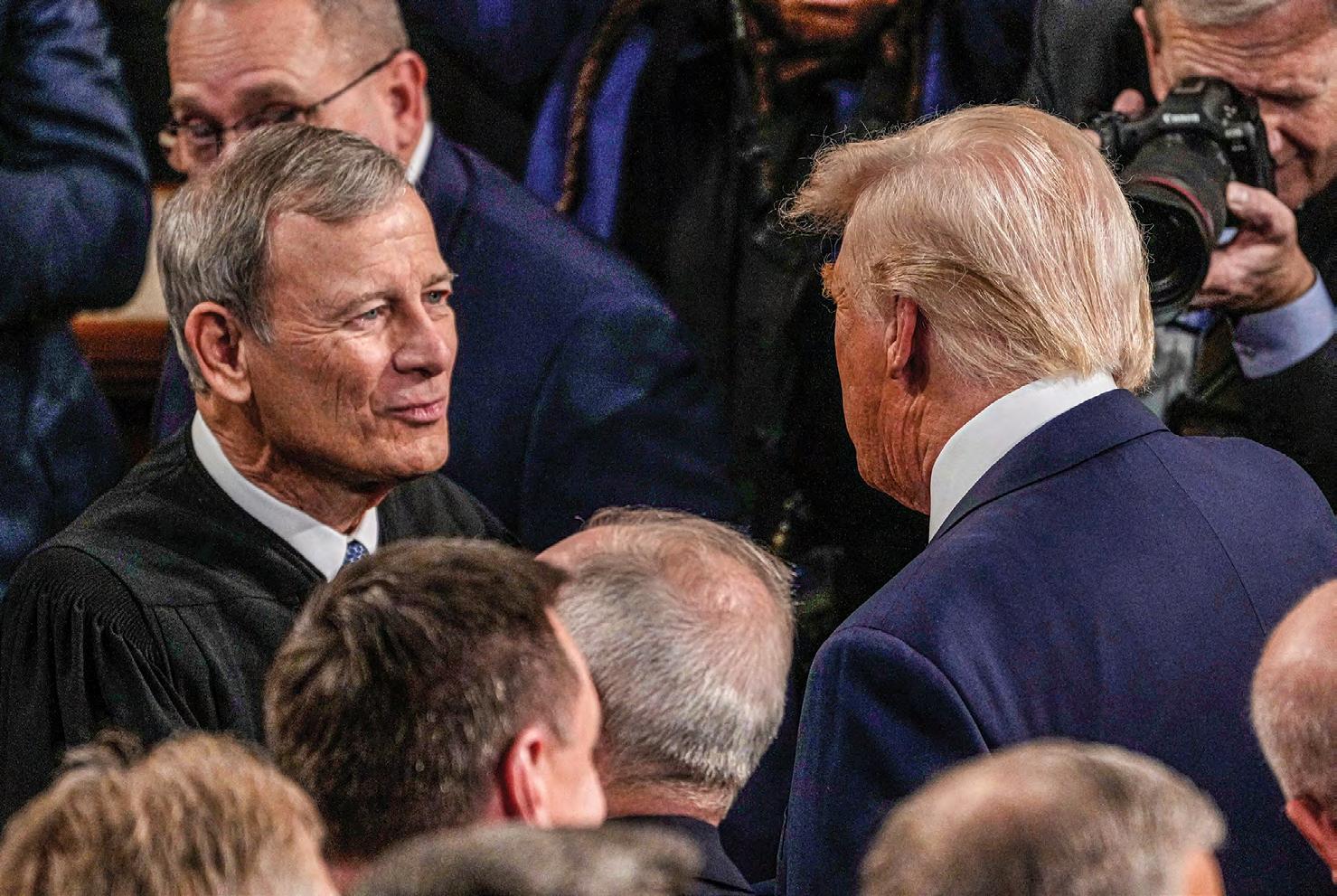
Breaking the power of the Roberts Court is an urgent predicate to restructuring American democracy.
If judicial review is not to be abolished entirely, as is the case in most other democracies, I’ve come to favor a reform idea recently proposed by Justin Briley in Liberal Currents. He would double the number of circuits and district courts—thus alleviating the severe backlog of cases at those levels— and have the Supreme Court drawn from the entire federal judiciary at random for each individual case.
This would solve the problem of a selfsealed system of power, and it would greatly reduce the temptation for justices to enact their partisan preferences through faux-legal argle-bargle. With the knowledge that a judge will only get a chance to make Supreme Court rulings occasionally, there will be a strong incentive to rule in a way that &ts with law and precedent, so it will stand up to scrutiny. And rather than responding to Republican cheating with Democratic counter-cheating—which naturally invites counter-counter-cheating—it would make the system facially fair for everyone, thereby increasing the reform’s chances of persisting over time.
Whether it’s adding seats or some other reform, the most important task is to break the power of the traitorous majority on the
Supreme Court. This will enable not just shutting down the fascist plague vector of Elon Musk’s X, and establishing a major legal tribunal to prosecute all the other M:B: crimes of the second Trump administration (which probably number in the millions at this point), but also structural reforms to shore up American democracy, such as statehood for Washington, D.C., and Puerto Rico, a fresh Voting Rights Act with a ban on partisan gerrymandering, and so on. (Abolishing the Senate & libuster will also be necessary for this, but that’s a subject for another article.)
It’s important to emphasize that kicking the legs out from under M:B: will not get rid of conservatism as a political tendency. Indeed, such a thing is di cult to imagine. Theocrats, war hawks, haters of government, and good old sel&sh rich people will always be with us. But we’ve had a conservatism that wasn’t this paint-blisteringly insane as recently as Trump’s last term. Abolish the madness factory that is X, end Republicans’ ability to rule by decree through the Supreme Court, and—after a hopefully prolonged period in the political wilderness—they might start to come to their senses. n
Lucas Waterfill, a 35 -year-old comedian based in Indianapolis, bought his ! , 2,, -square-foot, three-bedroom, twobathroom home on the city’s southeast side &ve years ago. He previously lived in Plain&eld, a quiet suburb on the western outskirts of Indianapolis.
“It’s just a little dollhouse, not that big, but it works for me,” Water & ll told the Prospect.
But while the house may be small, the monthly payment for electricity has gotten bigger. Water & ll said his last “major bill” came out to $.-.; he used to pay anywhere from $#., to $-,, per month.
“I’m trying to do everything I can to cut costs, like turn o( lights and not use my AC or heat as much,” Water & ll said. “It’s untenable.”
Living with a disability and on a & xed income, Water & ll describes himself as middle-class. When we spoke, he almost regretfully recalled having to ask his parents for help to make ends meet. “It’s not realistic for a person trying to make it middle-class to pay that much for the basics,” Water & ll said, adding that his e(orts to obtain energy assistance have yet to bear any fruit.
Waterfill is one of some .,,,,,, customers served by :ES Indiana, formerly Indianapolis Power & Light. The electric utility serves the Indianapolis metropolitan area and parts of central Indiana. It was acquired by the multinational utility holding company :ES in 2,,!, and rebranded as :ES Indiana in 2,2!
:ES reported a net income of $9,, million for 2,2.. According to the Energy and Policy Institute (EPI), Andrés Gluski, the company’s chief executive officer, made almost $9 2 million last year, slightly below the $!2.# million in average take-home pay EPI tracked in an analysis of executives at .! investor-owned utilities.
The mother lode of utility buyouts just landed on Hoosiers’ doorstep. Regulators have no say over whether the deal goes through.
By James Baratta
Water & ll, like other :ES Indiana customers, occasionally receives emails from the utility with tips on how to cut costs. “They put the onus on us, which I think is a slap in the face when they’re making all this pro&t,” he told the Prospect. “I need my wheelchair. I need my lifts.”
Earlier this year, Indiana lawmakers passed sweeping legislation aimed at lowering Hoosiers’ electricity costs. House Enrolled Act !,,2, which was signed into law by Gov. Mike Braun (R) on February 2$, establishes multiyear rate plans based on performance incentives tied to a (ordability and reliability, bans utility shuto(s during
heat emergencies, and requires utilities to establish energy assistance programs for low-income customers.
What it did not do was give the Indiana Utility Regulatory Commission (IU R C) authority over mergers and acquisitions involving the state’s regulated utilities. Consequently, Indiana remains one of the only states that cannot approve or reject takeover deals. One such deal is set to proceed imminently, and Hoosiers are furious about what it could do to their utility bills.
In March, :ES announced plans to be acquired by BlackRock-owned Global Infrastructure Partners and Swedish private equity & rm E E T Group, with the California Public Employees’ Retirement System (Cal PE R S) and Qatar Investment Authority underwriting the agreement. The acquisition, which includes the company’s utilities in Indiana and Ohio, has an enterprise value of $##. - billion, with consolidated net debt totaling a whopping $2/ 2 billion.
BlackRock’s purchase of :ES is the latest in a spree of private equity purchases of power companies, which critics believe could lead to rate hikes and gouging of customers. It’s also among the largest private equity utility buyouts to date, second only to the acquisition of T X U Corporation by FFR , TPB Capital, and Goldman Sachs Capital Partners in 2,,/. That buyout had an enterprise value of $-. billion. Seven years after T XU ’s private equity owners rebranded it and split up the business, the generically renamed Energy Future Holdings went bust.
While there are some parallels between the two buyouts, :ES derives more of its earnings from regulated utility operations and long-term contracted renewables, rather than so-called merchant generation, or the sale of power to the grid. Still, the logic behind both buyouts hinges on the assumption that cash ows will remain stable enough to sustain a highly leveraged capital structure over the long term. And if the new owners feel compelled to increase the cash ows to service the debt, customers like Lucas Water & ll could pay the price.
Fallout from the announcement forced :ES Indiana to postpone all three of its community open houses “out of an abundance of caution,” with the utility citing safety concerns related to “threats of violence on social media,” a March $ press release explains. At the time of writing, new dates have not
been announced.
Later that month, the IU RC launched an investigative inquiry into energy a (ordability with an hours-long public hearing attended by Indiana’s big five investorowned utilities. After :ES Indiana’s presentation, IU R C Commissioner David Veleta questioned :ES Indiana President Brandi Davis-Handy about referencing the “regulatory compact,” or the obligation utilities have to provide reliable service at a just and reasonable rate set by regulators. :ES Indiana maintains that the regulatory compact is a key pillar of its a (ordability framework, yet it also uses “trackers” that allow for ongoing recoupment of costs in between rate requests.
“There’s a tension between invoking the regulatory compact and recovering a growing share of your costs through trackers that bypass rate case review,” Veleta said.
Davis-Handy agreed to an ongoing review of these trackers and the impact on customers. But the IURC is relatively powerless to prevent the private equity–backed acquisition, even if the new ownership is even more willing to maximize pro&t on the backs of its customers. Despite this, :ES Indiana contends that its customers will not bear any costs related to the acquisition.
The frustration expressed by many :ES Indiana customers also peaked at an April 2, listening session, one of several hosted by regulators across the state this spring as part of their a (ordability investigation. As ; )G I reported, attendees “aired grievances over spikes and inconsistencies in billing, metering irregularities and challenges reaching customer service departments,” with some o(ering “stacks of utility bills to the commissioners as evidence.”
The $8- million overhaul of :ES Indiana’s billing system, which was built by Accenture and dubbed the “:CE Project,” was fraught with irregularities when it launched in November 2,2#. The results of Accenture’s
readiness assessment were promising, indicating that the new system was 99 percent ready for launch.
Turns out, it wasn’t.
In a & ling with the IU RC , Guidehouse, another professional services consulting firm, found that Accenture’s readiness assessment “did not re ect the true state of system preparedness.” Moreover, the assessment did not include designated testing for out-of-balance billing.
Tens of thousands of customers were plunged into billing chaos. One ratepayer reportedly received a bill for $!,,.2!.-2 on a home she had already sold. Her previous bill was $2..9/.
:ES Indiana incurred approximately $-/ million in losses after launching the new system. The company brazenly tried to recover those losses, based on their own errors, in a rate case the IU RC will have to decide in the weeks to come. While settlement born out of that rate case does not include any provisions that would allow :ES Indiana to recover said losses, it would result in higher rates for residential customers, and lower rates for industrial customers.
“I don’t know how I would a (ord another increase,” Water &ll told the Prospect. “I can’t a (ord this the way it’s going right now.”
:ES Indiana did not respond for comment. Indiana-based consumer advocacy group Citizens Action Coalition (C:C) calls the rate reduction for large energy users a “sweetheart deal” that “fails to adequately address the egregious and prolonged billing system problems.”
What’s more, the law & rm representing :ES Indiana in the rate case, Taft Stettinius & Hollister, contributed $2.,,,, through its political action committee to one of Braun’s post-election fundraising committees in September 2,2.. Braun also bene&ted from $$,,,, in :ES Indiana donations during his gubernatorial campaign. Three months after the Taft Stettinius & Hollister contri-
INDIANA REMAINS ONE OF THE ONLY STATES THAT CANNOT APPROVE OR REJECT UTILITY TAKEOVER DEALS.

The purchase of AES Indiana by BlackRock could also benefit BlackRockaffiliated data centers in the state.
bution, Braun appointed Andy Zay, a former state senator and member of the Indiana Senate Utilities Committee, as IURC chair. Zay has been presiding over the rate case; he received $-,,,,, in donations from several utility industry P:Cs, including :ES Indiana, during his state Senate career.
Zay, whose tenure became e (ective on January !2, 2,2$, has faced questions over his ability to remain an independent arbiter in his capacity as chair. Zay declined to comment through an IU RC spokesperson, citing the ongoing case.
Delivering electricity to hundreds of homes is inherently a more costly endeavor than supplying bulk power to a select few large load users. As I’ve written for the Prospect, charging all ratepayer classes the same average per kilowatt-hour price is one way to avoid this conundrum.
Last year, Gov. Braun signed House Enrolled Act !,,/ into law, requiring large load customers to pay 8, percent of the costs for new energy infrastructure needed to power data centers and similar projects. Zay has maintained that data centers will pay their own way, but Hoosiers aren’t buying that. They’re also skeptical of Sabey Data Centers in particular.
At the time of writing, Sabey has yet to
& nd a tenant for its proposed data center on the southwest side of Indianapolis. Residents are worried that BlackRock, a Sabey client, could leverage its ownership of :ES Indiana to bene&t the data center developer. BlackRock declined to comment. Sabey did not comment.
The acquisition of :ES by the BlackRockled consortium of investors does need federal approval, and is expected to come before the Federal Energy Regulatory Commission ()ERC) later this year or early next year. Indiana state Rep. Cherrish Pryor (D) has called on the IU RC to formally petition )ERC to deny the proposed sale.
In the most recent legislative session, Pryor also introduced an amendment to House Enrolled Act !,,2 requiring IURC approval ahead of the sale of any utility, as well as giving municipalities the initial opportunity to buy the utility. All but one Indiana Republican voted down Pryor’s amendment.
“I just think it was very convenient for :ES and BlackRock to make the decision to move forward with the acquisition a couple of days after we got out of session,” Pryor said in an interview with the Prospect. “It’s very disappointing that my Republican colleagues decided not to try to push back on the sale and to try to hold :ES accountable. Pryor, who has “grave concern” about the
acquisition, is planning to reintroduce the measure once the Indiana House is back in session. “I’m going to have to be strategic in how I decide to o(er that up,” she said, “as an amendment next year, or … as a bill next year.”
Water & ll also shared reservations about the bid to buy :ES Indiana’s parent company.
“We’re already complaining about how :ES is treating us,” he said. “We need to be able to control our own electricity.”
Pryor believes in the concept of public utility ownership, recalling how :ES Indiana’s predecessor was a municipal utility. When she introduced the amendment, “my thought was: Let’s see if we can take it back to the way it was, instead of putting it in the hands of Wall Street,” Pryor said. “Now we’re going to put it in the hands of private equity. What’s going to be next?”
But one of Indiana’s loudest voices of opposition to the deal is an unlikely one: the state’s treasurer, conservative Republican Daniel Elliott.
“I’m a capitalist,” Elliott told the Prospect in an email. “You should get the rewards for your labors but also be willing to endure the loss if it fails. I do not believe that is the plan here. This consortium of purchasers [is] not here to put Hoosiers & rst or America & rst.” n

BY PAUL STARR
Last New Year’s Eve, the Department of Homeland Security (DHS) posted an image online of an inviting, deserted beach with a classic mid-20th-century car parked on the sand. In the sky were the words “America A er 100 Million Deportations,” and above the image was a caption, “The peace ,f . nation n0
1onger besieged by 5he 5hird world.”
This fantasy scenario, the removal of more than a quarter of the U.S. population, didn’t come from a random online troll. It was posted on X by the o cial feed of the federal agency charged with immigration enforcement.
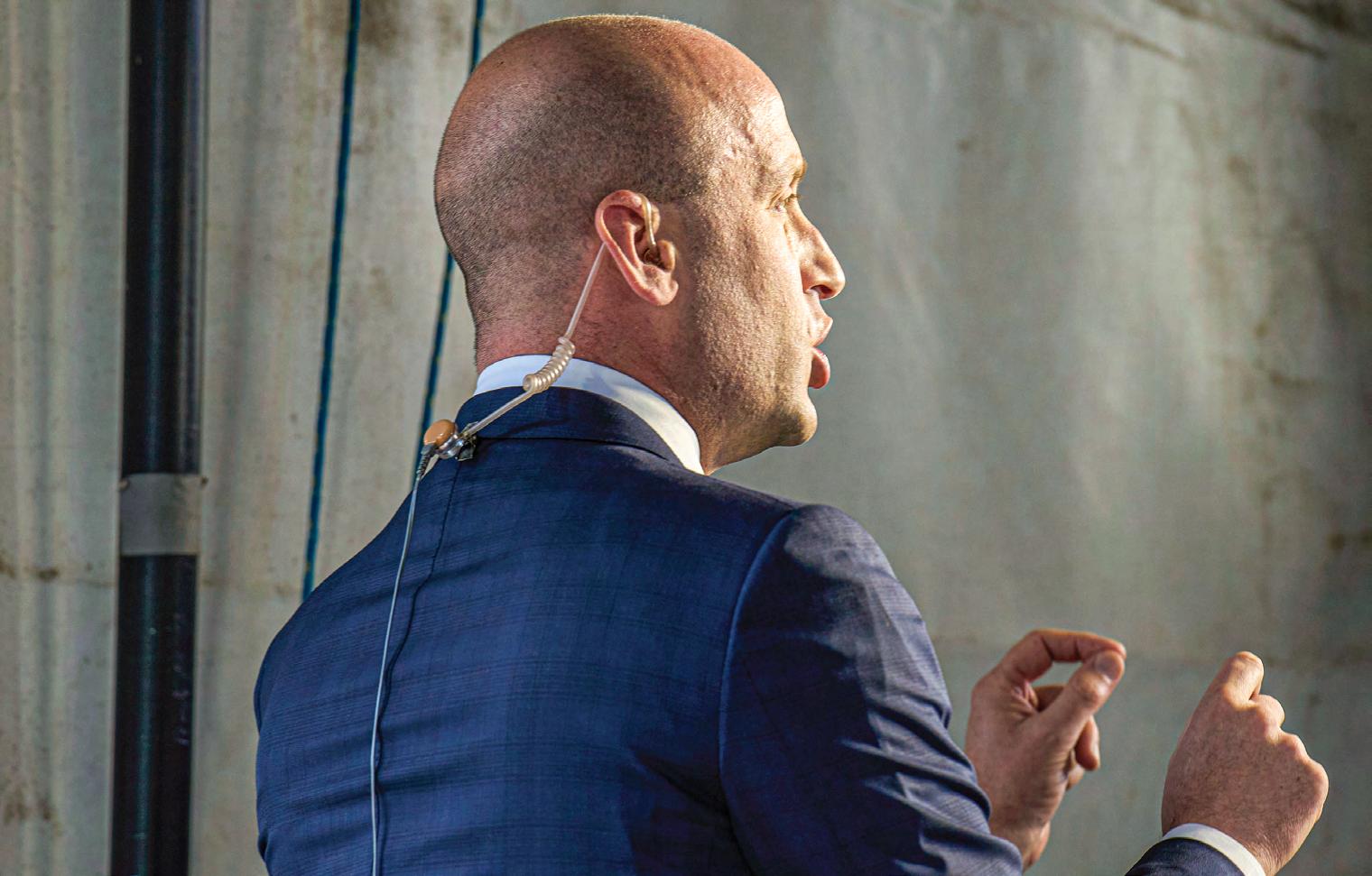
The driving force behind the Trump administration’s e orts to stop the “ 5hird world” from “besieging” the United States is S5ephen Miller, the president’s deputy chief of sta for policy and homeland security adviser. Just four days before the post by DHS, Miller himself had tweeted another fantasy: “Someone should write an alternate historical novel where Americans are the first to master the automobile, the first in flight, the first to harness the atom, the first to land on the moon but 9ust keep going and never ,pen ,ur borders
50 5he entire 5hird world for sixty years.”
ILLUSTRATION BY MICHAEL
J. HENTZ
There’s that euphemism “third world” again, so much more discreet than the explicitly racial terms Miller’s forerunners used when they shut down immigration a century ago. The !9$. Immigration and Nationality Act that Miller describes as opening our borders to the third world abolished the national origin quotas from !92- that had limited immigration mainly to Northern and Western Europeans. Since the !9$. reforms, /$ million immigrants have come to the United States, almost 9, percent of them from Latin America, Asia, and Africa. Miller has a clear message to the tens of millions of his fellow Americans with those origins: “The United States would be a far better country without you.”
Of course, the people who pushed for the !92- law had the same message for Jewish families like Miller’s great-grandparents from Belarus: “The United States would be a far better country without you.”
Miller is no ordinary presidential aide. He commands other Trump o cials with the con &dence that he is the & rst among them, as though he were Trump’s “prime minister,” as Ezra Klein has suggested. Early in President Trump’s second term, he played a central role in Trump’s attack on universities; more recently, he has helped build a M:B: deep state with young sta (ers loyal to Trump replacing the federal employees &red by DOBE. As The Atlantic ’s Ashley Parker, Michael Scherer, and Nick Miro( put it in January when Miller’s in uence was at its height, Miller is “the pulsing human id of a president who is already almost pure id … an accelerant for the president’s most incendiary impulses.”
The policies that Miller has been especially interested in accelerating concern America’s racial makeup, most conspicuously by ramping up Immigration and Customs Enforcement (ICE) arrests and deportations. Miller coordinated the e (ort to get Congress to triple ICE’s annual budget in Trump’s One Big Beautiful Bill Act, and he has pressed the agency to achieve the goal set in the legislation of a million deportations a year, which works out to about #,,,, a day.
But that e(ort, which su (ered a setback in late January when immigration agents’ killing of two U.S. citizens in Minneapolis cost the administration public support, is only the more visible part of Miller’s antiimmigrant campaign. As the tweet about the !9$. immigration reforms indicated, his animus isn’t directed just at illegal

immigrants. He doesn’t want many legal immigrants either, especially not if they’re coming from the “third world.” In January, the Trump administration suspended immigration visas for people from /. countries, covering most of Africa and much of Asia, Latin America, and Eastern Europe (including Belarus). It was the most signi &cant step in $, years to restore the pre-!9$. limits on who can immigrate and become an American. The administration has also nearly shut down refugee resettlement, except for whites from South Africa.
Mass deportations and immigration restriction are best thought of as just one half of an ethnonationalist agenda aimed at what might be called white replenishment , the response of right-wingers to the racial replacement that they imagine the government has been pursuing. The other half consists of pronatalist policies. If unauthorized immigrants are deported or pressured to ee at the rate of a million a year while legal immigration is limited, the United States may have zero or even negative immigration; that is, more people leaving than settling in the country. In that case, the U.S. population will soon begin to age and shrink, because the birth rate is falling below the level needed to stay even. So Miller and other ethnonationalists want American women to have more babies, a cause for which Miller’s wife has become an outspoken advocate.
“Make babies. Raise those babies,” Katie Miller, formerly D O BE’s communications director, urges other women. “It’s our highest and best value.” Just as in her husband’s crusade against third world immigration, the racial dimension is never explicit. But
she and others on the right think that conservative women are more likely than liberal women to have children, creating “a partisan fertility gap” that some speculate could give Republicans a long-term political advantage in the absence of immigration. White replenishment would be the reverse of what the sociologist Tomás Jiménez calls “ethnic replenishment.” Jiménez argues that ongoing immigration from Mexico has continually replenished the sense of a distinct ethnic identity among Mexican immigrants. Stop immigration, and you stop ethnic replenishment and likely encourage ethnic attrition, a decline in ethnic identi &cation. That’s what happened with many Southern and Eastern Europeans who, after the immigration cuto( in the !92,s, blended into the white mainstream after initially being seen as less than fully white.
Borrowing from Jiménez, I use “white replenishment” to refer to any process that “whitens” the population, whether that results from deportations (or “remigration,” as some on the far right say), restriction of nonwhite immigration, pronatalist policies aimed predominantly at native-born whites, or a strengthening of white identi&cation among people with mixed whiteminority ancestries.
Is white replenishment feasible? What would happen in an America guided by Stephen Miller’s policies? I am not going to suggest those policies would be completely ineffectual in whitening the population. But they are a deadly prescription for the country, based on a hopeless quest to bring back a lost !9.,s America as well as false assumptions about immigrants, race and culture, birth rates, and the economy.
S5ephen Miller’A policies are a deadly prescription for the country, based on a hopeless quest to bring back . 1ost
Miller has played a role in Trump’s second term that far outstrips his title as deputy chief of staff.
.
Miller has been Trump’s chief adviser on immigration since his 2,!$ campaign, but he has been able to act on a more complete anti-immigration agenda in Trump’s second term. That agenda encompasses both forcing many current immigrants to leave and stopping prospective immigrants from arriving. Miller wants to bring about a historic reversal in America’s demographic evolution.
Despite all the con ict over immigration that Trump stirred in his & rst term, he brought about little lasting change. When he left o ce, he hadn’t passed any major immigration legislation, and America had just as many unauthorized immigrants, around !, to !! million, as it had when he & rst became president. That was partly due to Trump’s own chaotic inconsistency as well as resistance in Congress and from his law-abiding appointees at DHS.
The Republican Congress elected with Trump in 2,2- has been more amenable to Miller’s agenda, and instead of just serving as an adviser, Miller now controls immigration policy, with only Trump above him. Before DHS Secretary Kristi Noem was &red in March, she reportedly said, “Everything I’ve done, I’ve done at the direction of the president and Stephen.”
The aggressive deportation strategy came from the top. Surging ICE into blue cities served more than one purpose, not just seizing the undocumented on the streets but intimidating others to self-deport and forcing Democratic o cials to capitulate to Trump’s masked agents. The choice of Min-
neapolis as a target was revealing: The city has a community of Somalis, whom Miller and Trump have singled out as objects of contempt. In late 2,2. , just before the surge began in January, Trump called the Somalis “garbage,” while Miller called them thieves whose only industry in Africa had been piracy, which they had brought to the United States in the form of Medicaid and welfare fraud. Miller tied the Somalis to the Democrats, whom he accused of seeking to turn America into a “version of Somalia” by carrying out policies based on “the two worst ideologies imaginable, communism and DEI.”
After community resistance turned the ICE surge in Minneapolis into a public relations debacle, Trump decided to pull back from highly visible confrontations for fear of midterm election losses. But while Noem and other top o cials at DHS lost their jobs, Miller kept his, and although he has stepped back from running DHS, the administration’s aims have not changed. For the remainder of Trump’s term, ICE will have the new resources Congress has given it—thousands of additional agents, a dozen warehouses converted into huge detention centers, a eet of deportation aircraft. The new DHS secretary, former Oklahoma Sen. Markwayne Mullin, has signaled a tactical shift toward more focused raids that achieve mass deportations e ciently without triggering public uproar.
Miller has also been pushing another strategy: spurring immigrants to leave on their own by making life di cult for them. These tactics include denying immigrants commercial trucking licenses, health coverage, housing, and & nancial credit. The deaths and dangerous conditions at detention centers are well calculated to instill
fear among deportable immigrants and to encourage them to ee before ICE shows up. The population at risk of being deported is considerable. In 2,2#, according to an estimate by the Pew Research Center, there were about !- million unauthorized immigrants, or 2/ percent of the foreign-born population. “Unauthorized” refers to immigrants with no legal protections (eight million) or with only precarious protections (six million). The latter include people seeking asylum but awaiting a date in immigration court; the Dreamers on Obama’s program of Deferred Action for Childhood Arrivals, which the courts have not yet allowed Trump to end; others who have received “humanitarian parole”; and still others who have Temporary Protected Status.
Since Trump’s return to the presidency, he has revoked parole for about .,,,,,, Cubans, Haitians, Nicaraguans, and Venezuelans and allowed Temporary Protected Status to expire for about /,,,,,, Venezuelans and Haitians. (The expulsion of the Haitians, however, may be overturned in the Supreme Court because of flagrant procedural violations.) Judges in immigration courts, which are part of the Justice Department, are being pressured to deny asylum; judges deemed too lenient are being purged, and only !, percent of asylees have been winning their cases.
In short, as long as Miller has anything to say about it, most immigrants in a precarious legal position have little chance of achieving secure status.
Miller’s e orts to restrict legal immigration get less attention than the mass deportations, but they are well calculated to stop the “third world” from besieging Americans any further.
In December, the administration suspended the Diversity Visa lottery, which for the previous three decades had brought about ..,,,, immigrants a year from countries with low recent rates of immigration to the United States. Unsurprisingly for any program with “diversity” in its name that’s bene&ted many African immigrants, conservatives have long had it in their crosshairs. To shut it down, the Trump administration said the program raised public-safety concerns, citing one solitary case: a Portuguese immigrant, admitted to the country around 2,,,, who in 2,2. murdered two students at Brown University and a professor at MIT.
In January, the Trump administration used a di (erent rationale for its suspension of immigration visas for people from /. countries, claiming without evidence that people from those countries were at “high risk” of relying on welfare bene &ts. In a separate measure in January, risks to national security were the grounds for denying nonimmigrant as well as immigrant visas for people from !9 countries, mostly in Africa and the Middle East.
Although a future administration could reverse these measures, that will not be true of Trump’s executive order on birthright citizenship if the Supreme Court sustains it. That order, suspended by lower courts, would deny citizenship to a child born in the United States if the mother’s presence on American soil was unlawful or only temporarily lawful and the father was neither a U.S. citizen nor a lawful permanent resident. Based on the legal history of birthright citizenship and oral argument in the Supreme Court in April, most legal analysts expect the justices to overturn Trump’s order. But in the weeks before the Court heard the birthright citizenship case, Miller prodded Republican state legislators from Texas to end public funding of K-!2 education for undocumented children, which may have more chance of being upheld.
A !9/. Texas law originally led to a Supreme Court decision in !982 in Plyler v. Doe , affirming children’s right not to be denied K-!2 education based on their legal status. In that case, the Court ruled that a state needed to have a “substantial” interest to justify denying education to undocumented children, because the denial would impose “a lifetime hardship on a discrete class of children … [who] can neither a (ect their parents’ conduct nor their own undocumented status.” The Court reasoned that states lacked a substantial interest because a class of illiterates would exacerbate “the problems and costs of unemployment, welfare, and crime.” But that decision commanded only a bare .-majority, and today’s Court seems far less likely to impose the same requirement for public funding on the states.
The loss of constitutional protection for the education of undocumented children would be a historic shift of enormous social consequence. It would likely lead many immigrant families to ee red states for blue states where their kids could get an education, or to self-deport if no state would educate them.
How big an impact Miller’s policies have had so far is unclear. Based on census data, the Pew Research Center estimates that from January to June 2,2. the total immigrant population fell by ! - million, including some /.,,,,, workers. But Pew notes that the &gures may re ect declining survey response rates by immigrants. That problem is likely to make all data tracking the immigrant population highly unreliable at a time when many immigrants feel threatened.
In January, the Census Bureau reported a “historic decline” in net immigration from 2./ million in 2,2- to !.# million in 2,2. and a projected #2!,,,, in 2,2$. The net immigration &gures, however, are uncertain because the census does not track immigrants who return home permanently. Its forecast for 2,2$ was also only a guess because in January it didn’t know all the measures the administration would adopt this year to curb legal immigration. An independent analysis of census data by a team at the Brookings Institution &nds that immigration fell into negative territory in 2,2. (between -!,,,,, and -29.,,,,) and has continued to be negative in 2,2$
Thus far, the national impact of the immigration reversal has been limited. But if sustained over years at the level Miller hopes to reach, negative immigration would have large implications for every sphere of American life, from local communities to the national economy. Many of Trump’s supporters may like the idea of reversing immigration more than its consequences for rural and small-town depopulation, aging and shrinkage of the workforce, economic growth, and the & scal problems of the federal government, particularly Social Security and Medicare.
Much of rural and small-town America— Trump country—has already been losing population. Two-thirds of counties have had more deaths than births. Schools and hospitals are under threat, and many have closed. Urban areas are not exempt from those problems; cities are struggling with school consolidation and closures. But the implications are more serious in rural areas, where the loss of the only school or only hospital in a community makes it a less desirable place to live, drives young families away, reduces real estate values, and furthers a self-reinforcing process of decline.

Rural communities with rebounding populations tend to have one thing in common: new immigrants. Negative immigration will make it harder for rural community institutions to survive.
Nationally, the economic implications of sustained negative immigration are going to be severe. Economic growth depends on two factors: the number of people working and their productivity. When the labor force stops increasing, the growth of the economy must come entirely from higher productivity. Trump’s recent budget, as Paul Krugman points out, makes implausibly high assumptions about productivity increases to obscure its implications for the federal de&cit.
When Trump and Miller suggest that immigrants are leeches on welfare, they create a wholly false picture of their &scal impact. Immigrants pay more in taxes than they receive in bene&ts, particularly in relation to Social Security and Medicare. One recent study estimates that from !99- to 2,2#, immigrants generated a cumulative & scal surplus of $!-.. trillion (in 2,2- dollars) and that, without immigrants, the national debt would have risen to twice its current level. Besides requiring substantially higher taxation, sustained negative immigration would have other unpleasant ramifications for conservative business interests. In June 2,2., Trump decided to call o( ICE enforcement on worksites in two industries of special political or personal interest to him. In agriculture and hospitality, he said, immigrants are “very good, long time

workers,” so ICE should steer clear of them. The order then went out to stop enforcement at farms, meatpacking plants, and hotels (and, I imagine, golf courses).
ICE raids on farms and orchards would probably be one of the most e cient ways of deporting the undocumented, but they would also leave crops rotting in the &elds and raise in ation. Able-bodied, nativeborn workers aren’t standing by willing to do backbreaking work at low wages. To relieve some shortages, Trump has authorized more short-term visas for seasonal farmworkers. This is what Trump and Miller are o(ering rural America: a fringe labor force of undocumented and temporary workers, powerless because they cannot vote, cannot organize, and are deportable the moment they make any trouble.
In other industries, such as construction, nursing home care, and restaurants, mass deportations and immigration restriction are already causing labor shortages. If Miller succeeds in achieving negative immigration, he is going to have to do it at the expense of business interests dear to Trump and the Republican Party.
But Miller isn’t worried about the farranging consequences of the policies he is promoting because he believes history shows there is an alternative to immigration: more American babies. Immigration, he says, was “net negative” and “all population growth was from family formation” during “the last period in which America was the undisputed global superpower.” Presumably, he’s refer-
If sustained over years at the level Miller hopes to reach, negative immigration would have large implications for every sphere ,f
Trump and Miller have pulled back from visible confrontations on immigration enforcement, but the aims have not changed.
American 1ife.
ring to the post–World War II era. But while immigration was low then, it was net negative only for one year, from July !9.- to June !9.., when the Eisenhower administration deported hundreds of thousands of Mexicans from the Southwest.
Miller is calling for an inde& nite period of far greater negative immigration, which won’t help the birth rate. Immigrants have higher birth rates than the native-born. Instead of stimulating family formation and raising the birth rate, mass deportations break up families and reduce the birth rate. But the problems with conservative pronatalism only begin there.
Conservatives in recent years have been seized with worries about the falling birth rate, but they are ideologically incapable of doing much about it. Economic pressures constrain many people from having as many children as they might under more auspicious conditions. The costs of child care, health care, housing for a growing family, college, and forgone earnings during pregnancy and early childhood make raising kids today a daunting &nancial proposition. In Brigham Young University’s American Family Survey last year, cost was the top reason people gave for “limiting the number of children [they] have had or plan to have.” More than two-thirds of people disagreed
with the statement that raising a child is “a (ordable for most people.”
But conservatives are opposed to raising taxes or reorienting public spending to reduce those costs in any signi&cant degree. Moreover, the last thing they want to do is to give poor women, particularly poor women of color, an incentive to have more children—this has always been one of the main conservative criticisms of welfare. To avoid incentivizing the “wrong” people, conservative pronatalists have proposed aid for parents in the form of tax credits and child bonuses whose bene&ts are greater for families with higher incomes. In the end, though, the policy changes Republicans adopt when they are in o ce are just too small to a (ect the birth rate.
The fate of pronatalist policy under Trump is instructive. During their 2,2campaign, Trump and JD Vance raised hopes among pronatalists that they would &nally have an administration on their side. Trump said he would make in vitro fertilization free, and in 2,2. he even proclaimed himself the “fertilization president,” but the main result has been minor discounts on fertility medications that are hardly likely to a (ect the nation’s birth rate.
His One Big Beautiful Bill did establish “Trump accounts” for newborns, a slimmeddown version of more ample, progressive proposals such as William Darity’s “baby bonds.” For children born between 2,2. and 2,28, the federal government will make a deposit of $!,,,, into a private investment

of 2 ! births per woman keeps the population level. Since 2,,/, it has fallen below replacement, dropping to ! ./ projected births per woman in 2,2..
That projection hasn’t yet kicked in: Last year, births still outnumbered deaths by about half a million, but according to a forecast by the Congressional Budget O ce, deaths will exceed births by 2,#,, when the U.S. population will begin falling without net immigration. If net immigration turns negative before 2,#, (which it may already have done), the population will fall sooner.
account that cannot be drawn upon until the child is !8 years old, ensuring that it won’t help with the immediate costs of raising children. Even if the money could be withdrawn sooner, it’s too small to make a di(erence in decisions about having children.
Child care might have been a Trump cause. When Ivanka Trump advised her father during his &rst term, she proposed a program to support child care, but it wasn’t his priority then, and it isn’t his priority now. At an Easter lunch this year, he said: “We’re &ghting wars. We can’t take care of day care.” Public &nancing of child care never gets traction under Republicans in part because conservatives consider it unfair to traditional families with stay-at-home mothers. Meanwhile, cuts in federal funds are resulting in closures of child care centers and less food assistance for low-income families.
The !9., s generation of stay-at-home mothers is the model for conservative pronatalists’ vision of a new baby boom. But women of that era stayed home partly because of outright exclusion from educational opportunities, jobs, and careers. The standard of living of most families today depends on the earnings of women. Conservatives don’t have a practical plan to turn American families back in time.
Conservatives also aren’t willing to impose regulations on corporations that would enable parents to reconcile work with raising children and give them more security. In today’s age of precarity, many
people in their twenties and thirties don’t feel con&dent enough about their jobs or the economy to make long-term commitments to marriage and raising children.
The post–World War II U.S. economy supported the aspirations of working families in large part because of changes resulting from the New Deal. Americans in the !9., s benefited from two things that Trump and Miller show no interest in restoring: the highest rates of unionization and the most highly progressive tax system Americans have ever had. Incomes grew fast, and unlike today they grew faster at lower- and middle-income levels than among the rich. The GI Bill and expanded state support for education from K-!2 to college created opportunities for upward mobility. After su (ering through the Depression and war, Americans saw improvement in their lives. They had reasons for hope, and the children they had were an expression of that hope. Based on the history they had lived through, they expected that their children would have a better life and see a better world.
Despite declining after the postwar baby boom, the birth rate climbed back near the population replacement level in the !99,s and early 2,,,s, another era of broadly rising incomes. One key measure, the “total fertility rate,” projects how many children women will have over their childbearing years, based on current birth rates among women of di(erent ages. A total fertility rate
One reason for the decline in the birth rate is a development we ought to celebrate. In the early !99,s, the high birth rate among teenagers was treated as a national crisis. Teens, people said, were unprepared to be mothers and were destroying their own chances for education and a better life. Thirty years later, the teen birth rate has fallen /2 percent, part of a wider tendency among American women to postpone childbirth into their late twenties and thirties. As birth rates have been falling at earlier ages, they have been rising at later ages. If that increase continues, the fall in the total fertility rate will prove to be less than today’s projections indicate.
But we shouldn’t dismiss concerns about the birth rate. The di culty that parents face in a (ording the costs of raising children ought to prompt public action. Although pronatalist policies in other countries have not been a notable success, some analysts attribute that to policies that typically don’t come close to o( setting the true costs of raising a child or enable parents to balance work and family. The economist Nancy Folbre argues that everyone in a society bene&ts from the raising of the next generation, but the childless are free-riding on the parents that do make the investment. That’s part of the justi &cation for paid parental leave, public funding for child care, and other ways of relieving the economic pressures that prevent families from having the number of children they want to have. A serious commitment to a progressive alternative might achieve the results that more tentative policies haven’t produced.
Liberals and progressives are also not as alarmed as conservatives about the falling birth rate because they are comfortable with a policy that has demonstrably raised the birth rate: immigration. Not only do immigrants have a higher birth rate than the U.S-born; U.S. immigration law, with
its emphasis on family unification, has directly supported families. If we want a higher birth rate, immigrants can help achieve that aim. Conservatives don’t like that option because they are prioritizing another goal—white replenishment.
Since the reopening of immigration in !9$., the United States has been fortunate to attract some of the most energetic and talented people in the world. Prominent examples are not hard to find. Of the Nobel Prizes won by Americans in chemistry, medicine, and physics since 2,,,, -, percent have gone to immigrants. Of Fortune .,, companies, -$ percent were founded by immigrants or their children. Immigrants haven’t just taken jobs—they’ve created them. Aspiring entrepreneurs have come to the United States because it has provided them opportunity and been more welcoming than other countries. That source of American renewal and vitality is endangered by Miller’s exclusionary policies and his fanning of resentment against contemporary immigrants.
Miller’s appeal to resentment assumes that, unlike earlier mass immigration from Europe, the post-!9$. wave has brought to America’s shores foreigners without the ability to succeed or the interest in assimilating. But as extensive research has shown—summed up in Ran Abramitzky and Leah Boustan’s book Streets of Gold the post-!9$. immigrants have been as economically mobile and as quick to assimilate as their European forerunners. The United States has continued to excel at something it has been good at throughout its history: making Americans—since !9$. making Americans out of the most diverse peoples any country has ever absorbed.
Some economically driven resentment of immigrants is understandable. Real earnings for men without a college education have eroded, and immigrants make convenient scapegoats. In industries like meatpacking and trades like roo& ng, employers have used immigrants to undercut unionized workers and slash wages and bene&ts. Many native-born workers infer from such experiences that they would be better o( if Trump and Miller succeeded in cracking down on immigration.
But if Trump and Miller have their way, workers won’t get back the unions that once made those jobs high-paying jobs. Businesses that lose cheap immigrant labor have two other options besides raising wages. In some cases, they can move the work abroad; for example, companies will import fruits and vegetables that cannot be produced cheaply in the United States. In other cases, companies will substitute technology for human labor and invest in robots to do the jobs that immigrants have done. That’s already happening. There are even robots for milking cows. If immigration is cut o( and mass deportations deplete the labor force, investments in more automated work will increase.
Trump’s pronatalism has been for show, but his nativism has been for real. The combination won’t enable Americans to timetravel back to the !9.,s; it will produce a country with fewer babies and more robots. Liberals and progressives bear some responsibility for creating the panic about immigration that helped put Trump back in power. As I previously wrote in these pages (“The Social Triumph and Political Tragedy of Immigration,” December 2,2-), President Biden squandered Americans’ goodwill toward immigrants by allowing a border crisis to develop that supported Trump’s case against immigration. For a long time, liberals and progressives also hadn’t done their own cause any favors by proclaiming the demographic inevitability of a “majority minority” society in which whites would become a minority group.
The notion that whites are about to become a minority has been deeply misleading. Such forecasts re ect the dubious assumption that the many Hispanics who see themselves as white are victims of a kind of false consciousness. The forecasts make the even more dubious choice of treating all future descendants of Hispanics as nonwhite, despite high rates of intermarriage with Anglos and strong tendencies in later generations to identify as white. As survey data shows, the majority of Hispanics today do not see themselves as “people of color.” The Census Bureau has contributed to the illusion of a collapse of the white population. By adopting a racial recoding algorithm and other changes in 2,2,, it reclassi &ed about / percent of the white-identifying population as multiracial, prompting stories in the media about a precipitous white decline.
So it’s not my argument that Stephen
Miller’s America is impossible because whites will inevitably lose their majority status. Even with signi &cant immigration, whites will continue to be the majority. Miller’s immigration policies might result in some white replenishment; more Hispanics will likely identify as white if Latin American immigration is cut o(
But the United States is long past the point where it can succeed on Miller’s assumptions. It cannot be run on the premise that the millions of Americans with origins in the “third world” are culturally alien and economically burdensome. That is a dangerous and demeaning lie.
In !9.2, after Congress revised the immigration laws but left in place the national origin quotas that discriminated against Southern and Eastern European Catholics and Jews, President Harry Truman said in his veto message that it was “incredible” to him that “we should again be enacting into law such a slur on the patriotism, the capacity, and the decency of a large part of our citizenry.” Although Congress overrode that veto, Truman’s view prevailed when Congress eliminated the national origin quotas in !9$.
Miller’s policies are a slur on the patriotism, capacity, and decency of a large part of our citizenry today. Those slurs are implicit in the wholesale exclusions of people from the countries he calls the third world. The explicit slurs that regularly come out of the mouths of Trump and Miller are unambiguously demeaning. They incite racial hatred and threaten the ability of Americans to live together in mutual respect.
Fortunately, Americans are rejecting Trump and Miller’s path. According to Gallup, public support for immigration is back up to the level it reached before Biden’s policies squandered Americans’ goodwill. Trump and Miller misread the 2,2- election. Americans do not want their government to wage war against their neighbors. Concern about the birth rate is not a bad thing. We ought to use that concern to demand policies that would enable families to have the children they want to have. Mostly, though, what Americans need is something they have had before—hope grounded in reality. Hope for a better life. Hope for a government that works for them. If Americans had more hope, they would have more children. And if they had that hope, there might not be as much anxiety about the race those children might be. n
THE SEEDS OF AN AUTHORITARIAN STATE WILL STILL BE THERE UNLESS THE UNITED STATES RECKONS WITH ITS OWN FASCIST PAST AND HOW THAT RELATES TO STEPHEN MILLER’S VISION FOR THE FUTURE.
BY WHITNEY CURRY WIMBISH

Despite what Republicans and some mainstream Democrats would have us believe, half ,f Americans agree 5hat ICE should
n0 1onger exist. Progressive candidates across the country have taken note and are using “Abolish ICE” as a rallying cry to organize their communities and win elections.

Rep. Analilia Mejía (D?NH) is one such progressive. She campaigned on abolishing ICE against ten other candidates, some of whom had raised much more money, and won her primary and then the special election. The day after she was sworn in, House Minority Leader Hakeem Je( ries (D?N G) announced Mejía’s appointment to the House Committee on Homeland Security, the body that oversees ICE and the Trump regime’s immigration terror campaign, joining others on the committee who have called for ICE’s abolishment and redirecting funding to community-based organizations.
Shortly after her appointment, Mejía participated in a hearing of the Homeland Security Committee , asking witnesses whom immigration agents had shot and assaulted what “meaningful actions” lawmakers could take to bring them justice. Most said they wanted accountability for the agents who hurt them. But the Rev. David Black, senior pastor of First Presbyterian Church of Chicago, whom federal immigration agents shot multiple times in the head, face, and body with pepper balls and shoved to the ground when he protested outside an ICE prison in Broadview, Illinois, last year, had a di (erent answer.
“With respect to the members who believe in reform, I believe that this department and administration really need an exorcist. That’s my opinion as a pastor,” he said. “I would like people to understand in this Congress and in the United States, that what we are facing, the evil we are facing from this administration, goes beyond political solutions and goes beyond reform. It requires spiritual solutions.”
Some Democrats have been more circumspect in the face of ICE’s terror or have retreated to weasel words that fall short of wholesale reform. Rep. Dan Goldman (D?N G), for example, wants to “abolish ICE as we know it .” Political leaders like this have failed to fully internalize the political project of White House deputy chief of sta ( Stephen Miller and his intellectual allies in the Trump administration. They mean to have the federal government fund, arm, equip, and train a paramilitary force to roam the country as it pleases, with few or no checks on its power. They mean to institutionalize an entity that is incompatible with democracy.
The clearest indication of Miller’s desire was when he went on state media— Fox News—last fall and gave these men with guns a directive. “To all ICE o cers: You have federal immunity in the conduct of your duties. And anybody who lays a hand on you or tries to stop you or tries to obstruct you is committing a felony,” Miller said. “No one—no city o cial, no state o cial, no illegal alien, no leftist agitator or domestic insurrectionist—can prevent you from ful& lling your legal obligations and duties.”


ICE agents have confronted migrants and U.S. citizens alike in courthouses, private homes, and on American streets.
Miller made these comments three months before agents killed Renee Good and Alex Pretti in Minneapolis; the Department of Homeland Security shared Miller’s clip on X after the Good murder, as if to con & rm ICE sat beyond the reach of the law. It was a matter of time until Miller’s concept would result in death.
Scholars who study authoritarian and fascist regimes may not be calling for an exorcism or spiritual renewal. But they do say that simply erasing institutions that embody such ideologies is not enough to escape them. Inevitably, authoritarianism will more easily return if the structures that enable it remain in place, just as Jonathan Ross, the ICE o cer who killed Renee Good, was reassigned to another part of the bureaucracy.
They also say that while it is tempting for Americans to look to places like Argentina, Germany, or Italy for guidance, those are poor comparisons for what’s going on in America today. Instead, they suggest revisiting America’s own history, when enough people decided to take the nation away from its genocidal, slave-owning genesis, fought a war that left $2,,,,, dead—more than any other war in U.S. history—and then spent a century struggling to end Jim Crow laws that oppressed Black people.
“Abolishing ICE is probably not that hard,” said Yanilda María González, assistant professor of public policy at the Harvard Kennedy School, who studies authoritarianism. “Agencies get abolished all the time.”
ICE is a modern invention. Its creation abolished a di (erent immigration agency, the Immigration and Naturalization Service, when lawmakers overwhelmingly
passed the 2,,2 Homeland Security Act following 9/!! . That law was ostensibly meant to stop future attacks from terrorists, and all but ten senators voted for it. (Frank Murkowski, Republican from Alaska, did not cast a vote.) Enacted through democratic processes, the new law handed racist authoritarians a tool with which to terrorize immigrants, drive them underground, strip them of basic human rights, and facilitate an easily abused workforce.
The evolution of the Homeland Security Act from a response to 9/!! to one facing inward came within a matter of years. The law held that ICE would answer to the new Department of Homeland Security (DHS) and be responsible for enforcing immigration law, investigating the illegal movement of people and goods, and preventing terrorism. The agency it replaced had answered to the Department of Justice.
ICE had an initial budget of $# # billion. Funding for the new agency crept upward for years and under President Barack Obama was slightly less than $$ billion in 2,!. . During that & scal year, the federal government reported that ICE had removed or deported 2#.,-!# people.
Ten years later, the base budget is now roughly $!, billion, but it has been supplemented with a surge of $/. billion in extra funding from the 2,2. One Big Beautiful Bill Act. Meanwhile, the number of deportations in FY2,2. hit --#,,,,, according to Reuters, up from 2/!,,,, the year before. The Trump administration has stopped issuing detailed statistics on immigration, just as it has stopped issuing timely notices each time someone dies in its immigrant concentration camps. The Prospect ’s nonscienti&c tally
listed the names of .. people who have died in ICE custody as of April 2-. Immigration agents have injured dozens of people since the beginning of 2,2. and killed at least 28. These are minimum numbers.
Democrats tried to at least hold up the base funding for the 2,2$ &scal year, conditioning it on a series of relatively modest reforms. But at the end of April, Republican lawmakers introduced a measure using the party-line budget reconciliation process that would send yet more money to ICE and Customs and Border Protection (C CP): a $/, billion baseline that would fund the agencies through at least the end of President Trump’s term. Because both the surge funding and this baseline funding do not go through the normal appropriations process, this avoids certain guardrails and accountability measures, like time limits on spending and directives about where the money goes. The money becomes a slush fund for abduction, warehousing, deportation, and mass death and injury.
The vast amount of taxpayer wealth handed to immigration enforcement has spread and nurtured violence, beyond abusing immigrants and those trying to protect them. It’s also spawned a massive surveillance network that can spy on anyone, regardless of their immigration status, and acted as a jobs program for violent far-right bigots, whom it recruits with Nazi imagery at gun shows, “Ultimate Fight Club venues, rodeos, martial arts centers, and other haunts for men who tend to have a far right political vision,” as Truthout reported Homeland Security o cials are hiring at such a fast rate that they’re unable to fully vet their new recruits, an AP investigation


found, &lling the ranks with bankrupt people who are easy to extort and people who have previously been accused of misconduct. The rot that this represents goes beyond the existence of a single governmental agency.
The implicit goal of ICE is to eliminate illegal immigration entirely. But immigrants are always going to come into the United States, as North Carolina Justice Center senior attorney Carol Brooke explained. “Unfortunately,” she said, “the economic situation in other countries is such that people will come regardless of how di cult we make it for them while they’re here.”
At some level, Miller and his allies know this. The presence of the paramilitary force is not solely to enforce immigration laws or improve job availability for native-born citizens. It’s to project authoritarian power. And that’s made easier by the fact that such power projection is already all around us.
The brutality of rounding up and kicking out hundreds of thousands of people and imprisoning at least $,,#!! (as of April - ) in immigration detention camps has infuriated people across the U.S., who have put themselves physically and & nancially in danger to protect themselves and their neighbors. Many have wondered how widespread violence conducted by masked agents could happen in the land of the free.
But the surrealism of such a tyrannical force existing within a democratic nation is not as odd as it sounds, González said. Authoritarian enclaves routinely exist within democratic nations, using authoritarian practices, formal rules, and informal norms, including arbitrary detention, torture, and extrajudicial killings. And while the U.S. is
the Trump administration mean to institutionalize an entity that is incompatible
with Cemocracy.
accustomed to denouncing these practices in State Department human rights reports, they persist in the United States just as they do in countries that have undergone celebrated transitions to democracy, including Brazil and Argentina.
“Even in the U.S there are all these di(erent ways where the local police departments have operated in authoritarian enclaves,” she said. The emergence of ICE as an institution is just one example, she and other scholars said. Other modern examples include prison and even American workplaces, where employees’ ability to access modern medicine, buy groceries, and pay rent comes to an end if a boss decides to hand out pink slips.
“These authoritarian policies are the outcomes of ordinary democratic policies,” González said. One reason she gave will make average Democratic voters uncomfortable: Some Americans want them. Consider the Trump rallies across the country, at which white supporters held up signs that said “Mass Deportation Now!”
“We have bottom-up societal demand for this violence, for extralegal force,”
González said. In Brazil, for example, surveys throughout the years show that the popular phrase “bandido bom é bandido morto,” or “a good criminal is a dead criminal,” routinely draws between #$ and $, percent agreement. Her own survey found that -, percent of participants agreed with the phrase. Some tolerate the violence, and some outright support it.
Infrastructure like ICE ful& lls this latent desire. “These are demands that end up getting channeled through Democratic institutions,” she said. “I’ve sat in committee meetings where citizens applaud when someone says a police o cer killed someone. They applaud like, ‘Thank God.’”
That outlook comes from frustrations with crime, feeling unsafe and unprotected, and anger that the government has responded inadequately. Jair Bolsonaro, the far-right former president of Brazil who is now serving a 2/-year term for an attempted coup, campaigned on that violence, saying “a police o cer who does not kill is not a police o cer,” and that cops should get medals for killing. Donald Trump has voiced similar sentiments, suggesting that the government
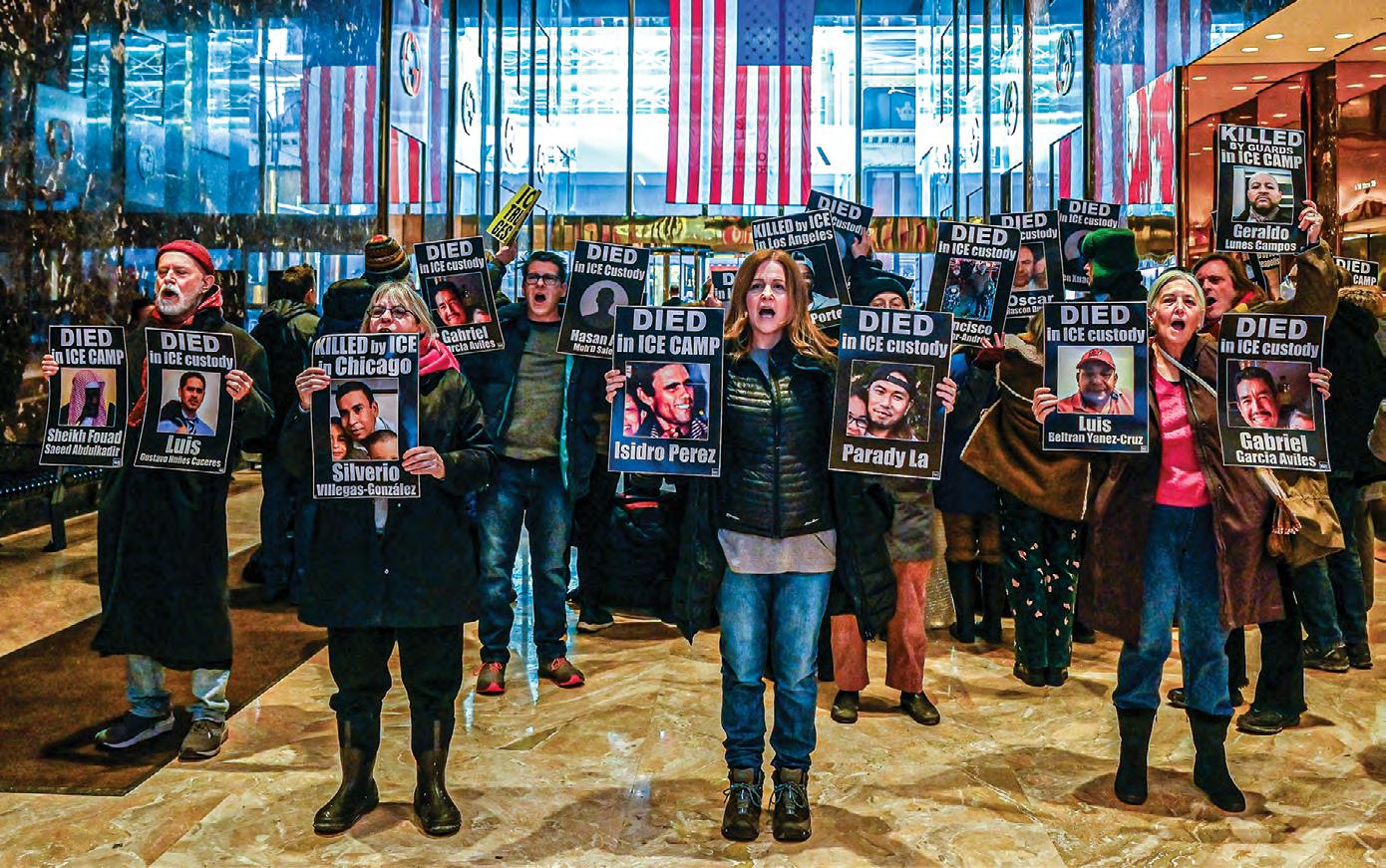

grant police o cers “one real rough, nasty” and “violent day” in the style of The Purge, because that would “immediately” end crime. These are appealing statements to people who are afraid and angry about crime, and in the U.S., for people who do not know that overall crime and property o(enses across the country have been falling for years
“People’s frustration with rising crime or a sense of disorder, candidates using this type of really pro-violence rhetoric is not a minus, it’s a plus, it’s not a bug it’s a feature, it’s something that makes people vote for them as opposed to something that would repel voters,” said González. “There are incentives for politicians to make these types of demands.”
Those incentives get a boost from a highly concentrated media apparatus that works in service of regime officials yet brands itself as news, scholars said. Fox News is the standard-bearer of state media, but the propagandistic nature of the news industry is everywhere, laundering the talking points of the political party in power, accepting corporate economic theories as fact, and taking the side of the State Department.
As civil rights lawyer Alec Karakatsanis points out in his book Copaganda , consuming content from mainstream media outlets that routinely take the side of police skews perceptions (including in subtle ways like using the passive voice to shield cops), makes people feel less safe, and increases their fear of marginalized groups. And as Jeremy Busby writes from a Texas prison, where he is incarcerated, “propaganda can turn people into individuals they would have once despised,” including leading incarcerated people to believe they no longer deserve soap and toilet paper, “and get angry at anyone who did,” after watching enough “law and order” commentary on Fox. He warned that the same is true for anyone: Watch enough anti-democratic propaganda, and “people on the outside may stop believing they deserve democracy.”
These are some of the factors that lead members of a democracy to support authoritarianism, scholars said. Simply replacing ICE , or even the entire DHS, won’t touch the real problem, nor do nations that have rejected full-blown fascist dictatorships hold the answers.
A better source for guidance, said Alberto Toscano, an adjunct professor at Simon Fraser University’s School of Communication, is to look at the fascism America has already confronted and to the radical Black thinkers who have been doing that since the nation’s founding. He outlined this position in a 2,2, column, pointing out that radical Black thinkers have struggled to get white Americans to face the fascism inherent to colonialism and racial slavery for more than a hundred years—“long before Nazi violence came to be conceived of as beyond analogy.” The American tendency to look for answers abroad ignores that America has already contended with fascists in the form of racist slavers who bought and sold Black people on an industrial scale. It’s one thing to take inspiration from international anti-fascist &ghts. But imagining oneself as analogous to a member of the French resistance, he said, is “silly.” It’s also a tendency driven by American exceptionalism and emotional fragility, allowing Americans to think of fascism “as a kind of aberration or exception,” Toscano said. “It allows you to think there is something fundamentally positive in the U.S. order.”
That is why, he said, it’s better to study Black radical activists and authors in the U.S., including W.E.B. Du Bois, Langston Hughes, and Angela Davis, and ask, “What are the homegrown forms of racialized fascism and authoritarianism that are baked into U.S. institutions?” It’s not that nothing can be learned from other countries, but thinking about what Europeans did after fascism has limited virtue if you’re not thinking about how the U.S. failed to ever truly

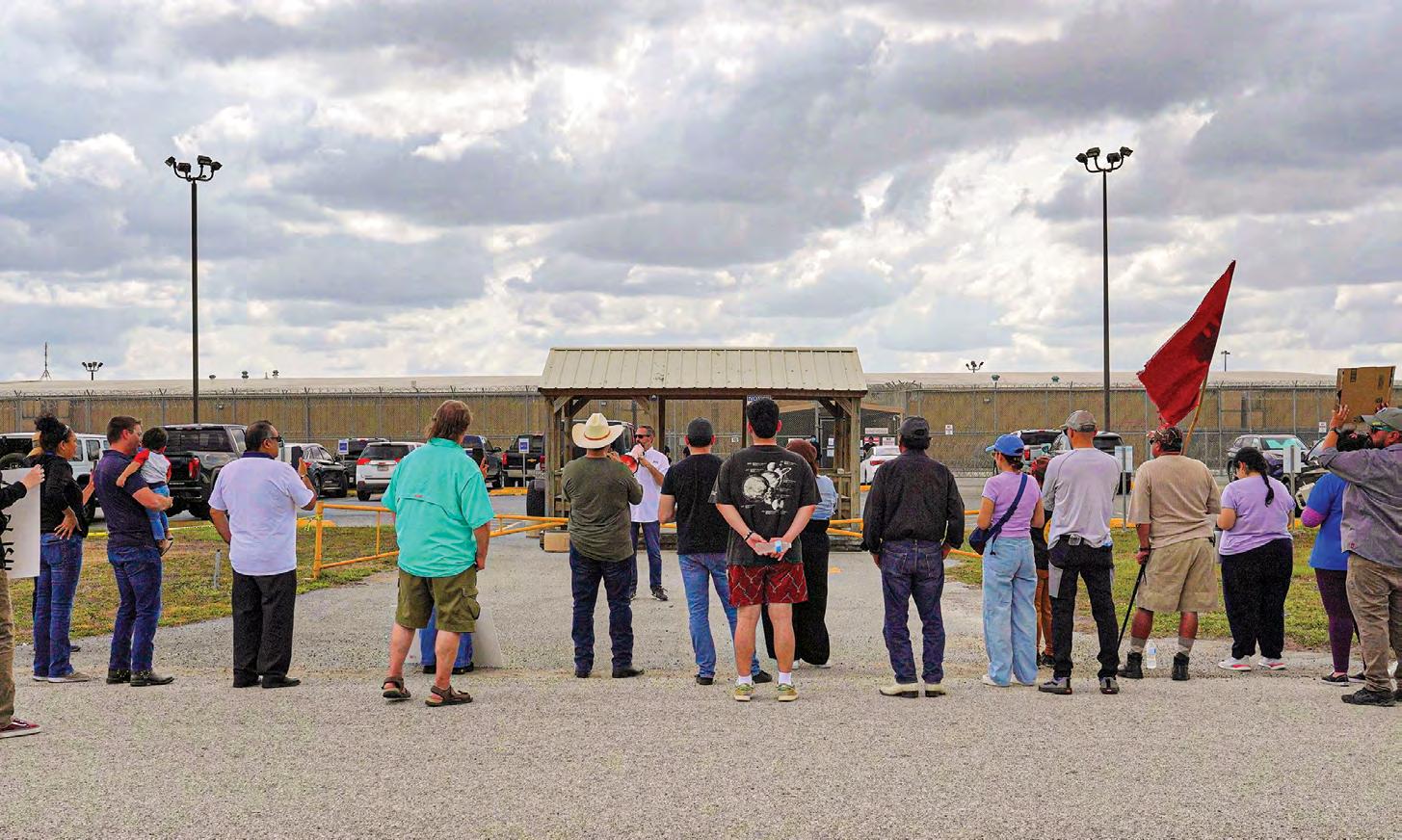
Organizing against mass deportation reflects the active participation in governance needed to upend authoritarianism.
transition into a multiracial democracy. Why are white people still trying to disenfranchise Black voters in 2,2$? Is the U.S. Constitution fundamentally corrupted by existing with slavery for 8, years? The experiences of other countries cannot answer.
“In all those cases you’re talking about the passage from one political order or form of government to another,” said Toscano. “That’s not really the case with the U.S. All of the institutions are in some sense the same. [Trump and Miller have] grown ICE, but Tom Homan was hired and given a medal by Barack Obama … The political and institutional architecture of the U.S. has not been radically transferred, but abused or perverted.”
Toscano added that instead of learning what Americans can learn from Europe after World War II, a better question is what can be learned about the fact that much of the right wing is unhappy about the results of the Civil War. To truly change the future of the United States, he said, the electorate would need to engage in a version of what Rev. Black suggested with his “spiritual solutions.”
“Whatever comes after Trump, if there were a political movement and a shift in government such that the idea would be to really revoke many of the e(ects of Trumpism in the United States, this would actually involve not returning to the previous status quo but engaging in some serious radical reforms,” Toscano said, such as changing the nature of the Supreme Court or radically rethinking U.S. residency rules, which “have always been authoritarian in its potentiality.”
But, he said, a real discussion of a Third
Reconstruction can’t happen if people think the order is good, just taken over by bad people. “That’s the fundamental aw in the ideology of the mainstream Democratic Party,” Toscano said.
For Mejía, the answer lies in organizing. Speaking with the Prospect after the DHS hearing, she agreed that simply getting rid of one agency is not enough, and like Toscano she is drawing inspiration from American civil rights &ghters, who used legal challenges, direct actions, boycotts, and protests, while holding their ground against vicious racists who attacked them and their children physically and assassinated their leaders. They also organized, which was one of the messages from Rev. Black’s testimony she said resonated with her.
As an organizer, Mejía said she heard a call for community-building, connecting with neighbors, and getting more people to take an active role in participating in governance. She cited research by Erica Chenoweth, dean and Frank Stanton Professor of the First Amendment at Harvard Kennedy School, who theorizes that governments typically fail to withstand challenges from #.. percent of the population. To her, that means doing exactly what she did to get elected: meeting with constituents, o(ering training and education sessions, and listening to their needs, fears, and hopes, and encouraging them to do the same.
“In many ways we’re going to have to return to old-school organizing,” she said. “# . percent deeply engaged doesn’t just mean people reading the news but rather … # . percent of the population has to be actively engaging
with their neighbors, activating them.”
That is what will roll back ICE and the rising fascism it embodies. After all, she said, the United States has already endured a fascist regime. “We’ve experienced that in the U.S,” she said. “It just wasn’t evenly distributed.”
For Toscano, it also requires imagining a new future, as Du Bois wrote about in the !9#,s. Toscano says it is striking that the best that many Democratic leaders can do is think about removing recent institutions, not radically overhauling any of the American systems that have made ICE and the Trump/Miller immigration terror campaign possible. It’s not as if the South just gave Black people better representation out of kindness, he said. The Union Army occupied Southern states and forced them to.
“There’s almost no willingness to recognize that the reason things have come to this really grim point is because the U.S. laws and the U.S. state make all of this possible,” Toscano said. “What I don’t see happening, even among the further left edges of the Democratic Party, is a political analysis that would really say that a very drastic reform of the U.S. constitutional order would be necessary for this not to happen again.”
Without that, he said, rhetoric about the rule of law, the Constitution, the checks and balances is completely hollow. That unwillingness, the inability to really question the institutional and legal order of the United States, is what has made ICE possible.
“So, what would a reform or transformation or abolition of this kind of precedent look like?” he asked. “And who’s willing to take it on?” n
STEPHEN MILLER IS IN LARGE PART DICTATING U.S. FOREIGN POLICY, WITH A MINDSET OF UNILATERAL VIOLENCE ON A MAXIMUM SCALE.
BY ELLEN IOANES

S5ephen Miller’A giddy grin takes up half the screen as Fox News host Jesse Watters allows him to expound on the success of the United States and Israel’s war on Iran.

“President Trump is saying, ‘We the United States, have the world’s not just most powerful military, most powerful navy,’” Miller says about halfway through his monologue, as the White House twinkles in the dusk behind him and a third split screen shows footage of jets launching o( an aircraft carrier. “Whoever controls the seas is able to control the outcomes in any foreign-policy showdown … If Iran chooses the path of a deal, then that’s great for the world, that’s great for everybody. If Iran chooses the path of economic strangulation by blockade, then the world will pass Iran by.”
The April !- appearance came amidst a double blockade of the Strait of Hormuz, and followed more than a month of U.S. and Israeli bombing that killed dozens of Iranian o cials and hundreds of civilians, endangered U.S. allies in the Gulf region, reignited Israel’s devastating war on Hezbollah and southern Lebanon, drove up fuel prices stateside, and threatened supply shocks for multiple components and & nished goods globally.
A 92-second clip from the appearance encapsulates a striking dynamic in the second Trump administration’s approach to foreign policy: In some sense diplomacy still exists, hence the talk of a “deal,” but it is increasingly backed by the threat of overwhelming military force.
The idea that might makes right as one of “the iron laws of the world that have existed since the beginning of time,” as Miller told CNN’s Jake Tapper shortly after U.S. military forces kidnapped Venezuelan President Nicolás Maduro and his wife Cilia Flores, encapsulates this administration’s worldview. From Donald Trump’s threats to other countries on social media to Defense Secretary Pete Hegseth’s press brie&ngs about the war on Iran (or as Hegseth reminds us, Operation Epic Fury), projecting violence abroad in some form is usually the answer.
The policy of belligerent imperialism has more than one origin point, and it is nothing new in the context of American empire. Indeed, U.S. behavior on the world stage over the past !8 months is both uncanny and nihilistic; we are once again prosecuting a baseless and unsuccessful war in the Middle East, only this time no one even bothered to try and sell it to the public. If the Monroe Doctrine opened the door for intervention—both covert
and outright—in Latin America, the Trump corollary drove a tank through the wall and set up loudspeakers shrieking “Courtesy of the Red, White and Blue” on loop.
But Miller, as one of the president’s closest advisers and a major power player in the administration, has fueled, architected, and at times instigated America’s practice of foreign policy at gunpoint.
“Generally, an administration has a freer hand on foreign policy than domestic,” Jake Johnston, director of international research at the Center for Economic and Policy Research, said in an interview. “The administration has been constrained in some things domestically, but they’re not really on foreign policy. And so you can sort of push the boundaries. You can break norms. You can violate international laws. You can create a precedent or undermine the ability to check anything the administration does.”
But reality seems to have caught up with the administration’s bombast and bombers in Iran. As of now, there’s no agreement to prevent Iran from building its own nuclear weapon, and the Iranian regime is diminished but far from dismantled.
Though the clear lesson here is that military power cannot solve every disagreement, that doesn’t mean the administration won’t try it again—maybe in Cuba or Greenland—despite the consequences.
Miller, 40, was a senior policy adviser and speechwriter in the first Trump administration; he has built on that foundation to become homeland security adviser and deputy chief of sta ( in this one. As an aide to former Alabama Sen. Je( Sessions, the & rst prominent Republican o cial to support Trump’s presidential campaign, his primary policy victory was defeating comprehensive immigration reform in 2,!#. This obsession immediately informed Miller’s & rst policy framework once Trump became president, known colloquially as the “Muslim ban.”
Trump’s executive order, formally titled “Protecting the Nation from Foreign Terrorist Entry into the United States,” restricted travel from Iran, Syria, Somalia, Libya, Yemen, and Sudan, all majority-Muslim countries. That & rst shot, which triggered protests at airports across the country, was ultimately unsuccessful, but an altered version of it was upheld by the Supreme Court in 2,!8. Though Miller was reportedly not involved in drafting the & nal version, the
Miller has fueled, architected, and at times instigated America’s practice of foreign policy at gunpoint.
The spiraling conflict triggered by the Iran war, as we see in Lebanon, shows that military power cannot solve every disagreement.
policy idea is emblematic of what he considers the purpose of the federal government: to keep those he deems outsiders out by any means necessary. That included using a public-health statute to ban entry at the southern border during COD ID, and ending Temporary Protected Status for immigrants from countries ravaged by war or natural disaster.
Trump’s and Miller’s ideologies are aligned, but the means by which Trump has centralized power, called the “unitary executive theory,” plays a key role here, too. “You need a superior and unfettered executive to wield the violence of the state against undesirables,” according to a former Foreign Service o cer who served multiple international tours with the State Department and whose name is being withheld to avoid retribution.
Miller’s interpretation of his current role as homeland security adviser is expansive; he doesn’t just work to thwart terror attacks or direct policy for the Department of Homeland Security. He also turns domestic security policy—like terrorizing noncitizens and industrial-scale deportations to places like El Salvador and the Democratic Republic of the Congo (DRC)—out onto the world.
“For Stephen Miller, foreign policy isn’t international policy, it’s policy for foreigners, whether they’re inside the United States or outside of the United States,” the former
Foreign Service o cer said in an interview.
The best way to understand that dynamic, the former Foreign Service o cer said, is through U.S. foreign policy in Latin America and the Caribbean; speci&cally, the repeated airstrikes on small boats that the administration claims are tied to “narco-terrorist gangs.”
Miller reportedly floated the idea to attack boats of migrants headed to the U.S. back in 2,!8, according to a book by Miles Taylor, who was chief of sta ( at DHS during the & rst Trump administration. “Tell me why can’t we use a Predator drone to obliterate that boat?” Miller reportedly asked the then-commandant of the U.S. Coast Guard, according to Taylor’s account. When told that such action would clearly be against international law, Miller reportedly told the commandant, “I don’t think you understand the limitations of international law.” Miller has denied Taylor’s account.
Yet proposals that skirt the edges of international law didn’t come out of nowhere. The U.S. under George W. Bush created legal mechanisms following the September !!th attacks to torture hundreds of people in CI: black sites and then at Guantanamo Bay. The Obama administration’s targeted drone strikes were assassinations by another name. The Biden administration further eroded international norms and subverted its own policies by & nancing Israel’s genocide in Gaza, in violation of the Leahy Law,

which prohibits foreign military assistance to nations that violate human rights.
“Seems like Miller is sort of taking what he was already willing to do during the & rst term and then combining that with what Israel has been doing in the way it has just been completely ignoring any kind of international law, Geneva Conventions, any of it in its conduct in Gaza and Lebanon, to then in uence U.S. foreign policy,” Annelle Sheline, a research fellow in the Middle East program at the Quincy Institute for Responsible Statecraft, said in an interview.
In other words, Miller and the Trump administration have been able to steamroll what was left of international law; they just had to &gure out how to do it.
According to The Guardian and The New York Times, Miller was directly responsible for at least the initial strikes on Venezuelan boats back in September. Even if Trump was technically the last word on the strikes, as the White House says, they could not have happened without Miller’s input. He came up with the legal structure that ultimately justi&ed those strikes—using the Alien Enemies Act to position Venezuelans as a liated with the Tren de Aragua cartel, which the administration previously designated as a foreign terrorist organization. (The Alien Enemies Act was also the justi&cation to deport hundreds of Venezuelans living in the U.S. to El Salvador’s notorious CECOT prison, where
many reported enduring serious abuse.)
The “secretary of state can declare an organization a foreign terrorist organization, based on nothing but vibes,” the former Foreign Service o cer said. “Then the next step is you say that they’re tra cking drugs in order to do terrorism. That doesn’t have to be true, you just have to suspect it, and ‘suspect’ is a state of mind, right? You can start doing lethal operations against those individuals, and call them enemy combatants.”
Of course, just because there is a legal architecture and justi&cation for the strikes, that doesn’t mean they are actually legally justi&able, as Brian Finucane, senior adviser for the U.S. Program at the International Crisis Group, noted in an interview.
“The administration is trying to cloak these strikes in the mantle of counterterrorism, in the mantle of armed con ict, but that’s completely false framing,” Finucane told the Prospect. “There is no armed conict, unlike with the war on terror, where the U.S. was engaged in actual armed con ict with organized armed groups like al-Qaeda and ISIS.”
When the administration attacks these small boats, Finucane said, “we have premeditated killing outside of armed con ict, which implicates U.S. criminal statutes on murder, murder on the high seas, conspiracy to commit murder outside the United States, and murder under the Uniform
Code of Military Justice. And I say this as someone who advised on legal counterterrorism operations under both the Obama and Trump ! , administrations.”
According to The New York Times, Miller’s desire to use boat strikes as a deterrent assisted other foreign-policy priorities. It dovetailed with President Trump’s interest in Venezuelan oil and Secretary of State Marco Rubio’s desire for regime change in Venezuela and, eventually, Cuba. The White House denied parts of the Times ’ reporting.
But most of all, the boat strikes and subsequent kidnapping of Maduro and Flores created a replicable—at least in theory— model for the second Trump administration’s foreign policy: Shoot & rst and deal with the consequences later.
On March 5, Miller made an appearance at the Doral, Florida, headquarters of U.S. Southern Command, the military :OR (area of responsibility) that contains much of Latin America and the Caribbean. The occasion was the & rst Americas Counter Cartel Conference, and defense and security o cials from !/ Latin American and Caribbean countries were in the audience.
Miller was there to tell attendees that the U.S. was taking a new approach to drug cartels operating throughout the region: military force, regardless of domestic or international law, and whether the
governments themselves pursued it or not.
Just days before that conference, the U.S. and Ecuador launched a joint attack on targets in Ecuador as part of an operation to defeat the drug cartels that have rapidly gained power and in uence in the country, particularly in coastal areas and port cities.
Drug tra cking has certainly become a major security problem for Ecuador in the past decade, as has the precipitous rise in cartel-related violence. Ecuador now has the highest homicide rate in the region, and President Daniel Noboa has taken an increasingly hard-line approach to the problem, ramping up internal repression and now allowing U.S. forces to conduct airstrikes within its territory.
Beyond the fact that the initial March campaign appears to have targeted a dairy farm, not a narco-terrorist training facility as initially claimed, the e cacy of this kind of approach isn’t really clear. Aggressive, violent, and inhumane immigration policies like sending Afghan refugees to the DRC or Venezuelans to CECOT might deter individual people from coming to the U.S., but the logic doesn’t apply to cartels, as Will Freeman, a fellow for Latin America studies at the Council on Foreign Relations, told the Prospect
“Trying to copy and paste that same deterrence logic to businesses is where it breaks down, because the cartels are organized crime, are businesses,” Freeman said in an interview. “So you aren’t deterring them from operating by blowing up boats, because they have a lot of other assets. I don’t think they’re impoverishing the cartels.”
According to Freeman, whose expertise is organized crime in Latin America, limiting illicit & nancial ows would go much further toward that end, something the Trump administration has abandoned. “The biggest [factor] … is actually all the clearing away of any regulation or oversight on cryptocurrencies. A lot of money laundering [is] happening through Tether now. A lot [is] also happening through these opaque Chinese money-laundering networks.”
If Miller is to be believed, the Americas Counter Cartel Coalition, also called the Shield of the Americas, intends to forcefully attack the problem rather than address any root causes or essential tools of the illicit drug trade. And, according to the former Foreign Service o cer, that may have been only part of the point in the & rst place.
“[Miller’s] desire was to have the president be able to do something kinetic,” like
,f America’A image as a credible and useful partner.
At the Americas Counter Cartel Conference, Miller outlined his policy to use military force to counter the drug trade.
a bombing campaign, he said. “What Miller was saying was that the president has the authority to do extrajudicial killings of certain populations, and there’s no limit on that right, and he knows who he wants those populations to be. That was the original objective, I believe, of the boat strikes.”
Part of the way Miller and Trump’s other close advisers are able to convince the president to support their priorities is that there just aren’t that many people to get in the way. And according to diplomatic sources the Prospect spoke with, those who disagree with the administration’s foreign policy are reluctant to speak out.
In May of last year, just after Marco Rubio took over as national security adviser, the National Security Council cut about a hundred jobs; in previous administrations, the agency has been tasked with coordinating international policy among government agencies and providing specific foreignpolicy expertise, particularly in unstable areas or regions where there are active or potential con icts. According to contemporaneous reporting, many of those experts were dismissed and sent to other postings in the government.
The administration has also gutted the State Department, laying o( hundreds of staffers last summer and threatening to push out more via a new set of performance evaluations. Those who remain, according to American Foreign Service Association President John Dinkelman, fear speaking out against this administration’s policies.
“A lot of what we do is based on our ability to tell the truth, as we see it, to leadership, and historically, that has been without fear of any rami &cation or recrimination or retribution,” Dinkelman said in an interview.
“Unfortunately the environment, not just in Washington but throughout the Foreign Service, is one of—how shall I say this—covering your back, because bad news now is not welcome. Unfortunately, the tendency to shoot the messenger has now become an attribute in the management style of our Foreign Service. So you can understand how that would cause an entire system to basically freeze up with people not so much interested in reporting back to Washington the bad news that might get them in trouble, but rather, either not reporting at all, or worse, misreporting that things are OK when they really aren’t.” The result is that committed, career Foreign Service o cers & nd that they cannot e (ectively do their job and resign , which is probably part of the administration’s goal in the & rst place.
Trump also removed around #, career diplomats from their posts late last year, many of whom served in challenging posts or areas where there is now outright conict. Replacement ambassadors have not been named or con & rmed, leaving chargés d’a (aires in place. In the diplomatic world, rank matters, and a chargé d’a (aires simply doesn’t have the gravitas required to conduct negotiations e(ectively.
“[There are] more than !,, countries out there where our senior diplomats … don’t have all the tools that they need in the form
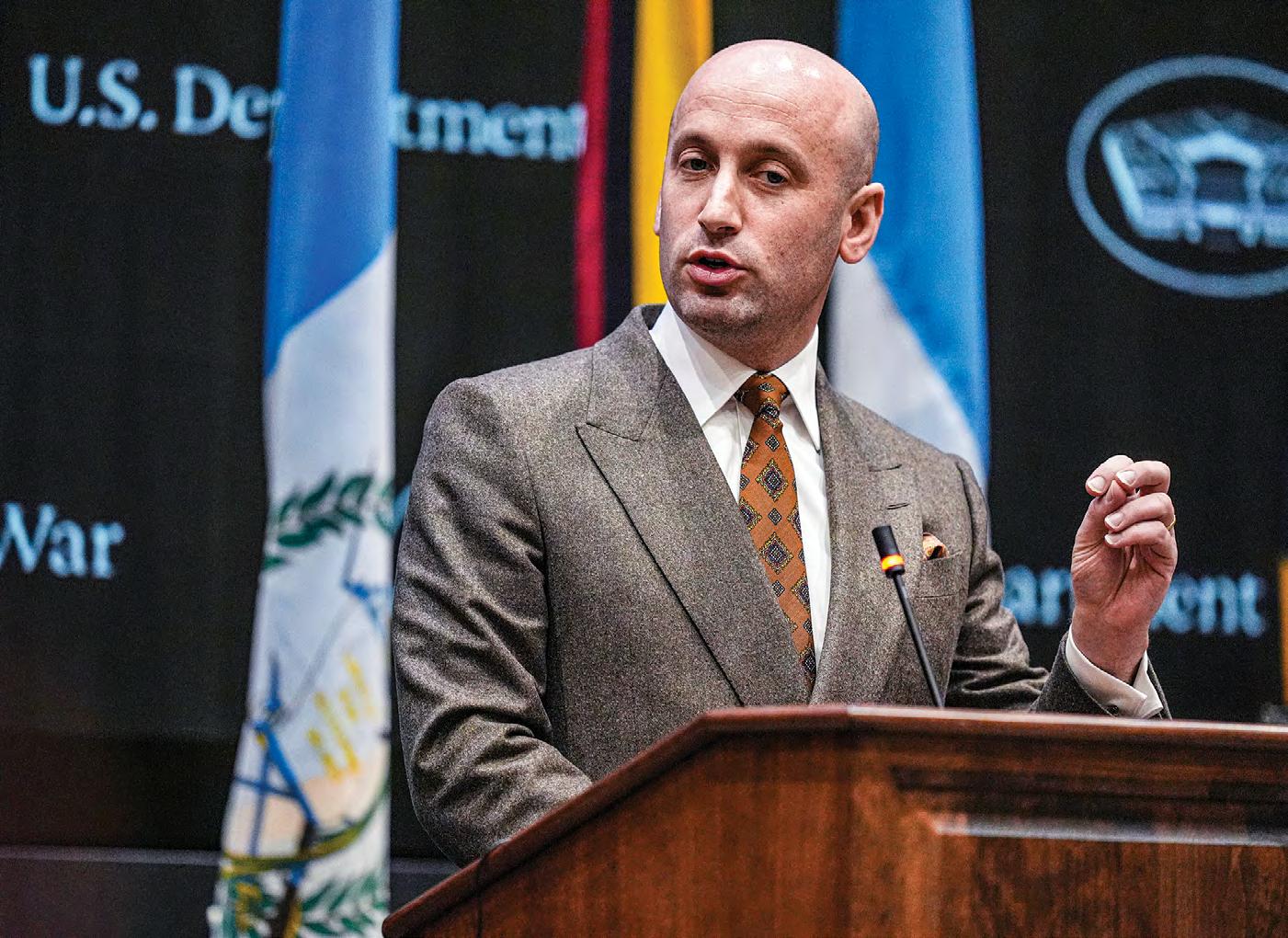
of diplomatic rank or accreditation,” Dinkelman said. “There’s no reason for that.”
That environment leads to lower-level o cers passing the buck up when it comes to issues on the ground, consolidating foreign-policy decisions at the top because they fear the consequences of making the “wrong” decision.
“There’s functionally no foreign policymaking process anymore, in a way that involves any counterweight to these personalistic relationships with the president,” the former Foreign Service o cer said.
Nowhere has that been more obvious than in Iran. After the success of the Maduro kidnapping, the administration became convinced that a regime change operation in Iran would be just as simple, so in the midst of indirect negotiations to limit Iran’s ability to build a nuclear weapon, the U.S. started moving more materiel and military personnel to the region. It was the Miller doctrine in action: maximum aggression, with the belief that America can take whatever it wants.
“You would think going into negotiations with Iran that that’s the time to act again from a place of strength,” said another former Foreign Service o cer who served multiple foreign tours and whose name is being withheld to avoid retribution. “We’ve had this maximum pressure campaign. The Iranian people are rising up. The proxies have retrenched or been destroyed, like it’s the perfect opportunity to go in there, get some concessions, come up with a good deal.”
Instead, despite battering Iran with
around a thousand Tomahawk cruise missiles—worth about $- million each— and killing Ayatollah Ali Khamenei and multiple members of Iran’s political and military leadership, the U.S. is actually empowering the Islamic Revolutionary Guard Corps, the Ma &a-like military apparatus that wields enormous power over the Iranian regime, the second former Foreign Service o cer said. “The leverage calculus started to shift very quickly when Iran was able to withstand so much pounding from high-intensity, very expensive, and very much in-demand weapon systems and wreak a decent amount of destruction across the region with much lowercost versions. They very severely shifted the leverage away from the United States because it had, all of a sudden, expended a huge proportion of its military power for very little result.”
Indeed, as of this writing, Iran is not allowing free passage through the Strait of Hormuz, the crucial global shipping lane, and began charging vessels to navigate those waters. Rather than negotiate, the Trump administration initiated a blockade, hoping to squeeze the regime and all of Iran’s citizens into surrender.
Though U.S. and Israeli attacks have certainly caused damage in Iran, they haven’t actually achieved any of the Trump administration’s stated objectives. Instead of regime change, access to Iranian oil, and an end to nuclear enrichment, the war has alienated American voters, Iranian citizens, and nearly all of America’s allies and partners.
The war on Iran endangered much of the world, physically, economically, or both, for no obvious reason. That’s the di (erence between force and outright bullying; the latter implies some level of cruelty and incompetence, neither of which are qualities one seeks in an ally. Most long-term allies and partners, frustrated by threats to N:TO by attacking Greenland and monthslong tari( wars, have refused to support the U.S. operation or e(orts to secure safe passage along the Strait of Hormuz. America will have to go it alone.
Miller’s Hobbesian worldview has accelerated the demise of America’s image as a credible and useful partner, inasmuch as that existed following the war on terror and former President Joe Biden’s support for the Gaza genocide. The damage that he and the rest of the administration have done on the global stage will take years and enormous e(ort to undo.
But the foreign policy and domestic policy feed and reinforce each other; consider the fact that Kristi Noem, right after she was dismissed as homeland security secretary, was appointed the U.S. special envoy for the Shield of the Americas.
“The way I view [Miller’s] in uence on foreign policy, it’s not really about the foreign policy, it’s about how foreign policy can be used domestically,” Johnston said. “It’s not really about the hemisphere at all, per se, other than its e(ect on the U.S. It helps him advance his agendas domestically,” particularly mass deportations.
Approaching the midterms and looking forward to 2,28, Americans will need to seriously consider how to remedy the damage that Miller and this administration have wrought on us, and the rest of the world, Sheline said.
“My hope is that … there will be some kind of demand for accountability, a more robust system of international law,” Sheline told the Prospect. “Because the alternative is, we just kind of throw out the Geneva Conventions, or other aspects of international law, and then it’s like, OK, so do we want to live in that world?” n
Ellen Ioanes is a New York– and Beirutbased journalist. Covering a broad range of topics from the defense industry to internet culture, her work has appeared in Vox, Business Insider, The Guardian , Foreign Policy, and other outlets.
The U.S. suffers from a mass exodus of primary care doctors, as medical practice is dictated by corporate masters at the expense of physicians and patients.
By Robert Kuttner


Primary care physicians—internists, general practitioners, family doctors, and pediatricians— are the key point of patient contact with the medical system. They have been leaving the medical profession in droves because their conditions of practice have become intolerable.
These doctors are being pressured to see more patients in shorter appointments despite ever more complex cases and treatment options, even as they are required to spend more time at computer terminals entering patient data. One recent paper in the Journal of General Internal Medicine calculates that primary care doctors, to meet all of their clinical and clerical obligations, would literally need to work 2$ / hours a day
Doctors & nd themselves working evenings and weekends to catch up with administrative work. My own internist typically responds to questions via the hospital’s “Patient Site” at about 2 a.m. Some doctors compensate by nominally going part-time, but often work full-time for half pay to keep up with the demands. Others take early retirement or move to boutique “concierge” practices, where they can conscientiously care for a Iuent patients who pay out of pocket. A & ne internist I know, still in her forties, prized her work and her patients but could not take the pressure anymore. She quit to go to work for an insurance company reviewing claims.
The result of this exodus is even more pressure on doctors who remain, worsening the cycle. The U.S. is now said to be short at least 2,,,,, primary care physicians, but one recent study found that the shortage would rise to 2,8,,,, if all Americans had good health insurance
In Boston, site of several world-class teaching hospitals, a study found that as of 2,2,, one-third of primary care doctors are over $,. As older primary care doctors retire, they are not being replaced. Young residents get a close look at their exhausted and demoralized mentors when they do primary care rotations, and most opt for other less taxing, more rewarding specialties. According to Dr. Wayne Altman, chair of family medicine at Tufts Medical
School, when residents and hospitals did their annual matchup for new doctors in March, just #.9 percent of incoming physicians chose family medicine. He told me, “They look at us and say, you are doing the Lord’s work and good luck to you.”
What is driving this syndrome, and what might fix it? I spoke to more than #, of the people who have given this question the most careful attention, including former heads of Medicare and Medicaid, hospital CEOs, and leading health policy researchers. I read numerous studies and interviewed several primary care doctors. The story is both simple and complicated.
At the #,,,,, -foot level, one can view a collision of several separate factors, all of which add up to more pressure on primary care doctors. As I wrote in an investigative piece for the Prospect on Epic Systems, the near-monopoly vendor of electronic databases for hospitals, the system has become a time sink. Doctors, especially primary care doctors, are required to enter scads of data after each patient visit. The computer will not let the doctor proceed until every question is answered. One study found that physicians spend two hours entering data for every hour with patients.
The purpose is less clinical than commercial. Under rules laid out by Medicare, more than half a century ago, patient visits and procedures get elaborate codes called CP T codes that in turn dictate payments. Epic facilitates upcoding, so that hospitals can squeeze out maximum reimbursements from private insurers (or so Medicare Advantage insurers, which many doctors work for, can overbill the government). “Doctors—highly trained professionals— are reduced to performing clerical and administrative tasks,” says Dr. David Bor of Cambridge Health Alliance.
A second factor is the systematic bias in
payment systems against primary care. The American Medical Association, dominated by specialists, has captured the coding system. The :M: owns the codes, of which there are more than !!,,,,. Every time a code is used, even for routine tests, the :M: captures a royalty. The :M: makes about $28. million a year from these payments, or about half its total income.
The code formulas are systematically biased in favor of specialists and against primary care doctors. Under Republican and Democratic administrations alike, the government’s Centers for Medicare & Medicaid Services (CMS) has deferred to the :M:-owned and -dominated system. Commercial insurers tend to follow the Medicare guidelines. The :M: has used its political in uence to block every attempt at reform.
Third, as doctor-owned practices have been overwhelmed with byzantine bureaucratic demands from both commercial insurance companies and the government, physicians have been selling their practices to hospitals, private equity companies, or even insurance conglomerates. Hospitals, whether nominally nonpro&t or for-pro&t, emphasize maximizing income. Likewise insurers or private equity & rms.
The doctors’ new masters only intensify the time squeeze. Hospitals like to own primary care practices, not because they are moneymakers—due to the bias in payment formulas, they tend to be money-losers— but as sources of referrals to lucrative, procedure-intensive specialties, such as cardiology, oncology, and orthopedics.
But lately, hospitals have been turning away from primary care entirely, because of the low compensation for physicians and the odd way that hospitals calculate their costs. When a doctor practices at a hospital, the hospital charges rent and attributes other indirect costs to the physician practice. One recently retired CEO of a major hospital
group told me, “I lost about $!,,,,,, on every [primary care] physician.” Average doctor earnings of about $2.,,,,, year, plus attributed indirect costs, were well above what the hospital could bill insurers.
By contrast, specialists are big pro&t centers. The big hospitals have found other ways of getting referrals to their specialists; they have gone on acquisition binges to take over community hospitals and created referral networks. So they no longer need in-house primary care as a referral source. Many are deliberately shrinking primary care or are happy to let the number of primary care doctors dwindle. At the prestigious Massachusetts General Hospital, between 2,2# and 2,2. an astounding /8 primary care physicians quit out of about 2., —either retiring, leaving for another facility, or opting for concierge practice. Not all were replaced. (See sidebar.)
The squeeze on primary care is exacerbated by the invention of countless new drugs, medical devices, tests and diagnostic decisions, all of which consume time. Half a century ago, there were no M R I s or CT scans, and far fewer standard pharmaceutical drugs and tests. Dr. Michael Barnett, an internist and health policy researcher at Boston’s Brigham and Women’s Hospital, told me, “The old norm that a primary care doctor should be responsible for a panel of !,8,, to 2,,,, patients is an anachronism.” He cites the example of a heart valve disorder that can now be treated with new elegant forms of costly surgery. But when the primary care doctor spends time making the diagnosis and refers the patient to the surgeon, it is the surgeon who is well compensated, while the primary care doctor is underpaid.
Thus the paradox: Specialists, as pro&t centers, get along with this new complexity just & ne. They make plenty of money o( it and are not su (ering the same level of burnout. But since the coding and payment system is based largely on procedures and specialized expertise, primary care doctors are systematically undercompensated for listening, evaluating, writing up process notes, and coordinating care, all of which is the essence of their job.
At the heart of the story is the relentless commercialization of medicine. According to the American Hospital Association, about $8 percent of community hospitals are now part of chains. Slightly more than
Primary care doctors are systematically undercompensated for the essence of their job.
half of the nation’s roughly $,!,, hospitals are nominally nonpro&ts, but most are trying to emulate for-pro&ts. Mass General is one of the worst o(enders and is all too emblematic of the emerging business model of most academic medical centers.
Mass General was chartered in !8!! by the Massachusetts legislature as a hospital that would treat anyone in need of medical care, regardless of ability to pay. The facility became the & rst Harvard Medical School teaching hospital, training and supervising interns and residents, as well as a leading research facility.
But as the entire medical system became more commercialized and pro&t-oriented, so did Mass General. In the !99,s, it began pursuing greater market share, partly as a source of increased bargaining power over insurer payments. The idea was to make it inconceivable for an insurer to threaten to deny patients the right to use the hospital. In !99- , Mass General undertook a partial merger with one of Boston’s other renowned teaching hospitals, Brigham and Women’s Hospital, creating a parent corporation called Partners HealthCare.
Health care workers spoke in 2025 at a congressional hearing on burnout, which is set to expand over the next decade.


The hospital hired costly branding consultants. They realized that Mass General and Brigham and Women’s were prestigious brands, while “Partners” had no resonance. So the corporation spent over $!,, million to rebrand Partners as Mass General Brigham (MBC). One of their highest-paid executives is Mark Bohen, chief marketing and communications o cer. He previously worked for Nabisco, where he marketed Oreos and Ritz Crackers. MBC displays slogans like “One System, One Mission, One Mass General Brigham.” But that branding has also back & red, since it tends to confuse people about which hospital it refers to.
Since the !99,s, business tycoons and not doctors have been added to the MBC board, & rst as a source of donations, and then as dominant in uences on corporate strategy. Today, the board chair is Scott Sperling. His day job is co- CEO of Thomas H. Lee Partners, a private equity & rm described as “focused on investing in middle market growth companies in three core sectors: & nancial services, healthcare, and technology and business solutions.” So Sperling brings his private equity mentality to how MBC is run.
One vice chair is billionaire Jonathan Kraft, president of The Kraft Group, the holding company of the Kraft family’s
business interests. He is also president of one of the family properties, the New England Patriots. The other vice chair is John Fish, chairman and CEO of Su (olk Construction, Boston’s pre-eminent construction & rm, which has pro&ted from several Boston health care projects.
In February and March 2,2. , MBC announced some ! , .,, layoffs, citing a shortfall in the system’s operating budget. But when the 2,2. fiscal year numbers were announced in December, MBC ran an operating pro&t of $.9 2 million for the &scal year and a total pro&t of $2 - billion, reflecting earnings from surplus capital invested in the stock market. The hospital had plenty of money to avert layoffs. At last count , Mass General had some #,,,,, patients in its system who did not have a primary care physician, and was turning to AI to do thousands of initial screenings.
In the meantime, Anne Klibanski, CEO of MBC, has received several raises in recent years. She nearly doubled her annual compensation in just four years, from $- .# million in 2,2, to $8.- million in 2,2- . At least !$ MBC executives make more than a million dollars a year. The more pro&t that the hospital books, the more money there is to pay executives—but evidently not primary care doctors and their support sta (. When MBC announced the layoffs, the hospital system emphasized that they were all “non-clinical” personnel. But many played vital support functions that now had to be &lled by doctors and nurses, cutting further into clinical time. One primary care doctor in a large practice at MBC, Claire Bloom, told a reporter that her practice manager was abruptly laid o(. “That person’s work still needs to be done, right? It’s not like you can eliminate the tasks … they just have to be transferred to other people. Those other [clinical] people already have full time jobs. Those people are going to be overworked and burnt out, and it’s just not possible.”
The result of all these pressures is that primary care doctors have experienced worsening de-professionalization. Dr. Bor of Cambridge Health Alliance observes, citing author Daniel Pink, that professions, in contrast to ordinary occupations, are distinguished by three factors: autonomy, mastery, and purpose. Each has been crushed by the corporate takeover of medicine. Before pro&t maximization became paramount, physicians set their own schedules and gov-
erned their own practices. Today, they are treated like any other corporate employee. “The next generation doesn’t expect autonomy as part of their profession,” Bor says. “They have internalized the new rules. They are less likely to see their profession as a calling.” Their sense of purpose is eroded, he adds, as is their capacity to master and use their knowledge.
“When I was a young clinician,” Bor says, “I learned a great deal from talking with my peers. I don’t see doctors having lunch together in the cafeteria. They’re all busy at their computers.”
Dr. Tait Shanafelt, a hematologist at Stanford Medical School and a leading researcher on doctor burnout, began systematically studying the phenomenon in 2,,!. He has found a steady increase in doctor stress, exhaustion, fatigue, depression, and social isolation, leading to negative e(ects on patient care.
Primary care doctors find themselves demoralized, in both senses of the word. They are dejected, but also the medical care they are being forced to practice is at odds with their own sense of moral behavior. In 2,!8, Dr. Wendy Dean popularized the concept of moral injury. Dean and her collaborator, surgeon Simon Talbot, argued that terms like “burnout” missed much of what was really going on.
Moral injury occurs when doctors’ deeply felt duty to their patients is at odds with their conditions of work and their necessary care of themselves. Even though it is not their fault, doctors feel shame that they are failing their patients and drive themselves even harder, creating an impossible moral bind. Dean writes that the experience of physician moral injury is akin to posttraumatic stress disorder (P TSD), in which veterans feel shame at what they saw and did on the battle&eld.
Dean’s 2,2# book elaborating the concept is titled If I Betray These Words. The title is from the Hippocratic oath. The extended quote is “In honor of the knowledge I’ve received from my teachers, I swear to care for anyone who su (ers, prince or slave. If ever I break this oath, let my gods take away my knowledge and my own health … May I be destroyed if I betray these words.”
One of my personal heroes, the economist and moral philosopher Albert Hirschman, wrote a profound book with the odd title Exit, Voice, and Loyalty. Hirschman’s insight was that there are two ways of exerting in u-
ence: voice and exit. If you are given voice, that engenders loyalty. When you are denied voice, whether in employment, a marriage, or a nation, you ultimately may exit. Demoralized doctors denied voice eventually exit the profession. As Dean writes, in extreme cases of moral injury, some commit the ultimate form of exit—suicide.
Dean tells several stories of the excruciating pressure on doctors to cut corners and calls for an end to the corporate domination of medicine. But the corruption and debasement of the nonpro & t part of the system is such that reform would need to go even deeper.
The simple remedy for this tangled mess would be national health insurance. If implemented properly, a national health program could dispense with the pro&teering, the middlemen, the costly insurance billing and upcoding games, and save trillions of dollars by redirecting the savings to care. It could also pay primary care doctors decently, increase the time they can spend with patients, and reduce the use and payment of specialists. In Canada, with a universal system, primary care doctors are about half of all doctors, compared to about one-quarter in the U.S.
But national health insurance is not coming to America anytime soon. Short of that, partial reforms of payment systems could help. There have been several efforts to break the :M:’s specialist-dominated lock on payment codes. All have failed.
In the !9/,s, when Joseph Califano was Jimmy Carter’s secretary of Health, Education, and Welfare (the predecessor of the Department of Health and Human Services, or HHS), leaders of Medicare and Medicaid attempted to substitute the public-domain system of coding used internationally for the :M:’s proprietary one. But the Carter administration needed the :M:’s support for pending health legislation. Califano, who was lobbied by his own doctor, told the Medicare people to back o(. Similar sagas have occurred since. Bill Clinton needed the :M:’s support for pending patient privacy legislation, the KennedyKassebaum bill, which became the Health Insurance Portability and Accountability Act of !99$ (HIP::). And in 2,,#, the Senate passed legislation to switch to the international coding system. But the :M: reportedly got that killed by agreeing to support the Medicare Modernization Act, which added
privatized Medicare drug coverage.
Ironically, there may be a window for reform this year. HHS Secretary Robert F. Kennedy, Jr. has a vendetta against the :M: . One well-placed source tells me that Kennedy has authorized one of his top aides to work on taking the coding system away from the :M: , a position shared by Sen. Bill Cassidy (R?A :), a doctor, who chairs the Senate Health, Education, Labor and Pensions Committee. Cassidy announced last October that he had begun an investigation into the :M: abuses of the codes. Cassidy wrote, “I am particularly o(ended by the :M: abusing its government-endorsed CPT monopoly to charge every stakeholder in the health care system signi&cant amounts of money while advancing an anti-patient agenda.”
The Senate Finance Committee has jurisdiction over Medicare, and its leader, chair Sen. Mike Crapo (R?ID), favors this reform. However, the window could soon close. Cassidy, who is up for re-election and is opposed by Trump, may lose his primary; and R)F Jr. seems to be rapidly losing political capital.
Some efforts at payment reform have back &red. In 2,,$, health policy reformers came up with a concept called the Medicare Shared Savings Program (MSSP). The idea was that a hospital, clinic, or doctor practice would form a group known as an accountable care organization (:CO) and be &nancially rewarded for hitting certain goals of quality and e ciency. The savings could then be directed to better primary care. :COs were duly created in 2,!, by statute as part of President Obama’s A (ordable Care Act.
What actually happened was that private equity companies realized they could acquire :CO s as a way of buying doctor practices. They could extract the savings and then squeeze the employees to see more patients and increase billings. Doctors went from the frying pan to the & re. Between 2,!2 and 2,2!, some . ,//9 physician practices in #,/ metropolitan areas were sold to private equity.
Why would doctors do this to themselves?
Because when a practice sells out to private equity, the doctors that owned the practice get a one-time payment that can be upwards of a million dollars. This can be very attractive to a doctor nearing retirement—at the expense of younger colleagues.
Insurance conglomerates like Optum, a division of the health care giant UnitedHealth, have also been buying up doctor practices, and executing the same kind of
UnitedHealth is the largest employer of doctors in the country, and freestanding primary care practices are rare.
Doctors have begun to speak out about moral injury, the shame doctors feel over being unable to serve their patients.


squeeze, especially on primary care physicians. Today, UnitedHealth is the largest employer of doctors in the country, and oldfashioned freestanding primary care physician practices are rare. The largest category of owner is hospitals, followed by private equity; 22 percent of for-pro &t hospitals are themselves owned by private equity. All told, about /8 percent of physician practices are now owned by corporate entities.
In most of the country, this is actually a crime. Corporate practice of medicine laws require physicians and not conglomerates or other corporate structures to own medical practices in ## states and the District of Columbia . But private equity and other entities get around this by using &gurehead physicians to “own” the practice while all the business decisions are made by the firms or affiliated “management service organizations.” In several states, bills have been introduced to tighten these laws and end the shell game. The only one that has passed is in Oregon, which prohibits private equity owners from dictating clinical decisions, but does not fully prohibit their involvement. Oregon’s implementation will be closely watched by other states looking to reduce corporate control of health care.
At the state level, it’s possible to mandate a partial shift in payment formulas. Dr. Altman of Tufts Medical School is a national leader on payment reform and founder of the Massachusetts Primary Care Alliance for Patients. Altman has been working with a group of state legislators in Massachusetts to pass legislation that would shift from fee-for-service payments to advance payments, a reform that would e(ectively double state spending on primary care from $ to 8 percent to !2 to !. percent. Altman told me that the reform would so improve preventive care that it would pay for itself within two years.
However, the argument that increased spending on primary care saves money on net is controversial. Some studies have found that in some cases when primary care doctors have more time to spend with patients, they are more likely to & nd conditions that will in turn require costly treatments. This will keep more people alive and well but may not produce net savings for the system. “I don’t think advocates of more investment in primary care should be emphasizing the &nancial savings,” says Dr. Barnett of Brigham and Women’s Hospital. “We need more investment in primary care
With a total of some 85,((( employees, Mass General Brigham ()gb) is the largest private-sector employer in Massachusetts, giving it immense political clout. Since Mass General and Brigham and Women’s Hospital consummated a partial merger in the 1,,(s, they have systematically bought up community hospitals as both referral networks and profit centers. )gb, with Harvard teaching hospitals, can bill at premium rates for services at formerly independent community hospitals that often still have lower costs.
Because of )gb’s political influence, state authorities seldom intervene in a pattern of attempted market domination that should raise antitrust and cost concerns. A rare exception occurred in November 2(21, when then-Attorney General Maura Healey, who is now governor, warned that )gb’s planned creation of three new surgery centers in Westborough, Westwood, and Woburn would increase market share “at the expense of lower-priced providers.” )gb shelved the plans.
Like most states, Massachusetts requires proposed new medical facilities to apply for certificates of need to prevent wasteful and duplicative investment, but )gb regularly runs roughshod over the process. )gb is spending just under -2 billion to build two new towers next to its historic downtown Boston campus. They will house .82 new beds plus a new cancer center.
The rival Beth Israel Deaconess system is also building a new cancer facility in partnership with the Dana-Farber Cancer Institute. It’s far from clear that Boston needs this new capacity, but cancer treatment is a huge profit center, and the two systems compete for market share. The state is allowing both to proceed.

Mass General Brigham is a cautionary tale.
Amid all this new construction for specialty care, conditions for primary care have continued to deteriorate. Instead of rebuilding primary care in-house, )gb launched a partnership with /vs, which offers “Minute Clinics” at some of its pharmacies. Under the plan, /vs will hire or redeploy 8( “Primary Care Advanced Practice Providers,” mostly nurse practitioners, who will be responsible for patient panels of 1,5(( each. )gb will lend its brand and patient database to /vs and share profits. This idea raised significant clinical and financial concerns. In April, the Massachusetts Health Policy Commission issued a report warning that the deal could raise costs, and the commission solicited further comments.
By 2(2. , conditions for
and medical residents had recently succeeded in organizing a union. “They were getting regular raises and improved conditions while primary care work lives were becoming increasingly unsustainable,” said Eisenberg. “We were inspired by the residents.” Residents recently approved a contract that includes 7 percent raises and improved working conditions.
Most employers would recognize the overwhelming level of support and accept the result. But not Mass General Brigham. Executives hired the nation’s largest union-busting law firm, Littler Mendelson, whose clients include Starbucks, McDonald’s, and Nissan. Littler Mendelson resorted to the usual playbook. The regional nlrb certified the election result, but )gb appealed to the national nlrb, which at the time lacked a quorum, putting the election on hold.
primary care doctors had become so intolerable that )gb doctors organized a union. “Doctors are far from ideal candidates for a union,” one of the leaders of the effort, Dr. Mark Eisenberg, an internist at Brigham and Women’s, told me. Yet an astounding 88 percent of primary care doctors at the two hospitals signed union cards, and the union went on to win the election by a similar margin.
As Eisenberg points out, doctors are so squeezed by management at )gb that they don’t even get paid sick days. If a doctor calls in sick, it comes out of vacation time. “Either that or the doctor goes to work and risks infecting patients,” Eisenberg said.
Nurses at Brigham and Women’s had long been unionized,
Management also challenged the composition of the proposed bargaining unit—all primary care physicians—and argued that if doctors at )gb wanted to organize physicians, they had to organize all physicians and not just those in primary care. The regional nlrb ruling also rejected that ploy.
Recently, Trump’s appointees to the nlrb have given it a quorum, so the appeal will proceed. The union, affiliated with the Doctors Council of the seiu, has resorted to community pressure on management to drop the appeal and recognize the union, including informational pickets at the hospitals and a letter of support from 3, state legislators.
As part of its union resistance campaign, )gb, supposedly short of funds, abruptly announced plans for new spending of -.(( million on primary care. No input had been solicited from doctors, and no details were disclosed.
because it’s the right thing to do.”
At the hospital level, some facilities that are still mission-driven have tried to be counterweights to these larger trends. Dr. Shanafelt, who became Stanford’s &rst chief wellness o cer, is a leading national missionary for the idea that changes in how hospitals operate can make a di (erence. His research shows wide variations in rates of physician burnout. At Stanford, where Shanafelt directs a program called WellMD, hospital leaders do a lot of active listening to doctor frustrations and make adjustments. They use support sta ( and clinician teams to relieve extreme points of doctor stress. “If we optimize e ciency at the local level, it can help … and above all have leaders who listen,” Shanafelt told me.
The approach is the exact opposite of how management proceeds at Mass General Brigham. Rather than responding to suggestions, health professionals tell me, they ignore doctor concerns and exacerbate stress with layo(s of support sta ( and redoubled demands for doctor productivity. For more hospital executives, MBC is an unfortunate role model.
The most illuminating example we have of a partial reform that brings far better primary care is found in freestanding health plans that bypass the entire insurance and hospital industry. Some years ago, I wrote an article for the Prospect about the best of them, the health plan of the New York hotel workers union, which serves about 8.,,,, union members, retirees, and families.
Local $ of UNITE HER E is one of the most powerful unions on the country. It has organized large hotels in Manhattan, wall to wall. One of the bene&ts it has negotiated is membership in the union’s own health plan, which is like no other. The plan operates &ve freestanding health centers in New York’s &ve boroughs. There are no deductibles, no ceilings, no insurance billing, no waiting lists, and infrequent co-pays and prior authorizations. It includes full optical and dental care. Drugs used in long-term therapies are free; other prescriptions have a nominal charge of $!, to $2,. All doctors are on salary, typically around $2,,,,,, to $2.,,,,,. The average physician panel size is around !,,,, patients, about half that of hospital-based doctor practices.
Dr. Robert Greenspan, the longtime director of the health plan, said of its operating philosophy for patients: “We want
Local 6 health plan in New York is something like national health insurance in one sector.
you to come in. We want unlimited access to primary care. It pays o( over the long term. All of the co-pays and deductibles do the opposite of what is claimed. They don’t assure that scarce medical resources are used as e ciently as possible or deter excessive use. They are simply barriers to care.”
Doctors and patients in the union health plan both have the highest satisfaction rates in New York. With all the money that the system saves, the cost (paid entirely by employers) is about one-fourth that of the average commercial health plan in New York, according to the plan’s current director, Dr. David Jacobson.
When I first reported on the union health plan for the Prospect in 2,!! , I interviewed management as well as union people. Joseph Spinnato, the longtime president of the Hotel Association of New York City, who takes great pride in the plan, told me, “I could not duplicate this on the private market for anything like what we pay. When you measure it against what
our member hotels pay to cover their nonunion employees and what they get, there is simply no comparison.”
The costliest part of the plan is inpatient care, which has to be negotiated with local hospitals that are far less e cient and more focused on pro&ts. The plan is now working to bring more procedures and tests inside its own system.
According to Dr. Jacobson, who has directed the plan since 2,2,, New York has just approved the construction of three casinos, the & rst of which will be opening later this year. As part of the approval agreement, all three will be union operations. So Local $ will gain some !,,,,, to !2,,,, new members, and the health plan will gain many more because it includes their families. This increased membership and income gives Jacobson the basis for building a whole new health center in Manhattan. For the & rst time, it will have several services that ordinarily require expensive referrals to hospitals, such as CT scanners, MR Is, and an endoscopy suite.
The union health plan is a cousin to the & rst generation of sta (-model, nonpro &t prepaid group health plans, such as Group Health of Puget Sound, HIP of Greater New York, and the early versions of Kaiser. All of these had salaried doctors, no deductibles or co-pays, and no insurance companies. But as prepaid group plans morphed into HMOs, most became just another part of the commercial system. The radical alternative Local $ health plan is something like national health insurance in one sector.
Could that model be duplicated? Dr. Jacobson thinks that large employers or groups of employers might sponsor their own health facilities like Local $ does and cut out insurers entirely, while saving lots of money and providing better care. And he told me the following story.
Some years ago, the then-president of the union met with New York City’s mayor at the time, whom he did not name. The union leader pointed out that the city had some #,,,,,, municipal employees on its payroll, about ten times the number of Local $ members. The city was paying a fortune for their health coverage, which was decent, since all city employees are members of unions. Ward proposed, why not do what we do and set up your own medical plan and facilities.
“But the mayor wasn’t interested,” Jacobson said. “It was too socialistic.”
Over to you, Zohran Mamdani. n

IN MID - APRIL, a week before Virginia voters narrowly passed new congressional maps in response to Republican gerrymandering, groups of landowners and land preservationists in Northern Virginia quietly won a state appeals court battle against a deeppocketed consortium of developers. They had sued the county over failing to follow state regulations about posting public notices involving a data center project.
Between the redistricting vote, Virginia’s legislative budget impasse over data center taxation, and state and federal lawmakers caterwauling from Washington to Richmond and back again, it’s not surprising that a suburban county court case didn’t really penetrate the dystopian news cycle.

BY GABRIELLE GURLEY
But a screwup that derails what would have been the world’s largest data center is worth unpacking. Zoning applications and hearings are some of the most combative, tedious, yet vital happenings in cities and towns. They are also relentlessly ignored by most residents, who never read those public notices, much less know where to look for the clues about parcels of land being sold or new builds that a (ect their lives and property. Some real estate developers often count on this disinterest.
But something as simple as failing to adhere to regulations about posting a public notice can upend an entire project. That’s
what happened in Prince William County, Virginia, a Washington suburb, when the Board of Supervisors, the county’s policymaking body, mishandled public announcements for what at the time would have been a huge campus, the equivalent of about !2 dozen Walmart superstores.
That was a surprising but welcome development for county residents, who have been incensed that more harms might be foisted on their communities. In just the past couple of years, support for data centers has plummeted in the state and beyond. Northern Virginia is the country’s largest data center market, and it’s become ground zero for an upsurge of de&ance, especially against the next-generation infrastructure that supports arti &cial intelligence.
In an era of poisonous politics, Democrats, Republicans, and independents have found common cause over the value of tax breaks worth billions to Big Tech companies worth trillions. What residents see in exchange are higher electricity and water rates, a paltry number of new permanent jobs, and a host of unsavory environmental impacts, from the desecration of green spaces, erasures of wildlife habitats, and air and noise pollution. The public outcry has had a serious impact: Across America, at least 2. di (erent data center projects were canceled last year, and half of all data centers expected to open in 2,2$ will be delayed or simply canceled, according to reporting from Bloomberg.
In Prince William County, where former Vice President Kamala Harris won in a landslide in the 2,2presidential election, tenacious local residents have pressed their cases against some of the most powerful companies in the world. The Digital Gateway case may seem like & nally getting Al Capone on tax evasion. But as tech companies branch out from Northern Virginia to more rural parts of the state, court local o cials with & rst-responder gear, and gag them with nondisclosure agreements, they’ll double down to make sure that their next mega-million data center project doesn’t implode on a technicality. It still may not pan out, however. Shoehorning even more development into the national epicenter for data center hubs has energized Virginians weary of unrelenting economic chaos to team up to confront the tech intrusions that bruise communities.
A FEBRUARY 2026 Clean Virginia report warns that in the next !. years, Virginia data centers’ energy needs are projected to double or triple, increasing the transmission pressures on PH M, the grid operator. Electricity bills could jump by hundreds of dollars.
In a sprint to a zero-emission future, the 2,2, Virginia Clean Economy Act required Dominion Energy, the state’s investor-owned public utility, to transition to !,, percent renewable sources by 2,-.. Energy consumption had been sagging but then surged after the pandemic. Arti &cial intelligence has only accelerated those demands.
By the time consumers were dazzled by the wonders
of Chat BP T, the rest of the tech sector had decided to make an enormous bet. At the heart of it was hundreds of billions of dollars in infrastructure spending to generate the necessary compute to train, build, and maintain new AI agents.
So far, state regulators have given Dominion an out on the renewable mandate by allowing the company to build new natural gas plants. But the DCE: is still on the books, almost daring them to reconcile the di (erences.
The Northern Virginia counties, chiefly Fairfax, Prince William, and Loudoun, which has the state’s highest concentration of data centers, made very good use of decades of tech tax revenues, even as they o(ered the companies subsidies to locate in their communities.
Those dollars gloss over the crisis brewing over an electric grid that wasn’t equipped to handle the demand for energy to power data centers, much less a hyperscale AI data center, the Tyrannosaurus rex of these warehouse-style facilities. Replacing power plants, transformers, distribution networks, substations, and more to meet the AI revolution, while serving the existing demands from consumers and businesses, is expensive, and those exploding costs are traditionally passed along to residential ratepayers.
The AI build-out has become one more troubling symbol of the a (ordability crises plaguing middleincome and poor Americans and now gnawing at the lower rungs of the upper middle classes. But never mind all that, say tech company executives speeding to build new facilities everywhere. The problem for them and the specialty real estate developers they work with is that residents have caught on. Virginians’ support for data centers has sunk like a very large stone in places that once knocked themselves out trying to site the facilities.
COUNTY is one of the fastestgrowing hubs in Northern Virginia’s data center universe. The county has ./ data center buildings completed, with #, under construction, according to the county’s data center development and inventory summary. And the developers they welcomed in are not exactly reliable partners: The county has spent close to half a million dollars &ghting & rms that are protesting the size of their property tax bills.
In 2,2! , the county initiated work on a new data center project, Digital Gateway. The plan would deposit an incredible #/ data centers—up to 2/ million square feet—on 2,,,, acres in a rural area of homes, a state forest, and the Manassas National Battle&eld Park, the site of the & rst engagements of the Civil War. Prince William County Circuit Court Judge Kimberly Irving, in her ruling on the project, marveled at its scope: “The sheer size of this development cannot be overstated.”
There were political glitches from the start. In 2,2!, a county supervisor sold his home to one of the developers, and after sparking a recall e(ort, he resigned. The following year came the revelation that Ann Wheeler, the chair of the county’s Board of Supervisors, had sold stock
in Blackstone, the parent company of ETS Realty Trust, one of the two developers. (Compass Datacenters was the other.) Another recall attempt unfolded after that news, but that didn’t dissuade Wheeler from running for re-election. But her campaign failed miserably, even after she outspent her challenger by some $#,,,,,,.
“That was when people & nally started to understand outside of Prince William, there is an electoral consequence to this kind of industrial harm, and it’s going to be seen at the ballot box,” says Elena Schlossberg, executive director of the Coalition to Protect Prince William County, a grassroots civic group and a project opponent. Though the county planning commission had voted against the project, citing questions about its e(ects on electricity rates, battle&eld grounds, and recreation areas, Wheeler, by then a lame duck, steered the project to approval anyway.
That set the stage for two 2,2- court cases & led against the county and the project developers: one by the Oak Valley Homeowners Association and the other by the American Battle&eld Trust, which protects historic war sites, and another group of residents. “We didn’t know that we’d be sacri &cing Virginia to become the data center land & ll of the world,” says Schlossberg. But while previous e(orts to &ght data centers focused on residents’ concerns about electricity costs, this time broader concerns about the overall state of the regional economy hard hit by the DOBE cuts have ratcheted up residents’ anger. “I’m going to meetings and I’m hearing people talk about their water bills,” she says.
A mundane oversight &nally took down the project. A Board of Supervisors employee submitted information about the hearing to The Washington Post. To publish it, the newspaper needed the employee to con & rm the information. But no one got back to the paper. Though the notices did eventually post, the statutory requirements weren’t met. Who exactly was to blame has been disputed, but Judge Irving ruled that the board should have responded to the Post ’s email.
“The integrity of our public notice law is the reason that the Prince William Digital Gateway is swaying on the ropes right now and about to collapse,” state Sen. Danica Roem (D-Manassas) told the Prospect. At the end of April, Compass Datacenters dropped its appeal to the state Supreme Court, but news reports indicate that ETS plans to forge ahead.
The Board of Supervisors was ready to bow out of the Digital Gateway war as well. On April !- , the board voted unanimously to drop its expensive legal &ght; local o cials had already spent $! / million on the case.
For the Coalition to Protect Prince William County, it marked another victory after years of battling data centers. The group sprang to life in 2,!- to contest a Dominion Energy proposal to build a new transmission line, in part to service an Amazon data center. Residents were mostly in the dark about the project until a local o cial chatting with workers digging up a sidewalk and laying &ber found out they were working on an
Amazon data center project. The coalition didn’t stop the transmission line project, but their protests managed to get a segment of the line buried underground.
“For a use that relies so heavily on the public utility system and also includes infrastructure that will impact the community directly through the transmission line or through the diesel generator or the gas turbines … this is exactly why you need more disclosure—and that is why that lack of the community transparency is starting to bite the data center industry,” says Schlossberg.
HALF OF ALL DATA CENTERS EXPECTED TO OPEN IN 2026 WILL BE DELAYED OR SIMPLY CANCELED.
The industry has hit upon a new strategy in response to public pushback. Last Christmas, an organization called Virginia Connects, a group created by the industry’s Data Center Coalition, ran ads across the state totaling around $/,,,,,,, praising data centers for “investing billions in clean energy,” “creating goodpaying jobs,” and “building a better energy future.” The spots also stressed that data centers would pay for their own energy costs, something no less a &gure than President Donald Trump has pushed for.
“They’re trying to come up with better narratives of what they promised to do,” Schlossberg says. “‘We’re going to use hydrogen fuel cells, SMR s, we won’t use more water.’ But it’s all smoke and mirrors. I say, look at what is happening in Northern Virginia: What is happening in Northern Virginia is what will happen to you.”
DATA CENTERS &rst sprang up in Northern Virginia in the !99,s to facilitate mass commercialization of the internet, whose origins lie deep in the mid-century federal defense, space, and energy agencies. Generative AI, the large language models that create video, audio, and text in response to prompts or commands, by contrast, has di (erent requirements.
Unlike the &nancial tech or defense companies that needed transmission lines on large, at sites near their Washington-area customers, AI data centers don’t need to be physically close to customers. So they are branching out to more remote areas of the state, near pristine forests or abandoned coal mines. These hyperscale facilities are supersized, covering millions of square feet.
The Roanoke Parks and Recreation Department calls Carvins Cove the city’s “outdoor hidden gem” for hiking, horseback riding, & shing, and more, on !2,,,, acres in Botetourt and Roanoke Counties in Southwest Virginia. It’s the drinking water source for the 98,,,, residents of the city of Roanoke, as well as surrounding counties and towns.
Now it’s also the water source for a new Google hyperscale data center. Google and the Botetourt County Board of Supervisors sealed a $!- million deal in June of 2,2. when they formally announced “Project Raspberry,” a nearly one-million-square-foot facility spread across three buildings on a #!2-acre campus. The industrial area would contain three substations, an o ce building and access roads, utilities, parking areas, and stormwater management facilities—all set for an area that was quickly zoned for data centers two years ago.
Google has worked to secure clean-energy resources in the state. The company entered into a power purchase agreement for the full capacity of the /.-megawatt Rocky Forge Wind project, which will power its data centers in Dominion’s service areas. But the wind farm won’t supply any energy to Project Raspberry; it will instead draw energy from Appalachian Power, which services Central and Southwestern Virginia.
The company has also declared that its cooling technology will deliver e ciencies. “In Botetourt County, the high quality of water means that we can circulate it multiple times through our cooling system, reducing the amount of water needed for operations,” Google said in a statement posted on the county website. Google has indicated that it will pay all water and electricity infrastructure and generation costs.
But a (ordability concerns and strains on the grid haven’t dropped out of sight. PH M, the regional grid operator for !# states and the District of Columbia, will soon face reliability challenges, and has warned that the region may experience brownouts during periods of high demand.
Project Raspberry closes in on recreational areas, homes, an apiary, and a popular cherry blossom grove. Trees have already been cleared. If the shock of a hyperscale data center emerging in the middle of the neighborhood wasn’t enough, residents were surprised to learn that the data center will slurp up two million gallons of water per day, and potentially up to eight million gallons once all three data centers are up and running.
Virginia is a water-rich place, but as data centers proliferate that could change. At the end of April, the U.S. Drought Monitor posted a severe drought advisory for Botetourt County that indicated the likelihood of water shortages and water restrictions. A new state law signed this spring requires municipal waterworks and other large water providers to report the amount of water they provide each month to individual data centers as well as other water users.
The law requires reporting on both potable and reclaimed water uses, which is particularly relevant to data centers because much of the reclaimed water they use—which is typically wastewater or other non-potable water that has been treated so it can be repurposed for other uses—is evaporated in data centers’ cooling processes and does not get returned to waterways. (However, diminished stream ows can a (ect downstream water supplies.)
While this provision a (ects data centers only once they are up and running and will not shed light directly on potential water use by proposed projects, it puts tech companies on notice that the state intends to monitor potential risks to drinking water supplies.
“Peak demand is the real critical number to think about, the days of the year when they’re using the most water,” says Quentin Good, a policy analyst with Frontier Group, a research and policy organization. “Transparent reporting on energy and water use from data centers” is
key and those numbers should include “daily and hourly use, so that we can actually plan for those peak demand times.” Asked about the data center’s projected water usage, Good suggests those daily numbers could vary.
Data center developers and their local supporters don’t have any interest in engaging with community members. Ben Verschoor, an organizer with the Southwest Virginia Data Center Transparency Alliance, a group formed last fall to oppose the project, claims the board moved the Google sale forward with minimal public notices. There were no public hearings.
Subterfuge is a feature, not a bug. If local o cials can come up with a “by right” development project, discuss it behind closed doors, and quickly approve it in a scheduled session at an inconvenient time, there’s no need to worry about NIMCGs, enviros, or working sti (s showing up to complain. (The Transparency Alliance discovered that the board had rezoned the land for data center usage after a person who regularly attends the meetings alerted them.)
Prince William County’s win is de&nitely on Botetourt County’s radar. Like the Prince William County o cials, the Botetourt County Board of Supervisors was excited by the dollars but unmoved by democracy in action, and resorted to a grand plan of maximum obfuscation.
Last fall, seeking to con & rm reported water usage, a hyperlocal news outlet, The Roanoke Rambler, took the water authority to court after submitting a state Freedom of Information Act request. They would eventually receive documents from the water company, which had signed a nondisclosure agreement (N D:) with Google, with the usage numbers redacted. The company had claimed that the information was “ proprietary.” The Rambler then sued the water authority, and a Roanoke County circuit judge ordered disclosure of the numbers, ruling that the data is “not a right” or “information that is owned by Google.” The case is likely to boost other Virginia communities’ e (orts to obtain water usage numbers from data center developers.
In 2,2-, Trump, AI’s top cheerleader, crushed Harris in Botetourt County. Yet residents have been alarmed by Project Raspberry, says Danny Goad, a realtor and an opponent who’s active in local B OP circles. “I don’t care if President Trump is pushing it; I don’t want it. I don’t care if Biden is pushing it,” he says. “It’s bad for our communities. They take our water; they take our power; they give us no jobs.”
Like most data center projects, Project Raspberry goes heavy on temporary jobs—it will bring in !,.,, construction jobs—and light on permanent local positions: about !.,. For local o cials, the jobs were incidental; what appealed was the $#, million in new annual revenues, $!, million per center. Google also agreed to $- million in community bene &ts that included ambulances and & re trucks.
The most attractive aspect for the water authority was that the revenues would support development of a new water resource. But the projections around

identifying a new source and when it would have to be available depend on who’s doing the talking: the board, the water authority, or Google. “It just feels like there’s a lot of shifting goalposts,” says Verschoor. “It’s di cult to get a straight answer.”
Google’s application set in motion a Section -,Clean Water Act permit application that brought the Army Corps of Engineers into the mix to evaluate the project’s impacts on surrounding wetlands, streams, and endangered and threatened species. A public comment period ended in early April. The Transparency Alliance asked residents to request a public hearing in their letters to the Army Corps.
IT’S EASY to & nd data centers in the wild. About -. minutes from downtown Washington, ;M:T:’s Silver Line glides along Interstate $$ in Fairfax and Loudoun Counties, past leafy suburban neighborhoods of colonial homes that give way to a parade of low-rise, rectangular warehouses in shades of agreeable gray.
At the end of the line is Loudoun Station, a small development of apartment buildings, fast-casual eateries, Mexican, barbecue, and pizza restaurants, and other retail businesses topped o( with a movie theater and a small park with a splash pad for kids. This being the
serious ’burbs, midday on a weekday it’s ghost-town dead. Only a few people mill around: a middle-aged woman slowly walking a large dog, another pushing a baby in a stroller. A few workers plant owers in large containers around the development.
More than a few apartments have a view that might satisfy hardcore tech nerds: The data center out this way is another standard-issue gray building, though this one had some bright-yellow squares running along the rooftop line. Young trees and an impressive black wrought iron fence topped with knife-like protrusions surround the facility, in case you didn’t get the o(-limits message.
No matter how well landscaped they are to &t in, data centers have provoked outrage and acts of violence across the country—shots & red at the home of a data center–supporting Indianapolis city councilor and a & rebomb hurled at OpenAI CEO Sam Altman’s San Francisco residence, for example. Mostly, though, there are tried-and-true protests. In Virginia, a few demonstrators greeted Gov. Abigail Spanberger (D?D:) on a late-April visit to Botetourt County to sign unrelated legislation.
There’s been a swift shift in public opinion. By the winter of 2,2- , Virginians had mostly come to terms with data centers. A Virginia Commonwealth
In many parts of Virginia, data centers loom over residential neighborhoods.
Gov. Abigail Spanberger (D) has faced demands for multiple reforms to the state’s previously data center–friendly policies.
University poll showed a plurality of respondents supporting them. There wasn’t much of a partisan divide, though independents seemed to be holding their noses. All was not well in Northern Virginia, though, where one-third of registered voters “strongly disagree” that there should be more data centers in the state. In Northwest Virginia, another one-quarter of respondents thought the same. Another eyebrowraising data point indicated that nearly one-third of Gen Z and younger millennials aged 2.-#- also “strongly disagree” that there should be more data centers.
Today, most residents don’t want to be near one, hear one, or pay higher electricity and water bills because of one. A March Washington Post-Schar School/George Mason University poll found that nearly /, percent of Virginia’s registered voters agreed that the sales tax break should end. On overall quality-of-life issues, .9 percent believe that the facilities have had “negative impacts” on the local environment; another ./ percent said they had negative impacts on home energy and utility bills. But .$ percent thought data centers had a positive impact on job creation.
In Loudoun County, -, percent believed life was worse with them; another -, percent thought that there was no di(erence. Only !9 percent thought life had improved.
The atmosphere in Richmond re ects this massive political reorientation. Virginia lawmakers went into a late-April special session to hash out a two-year budget agreement precisely because of an unbridgeable divide over preserving or ending a sales and use tax exemption on computer equipment and software for data centers. The minimum eligible requirements include $!., million in new capital investment and ., new jobs, which put the state on the tech-friendly business map.
Elected last November, Spanberger preached a (ordability on the campaign trail, but she wants to keep Virginia “open for business” and doesn’t support quashing the tax exemption. Delegate Don Scott (D-Portsmouth), the Speaker of the House of Delegates, backs her up with the proviso that, in order to receive the credit, the facilities won’t be able to use on-site power sources that generate carbon emissions, which appears to be a nod to the DCE: and community concerns with pollution from diesel generator emissions.
Another grassroots-pleasing piece of legislation signed into law this year allows jurisdictions handling rezoning applications and other special uses to require data centers and other high-energy users to provide site assessments evaluating noise, ground- and surface water, agriculture, historic sites, forests, and park impacts for projects !,, megawatts or greater. The data center’s electric utility also must submit information about substations and transmission voltage requirements.
For Virginia delegates in the lower chamber, data centers are bright spots, supporting direct and indirect jobs. Tech companies pay billions in property and state income taxes at a time when federal cutbacks have compromised state & nances. “This is what’s helping keep the budget a oat and that’s what I think the House is worried about,” says David Toscano, a former Virginia House of Delegates Democratic minority leader.
Not everyone agrees about the jobs impact. A Food & Water Watch report in January found that the investment necessary to create one data center job in Virginia cost $!# million, !,, times more than it does to create a comparable job in another industry.
Anthony Elmo of Good Jobs First, a corporate and government accountability watchdog group, coauthored an April white paper on the hidden costs of the data center subsidy to public schools. He doesn’t buy the jobs pitch either. “If taxpayers are on the hook for subsidies, credits, incentives, abatements, all these di (erent things for these projects, is the amount of money that they’re inserting into these projects worth it in terms of the outcomes of jobs?” Job creation is a mirage. Their promises resemble the ones made by professional sports teams that point to local jobs connected to their stadium deals, ones that are low-wage and seasonal and rarely much beyond that.
Data center construction yields temporary construction and maintenance jobs. Even local jobs can be an illusion for a community if skills aren’t there. Data center electricians require special certi &cations that residential electricians typically don’t have; the sector often relies on electricians who travel.
These jobs are critical for unions like the International Brotherhood of Electrical Workers Local 2$, which has seen its membership increase and supports preserving the tax exemption. Other unions like the Virginia Education Association want recovered tax revenues directed to public schools.
Elmo, who is based in Texas, has seen the aftershocks of data center development in Abilene and Amarillo. “What ends up happening is it throws the housing market out of whack,” he says, “because you have electricians having to come in from out of state and from other parts of Texas to work on these projects for !8 to 2- months. It ends up wrecking the local housing economy by driving up prices.”
Spanberger and state lawmakers want to seal the deal before the state runs out of money at the end of June. They say they’ll get there. But keeping the tax break intact would come at a major political cost. “I can understand the logic of the House and the governor not wanting to rock the boat with tech companies and businesses,” says Verschoor, the Botetourt County organizer. “But realistically, everybody hates these [data centers] and they’re going to hate anybody who supports them.”
The tax exemption went live in 2,,8, but only a few jurisdictions adopted it; in 2,!,, lawmakers implemented it statewide. They projected hits of $!.. million each year. “One of the biggest problems,” Elmo says, “is that when these programs were started, it wasn’t fully understood that companies would double-, triple-, and quadruple-dip on this sales and use tax every time they needed to replace servers and chips.”
“States vastly undershot what they thought these programs would cost,” says Elmo. He estimated that in &scal year 2,2- , K-!2 schools lost out on $2$/ million, and the state nearly $! billion. Prince William County schools lost out on $!9 million. The estimate for &scal year 2,2. is nearly double: almost $2 billion.
The lead state Senate negotiator, Sen. Louise Lucas (D-Portsmouth), the chair of the Finance and Appropriations Committee, declared early on that the state no longer needed to subsidize the richest tech companies in the world. (Meta, Microsoft, Google, Amazon, and Oracle all do business in Virginia.) While most of the tax bene&ts were scheduled to expire in 2,#., the Senate wanted them gone in 2,2/ Lucas, a longtime force in Richmond, originally wanted nearly $2 billion in savings to go to education, transportation, and local and regional programs. At press time, her latest proposal was $!.$ billion. “Our dispute is now whether data centers will pay the same sales tax as every other business and I will not budge on that,” she has said.
The Data Center Coalition, the leading industry group, is also at the negotiating table. The sector’s lobbying arm represents the hyperscalers, who don’t always play nicely with the organization’s smaller companies. The undisputed heavyweight in Virginia politics, however, is Dominion, a major political donor that has contributed to Lucas’s and Scott’s campaigns, and to Spanberger’s 2,2$ inaugural fund.
“They de&nitely bene&t in a major way from having a huge data center demand on the horizon that helps them do what they do best, which is to build very expensive capital infrastructure on which they earn a return,” says
Brennan Gilmore, executive director of Clean Virginia, a clean-energy and government accountability group. Dominion has conveniently blamed data centers for rising electricity costs, Gilmore adds, and the utility wants to see the costs transferred to them.
gives in to public pressure or not, other states are striking back. Washington state eliminated its sales tax break for data centers. The decision goes into e(ect on July ! and will bring in $$# million over the next two years and $!-- million for the 2,2/–2,29 &scal years. State lawmakers also applied the state sales tax to previously exempt digital services and technology. Texas, currently the second-largest data center hub and charging fast toward Virginia’s top slot, is exploring getting rid of its sales tax exemption or paring it back next year.
CANDIDATES HAVE PUT DATA CENTERS AT THE FOREFRONT OF THEIR CAMPAIGNS, AND WOE TO THOSE WHO DEFY VOTERS.
Meanwhile, grassroots opposition to data centers continues to surge. By the end of last year, analysts at Data Center Watch had found local opposition groups in -2 states. Small towns like Canton, North Carolina, were issuing moratoriums on construction. Port Washington, Wisconsin, overwhelmingly approved a ballot measure in April giving residents more say over data center development projects. And other rural Virginia communities, like Appomattox County, are in open protest.
Candidates have put data centers at the forefront of their campaigns, and woe to those who defy voters. Global headline writers proclaiming Maine as the &rst state to implement a data center moratorium didn’t reckon with Gov. Janet Mills’s (D?ME) veto pen. Mills wanted to save a data center project at a former paper mill site, and the legislature failed to overturn her veto. Destined to be unpopular, her decision pretty much con&rmed that she had given up on her Democratic Senate primary &ght against &rst-time candidate Graham Platner, a popular oysterman. She quit the race soon afterward.
In Festus, Missouri, voters tossed four city councilors out of o ce in April after the council approved a $$ billion hyperscale CRB data center. Turnout was mammoth, extraordinarily higher than last year’s contests. Data center opponents in the St. Louis suburb are now collecting signatures to recall the mayor and the councilors who were not on the 2,2$ ballot. Of those four, one has already resigned.
Richmond is on notice. “The legislature has to get it right,” says Schlossberg of Prince William County. “If Democrats don’t get it right, if [the governor] goes back on her word for a (ordability, if people see their land being seized for eminent domain—which is happening more and more throughout Virginia, in communities that are more densely populated, in communities that are farmland—it doesn’t matter where the gas turbines are being approved as on-site generation.”
“The impacts are growing,” she adds. “And Abigail Spanberger needs to get it right, or she’s going to be seen on the side of the wealthiest industry in the world destroying communities.” n
Guyana has emerged as an oil and gas powerhouse in recent years. How do U.S. and corporate interests complicate the country’s changing conditions?
BY NAOMI BETHUNE


It’s Saturday, and I’m squeezed into the back of a rickety red car on my way to the Mon Repos market. Getting there from Georgetown, Guyana’s capital, is straightforward: follow a highway that runs east from the city along the coast. I’m sitting beside my father’s cousin Rochelle, who has been incredibly helpful in getting us around, and a man named Gavin who’s been a taxi driver for decades sits behind the wheel. He tells me that despite having an old-age pension (a noncontributory social security bene&t for Guyanese over the age of $.), he still loves doing this work.
After parking alongside the Rupert Craig Highway, we hold our breath just to cross the street as cars whiz by. At the market, the energy is palpable: Somewhere, a DJ is playing soca music while vendors stand behind stalls selling everything from freshly butchered pork to avocados the size of my hand. Guyana is the only country in the world that’s able to produce enough food to feed itself fully without relying on imported options. As I weave through the stalls behind Rochelle, whose hand is &rmly clasped around that of her eight-year-old daughter, I see that reality. I reckon you could & nd any fruit or vegetable in the world here.
Guyana is breathtaking. Around 8. percent of the country is covered in rainforest. Although it’s part of South America, its culture and language are aligned
with English-speaking Caribbean countries. Guyanese people are racially and ethnically diverse, which re ects the in uence of the United Kingdom’s century-plus of colonial rule, which ended in !9$$. Indo-Guyanese, who are primarily descendants of Indian indentured laborers, constitute around -, percent of the population. Afro-Guyanese, the second-largest ethnic group, account for nearly #, percent, and are descendants of enslaved Africans who were kidnapped and forced to work on sugar plantations.
Although small in numbers, Guyana’s nine recognized indigenous nations (typically referred to as Amerindians) have had a signi&cant impact on the country’s culture as well. Chinese Guyanese and Portuguese people have also long been active in business and commerce. Guyana’s overall population is around 8.,,,,,
Located on the northern coast of South America, Guyana is squeezed between Venezuela and Suriname, with Trinidad and Tobago lying to the northwest. All three countries (especially Venezuela, which holds the largest crude oil supply in the world) have become more dependent on oil and gas in recent years. By contrast, Guyana’s most prominent natural resources had historically been bauxite, gold, sugar, and diamonds, but it too has seen the surging involvement of the fossil fuel industry.
Shell, ExxonMobil, and other oil companies operated intermittently in Guyana from the mid-!9,,s onward, drilling wells in hopes of & nding crude. But it wasn’t
until 2,!. , a couple of months after my last visit to the country, that Esso, a subsidiary of ExxonMobil, declared that over 29. feet of high-quality oil-bearing sandstone reservoirs were located o( of Guyana’s coast. This was eventually drilled down to !/,82. feet. Over the past decade, ExxonMobil has made dozens of other discoveries in what is called the Stabroek Block, named after the historic name of Georgetown.
Crude oil prices are skyrocketing, an artifact of the broader war in Iran. That has paradoxically brought a projected windfall to multinational oil companies like ExxonMobil, but it has them searching for oil under every rock on Earth. In this environment, Guyana could become the site of another fossil fuel exploration boom.
Any country that partners with Big Oil can make billions through taxes, shared pro&t, and any royalties. In 2,2- , a Reuters investigation revealed that the three largest U.S. oil exploration companies paid more than $-2 billion to foreign governments in that year alone. It’s not surprising then that a small country like Guyana, historically one of the most impoverished in South America, would want a slice of the pie. But reality has been less kind to the Guyanese people.
AS OF 2024,
ExxonMobil claimed that the Stabroek Block holds !! billion oil equivalent barrels, and last November, the company said that 9,,,,,, barrels of oil are produced daily. Amid the frenzy, environmental rights groups in Guyana and abroad have raised concerns about the heightened risk of oil spills.
ExxonMobil holds the majority ownership (-. percent) under its subsidiary ExxonMobil Guyana Limited. Hess (acquired by Chevron in July 2,2.) maintains #, percent, and the Chinese National O (shore Oil Company (CNOOC), a venture owned by the People’s Republic of China, owns 2. percent. In 2,!$, the Stabroek Block Production Sharing Agreement (PS:) was signed by the Guyanese government and the aforementioned oil companies. It was kept under wraps until 2,!/, when after considerable pressure it was & nally publicized.
The deal turned out to be one-sided. Up to /. percent of the monthly gross revenue from the Stabroek Block covers ExxonMobil, Hess, and CNOOC’s operating and development costs. What’s left is split evenly between the companies and the government, meaning that Guyana gains a !2.. percent revenue share. But this is only after “recoverable contract costs” are deducted from the leftover 2. percent.
Compared to other agreements, Guyana’s deal is particularly unfair. Guyana receives a & xed 2 percent royalty every quarter from the oil companies, which comes out of their respective pro&t shares, compared to the global average range of !, to !. percent . A report produced by Kaieteur News, a prominent Guyanese newspaper, in 2,!9 revealed that out of !#, PS: s, Guyana and ExxonMobil’s was the most “unusual.”
Out of Guyana’s share of the pro&ts, the country pays
the contractor’s income tax, and there is no sliding scale for the 2 percent royalty to increase as production evolves. Ring-fencing provisions were also omitted, which permits ExxonMobil and its counterparts to charge Guyana for the cost of newer wells before production even starts, if it starts at all.
Guyana received $2 ! billion in pro&ts plus the additional royalty in 2,2- . The government waived $.2. million in income taxes for ExxonMobil, which is built into the 2,!$ PS:: Oil companies are exempted from most income taxes. Instead, the Guyanese people pay annual taxes. ExxonMobil walked away from Guyana with $- / billion in pro&ts; Hess saw $# ! billion; and CNOOC reaped $2.. billion.
The 2,!$ deal was created and signed in June, just slightly over a year after ExxonMobil announced its & rst oil discovery. In 2,!9, production started. This is accelerated compared to the process in other countries. “The reason why it takes so long elsewhere is because the oil industry is a well-regulated industry in most parts of the world,” says Thomas Singh, a senior lecturer in the University of Guyana’s Department of Economics. “In Guyana, on the other hand, we didn’t have the regulatory framework. Beyond that, we were so anxious to facilitate ExxonMobil that we allowed Exxon to lead the process. Exxon began to essentially regulate itself. That’s why it happened so fast.”
For years, scholars, politicians, and citizens alike have been calling for the “sweetheart” deal to be renegotiated to better favor Guyanese interests. In recent years, the Guyanese government has passed legislation aimed at improving regulations on oil and gas. In 2,2#, the Petroleum Activities Act superseded ancient regulatory frameworks, ensuring that any future oil agreements would better bene&t the country. It includes ensuring a higher royalty rate (!, percent compared to the 2 percent that is outlined in the deal with ExxonMobil), a lower cost recovery ceiling ($. percent), and a !, percent corporate tax. Guyana also established the Natural Resource Fund in 2,!9, which manages oil revenue. But the 2,!$ PS: remains in place.
Concerns remain about the dangers of the Guyanese economy’s reliance on the oil sector.
“I think the fear that economists have is that the boom and the bust in the commodity markets have corresponding e(ects on our economy,” says Singh. “The entire economy becomes dependent on oil, and the so-called Dutch disease phenomenon becomes very likely. We can see that already happening, and countries that export oil are particularly vulnerable to the Dutch disease.”
Named after the Netherlands’ economic troubles after the discovery of gas deposits in !9.9, “Dutch disease” refers to how the increase of one natural resource sector (in Guyana’s case, oil and gas) reduces the competitiveness of the rest of the economy. It’s befallen countries such as Nigeria, Angola, and Venezuela, impacting economies already shaped by the legacy of colonial exploitation. Guyana may fall victim to the resource curse as well.

both Indo- and Afro-Guyanese are buying and selling around me. But one vendor tells me that despite this diversity, there isn’t much community. His name is Leon, and we chat behind his stall where he and his son sell a variety of fruits and vegetables. I haven’t asked any direct questions about race and racism, which has long been a signi &cant factor impacting every element of Guyanese society, but I don’t have to.
“Guyana is about race,” Leon says frankly. “You can be a Black person, and no Indian will vote for you. You can be an Indian, and someone Black won’t vote for you.” He’s not wrong. Guyanese politics have long been racialized, with the two historically dominant political parties being split along ethnic, racial, and ideological lines. Called the People’s Progressive Party (PPP/C) and the People’s National Congress Reform (PNCR), the former has attracted the support of Indo-Guyanese, and the latter Afro-Guyanese.
“I believe we could be a model [of national cohesion], but not until we get a level of inclusion instead of a very narrow partisan approach on both sides,” says Mark Kirton, retired director of the Institute of International Relations at the University of the West Indies. “Historically, we’ve been beset by the fact that there’s a strong correlation between race and political preference, which is only now kind of moving forward based on disillusionment with parties … there’s national-interest issues that must be placed in the forefront.”
Several other parties have strong in uence in the Guyanese parliament, some of which are multiethnic and multiracial, such as We Invest in Nationhood (;IN). A Partnership for National Unity (: PNU) has also been a major player, whose advocates are predominantly Afro-Guyanese. It was an : PNU–Alliance for Change (: )C; a multiethnic party) coalition-led government that signed the 2,!$ agreement with ExxonMobil. Now, the ruling party is the PPP, led by President Irfaan Ali,

Concerns remain about the dangers of the Guyanese economy’s reliance on the oil sector.

who is serving his second term. Ali has admitted that “we did not have the best of deals” with ExxonMobil in the past, but has not budged when faced with calls to renegotiate it.
ExxonMobil and Chevron’s statuses as U.S.-owned companies have resulted in the U.S. paying an increased amount of attention to Guyana. Recently, the U.S. ambassador to Guyana, Nicole Theriot, said that “it is incredibly dangerous to start talking about renegotiation of a contract that has been agreed upon. That sends a terrible signal to international investors all over the world that you can’t trust what you have signed with a government that is willing to renegotiate.” It was a typically aggressive ultimatum to an emerging market: Multinational corporations must be given whatever they want, so as not to spook investors.
Unsurprisingly, ExxonMobil has never shown interest in making changes to the Stabroek Block PS: . The Prospect reached out to ExxonMobil for comment, and didn’t receive a response.
It’s not the & rst time the U.S. has attempted to exert its in uence over Guyana. Before the country gained independence in !9$$, a covert CI: operation (with the support of British o cials) successfully overthrew
Guyana’s main exports have historically been gold (top) and sugar (middle left), but oil (bottom) was discovered in 2015.
Cheddi Jagan, the & rst elected prime minister, whose party (the PPP) embraced leftist ideals and called for organizing across racial and ethnic lines. Forbes Burnham established and led the PNC with the support of the U.S., & nally becoming the & rst prime minister of independent Guyana. He led the country for the next two decades, exerting what some consider an authoritarian rule, which also contributed to solidifying racial/ ethnic political divides.
Venezuela’s position as Guyana’s next-door neighbor is a crucial component of America’s current geopolitical relationship with the country. Since the !9th century, Essequibo, Guyana’s western region, has been the subject of a signi &cant territorial dispute. Tensions between Guyana and Venezuela pertaining to who has claim to the Essequibo have existed for decades, but in 2,2#, things reached a breaking point when the Venezuelan government declared that the results of a referendum showed overwhelming support for annexation.
This led to increased U.S. military assistance to Guyana, upping aid that started in 2,22 and engaging in collaborative military exercises with the Guyanese army (which still continue to this day, as the Prospect con&rmed with the U.S. Southern Command), military & nancial support, and further diplomatic meetings. Guyana’s wealth of natural resources, particularly the oil o( its northern coast, arguably has in uenced U.S. interest in the dispute, due to ExxonMobil’s operations in that area.
Later this year, the Essequibo dispute will be decided by the International Court of Justice. Guyana has requested that the court declare that Venezuela has no legitimate right to the region. In the meantime, the situation remains strained. “I think that this border dispute in Essequibo will only go away if the government in Guyana changes,” says Tamanisha J. John, an assistant professor of politics at York University. “Not just that the government changes, but the government changes and tries to pursue more cordial relations with Venezuela, and also tries to renegotiate its oil contract with ExxonMobil. I think that that’s going to be very hard for any new government in Guyana to try to do given how much power ExxonMobil has been able to amass in Guyana within the past four or &ve years.”
In 2,2., Marco Rubio visited Guyana, and pledged that the U.S. would continue to provide support to the country, placing an emphasis on the oil industry. When Venezuelan President Nicolás Maduro was kidnapped by U.S. forces in January, Ali said it would bring “greater stability” to the region. Guyana, alongside Trinidad and Tobago and the Dominican Republic, was selected to attend the inaugural Shield of the Americas Summit hosted by President Trump in March.
in Georgetown, the city’s largest and oldest market. It’s di cult for me to &nd my way around. I’m sidestepping
buses and motorbikes that are dangerously close to my feet. The clock tower, a Georgetown landmark, overlooks the hustle and bustle. A woman named Samantha is selling cleaning supplies. She repeats a complaint I’ve heard several times today: Guyana is too expensive.
“Every day people are just raising things, because the cost of living is really high. People are really underpaid. I think everybody needs more money,” she says. Through the Natural Resource Fund, the Guyanese government has begun to issue cash grants to citizens over the age of !8. After registering online, showing identi&cation, and if necessary, opening a bank account, people are eligible to receive !,,,,,, Guyanese dollars. That shakes out to just shy of $.,,.
To many, that doesn’t help much. In ation, largely due to the booming oil and gas industry, has created an environment of uncertainty. Although in ation overall has remained stable, the costs of food and housing have risen, leaving many of the Guyanese people I spoke with both angry and worried.
“We don’t notice the sense of frustration and humiliation people feel when you encounter these kinds of things in the market, where the money you come with won’t go as far as it went a couple of weeks ago,” says Mike McCormack, who sits on the Guyana Human Rights Association’s board of trustees. “When there’s something you can’t buy, you feel frustrated, but you don’t know what to do about it, because it’s in ation, it’s oil and gas and issues which are way above what you can cause and calculate. It builds up and it renders people more disposed to react.”
Compared to the current cost of living, many people don’t see the cash grants alone as being su cient. I speak with a woman who’s selling grapefruit; her son peeks out from underneath the table as we talk. “Salary is the biggest headache in this country,” she says. “As long as you’re not getting a proper salary, nothing’s going to move forward … Things will always be the same way, and that’s what people are crying out all the time.”
In 2,22, the World Bank said that Guyana’s poverty rate was one of the highest in South America, despite its rapidly growing BDP. Today, the current median monthly salary is $9.,,,, Guyanese dollars, which is less than $.,,.
Trickle-down economics could possibly become an issue in Guyanese society, Kirton re ects. “There’s a lot of infrastructure work going on on roads and bridges, but the average worker is not bene&ting … the building activity is bene&ting a small group,” he says. “We don’t get the kind of movement where people are satis&ed.” I certainly could see evidence of that claim as I picked my way through both markets. Yet not a single person I spoke to was willing to directly speak about the government’s role in perpetuating these inequalities.
Beyond prioritizing infrastructure projects, the Guyanese government has been using the pro&ts from the oil and gas industry to attempt to make other improvements, such as offering free tuition at the
University of Guyana. It has also taken on an ambitious enterprise named the Gas-to-Energy project in collaboration with ExxonMobil, which will establish infrastructure that transports natural gas from Stabroek Block to a processing facility/power plant on the mainland. It’s been touted as a way to lower electricity and gas costs for Guyanese citizens and stop power blackouts from being a regular occurrence.
The project is already facing delays. In 2,22, the government awarded two companies a $/.9 million contract to build the facility, one of which exited the project last year. In order to & nance the Gas-to-Energy pipeline, the Guyanese government took out a $.2$ million loan from the United States Export-Import Bank. ExxonMobil has invested over a billion dollars into building the pipeline, which Guyana will pay back over the next 2, years. As each day passes, U.S. economic and therefore political interests become increasingly entrenched in the tiny country.
By the end of 2,2$, Guyana is slated to receive $2./9 billion in oil revenue, and its Natural Resource Fund has seen the bene&ts of the rise in global prices after the Iran war. But Guyana’s debts are rising, in spite of the massive transformation that the country is undergoing and in ux of wealth it is seeing. Whispers of a resource curse are no more; the evidence is now all-encompassing.
Transparency about governance has long been fraught in Guyana, which makes local reporting dif&cult. Journalists have limited access to public records, are often berated by public o cials, and media outlets favored by the government are selectively given interviews. Using the courts in an e(ort to silence reporters is also commonplace.
Guyana is ranked 8-th out of !82 countries by Transparency International’s Corruption Perceptions Index, which remarks: “State capture by economic and political elites fosters misappropriation of resources, illicit enrichment and environmental crime.” In 2,22, a DICE News investigative feature revealed that Vice President Bharrat Jagdeo took cash bribes from a Chinese businessman named Zhi Rong Su to award his contracts to his company.
“Institutionalized corruption leaves the population in question. It [corruption] becomes endemic … from the village to the town to the country, and that’s the
In ation, largely due to the booming oil and gas industry, has created an environment of uncertainty.

real problem,” says Kirton. “The question is, though, how do we deal with it?”
On American soil, attacks on the free press, allegations of political corruption, and a backsliding of transparent governance is occurring as well. Uncertainty remains about how it’s possible to hold the Trump administration and its allies accountable for any actions that have no legal basis. In addition to any internal concerns, how will the activities of the second Trump administration impact geopolitical relationships with countries like Guyana? What’s on the horizon is uncertain: Will the U.S. continue to be friendly, but & rm? Or is there a possibility of a more aggressive approach? And will the need for more fossil fuel development lead to an even deeper relationship with oil multinationals, at the expense of the nation’s environment and with little bene&t to the public?
These questions, and more, sit in the back of my mind as we wait for Gavin to come pick us up from Stabroek Market. I sit beside Rochelle and her daughter on its outskirts, pressing a cold bottle of water to my neck. Using my portable fan is futile; it barely cuts through the humid air. People chat, car horns blare, and the sounds of dozens of stereos intermingle with each other. It’s a rhythm of familiarity, of prevailing culture, in a country that’s on the brink of something everyone seems to know, but no one wants to speak about. n
top : Secretary of State Marco Rubio pledged U.S. support to Guyana in 2025.
bottom : Shoppers at the Mon Repos Market in Georgetown, Guyana’s capital.

BY DAVID DAYEN
IN ONE OF HIS FIRST NEWS CONFERENCES AS president in !98!, Ronald Reagan famously said: “The nine most terrifying words in the English language are: ‘I’m from the government, and I’m here to help.’” Today, a di (erent phrase terri &es me whenever it’s uttered by pundits, strategists, or politicians playacting as pundit or strategist: “Here’s what the Democrats should do.”
The constant public musing over how the Democratic Party should position itself on every issue, not as a matter of & rst principles but calibrated for mass acceptance from the small slice of swing voters believed to determine national elections, creates an overwhelming impression that the party and its leaders stand for nothing. It diminishes any role for politics other than market research and instructs the electorate that a politician’s views are forever up for grabs. And it misreads what Americans in the 2! st century appear to want in their elected o cials: some sense that they are human beings who believe in something, not poll-tested weather vanes.
Sen. Chris Murphy has served in public o ce for the entirety of this century, elected & rst to the Connecticut House of Representatives in !998 at the age of 2.. He has lived through this era of many leading Democrats hewing their views to what they think can win the
most votes, rather than what might help the most people. And judging from his new book Crisis of the Common Good, Murphy is sick of this perpetual self-doubt and wants to let people in on his belief system.
The book doesn’t open with a legislative &ght or a congressional hearing, but with Murphy watching his son play youth hockey and hearing that he cannot record the game to show to other family members, because if he does, his son’s team will be penalized. Private equity–backed Black Bear Sports Group instituted the ban because it sells access to a subscription-based video service of every game for up to $., a month. What concerns Murphy is this loss of control, much of it driven by corporate power, the same helplessness many of his constituents feel doing battle with modern life. You can see this in the historic recent drop in consumer sentiment to levels below the Great Recession and the COD I D crisis, despite relatively low unemployment and, before the Strait of Hormuz crisis, only modestly elevated in ation. The only way to reconcile this is by understanding that it’s about more than high prices or insecure jobs: Americans have a pervasive sense that they are under siege and outgunned. Even youth sports have become a pro&t opportunity; proud parents have become disempowered by corporate forces that dictate the terms and structure of the marketplace.
Murphy describes this not just in economic terms but as a spiritual crisis. I take him to mean a collapse of moral authority. When things we once took for granted are commodi &ed and when simple pleasures are limited to those who can a (ord them, we’ve diminished something decent and proper. When presidents solicit bribes with a meme coin and when lives are occupied with gambling instead of participating, we’ve lost something inside ourselves. When friendship is intermediated through social media and when civic pride is harder to muster amid homogenized, hollowed-out Main Streets, we grow lonely and alienated.
None of this sounds like a typical politician’s book, but the intellectual work of someone wrestling with why people are so stultifyingly unhappy today. This is not a book promising that economic growth will solve all ills: It directly calls out “false idols that … o(ered abundance but left us feeling empty.” There once was a time when our politicians reckoned with moral crises, and the moment appears ripe for a return to it.
MURPHY DRAWS ON the work of philosophers, social scientists, health researchers, and his own reporting and personal experiences. He identifies six “cults” that he believes represent the greatest threat to an America he once knew. While there’s a tendency to lapse into nostalgia in the narrative—Murphy is careful not to wholly idealize the past, noting that Trump’s version of Make America Great Again longs for a “white, male-dominated order”—it’s hard to argue with his identi&cation of society’s ills.
The Cult of Pro&t prioritizes corporate rewards above the needs of workers and the health, both literal and &gurative, of communities. He uses the example of Broyhill, the mid-century furniture manufacturer that was a fixture in rural North Carolina, paying a living wage and giving the region an identity. The value proposition was that people would pay a little more for high-quality, durable products, and that this prosperity could be broadly shared. Big-box stores deserting quality suppliers for cheaper disposable goods made that bet impossible. Broyhill was sold in !98,, and investment & rms engaged in familiar rounds of asset-stripping. Carolina pride and worker agency was lost in the bargain.
The Cult of Everywhere highlights the attening of America and the erasure of local uniqueness. The nation’s landscape can often feel like the poorly rendered background of a video game, with the same four storefronts popping up over and over again. (I just spent some time in Omaha, Nebraska, parts of which have this desperately generic feel.) Murphy laments the loss of a market in
By Chris Murphy FARRAR, STRAUS AND GIROUX

his hometown of Wethers&eld, Connecticut, where the shopkeeper would slice a thin cut of cheese as a free sample for kids. Vanishing Main Streets eliminates opportunities for shared activity and fellowship, but also it means wealth roams outside the community, leaving nobody with a stake in its future. As Murphy writes, the country has taken on a gated feel, with the rich reserved the best seats for the ball game or the shortest lines for the plane, taking painstaking steps to avoid overlapping with the rabble.
The Cult of Technology is about the isolating, atomizing power of the smartphone, social media, and AI, which has diminished human friendship, personal happiness, and even moral reasoning. Murphy is surprisingly candid here about “feeling isolated and increasingly guarded” from “years of being in the public eye, constantly watched and evaluated.” But he more deftly relates the retreat behind screens as antithetical to human survival instincts, which historically demanded cooperation and ingenuity.
The Cult of Consumption sublimates meaning in consumerism, as when George W. Bush told Americans the best thing they could do after 9/!! was to go shopping. Purchases can be undertaken for the collective good, like Liberty Bonds after World War I. But locating common cause in adding to a multinational corporation’s stock price feels hollow. The Cult of Credentialism focuses on how the growing requirement for a college degree in professions that don’t really need it breeds social resentment and widens an education divide that has become a political one.
Finally, the Cult of Corruption was once called the culture of corruption 2, years ago, when lobbyist Jack Abramoff pled guilty to bribing public o cials. But it has accelerated in both the brazen self-dealing of the Trump regime and the more mundane debasement of the Democratic National Committee’s “call room,” where elected officials spend hours dialing for dollars, talking to millionaires about their money instead of talking to constituents about their needs. I don’t totally buy Murphy’s point that public admiration for business leaders has enabled their in & ltration into politics and a winner-take-all mindset in public life, but the self-perpetuating in uence of big money is undeniable. Here’s how Murphy describes the cycle: “Wealth purchases in uence, in uence shapes law, law generates wealth.”
The ethical dimension to Murphy’s narrative is apparent when he condemns prediction markets, which allow people to bet on tragedy and gamify misfortune. “When war and elections and famine become just another opportunity for enrichment,” he writes, “they lose their moral weight.”
THIS IS A CAMPAIGN BOOK for a possible 2,28 contender, so Murphy does & ll it with ideas for how to dismantle the six cults. There are some familiar proposals, like higher wages, unionization, stronger antitrust enforcement, accountability for social media, and public &nancing for campaigns. There are some not-so-familiar ones, too, like forcing higher corporate tax rates on dominant &rms, or canceling private-sector concierges for the rich like the airport security facilitators at Clear, or establishing a Social Capital Fund to support community spaces that bind us together.
But the thought process that led to the policy menu is much more interesting. Murphy is interested in the part of our founding documents that declares a right to pursue happiness. He rightly sees government as having that obligation, not just by enabling & nancial success but by empowering social connection, community spirit, and psychic bene &t.
Murphy is not the first politician to identify a country in a moral crisis. Jimmy Carter gave a whole angst-ridden speech about it in !9/9, hoping to also shake the country out of a stupor and reunify around common principles. Amid an orgy of Washington corruption and a Middle East energy crisis, Carter went into isolation at Camp David and emerged to tell Americans about “the growing doubt about the meaning of our own lives” and “the loss of a unity of purpose for our Nation.” He criticized “selfindulgence and consumption,” and reported on “a Congress twisted and pulled in every direction by hundreds of well-& nanced and powerful special interests.” He recounted the damage of voter alienation, collapsed faith in institutions, and diminished expectations for the future. “This is not a message of happiness or reassurance,” Carter said, “but it is the truth and it is a warning.”
Sound familiar?
It’s been lost to history that the public greatly appreciated Carter’s “Crisis of Con &dence” speech. His approval ratings soared for a few days until he fired his entire cabinet and reinstituted the very
There was once a time when our politicians reckoned with moral crises, and the moment appears ripe for a return to it.
doubts he attempted to remove. Moreover, Carter’s drive for deregulation and austerity showed that moral convictions do not always translate into sound policy or e (ective politics. Yet the parallels between Carter’s speech and Murphy’s book are clear: Both are reckonings with an undercurrent of anger, sadness, and missing hope. Both look to an idealized version of our past and speak to the need for renewal of purpose. Both respond to a nation in turmoil, rather than recede to comfortable terrain in Washington.
There is a massive de&cit in moral leadership in this country. Carter’s victory in !9/$ was predicated on a similar dejection among the population after Watergate. Between roving ICE kidnappings, war and brutality in the doomscroll, AI anxiety, and the sickness of for-pro&t health care, the public is stirring for someone to make sense of the maelstrom. Texas Senate candidate and Presbyterian seminarian James Talarico, whose campaign stops have the feel of tent revivals, suffused with demands to make politics about helping our neighbors and protecting the downtrodden, wouldn’t have raised $2/ million in a quarter if there wasn’t.
The deepened partisanship of the modern age could make this a tough sell. Sometimes, there are opportunities for consensus: Witness the Senate unanimously banning trading on prediction markets by members and sta (s. But while Murphy takes pains to cite how Democrats and Republicans alike reject runaway pro&t-seeking, endless corruption, privatization, social media addiction, and empty consumerism, he’s been tripped up before in his search for common ground.
When Oliver Anthony’s “Rich Men North of Richmond” song went viral, echoing the immorality of predatory capitalism and the tyranny of the powerful, Murphy tried to show solidarity, posting on social media about the opportunity for realign-
ment around &ghting elite control. He was absolutely hammered, as liberals dismissed Anthony as a white supremacist and racist with no entry into a Democratic coalition. Murphy thinks that’s a shame, that “we have blinded ourselves to the possibility of scrambling our politics.” But he gets a little more real shortly thereafter. “It is also not clear Democrats are fully committed to an agenda that breaks up corporate power … Wall Street interests, technology industry and university elites, and anonymous donors have all gained strong footholds in our party’s power structure.” He goes on to talk about how those interests seemed to be winning in 2,2- , when Kamala Harris’s donors urged her to dump former Federal Trade Commission chair Lina Khan from a future administration. (There’s an amusing section of the book where Murphy goes to Silicon Valley and hears CEOs obsessed with Khan.) This lack of cohesion in the party about the nature of American crisis may be more critical than whether partisan divides can be bridged while trying to & x it.
But elsewhere, the yearning for something like the vision Murphy outlines is palpable. The greatest validation for his belief in returning to a moral politics was seen this winter in Minneapolis and Greater Minnesota, in blue bastions and red towns, where ordinary citizens put their bodies, their freedom, and even their lives on the line for their immigrant neighbors. They got groceries for those afraid to leave the house; they took in children when the parents were deported; they stood watch to protect people they didn’t know. They did it because they felt a responsibility to the residents of their community, and a belief that everyone matters. And this work gave them meaning and purpose.
It would be better if such a social transformation didn’t have to be forged while &ghting one’s own government. n
One young woman claims to know what is wrong with girls today: They need to turn to the right.
BY TISYA MAVURAM

FREYA INDIA IS WORRIED ABOUT THE girls. Girls®, to be more precise. “We have been transformed from people into products,” the blurb of her book, GIRLS®: Generation Z and the Commodi cation of Everything, claims. The “we” she is invoking allegedly includes herself; India, the 2$-year-old writer behind the popular Substack newsletter BIRA S and sta ( writer at Jonathan Haidt’s publication After Babel, began writing what would eventually
become this book in 2,2! to “&gure out why [she] felt so anxious and alone.” Over time, she explains at the start of the book, she came to the conclusion that the internet was the problem, and the incentive structure that young women have online is making them more anxious, more alone, and more disconnected than ever.
Anyone who has ever been on the internet over the past ten years is likely to sympathize with this line of thinking. The race-
to-the-bottom ad monetization strategy of Meta, Google, and the winners of Silicon Valley’s platform era turned tech founders into the richest people alive. It incentivizes certain types of user behavior that perform well on algorithms to the detriment of fostering human connection. At & rst glance, India is the latest in a long line of critics bemoaning the encroachment of extractive tech companies into every layer of society.
However, is this what India is really interested in? The book is structured into an introduction, six chapters with pithy names—“Filtered,” “Diagnosed,” “Documented,” “Disconnected,” “Detached,” and “‘Empowered’”—each diagnosing a di(erent issue that girls on the internet face, and a conclusion detailing her prescription for these ills. India has marketed this book as a treatise against Big Tech, presumably because Silicon Valley is a well-documented villain that everyone can agree on.
But her diagnoses of both the problem and the solution have little to do with tech companies. While the book is nominally a work of tech criticism, she has far harsher verdicts on divorce, hookup culture, the retreat of organized religion, and porn. Mark Zuckerberg comes in for less scrutiny for intentionally stoking body dysmorphia among teen girls on Instagram than do the cultural bogeymen of the right. “For decades,” she writes, “the institutions, communities, and customs that once bound people together have been falling away. Religion has more or less disappeared, marriage and family have been mocked, neighborhoods have been uprooted, communities have collapsed.” She does not explain what, if anything, this has to do with “the commodi &cation of everything.”
There are many instances throughout the book of non sequitur segues to these seemingly o(-topic concerns. In addressing the phenomenon of girls and young women sharing their experiences with extreme social anxiety, India notes that “children of divorce are more likely to be anxious, depressed, and antisocial.” She returns to what she sees as the social consequences of divorce many times throughout the book, including supercharging this crisis of mental health. “The idea of having an ‘authentic self’ was also taking hold,” she writes of the 2,!,s. “Divorce became a way for parents to & nd their true selves, & nally becoming who they were meant to be, free from restraints and obligations.”
India presents no evidence that the young women she is describing come from broken homes, or how that would even in uence how girls experience the internet. That might be because the basic narrative makes no sense. Far from increasing, CDC data shows that divorce rates in the U.S. have declined by nearly half since the ’9,s. In India’s home country of the U.K., divorce rates have similarly declined over the past few decades.
One notices a note of contempt in how India describes the girls she claims to be worried about, since she chooses to minimize their concerns at every turn. This is especially apparent in her commentary on mental health. Take, for example, her description of an experience she had as a teenager on the internet, watching a popular YouTuber make a personal confession. “Zoella takes a deep breath and &nally confesses to millions of subscribers that she su(ers from … anxiety,” she writes. “I remember watching when I was thirteen and feeling like I was intruding on something. Zoella opened up about overthinking, panic attacks, and anxiety so overwhelming it sometimes left her unable to get out of bed.”
Should such personal confessions be taken seriously? India has doubts. “As a teenager,” she writes, “I found it easy to ignore the barrage of BetterHelp ads, because although I felt lonely and anxious, I didn’t believe everyone needed professional help. But then, suddenly, we all did.” She continues: “Maybe we don’t have : DH D; maybe the pace of this world is hard to keep up with … Maybe we don’t have social anxiety disorder; maybe we grew up with
India has marketed this book as a treatise against Big Tech, but her diagnoses have little to do with tech companies.
less face-to-face interaction than any other generation in history.” The possibility that girls have social anxiety disorder because they grew up with insu cient face-to-face interaction doesn’t seem to occur to her.
In any case, maybe the in uencers are faking it. It is impossible to say how many people on the internet who claim to su (er from clinical anxiety or : DHD actually have it, and India is of course free to make her own decisions about what is best for her own mental health. But it is unclear what quali &es her to make that determination for others. She claims that a major source of anxiety for young women is “outsourcing every decision to ‘experts.’” “We wait for them to show us how to live,” she writes, “to educate us on what we should think; to tell us which version of right or wrong is trending. And the more we turn to them, the less we trust ourselves.” If girls would be wise to distrust the words of mental health experts and instead rely on themselves, then why should they be expected to trust India’s diagnosis of the problem?
she writes. “They are advertisers; they are always selling something. And by the late 2,!,s, medication companies were looking for sponsorships.” One would assume that this line of critique would lead to a thorough indictment of the in uencer economy, or Big Pharma, or the ad revenue model of tech platforms. India is not interested in any of that. In her world, that these structural forces have negative social e(ects is an unfortunate reality, but not one worth challenging. Instead, she argues that the e(ects are natural and inevitable. “We are so determined to destigmatize mental health issues that we have started to stigmatize being human, having human reactions to things,” she writes. And this once again con icts with a previous point—emotional introspection, which she is skeptical of, is surely among the most human behaviors.
AND THE COMMODIFICATION OF EVERYTHING
By Freya India HENRY HOLT

India spends a signi &cant portion of the book decrying how girls are pressured into learning about the world entirely through the lens of the internet, adopting progressive stances to satisfy the incentives of algorithms and public opinion. Perhaps she should take her own advice. Throughout the book, she deploys the word “we” often, to implicate herself as one of the young women she’s talking about. But hers is the only personal experience present. Instead, the book’s argument is largely based on a handful of studies taken out of context, in uencer videos, and social media posts. The book contains little serious reporting—there are no examples of her talking to young women directly about how they feel, or asking questions of the companies she claims to indict. Much of her methodology involves making sweeping conclusions based on random posts on the internet. This leads India into some embarrassing missteps. One example is her characterization of the AI wearable brand Friend, an ad for which had gone viral in 2,2- . She GIRLS® GENERATION Z
Moreover, a fast-paced world that leaves young people behind, or a lack of social interaction for vast numbers of young people, are actual societal problems. India’s proposed solution is to look inward and stop trying to seek help. Young women a (ected by the externalities of the internet economy should simply choose to opt out—of therapy (“Now we shame people who aren’t in therapy. Those who haven’t signed up are almost stigmatized”), medication (“Many have also been overmedicated, with consequences that could last a lifetime”), even analyzing one’s own mental health (“Taking your emotions too seriously will only make you feel worse”).
Medication comes in for particular criticism. “Back in the 2,!,s, in uencers didn’t start normalizing and promoting psychiatric drugs simply to raise awareness,”
notes that Friend had secured $8 . million in investor capital, and quotes some of the comments underneath the ad to demonstrate “demand” for the product. This would be a great example of her argument that young women are turning to digital simulations of friendship over real-life connection, if the supposed demand had shown up as big sales. It didn’t. As of October 2,2., a full year after the ad India cites was released, Friend had only sold about !,,,, units. The company’s massive ad campaign on the New York City subway was received poorly by New Yorkers, and the ads were routinely defaced by mocking gra ti.
The whole book su ( ers from a cloudy vagueness. At no point does India outline some serious solutions for the crises she names. How to reduce the divorce rate? She doesn’t say. She reiterates that these problems are not the age-old concerns of young people struggling to & nd their place in the world. But the prescriptions she does have are ancient clichés. “Aspire to be di (erent!” she writes. Pick yourself up by your bootstraps and stop being mentally ill. No young woman has ever thought of this before.
India claims she wrote GIRLS ® for young women, but they are much more raw material for her career projects than active participants in the conversation. Her personal brand is that of a wunderkind thinking seriously about her own generation, but she makes her money writing for a reactionary-friendly newsletter ecosystem and a $2-year-old white male professor at N G U. Instead of speaking directly to her own peers, she is performing concern for a di (erent, older audience.
Ultimately it is a shame, because it is true that young women are uniquely vulnerable to the distorting e ( ects of the internet. Someone who claims to speak on their behalf, to translate their struggles to an older audience, should be more interested in their opinions and welfare. Instead, India is more preoccupied with con & rming what older conservatives believe about Gen Z. This is quite a lucrative path to take as a writer. There are endless opportunities in attering the vanities of people with money and power. But that has nothing to do with girls. n
Tisya Mavuram is a writer in New York. She is the author of the Substack newsletter Terms and Conditions.
BY EMMA JANSSEN
CHICAGO – THE COUNTRY’S ONLY
museum dedicated solely to public housing sits in a three-story brick building on a large, otherwise vacant lot on Chicago’s West Side. In April, the &elds surrounding the building had just started to turn springgreen, and a community garden behind the public library next door was in its early stages of growth.
The National Public Housing Museum opened in April 2,2. after decades of work by public-housing advocates, residents, and historians. It sits in the last remaining building of the original #2 that made up the Jane Addams Homes, a public-housing community that opened in !9#8 and was demolished in the early 2,,,s. The vacant lots surrounding the building are a reminder of how sprawling a community the Jane Addams Homes once was.
Since its opening, the museum has become a focal point for the community. A large room on the & rst oor has hosted political events and cultural celebrations
alike. During warm months, the doors to the room open to a large courtyard outside, home to seven stone animal sculptures designed in a modernist Art Deco style.
The blending of indoor and outdoor space, said Ti ( Beatty, the museum’s associate director, is “just like when you’re at home, you have the back porch, and somebody’s barbecuing, and then you’ve got the conversation with adults in the living room.”
While the adults chat politics, said Beatty, kids climb over the soft, rounded silhouettes of the stone lions and rams. Nearly a century ago, when the stone animals stood at the Jane Addams Homes, the kids who lived there would play on them in the exact same way.
The museum also hosts resident artists for their “Artist as Instigator” program , which blends arts and advocacy. One resident artist, Natasha Florentino, created a documentary about public housing with the museum’s support. Her project, “A Home Worth Fighting For,” focused on


New Yorkers who were actively & ghting the demolition of the Fulton and ElliottChelsea Houses in Manhattan. Florentino connected Chicago and New York publichousing residents “so they can learn from each other, because what happened in Chicago is basically being replicated in these other places,” said Beatty.
Though the museum is rooted, physically and conceptually, in Chicago, it still seeks to be a truly national space. By telling the history of Chicago’s struggles to build public housing for those who need it, the team behind the museum hopes it can help those in other cities, like New York. And maybe it can revive the story of public housing itself, which has been denigrated by fearmongering, disabled by restrictive laws and diminished funding, and blocked as part of a potential solution to a historic and shameful housing a (ordability crisis.
THE MUSEUM IS HOME to public-housing residents both past and present; an hour-
long tour takes visitors through three mock apartments that were modeled after the homes of real residents in the Jane Addams Homes. In a di (erent wing of the building, there are !. units of currently occupied mixed-income housing (the museum has a partnership with the Chicago Housing Authority to have a ( ordable housing on the premises).
This blending of the past and present is where the museum is at its best. The airy space is & lled with meticulously collected and reconstructed artifacts from publichousing residents, both famous and anonymous. Items belonging to Supreme Court Justice Sonia Sotomayor, who grew up in New York’s Bronxdale Houses (now named the Justice Sonia Sotomayor Houses in her honor), are displayed with the same care as a kinked and dusty garden hose that belonged to a “Miss Juanita.”
There is no detail too small or quotidian to archive. During a break from wandering the museum, I took a seat on a patterned
The National Public Housing Museum is located in the last remaining building of the Jane Addams Homes, which were demolished in the early 2000s.
purple oor cushion that the museum had recreated from fabric found in publichousing residents’ homes in collaboration with the artist Jayah Arnett .
These crushed velvet and corduroy fabrics “show how beautifully and resiliently residents were using style as an act of resistance against the monotony of the green paint that everyone had their apartments painted,” said Lisa Yun Lee, the museum’s executive director.
Throughout the museum, rusted trash chutes and defunct intercom systems are preserved with as much care as old family recipes and handmade clothes.
A dark-wood desk sits in the museum entryway. It was donated by Sunny Fischer, who sits on the museum’s board and grew up in public housing in the Bronx. “My father’s desk, smelling of lemon oil, stood under a window in my parents’ small room,” a sign next to the desk reads. “My father seemed most happy there; it gave him an aura of importance and busyness, a respite from his job as a mailman.”
There is dignity in these artifacts, the museum asserts. There is dignity in public housing. There is much worth preserving, especially in Chicago, with its history of destroying public housing.
The building that houses the museum is the last remaining structure from the Jane Addams Homes. The city tore down the other #! buildings as part of the “Plan for Transformation,” a public-housing redevelopment initiative that the Chicago Housing Authority (CH:) began in 2,,, and which was the impetus for the museum’s creation.
On its surface, the Plan for Transformation made sense: Many of Chicago’s publichousing communities were old and hadn’t been maintained. In some cases, the buildings were unsafe and unsanitary. The poor conditions fed into an image of rampant crime and drug use, making revitalization sound reasonable. CH: proposed demolishing !8,,,, “obsolete” public-housing units and replacing them with mixed-income housing, where public-housing units are mixed in with market-rate ones.
The turn toward mixed-income housing had similarly noble goals—a CH: report said that it would “reintegrate low-income families and housing into the larger physical, social and economic fabric of the city.”
But Lee is skeptical of the mixed-income housing model. “In my analysis, there also is a long-standing mythos about how you deal

Though the museum engages deeply with issues of housing injustice, it never does so at the expense of telling stories of leisure and joy.
with poverty, which has to do with criminalizing the person who’s poor,” she said, “and that if you somehow put them in proximity to people with money, the uplift is going to make everything better. Instead of dealing with the root causes of poverty.”
Change was certainly necessary in Chicago’s public housing. By the mid-!99,s, these communities had been so poorly maintained that the federal government took over CH: ; Henry Cisneros, then housing secretary, called it the “worst public housing in America.” According to the Department of Housing and Urban Development, !! of the !. poorest areas in the country were CH: public-housing communities.
Once the federal government handed control back to CH: , it began the Plan for Transformation, demolishing housing complexes across the city. The Ida B. Wells and Robert Taylor Homes in Bronzeville, the Henry Horner Homes on the Near West Side, and, of course, the Jane Addams Homes were just some of the communities demolished as part of the initiative.
Experts like the historians and advocates at the National Public Housing Museum say that the Plan for Transformation failed to meet its goals and instead displaced thousands of Chicagoans from their homes. Today, CH: has at least !$,,,, fewer publichousing units for families than it did before the demolitions.
A 2,!/ investigation by ; CEJ, Chicago’s local N PR a liate, found that, !/ years after the Plan for Transformation began and $# billion later, less than 8 percent of the households whose homes were demolished actually lived in mixed-income communities. The rest had mixed outcomes. Some continue to live in public housing, others use
Section 8 vouchers, while around #- percent live without any government subsidy.
In 2,22, CH: claimed that the Plan for Transformation had & nally “achieved the goal” of revitalizing 2.,,,, housing units. A ProPublica investigation threw that into question, & nding that the agency padded over one-& fth of the 2.,,,, -unit total with different types of housing that weren’t included in the original plan.
Meanwhile, the dream of dignified affordable housing for all Chicagoans remains unful&lled. The city’s housing commissioner said that Chicago needs !,,,,,, more a (ordable units to meet demand. And over !,, acres of CH:-owned land and buildings remains vacant
Whatever America devises to mitigate a severe de&cit of a (ordable places to live, public housing is unlikely to play a role until Congress repeals the Faircloth Amendment , which since !999 has blocked any net increase in the total amount of public housing in the country. Any new construction has to be o(set by destroying older housing stock or removing it from public-housing inventory. It also caps how many units CH: or other local authorities can own. Rep. Alexandria Ocasio-Cortez (D?N G) and others have called for a repeal, but they have thus far been unsuccessful.
When public-housing residents saw wrecking balls crash into their former buildings, the need to preserve the stories of those homes became clear.
THE HIGHLIGHT OF the museum is a tour of three apartments, two of which are based on the homes of speci &c families who lived in the Jane Addams Homes. Led by one of the museum’s capable and kind guides, we
stepped into a stairwell and through the front door of the Turovitz family apartment, a recreation of a Jewish family’s home from the late !9#,s.
We sat on a green striped couch in the mock Turovitzes’ living room (though the family did live in the Jane Addams Homes, they lived in a di (erent unit), thumbing through artifacts lovingly placed throughout the space: Yiddish-language newspapers, war ration food stamps, and even an old Superman comic book that praises public housing (“emergency squads commence erecting huge apartment-projects [and] in time the slums are replaced by splendid housing conditions”).
The second apartment does not correspond to a specific family’s home, but includes !9., s-style decorations and explains the history of redlining and racial covenants. An excellent shadow-puppet style & lm created by Manual Cinema with Keeanga-Yamahtta Taylor distills the complex web of racist housing policies into a clear narrative.
The & nal apartment of the tour, modeled after the home of the Hatch family, told the story of what it was like to be a Black family in Chicago public housing during the civil rights movement. The Hatch home was colorful, with a big television set in the center of the living room and stacks of classic literature & lling the bookshelves. An oral history that included snippets from the Hatch sisters described how the family enjoyed reading Charles Dickens and listening to Aretha Franklin.
“Along with the stories of crumbling buildings and police acting with impunity, there’s stories of joy, wonder, family, community. People helping one another,” said Lee.
Though the museum engages deeply with issues of housing injustice, redlining, and displacement, it never does so at the expense of telling stories of leisure and joy. One standout exhibit, the R EC Room, is a cozy, dimly lit wood-paneled room & lled with records. The twist? Most of the albums were recorded or produced by former publichousing residents, from Thelonious Monk to Mary J. Blige. It’s an homage to old-school record stores and rec rooms where families would go to chill out and listen to music.
“I (Who Have Nothing)” by Sylvester—a disco singer who lived in Los Angeles’ Aliso Village as a child—was on the record player. Beatty turned it up, and the entire second oor was & lled with music and light. n
BY FRANCESCA FIORENTINI

“HAVE YOU SEEN THE VIDEO OF THE FEMALE BONOBOS stomping out the male bonobo?” my friend asks over dinner. Our mini girls trip to see Cardi B in Palm Springs is beginning in tonal perfection.
“Yes! They beat him to death because he was abusing one of the baby bonobos!” my other friend cries.
I look the story up. The attack was called the “most violent ever documented” among bonobos, a notoriously matriarchal and largely peaceful species. Five females took turns stomping on the male’s body, bit his testes, and pleasured themselves on top of him while the assault happened. Gangster.
“Did you know bonobos share 98 percent of our DN:?” says my friend. “We also share the same amount with chimps, who are super-violent.” We all pause for a moment, almost wistful.
The conversation then turns into a discussion about how we might manage our own matriarchal justice, and whether our softer political tendencies around restorative justice should apply. (For the record, I’m fairly merciful.)
This is what women do nowadays when men aren’t around: swap skin care routines and discuss how to exact justice on male predators. It’s been just a few weeks since millions of Epstein & les were dumped on the public to fester like a land & ll. They included thousands of pictures of abused girls, a diary of a victim discussing being robbed of her baby just after giving birth, and lurid details of collusion with businessmen like Les Wexner, whose company Victoria’s Secret shaped so much of the cultural obsession with girls’ bodies in the ’9,s—the culture we grew up in.
It’s not just the Epstein & les. Women have been staring down a weekly onslaught of stories that remind us that despite it being
the year 2, -e ng-2$, our lives and our bodies are still sickeningly disregarded. The stories range in severity, but each one lands like a chimp-like punch to the tit.
It’s the supposed Democratic “ally” Rep. Eric Swalwell, who allegedly assaulted at least & ve women, including accounts of rape. Instead of taking responsibility for his harm, he preferred to maintain his innocence while resigning from public o ce. “I’m innocent, here’s my gun and my badge.” (I guess we can expect Swalwell to grab a nighttime spot on NewsNation, right after Chris Cuomo and Bill O’Reilly. It’s a streaming sanctuary for predators.)
It’s the CNN exposé about a website where men trade tips and sell videos of themselves raping their unconscious wives or girlfriends. Women who trust them. Women who love them. Women who already consensually sleep with them and their mangled little dicks. That story is followed by the arrest of a pop singer named D-vd for the alleged murder and mutilation of a !--year-old girl named Celeste Rivas. Her body had been found decomposing inside a Tesla registered to him.
Add to that some comedy news: Louis CK headlining the Net ix Is a Joke Festival at the Hollywood Bowl in L.A. Maybe this time if he masturbates in front of a female comic in the greenroom, they get to headline the festival next year! If only!
It’s all a bit much. We are living in the cold unrelenting backlash of the #MeToo movement. Hell, even Harvey Weinstein is back in court after an appeals court threw out his conviction. The backlash is now playing out under yet another Trump presidency, the man who inspired its creation in the & rst place. And just like the second Trump administration, a second #MeToo movement is looking like it will be darker and more unhinged.
A few weeks ago, a friend sent me a viral tweet I had somehow missed: Men should start o in jail and prove their way out. The subsequent belly laugh was healing. It’s obviously a joke, but the premise stands. Men (not all men) are not only dangerous to women and children, they are on the loose! And more than that, they’re in charge.
Why wouldn’t the next #MeToo movement involve a little bonobo justice? Would it not be warranted? Women are living in a country that is currently charging them with manslaughter for having lifesaving abortions, while we’re simultaneously being waterboarded by pundits asking whether men are OK. Cue the belly laugh.
For now, it seems women are biding our time, forming our underground networks of solidarity as we wistfully swoon at our mammalian counterparts for how they so swiftly handle predators in their midst. But don’t worry, men, whatever revolutionary feminist movement arises next—and it will arise—remember we only share 98 percent of our DN: with bonobos. The other 2 percent is up to you. n

In these times, solidarity is our greatest strength. Your support funds independent, fact-checked, and fearless journalism and the writers, artists, and researchers who create it. Visit prospect.org/donate to support our mission.


Join senior editor Ryan Cooper and Alexi the Greek for grounded, novel, and irreverent perspectives on current events and political theory. Access free episodes and excerpts at Prospect.org/podcasts
Support the Prospect with a POWER level membership for access to ALL episodes Prospect.org/membership
The pessimist complains about the wind; the optimist expects it to change; the realist adjusts the sails.
—WILLIAM ARTHUR WARD