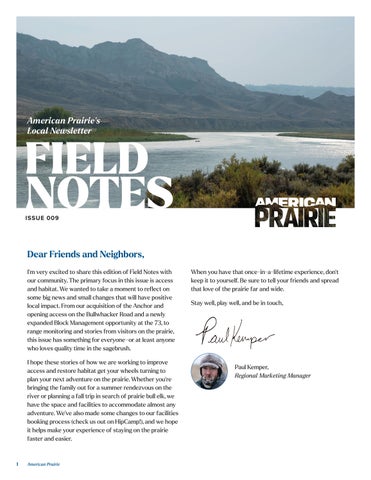
American Prairie’s Local Newsletter
FIELD NOTES ISSUE 009
Dear Friends and Neighbors, I’m very excited to share this edition of Field Notes with our community. The primary focus in this issue is access and habitat. We wanted to take a moment to reflect on some big news and small changes that will have positive local impact. From our acquisition of the Anchor and opening access on the Bullwhacker Road and a newly expanded Block Management opportunity at the 73, to range monitoring and stories from visitors on the prairie, this issue has something for everyone–or at least anyone who loves quality time in the sagebrush. I hope these stories of how we are working to improve access and restore habitat get your wheels turning to plan your next adventure on the prairie. Whether you’re bringing the family out for a summer rendezvous on the river or planning a fall trip in search of prairie bull elk, we have the space and facilities to accommodate almost any adventure. We’ve also made some changes to our facilities booking process (check us out on HipCamp!), and we hope it helps make your experience of staying on the prairie faster and easier.
1
American Prairie
When you have that once-in-a-lifetime experience, don’t keep it to yourself. Be sure to tell your friends and spread that love of the prairie far and wide. Stay well, play well, and be in touch,
Paul Kemper, Regional Marketing Manager
Doc is someone we are grateful to know, who has generously offered his expertise and an unwavering belief in the mission to return bison to the grasslands. He was there when the first bison hooves touched the ground at American Prairie in 2005, after more than 100 years of absence. A regular presence over the years, including attending our bison handlings, Doc has helped solve problems and offered his wisdom backed by decades of experience. And then in 2025, he chose to give something deeply personal to the American Prairie Field School.
The Gift of Friendship Celebrating Don “Doc” Woerner Dusty Rixford Education Manager
On a rainy morning in August, a 14-foot-long cargo trailer covered in bison graphics pulled up in front of the National Discovery Center in downtown Lewistown. What stopped traffic on main street was the full sized, half-taxidermied and half-skeletal bison that came rolling out of the trailer. Long before this gift ever crossed our threshold, Dr. Don Woerner, or “Doc” as most know him by, has been a friend and advisor to American Prairie for more than twenty years. Doc has practiced Veterinary medicine in Montana for nearly sixty years, running a family-owned clinic in the Yellowstone Valley west of Billings. For decades, Doc has consulted with a variety of bison operations, including privately-owned herds, tribal herds, and conservation herds including the bison of Yellowstone National Park. Family-owned cattle ranching is also part of Doc’s heritage and career. He’s a founding member and current board member of the Montana Bison Association, and he tells us, “Through the years I have worked with all classes of animals including livestock, pets, horses, zoo animals and wildlife. The American Bison is my favorite and most respected animal.” 2
American Prairie
Ernie the taxidermied bison is from Doc’s own collection and has traveled all over the West as an ambassador for prairie education. His presence is the common ground to tell shared stories: of history, of the people who followed the buffalo across the plains, and of the importance of preservation. Ernie is a bridge between people and the natural world, and will now share that connection with all the visitors who encounter him. When Ernie is not displayed in the front lobby of the National Discovery Center, he is on the road with the Field School, visiting classrooms in Montana. He is art and craftsmanship, the spark for conversation, and in real life an opportunity for education. Unlike a photograph, Ernie is massive and captures your attention, inviting you to study the texture of his fur, the shape of his hooves, how his ribs affix to his spine, or the size of his head. When you are with Ernie, you can’t help but be engaged, pondering, asking questions. And that right there is the real gift. For someone who has spent over twenty years helping strengthen American Prairie from the inside, this donation feels like the very spirit of who Doc is: steady, grounded, knowing, and kind-hearted. Ernie the bison reflects a belief that education and connection to place matter. That preserving the stories of landscapes, wildlife and of shared work are essential. And he will continue to teach and encourage both young and old, not only about the uniqueness of the prairie, but about the beauty of the natural world. We celebrate this new gift in the form of taxidermy and a custom trailer to transport Ernie, but we also celebrate Doc’s friendship and the quiet, steady company of someone who has believed in American Prairie for more than two decades. And who chose, at just the right moment, to make a gift that will carry that belief forward in a lasting way. Thank you, Doc, for your years of partnership, friendship and trust. And thank you for this remarkable gift.
Field Notes 3
The Road Back In American Prairie Reopens a Long-Disputed Gateway to the Missouri Breaks Beckie Williams Land Acquisition Director
Long before Blaine County had a county attorney, a district court, or a legal dispute worth writing about, the Bullwhacker Road was already a working route through some of the most remote country on the northern plains. Steamboats carried freight up the Missouri River from Fort Benton as far as the water would allow; when the river ran too shallow, cargo came off at Cow Island, and the bullwhackers took it from there, driving ox-drawn carts inland toward the mining towns beyond. They moved through country that didn’t make anything easy, and the road those drivers wore into the earth held the name of their trade long after the freight wagons were gone.
4
American Prairie
By the time the homesteaders arrived in earnest, Bullwhacker Creek and the draws feeding it were established geography. John Ervin was working land at the mouth of Bullwhacker Creek beginning around 1911, running cattle and horses in the breaks north of the Missouri in a stretch of country the BLM’s founding proclamation for the Upper Missouri River Breaks National Monument would later describe as some of the wildest terrain on the Great Plains.
Anchor Ranch totals 67,960 acres: 22,837 deeded acres and 45,123 leased acres. The Anchor Ranch itself was homesteaded in the 1920s along that same corridor. Pearl and Josie Gilmore filed their homestead claim south of Havre in 1934, building a log home and root cellar in the breaks and running livestock in country that tested anyone who tried to make a life there. The Gist family bought the Ervin ground in 1947 and continued ranching along Bullwhacker Creek until selling to the BLM in 1980. The Ervin Homestead and Gist Bottom are recognized today on the National Register of Historic Places.
The Long Fight for a Short Road Bullwhacker Road had been in public use for decades, traveled by land managers, ranchers, and recreationists, and served as the only reasonable motorized route into roughly 50,000 acres of BLM and state land in the Breaks. As recreational use of the road grew through the 1990s, the owners of the Anchor Ranch moved to close it, and the dispute that followed ran through multiple legal channels. The Public Land Water Access Association began gathering historical documents in 2006 to establish the road’s public status, arguing that its use predated the patent of the surrounding land in the 1920s. The Blaine County attorney agreed in 2007, declaring a 3.8-mile section of Bullwhacker Road public where it crossed the Anchor Ranch. That ruling was challenged in the 17th Judicial District Court in 2009, and in March 2011, a judge reversed the county attorney’s position, finding the evidence for a public prescriptive easement inconclusive and declaring the road private. The ranch changed ownership the following year, and a negotiated public access agreement with Montana Fish, Wildlife & Parks provided some limited, conditional use of the road, but the fundamental situation remained unchanged. Attempts to resolve the issue through a federal land exchange were explored and ultimately declined by the BLM in 2016. Montana FWP negotiated a separate access agreement through a private parcel in the area in 2023, and the BLM opened a short primitive road section in April 2024 to provide some legal motorized access into the Bullwhacker country, but these remained workarounds rather than solutions.
Opening the Gate In September of 2025, American Prairie purchased Anchor Ranch along with two additional properties in Blaine County — the second-largest land acquisition in our history. Anchor Ranch totals 67,960 acres: 22,837 deeded acres and 45,123 leased acres on the Bullwhacker Grazing Allotment. A second parcel adds 1,888 deeded acres adjacent to the south side of Anchor Ranch, and a third transaction in the Cow Creek basin brings an additional 5,401 acres. When American Prairie closed on Anchor Ranch, our first action was to reopen Bullwhacker Road. The 3.8mile section through the property is now open to public motorized travel, restoring reliable access to those 50,000 acres of public land in a way that doesn’t expire, isn’t
Field Notes 5
seasonal, and isn’t contingent on a negotiated agreement between agencies and private parties. Randy Newberg of Fresh Tracks and Hunt Talk put it plainly: “This is a win for anyone who cares about public access to our shared lands. It’s an area that’s both important to protect and for the public to access.” The Bullwhacker Allotment sits in the foothills of the Bears Paw Mountains, where upland prairie transitions into steep coulees, timbered ridgelines, and the broken terrain of the Missouri River Breaks. Elk, mule deer, white-tailed deer, pronghorn, upland birds, and bighorn sheep all use the area, and the property provides important connectivity for wildlife migrating between the Upper Missouri River Breaks National Monument, the CMR, and north toward the Bears Paw and Little Rockies ranges. The biological case for protecting this corridor has been well established; what’s changed is that the public can now reach it.
Keeping the Ranch in the Ranch On both Anchor Ranch and the Cow Creek basin property, the ranching families currently leasing the ground are
6
American Prairie
staying in place, continuing to run cattle on land they know. This reflects how American Prairie operates across its existing holdings; we currently lease land across 80 percent of our management units to 25 local livestock producers running approximately 8,000 head of cattle. Keeping working families on the landscape isn’t incidental to the mission; it’s part of how American Prairie manages the ground it acquires. More than 80,000 of American Prairie’s acres are enrolled in Montana Fish, Wildlife & Parks’ Block Management program, opening that land to public hunting. American Prairie intends to release a full public access plan for the new Anchor Ranch in 2026. The Bullwhacker country has always been worth the effort it takes to get there. The homesteaders who filed claims in this remote stretch of Montana understood that, and the hunters, hikers, and wildlife that use it now understand it too. American Prairie’s acquisition of Anchor Ranch doesn’t change what the country is; it changes who can reach it, and in a time when access seems more and more elusive, that makes a huge impact.
A Look Ahead Upcoming events at the National Discovery Center David Cunningham Kären and Jay Abbe Director of the National Discovery Center
American Prairie’s National Discovery Center has a lot to offer in 2026 — from world-class exhibits to our immersive dark sky experience to exciting short films, as well as upcoming exhibits and programs. Our newest addition is the Sherry Girten and Scott Waldie BlackFooted Ferret Exhibit featuring “Bandit,” an endangered species on loan from the National Black-Footed Ferret Conservation Center, a division of the US Fish and Wildlife Service! While visiting, check out “Ernie,” a full bull bison mount showing his complete skeletal structure!
Additional events in 2026 include a performance by Baroque Music Montana titled Beyond Baroque: Hymn of Thanksgiving – Beethoven’s Quartet Op 132, showcasing four world-class musicians; Women on Fire, a unique presentation featuring three women who fought (or currently fight) wildfires in various parts of the west (August 14); and A Journey to the Kazakh Steppe with Scott Heidebrink (October 22). Scott, American Prairie’s Director of Landscape Stewardship, will take the audience on a fascinating journey to the vast steppe of Kazakhstan, the world’s largest continuous grassland biome! We are also excited to feature our wild friends at the National Discovery Center. Our black-footed ferret Bandit will be the star attraction, along with expert speakers, during American Prairie’s Second Annual Ferret Fest (September 19). Eco-Critters with Zoo Montana, a fan favorite, will once again showcase live wildlife from around the world during five fun expeditions to Lewistown!
The National Discovery Center is set for another exciting year of programming. From May through October, we will host “The Art of Carol Guzman,” featuring many of Carol’s original prairie-themed works. The opening reception is scheduled for May 23.
The 2026 season closes with First Light: An Exhibition of the Works of John Isaiah Pepion (November 7). Mr. Pepion, an acclaimed Blackfeet artist, muralist, and educator, is widely known for his Plains graphic art, which combines traditional design with contemporary illustrations.
On May 27, we’ll feature journalist Dave Hage, author of the newly-released Sea of Grass: The Conquest, Ruin, and Redemption of Nature on the American Prairie. Hage’s presentation will discuss the history, destruction, and restoration efforts of the North American prairies.
Make plans to attend these events and to visit the National Discovery Center in 2026! The National Discovery Center is open Thursday through Saturday from 10 to 4. To learn more about upcoming events, please visit americanprairie. org/national-discovery-center. View our live ferret cam: americanprairie.org/webcams Field Notes 7
Learning from the Land Range Monitoring at American Prairie and Beyond Manning Rushton Bison Operations Manager
The range monitoring program at American Prairie is a collaborative effort that has been developed with input from ecologists, wildlife biologists, range conservationists, and holistic natural resource managers. It includes both short-term and long-term monitoring data collection, and has been evolving as a formal collaborative program since 2022. The short-term data we collect helps inform our bison management decisions on a seasonal or annual basis. The long-term monitoring program is in cooperation with the Intertribal Grasslands Network (a socioecological research effort led by Aaniiih Nakoda College and the Smithsonian Conservation Biology Institute) and will document changes across a larger landscape over decades.
8
American Prairie
Ranchers and land managers around Montana and beyond use range monitoring to document and learn from changes across the landscape, by measuring criteria determined by their management goals. The range monitoring program at American Prairie is built around assessments such as the USDA’s 17 Indicators of Rangeland Health, and collecting data that includes photo points, plant species identification, habitat cover measurements, and forage production estimates. These methods allow us to assess the carrying capacity of our bison pastures, as well as the condition of the rangeland and the quality of wildlife habitat that it provides. The goal of our partners at the Intertribal Grasslands Network is to establish a collaborative, tribally-led research network encompassing northern great plains Indigenous communities, tribal colleges, and the buffalo populations that they manage. The Network currently includes the communities of Fort Peck, Fort Belknap, Rocky Boy, Blackfeet and Confederated Salish and Kootenai Tribes. American Prairie provides another dataset in measuring the impact of buffalo on the prairies, and we are proud to be working in cooperation with all of these partners and leaders in buffalo restoration. The Intertribal Grasslands Network utilizes camera traps and audio recorders to monitor the presence and abundance of wildlife species on the bison range.
Root Morphology of common plants in a sagebrush steppe ecosystem
Teams measure vegetation height and biomass, and collect soil and vegetation samples for chemical analysis. Other work includes collecting bison fecal samples to assess the chemistry and plant species composition of their diet. For example, on one of the days the samples were collected, the bison on the Blackfeet Nation pastures were eating a significant amount of plants from the Rosacea, or rose family. In contrast, the bison at American Prairie were eating mostly grasses like the perennial needle-andthread grass and legumes such as yellow sweet clover. While this is only a snapshot of their overall diet, it is interesting to see the diversity in bison diet across these different habitat types from the mixed-grass prairie of northeastern Montana to the Rocky Mountain Front. The combination of quantitative and qualitative data over the short and long-term gives us a comprehensive and holistic view of habitat quality and range conditions. This will allow us to make sound management decisions about the bison herd and habitat restoration efforts for tomorrow and monitor the impacts of these decisions for decades to come.
Long-term Monitoring Sites American Prairie, Sun Prairie Unit
Field Notes 9
Huts, Hunts, and Harvests Anna Schale Public Access Manager
Every year, we look forward to reading through the guest books from our Myers Family Huts, getting your feedback after hunting season, and hearing from you in emails and notes. We love learning about the wildlife you saw, the time you spent with your family, the brilliance of the stars over the breaks at night, or the gumbo that sucked off your shoes! For this Field Notes, we thought we’d share some favorites from this past year. We hope these glimmers encourage you to plan your own trip to the prairie!
Public Access Update! Located along the southern border of the Charles M. Russell National Wildlife Refuge (CMR), along the Musselshell River in Garfield County, the 73 Unit of American Prairie has been open to the public since the fall of 2022. The 32,003-acre property comprises 12,233 deeded acres and 19,770 leased acres. New for this upcoming spring hunting season, we are opening the 73 for spring turkey hunting through Montana FWP’s Block Management program, including along the Musselshell river bottom. The closure of the Wildlife Viewing Area along the Musselshell River will resume August 15 to January 1 to provide quality wildlife viewing opportunities for the rest of the public. For more information on accessing the 73 and other American Prairie properties for hunting, visit: americanprairie.org/hunting.
10
American Prairie
“ We loved going on a long family bike ride first thing in the morning. Plentiful bird song and each vista was a revelation! We felt like the only people on Earth.” — Lewis and Clark Hut Guest “ Although we drove to many different APR sites (and enjoyed them all), some of the most interesting times we had were on the trails right around the Antelope Creek Campground: the baby prairie dogs gave endless enjoyment, burrowing owls nesting near pond, long-billed curlews nesting on the prairie dog towns, many native bees in the flowers, and fascinating plants.” — Erick, Missoula, MT “ One evening as the sun was setting, I was on the hilltop next to the tepee when I heard cattle mooing and turned to see cattle being driven by a lone cowboy on horseback. Iconic image in real life.” — Gary, Bothell, Washington “ I flushed out dozens of grouse on my walk around your nature trail. I can still hear the pounding of their wings.” — Gwen, Aztec, NM
“ This was my first ever elk hunt. I got to see a good amount of elk and stalk in on some. Although I didn’t harvest one, I learned a lot about elk and elk hunting. This is a beautiful property and it was so special to get to be the only one hunting on it. Thank you.” — Kate (youth hunter), Billings, MT “ Had a great experience with low pressure animals. Best hunt of my life.” — Michael, Colombia Falls, MT “ I’ve hunted the area surrounding Blue Ridge for many years and always wished I could hunt it. I was able to this year and really appreciated the opportunity and was successful on a great bull.” — Denny, Stacey, MN “ I hunted Blue Ridge in late October, during the first major snowstorm of the season. My first day was wiped out due to weather but we still drove the roads to get a feel for the area and find the walk-in parking locations. The weather cleared on the second day and provided phenomenal elk hunting, my brother and our friend were along for the hunt and we were able to harvest my first ever bull.” — Blue Ridge Hunter “ The first time I’ve heard meadowlarks and bugling bulls simultaneously. The weather was awful mid-hunt which makes for strong memories of the wet, cold, uncomfortable times. Sharing the landscape with a hunting partner who has the same appreciation for habitat and experience that I do. I’ve gotten to tag along with him on some pretty big opportunities and it was pretty special to share this one with him.” — DJ, Colombia Falls, MT “ Seeing elk every day, having opportunity each day, the whole time spent is a great story, I got to spend it with my grandson which means a lot personally and our stories together chasing and calling elk for those days are something that I can tell around the fire anytime” — Jeffrey, Bigfork, MT “ Just had fun biking on the local trail but also outside the gates and getting to the edge of the CMR-WR. Took way too many pictures and enjoyed my stay a lot. Long days! Sunset at 10:15 and dawn at 4:30 with storms in between :)” — Carter, Bozeman, MT
“We had an amazing northern lights show!” — Antelope Creek Visitor “ We enjoyed trips to Zortman, Mission Canyon and the Prairie Union Schoolhouse.” — Helen, Clancy, MT Such a unique habitat! Great signage on your trail. Best restroom and shower on our two week trip!! — Carolyn, Leavenworth, WA “ We had our bear spray ready and kept an ear out for rattlesnakes but in the end, it was a big white cow on the old ranch road where we were mountain biking that stopped us in our tracks! She was guarding the calves and other mom cows and wasn’t going to budge. We loved watching the prairie dogs in the prairie dog town and listening to them chatter. Because our hut had a sizable solar refrigerator and a gas stove, we cooked some pretty awesome meals, especially our candlelight dinners—so fun!” — Lisa, Des Moines, IA “ The sunrises and sunsets, storms and skyscapes, in the Missouri Breaks area seem to be some of the best you will find in all of Montana. Couple with the adventure, the wildlife, and the rich history it is a very unique place to spend some time.” — Terry, Missoula, MT “The coyotes are LOUD lol” — Leonard, Great Falls, MT “ Burrowing owls — always a joy — and also a couple of rarely seen species (by me, at least), brown thrasher and indigo bunting.” — Linda, Clancy, MT “ We had 4 kids who just loved it. The 3 year olds hiked into Craighead the whole way, and bike trailers carried the younger ones. Roads were dry enough to make this possible, which is not always the case. The cattle round up was a hit with the kiddos, and cowboys were easy on the wives’ eyes.” — George, Missoula, MT “ Three times in a row we have seen the Aurora while staying at the L&C hut without any forecasting. Quite a show.” — Hut guest
“ While visiting Buffalo Camp a large Bull Buffalo was in the camp alone, no people and no other buffalo he was scratching himself on the camp site sign.”
“ We had a spectacular view of the December full moon rising over the Missouri.”
— Dennis, Yakima, WA
— Gary, Great Falls, MT Field Notes 11
P.O. Box 908 Bozeman, MT 59771
[Recipient Address]
Heard about American Prairie in the news, and wondering what’s going on with the BLM decision, grazing bison on public lands, and what’s next or what you can do? For the most up-to-date information, FAQ’s, and resources, visit: americanprairie.org/bison-belong-here/
CONTACT
Corrie Williamson American Prairie Director of Community Outreach corrie@americanprairie.org
12
American Prairie