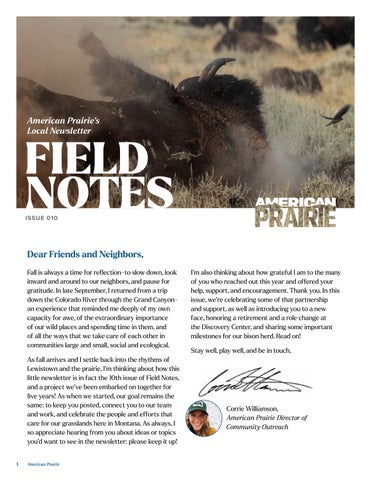
American Prairie’s Local Newsletter
FIELD NOTES ISSUE 010
Dear Friends and Neighbors, Fall is always a time for reflection–to slow down, look inward and around to our neighbors, and pause for gratitude. In late September, I returned from a trip down the Colorado River through the Grand Canyon– an experience that reminded me deeply of my own capacity for awe, of the extraordinary importance of our wild places and spending time in them, and of all the ways that we take care of each other in communities large and small, social and ecological. As fall arrives and I settle back into the rhythms of Lewistown and the prairie, I’m thinking about how this little newsletter is in fact the 10th issue of Field Notes, and a project we’ve been embarked on together for five years! As when we started, our goal remains the same: to keep you posted, connect you to our team and work, and celebrate the people and efforts that care for our grasslands here in Montana. As always, I so appreciate hearing from you about ideas or topics you’d want to see in the newsletter: please keep it up! 1
American Prairie
I’m also thinking about how grateful I am to the many of you who reached out this year and offered your help, support, and encouragement. Thank you. In this issue, we’re celebrating some of that partnership and support, as well as introducing you to a new face, honoring a retirement and a role change at the Discovery Center, and sharing some important milestones for our bison herd. Read on! Stay well, play well, and be in touch,
Corrie Williamson, American Prairie Director of Community Outreach
My professional background is in economics, non-profits, outdoor recreation, and tourism. Perhaps it took a project as big as American Prairie for me to tie all these threads together. My work has been split between community outreach and time in Lewistown at the National Discovery Center. I love to get out there and talk to people! I’ve had the chance to engage with tribal partners, business owners, ranchers, politicians, and everyone in between. What a joy it is going out and meeting people face-toface, especially in this digital age.
A New Face Around Town... ...and on the Two-Tracks: Meet Mike Kernan Mike Kernan
Senior Conservation Enterprise Manager
Hey there, I’m Mike Kernan, one of the new faces around Lewistown and American Prairie. In March I began as the Senior Conservation Enterprise Manager and have already had a great time exploring the prairie and meeting the folks around here who make this place so wonderful. Prior to joining American Prairie and moving to Lewistown, I’d been in Missoula for quite some time, although I’m originally from Wisconsin. I feel so lucky to be here in Montana, surrounded by mountains, rivers, and prairie to explore! If I had to define my life with one object, it would be the bicycle. I really enjoy all varieties of cycling, but I tend to spend the most time spinning around on gravel roads and wow is it great riding in the American Prairie area! The gravel roads and twotracks out here are endless. I often go hours without
2
American Prairie
seeing any cars or trucks. The gumbo mud is definitely no joke, though. If you’re out riding and see storm clouds coming your way, flip it! I recently dilly-dallied too long and got caught in a storm about seven miles west of the James Kipp campground. The roads turned to gumbo and I got back to my car quite a bit later than planned.
I recently assembled our 2026 Community Impact Report which helps synthesize our presence in the seven counties where American Prairie holds land. This region has a diverse and established economy, and we are glad to be here and be a part of it all. Here are some key takeaways: • As American Prairie’s footprint has grown, we’ve continued to enroll more land for hunting in the Block Management program. We’re one of the largest Block Management participants in the state with over 82,000 acres enrolled in the program. • Total visitation to our huts and campsites has increased every year from 2021-2025. Since opening in 2021, the National Discovery Center in Lewistown has also seen increased visitation year after year. On top of being a great place for people to start their trips to the prairie, the NDC has played a key role in American Prairie increasing the proportion of its staff living in Lewistown, and thereby adding more dollars into our local community.
Luckily this is proper Big Sky country and you can often see 100 miles in any direction, so keep your eyes on the horizon and don’t wait until that cloud is on top of you. Another detail worth mentioning that I appreciate about riding here is how many people wave back to me when we do encounter each other on the road. I really like waving to strangers when I’m out on the bike, so it’s nice being somewhere where people wave back.
• Partnerships with neighboring ranchers through our Wild Sky program continue to increase! We love getting to partner with our neighbors through a shared appreciation for the land and wildlife. I’m sharing a few graphs from the report here, but check out the full deep-dive at www.americanprairie.org/ publications. I’ll be out and about, on the prairie and all over Montana, so say “hi” if you see me around! Or if you see me on my bike, wave back please! Field Notes 3
The STEM curriculum Dusty implemented connected Montana students with experts and research scientists from both the Smithsonian Institution and American Prairie. Subjects taught included wildlife ecology, geology, plant biology, astronomy, natural and human history, and Traditional Native Games. In addition, Dusty worked closely with American Prairie field staff and skilled instructors from Yellowstone Forever, Montana Outdoor Science School, Aaniiih Nakoda Tours, and Touch Grass LLC to support prairie science education for Montana middle school students. For much of the time, Dusty was a one-woman show, which is evidence of her tenacity, work-ethic, and grit. From managing complex logistics to maintaining critical partnerships with collaborators, Dusty succeeded in making the Field School a resounding success!
A Changing of the Guard: David, Dusty, and the National Discovery Center At the end of this year, David Cunningham will retire as the head of our National Discovery Center, and Dusty Rixford, who has managed our Field School and youth educational programming for more than five years, will step into the role. We asked David and Dusty to reflect on their time working together, one another’s accomplishments, and some of the plans for this important transition.
Passing the Baton Leaving the NDC in Great Hands David Cunningham Kären and Jay Abbe Director of the National Discovery Center
At the end of this year, I will be stepping away from my post as the Kären and Jay Abbe Director of the National Discovery Center and heading into some semblance of retirement in Wyoming, where I have had a home since 2011. On January 1, I will confidently hand over the reins to Dusty Rixford, the new Senior National Discovery Center Manager! Dusty has a wealth of experience providing educational programming and experiences to young people in Lewistown and Central Montana, creating early and 4
American Prairie
enduring connections to Montana’s prairie ecosystem, and I am honored to leave the Center in her capable hands. Dusty grew up in the Sonoran Desert of Arizona, where she developed a love for the outdoors. Early on, she worked in conservation education and fire prevention for the U.S. Forest Service, serving on hotshot crews and as a smokejumper throughout the western United States. As a firefighter, she completed an amazing 49 jumps! In 2021, Dusty came on board as American Prairie’s Field School Manager. During that time she built meaningful and impactful relationships with local teachers, students, Tribal partners, and the general public. The American Prairie Field School offered education programming for grades K through 12 and consisted of immersive overnight and day programs at Antelope Creek Campground and the Discovery Center, providing them with the opportunity to learn about the plants, animals, and people that shape the prairie ecosystem.
While Dusty will continue some of the National Discovery Center’s current programs (for example, Eco-Critters and the Music Series), she will also develop new and exciting programming of her own. One of her goals is to better serve younger audiences. Dusty has already built a strong following for her popular Beaver Tales program. This weekly series at the National Discovery Center is focused on preschool kids who, through fun activities and storytelling, learn about the prairie. In addition, as Field School Manager, she regularly hosted school groups at the National Discovery Center, expertly utilizing the incredible exhibits in that space. That Dusty will continue bringing her knowledge and skills, as well as her heart and soul, to her work as an educator is a blessing to all of us at American Prairie, and to those of us in Lewistown and Central Montana. I am very grateful for Dusty’s willingness to step into her new role and greatly look forward to seeing the next exciting phase of growth under her leadership at the National Discovery Center!
Leaving a Lasting Footprint Celebrating David’s Retirement Dusty Rixford
Senior National Discovery Center Manager
For the past four years, David has helped make the National Discovery Center so much more than just a place to learn about the prairie. Through his creative programming, special events, and countless connections with people in our community, David has made the Center a place where all can gather, discover something new, and feel a little more connected to the landscape and people around them. David’s leadership and dedication to American Prairie and the National Discovery Center is admirable. David’s special events, wonderful speakers, and unique programming have been a cultural treat with something for everyone in the community, drawing folks into the Center who had never stepped inside before. From a talk on authentic Indigenous Blankets with Barry Friedman to prairie lectures about the many facets of the prairie, to intimate concerts with world class musicians, David’s programming brought something special to Lewistown. Being a museum guy and history major, David understands that museums are not just a place to preserve things from the past, but a place where people can hear those stories, and understand their importance and how they fit into the big picture. When you ask David about what he is most proud of during his time as Director of the National Discovery Center, you might be surprised that the answer is a small and extraordinarily rare mammal: the black-footed ferret. The black-footed ferret enclosure and display is top notch and represents so much of what a discovery center is all about, telling a story about the prairie, its wildlife, and one of the remarkable recovery efforts in the history of conservation. Bringing back the endangered black-footed ferret, one of North America’s rarest mammals, from the edge of extinction is history that all should know. That little ferret is more than a display. It is a reminder of the importance of curiosity, conservation, sense of place, and perseverance. And of a director who believed those stories were worth sharing. As David prepares to retire from his role as Director of the National Discovery Center, his legacy will live on in many ways–in the programs he helped create, the events he brought to our community, the visitors he welcomed, and the stories he helped preserve. The National Discovery Field Notes 5
Center will continue to be seen as a valued community resource with opportunities to gather, learn, experience, and connect. Long after David has retired, visitors to the National Discovery Center may not know about the director who, through hard work and collaboration with the US Fish and Wildlife Service and the Black-Footed Ferret Conservation Center, brought the ferret to Lewistown. However, they will experience a small part of his legacy. We will miss David’s knowledge and expertise. We will miss his quick wit, his stories, his kindness, his friendship, and his obscure knowledge for answering those unusual trivia questions-but mostly we will miss him! Thank you, David, for everything you have given to the National Discovery Center and to our community. We wish you a retirement filled with new adventures, football, fishing, time on the beach, plenty of laughter, banana pudding, and also a little less responsibility.
Bison Belong Here And So Do You Scott Heidebrink
Director of Landscape Stewardship
For thousands of years, bison shaped the grasslands and cultures of North America. Their grazing, movement, wallowing, and sheer presence influenced the plants, wildlife, soils, and people of the Great Plains. More than any other species in North America, they are part of the ecological and cultural identity of the prairie. For the last 200 years, the story of bison has largely been about what was lost. Tens of millions once moved across North America before they were systematically removed in the nineteenth century. With important milestones being reached in 2026, the story continues to evolve. We are turning the page and entering a chapter defined by return. These milestones reinforces the reality: Bison Belong Here. With this year’s bison calves being born in May, the bison population on American Prairie has grown to over 1,000 bison on over 50,000 acres. Reaching 1,000 bison represents far more than a population
6
American Prairie
milestone. Each additional bison represents another step toward restoring the ecological processes that once defined this landscape. Herds of a large size can move across vast areas, graze at meaningful scales, create disturbance, redistribute nutrients, and interact with the prairie. One thousand bison demonstrate what becomes possible when conservation moves beyond protecting an individual species and begins restoring the relationships between animals and the landscapes that shape them. With others in the region (including the Chippewa Cree of Rocky Boy, Fort Peck Assiniboine and Sioux Tribes, and the Aaniiih and Nakoda Nations of Fort Belknap) seeing Buffalo success as well, Buffalo now number over 3,000 in the broader region and are returning ecological function to over 100,000 acres and to the culture and communities that thrived for millennia with Buffalo. This milestone also represents years of work, patience, and persistence. Growing a herd of bison requires land, water, fences, animal husbandry, monitoring, partnerships, and people willing to tackle complex challenges. It requires balancing ecological objectives with the realities of managing large animals in a working landscape. Reaching thousands of bison is not the end of this effort. It is evidence of what commitment to ecological function and bison can accomplish.
Field Notes 7
This progress has also been reinforced in another important arena. In early September, a U.S. District Court judge’s ruling will keep bison on the landscape and represents something larger than the outcome of a single legal dispute. It is the beginning of recognition that bison have a legitimate place on today’s landscape and that their presence can coexist with the laws, land uses, communities, and management systems of the region.
An Abundance of Gratitude Partnership Highlights from 2026 Corrie Williamson
Director of Community Outreach
That is what Bison Belong Here means. It means restoring an animal while also restoring ecological function. It means recognizing bison as livestock while continuing to create opportunities for them to function more fully as part of the ecosystem. It means working with neighbors, ranchers, Indigenous communities, agencies, scientists, conservationists, and others who share a connection to these grasslands. And it means demonstrating that restoring bison does not require abandoning the people, cultures and communities of the prairie. The future of bison includes everyone. One thousand bison is worth celebrating. A legal decision keeping bison on the landscape is worth celebrating. But both are part of a much longer path. The goal is bigger than a number, a court case, or a single herd. The goal is a prairie where ecological function once again has the space to shape the land, where people can experience bison as part of a functioning grassland ecosystem, and where future generations no longer have to imagine what a landscape with bison might look like.
Bison Belong Here.
8
American Prairie
In many ways, 2026 has been a challenging year, with threats to our bison program and public land leases. But amidst those challenges, a silver lining has been the reminder of the strength and depth of our support and our partnerships. We are grateful to all of you who spoke out during the many public comment periods and other opportunities for public participation over this past year. We’re also pausing to celebrate some of the folks we are lucky to get to do this work with. Here’s a highlight of some of our favorite collaborations this year: • This was our first full summer of leasing tipis at Antelope Creek Campground from Aaniiih Consulting, Hospitality, and Outdoor Adventure LLC, a nativeowned business out of Fort Belknap. We are so grateful to get to partner with Aaniiih Consulting to share the plains’ most iconic and ancient lodging with visitors, and also to learn from our tribal partners through trainings, tours, and consultation. If you’re visiting the prairie and interested in experiencing the landscape with a native guide, we’d be delighted to connect you to Aaniiih Consulting or our good friends at Aaniiih Nakoda Tours! • The Smithsonian Conservation Biology Institute is our science partner, and, alongside them, we participate as a monitoring site with the Intertribal Grasslands Network, a long-term socio-ecological monitoring collaboration, made up of tribal colleges and tribal Buffalo programs across the Hi-Line. This year, we were honored to host the Network’s season-opening training and team-building gathering out at our Enrico Center on our Sun Prairie property. Interns from tribal colleges from the Blackfeet Nation, Fort Belknap Indian Community, Rocky Boy Chippewa Cree Tribes, Fort
Peck Tribes, and Confederated Salish Kootenai Tribes, as well as Smithsonian staff were able to spend a week on the prairie in the green of June, learning from one another, preparing for their upcoming research season, and connecting with ancestral homelands. • We are thrilled to work with multiple Osher Lifelong Learning Institutes (a diverse network of non-credit courses and educational programs, specifically designed for people who are 50 or older) including planning a new trip offering with Montana State University’s Osher for 2027, hosting a University of Montana Adult Field School course for the second year in a row, and popping down to Boise State for an Osher lecture this fall. We love connecting with university systems, researchers, students, and teachers, and welcoming groups like this to the prairie! Such courses are so valuable in offering participants a deeper understanding and appreciation of our region and the grasslands, and most meet with other NGO’s, local programs, tribal nations, and neighbors. • We are proud to continue our partnership with the Rocky Boy Buffalo Program and Buffalo Child Ranch. The Buffalo Program leases the deeded portion of our Dry Fork property for their satellite herd (in addition to the Buffalo on Rocky Boy tribal lands near Box Elder) which will grow by around 75 Buffalo after our handling this fall! These Buffalo support food sovereignty efforts in the community as well as cultural revitalization. • Our landscape is multi-jurisdictional, and this year we were really grateful for our local Fish, Wildlife, and Parks staff, and all their coordination with our team–from connecting around exciting developments at the new Judith Landing State Park on the PN (on 109 acres donated by American Prairie to the Montana State Parks Foundation in 2024) to working with our local wardens and regional managers on a successful opening of Bullwhacker Road to the public for the first time in over a decade. We look forward to seeing more infrastructure, interpretation, and trails developing at Judith Landing State Park in 2027, and to hearing your stories of adventure on the Anchor! Thanks again to all our friends and partners across the state for another year of working together to benefit people and prairies. Field Notes 9
Wild Sky Highlights and Photo Contest At the Chokecherry Festival this year, attendees voted for their favorite Wild Sky Camera trap photo of 2025. Read on to see the images that were voted on and where the first place image was captured. We are grateful to area landowners and ranchers for their love of the land, their stewardship, and for participating in the Wild Sky program! Visit www.americanprairie.org/wildsky to learn more about our Wild Sky program.
1st Place: Two mountain lions slink past a Wild Sky camera trap on Lance Johnson’s ranch in the Judith Mountains.
2nd Place: A Bald Eagle soars past the camera trap on Bill Milton’s ranch near Roundup.
10
American Prairie
Field Notes 11
P.O. Box 908 Bozeman, MT 59771
Thank you for your interest in American Prairie! Learn more at AmericanPrairie.org, and don’t hesitate to reach out with questions or concerns, or to share ideas for future newsletter topics.
CONTACT
Corrie Williamson American Prairie Director of Community Outreach corrie@americanprairie.org
12
American Prairie