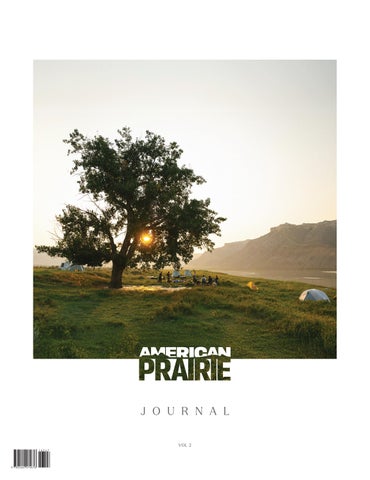
J O U R N A L VOL 2
American Prairie's mission is to create the largest nature reserve in the contiguous United States, a refuge for people and wildlife preserved forever as part of America’s heritage.
© 2025 American Prairie Foundation. All rights reserved.
A M E R I C A N P R A I R I E J O U R N A L VOL 2
5
Vision, Persistence, Partnership
6
A River Runs Through It
18
Designing for the Prairie
22
Sageland Scenes
32
Return to the Prairie
38
Where Land Repairs the Soul
42
A Pedal Through the Prairie
56
The Beacon of Fort Benton
60
Quietly, Then Boldly
64
Bison: Portrait of an Icon, an excerpt
70
A Long-Range Perspective
80
What Charlie Russell Did (and Didn't) See
86
Free Land: Prints by Jason Clark
92
Contributors
3
4
American Prairie Journal
Vision, S Persistence, Partnership
omething extraordinary is happening on the Northern Great Plains. After years of vision, persistence, and partnership, American Prairie has reached a true tipping point—in scale, in reach, and in the incredible support we’re seeing from people across the country. I feel immense pride in what we’ve accomplished together, and deep gratitude for the growing community that believes in our mission. Awareness of both American Prairie and this awe-inspiring landscape has never been greater—and that collective awareness is fueling something powerful. With a landscape so grand and wildlife so iconic, it’s easy to get swept up in the excitement of what’s unfolding here. As an organization, we talk often about our bison herd, our rewilding work, the scale of our habitat base, and the amount of effort it takes to make it all possible. But this edition of The Journal invites us to slow down and listen to the quieter, deeply human stories woven through the prairie’s expanse. Stories about connection and belonging, of community and culture, of art and adventure. Stories that reveal a certain warmth and humanity in a place too often characterized as rugged or bare. As we embark on our 25th year as an organization, I find myself reflecting on all the people who make our work not just possible, but meaningful. Every person who has spent time on the prairie has been shaped by it in their own way. Their stories remind me why this place and our mission matter, and why I’m so inspired to keep it moving forward. Just imagine what stories the next 25 years will bring. I hope you enjoy this edition of The Journal, and that it brings you a little closer to this extraordinary place we all love and hold dear.
Alison Fox, CEO
5
A RIVER RUNS
6
American Prairie Journal
Words & Photos by Max Lowe
T H RO UGH I T 7
THERE ARE CORNERS OF THE WORLD where our past lies closer to the surface of the present. The plains of Montana are undoubtedly one of these mystifying places, where history is whispered in the wind and pours out of the sediment and shale as it is decayed by the elements. It feels like a place where the stories of those who walked the land before us live more tangibly on the edge of our own. Having grown up in Bozeman and traveled throughout the many diverse landscapes of our state over the course of my now almost 37 years, I have learned to interpret my home state by the feeling of how close the past feels to the present, and what lessons can be learned by listening in those moments. Heavy raindrops fell on the windshield as my wife, Lia, and I drove across the New Fort Benton Bridge and into the town once known as the innermost port in the world: Fort Benton, Montana. The last stop for steamboats traveling up the Missouri River from St. Louis, Fort Benton served as the last navigable port-of-call for settlers, miners, fur traders and
the like coming west during the great expansion. It had been an unusually wet summer, and on this mid-August afternoon when the wheat farmers in the surrounding country were praying for hot and dry weather so they could harvest their crops, the rain came down in sheets pelting the surface of America's longest river, the mighty Missouri. On its banks the Grand Union Hotel stands prominently, restored and still operational as the oldest hotel in the state, built in 1882 to house and entertain weary steamboat passengers fresh from their sometimes months-long journeys up the river. In the lobby we met our fellow travelers, and our river guides Kelly Engen and Jonna Schuller, as well as the owner of Missouri River Outfitters, Nicolle Fugere. Together we would be paddling through the Upper Missouri River Breaks National Monument. Uncrossed by roads for 47 miles, the section of river ahead of us still stands as one of the longest stretches of wild river in the lower 48.
THIS SECTION OF RIVER STANDS AS ONE OF THE LONGEST STRETCHES OF WILD RIVER IN THE LOWER 48.
8
American Prairie Journal
Lia getting ‘barreled’ in a natural rock wave, the closest we got to the white cliffs.
9
Along our float, MRO Guide Kelly provided equal parts paddling tips, local lore, and perfect solitude.
10
American Prairie Journal
Like those first humans who traversed the waters of the Missouri, we would travel by canoe and paddle, aided by Missouri River Outfitters’ founding principle that quiet waters allow for a more intimate and profound connection with place. Founded in 1965 and standing as the longest operating outfitter in the state, MRO was imagined as a part time job and full-time obsession by a “Motley Crew” of teachers during their summers off. They wanted to share their passion for the vast written and oral history of the area, and their love for the Missouri Breaks’ natural splendor. Now owned and operated by the mother-daughter team of Nicolle and Janice Fugere, MRO still functions under the same guiding principles: that there is immense knowledge to be gained in finding ourselves within the story of the river that runs through it all. As we unloaded our 18-foot sunflower yellow canoes at the Coal Banks boat ramp and packed them with more gear than seemed reasonable for such slender and elegant craft, the storm clouds from the day prior clung to a distant horizon. Our cheery guide Kelly Engen, a 3rd generation Montanan, born and raised in Fort Benton, now a photographer and grade schoolteacher like MRO’s founders, is undeterred by the potential for more rain. “We have indeed packed all of our myriads of equipment and provisions in dry bags for this exact reason,” he exclaims, “that, and or if you happen to flip your canoe by accident!” As distant thunder rumbles, we take our first paddle strokes into what will be three days in still wild country, traveling those 47 river miles through the White Cliffs section of the Breaks, and
into some of the westernmost sections of American Prairie. Since before recorded history, the Missouri has been a sacred thoroughfare for numerous Native American tribes. Most relevant to the stretch we would travel are the Aaniiih (Gros Ventre), Nakoda (Assiniboine), Niitsitapi (Blackfeet), Nez Perce, and Lakota. Not only was the river a source of life with the water it delivered from snowy peaks of the Rocky Mountains, but it was also a thoroughfare for tribes to travel by canoe in pursuit of the buffalo that blanketed the plains. There are no exact population statistics for the American Bison, but historic accounts described herds of the iconic wild bovine so vast, they could span 50 miles, darken the plains and shake the earth as they moved. In the early 1870s US government policy encouraged outright slaughter of the northern herds of buffalo, as a backhanded way to subjugate the Plains tribes and force them onto reservations. What resulted was a nearly complete extermination of the American Bison: culling a population estimated at 1.5 million in 1870 to a mere few hundred animals by the late 1800s, most of which found haven in the northern reaches of the newly founded Yellowstone National Park. Most wild buffalo remain in Yellowstone today, but indigenous-led efforts and conservation organizations have been working to restore bison to Montana’s Northern Great Plains. The combined efforts of these organizations and the individuals within them move us a small step closer to that history of open country, where the bison can once again roam as they once did in the not-so-distant past.
11
Many cows graze along the river banks, requiring a little clean up before pitching tents.
12
American Prairie Journal
Every campsite was epic, but that night Justin’s campfire guitar and a dose of ’90s rock made it unforgettable.
13
There are bison that drink from the creeks flowing through American Prairie’s Sun Prairie unit en route to the Missouri. But the animals we see most on the banks of the river are cattle grazing on allotments leased within the National Monument. Behind these cows are the ranchers who now steward much of the prairie and beyond, and who now define a large role in our human relationship to the land in Montana. By the late 1800s ranchers were moving cattle into the open plains, establishing lifestyles defined by the harsh beauty with which they were met. The PN Ranch at Judith Landing where we would end our float became one of the most storied cattle operations in Montana and served as a hub for commerce, mail, and community gathering in the Judith Basin. Ranching families lived and worked in deep connection with the land, managing cattle amid challenging terrain and weather while navigating shifting economic and environmental pressures to become one of the defining legacies in the state's history to this day. As we pulled our canoes up on the muddy banks of the Mo (as the Missouri is affectionately known) to break for lunch, cows scattered into stands of cottonwood trees looking on with concerned curiosity. As soon as lunch was laid out, the clouds naturally open and we stand in rain gear beneath what sparse shelter the ancient cottonwoods offer, eating our sandwiches
14
and laughing at the timing. But as fast as it arrived, the storm moved off to the south and we were led up the hill by Kelly to an overlook where he pointed out an overgrown but still distinct circle of stones. “If you were flying over the breaks looking down, you would see hundreds of these along the banks of the river.” Kelly tells us, “The ancient markers of where tipis once stood, raised by the many tribes who moved along the river as we do now.” Afternoon comes on lazily to the river, while our paddle strokes carry us further into the iconic landscape that gives the White Cliffs their name. Towering alabaster walls of sandstone rise from the grassy hills, lending an otherworldly feel to an otherwise familiar landscape. From his journal entry on May 31st, 1805, as they arduously made their way up the same section of river we now descend, Meriwether Lewis wrote; “The water in the course of time...has trickled down the soft sand cliffs and worn it into a thousand grotesque figures, which with the help of a little imagination...are made to represent elegant ranges of lofty freestone buildings, having their parapets well stocked with statuary.” Now more than 200 years later with so much having changed here on the plains of Montana, these stone effigies remain, a testament to how close we truly are to that defining history in geologic time.
American Prairie Journal
Early morning hike to perch in the Hole In The Wall. See page 4 for perspective.
15
16
American Prairie Journal
With every bend in the river, a new magic castle of stone appeared.
A lone cottonwood stands silhouetted against the raking cliffs beyond, marking our campsite for the night. White throated swifts dance in and out of the ancient mother tree’s branches, chasing the evening hatch of mayflies coming off the river as we unload our canoes and fan out looking for dry spots to set up our tents. Jonna and Kelly fire up the camp kitchen for dinner as a full “Sturgeon Moon” rises, named by Native Americans for its relevance to the time of year that the massive prehistoric fish were most readily caught in the Missouri and beyond. Adjacent to the moon's rise and framed in the last glow of light that creeps across the valley, a massive keyhole eroded from the cliff face sits above our camp, aptly named “Hole in the Wall.” In the morning, we will hike up to the prominence above the natural arch to look down on the sweeping heart of the Breaks that surrounds us, but for now we settle around the warm campfire as the sun dips low on the horizon. As night falls around us, the sound of distant coyotes somewhere up on the canyon rim interrupts the din of crickets and the crackling of fire at our feet. Kelly reads excerpts from a book that chronicles the journals of the Lewis and Clark expedition, the first written account of this landscape. The name “Breaks” comes from their observation that the rugged cliffs broke the
otherwise flat and seemingly endless landscape across which they had traveled to this point. Their reverence for the wild nature of this place and the vitality of the river that carried them through it was evident in their writing, and the experience they conveyed felt palpable as we considered the collective story of this place, of which we now felt a part. I remember another night in the annals of my own story, sitting on the banks of this same river with my extended family as an awkward 12-year-old; the last and only other time I traveled down the Missouri River on a canoe trip not unlike this one. Thinking about how much has changed in my life since then; many things now fade into the past, and much has shifted in how I view the world since then, and it shakes me to the core. How we interpret the idea of place is so intimately tied to perspective, and now to be here again traveling these same riffles in the river and walking the same banks 25 years later, the perspective I’ve gained is one I’ve learned to listen for and treasure. We choose to be a part of the story of these places or not; and that choice to go and see how the world changes and doesn't, gives us roots that reach deeper into our shared history than we know. •
17
18
American Prairie Journal
Designing for the Prairie Words by Lindsay Schack
THE PRAIRIE has a way of reminding you what matters. You are exposed to everything: the continuous landscape with endless wind, snow that drifts into every corner, a night sky that stretches for miles. I grew up in eastern Montana, and spent a lot of time at my grandparents' cattle ranch just across the border in North Dakota. I remember spending my childhood outdoors in all conditions, running around the farm with my sisters. Those experiences shaped how I see the world. The land demanded respect. You learned to take care of each other, to be resilient, and to find beauty in utility.
19
That early understanding still shapes how our team at Love Schack Architecture approaches design. There’s a purpose in the plains that is evident in any rural area. Out here, buildings aren’t meant to make statements; they’re meant to endure. They are tools for connection, providing protection, reflection, and space for gathering. My path to architecture was not easy coming from eastern Montana. Design was not part of the culture, mainstream influences were scarce, and shadowing an architect during high school almost scared me away. The nearest architect was sixty miles away and worked out of a quonset hut. The experience taught me that in the prairie, aesthetics came second to utility. You designed for survival. And there is still some truth to that for me. Designing in harsh conditions requires creating safe, efficient environments that respond to their surroundings.
20
Architecture in this landscape is not just about survival; it’s about finding a dual purpose between durability and inspiration, protection and comfort. That balance is where artistry lies. Our design at Love Schack has always been grounded in that intersection of science and beauty. Over a decade ago, I began studying Passive House principles while designing a teaching space for rural students in eastern Montana, aiming for building assemblies that were safe and non-toxic. I wanted to understand how building science could make structures both safe and sustainable. That research continues to guide our practice. The prairie’s extreme climate places tremendous stress on buildings. Passive House methods allow us to design structures that can withstand that stress while minimizing environmental impact and creating a comfortable living environment. It is a practical solution rooted in respect for both the people and the place.
OUT HERE, BUILDINGS AREN’T MEANT TO MAKE STATEMENTS; THEY’RE MEANT TO ENDURE.
American Prairie Journal
When American Prairie invited us to collaborate on new structures across their vast landscapes, it felt like coming home. Although our studio is based in Bozeman, eastern Montana remains at the heart of who I am. That part of the state is rarely in the spotlight. It does not have the jagged peaks of Glacier or the geysers of Yellowstone, but its beauty runs deep in the stillness, the color of the grass, and the light that moves across the horizon.
setting. We sourced materials as locally as possible, selecting them for their strength and longevity. We incorporated Passive House building methods, including air sealing, high-quality insulation, and healthy materials.
American Prairie’s commitment is generational. They think in centuries, not decades. Designing for that vision is both humbling and inspiring. The Lewis and Clark Hut is not meant to impress; it is meant to belong. It provides shelter that invites people to slow down and look around, to notice the details that make the prairie extraordinary.
American Prairie’s mission—to restore and protect one of North America’s largest grassland ecosystems—aligns closely with our own values of humility, endurance, and care for the land. Their work is ambitious and deeply grounded. They are building something that will outlast all of us. Designing for American Prairie required thinking on the same timescale. We had to ask how architecture could support a mission that is bigger than any one person or project. These structures are not monuments. They are quiet, durable places that help people connect with the land. These projects serve as vehicles for discovery; inviting people into the prairie rather than building over it. Our first collaboration, the Lewis and Clark Hut, began with the site. Located downriver from Judith Landing on a bluff overlooking the Missouri River and Council Island, the location was chosen for its history and its sense of place. American Prairie had experimented with yurts and wanted something more permanent, a structure that could provide reliable shelter without losing the simplicity of the camping experience. From the start, the design centered on durability and restraint. The hut needed to house a group of visitors, withstand harsh conditions, and accommodate everything from muddy boots to wet dogs. We used prefabricated assemblies to minimize environmental impact and streamline construction in a remote
That restraint is central to the project’s authenticity. The hut’s value lies in its purpose, not its luxury. It gives people access to the prairie, allowing them to experience it up close rather than from a distance.
THE LEWIS AND CLARK HUT IS NOT MEANT TO IMPRESS; IT IS MEANT TO BELONG. The design includes covered decks on three sides, creating small outdoor areas that extend the living space. These porches are where people gather, cook, and watch the weather roll in, moments that remind you why you came to the prairie.
Our collaboration continues with an exciting new project to benefit the public on Antelope Creek. This site, at an existing campground, will expand opportunities for education and recreation. The design includes bunkrooms, two private rooms, and generous outdoor gathering spaces for larger groups. Like the first hut, it is meant to give students and visitors a chance to learn from and connect with the prairie. Designing for the prairie is about creating a space for people to discover the vast landscape. It is a place where I can bring my kids to appreciate the outdoors, with its endless wind and the night sky stretching for miles. These buildings give people a way to be part of something enduring, to stand quietly in a place shaped by wind and time, and to feel, if only for a moment, what it means to belong here. •
There would have been easier locations and ways to build. We could have flown in materials by helicopter, as some remote projects do. American Prairie deliberately chose to keep it grounded, trucking in materials, keeping the budget modest, and embracing the grit of the landscape.
21
Sageland Scenes Words & Photos by Seth Owens
I’VE WATCHED THE SUN RISE over many prairies across North America, but there is something special about watching the liquid sunrays slowly stream across the sagebrush sea. The sunlight warms the dew on the pale green leaves, releasing a resinous and bittersweet odor that wafts across the rolling hills. I lay quietly in my blind. I’ve been here for a few hours now, since well before sunrise, listening to the swish-wa-woo-pop of the ancient denizens of this biome. Greater Sage-Grouse surround me in my small blind. Their displaying pops only growing louder as the sun’s warmth floods the prairie. In the distance, the wailing song of a far-off coyote accompanies a chorus of grouse and songbirds. The natural anthem of the American West resounds across the sagebrush and in my mind. •
22
American Prairie Journal
A dominant male escorts a potential mate away from the competition. Her choices on a lek are numerous, and the leading male is heavily contested.
23
A reprieve from displaying males are rare, but a break is much deserved by a visiting hen.
24
American Prairie Journal
Fine filoplumes adorn the nape of a prime male Sage-Grouse.
25
26
American Prairie Journal
Yellow gular air sacs are rapidly inflated and thrust forward. A resounding Pop echoes through the prairie.
27
The lek is not just a dance floor, it's a battleground.
Powerful wings strike with a thunderous sound.
28
Prime males must show strength, skill, and swagger to attract a mate. The competition is stiff, but the reward is the opportunity to pass on the fittest genetics.
29
The sagebrush sea is not an empty expanse. It is fully alive. It's secrets are told to those who are willing to rise early, venture late, and get a little lost along the way.
30
American Prairie Journal
Seth Owens – StuffSethSees.com
31
Return to the Prairie Words & Photos by Madeline Jorden
AS MY CAR COASTED off the pavement and hit the gravel road on the outskirts of Winifred, my blue heeler mutt, Newt, got up from the back seat where he’d been curled up sleeping for the last several hours and stood on the center console to look out the windshield with me. It was after dark, and there was nothing to see but the wash of my headlights over the gravel. Dirt road, I knew what he was thinking as we rattled over the washboards, This is where the fun stuff happens. After a few miles, the gravel road began to twist. Though we couldn’t see it in the dark, the neatly fenced pastures lining the road were giving way to the rougher contours of the Missouri Breaks, where the river has been carving coulees and bluffs out of soft soil for millennia. Coming down a steep hill, the road finally deposited us at the entrance of American Prairie’s PN property. Newt and I spent seven years living on the prairie at a ranch in Colorado where I worked before moving to Montana, and while he’s tolerated our relocation to the more urbane environment of Missoula, I know it's been an unequivocal downgrade for his lifestyle. Instead of prairie dog towns to sniff around, he has to make do with the occasional squirrel in our neighborhood. He rarely gets to bark at cattle as if he’s a purebred cow dog, and some days the only walk he gets is on a leash. I miss the vast expanse of the prairie for many of the same reasons he does.
32
American Prairie Journal
The Missouri River cuts through the Breaks on the PN property.
33
34
At the PN, where we were headed, we could almost pretend to be prairie residents again. Driving onto the property in the dark, my headlights picked out a few token, familiar sights like a spotlight. A couple indignant dogs did their best to discourage our advance onto their territory by biting at my tires, a black cow bedded down on the side of the road chewing her cud, and a set of old corrals. As we lay down in our bunks in the hut that night, the once-familiar sound of a chorus of coyotes howling us to sleep confirmed that we were back in prairie country.
celebrate mountains, canyons, and coasts, but never set one aside for its grasslands. American Prairie is trying to fill that gap in its own way.
The PN is one of several properties American Prairie has opened to the public as part of its ambitious efforts to stitch together a 3.2-million acre ecosystem across northern Montana. As someone with sentimental ties to the prairie, I can appreciate an organization that’s devoted to preserving a landscape so often overlooked. This once vast biome in North America has been mostly plowed under or built upon, making it the most imperiled ecosystem in the country. The United States built national parks to
At the PN, the openness feels expansive but not empty. When Newt and I arrived with my friend Sierra, who had come along from Bozeman to join us, we shared the property with a couple of hunting parties and the families that live there to manage the land and the cattle. Otherwise, it was just us, the sound of the river somewhere in the dark, and the wind moving through the cottonwoods.
Public access is part of the vision. Every new piece of land they acquire comes with a plan for how people can use it—whether that means hunting, bringing horses, birding, or taking a dog for a walk. Much of the hunting access works through Montana’s Block Management program, and with more than 80,000 acres enrolled for the 2025 season, American Prairie is among the largest participants in the state.
American Prairie Journal
The morning after we arrived, the sun rose on an overcast, fall day, and we could finally see where we’d landed—in a grove of cottonwoods a stone’s throw from the Judith River. Not long after we’d finished coffee and breakfast next to the fireplace, Mike Ferda, the PN’s hunting caretaker, pulled up in his side-by-side to offer us a tour of the property. For the next several THE UNITED STATES BUILT hours, Mike drove us along two tracks NATIONAL PARKS TO to practically every corner of the property, CELEBRATE MOUNTAINS, pointing out places CANYONS, AND COASTS, he’d helped gather BUT NEVER SET ONE ASIDE cows or hiked with his grandkids. He showed FOR ITS GRASSLANDS. us where, along the Judith, he’d seen grizzly bear tracks crossing the road on an American Prairie property. A game camera he put up later confirmed his sighting: the first hard evidence of grizzly bears in the Missouri Breaks in roughly a century. In the middle of a prairie dog town that pocked the entire length of a basin called the Big Sag, we ran into Chane, the manager for the ranching operation that leases grazing ground on the PN from American Prairie. Given the chance, many ranchers would probably elect to exterminate a prairie dog colony to protect forage for their cattle. So to see a cattleman going about his work in the midst of their mounded up burrow entrances seemed to sum up the PN’s purpose: to be a working landscape where livestock, wildlife, and recreation are all given a place. From the Big Sag, we climbed a steep twotrack and crested onto a broad bench that looked more like the prairie most people picture—wide open and full of grass. The cured grasses stood buff against a pale blue sky, with a darker line of mountains on the far horizon, a color combination I’ve always found perfect. From a high bluff we looked west down into Arrow Creek, where Mike and the ranch crew had recently ridden a 25-mile loop to push cattle back toward headquarters for weaning. Then we dropped through another shallow basin—the Little Sag—before the Missouri appeared below us like a silver ribbon cutting through the breaks.
From high on the bluffs, it was easy to see why folks have been drawn to this river for as long as there have been people here. Before Lewis and Clark camped at the confluence of the Missouri and Judith Rivers in 1805, and named the Judith for Clark’s future wife, this valley was part of the homelands of the Aaniiih, or Gros Ventre people, along with the Nakoda, Blackfeet, and others. The Aaniiih knew the Judith and the Missouri as The White River and The Big River. Today, many Aaniiih and Nakoda people live on the Fort Belknap Indian Reservation to the northeast, and American Prairie partners with the tribe on bison reintroduction, other wildlife restoration, and to educate visitors about the cultural history of the area. A natural crossing point in the landscape, the confluence of the Judith and Missouri was a travel corridor for bison herds and the people who followed them. It was also the site of the 1855 Lame Bull Treaty signed by the United States and the Blackfeet and allied tribes to establish peace and a common hunting ground. Within a generation, steamboats were pushing up the river and the treaty’s vision of balance between nations had already begun to give way. The next wave of settlers brought cattle. T.C. Power and Bill Norris, for whom the PN is named, established one of the region’s first ranches at Judith Landing, and the Norris’ mansion still stands in a grove of cottonwoods along the river. American Prairie recently donated the Judith Landing property to the State of Montana to help establish the region’s first state park.
By late afternoon, the sky was a pale sheet of gray. Mike dropped us off back at the hut, and we thanked him for the tour before he rumbled off toward headquarters. We spent the rest of the evening walking the dogs down to the river. The Judith was running low and cold. The dogs took a swim, and in warmer weather it would have been tempting to follow them. Back at the hut, the coyotes howled across the valley again as we cooked dinner and sat by the fire. A green Federal Supply Service notebook that serves as the yurt guestbook sat on the kitchen counter. It contains entries dating back to 2018, starting with the yurt’s
35
The Judith River winds through the PN before meeting the Missouri River.
From the PN’s flats, the Highwood Mountains rise beyond miles of unbroken prairie. 36
American Prairie Journal
inaugural guests Susan and Roy O’Connor, who donated the funds for its construction in memory of the pioneering ecologist John Craighead and his wife, Margaret. Sophie Craighead, who is Susan’s sister, and her husband Derek, John and Margaret’s son, were also in attendance. “May the passion for enlightened husbandry of our fellow wild neighbors and good management of our wild places,” Derek wrote in a note tucked into the cover of the book, “burn hot in the souls of all those who visit and use this hut.” The following pages are filled with dozens of notes from visitors who traveled to this remote region of Montana from Florida, Georgia, Texas, and Connecticut, and also many Montanans who came from Billings, Bozeman, Livingston, Helena, and beyond. They came for 80th birthdays and 8th birthdays, Thanksgiving and the Fourth of July, to bike, hunt, kayak, study moths, watch the Perseid meteor shower, and shoot their first turkeys. Some entries are poems while others are sketches or crayon-drawn notes from children. Taken together, they provide a record for all the ways it's possible to spend time on and enjoy the prairie.
Driving away from the property on Sunday morning, a steady wind shook the last golden leaves from the branches of the cottonwoods along the Judith. This stretch of road was not included in Mike’s extensive tour, so I hadn't seen it yet in the light. I felt better— calm and whole—as one generally does after spending a couple days outside, without cell phone service, in a landscape where I felt I belonged. The weekend was a quick introduction to the PN, and I was already coming up with reasons to return: to bring my horses and ride the coulees, to stay a few nights after floating the Missouri down to Judith Landing, or to come back with my partner for a spring turkey hunt. There’s room here to get out and to get a little lost, which is maybe the best way to find out what keeps you connected to the prairie. •
37
Where Land Repairs the Soul Words by Antonia Malchik
THE SUN PRAIRIE SECTION of American Prairie is rampant with prairie dogs. A beautiful word, “rampant.” It makes me think of nasturtiums sprawling through a garden, blossoms covered in pollinating bees; the word is reminiscent of prairie dogs themselves, a keystone species evoking abundance, those diminutive mammals popping in and out of holes in generous numbers, calling alarms to one another at the sign of a hawk, or a neighborhood dog. Or the chirping yip as they rear up on hind legs, a forepaw raised briefly, like a regal lion on the herald of some noble family—a position known also as “rampant.” Wind-ruffled leaves of cottonwood trees remind me of my childhood in Montana’s Gallatin and Flathead Valleys, of cottonwood and aspen groves in the more damp parts of the state where I’ve spent most of my life. If you close your eyes, that sound, the rustle of cottonwood leaves’ late-summer dry rubbing together, is like that of a wide, gravel-bedded river fed by snowmelt. This land, bought and stewarded by American Prairie, is scant in water. Its waves and rapids are of hills and coulees, its waterfalls the movement of
38
buffalo, the prairie dogs reminding me of the tiny hidden creeks and unnamed ephemeral streams high up in the pineand fir-covered mountains near where I live. For a human being used to private property being a sign of restriction, of separation punctuated by “No Trespassing” signs, this land has yet another quality, one that even the most intact wilderness areas often fail to reach: a sense of belonging. Step onto American Prairie land and an ancient tension unravels, one that most people, particularly those of us whose roots on this continent only go back a few generations, have never been aware of. It’s a tension that tells us our right to belong to land, to soil and earth, to simply walk on it, smell its air, know and care for all its forms of wild life, a right to relate to land, has been taken from us. For centuries, all across the European continent, land used for survival—protected by law for common people to graze animals, draw water for drinking and washing, forage plants and nuts, and gather firewood—was incrementally taken out of common use and turned into private property. It was, essentially, stolen. Taken from the public by those in power, in the name of personal profit, in iterations of a story that has, in various millennia, spanned the globe. Its most recent reprisal covered the North American continent, land violently stolen from Native Nations in waves of massacres, broken treaties, forced starvation, and brutal coercion. In Europe, the physical devastation of what was known as enclosure is often forgotten but can’t be overstated. In waves of enclosures from the 1200s through the 1800s in England alone, thousands starved to death. Hundreds
of thousands were evicted from their homes, and their subsequent homelessness often criminalized. Enslavement was on occasion used as punishment for “vagrancy.” The Highland Clearances of Scotland is one of the most recent and better-known of Britain’s enclosure movements, with its victims forced by the hundreds of thousands to emigrate to North America or Australia, or relocated to the most marginal and least fertile lands in the country, freeing the bulk of Scottish land up for absentee landowners to graze more profitable sheep. The centuries-long fight against enclosure, for the right to survive and sustain life from the land, was acute and bloody and has been largely forgotten. Hundreds of thousands died fighting in resistance actions like Kett’s Rebellion, the Midlands Revolt, Germany’s Great Peasants’ Revolt, the Levelers and Diggers movement—hundreds of revolts and rebellions took place over several centuries. Few have heard of them, those movements flattened under an historical narrative that erased repeated thefts of land, and its consequences for humans. Something else was lost, too, something even less acknowledged than the emptying of villages and starvation of their people. Those who lived on these lands were denied their relationship with them. Their right to know the land, and its life, as kin, to feel secure in a sense of belonging. The Celtic truth about identity, wrote Scottish land activist Alastair McIntosh in his memoir and history Soil and Soul, “is actually a deep human truth: a person belongs inasmuch as they are willing to cherish and be cherished by a place and its peoples.” And perhaps as much as they are allowed to know and cherish the same.
American Prairie Journal
When I stayed at American Prairie’s Enrico Education and Science Center in late summer 2025, meeting employees and chatting with visitors, spending my days with prairie dogs and coyotes, barn swallows and meadowlarks, it was that pervasive sense of belonging that threaded through each conversation, deepening throughout the week. I was there when news came through of a large new purchase for American Prairie, one that reopened public access to a significant section of the Upper Missouri River Breaks National Monument that previous owners had closed off and privatized. Watching one of the employees that morning color in the new section of American Prairie land on a large
YOU ARE ALLOWED TO CONSIDER BELONGING TO LAND. map kept on display in the main room almost brought me to tears. I didn’t tell either the staff or other guests who were staying at the center that week, but my grandfather, a third-generation Montana farmer and rancher, had worked to help create the Missouri’s Wild & Scenic River status and protect the Upper Missouri River Breaks, along with advocating for creation of the Scapegoat Wilderness. A grandson of homesteaders and heir to land his father had been given by the U.S. government—land itself forcibly stolen from the peoples who’d lived with and from it for generations beyond count— my grandfather knew that most people will never own enough land or river
access to allow freedom of movement, much less the solace of nature. Most people will never own land at all. My relatives still run the original family homestead, not far from American Prairie’s PN Ranch section. But like most land in Montana, it’s private. I have permission to visit, walk around a bit, maybe even ride a horse up the hillsides if I like, being a cousin, but only a very small percentage of humanity will ever have opportunities like that. People I know in nearby towns—Big Sandy, Havre, Lewistown—do not, for the most part, own any land to speak of. Just as was true in enclosures of the commons over the last 800 years, in a culture where land is subject to the dictates of property law, this reality affects more than Montana’s treasured hunting access. It determines a sense of belonging, of knowing who we are as human beings in relation to place. In his book Enlivenment, German philosopher Andreas Weber discussed at length the losses of identity, belonging, and sense of self that were inherent in enclosures of the commons, which took not just most people’s means of survival, but their millennia-old relationship with land as well. Enclosures, he wrote, “exiled humans from our surrounding nature, which had supplied us with connectedness and an experience of being connected to reality.” In separation from nature, from land, we lose part of what it means to be human. “To the degree that we do not allow ourselves to think as selves-in-connection,” wrote Weber, “we lock ourselves out of nature, we distance our soul from it.” And yet, it might be surprisingly simple to begin repairing those lost connections, to remind us what it means to relate to land.
39
At the Enrico Center, I chatted with people about some of the conservation volunteer work I do around Montana. Most of that is serving on a volunteer trail crew in the Bob Marshall Wilderness one week a year, but by far the most restorative, healing instances of that labor are the summer weekends I spend with volunteer crews removing barbed wire fencing for pronghorn migration. Pronghorn prefer to slip under fences rather than jump them, and often get injured by the barbs. Private land or public, seeing that fence come down, or a mile of lower-strand barbs replaced with smooth pronghorn-friendly wire, fills an ache in my spirit. There’s a marrow-deep satisfaction in participating in that small act of repair after over a century of injury to land and life. Walking onto Sun Prairie feels similar. American Prairie’s slow, meticulous work of stitching together land parcels that were whole and lived on and with by several Native Nations less than two centuries ago, the nurture of bison herds and prairie dogs, the pasqueflower and diversity of sages on this grassland ecosystem, and, crucially, continual collaborative work with the area’s human communities, sends out a call to every soul’s long-denied need to see a land whole, its frayed fibers of interdependent life weaving together again. Like prairie dogs signaling to one another across the fields. But there is something else beneath that, bigger even than coming across a herd of bison grazing along a coulee, their wallowing kicking up dust like my grandfather’s ancient International hauling across farm tracks of harddried August gumbo. It’s permission, an almost intergenerational craving being met: here, you are allowed to consider belonging to land, to care about it, to care for it, even to believe it might care for you.
40
You don’t have to own a single square foot, and still you can find that connection. In his seminal 1995 essay “The Trouble With Wilderness,” environmental historian William Cronon wrote of spending time in wilderness—a waterfall in the Sierras, evening in a desert canyon, an encounter with a fox in an unnamed pine forest. “Remember the feeling of such moments, and you will know as well as I do that you were in the presence of something irreducibly nonhuman, something profoundly Other than yourself. Wilderness is made of that too.” But the very reason for our being in those places, for the existence of wilderness itself and the visceral otherworldness—enlivenment, Andreas Weber might name it, nature’s resonance with our own internal aliveness—stems from a centuries-old project of disconnecting humans from the rest of life. Of telling us we humans are one thing and that nature is everything “other” and our role is to dominate whatever is nonhuman—including, throughout most of history and in nearly every corner of the world, many humans who didn’t fit into narrow categories of identity. Wilderness areas were created, Cronon wrote, to protect nature from civilization, from humans’ dominant culture and the destruction it can’t seem to help inflicting on the rest of life. They existed to preserve a myth of the American frontier, and erased the lives and histories of Indigenous peoples who had been forced off of and out of their homes to create both the settlements and homesteads that covered the American West, and the “wilderness” protected from those same settlements. “The Trouble With Wilderness” is an extensive essay, covering frontier myths, the 18th-century Romantic notion of the sublime, the erasure of Indigenous peoples’ relationship
American Prairie Journal
with land, and the Book of Exodus, among other topics. Cronon’s main purpose was not to attack the notion of preservation—he is clearly a lover of nature—but to untangle what he calls conservation’s central paradox: “Wilderness embodies a dualistic vision in which the human is entirely outside the natural. . . . We thereby leave ourselves little hope of discovering what an ethical, sustainable, honorable human place in nature might actually look like.” The true issue Cronon saw was in the permission that wilderness gives most humans to “evade responsibility for the lives we actually lead,” to preserve a percentage of life and land while never learning how to live sustainably or honorably with the rest.
can wander from behind a roadside fence’s “No Trespassing” sign. But here, there is another way to work with land, an old way made new again. With people: staff who specialize in wildlife ecology and grassland ecosystems and connections patiently built with surrounding human communities, led by guidance from and collaboration with local Native Nations; and all those who visit. People like me, looking to remember what it might feel like to be part of a place in all its wholeness. The morning I left Enrico, a day after everyone else had departed and I was alone for a few hours, I was writing notes on the porch of the building that might have felt lonesome without the ubiquitous prairie dogs and barn swal-
THERE IS INFINITE PROMISE IN THE EXISTENCE OF LAND FOR WHICH A PERSON NEED HAVE NO MONETARY WEALTH, NO PROPERTY TITLE… Sitting on the porch of the Enrico Center, watching prairie dogs and listening to early-morning coyotes and meadowlarks, after meeting several American Prairie employees and visitors to the land, Cronon’s essay was what I kept thinking of. The private ranches and farms that cover most of Montana host wildlife and hidden streams, ravines and pockets of unspoiled prairie too steep to plow. Same for my own relatives’ ranches and farms—thousands of acres in some of the state’s most fertile regions. There, intact prairie that still remains, and pronghorn herds who find food and refuge. Most people will never see those lands, that life, beyond where the eye
lows. A man drove up the dirt track and parked his pickup, walked up to me, apologetic for the interruption. He was looking for burrowing owls, he said. His photographer friend and him had seen a hillside full three years before but he couldn’t find them and driving around had only found two. I knew the week’s other visitors had spotted several a few days previous but wasn’t sure where, and directed him to one of American Prairie’s wildlife ecologists who lived nearby. “Where you visiting from?” I asked, noting to myself his Montana license plate and beaten-up truck that was unlikely to be a rental.
Anaconda, he told me. “I drove 500 miles.” He opened up a bit when I told him I lived in Montana, too, had driven over 400 to get here. “Born and raised in Butte,” he told me, which isn’t, as Montana distances go, that far from where I grew up south of Bozeman in the Gallatin Valley. The wildlife ecologist came into sight and I urged the man to go ask about the owls, since I couldn’t help in that area. I watched him walk over with a hesitant politeness in his tall, lean frame that reminded me of my grandfather, and thought, that right there is something you couldn’t pay for, not truly. An open invitation to wander vast miles for the sight of burrowing owls, not a single person with the right to rescind your access, telling you you don’t belong there. There is infinite promise in the existence of land for which a person need have no monetary wealth, no property title, no relatives with thousands of acres and tenuous permission to chase elk through knee-deep snow, to have relationship. That was this land’s reality less than two centuries ago, before the illogic of theft and enclosure was imposed on it. Your inheritance is contained in being alive, in being here, in an involuntary smile at the prairie dogs’ morning calls and goosebumps raised in the thrill of coyote yips before sunrise, heart rampant at the liquid notes of a meadowlark. You’re allowed, finally, to begin feeling what it might mean to live in relationship with land again. •
41
A Pedal Through the Prairie Words by Joel Caldwell Photos by Joel Caldwell and Logan Watts
42
American Prairie Journal
THE VAST PRAIRIES EAST OF THE ROCKIES occupy a strange space in the American consciousness. Sometimes it’s defined by nostalgia, cowboy tropes and the Old West. Sometimes it’s pure function, endless fields of wheat or soybeans. But, more often than not, it’s perceived as just a whole lot of nothing—a flat expanse, devoid of outstanding characteristics. But just two-hundred years ago, the landscape now commonly referred to as “flyover country” was one of the biological wonders of the world, so stunning that explorers like Meriwether Lewis, William Clark, and John James Audobon heaped ecstatic praise on the place and its innumerable wild creatures: stretching some 500,000-square miles west of the Mississippi River to the Rocky Mountains, the Northern Great Plains was once home to 25 million bison, herds of which stretched across entire horizons; 15 million pronghorn, running at highway-legal speeds; clouds of waterfowl that could darken the sky; wolf packs, chasing down bison a dozen times their weight; mountain lions, pursuing prey through seas of five-foot-tall grass; and at least 100,000 grizzly bears, a plains native only exiled into mountainous regions in recent human history. Add in countless elk, bighorn sheep, mule deer, coyotes, ferrets, and literally billions of prairie dogs, that bygone ecosystems was such an overflowing show of biodiversity that environmental historian Dan Flores refers to it as the “American Serengeti.” Today, the Great Plains are a faint echo of their former glory, tattered remains so completely dismantled and denuded the original grandeur is hard to grasp. In some parts of the country, only one percent of the native prairie remains, the rest having been converted to agricultural land. And that’s one of the difficulties of preserving it: the prairie’s uniqueness lies in its immensity. In short, we’ve forgotten what was once North America’s most iconic, vast and central landscape. Some still view the plains as an understated masterpiece, an elegant ecosystem that unfolds to the patient observer. For others, it’s home. For most, however, the loss goes unlamented.
That’s not the case in northeastern Montana, home to one of the world’s four remaining intact temperate grasslands. Despite being diminished, this wild prairie still encompasses a huge area, including two large protected areas, the Charles M. Russell National Wildlife Refuge and the Upper Missouri River Breaks National Monument. The rest, however, is a checkerboard of both public land and private ranches. And that’s where American Prairie comes in. This Montana-based nonprofit organization has been acquiring private ranches in an attempt to create an uninterrupted, 3.2 million-acre chunk of protected publicly-accessible land 1.5 times the size of Yellowstone. If they succeed, it would become the largest nature reserve in the continental United States, restoring critical habitat and wildlife populations on a scale not seen since the 1800s. But not everyone in northeastern Montana supports American Prairie’s vision. Like any large scale conservation project, American Prairie must balance an audacious mission with the needs of the local population. One force, however, has the potential to drive both conservation and the local economy: recreation. American Prairie could make for a truly unique outdoor destination—which is what brought myself and three friends to Winifred, Montana, at the end of June, prepped for a seven-day bikepacking trip. Our goal is to travel across the massive conservation project via human power, pioneering a new route around the entirety and talking to people we meet along the way. We hope to end the ride with a better understanding of this unique landscape that once made up the literal core of the United States.
43
44
Joel Caldwell | Charleston, SC
Peter Hall | Missoula, MT
Jacques Boiteau | Denver, CO
Logan Watts | Brevard, NC
American Prairie Journal
DAY 0
The Winifred Tavern The front door of the Winifred Tavern is open, and a gusty breeze flutters the layer of signed dollar bills hanging from the ceiling above a large wraparound bar. Photos of hunters posing with enormous bighorn sheep hang alongside antiquated, neon beer advertisements. Just over 200 people live in the town of Winifred, an agricultural community some 10 miles south of the Missouri River, but the old establishment feels like a destination, a place you arrive intentionally. My purpose is the three men perched on stools in front of the bar. Two are old friends from my Montana days: Peter Hall, an architect by trade and an avid hunter and fisherman, lives in Missoula; Jacques Boiteau, an engineer, knowledgeable outdoorsman, and human catalyst, now lives in Denver; Logan Watts, founder of Bikepacking.com and master route planner, has joined us from Brevard, North Carolina. Logan and I have ridden bikes together around the world, and he’s the brain behind our upcoming week of prairie exploration, punishment, hilarity and joy. We catch up over a couple of beers, talking excitedly about the long ride in front of us. Outside, the wind blows through the wide open country and it begins to rain steadily. We settle in to wait out the weather. 45
IF IT RAINS, JUST CAMP. DON'T TRY TO RIDE.
46
American Prairie Journal
DAY 1
An Imperfect Start 62 mi |
2,890 ft of climbing
We should have waited longer. The gumbo mud of the Missouri Breaks region is brutal: the wet, heavy mix of sand and clay is capable of stranding travelers and animals alike. Even adult elk can be trapped in place, each leg encased in a foot-deep sleeve of natural concrete. I'd been warned about the Breaks’ infamous mud: “If it rains, just camp. Don't try to ride,” multiple friends had told me—advice we’d ignored, eager to set off. It takes less than a mile to realize our folly, when Jacques shifts gears. His derailleur, covered in red mud, contorts impossibly into his spokes, completely shearing his derailleur hanger. Compared to a 700pound bull elk, modern bicycle componentry didn’t stand a chance. Peter doubles back for the van, and we load Jacques’ now completely inoperative rig into the back. To keep going, he must find a very specific part, in one of the most remote areas of the continental United States. It seems like a fool’s errand, but if anyone has a chance of succeeding, it’s Jacques. He sets off, and we continue pedaling. Ten miles down the very slick, very muddy road, a Lewistown local pulls over in a large pickup to inform us the McClelland-Stafford Ferry, our means of crossing the Missouri River, has been damaged by the spring ice-flow and is currently not running; instead, we must slog to the PN Bridge, adding an additional 50 miles to the ride. I stop to scrape
clay from my drivetrain, cassette, and tires, and the infuriating gumbo-mess just gets stuck to my shoes; when I attempt to shift gears on the next short climb, I hear a dreadful “CHUNK!”—almost the same noise Jacques’ derailleur made a few hours earlier. Luckily, it’s just a bent derailleur hanger—not good, but at least it’s still intact. I’m able to wiggle it off the bike just as a man astride an impossibly large motorcycle idles alongside us. Robin Hurd owns a farm near Big Sandy, and is experienced at bending metal; after a short explanation, he has the three inch piece of steel between two rocks, confidently pounding it back into shape while the rest of us hold our breath, hoping it doesn’t snap. As he does, I ask him what he thinks of American Prairie’s efforts. “I think it’s kind of cool,” Hurd says. “It’s not like anybody has to sell. The only way they get the land is to buy it from someone. I don’t know why people are so worried about it.” He stands up, triumphantly holding the now-straightened part. I’m down a gear, but my bike still pedals, and Hurd produces two bottles of homebrew from his saddlebags to uplift our spirits. The road dries and we pick up speed, and are soon heading north across the Missouri River. Meadowlarks flit from fencepost to fencepost, their lilting song urging us onward. The sun is out and we ride farm roads through clouds of butterflies for another 50 miles. It’s nearly sundown when we reconnect with our original route, and a friendly rancher named Steve Faber offers to let us pitch tents on his property, the Pinwheel Ranch. As the sun sets over the Missouri, we find ourselves drinking beer for the second time that day, glad for sturdy steel, helpful locals, and—most of all—dry dirt.
47
DAY 2
The Breaks 36 mi |
2,798 ft of climbing
In spring 1805, Lewis and Clark crossed into what is now northeastern Montana and came upon the Missouri River. In his journals, Lewis described the white cliffs paralleling the watercourse, a feature called the Missouri Breaks (or just “the Breaks,” to locals). They disprove a common myth about the North American plains: that they’re entirely flat. “A thousand grotesque figures, pyramids, and lofty, freestone buildings their parapets wellstocked with statuary,” Lewis wrote, “...so perfect indeed are those walls that I should have thought that nature attempted here to rival the human art of masonry had I not recollected that she had first begun her work.” This unique topography is a succession of steep rocky bluffs and outcroppings, the grassy plains dramatically “breaking away” hundreds of vertical feet to the broad Missouri River below. A big, blue Montana sky has us up and moving early, riding along primitive roads that snake through shin-deep grass. Mule deer flee at our approach, disappearing into a thicket of dense pine. Within an hour we enter the lonely crags and canyons of the Breaks. The landscape is as beautiful as it is austere. Layers of sandstone and limestone, siltstone and shale, all erode at varying rates to shape the stark, badland topography. Small ponds and streams are
48
rimmed with a white mineral film leached from the ground. It is hot. As the sun creeps higher, we spot a ribbon of smoke over the rim of the opposite canyon wall. Then we drop, and forget the smoke to navigate a steep stretch of broken road winding through a crowd of bleached, alien hoodoos. I take a header— front wheel washing into a rut, my momentum projecting me over the handlebars (the impact is mostly absorbed by the camera strapped to my chest). A sandy gulch takes us across the canyon, and a few steep hike-a-bikes later we crest the rim to an old two-track. It’s an old stagecoach road, called “Bullwhacker” by locals, a remnant of a minor gold rush that swept through the area in 1900, but it’s the drone of a single-engine aircraft that draws our attention. A small plane creeps east across the blue sky, spitting out a few tiny figures as it nears a nearby ridgeline: smokejumpers, parachuting to the source of the smoke we saw earlier. Yesterday, it was mud; today, it’s fire. Welcome to the Breaks. Another free-wheeling descent, past an old, rattlesnake-infested homestead. We cross a stream and ahead, the road crumbles and disappears into a series of sunken gullies. Exhausted, we drag our bikes back up a brutal incline that one local later describes as, “steeper than a cow’s face.” We ride for hours along a grassy ridgeline that takes us out of the Breaks. Exhausted and abused, we round a corner and are greeted by an unexpected silhouette, backlit by a crimson sky. Jacques, lounging against his bike, a mismatched derailleur hanger, salvaged from a bike shop and ground down to operable size, fits imperfectly but does the trick. An unexpected reunion after a hard days ride.
American Prairie Journal
The Missouri Breaks is pure badlands country—and perfect terrain for the bighorn sheep—less conducive to bicycles.
49
The Wild-West hamlet of Zortman, Montana, once a hangout for Butch Cassidy and the Sundance Kid.
50
American Prairie Journal
DAY 3
Little Rocky Mountains, Zortman, Dry Fork 60 mi |
3,782 ft of climbing
We pass through the ghost town of Landusky and continue on into the Little Rocky Mountains. Sidehilling along an old mining road, our hearts drop when the Little Rockies suddenly come into view— not so little! Our route continues straight up a loose rocky climb, spitting us out into the town of Zortman. It’s a town with a palpable Wild West feel, as if a gunfight might break out at any moment. An estimated $125 million in gold was taken out of the mountains surrounding Zortman and Landusky beginning in the late 1800s. Now only sixty year-round residents reside in town. We enjoy a hot meal at the Miner Club Bar and resupply at the Buckhorn Store. Leaving Zortman, we sail downhill, turning onto highway 191 for a few short miles. Heading east past the stately white buildings of the Matador Ranch, we pedal along a grassy two-track that grows fainter by the mile, entering the Dry Fork unit of American Prairie. After two days in the Breaks and mountains we have finally arrived at the intact, unplowed prairie lands of Montana’s Northern Great Plains. As the sun sets, the two-track all but disappears and we ride on faith. I can’t believe how vast it is. No buildings, no development, not a fence in sight. Green, undulating hills made golden by the sun, as far as the eye can see. It feels like safari America— I understand Flores’ likening the area to the Serengeti. The only thing missing is the wildlife. Here, now, I realize I’ve never properly experienced this ecosystem. As we set up camp, we are serenaded by the fluted notes of meadowlarks, the yelping of coyotes, and the peculiar boom of nighthawks diving above. The audio component is unbelievable, too many insects and birds to wonder at. I close my eyes and listen. An avian symphony sings, calls, and thrums. Temperate grasslands are the least protected biome in the world and I am standing in one of only four remaining tracts suitable for ecosystem-scale conservation. Looking around, I am struck by the immensity of it all, reassured by the complete absence of humanity. A few pronghorn bucks stare curiously from atop the next rise—white-rumped,
black-eyed, they are remnants of a species predating the pleistocene—ungulates that, with a little help, could someday again number in the tens of thousands. I let myself imagine bison as far as the eye can see, grizzly bears and wolves. I can picture it, just for a moment, yet when I open my eyes, the emptiness confronts me. It’s like touring the Louvre, devoid of all the art. I sleep without my rainfly on a soft bed of grass.
DAY 4
White Rock, Wildlife, Waterfowl 63 mi |
1,400 ft of climbing
A tailwind pushes us down the prairie. We pass old, dilapidated homesteads leaning like drunkards along the roadside. Lark buntings—big billed, chunky sparrows of the grasslands—flutter up to deliver their flight songs. Osprey and hawks soar on thermals high above. Long-billed curlews dash quickly across the dry ground, taking to the air and calling loudly to warn us away from nest sites. The day has become hot by the time we enter the White Rock unit of American Prairie. We’re strong from three days of riding and have acclimated to the heat. Our bikes, weighed down with water, provisions, camping and camera gear, have begun to feel more manageable. The rhythmic hum of crickets is shattered when we spook a huge covey of sharp-tailed grouse. Perfectly camouflaged, they erupt noisily and in waves from right in front of our wheels—a squadron of jet fighters, their bodies careening wildly into the blue sky. Over the course of the day, we encounter wildlife like we haven’t seen thus far—curious standoffs with pronghorn who approach us, pausing, and then wheel away, disappearing in a flash. Bands of mule deer spring through the air, all four hooves connecting with the ground simultaneously.
51
DAY 5
DAY 6
The American Bison
Charles M. Russell
60 mi |
2,116 ft of climbing
Today we see our first buffalo. We initially glimpse them from afar, a herd on a hillside, dark spots on an otherwise green palette. Later, topping a rise, we surprise two while downhilling on a grassy two-track. They explode upward in a cloud of dust, jump twice, and break into a gallop. Watching them run through the prairie—America’s iconic national mammal, wreathed in dust, dense curly brown fur—is magnificent. The sight transports me to a different time. We take the Box Elder Crossing to Buffalo Camp, American Prairie’s campground on the Sun Prairie unit. A few miles to the south is the Enrico Education & Science Center, a staff facility and office for the scientists and postdocs working on the prairie. We arrive in the heat of the day and gratefully collect the resupply package of food and ‘surprise’ beers that Peter and I mailed the week before. Lunch runs long as we stretch out in the shade of the building’s wraparound porch. Delirious with beer, lunch, and five days of riding, we descend along the 201 Road into the Charles M. Russell National Wildlife Refuge (CMR). We ride through a large prairie dog colony, hundreds of highpitched warning barks ringing out on all sides. Furry heads retreat into dens as we pass, only to reappear moments later. The climb is brutal: three massive inclines on an old stagecoach road lead us straight into the setting sun. Riding uphill, sweating from every pore, a cloud of mosquitos keeps pace with me. I run my hand down my leg ever fifth pedal stroke and kill fifteen with a swipe, taking grim satisfaction from the dozens ineffectually swarming my prosthetic leg. Jacques gets tangled up in a deep rut and goes down, smack dab in the worst of it. After forty-five minutes of gritted teeth, we make camp along a bluff overlooking the Breaks. Dropping my bike, I quickly change into full rain gear, desperate for protection from the twilight swarm.
52
48 mi |
3,658 ft of climbing
We wake up to a spectacular view of the Breaks. Mercifully, the mosquitos have vanished in the night. After breakfast and coffee we head out, riding along the ridgeline in the morning sun before a fast descent down to the Missouri River. We stop to purify drinking water and then pedal west, the road through the CMR climbing and descending too many times to count. We cross back over the river at Highway 191, bumming water at James Kipp campground. Turning west on Two Calf Trail, we climb high onto the bluffs overlooking the south bank of the Missouri. We pause for a final look back at the Breaks, an iconic badlands of the American West that nearly broke us six days earlier. Bicycle travel has a curious way of elongating time. A wave of nostalgia hits me as I think of the rugged country we’ve traversed over the past week and all the friendly people who've offered us a smile and a drink from their garden hose. Leaving the CMR, we camp on a small piece of public land fifteen miles from Winifred. We cook over a smokey fire of dried sage brush as nighthawks dance and dive overhead.
American Prairie Journal
Joel Caldwell seizes a rare opportunity to ride alongside a full-sized bison.
53
DAY 7
EPILOGUE
Back to Winifred
Common Ground
35 mi |
1,460 ft of climbing
By ten-thirty in the morning we’re comfortably installed on four bar stools at the Winifred Tavern. We dig into omelettes and burgers—our filthy clothes are noticeably baggier from seven days of hard riding. I strike up a conversation with a retired school teacher and trained wildlife biologist by the name of Ralph Rogers a few stools down. Like most everyone we’ve met over the past week, Ralph is friendly and direct. “This little life at the end of the road here is really special. It’s a great community.” He pauses as the bartender slides an omelette the size of a frisbee before him. “Every rancher and farmer has a huge amount of pride in what they do. What a lot of people resent [about American Prairie] is the whole concept that this should be America’s playground. Why should they be the ones to sacrifice their way of life that has been unchanged forever?” I mention the importance of protecting the grasslands ecosystem and he’s quick to agree, “Every inch of prairie needs to be preserved by someone, somewhere. Because it’s all gone. That’s my opinion and I can’t apologize for it.” Like many of the locals I talked to over the course of the ride, Rogers’ reluctance to endorse American Prairie seems to stem from loyalty to this close-knit community. He displays a nuanced understanding of what hangs in the balance and an appreciation for the country in which he lives. But there is also a stubborn reluctance to seeing it changed by those that he thinks of as outsiders. “It can never be what it was,” he tells me.
A week later I have the opportunity to talk to American Prairie CEO Alison Fox. She’s particularly interested in hearing about my conversations with local people, their opinions and feelings about her organization. When I mention my conversation with Rogers, that local people resent sacrificing their way of life, she contends that no one should have to sacrifice. “We’re buying land from willing sellers, land that comes on the market. We just have a different vision for how we would like to manage our land. We all have tremendous respect and love for this country—how do we find that common ground?” Fox envisions a fully functioning ecosystem. “Over the long term, if we can remove fences and let prairie dog towns expand, we’ll have a larger ungulate population. Once the carnivores return, you have an ecosystem in balance. That's the opportunity we see.” Of American Prairie’s 3.2 million acre vision, more than 75% is already public lands. And most of that is native prairie. Author and environmental historian Dan Flores makes the argument that American Prairie is the “best chance we've yet had to correct one of America's biggest conservation mistakes.” The Great Plains and its stunning wildlife of 200 years ago was one of the great wonders of the world. We didn't just decimate untold millions of animals, we completely lost a hallmark ecosystem of North America, without even a park of sufficient size by which to mark its significance. Flores likens American Prairie’s vision to the creation of Yellowstone, but cautions that to re-create the “American Serengeti” will take decades. “Yellowstone was proclaimed [by the government]. American Prairie is underway, but is a long way from being realized.” Undeterred, Fox is characteristically optimistic. “It’s a generational project,” Fox tells me, “but I just might be young enough to see it happen!” •
This story was originally published in 2020 for Patagonia.com. For the full trip report go to Bikepacking.com.
54
American Prairie Journal
The endless two-track is great for side-by-side conversation, if the grade allows.
55
The Beacon of Fort Benton Montana History Lives at the Grand Union Hotel Words by Patrick Canale
KNOWN AS THE “Birthplace of Montana” and the furthest inland port on the Mississippi River system, Fort Benton became instrumental to the development of Montana and the broader Northern Plains. As steamboat traffic boomed in the late 1800s, Fort Benton greeted settlers, miners, traders, and explorers adventuring further west, as well as north into Canada.
56
The Grand Union Hotel began welcoming guests here in 1882—a full seven years before Montana became a state. The hotel was built at the height of Fort Benton’s prosperity—a beacon of newfound wealth and modernity in a rugged landscape. As one of the most iconic historic landmarks in the American West, the Grand Union reflects the optimism and ambition of the Montana frontier at
the peak of westward expansion, catering to the newly-minted Montanans and their guests—ranchers, military officials, politicians, and entrepreneurs—who shaped the region. If the story ended right there, it may not be worth telling. Instead, the Grand Union stands apart as an example of trademark Montana grit and perseverance through even the worst of times. By 1917, as World War I raged and the Homestead Act had fostered a rush on land throughout the West, local ranchers Mr. & Mrs. Charles Lepley acquired the Grand Union in a time of extreme uncertainty. The railroads had already diminished the importance of Fort Benton’s port along the Missouri River. The clouds continued to gather as prohibition ran the Grand Union’s opulent saloon dry while drought, poor crops, and falling prices brought the Great Depression’s wrath to Montana a full ten years American Prairie Journal
before the rest of the nation. Montana’s economy withered as homesteads were deserted. The Grand Union and Fort Benton’s golden eras faded away. More than two decades later, the Great Depression lifted. In the 1940s, rain again fell in the area; crop yields and prices finally began to rise. As World War II ended, a new generation took up some of the abandoned homesteads and agriculture rose to its current and undisputed importance in Fort Benton and its surroundings. But, by this time, any claim to being grand had long been worn from the hotel’s facade. As its cold chimneys shed bricks onto sidewalks below, the abandoned hotel was more bird nest than lovenest. It continued disintegrating over generations, a relic and overwhelming restoration project no one could see through—until Montanans James and Cheryl Gagnon purchased the property
in 1995. A team of preservationists began painstakingly returning the building to its original elegance and splendor over the next several years. The Grand Union re-opened in 1999—on the 117th anniversary of its original opening—reviving a lost chapter in Montana history. Now listed on the National Register of Historic Places and recipient of several state and national restoration awards, the Grand Union is Montana’s oldest operating hotel. Truly a grand hotel, its interior is luxurious by modern standards, yet respectful of its heritage, graced with the historic elements and original details that cannot be reproduced—from the lobby’s grand staircase to the original brass room keys. In 2022, The Grand Union added another chapter to its history with the purchase by Montanans Colette and Tony Longin. After 140 years, the Grand Union’s keys are still in good hands. • 57
58
American Prairie Journal
59
Cultural Preservation on the Reservation Words & Photos by Maria Hawkins Direct Descendant of Chief Little Bear
Q U I E T L Y, THEN BOLDLY 60
American Prairie Journal
THE PEOPLE OF ROCKY BOY, Montana, uphold a thread that ties them to something greater, an ancient story stitched into the land itself. For me, I am pulled back to the lands and the story of my Ancestors. Chief Little Bear is my fourth great grandfather on my mother’s side—but I did not grow up with this knowledge. It came to me when I found my biological family as a teenager, when I wanted nothing more than a family. Today, many years later, I make it back to Rocky Boy for family gatherings and the Powwow. My daughter dances Jingle and Fancy, an opportunity I never had. Her dancing is not only a testament to the strength of our people, but an act of resilience, and a show of our need to go back to our roots. The right to practice our ceremonial dances and speak our native languages was taken by the U.S. government in the 1800s and through the late 1900s. Ways of life were stripped from every Indigenous corner of the United States and beyond. In Canada in 1885, when the buffalo’s existence was fading, the Cree were pushed to wander further and further, seeking food to withstand unforgiving winters. Promises of rations from the Canadian Government quickly dissolved into empty words, and hunger carried the Cree into the North West Rebellion. When the battle smoke cleared, Little Bear, son of Big Bear, led his band south across the border into Montana. There was no sanctuary waiting; instead, the United States Military saw the displaced Cree as a nuisance. Small unbearable plots of Montana land had already been carved away into reservations, each one heavy with hunger and despair. For the Cree, this was the beginning of life as the “landless Indians,” a people without a home, yet still unyielding in their hope. For years they hid from persecution, yet never surrendered their fight. At last, in 1916, their determination paid off. President Woodrow Wilson signed into law a bill that gave land to two leaders: Chief Little Bear of
the Cree, and Chief Rocky Boy of the Chippewa. Out of great loss and tragedy, a homeland was born. The courage of their people lit a fire of resilience that still burns today, a reminder of the strength of those who had nothing and yet gave everything. That strength carried forward through generations, disease, starvation, the cold walls of boarding schools, and the heavy hand of substance abuse. And yet, like a river that finds its way back to the sea, the people began returning to the ways of their ancestors. Cultural preservation grew quietly, then boldly, through language, prayer, and tradition. The sweat lodge whispered healing. The drum called hearts back into rhythm. Each song and ceremony pieced together fragments that had nearly been lost. Today, powwows rise as living proof of survival. They are more than celebrations, they are medicine. The jingle of metal cones, the flutter of feathers, the shimmer of fringe and sequins dance in harmony with the heartbeat of the drum. You feel it not only in your chest but in your spirit, as colors and movement tell a story far older than the powwow grounds itself. The Jingle Dress Dance, one of many traditional Powwow dances, was created for healing, to help a sick girl with a terrible illness. The origination is said to have happened during the influenza pandemic. Each cone carries a prayer and hopefulness to heal all those who need it. Watching the women and girls who dance this style, you will see their feet moving in complex patterns, seeming weightless. This dance is one of the most powerful to witness, all the metallic cones bouncing and jingling together with the beat of the drum. You can feel the pride and resilience in each beat and foot step. It is the story of those who came before us. Those who endured hunger and persecution. Those who fought for our right to dance, pray, and exist. Every step in the circle is not only a dance, it is a prayer, remembrance, and promise that we are still here to make our ancestors proud.
61
New Agency, a drumming group from Alberta Canada, performing at the Rocky Boy Powwow.
62
American Prairie Journal
For me, returning to the roots of my ancestors is more than a journey, it’s an act of healing. I didn’t grow up on the reservation or among my people, so every visit to the homelands carries deep meaning. It’s a chance for my family to experience the traditions and lifestyle keeping our spirit alive. I want my daughter to feel pride in the prairies and mountains where our people once roamed freely, where they made their home. The drive to Rocky Boy stretches across THE TRUTH OF wide-open prairies RESERVATION and endless roads. As I look out over LIFE IS COMPLEX those lands, I imagine AND ROOTED the bison that once filled them, migratIN RESILIENCE. ing like rivers across the plains. Now, fenced-in herds dot the landscape; these are reminders not only of what was lost, but also of the people who remain. Many Tribes are working to restore the bison population to bring back a traditional food source. As you drive further into the reservation, you see buildings worn by time, homes weathered by generations of hardship. The truth of reservation life is complex, but it’s real, and rooted in resilience. When you get closer into the reservation, you see the Bears Paw mountain range. The powwow grounds are in the hills set to the backdrop of the Sundance grounds. The world shifts when you enter the sacred lands where our people practice the traditional prayers to the ancestors. The campgrounds are alive, a patchwork of tipis, tents, and campers against the vast sky. At the center stands the arbor, a circular structure with an open top and sides, covered in aspen branches. Around the arbor vendors sell beadwork, fry bread, and clothing. This is where the powwow's heart beats loudest; drum groups circle the arbor, using microphones and speakers to project the singers' voices and the pounding of the drums. As the grand entry begins, dancers in bright regalia fill the circle: each step into the dance circle is a
prayer, each song an offering to our lineage. As dancers enter for the grand entry, the flag song rises in place of the national anthem, honoring our ancestors and those who served to protect our way of life. The men's categories consist of Traditional, Fancy, Grass, and Chicken. Each style of dance has its own regalia and meaning. The men's Chicken Dance resembles the prairie chicken, the movements echoing the birds' mating dances where they puff their chests out and stomp their feet in a rhythm to attract the females. The tails on the birds are fanned out and beautifully patterned; the dancers have bells around their ankles and tufts of sheep's hair to resemble the feathering on the birds. Their feathered belts resemble the fanned-out bird, ready to dance. The headpiece is a combination of porcupine hair that starts at the top of the head and wraps down the back of the neck. On top of this headpiece are two feathers with white or a colorful plume feather attached. Each dancer has their own style and spin on the regalia which makes for a colorful and beautiful experience to witness! As evening falls, the powwow takes on a new rhythm. The cool breeze moves through the grounds, carrying the sound of drums into the night. Children laugh and chase one another around the arbor. The glow of overhead lights highlights the dancers’ beadwork and feathers. There’s a humbling beauty to these moments, an unmistakable feeling of love, endurance, and belonging. By sunrise, the camp slowly wakes. The smell of coffee and breakfast drifts through the air. As a family we prepare the morning meal, which can range from something like eggs and bacon one morning to donuts family members bring from town. While preparing for the upcoming events, we take in the views from the Bear’s Paw mountains and the hillsides. As the day warms, the grand entry begins again, life moves in a circle here. Each day, song and dance are a reminder our people are still here, celebrating, and connected to the land that made us. •
63
64
American Prairie Journal
BISON Portrait of an Icon An excerpt Words by Chase Reynolds Ewald Photos by Audrey Hall
65
BISON ARE CREATURES OF CONTRADICTION.
They may look like a cartoonist’s vision of a prehistoric animal, with their dense, humped, compact bodies on overly short legs; their curved horns and jaunty beards; their robes’ worth of fur (luxurious in places, in others hanging off their bodies in ragged strips); and those ageless, knowing eyes. But bison are nimble, fast, and strong. They’re capable of sprinting thirty-five miles an hour, fording glacier-fed rivers with their calves during the height of spring run-off, and—as anyone can witness by watching the warning video on Yellowstone National Park’s website—tossing a tourist with merely a flick of their massive heads. The animals are tough, durable, resilient and smart. They have matriarchal leaders who employ the strength of the group to protect the young. And they evolved in perfect adaptation to life on the Great Plains. These evolutionary strategies include a metabolism that slows down in the winter so they need less forage, and a habit of walking into and through storms instead of drifting with them and prolonging exposure. Yet in a short couple of decades late in the nineteenth century, these iconic creatures barely survived an assault that took their numbers from an estimated twenty-five to sixty million to fewer than one thousand.
American Prairie’s Sun Prairie Unit is an hour and a half from the nearest town (Malta, population 1,950) and accessed by dirt roads. When it rains, the roads become slick with bentonite, a substance that causes slow-moving cars on level surfaces to slide sideways. During a six-month winter, blizzards are a fact of life. Although snow, hail, and downpours can
66
happen anytime, summer and fall are when the prairie comes alive with wildlife, when the green grasses ripple in the breeze, when sunflowers bob their heads along the roadsides, and meadowlarks sing on barbed-wire fences. It’s when the big skies of Montana are at their most expansive. In the north-central section of the state, where the Missouri River flows eastward for more than 700 miles, it’s open country, sparsely settled, with nary a wi-fi cafe in sight. It’s a land of farms and ranches, combines, and grain silos. It’s also a land of natural grassland prairie, tens of thousands of acres of which have never been tilled. When in the spring of 1805 the Lewis and Clark Expedition first passed through this spectacular region, they encountered vast herds of bison. As settlers subsequently moved onto the Plains and bison were virtually exterminated, other megafauna—grizzlies, mountain lions, elk—were displaced to the mountains while “nuisance animals” and predators such as prairie dogs, coyotes, and wolves were poisoned and shot. When a group of conservationists conceived of a project to protect a large swath of this ecosystem, one of the world’s last intact grasslands, they imagined a 3.2-million-acre area bisected by the Missouri River. Private land would be combined with a patchwork of public lands (the Charles M. Russell Wildlife Refuge, the Upper Missouri River Breaks National Monument, and BLM lands) to create the largest wildlife preserve in the continental U.S. Fences would be removed, pronghorn antelope and prairie dogs protected, and bison herds would be reestablished. Ultimately, other species would follow. This would be possible, explains Dr. Daniel Kinka, American Prairie’s Director of Rewilding, because, unlike most of the United States, “The foundation of our ecosystem remains largely intact. It’s changed drastically over 150 years, but by and large the grasslands are still there and have tons of capacity to support large amounts of wildlife.”
American Prairie Journal
67
68
American Prairie Journal
“ M OST CREATURES HAVE TO CHASE THE SEASONS. BISON HAVE THIS ABILITY TO FREEZE SPRING IN PLACE.” Dr. Daniel Kinka, Director of Rewilding at American Prairie
It’s also because bison are ‘ecosystem engineers’, partly due to their manner of grazing, and the ways in which they move across the landscape, and partly because of their habit of wallowing. Bison create depressions in the earth that they then roll in, to cool off, shed fur, rid themselves of parasites, scratch their backs, and mark their territory. They’ll use the same spots year after year, creating permanent intermittent wetlands. The inadvertent effects of this behavior on the ecosystem are enormous, Kinka explains, from carrying seeds picked up in the animals’ coats from one location and transplanting them to another, to literally creating habitat. And unlike cattle, bison don’t linger in riparian corridors. They drink and move on, allowing flourishing willows, healthy stream edges, and plants that haven’t been trampled to sustain elk, mink, beaver, and those species of fish that need shade. Bison also earn their title as a keystone species by “mowing the North American lawn,” Kinka explains. The key is that they do so unevenly. “Some areas are grazed where they’re taking half and leaving half. Others areas are grazed to the ground. Still others are missed and can go ungrazed for years. This creates a mosaic of grass types and habitats that create important habitat for birds. A prairie system experiences regular booms and busts with ice and fire and it has to have a mosaic. As soon as you smooth out that mosaic, you lose biodiversity.”
New research on bison lends weight to the Green Wave Hypothesis, the idea that as spring returns a green wave of new plant life creeps up in elevation. “Most herbivores follow that green wave because the spring grasses are the most nutritious,” says Kinka. “But bison break the mold. The way they graze locks the grassland into spring because every time the plants start to grow, the bison nibble them down just enough [to promote regrowth]. Most creatures have to chase the seasons. Bison have this ability to freeze spring in place.” A traverse of American Prairie in search of bison involves hours of driving on dirt roads. An early summer foray might include braking for a family of sage grouse, glimpsing baby marbled godwits tumbling amongst sunflowers, and seeing a flock of pelicans take flight from a lake ringed with rushes. When visitors locate one of the herds, perhaps about 100 bison, they might take photos and observe through binoculars. But even at 300 yards, the cows are uneasy. One by one the animals get to their feet. Slowly the group starts moving away. Soon they are trotting. They disappear down into a little wash lined with vegetation and reappear on the far side as a sizable herd moving across the prairie. This isn’t like Yellowstone, where the last direct descendants of the millions that roamed the Great Plains nonchalantly share the winter roadways with snowmobiles. These animals are wary of humans and driven by instinct. Gathering momentum, they churn the ground with their hooves and merge into a single dark line across the vast brown and sage plain. •
Bison: Portrait of an Icon is available at booksellers near you.
69
70
American Prairie Journal
A Long-Range Perspective Range riders help ranchers endure, keeping prairie landscapes productive for cattle and grizzlies Words by Jessianne Castle Photos by Louise Johns
71
Chris Moline stands on his family ranch, the Moline Ranch, near Geraldine, Montana.
The land unfurls in all directions from the Moline Ranch. TO THE EAST, the Missouri River Breaks undulate beneath picturesque big skies while peaks of central Montana’s island mountain ranges rise from the layered landscape in cerulean glory. The Bears Paw, Judith, Big Snowy, Little Belt, and Highwood mountains all overlook this part of the state, which is defined by buttes and coulees, while life-giving waters such as Arrow Creek meander to meet the Judith River and Missouri River beyond. It’s a swath of land with many stories to tell; wildlife tracks imprinted in the mud, dropped feathers, scattered bones, gravestones, fence posts, and tipi rings reveal chapters in a Western epic where life and death happen on the range. “This area is really special because it is undeveloped,” says Chris Moline, who operates his cattle business from the family home and ranch headquarters 21 dirt-road miles east of Geraldine. “I have great conversations with fence posts and sagebrush and rocks,” he adds with a hearty laugh.
72
Like many ranchers in the state, Moline raises cattle destined to feed families and in doing so he provides for his own. Moline is the father of six, with four grandchildren so far, and is intent on sharing his legacy with the next generation. The pride in his voice is apparent as Moline describes the vibrancy of the prairie and the grassland bench he inherited from his father, who was born in 1914, homesteaded the ranch, and died there when his son was just 13 years old. “I’m trying to teach my kids what my dad taught me. My dad told me, ‘Protect this bench,’” Moline says, adding that in addition to abundant elk and deer populations, the Moline Ranch provides critical habitat for greater sage grouse; and a diverse and thriving ecosystem is one that supports cattle, too. Committed to preserving his piece of a healthy landscape, Moline is working with his neighbor, American Prairie, to ensure healthy populations
of wildlife can thrive. This effort is a part of the nonprofit’s Wild Sky program, a partnership between American Prairie and landowners living in key wildlife corridors in central Montana. Through Wild Sky, landowners receive financial and technical support for decisions and management practices that benefit the land and wildlife. And range riding has been one aspect of the program that makes for truly collaborative conservation. Many Cups of Coffee On almost any given workday you’re likely to find Katy Beattie seated at a kitchen table. Clasping a steaming cup of coffee, her easy smile illuminates her face. She’s chatting with a rancher, listening to the latest challenge dished out by the weather, inquiring about the rest of the family, checking in on what’s next on the rancher’s list of to-dos. Based in Lewistown, 75 miles from Geraldine, Beattie is the Wild Sky Program Manager. In this capacity, she works directly with ranchers in the Wild Sky program to understand their properties and management practices, develop shared goals, and help implement steps toward achieving
American Prairie Journal
Kendra Proper helps her daughter, Billie Moline, play on the large rock in the corrals that was put there by Billie’s late grandfather, Christian Moline, on the Moline family ranch.
73
A GENERATION AGO, THESE AREA RANCHERS LIKELY WEREN'T LISTING GRIZZLY BEARS AMONG THE TYPE OF CHALLENGES THEIR OPERATIONS FACED.
74
American Prairie Journal
Jake Moline stands with his horse talking with his father before a ride on their family ranch.
those goals. Joint efforts might include modifying fences to be more wildlife friendly, removing fences that hinder wildlife passage, limiting livestock access to streams, using game cameras to identify wildlife habitat corridors, and hiring range riders to monitor and help protect cattle. While American Prairie’s overall goal is to see a restored and thriving prairie ecosystem in central Montana— one that includes a stable population of native wildlife like grizzly bears— the organization recognizes the critical role working lands play in providing wildlife habitat, and human safety and predation on cattle are real concerns that impact how a rancher makes management decisions. “It’s a lot of cups of coffee,” Beattie says with a laugh. “This is a team game.” While grizzly bears were historically present on the prairie—among other accounts from the Lewis and Clark expedition, Meriwether Lewis documented a narrow escape with one bruin on June 14, 1805, near the Great Falls of the Missouri, some 40 miles west of Geraldine—local populations were extirpated by the 1930s, and bears are only just starting to return. A generation ago, these area ranchers likely weren't listing grizzly bears among the type of challenges their operations faced. “Ranching can be really difficult, with really small margins,” Beattie says. “You have to give people time to be able to factor in new management practices that are going to cost them something. Because those margins are slim, a rancher may not be able to implement the new practices as soon as might be practical. So it’s really important for organizations to take on some of the costs of these wildlife-friendly approaches.” Invested in a collaborative process, Beattie met with Moline four years ago to discuss the elephant in the room— or bear in the brush, as it were.
“Even though he hadn’t confirmed a grizzly on his place, we knew that the likelihood was high that they would show up in the future, since there were grizzly bears coming through that Arrow Creek–Coffee Creek–Judith River corridor,” Beattie says. “American Prairie wants to see these bears existing where they historically did on the prairie, but the landscape looks incredibly different now. We have people making their living off the land, with genuine concerns.” So, American Prairie and Moline devised a plan to use range riders to help ease those concerns. And they got started just in the nick of time. On the range rider program’s first anniversary Moline confirmed the presence of a grizzly bear on a section of leased land belonging to American Prairie which neighbors his ranch.
Cowboyin’ for the Cause Colie Moline’s blue eyes pierce the cold as she huddles into her lined leather jacket. She tips her felt hat so the brim takes the brunt of the wind as snow pelts her and her horse. Up ahead, she barely makes out the figures of black cows hunkered down in the storm. It’s a scene from the 2021 documentary Bitterbrush, which showcases the rugged lifestyle of Colie and her friend Hollyn Patterson, who take seasonal jobs herding cattle throughout Idaho, Montana, and Wyoming. In the matter-of-fact way of someone who’s tended animals since childhood, Colie and Hollyn track down cattle, move them to greener pastures, and care for those who are ill. “I love this work. I love this lifestyle, and I do believe I have the skill
75
Jake Moline moves cattle on the PN Ranch, which borders his multigenerational family ranch, the Moline Ranch.
76
American Prairie Journal
77
set for it,” Colie says, later adding that she enjoys the allure of seeing new country, though she struggles with the seasonal nature of the positions. Colie worked for her father as a Wild Sky range rider on the Moline Ranch in the first years of the program, and her brother Jake serves in the position now. Range riders are known by a number of names. Some call them cowboys, others use the term shepherds. As long as there’s been cattle there’ve also been those who tend them, though the practice shifted following the decline in predators by the early 20th century. But as wolves and grizzly bears return to their historic ranges, programs have cropped up through nonprofits, grazing associations, and government agencies that task a staff person with checking on cattle and monitoring for predators in a collaborative process that marries public and private interests. In Montana, these efforts have been concentrated in the Western half of the state through entities like the Big Hole Watershed Committee, Blackfoot Challenge, Tom Miner Basin Association, and U.S. Fish and Wildlife Service. But
thanks to a partnership with Conservation Science Collaborative, American Prairie was able to bring range riding to the Molines and has since expanded to assist a second landowner in the area. These riders monitor game cameras for the presence of wolves, coyotes, mountain lions, and grizzly and black bears, as well as check on and herd the cattle. They are in regular contact with the ranchers, providing important eyes on the ground and presence in the area. “Range riders keep an eye on the cattle and the grasses, the wildlife and the water,” Chris Moline says. “It’s a good thing. It’s also a good thing for the young people who want to put miles on their horses. It’s good for these young people to be more confident and understand the land a little bit better. We’re slowly solving all these problems.” While the cowboy has become a quintessential romantic figure of the West, Moline offers that the true meaning of the word goes deeper than the depictions of John Wayne or the rodeo cowboy in flashy pearl snaps. “Being a cowboy is taking care of the land and the animals, being good to the animals,
Ranch dog, Poppy, stands outside Jake Moline’s home on the Moline Ranch.
78
enjoying this type of lifestyle instead of just trying to impress everybody.” He pauses to greet a technician from the state land office who stops by the house on his way to a patch of public land up the road. After cordial conversation, Moline sends him off with a friendly word of advice: “Don’t forget your grizzly bear spray.” “I think there’s a place for every wild animal,” he says later. “We’ve got to learn about the predators. Understand them before we can work with them.” A Legacy of Persistence About 10 miles south of Roy, at the northeast toe of the Judith Mountains, Lance Johnson is in between fixing machinery and moving farming equipment. The distinct rumble of a tractor’s engine punctuates his words. “It’s been really tough,” he says. “We bought our place about 15 years ago, but started by leasing the ground in the fall of ’99. I’ve always had to run more cows than what this place will support in order to make payments so I’ve leased a lot of different ranches. But leases are often hard to come by, and it’s hard to compete with the big money.” As Montana continues to see an uptick in the number of people looking to find their own slice of the American West, rising land prices further strain an industry defined by tight margins. “Finally, after all the work and everything we’ve done, this year the cattle market’s in a good position,” Johnson adds. “I’m getting my cattle and machinery paid off. After 30 years, we’re starting to get a little bit caught up.” Johnson and his wife manage cattle across almost 50,000 acres, calving naturally on the range and raising the calves to yearlings before sending them down the road. Johnson sends a hired hand to check cattle, daily during calving season and a couple of times a week the rest of the year. And with American Prairie’s range rider, who rides part time, there’s now twice as much human presence on the landscape.
American Prairie Journal
“The range rider gives added peace of mind, but of course it comes at somebody’s expense. Somebody’s paying the bill,” he says. “But at these cattle prices you don’t have to deter very many attacks or problems and you pay for that service in a hurry.” So far, there hasn’t been confirmed predation from bears on Johnson’s or Moline’s livestock. And Beattie says with that success rate the program can increase ranchers’ tolerance of bears by helping them feel safer, protecting the cattle, and supporting a livelihood that’s integral to the American West. “We need to work with the community to make this successful,” she says. “We can’t just have our goals and forget about all of the people who are living out here in this region with us.”
East of Geraldine, Moline shares that he buried his late wife on the ranch on a rise where she particularly enjoyed the view. She passed away from a brain aneurysm while riding a horse. “She loved this way of life,” Moline says. “I didn’t feel like burying her in a cemetery. I just wanted her to be out here all of the time. I want to give my kids the opportunity to take this over if that’s what they want to do. I hope they love the land as much as I do.” “People think this is easy to do,” he adds. “It’s not. You have to have all this knowledge and understanding and work with the land. It would be harder to do without this program. Range riding gives me a better opportunity to help protect the grassland.” •
79
What Charlie Russell Did (and Didn’t) See The Famed ‘Cowboy Artist’ Painted What He Knew, and What He Wished He Knew Words by Nicole Qualtieri
“Russell on Red Bird”, 1906
80
American Prairie Journal
Russell in 1907.
Step into the paintings of Charles Marion Russell, and the imagination strikes up a fierce sense of in-person documentation, of the massive herds of bison that once darkened the plains of Montana, and a multitude of Indigenous cultures still intact and fighting for their lives and cultural survival. THE HUES OF BOTH WATERCOLOR and oil paints pull the tone from the prairie, the pines, and the dust kicked up by galloping horses and hunted bison. Humor, sadness, moments of peace, and life-threatening action rip through the more than 4000 works of the famous cowboy artist. And yet, Russell was born in 1864. At the same time of Russell’s infancy, nearly a million men were losing their lives taking part in the American Civil War. Tensions were high throughout the continent, and the Western myth of the cowboy took shape at a rabid pace. The Homestead and Conscription Acts pushed migrants further and further west, and the fever for gold and the precious metals to come pressed the promise of wealth into the leather-soled feet of anyone seeking adventure, escapism, or simply the imagined dream of a better life.
ing the horses and cattle near camp through the dark hours, and Russell had a deep affinity for the work, as well as for the people and horses at hand. He, in this way, achieved his dream of becoming a dyed-in-the-wool cowboy. Though surrounded by cattle, he likely daydreamed of immense herds of bison in the waves of grass laid out before him, as far out as the mind’s eye can see. As the perpetual story of humanity goes, a common sentiment set into the Montana territory; it rang that everything had been better before. But, at that time, the sentiment took on a crystal clarity when it came to the wilder panoramas of the recent past.
1864 is also the year Montana became recognized as a territory, but it wouldn’t be until mid-March of 1880 that the budding artist would first set foot in the place he’d call home. Born in St. Louis to a family of means, Russell latched onto Western dreams of his own. Rails reached into the sprawling border of Montana in March of 1880 for the first time, and he wasted no time in taking the line to the modern southern border of Red Rock, then riding in a stagecoach north to Helena.
At the time of Russell’s arrival, wildlife population numbers fell as fast as thousands of boulders flung from high cliffs, and the population decrease warned of a coming drought of life itself on the landscape. He had missed the experience by just a few decades. Though a few centuries drummed away at the depletion of both flora and fauna, a tipping point of devastation took place in the middle decades of the 19th-century, and just seventy four years earlier, the adventurers Meriwether Lewis and William Clark experienced a wholly different land, abundant with wildlife, on their famous expedition.
For the next 15 years or so, Russell worked as a shepherd then a nighthawker for ranch outfits with whom he had social acquaintance. Nighthawkers took on the responsibility of keep-
“I assended to the high Country and from an eminance I had a view of the plains for a great distance. From this eminance I had a view of a greater number of buffalow than I had ever
81
Seen before at one time. I must have Seen near 20,000 of those animals feeding on this plain,” Captain Meriwether Lewis wrote in his famous journal on August 29th, 1806, while south of the White River, near what is now Chamberlain, South Dakota. Twenty thousand. This is a mere glimpse of what some wildlife experts purport to have been 30-60 million bison on the great plains of the American West. Historian Dan Flores dubbed the time of plenty as “The American Serengeti.” Flores reaches back even further into time in his book of the same name, drawing the experience of the Pleistocene epoch into the modern imagination. He writes of giant sloths, saber-toothed cats, shortfaced bears, American cheetahs, and animals that we can bear only skeletal witness to. How so many large mammals became extinct during the Pleistocene is hotly debated, but we can make assumptions that shortages of once-abundant resources played a small part, of the even larger Bison antiquus that roamed the plains 10,000 years ago.
This same assumption of plenty absolutely obliterated North American wildlife in what remains the biggest assault on wildlife in world history. Population numbers in the millions weren’t enough to protect creatures like the now-extinct passenger pigeon and even the American bison of Lewis and Clark’s journey less than a century earlier. By 1886, the American bison (Bison bison) was close to the point of extinction, like its large Pleistocene relative Bison antiquus. It’s estimated that less than a thousand bison lived and breathed in their historic range. Why? Three hundred years of market hunting finally reached a fever pitch. In 1880, Montana settlers numbered 39,159. In 1890, the Census clocked 142,924 people. Many of these individuals not only hunted for the market, but for themselves. Though, by 1890, not much was left to sell. In a PBS article penned by Flores and Sara Dant called When American Wildlife was for Sale, the authors note: “In a single year in the [1870s], market hunters in Bozeman had shipped east the skins of 7,700 elk, 22,000 deer, 12,000 prong-
Waiting for a Chinook (The Last of 5000), Charles M. Russell — Watercolor, 1887. Used with permission from the Montana Stockgrowers Association, Helena, Montana (L1953.01.01)
82
American Prairie Journal
horns, 200 bighorn sheep, then followed that with pelts from 1,680 wolves, 520 coyotes, and 225 bears…By 1886 Montana had already initiated a bounty system for wolves and coyotes that through the 1920s would kill an astounding 111,545 wolves and 886,367 coyotes in the territory and state.” Coming of age in the 1880s meant that Russell felt as if he’d missed out on the greatest era of the West, that he was one lifetime away from what would have been the grandest adventure a brave young man could pursue. And yet, his art could create imagery where he had none, and even more astonishingly, much of the art he created he held in his mind’s eye, created from the avid stories told by those who lived through it, or navigated previous artistic renditions to find his own voice and style of what the action on the plains might have looked like just a few decades prior. 1886 remains a historic year not just for the reasons previously stated, but because the winter of 1886 into 1887 would be one of the toughest on record in the history of Montana. Called the “Great Die Up,” an unrelenting push of freezing and snowdriven winter weather started in the third week of November. Twenty five days of snow were recorded in February of 1887, and temperatures in late winter barely rose above zero through early March.
“Buffalo Hunt”, 1897
He called the small piece Waiting for a Chinook. After it delivered the horrible news of loss to the cattle baron, Kaufman passed it around. It began picking up steam in Helena as a symbolic depiction of one of the earliest agricultural tragedies in the West. Over the next few months, the watercolor achieved what amounts to 19th-century virality. By May 26, 1887, the Helena Weekly Herald wrote of Russell RUSSELL PICKED UP ON THE GROWING that “the fame of an amateur devotee of the brush and pencil has LIBERAL MOVEMENT FOR WILDLIFE ADVOCACY arisen in Montana, and nurtured by true genius within the confines FOMENTING IN THE WAKE OF IMPLICIT AND of a cattle ranch, has burst its NEAR ABSOLUTE DECIMATION. bounds and spread abroad over the territory.”
The winter resulted in a loss of cattle estimated at more than 90%. Any remaining wildlife likely suffered greatly alongside the dying bovines. But Russell would etch one of his most famous sketches of his life due to the storm. He spent that infamous winter at the OH Ranch. It sat on the south side of the Judith River, about a mile east of Utica, Montana. Russell tells his side of it in a story dictated to a stenographer in 1926: One night, Jesse Phelps had got a letter from Louie Kaufman, one of the biggest cattlemen in the country, who lived in Helena, and Louie wanted to know how the cattle was doing, and Jesse says to me: “I must write a letter to Louie and tell him how tough it is.” I was sitting at the table with him and I said: “I’ll make a sketch to go with it.” So I made one, a small water color about the size of a postal card, and I said to Jesse: “Put that in your letter.” He looked at it and said: “Hell, he don’t need a letter; this will be enough.”
1887 also marked the beginning of an organized conservation effort. A young well-heeled adventurer not too dissimilar from Russell named Theodore Roosevelt co-founded The Boone and Crockett club in the same year. As Russell matriculated into a full-time artist, he also picked up on the growing liberal movement for wildlife advocacy fomenting in the wake of implicit and near absolute decimation. The market hunt officially ended under Theodore Roosevelt’s presidency with the Lacey Act of 1900. This legislation set the stage for more conservation works to come, including the beginnings of what we call public land today. The attempt to create forest reserves to set aside wild landscapes as federal property began in 1891 with President Benjamin Harrison, though it wouldn’t be until March of 1907 that Theodore Roosevelt preserved the first 16 million acres of what we now call public land. By 1909, the national forests consisted of some 150 million acres.
83
Over Russell’s lifetime, which spanned through 1926, more than a quarter of his work focused on wildlife, though it’s a genre that he is less known for, than, say, classic Western conflict scenes. While others still engaged in hunting what was left of Montana’s wildlife, Russell dubbed himself the “Harmless Hunter.” He attended many hunts, however, and he artfully documented a few in-person bison hunts on the Flathead reservation, allowing him to experience some of what he had missed. Still, he never raised the gun himself. He preferred to memorialize his wildlife interactions, imaginations, and historic ruminations with brush and paper, and that he did. One of his most famous wildlife works—and perhaps one of his most generous gifts—is a large oil painting now held at the C.M. Russell Museum built on the expanded grounds of Russell’s former home in Great Falls, Montana. “The Exalted Ruler” features a bull elk, amongst a herd of cows, and if one is paying attention, they’ll note an older bull to the left walking away, and a younger bull behind. Russell—a member of the Elks Lodge himself—painted this as a gift for his brethren in the Great Falls Elks Lodge in 1912. The inherent tribute is to the President of the Elks Lodge, which the organization deems its “Exalted Ruler”; the bull walking away represents past presidents, and the young bull to the right speaks to the rising leadership amongst the brethren. Russell would often paint easter eggs of a sort into paintings he did for friends, and this painting was no exception. A ruffed grouse takes shape in the grasses beneath the bull elk at center.
At the time of the painting, the data on statewide elk population had yet to become a normal part of wildlife science record, but it’s estimated that Montana still held herds of nearly 40,000 elk—mostly in the Greater Yellowstone Ecosystem. In the same year that Russell gifted “The Exalted Ruler” to his brothers at the Elks Lodge, elk were shipped out of the new national park to Montana towns like Hamilton, Stevensville, and Thompson Falls in order to re-establish herds in prior ranges. From the early 1890s through the end of his lifetime, Russell’s work as a painter continued to tell stories of the West of both his era and the one that preceded him. A man that some of us might think of as an artistic documentarian was not that at all; he was, by craft, a prolific and perhaps peerless imaginator in the truest sense of the word. Today, Montana’s wildlife flourishes, thanks to conservation efforts spanning the past 125 years. Nearly 100,000 elk roam within its borders. Pronghorn, bighorn sheep, large predators like grizzlies and wolves, mule deer, moose, and more are now buoyed and harbored by science, nonprofit work, public lands advocacy, the sporting community, and efforts by private land owners and wildlife enthusiasts alike. Moreover, thousands of bison once again call Montana home, both in private and public herds. One wonders what Charlie Russell might make of this rebound, nearly 100 years post-mortem. Perhaps one might think of his more sentimental works as not only painting a golden sense of abundance over the past, but being emblematic of what the future for both Montana and its wildlife, at its best, could also hold. •
A treasure trove of Russell's life and art, art history, and Western artists at their peak, The C.M. Russell Museum in Great Falls, Mont., played a key role in bringing this article to life, through both information and imagery. The author expresses both gratitude and urges readers to visit, as the upkeep and preservation of Russell's home is a beautiful, inspiring, and educational tribute.
84
American Prairie Journal
“The Exalted Ruler”, 1912
85
FREE
LAND We Live in an Era when Every Square Foot of Earth Belongs to Somebody 2025, Relief print and monotype, 15 x 23 inches
86
American Prairie Journal
Bitter ironies, fractured species, restoration rising and the hope of a better future. Prints by
JASON CLARK
Requires Grazed Short-grass Prairies for Breeding 2025, Relief print and monotype, 22.5 x30 inches
87
JASON CLARK is an educator and printmaker living in Missoula, Montana. He received an MFA in printmaking from the University of Montana in 2004. After graduating he taught and managed the printmaking studios at the University of Louisiana in Monroe and then at Bemidji State University in Minnesota. He returned to Missoula in 2012 where he is currently an adjunct professor and serves as the 2D and 3D technician in the School of Visual and Media Arts at the University of Montana. He was inspired to create a body of work exploring the history of the West from the era before European contact to the extermination of the Indigenous Peoples and bison and the colonization of the West. This work specifically examines the erosion of Indigenous lands ceded through treaty, by the passage of the Homestead Acts (1862) and (1909), Dawes Act (1887), and Allotment Act (1904). These acts encouraged white settlement on Tribal land and broadly opened the West to millions of settlers, forever altering the West for Tribal people. Clark highlights these bitter ironies and the possibility of restoration of this important and diverse ecosystem by creating prints featuring species of concern impacted by division and land development such as the sage grouse and bison, blackfooted ferret, and prairie dog. Jason.clark@mso.umt.edu
88
American Prairie Journal
Pishkun, 2025, Monotype, 22.5 x 30 inches
Restoring Bison to Indigenous Lands, 2025, Monotype, 22 x 30 inches
89
A Powerful Spiritual Presence, 2025, Screen print and monotype, 15 x 22.5 inches
90
American Prairie Journal
Remnants of the Short-grass Prairie, 2025, Monotype, 14.5 x 22.5 inches
Cultural Landscape, 2025, Relief print and monotype, 22 x 30 inches
91
Contributors Joel Caldwell Joel Caldwell is a photographer, writer, and filmmaker. For the past ten years he has focused on telling conservation and environmental justice stories from around the world. In recent years, his focus has shifted to uplifting stories of ecosystem restoration and humanity’s connection and place within nature. Patrick Canale After chasing thrills westward as an aspiring journalist, middle age has only slightly mellowed PJ’s wanderlust and thirst for novelty. He currently explores the backroads and vistas of the Interior Northwest on his bicycle, pausing only to coast and cast at any sign of rising trout in the tributaries of the Upper Columbia River Basin. He followed Lewis and Clark’s path back from the Columbia to the Missouri River through historic Fort Benton in this issue of American Prairie Journal. Jessianne Castle Jessianne Castle lives in a tucked away prairie in northwest Montana where she writes about the people and animals living in the Northern Rocky Mountains. She is the editor-in-chief for Big Sky Journal and Edible Bozeman and is a solutions-based storyteller. Jason Clark Jason Clark received his MFA in printmaking from the University of Montana in 2004. After graduating he taught and managed the printmaking studios at the University of Louisiana in Monroe and then at Bemidji State University in Minnesota. He returned to Missoula in 2012 where he is currently an adjunct professor and serves as the 2-D & 3-D technician in the School of Visual and Media Arts at the University of Montana. These prints are referencing the long history of the land, the layering of movements, events and stories that stack on top of each other as time passes.
Audrey Hall Born in Brazil and transplanted to Montana, Audrey Hall grew up in a multi-cultural family rooted in both arts and science. A Rotary scholar, she studied fine art photography under Thomas Joshua Cooper at the renowned Glasgow School of Art in Scotland. Her work is part of the TIA Collection, a distinguished private collection whose unique purpose is the lending of significant works of art to museums and institutions. The diversity of her upbringing and education continue to be an influence as she plans her next projects and commissions. She keeps one pair of boots in Montana and another in Santa Fe, New Mexico, considering the West home and profoundly inspiring to her work. Maria Hawkins Maria Hawkins was born and raised in a small town outside of Bozeman, Montana. She is proud to be from the Chippewa Cree tribe of Rocky Boy and a direct descendant of Chief Little Bear. Inspired by the landscapes and wildlife of her homelands, Maria found a natural connection to photography and storytelling at a young age. Since then, Maria has grown into the role as a dedicated sports photographer, capturing the energy and community of Montana's athletic scene. She is also fully immersed in the snowsports world, where she continues her art in the mountains, blending her love of action, land, and narrating the stories close to her heart. Louise Johns Louise Johns is a documentary photojournalist with a master’s degree in Environmental Science Journalism. A National Geographic Explorer and a Fellow with International League of Conservation Photographers, her work examines the relationships between people, place and animals, with a focus on rural communities in the American West. Her work has appeared in a variety of outlets including The New York Times, National Geographic, Patagonia, GEO and High Country News. In addition to her photojournalism work, Louise teaches photography. She lives in Montana, where she pursues stories that help her understand the place she calls home. Madeline Jorden Madeline Jorden is a writer and journalist based in western Montana. Her work is shaped by years living on ranches and an enduring love for the prairie.
92
American Prairie Journal
Max Lowe Known for his ability to capture stories in the most remote corners of the world, Max Lowe has honed his skill as a director and photographer in his search for adventure and narratives unheard. From his home in the mountains of Montana to now countless countries, landscapes and cultures across the globe, max has been witness to stories spanning the gap of human experience. Antonia Malchik Antonia Malchik has written for Aeon, The Atlantic, Orion, High Country News, the Los Angeles Times, and a variety of other publications. Her first book, A Walking Life, is about walking’s role in our shared humanity. She writes the newsletter On the Commons, about ownership, property, and what we lose in the privatization of the commons. Antonia lives in northwest Montana. Seth Owens Seth Owens is a passionate and dedicated wildlife photographer and conservationist. He takes advantage of opportunities given, photographing big game, birds, insects, and plants, but his true fervor is for photographing the birds of the prairies, especially grouse. Seth is one of a very small crowd to photograph all five species of prairie grouse, an accomplishment he wears proudly. His goals are to educate and inspire his audiences to go out and explore the incredible world around them, whether that be the prairies and grasslands, mountains and forests, or the wild parts of their own backyard. “Go Get Lost.” Nicole Qualtieri Nicole Qualtieri (@nkqualtieri) is the Editor-in-Chief and co-founder of The Westrn and its accompanying podcast “Westrn Radio”. She’s an award-winning writer and editor, and she's worked with brands ranging from MeatEater to Backcountry Hunters & Anglers to acting as the Hunt & Fish Editor at GearJunkie. Her writing has appeared in Outside Magazine, USA Today, Modern Huntsman, Men's Journal, and many more.
Chase Reynolds Ewald Chase Reynolds Ewald fell in love with the American West the first time she rode a horse through Wyoming sagebrush at age ten. Since then she has been chronicling the region, writing hundreds of articles and nearly twenty books including Wild Sugar with Wyoming chef Lindsey Johnson and California Coastal with Heather Sandy Hebert. Her longtime collaboration with Montana-based photographer Audrey Hall encompasses seven books. Their most recent title, Modern West, came out in September. Their previous works include American Rustic, Cabin Style, and the multi-award-winning Bison: Portrait of an Icon. Lindsay Schack Lindsay Schack, NCARB, AIA, CPHC Lindsay is Principal of Love Schack Architecture, a regional design firm that specializes in low energy design using natural materials, and has sponsored Certified Passive House Tradesperson training in Montana and Wyoming in 2018, 2022 and 2023. Lindsay is a Certified Passive House Consultant, is certified by the National Council of Architectural Registration Boards, and a member of the American Institute of Architects. Lindsay is the 2024 Past Chair of the AIA Knowledge Community for Small Project Design, is a Board Member of the Passive House Network and is the Architect of some of the first Passive House projects designed in Idaho, Montana and Wyoming. Logan Watts Logan started Mountain biking in the mid-2000's and quickly fell head over heels (sometimes literally) for the sport. Soon after he was lured into the world of bike touring and bikepacking... A graphic designer by trade, Logan made a major change in 2012, ditched his career and set out on his first, 6-month, long-distance bike tour. During this trip he created Pedaling Nowhere, a blog to document he and his wife Virginia's travels. In 2013 he developed the bikepacking routes project and evolved the website to what would become BIKEPACKING. com in 2015. Follow Logan on Instagram @logans.ride
93
THE LANDSCAPE STEWARDED BY AMERICAN PRAIRIE was originally cared for, used, and called home by generations of Indigenous Peoples, including the Aaniiih (Gros Ventre), the Niitsitapi / Pikuni (Blackfeet), the Nakoda (Assiniboine), the Lakota / Dakota (Sioux), Apsáalooke (Crow) Ojibwe / Anishinaabe / Ne-i-yah-wahk (Chippewa Cree) and Metis (Little Shell Chippewa). We are deeply grateful for the past and present stewardship of these Indigenous communities, and seek always to elevate and honor their spiritual and cultural ties to the land and its wild relatives, and to respect their sovereignty and deep sense of place. Visitors to the landscape have much to learn from those who have called it home for so long; we place great value on our relationships with Indigenous neighbors, and the opportunities we have been afforded to share teachings, ceremony, food, laughter, language, and ways of knowing. To these pages, to the prairie and its possibilities, we say, Welcome. Or, in the Nakoda language, Diya Yahi, and in Aaniiih, Nēn – ú – Thăn: It is good you have arrived.
94
American Prairie Journal
95
96
American Prairie Journal
C
AmericanPrairie.org
American Prairie's mission is to create the largest nature reserve in the contiguous United States, a refuge for people and wildlife preserved forever as part of America’s heritage.