SUM M ER 2026 n $15. 00 S Y M P H O N Y
What It Means to Be an American Orchestra Today
SUMMER 2026
250th Commissions
Local Focus
Health and Wellness
One Composer, Two Orchestras
Prelude
I
t’s a stirring peroration, a clarion call that set the tone for the nation that followed. This year marks the 250th anniversary of the signing of the Declaration of Independence, and orchestras are marking the semiquincentennial in ways that go beyond catchy programming that pulls heartstrings and drives ticket sales—although there’s plenty of that, and it’s great. Orchestras of every size and description are performing tried-and-true Americana, sure, but they are also commissioning and performing works that consider the anniversary from sometimes questioning, skeptical perspectives or that center previously underrepresented voices. In addition, orchestras and concert venues are presenting talks, interviews, and audience-interaction events that help expand their range, their reach, their service. This issue of Symphony looks at where we are right here, right now. In addition to an overview of how some orchestras are marking the country’s 250th anniversary, we hear from two divergent groups: board chairs at Maryland orchestras offer their thoughts on governance, and the young members of the League’s Student Leadership Council discuss their visions for the present and future of orchestras. We report on how a youth orchestra program is expanding access to music in Tennessee and how one composer is forging relationships with two orchestras in Kentucky. Indie-rock diva St. Vincent, who is performing with U.S. orchestras this summer, divulges her affinity for Shostakovich, Stravinsky, Debussy. We all know, intuitively, that live music supports wellbeing, and as more scientific research demonstrates the positive impact of music on health, we report on how orchestras are delivering programs that do exactly that. Yup, it’s a must-read, multigenerational, intersectional, cross-cutting, artistically inspired issue of Symphony. A lot like this country.
TH E M AGA ZIN E OF TH E LE AGUE OF A ME RIC AN ORC H ES TR AS
VOLUME 77, NUMBER 1 / SUMMER 2026
symphony® the award-winning magazine of
the League of American Orchestras, reports on the issues critical to the orchestra community and communicates to the American public the value and importance of orchestras and the music they perform. EDITOR IN CHIEF Robert Sandla PRODUCTION & DESIGN Jon Cannon, Big Red M ADVERTISING DIRECTOR Stephen Alter ADVERTISING ASSOCIATE Lexi Sloan-Harper PUBLISHER Simon Woods PRINTED BY Dartmouth Printing Co. Hanover, NH The print edition of symphony® (ISSN 0271-2687) is published annually by the League of American Orchestras, 520 8th Avenue, New York, NY 10018-4167. SUBSCRIPTIONS AND PURCHASES Annual subscription: $15 domestic/$20 international. To subscribe, visit americanorchestras. org/symphony-magazine/subscribe-to-symphony/, call 646-822-4080, or email member@ americanorchestras.org. Current issue $15.00. Back issues available to members $6.95/nonmembers $8.45. League Member Directory, 75th Anniversary, and other special issues: members $11.00/non-members $13.00. Call 646-822-4080 or email member@americanorchestras.org. ADDRESS CHANGES Please send your name and your new and old addresses to Member Services at the New York office (address below) or send an e-mail to member@americanorchestras.org. EDITORIAL AND ADVERTISING OFFICES League of American Orchestras 520 8th Avenue, New York, NY 10018-4167 E-mail (editorial): editor@americanorchestras.org E-mail (advertising): salter@americanorchestras.org Phone (advertising): (646) 822-4051 © 2026 LE AGUE OF A MERIC AN ORCHESTR AS
symphony® is a registered trademark. Printed in the U.S.A.
WEBSITE americanorchestras.org
2
SUMMER 2026
SUMMER 2026
TH E M AGA ZI N E O F TH E LE AG U E O F A MERIC A N O RCH ES TR AS
2 Prelude by Robert Sandla 6 The Score
Orchestra news, moves, and events
6 34
12 Beyond False Choices
Orchestras don’t face a choice between artistic excellence and social impact. The opportunity is to hold both values at once, embracing the tension and allowing for a richer understanding of purpose. By Simon Woods
14 Building Trust, Sustaining Art
A new report from the Wallace Foundation focuses on how arts groups rooted in communities of color navigate trust, artistic value, labor, and governance—and contribute to cultural vitality.
16 What’s Up in Maryland: The View from the Board
Amid a rapidly changing landscape, board leaders at Maryland orchestras are rethinking what it means to serve their audiences. With the League’s National Conference happening in Baltimore, Maryland board chairs discuss the challenges and opportunities they face. By Piper Starnes
24 A Passion for Orchestras
40 42 54
Few orchestra executives have the broad perspective and experience of David Hyslop, who has been CEO of several large orchestras and interim CEO of 14 orchestras. By Jennifer Teisinger
28 Leading the Way
Members of the League’s Student Leadership Council share their thoughts on where they see orchestras today and tomorrow—and what it will take to get there.
34 From Sea to Shining Sea
Orchestras across the country are commissioning and performing works to mark the nation’s 250th anniversary. Here’s a look at just some of the semiquincentennial music-making. By Steven Brown
40 All Her Stars Aligned
This summer, indie-pop star St. Vincent is performing with American orchestras. It’s a chance for the singer-songwriter to realize her GarageBand dreams on an epic scale. By Ann Lewinson
42 One Composer, Two Orchestras
Composer Brittany J. Green’s career includes relationships with the Louisville Orchestra and the Lexington Philharmonic. The result? New music and a new relationship between the state’s largest orchestras. By Rich Copley
48 A Stage for Every Voice
76
The Jackson Symphony is seeking to expand access to music education across rural West Tennessee. By Shoshana Cenker
54 Music as Medicine
Scientific research increasingly proves the vital impact of music on health and wellness. Here are three music organizations that are delivering programs that support wellbeing. By Naveen Kumar
60 League of American Orchestras Business Partner Directory
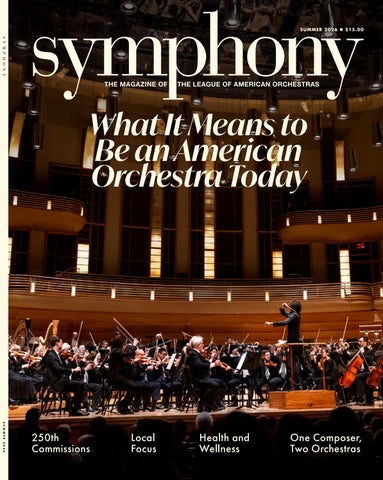
ABOUT THE COVER The Baltimore Symphony Orchestra and Music Director Jonathon Heyward in performance at the Music Center at Strathmore. Photo courtesy of the Baltimore Symphony Orchestra.
4
74 League of American Orchestras Annual Fund 76 Remembering: Michael Tilson Thomas
Conductor and composer Michael Tilson Thomas passed away on April 22 at age 81. He put orchestras and the music they play at the center of American cultural life. By Vivien Schweitzer
Throughout this issue, text marked like this indicates a link to websites and online resources.
SUMMER 2026
The Score N E WS, M OVES, A N D E VEN TS I N T H E O RCH ES TR A I N D US TRY
Kennedy Center Renovations to Impact National Symphony Orchestra
Wikipedia Commons.
On February 1, President Trump announced plans for the Kennedy Center’s closure this summer for repairs, after a year of far-reaching changes. Shortly after taking office, the President appointed himself to the Kennedy Center board, replaced Biden appointees and added new members, and was subsequently named chair. Many months before her planned December 2025 departure, the President replaced Kennedy Center President Deborah Rutter with Richard Grenell, former U.S. Ambassador to Germany. In December 2025, Trump hosted the The renamed John F. Kennedy Center for the Performing Arts. Kennedy Center Honors and the board voted to add his name to the venue. In the new year, Washington National Opera announced that it was cutting ties and moving its spring season to George Washington University. March 2026 saw Grenell replaced by Matt Floca, the center’s vice president of facilities operations. Also in March, National Symphony Orchestra (NSO) Executive Director Jean Davidson stepped down to lead California’s Wallis Annenberg Center. Critics have charged that the two-year closure is an effort to cover declining attendance and cancellations by prominent artists including Philip Glass, Renée Fleming, and Ben Folds. In late April, amid two lawsuits seeking to halt the closure, Kennedy Center officials offered journalists, donors, and lawmakers a tour showing water damage and outdated stage technology. Congress has specifically appropriated $242 million for capital repairs and restoration. Despite the upheaval, the National Symphony Orchestra has continued to play at the center, its home since 1971, and is pursuing alternate venues for the closure, set to begin this July. As this issue went to press, the NSO was expected to announce plans for its 2026–27 season.
When the Dance Theatre of Harlem revived its signature staging of Stravinsky’s Firebird in April, it turned to “a mission-aligned institution” in the Gateways Music Festival. The Gateways Festival Orchestra, made up of 100 professional musicians of African descent, joined the company for three performances at New York City Center, conducted by Jeri Lynne Johnson and Tania León. Choreographed by John Taras with vibrant scenery and costumes by Geoffrey Holder, the DTH Firebird moves the ballet’s Russian setting to a Caribbean island. DTH’s production caused a sensation at its 1982 premiere, but hasn’t been seen since 2004, when the company went on hiatus due to financial difficulties. For its hometown revival, DTH turned to the Gateways Orchestra, whose members are drawn from professional ensembles and conservatory faculties nationwide. (Prior to New York, the staging was mounted with different orchestras in Detroit, Paris, and Norfolk, VA.) Based at the Eastman School of Music, the Gateways Music Festival has recently been increasing its national presence, with concerts at Carnegie Hall and elsewhere. Its annual spring festival was held shortly after the DTH run in Winston-Salem, N.C., where Gateways was founded in 1993.
Nir Arieli, courtesy of DTH
Gateways Festival Orchestra Joins Dance Theatre of Harlem for Firebird
Dance Theatre of Harlem artist Alexandra Hutchinson in the company’s staging of Firebird.
6
SUMMER 2026
THE SCORE
Greenville Symphony Premiere Draws on Teenage Talent, and History
Chicago Symphony Orchestra Facebook
The Greenville Symphony Orchestra ended its season on April 25-26 with the premiere of a piece about a South Carolina girl who became a Revolutionary War heroine. To involve the community in the creative process, the orchestra turned to local teenage girls who served as artistic partners. Composer Peter B. Kay’s Dicey Langston: The South Carolina Girl Who Defied an Army tells the story of 15-year-old Dicey, who spied on Greenville Symphony Orchestra musicians, local high school students, and composer Peter B. Kay British Loyalists and uncovered plans for an attack on a Patriot camp. She traveled collaborated on Dicey Langston: The South Carolina through dangerous backcountry in 1781 to warn American soldiers and avert a disaster. Girl Who Defied an Army. Teenagers from Travelers Rest, S.C., where Langston lived, contributed to a workshop last October. The Greenville Journal reported that Kay “read the script to the teens and elicited their ideas about how the music should sound. Happy? Sad? Should it be fast? Slow? And how should water sound in music?” Director and lyricist Mark Waldrop wrote the text; Greenville Symphony Music Director Lee Mills conducted. Further input came from the Upcountry History Museum and SC250, a state agency set up to highlight South Carolina’s role in the 250th anniversary of American independence.
Chicago Symphony Cellist Unleashes a Synthmap There are musician side hustles—and then there is a recent project by Katinka Kleijn, a longtime cellist in the Chicago Symphony Orchestra. On April 8, Kleijn performed Bionic Synthmap, an interactive audiovisual installation in which she crawled and scampered across the stage of Orchestra Hall, triggering sounds and projected images. For the 40-minute work, pieces of conductive material were arranged on the stage floor in a large design. When the leotard-clad Kleijn touched her hands or feet to two strips of Chicago Symphony Orchestra cellist Katinka Kleijn material at once, her body completed a circuit that triggered a synthesized soundscape. performs Bionic Synthmap at Orchestra Hall. Also set off were swirling visuals by Kelley Sheehan. Kleijn is a fixture on Chicago’s improvised and avant-garde music scene, but Bionic Sythmap marked the first time she highlighted this side of her music-making under the CSO banner. At the end, she invited audience members onstage to trigger the sounds themselves. As Kleijn played a driving cello soundtrack, a dozen people “wriggled on the floor like kids in a sandbox,” wrote Hannah Edgar in MusicalAmerica.com. In all, a couple hundred had heeded Kleijn’s invitation and assurance that “this is your stage tonight.”
Illinois Symphony Speeds Along Route 66
Kansas City Symphony to Develop Additional Venue
For the Illinois Symphony Orchestra, America’s most famous road is still delivering kicks after 100 years. The orchestra concluded its season on May 2 with the premiere of Reverie on the Mother Road, a centennial tribute to Route 66 by Chicago-based composer Michelle Isaac. Music Director Taichi Fukumura organized the commission two years ago when he was a conducting fellow at the Chicago Sinfonietta; Isaac was the orchestra’s inaugural Freeman Composing Fellow at the time. Isaac told WGLT Radio that her piece draws on Route 66 as a connecting force through eight states, from Illinois to California. In keeping with her taste for deeply researched yet “light, fun, whimsical pieces,” she evokes car sounds and other effects. The six-minute piece also pulses with themes of freedom, perseverance and “good old-fashioned fun,” according to Isaac, as she evokes the neon-lit spirit of road-trip culture.
Missouri’s Kansas City Symphony has announced plans to build a new concert venue in the city’s South Plaza district, expanding the types of touring artists it can present. Orchestra leadership said the as-yet unnamed venue will be Rendering of the Kansas City Symphony’s proposed designed for amplified music new venue, which will host popular artists as well as some orchestra concerts. Image from Populous/ acts and orchestra concerts, Kansas City Symphony. and will accommodate up to 4,600 listeners. The symphony will continue to play out of Helzberg Hall at the Kauffman Center, which seats 1,600. Groundbreaking on the site is set for later this year. Kansas City Symphony President and CEO Danny Beckley told KCUR that the venue is “a natural evolution” for the organization as it broadens programming. The new venue fills a gap in the region for halls in the 4,000- to 5,000-seat range while providing a new income stream. “It is really a sweet spot for national touring artists,” Beckley said, adding that sales of concessions and merch will bring added revenue. The venue will be co-operated with MEMI, a subsidiary of the Cincinnati Symphony Orchestra. The Kansas City Symphony hopes to draw an estimated 300,000 patrons a year when the hall opens in 2028.
AMERICANORCHESTRAS.ORG
7
THE SCORE
The 2026 Avery Fisher Career Grants were awarded on March 24 at the Jerome L. Greene Performance Space at WQXR in New York City. The recipients are cellist Leland Ko, violinists Nathan Meltzer and Keila Wakao, and pianist Dmitry Yudin. Each received an award of $25,000 for career advancement purposes. The Avery Fisher Artist Program was set up in 1974 by Avery Fisher as part of a gift to Lincoln Center. With the newest crop of winners, 183 Career Grants have been awarded since 2026 Avery Fisher Career Grant recipients (left to right): Dmitry 1976. The awards are chosen by the program’s executive committee and Yudin, Keila Wakao, Leland Ko, and Nathan Meltzer. are designed to support instrumentalists or chamber ensembles who have the potential for major careers. Previous recipients include pianists Jonathan Biss and Yuja Wang; cellists Carter Brey and Zlatomir Fung; violinists Sarah Chang and Paul Huang; violist Matthew Lipman; double bassist Nina Bernat; and the Calidore String Quartet. The Career Grant ceremony performances are recorded for the recipients’ unrestricted use, archived on the program’s website, webcast live and later broadcast by WQXR, and featured on the PBS digital series Taking Note.
A Pitch-Perfect Artemis II Mission Before Artemis II set out on its historic mission around the far side of the moon, NASA released a visual rendering of the flight path that provided online fodder for music lovers: the flight path looked a whole lot like a treble clef sign. “Only a musician would look at the Artemis II flight path and immediately think, ‘That’s a treble clef,’” wrote Jeffrey Faux, a choral conductor from Bonita Springs, Fla., on Facebook. “What a stunning blend of art and science,” mused Kate Hill, a Los Angeles-based writer, on Instagram. After launching from the Kennedy Space Center on April 1, Artemis II flew two orbits around Earth before swooping around the far side of the moon in what is often called a figure-eight pattern. This uses the moon’s gravitational field to slingshot the capsule back to Earth. Some viewers saw an underlying musical message. “The long-term preparation and discipline behind a space mission feels so similar to the musician’s journey,” read the Instagram account of the Caledon Concert Band in Bolton, Ontario. “It’s not really about a destination, it’s about the process, the consistency, and showing up again and again.” NASA’s flight path for Artemis II. For Artemis III, a bass clef?
Virginia Symphony Salutes Adolphus Hailstork on his 85th Birthday After American composer Adolphus Hailstork III turned 85 on April 17, the Virginia Symphony and Virginia Arts Festival honored the milestone with a concert led by JoAnn Falletta. Hailstork and Falletta began working together in Norfolk, VA in 1991, the year he became the orchestra’s composer in residence, and she arrived as music director. The birthday concert included several of Hailstork’s signature works including his First Piano Concerto (featuring pianist Stewart Goodyear), Celebration, and An American Port of Call, a piece inspired by Norfolk. Four all-Hailstork chamber concerts followed at the festival this spring. In an interview with Norfolk’s WHRO, Hailstork reflected on his longstanding ties to the region, where he has held teaching posts at Old Dominion University and Norfolk State University. He also remarked on his extensive catalog of more than 250 works, many of which capture aspects of American life and the African American experience. “I do react to the world around me,” he said. “I feel that’s my particularly calling… I’m just aware of the news, and I like to reflect that. And I get energized by it.” 8
Larry Ferdinande
Jennifer Taylor
Avery Fisher Career Grants to Four Rising Artists
Adolphus Hailstork takes a bow with the Virginia Symphony Orchestra at the concert marking his 85th birthday.
SUMMER 2026
THE SCORE
Know Your Bow: Music and Conservation The League of American Orchestras is a global leader in pursuing policies and practices that support sustainable approaches to the natural resources used in musical instruments, providing both advocacy and guidance on the rules under the Convention on International Trade in Endangered Species of Wild Fauna and Flora (CITES). Find essential information about the latest policies for the Pernambuco wood that is in many bows for stringed instruments in the League’s updated Know Your Bow Campaign https://americanorchestras.org/know-your-bow-tips-for-owners-and-users-of-pernambuco-bows/, view the League’s February 2026 webinar produced in partnership with the U.S. Fish and Wildlife Service, and learn more in Symphony’s coverage at symphony.org and the dedicated resource page on Pernambuco policies and conservation at americanorchestras.org.
Here for You: Visa Assistance and Guidance As orchestras are increasingly reporting, the process of engaging international guest artists and conductors has grown more challenging, expensive, and uncertain. The League has long been at the helm on this issue, both in leading efforts to improve federal policies and in helping orchestras navigate this process. General public guidance is always available via the League’s dedicated website, Artists from Abroad, https://artistsfromabroad.org/, and member orchestras are also entitled to direct technical assistance given the many factors to consider. The League’s advocacy team is ready to help orchestras evaluate their options and understand the requirements, as we work to improve policies in Washington, D.C.
AMERICANORCHESTRAS.ORG
9
THE SCORE
Obituary: Polly Kahn, Former League Vice President
Polly Kahn
On October 14, Polly Kahn, a dynamic and influential figure in the orchestra field, passed away after a brief illness. She was 77 years old. Kahn was the Vice President for Learning and Leadership Development at the League of American Orchestras for 14 years, stepping down in 2014. She was a tireless champion of orchestras and the music they play, with an ardent commitment to developing the next generation of musicians; connecting with communities in authentic, ongoing ways; encouraging the creation and performance of new music, and welcoming more diverse musicians, composers, staff, board members, and audiences to orchestras. The participants in the League’s professional development and other programs during Kahn’s tenure number in the hundreds; many have forged careers at orchestras, performing arts centers, and ensembles nationwide. Prior to the League, Kahn was Director of Education for the New York Philharmonic, the Tisch Center for the Arts at the 92nd Street Y, assistant director of Lincoln Center Institute, and founding administrator of the Avery Fisher Artist Program. After stepping down from the League, she founded PK Art Solutions/PK Orchestra Solutions. In 2014, Symphony published her “Making a Difference” article. Many of the philosophies and strategies that Kahn outlined a decade ago were unusual or even provocative at the time, but are now widely practiced.
Obituary: Chuck Olton, Former League President and CEO The orchestra world lost an impactful executive when Charles (Chuck) Olton passed away on January 12. He was 87 years old and resided in Greenport, NY. Known as Chuck, Olton was president and CEO of the then-American Symphony Orchestra League from 1997 to his retirement in 2003. During his tenure, the League moved from the Washington, D.C. area to New York City, increased contributed income, and built closer connections with musicians. Under his aegis, the League put a renewed stress on professional development, launching the Orchestra Leadership Academy, which presented multiple seminars each year focusing on orchestra management. Prior to the League, Olton was dean of Parsons School of Design, dean of academic affairs at Barnard College, and had leadership roles at the State University of New York at Buffalo and at Union College. At the League’s 2003 National Conference, veteran orchestra executive Peter Pastreich observed: “Charles Olton gave us important new musical initiatives, including Music Chuck Olton for a New Millennium and Music Alive!; new conductor training programs … [and] a vast Audience Motivation Research study … Chuck’s initiatives included active collaboration with the Sphinx Organization to assist young African American and Latino musicians … new efforts to promote diversity and excellence in orchestra education and community engagement in American orchestras, and a program in orchestra trustee training.”
Stay on Pitch with Symphony.org Symphony, the League’s award-winning publication, isn’t only this here print magazine. Every weekday, symphony.org posts the latest news, breaking developments, timely research, and galvanizing opinions about the orchestra world. Symphony.org also publishes original feature articles that analyze trends, bring forward new voices, go behind the scenes, and spark industry-wide discussions. Symphony.org posts more than 800 must-read News Briefs and dozens of in-depth feature articles every year, and it’s become the industry’s go-to source of news, information, and ideas, with an average of 58,000 views per month. Check it out.
10
SUMMER 2026
THE SCORE
Musical Chairs The Phoenix Symphony has appointed PAOLO BORTOLAMEOLLI as music director. He will serve as music director designate for 2026–27 and become music director with the 2027–28 season. Cellist STARLA BRESHEARS will join the San Francisco Symphony next season. The 18-year-old is a 2025 graduate of the SF Conservatory of Music’s Pre-College Program and is set to graduate from high school this year. GABRIELA LENA FRANK has won the 2026 Pulitzer Prize in Music for Picaflor: A Future Myth. The work was co-commissioned by the Philadelphia Orchestra, Oregon Symphony, and Bravo! Vail Music Festival and premiered by the Philadelphia Orchestra with Principal Guest Conductor Marin Alsop in March 2025. TOMÁS GARCÍA has been named
assistant conductor at Princeton Symphony and conductor of the Symphonic Orchestra of the Youth Orchestra of Central Jersey, Princeton Symphony’s youth orchestra partner.
JONATHAN MARTIN has been appointed interim CEO at the Savannah Philharmonic. He most recently served as president and CEO of the Cincinnati Symphony Orchestra.
Michigan’s Grand Rapids Symphony has named SAM STRATER as senior vice president and general manager.
Colorado’s Bravo! Vail Music Festival has appointed composer CHRIS ROGERSON as artistic director, effective September 1. He succeeds Anne-Marie McDermott, who steps down after a 16-year tenure.
has been appointed president and CEO of Boston’s Handel and Haydn Society. He succeeds David Snead, who retired in May 2025.
The Tucson Symphony Orchestra has named EVAN ROIDER to the newly created position of principal pops conductor. The Boston Symphony Orchestra has appointed conductor and composer ESA-PEKKA SALONEN as director of this summer’s Tanglewood Festival of Contemporary Music. LEONARD SLATKIN has joined the
Nashville Symphony as music director. He was the orchestra’s music advisor from 2006 to 2009, and in 2025 following Music Director Giancarlo Guerrero’s departure.
LECOLION WASHINGTON, JR.
AMY WILLIAMS has been selected as president and CEO of the Kalamazoo Symphony Orchestra. She was most recently CEO of the Savannah Philharmonic. MEGAN YINGST has been appointed interim chief operating officer at the Washington Metropolitan Philharmonic in Alexandria, Virginia.
The Boston Symphony Orchestra has appointed YIRAN ZHAO and JAKUB PRZYBYCIEŃ as assistant conductors, starting with the 2026–27 season.
The Cincinnati Symphony Orchestra has appointed violinist RANDALL GOOSBY as its inaugural community artist-inresidence. ANNA HANDLER has been named conductor in residence at the Los Angeles Philharmonic.
The Music Academy of the West in California has appointed CONOR HANICK as creative and artistic advisor, and INDIGO FISCHER as vice president of artistic planning. The Saint Paul Chamber Orchestra has selected violinist ALINA IBRAGIMOVA as its newest artistic partner, one of the SPCO’s five artistic partners. JOE JAXSON has joined the Richmond Symphony as composer in residence. ROBERT KAHN has been named assistant conductor at the Chicago Symphony Orchestra for the 2026-27 season.
The Minnesota Orchestra has appointed conductor-violinist LEONIDAS KAVAKOS as principal guest conductor, beginning in fall 2027.
AMERICANORCHESTRAS.ORG
11
Forward Thinking
Beyond False Choices Orchestras don’t face a choice between artistic excellence and social impact. The opportunity is to hold both values at once, embracing the tension and allowing for a richer understanding of purpose. By Simon Woods
F
or many in the classical music world, just keeping our heads above water sometimes feels like the most we can achieve. We rarely have time to step back and actually ask ourselves why we’re here. But if you were to gather a hundred performers, administrators, and volunteers, and ask them why they choose to devote so much of their waking lives to this work, you would hear a multitude of answers—and those answers would celebrate the many roles that orchestras play in people’s lives and communities. Yet discussions about the purpose of orchestras too often become framed as binaries—tradition versus innovation, artistic integrity versus community relevance, “art for art’s sake” versus social impact—forgetting that a multi-dimensional understanding of purpose is in fact what gives our art form enduring meaning. The tensions can help sharpen our thinking, but we can hold them in creative balance, not mutual exclusion.
12
It’s perhaps worth considering some useful typology here. The researcher and consultant Alan Brown did important work almost twenty years ago about the impact of the arts. Here is a definition that still resonates: “Intrinsic impacts of the arts refer to the direct aesthetic, emotional, cognitive, and social experiences that arise from engagement with artistic work. Extrinsic impacts refer to the instrumental outcomes of the arts on broader social, economic, educational, or health-related objectives.” The distinction between intrinsic and extrinsic impacts matters greatly to us, because it shapes how organizations allocate resources, define success, and talk about what they do. Last year I attended a performance by the New York Philharmonic of one of Pierre Boulez’s major orchestral works. An almost-full David Geffen Hall and an ovation at the end were reminders that the greatest music from the avant-garde period still has the power to move us. The aesthetic was hypnotic and
SUMMER 2026
F O R WA R D T H I N K I N G
Simon Woods, President and CEO, League of American Orchestras
deeply abstract. There was no emotional journey like a Mahler symphony, no storytelling like Tchaikovsky’s Romeo and Juliet, no tone painting like Debussy’s La Mer, no coded politics like Shostakovich’s symphonies, no social commentary like John Adams’s Scheherazade.2, and certainly no dialogue with contemporary society like so much stimulating work by today’s composers. It was simply about itself and how it affected those who encountered it—and maybe all the more powerful for that, in our dopamine-drenched world of relentless stimuli and short attention spans. For most artists and audiences, it’s those intrinsic impacts that most immediately concern us. It’s what musicians live to create: how the greatest artistry allied with inspirational repertoire can create a personal and communal experience of the deeper dimensions of being human: love, hope, uplift, nostalgia, melancholy, and other more complex feelings that music evokes and words cannot. This experience is worthy of deep protection in arts organizations’ understanding of purpose. At the opposite end of the spectrum, I have recommended to many people that they read Alan Harrison’s book Scene Change: Why Today’s Nonprofit Arts Organizations Have to Stop Producing Art and Start Producing Impact. I also warn them that they may want to throw the book across the room. Harrison argues that arts organizations do not deserve financial support just for presenting art, and that they exist primarily to create positive impact using art as a tool. His thesis AMERICANORCHESTRAS.ORG
rests on the belief that arts organizations have both a moral and a legal obligation to benefit broader society, not just those members of our communities who choose to attend. The idea that the arts require the extrinsic validation of social impact to justify their existence is seriously off-key. That said, Harrison’s ideas prick deeply at my conscience, and should do so for all of us. He reminds us of the persistence of exclusion in the arts in America; the perils of artistic self-absorption; the need for risk-taking; the importance of measuring and reporting actual—not imagined— impact; and above all, about arts organizations’ responsibility to help make their communities better places to live. And he exhorts us to stop making performative statements about excellence and the transformational power of great art. Read the book and draw your own conclusions. The good news is that these debates are long underway in the orchestra world and will be in full view when the field comes together again in Baltimore for the League’s National Conference this June. Perhaps no better recent example of the changing perspective of these debates exists than the huge growth in work around music and health, an area that continues to gather fast momentum across orchestras of all sizes and locations. The League’s publication Orchestras in Health and Wellness (at americanorchestras.org/ catalyst-guide-orchestras-in-health-andwellness/) offers snapshots of the many ways orchestras are investing in this work—not only because the impact on fellow humans is beautiful and inspiring, but because it opens new avenues for demonstrating how orchestras and their music can matter far beyond the concert hall. Last summer I spent more time than usual in Europe, visiting festivals, talking to orchestra leaders, and reflecting on orchestras’ place in the world. As government funding becomes increasingly uncertain in parts of Europe, many of their orchestras are looking across the Atlantic with great interest at how American
orchestras are adapting to the changed environment through a focus on inclusion and community impact. At the same time, I admire the classical music world in Europe for the degree to which innovation (and there is plenty of it right now) is so rooted in the music and onstage creativity itself, rather than in extrinsic ways of framing impact and meaning. This is a moment for interesting transatlantic learning. Orchestras are often among the largest arts organizations in their communities, and with that comes the responsibility to make mature and balanced judgments about purpose and public value. We can honor legacy while inventing new traditions, respect our elders as we appeal to younger audiences, be trustworthy as we stimulate and provoke, and nurture artistry as we look beyond the stage. In my “Rethinking Orchestra Governance” article in Symphony (at symphony.org/ features/forward-thinking-rethinkingorchestra-governance/), I suggested how boards might make overt discussion of these tensions and trade-offs a more regular part of their work. But as we do this, let’s keep faith with the musical expression at the core of our art. In a time of unsettling division and conflict in public life and international affairs, one of the highest purposes of music is to be its own gloriously abstract self for those who seek solace, centering, and inspiration. Our job in the arts is to make that precious experience available to as many people as possible. Buddhist philosophy reminds us that “we are enough.” So as we reach for ever more impact in our communities, we should also remember that the music on our stages is, in itself, often enough. SIMON WOODS is the President and CEO of the League of American Orchestras. He brings over 30 years of experience working with orchestras, including the Los Angeles Philharmonic, New Jersey Symphony Orchestra, the Philadelphia Orchestra, Royal Scottish National Orchestra, and Seattle Symphony. He was honored to become an American citizen in 2018.
Orchestras can honor legacy while inventing new traditions, respect our elders as we appeal to younger audiences, and nurture artistry as we look beyond the stage. 13
Building Trust, Sustaining Art A new report from the Wallace Foundation focuses on how 18 arts groups rooted in communities of color navigate trust, artistic value, labor, governance, and placemaking—and contribute to cultural vitality and community connection.
I
n May, the Wallace Foundation and the Social Science Research Council released Building Trust, Sustaining Art, the first major research analysis from the Thriving Communities cohort of the foundation’s five-year, multi-strand Advancing Well-Being in the Arts initiative. This group of grantees comprises 18 arts organizations rooted in communities of color, with budgets over $500,000. Informed by qualitative studies developed by early-career scholars, Building Trust, Sustaining Art presents an overview of the organizations’ contributions to cultural innovation and identifies a set of adaptive strategies that shape how arts organizations rooted in communities of color sustain their work—and, in turn, contribute to cultural vitality and community connection. Among the organizations participating in the study is Chicago Sinfonietta. To help build a field-wide understanding of these organizations’ practices and contributions to community, Wallace partnered with the Social Science Research Council to establish the Arts Research for Communities of Color (ARCC) Fellowship, which matched 18 early-career researchers with each of the Thriving Communities organizations. The ARCC Fellows conducted year-long collaborative, qualitative studies with their partner organizations that addressed key questions of importance to the organizations, with many focused on organizational history and culture. Researchers produced evidence-based resources for their organizational partner as well as academic scholarship for the field. Drawing upon the individual studies, the report identifies a series of common challenges faced by organizations across the cohort, pointing towards tensions unique to—or faced disproportionately by—arts organizations of color. The report identifies seven core strategies that organizations have deployed in response to these structural constraints and field-level pressures, approaches that help strengthen community accountability, expand artistic possibility, and build legitimacy. Finally, the report identifies opportunities for further research and institutional support that account for the long-term, relational, and adaptive practices undertaken by each organization, rather than focusing on short-term outcomes. To read the complete Building Trust, Sustaining Art report, one of nearly 50 studies being funded through Wallace’s Advancing Well-Being in the Arts initiative, visit https://wallacefoundation.org/.
14
Executive Summary
Arts organizations rooted in communities of color operate at the intersection of artistic ambition and structural disadvantage while producing extraordinary work with significant cultural and civic value. The Arts Research for Communities of Color (ARCC) Fellowship was created to document this reality from the inside and contribute to a more equitable and sustainable arts field. This report synthesizes the collaborative research conducted by the ARCC Fellows with 18 participating organizations from The Wallace Foundation’s Advancing Well-Being in the Arts initiative, identifying the recurring challenges these organizations face and the organizational practices they employ to thrive in an otherwise forbidding funding environment and an exclusionary arts field. Established in 2021 by the Social Science Research Council (SSRC) with funding from The Wallace Foundation, ARCC paired 18 early-career qualitative researchers with 18 arts organizations across the United States. The Fellows came from disciplines including sociology, anthropology, and art history. The organizations range from place-based community hubs and culturally specific performing arts companies to museums and media arts organizations. What made these pairings unusual was the commitment to producing collaborative research within organizational life, with research questions shaped by what the organizations themselves needed to understand about their work, rather than by academic agendas. Working closely with their respective organizations, Fellows identified four recurring challenges: Trust is not assumed. In neighborhoods shaped by decades of disinvestment, redlining, and gentrification, communities have good reasons to be skeptical of institutions, including arts organizations. The 18 organizations have built trust with their communities through sustained presence, demonstrated responsiveness, and a willingness to be held accountable to community values and criticism over time. Challenging dominant narratives in the arts field demands ongoing labor. These organizations have to invest significant time and resources in translational and educational work to inform their funders, critics, and audiences of the importance of their work and to legitimize their position within their respective arts fields. This educational work is not peripheral to their mission; it is how they survive. Negotiating cultural excellence is a constant tension. Field-level standards have historically centered on narrow aesthetic SUMMER 2026
BUILDING TRUS T, SUS TAINING ART
traditions that were not built with these organizations in mind. In response, they have developed their own definitions of excellence rooted in community experience, whether by elevating devalued local forms, broadening audiences beyond elites, or asserting community-rooted practices in dominant institutional spaces. Balancing local, national, and international orientations requires ongoing strategic choices. Many organizations serve overlapping constituencies with different and sometimes competing expectations, navigating accountability to their immediate communities while participating in broader artistic and diasporic networks. To meet these challenges, the 18 organizations have developed integrated strategies that span their artistic, organizational, and community-facing work. To meet these challenges, the 18 organizations have developed integrated strategies that span their artistic, organizational, and community-facing work.
Building trust and legitimacy
The organizations build trust in two ways: by providing unique access to resources, programming, and safe spaces for artists and communities to experiment and collaborate, and by staying attentive to their constituents’ evolving needs and adjusting accordingly. They also reframe dominant narratives and build field legitimacy without choosing between community accountability and field recognition. They do this by investing in the professional development of their staff and artists and encouraging artistic collaboration and innovation. Some organizations go further, using their art practices to challenge biases and educate audiences about the experiences of communities of color.
institutions, and across broader movement alliances. Role fluidity, shared resources, and movement solidarity allow these organizations to do collectively what none of them could sustain on their own. Placemaking is equally central to how organizations sustain their work over time. For them, securing and defending physical space is a condition of survival that signals commitment to their communities while also serving as a foundation for the long-term cultural presence their missions require.
Further Research
The ARCC cases point to organizations doing extraordinary work under conditions that most institutions would not survive. They also point to the need for further research to better understand how these organizations sustain themselves over time. More longitudinal research on how trust gets built and rebuilt over time, how excellence is defined and contested across generations and arts disciplines, and how collective capacity emerges across networks would deepen the field’s understanding. In addition, the Fellows’ research makes the case for increased institutional support that would allow these organizations to remain accountable to their communities’ changing needs. Much of what makes their work possible—relationship maintenance, care, education, and coalition building—remains invisible within conventional funding frameworks. Philanthropic support that recognizes this labor as foundational and allows for organizations to adapt over time to stay accountable to community-defined values, rather than field visibility, would contribute to a more equitable and sustainable arts field.
The 18 Participating Organizations
Collaboration and placemaking
Place-based community hubs: • The Laundromat Project (Brooklyn, NY) • Esperanza Peace and Justice Center (San Antonio, TX) • Pillsbury House + Theatre (Minneapolis, MN) • Oakland Collective (Oakland, CA) • 1Hood Media Academy (Pittsburgh, PA) Culturally specific performing arts organizations with national and international reach: • Ragamala Dance Company (Minneapolis, MN) • Theater Mu (Saint Paul, MN) • Chicago Sinfonietta (Chicago, IL) • Philadelphia Dance Company (Philadelphia, PA) • Pregones/Puerto Rican Traveling Theater (New York, NY) Organizations centered on community history, archives, and cultural memory: • Arab American National Museum (Dearborn, MI) • Rebuild Foundation (Chicago, IL) • Museo de Arte Contemporáneo de Puerto Rico (San Juan, PR) • Harvey B. Gantt Center for African-American Arts + Culture (Charlotte, NC). Media-making and storytelling organizations: • Queer Women of Color Media Arts Project (San Francisco, CA) • BlackStar (Philadelphia, PA) • Self Help Graphics & Art (Los Angeles, CA) • The Union for Contemporary Art (Omaha, NE)
AMERICANORCHESTRAS.ORG
15
Archiving and cultural memory
Through archiving and documentation, organizations preserve histories that dominant institutions have long overlooked, asserting the contributions of communities of color to their respective arts fields. Fellows also participated directly in this work, documenting the institution’s histories and preserving archives, making research itself part of the organization’s capacity to sustain their stories over time.
Labor, care, and governance
Persistent underfunding and structural precarity have shaped how these organizations manage their internal work. Many started their work relying on labor dynamics shaped by charity-based organizational models and an emphasis on sacrifice. These dynamics generate conflict across generations and genders, contributing to burnout. Some organizations have responded to these labor challenges by developing care-based policies that invest in staff sustainability and well-being. Governance raises a related set of tensions: As organizations have grown, they have had to move away from the informal structures of their early years and experiment with new management approaches, balancing staff expectations and remaining accountable to their communities. Neither labor nor governance has a clean solution. What Fellows document across these cases is ongoing negotiation rather than resolution. The 18 organizations treat collaboration as a core value. They build interdependence within their organizations, across peer
Board Room
Making an Impact in Maryland: The View from the Board Amid a rapidly changing financial and cultural landscape, board leaders at Maryland orchestras are rethinking what it means to serve their audiences with clarity and purpose. Many institutions are deepening their roles as civic and community partners in order to maintain relevance. Ahead of the League of American Orchestras’ National Conference in Baltimore, we asked board chairs about the challenges they face and where they see opportunity. By Piper Starnes
A
t a time when arts institutions in the United States are navigating economic pressure, political tension, and shifting audience behaviors, orchestras are being asked to do more than just perform. They’re being asked to matter. How are orchestras contributing to cultural life? What role do they play in education and in the community? Are they remaining as relevant as they could be? In Maryland and the Washington, D.C. area, these questions feel especially immediate. The two-year shutdown of the Kennedy Center—a major cultural anchor in the national arts scene—adds both uncertainty and opportunity, prompting nearby organizations to consider how they can support audiences, artists, and each other during this period of disruption. The League of American Orchestras’ 81st National Conference takes place June 1–3 and will be hosted by the Baltimore Symphony Orchestra. Inspired by this summer’s Conference theme FLOW, we asked board chairs from Maryland orchestras how they’re moving through the streams of today’s society and what they’re doing to address access, relevance, and impact.
Katie Edwards, Board Chair, Annapolis Symphony Orchestra Annapolis Symphony Orchestra
Looking at the social, economic, and cultural moment we’re in now, what challenges feel most pressing for your orchestra, and where do you see real momentum or opportunity? If I have learned anything in my time serving on the board of the Annapolis Symphony Orchestra, and now as chair, it is that change is not an interruption, it is the constant. Audience habits are always evolving, costs continue to rise, and live performance strives to be competitive in a world with fragmented attention. Patrons are asking institutions to articulate not just what they do, but
16
why they matter in the present moment. I believe our most pressing challenge is clarity of purpose. Financial sustainability is essential, but it follows from relevance. When we are clear about our role in civic life, momentum follows. How do you define your orchestra’s responsibility to your community? In what ways does your board help shape and foster that relationship? An orchestra’s responsibility extends well beyond presenting concerts. We are stewards of cultural heritage, educators, employers of artists and arts administrators, and we are partners in the economic vitality of our region. Our board aims to approach governance with that broader lens in mind. We strive to ask not only how a performance sold, but who it served and how it strengthened our connection beyond the concert hall. Our role is to ensure that artistic excellence and community impact move forward together.
“Financial sustainability is essential, but it follows from relevance. When we are clear about our role in civic life, momentum follows.” – Katie Edwards, Board Chair, Annapolis Symphony Orchestra Beyond gaining potential new audiences, what is the broader value of music and arts education? How does early exposure to and engagement with orchestral music have a transformative impact? Arts education and early exposure to orchestral music build more than future audiences; they cultivate discipline, collaboration, empathy, and confidence. Ensemble music teaches young people how to listen—to one another and to something larger than themselves. The long-term impact is civic as much as
SUMMER 2026
BOARD ROOM
artistic. When we invest in education, we invest in the health and resilience of our entire community. In this moment, orchestras have an opportunity to lead, not just artistically, but socially. By creating shared experiences that bring people together in meaningful ways, we can be a part of making change.
Richard Miles, Board President, Baltimore Chamber Orchestra Baltimore Chamber Orchestra
Looking at the social, economic, and cultural moment we’re in now, what challenges feel most pressing for your orchestra, and where do you see real momentum or opportunity? The orchestras that will thrive during these uncertain times are the ones that measure success through the lens of community impact and are willing to look at who else is doing meaningful work and be brave enough to share the stage with them. What I mean by that is, that magic inside the concert hall when everything clicks, when the music lands, and you feel the whole room responding together—that’s real, and it’s irreplaceable. But it can’t be the only thing we’re selling. We have to ask: what does this orchestra mean to this community beyond the people who buy concert tickets? And the way to answer that question is by investing in education, community engagement, media presence, and institutional partnerships.
“The orchestras that tell their story compellingly, and back it up with real impact, are the ones that will shape the industry’s future.” – Richard Miles, Board President, Baltimore Chamber Orchestra Partnerships, in particular, give me genuine hope for how the Baltimore Chamber Orchestra (BCO) is tackling this challenge because there is so much opportunity when you lead with
AMERICANORCHESTRAS.ORG
collaboration. You find the right partners, you create something neither of you could do alone, and suddenly you’re reaching audiences who might never have otherwise walked through your doors. I’m really proud that this season we’re partnering with the U.S. Naval Academy Glee Club to perform Christopher Tin’s The Drop That Contained the Sea. BCO Music Director Robert Moody has a longstanding relationship with the Glee Club, and that trust-based collaboration fuels real momentum. Next season, we have a partnership on a joint concert that includes a world premiere commission TBA, and that project has shown me artistic programming’s role in creating community impact. Generating support becomes much easier when the larger focus is on community impact because every stakeholder knows that their investment is doing something in the world. That’s the opportunity—not just for the BCO, but for the field. The orchestras that tell that story compellingly, and back it up with real impact, are the ones that will shape the industry’s future.
Christian Johansson, Board Chair, Baltimore Symphony Orchestra Baltimore Symphony Orchestra
How do you define your orchestra’s responsibility to your community? In what ways does your board help shape and foster that relationship? The Baltimore Symphony Orchestra (BSO) has always prioritized education, access, and civic engagement alongside the presentation of great performances. For many years, OrchKids, the BSO’s nationally recognized El Sistema program embedded in Baltimore City Public Schools, has been a beacon of our special community relationship. In 2019, we took this thinking a step further, crafting an institutional strategic plan that tied our future relevance and resilience to community building. We describe this strategy as “A Hall/Symphony for All.” This phrase is powerful in its simplicity because music can’t unite us if people
can’t hear it. It’s why we are inviting people to come together through shared experiences in many more ways and places. The Board plays an important role in fostering this thinking. With roughly 35 members, the BSO’s Board helps shape strategy, support the institution philanthropically, and serve as ambassadors connecting the orchestra to the wider community across the state.
“Music can’t unite us if people can’t hear it. We are inviting people to come together through shared experiences in many more ways and places.” – Christian Johansson, Board Chair, Baltimore Symphony Orchestra In light of the announced two-year shutdown of the Kennedy Center, do you anticipate any ripple effects in the orchestra field? Moments of change within major cultural institutions inevitably create ripple effects across the broader arts ecosystem. At the same time, they also highlight the resilience and adaptability of the field. One of the reasons the BSO is so proud to host this year’s League Conference is because of the timely opportunity to welcome our greater Maryland-DC-Virginia peers to reflect together on how we can best support each other and serve our deeply interconnected communities through the Kennedy Center’s planned closure. As we all saw during the pandemic, some of the most challenging audience patterns to break were when patrons fell out of the habit of attending. We all need more people discovering orchestras, opera companies, and concert halls throughout the region to sustain our operations today and to nurture audiences of tomorrow. The BSO’s dual market presence allows us to be a positive contributor to this mutually shared goal: welcoming audiences seeking meaningful live music experiences. Our priority is simply to remain open to as many audiences and artists as possible at our home at Strathmore, at the Meyerhoff, and everywhere the BSO performs, week in and week out.
17
BOARD ROOM
Elizabeth L.K. Berman, Board President, Columbia Orchestra Columbia Orchestra
How do you define your orchestra’s responsibility to your community? In what ways does your board help shape and foster that relationship? Columbia Orchestra was founded on a simple but powerful premise: that community musicians deserve a home. That origin shapes everything about how we understand our responsibility to our community—it’s reciprocal, not transactional. We serve our audiences, yes, but we are equally accountable to the 100+ volunteer musicians who give their time, talent, and Monday nights to this organization. Our board reflects that dual accountability. For much of our history, it was composed almost entirely of ensemble members. Over the last decade or so, we’ve intentionally broadened that composition to include non-musician members—people who bring perspectives from business, education, law, healthcare, and the broader Howard County community. That shift hasn’t diminished our musician-centered identity; it has expanded our capacity to serve it. Diverse governance leads to more creative problem-solving, stronger community connections, and ultimately better outcomes for everyone who walks through our doors—or onto our stage.
“The arts are not a luxury. A growing body of research connects arts participation to measurable improvements in mental health, community cohesion, academic success, and even healthcare costs.” – Elizabeth L.K. Berman, Board President, Columbia Orchestra When you think about the future of the orchestra field, what excites you? How should orchestras adapt to changing times? What excites me most about the future of orchestral music is something that’s been
18
true all along but is finally getting serious attention: the arts are not a luxury. A growing body of research connects arts participation to measurable improvements in mental health, community cohesion, academic success and graduation rates, and even healthcare costs. I believe tying the health of an arts community to the health of the surrounding socioeconomic community is one of the most powerful—and underutilized— arguments for what orchestras do. Beyond gaining potential new audiences, what is the broader value of music and arts education? How does early exposure to and engagement with orchestral music have a transformative impact? The question of music education’s broader value is one I think about differently than most people in this field—and I say that as someone who not only leads an orchestra comprised entirely of volunteer musicians but also plays in it as principal oboe. When we make the case for music education primarily through economic and social outcomes—graduation rates, cognitive development, career readiness— we’re speaking the language of capitalism rather than the language of community. Those outcomes matter, and the research supporting them is real and growing. But that framing quietly suggests that music’s worth is contingent on what it produces, rather than what it cultivates in the person experiencing it. The transformative impact of music is, at its core, individual—and it is precisely that individual transformation that creates broader value, not the other way around. For a volunteer organization like Columbia Orchestra, this distinction is existential. Our musicians—doctors, teachers, engineers, and countless others—didn’t choose music as a career. They chose it as a calling. That choice, made freely and sustained over decades, is what built this organization and what will carry it forward. If we train young musicians to see their art purely as an economic asset, we risk losing the very people who make community orchestras possible. Music education’s most enduring gift may not be the professional musician it produces—but the lifelong musician it inspires.
Doug Spotts, Board President, Maryland Symphony Orchestra Maryland Symphony Orchestra
When you think about the future of the orchestra field, what excites you? How should orchestras adapt to changing times? I am personally excited about the inclusion of new voices in helping guide us/boards, strategically, out of disruptive and divisive times, especially the voices of our youth, our future! There is something inherent in the standard repertoire and in new music that evokes the best response in all of us, together, as community members and regional partners, especially when diverse voices are welcomed “to the table.” Classical music is for all of us, not just “the supposed 3%” of those interested in classical music and over the age of 65. Attracting new voices and diverse community representatives makes sure that a balance is maintained between artistic vision and financial stewardship, between art and science, and bridging the gaps in our community which stand in the way of true healing, equity, and inclusion and in broadening audience engagement. These words and concepts still matter and are the backbone for a healthy community!
“There is something inherent in the standard repertoire and in new music that evokes the best response in all of us, together, especially when diverse voices are welcomed.” – Doug Spotts, Board President, Maryland Symphony Orchestra What is your philosophy of governance for nonprofits like orchestras? How involved should the boards be in strategic planning versus day-to-day operations? There has to be a balance between strategy and fiduciary responsibility between the board and staff. An effective board and board leadership do not drive day-to-day operations. The board has a responsibility to support and foster effective development
SUMMER 2026
BOARD ROOM
of the executive director, and to make sure there is good communication between the executive director and the music director. The board should not micromanage the roles of these individuals. Boards must remain independent and not be representative of one perspective or pressured by financial objectives. They must remain above political influence and coercion.
audiences, and supporters. We work closely with leadership and staff to make sure our programming, learning and engagement programs, and outreach efforts align with our mission and the community’s needs. The board also helps secure the resources that make this work possible, ensuring that NatPhil can continue to be a flourishing part of the DMV [District of Columbia, Maryland, Virginia area].
When you think about the future of the orchestra field, what excites you? How should orchestras adapt to changing times? Orchestras today have an extraordinary opportunity to reach new audiences and advance the art form. This happens through innovative programming, interdisciplinary collaborations, and a stronger connection with our community. The arts remind us of our humanity, and
Paul Dudek, Board Chair, National Philharmonic National Philharmonic
How do you define your orchestra’s responsibility to your community? In what ways does your board help shape and foster that relationship? National Philharmonic’s responsibility to our community is both artistic and civic. At our core, we’re Montgomery County’s only home-grown and professional orchestra, and as such, our role is to provide our community with world-class orchestral experiences. To do that, though, we need to remain accessible, welcoming, and meaningful. We do this through programming that reflects our commitment to diversity and equity in the art form, learning and engagement programs that serve all corners of our community, and programs like “All Kids. All Free. All the Time.,” that provides free tickets to kids ages 7-17. We see NatPhil as participating in the life of our community. We want to contribute to the vibrant identity of the region and serve as a reflection of our patrons.
“Adapting means staying responsive to artistic and audience perspectives by broadening our repertoire and creating a space where people come together to experience something profound and shared.” – Paul Dudek, Board Chair, National Philharmonic The Board of Directors plays an essential role in shaping this relationship. We are NatPhil’s biggest ambassadors, connecting the orchestra with community leaders,
AMERICANORCHESTRAS.ORG
19
BOARD ROOM
Executive Leadership Skills for Board Members at 2026 Conference The League’s 2026 National Conference offers extensive programming for orchestras board members. At the “Raising the Bar on Board Engagement” Pre-Conference Seminar on Monday, June 1, nonprofit governance consultant Marla Bobowick helps board members and executives explore governance principles and best practices. A major new convening, the Orchestra Board Member Forum, features content on strategic fundraising, leadership skills, board engagement, and fireside chats with industry leaders alongside inspiring performances and networking events. During the Conference, members of the League’s Board of Directors serve as Conference buddies, guiding orchestra board members to the most compelling sessions and facilitating peer introductions. The League will soon launch the new edition of its Effective Orchestra Governance guide, a time-tested resource free for League members. Learn more at https://leagueconference.org/board.
it’s through that human connection that we can advance the field. For orchestras like NatPhil, adapting means staying responsive to artistic and audience perspectives by broadening our repertoire, highlighting new, overlooked, forgotten, and diverse voices, and creating a space where people come together to experience something profound and shared. It means investing in our community through learning and engagement programs that uplift young musicians, introduce new audiences to our art form, and make our music accessible to everyone.
Karyn L.C. Nicholson, Board President, National String Symphonia National String Symphonia
How do you define your orchestra’s responsibility to your community? At the National String Symphonia, we view our responsibility to the community as both artistic and civic. Our orchestra exists to create shared experiences that bring people together through the expressive power of live music. A string art music performance is more than a cultural event—it is a gathering place where listeners experience beauty, as they reflect and connect with one another.
20
In a world increasingly shaped by AI (artificial intelligence), people increasingly question authenticity: what is human-created, what is generated, and what is real. Our live orchestral performances offer a powerful reminder of another type of AI—Actual Intelligence. We call them Informances: INFORmation + PerformANCES. Our music director/conductor, Dr. David A. Fanning, shares insight and meaning about the composer and the work. Then, our musicians perform, and the audience witnesses something fundamentally human: a shared community experience. The musicians listen to one another, responding in real time, and shaping a musical narrative together in a single, unrepeatable moment. This shared experience invites audiences to engage their senses, emotions, and intellect simultaneously. In doing so, live music strengthens curiosity, empathy, and the collective intelligence of a community.
“In an era of rapidly evolving technology, we affirm the enduring value of shared artistic experiences—where human creativity, community presence, dialogue, and learning strengthen civic life.” – Karyn L.C. Nicholson, Board President, National String Symphonia
Our board plays a vital role in nurturing this relationship. As advocates and community connectors, board members help ensure that the orchestra remains accessible, relevant, and responsive to the people we serve. The National String Symphonia’s shared board and operations leadership supports thoughtful programming, educational engagement, and partnerships that expand the reach of live orchestra music in our communities. In an era of rapidly evolving technology, the National String Symphonia affirms the enduring value of shared artistic experiences—where human creativity, community presence, dialogue, and learning strengthen the fabric of civic life. PIPER STARNES is a writer whose words have been published by Opera America, Syracuse.com, Rochester City, and Charleston City Paper. She holds a bachelor’s degree from Clemson University in performing arts for keyboard instruments and a master’s degree from Syracuse University in Arts Journalism and Communications. She currently works for the Los Angeles Philharmonic as a creative copywriter in the marketing department.
SUMMER 2026
A Passion for Orchestras The orchestra world is filled with gifted leaders and executives. But few have the broad perspective and experience of David Hyslop, who has been CEO of several large orchestras and interim CEO of 14 orchestras. As the League bestows its Gold Baton award on Hyslop at this year’s National Conference, we catch up with this orchestra veteran. By Jennifer Teisinger
I
n his 61-year orchestral management career, David Hyslop has served as CEO of the Minnesota Orchestra (1991-2003), St. Louis Symphony Orchestra (1978-1991), and Oregon Symphony (1972-1978), and as interim CEO for a remarkable 16 performing arts organizations including 14 American orchestras, a musical theater, and an opera company. Hyslop has an unmatched overview of the orchestra field: he’s led and collaborated with orchestras of every size, in communities big to small, and has encountered just about every challenge in the industry. His passion for the artform is infectious, his knowledge base is deep, and his stories have that sneaky learning quality. He didn’t set out to be a mentor for orchestra CEOs but found that it comes with the territory. Hyslop is one of two recipients of the 2026 Golden Baton award given by the League of American Orchestras (the other awardee is the Sphinx organization). It’s the League’s highest honor, in recognition of his decades of service to orchestras. His other accolades include the David J. Hyslop Trumpet Chair endowed by the St. Louis Symphony Orchestra, “Fanfare for D.H.,” commissioned by the St. Louis Symphony to honor Hyslop’s tenth anniversary leading the orchestra, written by Joseph Schwantner. He has a lifetime achievement award from his alma mater, Ithaca College in New York, and he is a Life Trustee of the Minnesota State Fair Foundation.
David and Sally Hyslop with Joshua Bell at the 10th anniversary of the founding of the Tulsa Symphony, where David Hyslop served as interim CEO.
24
How did your education prepare you for a career in the orchestra business? I had a very good college preparatory high school education in Schenectady. I studied music and was pretty good at math. I was in band, chorus, everything, and I wanted to get an idea what it was like to perform. I had a chance with a scholarship to attend Albany State University or I could go to Ithaca College, a private school. My mother and father were wonderfully supportive, but they had no money. I suggested I would work my way through school and went to Ithaca. I ended up working for a woman named Anna Mae Whitcomb who had concert tickets at Cornell University, where I saw the Buffalo Philharmonic with Joseph Cripps, George Szell with the Cleveland Orchestra. I ended up singing with the Cornell University Glee Club. We sang with the Philadelphia Orchestra, Beethoven 9, and all that. I was a trumpet major and switched to voice, but I knew in my second year at Ithaca what I wanted to do. After hearing the orchestras at Cornell University, I asked my voice teacher, Lucille Baker, “Is there a business side to orchestras?” She said, “Of course. Why?” After I graduated, I taught elementary music for a year in the Elmira Heights school system, and I managed the Elmira Symphony and Choral Society. How did your career as an orchestra manager begin? Helen M. Thompson was running the League of American Orchestras. She was way ahead of her time. In January of 1965, I attended a League-sponsored orchestra management class in New York City. Tom Morris was in that class, too. He subsequently got a Ford Foundation grant in arts management and worked with the Cincinnati Symphony. I was awarded the Martha Beard Rockefeller grant which sent me to the Minnesota Orchestra. I stayed there until 1972 when I went to Portland to run the Oregon Symphony. I went to St. Louis in 1978 and came back to the Minnesota Orchestra in 1991, this time as the CEO, and this was when I met my wonderful wife, Sally. I decided to take the Minnesota Orchestra through its 100th anniversary and then retire. But I got bored in retirement, which is when I started consulting. I did executive searches, capital campaigns, and I did things that had nothing to do with orchestras.
SUMMER 2026
A PA S S I O N F O R O R C H E S T R A S
Then, West Virginia Symphony asked me to serve as interim CEO. After that, Nick Webster and Henry Fogel asked me to help the Tulsa Symphony. My entire life changed when the Dallas Symphony called. They were close to going out of business. I was there for a year and a half and off to the races went this interim work. It ended up being 16 interim positions: 14 orchestras, the Dallas Summer Musicals, and the Livermore Valley Performing Arts Center. Now, the work has calmed down fairly dramatically, which makes some sense. I’m 83 years old. What were the “aha” moments in your orchestral career? Know what you know, but also know what you don’t know. And don’t pretend that you know! Admit to yourself what you don’t know and find people who can help. The other “aha” moment was that in every place, you had to have somebody on the board of directors who is right there with you. Someone who understands, and then you could get things done. When I got to Oregon, it was a bit of a mess. But I had a board chair named James Rogers and bottom line, he knew music and he knew how to get things done. It was a tremendous six years in Oregon. After the Oregon Symphony, I realized I had a knack for turnarounds. What has been the most rewarding part of your work in the orchestra field? Two things. Great, great music. Being surrounded by great music and knowing that I was a part of that. And the second thing is working with so many people and mentoring people like yourself.
AMERICANORCHESTRAS.ORG
What were some of the biggest challenges that you had to overcome? The Oregon Symphony was in trauma at the beginning. I inherited a lockout when I got out there. The biggest challenge in St. Louis was building corporate support after they had left the United Arts Fund. At that time, St. Louis was the base of 7Up, the Pulitzer publishing empire, Monsanto, Ralston, Purina, Anheuser-Busch, on and on. St. Louis was the fourth-largest city in the United States for a long time, and then the population moved out to St. Louis County. The constant challenge was making sure that you related to the county, that the orchestra had patrons from both the city and the county. The first time I was at the Minnesota Orchestra, as an assistant, the biggest challenge was adding more weeks to make it a 52-week season. The service addition was driven by labor demand, and we needed to figure out what to do with those services—which led, in part, to adding more pops concerts. The biggest challenge when I came back to Minnesota the second time was establishing it as a world-class orchestra. So, we took the orchestra to Europe in 1998. We also played in Japan and that was a challenge, but also very rewarding. What is the largest challenge facing orchestras now? I think the biggest challenge now is that 60 years ago the orchestra funding ratio was 50% earned, 50% contributed. And now the funding ratio is 20% earned, 80% contributed, and that’s not so unusual. For many orchestras now, there is less corporate support than there used to be.
25
A PA S S I O N F O R O R C H E S T R A S
You have to know the repertoire. You also have to have business skills and be good with people. You better have a thick skin. And, you have to have fun.
In 2017, Hyslop was invited to lead a turnaround for the troubled Dallas Summer Musicals. Now named Broadway Dallas, the organization presents touring Broadway shows at the Music Hall on the Texas State Fairgrounds. Hyslop’s position lasted for a year, and the arts group’s staff presented him with a life preserver for helping to save the organization.
You’ve been in the orchestra business for 61 years. How has the repertoire changed? The upside to having a longer season is having more concerts to diversify the repertoire. Programming pops concerts introduces people to the orchestra, and doing education concerts is important. We have an obligation to be more relevant within the community. The only “A” I got in college was in music theory. And why was that? Because I already had it in high school. Those things are going away. Orchestras also started having a chamber music series. From Mozart, Bach, or Beethoven, or Jesse Montgomery or Anna Clyne and many other living composers—expanding the repertoire, emerging young composers, and performing composers that have been neglected. We don’t need to apologize for playing this music, because there’s plenty of room for the traditional repertoire. This is part of the mission. You’ve also got to have the involvement within the community, and it’s got to be genuine. If it’s genuine, it will work. If it’s not genuine, it doesn’t. Do you enter an interim role at an orchestra with a philosophy of how you’re going to approach the situation? I know you’re adapting once you get there, but do you have a playbook? I don’t have a playbook, but there are two situations: turnarounds and not turnarounds. In a turnaround, everyone has to put skin in the game, and you’ve got to have a board member that is there with you, who understands what you’re doing, what you’re going through. It was an unbelievably gratifying experience in the ones that are not turnarounds. My philosophy there is you look at what are the strengths, what are the weaknesses, what can you do to help them in the strengths, and what can you do to point them in the right direction, get them connected to others in the industry. They may think they have a problem that’s unique, but in most cases it’s not. You have mentored many orchestra executives, including me. Why do you do this work and what do you hope that your mentees will gain from the experience? I enjoy it and I think I can help make a positive difference. Seeing people like you grow the way you’ve grown is tremendously gratifying.
26
Do you see yourself as a trailblazer? No one else in the field has spent as much time as you have at all these orchestras. When I started doing the interim work, I did not think of it as trailblazing. I thought of it as work, and then the phone kept ringing. Travel is the hard part. I was going through TSA in Dallas and the fellow said, “Mr. Hyslop, are you going to Dallas, Louisville, or Stockton today?” He knew all the places! It’s like the joke about the two retired comedians sitting on a bench and they don’t even mention the joke. One of them says, “Number 67,” and they start laughing. What advice do you have for someone interested in getting into orchestra management? You have to know the repertoire. You also have to have a business skill and be good with people. You better have a thick skin because these times are challenging. And, you have to have fun, too. Can I add that you have to be willing to work a lot of hours? Oh yeah, you can add that! There’s a funny story. We had a group that Peter Pastreich started about 10 years ago called “The 10.” One of the spouses of one of the newer managers walked through and said with scorn, “Do you all work on the weekends?” And everybody looked at her and just raised their hands. And that was the end of the conversation. What advice do you have for a new orchestral CEO? Wherever you’re going, listen. Learn from the people that are there. Get to know the situation. If you walk in like you know everything and you’re the greatest thing since sliced bread, you’re just asking for trouble. You know the corny phrase that God gave you two ears and one mouth, because you’re supposed to listen twice as much as you talk, right? What gives you hope about the future of orchestras in the United States? A couple of things. One of them is we’re going to continue to have superb players. And we have the greatest music. For the most part, the U.S. has the greatest music schools in the world. You know the catchphrase, enriching lives with great music? The need is more than ever. Is it going to be easy? No. But when was it ever easy? JENNIFER TEISINGER is executive director of the South Dakota Symphony Orchestra, her sixth orchestra within a 30-year orchestra management career. Previous executive director roles include Bravo! Vail Music Festival, Sun Valley Music Festival, and Vancouver Symphony Orchestra (WA). Teisinger began her career managing education and the youth orchestra programs at the San Jose Symphony and managing the San Francisco Symphony Youth Orchestra.
SUMMER 2026
AMERICANORCHESTRAS.ORG
27
Leading the Way The League’s Student Leadership Council brings forward the voices and perspectives of the next generation, who are the very future of the orchestra field. Symphony asked the 2025–26 Student Leadership Council to share their thoughts on where they see orchestras today and tomorrow—and what it will take to get there.
F
ormed in 2023, the League of American Orchestras’ Student Leadership Council gives the League a direct line to the voices shaping the orchestra field's future. The council meets monthly and takes on projects to increase student membership and engagement and shape and present virtual and in-person programming. They also bring student perspective into the League's strategic thinking, advisory committees, and content development. Through a mentorship program pairing them with orchestra professionals, mutually beneficial connections are made, and students gain understanding and skills to enter the field and lead in it. The council collaborates with the League in building inclusive pathways for a new generation of diverse and creative professionals to enter the field and flourish as leaders and promote a thriving future for orchestras. Here, the 2025-26 Student Leadership Council—Georgia Burtt, Jacob Eddy, Greta Hulterstrum, Megan Rasmussen, Nema Robinson, and Faith Youn—share their visions and ideas. Learn more at americanorchestras.org/connect/constituency-groups/ student-leadership-council/.
Georgia Burtt BM ‘26 (Violin Performance), University of Miami: Frost School of Music. Frost Symphony Orchestra, violinist; Frost Rock Symphonic Orchestra, concertmaster and orchestra director; Empire State Youth Orchestra, violinist (2018–2022), Empire State Youth Orchestra Young Leaders (2020–2022). Photo credit: Yoshio Novacek
An orchestra is a family. It is a group of people striving for the same goal who all deeply care about the means of achieving that goal. It is the largest instrument in the world that can speak to people in both an intimate and outward way. To me, it is a community of individuals who want to create art together to the best of their ability. Orchestras allow for musicians to learn and grow as both an individual and team while playing music that has touched the hearts of people for hundreds of years.
28
I would rethink how orchestras program their concerts. While performing the great and standard works is incredible, the wealth of compositions is immeasurable. Orchestras should not only commission or play new works, but dig back in time and play works not often done. There are some relatively unknown works that have no recordings of them that could benefit both the composer’s and orchestra’s legacy. A more diverse program also attracts a more diverse audience. I hope that the orchestra field can continue to inspire artists of the future and I dream that we can use some of the negative aspects of the past to grow and support, rather than demolish our voices. Playing unknown and underrepresented composers of both new and old with detailed histories and backgrounds of the works can teach the audience about the rich history of music. I would like to see more multi-media productions that emphasize a multi-sensory experience that can interact with and reach a larger audience. It is so imperative that orchestras continue to expand their “artistic palettes” to keep up with the evolving world while keeping their traditions. Next time your local orchestra premieres or plays a “new” or “weird” work, go support and discuss with your peers about the experience.
It is imperative that orchestras continue to expand their “artistic palettes” to keep up with the evolving world while keeping their traditions.
Jacob Eddy BM ’27 (Classical Composition), Manhattan School of Music. League 2024-26 Student Leadership Council; Speaker, League of American Orchestras National Conference (2025); Student Experience and Development Intern, Youth Orchestras of San Antonio (2024). Member, ASCAP; Member, American Society of Music Arrangers and Composers; Member, Society for Music Theory. Photo credit: Rachel Monteleone
Being a musician for the past 11 years, I have had time to reflect on what an orchestra is. I have played in many concerts, SUMMER 2026
L E A D I N G T H E WAY
whether it be in the orchestra, conducting, or singing. I have seen many of my own pieces premiered by orchestras and ensembles throughout the years. I have seen countless concerts by world-class ensembles, school orchestras, and community ensembles. The one thing that every single one of these experiences shares is passion. An orchestra is passion. It is community. Most importantly, it is the intersection between passion and community. From the orchestras of the court to present-day concerts, orchestras have always been a gathering to bring people together. Being able to share the passion of music-making with the general public at live concerts is what makes an orchestra so special. The first thing I would change if I were to oversee an orchestra would be to expand our education and community engagement department. I truly feel that this department is the backbone of the orchestra and is a vital component in keeping the orchestra alive. Orchestras sometimes have an aspect of exclusivity and elitism. Historically, this had held true. Only aristocrats and the upper class could enjoy themselves at concerts. While orchestras still heavily rely on funding from donors coming from the upper class, they are kept alive by people from all walks of life. An audience isn’t an audience without representation. Every education and community engagement department is tasked with creating an environment that is welcoming and offers opportunities to all communities. Music is written to be listened to, not paid for. It is my true hope that orchestras will evolve into a more accessible and diverse community. Music is meant to be enjoyed by all and played by all. Music knows no prejudice or bias. It is a universal language of community. It is our duty as musicians to continue to work together for the future of orchestras that serve each other and our community.
An orchestra is passion. It is community. Most importantly, it is the intersection between passion and community.
Greta Hulterstrum BM ‘26 (Flute Performance, with Minor in Arts Management), West Virginia University. Box Office Worker/House Manager, West Virginia University College of Creative Arts/ Media; Principal Flutist, WVU Symphony Orchestra; Private Flute Instructor, Nels Bells Music Studio; Private Piano Instructor, Christina’s Piano Studio; Intern, Flute Society of Washington Mid Atlantic Flute Convention (2025); Intern, Wheeling Symphony Orchestra (2024); Registration Assistant, National Flute Association Convention (2023).
Over the past five years, my involvement in orchestras has shown me the role they play in community connection and social impact. Beyond the music itself, an orchestra is simply a group of people coming together to share something special. Whether musicians, operations staff, artistic administrators, or audience members, each individual brings a unique skill and perspective that enables an orchestra to share a gift with AMERICANORCHESTRAS.ORG
others. Beautiful things can happen when a diverse group unites together for a common purpose, and orchestras are a testament to this. To fully embrace this opportunity orchestras have to unite people, it is important for them to be approachable and reflective of their community’s values and culture. With my goal of working in community engagement and education with an orchestra, my hope is to involve kids in orchestra programming at a younger age in creative and interactive ways. Many orchestras are offering sensory-friendly and relaxed concerts, which I think reflects many communities’ goals of being more inclusive. But what if these weren’t a one-time event, and instead, kids always felt welcomed and included at orchestra concerts? Often, the younger generation is thought of as the future of music, but really they are the present. Building concert experiences that serve youth—through artist meet and greets, Q&A’s, listening guides, or other activities—can help ensure orchestras remain authentic and accessible for years to come. The work extends beyond engaging youth alone. I think it is most important for orchestras to evolve alongside the culture, musical interests, and identities of the people in the community they serve. When individuals feel seen and heard, they will more likely want to become involved. By creating interactive and inclusive experiences for all people, orchestras can deepen their relationships and broaden their impact. Ultimately, I hope orchestras will become more than an evening concert experience, and instead, will be the thing that unites people in an increasingly divided world. How can you make a difference in your community and bring people together through music?
Beautiful things can happen when a diverse group unites together for a common purpose, and orchestras are a testament to this.
Megan Rasmussen MFA ‘27 (Arts Administration), Southern Utah University. League 2024-26 Student Leadership Council; Speaker, League of American Orchestras National Conference (2025); Front of House Intern, Utah Symphony | Opera (2024); Board Member, Utah Flute Association (2024–2025), Flutist, Utah State University Symphony Orchestra (2022-23); Flute Substitute, Northern Utah Symphony Orchestra (2023–2024); Registration Assistant, National Flute Association Convention (2023); Member, National Flute Association; Member, Utah Flute Association. Photo credit: Becca Hughes
It's difficult to articulate exactly what an orchestra is to me personally. So many of my impressions, emotions, and beliefs about orchestras have been formed in the moments when music speaks instead of words, seamlessly communicating the human experience. In an era of digital music, instantly available, the impact of live music becomes increasingly rare. Music is healing; it connects, encourages, and inspires. Live music is especially
29
L E A D I N G T H E WAY
effective in uniting people. This is why we continue to work for the future of orchestras, because we believe in the power of music to change lives. As I’ve spent more time around orchestras, both as a musician and administrator, I realize that the orchestral music industry is unique. Everyone I have worked with in the League and beyond works to uplift the entire industry. It is a culture of support, of service, and of hope. This culture is what makes the orchestral field so special. If I were in a leadership role in an orchestra tomorrow, I would look for ways to bring this culture beyond the concert hall into my community. Nonprofits are created for societal benefit. For an orchestra, this could look like programs where musicians go to local children’s hospitals for mini-concerts, free community concerts at local libraries, or holiday specials in local churches and community centers. My hope for the future of orchestras is that we go beyond our concert halls and habits to find the people who need the healing power of music. Often, they also face the greatest barriers that prevent attendance at a typical concert. I invite you to discover ways you can bring the music beyond the doors of the concert hall. Look at the needs of your community, find ways that the orchestra can help, then do it! It is critical to start thinking outside the box we put ourselves in and find the people who need the music the most.
Music is healing; it connects, encourages, and inspires. Live music is especially effective in uniting people.
Nema Robinson BM/MA ’27 (Music Education), University of Maryland Baltimore County. Violinist, University of Maryland Baltimore County Chamber Orchestra; Violin Teaching Artist, Baltimore Symphony OrchKids Program; Faculty, John Hopkins Peabody Preparatory; Faculty, Tuned In at the Peabody Institute; Violin Teacher, Bridges Baltimore; Alumni Leader, El Sistema USA; National Association of Music Education, Executive Board Member; Violinist, University of Maryland Baltimore County Symphony Orchestra (2021–2024). Photo credit: Kiirstn Pagan Creative Services
An orchestra, to me, is a living conversation one that unfolds without words but carries more meaning than most speeches ever could. It’s a place where individuality and unity constantly negotiate with each other. Every musician brings a distinct voice, history, and emotion, yet the goal is to breathe as one organism. When it works, it feels less like performance and more like shared truth. If I were given a leadership role tomorrow, the first thing I would change is how we define excellence. Too often, orchestras prioritize technical perfection over human connection. I would actively program and rehearse with the intention of emotional risk creating space where musicians feel safe to experiment, phrase differently, and even fail. 30
My hopes for the orchestra field are rooted in expansion— not just in size, but in mindset. I want orchestras to reflect the diversity of the communities they serve, not only in who is on stage but in what stories are told. I dream of concerts where a centuries-old symphony can coexist with new works, different genres, and unexpected collaborations. I hope orchestras become spaces where curiosity is as valued as tradition. Most importantly, I want orchestras to feel necessary again—not as relics of culture, but as vital, evolving expressions of it. If this resonates with you, don’t wait for permission to shape the future. Attend a concert and bring someone new. Support emerging composers and musicians.
I dream of concerts where a centuries-old symphony can coexist with new works, different genres, and unexpected collaborations.
Faith Youn BM ‘27 (Violin Performance, with Minor in Business of Entertainment, Media, and Technology), New York University. Personnel Intern, New York String Orchestra Seminar; Teaching Artist and Production Assistant, Chamber Music Society of Lincoln Center; Content Committee Member, American String Teachers Association (ASTA); Violinist, NYU Orchestra; Education and Community Engagement Intern (2024–2025) and Young Musician Artist (2023), Chamber Music Society of Lincoln Center; Program Operations and Media Intern (2025) and Violinist (2019, 2022–2023), Pacific Music Institute–Hawaii Youth Symphony; Marketing Assistant and Program Editor, Music Academy of the West (2024); Marketing Intern (2023–2024), Violinist (2020–2024), Conducting Apprentice 2022–2023), Chamber Musician (2020–2023), New York Youth Symphony; DEI in Youth Orchestras Panel Speaker, League of American Orchestras Conference (2021). Photo credit: Seungho Choi
Surprisingly, I don’t come from a musical family—in fact, a very unmusical one. I didn’t grow up attending orchestra concerts or listening to much classical music in my leisure time other than the occasional Yo-Yo Ma recording my dad bought on iTunes for a few cents or Lindsey Sterling’s enthralling interpretation of pieces for YouTube videos. Despite this, wanting to give me an opportunity my parents never had, my first experience with an orchestra wasn’t sitting in a hall—it was playing inside one. Since I was six, I’ve learned what it means to be part of something larger than myself. From funny moments with my stand partners to now experiencing the rush of the administrative positions that put these performances together, an orchestra, to me, is a living, breathing organism—a bigger person. Each section functions like an organ, dependent on the others to sustain and enhance life. The audience is the environment that shapes an orchestra—its energy and purpose. This constant exchange has shaped how I see not only music, but my relationships and collaboration in everyday life. SUMMER 2026
L E A D I N G T H E WAY
If I were given a leadership role tomorrow, I would challenge how we define success in orchestras. Too often, the field feels caught between survival and intentions, programming new works, trying to expand audiences, and pushing innovation, yet sometimes without asking whether these efforts truly resonate. Are we inviting people in, or are we speaking past them? Internally, this question extends to culture as well: are we creating spaces where all voices are heard, or are we operating on autopilot to sustain the institution? My hope for the orchestra field is a shift from a mere transaction to a genuine relationship. Instead of asking, “How do we get audiences to come?” we might ask, “How do we connect with people we care about?” What would bring our own friends and family without a background in classical music through our doors? In a time shaped by AI and digital oversaturation, orchestras have the potential to offer something rare but growingly sought after: genuine, human connection. The orchestra has always been a collective act. Let’s build it into a collective relationship: ask better questions, shape stronger cultures, and create spaces where people feel they belong.
In a time shaped by AI and digital oversaturation, orchestras have the potential to offer something rare but growingly sought after: genuine, human connection.
32
SUMMER 2026
From Sea to Shining Sea
By Steven Brown
It’s “we the people” in action: Orchestras of every size and description across the country are commissioning and performing works to mark the 250th anniversary of the nation’s founding. Here’s a look at just some of the semiquincentennial music-making.
A
extraordinary strength,” Dudamel said in the Philharmonic’s announcement. “I was so proud to be a part of that, and everybody was,” says Jerod Impichchaachaaha' Tate, who orchestrated the final portion of the work. When the composers finally met in person during rehearsals, “We were like kids,” he recalls. “It was like going to composition camp. Everybody was like, ‘Oh my gosh, I liked your piece because of this,’ and ‘I liked your piece because of this.’ It was just awesome. To me, it was the perfect example of how this should all go. It was full of love and joy.” After the premiere, video of Dudamel welcoming the phalanx of composers to the stage for their curtain call promptly bubbled up on social media.
Fadi Kheir
modern classic of piano music premiered in 1976, when Frederic Rzewski’s The People United Will Never Be Defeated! rang out during concerts celebrating the 200th anniversary of American Independence. Just in time for the 250th anniversary, the work took on a new life: In March, the New York Philharmonic and Music and Artistic Director Designate Gustavo Dudamel premiered an orchestral version of Rzewski’s epic theme and variations. For the Philharmonic’s “US at 250” series, the orchestra divided segments of Rzewski’s sprawling score among 18 composers, from veterans Tania León and Roberto Sierra to up-and-comers Nina C. Young and Joel Thompson. “Together, they form a musical community that mirrors the idea behind the piece itself: that many voices, when united, can speak with
In April, as part of its “United in Sound: America at 250” festival, Carnegie Hall presented “We Chose to Go to the Moon,” narrated by historian John Monsky and featuring the Orchestra of St. Luke’s, which traced the exaltation and tragedy of America’s space race via popular songs of the period. Directed by Michael Mayer and conducted by Ian Weinberger, the concert featured Broadway vocalists.
34
SUMMER 2026
For its “US at 250” series, the New York Philharmonic commissioned orchestrated variations of Frederic Rzewski’s 1976 The People United Will Never Be Defeated! from 18 contemporary composers. Philharmonic Music and Artistic Director Designate Gustavo Dudamel (at left in photo) led the world premiere at David Geffen Hall in March. The 18 composers included Kati Agócs, Marcos Balter, Enrico Chapela, Anthony Cheung, Suzanne Farrin, Brittany J. Green, Felipe Lara, Tania León, Andrew Norman, Arturo Márquez, Maria Schneider, Nina Shekhar, Roberto Sierra, Conrad Tao, Jerod Impichcha a ahaaha' Tate, Joel Thompson, Wang Lu, and Nina C. Young.
That occasion may have boasted the anniversary’s biggest collection of composers’ voices at one place and time. But orchestras and festivals far and wide have been enlisting composers to chime in for the anniversary, evoking subjects from the Liberty Bell and Abraham Lincoln to the thoughts and hopes of ordinary Americans of today. “History is messy and complex,” composer Julia Wolfe says. Through music, “you can shine a light on a political moment or a historical moment and say, ‘Look at that.’ You can examine it without necessarily being didactic.” Audiences, she adds, are “intelligent. They can take it in and have a dialogue in their own heads.”
The Struggle for Democracy If the anniversary celebrations had a kickoff, it may have come last September, when the Houston Symphony premiered Wolfe’s Liberty Bell. Wolfe grew up outside Philadelphia, she recalls, and the Liberty Bell’s image has been fixed in her mind ever since. She zeroes in on the famous crack that has silenced the bell since 1846: To her, it’s a metaphor for “the struggle for democracy.” Liberty Bell picks up there. “The piece, especially in the beginning, is very fractured,” Wolfe says. As the music unfolds, a bell plate—a metal rectangle that, when struck, emits a specific pitch—helps evoke a bell that still has its voice. But the work’s turbulence continues.
AMERICANORCHESTRAS.ORG
Chris Lee
Brandon Patoc
FROM SEA TO SHINING SEA
The New York Philharmonic commissioned David Lang’s the wealth of nations as part of its “US at 250” series. Lang’s evening-length oratorio is based, in part, on the 1776 tract by Scottish economist Adam Smith, and reflects on capitalism and commerce with quotes from Frederick Douglass, Franklin Delano Roosevelt, and more. In photo, Music and Artistic Director Designate Gustavo Dudamel leads the work’s March world premiere with the Philharmonic, vocalists Fleur Barron and Davóne Tines, and the New York Philharmonic Chorus.
“Obtaining liberty is not a quiet, tidy process,” Wolfe’s program note says. “It is a messy, boisterous, ongoing, interlocking struggle. Music is my way of adding to the clamor. I shout out perseverance, grab tight to optimism, and search for a way forward.” Wolfe’s Liberty Bell will resound this summer in the hands of the Philadelphia Orchestra and Chicago’s Grant Park Orchestra. In fraught times, musicians offer a model of listening and cooperation, says Michael Stern, music director of Orchestra Lumos in Connecticut. “No player can sit next to another player in a string quartet, in a duo, in a brass band, in a rock band (or) in a symphony orchestra without listening to everything that’s going around and figuring out how to plug into that,” Stern says. Orchestra Lumos in April offered a variety of perspectives on the nation by premiering Five American Portraits, woven together from individual movements by composers spanning generations. The project offers musical depictions of several American figures. Veteran Christopher Theofanides salutes environmentalist Rachel Carson, author of the epochal Silent Spring. Clarice Assad, who bridges the jazz and classical worlds, depicts illusionist Harry Houdini, who “hoodwinked the country into believing things that weren’t true,” as conductor Stern puts it. Quinn Mason offers an elegy to legions of forgotten people who contributed to America’s success, such as 19th-century immigrants who helped build the railroads spanning the continent. Liam Cummins, a
Juilliard School student, salutes historian Howard Zinn, who insisted that patriotism is “something deeper … than parades and flag-waving,” Stern says. And Nicky Sohn, whose family moved to the United States from Korea when she was 14, looks at the fantasy of “the happiest place on earth” conjured up by Walt Disney and his corporation. “Growing up, my sister and I were completely obsessed with Disney,” Sohn recalls. “I think we started watching Disney movies before we could speak— the princesses, The Lion King, all of it.” As she settled in this country and grew up, Sohn realized that “Disneyland is a wonderful place, but it’s also at its core a machine that wants to sell you something.” In the real world, while each U.S. region where she has lived—East Coast, West Coast, and Texas—has offered her “a community that’s loving and supportive,” she adds that “in the past few years, being in this country as an immigrant has been genuinely difficult.” Sohn aims to capture those contrasts. Without resorting to actual quotes from Disney scores, Sohn says, she employs the glittering sonorities of glockenspiel, trilling winds, harp, and such to suggest “the Disney sound we all can tell” and let listeners reminisce about their favorites. But the work ends, she adds, on an ambiguous note, reflecting her own “personal questions” about the present day. Stern thinks Sohn’s score is “a little bit parody and it’s a little bit sarcastic, but it’s also somehow innocent, in a way.” 35
Titilayo Ayangade
Shevaun Williams, courtesy of American Composers Orchestra
FROM SEA TO SHINING SEA
Curtis Stewart, artistic director of the New York-based American Composers Orchestra, which commissioned multiple works marking the country’s 250th anniversary. “There were so many different kinds of music, but they all pointed to the same idea, (centering) around what it means to be American,” he says.
He will reprise Five American Portraits in July with the National Repertory Orchestra in Colorado. Composer Tate, a member of the Chickasaw nation, sees his mission in part as ethnomusicology in the tradition of Béla Bartók. That feeds into his American Indian Symphony, a 2025 work that will have its West Coast premiere in July during the Oregon Bach Festival. A tribute to American Indian storytelling, the symphony incorporates texts in the languages of six nations: Wichita, Potawatomi, Apache, Chickasaw, Modoc, and Cheyenne. To help choruses and soloists master the languages, Tate notes, the performance materials include recordings of native speakers demonstrating the pronunciations. “It is a very important piece for me,” says Tate, who resides in Oklahoma. “I am dedicated to the development of American Indian symphonic composition. And this was a wonderful opportunity for me to compose a work in homage to my tribal neighbors. It takes the exoticism and the mystery out of Indian country and helps other Americans feel current with their native neighbors. I love being able to contribute like this.”
American Complexity An orchestra that doesn’t explicitly cite the anniversary as its motivation can still add to the picture of American music and life—as the Oakland Symphony did in February, when it premiered Daniel Bernard Roumain’s America, to US. 36
As part of the New York Philharmonic’s “US at 250” series, Jerod Impichchaachaaha' Tate orchestrated the final movement of Frederic Rzewski’s 1976 The People United Will Never Be Defeated! The Philharmonic commissioned 18 composers to rethink Rzewski’s piano score for orchestra. Tate’s American Indian Symphony will have its West Coast premiere this July at the Oregon Bach Festival.
A concerto for electric violin, played at the premiere by virtuoso Tracy Silverman, the work takes a path from disruption and distortion to serenity and hope, says conductor Kedrick Armstrong, the Oakland Symphony’s music director. The transformation comes with the help of a section Roumain calls the “Town Hall Cadenza,” which invites members of the audience to step forth and share their thoughts about the nation. Roumain’s goal, as his instructions in the score explain, is for the speakers to add “an urgent, vibrant, collective expression of our keenly American trials, tribulations, hopes and dreams.” Roumain envisions complete spontaneity, with listeners walking up to a microphone with no vetting or rehearsal. But practicality augured against that in Oakland, Armstrong says. The orchestra identified nine speakers with the help of community organizations, asked them to prepare comments lasting 15-20 seconds, and brought them into the dress rehearsal. A youngster 8 or 9 years old stands out in Armstrong’s mind. “We had a kid who wrote a little song,” he recalls. “The opening line was, ‘In America. In America.’ Then he would sing, ‘I want people to be free in America. I want there to be peace in America’”—and Armstrong sang out that last line as the memory took hold. “I couldn’t have dreamed of that moment,” Armstrong adds. “It was absolutely mind-blowing.” After experiencing the work’s journey, he says, “You
walk out of the concert hall feeling like you need to do something or think about something—or wanting to just talk to someone.” Silverman and Armstrong will take America, to US to the American Composers Orchestra in New York this fall. The orchestra already contributed two new-music concerts to the anniversary celebrations as a part of Carnegie Hall’s season-long series “United in Sound: America at 250.” The orchestra’s March program included Jessie Montgomery’s recent Procession and a batch of premieres: Brittany J. Green’s Letters to America, a song cycle for soprano Karen Slack spotlighting the experiences of Black women; Joseph C. Phillips’ We Hold These Truths, a multimedia portrait of Black-owned resorts and leisure spaces of the 19th and 20th centuries; Shelley Washington’s Haymaker, which calls on cellist Amanda Gookin to double on kick drum in music that evokes seething feelings underneath a woman’s pride and persistence; and Kite’s Wičhínčala Šakówin, a multimedia work that combines artificial intelligence, Lakȟóta Visual Language, and musicians’ improvisation to describe dreams recounted by concertgoers. “There were so many different kinds of music, but they all pointed to the same idea, (centering) around what it means to be American,” says Curtis Stewart, the orchestra’s artistic director. While programs full of new music are the American Composers Orchestra’s meat, he thinks the ensemble sets an example for less-specialized groups. “We’re this very small orchestra,” Stewart says. Though the ACO has highly active commissioning, mentoring, and workshop programs, he points out that “we have two concerts a year. If we can do five of these works and figure out how to get a three-spot percussion setup moving into an improv group moving into a song cycle that blends three different genres moving into a kick drum piece, than any of our American orchestras can program at least one of those—and have it not be a premiere. Have it be tradition.” Carlos Simon, the Kennedy Center for the Performing Arts’ composer in residence and the Boston Symphony Orchestra’s composer chair, composed Monuments: A Suite for D.C. for the SUMMER 2026
Composer Tania León introduces her Time to Time at the work’s world premiere by the Boston Symphony Orchestra in November. The program, led by Dima Slobodeniouk, was part of the BSO’s expansive, interdisciplinary 250th-anniversary “E Pluribus Unum: From Many, One” festival.
center’s “250 Years of US: Many Voices, One Nation.” A Washington native who spent much of his life there, Simon sees Monuments as “a soundtrack, if you will, that represents the past as well as what we have to look forward to,” he says in a video clip released by the center. While many of these composers have drawn on their personal experiences, heritage, or surroundings, Tania León goes a different route in Time to Time, premiered last November by the Boston Symphony Orchestra as part of its 250th-anniversary series, “E Pluribus Unum: From Many, One.” The veteran composer is a native of Cuba who has resided in the United States since 1967. But Time to Time springs from a 17th-century Japanese haiku:
In January, Music Director Andris Nelsons led the Boston Symphony Orchestra and the Tanglewood Festival Chorus in Leonard Bernstein’s Chichester Psalms as part of the BSO’s wide-ranging “E Pluribus Unum: From Many, One” festival. In photo, Nelsons applauds Edward Njuguna, who sang the score’s boy soprano role.
Now we discuss music from China or the polyrhythmia of African music, or the incredible singing of the Balkans. This is something we didn’t really have the potential to do (in the past). To me, we were really narrow-minded without understanding the power of music in the world or the power of a composer addressing sounds.”
Winslow Townson
Michael Lutch
Hilary Scott
FROM SEA TO SHINING SEA
As part of its “E Pluribus Unum: From Many, One” festival, the Boston Symphony Orchestra presented broadcaster Krista Tippett and author Nicole Krauss in conversation at Temple Ohabei Shalom on January 14. The event explored Jewish identity, memory, and the creative spirit.
From time to time The clouds give rest To the moon’s beholders “As I have grown older, my philosophy of life is much more global than only pinpointing the culture that I grew up with—the particulars of my life,” León says. “Through traveling, through collaborating with musicians all over the world, and from appreciating culture as a human solution to life, I consider myself a citizen of the world.” Today’s musicians, she adds, know much more about the world’s music and cultures than those of 50 years ago. The Internet and communications have expanded their view, and the increasingly diverse New York City, where she lives, offers “a little world within the world. AMERICANORCHESTRAS.ORG
37
Lou Chen, INTEMPO
FROM SEA TO SHINING SEA
Tony Melone
Stamford, Connecticut’s Orchestra Lumos marked the nation’s 250th with the premiere of Five American Portraits, a new commission from five composers of diverse generations and perspectives. At the April concerts, composers (from left) Christopher Theofanidis, Clarice Assad, Nicky Sohn, Liam Cummins, and Quinn Mason take a bow with Orchestra Lumos Music Director Michael Stern.
Chris Lee
“When we present music that has as a backdrop the consideration of who we are as Americans and all of its different facets, that provokes conversation and provokes thought,” says Orchestra Lumos Music Director Michael Stern.
Chris Lee
As part of its season-long “United in Sound: America at 250” festival, Carnegie Hall presented the Philadelphia Orchestra, led by Principal Guest Conductor Marin Alsop, in a program that included the New York premiere of John Adams’ The Rock You Stand On and Gershwin’s Piano Concerto in F, with Hayato Sumino as soloist in March.
Matt Rood
Carnegie Hall Executive and Artistic Director Clive Gillinson with musicians of Carnegie Hall’s 2024 National Youth Orchestra of the USA. Carnegie Hall’s “United in Sound” festival features orchestras, chamber ensembles, vocal, jazz, pop, and folk groups—and the Grand Ole Opry.
Composer Nicky Sohn, who contributed to Orchestra Lumos’ Five American Portraits, emigrated from Korea to the U.S. when she was 14. She notes that while everywhere she has lived in the U.S. has offered “a community that’s loving and supportive,” she adds that “in the past few years, being in this country as an immigrant has been genuinely difficult.”
38
The Boston Symphony will put U.S. history squarely in the spotlight at Tanglewood on July 5, when it premieres Philip Glass’ Symphony No. 15, based on speeches by Abraham Lincoln. BSO President and CEO Chad Smith has long been “a champion and supporter” of Glass’ music, says Anthony Fogg, the group’s vice president of artistic planning. After Glass called off the work’s scheduled premiere at the Kennedy Center due his views of Trump administration policies, “a personal conversation” between Smith and Glass led to the BSO stepping in. “Very happily, we had a spot in our schedule,” Fogg says. “We had to change some plans to accommodate it. But the first hearing of a work by one of America’s most significant artists was an opportunity we felt obliged to take up.” The symphony’s premiere will share the program with Aaron Copland’s A Lincoln Portrait and music from John Williams’ score to the film Lincoln. Multiple orchestras will play the new Glass symphony in the coming season. Following a performance with vocalist Davóne Tines, the Virginia Symphony Orchestra will record the
work, to be released in January 2027. The Orchestra of St. Luke’s has slated the Glass score for its New York premiere next season in Carnegie Hall, while the Baltimore Symphony Orchestra will perform it in June of 2027. The Boston Symphony Orchestra also contributed to Carnegie Hall’s “United in Sound” festival, offering a concert performance of Samuel Barber’s once-acclaimed, now-neglected opera Vanessa. Besides hosting the American Composers Orchestra concerts, Carnegie Hall has been presenting a panoply of 250th events featuring orchestras, chamber ensembles, vocal groups—not to mention jazz, pop, and folk groups and even the Grand Ole Opry. Clive Gillinson, the hall’s executive and artistic director since 2005, adds a Briton’s perspective on the celebratory year’s musical adventures. “I think it’s good for Americans to be aware of how rich their culture is,” Gillinson says. “When I came here, I was very surprised. You know, a lot of Americans actually have an inferiority complex about American culture in relation to Europe. They shouldn’t have. Because, A, the quality of performance here is really SUMMER 2026
FROM SEA TO SHINING SEA
From an American’s vantage point, music invites people to open their minds as they consider their nation, Orchestra Lumos’ Stern says. “When we present music that has as a backdrop the consideration of who we are as Americans and all of its different facets, that provokes conversation and provokes thought. Who are we and who do we want to be?” Stern says. He believes music can create “immersive moments which make us
think—which make us feel. Through those experiences, we can process the world differently, and hopefully with more understanding and with more empathy. Music is empathy.” STEVEN BROWN writes about classical music and the arts. He is the former classical music critic of the Orlando Sentinel, Charlotte Observer, and Houston Chronicle.
Christine Cueto
as high as anywhere in the world. But secondly, in their own culture, they’ve made an extraordinary contribution. In music, it’s so many different genres. America has made a real contribution to the world.”
Christine Cueto
The Oakland Symphony gave the premiere of Daniel Bernard Roumain’s America, to US in February, on a program with works by Reena Esmail, Gustav Mahler, and Chen Yi. In photo, from left: Oakland Symphony CEO Dr. Mieko Hatano, Daniel Bernard Roumain, Oakland Symphony Music Director Kedrick Armstrong, and violinist Tracy Silverman.
Houston Symphony
Music Director Kedrick Armstrong conducts the Oakland Symphony at the Paramount Theatre, February 20, 2026. Armstrong led the Oakland Symphony in the premiere of Daniel Bernard Roumain’s America, to US in February, and will lead the American Composers Orchestra in the work this fall in New York.
If the anniversary celebrations had a kickoff, it may have come last September, when the Houston Symphony premiered Julia Wolfe’s Liberty Bell. In photo: Wolfe with the Houston Symphony and Music Director Juraj Valčuha in rehearsal for the 2023 U.S. premiere of her Pretty.
AMERICANORCHESTRAS.ORG
39
All Her Stars Aligned Last September, St. Vincent capped the tour for her latest album, All Born Screaming, in a surprising way: with a BBC Proms orchestral concert at the Royal Albert Hall. This summer, she’s bringing that concert to American orchestras nationwide, beginning with the Pittsburgh Symphony Orchestra and including dates with the Chicago Symphony Orchestra and the New York Philharmonic. For the protean indie-pop star, it’s an opportunity to realize her GarageBand dreams on an epic scale. By Ann Lewinson
40
OK McCausland
F
or Annie Clark, the unclassifiable musician and singersongwriter who performs as St. Vincent, the past 19 years have been eventful, to put it mildly. She’s recorded seven albums—plus one with David Byrne—won six Grammys, covered Kate Bush and Nirvana at their Rock and Roll Hall of Fame inductions and Philip Glass at the Kennedy Center Honors, and had one of her self-designed guitars displayed in the Metropolitan Museum of Art. But last September at London’s Royal Albert Hall, she did something she’d never done before: perform with an orchestra. The invitation came from Jules Buckley, an enterprising British composer and conductor, as the latest in his annual series of pop-star collaborations at the BBC Proms. A recording of the concert, LIVE IN LONDON!, dropped in March, but American fans get to hear the program live this summer when St. Vincent undertakes a tour of U.S. orchestras, conducted once again by Buckley. “The first rehearsal, when I saw everyone with their charts and instruments and I heard the run-through of the first song— my jaw was on the floor,” recalls Clark, who was connected to Buckley through her keyboardist, Rachel Eckroth. With Eckroth, Buckley, and his team of arrangers, she dove deep into her back catalogue, re-encountering her early influences. “At least my first two records were very influenced by my love of Shostakovich, Stravinsky, Debussy,” she says, “so to actually hear these songs with a full orchestra is really full-circle.” Indeed, the concert opens with what was, on her debut album, Marry Me, a jazz-inflected piano solo by David Bowie’s longtime keyboard player Mike Garson that sounded like the motif in the finale of The Firebird, slightly rejiggered. Buckley has reassigned Garson’s tune to the oboe, in a flute-forward arrangement that now recalls the opening of Prelude to the Afternoon of a Faun. But Clark, an omnivorous autodidact who in the course of our interview managed to reference both Agnès Varda and Alexander Solzhenitsyn, is largely self-taught when it comes to the classics. “I can’t read music well at all. I did take one conducting course where you did the first maybe minute and a half of Petrushka— well, I can wiggle my hands. It really comes by way of Disney and Warner Brothers. The cartoons you see as a kid, that’s your first introduction to orchestral music. As I got a little bit older, I got
St. Vincent.
more interested in modernism and the Russians. I think turn-ofthe-twentieth-century Russian orchestral music was fascinating because of what was happening geopolitically. There’s a rigidity to it but through the rigidity comes a whole lot of emotion. There is great music. Artists can thrive in times of duress.” Disney classics themselves were also an early influence on Clark. To overcome writer’s block while working on her second SUMMER 2026
ALL HE R S TARS ALIGNE D
AMERICANORCHESTRAS.ORG
St. Vincent performs with the Jules Buckley Orchestra at a BBC Proms concert at London’s Royal Albert Hall, conducted by Jules Buckley.
Andy Paradise
album, Actor, she watched them with the sound off, re-scoring. What emerged were songs like the opening track, “The Strangers,” in which Clark, in a voice so disarmingly placid one imagines an animated bluebird alighting on her shoulder, sings lyrics like “I threw flowers in your face on my sister’s wedding day.” Woodwinds swirl, conjuring a bottomless well. “There’s a Snow White aspect to a song like ‘Strangers,’ she says. “That’s the ‘I wish’ song, like, ‘Let me look into a wishing well.’ But it’s also Judy Garland on pills. There’re a lot of things going on there.” The orchestrations of these early songs bring out that Grimm treacherousness cloaked by harp glissandos. Other arrangements are no less evocative: strings buzz like swarming bees, and a minimalist synthesizer vamp, like a life raft just out of reach, links songs from disparate periods. As in a tone poem, a narrative is implied. “You want there to be some moments where things can bleed into one another,” she says, “and you can get lost in a cloud until you know where you are again.” While some songs have been atmospherically reimagined for orchestra, others hew close to Clark’s original arrangements—they’ve just been supersized. On her 2014 single “Digital Witness,” for example, a multitracked Ralph Carney played all the horns; with an orchestra, she’s got a whole row of bleating trombones. Sometimes—to refute Clark’s suspicions of wishing wells—dreams really do come true. “When you’re making records, you’re dreaming of what could possibly be. But when you go out on the road, there are obvious constraints. There’s no world where I could have ever afforded a 20-piece horn section.” But with an orchestra, her ambitions have been fully realized. “This is actually how I always intended it. I just couldn’t afford to be performed this way live.” For an artist who once saw every release as an opportunity for Bowiesque reinvention, the Proms concert was an occasion for stepping back. “It feels like a mid-life career retrospective,” she says. “I don’t often look back. I just keep moving forward. But to see all of this material through the lens of—in the megaphone of—this glorious 60-piece orchestra, it makes me feel a sense of pride that I don’t often feel. I guess I have made a fair amount of music here, and it’s translatable to this grandiose form.” The experience of fronting an orchestra also provided a welcome respite from the usual rock show exertions. “The last tour I did, it was blood and guts. If I wasn’t bleeding and spitting and feral and truly going to some level of obliteration onstage then it wasn’t a good show. But this is an entirely different experience. It’s kind of sacred in a very different way. And it’s just really civilized. You’re off stage at 9:30. You can have a nice dinner afterwards.” Playing with an orchestra, she found, also required a different kind of discipline. “You’ve got to bring your absolute musicianship A-game and clarity and focus to it. I found myself in London straddling the line between getting so overwhelmed by the beauty of the music and going, ‘Oh yeah, and I am also
Andy Paradise
At least my first two records were very influenced by my love of Shostakovich, Stravinsky, Debussy, so to actually hear these songs with a full orchestra is really full-circle.
St. Vincent performs with the Jules Buckley Orchestra at a BBC Proms concert at London’s Royal Albert Hall, conducted by Jules Buckley.
completely present as a performer and a singer.’ It’s a glorious wave, it really is. The show has been one of my favorite things that I’ve ever done. And so hopefully that can continue this summer, in the United States.” ANN LEWINSON is the author of Still Life with Meredith (Outpost19) and a journalist based in New York, where she has written most recently for ARTnews, cléo, The Evergreen Review, Hell Gate, Local Knowledge, Necessary Fiction, The Observer, Paper Brigade, The Rumpus, and Screen Slate.
41
ONE COMPOSER TWO ORCHESTRAS
Brittany J. Green’s quick rise in the composing world has included a unique relationship with two Kentucky orchestras. Her stints with the Louisville Orchestra’s Creators Corps and Lexington Philharmonic’s Composer-in-Residence programs resulted in new music and a new relationship between the Bluegrass State’s largest orchestras.
Louisville Orchestra
By Rich Copley
Composer Brittany J. Green during a rehearsal of one of her works at the Louisville Orchestra.
42
SUMMER 2026
ONE COMPOSER, T WO ORCHESTR AS
M
THE LOUISVILLE ORCHESTRA AND LEXINGTON PHILHARMONIC COULDN’T HELP BUT NOTICE THEY HAD INDEPENDENTLY SELECTED THE SAME COMPOSER FOR THEIR COMMISSIONING PROGRAMS IN BACK-TO-BACK SEASONS. Brunet is slated to conduct the Louisville Orchestra in the 2026-27 season, and the Louisville Orchestra’s sound engineer has been working with the Lexington crew on some aspects of Green’s world premiere that push the boundaries of amplified and recorded sound in an orchestral composition for the Philharmonic. “It’s been nice to feel like I’m deepening my connection in Kentucky much more than what I thought I would when I first applied to the Louisville thing,” Green says, sitting in the Singletary Center Concert Hall on a February Saturday, a few hours before the Lexington Philharmonic played her TESTIFY! paired with Beethoven’s Symphony No. 9.
FO RGI NG A C O M P O SI NG CA RE E R
Green’s star has quickly risen in the composing world, including performances in March of her Letters to America by the American Composers Orchestra with soprano Karen Slack at Carnegie Hall and participation in a new orchestration of Frederic Rzewski’s The People United Will Never Be Defeated by the New York Philharmonic conducted by Gustavo Dudamel. As she recalls, her first commission was just earlier this decade from the Emory University Symphony Orchestra in Atlanta. A couple years later, she was in the Louisville program and on Lexington’s radar. The February Lexington Philharmonic concert she was waiting for was the first of four times in a week that TESTIFY!, based on Green’s memories of her mother playing the tambourine in church, would be played in the Commonwealth. Louisville, in the midst of a Kentucky touring project, played the piece on three stops, including the state capital, Frankfort. The score was commissioned through the Virginia B. Toulmin
Michaela Bowman
Michaela Bowman
élisse Brunet was searching for the second composer-in-residence in her tenure as music director of the Lexington Philharmonic in Lexington, Kentucky when she happened upon North Carolinian Brittany J. Green. Brunet, who took up the baton for the Lexington orchestra in 2022, was taken by the power of Green’s music along with its mix of orchestral and electronic sounds and frequent basis in poetry. So, Brunet brought Green to the Philharmonic’s composer-in-residence selection committee. Little did they know that just over 75 miles down the road, the Commonwealth’s other big orchestra had also taken an interest in Green, as the Louisville Orchestra was looking at her for its Creators Corps program. Music Director Teddy Abrams was also drawn to Green’s compositional prowess, in which he heard a mix of minimalism and American populist styles. But what sealed the deal for Creators Corps, a program where the composer literally lives in Louisville for the season, was Green’s thoughtful approach to community engagement and education. No one in the Louisville Orchestra and Lexington Philharmonic can name a significant interaction between the orchestras in Kentucky’s two largest cities in recent memory. But they couldn’t help but notice they had independently selected the same composer for their commissioning programs in back-to-back seasons. Green was in Louisville’s Creators Corps for 2024–25, and she is now in her Lexington Philharmonic composer-in-residence season, which culminated with the world premiere of her Black Dandelions: An American Triptych on April 18 at the University of Kentucky’s Singletary Center for the Arts. “I was always an admirer of what Louisville has been doing from an early age, like the 1950s with the fantastic recordings they were doing of new American music, and now with the Creators Corps program that they have,” says Brunet, who was a central figure in the 2023 documentary Maestra, about women orchestra conductors around the world. “Then Brittany came along, and they had selected her, we have selected her—that’s fantastic!” Abrams, whose first two seasons in Louisville were the subject of the PBS documentary Music Makes a City, says, “Everybody’s saying so many great things about Mélisse, and obviously they have great taste if they chose Brittney. So, this makes a lot of sense. Let’s develop this relationship already.”
Composer Brittany J. Green at the world premiere of Black Dandelions on Saturday, April 18, at the Lexington Philharmonic with Music Director Mélisse Brunet and Acting Concertmaster Margaret Karp.
AMERICANORCHESTRAS.ORG
43
ONE COMPOSER, T WO ORCHESTR AS
AMERICANORCHESTRAS.ORG
“It was really special for them, because they’re so used to hearing composers being abstract entities, right?” says Jacob Gotlib, senior Creators Corps program manager. “Beethoven, Mozart, Tchaikovsky—these are far away, long-dead entities, and even living composers are abstracted some ways. All of these kinds of experiences with Brittany … this was kind of a culmination of all of those encounters and interactions, and I think people found that to be really touching and special.”
Louisville Orchestra
Foundation Orchestral Commissions Program by the League of American Orchestras in partnership with the American Composers Orchestra, which Brunet has conducted, and received its world premiere by the Jacksonville Symphony Orchestra in September 2024. While the Louisville Orchestra didn’t have rights to perform TESTIFY! publicly while Green was part of Creators Corps, Abrams points out that the orchestra workshopped the piece for Green while she was in Louisville and says it’s a crowd-pleaser the orchestra enjoys playing on tour. Both Abrams and Brunet tout their respective programs as different from the usual model of commissions. In Louisville’s Creators Corps, the composer basically becomes a member of the orchestra’s creative staff and works emerge out of community engagement while living in Louisville. Green’s Lands of Hypnagogia, for instance, is an animated video soundtrack that resulted from her engagement with students at the Waldorf School of Louisville. Green, who briefly pursued a career as a school band director and teacher before turning to composition, worked with students at the school to develop a mystical story of dreams and dragons and musical themes for their story and characters. Then, University of Louisville students created the animated short and Green orchestrated the music. It was premiered at one of the Louisville Orchestra’s Classics series concerts with the Waldorf School students watching their creation come to life.
At the Louisville Orchestra, Brittany J. Green discusses her new work with the audience and Music Director Teddy Abrams.
45
Michaela Bowman
Louisville Orchestra
ONE COMPOSER, T WO ORCHESTR AS
Brittany J. Green with other participants in the Louisville Orchestra’s Creators Corps program.
At Inside the Score, the Lexington Philharmonic's pre-concert talk with Music Director Mélisse Brunet, composer in residence Brittany J. Green and guest narrator Silas House speak with audience members.
GREEN RECALLS VIRTUAL AND IN-PERSON READINGS OF HER NEW WORK AS “GETTING THE CHANCE TO THINK OUTSIDE THE BOX AND EXPERIMENT AND PLAY AROUND AS MUCH AS POSSIBLE.” Abrams sees Creators Corps as a 21st century iteration of the Louisville Orchestra’s project of commissioning and recording new works, which ran from the 1950s to the early ‘90s. While the Lexington Philharmonic doesn’t have the resources to offer a commissioning program at Louisville’s scale, Brunet says the Saykaly Garbulinska Composer-in-Residence program is designed to give the composer an engaged experience with the orchestra musicians, offering several readings of the commissioned piece during the year, as well as multiple performances of the composer’s works during the season in addition to the world premiere. “It’s super fun, because you get into the brain of the composer for a little bit and discover what they are after,” Brunet says. “For me, as a performer, it’s fantastic, because a lot of the composers I work with are dead, and you will never be able to ask Beethoven about his Ninth Symphony.”
W O R KS I N PR O GRES S
Brunet says the evolution of Green’s new piece for the Lexington Philharmonic had been “phenomenal” from the orchestra’s first reading of it in November to the next one in February. Green recalls that virtual reading in November 2025 and the in-person in February as, “getting the chance to think outside the box and experiment and play around as much as possible. It has been fun, and something that I feel is really unique to this particular opportunity.” Facilitating that process has been Lexington Philharmonic Production Manager Seth Murphy, who engineered the Zoom calls that allowed Green to interact with the orchestra members in real time and helped to create the amplified and recorded sounds in Black Dandelions. 46
“I’m starting to become more aware of a small circle of orchestra production nerds out there,” says Murphy, who also helped Green create a piece for the Philharmonic’s annual Symphonic Stroll outdoor event that involved multiple boom boxes and cassette recordings. It all fostered collaboration with Chris Kincaid, who works on sound production with the Louisville Orchestra. As the relationship between the orchestras is just a couple years old, it is not clear where future collaborations between the Louisville Orchestra and the Lexington Philharmonic will go. But Abrams and Brunet say they love that it started with new music, which is something they say is important to Kentucky. “Kentucky was always considered an important cultural region of America, because it’s produced so many heritage and folk musicians that have gone on to represent the country culturally, artistically,” Abrams says. “But besides the orchestra’s First Editions Records, I don’t know that it’s thought of as a destination for living composers, and that was our goal with this program. “I would love to see some kind of Kentucky-wide orchestral collaborations become possible in the next season or two.” Brunet, who is now on the Creators Corps selection committee, says, “I want to see more collaborations. I’m sure Teddy wants to do that as well. And I know everybody at the office in Lexington is oriented the same. What is it going to take? I don’t know. “But it came through new music, which is fantastic.” RICH COPLEY is a multimedia storyteller based in Lexington, Kentucky who spent 25 years as an arts and entertainment journalist at daily newspapers, including 20 years at the Lexington Herald-Leader. He is now a multimedia producer for the Presbyterian Church (U.S.A.) and a freelance writer and photographer. Author photo by Jonah Falco
SUMMER 2026
The Jackson Symphony is seeking to expand access to music education across rural West Tennessee.
Jackson Symphony
By Shoshana Cenker
A recent Jackson Symphony Music Academy concert brought together more than 350 students from ten counties across West Tennessee.
48
SUMMER 2026
M
ost children have a strength in the arts: writers, poets, dancers, singers, performers, artists, musicians. This art is their voice. But in West Tennessee, their voices were stifled. We’ve given them the ultimate stage by giving their voices the opportunity.” That’s how Sherry Freeman, CEO of the Jackson Symphony, describes the efforts of the Jackson Symphony Music Academy (JSMA) and its Regional Music Centers (RMCs). These education initiatives are reshaping access to music across West Tennessee. After the symphony’s board embraced Freeman’s vision for the establishment of the Academy and RMCs, the organization and its supporters focused on building the programs. The symphony hired Debra Rhodes in 2023 as JSMA’s director, leading the effort to launch the Academy and its network of Music Centers. JSMA, which just completed its third season, is based in Jackson. Participants audition and pay tuition to participate in strings, choir, and symphonic band groups. Launched two and a half years ago as part of JSMA’s expanding education initiatives, Regional Music Centers are designed to bring free, high-quality music instruction into rural communities; a significant undertaking at scale. The Jackson Symphony’s musicians offer strings and choral training in RMCs held in churches, schools, and community centers, serving 10 counties. Founded in 1961 as a small community ensemble, the Jackson Symphony has grown into a professional orchestra, employing 65–70 musicians from across the Southeast. Serving as a major cultural institution for West Tennessee, its season now includes three classical presentations, three pops performances, and a film concert. The season, including an annual free community concert, reaches more than 35,000 attendees annually. Education has long been central to the orchestra’s mission, but in recent years, initiatives like the Jackson Symphony Music Academy and its Regional Music Centers have significantly accelerated and expanded those efforts. Funding for the Regional Music Centers is supported through community donations, state and federal grants, and philanthropic investment, ensuring students can participate at no cost. The AMERICANORCHESTRAS.ORG
Jackson Symphony
“
A S TAGE FOR E VE RY VOIC E
In Spring 2024, more than 200 students from across the area took the stage together for the first time, marking a milestone for the Jackson Symphony Music Academy and the Regional Music Centers.
We’re creating the next generation of musicians, but also the next generation of supporters. These are future audience members, board members, community leaders. Debra Rhodes, Director, Jackson Symphony Music Academy
goal of RMCs is not just instruction, but eliminating barriers to participation, including financial, geographic, and logistical obstacles that have historically limited access to arts education. “I spent 32 years in education, and I kept thinking about the students who were most at risk,” says Freeman. “If a kid can’t afford to rent an instrument, we provide it or split funding with parents. If they need concert clothing and shoes, we buy that. If parents can’t afford to drive to a concert to see their kid perform, we cover that. Kids are coming to our RMCs from everywhere, so we’re removing anything that would keep a child from engaging in the arts.” That commitment is producing results. JSMA and RMCs have grown from a small pilot to serving more than 350 students across West Tennessee. RMCs include instruction, rehearsals, and concert performances with audiences of 1,500. These Music Centers created a pipeline directly connecting beginner instruction to more advanced ensembles, like the Jackson Symphony Youth Orchestra.
“We didn’t have a handbook, we just put our heads together,” says JSMA director Rhodes. “Our mission is to provide education and performance opportunities with the best possible instruction. You can see our students’ joy, awe, and excitement about being in an ensemble. We teach them, ‘This is your team, show up and learn.’ And they do! Their instructors are the most generous educators. I’m so proud of what we’re doing. In our parent survey after our first year, every RMC family said our program is beyond their expectations, and they would never have had this opportunity otherwise. It blew me away.” That sense of belonging and exceptional instruction is echoed by the RMC educators. “I’m seeing students finding family. It’s a familial experience where we’re moving toward that commonality of shared excellence and a shared goal. And that, apart from the music, is the most important thing,” notes Dr. Doug Owens, JSMA Symphonic Band director, who has taught at the University of 49
A S TAGE FOR E VE RY VOIC E
Small ensemble settings in each county allow for individualized instruction and mentorship, connecting students directly with professional musicians from the Jackson Symphony.
Tennessee at Martin for 15 years. “What I find is that students who have had access to events like the Jackson Symphony Youth Orchestra, All West, All State, or private lessons come in [the University of Tennessee] with a leg up on students who haven't had access to those resources.” In many parts of West Tennessee, access wasn’t available before the Academy’s RMCs. Without these opportunities, Owens asks, who will continue to teach or perform centuries-old masterworks by composers like Beethoven? “These RMCs are special because they fill an important void. There’s a real hunger for orchestral music, even in a rural area like Martin and by extension Jackson,” adds Owens, who teaches saxophone and double reed. “We’re putting instruction in the hands of these young players … and it's going to inform their lives. Pursuing excellence is a good thing. People grow mentally, spiritually, and emotionally, whether as performers or audience members.” Families regularly express genuine gratitude for the programs while experiencing that uplifting impact. “Jackson’s Symphony is known for its high quality,” parent Beth Diaz says. “The JSMA Children’s Choir brought my daughter, Lara, more confidence. The whole program is a great way to connect something meaningful, enriching, and educational within communities.” “I’ve always loved music, singing, and playing piano,” Lara Diaz adds. “Choir has increased my love of music, and I enjoy being together and even made new friends in Choir.” Music is equally important to Heather Pennel, who played violin when she was younger. Her son, Moses, participates in the Haywood County RMC. “This program opened a door,” she points out. “It’s so important for kids to learn these skills—studies correlate music with academics. I see a confidence change in Moses; he takes pride in himself.” Students are feeling that shift, too. Moses, who joined the first violin class and now plays three horns, suggests finding a friend to learn music with. “Go for it, it’s really fun!” he says. “I love
For participants in the Jackson Symphony’s Music Academy and Regional Music Centers, performing in their home communities is a highlight for students, as family, friends, and neighbors celebrate their progress.
50
SUMMER 2026
Jackson Symphony
A S TAGE FOR E VE RY VOIC E
In communities where access to string instruction has been lacking, students are taking up a violin for the very first time.
AMERICANORCHESTRAS.ORG
playing with the Jackson Orchestra, and my teachers and friends are really nice. When we get papers with notes, I can read the notes! That’s a really good part.” “It’s given him a lot of confidence,” Moses’ dad, Ryan Pennel, says of the changes he’s seen. “The first time they performed, Moses was nervous. Now he plays loud and proud.” Other instructors also see that growth, producing swift, positive transformations. “When students play together, something shifts. They suddenly realize it’s way more fun than playing by yourself. Then, they actually practice,” says Obion County RMC’s violin instructor Beth Ostenson. “Ensemble playing puts students in that creative flow faster than solo playing. They have to be adaptable too, waiting for another player to do their part. If they bulldoze them, it's not going to sound right. They learn to work with other people—a good life skill.” “We’re creating the next generation of musicians, but also the next generation
51
A S TAGE FOR E VE RY VOIC E
Ensemble playing puts students in that creative flow faster than solo playing. They learn to work with other people—a good life skill. Beth Ostenson, Regional Music Center Violin Instructor
The Jackson Symphony’s Music Academy and Regional Music Centers give young people multiple opportunities to share their voices and hone their musicianship. Photos from Jackson Symphony
of supporters,” Rhodes adds. “These are future audience members, board members, community leaders.” That kind of development and music-making joy is exactly what such programs foster. The long-term vision extends to a broader ecosystem, and the Jackson Symphony’s investment in education is rooted in sustainability and community influence. “Whether they continue in music or not, they’re impacted by art. They become advocates and patrons who understand art’s value,” notes Freeman. “It’s not enough to sell tickets. You have to invest your excellence back into your community. If you do right by people, they do right by you.” As Jackson Symphony Music Director and Conductor Paul Haas retools strings programs, the orchestra is working to raise additional funds to expand the Regional Music Centers to 23 counties, reaching every corner of West Tennessee within the next five years. Demand is already outpacing capacity. For now, this work continues one student, one rehearsal, one performance at a time. For the young musicians
52
SUMMER 2026
A S TAGE FOR E VE RY VOIC E
In many parts of West Tennessee, access wasn’t available before the Jackson Symphony Music Academy’s Regional Music Centers. finding their voices, the opportunity is everything. “Without opportunity, voices are lost,” Freeman says. “If you give them opportunity, you can change the outcome of their lives.”
SHOSHANA Y. CENKER is a writer, editor, and editorial & marketing strategist. She founded Wonderful Word Nerd, a freelance communications consultancy, and co-founded Two Chicks in a Coop, a creative services agency.
Jackson Symphony
“If a kid can’t afford to rent an instrument, we provide it or split funding with parents.,” says Jackson Symphony CEO Sherry Freeman. “We’re removing anything that would keep a child from engaging in the arts.”
Jackson Symphony
From its first open house in rural northwest Tennessee, Regional Music Centers drew immediate interest, a sign of the unmet demand for accessible music education.
Through partnerships with organizations such as local Boys & Girls Clubs, Jackson Symphony’s Regional Music Center students are playing instruments and singing.
AMERICANORCHESTRAS.ORG
53
Music as medIcine
By Naveen Kumar
The positive effects of music on mental and physical wellbeing have long been recognized. Now, scientific research increasingly proves the vital impact of music on health and wellness. As more and more orchestras, ensembles, and concert halls are delivering programs that focus on health and wellbeing, here are approaches at three music organizations that are tailored to their communities. Chris Lee
In April, a Carnegie Hall Well-Being Concert in the Solomon R. Guggenheim Museum featured the Khorikos vocal ensemble in music of Arvo Pärt, John Tavener, Shara Nova, Anna Meredith, Thomas Adès, Kile Smith, and a world premiere by Charlotte Greve. Audience members were invited to listen as they wished.
54
SUMMER 2026
MUSIC AS MEDICINE
As evidence grows of music’s profound impact on health and well-being, orchestras are increasingly recognizing the potential to lead in the wellness space. The League’s Catalyst Guide, Orchestras in Health and Wellness, examines how programming with a focus on health supports well-being, deepens orchestras’ community engagement, and demonstrates orchestras’ role as vital contributors to public health, social connection, and local resilience. The League’s Orchestras in Health and Wellness guide is available free of charge at americanorchestras.org/catalyst-guide-orchestras-in-health-and-wellness/.
A
boom in research over the past decade has left no doubt that live music has powerful impacts on well-being. From ameliorating trauma and anxiety to managing chronic pain and dementia, the range of uses and conditions for which music has proven effective is staggering. The Orchestras in Health and Wellness Catalyst Guide released last summer by the League of American Orchestras has served as a resource, documenting wellness initiatives at orchestras around the country and sharing best practices in a burgeoning area of experimentation. Increasingly, the question is no longer whether orchestras have a vital role to play in promoting health and well-being for the audiences they serve: That understanding is becoming a primary pillar of many community engagement departments. But as orchestras continue to develop creative approaches and evaluate their effectiveness, a continuous stream of insights has emerged that the field can build upon collectively. As with any community engagement work, what sort of wellness-centered programs might be right for a particular orchestra depends on the needs in their area—and among partnering organizations, like schools and caregiving facilities. But the research components that often grow in tandem with wellness initiatives aim to understand not just their effectiveness, but how they can be iterated at other organizations and benefit various populations.
From ameliorating trauma and anxiety to managing chronic pain and dementia, the range of uses and conditions for which music has proven effective is staggering.
Sounds of the Symphony
The Phoenix Symphony has for more than 10 years partnered with researchers at Arizona State University to design and study the impact of health-related initiatives, including at local care facilities. But their latest project brings that work inside the concert hall—or really, into the lobby—where military veterans, active service members, and their families are invited to converse with musicians before and after select performances. The program, called Sounds of the Symphony, is funded by the NEA and coincides with the symphony’s current season. It draws from audiences who’ve arranged tickets through the Veterans Ticket Foundation, or Vet Tix, which offers free and discounted tickets to veterans and military members. For sessions of around 30 minutes before and after the musicians AMERICANORCHESTRAS.ORG
A form for the Music on Prescription program, to be signed by the doctor and patient, prescribes attendance at a concert by the Montreal Symphony Orchestra to improve physical and mental health.
55
MUSIC AS MEDICINE
Fadi Kheir
Participants in the Phoenix Symphony’s Sounds of the Symphony fill out brief surveys before and after the experience to report on changes in stress and mood, pain levels, and social bonding.
Chris Lee
Chris Lee
Fadi Kheir
Soprano Joyce DiDonato took a break from her operatic and orchestral engagements to lead an intimate Carnegie Hall Well-Being concert.
At the Cathedral Church of St. John the Divine, a Carnegie Hall Well-Being Concert in February gathered relaxed audiences for an evening of Baroque music performed by tenor Nicholas Phan and Theotokos ensemble, hosted by Krista Tippett.
In November, Britain’s Maxwell Quartet performed an intimate Well-Being Concert at Carnegie Hall’s Resnick Education Wing.
perform onstage, a group of them gather to talk with participating vets, service members, and their loved ones. “We’re trying to create this opportunity to reach beyond the curtain to provide a sense of connection,” says Valerie Bontrager, the symphony’s vice president of community engagement
“It demystifies, in part, who these musicians are,” says David Coon, PhD, research lead for the project and director of Arizona State University’s Center for Innovation in Healthy and Resilient Aging. “It also raises awareness of the sheer talent that’s in your backyard that you’re sitting and listening to,” he adds. Conversations
56
and education. “Veterans have a really interesting perspective, having had these high-tense jobs and having to learn to work together,” Bontrager adds, noting that the conversations enrich the veterans’ understanding of what it takes to be onstage, and help musicians see their jobs in a new light as well.
SUMMER 2026
MUSIC AS MEDICINE
with the musicians range from participants learning about the rigors of training and what they’ll hear onstage to more personal anecdotes that connect everyone involved on a more human level. (One patron and musician, for example, learned their parents shared a neighbor in Minnesota, Bontrager recalls.) Patrons fill out brief surveys before and after the experience, reporting on potential changes in stress and mood, pain levels, and feelings of social bonding as well the perception of benefits. Researchers also invite the patrons to participate in focus groups to gather more qualitative data. The current study is still underway, but organizers are encouraged by observing the program’s success so far, and hope to find ways to iterate it beyond the initial year at PSO. “It’s not just about the Phoenix Symphony,” Coon says. “We’re also thinking about who else might pick this up and try it in the future elsewhere.”
At the Montreal Symphony Orchestra, patients can fill a prescription from their doctor to attend a concert. Carnegie Hall’s Weill Music Institute. Soft lighting allows people to see each other across the circle, encouraging a sense of community, while a host invites participants to interact and to set an
intention. The variety of responses they heard led to one early realization: People weren’t just coming to relax and destress, as might be assumed—some wanted to feel energized, engaged, and joyful.
Well-Being Concerts
Twenty partners around the globe have signed on to try their own take on Carnegie Hall’s Well-Being Concerts, which were born out of brainstorming about how to address the mental-health impacts of the pandemic. Piloted in 2023, Carnegie Hall’s concert series catered at first to health care workers and those impacted by the criminal justice system, but quickly expanded to invite the public. Partnering orchestras receive a variety of free resource guides and educational support to help launch their own series. The Well-Being Concerts, which are supported by government funding and other annual support to Carnegie Hall, including from Northwell Health, have been shaped through feedback from participating audiences, musicians, and staff, both anecdotally and in formal research studies. The concerts, which Carnegie Hall has held both internally and at off-site locations like the Guggenheim Museum, share a few basic design principles: They are set in the round with musicians at the center, and feature various seating options in addition to chairs, including cushions and yoga mats on the floor. “We wanted to create a calming, enveloping space that would feel like a big living room,” says Sarah Johnson, chief education officer and director of AMERICANORCHESTRAS.ORG
57
MUSIC AS MEDICINE
Montreal Symphony Orchestra
Carnegie Hall’s Well-Being concerts are set in the round with musicians at the center, and feature seating options in addition to chairs, including cushions and yoga mats on the floor.
Phoenix Symphony
At the announcement of the Music on Prescription program, a partnership between the Montreal Symphony Orchestra and Médecins francophones du Canada.
Phoenix Symphony
Phoenix Symphony musicians meet Vet Tix participants in a Sounds of the Symphony program before a concert.
Musicians from the Phoenix Symphony and researchers from Arizona State University, in photo, have worked together for years on health-related initiatives. In the Sounds of the Symphony program, military veterans, active service members, and their families are offered free or discounted tickets to Phoenix Symphony concerts.
“People can come to the same concert looking for different things, and find those experiences,” Johnson says. Well-Being Concerts have since featured a dynamic program of music that aims to activate and connect participants to each other in a variety of ways. At one
58
early concert, a musician shared a story of personal loss that opened up a space for others to tap into their own grief, Johnson recalls. “From the beginning, the series tried to center curiosity more than certainty,” says Ian Koebner, PhD, strategic consultant for Carnegie Hall on health and wellness programs and co-author of a study, titled “Beyond performance: Carnegie Hall’s Well-Being Concerts,” as a model for arts in health, which was published in October. Koebner considers the concert series “a creative laboratory for audiences, artists and scholars from many different disciplines to ask questions of these encounters with live music.” Further research is ongoing, but findings published so far have found participants reporting an increased sense of calm and connection to others, and an awareness that music can be a vital resource for their well-being. Some even expressed their desire to incorporate live music into an ongoing mental health practice, suggesting that wellness-centered programs could generate their own loyal patrons.
A Prescription for Music
At the Montreal Symphony Orchestra, patients can call in to fill a prescription from their doctor to attend a concert. MSO is in its first season partnering
with Médecins francophones du Canada on a program known as Music on Prescription, part of a growing number of similar initiatives utilizing the health benefits of the arts. Patients who receive a prescription from their physician can arrange a pair of free tickets to attend an MSO performance. The program is open to all physicians in Quebec, and organizers expected about 100 to sign up. So far, nearly twice as many have. The research component is led by Médecins francophones du Canada, and the partners hope to develop a funding model for long-term sustainability. Prior to being named CEO of the symphony in 2024, Mélanie La Couture spent more than 10 years in leadership at the Montreal Heart Institute, where her experience informed her understanding of the role arts can play in well-being. “I often heard my physician colleagues emphasize how profoundly healthy lifestyle habits influence overall health,” La Couture says. “Sitting in a concert hall allows people to truly disconnect for two hours; it reduces the stress hormones which reduces heart rate and blood pressure, and it helps stimulate memory.” Social prescribing, through which doctors recommend non-clinical, community-based activities to benefit health, was first developed in the U.K. in the 1990s and has increasingly caught on in Canada. A recent report by the Canadian Institute for Social Prescribing found that such programs can reduce primary care visits by up to 42 percent and emergency department use by 24 percent. The practice is growing stateside as well, where Social Prescribing USA offers resources for providers and patients, including a map of available programs. Patients’ health information remains confidential, but there’s a valuable opportunity for dialogue when they call in to schedule their visit. “They speak to a human and say, ‘I’ve got this prescription. What should I go see?’ And we ask them, ‘Do you know classical music? What are your interests?’” says Léo Mondor, a publicist at MSO. “It has such a great effect just to have the conversation.” NAVEEN KUMAR is a journalist and critic whose work has appeared in The New York Times, The Washington Post, Town & Country, and more.
SUMMER 2026
Photo: Melissa Taylor
2026 Business Partner Directory
CURRENT MEMBERS AS OF APRIL 1, 2026
60
SUMMER 2026
2026 Business Partner Directory Company Name
Primary Contact
Address
Email, Phone, Website
ACOUSTICS Akustiks
Paul Scarbrough
30 Elmwood Avenue Norwalk, CT 06854
pscarbrough@akustiks.com (203)299-1904 https://www.akustiks.com
ARUP
Joe Solway
77 Water Street New York, NY 11201
joe.solway@arup.com (212)897-3000 https://www.arup.com/
Charcoalblue
Byron Harrison
150 West 28th Street Suite 1504 Nw York, NY 10001
byron.harrison@charcoalblue.com (212)645-0790 https://www.charcoalblue.com/
Consonant Design
Richard H. Talaske
9855 Cooper Creek Road Free Soil, MI 49411
rtalaske@consonantdesign.com (708)417-0905 https://consonantdesign.com/
Kirkegaard
Brian Corry
2 Cityplace Drive 2nd Floor St. Louis, MO 63141
bcorry@kirkegaard.com (312)441-1980 http://www.kirkegaard.com
Threshold Acoustics
Scott D. Pfeiffer
141 West Jackson Boulevard Suite 2080 Chicago, IL 60604
spfeiffer@threshold.llc (312)386-1400 http://www.thresholdacoustics.com
ARCHITECTURE David M. Schwarz Architects
Derek Marks
1707 L St NW Suite 400 Washington, DC 20036
derek.marks@dmsas.com (202)862-0777 https://www.dmsas.com/
HGA Architects & Engineers
Amy Braford Whittey
420 North 5th Street Suite 100 Minneapolis, MN 55401
abrafordwhittey@hga.com (612)758-4000 https://www.hga.com
Sparano + Mooney Architecture
John Sparano
57 West 211 South Salt Lake City, UT 84115
john@sparanomooney.com (801)746-0234 https://www.sparanomooney.com/
ARTIST MANAGEMENT Agence Station Bleue
Annick-Patricia Carriere
4713 rue Papineau Montreal, QC H2H 1V4, Canada
ap.carriere@stationbleue.com (514)529-5717 www.stationbleue.com/en/
Arabella Arts
Samantha Scully
444 Madison Avenue Suite 301 New York, NY 10022
samantha@arabella-arts.com (201)788-3684 https://www.arabella-arts.com
Arts Management Group, Inc.
William J. Capone
130 West 57th Street Suite 6A New York, NY 10019
bill@artsmg.com (212)337-0838 http://www.artsmg.com
AMERICANORCHESTRAS.ORG
61
2026 Business Partner Directory Company Name
Primary Contact
Address
Email, Phone, Website
ARTIST MANAGEMENT (CONTINUED) Cadenza Artists
Julia Torgovitskaya Levitan
12021 Wilshire Blvd Ste 710 Los Angeles, CA 90025
julia@cadenzaartists.com (310)896-8527 https://cadenzaartists.com/
Colbert Artists Management
Lee A. Prinz
460 East Fordham Road #2059 The Bronx, NY 10458
prinz@colbertartists.com (212)757-0782 http://www.colbertartists.com
Concert Artists Guild Tim Mar
29 East 49th Street 11th Fl New York, NY 10017
tmar@concertartists.org (212)333-5200 http://www.concertartists.org
David Belenzon Management, Inc.
David Belenzon
P.O. Box 5000 PMB 67 Rancho Santa Fe, CA 92067
david@belenzon.com (858)832-8380 http://www.belenzon.com
Dinin Arts Management & Consulting
Sarah Dinin
P.O. Box 454 Sharon, MA 02067
sarah@dininarts.com (845)323-2808 https://www.dininarts.com
Epstein Fox Performances
Michael Fox
24 Southmayd Street Newport, RI 02840
michael@efperformances.com (401)324-9612 https://www.efperformances.com/
Frank Salomon Associates, Inc.
Barrie Steinberg
16 West 36th Street Suite 1205 New York, NY 10018
barrie@franksalomon.com (212)581-5197 http://www.franksalomon.com
IMG Artists
Romana Jaroff
7 West 54th Street New York, NY 10019
rjaroff@imgartists.com (212)994-3500 http://www.imgartists.com
James Brown Management
James Brown
25 City Road Cambridge CB1 1DP, United Kingdom
jb@jamesbrownmanagement.com +44 1223 641750 www.jamesbrownmanagement.com
Jensen Artists
Christina Jensen
9 North Wodenethe Drive New York, NY 12508
christina@jensenartists.com (646)536-7864 http://www.jensenartists.com
J-Master Music
Lynn L. Moore
73 Dwinell Street West Roxbury, MA 02132
llmoore347@gmail.com (617)323-3972 http://www.marcusroberts.com
Jonathan Wentworth Associates Ltd.
Martha J. Woods
6118 40th Avenue Hyattsville, MD 20781
martha@jwentworth.com (301)277-8205 https://www.jwentworth.com/
Kirshbaum Associates Inc.
Jason M. Belz
307 Seventh Avenue Suite 506 New York, NY 10001
jbelz@kirshbaumassociates.com (212)222-4843 http://www.kirshbaumassociates.com
62
SUMMER 2026
2026 Business Partner Directory Company Name
Primary Contact
Address
Email, Phone, Website
ARTIST MANAGEMENT (CONTINUED)
Knight Classical
Alexandra Knight
Barley Mow Centre, Unit E2.08 10 Barley Mow Passage Chiswick, London W4 4PH United Kingdom
L2 Artists
Jeffrey Larson
76 Glenwood Road Ridgewood, NJ 07450
jeffrey.larson@l2artists.com (212)419-2986 https://www.l2artists.com/
LocksBridge Artist Management
Onur Tahmaz
855 Boylston Street Boston, MA 02116
onur@locksbridge.net (857)209-7111 https://locksbridge.net
Marilyn Rosen Presents
Marilyn Rosen
25 Custer St Suite 204 Boston, MA 02130
marilynrosenagent@gmail.com (617)901-9580 https://www.marilynrosenpresents.com
MKI Artists
Brooke Quiggins Saulnier
70 S Winooski Ave. #318 Burlington, VT 05401
brooke@mkiartists.com (802)658-2592 http://www.mkiartists.com
Monica Felkel Creative Partners
Monica J. Felkel
65 West 90th Street Suite 14F New York, NY 10024
monica@monicafelkelcreativepartners.com
Opus 3 Artists
Leslie Beatrice
348 West 57th Street Suite 282 New York, NY 10019
lbeatrice@opus3artists.com (212)584-7500 https://www.opus3artists.com
Performing Arts Laboratory
Diego Barbosa-Vásquez
Peter Throm Management
Peter J. Throm
2040 Tibbitts Court Ann Arbor, MI 48105
peterthrom@me.com (734)277-1008 http://peterthrom.com
Schmidt Artists International
Patricia Handy
311 11th Avenue Suite 2403 New York, NY 10023
mph@schmidtart.com (212)421-8500 http://www.schmidtart.com
Spot-On Entertainment
Scott Coulter
313 West 118th Street Apartment 4H New York, NY 10026
scott@spot-onentertainment.com (212)945-4160 https://spot-onentertainment.com/
8411 Southbridge Drive Ste. 2 Estero, FL 33967
paolacastellano@ studioartconcertagency.com https://www.studioartconcertagency. com/
Studio Art USA
Paola Castellano
AMERICANORCHESTRAS.ORG
alexandra@knightclassical.com 44 (0)7515 879 123 https://knightclassical.com
(917)868-8107
https://monicafelkelcreativepartners.com/
solutions@perfomingartslab.com (626)620-4391 https://www.performingartslab.com
63
2026 Business Partner Directory Company Name
Primary Contact
Address
Email, Phone, Website
ARTIST MANAGEMENT (CONTINUED) Summers Artist Services
Owen Summers
10 Green Place New Rochelle, NY 10801
owen@summersartistservices.com (845)702-4308 https://www.summersartistservices. com/
Suono Artist Management
Marianne LaCrosse
4 Azalea Lane San Carlos, CA 94070
marianne@suonoartistmanagement. com (650)330-2031 https://www.suonoartistmanagement. com/
TCG Entertainment
Stephen Cook
Lilac Lane Frisco, TX 75034 United States
steve@tcgent.com (972)727-7779 https://www.tcgent.com/
Young Concert Artists
Mic Herring
1776 Broadway Suite 1500 New York, NY 10019
mic@yca.org (212)307-6657 http://www.yca.org
ASSOCIATION BMI (Broadcast Music, Inc.)
Chris McCormick
7 World Trade Center 250 Greenwich Street New York, NY 10007
cmccormick@bmi.com (844)264-4255 https://www.bmi.com
AUDIO AND VIDEO PRODUCTION Central Sound at Arizona PBS
Alex Kosiorek
555 North Central Avenue Phoenix, AZ 85004
alex.kosiorek@asu.edu (602)496-1164 https://www.azpbs.org/centralsound
COMPETITIONS American Piano Awards
Joanne Bennett
4603 Clarendon Road Suite 030 Indianapolis, IN 46208
joanne@americanpianists.org (317)940-9945 http://www.americanpianists.org
International Violin Competition of Indianapolis
Glen Kwok
32 East Washington Street Suite 1320 Indianapolis, IN 46204
kwok@violin.org (317)637-4574 https://www.violin.org
The Cliburn Agency
Sandra Doan
201 Main Street Suite 100 Fort Worth, TX 76102
sdoan@cliburn.org (817)738-6536 http://www.cliburn.org
COMPUTERS | SOFTWARE | TECHNOLOGY
Acceptd
64
Katie Polen
Togetherwork LLC 2 Ravinia Drive Suite 500 Atlanta, GA 30326
hello@getacceptd.com (888)725-2122 https://getacceptd.com/
SUMMER 2026
2026 Business Partner Directory Company Name
Primary Contact
Address
Email, Phone, Website
COMPUTERS | SOFTWARE | TECHNOLOGY (CONTINUED) 19725 Sherman Way #305 Los Angeles, CA 91306
lamae@dreamwarrior.com (818)610-3316 https://www.dreamwarrior.com
439 US Route 1 Ste A York, ME 03909
director@redgranite.group https://hellobolero.com/
Christina Pan
115 Broadway Floor 5 New York, NY 10006
christina@getcuebox.com (646)727-6302 https://www.getcuebox.com/
easy-connect
Wolfgang Graf
Mariahilferstrasse 109 Vienna A-1060, Austria
w.graf@easy-connect.io https://www.easy-connect.io
Ensemble Manager
Tony Edwards
1519 Lochaline Loop Pflugerville, TX 78660
tony@ensemblemanager.com (512) 4310-0954 https://ensemblemanager.com
Future Demand
Hannes Tronsberg
Future Demand GmbH Köpenicker Str 145 10997 Berlin, Germany
InstantEncore
Nancy Trigg
8380 Miramar Mall Suite 220 San Diego, CA 92121
nancy@instantencore.com (858)366-4586 http://www.instantencore.com
IT4Culture
Ron Grimshaw
IT4Culture 11 Rue Duvergier Paris 75019, France
ron@it4culture.com +33 (0)9 54 85 61 19 https://it4culture.com/website/
Jixaw Technologies
Blair Cresswell
250-997 Seymour Street Vancouver, BC V6B 3M1, Canada
bc@jixaw.com (604)324-1771 https://jixaw.com/
Leap Event Technology
Caroline Passe
10675 Perry Highway Wexford, PA 15090
caroline.passe@leapevent.tech https://leapevent.tech
Muvac
Luis Perandones Lozano
Alt-Moabit 19 Berlin 10559, Germany
info@muvac.com https://www.muvac.com/en
Newzik
Emma Hakimi
7 avenue Ingres Paris 75016, France
ehakimi@newzik.com +3 608 368334 https://newzik.com
OPAS USA
Tom Gaitens
ArtDynamix | Dream Warrior Group
LaMae Weber
Bolero
David Baker
CueBox Software
AMERICANORCHESTRAS.ORG
26 Poland Rd Freeport, ME 04032
tronsberg@future-demand.com +49 30 403 656 100 https://www.future-demand.com/
tgaitens@fineartssoftware.com (919)380-0172 https://opas.eu/
65
2026 Business Partner Directory Company Name
Primary Contact
Address
Email, Phone, Website
COMPUTERS | SOFTWARE | TECHNOLOGY (CONTINUED) Artsconsolidated Aps (Operabase)Business Centre Nord Lyngbyvej 20 Copenhagen 2100, Denmark
ulrike.koestinger@operabase.com +43 664 151 3310 https://operabase.com
3026 44th Ave W Seattle, WA 98199
leonoor@prosperoapp.com https://prosperoapp.com/
Operabase
Ulrike Köstinger
Prospero
Leonoor Rinke Frank
Sottovoce
Desmond O’Neill
17/47-55 John Street Leichhardt, NSW 2040 Australia
des@sottovoce.io +61 416 025127 https://www.sottovoce.io/
Spektrix
Laurice Grae-Hauck
213 West 35th Street Suite 400 New York, NY 10001
laurice.grae-hauck@spektrix.com (646)741-5110 https://www.spektrix.com/en-us/
Symphony.live
Jeroen van Egmond
Symphony Media B.V. Danzigerkade 17 Amsterdam 1013 AP, Netherlands
Tessitura Network
Jenifer LaMorte
11700 Preston Road Suite 660 PMB 214 Dallas, TX 75230
ThunderTix
Haley Manley
Tixly
Hrefna Jonsdottir
W French Pl. San Antonio, TX 78201
hrefna@tixly.com https://tixly.com
True Tickets
Ken Lesnik
6 Liberty Square Suite 2021 Boston, MA 02109
ken.lesnik@true-tickets.com (855)878-3849 https://true-tickets.com/
YOUNISON
Christopher Widauer
Advance Music Services christopher.widauer@younison.com Rue Benjamin Franklin 18 75116 +43 664 8292208 Paris FR75948191705, France https://www.younison.org/
jeroen.van.egmond@symphonymedia.live
+31 650 828245 https://symphony.live
timmy.metzner@tessituranetwork.com (888)643-5778 (332) http://www.tessituranetwork.com haley@thundertix.com (512)872-3831 https://www.thundertix.com/
CONSULTING Arts Consulting Group
Abigail George
292 Newbury Street Suite 315 Boston, MA 02115
info@artsconsulting.com (888)234-4236 http://www.artsconsulting.com
Catherine French Group
Catherine French
2500 Q Street NW Suite 623 Washington, DC 20007
info@catherinefrenchgroup.com (202)965-0999 http://www.catherinefrenchgroup.com
66
SUMMER 2026
2026 Business Partner Directory Company Name
Primary Contact
Address
Email, Phone, Website
CONSULTING (CONTINUED) P.O. Box 6133 River Forest, IL 60305
calida@creativeevolutions.com (575)386-5837 https://www.creativeevolutions.com/ consulting
Creative Evolutions
Calida Jones
Diaz Inclusion Consulting
Carlton Ford
1393 Washington Road Pittsburgh, PA 15228
carlton@diazinclusion.com (708)363-1060 https://www.diazinclusion.com
Double Eagle
Terri-Ann Feindt
110 South Street Morristown, NJ 07960
terriann@doubleeagleco.com (973)315-9011 https://www.doubleeagleco.com
JCA
Jonathan Carpenter
575 Eighth Ave. Suite 1200 New York, NY 10018
jonathan.carpenter@jcainc.com (888)446-4588 https://www.jcainc.com/
Nave Strategies
J.L. Nave III
525 Royal Pkwy #292441 Nashville, TN 37229
jlnave@navestrategies.com (260)416-2050 https://www.navestrategies.com
R&L Consulting
A.J. Rhodes
97 Hemlock Street Arden, NC 28704
aj@randlconsulting.com (828)318-2408 https://www.randlconsulting.com/
RSC Associates
Catherine Heitz New
2422 Epworth Road Chandler, IN 47610
rsc@rscassociates.com (317)300-4443 https://www.rscrevenue.com
TOC Arts Partners
Tom O’Connor
276 Riverside Drive Suite 4C New York, NY 10025
TRG Arts
Andrew Cotlar
P.O. Box 38879 Colorado Springs, CO 80937
acotlar@trgarts.com (719)323-4125 https://www.trgarts.com
WolfBrown
Alan Brown
918 West Boston Blvd. Detroit, MI 48202
alan@wolfbrown.com (415)796-3060 http://www.wolfbrown.com
Ronald Schiller
P.O. Box 1212 Aspen, CO 81612
ronschiller@aspenleadershipgroup.com (970)315-2818 https://www.aspenleadershipgroup. com/
ZRG | Aspen Leadership Group
AMERICANORCHESTRAS.ORG
hello@tocartspartners.com (212) 729-6995 https://tocartspartners.com/
67
2026 Business Partner Directory Company Name
Primary Contact
Address
Email, Phone, Website
CORPORATION Carnegie Hall Corporation
Clive Daniel Gillinson
881 7th Avenue New York, NY 10019
cgillinson@carnegiehall.org (212)903-9600 https://www.carnegiehall.org/
DYNAMIC PRICING Digonex Dynamic Pricing
Harry Tomasides
133 W. Market St., #216 Indianapolis, IN 46204
htomasides@digonex.com (469)371-3793 https://www.digonex.com/
VATIC
Sean Kelly
7306 Walling Lane Dallas, TX 75231
seank@vatic.tech (469 )688-0162 https://www.vatic.tech
EQUIPMENT Aria Lights
Peter Hildebrandt
244 Southern Hill Dr Duluth, GA 30097
peterh@arialights.com (678)636-9852 https://arialights.com/ hello@notation-ai.com (818)858-4379 https://notation-ai.com
Notation AI
Garen Khachatryan
215 North Kenwood Street Glendale, CA 91206
RATstands
Olivia Mason
Unit 5 Waterside Business Park olivia.mason@ratstands.com +44 (0)208 741 4804 Witham, Essex CM8 3YQ https://www.ratstands.com/ United Kingdom
Wilde + Spieth
Thomas Gerber
Wilde + Spieth Designmöbel GmbH & Co. KGRöntgenstraße 1-1 Esslingen 73730 Germany
gerber@wilde-spieth.com +49-(0)711 35 13 03-0 https://www.wilde-spieth.com/en
FINANCIAL SERVICES AccountingWare / CoNetrix
Marvin Crossnoe
6224 34th Street Lubbock, TX 79407
mcrossnoe@accountingware.com (800)354-7152 https://accountingware.com
Cast & Crew LLC
Lizette Gomez
2300 W. Empire Ave 5th Floor Burbank, CA 91504
lizette.gomez@castandcrew.com (888)570-6180 https://www.castandcrew.com/
3200 West End Avenue Suite 500 Nashville, TN 37203
mherrera@chazinandcompany.com (800) 535-6049 https://www.chazinandcompany.com/
220 South 6th Street Minneapolis, MN 55402
holly.kellar@claconnect.com (612)376-4500 https://www.claconnect.com/en
Chazin and Company Mattie Herrera
CLA | CliftonLarsonAllen
68
Holly J Kellar
SUMMER 2026
2026 Business Partner Directory Company Name
Primary Contact
Address
Email, Phone, Website
FINANCIAL SERVICES (CONTINUED) RADAR Nonprofit Solutions
Jeremiah Marks
1142 N Tanglewood Lane Liberty Lake, WA 99019
jeremiahmarks@radarnp.com (484)228-1084 https://www.radarnp.com
Your Part-Time Controller
Justine Townsend
1600 Market Street Suite 3425 Philadelphia, PA 19102
justine.townsend@yptc.com (844)358-4023 https://www.yptc.com/
HEALTH AND WELLNESS Sound Chiropractic
Jenene Cherney
2 Berard Boulevard Oakdale, NY 11769
drjenenecherney@gmail.com (631)699-2104 https://sound-chiropractic.com/
INSURANCE Clarion Associates
Huntington T. Block Insurance
Daniel Schoenfeld
Casey Wigglesworth
200 Motor Parkway Suite B10 Hauppauge, NY 11788
1120 20th St NW Washington, SC 20036
dan@clarionins.com (800)848-2534 http://www.clarionins.com casey.wigglesworth@huntingtontblock. com (855)219-3189 https://www.huntingtontblock.com/
LAW FIRMS
Fisher Phillips
Kelsey Lange
227 W. Trade Street Suite 2020 Charlotte, NC 28202
Jackson Lewis P.C.
Michael Bertoncini
75 Park Plaza 4th Floor Boston, MA 02116
klange@fisherphillips.com (704)334-9315 https://www.fisherphillips.com/en/ index.html michael.bertoncini@jacksonlewis.com https://jacksonlewis.com
MARKETING SERVICES Capacity Interactive
Erik Gensler
1239 Broadway Ste 1103 New York, NY 10001
erik@capacityinteractive.com (646)559-1341 https://capacityinteractive.com/
Casual Astronaut
Tina Kelly
116 West McDowell Road Phoenix, AZ 85003
tina.kelly@casualastronaut.com (602)626-8823 https://casualastronaut.com
CKP Group
Carey Kirkpatrick
AMERICANORCHESTRAS.ORG
carlos@theckpgroup.com https://theckpgroup.com/
69
2026 Business Partner Directory Company Name
Primary Contact
Address
Email, Phone, Website
MARKETING SERVICES (CONTINUED)
Feathr
Ellie Bussard
104 North Main Street Suite 600 Gainesville, FL 32601
ellie.bussard@feathr.co (352)519-3997 https://www.feathr.co/
Made Media
James Baggaley
90 Bridge Street Westbrook, ME 04092
james.baggaley@made.media (888)927-6563 https://made.media/
Management Science Kevin Mason Associates
400 MSA Drive Tarentum, PA 15084
kmason@msa.com (724)265-6500 https://www.msa.com/
Sametz Blackstone Associates
40 West Newton Street Boston, MA 02118
roger@sametz.com (617)266-8577 http://www.sametz.com
Roger Sametz
PRODUCTION COMPANIES helen@helenwelch.com (330)571-2999 https://helenwelch.com/
Big Wow Productions Helen Welch
8556 Fisher Road Diamond, OH 44412
Elite Speakers Network
Kim Walsh Phillips
14525 Morning Mountain Way Alpharetta, GA 30004
Kobotech
Leigh Levine
8 South Michigan Avenue Chicago, IL 60603
leigh@kobotech.com (312)263-0074 https://kobotech.com
KV 265 - Science & Symphony Films
Jose Francisco Salgado
320 Old Hickory Blvd Apt 3000 Nashville, TN 37221
jf@kv265.org (630)886-6443 http://KV265.org
kwphillips@powerfulprofessionals.com (844)420-7827
https://www.elitespeakersnetwork.com/elite
PUBLISHER—MUSIC/LIBRARIES Boosey & Hawkes
Steven Lankenau
250 West 57th St Floor 6 New York, NY 10107
steven.lankenau@boosey.com (212)358-5300 http://www.boosey.com
Music of Richard Yardumian
Mira Yardumian
P.O. Box 497 Bryn Athyn, PA 19009
mira@richardyardumian.com (215)947-5464 https://richardyardumian.com/
Oxford University Press
Becky Dawson
Music Department Great Clarendon Street Oxford, OX2 6DP, England
rebecca.dawson@oup.com +004 4186535 (5109) http://www.oup.co.uk
Concord Theatricals
Robin Pomatto
250 West 57th Street 6th Floor New York, NY 10107
robin.pomatto@concord.com (212)688-5252 https://www.concordtheatricals.com
70
SUMMER 2026
2026 Business Partner Directory Company Name
Primary Contact
Address
Email, Phone, Website
RECORDING COMPANY Head In The Sand
P.O. Box 1020 Bag 6000 Banff, AB T1L 1H5 Canada
Michael Falk
mike@headinthesand.ca (204)952-3705 https://headinthesand.ca/
TELEMARKETING AND TELEFUNDING
Bennett Direct
Susan K. Bennett
The Wells Building 324 East Wisconsin Avenue Suite 1220 Milwaukee, WI 53202
DCM
Amanda Zook
244 Fifth Avenue Suite M223 New York, NY 10018
susan@bennett-direct.com (888)816-3613 (1000) http://bennett-direct.com/ azook@dcmtm.com (212)279-4888 http://dcmtm.com
THEATRE DESIGN Fisher Dachs Associates - Theater Planning and Design
Robert Campbell
22 West 19th Street New York, NY 10011
bcampbell@fda-online.com (212)691-3020 http://www.fda-online.com
Schuler Shook
Michael DiBlasi
219 Main Street SE Suite 200 Minneapolis, MN 55414
mdiblasi@schulershook.com (612)339-5958 http://www.schulershook.com
Stages Consultants
Sean E. Lough
300 Raritan Avenue 2nd Floor Highland Park, NJ 08904
sean@stagesconsultants.com (732)333-8003 https://www.stagesconsultants.com
TheatreDNA
Alex Hargis
453 S. Spring Street Ste. #1230 Los Angeles, CA 90013
ahargis@mytheatredna.com (213)375-3688 https://www.theatredna.com/
TRAVEL
Emily Henriksen
110 Third Avenue North Suite 202 Post Office Box 849 Edmonds, WA 98020
emily@acfea.com (800)627-2141 http://www.acfea.com
Air Planning
Scott Bickford
2 Main St Salem, MA 03079
sbickford@airplanning.com (603)890-0044 https://www.airplanning.com
Boomerang Carnets / CIB
Curt E. Wilson
8715 Cary Algonquin Road 2nd Floor Cary, IL 60013
cehw@atacarnet.com (800)282-2900 http://www.ATACarnet.com
711 Princess Street Alexandria, VA 22314
neeta@classicalmovements.com (703)683-6040 https://www.classicalmovements.com
ACFEA Tour Consultants
Classical Movements Neeta Helms
AMERICANORCHESTRAS.ORG
71
2026 Business Partner Directory Company Name
Primary Contact
Address
Email, Phone, Website
TRAVEL (CONTINUED) 330 Congress Street Suite 5 Boston, MA 02210
encoretours@acis.com (877)460-3801 http://www.encoretours.com
1440 South Priest Suite 102 Tempe, AZ 85281
john@musiccelebrations.com (800)395-2036 https://musiccelebrations.com/
Danielle Dybiec
1080 Bergen Street #201 Brooklyn, NY 11216
danielle@ninemusestravel.com (347)787-0990 https://www.ninemusestravel.com
Bruce Rickert
6542A Lower York Road Suite 144 New Hope, PA 18938
Encore Tours
Glenn Quirion
Music Celebrations International
John Wiscombe
Nine Muses Travel
Peak Group Travel
br@peakgrouptravel.com (800) 220-0165 https://peakgrouptravel.com/
Advertiser Index
72
Akustiks, LLC............................................................ 2
G. Schirmer, Inc. | Wise Music Group............... 31, 44
Amarillo Symphony................................................ 25
International Violin Competition of Indianapolis........C4
American Academy of Arts and Letters.................... 39
Jackson Lewis P.C................................................... 10
Aria Lights............................................................. 53
Kenneth Fuchs........................................................ 47
ASCAP.................................................................... 1
League of American Orchestras......19, 22, 23, 57, C3
Big Wow Productions............................................. 37
Locksbridge Artists Management............................. 21
BMI (Broadcast Music, Inc.)..................................... 59
Love Productions....................................................C2
Brass Transit........................................................... 52
Marilyn Rosen Presents........................................... 11
Caesar Sings......................................................... 73
Minnesota Orchestra.............................................. 27
Concord Theatricals................................................ 32
Parker Artists........................................................... 3
Dallas Symphony................................................... 25
The Cliburn Agency.................................................. 5
Dave Bennett............................................................ 9
The Music of Richard Yardumian............................. 51
Dispeker Artists...................................................... 45
Young Concert Artists............................................. 33
SUMMER 2026
74
SUMMER 2026
AMERICANORCHESTRAS.ORG
75
Remembering: Michael Tilson Thomas Conductor and composer Michael Tilson Thomas passed away on April 22 at age 81. His influence was wide, his conducting was electrifying, and he put orchestras and the music they play at the center of American cultural life. By Vivien Schweitzer
76
Photo by Kristen Loken.
A
fter the conductor Michael Tilson Thomas—the charismatic music director of the San Francisco Symphony between 1995 and 2000—died at age 81 on April 22 of an aggressive brain cancer, former U.S. Vice President Kamala Harris, a Bay Area native and friend of Tilson Thomas from her years as a California prosecutor and senator, posted on social media that he “approached his work with creativity, innovation, and passion. He loved music, and he loved the impact music made on his audience and the world.” A protégé of Leonard Bernstein and a gifted communicator who often spoke to audiences from the podium, MTT (as he was widely known) enthusiastically continued his mentor’s legacy of demystifying classical music. MTT championed 20th-century American composers such as John Cage, Henry Cowell, Charles Ives, and Lou Harrison and worked with living composers of both minimalist and modernist aesthetics. He was equally devoted to the so-called standard repertory and had a particular affinity for Mahler, recording his nine symphonies on the SFS Media label. An only child, MTT was born in Los Angeles on December 21, 1944. His father was a movie and TV producer, and his paternal grandparents were well-known Yiddish actors in New York. His mother was a researcher at Columbia Pictures and taught English at public schools in LA. During his youth, MTT studied piano and oboe and was exposed to classical music, jazz, pop, and other genres by his music-loving parents. He went on to study piano and conducting at the University of Southern California and met Bernstein at Tanglewood in 1968, winning the Koussevitzky Prize for student conductors.
Music Director Michael Tilson Thomas leads the San Francisco Symphony in Mahler’s Symphony No. 5 on September 28, 2012.
MTT was music director of the Buffalo Symphony Orchestra from 1971–79, principal guest conductor of the Los Angeles Philharmonic Orchestra from 1981-85, and co-founder in 1987 of the Miami Beach-based New World Symphony, which trains exceptional postgraduate musicians from diverse backgrounds. He was principal conductor of the London Symphony Orchestra from 1988 until 1995, and conducted worldwide. A composer, his works included From the Diary of Anne Frank, premiered with narrator Audrey Hepburn, and Meditations on Rilke. His discography as a pianist, composer, and conductor includes some 150 recordings and he won 12 Grammy Awards. In addition to the video series Keeping Score, in which he explored works such as The Rite of Spring, he created programs for the BBC, PBS, and the New York Philharmonic.
At age 12 in junior high school orchestra, he met the cellist Joshua Robison. Years later they became a couple, and Robison managed Tilson Thomas’ career for decades. They married in 2014. (Robison died at age 79 in February.) The tributes from luminaries in many fields are testament to MTT’s remarkably wide impact. The San Francisco Giants began their game at Oracle Park on April 23rd with a moment of silence. The band Metallica called MTT a “towering figure.” California Governor Gavin Newsom posted on April 23 that Tilson Thomas “redefined classical music for the modern era… He was bold, innovative, thoughtful and generous. His work will forever play on.” Michael Tilson Thomas died as this issue of Symphony was going to press. Symphony.org posted an extensive tribute and remembrance in May. Read composer John Adams’s 2024 Symphony article about Tilson Thomas at https:// symphony.org/features/the-real-maverick/.
SUMMER 2026
5 2 0 8 T H A V E N U E , N E W Y O R K N Y 1 0 018 - 41 6 7