Danielle Smith Human Resources Manager/Assistant to COO
RACING AND ORGANIZER SERVICES
Mike Pelletier Director of Racing
Bill Cumbow Director of International Competition
Michael Burkeen Deputy Director of Racing
Ken Saillant Track Racing Manager
Alexandria Reasoner Program Manager
Connie Fleming Supercross/FIM Coordinator
Olivia Davis Sanctioned Activity Coordinator
MUSEUM
Paula Schremser Program Specialist
Ricky Shultz Museum Clerk
Kobe Stone Museum Clerk
AMA BOARD OF DIRECTORS
Contact any member of the AMA Board of Directors at americanmotorcyclist.com/ama-board-of-directors
Russ Ehnes Chair
Great Falls, Mont.
Gary Pontius Vice Chair
Westfield, Ind.
Byron Snider Assistant Treasurer
Newbury Park, Calif.
Jerry Abboud Executive Committee Member
Thornton, Colo.
Brad Baumert
Louisville, Ky.
Hub Brennan
E. Greenwich, R.I.
Christopher Cox
Florence, S.C.
Mark Hosbach
Franklin, Tenn.
Robert Pearce Amherst, Ohio
Tom Umphress Jordan, Minn.
Faisel Zaman Dallas, Texas
(800) AMA-JOIN (262-5646) (614) 856-1900
AmericanMotorcyclist.com
@AmericanMotorcyclist @ama_riding
GOVERNMENT RELATIONS
Michael Sayre Director of Government Relations
Nick Haris Western States Representative
Tiffany Cipoletti Government Relations Manager, On-Highway
Peter Stockus Government Relations Manager, Off-Highway
Erin Reda Grassroots Coordinator
MARKETING AND MEMBER SERVICES
Amanda Donchess Director of Membership Marketing and Services
Lauren Kropf Marketing and Advertising Coordinator
Tiffany Pound Member Services Manager
Joe Bromley Program Development Manager
Pam Albright Member Fulfillment Coordinator
Bob Davis Program Volunteer Specialist
Stephanie McCormick Member Services Representative
Vickie Park Member Services Representative
Charles Moore Member Services Representative
Kelly Anders Member Services Representative
Sarah Lockhart Member Services Representative
Taylor Fluck Member Services Representative
Robin Walker Member Fulfillment Representative
John Bricker Mailroom Manager
INFORMATION TECHNOLOGY DEPARTMENT
Shaun Holloway Director of Information Technology
Joey Brown Application Developer
Ed Madden System Support Specialist
Rob Baughman Operations Specialist
American Motorcyclist magazine (ISSN 0277-9358) is published monthly (12 issues) by the American Motorcyclist Association, 13515 Yarmouth Drive, Pickerington, OH 43147.
Copyright by the American Motorcyclist Association/American Motorcyclist 2021. Printed in USA. Subscription rate: Magazine subscription fee of $19.95 covered in membership dues.
Postmaster: Mail form 3579 to 13515 Yarmouth Drive, Pickerington, OH 43147. Periodical postage paid at Pickerington, Ohio, and at additional mailing offices.
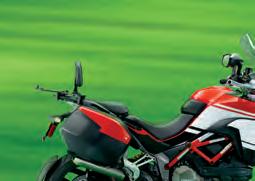
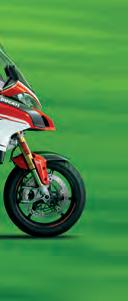
It’s probably not a surprise to anyone who knows I recently bought a new (to me) motorcycle that I’ve been riding a ton lately — on the Alps Challenge tours, for sure (see page 38 for the scoop), but also back home on the 2013 Ducati Multistrada I bought a week before I left for Europe.
It’s my first-ever Ducati, and for the most part I’m loving the thing. It’s torquey as hell, faster than sin, comfortable enough for cross-state travel, stunningly beautiful to look at, and do-it-all capable enough even for track days, though it’s not without issues, primary of which is the over-damped and difficult-to-adjust Sachs semi-active “Skyhook” suspension. With all that on-road exposure you’d expect to run across some sketchy and surprising situations — and I definitely have.
A biggie happened the other evening on a ride up Big Cottonwood Canyon on the way to the top of 8,000-foot Guardsman Pass, which leads to Park City. Halfway through a medium-fast left hander I spied a pretty ugly situation directly in front of me…a thin layer of dirt spread across the entire lane, courtesy of some nearby construction.
The corner entry was clean, so the dirt was a total surprise, and before I could do much more than feather the brakes to slow down a bit, my front Pirelli lost traction and, soon after, so did the rear. For a second or two I was floating in that netherworld between full traction and crashing, and all that kept me from going down, I think, was a little throttle and steering manipulation — thanks to 50 years’ worth of dirt-riding experience — and a little luck.
Surprise number two happened just 30 minutes later on the way down the canyon when a mule deer (which are larger than Eastern Whitetails) sprinted
PERSPECTIVES
SURPRISE, SURPRISE!
BY MITCH BOEHM
across the road right in front of me. I dug deep into the Ducati’s ABS and luckily missed the thing, but it was yet another reminder of how quickly situations can change just when you think things are going well, and how surprises out there on the mean streets can quickly turn a fun afternoon of riding into a multi-day stay in the trauma center, or worse. (Trauma centers are no fun, trust me).
Surprises are everywhere, it seems, on backroads and in town. Two that seem to bite a lot of riders (me included) are cars that are parked (or seemingly so) along backroad shoulders and in-town spaces suddenly pulling out right as you approach them. Despite mirrors and the human body’s ability to look behind itself, it happens way too often, and all you can do is be on guard and ready to react.
Same with slippery (and often oil-coated) on- and off-ramps, which almost bit me bad while returning from a test ride on a pre-production ST1100 sport tourer when I worked for Honda in the early 1990s. Thinking about everything except the connec-
Besides fourwheelers, surprises are everywhere out on the mean streets…
tor ramp between two perpendicular freeways, I railed in there and never saw the oil slick until I was two-wheel skating toward the guardrail. Luckily I survived, but the memory pops back into my mind every time I see an onor off-ramp. And that helps.
Things like corners tightening up suddenly, or your bike starting to sputter due to a lack of gas on a crowded freeway (forcing you to reach down and flick to reserve) are other examples of suddenly dangerous situations popping up out of nowhere, and all you can do, really, is be ready for them and not have to think much when you’re forced to act. The key is to act correctly as well as quickly, and as we all know, the latter can take years of experience — something new riders don’t always have the benefit of.
So get out there and ride, eh? Gomer Pyle would be proud.
Mitch Boehm is the editorial director of the AMA
KEVIN WING
YOUR SISTER’S DOG’S BIRTHDAY PARTY
Protect your escape with Progressive. Progressive knows that the best part of any event is leaving on your bike. That’s why we offer comprehensive and collision coverage for your bike and more. See if you could save by switching to America’s #1 motorcycle insurer.
2022 MEMBER
MONTHLY DRAWINGS
• Liberty Sport Eyewear
• Nelson Rigg Choice: Cover, Luggage
• Mimi & Moto Children’s Books
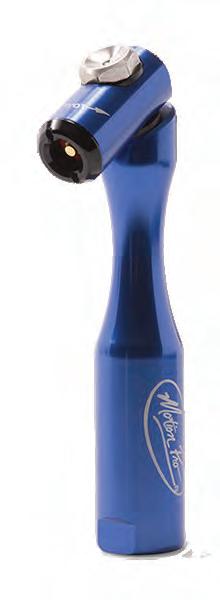
• Motion Pro: Pro Fill Airchuck
• Warm & Safe 12V USB Adapter
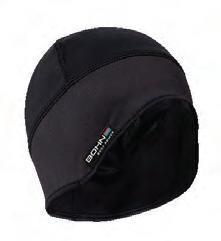
• Bohn Armor Skull Cap
• AMA T-Shirt
QUARTERLY DRAWINGS
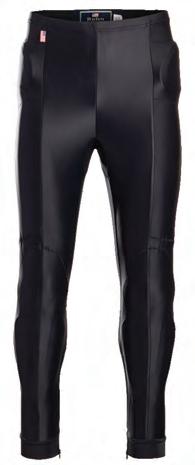
• Bohn Armor Pant & Shirt Set
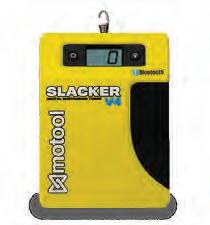
• Motool Slacker & Street Kit
Members who join or renew their AMA membership from Jan. 1, 2022, through Dec. 31, 2022 are automatically entered to win one of these awesome motorcycling prizes!
SWEEPSTAKES
It’s no secret that success is as much a function of tenacity as it is of talent, intelligence or education. Dustin Hoffman’s early career was a series of rejections, J. Paul Getty went broke 17 times before he got rich, and an 8th-grade Albert Einstein was not recommended for higher education in mathematics.
Lonnie Manybears was not recommended for anything. He was terrible in math and equally inept at reading, writing, the social sciences and indeed, the social skills. He failed Grade 4 and quit school after he failed Grade 8. We all knew “Lazy Lonnie” wouldn’t amount to anything.
He lived a few doors down from us, and we’d often hear his alcoholic father bellowing orders to the family. Lonnie’s dad loved three things: whiskey, ice fishing, and motorcycles. In winter, he’d drag his sons to the bay to spend hours over a hole chopped into the ice while he drank his way into a stupor.
During summer he did the same thing over worn-out motorcycles, and Lonnie ended up being fascinated with mechanics. On any summer evening, while other kids watched TV, Lonnie could be seen well past dark through the open door of his dad’s garage working on something mechanical. By the time he hit his teens he was better at it than his father.
The Japanese motorcycle invasion of the early sixties hit the transportation scene like Pearl Harbor, and it wasn’t long before every kid had a Honda 50 step-through or the more macho Honda 90 Sport. Unlike British or American iron, the beauty of a Japanese bike was that you could pay for it in one summer if you worked weekends, days, nights and
MEGAPHONE
Moto MERITOCRACY
BY B. JAN MONTANA
in between. Honda did more to infuse the Baby Boomer generation with work ethic than the entire National Education Association.
No one knew anything about motorcycle mechanics, however, and “maintenance” was something janitors did after school. The “nicest people” in the ads never had dirty hands, so why should we? Besides, by the time we’d paid for the bike, there was barely anything left for oil or plugs; those bikes were just going to have to look after themselves.
Despite our impression that these things should last forever, they tended to break down after a couple of seasons. And when that happened it was either a trip to the dealer and his abominable $17 per hour shop rate, or to the clapboard garage of Lonnie Manybears. Lonnie was closer, and he worked for tips. He soon became very popular.
It was an ironic sight. The same guys who had derided Lonnie all through public school with names like “wagon burner” and “spear chucker” were now lining up as if he was Miss February signing centerfolds. Lonnie had failed virtually everywhere they had succeeded, yet they pursued his skills and knowledge as if he were a Greek oracle.
Lonnie may not have been academic, but he was no fool. He soon started charging half the shop rate. When guys complained, as they inevitably did, he’d always say this: “When you need help, you gotta pay de best guy.”
When the snowmobile craze hit, the local motorcycle dealer had service work 12 months per year, and he offered Lonnie a full-time job. Lonnie was not only good with a torch and a welding rod, he could repair
parts that were never designed to be disassembled. There’s a pretty big difference between a factory trained “remove and replace” lackey and a tech who has the skills to actually fix things. Lonnie was the antidote to planned obsolescence, and it wasn’t very long at all before he was the lead technician.
When he got an offer from a dealer in the big city, his employer countered with a partnership agreement. Lonnie stayed local, ended up buying the shop in his 10th year, and then leveraged his way into another shop soon after. When Honda started importing cars, Lonnie got the local automotive dealership.
By age 28, Lonnie owned three dealerships and lived in a large house on a golf course. He was significantly wealthier than the classmates who’d derided him in school. He won “life’s lottery” without Affirmative Action or any other government program. To the contrary, he didn’t face any real discrimination till the IRS discovered he was a successful businessman.
The local paper did a feature on him, and the Ivy League reporter printed his badly worded answers verbatim. She finally asked the question that must have been uppermost in the minds of readers.
“Mr. Manybears, how did you manage to become so successful considering your limited education?”
Although I’d heard it before, I roared with laughter at his pat response. “When you need help, you gotta pay de best guy. I hired de best guys.”
B. Jan Montana is an AMA Member.
MAXIMUM PROTECTION THROUGH
PREMIUM FILTRATION
APPLICATIONS FOR MOST MODELS
YAMAHA, HONDA, KAWASAKI, SUZUKI, KTM, HUSQVARNA, GASGAS & MORE
BACKFIRES
WINDSCREEN WISDOM
Excellent article on windscreen design, materials and care in the September issue’s Garage section. I ride eight bikes, but one I’ve had for 34 years — my 1988 Harley-Davidson FLHS — has the police-style screen that is original and still very clear and uncracked after 175,000 miles. I only wash it with water and micro-fiber towels, and dry with same. Years ago, micro-fiber towels weren’t really a “thing” and I used old-fashioned baby diapers to wash and dry my screens with. Those did not scratch things up, either. Keep up the great work!
Bob Lower Casper, Wyo.
SKILL TRANSFER
At 77 years of age, I am riding my motorcycle a bit less and my bicycle a bit more of late. A month ago I was at a four-way stop on my Cannondale bicycle, arriving simultaneously with a pickup to my right and waiting for my turn to proceed after him. As I began to cross the intersection, I covered my brake and monitored the front wheels of the car that had arrived after the pickup, as I have done in similar situations on my motorcycles. When I was a third of the way into the intersection, the car began to move briskly into my path, but I was able to stop in time to avoid being run over thanks to my 60 years of practice on motorcycles. The car driver appeared to be annoyed at my existence. Not me.
Richard DeBeau Nortfield, Minn.
LETTER OF THE MONTH
R MORE SHOP TALKIN’
eally enjoyed the Talkin’ Shop article in the August issue. Matthew Crawford’s Shop Class as Soulcraft book (which was mentioned in the October issue’s Backfires section) is a great read. Crawford, who’s a Ph.D., motorcycle shop owner and faculty member at The University of Virginia, writes that not every student is meant for a “knowledge college,” and that technical schools need to be considered more often. Society in turn needs to afford more respect to the trades and graduates with technological credentials.
Not long ago a young friend was dropping his mother’s Volvo off for service at the dealer and the Service Manager noticed the tech school logo on his shirt. He was offered a job on the spot and upon graduation became a certified Volvo technician, earning a decent wage doing something he loved. High school guidance counselors need to get on board and offer solutions that accommodate the individual’s interests and aspirations rather than being concerned with statistics boasting about their rate of graduates going off to “knowledge colleges.” Let’s pay these tech graduates accordingly, respect and honor them, and encourage students to explore the many benefits of a technical education and career.
Ron Fish Valley Forge, Pa.
From what we’re reading and seeing, Ron, tech-school grads are making quite decent money these days, and in many cases more than liberal arts degree holders. The knowledge-college-is-the-only-way mentality of the last few decades seems to be changing of late, and for those for whom a traditional college education isn’t a good fit, that is good news indeed.
Letters to the editor are the opinions of the AMA members who write them. Inclusion here does not imply they reflect the positions of the AMA, its staff or board. Agree? Disagree? Let us know. Send letters to submissions@ama-cycle.org or mail to American Motorcyclist Association, 13515 Yarmouth Drive, Pickerington, OH 43147. Letters may be edited for clarity and brevity.
GARY YASAKI
SOLO OR NO? A GOOD QUESTION
At 62, I often find myself hitting the trails solo. I suppose it could be my reclusive nature, inability to tolerate people for extended lengths of time (“extended” defined as longer than 10 minutes), or some other trait that will be assigned an acronym followed by the creation of support groups and self-help books.
But seriously, I grew up racing with a whole posse of friends and we always did just fine. Nowadays, I will meet up with a few people on the trail…and yet there is always something that has me just wanting to ride solo. Is it an ego thing?
It always feels like someone is trying too hard to be the fastest guy, and let everyone know it, while people like me did our serious racing years ago and now just want to feel the rush without the crush of crashing out in the name of being the fastest guy on “Who Cares Trail” that day. Other times it’s just the lack of connection. The guy who brags about never
washing his bike cuz it would cut into his riding time, or the one who has to stop every 5 minutes for a smoke. Even guys I do like to ride with on occasion can annoy me when they want to go ride XYZ trail because it’s close to home and they can get back to, ya know, the important stuff. I’d rather drive two hours to the best trail and make it a day. I could go on. I guess I’m searching for ideas or ways on how to approach riding so I can actually be more social? I think I’d like to ride with others, and I miss my old buddies, and the camaraderie of it all. I just think so many people are in different places in their riding experience that it’s hard for me to find my niche. What do you think?
Brian Hennessy
I’m in the same boat some of the time, Brain. I enjoy riding with others quite a bit, but whether I know them or they’re strangers, there are occasions when they do things I don’t like. It’s getting worse with age, too. The older I get (I’m 60 now), the pickier
NEW for CRF1 100A Standard
I am about who I ride with, and my patience isn’t what it used to be — and it was never all that good to start with! I’d be interested to hear what readers have to say about this, so ping us at submissions@ama-cycle. org if you want to sound off.
—Ed.
CARLSBAD (PHOTO) CREDIT
Can you tell me who shot the stunning opening photo of Marty Moates holeshotting the 1980 USGP in your One Day of Magic piece in the September issue? The layout is stunning, but that photo is epic and makes the whole thing come together so nicely. Thanks!
Marc Johnson Ravenna, Ohio
That’d be longtime motorsports photojournalist David Dewhurst (dewhurstphoto.com), who shot a lot of the images in our Carlsbad history piece a few issues back.
IBACK IN THE DAY
Where the photos are blurry but the memories are clear!
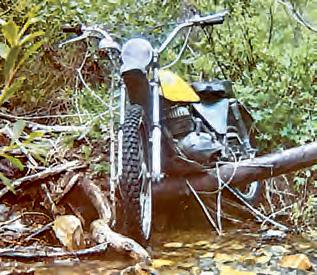
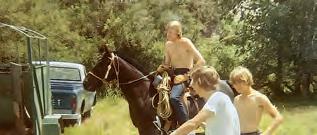
t was a beautiful summer day, perfect for riding the mountains of Utah. My older brother and I started off on our regular loop and then came to a midpoint that overlooked a canyon that led to the valley — and home. We’d looked down that slope many times, wondering if we could make it down on our Bultacos. This time, our youthful, can-do attitudes said “yes,” and we ventured into a creek bed densely overgrown with brush and trees that led into the steep and narrow canyon. After a difficult
descent down a waterfall, we found we were trapped at the top of another waterfall, a drop off with sheer embankments on both sides. No way, we decided. Impossible. We were stuck. We abandoned our bikes in the creek bed and hiked home, arriving just before dark and after concocting a plan to rescue our bikes the next morning. The plan included a horse, a rope and a third skinny kid pulling the bikes up the embankment to another rough trail, but one that led home. We missed dinner, and mom was mad, but we had the ride of our lives!
—Tom and John Bogus
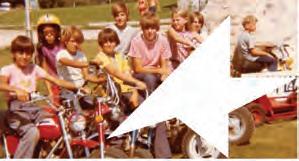
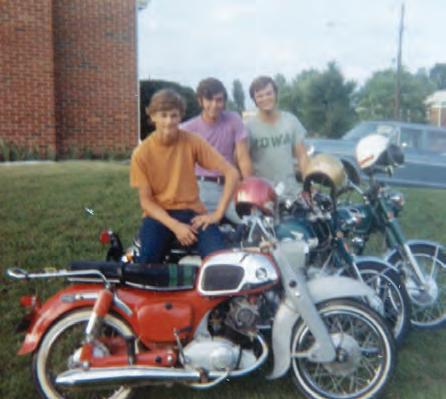
side yard in Southern Maryland showing, left-to-right:
I confess that my favorite section of the American Motorcyclist is Back in the Day. The stories and photos stimulate so many fond memories for me and — in the case of the pre-1950s/preme photos — really invoke America’s motorcycling history. The section inspired me to submit my own photo, taken in the summer of 1972 in my
Henry Smith (me) with my 1966 CA95 Benly 150 “Baby Dream.” Yes, a car had previously turned left right in front of me in an intersection when I had the right-of-way, and my very sturdy fork assembly crumbled up like an accordion and I woke up in the hospital — and of course I’ve been riding like I’m totally invisible ever since!
That’s Johnny Vendemia with his Honda CB175. And Bill “Slugger” Reed, who taught me how to ride a motorcycle (bless him) on his pictured Yamaha, a 250 I think, but my memory is failing on that detail. We were three of the eight members of a little informal motorcycle club out of Clinton, Md., named by our always-hilarious gym teacher, “The Puddin’ Pullers.”
The freedom, fun and youthful joy that those bikes represented to me and my pals cannot be overstated. Please keep those great issues coming!
–Henry Smith
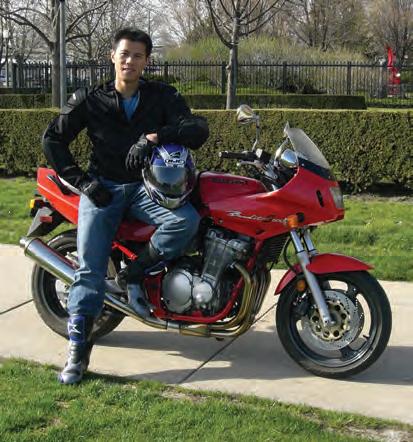
First off, I’d like to say that the AMA magazine has come a long way. I enjoy it thoroughly every month! Keep up the good work! The red Suzuki Bandit 600 was my first bike, bought when I was a junior in college, and with a full head of hair. As a young and dumb overconfident kid I failed my first try at my motorcycle license at the DMV. I then took a proper MSF course, and not only did I get my license, I left with a wealth of knowledge and skills I wouldn’t have gotten otherwise. I tooled around college and the empty county roads with her and commuted from Texas to Mexico for my job.
—Fernando Chen
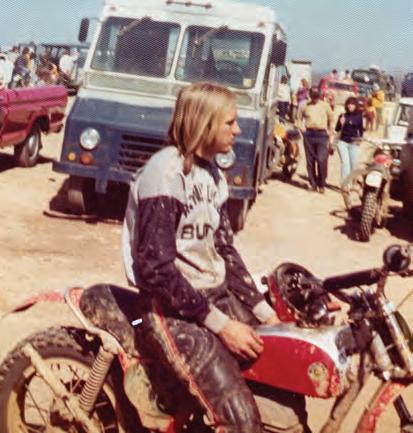
This is around ’72 or so in the early days of motocross in western Pennsylvania. My first bike was a Honda S90. A Hodaka came next. On to a Montesa Capra and a pile of Bultacos. Best days racing local tracks with my brother Marko. Keep up the great work.
—Tom Hollowood
Here I am in 1975 at 25 years of age on my new ’75 Bultaco Frontera 360. Now at 72 I’m still an avid motorcycle enthusiast, although I’m not riding in the dirt anymore. I made the switch to the street after 20 years. I ride every chance I get with four bikes in my shop — two Kawasaki 1200 ZRXs, an ’84 Honda Interceptor 700 and an ’84 GPZ Kawasaki 750.
—Jim Mendoza
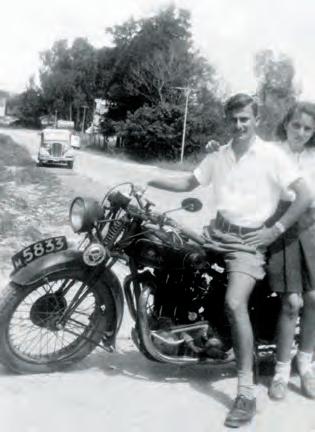
Two generations of bikers here! The first photo is my then-17-yearold father Yaacov (Jack) with his younger sister Dalia on his Sunbeam in Hadera, Israel, circa 1937. Born and raised in Israel until coming to the US in 1950 to study engineering at Brooklyn Polytech, my father also owned a BSA and a Norton.
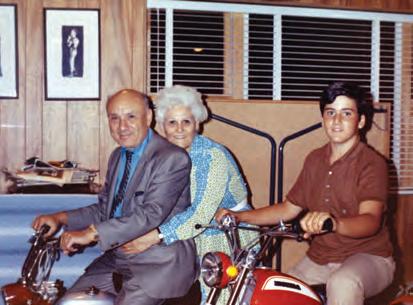
The second photo is me and my maternal grandparents, Max and Tova, on my Honda Trail 50 and my Honda SL70, circa 1971. My father surprised me in 1969 by purchasing this Honda Trail 50 at Osaka, Japan’s Expo and shipping it back to the U.S. My greatest memory was him telling me to help him off-load the crate and opening it not knowing what was inside. I was 10! Two years later he upgraded me to the SL.
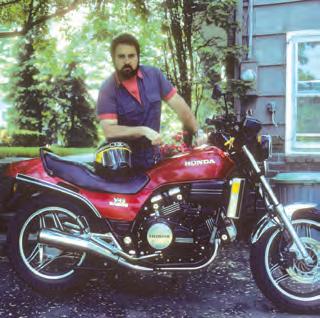
Third, me and my the-newly-released 1984 Honda V45 Sabre in New York, circa 1985. Shaft drive, anti-dive, fiber optic integrated cable alarm system, LCD instruments and the smoothest engine I’ve ever experienced to this day. It was the greatest bike I’ve ever owned!
—Eli Hardof
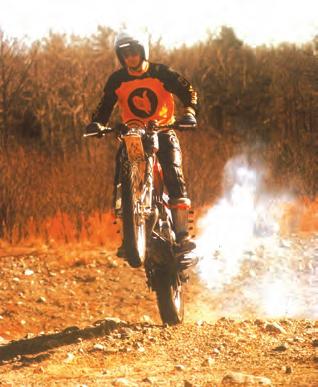
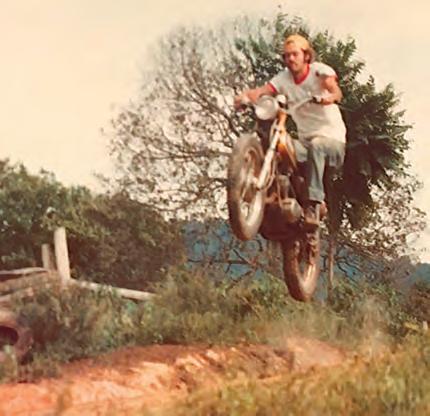
This page has become my favorite part of this magazine. My brother and I bought this 1973 Yamaha 175 Enduro, seen here jumping out of a pit silo. Fifty years later I have a YZ250 and an MX track on the farm. My son-inlaw, grandsons, friends and neighbors all enjoy riding there.
—Glenn Yowell
up to speed
News, notes, insight and more from the motorcycling universe
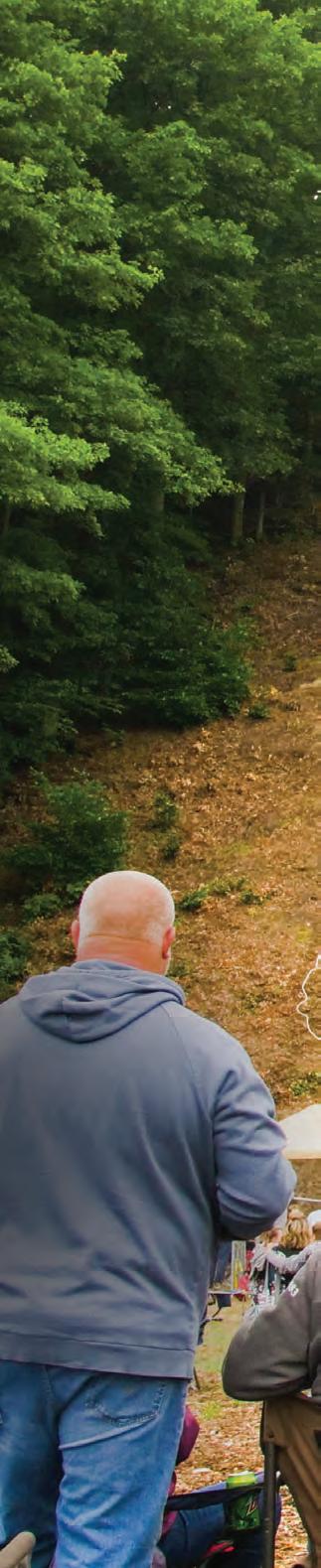
The AMA Hillclimb Grand Championship overcame adverse weather to crown its champions
KEATON MAISANO
G Muddy Mayhem!
o watch a hillclimb event, and the focus is usually on what’s going up the hill. But at the AMA Hillclimb Grand Championship in August at Michigan’s historic Mount Garfield, the concern was what was coming down!
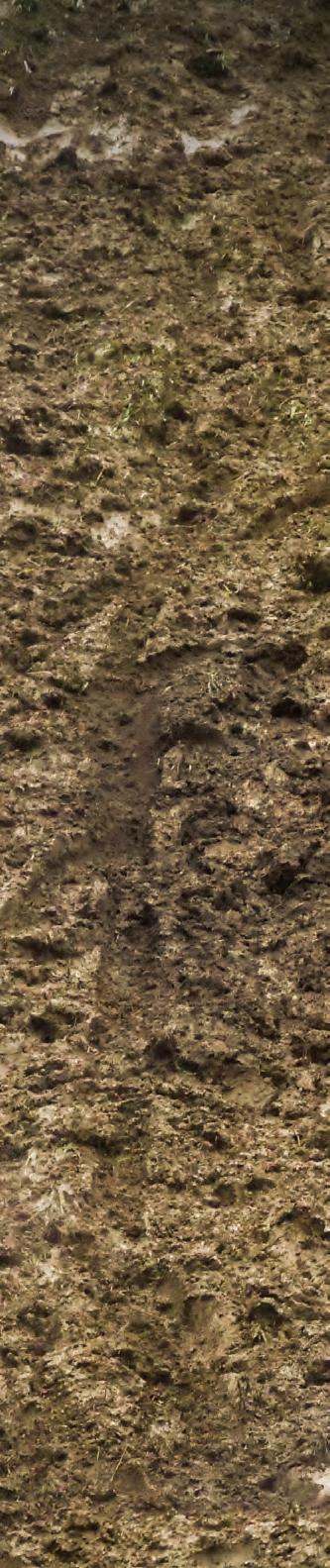
“We got to the 450 class,” said first-time event promoter John Radke, “and as the bikes were going out, the hill was coming down faster
than the bikes! Every time they went over one of the breakers, the water would pour out from behind it, so there were times where more of the mud was coming down than bikes were going up.”
While a heavy rain had
turned Mount Garfield — a sand dune that has been tied to hillclimb and the Muskegon Motorcycle Club for more than a century — into a muddy version of itself, it was up to Radke and those working the event to adapt and try to salvage the weekend.
Deciding to postpone the event until the next day, the competition was limited to a single round, tie breakers and the King
of the Hill competition, for the more than 170 riders due to limited time and hill conditions.
With any tough decision, Radke said the altered format was met with mixed emotions.
“We took our lumps. Some people were happy, though there were some that were very definitely not,” Radke said. “But at the end of the event, and in days following, I received numerous texts and phone calls from some of those people that were upset at the time. Cooler heads had prevailed, and they seemed
to appreciate what we did and knew that we did the best we could with the situation we were given.”
Despite difficult conditions and hard decisions, Radke said there were fortunately no major injuries sustained by any of the riders during the event.
While Radke promoted and ran the event, he was quick to point out that the success of the event was not thanks to his efforts alone.
“It takes a village to
Dan D. Raymond organized the Muskegon Motorcycle Club in 1920, and Mount Garfield (main) was leased for a hillclimb a year later in 1921. Jason Vanberg (right) was named AMA Hillclimb ATV Racer of the Year. The AMA Senior Hillclimb Racer of the Year went to Jason Braun (far right).
PHOTOS: LUKE CIPALA
“It takes a village to put on a hillclimb. I had a great group of people that I’ve worked with for the last few years. And I’d say the success of it all is based upon them.”
JOHN RADKE
up to speed
put on a hillclimb,” Radke said. “I had a great group of people that I’ve worked with for the last few years. And I’d say the success of it all is based upon them — everybody being willing to help out.”
From local riders and club members to groups from outside the area, Radke said the work that was put into making the event run as smooth as possible was crucial.
AMA Awards at the event.
Cullen Vice, who earned the top spot in the 125cc class, took the honor of AMA Hillclimb Racer of the Year, while Blaze Gouty, who
A decade before running events or edging out the competition, Radke was among the spectators with his grandson at Muskegon Motorcycle Club’s Bridgeton location. It was through being a spectator that his grandson got into riding hillclimb, and Radke found himself moving into a role as a referee. Within two years he was the District 14 chairman for hillclimb.
From his time as a spectator all the way to running the AMA Hillclimb Grand Championship, Radke said it is the family atmosphere of the sport that remains appealing to him.
“The community aspect
“It truly was a nationwide effort,” Radke said. “I had a little bit of help from all the districts involved, and they contributed a lot to make this event happen. That was probably the best feeling. Yes, we all have our rivalries, and we all pick on each other, but at the end of the day, we’re family.”
As for the competition side of things, Radke said the adverse conditions challenged each rider’s abilities to the extreme. Showing off their skills in the mud, four riders took home
won the Mini Junior class, was named AMA Youth Hillclimb Racer of the Year.
The AMA Senior Hillclimb Racer of the Year went to Jason Braun, winner of the Masters class, and Jason Vanberg, who won the ATV Open class, took home the AMA Hillclimb ATV Racer of the Year.
Beyond the AMA Award winners, Broc Williamson earned the prestigious title of King of the Hill for 2022.
Radke found his own slice of glory when he won the vintage class.
“I just came off an injury, two broken ribs and a broken thumb,” he said. “I played it conservative. Conservative got me through the roughest part, and I was able to get a better footing.”
of hill climbing has been one of the biggest draws for me,” he said, “and it’s what has kept me involved. You go anywhere, you meet somebody, they become a friend and they become part of your family by the end of the day.”
Blaze Gouty (above left) earned the AMA Youth Hillclimb Racer of the Year award while Cullen Vice (above right) won the AMA Hillclimb Racer of the Year honor. Broc Williamson (right) took home the title of King of the Hill.
“We got to the 450 class, and as the bikes were going out, the hill was coming down faster than the bikes! Every time they went over one of the breakers, the water would pour out from behind it...”
JOHN RADKE
up to speed
RIGHTS Roundup
What’s trending in government relations and legislative
affairs
BY KALI KOTOSKI
Inflation Reduction Act Neglects e-Motorcycles
he Inflation Reduction Act recently signed into law by President Biden fails to support the motorcycle industry’s push into the electrification of two-wheeled transportation by not including tax credits meant to lower the cost of EVs.
The law aims to reshape the
nation’s energy sector and spur the production and demand of electric automobiles to foster widespread consumer adoption. Currently, most electric vehicles are too expensive for many Americans, and e-vehicle infrastructure is lagging, as well.
The law includes a $7,500 tax credit at the point of sale for new EVs and $4,000 for used EVs. The new tax credits replace the old incentive system, which included a $7,500 credit for new EVs and set a manufacturing
cap on automakers. Beginning January 1, 2023, the cap no longer exists, and the credit scheme lasts until 2032.
However, electric motorcycles were left on the cutting room floor after Congress failed to revive a federal tax credit for motorcycles that expired on the first of this year.
“The AMA was very disappointed to see the entire electric motorcycle tax credit provision eliminated in the bill,” said AMA Director of Government Relations Michael Sayre. “The AMA worked
New Study Confirms Self-Driving Tech Concerns
new study released by the Connected Motorcycle Consortium — an industry-led group — proves that Advanced Driver Assistance Systems (ADAS) pose safety risks for motorcyclists and other vulnerable road users. The study comes as governments plan to allow self-driving technology on public roads. For example, the United Kingdom plans to allow limited self-driving cars on its roads next year, with full implementation in 2025. The study provides actionable science to raise the standard for automakers to ensure that technology is safe for motorcyclists.
The study also aims to close the gap in ADAS research that has focused on detecting pedestrians, bicyclists and other four-wheeled traffic, but has never ana-
lyzed motorcycles as a singular variable.
The Consortium found that as drivers become more dependent on ADAS, they become less attentive to the task of driving. While the group says this technology could lower car-to-car collisions, car-to-motorcycle collisions would likely increase. The study also found that current technology can detect motorcycles but with a latency that may not give a driver, or the technology, enough time to react.
Focusing on radar-detection systems, which operate like sonar, the Consortium found that current settings have not dialed in the ability to detect motorcycles. The reason is that the radar detection systems can be set too low, which will adequately detect larger objects like cars, or set too high and thus unable to distinguish motor-
cycles from small, irrelevant detections.
There are similar concerns for camera-based ADAS systems and their ability to detect motorcycles that the study didn’t address. For example, suppose a camera is reading two taillights ahead that are at staggered distances. In that case, it can appear as one set of taillights, which is one of the hypotheses for the recent crashes involving Teslas that killed two motorcyclists in Utah and California after being struck from behind.
For automakers, the study concluded that radar systems need more robust testing and precise settings to account for motorcycles and the myriad differences between them and cars. In addition, the CMC advised that OEMs should consider adding radar reflectors on motorcycles, a common practice in the boating industry, to help ADAS systems
very hard with the electric motorcycle industry to save the program.”
The ill-fated Build Back Better Act, a precursor to the Inflation Reduction Act, included and sought to extend the electric motorcycle tax credit and triple the incentive to up to 30 percent of the purchase price, with a cap of $7,500.
“We believe any incentive that’s extended to those buying electric vehicles with four wheels should be extended to those buying an electric motorcycle,” added Sayre.
The electric motorcycle industry and the AMA are already working with supportive members of Congress to introduce the electric motorcycle tax credit in future legislation.
“We have and will continue to engage with members of Congress to promote incentives for electric motorcycles and more choices for consumers,” said Harley-Davidson VP Communications and Corporate Relations George Prassas. “Manufacturing as well as EV credits for all types of vehicles are essential to ensuring America leads the transportation industry.”
Since Harley-Davidson’s debut of electric motorcycle LiveWire in 2019, the company and its sub-brand have sold 1,648 units.
detect motorcycles. Some places that could improve ADAS detection include the end of the handlebars, axles, mirrors or near the indicators and the front fender.
“By mounting [radar reflectors] on the ends of the bars and the bike’s axles front and rear, there’s no angle at which a radar can be pointed at a bike without hitting at least one of the reflectors, bouncing a strong signal back to the radar sensor and improving the conspicuity towards sensor-based ADAS,” the study said.
Riding ROUNDUP
BUCKET LIST Ride
MA Charter Life
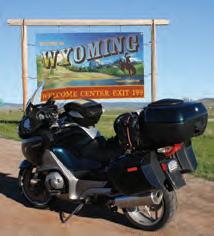
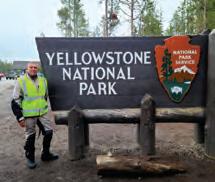
AMember Jeff Shultz has been a licensed motorcyclist for more than 50 years and ridden thousands of miles, but it wasn’t until 2021 that he got to live his motorcycling dream of taking a cross-country
motorcycle trip.
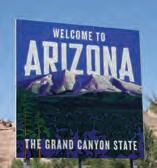
Setting out from his home in Dillsburg, Pa., Shultz rode his BMW R1200RT West to Arizona, up through California, across the scenic states of the Central United States and all the way back home. Along the way he
Jeff Shultz
explored Mount Rushmore, Yellowstone National Park and the Grand Canyon, all while enjoying the exhilarating freedom of two wheels. While a great opportunity to see some of the country’s most significant sites, Shultz’s bucket list trip also
To have your riding story featured in AMA Riding Roundup, send your photos and story to submissions@ama-cycle.org.
gave him the chance to see many of his friends and family scattered across the country.
“It’s not often that a person gets to fulfill a lifelong dream,” Shultz told American Motorcyclist, “and love the manner in which it is accomplished.”
—Keaton Maisano
Racing ROUNDUP
WHAT’S WHAT IN THE WORLD OF AMA RACING COMPETITION
SWEET VICTORY!
Although nearly halfway around the world, Team USA’s seven-rider roster made the United States proud as they finished atop the international standings at the 2022 FIM Junior Motocross World Championship in Vantaa, Finland, in August 2022.
Making their first appearance in the annual event since 2019, Team USA rose to the occasion and tallied 17 points — edging out the host country Finnish team, which took second with 25 points. The Netherlands rounded out the podium with 26 points. The title became Team USA’s fifth overall and first since 2014.
“This year was a great opportunity
for our team, and they seized the moment on the world stage,” said AMA Deputy Director of Racing Mike Burkeen. “I am truly proud of every member of this team, and they reaffirmed what we knew when we selected them: they are some of the brightest young stars in motocross.”
Tayce Morgan of Clermont, Fla., and Maddox Temmerman of Visalia, Calif., represented the team in the 65cc FIM Junior Motocross World
Cup Class.
The 85cc FIM World Championship Class included Carson Wood of Zephyrhills, Fla., Seth Dennis from Port Saint Lucie, Fla., and Landon Gibson of Peachtree City, Ga.
Finally, the 125cc FIM Junior Motocross World Championship Class included riders Casey Cochran of Clermont, Fla., and Collin Allen of Clayton, N.C.
Jeff Cernic, longtime amateur
motocross supporter who managed the U.S. team in its last appearance in 2019, served as team manager. Roost MX and MXtire sponsored the team.
The FIM Junior Motocross World Championship hosts competitors between 11 and 17 years of age. Countries select their own best and brightest motocross stars to participate in individual classes and team events.
—Keaton Maisano
Left: AMA Deputy Director of Racing Mike Burkeen. Above: Left to right, Seth Dennis, Maddox Temmerman, Landon Gibson, Tayce Morgan, Collin Allen, Carson Wood and Casey Cochran.
ALRIGHT KIDARE S THE
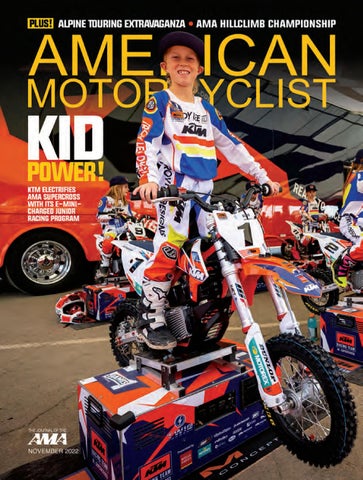
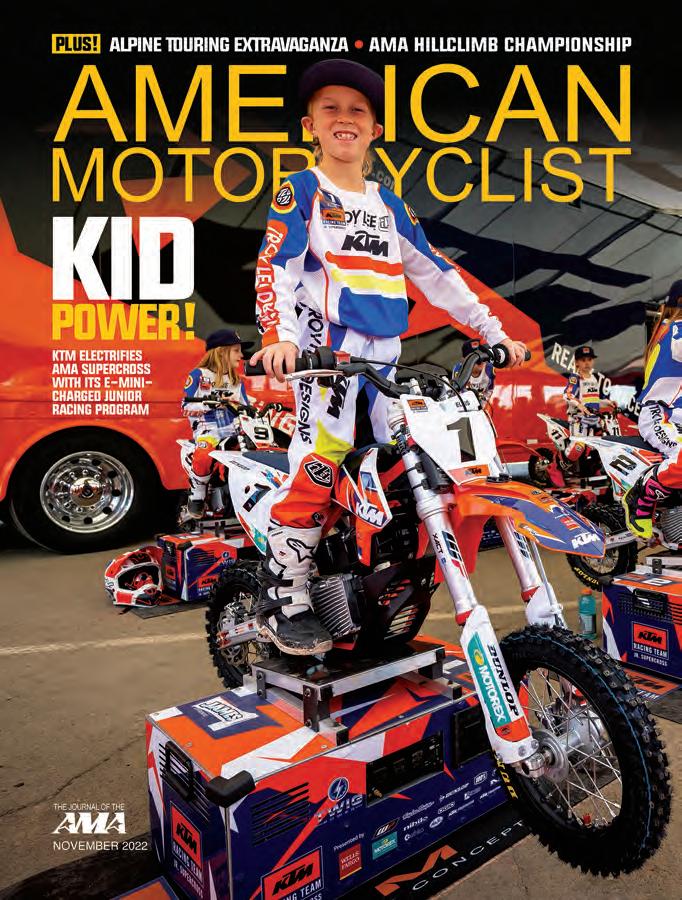
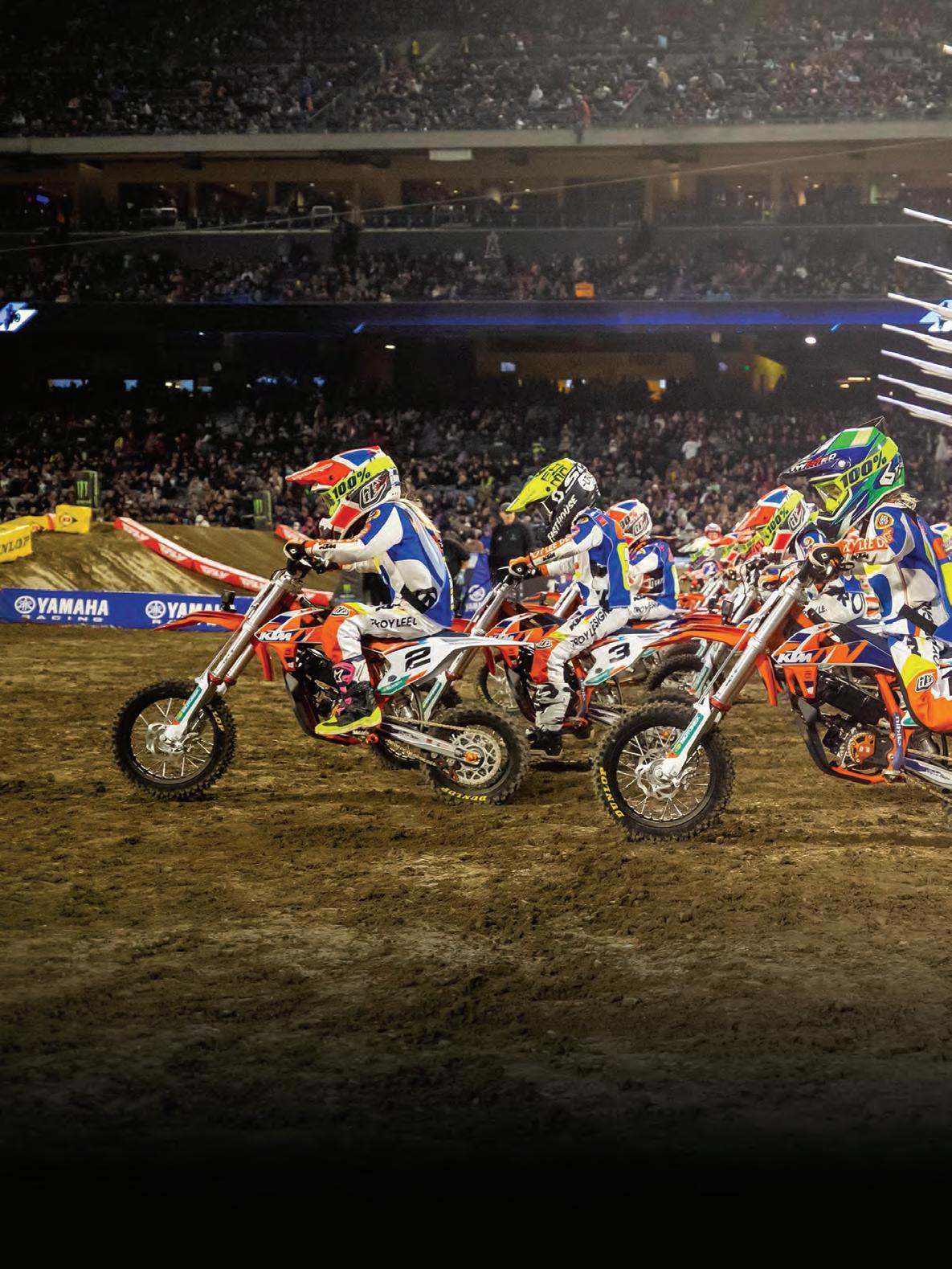
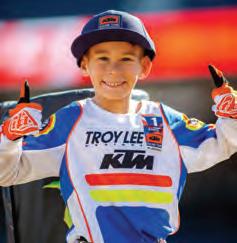
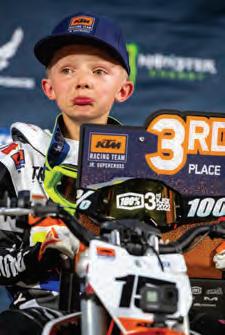
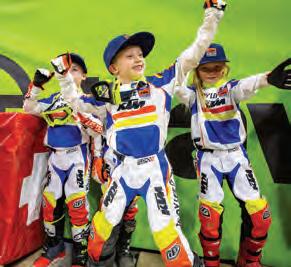
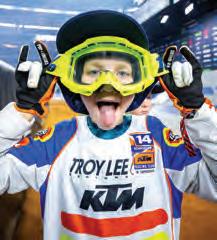
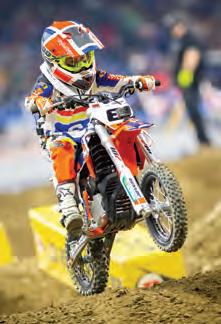
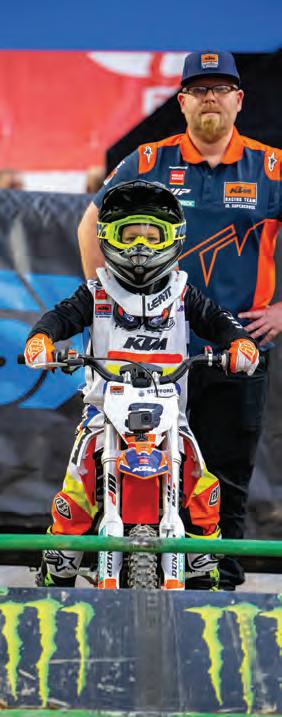
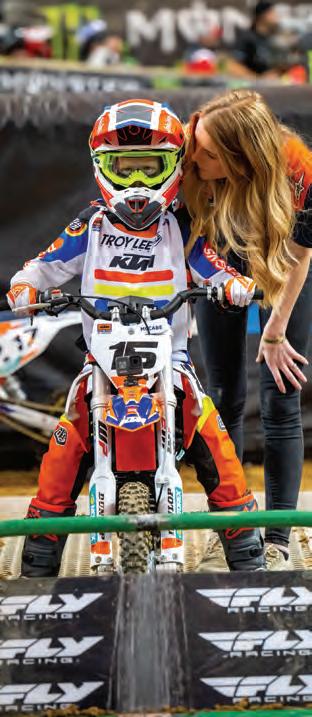
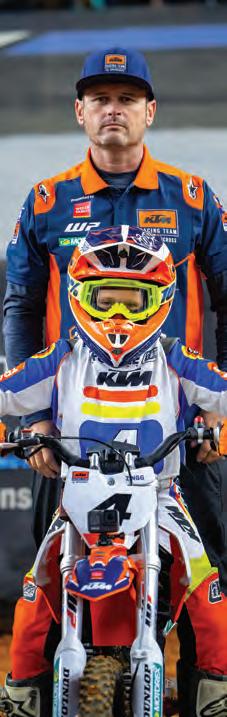
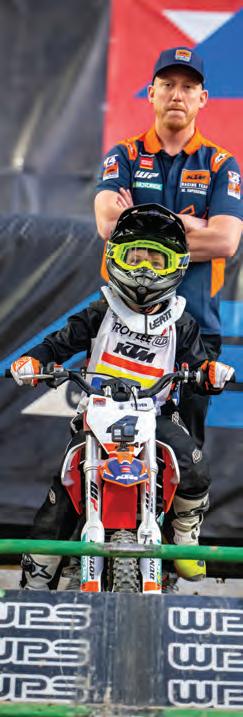
KTM electrifies AMA Supercross with its e-mini-charged Junior Racing program
BY JOY BURGESS PHOTOS COURTESY OF KTM AND JEFF KARDAS
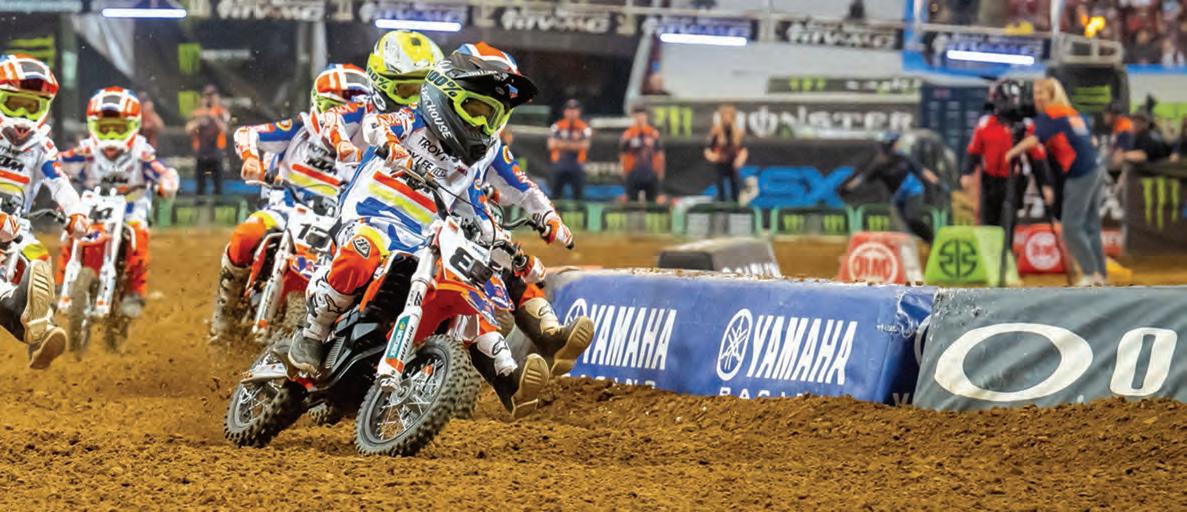
For a young racer, it had to be nothing less than a complete mindblower.
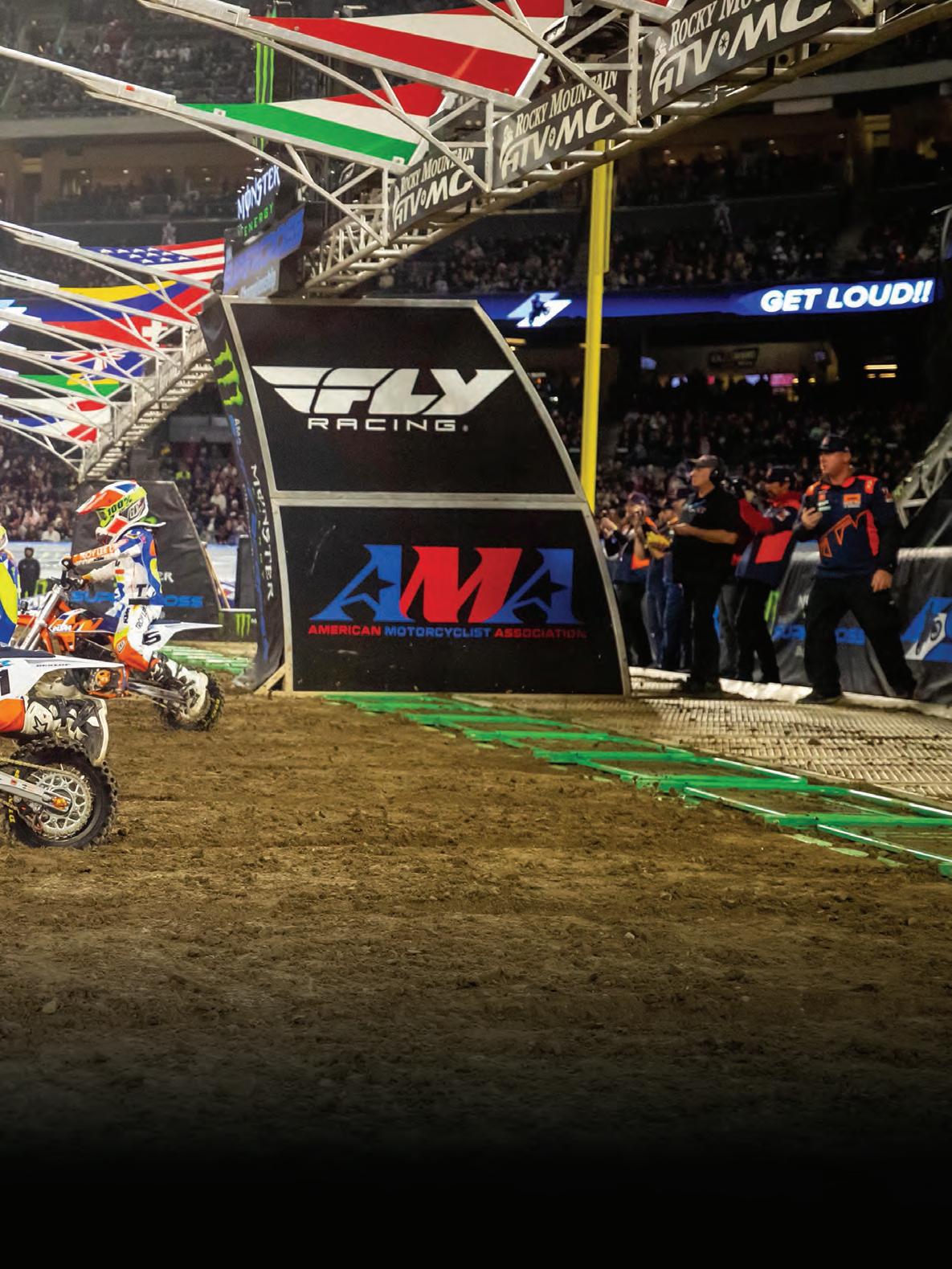
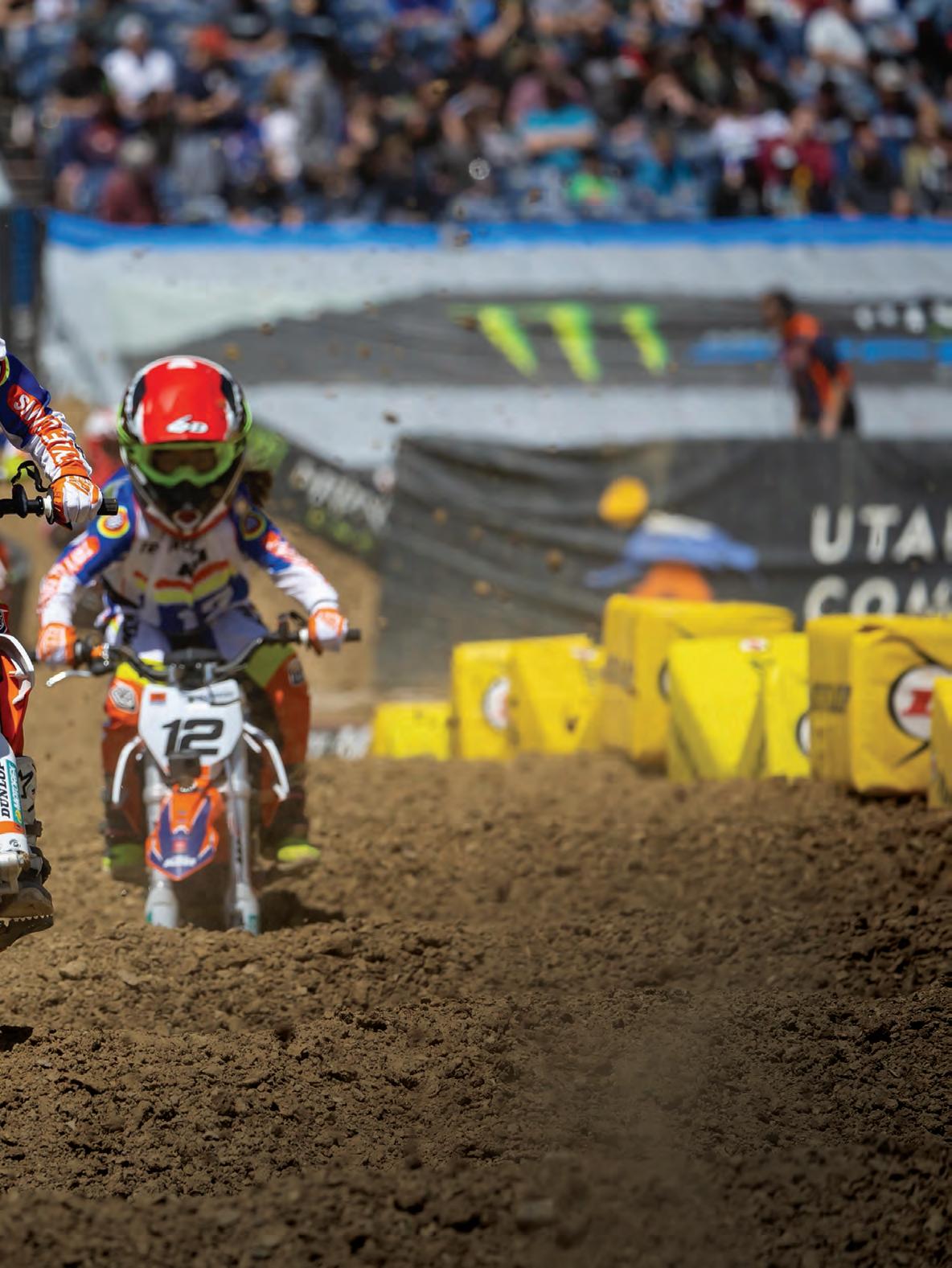
Back in March of 1997, a 7-year-old Minnesota boy walked into the H.H.H. Metrodome — where the NFL Vikings played — for the Minneapolis AMA Supercross round, threw a leg over a KTM 50SX in front of a massive crowd of screaming
fans, and raced the very same track that then-current pros and now AMA Motorcycle Hall of Famers Ricky Carmichael, Jeff Emig and Jeremy McGrath competed on that day.
That boy was none other than Ryan Dungey who, during his decadeplus pro career, collected nine professional titles — four of them with KTM — including four AMA 450SX
Championships, the 2009 AMA 250SX West Championship, and four AMA Pro Motocross Championships.
That experience left a mark, one that Dungey remembers to this day.
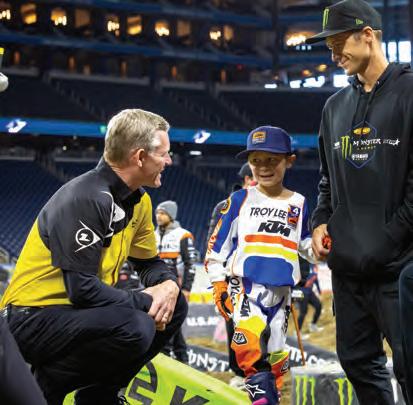
“I’d seen AMA Supercross on TV, raced weekends and already knew that’s what I wanted to do,” Dungey told American Motorcyclist. “But being part of KTM’s Junior Racing program
and feeling like a factory rider for a day was huge. Racing on an actual AMA Supercross track and being with factory riders like McGrath and Emig resulted in a deeper love for racing and motivated me to work hard to get there myself. Looking back now, it’s incredible that I got to live that out!”
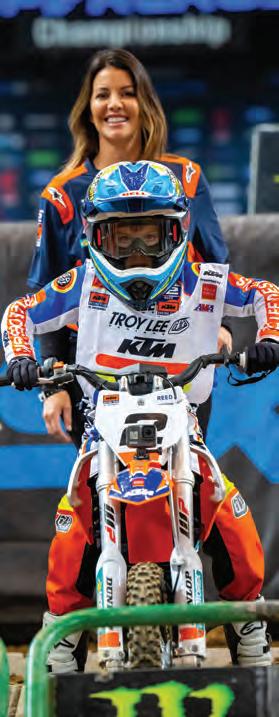
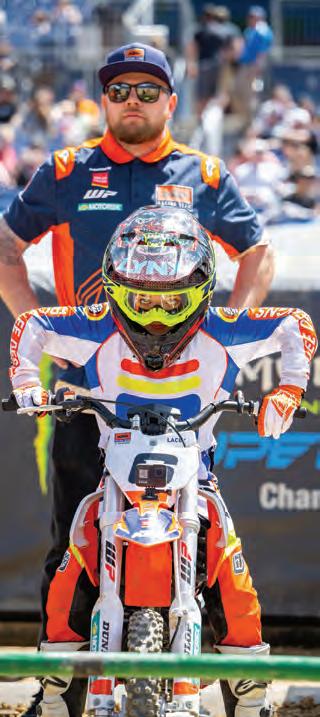
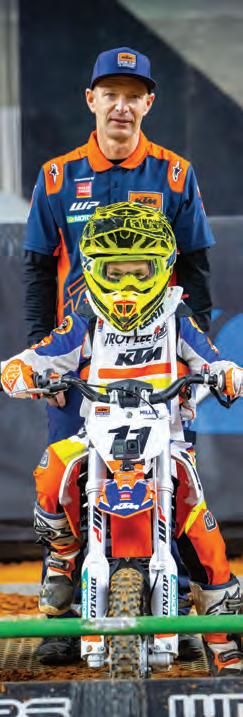
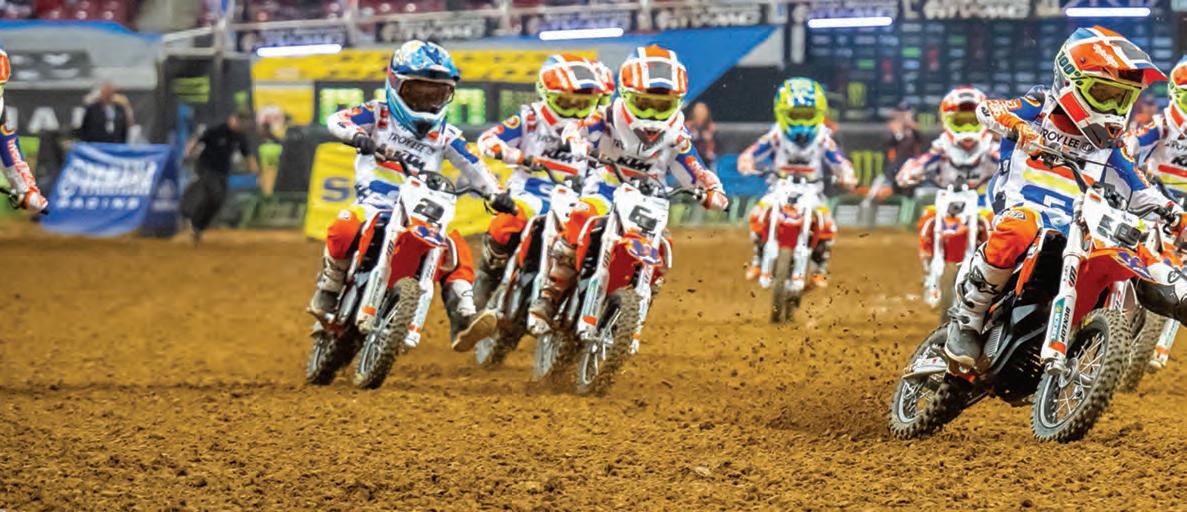
KTM’s Junior Racing program, which got its start a quarter century
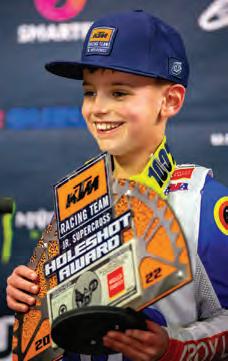
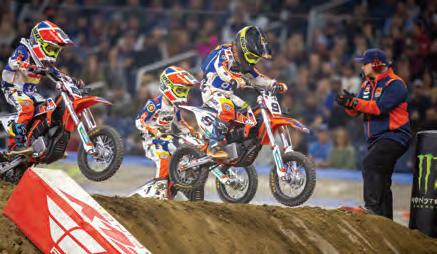
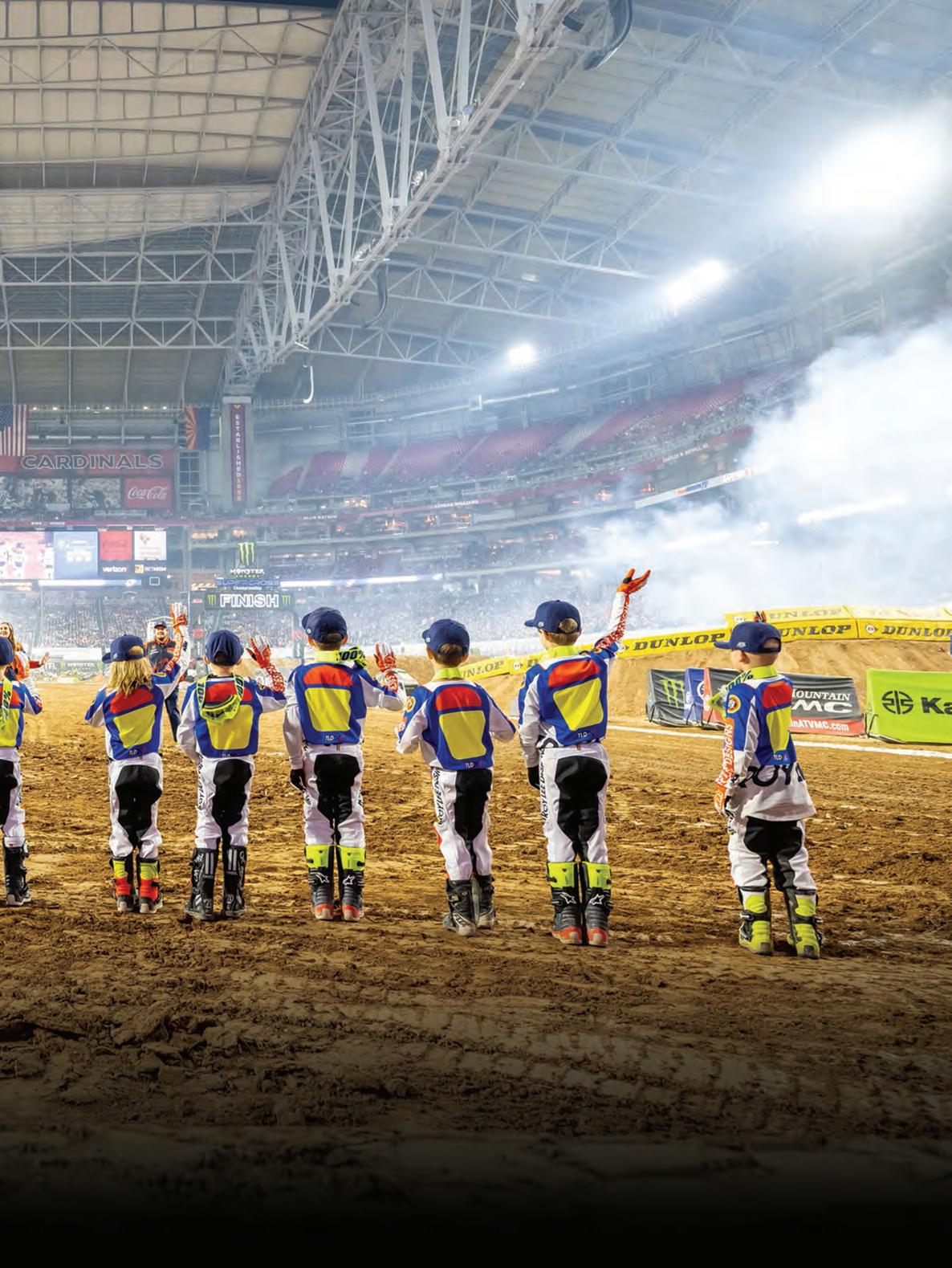
ago, showcases the talents of boys and girls in stadium venues and allows them to race on the same tracks as their AMA Supercross heroes during intermission or between races. Many of the sport’s top pro riders got their first serious taste of racing as part of the program, including AMA Supercross and motocross racer Mike “Mr. Holeshot”
Alessi, who was the program’s very first winner. Through the years, racers such as Zack Osborne, Justin Barcia and 2022 AMA Supercross champion Eli Tomac took part in the program and became serious pro contenders years later.
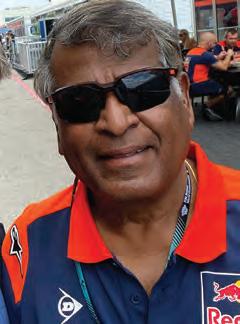
“The program was an offshoot of a collaboration we’d started with a local police department here in SoCal that used KTM kids dirt bikes in local schools to highlight safety, anti-drug, stay-in-school and respectyour-parents messages,” Executive Director of KTM North America and 2020 AMA Dud Perkins Lifetime Achievement Award winner Selvaraj “Sel” Narayana told us. “Those bikes ended up on display at a couple of SoCal [AMA] Supercross races, and they were quite popular with kids and their parents. After some brainstorming between me, KTM executives Scot Harden and the late Rod Bush, the AMA and the Supercross promoter at the time and others, the program launched.”
“For KTM,” Narayana added, “it was a way into the Big Show. At the time we weren’t so competitive
in AMA Supercross, but the Junior Racing program helped create a bigger bond with the racing and Supercross community, and that helped strengthen our brand.”
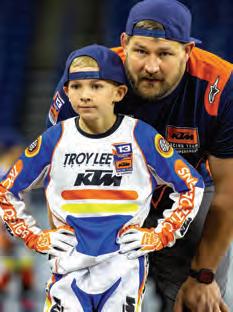
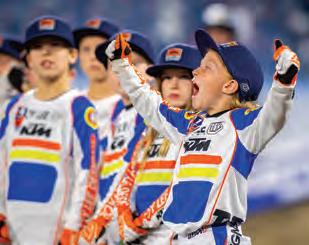
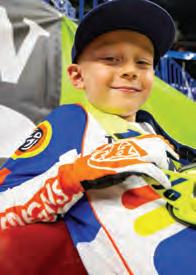
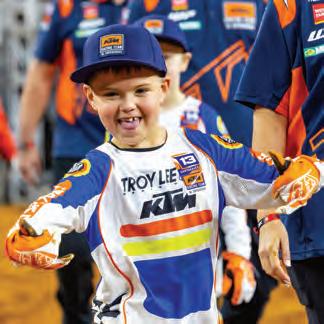
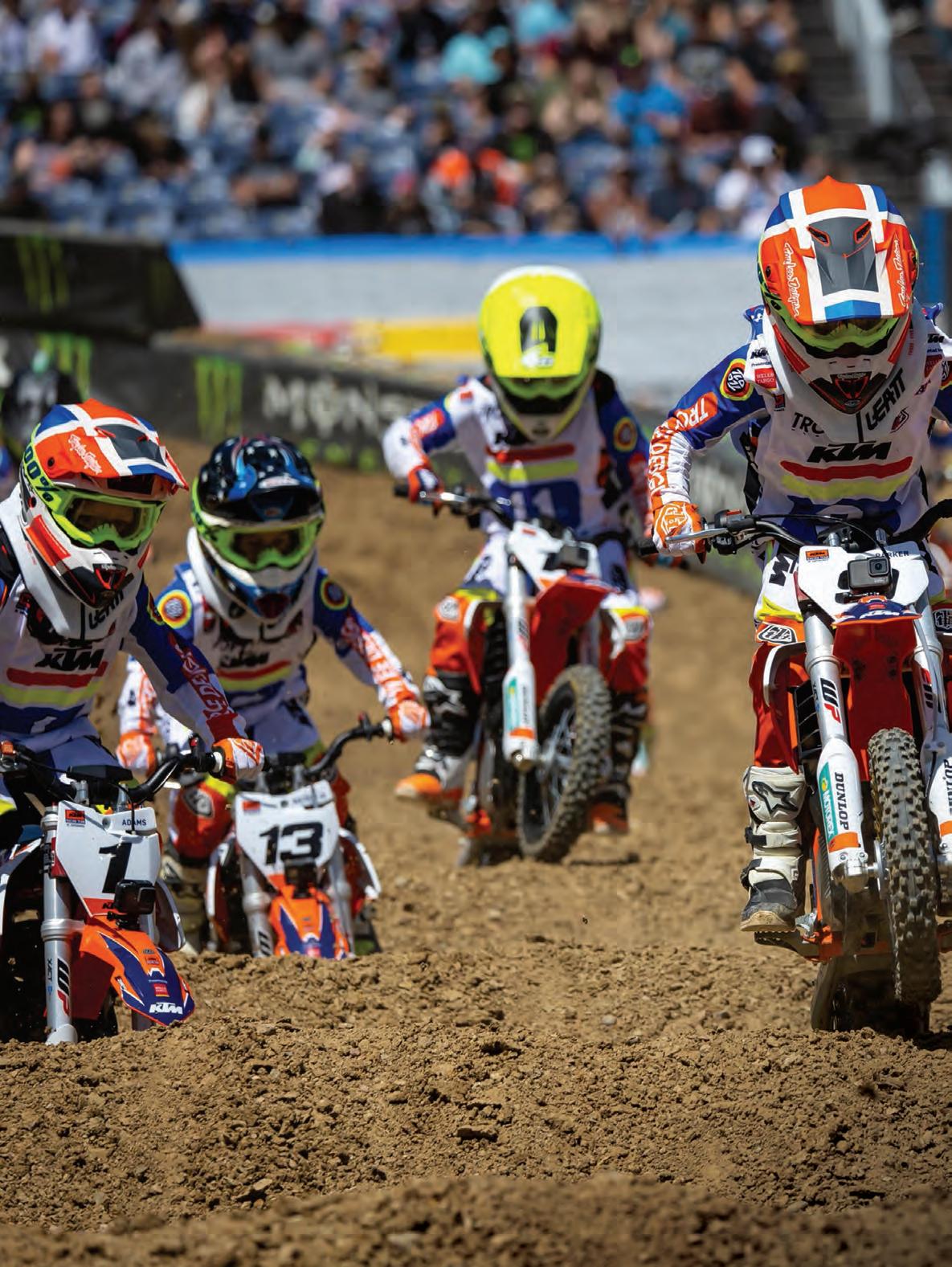
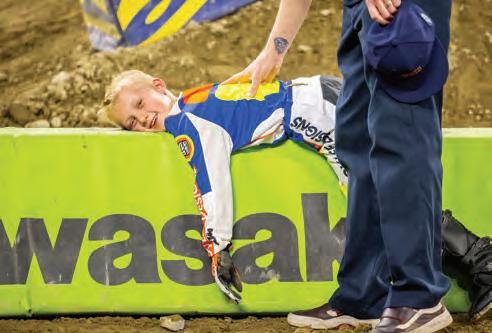
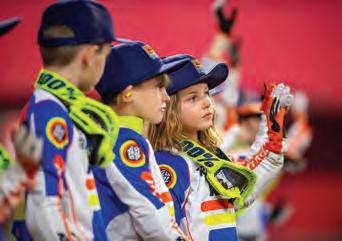
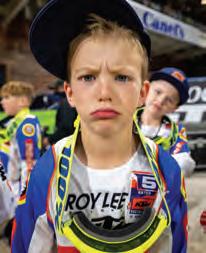
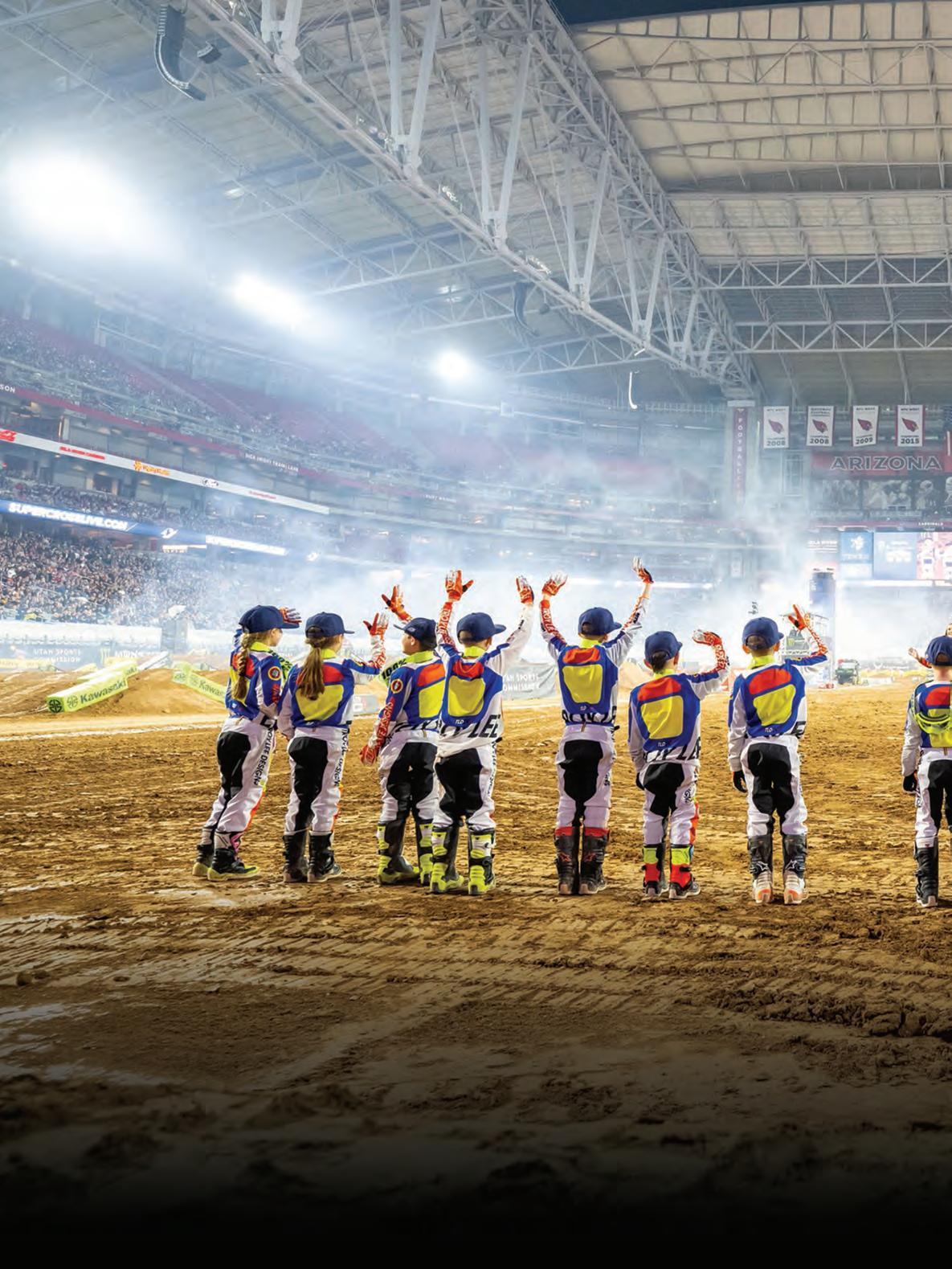
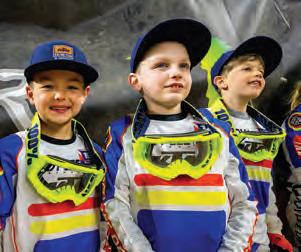
The program was a hit right away with the kids, their parents and the fans — and for the young riders themselves a dream come true. They got to ride the same track as their heroes, be treated like a factory
rider for a day, hear 40,000-plus fans screaming for them, the lights, the atmosphere…pretty intense for a 7or 8-year-old.
“Sel’s vision for this program was brilliant,” AMA National Champion motocrosser and AMA Motorcycle Hall of Famer Mark Blackwell said, “especially when you look at the impact the program has had on the company and the riding and racing community. Having been involved at a senior level at several large companies, I can tell you it’s difficult to get something like this off the ground. Sel and his colleagues at KTM deserve a ton of credit for the success here. Of course, I have known him for 50 years and am constantly amazed at the many significant things he’s done for our industry over his distinguished career. He’s humble and won’t mention them, but they are substantial!”
While the core values of the KTM Junior Racing program haven’t changed much over the 25 or so years of its existence, what has changed is the technology of the bikes — and just recently.
“The introduction of the mini-E — the KTM SX-E 5 — is the biggest change,” KTM Vice President of Operations Robert Pearce told us. “2020 was the first year we used that bike, and we’re going into the fourth year for the 2023 season.”
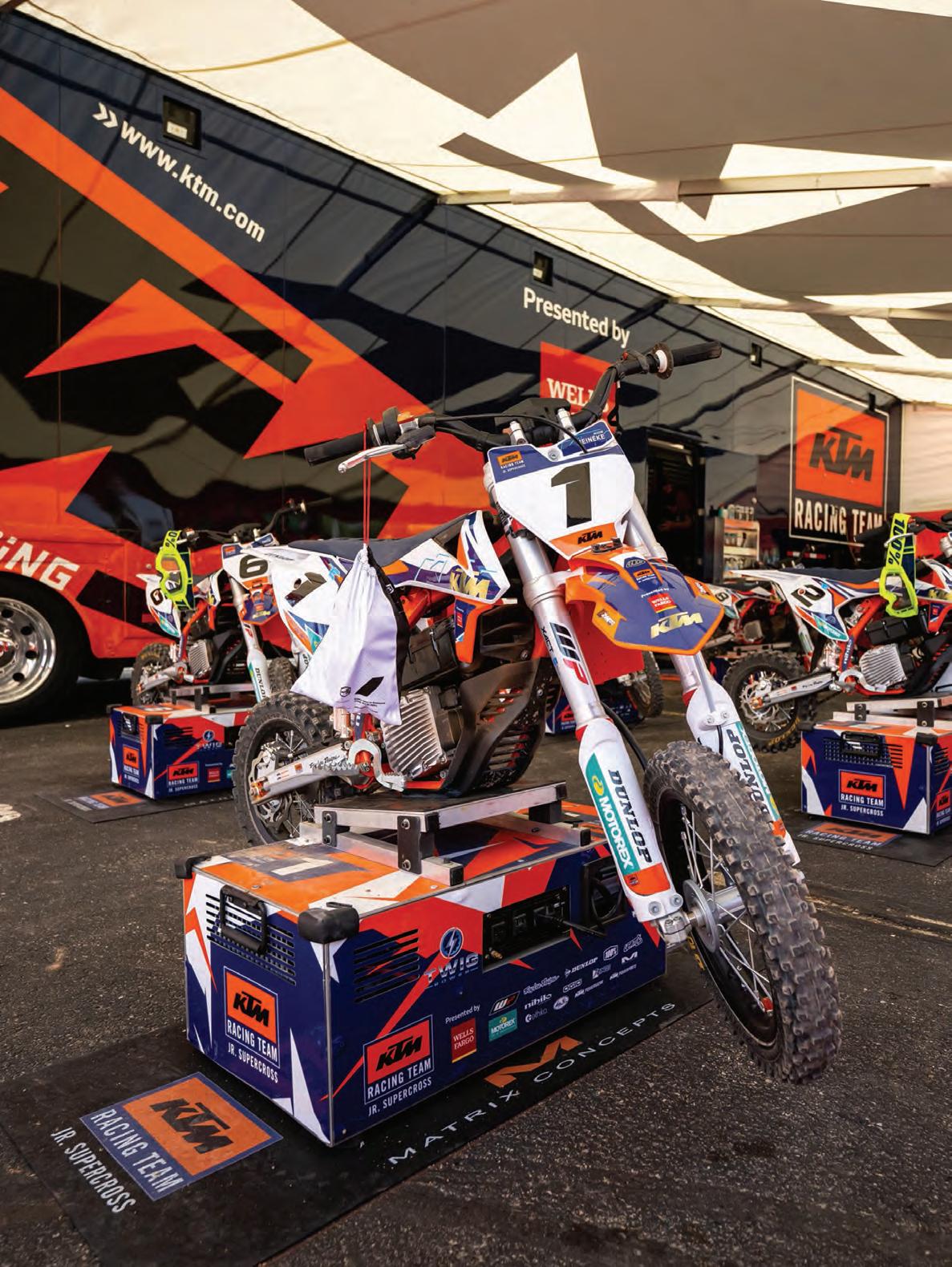
“Overall,” Pearce continued, “this motorcycle is adjustable as far as seat height, suspension settings and modes of power delivery because it has six modes. In Mode 1 you can walk alongside the bike, while Mode 6 is full-on race mode, and equal to our
“We asked ourselves what it would take to charge those chargers from some type of solar array that could be installed on the semi, AND run the entire truck inside — lights, liftgate, compressor, etc. — all day long at an event and still be able to charge the bikes?”
ROBERT PEARCE
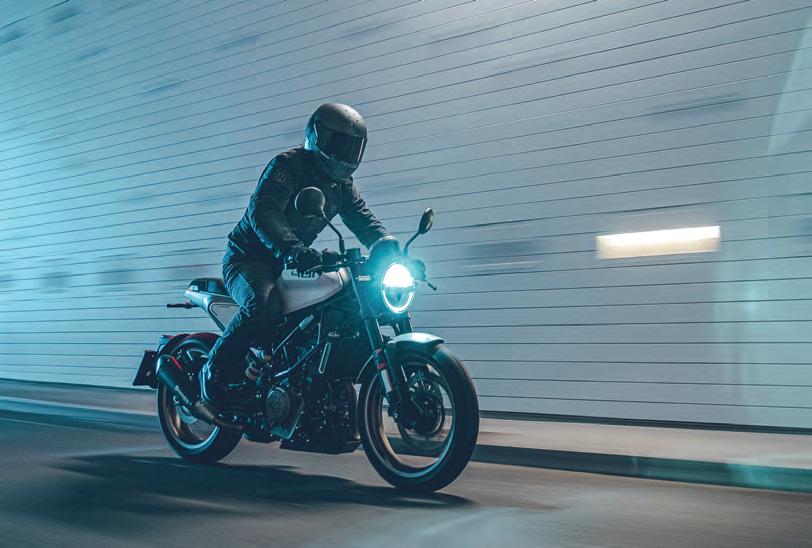
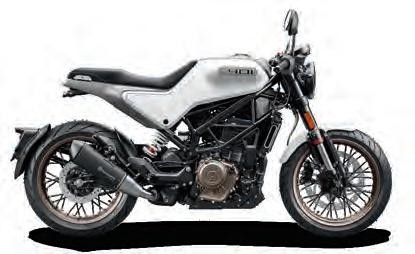
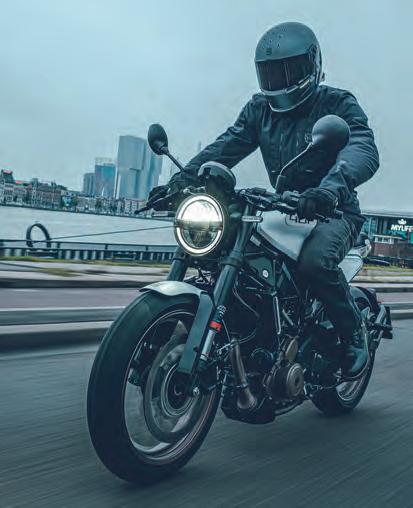
Beyond the mini-Es the kids are racing on, KTM plans to dive deeper into electric-powered motorcycles in the future. “We’re getting more involved in 2023 with an electric street bike on the Husky side,” Pearce (pictured below left) told us. “We already offer a full-size trail bike that’s street legal in Europe. And in the future, this is the way everything is going.”
“For KTM, it was a way into the Big Show. At the time we weren’t so competitive in AMA Supercross, but the Junior Racing program helped create a bigger bond with the racing and Supercross community.”
SELVARAJ “SEL” NARAYANA
KTM 50SX gas-powered bike.”
Beyond using these bikes in the Junior program, the mode-oriented adaptability of KTM’s e-bikes is significant in both the growth and sustainability of our sport.
“A capable 4-year-old can ride the bike on Mode 1 or 2 and a parent can feel safe that they’ll have a fun time,” Pearce said. “And, the bike moves with the age of the rider. You can elevate the bike’s suspension and performance as the child grows physically and improves their skills.”
The goal, of course, is to get more kids riding — and keep ’em riding. These electric minis are not only quiet, there’s very little maintenance, so there’s no need to worry about air filter cleaning, pistons and rings, or even putting gas in it. “Moms love this,” Pearce added, “because they just plug it in and charge the bike. That’s it.”
Beyond offering a versatile and adaptable bike for children, KTM wanted to show that other technologies — environmentally friendly ones — can be used competitively in the off-road arena.
“These bikes aren’t just raced at AMA Supercross,” Pearce mentioned. “They are raced at
the Grand National Cross Country (GNCC) series in the youth class, and their batteries last 30 minutes. The excitement of the possibility of e-tech being raced at that level was a big reason we wanted to introduce these bikes to the race community. And it’s been overwhelmingly accepted. They were raced in the first e-championship at the [AMA Amateur National Motocross Championship at Loretta Lynn’s] in 2020.”
On the tech side, the SX E-5 has a 5kW electric motor puts out about 8hp, according to Pearce, which is almost equal to the gas-powered 50SX. How long the 0.9kWh battery lasts largely
Above: AMA Motorcycle Hall of Famer Broc Glover chatting with Chad Reed and his son.
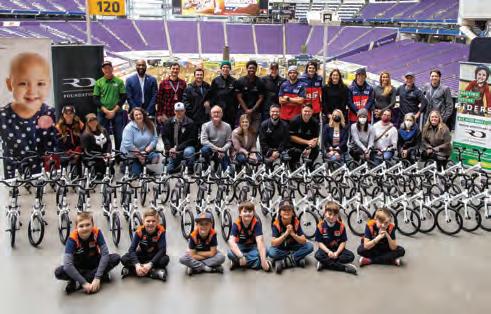
Left: Kids involved in the KTM Junior Racing program helped raise money for the Ryan Dungey Foundation, which went to All Kids Bike. They even helped build and deliver the bikes to a local school in Minneapolis.
depends on what mode you’re in. In Mode 1 it might last more than half a day, while in full-power Mode 6 it only lasts around 12 minutes.
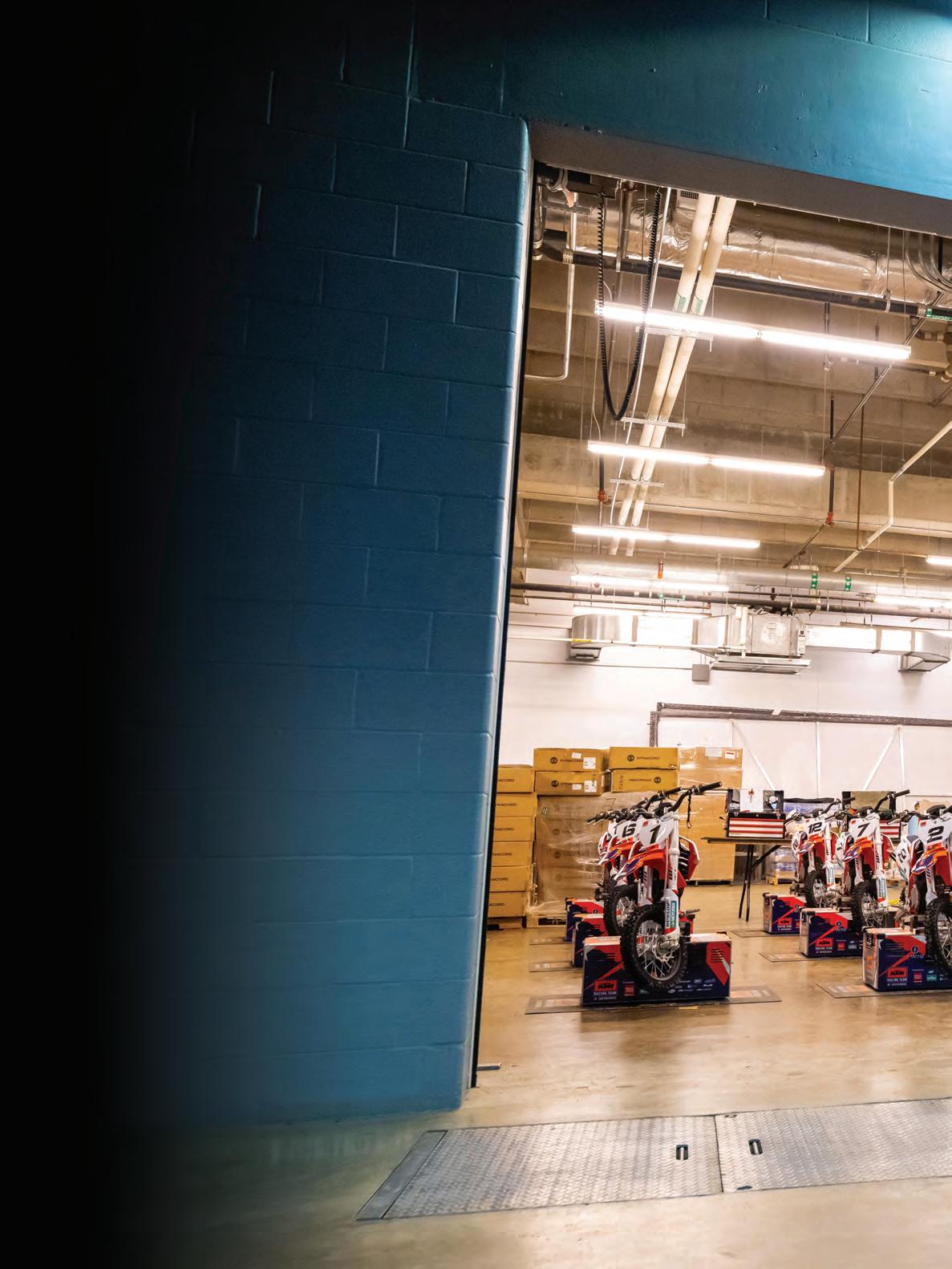
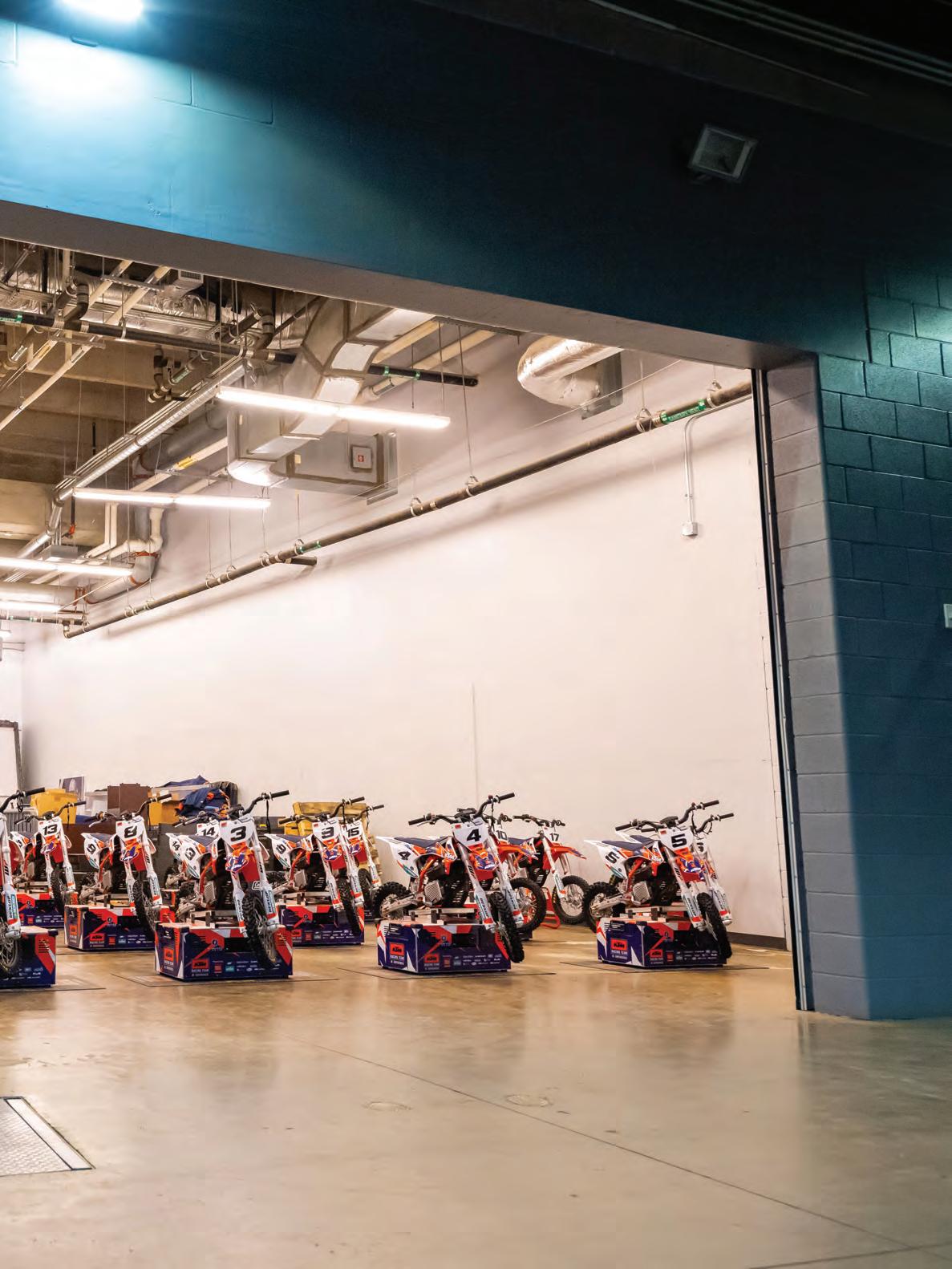
But here’s where it really gets interesting: First, KTM built custom bike stands that charge the bikes’ batteries while they’re sitting on them. But then they went several steps
further, building a transporter that reflects much of the environmentally friendly tech and innovation contained in the bikes and stands.
“We asked ourselves what it would take to charge those chargers from some type of solar array that could be installed on the semi,” Pearce told us. “But then we thought, what would it take to run the entire truck inside — lights, liftgate, power washer, compressor, etc. — all day long at an event and still be able to charge the bikes?”
“We went with the full-blown plan,” Pearce added, “with 30 solar panels on the top of the truck, which produce 3.9kW of solar energy. It’s a very powerful and robust system that charges three 48-volt solar batteries through a solar inverter. They’ll last a complete day and night at an AMA Supercross, even if it’s raining and overcast. All 15 podium stands are charged off the energy produced by the semi, though they can also be charged on the grid, and those
“Sel’s vision for this program was brilliant, especially when you look at the impact the program has had on the company and the riding and racing community.”
MARK BLACKWELL
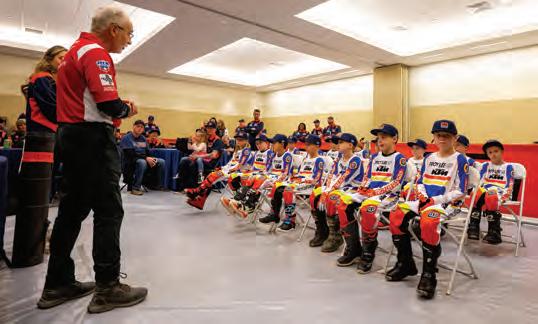
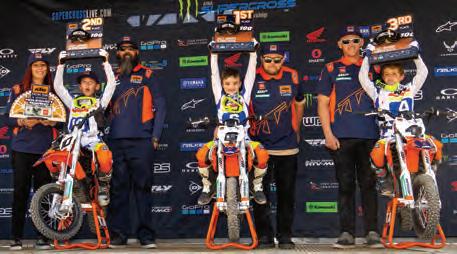
Far left: Racers’ meetings are taken pretty seriously on race day. Below: A group of KTM SX-E 5s sitting atop their podium chargers between races at AMA Supercross.
podium stands last all day. We have a 10-minute practice, another 10-minute practice, and then the actual race. We charge the bikes on those podium stands between the practices and then again before the race.”
Each year about 150 kids go through the KTM Junior Racing program, though three or four times that number apply. Kids have to be
7 or 8 years old to apply and need to show proof of at least one year of competition experience. Riders and parents also must be AMA members to participate.
Kids from across the country — and the world — apply. Kids from the United Kingdom, Australia, France, Holland, Germany, Mexico and Canada have been involved, and
applicants include kids from all racing disciplines, from cross-country to motocross to hare and hound.
Between January and May, the KTM Juniors participate in 10 AMA Supercross rounds, with 15 different kids racing at each event. At the end of the season the winners of those 10 rounds compete in a final championship, which takes place at
the final AMA Supercross race — this past year at the Salt Lake City round.
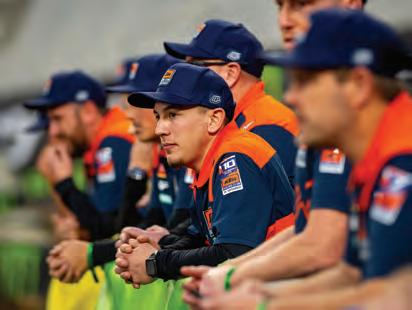
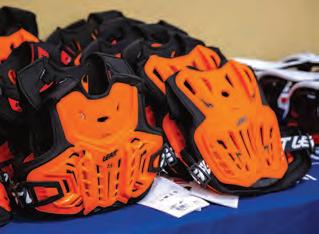
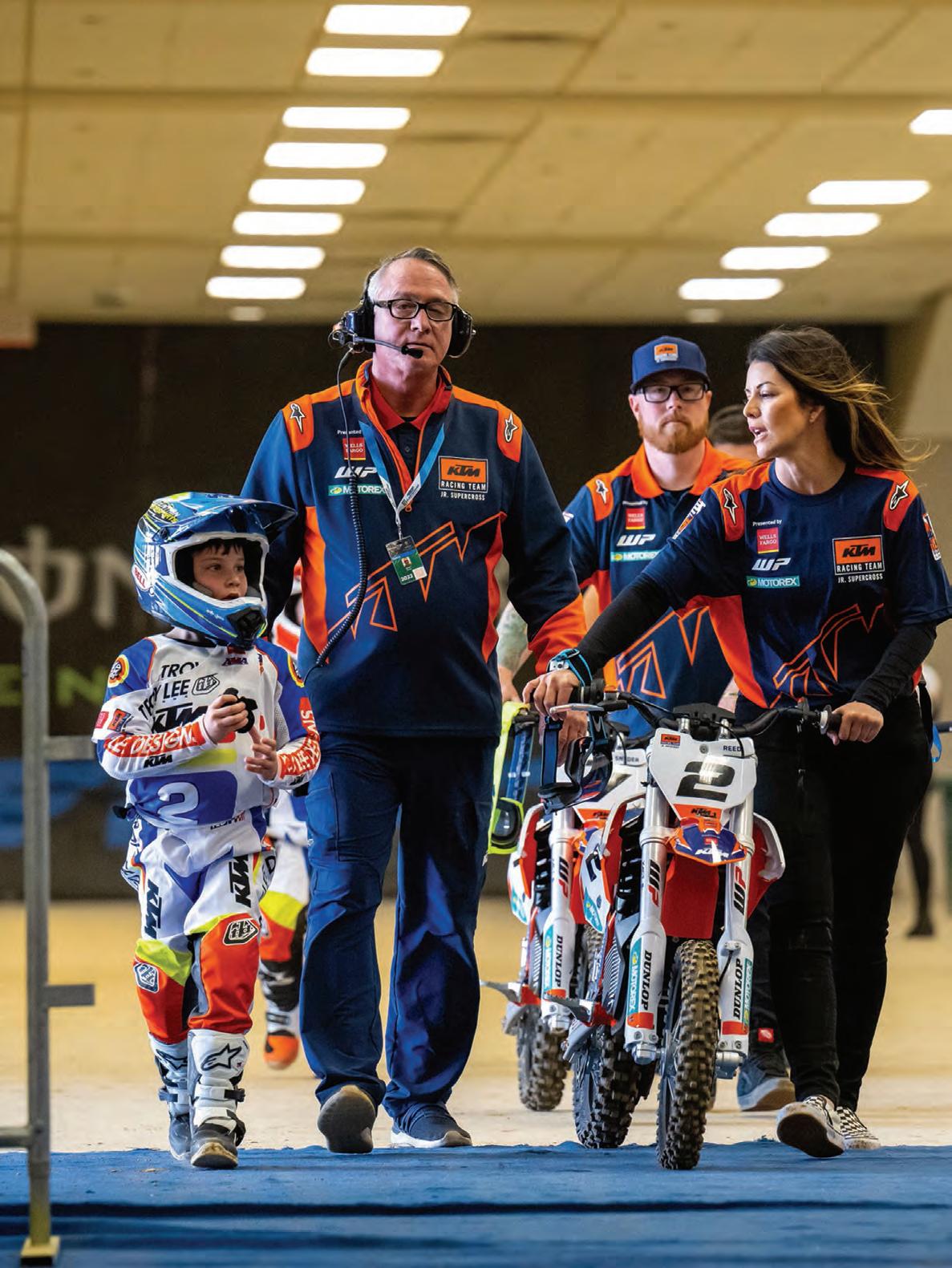
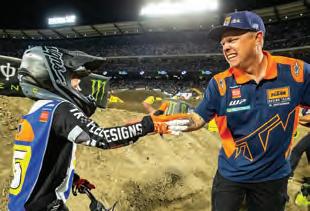
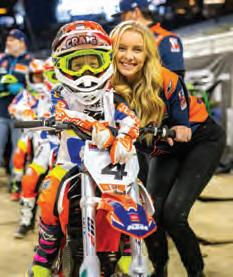
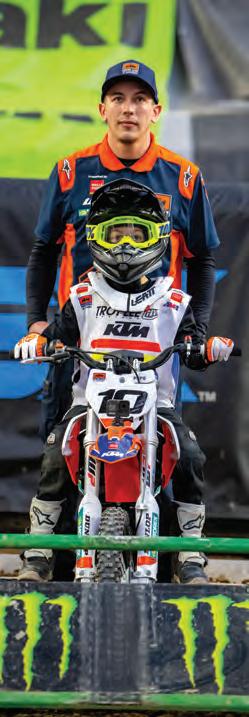
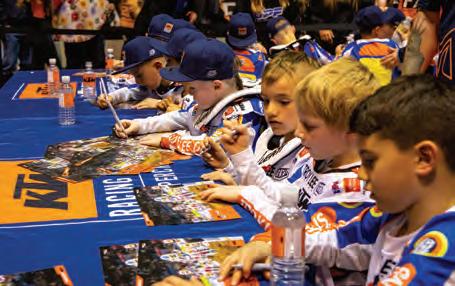
“At the races, kids are treated to a full day, just like they were professional athletes,” KTM Group’s Motorsports Marketing Manager Megan Argubright said. “They have a proper riders’ meeting and are given a number for the day. In the meetings they’re reminded they’re a
factory athlete for the day, we have guests come in and talk about safety, staying healthy, and even flaggers demonstrating what the various flags mean. We also go over operation of the motorcycle with them.”
The bikes themselves, the R&D that went into them, the solar-powered semi, the logistics of providing 150 kids each year — for 25 years — with
a full racing day on a professional AMA Supercross track…it is and has been a huge investment for KTM. Is it worth it?
According to Argubright, the program offers significant value and return on investment for KTM.
“We all know AMA Supercross has a reach unlike any other in our sport,” she said, “except for perhaps
“Being part of KTM’s Junior Racing program and feeling like a factory rider for a day was huge...Looking back now, it’s incredible that I got to live that out!”
RYAN DUNGEY
MotoGP. It’s where the idols are. If we can invest and showcase our product and bring out these future champions, it’s the perfect activity. There’s such a long history of champions who competed in this program when they were 7 or 8 years old.”
“KTM is all about being ‘ready to race,’” she added, “and we put a lot of time investment into that.
Achieving what our brand stands for and starting at the very beginning
of a racer’s journey — that’s tangible, we can measure it. And I think our market share — which in that segment is super healthy — speaks for itself. These kids are the grassroots of the sport, and investing in these programs is as important as investing in our products.”
Growing the sport of motorcycling — a focus of the KTM brand, according to Argubright — particularly at this young age is key. And the program is creating unforgettable memories for these kids and their parents, showcasing motorcycling as a family activity.
“I grew up watching AMA Supercross as a kid,” said Joseph Johnson, whose son Joey raced at the Denver round, “and to see [my son] walking out of the tunnel
and onto the track…it gives me goosebumps today just thinking about it and being there with him. He was out there with all his favorite riders, having a blast, watching them ride, and getting to experience the same track they were riding.”
“KTM caters to the kids — it’s unbelievable,” said Jeremy Santoro, a parent whose son raced in St. Louis. “It’s incredible what they’re doing for these kids.”
The kids involved in the KTM Junior Racing program aren’t just enjoying an incredible experience on the track; they’re learning to give back, too. This year the kids involved helped raise money for the Ryan Dungey Foundation, and every dollar raised went to All Kids Bike — which is introducing kids to Strider bikes as a part of kindergarten P.E. in schools across the country.
“The kids didn’t just make the $15,000 goal,” Argubright told us, “they doubled it for the 2022 season. And they didn’t just raise money; they helped build the bikes, too, and then they delivered them to a school locally. It was a great way for them to learn about connecting with their local community and giving back as an athlete.”
For the humble man behind the
inception of KTM Junior Racing, the evolution of the program and what it has become today is a bit eye-opening.
“I have to say I’m a bit surprised at what it’s become over the years,” Sel Narayana said. “It’s now a shining program, a golden program, very prestigious and one that has set the standard. We as a company have worked very hard
Above: Sel Narayana’s vision and work — along with that of his KTM colleagues — resulted in the KTM Junior Racing Program, which has greatly impacted the riding and racing community for more than a quarter century.
at improving it over the years, and for that we’re all very proud.”
“Lately,” he continued, “since it’s been 20-some years, I’m seeing parents of kids in the program today come up to me at the races and tell me they rode in the program 20 or 25 years ago, and do I remember them? [Laughs] It’s been happening more and more lately, and it’s very rewarding and emotional for me…and
the entire company.”
The future looks bright for the program, as well.
“The KTM Junior Racing Program has become an exciting and integral part of race day at AMA Supercross,” says AMA Director of Racing Mike Pelletier. “The experience KTM provides each rider is second to none, and watching these talented young riders compete
“I have to say I’m a bit surprised at what it’s become over the years, It’s now a shining program, a golden program, very prestigious and one that has set the standard. We as a company have worked very hard at improving it over the years, and for that we’re all very proud.”
leaves no doubt that the future of AMA Supercross is bright.”
In a time where parents worry about kids getting too wrapped up in video games and social media, it’s good to see motorcycling providing an exciting alternative. And through KTM’s Junior Racing Program, it’s not all that hard to see the truth in the statement “the kids are alright!” AMA
SELVARAJ “SEL” NARAYANA
THE GREAT
BY MITCH BOEHM
PHOTOS BY THE AUTHOR AND EDELWEISS BIKE TRAVEL
For me, and for many of you, I’d guess, it’s a moment we live for and enjoy more than just about any other…the instant your personal fun meter pegs deep into the red aboard a motorcycle, with the resulting rush of adrenaline and endorphins transporting mind and body to top of the world — or in
this case, the top of a 13,000-foot Alpine peak.
For most of us, motorcycles deliver this physical and emotional high more often than any other endeavor…which pretty much explains why we’re all here in the first place.
My latest bout of endorphinbased bliss happened on Day 4
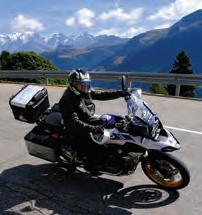
of the first of our 2022 AMA Alps Challenge tours with the Edelweiss folks in late August, when myself, tour guide Dieter and 70-something-yearold Challenge participant Bill O. got together on the way up Switzerland’s dramatic Fluelapass. The sun was out, the fast-’n’-curvy asphalt had that sparkly, wood-raspy look to it, and we’d broken away from the group
ESCAPE
OUR 2022 AMA ALPS CHALLENGE TOURS WERE A DOUBLE-DOSE OF HIGH-ALPINE GEOGRAPHY, CULTURE AND CUISINE …AND AS THE CARS SANG BACK IN 1978, “JUST WHAT I NEEDED.”
after a morning of rather sedate (although visually stunning) followthe-leader.
On tours like this you need to blow the cobwebs out and grind off a little footpeg steel every once in a while, right? And the three of us did just that for about 10 straight minutes as we railed toward the summit, where we’d stop for lunch.
Once in the ristorante’s lot we jumped off the bikes, high-fived and banshee-yelled loud enough that several patrons on the patio looked up to see what the commotion was. Twenty minutes later we were enjoying the house specialty of Rösti — the traditional Swiss farmer’s meal of fried potatoes with egg or meat — on that very patio. With the sun shining, cappuccinos in hand and Switzerland’s insane peaks
jutting skyward in every direction, one couldn’t think the scene was anything less than just exactly perfect.
The entire tour had been like that, as they typically are with the Edelweiss folks, but it was the timing of these two treks that was most welcome to me personally, as the two or three months leading up to my late August departure to Munich, Germany, were about as crazed and stressful as I’ve encountered.
Part of it was workload — the crush of event planning, magazine deadlines, our current website, our new under-construction website, press releases, social media, budgets and more. But the other element was our old friend COVID-19 (thanks, CCP!), which not only hit me like a ton of bricks during Vintage Motorcycle Days (along with our entire staff) but
drove me into a ditch of ugly mental angst in the weeks following VMD. According to my doc, COVID is more mentally debilitating than anyone thought (thanks, CCP!), and after experiencing the stress, exhaustion and spates of delirium in the weeks after VMD, I have no doubt he’s right. So these two tours were just what I needed.
Doing both tours (including travel) would’ve sucked up 19 precious days, so I opted to do about 60 percent of each to save some time and still be able to spend a few days with each group. Challenge I began and ended in Munich, just like last year (see our November 2021 issue), while Challenge II used Milan, Italy, as a base, so I flew to Munich a
The following day was epic, and pretty representative of what you’ll find on our Alps Challenge tours, or one of Edelweiss’s own Alpine adventures.
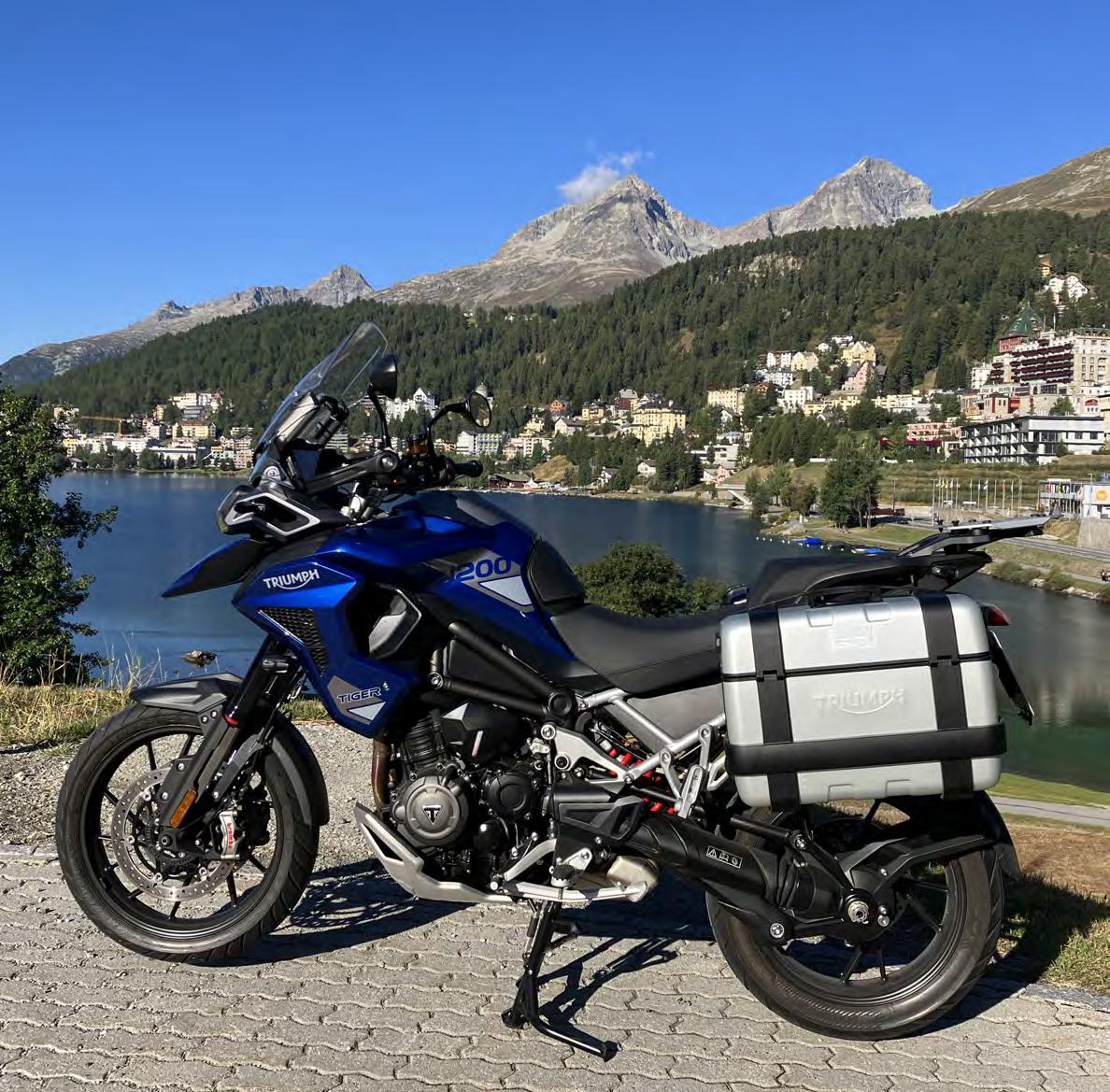
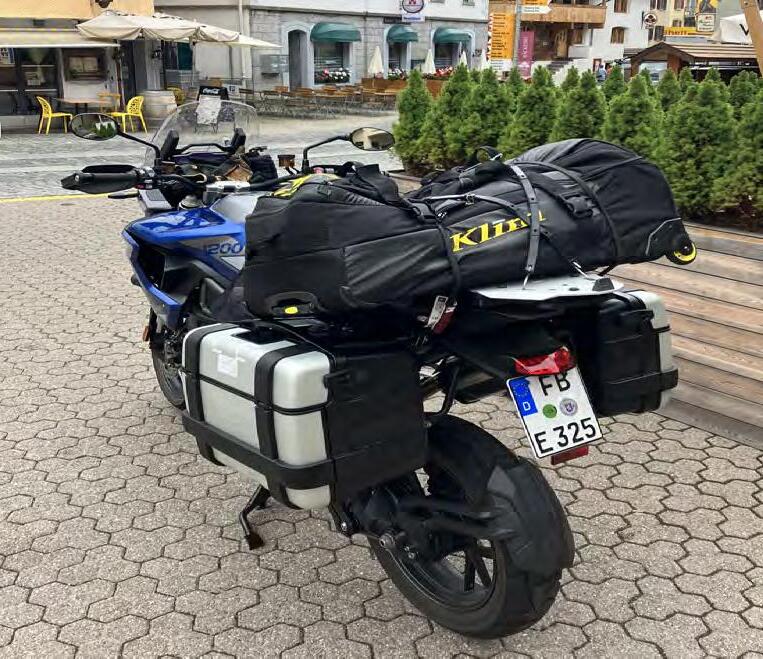
couple days after the first tour began, strapped my new KLIM Kodiak gear bag to the back of my Triumph Tiger 1200 GT Pro test bike at Hotel Henry (Edelweiss’s Munich-area base hotel) at around 11 a.m., and headed south to meet up with the first group in beautiful Bolzano, Italy, that evening for dinner.
Munich to Bolzano is only about 300 kilometers and not an all-day trek, but I’ve always felt there’s something strangely challenging and thrilling about heading into the imposing Alps alone on a motorcycle. I’ve ridden the Alps a dozen times over the years, but reading maps or GPS and deciphering German road signage is always a little challenging
— especially after very little sleep on the overnight flight.
Arriving at the correct hotel always feels like a victory, and after a muchneeded nap and shower I headed to the lobby to meet the Alps Challenge I group, some of whom I’d been emailing with in the preceding weeks. As always it was an interesting mix: Dennis B., Brian D., Jeff D., Larry W., Bill S. and the father/son duo of Bill (ex-motocrosser/enduro-racer and self-taught engineer) and Justin O. Stacey C. got as far as Germany, but when the airline lost her luggage and all of her gear she had to back out until next year.
The following day was epic, and pretty representative of what you’ll
find on our Alps Challenge tours, or one of Edelweiss’s own Alpine adventures. After a typically yummy breakfast we huddled to go over the route and then took off in cool morning sunshine for Livigno, Italy, a lovely ski town that’s only 100 or so klicks — as the crow flies — East of Bolzano.
Of course, thanks to the many interesting routes and passes between the two towns, we ended up riding three times that many kilometers that day, and through one of the most interesting passes in the Alps, Passo de Gavia, the tenth highest paved road in the Alps and a common venue for the worldrenowned Giro d’Italia
bicycle race. (Look up the 1988 race for a great story there…)
We approached Gavia from the south, which is forested at lower elevations and bare and rocky up high, but single-track in most spots and very, very challenging, with tricky sections where two cars simply cannot fit, and areas where it’s squeeze-by-tight even for a bike and a small European car. Did I mention a lack of guardrails most of the way up? Miss a turn and you won’t stop cartwheeling for a long time.
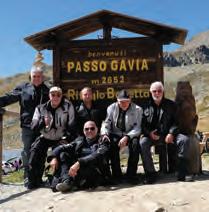
At the summit we stopped for cappuccinos at the Rifugio Bonetta along with the tourists, motorcyclists and bicyclists, grabbed a photo in front of the Passo Gavia sign, and then headed North and downhill along a grand valley past Santa Catarina ski area and our eventual
two-night stop at the wonderful Lac Salin hotel in Livigno, a winter sports town that’s become one of my — and many tour participants’ — favorites. Dinner conversation that night was lively thanks to the “Gavia experience” (as it was last year), with the group split about 70/30 on whether or not they enjoyed the no-guardrail/single-track thrills and always-present potential for spills.
The more experienced riders tended to enjoy Gavia, while some with fewer miles and years-in-saddle did not —
and were adamant about it. “Not fun at all,” one told me that evening, “but I’m glad I survived it.”
Old Bill O., pushing 80, recovering from cancer and walking with a decided limp, loved it, despite being squeezed into an earthen embankment by a road-hogging Fiat on the way up the South side. “I’d do it again right now if I could!” he told me with a mischievous grin the following morning. The old motocrosser was a real talent on a streetbike, and watching him ride
Alps Challenge I tour group (minus Dennis B.) at beautiful St. Moritz, Switzerland, a few days in. Left to right: Justin O., father Bill O., Dieter A. (kneeling), Larry W., Brian D., Jeff D., Bill S. and yours truly. St. Moritz hosted the winter Olympics in 1928 and 1948, one of three cities to host twice along with Innsbruck, Austria and Lake Placid, N.Y.
gave me hope for my own twowheeled future two decades down the line.
The following day included more passes, epic weather and, most importantly, no stress, and that night we celebrated with our now-annual pizza party at the same restaurant we had so much fun at last year. While blessed by the presence of superb tour guide Dieter from the 2021 Challenge, we missed having Domenico with us, who we teased mercilessly during last year’s pizza
night with the whole pineapple-onpizza thing, which he said would get him banned from his hometown of Naples forever if word ever got out!
We had a great time once again, and shockingly, this year’s menu included pineapple as a topping. Go figure.
The group would have another couple days of pass-conquering rides (including the always-thrilling Passo dello Stelvio) before heading back to Munich, but magazine deadlines
Left: narrow lanes and blind corners heading up the Passo de Gavia.
Main image: Every so often, tour guide Dieter will dismount and shoot photos of participants running through corners. Jeff D. demonstrates.
DID I MENTION A LACK OF GUARDRAILS MOST OF THE WAY UP? MISS A TURN AND YOU WON’T STOP CARTWHEELING FOR A LONG TIME.
had me heading South and solo to Milan — where the Alps Challenge II tour would start and end — to help get the latest issue uploaded to the printer without (hopefully) any major gaffes.
And so, after many heartfelt ciaos! at breakfast the next morning, I jumped aboard my amazingly competent Triumph Tiger and headed South for the second of three solo runs through the Italian Alps. As the crow flies, Livigno to Milan is less than 200 kilometers, but with a few passes to summit and the crush of humanity to deal with South of Lake Como as I neared the fashion capital of the world, it took five or six long hours — and riding into the hotel parking garage later that afternoon felt pretty dang satisfying.
Two days later, with the October issue buttoned up (thanks to our AMA staff!) and plenty of afternoon siestas
thanks to the many interesting routes and passes between the two towns, we ended up riding three times that many kilometers that day, and through one of the most interesting passes in the Alps.
and carb-loaded Italian meals to refill my own personal fuel tank, it was time to meet the second tour group and do it all again.
The group was similar in makeup, and even had some returning attendees — Dennis B. from the previous week and two guys from last year’s tour, Rick S. and Phil R., two of the now-famous Tennessee Trio. It was great to see them again, just as it was to welcome Edelweiss tour guide director Thomas (who ran last year’s tour) to assist Dieter, who managed
the previous week’s tour so well. We had some international guests, as well, with Canadian brothers Pete and Terry R., Brazilians Jose O. and Wilson G., and Luxembourg-based Brit Peter A. joining Americanos Dennis, Rick and Phil.
Instead of a southward, clockwise loop starting from Munich, the Challenge II route would run counterclockwise North from Milan to the ski town of Pontresina, Switzerland, before heading West to Andermatt, Switzerland, and then to Chamonix,
Clockwise from upper left: Toasting the tour from The Oxen restaurant in Andermatt, Switzerland, where cheese fondue ruled the evening. An older Swiss gent we met along the way who’d bought his first-gen R80G/S in 1981. The picnic lunch is always a favorite during an Edelweiss tour.
France (and Mont Blanc, the highest point in the Alps at nearly 16,000 feet) before curving South and East again toward Aosta, Italy, and Milano.
Aside from some crazy Italian drivers and the hordes of bicyclists on the narrow roads (it’s a squeeze at times), riding valley-to-valley and pass-to-pass is pretty much a zero-stress deal, and after your tenth “Whoa, this is effing amazing!” to yourself on the first day or two, you start to understand (or get reacquainted with) why trekking the Alps on a motorcycle is, for many, the Best Ride There Is.
The trek to Pontresina on Day 1 was a great example, starting off with a short coffee and mineral-water stop (how could we not?) in legendary
San Pellegrino. We then continued Northeast to the Passo Vivione, which featured some very Gavialike sections and a lovely lakeside plateau on top where we had one of Edelweiss’s signature picnic lunches, this one prepared by Deiter, as he and Thomas would trade off driving the luggage van each day.
Jose will hate me for recounting this, but it was such a crazy experience I simply cannot ignore it.
As he and I made our way through the very tight and tricky forest section on the Passo Vivione, he came upon an oncoming car in a blind corner and, thinking they might hit each other, jammed on his brakes. The car — a clean and current-model Mercedes sedan — did the same,
Top to bottom: Glaciers are common in the Alps, for ice-tunnel treks and group selfies. That’s Dieter up front. Canadian brothers Peter (left) and Terry kept us laughing all week long.
and came to a stop just to Jose’s left. But due to the incline of the road, and the fact that Jose is a bit inseamchallenged (and the R1250GS is tall), he wasn’t able to stop the bike from falling to the left when he came to a stop and went to plant his left foot on the ground. The result? The bike and Jose toppled right onto the Mercedes’ hood, the handlebar crash guard putting a decent-sized dent in the driver’s side of the hood.
Whoa! Watching all this from behind, I figured we’d be there for hours, dealing with police and insurance despite the fact that Jose is an attorney. But what happened after myself, Jose and the guy and gal in the car levered the GS off the hood I will never forget: After the
ON TOURS LIKE THIS YOU NEED TO BLOW THE COBWEBS OUT AND GRIND OFF A LITTLE FOOTPEG STEEL EVERY ONCE IN A WHILE, RIGHT? AND THE THREE OF US DID JUST THAT FOR ABOUT 10 STRAIGHT MINUTES AS WE RAILED TOWARD THE SUMMIT.
couple made sure Jose was OK (he was), the girlfriend, who had better English than her boyfriend, said to “not worry” about the damage, as her boyfriend was going to “adjust” the car anyway…and with that they waved and drove away with a smile. Not sure if “adjust” meant to paint or modify the car (or maybe it was a rental with full-coverage insurance?), but we weren’t about to argue, and continued on without a hitch. I’m just
sorry I didn’t snap a photo of that GS laying on that shiny Mercedes hood! After crossing into Switzerland (careful here…a speeding ticket can cost a grand or more) we continued North via the Bernina Pass and, finally, into lovely Pontresina, where we’d check in, shower, grab a beer or two and then enjoy a great dinner, all while listening to Canadians Peter and Terry do their often-hilarious Bob and Doug McKenzie/Great White
after your tenth “Whoa, this is effing amazing!” to yourself on the first day or two, you start to understand (or get reacquainted with) why trekking the Alps on a motorcycle is, for many, the Best Ride There Is.
North-type routine. Again, lots of laughter, and very little stress. Just what I needed.
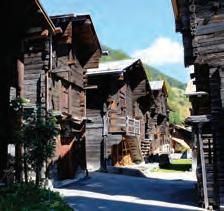
From there it was on to legendary ski town of Andermatt, Switzerland, famous for winter sports primarily but also for a scene from the James Bond film Goldfinger shot there. (The famous car scenes from the same movie were filmed on the nearby Furka Pass.) The Andermatt stayover would be two nights, with day two being a free day for relaxing or, more likely, riding local passes and sampling local food…which our group took full advantage of.
A culinary highlight of the trip (sensing a pattern here?) was dinner on our final night in Andermatt at The Oxen, a 100-year-old restaurant housed in a 300-yearold structure that featured cheese fondue, a specialty of the region. As
we dipped hunks of bread, meat and veggies into hot fondue pots flavored with bacon, cheese and mushrooms that evening with long forks (my mouth is watering as I type these words), I remember thinking it was a meal I couldn’t ever forget.
Days four, five and six consisted of more sensory overload, especially the overnight stop in Chamonix, France, and the legendary and imposing Mont Blanc, all 15,771 feet of it. The massif, which lies on the border of France and Italy, and reaches into Switzerland, as well, features 40
square miles of glaciers, which have advanced and retreated over the last few hundred years. The first ascent is credited to Michel-Gabriel Paccard and Jacques Balmat in 1786, and as you look at the thing it’s hard to believe anyone could reach the top, let alone 230-some years ago.
I left the tour early again, soloing for a third time all the way back to the Munich area and Hotel Henry, where I’d drop off the Tiger, dry out, get a little rest and chronicle my thoughts for this story. It took nearly nine hours and was a grind due to the constant rain and traffic, but the memories of the past dozen or so days — and the amazing competency of the Tiger 1200 I was riding — kept me alert and involved despite the heavy downpour.
At Hotel Henry I met another group (all friends) from Canada getting ready for the start of an
Edelweiss Ultimate Alps tour the following day. We chatted a bit, and since all but one had never ridden the Alps, I was happy to give them a quickie overview of what I’d been doing the last dozen days when they asked. Retelling some of it gave me goosebumps and reminded me of a few things.
One, how cool it is to meet and get to know new motorcycle enthusiasts from around the world. It just doesn’t happen all that often.
Two, how personally rewarding it can be to do solo trips in
an area you don’t know all that well, especially one with such breathtaking geography, roads, culture and history.
And three, and maybe most importantly, how amazing the Alps region is for motorcyclists, and how fortunate I am (and tour guests are) to be able to experience them as I do on occasion — the narrow roads, rain, lack of guardrails and general danger of riding there (and everywhere) notwithstanding. Motorcycling is a challenge, and one chock full of
dangerous situations. But we like it that way.
Boiled down (and we all know this), motorcycling is good for your head, good for what ails ya, good for stress relief…and it never gets old, especially in the Alps.
And the best news of all? We’ll do it all again next year, with three tours in 2023, Challenge Tours I and II as we did this year for those who missed out on all the fun, and a very special Alps Challenge III tour that will launch from Nice, France on the French Riviera and explore the always dramatic Western Alps of France and Southern Switzerland — and finish notching
Alps Challenge II group at the top of beautifully challenging Passo del Vivione. Left to right: Jose O., Wilson G., Peter and Terry R. (kneeling), Dennis B., Rick S., Dieter (kneeling), yours truly, Phil R., and Peter A.
the 50-some Alpine passes promised when we announced this effort in the beginning of 2021.
Tour dates for 2023 are as follows:
• Alps Challenge I, August 3–11
• Alps Challenge II, August 12–20
• Alps Challenge III, August 21–29
I’m especially looking forward Challenge III, as it’s the region I rode during my very first extended Alps tour back in the 1980s. I may even convince my son to join the group this time around, too. He’s a good offroad rider and racer but needs more in-saddle time on a street bike before it can happen. We shall see.
As always, Edelweiss tours are mostly inclusive, with tour guides, hotels, most meals, rental motorcycles, luggage van and picnic lunches, maps and assorted other details included in the price. Travel to and from Europe, motorcycle fuel and some meals are extra. For more information check with edelweissbiketravel.com.
So do yourself a favor and consider signing up for one or, like Dennis B. (shown here with cheesecake), more than one, as Edelweiss is offering discounts to folks who do two or more Alps Challenge tours.
It might be just what you needed! AMA
DEALS AND DISCOUNTS
THE ESSENTIALS
Lodging
Save 15% at participating Choice Hotels Properties.
Up to 10% off at Motel 6. Use code: M64AMA
20% discount off available rates, call (800) REDROOF and use the code VP+ 503343. To make reservations online use code: VP+ 503343 in the field labeled “VP+/ID#”
ADVMoto
20% discount. Use code AMADV20
AMA Motorcycle Hall Of Fame Free admission to the AMA Motorcycle Hall of Fame in Pickerington, Ohio.
AMA Supercross Tickets
10% discount on tickets at supercrosslive.com Use code 5AMASX
Anthony’s Leatherworks
10% discount. Use code AMADISCOUNT
Blendzall
AMA members can save 20% at blendzall.com. Use code AMA20 at checkout.
Bohn Body Armor
10% AMA Member Exclusive Discount. Visit bohnarmor. com and use code AMA18 at checkout.
Butler Maps
AMA members receive a 20% discount at butlermaps.com. Use code AMAMEMBER
Cardo Systems
20% discount online with valid AMA membership card.
Colorado Motorcycle Adventures
10% discount with valid AMA membership card.
exclusive discount on instruction. Learn more at thedirtbikeacademy.com
Dowco Powersports 20% discount. Use code AMA20
EagleRider For Club EagleRider AMA members receive 2 free rental credits
AMA Roadside Assistance Roadside assistance coverage for eligible members.
Car Rentals
Up to 25% off at any Avis or Budget. Avis Code: D388100 Budget Code: Z942000
AMA Gear Find patches, pins, T-shirts, hats and more.
Edelweiss
AMA members save on standard bike tour. Use code 21AMA-EBT03 at checkout.
Evans Cooling System
25% discount on Evans Coolants and Prep Fluid. Use code AMAFUN at evanscoolant.com.
EVS Sports
10% discount and free shipping on all orders. Use code AMAEVS20
Helite Moto AMA members get 15% off every order at helitemoto.com. Use code HELITEAMA
International Motorcycle Shows
Save on advanced adult oneday general admission. Use code AMA20
Legacy Track Dayz 15% discount on Legacy Track Dayz events. Use code AMARideLTD
Liberty Sport Eyewear 30% discount on all “motorcycle collection” frames. Discount code AMA30.
MAD Maps
Save 15%. Use code AMA15
Shippers
® Medjet Air medical transport and travel security protection – visit Medjet.com/AMACycle or call 1.800.527.7478, referring to American Motorcyclist Association.Annual rates are reduced by 20% and start at $235.
MotoAmerica 20% off 2-day and 3-day passes at select MotoAmerica events. Use discount code AMA20
Motool AMA members can save 10% at motool.co. Use code AMAVIP at checkout.
MX Boot Repair 10% discount. Use code AMADISCOUNT
MYLAPS 20% discount off MSRP or current sales price on weborders or orders coordinated by the AMA. Use code AMA-789HJK
Nelson Rigg 20% AMA Member Exclusive Discount on all products! Use promo code AMA-NR20
Third Eye Design $25 discount on inView, a wireless brake and signal light. Use code AMA at thirdeyedesigninc.com
Quin Design Helmets
Warm & Safe
COMING EVENTS
Be sure to check the event website or call the organizer for the latest information, including postponements or cancellations.
MARKETPLACE
California Adventure Series. Jan.15 - Nov. 30. Southern California Motorcycling Association, 330-857-8131, adventures@sc-ma.com, sc-ma.com.
Motorcycle Grand Tour of Texas. March 1-Nov. 15. MC Grand Tour of Texas, LLC, 210-7771434, davidcanada@mcgttx.com, www.mcgttx. com
Tour of Honor. April 1- Nov. 30. Tour of Honor, 208-740-0899, admin@tourofhonor.com, tourofhonor.com.
The following represents active, registered trademarks,trademarks and service marks of American Motorcyclist Association, Inc. (AMA). Usage of any AMA trademark or registered trademark without our permission is prohibited. Please contact jholter@ama-cycle.org for more information or assistance, (800) AMA-JOIN® • AMA Dragbike® •AMA Endurocross® • AMA Motorhead® • AMA Pro Grand National Championship® • AMA Pro Racing® • AMA Race Center™ • AMA Racer® • AMA Racing® • AMA Racing Land Speed Grand Championships® • AMA Supermoto® • AMA Supercross® AMA SX Lites® • AMA U.S. ISDE Team™ • AMA U.S. Jr. Motocross Team™ • AMA U.S. Motocross Team™ Amateur National Motocross Championships® • American Motorcyclist Association® Arenacross® • ATV Hare Scrambles National Championship Series® • ATV Motocross National Championship Series® • Flat Track Grand Championships™ • Grand National Enduro Championship® • Gypsy Tour® Hare & Hound National Championship Series® • Hare Scrambles Championship Series® • Hare Scrambles National Championship Series® • Kids Just Want To Ride® • Motorcycle Hall of Fame® • Motorcycle Hall of Fame Museum® • Motorcyclist of the Year® • Motostars® • National Adventure Riding Series® • National Dual-Sport Series® National Enduro Championship Series® • Protect Your Right to Ride® • Protecting Your Right to Ride® • Ride Straight® • Rights. Riding. Racing.® • Road Race Grand Championships® • Vintage Grand Championships® • Vintage Motorcycle Days® • Vote Like A Motorcyclist®
Celebrate the Faith That Guides and Protects You
Exceptional Hand-craftsmanship and Meaningful Design
Since Biblical times the olive tree has been a symbol of peace, reconciliation and renewal. Now the wood from this ancient tree of the Holy Land is the new centerpiece in a powerful new design available exclusively from The Bradford Exchange. Introducing the “Rooted in Faith” Olive Wood and Diamond Pendant, a reminder of God’s presence in your daily life. Handsomely hand-crafted, the cross-shaped pendant features an inlay of warmtoned olive wood, contrasted by stainless steel accented with 24K gold ion-plating and roped edge detail. In the center shines a genuine solitaire diamond, a brilliant symbol of the light of faith. Engraved on the reserve are the uplifting words He is with me, always. A matching 24-inch stainless-steel chain completes the look. Boldly styled with timeless impact, this inspirational pendant will remind you of the rewards of your faith every time you wear it.
AN AMAZING VALUE NOT SOLD IN STORES; ORDER TODAY!
This remarkable pendant is a remarkable value at $99.99, payable in 3 easy installments of just $33.33 each.*
To order yours, backed by our 120-day money-back guarantee, just return the Priority Reservation. Demand is expected to be intense, so don’t wait. Order yours today!
Garage
Tips,Tweaks, Fixes and Facts: The two-wheeled ownership experience, explained
A TIGER IN THE ALPS, PART II
Sampling Triumph’s redesigned-for-2023 Tiger 1200 GT Pro
BY MITCH BOEHM
e don’t do much traditional bike-eval here, as there’s plenty online, but when our annual Alps Challenge tours roll around, it’s an ideal opportunity. Last year I rode Harley-Davidson’s new Pan America adventure tourer, which I found plenty competent, and
since big ADV bikes are perfect for the challenging Alpine environment, I went there again, ordering one of Triumph’s redesigned Triumph 1200 Tigers — the GT Pro — for this year’s dual Alpine treks. And I don’t think I could have done better.
I have ridden a lot of big-inch
adventure bikes over the years, but the GT Pro was easily the most impressive one I’ve ever ridden. Comfortable, smooth, ungodly fast, loads of fun, fitted with easy-to-use and cavernous luggage, and offering what are maybe the best brakes, suspension and handling I’ve ever
experienced in this class, the GT Pro was a perfect companion. It handled slow, follow-the-leader stuff as happily as it put up with being flogged like a superbike, and not once did I wish for anything different.
Let’s start with handling and suspension, which stood out like a scrumptious pasta meal in a sea of fast food. Part of this is due to the bike’s 50-some-pound weight loss compared with its predecessor, but probably more so to optimized chassis geometry and what are truly spot-on spring and damping settings in the semi-active fork and shock.
I started out in Tour mode, thinking it would be the best compromise of wheel control and comfort on
I HAVE RIDDEN A LOT OF BIG-INCH ADVENTURE BIKES OVER THE YEARS, BUT THE GT PRO WAS EASILY THE MOST IMPRESSIVE ONE I’VE EVER RIDDEN. COMFORTABLE, SMOOTH, UNGODLY FAST, LOADS OF FUN.
the interesting-but-sometimeschoppy Italian roads. It worked fine on smoother routes and at slower speeds but allowed the chassis to pitch and float a bit much when the going got aggressive. Of course, I’m no lightweight by any stretch.
I figured Sport mode might be a bit firm, as it is on my new (to me) 2013 Ducati Multistrada, but when I switched to Sport on Day 2 a whole new world opened up. Not only did the Tiger’s legs keep the chassis under control even at crazy aggression levels, it handled the small choppy stuff perfectly, which is a rare combination. The GT Pro feels agile despite its weight and physical size (big ADV bikes are not small), steers crisply, stops like a superbike and offers the type of high-level feedback that keeps you in the know
all the time. The chassis folks at Triumph really deserve big-time kudos here.
Same with the 1160cc inline triple, which blasts out 125 or so rearwheel horsepower all over the map and does so with a throbby growl that’s immediately alluring. I always say triples have the feel of a twin and the rip of an inline-four up top, and it’s certainly true here. Wind
Shifting is smooth. The seat’s pretty good on longer days. And fueling is spot-on, even at altitude — and we sure did plenty of altitude. The thing looks badass, too, which is never a bad thing.
It’s always a bit of a gamble when you request an all-new bike for what’s ostensibly a two-week tour, with eight hours minimum each day in-saddle. A lot of reviews put the new Tiger 1200s
and weather protection are superb, with an easily (manually) adjustable windscreen that does a good job of keeping windblast off your head. Engine heat is fairly well controlled, unless you’re burbling through Milan traffic on a hot day, that is (don’t ask). Luggage locks and open/close hardware are easy to use, and the bags themselves are roomy. The shaft-drive system is glitch free.
(there are several iterations) right up there with the best bikes in the class, so I wasn’t too worried.
But after 13 days in the saddle, I can tell you that I could easily live with this one as my only bike. I’m loving my 2013 Pikes Peak Multistrada, but in terms of all-around ability and performance, this new Tiger’s got it covered. Time and technology march on.
For my three solo runs during two weeks of Alps trekking (no chase vehicle on those days) I strapped KLIM’s awesome Kodiak gearbag to the Tiger’s pillion. The thing is bulletproof.
Garage
TESTED AM
Alps Gear 2022
High-quality protective and all-weather gear you just gotta have when you’re trekking the Alps
Touring the Alps in late summer isn’t the environmental challenge that, say, trekking to Alaska can be, but you’re always better off with quality gear that can handle the extremes of climate and abrasion.
This year I added a few items to my primary set of touring duds: a KLIM Carlsbad Gore-Tex jacket, a pair of Alpinestars RT-8 Gore-Tex boots, and a set of Dainese rain mitts to shield my deerskin gloves. All this augmented my standard touring kit, which includes a pair of Aerostich Darien overpants and a Shoei Neotec 2 modular helmet.
KLIM Carlsbad Jacket
I don’t think I could have done better than KLIM’s latest Carlsbad design, which melds premium impact protection, effective venting and superb wind and weather protection with awesome – for me — fit and a stylish look.
The Carlsbad isn’t the heaviest jacket in KLIM’s product line (that’d be the Badlands Pro), but was an ideal mix of weight and warmth for the mostly-warm-but-sometimeschilly weather we saw. Included are a million well-placed and -shaped pockets, super-effective venting you can easily control and feel, CEapproved armor in all the right places (including a back protector) and a generous cut that’s easy to live in all day long.
I wore the Carlsbad every day for eight or nine hours and never once had a complaint, rain or shine, and it rained really hard on that final day running from Western Switzerland to Munich. KLIM gear is expensive, but for this level of performance and build quality it’s money well-spent — and there’s a good reason you see a lot of seasoned motorcycling veterans wearing the brand. $699 at KLIM.com
Alpinestars RT-8 Boots
The Alpinestars RT-8s were similarly superb, offering mondo abrasion and weather protection in addition to more comfort than I’m used to. You’ll almost feel like you’re wearing running or hiking shoes. The footbeds are plush, and while they don’t breathe like a pair of lightweight racing boots (which would leak like a sieve), my footsies were comfortable for the duration of both tours. $369 at Alpinestars.com
Shoei Neotec 2 Helmet
Shoei’s latest modular lid is my goto helmet these days, offering tons of comfort, great venting, a slick shield system, a flip-down sunglass visor, an easy-click chinstrap and of course the ability to flip up the chin bar —
which makes all the difference when you’re stopping and starting a lot on tour. I didn’t sip any of the 20 or 30 cappuccinos I had on the trip while wearing it, but I could’ve! $799 at Shoei-Helmets.com.
Aerostich Darien Pants
I’d planned to wear KLIM’s Carlsbad pant along with the company’s awesome jacket, but when they didn’t fit my outof-shape bod well enough for two weeks of touring (my fault, not theirs) I reverted to my Aerostich Darien standbys. They’re just a shell with strategic armor, but with Gore-Tex protection, beefy zippers up each pant leg and a nice belt-and-snap closure system, they work really well. And when it’s chilly out I slip on a pair of thin stretchy long johns for warmth. $480 at Aerostich.com
Lee Parks Designs Deer Sport Gloves
The Deer Sports have been a favorite for years, and given their superb construction, lack of seams, surprising warmth and soft, super-comfy fit, there’s no reason to try anything new. They aren’t waterproof, so I slide on a pair of Dainese rain mitts when it rains. Good to go. $175 at LeeParksDesigns. com.
—Mitch Boehm
AMA Alps Challenge I – Aug 03-11, 2023
AMA Alps Challenge II – Aug 12-20, 2023
CKAWASAKI’S FIRST TURBO
Before the superb GPz750 Turbo came the infamous 1978 Kawasaki Z1-R TC
an we agree that the 1970s were perhaps the most wonderfully unique, crazy and experimental decade in all of motorcycling? Many of you probably can.
Not only did you have the dramatic rise of Japan Inc. but, along with it, technology and functional advancement like we’d rarely seen. From motocrossers to open-class street bikes and everything in between, motorcycles got better, better looking, faster and more reliable by the year. Right along with rock ’n’ roll, motorcycling in the 1970s was pretty epic.
While some of those technical experiments worked, others did not, and Kawasaki’s infamous Z1-R turbo project — called the Z1-R TC — was a good example. It was a kit bike, really, and never an official model, but regulations were looser back then, and companies — especially ones with a wild (and green) streak in their DNA like Kawasaki — could and would take advantage.
The idea for the TC came from Kawasaki sales executive
Alan Masek, who had connections with aftermarket firm American Turbo Pak, and who figured the over-engineered Z1-spec engine in the company’s Z1-R production bike (which wasn’t moving all that quickly in showrooms) could handle the 40-percent horsepower boost a turbo would bring. He was only partially right.
The bike was fast, and for a time the quickest “production” motorcycle in the land, though a recommended waste-gate boost setting on early models of 8 psi caused some dramatic and messy failures. Run at 10 psi (the waste gate was easily adjustable), TCs could run in the 10s at the strip, which made a lot of enthusiasts cheer, but it also made for a lot of engine rebuilds and welded cranks.
The kit model only lasted two seasons, ’78 and ’79, but the project did bear fruit a few years later when Kawasaki unleashed the legendary GPz750 Turbo of 1983, which was ungodly fast and did just about everything well. It was the best of the 1980s turbo bikes by far, but that is a story for another day. Stay tuned. —Mitch Boehm
A truly epic opportunity to win a bike ridden and signed by AMA Hall of Famer and 1993 World Champion Kevin Schwantz? You bet! Raffle tickets give you chances to win a new Suzuki GSX-R1000 painted in Schwantz’s late ’80s Pepsi Racing livery, and also benefit the AMA Motorcycle Hall of Fame and Museum — where legends live! A winner will be drawn next July at 2023 AMA Vintage Motorcycle Days at Mid-Ohio Sports Car Course.