The All-Terrain Vehicle Association (ATVA) protects ATVers’ right to ride. It also serves as a source of authoritative information about where and how to ride, products and events. The ATVA is part of the American Motorcyclist Association (AMA), the world’s most powerful voice for motorcyclists. ATVA Enthusiast membership is $29 a year. A Competition membership is $39 a year. For more information call toll free (866) 288-2564 or check us out online at ATVAonline.com.
THE ATVA NEWS TEAM
Bill Kresnak
Editor
Jen
Muecke
Senior Designer
Nora Berardi Production Coordinator
ATVA News is published bimonthly by the All-Terrain Vehicle Association, 13515 Yarmouth Dr., Pickerington, OH 43147. Copyright by the ATVA. Printed in USA. No responsibility is assumed for loss or damage to unsolicited materials. Send story ideas and high-resolution photos to editor@ATVAonline.com. You may see them in ATVA News. Be sure to include your name and phone number.
FEATURES
DEPARTMENTS
INSIDE
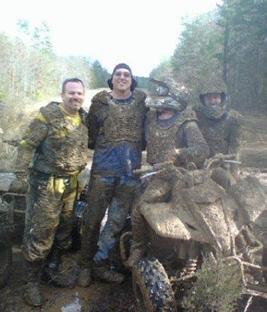
“My wife and I got fed up with urban sprawl and bought some acreage and fell in love with ATV riding. We both have had motorcycles in our lives in the past and never even thought of ATVing. We now go all over to experience the best that America has in trail riding with our friends and family. In the photo are, from left to right: Buddie, me, Jeff (lifelong friend) and his son, Spencer. The picture was taken in the mud field on our property where we have created a ‘race track’ of sorts and enjoy spending time to see who can get the other muddier. It can also be quite the dust bowl in July and August.”
– Jay Anderson of Mineral, Va.
Want to share a photo? Send it with your name to Editor@ ATVAonline.com.
The Latest And Best Hope To Save Kids’ ATVs
Bill Would Exempt Kids’ Machines From ‘Lead Law’
A new bill in Congress offers the best hope to stop a de facto federal ban on kid-sized ATVs and dirtbikes.
And Ed Moreland, senior vice president for government relations for the American Motorcyclist Association (AMA), which is the parent organization of the ATVA, is urging all concerned riders and parents to contact their federal lawmakers now to support the legislation.
Moreland notes that it’s critical for lawmakers to co-sponsor the bill to increase its chance of passage.
“Decision-makers listen to the voices of ATVA and AMA members,” he says. “Now is the time for everyone who supports responsible motorized outdoor recreation for children to contact their lawmakers and ask them to cosponsor H.R. 412, the Kids Just Want to Ride Act. The future of motorcycling depends on it.”
Rep. Denny Rehberg (R-Mont.) introduced the Kids Just Want to Ride Act on Jan. 25 to exempt child-sized dirtbikes and ATVs from the Consumer Product Safety Improvement Act of 2008 (CPSIA), commonly known as the lead law.
The CPSIA, which took effect Feb. 10, 2009, effectively banned the sale of small-displacement recreational vehicles intended for kids 12 years old and younger due to overly restrictive lead-content standards. The law also requires expensive and time-consuming testing to prove products comply with the law.
But the Consumer Product Safety Commission (CPSC), which is responsible for implementing the law, has delayed enforcement of certain parts until the end of the year, which grants a reprieve for child-sized dirtbikes and ATVs.
“Time is running out,” Moreland says. “Lawmakers on both sides of the aisle have already signed on to co-sponsor the bill, but we need more.”
Rep. Mike Ross (D-Ark.) is one of the dozens of lawmakers already supporting the bill.
“This small change to the law will help ensure youth-model motorcycles and ATVs are not pulled from the [showroom floors] and remain available to the parents of children who wish to ride appropriately sized vehicles designed just for them that already meet government safety guidelines,” Ross says.
Says Rep. Adam Kinzinger (R-Ill.), another co-sponsor: “Banning children from using appropriate child-sized offhighway vehicles prevents kids from using the proper vehicles that were designed to keep them safe.”
To help, riders should contact their representatives and tell them to support H.R. 412, the Kids Just Want to Ride Act. Go to the ATVA website at ATVAonline.com > Rights > Issues & Legislation for directions to send an email. Or you can call the U.S. Capitol Switchboard at (202) 225-3121 and ask for your representative by name.
Jim Bowie
Kids Under Attack In Illinois Legislation
Would Ban Kids From Riding
Kids under the age of 16 would no longer be able to ride ATVs or motorcycles in Illinois if state Rep. Mary Flowers (D-Chicago) has her way.
On Jan. 27, Flowers introduced H.B. 292 that would make it illegal for anyone under the age of 16 to operate a motorcycle or ATV. The bill was referred to the House Elementary and Secondary Education Committee for consideration.
In written testimony to the House Elementary and Secondary Education Committee dated Feb. 10, AMA/ATVA Government Affairs Manager Royce Wood argued that the bill would “deny our members, and hundreds of thousands of other off-highway vehicle enthusiasts, the right to participate in their preferred family recreation.
“Families should be free to decide what to do in their spare time and
parents must have discretion over the type of recreation in which their children participate,” he wrote.
AMA/ATVA Grassroots Coordinator
Jessica Irving says immediate action is needed to defeat the bill.
“We’ve alerted Illinois ATVA and AMA members who have contacted their lawmakers and pointed out the many positive aspects of off-highway riding for kids,” Irving says. “I’m confident that the concerns of ATVA and AMA members played a key role in killing the bill last year, and I hope that we will prevail again this year.”
Illinois ATVA members should contact their state representatives and tell them to oppose H.B. 292. A pre-written letter opposing the bill is available on the ATVA website at ATVAonline.com > Rights > Issues and Legislation.
Proposed Forest Service Planning Rule Released Riders Need
To Protect Responsible Access
The U.S. Forest Service is seeking comments on a proposed planning rule for the national forests that has been in the works for more than a year.
“It’s vital that off-highway riders around the nation read the proposed rule and comment by the deadline to ensure that the voice of the motorized recreation community is heard,” says Royce Wood, AMA/ATVA government affairs manager. “We certainly know that the groups and people who want to expel riders from public land will be giving the U.S. Forest Service an earful.”
The planning rule will guide the land management plans in all national forests and grasslands in the national forest system for decades to come.
The comment deadline is May 16. For information on the new rule and to comment, go to FS.USDA.Gov/ planningrule.
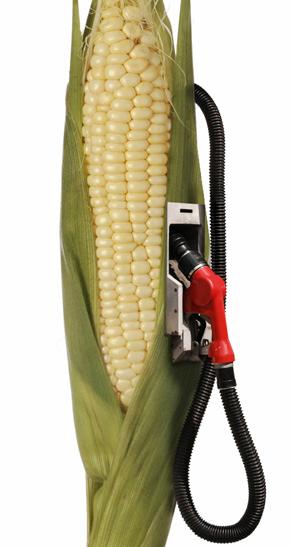
More Ethanol In Gas Approved For Older Cars
ATVA Concerned About Effect On ATVs
The federal Environmental Protection Agency has granted a waiver to allow the use of gasoline made up of 15 percent ethanol in model year 2001 through 2006 passenger vehicles, including cars, SUVs and light pickups.
The decision, announced Jan. 21, follows an earlier decision to allow the use of gas containing up to 15 percent ethanol—also known as E15—in model year 2007 and newer passenger vehicles.
But the EPA said it hasn’t made the same declaration for motorcycles, heavy-duty trucks or non-road engines “because current testing data does not support such a waiver.”
The federal agency also is developing requirements to ensure that E15 is properly labeled at the gas pump. The label will be designed to prevent refueling into vehicles, engines and equipment not currently approved for the higher ethanol blend.
ATV and motorcycle manufacturers currently only certify modern engines to run on fuels that have a 10 percent or
less blend.
Imre Szauter, AMA/ATVA government affairs manager, notes that the ATVA supports the use of cleaner-burning fuels but is concerned that, if the allowable level of ethanol is raised, it could result in premature engine damage.
“Until studies show that a higher ethanol blend won’t damage ATV or motorcycle engines, and won’t make them emit more nitrogen oxides than are allowed by the EPA, the ATVA and AMA can’t support any proposal to allow a higher blend,” Szauter says.
The AMA is a member of AllSAFE, the Alliance for a Safe Alternative Fuels Environment, a group formed to ensure that fuels containing ethanol are promoted in a thoughtful manner. AllSAFE is made up of associations that represent consumer and commercial users of ethanol blends, manufacturers of boats, vehicles, engines and equipment, and retailers who sell gasoline and ethanol-fuel blends.
Ask The ATV Safety Institute: Hauling An ATV In A Pickup
YOU ASK: I want to haul my ATV in my pickup. Do I need a special ramp, or can I use boards? Is there anything I need to know about loading and unloading the ATV?
THE ASI RESPONDS: Here are some tips to help you safely load your ATV onto a pickup truck or trailer:
Use only ATV-specific ramps—not flat boards—because these ramps are rated for loads heavy enough to handle your ATV. Many ATV ramps also have a raised edge that helps prevent the tires from veering off the sides of the ramps, and many have an angled top flap that provides a good transition from the ramp to the truck or trailer bed.
Select ramps that have a load rating and width appropriate for the heaviest and widest ATV you’ll be transporting. Ramps are available as one wide unit or two separate parallel units that you must position at a width that matches your ATV’s tire paths.
Position the pickup truck or trailer in a manner that minimizes the steepness of the ramps. Using a longer ramp will also
minimize the steepness.
Secure the ramps to the pickup truck or trailer using tie-down straps, so the ramps will not shift or fall while you load or unload the ATV.
Avoid riding the ATV up or down the ramps. Use a winch to load the ATV if possible, or have others help you roll the ATV up or down the ramps. If you must ride the ATV, wear full protective gear, especially a DOT-compliant helmet; proceed slowly in low gear; lean forward while riding up or backing down the ramps; check behind you before backing down the ramps.
After loading, secure the ATV to the truck or trailer using ratcheting tie-down straps. While in transport, periodically stop to check that the tie-downs have not loosened.
To enroll in an ATV RiderCourse near you, visit ATVSafety.org or call (800) 887-2887.
TO RIDE VIDEO CONTEST
‘Kids Just Want To Ride!’ Video Contest
A Key Component Of The AMA Family Capitol Hill Climb
Efforts are ramping up to change the lead law that effectively bans the sale of kids’ dirtbikes and ATVs at the end of the year.
The AMA has launched a “Kids Just Want to Ride!” video contest so that youngsters can explain to federal lawmakers and others why riding is so important to them.
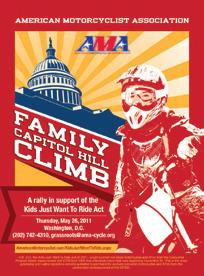
While all the homemade videos will be used to help deliver this important message to lawmakers, the winning video will be a key component of an AMA-organized “AMA Family Capitol Hill Climb” in Washington, D.C., on May 26. The media event and lobbying effort will urge lawmakers to exempt kids’ dirtbikes and ATVs from the lead law.
“This two-pronged approach will put a human face on the devastating impact the lead law will have on family recreational riding when key parts of the law are enforced at the end of the year,” says Ed Moreland, AMA senior vice president for
government relations. “Lawmakers need to understand that these are real kids, and real families, being hurt by the law.”
For full details concerning the Kids Just Want to Ride video contest and the AMA Family Capitol Hill Climb, go to AmericanMotorcyclist.com/ KidsJustWantToRide.aspx.
“The AMA Family Capitol Hill Climb will be a full-court press to garner support among lawmakers for H.R. 412, the Kids Just Want to Ride Act, which would exempt kids’ dirtbikes and ATVs from the lead law,” Moreland says. “We need to get as many riders and their families to attend the AMA Family Capitol Hill Climb as possible so that we can have an impact on decision-makers.”
If you plan to attend the AMA Family Capitol Hill Climb, contact the AMA Grassroots Team to help with your visit and arrange a meeting with your federal lawmaker. Call (202) 742-4310 or email grassroots@ama-cycle.org.
The AMA Family Capitol Hill Climb will deliver a message to lawmakers that kids’ dirtbikes and all-terrain vehicles should be exempt from the lead law.
OFF-HIGHWAY RIDING UNDER FIRE NEW TACTICS TARGET
When it comes to anti-access forces and their efforts to close off land to responsible recreational off-highway riding, we thought we’d seen it all. Behind-the-scenes, backroom deals with powerful legislators. Orchestrated news conferences. Political sleight-of-hand. All of it aimed at shutting us out.
Interesting thing, though: When anti-access groups are forced to play by the rules—such as when they get their bills introduced in Congress to ban ATVs and motorcycles from public land—they almost always lose.
That’s because their proposals don’t stand up to public scrutiny and debate.
Alarmingly, though, opponents of responsible off-highway riding have added a new tactic to their arsenal: Throwing the rulebook out the window.
The latest attempts involve bypassing the people’s representatives in Congress entirely, so that there is absolutely no public debate. No debate means their plans don’t get scrutinized, and—they hope—don’t get derailed.
“This new tactic is particularly disturbing,” notes Rob Dingman, president and CEO of the American Motorcyclist Association (AMA), the parent organization of the ATVA. “The clear aim of anti-access groups is to take land using autocratic administrative rulings—the same land these groups have repeatedly been unable to secure through the legislative process when the light of public scrutiny is shined on their schemes.
“This is a trend that must be stopped,” he stresses.
Photo
will look at the land they manage and decide which land should be labeled “Lands With Wilderness Characteristics.” Once those decisions are made, the officials will go through a public land-use planning process before designating land as “Wild Lands.”
In a letter dated Jan. 28, Rep. Rob Bishop (R-Utah), the outgoing chairman of the Congressional Western Caucus, Sen. John Barrasso (R-Wyo.), chairman of the Senate Western Caucus, and 47 other House members and eight other senators asked Salazar to rescind the order.
“I am increasingly concerned by Secretary Salazar’s and the current administration’s ongoing efforts to circumvent Congress when it comes to creating new public lands policies,” Bishop said. “The DOI’s [Department of Interior’s] unilateral decisions regarding the management of our public lands and resources are detrimental to communities and businesses throughout the West.
“Their lack of regard for the impact this will have on local economies is unacceptable,” he continued. “It is time that they start taking into consideration the people that will be hurt by their decisions to operate in a vacuum, starting with the withdrawal of Secretarial Order 3310.”
Leaked Documents Reveal Land-Closing Agenda
Internal BLM documents that surfaced last year showed the agency has been talking about changing landuse designations on millions of acres of public land—a devastating blow to riders that could close between 35 million and 140 million acres to responsible off-highway recreation.
“The documents indicated that government officials may have a finely detailed plan to exclude Americans from accessing public land despite the agency’s assertion that these documents are simply the result of ‘brainstorming sessions,’” says AMA Washington Representative Rick Podliska.
The internal memo states that some 130 million to 140 million acres—an area roughly the size of Colorado and Wyoming combined—are under consideration for special land-use designations that could further restrict off-highway riding. This is about half of the 264 million acres of public land managed by the BLM.
The document also states that about 35 million acres of BLM land “should be considered for a new and/or heightened conservation designation.”
The memo spells out a proposed plan for public land-use designations that could ban OHV riding by supporting
certain congressional land-use designation proposals and having the president pull an end run around Congress by unilaterally naming areas as national monuments “should the legislative process not prove fruitful.”
The memo suggests the agency use its internal land-use planning process to accomplish the bureau’s goals for managing “conservation values” when other efforts fail.
“This memo doesn’t read like a draft document,” Moreland says. “It reads like a playbook for shutting the public out of land-use decisions.”
America’s Great Outdoors Initiative
Even though the Obama administration announced its America’s Great Outdoors initiative on April 16, 2010, to date there have been no details released, Podliska says.
“The administration launched the initiative by simply saying that the overall goals were to ‘support innovative community-level efforts to conserve outdoor spaces and to reconnect Americans to the outdoors,’” Podliska says. “Is this the beginning of a new push for the president to unilaterally designate national monuments around the nation that could shut out OHV recreation? At this point, we simply don’t know.”
What we do know, he says, is that the president directed the secretaries of the interior and of agriculture, the administrator of the Environmental Protection Agency and the chair of the Council on Environmental Quality to lead the initiative.
Proposed Forest Planning Rule Unveiled
The U.S. Forest Service has launched an effort to simplify planning for the national forests, and that gives antiaccess forces another opportunity to shut out riders unless our voices are heard, says AMA/ATVA Government Affairs Manager Royce Wood.
After all, not only is what the Forest Service proposing even more complex than the current planning process,
it takes into account unnecessarily broad factors that shouldn’t even be considered, Wood says.
Like “climate change.”
“No one can accurately determine how this issue impacts the day-to-day management of responsible OHV recreation on the local level,” he says.
“We also need to let the Forest Service know that traditional multiple uses that have long been valued by the public must be considered in forest planning. Under the federal Multiple-Use Sustainable Yield Act of 1960, the Forest Service is required to take multiple uses into account.”
The Forest Service is taking comments on the proposed planning rule until May 16. To comment, go to FS.USDA.Gov/ planningrule.
Battle Lines Are Drawn
“Opponents of responsible motorized recreation are getting very aggressive these days and are using every trick in the book to try to destroy our sport and lifestyle,” Moreland says. “It’s very important that every rider get involved, from writing to federal lawmakers pointing out the positive aspects of motorized recreation to attending Forest Service meetings where management plans are discussed.
“We need to ensure that the positive face of motorized recreation is before decision-makers everywhere,” he says. “And we need to let the anti-access forces know that responsible motorized recreation is a federally recognized, legitimate form of recreation that must be preserved.”
The battle continues.
THE ATVA AND AMA SUPPORT WILDERNESS, AND LAND ACCESS
A Federal Law Provides For Varied Use Of The Land
The ATVA and AMA wholeheartedly support appropriate Wilderness—as defined by the federal Wilderness Act of 1964—and back the designation of land that meets that strict criteria, with congressional oversight and with broad public support.
The Wilderness Act states that to earn a Wilderness designation the land must be “an area where the earth and its community of life are untrammeled by man,” and that “generally appears to have been affected primarily by the forces of nature, with the imprint of man’s work substantially unnoticeable.”
“Pristine land should be protected,” says Ed Moreland, AMA senior vice president for government relations. “Public land that meets the strict criteria of the Wilderness Act deserves to be protected not only currently, but for future generations as well.
“But we have to be careful to protect the land for future generations and not from future generations,” Moreland says. “The way to do that is to use the designation process prudently.”
Moreland believes that public land
that can’t meet the strict requirements of the Wilderness Act should be governed by another equally forceful federal law— the Multiple Use-Sustained Yield Act of 1960.
“That law encourages a wide variety of activities, provided that they take place in harmony with natural resource values,” he says.
The ATVA and AMA support the responsible use of OHVs on public land that doesn’t meet the strict requirements to qualify as Wilderness. The ATVA and AMA believe this access should be administered by professional land managers in order to meet the needs of participants, protect the land and promote responsible use.
“An important point for everyone to remember is that off-highway riders are environmentalists as well. We enjoy the outdoors, outdoor recreation, and care deeply for the land,” he says.
“We believe that reasoned, active management of public land is the best way to protect the land, and the best way for all Americans to be able to enjoy this treasured resource,” Moreland says.
FIGHT BACK!
Help Stop Bans by Making Your Voice Heard
There are lawmakers on both sides of the aisle who are on both sides of the issue when it comes to banning offhighway vehicles (OHVs) from public land.
All riders need to let their federal lawmakers know that they enjoy motorized recreation and want a full public debate, with citizen input, before OHVs can ever be excluded from public land, especially through a Wilderness land-use designation.
To act, you can contact your federal lawmakers by going to ATVAonline. com > Rights > Issues & Legislation. There, you can find the names of the members of your congressional delegation as well as their addresses and telephone numbers, and you can let them know how you feel.You can also send a pre-written letter from there.
Individuals can also sign up for the AMA Government Relations Department’s Action E-list to be notified by email when support is needed to make a difference on important issues, including at town hall meetings.
The ATVA has a supply of “Stop the Land Grab” stickers that are a great way to show your opposition to unwarranted efforts by anti-access groups to restrict access to public land without ever saying a word.
To request a sticker, note your ATVA or AMA number and send your request to:
Making A Difference The Arizona OHV Ambassador Program
A great way to have fun off-highway riding as well as help ensure there are places to ride in the future is to get involved in a volunteer Trail Patrol or Trail Ambassador program on public land.
And one of the best programs in the nation is the Arizona Off-Highway Vehicle (OHV) Ambassador Program, where officials have formed a partnership that includes a variety of land-management agencies and volunteers.
“Pete Pfeifer, who is chairman of the Arizona State Parks Off-Highway Vehicle Advisory Board, and his team have done a great job with this program,” says Nick Haris, AMA Western states representative. “Ambassadors encourage responsible riding, help maintain trails and help educate land-management officials about the needs of off-highway riders.”
A variety of other government agencies are also involved in the program, including the federal Bureau of Land Management (BLM), the U.S. Forest Service and the Arizona Game and Fish Department. Additional
support comes from the Arizona Sheriff’s Department and Arizona State Land Department.
Off-highway riding organizations active in the effort are under an umbrella organization called the Arizona Motorcycle Riders Association, a nonprofit, volunteer association made up of eight clubs: Arizona Trail Riders, the Coconino Trail Riders Association, the FAST’R Motorcycle Club, the Off-Camber Motorcycle Club, the Off-Road 86 Club, the Rock Stars Motorcycle Club, the Extreme Motorcycle Club and Trail Riders of Southern Arizona.
Besides projecting a positive image of OHV riding on the trails, the ambassadors promote responsible motorized recreation and land stewardship, support cooperation between OHV users and OHV management agencies, provide OHV information about where to ride, riding safety, etiquette, rules and regulations, and help resource management agencies monitor, maintain and improve OHV routes and facilities.
“The OHV Ambassador has the satisfaction of
knowing that they’re making a positive impact on the future of OHV recreation,” Pfeifer says.
“Additionally, they get opportunities to interact with federal and state land managers, law enforcement officers and state representatives.
“The ambassador will gain a greater understanding of the current issues, challenges and opportunities their local agencies are working through as well as an ability to influence the outcome,” he adds. “The greatest benefit of becoming an ambassador is the fun of spending time on Arizona’s roads and trails.”
The program is invaluable because it strengthens existing clubs and state associations by providing new recreational opportunities, and may even lead to the creation of off-highway riding clubs in areas where they don’t exist, he says.
Plus, the program provides and promotes education, safety, trail etiquette and environmental
programs for motorized recreation while emphasizing the benefits of responsible behavior, he says.
The program currently exists in the Lake Pleasant area, including the Boulders OHV area, Bradshaw Foothills and Table Mesa Road west of the I-17 freeway; the Cave Creek Ranger District/North Scottsdale area and southwestern portions of the Tonto National Forest (Desert Vista); and the Florence Junction area, including the Desert Wells Multiuse Area and the BLM portion of the Middle Gila Canyons area.
The program is expanding in 2011.
“We’re going to be looking for riders, not racers,” Pfeifer says. “People who enjoy riding but also think on their feet, offer assistance, enjoy interacting with the public, and at the end of the day have that Malcolm Smith smile.
“We’ll have no authority but our presence will be felt out on the trail,” he continues. “We hope that the factories and product manufacturers will recognize our ability to promote their products and offer some support.”
Ambassadors patrol with at least one other volunteer/agency staff member in a vehicle that is equipped with safety and patrol gear.
Since September 2007 when the program began, 86 volunteers have
monitored more than 4,000 miles of trails on public land, helped riders, removed trash, ensured hazards are taken care of and repaired fences.
The volunteers have donated about 4,000 hours of time, saving government agencies about $79,000.
Also since September 2007, some 4,154 trail miles were monitored, 11 significant public safety trail hazards reported, 21 trailer (40 cubic yards) loads of trash removed from public land and 75 abandoned mines were located and recorded.
Ambassadors use their own street-legal vehicles suitable for OHV roads and trails. These range from large four-wheel drive vehicles to ATVs (which can be made streetlegal in Arizona), side-by-sides and motorcycles.
Additional information about the program can be found on the Arizona State Parks website at AZStateParks.com/OHV/ ambassadors.html.
Interested applicants should download and submit an application to the BLM:
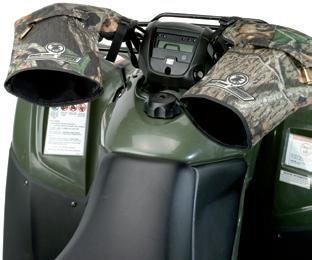
A rider’s hands can be one of the hardest things to keep warm on those cold rides through the backwoods. The new Pursuit Handwarmers from NRA by Moose Utility Division provide an answer. The high-quality 600-denier nylon ensures water resistance and makes cleaning simple. Available in multiple styles, these handwarmers also feature built-in pockets for warming packets to further guarantee warmth. Overall dimensions: 16 inches wide by 14 inches in length.
MSRP: Black $26.95, Mossy Oak Break-up $29.95, RealTree $29.95
Info: MooseUtilities.com/NRAbyMoose
STI Rolls Out New HD1 Wheel
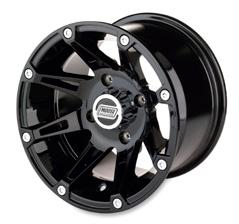
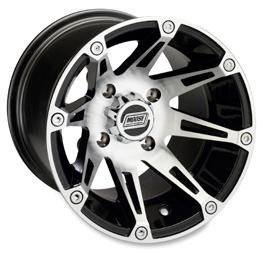
STI Tire & Wheel has launched its new HD1 wheel, which features a non-stick, Slik-Kote finish. STI says this high-tech, rugged, deep gray finish reduces mud and debris buildup and resulting unsprung weight, which can compromise the machine’s power, handling and ride. It also makes post-ride cleanup exceptionally easy. This advanced one-piece alloy wheel features both inner and outer wheel lip reinforcement. The STI HD1 debuts in 12x7 and 14x7 sizes. The 12x7 has a 700-pound load rating, while the 14x7 size provides an 800-pound load rating.
MSRP: 12x7, $81.05; 14x7, $97.38
Info: MTADistributing.com
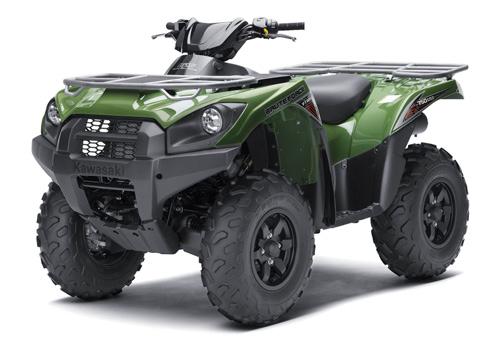
Kawasaki Launches Revamped
The Kawasaki Brute Force 750 4x4i ATV received a comprehensive round of upgrades for the 2012 model year. An Electric Power Steering (EPS) system highlights the changes, but is joined by other significant new features like a more powerful V-twin engine, new double-wishbone front suspension, six-spoke cast alloy wheels and new bodywork featuring wide-stance styling cues. Thanks to revised tuning, a new cylinder head and increased compression ratio, the 2012 Brute Force 750 4x4i’s upgraded four-stroke, fuel injected, 90-degree 749cc V-twin engine offers more power than ever, with enhanced low-rpm performance. The ATV is also available in an SE version, featuring a premium quality Metallic Tungsten Gray automotive paint finish, unique graphics and a bright silver machined finish on the face of its cast aluminum wheels.
Colors: Scout Green, Super Black, Metallic Tungsten Gray (SE).