LOVEOF MOTO FOR THE
Roots. Legacy. Legends





















































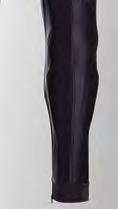


MONTHLY DRAWINGS



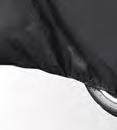

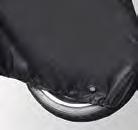












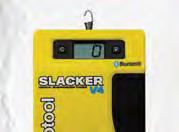
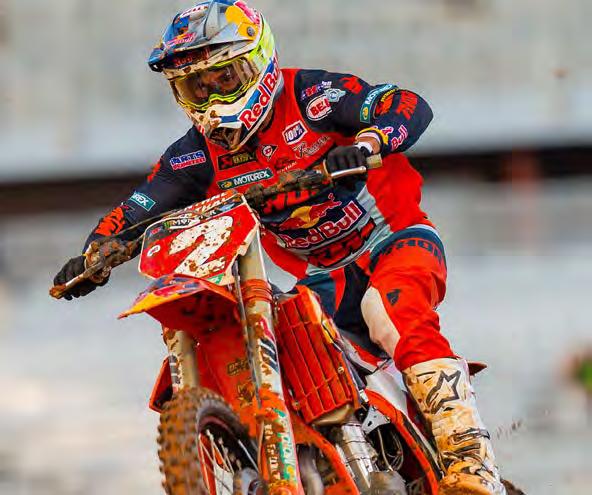
Members who join or renew their AMA membership from Jan. 1, 2021, through Dec. 31, 2021 are automatically entered to win one of these awesome motorcycling prizes!
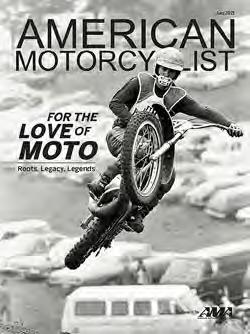
ON THE COVER:
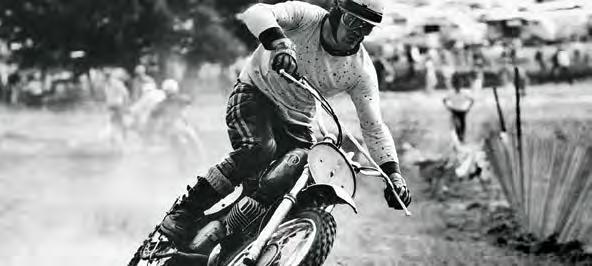
JIM POMEROY, BY BILL PETRO
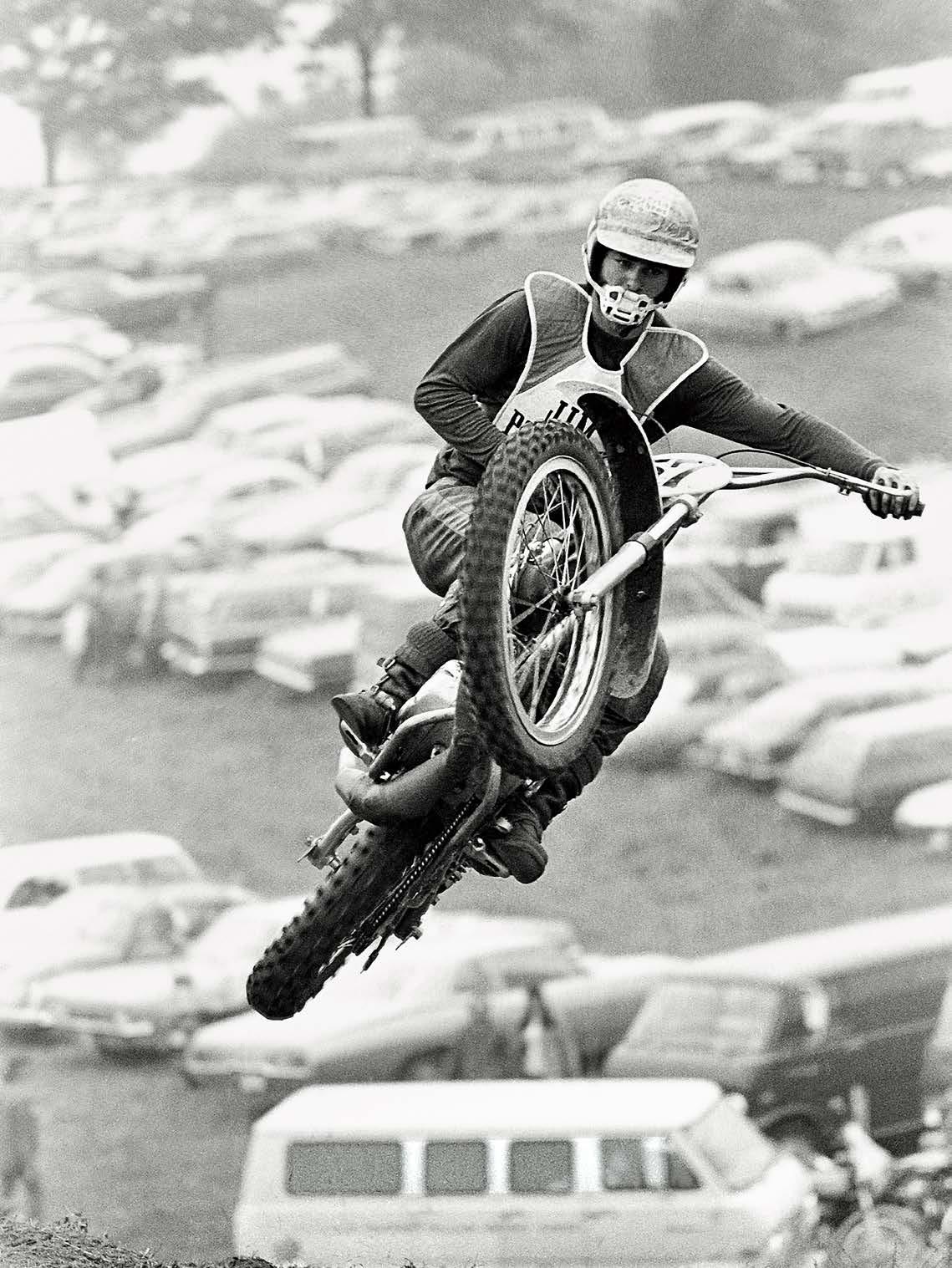
There’s plenty of competition for Best Motocross Photo Ever, but Bill Petro’s epic cross-up shot of Jimmie Pomeroy at the 1972 Copetown, Canada 250cc Grand Prix is arguably the leading contender. Read all about the shot and the events surrounding its release and legendary status on page 46. Nice job, Bill!
June 2021
Volume 75, Number 6
CONTENTS
PERSPECTIVES 6
Editorial Director Mitch Boehm
AMA INSIDER 8
AMA President and CEO Rob Dingman
BACKFIRES 10
Membership feedback on the magazine’s new direction
UP TO SPEED 12
News, notes, sneak peeks and policy from the motorcycling universe
SUPERCROSS CHAMPS 20
Cooper Webb, Colt Nichols and Justin Cooper grab 2021 SX titles
1968 WESTLAKE VILLAGE INTER-AM 22
Joel Robert and other Euro stars show the Americans how it’s done
1972 SUPERBOWL OF MOTOCROSS 34 16-year-old Marty Tripes wins the very first Supercross
COVER:
JIM POMEROY, UNPLUGGED 46
Is Bill Petro’s epic Pomeroy cross-up image the most iconic mx photo ever?
MX ROOTS: THE ELSINORE 48
Honda’s 1973 CR250R helped kickstart a motocross revolution
THE SCREAMIN’ YELLOW BANSHEE 49
Suzuki’s 1975 RM125 was a winner on the track and in the showroom
THE WATER PUMPER 50
With Bob Hannah and Bill Buchka, the 1976 OW27 Yamaha was a motocross force
THE CHAMP 52
“Bad Brad” Lackey: America’s first World Motocross Champion
ONE TO WATCH 54
KTM Orange Brigade motocross racer Tayler Allred chases her dream
EVENT CALENDAR 58
AMA-sanctioned rides, races and events you just can’t miss
MEMBER’S TAKE 65
AMA member Lisa Scoppettuolo talks about learning to ride
FLASHBACK: MARTY SMITH 66
The 1970s Team Honda superstar is gone, but not forgotten
COMMUNICATIONS
Mitch Boehm Editorial Director
Mark Lapid Creative Services Director
Joy Burgess Managing Editor
Dustin Goebel Senior Designer
Gina Gaston Web Developer
Kali Kotoski Editor-at-Large submissions@ama-cycle.org
Steve Gotoski Director of Industry Relations and Business Memberships (951) 491-1910, sgotoski@ama-cycle.org
Forrest Hayashi Advertising Manager (562) 766-9061, fhayashi@ama-cycle.org
Lynette Cox Marketing Manager (614) 856-1900, ext. 1223, lcox@ama-cycle.org
All trademarks used herein (unless otherwise noted) are owned by the AMA and may only be used with the express, written permission of the AMA.
American Motorcyclist is the monthly publication of the American Motorcyclist Association, which represents motorcyclists nationwide. For information on AMA membership benefits, call (800) AMA-JOIN or visit AmericanMotorcyclist.com. Manuscripts, photos, drawings and other editorial contributions must be accompanied by return postage. No responsibility is assumed for loss or damage to unsolicited material. Copyright© American Motorcyclist Association, 2021.
AMA STAFF
EXECUTIVE
Rob Dingman President/Chief Executive Officer
James Holter Chief Operating Officer
Jeff Wolens Chief Financial Officer
Donna Perry Executive Assistant to President/CEO
Danielle Smith Human Resources Manager/Assistant to COO
RACING AND ORGANIZER SERVICES
Mike Pelletier Director of Racing
Bill Cumbow Director of International Competition
Michael Burkeen Deputy Director of Racing
Erek Kudla Off-Road Racing Manager
Ken Saillant Track Racing Manager
Joe Bromley Program Development Manager
Alexandria Kovacs Program Manager
Connie Fleming Supercross/FIM Coordinator
Lakota Ashworth Racing Coordinator
Olivia Davis Racing Coordinator
Serena Van Dyke Recreational Riding Coordinator
OPERATIONS
Steve Austin Director of Operations
John Bricker Mailroom Manager
Rob Baughman Operations Specialist
Ed Madden System Support Specialist
AMA BOARD OF DIRECTORS
Contact any member of the AMA Board of Directors at americanmotorcyclist.com/ama-board-of-directors
Russ Ehnes Chair
Great Falls, Mont.
Gary Pontius Vice Chair
Westfield, Ind.
Byron Snider Assistant Treasurer
Newbury Park, Calif.
Jerry Abboud Executive Committee Member
Thornton, Colo.
Paul Vitrano Executive Committee Member
Medina, Minn.
Brad Baumert
Louisville, Ky.
Hub Brennan E. Greenwhich, R.I.
Christopher Cox
Florence, S.C.
Mark Hosbach
Franklin, Tenn.
Robert Pearce Amherst, Ohio
Tom Umphress
Jordan, Minn.
Faisel Zaman Dallas, Texas
(800) AMA-JOIN (262-5646) (614) 856-1900
AmericanMotorcyclist.com
@AmericanMotorcyclist @ama_riding
ACCOUNTING
Karen Esposito Accounting Manager
Deb D’Andrea Data Entry Representative
GOVERNMENT RELATIONS
Michael Sayre Director of Government Relations
Nick Haris Western States Representative
Tiffany Cipoletti Government Relations Manager, On-Highway
Peter Stockus Government Relations Manager, Off-Highway
Erin Reda Grassroots Coordinator
MUSEUM
Daniel Clepper Collections Manager
Paula Schremser Program Specialist
Ricky Shultz Clerk
Von Kieber Clerk
MARKETING AND MEMBER SERVICES
Amanda Donchess Director of Membership Marketing and Services
Jennifer Finn Member Activity Coordinator
Lauren Snyder Marketing and Advertising Coordinator
Tiffany Pound Member Services Manager
Stephanie McCormick Member Services Representative
Vickie Park Member Services Representative
Ellen Wenning Member Services Representative
American Motorcyclist magazine (ISSN 0277-9358) is published monthly (12 issues) by the American Motorcyclist Association, 13515 Yarmouth Drive, Pickerington, OH 43147. Copyright by the American Motorcyclist Association/American Motorcyclist 2021. Printed in USA. Subscription rate: Magazine subscription fee of $19.95 covered in membership dues.
Postmaster: Mail form 3579 to 13515 Yarmouth Drive, Pickerington, OH 43147. Periodical postage paid at Pickerington, Ohio, and at additional mailing offices.

SO LONG, GEORGE
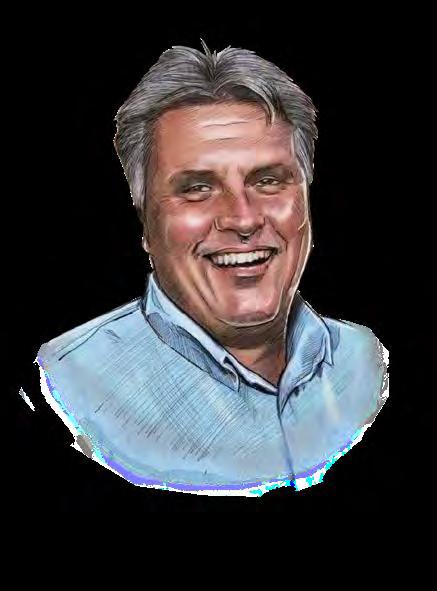
By Mitch Boehm
Ohio motocross, and the entire motorcycling community, really, lost a great one back in March. He was George Singler, a truly Paul Bunyan-esque icon of Northern Ohio who for 40 years owned and ran a little motocross track just West of Medina, Ohio by the name of Smith Road Raceway. George was 87.
Smith Road figures prominently in my own motocross life. It was not the first track my dear dad took me to but it was the place that hooked me into motocross like a hungry bass in a pond. See, “Smith,” as my dad and I called it, was the first place I ever trophied, way back in the fall of ’74 on my bone-stock ’73 Honda XR75.
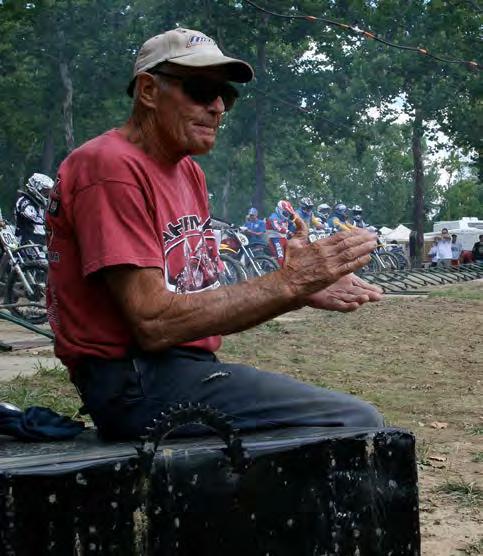
EGeorge Singler, in his element, applauding finishers during an AHRMA national in 2009 at Medina, Ohio’s Smith Road Raceway, which he owned and ran for four decades.
We’d tried racing at a few local tracks before heading to Smith Road in October, and I hadn’t had much luck. Not even a top ten. Most of the XRs (and there were a lot) had pipes and cams; some had bigbore kits, and most had moved-up (or laid-down) shocks. The Yamaha YZ80s were fast, too, and lighter than my XR. But in that late-season race I got good starts, rode better than I had, and ended up with a third overall and a trophy — which George handed me with his huge, callused hands in front of 60 or 70 riders, parents and fans. Boom! Open mouth. Insert hook. For this then-12-year-old it was a truly awesome moment. And the start of a near50-year love of motocross that very definitely inspired this issue.
From there it was a whirlwind several years for me and my dad — and sometimes mom, too. We did all of ’75 on that same XR but with a big-bore kit, pipe and trick monoshock suspension. I won 17 trophies that season, many at Smith Road, and even won a few races. In ’76 we moved up to the 100cc class on a Yamaha YZ100C, did all of ’77 on a YZ125D, and did ’78 on a YZ250E. And every year there’d be George, working the track, driving those tractors with his shirt off, running riders’ meetings in the mornings and handing out trophies at day’s end.
I reconnected with George some 12 years ago for a story I wrote called Full Circle about racing at Smith Road after a 30-plus year absence on the last bike I’d ridden there — a ’78 YZ250. Being on that sacred dirt and racing again where it all began for me was amazingly powerful — as was seeing George working the starting gate, watering the track and moving dirt around.
George and I kept in touch, and the guy continually amazed me, racing well into his 70s after selling the track and moving to Florida, and still going pretty fast. George was one of the country’s best off-road riders in the 1960s, and he kept those skills sharp right until he quit racing a few years ago when pancreatic cancer got the best of him.
The Plas family, which owns and runs Smith Road these days, is having a memorial race in George’s honor at their annual July 4th event. I’m planning to attend before heading to MidOhio for Vintage Motorcycle Days. Godspeed, George. You are in many ways Mr. Motocross to me, and you will be missed.
THE ARAI DIFFERENCE: GLANCING OFF
At Arai, protecting the rider is the single most important element in any helmet they produce. The kinetic energy generated by a crash can be avoided or minimized by glancing off objects. Glancing off is the ability to avoid sending energy directly into the helmet and Arai believes this is one of the most important performance characteristics of a helmet. Protect what is priceless.
XD -4 I COVER FLUORESCENT YELLOW FROST
LETTER OF THE MONTH Back To Basics
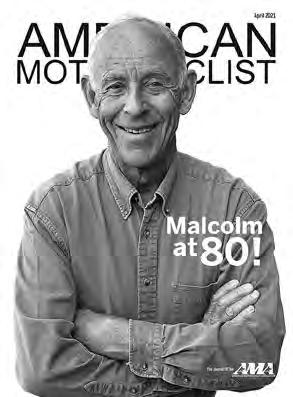
Just got my American Motorcyclist and read it cover to cover. Congratulations to Mitch Boehm and the new staff, as it’s the best Motorcyclist I have read in years. The feature on Malcolm Smith and the article on Harley-Davidson both read right to my heart. Having turned 74 this past January and having ridden motorcycles since 1958, you might say I have been there and done that. Really looking forward to the next issue. Promise us old dudes you will not switch to a digital-only publication. I know all the reasons, but I have copies of various moto mags, some of which are 50 years old, that I can pick up and reread and smile at the memories.
John J. Black | Huntsville, AR #3332040
it and maybe save for later. Well, an hour later I’d say well done! It’s a fresh reminder of how much I looked forward to getting printed magazines each month, as I have let all my subscriptions to gone-digital magazines lapse. Harley recently announced that its HOG magazine is going digital and asked what members thought; I responded by telling them not to bother with a renewal notice. There is just something to the printed word! Enjoyed the article on Malcolm. It really gave a side I had never heard before. Keep up the good work.
Rick Steen | Altus, OK
The April issue was the best I’ve read in a very long time. Not sure if Mitch deserves all the credit [No chance! -Ed.] but I suspect he had a big part in the recent changes. I often gave past issues just a cursory glance, but I read this one cover to cover. Great job! I understand the transition to digital media, but as an old fart I grew up turning pages and much prefer it.
Don Kathke | AMA #632283
Promise, John! -Ed.
Reading that excellent article about Malcolm in the April edition, and his femur problems, reminded me of a day in 1964 when a tree jumped in front of me on my motorcycle and broke my right femur. The doc fixed it with a long rod, and I asked if the rod had to stay in or could be removed. “Do you plan on continuing to ride motorcycles?” he asked. “Yes.” “Well, just think if you had the same accident, breaking the femur and bending the rod, so we’ll take it out in two years.” I’m now 81, still riding, rodless, with a well-healed femur.
Clement Salvadori | Atascadero, CA
AMA #77415
Mitch, the Malcolm Smith piece in the April issue is perhaps the best you’ve written. It certainly struck a chord with me. We have similar history, as I was 13 when I discovered motorcycling. Trans-
AMA at Carnegie, must have been ’71, and Laguna Seca in ’72. Thanks, Dad. I wish you were still here. I remember Parkhurst, Neilson, Jennings, Seimen, and Art Friedman is also etched into my brain. Call me old and old-fashioned, but I love the print and the stories. I avoid the computer in my downtime; too much time spent there for work. A dozen bikes in the garage now, some street, some dirt, some new, some old, all ridden with gusto. The passion that was born some 50 years ago still burns. I’ll add that I had the pleasure of crossing paths with Malcolm in Bahía de Los Ángeles maybe seven or eight years ago. It was an epic ride and a meeting in Baja that will never be forgotten. Keep it coming and thank you.
Jeff Banister | Pleasanton, CA
I just got my new issue of American Motorcyclist and thought I’d just scan
A huge Hurrah! to Mitch Boehm for his excellent Malcolm Smith tribute in the April issue. But please give us some background on the big-fin Greeves MX bike — wearing an “XLR900 HarleyDavidson” badge — that’s shown with Malcolm, Mert and that McQueen dude on pages 20-21. I suspect it may have been Mert’s playbike at the time?
Lindsay Brooke | Plymouth, MI
Rumor has it Mert didn’t want to make his bosses in Milwaukee unhappy, though do we think anyone was fooled? We do not! -Ed.
Thank you for your article celebrating Malcolm Smith’s 80th Birthday. I agree, time flies when you are having fun. It seems yesterday that, as a 14-year-old, my mother bought a used Husqvarna for my birthday. I had just completed my first filter cleaning on my new, to me, bike and came up missing a washer. At 14 I didn’t see a problem and decided
or mail to American Motorcyclist Association, 13515 Yarmouth Drive, Pickerington, OH 43147. Letters may be edited for clarity and brevity.
to start the bike, sending said washer into the piston skirt. That mistake was perhaps one of the best I ever made, as it led me to a mechanic who worked in a small shop on La Cadena St. called K&N. That mechanic was Malcolm Smith; it’s a gift I appreciate to this day.
Over the years I would purchase all sorts of stuff from Malcolm’s shop, but just as frequently I would show up for some sage advice. I visited Malcolm’s newest store recently and within minutes he was standing in front of me with his endearing smile asking how things were. We chatted about motorcycles, and I shared what a profound contribution he made to my life. Besides, how many of us can say Malcolm Smith was their first mechanic? Thank you, Malcolm!
Patrick Brown | Keizer, OR AMA Life Member #0626528
The new direction for the magazine is a great move. By bringing back Storytelling you have made the magazine much more interesting and increased its value to readers. I hope you can keep the print format. I miss all the bike mags that have surrendered to “progress,” and have stopped reading most since they went to the email format. I miss them but I don’t miss endless pop ups. I know the harsh realities facing the publishing business but I already spend too much time in front of my computer. You couldn’t have picked a better subject for your first issue than Malcolm Smith. He is a friend and hero to anybody who ever rode a motorcycle.
Just one nitpick: Bruce Brown did not say “Nice, Malcolm.” He said “Neat, Malcolm,” because Malcolm’s comment after a tough desert event was “That was really neat!” I know this because in order to finance the Hogback Mountain Enduro in 1975 our club rented the 16mm film of On Any Sunday and showed it a few times to packed houses. We charged a modest admission fee but so many people showed up that we made enough to pay all the expenses for the first year of the event. All of us in the Muddy Boot Gang watched that movie so many times that “Neat,
Malcolm” became our standard salute to any spectacular or stupid move on a dirt bike. After all these years, it still is. As far as the content of the magazine goes, all I can say is, “Neat, Mitch.”
Galen Royer | Washingtonville, NY
You are correct, Galen, and thanks for pointing it out. As for magazine content, it was a team effort, for sure. We have a lot of compelling stuff coming. -Ed.
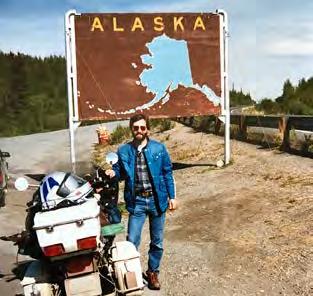
I wanted to say thanks for the great April issue of American Motorcyclist featuring Malcolm Smith. Curiously, it brought back some vivid memories of my motorcycle trip to Alaska in 1987, and the Malcolm Smith product that helped me get there. It was a bright blue two-piece riding suit that kept me warm and dry during the 18,000-mile, three-month adventure. With reflective striping and an embroidered yellow “MS” emblem on a chest pocket, it was beautifully crafted. Thirty four years and many tours later the suit continues to serve me well. Thank you, Malcolm! I’m still riding with you!
Rob Pflug | Cedar Mountain, NC Charter Life Member
American Motorcyclist slides outta my mailbox and there’s Malcolm. He’s 80, but that smile is eternal. I got a couple of pages into the magazine and there’s another big grin, as I knew who it was even without my glasses. Glad you found a home there, Mitch. As for magazines, something like twenty automotive titles disappeared from the racks in 2020, and that hit me harder than the virus. Circa 1980, I was reading seven monthly motorcycle magazines; today, there
aren’t that many total automotive mags anywhere outside of Barnes & Noble, and their selection continues to shrink. And of what there is, there’s nothing that motivates me like Cycle, CW, CG and Motorcyclist once did. The internet offers a lot, but there’s more eyestrain to go with it and, as Abe Lincoln said, you can’t believe everything you read there.
Mark Shifflett | Newton, KS
Well done on the April edition of American Motorcyclist. The new format/ focus is a welcome change and long overdue. Thanks!
Kevin Steely Life Member & certified GOM (Grumpy Old Man)
Thank you for creating the artistic centerfolds in American Motorcyclist. I would hang them in my garage if I had one. Byrd | Mt. Vernon, NY Life member
A great article by Joy Burgess in the April issue about the advantages and design of the Strider Bikes for children! I have watched neighborhood parents struggling as they try to teach their children to ride bicycles. Not all kids will continue trying to learn if they’re afraid of falling or failure. Strider gets the rider off on the right (and left) foot with less chance of falling and more immediate success, encouraging the child to continue. I’ve tried in vain to share the information about these bikes to parents, but for many it can’t be better because it’s different than what they know. I’ve also found that many adults never learned to ride, so their apprehension may be transferred to their kids.
I hope that sharing more stories like this will help younger people grow up and enjoy all the fun that motorsports have to offer by giving them a solid foundation learning balance and coordination. Keep up the great work on the magazine! Like Boehm said in his opening remarks, I still look forward to each motorcycle magazine that shows up in my mailbox!
Patti Blaskovic | Cleveland, OH AMA #2993166
Rob Pflug Alaska, 1987
RED LIGHT BLUES
The ongoing struggle with non-motorcycle-friendly traffic signals continues…
By Joy Burgess
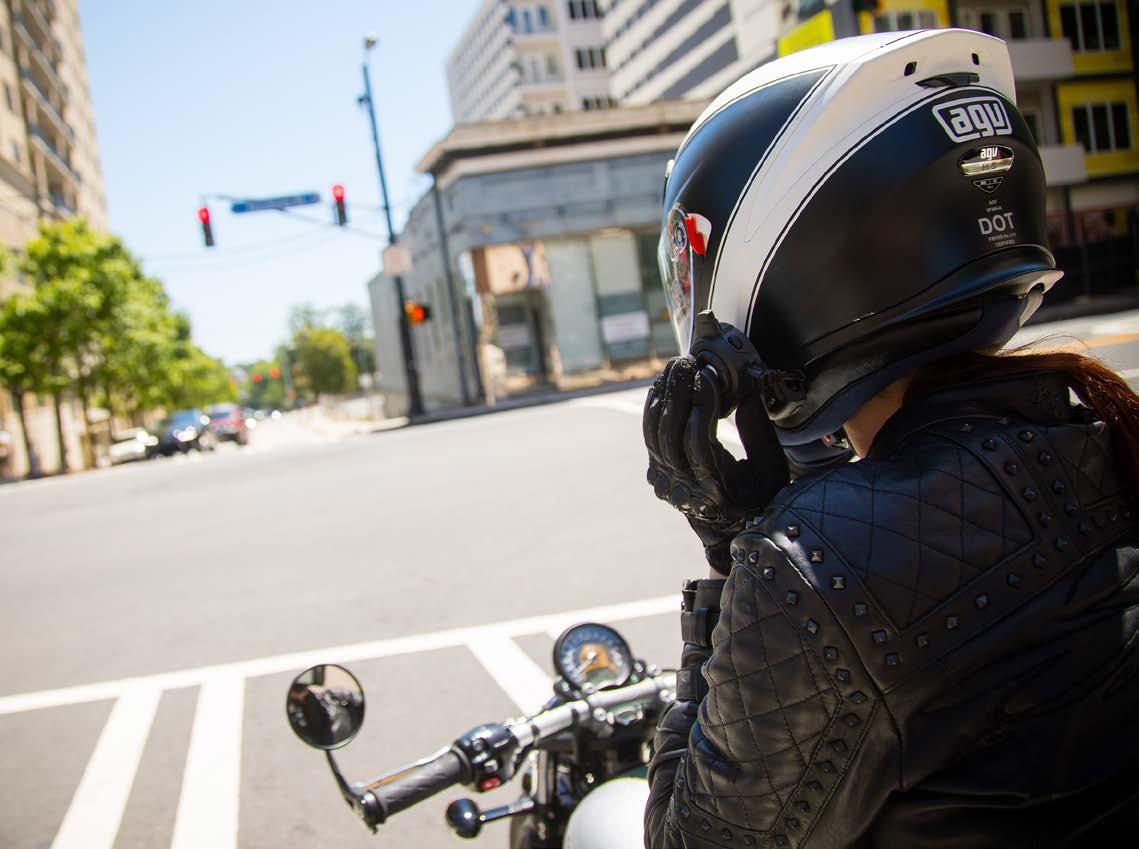
The red light blues. If you’re a street rider, you’ve probably had ’em. You ride up to a red light and you wait, expecting the light to turn green eventually. But when it doesn’t, or it cycles without giving you a left-turn arrow, you start to fidget. Maybe you jump up and down on your seat, hoping to trigger a sensor buried in the ground (which doesn’t work…read on!), or let a car behind you roll up and (hopefully) trigger things.
When that doesn’t work, maybe you take a few rights to get where you’re going. “I’ve even put my kickstand down
and run over to a crosswalk to hit the crossing arrow to trigger a traffic light,” said AMA On-Highway Government Relations Manager Tiffany Cipoletti. Or, some folks say “the heck with it,” wait for a safe and clear moment, and run the light, risking a ticket.
While you’re likely familiar with the struggle, you may not be aware that 15 states have already passed Traffic Actuated Signal laws — which Cipoletti notes are referred to as “Dead Red” proposals by state motorcycle rights organizations — addressing this issue, which basically allow you to treat
malfunctioning traffic signals as stop signs when it’s safe to proceed. Two additional states — Louisiana (H.B. 150) and Texas (S.B. 1737) — are actively pursuing such legislation.
Of course, this does not mean motorcyclists can treat any stoplight like a stop sign. Specifics vary among the 15 states with laws already in place, but one example is Virginia’s current code. It allows riders to proceed through the intersection on a steady red light when a sensor fails to detect the motorcycle only if they: come to a full and complete stop for two minutes or two complete cycles
Jeff Kardas
“While it may seem like a small thing, this slight nuisance is symptomatic of a bigger problem — infrastructure that fails to take motorcycles into account.”
of the traffic light (whichever is shorter); exercise care and treat the traffic signal as a stop sign; determine it’s safe to proceed; and yield the right of way to the drivers of any other vehicles approaching from either direction.
In contrast, Arkansas simply requires riders to come to a full and complete stop, exercise caution, and proceed when safe at a light that fails to actuate. In Illinois, riders must wait at least 120 seconds before safely proceeding due to a signal malfunction or failure to detect their arrival, but this may only be done in municipalities with less than 2 million people, which means it’s not legal in the city of Chicago. So it’s a mixed bag.
Although this traffic signal problem isn’t new, many riders don’t understand why it happens. It’s a common myth that traffic signals are triggered by vehicle weight (which leads to the ineffective and somewhat-humorous jumping around on the bike at red lights). Many traffic signals use inductive loop detectors (ILDs), a type of in-roadway sensor that causes a light change from red to green when metal interrupts an electrical field at an intersection. These sensors aren’t as sensitive to motorcycles because they contain far less metal than cars, although according to the Federal Highway Administration, if motorcycles don’t actuate the sensors it is possible to adjust their sensitivity settings. We say, “Get
those screwdrivers out, city engineers!”
Many areas continue to move towards using traffic signals featuring newer technologies like video and radar detection, and while they’re far better at detecting bikes than ILDs, they still may not always sense motorcycles.
While it may seem like a small thing, this slight nuisance is symptomatic of a bigger problem — infrastructure that fails to take motorcycles into account. And as national discussions surrounding transportation have shifted towards a fully autonomous future, motorcycles must be a part of this conversation in order to preserve the future of twowheeled travel.
The AMA works diligently to ensure that every conversation about infrastructure includes motorcycles. The AMA also continues to advocate for motorcycle safety to be a critical component of all autonomous vehicle technology programs, voicing concerns about how other vehicles detect and respond to motorcycles and the vehicleto-infrastructure component that comes with a fully autonomous future.
Along with engaging the DOT during public comment periods regarding autonomous vehicle policy, the AMA worked with Harley-Davidson and the Motorcycle Riders Foundation during the 116th Congress to share joint concerns on the priorities of motorcyclists, and will continue to utilize that framework of concerns of the motorcycle community in autonomous vehicle policy while engaging during the 117th Congress.
Traffic Actuated Signal laws offer a way out when you’re stuck at a red light, but it’s better to avoid getting stuck in the first place. If you have a faulty traffic signal in your area, contact your local road authority to alert them of a malfunctioning signal that’s not working for motorcycles. Signals can be recalibrated to better detect bikes to prevent the problem. If your state doesn’t have a Traffic Actuated Signal law for motorcycles, contact your state legislators.



COLORADO PULLS OHV FUNDING U-TURN
Robbed by the pandemic, Colorado returns $5 million to OHV fund
By Kali Kotoski
The governor of Colorado has signed a bill to return $5 million to the State Parks’ Off-Highway Vehicle Recreation Fund after fears that the state’s revenue would take a drastic hit by the COVID-19 pandemic were overblown.
The bill represents a significant win for the OHV programs in the state at a time when outdoor recreation activities in the backcountry have surged to unprecedented levels, highlighting the dire need to have adequate funds to manage the strain on natural resources, educate users, maintain trails and preserve riders’ rights.
The $5 million was originally swept into Colorado’s General Fund
during the final days of the 2020 legislative session, when the state was desperately trying to shore up its coffers ahead of the anticipated pandemic squeeze. The last-minute sweep blindsided stakeholders without time to mount objections.
While sweeping money from cash funds deemed not immediately essential is a common practice when states are faced with budget uncertainty, a repayment of funds is virtually unheard of, according to Jerry Abboud, AMA Board Member and President of the Colorado OffHighway Vehicle Coalition.
“In my 35 years of working on off-highway issues,” Abboud said, “a repayment of funds has only
happened a few times at most. It is a lesson for those working on issues out there, that once the money has been swept don’t just lay down and think it is over.”
Senate Bill 225 was championed by Senator Bob Rankin (R-Carbondale) who wrangled support within the Joint Budget Committee, eventually earning broad bipartisan support.
“I’m philosophically opposed to using cash funds to balance the state’s budget,” said Rankin. “However, responding to the COVID pandemic required budget cuts no one wanted to make. When the time came to look at undoing some of the cuts we had to make last year, repaying the OHV fund became a priority of mine. I felt it was one of the more egregious cash fund sweeps we had to make. And given the fact that we have a lot of backcountry to repair due to overuse and historic wildfires, I wanted to pay back this fund in particular.”
House Rep. Kim Ransom (R-Acres Green) also led the charge to repay the funds. The Colorado Off-Highway Vehicle Coalition (COHVCO) and the Powersports Dealers Association of Colorado led the lobbying push while
Jeff Kardas
the non-lobbying Trails Preservation Alliance continued to educate the public on how they can protect their rights.
“It’s not often that cash funds get repaid,” said Landon Gates, lobbyist for the Powersports Dealers Association of Colorado. “We were fortunate enough to have Senator Rankin do much of the heavy lifting behind the scenes, and working together we were able to use PDAC’s membership to help educate the other members of the Joint Budget Committee on the serious need for backcountry trail repair.”
COHVCO Chairman Matt Hiller said that the advocacy work by lobbyists representing off-highway issues cannot be understated, as it is crucial in accessing and safeguarding funds.
“Without a strong presence at the Capitol by COHVCO lobbyists saving our sport would be impossible,” Hiller said.
Rob Dingman, President and CEO
“It is often a hard-fought battle to get the funds allocated but when they are swept and not repaid, the fight to get more funding starts again from square one.”
of the AMA, explained that, in general, the sweeping of motorcycle and trailpreservation funds leads to a scenario where a user fee paid by riders through licensing, permits, registration and fuel fees, becomes a user tax when the funds are swept away to support unrelated programs.
“It is often a hard-fought battle to get the funds allocated,” Dingman said, “but when they are swept and not repaid, the fight to get more funding starts again from square one. The repayment of the Colorado OHV Fund shows these user fees will be spent for their intended purpose.”
Abboud said that with the repayment of the $5 million, stakeholders will now
start working with the Colorado Division of Parks and Wildlife on a strategic and impactful two- to three-year spend-down plan. Additionally, Abboud said capturing funds as soon as possible is a priority as federal government agencies and Congress are pushing for the private sector to take on more of the funding burden.
“As federal agencies are signaling that conservation efforts need to shift from the public sector to private stewardship,” Abboud added, “it is important that we have these public funds now to prepare for increased strain in the future, because private-sector stewardship will not be enough.”






MOTOCROSS SCHOLARSHIP RACES
The AMA and On Track School team up to support continuing education through scholarships for racers
By Joy Burgess
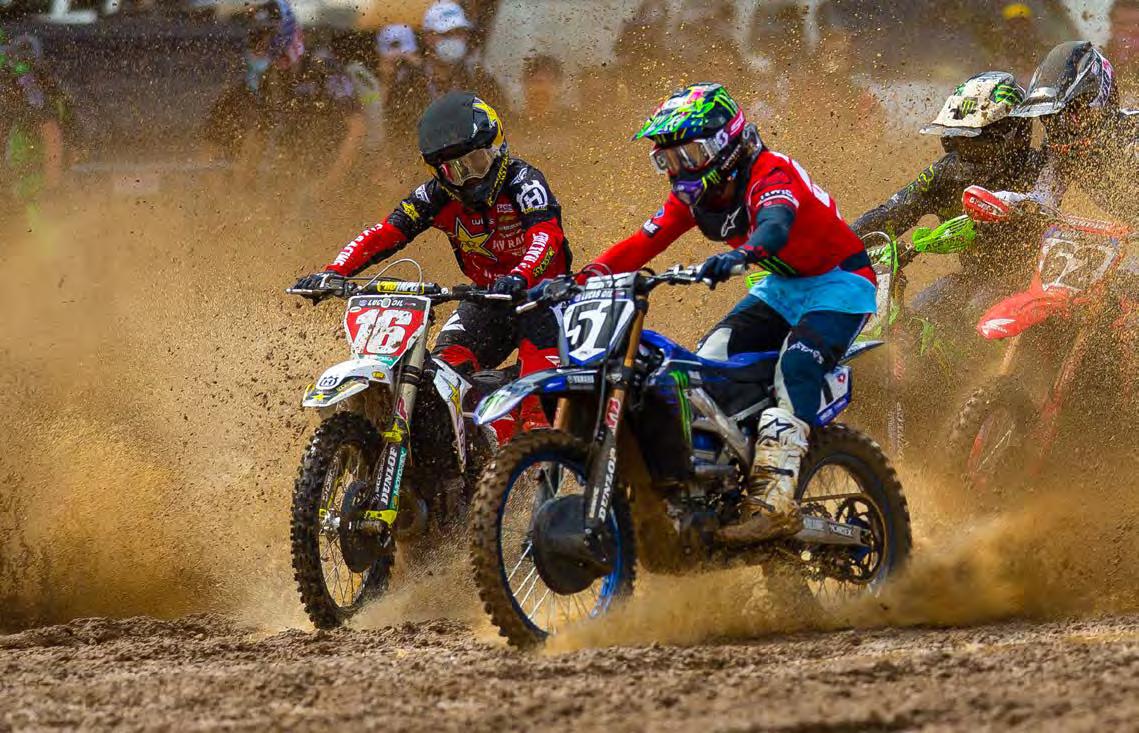
In 2018, the AMA and the On Track School discussed the need for continuing educational support for racers, and together came up with a program to award scholarship funds at approved sanctioned races. Over the following year, members of On Track School continued to meet with AMA representatives, conducted research, met with MX Sports to expand the reach of the program and presented
findings to the AMA, supporting a plan to implement based on a successful model shared by the USA BMX Foundation. The very first event, coined Cash for Class, took place in Nov. 2019 at the Georgia Practice Facility (GFP) in Cairo, Ga. Cash for Class brought in 190 individual race entrees and raised more than $12,500 in donations. Of that, $9,300 was paid in scholarship certificates to 529 education savings
plans, and in 2020, $15,140 was paid in scholarships from the second Cash for Class Scholarship Race at GPF. Additional funds donated from these events have been rolled over to be used in 2021. Donations are held in an endowment fund by On Track Learning Solutions, Inc.
An established advisory scholarship panel is in place, including On Track School, GPF, AMA Director of Racing Mike Pelletier, AMA Deputy Director of Racing/Motocross Manager Michael Burkeen, AMA Racing Program Manager Alexandria Kovacs, MX Sports, and former AMA Pro Motocross and AMA Supercross Champion Jeff Emig.
The next event will be held at GPF in Cairo, Ga. in Nov. 2021, an AMA Featured event. Stay tuned for more updates and coverage of November’s scholarship race.
Learn more at https://scholarshiprace.com/.
Jeff Kardas
Oceano Dunes Group Challenges Coastal Commission
Authority in Lawsuit

The Friends of the Oceano Dunes in a lawsuit has accused the California Coastal Commission of violating environmental laws and overstepping its authority to approve a plan to ban off-road vehicle riding at the Oceano Dunes State Vehicular Recreation Area over the next three years. The lawsuit, filed in April, is the latest salvo in a conflict that has yet to determine which agency, the Coastal Commission or the California State Parks, has jurisdiction over deciding the future of off-roading at the area. The conflict has been a flashpoint between agencies and advocacy groups for years, costing the state hundreds of thousands of dollars. In March, the Coastal Commission voted unanimously to expedite a recommendation to close access to the dunes in three years, instead of five, while closing access to the Pier Avenue entrance by July 1, 2022.
The lawsuit disputes the Coastal Commission’s finding that it has sovereignty over projects managed by California State Parks, which is tasked with protecting the state’s natural and cultural resources, as well as creating opportunities for high-quality outdoor recreation. Friends of the Oceano Dunes argues that the Coastal Commission misled the public into believing that access would remain and that parking and camping areas would stay open, only to reconstitute a plan that bans access without holding a formal hearing. The group also argues that under the California Environmental Quality Act, only the lead state agency has the principal responsibility to approve a project, which California State Parks asserts it is. In 1975, the dunes were set aside for off-road vehicle recreation as part of the California Coastal Plan.

Take Part in the 2021 AMA National Adventure Riding Series
The AMA National Adventure Riding Series for 2021 has more than a dozen events across the country for riders to test their skills, explore the pavement, and blast down remote dirt roads. The AMA National Adventure Riding Series, sponsored by ADVMoto and Helite, offers the best routes and trails to showcase the abilities of adventure bikes. The two-day events include plenty of challenging rides that are well marked and thoughtfully designed by local clubs. They are also built around a full weekend of activities that include bonfires, camping, food and prizes. AMA membership is required for these national-level events. For those who aren’t yet members, a one-event pass may be purchased for $20 at the event. Event dates are subject to change. For the most up-to-date schedule, visit https://americanmotorcyclist.com/nationaladventure-riding.
Wisconsin Rep Seeks Reauthorization of Motorcycle Advisory Council
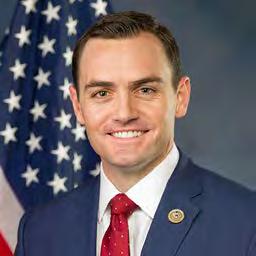
Representative Mike Gallagher (RWI) has introduced the Motorcyclist Advisory Council Reauthorization Act, a bill that would renew the Motorcyclist Advisory Council’s mandate at the U.S. Department of Transportation. If H.R. 2141 passes, it would set up the third iteration of the council that is made up of motorcycle manufacturers, rights and safety organizations — such as the AMA — and local and state transportation and infrastructure specialists. The Council serves as a liaison to the US DOT to voice critical firsthand knowledge on infrastructure and road safety measures impacting motorcyclists.
Specifically, the Council has advised the US DOT on barrier design, roadway design, maintenance, construction practices and the implementation of Intelligent Transportation Systems. The second iteration of the Council was chaired by Michael Sayre, the AMA’s Director of Government Relations. The bill would require the US DOT to respond to recommendations while allowing more of a back and forth between government agencies, including the Federal Highway Administration (FHWA) and National Highway Traffic Safety Administration (NHTSA), Sayre explained. The bill is also supported by Harley-Davidson, ABATE of Wisconsin and the Motorcycle Riders Foundation. The AMA calls on its members to contact representatives to ensure the Council remains an active and participatory member in infrastructure development.


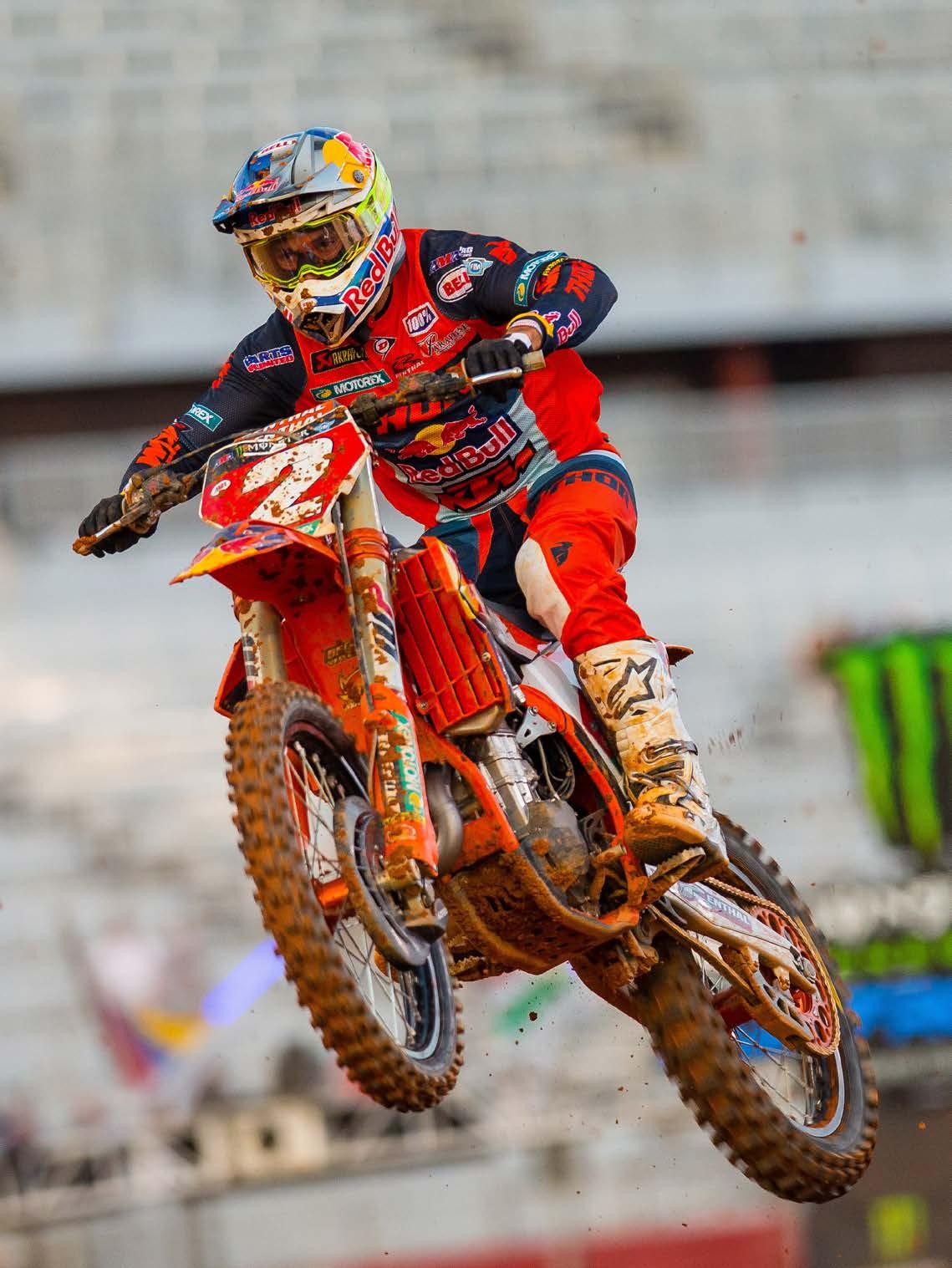
Cooper Webb, 2021 AMA Supercross
Coop Crushes It!
Needing only to finish the AMA Supercross finale in Salt Lake City to win his second championship, Red Bull KTM’s Cooper Webb routes an impressive field in dramatic fashion
By Mitch Boehm
The conventional wisdom said play it safe. Just finish 19th or better in the Salt Lake City AMA Supercross finale, it said, and the title — your second — is all yours. Do not get mixed up with the likes of Team Honda HRC’s Ken Roczen, Monster Energy Kawasaki’s Eli Tomac, Yamaha Factory Racing’s Aaron
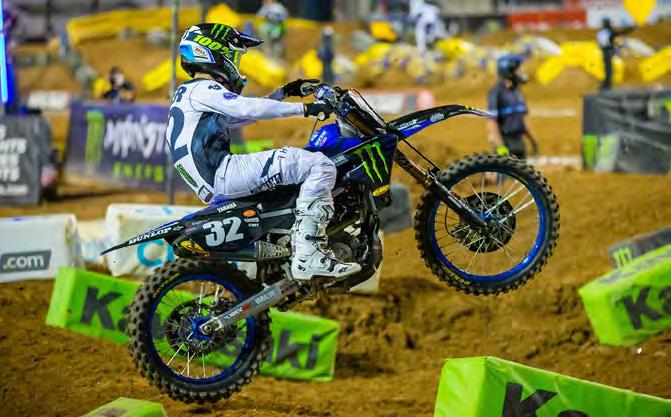
Justin
Cooper, 2021 AMA Supercross
West Champion
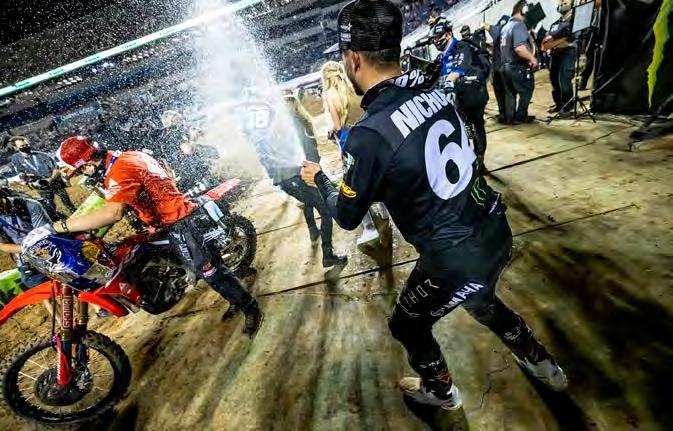

Colt Nichols, 2021 AMA Supercross
Plessinger, or any number of “something to prove and nuthin’ to lose” competitors.
Many figured savvy ol’ Roger DeCoster, KTM’s racing head honcho — and a five-time world champ himself — might have told Webb just that before the night’s action began.
But no. Coop was fast in qualifying (5th), fast in his heat race (2nd), and absolutely blazing in the 450SX Main. And while it took a while for the new champ’s dominance to fully assert itself in that final Main event of the season, Coop left no doubt by the end of the night that he and he alone deserved champion status.
Coop gated right up front in the Main and, for the first handful of laps, absolutely hounded Roczen, who needed to win and, basically, have Webb DNF for him to grab the title. The crowd — a Covid-limited sell out of approximately 25,000 — was on its feet, as were the contingent of KTM brass I was sitting with, and one had to wonder (as we all did) if Webb was playing things a bit risky.
When he backed off and let Roczen gain a little (and let an on-fire Chase Sexton go by) everyone breathed a little easier. But it wouldn’t last, as Coop began pushing in the race’s latter stage, passing Rozcen (who’d been passed by Sexton, and who was fading) and, finally, getting by Sexton with a handful of laps to go for the dramatic win.
“It’s been a heck of a year with everything in the world going on,” Webb said afterward. “We just dug deep and stayed the course. It’s been an incredible journey, a hard-fought season, lots of hard races and a lot of good and bad, but this is all worth it right here. Two-time champion is incredible, [and] to get the win tonight is just the cherry on top.”
Probably oughta call that a crushed cherry.
Jeff Kardy
Jeff Kardy
Jeff Kardy
World champion Joel Robert, leading the way on his factory CZ in the 250 International division.
Motocross in America — The Early Days
A vivid look at Edison Dye’s Westlake Village, California Inter-Am of 1968 — one of America’s earliest international motocross meets and a race that fertilized the young roots of an American MX dynasty — through the lens of photographer Ed Lawrence
By Mitch Boehm
For anyone in the dark back in the late 1960s as to the name of America’s biggest motocross series or the sport itself, the official Inter-AM racing program for 1968 laid things out pretty nicely:
“Welcome to the Inter-AM,” wrote industry pioneer Joe Parkhurst, “[which stands for] the International American Motocross series. The 8-race series comprises the first presentation of one of the most important events on the American motorcycle racing scene. Leading European riders (at this time the best in the world) are touring the country in a spectacular series that began in October at Pepperell, Mass., went to the Midwest for the Mid-Ohio event, then to Wichita, Kan., and to Dallas, Texas.
“This program,” Parkhurst continued, “covers the final four events, [the first of] which will be staged at Westlake Village, Southern California’s newest motocross venue, on November 16/17…” Parkhurst went on to list the final three West coast events in the series — Santa Cruz, Carlsbad and, finally, Saddleback Park.
But it’s the Westlake Village meet — the first international So Cal motocross of that crazy, Vietnam-addled year — that concerns us, mostly due to a cache of wonderful photos shot by a local photographer named Ed Lawrence. They were discovered and eventually acquired by So Cal motocross enthusiast and racer Tom Barnett, who grew up in Westlake and lives there today.
“That ’68 race was a big deal to us kids,” remembers Barnett, who grew up riding dirt bikes in the area, “especially with all the pros from Europe coming over.”
A promotional poster, which touts the sport as “the roughest, wildest and most difficult sport on earth,” lists those riders: Sweden’s Torsten Hallman, Bengt Aberg, Torlief Hansen and Christer
“That ’68 race was a big deal to us kids,” remembers Barnett, who grew up riding dirt bikes in the area, “especially with all the pros from Europe coming over.”
Hammargren. Belgium’s Joel Robert and Roger DeCoster. Holland’s Pierre Karsmakers. Germany’s Adolf Weil. England’s Dave Bickers. And others. Radio and print ads for the race appeared all over Southern Cal and excitement ran high, as fans were about to get a glimpse of the European-style motocross they’d heard and read about.
Barnett, whose family moved to Westlake in 1967, remembers those early years well. “I’d just finished 5th grade,” he told me, “and over that summer the neighborhood kids would ride out our driveways and straight into the hills. Westlake was considered ‘the country’ in those years and a lot of Hollywood films and TV shows were filmed there. We’d leave in the morning and be gone all day, returning home (hopefully) in time for
dinner. Those were great years, and that first race was a really big deal.”
Today, Westlake Village — which lies 10 miles west of Los Angeles’ San Fernando Valley — is a beautiful but typically congested LA suburb, with homes nudging right up against the picturesque mountains that surround it. Expensive homes now dot the area where the track was located, and you’d likely attract the police just by firing up your motocross bike in your driveway. But 50-plus years ago it was a sleepy, out-of-the-way bedroom community with plenty of rolling, open land on either side of the Ventura Freeway, which made it ideal for Hollywood filmmakers and entrepreneurial promoters like Edison Dye, known by many as the “father of American motocross.”
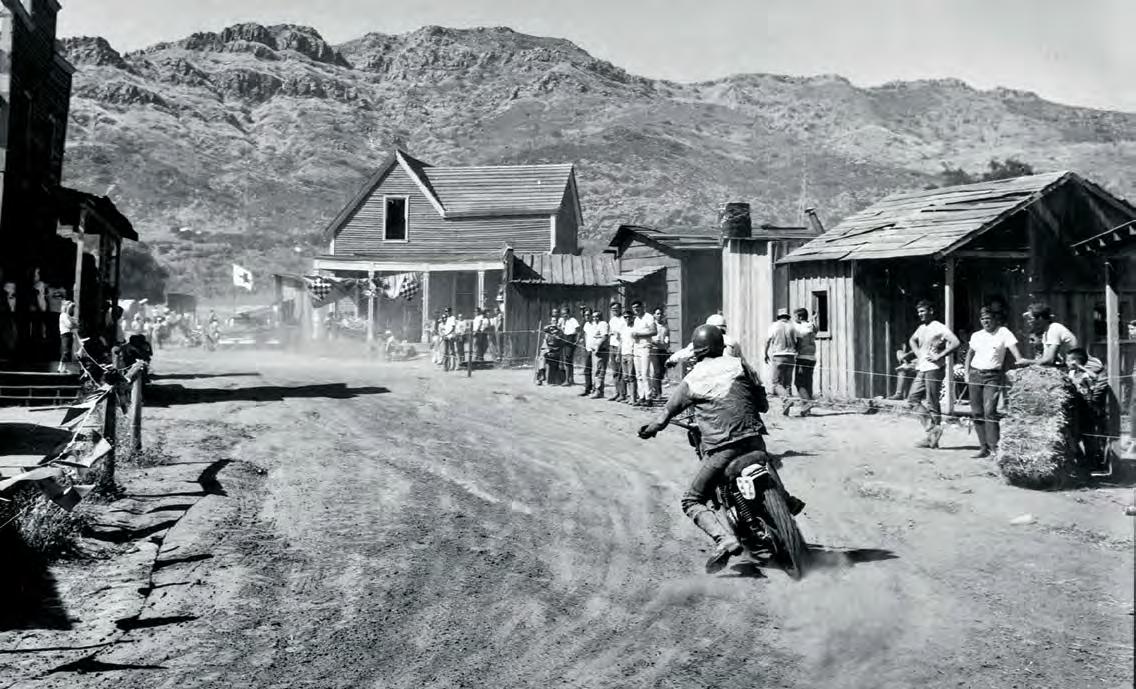
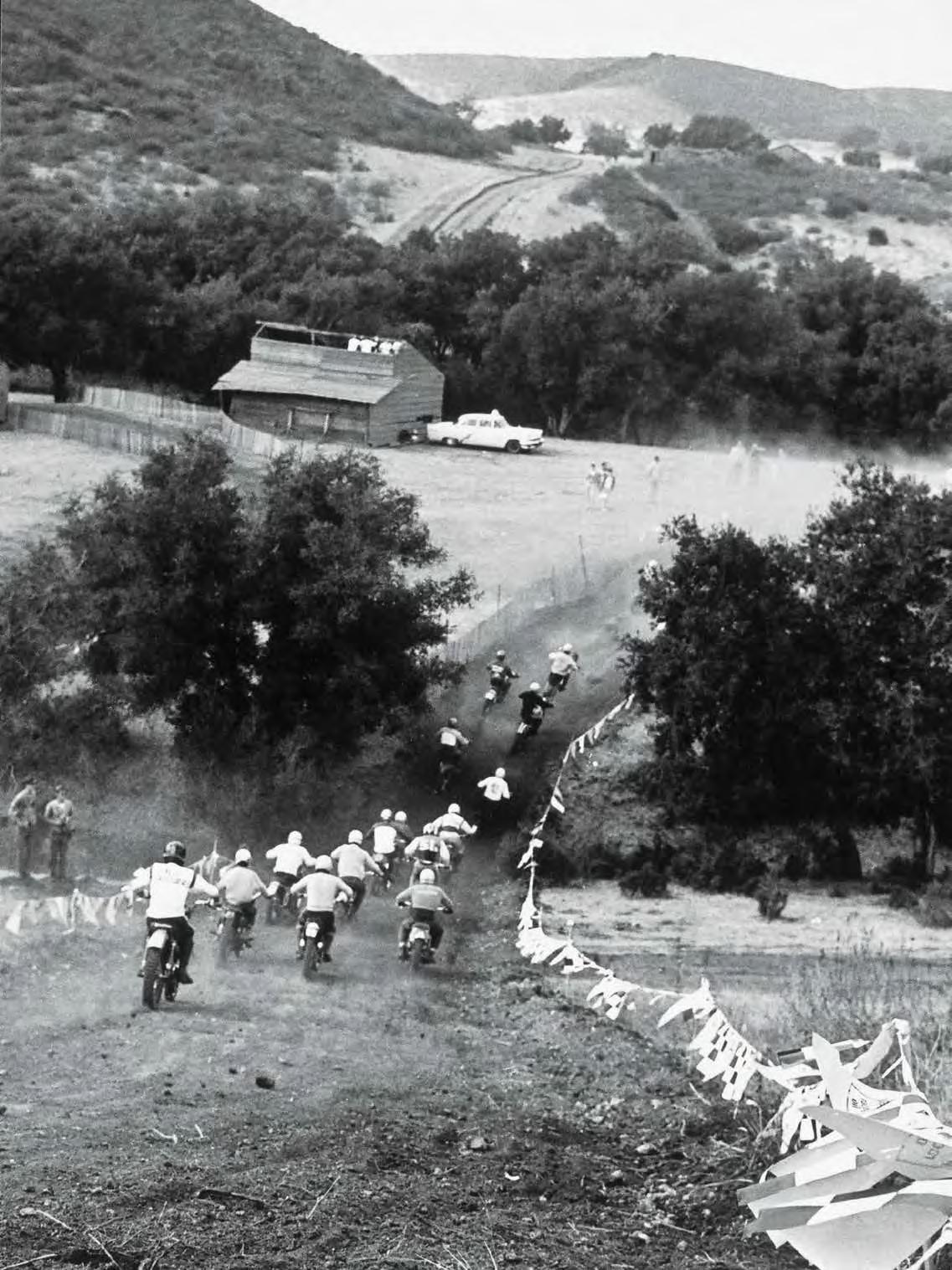
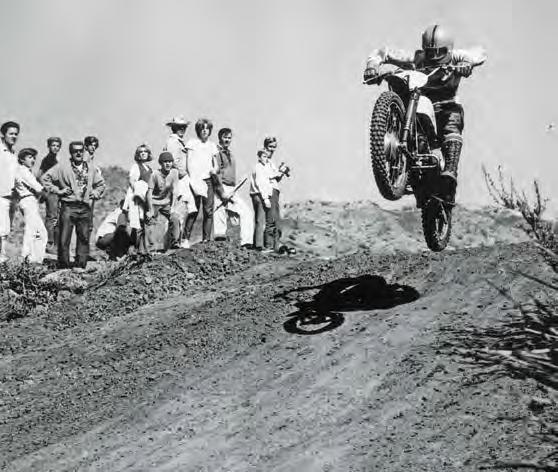
The Westlake circuit was hilly and plenty challenging. Check out the track marshals watching from the roof of the barn, and the lead rider wheelying out of the gully. Left: A rider negotiates the old movie-set section of the track, which came just after riders rode through an old barn (next page).
“These four exciting weekends,” wrote Parkhurst in the program’s introduction, “constitute the climax of an intense effort by Mr. Edison Dye, [who has] traveled the world, spoken to hundreds of people, and spent enormous sums of money to organize the series. Inter-AM marks the first occasion that so many international stars, factory teams and past and present world champions have journeyed to the U.S. in a serious effort to bring this country into the world motorcycle-racing fold. America is indebted to Mr. Dye and his International Motocross company, which made Inter-AM possible.”
Dye didn’t introduce motocross to America. That honor probably goes to the folks at the New England Sports Committee in the late 1950s, according to various moto historians, who were promoting races at Grafton, Vt.’s Bell Cycle
Ranch, owned by Maico dealer Perley Bell. Still, Dye introduced a more serious and demanding form of motocross, one practiced by European riders, that was a level or two higher than what American riders were used to with scrambles racing. Barnett’s early connection with the Westlake track and movie sets imprinted him powerfully with that race and those early riding experiences. “One day while on eBay I typed in ‘Westlake motocross’ and up popped an entry form from the Westlake Inter-AM,” he says. “I bought it and contacted the seller, who said he had a load of Edison Dye memorabilia he’d be happy to show me. A week later I drove to his home and bought everything he had from the Westlake races [there were two, in ’68 and ’69. —Ed]. Dye apparently never threw anything away.”
“Several years later, in 2005,” Barnett
remembers, “I was at a nearby historical landmark called the Stagecoach Inn. In the gift shop I spied a calendar that featured a photo of a rider from the Westlake Inter-AM racing down Main Street of that movie set! I’d only seen a few pictures of the race, but I knew if there was one photo there had to be more. So I contacted the photographer, Ed Lawrence, and over the next several years tried to convince him to sell me the photos. He resisted for a long time, but I finally got him to send me the negatives so I could take a look. When they arrived I had them printed, and they were amazing, more so than I ever could have imagined, so I ended up buying everything, negs and all. The motocross community is lucky Mr. Lawrence was there that day, photographing history and doing it so well.”
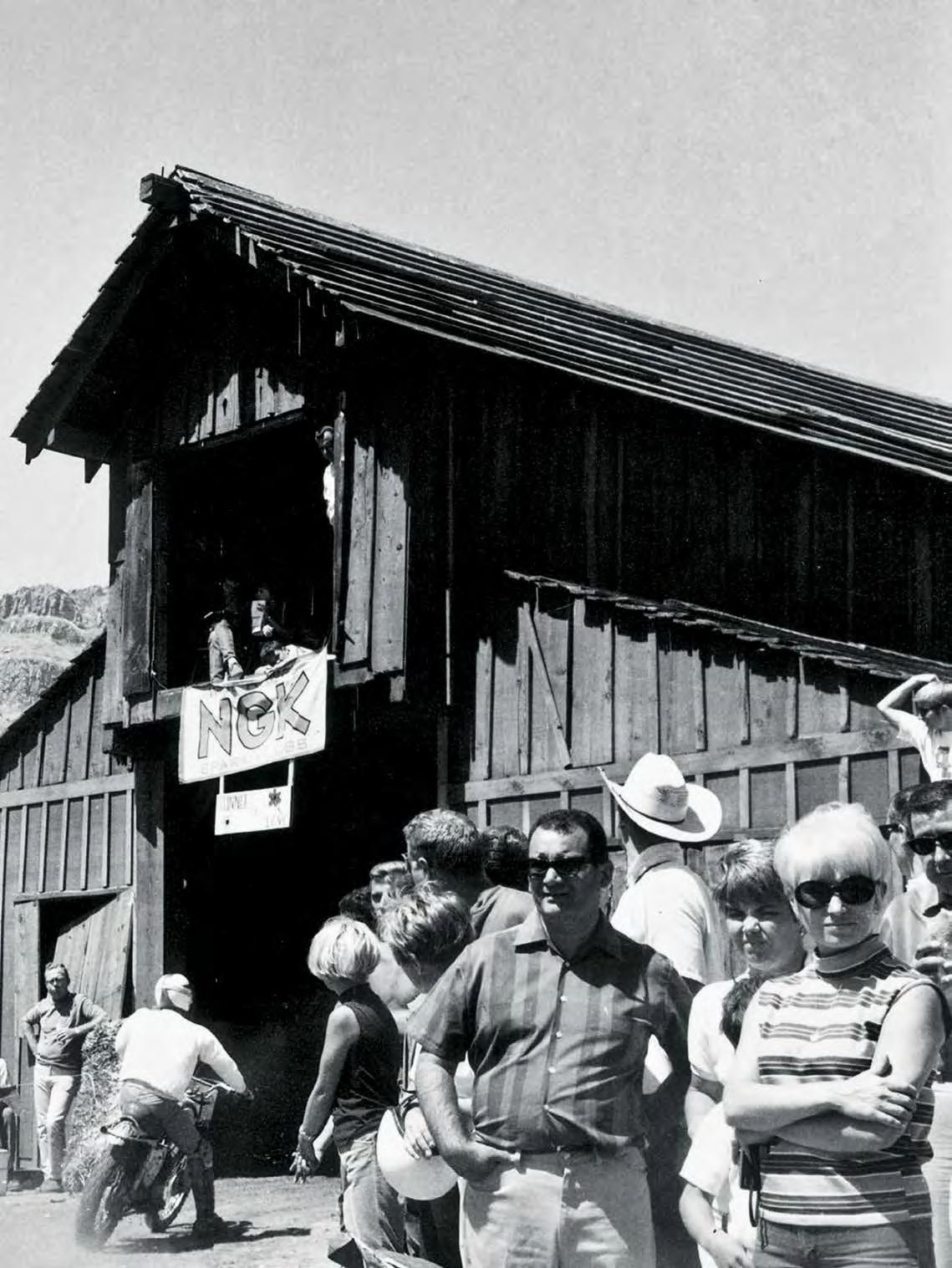
Old barns and spectators basically standing on the track… Oh, the wonderful, freewheeling 1960s!
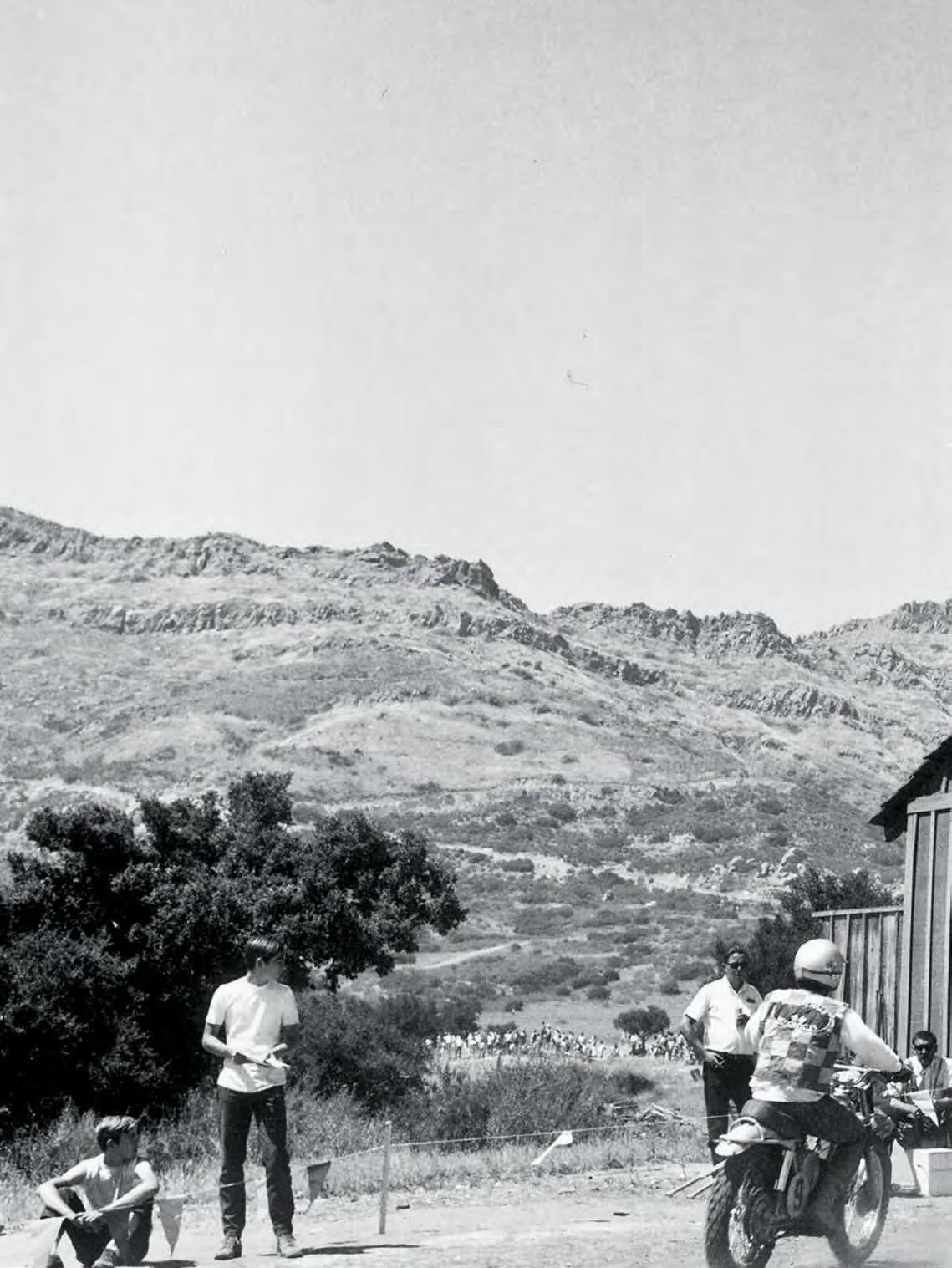
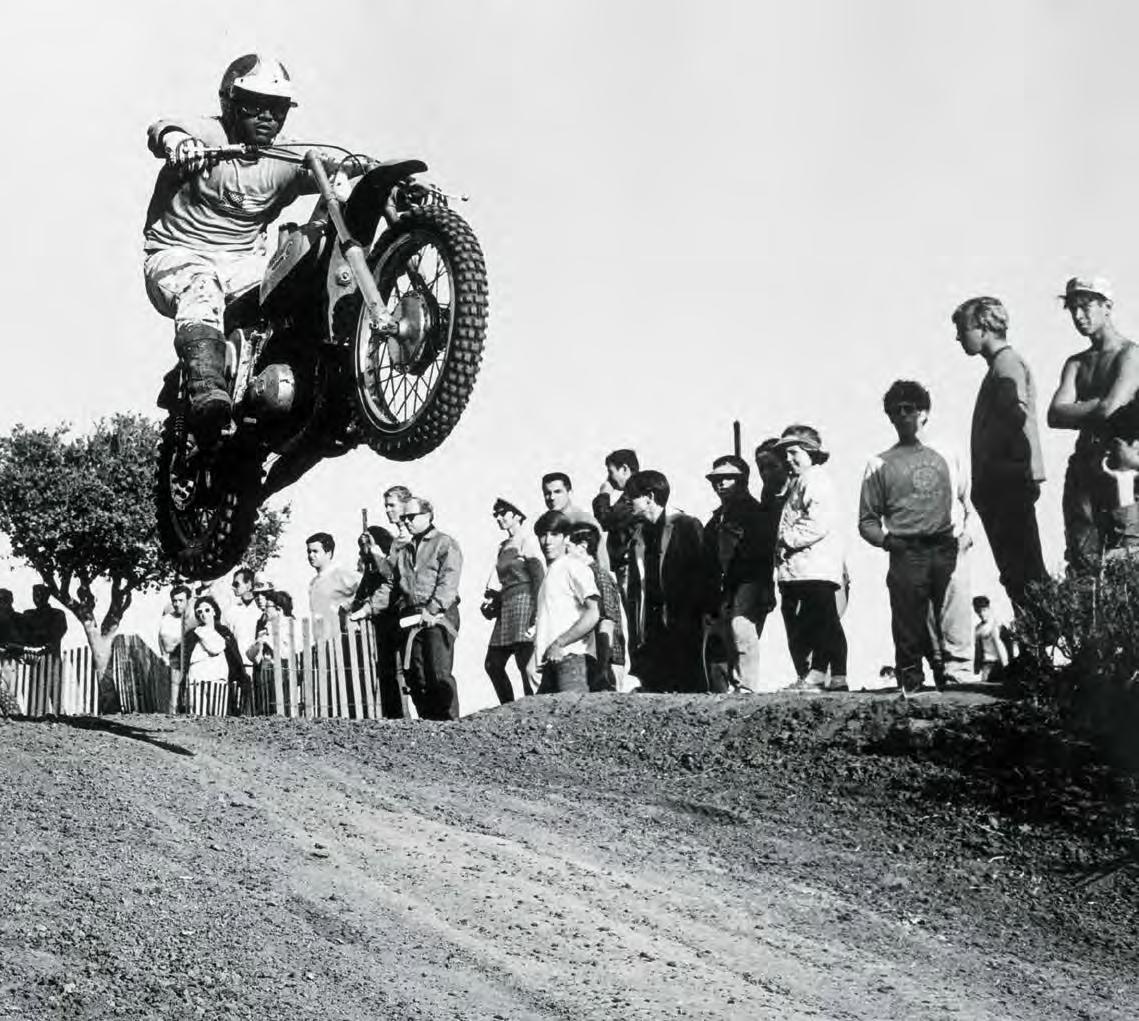
The black-and-white photos in Barnett’s collection — more than 100 in all — are superb, many benefitting from Lawrence’s non-motorsports background by incorporating plenty of event atmosphere—mountains, spectators, structures and the track geography itself. Lawrence’s excellent composition and the absolute sharpness of the photos put the viewer at the event, a great feeling for fans of motocross and its roots in America.
Barnett and I spent a lot of time discussing and digesting the images. But to get a more personal feel for what the event was like, I invited five of the
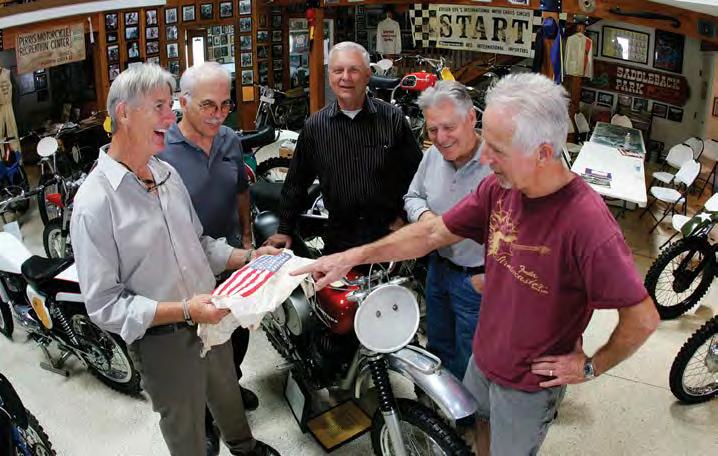
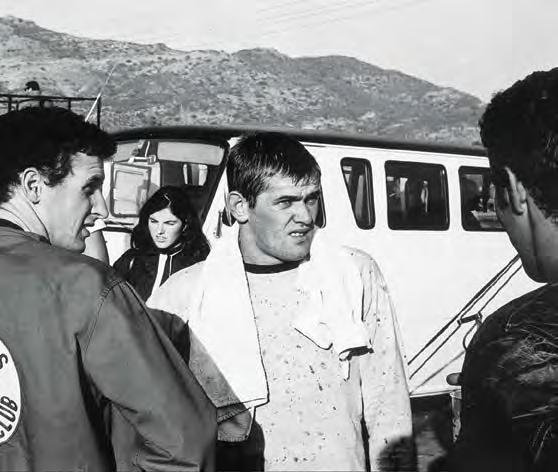
sport’s legends who actually competed at Westlake in ’68 — Roger DeCoster, Lars Larsson, Gunnar Lindstrom, Barry Higgins and Mike Runyard — to join myself and Barnett for a lunch at Tom White’s Early Years of Motocross museum back in 2010. Runyard, who rode that first Westlake event on a Moto Beta and who went on to ride for the Suzuki factory in later years, was clearly moved by the images.
“Wow,” Runyard said when he spied the photos laid out on tables, “I feel like I’m there! Unbelievable. I can hear the bikes now. The biggest thing,” he said, “was this: We’d seen the Europeans
race, and we knew they really were good. We’d watch them and say, ‘Look, he’s standing up all the time.’ Or, ‘Hey, he’s wheelying through that bumpy section…’ But we’d never seen them ride 125s. [ Many of the Europeans rode 250s and open-class bikes that day, but many — including world champion Joel Robert — also rode the 125cc Senior division — Ed.] They were pinned everywhere, and never let off. Like wild bumblebees! Everyone was freaked, even the spectators, who’d clearly never seen such a thing. The U.S. riders did not ride like that. And we did not ride 125s, either; it was mostly just 90s and 100s.”
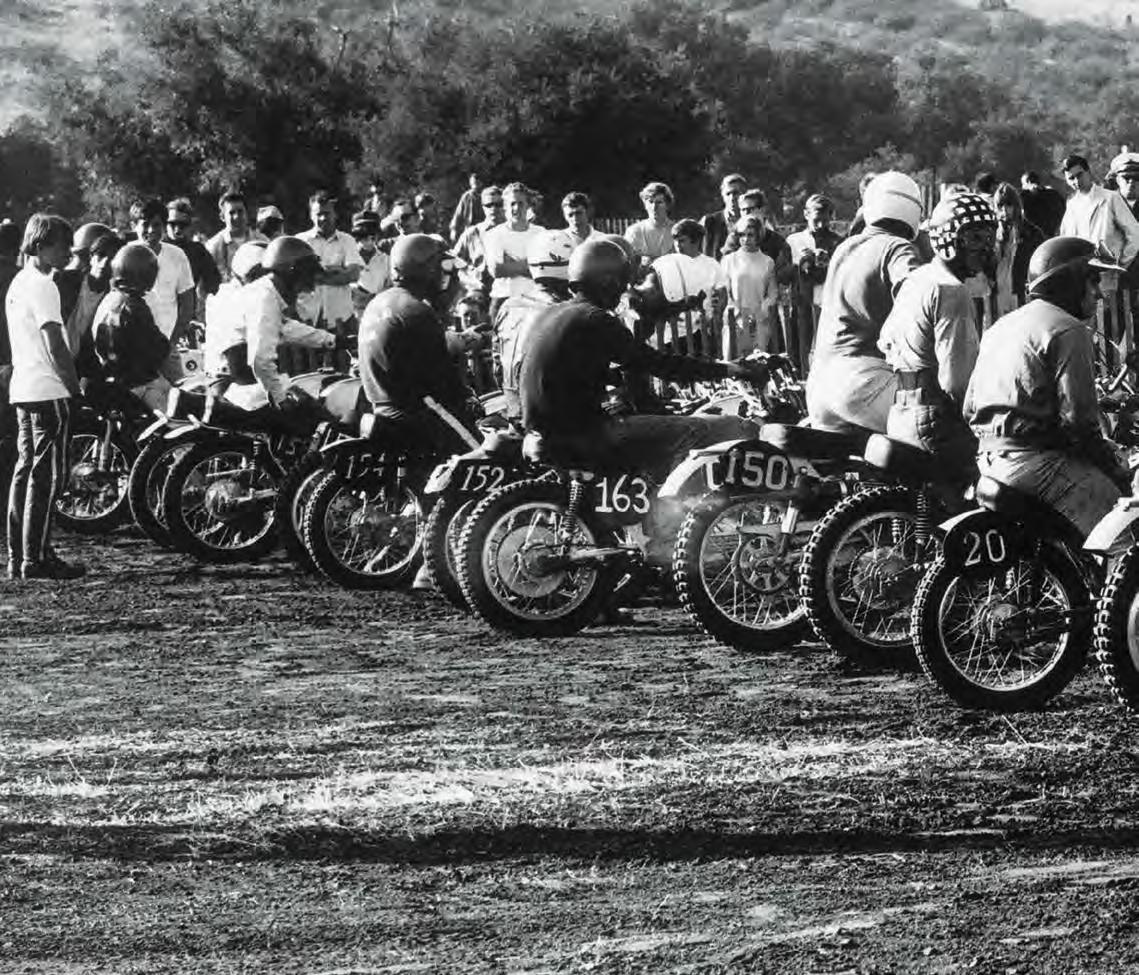
Right: The late Tom White pointing at the bib Mike Runyard (holding bib) wore at the Westlake Village Inter-AM. In the main image, Runyard is No. 155. Back in 2010, White hosted a reunion with some of the legends from the Westlake event. To Runyard’s left are Barry Higgins and Gunnar Lindstrom, while longtime industry insider Bryon Farnsworth is to White’s immediate right.
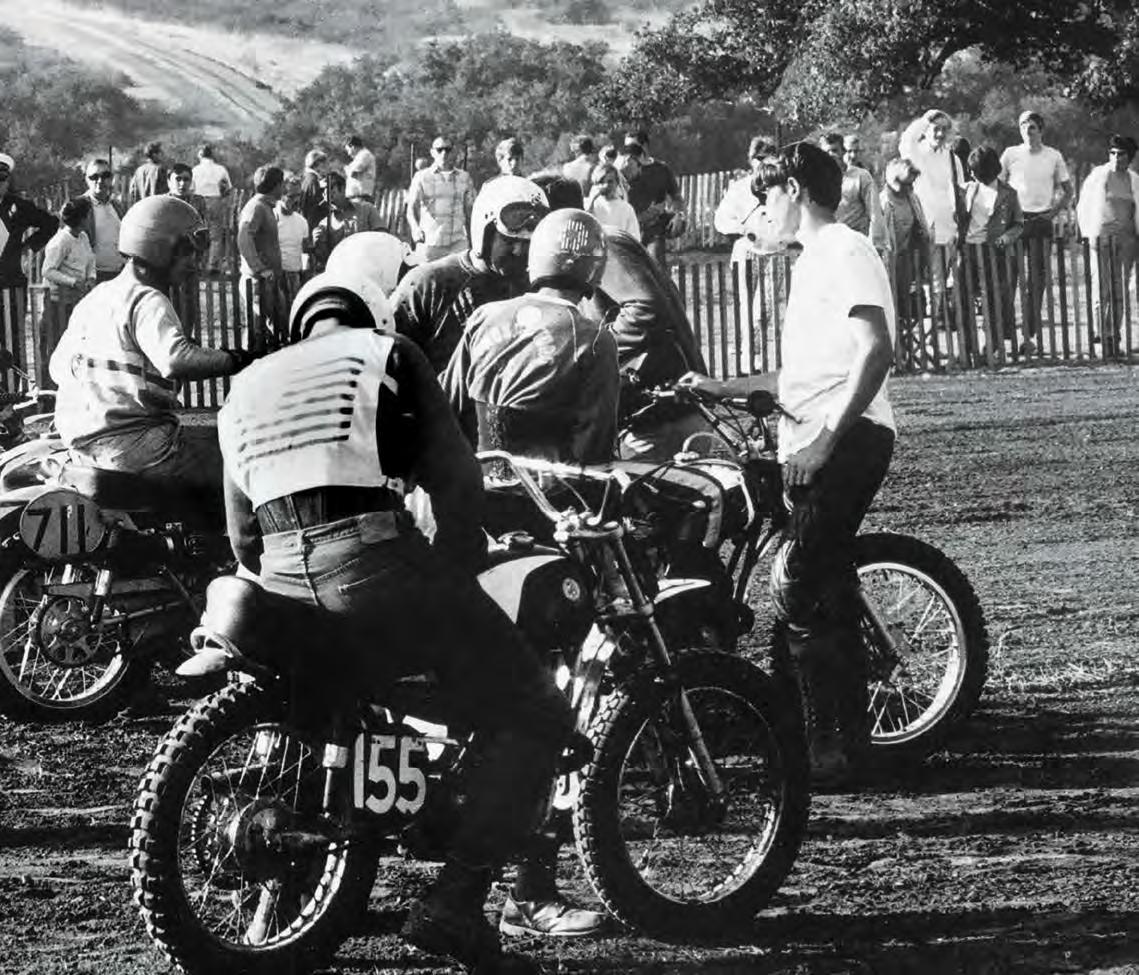
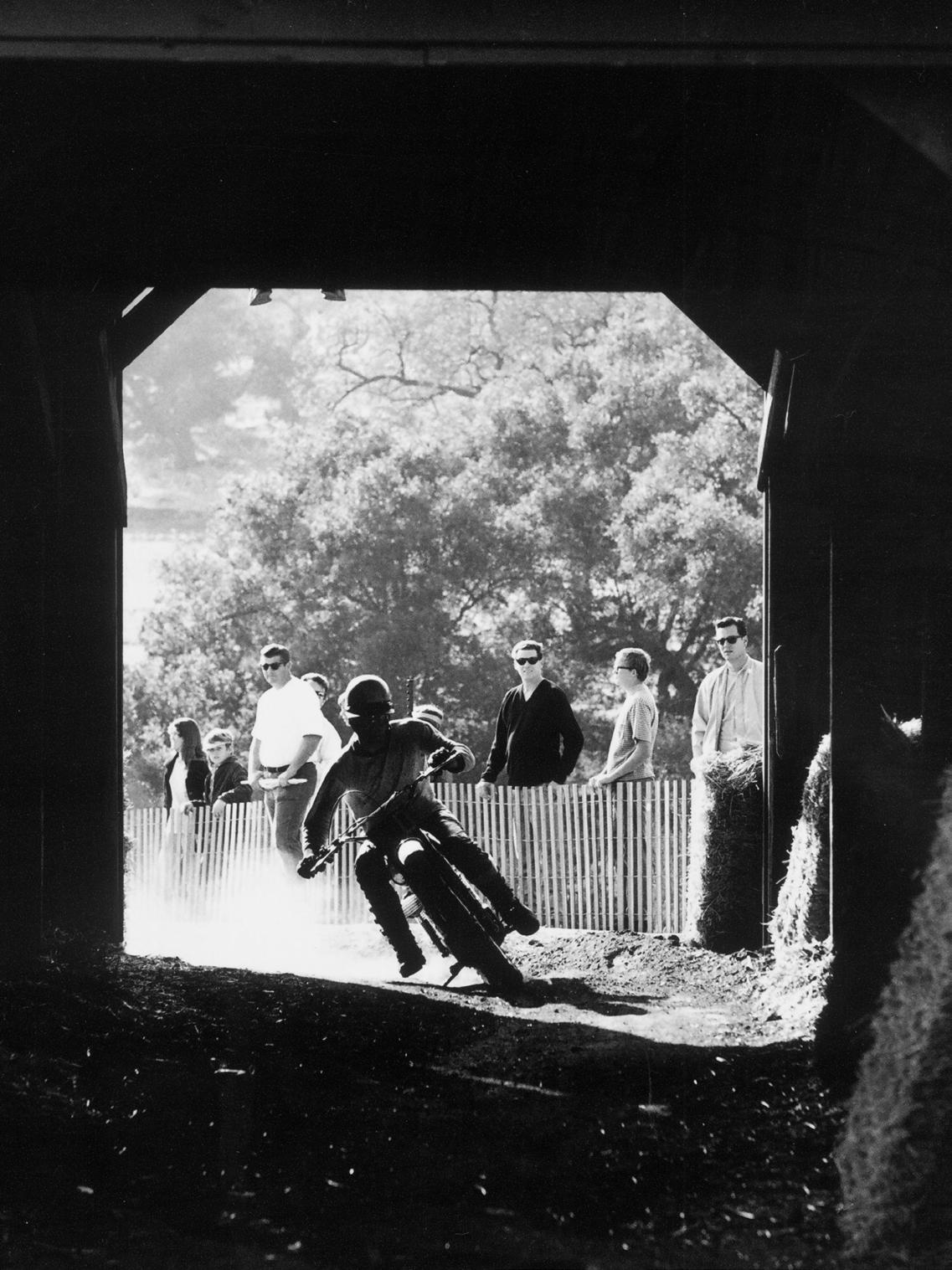
The track ran right through one of the movie-set barns, which caused Gunnar Lindstrom to comment, “we’d never seen anything like that in Europe!”
Higgins, possibly America’s first factory rider (he got a ride with the Ossa factory in 1970) and the 10th-place overall finisher that day in the 250cc International division, also remembered being shocked by the Europeans’ riding style. “We watched them,” he said during lunch, “but we really didn’t know what we were looking at. We were dumb kids! When [Torsten] Hallman showed up a couple years earlier (during the U.S. motocross exhibition Dye had set up for him across the country in ’66), we heard of him riding three 15- or 20-minute motos. To us, that was a shock. We’d never ridden that much in one day; short sprint races were our thing. Three in a day? Unheard of. Nobody could keep up. Heck, Hallman rode six motos at Westlake! It was a rude awakening for us Americans.”
Lars Larsson, who lived in the U.S. part time and who’d become such a part of the American scene by ’68 he was actually considered part of the American contingent, remembers things this way: “Only Torsten [Hallman] came in ’66,” he said, “for that tour with Edison. It was really the first time most Americans had seen European motocross. In ’67, a handful of us came over: myself, Torsten, Ake Jonsson, Joel, Roger, Dave Bickers and a couple others…We did a few races. I had a contract with Husky in ’67, so I was in the U.S. for months before the series started.”
“The U.S. riders were motocross rookies,” Larsson added, “just amateurs. It was like cat and mouse on the track; we’d play with them. But it was a great time. I ran motocross schools here and spent a lot of time teaching the U.S. riders, and they caught on quickly. To be involved with the birth of real motocross here, and to see what it would eventually become, was just fantastic.” Larsson recorded a 7th overall in the 250cc International race that day.
“America was fertile ground for
motocross to explode,” says legend racer Gunnar Lindstrom. “Bikes were cheap, land to ride on was plentiful… the whole situation was so favorable. I think we European riders realized it was only a matter of time before the Americans got real fast and began to win championships…”
“Today you will see the world’s best motocross riders competing in the toughest form of motorcycle racing known,” added Parkhurst in the Westlake program. “For many years we in the U.S. raced at motocross, but called the events scrambles, or rough scrambles. They still are scrambles, but different methods of scoring and organization bring in the term ‘motocross’ — ‘moto’ from motorcycle, ‘cross’ from cross-country. Most of the American riders you will see today possess only a minimum of experience, [but they] are getting better every day.”
The Westlake circuit was laid out over hilly, dry terrain, with a steep downhill/ uphill creek crossing, a couple jumps
and a wide starting area. It also ran right through one of the movie-set barns just before the Main Street finish straight, which caused Lindstrom to comment, “we’d never seen anything like that in Europe!”
When laying out the circuit, Dye wanted a very long track, one in the European tradition. But Lindstrom says Hallman talked him out of it. “Torsten felt a longer track wouldn’t allow spectators to see all or most of the action, and also that the PA announcer would lose track of the leaders.” They went back and forth, and Edison finally relented, shortening the course in the back section.
“The track was pretty good,” remembers DeCoster, who himself had quite a bit of track layout experience, having helped design Saddleback Park, Carlsbad and, in later years, the MidOhio Moto Park circuit in Lexington. “It had some up and down sections, which reminded me a little of European tracks. There wasn’t much watering back then, so things got pretty dusty. I was pretty vocal about dust in the GPs, eventually organizing a boycott of a race that was too dangerous due to dust. The FIM was not happy with me!”
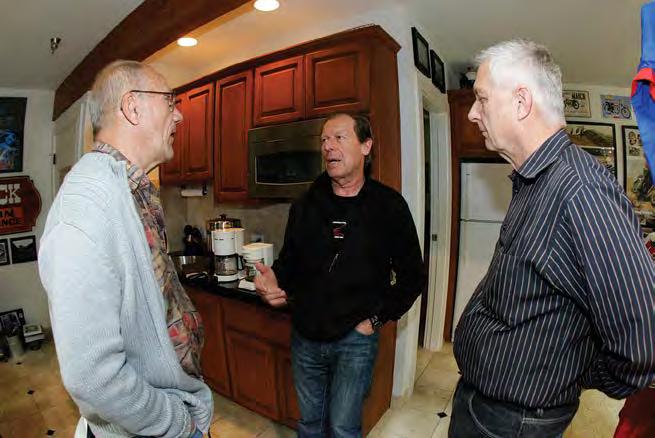
Lars Larsson (left) and Roger DeCoster (middle) also attended White’s gettogether, and provided additional insight. That’s Gunnar Lindstrom at right.
DeCoster then alluded to the importance of these first international events, at least in the eyes of the Europeans. “By 1970,” he said, “most of the better European riders were coming here. The U.S. market was booming, and the factories wanted all of us to come and race. There was money to be won, and we won a lot of it!” DeCoster recorded a 3rd overall in the 250cc class and a 10th overall in the 500cc division at Westlake.
Tim Hart, who grabbed a 13th overall in the prestigious 500cc class, related a humorous story about an incident involving world champion Joel Robert. “In practice,” he says, “I found myself out in front of world champ Joel Robert, who I guess had just come out onto the track. Being young, fast and foolish, I started riding really fast — faster than I was able to handle. And of course I crashed, hard, right in front of Robert, literally knocking myself out. Joel came
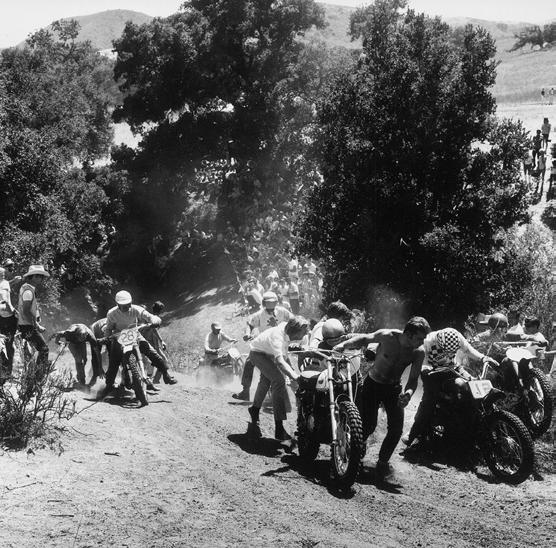
Clockwise from above: The track included a tricky stream crossing at the bottom of a steep gully, which caused a bit of havoc. Joel Robert in the pits with a Dirt Diggers member. Tim Hart launching his linkedfork Guazzoni 125. John “the Flyin’ Hawaiian” Desoto leading David Aldana (11) and Dave Bickers (5). You’ve just gotta love the spectators’ late-’60s attire!
up to me later in the pits and said, ‘Do not try to beat me…you will not!’ He was right. I’ll always remember that…” You will not. Those words rang plenty true in 1968. But change was coming; the Americans would get fast, and quickly, and the Euros knew it. Soon there would epic and memorable battles, especially at the Inter-AM, Trans-AMA and early Supercross events during the 1970s… And what a glorious decade that was.
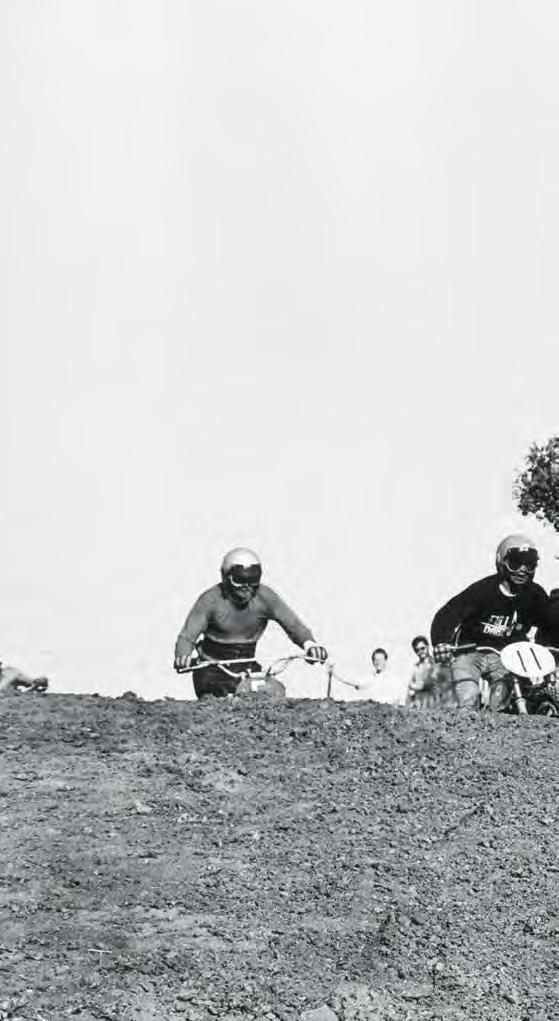
“By 1970,” said DeCoster, “most of the better European riders were coming here. The U.S. market was booming, and the factories wanted us to come and race. There was money to be won, and we won a lot of it!”
The First Supercross
A wild look back at the 1972 Superbowl of Motocross — conceived by promoter Mike Goodwin, held in the legendary LA Coliseum and won by 16-year-old Marty Tripes — through the lens of 17-year-old high-school student, photographer and racer Greg Owen
By Mitch Boehm
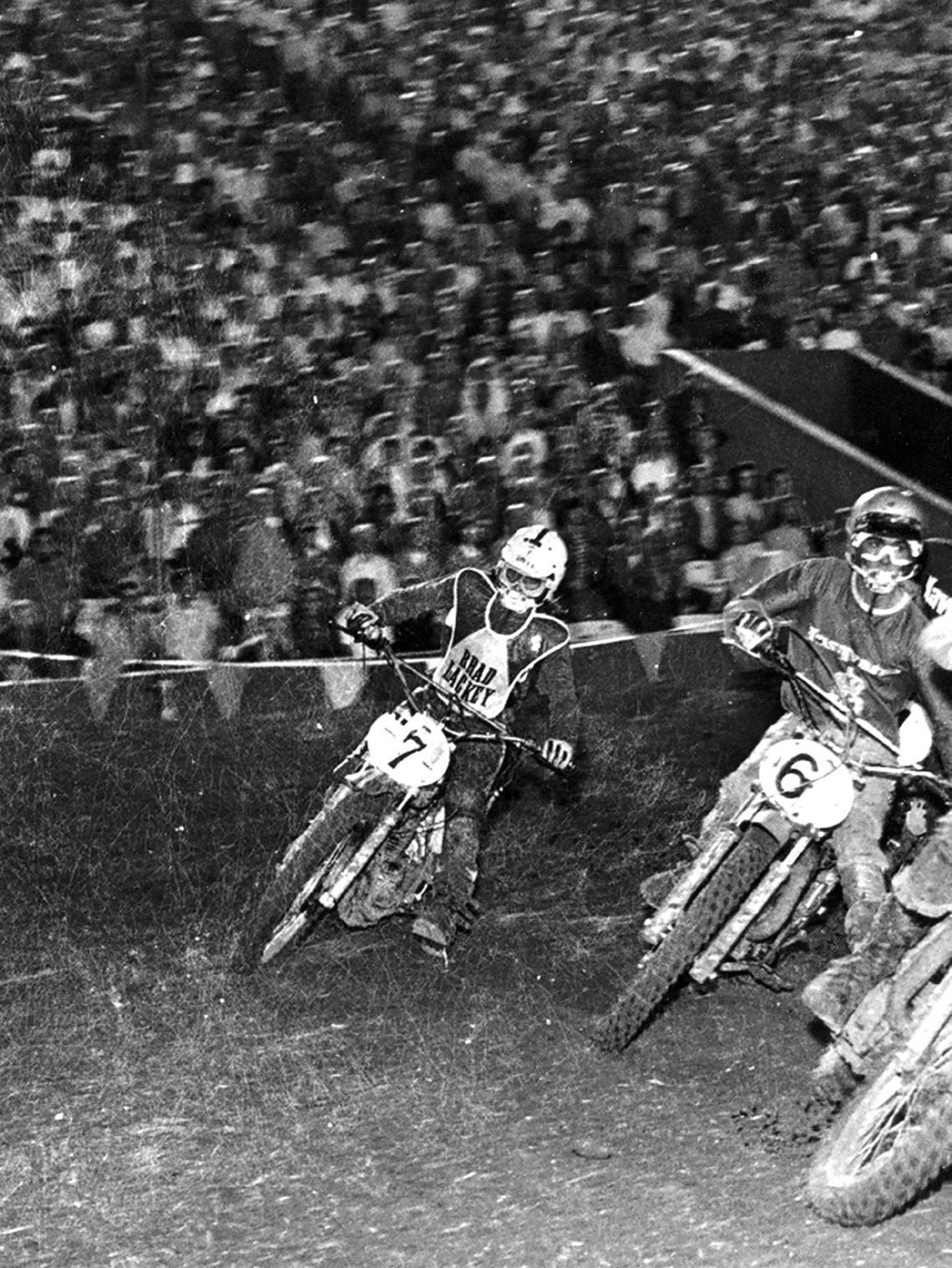
They’re off! Torsten Hallman grabs the holeshot, with Brad Lackey (7), Bob Grossi (6), John Desoto (hidden) and moto winner Arne Kring (21) close behind.
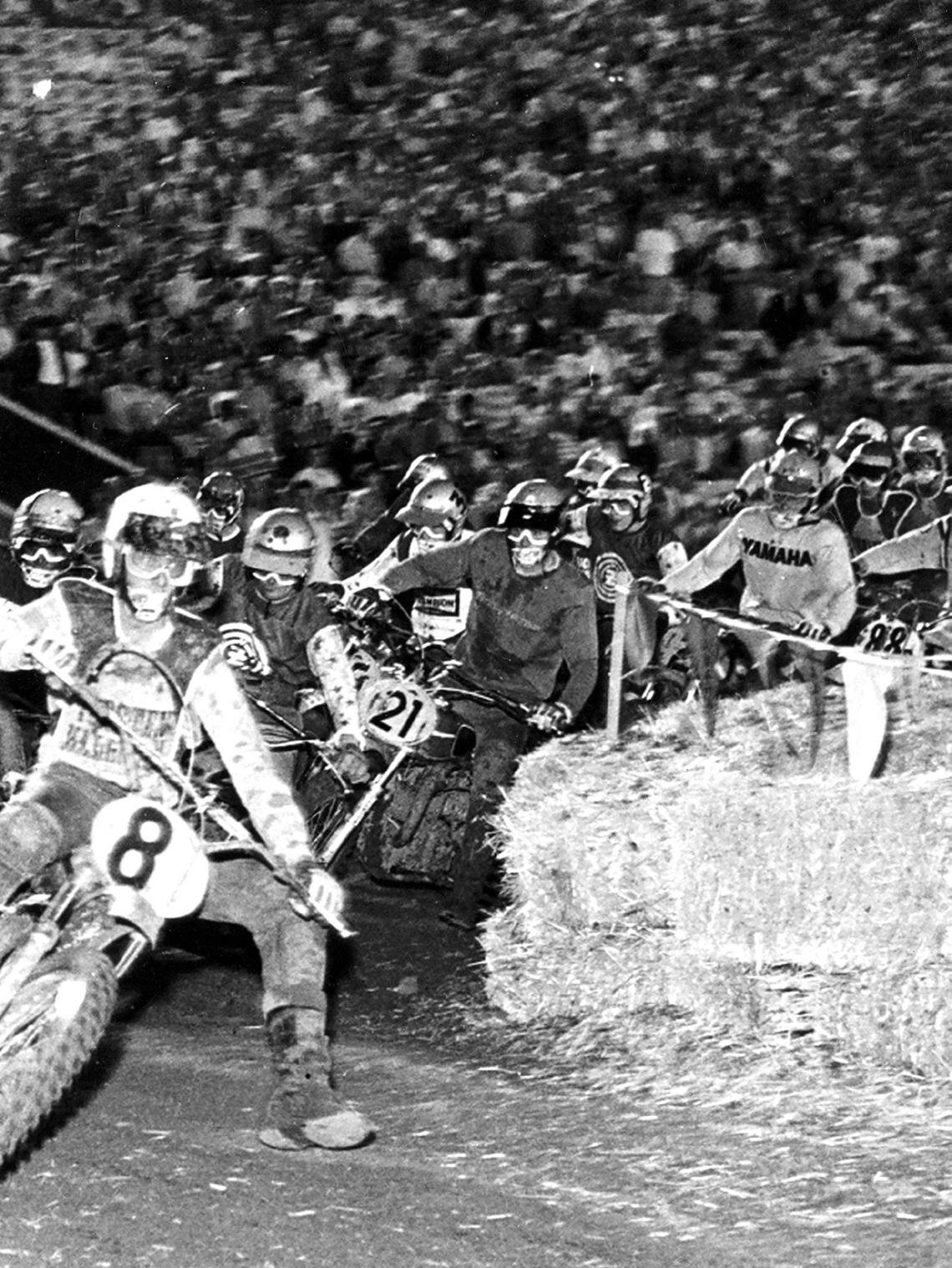
The first Super Bowl — held at the Los Angeles Memorial Coliseum on Jan. 15, 1967 — was a lopsided affair, the Green Bay Packers dousing the Kansas City Chiefs 35-10 on the brilliant passing of Bart Starr, who racked up 250 yards through the air and tossed two touchdowns on his way to earning MVP honors.
The first Superbowl of Motocross, held at that same Coliseum five-anda-half years later, was significantly more hard-fought — and possibly every bit as significant, given what Supercross is today. Sixteen-year-old Marty Tripes, a local boy from San Diego, went 2-2-2 in the three-moto format that evening, snatching the overall win from a trio of very fast
European moto-winners — Swedes Torleif Hansen, Arne Kring and Hakan Andersson. But consistency counted in Tripes’ dramatic win, which set the stage for a superb career and, maybe more importantly, helping set the motocross — and, eventually, Supercross — hook firmly in the cheeks of American motorcycle fans.
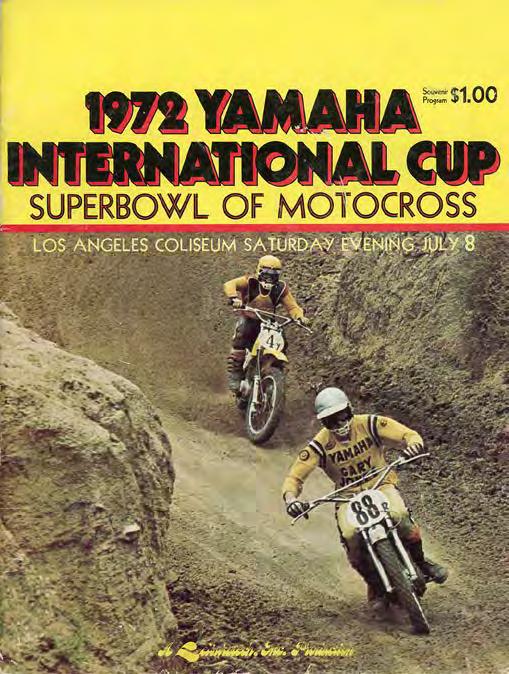
But even the most prescient observers of motorcycle sport couldn’t see the dramatic scope of what lay just around the corner, in motocross or motorcycling in general. Folks were simply having a great time on motorcycles and enjoying the two-wheeled explosion then taking place in America, the bikes, the racing and the fun — all of it captured so wonderfully in Bruce Brown’s On Any Sunday, which debuted less than a year before Tripes’ dramatic Coliseum victory.
One of those thoroughly enjoying the scene was Greg Owen, a So Cal teenager who’d been introduced to motorcycling at a young age, had been hooked badly like so many of us, and who’d integrated motorcycles firmly into his life.
“We were on a Boy Scout outing in the mid 1960s,” Owen told me a decade ago. “I was 10 or 11. One of
the dads had brought a Honda Cub, another a Bearcat scrambler. I got to ride a little, and was instantly in love with bikes. I eventually convinced my dad to get me a bike, a Honda 50, and I must have ridden it up and down our street a hundred times a day for months on end. I was happy to just shift gears and ride!”
Owen, along with his family and brother Kelly, began spending time in the desert, camping, riding and basically livin’ large. “Those were the greatest times of my life,” Owen said. “We’d ride all day, build beer can pyramids from Dad’s empties, hang around the fire at night. From there it escalated. I had a paper route and had saved $100, and my dad helped me buy a Hodaka. I brought it to shop class and hopped it up with a homemade expansion chamber, number plates, bars, a fork brace, etc.”
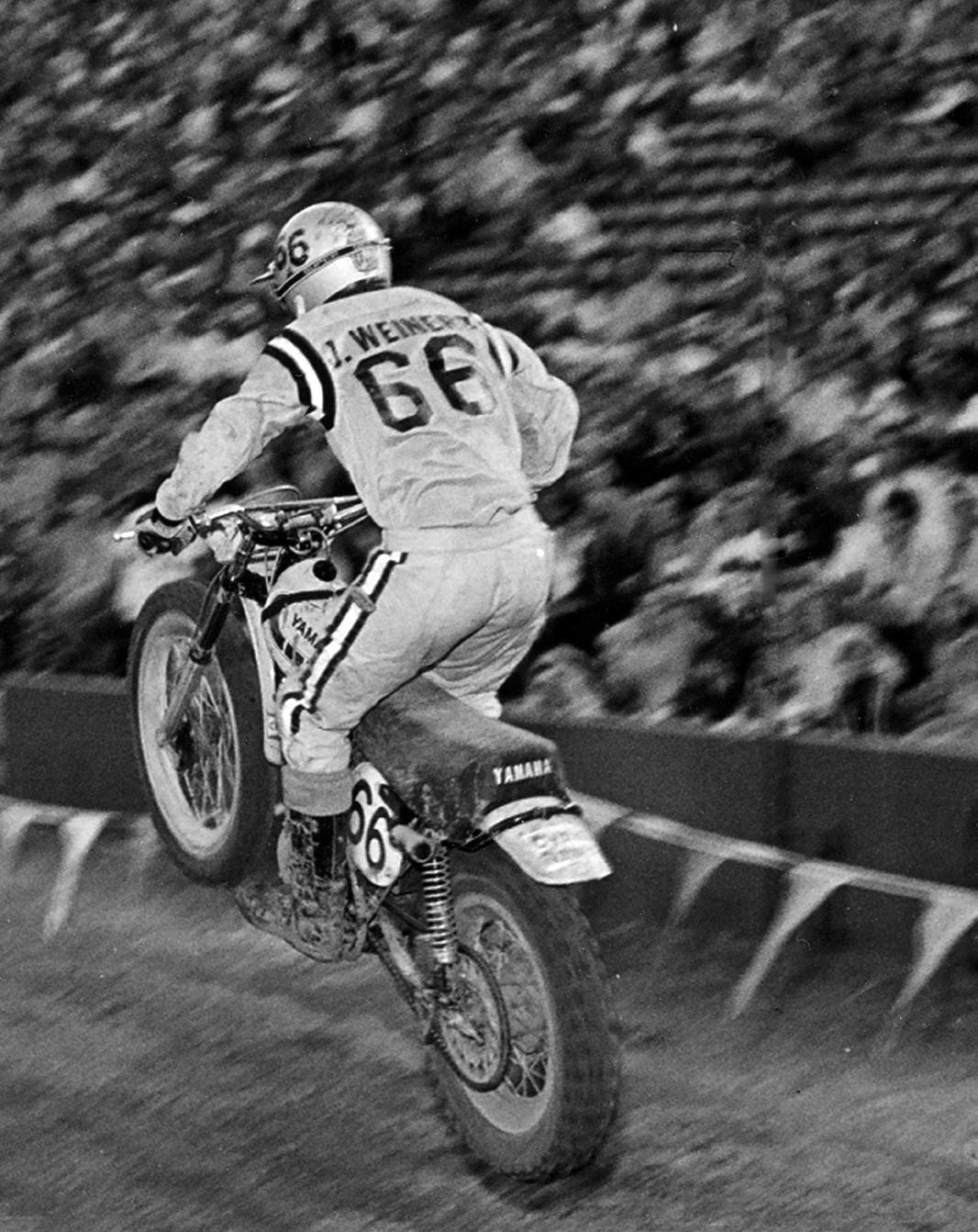
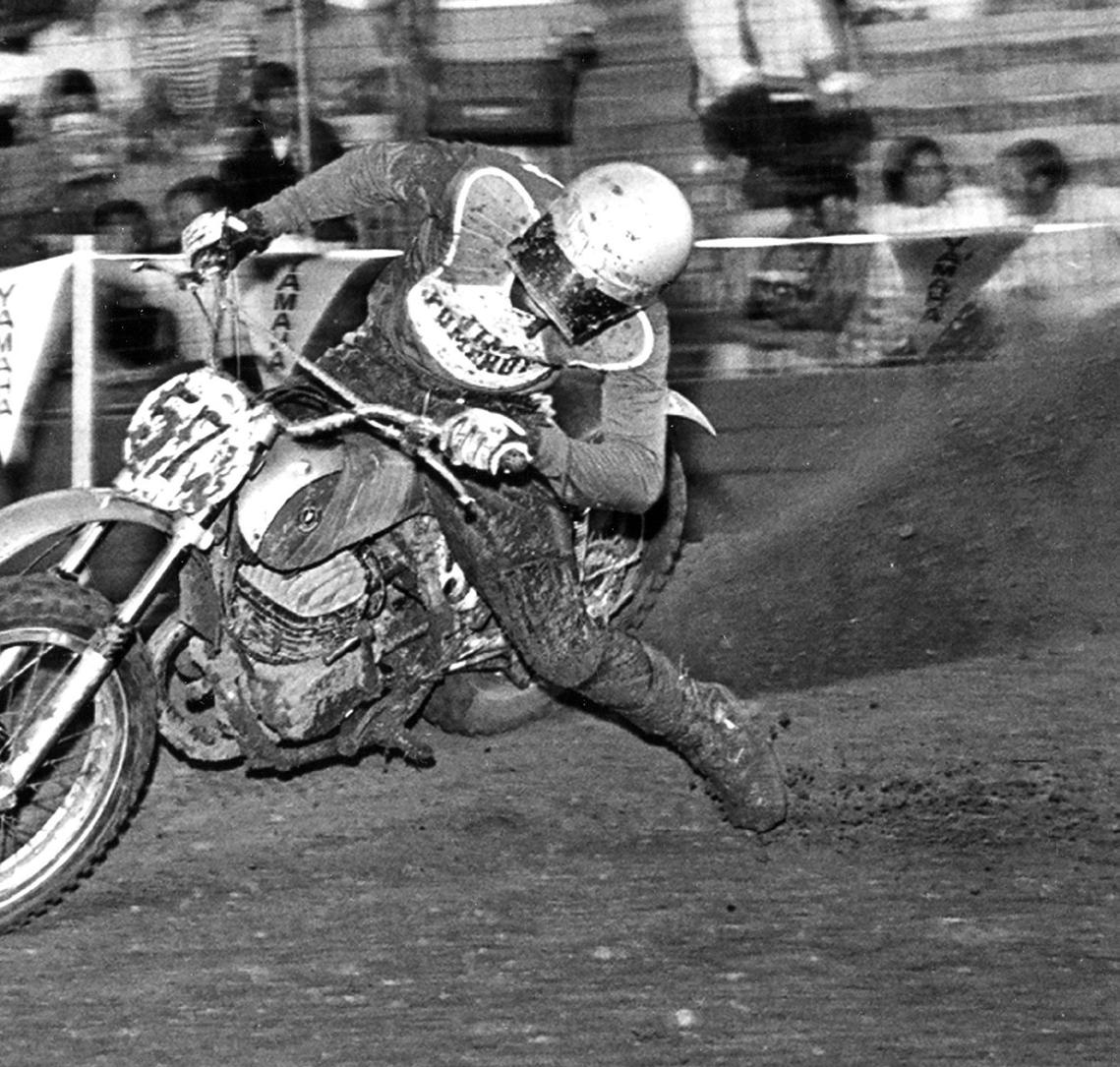
Jimmy Weinert (66) flies past Owen’s camera, his pre-monoshock Yamaha about to thump the dirtcovered plywood and plastic put down to protect the L.A. Rams’ football turf. It didn’t work.
Marty Tripes, a local boy from San Diego, went 2-2-2 in the three-moto format, snatching the overall win from a trio of very fast European moto-winners.
“One day in the desert,” Owen continued, “I saw a race team called the El Banditos with their cool helmets and shirts — and knew I had to race. So I bought an Ossa Stiletto, ran a few desert events, then started motocrossing with my brother Kelly. We had a small budget, but competed as much as we could at Carlsbad and Saddleback, and then at night at
tracks like Ascot and Orange County Raceway. Heck, you could race four or five times a week back then, which some guys like [Brad] Lackey, [John] Desoto and [Tim] Hart did to make money for the nationals.”
Money for racing was in short supply, but that would begin to change when Owen’s father came back from Germany with
a Rangefinder camera. “I started shooting with it,” said Owen, “and it piqued my interest. I eventually bought a cheap 35mm SLR and learned to develop my own shots. I got to know [godfather of So Cal motocross] Stu Peters, who let me shoot photos and sell them at the races. I’d shoot an event, develop film and make prints all week, then sell
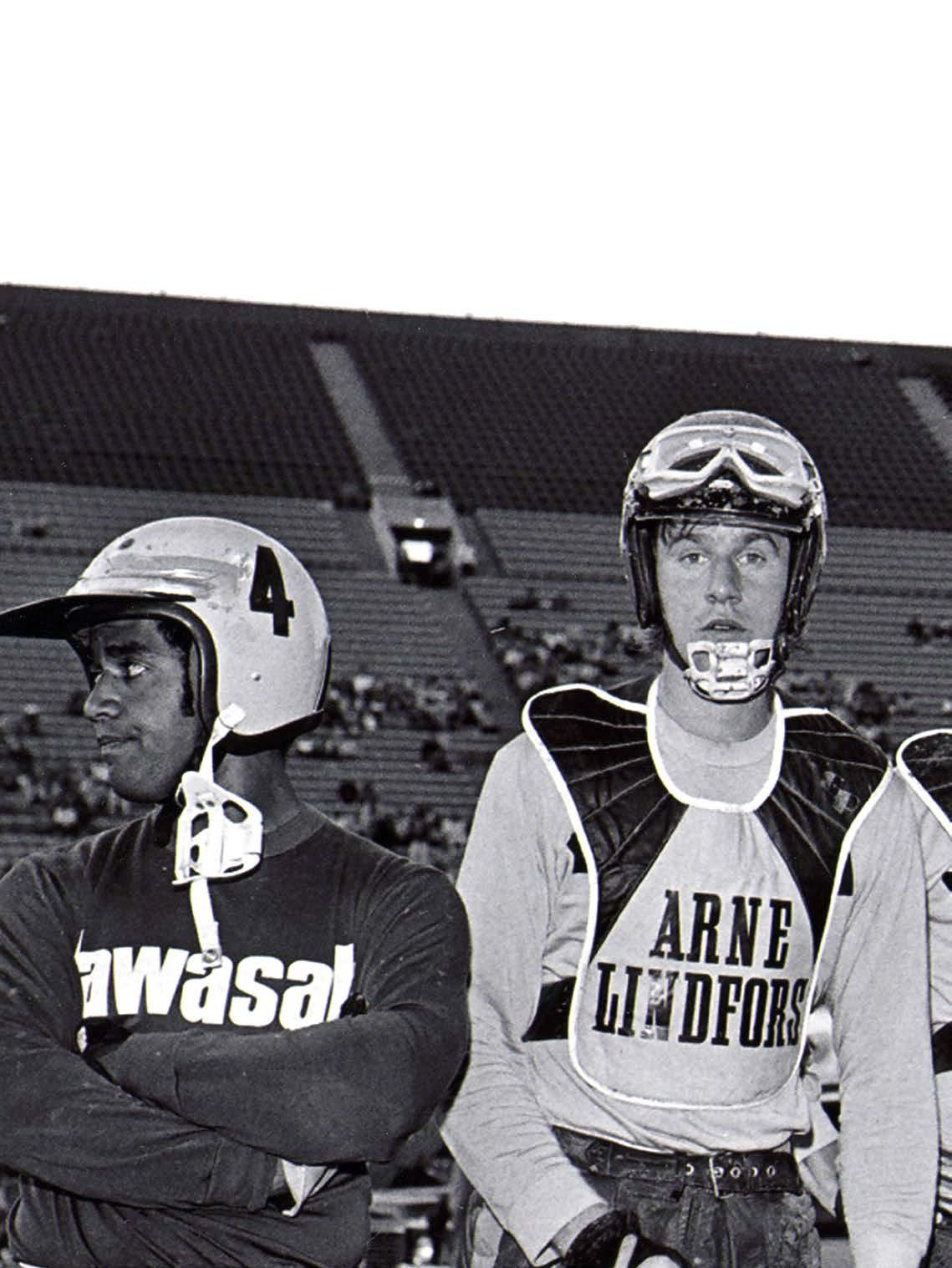
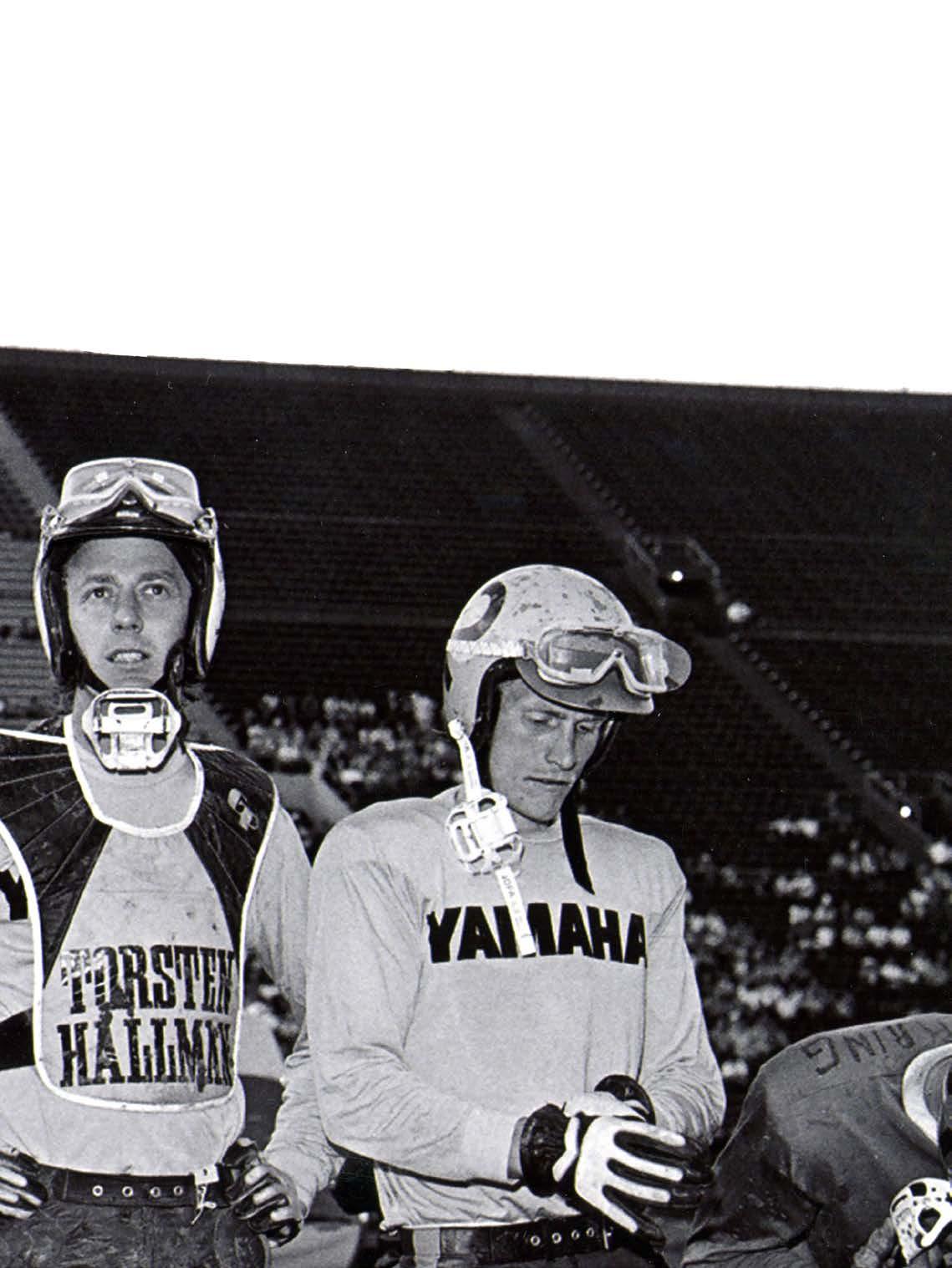
While John Desoto looks away, Swedes Arne Lindfors, Torsten Hallman and Hakan Andersson (right) strategize the best way to deal with Mike Goodwin’s very un-motocross-like racetrack.
“I’d shoot an event, develop film and make prints all week, then sell them to racers the following Sunday for a buck apiece.” – Photographer Greg Owen
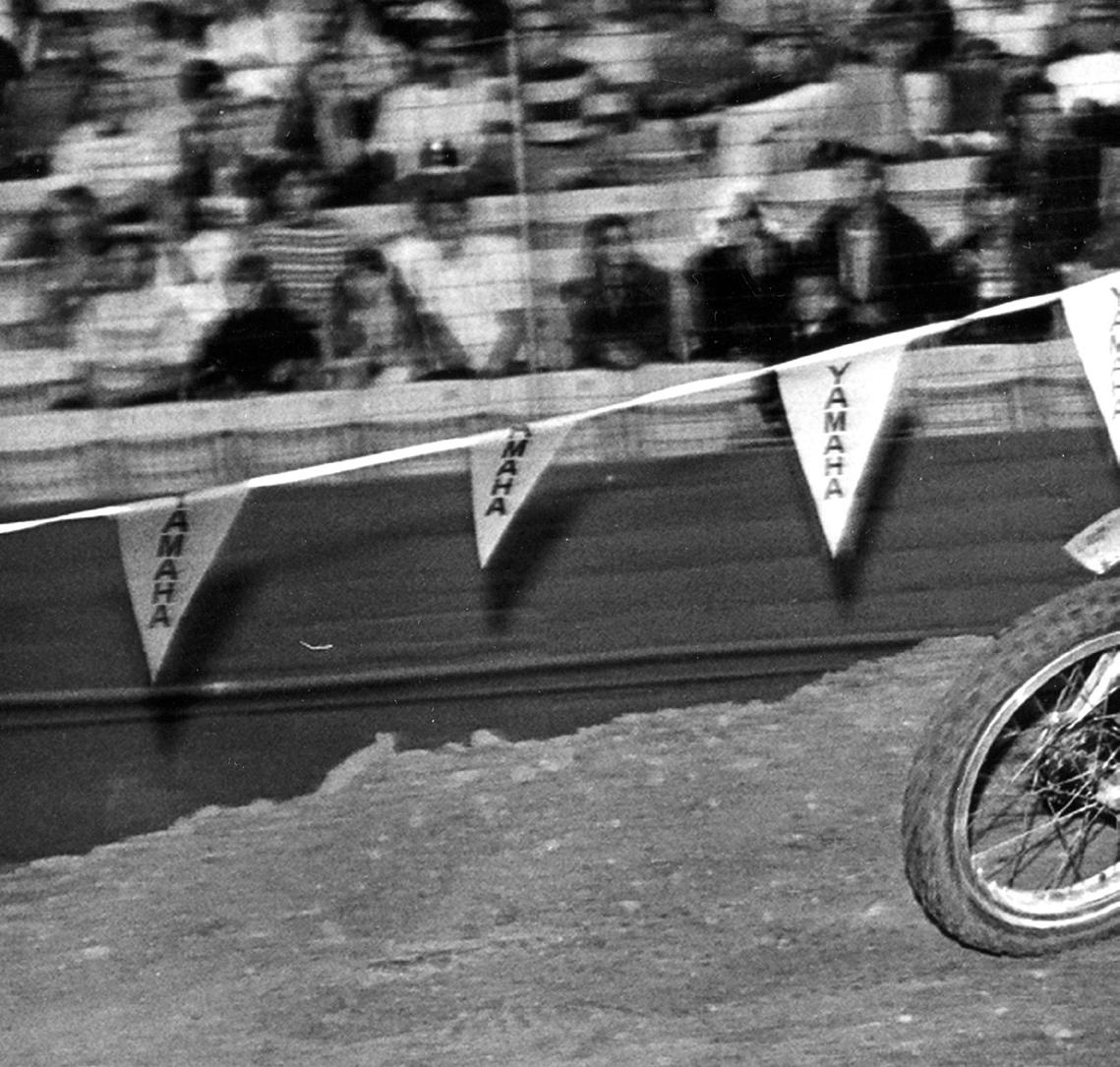
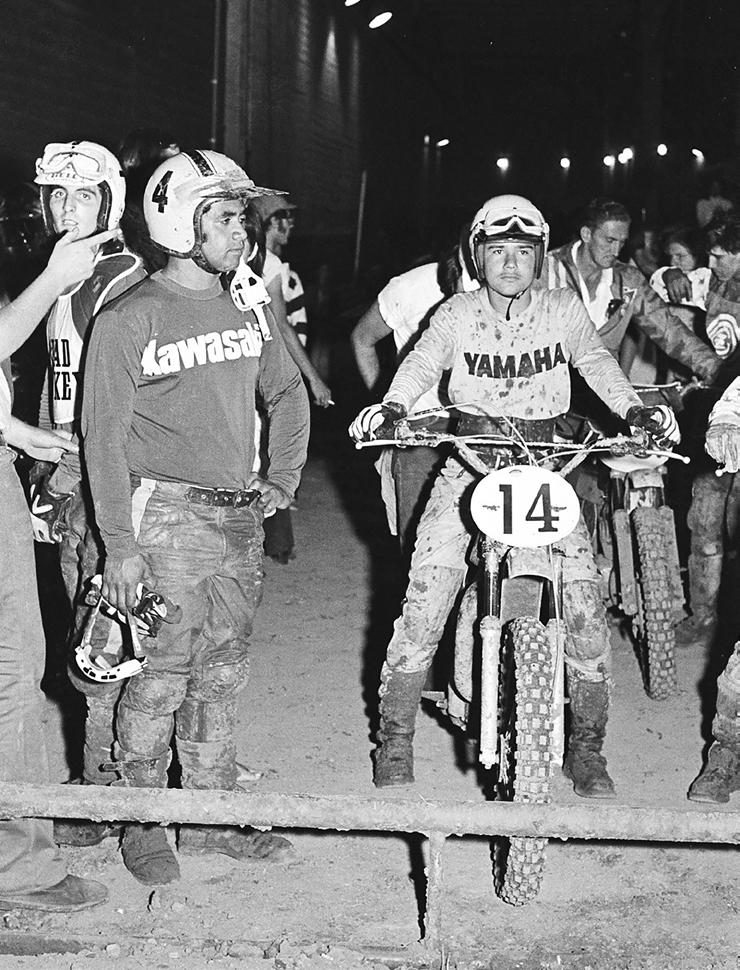
Left: Desoto and Lackey (left) might well be thinking this: “What’s this kid — Tripes, No. 14 — doing here? Isn’t he still 15?” Above: Jimmie Pomeroy, this issue’s cover boy, doing his thing on the Bultaco.
them to racers the following Sunday for a buck apiece. I bought a cheap strobe and started shooting at night races, and selling those photos, too. I still wanted to race, so doing both got tricky. The guys in my class never got photos of themselves!”
“I could write a little, too” Owen added, “and I started doing race reports for papers like Motor Cycle Weekly. I was making a couple hundred dollars a week at this, and
also selling photos, and after a while I began making really good money, more than my parents, actually!”
“Greg was in his element at the time,” said his late brother Kelly. “He converted his bedroom closet into a dark room, developed all of his own film and printed it old-school fashion. And all while working as a roofer for my father’s company, attending high school and racing three to four times a week at all
the CMC events. He made a ton of money at a time when other guys in school were making $2.65 an hour working at McDonald’s. He took a couple of photography classes and that was all he needed. He sold those 8x10s for a dollar apiece, and the riders — and their families — bought them all. It was quite a time for him!”
It was also quite a time for another California motorcycle enthusiast — namely, Michael
Goodwin, a rock music promoter who’d come up with a unique idea for a stadium motocross race after hearing about a dirt track event at Madison Square Garden that had supposedly sold out.
“I figured this new sport of motocross would be really exciting in a stadium,” Goodwin told Racer X, “so I put together a proposal and sent it to Olympia Beer…and they said yes! I then had to figure out how to do it, so I met with Mr. Nicholson of the LA Coliseum. I was scared to death because I knew he was going to say no. Luckily, his kid rode motocross. We went across the street to a restaurant called Julie’s and drew a sketch of the track on a cocktail napkin.”
“I’d heard about the Superbowl thing,” Owen mentioned, “but didn’t know much about it. I got a photo pass through Motor Cycle Weekly When I got to the Coliseum I started experimenting, shooting color and black and white. The whole thing was very exciting. As the stadium began to fill up you could sense this was going to be a big deal; no one had ever seen anything like it before. I remember being amazed at how they’d transformed the place — a pristine football and track-and-field venue — into a motocross track. I was there early, watching the workers use plastic and plywood to protect the grass.
“Once practice started,” Owen remembered, “everyone there — from the stands to the pits to the folks on the field — knew this was gonna be huge. No one had ever seen anything like it. I remember Jimmy Weinert leaping off this big jump and thinking ‘wow.’ And it got better as the evening wore on, the riders figuring out the track and going faster than ever.”
If those watching thought the track was great, many riders did not, especially the Euros, who bitched about Goodwin’s effort all weekend long. “They were saying it wasn’t really motocross,” said Jimmy
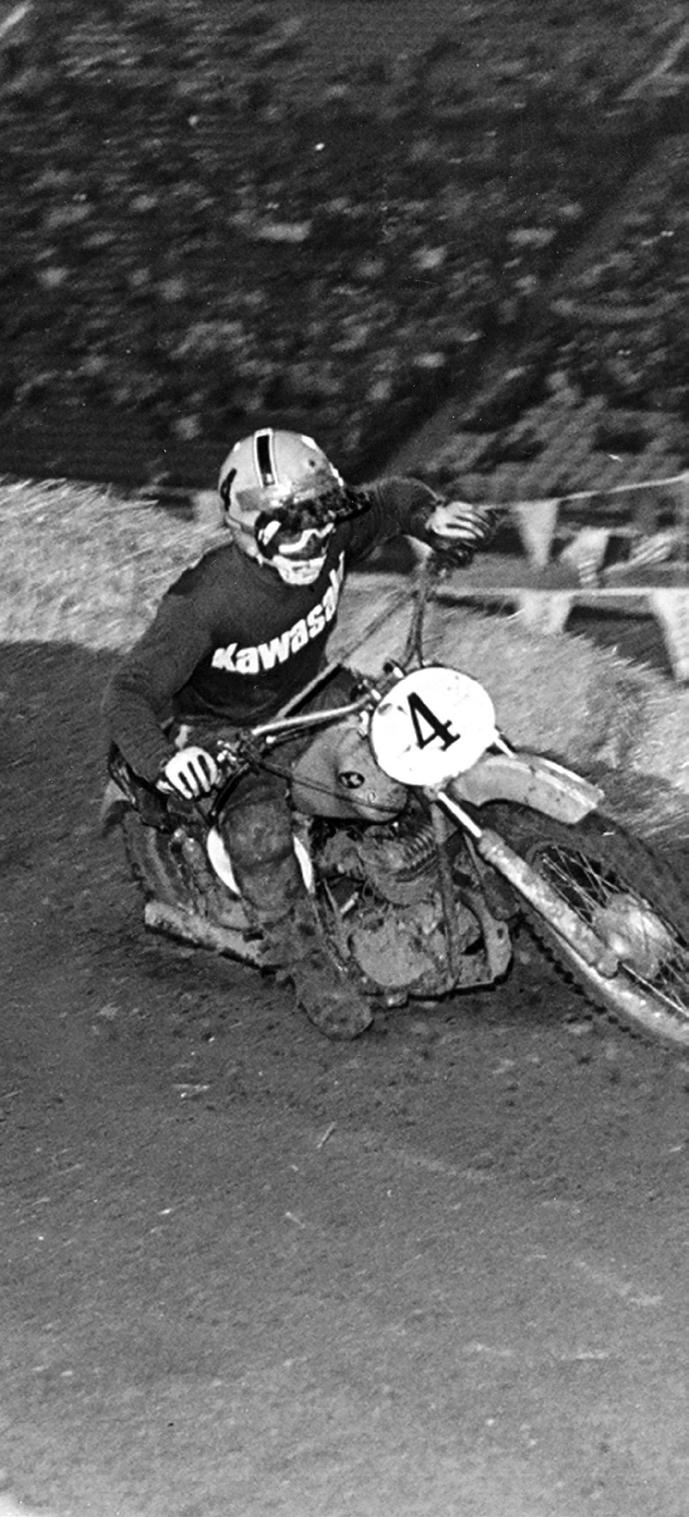
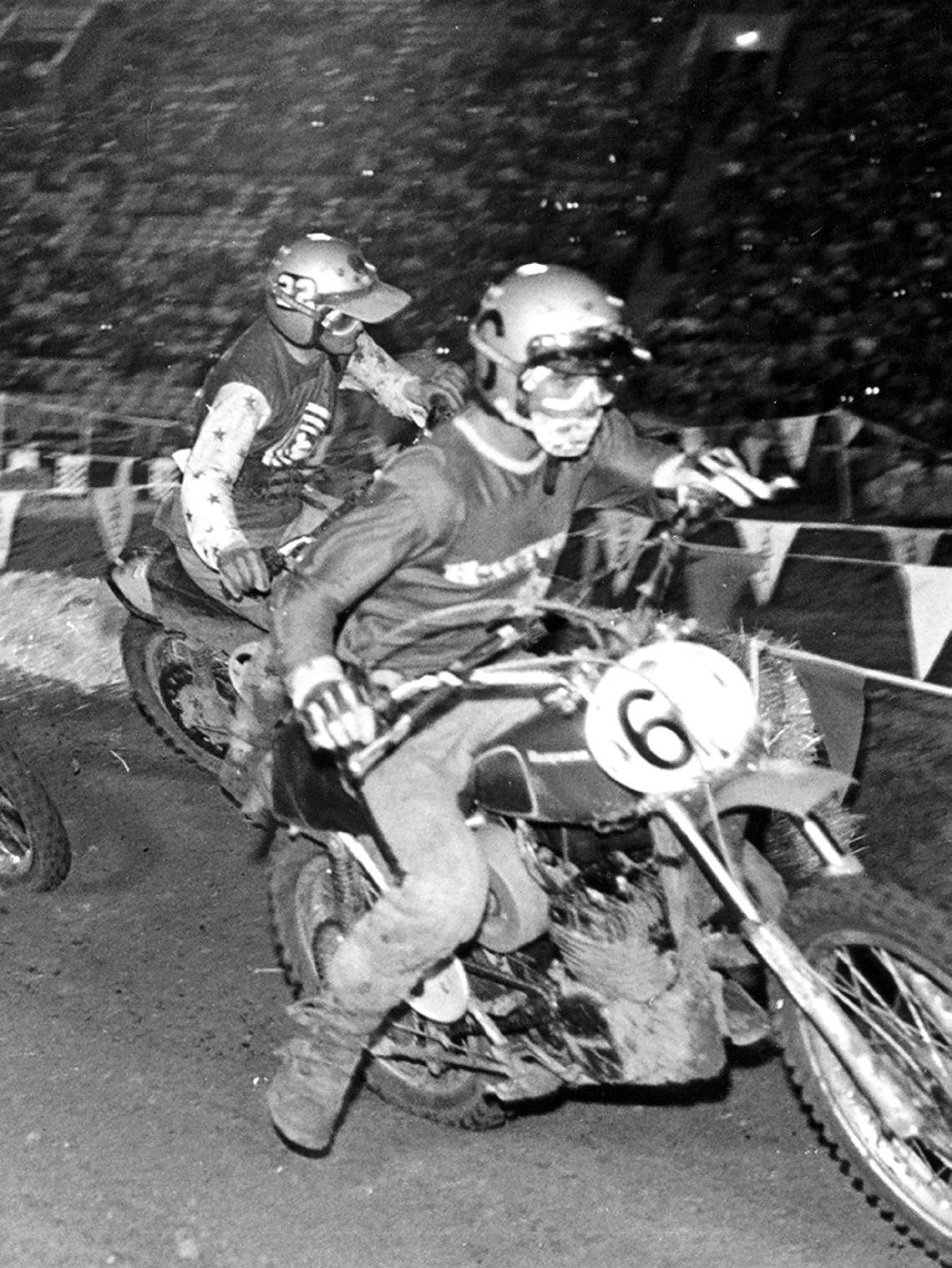
John “the Flyin’ Hawaiian” Desoto (4) cuts under a rider and sets his sights on Bob Grossi (6). Hard-riding Desoto led two Superbowl motos before tumbling badly in a dark corner and again in the water hole. It wasn’t his night.
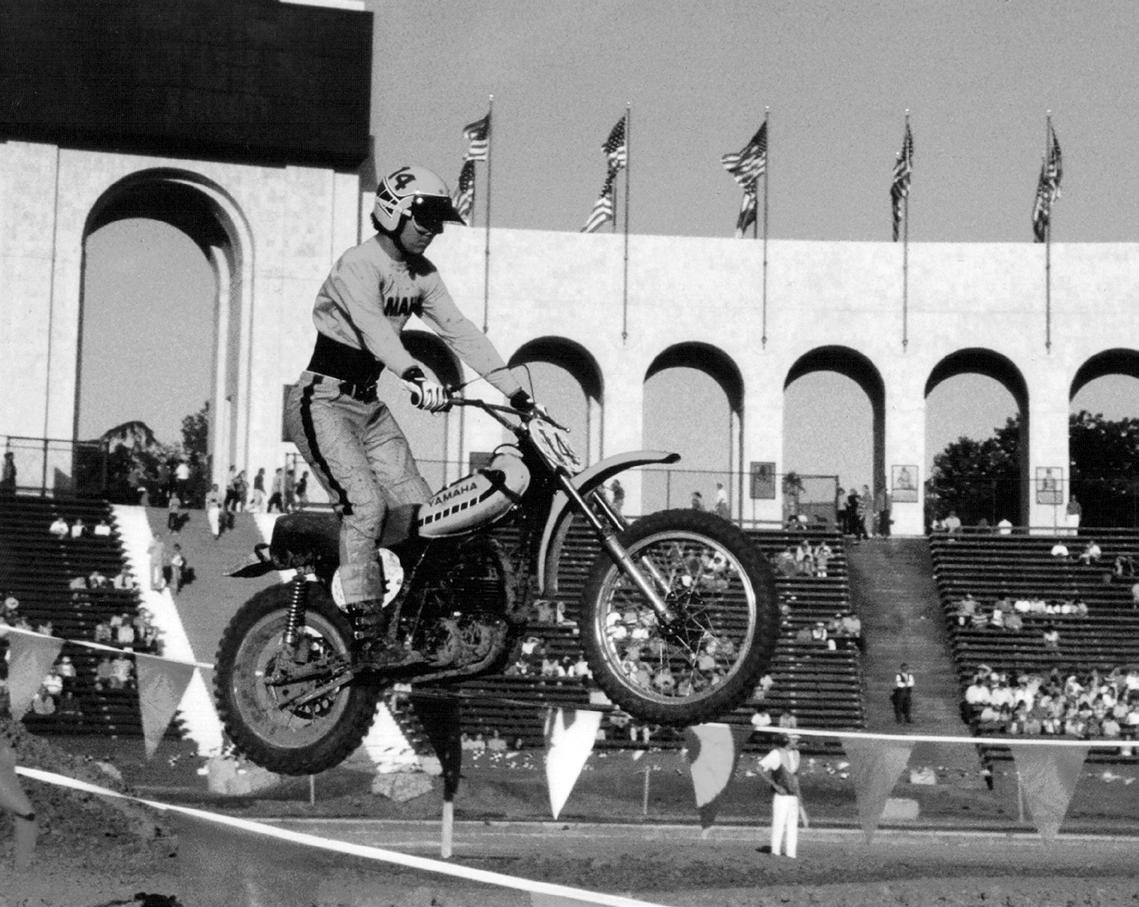
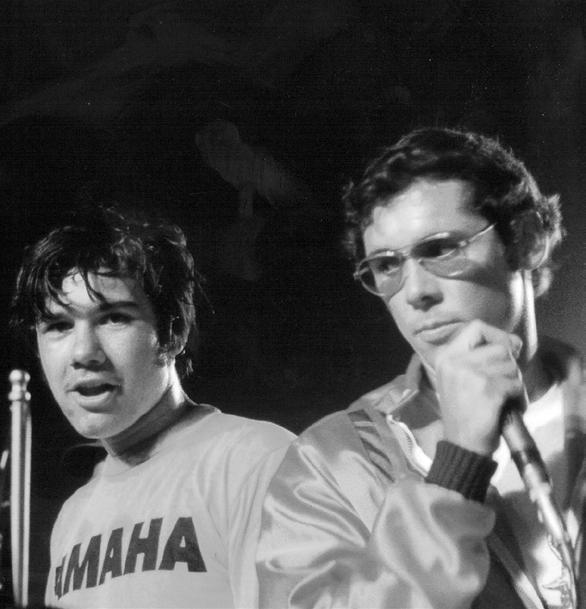
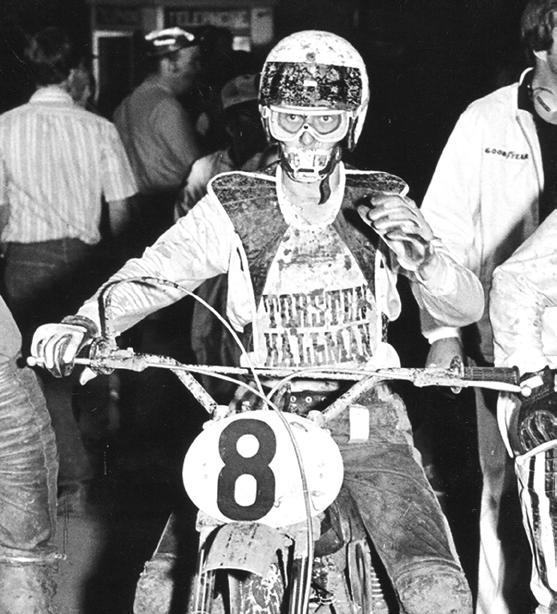
Young Marty Tripes during practice, and being interviewed post-race by legendary announcer Larry Huffman.
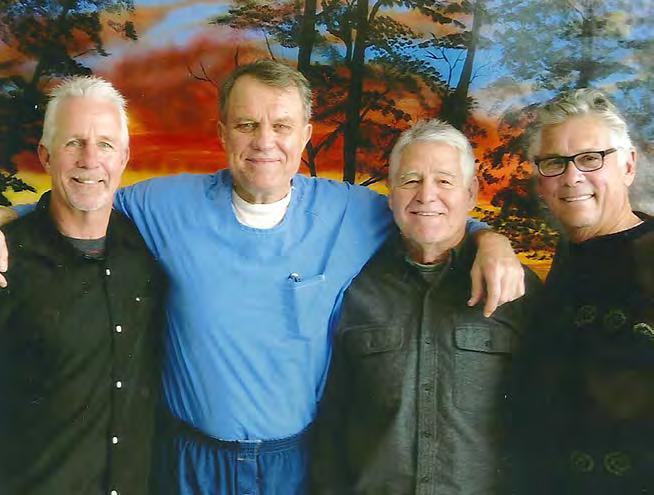
Eleven years ago, Larry Huffman (right), the late Tom White (left)and Bryon Farnsworth (middle right) visited Supercross promoter Mike Goodwin in jail, where he’s serving a life sentence for the alleged murder (evidence was in dispute) of Mickey Thompson. Goodwin is in failing health these days, but was overjoyed to see some of his old friends.
Weinert, who didn’t much like the circuit himself. “The jumps were ugly and it was narrow, with no room for error.”
But one rider felt good about the layout right from the start. “Seeing the narrow turns and jumps was just incredible,” Marty Tripes told Racer X. “I couldn’t wait to get out there. I always rode the hills around El Cajon, and did the trick stuff. The track at the Coliseum was perfect for me.” Amazingly, Tripes turned 16 just days before the race.
shot,” he said, “the one of him flying away from me in mid-air. I remember looking for a different angle there, something different. DeSoto was great to watch. He rode with such strength, gassing it in the whoops and just manhandling the bike. Amazing. Another amazing thing was how close the fans were to the bikes. If someone got off at speed, the bike would go right into the stands!”
Owen still remembers the elation at evening’s end, the crowd jumping up and down and cheering for young Tripes, who’d beaten the best in the world.
“I believe our guys had an advantage over the Euros at a track like this,” said Owen. “I’d shot at all the night venues — Ascot, Lions, Irwindale, etc. — and all were slick and tight and had big jumps, just like the Coliseum track. So yeah, all this racing helped them, and that’s one reason they did so well at the Coliseum.”
During the motos Owen lugged his cameras and heavy Norman strobe — complete with heavy lead-acid battery hung around his neck — from corner to corner trying to capture the action uniquely. “I remember shooting that Weinert
Owen still remembers the elation at evening’s end, the crowd jumping up and down and cheering for young Tripes, who’d beaten the best in the world. That he’d done it on a venue reasonably alien to the admittedly better European riders didn’t seem to matter much.
“At that point the American riders were gaining speed quickly,” he said, “and in just a few years the young high-school team riders in the 125 Support class — Mike Bell and others — would dominate the sport of Supercross.”
Which, by all accounts, seems to have been born that very evening — and at what would become the first Supercross ever.
The Shot
Bill Petro’s Jim Pomeroy cross-up photo — arguably the most iconic motocross image ever
By Mitch Boehm
Remember what you were up to in the summer of 1972?
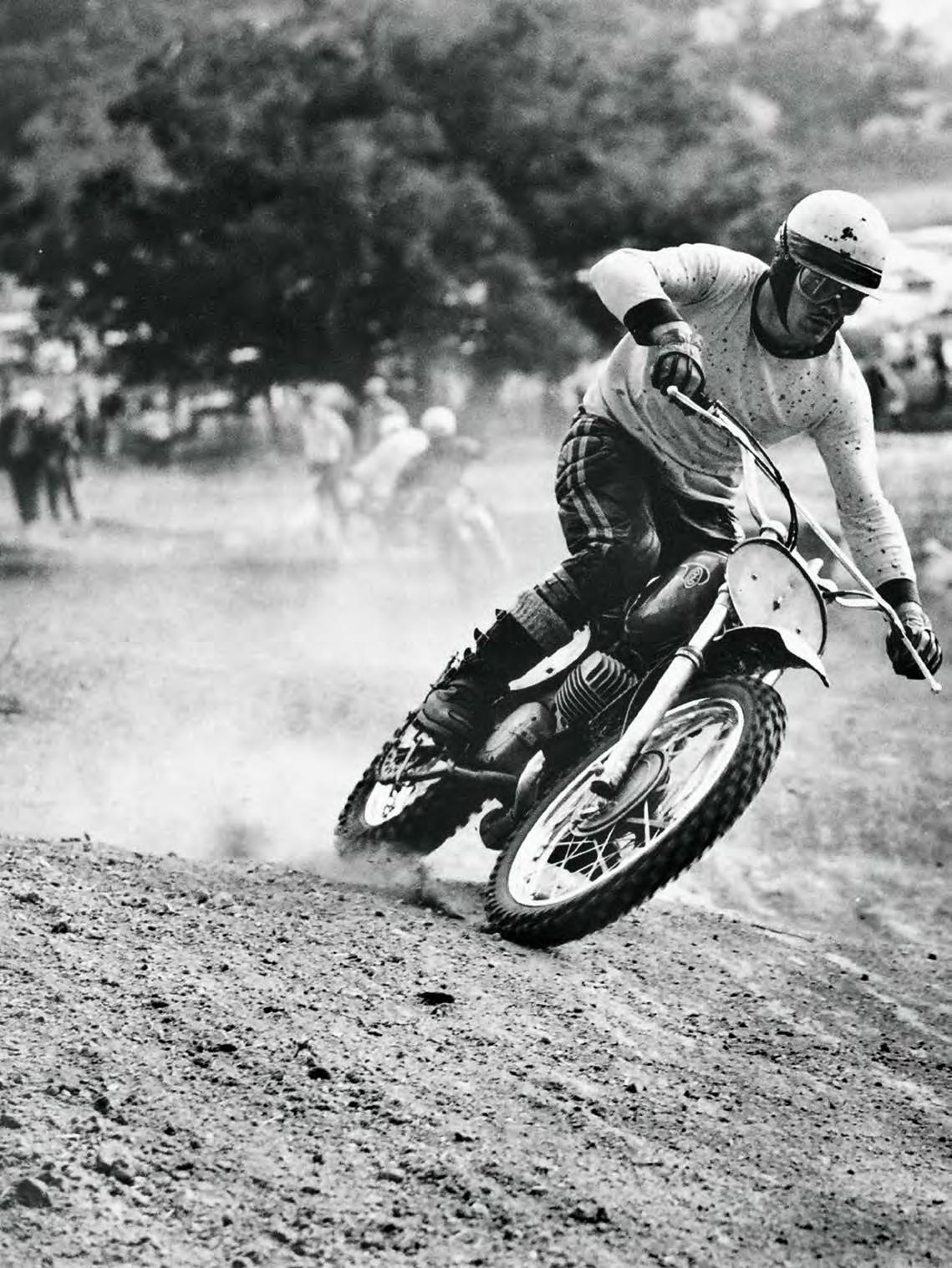
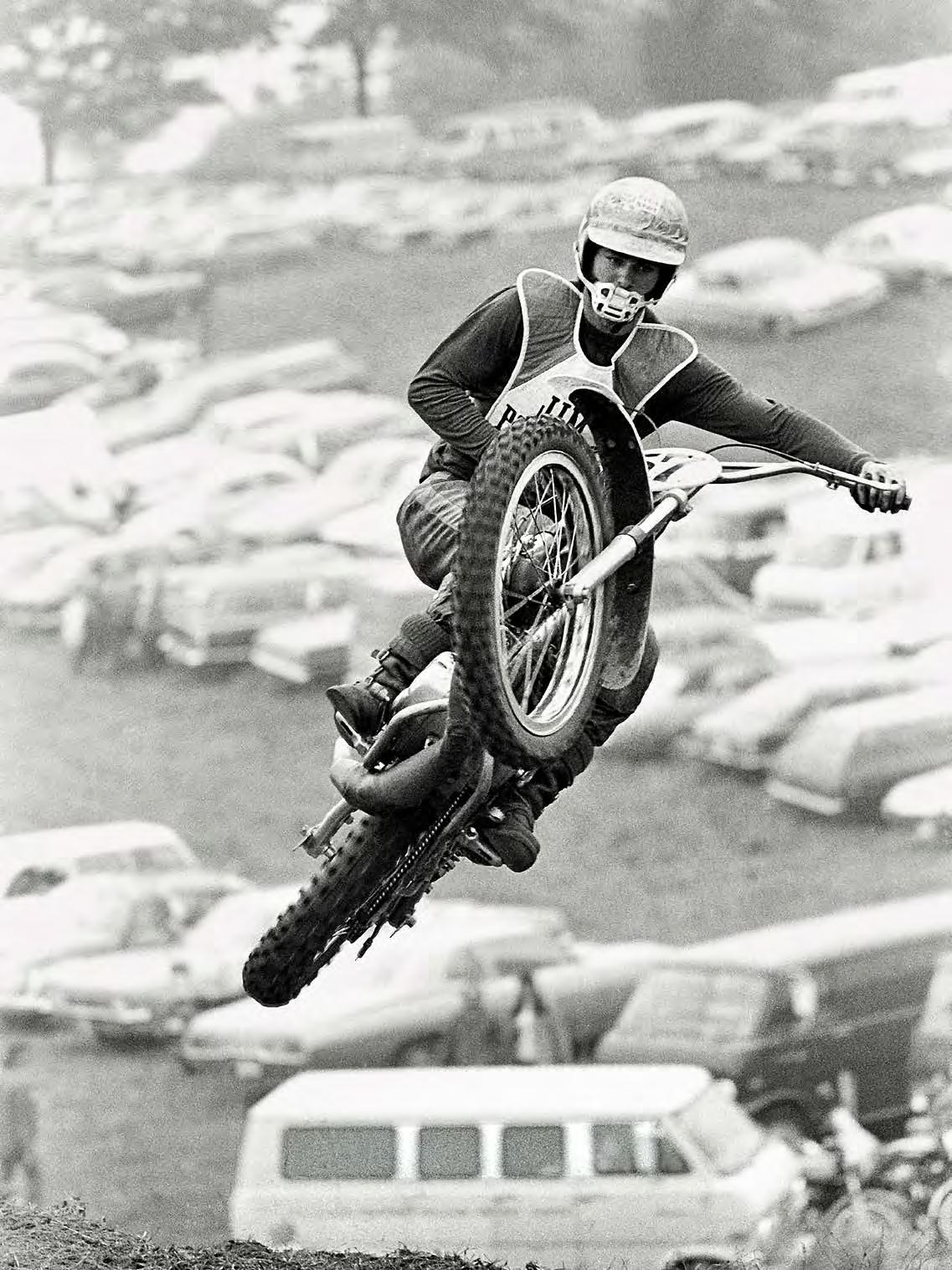
Whatever it was, if you were into bikes, and especially if you were a fan of motocross, you almost certainly recall this image of a crossed-up Jimmie Pomeroy strutting his stuff at the ’72 250cc Grand Prix in Copetown, Canada.
You remember it because it’s very likely the most-reproduced motocross image ever… certainly of the 1970s, and probably of the last five decades. After first appearing in a Bultaco ad (see inset), the image quickly became a hit, appearing on t-shirts, posters, coffee mugs, in other company advertisements in magazines, etc., with later users never bothering to pay photographer Bill Petro, a Canadian college student just scrambling to make ends meet.
time favorite shots.”
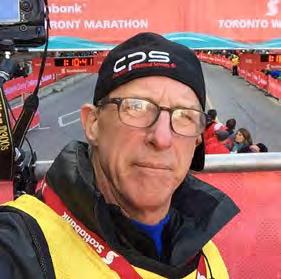
Photographer Bill Petro
He’s certainly not alone there. The image itself is a gem, a perfect storm of perspective, exposure, bike attitude and atmosphere. For a youngster like myself and all my buddies back home in North Ridgeville, Ohio during the earlyand mid-1970s, all of us just getting into minibikes and trying to mimic our hero’s antics on our Schwinn Sting Rays over board-and-cinder-block ramps, Petro’s shot burned itself into our psyches. Over the years it has become an almost Iwo Jima flag-raising type of image for the motocross set.
The photo not only showcased Pomeroy, the first American to win a motocross Grand Prix (the 1973 Spanish GP), but our country’s growing power within the sport. The image’s staying power and heft was and is unprecedented, and it remains a wonderful piece of motocross history to this day.
If you’d like to buy a signed and numbered high-quality archival print from Petro, and we recommend it highly, pay a visit to Petro’s Legends of Canadian Motocross website at locmx. com. He says there are a few left from the first Limited Edition signed set, and he’d be happy to send you one. Since the guy never got paid for all the use and attention the photo got back in the day, it’s the least we can do, right?
Nice job, Bill Petro. The motocross world owes you a big Thumbs Up!
“It was the first picture I ever sold,” Petro told American Motorcyclist. “Somehow the ad agency in question tracked down my mother, cause they couldn’t find me. They paid me $125 for it, a lot of money at the time. And being a student…well, I was happy to take it.”
“I was looking at the scan a while back,” he added, “and remembering the day I shot it. People were talking about this guy Jim Pomeroy doing these beautiful cross-ups over a jump in the back section of the track, so I headed over to shoot him. These days, that sort of thing is no big deal. But back then it was very, very cool. It’s one of my all-
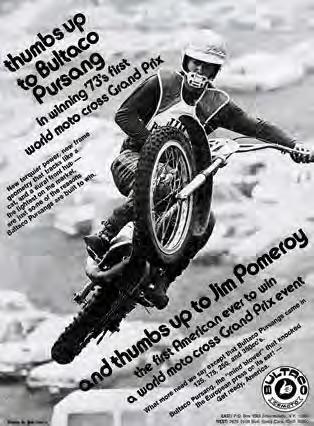
“People were talking about this guy Jim Pomeroy doing these beautiful cross-ups over a jump in the back section of the track, so I headed over to shoot him.”
The Elsinore
With its ’73 CR250M, Honda launched its first real two-stroke — and kick-started a motocross revolution
By Mitch Boehm
It came out of nowhere, like a South Pacific tsunami wreaking havoc and affecting everything it touched.
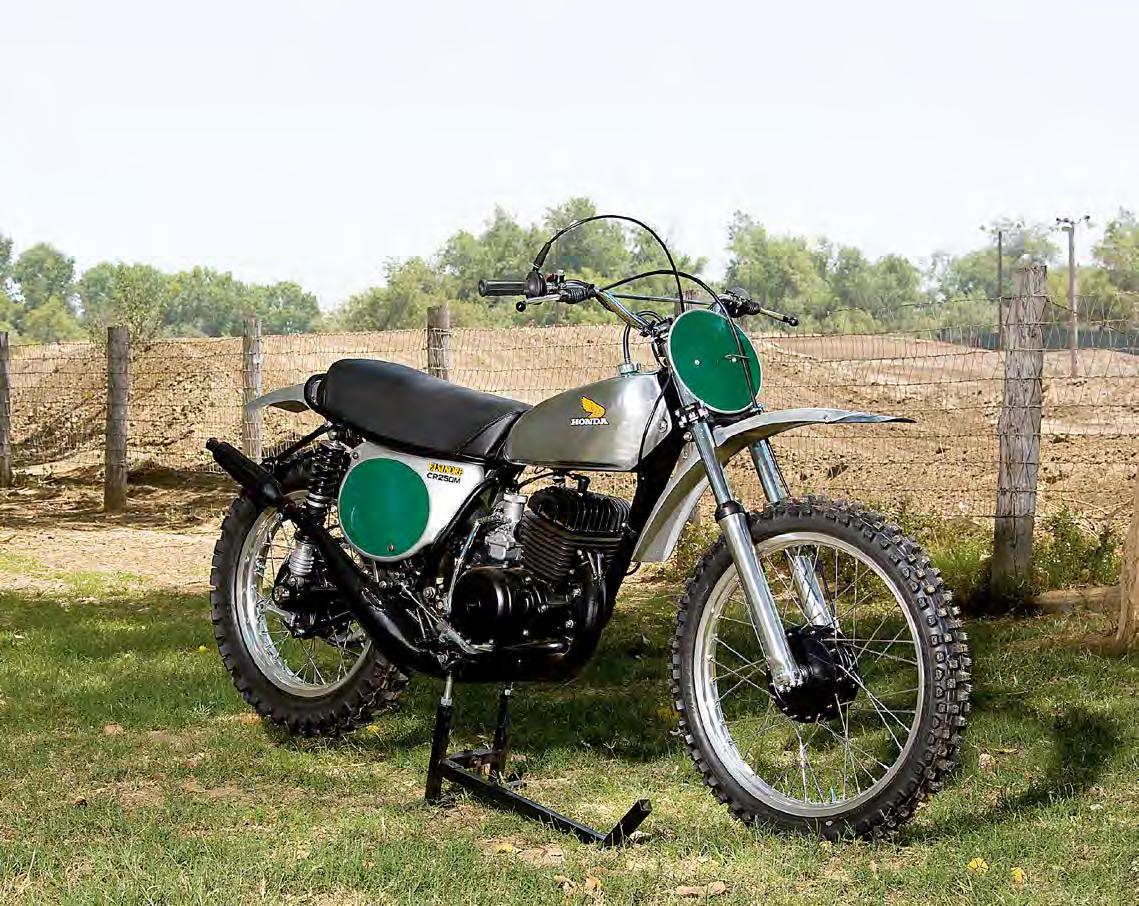
It was Honda’s CR250M Elsinore, Soichiro Honda’s first-ever full-sized production two-stroke, and a bike that would rock the motocross landscape for years.
Considering the iconic two-strokes Honda has built over the last five decades, it’s almost amazing to consider that Big Red’s first tiddler was a huge shock. But it was.
The seeds motocross pioneer Edison Dye had planted in the late ’60s were sprouting coast to coast, watered by insatiable American enthusiasm and fueled by rapidly-improving machines
— Euro marques such as Husky, CZ and Bultaco, but also by Suzuki’s MXoriented TMs, Yamaha’s do-it-all DT-1 and others. Kawasaki, Yamaha and Suzuki showcased radical works racebikes, but Japan Inc., even after establishing itself as the world’s premier two-wheeled power broker, still hadn’t built a worldclass production motocrosser.
The Elsinore, named after the SoCal town that hosted the famous race memorialized in On Any Sunday, changed all that in an instant. Which was plenty ironic given that Soichiro Honda himself had said, in effect, that his company would never build two-stroke motorcycles.
Introduced in early ’73, the silver and green rocket brought works-level motocross performance to Everyman for just $1,145. Nothing this side of a factory machine could touch it. Producing nearly 30 horsepower and weighing just 212 pounds sans fuel, the 250 Elsinore became an instant winner, offering amateurs and pros alike a powerful, lightweight and durable machine that could compete for moto wins week-in and week-out.
Liberal use of aluminum and magnesium kept it light and maneuverable. Honda engineering — and two years of testing — made it durable and fast. Dealers sold every unit they could get their hands on, magazines spread the word via glowing track tests, and race-result columns in Cycle News provided proof that Honda’s new motocrosser was a force to be reckoned with. Only Yamaha’s ’74 YZ250, which debuted a few months after but was nearly twice the price and built in limited quantities, had the Elsie covered performance-wise.
The Elsinore name may have disappeared in 1982, but the impact of this revolutionary machine lives on.
The Screamin’ Yellow Banshee
46 years ago, advanced suspension and a DeCoster-esque look made Suzuki’s very first RM — the ’75 RM125M — a winner in the showroom and on the track
By Mitch Boehm
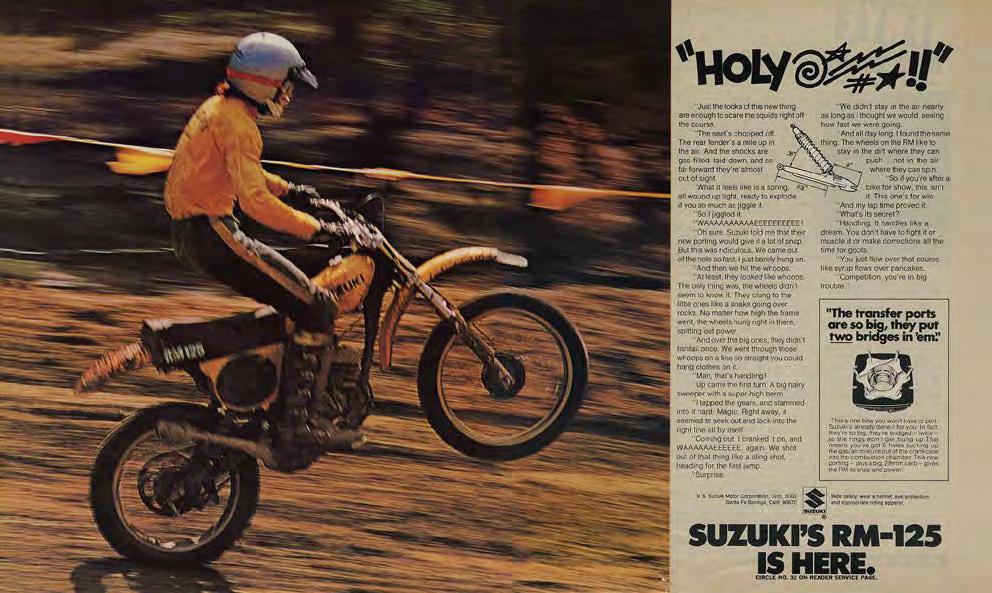
“Holy $*&%#!!” was right.
The Suzuki RM125 ad that appeared in various moto magazines in early 1975 freaked people out, me included. Here was a 125-class motocrosser that looked like a works bike, nevermind that it was in many ways a reworked TM125 Challenger with laiddown shocks.
But what an image those beefy Kayabas made, all trick-looking and angled so far forward the side panels had huge bulges in them. The RM looked like a 4/5ths-scale version of what DeCoster,
Wolsink and DiStefano were riding, and I remember thinking that here, truly, was a bike that had a chance to put a serious dent into the 125 Elsinore’s domination of 125cc motocross — not an easy task given the silver Honda’s performance. While Suzuki’s works machines were then the best in the world (Joel Robert’s exotic 1972 RH72 racer, for instance, weighed just 168 pounds!), its production-spec TM125s, 250s and 400s were woefully outgunned, especially once the Elsinores appeared.
Everything changed with the
introduction of the RM, which offered bold technical advances over its TM125 sibling and set the stage for a line of all-new RMs that would appear in 1976 and beyond. It offered a hopped-up engine with a heavier-breathing cylinder and transfers, a new pipe and a larger carburetor; and on the chassis side a beefier TM250/400 fork and those laid-down Kayabas, which offered 7.5 inches of travel — a lot for that era. Long travel was leading edge in 1975; kits were available to modify the suspension of existing bikes, and sold like crazy. But Suzuki had done it for you.
It all worked, at least reasonably so. Cycle and Cycle World pegged RM125M testbikes at 18.5 and 19.6 hp, respectively, a couple ponies down on the YZ125C and CR125. But when you factored in the available hop-up kit from Suzuki (and the aftermarket) and its better suspension performance, the yellow zonker was right in the ballpark.
Suddenly, Suzuki had gone from alsoran to contender. And within a year, the company would stun again with the casereed-inducted, chromoly-framed RM125A, along with highly functional RM250 and 370. Talk about DeCoster-esque…
1976 The Water Pumper
With Bob Hannah riding and Bill Buchka wrenching, Yamaha’s wild, liquid-cooled OW27 was unbeatable
By Mitch Boehm
It almost doesn’t look like it’s from 1976. The fork-mounted radiator, the water hoses, the fenders way up in the air suggesting mondo wheel travel…Those bits and that technology say late ’70s or early ’80s far more than they say middle ’70s.
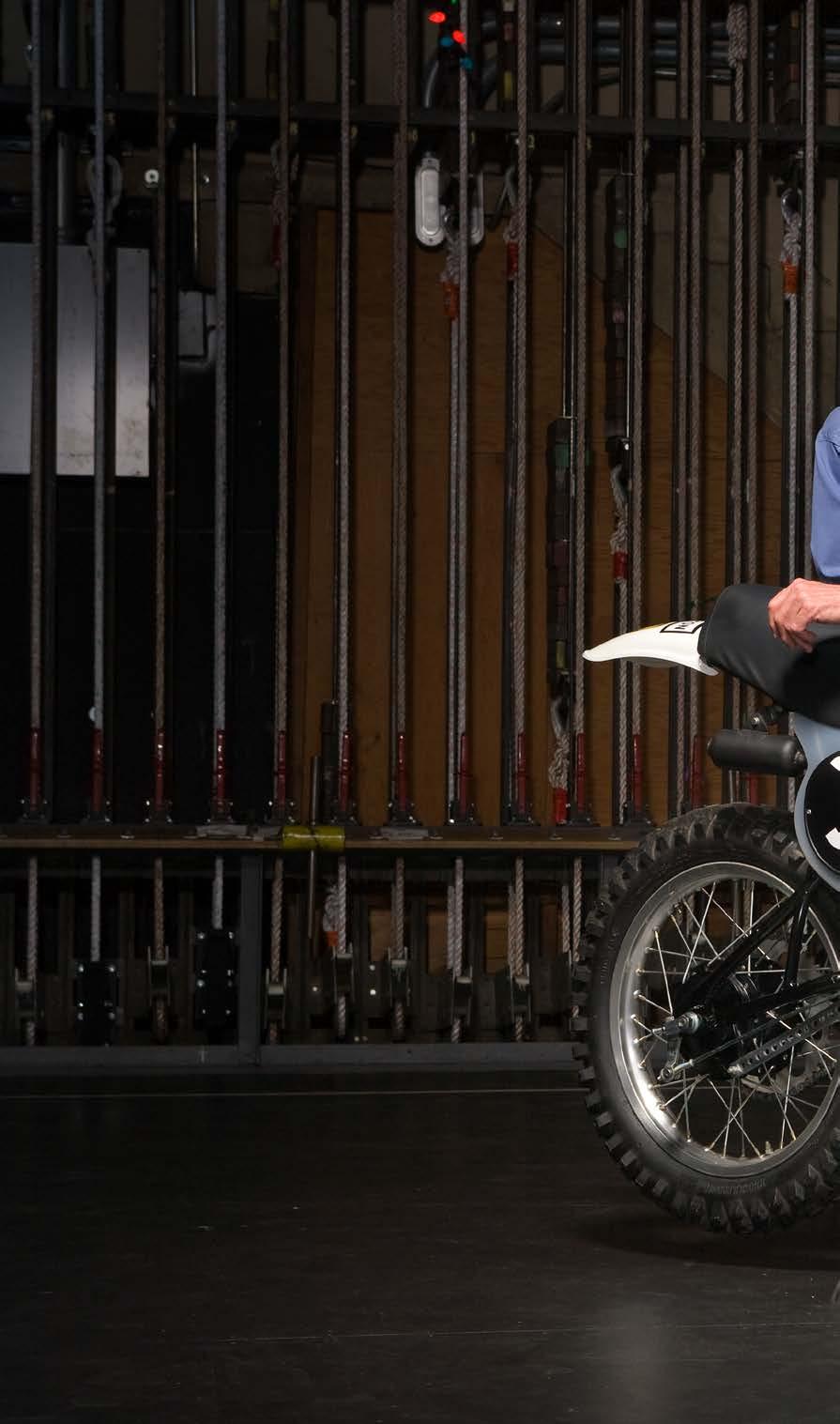
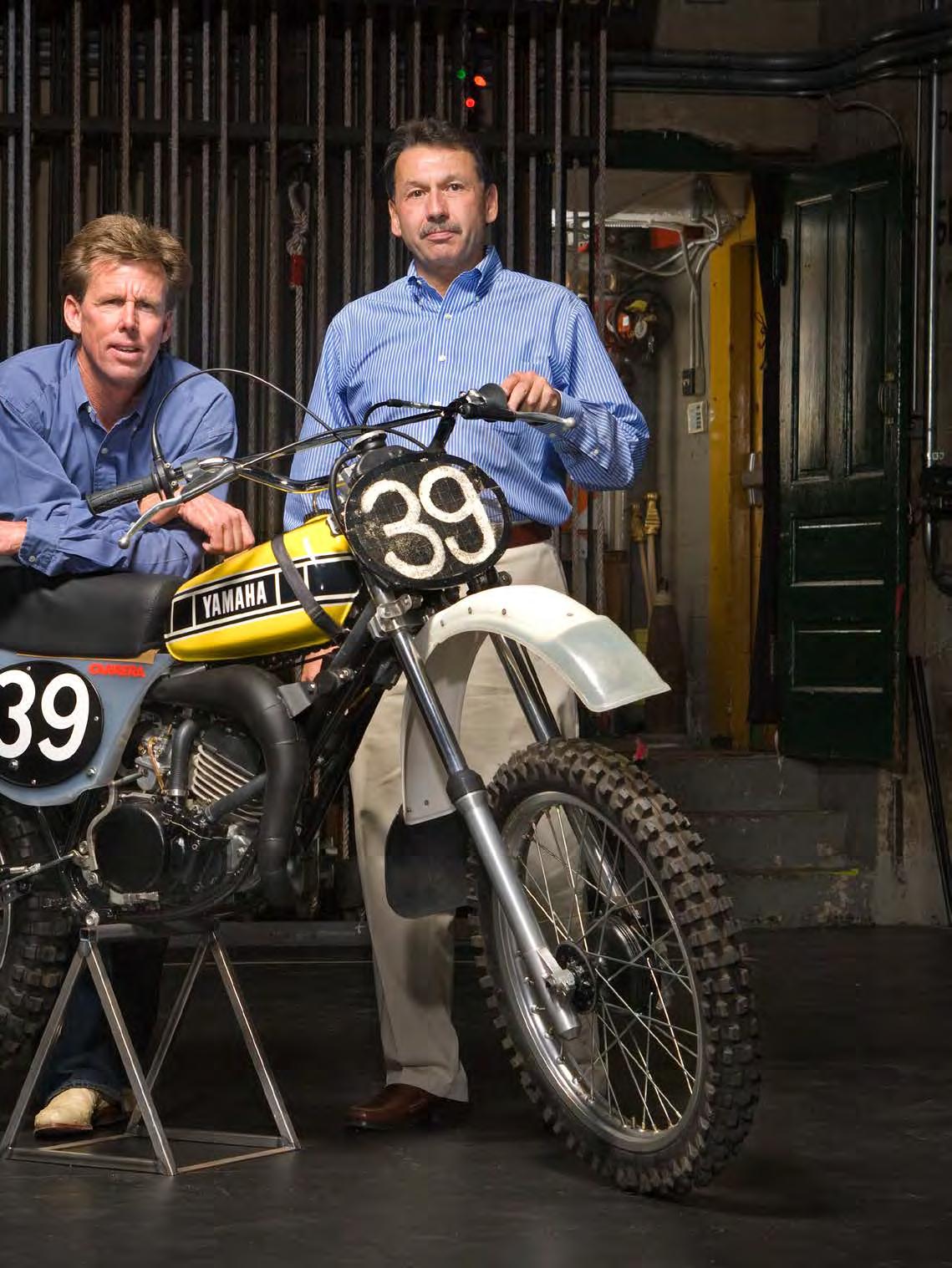
Of course, that technical brilliance is part of the reason this motorcycle, Yamaha’s 125cc OW27, has become so legendary — especially when allied with the two gentlemen who put the bike at the very top of our sport in 1976: Bob Hannah and Bill Buchka.
It was not an easy path to the AMA 125cc National Championship in ’76, and for a box van-full of reasons. First, Hannah was a largely unknown quantity that year. He’d become a So Cal hotshot in ’75 and had done well in the Florida Winter Series, but remained untested in true Nationalclass competition.
Marty Smith, the reigning 125-class champion from ’74 and ’75, was as fast as ever, especially aboard a revised RC125 Honda. Competition as a whole was rabid that year as well, with a dozen riders — guys such as Broc Glover, Warren Reid, Steve Wise, Danny LaPorte, Bruce McDougal and others — riding bullet-fast Elsinores, YZs and RMs from a host of successful and talented aftermarket companies such as FMF, DG and T&M. Any one of a dozen guys had the skill to win
motos that year.
Fortunately, Yamaha’s liquid-cooled OW27 was superb all season long, offering young Hannah enough power, handling and durability to win five of the eight Nationals. The key, according to Hannah, was consistency; the liquid-cooling kept power consistent throughout the 40-minute motos, and the trick rear shock kept suspension action from deteriorating.
Combined with Hannah’s scoldingly fast riding and intense physical fitness (he trained like crazy leading up to the series), he, the OW and Buchka were able to take advantage of Smith’s uneven performances, which were caused by a number of factors. Most notably, Smith having to ride four different bikes — production- and worksspec — during the season due to the AMA’s claiming rule (which affected Hannah and Yamaha as well), but also his concurrent quest to compete in the 125cc World Championship series at the same time.
In the end it was all Hannah, Buchka and Yamaha, champions of one of the most dramatic and competitive AMA National Championships in motocross history. It may have all happened 45 years ago, but seeing these guys and this bike up close and personal (thanks to Fran Kuhn’s so-cool lenswork), it seems more like yesterday.
The Champ
“Bad Brad” Lackey: America’s first World Champion
By Mitch Boehm
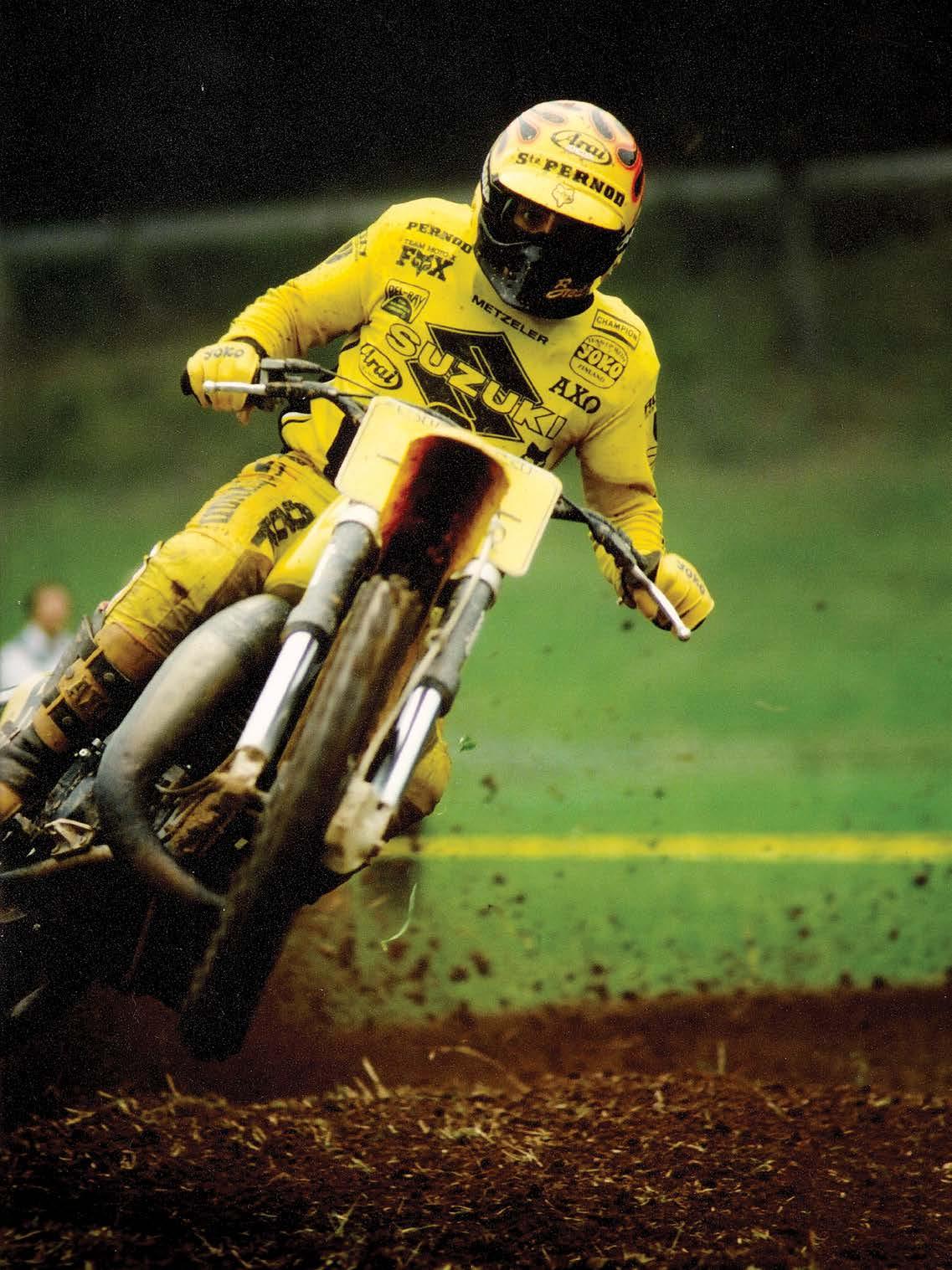
During the 1970s and early 1980s, Brad Lackey proved to be the most successful and consistent Grand Prix motocrosser from America. He scored his first 500cc moto win in Luxembourg in 1976 on an aging and mostly non-competitive Husqvarna; then grabbed his first overall victory in Britain in ’77 after joining Honda’s GP squad; finished second overall to Heiki Mikkola on another Honda in the ’78 World Championship; and captured runner-up honors again in ’80 on a Kawasaki.
Suzuki got back into World Championship motocross competition in 1981 after dominating much of the 1970s with guys named DeCoster, Robert, Rahier and Wolsink, and hired Lackey as its primary rider. The team got up to speed quickly and, by ’82, had a bike and rider that were capable of winning races.
During the ’81-’82 offseason Lackey
“Suzuki didn’t like it at all. When I showed up with that fork on my bike, they said ‘take it off, you’ve gotta run these [forks].’ I said no. They had a fit, but that’s the way it was gonna be.”
tried a then-unique fork assembly designed and built by noted suspension guru Steve Simons. It was an inverted design Simons had begun working on back in ’79, and Lackey liked it enough that he insisted on running it during the ’82 season.
“Suzuki didn’t like it at all,” he told an interviewer back in 2007. “When I showed up with that fork on my bike, they said ‘take it off, you’ve gotta run these [forks].’ I said no. They had a fit, but that’s the way it was gonna be. In Europe you’re riding in ruts all the time, and when you’d steer out of them, standard forks would twist and flex. But the Simons fork was strong and rigid; you’d turn the bar and the bike would climb right out. On giant jumps they’d never bottom, and they weighed about the same.”
Lackey battled Belgian teammate Andre Vromans the entire season, and
at the final round in Luxembourg it came down to the slimmest of margins. In moto one, Vromans found himself in the lead but was passed by Brit Graham Noyce. Lackey was third and knew he had to get past Vromans into second, which he did on the final lap. That pass boosted Lackey’s spirits and had a demoralizing effect on Vromans, with Lackey winning moto number two easily for the overall win and the 500cc World Championship — his first, and America’s first.
The second coolest thing about Lackey’s championship? That’d be the title-winning Suzuki RN500 he won it on, which now sits in Lackey’s Bay Area home after spending a couple of years in the AMA’s Hall of Fame Museum.
“Everyone said it’d been crushed,” Lackey said, “but on a trip to Holland, Sylvain Geboers and I visited my old teammate Jean-Jacques Bruno’s mechanic, who had it in his shop, albeit without the right fork, fender and seat cover. I asked him how he was sure it was mine, and he said, simply, ‘It’s a 4-speed.’ Bingo! My bike was the only one with a 4-speed!”
“I have a museum at home,” Lackey added, “with about ten bikes in it, including my ’75-season Husky. The Suzuki sits in the perfect spot.”
A perfect finish to a perfect season.
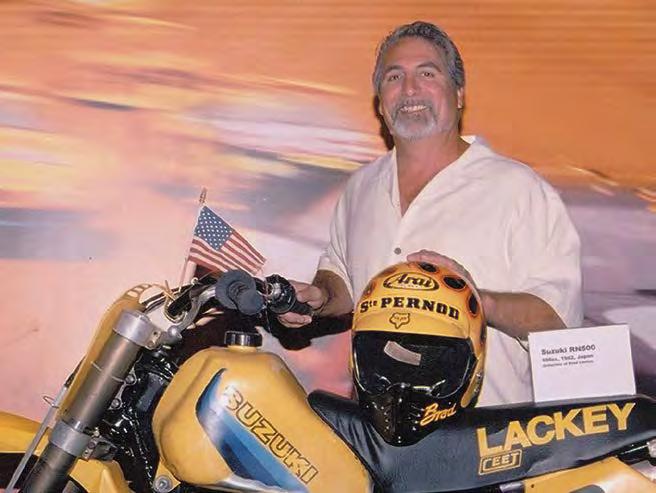
Lackey, with his titlewinning RN500 Suzuki, which now sits in his home.
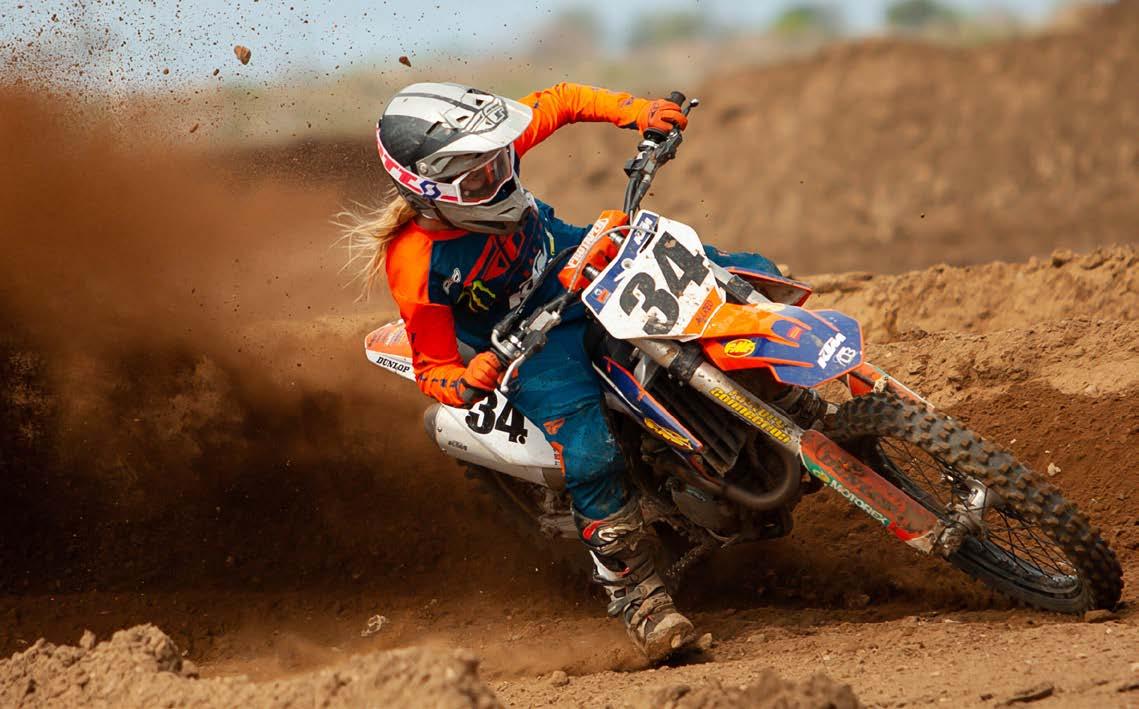
One to Watch
KTM Orange Brigade amateur motocross racer Tayler Allred chats MX, mentoring and chasing her AMA Supercross license
By Joy Burgess
Among young motocross racers, Tayler Allred has long been considered “one to watch.” She qualified multiple years in a row at the AMA Amateur National Motocross Championship at Loretta Lynn’s Ranch, winning there, and has been racing in AMA Supercross Futures as part of her plan to, hopefully, become one of the few women to race in the AMA Supercross 250 class. Her skills caught the attention of KTM, and she’s currently the only girl racing as a part of KTM’s Orange Brigade. “The
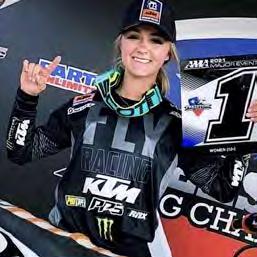
Orange Brigade is an amateur racing program designed to represent our full range of motocross bikes,” KTM Amateur Racing Manager Nathan Ramsey told American Motorcyclist “We give riders and families support through the KTM brand, making it easier for them to go racing at the highest amateur level. We have everything from a 7-year-old 50cc rider to an 18-year-old 450 rider. The goal is to take young riders and groom them so that one day they can be a part of the Red Bull KTM Factory MX/SX team.”
We recently caught up with the KTM
racer from Utah to chat about when she started racing, her biggest racing inspirations, and learn more about what she’s got planned for the future.
American Motorcyclist: First, you’re only 17 years old, but you’ve already been racing for a long time. How did you get started?
Tayler Allred: My dad was a desert racer, so I grew up around it from the time I was small. When I was 3 he got me my first bike and I’d ride in the desert for fun. I started racing when I was 4 or so, although I didn’t get serious about it until I got my first AMA title in 2014 at the California Classic in the Girls (9-13) class. That was the point when I realized this could be a serious thing for me, and I wanted to get as many titles as possible.
I quickly realized that I could do well racing the girls on the West Coast, so I was motivated to go race with the gals on the East Coast, too. I looked up to racers like Jordan Jarvis and Hannah Hodges, and that kept me motivated to work on being the best!
AM: You’re part of the KTM Orange
Kyle Basaker/Base653 Photo
Monster Army
Brigade…what’s it like being a part of that program?
TA: It’s one of the biggest honors of my life. I’m the only girl on the entire team, but everyone is super supportive. I’ve learned that I can always count on my team. I’ve been racing in the Women’s Class, Open Pro Sport, and 250 A classes as a part of the team. It would be super cool to see more girls on the team, and I see some potential in some of the younger girls who are racing these days.
AM: As you got started as a racer and during the past decade you’ve been racing, who have you looked up to for inspiration?
TA: Definitely Jordan Jarvis and Hannah Hodges now and, when I was younger, [former professional motocross racer, four-time AMA women’s motocross national champ and current stunt actor] Ashley Fiolek. Vicki Golden [an American professional Freestyle Motocross rider] is also one of my idols. I especially love how she helps younger girls get involved in our sport. I’m training two little girls right now, and it’s so awesome to walk in Vicki’s steps, getting more girls into the sport.
AM: What about some of the legendary motocross greats, guys like Roger DeCoster?
TA: Roger — I look up to him for sure! I got the chance to actually meet him when I got into the Orange Brigade, and wow, that was a highlight.
AM: You’ve already grabbed a women’s championship this season and you’re riding well, so we’ve got to know what your plans are for the future.
TA: I’ve tried some off-road racing — that’s pretty cool. But I really want to follow in Jordan Jarvis’ footsteps. It’s so awesome how she has her Supercross points already. I can see how challenging it is, but one of my main goals is to get my AMA Supercross license. And soon!
AM: So, should we watch for you in the AMA Supercross 250 class?
TA: Definitely, and hopefully in the next year or two!





THE BETA AMA NATIONAL DUAL-SPORT SERIES FEATURES SOME OF THE COUNTRY’S BEST ORGANIZED DUAL-SPORT RIDES. EVENTS INCLUDE MILES OF WELL-MARKED, CHALLENGING TRAIL CONNECTED BY SCENIC BACKCOUNTRY ROADS.





MAKE IT YOURS
The AMA offers a variety of card types and designs for members. In addition to our standard card, we offer a number of themed cards that identify you as belonging to a specific group or speak to your passion as a motorcyclist.

Call (800) AMA-JOIN (2625646) to request an affinity card at any time, at no additional cost.

































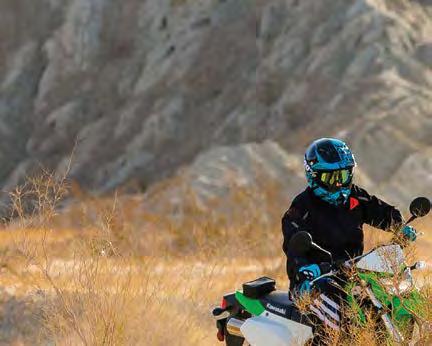





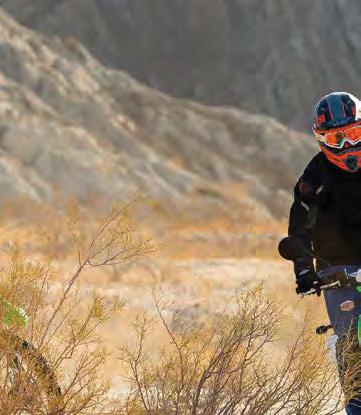






DEALS AND DISCOUNTS




THE ESSENTIALS PRODUCT DISCOUNTS

ADVMoto 20% discount. Use code AMADV20
AMA Motorcycle Hall Of Fame Free admission to the AMA Motorcycle Hall of Fame in Pickerington, Ohio.

AMA Supercross Tickets
10% discount on tickets at supercrosslive.com Use code SXAMA5

Anthony’s Leatherworks 10% discount. Use code AMADISCOUNT

Blendzall
AMA members can save 20% at blendzall.com. Use code AMA20 at checkout.


Car Rentals
Up to 25% off at any Avis or Budget. Avis Code: D388100 Budget Code: Z942000
AMA Gear Find patches, pins, T-shirts, hats and more.
EagleRider
For Club EagleRider AMA members receive 2 free rental credits
Evans Cooling System 25% discount on Evans Coolants and Prep Fluid. Use code AMAFUN at evanscoolant.com.
EVS Sports 10% discount and free shipping on all orders. Use code AMAEVS20



Bohn Body Armor
10% AMA Member Exclusive Discount. Visit bohnarmor. com and use code AMA18 at checkout.
Butler Maps

Helite Moto AMA members get 15% off every order at helitemoto.com. Use code HELITEAMA
International Motorcycle Shows
Save on advanced adult oneday general admission. Use code AMA20
Medjet
Air medical transport and travel security protection – visit Medjet.com/AMACycle or call 1.800.527.7478, referring to American Motorcyclist Association.Annual rates are reduced by 20% and start at $235.
MotoAmerica 20% off 2-day and 3-day passes at select MotoAmerica events. See AMA website for more detail.
Motool
AMA members can save 10% at motool.co. Use code AMAVIP at checkout.
MX Boot Repair 10% discount. Use code AMADISCOUNT

MYLAPS
20% discount off MSRP or current sales price on weborders or orders coordinated by the AMA. Use code AMA-789HJK

AMA members receive a 20% discount at butlermaps.com. Use code AMAMEMBER RoadRUNNER Motorcycle Touring & Travel magazine 20% discount. Use code CRIAMA
Cardo Systems
20% discount online with valid AMA membership card.
Colorado Motorcycle Adventures 10% discount with valid AMA membership card.

Legacy Track Dayz 15% discount on Legacy Track Dayz events. Use code AMARideLTD

Liberty Sport Eyewear 30% discount on all “motorcycle collection” frames. Discount code AMA30.
MAD Maps

Dowco Powersports 20% discount. Use code AMA20

Save 15%. Use code AMA15 ®






Nelson Rigg 20% AMA Member Exclusive Discount on all products! Use promo code AMA-NR20

Third Eye Design $25 discount on inView, a wireless brake and



COMING EVENTS
ALASKA
Road Ride/Run: June 14-17. Guntersville. Concours Owners Group. concours.org
ARKANSAS
Dual Sport: June 26-27. New Blaine. Arkansas Dirt Riders, Inc. (501) 539-3361 arkansas-dirt-riders.spruz.com
CALIFORNIA
Motocross: June 5-6. Pala. 2X Promotions LLC. (559) 500-2276 2xpromotions.com
Motocross: June 12-13. Porterville. 2X Promotions LLC. (559)500-2276 2xpromotions.com
Motocross: June 19-28. Mammoth Lakes. 2X Promotions LLC. (559) 500-2276 2xpromotions.com
Enduro: June 12. Lucerne Valley. 100’S MC. 100smc.org
Road Race: June 12-13. Buttonwillow. California Roadrace Association. (714)822-6053 race-cra.com
Flat Track - TT: June 12. Lodi. Lodi Motorcycle Club. (209) 368-7182 lodicyclebowl.com
Flat Track - TT: June 13. Lodi. Lodi Motorcycle Club. (209) 368-7182 lodicyclebowl.com
Flat Track - TT: June 26. Lodi. Lodi Motorcycle Club. (209) 368-7182 lodicyclebowl.com
Dual Sport: June 26-27. Big Bear Lake. Big Bear Trail Riders, Inc. (818)391-3083 bigbeartrailriders.com
Adventure Ride: June 26-27. Big Bear Lake. Big Bear Trail Riders, Inc. (818) 391-3083 bigbeartrailriders.com
FLORIDA
Motocross: June 5-6. Alachua. Unlimited Sports MX, Inc. unlimitedsportsmx.com
GEORGIA
Motocross: June 12-13. Dalton. LRMX, Inc. (706) 278-2868 lazyrivermx.com
Enduro: June 13. Greensboro. Cherokee Cycle Club Inc. nepg.com
Road Rally: June 25-26 Hiawassee. Greater Atlanta British MC Association. (404) 307-3558 gabma.us
IOWA
Motocross: June 12. Shell Rock. New Hartford Racing Association, Inc. (319) 885-6469 newhartfordracing.com
Motocross: June 13. Shell Rock. New Hartford Racing Association, Inc. (319) 885-6469 newhartfordracing.com
IDAHO
Enduro: June 5. Idaho City. Boise Ridge Riders. (208) 384-5141 boiseridgeriders.org
Enduro: June 6. Idaho City. Boise Ridge Riders. (208) 384-5141 boiseridgeriders.org
Extreme Off-Road: June 19-20. Kellogg. Stix & Stones Offroad. (866) 345-2675 silvermt.com
ILLINOIS
Enduro: June 6. White City. Cahokia Creek Dirt Riders. (217) 725-5048 cahokiacreekdirtriders.com
Trail Ride: June 6. Ottawa. Variety Riders Motorcycle Club Inc. (815) 488-9562 varietyriders.com
Hare Scrambles/Cross Country: June 12-13. Belleville. Belleville Enduro Team Inc. (618)277-3478 bellevilleenduroteam.com
Flat Track - Short Track: June 26. Macomb. Lamoine Ramblers. (309) 837-9436 lamoineramblers.net
Motocross: June 27. Byron. Motosports Enterprises LTD. (815) 234-2271 motobyron.com
Trail Ride: June 27. Ottawa. Variety Riders Motorcycle Club Inc. (815) 488-9562 varietyriders.com
INDIANA
Hare Scrambles/Cross Country: June 6. Columbus. Stoney Lonesome M/C. (812) 343-4411 stoneylonesomemc.com
MICHIGAN
Motocross: June 5. Belding. Grattan Raceway. grattanracewaypark-mx.com
Motocross: June 6. Millington. Bulldog Riders MC, Inc. (810) 241-7740
Motocross: June 6. Belding. Grattan Raceway. grattanracewaypark-mx.com
Motocross: June 12-13. Buchanan. RedBud Recreation, Inc. (269) 695-6405 redbudmx.com
Motocross: June 19. Portland. Portland Trail Riders. (517) 376-1437 portlandtrailriders.com
Motocross: June 20. Cadillac. Cadillac Motorcycle Club, Inc. (231) 878-3486 cadillacmc.com
Motocross: June 20. Portland. Portland Trail Riders. (517) 376-1437 portlandtrailriders.com
Flat Track - Short Track: June 5. Midland. Polka Dots M/C. (989) 832-8284 polkadotsmc.net
Flat Track - Short Track: June 12. Deford. Lucky Thumb Motorcycle Club, Inc. (810) 404-2895 luckythumbmotorcycleclub.com
Observed Trials: June 6. Metamora. Michigan Ontario Trials Association. (248) 495-5862 motatrials.com
Drag Race - Dirt: June 11. Grant. Muskegon Motorcycle Club. (231) 736-6195 muskegonmotorcycleclub.com
Drag Race - Dirt: June 12. Grant. Muskegon Motorcycle Club. (231) 736-6195 muskegonmotorcycleclub.com
Hillclimb: June 12. Grant. Muskegon Motorcycle Club. (231) 736-6195 muskegonmotorcycleclub.com
Hillclimb: June 13. Grant. Muskegon Motorcycle Club. (231) 736-6195 muskegonmotorcycleclub.com
Flat Track - TT: June 13. Deford. Lucky Thumb Motorcycle Club, Inc. (810) 404-2895 luckythumbmotorcycleclub.com
Flat Track - Short Track: June 19. Midland. Polka Dots M/C. (989) 832-8284 polkadotsmc.net
MINNESOTA
Trail Ride: June 5-6. Kato. Kato Cycle Club. (507) 340-7870 katocycleclub.com
Trail Ride: June 5. Millville. Twin Cities Trail Riders. (612) 965-8618 tctrailriders.org
Enduro: June 5-6. Huntersville. River Valley Enduro Riders. (612) 247-2039
Observed Trials: June 5. Gilbert. Upper Midwest Trials Association. (651) 261-5977 umta.org
Observed Trials: June 6. Gilbert. Upper Midwest Trials Association. (651) 261-5977 umta.org
Motocross: June 6. Cambridge. BCMX Adventure Park. (612) 280-8939 bcmxadventurepark.com
Motocross: June 13. Brookston. Echo Valley Motopark, LLC. (218) 391-8422 echovalleymotocross.com
Motocross: June 13. Millville. Hi-Winders. (507) 753-2779 springcreekmx.com
Motocross: June 19-20. Millville. Hi-Winders. (507) 753-2779 springcreekmx.com
Motocross: June 20. Brook Park. Berm Benders Raceway. (320) 980-2680 bermbendersraceway.com
Motocross: June 27. Cambridge. BCMX Adventure Park. (612) 280-8939 bcmxadventurepark.com
Motocross: June 27. Millville. Hi-Winders. (507) 753-2779 springcreekmx.com
Motocross: June 27. Mankato. Kato Cycle Club. (507) 340-7870 katocycleclub.com
Hillclimb: June 19. Mankato. Kato Cycle Club. (507) 340-7870 katocycleclub.com
MISSOURI
Road Rally: June 14-17. Springfield. American Voyager Association. (954) 774-0364 amervoyassoc.org
MISSISSIPPI
Enduro: June 19-20. Prentiss. Gulf States Off-Road. (818) 974-1997 gulfstatesoffroad.com
NEW HAMPSHIRE
Road Rally: June 12-20. Weirs Beach. Laconia Motorcycle Week Association. (603) 366-2000 facebook.com/laconiamcweek/
NEW JERSEY
Motocross: June 6. Millville. Field of Dreams. (856) 765-3799 njmppfod.com
COMING EVENTS
Flat Track - Short Track: June 27. Gettysburg. Shippensburg MC. (717) 796-0294 baermotorsports.com
Flat Track - TT: June 13. Parkesburg. E PA Piston Poppers MC Inc. (484) 336-9160 pistonpoppersmc.com
Hillclimb: June 6.
Spring Grove. White Rose MC. (717) 229-2621 whiterosemc.org
Motocross: June 12-13. Seward. Pleasure Valley Raceway. (814) 317-6686 pvrmx.com
Motocross: June 20.
Birdsboro. Pagoda Motorcycle Club. (610) 582-3717 pagodamc.org
Motocross: June 20. Mt. Morris. Racer Productions, Inc. (304) 284-0084 highpointmx.com
Motocross: June 27. Shippensburg. Doublin Gap Motocross, Inc. (717) 249-6036 doublingap.com
Road Rally: June 17-19. York.
Mid-Atlantic Women’s Motorcycle Rally, Inc. mawmr.org Road Rally: June 24-27. Johnstown. Visit Johnstown. (800) 237-8590 facebook.com/johnstownthunder
TEXAS
Road Rally: June 10-13. Austin. Derwood LLC. (512) 698-9800 republicoftexasmotorcyclerally.com
UTAH
Road Ride/Run: June 21 - July 2. Provo. IBA Sports. (949) 221-1003
VIRGINIA
Motocross: June 19. Wytheville. Victory Sports Inc. (423) 323-5497 victory-sports.com
Motocross: June 20. Wytheville. Victory Sports Inc. (423) 323-5497 victory-sports.com
WISCONSIN
Flat Track - Half-Mile: June 5. Burnett. Beaver Cycle Club, Inc. (920) 319-6889 facebook.com/beavercycleclub
Flat Track - Half-Mile: June 6. Elkhorn.
iRon Enterprises LLC. (414) 702-6777
Flat Track - Short Track: June 11. Plymouth. Southeastern Short Trackers, LTD. (262) 339-7430 dairylandclassic.com
Observed Trials: June 5. Sturgeon Bay. Wisconsin Observed Trials Association. (319) 330-8016 wisconsintrials.org
Observed Trials: June 6. Sturgeon Bay. Wisconsin Observed Trials Association. (319) 330-8016 wisconsintrials.org Hare Scrambles/Cross Country: June 12-13. Arkansaw. Straight Arrow Enduro Riders. (651) 226-2305 arkansawmx.com
Adventure Ride: June 12-13. Wabeno. Wisconsin Dual Sport Riders. (920) 350-2030 widualsportriders.org
Dual Sport: June 12-13. Wabeno. Wisconsin Dual Sport Riders. (920) 350-2030 widualsportriders.org
Motocross: June 13. Lake Mills. Aztalan Cycle Club Inc. Aztalanmx.com Hillclimb: June 26-27. Hixton. CMJ Raceway LLC. (608) 220-6853 cmjraceway.com
WEST VIRGINIA
Motocross: June 5-6. Hedgesville. Tomahawk MX, LLC. (304) 582-8185 tomahawkmx.com
Motocross: June 19-20. Hedgesville. Middle Atlantic Motocross Association, Inc. (304) 582-8185 tomahawkmx.com
Road Ride/Run: June 23-26. Glen Dale. Hoagy’s Heroes, Inc. (304) 639-1863 hoagysheroes.org
Hare Scrambles/Cross Country: June 26-27. Snowshoe. Racer Productions, Inc. (304) 284-0084 gnccracing.com
MOTOCROSS:
2021 Lucas Oil Pro Motocross Championship. mxsportsproracing.com
Round 2: June 5. Lakewood, Colo. Thunder Valley Motocross Park
Round 3: June 19. Mount Morris, Pa. High Point Raceway
Round 4: June 26. Southwick, Mass. The Wick 338
Round 5: July 3. Buchanan, Mich. RedBud MX
Round 6: July 17. Millville, Minn. Spring Creek MX Park
Round 7: July 24. Washougal, Wash. Washougal MX Park
Round 8: Aug. 14. New Berlin, N.Y. Unadilla MX
Round 9: Aug. 21. Mechanicsville, Md. Budds Creek Motocross Park
Round 10: Aug. 28. Crawfordsville, Ind. Ironman Raceway
Round 11: Sept. 4. Pala, Calif. Fox Raceway
Round 12: Sept. 11. Rancho Cordova, Calif.. Hangtown Classic
National Championship: AMA ATV Motocross National Championship Series. atvmotocross.com
Round 5: June 19-20. Walnut, Ill. Sunset Ridge MX
Round 6: July 3-4. Seward, Pa. Pleasure Valley Raceway
Round 7: July 17-18. New Berlin, N.Y. Unadilla MX
Round 8: July 31-Aug. 1. Buchanan, Mich. RedBud MX
Round 9: Aug. 14-15. Hurricane Mills, Tenn. Loretta Lynn Ranch
Round 10: Sept. 4-5. Nashport, Ohio. Briarcliff MX
National Championship. AMA Vintage Motocross Grand Championship. vintagemotorcycledays.com
July 24-25. Lexington, Ohio.
Mid-Ohio Sports Car Course. (614) 856-1900
National Championship. AMA Amateur National Motocross Championship. mxsports.com
Aug. 2-7. Hurricane Mills, Tenn. Loretta Lynn’s Ranch
National Championship. Northeast Regionals.
AMA Amateur National Motocross Championship.
Vet: June 5-6. Hedgesville, W.Va. Tomahawk MX
Youth: June 12-13. Seward, Pa. Pleasure Valley Raceway
Amateur: June 19-20. New Berlin, N.Y. Unadilla MX
National Championship. Southeast Regionals.
AMA Amateur National Motocross Championship.
Youth: June 5-6. Alachua, Fla. Gatorback Cycle Park
Vet: June 12-13. Dalton, Ga. Lazy River MX
National Championship. Mid-East Regionals.
AMA Amateur National Motocross Championship. Amateur: June 12-13. Buchanan, Mich. RedBud MX
Youth: June 26-27. Nashport, Ohio. Briarcliff MX
National Championship. North Central Regionals.
AMA Amateur National Motocross Championship.
Youth: June 5-6. Walnut, Ill. Sunset Ridge MX
Vet: June 5-6. Winterset, Iowa. Riverside Raceway Amateur: June 19-20. Millville, Minn. Spring Creek
National Championship. South Central Regionals.
AMA Amateur National Motocross Championship.
Vet: June 12-13. Tyler, Texas. Swan MX Raceway Park
Youth: June 19-20. Wortham, Texas. Freestone Raceway National Championship. Midwest Regional.
AMA Amateur National Motocross Championship.
Youth/Amateur/Vet: June 12-13. Porterville, Calif. Porterville OHV Park
National Championship. Southwest Regional.
AMA Amateur National Motocross Championship. Youth/Amateur/Vet: June 5-6. Pala, Calif. Fox Raceway
MAJOR EVENTS:
Mammoth Motocross: June 19-28. Mammoth Lakes, Calif.
Mammoth Mountain. (559) 500-2276 2xpromotions.com
FEATURED EVENTS:
Racer X Maine Event: Aug. 28-29. Lyman, Maine. (781) 831-2207 mx207.com
Baja Brawl: Sept. 4-6. Millingon, Mich. Baja Acres. (989) 871-3356 bajaacres.com
Yamaha All-Star Pro-Am:Sept. 12. Shippensburg, Pa.
Doublin Gap MX Park. (717) 249-6036 doublingap.com
45th Annual Kawasaki Race of Champions: Oct. 1-3. Englishtown, N.J. Raceway Park. (732) 446-7800 etownraceway.com
Top Gun Showdown: Oct. 10. Blountville, Tenn.
Muddy Creek Raceway. (423) 323-5497 victory-sports.com
Be sure to check the event website or call the organizer for the latest information, including postponements or cancellations.
June 12-13. Ride for Research. Wabeno, Wis. Wisconsin Dual Sport Riders. (920) 3502030 widualsportriders.org
June 26-27. Big Bear Run. Big Bear, Calif. Big Bear Trail Riders. (818) 391-3083. bigbeartrailriders.com
Sept. 1-12. Blue Ridge. Pineola, N.C. Appalachian Trail Riders. (704) 309-3271 carolinadualsporters.com
Sept. 18-19. Buffaloe 500. Columbus, Ind. Stoney Lonesome Motorcycle Club. (812) 342-4411, ext. 4. stoneylonesomemc.com
Sept. 25-26. Show Me 500. Bixby, Mo. Midwest Trail Riders Association (314) 434-5095 ridemtra.com
Sept. 25-26. Big Woods 200. Wabeno, Wis. Wisconsin Dual Sport Riders. (920) 3502030 widualsportriders.org
Oct. 2-3. Perry Mountain Tower Run. Stanton, Ala.Perry Mountain Motorcycle Club. (334) 327-5086 perrymountainmotorcycleclub.com
Oct. 2-3. Shenandoah 500. Natural Chimneys, Va. Washington Area Trail Riders. (703) 596-2675 watr.us
Oct. 15-17. Pine Barrens 500. Cookstown, N.J. Pine Barrens Adventures LLC. (732) 9954343 pinebarrensadventures.com
Oct. 23-24. Cross-Florida Adventure. Bartow, Fla. Dixie Dual Sport. (727) 919-8299 dixiedualsport.com
Nov. 26-27. L.A. - Barstow to Vegas. Palmdale, Calif. District 37 Dual Sport. (626) 446-7386 labarstowvegas.com
Sept. 18-19. Yosemite Dual Sport Adventure. Buck Meadows, Calif. Family Off-Road Adventures. (209) 993-7306 familyoffroadadventures.com
Sept. 18-19. Buffaloe 500. Columbus, Ind. Stoney Lonesome Motorcycle Club. (812) 342-4411, ext. 4 stoneylonesomemc.com
Sept. 25-26. Show Me 200. Bixby, Mo. Midwest Trail Riders Association (314) 434-5095 ridemtra.com
Sept. 25-26. Big Woods 200. Wabeno, Wis. Wisconsin Dual Sport Riders. (920) 3502030 widualsportriders.org
Oct. 2-3. Perry Mountain Tower Run. Stanton, Ala. Perry Mountain Motorcycle Club. (334) 327-5086 perrymountainmotorcycleclub.com
Oct. 2-3. Shenandoah 500. Natural Chimneys, Va. Washington Area Trail Riders. (703) 596-2675
Nov. 6-7. Hammer Run. Port Elizabeth, N.J. Tri-County Sportsmen MC. teamhammer.org
Nov. 6-7. Howlin’ at the Moon. Prescott Valley, Ariz. Arizona Trail Riders. (602) 692-9382 arizonatrailriders.com
Nov. 26-27. L.A. - Barstow to Vegas. Palmdale, Calif. AMA District 37 Dual Sport. (626) 4467386 labarstowvegas.com
AMA National Gypsy Tour. americanmotorcyclist.com/gypsytour Laconia Motorcycle Week. June 12-20. Laconia, N.H.
AMA Vintage Motorcycle Days. July 23-25. Lexington, Ohio
Beta AMA National Dual-Sport Series. americanmotorcyclist.com/ national-dual-sport
June 5-6. Durty Dabbers Great Adventure. Lock Haven, Pa. Durty Dabbers. (570) 7489456 durtydabbers.com
June 12-13. Ride for Research. Wabeno, Wis. Wisconsin Dual Sport Riders. (920) 3502030 widualsportriders.org
June 26-27. Big Bear Run. Big Bear, Calif. Big Bear Trail Riders. (818) 391-3083 bigbeartrailriders.com
June 26-27. Ozark 200. New Blaine, Ark. Arkansas Dirt Riders, Inc. (501) 539-3361 arkansasdirtriders.net
July 24-25. Copperhead. Logan, Ohio. Hocking Valley Motorcycle Club (614) 385-7695 hockingvalleymc.com
Aug. 28-29. Baby Burr. New Plymouth, Ohio. Enduro Riders of Ohio. (740) 972-4214 enduroriders.com
Sept. 11-12. LBL 200. Dover, Tenn. KT Riders. (270) 350-6324 lbl200.com
AMA Grand Tours. americanmotorcyclist.com/grandtours
March 15 - November 15. Texas. Motorcycle Grand Tour Of Texas. (210) 777-1434 mcgttx.com
January 15 - November 30. California. California Adventure Series
Southern California Motorcycle Association. (818) 397-5738 sc-ma.com
January 15 - November 30. USA Four Corners Tour.
Southern California Motorcycle Association. (805) 889-5220 sc-ma.com
January 15 - November 30. USA Best 15 US Roads Challenge.
Southern California Motorcycle Association. sc-ma.com
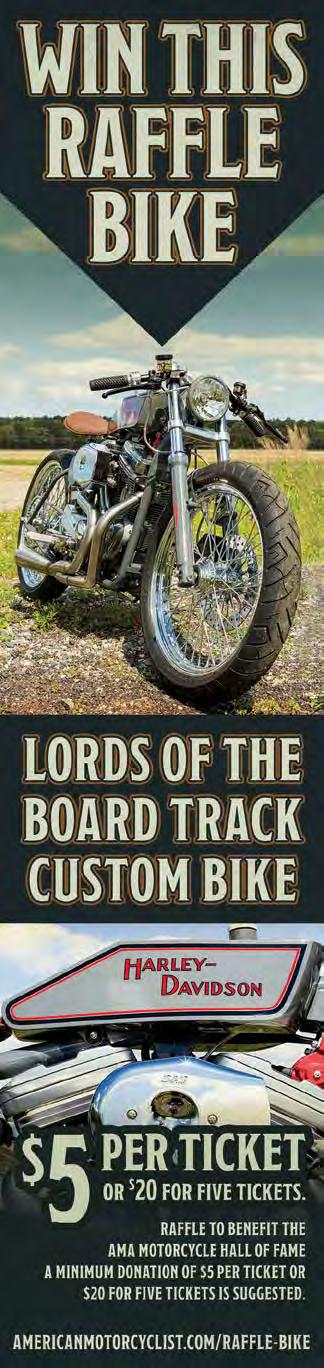

HALL OF FAME EVENTS AND EXHIBITS
AMA Motorcycle Hall Of Fame. americanmotorcyclist.com/hall-of-fame
The AMA Motorcycle Hall of Fame is on the AMA campus in Pickerington, Ohio, and is open 9 a.m. to 5 p.m. seven days a week. Closed: Easter, Thanksgiving, Christmas Eve, Christmas Day and New Year’s Day.
Main Hall: Now featuring the 2019 Hall of Fame inductees, the main floor celebrates the heroes of the track, road, trails and halls of government who have elevated the sport, business and lifestyle of motorcycling to new heights.
Founder’s Hall: Honoring the Hall of Fame’s generous contributors.
The Birth of a Hurricane: How Hall of Famer Craig Vetter reimagined BSA for an American market.
Sam Swope: Motorcycles that represent the generous, charitable giving of motorcyclist and philanthropist Sam Swope.
Lords of the Board Track: Board-track racing was one of the earliest formal motorcycleracing disciplines. It featured man and machine speeding around a simple wooden track while huge crowds cheered them on. Learn why this form of racing dropped from sight almost as quickly as it emerged. Learn about the racers who dared to compete in this exhilarating sport and watch a video of actual racing from 1921.

AMA Trademarks
The following represents active, registered trademarks, trademarks and service marks of American Motorcyclist Association, Inc. (AMA). Usage of any AMA trademark or registered trademark without our permission is prohibited. Please contact jholter@ ama-cycle.org for more information or assistance.
(800) AMA-JOIN® • AMA Dragbike® • AMA Endurocross®
AMA Motorhead® • AMA Pro Grand National Championship® AMA Pro Racing® • AMA Race Center™ • AMA Racer®
AMA Racing® • AMA Racing Land Speed Grand Championships®
AMA Supermoto® • AMA Supercross® • AMA SX Lites®
AMA U.S. ISDE Team™ • AMA U.S. Jr. Motocross Team™
AMA U.S. Motocross Team™ • Amateur National Motocross Championships® • American Motorcyclist Association® Arenacross® • ATV Hare Scrambles National Championship Series® • ATV Motocross National Championship Series® Flat Track Grand Championships™ • Grand National Enduro Championship® • Gypsy Tour® Hare & Hound National Championship Series® • Hare Scrambles Championship Series® Hare Scrambles National Championship Series® • Kids Just Want To Ride® • Motorcycle Hall of Fame® • Motorcycle Hall of Fame Museum® • Motorcyclist of the Year® • Motostars® • National Adventure Riding Series® • National Dual-Sport Series® National Enduro Championship Series® • Protect Your Right to Ride® • Protecting Your Right to Ride® • Ride Straight® Rights. Riding. Racing.® • Road Race Grand Championships® Vintage Grand Championships® • Vintage Motorcycle Days® Vote Like A Motorcyclist®
LIVING MY DREAM
By Lisa Scoppettuolo
My love affair with motorcycles started when I turned 10. I was allowed to choose any bicycle in the store for my birthday, and when I saw that red bike that looked just like a motorcycle, I knew I’d found the best present ever.
Through the years I enjoyed seeing others ride, but my own motorcycle journey didn’t begin until the summer of 2016. While working at a post office I spoke to my coworker Bill Morgan and mentioned I’d longed to learn how to ride a motorcycle. Next thing I knew he was regaling me with tales of racing dirt bikes.
“You get the bike, and I’ll teach you,” he told me.
I purchased a Yamaha XT250, a dualsport I could ride both on and off road. I didn’t know that much about different motorcycles at that point, but I loved that the bike was blue and white…my favorite colors.
Bill took me to Extreme Machines, a motorcycle shop, and got me all geared up, insisting I get a helmet that was DOT approved. He also helped me pick out gloves, a chest protector, shoulder pads, knee protectors and, of course, motocross boots.
My first lesson was in his yard, and as with anything, you’ve gotta practice.
The first five times on the bike, I fell. But I dusted myself off and got back on. Eventually I could stay on that bike, and by the next day I was more comfortable zipping around Bill’s lawn.
I noticed he had a little hill in his yard and just couldn’t resist. I turned the bike toward the hill, picked up some speed and went over it. Bill looked at me in amazement, gave me a thumbsup and asked, “Have you ever thought about racing?”
I hadn’t, but it sure sounded like fun. And that was the start of a beautiful friendship. Bill took me to the races, including Budds Creek, Unadilla and Motocross of Nations, to name a few. I fell in love with the sport, but sadly, Bill passed away.
Later, I met another coworker — Bob Wallace — who loved racing dirt bikes and owned a Husqvarna shop. After chatting about our mutual love for two wheels, he offered me a place to practice
and gave me a lot of guidance and support. Through him I was recently able to purchase a Husqvarna TE 150 dirt bike with electric start.
I definitely need more practice before I start racing, but I’m used to overcoming obstacles. Born with a severe learning disability, I was told I may never achieve academic success, but I proved everyone wrong, graduating high school and college with honors. While they said my perception problems might keep me from driving a car, I now ride a motorcycle and love the thrill of flying over hills.
Today, it feels like I’m living a dream! As a child, I envisioned wearing a helmet and gear and speeding off, and that dream has become a reality.
I’ve always loved writing, and wanted to write a book. And going to the races inspired me to write my first children’s book. It’s titled Straight Off the Gate, and is a story about dirt bikes and other types of motorcycles.
To inspire others with my journey, I even created a documentary called Unscoppable, and it’s currently available on YouTube. (youtu.be/VnqQHU4ARac)
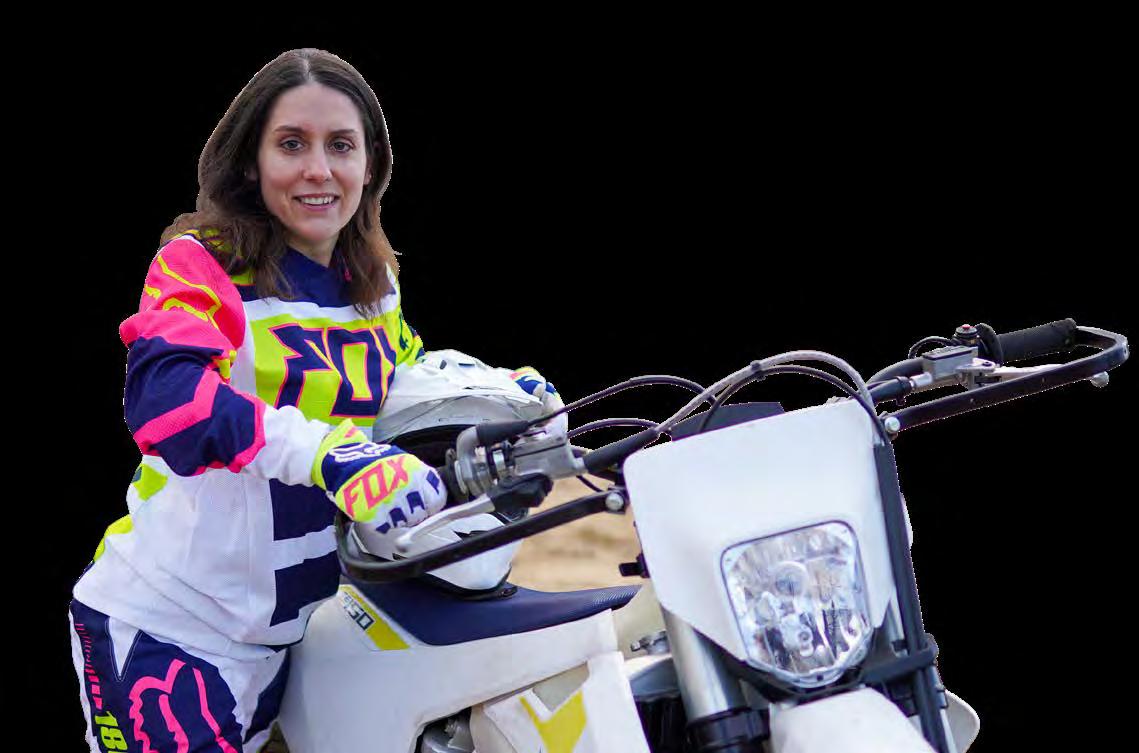
I’m so thankful Bill taught me to ride. Riding taught me perseverance, determination and hard work. But most important, it taught me to go after my dreams!
Lisa Scoppettuolo is an AMA member from Monroe Township, N.J.
Marty Smith
Gone, but not forgotten
By Mitch Boehm
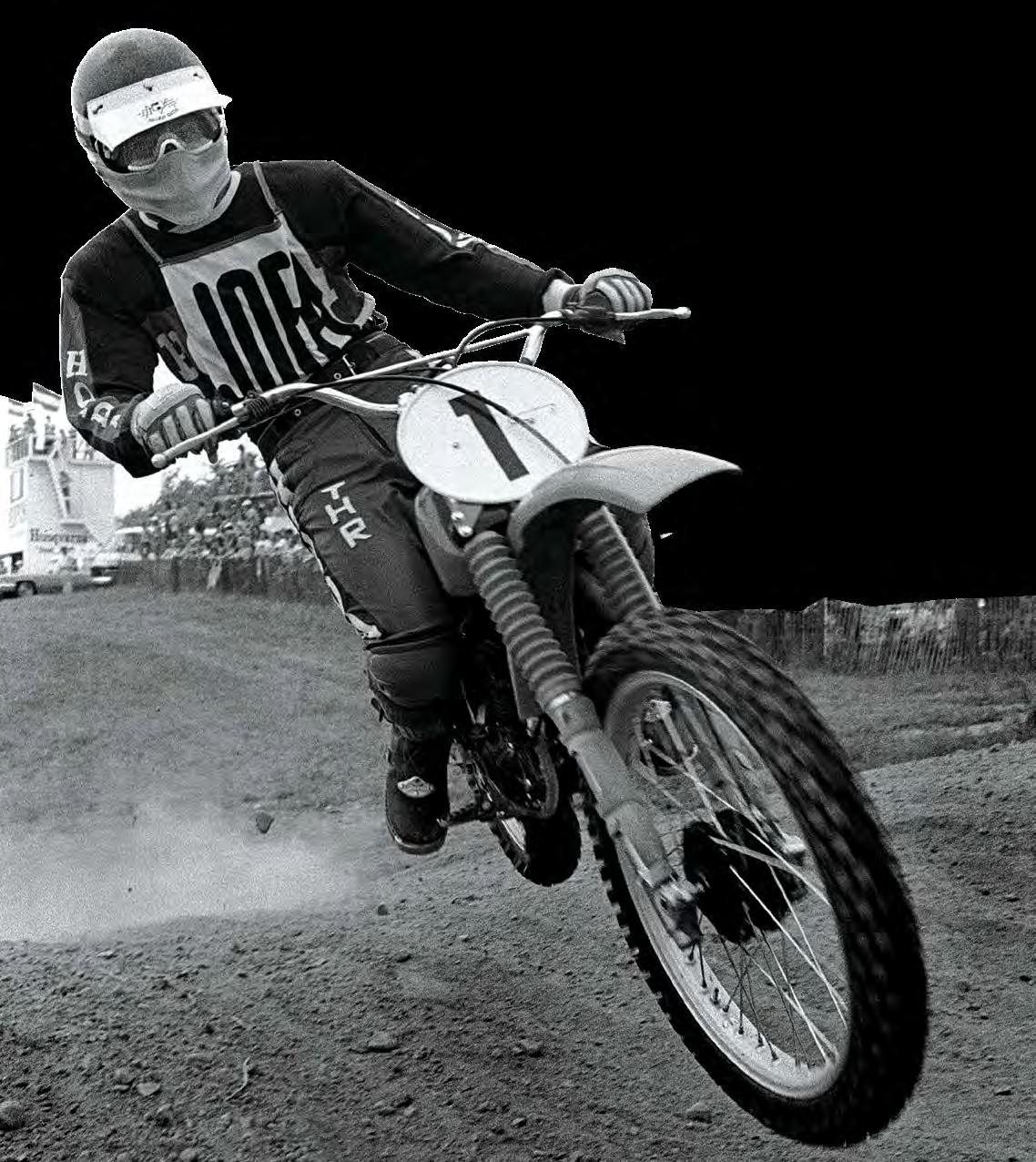
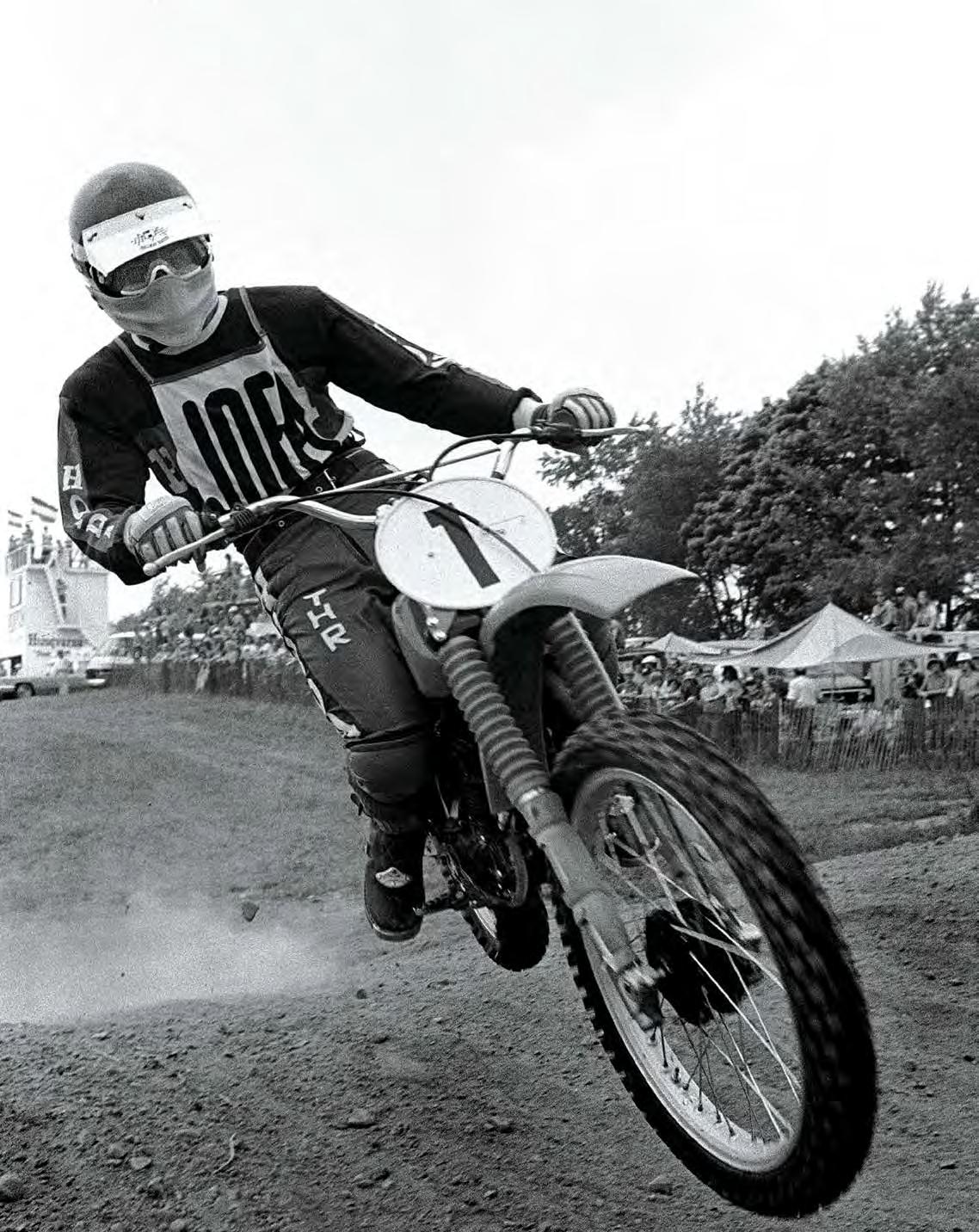
Charlie Morey

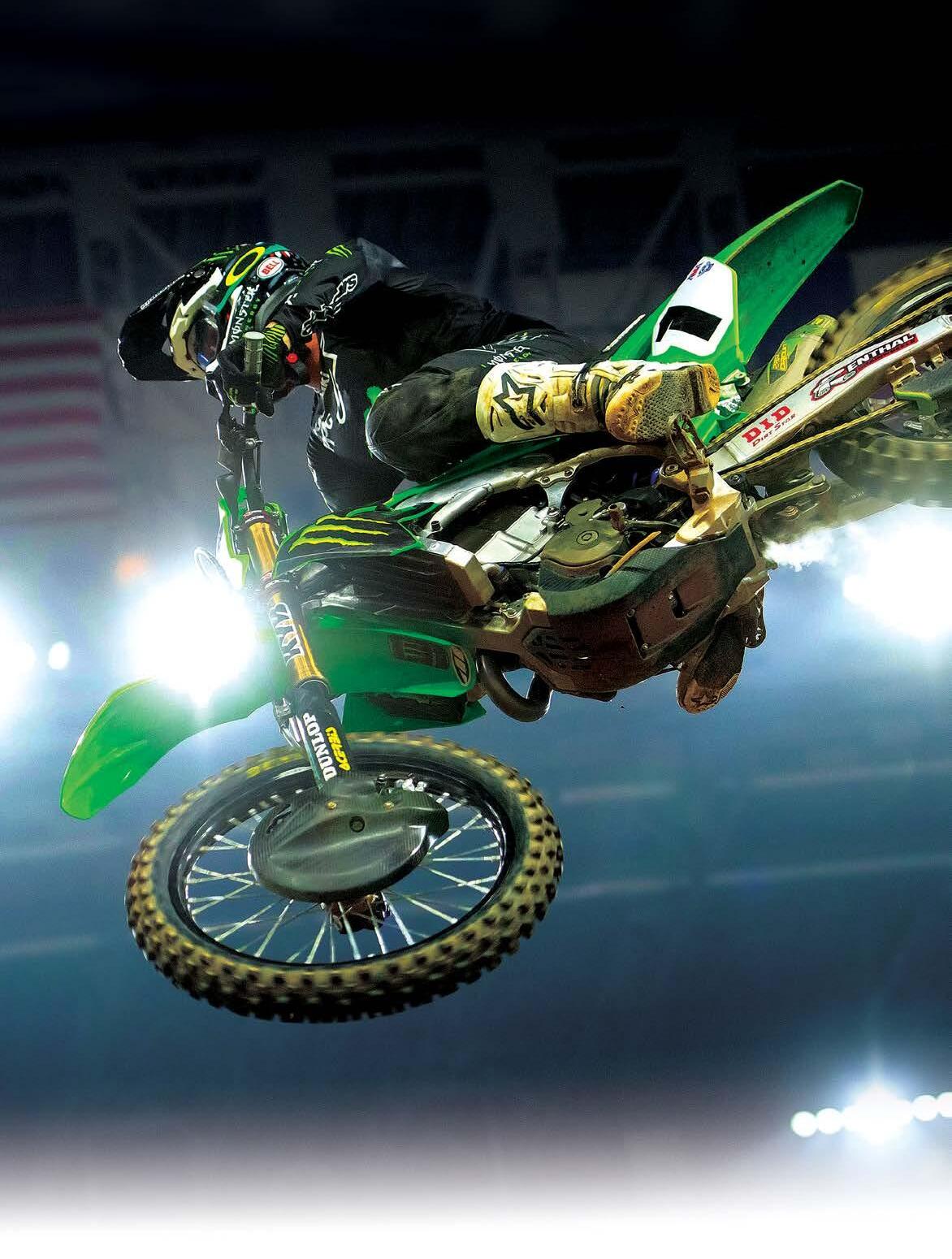

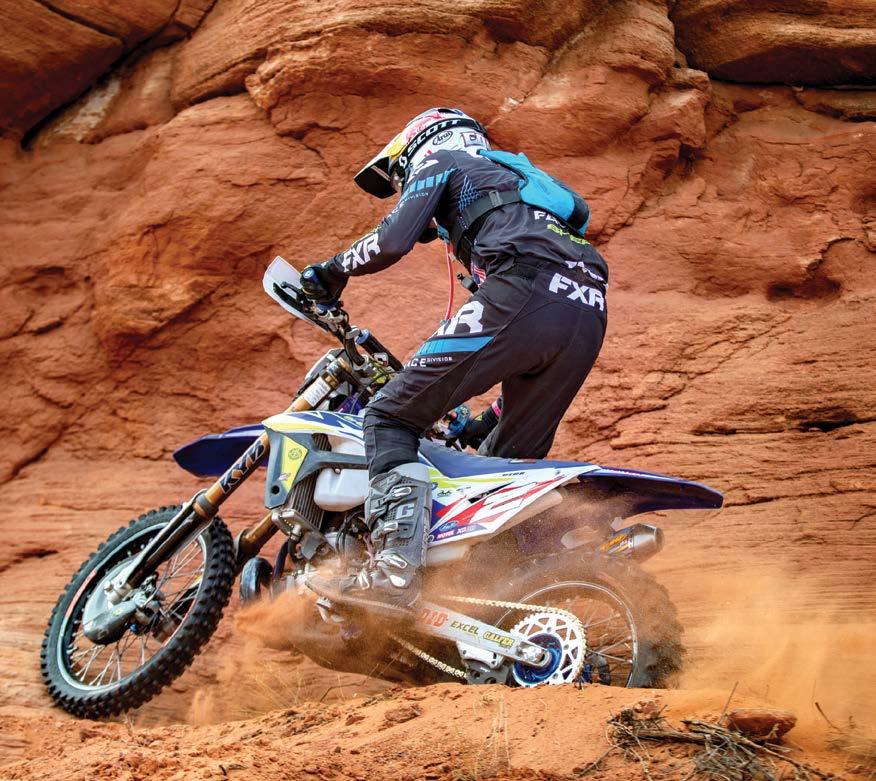
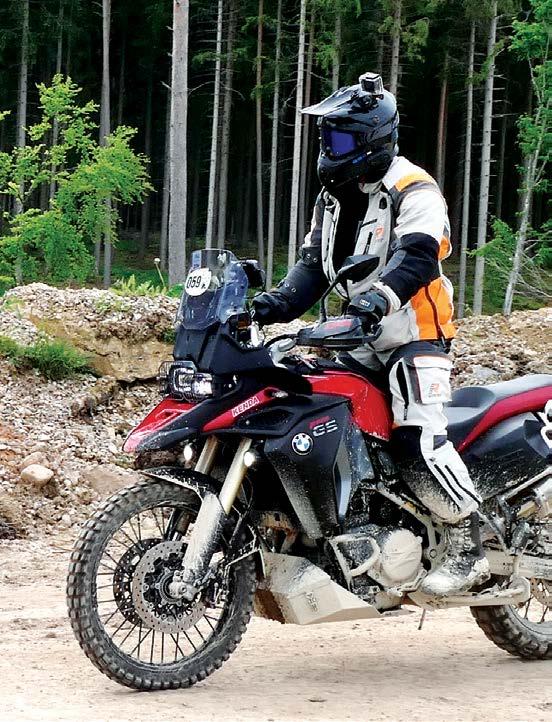
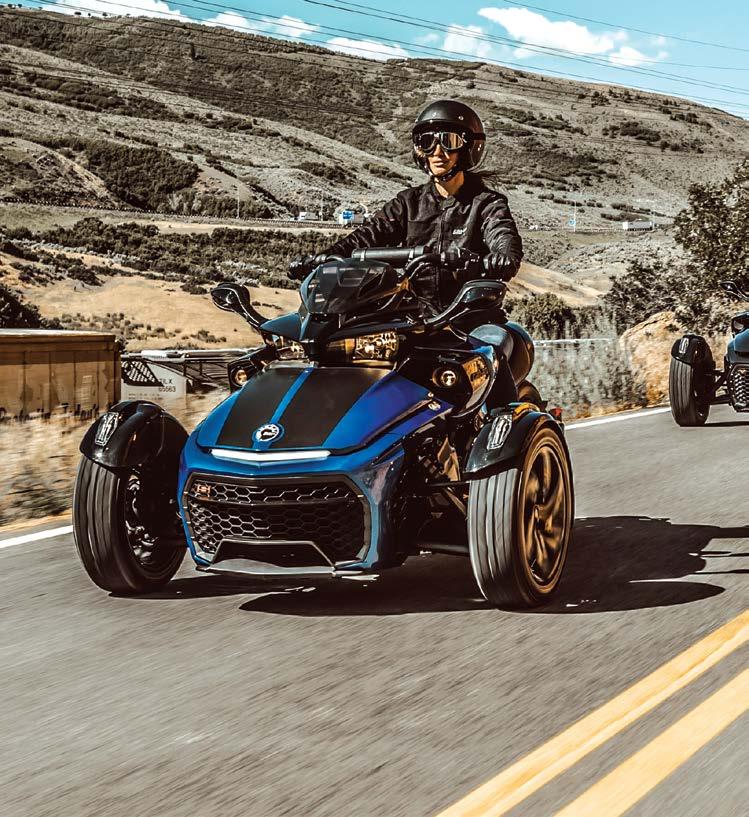
TRACTION FOR ALL