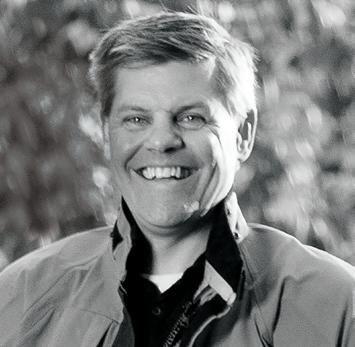
AMA President and CEO Rob Dingman on MOTY and the AMA’s 100th anniversary
10 BACKFIRES
Membership feedback on recent issues
12 BACK IN THE DAY
Where the photos are blurry but the memories are clear!
14 RIGHTS REFRESH
A look back and forward in government relations
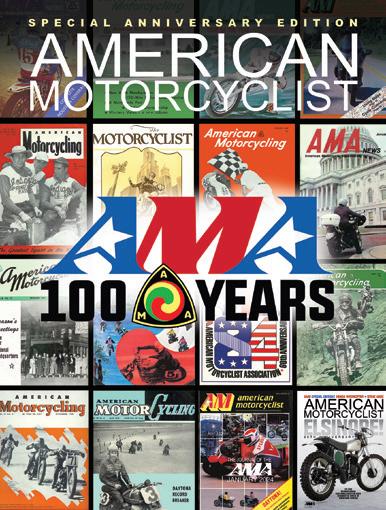
20 COVER STORY: 100 YEARS OF THE AMA
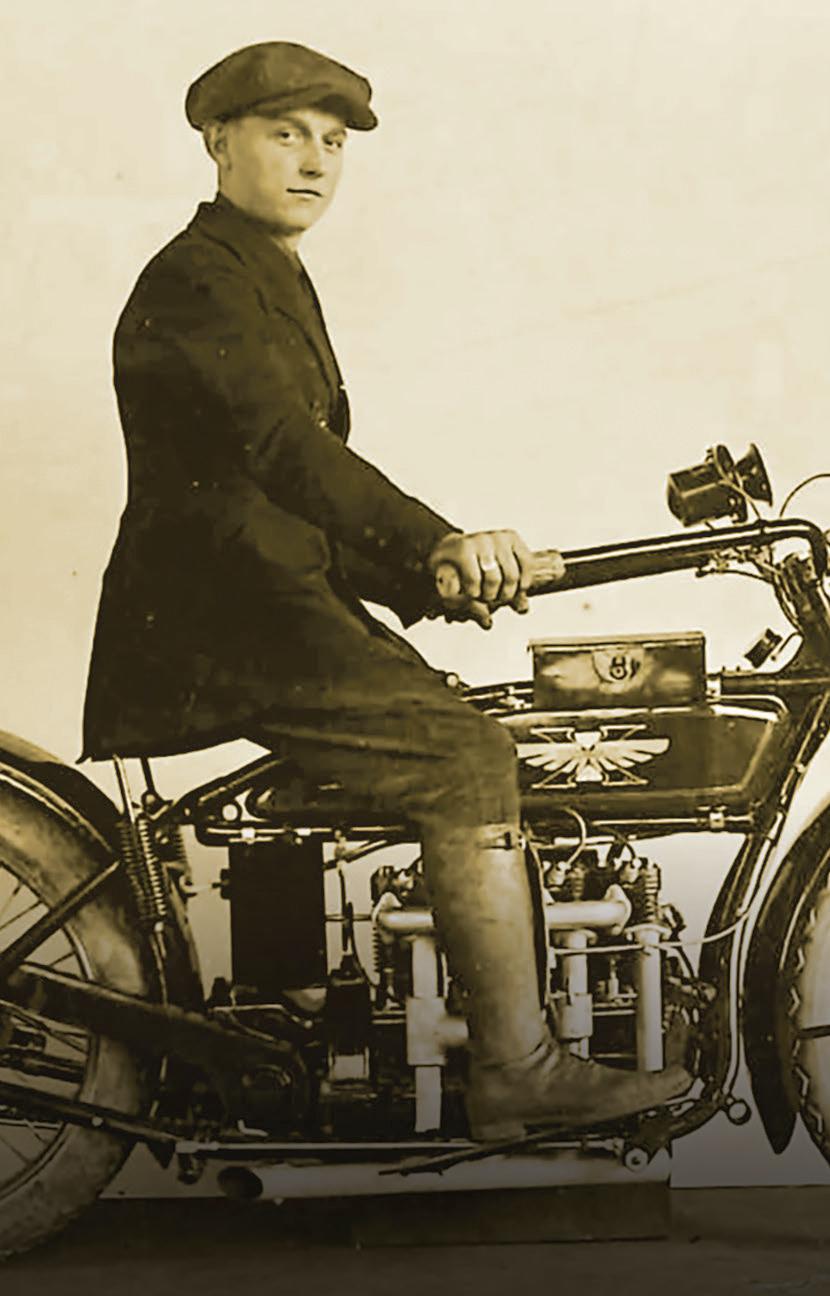
Setting the stage for our organization, from the 1860s to the 1920s
40 TO THE END OF THE WORLD
…AND BACK! PART II
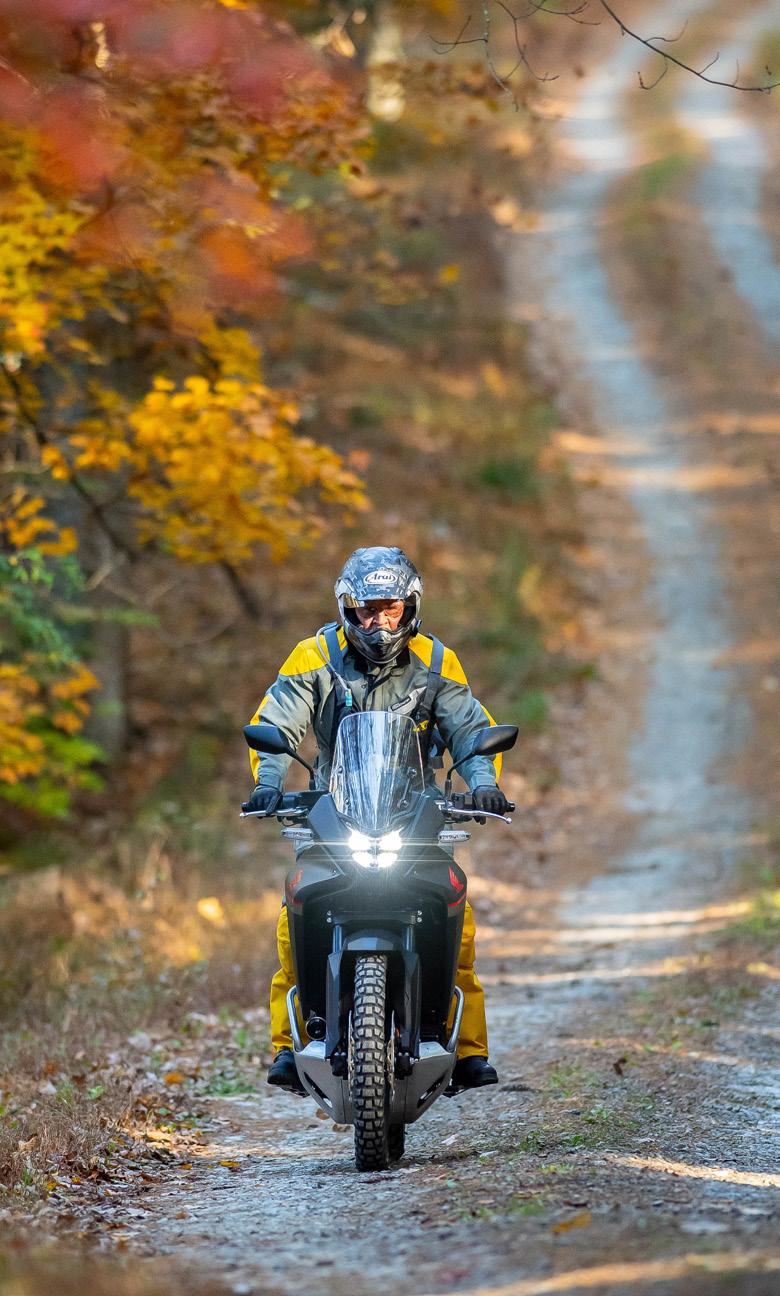
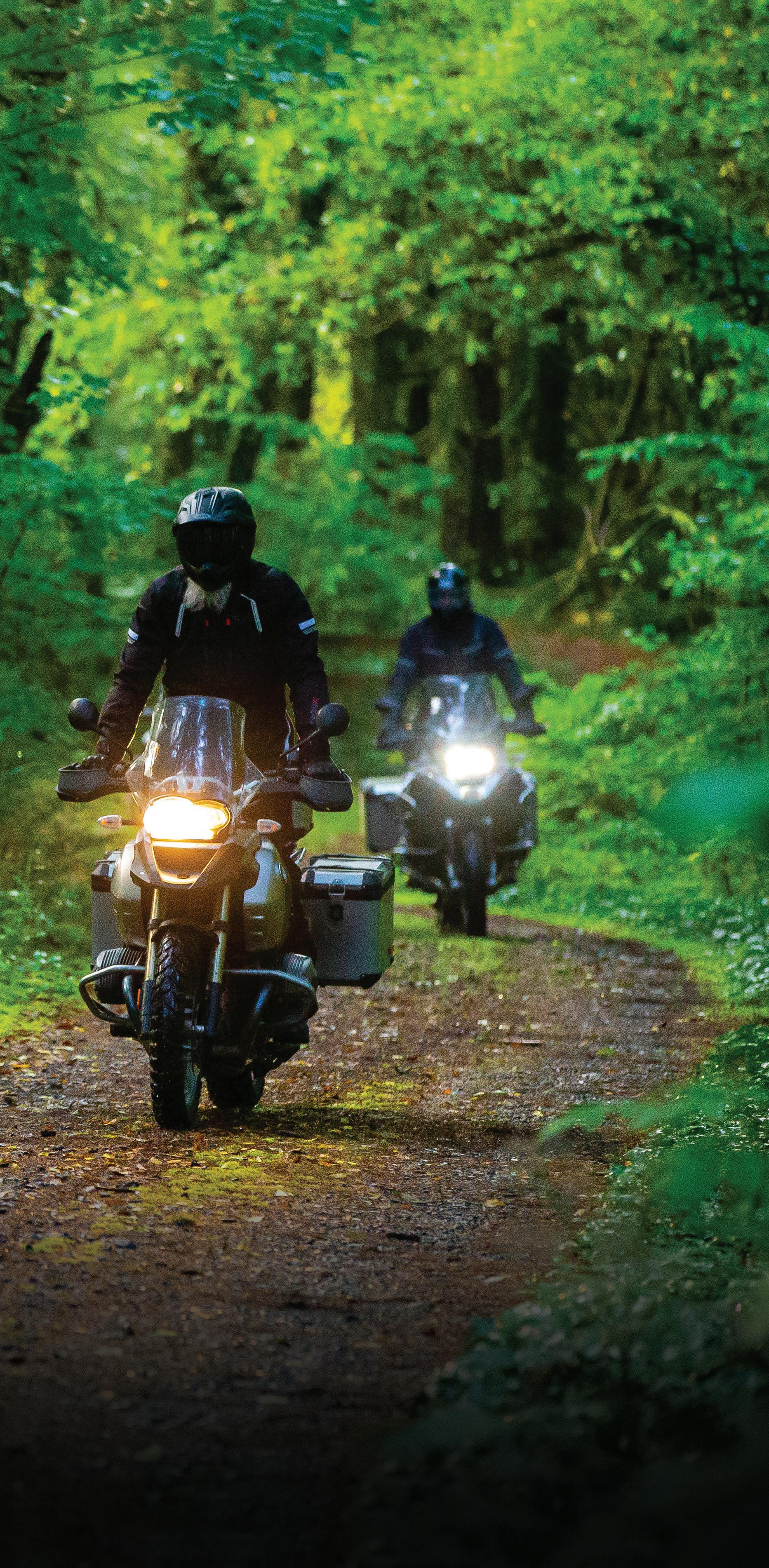
One very big continental adventure on one very small adventure bike
52 2023 AMA MOTORCYCLIST OF THE YEAR
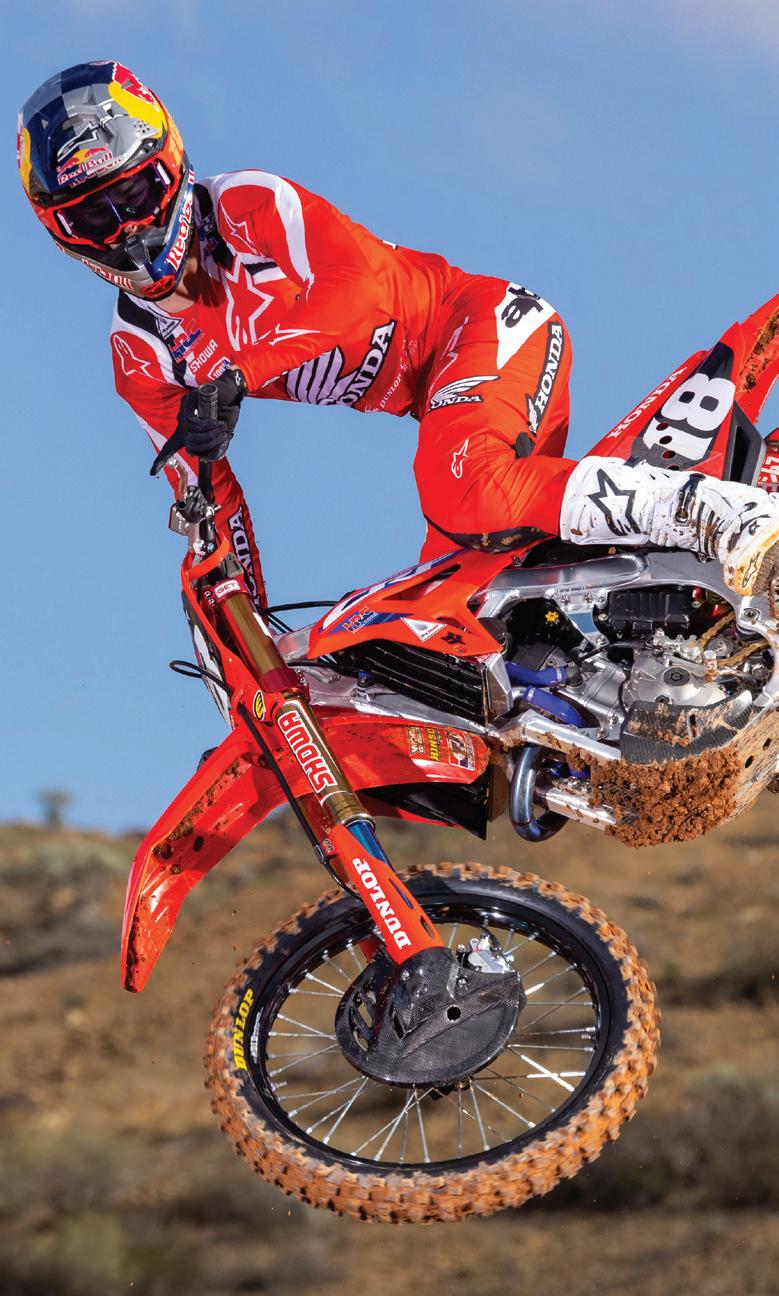
From AMA Supercross to the outdoor Nationals, Jett Lawrence did it all in 2023
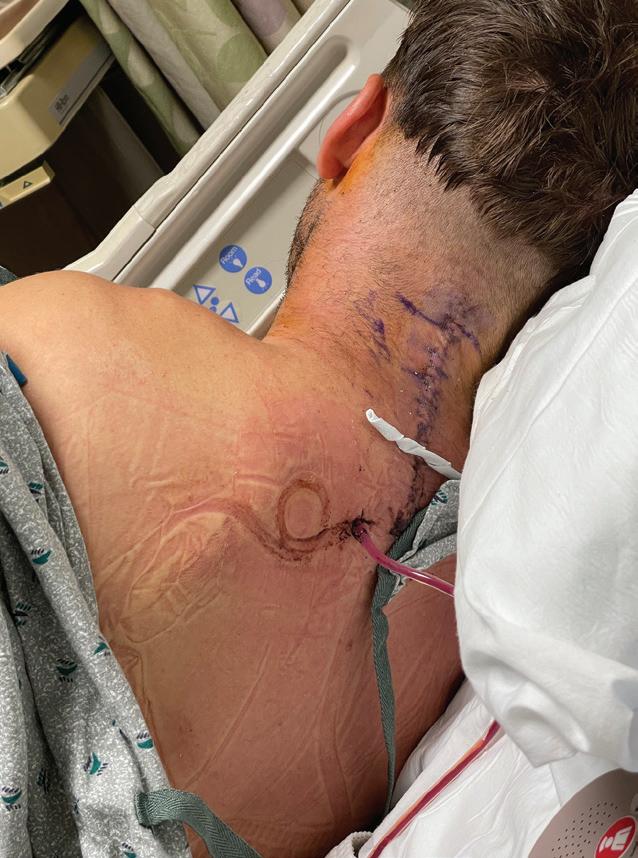
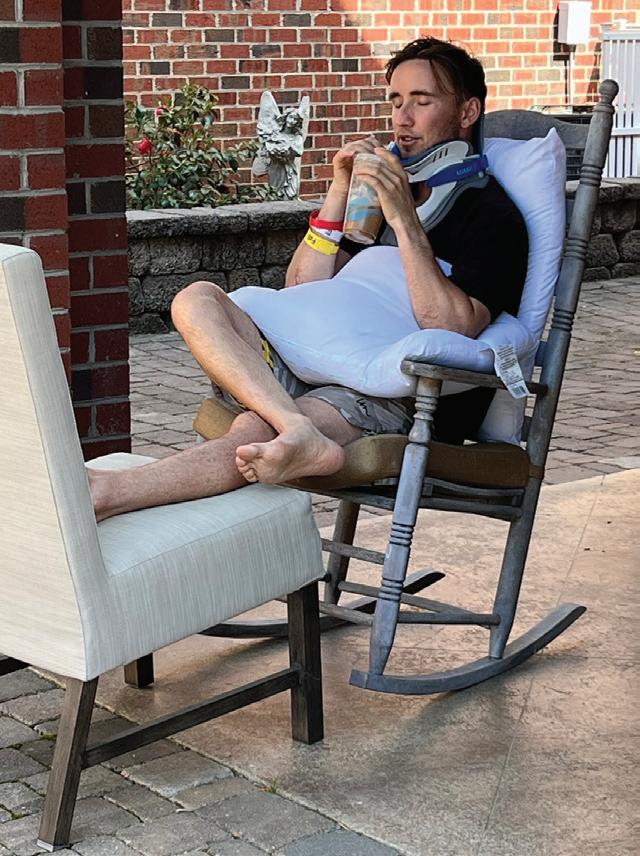
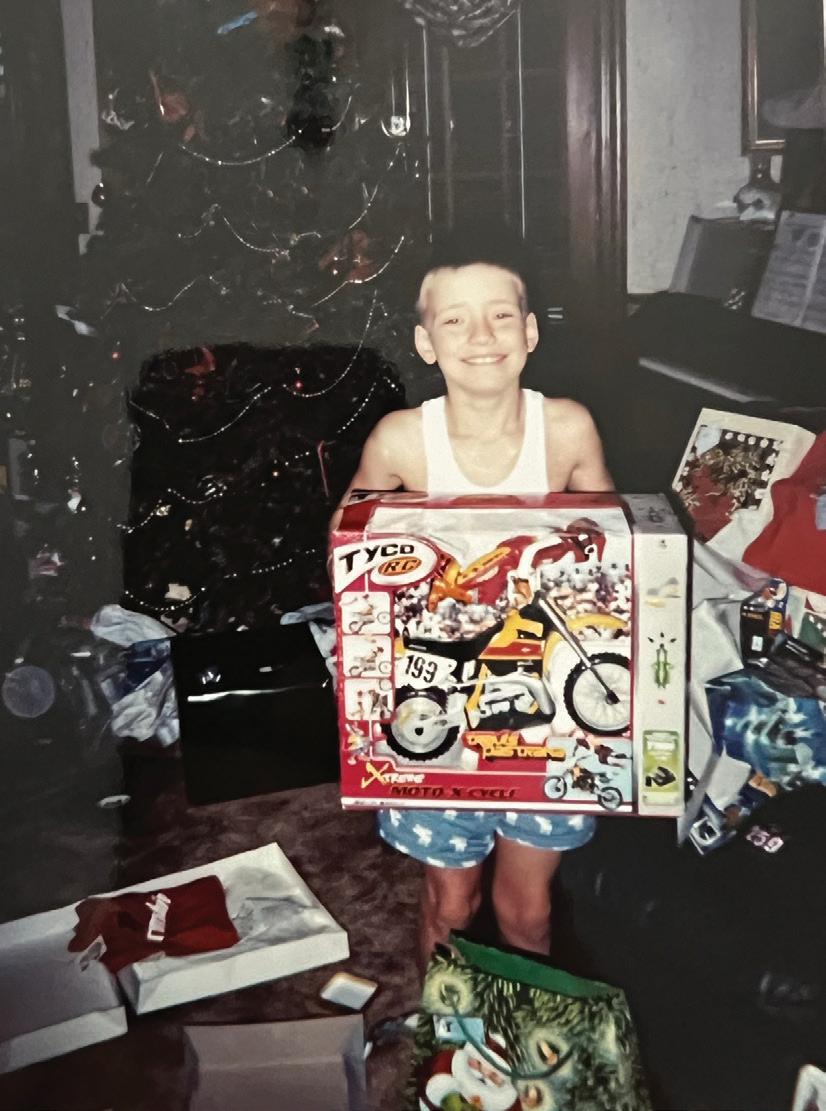
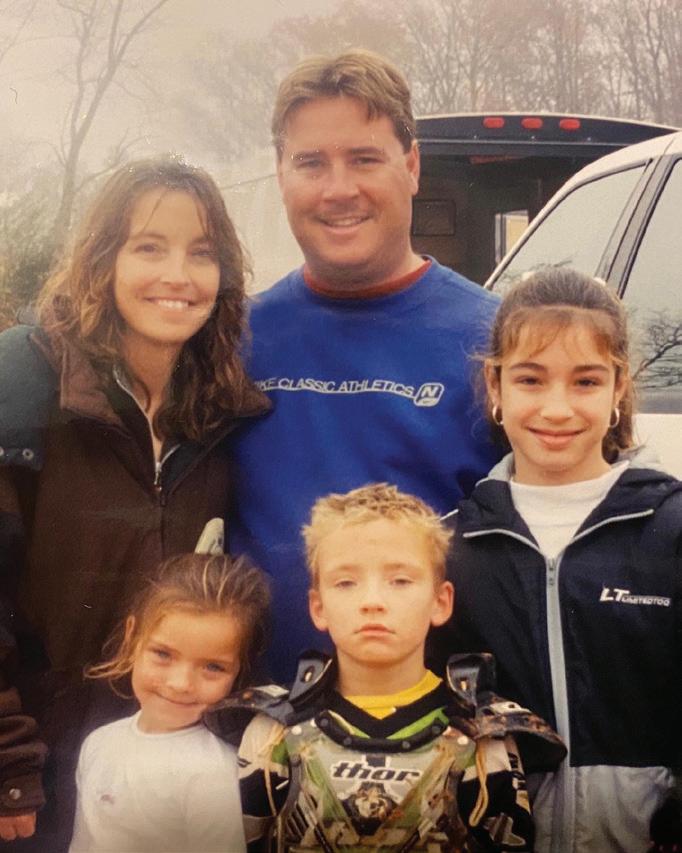
58 THE COMEBACK KID
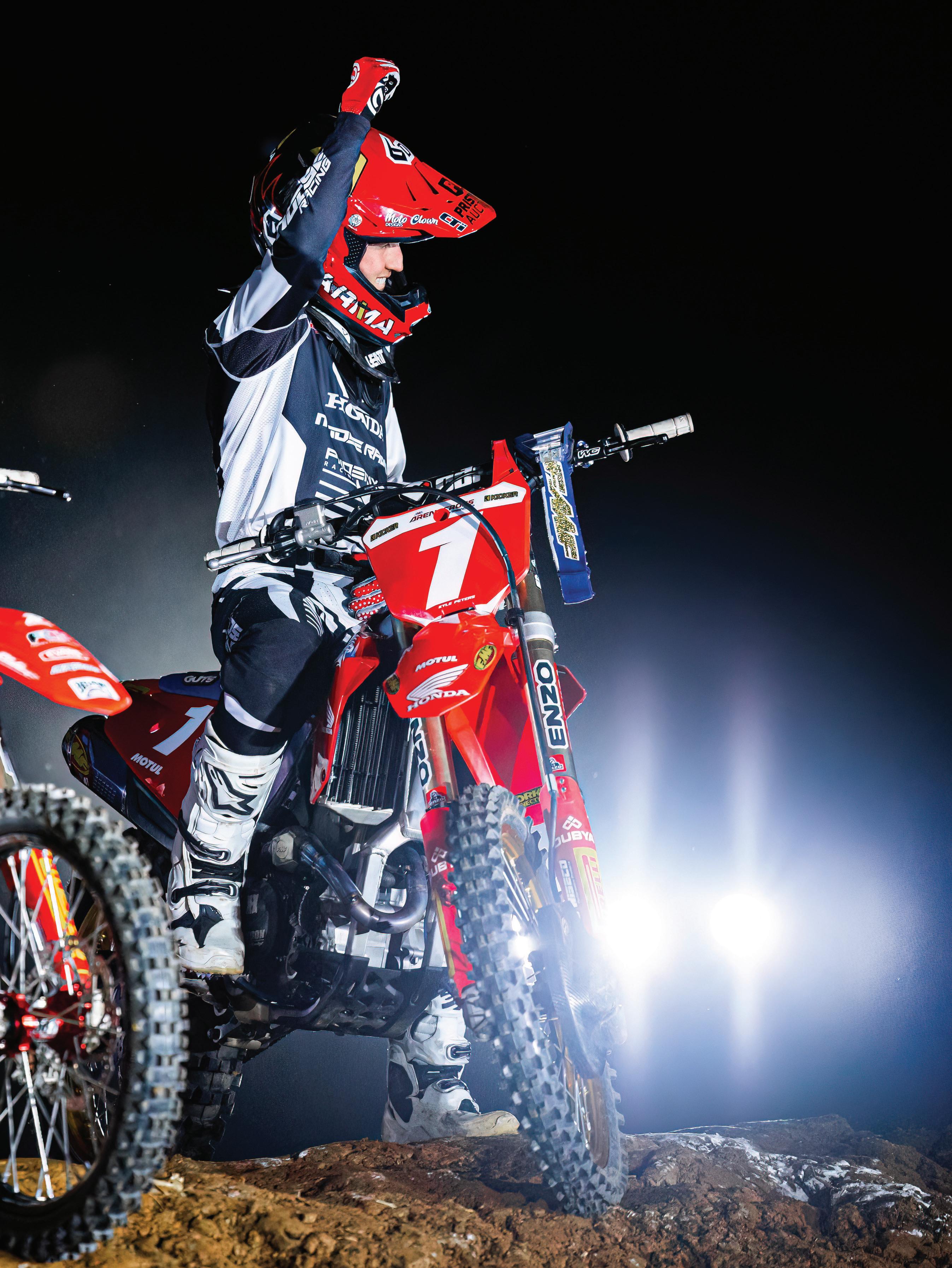
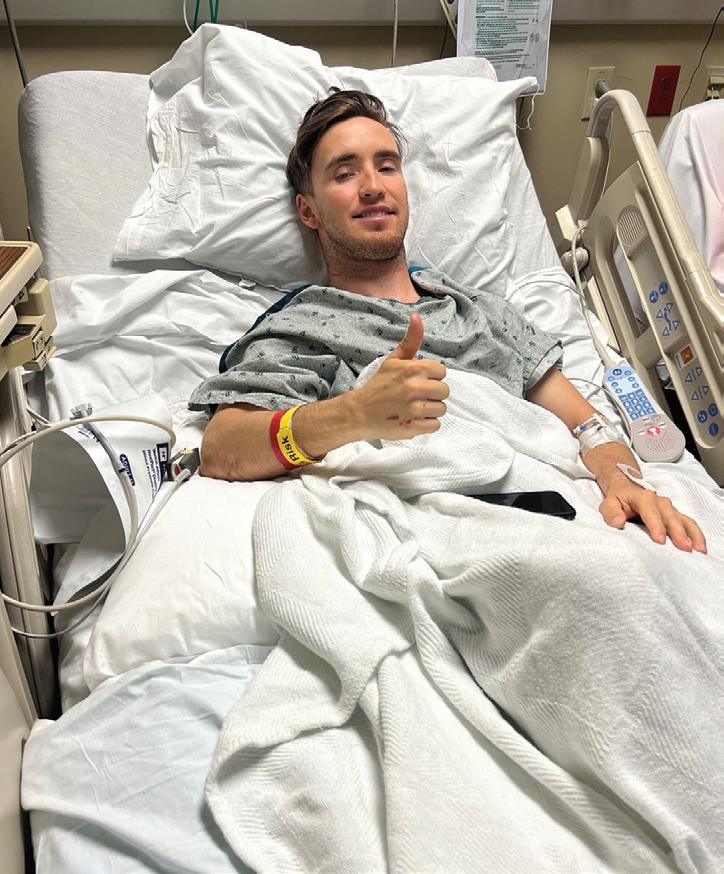
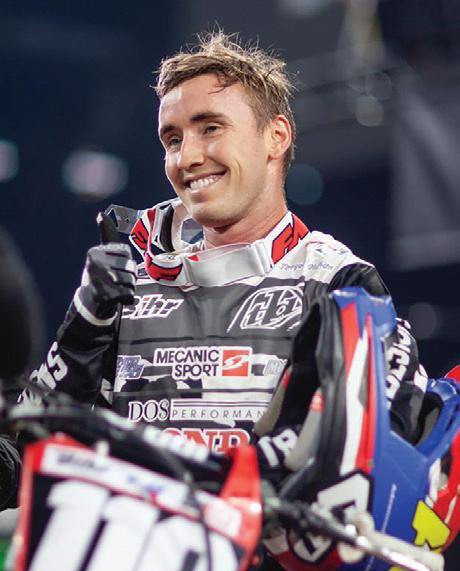
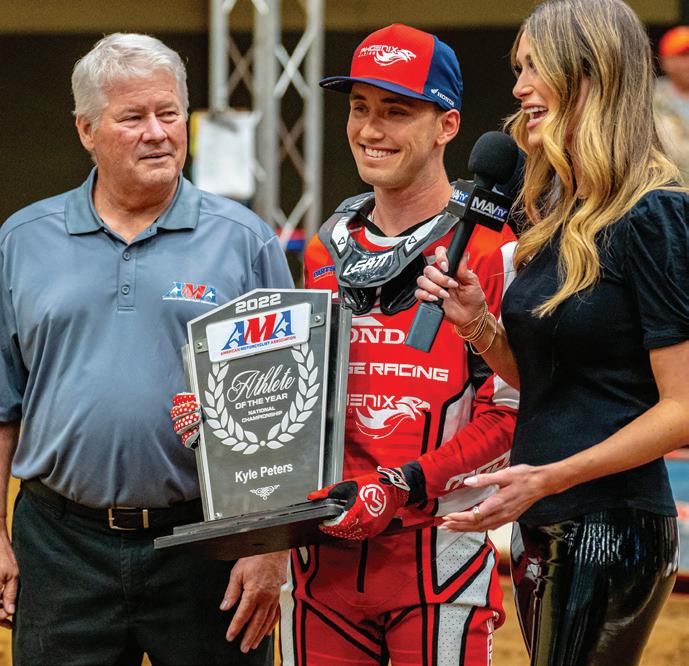
After an ugly injury, AMA Arenacross champ Kyle Peters rebounded big-time
70 AMA GARAGE
Tips, tweaks, fixes and facts: The motorcycle ownership experience, explained
74 AMA BEHIND THE SCENES
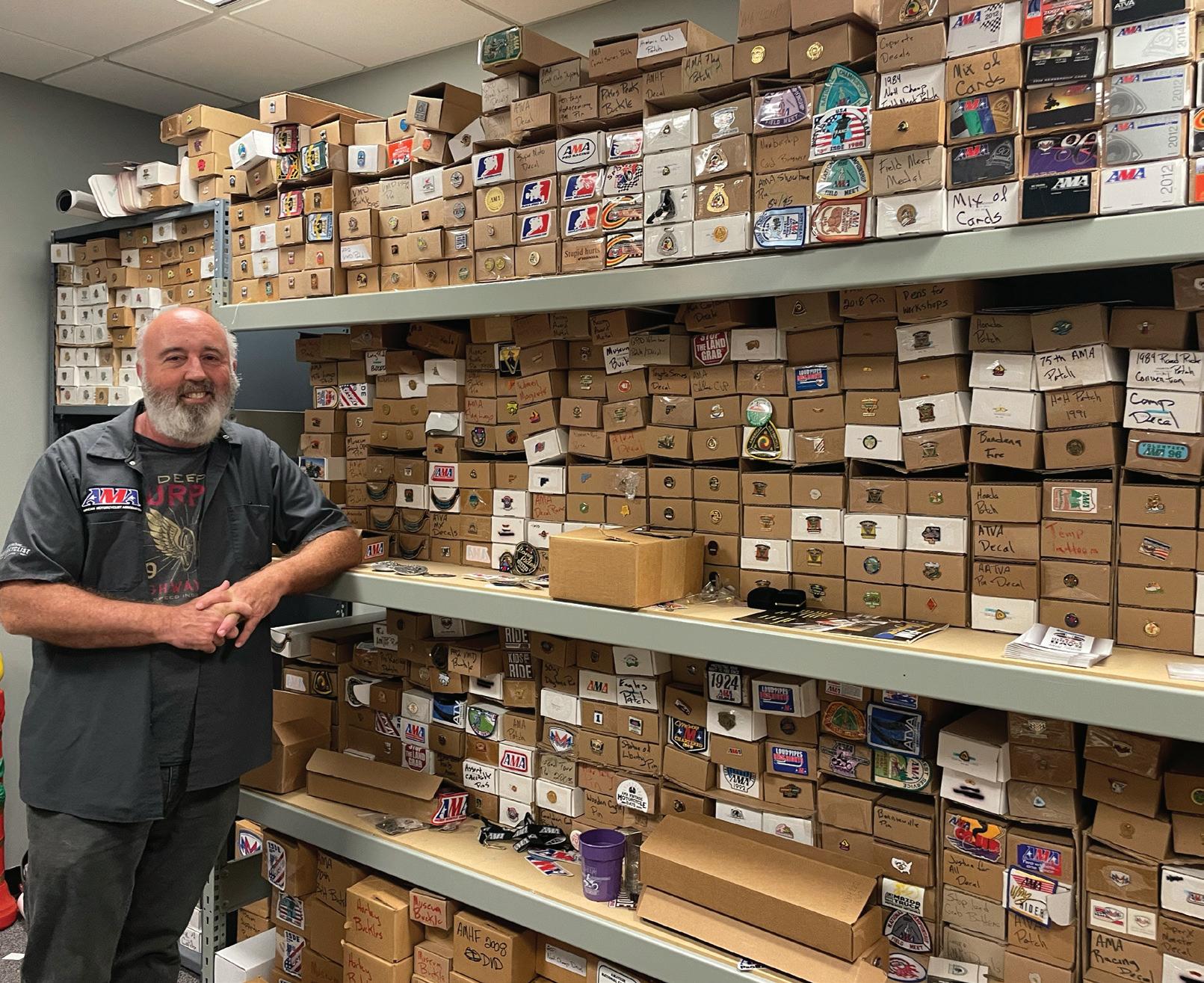
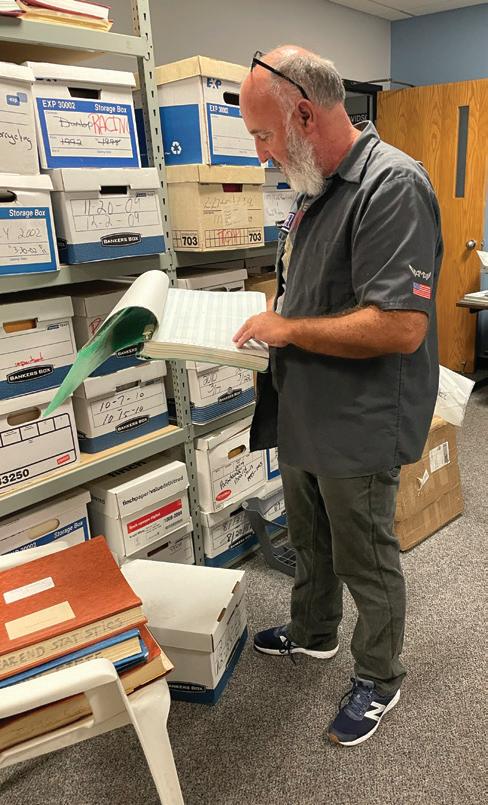
Meet John Bricker, the AMA’s de-facto historian
ON THE COVER:
Centennial celebrations are truly special occurrences, and the AMA’s 100th birthday in 2024 is no different. This month we feature the very roots of the AMA. In doing so we chart the advent of the sport of motorcycling itself, from the rise of steam- and internal-combustion engines to the creation of bicycles…and the inevitable mixing of both.
THE AMA LEADS THE WAY TO PROMOTE AND PROTECT MOTORCYCLING — AND WITH OUR BUSINESS MEMBER PROGRAM, TO HELP YOUR BUSINESS THRIVE.
u Exposure in American Motorcyclist magazine
u Discounted ad rates
u Board position availability
u Consumer data from AMA member surveys
u Updates on Government Relations activities
u AMA reports from events and consumer activities
u AMA newsletters
u Magazine copies for company, dealership, etc.
u And more!
“For over half a century, Kawasaki has supported the AMA’s mission to promote, preserve and grow the motorcycle industry. As a supporting Business Member, Kawasaki works together with the AMA to help build a bright future for motorcyclists, including safety, legislation for rider rights and land use, promoting riding and racing, and supporting the heritage of the AMA Hall of Fame. Supporting the AMA is essential to preserving the positive growth of motorcycling and the powersports industry.”
—Eigo Konya, President & CEO Kawasaki Motors Corp., U.S.A.
Apply here https://form.jotform.com/amatech/business-member-app For more information contact Michael Kula at mkula@ama-cycle.org • (949) 466-7833 or Alex Boehm at aboehm@ama-cycle.org • (310) 662-1724
Like a lot of Boomers, I don’t spend a lot of time on social media, and for a whole bunch of reasons.
But once in a while I am forced to log on for some work-related or family stuff, and the other day stumbled onto a conversation about AMA benefits I found interesting.
A gentleman had asked about specific benefits the AMA offered, and the answers he got were pretty spot-on. One guy mentioned discounts on accessories, event tickets, bike shipping, rentals, performance parts and the like, and based simply on the substantial cost-savings potential there, one could completely pay for his or her entire AMA membership each year with a single large purchase, or at least a few smaller ones.
The company partners listed in the magazine or online [AmericanMotorcyclist.com/deals-and-discounts] and the products and services they offer are pretty impressive. You’re gonna buy that gear or part or those event tickets anyway, right? You might as well pay for your AMA membership while you’re at it…and then keep on saving money. Total no brainer.
Another gent posted that American Motorcyclist magazine — another primary AMA benefit — has gotten “really good” of late, and I couldn’t agree more, though I might be a bit biased. Our goal for the last few years has been to offer a thoroughly informative and entertaining read each month, one melding current events, historical features, touring stories, AMA-centric elements, thoughtful columns, important government relations information and much more.
We can’t please everyone, and we hear about it when we don’t, but we’re trying to give folks what I call the
PERSPECTIVES BENEFITS ’R’ US
BY MITCH BOEHM
traditional moto-magazine experience that’s gone mostly missing in internet-based storytelling. Many members tell me they’ve gone from leafing through the magazine and tossing it, to waiting impatiently for it to drop into the mailbox. That’s a seismic shift.
AMA membership also gives enthusiasts access to AMA-sanctioned amateur racing all over the country, on dirt, asphalt and ice, and there’s similar access for all sorts of recreational
for their yearly dues of 50 cents.
Some riders seem to be under the impression that the M&ATA should confer all sorts of benefits on its members without any cooperation on their part. They [think] the 50-cent registration fee, which hardly pays the postage on the mail they receive from the Chariman, should pay for everything from legal assistance when arrested for speeding to theft, accident and life insurance, and everything in between. The M&ATA
AMA MEMBERSHIP ALSO GIVES ENTHUSIASTS ACCESS TO AMA-SANCTIONED AMATEUR RACING AND
RECREATIONAL RIDES AND EVENTS ALL OVER THE COUNTRY...AND THEN THERE ARE OUR GOVERNMENT RELATIONS EFFORTS, WHICH HAVE PROVEN MONUMENTALLY IMPORTANT OVER THE YEARS, BUT WHICH DON’T ALWAYS GET THE EXPOSURE AND GRATITUDE THEY DESERVE.
rides and events. And then there are our government relations efforts, which are substantial and have proven monumentally important over the years, but which don’t always get the exposure and gratitude they deserve.
Over and above all this, however, is the intangible/altruistic value that comes from being part of the world’s largest motorcycle-oriented member organization. With membership you are supporting the entire industry, from advertisers in our pages and at our events, to our aforementioned government-relations efforts, to local and regional event, recreation and competition promoters and clubs, all of whom organize things for us to do and enjoy on our motorcycles.
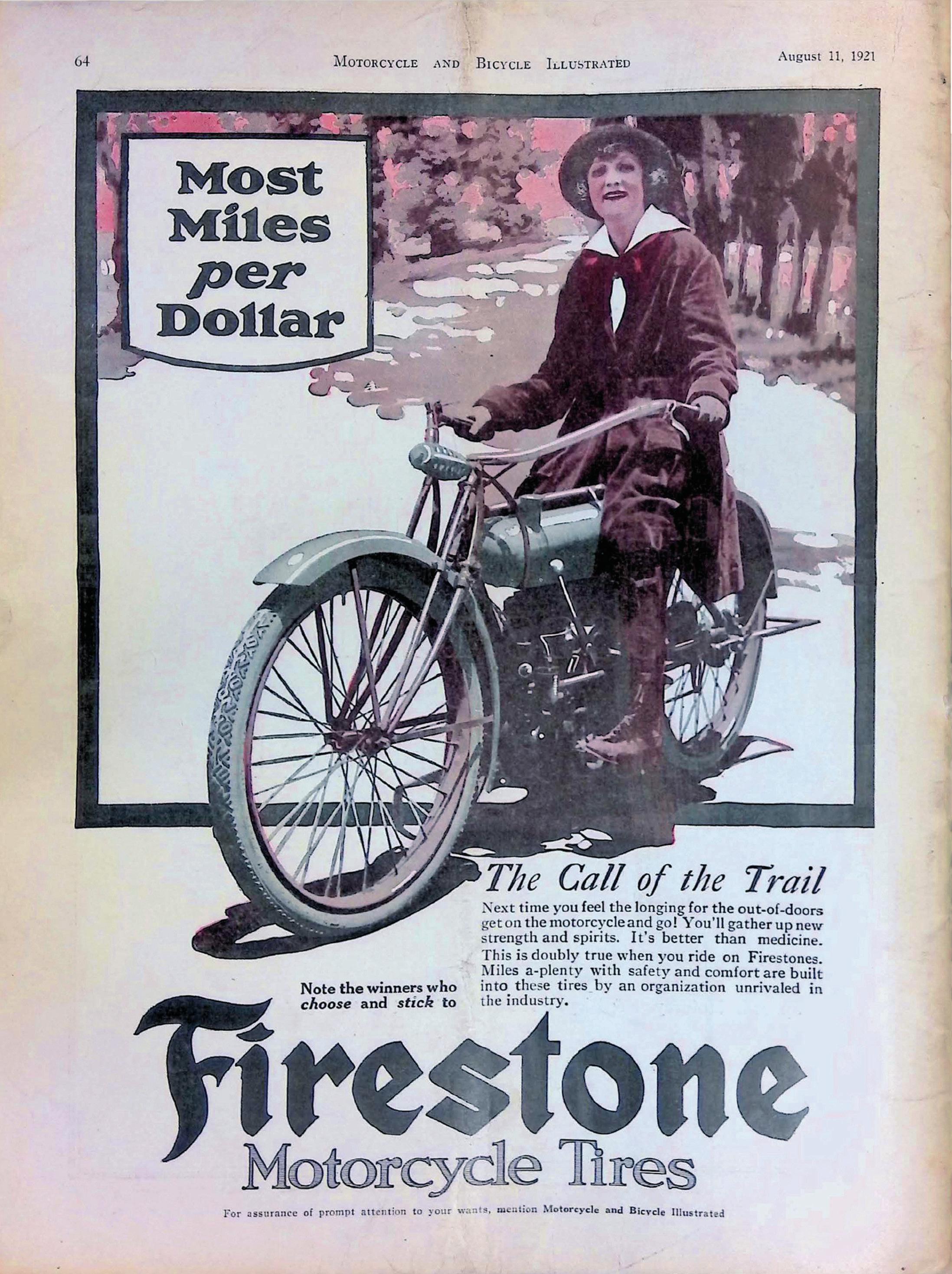
In September of 1923, less than a year before the AMA was created by the M&ATA (Motorcycle and Allied Trades Association), Bicycle and Motorcycle Illustrated magazine editors wrote the following about folks asking about what benefits they could expect
really is a benefit association, but it is a mutual benefit, and this means the obligation is mutual. Every member benefits in proportion to the service he or she renders. Among the things every rider may do to help are to observe the rules of the road, consider the rights of others, dress neatly, act like a gentleman and always respond when asked in combating adverse legislation. Do your share and you won’t have to ask, ‘what do I get for my fifty cents?’
Quaint and old-fashioned, for sure, but true nonetheless, and it’s something I think every one of you understand— and the AMA thanks you for your support! If you’ll spread the word among friends and fellow riders, all the better. Because as Joy Burgess wrote in her column last month, we are definitely stronger together.
Mitch Boehm is the Editorial Director of the AMA and a long-time member.
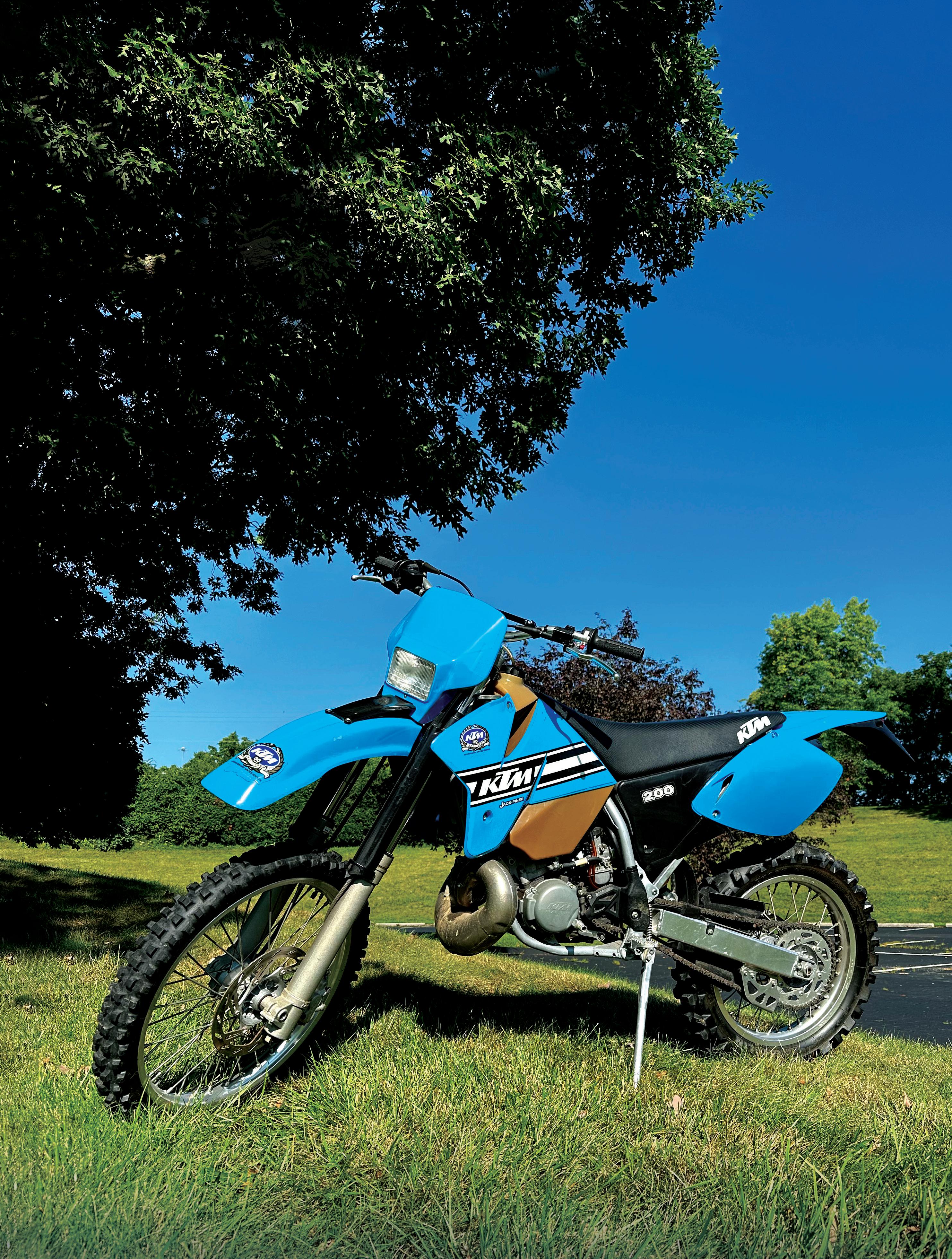
Feeling lucky? Looking to win a true two-wheeled legend? This special-edition, 1997-spec KTM 200 Jackpiner raffle bike — built to celebrate the 30th anniversary of the first Penton motorcycles sold back in the late 1960s and named after the Penton 175 that used the first full-sized engine KTM built — will absolutely do the trick. Only 133 were built, and to make the package even more special, each is numbered and has a John Penton-signed sticker on the front fender. Get your tickets — $5 per, or 5 for $20.
Something I find myself saying frequently is that if the AMA did not exist, it would have to be invented. That appears to have been the sentiment 100 years ago when the AMA was first formed from the Motorcycle & Allied Trades Association’s Competition Committee that was established in 1919 to make rules and regulations necessary for the proper control of motorcycle competition in the United States.
In the wake of the demise of the original motorcycle organization—the Federation of American Motorcyclists (FAM) — the M&ATA had already been registering clubs to share information about motorcycle events and activities, and rider registration became an integral component of the Committee’s work. It was envisioned at the time that the system of rider registration would provide the basis for a strong riders’ association. These efforts would eventually give way in 1924 to the creation of the American Motorcycle Association.
The American Motorcycle Association, by the way, is the official name of the organization. The American Motorcyclist Association was created as a DBA years later to reflect the fact that the organization is comprised of and run by motorcyclists!
When I joined the AMA as a member in 1994, the AMA was celebrating its 70th anniversary. I joined the AMA staff as the Association’s Washington representative that same year. It is hard to believe that was 30 years ago. I left the AMA staff in 1998 and returned in the fall of 2006 as AMA president, and became president and CEO in the spring of 2007. I have served on the staff for over 20 years and been a member for over 30 years.
From the President and CEO SPECIAL MOMENTS AND MOTORCYCLISTS
BY ROB DINGMAN
This means that I have been a part of the organization for nearly a third of its existence, and been a part of guiding the association for 20 percent of it.
I have spent a significant portion of my adult life as part of this great organization. As we celebrate this 100year milestone in the coming months, I hope to elaborate more on my involvement with the organization and what it has meant to me over the years.
You can read more about the AMA’s origins and its history on page 20 of this issue, and in upcoming issues throughout 2024.
It seems that over the last few years the most significant accomplishments in motorcycling have been achieved by racers, or at least those involved in some facet of motorcycle racing.
Being recognized as the AMA Motorcyclist of the Year is not necessarily intended to recognize racers per se, but the achievements of several racers over the last few years have been so significant that they could not be ignored.
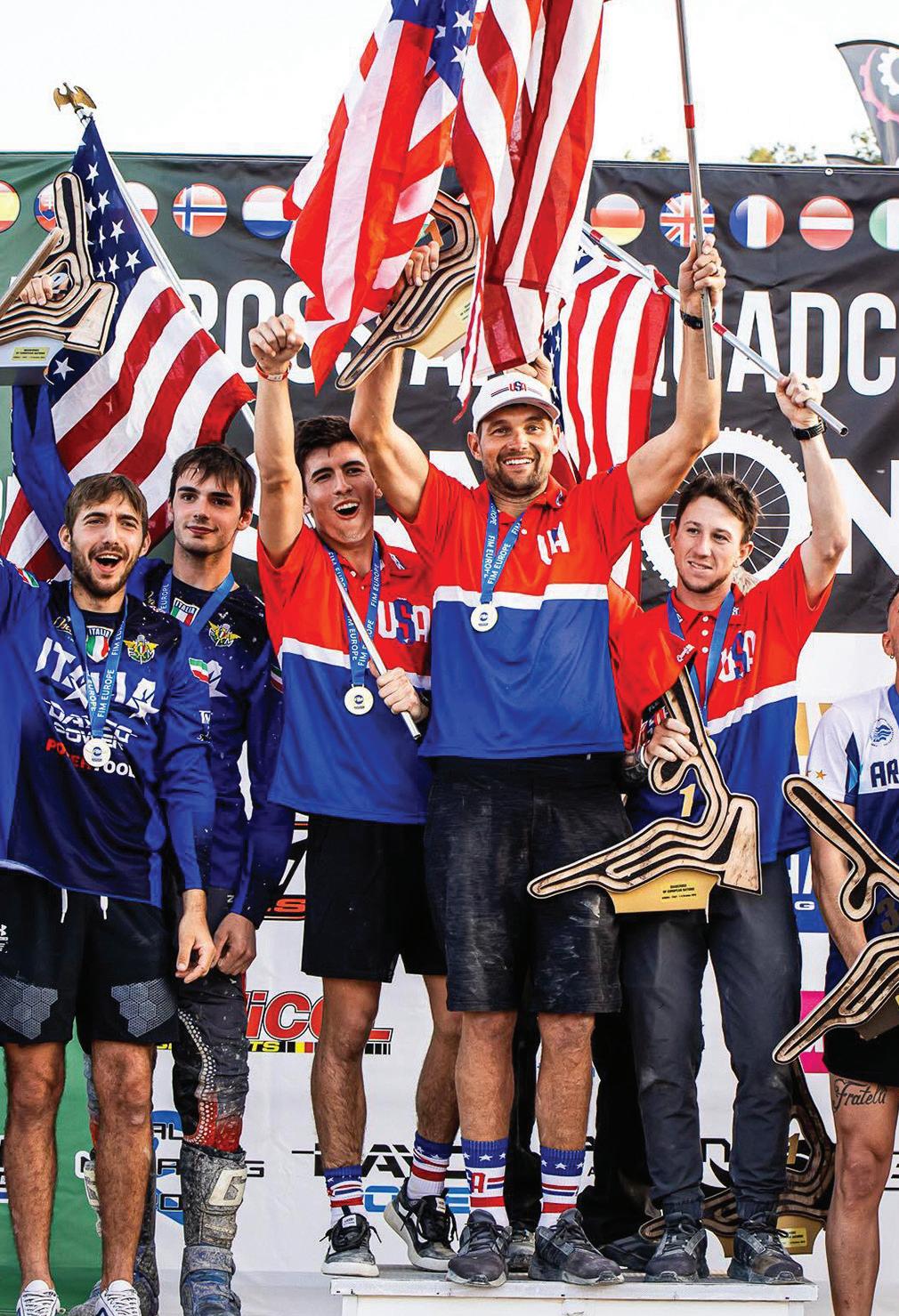
For 2022, the honor went to the winning U.S. Motocross of Nations Team of Eli Tomac, Chase Sexton and Justin Cooper, managed by AMA Hall of Famer Roger DeCoster. The year before, it went to International Six Days Enduro Team USA member Brandy Richards for winning every single test in her class for the entire six-day event. Before that, it went to members of the Safe-To-Race Task Force, who helped us all get back to racing in the face of the global pandemic.
The AMA Motorcyclist of the Year is a recognition bestowed by the AMA Board of Directors for the profound impact an individual has had on motorcycling over the last year. All of the aforementioned MOTY honorees certainly had quite an impact on motorcycling because their accomplishments were so historically significant.
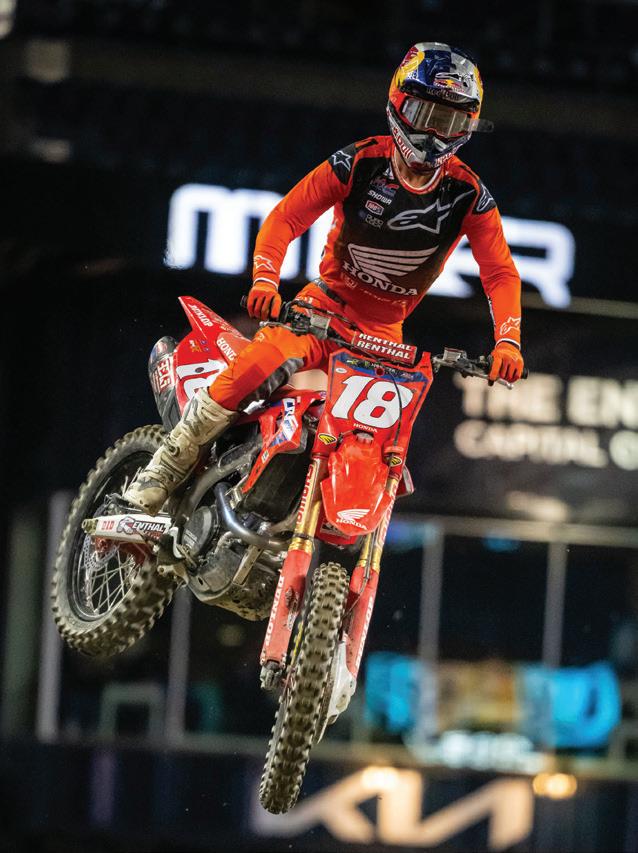
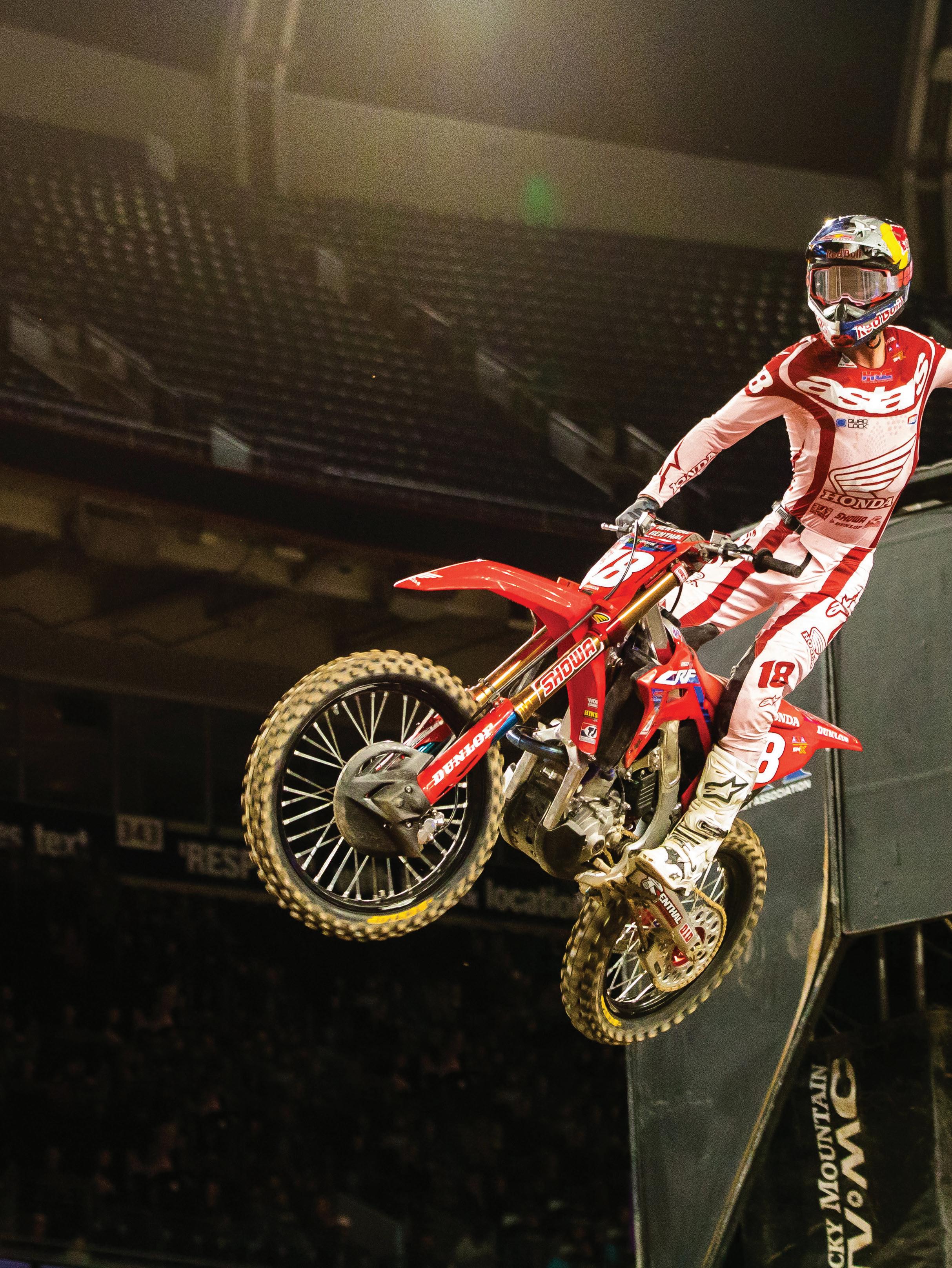
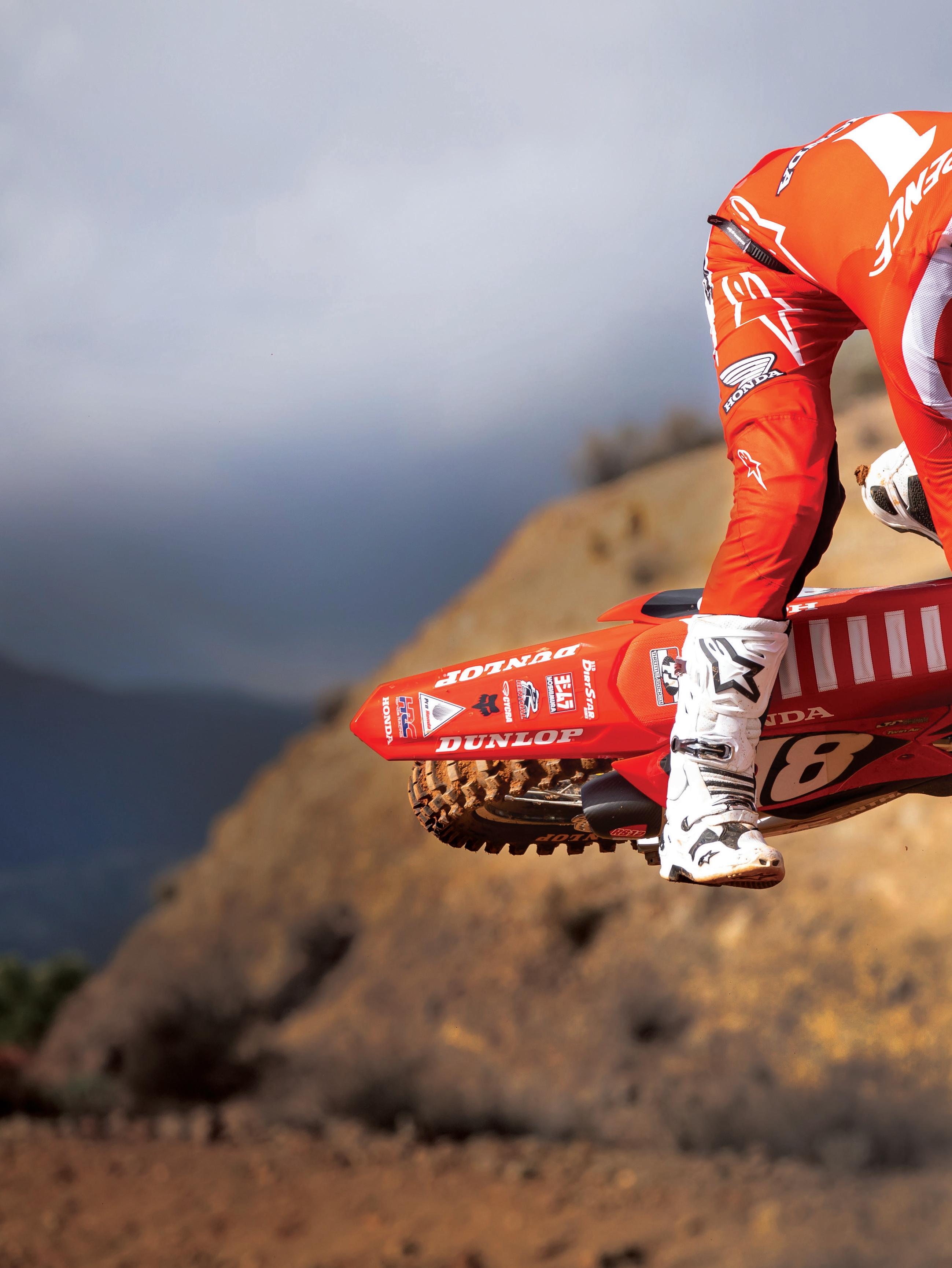
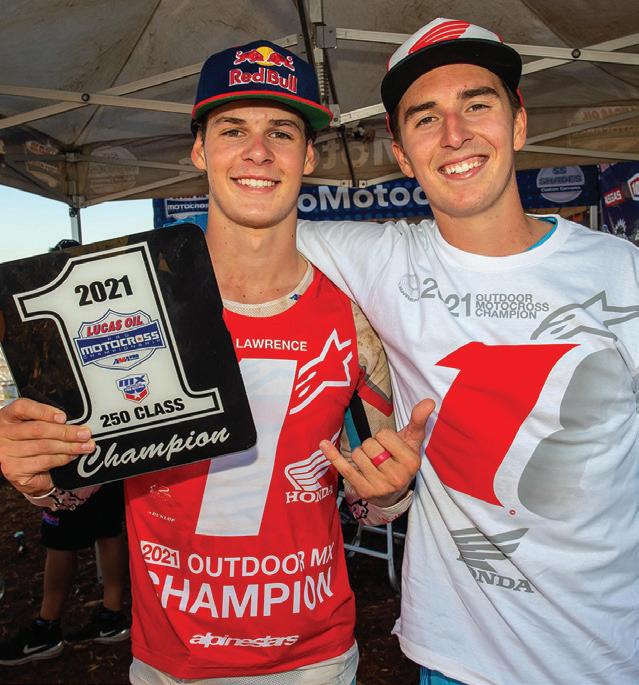
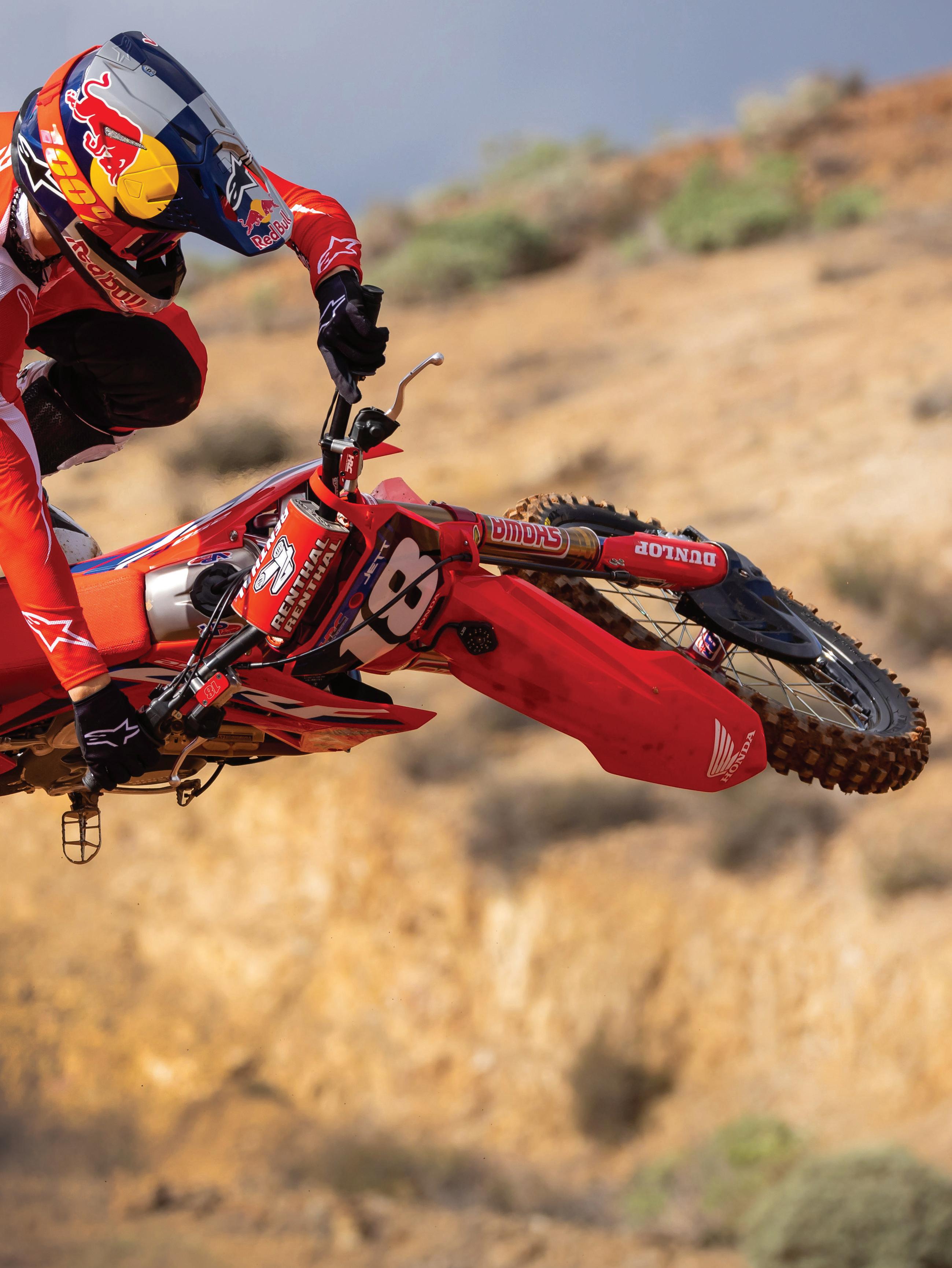
In 2023, one motorcyclist distinguished himself above all others through his incredible and historic success on the racetrack. This motorcycle racer won the 2023 Supercross 250 West Championship, became the first rookie-in-class to have a perfect moto-win season going 22-0 on his way to winning the 2023 AMA Pro Motocross 450 Championship, and won the first ever SuperMotocross Championship.
In recognition of these amazing and first-ever accomplishments, the AMA Board of Directors has chosen AMA Supercross and Pro Motocross racer Jett Lawrence as the 2023 Motorcyclist of the Year! You can read more about Jett Lawrence’s many accomplishments on page 52. Congratulations, Jett!
Rob Dingman is the President and CEO of the AMA, and a Charter Life Member
Honda’s Jett Lawrence: 2023 AMA Motorcyclist of the Year
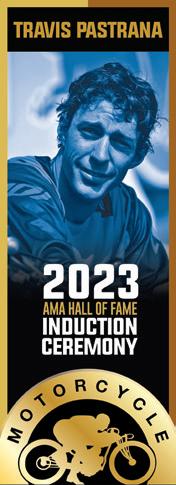
2023 HALL OF FAMERS ASK YOU TO SUPPORT
THE AMA HALL OF FAME
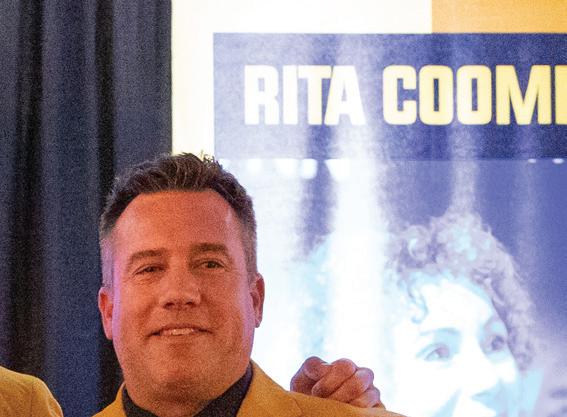
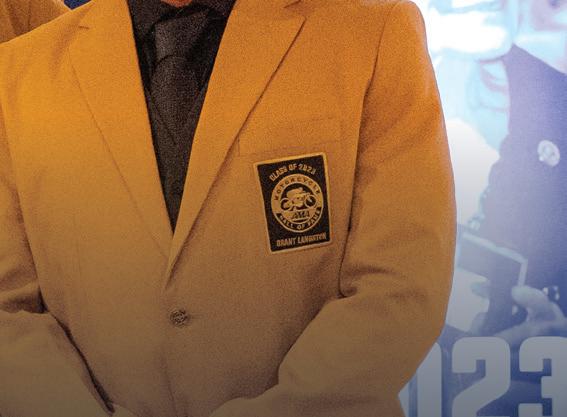
Being inducted into the AMA Motorcycle Hall of Fame as the Class of 2023 was an honor and thrill, but that’s only part of the reason we’re such big fans and supporters of the Hall of Fame.
We understand that the AMA Motorcycle Hall of Fame’s mission to preserve and promote the heritage of American motorcycling is alive, well and vitally important.
But what if our greatest racers, riders, ambassadors and
visionaries were lost to history? What if their very important achievements were forgotten? Would tomorrow’s riders chase their motorcycling dreams if they had no one to inspire them?
That’s not something we’d like to chance, and we’re certain you agree, so here’s our question to you: Will you please make a financial contribution to the Hall of Fame?
GIVING
$0-$49: Decal
LEVELS
$50-$74: Decal and Pin
$75-$149: Decal, Pin, Calendar
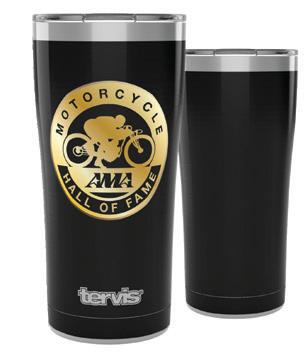
$150-$399: Decal, Pin, Calendar, Tumbler
$400-$999: Decal, Pin, Calendar, Tumbler, Hat, Jacket
$1000-$2499: Decal, Pin, Calendar, Tumbler, Hat, Jacket, HOF Days Experience
$2500-$4999: Decal, Pin, Calendar, Tumbler, Hat, Jacket, HOF Days Experience, VMD VIP Experience
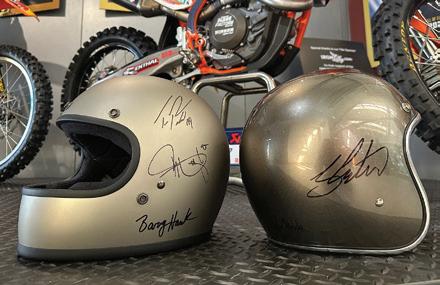
$5000-$7499: Decal, Pin, Calendar, Tumbler, Hat, Jacket, HOF Days Experience, VMD VIP Experience, Signed Helmet
$7500+: Decal, Pin, Calendar, Tumbler, Hat, Jacket, HOF Days Experience, VMD VIP Experience, Signed Pull-up Banner of your choice
BACKFIRES
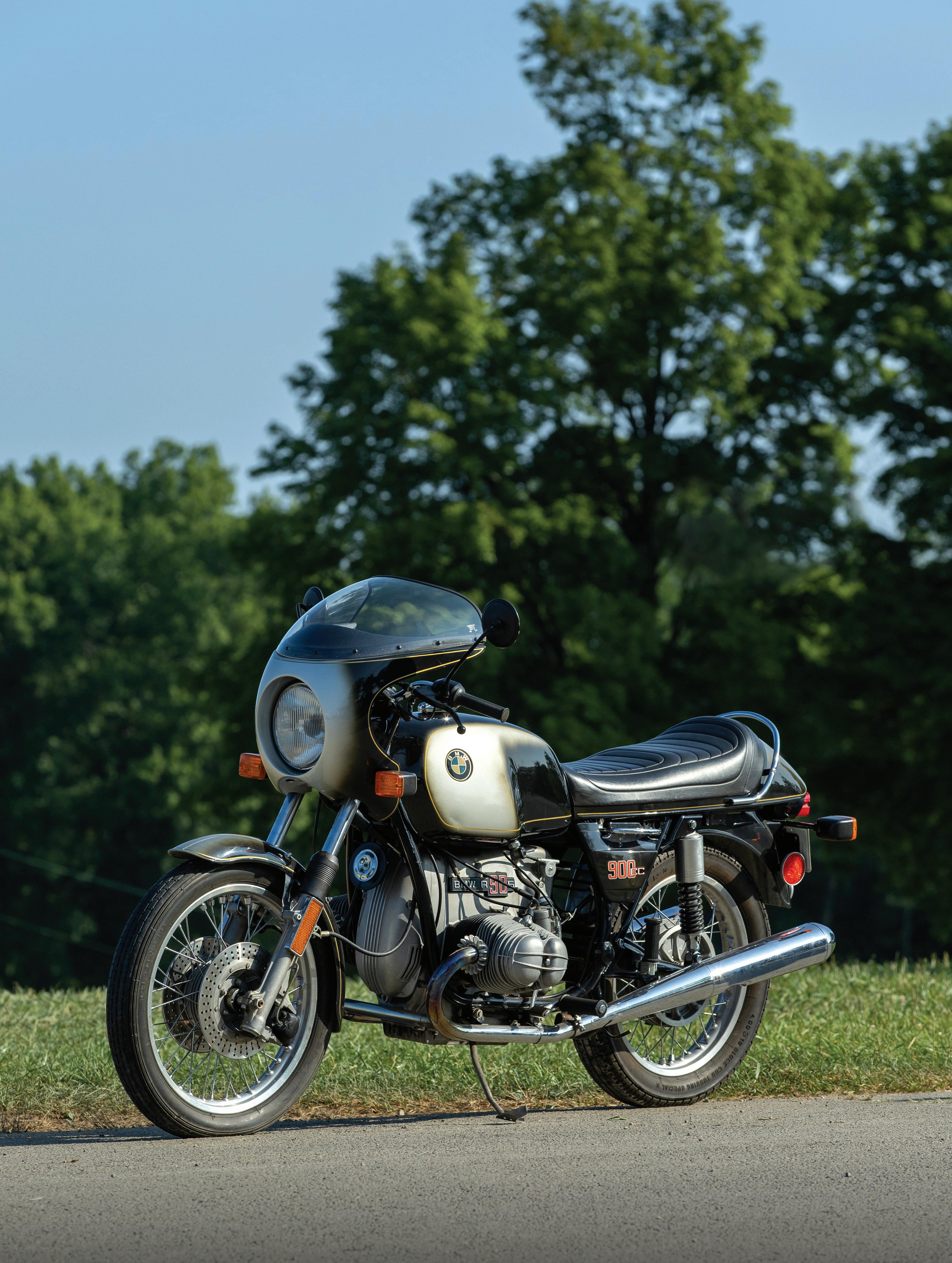
OF RAFFLES AND R90Ss
The smoke/black R90S was the first BMW I ever wanted. Before it, Beemers were — as pointed out in your November-issue piece — thought to be stodgy, reliable transportation for old people. The beautiful S changed that. If I should happen to win your 2023/’24 raffle bike, there will be no need to call a transportation company to get it to California. I’ll fly to Ohio, check the bike’s tire pressures and oil, and ride it home. As I have often found over the last 40 years, Peter Egan and I agree on this: the R90S is one of the few older classic bikes that I would ride cross-country.
Peter Swanson, AMA Life Member Cambria, Calif.
I would say, and I think Bob Lutz would agree, that pre-R90S BMWs weren’t thought to be stodgy and boring, they very much were. Good luck with those raffle tickets! – Ed.
YAMAHAS AT VMD
Per your AMA Vintage Motorcycle Days coverage in the October 2024 issue, good job Alex Boehm! It’s cool that you were aboard a 1980 YZ250G, because I bought one of those new in 1980. At 27, you should be in your prime physically for vintage MX…but ain’t it funny that, even at your young age, moto is still a great workout? Me and my buddies still race in the plus60 class…we’re still having fun in the dirt, and I’m glad you are, too!
Ron DeFonce
STEVE JOHNSON, WE MISS YA
Another great issue (November 2024). The comparo feature by John Burns was enjoyable reading, as he has a style that makes such stories enjoyable and interesting. The Last Page photo of Wayne Rainey and Eddie Lawson was extra special to me (and to a lot of industry folks, I would
imagine), as it showed notable race bike tuner, builder and team manager Steve Johnson standing between those two AMA Hall of Famers.
Johnson was one of the most important race-team members ever at Kawasaki. He built and maintained winning MX bikes for Brad Lackey, Jimmy Wein-
LETTER OF THE MONTH
A ARGENTINA TO AMERICA, VIA LAVERDA
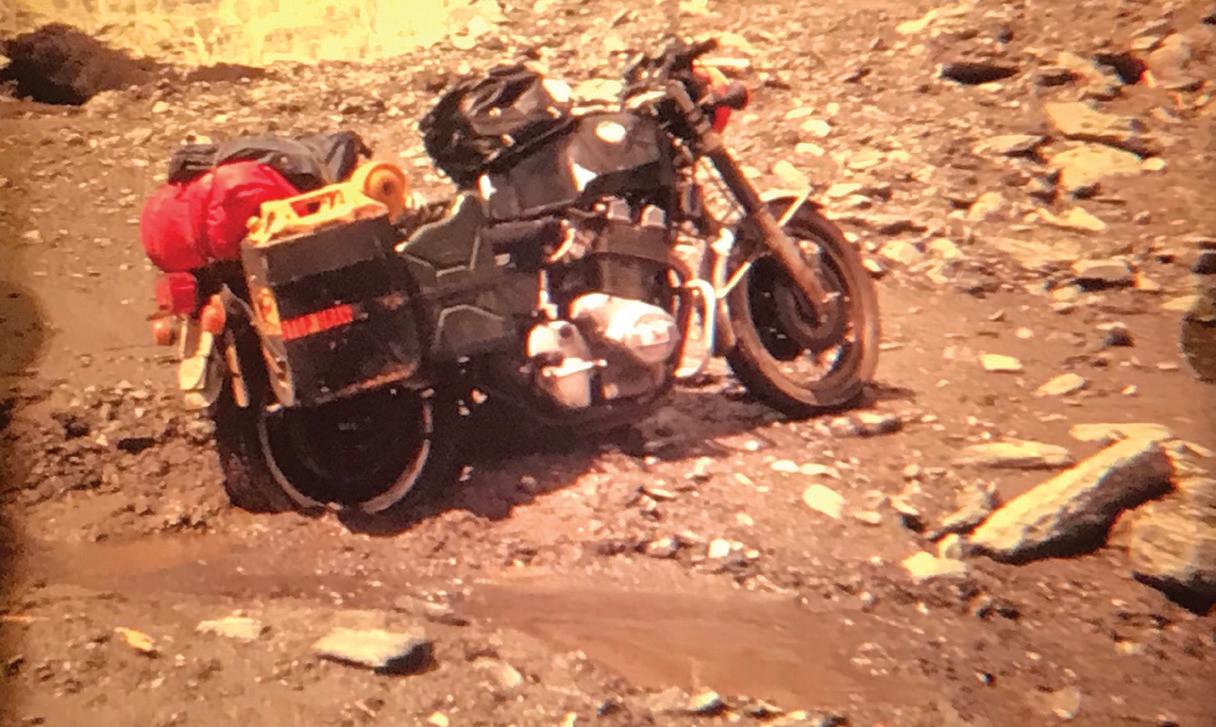
aron Frank’s South America touring piece (American Motorcyclist, November 2023) was for me a blast from my past. I did a similar ride, though in 1980, which meant no cell phones, GPS, computers, credit cards or digital camera…I used a Kodak 103 Instamatic. And no EFI, either, which means I got pretty good at fine-tuning the Dellorto carbs on my well-used 1974 Laverda (which had over 50,000 miles on it at the beginning of the trip) at high altitude.
I rode many of the same roads as Aaron, and even had a similar experience crossing the Andes from Chile to Argentina and getting stranded and seeking refuge in a tunnel because of snow. I still have my collection of Bartholomew paper fold-up maps
and my compass, and would love to put them to use again.
For me the trek was Levis and a Belstaff, lace-up work boots and that old Laverda, as ADV bikes were not a thing yet. And I only met four other riders in the nine months I was in South America. But I had one hell of an adventure. Really looking forward to part 2 (and maybe part 3) of Aaron’s adventure. I loved every mile of it, and thanks for sharing.
David Peel, Palm Desert, Calif.
Your wish is our command, David, as part II of Aaron’s adventure is included in this edition. Have to say, we’re all pretty amazed you did such a trip on that old Laverda…impressive! Thanks for sharing. – Ed. Letters to the editor are the opinions of the AMA members who write them. Inclusion here does not imply they reflect the positions of the AMA, its staff or board. Agree? Disagree? Let us know. Send letters to submissions@ama-cycle.org or mail to American Motorcyclist Association,13515 Yarmouth Drive, Pickerington, OH 43147. Letters may be edited for clarity and brevity.
ert and Gary Semics, and did the same on the AMA Superbike squad for Lawson and Rainey. Steve was arguably one of the best and most innovative technicians at Kawasaki during the 1970s and 1980s, right alongside guys like Roy Turner and Jim Felt. Later in his career, Steve helped Muzzy build his winning Kawasaki Superbike program, and had a lot to do with Lawson’s amazing win in the Daytona 200 in 1993 on the Vance & Hines Yamaha. Johnson was also instrumental in Phil Read’s 250cc world championship in 1971, when Johnson was just 20 years old. Steve passed away in June of 2021, but his contributions to Team Green and the motorcycle racing world are still remembered today. RIP, buddy.
Bryon Farnsworth
WHOOPSIE!
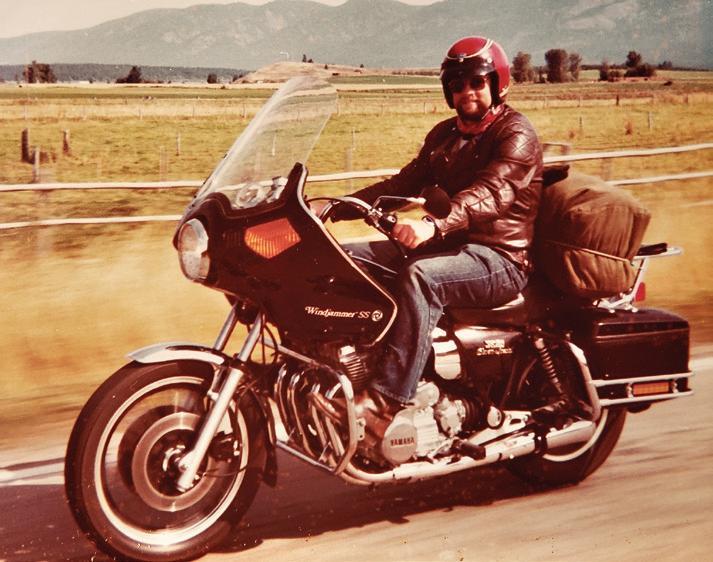
Nice presentation of Yamaha’s XS1100 in my November-issue
column, but I was surprised you didn’t use the photo I sent you of me on the bike at Polson, Mont., as I thought it was a great vintage shot.
B. J. Montana
It is, B.J., but I somehow didn’t see the attachment when you emailed me. Here’s the shot in all its, er, glory! – Ed.
NO WONDER!
I’m a bit late with my comment on the September issue’s Garage Gear That Works piece. Almost every motorcycle garage is missing JIS screwdrivers. Almost every “Phillips” screw head in North America used in a car or motorcycle is actually a JIS screw. Using a standard Phillips screwdriver on a JIS head damages the head. JIS-spec screwdrivers do not damage these screw heads, and yet they also work on standard Phillips head screws quite well. Using a JIS screwdriver on a JIS head is almost magic. Give it a try.
Ian Beales
Parksville, British Columbia
I have earned world-championship status over the decades stripping Phillips-head fasteners, and I finally know why! Thanks for the tip. – Ed.
MIND READER?
Since it’s the AMA’s 100th anniver-
sary, I think it would be cool to publish different covers from through the years, and maybe list some important issues that occurred over the decades.
Robert Horsch
It’s coming, Robert. (Are you somehow listening in on our editorial meetings?) – Ed.
ISDT REUNION RIDE
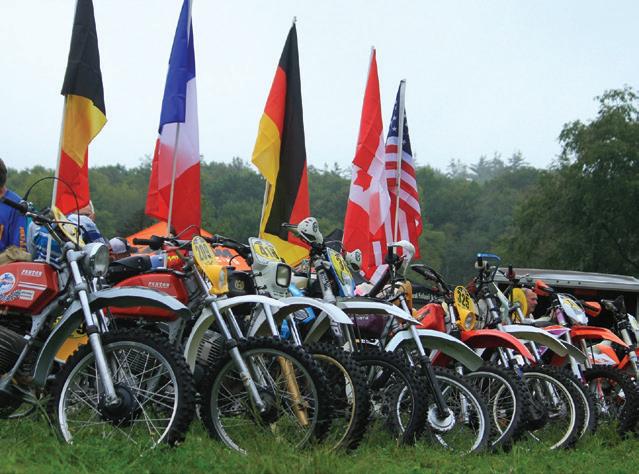
I had the privilege of riding the ISDT Reunion ride in Vermont in September 2023 to celebrate the 50th anniversary of the Dalton Six Days. We rode past lots of classic New England scenes like the one of Malcolm Smith portrayed on page 24. What amazed me with that shot is when I looked twice, I spotted a couple of kids behind the stone wall, watching the riders go by! That was an element of the ’73 event, and it was the same last year as families came to the end of the driveway to wave as riders passed. Very cool.
Mike O’Reilly, Charter Life Member Constance Bay, Ontario
TBACK IN THE DAY
Where the photos are blurry but the memories are clear!
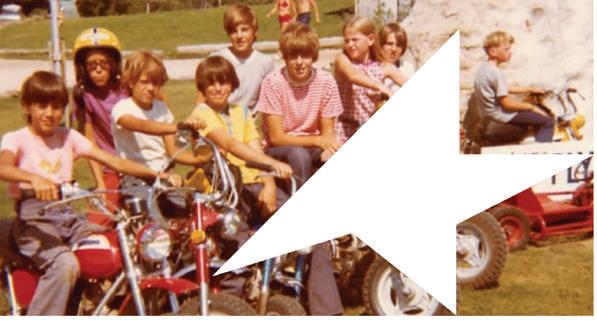
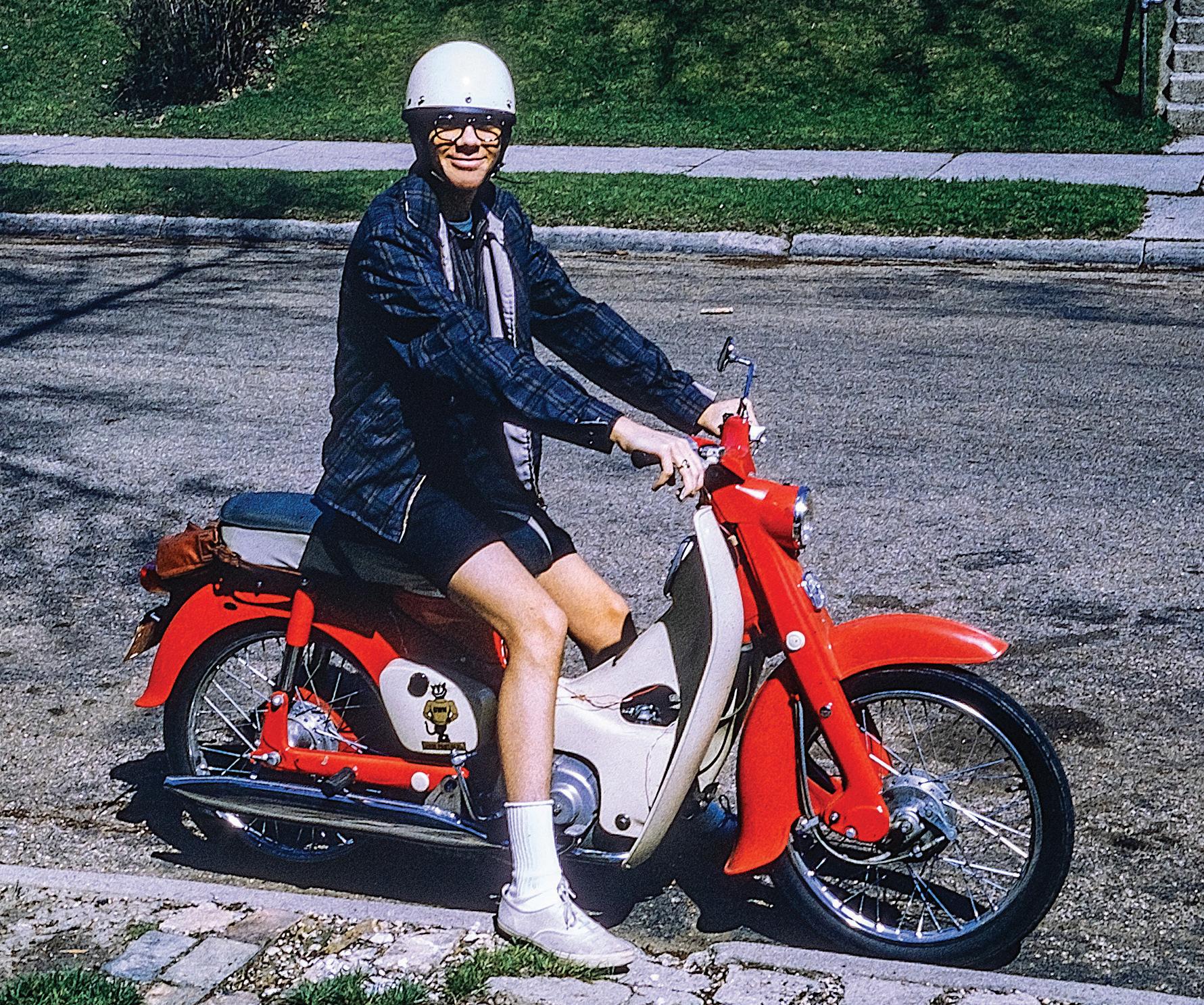
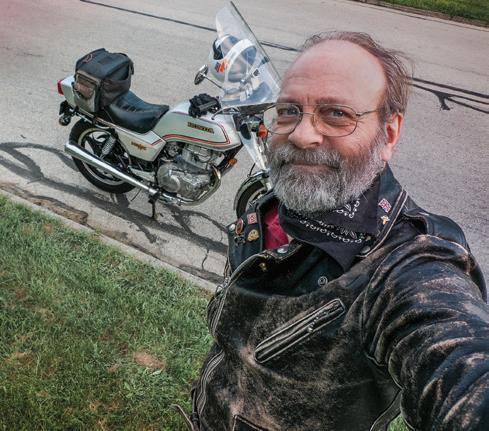
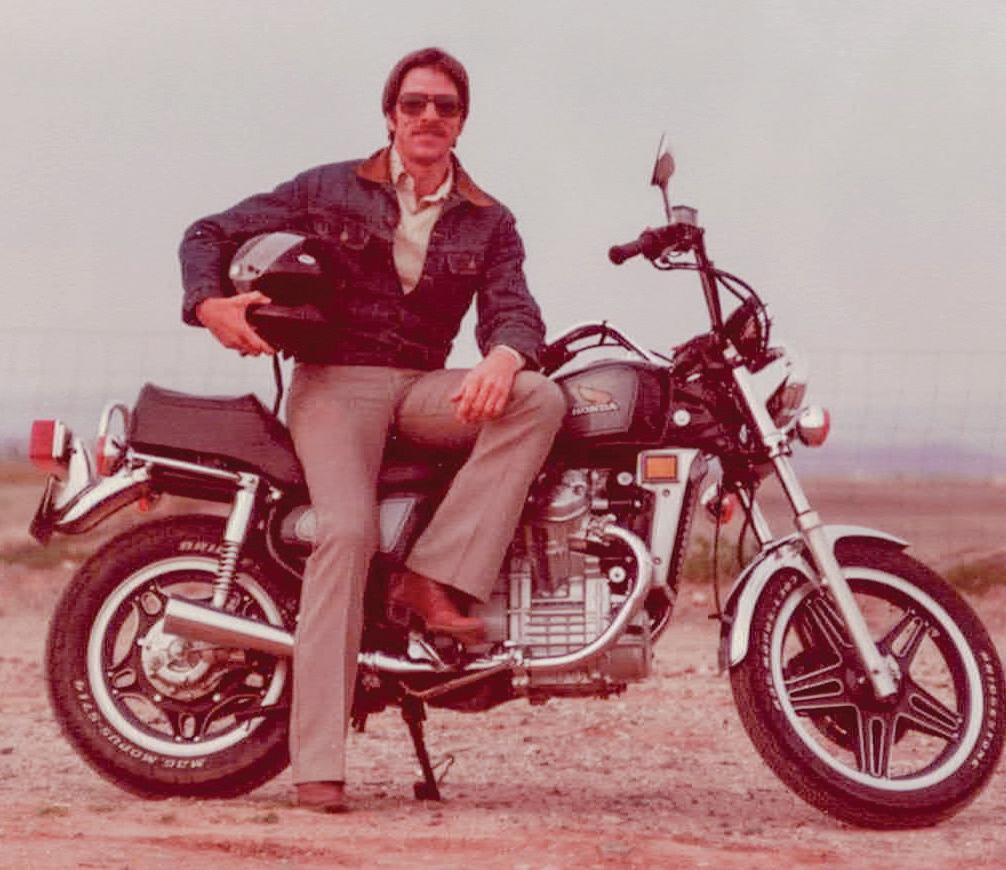
he first photo is me on my first bike, a 1965 Honda Cub 50 in front of our family home. I rode it 3,000 miles in one year. Many times during high school I’d carry a gym bag and violin case on it, and then pick up my friend Carl, who’d hold his briefcase in one hand and his French horn case in the other…and away we’d go. After I got married, riding wasn’t practical, and I was out of riding for 17 years until 1986, when I was introduced to real motorcycling when I got my present bike for $550 — a used 1980 Honda CB400T with 1,920 miles on it. I commuted to work and took rides with friends, especially on Wisconsin’s rustic roads. At 75, I’m an AMA Life Member. The Hawk in the second photo is 43 years old (35,987 miles), runs like new, and is my last bike. I LOVE IT.
Alan Magayne-Roshak
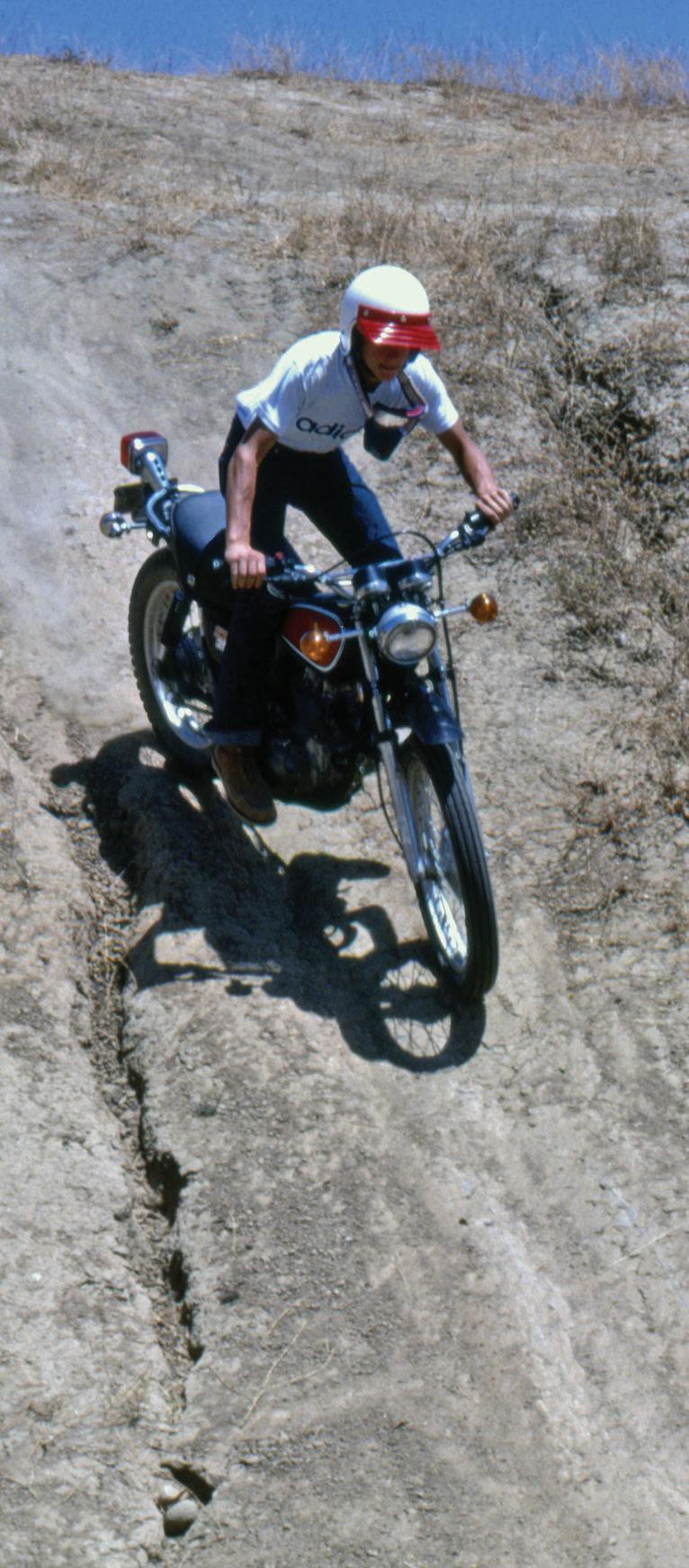
My dad traveled in the summertime for work while employed by the Department of Agriculture, and in the summer of 1976 we drove from Nebraska to California…and he made a custom rack on our camper so I could take my Honda XL250 along (cool dad move!). Having read about Saddleback Park and AMA Motorcycle Hall of Famers Marty Smith, Bob Hannah and Roger DeCoster in the pages of Motocross Action, I was super excited! Of course, as I rode at Saddleback for this photo, I was – in my teenage mind, at least – neck-and-neck with all three in an epic race. Although I’ve had over a dozen motorcycles throughout my life, that XL250 carries most of my best memories — something about the stage of life I was in and discovery of both the machine and myself. Great memories!
John Holmes
Lookin’ good, John. You’re even sporting a Scott facemask, though you’ve pulled it down. Did Hannah or Smith roost you? – Ed.
My first motorcycle was a 1982 Honda CX500. It was a bulletproof little machine but had short legs on the highway, so I upsized to a 1983 Honda CB1000. In 2003, I rode my 2002 BMW R1150GS from Phoenix to Denali National Park in Alaska. It took me 17 days and covered 7,945 miles. I’m currently riding a 2015 Yamaha Super Tenere, and at 67 years old may have to downsize soon. Down but not out.
Peter Baker
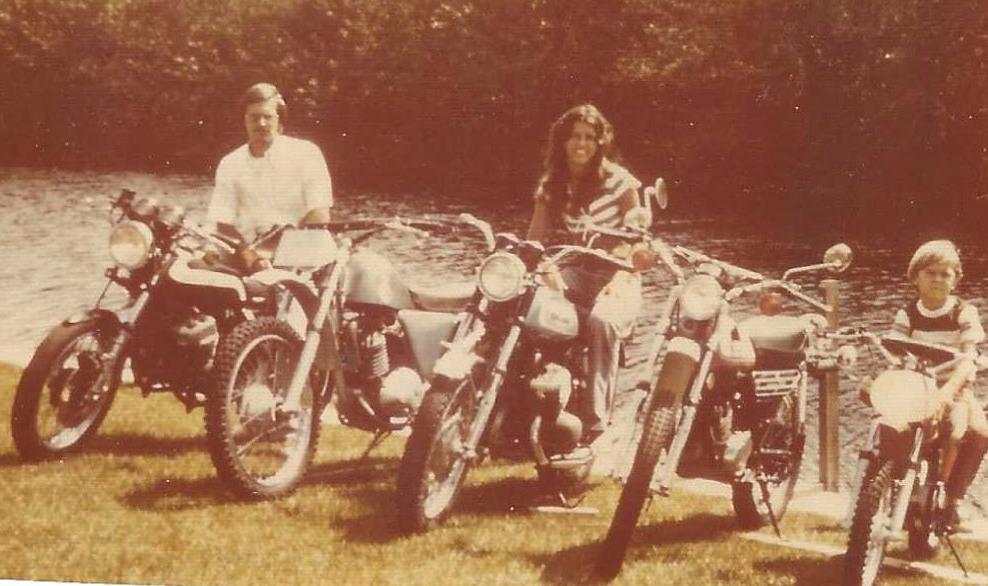
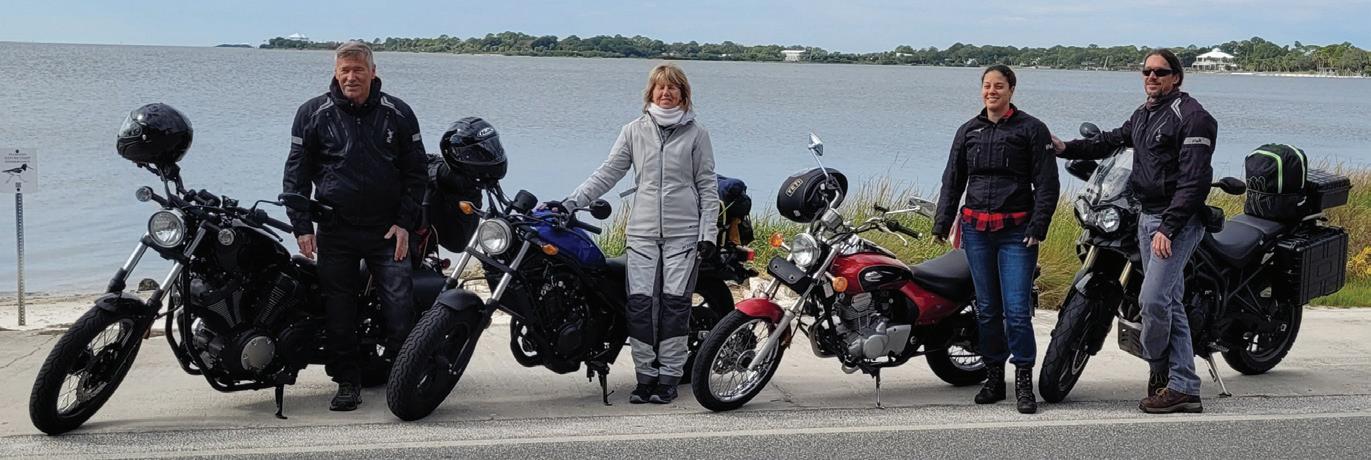
The first picture (from 1975) is, left to right, me on my 1973 Kawasaki H2 750, my 1970 Greeves 250, my wife Claire on her 1970 Kawasaki H1 500, her 1975 Yamaha 100 Enduro, and our 5-year-old son Mark on his 1975 Honda MR50 Elsinore. The second photo was taken in Novem-
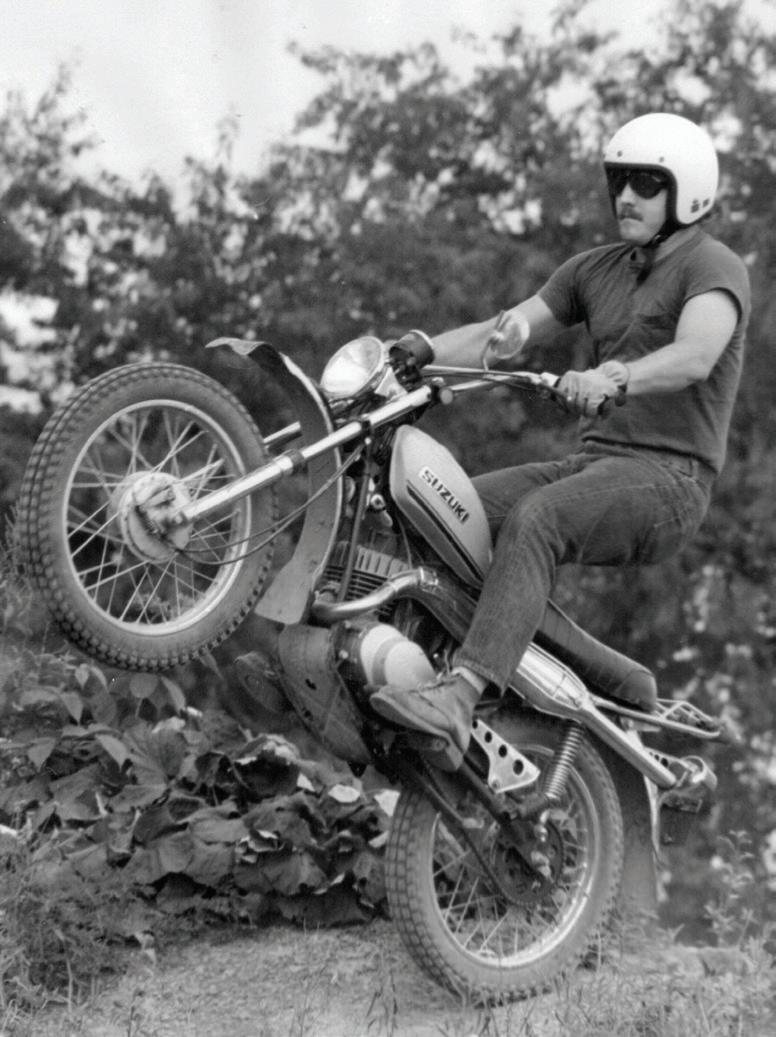
As a teenager (not counting a Whizzer that only ever ran once) I started my motorcycle experience with a 1949 Cushman Motor Scooter, and worked through 59 years with both on and off-road motorcycles. After owning a 2012 Gold Wing, I’ve come full circle with my current ride – a Suzuki 650 Burgman scooter. This photo is of me on my early ’70s Suzuki 90cc trail bike. It had a four-speed transmission with a high/low gear range selector, and in low range it could almost climb a tree! It took me through the back roads and trails in Pittsburgh and Western Pennsylvania. Great memories! Love your Back in the Day articles.
I wonder if any of your readers rode Cushmans?
Robert Muir
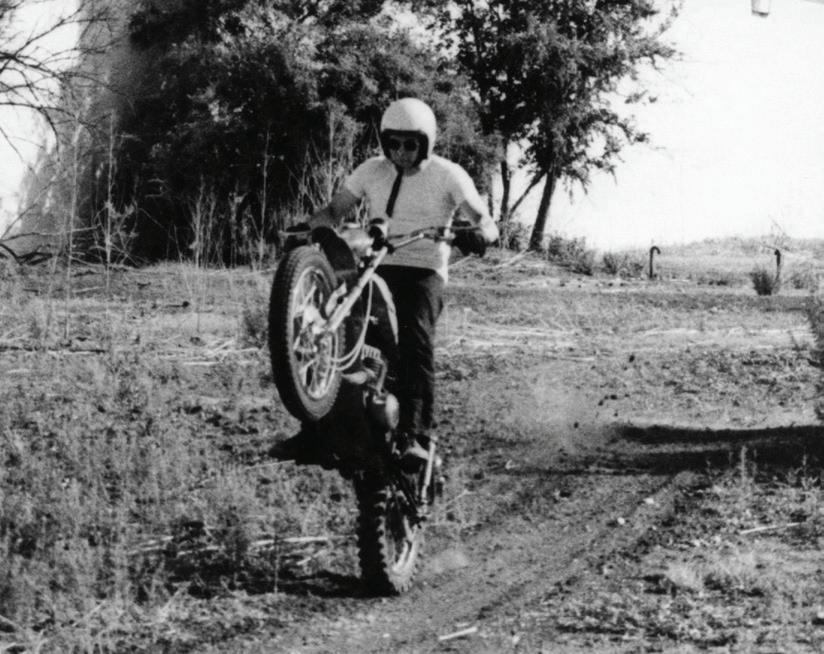
Here’s me landing from a jump on my 1970 Suzuki TS250 in San Antonio at the Olmos Basin, where me and my college buddies would ride when not in class. We were inspired by Bruce Brown’s 1970 classic On Any Sunday, which led a half dozen of us to buy and ride motorcycles. I am still riding today, along with my wife. Between us we own and continue to ride nine motorcycles!
Ned Thanhouser
ber of 2022 during a trip to Cedar Key, Fla. I’m on the left with my 2019 Yamaha Bolt, Claire with her 2018 Honda Rebel 500, Mark’s girlfriend Angelie with her 2002 Kawasaki Eliminator 125, and Mark with his 2012 Triumph Tiger 800. Mark also has a 1992 Harley Softail Custom
that he’s been riding for about 25 years. Forty-seven years and still riding together.
Ron Andersen
Gotta say, that’s quite a collection in ’75, Ron! Two strokes to the moon! WooooHooooo! – Ed.
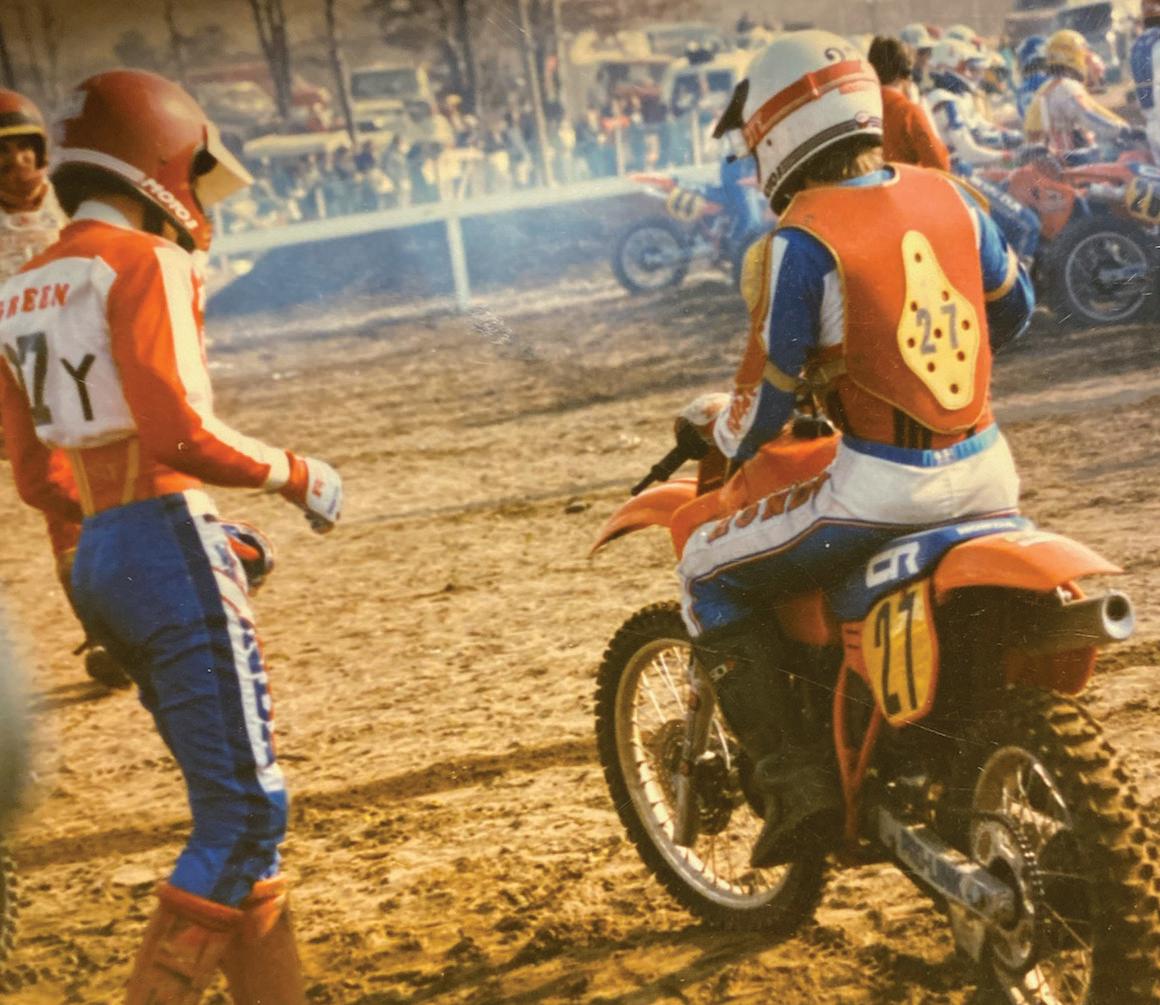
This photo is from Raceway Park in Englishtown, N.J. in ’85. I’m on the Honda CR500, and that’s my brother Dan who’s just about to jump aboard for his moto. We shared that bike for the entire season; it never shut down between races and ran all season with no troubles. Wish we’d never sold it! Dan and I still ride dirt bikes every chance we get. Last year I got vintage fever and bought an ’83 Honda CR480. I made the trip out to the AMA Vintage Motorcycle Days in July and had a blast riding that beast. I had such a good time that I plan to make it an annual trip.
Lou Green
We will see you there, Lou, and I’ll tell you all about my CR480 experiences, one of which involves a little procedure called a ‘chest tube’! Aside from that, I loved my 480 while I had it. – Ed.
up to speed
News, notes, insight and more from the motorcycling universe
REVIEW 2023
RIGHTS REFRESH
The revamped AMA Government Relations Department hit the ground running in 2023, and is primed to successfully defend motorcyclists’ rights in 2024
BY KEATON MAISANO
The past 12 months brought about a bolstering of the AMA’s Government Relations Department, and new faces and a refreshed approach emphasized the main mission: protecting motorcyclists’ rights.
In 2023, the AMA set out to reimagine how it approached regional representation, allowing the team to more efficiently and effectively operate. This change led to the creation and staffing of Washington D.C., Eastern states and Central states representatives. Nick Haris, who remained in his role as the Western states representative, took over as director of the department.
The trio of Zach Farmer (Washington D.C. representative), Nick Sands (Central states representative) and Shayna Fritz (Eastern states representative) joined the team in 2023 to help champion motorcyclists’ rights throughout the country.
Legislation protecting the right to repair is gaining momentum at the federal and state levels, with more than 20 states introducing or signing into law proposals that support one’s right to repair. The Biden Administration issued an Executive Order directing federal agencies to take steps to “make it easier and cheaper to repair items you own by limiting manufacturers ability to bar selfrepairs or third-party repairs of their products.”
The new-look GRD team hit the ground running as it monitored and engaged several issues throughout 2023, and the staff is looking ahead to another year of serving AMA members and motorcycling in 2024.
RIGHT TO REPAIR
In the fall of 2023, the House Energy and Commerce Committee held a hearing and markup of H.R. 906, the REPAIR ACT, which provides flexibility for consumers to diagnose, maintain, repair and modify their vehicles.
Congress is considering proposals, which include the right to repair, to enhance product safety and transparency.
The AMA supports motorcyclists’ right to repair their own motorcycles or seek out the services of an independent shop.
E15 FUEL
A growing number of bipartisan lawmakers and organizations continue to push for the year-round sale of E15 — which has been shown to damage carbureted and fuel-injected motorcycles, decrease gas mileage and reduce the shelf life of gasoline. The fuel is often illegal for use in motorcycles, and inconsistent and unenforced labeling at the pump leaves motorcyclists susceptible to confusion.
The Consumer and Fuel Retainer Choice Act of 2023 would enable the year-round nationwide sale of ethanol blends higher than 10 percent. Furthermore, the Biden-Harris Administration and the U.S. Environmental Protection Agency Administrator Michael S. Regan
up to speed RiGHTS ROUNDUP
READ ALL ABbOUD IT
Jerry Abboud steps away after illustrious run with AMA Board of Directors; Tom Umphress elevated to Rights and Advocacy Committee Chairman
BY JACK EMERSON
For the past several years, the American Motorcyclist Board of Directors relied on the mind of Jerry Abboud.
Now, Abboud is set to retire from the Board after several years of service with the AMA, but his impact will leave a lasting impression on his fellow board members and the AMA as a whole. Abboud wore many hats while on the AMA Board of Directors, serving as Chairman of the Board Rights and Advocacy Committee and as a member of the AMA Board’s Executive Committee.
“Jerry Abboud was a tremendous asset to the AMA as a member of the Board of Directors,” AMA President and CEO Rob Dingman said. “Jerry’s knowledge of government relations issues is unsurpassed, and this proved extremely valuable as Jerry served as Chairman of the Board’s Rights and Advocacy Committee. His years of experience with nonprofit organizations and in the motorcycle industry also made him invaluable as a member of the AMA Board’s Executive Committee.”
Board’s capabilities with his knowledge and expertise in several areas, most notably land usage issues and offhighway vehicle recreation.
“I’ve known my friend Jerry Abboud for over 30 years and have been amazed by his perseverance as an advocate for all forms of motorcycling and off-highway vehicle recreation,” AMA Board of Directors Chairman Russ Ehnes said. “We all owe Jerry a big debt because his work has not only had an enormous positive impact on motorcycling in Colorado, but also nationwide.”
Abboud brought a new perspective in his time with the AMA Board of Directors, one rooted in advocacy, which came as a result of his grassroots work in his home state of Colorado. As an attorney, Abboud also heightened the
AMA BOARD MEMBERS BAUMERT AND ZAMAN RETAIN SEATS
MA Board of Directors members
ABrad Baumert (Assistant Treasurer) and Faisel Zaman both retained their seats after no qualified candidates challenged them before the Sept. 1 deadline.
Baumert represents the Southeast
As Abboud transitions out of his role as the Chairman of the Board Rights and Advocacy Committee, Tom Umphress will step into the vacant position. Like Abboud, Umphress has plenty of advocacy experience, especially when it comes to promoting responsible recreational riding. While Umphress elevates to a higher position, former Board Chairwoman Maggie McNally will return to the Board to fill in the vacancy.
“As Jerry rotates off the Board, he is succeeded as Chair of the Rights and Advocacy Committee by Tom Umphress who also brings a great deal of government relations experience to the position,” Dingman said, “and although Jerry leaves some tough shoes to fill, Tom will certainly rise to the challenge.”
Region, which includes Kentucky, Tennessee, Virginia, North Carolina, South Carolina, Alabama, Georgia and Florida. Zaman represents the South Central Region, which encompasses Kansas, Missouri, Oklahoma, Arkansas, Texas,
Louisiana and Mississippi.
The AMA Board of Directors includes 12 members — six elected by AMA members, four elected by business members, and two at-large members appointed and ratified at the annual national AMA member meeting.
AMA AND BDR PARTNER FOR 2024
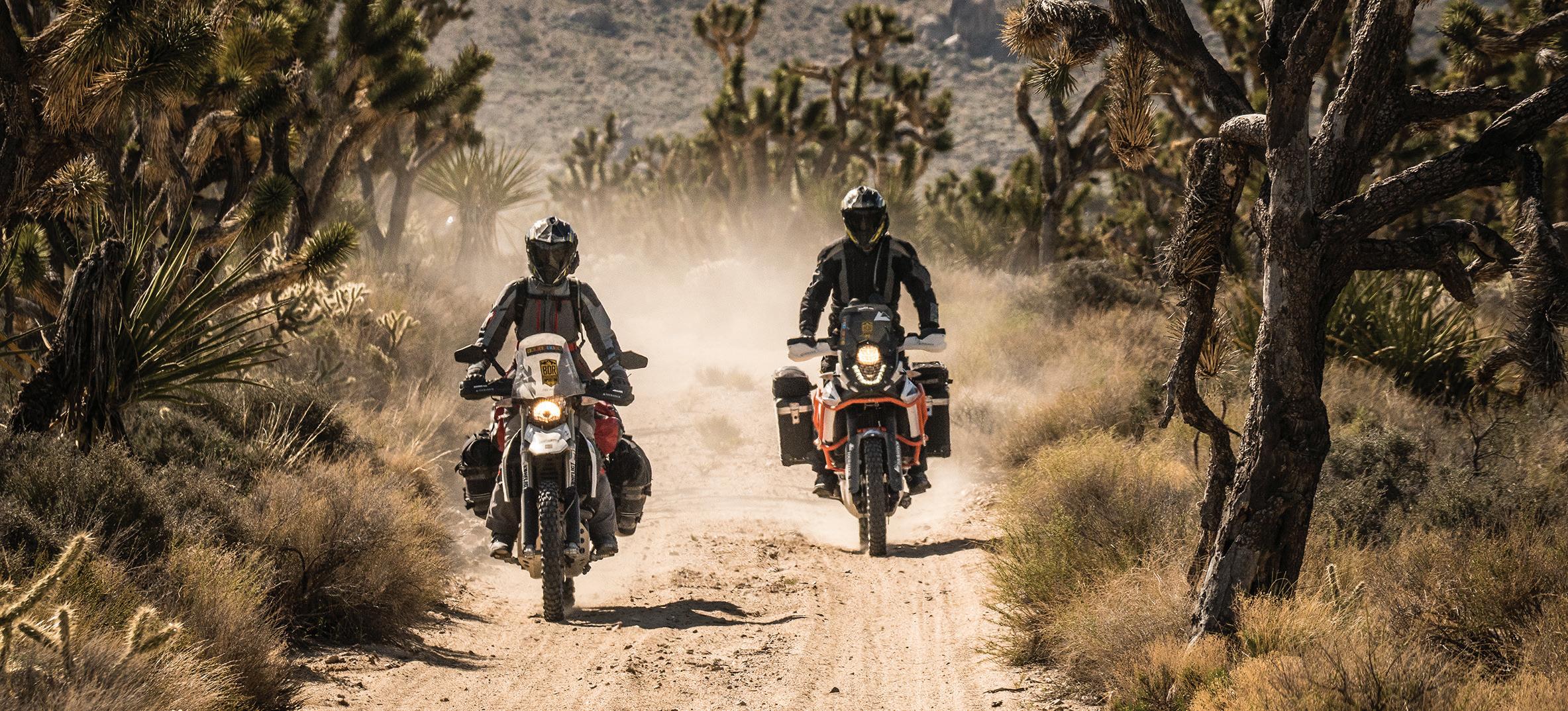
The AMA and Backcountry Discovery Routes (BDR) recently entered a partnership for 2024 designed to promote BDR’s mission to create and promote dual-sport and adventure recreation as well as AMA membership. At a point when
dual-sport and adventure riding continue to see significant growth, it’s an important partnership that will also support the AMA’s mission promoting and protecting the motorcycle lifestyle.
BDR is a 501(c)(3) non-profit organization that creates off-highway
routes for dual-sport and adventure motorcycle travel. Since 2010 BDR has introduced a new route with free GPS tracks for the community each year, except for 2021 due to the global pandemic.
To learn more about Backcountry Discover Routes, visit ridebdr.com.
amateur
Three other special awards were presented at the conclusion of the event. Taking home the Expert Racer of the Year Award was Southwest Ranches, Fla., native, and previous Amateur Racer of the Year winner, Chyler Weatherford.
Claiming Vet/Senior Racer of the Year honors was Antal Halasz of College Point, N.Y., and Dave West of Palm City, Fla., secured the Amateur Racer of the Year award.
100 YEARS OF THE AMA
BY MITCH BOEHM PHOTOS: AMA ARCHIVE
“When my grandfather’s brother Arthur and his friend Bill Harley decided [in 1902] to motorize a bicycle…they didn’t set out to start a big company…and they certainly didn’t dream that motorcycles bearing their names would become globally recognized symbols of American power and freedom. They shared a dream of [a motorized bicycle] that would speed up hills and power through mud. They were just young guys thinking, ‘We gotta go down the road on two wheels!’” – Willie G. Davidson, Ride Free, A Memoir
It’s not much of a surprise, and maybe it’s where Arthur and Bill got their inspiration in the first place, but the creation and development of bicycles and two-, threeand four-wheeled powered vehicles in the mid-to-late 1800s and very early 1900s had much of that same gotta go down the road sentiment baked into the foundation.
There was work for powered machines to do in those early days, for sure, both wheeled and non-wheeled, and on farms and in factories. But cruising a parallel path to all that pesky and sweaty labor was the desire to move…to go places, to travel, often with friends, and do it at a pace
SETTING THE
As the fledgling sport of motorcycling took shape in the early 1900s, the industry saw the need to gather, register, protect and rally motorcyclists to the cause — and the AMA was born
well beyond that of horse and buggy.
Bicycles (developed during the middle and late 1800s), rudimentary automobiles (of the early 1900s) and motorcycles (basically powered bicycles in those early years) were answers to many of those dreams and desires, and designs for each would improve both quickly and drastically as the 19th Century turned to the 20th.
But while Bill Harley and Arthur Davidson’s “getting down the road on two wheels” thinking could be accomplished on a bicycle, it was motorcycles — “motocycles” at first — that captured the attention and excitement of a population ready to get out on those roads — rough and unpaved as many were at the turn of the century — and go
The AMA would become an official entity in 1924,
which makes 2024 our 100th anniversary. And while the mainstream motorcycle movement had been a thing for 20 or so years before the AMA’s creation, the root system of our sport, the early manufacturers such as HarleyDavidson and Indian, and this very organization, are inexorably linked.
Motorcycles (and automobiles) altered the very fabric of life in America (and much of the rest of the world) dramatically in those early days of powered travel. The machines advanced quickly to offer more speed, range,
STAGE
durability and performance, yet there developed an innate need for something more — but something less tangible — than simply travel and movement.
Motorcycles weren’t just transportation in those very early days, as automobiles were. As today, they were exciting, emotional and challenging conveyances, ones that not only demanded a modicum of skill to operate safely and properly (and fully), but ones that generated a powerful thirst among enthusiasts for fun, camaraderie and social connection through shared experiences such as recreational riding, event participation, moto-political activism, and competition.
Quenching those social and competitive thirsts, and harnessing them for the good (and defense) of the sport by gathering, registering, supporting and inspiring like-minded enthusiasts, demanded a decent level of organization. In motorcycling’s earliest days, this organizational effort took the form
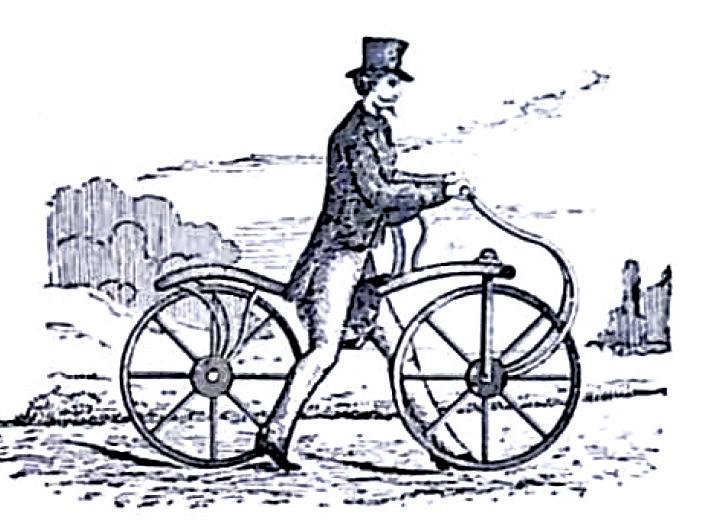
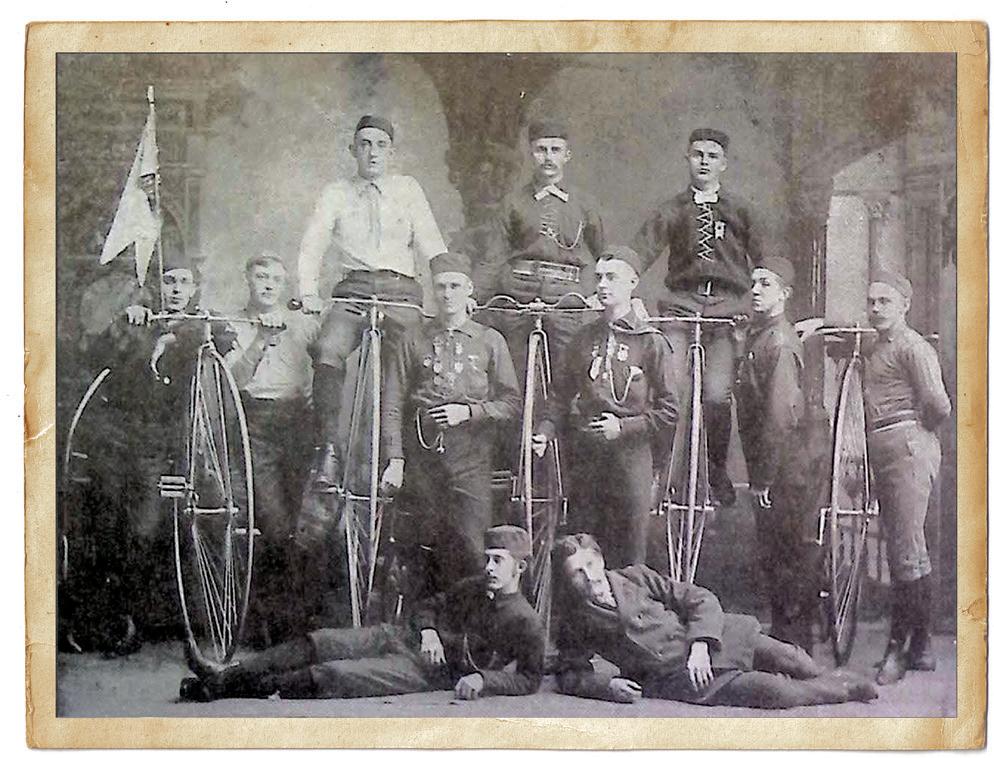
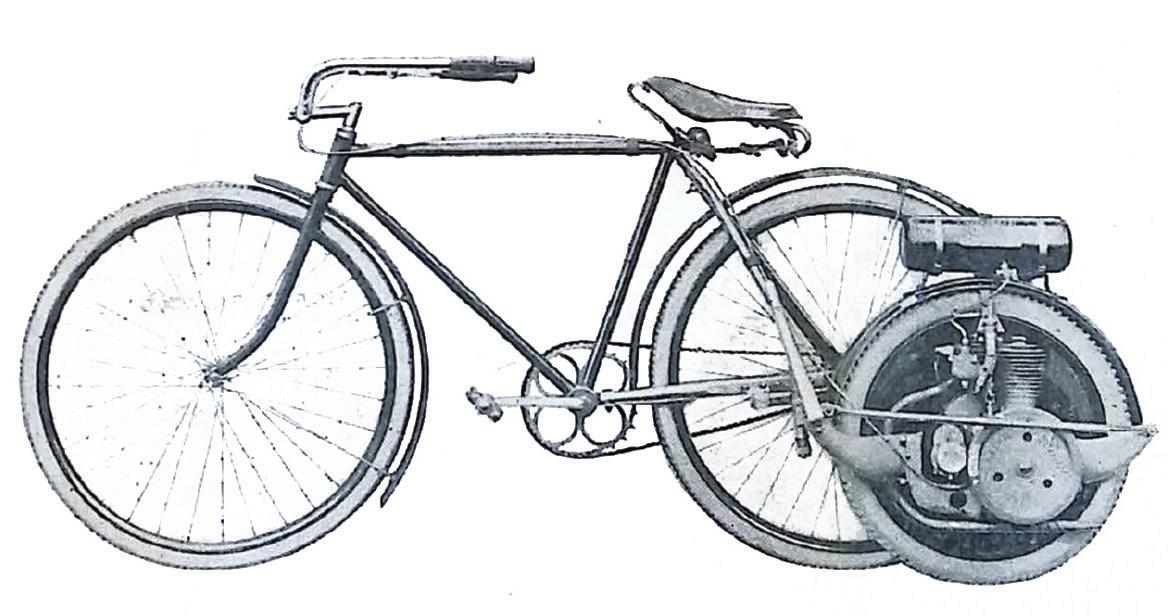
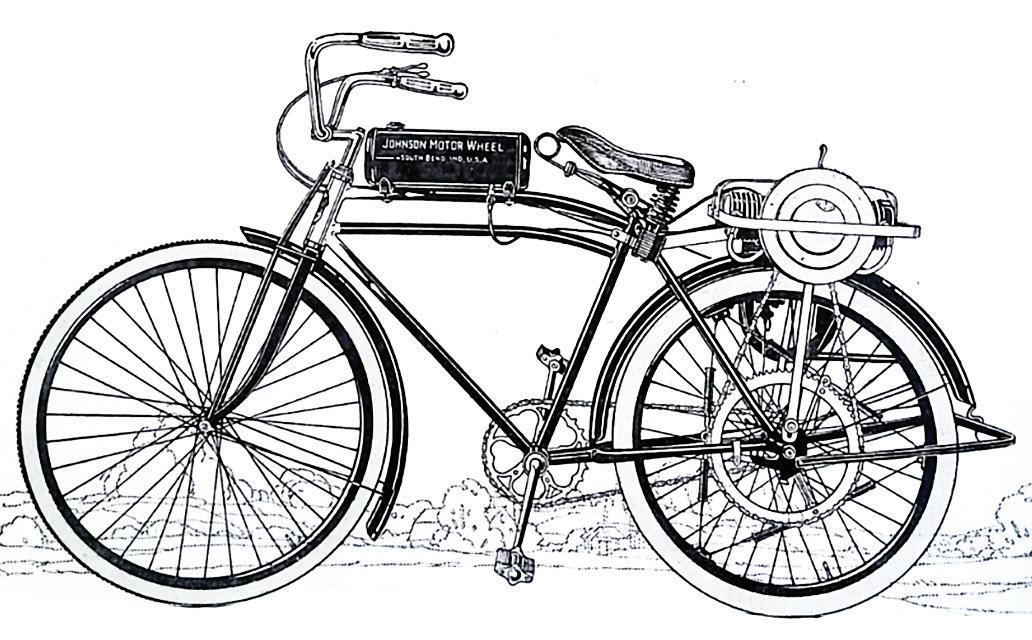
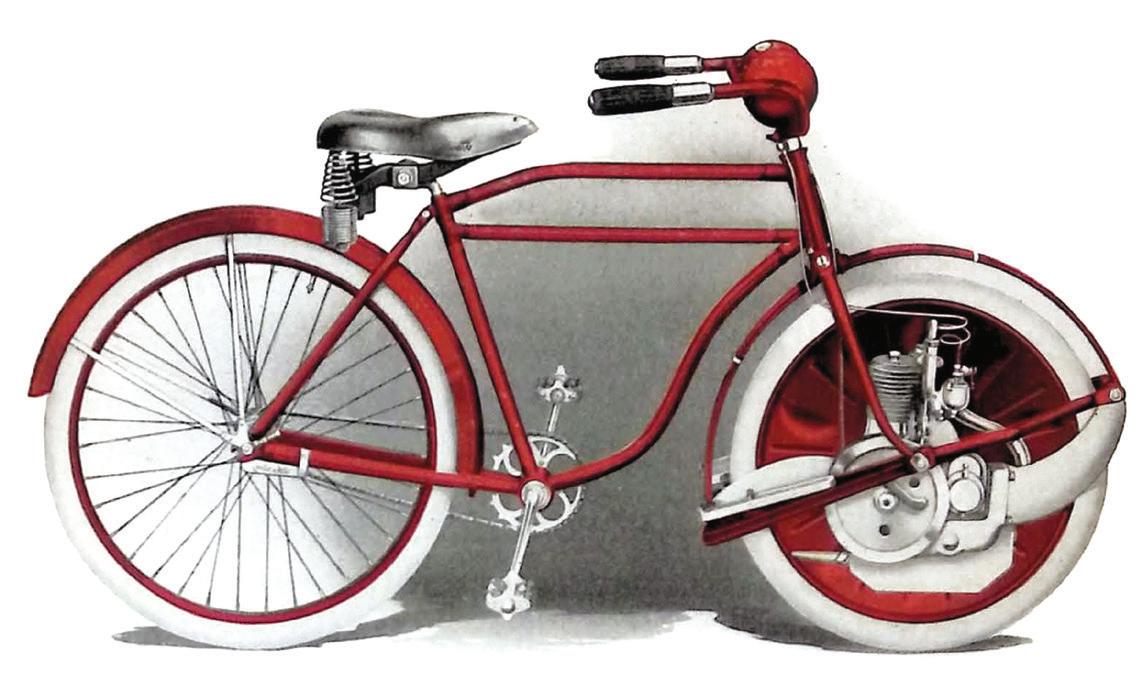
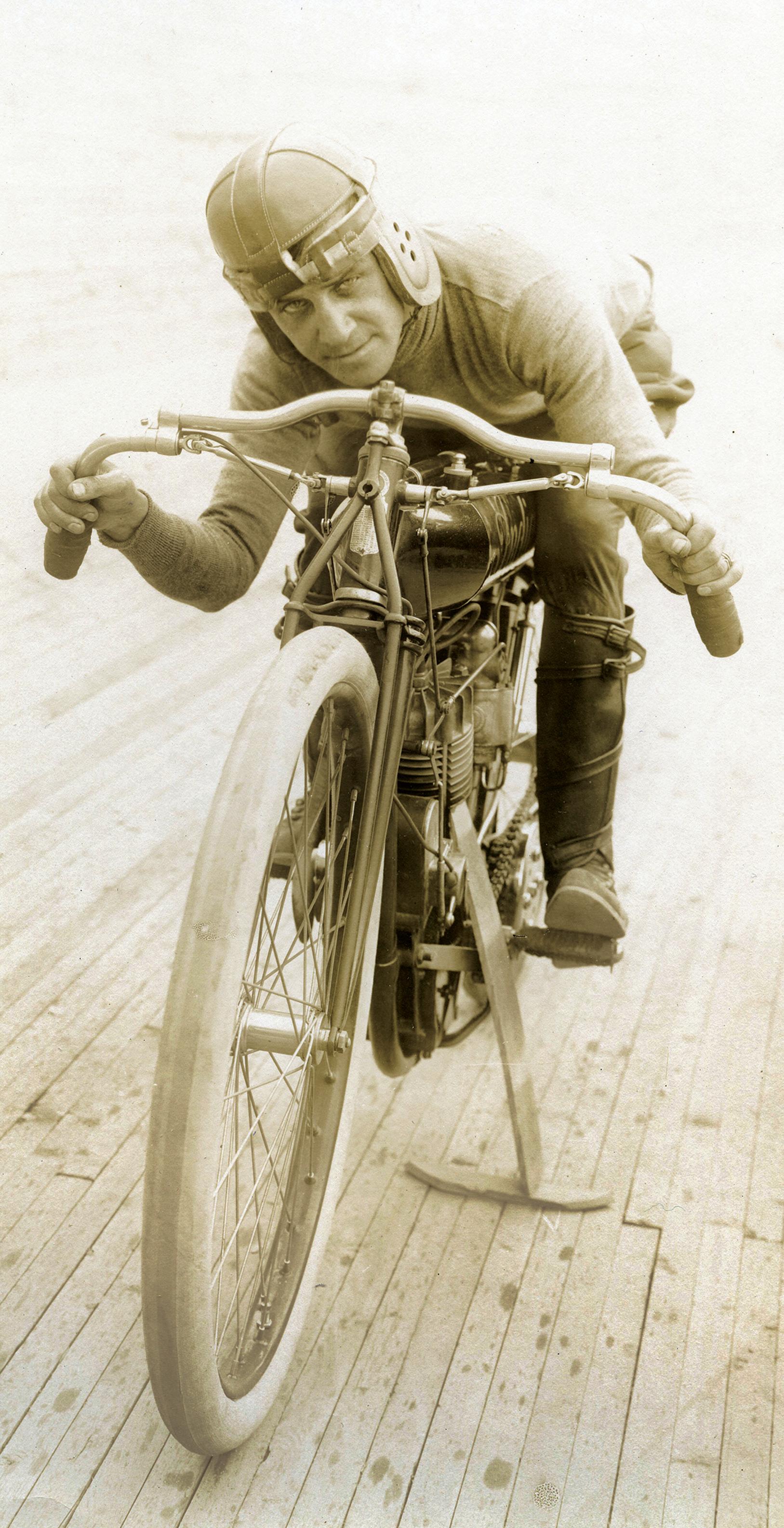
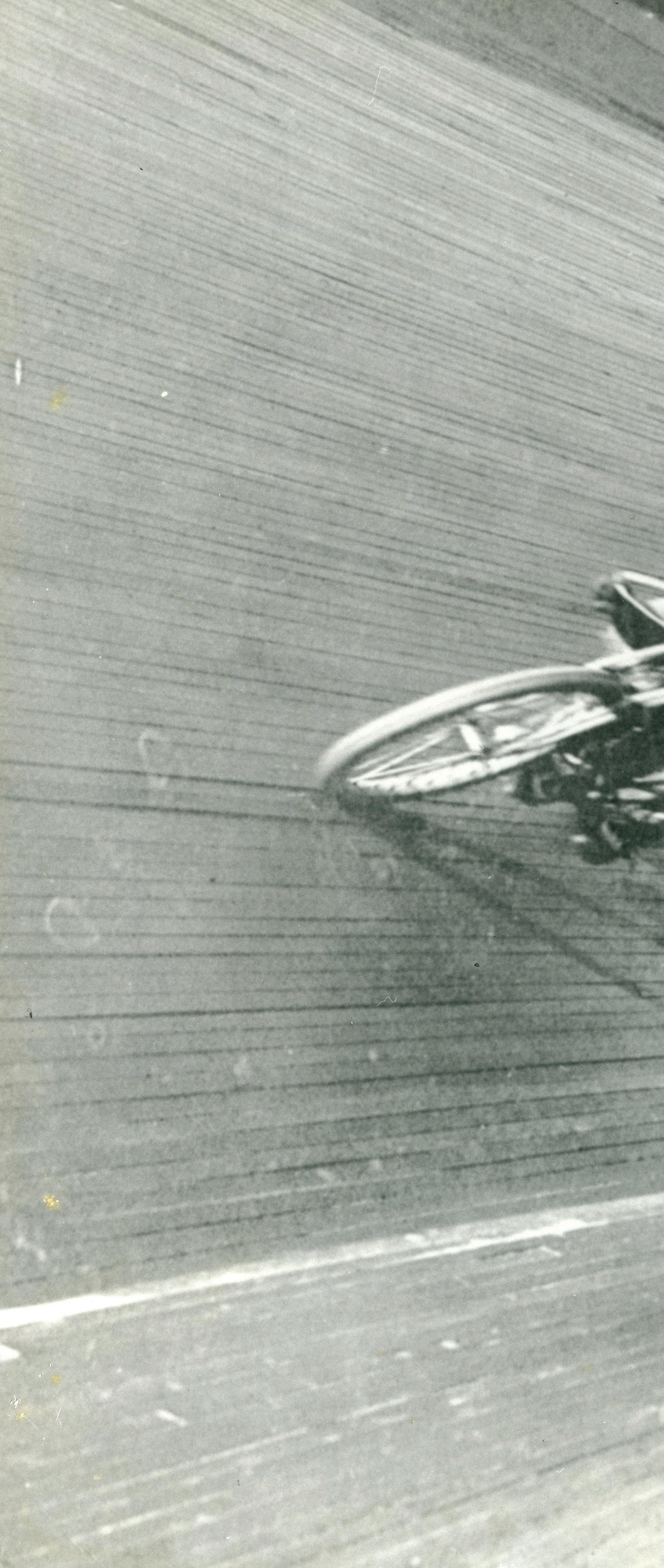
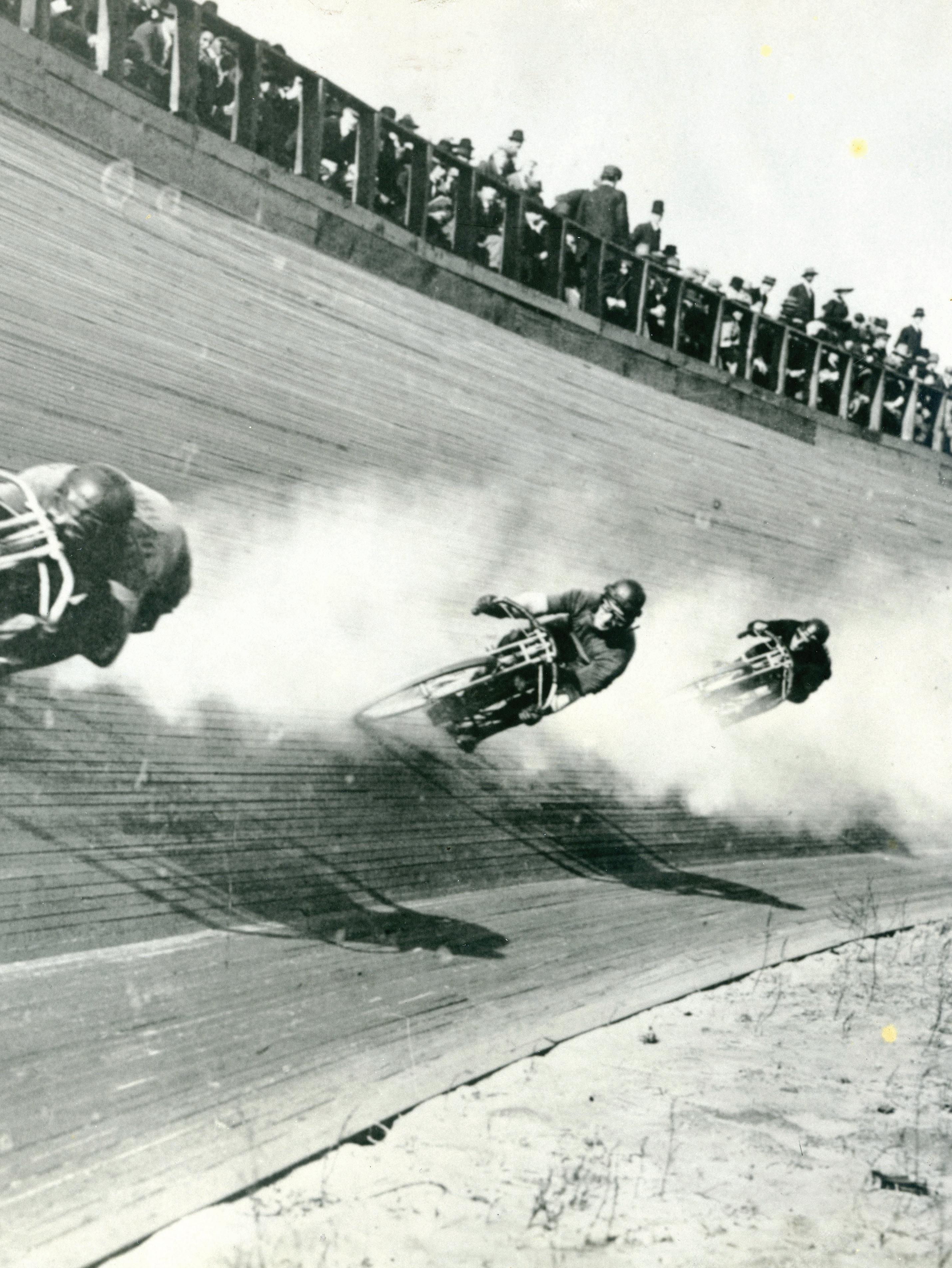
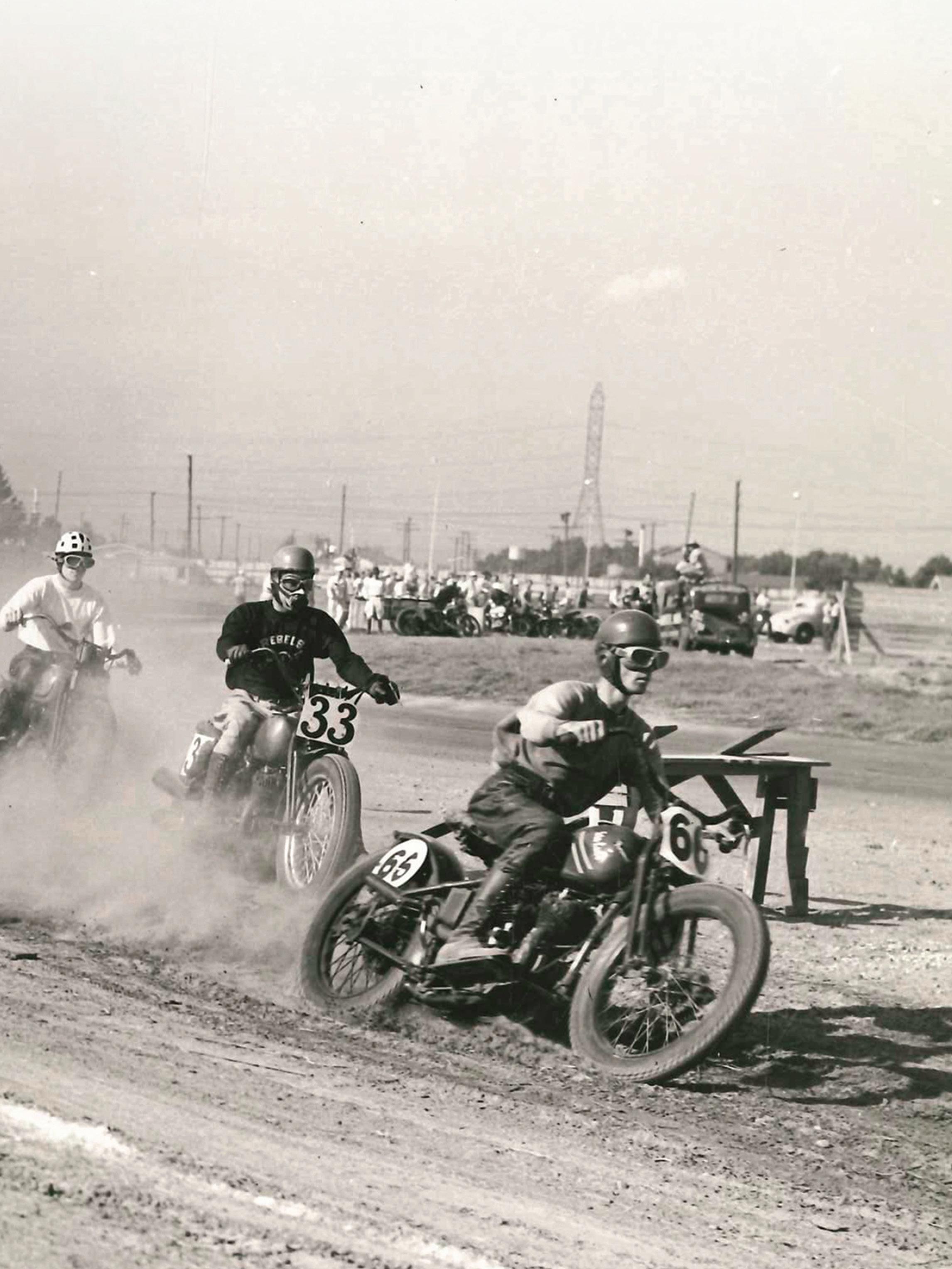
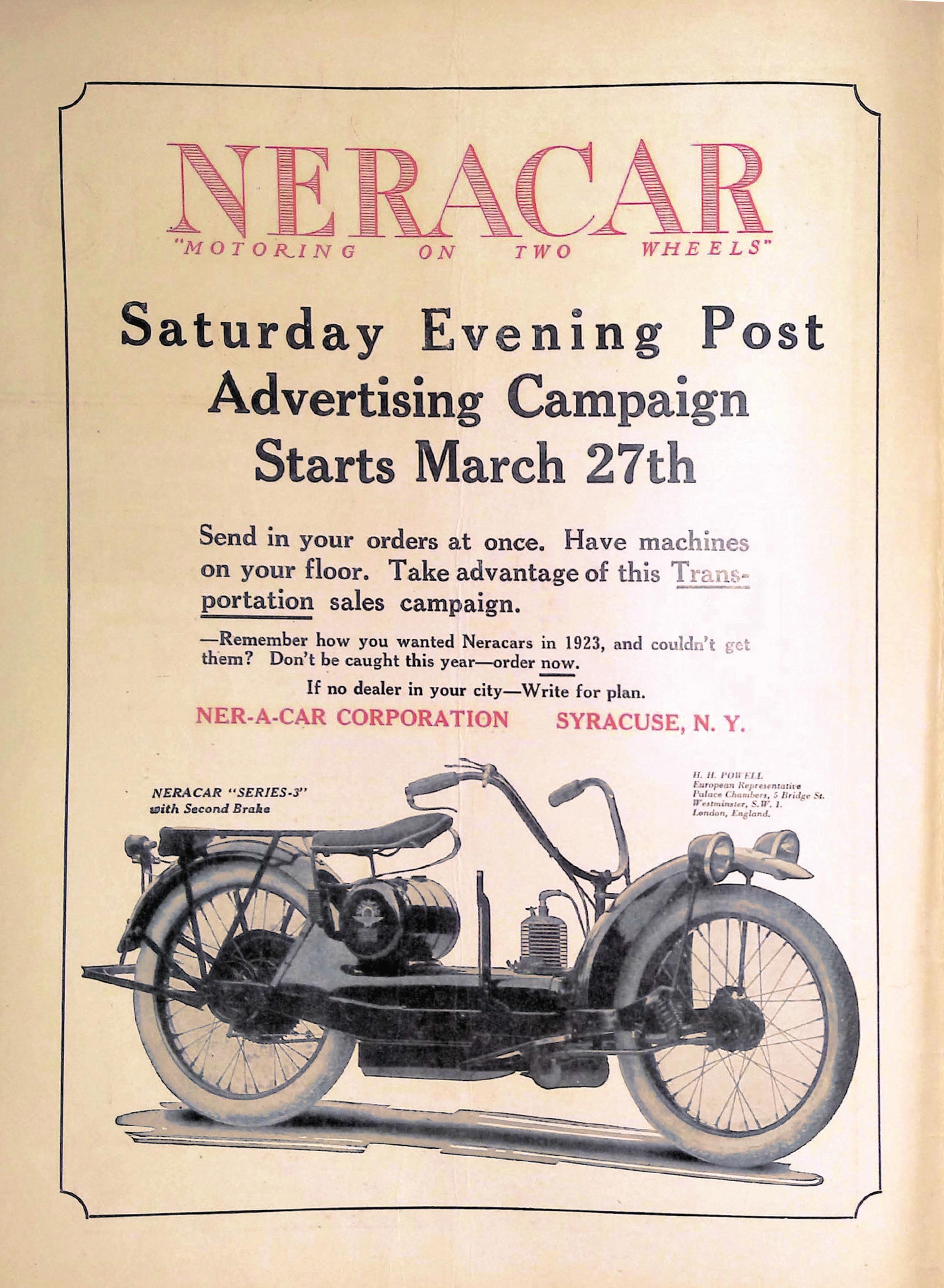
Wheels, wheels and more wheels…the late 1800s and early 1900s were full of ’em, and on all sorts of contraptions, too, from early legpowered “running machines” (top middle) to big wheelers (above) to motorized bicycles to board-track racers (far left), sidecars and more. Exciting times, for sure.
of a member organization known as the Federation of American Motorcyclists, or FAM, which registered nearly 9,000 enthusiasts before its demise just after WWI.
The MMA, or Motorcycle Manufacturers Association, came next, with none other than H-D’s Arthur Davidson as Treasurer, but was soon supplanted by the M&ATA, or Motorcycle and Allied Trades Association, a more manufacturer- and aftermarket-oriented organization that filled the FAM’s social- and competition-oriented voids by establishing the AMA for the very reasons listed above.
But we’re getting ahead of ourselves here. First a little history…
ROOT SYSTEM
An obsessive might trace motorcycling’s DNA to 4000 BC and the very first wheels, which are thought to have spun pottery, or maybe the wheels of the wheelbarrows or Roman chariots that came later…or any of the thousands of wheeled mechanisms developed during the industrial revolution of the 1700s and early 1800s.
to the front wheel, and many of those wheels were of huge diameter, several times larger than the rear wheel, which caused all sorts of safety and control problems until the socalled “safety” bicycles — bikes with similarly sized wheels front and rear — came about in the later 1880s.
By that point, steam engines had been around for well over 100 years (Thomas Newcomen is credited with the concept), and naturally, some were installed onto early bikes, with Frenchman Pierre Michaux and Boston’s own Sylvester Roper getting credit by many for doing it first in the 1860s with their steam velocipedes.
But many historians place the beginnings of what we know as a motorcycle with the first bicycles of the middle 1800s, with Karl von Drais’ laufmaschine (“running machine”) often recognized as one of the first. The first pedal-crank bicycle is said to have come from Germany’s Philipp Moritz Fischer, who “rode” a leg-propelled Draisine bike as a young man and who is said to have built the first bike powered via pedals, presumably due to sore legs from the laufsmaschine.
Many of those early bikes had pedals connected directly
But as internal-combustion engines — first built in commercially successful guise by Etienne Lenoir and, later, Nicolaus Otto — became more common and functional, it was only a matter of time before they found their way between — or onto, or alongside — the frame rails of two-wheelers.
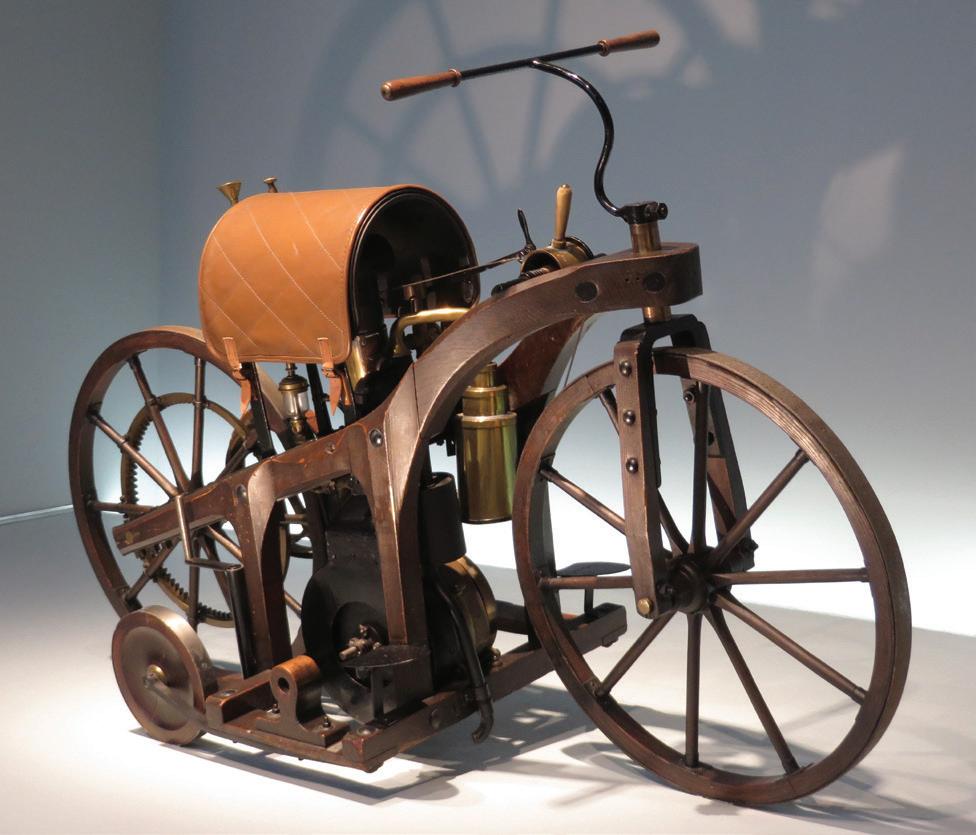
First to do it, of course, were Gottlieb Daimler and Wilhelm Maybach of Germany, who built the DaimlerMaybach Reitwagon in 1885 — a replica of which sits proudly in the AMA’s Motorcycle Hall of Fame. Their creation was both large and heavy, its thick wood frame and wheels looking more like a farm implement than what we’d consider a motorcycle. But it was the first and it led the way.
BOOM TIMES
As the 20th century neared, the motorcycle landscape took a grand leap forward, with many of these new bicycle companies fitting small internal-combustion engines to
SMITH MOTOR WHEEL JOHNSON MOTOR WHEEL
Motorcycles weren’t just transportation in those very early days, as automobiles were. As today, they were exciting, emotional and challenging conveyances...
their designs and offering them for sale to the public on a far wider scale than ever before.
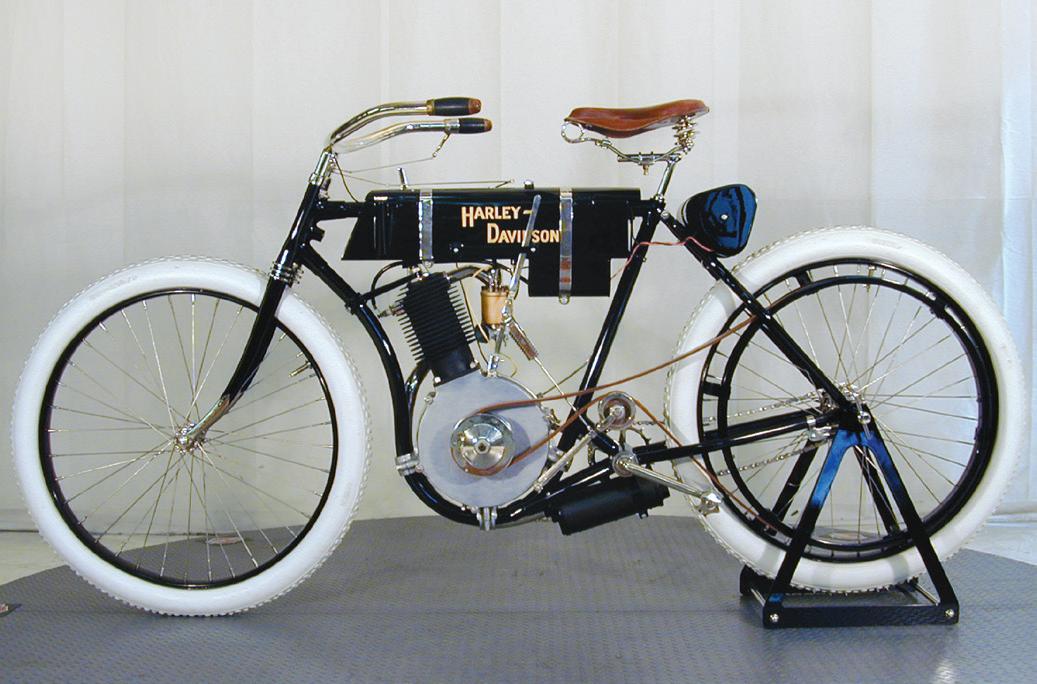
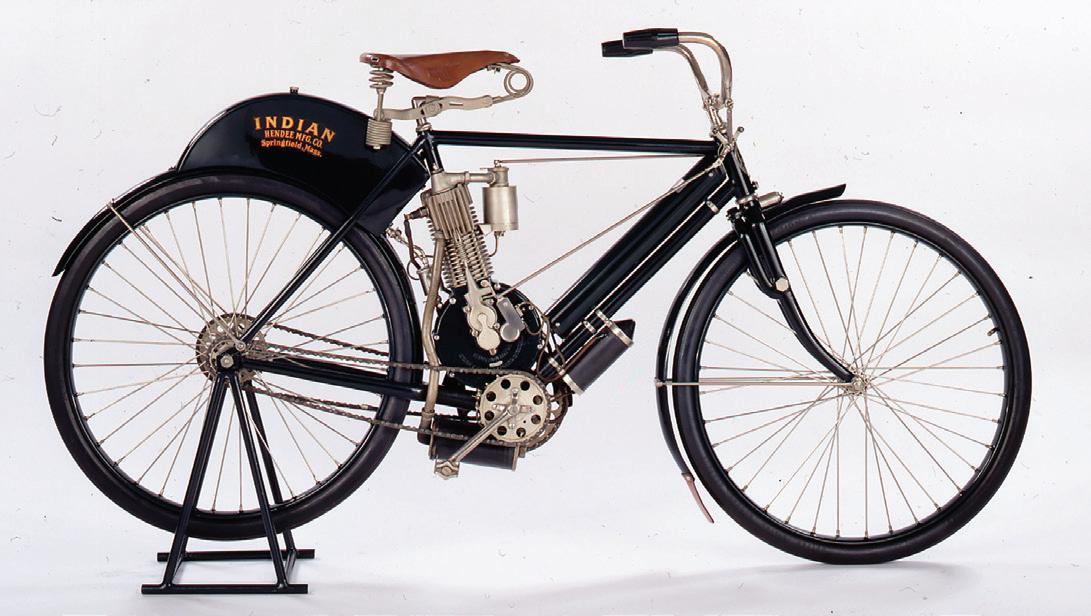
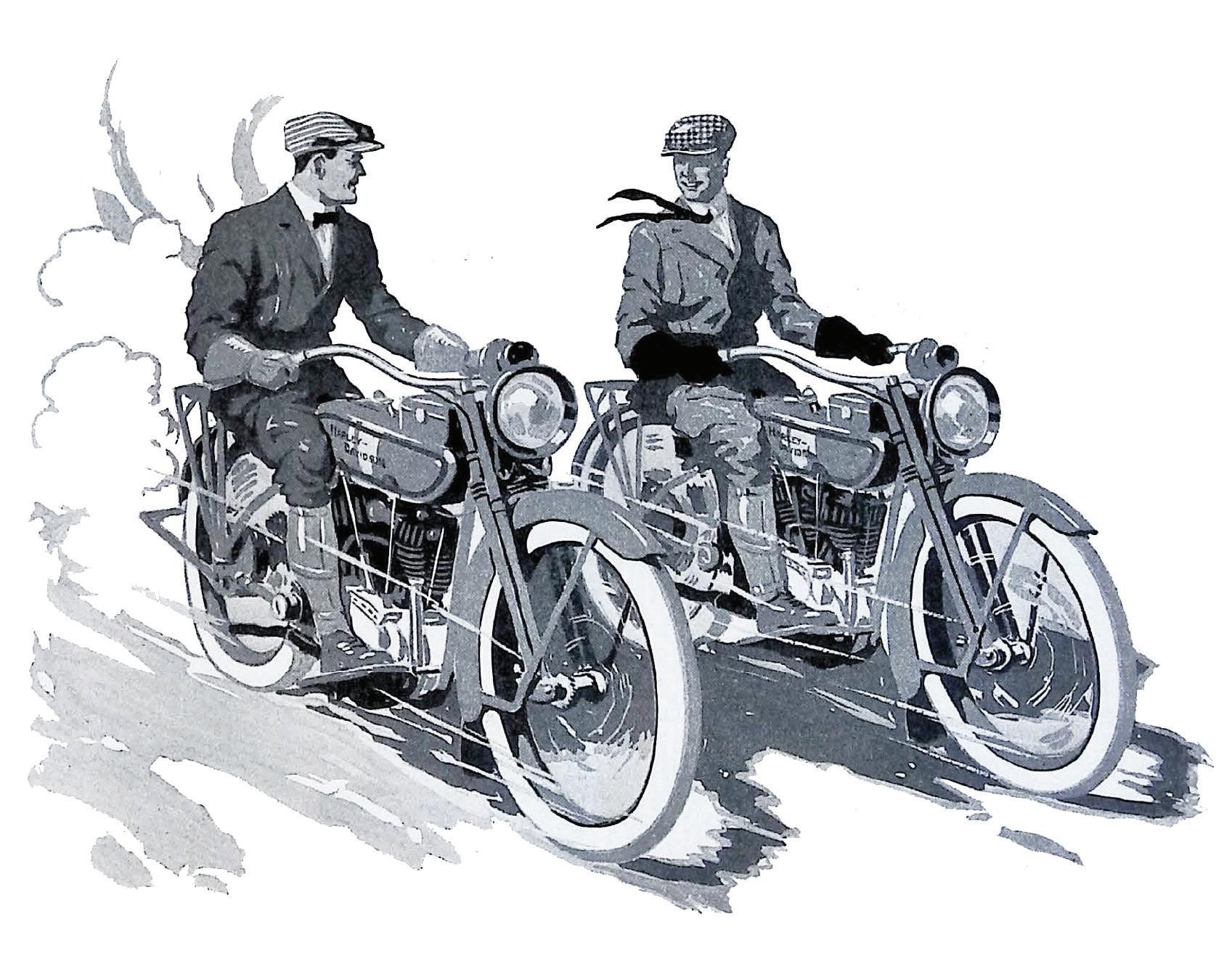
France’s Peugeot is credited as the first of these, offering a powered model in 1898, and as engine technology began to improve at a rapid rate, many more new (and old) companies followed suit, including Royal Enfield (1901), Hendee/Indian (1901), Triumph (1902) and, in 1903, Harley-Davidson, just to name a few.
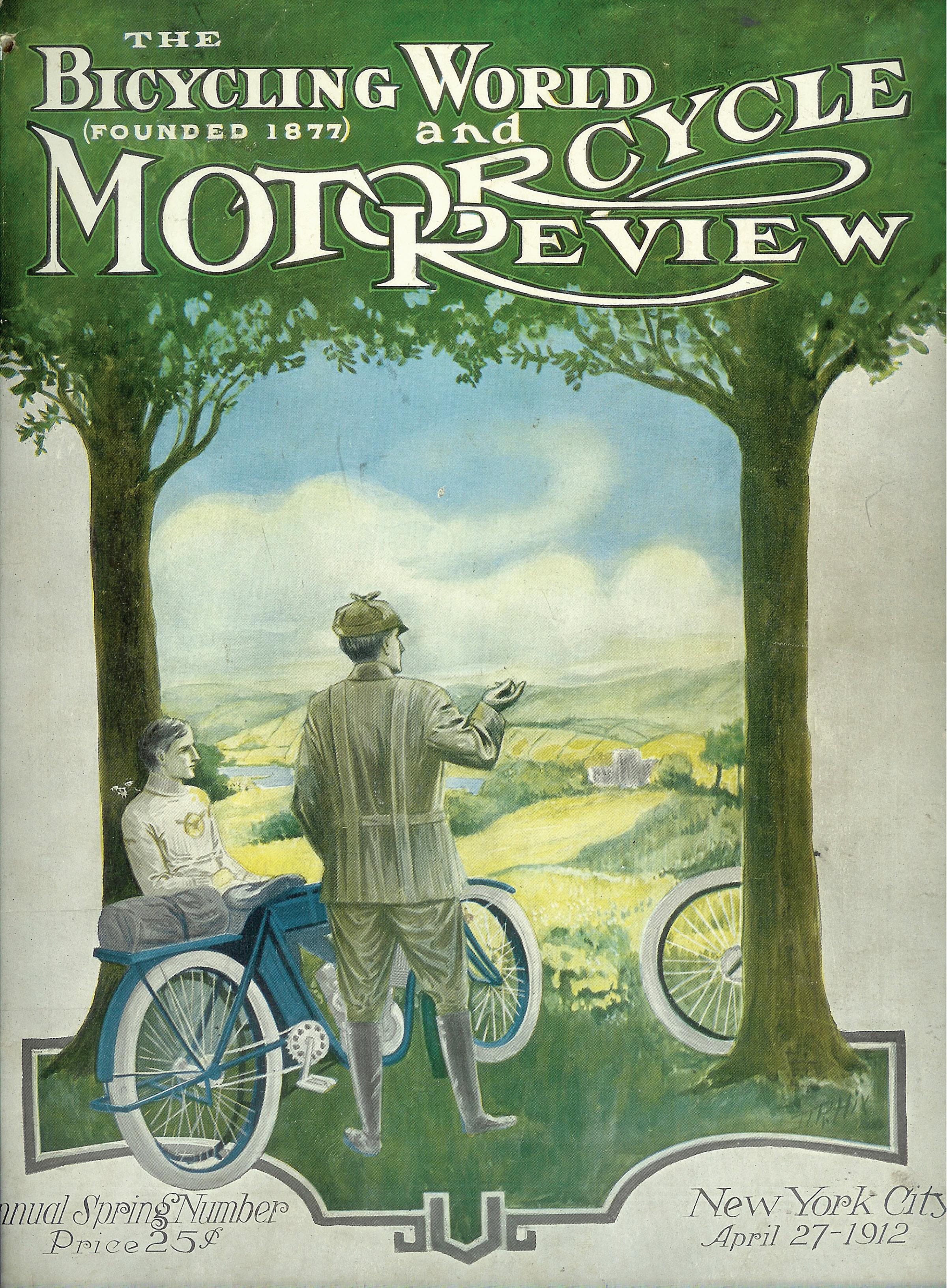
The first motorcycle magazine was actually a bicycle bi-weekly known as The Bicycle World, first established in 1877. It morphed into The Bicycle World and Motocycle Review shortly after the turn of the century, and served as the journal of the “wheelmen,” as enthusiasts were called in those early days.
FIM
we know today.
Between riding and travel and racing and social gettogethers and much more, a lot of ground was shifting on the motorcycle landscape in those very early days, with large numbers of clubs being formed across the country and all sorts of racing and non-racing activities taking place. In fact, it was a local club that created the spark that ignited the formation of the FAM, the first national motorcycle organization.
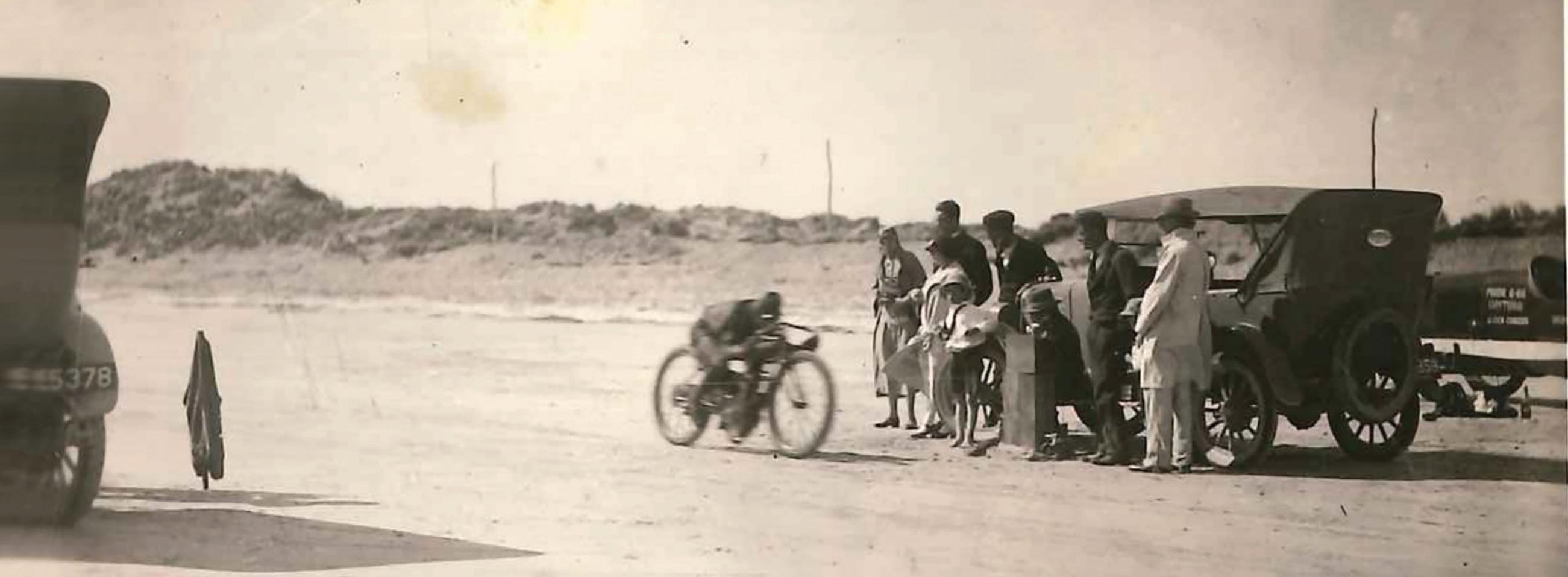
Aside from their use in travel and leisure riding, these early motorbikes were also used to pace bicycle races, though it didn’t take long for pace riders to realize the potential of racing these motorized two-wheelers. As early as 1905, motorcycle racing had established itself as a sport with a future.
Competition was percolating in Europe, as well, with a particularly unsafe race near Paris in September of 1904 causing the participating countries — Austria, Denmark, France, Germany and Great Britain — to join together and form the Fédération Internationale des Clubs Motocyclistes (FICM), which would in 1912 become the
FIRST FAM
Spurred by the first major legislative problem to confront motorcyclists — a New York law requiring registration of motorcycles as motor vehicles [imagine that! — Ed.] — a committee was formed by the New York Motorcycle Club in early 1903 to gauge the need and desire for a national enthusiasts’ organization, one that would support the sport and enthusiastic adherents. Having found plenty of support for such an organization among club members and the burgeoning industry, the Federation of American Motorcyclists (FAM) was formed that summer, with a constitution that sounds plenty familiar:
CONSTITUTION Article 1: The title of this organization shall be the Federation of American Motorcyclists. Its objectives shall be to encourage the use of motorcycles and to promote the general interests of motorcycling; to
Above: The first Harley-Davidson, circa 1903, one of just a few built that year. This one sits in H-D’s factory museum in Milwaukee, Wis. The DaimlerMaybach Reitwagen (left) of 1885 gets credit as the first internal combustionpowered motorcycle. Though cumbersome and heavy, it led the way to all sorts of lightweight motorized bicycle designs (below).
AS BIKE SALES AND MOTORCYCLE ACTIVITY INCREASED DRAMATICALLY IN THE YEARS AFTER THE FAM’S CREATION, A SIMILAR MOVE TOWARD ORGANIZATION
— ONE THAT WOULD EVENTUALLY LEND SHAPE TO THE FUTURE AMA — TOOK
ascertain, defend and protect the rights of motorcyclists; to facilitate touring; to assist in the good roads movement; and to advise and assist in the regulation of motorcycle racing and other competition in which motorcycles engage.
A spirited debate quickly arose on the subject of competition, and whether motorcycle racing should share racetracks with auto racing organizations (it should not, it decided), and whether the FAM should “absolutely control” racing or simply serve in an advisory capacity, with an “advise and assist” role finally decided upon.
From small beginnings, the FAM quickly moved in the direction of encouraging racing and club activity. Board track and motordrome racing emphasized speed, while endurance and road runs were primarily the domain of the clubs. A self-imposed horsepower limit of 5 bhp was a bone of contention, but the biggest issue was funding, with Treasurer E.M. Estabrook stating in 1909 that rebates to
PLACE IN THE RISE OF TRADE ORGANIZATIONS.
districts should be discontinued because [the districts] could operate without those funds, while the national organization needed the money to continue to build core strength. It’s an element that would be discussed in later decades.
As bike sales and motorcycle activity increased dramatically in the years after the FAM’s creation, a similar move toward organization — one that would eventually lend shape to the future AMA — took place in the rise of trade organizations comprised of
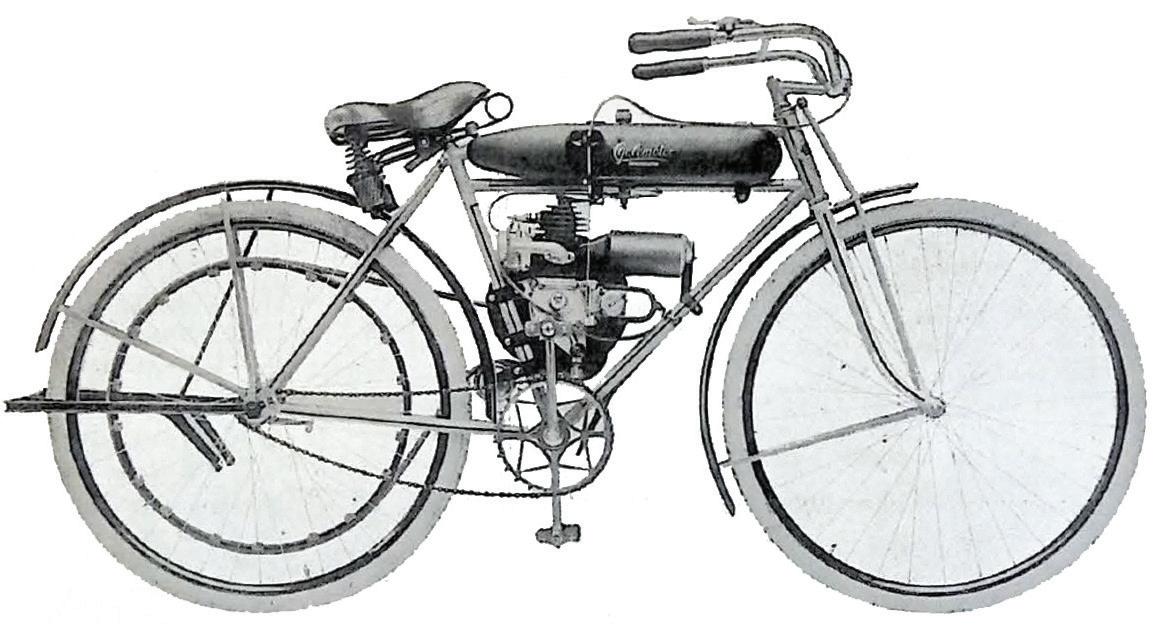
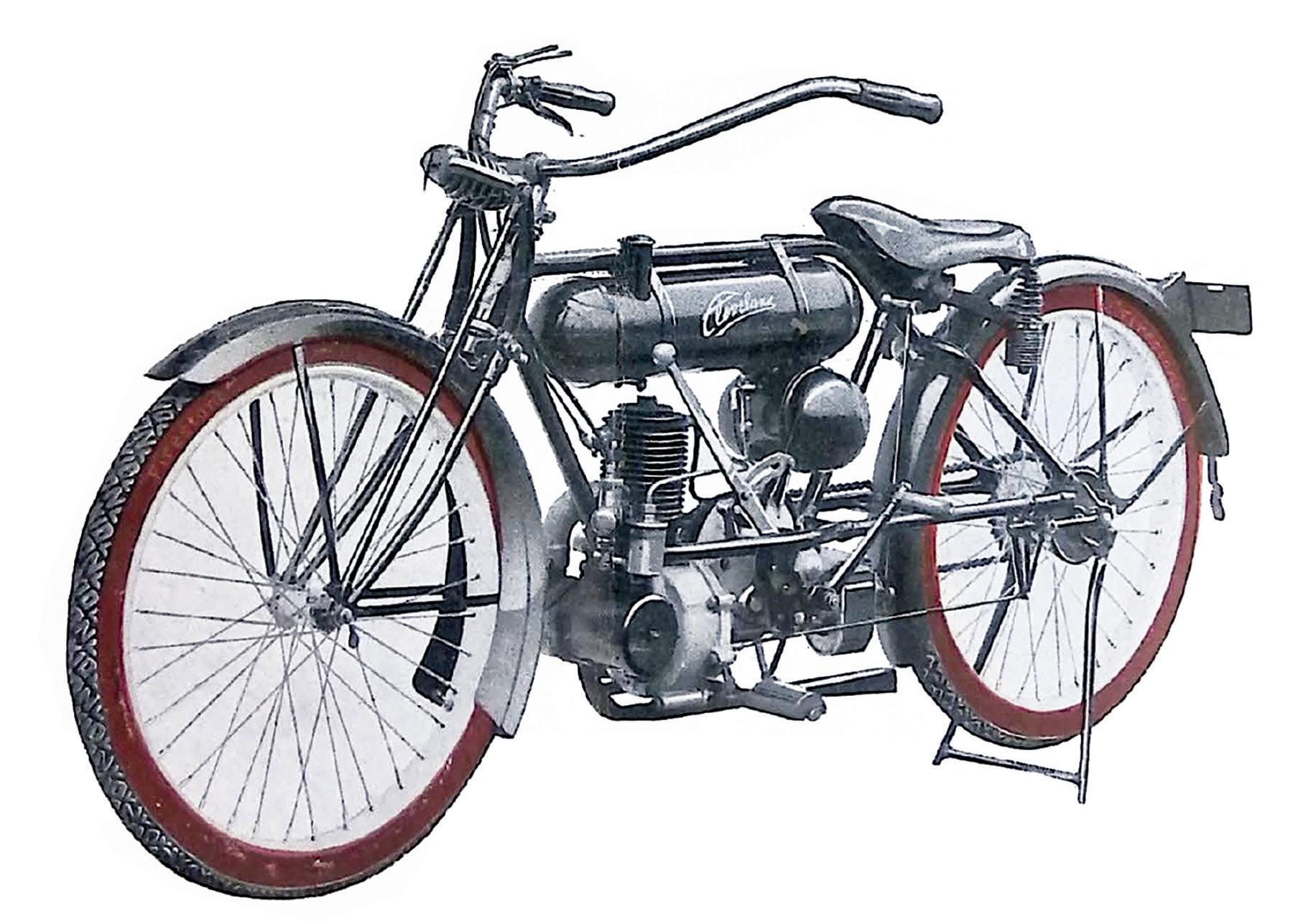
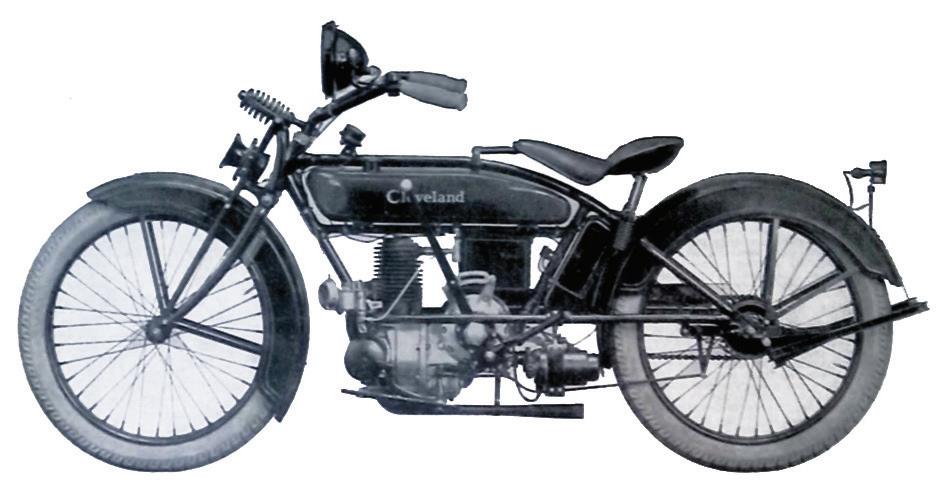
Top: It didn’t take long for enthusiasts to start racing one another and doing speed trials on their bikes. Right: A Cleveland single, with its telltale tank. Right: The cover of The Bicycling World and Motorcycle
from 1912.
Review
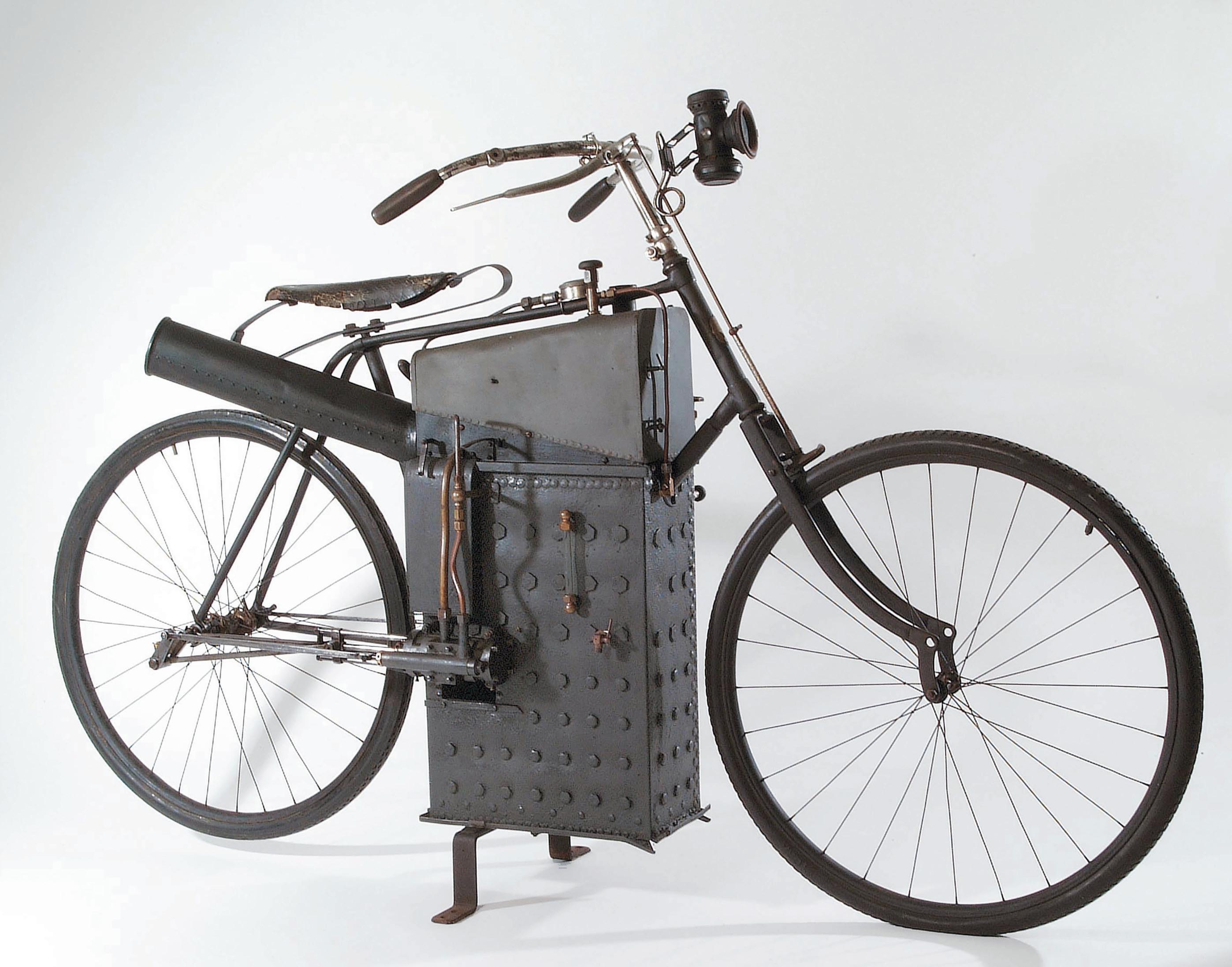
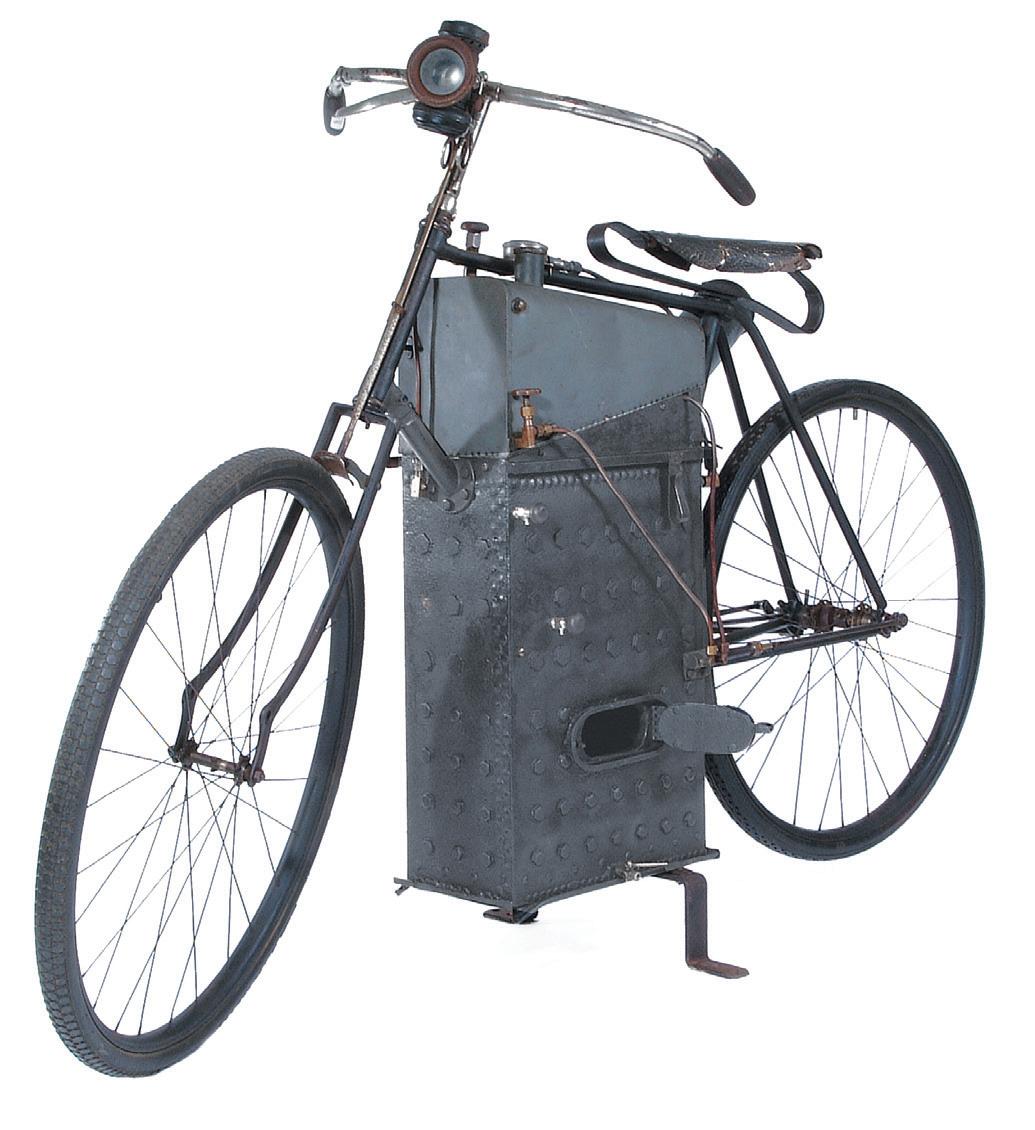
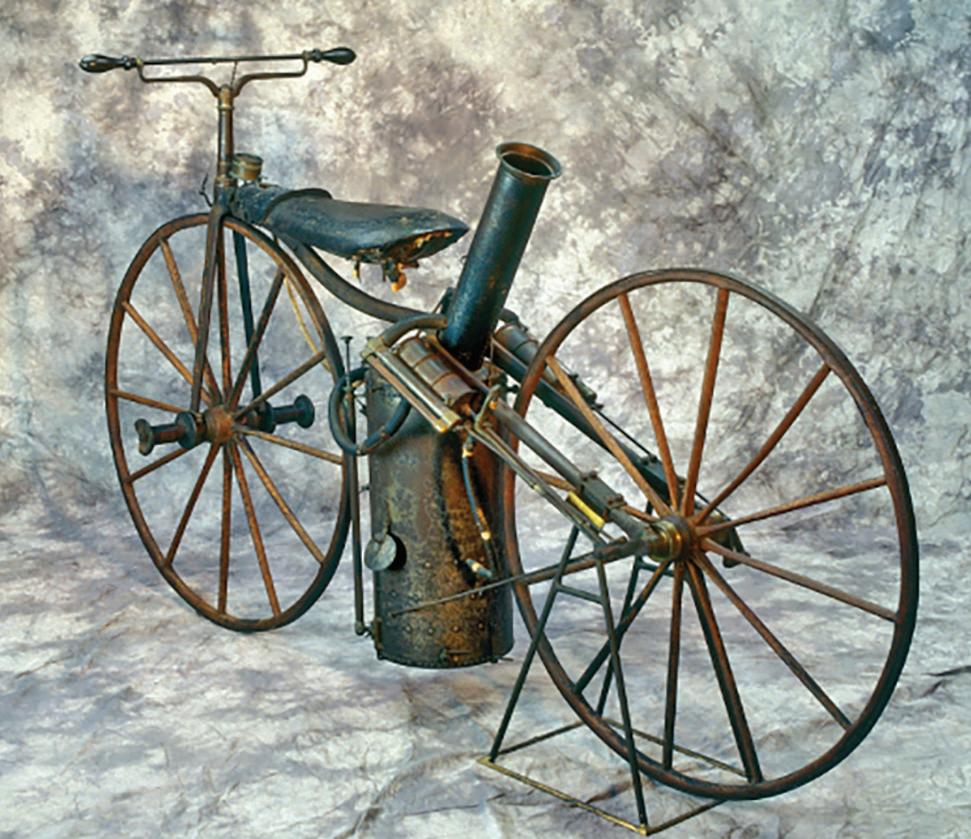
There is some disagreement on what constitutes the first motorcycle, but it’s pretty hard to argue that AMA Hall of Famer and Massachusetts resident Sylvester Roper’s original velocipede steamer (below) of 1868 doesn’t rank as at least 50% of the very first wave. (French father and son Pierre and Ernest Michaux built something similar a year or so earlier.) Roper’s steamcycle burned charcoal and rolled on wooden wheels, but a powered cycle it was, and if you buy the idea that a steam-powered two-wheeler was indeed a motorcycle (as many do), then these two – Roper and Michaux – beat Daimler and Maybach to the punch by more than a dozen years. Roper built several versions of his steamer over the years, the final iteration of 1896 (above and left) using a productionspec bicycle as a base. With each stoking of the coals, Roper’s bike would run for seven miles, and reach speeds of 30 mph. While demonstrating it at a local bicycle race, the 73-year-old Roper is said to have died of a heart attack.
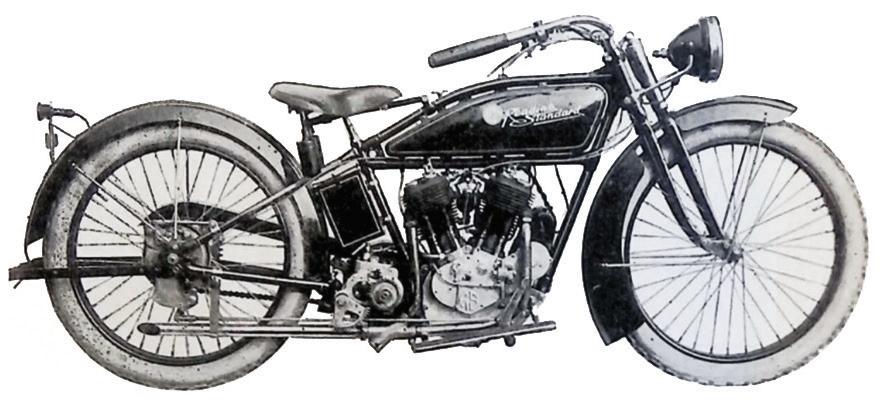
1917 READING STANDARD
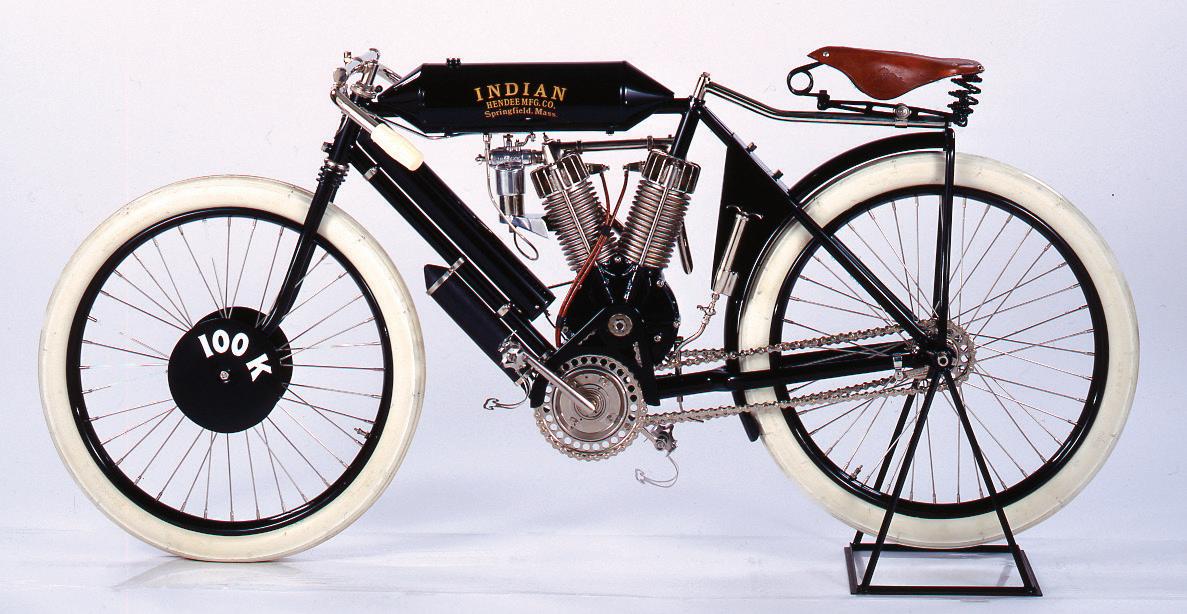
1912 INDIAN 8 VALVE
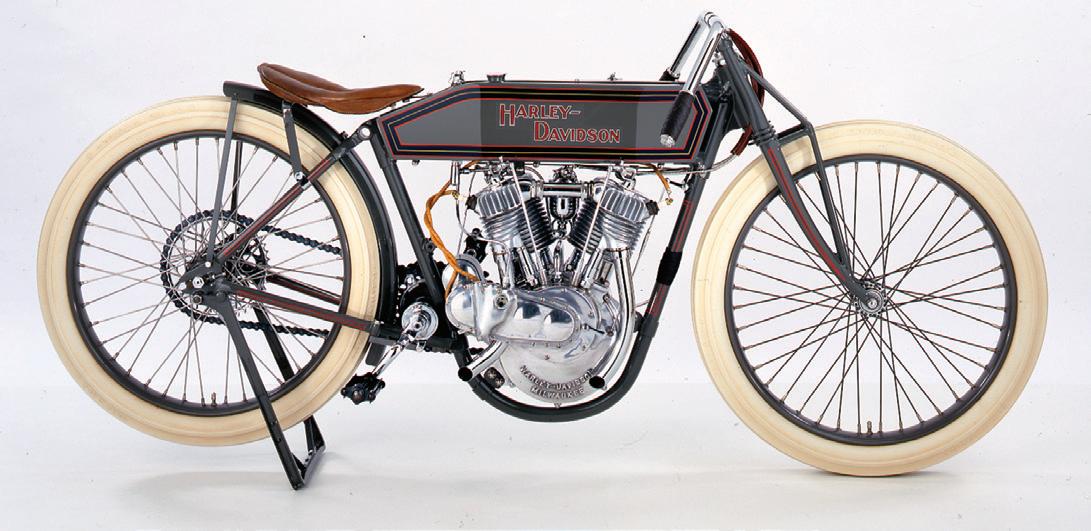
1914 HARLEY-DAVIDSON WILLIS
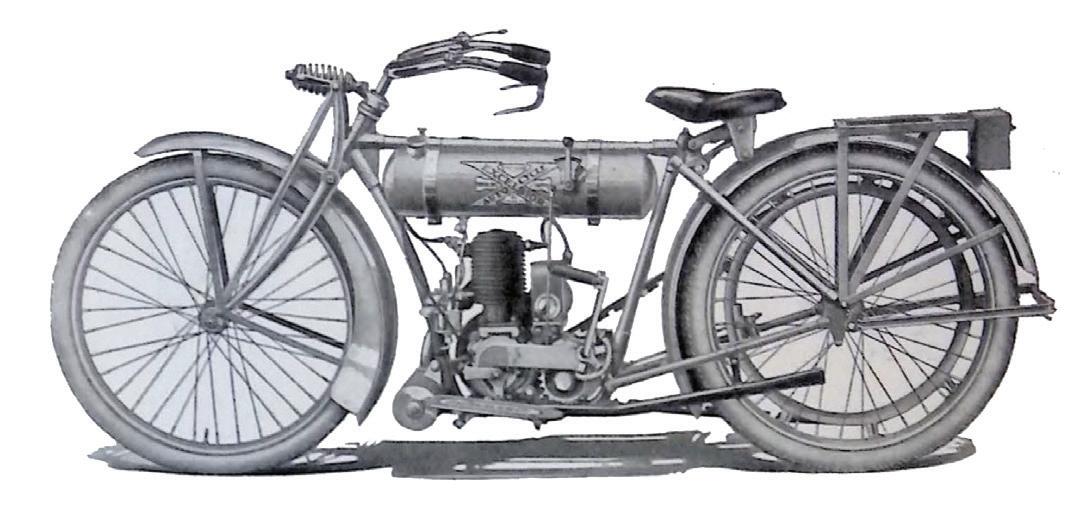
1916 EXCELSIOR TWO-STROKE LIGHTWEIGHT
1924 CLEVELAND
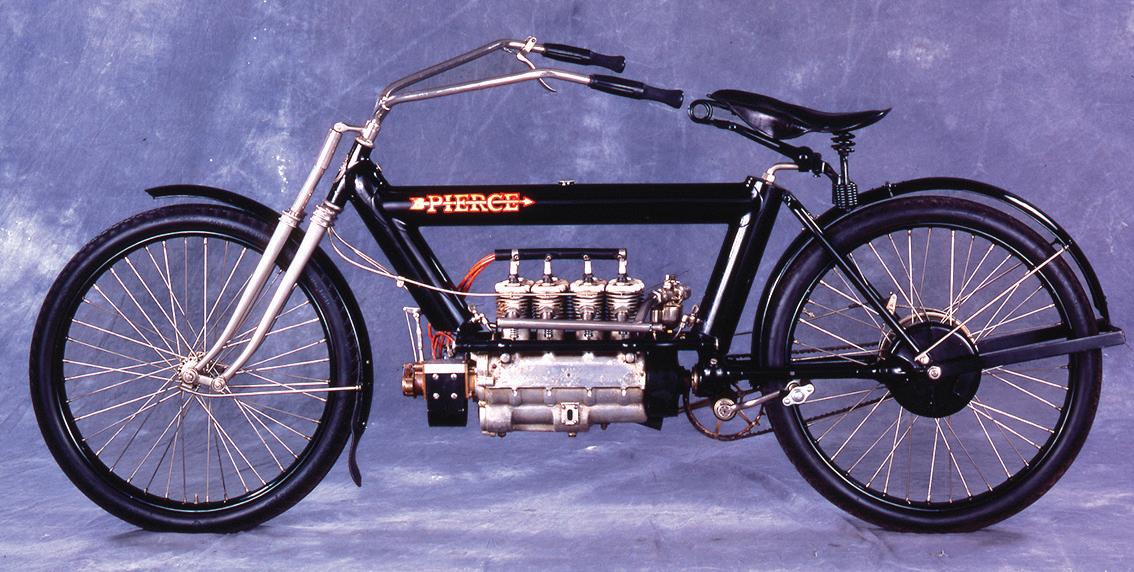
1911 PIERCE FOUR
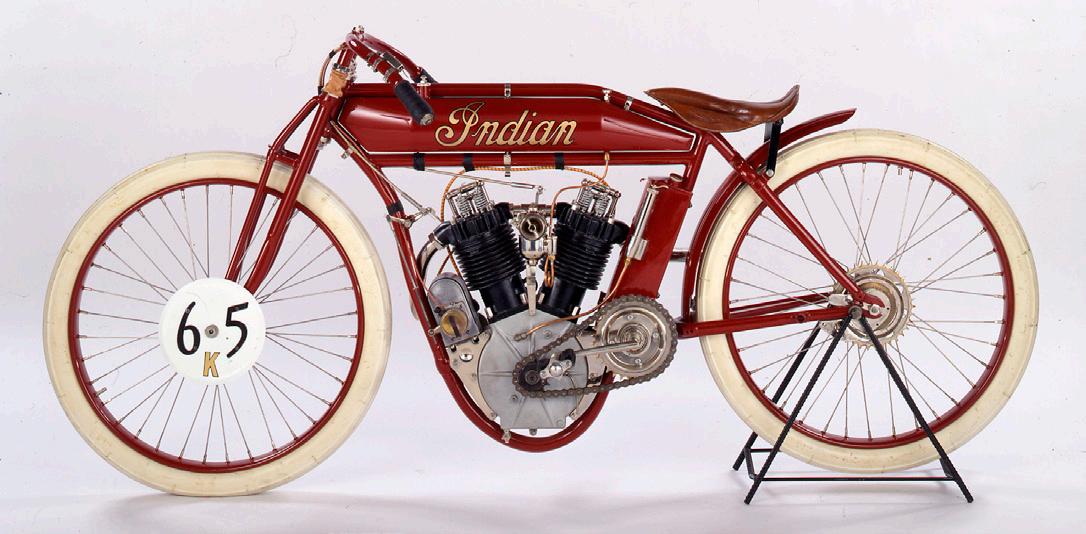
1908 INDIAN TWIN
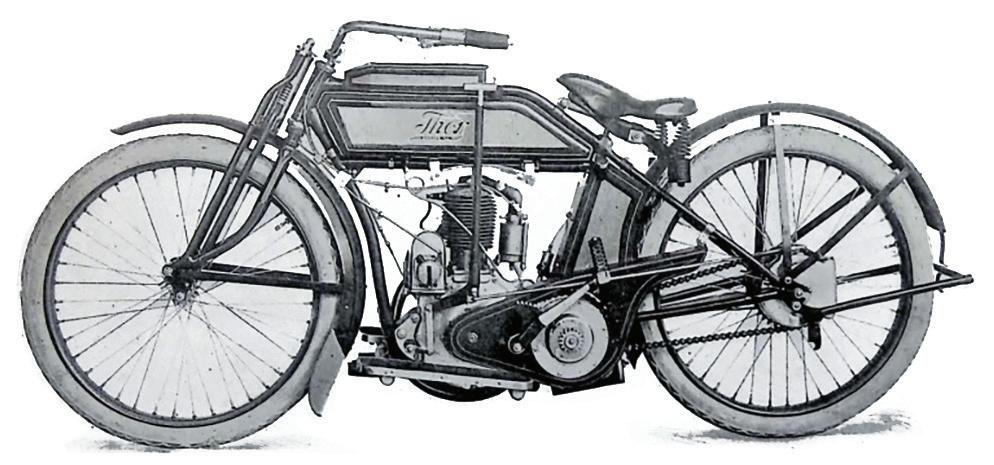
1916 THOR
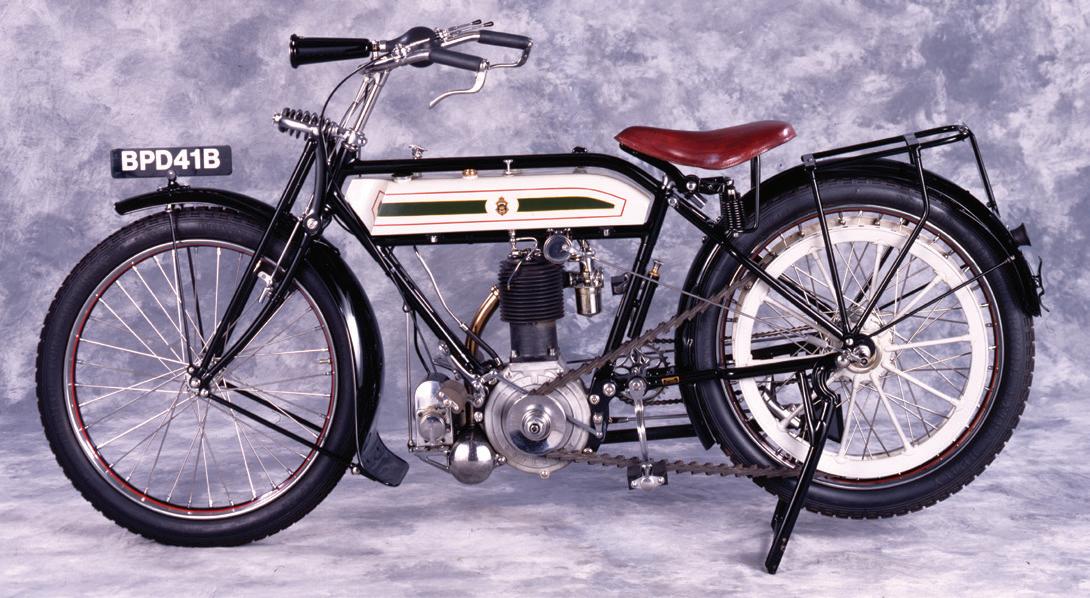
1914 TRIUMPH TT TYPE G
1905 INDIAN SINGLE
manufacturers, accessory makers and distributors, a primary example being the establishment of the Motorcycle Manufacturers Association, or MMA, in 1908.
These outfits, which included bicycle and motorcycle makers, began to hold shows and conventions demonstrating the growing strength of the two-wheeled industry, and worked in concert with the FAM on a range of pro-industry items — legislation (supporting good, fighting bad), racing rules, and assorted other regulations. It’s noteworthy that a fellow named A.B. Coffman of Consolidated Manufacturing of Toledo, Ohio, was elected president of the MMA in 1911 (remember the name), and that Arthur Davidson of the fledgling Harley-Davidson firm was appointed treasurer.
THE M&ATA
By 1915, the FAM boasted a membership of 8,500, but due to mismanagement and the effects on the country and motorcycling of the war in Europe, membership had fallen to just over 3,300 by 1917. Organized motorcycling might have suffered a major blow with the deterioration of the FAM had it not been for a Nov. 15, 1916, meeting of manufacturers and related companies, the result of which was the formation of the Motorcycle and Allied Trades Association (M&ATA).
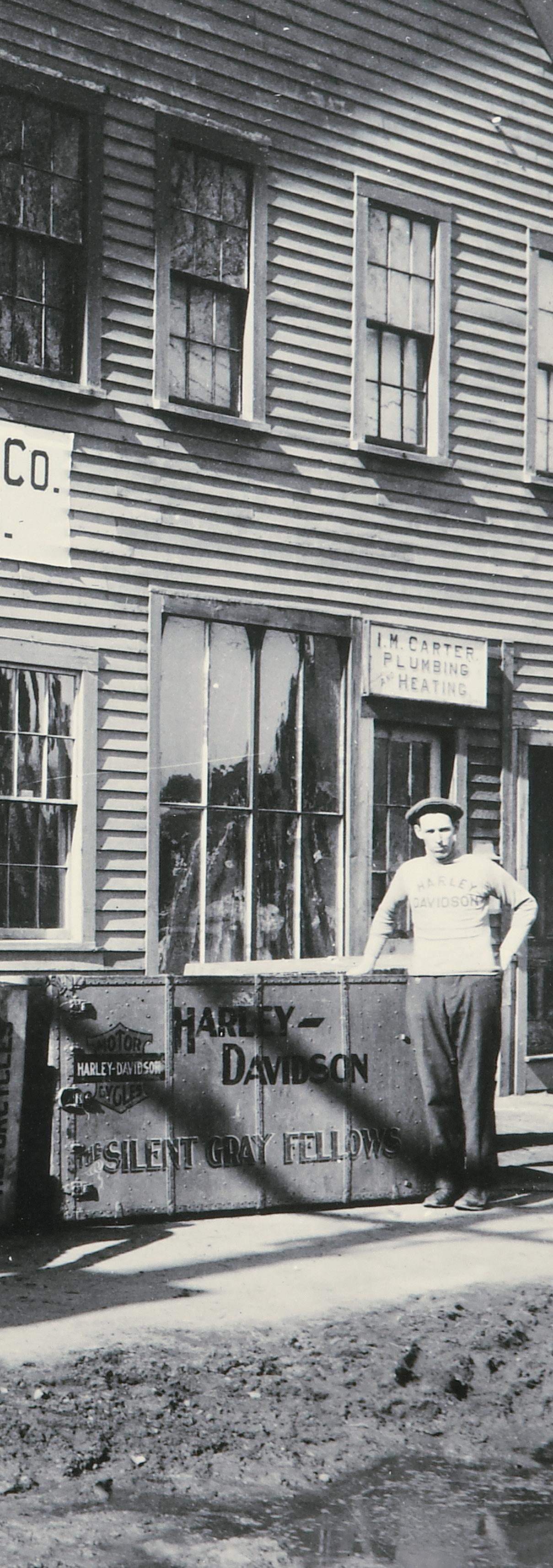
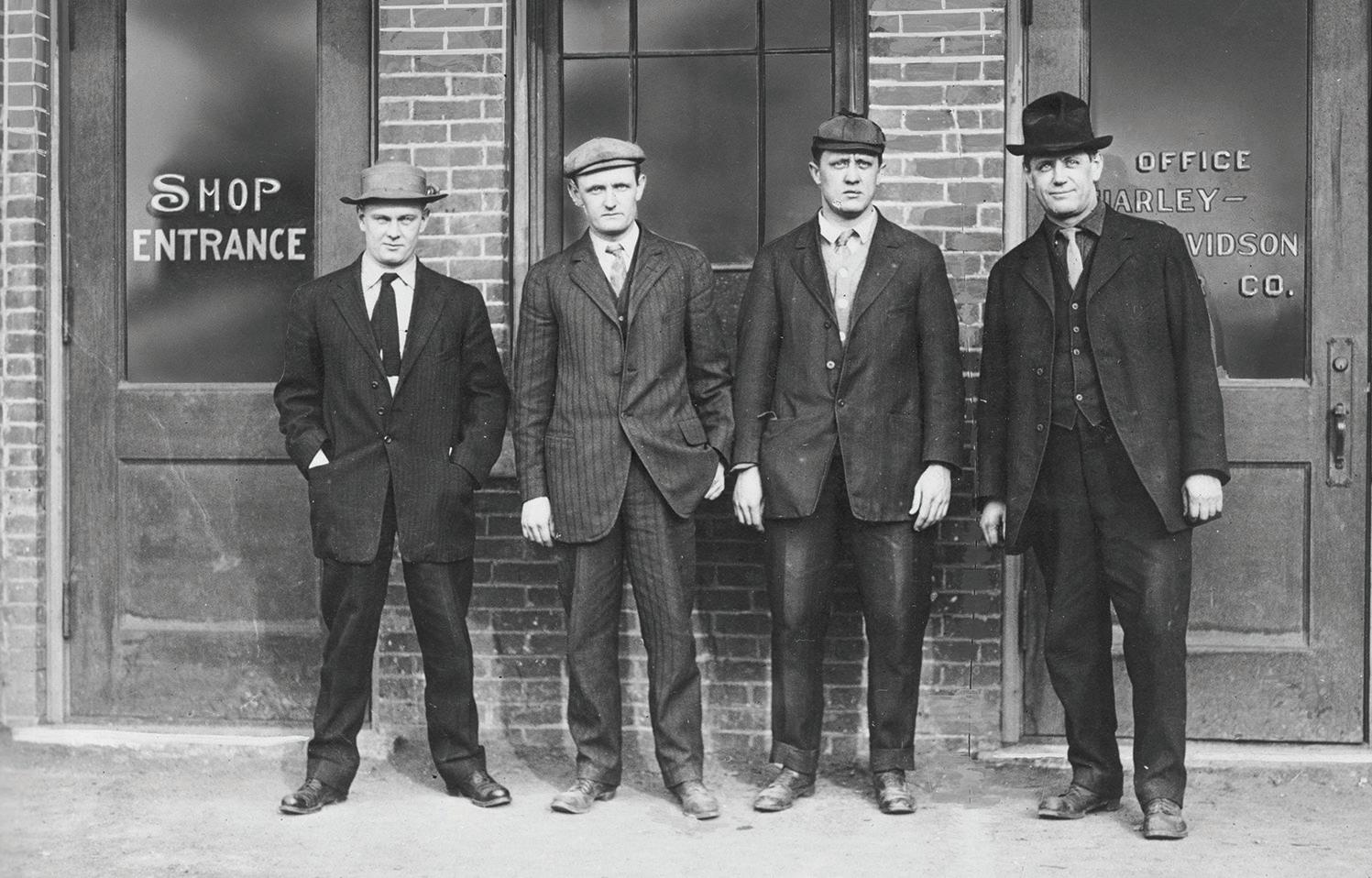
By 1910, H-D production was more than 3000 units annually, and Harleys were becoming part of American culture, in windows, shipping crates, garages and on the road. Right: H-D Motor Company founders (left to right) Arthur Davidson, Walter Davidson, Bill Harley and William Davidson.
Left: Fred West, Indian, promotional photo. Don Emde Collection. Above: Joe Wolter leading Excelsior teammates Jake DeRosier and Charles Balke, summer 1912. Don Emde Collection.
“If every motorcycle club in the country were to adopt a similar resolution, the roads and highways would soon be free of this noisy pest.”
HARLEY-DAVIDSON’S ENTHUSIAST
One of that organization’s primary purposes was to revitalize the FAM, but instead, and for a handful of reasons, it quickly became the dominant force in motorcycling, less through its own design than the FAM’s failures and the effects of WWI.
Despite its industry control, the M&ATA had in common with the riders of the nation a genuine desire to increase the scope of organized activity. WWI had cut deeply into that activity, and while the war had provided a healthy market for service machines, the post-war era dictated that activity be organized not only for the benefit of riders, but also to generate demand for new and used motorcycles, parts and accessories. Was this industry control self-serving and Capitalistic? Absolutely. But during a time of the sport’s foundational growth, plenty practical.
With the demise of the FAM, the M&ATA quickly went about the business of registering clubs. Noting the wealth of motorcycling activity, including competition events, tours, endurance runs, hillclimbs, race meets and record trials to be enjoyed during the 1919 season, the M&ATA urged clubs to register with its Education Committee, which spread the word about
events and activities, and offered valuable information on the promotion of club events.
GYPSY TOURS
The M&ATA also carried on the competition function of the old FAM with its emphasis on oval track, boardtrack/ motordrome racing and hillclimbing, and also spent considerable time on what was to become an institution in American motorcycling and, later, the AMA — the Gypsy Tours.
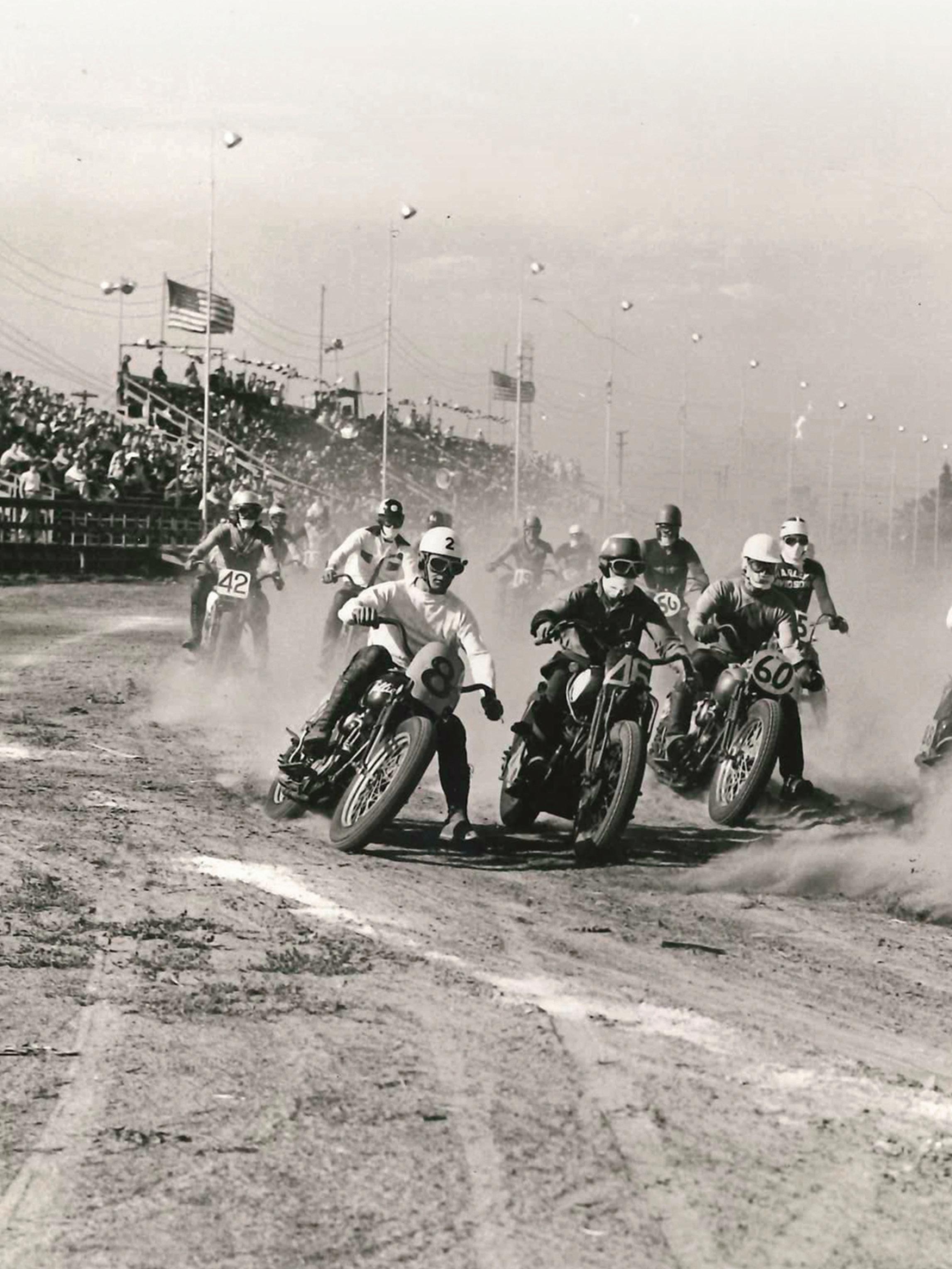
The origin of the Gypsy Tours can be traced to 1913 and what was billed as a “Good Fellowship” tour in Milwaukee. By 1920, similar events featuring all sorts of fun and games, skills tests, mileage challenges and more were being held all over the country, with the M&ATA designating them Gypsy Tours and setting a single, coordinated weekend on which all were conducted. That year, some 30,000 riders took part in Gypsy Tours, with 50,000 engaging in 1921, and a whopping 75,000 taking part on June 18-19, 1922. The Gypsy Tours became a major membership generator for the M&ATA, and would do the same for the AMA down the road.
COMPETITION COMMITTEE
As the M&ATA’s work on the racing side of the ledger became more significant, a Competition Committee was established in 1919. The Committee would “have the authority to act in the name of the M&ATA to make rules and regulations as may be necessary for proper control… for all future motorcycle competition in the U.S.”
Rider registration was a key part of the Committee’s work, and the announcement of its founding included this: “Out of this [system of rider registration] we believe that ultimately will come a strong riders’ association which need not and should not be a part of the M&ATA, but which will be affiliated with the M&ATA…”
W.H. Parsons, editor of Motorcycle and Bicycle Illustrated, was named first chairman of the
A.B. Coffman
100 YEARS OF THE AMA Committee, and in the first edition of the magazine following his appointment he’d write the following: “This plan of registration is not an organization of a riders’ association, though it is expected that this will be the foundation upon which eventually will be built a strong and efficient rider organization which will be affiliated with the M&ATA.”
In just a few years, this would become the AMA.
GOVERNMENT RELATIONS
Racing and Gypsy Tours kept the M&ATA plenty busy, but the group was doing even more on the side. In a statement that rings familiar today, M&ATA President Walter Davidson of Harley-Davidson said, “One of the
most important tasks ahead is to watch and combat in every way possible unfavorable legislation.”
One of the first recorded government-relations activities on behalf of motorcyclists came from the aforementioned A.B. Coffman, by now a general manager at the M&ATA.
Coffman sent a letter of protest to U.S. Senator Thomas Watson of Georgia, who had called motorcycles “devilish” in a speech promoting highway regulation.
Coffman’s letter, which pointed out numerous positives of the motorcycle as a practical mode of transportation and its significant role in WWI, was published in the motorcycle magazines of the day, and served notice to politicians that motorcyclists were indeed a large contingent demanding fair treatment. In turn, the letter served as an example to motorcyclists across the country on how to deal with political threats in a respectful and effective manner.
The Committee also fought against excessive noise,
which was as big a problem then as it is now. The New Jersey Motorcycle Club, which would subsequently become the first club chartered by the AMA, went on record in 1922 as opposing further use of the loud, exhaust-system “cut out” (basically a muffler bypass), and indicated it would cooperate with police in running down offenders.
Harley-Davidson’s Enthusiast noted that, “…this resolution is one that all thinking motorcyclists with the good of the sport at heart would like to see grow. If every motorcycle club in the country were to adopt a similar resolution, the roads and highways would soon be free of this noisy pest.”
BIG MOVES
Now dealing with racing, excess noise, caustic legislation, membership generation, events such as Gypsy Tours and a host of other initiatives, M&ATA
100 YEARS OF THE AMA
Directors met in Cleveland, Ohio, on May 15, 1924, to formulate a major restructuring and re-alignment of the so-called “registered riders division” of the M&ATA — a move spurred by A.B. Coffman, and one that would lead at that very meeting to the creation of the American Motorcycle Association.
From the outset, the creation of the AMA was largely a name change, in that the previous Competition Committee was now the Competition Committee of the American Motorcycle Association. The stated purpose of the AMA was to assume the responsibility for all rider activity, pure and simple. Sanctions would be issued, and events such as Gypsy Tours, the National Rally and the new National Six-Days Trial (a road version of the then-new and highly popular European ISDT) were to be run under the auspices of the AMA.
All M&ATA-registered riders in good standing automatically became AMA members (and were given an attractive gold and enameled pin) with dues of $1 per year; all M&ATAregistered clubs were immediately chartered (with the New Jersey Motorcycle Club granted AMA charter No. 1); and registered dealers were given a large window sign telling “all rider members of the AMA that this dealer is one of them…” — the latter a precursor to today’s Business Member Program.
The AMA’s new slogan that “An organized minority can always defeat an unorganized majority” was all about strength in numbers, and an indication of the AMA’s dedication to protecting the interests of its riders from unfair legislation.
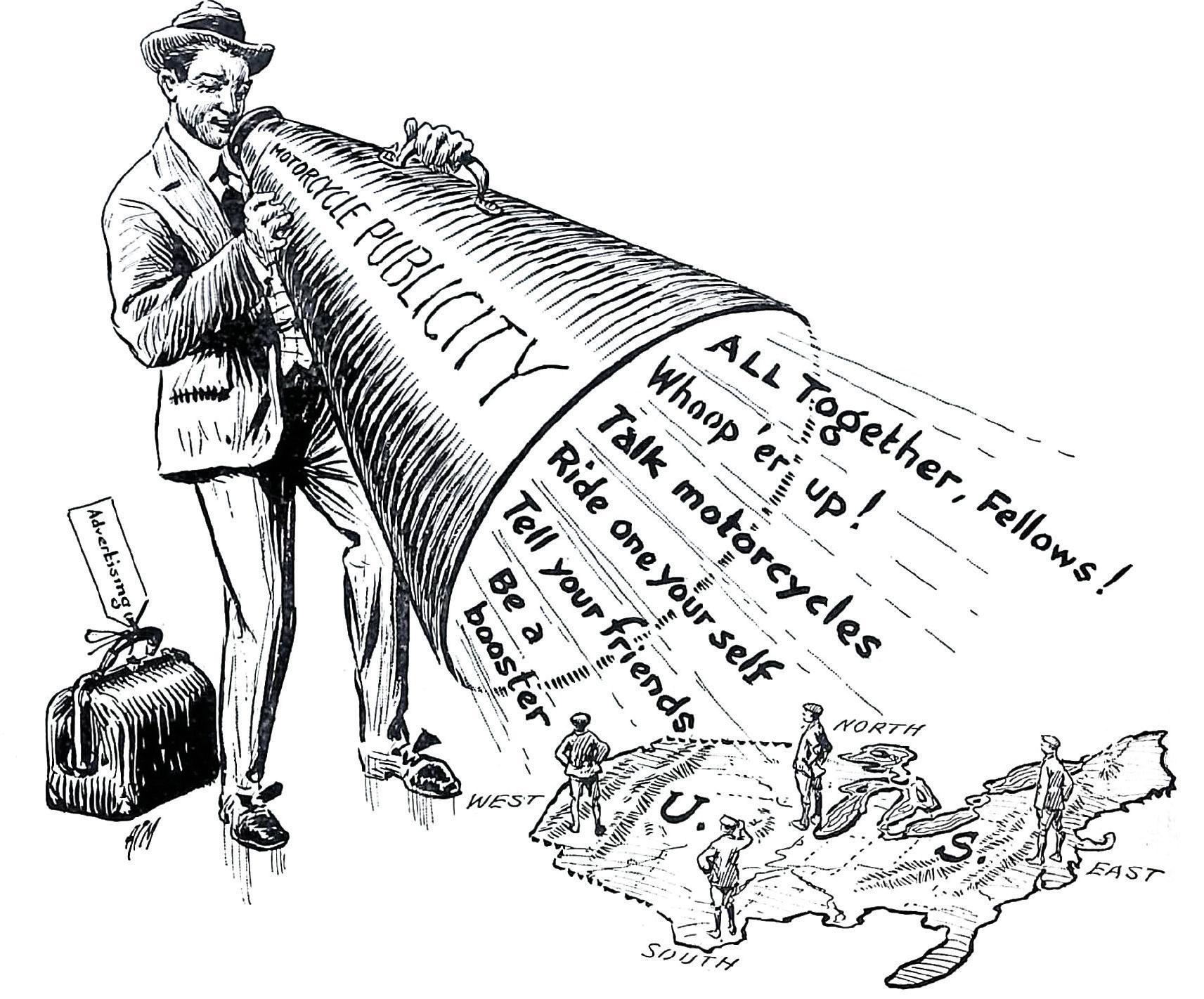
Motorcycle and Bicycle Illustrated lent considerable support to the new AMA, editorializing, “Within the next 12 months there should be membership of 25,000 in the AMA. Have you joined? Get on the bandwagon. Be one of the boosters.”
Editor W.H. Parsons (the first chairman of the M&ATA’s Competition Committee, remember) added this: “The AMA was born to succeed the registered riders division of the M&ATA...and while there was no change in personnel, it is hoped that rider interest and initiative will increase until the organization becomes strong enough to stand on its own without financial or administrative assistance from the manufacturers, which has been necessary to keep things going for the last five years.”
And the first Secretary of the AMA, the person tasked with overseeing the new organization?
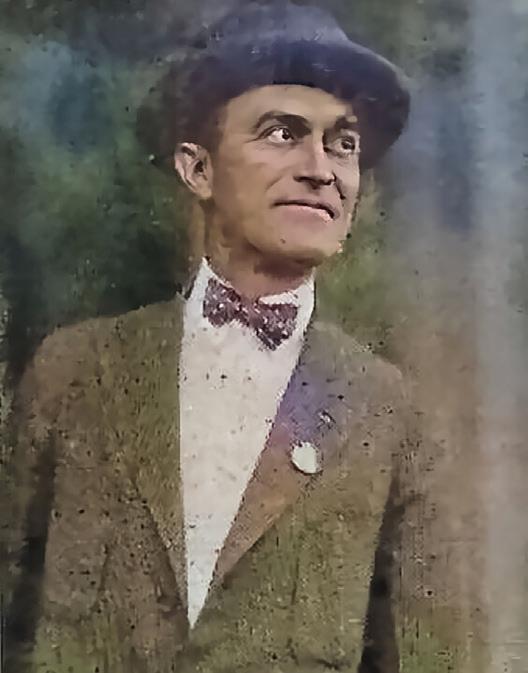
A.B. Coffman, of course. Coffman was a visionary in many ways, as he not only saw the need for this specific organizational structure, but understood the need for it to be funded by motorcyclists instead of primarily by manufacturers so that it remained focused on the needs of motorcyclists. He knew that that particular element helped everyone, OEs and aftermarket alike. Coffman’s position was not full-time in those days, but he dedicated much of his time and effort to promoting the AMA from offices in Chicago.
Coffman wasn’t alone, though. There’d be more visionaries to come.
But for now, our hat’s off to the pioneers of motorcycling
and the AMA…from the pottery makers and chariot drivers, to the early bicycle and internal-combustion designers, to the Daimlers and Maybachs and Davidsons and Harleys and Hendees of the world, and others — individuals who saw what motorcycling could be, and laid the groundwork for 100-plus years of fun, excitement and camaraderie.
Look for Part II of motorcycling and the AMA’s history next month, when we cover the craziness of the Roaring ’20s. AMA
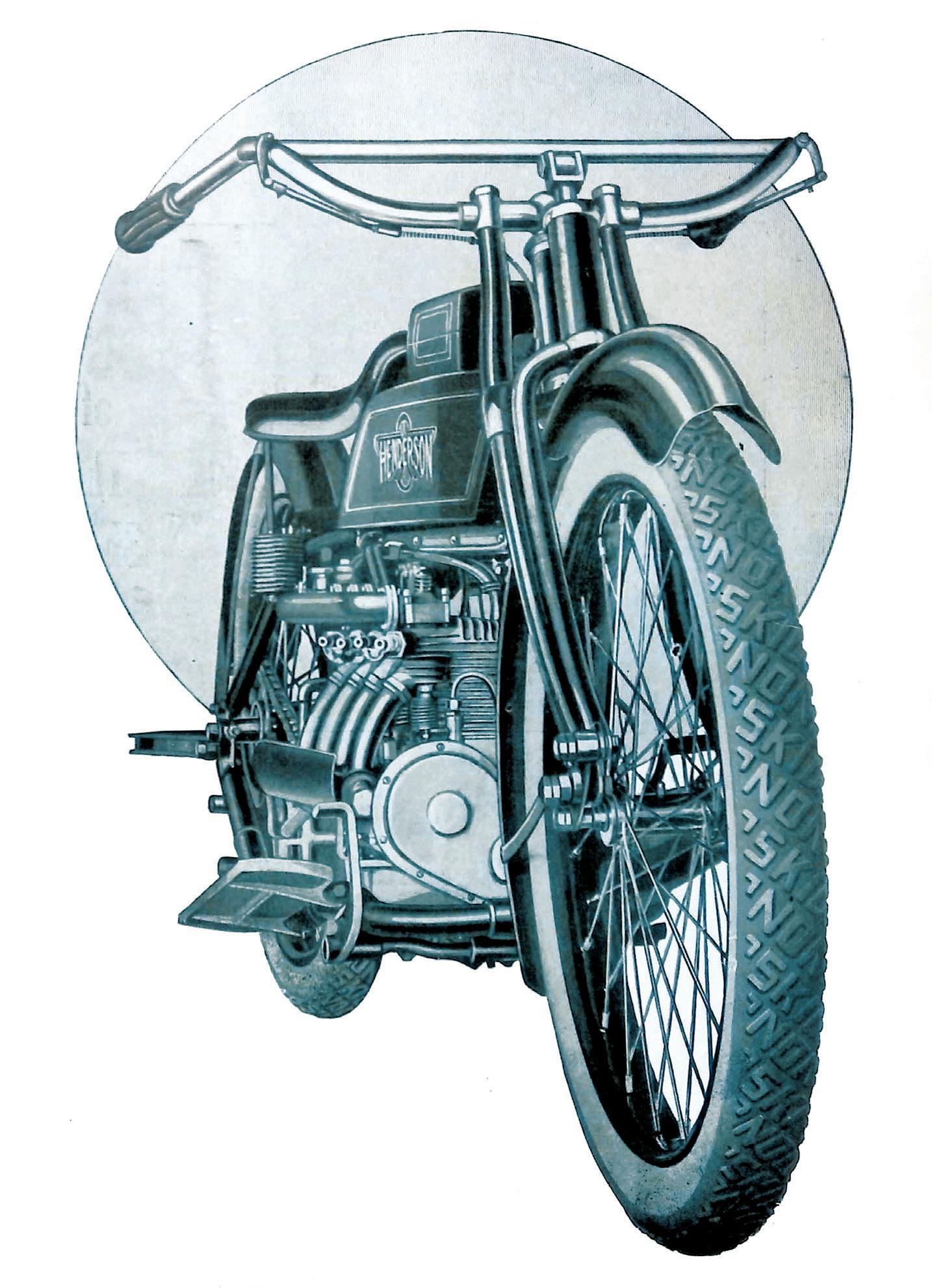
1916 HENDERSON
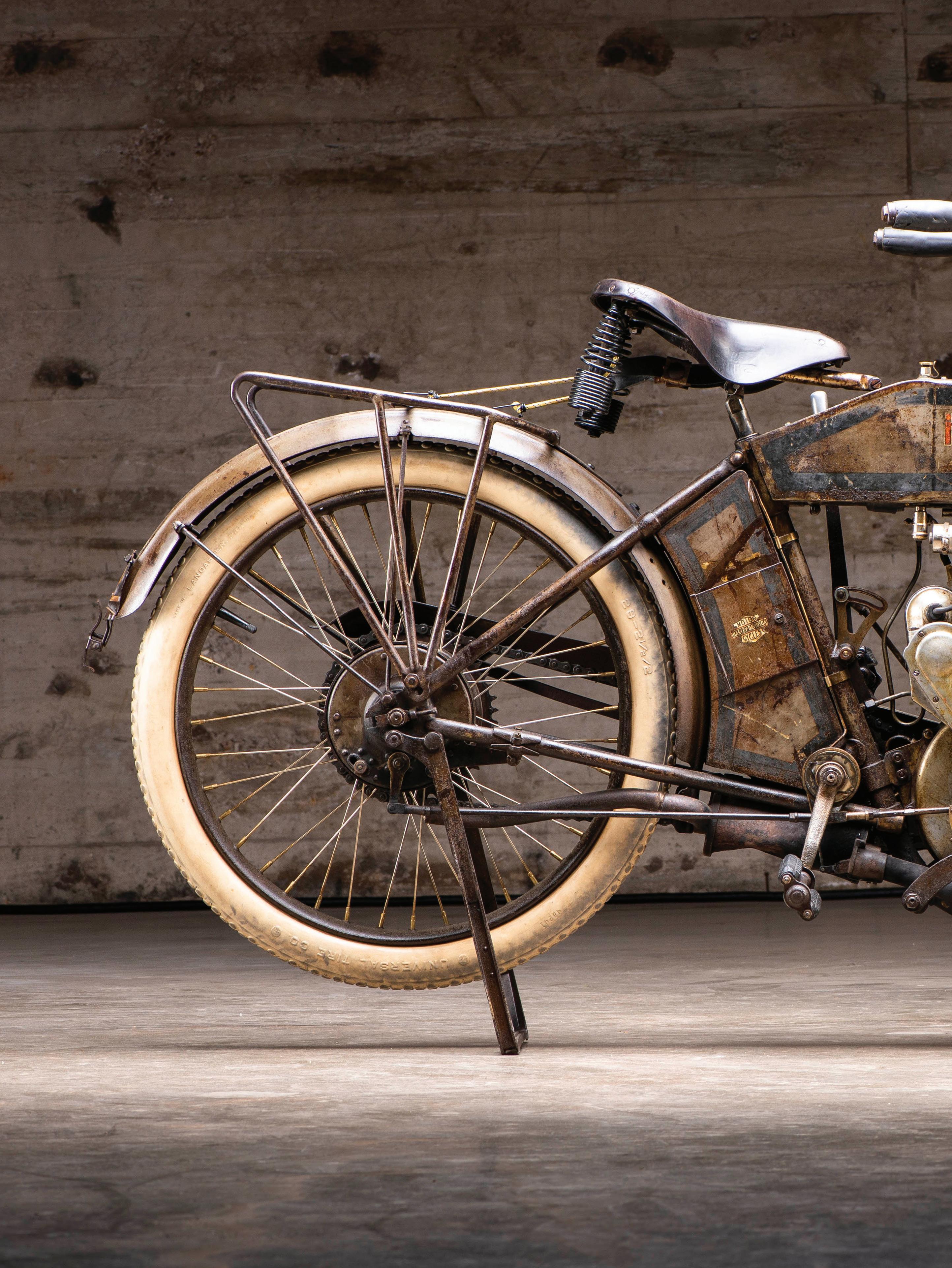
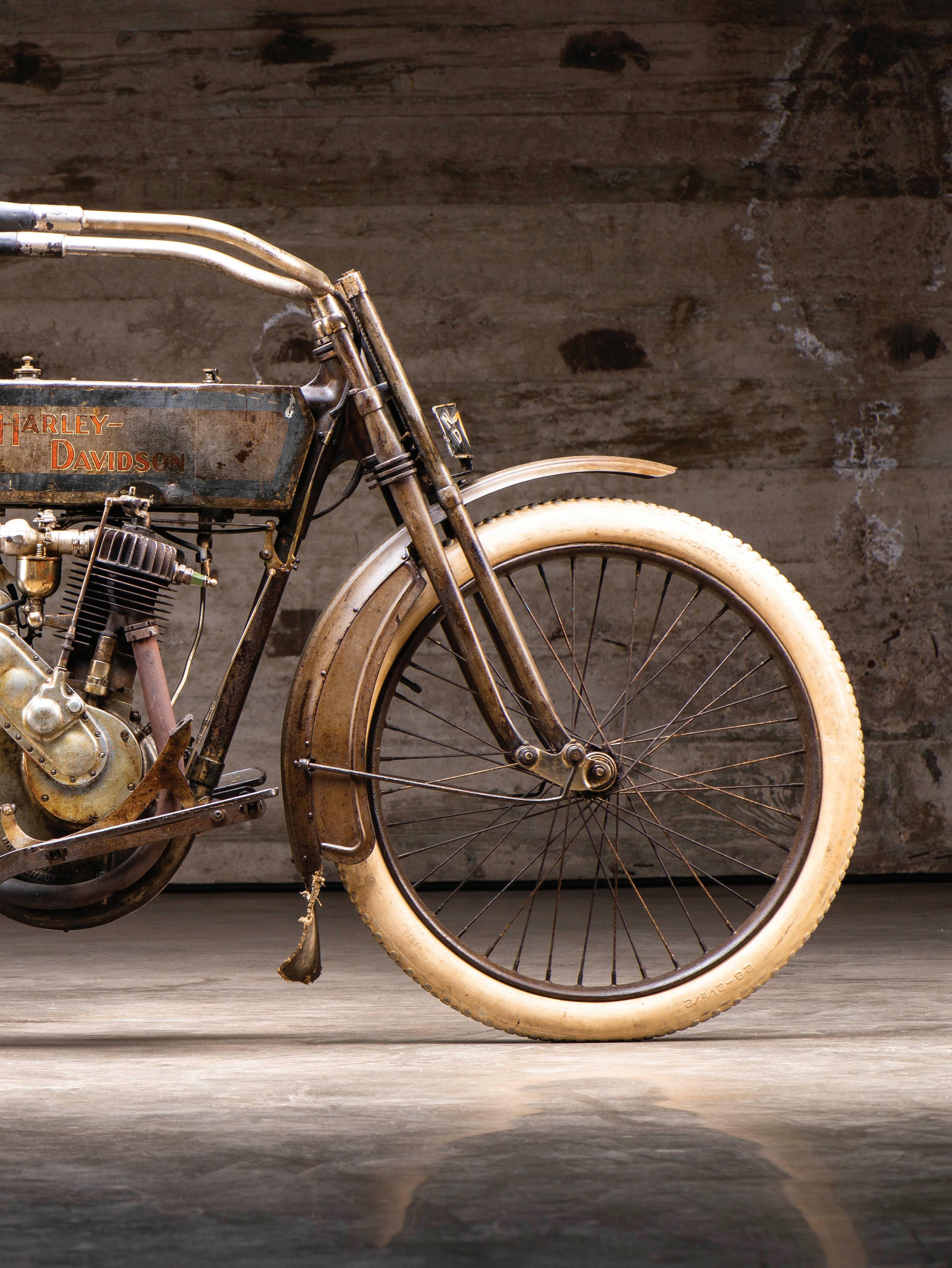
1914 Harley-Davidson Model 10B single.
Owner: Steve Klein.
Photo: Michael Lichter
TO THE END OF THE WORLD
PART TWO
WORDS & PHOTOS BY AARON FRANK
The first law of adventure touring in the developing world is this: There are always problems. Roadblocks. Breakdowns. Getting lost, or stuck, or sick, or scared by something beyond your control.
The corollary to that first law: There are always solutions. Detours around roadblocks. A helpful mechanic who can fix — or fabricate — anything. A friendly local who will give you directions, push you out of the mud, or wait patiently while you deploy Google Translate to describe your stomach bug.
THE SECOND HALF OF ONE VERY BIG ADVENTURE ON ONE VERY SMALL ADVENTURE BIKE
off a thief on a motorcycle had just swiped my iPhone right out of my hand on the street in Bogota, Colombia. His illicit access to my phone — and the subsequent fraud — set off an avalanche of problems that could only be solved by flying back to the U.S. to have my phone reactivated and my financial accounts secured. Big problems, so I started throwing big money at plane tickets, a replacement iPhone and more. Just one week later and a few thousand dollars poorer, I was back on the ground in Panama and ready to resume my ride.
The best solutions — especially for an overprivileged American like me — often start with throwing money at the problem. Consider the issue of my stolen iPhone. If you read Part 1 about my ride from Argentina to America aboard my daughter Kiva’s Kawasaki Versys-X 300 (in the November 2023 issue of American Motorcyclist), you know that when we left
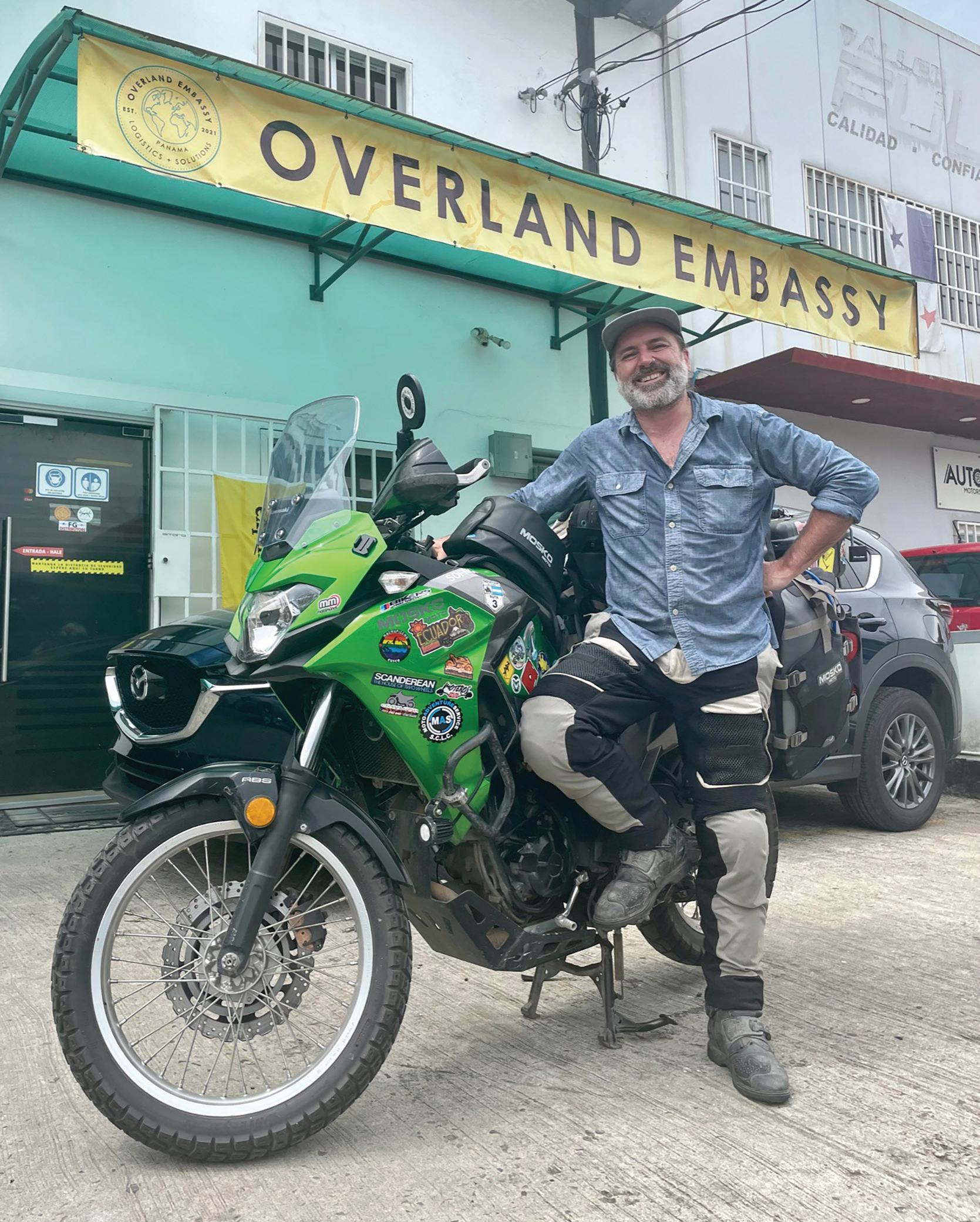
Because there are no roads across the Darien Gap, the thin strip of jungle that separates Central America from South America, I had to fly the Versys-X from Bogota to Panama City. I shipped the bike via The Overland Embassy, a supremely helpful shipping and logistics company based in Panama City, and that’s where I stored the bike during my brief trip back to the States.
AND BACK!
When I returned to Panama City it felt like I was on a completely different planet. When I last left the motorcycle in Bogota it was late fall (Southern Hemisphere) at 8,600 feet, and a very comfortable 60 degrees. Panama City, at sea level in the peak of summer, couldn’t have been more different. Just packing my saddlebags in the Overland Embassy parking lot I was sweating like I was at a hot yoga class. This would take
Precipitation was my constant companion in Central America. I would be rained on at least once a day for 33 of the next 36 days, and I was about to get a major education in the differences between wet season and dry season roads.
some getting used to. Fortunately, this was also the beginning of the rainy season, and, like clockwork, it rained every single day between 3 p.m. and 5 p.m. — ensuring that my boots and riding gear were constantly wet, which meant I was constantly benefitting from evaporative cooling (sarcasm). Precipitation was my constant companion in Central America. I would be rained on at least once a day for 33 of the next 36 days, and I was about to get a major education in the differences between wet season and dry season roads… It’s almost comical how little I prepared for this trip. Almost tragic, too. Case in point: navigation aids. I didn’t use a dedicated GPS unit on this trip, or any other specialized nav device, instead relying nearly exclusively on Google Maps. This worked mostly fine in South America, with a few
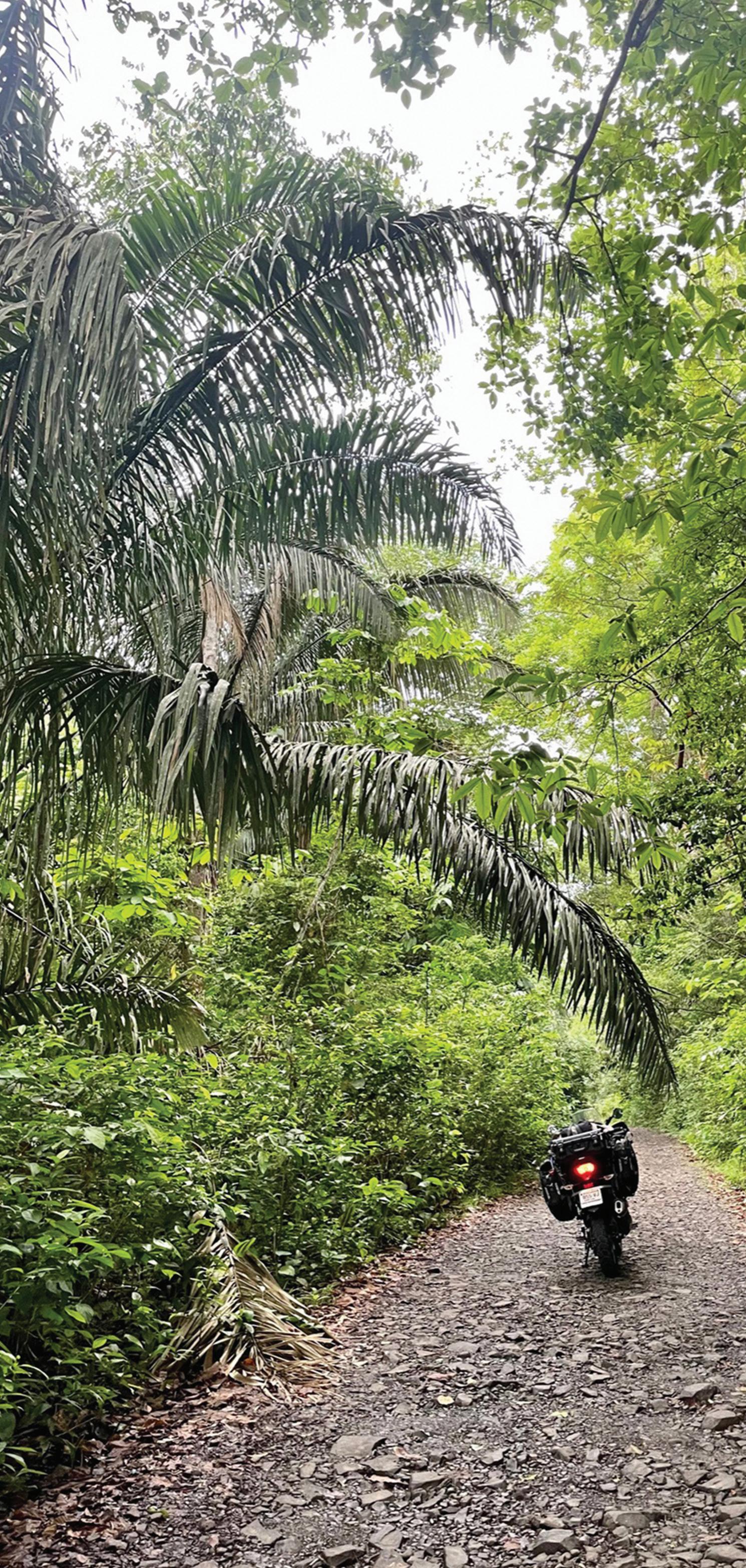
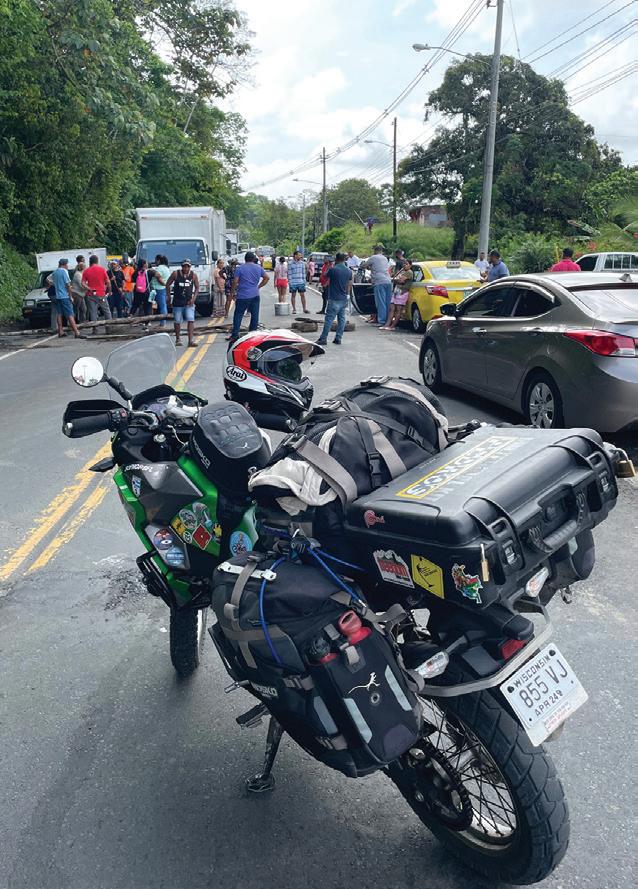
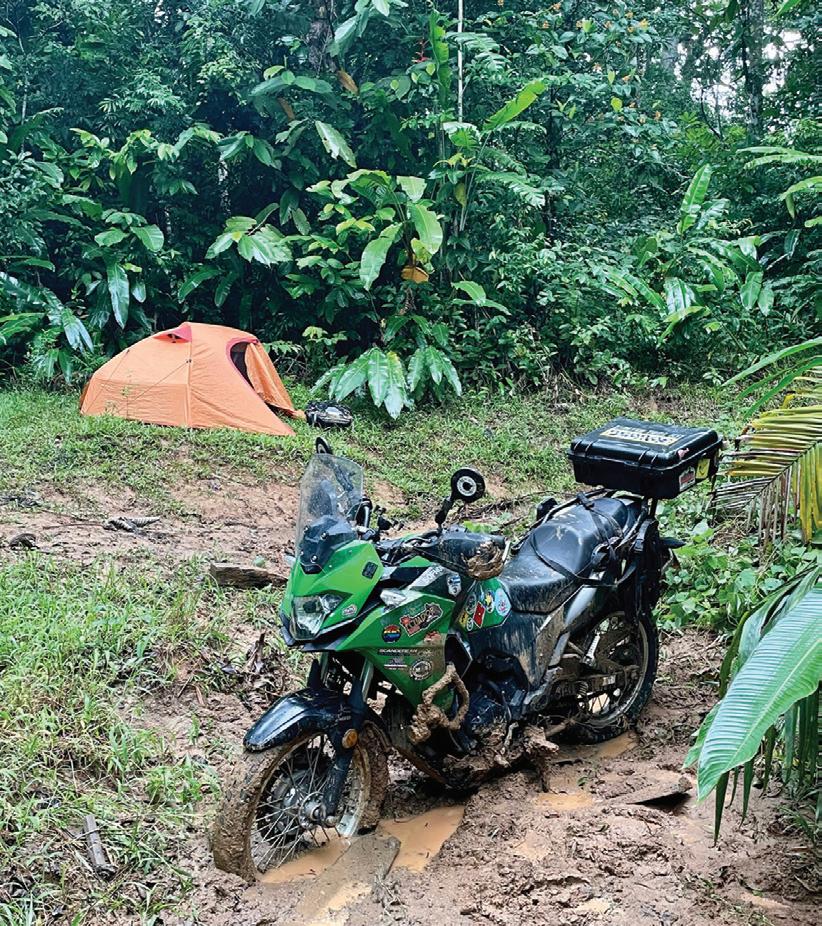
Central America’s dense jungles — like here in Panama’s Gamboa Rainforest Reserve — were a stark contrast to the wide-open vistas of South America. Far right: The tropical climate was an adjustment as well, as you can tell from my sweat-soaked shirt the day I departed Overland Embassy in Panama City. Center right: Political roadblocks, like this one in Gatun, Panama, are common throughout Latin America.
exceptions like Valparaiso, Chile, where I was repeatedly routed up and down pedestrian-only stairways. As long as I remembered to download maps for offline use when I didn’t have signal, it was fine.
It was not so fine after I crossed into Central America, however, where Google Maps repeatedly tried to poach me into dangerous situations. The worst was the day I crossed the border from Panama
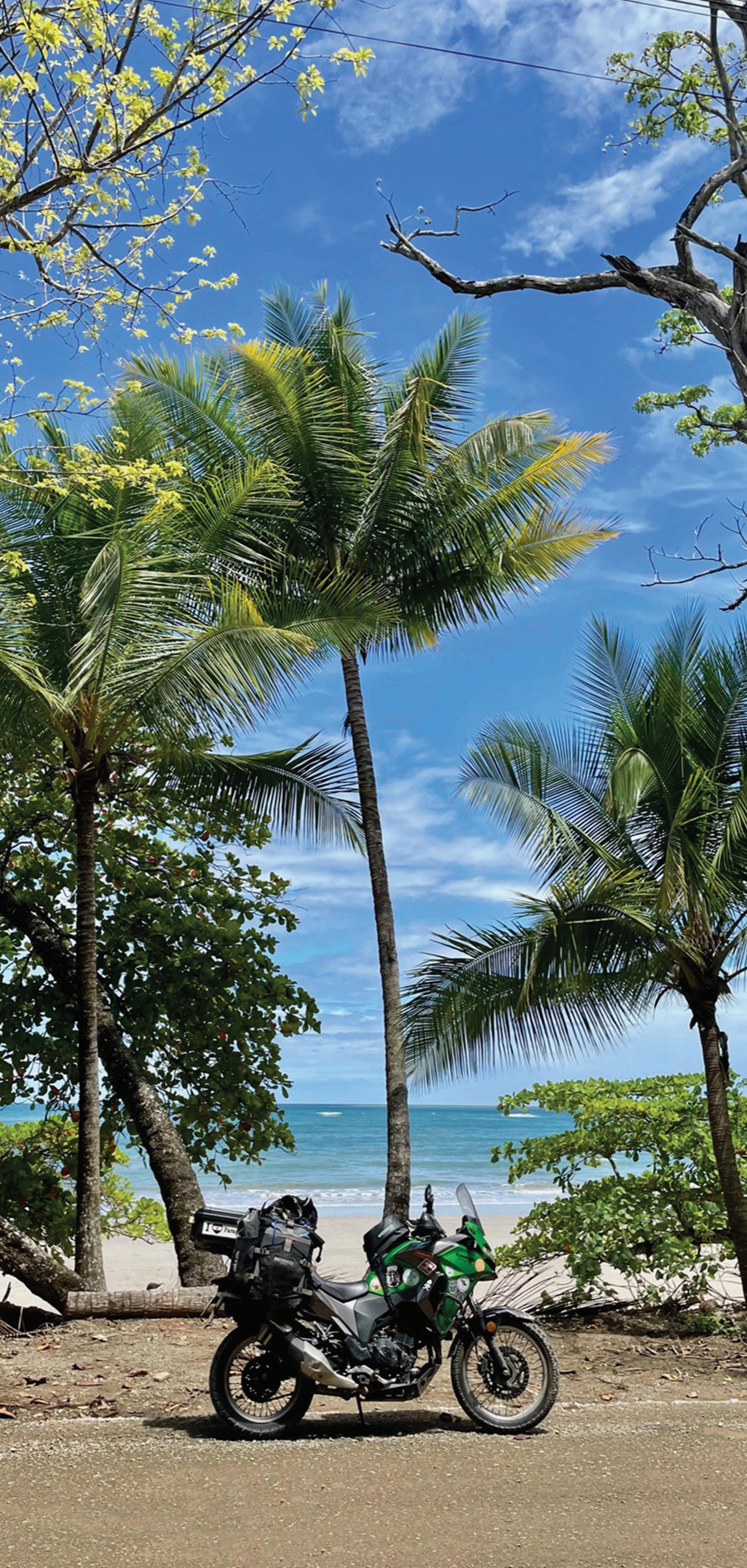
into Costa Rica. Wanting to avoid the chaos of the main Pan-American Highway crossing at Paso Canoas, I instead plotted a route to cross in the mountains at Rio Sereno. That crossing was as quick and calm as could be, but it set into motion a cascade of complications that I could hardly anticipate at the time. I was just excited to get to the pleasantsounding Los Cocos Cabinas at Playa Zancudo — my first time back to the Pacific Coast since I left Peru. I plugged the destination into Google Maps and started the winding route toward the coast.
The ride started out great, with a long and twisty descent through Campo Dos and toward the coast. Remember what I wrote in Part 1, how a great morning ride almost always guaranteed a miserable afternoon? As I neared the coast
at Golfito, it began to rain heavily — just that time of day. I passed through the storm quickly but, when I emerged on the other side, the road conditions began to deteriorate. Paved two-lane turned to paved one-lane and then gravel. Then the gravel road was blocked by a fallen tree. The leaves were quite dry, like it had been there for a while—unusual in these parts, where roads are typically kept clear. About then I realized I hadn’t seen anyone else in quite some time. Still, Google Maps said I was on the right road, and less than 15 miles from the coast. Onward.
turned to a trail of thick, wet, slippery clay. I considered turning back — but that would require riding through the thunderstorm again, and a 75-mile detour back to the coast. Meanwhile, Google Maps showed I was now just 10 miles from the coast. I clicked the Versys-X into gear and continued ahead.
A few miles later, the gravel road
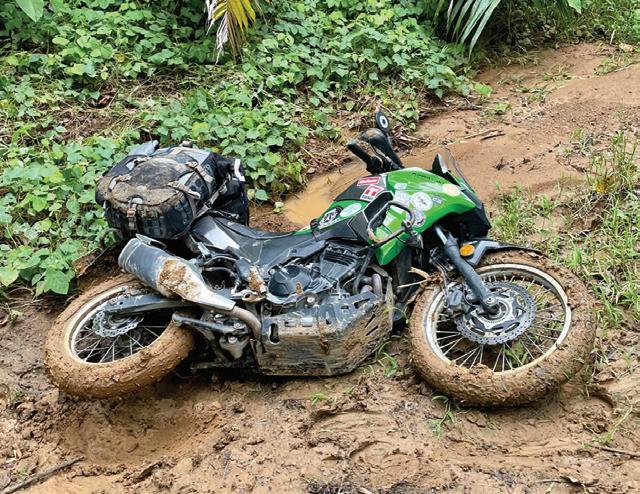
You know that feeling when you make a bad decision, but you pretend to ignore it instead? That was the feeling I had quarter mile later, when the trail made a hard right and, before I could even check the brakes, I was sliding down a steep hill to the river bottom below. No way I’m riding back
up that hill! Like that was an option anyway, with the Versys-X sunk to the hubs in peanut butter-like mud. I pushed, pulled and dragged for almost an hour, only to move the bike maybe another 100 feet down the trail.
Still, Google Maps told me I was almost there! The map showed a small town just about a mile or so down the trail, with a school and a small store. I wasn’t planning
on camping that night, so I was carrying no food and only a half-liter of water. It was about 95 degrees, and I was exhausted and dumping sweat, so I started hiking.
The trail was even worse in that direction. I walked a few hundred yards through jungle so dense I could barely see in front of me before I decided to return to my bike and settle in for the night. After stripping down and lying in the river to cool off — literally naked and afraid — I returned to my tent for a long, sleepless night of strategizing. This was big trouble. The last village I passed through was at least eight miles back. I figured I would hike there in the morning and find help. I’d probably need a few guys and maybe an ATV, or a tractor, or even a donkey to drag
my bike back up to dry trail. Always problems. Always solutions. Right? I awoke with the sun, packed up my tent, and set off on foot, leaving the Versys-X buried in the mud. A few minutes later, right after I made it back to the gravel portion
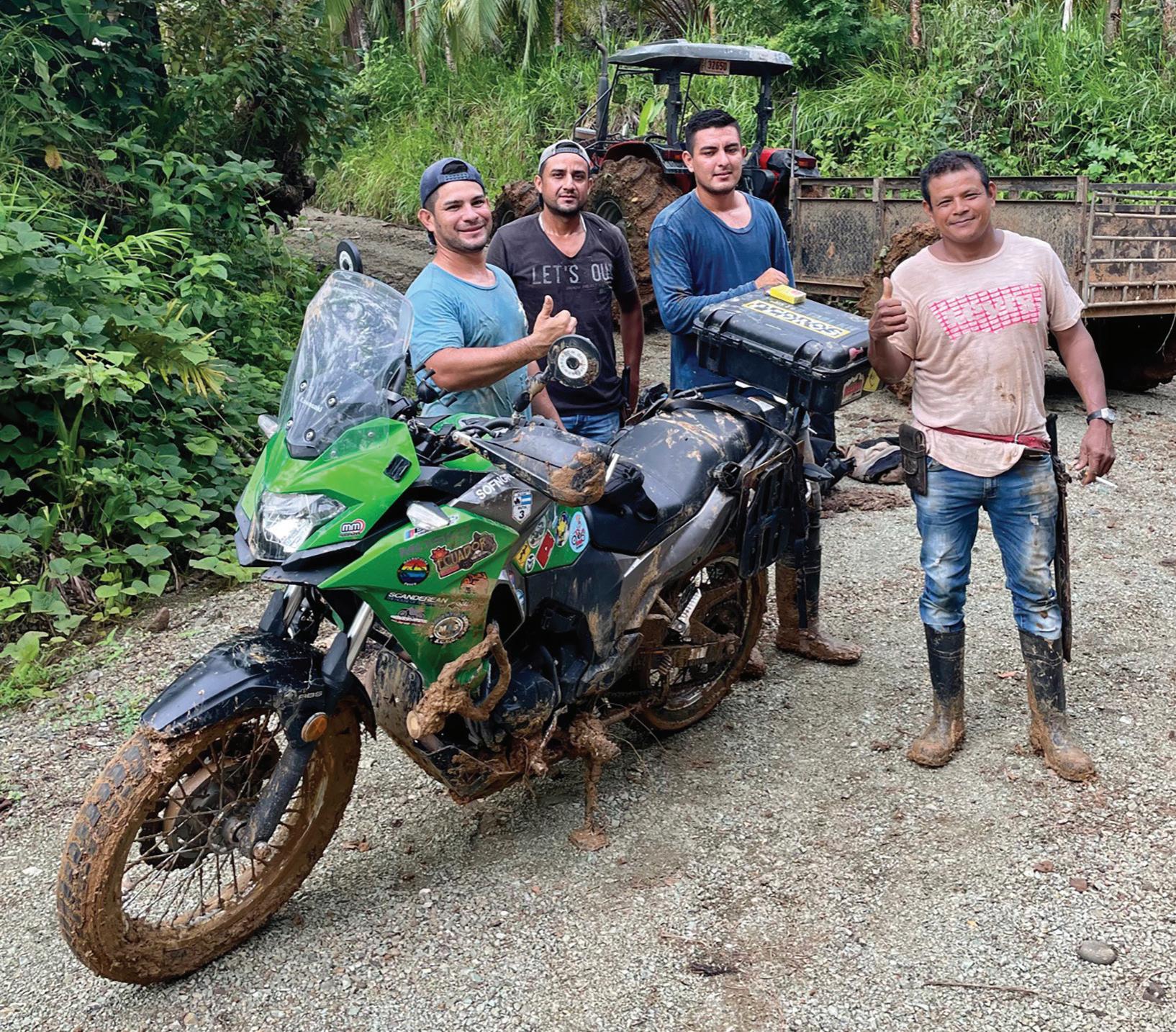
of the road, I saw what seemed like a hallucination — a massive 4x4 tractor, pulling a trailer, with four young ranchers aboard. I flagged them down and did my best to explain my predicament. “Tengo un problema muy grande. Soy muy estúpido y se me quedó la moto atascada en el barro, junto al río...” These guys
had a good laugh at my expense, explaining that this was a dryseason road only, and I learned a valuable lesson about Google Maps. The five of us had my motorcycle back on the main road in less than 30 minutes. I never made it to Playa Zancudo.
Costa Rica was the most challenging country I rode through on this trip — unexpected, because it’s arguably the most modern country in Latin America. But the rainy season is no joke. I got overconfident in South America, where I would often ride in the backcountry for days at a stretch without any problems. But the Andes were mostly dry. When traction is good you can get a motorcycle — even an anemic Versys-X 300 — through almost anything with a little riding skill and a lot of patience. In the mud, however, all bets are off. And Costa Rica in June is all mud. More than a good GPS, what I most needed was a good friend. So many obstacles I encountered
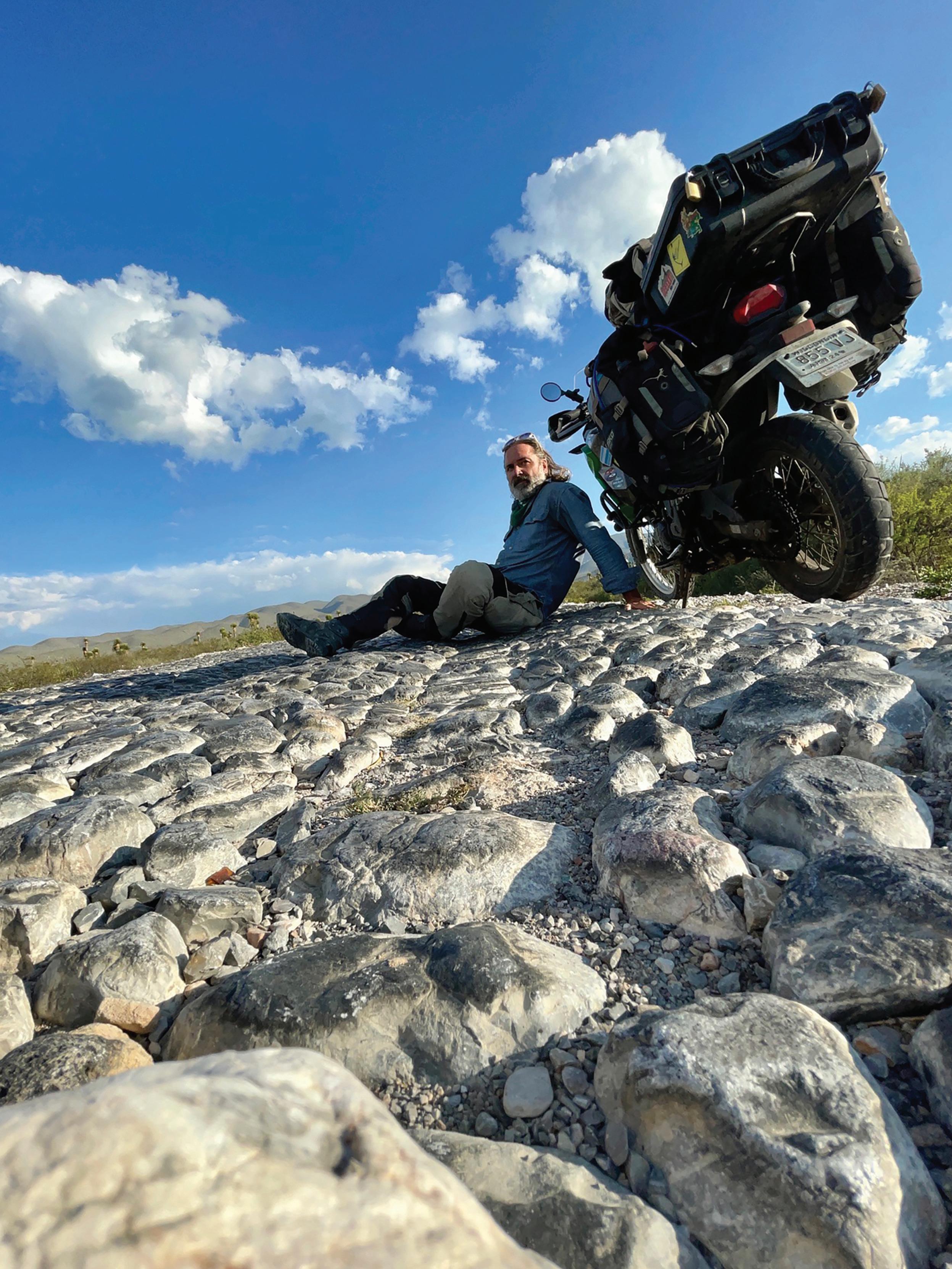
Snaps from a very bad day — and a very long night — when I got the Versys hopelessly stuck miles from nowhere in the middle of the Costa Rican jungle. These four guys, and their 4x4 tractor, totally saved the day. Opposite page: Yet another questionable “road” that Google Maps routed me down.
would have been easy with a helping hand, but alone they turned me around every time. My third day in Costa Rica, crossing the Guanacaste Peninsula, I encountered a small bridge out. I dropped into the gully, crossed the small stream, and was unable to build enough speed to get over the steep step-up to the pavement on the other side. With a friend to help me push and lift the
You know that feeling when you make a bad decision, but you pretend to ignore it instead? That was the feeling I had quarter mile later, when the trail made a hard right and, before I could even check the brakes, I was sliding down a steep hill to the river bottom below.
bike over the top, I would have been through this spot in two minutes. By myself I wasted 20 minutes, and still had to turn around and make a 60-mile detour. Adventure touring is always better with a friend.
Missing bridges, flooded river crossings, roads to nowhere — Costa Rica felt like one long backtrack, and so I was excited to make it to Nicaragua, where I was looking forward to a few days surfing at San Juan del Sur. But first I had to get into the country — and Peñas Blancas was the most frustrating border crossing yet. I knew it was going to be a long day when I entered the main building and the power was out. Because there was no power, they were unable to process the TIP (temporary import permit) for my motorcycle there. Instead, I was directed to the commercial truck lanes where I was told to queue up — on foot—between two massive 18-wheelers. After a hot and dirty
30-minute wait, I reached up and passed my TIP paperwork through a window high above my head, at truckwindow height.
Once I had my TIP in hand, I next had to have my bike fumigated. After another long wait amongst the trucks — this time at least I was on my bike — I paid $3 to have my paperwork stamped by the agent who did nothing to treat my bike! Next it was
At the beginning of my trip, in South America, I would purposefully seek out difficult routes and revel in tackling the toughest terrain alone. Now, even the sight of a simple dirt road would make me uncharacteristically anxious.
the mandatory vehicle inspection. I finally found the police inspector on a lawn chair in an unmarked concrete kiosk in the middle of a massive parking lot. I paid him $3 also and he dutifully stamped my paperwork, without even asking to see my bike. Now that I had all the right stamps in place, it was time to play the photocopy game. This was not my first border and so I was ready with copies of my passport, driver’s license, bike title, registration and insurance paperwork. Of course, they also needed a copy of my exit stamp from Costa Rica — one photocopy I could not have possibly prepared in advance — and so I had to walk a few blocks to a local tienda to make that copy. Someone at the border must have a relative who owns the copy machine in that store.
Three hours later I had my entrance paperwork completed — or so I thought. I suited up, approached the final checkpoint,
and handed my pile of papers to the guard. A frown crossed his face and he said I was still missing one signature, from “Hani.” Was that an agency acronym? A person’s name? From his hand gestures, I figured out that Hani was a short, plump woman. I parked the bike and waded back into the border complex, searching for someone who matched the physical description of roughly 92 percent of Nicaragua’s female population. I finally found Hani sitting on a folding chair next to an X-ray machine. She wasn’t wearing any uniform, just a plain blue t-shirt. She diligently studied my paperwork for a full minute before she pulled out a pink pen and scrawled a massive
signature across the top sheet. I’m not convinced Hani’s signature was an official requirement — I’m quite sure it was all a wild goose chase only gringos get sent on — but with her bright-pink blessing I was allowed to enter Nicaragua at last. But the bureaucratic fun wasn’t over yet. I was stopped by police just 10 minutes beyond the border for passing on a double-yellow line. Never mind that everyone in Latin America passes on the double yellow all the time — even in Nicaragua. I started to protest and
then just pulled out a $20 bill, which instantly made the problem go away. Not more than five minutes later I was stopped by the next officer up the road, this time for a suspicious “document check.” By this point I had ridden almost 10,000 miles across nine countries, and I had not yet been stopped by the police even once. Now, in Nicaragua, I had been stopped twice during my first 20 minutes in the country. Don’t get me wrong. I love Nicaragua. The surf breaks in the south are some of the best in Central America. Colonial cities like Granada and León are impossibly charming. But
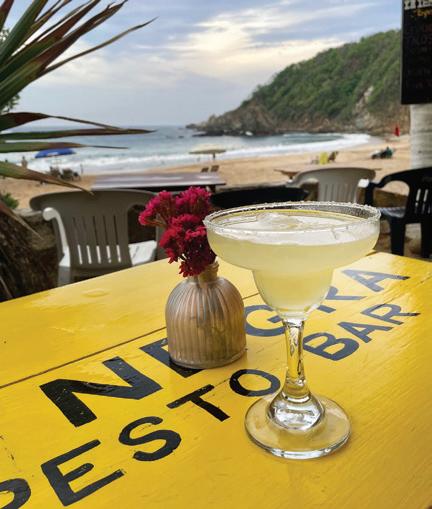
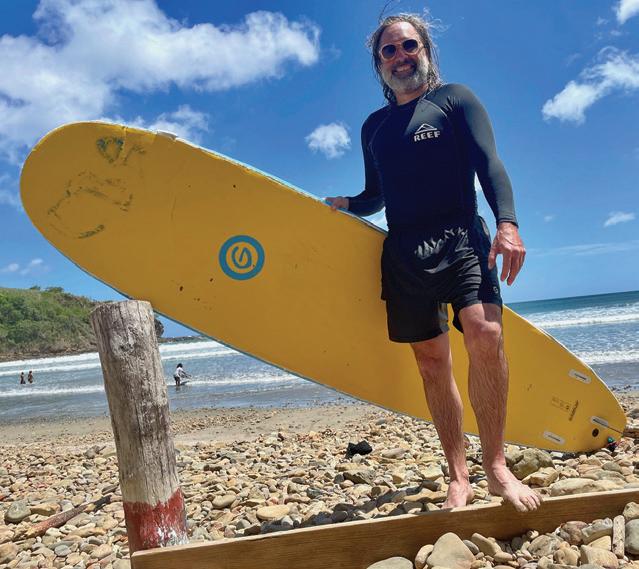
A rental Wavestormer and a clean, chest-high “Dad wave” at Playa Remanso in Nicaragua, all washed down with a margarita; rest days don’t get any better. Above, left: The surfboard might have been more useful than a motorcycle for crossing flooded roads in Costa Rica.
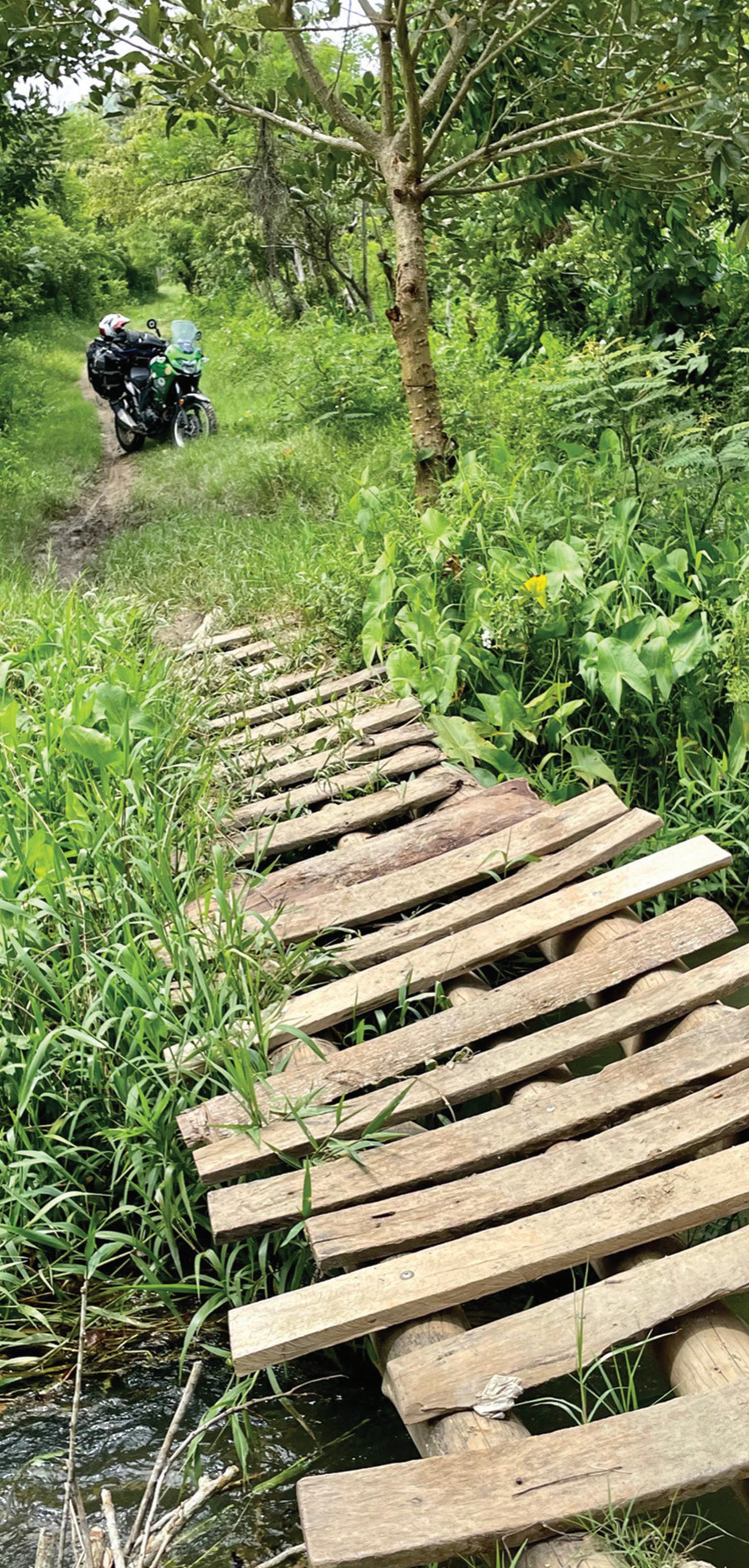
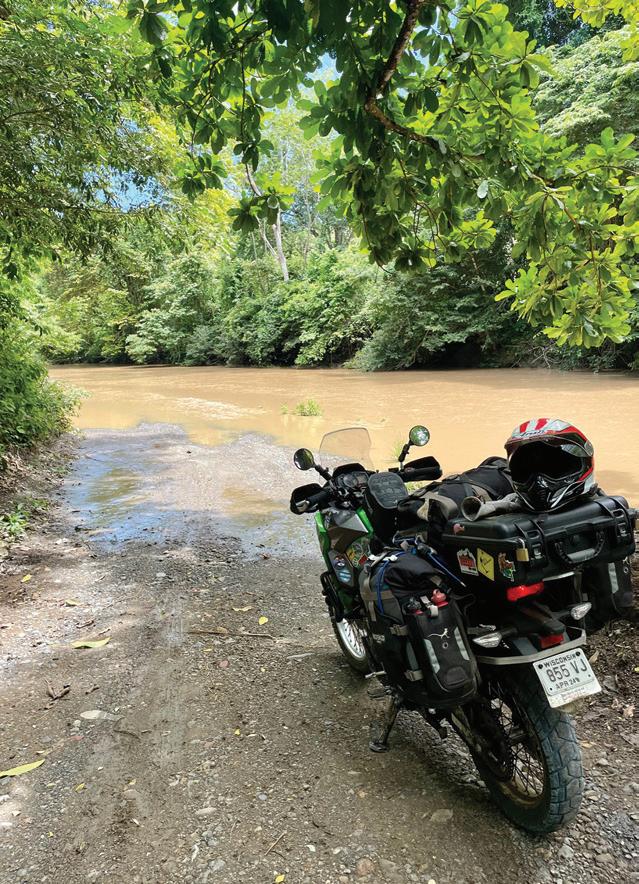
the bureaucracy bites. After Nicaragua, riding Honduras was less stressful; no one cares about traffic laws anywhere in that country, not even the police. The Mayan ruins at Copán were memorable, more rustic than similar sites in Guatemala and Mexico, with great flocks of wild macaw flashing through the jungle. I had yet another round of Google Maps trouble during my last day in Honduras, however, attempting a shortcut to the Guatemala border; this time I just turned around when the trail turned into a narrow wooden footbridge, two-hour detour be damned. Fool me once… Guatemala is another country I had been to a few times before, and it was great to revisit old favorites like Antigua, another gorgeous colonial city in the shadow of the massive Acatenango volcano. I also love the highlands surrounding Lake Atitlán — steep, twisty and well-paved, this is some of the best street riding in the world. But by now you know what a great morning ride means. Sure enough, descending later that afternoon from Panajachel I encountered road construction and yet another unexpected river crossing. The crossing was about 50 yards wide, and the water was murky and dark. I couldn’t tell if it was three inches or three feet deep, and I didn’t necessarily feel like wading out. An old, familiar dread set in, memories of being stuck, or submerging my bike all alone. I almost felt like crying, and rather than risk it, I got ready to turn around — again. Just then, a small black SUV appeared on the opposite bank and splashed through the crossing without issue — it was only about six inches deep! I
crossed easily and carried on.
Unpredictable, often-terrible road conditions were really wearing me down, to the point where I was suffering what felt like a form of bad-road post-traumatic stress disorder. At the beginning of my trip, in South America, I would purposefully seek out difficult routes and revel in tackling the toughest terrain alone. Now, even the sight of a simple dirt road would make me uncharacteristically anxious. A few days later, after I had crossed into Mexico, I came across a roadblock on the long bridge into Tuxtla Gutiérrez. No traffic would be allowed to cross until 9 p.m. There
planned route. But I couldn’t help but notice how much my attitude had changed, with me now cringing at the sight of dirt and all but praying for the dull, straight, paved roads.
Mexico is such a rich place to travel on two wheels. The landscapes are stunning, whether it’s the jungles of Chiapas, the Pacific Coast surrounding Mazunte, or the mountains of Oaxaca state.
The many Pueblos Magicos (Magic Towns) — San Cristobal de las Casas, Palenque, Comitan, and 128
was another bridge further south, roughly a three-hour detour. An alternate route to the north would be faster — just 90 minutes — but I was warned the road was quite bad. Against my better judgement, I took the northern option.
I regretted that decision almost immediately. With each passing mile the road got worse, from broken pavement to gravel to a deeply rutted dirt trail. A familiar sense of foreboding crept in, as I imagined the inevitable washout, river crossing, or mud hole that would once again force me to turn around — or worse. Fortunately, there were no insurmountable obstacles — just lots of difficult, slow-speed trail riding — and an hour later I was back on my
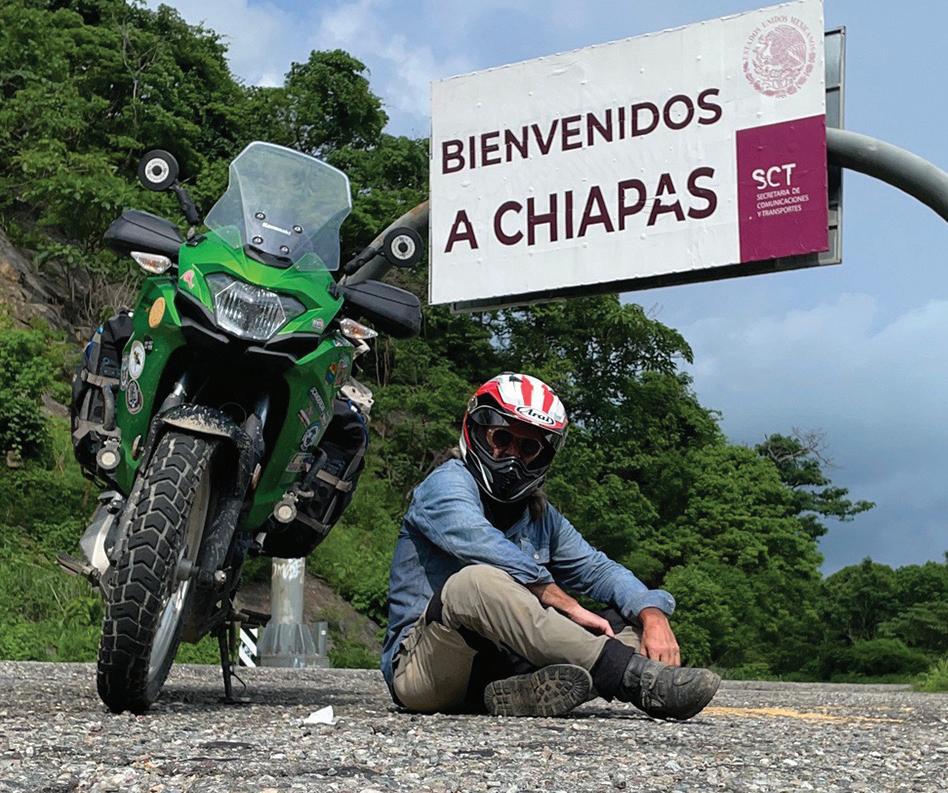
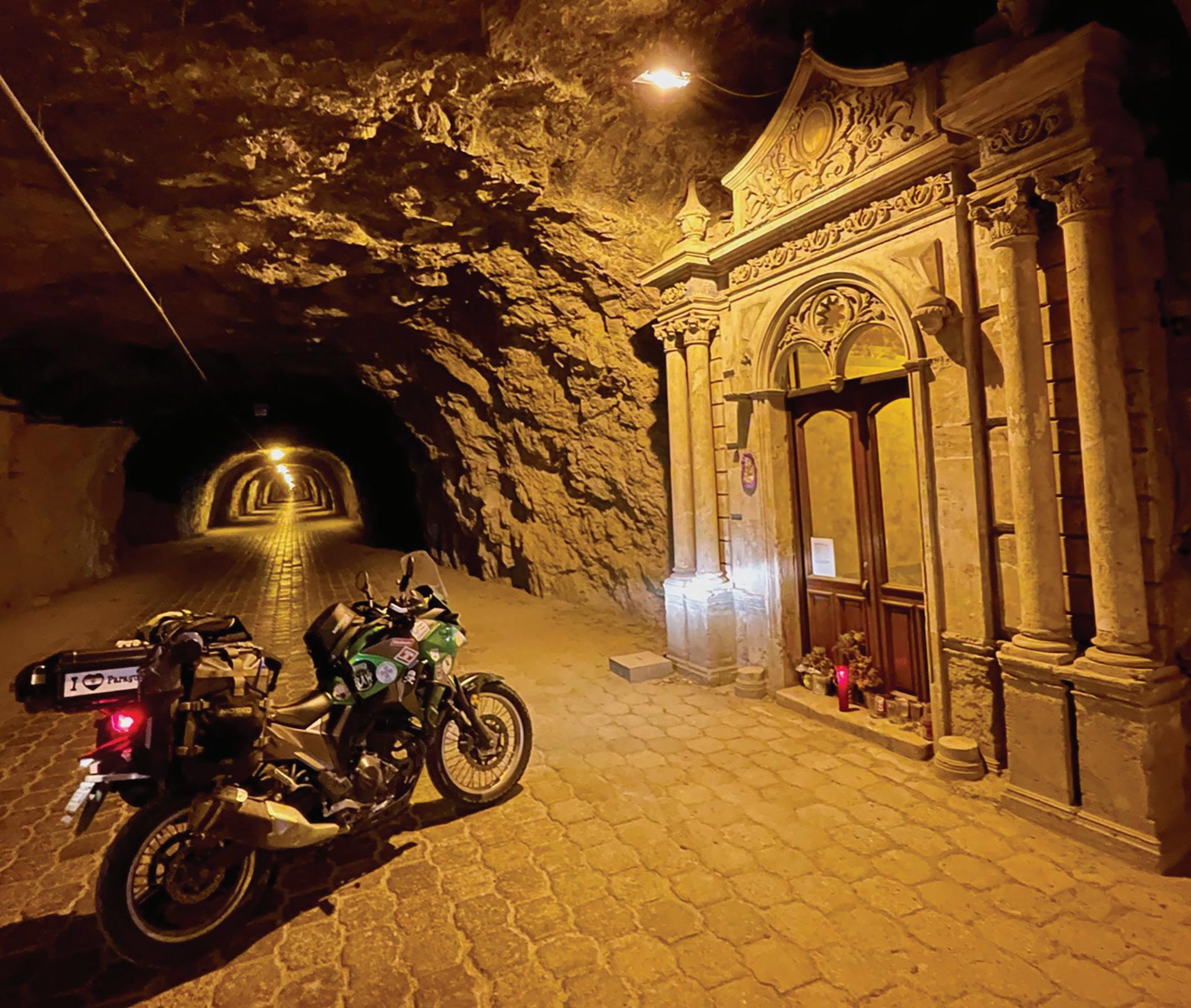
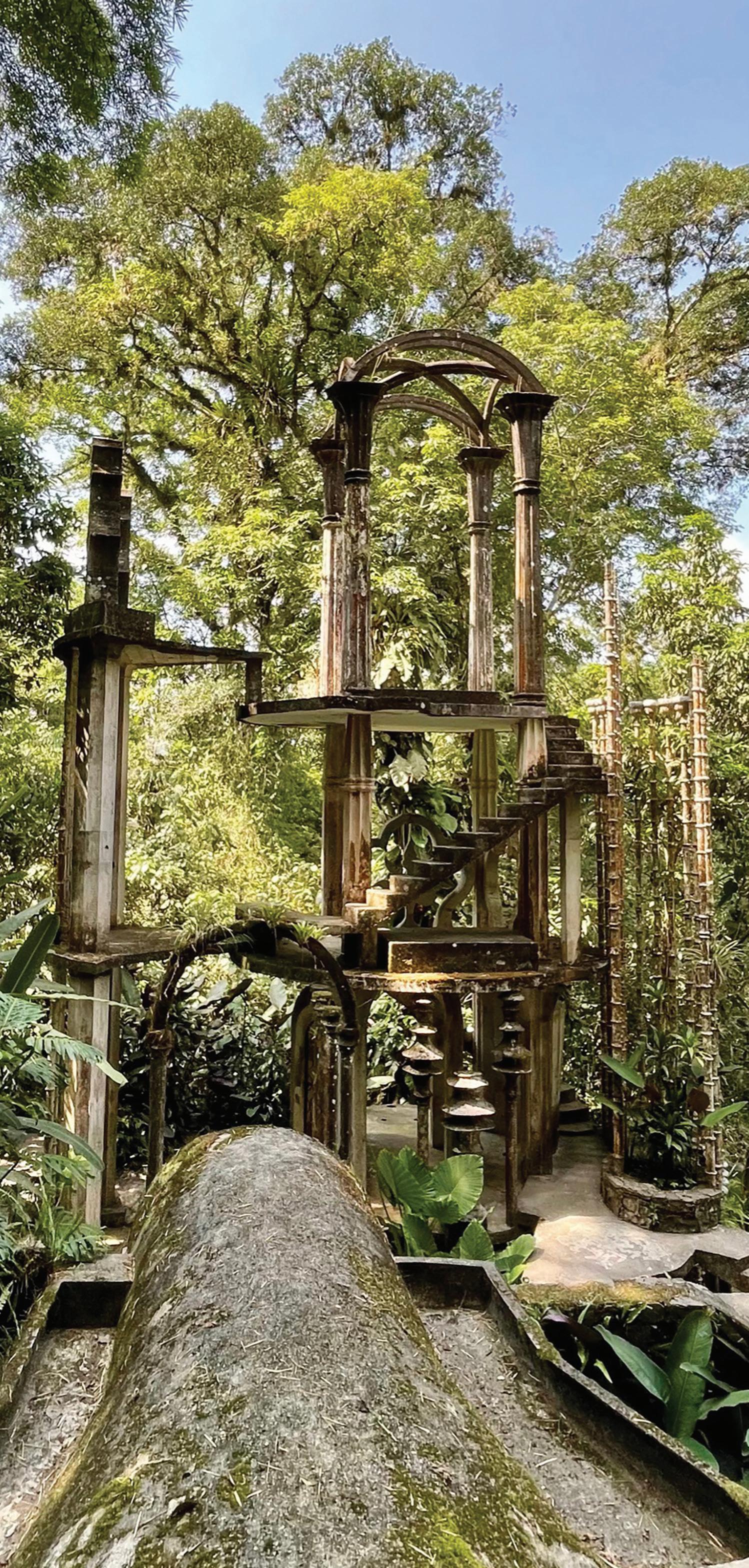
Left: Welcome to Chiapas! This sign in southern Mexico’s Chiapas state is the gateway to some of the best street riding in the world (note the thunderstorm in the background). Below: This small chapel marks the midpoint of the Ogarrio Tunnel, the only road into the Mexican town of Real de Catorce. Right: A scene from Las Pozas, Edward James’ surrealist sculpture garden, in Xilitla, Mexico.
other Mexican towns that hold this special designation — are ridiculously quaint. The food is amazing everywhere, and the Mexican people are among the friendliest I’ve met, gracious, accommodating and supremely helpful. Even after exploring 12 new countries, Mexico — a country I have ridden across multiple times — remains my favorite. We’re lucky to have this magical place just across our Southern border, and if you haven’t already ridden there, you should start making plans.
After a few stunning — but sweltering — days riding along the southern coast, I headed north into the mountains to find an escape from the tropic summer heat. First, I hit Oaxaca and then Mexico City — two of the finest culinary destinations in the entire world — where I ate what felt like my body weight in street tacos. From there I traveled north to two of the most magical of all the Pueblos Magicos:
Xilitla and Real de Catorce.
Xilitla is an oasis in San Luis Potosi state, a beautiful village tucked into a tiny cloud forest on the far eastern edge of the Sierra Gorda Biosphere Reserve. It’s best known for Las Pozas, an otherworldly outpost created by English artist Edward James, a good friend and patron of Salvador Dalí. Featuring towering surrealist sculptures surrounded by waterfalls and crystal-blue pools ( pozas ), Las
I regretted that decision almost immediately. With each passing mile the road got worse, from broken pavement to gravel to a deeply rutted dirt trail. A familiar sense of foreboding crept in, as I imagined the inevitable washout, river crossing, or mud hole that would once again force me to turn around — or worse.
Pozas is an enchanting spot to wander for a few days.
Real de Catorce is only a day’s ride from Xilitla, but it couldn’t be more different. Leaving behind the lush forests of Las Pozas, Real de Catorce sits at 9,000 feet on a desert plateau in the Sierra de Catorce. Remote and isolated — there are only two ways to enter Real de Catorce, either the two-mile-long Ogarrio Tunnel or a harrowing jeep road that snakes for miles along a 1,000-foot cliff — Real de Catorce is like stepping 100 years back in time. The ambiance is pure Old West, with dilapidated buildings and most of the town moving either on horseback or in vintage Willys Jeep Station Wagons, most of which have been plying these ridiculously steep streets
I had ridden almost 10,000 miles across nine countries, and I had not yet been stopped by the police even once. Now, in Nicaragua, I had been stopped twice during my first 20 minutes in the country.
EJEFF KARDAS, HONDA AND LAWRENCE ARCHIVES
ach year the AMA — its Board of Directors and staff — presents a highly prestigious award to an individual who’s had the most profound impact on the world of motorcycling over the past year.
Looking back at 2023 and the many significant happenings in our sport and industry, it’s pretty hard to ignore the impact of the undisputed No. 1 contender for that honor: AMA Supercross and Pro Motocross racer Jett Lawrence.
Jett’s accomplishments in 2023 were, simply put, astounding. Jett won the 2023 AMA Supercross 250 West Championship. Then the 2023 AMA Pro Motocross 450 Championship. And finally, the inaugural SuperMotocross Championship.
What’s more, during his outdoor 450 Pro Motocross title run, Jett not only recorded a perfect moto-win season, going 22-0 for the series, he also became the first rookie-in-class to do that. Ever. It’s something he told ESPN he “never thought was possible.”
To give that a little extra perspective, AMA Hall of Famers Ricky Carmichael and James Stewart also notched perfect seasons, but neither was an in-class rookie. All of which makes Jett’s performance during 2023 positively otherworldly.
Jett Lawrence
PHOTOS BY
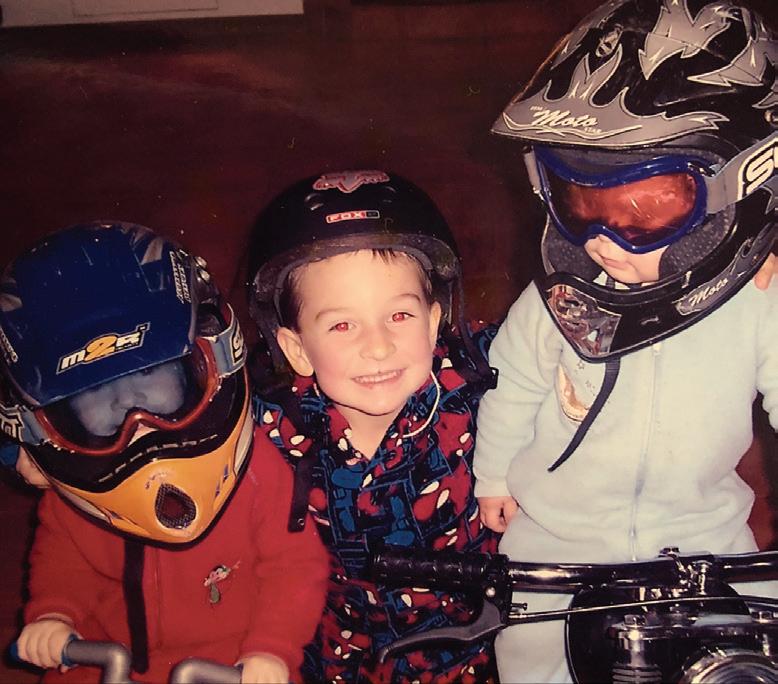
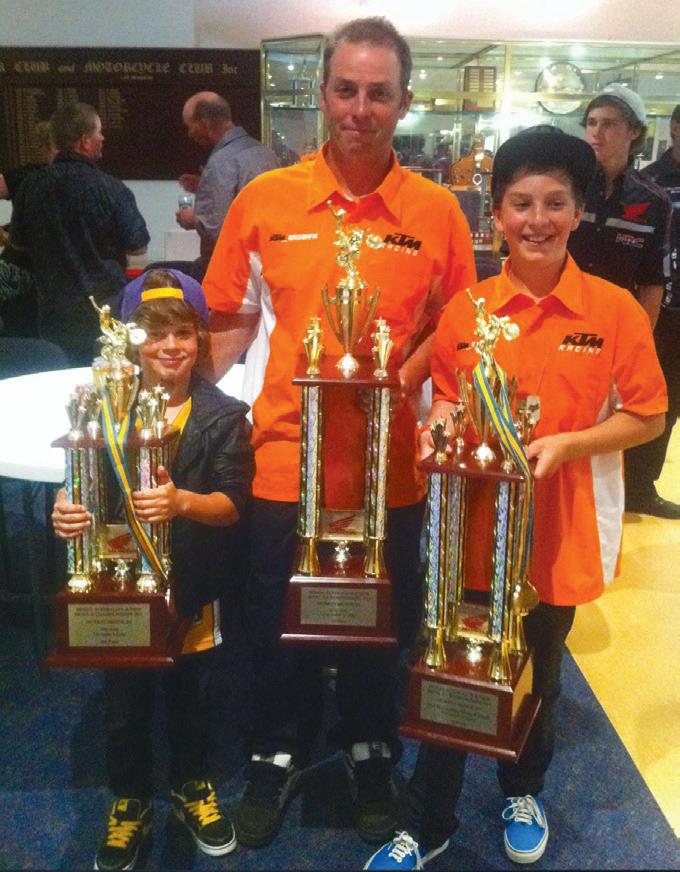
the family was for Jett and Hunter to race in America.
“Winning [was] a motivation,” Jett said, “But I think we also had the motivation to succeed so we could live a better life than we did in Europe.”
All their hard work paid off. The family moved to the U.S. in 2018, with Jett having an impressive showing at the 2018 Mini Os that fall, followed by an astounding run in the 2019 AMA Amateur National Championship at Loretta Lynn’s.
The brothers got their AMA Pro licenses in 2019 when Jett was just 16 years old, and it quickly became clear that the duo from “Down Under” would be top contenders in the sport.
Since going pro in the U.S., Jett has won the 2020 Marty Smith Rookie of the Year award in Pro Motocross, two AMA Pro Motocross 250 Championships in 2021 and 2022, was the 2022 Monster Energy FIM Motocross of Nations Ricky Carmichael Award winner, two AMA Supercross 250SX titles, and the 2023 SuperMotocross Championship. And he accomplished all that before his 21st birthday.
Jett attributes much of his success to his father’s coaching, and the strong team he has with his father and brother.
“Our father is a lot more involved than I think any other father in the sport,” Jett said. “He points a finger at you and makes you work and do 100 percent each time. He does 100 percent for us, and [that] makes us want to do 100 percent for him. He’s our best coach!”
When Jett was younger, he looked up to AMA Motorcycle Hall of Famers Carmichael and Ryan Dungey, but his success has shown that he’s on his own path to becoming a legend.
“When [I] was younger,” he said, “I wanted to be like Ricky or Ryan, but now I’m setting my own path. I don’t want to be like Ricky Carmichael…I wanna beat him!”
And the young racer is well on his way. Carmichael himself recently called Jett’s riding “poetry in motion,” and AMA Hall of
Famers Jeremy McGrath, Travis Pastrana and Ryan Dungey have all weighed in on what a special talent he is.
Despite all the wins, the big-dollar deals and all the press, Jett will tell you that he’s just a normal person, and he hopes that he’ll inspire the future generation of riders with that attitude.
“[I want] younger kids to see that [I’m] a normal person who put in the work to get to this level,” Jett told American Motorcyclist previously. Hopefully it’ll get the younger generation to work harder to get where they want to be.”
“…an individual who’s had the most profound impact on the world of motorcycling over the past year?”
No question: Jett Lawrence, hands down. AMA
Below left and middle: The Lawrence brothers were into motorcycles from their early years, claiming trophies while still living in Australia. Bottom right: Jett after claiming the 2021 AMA Pro Motocross Championship with brother Hunter, who took third that year.
Kyle Peters is the rejuvenated AMA Arenacross series’ brightest star, but his journey to his fourth consecutive title nearly never happened
THE
Just two months removed from claiming his third consecutive title in the AMA Arenacross National Championship Series, Phoenix Racing Honda’s Kyle Peters looked to carry some of that winning momentum over to AMA Supercross at the St. Louis round on April 9, 2022.
But what began as a oncepromising night of racing ended up leaving Peters on an operating table rather than a podium.
“In the second main event of the Triple Crown, I got off to a great start,” Peters said. “I think I was a third or so and just made a little mistake. Two lines came together and I ended up getting clipped by another rider…that was all it took. It ended up whiskey throttling me off my bike, landed flat on my back into the face of a jump, and just knew right away something wasn’t right.”
up against his spinal cord, causing the loss of feeling. Peters later found out from his doctor that this injury results in paralysis from the neck down in 80-90 percent of cases.
While Peters described the incident as “one of the scariest moments of my life,” he was thankful for all the good fortune that contributed to the best possible outcome.
“I could move my legs,” Peters added, “but I couldn’t feel them. It felt like I slept on my arms wrong and they were asleep. Like I couldn’t really feel anything, but I could move everything. I could feel something on my neck was not right.”
After being stretchered off the track, the then-29year-old Peters was taken to the nearby Barnes-Jewish Hospital where it was determined he’d suffered a burst fracture injury of his C5 and C6 vertebrae, which pushed
“Thankfully, my dad is able to travel with me a lot,” Peters said.
“He’s only missed a couple of races of mine, so thank God he was there with me and by my side.
The hospital was really close to the stadium, too, and it’s one of the best hospitals in the country, and one of the best doctors did my surgery. These are all ‘thank God’ things to me. So, as bad as it was, it couldn’t have gone any better.”
The surgery involved going in through the back of Peters’ neck to put two rods and 10 screws to fuse six of his vertebrae. The major surgery kept Peters in the ICU for six days before his mother — who rushed to fly to St. Louis the day after his injury — and father booked him a flight home to North Carolina.
Greensboro, N.C., is where Peters has called home for most his life and where he was raised. Unlike many of his racing peers, Peters did not grow up in a household with parents or siblings that raced motorcycles. Instead, Peters developed the itch to compete on two wheels when his dad took him to an arenacross event.
BACK KID
BY KEATON MAISANO PHOTOS: @HUXONBRAND AND KYLE PETERS’ ARCHIVES
“My dad ended up taking me to an arenacross when I was about 7 or 8 years old, and I was hooked ever since,” Peters said. “At that point, I didn’t have a motorbike yet. From that point on I begged my dad and mom every day until Christmas that year, when I was able to get a Yamaha PW50.”
After getting his first motorcycle it didn’t take long for Peters to get into competition, racing for the first time around 8 years old at Rolling Hills in Reidsville, N.C. Peters spent the first few years of his amateur career feeling out the motorsport lifestyle — one he would eventually adopt.
“Anytime I could race, we went out and raced,” Peters said. “Dad would pretty much take me to the track on the weekends and Mom was at home taking (my two sisters) to games, competitions and whatnot. For a majority of the
amateur nationals, they were able to come and spend the week as well, which was really cool.”
Peters’ amateur career culminated in a 250 A class title at the 2011 AMA Amateur National Motocross Championship at Loretta Lynn’s. The title came on the heels of a career filled with second-place finishes and in the midst of dealing with a compression fracture in Peters’ back, an injury he sustained during a 450 Pro Sport class race at Loretta’s.
His career developed into 11 years of AMA Supercross competition and an illustrious AMA Arenacross career that began in 2020.
The 2020 season was Peters’ first with the Phoenix Racing Honda
team, and they suggested he race AMA Arenacross. While Peters was initially skeptical, as he wanted to focus solely on AMA Supercross, he eventually came around to the idea…and fell in love with the sport.
In his first arenacross season, Peters wasted no time announcing his presence, and promptly won the title.
“The goal was to go win, but I wasn’t 100 percent sure what to expect because the tracks are a lot different and the bike setup is a lot different,” Peters said on the
transition from AMA Supercross to AMA Arenacross. “The team worked really hard getting the bike set up exactly the way I needed it and the way I liked it, and we were able to make it happen the first year.”
Peters followed up his 2020 success with AMA Arenacross titles in each of the next two seasons, setting the stage for a chance to win a fourth consecutive championship in the 2022-2023 season.
But before Peters could focus on another title — or even riding a motorcycle — he had to focus on his rehabilitation, which initially involved a neck brace and plenty of time on the couch.
A month after his injury, his
doctor in North Carolina gave him the green light to lose the neck brace, and Peters said his focus shifted to attacking physical therapy.
“I wasn’t sure what I was going to do, if I was ever going to race again or ride again or what challenges were ahead, initially,” Peters said. “My whole goal to start off with was to live a normal life and be able to do the things I wanted to do, whether it be mountain biking, snowboarding, surfing, golf, whatever.”
“As time went on with my trainer, Cory Worf, we started seeing big strides with movement, stability, strength and everything that came along with that,” Peters continued. “Started thinking about getting back on the bike, and then eventually got on a turn track for a little bit and was like, ‘Oh, maybe I can do this.’”
Worf trained motocross riders in the 1990s, including AMA Motorcycle Hall of Famer Jeremy McGrath, Jimmy Button and Ernesto Fonseca. No stranger to helping athletes through rehab, Worf was with Button as he worked on returning from a broken back.
A young Kyle Peters getting a Tyco RC Xtreme Moto-x Cycle Travis Pastrana toy for Christmas. Left: Peters recovering from surgery after he burst fractured his C5 and C6 vertebra. Right: Peters with his parents (Angie and Kevin) and sisters Kinley (left) and Kelly (right).
“The goal was to go win, but I wasn’t 100 percent sure what to expect because the tracks are a lot different and the bike setup is a lot different.”
KYLE PETERS
“He knew kind of how to go about things and how hard we could push it to move and whatnot,” Peters said. “Thankfully, I had him to help me and move me along, but also push me to reach that next level.”
Peters said his focus did not shift to racing again until about four months into his rehabilitation. Despite uneasiness from members
of his family, who were comfortable with Peters hanging up his helmet for good, Peters eventually decided to work toward a return to motorcycle racing.
For Peters, the decision was one based on a desire to live his life in its truest form.
“There are risks to life doing anything, no one’s promised tomorrow,” Peters said. “God has watched over me so far in my life and watched over me through this injury, so I’m going to still do what I can do and do what I love because that’s living to me. I’m going to do it as safely as possible, but there’s risk to anything.”
Incredibly, just 223 days after suffering what could have been a career-ending and life-altering
injury, Peters was back on the bike for the AMA Arenacross 2022-23 season opener in Albany, Ga., on Nov. 18, 2022.
“When I got there for Round 1, I was like ‘alright I remember this feeling. Let’s go’,” Peters said. “I was pumped to be there, and just went out there and had fun.”
And there was plenty of fun to be had for the reigning champion, who won both motos on the night. This would be the first of seven instances all season in which Peters would win both motos in an event victory.
operations for AX Promotions, the promoter of AMA Arenacross — said Peters’ performance on the track looked as special as ever.
“When KP was on the track, you didn’t see the effects that he had an injury or was coming back from anything,” Smith said. “The intensity level he brought to the track regardless of having that (injury) was above and beyond anyone else.”
While his ability to tally season points looked familiar, the manner in which he rode to do so had evolved to account for his injury.
The win marked the beginning of a magical season for Peters, who went on to dominate the standings and position himself to win his fourth consecutive championship. Shawn Smith — the director of
“With the injury I had, everything had to change,” Peters said. “My riding style had to change a little bit… I wear a neck brace now that hinders me in a few areas, but for me, it is more of a safety thing than anything. Also having the rods and screws in
In a two-week period in March 2021, Peters capped off a 20-0 season to claim his second AMA Arenacross title and reached an AMA 250SX podium for the third time in his career.
my neck, I can’t really do as much as I used to be able to in terms of training.”
While the return meant a lot to Peters and those close to him, his presence was just as impactful to the sport itself. Since his arrival to AMA Arenacross, Peters has become one of its brightest stars both on and off the track.
Smith said Peters’ importance in building up the sport can be seen in his willingness to engage with fans.
“I don’t care how long the line is, KP is there the whole time for fans, never turns anybody away,” Smith said. “He understands this is not about him or his results…this
is about the series, motorcycling, arenacross and all the sponsors. KP gets it.”
For Peters, spending time with fans is all about giving back and being a good role model to the kids looking up to him.
“It’s so important to me because I was that kid growing up,” Peters said. “I went to my first arenacross race and those guys were superheroes to me.”
Despite all the adversity, Peters entered the Salem, Va., round in
March 2023 with a chance to clinch the title two weeks early.
And just two hours from his hometown and less than a year removed from his scary crash in St. Louis, Peters capped off the magical season with a 2-1 mainevent performance to claim his fourth consecutive AMA Arenacross National Championship.
“To be able to do it the way I did it
“I
wasn’t sure what I was going to do, if I was ever going to race again or ride again, initially. My whole goal to start off with was to live a normal life and be able to do the things I wanted to do.”
KYLE PETERS
in front of my whole family, and to be able to share that with them and share the victory, share the overcoming of all the obstacles, the adversity,” Peters said. “It was so incredible.”
“My family saw what I went through, all the hard work that went into it,” Peters continued. “Every day doing therapy and them going on walks
with me because that’s all I could do, to them taking care of me on the couch. They saw all the steps through that, which normally no one gets to see and, and to be able to share that with them, it still gets me emotional.”
Now in the midst of his fifth season, Peters is seeking a
fifth title — a feat not many have accomplished in the series’ existence.
“I know Budman [Buddy Antunez] and a few other people have five national arenacross championships,” Peters said. “I’d love to join that club. I’d love to surpass them. I love this. I love racing and doing what I get to do. I want to do it as long as I can.” AMA
Top left: Peters receiving his 2022 AMA Athlete of the Year honor from AMA Deputy Director of Racing Mike Burkeen.
Top middle: Biking is one of Peters’ favorite hobbies. Top right: Peters interacting with fans at an AMA Arenacross event.
...AND SAVE MONEY! THE ESSENTIALS PRODUCT DISCOUNTS
Lodging Save 15% at participating Choice Hotels Properties. Up to 10% off at Motel 6. Use code: M64AMA
20% discount off available rates, call (800) REDROOF and use the code VP+ 503343. To make reservations online use code: VP+ 503343 in the field labeled “VP+/ID#”
ADVMoto 20% discount. Use code AMADV20
AMA Motorcycle Hall Of Fame Free admission to the AMA Motorcycle Hall of Fame in Pickerington, Ohio.
AMA Supercross Tickets
Save $5 on up to 8 tickets at supercrosslive.com Use code 4AMA5
Anthony’s Leatherworks 10% discount on repair order Use code AMADISCOUNT
Blendzall
AMA members can save 20% at blendzall.com. Use code AMA20 at checkout.
Bohn Body Armor 10% AMA Member Exclusive Discount. Visit bohnarmor. com and use code AMAD22 at checkout.
Bugslide
AMA members enjoy 15% off all BugSlide® cleaning products. Use code AMA2023
Butler Maps
AMA members receive a 20% discount at butlermaps.com. Use code AMAMEMBER
California Dual Sport Riders
Members save 50%. Use code AMA. Visit cdsr.us to learn more.
Cardo Systems
20% discount online with valid AMA membership card. Use code AMA20
Colorado Motorcycle Adventures
10% discount with valid AMA membership card.
Take advantage of discounts from our quality partners and save loads of money – and pay for your AMA membership – in just a few keystrokes! From gear, event tickets and rentals to accessories, hotels and performance parts, it really is that simple.
EagleRider
For Club EagleRider AMA members receive 2 free rental credits. Use code AMACLUBER
Edelweiss AMA members save on standard bike tour. Use code 21AMA-EBT03 at checkout.
Evans Cooling System 25% discount on Evans Coolants and Prep Fluid. Use code AMAFUN at evanscoolant.com.
EVS Sports 10% discount and free shipping on all orders. Use code AMAEVS20
Gryphon Moto
AMA members receive a 15% discount on Gryphon Moto orders at gryphonmoto.com. Use code AMA at checkout.
Haynes
an additional 15% on all Haynes & Clymer print and online repair manuals. Use code AMA15
Heli Bars Use code AMAM2020 for a 10% AMA Member Exclusive Discount at helibars.com.
Helix Racing Products
AMA members save 20 on all products at helixracingproducts. com. Use code AMA20 at checkout.
Helite Moto
AMA members get 15% off every order at helitemoto.com. Use code HELITEAMA
HertzRide
AMA members save 10% on rentals in all locations globally at hertzride.com/us/ promo/American-motorcyclistassociation-1065 or use code AMA10
Legacy Track Dayz
15% discount on Legacy Track Dayz events. Use code AMARideLTD
MAD Maps Save 15%. Use code AMA15
Matrix Concepts AMA members receive a 25% discount on most products for shop, garage & track necessities at matrixracingproducts.com Use code AMA25
Medjet
Air medical transport and travel security protection – visit Medjet.com/AMACycle or call 1.800.527.7478, referring to American Motorcyclist Association. Annual rates reduced by 20% and start at $235.
MotoAmerica
20% off 2-day and 3-day passes at select MotoAmerica events. Use discount code AMA20
Motool
AMA members can save 10% at motool.co. Use code AMASAVE20 at checkout.
MX Boot Repair
10% discount. Use code AMADISCOUNT
at checkout
MYLAPS
20% discount off MSRP or current sales price on weborders or orders coordinated by the AMA. Use code AMA-789HJK
Nationwide Pet Insurance
members save on pet
Nelson Rigg 20% AMA Member Exclusive Discount on all products! Use promo code AMA-NR20
Racing
off products at riskracing.com. Use code AMA15
ama2020rl
Concepts 15% off products at stkrconcepts.com. Use code AMA15
The Dirt Bike Academy 10% exclusive discount on instruction. Learn more at thedirtbikeacademy.com Use code TDBAAMA10 Street Skills 10% discount on online courses at StreetSkills.net. Use code AMACCOC.
Dowco Powersports 20% discount.Use code AMA20
Liberty Sport Eyewear
30% discount on all “motorcycle collection” frames. Discount code AMA30.
Third Eye Design 10% discount on inView, a wireless brake and signal light. Use code AMA at
Be sure to check the event website or call the organizer for the latest information, including postponements or cancellations.
AMA CALIFORNIA
Grand Prix Jan. 12 - 14. Delano. NGPC Round 1, Southern California Motorcycle Club, http://www.ngpcseries.com/ Hare Scrambles/Cross Country Jan. 13 - 14. Rancho Cordova. Prairie City Grand Prix, Polka Dots Motorcycle Club, 916-606-5108, prairiecitygrandprix@gmail.com
Hare and Hound Jan. 20 -21. Lucerne Valley. Desert MC Winter Classic National Hare and Hound, Desert Motorcycle Club, Inc.
Enduro Jan. 27. Lucerne Valley. 100s MC Sprint Enduro, 100’S MC www.100smc.org
Dual Sport Jan. 27. Ridgecrest. Hi Desert 250 Saturday, Countdown, 775-884-0399, Jerry.counts@sbcglobal.net, Dualsportwest.com
Round 12: March 30. St. Louis, Mo. The Dome at America’s Center
Round 13: April 13. Foxborough, Mass. Gillette Stadium
Round 14: April 20. Nashville, Tenn. Nissan Stadium
Round 15: April 27. Philadelphia, Pa. Lincoln Financial Field
Round 16: May 4. Denver, Colo. Empower Field at Mile High
Round 17: May 11. Salt Lake City, Utah. Rice-Eccles Stadium
2024 Supercross Futures AMA Championship supercrossfutures.com
Supercross Futures Premier Qualifying Events:
Round 1: Jan 27. Anaheim, Calif. Angel Stadium
Round 2: March 2. Daytona Beach, Fla. Daytona Int’l Speedway
Round 3: March 30. St. Louis, Mo. The Dome at America’s Center
Round 4: April 13. Foxborough, Mass. Gillette Stadium Supercross Futures AMA National Championship
May 11. Salt Lake City, Utah. Rice-Eccles Stadium MOTOCROSS
Pro Motocross Championship Series promotocross.com
Round 1: May 25. Pala, Calif. Fox Raceway at Pala
Round 2: Jun 1. Sacramento, Calif. Hangtown Classic
Round 3: Jun 8. Lakewood, Colo. Thunder Valley Motocross Park
Round 4: Jun 15. Mount Morris, Pa. High Point Raceway
Round 5: Jun 29. Southwick, Mass. The Wick 338
Round 6: Jul 6. Buchanan, Mich. RedBud MX
Round 7: Jul 13. Millville, Minn. Spring Creek MX Park
Round 8: Jul 20. Washougal, Wash. Washougal MX Park
Round 9: Aug 10. New Berlin, N.Y. Unadilla MX
Round 10: Aug 17. Mechanicsville, Md. Budds Creek Motocross Park
Round 11: Aug 24. Crawfordsville, Ind. Ironman Raceway NATIONAL CHAMPIONSHIPS
AMA Arenacross National Championship Series arenacrossusa.com
Round 3: Jan 5-6. Loveland, Colo. Budweiser Events Center.
Round 4: Jan 12-13. Grand Island, Nebraska. Heartland Events Center.
Round 5: Jan 19-20. Guthrie, Okla. Lazy E Arena.
Round 6: Jan 26-27. Guthrie, Okla. Lazy E Arena.
Round 7: Feb 2-3. Prescott Valley, Ariz. Findlay Toyota Center.
Round 9: Mar 8. Fayetteville, N.C. Crown Complex Arena.
Round 10: Mar 15. Salem, Virginia. Salem Civic Center. Round 11: Mar 22-23. Denver, Colo. Denver Coliseum. Round 12: Mar 29. Las Vegas, Nevada. Orleans Arena. FEATURED EVENTS
Baja Brawl
Aug. 31-Sept 2. Millington, Mich. Baja Acres 871-3356. bajaacres.com
Yamaha All Star AMA ProAm Featured Event / MDRA Sep. 14-15. Shippensburg, Pa. Doublin Gap Motocross (717) 249-6036. doublingap.com
MAJOR EVENTS
James Stewart Freestone Spring Championship
March 6-10. Wortham, TX. Freestone County Raceway. freestonemx.com
Sep. 28-29. Big Woods 200. Wabeno, Wis. Wisconsin Dual Sport Riders. (920) 350-2030. widualsportriders.org
Nov. 2-3. Howlin at the Moon. Payson, Ariz. Arizona Trail Riders. (602) 692-9382. arizonatrailriders.com
AMA Trademarks
The following represents active, registered trademarks, trade-marks and service marks of American Motorcyclist Association, Inc. (AMA). Usage of any AMA trademark or registered trade- mark without our permission is prohibited. Please contact jholter@ama-cycle.org for more information or assistance, (800) AMA-JOIN®
• AMA Dragbike® • AMA Endurocross® • AMA Motorhead® • AMA Pro Grand National Championship®
• AMA Pro Racing® • AMA Race Center™ • AMA Racer® • AMA Racing® • AMA Racing Land Speed Grand Championships® • AMA Supermoto® • AMA Supercross® AMA SX Lites® • AMA U.S. ISDE Team™ • AMA U.S. Jr. Motocross Team™ • AMA U.S. Motocross Team™ • Amateur National Motocross Championships® • American Motorcyclist Association® Arenacross® • ATV Hare Scrambles National Championship Series® • ATV Motocross National Championship Series® • Flat Track Grand Championships™ • Grand National Enduro Championship® • Gypsy Tour® • Hare & Hound National Championship Series® • Hare Scrambles Championship Series® • Hare Scrambles National Championship Series® • Kids Just Want To Ride® • Motorcycle Hall of Fame® • Motorcycle Hall of Fame Museum® • Motorcyclist of the Year® • Motostars® • National Adventure Riding Series® • National Dual-Sport Series® • National Enduro Championship Series® • Protect Your Right to Ride® • Protecting Your Right to Ride® • Ride Straight® • Rights. Riding. Racing.® • Road Race Grand Championships® • Vintage Grand Championships® • Vintage Motorcycle Days® • Vote Like A Motorcyclist®
Garage
Tips,Tweaks, Fixes and Facts: The two-wheeled ownership experience, explained
2024 Honda Transalp 750
Honda dusts off a late 1980s ADV nameplate and scores. Is Less More? Yes!
Downsizing being all the rage these days, here comes Honda right on schedule with an allnew lighter, friendlier, and cheaper ADV bike. Sure the Africa Twin is a great adventurer, but most of us middle-aged cheapskates aren’t Cyril Despres, and most of our adventures don’t require 100+ horsepower, super long-travel suspension or a foot of ground clearance.
BY JOHN BURNS RIDE FIRST
Most of us don’t want to pick up a 500-pound plus motorcycle when it invariably tips over in the most awkward place, either, and I, for one, see no need to shell out 15 or 20 Gs for a motorcycle whose potential mocks my skill set. Especially when Honda invited us to sample the allnew Transalp 750 on Backroad Discovery Route’s Pennsylvania trek. With its 4.5-gallon tank full (halfa-gallon less than Africa Twin), Honda says the Transalp’s 459-lb. wet weight undercuts
Most of us don’t want to pick up a 500-pound plus motorcycle when it invariably tips over in the most awkward place, and I, for one, see no need to shell out 15 or 20 gs for a motorcycle whose potential mocks my skill set.
Honda has four Accessory Packages on offer: Adventure, Comfort, Touring, and City. Touring gets you locking hard bags, a 12V accessory kit (the standard bike has a USB port under the seat), the tall windscreen and a centerstand. Lots of individual accessories are also available.
the base AT by 46 lbs. in spite of its steel frame. The Transalp’s seat is 33.7 inches from the ground, but there’s also a low-seat option that takes it down to 33.3 in. My 30-inch legs felt pretty confident on either one, able to get my foot balls down on both sides as the 43mm Showa SFF-CA inverted fork groaned through part of its 7.9-inch travel as my massive mass settled in, and the Pro-Link Showa shock used up more than a little of its 7.5-inch travel.
I’ve toppled over more than once from a standstill on Yamaha Tenere 700s, whose seat height claim is 34.4 in. That extra inch is an angry one indeed. Not only is the Transalp seat lower, it’s also broader and more comfortable than the Tenere’s more dirtbikey one, which is a big reason why the Honda feels considerably “streetier” than the Yamaha.
Speaking of the Tenere, we’ve been singing the praises of its spunky 689cc parallel Twin since the first FZ-07 got here in 2015. With its own all-new parallel twin, Honda takes everything we like about that engine and kicks it up about three notches. 755cc isn’t much bigger than the Yamaha, but the Honda’s Unicam head and more oversquare dimensions conspire to have the Transalp moving out from 2,000 rpm on up with more authority than you expect from a 750. The engine also spins up more enthusiastically than the Tenere’s.
The U.S. version adheres to sound restrictions that limit horsepower compared to the 90.5 bhp at 9,500 rpm Honda claims for the Euro version, but it doesn’t have much less, and still feels plenty fast. At 4,000 rpm, the engine’s producing serious thrust, and between 6,000 and 8,000
Garage
rpm the angry animal trapped in the airbox and being poked with the 270-degree crank through the Vortex flow ducts is screaming to get out. If you want to bounce the tach needle off its soft limiter (just past 10k on the analog-looking TFT tach) as you scatter leaves on Pennsylvania dirt roads, you can. The standard up/down quick-
Rain, and a customizable User mode. In User, you can switch to Off-road ABS, which disables rear ABS, and you can turn off traction control, too (HSTC, Honda calls it). It’s all easy for even a technophobe to operate quickly with the left-thumb button. Personally, I like a little HSTC, of which there are five levels. A couple of too-sideways times
No one much knew what to make of the original XL600V Transalp when it appeared on US shores in 1989 in the midst of the sportbike boom, which probably explains why it was gone after 1990 from American Honda’s lineup. Now, mid-size ADV bikes own the market.
shifter makes it easy to keep things screaming, and especially helps with smooth downshifts on those loose surfaces, too; engine braking is three-way adjustable. (When you do want the clutch, its slip-assist function gives it a really light pull and smooth engagement.)
Alternatively, when you tire of standing on the pegs and trying to keep up with the fast kids, you can just sit down on the cush seat, dial it back to cruise mode, and take in the Pennsylvania BDR’s glorious fall scenery. The Transalp encourages that, as the width of the gas tank makes standing on the pegs slightly awkward. On smoothish gravel roads (most of the BDR), the ride’s impeccable. On the couple of gnarlier rocky sections we encountered, with the rocks mostly invisible under a carpet of leaves, you might wish for the Africa Twin’s more sophisticated suspension and a steering damper. But it’s all good.
Actually, there is no Cruise mode, but there are Sport, Standard, Gravel,
out of loose gravelly corners just as my medulla oblongata was seizing up, the Honda brain had already stepped in to slow the rear’s spinning and straighten things out. A man’s got to know his limitations — and when he doesn’t, it’s nice to have a machine that does.
On top of all that, after 1.5 days of riding 80 percent dirt roads, my bike’s computer said it was getting 45 mpg, and the computers on the fastest guys’ bikes, who were flogging their Transalps the whole time, read between 50 and 54 mpg. Not sure how that works, but I like it.
All in all, for $9,999, this is a helluva motorcycle that I alas, cannot wholeheartedly endorse, because they left off my favorite gadget: cruise control. If you’re one of those people who claims to not care about cc (Yamaha sold plenty of Teneres without it), then there’s nothing stopping you. Except that American Honda is only bringing in the Matte Black Metallic, and not the lovely white one available abroad. Those two things aside, I wouldn’t try to talk you down from this one. Very nice.
RIDES STAFF
THE DR650 DOOFUS
The newer DR650 (closest to camera) has fewer miles and is outfitted way better than the older one. Live and learn.
Dueling DRs:
A perfect example of two not being larger than one
BY MITCH BOEHM
Months ago, in the wake of the Neil Fergus cover story (June 2023), I decided I had to have a big dual-sport thumper. I’d helped develop Honda’s XR650L (alongside the late Bruce Ogilvie) during my three-year stint at American Honda in the early 1990s, and thought I had a soft spot for it…but after researching things I settled on a Suzuki DR650, like Neil’s, with about 6K on the clock.
It wasn’t perfect (the jetting was off and it had some funky bolt-ons), but it did have firmer aftermarket suspension from the DR experts at Pro Cycle, which was important, as I’m not 180 pounds anymore. I quickly replaced the not-comfy stock seat with a superb Seat Concepts saddle and added fresh rubber (Kenda K270s), and figured once I swapped the stock exhaust for a reasonably-quiet Leo Vince and added a large-capacity fuel tank (also from Pro Cycle), I’d be ready to roll.
But no. Just two days before leaving for our Alps Challenge tours I was poking around online and found another
DR just 20 miles from home that had all the fixins, including the Leo Vince and biggie tank…but also the Pro Cycle flat-slide Mikuni carb upgrade, Pro Taper bars, billet fork brace, alloy engine bash plate, luggage racks and more. It also somehow had only 700-some miles on the clock. Basically, the guy had outfitted the bike to the teeth, but never really rode it. And he’d just reduced the price.
I had no time and not a lot of cash, having just spent $3,500 on the first DR, but such was my mania (gotta love that quote from A Christmas Story) that I snagged it, knowing that A) someone would snatch it while I was in Europe, and B) I could sell the first DR to make room for the second, physically and financially. It’s a cruel game our minds play when we gotta have something, right?
Now that I’ve done a bit of parts mixing and matching with these two, it’s time to sell No.1. But with winter already here it might be spring before I can sell it. I can deal with that. I just need to make sure I stay off Craigslist and Facebook Marketplace. I’m a doofus, and it’s obvious I have no control.
behind the scenes
The Historian
Longtime AMA employee — and unofficial archivist — John Bricker has spent years building, cataloging and organizing AMA history
BY KEATON MAISANO
At first glance, the American Motorcyclist Association’s collection of history appears to be concentrated within the AMA Motorcycle Hall of Fame Museum, which showcases many significant motorcycles, relics and memorabilia.
However, those two floors of history pale in comparison to the 100 years of documents, magazines, photos, film, CDs, VHS tapes and more on the lower floor of the AMA headquarters office in Pickerington, Ohio, which is literally connected to that impressive museum via a walkway.
Archiving and organizing this vast collection of history has become the task of AMA Mailroom Manager John Bricker, who became an AMA employee in 1990 and who, with the advancement of technology over the years (and the subsequent decrease in physical mail), became the defacto historical caretaker of AMA history.
“I’ve always been a historian,” Bricker said. “I do a lot of my genealogy with my family, and I’m the co-founder of the Galena Historic Foundation in Galena, Ohio.”
Bricker has scanned decades of magazines, racing records, documents, photos and more to preserve the information stored within the walls of the AMA headquarters. In addition to digitizing the archives, he has spent his time
Whether organizing shelves of pin boxes, sifting through old racing records, or scanning photos and magazine pages, Bricker keeps busy keeping AMA history in order.
organizing the physical copies of magazines, pins and other memorabilia.
“The AMA is the American Motorcyclist Association,” Bricker added. “It’s about people, and you find the people in the paperwork. I’m trying to preserve that.”
With a collection of different magazines such as Motorcycle Bicycle that dates to around 1910, the physical records of motorcyclists and the AMA can be traced back to before the AMA’s creation in 1924.
“I have come across paperwork with [AMA Motorcycle Hall of Famer] Arthur Davidson mentioning the creation of the AMA,” Bricker said. “In one of them, I found what I believe to be the first mention of an AMA organization.”
Even after years of effort, Bricker estimated he is only 20 percent through the material. Despite the daunting task ahead of him, Bricker keeps chipping away. “People think there’s no way I’ll be able to scan it all,” he said, “but you just get started…one box, then a second box, and after a while, you’re like, ‘Hey, I’m halfway through this pile.’”
“There is so much rich history at the AMA, and so much potential if you just bring it out of the shadows,” Bricker continued.
Some of that rich history will end up on the pages of American Motorcyclist during the coming year as our 100th Anniversary celebration plays out. And Bricker will have had a serious hand in all of it. Thanks, J.B!
Preserving and promoting motorcycling’s rich history is the mission of the AMA Motorcycle Hall of Fame. The Hall of Fame is funded by the American Motorcycle Heritage Foundation, a 501(c)(3) non-profit, and it is through the generosity of donors that this effort is possible. Donations can be made by going to AmericanMotorcyclist.com/hall-of-fame.
Looking for a real chunk of motorcycle history, and one that benefits the AMA Motorcycle Hall of Fame? Well, this is it, and here’s your chance!
Back in 1972, BMW’s motorcycle division was at a critical crossroads, with some higher-ups advising to close things down. Luckily, Bob Lutz and Hans Muth joined forces to create the now-legendary BMW R90S, a premium, top-shelf motorcycle that could battle the likes of Honda’s CB750 and Kawasaki’s Z1, not in pure performance but in craftsmanship, comfort, and cachet.
Get your tickets — $5 per, or 5 for $20.
Don’t miss this!
THE WORLD’S WARMEST BASELAYER
Japanese baselayer brand Zero t has created a range of game-changing products to keep you toasty warm and ensure that plummeting temperatures won’t stop you getting out on the road or track this winter. Designed by a passionate team of innovators and baselayer specialists, the Zero t Heatrub Ultimate is the most technically advanced baselayer on the planet and completely di erent to any other product you’ve ever worn before.
WHAT MAKES IT SO GOOD?
1. It’s ve times warmer than a standard baselayer
That is quite a claim, but it’s a fact. Tested at the iconic Boken Institute in Osaka, the Heatrub Ultimate baselayer recorded a Heat Retention Rating of 0.78; a standard baselayer would have a rating of between 0.1 to 0.14. And for reference, a jumper would typically have a rating of 0.3. The Ultimate performs best in a temperature range of 14° thru 50° Fahrenheit – so even in the coldest of conditions and most biting of winds, you’ll still be nicely heated.
2. Instant warmth the moment you put it on
A standard baselayer traps body heat between your skin and the material, so it takes a little time before you feel the bene ts. With Zero t, ve separate fabrics, along with a patented knitting process, create instant warmth as soon as you pull it on. And, because of the construction of the garment, this heat is retained for the duration of your time on the bike, making it an essential piece of kit this winter.
HEATRUB MOVE BASELAYERADAPTABLE WARMTH ON THE GO
The Ultimate baselayer is complemented by the Heatrub Move ($76), which is twice as warm as a standard baselayer and ideal for milder temperatures of between 23° thru 53° Fahrenheit. It features a 45% polypropylene construction on the inside of the baselayer and a hollow polyester shell that combine for ‘Adaptable Warmth’, keeping you cosy when you’re at a standstill yet regulating temperature and ensuring you don’t overheat as your ride progresses. The construction removes sweat from the skin and evaporates it o the surface of the baselayer quickly, so that nasty feeling of ‘cold sweat’ never materialises.
3. Heating from top to toe this winter
Innovative ‘Heat Threads’ positioned on the inside of the garment gently rub against your skin and are activated upon even the smallest of movements, creating positive warmth across your body. We also produce Heatrub Ultimate Leggings, Heatrub Ultimate Socks and a Heatrub Ultimate Neckwarmer, all of which are made from the same material and work in exactly the same way, so you can have top-to-toe warmth on even the longest of journeys with Zero t.
4. Ride free with fewer layers and greater warmth
The Ultimate is the ideal product for bikers who hate traditional tight baselayers. Over the years, you may well have ‘layered up’ in order to combat the e ects of cold weather. This is where we are changing the game. The Heatrub Ultimate is so good at keeping you warm, you won’t need multiple additional layers. And the unique fabric mix means it doesn’t need to rely on compression to keep you warm, making it super comfortable too.
Five times warmer than a standard baselayer
No need for multiple additional layers – a game-changer