Snapshot
Next! AMA Racing Awards
The Best Of The Best
Not only will the 2012 AMA Championship Banquet recognize the top-three class finishers in AMA national championship competition, it’s also where the AMA will announce the recipients of its most significant racing awards.
The banquet is set for Jan. 19, 2013, at the Aladdin Center in Columbus, Ohio.
The list of honors reflects the diverse nature of AMAsanctioned competition. They include awards for youth and vet riders, as well as the two highest racing honors bestowed by the association: The AMA Athlete of the Year Awards for national championship and grand championship competition. Last year, AMA National Enduro Champion Russell Bobbitt and AMA Dirt Track Horizon Award Winner Daniel Bromley walked away with the honors.
The AMA Athletes of the Year will be selected from all 2012 AMA National Champions and AMA Horizon Award winners.
Want to know who comes out on top? Don’t miss the banquet! Not only will it include awards for all AMA national champions, there will also be plenty of prizes and more. Get your tickets at www.americanmotorcyclist.com/racing.
Zach Bell, AMA Motocross Horizon Award Winner
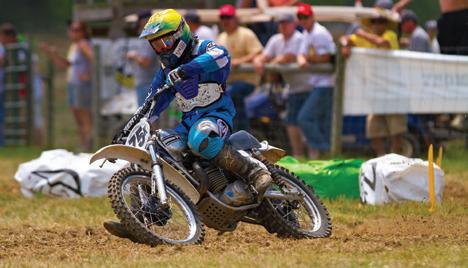
Adam Giddings, AMA Vintage Off-Road Grand Champion
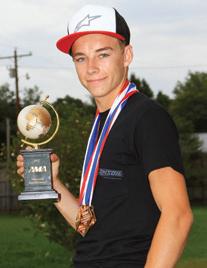
for Ochs. Last year he won the AMA Youth Roadrace Rider of the Year. And now, on the heels of the AMA Horizon Award, he is already looking ahead to moving up to the AMA Pro Racing ranks and a return to Daytona.
“I’m going to ride AMA [Pro] next year and will definitely be back at Daytona, maybe as a privateer unless I get picked up by somebody,” he said. “My weekend was far better than the expectations I had.”
While Ochs was emerging as a future star, Cohrs, the Vet/Senior Award winner, was re-establishing his status as one of the more successful veterans.
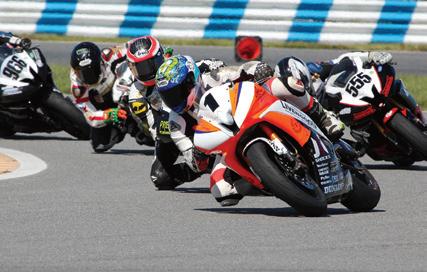
Just prior to his three-way shootout with Ochs and Anderson in the 600 SuperBike race, Cohrs raced to an impressive victory in the Expert F-40. And he placed third behind Ochs and Anderson in Saturday’s 600 SuperSport.
Not bad for a guy just seven months removed from a jarring accident in Savannah, Ga., where he suffered a broken back. This marked only his fourth weekend of racing since the accident.
“Pretty good weekend. I can’t complain,” the 44-year-old from Suwanee, Ga., said after the races. “I’m sore and stiff, but I’m trying to get it
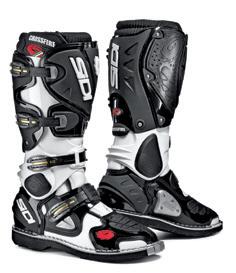
Sidi Crossfire Boots
Happy Feet
As an off-road racer, some parts of your body are more exposed than others: your head, your hands and your feet. Sure, it’s vital to wear quality stuff all over, but if you can spare the hardearned cash to really protect these three critical areas, do it.
But protection is just part of the story. It’s easy to add panels of injection-molded plastic. What’s hard is offering rock-solid protection while preserving flexibility and comfort. This is where the $475 Sidi Crossfire Boots positively shine.
The key to the comfort is Sidi’s Dual Flex system. Forward and backward movement is fairly uninhibited, while side-to-side motion—the type that can really screw up your ankle—is restricted. Fit also benefits from the four floating independent straps that not only allow custom sizing at each point but flex just enough to provide additional give when needed.
That flex contributes a lot to the Sidi’s comfort, which is exceptional for a non-bootie design. Personally, I’m a huge fan of booties. (These are the thick-sock-like inserts that you slip over
your feet before you put them in the boot.) However, the Sidi’s are one of the rare non-bootie boots that get a pass on my admittedly sensitive feet.
The Crossfire outers are made from Lorica, a woven microfiber injected with resins. It’s not just tough, but relatively soft and pretty much waterproof. I’ve had the Sidis under water several times—yes, including times I’ve been pushing the bike—and they haven’t leaked a noticeable drop.
Another nice feature on the Sidis is the cam-lock buckle system. They cinch quickly and stay cinched. They’re also easy to adjust if you need to accommodate different knee guards or go from an over- to insidethe-boot riding pant.
Despite all the other elements that go into a good boot, one feature can make
back again. But it will get there. I’ll just keep practicing. It’s not like starting over, but kind of is.”
The two recipients of the Top Novice Award—Plemmons and Imrie—looked nothing like novices during their victorious weekend performances.
Plemmons, from Union Mills, N.C., followed up his Saturday victory in the amateur SuperSport 1000 with a triumph Sunday in the SuperBike 1000. It was a far cry from his first appearance at Daytona a year ago, when he crashed at 170 mph in Turn 4.
“I wondered whether I even wanted to come back here, because that was scary,” said Plemmons, 38, who is finishing his first full year of racing.
“But I figured I’d try it. You never succeed if you don’t try, so I jumped back on the horse, grabbed the bull by the horns, and hung on.”
Imrie, a 27-year-old from Winnipeg, Manitoba, won three AMA races at a speedway he’d seen repeatedly on television but had not visited until this weekend. He took SuperSport 600 Saturday, and won the SuperBike 600 and SuperBike Twins Sunday.
“I was kind of nervous coming down here—just because of the atmosphere and the fact that I’ve been watching this track on TV forever,” said Imrie, who first raced a motorcycle last year.
or break any design: the sole. This is a major balancing act. Too soft for feel, and your feet get hammered. Too stiff, and you don’t feel the bike. Sidi is somewhere in the middle, which is right where you want it—decent feel but enough protection to keep your feet happy for days of back-to-back riding. The jury’s still out on long-term durability, but wear is typical through about 750 miles of hard off-road riding.
Sizing is close, if not spot on. I typically wear a size 10.5-11 shoe. The Euro 45s do the job, but 44s aren’t out of the question. The boots are trim widthwise. If you have wide feet, the Sidis may be a bit snug. Of course, as with anything as critical as boots, you want to try them on before you buy.
The Sidis are on the high end of the pricing spectrum, but they also are arguably the best boot you can buy. If you put a premium on comfort and control, you owe it to yourself to give them a serious look.
Find a dealer near you at www.motonation.com. Click on “Our Dealers.” —James Holter
Jim Cohrs won the 2012 AMA Roadracing Vet/Senior Award.
AMA National Hare & Hound Finale To Kurt Caselli Back
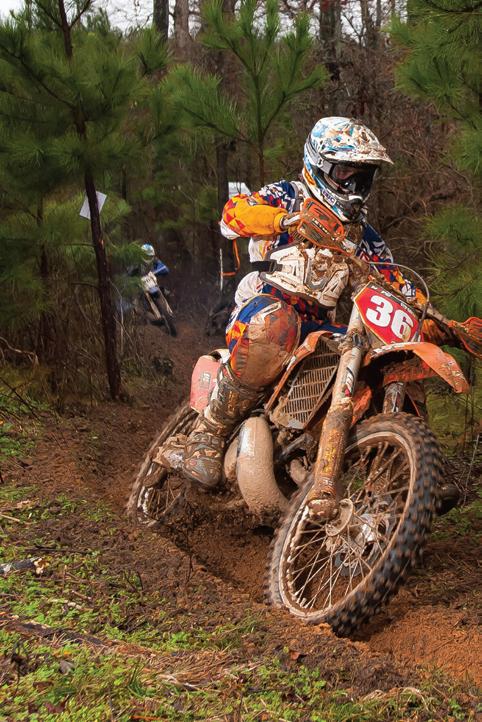
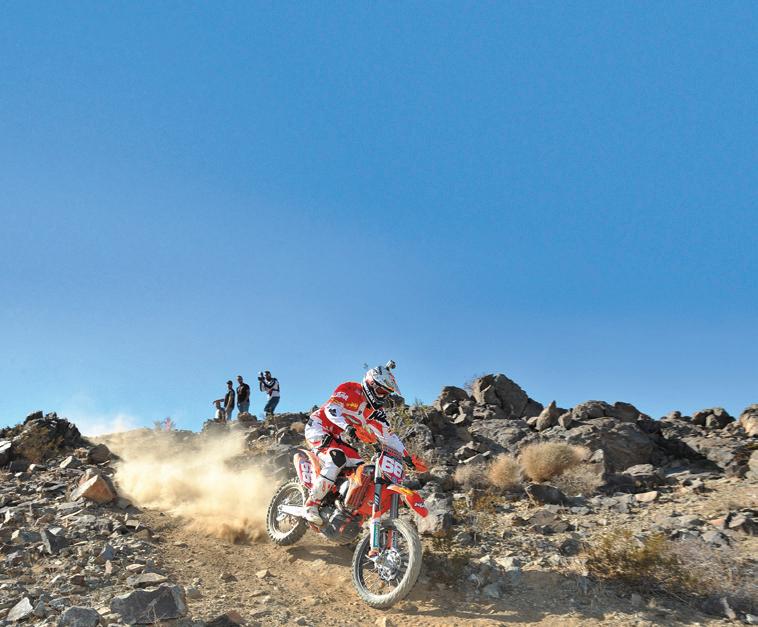
Kurt Caselli did what many thought impossible. The FMF/KTM rider won his seventh overall of season at the 10th and final round of the AMA National Hare & Hound Championship. With the win, Caselli triumphed at every event he finished, overcoming a mid-season injury that sidelined him for three rounds.
“I knew I had to win these last two rounds if I wanted any shot at the championship,” said Caselli. “It was important to have a good start and stay out of everyone’s dust so I
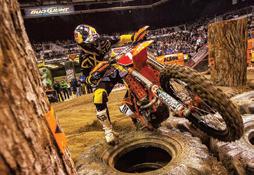
A packed house witnessed what was arguably 2012’s most exciting GEICO AMA EnduroCross round at Boise’s Idaho Center on Oct. 27.
From Injury To Win Title
could ride my own race.”
Caselli’s start was indeed crucial to his win in the dry and dusty conditions of Lucerne Valley. He got the holeshot and led the group into the first 40-mile loop, which was split into two 20-mile segments of technical single-track.
Caselli came through the pits at the end of the two sections 15 seconds ahead of David Kamo and series point leader David Pearson. Pearson would have to finish third or worse for Caselli to claim the championship.
“The second loop was really fun and had some cool rocky downhills,” Caselli said. “The club did a really good job of changing up the course and I had a lot of fun riding today.” Caselli was able to stretch out his lead for the remainder of the race and took the win.
Although Pearson crossed the line in second, a referee penalty assessed at the gas stop docked Pearson five minutes for a violation of fueling safety procedures. Due to the penalty, Pearson was credited with sixth, and Caselli the title.
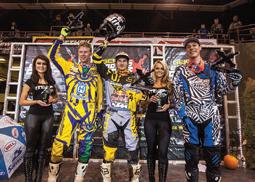
KTM’s Taddy Blazusiak took another win on a difficult track despite a last lap mishap with a tractor tire that allowed Beta’s Cody Webb to get within striking distance. Husqvarna’s Cory Graffunder took third.
Off the start, Webb blasted his Beta into the lead. Blazusiak was deep in the pack as they came to the large log exiting the first turn, but in typical EnduroCross action (that is, controlled chaos), he quickly found his way into second.
“I was about fifth exiting the first turn and then everybody went wide in the second turn and left the inside wide open for me. So I came out second behind Cody,” Blazusiak said after the race. Blazusiak took the lead on the second lap and led until Webb found a way around through the wood pile on the fourth lap. Blazusiak passed Webb and held the lead until the last lap when he got stuck on the tractor tire.
Each AMA EnduroCross event also includes several support classes.
• In the Women’s class, KTM’s Maria Forsberg took the win over Louise Forsley and Kacy Martinez.
• The Open Amateur class was won by Canada’s Shane Cuthbertson over Ty Tremaine.
• For the second week, Tremaine came back to win the TrialsCross class. Shad Petersen was second.
• The Vet 35+ class was another close race with Robert Farrington taking the win ahead of Stephen Foord.
Taddy Blazusiak Wins EnduroCross Thriller Webb Had A Shot…
16 Types Of Competition
Face it. There probably are two or three other cool ways to use your motorcycle that you never considered. Here are a few suggestions:
1. Motocross. Motocross is the most popular form of amateur motorcycle racing in the United States, and with classes for machines from 50cc to more than 450cc, and riders age 4 to 50-plus, it’s a sport for the whole family.
Motocross races are run over natural and man-made terrain courses with hills, jumps and tight turns. Typically, the scores from two races—or motos— are combined to determine a racer’s overall placement. One of the most strenuous sports in the world, motocross is also one of the most fun.
2. Enduro. Enduros are one of the oldest forms of motorcycle competition. Run on a challenging route that includes wooded and desert terrain, more difficult “test” sections are typically connected with roads, fire roads or easy two-track trail.
Small rows of riders—generally three to five a row—are flagged off in oneminute intervals. These riders may be in your class, but more likely they are not. Aided by a route sheet that includes mileage, turn and time information, you follow a marked course. Scores are collected at checkpoints along the way.
3. Dirt Track. One of the most traditional forms of motorcycle competition in the United States, dirttrack racing includes four different types of events: oval short-track, halfmile and mile tracks, and TT courses, which feature at least one right turn and a jump. Dirt-track bikes include both traditional dirt-trackers and DTX bikes, which are converted motocross or off-road motorcycles.
4. Hare Scrambles. Hare scrambles are woods races, but unlike an enduro, all riders in a single class start on the same row, and the event is an all-out race to the finish. They are conducted on long, marked-loop courses through woods or desert and over rugged natural terrain. The racers keep doing laps on the course until the leader either completes a pre-determined number of laps or has raced for a pre-determined amount of time, usually two hours.
5. Roadracing. Roadrace events, run on paved closed-course circuits across the country, are where you’ll find the latest generation of sportbikes being stretched to the limit. Although the top classes circulate the courses at high speeds, there are also classes for riders on less-powerful machines.
6. Hillclimb. A hillclimbs is essentially a drag race up the face of a challenging hill, with each rider allowed at least two attempts to conquer the hill. The winner is the rider who climbs the hill the quickest or, if no one reaches the top, makes it the farthest.
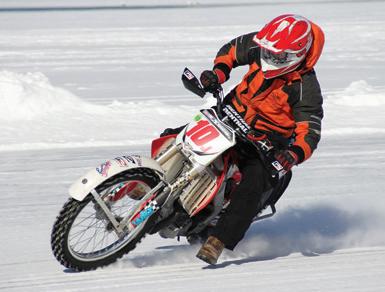
7. Ice Racing. Ice racing looks like an oval dirt-track race, except it’s run on ice. Racers modify a variety of machines to run on frozen lakes and ponds using off-road tires, often studded with hundreds of sheet-metal screws.
9. Hare and Hound. Also simply called desert races, these are popular in the Southwest. Riders race over a natural terrain course at least 40 miles long and pass through a series of checkpoints. But unlike an enduro, hare and hound races are similar to hare scrambles events in that they are an allout race featuring a mass start.
10. Arenacross. Motocross racing goes indoors in Arenacross—essentially the amateur form of AMA Supercross. With tight courses set up inside arenas and other close confines, the tracks tend to put a premium on technique and finesse, as well as fitness.
11. Supermoto. In supermoto, racers typically ride modified motocross bikes fitted with road-race-type tires. They race on courses that are part asphalt and part dirt, often with jumps and other motocross-type obstacles.
12. EnduroCross. EnduroCross is one of the wildest sports on two wheels. It combines elements of motocross and enduro racing in the tight confines of a fan-friendly stadium setting. Riders have to race over rock beds, through water crossings, over tractor tires and across telephone poles.
13. Drag Racing. If top speed and massive acceleration are what you crave, drag racing should satisfy your appetite. It’s all about getting down a paved quarter-mile track fastest, whether you’re racing the clock or another competitor lined up alongside. Classes are divided by engine displacement and the level of performance modifications allowed.
14. Land Speed Racing. Landspeed trials are all about going faster than anyone has gone before, typically on miles-long courses over perfectly level terrain like the Bonneville Salt Flats. Classes are determined by engine displacement, modification levels and various degrees of streamlining, and encompass everything from smalldisplacement racers to high-powered, custom-built streamliners made for the sole purpose of topping 350 mph.
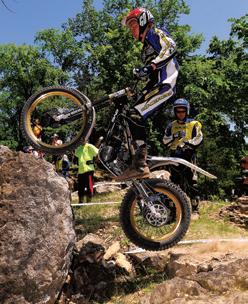
8. Trials. In observed trials, the winner is simply the most skilled, graceful and (sometimes) luckiest rider on a particular course. Speed is not a factor, but competitors must negotiate sections of extremely difficult terrain without putting their feet down.
15. Speedway. Using lightweight, single-gear bikes built solely for this type of competition, racers battle handlebar-to-handlebar on ultra-short oval dirt tracks typically a quarter-mile in length or less. Races typically last four laps, putting a premium on good starts, and the ability to slide the rear of the bike all around the oval.
16. Vintage. Vintage racing is all about bringing back the past. Racers compete on classic machinery, ranging from bikes nearly a century old to machines that went on the market just prior to the modern era. Vintage racing is popular in motocross, hare scrambles, trials, roadracing and dirt track.
Ice racing proves that it doesn’t have to be warm to race a motorcycle.
Trials emphasizes control over speed.
RACING DEPARTMENT
Jeff Massey
Vice President of Operations
Kevin Crowther Director of Supercross and Pro Racing Relations
Bill Cumbow Director of Special Projects
Kip Bigelow Motocross/Arenacross Manager
Ken Saillant Track Racing Manager
Chuck Weir Off-Road Manager
Jane Caston Supercross/Motocross Coordinator
Tamra Jones Off-Road/Track Racing Coordinator
Lana Cox Administrative Assistant AMA (614) 856-1900 amaracing@ama-cycle.org 13515 Yarmouth Dr. Pickerington, OH 43147
ADVERTISING
Steve Gotoski Advertising Director (951) 566-5068 sgotoski@ama-cycle.org
Zach Stevens National Sales Manager (626) 298-3854 zstevens@ama-cycle.org
EDITORIAL
AMA Racer is produced by the Communications Department of the American Motorcyclist Association. AMA Racer (614) 856-1900 submissions@ama-cycle.org 13515 Yarmouth Dr. Pickerington, OH 43147 www.americanmotorcyclist.com
Cover Photo: Andre Och races his way to the 2012 AMA Roadracing Horizon Award (Credit: Jen Muecke)
Insets: Sidi Crossfires (Sidi), Kurt Caselli (Mark Kariya), Racing tips (Dan Campbell)
Racer is published by the American Motorcyclist Association, Copyright (c) 2012. Printed in USA. Send story ideas and photos to submissions@ama-cycle.org. All submitted material becomes property of the AMA. Return of special items may be arranged, but call (614) 856-1900 before submitting.
Second Time Around
By Matt and Ciara Sibbick
It was 1984. I had been racing locally in New York for about six years. I was in the infield of the Syracuse Mile, and my parents were in the stands. What I didn’t know at the time was that they were considering buying a Rotax 500 that would likely catapult me into the Junior Pro ranking as a dirt tracker.
My mother was all for it.
“Just buy it. We’ll worry about the bills later,” she told my dad.
Dad didn’t bite. His family responsibilities got the best of him, and he passed on the bike.
The next year, I was no longer racing. I don’t really remember why I stopped, maybe it was a girl, my job or just life in general. To tell you the truth, at the time I didn’t miss it at all.
In 1987, I moved to Florida and soon after started a family of my own. I now had the same responsibilities my father had. I still had the bikes but lost interest, eventually selling them.
Close to 20 years later, my daughter, now a young adult, helped me realize that something in my life was missing.
Then, almost on cue, I found out what that was.
One day at work, my good friend, Joe, and I were having a normal conversation when the topic of dirt-track racing arose. I couldn’t believe it; he was a dirt tracker from back in the day, too! That conversation went on forever. If you have ever raced, then you know that bench racing is almost as much fun as winning.
Next thing I know, Joe is introducing me to a client of his. As it turned out, their son, Kurt, raced dirt track in Florida, and the track happened to be only two hours from my home.
Several weeks went by, and after at least one failed attempt to make the races, I finally arrived at the track. There they were: race bikes, trailers, EZ-up tents, the smell of race fuel and the sound of 10 bikes roaring around the track. I knew even before I stepped out of the motor home that I was hooked once again.
Coming back made me realize what is so addicting about the racing lifestyle. It’s not just the roaring engines or the
bikes sliding into the corner as if they were in a controlled crash, but it’s the people and the racing family. You won’t meet a better group of people anywhere. Sure, there are a few characters at the track, but the sense of unity and overwhelming support is undeniable.
It was in the stands that day someone said to me, “Next time you come up here you’ll be on a bike.”
I laughed and said, “No way will that happen.”
But all the way home, I couldn’t stop thinking of how to get my hands on a bike just to see if I could still do it. I called one of the racers and asked if he had any ideas. He offered up his bike and all the gear I would need to give it another whirl. I went to the track for the next race and hopped on a bike and road a few laps as fast as I could.
I was in last place, my left leg dragging all the way around the track after just a few short laps, but if you could have seen my face behind that clay-covered helmet, a smile from ear to ear. The checkered flag came out and I had two thoughts: “Thank, God, that’s over because my leg feels like it’s going to fall off.” And, “Man, I have to do that again!”
I even did a “victory” wheelie for my finish in last place.
It has been five years since that incredible day back at the track, and I now race every chance I get. I may not win every time, but I sure have fun, and I ride pretty well, too. I currently have four bikes, and I finally own the Rotax that my parents couldn’t buy in 1986.
I am grateful for the people who introduced me to dirt-track racing and the people who re-introduced me to it as well. I am doing things now that I only dreamed of doing as a kid. I’ve raced the Springfield Mile, the Du Quoin Mile and made trips to watch many pro events. The list goes on. If you see me on the road, follow me to the races. It will be the best form of racing you will ever see. The racers will be happy to see you and, who knows, you just might borrow my bike for the next race.
Matt and Ciara Sibbick are AMA members from Riverview, Fla.
Jim Grant
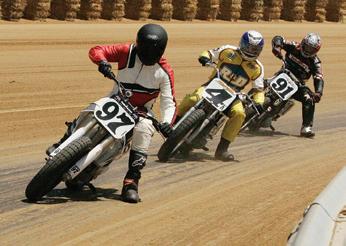
Matt (No. 97) on Du Quoin’s Magic Mile.