An AmericanHort Member Benefit
2018:April
A KNOWLEDGE RESOURCE FOR OUR INDUSTRY
IN THIS ISSUE
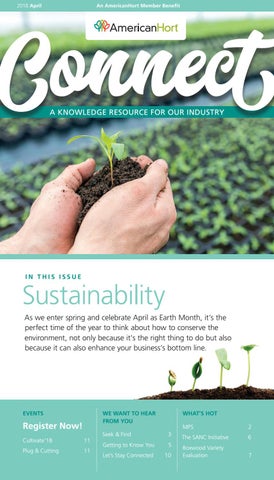
Sustainability As we enter spring and celebrate April as Earth Month, it’s the perfect time of the year to think about how to conserve the environment, not only because it's the right thing to do but also because it can also enhance your business’s bottom line.
EVENTS
WE WANT TO HEAR FROM YOU
Register Now! Cultivate’18 11 Plug & Cutting
11
WHAT’S HOT MPS 2
Seek & Find
3
The SANC Initiative
Getting to Know You
5
Let’s Stay Connected
10
Boxwood Variety Evaluation 7
6
A LOOK AT MPS
By Mary Beth Cowardin
It started with a Dutch auction side project of green industry professionals more than twenty years ago and quickly flourished into an international organization founded by growers, for growers, with one common mission: sustainability.
MPS (More Profitable Sustainability) was founded in 1995 in the Netherlands. It grew out of a small project with a Dutch auction to address two issues. First, the project aimed to help growers understand their impact on the environment. Second, the project intended to help growers demonstrate how they were operating in a sustainable way.
Sustainability was a newer concept at that time, however, the project was so successful that MPS emerged, in its own right, to serve the needs of the green industry. In its first years, the small group of initial growers evolved into grower groups on a national level and the number of participating growers, with the help of the Dutch auction and industry associations, grew quickly.
“As a grower, you are working on sustainability every day. You might not directly think about it, but by working towards things like integrated pest management, using drip irrigation for fertilizers, capturing rainwater, and implementing recycling principles, you are taking steps in the right direction. MPS is here to help you better understand and to improve your sustainable efforts, and as result become more profitable!” — Arthij van der Veer General International Coordinator North & Central America
2 | AmericanHort.org
It wasn’t until 2007 that MPS expanded its reach to North America. After a sustainability conversation with D.S. Cole at an industry trade show in Germany, the company agreed to sign up for the MPSABC certification program as the first North American grower participant. “It was not always easy for growers to see the value in this because sustainability was not a mainstream concept like it is nowadays,” said Arthij van der Veer, general coordinator for North America at MPS. “A lot of growers, because of the economic crisis, had other priorities.” However, the benefits of the sustainability certification program caught on and a steady stream of growers in the U.S. signed up to participate. Today, more than 3,000 growers participate in the MPSABC Sustainability Certification program, including 75 growers in North America. The growers are evaluated in five sustainable categories, including use of crop protection agents, fertilizers, energy, water, and recycling. Program participants receive benchmark data and feedback on their individual performance in these categories four times per year. MPS could be called the pioneer of sustainability for the green industry as it has led the effort to bring international standards and guidance to growers. MPS helps shape the way the green industry approaches sustainability and it is proactive in developing new management and monitoring tools to help the industry prepare for a future rooted in sustainability.
SE
IN
GO
MPS–Shaping the Way the Green Industry Approaches Sustainability
MPS launched its own certification program called MPS-ABC in 1997. The program aimed to develop sustainability standards to serve as a guide for the international horticulture industry.
D
After realizing success in the Netherlands, efforts expanded throughout Europe in Belgium, France, Italy, and Germany. Additional expansion efforts took hold in Africa, Latin and Central America, and Asia.
EK & F
Seek & Find !
Introducing our newest Connect feature! Each issue, we’ll be “hiding” a new small graphic. When you find it, email us at connectseekandfind@americanhort.org, and tell us where you found it. (For example, “bottom left corner of page 5.”) When you respond by the 1st of the month after the publication is issued, you’ll be entered into a drawing for an AmericanHort super prize pack. For this April issue, respond by May 1.
Congratulations
Congratulations to the following AmericanHort members who found February’s Dollar Bill in our Seek & Find and are winners of our drawing for some AmericanHort swag! Robin Barker St. Louis, MO Mike Graham Fort Lake, FL France LeBea, Montréal, Quebec Canada Steve Mostardi Newtown Square, PA
Mary Beth Cowardin VP, Marketing & Member Engagement, AmericanHort MaryBethC@AmericanHort.org
2018:April | 3
A CASE STUDY
D.S. Cole Growers– A Journey in Sustainability Perform a Google search for D.S. Cole Growers, and it doesn’t take long to figure out that the business is deeply rooted in sustainable production. Ten years ago, its President, Doug Cole, embarked on a mission to operate his company with sustainability at the forefront. His decision brought an international sustainability program to the states, and soon D.S. Cole Growers became the first North American business to become MPS-ABC certified. Why did Cole take the leap and what advice does he have for other businesses who are interested in sustainable growth? Here are a few highlights from a recent interview about his sustainable success story. Why did you decide to operate sustainably? I had been watching the sustainability process taking place in Europe for many years and was interested in how MPS was being used by growers. We had a meeting with the CEO of MPS to discuss how we could bring higher sustainability standards to the U.S. After that meeting, we decided to run a trial of MPS-ABC at our facility to see how the program would work here. Our staff was enthusiastic to be involved 4 | AmericanHort.org
and worked together with MPS to get the program up and running. There were initial challenges with the metric system and other measurement issues, but we were able to overcome those challenges. The key was our interest in making the program work. What are a few examples of sustainable practices you are currently using? We use sustainability systems to track our fertilizer quantity, fertilizer type, along with what pesticides we use, with the goal to decrease usage. We are increasing our biological controls to become more sustainable, and we are learning which pesticides are more environmentally safe. Measuring our energy consumption has been another beneficial practice for D.S. Cole Growers. We have been able to decrease our energy use through continuous monitoring and upgrades, such as the installation of double-heat screens in all of our greenhouses.
D.S. Cole Growers is a leading provider of vegetative annual plants based in Loudon, N.H. The company specializes in young plant production and supplies distributors throughout the U.S. and Canada. How has working with MPS helped your business? D.S. Cole Growers strives to be a leader in sustainability and be known as good stewards of the environment. I think MPS has actually helped us internally more than how our customers view us. Our staff has enthusiastically worked to improve on benchmarks to have less inputs in our production, and this saves us money. If we did not have MPS to create a system to work with, our improvements would not have taken place. What would you tell other businesses looking to become more sustainable? I would tell them that the MPS-ABC certification program will save them money if implemented properly. They need to get staff interested and involved to make it work. What is the best part of working in the green industry today? It is exciting because the industry is always changing. We have the opportunity of inventing and reinventing product and processes continuously.
Getting to Know You Share Your Sustainability Practices Take our survey at AmericanHort.org/ AprilConnect
2018:April | 5
RESEARCH & CERTIFICATION
Systems Approach to Nursery Certification: The SANC Initiative Happy Spring! In Horticulture, sustainability means many things. Among them, it should mean producing and delivering healthy plants, free of regulated pests, to satisfied consumers. On that front, there are some interesting things going on. First, we are making great progress toward modernizing the plant production and certification process through the Systems Approach to Nursery Certification (SANC) initiative. SANC is a pilot initiative involving AmericanHort, USDA, and the National Plant Board. Details on the web at sanc.nationalplantboard.org. This initiative is, at its heart, a quality management system for plant production. A grower assesses what can go wrong where in the plant production process. Based on a careful risk assessment, best practices are combined to create a “system” that proactively addresses the risks and becomes the heart of a facility’s manual. Traceability and sound recordkeeping are also critical. Regulators shift focus from inspecting plants to auditing adherence to the manual.
Hills Nursery, a major e-commerce seller of trees, shrubs, and perennial plants, has just announced a comprehensive plant compliance system called Plant SentryTM. This new program is designed to ensure that e-commerce vendors grow and ship plants that are fully compliant with plant pests and invasive plant regulations and restrictions of the 48 continental U.S. states. Compliance with fast-changing state rules has long been a challenge in traditional green industry commerce. It is especially so in new commerce models. We asked Jeff Dinslage, president of Nature Hills Nursery and NatureHills.com, about the new program.
Nearly 20 AmericanHort member operations are trialing SANC. The last of the “phase 1” growers will soon be “SANC-certified,” and phase 2 of the pilot is well underway. Diverse operations from coast to coast are involved.
“At Nature Hills, our intention is to be proactive and completely compliant,” said Dinslage. “Our Plant SentryTM system makes it possible to meet the stringent growing, inspection, and audit requirements for plants in every state—thereby protecting against plant diseases and pests, invasive plants, and other threats to plant health and environmental safety.”
Another leading AmericanHort member is breaking some new ground, too. Nature
To create the Plant SentryTM program, Nature Hills Nursery built and continuously
6 | AmericanHort.org
updates a comprehensive national database that includes the plant regulations and restrictions of the 48 continental U.S. states. State rules are examined to determine which plants cannot be sold in each specific state and updates are entered into the database. Grower agreements between Plant SentryTM and each nursery ensure that all rules are being followed at all times. A Plant SentryTM compliance officer works closely with NatureHills.com and each supplier to ensure only compliant plants are sold to customers. Staff horticulturists review all online plant descriptions to ensure the information presented is complete and accurate. Plant SentryTM also includes a shipment certification program. Proprietary
e-commerce software prevents the shipment of a restricted plant to each state. Each online order is automatically reviewed by customer zip code to remove restricted plants from any order, thus guaranteeing that only compliant plants are shipped. The Plant SentryTM system was inspired by the SANC program, and as SANC opens to broader participation, Nature Hills will encourage all its suppliers to become SANCcertified. Craig Regelbrugge Senior Vice President AmericanHort CraigR@AmericanHort.org
HRI Launches New Boxwood Variety Evaluation Initiative HRI has recently relaunched its Emerging Issues: Boxwood Blight Fund and will use this fund to coordinate development efforts for a standardized evaluation of boxwood varieties’ tolerance of or susceptibility to boxwood blight. In 2012, in response to confirmations of boxwood blight in the United States, HRI established the Emerging Issues: Boxwood Blight Fund and dedicated over $16,000 towards research on mitigation efforts. Since then, HRI has leveraged these funds to gain an additional $2.7 million through multiple funding sources, including the USDA-ARS Floriculture and Nursery Research Initiative and USDA-APHIS Farm Bill. HRI continues to directly fund boxwood blight research, including two projects funded in 2018. In addition to needed mitigation research, the industry needs to better understand which boxwood varieties exhibit tolerance or susceptibility. HRI is using the re-established Boxwood Blight Fund to help establish a
standardized testing protocol. Previous research has shown potential variability among results. For example, a variety may show high tolerance in one site but moderate tolerance at another site. Ultimately, HRI hopes to endorse a labeling system indicating a variety’s tolerance level to guide better choices by nursery growers, retail customers, and landscape managers. Both the Virginia Nursery & Landscape Association and the West Virginia Nursery & Landscape Association have committed $10,000 toward this work. To make a charitable contribution in support of the Boxwood Fund, please contact HRI at 614-487-1117. Make checks payable to HRI at 2130 Stella Court, Columbus, OH 43215 and include memo line: Boxwood Blight. Jennifer Gray Research Programs Administrator, AmericanHort JenniferG@AmericanHort.org
2018:April | 7
FROM THE HILL
A D V O C A C Y U P DAT E S
New Trucking Mandate: What’s It Mean, & What Are We Doing About It AmericanHort’s advocacy efforts have been heavily-focused as of late on recently-enacted trucking regulations, which have created a number of concerns throughout our industry. An op-ed was placed in The Hill, a D.C. based publication, calling for flexibility with hours of service rules and a potential delay of hard enforcement of the Electronic Logging Device (ELD) mandate until various issues can be addressed and fixed. In the op-ed, AmericanHort’s Director of Government Affairs Tal Coley shared the concerns of our industry with the mandate’s current rules —significant price increases for freight in the industry, vague guidance on certain aspects of the regulations, as well as the specific challenges the horticulture industry faces with these new rules. AmericanHort will continue its advocacy efforts on the issue, aiming to alleviate or at least mitigate our industry’s concerns. In addition to our op-ed, we hosted a webinar last month in partnership with the Ohio Nursery and Landscape Association on
Note: You can read the Op-Ed by visiting AmericanHort.org/ TruckingOpEd
8 | AmericanHort.org
the ELD mandate and hours of services rules for trucking — highlighting various aspects of the regulations and the impact on our industry. The webinar featured Andy Bruney of T. Load Specialties, a transportation company in Columbus, OH, with more than 25 years of experience in coordinating truck load shipments throughout the United States. Andy shared numerous insights to help our industry’s business owners manage the new trucking regulations. The webinar focused on helping shippers and receivers be more prepared for the upcoming season, as motor carriers and logistics providers face these new regulatory challenges. We discussed the new regulations and how they affect the logistics industry, as well as the impacts relevant to the horticulture industry, including the process changes of shipping and receiving various industry products. Miss the webinar? You can watch a recording of it now in the AmericanHort Knowledge Center at AmericanHort.org/KC.
MEET OUR S TA F F
Featuring
The AmericanHort Events Team Where would any of us be without them?
Sherry L Johnson Vice President – Knowledge & Business Advancement
Elizabeth Waldo Event Coordinator
SherryJ@AmericanHort.org
8 months with AmericanHort
8 years with AmericanHort
Responsibilities: Trade shows and events
Responsibilities: Leading the events, education, and trade show team
Hobbies: Going to concerts, listening to music, watching sports, and hanging out with my family
Hobbies: I love baking, gardening, and spending time with my family Favorite Part of AmericanHort: I feel like the horticulture industry is absolutely one of the best to work in and truly enjoy working with all of the great people.
ElizabethW@AmericanHort.org
Favorite Part of AmericanHort: My favorite part about working for AmericanHort is the family atmosphere. Everyone is very welcoming and always willing to lend a helping hand.
Margaret McGuireSchoeff Director of Events & Business Engagement
Shanan Atkinson Trade Show Manager
MargaretS@AmericanHort.org
Responsibilities: Trade shows
10 years with AmericanHort
Hobbies: Spending time with my husband, kids, and dogs!
Responsibilities: Event logistics and management, Executive Director of NLAE Hobbies: I enjoy running, practicing yoga, and skiing. Favorite Part of AmericanHort: I like working with our members to better their businesses and careers in the horticulture industry.
ShananA@AmericanHort.org 4 months with AmericanHort
Favorite Part of AmericanHort: Reconnecting with people in the green industry after being away from it for a few years is amazing as is making new connections. I’m enjoying putting together the aspects of Cultivate from the staff perspective since I had previously only seen the event for years as an attendee. 2018:April | 9
Connect WITH US
WITH US
Let ’s Stay Connected !
We want to get to know you better. Help us do so by joining us in Connect With Us— our brand-new way of connecting with our members and community. Snap a pic that best represents the topic of the month, and share it with us on social media with the special hashtag below. Make sure you tag us in the post, too!
This month, share a photo that represents recycling in your business and use the hashtag:
#HortRecycle @AmericanHort
@youramericanhort @American_Hort
Vote Now: AmericanHort Board of Directors AmericanHort is governed by a dedicated and passionate Board of Directors, and it’s time to elect new industry members to fill three board seats. Please vote for the people you think best suits the needs of the industry and AmericanHort at AmericanHort.org/Elections. Voting closes April 30, so don’t wait!
Cast your vote now.
KEY DAT ES
About AmericanHort AmericanHort is the national association of horticulture businesses and professionals across the spectrum of the industry. Without you there is no us, so AmericanHort undertakes the critical task of protecting, preserving, and promoting the national horticulture industry so that people like you can do what you love in an industry that thrives. Perform better, grow faster, and prepare for the future as a member of AmericanHort, the green industry’s leading association. Learn more at AmericanHort.org. AmericanHort represents the entire horticulture industry. No matter your specialty, we have the resources you need to cultivate a successful business.
Business Plus
Floral
Greenhouse
Interior Plantscape
Landscape
Garden Retail
Registration Open Now – Have You Registered for a Tour or Workshop? Sweeten your Cultivate’18 experience by signing up for one of the tours or workshops happening on Saturday, July 14th. Available Tours:
Available Workshops:
•
Garden Retail Tour
•
•
Greenhouse Production Tour
Biocontrols Workshop
•
•
Hydroponics Tour
•
Nursery Tour
Landscape Cost Accounting Workshop
Take your Cultivate experience to the next level, register for a tour or workshop at: Cultivate18.org/ Register
•
Hydrangea Workshop
•
A Drone Workshop
•
Retail Peer2Peer Workshop
•
CareerUP
J U LY
14-17 COLUMBUS OHIO, USA
SEPTEMBER
Registration Open Now Generation Next
Nursery
Research
Hello@AmericanHort.org 2130 Stella Court Columbus, Ohio 43215-1033 USA (614) 487-1117 Main AmericanHort Connect 2018:April © 2018 AmericanHort. All rights reserved. This material may contain confidential information and it is for the sole use of AmericanHort members. The information contained herein is for general guidance and not for the purpose of providing legal advice. It cannot be distributed, reprinted, retransmitted, or otherwise made public without prior written permission by AmericanHort. Please contact the editor at (614) 487-1117 for permission with acknowledgment.
AmericanHort’s Plug & Cutting Conference is the event for young plant producers and growers from across the country. In the world of plugs and cuttings, even the smallest changes in strategy, technology, and technique can mean huge impacts on your bottom line.
17-19 CHARLOTTE, NORTH CAROLINA
Learn more and register at AmericanHort.org/Plug18
Did you know?
Past webinars are recorded and available for AmericanHort members at AmericanHort.org/KC.
Recent Articles of Interest • New Trucking Regulations: The Impact on Our Industry • Comprehending the New Tax Law • Industry Insider Report: A Perspective on Profit Margins, a Q&A panel discussion
AmericanHort.org 10 | AmericanHort.org
2018:April | 11
of paper products each year.
PINE TREES’ WORTH
2
One person uses
of paper per year.
POUNDS
680
The average American uses seven trees and
of trash for his or her (or other people’s) children.
POUNDS
90,000
This means each adult will leave a legacy of
In a lifetime, the average American will throw away 600 pounds of his or her adult weight in garbage.
saves the amount of energy it takes to power a PC for one workday.
ALUMINUM CANS
2
Recycling
Source: Boston College | Know Your Facts https://www.bc.edu/offices/sustainability/what-you-can-do/know-facts.html
over 350 gallons of oil, and a lot of landfill space.
TREES,
17
of recycled paper can actually help to save
POUNDS
2,000
It also causes 20% less air pollution and 50% less water pollution than making a new bottle.
HOURS.
4
One recycled bottle saves enough energy to run a 100-watt bulb for
Electronic Service Requested
2130 Stella Court Columbus, OH 43215 USA (614) 487-1117 AmericanHort.org
Presorted Standard Mail U.S. POSTAGE PAID Columbus, OH Permit No. 1560