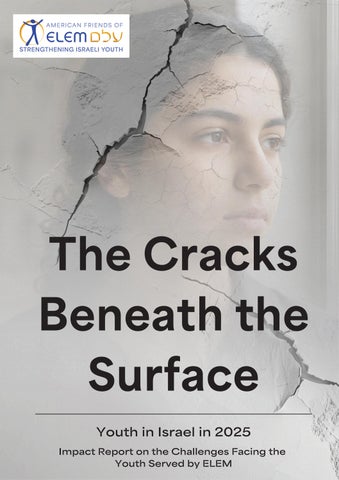
The Cracks Beneath the Surface Youth in Israel in 2025 Impact Report on the Challenges Facing the Youth Served by ELEM
Table of Contents
5
Forward
6
A Concerning Situation Assessment for Early 2026
8
About ELEM
11
ELEM Throughout Israel
12
Extending Our Impact
14
How the Cracks Began to Form
16
Mapping the Prevalence of Key Risk and Distress Indicators
17
The Effects of the War – Interconnected Risks
18
Trends in Distress and Risk
20
Gender Differences in Risk and Distress Indicators
21
How Risk and Distress Change with Age
22
Impact of War-Related Loss
23
Warning Signs After Two Years of War
26
Violence Across Young People’s Lives
30
Testimonies from the Field
32
Conclusion and Key Findings
34
Looking Ahead to 2026
36
2025 Budget
38
ELEM Partners
Forward
5
2025 marked a turning point for Israeli society, particularly for its young people. The phrase "exposing the cracks" captures the critical shift from the apparent resilience that characterized 2024 — a year in which young people drew on their survival skills to "hold on", often suppressing their emotional distress — to the emergence of deeper and more visible signs of trauma in 2025. Paradoxically, the relative easing of the security crisis allowed much of this trauma to surface, bringing with it heightened anxiety, profound loneliness, increased violence, and a pervasive sense of uncertainty and lack of direction. For young people — especially those already facing risk and distress — this reality intensified existing challenges, affecting their development, relationships, and ability to cope with everyday life. Against this backdrop, ELEM recognized the need to take a closer, systematic look at what young people were experiencing, based on the realities of the teenagers and young adults we encounter every day. Methodology This report is based on a systematic assessment conducted in December 2025 involving 3,142 young people ages 12–26 who received support through ELEM's various programs. The findings draw on assessments by the professionals and volunteers who work with these young people every day, together with an analysis of field data and statistical trends.*
ELEM's work is carried out in partnership with, and with support from, Israel’s Ministry of Welfare and Social Security.
*The data relates to youth with whom ELEM met and does not necessarily reflect the entire population of adolescents in Israel as a whole.
6
A Concerning Situation Assessment for Early 2026 As we conclude our review of the 2025 data, we are also closely examining developments during the first months of 2026. We cannot ignore the complex reality facing young people in Israel today. In recent months, there has been a troubling increase in reported suicide attempts among young people. Although official data from government authorities is not yet available, evidence emerging from the field, along with reports from multiple sources, points to a concerning level of emotional distress among young people. We must also consider the impact of Operation "Roaring Lion" (which began on February 28, 2026) and provide a current picture of what ELEM is seeing on the ground. ELEM's findings are based on 91 professional assessments submitted by staff across 30 programs throughout Israel. Based on in-depth interviews, observations, and personal conversations, these findings paint a troubling picture of adolescents’ well-being in the aftermath of Operation "Roaring Lion.” Young people are experiencing a significant deterioration in their emotional and behavioral well-being. The transition from 2025 (“Rising Lion”) to 2026 (“Roaring Lion”) has been marked by a sharp escalation in risk indicators, including a 70% increase in reports of self-harm and a 73% increase in expressions of anger. An analysis of young people’s needs points to an urgent need for stability and support. Nearly half of the young people surveyed (49%) need routine and structure, while 40% need consistent, meaningful human connection. Almost half (46%) report boredom and inactivity, approximately 40% report loneliness or social isolation, and 37% are coping with anxiety or fear.
7
Concerning Trends *Operation Rising Lion (2025) vs. Operation Roaring Lion (2026)
Rising Lion 52%
Roaring Lion 50%
51%
40% 34% 28%
26%
17%
15%
10%
Self-Harm (Trauma Dept.)
30%
increase in anxiety
Substance Abuse
Anger (Community Dept.)
73%
increase in anger
Anxiety (Trauma Dept.)
21%
increase in substance abuse
Boredom (Community Dept.)
70%
increase in self-harm
*Refers to major military escalations and home-front emergency periods in Israel in 2025 and 2026.
8
About ELEM In 2025, ELEM teams reached 15,000 at-risk teens and young adults through both in-person and online services, providing professional support to help them integrate into their communities, navigate life's challenges, and realize their full potential. For more than 43 years, ELEM has been Israel's leading organization dedicated to identifying, reaching, supporting, and treating at-risk youth. Through dozens of programs across the country, led by hundreds of staff members and more than a thousand volunteers, ELEM works wherever young people are — in their communities, on the streets, and online — building trust-based relationships that provide support, stability, and opportunities for change. ELEM’s work is carried out in partnership with government ministries — particularly the Ministry of Welfare and Social Security — as well as local authorities and philanthropic foundations, making ELEM an integral part of Israel’s national response to the needs of at-risk teens and young adults.
ELEM by the Numbers 14,982 Teens and young adults received assistance
5,800
In person
279
1,052
Employees
Volunteers
120
9,182
Freelancers
Online
35 Municipalities where we work
53 Programs
9
Multiculturalism 61% Israeli-born 13% Arab society 8% Former Soviet Union background 5% Ethiopian background 12.7% Other 0.3% Without status
Gender 60% Male 38% Female 2% Transgender/Non-binary
Age 9% 10-13 27% 14-15 30% 16-17 25% 18-21 9% 22-30
10
ELEM Throughout Israel
11 Kiryat Shmona
Upper Galilee
Majd al-Krum
Acre
Al Batuf Tiberias
Haifa Nof HaGalil
Afula
Youth Center
Umm al-Fahm
Kafr Qara
Safed
Tur’an
Arraba
Baqa al-Garbiyye
Acre (Akko)
Afula Al Batuf Arraba Ashdod
Baqa al-Garbiyye Bat Yam Beit Shemesh Bnei Brak
Outreach Vans
Ra'anana
Herzliya Bnei Brak Tel Aviv
Treatment Centers for Extreme Risk/ Prostitution Treatment for Sexual Assault Holistic Model – Outreach Van, In-School Space & Youth Center
Dimona
Petah Tikva
East Jerusalem
El’ad Modi’in Region
Bat Yam Holon
Modi'in Illit Lod
El’ad
Ramla
Ashdod
Jerusalem Beit Shemesh
Kiryat Malakhi
Eilat
East Jerusalem
Haifa Herzliya Holon Jerusalem Kafr Qara Kiryat Malakhi
Ofakim
Kiryat Shmona Dimona
Lod Majd al-Krum Modi’in Illit
National Programs
Modi’in Region Nof HaGalil Ofakim
ELEM Digital
Petah Tikva Ra’anana
Anashim Tovim (Good People) / Yuvalim
Ramla Safed (Tzfat) Tel Aviv
Treatment for Sex Offenders
Tiberias Tur’an Umm al-Fahm
“Housing First” Apartments
Upper Galilee Eilat
12
Extending Our Impact To create systemic change for at-risk teens and young adults, ELEM’s work extends beyond its direct, daily engagement with young people. By equipping professionals and helping shape public policy, ELEM expands its impact from individual young people to the broader systems that surround and support them.
Training and Tools for Professional Teams Recognizing that early identification and professional intervention can help reduce future risks, ELEM trains educators, mental health professionals, and communitybased teams to identify, engage, and support at-risk youth. These trainings include workshops, professional consultations, seminars, and professional development sessions for diverse audiences, significantly expanding the number of trained and caring adults equipped to support young people in their daily lives.
In 2025, 1,500 professionals participated in 150 training groups across Israel.
13
Shaping Policy and Advancing Youth Rights ELEM works to drive systemic change and improve the policies and processes that affect the lives of at-risk teens and young adults. Guided by the belief that those directly affected by public policy should have a voice in the decisions that shape their lives, ELEM participates in Knesset hearings, government forums, professional committees, and legislative processes, bringing its extensive on-the-ground experience and expertise to policymakers and decision-makers.
In 2025, ELEM participated in 58 committees and roundtables across the Knesset and government ministries, presenting the needs and challenges facing young people and offering policy recommendations informed by our direct work with youth.
14
How the Cracks Began to Form The Breaking Point October 7, 2023
Exposure to extreme violence, loss, and an immediate sense of danger; the sudden upheaval of daily life; school closures; isolation at home; and profound uncertainty.
Life in a State of Emergency Continuous missile attacks; the evacuation of communities in northern and southern Israel; widespread military reserve call-ups; separation from friends and familiar surroundings; prolonged separation from parents called to reserve duty; extended periods of remote learning; and long stretches of isolation at home.
October 2023
Oct-Nov 2023
November 2023
Early 2024
A Moment of Hope and Fragility The Return of Hostages and a Temporary Pause in Fighting Brief moments of relief and hope, alongside emotional overwhelm and an abrupt return to uncertainty and instability.
Partial Return to School The Gradual Resumption of Educational and Social Activities, Though Daily Life Remained Far from Normal. The return to routine was accompanied by ongoing tension, cumulative exhaustion, and continued exposure to news and social media.
15
Renewed Escalations Partial Return Ongoing Fighting and the Expansion of the War of Hostages
Young people continue to “hold on,” navigating daily life in survival mode, often without the space or opportunity to process their emotions or have meaningful conversations about what they have experienced.
The End of Evacuations and the Return of Civilians to the North A tense return to a sense of “normalcy.”
Fragile Routine Continued Uncertainty and Tension A partial return to routine amid continued instability, emotional distress, and a growing sense of exhaustion.
Spring 2024
End of 2024
Spring 2025
June 2025
Jul-Dec 2025
Twelve-Day War
Renewed Fighting Takes an Emotional Toll A renewed sense of danger and heightened tension among young people already coping with the cumulative emotional toll of prolonged conflict.
re e h T “ e no , wer sirensd e a mor I still h y butem in m th ead.” h
The Picture Becomes Clearer As the Immediate Crisis Begins to Ease As the immediate crisis begins to subside, previously suppressed emotions — including anxiety, loneliness, anger, and a sense of aimlessness — begin to surface with greater intensity, revealing the psychological toll of nearly two years spent in survival mode. The cumulative impact of repeated trauma, prolonged uncertainty, and chronic instability is becoming increasingly apparent, leading to emotional exhaustion, burnout, and difficulty reestablishing a sense of routine and normalcy.
16
Mapping the Prevalence of Key Risk and Distress Indicators Ranking 23 risk and distress factors according to reported percentages 66%
Consumption of alcohol
59%
Difficulty integrating into educational/social frameworks
54%
Violence outside the home
51%
Survivors of sexual abuse or exploitation
50%
Anxiety and depression
49%
Loneliness
48% 45% 44% 41%
Difficulty maintaining routine Drug abuse Lack of family support Online violence Difficulty with regular school attendance Unsupervised parties
39% 39% 38% 35% 27% 26% 25% 20% 17% 17% 15% 12%
Domestic violence Social difficulties Increased preoccupation with eating and weight High-risk behavior Criminal activity Food insecurity Self-harm Sexually harmful behavior Suicidal ideation Homelessness
High prevalence (+50%)
*The terms used describe a range of emotional experiences and are not intended to represent clinical diagnoses.
17
The Effects of the War — Interconnected Risks Since October 7, amid ongoing war and uncertainty, we have gained a deeper understanding of the complex challenges facing young people. While these challenges may once have been viewed individually, it has become increasingly clear that they are deeply interconnected. Young people’s emotional well-being, daily functioning, coping mechanisms, and family and social environments influence one another, collectively shaping their experiences and the risks they face.
Risky Coping Behaviors
Environmental Harm
Emotional Distress
Difficulty Functioning
Risky Coping Behaviors Coping through substance use (alcohol and drugs) Coping through thrill-seeking and risktaking (partying and dangerous behaviors) Coping through aggression or violence Coping through behaviors involving the body (disordered eating and self-harm)
Emotional Distress Depression and anxiety Loneliness and social isolation Social difficulties and exclusion
Environmental Harm External Circumstances
Violence in the home Poverty and food insecurity Difficulty accessing rights and services Parental alienation
Difficulty Functioning Difficulty functioning within structured settings Difficulty maintaining daily routines
18
Trends in Distress and Risk Long-Term Analysis - 2024 to 2025
Environmental Vulnerability
Risk Behaviors
Difficulty Functioning
An increase from 13% to 29% (more than doubling within one year)
An increase from 26% in 2024 to 37% in 2025
A dramatic rise from 34% to 49% (+15 percentage points)
Environmental Vulnerability
Risk Behaviors
Difficulty Functioning
Frequency of risk factors (%) 80% 60% 40% 20% 0%
2023
2024
2025
* 2023 refers, for the most part, to the period prior to October 7.
20
Gender Differences in Risk and Distress Indicators Gender Gaps in Risk and Distress Indicators clear gap
Emotional Distress
Girls report significantly higher rates of self-harm and disordered eating than boys. Self-harm is reported at four times the rate among girls (21%), while disordered eating is reported at three times the rate (44.5%).
Substance Use and Risk-Taking Boys report higher rates of life-threatening or high-risk behaviors (38%) and substance use (54%).
Male
Percent of reports (%)
Female
80%
72%
70% 59.2%
60%
54%
50%
44.5%
40%
40.8%
38%
38.3%
23.5%
21%
20%
0%
44%
40%
29%
30%
10%
63.2%
62.9%
5%
16%
12.4%
8%
Self-harm
Eating disorders Suicidal ideation
Loneliness/ isolation
Depression and anxiety
Dangerous behavior
Social difficulties
Drug use
Alcohol use
21
How Risk and Distress Change with Age Four Dimensions of Distress Across Critical Developmental Years Emotional distress
Difficulty functioning
Risk behaviors
Environmental vulnerability
Frequency of Risk Factors (%) 40% 36% 32% 32%
30%
34% 30%
28% 26%
24%
20% 13%
14%
12% 12%
10%
0%
14-15
16-17
18-21
The data indicates a continuous increase in risk factors as age increases. Across all four risk dimensions, a deterioration is evident from ages 14–15 to 16–17, with an even more significant increase among ages 18–21. This trend highlights the importance of early intervention, before risk patterns become established and intensify throughout adolescence.
22
Impact of War-Related Loss
Comparing Young People Who Experienced Personal Loss with Those Who Did Not Suicidality 3.7 times higher
Loneliness, Isolation, Anxiety, and Depression
Among young people who experienced loss, 45% showed indicators of suicidality, compared with 12% of those who did not experience loss.
Among young people who experienced loss, 82% showed signs of loneliness or social isolation, while 75% showed signs of severe anxiety or depression.
A critical difference
Have not experienced loss
Experienced loss
Percentage reporting (%) 100% 82%
80%
75%
60% 48%
58%
54%
45%
45%
42%
40% 32%
41% 35%
29%
26%
22%
20%
14%
12% 0%
Loneliness/ isolation
Social difficulties
Depression and anxiety
Suicidality
Risk behaviors
Criminal acts
Eating disorders
Self- harm
* Sample of 110 youth who experienced direct loss
23
An excerpt from an anonymous conversation on ELEM Digital that led to coordinated support from an ELEM professional and the young person’s school counselor.
Warning Signs After Two Years of War
Good evening, how are you this evening? Terrible I'm Shiraz, I provide support here on the chat. How old are you? 12 Want to tell me what happened?
It's just so hard for me
In this life
35% Social Difficulties, Including Exclusion More than a third of youth have experienced social challenges, including extreme social exclusion.
For a while now I've wanted to kill myself.
Have you tried telling your parents?
No. I was always a daddy's girl and now he's not here. He was killed in reserve duty nearly a year ago.
20%
Food Insecurity One in five youth is experiencing financial difficulties and food insecurity.
26
Violence Across Young People’s Lives The data shows that violence is one of the most significant and concerning trends identified among young people. However, a closer analysis reveals that violence is not an isolated issue. Rather, it appears across multiple areas of young people’s lives and often occurs alongside other forms of distress. The data reflects both exposure to and involvement in different types of violence.
1 in 2 youth assessed by ELEM
Among youth who were exposed to violence
were exposed to at least one type of violence
were exposed to 3 to 4 types of violence
54%
40%
The prolonged period of war, social disruption, and instability has created a complex reality for young people. Within this environment, violent behavior may be linked to difficulties with self-regulation, a persistent sense of threat, and a diminished sense of safety and personal boundaries.
Frequency of Violence (%)
Violence
50% 40% 30% 20% 10% 0%
2023
2024
2025
A moderate decline in 2024 (from 22% to 17%) followed by a sharp increase in 2025 (from 17% to 40%).
27
Violence Does Not Occur in Isolation Among young people who experienced or were involved in violence, the data revealed a range of additional risk factors and forms of distress. A clear pattern emerges: violence rarely occurs on its own but is often interconnected with other challenges in a young person’s life. Understanding these connections allows us to view violence not simply as an isolated behavior, but as a potential indicator of broader distress and the complex challenges a young person may be facing.
Violence in the Home
Sexual Violence
Depression and anxiety
Depression and anxiety
81%
Isolation/loneliness
76%
Self-harm
71%
Suicidal ideation
68%
Social difficulties Difficulty with routine
78%
Difficulty with educational/social frameworks
74%
Difficulty with routine
72%
Truancy
69%
67%
Suicidal ideation
66%
66%
Lack of support
65%
Self-harm
63%
Online Violence
Outside the Home
Isolation/loneliness
74%
Unsupervised parties
73%
Social difficulties
71%
Alcohol use
71%
Depression and anxiety
69%
Involvement in crime
69%
Self-harm
61%
Drug use
64%
Truancy
58%
This understanding is essential for developing services that address not only the violence itself, but also the underlying challenges and circumstances that may contribute to it.
28
Violence at Home
Distribution of Type of Violence by Year (Including Trends)
38%
53%
Nearly Double
Highest Rate Recorded
Violence at home
Violence outside the home
Up from 20% in 2024, signaling a troubling rise in violence within the home.
Violence in public spaces rose sharply in 2025, reaching 53% after declining in 2024.
Rising Violence Across Settings
In 2025, violence increased sharply both at home and outside the home — a shift from previous trends. Percentage of reports (%)
Outside the home
At home
60% 53%
50% 40% 30%
40% 33%
38% 31%
20%
20% 10% 0%
2023
2024
2025
29
Online Violence
Prevalence of Reported Online Violence Annual comparison: percentage of young people who experienced or were involved in online violence
135%
Annual increase Online violence rose sharply from 17% to 40% in just one year, highlighting the growing prevalence of violence in digital spaces. 50%
40%
40%
30%
20%
17%
10%
0%
2024
*All data is based on the total number of cases handled by ELEM Digital. ELEM’s online activity is funded by and carried out in cooperation with the National Insurance Institute.
2025
30
Testimonies from the Field
Insights from ELEM Staff Working Directly with Young People
Verbal Abuse and Bullying “Has been hostile towards everyone today.” “Acts like a bully to quieter kids.”
Ostracism, Humiliation, and Social Exclusion “Excluded from 1st to 5th grade — no one noticed.” “Hangs out with a group but still feels like an outsider.” “Looks lost, comes alone, and does not know where his friends are.”
Sexual Violence, Exploitation, and Abuse “A sexual video of her was shared widely.” “She was filmed without her knowledge and now experiences panic attacks.”
Physical Violence “Broke his leg in a fight.” “Sustained a head injury after hitting a fence during a physical altercation.” “Episodes of rage — became involved in a serious physical fight with another teenager.”
31
Youth Share Their Experiences in 2025 “I am always hungry. There is not always food at home, and I am ashamed to tell anyone.” “At night I prefer being outside. There is tension and yelling at home and outside it is quiet at least. People think I roam around because I want to. The truth is I just don’t want to go home.” “I feel as though I am always on guard, like something is about to happen.”
“Sometimes during alerts, the only call I got asking me how I am doing was from my ELEM counselor.”
32
The challenges facing young people are no longer limited to those traditionally considered at risk — they are becoming a widespread reality across Israeli society. Conclusion The report’s findings reveal a shift in how distress is manifesting among teens and young adults. Emotional distress remains widespread, but it is increasingly affecting daily functioning and emerging through risky behaviors. Distress does not occur in isolation; it is shaped by interconnected life circumstances, daily challenges, and complex coping mechanisms. These findings point to increasingly complex needs among young people, extending beyond traditionally vulnerable populations and underscoring the need for early identification, consistent support, and services that respond to the changing realities of young people’s lives in Israel.
Key Findings
33
Multidimensional Distress The data indicates that distress among young people rarely occurs in isolation. Instead, emotional distress, difficulties with daily functioning, and risky behaviors often occur simultaneously and influence one another.
Changes in How Emotional Distress Is Expressed In 2025, indicators of risky behavior and difficulties with daily functioning were identified more frequently than indicators of emotional distress. This may reflect a shift in how distress is expressed and observed, rather than a change in the severity of the distress itself.
Family and Environmental Factors Increase Vulnerability Family instability, exposure to violence, and complex life circumstances can increase young people’s vulnerability and make it more difficult for them to function and cope.
Violence Across Multiple Areas of Young People’s Lives Violence appears across multiple settings — including at home, in the community, and online — and rarely occurs in isolation. It often coexists with emotional distress, difficulties with daily functioning, and other risky behaviors.
Adolescence as a Critical Period of Increased Risk Risk indicators increase throughout adolescence, with a notable rise among young people ages 16–17 and a continued upward trend into young adulthood.
Gender Differences in Patterns of Distress Girls show higher rates of internalized distress, while boys show higher rates of risky behaviors, pointing to different patterns in how distress may be expressed.
Changes in Distress and Risk Indicators (2024–2025) Following a relative decline in 2024, risk indicators increased again in 2025, reflecting continued instability and the cumulative impact of prolonged crisis and uncertainty.
Impact of War-Related Loss Young people who experienced war-related loss showed particularly high rates of loneliness, social isolation, depression, and risky behaviors, highlighting the heightened vulnerability of this group.
Looking Ahead to 2026
The War Has Brought Risk Into Every Household The boundaries have blurred. The war has profoundly changed life for young people and families across Israel, making the distinction between “typical” youth and youth at risk increasingly difficult to define. In the past, the term “youth at risk” was primarily associated with young people facing the most severe and prolonged challenges, often beginning in childhood. Since the COVID-19 pandemic — and even more so since the outbreak of the war — ELEM has witnessed those traditional boundaries begin to shift. Risk is no longer defined solely by family background or socioeconomic circumstances. Young people across Israeli society are experiencing increased vulnerability. A series of national crises — from the social isolation of COVID-19, to growing exposure to harmful online content and experiences, to the trauma of war — has broadened the population of young people facing significant emotional, social, and behavioral challenges.
35 Even in households traditionally considered stable and well-functioning, ELEM is seeing new patterns of risk emerge as family support systems are disrupted. The combination of prolonged reserve duty, financial uncertainty, and ongoing stress has significantly affected the presence and emotional availability of parents and other adults in young people’s lives. As a result, many adolescents who were previously considered resilient are now facing difficult circumstances without adequate guidance, support, or protection. Risk is no longer confined to traditionally vulnerable populations; it is affecting young people across social and economic backgrounds. The report’s findings show that amid ongoing uncertainty, young people need more than crisis intervention — they need stable, consistent human connection. For many, an ongoing relationship with a trusted adult can provide a critical source of stability, supporting emotional regulation, a sense of belonging, and the ability to cope. At the same time, the distress described in this report does not exist in isolation. It extends across home, school, community, and online environments, with emotional distress, difficulties in daily functioning, and risky behaviors often overlapping and reinforcing one another. While services in the past may have focused on specific issues, today’s challenges are increasingly complex and interconnected. The cumulative impact of years of crisis has created an unprecedented level of need. These circumstances require a shift from isolated interventions to a more comprehensive approach — one that considers the whole young person and the interconnected factors shaping their experiences and well-being. Strengthening the resilience of Israel’s young people requires a collective effort. Government ministries, local authorities, civil society organizations, and communities must work together to build a coordinated continuum of long-term support.
Investing in youth today is essential to building the resilience of Israeli society tomorrow.
36
2025 Budget 12%
Income
Value of Volunteer Services
7,760
(in thousand shekels)
28%
Donations
Total Income
58%
17,835
64,145
in thousands of shekels
Public Sector / Government Funding
2%
37,485
Knowledge Services & Training
1,065
Expenses
(in thousand shekels)
54%
Salaries & Employee Benefits
34,890
12%
Total Expenses
Value of Volunteer Services
7,760
64,145 in thousands of shekels
11%
Management, General & Fundraising
7,060
23%
Program Services & Direct Costs
14,435
38
Thank you so much From the ELEM family, from the youth and young adults of Israel Ann Bialkin and the Bialkin Family Foundation
Lenore Ruben President, American Friends of ELEM
משפחת ליאון
גברת ומר ורדה ובעז דותן
Nitzan Foundation
Todd and Yadira Patkin
הבית של דורון
The Frieze Family Foundation
39
Horace W. Goldsmith Foundation
The Gary Saltz Foundation
Robin Nourmand and Sepideh Makabi
Mark and Lorraine Schapiro Family Foundation
Menahem Shalgi
Dan and Sara Sapadin
“There is a crack, a crack in everything. That's how the light gets in.” - Leonard Cohen
The cracks have been exposed. Together, we can begin to repair them.
ELEM / Youth in Distress works in collaboration with the Ministry of Welfare and Social Security.
AMERICAN FRIENDS OF ELEM, 35 Journal Square, Suite 531, Jersey City, NJ 07306 212.787.3337 | www.elem.org | info@elem.org