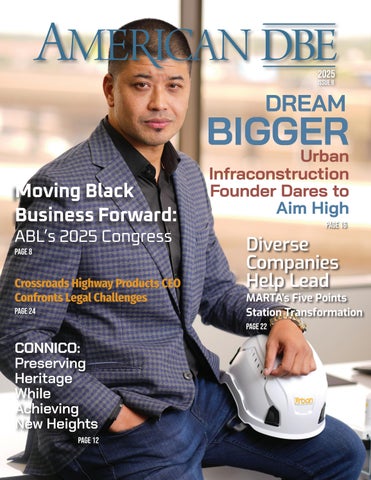
2025 Issue II
DREAM
BIGGER Urban Moving Black Business Forward: ABL’s 2025 Congress Page 8
Crossroads Highway Products CEO Confronts Legal Challenges Page 24
Infraconstruction Founder Dares to Aim High Page 16
Diverse Companies Help Lead
MARTA’s Five Points Station Transformation Page 22
CONNICO: Preserving Heritage While Achieving New Heights
Page 12 / 2025 – Issue II
1
Building Communities, Creating Opportunities, Inspiring Young People
BUILDING BETTER COMMUNITIES
Learn more at cerm.com 2
/ 2025 – Issue II Atlanta | Mobile | Tampa | Orlando
Construction Management Engineering Services Environmental Management Program Management Remediation & Contracting Survey & Mapping
Your Journey Begins with Us The Metropolitan Washington Airports Authority (MWAA) offers small businesses a place to grow. The Office of Diversity, Inclusion and Social Impact is committed to maximizing the inclusion of small businesses in MWAA's contracting opportunities. To learn more about small business certifications, outreach events, current and upcoming contracting opportunities, the Airports Authority’s Small Business University, and conducting business with the Airports Authority, scan the QR code below:
Reagan National Airport
Dulles International Airport
Dulles Toll Road
Dulles Metrorail / 2025 – Issue II
3
On the cover: Anup Tamrakar, president & CEO of Urban Infraconstruction (photo courtesy of Marvin Jackson, Archer Western/Walsh Construction)
16
CONTENTS
12
Features
DBE Power Player
8
ABL 2025 Congress on the State of Black Business in Metro Atlanta
Highway Products CEO 24 Crossroads Confronts Legal Challenges
12
Connico: Preserving Heritage, Achieving New Heights
DBE Program Spotlight
16
Urban Infraconstruction Founder Dreams Bigger
While the City Moves: Diverse 22 Building Companies Help Lead MARTA Five Points Station Transformation
INDUSTRIES
BUSINESS DEVELOPMENT
26 Airports Defending Equity in Infrastructure:
38 Building Wealth Through ETFs
AMAC’s Legal Fight for the Future of the DBE Program
Events
30 Transit COMTO Honors Women with 2025
42 Upcoming National Events
34 Civil/Highways Supreme Court Makes Landmark
ADVERTISING
Women Who Move the Nation Awards
DBE Fraud Conviction
4
24
/ 2025 – Issue II
42 Advertiser Listing
26
2025 – Issue II Publisher Shelton A. Russell Managing Editors PR PROS, LLC Creative Director William Cash Digital Media Premier Web Design Solutions Headquarters 514 Daniels Street, #186 Raleigh, NC 27605 Website www.AmericanDBE.com About American DBE Magazine American DBE Magazine is the premier industry resource for individuals and stakeholders who work in the infrastructure, construction and transportation industries. American DBE Magazine is published quarterly and distributed in all 50 states— plus Puerto Rico and the U.S. Virgin Islands—to DBE program administrators, business owners, and professionals in the Aviation, Highway Construction and Public Transit industries.
Subscriptions American DBE Magazine is published quarterly in Fall, Winter, Spring and Summer editions. The annual subscription rate is $24.99 including online editions, special industry reports, and four issues: single copy list price is $6.99 plus postage originating from Raleigh, North Carolina.
Advertising Sales editor@AmericanDBE.com (919) 741-5233 (Office)
/ 2025 – Issue II
5
From the publisher
Defending Opportunity For decades, the term Disadvantaged Business Enterprise has carried both historical weight and enduring purpose. While it was never meant to define the people behind the businesses, it has represented a recognition of systemic barriers that have long influenced access to opportunity in America’s contracting landscape. With the U.S. Department of Transportation’s new Interim Final Rule eliminating race and gender-based presumptions of disadvantage in the DBE and ACDBE programs, the nation stands at a pivotal moment. This decision—shaped by recent court rulings and the Trump Administration’s broader rollback of diversity, equity, and inclusion initiatives—marks a fundamental shift in how fairness and equity are understood and applied in public contracting. For more than 40 years, the DBE Program has served as a tool for inclusion, ensuring that firms historically excluded from federally assisted contracts had a fair chance to compete. The program was never about preference; it was about justice. It acknowledged that generations of exclusion
6
/ 2025 – Issue II
required deliberate action to open the doors of opportunity. The new rule, which removes long-standing presumptions of disadvantage for minority- and womenowned firms, raises concerns that the progress achieved over decades could be reversed, rebuilding barriers the program once worked to dismantle. Yet, the American DBE community continues to prove that true progress is not solely dependent on government policy—it is driven by the excellence, persistence and innovation of diverse entrepreneurs who continue to succeed against the odds. American DBE Magazine remains steadfast in its mission to document, celebrate and advocate for equity, fairness and inclusion within the transportation and infrastructure industry. This issue reflects that commitment by highlighting firms and organizations that embody resilience and leadership in a changing environment. The cover story features Urban Infraconstruction, founded by Anup Tamrakar, whose journey from Nepal to entrepreneurial success in the United States demonstrates that the American Dream is still attainable for those who work hard and lead with integrity. The issue also features Connico, a company continuing to build upon the legacy of founder Connie Gowder under new leadership, and the Atlanta Business League, founded by Booker T. Washington, whose enduring mission links education, entrepreneurship and empowerment. Also featured is Stephanie Duncan of Crossroads Highway Products, a woman
entrepreneur leading with strength and clarity of vision, along with the Metropolitan Atlanta Rapid Transit Authority (MARTA), which continues to exemplify how inclusion drives success in major infrastructure programs. In addition, this issue examines the implications of the new federal rule and the ongoing efforts of advocacy organizations such as AMAC and COMTO, whose leadership and persistence continue to safeguard opportunities for diverse firms nationwide. These stories reaffirm an essential truth: opportunity transforms lives and communities when extended equitably and defended courageously. As the definition of fairness continues to evolve, American DBE Magazine will remain committed to ensuring that history’s lessons are neither forgotten nor repeated. Equality is not about denying history; it is about ensuring that history does not repeat itself.
Best Regards,
Shelton A. Russell, Publisher American DBE Magazine
Get MORE—Visit Us At: www.AmericanDBE.com
/ 2025 – Issue II
7
Moving Black Business Forward: ABL’s 2025 Congress Showcases Resilience and Opportunity for Diverse Entrepreneurs For over 90 years, the Atlanta Business League (ABL) has been a cornerstone of economic empowerment, advancing Blackowned businesses across metro Atlanta. Founded in 1933 as an affiliate of Booker T. Washington’s National Business League, the ABL remains committed to its founding mission: to foster the growth, creation, and development of successful Black-owned enterprises. ABL brought its mission to life at the 18th Annual Congress on the State of Black Business in Metro Atlanta, held in June 2025, at Atlanta Metropolitan State College. With the theme “Moving Black Business Forward: Systems, Structure, and Success,” the event convened an impressive slate of government leaders, corporate executives, and entrepreneurs to explore strategic opportunities and to confront emerging threats.
Atlanta Business League President & CEO Leona Barr-Davenport gives opening remarks at the 2025 ABL Congress on the State of Black Business at Atlanta Metropolitan State College in June.
Infrastructure Funding and Legal Challenges Take Center Stage A highlight of this year’s Congress was the participation of top regional infrastructure agencies, including the Georgia Department of Transportation (GDOT), the Metropolitan Atlanta Rapid Transit Agency (MARTA), and Hartsfield-Jackson Atlanta International Airport (HJAIA). Leaders from each organization spoke about the unprecedented opportunities stemming from the Bipartisan Infrastructure Law, which continues to fund projects across Georgia in transportation, mobility and environmental engineering. MARTA Chief of Staff Steven Parker emphasized the agency’s commitment to breaking large contracts into smaller, accessible scopes for local and diverse firms. HJAIA Deputy General Manager Michael Smith discussed opportunities related to $18 billion in infrastructure investment over the next
8
/ 2025 – Issue II
GDOT EEO Director Kimberly King discussed ongoing highway construction investments funded by the State of Georgia and the Federal Highway Administration. But alongside opportunity came frank discussion of new headwinds facing the Disadvantaged Business Enterprise (DBE) Program. Agency leaders addressed the Mid-America Milling vs. U.S. Department of Transportation case and its implications for race-conscious contracting programs. The leaders shared how their organizations have interpreted and responded to the Anti-DEI Executive Order signed by President Donald Trump on January 21, 2025. While legal counsel is still guiding internal reviews, officials affirmed their continued commitment to equity, small business inclusion, and the DBE Program’s core goals, even as the legal landscape shifts. This dialogue reflected ABL’s proactive leadership in helping Black entrepreneurs stay informed, prepared and engaged in policy changes that could directly affect their access to contracts, funding and certification programs.
Workshops, Panels and Business Intelligence
Michael Smith, deputy general manager of Hartsfield-Jackson Atlanta International Airport, speaks at the Atlanta Business League’s 2025 Congress.
decade, with contracting needs spanning everything from runway resurfacing to smart technology upgrades.
The Congress delivered a slate of programming tailored to educate and activate the region’s Black business community. Attendees participated in four concurrent workshops that explored critical themes, including infrastructure opportunities, supplier diversity strategies, workforce capacity-building, and international trade. These sessions provided relevant insights and resources for business owners seeking to position themselves for growth in evolving markets. During the midday program, the featured luncheon panel, titled “Fueled and Energized for Growth,” brought together experts to
explore the intersection of clean energy, electric vehicle infrastructure, utility procurement, and the emerging role of data centers in driving regional economic development. Public-sector officials and business executives offered candid Q&A sessions, sharing tactical advice and firsthand perspectives to help entrepreneurs take actionable steps in a competitive landscape. In their opening remarks, ABL President & CEO Leona Barr-Davenport and 2025 Congress Chair Albert G. Edwards, CEO of Corporate Environmental Risk Management (CERM), underscored the urgency of the moment. They framed the Congress not only as a celebration of progress but also as a strategic response to the shifting conditions in the market and broader public policy arena. “At the Atlanta Business League, we know that the strength of metro Atlanta’s economy is tied to the strength of Black businesses. The Congress on the State of Black Business is where we speak truth to power, share knowledge, and open doors of opportunity. It is not simply about contracts, policies, or markets—it is about people, families, and communities. When a Black business grows, it creates jobs, builds wealth, and transforms neighborhoods. That is why this Congress matters. We are here to equip our businesses with the tools, resources, and connections to thrive—not just for today, but for generations to come,” said Barr-Davenport.
New Frontiers: Utility and Technology Infrastructure Another opportunity highlighted during the Congress was the increasing need for businesses specializing in water/sewer, electricity, and technology infrastructure. Tiffany Callaway Ferrell, vice president of operations at Atlanta Gas Light & Chattanooga Gas, spoke to the growing demand for electric infrastructure tied to the rise of artificial intelligence. Other panelists representing Burns & McDonnell, HNTB Corporation, and Gresham Smith discussed how AI-powered technologies are fueling a wave of massive data center developments in the Greater Atlanta area—projects that will require not just energy investment but also support from a wide range of construction, utility and technical service providers. Local governments also emphasized an increasing infrastructure need for major cities: water and sewer systems. Representatives from Clayton, Gwinnett
Regional Outlook Panel members share forecasts on upcoming opportunities, industry challenges and tips for business success. Panelists are (from left) Michael Smith, HartsfieldJackson Atlanta International Airport; Lorraine Cochran Johnson, CEO of DeKalb County; Stacey Key, president and CEO of the Georgia Minority Supplier Development Council; Steven Parker, chief of staff for the Metropolitan Atlanta Rapid Transit Authority (MARTA); and Nicole Love Hendrickson, chairwoman of the Gwinnett County Board of Commissioners.
From left: Yolanda Broome, deputy commissioner of the City of Atlanta Department of Watershed Management; Kimberly King, Equal Employment Opportunity director for the Georgia Department of Transportation; Michelle Arnold, division director of preconstruction for the Gwinnett County Department of Transportation; Ernest Ellis, president and CEO of FS 360, LLC; and Kenyata D. Smiley, transportation planning director at HNTB and president of COMTO Atlanta, participate in the Infrastructure Panel during the Atlanta Business League’s 2025 Congress on the State of Black Business at Atlanta Metropolitan State College on June 24, 2025.
County, and DeKalb County echoed the urgent need for contractors to tackle water, sewer and drainage projects. With aging infrastructure and a rapidly growing regional population, these essential systems are under increasing pressure, and public agencies are actively seeking capable firms to help meet the demand. “The 2025 Congress really highlighted the resiliency of the Black, Minority, Female and Small Business community. I am particularly proud of the positive and collaborative support that we receive from leaders from across the Atlanta Region and broader State of Georgia,” Edwards said.
ABL’s Broader Impact While the Congress was a powerful convening of ideas and opportunities, the Atlanta Business League’s work extends far beyond a single event. Year-round, the ABL delivers strategic value through capacitybuilding programs and leadership initiatives. Among these are the Take Your Business 2 The Next Level (TYB2NL) accelerator, the Business Enrichment Seminar Series (BESS), and Tuesday Talks—a recurring series of CEO forums and mentorship conversations. — continued / 2025 – Issue II
9
The Atlanta Business League hosts several signature events each year to advance its mission of supporting Black entrepreneurs and business leaders across metro Atlanta. Among its flagship programs is the Men of Influence Awards, which recognizes distinguished leaders for their professional achievement and service. The 2025 honorees are pictured here.
The League also supports emerging talent through the Student Business Shadow Project (SBSP), offering youth firsthand exposure to professional environments and entrepreneurship. Flagship events such as the Super Tuesday Conference, CEO Awards, Women of Vision Breakfast, and the Men of Influence Reception further elevate the visibility and influence of Black business leaders throughout the metro Atlanta area. Collectively, these programs empower Black-owned businesses to thrive in competitive markets, strengthen ties with corporate and government stakeholders, and overcome the legal, financial and operational barriers that often hinder growth. If the 2025 ABL Congress sent one message, it was this: now is the time for Black-owned businesses to be informed, organized, and ready. From massive infrastructure contracts and energy-sector innovation to shifting legal frameworks and political pressures, the environment is complex—but not insurmountable. With organizations like ABL serving as trusted advocates and conveners, Atlanta’s Black business community is poised to move forward with resilience, strategy and shared success.
10
/ 2025 – Issue II
Atlanta Business League Immediate Past Chair and 2025 Congress Chair Albert Edwards (center) talks with members and guests at the 2025 Men of Influence Awards.
Subscribe today! Visit us at:
www.AmericanDBE.com
All in together
Inclusion Drives Innovation
Supplier Diversity
Urban Workforce Development Initiative
Community Engagement
Workforce Diversity
Register your business as a subcontractor at messer.com/economic-inclusion/supplier-diversity
Building better lives for our customers, communities and each other
@messerwearebldg messer.com / 2025 – Issue II
11
CONNICO’S
NEW ERA:
Preserving Heritage While Achieving New Heights
When a business transitions leadership after the loss of its founder, new leaders
must balance respect for the firm’s history with the need for continued innovation.
For Connico, an aviation and infrastructure consulting firm with offices near Nashville, Cincinnati, and Atlanta, that balance is being navigated under the leadership of President and CEO Sri Kumar. Connie Gowder founded Connico in 1990 and established a niche in the transportation consulting industry. She recognized opportunities in specialized services such as cost estimating, scheduling and on-site
12
/ 2025 – Issue II
Sri Kumar, president and CEO of Connico, speaks to employees about the firm’s leadership vision and strategic growth plans.
construction management, which connect the early concept stage to final execution in airport, roadway and community construction projects. For more than three decades, Connico has completed projects at nearly 400 airports across the country. The company’s course shifted in 2021 when Gowder was diagnosed with cancer and died shortly thereafter. The loss created both an emotional and professional challenge at Connico. The firm continued operating under Kumar, who had been mentored by Gowder, along with longtime leaders Chief Development Officer Dave Hunley and Chief Operations Officer Bryan Hafertepe. “We made the decision to keep the company running rather than closing the doors,” Kumar said. “Connie had been training me to maybe one day sit in her seat. Having another 50 or
60 years of training would have been nice, but we did not have that luxury,” Kumar said. Kumar emphasized the importance of maintaining Connico’s certification as a Disadvantaged Business Enterprise (DBE). Gowder built the company as both a consulting firm and an example of the opportunities available for DBE-certified businesses. “We’re proud of what we were able to accomplish and proud to build on Connie’s legacy,” Kumar said. According to Kumar, maintaining DBE status is not only about compliance or meeting requirements. “Disadvantaged businesses are actually advantaged businesses. Being a small business is an asset, not a detraction,” Kumar said.
Under Kumar’s leadership, Connico revised its core values and introduced a new vision prioritizing people and workplace culture over business metrics. The vision statement adopted in 2022 did not reference cost estimating, scheduling, engineering, or aviation, which had been the firm’s traditional service areas. “Our vision is to be the best place to work,” Kumar said. Since then, Connico has grown from 13 employees in 2022 to 35 employees working across 34 stated in June 2025. Kumar said the company intends to keep a close-knit atmosphere despite the expansion. “We prioritize remaining a firm that values genuine connections among our team members,” Kumar said. “If we ever get so large that I don’t recognize an employee or their family member at our company gatherings, then we’re too big,” Kumar said. Connico’s workplace culture, which emphasizes genuine employee value and respect, has allowed the firm to attract top-tier talent amid industrywide labor shortages. “We consistently hire the absolute best person for every job. As a result, our 35 employees collectively speak more than a dozen languages and come from more than a dozen different countries,” Kumar said. Simultaneously, Kumar has navigated Connico through economic volatility, regulatory changes, and industry-specific challenges, including pilot shortages and recent legal and political obstacles to DBE and diversity, equity and inclusion programs. “Our clients rely on us because we help them navigate the complexity and unpredictability inherent in our industry,” Kumar said. “Every single client we’ve talked to about this has said clearly, ‘Our way of doing business remains unchanged.’”
An aerial view of Detroit Metropolitan Airport. Connico provided cost consulting, construction administration and scheduling services for the reconstruction of Runway 3L-21R and its connecting taxiways.
and program management support, often as a bridge between design and construction. These services ensure projects stay on budget and schedule, and are feasible and responsive to client goals. With deep roots in aviation and infrastructure, Connico frequently partners with major architecture, engineering, and construction management firms, serving as subconsultants with a DBEcertification advantage, focused on adding technical precision and risk insight into the planning and delivery phases of complex capital programs.
Among its notable projects is Connico’s continued work at Los Angeles International Airport (LAX), where the firm supports one of the country’s most complex airport modernization programs. By guiding infrastructure sequencing and minimizing operational disruptions, Connico’s team provides insights that help major airport stakeholders deliver improvements without compromising safety or service. At Pittsburgh International Airport, Connico’s cost estimating expertise helped shape a — continued
Kumar also highlighted the role of technology and artificial intelligence in transforming infrastructure consulting, particularly through enhanced data analysis. “AI is reshaping data analysis, helping us make better-informed decisions. But ultimately, the depth of human expertise, judgment and critical thinking Connico offers cannot be replicated by technology. We embrace AI as an enhancement tool, not as a replacement,” Kumar said. Connico’s technical services are essential in translating visionary infrastructure concepts into executable plans. The firm offers cost estimating, scheduling, construction phasing,
LEFT: Sri Kumar, president and CEO of Connico. RIGHT: Connie Gowder, founder of Connico, whose leadership and vision continue to inspire the firm following her passing in 2021. / 2025 – Issue II
13
new terminal development plan by analyzing multiple build alternatives and offering market-sensitive budget guidance during early design phases. Their work allowed airport leaders to make data-informed decisions and align funding strategies accordingly. “Sometimes our clients come to us with a rough sketch, and we help them understand what it will cost, how long it will take, and whether it’s the right solution,” Kumar said. “Other times, we’re embedded in ongoing work, looking at drawings and timelines through the eyes of a contractor or a construction manager. Either way, our job is to bring clarity and practical insight to the project team,” Kumar said. While airports are the cornerstone of Connico’s portfolio, the firm has expanded into municipal, transit and rail projects. Connico advises public agencies on funding strategies, scheduling optimization, and risk mitigation. This diversity in project experience allows the firm to offer tailored solutions based on local market dynamics, regulatory nuances, and client priorities. As Connico moves forward, Kumar often reflects on Gowder’s vision and how she would perceive the firm’s current trajectory. “I think she would have built a company very much like the one we’ve built today,” Kumar said. “She’d be really pleased with what we’ve been able to do with her reputation, her legacy, and the quality services she always wanted,” Kumar said.
Connico’s ownership team, established in 2021 after the passing of founder Connie Gowder. From left are Bryan Hafertepe, Sri Kumar and David Hunley.
Looking ahead, Kumar envisions controlled yet meaningful growth. Over the next three to five years, Connico expects to double in size and ideally stabilize at around 50 employees. Rather than focusing solely on numeric growth, Kumar emphasizes enhancing the firm’s capabilities, deepening service offerings, and solidifying its position as an industry leader. By 2030, Kumar intends Connico to set the standard for workplace excellence, demonstrating to other organizations that work does not have to be a sacrifice. “Work does not have to be
Airfield view at Cincinnati/Northern Kentucky International Airport. Connico provided cost estimating, construction administration and scheduling services for Runway 9-27 and its connecting taxiways.
14
/ 2025 – Issue II
a place you go to pass the time or pay the bills,” Kumar said. Kumar’s advice to other DBEs echoes Gowder’s legacy: Build genuine relationships, consistently deliver exceptional services, and leverage the unique advantages of being a DBE firm. “You want to show people that you’re about more than the letters,” Kumar said. If you cultivate genuine relationships and consistently deliver exceptional work, your phone will keep ringing. “
Integrity
Transparency
Service
Law / Public Policy Consulting Disparity Research / Disparity Studies Supplier Diversity Program Management
235 Peachtree Street, N.E. | Suite 400 | Atlanta, Georgia 30303 | Phone: 404-584-9777 | Fax: 404-584-9730 | GSPClaw.com / 2025 – Issue II 15
BIGGER
DREAM Urban Infraconstruction Founder Dares to Aim High Anup Tamrakar is the president and CEO of Urban Infraconstruction, LLC. (photo courtesy of Marvin Jackson, Archer Western/Walsh Construction)
Anup Tamrakar embodies the American Dream— to achieve his highest potential and reap the rewards of his hard work. He immigrated to the U.S. as an 18-year-old college student from his childhood home in Kathmandu, Nepal. His college years led him to earn an associate’s degree and then a Bachelor of Science degree in Construction Science from Texas A&M University-Commerce, finishing with a 3.9 grade point average and magna cum laude honors. 16
/ 2025 – Issue II
The high standards he established as a young man have continued throughout his professional journey. He began his career by working through the ranks of a Fort Worth, Texas-based civil contracting firm, before launching Urban Infraconstruction (Urban) as a side hustle in 2015. “We started as a flatwork company, doing sidewalks and other concrete jobs,” Anup said. Although successful with his employer, Anup knew he needed to do more once he got married and welcomed his first child. “I had a very good job, but I didn’t feel like I was getting anywhere in my life. That led me to jump across the line and go on this journey I’ve been on for the last 10 years,” he said. He left his job in 2017 and committed to building Urban full-time. His vision of what the business could become has continued to grow as the size and scope of its contracts have expanded. “We started as a sidewalk contractor. We would still be a sidewalk contractor if we stayed in our comfort zone. Still, we have stayed humble and nimble, looked at the opportunities out there, and constantly worked to expand our capabilities,” Anup said. Anup attributes the company’s growth to believing in himself, his leadership team, and his crew enough to take on larger projects, which allows the company to earn clients’ trust and build a strong team of workers. As the business matured, he faced the challenge
of shifting from doing everything himself to building systems and empowering leaders. “At each step, the vision has evolved. But in essence, it’s always been about growing — because if you’re not growing, you’re dying,” he said. The mindset of staying open to new opportunities and growth led the company to its most significant opportunity so far, working on the DART Silver Line Project in
The Walsh Group said. Tamrakar’s leadership style is intentionally situational. “With experienced leaders, I serve more as a coach or partner. With new graduates, I’m more directive,” he said. He empowers team members to take initiative, make decisions, and learn from their mistakes. “We all hold each other accountable, and that openness is what helps us grow together as a company.”
Urban Infraconstruction installed water piping and mechanical systems at the Dr. Paul Phillips Facility in Weatherford, Texas.
gives the most productive years of their life to our company, I take that personally,” he said. “I want to give them a platform to achieve their dreams while helping us achieve ours.” As technology reshapes the construction industry, Tamrakar is committed to staying ahead of the curve. “Construction has been slow to adopt innovation, but we’re catching up fast,” he said. Urban has partnered with a Texas-based tech company to digitize operations, improve safety protocols, and increase productivity using tools like AI and custom-built platforms. While Tamrakar is concerned about the issues facing diverse firms across the country, his highest priority is building a competitive company that adds value to the client’s bottom line. Urban graduated from the Federal DBE Program after company revenues exceeded the program’s limits. The company regularly works as a prime contractor for several municipal agencies in the Dallas area, and as a subcontractor on significant infrastructure projects. Although he is concerned about the current legal climate and challenges to the DBE Program and other business diversity programs, he clearly focuses on providing excellent service and building an outstanding organization that will thrive regardless of the political and legal climate. “If you can add value, it doesn’t matter where you come from. You’re qualified,” Tamrakar said. He also believes that immigrants personify what — continued
the Dallas Metroplex. Urban crews started working on the project in 2019 before the pandemic and are still working on it as it concludes in 2025. Tamrakar says the Silver Line project has expanded the company’s brand and reputation. “We have grown with the project, evolved with the project, and delivered value to the client. And we’ve partnered with one of the biggest contractors in the heavy civil space for one of the toughest clients in the market. That project stands out for us.” Archer Western is pleased with Urban’s work as a subcontractor. “Urban is one of our success stories in subcontracting and scaling on the DART Silver Line Regional Rail Project. Under Anup’s leadership, the company expanded its scope beyond flat work to include retaining walls, bridges, structures, and grade crossings. Their ability to take on additional risk and increase production has brought real value and sustainability to our partnership with Urban,” Marvin Jackson, Jr., BWE Program Manager at Archer Western/
Urban currently has a team of more than 300 people. Tamrakar emphasizes creating a company culture where everyone feels connected to the mission. “When someone
Below: Urban Infraconstruction crew members prepare rebar reinforcement for a paving project in Richardson, Texas, in June 2025.
/ 2025 – Issue II
17
Urban Infraconstruction crew performs bridge deck work on a Dallas North Tollway bridge project in Frisco, Texas, in May 2025.
America is all about and added, “The value of these entrepreneurial people, who are hard workers, who want to do good — that’s the country’s identity. That must be preserved and supported.” One strategy Tamrakar uses to maximize his entrepreneurial and personal success is prioritizing health and fitness as a way of life. He has disciplined himself to set aside time daily to meditate, exercise and reflect on his goals. This process keeps him focused, increases his energy, and improves his discipline, making him a better leader. “If there is no health, both physical and mental, there’s nothing else. There’s no business. There’s no life,” he said. Tamrakar’s daily regimen includes waking up between 3:30 and 4 o’clock to begin his day with meditation and exercise, often running several miles before most people hit the snooze button for the first time. He believes getting an early start gives him time to focus on his personal growth and vision before family and business responsibilities begin each day. “I’m religious about waking up by four o’clock in the morning, and by waking up at four, that gives me two or three hours for myself to attend to, to reflect, to do important things, to do things that are important for my health way before anybody else is awake. So, by 7 o’clock, when I leave
18
/ 2025 – Issue II
home, I will have my priorities for the day all lined out.” Tamrakar physically pushes himself to stay sharp and grounded. He’s completed multiple marathons, including the Marine Corps Marathon in Washington, D.C., and another one in Fort Worth earlier in 2025. “You just can’t wake up and say, like, I’m going to run 26 miles,” he said. “You have to have the discipline. You have to have it when it is snowing or raining, when the temperature is cold, when it’s windy — you still have to show up,” he said. Tamrakar’s vision extends beyond business. Through initiatives in both the U.S. and Nepal, Urban is committed to giving back. The company supports charitable efforts in the Dallas-Fort Worth area and charitable efforts in Nepal. He says there are 2 million kids in Nepal who do not have access to quality education, and he has a unique opportunity to impact this situation positively. “A lot of what I do these days is to be able to support that cause and support a lot of people in Nepal who are working in that cause to have access to kids and education for the kids back home.” Looking ahead, Tamrakar hopes his story encourages the next generation to pursue their goals with conviction and to set their sights high. He says the advice he would
give to his younger self, and the next generation is to dream bigger. He uses his conversation with his daughter to illustrate the point best: “I was taking my daughter to school a few years ago. We had a fantastic conversation in the car. I pushed her to think about where she wanted to attend college. Then she asked me, ‘Dad, why didn’t you go to Harvard?’ It caught me by surprise that a seven-year-old asked me that question. But I also had to be honest with myself to ask myself that question. Why didn’t I go to Harvard? Why did I go to a community college? And my answer to her was I didn’t dream big enough. Back then, I didn’t think I could get into Harvard. So, I didn’t even try. Had I dreamed big enough to try to go to Harvard, my chances of getting into Harvard would probably be higher than they are now because it’s zero, and I didn’t even dare. I didn’t even think about it. So, I would say that my advice is to dream bigger!”
Anup Tamrakar (left) celebrates completing his 31st half-marathon with a friend in July 2025. He maintains balance by starting each day with planning, meditation and exercise.
400+ Firms mentored by Austin have received contracts exceeding $3 billion. Austin Commercial is committed to recognizing, embracing, and supporting workplace diversity. As a construction industry leader, Austin takes pride in creating minority economic opportunities.
www.austin-ind.com
/ 2025 – Issue II
19
Contributing to a better future with every project
Come grow with us!
Become a Partner by registering at: https://www.laneconstruct.com/work-with-us/subcontractors-and-suppliers/ 20
/ 2025 – Issue II
ENGINEERING C O N S U LT I N G ENGINEERS, LLC
SERVICES
AVIATION CONSTRUC TION MANAGEMENT ENVIRONMENTAL
USINES ED B S G A
X, G
CK L Engineers, LLC 312-763-2989 CK LENG .COM
IA
IL
,T
PRISE TER EN
DISADVAN T
TR ANSPORTATION DESIGN
A, IN
&
/ 2025 – Issue II
21
PROGRAM SPOTLIGHT Rendering of the MARTA Five Points Station redevelopment project. Credit: SOM
Building While the City Moves: Diverse companies help lead MARTA’s Five Points Station transformation Atlanta’s Five Points Station, the central hub of the Metropolitan Atlanta Rapid Transit Authority (MARTA) system, is undergoing a significant transformation. As one of the busiest stations in MARTA’s rail network, Five Points is more than just a transit stop; it symbolizes the city’s mobility, history and future. With multiple improvement efforts underway, the projects redefine the physical space and highlight the leadership and participation of diverse businesses across the region.
A Vision for a Better Rider Experience The Five Points Station Transformation Project, led by Skanska, is part of MARTA’s larger capital improvement plan to modernize
22
/ 2025 – Issue II
and expand its transit infrastructure. The $230 million effort focuses on concourse-level upgrades and includes expanded natural light, reconfigured pedestrian flow, and removal of the massive concrete canopy above the station. Work is underway and is scheduled for completion in 2027. MARTA began Phase 1 of the Transformation Project in May 2025, beginning with the canopy deconstruction. Additional improvements will enhance accessibility, modernize walkways, and create a brighter, more welcoming station for the thousands of commuters who pass through daily. MARTA spokesperson Greg Giuffrada emphasized the critical infrastructure needs driving the project during a Fox 5 Atlanta interview in 2023. “This is much more than aesthetic. It really
is a functional necessity for us to get a new canopy over this station, to protect it from the elements, so that all of our trains, all of our equipment underneath, are protected and can keep running without water intrusion,” Giuffrada said.
A Joint Effort to Upgrade While Trains Keep Running Alongside Skanska’s work, the Carroll Daniel | Moody joint venture is leading a complementary set of platform-level improvements through MARTA’s Station Rehabilitation Program. Unlike the Transformation Project, which is focused on the concourse and canopy, the Rehabilitation Program targets upgrades below ground, where passengers board and exit trains.
C.D. Moody Construction, a Black-owned firm with decades of experience in major infrastructure projects, plays a central role. “We’re not doing the big renovation of Five Points,” said David Moody, president and CEO of C.D. Moody Construction. “We’re doing a smaller version, some updates in conjunction with the larger renovation. A lot of night work, enhancing the station while they prepare for the major overhaul.” That “smaller version” is anything but minor. The Carroll Daniel | Moody team is replacing brick pavers with durable porcelain tile, installing new ceilings with decorative metal panels, upgrading LED lighting, and restoring the historic Eiseman façade that anchors the station’s interior. Other improvements include wall tile, acoustical sound panels, high-volume fans, and refreshed passenger amenities such as benches and receptacles. With the platform work divided into nearly 40 carefully sequenced phases, the JV coordinates closely with MARTA operations to maintain passenger access and keep train service uninterrupted. Moody described the work as “acting like you’re not there,” a phrase that captures the challenge of delivering significant upgrades in one of Atlanta’s busiest transit environments. For Moody, the assignment carries a deeper personal meaning. “The summer before my senior year at Morehouse, I was a MARTA bus driver. Now, 48 years later, I’m building for MARTA,” he said. “It’s a reminder why we should never give up, why we should dream big. You never know where life’s going to take you.”
Diverse Firms, Enduring Legacy Moody credits his success to the legacy of inclusion in Atlanta’s infrastructure sector, most notably the work of former Mayor Maynard Jackson, who set a new standard for DBE participation in public projects. “I wouldn’t be where I am if it wasn’t for Maynard Jackson,” said Moody. “He never guaranteed you work. He never guaranteed you to be successful. What they guaranteed was you will get an opportunity if you’re qualified. And that’s really what changed it.” He also reflected on how growing up without seeing Black contractors limited his dreams and why representation matters today more than ever. “I realized I had limited my own
Rendering of the new interior of MARTA’s Five Points Station.
dreams because I never saw anyone who looked like me doing construction on a major scale. That’s why what we do every day is so important, so our children can believe in themselves,” he said. Moody Construction is not the only diverse firm contributing to Five Points improvements. Other DBEs scheduled to participate include Corporate Environmental Risk Management (CERM), which provides environmental compliance, materials testing, and engineering support; Rohadfox, which serves as program management and systems integration consultant; and Hummingbird, which leads stakeholder communications, public engagement, and media outreach. Each firm has a distinct role in supporting MARTA’s work at Five Points, and their participation reflects the strength and technical excellence of Atlanta’s diverse business community. Collectively, their involvement demonstrates MARTA’s commitment to supplier diversity and equitable access to public contracting opportunities. Al Edwards, president and CEO of CERM, said in a MARTA-produced video that the agency has long played an anchor role for Black- and minority-owned firms in the region. “Our initial introduction to MARTA was through the DBE Program and the Office of Diversity and Equal Opportunity,” Edwards said. “Atlanta is the benchmark for Black businesses in this nation, and MARTA has always been an anchor. The opportunities we’ve had here have helped us grow across the Southeast,
from geotechnical and survey services to construction management and environmental work. But the real highlight has been the people, and the partnerships that continue to sustain and expand minority businesses well beyond Atlanta.” The Five Points Station improvements exemplify how inclusive public contracting can foster opportunity, preserve history, and build a more equitable future. The participation of DBE firms across both the Transformation and Rehabilitation efforts aligns with MARTA’s agencywide objective of achieving a 23% DBE participation rate on all FTA-assisted contracts for federal fiscal years 2024–26. For Moody, Edwards, and the diverse firms involved, it is about more than bricks and mortar; it is about leaving a legacy.
C. David Moody, President & CEO of C.D. Moody Construction. / 2025 – Issue II
23
DBE Power Player
Crossroads Highway Products CEO Confronts Legal Challenges While Leading National Advocacy Effort
24
company, an experience that gave her industry knowledge and the confidence to launch her own business. “No one knew who I was,” she said. “I had to be very, very persistent.” After securing her first contract in 2019, she pursued DBE certification and completed the process during the COVID-19 pandemic.
the DBE goal drops to zero for any project the plaintiffs want to bid on. Since October 2024, I’ve only received one contract. Before that, I would have had several by now.”
Breaking into the market required resilience. “In the beginning, I was competing Crossroads Highway Products, LLC Founder and President with the manufacturers,” Stephanie Duncan displays her DBE certification from the Duncan said. “They were Indiana Department of Transportation. q u o t i n g co n t ra c to rs directly. It took a lot of convincing, but I proved Building a Business my value.” Her persistence established in a Competitive Market Crossroads as a reliable part of Indiana’s transportation supply chain, able to step in Stephanie Duncan, founder and CEO of when projects demanded large quantities Crossroads Highway Products, has built her of materials on short notice. business in one of the most competitive corners of the construction supply industry. Confronting Legal Based in Indiana, Crossroads is a certified and Economic Threats Disadvantaged Business Enterprise (DBE) that Duncan launched in July 2019. The Crossroads’ momentum slowed dramatically company stocks expansion joint materials in late 2024 following a federal court ruling in and other infrastructure components used on Mid-America Milling Company, Inc. v. USDOT. highways, bridges and wastewater treatment The decision issued a preliminary injunction plants. Duncan said Crossroads is Indiana’s on the DBE Program in Kentucky, requiring only known stocking supplier for specific that any project the plaintiffs intended to Sika USA and Watson Bowman Acme brand bid on eliminate DBE participation goals. materials. Contractors, according to Duncan, Although the case originated in Kentucky, have relied on her firm to provide timely its effects quickly spread into Indiana and delivery for projects such as the I-69 Finish other states, creating uncertainty for certified Line, the North Split interchange, and other firms like Crossroads. toll road and bridge work across the state. For Duncan, the ruling was a major setback. Her pathway into ownership began when “It rattled me to the core,” she said. “I had she was estimating materials for another just purchased a new vehicle, and started building out an office, and then I learned that
The broader threat to the DBE Program soon became clear. Many business owners underestimated the impact, but Duncan saw how quickly it could destabilize small, diverse firms. She pointed to Don Johnson, an Illinois-based rebar manufacturer and vice president of DBEs of America, who lost 80 percent of his workforce after losing
/ 2025 – Issue II
To adapt, Duncan expanded Crossroads’ DBE certification to more than 38 states, keeping opportunities open but adding to the administrative burden of operating across a wide geographic area. “It’s a lot to keep up with,” she said, “but I’m grateful the manufacturer I represent helps manage the quoting process.”
Stephanie Duncan and Susan Dawson of Navigant Law Group pause outside the U.S. Capitol Building in Washington, D.C., during their visit to advocate for the DBE Program and the reauthorization of the federal DBE Program in July 2025.
his certification in a targeted challenge by competitors. Johnson spent significant resources to regain certification, only to be confronted by the injunction. For Duncan and others, the risk of widespread business losses underscored the urgency of collective action.
Building a National Advocacy Movement Instead of retreating, Duncan responded by founding DBEs of America, a grassroots coalition created to defend and advocate for the DBE Program nationwide. “I freaked out at first,” she said, “but then I said, ‘You’ve got to do something.’” What began as a local Facebook group soon grew into a national network, evolving into an official 501(c)(4) organization by January 2025. The group developed a SharePoint platform for sharing resources, began holding regular meetings, and launched an online portal to collect testimonials from DBE firms about how the program affects their livelihoods. Duncan emphasized that the program should not be confused with broader diversity initiatives. “This program is not DEI,” she said. “It’s economic opportunity. It supports local jobs, communities, and small businesses.” That message has resonated with allies ranging from state transportation agencies to private-sector platforms like DBE Good Faith, which have helped publicize opportunities. The coalition also works with banks, insurance providers, and others who recognize that uncertainty surrounding the DBE Program affects not only small businesses but also the larger industry ecosystem. DBEs of America also has partnered with Women First NLC, an advocacy organization that has supported its early efforts. In July 2025, the coalition organized a lobbying trip to Washington, D.C., and consulted with attorneys, including legal counsel Susan Dawson of Navigant Law Group in Chicago, to help shape its strategy. The organization remains volunteer-run, but its leaders believe collective advocacy is essential to preserving opportunities created by Congress decades ago. “Congress enacted this program because of discrimination,” Duncan said. “If we don’t have it, there will be discrimination again.”
Crossroads Highway Products’ delivery truck drops off bridge expansion joints for the I-65 project in Downtown Indianapolis, Indiana.
Crossroads Highway Products Warehouse stocks highway building materials for on-site delivery to contractors.
For Duncan, the shift from running materials in her pickup truck to leading a national advocacy campaign has been dramatic, but also transformative. “Nobody is going to fight for my business but me,” she said. “I’ve learned so much about leadership and advocacy. I’ve gone from delivering materials in my F-350 to leading a national movement.” DBEs of America continues to recruit members and share updates through its website, www.dbesofamerica.org, as well as on Facebook and LinkedIn. For Duncan, the effort reflects both business necessity and a broader commitment to protecting access to infrastructure contracts for diverse firms. With warehouses stocked, a new office in place, and a growing advocacy network, she continues balancing day-to-day operations with the broader fight over the DBE Program’s future.
DBEs of America and Women First NLC representatives prepare to meet with legislators on Capitol Hill to advocate for the DBE Program.
/ 2025 – Issue II
25
AIRPORTS
Defending Equity in Infrastructure: AMAC’s
Leading airport directors from across the country discussed inclusive business opportunities and the latest trends in airport development during the 20/20 Vision Forum at the AMAC Business Opportunity Conference in June 2025 in New Orleans. Pictured from left: Philip Washington, Denver International Airport; Michael J. McMurray, Chicago Department of Aviation; Kevin Dolliole, Louis Armstrong New Orleans International Airport; Shannetta R. Griffin, P.E., Baltimore/ Washington International Thurgood Marshall Airport; moderator Jabari Young, Forbes; and Ricky Smith, Hartsfield-Jackson Atlanta International Airport.
A legal battle unfolding in federal court is testing the future of one of the country’s most prominent supplier diversity programs. The U.S. Department of Transportation’s Disadvantaged Business Enterprise (DBE) Program, designed to create opportunities for minority- and women-owned firms, now faces a constitutional challenge that could
Clause. A preliminary injunction issued in 2024 halted DBE contract goals in 25 states where the plaintiffs expressed intent to bid. That injunction remains in effect.
Legal Fight for the Future of the DBE Program
26
/ 2025 – Issue II
reshape how equity is defined and enforced in public infrastructure spending. The lawsuit, filed in 2023 by two non-DBE firms, Mid-America Milling Company and Phoenix Excavating, argues that the raceand gender-based presumptions used to certify DBE firms violate the Equal Protection
In a pivotal development, the U.S. District Court for the Eastern District of Kentucky ruled on May 21, 2025, that the Airport
Minority Advisory Council (AMAC), alongside several other organizations, had standing to intervene in the case. The court’s ruling ensures that organizations representing those most affected by changes to the DBE program can defend its legality in court. “Our board and national office unanimously agreed: this was the right thing to do,” said Ricky Smith, AMAC Chair and General Manager of Hartsfield-Jackson Atlanta International Airport. “This is our legal effort to protect initiatives that are vital not just to our members, but to our broader economy.” The case gained further urgency after the U.S. Department of Justice and the plaintiffs submitted a proposed consent decree on May 28, 2025. The agreement, if approved by the court, would effectively halt all race- and gender-based DBE certifications unless re-evaluated under new, neutral criteria. AMAC and its co-intervenors, including the National Association of Minority Contractors and Women Construction Owners & Executives, filed objections immediately. On June 19, 2025, the intervenors formally opposed the proposed decree, warning that it was negotiated without stakeholder input and would severely undercut decades of progress. They raised concerns about due process violations and the risk of dismantling a program that has created significant opportunities in aviation, transportation and construction sectors.
stand by while others attempt to quietly unravel decades of progress. We are in this fight, we have a voice, and we will be heard!” As the legal case proceeds, many DBE firms are already feeling the impact. In jurisdictions covered by the injunction, contract goals are suspended, creating uncertainty for certified firms bidding on federally funded projects. The concern is not just theoretical. Without goals, some firms are being excluded or overlooked, undoing years of advancement. Kenneth Weeden, founder of Ken Weeden & Associates and a longtime AMAC member, described the moment as critical. “This lawsuit is not just about paperwork and policies, it’s about people,
Weeden emphasized the importance of awareness and preparation. “Even the agencies we deal with, USDOT, FAA, don’t fully know how or when changes will come. That makes it more important than ever to stay engaged.” Hezekiah Harris, president of CMTS, LLC, echoed those concerns. “In cities where we’re a prime consultant, we benefit from local leadership that understands why economic diversity matters. But in places where we’re subcontractors, our opportunities are more fragile,” he said. “Losing DBE goals could erode decades of progress.” During AMAC’s recent Economic Opportunity and Policy Forum in Washington, D.C., more than 80 members convened with lawmakers to discuss the future of DBE and ACDBE programs. “It’s been the most powerful forum I’ve experienced in a very long time,” Smith said. “The diversity of thought in the sessions and our presence on the Hill made this a defining moment.” AMAC is continuing its multipronged strategy, combining litigation, policy advocacy, and grassroots mobilization. Its Policy & Advocacy Committee and emerging political action committee offer members channels to engage without becoming full-time lobbyists.
The stakes remain high. If the consent decree is approved as written, DBE goals could be suspended nationwide, with states required to recertify thousands of firms under Attorney Colette Holt, an more stringent standards. expert in public contracting, Rep. Troy A. Carter, D-La., encourages airport professionals and If rejected or revised, the noted that even if race- entrepreneurs to push back against challenges to diverse business case could proceed through opportunities at the 2025 AMAC Business Opportunity Conference. conscious DBE measures are appeals that may ultimately restricted, agencies could still reach the U.S. Supreme Court. pursue race-neutral small On July 18, 2025, a federal business strategies. “This judge denied motions from will allow agencies to stand up robust SBE families, and businesses that depend on two other companies attempting to elements, such as mandatory subcontracting these opportunities to thrive,” he said. “We intervene and expand the original injunction, or even target market opportunities,” Holt can’t afford to be passive. AMAC stepping in signaling that the court may not support said. “Organizations must be ready to adapt means that we are defending our future, not broader limitations without specific plaintiff but also prepared to defend what works.” just reacting to someone else’s definition involvement. Eboni Wimbush, AMAC President and CEO, of fairness.” was direct in her assessment: “We will not — continued
/ 2025 – Issue II
27
Yet AMAC and its allies remain steadfast. “Our community doesn’t know how to survive any way but through resilience,” Smith said. “We’ve been resilient for over 400 years. Our ancestors endured far more dire circumstances than what we face today.” The organization’s legal team and policy
leaders continue monitoring developments closely, committed to keeping their members informed and engaged. The months ahead could prove pivotal not only for the DBE Program but for the national conversation around supplier diversity.
The AMAC Business Conference Legislative Meeting with Experts panel provided insight into recent legal proceedings affecting the future of the federal DBE and ACDBE programs. Pictured from left: moderator Gonzalo de la Melena, founder and CEO of Emerging Airport Ventures; attorney Colette Holt, owner of Colette Holt & Associates; and attorney Rodney Strong, CEO and co-founder of Griffin & Strong, PLLC.
For AMAC and the firms it represents, legal intervention is more than a lawsuit. It is a stand for economic equity, inclusion, and access to opportunity in the American economy.
GET MORE Visit us at:
www.AmericanDBE.com
Farad Ali, executive chairman of Asociar (left), talks with John Hope Bryant, founder, chairman, and CEO of Operation HOPE Inc., during the AMAC Business Opportunity Conference about strategies for diverse business owners to succeed despite current challenges to DEI and the federal DBE Program.
28
/ 2025 – Issue II
Fueling the Future of Aviation and Aerospace
Through mentorships, hands-on experiences, and strategic partnerships with colleges and universities, Houston Airports ignites passion in aviation and aerospace. Our airports connect people globally, but it's our commitment to education and support that opens a world of opportunities for the next generation of aviators and space pioneers.
Learn more about what's happening at Houston Airports at fly2houston.com.
/ 2025 – Issue II
29
TRANSIT
COMTO Honors Women Transit Leaders at 2025 Celebrating Women Who Move the Nation Awards WASHINGTON, D.C. — The Conference of Minority Transportation Officials (COMTO) honored 11 extraordinary women at its 14th Annual Celebrating Women Who Move the Nation Awards Breakfast, held March 20, 2025, in Washington, D.C. The annual event celebrates trailblazing women who are making significant contributions to the transportation industry while advancing equity and opportunity for all. This year’s honorees represent diverse disciplines and leadership roles across the public and private sectors. Among them is Evalynn “Eve” Williams, president of Dikita Enterprises, who exemplifies excellence and advocacy for Disadvantaged Business Enterprises (DBEs) within the transit industry. Evalynn “Eve” Williams: A Champion for DBE Growth and Excellence With more than 37 years at Dikita Enterprises—including 27 years as CFO and 14 as president and CEO—Williams has guided the Dallas-based firm to national prominence. Following in the footsteps of her father, the company’s founder, Williams has continued to lead Dikita into new markets and high-impact projects across the United States. Her leadership has been pivotal in increasing DBE participation in major infrastructure projects. In 2016, Dikita made history under her leadership by completing a joint venture as a 49% prime partner in designing and managing DART’s final three miles of light rail. That milestone
30
/ 2025 – Issue II
represented a significant leap for DBEs in securing meaningful roles beyond subcontracting. She also led Dikita to become the first African Americanowned firm to serve as a prime program manager for the Dallas Independent School District’s multibillion-dollar bond programs, with over $48 million in total revenue and 95% minority participation. Her commitment to excellence and mentoring staff to “give it 130%” has solidified her status as a national leader in advancing DBE inclusion and performance in transit.
Evalynn Williams: Dikita Enterprises President & CEO recognized as a 2025 COMTO Women Who Move the Nation honoree.
Williams also made history as the first African-American woman to chair the Business Members Board of Governors of the American Public Transportation Association (APTA), where she continues to advocate for equitable business opportunities. Legacy and Impact Since its inception in 2012, COMTO’s Celebrating Women Who Move the Nation awards program has honored more than 130 women whose work advances equity and excellence in transportation. The 2025 cohort continues this legacy with bold vision, collaborative leadership, and a shared commitment to uplifting communities.
“We are proud to recognize this distinguished group of women leaders who are not only moving the nation but also changing the narrative,” said COMTO President and CEO April Rai. “Their work inspires the next generation and ensures that transportation is an engine for opportunity.” As COMTO and the transportation industry continue to evolve, leaders like Evalynn Williams ensure that DBEs are not only present but thriving. Through her business achievements and national advocacy, Williams represents the power of inclusive leadership to shape a more equitable future.
Honoring Women Leading Innovation and Transformation The 2025 award recipients are accomplished leaders transforming the face of transportation:
2025 COMTO Honorees
Lori M.K. Kahikina, executive director and CEO of the Honolulu Authority for Rapid Transportation (HART), is the first woman and Native Hawaiian to lead Hawaii’s largest infrastructure project. Under her leadership, the Skyline rail system opened its first segment in 2023, with future phases on track. Kahikina’s stewardship is bridging transit access across O‘ahu’s urban core.
Tanya Adams, senior vice president
Coree Cuff Lonergan, CEO and
Rhonda Briggins, vice president
Yvonne Lopez-Diaz, vice president
Daniella Levine Cava, mayor of
Yetunde Olumide, chief financial
Nikki Frenney, vice president of
Dottie Watkins, president and CEO
and director of strategic partnerships at WSP USA, has spent her career advocating for inclusive workplaces and equitable business practices. A former Illinois DOT executive, Adams has become a national voice for increasing diverse representation and creating safe, supportive work environments within the engineering and transportation sectors.
of transit service at Jacobs, has spent more than two decades shaping transit policy and infrastructure development. A longtime COMTO member and former Atlanta Chapter President, Briggins played a key role in MARTA’s legislative wins totaling over $10.9 billion. They helped secure a $3 billion program management contract during her first year at Jacobs. Her work blends innovation, advocacy, and strategic partnership with community and industry stakeholders.
Miami-Dade County, was honored for her leadership in climate resilience, affordable housing, and public transit expansion. As the first woman elected mayor of Miami-Dade, she oversees a $12 billion budget and nearly 23,000 employees. Her SMART Plan aims to deliver equitable, sustainable transportation through five new transit corridors and deep community engagement.
customer success at MV Transportation, brings over 20 years of dynamic leadership to the industry. Known as the “Olivia Pope of Public Transit,” Frenney has helped MV grow from a $24 million company to a $1.4 billion leader. Her advocacy for accessible transportation and expanding paratransit services underscores her dedication to mobility as a fundamental right.
general manager of Broward County Transit, leads Florida’s second-largest transit system and a transformative $4.3 billion investment plan known as PREMO. With a career spanning transportation, energy, and engineering, she is also recognized as the first African-American woman to serve as chief engineer for capital projects at a Class I railroad.
and national workforce strategist at HNTB, has dedicated 24 years to advancing workforce development in transportation. Lopez-Diaz is a trailblazer promoting inclusive talent pipelines, from directing HR to implementing national strategies. A board member of COMTO Central Florida, she is also recognized as a top Latina leader in infrastructure. The ENO Center named her one of the “Top 10 Women to Watch in Transportation.”
officer at the Washington Metropolitan Area Transit Authority (WMATA), manages a $5 billion budget and oversees financial planning, risk mitigation, and grant management. Born in Lagos, Nigeria, Olumide’s rise through corporate finance and public service is marked by excellence and global leadership. As an Aspen Global Leadership Network member, she also advocates for underprivileged women and continues to elevate fiscal stewardship in transit.
of CapMetro in Austin, began her transit journey as a part-time bus operator. Over the past 20 years, she has held nearly every operational role at the agency. Watkins steered CapMetro through the COVID-19 pandemic without layoffs and now champions people-first leadership, equity, and community-centered mobility solutions. A lifelong CapMetro rider, Watkins embodies hands-on leadership and strategic vision. / 2025 – Issue II
31
32
/ 2025 – Issue II
Newly Assigned to DBE/ DBELO or Certification Duties? DBE PROGRAM EXPERTS
ALL PHASES, ALL MODES—SINCE 1989 • DBE & ACDBE Program and Goal Methodologies • Compliance Monitoring and Report Development • DBE – ACDBE Certification Support • Airport Concessions DBE Programs • Joint Venture Agreements • Disparity Studies – Anecdotal Data • Staff Development and Training • Training via the National DBE Institute
Clients Include:
• State Highway Departments • State and Local Transit Agencies • Airport Authorities and City Aviation Departments
www.kwaplanning.com
(888) 762-6296 P.O. Box 3113, Wilmington, NC 28406 kenneth-weeden@kwaplanning.com WILMINGTON • RALEIGH • ATLANTA
NEED TRAINING?
For you, a year-round professional development training opportunity.
“Better Professionals equals Better Programs”
Topics Include: • Functional Understanding of DBE/ACDBE Programs • Requirements for Program Admin Staff • Goal Setting Methodologies and Program Monitoring • Understanding Joint Ventures in ACDBEs • Developing Outreach Programs
Please see our website for schedules and locations
www.natdbe-ti.com
(888) 762-6296 nikki-Jefferies@kwaplanning.com
Colette Holt & Associates provides legal counsel and consulting services to governments and businesses. Colette Holt & Associates is a firm of nationally recognized experts in conducting disparity studies and designing, implementing and defending successful affirmative action programs. • Minority / Women / Disadvantaged Business Programs • Affirmative Action and Compliance Consulting and Training • Disparity and Availability Studies • Speaking and Presentation Services • Expert Witness Services • General Counsel to American Contract Compliance Association
(773) 255-6844 • colette.holt@mwbelaw.com • www.mwbelaw.com / 2025 – Issue II
33
CIVIL/Highways
Supreme Court Ruling Reinforces DBE Integrity with Landmark Fraud Conviction by Shelton A. Russell On May 22, 2025, the U.S. Supreme Court delivered a critical ruling in the case of Kousisis v. U n i te d States that is expected to have lasting implications for the federal Disadvantaged Business Enterprise (DBE) Program. The Court upheld wire fraud convictions against Pennsylvania contractor Stamatios Kousisis and his company, Alpha Painting and Construction Co., for falsely claiming DBE participation in two multimillion-dollar state transportation contracts in a 7-2 ruling. The ruling establishes that defrauding a government agency through deceptive DBE commitments constitutes a violation of federal fraud statutes—even if the work is performed satisfactorily and the agency claims no financial loss. Legal experts and advocates say the decision sends a clear message: using DBEs as mere pass-throughs or paper fronts undermines the core intent of the program and will not be tolerated. The Scheme and Its Unraveling Alpha Painting secured two large contracts from the Pennsylvania Department of Transportation (PennDOT) for painting and rehabilitation work on the Girard Point Bridge and the 30th Street Station in Philadelphia. As part of the federal funding
34
/ 2025 – Issue II
requirements tied to these contracts, PennDOT mandated a percentage of work be subcontracted to DBEs—6% and 7%, respectively. Kousisis and Alpha Painting claimed they would purchase painting supplies from Markias, Inc., a certified DBE in their bids. However, this commitment turned out to be false. According to court documents, Markias did not provide supplies or labor but merely acted as a pass-through for invoices and payments. Kousisis arranged for the actual suppliers—non-DBE firms—to bill Markias, who then inflated the invoices slightly and passed them along to Alpha. This arrangement created the illusion of DBE participation where none existed. Although PennDOT was pleased with the completed work, the federal government charged Alpha and Kousisis with wire fraud and conspiracy under 18 U.S.C. §§ 1343 and 1349. They were found guilty at trial and appealed, arguing that PennDOT had suffered no monetary loss and, thus, no fraud had occurred.
A Ruling with National Impact Writing for the majority, Justice Amy Coney Barrett rejected that defense. The Court ruled that under the wire fraud statute, a person can be convicted of fraud even if the government receives the services it contracted for, so long as the defendant used false or misleading information to obtain money or property. The Court emphasized that what mattered was not whether the paint was applied or
bridges repaired, but how the contract was secured. By lying about DBE participation—a condition of contract eligibility—Alpha and Kousisis induced PennDOT to award them tens of millions of dollars under false pretenses. “Intentionally lying to induce a victim into a transaction that will cost her money or property,” Barrett wrote, “has long been considered a species of actionable fraud.” The Court further explained that the requirement for disadvantaged businesses to perform a “commercially useful function” is not symbolic, but a legally enforceable component of federal DBE rules. Reinforcing the Spirit and Letter of the DBE Program The Supreme Court’s decision strengthens the integrity of DBE programs nationwide. It validates the core principle that DBE participation must be real, meaningful, and economically impactful for certified firms— not a box to be checked or a loophole to be exploited.
Clarifying Materiality in Fraud Cases A central argument in the case was whether economic loss is necessary to establish fraud. The Court flatly rejected that idea. Instead, it emphasized that material misrepresentations used to obtain money or contracts are sufficient grounds for fraud, regardless of whether the victim suffers a measurable financial loss. This clarification could shape future prosecutions, particularly in cases where prime contractors misstate DBE involvement or make promises about inclusion that are never fulfilled in practice.
that DBE commitments go to the “essence of the bargain” in large infrastructure contracts. That question remains open to future litigation. The Supreme Court’s decision in Kousisis underscores the importance of ethical conduct and transparency in public contracting. It serves as a warning to contractors tempted to exploit DBE rules for personal gain, and as a call to action for agencies to strengthen oversight and verification of DBE commitments. With billions in federal infrastructure spending on the horizon, the ruling could not come at a more critical time. Ensuring that DBE dollars flow to real businesses, performing real work, remains a cornerstone of equitable economic development.
The Court stopped short of defining how “materiality” should be measured in DBE fraud cases. Justice Clarence Thomas, in a concurring opinion, expressed skepticism
Industry observers note that pass-through schemes have long plagued the DBE community, eroded trust, and deprived legitimate DBEs of the opportunity to grow and build capacity. This ruling reaffirms that enforcement agencies— and now the highest court in the country—view misrepresenting DBE participation as serious criminal conduct. “This is a victory for the thousands of DBEs working hard to perform on their own merits,” said a representative from a national minority contractors association. “The Court made clear that the DBE requirement isn’t a formality. It’s part of the economic justice mandate that Congress envisioned when it created the program.”
/ 2025 – Issue II
35
36
/ 2025 – Issue II
/ 2025 – Issue II
37
BUSINESS DEVELOPMENT
Building Wealth Through ETFs: A Strategic Guide for DBE Business Owners
by Shelton A. Russell
Planning for retirement as a small business owner can be especially challenging. Unlike traditional employees, business owners are responsible for creating their own retirement safety nets—often while navigating the ups and downs of entrepreneurship. Amid this complexity, one tool stands out for its simplicity, accessibility, and long-term potential: exchange-traded funds, or ETFs. ETFs are baskets of securities, typically stocks, bonds, or a mix, that trade like individual stocks on public exchanges. They combine the diversification of mutual funds with the flexibility and low cost of personal stock trading. For DBE owners who may not have time to monitor the stock market daily or manage complex portfolios, ETFs offer an efficient way to build wealth over time. “The appeal of ETFs is rooted in their simplicity, cost-effectiveness, and built-in diversification,” according to CNBC. “Rather than trying to pick winning stocks or time the market, investors can buy into broad market sections through a single ETF.” For diverse business owners, this means less guesswork and more opportunity to capture long-term market gains. With options available for every stage of life and every investment goal, ETFs are uniquely positioned to help DBE entrepreneurs plan effectively for retirement.
38
/ 2025 – Issue II
Another strong contender is the Invesco QQQ Trust (QQQ), which focuses on large-cap growth and technology-driven companies listed on the Nasdaq. For those interested in global diversification, the iShares MSCI ACWI ex U.S. ETF (ACWX) adds international exposure to the portfolio. This allows investors to tap into emerging and developed markets outside the United States.
25 to 35 Years Before Retirement: Aggressive Growth for the Long Term Business owners with several decades until retirement have the advantage of time. This group can prioritize aggressive growth by allocating most of its investments into equities. The Vanguard Total Stock Market ETF (VTI) provides broad exposure to the entire U.S. stock market, including small-, mid-, and large-cap companies. This kind of exposure allows investors to ride the overall growth of the American economy while mitigating risks tied to betting on individual stocks.
“Investors early in their careers should consider allocating up to 90 percent of their portfolio to stocks,” Investopedia advises. “Younger investors have more time to recover from downturns, making them well-positioned to benefit from the compounding power of equities over decades.”
15 to 25 Years Before Retirement: A Balanced Strategy of Growth and Stability For DBE owners in mid-career, a balanced approach begins to take shape. With 15 to 25 years to retirement, maintaining growth while introducing a degree of stability becomes essential. Entrepreneurs in this stage often face increased business and family responsibilities, so reducing portfolio risk becomes a more pressing concern.
The Vanguard S&P 500 ETF (VOO) provides a solid core holding with exposure to the largest U.S. companies, offering historical stability and consistent returns. Adding the Vanguard Dividend Appreciation ETF (VIG) introduces the benefits of dividend growth investing, which seeks capital appreciation and income through regular dividend payments. The iShares Core U.S. Aggregate Bond ETF (AGG) helps reduce overall volatility by adding fixed-income exposure. Including the Vanguard Real Estate ETF (VNQ) can also enhance income generation and provide diversification, since real estate often moves independently of traditional equities. “T. Rowe Price recommends that investors in their 40s and 50s hold a significant portion of equities while gradually increasing fixed-income assets,” the firm notes. This approach allows business owners to keep growing their portfolios while cushioning against economic uncertainties.
10 to 15 Years Before Retirement: Prioritizing Capital Preservation and Income For business owners nearing retirement, capital preservation and income become top priorities. At this stage, portfolios typically shift toward more conservative allocations while still maintaining some growth exposure. The goal is to generate a steady income and minimize the risk of significant losses that could derail retirement plans. The Schwab U.S. Dividend Equity ETF (SCHD) focuses on high-quality dividend-paying companies offering stability and income. Depending on the investor’s needs, dividends can be reinvested or used as supplemental income. The Vanguard Balanced Index Fund ETF (VBIAX) blends stocks and bonds in a 60/40 split, offering a simple, hands-off way to maintain balance. Fixed-income options like the iShares U.S. Treasury Bond ETF (GOVT) and iShares TIPS Bond ETF (TIP) help mitigate interest rate and inflation risks. Treasury bonds provide safety and reliability, while TIPS are designed to preserve purchasing power over time.
According to ETF.com, “income-focused ETFs and conservative balanced funds are critical for those preparing to retire. They provide both cash flow and downside protection.”
The Importance of TaxAdvantaged Retirement Accounts DBE owners should utilize tax-advantaged retirement accounts regardless of their timeline to enhance long-term savings. Solo 401(k)s are ideal for entrepreneurs without employees, offering higher contribution limits and flexible investment choices. SEP IRAs provide a simple option for small businesses, with relatively high annual contribution limits. Roth IRAs add the benefit of tax-free retirement withdrawals, making them a powerful complement to other strategies. These accounts help reduce taxable income today or provide tax-free growth tomorrow, and they are available through most brokerage firms that support ETF investing. Selecting the correct account type based on business structure, income level, and retirement horizon can significantly impact long-term outcomes.
Robinhood is a streamlined, mobile-first platform designed for ease of use. It’s especially appealing to first-time investors because of its intuitive design and zerocommission trades. While its features are more limited than Fidelity or Schwab, Robinhood makes it easy to start small and build confidence over time. Each platform enables DBE owners to open retirement accounts, set up automatic contributions, and access diversified ETFs. By leveraging these tools and aligning investments with their retirement timeline, DBE business owners can take meaningful steps toward building lasting wealth and securing a financially stable future. Disclaimer This article is intended for informational and educational purposes only. It does not constitute financial, legal, or investment advice. Readers are encouraged to consult a licensed financial advisor or conduct their own research, including reviewing investment guidance provided by brokerage firms, before making any investment decisions .
Getting Started: Brokerage Firms for DBE Owners Choosing the right brokerage is a crucial first step for DBE owners ready to begin their ETF journey. Three accessible and easy-to-use platforms stand out: Fidelity Investments, Charles Schwab, and Robinhood. Fidelity offers a comprehensive suite of tools with no commissions on U.S. stock and ETF trades, top-tier customer service, and strong educational content for new investors. Its robust platform supports all major retirement accounts, including Roth IRAs, SEP IRAs, and Solo 401(k)s. Charles Schwab provides a user-friendly interface, access to fractional shares, and a wide selection of low-cost ETFs. Schwab also offers free financial planning tools and a network of local advisors for those who prefer in-person guidance.
/ 2025 – Issue II
39
PROVIDING INNOVATIVE COMPLIANCE SOLUTIONS Supplier Diversity Programs DEI Programs & Action Plans Small & Local Business Programs Prevailing Wage, Workforce, Project Labor Agreements Software Implementation Certification Services
40
Site: www.gcapservices.com
CELEBRATING 25 YEARS OF COMPLIANCE EXCELLENCE
Email: info@gcapservices.com
GCAP IS CERTIFIED IN MULTIPLE STATES
Phone: (714) 800-1795 / 2025 – Issue II
GET MORE! Visit us at www.AmericanDBE.com
/ 2025 – Issue II
41
ADVERTISER LISTING
Page 19: Austin Commercial
Page 32: Hampton Roads Connector Partners
Page 7: B2Gnow
Page 29: Houston Airport System
Page 41: C&S
Page 33: Ken Weeden & Associates
Page 37: Charlotte Area Transit System (CATS)
Page 20: Lane Construction
Page 43: City of Columbia, South Carolina
Page 11: Messer Construction
Page 21: CKL Engineers, LLC
Page 5: PR PROS, LLC
Page 33: Colette Holt & Associates
Page 36: South Atlantic SBTRC
Page 40: GCAP Services
Page 36: Virginia Department of Transportation (VDOT)
Page 15: Griffin & Strong
2026 Upcoming National Events
42
Transportation Research Board (TRB) TRB Annual Meeting Washington, DC; January 11-15, 2026 https://trb-annual-meeting.nationalacademies.org
Women’s Business Enterprise National Council (WBENC) 2026 WBENC National Conference Salt Lake City, UT; June 15-18, 2026 https://www.wbenc.org
American Association of Airport Executives (AAAE) 98TH Annual AAAE Conference & Exposition Los Angeles, CA; May 3-5, 2026 https://aaae.org/annual
Conference of Minority Transportation Officials (COMTO) 55th National Meeting and Training Conference Washington, DC; July 25-28, 2026 https://comto.org
WTS International (WTS) 2026 WTS International Annual Conference Los Angeles, CA; May 5-7, 2026 https://wtsinternational.org
National Minority Supplier Development Council (NMSDC) NMSDC Annual Conference & Exchange 2023 Phoenix, AZ; September 20-23, 2026 https://www.nmsdc.org/
Airport Minority Advisory Council (AMAC) 41 Annual Airport Business Conference National Harbor, MD; June 10-14, 2026 https://amac-org.com/annualconference/
American Public Transportation Association (APTA) APTA’s TRANSform Conference & Expo Chicago, IL; October 4-7, 2026 https://www.aptaexpo.com/
/ 2025 – Issue II
THE CITY OF COLUMBIA IS PROJECTED TO SPEND $68,883,680.00 TOWARD THE COLUMBIA DISADVANTAGED BUSINESS ENTERPRISE (CDBE) PROGRAM OVER THE NEXT YEAR. The City of Columbia needs contractors & subcontractors in the following areas:
CIPP • Concrete Curb & Gutter/Sidewalks General Concrete • Horizontal Drilling Manhole Rehabilitation & Lining • Water & Sewer Contractors Grading • Electricians • Landscaping • Demolition Local and non-local contractors are invited to participate in these opportunities. Please contact Ayesha Driggers at 803.545.3955 or ayesha.driggers@columbiasc.gov to start the ebid registration process. 803.545.3950 • OBO@columbiasc.gov www.columbiasc.gov/obo • @columbiaobo
/ 2025 – Issue II
43
American Diverse Business Enterprise Magazine American DBE Magazine is the premier informational and marketing publication for businesses, administrators and stakeholders in programs supporting the growth and success of minority- and women-owned companies in the transportation and infrastructure industry.
www.americandbe.com/p3project/
44
Contact atII editor@americandbe.com or (919) 741-5233 for more information or advertising opportunities. / 2025 –us Issue