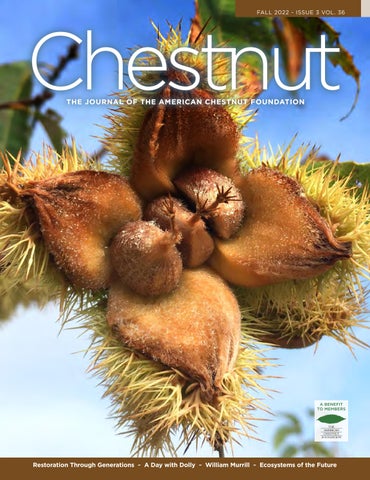
FALL 2022 ~ ISSUE 3 VOL. 36
THE JOURNAL OF THE AMERICAN CHESTNUT FOUNDATION
A BENEFIT TO MEMBERS
Restoration Through Generations ~ A Day with Dolly ~ William Murrill ~ Ecosystems of the Future
FALL 2022 ~ ISSUE 3 VOL. 36
THE JOURNAL OF THE AMERICAN CHESTNUT FOUNDATION
1
3
12
PRESIDENT’S MESSAGE
GENERATIONS
MEADOWVIEW
from Lisa Thomson
A Multigenerational Movement
A View from Meadowview
14
21
25
NEWS FROM TACF
RSC COLUMN
HISTORY & CULTURE
A Day with Dolly
Phytophthora Screening and Creating Dual Resistance
Discovering William A. Murrill
35
37
Upon My Return to Appalachia
IN HONOR AND IN MEMORY
Second Chances
27 SCIENCE Ecosystems of the Future Progeny Test
REFLECTIONS
36
RECIPE Pumpkin Cinnamon Chestnut Rolls A BENEFIT TO MEMBERS
8
Years as a:
PRESIDENT’S MESSAGE
DEAR CHESTNUT ENTHUSIASTS, When I began my tenure nearly eight years ago at TACF, I went on a “listening tour” to learn why this one species that had been nearly lost for more than a century, still resonated so strongly in people’s hearts. Often, I heard the reoccurring theme of family ties and firsthand knowledge of experiencing the tree in its heyday, passed down from parents, grandparents, or a favorite uncle or aunt.
Lisa Thomson President and CEO
We use that multigenerational theme in this issue of Chestnut to showcase a few families who embody this sentiment and turned their love of chestnut into action and advocacy for its return. Enjoy these heartwarming generational stories from some of our most passionate and enduring chestnut advocates beginning on page 3. One such person came to TACF by way of her beloved uncle. American icon, singer-songwriter, and generous philanthropist Dolly Parton learned about TACF from her late uncle, Bill Owens. Read about her journey with Uncle Bill and how we were gifted the opportunity to present her with a posthumous Chestnut Conservation Champion Award to recognize Uncle Bill’s contribution to the education and research of the American chestnut at Dollywood’s theme park. The article, “A Day with Dolly,” can be found on page 14. By the time this issue reaches your mailboxes, we will be embarking on our first in-person fall meeting since 2019, TACF’s American Chestnut Symposium, right here in our hometown headquarters of Asheville, September 30 to October 1, 2022. After enduring two false starts dashed by COVID surges, we are thrilled to safely join together again. We hope to see you there to share in the experience, camaraderie, and learning opportunities that always occur at these meetings as we have an amazing lineup of speakers, a poster session, and even field trips planned. I hope to see you there! With gratitude,
Lisa Thomson, President and CEO The American Chestnut Foundation
Lisa Thomson and Dolly Parton, June 2022.
The Journal of The American Chestnut Foundation
~1
American Chestnut Bur Taken several years ago during a successful harvest season at TACF’s Meadowview Research Farms, this photo highlights the true beauty and intricacies of an open American chestnut bur.
WHAT WE DO The mission of The American Chestnut Foundation is to return the iconic American chestnut to its native range. CONTACT US: chestnut@acf.org • acf.org facebook.com/americanchestnut • twitter.com/chestnut1904 • instagram/tacf1983
TACF National Office 50 N. Merrimon Avenue Suite 115 Asheville, NC 28804 (828) 281-0047 Meadowview Research Farms 29010 Hawthorne Drive Meadowview, VA 24361-3349 (276) 944-4631
OFFICERS CHAIR: William J. (Jay) Cude, III, TN IMMEDIATE PAST CHAIR: Brian McCarthy, Ph.D., OH PROMOTION AND OUTREACH COMMITTEE CHAIR: Betty McDonald Allison, NC TREASURER AND FINANCE COMMITTEE CHAIR: Barbara Tormoehlen, OH SENIOR SCIENCE ADVISOR: Kim Steiner, Ph.D., PA
EMERITUS MEMBERS Essie Burnworth (posthumously) Gary P. Carver, Ph.D. Herbert F. Darling, Jr. Hugh Irwin William G. Lord, D.V.M. (d) William L. MacDonald, Ph.D. Rex Mann Glen Rea Rufin Van Bossuyt Richard Will
PRESIDENT & CEO: Lisa Thomson, NC BOARD OF DIRECTORS Rebecca (Becky) Carter, GA Hill Craddock, Ph.D., TN Mandy Adler Cromwell Ph.D., MA Bruce Levine, MD Dennis Liu, Ph.D., NC Lewis Lobdell, PA Ambassador Catherine Novelli, VA Jeanne Romero-Severson, Ph.D., IN John Scrivani, Ph.D., VA Jim Searing, PA Bradford Stanback, NC
STAFF ASHEVILLE Lisa Thomson, President & CEO Paul Wingenfeld, Chief Financial Officer Judy Antaramian, Membership Manager Anna Ewing, Communications Coordinator Laura Harrison, Gifts and Records Specialist Lindsay Keitzer, Grants Manager Cherin Marmon-Saxe, Director of Operations
LEGAL COUNSEL: Donald C. Willeke, Esq., MN
~ A Benefit to Members
New England Regional Office UVM Aiken Forestry Service Labs / USFS NRS 705 Spear Street South Burlington, VT 05403 (802) 999-8706
HONORARY DIRECTORS Norman Borlaug, Ph.D. (d) President Jimmy Carter Richard A. Jaynes, Ph.D. Mrs. Mary Belle Price (d) Peter H. Raven, Ph.D. Philip A. Rutter Edward O. Wilson, Ph.D. (d)
SCIENCE AND TECHNOLOGY CHAIR : Deborah Delmer, Ph.D., NC
2
Mid-Atlantic Regional Office The American Chestnut Foundation 900 Natural Resources Drive Charlottesville, VA 22903 (828) 281-0047
North Central Regional Office Pennsylvania State University 206 Forest Resources Lab University Park, PA 16802 (814) 863-7192 Southern Regional Office 50 N. Merrimon Avenue Suite 115 Asheville, NC 28804 (434) 906-9312
Cara Parker, Office Administrator Carrie Plaxco, Gifts and Records Specialist Jules Smith, Director of Communications Jared Westbrook, Ph.D. Director of Science Barbara Wood, Membership Coordinator Shana Zimnoch, Director of Donor Engagement MEADOWVIEW Eric Jenkins, Tree Breeding Coordinator Vasiliy Lakoba, Ph.D. Director of Research Dan Mckinnon, Director of Land Management Cassie Stark, Lab Manager Jim Tolton, Facilities and Grounds Technician Ciera Wilbur, Nursery Manager REGIONAL SCIENCE COORDINATORS Kendra Collins, New England, and RSC Manager Sara Fitzsimmons, North Central, and Chief Conservation Officer Brianna Heath, Mid-Atlantic Jamie Van Clief, Southern EDITORIAL Lisa Alford, Design & Layout
GENERATIONS
AMERICAN CHESTNUT RESTORATION
A Multigenerational Movement Families have a rich history of passing down traditions, recipes, and stories generation after generation. For many, the legacy of the American chestnut is bestowed in similar ways. Instilling a deep connection to this resilient tree within young people brings about a dedicated future generation committed to its stewardship and preservation. Those of us at The American Chestnut Foundation are sincerely inspired by this movement and delighted to share stories from a sampling of our members who participate in carrying on the tree’s legacy. Together, through science and stories, we continue to build awareness and garner support toward the restoration of this iconic tree.
The Journal of The American Chestnut Foundation
~3
GENERATIONS
GENERATIONS
4
~ acf.org
TREE HUGGER LEGACY IN SOUTH GEORGIA The Carter Family
I
n the early days of TACF, when our founders launched this audacious goal, the organization received a prized endorsement. President Jimmy Carter agreed to be an Honorary Director and help advocate on behalf of this fledging conservation group. President Carter orchestrated the planting of hybrid chestnuts at The Carter Center in Atlanta and at his residence in Plains, GA. He remembers well the time before the blight, when American chestnuts once grew near his boyhood farm, now a part of the Jimmy Carter National Historic Park. As a young and enterprising boy, Carter often collected chestnuts in the fall to take to school and trade them for “one or two nice marbles.” He also states, “I like to help make places better for the future and I like to think that restoring the chestnut tree is one of those shining achievements that will come to the whole world.” Now that President and Mrs. Carter are in their well-deserved retirement, the chestnut torch has been passed to his second son Chip
and daughter-in-law Becky. Last year TACF’s President and CEO Lisa Thomson approached Chip and Becky about carrying on this family legacy through the organization’s hopeful mission. Chip is active in plantings, and when Becky recently retired from The Carter Center, she excitedly agreed to join TACF’s Board. Chip continues his father’s interest in growing chestnuts on their ancestral farm. He is experimenting with suitability and longevity, by planting on different sites using Georgia material supplied by Marty Cipollini of Berry College. Chip hopes to dot nearby landscapes with blight-resistant American chestnuts in the future. “For years my parents have had an active interest in the restoration of chestnuts in our county and in the woods on our farm. While Becky works to propagate them in the country, I plant a few on our farm each year with the hope that eventually they will be as prevalent as the other hardwood species that grow around Plains.”
THE CONN FAMILY TREE: CHESTNUTS THROUGHOUT THE CENTURY By Caitlin Conn, GA Chapter
A
s a child, I was fortunate to spend lots of time outdoors with my grandparents. I recall many wonderful adventures with my grandfather, William G. Conn (Poppy), who recently celebrated his 98th birthday. American chestnuts were already succumbing to blight by Poppy’s birth in 1924, but his father – my great-grandfather – was a child in the 1890s and passed on stories from his youth. Poppy says that Great Grandpa used to take empty salt bags to the nearby Tuscarora Mountain in Central Pennsylvania; there, he could fill them with American chestnuts within minutes. Although Poppy himself never saw these trees thriving, he remembers when fallen American chestnut trees were abundant in the forests, and he recalls harvesting their wood and using it to heat his hunting cabin. Poppy knows of some nearby homes that incorporate American chestnut lumber, and he has always enjoyed eating chestnuts of any variety. In fact, as a child, I helped Poppy
collect Chinese chestnuts from neighbors, and shortly thereafter we would eat and enjoy our harvest. Considering all these benefits that chestnuts have provided for Poppy and our family, it’s safe to say that he is well aware of the need to restore American chestnut trees. Poppy is a true conservationist. As an avid hiker, hunter, and gardener, Poppy lives in harmony with nature, and even at 98 he is deeply concerned with the future of our planet. Despite no formal training in the life sciences beyond high school, to this day he amazes me with his insatiable curiosity, keen observations of the natural world, and expertise in biology that he developed in his extensive time outdoors. Regarding his passion for American chestnuts, he says, “I love the woods, and I love to hike, and I love to hunt…and they were such a [critical] source of food for wildlife.” He goes on to explain that in his near-century of life, he has seen wildlife become increasingly
GENERATIONS
President and Mrs. Carter frequently quote their school principal Ms. Julia Coleman as saying, “We must adjust to changing times but keep our unchanging principles.” Becky translates this guidance into action. “We know that climate change is causing global impacts, many of which are disastrous to life and livelihood,” she said. “To help mitigate these impacts we can support conservation and resilience in our forest systems by fostering new scientific innovations to save the genus Castanea. These trees evolved and migrated – over millions of years and across the globe – to become the iconic American chestnut. Thanks to professional and citizen scientists, dedicated volunteers, and members of TACF, it’s exhilarating that the tree can be returned to its native range. It can provide important ecosystem services, food, wood products, and carbon sequestration.” Now multiple generations of the Carter Family are involved in TACF’s visionary goal by planting trees to help restore the American chestnut.
Lisa Thomson and President Jimmy Carter at the re-dedication of The Carter Center’s chestnut orchard, July 2017.
Chip and Becky Carter
Marty Cipollini (GA Chapter) with one of TACF’s hybrid chestnuts at the Carter residence.
dependent upon farmers’ fields for food, which is a problem for farmers and can be bad news for the wildlife as well. But it isn’t just about people and other animals for Poppy. He appreciates the inherent worth of American chestnuts themselves, declaring, “I love trees. I’m a treehugger.” I hear a hint of pride in his voice as he claims this title. As a biologist and member of the Conn family, I gratefully accept the thread that ties generations of us to American chestnut trees and the forests in which they once thrived. I aspire to Poppy’s knowledge of the natural world, to his intellect and curiosity, and to his refusal to let age (or anything else) slow him down. The next time I visit, he intends to show me a few remaining American chestnuts that he has found throughout his decades in the forests. I know that this time with him – especially time spent in the woods admiring trees – will make me a better researcher and caretaker of American chestnuts.
Caitlin and her Poppy have been spending time outdoors together for more than 30 years.
Caitlin, GA Chapter science coordinator, pollinates an American chestnut tree.
William G. Conn, 98, visits a European chestnut in his neighbor’s yard in Central PA.
The Journal of The American Chestnut Foundation
~5
GENERATIONS
GENERATIONS
6
~ A Benefit to Members
FROM CEO TO TREE FARMER The Cude Family
J
ay Cude has been a member of TACF for 22 years. He attended his first annual meeting in 2015 at Penn State, with son Nathan, to learn more about genetics and other scientific methods to rescue the American chestnut. Jay’s love of forests, farming, and the outdoors has been passed on to his children. Nathan is a Ph.D. microbiologist and works in genetics with a private biotech firm. Jay refers to him as his “translator” for all the technical aspects of TACF. Nathan has since joined TACF’s Science & Technology Committee. He helped facilitate a meeting at Oak Ridge National Laboratory where he performed his postdoc research. Jay’s wife, Connie, is a middle school science teacher who also helps him with TACF business. According to Jay, “I understand genetics much better when it’s presented to me in a middle school lesson plan.” Jay comes by his chestnut connection naturally through his grandfather. In the early 1900s W.J. Cude Land and Lumber Company owned large tracts of timber and manufactured wood products (including chestnut). Today
Jay actively manages the hardwood timber on their farm, including a recent NRCS grant for Timber Stand Improvement. He recently collected and milled seven different hardwoods for use by hobbyists in their woodshops. Jay hopes future generations will be able to harvest American chestnut again. Lisa Thomson remembers meeting Jay for the first time at the Penn State gathering. “It’s not often you have someone introduce themselves and state that they just retired, loved strategic planning, and end the introduction with ‘how can I help?’” He had been involved with the TN Chapter as a board member but was interested in volunteering at the national level, especially in the areas of marketing and promotion, his areas of expertise. Later that year, he traveled to Asheville to meet with Lisa who then recruited him to the board of directors. Jay has served as chair of the governance and promotion and outreach committees, was a helpful author of the first strategic plan in 2016, and appointed board chair in 2021. He takes his position seriously
KEEPING IT IN THE FAMILY By Mark and Mindy Double, WV Chapter
D
uring the Civil War, Madison Carter, a 27-year-old Union soldier in Company C, 6th West Virginia Light Artillery, was captured on his way to Gettysburg. As he sat in Libby Prison in Richmond, VA, he thought of the 16.5 acres he purchased 30 miles south of the Mason-Dixon line near Fairmont, WV. Madison acquired the land in August 1863 with a dream of growing trees on this land. It wasn’t until October 3, 1864 when Madison’s term of service expired that he began to realize his dream. He eventually built a timber business and increased the farm to 400 acres, no doubt land that contained American chestnut. Little did Madison realize that six more generations of his family would live and farm the same land for another 150 years. Each generation following Madison sought to be good stewards of the land. Currently, our daughter, Erin, husband, Jeff, and our two grandchildren, Grace (6) and Grant (3) live on the farm. Over many generations, it
has been a working farm with cattle, horses, swine, and chickens. Hay has been harvested, large gardens planted, and each generation strived to maintain the farm. A system of seven miles of roads were established by Grace and Grant’s maternal great grandfather, Jim Crawford, and those roads are still maintained. During the last several years, more than 60 chestnut trees have been planted. The farm was the WV Tree Farm of the Year in 1971 and again in 2000. In 2001, it was selected as the best tree farm in the Northeast U.S. and competed with three other farms for the title of best tree farm in the U.S. The farm was recognized as a Centennial Farm in 2021. Rabindranath Tagore is quoted as saying, “the one who plants trees knowing he will never sit under their shade has at least started to understand the meaning of life.” The meaning of life is that we are all transient beings here on earth. What we leave behind, our legacy,
GENERATIONS
and works long hours to promote and forward the mission of TACF. Jay has been a key player in the regulatory process associated with the transgenic tree. He introduced TACF and ESF to the well-respected D.C. law firm, Keller & Heckman, whom he worked with during his corporate career. The firm has provided invaluable support, helping to navigate the complicated world of deregulation for the Darling 58 transgenic tree with three different federal agencies. Attorney James Votaw and his team successfully petitioned the firm to serve TACF on a pro bono basis, which has been a transformational gift to our organization.
W.J. Cude Land & Lumber ad, 1907.
Nathan and Jay Cude on a fly fishing trip in NC.
Lumber from Jay’s family farm.
Jay is a shining example of carrying on a family legacy that has been passed on through generations. From his grandfather to his son Nathan, it is a deep interest and passion for healthy forests for wildlife and human recreation. Nathan and his wife Jia just welcomed their first child, Lydia, so the legacy continues!
Grace and Grant looking at photos of Madison and his house.
Madison Carter in his Civil War uniform.
is what is important. We have planted chestnut trees not only for our grandchildren, but hopefully for their grandchildren. We want to pass on our love for the land so that our farm may still be in the family for another 150 years. Teaching our grandchildren the history of the farm and the importance of American chestnut is part of the legacy of this land, fulfilling Madison’s dream.
Grace and Grant with Madison’s sword.
Mark, Mindy, and grandchildren pose by the Century Farm sign, indicating the property has been in Mindy’s family for more than one hundred years.
The Journal of The American Chestnut Foundation
~7
GENERATIONS
GENERATIONS
8
~ acf.org
PASSING DOWN THE PASSION The Klinger Family
A
s an early member of The American Chestnut Foundation, Chandis Klinger was honored to receive some of the first backcross chestnuts available to membership. He tended to his nuts and seedlings with great care. Chandis’ vision was to cultivate blightresistant American chestnuts deep in the heart of his central Pennsylvania woodland. His challenges were many, even beyond the blight itself. Namely mice, chipmunks, squirrels, deer, bears, and shade from other trees. He became known as the “critter guy” and spoke often at national meetings about his “inventions” to help ward off predators. These included wire and wood contraptions, juice containers, and egg/cayenne pepper sprays. He tended nearly 100 nuts, only a few of which survive today. Chandis is also remembered for some of his notable trees. When he learned about mud packing he went to work, gathering large coffee tins. He arranged the dirt-filled tins in a suit of armor around his largest surviving, but blight infected, native tree. The tin can mud pack extended to chest height, giving it the
nickname “the robot tree.” Also nearby was a tree known as “VIC” (Very Impressive Chinese). VIC had Chinese leaves, bark and burs, but was much taller and straighter than a typical Chinese chestnut. The robot and VIC trees were at the heart of Chandis’ original, middle of the forest, backcross chestnut orchard. In the last several years, due to a progressive form of Parkinson’s Disease, Chandis wasn’t able to visit his beloved chestnut trees. So his children, Hans and Kristy Klinger, would venture into the family woodlands following his original hand-drawn map, and update his chestnut tree journal. They would come back with a report and a bur or a leaf, all of which brought tears to his eyes. Knowing how much he missed his chestnuts, the family arranged a special planting in October 2021 with Sara Fitzsimmons, TACF chief conservation officer. Together, they planted four bare root seedlings from the Pennsylvania State University chestnut orchards within viewing distance of the Klinger home. Unfortunately, this was one of the last outings Chandis
OUR FAMILY TREE By Doug McLane, VT/NH Chapter
I
n the 1950s, Thanksgivings at our cousin’s was always accompanied by a roaring fire in the fireplace. My uncle explained that a good portion of the year’s wood supply was chestnut he had cut from the family woodlot. Although the trees died decades before, the chestnut trunks were still standing and easily cut and split. That must have been the beginnings of my fascination with American chestnut trees, because I acquired a large box of his gray wormy chestnut logs that I still have to this day. Years later I obtained a set of post office boxes made by my great grandfather, an immigrant from Scotland, who used a water-powered mill to manufacture most of the postal boxes in America in the late 1800s and early 1900s. It appeared that some of the wood was chestnut. In those days, postmasters had to buy and supply their own post office boxes. More recently, renowned local restaurateur Alex Ray disassembled an old post and
beam barn in southern New Hampshire and reassembled it in Plymouth. He asked if any of the hand-hewn timbers looked like chestnut and I determined that indeed, some were. After developing a partnership with a local solar energy organization, work began using the best timbers to build a pavilion. The roof supported solar panels for a ‘solar share’ project in which the energy produced is donated to families in need. Several American chestnuts were planted on the property and an informational sign, made of reclaimed chestnut boards, was installed close by. My Wife Sue grew up in northeast Ohio. She had been given a copy of a child’s book written by her grandmother, who was born in 1897, about growing up on a self-sufficient farm where “we did not need money – we took eggs and butter and traded them for coffee, sugar, rice, salt, etc., the few things you do not raise on a farm. In the autumn you found chestnut burs and chestnuts on the ground.”
GENERATIONS
had, but it was a very memorable day. He passed away in November 2021 and was soon followed in death by his devoted wife Violet, another TACF member who had also attended many chestnut meetings. Although Chandis Klinger didn’t live to see the fruition of a truly blight-resistant tree, his memory and passion lives on. Hans and Kristy continue to monitor chestnuts in the Klinger woodland, grow new trees from seed, place wire cage protection, ensure adequate light, and mud pack cankered trees – some 15 feet high! They look forward to the day that not only backcross trees, but transgenic trees, will be planted in the Klinger woodlands. We must be open to scientific advances to once again fill the Pennsylvania forests with American chestnut. Saving this foundation tree species is a necessary generational undertaking. Chandis and Violet passed on their passion to Hans and Kristy and they are dedicated to continuing the journey.
In the early 1980s, while teaching biology and conservation at our local high school, I ventured into the woods with an old-time trapper who showed me a sizable American chestnut he had discovered. Unfortunately, that tree was later mistakenly cut in a logging operation, but several of the seedlings were transplanted into the valley floor and have since been used for our Chapter’s breeding and seed orchard stock. One of my biology students from 30 years ago is now a teacher at the same school of which I taught. She and her students have planted a germplasm conservation orchard for the VT/ NH Chapter on the campus grounds – a younger generation carrying on the work of those before them. Now, my new crop of grandchildren help weed and spread wood chips on the chestnut orchards nearby. Someday, they too will take pride in being part of the McLane family American chestnut story.
Family and friends took part in a chestnut tree planting at the Klinger homestead, October 2021.
The Klinger family and Sara Fitzsimmons (green shirt) pose beside the newly planted chestnut seedling.
Hans Klinger plants a bare root seedling.
Doug McLane, alongside his grandchildren, shows off this chestnut seedling’s long taproot.
Excerpt from the book written by Sue McLane’s grandmother.
Sue McLane stands in front of a healthy American chestnut.
The Journal of The American Chestnut Foundation
~9
GENERATIONS
GENERATIONS
10
~ A Benefit to Members
RESTORATION THROUGH GENERATIONS By Woods Sinclair, CT Chapter
P
erhaps “American chestnut” is imprinted in my DNA – somehow? Merely a lad, in the early 50s, Millstream became my ancestral home where my wife, Mary Lu from Texas (no chestnuts but bushels of pecans) and I eventually resettled. Behind Millstream at forests’ edge was an immense truncated ghost which I revered, an American chestnut some 50’ tall and the full width of out-stretched arms. Returning from college, I found the ghost had given up. The shards of that magnificent tree may still exist today ‘mongst the forest leaves and litter. The generation Mary Lu and I brought forth was raised next door, across the brook from Millstream. Just off Canaan Mountain Road was a hybrid chestnut planting, which we harvested each fall in anticipation of the holidays. Planted by the Great Mountain Forest (GMF) crew along with their other hybrid chestnut orchards, these were the source of memorable walks (porcupine quills,
before bears), roasting fires, and purée at our thanksgiving table. And still savored. After retirement from nearly 30 years teaching English at Housatonic Valley Regional High School (HVRHS) – from whence I graduated in 1956 – college, marriage, the U.S. Army, moving east and travels with Mary Lu, I continued close vocational agriculture relationships and eventually renewed my interest in the American chestnut. I became a member of the CT-TACF Chapter, and through Leila Pinchot explored the possibility of developing a specific percentage hybrid orchard in Northwest CT, made a reality through Starr Childs of GMF – which I eventually managed through Leila’s urging. Seeking help, I turned to the high school whose staff leapt at the chance for hands-on forestry education. This opened up a learning/teaching opportunity for me as well: English Department Head to Hybrid American Chestnut Manager.
WONDER FIRST, CHESTNUTS LATER By Anna Sproul-Latimer, VA Chapter
R
ecently, I asked my oldest kid, who is 8, what he knew about American chestnuts. My own unhinged obsession with them has been underway for about two and a half years. Had any of it trickled down to him? “Uh,” he said. “I know they’re super rare? And you really, really like them. Like –” he gave me a withering look “– really.” Both of those things were correct, at least. We are getting there. Truth be told, neither Jack nor his siblings – Lucy and Will, ages 6 and 3 – care all that much about chestnuts for now. They are, like me and their father, indoors people. (On our family vacation last week, for instance, I asked Will whether he wanted to go play on the beach with me. Staring at his little feet with a look of anticipatory disgust, he asked, “will there be SAND there?”) I am not pushing the subject, although don’t get me wrong: I do hope that each of my kids
eventually has the kind of chestnut conversion moment I did. Someday, I hope they happen upon the story of Castanea dentata in a book; really pay attention to it; then feel the tectonics of their worldview start to shift inside them, creating a breathtaking new landscape. For me, discovering what happened to this tree felt like unearthing some kind of American botanical Ark of the Covenant. Here was this massive event with an almost unfathomable impact on our national ecology, economy, and culture – but almost no one knew about it. It was somehow buried in a cave of the zeitgeist, its lessons forgotten, its location unknown to all but a few craggy outdoorsmen. In my opinion, this kind of Indiana Jones-level revelation lands best if not foisted onto one by one’s lame mom. What I try to do instead, therefore, is prime their vision so that one day they come to the revelation all on their own. I say to them: wow, you guys, isn’t it cool how humans have the power to turn our sorrow and
GENERATIONS
Now, however, our family’s second generation and into our grands, the third generation, have participated in the current orchard, its cultivation, and continued maintenance – an incredible benefit as I am wheelchair confined. Also, some 15 years of high school students since 2007 are still exposed to the American chestnut: some through original plantings, maintenance, and record keeping; others through employment, facilitated through the CT-TACF Chapter; and now through continued field trips.
Woods and his grandson spend time in a chestnut orchard.
A greatest pleasure has been rediscovery and regeneration of interest in and appreciation by family and students for the American chestnut.
Woods’ grandchildren prepare tree tubes.
care into world-mending collective action? What other species can collaborate across time and space to raise cathedrals into the sky? We have the power to love, care, and change the world beyond the limits of our own measly bodies and lifespans. No other species on Earth the power to put love into action like this. None. What a gift. What I am trying to rub off on them is not the work of chestnut restoration per se, but the wonder that this work of chestnut restoration fuels in me. I believe that any American who has this compass open inside them will inevitably find themselves navigating here to the threshold of this cause. If and when my kids get here, I will delight in welcoming them home to this covenant I feel so privileged to share with all of you right now.
Woods inoculates a chestnut tree with daughter Laura.
Jack and Lucy Latimer stand under a large surviving American chestnut in Seneca Creek State Park, MD.
Anna Sproul-Latimer participates in a planting at Sky Meadows State Park, VA.
Jack Latimer gazes up at an American chestnut in Seneca Creek State Park, MD.
The Journal of The American Chestnut Foundation
~ 11
MEADOWVIEW
A View FROM MEADOWVIEW
Pollination season at TACF’s flagship Meadowview Research Farms spanned all of June this year. Nursery Manager Ciera Wilbur (left) and Tree Breeding Coordinator Eric Jenkins (right) are seen here pollinating a large selected backcross tree on the Duncan farm. The mother tree carries a ‘Blight 1’ designation from genomic selection models built by TACF Director of Science Jared Westbrook, representing its position in the top tier of blight resistance across all TACF affiliated orchards. This particular cross used Darling 58 pollen produced in the lab at SUNY’s College of Environmental Science and Forestry as part of efforts to increase genetic diversity across transgenic chestnut populations.
12
~ acf.org
MEADOWVIEW
The TheJournal Journal of of The The American American Chestnut Chestnut Foundation Foundation
~ 13
NEWS FROM TACF
A Day With Dolly By Lisa Thomson, TACF President and CEO
More than 10 years ago, The American Chestnut Foundation began a partnership with the Dollywood theme park thanks to Dolly Parton’s uncle, Bill Owens. It all started with Uncle Bill’s dream of planting thousands of trees at the park in Pigeon Forge, Tennessee, on the edge of the Great Smoky Mountains. When hometown girl Dolly bought the theme park in 1986 with the Herschend family, she helped rebrand the space to showcase the Appalachian Mountains, its music, crafts, and people.
A bit about Dolly’s beloved Uncle Bill: She often credits him with launching her career and taking her to Nashville for auditions and radio shows when she was embarking as a young singersongwriter, and he encouraged her every step of the way. Bill himself was also a musician, so they became very close over the years, traveling to shows and auditions. Sadly, Bill passed away last year and Dolly had this to Bill Owens and Dolly Parton in the say in her eulogy: early years of her singing career. “Uncle Bill worked Photo courtesy of Dollywood. at Dollywood from the time we opened in the family show was his passion. He also championed for many years. He was funny, friendly and generous. He always had a kind the cause of protecting the natural word for everybody and gave good environment at Dollywood in 1986. advice to young people starting in During that time, he took it upon the business. He joined forces with himself, with his wife Sandy, to plant Dollywood, The American Chestnut 70,000 trees on the park property.” Foundation, University of Tennessee Bill learned about the work of TACF at Chattanooga and The American and reached out to Hill Craddock, Eagle Foundation to bring back the professor at UT-Chattanooga and one endangered chestnut tree to the of TACF’s most dedicated volunteer Great Smoky Mountain area. That 14
~ A Benefit to Members
leaders, to help him plant hybrid American chestnut trees and educate park guests about our restoration efforts. With Hill as a trusty guide, together they planted a few of TACF’s hybrid trees in a remote area of the park to gauge how well they would fare. Bill then championed the Bill Owens American Chestnut Education and Research Fund and secured donations from park visitors and Dolly herself. The Fund is now administered by senior staff at Dollywood and we are working on next steps to best direct the donations for the most impact. Reinvigorating our partnership with Dollywood has been a focus of senior staff at TACF since 2019. One exciting outcome was the opportunity to present Dolly the Chestnut Conservation Champion Award in memory and honor of her Uncle Bill on stage at Dollywood’s new HeartSong Lodge & Resort media event, on June 24, 2022. President and CEO Lisa Thomson
NEWS FROM TACF
and Director of Communications Jules Smith were invited to Pigeon Forge to attend the ceremony. “It was an amazing yet slightly surreal experience to be on a stage with an American icon, but Dolly’s natural warmth and friendly demeanor made me feel at ease immediately,” said Lisa of the presentation. After telling the story of TACF’s mission, Lisa unveiled a framed historic photo of enormous chestnut trees taken in the Smokies circa 1910. The frame was handmade by TACF’s talented Carolinas member Jon Taylor, who crafted it from wormy chestnut and used guitar bridge pins as accents,
Following the unveiling, Dolly speaks about her Uncle Bill’s passion for and efforts to rescue the American chestnut.
and a guitar string as the hanging wire. When Lisa pointed that out to Dolly at the event, she said “Uncle Bill would have loved that. He played a big ol’ red Gretsch guitar.” This commemorative photo will reside at the Chasing Rainbows Museum at Dollywood for guests to enjoy.
Lisa Thomson and Dolly Parton unveil the Chestnut Conservation Champion Award.
We are pleased Dolly also agreed to be interviewed about chestnut restoration for our upcoming documentary film, (see ad on page 20). In the final stages of filming and editing, TACF plans its premiere for Earth Day 2023 and will enter it into film festivals around the country.
Dolly says of her Uncle Bill, “He joined forces with Dollywood, The American Chestnut Foundation, University of Tennessee at Chattanooga and The American Eagle Foundation to bring back the endangered chestnut tree to the Great Smoky Mountain area. That was his passion.”
The Journal of The American Chestnut Foundation
~ 15
NEWS FROM TACF
Second Chances By Mark Double, WV Chapter President
Chestnut Mountain Ranch (CMR) sits on a rocky hilltop just south of Morgantown, WV surrounded by a mixed hardwood forest with a clear mountain stream in its midst. CMR is a three-fold model of home, school, and community for at-risk boys, ages 12-15 where an environment is created that restores broken family relationships and often-times, heals deep wounds. The boys are given the structure, stability, and time needed to work through crisis situations in a program that collaborates with their families. At CMR, the goal is to restore families and give them hope for the future. The boys at CMR are being given a second chance. Steve Finn is the founder and executive director of CMR. Steve was a police officer in metro Atlanta for 12 years, working with drug gangs and the violence that accompanies drug use and distribution. Steve wondered if some intervention could be done with young boys before they became indoctrinated into drug gangs. He and wife Dawn were drawn into ministry and they became full-time house parents at Eagle Ranch in Georgia, nationally recognized as one of the best programs in the country for positively changing the lives of at-risk boys. In 2005, Steve and Dawn were then led to West Virginia to model a program similar to Eagle Ranch. For his work at CMR, Steve has been recognized as one of the top three leaders in the county by the 2016 John C. Maxwell Leadership Awards Committee. While it takes several months upon arrival at CMR for the boys to gain the trust of CMR’s staff and for the staff to trust the boys, the transformation of the boys’ behavior and attitude is noteworthy. Each boy is provided his own room in a residential housing unit that is occupied by six boys and two-house parents. While at the 225-acre ranch, the boys earn points by doing their chores and they are provided with unending outdoor activities, including hiking, basketball, fishing, and lure tying. The boys generally spend three years at CMR and weekly counseling sessions for the boys and their families are conducted to maximize each boy’s success before they return home.
Two CMR boys plant a seedling in front their chapel. All photos by Mark Double and Steven Finn.
16
~ acf.org
Robert Rorke of Cumming, Georgia, a long-time supporter of CMR, contacted Mark Double, president of the WV Chapter, suggesting that an American chestnut orchard at CMR would be appropriate. On a hot, muggy day in late May, the WV Chapter of The American Chestnut Foundation joined with the boys and staff to plant 24 native American chestnut seedlings that were potted by WV Chapter members and raised for two months in the West Virginia University greenhouse. Prior to
NEWS FROM TACF
Mark Double shares information about how to plant the seedlings.
Three CMR boys plant a seedling.
Mark Double discusses a seedling’s root system with the boys.
A seedling is watered after planting.
planting, Mark Double spoke to the boys about the history of American chestnut, its importance, and some of the ways TACF is working toward restoration of the species. Once at the planting site, Double showed the boys how to plant the seedlings followed by watering and mulching. The site was extremely rocky and Bradley Clodfelter, program manager and coordinator of counseling at CMR, oversaw the digging of the holes, no easy task in the rocky, shale soil. The boys will weed around the seedlings and make sure they are watered in periods of drought. When talking about why planting these trees are important, Steve Finn said, “Today we’re planting these saplings, and a lot of times the boys come to us with a lot of wounds, a lot of anger, a lot of sadness and regret
from decisions from their past or things that may have happened to them. We, here at CMR are taking these young men and just like the American chestnut seedlings, we are slowly growing them into a mighty chestnut.” The American Chestnut Foundation began its journey in 1983 to restore the species back into our eastern North American forests. Just like the boys at CMR, the American chestnut required help and TACF’s backcross breeding program, and the ‘Darling 58’ transgenic tree developed at the State University of New York are two ways chestnut restoration may be possible. Both the boys at CMR and the American chestnut are receiving second chances.
The Journal of The American Chestnut Foundation
~ 17
2022 END OF YEAR APPEAL
A Multigenerational Movement STORIES FROM OUR PAST, CREATING OUR PRESENT, BUILDING OUR FUTURE One of the reasons The American Chestnut Foundation (TACF) continues to advance our mission is due to multigenerational support where deep respect and understanding of the tree is handed down through the years. Passed through the ages, these individuals become the stewards of the iconic American chestnut. It is a story, turned tradition, that is history in the making. The American chestnut is an economically and ecologically significant foundation species, and its restoration matters. We are presented with a rare opportunity to reclaim this tree, once thought lost forever. Its survival is in our hands. It is your commitment today that allows us to right the wrongs of our past and build a future where chestnuts line forest pathways and nourish the earth. Give today to commemorate the collective stories that drive our mission forward. Give today to save the American chestnut tree!
Grab the Popcorn and Dim the Lights AMERICAN CHESTNUT DOCUMENTARY FILM PREMIERING EARTH DAY 2023
Forty years ago, TACF embarked on a mission to rescue a singular tree species: the American chestnut. Your passionate participation has transformed our hopeful mission into a movement, driven by an unwavering commitment to restore a national treasure to American forests. This tree’s story is now one of promise and resilience because of the vital role played by you – our members, collaborators, partners, and supporters.
It is this narrative we seek to share in the coming documentary – a story that has spawned a movement. The film will cover the tree’s historical significance, countless benefits, and perpetual will to live. You will hear from researchers and citizen scientists determined to save it, and from luminaries such as President Jimmy Carter, Barbara Kingsolver, and Dolly Parton.
A mission of this scope survives only through continued momentum. As we move closer toward the film’s planned premier on Earth Day 2023, updates will be shared through TACF’s website, social media platforms, and eSprout.
RSC COLUMN
Phytophthora Screening AND CREATING DUAL RESISTANCE IN THE SOUTHERN REGION By Jamie Van Clief, Southern Regional Science Coordinator
Comparison of different root ratings in seedlings inoculated with Phytophthora cinnamomi. The left scored the lowest with large lesions and lack of secondary roots, the middle scored intermediate, and the tree farthest to the right scored the highest, showing the greatest levels of resistance. All photos by Jamie Van Clief.
The Journal of The American Chestnut Foundation
~ 21
RSC COLUMN
BACKGROUND
Current orchard activities
Phytophthora root rot (PRR) disease is a major challenge to the reintroduction of the American chestnut. One of the world’s most invasive and damaging plant pathogens worldwide, Phytophthora cinnamomi (Pc), is an oomycete which establishes hyphae that grow throughout the host’s root structure, destroying root tissue and preventing the root from taking in water. Unlike chestnut blight, PRR causes complete mortality of the American chestnut. However, both the Chinese and Japanese chestnut species exhibit some resistance to Pc, and are assumed to have co-evolved for millions of years with the disease, which originates from Southeast Asia. Incorporating PRR resistance from the Asian chestnuts into American chestnut has become a major objective of the Foundation’s restoration effort as Pc is an increasingly common pathogen in the southeastern U.S., and is now being found as far north as Pennsylvania. There is significant potential for PRR to continue farther north with climate change and human transport of infected horticultural and ornamental plants. The good news is that some of the AmericanAsian hybrids have shown significant resistance to PRR.
The American Chestnut Foundation (TACF), either directly or through its state chapters, currently maintains many field sites that have tested positive for Phytophthora cinnamomi, the causal agent for PRR. On a few of these sites, instead of treating the soil to control the disease, the pathogen is allowed to prosper, and chestnuts are planted as a means to screen potential chestnut hybrids for PRR resistance in the field. TACF, in cooperation with the U.S. Forest Service Resistance Screening Center (USFS RSC) in Asheville, NC, actively pre-screens seedlings by inoculating them with Pc in sub-irrigation tubs in a greenhouse setting to guarantee exposure to the pathogen. To date, we have screened more than 230
22
~ A Benefit to Members
different families representing a large portion of the backcross program. The PRR resistance screening program proceeds into field orchards. John French, a plant pathologist and dedicated longtime member of TACF, directs a PRR resistance screening program at a key site in Georgia. “We inoculate the trees after they are planted in the field to reduce the probability for ‘escapes,’” says John. “Inoculum density in the field is not uniform, and may change from one season to the next, hence the test subjects may not all be challenged uniformly with native P. cinnamomi inoculum if left to chance. The main idea is that the survivors obviously contain a PRR resistance trait(s) that is robust, which is the imprimatur
USFS Bent Creek Resistance Screening Center Director Katie Mckeever at the facility’s greenhouse, who led the effort to rate inoculated chestnuts after the growing season. All photos by Jamie Van Clief.
RSC COLUMN
reason for the screening. We use only site-specific inoculum, meaning we field-inoculate with the identical strain that was used to pre-screen the seedlings in the greenhouse. This is important because P. cinnamomi is a regulated pathogen, so it cannot be intentionally transported from one place to another.” John is also a principal advocate for expanding the field screening initiative to many other locations throughout the chestnut range. “Robustness of the resistance trait means that the trees we deploy to restore chestnut throughout its range must be able to withstand attack by PRR wherever they encounter it. The virulence topography probably is not flat among P. cinnamomi strains from one site to another.” Just across the border in South Carolina, Chestnut Return Farm, the largest and oldest PRR testing site, maintains a set of 100-gallon tubs that continue to run the Foundation’s longest pre-screening effort. Owned, maintained, and designed by Joe James, founder of the PRR program at TACF, this site contains an impressive total of eleven orchards with nearly 1,000 chestnut trees in ages ranging from saplings to 27 years post-planting. Survivors of James’ program have withstood a continuous challenge from PRR on this heavily infested property. Under a USDA permit and with the help of local volunteers over the last two years, we have placed more than 400 bags on trees using transgenic pollen given to TACF by our partners at SUNY’s College of Environmental Science and Forestry. This pollen carries a gene that neutralizes one of the main attacking mechanisms of chestnut blight. The objective is to stack dual resistance traits against both PRR and chestnut blight.
Genomics A group from Clemson in 2011, and a more recent TACF-supported study in 2017, found two areas of the genome which appear to have high impact on resistance to PRR (Olukolu et
Volunteers pollinate flowers and place bags for transgenic pollinations at Chestnut Return Farm. These screens are an APHIS requirement to prevent the spread of transgenic material. Progeny from these pollinations will be some of the first generation of dual-resistant trees.
al. 2011, Zhebentyayeva et al. 2017). This is valuable information for potential candidate genes for future genetic engineering, it allows for further insights into the mechanisms of resistance, and strengthens our ability to make genetic selections of backcross material. Combined with historic screening data, TACF Director of Science Jared Westbrook has been able to make selections for PRR resistance in the program’s backcross trees without the need
for physical screening. The progeny of these selections will be screened and field tested in upcoming years to prove their efficacy against PRR.
Path Ahead TACF is in continued collaboration with the USFS RSC to pre-screen chestnut seedlings for resistance to Phytophthora root rot disease. The facility has the capacity to screen more than 4,000 trees annually. In further collaboration with Steve Jeffers at Clemson University, we
The Journal of The American Chestnut Foundation
~ 23
RSC COLUMN
are identifying new locations with Phytophthora cinnamomi. Material from our PRR orchards can be bred with blight-resistant material, creating dual-resistant trees and furthering our efforts to restore the American chestnut. It will be especially vital for reintroduction in the southern region as the tree is more prone to infestation from this highly lethal pathogen.
SOURCES Olukolu, Bode A.; Nelson, C. Dana; Abbott, Albert G. 2012. Mapping resistance to Phytophthora cinnamomi in chestnut (Castanea sp.). In: Sniezko, Richard A.; Yanchuk, Alvin D.; Kliejunas, John T.; Palmieri, Katharine M.; Alexander, Janice M.; Frankel, Susan J., tech. coords. Proceedings of the fourth international workshop on the genetics of host-parasite interactions in forestry: Disease and insect resistance in forest trees. Gen. Tech. Rep. PSW-GTR-240. Albany, CA: Pacific Southwest Research Station, Forest Service, U.S. Department of Agriculture. p. 177. Zhebentyayeva, Tetyana N.; Sisco, Paul H.; Georgi, Laura L.; Jeffers, Steven N.; Perkins, M. Taylor; James, Joseph B.; Hebard, Frederick V.; Saski, Christopher; Nelson, C. Dana; Abbott, Albert G. 2019. Dissecting resistance to Phytophthora cinnamomi in interspecific hybrid chestnut crosses using sequence-based genotyping and QTL mapping. Phytopathology. PHYTO-11-18-042-. https://doi.org/10.1094/ PHYTO-11-18-0425-R.
John French, Russell Flint, and Joe James planted chestnuts for screening at Joe James’ Chestnut Return Farm. All photos by Jamie Van Clief.
Make It A Family Affair PLANT THE SEEDS OF CHESTNUT RESTORATION WITH A GIFT OF MEMBERSHIP
Would you like to involve another generation within your network of family or friends in American chestnut restoration? A gift of membership to TACF is the perfect choice and lasts a full year! Not only is it a great way to share the story of this audacious tree, it also offers the opportunity to literally plant seeds – as a volunteer or in their own back yard. Members are eligible for a presale of wild-type American chestnut seedlings and can participate in local breeding and research activities. In addition, each gift membership includes a subscription to our award-winning Chestnut magazine. Your gift of membership today will inspire others to join this historical movement to rescue the American chestnut.
HISTORY & CULTURE
DISCOVERING
William A. Murrill By Madison Brown, WV Chapter
In the summer of 1904 Hermann Merkel, chief forester at the Bronx Zoological Park, observed its American chestnuts’ “twigs and branches whose foliage was brown and brittle long before winter…The brutal winter just past was to blame,” he conjectured.[1] The following summer a staff member of The New York Botanical Garden informed William A. Murrill, the Garden’s Assistant Curator, that many chestnut trees in the Garden were diseased. Suspecting a fungal agent, Murrill applied a common fungicide of the time, Bordeaux mixture (a compound of copper sulfate and hydrated lime). The treatment did not work and Murrill began an investigation.[2] “In 1906 William A. Murrill of The New York Botanical Garden, having established that the fungus enters the chestnut through wounds in the bark, called the pathogen Diaporthe parasitica. In 1912 taxonomic considerations led mycologists to rename it Endothia paracitica….In 1978…the fungus received its current name, Cryphonectria parasitica.”[3]
William A. Murrill, 1907.
William A. Murrill recognized and named the pathogen that nearly destroyed the American chestnut, but who was he? Where was he before and after 1906? What else did he do and accomplish? Murrill was born October 13, 1869 into a solid Methodist family on a farm south of Lynchburg, Virginia. He grew up on several farms where “...the sights and sounds of the fields and woods made a deep impression on this childhood heart and a love of Nature was planted deep in his breast, to grow and broaden with the passing years.”[4] Music was another talent and interest. He learned piano and organ, playing at home and in churches. One of these farms was near Blacksburg, Virginia, where he attended the Virginia Agricultural and Mechanical College (now VA Tech). In 1886 at age 16 he graduated in agriculture with highest honors, and in 1887 in mechanics with a Bachelor of Science degree.[5] His mother, wanting her son to continue his education and have more time to mature, obtained a place and financial assistance for him at Randolph-Macon in Ashland, the Virginia Methodist college, where he received a Bachelor of Science in 1889, a Bachelor of Arts in 1890, and a Master of Arts in 1891.[6]
Photos courtesy of The New York Botanical Garden. The Journal of The American Chestnut Foundation
~ 25
HISTORY & CULTURE
After Randolph-Macon, Murrill taught “senior classes in English, Latin, French, German, Mathematics, and all the Natural Sciences” at Bowling Green [Virginia] Female Seminary from 1891 to 1893.[7] From 1893 to 1897 he taught at the Wesleyan Female Institute in Staunton, Virginia. There he began a journal of “observations he made within a three-mile radius of the school.”[8] Excerpts from this diary make up half of The Natural History of Staunton, Virginia, which he published in 1919. The rest contains “a chapter on Virginia Geology…nine chapters describing in scientific terms, a complete list of all the plants he had collected and identified… some of his favorite quotations related to nature…and several pages devoted to poems that refer to music.”[9]
American chestnut trees at The New York Botanical Garden.
In 1897 Murrill married Edna Lee Luttrell, a former student. Their only child died in infancy. From 1897 to 1900 Murrill studied at Cornell University and earned his Ph.D. His dissertation was presented in published form: “The Development of the Archegonium and Fertilization in the Hemlock Spruce (Tsuga canadensis, Carr).”[10] With Ph.D. in hand Murrill moved to New York City and taught biology at DeWitt Clinton High School from 1901 to 1904. In 1901 he became a member of the prestigious Torrey Botanical Club, which published his latest papers. These brought attention to Murrill and “he was named assistant curator at The New York Botanical Garden. There began in earnest his career in the field of mycology and it was
there that he made the important discovery of the fungus killing the American chestnuts. ….With a full schedule of travel, teaching, collecting trips and publications, Murrill’s star”[11] rose until 1918. On a trip to Europe that year he was hospitalized four months with a kidney disease, during which he was incommunicado. In his absence, the Botanical Garden filled his vacant position, then demoted him upon his return. In 1924 he resigned due to disagreements with the Garden’s director. Furthering Murrill’s struggles, his wife divorced him for abandonment during this time period. He moved in with an aunt near Lynchburg, then built himself a log cabin and began observing the plants and wildlife of the nearby mountains. In the winter of 1925 he moved to Florida where he had earlier made collecting trips. In 1926 George Weber, Professor of Plant Pathology at the University of Florida, “recognized the now rather tattered Dr. Murrill playing classical piano at the Tin Can Tourist Camp in Gainesville.” The University gave him work space and a fifty-dollar monthly honorarium. Murrill responded by specimen collecting, publishing 118 scientific and popular papers, and engaging with the Gainesville community until his death three decades later. His small gravestone in Gainesville reads simply: “William Alphonso Murrill, October 13, 1869 – December 25, 1957, Author – Naturalist – Editor.”[12] Murrill discovered and named tens of thousands of new species of mushrooms and fungi and published some 500 scientific articles, 800 popular articles, and 20 books.[13]
erkel (1874-1938), was a German born and educated landscape architect. Jill Jonnes, Urban Forests: a M Natural History of Trees and People in the American Cityscape. 48. Mark Gatewood, “William Alphonso Murrill and the natural history of Staunton at the end of the nineteenth century,” Augusta Historical Bulletin, (vol. 43, 2007), 46-47. This article in the Augusta Historical Bulletin has three authors: Madison Brown, YuLee Larner, and Mark Gatewood. (Citations from these authors will be cited by individual name and page number.) [3] Joseph Newhouse “Chestnut Blight,” Scientific American, (July 1990), 106. [4] William Alphonso Murrill, Autobiography, (n.p., 1954), 6. Hereafter cited as “Autobiography” [5] Autobiography, 15-16. [6] Richard Irby, History of Randolph Macon College (Richmond: Whittet & Shepperson, 1898), 307. [8] YuLee Larner, 39. [9] YuLee Larner, 43. [10] Annals of Botany, vol. XIV, no. LVI (December 1900): 583-607 & plates XXXI and XXXII. [11] Mark Gatewood, 45-48. [12] Mark Gatewood, 48. [13] Mark Gatewood, 46. [1]
[2]
26
~ A Benefit to Members
BIO: MADISON BROWN Those massive, fallen gray trunks on the western ridge of Ramseys Draft Wilderness, west of Staunton, introduced me to the American chestnut. I met my first Chinese chestnut years later on the eastern ridge. Living and working in academia and social services in the Great Valley of Virginia, the Blue Ridge to the east and the Alleghenies to the west were my beloved hiking locations for many years. Our interest in local history led YuLee, Mark, and me to William Murrill. We researched and published an article about his early years, his teaching career in our hometown, his graduate studies, and activities in New York, especially at The New York Botanical Garden, and lastly the final years of his life.
THE SCIENCE
THE AMERICAN CHESTNUT AND THE
Ecosystems of the Future By Vasiliy Lakoba, Director of Research at Meadowview Research Farms
Sun shining through the leaves of an American chestnut hybrid. The Journal of The American Chestnut Foundation
~ 27
THE SCIENCE
Today, as The American Chestnut Foundation and its collaborators begin to reap the rewards of many years’ tree breeding, genomic selection, and biotechnology efforts, we are presented with and continue to test several avenues toward restoration of the American chestnut. These include the Darling 58 tree developed by William Powell’s group at the SUNY College of Environmental Science and Forestry, selections for chestnut blight and Phytophthora root rot resistance from backcross orchards, as well as various combinations of breeding and biotechnological approaches. As we anticipate and prepare for eventual large-scale reintroductions of American chestnut into a variety of landscapes, we must consider what constitutes restoration success.
Firstly, what is a restoration-worthy tree? Answering this question will require long term comparison of these various ‘products’ performance in both orchard and forest settings across climates. Secondly, what is a restoration-worthy tree population? An ideal may be self-sufficient stands that reproduce, recruit seedlings to the canopy, and hold a niche in the landscape. Certain traits central to population fitness can be selected for in orchards, but monitored restoration plantings will be the true test in this arena. Thirdly, what is a restored forest? This question is largely philosophical, since determining success at such a scale is as much about defining ‘forest health’ as it is about setting benchmarks of plant community composition and demography. Finally, what is a restored species? Today, the American chestnut is functionally extinct and its future range will be comprised of a growing number of reintroduction populations. We can look to the past and present – but, even more, to the future – of the receiving ecosystems to formulate what constitutes successful restoration of this iconic tree. Looking across historical evidence and recent studies, there are some things we know about the stature and role of the American chestnut in ecosystems where it was present, but much remains unknown. There is variable evidence concerning prevalence and habitat specificity of the chestnut before the arrival of the blight. This includes disagreement among qualitative accounts of cove forest occupancy in the South[1] as well as average size of the trees[2],
28
~ acf.org
suggesting that the “redwoods of the East” moniker applied more to outlier specimens than to typical populations. By many accounts, American chestnut – much like its congeners around the world – was vital to numerous human societies, fueling timber framed construction, wood product industries, food systems, and rural livelihoods[3]. The tree also played an important role in the function of Eastern forests, providing habitat and food sources
to a variety of biota, including several host-specific invertebrate taxa whose extinction may be linked with the chestnut’s demise[4]. Additionally, experimental studies using chestnuts as a food subsidy have pointed to the tree’s benefit to native mammalian and avian communities[5,6]. While our drive to understand the past is justified, much has changed since the functional extinction of the American chestnut. Its restoration
Figure 1
Mean temperature change across the United States between 1900 and 2020 has ranged from a decrease of 1°C to an increase of over 2°C per century. These average temperatures are accompanied by changes in temperature extremes and seasonality. The yellow outline represents the American chestnut’s historic range. Map adapted from epa.gov.
THE SCIENCE
will not be a window to forests as they once were, but will instead take place in the context of continued global environmental change. The last century of climate change has seen mean temperatures increase across the majority of the chestnut’s range (Figure 1) and future projections based on fossil fuel consumption scenarios predict continuation of this trend[7]. Assuming strong local
adaptation and limited plasticity of response to climatic extremes, the future range of the American chestnut is projected to move northward, where current and future climates are more reminiscent of the southerly regions it once occupied[8]. Habitat fragmentation and land use change are persistent forces in the Anthropocene (Figure 2), increasing the proportion of edge habitat and driving ecological disturbance regimes
Figure 2
Percent landcover change across the United States between 2001 and 2016 based on the National Land Cover Database (NLCD) maintained by the U.S. Geological Survey. Low (1%) to High (100%) change is calculated as the number of changed 30-meter pixels in a 1-kilometer grid. The yellow outline represents the American chestnut’s historic range. Map adapted from usgs.gov. Figure 3
Exotic vascular plant species richness across counties of the United States based on 2008 data. Values range from 20 species to 931 species per 10,000km2, with greatest concentrations in the northeast megalopolis, from Portland, ME to Washington, DC. The yellow outline represents the American chestnut’s historic range. Map adapted from bonap.org; credit: Greg J. Schmidt, Misako Nishino, and John Kartesz.
dissimilar from those experienced by American chestnut in the centuries preceding the introduction of blight[9]. The intermediate disturbance hypothesis – correlating maximal biodiversity with a moderate level of disturbance – is one of several theories positing that plant communities of the future will be more dominated by weedy and disturbance-adapted species as the range of disturbance regimes has shifted toward greater frequency and magnitude with human intervention[10]. Similarly, the legacy of fire suppression[11] and unchecked herbivore overabundance[12] are key agents of disturbance which are likely to remain in place as they are linked to safety and comfort in settled areas[13]. While chestnut blight and Phytophthora root rot are currently the two main disease foci of tree improvement work undertaken by TACF, it is plausible that novel pathogens could reach North America and impact restoration populations in the future. Some early detection of and rapid response to these threats can be undertaken via sentinel plantings and robust citizen science[14], however the difficulty of such predictions lends greater urgency to ongoing genetic diversification efforts. Invasive species, including other plants, have become increasingly common in Eastern North America, particularly correlated with mass human transit and creation of disturbed and urbanized habitats (Figure 3). It is possible that the restored American chestnut will face greater selection pressures for competitive ability than its ancestors centuries ago, both from introduced understory species[15] and from native populations that have historically competed with the chestnut, gaining ground since its demise (e.g., Kalmia latifolia;[16]). Finally, it is critical to recognize the change in density and distribution of human populations in the American chestnut’s former and future range (Figure 4). This change has been monumental over the last hundred years – especially in the northeastern states – and will continue to amplify, affecting land use change, public values and perceptions, and economic opportunities pertaining to the
The Journal of The American Chestnut Foundation
~ 29
THE SCIENCE
Figure 4
A comparison of United States census population per square mile by county between 1904 (the year chestnut blight was introduced) and 2010. Densities range from 0 to 90+ people per square mile. The yellow outline represents the American chestnut’s historic range. Maps adapted from visualcapitalist.com.
tree’s restoration[17,18]. Fortunately, the burgeoning fields of urban ecology and natural resource social science can provide us avenues for engaging with and understanding the complex human geography into which we plan to reintroduce the American chestnut. In practice, this could help steer cultivation of some breeding lines for more developed or urbanized landscapes.
Given the rate of global environmental change to date and projections for the future, diversification and continued empirical evaluation across a wide range of sites will give the American chestnut the greatest chance at success. At the same time, regional adaptation, whether to climate, disturbance regimes, competitors, or landscape types, will help guide how we draw upon diversity in the
REFERENCES [1] Wang, G. & Knapp, Benjamin & Clark, Stacy. (2013). The Silvics of Castanea dentata (Marsh.) Borkh., American Chestnut, Fagaceae (Beech Family). USDA Forest Service, General Technical Report, Southern Research Station. GTR-SRS-173. [2] Collins, Rachel & Copenheaver, Carolyn & Kester, Mary & Barker, Ethan & DeBose, Kyrille. (2017). American Chestnut: Re-Examining the Historical Attributes of a Lost Tree. Journal of Forestry. 116. 10.5849/JOF-2016-014. [3] Lutts, Ralph. (2004). Like Manna from God: The American Chestnut Trade in Southwestern Virginia. Environmental History – ENVIRON HIST. 9. 10.2307/3985770. [4] Opler, Paul A., W. L. MacDonald, F. C. Cech, J. Luchok, and C. Smith. “Insects of American chestnut: possible importance and conservation concern.” Proceedings of the American Chestnut Symposium (1979): 83-85. [5] Smyser, Timothy & Blythe, Rita & Johnson, Scott & Lichti, Nathanael & Swihart, Robert. (2015). Allegheny woodrat hard mast preference and response to food supplementation. The Journal of Wildlife Management. 80. n/a-n/a. 10.1002/ jwmg.1010. [6] Wright, J. R., Matthews, S. N., Pinchot, C. C., & Tonra, C. M. (2022). Preferences of avian seed-hoarders in advance of potential American chestnut reintroduction. Forest Ecology and Management, 511, 120133. [7] Elmar Kriegler, Nico Bauer, Alexander Popp, Florian Humpenöder, Marian Leimbach, Jessica Strefler, Lavinia Baumstark, Benjamin Leon Bodirsky, Jérôme Hilaire, David Klein, Ioanna Mouratiadou, Isabelle Weindl, Christoph Bertram, Jan-Philipp Dietrich, Gunnar Luderer, Michaja Pehl, Robert Pietzcker, Franziska Piontek, Hermann Lotze-Campen, Anne Biewald, Markus Bonsch, Anastasis Giannousakis, Ulrich Kreidenweis, Christoph Müller, Susanne Rolinski, Anselm Schultes, Jana Schwanitz, Miodrag Stevanovic, Katherine Calvin, Johannes Emmerling, Shinichiro Fujimori, Ottmar Edenhofer, Fossil-fueled development (SSP5): An energy and resource intensive scenario for the 21st century, Global Environmental Change, Volume 42, 2017, https://doi.org/10.1016/j. gloenvcha.2016.05.015. [8] Noah, P. H., Cagle, N. L., Westbrook, J. W., & Fitzsimmons, S. F. (2021). Identifying resilient restoration targets: Mapping and forecasting habitat suitability for Castanea dentata in Eastern USA under different climate-change scenarios. Climate Change Ecology, 2, 100037.
30
~ A Benefit to Members
most prudent ways. The ecosystems of the future issue a challenge to the American chestnut and those working to restore it. By considering the many facets of this challenge now, we can prepare ourselves to meet it with the necessary research, public engagement, and investment of our resources.
[9] Wickham, J.D., Riitters, K.H., Wade, T.G. et al. Temporal change in fragmentation of continental US forests. Landscape Ecol 23, 891–898 (2008). https://doi.org/10.1007/s10980-008-9258-z [10] Hobbs, R. J., & Huenneke, L. F. (1992). Disturbance, Diversity, and Invasion: Implications for Conservation. Conservation Biology, 6(3), 324–337. http://www. jstor.org/stable/2386033 [11] Nowacki, Gregory. (2008). The Demise of Fire and “Mesophication” of Forests in the Eastern United States. BioScience. 58. 123-138. 10.1641/B580207. [12] Tremblay, Jean-Pierre & Côté, Steeve & Rooney, Thomas & Dussault, Christian & Waller, Donald. (2014). Ecological impacts of deer overabundance on temperate and boreal forests. Annual Review of Ecology Evolution and Systematics. 35. 114-147. 10.1146/annurev.ecolsys.35.021103.105725. [13] Mccaffrey, Sarah & Olsen, Christine. (2012). Research Perspectives on the Public and Fire Management: A Synthesis of Current Social Science on Eight Essential Questions. USDA Forest Service – General Technical Report NRS. 104. [14] Brown N, Pérez-Sierra A, Crow P, Parnell S. The role of passive surveillance and citizen science in plant health. CABI Agric Biosci. 2020;1(1):17. doi: 10.1186/ s43170-020-00016-5. [15] Hunter, B. A. (2015). Allelopathic Impact of Three Non-Native Invasive Species on the Early Growth of Hybrids of American Chestnut (Castanea dentata (Marsh.) Borkh.) [Master’s thesis, Ohio University]. OhioLINK Electronic Theses and Dissertations Center. [16] Brose, Patrick H. 2016. Origin, development, and impact of mountain laurel thickets on the mixed-oak forests of the central Appalachian Mountains, USA. Forest Ecology and Management. 374: 33-41. [17] Lapointe, Marie & Cumming, Graeme & Gurney, Georgina. (2019). Comparing Ecosystem Service Preferences between Urban and Rural Dwellers. BioScience. 69. 10.1093/biosci/biy151. [18] Racevskis, Laila & Lupi, Frank. (2006). Comparing Urban and Rural Perceptions of and Familiarity With the Management of Forest Ecosystems. Society and Natural Resources. 19. 479-495. 10.1080/08941920600663862.
THE SCIENCE
Progeny Test: ASSESSING THE INFLUENCE OF GENETICS AND THE ENVIRONMENT ON AMERICAN CHESTNUT AT ITS NORTHERN RANGE LIMIT By Paul G. Schaberga, Paula F. Murakamib, Kendra M. Collinsc
The TheJournal Journal of of The The American American Chestnut Chestnut Foundation Foundation
~ 31
THE SCIENCE
Chestnut blight is the primary factor that constrains American chestnut populations in North America. However, genetic and environmental factors unrelated to blight tolerance also influence chestnut health and productivity. Furthermore, these influences may be particularly important in novel environments, such as a species’ range limit. One way to examine the influences of genetics and the environment on tree performance is to grow trees from across a species’ range together in a common garden where environmental conditions are more uniform and differences among seed sources can be better attributed to tree genetics. This type of common garden planting is called a provenance test.
In 2009, a collaboration between the USDA Forest Service, TACF and the University of Vermont established what is likely the first and only range-wide provenance test of American chestnut seed sources. This planting, on the Green Mountain National Forest in Vermont, includes trees from 13 seed sources from across the species’ range planted within American chestnut’s northern limit (Figures 1 and 2). Plantation trees were started from nuts graciously provided by TACF chapter volunteers. Over the years, our collaborative group measured springtime bud and leaf
phenology, spring leaf frost damage and shoot winter injury (Figure 3) – all factors that could influence tree performance and growth at a cold northern location. And in 2018 we used increment cores to remove pencil-thin cylinders of wood from stems to assess radial growth and relate that growth to temperature and moisture measurements over time (Figures 4 and 5). These analyses and results were recently compiled in a paper (Schaberg et al. 2022) that used seed source temperature zone as an indicator of broad genetic adaptations to the cold that may influence performance
Figure 1
Figure 2
Locations and temperature zones of American chestnut sources planted in a provenance study on the Green Mountain National Forest in Vermont.
American chestnut provenance study on the Green Mountain National Forest in Vermont, 2012 (left, three years after initial planting) and 2019 (right).
a USDA Forest Service, Northern Research Station, 81 Carrigan Drive, Burlington, Vermont, 05405, USA USDA Forest Service, Northern Research Station, 705 Spear Street, South Burlington, Vermont, 05403, USA c The American Chestnut Foundation, 705 Spear Street, South Burlington, Vermont, 05403, USA
b
32
~ acf.org
THE SCIENCE
Figure 3
A
B
C
Emerging chestnut leaves (A), foliar frost damage (B) and winter shoot injury (C).
in the chilly north. Temperature zones were established using data on the mean minimum winter temperatures over 10-30 years for weather stations nearest seed source
Figure 4
locations; these averages were -5 °C and above for the warm temperature zone, -5 to -10 °C for the moderate temperature zone, and below -10 °C for the cold temperature zone. Our analyses showed that the timing of bud break and leaf-out varied as much as 19 days across the five years assessed (2012 to 2016) and was earliest in years with warm springs. There were often differences in the timing of leaf development among seed source temperature zones. In general, seed sources from the warm temperature zone broke bud and leafed out earlier than moderate and cold temperature zones. Frost injury to leaves was evident in three of the five years measured and ranged from moderate (33% of leaves damaged) to severe (100% of leaves injured). Differences in injury among temperature zones was only detected when damage was moderate and then varied depending on the timing of frost occurrence relative to the stage of leaf expansion (leaves were most vulnerable when partially expanded).
Collecting a tree core using an increment borer.
Shoot winter injury occurred every year and ranged from low (less than 5% of shoots) to high levels (about
The Journal of The American Chestnut Foundation
~ 33
THE SCIENCE
Figure 5
Mounted and sanded tree cores for microscopic analysis.
40% of shoots). In three of the five years assessed, seed sources from the warm temperature zone had the most winter injury. Although radial growth was low when trees were young, by the time the trees were ten years old, growth was robust. In fact, by the last year that we assessed, growth was greater than any tree species that we have measured in other studies throughout Vermont except one – the notoriously fast growing eastern white pine. However, growth of our American chestnuts showed no signs of plateauing when last measured, so we expect that these chestnuts could exceed white pine productivity over time. Differences in radial growth among the temperature zones were comparatively small, but growth tended to be greatest for warm and moderate zone sources and least for cold zone sources. In general, growth was greater with earlier leaf-out, and less with greater shoot winter injury. The climate factor best associated with growth was moisture – higher moisture availability in the summer, late fall and mid-winter were all associated with greater growth. Even though American chestnut is considered a moderately drought tolerant species, it clearly benefited from adequate moisture availability.
In summary, regardless of the genetic source, American chestnuts were sensitive to cold damage (spring leaf frost damage and shoot winter injury) when planted at its northern range limit. Levels of cold injury often varied amongst genetic sources, with sources from the warm zone generally showing the greatest vulnerability to cold damage. Genetic sources occasionally differed in growth, but these differences were modest compared to the high growth potential of the trees. Growth generally increased with a lengthened growing season (afforded by early leaf-out), but growth was depressed following winter shoot injury and loss. Higher moisture availability across multiple seasons was the climate parameter best associated with good growth. Warm temperature zone sources were most likely to leaf-out early and grow well but were the sources most likely to also experience winter shoot injury. Cold temperature zone sources experienced little shoot winter injury, but often experienced only modest growth. Moderate temperature zone sources tended to have low foliar frost and shoot winter injury while also experiencing high growth even at this northern site – a potentially winning combination for chestnut growing at the northern limit of its historical range.
REFERENCE Schaberg, P.G., P.F. Murakami, K.M. Collins, C.F. Hansen, G.J. Hawley. 2022. Phenology, cold injury and growth of American chestnut in a range-wide provenance test. Forest Ecology and Management. 513:120178 https://doi.org/10.1016/j.foreco.2022.120178
34
~ A Benefit to Members
REFLECTIONS
WHILE ROAMING THROUGH A GRAVEYARD in Reykjavík in December 2021, the first words of what became this poem dropped into my mind. I was soon to travel to East Tennessee to see my extended family for Christmas, a journey I’d made many times since moving to Iceland in 2018, yet this time felt different: the mountains in which I was raised had moved into me – inside me. Amid headstones and snowdrifts, I had stumbled upon an inner landscape. It was a somber image: the home you return to is often unrecognizable from the one you left. As such, “Upon My Return to Appalachia” became a means of expressing both ecological and personal transformation. The county where my mom’s family traces its roots would have once been blanketed in chestnut trees. Just as my grandparents’ fence, hewn of chestnut rails, contains the memory of that once-abundant species, so also the image of this fence, in its decay, holds the possibility of rebirth. Nature guarantees little but impermanence, but it also points us beyond the trappings of our present condition. After all we know fades away, we’re faced with the choice of how we want our world to look.
Upon My Return to Appalachia there will be no sorghum in the valleys, no crawdads or whippoorwills in their hidden places, nor those stout beams of chestnut lining my grandparents’ fence. The churches will stand empty by the roadsides, the blackberry brambles will sag with rotted fruit. The recipes will be forgotten, the hearth cold. There will just be the mountains, old and still, and the sound of someone wailing from the next ridge.
~ Gabriel Walden Dunsmith
This poem first appeared in the July/August 2022 issue of Poetry; poetryfoundation.org/poetrymagazine/poems/158124/upon-my-returnto-appalachia
The Journal of The American Chestnut Foundation
~ 35
RECIPE
Pumpkin Cinnamon Chestnut Rolls [Vegan]
TACF Southern Regional Science Coordinator Jamie Van Clief not only appreciates working among the trees, she also enjoys time in the kitchen! Perfect for the cool weather season, Jamie baked this mouth-watering dish and shared them with several lucky staff members. She made a few substitutes to the original recipe, which can be found on the website One Green Planet: onegreenplanet.org/vegan-recipe/pumpkin-cinnamon-chestnut-rolls-vegan/ PREPARATION
INGREDIENTS Dough: • 1 cup almond flour (or oat or spelt flour) • 1 3/4 cup all-purpose pastry flour • 1 pack instant yeast (or 2 + 2/3 tablespoons fresh) • 1 TBSP sugar • 1 cup almond milk • 1/4 TBSP salt • 2 TBSP vegan butter (margarine) • 1/4 cup pumpkin purée • 3/4 TBSP pumpkin spice (optional) • Thyme to taste
36
A Benefit to Members ~ acf.org
Pumpkin-Chestnut Filling: • 3 TBSP vegan butter (margarine) • 1/4 cup pumpkin purée • 1/3 cup organic cane sugar • 3 TBSP coconut syrup (or agave) • 4 handfuls chopped chestnuts, fresh roasted and peeled or pre-peeled • 1 TBSP cinnamon Glaze: • 1 TBSP vegan butter (margarine) • 2 cups powdered sugar • 2-4 TBSP almond milk
D ough: Heat the almond milk and vegan butter until warm and melted, but not boiling. Remove from microwave (or stovetop) and let cool to 110°F. It should be warm but not too hot or it will kill the yeast. Sprinkle on yeast (dry or fresh) and sugar. Let activate for 10 minutes in the mixture. Add cinnamon to the yeast mixture and stir. Let it sit for a few minutes, then whisk in 1/4 cup of the pumpkin purée and add the salt. Next, add in flour (1/2 cup at a time) and stir. The dough will be sticky in the transformation. When it is too thick to stir, transfer to a lightly floured surface and knead for a minute or so until it forms a loose ball, adding flour as needed (you can adjust flour until you reach a well-mixed dough). Set the dough in a warm place to rise for about 40 minutes to an hour, or until doubled in size. Remove dough and roll into the shape of a pizza at 1/4-inch thick.. Filling: Combine the pumpkin, vegan butter, cane sugar, coconut syrup/agave, chopped chestnuts, and cinnamon. S pread the mixture on the dough and roll from one side to the other to form a cylindrical shape. Then, cut 1 ½ to 2-inchthick slices. Add the rolls into a pre-greased baking pan. B ake at 350°F for 30-40 minutes until golden brown. Glaze: Melt 1 TBSP vegan butter and whisk in 2 cups powdered sugar. Mix and gradually thin with almond milk, 1 teaspoon at a time until pourable but still thick. Drizzle mixture over the rolls and set aside briefly to cool.
IN MEMORY AND IN HONOR
MARCH 24, 2022 – AUGUST 22, 2022
IN MEMORY
IN HONOR
of our TACF Members George S. Beck From: Bruce Beck Bentley the Dog From: Robert Robinson James Ely Bradfield From: John G. and Amy Bradfield John Boyers Breinig From: Mary L. Breinig Col. I. D’Arcy Brent II From: Duffy Brent Benjamin Bromwell From: Mary Weller Fitzhugh L. Brown From: Mary Florence Brown Rachael Colangelo From: Ken Colangelo Wilford Corbin From: Jacob Kahn William J. Cusick From: Katherine J. Simpson Joan Freeman From: George Freeman Carol French-Corbett From: Ginger Howard Diana and Harry Wind Dr. Dennis Fulbright From: Kim Fulbright
William G. Garrison From: Robert Anderson Anonymous Kristin Gamble Flood Lloyd Khaner Luke LaValle Cathy McRae William Muchnic Beatrice Philippe Gregory Rice Loren Ross Peter Vlachos Barbara and Douglas Williamson Alexander Zagoreos Hayward Hardman From: Sharon Hardman Wylie Pierson Johnson From: Wylie Benjamin Johnson Corey Kahler From: Carrie Kahler Alma Kelley From: Paul Kelley Mark Wickwire Knight From: Anonymous Steve and Janine Avis Flora Cardoni Elizabeth Cart Lorie Coole-Foust Katy Friggle-Norton Jennifer Hallam Georgia Makiver Mary Robb Joan Rosenberg Ina Ross Lauren Royer Santha Parke and Brook Schnabel Elaine-Maryse Solari John and Cameron Soroko Marjorie Swett Regina Trainer Vail Tyler James Umstattd Tobin Williams Grant Williams Peter R. and Joanne K. Ziesing Family Fund
Kenneth S. Lay From: Kenneth G. Lay Catherine Mayes From: Randall Mayes Bart McPherson From: Joseph Shepard Frank W. Munzer From: Mary DeVito Susan Morrison Laura Virginia Nunez Balderas From: Joseph Dialessi Stephen Dialessi Joseph F. Oliver From: Dr. J. Steve Oliver Robert Ignatius Owens From: Peter and Mary Lee Aldrich John J. Doherty Rosamond and Alden Gifford Laura Halsey Anne Murphy Kathleen O’Connor Carolyn Osteen Julie Porter Sam Rubin Lisa Taffe Janet Tiampo Mary F. Townsend John Vincent Petrich From: Shelley Baker Beth Mitchell Mark Randall Ray From: Edwin Cuttet Benjamin Gibson Michael Richard From: Trace Alan Lydick Kylie Rothwell From: Adele C. Cerrelli
of our TACF Members Timmy Smith From: Robert Whitescarver and Jeanne T. Hoffman
Bailey and Braedon’s wedding From: Emily Bunty
Anthony “Tony” Stefani From: Jeffrey Crum
Bee America Customers and Honey Lovers From: Bee America Honey
Walter G. Thomson From: Alyce T. Fritz Barrett D. Transue From: Elise H. Transue Stanley Foster Warner From: Lauren Ganley
Rodney Byam From: Emily A. Ball Dominic Cucé From: John McBrine T. Gray Curtis, Jr. From: William and Noelle Locke
Frank Warren From: Claire Chadwick Sharon Mullen Watts From: Johnny M. Mullen G. Tyler Wright From: Elizabeth Benavitch Margaret Brown Lee Canale Len Canale Patrick Farrell Earl W. Hower Stephanie Krawchuk Ami Mason Jonathan Rexrode Kristin Salter Karen Swortzel Town of Leesburg Department of Public Works and Capital Projects
Herbert C. Davis From: Christie Williams Garrett DeGraff From: Nathaniel DeGraff Bill Ely From: Sarah Vooys Eric Evans From: Eva Butler James R. Young Sara Fern Fitzsimmons From: Robert and Nancy Shipman
John Meiklejohn From: The Lenox Garden Club Don Merkle From: Sonja Blanco Dr. Brandon Mitchell From: Glenn and Viola J. Riggleman Mark Mueller From: Glenn and Viola J. Riggleman Our Earth Mother and all the Nature Spirits From: CedarLight Grove, ADF Frank Pepe From: Frances Pepe Tom Sargent From: Laurie Barth Dr. Lauren Struck From: Aaron Mayer The McKernan Twins From: Alexandra K. Bailey Anthony Tufariello From: Dana Tufariello
Eric and Lorna Jayne From: David Cameron
Jamie Van Clief From: Western Carolina University
Lily Kingsolver From: The Honorable Robbie Shaw
Phyllis Vance From: Martha Vaughan
Dustin Lieb From: Terra Heigl Leif, Judah, and Atticus From: Mellekate Vishwas
John Wenderoth From: Alan B. Palmer Joshua Wolters From: Nigel C. Wolters Barbara Wood From: Maggie DeCan
We regret any errors or omissions and hope you will bring them to our attention. The Journal of The American Chestnut Foundation
~ 37
50 N. Merrimon Avenue Suite 115 Asheville, NC 28804
2022 END OF YEAR APPEAL
A Multigenerational Movement STORIES FROM OUR PAST, CREATING OUR PRESENT, BUILDING OUR FUTURE
Generations of members and supporters are at the core of The American Chestnut Foundation – a central reason our bold restoration mission continues to advance. It is this unwavering commitment, handed down through generations, that ensures the American chestnut will flourish again as a healthy canopy tree. We are generations participating in a historical movement to bring back a species once thought lost forever, and its survival is dependent on what we do in the present. Your generosity allows us to right the wrongs of our past and build a future of chestnuts that provide countless benefits to people, pollinators, and wildlife. Give today to drive this mission forward.